EP3236257A1 - Procédé de mesure de chromatographie en phase liquide, instrument de mesure de chromatographie en phase liquide, programme de mesure de chromatographie en phase liquide et support d'informations - Google Patents
Procédé de mesure de chromatographie en phase liquide, instrument de mesure de chromatographie en phase liquide, programme de mesure de chromatographie en phase liquide et support d'informations Download PDFInfo
- Publication number
- EP3236257A1 EP3236257A1 EP17167119.1A EP17167119A EP3236257A1 EP 3236257 A1 EP3236257 A1 EP 3236257A1 EP 17167119 A EP17167119 A EP 17167119A EP 3236257 A1 EP3236257 A1 EP 3236257A1
- Authority
- EP
- European Patent Office
- Prior art keywords
- eluent
- measurement
- component
- hemoglobin
- liquid chromatography
- Prior art date
- Legal status (The legal status is an assumption and is not a legal conclusion. Google has not performed a legal analysis and makes no representation as to the accuracy of the status listed.)
- Granted
Links
Images




Classifications
-
- G—PHYSICS
- G01—MEASURING; TESTING
- G01N—INVESTIGATING OR ANALYSING MATERIALS BY DETERMINING THEIR CHEMICAL OR PHYSICAL PROPERTIES
- G01N30/00—Investigating or analysing materials by separation into components using adsorption, absorption or similar phenomena or using ion-exchange, e.g. chromatography or field flow fractionation
- G01N30/02—Column chromatography
- G01N30/26—Conditioning of the fluid carrier; Flow patterns
- G01N30/28—Control of physical parameters of the fluid carrier
- G01N30/34—Control of physical parameters of the fluid carrier of fluid composition, e.g. gradient
-
- G—PHYSICS
- G01—MEASURING; TESTING
- G01N—INVESTIGATING OR ANALYSING MATERIALS BY DETERMINING THEIR CHEMICAL OR PHYSICAL PROPERTIES
- G01N30/00—Investigating or analysing materials by separation into components using adsorption, absorption or similar phenomena or using ion-exchange, e.g. chromatography or field flow fractionation
- G01N30/02—Column chromatography
- G01N30/26—Conditioning of the fluid carrier; Flow patterns
- G01N30/38—Flow patterns
-
- G—PHYSICS
- G01—MEASURING; TESTING
- G01N—INVESTIGATING OR ANALYSING MATERIALS BY DETERMINING THEIR CHEMICAL OR PHYSICAL PROPERTIES
- G01N30/00—Investigating or analysing materials by separation into components using adsorption, absorption or similar phenomena or using ion-exchange, e.g. chromatography or field flow fractionation
- G01N30/02—Column chromatography
-
- G—PHYSICS
- G01—MEASURING; TESTING
- G01N—INVESTIGATING OR ANALYSING MATERIALS BY DETERMINING THEIR CHEMICAL OR PHYSICAL PROPERTIES
- G01N30/00—Investigating or analysing materials by separation into components using adsorption, absorption or similar phenomena or using ion-exchange, e.g. chromatography or field flow fractionation
- G01N30/02—Column chromatography
- G01N30/86—Signal analysis
- G01N30/8665—Signal analysis for calibrating the measuring apparatus
-
- G—PHYSICS
- G01—MEASURING; TESTING
- G01N—INVESTIGATING OR ANALYSING MATERIALS BY DETERMINING THEIR CHEMICAL OR PHYSICAL PROPERTIES
- G01N30/00—Investigating or analysing materials by separation into components using adsorption, absorption or similar phenomena or using ion-exchange, e.g. chromatography or field flow fractionation
- G01N30/02—Column chromatography
- G01N30/86—Signal analysis
- G01N30/8665—Signal analysis for calibrating the measuring apparatus
- G01N30/8668—Signal analysis for calibrating the measuring apparatus using retention times
-
- G—PHYSICS
- G01—MEASURING; TESTING
- G01N—INVESTIGATING OR ANALYSING MATERIALS BY DETERMINING THEIR CHEMICAL OR PHYSICAL PROPERTIES
- G01N30/00—Investigating or analysing materials by separation into components using adsorption, absorption or similar phenomena or using ion-exchange, e.g. chromatography or field flow fractionation
- G01N30/02—Column chromatography
- G01N30/88—Integrated analysis systems specially adapted therefor, not covered by a single one of the groups G01N30/04 - G01N30/86
-
- G—PHYSICS
- G01—MEASURING; TESTING
- G01N—INVESTIGATING OR ANALYSING MATERIALS BY DETERMINING THEIR CHEMICAL OR PHYSICAL PROPERTIES
- G01N33/00—Investigating or analysing materials by specific methods not covered by groups G01N1/00 - G01N31/00
- G01N33/48—Biological material, e.g. blood, urine; Haemocytometers
- G01N33/483—Physical analysis of biological material
- G01N33/487—Physical analysis of biological material of liquid biological material
- G01N33/49—Blood
- G01N33/491—Blood by separating the blood components
-
- G—PHYSICS
- G01—MEASURING; TESTING
- G01N—INVESTIGATING OR ANALYSING MATERIALS BY DETERMINING THEIR CHEMICAL OR PHYSICAL PROPERTIES
- G01N30/00—Investigating or analysing materials by separation into components using adsorption, absorption or similar phenomena or using ion-exchange, e.g. chromatography or field flow fractionation
- G01N30/02—Column chromatography
- G01N2030/022—Column chromatography characterised by the kind of separation mechanism
- G01N2030/027—Liquid chromatography
-
- G—PHYSICS
- G01—MEASURING; TESTING
- G01N—INVESTIGATING OR ANALYSING MATERIALS BY DETERMINING THEIR CHEMICAL OR PHYSICAL PROPERTIES
- G01N30/00—Investigating or analysing materials by separation into components using adsorption, absorption or similar phenomena or using ion-exchange, e.g. chromatography or field flow fractionation
- G01N30/02—Column chromatography
- G01N30/88—Integrated analysis systems specially adapted therefor, not covered by a single one of the groups G01N30/04 - G01N30/86
- G01N2030/8809—Integrated analysis systems specially adapted therefor, not covered by a single one of the groups G01N30/04 - G01N30/86 analysis specially adapted for the sample
- G01N2030/8813—Integrated analysis systems specially adapted therefor, not covered by a single one of the groups G01N30/04 - G01N30/86 analysis specially adapted for the sample biological materials
- G01N2030/8822—Integrated analysis systems specially adapted therefor, not covered by a single one of the groups G01N30/04 - G01N30/86 analysis specially adapted for the sample biological materials involving blood
Definitions
- the present disclosure relates to a liquid chromatography measurement method, a liquid chromatography measurement instrument, a liquid chromatography measurement program, and a storage medium.
- the present disclosure in particular relates to a liquid chromatography measurement method, a liquid chromatography measurement instrument, a liquid chromatography measurement program, and a storage medium that are used to analyze biological samples such as blood.
- HbA1c glycated hemoglobin
- Hb variants in a measurement sample such as blood
- JP-A Japanese Patent Application Laid-Open
- VariantTM II Dual Program catalog by Bio-Rad Laboratories, Inc.
- HbA1c glycated hemoglobin
- either separate measurement instruments are used or analytical columns are swapped for: measurements to detect a hemoglobin variant and to separate or remove the hemoglobin variant to measure both the HbA1c and the hemoglobin variant (in variant mode); and measurements to primarily measure hemoglobin A1c (in fast mode).
- this is because different eluents need to be used for taking measurements in various cases since conditions such as eluent concentration in the lines have an influence on measurement accuracy.
- At least preferred embodiments of the present disclosure provide a liquid chromatography measurement method, a liquid chromatography measurement instrument, a liquid chromatography measurement program, and a storage medium that are capable of shortening measurement time while suppressing an offset from occurring in the retention time of HbA1c in cases in which HbA1c is measured by switching between plural measurement modes.
- One aspect of the liquid chromatography measurement method of the present disclosure is a measurement method including: switching between a first measurement mode using a liquid chromatography method in which hemoglobin A1c and a hemoglobin variant are measured in a measurement sample by sequentially delivering a first component-separating eluent, a second component-separating eluent and a wash eluent to an analytical column, and a second measurement mode using the liquid chromatography method in which the hemoglobin A1c is measured by sequentially delivering the first component-separating eluent and the wash eluent to the analytical column; delivering the wash eluent in the first measurement mode prior to an influence from the second component-separating eluent disappearing such that a first retention time of the hemoglobin A1c in the first measurement mode and a second retention time of the hemoglobin A1c in the second measurement mode are substantially the same as each other; and delivering the first component-separating eluent after the wash eluent.
- measurement time may be shortened while suppressing offset from occurring in the retention time of HbA1c in cases in which HbA1c is measured by switching between plural measurement modes.
- substantially the same in “substantially the same retention time” encompasses not only cases in which the two are completely the same, but also encompasses when there is a difference in the retention times as long the difference is ⁇ 5% or less.
- the delivery duration in the first measurement mode for delivering the first component-separating eluent after delivering the wash eluent may be longer than a delivery duration in the second measurement mode for delivering the first component-separating eluent after delivering the wash eluent.
- the method may further include: preparing a holding unit capable of holding at least two measurement's worth of measurement sample or more, in which two measurement's worth of one calibrator of a low concentration calibrator or a high concentration calibrator is held; performing calibration in the first measurement mode and the second measurement mode; preparing the holding unit in which two measurement's worth of the other calibrator of the low concentration calibrator or the high concentration calibrator is held; and performing calibration in the first measurement mode and the second measurement mode.
- the second aspect of the present disclosure is a liquid chromatography measurement instrument including: a switching unit that is configured to switch between a first measurement mode using a liquid chromatography method in which hemoglobin A1c and a hemoglobin variant are measured in a measurement sample by sequentially delivering a first component-separating eluent, a second component-separating eluent and a wash eluent to an analytical column, and a second measurement mode using the liquid chromatography method in which the hemoglobin A1c is measured by sequentially delivering the first component-separating eluent and the wash eluent to the analytical column; a first delivery unit that is configured to deliver the wash eluent in the first measurement mode prior to an influence from the second component-separating eluent disappearing such that a first retention time of the hemoglobin A1c in the first measurement mode and a second retention time of the hemoglobin A1c in the second measurement mode are substantially the same as each other; and a second delivery unit that is configured to deliver
- the switching unit, first delivery unit and second delivery unit may be function units realized by control of a controller.
- measurement time may be shortened while suppressing an offset from occurring in the retention time of HbA1c in cases in which HbA1c is measured by switching between plural measurement modes.
- a delivery duration in the first measurement mode for delivering the first component-separating eluent after delivering the wash eluent may be longer than a delivery duration in the second measurement mode for delivering the first component-separating eluent after delivering the wash eluent.
- the liquid chromatography measurement instrument may further include a pre-filter for filtering the measurement sample, the first component-separating eluent, the second component-separating eluent, and the wash eluent, the pre-filter being integrated with the analytical column.
- dead volume or line volume may be reduced at the pre-filter connection portion, enabling differences between instruments to be reduced.
- differences between instruments In cases in which switching between measurement modes is not performed, no particular issue arises from such differences existing between instruments; however, in instruments in which switching between measurement modes is performed, such differences between instruments have an effect on retention time offset. From the viewpoint of reducing retention time offset, there is therefore an advantage to integrating the pre-filter with the analytical column.
- the third aspect of the present disclosure is a liquid chromatography measurement program that causes a computer to execute processing, the processing including: switching between a first measurement mode using a liquid chromatography method in which hemoglobin A1c and a hemoglobin variant are measured in a measurement sample by sequentially delivering a first component-separating eluent, a second component-separating eluent and a wash eluent to an analytical column, and a second measurement mode using the liquid chromatography method in which the hemoglobin A1c is measured by sequentially delivering the first component-separating eluent and the wash eluent to the analytical column; delivering the wash eluent in the first measurement mode prior to an influence from the second component-separating eluent disappearing such that a first retention time of the hemoglobin A1c in the first measurement mode and a second retention time of the hemoglobin A1c in the second measurement mode are substantially the same as each other; and delivering the first component-separating eluent after the wash
- the fourth aspect of the present disclosure is a non-transitory storage medium storing a program that causes a computer to execute liquid chromatography measurement processing, the liquid chromatography measurement processing including: switching between a first measurement mode using a liquid chromatography method in which hemoglobin A1c and a hemoglobin variant are measured in a measurement sample by sequentially delivering a first component-separating eluent, a second component-separating eluent and a wash eluent to an analytical column, and a second measurement mode using the liquid chromatography method in which the hemoglobin A1c is measured by sequentially delivering the first component-separating eluent and the wash eluent to the analytical column; delivering the wash eluent in the first measurement mode prior to an influence from the second component-separating eluent disappearing such that a first retention time of the hemoglobin A1c in the first measurement mode and a second retention time of the hemoglobin A1c in the second measurement mode are substantially the same as each other;
- measurement time may be shortened while suppressing an offset from occurring in the retention time of HbA1c in cases in which HbA1c is measured by switching between plural measurement modes.
- the present disclosure thus enables measurement time to be shortened while suppressing an offset from occurring in the retention time of HbA1c in cases in which HbA1c is measured by switching between plural measurement modes.
- Fig. 1 is a schematic configuration diagram illustrating a high performance liquid chromatography (HPLC) instrument X used in high performance liquid chromatography.
- HPLC high performance liquid chromatography
- the HPLC instrument X is configured such that when set with a blood collection tube 11, the HPLC instrument X automatically measures the concentration of glycated hemoglobin (HbA1c) in whole blood.
- the HPLC instrument X is provided with an instrument body 2 including, for example, plural eluent bottles 12A, 12B, 12C, 12D, and 12E (five in Fig. 1 ).
- Each eluent bottle 12A to 12E holds a respective eluent A to E to be supplied into an analytical column 60, described later.
- Each eluent has, for example, a different composition, component ratio, pH, osmotic pressure, and so on according to use.
- the instrument body 2 includes a sample preparation unit 5, an analyzer unit 6, and a photometer unit 7.
- the blood collection tubes 11 are, for example, housed in a rack (not illustrated in the drawings) and configured so as to move to a position enabling collection by a nozzle 51 of the sample preparation unit 5, described later.
- the sample preparation unit 5 is a unit that prepares samples from blood taken from the blood collection tubes 11 for introducing into the analytical column 60.
- the sample preparation unit 5 includes the nozzle 51 and a dilution tank 53.
- the nozzle 51 is for collecting of various solutions, such as a blood sample 13 of the blood collection tubes 11.
- the nozzle 51 is capable of drawing up or expelling a solution, and is movable in both a vertical direction and a horizontal direction. Operation of the nozzle 51 is controlled by a controller 100, described later.
- the analyzer unit 6 controls adsorption/desorption of a biological component to a packing material of the analytical column 60, and provides various biological components to the photometer unit 7.
- the temperature setting of the analyzer unit 6 is set, for example, to approximately 40 °C.
- the analytical column 60 holds a packing material for selective adsorption of the hemoglobin in the sample.
- a copolymer of methacrylic acid and an ester of methacrylic acid is, for example, employed as the packing material.
- the analyzer unit 6 also includes a manifold 61, a fluid delivery pump 62, and an injection valve 63.
- the manifold 61 is for selectively supplying an eluent from a specific eluent bottle of the plural eluent bottles 12A to 12E to the analytical column 60.
- the manifold 61 is connected to the eluent bottles 12A, 12B, 12C, 12D, and 12E through respective lines 80A to 80E, and the manifold 61 is connected to the injection valve 63 through line 84.
- the fluid delivery pump 62 is for imparting motive force to move the eluents through the injection valve 63 and is provided partway along the line 84.
- the injection valve 63 is for collecting a fixed amount of sample for introduction and configured so as to be capable of introducing the introduction sample into the analytical column 60.
- the injection valve 63 includes plural introduction ports and discharge ports (not illustrated in the drawings).
- An injection loop 64 is connected to the injection valve 63.
- the injection loop 64 is configured so as to be capable of holding a fixed amount (for example, several ⁇ L) of solution.
- Switching the injection valve 63 as appropriate enables selection of: a state in which the injection loop 64 is in communication with the dilution tank 53, and the introduction sample is supplied from the dilution tank 53 to the injection loop 64; and a state in which the injection loop 64 is in communication with the analytical column 60 through a pre-filter PF and a line 85, and the introduction sample is introduced from the injection loop 64 to the analytical column 60.
- a six-way valve, for example, may be employed as such an injection valve 63.
- the pre-filter PF is a filter for filtering samples and eluents.
- the photometer unit 7 is for optically detecting hemoglobin contained in the solution desorbed from the analytical column 60, and is connected through a line 87 to a liquid waste tank 88 to discharge the desorption solution from the analytical column 60.
- Fig. 2 illustrates a block diagram of a control system of the HPLC instrument X.
- the HPLC instrument X includes the controller 100.
- the controller 100 is configured by a central processing unit (CPU) 100A that is a processor, read only memory (ROM) 100B, random access memory (RAM) 100C, non-volatile memory 100D, and an input/output interface (I/O) 100E respectively connected together through a bus 100F.
- the HPLC instrument X includes an operation section (not illustrated in the drawings) for receiving input from an operator.
- the sample preparation unit 5, the analyzer unit 6, and the photometer unit 7 are connected to the I/O 100E.
- a liquid chromatography measurement program is pre-stored in the non-volatile memory 100D.
- the CPU 100A reads and executes the liquid chromatography measurement program stored in the non-volatile memory 100D.
- the liquid chromatography measurement program may be stored on a storage medium such as a CD-ROM and executed by being read using a CD-ROM drive or the like.
- Fig. 3 illustrates a flowchart of liquid chromatography measurement processing executed by the CPU 100A of the controller 100.
- the operator may set a blood collection tube 11 containing the blood sample 13.
- the blood collection tube 11 is transported to the collection position by moving the rack housing the plural blood collection tubes 11.
- the CPU 100A When an operator gives a measurement start instruction, the CPU 100A reads and executes the liquid chromatography measurement program stored in the non-volatile memory 100D.
- step S10 determination is made as to whether the blood sample 13 to be measured is to be measured in the variant mode or to be measured in the fast mode (also referred to as normal mode). Processing transitions to step S12 for the fast mode measurement, and processing transitions to step S26 for the variant mode measurement.
- the variant mode (first measurement mode) is a measurement mode that uses a liquid chromatography method to measure HbA1c and hemoglobin variants in the blood sample 13 by successively delivering plural types of eluent, described later, to the analytical column 60 in a predetermined sequence.
- the fast mode is a measurement mode that, among plural types of eluent, successively delivers a plural common eluents common to the eluents used in the variant mode to the analytical column 60 in a predetermined sequence, to measure HbA1c.
- the measurement mode may be identified and set by reading bar code information affixed to the blood collection tube 11, by receiving an instruction signal from a host computer, or by input from the operation section. This enables compatibility even in situations in which blood collection tubes 11 to be measured by the fast mode and by the variant mode are housed together in the rack.
- the plural types of eluents of the present exemplary embodiment are solution A to solution C.
- Solution A first component-separating eluent
- Solution B wash eluent
- Solution C second component-separating eluent
- the order of hemoglobin elution strength, from the highest is: solution B, solution C, solution A.
- solution A, solution B, and solution C are delivered, in this predetermined sequence, to the analytical column 60, and measurement performed.
- solution A and solution B are delivered, in this predetermined sequence, to the analytical column 60 and measurement performed.
- solution A and solution B are common eluents having common specifications in the variant mode and the fast mode
- solution C is a non-common eluent used solely in the variant mode.
- the blood sample 13 is introduced. Specifically, the blood sample 13 is first collected from the blood collection tube 11. Namely, the blood sample 13 is collected from the blood collection tube 11 by actuating the nozzle 51. The blood sample 13 collected by the nozzle 51 is supplied to the dilution tank 53 by actuating the nozzle 51.
- the sample held in the injection loop 64 is filtered through the pre-filter PF and introduced to the analytical column 60.
- HbA1c, Hb variants, and the like are adsorbed onto the packing material when the sample is introduced into the analytical column 60.
- step S 14 solution A is supplied to the analytical column 60 for a predetermined duration. HbA1c is thereby eluted from the analytical column 60.
- the solution B is supplied to the analytical column 60 for a predetermined duration. All hemoglobin that remained on the analytical column 60 is thereby eluted and the analytical column 60 is thereby washed.
- solution A is supplied to the analytical column 60 for a predetermined duration.
- the analytical column 60 is accordingly equilibrated.
- the sequence of solutions delivered to the analytical column 60 is solution A ⁇ solution B ⁇ solution A.
- the desorption solution discharged from the analytical column 60 and containing various types of hemoglobin is supplied to the photometer unit 7 through line 86.
- the desorption solution is guided to the liquid waste tank 88 through line 87.
- the photometer unit 7 continuously illuminates light onto the desorption solution and outputs light reception results (light absorbance) therefrom to the controller 100.
- the controller 100 then calculates a chromatogram.
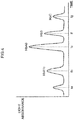
- a chromatogram is a graph illustrating a relationship between the time elapsed since the start of measurement and light absorbance as the light reception results. Which hemoglobin was detected may be found from which position the peak appeared at in the chromatogram, and the hemoglobin concentration may be found from the integrated value of light absorbance of the peaks (spike portions), namely, the magnitude of the area under the peaks.
- the measurement sample includes HbA1c and HbA0, some other form of hemoglobin, and specific hemoglobin variants such as hemoglobin C and hemoglobin S
- peaks are expected to appear at each time point ta, tb, tc, tf, and tg when eluents are switched over and delivered in sequence to the analytical column 60.
- determination may be made as to whether or not some other form of hemoglobin was detected from the calculated chromatogram by determining whether or not a peak appears at time point ta seconds.
- determination may be made as to whether or not HbA1c was detected by determining whether or not a peak appears at time point tb, determination may be made as to whether or not HbA0 was detected by determining whether or not a peak appears at time point tc, determination may be made as to whether or not HbS was detected by determining whether or not a peak appears at time point tf, and determination may be made as to whether or not variant hemoglobin C was detected by determining whether or not a peak appears at time point tg. Further, determination may be made that an unexpected type of hemoglobin was detected in cases in which a peak appeared at a time point other than at ta, tb, tc, tf, and tg. The concentration of each type of hemoglobin may be measured from the magnitude of light absorbance at the respective time point.
- the measurement sample includes HbA1c, HbA0, some other form of hemoglobin, hemoglobin C, and hemoglobin S
- HbA1c some other form of hemoglobin
- hemoglobin C some other form of hemoglobin
- hemoglobin S some other form of hemoglobin
- determination may be made as to whether or not HbA1c was detected by determining whether or not a peak appears in the vicinity of tb in the calculated chromatogram.
- HbA1c is measured based on the calculated chromatogram. Namely, as described above, determination is made as to whether or not a peak appears in the vicinity of tb, and determination is made that HbA1c was detected if a peak appears in the vicinity of tb. Then, the concentration of the HbA1c is measured from the integrated value of light absorbance of the peak in the vicinity of tb.
- the measurement results are stored in the non-volatile memory 100D. Namely, the concentration of HbA1c and whether or not hemoglobin variants were detected is stored in the non-volatile memory 100D.
- step S44 determination is made as to whether or not the above measurement has been completed for all of the blood collection tubes 11. In cases in which measurement has been completed for all of the blood collection tubes 11, the current routine is ended. In cases in which there is a blood collection tube 11 for which measurement has not been completed, processing returns to step S10 and determination is made as to whether the blood sample 13 to be measured is to be measured in the variant mode or measured in the fast mode.
- step S26 Processing transitions to step S26 in cases in which determination at step S10 is that measurement is to be measurement in the variant mode.
- the blood sample 13 is introduced, similarly to at step S12.
- solution A is supplied to the analytical column 60 for a predetermined duration. HbA1c is thereby eluted from the analytical column 60.
- solution C is supplied to the analytical column 60 for a predetermined duration. Hemoglobin other than HbA1c is thereby eluted from the analytical column 60 after the HbA1c has been eluted.
- step S32 solution A is supplied to the analytical column 60 for a predetermined duration.
- the analytical column 60 is thereby equilibrated.
- solution B is supplied to the analytical column 60 for a predetermined duration. All hemoglobin that remained on the analytical column 60 is thereby eluted and the analytical column 60 washed.
- step S3 6 solution A is supplied to the analytical column 60 for a predetermined duration.
- the analytical column 60 is thereby equilibrated.
- the sequence of solutions delivered to the analytical column 60 is solution A ⁇ solution C ⁇ solution A ⁇ solution B ⁇ solution A.
- HbA1c is measured, similarly to at step S20.
- hemoglobin variants are measured. Namely, as described above, determination is made as to whether or not a hemoglobin variant has been detected by determining whether or not a peak appears at a time point other than tb and tc. Then, in cases in which a peak appears at a time point other than tb and tc, the concentration of that hemoglobin variant is measured from the integrated value of the peak.
- the measurement result is stored in the non-volatile memory 100D.
- the concentration of the HbA1c and the concentration of the hemoglobin variant are stored in the non-volatile memory 100D.
- the present exemplary embodiment is able to switch measuring between the fast mode and the variant mode using a single instrument.
- a waveform W1 illustrated by hatching represents a waveform of the light absorbance peak for HbA1c.
- a waveform W2 represents the delivery timing of solution B.
- a waveform W3 indicates the amount of solution B remaining in the analytical column 60. Namely, the vertical axis in (1) of Fig. 5 has two meanings: the light absorbance of HbA1c and the amount of solution B remaining.
- solution A is delivered from time point t1 to time point t2
- solution B is delivered from time point t2 to time point t3
- solution A is delivered from time point t3 to time point t4.
- the amount (concentration) of solution B remaining in the analytical column 60 is not like waveform W2, and is actually a waveform that gradually increases and then gradually decreases like that of waveform W3 due to solution B mixing with the solution A that is already inside the line for introduction into the analytical column 60.
- the peak for HbA1c appears at time point t pn .
- the duration T in seconds from time point t1, this being the measurement start time, to time point t pn at which the peak for HbA1c appears is referred to as the retention time.
- the retention time at the (n + 1) th measurement namely, the duration from time point t1 to time point t pn
- the retention time of the (n + 1) th measurement namely, the duration from time point t4 to time point t p(n-1) , for example, are accordingly substantially the same as each other, and no particular issues arise.
- solution A is delivered from time point t1 to time point t2
- solution C is delivered from time point t2 to time point t3
- solution A is delivered from time point t3 to time point t4
- solution B is delivered from time point t4 to time point t5
- solution A is delivered from time point t5 to time point t6.
- time points t4 to t6 in (2) of Fig. 5 correspond with the respective time points t2 to t4 in (1) of Fig. 5 .
- the delivery duration of solution B in (2) of Fig. 5 (duration from t4 to t5) is substantially the same as the delivery duration of solution B in (1) of Fig.
- waveform W4 represents a delivery timing for solution C.
- Waveform W5 indicates the amount of solution C remaining in the analytical column 60.
- the amount of solution C remaining in the analytical column 60 is not like in waveform W4, and is actually a waveform that gradually increases and then gradually decreases like that of waveform W5, similarly to the case of solution B described above.
- time point t6 at which the (n + 1) th measurement starts, a state accordingly arises in which a small amount of the solution C that was delivered at the n th measurement still remains in the analytical column 60. Further, this is also a state in which there is a small amount of solution B remaining, similarly to in (1) of Fig. 5 .
- the timing at which the peak for HbA1c appears at the (n + 1) th measurement is therefore a seconds earlier than in the case of (1) of Fig. 5 , and the retention time is (T - a ) seconds. This is because although at time point t6 the amount of solution B remaining is substantially the same as in the case of (1) of Fig. 5 , there is solution C remaining.
- the delivery duration of the solution A delivered after solution C is made longer than in the case of (2) of Fig. 5 .
- the delivery amount of the solution A delivered after solution C is made larger than in the case of (2) of Fig. 5 .
- the delivery duration of the solution A (duration from t3 to t4) delivered after the solution C is made longer than in the case of (2) of Fig. 5 .
- the delivery duration is lengthened for delivering solution A at step S32. Note that the delivery duration of solution C, and of solution B and the solution A delivered after solution A are substantially the same as in the case of (2) of Fig. 5 .
- the delivery duration of the solution A delivered after solution C is not necessarily set to the duration until the solution C no longer issues from the analytical column 60. It is sufficient to set the delivery duration of the solution A delivered after solution C to a duration such that as an offset in retention time does not occur, even when a small amount of solution C remains in the analytical column 60.
- configuration may be made such that the delivery duration of solution A delivered after the solution B is b seconds longer than in the case of (2) of Fig. 5 , instead of making the delivery duration of the solution A delivered after solution C longer.
- the delivery duration of the solution A delivered at step S36 may be lengthened.
- the measurement duration at the n th measurement (the duration from t1 to t6) may thereby be shortened compared to the case of (3) of Fig. 5 . This is because the amount of solution B remaining is reduced commensurate to the increased amount of solution C remaining.
- the delivery duration is controlled for at least one of the solution A delivered to the analytical column 60 after delivery of solution C, namely, the solution A delivered directly after the solution C, or the solution A delivered directly after solution B, such that the retention time of HbA1c is substantially the same as the retention time of HbA1c measured in the fast mode.
- remaining components of solution B and solution C that affect the elution of HbA1c, as well as the influence from their remaining amounts may be set so as to be substantially the same at the measurement start time in the fast mode and in the variant mode.
- an offset may be suppressed from occurring in the retention time of HbA1c.
- the mode of controlling elution conditions inside the analytical column 60 is not limited thereto.
- other modes of controlling elution conditions inside the analytical column 60 include controlling an elution delivery timing, controlling an elution delivery amount, controlling an elution flow rate, adding a purging solution, and changing the elution concentration.
- Such elution conditions may be made different to the elution conditions in cases in which there is no switching between the variant mode and the fast mode so as to control such that the retention time of HbA1c c is substantially the same when measured in the variant mode and the fast mode.
- the delivery timing of solution B in the variant mode may be made different according to the difference between the first retention time and the second retention time.
- the delivery timing for solution B d seconds earlier is adjusted, and as illustrated in (2) of Fig. 6 , the first retention time of T1 seconds measured next in the variant mode is substantially the same as the second retention time of T2 seconds measured in the fast mode. Note that in the example in (2) of Fig. 6 , since the first retention time measured in the variant mode is c seconds shorter than the second retention time measured in the fast mode, the delivery timing for solution B is made earlier by d seconds.
- the delivery timing for solution B would be delayed by d seconds.
- the extent of adjustment in the delivery timing for solution B according to the difference between the first retention time and the second retention time, namely, a correspondence relationship between c seconds and d seconds, may be found by experimentation in advance or may be found from the measurement results from repeating actual measurements.
- the pre-filter PF is provided between the injection valve 63 and the analytical column 60
- configuration may be made in which the pre-filter PF is integrated with the analytical column 60. This enables the volume of line 85 to be reduced and enables the amount of solution C remaining to be suppressed as much as possible. The occurrence of an offset in HbA1c retention time may be therefore suppressed as much as possible.
- a calibration sample (referred to as a calibrator below) is used to calibrate the liquid chromatography instrument (referred to as calibration below). Further, even in cases in which there is no concern that the measurement conditions have changed, calibration is normally performed regularly to maintain measurement accuracy.
- a line 83 laid to connect the dilution tank 53 and the injection valve 63 together may be given a volume capable of holding at least two measurement's worth of measurement sample, and the following approach adopted.
- two measurement's worth of LOW calibrator may be held in the line 83 and calibration performed using the LOW calibrator in each measurement mode, i.e. in the variant mode and the fast mode, recording the measurement results of the respective measurement modes.
- Two measurement's worth of HIGH calibrator may then be held in the line 83 and calibration performed using the HIGH calibrator in each measurement mode, i.e. in the variant mode and the fast mode, recording the measurement results of the respective measurement modes.
- Measurements are thereby performed in the sequence LOW (variant mode) ⁇ LOW (fast mode) ⁇ HIGH (variant mode) ⁇ HIGH (fast mode), with the calibrator switched once, and the flow path washed once.
- This enables calibration procedures to be simplified and enables costs to be reduced while also enabling a reduction in the possibility of user error, such as putting in the wrong sequence or putting in the wrong number of calibrators.
- this method is not limited to application in calibration and may be employed in measurement (control measurement) using quality control solutions (samples), thereby enabling a contribution to cost reduction, such as a reduction in the amount of reagents used, a reduction in the amount of quality control solution used, and so on, and also enabling a reduction in user error, such as putting the quality control solutions in wrongly.
- a procedure may be adopted in which half of the measurement sample is used first to perform measurement in the fast mode, and when an abnormality has occurred, such as, as for example, when the measured value for HbA1c is an abnormally low value, the remaining half of the measurement sample is then used to perform measurement in the variant mode.
- the present disclosure is not limited to the exemplary embodiment described above, and various modifications thereto are possible.
- an HPLC instrument for measuring hemoglobin concentration in blood there is no limitation to an HPLC instrument for measuring hemoglobin concentration in blood, and the present disclosure may be applied to cases in which a sample other than blood is used, to cases in which concentration of a component other than hemoglobin concentration is measured, or to a liquid chromatography instrument other than an HPLC instrument.
Landscapes
- Health & Medical Sciences (AREA)
- Life Sciences & Earth Sciences (AREA)
- Physics & Mathematics (AREA)
- Chemical & Material Sciences (AREA)
- General Health & Medical Sciences (AREA)
- Biochemistry (AREA)
- General Physics & Mathematics (AREA)
- Immunology (AREA)
- Pathology (AREA)
- Analytical Chemistry (AREA)
- Engineering & Computer Science (AREA)
- Biomedical Technology (AREA)
- Hematology (AREA)
- Ecology (AREA)
- Biophysics (AREA)
- Molecular Biology (AREA)
- Urology & Nephrology (AREA)
- Food Science & Technology (AREA)
- Medicinal Chemistry (AREA)
- Investigating Or Analysing Biological Materials (AREA)
Applications Claiming Priority (2)
| Application Number | Priority Date | Filing Date | Title |
|---|---|---|---|
| JP2016084718 | 2016-04-20 | ||
| JP2017077851A JP6856434B2 (ja) | 2016-04-20 | 2017-04-10 | 液体クロマトグラフィ測定方法、液体クロマトグラフィ測定装置、及び液体クロマトグラフィ測定プログラム |
Publications (2)
| Publication Number | Publication Date |
|---|---|
| EP3236257A1 true EP3236257A1 (fr) | 2017-10-25 |
| EP3236257B1 EP3236257B1 (fr) | 2020-09-09 |
Family
ID=58632791
Family Applications (1)
| Application Number | Title | Priority Date | Filing Date |
|---|---|---|---|
| EP17167119.1A Active EP3236257B1 (fr) | 2016-04-20 | 2017-04-19 | Procédé de mesure de chromatographie en phase liquide, instrument de mesure de chromatographie en phase liquide, programme de mesure de chromatographie en phase liquide et support d'informations |
Country Status (3)
| Country | Link |
|---|---|
| US (1) | US10527594B2 (fr) |
| EP (1) | EP3236257B1 (fr) |
| CN (1) | CN107305204B (fr) |
Families Citing this family (1)
| Publication number | Priority date | Publication date | Assignee | Title |
|---|---|---|---|---|
| JP2024165957A (ja) * | 2023-05-18 | 2024-11-28 | アークレイ株式会社 | 分析システム |
Citations (7)
| Publication number | Priority date | Publication date | Assignee | Title |
|---|---|---|---|---|
| US5543315A (en) * | 1992-06-30 | 1996-08-06 | Kyoto Daiichi Kagaku Co., Ltd. | Method for stabilizing measurement values by high speed liquid chromatography |
| WO1997041771A1 (fr) * | 1996-05-06 | 1997-11-13 | Primus Corporation | Procede chromatographique servant a identifier et a caracteriser des variants d'hemoglobine dans le sang |
| JPH1010107A (ja) * | 1996-06-21 | 1998-01-16 | Sekisui Chem Co Ltd | 液体クロマトグラフィーによる試料の分析方法 |
| EP1103812A1 (fr) * | 1998-08-07 | 2001-05-30 | Sekisui Chemical Co., Ltd. | Procede de determination d'hemoglobines |
| EP2012111A1 (fr) * | 2006-03-24 | 2009-01-07 | Arkray, Inc. | Procédé de mesure de concentration en hémoglobine glyquée et appareil de mesure de concentration |
| JP2009236768A (ja) | 2008-03-27 | 2009-10-15 | Sekisui Chem Co Ltd | ヘモグロビン類の測定方法 |
| EP2447712A2 (fr) * | 2010-10-28 | 2012-05-02 | Arkray, Inc. | Procédé d'étalonnage pour la mesure d'hémoglobine A1c |
Family Cites Families (11)
| Publication number | Priority date | Publication date | Assignee | Title |
|---|---|---|---|---|
| WO1990006516A1 (fr) * | 1988-12-05 | 1990-06-14 | Primus Corporation | Procede de determination d'especes proteiques glucosees |
| JP2619537B2 (ja) * | 1989-09-18 | 1997-06-11 | 株式会社日立製作所 | 液体クロマトグラフの方法,その装置,そのシステム,及びその分離カラム |
| JP3131439B2 (ja) * | 1990-09-21 | 2001-01-31 | 株式会社日立製作所 | 液体クロマトグラフ装置 |
| JP2800509B2 (ja) * | 1990-11-30 | 1998-09-21 | 株式会社日立製作所 | 液体クロマトグラフ装置 |
| JP4420539B2 (ja) * | 1999-09-24 | 2010-02-24 | 積水化学工業株式会社 | ヘモグロビンa2の分離方法 |
| JP4989628B2 (ja) * | 2006-03-24 | 2012-08-01 | アークレイ株式会社 | グリコヘモグロビン濃度測定方法および濃度測定装置 |
| JP2011141120A (ja) * | 2008-10-07 | 2011-07-21 | Arkray Inc | 液体クロマトグラフィ装置および液体クロマトグラフィ |
| US20130199277A1 (en) * | 2010-02-02 | 2013-08-08 | Hiroaki Taira | Hemoglobin s analysis method, hemoglobin a2 analysis method, and hemoglobin a0 analysis method |
| JP5843509B2 (ja) * | 2010-07-26 | 2016-01-13 | アークレイ株式会社 | クロマトグラムの表示方法 |
| EP2762876A4 (fr) * | 2011-09-29 | 2015-05-06 | Sekisui Medical Co Ltd | PROCÉDÉ DE MESURE D'HÉMOGLOBINE A1c STABLE À L'AIDE DE CHROMATOGRAPHIE LIQUIDE ET PROCÉDÉ DE MESURE SIMULTANÉE D'HÉMOGLOBINE A1c STABLE ET D'HÉMOGLOBINE ANORMALE À L'AIDE DE CHROMATOGRAPHIE LIQUIDE |
| JP2016027326A (ja) * | 2014-06-26 | 2016-02-18 | アークレイ株式会社 | 測定方法、測定装置および溶離液 |
-
2017
- 2017-04-18 US US15/490,320 patent/US10527594B2/en active Active
- 2017-04-19 EP EP17167119.1A patent/EP3236257B1/fr active Active
- 2017-04-20 CN CN201710260487.0A patent/CN107305204B/zh active Active
Patent Citations (7)
| Publication number | Priority date | Publication date | Assignee | Title |
|---|---|---|---|---|
| US5543315A (en) * | 1992-06-30 | 1996-08-06 | Kyoto Daiichi Kagaku Co., Ltd. | Method for stabilizing measurement values by high speed liquid chromatography |
| WO1997041771A1 (fr) * | 1996-05-06 | 1997-11-13 | Primus Corporation | Procede chromatographique servant a identifier et a caracteriser des variants d'hemoglobine dans le sang |
| JPH1010107A (ja) * | 1996-06-21 | 1998-01-16 | Sekisui Chem Co Ltd | 液体クロマトグラフィーによる試料の分析方法 |
| EP1103812A1 (fr) * | 1998-08-07 | 2001-05-30 | Sekisui Chemical Co., Ltd. | Procede de determination d'hemoglobines |
| EP2012111A1 (fr) * | 2006-03-24 | 2009-01-07 | Arkray, Inc. | Procédé de mesure de concentration en hémoglobine glyquée et appareil de mesure de concentration |
| JP2009236768A (ja) | 2008-03-27 | 2009-10-15 | Sekisui Chem Co Ltd | ヘモグロビン類の測定方法 |
| EP2447712A2 (fr) * | 2010-10-28 | 2012-05-02 | Arkray, Inc. | Procédé d'étalonnage pour la mesure d'hémoglobine A1c |
Non-Patent Citations (3)
| Title |
|---|
| "BIORAD PRODUCT INFORMATION FOR THE VARIANT HBA2[HBF]HBA1C DUAL KIT PROGRAM", INTERNET CITATION, 13 April 2004 (2004-04-13), XP002276792, Retrieved from the Internet <URL:http://www.bio-rad.com/B2B/BioRad/product/br_category.jsp?BV> [retrieved on 20040413] * |
| E LAVALARD ET AL: "Evaluation of Variant II analyzer equipped with the new 270-2101 NU kit (Bio-Rad) for HbA 1c assay", ANN BIOL CLIN, 1 January 2009 (2009-01-01), pages 55 - 65, XP055387773, Retrieved from the Internet <URL:http://www.jle.com/download/abc-279899-evaluation_de_lanalyseur_variant_ii_equipe_de_la_nouvelle_trousse_270_2101_nu_bio_rad_pour_le_dosage_de_l--WVuNHX8AAQEAAHRH9vkAAAAO-a.pdf> [retrieved on 20170704], DOI: 10.1684/abc.2008.0289 * |
| RIOU J ET AL: "Cation-exchange HPLC evaluated for presumptive identification of hemoglobin variants", CLINICAL CHEMISTRY, AMERICAN ASSOCIATION FOR CLINICAL CHEMISTRY, WASHINGTON, DC, vol. 43, no. 1, 1 January 1997 (1997-01-01), pages 34 - 39, XP002276791, ISSN: 0009-9147 * |
Also Published As
| Publication number | Publication date |
|---|---|
| US20170307571A1 (en) | 2017-10-26 |
| CN107305204A (zh) | 2017-10-31 |
| CN107305204B (zh) | 2021-08-17 |
| EP3236257B1 (fr) | 2020-09-09 |
| US10527594B2 (en) | 2020-01-07 |
Similar Documents
| Publication | Publication Date | Title |
|---|---|---|
| JP6657003B2 (ja) | 糖化ヘモグロビン測定方法、糖化ヘモグロビン測定装置、及び糖化ヘモグロビン測定プログラム | |
| EP4187243B1 (fr) | Procédé et appareil d'injection d'un échantillon chromatographique | |
| JP6856434B2 (ja) | 液体クロマトグラフィ測定方法、液体クロマトグラフィ測定装置、及び液体クロマトグラフィ測定プログラム | |
| US8775098B2 (en) | Preparative liquid chromatograph system | |
| US20200033302A1 (en) | Autosampler and liquid chromatograph | |
| WO2010041637A1 (fr) | Dispositif de chromatographie en phase liquide et chromatographie en phase liquide | |
| US12111297B2 (en) | Liquid chromatograph and analysis method using liquid chromatograph | |
| US9841407B2 (en) | Liquid chromatograph and liquid chromatograph analysis method | |
| WO2015063886A1 (fr) | Appareil de chromatographie en phase liquide | |
| EP3236257B1 (fr) | Procédé de mesure de chromatographie en phase liquide, instrument de mesure de chromatographie en phase liquide, programme de mesure de chromatographie en phase liquide et support d'informations | |
| US10203308B2 (en) | Sample concentration device | |
| JP2005257575A (ja) | クロマトグラフ装置 | |
| EP3236256A1 (fr) | Chromatographe en phase liquide | |
| US11061003B2 (en) | Method and apparatus for injecting a chromatographic sample | |
| JP2015127700A (ja) | 液体クロマトグラフィ測定方法、液体クロマトグラフィ測定装置、及び液体クロマトグラフィ測定プログラム | |
| CN218938207U (zh) | 一种在线多步稀释的固相萃取-液相色谱二维分离系统 | |
| JP4536570B2 (ja) | 液体クロマトグラフ分析装置 | |
| JP2005128030A (ja) | 液体クロマトグラフ | |
| JP4687416B2 (ja) | クロマトグラフ用データ処理装置 | |
| US20260063602A1 (en) | Chromatogram analysis apparatus | |
| WO2022190605A1 (fr) | Procédé de commande pour dispositif d'analyse automatisé | |
| JP7562956B2 (ja) | 連続した液体クロマトグラフ | |
| JP5002659B2 (ja) | 液体クロマトグラフ装置、および分析用プログラム | |
| JP2023020352A (ja) | イオン交換クロマトグラフの制御方法およびイオン交換クロマトグラフ |
Legal Events
| Date | Code | Title | Description |
|---|---|---|---|
| PUAI | Public reference made under article 153(3) epc to a published international application that has entered the european phase |
Free format text: ORIGINAL CODE: 0009012 |
|
| STAA | Information on the status of an ep patent application or granted ep patent |
Free format text: STATUS: THE APPLICATION HAS BEEN PUBLISHED |
|
| AK | Designated contracting states |
Kind code of ref document: A1 Designated state(s): AL AT BE BG CH CY CZ DE DK EE ES FI FR GB GR HR HU IE IS IT LI LT LU LV MC MK MT NL NO PL PT RO RS SE SI SK SM TR |
|
| AX | Request for extension of the european patent |
Extension state: BA ME |
|
| STAA | Information on the status of an ep patent application or granted ep patent |
Free format text: STATUS: REQUEST FOR EXAMINATION WAS MADE |
|
| 17P | Request for examination filed |
Effective date: 20180425 |
|
| RBV | Designated contracting states (corrected) |
Designated state(s): AL AT BE BG CH CY CZ DE DK EE ES FI FR GB GR HR HU IE IS IT LI LT LU LV MC MK MT NL NO PL PT RO RS SE SI SK SM TR |
|
| STAA | Information on the status of an ep patent application or granted ep patent |
Free format text: STATUS: EXAMINATION IS IN PROGRESS |
|
| 17Q | First examination report despatched |
Effective date: 20190417 |
|
| GRAP | Despatch of communication of intention to grant a patent |
Free format text: ORIGINAL CODE: EPIDOSNIGR1 |
|
| STAA | Information on the status of an ep patent application or granted ep patent |
Free format text: STATUS: GRANT OF PATENT IS INTENDED |
|
| INTG | Intention to grant announced |
Effective date: 20200507 |
|
| GRAS | Grant fee paid |
Free format text: ORIGINAL CODE: EPIDOSNIGR3 |
|
| GRAA | (expected) grant |
Free format text: ORIGINAL CODE: 0009210 |
|
| STAA | Information on the status of an ep patent application or granted ep patent |
Free format text: STATUS: THE PATENT HAS BEEN GRANTED |
|
| AK | Designated contracting states |
Kind code of ref document: B1 Designated state(s): AL AT BE BG CH CY CZ DE DK EE ES FI FR GB GR HR HU IE IS IT LI LT LU LV MC MK MT NL NO PL PT RO RS SE SI SK SM TR |
|
| REG | Reference to a national code |
Ref country code: GB Ref legal event code: FG4D |
|
| REG | Reference to a national code |
Ref country code: AT Ref legal event code: REF Ref document number: 1312210 Country of ref document: AT Kind code of ref document: T Effective date: 20200915 Ref country code: CH Ref legal event code: EP |
|
| REG | Reference to a national code |
Ref country code: DE Ref legal event code: R096 Ref document number: 602017023111 Country of ref document: DE |
|
| REG | Reference to a national code |
Ref country code: IE Ref legal event code: FG4D |
|
| REG | Reference to a national code |
Ref country code: LT Ref legal event code: MG4D |
|
| PG25 | Lapsed in a contracting state [announced via postgrant information from national office to epo] |
Ref country code: BG Free format text: LAPSE BECAUSE OF FAILURE TO SUBMIT A TRANSLATION OF THE DESCRIPTION OR TO PAY THE FEE WITHIN THE PRESCRIBED TIME-LIMIT Effective date: 20201209 Ref country code: GR Free format text: LAPSE BECAUSE OF FAILURE TO SUBMIT A TRANSLATION OF THE DESCRIPTION OR TO PAY THE FEE WITHIN THE PRESCRIBED TIME-LIMIT Effective date: 20201210 Ref country code: LT Free format text: LAPSE BECAUSE OF FAILURE TO SUBMIT A TRANSLATION OF THE DESCRIPTION OR TO PAY THE FEE WITHIN THE PRESCRIBED TIME-LIMIT Effective date: 20200909 Ref country code: HR Free format text: LAPSE BECAUSE OF FAILURE TO SUBMIT A TRANSLATION OF THE DESCRIPTION OR TO PAY THE FEE WITHIN THE PRESCRIBED TIME-LIMIT Effective date: 20200909 Ref country code: SE Free format text: LAPSE BECAUSE OF FAILURE TO SUBMIT A TRANSLATION OF THE DESCRIPTION OR TO PAY THE FEE WITHIN THE PRESCRIBED TIME-LIMIT Effective date: 20200909 Ref country code: NO Free format text: LAPSE BECAUSE OF FAILURE TO SUBMIT A TRANSLATION OF THE DESCRIPTION OR TO PAY THE FEE WITHIN THE PRESCRIBED TIME-LIMIT Effective date: 20201209 Ref country code: FI Free format text: LAPSE BECAUSE OF FAILURE TO SUBMIT A TRANSLATION OF THE DESCRIPTION OR TO PAY THE FEE WITHIN THE PRESCRIBED TIME-LIMIT Effective date: 20200909 |
|
| REG | Reference to a national code |
Ref country code: AT Ref legal event code: MK05 Ref document number: 1312210 Country of ref document: AT Kind code of ref document: T Effective date: 20200909 |
|
| REG | Reference to a national code |
Ref country code: NL Ref legal event code: MP Effective date: 20200909 |
|
| PG25 | Lapsed in a contracting state [announced via postgrant information from national office to epo] |
Ref country code: RS Free format text: LAPSE BECAUSE OF FAILURE TO SUBMIT A TRANSLATION OF THE DESCRIPTION OR TO PAY THE FEE WITHIN THE PRESCRIBED TIME-LIMIT Effective date: 20200909 Ref country code: LV Free format text: LAPSE BECAUSE OF FAILURE TO SUBMIT A TRANSLATION OF THE DESCRIPTION OR TO PAY THE FEE WITHIN THE PRESCRIBED TIME-LIMIT Effective date: 20200909 Ref country code: PL Free format text: LAPSE BECAUSE OF FAILURE TO SUBMIT A TRANSLATION OF THE DESCRIPTION OR TO PAY THE FEE WITHIN THE PRESCRIBED TIME-LIMIT Effective date: 20200909 |
|
| PG25 | Lapsed in a contracting state [announced via postgrant information from national office to epo] |
Ref country code: EE Free format text: LAPSE BECAUSE OF FAILURE TO SUBMIT A TRANSLATION OF THE DESCRIPTION OR TO PAY THE FEE WITHIN THE PRESCRIBED TIME-LIMIT Effective date: 20200909 Ref country code: SM Free format text: LAPSE BECAUSE OF FAILURE TO SUBMIT A TRANSLATION OF THE DESCRIPTION OR TO PAY THE FEE WITHIN THE PRESCRIBED TIME-LIMIT Effective date: 20200909 Ref country code: CZ Free format text: LAPSE BECAUSE OF FAILURE TO SUBMIT A TRANSLATION OF THE DESCRIPTION OR TO PAY THE FEE WITHIN THE PRESCRIBED TIME-LIMIT Effective date: 20200909 Ref country code: RO Free format text: LAPSE BECAUSE OF FAILURE TO SUBMIT A TRANSLATION OF THE DESCRIPTION OR TO PAY THE FEE WITHIN THE PRESCRIBED TIME-LIMIT Effective date: 20200909 Ref country code: PT Free format text: LAPSE BECAUSE OF FAILURE TO SUBMIT A TRANSLATION OF THE DESCRIPTION OR TO PAY THE FEE WITHIN THE PRESCRIBED TIME-LIMIT Effective date: 20210111 |
|
| PG25 | Lapsed in a contracting state [announced via postgrant information from national office to epo] |
Ref country code: AL Free format text: LAPSE BECAUSE OF FAILURE TO SUBMIT A TRANSLATION OF THE DESCRIPTION OR TO PAY THE FEE WITHIN THE PRESCRIBED TIME-LIMIT Effective date: 20200909 Ref country code: AT Free format text: LAPSE BECAUSE OF FAILURE TO SUBMIT A TRANSLATION OF THE DESCRIPTION OR TO PAY THE FEE WITHIN THE PRESCRIBED TIME-LIMIT Effective date: 20200909 Ref country code: ES Free format text: LAPSE BECAUSE OF FAILURE TO SUBMIT A TRANSLATION OF THE DESCRIPTION OR TO PAY THE FEE WITHIN THE PRESCRIBED TIME-LIMIT Effective date: 20200909 Ref country code: IS Free format text: LAPSE BECAUSE OF FAILURE TO SUBMIT A TRANSLATION OF THE DESCRIPTION OR TO PAY THE FEE WITHIN THE PRESCRIBED TIME-LIMIT Effective date: 20210109 |
|
| REG | Reference to a national code |
Ref country code: DE Ref legal event code: R097 Ref document number: 602017023111 Country of ref document: DE |
|
| PG25 | Lapsed in a contracting state [announced via postgrant information from national office to epo] |
Ref country code: SK Free format text: LAPSE BECAUSE OF FAILURE TO SUBMIT A TRANSLATION OF THE DESCRIPTION OR TO PAY THE FEE WITHIN THE PRESCRIBED TIME-LIMIT Effective date: 20200909 |
|
| PLBE | No opposition filed within time limit |
Free format text: ORIGINAL CODE: 0009261 |
|
| STAA | Information on the status of an ep patent application or granted ep patent |
Free format text: STATUS: NO OPPOSITION FILED WITHIN TIME LIMIT |
|
| 26N | No opposition filed |
Effective date: 20210610 |
|
| PG25 | Lapsed in a contracting state [announced via postgrant information from national office to epo] |
Ref country code: SI Free format text: LAPSE BECAUSE OF FAILURE TO SUBMIT A TRANSLATION OF THE DESCRIPTION OR TO PAY THE FEE WITHIN THE PRESCRIBED TIME-LIMIT Effective date: 20200909 Ref country code: DK Free format text: LAPSE BECAUSE OF FAILURE TO SUBMIT A TRANSLATION OF THE DESCRIPTION OR TO PAY THE FEE WITHIN THE PRESCRIBED TIME-LIMIT Effective date: 20200909 |
|
| PG25 | Lapsed in a contracting state [announced via postgrant information from national office to epo] |
Ref country code: MC Free format text: LAPSE BECAUSE OF FAILURE TO SUBMIT A TRANSLATION OF THE DESCRIPTION OR TO PAY THE FEE WITHIN THE PRESCRIBED TIME-LIMIT Effective date: 20200909 |
|
| PG25 | Lapsed in a contracting state [announced via postgrant information from national office to epo] |
Ref country code: LU Free format text: LAPSE BECAUSE OF NON-PAYMENT OF DUE FEES Effective date: 20210419 |
|
| REG | Reference to a national code |
Ref country code: BE Ref legal event code: MM Effective date: 20210430 |
|
| PG25 | Lapsed in a contracting state [announced via postgrant information from national office to epo] |
Ref country code: CH Free format text: LAPSE BECAUSE OF NON-PAYMENT OF DUE FEES Effective date: 20210430 Ref country code: LI Free format text: LAPSE BECAUSE OF NON-PAYMENT OF DUE FEES Effective date: 20210430 |
|
| PG25 | Lapsed in a contracting state [announced via postgrant information from national office to epo] |
Ref country code: IE Free format text: LAPSE BECAUSE OF NON-PAYMENT OF DUE FEES Effective date: 20210419 |
|
| PG25 | Lapsed in a contracting state [announced via postgrant information from national office to epo] |
Ref country code: IS Free format text: LAPSE BECAUSE OF FAILURE TO SUBMIT A TRANSLATION OF THE DESCRIPTION OR TO PAY THE FEE WITHIN THE PRESCRIBED TIME-LIMIT Effective date: 20210109 |
|
| PG25 | Lapsed in a contracting state [announced via postgrant information from national office to epo] |
Ref country code: BE Free format text: LAPSE BECAUSE OF NON-PAYMENT OF DUE FEES Effective date: 20210430 |
|
| PG25 | Lapsed in a contracting state [announced via postgrant information from national office to epo] |
Ref country code: HU Free format text: LAPSE BECAUSE OF FAILURE TO SUBMIT A TRANSLATION OF THE DESCRIPTION OR TO PAY THE FEE WITHIN THE PRESCRIBED TIME-LIMIT; INVALID AB INITIO Effective date: 20170419 |
|
| PG25 | Lapsed in a contracting state [announced via postgrant information from national office to epo] |
Ref country code: NL Free format text: LAPSE BECAUSE OF NON-PAYMENT OF DUE FEES Effective date: 20200923 Ref country code: CY Free format text: LAPSE BECAUSE OF FAILURE TO SUBMIT A TRANSLATION OF THE DESCRIPTION OR TO PAY THE FEE WITHIN THE PRESCRIBED TIME-LIMIT Effective date: 20200909 |
|
| PG25 | Lapsed in a contracting state [announced via postgrant information from national office to epo] |
Ref country code: MK Free format text: LAPSE BECAUSE OF FAILURE TO SUBMIT A TRANSLATION OF THE DESCRIPTION OR TO PAY THE FEE WITHIN THE PRESCRIBED TIME-LIMIT Effective date: 20200909 |
|
| PG25 | Lapsed in a contracting state [announced via postgrant information from national office to epo] |
Ref country code: TR Free format text: LAPSE BECAUSE OF FAILURE TO SUBMIT A TRANSLATION OF THE DESCRIPTION OR TO PAY THE FEE WITHIN THE PRESCRIBED TIME-LIMIT Effective date: 20200909 |
|
| PG25 | Lapsed in a contracting state [announced via postgrant information from national office to epo] |
Ref country code: MT Free format text: LAPSE BECAUSE OF FAILURE TO SUBMIT A TRANSLATION OF THE DESCRIPTION OR TO PAY THE FEE WITHIN THE PRESCRIBED TIME-LIMIT Effective date: 20200909 |
|
| PGFP | Annual fee paid to national office [announced via postgrant information from national office to epo] |
Ref country code: DE Payment date: 20250422 Year of fee payment: 9 |
|
| PGFP | Annual fee paid to national office [announced via postgrant information from national office to epo] |
Ref country code: GB Payment date: 20250423 Year of fee payment: 9 |
|
| PGFP | Annual fee paid to national office [announced via postgrant information from national office to epo] |
Ref country code: IT Payment date: 20250424 Year of fee payment: 9 |
|
| PGFP | Annual fee paid to national office [announced via postgrant information from national office to epo] |
Ref country code: FR Payment date: 20250425 Year of fee payment: 9 |