EP3239334A1 - Plaque d'acier ayant une excellente résistance à la fissuration sous hydrogène et tube en acier pour tube de canalisation - Google Patents
Plaque d'acier ayant une excellente résistance à la fissuration sous hydrogène et tube en acier pour tube de canalisation Download PDFInfo
- Publication number
- EP3239334A1 EP3239334A1 EP15873097.8A EP15873097A EP3239334A1 EP 3239334 A1 EP3239334 A1 EP 3239334A1 EP 15873097 A EP15873097 A EP 15873097A EP 3239334 A1 EP3239334 A1 EP 3239334A1
- Authority
- EP
- European Patent Office
- Prior art keywords
- segregated particle
- steel plate
- particle size
- number density
- slab
- Prior art date
- Legal status (The legal status is an assumption and is not a legal conclusion. Google has not performed a legal analysis and makes no representation as to the accuracy of the status listed.)
- Withdrawn
Links
Images



Classifications
-
- C—CHEMISTRY; METALLURGY
- C22—METALLURGY; FERROUS OR NON-FERROUS ALLOYS; TREATMENT OF ALLOYS OR NON-FERROUS METALS
- C22C—ALLOYS
- C22C38/00—Ferrous alloys, e.g. steel alloys
- C22C38/14—Ferrous alloys, e.g. steel alloys containing titanium or zirconium
-
- C—CHEMISTRY; METALLURGY
- C21—METALLURGY OF IRON
- C21D—MODIFYING THE PHYSICAL STRUCTURE OF FERROUS METALS; GENERAL DEVICES FOR HEAT TREATMENT OF FERROUS OR NON-FERROUS METALS OR ALLOYS; MAKING METAL MALLEABLE, e.g. BY DECARBURISATION OR TEMPERING
- C21D8/00—Modifying the physical properties of ferrous metals or ferrous alloys by deformation combined with, or followed by, heat treatment
- C21D8/02—Modifying the physical properties of ferrous metals or ferrous alloys by deformation combined with, or followed by, heat treatment during manufacturing of plates or strips
- C21D8/0221—Modifying the physical properties of ferrous metals or ferrous alloys by deformation combined with, or followed by, heat treatment during manufacturing of plates or strips characterised by the working steps
-
- C—CHEMISTRY; METALLURGY
- C21—METALLURGY OF IRON
- C21D—MODIFYING THE PHYSICAL STRUCTURE OF FERROUS METALS; GENERAL DEVICES FOR HEAT TREATMENT OF FERROUS OR NON-FERROUS METALS OR ALLOYS; MAKING METAL MALLEABLE, e.g. BY DECARBURISATION OR TEMPERING
- C21D8/00—Modifying the physical properties of ferrous metals or ferrous alloys by deformation combined with, or followed by, heat treatment
- C21D8/02—Modifying the physical properties of ferrous metals or ferrous alloys by deformation combined with, or followed by, heat treatment during manufacturing of plates or strips
- C21D8/0221—Modifying the physical properties of ferrous metals or ferrous alloys by deformation combined with, or followed by, heat treatment during manufacturing of plates or strips characterised by the working steps
- C21D8/0226—Hot rolling
-
- C—CHEMISTRY; METALLURGY
- C21—METALLURGY OF IRON
- C21D—MODIFYING THE PHYSICAL STRUCTURE OF FERROUS METALS; GENERAL DEVICES FOR HEAT TREATMENT OF FERROUS OR NON-FERROUS METALS OR ALLOYS; MAKING METAL MALLEABLE, e.g. BY DECARBURISATION OR TEMPERING
- C21D8/00—Modifying the physical properties of ferrous metals or ferrous alloys by deformation combined with, or followed by, heat treatment
- C21D8/02—Modifying the physical properties of ferrous metals or ferrous alloys by deformation combined with, or followed by, heat treatment during manufacturing of plates or strips
- C21D8/0247—Modifying the physical properties of ferrous metals or ferrous alloys by deformation combined with, or followed by, heat treatment during manufacturing of plates or strips characterised by the heat treatment
- C21D8/0263—Modifying the physical properties of ferrous metals or ferrous alloys by deformation combined with, or followed by, heat treatment during manufacturing of plates or strips characterised by the heat treatment following hot rolling
-
- C—CHEMISTRY; METALLURGY
- C22—METALLURGY; FERROUS OR NON-FERROUS ALLOYS; TREATMENT OF ALLOYS OR NON-FERROUS METALS
- C22C—ALLOYS
- C22C38/00—Ferrous alloys, e.g. steel alloys
- C22C38/001—Ferrous alloys, e.g. steel alloys containing N
-
- C—CHEMISTRY; METALLURGY
- C22—METALLURGY; FERROUS OR NON-FERROUS ALLOYS; TREATMENT OF ALLOYS OR NON-FERROUS METALS
- C22C—ALLOYS
- C22C38/00—Ferrous alloys, e.g. steel alloys
- C22C38/002—Ferrous alloys, e.g. steel alloys containing In, Mg, or other elements not provided for in one single group C22C38/001 - C22C38/60
-
- C—CHEMISTRY; METALLURGY
- C22—METALLURGY; FERROUS OR NON-FERROUS ALLOYS; TREATMENT OF ALLOYS OR NON-FERROUS METALS
- C22C—ALLOYS
- C22C38/00—Ferrous alloys, e.g. steel alloys
- C22C38/005—Ferrous alloys, e.g. steel alloys containing rare earths, i.e. Sc, Y, Lanthanides
-
- C—CHEMISTRY; METALLURGY
- C22—METALLURGY; FERROUS OR NON-FERROUS ALLOYS; TREATMENT OF ALLOYS OR NON-FERROUS METALS
- C22C—ALLOYS
- C22C38/00—Ferrous alloys, e.g. steel alloys
- C22C38/02—Ferrous alloys, e.g. steel alloys containing silicon
-
- C—CHEMISTRY; METALLURGY
- C22—METALLURGY; FERROUS OR NON-FERROUS ALLOYS; TREATMENT OF ALLOYS OR NON-FERROUS METALS
- C22C—ALLOYS
- C22C38/00—Ferrous alloys, e.g. steel alloys
- C22C38/04—Ferrous alloys, e.g. steel alloys containing manganese
-
- C—CHEMISTRY; METALLURGY
- C22—METALLURGY; FERROUS OR NON-FERROUS ALLOYS; TREATMENT OF ALLOYS OR NON-FERROUS METALS
- C22C—ALLOYS
- C22C38/00—Ferrous alloys, e.g. steel alloys
- C22C38/06—Ferrous alloys, e.g. steel alloys containing aluminium
-
- C—CHEMISTRY; METALLURGY
- C22—METALLURGY; FERROUS OR NON-FERROUS ALLOYS; TREATMENT OF ALLOYS OR NON-FERROUS METALS
- C22C—ALLOYS
- C22C38/00—Ferrous alloys, e.g. steel alloys
- C22C38/08—Ferrous alloys, e.g. steel alloys containing nickel
-
- C—CHEMISTRY; METALLURGY
- C22—METALLURGY; FERROUS OR NON-FERROUS ALLOYS; TREATMENT OF ALLOYS OR NON-FERROUS METALS
- C22C—ALLOYS
- C22C38/00—Ferrous alloys, e.g. steel alloys
- C22C38/12—Ferrous alloys, e.g. steel alloys containing tungsten, tantalum, molybdenum, vanadium, or niobium
-
- C—CHEMISTRY; METALLURGY
- C22—METALLURGY; FERROUS OR NON-FERROUS ALLOYS; TREATMENT OF ALLOYS OR NON-FERROUS METALS
- C22C—ALLOYS
- C22C38/00—Ferrous alloys, e.g. steel alloys
- C22C38/16—Ferrous alloys, e.g. steel alloys containing copper
-
- C—CHEMISTRY; METALLURGY
- C22—METALLURGY; FERROUS OR NON-FERROUS ALLOYS; TREATMENT OF ALLOYS OR NON-FERROUS METALS
- C22C—ALLOYS
- C22C38/00—Ferrous alloys, e.g. steel alloys
- C22C38/18—Ferrous alloys, e.g. steel alloys containing chromium
- C22C38/40—Ferrous alloys, e.g. steel alloys containing chromium with nickel
- C22C38/58—Ferrous alloys, e.g. steel alloys containing chromium with nickel with more than 1.5% by weight of manganese
-
- C—CHEMISTRY; METALLURGY
- C21—METALLURGY OF IRON
- C21C—PROCESSING OF PIG-IRON, e.g. REFINING, MANUFACTURE OF WROUGHT-IRON OR STEEL; TREATMENT IN MOLTEN STATE OF FERROUS ALLOYS
- C21C7/00—Treating molten ferrous alloys, e.g. steel, not covered by groups C21C1/00 - C21C5/00
- C21C7/04—Removing impurities by adding a treating agent
- C21C7/064—Dephosphorising; Desulfurising
-
- C—CHEMISTRY; METALLURGY
- C21—METALLURGY OF IRON
- C21D—MODIFYING THE PHYSICAL STRUCTURE OF FERROUS METALS; GENERAL DEVICES FOR HEAT TREATMENT OF FERROUS OR NON-FERROUS METALS OR ALLOYS; MAKING METAL MALLEABLE, e.g. BY DECARBURISATION OR TEMPERING
- C21D2211/00—Microstructure comprising significant phases
- C21D2211/004—Dispersions; Precipitations
-
- C—CHEMISTRY; METALLURGY
- C21—METALLURGY OF IRON
- C21D—MODIFYING THE PHYSICAL STRUCTURE OF FERROUS METALS; GENERAL DEVICES FOR HEAT TREATMENT OF FERROUS OR NON-FERROUS METALS OR ALLOYS; MAKING METAL MALLEABLE, e.g. BY DECARBURISATION OR TEMPERING
- C21D9/00—Heat treatment, e.g. annealing, hardening, quenching or tempering, adapted for particular articles; Furnaces therefor
- C21D9/08—Heat treatment, e.g. annealing, hardening, quenching or tempering, adapted for particular articles; Furnaces therefor for tubular bodies or pipes
Definitions
- the present invention relates to a steel plate and a steel pipe for line pipe that have excellent hydrogen-induced cracking resistance.
- the present invention relates to a steel plate that has excellent hydrogen-induced cracking resistance and is suitable for use in line pipe for transportation and tanks for storage of natural gas and crude oil, and to a steel pipe for line pipe with excellent hydrogen-induced cracking resistance, obtained by using the steel plate.
- HIC Hydrogen-induced cracking
- HIC is also known to have a tendency to occur in segregation zones, including a center segregation and internal cracks of a cast strip, particularly, at an inclusion such as MnS, as a starting point. For this reason, some techniques for enhancing HIC resistance have been proposed.
- Patent Document 1 discloses that a steel material has improved HIC resistance by suppressing segregation degrees of Mn, Nb, and Ti at the center in the thickness direction of a steel plate.
- Patent Document 2 discloses a method for suppressing HIC that would occur in MnS or a Ca-based acid sulfide as a starting point, by using a parameter formula that includes the contents of Ca, O and S.
- a steel plate is subjected to melting, casting, and hot-rolling, and then it undergoes an HIC test before being dispatched as a product.
- the above-mentioned steel plate cannot be dispatched as a product with excellent hydrogen-induced cracking resistance. Because of this, the steel plate needs to be manufactured again, that is, melted again to produce a product, and then the product needs to undergo the HIC test again. This increases the manufacturing time period and might possibly result in missing the deadline or the like.
- HIC resistance can be evaluated at the stage of a cast strip after the casting without performing the HIC test after hot rolling, the manufacturing time period can be significantly shortened.
- HIC occurs at segregation zones (center segregation, internal cracks) or inclusions, such as MnS, as a starting point.
- MnS inclusions
- a long procedure A-1 from casting to dispatching is carried out in the following way.
- the steps of "Sample Preparation (for HIC test) ⁇ HIC Test" in performing the HIC test can be omitted as illustrated in a procedure B-1, so that products can be dispatched at an early stage.
- the conventional method would be to perform the following procedure A-2, where it takes a long time to perform steps from the casting to re-melting.
- the HIC resistance can be evaluated at the stage of the cast strip as illustrated in the following procedure B-2, even if the evaluation result is NG, the steps of "Rolling ⁇ Sample Preparation (for the HIC Test) ⁇ HIC Test" in the procedure A-2 below can be omitted, which enables a quick start of re-melting.
- Patent Document 3 discloses a method in which internal cracks are evaluated at the stage of the cast strip. In this method, the possibility of a hot charge rolling (HCR) operation is determined based on the evaluation result of internal cracks.
- HCR hot charge rolling
- Patent Document 3 does not describe a method for evaluating center segregation. Therefore, the method mentioned in Patent Document 3 is considered to be incapable of evaluating the HIC resistance caused by the center segregation at a stage of a cast strip.
- the present invention has been made in view of the foregoing circumstance, and it is an object of the present invention to achieve a steel plate and a steel pipe that have excellent hydrogen-induced cracking resistance, and further to achieve a steel plate and a steel pipe that enable the evaluation of the HIC resistance by an internal quality of a cast strip without performing an HIC test.
- a steel plate having excellent hydrogen-induced cracking resistance according to the present invention that can solve the above-mentioned problem includes, in percent by mass:
- a slab casted on the same casting conditions as the above-mentioned slab may be the slab in which the maximum segregated particle size and the number density of the segregated particle having the predetermined diameter or more, are measured.
- the steel plate may be in an API (The American Petroleum Institute) X65 Grade, and the respective ranges of the maximum segregated particle size and the number density of the segregated particle having the predetermined diameter or more, that avoid occurrence of hydrogen-induced cracking may satisfy either of formulas below: x ⁇ 1.26 where y covers all values ; and 1.26 mm ⁇ x ⁇ 1.78 mm , and y ⁇ ⁇ 3 , 846 ⁇ x + 7 , 178 where x is the maximum segregated particle size, and y is the number density of the segregated particle having the predetermined diameter or more.
- API The American Petroleum Institute
- the steel plate may be in an API X70 Grade, and the respective ranges of the maximum segregated particle size and the number density of the segregated particle having the predetermined diameter or more, that avoid occurrence of hydrogen-induced cracking may satisfy either of formulas below: x ⁇ 1.22 mm where y covers all values ; and 1.22 mm ⁇ x ⁇ 1.72 mm , and y ⁇ ⁇ 3 , 333 ⁇ x + 6 , 067 where x is the maximum segregated particle size, and y is the number density of the segregated particle having the predetermined diameter or more.
- the steel plate may be in an ASME (American Society of Mechanical Engineers) SA516 Grade 60, and the respective ranges of the maximum segregated particle size and the number density of the segregated particle having the predetermined diameter or more, that avoid occurrence of hydrogen-induced cracking may satisfy either of formulas below: x ⁇ 1.26 mm where y covers all values ; and 1.26 mm ⁇ x ⁇ 1.78 mm , and y ⁇ ⁇ 3 , 846 ⁇ x + 7 , 178 where x is the maximum segregated particle size, and y is the number density of segregated particle having the predetermined diameter or more.
- ASME American Society of Mechanical Engineers
- the steel plate may be in an ASME SA516 Grade 65, and the respective ranges of the maximum segregated particle size and the number density of the segregated particle having the predetermined diameter or more, that avoid occurrence of hydrogen-induced cracking may satisfy either of formulas below: x ⁇ 1.26 mm where y covers all values ; and 1.26 mm ⁇ x ⁇ 1.78 mm , and y ⁇ ⁇ 3 , 846 ⁇ x + 7 , 178 where x is the maximum segregated particle size, and y is the number density of the segregated particle having the predetermined diameter or more.
- the steel plate may be in an ASME SA516 Grade 70, and the respective ranges of the maximum segregated particle size and the number density of the segregated particle having the predetermined diameter or more, that avoid occurrence of hydrogen-induced cracking may satisfy either of formulas below: x ⁇ 1.22 mm where y covers all values ; and 1.22 mm ⁇ x ⁇ 1.72 mm , and y ⁇ ⁇ 3 , 333 ⁇ x + 6 , 067 where x is the maximum segregated particle size, and y is the number density of the segregated particle having the predetermined diameter or more.
- the steel plate may be in an ASTM (American Society for Testing and Materials) A516 Grade 60, and the respective ranges of the maximum segregated particle size and the number density of the segregated particle having the predetermined diameter or more, that avoid occurrence of hydrogen-induced cracking may satisfy either of formulas below: x ⁇ 1.26 mm where y covers all values ; and 1.26 mm ⁇ x ⁇ 1.78 mm , and y ⁇ ⁇ 3 , 846 ⁇ x + 7 , 178 where x is the maximum segregated particle size, and y is the number density of the segregated particle having the predetermined diameter or more.
- ASTM American Society for Testing and Materials
- the steel plate may be in an ASTM A516 Grade 65, and the respective ranges of the maximum segregated particle size and the number density of the segregated particle having the predetermined diameter or more, that avoid occurrence of hydrogen-induced cracking may satisfy either of formulas below: x ⁇ 1.26 mm where y covers all values ; and 1.26 mm ⁇ x ⁇ 1.78 mm , and y ⁇ ⁇ 3 , 846 ⁇ x + 7 , 178 where x is the maximum segregated particle size, and y is the number density of the segregated particle having the predetermined diameter or more.
- the steel plate may be in an ASTM A516 Grade 70, and the respective ranges of the maximum segregated particle size and the number density of the segregated particle having the predetermined diameter or more, that avoid occurrence of hydrogen-induced cracking may satisfy either of formulas below: x ⁇ 1.22 mm where y covers all values ; and 1.22 mm ⁇ x ⁇ 1.72 mm , and y ⁇ ⁇ 3 , 333 ⁇ x + 6 , 067 where x is the maximum segregated particle size, and y is the number density of the segregated particle having the predetermined diameter or more.
- the steel plate may further include, as another element, one or more of elements (A) and (B) below:
- the steel plate is suitable for use in line pipe and pressure container.
- the present invention also includes a steel pipe for a line pipe formed of the steel plate.
- the present invention can provide the steel plate and the steel pipe that surely have the excellent hydrogen-induced cracking resistance. Further, the present invention can provide the steel plate and the steel pipe in which the HIC resistance can be evaluated by the internal quality of a cast strip without performing an HIC test.
- These steel plates are suitable for use in line pipe for transportation of natural gas and crude oil and pressure container such as tanks for storage of natural gas and crude oil, and the like.
- the inventors have diligently studied to solve the foregoing problems.
- the inventors have focused on the tendency for HIC to occur at a MnS inclusion as a starting point.
- a steel to contain a rare earth element or Zr, which has a desulfurization effect, the formation of MnS can be suppressed to improve the hydrogen-induced cracking resistance.
- an appropriate content of such an element is found to efficiently exhibit the desulfurization effect as mentioned later.
- the component composition of the steel needs to be controlled. Furthermore, also to ensure the high strength, excellent weldability, and the like, which are other properties required as, for example, the steel for line pipe, the component composition of the steel plate needs to be as follows. The reasons for specifying the contents of the respective components, including the aforesaid rare earth elements and Zr, will be described below.
- Carbon (C) is an element essential to ensure the strength of a base metal and a weld bead.
- the C content needs to be 0.02% or more.
- the C content is preferably 0.03% or more, and more preferably 0.05% or more.
- an extremely high C content degrades the heat-affected zone (HAZ) toughness and the weldability of the steel. Any excessive C content is more likely to form NbC or island-shaped martensite, which possibly becomes as the starting point of HIC or a fracture propagation route.
- the C content needs to be 0.15% or less.
- the C content is preferably 0.12% or less, and more preferably 0.10% or less.
- Silicon (Si) has a deoxidation function and is effective in improving the strength of a base metal and a weld bead. To exhibit these effects, the Si content is set at 0.02% or more.
- the Si content is preferably 0.05% or more, and more preferably 0.15% or more.
- an extremely high Si content degrades the weldability and toughness of the steel. Any excessive Si content forms island-shaped martensite to generate and propagate HIC. Accordingly, the Si content needs to be suppressed to 0.50% or less.
- the Si content is preferably 0.45% or less, and more preferably 0.35% or less.
- Manganese (Mn) is an element that is effective in improving the strength of a base metal and a weld bead.
- the Mn content is set at 0.6% or more.
- the Mn content is preferably 0.8% or more, and more preferably 1.0% or more.
- an extremely high Mn content forms MnS, degrading not only the hydrogen-induced cracking resistance, but also the HAZ toughness and weldability.
- the upper limit of Mn content is set at 2.0%.
- the Mn content is preferably 1.8% or less, more preferably 1.5% or less, and still more preferably 1.2% or less.
- Phosphorus (P) is an element inevitably contained in steel.
- the P content exceeds 0.030%, the roughness of a base metal and a HAZ are significantly degraded, and the hydrogen-induced cracking resistance of the steel is also degraded.
- the P content is restricted to 0.030% or less.
- the P content is preferably 0.020% or less, and more preferably 0.010% or less.
- S Sulfur
- MnS MnS
- the upper limit of S content is 0.003%.
- the S content is preferably 0.002% or less, more preferably 0.0015% or less, and still more preferably 0.0010% or less.
- the S content is desirably low from the viewpoint of improving the hydrogen-induced cracking resistance.
- Aluminum (Al) is a strong deoxidizing element.
- the Al content needs to be 0.010% or more.
- the Al content is preferably 0.020% or more, and more preferably 0.030% or more.
- the Al content needs to be 0.08% or less.
- the Al content is preferably 0.06% or less, and more preferably 0.05% or less.
- Ca serves to control the form of a sulfide and has an effect of suppressing the formation of MnS by forming CaS. To obtain this effect, the Ca content needs to be 0.0003% or more.
- the Ca content is preferably 0.0005% or more, and more preferably 0.0010% or more.
- the upper limit of Ca content is set at 0.0060%.
- the Ca content is preferably 0.0045% or less, more preferably 0.0035% or less, and still more preferably 0.0025% or less.
- N Nitrogen
- the N content needs to be 0.001% or more.
- the N content is preferably 0.003% or more, and more preferably 0.0040% or more.
- An extremely high N content degrades the toughness of the HAZ by the presence of the solid-solute N.
- the N content needs to be 0.01% or less.
- the N content is preferably 0.008% or less, and more preferably 0.0060% or less.
- An oxygen (O) content is desirably low from the viewpoint of improving the cleanliness of a steel.
- An extremely high O content degrades the toughness of the steel, and additionally causes HIC at an oxide as a starting point, thereby degrading the hydrogen-induced cracking resistance.
- the O content needs to be 0.0045% or less, and is preferably 0.0030% or less, and more preferably 0.0020% or less.
- the sulfide-based inclusion in the steel has its form controlled as CaS by adding Ca, thereby rendering S harmless for the HIC resistance.
- the Ca/S needs to be set at 2.0 or more.
- the Ca/S is preferably 2.5 or more, and more preferably 3.0 or more. Note that the upper limit of Ca/S is approximately 17 based on the Ca content and S content specified by the present invention. Ca ⁇ 1.25 S / O ⁇ 1.80
- a Ca content (Ca - 1.25S) that is obtained by subtracting a content in Ca present as a sulfide (CaS) in the steel from the total Ca content in the steel must not be excessive relative to the O content.
- CaO is more likely to be formed as an oxide-based inclusion, which makes it easier for aggregates of the CaO (coarse Ca-based inclusions) to be formed in a larger amount at a superficial layer of a steel plate.
- (Ca - 1. 25S) /O needs to be 1.80 or less in order to obtain the excellent HIC resistance.
- (Ca - 1.25S)/O is preferably 1.40 or less, more preferably 1.30 or less, still more preferably 1.20 or less, and particularly preferably 1.00 or less.
- the lower limit of (Ca - 1.25S)/O is approximately 0.1.
- a rare earth metal is an element that is effective in enhancing the hydrogen-induced cracking resistance by suppressing the formation of MnS through the desulfurization effect as mentioned above.
- the REM content is preferably 0.0002% or more.
- the REM content is more preferably 0.0005% or more, and still more preferably 0.0010% or more.
- the upper limit of the REM content needs to be 0.02%.
- the REM content is preferably 0.015% or less, more preferably 0.010% or less, and still more preferably 0.0050% or less.
- REM means lanthanoid elements (15 elements from La to Lu), scandium (Sc), and yttrium (Y).
- Zirconium serves to form an oxide and disperse it finely in steel, while improving the HIC resistance by the desulfurization effect, thereby contributing to improving the HAZ toughness.
- the Zr content is preferably set at 0.0003% or more.
- the Zr content is more preferably 0.0005% or more, even more preferably 0.0010% or more, and much more preferably 0.0015% or more.
- the addition of any excessive Zr forms coarse inclusions to degrade the hydrogen-induced cracking resistance and the toughness of a base metal.
- the Zr content needs to be 0.010% or less.
- the Zr content is preferably 0.0070% or less, more preferably 0.0050% or less, and even more preferably 0.0030% or less.
- B Boron
- B enhances the hardenability of a steel and the strength of a base metal and a weld bead. Furthermore, B is bonded to N to precipitate BN while the heated HAZ zone is cooled in welding, thus promoting ferrite transformation from the inside of an austenite grain. In this way, B improves the HAZ toughness.
- the B content is preferably 0.0002% or more.
- the B content is more preferably 0.0005% or more, and still more preferably 0.0010% or more.
- any excessive B content degrades the toughness of a base metal and a HAZ zone, thus leading to degradation in the weldability.
- the B content is preferably 0.005% or less.
- the B content is more preferably 0.004% or less, and still more preferably 0.0030% or less.
- Copper (Cu) is an element effective in improving the hardenability of steel.
- the Cu content is preferably 0.01% or more.
- the Cu content is more preferably 0.05% or more, and still more preferably 0.10% or more.
- the toughness of steel is degraded.
- the Cu content is preferably 1.5% or less.
- the Cu content is more preferably 1.0% or less, and still more preferably 0.50% or less.
- Nickel (Ni) is an element effective in improving the strength and toughness of a base metal and a weld bead. To obtain these effects, the Ni content is preferably 0.01% or more. The Ni content is more preferably 0.05% or more, and still more preferably 0.10% or more. However, an extremely high Ni content leads to an excessively expensive steel for a structure. From the economical aspect, the Ni content is preferably 1.5% or less. The Ni content is more preferably 1.0% or less, and still more preferably 0.50% or less.
- Chromium (Cr) is an element effective in improving the strength of steel.
- the Cr content is preferably 0.01% or more.
- the Cr content is more preferably 0.05% or more, and still more preferably 0.10% or more.
- the Cr content is preferably 1.5% or less.
- the Cr content is more preferably 1.0% or less, and still more preferably 0.50% or less.
- Molybdenum (Mo) is an element effective in improving the strength and toughness of a base metal.
- the Mo content is preferably 0.01% or more.
- the Mo content is more preferably 0.05% or more, and still more preferably 0.10% or more.
- the Mo content is preferably 1.5% or less, more preferably 1.0% or less, and still more preferably 0.50% or less.
- Niobium (Nb) is an element effective in enhancing the strength of steel and the toughness of a base metal without degrading its weldability. To obtain this effect, the Nb content is preferably 0.002% or more. The Nb content is more preferably 0.010% or more, and still more preferably 0.020% or more. However, when the Nb content exceeds 0.06%, the toughness of the base metal and HAZ is degraded. Thus, in the present invention, the upper limit of Nb content is preferably set at 0.06%. The Nb content is more preferably 0.050% or less, still more preferably 0.040% or less, and yet more preferably 0.030% or less.
- Titanium (Ti) precipitates as TiN in steel, thereby preventing austenite grains in a HAZ zone from being coarsened during welding and thereby promoting the ferrite transformation.
- Ti is an element that is effective in improving the toughness of the HAZ zone.
- Ti exhibits the desulfurization effect, and thus is an element that is effective in improving the HIC resistance.
- the Ti content is preferably 0.003% or more, more preferably 0.005% or more, and still more preferably 0.010% or more.
- any excessive Ti content leads to an increase in the amount of solid-solute Ti and precipitated TiC, thus degrading the toughnesses of a base metal and a HAZ zone.
- the Ti content is preferably 0.03% or less, and more preferably 0.02% or less.
- a maximum segregated particle size and a number density of segregated particle having a predetermined diameter or more, at a center part in a thickness direction of the slab are set within respective ranges of the maximum segregated particle size and the number density of the segregated particle having the predetermined diameter or more, that avoid occurrence of hydrogen-induced cracking in the steel plate obtained by rolling the slab. Because of this, the steel plate of the present invention has excellent hydrogen-induced cracking resistance.
- above-mentioned ranges means the previously-determined ranges of the maximum segregated particle size and the number density of the segregated particle having the predetermined diameter or more, that avoid the occurrence of HIC in the steel plate obtained by rolling the slab.
- the segregation degree of center segregation at a stage of the slab is evaluated, specifically, the "maximum segregated particle size (maximum diameter of a segregated particle)" and the “number density of the segregated particle having the predetermined diameter or more” are set within the respective predetermined ranges.
- This arrangement can produce a steel plate with high hydrogen-induced cracking resistance, and can dispatch products at an early stage. The reason for this will be described below. Note that in the following, the "number density of the segregated particle having the predetermined diameter or more" will be simply referred to as the "number density of segregated particles" or “number density” in some cases.
- Segregation of components is present at internal cracks or center segregation zones of the slab. As the segregation degree of the component becomes higher, HIC is more likely to occur, which is well known, for example, as described in JP 2007-136496 A . Furthermore, segregation creates a hard microstructure made of MA (Martensite-Austenite constituent, an island-shaped martensite), perlite band, or the like. As the segregation degree becomes higher, the hard microstructure is more likely to be formed, whereby HIC propagates and extends along the hard microstructure. In the embodiment, the HIC resistance is evaluated, particularly, by taking into account the segregation degree of the center segregation.
- the segregation degree of the center segregation is evaluated from the "maximum segregated particle size" and the "number density of the segregated particle having the predetermined diameter or more".
- Various methods for examining the segregation degree of the center segregation have been proposed. There is a correlation between the "segregated particle size" and the “segregation degree of the center segregation”. As the “segregated particle size” is increased, the “segregation degree of the center segregation” tends to become higher (see reference: NKK technical report No. 121 (1988)). That is, there is a correlation between the maximum segregated particle size and the segregation degree of the center segregation. As the "segregation degree of the center segregation" becomes higher, HIC is more likely to occur. Thus, as the maximum segregated particle size is increased, HIC is also more likely to occur.
- the "predetermined diameter” mentioned in the above-mentioned “number density of the segregated particle having the predetermined diameter or more” can be set at the same diameter as a "predetermined diameter” mentioned in a “number density m1 of segregated particle having a predetermined diameter or more", which is measured in a section r1 of the slab shown in Fig. 2(a) to be mentioned later.
- the "predetermined diameter” obtained upon measurement of the slab is, for example, 1.2 mm in diameter
- the "predetermined diameter” of a product can also be set at 1.2 mm in diameter.
- the HIC resistance can be evaluated by the "maximum segregated particle size" and the “number density of the segregated particle having the predetermined diameter or more", whereby the HIC can be suppressed by controlling them together, i.e., the "maximum segregated particle size” and the "number density of the segregated particle having the predetermined diameter or more".
- the inventors have found that if the HIC resistance of a steel plate after rolling can be determined in advance by using the above-mentioned maximum segregated particle size and the number density of a steel strip at a stage of a slab, i.e., after casting and before rolling, the HIC test does not need to be performed on the steel plate as a product, thereby omitting a step therefor. Consequently, products can be dispatched at an early stage.
- the above-mentioned maximum segregated particle size and the number density can be virtually measured as mentioned below, which has advantages of being capable of easily examining the segregation degree in a short time.
- a slab obtained by casting is cut in the thickness direction, i.e., in the direction perpendicular to the casting direction as shown in Fig. 1 , and then is examined for the segregation degree of the center segregation.
- the level of the center segregation (segregated particle size, the number of segregated particle having the predetermined particle size or more) is varied in the slab width direction and thus occasionally deteriorates at a specific part of the slab in the width direction. As illustrated in Fig. 1 , by setting a cross section perpendicular to the casting direction as an object to be examined, a part where the center segregation becomes worst can be examined.
- the center segregation is a defect formed at a final solidification zone.
- the regions R1 and R2 are cooled from a wide-surface side and a narrow-surface side, while the region R3 is mainly cooled only from a wide-surface side.
- solidification proceeds from the wide surface toward the center in the thickness direction of the slab, and thereby the center part in the thickness direction of the slab becomes the final solidification zone.
- the center segregation occurs in the vicinity of the center part in the thickness direction of the slab, which is the final solidification zone in the region R3. For this reason, the present invention examines the segregation degree of the center segregation in the vicinity of the center part in the thickness direction of the region R3 as mentioned above.
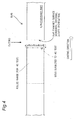
- each of the predetermined sections r1, r2, r3 ... rn is a rectangular region with W1 in width x D1 in thickness, as the section r1 is shown as an example in Fig. 1(b) .
- the "number density of the segregated particle having the predetermined diameter or more" in the section r1 is determined from N/(W1 x D1).
- threshold values of the maximum segregated particle size and of the number density which are used for evaluation of the HIC resistance of the slab, i.e., the respective ranges of the maximum segregated particle size and the number density that avoid the occurrence of the HIC in the steel plate obtained by rolling the slab.
- threshold values are determined previously, but their determination method is not particularly limited to the following method.
- An example of the method for determining the threshold values will include the following steps (i) to (iii). The details of the method will be described below.
- a slab is cast on the same casting conditions as the slab in which the maximum segregated particle size and the number density of the segregated particles are measured, and then the slab is hot-rolled, thereby manufacturing a steel plate for measurement of the threshold value.
- An HIC test is performed on the steel plate to check the presence or absence of HIC occurrence.
- the HIC test is performed by a method specified by the National Association of Corrosion and Engineer (NACE) standard TM0284-2003, as mentioned in Examples below.
- NACE National Association of Corrosion and Engineer
- HIC test it is examined whether or not HIC occurs in a region of a product (steel plate) that corresponds to the region R3 of the slab shown in Fig. 1 .
- the region R3 of the slab is divided into the individual n predetermined sections r1, r2, r3 ... rn in the width direction.
- the regions to be evaluated for the HIC resistance vary depending on the rolling direction during the rolling using the slab shown in Fig. 1 .
- a slab width W product width W.
- the regions corresponding to the "regions R1 and R2 of the slab" are “regions R11 and R12 ranging from both ends of the width W of the product to D/2 of the product width D.
- the region of the product corresponding to the "region R3 of the slab” is a "region R13 with a width W-D, except for regions from both ends of a width W of the product to D/2 of the product width D".
- regions corresponding to the "sections r1, r2, r3 ... rn in the region R3 of the slab” correspond to "sections r11, r12, r13 ... r1n” that are obtained by dividing the region R13 of the product into the individual n predetermined sections in the width direction, respectively.
- each of the predetermined sections r11, r12, r13 ... r1n is a rectangular region with W1 in width x D1 in thickness.
- the width of each slab changes from W before the rolling to Wa after the rolling, and thus the slab width W is smaller than the product width Wa, i.e., slab width W ⁇ product width Wa.
- the regions R21, R22, and R23 corresponding to the slab regions R1, R2, and R3 are determined by a rolling reduction, i.e., product width Wa/slab width W. Among these regions, it is confirmed whether or not HIC occurs in the region R23.
- the segregation degree of the center segregation can be evaluated by the "maximum segregated particle size" and the "number density of the segregated particles” as mentioned above.
- the boundary (threshold value) for determining whether HIC occurs or not due to the center segregation can be represented by a function f ⁇ (x, y) where x is the maximum segregated particle size and y is the number density.
- a "threshold function f ⁇ (x, y) of the maximum segregated particle size and the number density” is determined, and based on this threshold function, the HIC occurrence range is determined.
- the results obtained from the region of the slab and the corresponding region of the product are correlated to each other. For instance,
- the threshold function f ⁇ (x, y) of the maximum segregated particle size and the number density that serves as the boundary of the presence or absence of HIC occurrence is determined from the above-mentioned plurality of results. Based on the threshold function f ⁇ (x, y), the "respective ranges of the maximum segregated particle size and the number density that cause HIC" (HIC occurrence range) and the “respective ranges of the maximum segregated particle size and the number density that avoid the occurrence of HIC" (HIC non-occurrence range) are determined.
- the steel plate in the present invention is a steel plate in which the "maximum segregated particle size x" and the “number density y of the segregated particle having the predetermined diameter or more" are measured at the center part in the thickness direction of the region R3 at the slab cross section at a stage of the slab, and the measured x and y are within the "HIC non-occurrence range" determined by the threshold value f ⁇ (x,y). Since this steel plate is considered to have a low segregation degree of the center segregation zone, no HIC is determined to occur due to the center segregation.
- the threshold value is preferably determined by using the measurement results of the maximum segregated particle size and the number density in a plurality of slabs and the HIC test results.
- the measurement results of the maximum segregated particle size and the number density of the plurality of slabs and the HIC test results can be used to obtain the threshold value with higher accuracy, which can reduce the misjudgment of the presence or absence of HIC occurrence.
- the segregation zone and the HIC resistance may be evaluated by examining one cross section of the slab or product, or alternatively by examining two or more cross sections thereof.
- Fig. 3 hereinafter shows the results obtained by examining a plurality of cross sections of the slab of the same charge.
- Example 1 is an example of examining two cross sections of the slab of the same charge
- Example 2 is an example of examining three cross sections of the slab of the same charge. In either example, the result is obtained by examining the slab that is in conformity with API X65 Grade.
- Example 1 the respective maximum segregated particle sizes of the two cross sections are 1.12 mm and 1.14 mm, and the number density of either cross section is 0 particles/m 2 .
- the respective maximum segregated particle sizes of the three cross sections are 2.23 mm, 2.25 mm, and 2.26 mm, and the number density in each of all cross sections is 1,667 particles/m 2 .
- HIC occurs at the center segregation zones as the starting points.
- the slab in conformity with the API X65 Grade is used for evaluation.
- a slab in another strength grade for example, a slab of API X70 Grade or higher grade does not differ from the API X65 Grade slab in formation of segregation zones or in variations in the features of the segregation zones.
- the number of cross sections to be examined is not limited.
- the examination position (examined surface) of the slab is preferably a stationary part as shown in Examples below, but may be a non-stationary part.
- non-stationary part as used herein means a part casted when the casting condition is varied, for example, a part casted at an initial stage of casting, such as when the casting speed increases, or a part casted at the end of casting, such as when the casting speed decreases.
- a part adjacent to the region subjected to the HIC test is preferably examined. Such a part exhibits substantially the same HIC resistance as the HIC test result and can be evaluated more precisely.
- the above-mentioned maximum segregated particle size and the number density are used to evaluate the HIC resistance. Because of this, the internal quality of the cast strip can be precisely evaluated, so that based on this evaluation result, the HIC resistance can be evaluated at a stage of the cast strip. Consequently, the HIC test that would require several weeks can be omitted, thereby significantly shortening a time period from the manufacture to dispatching.
- Table 1 and Figs. 5 and 6 show the experimental conditions and results for determining the threshold value t ⁇ .
- 7 charges were cast to obtain each of a slab corresponding to the API X65 Grade and a slab corresponding to the API X70 Grade.
- One charge was cast to obtain each of a slab corresponding to the ASME SA516 Grade 60, a slab corresponding to the ASME SA516 Grade 65, and a slab corresponding to the ASME SA516 Grade 70. These slabs were examined for the center segregation in the following way.
- X70 corresponds to API X70 Grade; "X65” to API X65 Grade; "SA516 60” to ASME SA516 Grade 60; “SA516 65” to ASME SA516 Grade 65; and "SA516 70” to ASME SA516 Grade 70.
- the concentrations of C, Mn, Nb, P, and Ca were measured by an emission spectroscopy.
- the S concentration was very low and thus was difficult to measure by the emission spectroscopy. Then, the S concentration was measured by using a combustion-infrared absorption method.
- the casting speed was a drawing speed of the cast strip [m/min.], and was calculated from the diameter (circumferential length) and the rotational speed (the number of revolutions per unit time) of a roll (major roll) in contact with the cast strip.
- the term "stationary part” as used herein means a part that satisfies the following conditions.
- the number of cross sections for examination of the center segregation is shown in Table 1.
- the hot-rolling was performed on the slab through two or more passes.
- a surface temperature of the steel plate was set at 900°C or higher
- a cumulative rolling reduction was 40% or more at an average steel plate temperature of 1,000°C or higher, which was determined by the calculation below, and a rolling reduction per pass was 10% or more.
- another hot-rolling was performed such that a cumulative rolling reduction at 700°C or higher and lower than 900°C was 20% or more, and that a rolling-end temperature was 700°C or higher and lower than 900°C.
- the average steel plate temperature was determined in the following way. Specifically, based on data including a rolling pass schedule during rolling and a cooling method (water-cooling or air-cooling) between the passes, the temperature at any position of the steel plate in the thickness direction was determined by using an appropriate calculation method, such as a finite difference method. Then, the average steel plate temperature was defined as the average of the determined temperatures of the steel strip in a range from the front to back surface thereof. The definition of the "average steel plate temperature" also applied to other steel plates.
- the HIC test was performed after the rolling.
- Figs. 5 and 6 each show the relationship between the '''maximum segregated particle size' and 'number density' " and the "presence or absence of HIC occurrence" confirmed by the above-mentioned HIC test.
- Figs. 5 and 6 are diagrams plotted by taking a plurality of data from steel plates of respective samples Nos. shown in Table 1.
- Fig. 5 shows the examination results of threshold values f ⁇ (x, y) at which HIC occurred in components of the steels shown in Table 2 and belonging to the strength class of API X65 Grade.
- Fig. 6 shows the examination results of threshold values f ⁇ (x, y) at which HIC occurred in components of the steels shown in Table 2 and belonging to the strength class of API X70 Grade.
- the HIC resistance of each slab as the determination target was evaluated using the above-mentioned threshold value.
- the steel with the component composition shown in Table 2 was melted and subjected to continuous casting, thereby producing a slab as the determination target that had the slab thickness D of 280 mm and the slab width W of 2, 100 mm.
- each slab was processed by either of two patterns of hot-rolling and cooling methods, denoted as "TMCP” or "QT” in a "hot-rolling and cooling method” column shown in Table 3. Consequently, steel plates (each having 9 to 90 mm in thickness ⁇ 2,000 to 3,500 mm in width ⁇ 12,000 to 35,000 mm in length) with various component compositions were produced.
- TMCP hot-rolling and cooling methods
- TMCP hot-rolling through two or more passes, in each of which a surface temperature of the steel plate was set at 900°C or higher, a cumulative rolling reduction was 40% or more at an average steel plate temperature of 1,000°C or higher, determined by the calculation, and a rolling reduction per pass was 10% or more.
- TMCP also involved: another hot-rolling such that a cumulative rolling reduction was 20% or more at a temperature of 700°C or higher and lower than 900°C such that that the surface temperature at the end of the rolling was 850°C.
- the "TMCP” further involved: starting to cool the rolled steel plate from a cooling start surface temperature of 750°C or higher at an average cooling rate of 10°C/s and then stopping the cooling at a temperature of 350 to 600°C, followed by air-cooling to the room temperature.
- the above-mentioned "QT” was a method that involved: hot-rolling such that the surface temperature at the end of the rolling was 850°C or higher, followed by air-cooling to the room temperature; quenching by reheating the rolled steel plate to a temperature of 850°C or higher and 950°C or lower; and tempering the steel plate at 600 to 700°C.
- Hot-rolling and cooling method Ca/S (Ca-1.25S)/O Maximum segregated particle size (mm) Number density (particles/m 2 ) Evaluation of HIC resistance of slab Presence or absence of cracking in HIC resistance test Strength class 1 TMCP 7.5 0.96 0.448 0 OK Absence X65 2 TMCP 4.4 0.88 0.439 0 OK Absence X65 3 TMCP 7.5 0.96 0.917 0 OK Absence X65 4 TMCP 4.4 0.88 0.930 0 OK Absence X70 5 TMCP 5.7 1.02 0.962 0 OK Absence X65 6 TMCP 2.7 0.80 1.210 0 OK Absence X65 7 TMCP 3.9 0.73 0.788 0 OK Absence X70 8 TMCP 1.9 0.26 0.552 0 OK Presence X65 9 TMCP 5.4 1.89 0.623 0 OK Presence X65 10 TMCP 5.8 1.63 1.684 333 OK Absence X65 11 TMCP
- Tables 2 and 3 show the following. Steel types Nos. 1 to 7, 10 to 12, 15 to 17, and 20 to 22 satisfied the specified component compositions and restricted the maximum segregated particle size and the number density of each slab within the HIC non-occurrence range, thereby producing the steel plates with excellent HIC resistance in the present invention.
- a time period required from starting of casting to completion of a production of the steel plate that is, a time period until dispatching the steel plate with the sour resistance (casting ⁇ rolling ⁇ dispatching) was 19 days.
- a time period required from starting of casting to dispatching (casting ⁇ rolling ⁇ HIC test ⁇ dispatching) was 28 days, which was a long duration.
- the HIC test after the rolling was able to be omitted, which could significantly shorten the time period from starting of the casting to dispatching, e.g., from 28 days to 19 days.
- the HIC resistance can be evaluated at the stage of the slab as the cast strip without performing the HIC test after the rolling, thereby making it possible to significantly shorten the manufacturing lead time.
- the same HIC test is used for both the determination of the threshold value for evaluating the HIC resistance of a slab and the confirmation of HIC.
- the determination method of the present invention has high accuracy.
Landscapes
- Chemical & Material Sciences (AREA)
- Engineering & Computer Science (AREA)
- Materials Engineering (AREA)
- Mechanical Engineering (AREA)
- Metallurgy (AREA)
- Organic Chemistry (AREA)
- Physics & Mathematics (AREA)
- Thermal Sciences (AREA)
- Crystallography & Structural Chemistry (AREA)
- Heat Treatment Of Steel (AREA)
Applications Claiming Priority (3)
| Application Number | Priority Date | Filing Date | Title |
|---|---|---|---|
| JP2014266490 | 2014-12-26 | ||
| JP2015208021A JP2016125139A (ja) | 2014-12-26 | 2015-10-22 | 耐水素誘起割れ性に優れた鋼板およびラインパイプ用鋼管 |
| PCT/JP2015/085872 WO2016104529A1 (fr) | 2014-12-26 | 2015-12-22 | Plaque d'acier ayant une excellente résistance à la fissuration sous hydrogène et tube en acier pour tube de canalisation |
Publications (2)
| Publication Number | Publication Date |
|---|---|
| EP3239334A1 true EP3239334A1 (fr) | 2017-11-01 |
| EP3239334A4 EP3239334A4 (fr) | 2018-06-27 |
Family
ID=56356707
Family Applications (1)
| Application Number | Title | Priority Date | Filing Date |
|---|---|---|---|
| EP15873097.8A Withdrawn EP3239334A4 (fr) | 2014-12-26 | 2015-12-22 | Plaque d'acier ayant une excellente résistance à la fissuration sous hydrogène et tube en acier pour tube de canalisation |
Country Status (4)
| Country | Link |
|---|---|
| EP (1) | EP3239334A4 (fr) |
| JP (1) | JP2016125139A (fr) |
| KR (1) | KR20170093962A (fr) |
| CN (1) | CN107109594A (fr) |
Cited By (1)
| Publication number | Priority date | Publication date | Assignee | Title |
|---|---|---|---|---|
| US20240018616A1 (en) * | 2021-11-19 | 2024-01-18 | Angang Steel Company Limited | Low-temperature-resistant and corrosion-resistant cargo oil tank steel suitable for high-heat-input welding and manufacturing method therefor |
Families Citing this family (5)
| Publication number | Priority date | Publication date | Assignee | Title |
|---|---|---|---|---|
| JP2016125140A (ja) * | 2014-12-26 | 2016-07-11 | 株式会社神戸製鋼所 | 耐水素誘起割れ性と靭性に優れた鋼板およびラインパイプ用鋼管 |
| JP6869151B2 (ja) * | 2016-11-16 | 2021-05-12 | 株式会社神戸製鋼所 | 鋼板およびラインパイプ用鋼管並びにその製造方法 |
| CN107937831B (zh) * | 2017-11-16 | 2019-09-10 | 兰州兰石集团有限公司 | 压力容器用12Cr2Mo1V合金钢及其锻造热处理工艺 |
| KR102830745B1 (ko) | 2019-12-20 | 2025-07-07 | 주식회사 포스코 | 내 황화물 응력균열 저항성이 우수한 피팅부품 및 그 제조방법 |
| JP7636672B2 (ja) * | 2021-09-22 | 2025-02-27 | 日本製鉄株式会社 | 鋼材の耐水素誘起割れ性の評価方法 |
Family Cites Families (10)
| Publication number | Priority date | Publication date | Assignee | Title |
|---|---|---|---|---|
| JP5540982B2 (ja) * | 2010-08-09 | 2014-07-02 | 新日鐵住金株式会社 | 耐水素誘起割れ性に優れた鋼材 |
| JP5853661B2 (ja) * | 2011-12-15 | 2016-02-09 | Jfeスチール株式会社 | 高強度耐サワーラインパイプ用鋼板、その素材及び高強度耐サワーラインパイプ用鋼板の製造方法 |
| JP5910195B2 (ja) * | 2012-03-14 | 2016-04-27 | Jfeスチール株式会社 | 鋼材の耐hic性の評価方法およびそれを利用したラインパイプ用高強度厚鋼板の製造方法 |
| JP2014077642A (ja) * | 2012-10-09 | 2014-05-01 | Jfe Steel Corp | 鋼材のhic感受性の評価方法およびそれを用いた耐hic性に優れたラインパイプ用高強度厚鋼板の製造方法 |
| JP6169025B2 (ja) * | 2013-03-29 | 2017-07-26 | 株式会社神戸製鋼所 | 耐水素誘起割れ性と靭性に優れた鋼板およびラインパイプ用鋼管 |
| JP6165088B2 (ja) * | 2013-03-29 | 2017-07-19 | 株式会社神戸製鋼所 | 耐水素誘起割れ性と溶接熱影響部の靭性に優れた鋼板およびラインパイプ用鋼管 |
| JP6316548B2 (ja) * | 2013-07-01 | 2018-04-25 | 株式会社神戸製鋼所 | 耐水素誘起割れ性と靭性に優れた鋼板およびラインパイプ用鋼管 |
| JP2016125140A (ja) * | 2014-12-26 | 2016-07-11 | 株式会社神戸製鋼所 | 耐水素誘起割れ性と靭性に優れた鋼板およびラインパイプ用鋼管 |
| JP6584912B2 (ja) * | 2014-12-26 | 2019-10-02 | 株式会社神戸製鋼所 | 耐水素誘起割れ性に優れた鋼板およびラインパイプ用鋼管 |
| JP2016125137A (ja) * | 2014-12-26 | 2016-07-11 | 株式会社神戸製鋼所 | 耐水素誘起割れ性に優れた鋼板およびラインパイプ用鋼管 |
-
2015
- 2015-10-22 JP JP2015208021A patent/JP2016125139A/ja active Pending
- 2015-12-22 CN CN201580069970.XA patent/CN107109594A/zh active Pending
- 2015-12-22 EP EP15873097.8A patent/EP3239334A4/fr not_active Withdrawn
- 2015-12-22 KR KR1020177019234A patent/KR20170093962A/ko not_active Ceased
Cited By (1)
| Publication number | Priority date | Publication date | Assignee | Title |
|---|---|---|---|---|
| US20240018616A1 (en) * | 2021-11-19 | 2024-01-18 | Angang Steel Company Limited | Low-temperature-resistant and corrosion-resistant cargo oil tank steel suitable for high-heat-input welding and manufacturing method therefor |
Also Published As
| Publication number | Publication date |
|---|---|
| KR20170093962A (ko) | 2017-08-16 |
| JP2016125139A (ja) | 2016-07-11 |
| EP3239334A4 (fr) | 2018-06-27 |
| CN107109594A (zh) | 2017-08-29 |
Similar Documents
| Publication | Publication Date | Title |
|---|---|---|
| RU2518830C1 (ru) | Горячекатаный стальной лист и способ его изготовления | |
| EP3239320B1 (fr) | Tôle d'acier et tube d'acier pour tube de canalisation présentant une excellente résistance à la fissuration induite par l'hydrogène | |
| EP3042976B1 (fr) | Tôle d'acier pour tube de canalisation à paroi épaisse et à haute résistance mécanique ayant d'excellentes caracteristiques de résistance à la corrosion et à l'affaissement, et une ductilité aux basses températures, ainsi que tube de canalisation | |
| JP6047947B2 (ja) | 耐サワー性に優れたラインパイプ用厚肉高強度継目無鋼管およびその製造方法 | |
| EP2224028B1 (fr) | Plaques d'acier pour pipelines et tubes d'acier | |
| JP5748032B1 (ja) | ラインパイプ用鋼板及びラインパイプ | |
| KR101719943B1 (ko) | 다층 용접 조인트 ctod 특성이 우수한 후강판 및 그 제조 방법 | |
| EP2644729A2 (fr) | Plaque d'acier présentant une excellente résistance aux craquelures induites par l'hydrogène et son procédé de fabrication | |
| EP3239334A1 (fr) | Plaque d'acier ayant une excellente résistance à la fissuration sous hydrogène et tube en acier pour tube de canalisation | |
| EP2612946B1 (fr) | Tôle d'acier à haute résistance présentant d'excellents résultats de résistance à la rupture et de résistance à la fissuration induite par hydrogène | |
| JP7272442B2 (ja) | 耐サワーラインパイプ用高強度鋼板およびその製造方法並びに耐サワーラインパイプ用高強度鋼板を用いた高強度鋼管 | |
| EP3239333A1 (fr) | Plaque d'acier ayant d'excellentes propriétés en termes de ténacité et de résistance à la fissuration sous hydrogène et tube en acier pour tube de canalisation | |
| WO2013147197A1 (fr) | Tuyau d'acier à haute résistance pour tuyau de canalisation ayant une excellente résistance à la fissuration induite par hydrogène, tuyau d'acier à haute résistance pour tuyau de canalisation l'utilisant et son procédé de fabrication | |
| UA57775C2 (uk) | Сталь і спосіб одержання листа із сталі | |
| CN105838992A (zh) | 抗氢致开裂性优异的高强度管线管用钢板和高强度管线管用钢管 | |
| JP2006063351A (ja) | 耐水素誘起割れ性に優れた高強度鋼板および製造方法、並びにラインパイプ用鋼管 | |
| US20120121453A1 (en) | Hic-resistant thick steel plate and uoe steel pipe | |
| EP3239319A1 (fr) | Tôle d'acier présentant une excellente résistance à la fissuration induite par l'hydrogène et tube d'acier pour tuyau de canalisation | |
| EP3282028A1 (fr) | Tôle d'acier pour tube de canalisation haute résistance ayant une excellente ténacité à basse température et tube d'acier pour tube de canalisation haute résistance | |
| EP3018229B1 (fr) | Tube d'acier sans soudure pour un tube de canalisation utilisé dans un environnement acide et procede pour sa fabrication. | |
| KR20190119089A (ko) | 선재 및 평강선 | |
| EP3543366A1 (fr) | Tôle d'acier, tuyau d'acier pour conduite, et procédé de production associé | |
| WO2016104528A1 (fr) | Plaque d'acier ayant d'excellentes propriétés en termes de ténacité et de résistance à la fissuration sous hydrogène et tube en acier pour tube de canalisation | |
| EP3124639B1 (fr) | Tôle d'acier pour tuyau de canalisation à haute résistance ayant une excellente ténacité à basse température et tube en acier pour tuyau de canalisation à haute résistance | |
| WO2016104527A1 (fr) | Tôle d'acier présentant une excellente résistance à la fissuration induite par l'hydrogène et tube d'acier pour tube de canalisation |
Legal Events
| Date | Code | Title | Description |
|---|---|---|---|
| PUAI | Public reference made under article 153(3) epc to a published international application that has entered the european phase |
Free format text: ORIGINAL CODE: 0009012 |
|
| 17P | Request for examination filed |
Effective date: 20170725 |
|
| AK | Designated contracting states |
Kind code of ref document: A1 Designated state(s): AL AT BE BG CH CY CZ DE DK EE ES FI FR GB GR HR HU IE IS IT LI LT LU LV MC MK MT NL NO PL PT RO RS SE SI SK SM TR |
|
| AX | Request for extension of the european patent |
Extension state: BA ME |
|
| DAV | Request for validation of the european patent (deleted) | ||
| DAX | Request for extension of the european patent (deleted) | ||
| A4 | Supplementary search report drawn up and despatched |
Effective date: 20180528 |
|
| RIC1 | Information provided on ipc code assigned before grant |
Ipc: C21D 8/10 20060101ALI20180522BHEP Ipc: C22C 38/08 20060101ALI20180522BHEP Ipc: C21C 7/04 20060101ALI20180522BHEP Ipc: C21D 9/08 20060101ALI20180522BHEP Ipc: C22C 38/00 20060101AFI20180522BHEP Ipc: C22C 38/12 20060101ALI20180522BHEP Ipc: C21D 1/18 20060101ALN20180522BHEP Ipc: C22C 38/04 20060101ALI20180522BHEP Ipc: C22C 38/06 20060101ALI20180522BHEP Ipc: C22C 38/58 20060101ALI20180522BHEP Ipc: C22C 38/02 20060101ALI20180522BHEP Ipc: C22C 38/14 20060101ALI20180522BHEP Ipc: C22C 38/16 20060101ALI20180522BHEP Ipc: C21D 8/02 20060101ALI20180522BHEP |
|
| 17Q | First examination report despatched |
Effective date: 20191211 |
|
| STAA | Information on the status of an ep patent application or granted ep patent |
Free format text: STATUS: THE APPLICATION IS DEEMED TO BE WITHDRAWN |
|
| 18D | Application deemed to be withdrawn |
Effective date: 20200603 |