EP3252181A1 - Magnesium-lithium-legierung, gewalztes material und formartikel - Google Patents
Magnesium-lithium-legierung, gewalztes material und formartikel Download PDFInfo
- Publication number
- EP3252181A1 EP3252181A1 EP16743325.9A EP16743325A EP3252181A1 EP 3252181 A1 EP3252181 A1 EP 3252181A1 EP 16743325 A EP16743325 A EP 16743325A EP 3252181 A1 EP3252181 A1 EP 3252181A1
- Authority
- EP
- European Patent Office
- Prior art keywords
- mass
- alloy
- less
- magnesium
- ppm
- Prior art date
- Legal status (The legal status is an assumption and is not a legal conclusion. Google has not performed a legal analysis and makes no representation as to the accuracy of the status listed.)
- Withdrawn
Links
Images

Classifications
-
- C—CHEMISTRY; METALLURGY
- C22—METALLURGY; FERROUS OR NON-FERROUS ALLOYS; TREATMENT OF ALLOYS OR NON-FERROUS METALS
- C22C—ALLOYS
- C22C23/00—Alloys based on magnesium
- C22C23/02—Alloys based on magnesium with aluminium as the next major constituent
-
- B—PERFORMING OPERATIONS; TRANSPORTING
- B21—MECHANICAL METAL-WORKING WITHOUT ESSENTIALLY REMOVING MATERIAL; PUNCHING METAL
- B21B—ROLLING OF METAL
- B21B3/00—Rolling materials of special alloys so far as the composition of the alloy requires or permits special rolling methods or sequences ; Rolling of aluminium, copper, zinc or other non-ferrous metals
-
- C—CHEMISTRY; METALLURGY
- C22—METALLURGY; FERROUS OR NON-FERROUS ALLOYS; TREATMENT OF ALLOYS OR NON-FERROUS METALS
- C22C—ALLOYS
- C22C23/00—Alloys based on magnesium
-
- C—CHEMISTRY; METALLURGY
- C22—METALLURGY; FERROUS OR NON-FERROUS ALLOYS; TREATMENT OF ALLOYS OR NON-FERROUS METALS
- C22F—CHANGING THE PHYSICAL STRUCTURE OF NON-FERROUS METALS AND NON-FERROUS ALLOYS
- C22F1/00—Changing the physical structure of non-ferrous metals or alloys by heat treatment or by hot or cold working
- C22F1/06—Changing the physical structure of non-ferrous metals or alloys by heat treatment or by hot or cold working of magnesium or alloys based thereon
-
- C—CHEMISTRY; METALLURGY
- C22—METALLURGY; FERROUS OR NON-FERROUS ALLOYS; TREATMENT OF ALLOYS OR NON-FERROUS METALS
- C22F—CHANGING THE PHYSICAL STRUCTURE OF NON-FERROUS METALS AND NON-FERROUS ALLOYS
- C22F1/00—Changing the physical structure of non-ferrous metals or alloys by heat treatment or by hot or cold working
Definitions
- the present invention relates to a magnesium-lithium alloy having a particularly improved corrosion resistance, and a rolled material and a formed article prepared therefrom.
- magnesium-lithium alloys containing lithium have a mixed phase of an hcp structure and a bcc structure ( ⁇ phase) at a lithium content of 6% to 10.5% by mass and have a single ⁇ phase at a lithium content of more than 10.5% by mass.
- the ⁇ phase has a large number of slip systems, whereas the ⁇ phase has a limited number thereof. Therefore, as the lithium content is increased, the mixed ⁇ / ⁇ phase is converted to the single ⁇ phase, whereby the cold workability is improved.
- As such magnesium-lithium alloys LZ91 (containing 9% by mass of Li, 1% by mass of Zn, and the balance of Mg), LA141 (containing 14% by mass of Li, 1% by mass of Al, and the balance of Mg), and the like have been widely known.
- the magnesium-lithium alloys are advantageously lightweight, but have a problem of inferior corrosion resistance to be improved.
- Patent Publication 1 discloses that a magnesium-lithium alloy having a lithium content of 10.5% by mass or less and an impurity iron concentration of 50 ppm or less has an excellent corrosion resistance. Furthermore, Patent Publication 1 describes that when the lithium content is more than 10.5% by mass, the resultant magnesium-lithium alloy has the single ⁇ phase structure and exhibits a significantly deteriorated corrosion resistance. Specifically, in Examples of Patent Publication 1, each magnesium-lithium alloy has a lithium content of 10.5% by mass or less and a reduced impurity iron concentration, and thereby has excellent corrosion resistances. In contrast, in Comparative Example 6 of Patent Publication 1, a magnesium-lithium alloy has a single ⁇ phase structure with a lithium content of 14% by mass, so that the advantageous effect due to the reduction of the impurity iron concentration is not achieved.
- Non-Patent Publication 1 discloses results of studies on mechanical properties, corrosion resistance, and the like of magnesium-lithium alloys containing 13% by mass of lithium and 1%, 3%, or 5% by mass of aluminum in processing, heat treatment etc.
- Non-Patent Publication 1 describes that as the aluminum content is increased, the tensile strength is increased, while the specific strength is slightly lowered. Non-Patent Publication 1 further describes that as the aluminum content is increased, the corrosion resistance is improved, but is lower than those of binary lithium-magnesium alloys.
- An object of the present invention is to provide a lightweight magnesium-lithium alloy that can exhibit a practicable corrosion resistance with excellent cold workability and tensile strength.
- Another object of the present invention is to provide lightweight rolled material and formed article that can exhibit a practicable corrosion resistance with an excellent tensile strength.
- Patent Publication 1 specifies that the effect due to the reduction of the impurity iron concentration is not obtained in a lithium-magnesium alloy having a lithium content of more than 10.5% by mass and thus a single ⁇ phase with an excellent cold workability.
- the inventor has found that by controlling the aluminum content of such a lithium-magnesium alloy to achieve an excellent tensile strength and by adding a predetermined amount of manganese to the lithium-magnesium alloy, the corrosion resistance can be improved, and the effect due to the reduction of the impurity iron concentration can be obtained.
- the present invention has been accomplished based on this finding.
- a magnesium-lithium alloy comprising more than 10.50% by mass and not more than 16.00% by mass of Li, not less than 2.00% by mass and not more than 15.00% by mass of Al, not less than 0.03% by mass and less than 1.10% by mass of Mn, impurities, and the balance of Mg, wherein the impurities contain Fe at a concentration of 15 ppm or less.
- This magnesium-lithium alloy may be hereinafter referred to as the Mg-Li alloy of the present invention.
- a magnesium-lithium alloy comprising more than 10.50% by mass and not more than 16.00% by mass of Li, not less than 2.00% by mass and not more than 15.00% by mass of Al, not less than 0.03% by mass and less than 1.10% by mass of Mn, M, impurities, and the balance of Mg, wherein M represents at least one element selected from the group consisting of more than 0% by mass and not more than 3.00% by mass of Ca, more than 0% by mass and not more than 3.00% by mass of Zn, more than 0% by mass and not more than 1.00% by mass of Si, more than 0% by mass and not more than 1.00% by mass of Y, and more than 0% by mass and not more than 5.00% by mass of rare earth metal elements with atomic numbers of 57 to 71, and the impurities contain Fe at a concentration of 15 ppm or less.
- This magnesium-lithium alloy may be hereinafter referred to as the Mg-Li alloy of
- a rolled material or a formed article comprising the Mg-Li alloy of the present invention.
- the Mg-Li alloy of the present invention can have a single ⁇ phase structure with an excellent cold workability due to the above particular Li content, and can have an excellent tensile strength due to the above particular Al content.
- the Al content and the Mn content are controlled within particular ranges, and the impurity Fe concentration is lowered, the Mg-Li alloy can have an excellent practicable corrosion resistance.
- the rolled material and the formed article of the present invention contain the Mg-Li alloy of the present invention, and thereby can have an excellent tensile strength, a practicable corrosion resistance, and a light weight. Therefore, the rolled material and the formed article can be used in various fields of automobile parts and casing parts of portable audio devices, digital cameras, mobile phones, notebook computers, etc.
- the Mg-Li alloy of the present invention contains particular amounts of Li, Al, and Mn, impurities, and the balance of Mg, or contains particular amounts of Li, Al, Mn, and M, impurities, and the balance of Mg.
- the Li content is more than 10.50% by mass and not more than 16.00% by mass.
- the Mg-Li alloy has a single ⁇ phase structure or a eutectic ⁇ / ⁇ structure, and therefore has a lowered cold workability.
- the Li content is more than 16.00% by mass, the Mg-Li alloy has lowered corrosion resistance and strength, and cannot be put into practical use.
- Conventional Mg-Li alloys having Li contents within the above range have a single ⁇ phase crystal structure.
- the Mg-Li alloy of the present invention has a high Al content and thus a structure containing an aluminum intermetallic phase in addition to the main ⁇ phase, and therefore has a light weight and an excellent workability.
- the Al content is not less than 2.00% by mass and not more than 15.00% by mass.
- the corrosion resistance of the Mg-Li alloy is less effectively improved.
- the Al content is more than 15.00% by mass, the Mg-Li alloy has a large specific gravity (density) and loses the lightweight advantage.
- the Mn content is not less than 0.03% by mass and less than 1.10% by mass, preferably not less than 0.03% by mass and not more than 0.50% by mass, more preferably not less than 0.10% by mass and not more than 0.30% by mass.
- Mn can generate an intermetallic compound together with Fe, and can act to improve the corrosion resistance of the alloy.
- the corrosion resistance improvement effect due to the reduction of the impurity Fe concentration is not obtained in Patent Publication 1, this effect is achieved by adding the particular amount of Mn in the present invention.
- the corrosion resistance can be further improved by the combination of the reduction of the impurity Fe concentration and the addition of the particular amount of Mn.
- the Mn content is less than 0.03% by mass, the desired corrosion resistance improvement effect cannot be obtained.
- the Mg-Li alloy may lose the lightweight advantage.
- examples of the impurities include Fe, Ni, and Cu.
- the Mg-Li alloy may contain a small amount of the impurities as long as the strength, the corrosion resistance, and the like of the Mg-Li alloy is not deteriorated by the impurities.
- the Mg-Li alloy of the present invention has an impurity Fe concentration of 15 ppm or less, preferably 10 ppm or less. When the Fe concentration is more than 15 ppm, the corrosion resistance is lowered.
- the Mg-Li alloy of the present invention has an impurity Ni concentration of preferably 15 ppm or less, more preferably 10 ppm or less.
- the corrosion resistance is lowered disadvantageously.
- the corrosion resistance improvement effect due to the reduction of the impurity Ni concentration can be obtained as well as the effect due to the impurity Fe concentration reduction.
- the Mg-Li alloy of the present invention preferably has an impurity Cu concentration of 10 ppm or less. When the Cu concentration is lowered to this range, the corrosion resistance of the Mg-Li alloy can be further improved.
- M represents one or more elements selected from the group consisting of Ca, Zn, Si, Y, and rare earth metal elements with atomic numbers of 57 to 71 (hereinafter referred to simply as the rare earth metal elements).
- the rare earth metal elements include La, Ce, Pr, and Nd.
- each of the Ca content and the Zn content is more than 0% by mass and not more than 3.00% by mass
- the Si content is more than 0% by mass and not more than 1.00% by mass
- the Y content is more than 0% by mass and not more than 1.00% by mass
- the content of the rare earth metal element(s) is more than 0% by mass and not more than 5.00% by mass.
- the corrosion resistance of the alloy is further improved.
- Ca can generate a compound together with Mg, and the compound acts as an origin of nucleation in a recrystallization process, to form a recrystallization texture containing fine crystal grains.
- Corrosion of the Mg-Li alloy proceeds selectively at the crystal grain boundaries, and the progress of corrosion can be inhibited by forming such fine crystal grains.
- the corrosion resistance can be improved by forming such fine crystal grain boundaries.
- the Ca content is more than 3.00% by mass, the strength and the workability of the Mg-Li alloy may be lowered.
- the workability of the Mg-Li alloy can be further improved.
- Si the high-temperature strength of the alloy can be further improved.
- the rare earth element By adding the rare earth element to the Mg-Li alloy, the elongation of the alloy can be improved, and thus the cold workability can be further improved.
- the Zn content is more than 3.00% by mass or the Si content amount is more than 1.00% by mass, the strength and the workability of the Mg-Li alloy may be lowered.
- the Y content is more than 1.00% by mass, the high-temperature strength of the Mg-Li alloy may be lowered.
- the rare earth element content is more than 5% by mass, the specific gravity of the Mg-Li alloy may be excessively increased.
- the Mg-Li alloy of the present invention may optionally contain one or more elements selected from the group consisting of Zr, Ti, and B in addition to the above-described elements, as long as the objective corrosion resistance improvement effect is not greatly affected by the elements.
- the strength of the Mg-Li alloy is further increased by Zr, and the flame resistance of the Mg-Li alloy is increased by Ti.
- the content of these optional elements is preferably not less than 0% by mass and not more than 5.00% by mass. When the content of the optional elements is excessively high, the specific gravity is increased, so that the Li-Mg alloy of the present invention loses the lightweight advantage. Therefore, it is preferred that the content of the optional elements is minimized.
- the Mg-Li alloy of the present invention preferably has a corrosion amount of 0.160 mg/cm 2 /day or less.
- the corrosion amount is one of measures for evaluating the corrosion resistance.
- the Mg-Li alloy has a smaller corrosion amount, the Mg-Li alloy is more excellent in the corrosion resistance.
- the average crystal grain diameter of the Mg-Li alloy is preferably 40 ⁇ m or less, particularly preferably 20 ⁇ m or less.
- the average crystal grain diameter can be measured by a line intercept method using an optical microscope image of a cross-sectional structure of the Mg-Li alloy as follows. A sample etched with a 5% nitric acid ethanol solution is observed by an optical microscope at 200-fold magnification to obtain the image. Five lines having a length corresponding to 600 ⁇ m are drawn in the image to equally divide the image into six, and the number of grain boundaries crossing each line is counted. The length of 600 ⁇ m is divided by the counted number of the grain boundaries on each line, and the average of thus obtained values is used as the average crystal grain diameter.
- the Mg-Li alloy of the present invention preferably has a tensile strength of 160 MPa or more.
- the upper limit of the tensile strength is not particularly limited, and the tensile strength may be controlled in view of not lowering the cold workability.
- the tensile strength within the above range is equal to or higher than those of industrially-available LA141 and LZ91.
- the tensile strength can be determined by preparing a plate of the Mg-Li alloy of the present invention, cutting out three 1-mm-thick test samples of JIS No. 5 from the plate along each of lines at 0°, 45°, and 90° with respect to an arbitrarily-selected direction, and measuring the tensile strength values of the test samples at 25°C at a tensile rate of 10 mm/minute. The average value of the measured values is calculated at each angle of 0°, 45°, and 90°, and the maximum value among the three average values is obtained as the tensile strength of the Mg-Li alloy.
- a method for producing the Mg-Li alloy of the present invention is not particularly limited, as long as it is capable of producing the Mg-Li alloy with the above-described composition and properties.
- the Mg-Li alloy may be preferably produced by the following method.
- the method contains (a) preparing a raw material and (b) melting the raw material, and cooling and solidifying the melt to obtain an alloy ingot (slab).
- the raw material contains more than 10.50% by mass and not more than 16.00% by mass of Li, not less than 2.00% by mass and not more than 15.00% by mass of Al, not less than 0.03% by mass and less than 1.10% by mass of Mn, impurities, and the balance of Mg, and the impurities contain Fe at a concentration of 15 ppm or less.
- the raw material contains more than 10.50% by mass and not more than 16.00% by mass of Li, not less than 2.00% by mass and not more than 15.00% by mass of Al, not less than 0.03% by mass and less than 1.10% by mass of Mn, M, impurities, and the balance of Mg, M is at least one element selected from the group consisting of more than 0% by mass and not more than 3.00% by mass of Ca, more than 0% by mass and not more than 3.00% by mass of Zn, more than 0% by mass and not more than 1.00% by mass of Si, more than 0% by mass and not more than 1.00% by mass of Y, and more than 0% by mass and not more than 5.00% by mass of the rare earth metal elements, and the impurities contain Fe at a concentration of 15 ppm or less.
- the method may further contain (b1) subjecting the alloy ingot obtained in the step (b) to a thermal homogenization treatment.
- the thermal homogenization treatment is carried out generally at a temperature of 200°C to 300°C for 1 to 24 hours.
- the method may further contain (b2) subjecting the alloy ingot obtained in the step (b) or (b1) to a hot rolling treatment.
- the hot rolling treatment is carried out generally at a temperature of 200°C to 400°C.
- metals or mother alloys containing the above elements may be mixed at the above composition ratio to prepare the raw material.
- the raw material melt is cast into a mold and cooled and solidified to obtain the alloy ingot.
- the raw material melt is cooled and solidified by a continuous casting method such as a strip casting method.
- the alloy ingot obtained in the step (b) may have a thickness of about 10 to 300 mm.
- the rolled material of the present invention contains the Mg-Li alloy of the present invention, and has an excellent corrosion resistance.
- the rolled material may have a thickness of about 0.01 to 5 mm.
- the rolled material of the present invention may be produced by subjecting the Mg-Li alloy of the present invention (e.g. the alloy ingot obtained in the step (b), (b1), or (b2)) to a cold plastic working treatment and a heat treatment.
- the cold plastic working treatment is preferably performed at a rolling reduction of 30% or more.
- a known method such as rolling, forging, extruding, or drawing may be carried out to generate a strain in the Mg-Li alloy.
- the treatment is carried out generally at a temperature of room temperature to about 300°C. It is preferred from the viewpoint of generating a larger strain that the treatment is carried out at room temperature or at as low a temperature as possible.
- the rolling reduction in the plastic working is preferably 40% or more, more preferably 45% or more, most preferably 90% or more.
- the upper limit of the rolling reduction is not particularly limited.
- the Mg-Li alloy which has a certain degree of the strain generated by the plastic working, is annealed and recrystallized.
- the heat treatment is preferably carried out at a temperature of 150°C or higher but lower than 350°C for 10 minutes to 12 hours or at a temperature of 250°C to 400°C for 10 seconds to 30 minutes.
- the heat treatment is particularly preferably carried out at a temperature of 180°C to 300°C for 30 minutes to 4 hours or at a temperature of 250°C to 350°C for 30 seconds to 20 minutes.
- the resultant rolled material may have a lowered strength, although the corrosion resistance is not particularly affected by the conditions.
- the rolled material of the present invention can be produced from the Mg-Li alloy with a high dimensional accuracy without cracking and appearance defect. Thus, production efficiency of a formed article or the like can be improved by using the rolled material.
- the rolled material is suitable for use in a formed article such as an automobile part or a casing part of a portable audio device, a digital camera, a mobile phone, a notebook computer, etc.
- the formed article of the present invention contains the Mg-Li alloy of the present invention, and has an excellent corrosion resistance.
- the Mg-Li alloy of the present invention may be formed into a desired shape by rolling or the like, and may be subjected to a surface treatment if necessary.
- the surface treatment may be selected from known treatments for magnesium-based alloys and magnesium-lithium alloys. For example, first, a degreasing treatment using an organic solvent such as a hydrocarbon or an alcohol, a blasting treatment for removing an oxide film or for roughening the surface, an etching treatment using an acid or an alkali or the like may be carried out if necessary. Then, a chemical conversion treatment or an anodization treatment may be carried out.
- a known treatment such as a chromate treatment or a non-chromate treatment may be carried out in accordance with JIS.
- an electrolysis condition such as electrolytic solution, film formation stabilizing agent, current density, voltage, temperature, or time may be appropriately selected.
- a coating treatment may be carried out if necessary after the chemical conversion treatment or the anodization treatment.
- a known method such as electrodeposition coating, spray coating, or dip coating may be conducted.
- a known organic or inorganic coating material may be used in the coating treatment.
- An FPF (Finger Print Free) treatment for a titanium alloy or the like (glassy coating treatment) may be carried out instead of the above coating treatment after the anodization treatment, to form an excellent film having a high adhesion and a high density on the magnesium-lithium alloy.
- a heat treatment may be carried out before or after the surface treatment if necessary.
- a raw material containing 14.09% by mass of Li, 8.67% by mass of Al, 0.23% by mass of Mn, 0.86% by mass of Ca, and the balance of Mg was heated and melted to obtain an alloy melt.
- the alloy melt was cast into a mold of 150 mm ⁇ 300 mm ⁇ 500 mm to prepare an alloy ingot.
- the composition of the alloy ingot was determined by a quantitative ICP (Inductively Coupled Plasma) emission spectroscopic analysis. The results are shown in Table 1.
- the alloy ingot was heat-treated at 300°C for 24 hours, and a surface of the alloy ingot was cut to prepare a slab having a thickness of 130 mm for rolling.
- the slab was rolled at 350°C into a 4-mm-thick plate shape, and further rolled at the room temperature at a rolling reduction of 75% into a 1-mm-thick plate shape, to obtain a rolled body.
- the rolled body was annealed (heat-treated) at 230°C for 1 hour to produce a rolled material.
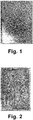
- the produced rolled material was subjected to the following neutral salt spray test. The result is shown in Table 1.
- a photograph of a surface of the rolled material was taken after the neutral salt spray test.
- a copy of the photograph is shown in Fig. 1 .
- the produced rolled material was subjected to a surface anodization treatment to prepare a test sample.
- a photograph of a surface of the test sample was taken after the neutral salt spray test.
- a copy of the photograph is shown
- the rolled material was introduced into a test container having a controlled temperature of 35°C ⁇ 2°C, sprayed with a 5% saline solution (50 ⁇ 5 g/l), left to stand at a pH of 6.5 to 7.2 for 72 hours, and taken out from the test container.
- the tensile strength of the produced rolled material was measured as described above.
- the rolled material was evaluated as acceptable when it had a tensile strength of 160 MPa or more, and was evaluated as unacceptable when it had a tensile strength of less than 160 MPa.
- the Mg-Li alloys of Examples exhibited significantly lower corrosion rates and thus more excellent corrosion resistances as compared with the Mg-Li alloys of Comparative Examples.
Landscapes
- Chemical & Material Sciences (AREA)
- Engineering & Computer Science (AREA)
- Mechanical Engineering (AREA)
- Materials Engineering (AREA)
- Metallurgy (AREA)
- Organic Chemistry (AREA)
- Physics & Mathematics (AREA)
- Thermal Sciences (AREA)
- Crystallography & Structural Chemistry (AREA)
- Sealing Battery Cases Or Jackets (AREA)
- Cell Electrode Carriers And Collectors (AREA)
Priority Applications (1)
| Application Number | Priority Date | Filing Date | Title |
|---|---|---|---|
| EP19178766.2A EP3556876A1 (de) | 2015-01-27 | 2016-01-26 | Magnesium-lithium-legierung, gewalztes material und formartikel |
Applications Claiming Priority (2)
| Application Number | Priority Date | Filing Date | Title |
|---|---|---|---|
| JP2015013644 | 2015-01-27 | ||
| PCT/JP2016/052088 WO2016121722A1 (ja) | 2015-01-27 | 2016-01-26 | マグネシウム-リチウム合金、圧延材及び成型品 |
Related Child Applications (1)
| Application Number | Title | Priority Date | Filing Date |
|---|---|---|---|
| EP19178766.2A Division EP3556876A1 (de) | 2015-01-27 | 2016-01-26 | Magnesium-lithium-legierung, gewalztes material und formartikel |
Publications (2)
| Publication Number | Publication Date |
|---|---|
| EP3252181A1 true EP3252181A1 (de) | 2017-12-06 |
| EP3252181A4 EP3252181A4 (de) | 2018-06-20 |
Family
ID=56543335
Family Applications (2)
| Application Number | Title | Priority Date | Filing Date |
|---|---|---|---|
| EP16743325.9A Withdrawn EP3252181A4 (de) | 2015-01-27 | 2016-01-26 | Magnesium-lithium-legierung, gewalztes material und formartikel |
| EP19178766.2A Withdrawn EP3556876A1 (de) | 2015-01-27 | 2016-01-26 | Magnesium-lithium-legierung, gewalztes material und formartikel |
Family Applications After (1)
| Application Number | Title | Priority Date | Filing Date |
|---|---|---|---|
| EP19178766.2A Withdrawn EP3556876A1 (de) | 2015-01-27 | 2016-01-26 | Magnesium-lithium-legierung, gewalztes material und formartikel |
Country Status (5)
| Country | Link |
|---|---|
| US (1) | US10900103B2 (de) |
| EP (2) | EP3252181A4 (de) |
| JP (1) | JP6794264B2 (de) |
| CN (1) | CN107250401A (de) |
| WO (1) | WO2016121722A1 (de) |
Families Citing this family (13)
| Publication number | Priority date | Publication date | Assignee | Title |
|---|---|---|---|---|
| EP3276019B1 (de) * | 2015-03-25 | 2021-08-18 | Subaru Corporation | Magnesium-lithium-legierung, gewalztes material aus magnesium-lithium-legierung und verarbeiteter artikel mit magnesium-lithium-legierung als ausgangsmaterial |
| CA3091705A1 (en) * | 2017-02-24 | 2018-08-30 | Innomaq 21, S.L. | Method for the economic manufacture of light components |
| JP7327906B2 (ja) * | 2018-04-23 | 2023-08-16 | キヤノン株式会社 | マグネシウム-リチウム系合金の部材、機器、及び光学機器 |
| EP3763845B1 (de) * | 2019-07-08 | 2021-08-18 | LKR Leichtmetallkompetenzzentrum Ranshofen GmbH | Magnesiumlegierung und verfahren zur herstellung derselben |
| CN113502422B (zh) * | 2021-06-11 | 2022-06-07 | 清华大学 | 高强韧镁锂合金及其制备方法 |
| CN114015918B (zh) * | 2021-10-12 | 2022-07-08 | 北京理工大学 | 一种低密度高强度高模量的镁锂合金及制备方法 |
| CN114000071A (zh) * | 2021-10-29 | 2022-02-01 | 内蒙古科技大学 | Lz91镁锂合金的深冷轧制方法 |
| JP2023075682A (ja) * | 2021-11-19 | 2023-05-31 | キヤノン株式会社 | 合金、合金部材、機器及び合金の製造方法 |
| CN114250393B (zh) * | 2021-12-29 | 2022-07-19 | 北京理工大学 | 一种高强度高模量双相的镁锂合金及制备方法 |
| TW202330955A (zh) * | 2022-01-28 | 2023-08-01 | 安立材料科技股份有限公司 | 適於利用大氣熔煉進行加工之鎂鋰鋁鋅合金及其用途 |
| CN114959390B (zh) * | 2022-05-06 | 2023-11-10 | 中国科学院金属研究所 | 一种高强高抗蠕变能力的超轻镁锂合金及其制备方法 |
| CN116618436B (zh) * | 2023-05-15 | 2026-01-06 | 兰州大学 | 一种通过热轧变形提升镁锂合金综合力学性能的方法 |
| WO2025170431A1 (ko) * | 2024-02-05 | 2025-08-14 | 한국재료연구원 | 고내식 마그네슘-리튬 합금 |
Family Cites Families (11)
| Publication number | Priority date | Publication date | Assignee | Title |
|---|---|---|---|---|
| US5059390A (en) * | 1989-06-14 | 1991-10-22 | Aluminum Company Of America | Dual-phase, magnesium-based alloy having improved properties |
| JPH04176839A (ja) | 1990-11-08 | 1992-06-24 | Aluminum Co Of America <Alcoa> | マグネシウム基合金 |
| JPH07122111B2 (ja) * | 1993-03-26 | 1995-12-25 | 三井金属鉱業株式会社 | 超塑性マグネシウム合金 |
| JPH0941066A (ja) * | 1995-08-01 | 1997-02-10 | Mitsui Mining & Smelting Co Ltd | 冷間プレス加工可能なマグネシウム合金 |
| JP2000282165A (ja) | 1999-04-01 | 2000-10-10 | Sharp Corp | リチウム含有マグネシウム合金及びその溶製用ルツボ |
| JP2001283796A (ja) | 2000-04-04 | 2001-10-12 | Matsushita Electric Ind Co Ltd | リチウム二次電池とその製造方法 |
| JP3821074B2 (ja) * | 2002-09-19 | 2006-09-13 | 住友金属工業株式会社 | マグネシウム合金板とその製造方法 |
| CN1924055A (zh) * | 2006-09-15 | 2007-03-07 | 苏州有色金属加工研究院 | 一种镁锂合金及其制造方法 |
| JP5757105B2 (ja) * | 2011-02-24 | 2015-07-29 | 住友電気工業株式会社 | マグネシウム合金材及びその製造方法 |
| CN103031474A (zh) * | 2011-09-29 | 2013-04-10 | 比亚迪股份有限公司 | 一种镁锂合金 |
| CN103643096A (zh) * | 2013-12-13 | 2014-03-19 | 内蒙古科技大学 | 一种双相组织的高性能镁合金板材制备方法 |
-
2016
- 2016-01-26 EP EP16743325.9A patent/EP3252181A4/de not_active Withdrawn
- 2016-01-26 CN CN201680009998.9A patent/CN107250401A/zh active Pending
- 2016-01-26 JP JP2016572035A patent/JP6794264B2/ja active Active
- 2016-01-26 US US15/544,784 patent/US10900103B2/en active Active
- 2016-01-26 WO PCT/JP2016/052088 patent/WO2016121722A1/ja not_active Ceased
- 2016-01-26 EP EP19178766.2A patent/EP3556876A1/de not_active Withdrawn
Also Published As
| Publication number | Publication date |
|---|---|
| EP3252181A4 (de) | 2018-06-20 |
| WO2016121722A1 (ja) | 2016-08-04 |
| EP3556876A1 (de) | 2019-10-23 |
| CN107250401A (zh) | 2017-10-13 |
| US20170369972A1 (en) | 2017-12-28 |
| JP6794264B2 (ja) | 2020-12-02 |
| JPWO2016121722A1 (ja) | 2017-11-02 |
| US10900103B2 (en) | 2021-01-26 |
Similar Documents
| Publication | Publication Date | Title |
|---|---|---|
| US10900103B2 (en) | Magnesium-lithium alloy, rolled material and shaped article | |
| EP2476769B1 (de) | Magnesium-lithium-legierung, gewalztes material, formartikel und herstellungsverfahren dafür | |
| EP3276019B1 (de) | Magnesium-lithium-legierung, gewalztes material aus magnesium-lithium-legierung und verarbeiteter artikel mit magnesium-lithium-legierung als ausgangsmaterial | |
| JP6412103B2 (ja) | 構造用アルミニウム合金板及びその製造方法 | |
| KR102210236B1 (ko) | 마그네슘 합금재 및 이의 제조방법 | |
| WO2009147861A1 (ja) | 易成形性マグネシウム合金板材及びその作製方法 | |
| CN105624494B (zh) | 一种含稀土元素的耐蚀变形镁合金及其制备方法 | |
| EP3399060B1 (de) | Verfahren zur herstellung von magnesiumlegierung mit ausgezeichneten mechanischen eigenschaften und korrosionsbeständigkeit | |
| CN115427598B (zh) | 镁合金、镁合金板、镁合金棒及其制造方法、镁合金部件 | |
| JP5731206B2 (ja) | マグネシウム−リチウム合金、圧延材、成型品、およびその製造方法 | |
| JPWO2009113601A1 (ja) | マグネシウム−リチウム合金、圧延材、成型品 | |
| CN110382724A (zh) | 镁合金板材及其制造方法 | |
| US11186899B2 (en) | Magnesium-zinc-manganese-tin-yttrium alloy and method for making the same | |
| CN119876708A (zh) | 一种含稀土的高强韧变形铝镁合金及其制备方法 | |
| Rokhlin et al. | Joint effect of scandium and zirconium on the recrystallization of aluminum Al–Mg2Si alloys | |
| JP3691089B2 (ja) | フッ化処理用アルミニウム合金 | |
| CN116926391A (zh) | 一种高亮高耐蚀镁合金及其制备方法 | |
| JP6501109B2 (ja) | アルミニウム合金及び材料、並びに押出材の製造方法 | |
| CN119913398A (zh) | 一种含稀土的耐蚀变形铝合金及其制备方法 |
Legal Events
| Date | Code | Title | Description |
|---|---|---|---|
| STAA | Information on the status of an ep patent application or granted ep patent |
Free format text: STATUS: THE INTERNATIONAL PUBLICATION HAS BEEN MADE |
|
| PUAI | Public reference made under article 153(3) epc to a published international application that has entered the european phase |
Free format text: ORIGINAL CODE: 0009012 |
|
| STAA | Information on the status of an ep patent application or granted ep patent |
Free format text: STATUS: REQUEST FOR EXAMINATION WAS MADE |
|
| 17P | Request for examination filed |
Effective date: 20170807 |
|
| AK | Designated contracting states |
Kind code of ref document: A1 Designated state(s): AL AT BE BG CH CY CZ DE DK EE ES FI FR GB GR HR HU IE IS IT LI LT LU LV MC MK MT NL NO PL PT RO RS SE SI SK SM TR |
|
| AX | Request for extension of the european patent |
Extension state: BA ME |
|
| DAV | Request for validation of the european patent (deleted) | ||
| DAX | Request for extension of the european patent (deleted) | ||
| A4 | Supplementary search report drawn up and despatched |
Effective date: 20180517 |
|
| RIC1 | Information provided on ipc code assigned before grant |
Ipc: C22C 23/00 20060101AFI20180511BHEP Ipc: B21B 3/00 20060101ALI20180511BHEP Ipc: C22C 23/02 20060101ALI20180511BHEP Ipc: C22F 1/00 20060101ALI20180511BHEP Ipc: C22F 1/06 20060101ALI20180511BHEP |
|
| STAA | Information on the status of an ep patent application or granted ep patent |
Free format text: STATUS: EXAMINATION IS IN PROGRESS |
|
| 17Q | First examination report despatched |
Effective date: 20190712 |
|
| GRAP | Despatch of communication of intention to grant a patent |
Free format text: ORIGINAL CODE: EPIDOSNIGR1 |
|
| STAA | Information on the status of an ep patent application or granted ep patent |
Free format text: STATUS: GRANT OF PATENT IS INTENDED |
|
| INTG | Intention to grant announced |
Effective date: 20220322 |
|
| STAA | Information on the status of an ep patent application or granted ep patent |
Free format text: STATUS: THE APPLICATION IS DEEMED TO BE WITHDRAWN |
|
| 18D | Application deemed to be withdrawn |
Effective date: 20220802 |