EP3254667B1 - Lichthärtbare zusammensetzung, zahnprothese und platte für zahnprothese - Google Patents
Lichthärtbare zusammensetzung, zahnprothese und platte für zahnprothese Download PDFInfo
- Publication number
- EP3254667B1 EP3254667B1 EP16746589.7A EP16746589A EP3254667B1 EP 3254667 B1 EP3254667 B1 EP 3254667B1 EP 16746589 A EP16746589 A EP 16746589A EP 3254667 B1 EP3254667 B1 EP 3254667B1
- Authority
- EP
- European Patent Office
- Prior art keywords
- meth
- acrylic monomer
- photocurable composition
- acrylic
- composition according
- Prior art date
- Legal status (The legal status is an assumption and is not a legal conclusion. Google has not performed a legal analysis and makes no representation as to the accuracy of the status listed.)
- Active
Links
Classifications
-
- A—HUMAN NECESSITIES
- A61—MEDICAL OR VETERINARY SCIENCE; HYGIENE
- A61C—DENTISTRY; APPARATUS OR METHODS FOR ORAL OR DENTAL HYGIENE
- A61C13/00—Dental prostheses; Making same
- A61C13/01—Palates or other bases or supports for the artificial teeth; Making same
-
- A—HUMAN NECESSITIES
- A61—MEDICAL OR VETERINARY SCIENCE; HYGIENE
- A61C—DENTISTRY; APPARATUS OR METHODS FOR ORAL OR DENTAL HYGIENE
- A61C13/00—Dental prostheses; Making same
- A61C13/0003—Making bridge-work, inlays, implants or the like
- A61C13/0006—Production methods
- A61C13/0013—Production methods using stereolithographic techniques
-
- A—HUMAN NECESSITIES
- A61—MEDICAL OR VETERINARY SCIENCE; HYGIENE
- A61C—DENTISTRY; APPARATUS OR METHODS FOR ORAL OR DENTAL HYGIENE
- A61C13/00—Dental prostheses; Making same
- A61C13/10—Fastening of artificial teeth to denture palates or the like
- A61C13/1003—Fastening of artificial teeth to denture palates or the like by embedding in base material
-
- A—HUMAN NECESSITIES
- A61—MEDICAL OR VETERINARY SCIENCE; HYGIENE
- A61K—PREPARATIONS FOR MEDICAL, DENTAL OR TOILETRY PURPOSES
- A61K6/00—Preparations for dentistry
-
- A—HUMAN NECESSITIES
- A61—MEDICAL OR VETERINARY SCIENCE; HYGIENE
- A61K—PREPARATIONS FOR MEDICAL, DENTAL OR TOILETRY PURPOSES
- A61K6/00—Preparations for dentistry
- A61K6/80—Preparations for artificial teeth, for filling teeth or for capping teeth
- A61K6/884—Preparations for artificial teeth, for filling teeth or for capping teeth comprising natural or synthetic resins
- A61K6/887—Compounds obtained by reactions only involving carbon-to-carbon unsaturated bonds
Definitions
- the present invention relates to a photocurable composition, a denture base, and a plate denture.
- a denture base made of resin (referred to as "resin base”) has been produced by a method in which a plaster mold adapted to an intraoral shape of a patient is first produced by a dental method, and then a curable resin is poured into the plaster mold, followed by curing the curable resin.
- JP S56 161313 A discloses dental compositions comprising (meth)acrylic monomer components which are difunctional aromatic acrylates or methacrylates and difunctional aliphatic acrylates or methacrylates.
- US 2009/004579 A1 discloses three-dimensional articles made using a stereolithography process wherein the photo-curable composition comprises (meth)acrylate monomer components and a photopolymerization initiator.
- a dental prosthesis a medical device for intraoral use, or a tooth and/or jaw model (hereinafter, collectively referred to as "dental prosthesis or the like") using a 3D printer
- stereolithography a method referred to as "stereolithography” in which a dental prosthesis is produced by forming a photocurable composition into the shape of the dental prosthesis or the like, and then the resulting shaped product is subjected to photocuring.
- the photocurable composition after being subjected to photocuring has an excellent flexural strength and flexural modulus, in view of practical use of the dental prosthesis or the like. Further, in this case, the photocurable composition after photocuring is also required to have an excellent Charpy impact strength, in view of durability of the dental prosthesis or the like.
- An object of an embodiment according to the invention is to provide a photocurable composition which is used for the production by stereolithography of a dental prosthesis, a medical device for intraoral use, or a tooth and/or jaw model, and which has an excellent flexural strength, flexural modulus, and Charpy impact strength after being subjected to photocuring.
- Another object of the embodiment according to the invention is to provide: a denture base which is produced using the above described photocurable composition, and which has an excellent flexural strength, flexural modulus, and Charpy impact strength; and a plate denture including the denture base.
- a photocurable composition containing a combination of specific monomer species has an excellent flexural strength, flexural modulus, and Charpy impact strength after being subjected to photocuring, and that the photocurable composition is particularly suitable for the production by stereolithography of a dental prosthesis or the like (in other words, a dental prosthesis, a medical device for intraoral use, or a tooth and/or jaw model), thereby completing the present invention.
- a dental prosthesis or the like in other words, a dental prosthesis, a medical device for intraoral use, or a tooth and/or jaw model
- the embodiment according to the invention provides a photocurable composition which is used for the production by stereolithography of a dental prosthesis, a medical device for intraoral use, or a tooth and/or jaw model, and which has an excellent flexural strength, flexural modulus, and Charpy impact strength, after being subjected to photocuring.
- the embodiment according to the invention provides: a denture base which is produced by stereolithography, using the above described photocurable composition, and which has an excellent flexural strength, flexural modulus, and Charpy impact strength; and a plate denture including the denture base.
- any numerical range indicated using an expression “from * to” represents a range in which numerical values described before and after the "to” are included in the range as a lower limit value and an upper limit value.
- (meth)acrylate refers to an acrylate or a methacrylate
- (meth)acryloyloxy group refers to an acryloyloxy group or a methacryloyloxy group
- the photocurable composition according to the present embodiment is according to appended claim 1.
- the photocurable composition according to the present embodiment has an excellent flexural strength, flexural modulus, and Charpy impact strength, after being subjected to photocuring, by including a combination of: the acrylic monomer (X); and at least one selected from the group consisting of the (meth)acrylic monomer (A), the (meth)acrylic monomer (B), and the (meth)acrylic monomer (C) (hereinafter, also referred to as "at least one of the (meth)acrylic monomers (A) to (C)").
- a dental prosthesis or the like which is produced by stereolithography, using the photocurable composition according to the present embodiment, also has an excellent flexural strength, flexural modulus, and Charpy impact strength.
- the photocurable composition according to the present embodiment has a viscosity suitable for the production by stereolithography of a dental prosthesis or the like.
- the "(meth)acrylic monomer component” refers to entire (meth)acrylic monomers included in the photocurable composition according to the present embodiment.
- the “(meth)acrylic monomer component” includes, at least: the acrylic monomer (X); and at least one of the (meth)acrylic monomers (A) to (C).
- the "(meth)acrylic monomer component” may include another (meth)acrylic monomer, other than the acrylic monomer (X) and the (meth)acrylic monomers (A) to (C), if necessary.
- the photocurable composition according to the present embodiment encompasses the following first to third embodiments.
- the first embodiment is an embodiment in which the (meth)acrylic monomer component in the present embodiment includes at least the acrylic monomer (X) and the (meth)acrylic monomer (A).
- the second embodiment is an embodiment in which the (meth)acrylic monomer component in the present embodiment includes at least the acrylic monomer (X) and the (meth)acrylic monomer (B).
- the third embodiment is an embodiment in which the (meth)acrylic monomer component in the present embodiment includes at least the acrylic monomer (X) and the (meth)acrylic monomer (C).
- At least two of the scope of the first embodiment, the scope of the second embodiment, or the scope of the third embodiment may have some components in common.
- the (meth)acrylic monomer component includes the acrylic monomer (X), the (meth)acrylic monomer (A), the (meth)acrylic monomer (B), and the (meth)acrylic monomer (C) falls within the scope of any of the first to third embodiments.
- the Charpy impact strength after photocuring is improved due to incorporation of the acrylic monomer (X), as compared to the case in which a dimethacrylic monomer containing two aromatic rings and two methacryloyloxy groups within one molecule is included, instead of the acrylic monomer (X).
- the flexural strength and the flexural modulus after photocuring are improved due to the incorporation of the acrylic monomer (X), as compared to the case in which an acrylic monomer containing one aromatic ring and one acryloyloxy group within one molecule is included, instead of the acrylic monomer (X).
- the incorporation of the acrylic monomer (X) allows for inhibiting a phenomenon in which a crystallinity of the monomers is increased excessively, as compared to the case in which a diacrylic monomer containing one aromatic ring and two acryloyloxy groups within one molecule is included, instead of the acrylic monomer (X). As a result, the viscosity of the photocurable composition is reduced.
- the viscosity of the photocurable composition is reduced due to the incorporation of the acrylic monomer (X), as compared to the case in which an acrylic monomer containing three or more aromatic rings within one molecule is used, instead of the acrylic monomer (X).
- the Charpy impact strength after photocuring is improved due to the incorporation of the acrylic monomer (X), as compared to the case in which an acrylic monomer containing three or more acryloyloxy groups within one molecule is used, instead of the acrylic monomer (X).
- the flexural strength and the flexural modulus after photocuring are improved due to the incorporation of the acrylic monomer (X), as compared to the case of using, instead of the acrylic monomer (X), an acrylic monomer which is at least one selected from diacrylic monomers containing two aromatic rings and two acryloyloxy groups within one molecule, and which has a weight average molecular weight of greater than 580.
- the lower limit of the weight average molecular weight of the acrylic monomer (X), which is 400, is a lower limit defined in view of ease of production or ease of availability of the monomer.
- the flexural strength and the flexural modulus after photocuring are further improved, due to the incorporation of at least one of the (meth)acrylic monomers (A) to (C), in addition to the acrylic monomer (X).
- the photocurable composition according to the first embodiment of the present embodiment is, as described above, a photocurable composition in which the (meth)acrylic monomer component includes at least the acrylic monomer (X) and the (meth)acrylic monomer (A).
- the (meth)acrylic monomer (A) is a (meth)acrylic monomer which is at least one selected from di(meth)acrylic monomers not containing, within one molecule, an aromatic ring and containing, within one molecule, one or more ether bonds and two (meth)acryloyloxy groups, and which has a weight average molecular weight of from 200 to 400.
- the flexural strength and the flexural modulus of the composition after photocuring are improved, as compared to those of a photocurable composition which includes, instead of the (meth)acrylic monomer (A) in the first embodiment, a (meth)acrylic monomer not containing an aromatic ring and containing one or more ether bonds and two (meth)acryloyloxy groups within one molecule, and having a weight average molecular weight of greater than 400, and which composition does not fall within the scope of any of the first to third embodiments.
- the lower limit of the weight average molecular weight of the (meth)acrylic monomer (A), which is 200, is a lower limit defined in view of the ease of production or ease of availability of the monomer.
- the photocurable composition according to the second embodiment of the present embodiment is, as described above, a photocurable composition in which the (meth)acrylic monomer component includes at least the acrylic monomer (X) and the (meth)acrylic monomer (B).
- the (meth)acrylic monomer (B) is a (meth)acrylic monomer which is at least one selected from (meth)acrylic monomers not containing, within one molecule, an aromatic ring and containing, within one molecule, a ring structure other than an aromatic ring and one (meth)acryloyloxy group, and which has a weight average molecular weight of from 130 to 240.
- the flexural strength and the flexural modulus of the composition after photocuring are improved, as compared to those of a photocurable composition which includes, instead of the (meth)acrylic monomer (B) in the second embodiment, a (meth)acrylic monomer containing a ring structure other than an aromatic ring and one (meth)acryloyloxy group within one molecule, and having a weight average molecular weight of greater than 240, and which composition does not fall within the scope of any of the first to third embodiments.
- the flexural strength and the flexural modulus of the composition after photocuring are improved, as compared to those of a photocurable composition which includes, instead of the (meth)acrylic monomer (B) in the second embodiment, a (meth)acrylic monomer containing no ring structure within one molecule, and which composition does not fall within the scope of any of the first to third embodiments.
- the lower limit of the weight average molecular weight of the (meth)acrylic monomer (B), which is 130, is a lower limit defined in view of the ease of production or ease of availability of the monomer.
- the photocurable composition according to the third embodiment of the present embodiment is, as described above, a photocurable composition in which the (meth)acrylic monomer component includes at least the acrylic monomer (X) and the (meth)acrylic monomer (C).
- the (meth)acrylic monomer (C) is a (meth)acrylic monomer which is at least one selected from di(meth)acrylic monomers not containing, within one molecule, an aromatic ring nor ether bond and containing, within one molecule, a hydrocarbon skeleton and two (meth)acryloyloxy groups, and which has a weight average molecular weight of from 190 to 280.
- the flexural strength and the flexural modulus of the composition after photocuring are improved, as compared to those of a photocurable composition which includes, instead of the (meth)acrylic monomer (C) in the third embodiment, a (meth)acrylic monomer not containing, within one molecule, an aromatic ring nor ether bond and containing, within one molecule, a hydrocarbon skeleton and two (meth)acryloyloxy groups, and having a weight average molecular weight of greater than 280, and which composition does not fall within the scope of any of the first to third embodiments.
- the lower limit of the weight average molecular weight of the (meth)acrylic monomer (C), which is 190, is a lower limit defined in view of the ease of production or ease of availability of the monomer.
- the photocurable composition according to the present embodiment preferably satisfies the following flexural strength and the following flexural modulus, after being subjected to photocuring, in terms of the practical use of the resulting dental prosthesis or the like (the resulting denture base, in particular).
- the photocurable composition according to the present embodiment preferably satisfies a flexural strength, as measured below, of 60 MPa or more, and more preferably, 65 MPa or more.
- the measurement of the flexural strength is carried out as follows.
- the photocurable composition is formed into a shaped product having a size of 64 mm ⁇ 10 mm ⁇ 3.3 mm thickness, and the resulting formed product is subjected to UV light irradiation at 5 J/cm 2 to carry out photocuring, thereby obtaining a stereolithographed product (namely, a cured product; the same shall apply hereinafter).
- the resulting stereolithographed product is stored in a constant temperature water bath controlled at 37 ⁇ 1°C for 50 ⁇ 2 hours, and the flexural strength of the stereolithographed product after storage is measured in accordance with ISO 20795-1: 2008 (or JIS T 6501: 2012).
- the photocurable composition according to the present embodiment preferably satisfies a flexural modulus, as measured below, of 1,500 MPa or more, and more preferably, 2,000 MPa or more.
- a flexural modulus as measured below, of 1,500 MPa or more, and more preferably, 2,000 MPa or more.
- the measurement of the flexural modulus is carried out as follows.
- the photocurable composition is formed into a shaped product having a size of 64 mm ⁇ 10 mm ⁇ 3.3 mm thickness, and the resulting shaped product is subjected to UV light irradiation at 5 J/cm 2 to carry out photocuring, thereby obtaining a stereolithographed product.
- the resulting stereolithographed product is stored in a constant temperature water bath controlled at 37 ⁇ 1°C for 50 ⁇ 2 hours, and the flexural modulus of the stereolithographed product after storage is measured in accordance with ISO 20795-1: 2008 (or JIS T 6501: 2012).
- the photocurable composition according to the present embodiment preferably satisfies the following Charpy impact strength, in terms of the durability of the resulting dental prosthesis or the like (the resulting denture base, in particular).
- the photocurable composition according to the present embodiment preferably satisfies a Charpy impact strength, as measured below, of 1.0 kJ/m 2 or more.
- a Charpy impact strength as measured below, of 1.0 kJ/m 2 or more.
- the measurement of the Charpy impact strength is carried out as follows.
- the photocurable composition is formed into a shaped product having a size of 80 mm ⁇ 10 mm ⁇ 4 mm thickness, and the resulting formed product is subjected to UV light irradiation at 5 J/cm 2 to carry out photocuring, thereby obtaining a stereolithographed product.
- the resulting stereolithographed product is stored in a constant temperature water bath controlled at 37 ⁇ 1°C for 50 ⁇ 2 hours.
- a notch in the shape of a letter A and having a depth of 2 mm is provided at the central portion in a longitudinal direction of the stereolithographed product after storage, to obtain a test specimen with a single-notch.
- the Charpy impact strength of the resulting test specimen with a single-notch is measured in accordance with ISO 179-1: 2010 (or JIS K 7111-1: 2012), and under conditions of a hammer energy of 0.5 J, a swing angle of 148 degrees, a test temperature of 23°C, and edgewise impact.
- the photocurable composition according to the present embodiment is used for the production by stereolithography of a dental prosthesis or the like (namely, a dental prosthesis, a medical device for intraoral use, or a tooth and/or jaw model).
- the dental prosthesis may be, for example, a denture base, a denture, an inlay, a crown, a bridge, a temporary crown, or a temporary bridge.
- a denture base is preferred.
- the medical device for intraoral use may be, for example, an orthodontic appliance (such as a mouthpiece, or an orthodontic appliance), a bite splint, a tray for obtaining an impression, or a guide for use in surgery.
- an orthodontic appliance such as a mouthpiece, or an orthodontic appliance
- a bite splint such as a bite splint
- a tray for obtaining an impression such as a tray for obtaining an impression
- a guide for use in surgery a guide for use in surgery.
- an orthodontic appliance is preferred, and a mouthpiece is more preferred.
- the dental prosthesis or the like (namely, a dental prosthesis, medical device for intraoral use, or a tooth and/or jaw model) is preferably a dental prosthesis or an orthodontic appliance, more preferably a denture base or a mouthpiece, and particularly preferably a denture base.
- stereolithography refers to one of the three-dimensional shaping methods utilizing a 3D printer.
- stereolithography methods examples include an SLA (Stereo Lithography Apparatus) method, a DLP (Digital Light Processing) method, and an ink-jet method.
- SLA Stepo Lithography Apparatus
- DLP Digital Light Processing
- ink-jet method examples include an ink-jet method.
- the photocurable composition according to the present embodiment is particularly suitable for a SLA or a DLP stereolithography method.
- Examples of the SLA method include a method in which a spot-shaped UV laser beam is irradiated to a photocurable composition to obtain a three-dimensional shaped product.
- the production thereof may be carried out, for example, as follows.
- the photocurable composition according to the present embodiment is pooled in a container, and a spot-like UV laser beam is selectively irradiated to a liquid surface of the photocurable composition so as to obtain a desired pattern.
- the photocurable composition is cured to form a cured layer having a desired thickness on a shaping table.
- the shaping table is lowered, so that the photocurable composition in a liquid state is supplied over the cured layer, in an amount sufficient for forming one layer, and the curing is carried out in the same manner as described above. This operation is repeated to obtain cured layers disposed one on another in layers. In this manner, a dental prosthesis or the like can be produced.
- Examples of the DLP method include a method in which planar light is irradiated to a photocurable composition to obtain a three-dimensional shaped product.
- JP-B 5111880 and JP-B 5235056 can be referred to, if appropriate.
- a dental prosthesis or the like is produced by the DLP method
- the production thereof may be carried out, for example, as follows.
- a lamp which emits light other than a laser beam such as a high pressure mercury lamp, an ultra-high pressure mercury lamp, or a low pressure mercury lamp, or alternatively, an LED is used as a light source.
- Examples of the ink-jet method include a method in which droplets of a photocurable composition is continuously discharged onto a substrate through an ink-jet nozzle, and then light is irradiated to the droplets adhered to the substrate to obtain a three-dimensional shaped product.
- a dental prosthesis or the like is produced by an ink-jet method
- the production thereof may be carried out, for example, as follows. Specifically, while scanning a plane with a head including an ink-jet nozzle and a light source, the photocurable composition is discharged onto a substrate through the ink-jet nozzle. At the same time, light is irradiated to the discharged photocurable composition to form a cured layer. This operation is repeated so that cured layers are formed and layered one on another, sequentially. In this manner, a dental prosthesis or the like can be produced.
- the photocurable composition according to the present embodiment preferably has a viscosity at 25°C and at 50 rpm, as measured using a Type E viscometer, of from 20 mPa ⁇ s to 1,500 mPa ⁇ s, in terms of suitability for the production by stereolithography of a dental prosthesis or the like.
- the lower limit of the viscosity is more preferably 50 mPa ⁇ s.
- the upper limit of the viscosity is more preferably 1,000 mPa ⁇ s, and still more preferably 500 mPa ⁇ s.
- the viscosity at 25°C and at 50 rpm of the photocurable composition according to the present embodiment may be adjusted depending on the method of the stereolithography to be used.
- the viscosity of the photocurable composition is preferably from 50 mPa ⁇ s to 1500 mPa ⁇ s, and more preferably from 50 mPa ⁇ s to 1000 mPa ⁇ s.
- the viscosity of the photocurable composition is preferably from 50 mPa ⁇ s to 500 mPa ⁇ s, and more preferably from 50 mPa ⁇ s to 250 mPa ⁇ s.
- the viscosity of the photocurable composition is preferably from 20 mPa ⁇ s to 500 mPa ⁇ s, and more preferably from 20 mPa ⁇ s to 100 mPa ⁇ s.
- the (meth)acrylic monomer component in the present embodiment includes the acrylic monomer (X) which is at least one selected from diacrylic monomers containing, within one molecule, two aromatic rings and two acryloyloxy groups, and which has a weight average molecular weight of from 400 to 580.
- the acrylic monomer (X) may consist of one type of diacrylic monomer containing, within one molecule, two aromatic rings and two acryloyloxy groups, or may be a mixture composed of two or more types of the diacrylic monomers.
- At least one of the diacrylic monomers constituting the acrylic monomer (X) contains an ether bond within one molecule, in terms of further improving the Charpy impact strength after photocuring.
- the degree of freedom of molecular motion is increased to impart flexibility to the cured product after photocuring, thereby improving its toughness.
- the Charpy impact strength of the cured product namely, the Charpy impact strength of the photocurable composition after photocuring is improved.
- At least one of the diacrylic monomers contains from one to four ether bonds within one molecule.
- the flexural strength and the flexural modulus after photocuring are further improved.
- the number of ether bonds within one molecule is still more preferably from two to four, and particularly preferably from two to three, in terms of further improving the flexural strength and the flexural modulus after photocuring.
- At least one of the diacrylic monomers is a compound represented by the following Formula (x-1), in terms of reducing the viscosity of the photocurable composition, and further improving the Charpy impact strength, the flexural strength, and the flexural modulus, after photocuring.
- each of R 1x and R 2x independently represents a hydrogen atom or a methyl group; each of R 3x and R 4x independently represents a straight chain or branched chain alkylene group having from 2 to 4 carbon atoms; and each of mx and nx independently represents a number from 0 to 4, with the proviso that mx and nx satisfy the relation: 1 ⁇ (mx + nx) ⁇ 4.].
- the plurality of R 3x s may be the same as or different from each other.
- R 4x the same applies for R 4x .
- each of R 1x and R 2x is preferably a methyl group.
- each of R 3x and R 4x independently represents an ethylene group, a trimethylene group, a tetramethylene group, a 1-methylethylene group, a 1-ethylethylene group or a 2-methyltrimethylene group, and more preferably, an ethylene group or a 1-methylethylene group.
- both of R 3x and R 4x are ethylene groups, trimethylene groups, tetramethylene groups, 1-methylethylene groups, or 2-methyltrimethylene groups, and more preferably both are ethylene groups or 1-methylethylene groups.
- mx + nx is from 1 to 4, it is particularly preferable that mx + nx is from 2 to 3, in terms of further improving the flexural strength and the flexural modulus after photocuring.
- At least one of the diacrylic monomers constituting the acrylic monomer (X) is a compound represented by the following Formula (x-2), in terms of reducing the viscosity of the photocurable composition, and further improving the Charpy impact strength, the flexural strength, and the flexural modulus, after photocuring.
- each of R 5x , R 6x , R 7x , and R 8x independently represents a hydrogen atom or a methyl group; and each of mx and nx independently represents a number from 0 to 4, with the proviso that mx and nx satisfy the relation: 1 ⁇ (mx + nx) ⁇ 4.
- the plurality of R 5x s may be the same as or different from each other. The same applies for each of R 6x , R 7x , and R 8x .
- R 5x or R 6x is a methyl group, and the other is a hydrogen atom.
- R 7x or R 8x is a methyl group and the other is a hydrogen atom.
- R 5x and R 8x are both methyl groups, and R 6x and R 7x are both hydrogen atoms.
- mx + nx is from 1 to 4, it is preferable that mx + nx is from 2 to 3, in terms of further improving the flexural strength and the flexural modulus after photocuring.
- the content of the acrylic monomer (X) is preferably from 550 parts by mass to 800 parts by mass, more preferably from 600 parts by mass to 800 parts by mass, and still more preferably from 620 parts by mass to 800 parts by mass, with respect to 1,000 parts by mass of the total content of the (meth)acrylic monomer component.
- the (meth)acrylic monomer component in the first embodiment of the present embodiment includes the (meth)acrylic monomer (A) which is at least one selected from di(meth)acrylic monomers not containing, within one molecule, an aromatic ring and containing, within one molecule, one or more ether bonds and two (meth)acryloyloxy groups, and which has a weight average molecular weight of from 200 to 400.
- A is at least one selected from di(meth)acrylic monomers not containing, within one molecule, an aromatic ring and containing, within one molecule, one or more ether bonds and two (meth)acryloyloxy groups, and which has a weight average molecular weight of from 200 to 400.
- the (meth)acrylic monomer (A) may be included in the (meth)acrylic monomer component in the second embodiment and the (meth)acrylic monomer component in the third embodiment.
- the (meth)acrylic monomer (A) may consist of one type of di(meth)acrylic monomer not containing, within one molecule, an aromatic ring and containing, within one molecule, one or more ether bonds and two (meth)acryloyloxy groups, or may be a mixture composed of two or more types of the di(meth)acrylic monomers.
- At least one of the di(meth)acrylic monomers constituting the (meth)acrylic monomer (A) contains one or two ether bonds within one molecule, in terms of further improving the Charpy impact strength after photocuring.
- At least one of the di(meth)acrylic monomers constituting the (meth)acrylic monomer (A) is a compound represented by the following Formula (a-1), in terms of further improving the Charpy impact strength after photocuring.
- each of R 1a and R 2a independently represents a hydrogen atom or a methyl group; each of R 3a s independently represents a straight chain or branched chain alkylene group having from 2 to 4 carbon atoms; and p represents a number from 2 to 4.
- a plurality of R 3a s may be the same as or different from each other.
- p is preferably 2 or 3.
- R 1a and R 2a are both hydrogen atoms or both methyl groups.
- each of R 3a s independently represents an ethylene group, a trimethylene group, a tetramethylene group, a 1-methylethylene group, a 1-ethylethylene group, a 2-methyltrimethylene group, or a 2,2-dimethyltrimethylene group, and more preferably an ethylene group, a 1-methylethylene group or a 2,2-dimethyltrimethylene group.
- At least one of the di(meth)acrylic monomers constituting the (meth)acrylic monomer (A) is a compound represented by the following Formula (a-2).
- each of R 1a , R 2a , R 4a , R 5a , R 6a and R 7a independently represents a hydrogen atom or a methyl group; and each of p, q and r independently represents 0 or 1, with the proviso that p, q and r satisfy the relation: p + q + r ⁇ 2.
- R 1a and R 2a are both hydrogen atoms or both methyl groups. It is preferable that R 4a and R 7a are both hydrogen atoms or both methyl groups, and R 5a and R 6a are both hydrogen atoms or both methyl groups.
- p and r are both 1.
- the (meth)acrylic monomer (A) has a weight average molecular weight of from 200 to 400.
- the (meth)acrylic monomer (A) in the first embodiment preferably has a weight average molecular weight of from 200 to 350.
- the (meth)acrylic monomer component in the second embodiment or the third embodiment includes the (meth)acrylic monomer (A)
- the (meth)acrylic monomer (A) in the second embodiment or the third embodiment preferably has a weight average molecular weight of from 200 to 350, more preferably from 200 to 300, and particularly preferably from 200 to 250.
- Examples of the (meth)acrylic monomer (A) include diethylene glycol di(meth)acrylate, triethylene glycol di(meth)acrylate, dipropylene glycol di(meth)acrylate, tripropylene glycol di(meth)acrylate, and propoxylated neopentyl glycol di(meth)acrylate.
- the content of the (meth)acrylic monomer (A) is preferably from 100 parts by mass to 450 parts by mass, more preferably from 100 parts by mass to 400 parts by mass, and particularly preferably from 120 parts by mass to 380 parts by mass, with respect to 1,000 parts by mass of the total content of the (meth)acrylic monomer component.
- the content of the (meth)acrylic monomer (A) is preferably 51% by mass or more, with respect to the total content of the (meth)acrylic monomer (A), (meth)acrylic monomer (B), and the (meth)acrylic monomer (C).
- the (meth)acrylic monomer component in the second embodiment of the present embodiment includes the (meth)acrylic monomer (B) which is at least one selected from (meth)acrylic monomers not containing, within one molecule, an aromatic ring and containing, within one molecule, a ring structure other than an aromatic ring and one (meth)acryloyloxy group, and which has a weight average molecular weight of from 130 to 240.
- the (meth)acrylic monomer (B) may be included in each of the (meth)acrylic monomer component in the first embodiment or the (meth)acrylic monomer component in the third embodiment.
- the (meth)acrylic monomer (B) may consist of one type of (meth)acrylic monomer containing a ring structure other than an aromatic ring and one (meth)acryloyloxy group within one molecule, or may be a mixture composed of two or more types of the (meth)acrylic monomers.
- the ring structure other than an aromatic ring is preferably an alicyclic structure or a heterocyclic structure.
- the ring structure other than an aromatic ring is more preferably a ring structure containing a dicyclopentenyl skeleton, a dicyclopentanyl skeleton, a cyclohexane skeleton, a tetrahydrofuran skeleton, a morpholine skeleton, an isobornyl skeleton, a norbornyl skeleton, a dioxolane skeleton, or a dioxane skeleton.
- the ring structure containing a skeleton as described above may be substituted by a substituent such as an alkyl group (for example, a methyl group, an ethyl group, a propyl group, or a butyl group), or the like.
- the ring structure other than an aromatic ring is preferably a polycyclic structure, and more preferably a ring structure containing a dicyclopentenyl skeleton, a dicyclopentanyl skeleton, an isobornyl skeleton, or a norbornyl skeleton,in terms of further improving the flexural strength and the flexural modulus after photocuring.
- At least one of the (meth)acrylic monomers constituting the (meth)acrylic monomer (B) is preferably a compound which does not contain an imide structure, in terms of reducing water absorption.
- At least one of the (meth)acrylic monomers constituting the (meth)acrylic monomer (B) is preferably a compound represented by the following Formula (b-1).
- R 1b represents a hydrogen atom or a methyl group
- R 2b represents a single bond or a methylene group
- a 1 represents a ring structure other than an aromatic ring.
- R 1b represents a hydrogen atom or a methyl group
- R 2b represents a single bond or a methylene group
- a 2 represents a ring structure containing a dicyclopentenyl skeleton, a dicyclopentanyl skeleton, a cyclohexane skeleton, a tetrahydrofuran skeleton, a morpholine skeleton, an isobornyl skeleton, a norbornyl skeleton, a dioxolane skeleton or a dioxane skeleton.
- the (meth)acrylic monomer (B) has a weight average molecular weight of from 130 to 240.
- the (meth)acrylic monomer (B) in the second embodiment preferably has a weight average molecular weight of from 140 to 220.
- the (meth)acrylic monomer component in the first embodiment or the third embodiment includes the (meth)acrylic monomer (B)
- the (meth)acrylic monomer (B) in the first embodiment or the third embodiment preferably has a weight average molecular weight of from 150 to 240, and more preferably from 180 to 230.
- Examples of the (meth)acrylic monomer (B) include isobornyl (meth)acrylate, norbornyl (meth)acrylate, dicyclopentenyl (meth)acrylate, dicyclopentanyl (meth)acrylate, cyclohexyl (meth)acrylate, tetrahydrofurfuryl (meth)acrylate, (meth)acryloylmorpholine, 4-tert-butylcyclohexanol (meth)acrylate, cyclohexanedimethanol di(meth)acrylate, (2-methyl-2-ethyl-1,3-dioxolane-4-yl) methyl acrylate, and cyclic trimethylolpropane formal acrylate.
- the content of the (meth)acrylic monomer (B) is preferably from 100 parts by mass to 450 parts by mass, more preferably from 130 parts by mass to 420 parts by mass, and particularly preferably from 150 parts by mass to 400 parts by mass, with respect to 1,000 parts by mass of the total content of the (meth)acrylic monomer component.
- content of the (meth)acrylic monomer (B) is preferably 51% by mass or more, with respect to the total content of the (meth)acrylic monomer (A), (meth)acrylic monomer (B), and the (meth)acrylic monomer (C).
- the (meth)acrylic monomer component in the third embodiment of the present embodiment includes the (meth)acrylic monomer (C) which is at least one selected from di(meth)acrylic monomers not containing, within one molecule, an aromatic ring nor ether bond and containing, within one molecule, a hydrocarbon skeleton and two (meth)acryloyloxy groups, and which has a weight average molecular weight of from 190 to 280.
- C is at least one selected from di(meth)acrylic monomers not containing, within one molecule, an aromatic ring nor ether bond and containing, within one molecule, a hydrocarbon skeleton and two (meth)acryloyloxy groups, and which has a weight average molecular weight of from 190 to 280.
- the (meth)acrylic monomer (C) may be included in each of the (meth)acrylic monomer component in the first embodiment or the (meth)acrylic monomer component in the second embodiment.
- the (meth)acrylic monomer (C) may consist of one type of di(meth)acrylic monomer not containing, within one molecule, an aromatic ring nor ether bond and containing, within one molecule, a hydrocarbon skeleton and two (meth)acryloyloxy groups, or may be a mixture composed of two or more types of the di(meth)acrylic monomers.
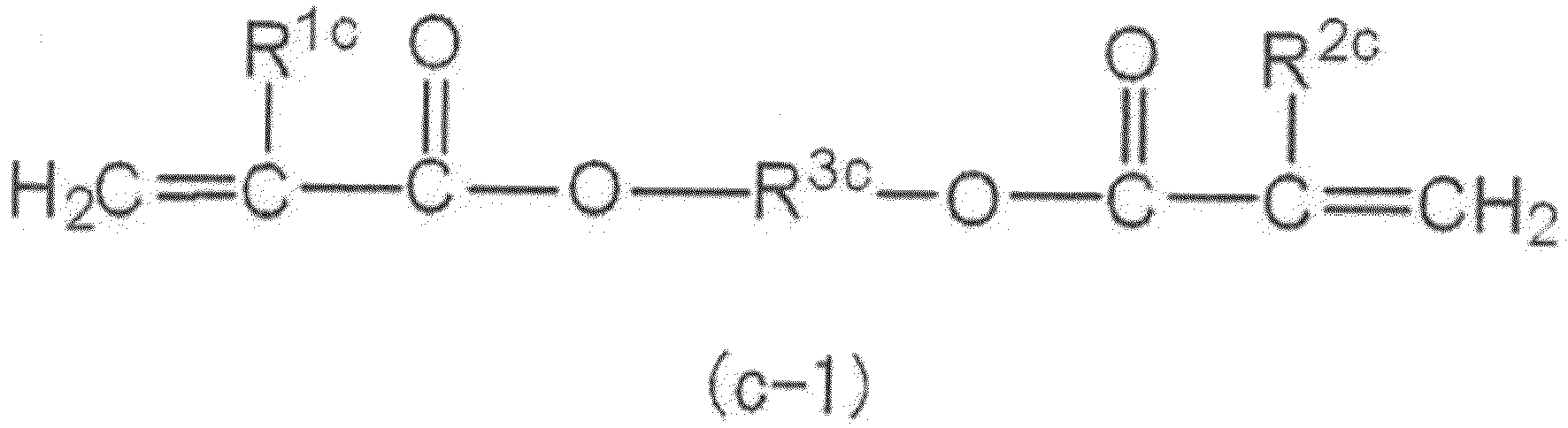
- At least one of the di(meth)acrylic monomers constituting the (meth)acrylic monomer (C) is a compound represented by the following Formula (c-1), in terms of further improving the flexural strength and the flexural modulus after photocuring.
- each of R 1c and R 2c independently represents a hydrogen atom or a methyl group; and R 3c represents an alkylene group having from 1 to 9 carbon atoms.
- the alkylene group represented by R 3c may be a straight chain alkylene group, or a branched chain alkylene group.
- At least one of the di(meth)acrylic monomers constituting the (meth)acrylic monomer (C) is a compound represented by the following Formula (c-2), in terms of further improving the flexural strength and the flexural modulus after photocuring.
- each of R 1c and R 2c independently represents a hydrogen atom or a methyl group; each of R 4c and R 5c independently represents a hydrogen atom or a methyl group; and nc represents a number from 1 to 9, with the proviso that an alkylene group represented by -(CR 4c R 5c ) nc - has from 1 to 9 carbon atoms.
- the plurality of R 4c s may be the same as or different from each other.
- R 5c the same applies for R 4c .
- the (meth)acrylic monomer (C) include 1,3-butylene glycol diacrylate, neopentyl glycol diacrylate, 1,4-butanediol diacrylate, 1,4-butanediol dimethacrylate, 1,6-hexandiol diacrylate, 1,6-hexanediol dimethacrylate, 1,9-nonanediol diacrylate, ethylene glycol dimethacrylate, and 1,3-butylene glycol dimethacrylate.
- the content of the (meth)acrylic monomer (C) is preferably from 100 parts by mass to 450 parts by mass, more preferably from 100 parts by mass to 400 parts by mass, and particularly preferably from 100 parts by mass to 350 parts by mass, with respect to 1,000 parts by mass of the total content of the (meth)acrylic monomer component.
- the content of the (meth)acrylic monomer (C) is preferably 51% by mass or more, with respect to the total content of the (meth)acrylic monomer (A), (meth)acrylic monomer (B), and the (meth)acrylic monomer (C).
- the (meth)acrylic monomer component may include another (meth)acrylic monomer other than the acrylic monomer (X), the (meth)acrylic monomer (A), the (meth)acrylic monomer (B), and the (meth)acrylic monomer (C).
- the total content of the acrylic monomer (X), the (meth)acrylic monomer (A), the (meth)acrylic monomer (B), and the (meth)acrylic monomer (C) in the (meth)acrylic monomer component is 60% by mass or more, more preferably 80% by mass or more, and still more preferably 90% by mass or more, with respect to the total amount of the (meth)acrylic monomer component.
- the photocurable composition according to the present embodiment includes a photopolymerization initiator.
- the photopolymerization initiator is not particularly limited as long as the photopolymerization initiator is capable of generating radicals when light is irradiated thereto.
- the photopolymerization initiator is preferably one which generates radicals by light irradiation at a wavelength used in the stereolithography.
- the wavelength of the light used in the stereolithography may be, for example, from 365 nm to 500 nm. However, the wavelength is preferably from 365 nm to 430 nm, and more preferably from 365 nm to 420 nm, in the view point of practical use.
- Examples of the photopolymerization initiator which generates radicals by light irradiation at the wavelength used in the stereolithography include: alkylphenone compounds, acylphosphine oxide compounds, titanocene compounds, oxime ester compounds, benzoin compounds, acetophenone compounds, benzophenone compounds, thioxanthone compounds, ⁇ -acyloxime ester compounds, phenylglyoxylate compounds, benzyl compounds, azo compounds, diphenylsulfide compounds, organic pigment compounds, iron-phthalocyanine compounds, benzoin ether compounds, and anthraquinone compounds.
- an alkylphenone compound and an acylphosphine oxide compound are preferred, in terms of reactivity and the like.
- alkylphenone compound examples include 1-hydroxy-cyclohexyl-phenyl-ketone (Irgacure 184: manufactured by BASF Japan Ltd.).
- acylphosphine oxide compound examples include bis(2,4,6-trimethylbenzoyl)-phenylphosphine oxide (Irgacure 819: manufactured by BASF Japan Ltd.), and 2,4,6-trimethylbenzoyl-diphenyl-phosphine oxide (Irgacure TPO: manufactured by BASF Japan Ltd.).
- the photocurable composition according to the present embodiment may include only one type of the photopolymerization initiator, or two or more types of the photopolymerization initiators.
- the content of the photopolymerization initiator (the total content, in a case in which two or more types thereof are included) in the photocurable composition according to the present embodiment is preferably from 1 part by mass to 50 parts by mass, more preferably from 2 parts by mass to 30 parts by mass, still more preferably from 3 parts by mass to 25 parts by mass, and particularly preferably from 3 parts by mass to 15 parts by mass, with respect to 1,000 parts by mass of the total content of the (meth)acrylic monomer component.
- the photocurable composition according to the present embodiment may include at least one other component other than the above mentioned components, if necessary.
- the total content of the (meth)acrylic monomer component and the photopolymerization initiator is from 80% by mass or more, and still more preferably from 90% by mass or more, with respect to the total amount of the photocurable composition.
- Examples of the other components include coloring materials.
- the photocurable composition according to the present embodiment may be colored to a color close to a gingival color by incorporating a coloring material, in terms of esthetics.
- the coloring material is not limited as long as the coloring material does not interfere with the shaping of the photocurable composition by a 3D printer, and is less susceptible to discoloration. Examples thereof include pigments, dyes, and colorants. More specific examples of the coloring material include synthetic tar dyes, aluminum lakes of synthetic tar dyes, inorganic pigments, and natural pigments.
- examples of the other components also include other curable resins other than the above described (meth)acrylic monomer component (such as other curable monomers other than the above described (meth)acrylic monomer component).
- examples of the other components also include thermal polymerization initiators.
- the photocurable composition according to the present embodiment includes a thermal polymerization initiator
- a thermal polymerization initiator examples include thermal radical generators and amine compounds.
- examples of the other components include: coupling agents such as silane coupling agents (for example, 3-acryloxypropyltrimethoxysilane); and additives such as rubber agents, ion-trapping agents, ion exchangers, leveling agents, plasticizers, and antifoaming agents.
- coupling agents such as silane coupling agents (for example, 3-acryloxypropyltrimethoxysilane); and additives such as rubber agents, ion-trapping agents, ion exchangers, leveling agents, plasticizers, and antifoaming agents.
- the method of preparing the photocurable composition according to the present embodiment is not particularly limited. Examples thereof include a method in which the acrylic monomer (X), at least one of the (meth)acrylic monomers (A) to (C), and the photopolymerization initiator (and other component(s), if necessary) are mixed.
- the means for mixing the respective components is not particularly limited. Examples thereof include: dissolution by ultrasonic wave; and mixing utilizing a twin arm mixer, a roll kneader, a twin-screw extruder, a ball mill kneader, or a planetary mixer.
- the photocurable composition according to the present embodiment may be prepared by mixing the respective components, then filtering the resultant to remove impurities, and further subjecting the resultant to vacuum deaeration treatment.
- a glass transition temperature (Tg) after photocuring of the photocurable composition according to the present embodiment is not particularly limited.
- the glass transition temperature (Tg) after photocuring is preferably 70°C or higher, and more preferably 80°C or higher, in terms of the flexural strength and the flexural modulus.
- the glass transition temperature (Tg) after photocuring is preferably 140°C or lower, in terms of the Charpy impact strength.
- the dental prosthesis or the like which is a cured product (namely, stereolithographed product) of the photocurable composition according to the present embodiment is particularly preferably a denture base.
- the denture base which is a cured product of the photocurable composition according to the present embodiment has an excellent flexural strength, flexural modulus and Charpy impact strength.
- the denture base according to the present embodiment may be a denture base for use in a complete denture or a full denture, or alternatively, a denture base for use in a partial denture.
- the denture base according to the present embodiment may be a denture base for an upper jaw denture (hereinafter, also referred to as “upper jaw denture base”), or a denture base for a lower jaw denture (hereinafter, also referred to as “lower jaw denture base”), or alternatively, a set of an upper jaw denture base and a lower jaw denture base.
- upper jaw denture base also referred to as "upper jaw denture base”
- lower jaw denture base a denture base for a lower jaw denture
- the denture base according to the present embodiment may be a denture base in which only a portion thereof is made of the photocurable composition according to the present embodiment, or a denture base entirely made of the photocurable composition according to the present embodiment.
- Examples of the denture base in which only a portion thereof is made of the photocurable composition according to the present embodiment include: a denture base (a so-called metal base) which includes a metal portion and a resin portion, and in which at least one portion of the resin portion is made of the photocurable composition according to the present embodiment; and a denture base (a so-called resin base) which consists of a resin portion, and in which only a portion of the resin portion is made of the photocurable composition according to the present embodiment.
- a denture base a so-called metal base
- resin base a so-called resin base
- Examples of the denture base entirely made of the photocurable composition according to the present embodiment include a denture base consisting of a resin portion.
- a plate denture according to the present embodiment includes the above described denture base according to the present embodiment and an artificial tooth fixed on the denture base.
- the denture base has an excellent flexural strength, flexural modulus and Charpy impact strength.
- the plate denture according to the present embodiment may be a partial denture or a complete denture.
- the number of the artificial teeth to be included in the plate denture according to the present embodiment is not particularly limited, as long as the plate denture includes one artificial tooth.
- the plate denture according to the present embodiment may be an upper jaw denture, or a lower jaw denture, or alternatively, a set of an upper jaw denture and a lower jaw denture.
- Examples of materials for the artificial tooth include an acrylic resin.
- the artificial tooth may contain a filler and/or the like, in addition to the acrylic resin.
- the viscosity of each of the photocurable compositions was measured by a Type E viscometer, under conditions of 25°C and 50 rpm.
- Each of the resulting photocurable compositions was formed into a size of 64 mm ⁇ 10 mm ⁇ 3.3 mm thickness using a 3D printer (MASTERr PLUS S 2011; manufactured by Carima Co., Ltd.), to obtain a formed product.
- the resulting formed product was subjected to irradiation of UV light having a wavelength of 365 nm, at 5 J/cm 2 , to carry out main curing, thereby obtaining a stereolithographed product.
- test specimen The resulting stereolithographed product (hereinafter, referred to as "test specimen") was stored in a constant temperature water bath maintained at 37 ⁇ 1°C for 50 ⁇ 2 hours. Then, the test specimen was retrieved from the constant temperature water bath, and the flexural strength and the flexural modulus of the retrieved test specimen were each measured in accordance with ISO 20795-1: 2008. These measurements were carried out using a tensile test apparatus (manufactured by INTESCO Co., Ltd.), at a speed of 5 ⁇ 1 mm /min.
- each stereolithographed product preferably has a flexural strength of 60 MPa or more, and more preferably 65 MPa.
- each photocurable composition preferably has a flexural modulus of 1,500 MPa or more, and more preferably 2,000 MPa or more.
- Each of the resulting photocurable compositions was formed into a size of 80 mm ⁇ 10 mm ⁇ 4 mm thickness using a 3D printer (MASTER PLUS S2011; manufactured by Carima Co., Ltd.), to obtain a formed product.
- the resulting formed product was subjected to irradiation of UV light having a wavelength of 365 nm, at 5 J/cm 2 , to carry out main curing of the formed product, thereby obtaining a stereolithographed product.
- test specimen The resulting stereolithographed product (hereinafter, referred to as "test specimen") was stored in a constant temperature water bath maintained at 37 ⁇ 1°C for 50 ⁇ 2 hours.
- the test specimen was retrieved from the constant temperature water bath, and a notch in the shape of the letter A and having a depth of 2 mm was provided at the central portion in the longitudinal direction of the retrieved test specimen, to obtain a test specimen with a single-notch.
- the Charpy impact strength of the resulting test specimen with a single-notch was measured in accordance with ISO 179-1: 2010 (or JIS K 7111-1: 2012). The above measurement of the Charpy impact strength was carried out under conditions of a hammer energy of 0.5 J, a swing angle of 148 degrees, a test temperature of 23°C, and edgewise impact.
- each stereolithographed product preferably has a Charpy impact strength of 1.0 kJ/m 2 or more, in a view of durability.
- A-BPE-2, A-BPE-2.2, ABE-300, A-BPE-4, and A-BPP-3 are acrylic monomers manufactured by Shin Nakamura Chemical Co., Ltd.;
- BP-4PA is an acrylic monomer manufactured by Kyoeisha Chemical Co. Ltd.;
- M-208 is an acrylic monomer manufactured by TOAGOSEI CO., LTD. The same applies for Tables 4 to 9 to be described later.
- 2EG is a methacrylic monomer manufactured by Kyoeisha Chemical Co. Ltd.
- 3PG is a methacrylic monomer manufactured by Shin Nakamura Chemical Co., Ltd.
- FA-222A is an acrylic monomer manufactured by Hitachi Chemical Co., Ltd.
- 3EG-A is an acrylic monomer manufactured by Kyoeisha Chemical Co. Ltd.
- APG-100 and APG-200 are acrylic monomers manufactured by Shin Nakamura Chemical Co., Ltd.
- SR 9003 is an acrylic monomer manufactured by Arkema Inc.
- IB-XA which is (meth)acrylic monomer (B) is an acrylic monomer manufactured by Kyoeisha Chemical Co. Ltd.
- FA-124AS which is (meth)acrylic monomer (C) is an acrylic monomer manufactured by Hitachi Chemical Co., Ltd..
- the structures of these monomers are as shown below.
- A-BPE-10, A-BPE-20, APG-400, and 9PG are acrylic monomers manufactured by Shin Nakamura Chemical Co., Ltd.
- FA-240A and FA-PTG9A are acrylic monomers manufactured by Hitachi Chemical Co., Ltd.
- CD 9043 is an acrylic monomer manufactured by Arkema Inc.
- BP-2EM is a methacrylic monomer manufactured by Kyoeisha Chemical Co. Ltd.
- Irg 819 is “Irgacure 819” (an acylphosphine oxide compound) manufactured by BASF Japan Ltd.
- Irg 184 is “Irgacure 184" (an alkylphenone compound) manufactured by BASF Japan Ltd.
- TPO is "Irgacure TPO” (an acylphosphine oxide compound) manufactured by BASF Japan Ltd.
- the respective structures of these photopolymerization initiators are as shown below.
- a photocurable composition which includes: the acrylic monomer (X) which is a diacrylic monomer containing two aromatic rings and two acryloyloxy groups within one molecule, and having a weight average molecular weight of from 400 to 580; the (meth)acrylic monomer (A) which is a di(meth)acrylic monomer not containing, within one molecule, an aromatic ring and containing, within one molecule, one or more ether bonds and two (meth)acryloyloxy groups, and having a weight average molecular weight of from 200 to 400; and the photopolymerization initiator(s).
- the acrylic monomer (X) which is a diacrylic monomer containing two aromatic rings and two acryloyloxy groups within one molecule, and having a weight average molecular weight of from 400 to 580
- the (meth)acrylic monomer (A) which is a di(meth)acrylic monomer not containing, within one molecule, an aromatic ring and containing, within one
- each of the photocurable compositions of Examples 1A to 26A is suitable for the production by stereolithography of a dental prosthesis or the like (a denture base, in particular).
- each of the acrylic monomers (X) is the same as that described in the "Description of Tables 1 to 3" above.
- FA-513 AS and FA-511 AS are acrylic monomers manufactured by Hitachi Chemical Co., Ltd.; CHA and THFA are acrylic monomers manufactured by Osaka Organic Chemical Industry Ltd.; SR217 is an acrylic monomer manufactured by Arkema Inc.; and ACMO is an acrylic monomer manufactured by KJ Chemicals Corporation.
- the structures of these monomers are as shown below.
- IB-XA is the same as that described in the "Description of Tables 1 to 3" above.
- each of FA-222A, which is the (meth)acrylic monomer (A), and FA-124 AS, which is the (meth)acrylic monomer (C), is the same as that described in the "Description of Tables 1 to 3" above.
- each of A-BPE-10, A-BPE-20, and BP-2EM is the same as that described in the "Description of Tables 1 to 3" above.
- SR611 is an acrylic monomer manufactured by Arkema Inc.
- M-140 is an acrylic monomer manufactured by Toagosei Co., Ltd.
- AIB, NOAA and LA are acrylic monomers manufactured by Osaka Organic Chemical Industry Ltd.
- Each of the initiators (namely, the photopolymerization initiators) listed in Tables 4 to 6 is the same as that described in the "Description of Tables 1 to 3" above.
- a photocurable composition which includes: the acrylic monomer (X) which is a diacrylic monomer containing two aromatic rings and two acryloyloxy groups within one molecule, and having a weight average molecular weight of from 400 to 580; the (meth)acrylic monomer (B) which is a (meth)acrylic monomer containing a ring structure other than an aromatic ring and one (meth)acryloyloxy group within one molecule, and having a weight average molecular weight of from 130 to 240; and the photopolymerization initiator(s).
- the acrylic monomer (X) which is a diacrylic monomer containing two aromatic rings and two acryloyloxy groups within one molecule, and having a weight average molecular weight of from 400 to 580
- the (meth)acrylic monomer (B) which is a (meth)acrylic monomer containing a ring structure other than an aromatic ring and one (meth)acryloyloxy group within one molecule, and
- each of the photocurable compositions of Examples 1B to 26B is suitable for the production by stereolithography of a dental prosthesis or the like (a denture base, in particular).
- each of the acrylic monomers (X) is the same as that described in the "Description of Tables 1 to 3" above.
- EG, BG and NP-A are methacrylic monomers manufactured by Kyoeisha Chemical Co. Ltd.
- SR212 is an acrylic monomer manufactured by Arkema Inc.
- FA-124AS is an acrylic monomer manufactured by Hitachi Chemical Co., Ltd.
- 1,6HX-A and 1,9ND-A are acrylic monomers manufactured by Kyoeisha Chemical Co. Ltd.
- each of FA-222A, which is the (meth)acrylic monomer (A), and IB-XA, which is the (meth)acrylic monomer (B), has the same structure as that described in the "Description of Tables 1 to 3" above.
- each of A-BPE-10, A-BPE-20, and BP-2EM is the same as that described in the "Description of Tables 1 to 3" above.
- 1,10DD and 1,10DDMA are "A-DOD-N", which is an acrylic monomer manufactured by Shin Nakamura Chemical Co., Ltd, and "DOD-N", which is a methacrylic monomer manufactured by Shin Nakamura Chemical Co., Ltd., respectively.
- Each of the initiators (namely, the photopolymerization initiators) listed in Tables 7 to 9 is the same as that described in the "Description of Tables 1 to 3" above.
- a photocurable composition which includes: the acrylic monomer (X) which is a diacrylic monomer containing two aromatic rings and two acryloyloxy groups within one molecule, and having a weight average molecular weight of from 400 to 580; the (meth)acrylic monomer (C) which is a di(meth)acrylic monomer not containing an aromatic ring and containing a hydrocarbon skeleton and two (meth)acryloyloxy groups within one molecule, and having a weight average molecular weight of from 190 to 280; and the photopolymerization initiator.
- the acrylic monomer (X) which is a diacrylic monomer containing two aromatic rings and two acryloyloxy groups within one molecule, and having a weight average molecular weight of from 400 to 580
- the (meth)acrylic monomer (C) which is a di(meth)acrylic monomer not containing an aromatic ring and containing a hydrocarbon skeleton and two (meth)acryloy
- each of the photocurable compositions of Examples 1C to 26C is suitable for the production by stereolithography of a dental prosthesis or the like (a denture base, in particular).
Landscapes
- Health & Medical Sciences (AREA)
- Oral & Maxillofacial Surgery (AREA)
- Epidemiology (AREA)
- Life Sciences & Earth Sciences (AREA)
- Animal Behavior & Ethology (AREA)
- General Health & Medical Sciences (AREA)
- Public Health (AREA)
- Veterinary Medicine (AREA)
- Dentistry (AREA)
- Plastic & Reconstructive Surgery (AREA)
- Manufacturing & Machinery (AREA)
- Engineering & Computer Science (AREA)
- Dental Preparations (AREA)
- Polymerisation Methods In General (AREA)
- Chemical & Material Sciences (AREA)
- Dental Prosthetics (AREA)
- Addition Polymer Or Copolymer, Post-Treatments, Or Chemical Modifications (AREA)
- Chemical Kinetics & Catalysis (AREA)
- Medicinal Chemistry (AREA)
- Polymers & Plastics (AREA)
- Organic Chemistry (AREA)
Claims (16)
- Lichthärtbare Zusammensetzung zur Herstellung einer Dentalprothese, einer medizinischen Vorrichtung zur intraoralen Verwendung oder eines Zahn- und/oder Kiefermodells durch Stereolithographie, wobei die lichthärtbare Zusammensetzung Folgendes umfasst:eine (Meth)acrylmonomer-Komponente und einen Photopolymerisationsinitiator;wobei ein Gesamtgehalt der (Meth)acrylmonomer-Komponente und des Photopolymerisationsinitiators 80 Massen-% oder mehr bezogen auf eine Gesamtmenge der lichthärtbaren Zusammensetzung beträgt, undwobei die (Meth)acrylmonomer-Komponente Folgendes umfasst:ein Acrylmonomer (X), das zumindest eines ist, das aus Diacrylmonomeren, die innerhalb eines Moleküls zwei aromatische Ringe und zwei Acryloyloxygruppen enthalten, ausgewählt ist, und das ein gewichtsmittleres Molekulargewicht von 400 bis 580 aufweist; undzumindest eines, das aus der aus Folgenden bestehenden Gruppe ausgewählt ist:einem (Meth)acrylmonomer (A), das zumindest eines ist, das aus Di-(meth)acrylmonomeren, die innerhalb eines Moleküls keinen aromatischen Ring enthalten und die innerhalb eines Moleküls ein oder mehrere Etherbindungen und zwei (Meth)acryloyloxygruppen enthalten, ausgewählt ist, und das ein gewichtsmittleres Molekulargewicht von 200 bis 400 aufweist;einem (Meth)acrylmonomer (B), das zumindest eines ist, das aus (Meth)acrylmonomeren, die innerhalb eines Moleküls keinen aromatischen Ring enthalten und innerhalb eines Moleküls eine Ringstruktur, die kein aromatischer Ring ist, und eine (Meth)acryloyloxygruppe enthalten, ausgewählt ist, und das ein gewichtsmittleres Molekulargewicht von 130 bis 240 aufweist; undeinem (Meth)acrylmonomer (C), das zumindest eines ist, das aus Di-(meth)acrylmonomeren, die innerhalb eines Moleküls keinen aromatischen Ring oder keine Etherbindung enthalten und innerhalb eines Moleküls ein Kohlenwasserstoffskelett und zwei (Meth)acryloyloxygruppen enthalten, ausgewählt ist, und das ein gewichtsmittleres Molekulargewicht von 190 bis 280 aufweist,und wobei ein Gesamtgehalt des Acrylmonomers (X), des (Meth)acrylmonomers (A), des (Meth)acrylmonomers (B) und des (Meth)acrylmonomers (C) in der (Meth)acrylmonomer-Komponente 60 Massen-% oder mehr beträgt.
- Lichthärtbare Zusammensetzung nach Anspruch 1, wobei zumindest eines der Diacrylmonomere, aus denen das Acrylmonomer (X) besteht, eine Etherbindung innerhalb eines Moleküls enthält.
- Lichthärtbare Zusammensetzung nach Anspruch 1 oder Anspruch 2, wobei zumindest eines der Diacrylmonomere, aus denen das Acrylmonomer (X) besteht, ein bis vier Etherbindungen innerhalb eines Moleküls enthält.
- Lichthärtbare Zusammensetzung nach einem der Ansprüche 1 bis 3, wobei zumindest eines der Diacrylmonomere, aus denen das Acrylmonomer (X) besteht, eine durch die folgende Formel (x-1) dargestellte Verbindung ist:

- Lichthärtbare Zusammensetzung nach einem der Ansprüche 1 bis 4, wobei zumindest eines der Diacrylmonomere, aus denen das Acrylmonomer (X) besteht, eine Verbindung ist, die durch die folgende Formel (x-2) dargestellt ist:

- Lichthärtbare Zusammensetzung nach einem der Ansprüche 1 bis 5, wobei zumindest eines der Di(meth)acrylmonomere, aus denen das (Meth)acrylmonomer (A) besteht, eine durch die folgende Formel (a-1) dargestellte Verbindung ist:

- Lichthärtbare Zusammensetzung nach einem der Ansprüche 1 bis 6, wobei zumindest eines der Di(meth)acrylmonomere, aus denen das (Meth)acrylmonomer (A) besteht, eine durch die folgende Formel (a-2) dargestellte Verbindung ist:

- Lichthärtbare Zusammensetzung nach einem der Ansprüche 1 bis 7, wobei zumindest eines der (Meth)acrylmonomere, aus denen das (Meth)acrylmonomer (B) besteht, eine durch die folgende Formel (b-1) dargestellte Verbindung ist:

- Lichthärtbare Zusammensetzung nach einem der Ansprüche 1 bis 8, wobei zumindest eines der (Meth)acrylmonomere, aus denen das (Meth)acrylmonomer (B) besteht, eine durch die folgende Formel (b-2) dargestellte Verbindung ist:

- Lichthärtbare Zusammensetzung nach einem der Ansprüche 1 bis 9, wobei zumindest eines der Di(meth)acrylmonomere, aus denen das (Meth)acrylmonomer (C) besteht, eine durch die folgende Formel (c-1) dargestellte Verbindung ist:
- Lichthärtbare Zusammensetzung nach einem der Ansprüche 1 bis 10, wobei zumindest eines der Di(meth)acrylmonomere, aus denen das (Meth)acrylmonomer (C) besteht, eine durch die folgende Formel (c-2) dargestellte Verbindung ist:

- Lichthärtbare Zusammensetzung nach einem der Ansprüche 1 bis 11, wobei die lichthärtbare Zusammensetzung eine Viskosität, wie unter Verwendung eines Typ-E-Viskosimeters bei 25 °C und 50 U/min gemessen, von 20 mPa·s bis 1.500 mPa·s aufweist.
- Lichthärtbare Zusammensetzung nach einem der Ansprüche 1 bis 12, wobei der Photopolymerisationsinitiator zumindest einer ist, der aus Alkylphenonverbindungen oder Acylphosphinoxidverbindungen ausgewählt ist.
- Verfahren zur Herstellung einer Dentalprothese, einer medizinischen Vorrichtung zur intraoralen Verwendung oder eines Zahn- und/oder Kiefermodells durch Stereolithographie, wobei das Verfahren das Lichthärten einer lichthärtbaren Zusammensetzung nach einem der Ansprüche 1 bis 13 umfasst.
- Verfahren nach Anspruch 14, wobei die Dentalprothese eine Zahnersatzbasis oder ein Mundstück ist.
- Zahnersatzbasis, die ein gehärtetes Produkt einer lichthärtbaren Zusammensetzung nach einem der Ansprüche 1 bis 13 ist.
Applications Claiming Priority (4)
| Application Number | Priority Date | Filing Date | Title |
|---|---|---|---|
| JP2015019541 | 2015-02-03 | ||
| JP2015019543 | 2015-02-03 | ||
| JP2015019542 | 2015-02-03 | ||
| PCT/JP2016/052961 WO2016125758A1 (ja) | 2015-02-03 | 2016-02-01 | 光硬化性組成物、義歯床及び有床義歯 |
Publications (3)
| Publication Number | Publication Date |
|---|---|
| EP3254667A1 EP3254667A1 (de) | 2017-12-13 |
| EP3254667A4 EP3254667A4 (de) | 2018-11-07 |
| EP3254667B1 true EP3254667B1 (de) | 2024-12-25 |
Family
ID=56564100
Family Applications (1)
| Application Number | Title | Priority Date | Filing Date |
|---|---|---|---|
| EP16746589.7A Active EP3254667B1 (de) | 2015-02-03 | 2016-02-01 | Lichthärtbare zusammensetzung, zahnprothese und platte für zahnprothese |
Country Status (6)
| Country | Link |
|---|---|
| US (1) | US10709530B2 (de) |
| EP (1) | EP3254667B1 (de) |
| JP (1) | JP6271772B2 (de) |
| CN (1) | CN107205884B (de) |
| TW (1) | TWI685519B (de) |
| WO (1) | WO2016125758A1 (de) |
Families Citing this family (16)
| Publication number | Priority date | Publication date | Assignee | Title |
|---|---|---|---|---|
| JP7010469B2 (ja) * | 2016-12-28 | 2022-01-26 | 三井化学株式会社 | 義歯床用材料、義歯床およびその製造方法、並びに、有床義歯およびその製造方法 |
| US11780947B2 (en) | 2017-03-29 | 2023-10-10 | Mitsui Chemicals, Inc. | Photocurable composition, denture base, and plate denture |
| KR102271174B1 (ko) * | 2017-03-29 | 2021-06-29 | 미쓰이 가가쿠 가부시키가이샤 | 광경화성 조성물, 인공손톱, 조형 데이터의 생성 방법, 인공손톱의 제조 방법 및 인공손톱의 제조 시스템 |
| KR102946247B1 (ko) * | 2017-04-03 | 2026-04-01 | 제스트 아이피 홀딩스, 엘엘씨 | 치과용 시멘트 조성물 및 사용 방법 |
| KR102667943B1 (ko) | 2018-03-30 | 2024-05-21 | 미쓰이 가가쿠 가부시키가이샤 | 광조형용 경화성 조성물, 소실 모형 및 입체 조형물의 제조 방법 |
| WO2020003133A1 (en) * | 2018-06-29 | 2020-01-02 | 3M Innovative Properties Company | Hydrated orthodontic articles, kits, and methods of making same |
| WO2020153269A1 (ja) | 2019-01-21 | 2020-07-30 | 三井化学株式会社 | 光重合開始剤、光硬化性組成物、硬化物、及び、歯科材料 |
| JP7365411B2 (ja) * | 2019-06-12 | 2023-10-19 | クラレノリタケデンタル株式会社 | マウスピース及びマウスピースの製造方法 |
| CN120647849A (zh) | 2019-10-02 | 2025-09-16 | 可乐丽则武齿科株式会社 | 光造型用树脂组合物 |
| US12569410B2 (en) * | 2019-10-28 | 2026-03-10 | Mitsui Chemicals, Inc. | Photocurable composition and dental product |
| TW202140587A (zh) * | 2019-12-23 | 2021-11-01 | 日商Dic股份有限公司 | 三維造形用圖案材料、硬化物、立體造形物、鑄模的製造方法及金屬鑄造物的製造方法 |
| EP4091578B1 (de) * | 2020-03-17 | 2024-10-09 | Tokuyama Dental Corporation | Verfahren zur herstellung von plattenzahnprothesen |
| KR102422823B1 (ko) * | 2020-08-26 | 2022-07-19 | 박성원 | 투명 치아 교정장치 형성용 조성물, 투명 치아 교정장치의 제조방법 및 그 방법에 의해 제조된 투명 치아 교정장치 |
| KR102444194B1 (ko) | 2020-08-26 | 2022-09-16 | 박성원 | 인공 치아 형성용 조성물, 인공 치아의 제조방법 및 그 방법에 의해 제조된 인공 치아 |
| TW202219078A (zh) * | 2020-11-05 | 2022-05-16 | 日商Dic股份有限公司 | 光硬化性樹脂組成物、樹脂造形物、鑄模的製造方法及金屬鑄造物的製造方法 |
| WO2024014437A1 (ja) | 2022-07-12 | 2024-01-18 | 三井化学株式会社 | 硬化性組成物、硬化物、及び歯科材料 |
Citations (1)
| Publication number | Priority date | Publication date | Assignee | Title |
|---|---|---|---|---|
| JPS56161313A (en) * | 1980-05-17 | 1981-12-11 | Lion Corp | Dental filler composition |
Family Cites Families (13)
| Publication number | Priority date | Publication date | Assignee | Title |
|---|---|---|---|---|
| JPS5616313A (en) * | 1979-07-19 | 1981-02-17 | Kimio Shibayama | Distance-weighted type reed screen type surface elastic wave transducer |
| JP3318364B2 (ja) | 1992-09-01 | 2002-08-26 | 株式会社ユニスン | 有床義歯の作成方法およびそれに用いる組合せトレー |
| JP2003507499A (ja) | 1999-08-13 | 2003-02-25 | デルタメド・メディツィーンプロドュクテ・ゲゼルシャフト・ミット・ベシュレンクテル・ハフツング | 可視光を用いて架橋する組成物およびその使用 |
| DE10111704B4 (de) | 2001-03-12 | 2008-06-12 | Ivoclar Vivadent Ag | Verfahren zur Herstellung eines Kunststoffteils |
| US7189344B2 (en) | 2001-03-12 | 2007-03-13 | Ivoclar Vivadent Ag | Method for producing a synthetic material part |
| JP2003085832A (ja) * | 2001-09-07 | 2003-03-20 | Ricoh Co Ltd | 多層光ディスクの製造方法及びその光ディスク |
| RU2005116302A (ru) * | 2002-10-28 | 2006-01-20 | Циба Спешиалти Кемикэлз Холдинг Инк. (Ch) | Улучшение стабильности фотоинициаторов при хранении |
| WO2006117157A1 (en) * | 2005-05-04 | 2006-11-09 | Cytec Surface Specialties, S.A. | Radiation curable methacrylate polyesters |
| EP2163234B1 (de) * | 2007-06-07 | 2018-09-26 | Tokuyama Dental Corporation | Zahnfüllungs-/zahnersatz-set |
| US20090004579A1 (en) * | 2007-06-27 | 2009-01-01 | Dsm Ip Assets B.V. | Clear and colorless three-dimensional articles made via stereolithography and method of making said articles |
| JP2010248297A (ja) * | 2009-04-10 | 2010-11-04 | Taiyo Ink Mfg Ltd | 光硬化性樹脂及び光硬化性樹脂組成物 |
| JP5730061B2 (ja) * | 2011-02-18 | 2015-06-03 | クラレノリタケデンタル株式会社 | 重合収縮力を低減した接着性の歯科用修復材料 |
| JP6438385B2 (ja) * | 2012-04-11 | 2018-12-12 | イフォクレール ヴィヴァデント アクチェンゲゼルシャフトIvoclar Vivadent AG | 複合樹脂組成物およびステレオリソグラフィーによる歯科構成部品の生成のためのプロセス |
-
2016
- 2016-02-01 CN CN201680007892.5A patent/CN107205884B/zh active Active
- 2016-02-01 US US15/547,217 patent/US10709530B2/en active Active
- 2016-02-01 EP EP16746589.7A patent/EP3254667B1/de active Active
- 2016-02-01 WO PCT/JP2016/052961 patent/WO2016125758A1/ja not_active Ceased
- 2016-02-01 JP JP2016573359A patent/JP6271772B2/ja active Active
- 2016-02-02 TW TW105103213A patent/TWI685519B/zh active
Patent Citations (1)
| Publication number | Priority date | Publication date | Assignee | Title |
|---|---|---|---|---|
| JPS56161313A (en) * | 1980-05-17 | 1981-12-11 | Lion Corp | Dental filler composition |
Also Published As
| Publication number | Publication date |
|---|---|
| CN107205884B (zh) | 2020-09-01 |
| CN107205884A (zh) | 2017-09-26 |
| TW201632569A (zh) | 2016-09-16 |
| JPWO2016125758A1 (ja) | 2017-08-03 |
| US10709530B2 (en) | 2020-07-14 |
| JP6271772B2 (ja) | 2018-01-31 |
| WO2016125758A1 (ja) | 2016-08-11 |
| EP3254667A1 (de) | 2017-12-13 |
| TWI685519B (zh) | 2020-02-21 |
| US20180014919A1 (en) | 2018-01-18 |
| EP3254667A4 (de) | 2018-11-07 |
Similar Documents
| Publication | Publication Date | Title |
|---|---|---|
| EP3254667B1 (de) | Lichthärtbare zusammensetzung, zahnprothese und platte für zahnprothese | |
| EP3360907B1 (de) | Photohärtbare zusammensetzung, zahnprothesenbasis und plattenzahnprothese | |
| JP7092284B2 (ja) | 光硬化性組成物、義歯床及び有床義歯 | |
| US12240929B2 (en) | Photocurable composition, denture base, and plate denture | |
| EP3925994A1 (de) | Lichthärtbare zusammensetzung, gehärtetes produkt und dentalprodukt | |
| JP7412535B2 (ja) | 光硬化性組成物、硬化物、及び歯科用製品 | |
| JP7728527B2 (ja) | 3次元造形用組成物 | |
| JP2023146821A (ja) | 光造形用硬化性組成物、歯科用製品及び義歯床 | |
| WO2023189684A1 (ja) | 光硬化性組成物、立体造形物、歯科用製品及びスプリント | |
| JP2023146822A (ja) | 光造形物の加工方法及び光造形物の加工物 | |
| JP2022135159A (ja) | 光造形用硬化性組成物、及び歯科用製品 |
Legal Events
| Date | Code | Title | Description |
|---|---|---|---|
| STAA | Information on the status of an ep patent application or granted ep patent |
Free format text: STATUS: THE INTERNATIONAL PUBLICATION HAS BEEN MADE |
|
| PUAI | Public reference made under article 153(3) epc to a published international application that has entered the european phase |
Free format text: ORIGINAL CODE: 0009012 |
|
| STAA | Information on the status of an ep patent application or granted ep patent |
Free format text: STATUS: REQUEST FOR EXAMINATION WAS MADE |
|
| 17P | Request for examination filed |
Effective date: 20170802 |
|
| AK | Designated contracting states |
Kind code of ref document: A1 Designated state(s): AL AT BE BG CH CY CZ DE DK EE ES FI FR GB GR HR HU IE IS IT LI LT LU LV MC MK MT NL NO PL PT RO RS SE SI SK SM TR |
|
| AX | Request for extension of the european patent |
Extension state: BA ME |
|
| DAV | Request for validation of the european patent (deleted) | ||
| DAX | Request for extension of the european patent (deleted) | ||
| RIC1 | Information provided on ipc code assigned before grant |
Ipc: A61C 13/00 20060101ALI20180919BHEP Ipc: A61K 6/00 20060101AFI20180919BHEP Ipc: A61C 13/01 20060101ALI20180919BHEP Ipc: A61K 6/083 20060101ALI20180919BHEP |
|
| RIC1 | Information provided on ipc code assigned before grant |
Ipc: A61C 13/01 20060101ALI20180926BHEP Ipc: A61C 13/00 20060101ALI20180926BHEP Ipc: A61K 6/083 20060101ALI20180926BHEP Ipc: A61K 6/00 20060101AFI20180926BHEP |
|
| A4 | Supplementary search report drawn up and despatched |
Effective date: 20181010 |
|
| RIC1 | Information provided on ipc code assigned before grant |
Ipc: A61C 13/01 20060101ALI20181002BHEP Ipc: A61K 6/00 20060101AFI20181002BHEP Ipc: A61C 13/00 20060101ALI20181002BHEP Ipc: A61K 6/083 20060101ALI20181002BHEP |
|
| STAA | Information on the status of an ep patent application or granted ep patent |
Free format text: STATUS: EXAMINATION IS IN PROGRESS |
|
| 17Q | First examination report despatched |
Effective date: 20210315 |
|
| RAP3 | Party data changed (applicant data changed or rights of an application transferred) |
Owner name: MITSUI CHEMICALS, INC. |
|
| REG | Reference to a national code |
Ref country code: DE Ref legal event code: R079 Free format text: PREVIOUS MAIN CLASS: A61K0006000000 Ipc: A61K0006887000 Ref country code: DE Ref legal event code: R079 Ref document number: 602016090734 Country of ref document: DE Free format text: PREVIOUS MAIN CLASS: A61K0006000000 Ipc: A61K0006887000 |
|
| GRAP | Despatch of communication of intention to grant a patent |
Free format text: ORIGINAL CODE: EPIDOSNIGR1 |
|
| STAA | Information on the status of an ep patent application or granted ep patent |
Free format text: STATUS: GRANT OF PATENT IS INTENDED |
|
| RIC1 | Information provided on ipc code assigned before grant |
Ipc: A61C 13/01 20060101ALI20240730BHEP Ipc: A61K 6/887 20200101AFI20240730BHEP |
|
| INTG | Intention to grant announced |
Effective date: 20240812 |
|
| GRAS | Grant fee paid |
Free format text: ORIGINAL CODE: EPIDOSNIGR3 |
|
| GRAA | (expected) grant |
Free format text: ORIGINAL CODE: 0009210 |
|
| STAA | Information on the status of an ep patent application or granted ep patent |
Free format text: STATUS: THE PATENT HAS BEEN GRANTED |
|
| AK | Designated contracting states |
Kind code of ref document: B1 Designated state(s): AL AT BE BG CH CY CZ DE DK EE ES FI FR GB GR HR HU IE IS IT LI LT LU LV MC MK MT NL NO PL PT RO RS SE SI SK SM TR |
|
| REG | Reference to a national code |
Ref country code: GB Ref legal event code: FG4D |
|
| REG | Reference to a national code |
Ref country code: CH Ref legal event code: EP |
|
| REG | Reference to a national code |
Ref country code: DE Ref legal event code: R096 Ref document number: 602016090734 Country of ref document: DE |
|
| REG | Reference to a national code |
Ref country code: IE Ref legal event code: FG4D |
|
| REG | Reference to a national code |
Ref country code: LT Ref legal event code: MG9D |
|
| PG25 | Lapsed in a contracting state [announced via postgrant information from national office to epo] |
Ref country code: HR Free format text: LAPSE BECAUSE OF FAILURE TO SUBMIT A TRANSLATION OF THE DESCRIPTION OR TO PAY THE FEE WITHIN THE PRESCRIBED TIME-LIMIT Effective date: 20241225 |
|
| PG25 | Lapsed in a contracting state [announced via postgrant information from national office to epo] |
Ref country code: FI Free format text: LAPSE BECAUSE OF FAILURE TO SUBMIT A TRANSLATION OF THE DESCRIPTION OR TO PAY THE FEE WITHIN THE PRESCRIBED TIME-LIMIT Effective date: 20241225 |
|
| PG25 | Lapsed in a contracting state [announced via postgrant information from national office to epo] |
Ref country code: BG Free format text: LAPSE BECAUSE OF FAILURE TO SUBMIT A TRANSLATION OF THE DESCRIPTION OR TO PAY THE FEE WITHIN THE PRESCRIBED TIME-LIMIT Effective date: 20241225 |
|
| PG25 | Lapsed in a contracting state [announced via postgrant information from national office to epo] |
Ref country code: NO Free format text: LAPSE BECAUSE OF FAILURE TO SUBMIT A TRANSLATION OF THE DESCRIPTION OR TO PAY THE FEE WITHIN THE PRESCRIBED TIME-LIMIT Effective date: 20250325 |
|
| PG25 | Lapsed in a contracting state [announced via postgrant information from national office to epo] |
Ref country code: LV Free format text: LAPSE BECAUSE OF FAILURE TO SUBMIT A TRANSLATION OF THE DESCRIPTION OR TO PAY THE FEE WITHIN THE PRESCRIBED TIME-LIMIT Effective date: 20241225 Ref country code: GR Free format text: LAPSE BECAUSE OF FAILURE TO SUBMIT A TRANSLATION OF THE DESCRIPTION OR TO PAY THE FEE WITHIN THE PRESCRIBED TIME-LIMIT Effective date: 20250326 |
|
| PG25 | Lapsed in a contracting state [announced via postgrant information from national office to epo] |
Ref country code: RS Free format text: LAPSE BECAUSE OF FAILURE TO SUBMIT A TRANSLATION OF THE DESCRIPTION OR TO PAY THE FEE WITHIN THE PRESCRIBED TIME-LIMIT Effective date: 20250325 |
|
| REG | Reference to a national code |
Ref country code: NL Ref legal event code: MP Effective date: 20241225 |
|
| PG25 | Lapsed in a contracting state [announced via postgrant information from national office to epo] |
Ref country code: NL Free format text: LAPSE BECAUSE OF FAILURE TO SUBMIT A TRANSLATION OF THE DESCRIPTION OR TO PAY THE FEE WITHIN THE PRESCRIBED TIME-LIMIT Effective date: 20241225 |
|
| REG | Reference to a national code |
Ref country code: AT Ref legal event code: MK05 Ref document number: 1753587 Country of ref document: AT Kind code of ref document: T Effective date: 20241225 |
|
| PG25 | Lapsed in a contracting state [announced via postgrant information from national office to epo] |
Ref country code: SM Free format text: LAPSE BECAUSE OF FAILURE TO SUBMIT A TRANSLATION OF THE DESCRIPTION OR TO PAY THE FEE WITHIN THE PRESCRIBED TIME-LIMIT Effective date: 20241225 |
|
| PG25 | Lapsed in a contracting state [announced via postgrant information from national office to epo] |
Ref country code: PL Free format text: LAPSE BECAUSE OF FAILURE TO SUBMIT A TRANSLATION OF THE DESCRIPTION OR TO PAY THE FEE WITHIN THE PRESCRIBED TIME-LIMIT Effective date: 20241225 |
|
| PG25 | Lapsed in a contracting state [announced via postgrant information from national office to epo] |
Ref country code: ES Free format text: LAPSE BECAUSE OF FAILURE TO SUBMIT A TRANSLATION OF THE DESCRIPTION OR TO PAY THE FEE WITHIN THE PRESCRIBED TIME-LIMIT Effective date: 20241225 |
|
| PG25 | Lapsed in a contracting state [announced via postgrant information from national office to epo] |
Ref country code: IS Free format text: LAPSE BECAUSE OF FAILURE TO SUBMIT A TRANSLATION OF THE DESCRIPTION OR TO PAY THE FEE WITHIN THE PRESCRIBED TIME-LIMIT Effective date: 20250425 |
|
| PG25 | Lapsed in a contracting state [announced via postgrant information from national office to epo] |
Ref country code: PT Free format text: LAPSE BECAUSE OF FAILURE TO SUBMIT A TRANSLATION OF THE DESCRIPTION OR TO PAY THE FEE WITHIN THE PRESCRIBED TIME-LIMIT Effective date: 20250428 |
|
| PG25 | Lapsed in a contracting state [announced via postgrant information from national office to epo] |
Ref country code: EE Free format text: LAPSE BECAUSE OF FAILURE TO SUBMIT A TRANSLATION OF THE DESCRIPTION OR TO PAY THE FEE WITHIN THE PRESCRIBED TIME-LIMIT Effective date: 20241225 |
|
| PG25 | Lapsed in a contracting state [announced via postgrant information from national office to epo] |
Ref country code: AT Free format text: LAPSE BECAUSE OF FAILURE TO SUBMIT A TRANSLATION OF THE DESCRIPTION OR TO PAY THE FEE WITHIN THE PRESCRIBED TIME-LIMIT Effective date: 20241225 Ref country code: RO Free format text: LAPSE BECAUSE OF FAILURE TO SUBMIT A TRANSLATION OF THE DESCRIPTION OR TO PAY THE FEE WITHIN THE PRESCRIBED TIME-LIMIT Effective date: 20241225 |
|
| PG25 | Lapsed in a contracting state [announced via postgrant information from national office to epo] |
Ref country code: SK Free format text: LAPSE BECAUSE OF FAILURE TO SUBMIT A TRANSLATION OF THE DESCRIPTION OR TO PAY THE FEE WITHIN THE PRESCRIBED TIME-LIMIT Effective date: 20241225 |
|
| PG25 | Lapsed in a contracting state [announced via postgrant information from national office to epo] |
Ref country code: CZ Free format text: LAPSE BECAUSE OF FAILURE TO SUBMIT A TRANSLATION OF THE DESCRIPTION OR TO PAY THE FEE WITHIN THE PRESCRIBED TIME-LIMIT Effective date: 20241225 |
|
| PG25 | Lapsed in a contracting state [announced via postgrant information from national office to epo] |
Ref country code: IT Free format text: LAPSE BECAUSE OF FAILURE TO SUBMIT A TRANSLATION OF THE DESCRIPTION OR TO PAY THE FEE WITHIN THE PRESCRIBED TIME-LIMIT Effective date: 20241225 |
|
| PG25 | Lapsed in a contracting state [announced via postgrant information from national office to epo] |
Ref country code: SE Free format text: LAPSE BECAUSE OF FAILURE TO SUBMIT A TRANSLATION OF THE DESCRIPTION OR TO PAY THE FEE WITHIN THE PRESCRIBED TIME-LIMIT Effective date: 20241225 |
|
| PG25 | Lapsed in a contracting state [announced via postgrant information from national office to epo] |
Ref country code: MC Free format text: LAPSE BECAUSE OF FAILURE TO SUBMIT A TRANSLATION OF THE DESCRIPTION OR TO PAY THE FEE WITHIN THE PRESCRIBED TIME-LIMIT Effective date: 20241225 |
|
| REG | Reference to a national code |
Ref country code: DE Ref legal event code: R097 Ref document number: 602016090734 Country of ref document: DE |
|
| REG | Reference to a national code |
Ref country code: CH Ref legal event code: PL |
|
| PG25 | Lapsed in a contracting state [announced via postgrant information from national office to epo] |
Ref country code: DK Free format text: LAPSE BECAUSE OF FAILURE TO SUBMIT A TRANSLATION OF THE DESCRIPTION OR TO PAY THE FEE WITHIN THE PRESCRIBED TIME-LIMIT Effective date: 20241225 |
|
| PG25 | Lapsed in a contracting state [announced via postgrant information from national office to epo] |
Ref country code: LU Free format text: LAPSE BECAUSE OF NON-PAYMENT OF DUE FEES Effective date: 20250201 |
|
| PG25 | Lapsed in a contracting state [announced via postgrant information from national office to epo] |
Ref country code: CH Free format text: LAPSE BECAUSE OF NON-PAYMENT OF DUE FEES Effective date: 20250228 |
|
| PLBE | No opposition filed within time limit |
Free format text: ORIGINAL CODE: 0009261 |
|
| STAA | Information on the status of an ep patent application or granted ep patent |
Free format text: STATUS: NO OPPOSITION FILED WITHIN TIME LIMIT |
|
| GBPC | Gb: european patent ceased through non-payment of renewal fee |
Effective date: 20250325 |
|
| 26N | No opposition filed |
Effective date: 20250926 |
|
| REG | Reference to a national code |
Ref country code: BE Ref legal event code: MM Effective date: 20250228 |
|
| PG25 | Lapsed in a contracting state [announced via postgrant information from national office to epo] |
Ref country code: GB Free format text: LAPSE BECAUSE OF NON-PAYMENT OF DUE FEES Effective date: 20250325 |
|
| PG25 | Lapsed in a contracting state [announced via postgrant information from national office to epo] |
Ref country code: FR Free format text: LAPSE BECAUSE OF NON-PAYMENT OF DUE FEES Effective date: 20250225 |
|
| PG25 | Lapsed in a contracting state [announced via postgrant information from national office to epo] |
Ref country code: BE Free format text: LAPSE BECAUSE OF NON-PAYMENT OF DUE FEES Effective date: 20250228 |
|
| PG25 | Lapsed in a contracting state [announced via postgrant information from national office to epo] |
Ref country code: IE Free format text: LAPSE BECAUSE OF NON-PAYMENT OF DUE FEES Effective date: 20250201 |
|
| PGFP | Annual fee paid to national office [announced via postgrant information from national office to epo] |
Ref country code: DE Payment date: 20260218 Year of fee payment: 11 |