EP3262007B1 - Modification de compositions à base de ciment à l'aide de déchets huileux à base d'alcool cétonique - Google Patents
Modification de compositions à base de ciment à l'aide de déchets huileux à base d'alcool cétonique Download PDFInfo
- Publication number
- EP3262007B1 EP3262007B1 EP15883599.1A EP15883599A EP3262007B1 EP 3262007 B1 EP3262007 B1 EP 3262007B1 EP 15883599 A EP15883599 A EP 15883599A EP 3262007 B1 EP3262007 B1 EP 3262007B1
- Authority
- EP
- European Patent Office
- Prior art keywords
- kaow
- sodium
- cement
- cyclohexanone
- cyclohexanol
- Prior art date
- Legal status (The legal status is an assumption and is not a legal conclusion. Google has not performed a legal analysis and makes no representation as to the accuracy of the status listed.)
- Active
Links
Images
Classifications
-
- C—CHEMISTRY; METALLURGY
- C04—CEMENTS; CONCRETE; ARTIFICIAL STONE; CERAMICS; REFRACTORIES
- C04B—LIME, MAGNESIA; SLAG; CEMENTS; COMPOSITIONS THEREOF, e.g. MORTARS, CONCRETE OR LIKE BUILDING MATERIALS; ARTIFICIAL STONE; CERAMICS; REFRACTORIES; TREATMENT OF NATURAL STONE
- C04B28/00—Compositions of mortars, concrete or artificial stone, containing inorganic binders or the reaction product of an inorganic and an organic binder, e.g. polycarboxylate cements
- C04B28/02—Compositions of mortars, concrete or artificial stone, containing inorganic binders or the reaction product of an inorganic and an organic binder, e.g. polycarboxylate cements containing hydraulic cements other than calcium sulfates
-
- C—CHEMISTRY; METALLURGY
- C04—CEMENTS; CONCRETE; ARTIFICIAL STONE; CERAMICS; REFRACTORIES
- C04B—LIME, MAGNESIA; SLAG; CEMENTS; COMPOSITIONS THEREOF, e.g. MORTARS, CONCRETE OR LIKE BUILDING MATERIALS; ARTIFICIAL STONE; CERAMICS; REFRACTORIES; TREATMENT OF NATURAL STONE
- C04B24/00—Use of organic materials as active ingredients for mortars, concrete or artificial stone, e.g. plasticisers
- C04B24/003—Phosphorus-containing compounds
-
- C—CHEMISTRY; METALLURGY
- C04—CEMENTS; CONCRETE; ARTIFICIAL STONE; CERAMICS; REFRACTORIES
- C04B—LIME, MAGNESIA; SLAG; CEMENTS; COMPOSITIONS THEREOF, e.g. MORTARS, CONCRETE OR LIKE BUILDING MATERIALS; ARTIFICIAL STONE; CERAMICS; REFRACTORIES; TREATMENT OF NATURAL STONE
- C04B24/00—Use of organic materials as active ingredients for mortars, concrete or artificial stone, e.g. plasticisers
- C04B24/008—Aldehydes, ketones
-
- C—CHEMISTRY; METALLURGY
- C04—CEMENTS; CONCRETE; ARTIFICIAL STONE; CERAMICS; REFRACTORIES
- C04B—LIME, MAGNESIA; SLAG; CEMENTS; COMPOSITIONS THEREOF, e.g. MORTARS, CONCRETE OR LIKE BUILDING MATERIALS; ARTIFICIAL STONE; CERAMICS; REFRACTORIES; TREATMENT OF NATURAL STONE
- C04B24/00—Use of organic materials as active ingredients for mortars, concrete or artificial stone, e.g. plasticisers
- C04B24/02—Alcohols; Phenols; Ethers
-
- C—CHEMISTRY; METALLURGY
- C04—CEMENTS; CONCRETE; ARTIFICIAL STONE; CERAMICS; REFRACTORIES
- C04B—LIME, MAGNESIA; SLAG; CEMENTS; COMPOSITIONS THEREOF, e.g. MORTARS, CONCRETE OR LIKE BUILDING MATERIALS; ARTIFICIAL STONE; CERAMICS; REFRACTORIES; TREATMENT OF NATURAL STONE
- C04B40/00—Processes, in general, for influencing or modifying the properties of mortars, concrete or artificial stone compositions, e.g. their setting or hardening ability
- C04B40/0028—Aspects relating to the mixing step of the mortar preparation
- C04B40/0039—Premixtures of ingredients
-
- C—CHEMISTRY; METALLURGY
- C04—CEMENTS; CONCRETE; ARTIFICIAL STONE; CERAMICS; REFRACTORIES
- C04B—LIME, MAGNESIA; SLAG; CEMENTS; COMPOSITIONS THEREOF, e.g. MORTARS, CONCRETE OR LIKE BUILDING MATERIALS; ARTIFICIAL STONE; CERAMICS; REFRACTORIES; TREATMENT OF NATURAL STONE
- C04B7/00—Hydraulic cements
- C04B7/36—Manufacture of hydraulic cements in general
- C04B7/48—Clinker treatment
-
- C—CHEMISTRY; METALLURGY
- C07—ORGANIC CHEMISTRY
- C07C—ACYCLIC OR CARBOCYCLIC COMPOUNDS
- C07C29/00—Preparation of compounds having hydroxy or O-metal groups bound to a carbon atom not belonging to a six-membered aromatic ring
- C07C29/48—Preparation of compounds having hydroxy or O-metal groups bound to a carbon atom not belonging to a six-membered aromatic ring by oxidation reactions with formation of hydroxy groups
-
- C—CHEMISTRY; METALLURGY
- C07—ORGANIC CHEMISTRY
- C07C—ACYCLIC OR CARBOCYCLIC COMPOUNDS
- C07C29/00—Preparation of compounds having hydroxy or O-metal groups bound to a carbon atom not belonging to a six-membered aromatic ring
- C07C29/48—Preparation of compounds having hydroxy or O-metal groups bound to a carbon atom not belonging to a six-membered aromatic ring by oxidation reactions with formation of hydroxy groups
- C07C29/50—Preparation of compounds having hydroxy or O-metal groups bound to a carbon atom not belonging to a six-membered aromatic ring by oxidation reactions with formation of hydroxy groups with molecular oxygen only
-
- C—CHEMISTRY; METALLURGY
- C07—ORGANIC CHEMISTRY
- C07C—ACYCLIC OR CARBOCYCLIC COMPOUNDS
- C07C45/00—Preparation of compounds having >C = O groups bound only to carbon or hydrogen atoms; Preparation of chelates of such compounds
- C07C45/27—Preparation of compounds having >C = O groups bound only to carbon or hydrogen atoms; Preparation of chelates of such compounds by oxidation
-
- C—CHEMISTRY; METALLURGY
- C07—ORGANIC CHEMISTRY
- C07C—ACYCLIC OR CARBOCYCLIC COMPOUNDS
- C07C45/00—Preparation of compounds having >C = O groups bound only to carbon or hydrogen atoms; Preparation of chelates of such compounds
- C07C45/27—Preparation of compounds having >C = O groups bound only to carbon or hydrogen atoms; Preparation of chelates of such compounds by oxidation
- C07C45/32—Preparation of compounds having >C = O groups bound only to carbon or hydrogen atoms; Preparation of chelates of such compounds by oxidation with molecular oxygen
- C07C45/33—Preparation of compounds having >C = O groups bound only to carbon or hydrogen atoms; Preparation of chelates of such compounds by oxidation with molecular oxygen of CHx-moieties
-
- C—CHEMISTRY; METALLURGY
- C04—CEMENTS; CONCRETE; ARTIFICIAL STONE; CERAMICS; REFRACTORIES
- C04B—LIME, MAGNESIA; SLAG; CEMENTS; COMPOSITIONS THEREOF, e.g. MORTARS, CONCRETE OR LIKE BUILDING MATERIALS; ARTIFICIAL STONE; CERAMICS; REFRACTORIES; TREATMENT OF NATURAL STONE
- C04B2103/00—Function or property of ingredients for mortars, concrete or artificial stone
- C04B2103/40—Surface-active agents, dispersants
- C04B2103/408—Dispersants
-
- C—CHEMISTRY; METALLURGY
- C04—CEMENTS; CONCRETE; ARTIFICIAL STONE; CERAMICS; REFRACTORIES
- C04B—LIME, MAGNESIA; SLAG; CEMENTS; COMPOSITIONS THEREOF, e.g. MORTARS, CONCRETE OR LIKE BUILDING MATERIALS; ARTIFICIAL STONE; CERAMICS; REFRACTORIES; TREATMENT OF NATURAL STONE
- C04B2103/00—Function or property of ingredients for mortars, concrete or artificial stone
- C04B2103/50—Defoamers, air detrainers
-
- C—CHEMISTRY; METALLURGY
- C04—CEMENTS; CONCRETE; ARTIFICIAL STONE; CERAMICS; REFRACTORIES
- C04B—LIME, MAGNESIA; SLAG; CEMENTS; COMPOSITIONS THEREOF, e.g. MORTARS, CONCRETE OR LIKE BUILDING MATERIALS; ARTIFICIAL STONE; CERAMICS; REFRACTORIES; TREATMENT OF NATURAL STONE
- C04B2103/00—Function or property of ingredients for mortars, concrete or artificial stone
- C04B2103/52—Grinding aids; Additives added during grinding
-
- C—CHEMISTRY; METALLURGY
- C07—ORGANIC CHEMISTRY
- C07C—ACYCLIC OR CARBOCYCLIC COMPOUNDS
- C07C31/00—Saturated compounds having hydroxy or O-metal groups bound to acyclic carbon atoms
- C07C31/13—Monohydroxylic alcohols containing saturated rings
- C07C31/133—Monohydroxylic alcohols containing saturated rings monocyclic
- C07C31/135—Monohydroxylic alcohols containing saturated rings monocyclic with a five or six-membered rings; Naphthenic alcohols
- C07C31/1355—Monohydroxylic alcohols containing saturated rings monocyclic with a five or six-membered rings; Naphthenic alcohols with a six-membered ring
-
- C—CHEMISTRY; METALLURGY
- C07—ORGANIC CHEMISTRY
- C07C—ACYCLIC OR CARBOCYCLIC COMPOUNDS
- C07C49/00—Ketones; Ketenes; Dimeric ketenes; Ketonic chelates
- C07C49/04—Saturated compounds containing keto groups bound to acyclic carbon atoms
- C07C49/105—Saturated compounds containing keto groups bound to acyclic carbon atoms containing rings
- C07C49/11—Saturated compounds containing keto groups bound to acyclic carbon atoms containing rings monocyclic
-
- Y—GENERAL TAGGING OF NEW TECHNOLOGICAL DEVELOPMENTS; GENERAL TAGGING OF CROSS-SECTIONAL TECHNOLOGIES SPANNING OVER SEVERAL SECTIONS OF THE IPC; TECHNICAL SUBJECTS COVERED BY FORMER USPC CROSS-REFERENCE ART COLLECTIONS [XRACs] AND DIGESTS
- Y02—TECHNOLOGIES OR APPLICATIONS FOR MITIGATION OR ADAPTATION AGAINST CLIMATE CHANGE
- Y02P—CLIMATE CHANGE MITIGATION TECHNOLOGIES IN THE PRODUCTION OR PROCESSING OF GOODS
- Y02P40/00—Technologies relating to the processing of minerals
- Y02P40/10—Production of cement, e.g. improving or optimising the production methods; Cement grinding
-
- Y—GENERAL TAGGING OF NEW TECHNOLOGICAL DEVELOPMENTS; GENERAL TAGGING OF CROSS-SECTIONAL TECHNOLOGIES SPANNING OVER SEVERAL SECTIONS OF THE IPC; TECHNICAL SUBJECTS COVERED BY FORMER USPC CROSS-REFERENCE ART COLLECTIONS [XRACs] AND DIGESTS
- Y02—TECHNOLOGIES OR APPLICATIONS FOR MITIGATION OR ADAPTATION AGAINST CLIMATE CHANGE
- Y02W—CLIMATE CHANGE MITIGATION TECHNOLOGIES RELATED TO WASTEWATER TREATMENT OR WASTE MANAGEMENT
- Y02W30/00—Technologies for solid waste management
- Y02W30/50—Reuse, recycling or recovery technologies
- Y02W30/91—Use of waste materials as fillers for mortars or concrete
Definitions
- caprolactam a precursor component used in manufacture of polyamide (nylon), for grinding of cements.
- Stefan et al. disclosed that byproducts obtained from the manufacture of caprolactam, wherein cyclohexanone is reacted with hydroxylamine, yielded the following materials: caprolactam (6-80% wt.), oligomers of caprolactam (2-20% wt.), aminocaproic acid (1.5-30% wt.), and alkali metal hydroxides (1-20% wt.), among others. See WO 2013/164212 at pages 5-6. Grinding additives containing caprolactam and aminocaproic acid were said to increase compressive strength of the cured cement product.
- the present inventors have discovered a novel application in cement and concrete for byproduct material removed as an alkali-soluble waste from the ketone alcohol oil stream during commercial production of cyclohexanone (a ketone) and cyclohexanol (an alcohol).
- This waste material is to herein as ketone alcohol oil waste ("KAOW").
- cement as used for describing the present invention includes hydratable cement such as Portland cement which is produced by pulverizing clinker consisting of hydraulic calcium silicates and one or more forms of calcium sulfate (e.g., gypsum) as an interground additive.
- Portland cement is combined with one or more supplemental cementitious materials, such as fly ash (e.g., Class C), granulated blast furnace slag, limestone, natural pozzolan, or mixtures thereof, and provided as a blend.
- supplemental cementitious materials such as fly ash (e.g., Class C), granulated blast furnace slag, limestone, natural pozzolan, or mixtures thereof, and provided as a blend.
- the term “cement” may also include supplemental cementitious materials that were interground with Portland cement during manufacture, such as fly ash (e.g., Class C).
- the term “cementitious” may refer to cement alone or in combination with one or more such supplemental cementitious materials.
- hydratable refers to cement or cementitious materials that are hardened by chemical interaction with water.
- Portland cement clinker is a partially fused mass primarily composed of hydratable calcium silicates.
- the calcium silicates are essentially a mixture of tricalcium silicate (3CaO•SiO 2 "C 3 S” in cement chemist notation) and dicalcium silicate (2CaO•SiO 2 , "C 2 S") in which the former is the dominant form, with lesser amounts of tricalcium aluminate (3CaO•Al 2 O 3 , "C 3 A") and tetracalcium aluminoferrite (4CaO•Al 2 O 3 •Fe 2 O 3 , "C 4 AF").
- tricalcium aluminate 3CaO•Al 2 O 3 , "C 3 A”
- tetracalcium aluminoferrite 4CaO•Al 2 O 3 •Fe 2 O 3 , "C 4 AF”
- exemplary additives of the present invention for modifying cement and cementitious materials comprise a ketone alcohol oil waste (KAOW) byproduct obtained from the commercial production of cyclohexanone and cyclohexanone from the oxidation of cyclohexane, and is in the form of a post-oxidation, alkali-soluble waste byproduct (and optionally further including post-oxidation, aqueous wash waste material) removed from the cyclohexanol/cyclohexanone/byproduct stream.
- KAOW ketone alcohol oil waste
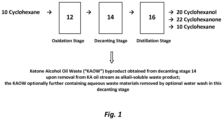
- Fig. 1 illustrates diagrammatically a commercial process wherein cyclohexane 10 is subjected to an "oxidation stage" (see block designated at 12) which generates a stream of cyclohexanol/cyclohexanone/byproducts which is then subjected to a "decanting stage” (see block designated at 14) from which waste products including ketone alcohol oil waste (KAOW) byproduct are removed using a caustic treatment aqueous wash (to remove alkali-soluble materials) from the cyclohexanol/cyclohexanone/byproducts stream which is then subjected to a distillation stage (see block designated at 16).
- alkali-soluble refers to materials which are aqueous soluble at pH greater than 7 and preferably up to pH of 10 and greater.
- the ester is then subsequently hydrolyzed to cyclohexanol and boric acid (B(OC 6 H 11 ) 3 + 3 H 2 O ⁇ 3 C 6 H 11 OH + H 3 BO 3 ).
- the boric acid is dehydrated to metaboric acid and recycled to the air oxidizer (3 H 3 BO 3 ⁇ H 3 B 3 O 6 + 3 H 2 O). Musser further explains that while this newer oxidation process is similar to the metal-catalyzed oxidation process (as explained in the foregoing paragraph), the cyclohexyl rings are protected from further attack.
- This boric acid process is purportedly characterized by higher yield of cyclohexanol and cyclohexanone, as well as a higher alcohol to ketone ratio (which could be as high as 10:1). Musser notes that this Halcon oxidation process is licensed to several companies around the world, and that the major producers using this technology (as of 2011) were Solutia, DuPont (UK), Bayer, and Mitsubishi.
- the oxidation stage (designated at block 12 in Fig. 1 ) as contemplated by the present inventors can involve the earlier air oxidation of cyclohexane process, or, more preferably, the boric acid modified oxidation of cyclohexane (e.g., Halcon oxidation), as explained in the preceding paragraph. In the oxidation stage, it is also optional to remove hexane diol during the oxidation stage 12. As shown in Fig.
- KAOW contains a mixture of sodium salts of C1 - C6 organic acids and may contain a small amount of sodium hydroxide (or other caustic material used in the caustic treatment portion of the decanting stage 14), and, as mentioned above, optional water-soluble materials removed as part of an optional water wash during the decanting stage.
- residual cyclohexane 12 removed from the cyclohexanone/cyclohexanol stream may be recycled back into the oxidation stage 12.
- the post-distillation cyclohexanol 20 and cyclohexanone 22 can then be used for other industrial purposes (e.g., as intermediate material for synthesis of caprolactam and adipic acid, which are in turn precursor/intermediates for manufacturing polyamide (nylon) materials).
- an exemplary additive composition of the present invention for modifying a hydratable cementitious composition comprises: (A) at least one cement dispersant for dispersing hydratable cementitious particles within an aqueous environment, such as a glycol (e.g., diethylene glycol), a glycerol, an alkanolamine (e.g., N,N-bis(2-hydroxyethyl)-2-hydroxypropylamine (DEIPA)), an organic acid not derived from nylon polymer manufacturing, a lignosulfonate (e.g., sodium lignosulfonate), a gluconate (e.g., sodium gluconate), a naphthalene sulfonate formaldehyde condensate, an acetone sulfonate formaldehyde condensate, a polycarboxylate polymer (e.g., a superplasticizing comb-type polycarboxylate polymer), a hydroxycarboxylate
- Preferred cement dispersants include lignosulfonate, a gluconate, or a mixture thereof, and most preferred are sodium lignosulfonate, sodium gluconate, or mixture thereof.
- an air detraining agent preferably a non-ionic defoaming agent
- KAOW may be used with gluconate without necessarily requiring the use of an air detraining agent.
- the relative amount of cement dispersant of component (A) and the KAOW of component (B) may be used in any desired ratios, although a preferred weight ratio (A:B) is 25-75:75-25. Amounts and percentages of materials shall be understood to be expressed herein based on dry weight solids unless otherwise indicated. The weight amount of the KAOW component will be further understood to be based on non-volatile constituents of the KAOW material.
- the component (B) ketone alcohol oil waste ("KAOW”) byproduct is obtained from the commercial production process whereby cyclohexanol and cyclohexanone are produced from cyclohexane.
- the production process can be described as comprising (i) an oxidation stage wherein cyclohexane is oxidized to provide a stream of cyclohexanol, cyclohexanone, and other byproducts (optionally hexane diol and other polyols can be removed in accordance with various industrial practices); (ii) decanting stage wherein the stream of cyclohexanol, cyclohexanone, and byproducts produced by the oxidation stage are subjected to a caustic treatment using a highly alkaline material (e.g., calcium hydroxide, sodium hydroxide, sodium carbonate (soda ash), calcium oxide, lime, or mixtures thereof, optionally with salts) to remove alkali-soluble waste
- the KAOW byproduct will contain carboxylic acid groups.
- KAOW material will contain substantially no or negligible amounts nitrogen (or, in other words, KAOW material incorporated into any additive or admixture should comprise nitrogen in an amount no more than 0-1.0 percent based on total dry solids (of non-volatile materials) in the KAOW byproduct obtained from the decanting stage (ii) as previously discussed.
- the present invention also provides cementitious compositions, which comprise: a hydratable cement or cementitious material in combination with the above described KAOW byproduct material.
- An exemplary cement or concrete composition of the present invention comprises a hydratable cement, fly ash (e.g., Class C fly ash), and KAOW or an additive composition comprising at least one cement dispersant and KAOW), optionally with at least one air detraining agent.
- Exemplary concretes comprise hydratable cement, aggregate, (e.g., sand and/or coarse aggregate), and the KAOW byproduct material.
- the present invention also provides methods for modifying a cementitious material, comprising: combining a hydratable cement or cementitious material (e.g., a supplemental cementitious material such as fly ash), or mixture thereof, with KAOW or an additive composition comprising at least one cement dispersant and KAOW.
- a hydratable cement or cementitious material e.g., a supplemental cementitious material such as fly ash
- KAOW a hydratable cement or cementitious material
- an additive composition comprising at least one cement dispersant and KAOW.
- KAOW as comprising at least four of sodium hydroxide, sodium carbonate, sodium bicarbonate, sodium formate, sodium butyrate, sodium caproate, sodium glutarate, sodium adipate, sodium valerate, and sodium malonate; and this is based on their analysis of various KAOW materials.
- typical examples of KAOW compositions are shown in Table 1 and Table 2 below.
- Table 3 and Table 4 show the actual analytical results of the KAOW sample obtained from a supplier (UBE Thailand).
- Table 3 Typical KA Oil byproduct (KAOW) composition 3 (chemical analysis of KAOW sample from UBE Thailand) Component Percent of weight of sample Aliphatic Carboxylic Acids as sodium salts (see Table 4) 16% Other Carboxylic acids as sodium salts (by difference)* approx. 4% Nitrogen containing compound** Less than 1% Sodium hydroxide / carbonate*** approx. 2% (*) Titration of the sample indicated the presence of more carboxylic acid groups than can be accounted for the sum of aliphatic carboxylic acids listed in table above.
- Cement dispersants increase fluidity of cement paste, mortar and concrete. Such dispersants are also called water reducers because they allow less water to be used in mortar cement or concrete without loss of slump (a measure of consistency or workability). Many cement additives permit the use of less water to obtain the same slump, or the attainment of a higher slump at given water content, or the use of less Portland cement to realize the same compressive strength.
- the performance requirements for water reducing admixtures are specified in ASTM Method C494-92, "Standard Specifications for Chemical Admixtures for Concrete.”
- a water reducing admixture is defined as an admixture that reduces the quantity of mixing water required to produce concrete of a given consistency by at least 5%.
- KAOW has great benefits when used as or in chemical admixture formulations for modifying properties such as slump in concrete, whether in ready-mix concrete or in concrete masonry units (e.g., blocks, pavers), alone or in combination with conventional cement dispersants.
- KAOW can achieve similar strength when it is combined with 0.3 to 1.3% by weight of KAOW.
- the air detraining agent (or defoaming surfactant) used was SURFONIC ® LF68 available from Huntsman Chemical, which is based on fatty alcohol alkoxylates.
- exemplary embodiments of the present invention may comprise KAOW in combination with fatty alcohol alkoxylate air detraining agents, although the present inventors believe that based on the foregoing results, non-ionic defoaming agents could be suitable used with KAOW in cementitious compositions.
- KAOW material obtained from a different source compared to the foregoing examples was also tested in concrete mixes.
- the concrete testing was done as follows: The concrete sample dosage with lignosulfonate, KAOW, and air detraining agent (SURFONIC ® LF-68 from Huntsman Chemical) was used in accordance with the dosages shown in table 8 below.
- KAOW dosage is relativity high
- KAOW has a tendency to entrain air upon mixing the treated cement with water. Therefore, it is preferred that KAOW containing cement grinding additives contain a defoamer.
- triisobutylphosphate may be advantageously used at a dosage of 1 - 5 % by weight based on non-volatile component of KAOW material.
Landscapes
- Chemical & Material Sciences (AREA)
- Organic Chemistry (AREA)
- Engineering & Computer Science (AREA)
- Ceramic Engineering (AREA)
- Materials Engineering (AREA)
- Structural Engineering (AREA)
- Chemical Kinetics & Catalysis (AREA)
- Inorganic Chemistry (AREA)
- Curing Cements, Concrete, And Artificial Stone (AREA)
- Civil Engineering (AREA)
- Environmental & Geological Engineering (AREA)
- Health & Medical Sciences (AREA)
- Life Sciences & Earth Sciences (AREA)
- Molecular Biology (AREA)
- Combustion & Propulsion (AREA)
- Processing Of Solid Wastes (AREA)
- Organic Low-Molecular-Weight Compounds And Preparation Thereof (AREA)
Claims (14)
- Composition additive pour modifier une composition cimentaire hydratable, comprenant :(A) au moins un dispersant de ciment pour disperser des particules cimentaires hydratables à l'intérieur d'un environnement aqueux ;(B) un produit dérivé de déchet huileux de cétone-alcool (« Ketone Alcohol Oil Waste », KAOW) pouvant être obtenu d'un processus commercial de production moyennant quoi du cyclohexanol et du cyclohexanone sont produits à partir de cyclohexane, le processus commercial comprenant les étapes suivantes (i) à (iii) comme suit :(i) un stade d'oxydation, dans lequel le cyclohexane est oxydé pour fournir un courant de cyclohexanol, de cyclohexanone, et d'autres produits dérivés,(ii) un stade de décantation, dans lequel le courant de cyclohexanol, de cyclohexanone, et de produits dérivés produit par le stade d'oxydation est soumis à un traitement caustique pour éliminer un matériau de déchet soluble dans l'alcali, ainsi obtenant le KAOW du courant de post-oxydation, et(iii) un stade de distillation, dans lequel le courant de cyclohexanol/cyclohexanone/produit dérivé traité dans le stade de décantation (ii) est fourni dans au moins une colonne de séparation pour récupérer tout cyclohexane résiduel ou pour éliminer un matériau à haut point d'ébullition du courant de cyclohexanol/cyclohexanone/produit dérivé ;dans laquelle le produit dérivé de KAOW éliminé du stade de décantation (ii) comprend au moins quatre parmi de l'hydroxyde de sodium, du carbonate de sodium, du bicarbonate de sodium, du formate de sodium, du butyrate de sodium, du caproate de sodium, du glutarate de sodium, de l'adipate de sodium, du valérate de sodium, et du malonate de sodium ; etdans laquelle les composants (A) et (B) ci-dessus sont prévus dans le rapport pondéral (A : B) de 25-75 : 75-25.
- Composition additive de la revendication 1, dans laquelle le KAOW pouvant être obtenu dans le stade de décantation contient en outre un matériau hydrosoluble éliminé du courant de cyclohexanol et de cyclohexanone par un traitement de lavage à l'eau qui précède ou suit le traitement caustique.
- Composition additive de la revendication 1, comprenant en outre, en tant que composant « (C) », un agent désentraîneur d'air présent en la quantité (C)/(A)+(B), sur la base du pourcentage du poids à sec total des composants (A) et (B).
- Composition additive de la revendication 3, dans laquelle le pourcentage du composant (C) est sur la base du poids de constituants non volatiles des composants (A) et (B).
- Composition additive de la revendication 1, dans laquelle l'au moins un dispersant de ciment du composant (A) comprend un glycol, glycérol, alcanolamine, un acide organique non dérivé de fabrication de polymère nylon, lignosulfonate, gluconate, condensat de formaldéhyde de sulfonate de naphtalène, condensat de formaldéhyde de sulfonate d'acétone, un polymère polycarboxylate, composé hydroxycarboxylate, un carbohydrate, ou des mélasses de fermentation, ou un mélange de ceux-ci.
- Composition additive de la revendication 1, dans laquelle l'au moins un dispersant de ciment du composant (A) comprend un lignosulfonate, un gluconate, ou un mélange de ceux-ci, de préférence dans laquelle l'au moins un dispersant de ciment du composant (A) est du lignosulfonate de sodium, du gluconate de sodium, ou mélange de ceux-ci.
- Composition additive de la revendication 1, dans laquelle le produit dérivé de KAOW du composant (B) comprend au moins de l'hydroxyde de sodium et du carbonate de sodium; ou dans laquelle le produit dérivé de KAOW du composant (B) comprend des groupes acide carboxylique ; ou dans laquelle le produit dérivé de KAOW du composant (B) comprend de l'azote en une quantité inférieure à un total poids d'un pour cent.
- Composition additive de la revendication 3, dans laquelle l'agent désentraîneur d'air est sélectionné parmi le groupe constitué de triisobutylphosphate et d'alcool alkylique d'éthoxylate-propoxylate en C16-C18, de préférence dans laquelle l'agent désentraîneur d'air est du triisobutylphosphate.
- Procédé de modification d'un matériau cimentaire, comprenant : la combinaison d'un ciment hydratable, d'un matériau cimentaire supplémentaire, ou d'un mélange de ceux-ci avec la composition additive de la revendication 1.
- Procédé de la revendication 9, dans lequel la composition additive est introduite dans un processus de fabrication pour broyer une scorie de ciment, la composition additive étant utilisée en une quantité de 0,01 % à 0,3 %, sur la base du pourcentage en poids de solides secs, sur la base du poids du ciment.
- Procédé de la revendication 9, dans lequel la composition additive est combinée avec un matériau cimentaire hydratable et un matériau agrégat, la composition additive étant utilisée en une quantité de 0,3 % à 1,3 %, sur la base du pourcentage en poids de solides secs, sur la base du poids du matériau cimentaire hydratable.
- Composition cimentaire comprenant : un ciment hydratable et un produit dérivé de déchet huileux d'alcool de cétone (« Ketone Alcohol Oil Waste », KAOW) pouvant être obtenu, sous forme de déchet soluble dans l'alcali, d'un processus commercial de production moyennant quoi du cyclohexanol et du cyclohexanone sont produits à partir de cyclohexane, le processus commercial comprenant les étapes suivantes (i) à (iii) comme suit :(i) un stade d'oxydation, dans lequel le cyclohexane est oxydé pour fournir un courant de cyclohexanol, de cyclohexanone, et d'autres produits dérivés,(ii) un stade de décantation, dans lequel le courant de cyclohexanol, de cyclohexanone, et de produits dérivés produit par le stade d'oxydation est soumis à un traitement caustique pour éliminer un matériau de déchet soluble dans l'alcali, ainsi obtenant le KAOW du courant de post-oxydation, et(iii) un stade de distillation, dans lequel le courant de cyclohexanol/cyclohexanone/produit dérivé traité dans stade de décantation (ii) est fourni dans au moins une colonne de séparation pour récupérer tout cyclohexane résiduel ou pour éliminer un matériau à haut point d'ébullition du courant de cyclohexanol/cyclohexanone/produit dérivé ;dans laquelle le produit dérivé de KAOW éliminé du stade de décantation (ii) comprend au moins quatre parmi de l'hydroxyde de sodium, du carbonate de sodium, du bicarbonate de sodium, du formate de sodium, du butyrate de sodium, du caproate de sodium, du glutarate de sodium, de l'adipate de sodium, du valérate de sodium, et du malonate de sodium.
- Composition cimentaire de la revendication 12, dans laquelle le KAOW pouvant être obtenu dans le stade de décantation contient en outre un matériau hydrosoluble éliminé du courant de cyclohexanol et de cyclohexanone par un traitement de lavage à l'eau qui précède ou suit le traitement caustique.
- Composition cimentaire de la revendication 12, comprenant en outre : des cendres volantes, du sable artificiel, ou un mélange de ceux-ci ; ou des cendres volantes contenant du carbone ; ou un agent désentraîneur d'air.
Applications Claiming Priority (1)
| Application Number | Priority Date | Filing Date | Title |
|---|---|---|---|
| PCT/US2015/018089 WO2016137508A1 (fr) | 2015-02-27 | 2015-02-27 | Modification de compositions à base de ciment à l'aide de déchets huileux à base d'alcool cétonique |
Publications (3)
| Publication Number | Publication Date |
|---|---|
| EP3262007A1 EP3262007A1 (fr) | 2018-01-03 |
| EP3262007A4 EP3262007A4 (fr) | 2018-11-14 |
| EP3262007B1 true EP3262007B1 (fr) | 2025-04-09 |
Family
ID=56788954
Family Applications (1)
| Application Number | Title | Priority Date | Filing Date |
|---|---|---|---|
| EP15883599.1A Active EP3262007B1 (fr) | 2015-02-27 | 2015-02-27 | Modification de compositions à base de ciment à l'aide de déchets huileux à base d'alcool cétonique |
Country Status (10)
| Country | Link |
|---|---|
| US (1) | US10752549B2 (fr) |
| EP (1) | EP3262007B1 (fr) |
| CN (1) | CN107531567B (fr) |
| BR (1) | BR112017018294B1 (fr) |
| ES (1) | ES3035113T3 (fr) |
| MX (1) | MX2017010751A (fr) |
| PL (1) | PL3262007T3 (fr) |
| PT (1) | PT3262007T (fr) |
| SG (1) | SG11201706920VA (fr) |
| WO (1) | WO2016137508A1 (fr) |
Families Citing this family (1)
| Publication number | Priority date | Publication date | Assignee | Title |
|---|---|---|---|---|
| US12291670B2 (en) * | 2023-02-08 | 2025-05-06 | Saudi Arabian Oil Company | Compositions and methods for branched calcium lignosulfonate cement dispersants |
Family Cites Families (28)
| Publication number | Priority date | Publication date | Assignee | Title |
|---|---|---|---|---|
| US3047629A (en) * | 1962-07-31 | Process of preparing cyclohexanone | ||
| US1006424A (en) * | 1911-03-28 | 1911-10-17 | Clyde B Asher | Concrete-floor construction. |
| US1773903A (en) * | 1929-10-09 | 1930-08-26 | Elmer G Kesling | Speed-changing mechanism |
| SU1006424A1 (ru) * | 1980-05-05 | 1983-03-23 | Предприятие П/Я В-2609 | Способ получени циклогексанона и циклогексанола |
| JPS5855353A (ja) | 1981-09-22 | 1983-04-01 | 太平洋セメント株式会社 | Aeフライアツシユコンクリ−トの製造方法 |
| SU1152947A1 (ru) | 1982-05-05 | 1985-04-30 | Тульский Ордена Трудового Красного Знамени Политехнический Институт | Способ приготовлени бетонной смеси |
| SU1424825A1 (ru) | 1984-12-13 | 1988-09-23 | Красноярский государственный медицинский институт | Устройство дл коррекции искривлений позвоночника |
| US4869846A (en) | 1986-07-07 | 1989-09-26 | Nalco Chemical Company | Fly ash utilization in flue gas desulfurization |
| SU1414825A1 (ru) | 1987-01-27 | 1988-08-07 | Специальное Конструкторское Бюро Главстройпрома | Добавка дл бетонной смеси |
| SU1606490A1 (ru) | 1988-04-18 | 1990-11-15 | Щекинское Производственное Объединение "Азот" Им.50-Летия Ссср | Комплексна добавка дл бетонной смеси |
| SU1625850A1 (ru) | 1988-07-11 | 1991-02-07 | Латвийский Научно-Исследовательский И Экспериментально-Технологический Институт Строительства Госстроя Латсср | Композици дл устройства ст жки полов |
| US5654352A (en) | 1995-05-16 | 1997-08-05 | Maxflow Environmental Corp. | Air-entraining agent and method of producing same |
| US5892122A (en) * | 1997-08-25 | 1999-04-06 | E. I. Du Pont De Nemours And Company | Method for making cyclohexanol and cyclohexanone |
| US6160183A (en) * | 1998-02-10 | 2000-12-12 | E. I. Du Pont De Nemours And Company | Direct oxidation of cycloalkanes |
| JP4451939B2 (ja) * | 1999-02-19 | 2010-04-14 | ダイセル化学工業株式会社 | シクロアルカノンの製造方法 |
| US6599358B1 (en) | 2000-03-13 | 2003-07-29 | Mainland Laboratory, Ltd. | Carbon scavenger fly ash pretreatment method |
| MY141254A (en) | 2003-01-24 | 2010-03-31 | Handy Chemicals Ltd | Sacrificial agents for fly ash concrete |
| US20040144287A1 (en) | 2003-01-24 | 2004-07-29 | Boral Material Technologies Inc. | System and method for treating fly ash |
| US6869998B2 (en) * | 2003-06-23 | 2005-03-22 | Geo Specialty Chemicals, Inc. | Concrete or cement dispersant and method of use |
| WO2006011182A1 (fr) | 2004-06-25 | 2006-02-02 | Sika Ltd. | Dispersant de ciment et composition de béton contenant le dispersant |
| DE102004035567B4 (de) * | 2004-07-22 | 2006-10-26 | Hilti Ag | Zweikomponenten-Mörtelmasse und ihre Verwendung |
| EA011556B1 (ru) * | 2004-12-22 | 2009-04-28 | ДСМ АйПи АССЕТС Б.В. | Способ разложения циклогексилгидропероксида |
| US7976625B2 (en) | 2006-01-20 | 2011-07-12 | Cognis Ip Management Gmbh | Compounds and methods for treating fly ash |
| US20100286312A1 (en) | 2009-05-06 | 2010-11-11 | Boral Material Technologies Inc. | Amine Sacrificial Agents and Methods and Products Using Same |
| RU2410345C1 (ru) * | 2009-12-29 | 2011-01-27 | Государственное образовательное учреждение высшего профессионального образования "Ивановский государственный химико-технологический университет" | Композиционный строительный материал |
| WO2011086242A1 (fr) | 2010-01-15 | 2011-07-21 | Lafarge | Adjuvant pour composition hydraulique |
| CN103228595B (zh) * | 2010-10-19 | 2015-08-12 | 格雷斯公司 | 用于可水合的水泥组合物的含粘土人工砂 |
| EP2660217A1 (fr) | 2012-05-03 | 2013-11-06 | Construction Research & Technology GmbH | Agent de broyage pour liant minéral |
-
2015
- 2015-02-27 SG SG11201706920VA patent/SG11201706920VA/en unknown
- 2015-02-27 US US15/553,996 patent/US10752549B2/en active Active
- 2015-02-27 EP EP15883599.1A patent/EP3262007B1/fr active Active
- 2015-02-27 PT PT158835991T patent/PT3262007T/pt unknown
- 2015-02-27 BR BR112017018294-7A patent/BR112017018294B1/pt active IP Right Grant
- 2015-02-27 CN CN201580079312.9A patent/CN107531567B/zh active Active
- 2015-02-27 ES ES15883599T patent/ES3035113T3/es active Active
- 2015-02-27 MX MX2017010751A patent/MX2017010751A/es unknown
- 2015-02-27 PL PL15883599.1T patent/PL3262007T3/pl unknown
- 2015-02-27 WO PCT/US2015/018089 patent/WO2016137508A1/fr not_active Ceased
Also Published As
| Publication number | Publication date |
|---|---|
| EP3262007A1 (fr) | 2018-01-03 |
| PL3262007T3 (pl) | 2025-09-08 |
| US10752549B2 (en) | 2020-08-25 |
| BR112017018294A2 (pt) | 2018-07-24 |
| EP3262007A4 (fr) | 2018-11-14 |
| SG11201706920VA (en) | 2017-09-28 |
| WO2016137508A1 (fr) | 2016-09-01 |
| ES3035113T3 (en) | 2025-08-28 |
| CN107531567B (zh) | 2020-06-09 |
| BR112017018294B1 (pt) | 2022-12-27 |
| MX2017010751A (es) | 2018-04-10 |
| CN107531567A (zh) | 2018-01-02 |
| PT3262007T (pt) | 2025-07-16 |
| US20180044240A1 (en) | 2018-02-15 |
Similar Documents
| Publication | Publication Date | Title |
|---|---|---|
| US8506701B2 (en) | Method for producing hydraulic powder | |
| DK2582643T3 (en) | Grinding Aids | |
| KR101313015B1 (ko) | 시멘트 첨가재료 및 시멘트 조성물 | |
| US20060086291A1 (en) | Amine-containing cement processing additives | |
| EP3046885B1 (fr) | Additif de mouture du ciment pour permettre l'utilisation d'un équipement en pvc | |
| US20130213272A1 (en) | Robust Air-Detraining for Cement Milling | |
| JP2015526371A (ja) | セメント粉砕助剤組成物 | |
| EP3647295B1 (fr) | Composition de béton et son procédé de production | |
| CN117999249B (zh) | 水泥组合物及其制造方法 | |
| EP3262007B1 (fr) | Modification de compositions à base de ciment à l'aide de déchets huileux à base d'alcool cétonique | |
| JP4330131B2 (ja) | セメント配合物用収縮低減剤、及びこれを含有するセメント配合物 | |
| JP7369849B2 (ja) | セメント組成物 | |
| TR2021019185A2 (tr) | Öğütme yardimcisi | |
| JP6278478B2 (ja) | セメント組成物およびコンクリート | |
| KR20260044060A (ko) | 활성화된 페로니켈슬래그가 치환된 혼합시멘트 및 그를 함유한 콘크리트 및 모르타르용 조성물 | |
| EP3833645A1 (fr) | Additif de broyage de glycérine brute stable à formulation efficace | |
| JP2022135555A (ja) | セメント組成物の製造方法及び固化材の製造方法 | |
| HK40016055B (en) | Concrete composition and production method therefor | |
| HK40016055A (en) | Concrete composition and production method therefor |
Legal Events
| Date | Code | Title | Description |
|---|---|---|---|
| STAA | Information on the status of an ep patent application or granted ep patent |
Free format text: STATUS: THE INTERNATIONAL PUBLICATION HAS BEEN MADE |
|
| PUAI | Public reference made under article 153(3) epc to a published international application that has entered the european phase |
Free format text: ORIGINAL CODE: 0009012 |
|
| STAA | Information on the status of an ep patent application or granted ep patent |
Free format text: STATUS: REQUEST FOR EXAMINATION WAS MADE |
|
| 17P | Request for examination filed |
Effective date: 20170901 |
|
| AK | Designated contracting states |
Kind code of ref document: A1 Designated state(s): AL AT BE BG CH CY CZ DE DK EE ES FI FR GB GR HR HU IE IS IT LI LT LU LV MC MK MT NL NO PL PT RO RS SE SI SK SM TR |
|
| AX | Request for extension of the european patent |
Extension state: BA ME |
|
| RIN1 | Information on inventor provided before grant (corrected) |
Inventor name: JACHIMOWICZ, FELEK Inventor name: LAI, WEE, FUK Inventor name: CHUN, BYONG-WA Inventor name: ZHANG, SHUQIANG Inventor name: ZHONG, HUA Inventor name: HNIN, YIN-ZAR |
|
| DAX | Request for extension of the european patent (deleted) | ||
| RIC1 | Information provided on ipc code assigned before grant |
Ipc: C04B 24/00 20060101AFI20180927BHEP Ipc: C04B 28/02 20060101ALI20180927BHEP Ipc: C04B 103/52 20060101ALN20180927BHEP |
|
| A4 | Supplementary search report drawn up and despatched |
Effective date: 20181015 |
|
| RIC1 | Information provided on ipc code assigned before grant |
Ipc: C04B 28/02 20060101ALI20181005BHEP Ipc: C04B 103/52 20060101ALN20181005BHEP Ipc: C04B 24/00 20060101AFI20181005BHEP |
|
| STAA | Information on the status of an ep patent application or granted ep patent |
Free format text: STATUS: EXAMINATION IS IN PROGRESS |
|
| 17Q | First examination report despatched |
Effective date: 20220228 |
|
| RAP3 | Party data changed (applicant data changed or rights of an application transferred) |
Owner name: GCP APPLIED TECHNOLOGIES INC. |
|
| GRAP | Despatch of communication of intention to grant a patent |
Free format text: ORIGINAL CODE: EPIDOSNIGR1 |
|
| STAA | Information on the status of an ep patent application or granted ep patent |
Free format text: STATUS: GRANT OF PATENT IS INTENDED |
|
| INTG | Intention to grant announced |
Effective date: 20241030 |
|
| GRAS | Grant fee paid |
Free format text: ORIGINAL CODE: EPIDOSNIGR3 |
|
| GRAA | (expected) grant |
Free format text: ORIGINAL CODE: 0009210 |
|
| STAA | Information on the status of an ep patent application or granted ep patent |
Free format text: STATUS: THE PATENT HAS BEEN GRANTED |
|
| P01 | Opt-out of the competence of the unified patent court (upc) registered |
Free format text: CASE NUMBER: APP_8522/2025 Effective date: 20250219 |
|
| RAP3 | Party data changed (applicant data changed or rights of an application transferred) |
Owner name: GCP APPLIED TECHNOLOGIES INC. |
|
| AK | Designated contracting states |
Kind code of ref document: B1 Designated state(s): AL AT BE BG CH CY CZ DE DK EE ES FI FR GB GR HR HU IE IS IT LI LT LU LV MC MK MT NL NO PL PT RO RS SE SI SK SM TR |
|
| REG | Reference to a national code |
Ref country code: GB Ref legal event code: FG4D |
|
| REG | Reference to a national code |
Ref country code: CH Ref legal event code: EP |
|
| REG | Reference to a national code |
Ref country code: DE Ref legal event code: R096 Ref document number: 602015091424 Country of ref document: DE |
|
| REG | Reference to a national code |
Ref country code: IE Ref legal event code: FG4D |
|
| REG | Reference to a national code |
Ref country code: PT Ref legal event code: SC4A Ref document number: 3262007 Country of ref document: PT Date of ref document: 20250716 Kind code of ref document: T Free format text: AVAILABILITY OF NATIONAL TRANSLATION Effective date: 20250709 |
|
| REG | Reference to a national code |
Ref country code: NL Ref legal event code: MP Effective date: 20250409 |
|
| REG | Reference to a national code |
Ref country code: ES Ref legal event code: FG2A Ref document number: 3035113 Country of ref document: ES Kind code of ref document: T3 Effective date: 20250828 |
|
| PG25 | Lapsed in a contracting state [announced via postgrant information from national office to epo] |
Ref country code: NL Free format text: LAPSE BECAUSE OF FAILURE TO SUBMIT A TRANSLATION OF THE DESCRIPTION OR TO PAY THE FEE WITHIN THE PRESCRIBED TIME-LIMIT Effective date: 20250409 |
|
| REG | Reference to a national code |
Ref country code: AT Ref legal event code: MK05 Ref document number: 1783439 Country of ref document: AT Kind code of ref document: T Effective date: 20250409 |
|
| PG25 | Lapsed in a contracting state [announced via postgrant information from national office to epo] |
Ref country code: FI Free format text: LAPSE BECAUSE OF FAILURE TO SUBMIT A TRANSLATION OF THE DESCRIPTION OR TO PAY THE FEE WITHIN THE PRESCRIBED TIME-LIMIT Effective date: 20250409 |
|
| REG | Reference to a national code |
Ref country code: LT Ref legal event code: MG9D |
|
| PG25 | Lapsed in a contracting state [announced via postgrant information from national office to epo] |
Ref country code: GR Free format text: LAPSE BECAUSE OF FAILURE TO SUBMIT A TRANSLATION OF THE DESCRIPTION OR TO PAY THE FEE WITHIN THE PRESCRIBED TIME-LIMIT Effective date: 20250710 Ref country code: NO Free format text: LAPSE BECAUSE OF FAILURE TO SUBMIT A TRANSLATION OF THE DESCRIPTION OR TO PAY THE FEE WITHIN THE PRESCRIBED TIME-LIMIT Effective date: 20250709 |
|
| PG25 | Lapsed in a contracting state [announced via postgrant information from national office to epo] |
Ref country code: BG Free format text: LAPSE BECAUSE OF FAILURE TO SUBMIT A TRANSLATION OF THE DESCRIPTION OR TO PAY THE FEE WITHIN THE PRESCRIBED TIME-LIMIT Effective date: 20250409 |
|
| PG25 | Lapsed in a contracting state [announced via postgrant information from national office to epo] |
Ref country code: HR Free format text: LAPSE BECAUSE OF FAILURE TO SUBMIT A TRANSLATION OF THE DESCRIPTION OR TO PAY THE FEE WITHIN THE PRESCRIBED TIME-LIMIT Effective date: 20250409 |
|
| PG25 | Lapsed in a contracting state [announced via postgrant information from national office to epo] |
Ref country code: AT Free format text: LAPSE BECAUSE OF FAILURE TO SUBMIT A TRANSLATION OF THE DESCRIPTION OR TO PAY THE FEE WITHIN THE PRESCRIBED TIME-LIMIT Effective date: 20250409 |
|
| PG25 | Lapsed in a contracting state [announced via postgrant information from national office to epo] |
Ref country code: RS Free format text: LAPSE BECAUSE OF FAILURE TO SUBMIT A TRANSLATION OF THE DESCRIPTION OR TO PAY THE FEE WITHIN THE PRESCRIBED TIME-LIMIT Effective date: 20250709 |
|
| PG25 | Lapsed in a contracting state [announced via postgrant information from national office to epo] |
Ref country code: IS Free format text: LAPSE BECAUSE OF FAILURE TO SUBMIT A TRANSLATION OF THE DESCRIPTION OR TO PAY THE FEE WITHIN THE PRESCRIBED TIME-LIMIT Effective date: 20250809 |
|
| PG25 | Lapsed in a contracting state [announced via postgrant information from national office to epo] |
Ref country code: LV Free format text: LAPSE BECAUSE OF FAILURE TO SUBMIT A TRANSLATION OF THE DESCRIPTION OR TO PAY THE FEE WITHIN THE PRESCRIBED TIME-LIMIT Effective date: 20250409 |
|
| REG | Reference to a national code |
Ref country code: DE Ref legal event code: R097 Ref document number: 602015091424 Country of ref document: DE |
|
| PG25 | Lapsed in a contracting state [announced via postgrant information from national office to epo] |
Ref country code: DK Free format text: LAPSE BECAUSE OF FAILURE TO SUBMIT A TRANSLATION OF THE DESCRIPTION OR TO PAY THE FEE WITHIN THE PRESCRIBED TIME-LIMIT Effective date: 20250409 Ref country code: SM Free format text: LAPSE BECAUSE OF FAILURE TO SUBMIT A TRANSLATION OF THE DESCRIPTION OR TO PAY THE FEE WITHIN THE PRESCRIBED TIME-LIMIT Effective date: 20250409 |
|
| PG25 | Lapsed in a contracting state [announced via postgrant information from national office to epo] |
Ref country code: CZ Free format text: LAPSE BECAUSE OF FAILURE TO SUBMIT A TRANSLATION OF THE DESCRIPTION OR TO PAY THE FEE WITHIN THE PRESCRIBED TIME-LIMIT Effective date: 20250409 |
|
| PG25 | Lapsed in a contracting state [announced via postgrant information from national office to epo] |
Ref country code: EE Free format text: LAPSE BECAUSE OF FAILURE TO SUBMIT A TRANSLATION OF THE DESCRIPTION OR TO PAY THE FEE WITHIN THE PRESCRIBED TIME-LIMIT Effective date: 20250409 |
|
| PG25 | Lapsed in a contracting state [announced via postgrant information from national office to epo] |
Ref country code: RO Free format text: LAPSE BECAUSE OF FAILURE TO SUBMIT A TRANSLATION OF THE DESCRIPTION OR TO PAY THE FEE WITHIN THE PRESCRIBED TIME-LIMIT Effective date: 20250409 Ref country code: SK Free format text: LAPSE BECAUSE OF FAILURE TO SUBMIT A TRANSLATION OF THE DESCRIPTION OR TO PAY THE FEE WITHIN THE PRESCRIBED TIME-LIMIT Effective date: 20250409 |
|
| PLBE | No opposition filed within time limit |
Free format text: ORIGINAL CODE: 0009261 |
|
| STAA | Information on the status of an ep patent application or granted ep patent |
Free format text: STATUS: NO OPPOSITION FILED WITHIN TIME LIMIT |
|
| REG | Reference to a national code |
Ref country code: CH Ref legal event code: L10 Free format text: ST27 STATUS EVENT CODE: U-0-0-L10-L00 (AS PROVIDED BY THE NATIONAL OFFICE) Effective date: 20260218 |
|
| 26N | No opposition filed |
Effective date: 20260112 |
|
| PGFP | Annual fee paid to national office [announced via postgrant information from national office to epo] |
Ref country code: GB Payment date: 20260121 Year of fee payment: 12 |
|
| PGFP | Annual fee paid to national office [announced via postgrant information from national office to epo] |
Ref country code: ES Payment date: 20260302 Year of fee payment: 12 |
|
| PGFP | Annual fee paid to national office [announced via postgrant information from national office to epo] |
Ref country code: DE Payment date: 20260121 Year of fee payment: 12 |
|
| PGFP | Annual fee paid to national office [announced via postgrant information from national office to epo] |
Ref country code: IT Payment date: 20260121 Year of fee payment: 12 |
|
| PGFP | Annual fee paid to national office [announced via postgrant information from national office to epo] |
Ref country code: FR Payment date: 20260121 Year of fee payment: 12 |
|
| PGFP | Annual fee paid to national office [announced via postgrant information from national office to epo] |
Ref country code: TR Payment date: 20260127 Year of fee payment: 12 |
|
| PGFP | Annual fee paid to national office [announced via postgrant information from national office to epo] |
Ref country code: PT Payment date: 20260122 Year of fee payment: 12 |
|
| PGFP | Annual fee paid to national office [announced via postgrant information from national office to epo] |
Ref country code: PL Payment date: 20260125 Year of fee payment: 12 |