EP3293215A1 - Polymerisierbare zusammensetzungen mit acylzinn-photoinitiatoren - Google Patents
Polymerisierbare zusammensetzungen mit acylzinn-photoinitiatoren Download PDFInfo
- Publication number
- EP3293215A1 EP3293215A1 EP16187716.2A EP16187716A EP3293215A1 EP 3293215 A1 EP3293215 A1 EP 3293215A1 EP 16187716 A EP16187716 A EP 16187716A EP 3293215 A1 EP3293215 A1 EP 3293215A1
- Authority
- EP
- European Patent Office
- Prior art keywords
- substituted
- radical
- independently
- alkyl
- branched
- Prior art date
- Legal status (The legal status is an assumption and is not a legal conclusion. Google has not performed a legal analysis and makes no representation as to the accuracy of the status listed.)
- Granted
Links
- 0 CC(c(c(C)c1OI)c(*)c(O)c1O)=O Chemical compound CC(c(c(C)c1OI)c(*)c(O)c1O)=O 0.000 description 4
- AYGOPBHEXZPMOS-UHFFFAOYSA-N CCCC[Sn](C(c(cc1)ccc1C#N)=O)(C(c(cc1)ccc1C#N)=O)C(c(cc1)ccc1C#N)=O Chemical compound CCCC[Sn](C(c(cc1)ccc1C#N)=O)(C(c(cc1)ccc1C#N)=O)C(c(cc1)ccc1C#N)=O AYGOPBHEXZPMOS-UHFFFAOYSA-N 0.000 description 1
- QJUBALMVUSELLT-UHFFFAOYSA-N CCCC[Sn](C(c(cc1)ccc1OC)=O)(C(c(cc1)ccc1OC)=O)C(c(cc1)ccc1OC)=O Chemical compound CCCC[Sn](C(c(cc1)ccc1OC)=O)(C(c(cc1)ccc1OC)=O)C(c(cc1)ccc1OC)=O QJUBALMVUSELLT-UHFFFAOYSA-N 0.000 description 1
- KJZHWFYHAHQLIA-UHFFFAOYSA-N CCCC[Sn](C(c1c(C(F)(F)F)cccc1C(F)(F)F)=O)(C(c1c(C(F)(F)F)cccc1C(F)(F)F)=O)C(c1c(C(F)(F)F)cccc1C(F)(F)F)=O Chemical compound CCCC[Sn](C(c1c(C(F)(F)F)cccc1C(F)(F)F)=O)(C(c1c(C(F)(F)F)cccc1C(F)(F)F)=O)C(c1c(C(F)(F)F)cccc1C(F)(F)F)=O KJZHWFYHAHQLIA-UHFFFAOYSA-N 0.000 description 1
- ORPUIRUCRZOFGP-UHFFFAOYSA-N CCCC[Sn](CCCC)(C(c(cc1)ccc1SC)=O)C(c(cc1)ccc1SC)=O Chemical compound CCCC[Sn](CCCC)(C(c(cc1)ccc1SC)=O)C(c(cc1)ccc1SC)=O ORPUIRUCRZOFGP-UHFFFAOYSA-N 0.000 description 1
- OAMDWBGUBPNFBL-UHFFFAOYSA-N CCCC[Sn]1(C(c(cc2)ccc2Cl)=O)C(c(cc2)ccc2Cl)=[o](cc(cc2)Cl)c2C1=O Chemical compound CCCC[Sn]1(C(c(cc2)ccc2Cl)=O)C(c(cc2)ccc2Cl)=[o](cc(cc2)Cl)c2C1=O OAMDWBGUBPNFBL-UHFFFAOYSA-N 0.000 description 1
- ZPKCIPDWCJMFDK-UHFFFAOYSA-N COc(cc1)ccc1C([Sn](c1ccccc1)(c1ccccc1)c1ccccc1)=O Chemical compound COc(cc1)ccc1C([Sn](c1ccccc1)(c1ccccc1)c1ccccc1)=O ZPKCIPDWCJMFDK-UHFFFAOYSA-N 0.000 description 1
- HGWDCXHJZCBQQT-UHFFFAOYSA-N O=C(c(c(F)c(c(F)c1F)F)c1F)[Sn](c1ccccc1)(c1ccccc1)c1ccccc1 Chemical compound O=C(c(c(F)c(c(F)c1F)F)c1F)[Sn](c1ccccc1)(c1ccccc1)c1ccccc1 HGWDCXHJZCBQQT-UHFFFAOYSA-N 0.000 description 1
Images

Classifications
-
- C—CHEMISTRY; METALLURGY
- C08—ORGANIC MACROMOLECULAR COMPOUNDS; THEIR PREPARATION OR CHEMICAL WORKING-UP; COMPOSITIONS BASED THEREON
- C08F—MACROMOLECULAR COMPOUNDS OBTAINED BY REACTIONS ONLY INVOLVING CARBON-TO-CARBON UNSATURATED BONDS
- C08F2/00—Processes of polymerisation
- C08F2/46—Polymerisation initiated by wave energy or particle radiation
- C08F2/48—Polymerisation initiated by wave energy or particle radiation by ultraviolet or visible light
- C08F2/50—Polymerisation initiated by wave energy or particle radiation by ultraviolet or visible light with sensitising agents
-
- A—HUMAN NECESSITIES
- A61—MEDICAL OR VETERINARY SCIENCE; HYGIENE
- A61K—PREPARATIONS FOR MEDICAL, DENTAL OR TOILETRY PURPOSES
- A61K6/00—Preparations for dentistry
- A61K6/60—Preparations for dentistry comprising organic or organo-metallic additives
- A61K6/62—Photochemical radical initiators
-
- A—HUMAN NECESSITIES
- A61—MEDICAL OR VETERINARY SCIENCE; HYGIENE
- A61K—PREPARATIONS FOR MEDICAL, DENTAL OR TOILETRY PURPOSES
- A61K6/00—Preparations for dentistry
- A61K6/80—Preparations for artificial teeth, for filling teeth or for capping teeth
- A61K6/884—Preparations for artificial teeth, for filling teeth or for capping teeth comprising natural or synthetic resins
- A61K6/887—Compounds obtained by reactions only involving carbon-to-carbon unsaturated bonds
-
- C—CHEMISTRY; METALLURGY
- C08—ORGANIC MACROMOLECULAR COMPOUNDS; THEIR PREPARATION OR CHEMICAL WORKING-UP; COMPOSITIONS BASED THEREON
- C08F—MACROMOLECULAR COMPOUNDS OBTAINED BY REACTIONS ONLY INVOLVING CARBON-TO-CARBON UNSATURATED BONDS
- C08F20/00—Homopolymers and copolymers of compounds having one or more unsaturated aliphatic radicals, each having only one carbon-to-carbon double bond, and only one being terminated by only one carboxyl radical or a salt, anhydride, ester, amide, imide or nitrile thereof
- C08F20/02—Monocarboxylic acids having less than ten carbon atoms, Derivatives thereof
- C08F20/10—Esters
- C08F20/12—Esters of monohydric alcohols or phenols
- C08F20/16—Esters of monohydric alcohols or phenols of phenols or of alcohols containing two or more carbon atoms
- C08F20/18—Esters of monohydric alcohols or phenols of phenols or of alcohols containing two or more carbon atoms with acrylic or methacrylic acids
-
- C—CHEMISTRY; METALLURGY
- C08—ORGANIC MACROMOLECULAR COMPOUNDS; THEIR PREPARATION OR CHEMICAL WORKING-UP; COMPOSITIONS BASED THEREON
- C08K—Use of inorganic or non-macromolecular organic substances as compounding ingredients
- C08K3/00—Use of inorganic substances as compounding ingredients
- C08K3/01—Use of inorganic substances as compounding ingredients characterized by their specific function
- C08K3/013—Fillers, pigments or reinforcing additives
-
- C—CHEMISTRY; METALLURGY
- C08—ORGANIC MACROMOLECULAR COMPOUNDS; THEIR PREPARATION OR CHEMICAL WORKING-UP; COMPOSITIONS BASED THEREON
- C08K—Use of inorganic or non-macromolecular organic substances as compounding ingredients
- C08K5/00—Use of organic ingredients
- C08K5/56—Organo-metallic compounds, i.e. organic compounds containing a metal-to-carbon bond
- C08K5/57—Organo-tin compounds
-
- C—CHEMISTRY; METALLURGY
- C08—ORGANIC MACROMOLECULAR COMPOUNDS; THEIR PREPARATION OR CHEMICAL WORKING-UP; COMPOSITIONS BASED THEREON
- C08K—Use of inorganic or non-macromolecular organic substances as compounding ingredients
- C08K2201/00—Specific properties of additives
- C08K2201/011—Nanostructured additives
Definitions
- the present invention relates to polymerizable compositions containing an acyltin compound as a polymerization initiator.
- the compositions are particularly suitable for the preparation of adhesives, coatings, cements, composites, moldings such as rods, plates, discs or lenses and in particular of dental materials and materials for the stereolithographic production of moldings.
- the photoinitiator used plays a decisive role in the curing of photopolymerizable resins. Upon irradiation with UV or visible light, this light absorbs and forms the polymerization-inducing species. In the case of radical polymerization, these are free radicals. Based on the chemical mechanism of radical formation, the photoinitiators are divided into two classes.
- Norrish Type I photoinitiators form free radicals upon irradiation by unimolecular bond cleavage.
- Norrish type II photoinitiators undergo a bimolecular reaction upon irradiation, with the photoinitiator in the excited state reacting with a second molecule, the coinitiator, forming the polymerization-inducing radicals by electron and proton transfer.
- type I and type II photoinitiators are used; for the visible light range, apart from bisacyldialkylgermanium compounds, almost exclusively type II photoinitiators have hitherto been used.
- the UV curing is characterized by a high reaction rate and is often used for the coatings of various substrates such as wood, metal or glass.
- various substrates such as wood, metal or glass.
- EP 1 247 843 A2 describes a UV-curable coating material using Type I photoinitiators such as diethoxyphenylacetophenone or acyl or bisacylphosphine oxides.
- the WO 01/51533 A1 describes a UV-curable wood coating material in which acylphosphine oxides, ⁇ -hydroxyalkylphenones or ⁇ -dialkoxyacetophenones are also used as photoinitiators. Due to the low wavelength of the UV light, UV curing can be used above all to realize transparent coatings with a low layer thickness. With strong coloring or pigmentation, in filled systems and with larger layer thicknesses, one reaches the limits of the UV-hardening. Such photopolyre reliesrashen resins with significantly reduced transparency cure only incompletely with UV light.
- photoinitiator system is a combination of an ⁇ -diketone with an amine co-initiator, as described, for example, in US Pat GB 1 408 265 is described.
- camphorquinone is preferably used as ⁇ -diketone. Campherquinone has an absorption maximum at a wavelength of 468 nm. As a result, camphor quinone shows a strong yellowing, with the disadvantage that with camphorquinone / amine initiated materials after curing often have a yellow tinge, since the initiator system is not completely fade ( N. Moszner, R. Liska, Photoinitiators for Direct Adhesive Restorative Materials, In: Basics and Applications of Photopolymerization Reactions, Vol.
- EP 1 905 413 A1 and EP 1 905 415 A1 disclose mono-, bis-, and triacylgermanium compounds useful as photoinitiators for curing dental materials with visible light. Their synthesis is complicated and takes place starting from expensive Dialkylgermaniumdihalogeniden using the Dithianstoffmaschinetechnik and column chromatographic purification.
- the WO 2015/067815 A1 discloses bis (germyl) ketones of the formula R 1 R 2 R 3 Ge (CO) GeR 4 R 5 R 6 and processes for their preparation. These bis (germyl) ketones should also be suitable as photoinitiators for dental materials.
- the invention has for its object to provide polymerizable compositions that can be cured with light in the visible range, which are characterized by a high reactivity and good curing characteristics and a good bleaching and can be cured in particular by visible light in the long wavelength range of the visible spectrum ,
- radicals R 4 , R 5 , R 6 , etc. these may be different or preferably identical.
- the radicals carry 0 to 3 and in particular 0 to 1 radically polymerizable groups.
- the polymerizable groups are preferably arranged terminally in non-cyclic radicals.
- a group may be interrupted by a heteroatom such as O is understood to mean that the O atoms are inserted into the carbon chain or carbon ring of the group, i. be bounded on both sides by carbon atoms.
- the number of heteroatoms is therefore smaller than the number of carbon atoms by at least 1, and the heteroatoms can not be terminal.
- the number of heteroatoms is always less than the number of carbon atoms, regardless of substituents.
- Halogen stands in particular for F, Cl, Br or I, preferably for F, Cl and very particularly preferably for Cl.
- acyltin compounds of the general formula (I) used according to the invention are in part already known from the prior art.
- the synthesis of the monoacylstannanes can be carried out, for example, by lithiation of triorganotin chloride and subsequent reaction with acid chloride (cf. GJD Peddle, J. Organometal. Chem. 14 (1968) 139-147 ):
- acyltin compounds Another possibility for the synthesis of acyltin compounds is a synthesis variant in which an Sn-Grignard compound is first prepared and then reacted with an aldehyde (cf. JP Quintard, B. Elissondo, D. Mouko-Mpegna, J. Organomet. Chem. 251 (1983) 175-187 ):
- acyltin compounds can be synthesized by reacting a carbanion, which is obtained from 1,3-dithianes, with tin chlorides (cf. Brook, JM Duff, PF Jones, NR Davis, J. Am. Chem. Soc. 89 (1967), 431-434 ):
- the dithiane obtained can be prepared by various methods (cf. Brook, JM Duff, PF Jones, NR Davis, J. Am. Chem. Soc. 89 (1967), 431-434 ) and J.-P. Bouillon, C. Portella, Eur. J. Org. Chem. 1999, 1571-1580 ), which are well known to those skilled in the art, are hydrolyzed to the corresponding ketones:
- acyltin compounds can also be obtained by oxidation of hydroxy groups (cf. T. Nakamura, H. Yorimitsu, H. Shinokubo, K. Oshima, Tetrahedron 57 (2001) 9827-9836 ):
- the compounds of the formula (I) are outstandingly suitable as photoinitiators for the polymerization and in particular for the free-radical polymerization, in particular for the initiation of compositions based on the monomers defined below.
- the compounds of the formula (I) are relatively easily accessible and show a very good polymerization-initiating action and an excellent bleaching behavior. They are also useful as photoinitiators for other polyreactions, e.g. the polyaddition.
- the compounds of the formula (I) are particularly suitable for medical applications, for example for the production of bone cements and of contact lenses, intraocular lenses or other medical molded parts, such as e.g. earplugs, cartilage implants and artificial tissue parts, and more particularly for the manufacture of dental materials such as adhesives, coatings, cements and composites.
- the acyltin compounds of the formula (I) are also suitable for the production of materials for the production of molded parts by stereolithographic processes.
- the initiators of formula (I) are useful in a variety of non-medical applications, such as for the production of molded articles, e.g. of rods, plates, discs or lenses, etc., printing inks or paints, lacquers, adhesives, for the production of printing plates, integrated circuits, photoresists, solder masks, inks for color printers, as materials for holographic data storage, for the production of nanodimensioned microelectromechanical elements, Optical waveguides, molded parts and for the optical production of information carriers.
- An important field of application is the use as a photoinitiator in the stereolithographic production of technical molded parts, e.g. of precision moldings and ceramic green bodies.
- novel compositions preferably contain from 0.001 to 5, based on the total weight of the composition Wt .-%, particularly preferably 0.01 to 1.0 wt .-% of the acyltin compound of the formula (I).
- compositions preferably also contain a polymerizable binder.
- Preferred binders are free-radically and / or cationically polymerizable monomers and / or prepolymers, more preferably free-radically polymerizable monomers, free-radically polymerizable prepolymers or a mixture thereof.
- Mono- or polyfunctional (meth) acrylates or mixtures thereof are particularly suitable as free-radically polymerizable binders.
- Monofunctional (meth) acrylic compounds are understood as meaning compounds having one or more polyfunctional (meth) acrylic compounds and compounds having two or more, preferably from 2 to 3, polymerizable groups.
- Examples of these are methyl, ethyl, hydroxyethyl, butyl, benzyl, tetrahydrofurfuryl or isobornyl (meth) acrylate, bisphenol A di (meth) acrylate, bis-GMA (an addition product of methacrylic acid and bisphenol A).
- UDMA an addition product of 2-hydroxyethyl methacrylate and 2,2,4-trimethylhexamethylene diisocyanate
- di-, tri- or tetraethylene glycol di (meth) acrylate trimethylolpropane tri (meth) acrylate, pentaerythritol tetra (meth) acrylate, and glycerol di- and trimethacrylate
- 1,4-butanediol di (meth) acrylate 1,10-decanediol di (meth) acrylate or 1,12-dodecanediol di (meth) acrylate.
- Compositions containing at least one radically polymerizable monomer having 2 or more, preferably 2 to 3, radically polymerizable groups are particularly preferred.
- Multifunctional monomers have crosslinking properties.
- hydrolysis-stable diluent monomers such as hydrolysis-stable mono- (meth) acrylates, eg mesityl methacrylate or 2- (alkoxymethyl) -acrylic acids, eg 2- (ethoxymethyl) acrylic acid, 2- (hydroxymethyl) -acrylic acid, N-mono- or Disubstituted acrylamides, such as N-ethylacrylamide, N, N-dimethacrylamide, N- (2-hydroxyethyl) acrylamide or N-methyl-N- (2-hydroxyethyl) acrylamide, or N-monosubstituted Methacrylamides, such as N-ethyl methacrylamide or N- (2-hydroxyethyl) methacrylamide and also use N-vinylpyrrolidone or allyl ether.
- hydrolysis-stable mono- (meth) acrylates eg mesityl methacrylate or 2- (alkoxymethyl) -acrylic acids
- hydrolysis-stable crosslinker monomers are urethanes of 2- (hydroxymethyl) acrylic acid and diisocyanates, such as 2,2,4-trimethylhexamethylene diisocyanate or isophorone diisocyanate, crosslinking pyrrolidones, such as 1,6-bis (3-vinyl-2-pyrrolidonyl) hexane , or commercially available bisacrylamides such as methylene or ethylenebisacrylamide, or bis (meth) acrylamides, such as N, N'-diethyl-1,3-bis (acrylamido) -propane, 1,3-bis (methacrylamido) -propane , 1,4-bis (acrylamido) butane or 1,4-bis (acryloyl) piperazine, which can be synthesized by reaction from the corresponding diamines with (meth) acryloyl chloride.
- crosslinking pyrrolidones such as 1,6-bis (3-vinyl
- free-radically polymerizable binders known monomers having low-shrinkage properties which can be polymerized in a ring-opening manner, such as, for example, mono- or polyfunctional vinylcyclopropanes or bicyclic cyclopropane derivatives (cf. DE 196 16 183 C2 respectively.
- EP 1 413 569 A1 or cyclic allylsulfides (cf. US 6,043,361 or US 6,344,556 ), which moreover can also be used in combination with the di (meth) acrylate crosslinkers listed above.
- Suitable ring-opening polymerisable monomers are those vinylcyclopropanes, such as 1,1-di (ethoxycarbonyl) - or 1,1-di (methoxycarbonyl) -2-vinylcyclopropane or the esters of 1-ethoxycarbonyl- or 1-methoxycarbonyl-2-vinylcyclopropanecarboxylic acid with ethylene glycol, 1,1,1-trimethylolpropane, 1,4-cyclohexanediol or resorcinol.
- vinylcyclopropanes such as 1,1-di (ethoxycarbonyl) - or 1,1-di (methoxycarbonyl) -2-vinylcyclopropane or the esters of 1-ethoxycarbonyl- or 1-methoxycarbonyl-2-vinylcyclopropanecarboxylic acid with ethylene glycol, 1,1,1-trimethylolpropane, 1,4-cyclohexanedi
- Suitable bicyclic cyclopropane derivatives are 2- (bicyclo [3.1.0] hex-1-yl) methyl or ethyl acrylate or their 3-position disubstitution products such as (3,3-bis (ethoxycarbonyl) bicyclo [3.1.0] -hex- 1-yl) acrylic acid methyl or ethyl ester.
- Suitable cyclic allyl sulfides are the addition products of 2- (hydroxymethyl) -6-methylene-1,4-dithiepan or 7-hydroxy-3-methylene-1,5-dithiacylooctane with 2,2,4-trimethylhexamethylene-1,6-diisocyanate or an asymmetric hexamethylene diisocyanate trimer (Desmodur ® VP LS 2294 from Bayer AG).
- formulations based on vinyl esters, vinyl carbonates and vinyl carbamates as radically polymerizable monomers.
- monomers and styrene styrene derivatives or divinylbenzene, unsaturated polyester resins and allyl compounds or free-radically polymerizable polysiloxanes which can be prepared from suitable methacrylsilanes, such as 3- (methacryloyloxy) propyltrimethoxysilane, and, for example in the DE 199 03 177 C2 are described used.
- acid group-containing monomers are polymerizable carboxylic acids, such as maleic acid, acrylic acid, methacrylic acid, 2- (hydroxymethyl) acrylic acid, 4- (meth) acryloyloxyethyltrimellitic anhydride, 10-methacryloyloxydecylmalonic acid, N- (2-hydroxy-3-methacryloyloxypropyl) -N-phenylglycine or 4- vinylbenzoic.
- carboxylic acids such as maleic acid, acrylic acid, methacrylic acid, 2- (hydroxymethyl) acrylic acid, 4- (meth) acryloyloxyethyltrimellitic anhydride, 10-methacryloyloxydecylmalonic acid, N- (2-hydroxy-3-methacryloyloxypropyl) -N-phenylglycine or 4- vinylbenzoic.
- phosphonic acid monomers in particular vinylphosphonic acid, 4-vinylphenylphosphonic acid, 4-vinylbenzylphosphonic acid, 2-methacryloyloxyethylphosphonic acid, 2-methacrylamidoethylphosphonic acid, 4-methacrylamido-4-methylpentylphosphonic acid, 2- [4- (dihydroxyphosphoryl) -2 -oxa-butyl] -acrylic acid or 2- [2-dihydroxyphosphoryl) -ethoxymethyl] -acrylic acid ethyl or 2,4,6-trimethylphenyl ester.
- vinylphosphonic acid 4-vinylphenylphosphonic acid, 4-vinylbenzylphosphonic acid, 2-methacryloyloxyethylphosphonic acid, 2-methacrylamidoethylphosphonic acid, 4-methacrylamido-4-methylpentylphosphonic acid, 2- [4- (dihydroxyphosphoryl) -2 -oxa-butyl] -
- Acid polymerizable phosphoric acid esters in particular 2-methacryloyloxypropylmono- or dihydrogenphosphate, 2-methacryloyloxyethylmono- or dihydrogenphosphate, 2-methacryloyloxyethylphenylhydrogenphosphate, dipentaerythritol-pentamethacryloyloxyphosphate, 10-methacryloyloxydecyldihydrogenphosphate, dipentaerythritolpentamethacryloyloxyphosphate, phosphoric acid mono- (1-acryloyl-piperidine 4-yl) ester, 6- (methacrylamido) hexyl dihydrogen phosphate and 1,3-bis (N-acryloyl-N-propylamino) -propan-2-yl dihydrogen phosphate.
- polymerizable sulfonic acids are suitable as adhesion monomers, in particular vinylsulfonic acid, 4-vinylphenylsulfonic acid or 3- (methacrylamido) propylsulfonic acid.
- polyaddition curable binder are particularly suitable thiol-ene resins containing mixtures of mono- or multi-functional mecapto compounds and di- or multifunctional unsaturated monomers, especially allyl or Norbonenharmen.
- Examples of mono- or multi-functional mecapto compounds are o-, m- or p-dimercaptobenzene and esters of thioglycol or 3-mercaptopropionic acid with ethylene, propylene or butylene glycol, hexanediol, glycerol, trimethylolpropane or pentaerythritol.
- difunctional or polyfunctional allyl compounds are esters of allyl alcohol with di- or tricarboxylic acids, such as malonic, maleic, glutaric, succinic, adipic, sebacic, phthalic, terephthalic or gallic acid, and also mono- or trifunctional allyl ethers, such as Diallyl ethers, ⁇ , ⁇ -bis [allyloxy] alkanes, resorcinol or hydroquinone diallyl ethers and pyrogallol triallyl ethers, or other compounds such as e.g. 1,3,5-triallyl-1,3,5-triazine-2,4,6- (1H, 3H, 5H) -trione, tetraallylsilane or tetraallyl orthosilicate.
- di- or tricarboxylic acids such as malonic, maleic, glutaric, succinic, adipic, sebacic, phthalic, terephthalic or gallic
- di- or multifunctional norbornene compounds are Diels-Alder addition products of cyclopentadiene or furan with difunctional or polyfunctional (meth) acrylates and also esters or urethanes of 5-norbornene-2-methanol or 5-norbornen-2-ol with di-or or polycarboxylic acids, such as Malonic, maleic, glutaric, succinic, adipic, sebacic, phthalic, terephthalic or gallic acid, or di- or polyisocyanates such as hexamethylene diisocyanate or its cyclic trimer, 2,2,4-trimethylhexamethylene diisocyanate, tolylene diisocyanate or isophorone diisocyanate.
- compositions according to the invention may advantageously also contain known photoinitiators (cf. JP Fouassier, JF Rabek (Ed.), Radiation Curing in Polymer Science and Technology, Vol.
- UV or visible range such as benzoin ethers, dialkylbenzilketals, dialkoxyacetophenones, acyl or bisacylphosphine oxides, ⁇ -diketones such as 9,10-phenanthrenequinone, diacetyl, furil, anisil, 4,4'-dichlorobenzil and 4,4'- Dialkoxybenzil and camphorquinone included.
- Norrish Type I photoinitiators especially acyl or Bisacylphosphinoxiden, such as the commercially available compounds 2,4,6-Trimethylbenzoyldiphenylphosphinoxid and bis (2,4,6-trimethylbenzoyl) phenylphosphine oxide, and particularly suitable are monoacyltrialkyl, diacyldialkylgermanium, triacylalkyl and tetraacylgermanium compounds such as benzoyltrimethylgermanium, dibenzoyldiethylgermanium or bis (4-methoxybenzoyl) diethylgermanium and tetrabenzoylgermanium. It is also possible to use mixtures of different photoinitiators.
- acyl or Bisacylphosphinoxiden such as the commercially available compounds 2,4,6-Trimethylbenzoyldiphenylphosphinoxid and bis (2,4,6-trimethylbenzoyl) phenylphosphine oxide
- initiator combinations of the acyltin compounds of the general formula (I) which additionally contain aromatic diaryliodonium or triarylsulfonium salts for example the commercially available compounds 4-octyloxyphenyl-phenyl-iodonium hexafluoroantimonate or isopropylphenyl-methylphenyl-iodonium tetrakis (pentafluorophenyl) borate.
- compositions according to the invention may also contain azo compounds, such as 2,2'-azobis (isobutyronitrile) (AIBN) or azobis (4-cyanovaleric acid), or peroxides, such as dibenzoyl peroxide, Dilauroyl peroxide, tert-butyl peroctoate, tert-butyl perbenzoate or di- (tert-butyl) peroxide included.
- azo compounds such as 2,2'-azobis (isobutyronitrile) (AIBN) or azobis (4-cyanovaleric acid)
- peroxides such as dibenzoyl peroxide, Dilauroyl peroxide, tert-butyl peroctoate, tert-butyl perbenzoate or di- (tert-butyl) peroxide included.
- peroxides such as dibenzoyl peroxide, Dilauroyl peroxide, tert-butyl peroctoate, ter
- Redox systems which have already proven themselves are: combinations of benzoyl peroxide with amines, such as N, N-dimethyl-p-toluidine, N, N-dihydroxyethyl-p-toluidine, ethyl p-dimethylaminobenzoate or structurally related systems.
- redox systems consisting of peroxides and such reducing agents, such as ascorbic acid, barbiturates or sulfinic acids or combinations of hydroperoxides with reducing agents and catalytic metal ions, such as a Mixture of cumene hydroperoxide, a thiourea derivative and copper (II) acetylacetonate, suitable for dual cure.
- compositions which contain one or more fillers, preferably organic or inorganic particulate fillers.
- Particulate materials having an average particle size of from 1 nm to 10 ⁇ m, preferably from 5 nm to 5 ⁇ m, are preferably used as fillers.
- the term "average particle size" refers in each case to the volume average.
- Preferred inorganic particulate fillers are amorphous spherical nanoparticulate fillers based on oxides, such as fumed silica or precipitated silica, ZrO 2 and TiO 2 or mixed oxides of SiO 2 , ZrO 2 and / or TiO 2 with an average particle size from 10 to 200 nm, mini fillers, such as quartz, glass ceramic or glass powder having an average particle size of 0.2 to 5 microns and X-ray opaque fillers, such as ytterbium trifluoride or nanoparticulate tantalum (V) oxide or barium sulfate.
- fibrous fillers such as nanofibers, glass fibers, polyamide or carbon fibers can be used.
- fillers for non-dental applications, in addition to the abovementioned materials, it is also possible to use homopolymers and / or copolymers, preferably poly ((meth) acrylates), vinyl polymers, preferably polystyrene or polyvinyl acetate, or condensation polymers, preferably polyesters, as fillers. These fillers are preferably used as a powder having an average particle size between 0.5 and 100 microns. They are partially soluble in the monomer. Furthermore, for non-dental applications, inorganic fillers such as CaCO 3 , talc, TiO 2 , CaSO 4 , silicates, glass, carbon powder or fibers or metal powder based on Al, Zn, Cu or Ni can be used.
- inorganic fillers such as CaCO 3 , talc, TiO 2 , CaSO 4 , silicates, glass, carbon powder or fibers or metal powder based on Al, Zn, Cu or Ni can be used.
- novel compositions can, if necessary, other additives, such as stabilizers, UV absorbers, Dyes or pigments, and solvents, such as water, ethanol, acetone or ethyl acetate, or lubricants.
- additives such as stabilizers, UV absorbers, Dyes or pigments, and solvents, such as water, ethanol, acetone or ethyl acetate, or lubricants.
- novel compositions are suitable for the preparation of photopolymers and as composites, cements, coating materials, primers or adhesives. They are particularly suitable for applications in the medical field, especially as dental materials, such as filling composites, luting cements, adhesives, denture materials, veneering materials, as well as for the production of crowns, inlays or coatings.
- the dental materials are suitable for intraoral use by the dentist for the restoration of damaged teeth, i. for therapeutic use, e.g. as dental cements, filling composites and veneering materials. But they can also be used extraorally, for example in the manufacture or repair of dental restorations, such as prostheses, artificial teeth, inlays, onlays, crowns and bridges.
- the materials according to the invention are suitable for medical use in surgery, e.g. in tissue regeneration, for the production of hearing aids or in ophthalmology for the production of intraocular lenses or contact lenses.
- the novel compositions can be used in stereolithography or in 3D printing for the production of moldings, prototypes or green bodies, in the coating sector or in microelectronics, for example in photoresist technology or nano-inprint lithography.
- a particularly preferred application of the materials according to the invention is in the range of the 3D printing of Ceramic or metal powders via lithography-based processes. Because of the relatively long-wavelength absorption maximum of the novel compounds of the formula (I), it is also possible to use ceramics such as zirconium oxides, carbides and nitrides, eg based on silicon, and even metal powders, eg stainless steel or tool steels , to be printed.
- novel compositions and the polymers prepared therefrom are also suitable as coatings or coatings on various surfaces, e.g. as decorative coatings and protective layers on wood, paper, cardboard and in particular plastic, ceramic or metal.
- the relatively long-wavelength absorption maximum of the compounds of the formula (I) according to the invention has particular advantages in particular for the depth of penetration of pigmented or filled systems, for example in the field of the inkjet process.
- the compositions according to the invention and the polymers prepared therefrom can also serve as adhesives for bonding a wide variety of materials or else for producing molded articles by casting, pressing, rapid prototyping or 3D printing.
- the triphenyltin chloride solution was then added dropwise via syringe and septum to the lithium suspension at RT over a period of 20 minutes, whereby the reaction mixture briefly decolorized again. It was stirred for 4 h at RT and another Schlenk flask with 10 ml of a solution of 1.06 eq. (0.54 ml) Benzoyl chloride prepared in dry THF. Both solutions were cooled to -78 ° C. by means of an acetone / N 2 mixture and the first reaction mixture was then added dropwise to the benzoyl chloride solution over a period of 20 minutes. After completion of the addition, the cooling bath was removed and the mixture was stirred under exclusion of light for 18 h at RT.
- the absorption spectrum of an acetonitrile solution of BtPhSn with a concentration of 1.0 mmol / l compared to benzoyltrimethylgermanium is in FIG. 1 shown.
- the absorption maximum of BtPhSn is 430 nm (benzoyltrimethylgermanium: 411 nm) and the extinction coefficient is 309 1 / cm.mol (benzoyltrimethylgermanium: 146 l / cm.mol).
- BtPhSn no significant absorption is observed until at wavelengths above 500 nm, whereas for benzoyltrimethylgermanium this is already the case at about 465 nm.
- the comparison shows that the benzoyl chromophore absorbs the Sn compound more strongly and with longer wavelength compared to the Ge compound, which is advantageous for use as a photoinitiator.
- UDMA dimethacrylate
- TEGDMA triethylene glycol
- bis-GMA addition product of methacrylic acid and bisphenol A diglycidyl ether
- Sn photoinitiator BtPhSn from Example 1 and fillers: OX-50, sil. (silanized fumed silica, Degussa), YbF 3 (ytterbium trifluoride, succinung, South Korea), SiO 2 -ZrO 2 mixed oxide, sil.
- test specimens Of the materials appropriate test specimens were prepared, the 2 ⁇ 3 minutes with a dental light source (Spectramat ®, Ivoclar Vivadent AG) were irradiated and thus cured.
- a dental light source Spectramat ®, Ivoclar Vivadent AG
- the determination of the flexural strength and the bending modulus was carried out after 24 h storage of the test specimens at room temperature (RT) or 24 h storage in water at 37 ° C (WL) (Table 2).
Landscapes
- Health & Medical Sciences (AREA)
- Chemical & Material Sciences (AREA)
- Oral & Maxillofacial Surgery (AREA)
- Life Sciences & Earth Sciences (AREA)
- Organic Chemistry (AREA)
- Polymers & Plastics (AREA)
- Medicinal Chemistry (AREA)
- Chemical Kinetics & Catalysis (AREA)
- General Health & Medical Sciences (AREA)
- Veterinary Medicine (AREA)
- Public Health (AREA)
- Animal Behavior & Ethology (AREA)
- Epidemiology (AREA)
- Plastic & Reconstructive Surgery (AREA)
- Biophysics (AREA)
- Dental Preparations (AREA)
- Addition Polymer Or Copolymer, Post-Treatments, Or Chemical Modifications (AREA)
- Materials For Medical Uses (AREA)
- Macromonomer-Based Addition Polymer (AREA)
- Polymerisation Methods In General (AREA)
- Adhesives Or Adhesive Processes (AREA)
- Organic Low-Molecular-Weight Compounds And Preparation Thereof (AREA)
- Engineering & Computer Science (AREA)
- Materials Engineering (AREA)
Abstract
Description
- Die vorliegende Erfindung betrifft polymerisierbare Zusammensetzungen, die eine Acylzinn-Verbindung als Polymerisationsinitiator enthalten. Die Zusammensetzungen eignen sich besonders zur Herstellung von Adhäsiven, Beschichtungen, Zementen, Kompositen, Formteilen wie Stäben, Platten, Scheiben oder Linsen und insbesondere von Dentalwerkstoffen und Werkstoffen für die stereolithographische Herstellung von Formteilen.
- Für die Aushärtung von photopolyreaktionsfähigen Harzen spielt der eingesetzte Photoinitiator eine entscheidende Rolle. Bei Bestrahlung mit UV- oder sichtbarem Licht absorbiert dieser Licht und bildet die polymerisationsauslösenden Spezies. Im Fall der radikalischen Polymerisation handelt es sich dabei um freie Radikale. Basierend auf dem chemischen Mechanismus der Radikalbildung werden die Photoinitiatoren in zwei Klassen eingeteilt.
- Norrish-Typ-I-Photoinitiatoren bilden beim Bestrahlen durch eine unimolekulare Bindungsspaltung freie Radikale. Norrish-Typ-II-Photoinitiatoren durchlaufen bei der Bestrahlung eine bimolekulare Reaktion, wobei der Photoinitiator im angeregten Zustand mit einem zweiten Molekül, dem Coinitiator reagiert und sich durch Elektronen- und Protonentransfer die polymerisationsauslösenden Radikale bilden. Für die UV-Lichthärtung werden Typ-I- und Typ-II-Photoinitiatoren eingesetzt, für den sichtbaren Lichtbereich kommen bisher, abgesehen von Bisacyldialkylgermanium-Verbindungen, nahezu ausschliesslich Typ-II-Photoinitiatoren zum Einsatz.
- Die UV-Härtung zeichnet sich durch eine hohe Reaktionsgeschwindigkeit aus und wird häufig für die Beschichtungen von unterschiedlichen Substraten wie z.B. Holz, Metall oder Glas eingesetzt. So wird zum Beispiel in
EP 1 247 843 A2 ein UV-härtendes Beschichtungsmaterial beschrieben, bei dem Typ-I-Photoinitiatoren wie Diethoxyphenylacetophenon oder Acyl- oder Bisacylphosphinoxide zum Einsatz kommen. - Die
WO 01/51533 A1 - Werden grössere Durchhärtungstiefen benötigt, wie zum Beispiel bei der Aushärtung von lichthärtenden Dentalfüllungsmaterialien, so wird mit sichtbarem Licht bestrahlt. Das dafür am häufigsten eingesetzte Photoinitiatorsystem ist eine Kombination aus einem α-Diketon mit einem Amincoinitiator, wie sie z.B. in
GB 1 408 265 - Dentalzusammensetzungen, in denen dieses Photoinitiatorsystem eingesetzt wird, werden z.B. in der
US 4,457,818 oder derUS 4,525,256 offenbart, wobei vorzugsweise Campherchinon als α-Diketon eingesetzt wird. Campherchinon hat ein Absorptionsmaximum bei einer Wellenlänge von 468 nm. Dadurch zeigt Campherchinon eine starke Gelbfärbung, mit dem Nachteil, dass mit Campherchinon/Amin initiierte Materialien nach der Aushärtung häufig einen Gelbstich aufweisen, da das Initiatorsystem nicht vollständig ausbleicht (N. Moszner, R. Liska, Photoinitiators for direct adhesive restorative materials, In: Basics and Applications of Photopolymerization Reactions, Vol. 1; Fouassier, J.-P., Allonas, X., Eds., Research Signpost, Kerala, 2010, 93-114). Dieses Bleichungsverhalten ist vor allem bei hellen Weisstönen des auspolymerisierten Materials sehr nachteilig. Ausserdem besitzen Campherchinon-Amin-Systeme bei Anwendung in sauren Adhäsiven den Nachteil, dass die radikalbildende Aminkomponente protoniert und dadurch für die Radikalbildung teilweise deaktiviert wird. - Die Verwendung von Germaniumverbindungen als Photoinitiatoren ist bekannt. Vor allem Bisacyldialkylgermaniumverbindungen sind effiziente Norrish-Typ-I Photoinitiatoren für die Aushärtung im Blaulichtbereich (B. Ganster, U. K. Fischer, N. Moszner, R. Liska, New photocleavable structures, Diacylgerman-based photoinitiators for visible light curing, Macromolecules 41 (2008) 2394-2400; N. Moszner, U.K. Fischer, B. Ganster, R. Liska, V. Rheinberger, Benzoyl germanium derivatives as novel visible light photoinitiators for dental materials Dent. Mater. 24 (2008) 901-907; N. Moszner, F. Zeuner, I. Lamparth, U. K. Fischer, Benzoylgermanium derivatives as novel visible-light photoinitiators for dental composites, Macromol. Mater. Eng. 294 (2009) 877-886).
-
EP 1 905 413 A1 undEP 1 905 415 A1 offenbaren Mono-, Bis- und Triacylgermaniumverbindungen, die sich als Photoinitiatoren zur Härtung von Dentalwerkstoffen mit sichtbarem Licht eignen. Ihre Synthese ist aufwendig und erfolgt ausgehend von teuren Dialkylgermaniumdihalogeniden unter Nutzung der Dithianschutzgruppentechnik und säulenchromatographischer Reinigung. - Aus der
EP 2 103 297 A1 sind als Photoinitiatoren geeignete Acylgermanium-Verbindungen bekannt, die mehrere Germaniumatome enthalten. - Die
WO 2015/067815 A1 offenbart Bis(germyl)ketone der Formel R1R2R3Ge(CO)GeR4R5R6 und Verfahren zu deren Herstellung. Diese Bis(germyl)ketone sollen sich ebenfalls als Photoinitiatoren für Dentalwerkstoffe eignen. - Der Erfindung liegt die Aufgabe zugrunde, polymerisierbare Zusammensetzungen bereitzustellen, die sich mit Licht im sichtbaren Bereich härten lassen, die sich durch eine hohe Reaktivität und gute Härtungscharakteristik sowie ein gutes Bleachingverhalten auszeichnen und die sich insbesondere durch sichtbares Licht im langwelligen Bereich des sichtbaren Spektrums härten lassen.
- Diese Aufgabe wird durch polymerisierbare Zusammensetzungen gelöst, die als Photoinitiator mindestens eine Acylzinn-Verbindung gemäss der allgemeinen Formel (I) enthalten

- R1,R2,R3 unabhängig voneinander jeweils eine Gruppe der Formel (II)

ein cyclischer, verzweigter oder vorzugsweise linearer C1-20-Alkyl-, C1-20-Alkenyl-, C1-20-Alkoxy-, C1-20-Alkylthio-, C1-20-Alkenoxy- oder C1-20-Acyloxy-Rest, der ein- oder mehrfach durch -O-, -S- oder -NR9- unterbrochen und/oder durch eine oder mehrere radikalisch polymerisationsfähige Gruppen und/oder Reste R10 substituiert sein kann, oder ein Benzoyloxy-Rest, -H, Trimethylsilyl, -OH, Halogen oder -CN sind,
wobei R1 und R2 auch zusammengefasst ein doppelt gebundenes Sauerstoff- oder Schwefelatom darstellen können oder zusammen mit dem Sn-Atom, an das sie gebunden sind, einen aliphatischen gesättigten oder ungesättigten Ring bilden können, der neben dem Sn-Atom 2 bis 6 Kohlenstoffatome und ggf. ein oder mehrere Sauerstoffatome enthält, wobei ein oder mehrere Kohlenstoffatome mit einem doppelt gebundenen Sauerstoffatom substituiert sein können und/oder der Ring mit einem aromatischen Ring anneliert sein kann, - R4,R5,R6,R7,R8 unabhängig voneinander jeweils -H, ein cyclischer, verzweigter oder vorzugsweise linearer C1-20-Alkyl-, C1-20-Alkenyl-, C1-20-Alkyloxy- oder C1-20-Alkenoxy-Rest, der ein- oder mehrfach durch -O-, -S-, oder -NR9- unterbrochen und/oder durch eine oder mehrere radikalisch polymerisationsfähige Gruppen und/oder Reste R10 substituiert sein kann, -OR9, Halogen, -SR9, -N(R9)2, -CF3, -CN, -NO2, -COOR9 oder -CONHR9 sind,
- R9 -H oder ein cyclischer, verzweigter oder vorzugsweise linearer C1-20-Alkyl- oder C1-20-Alkenyl-Rest ist und
- R10 -OH, -CxF2x+1 mit x = 1 bis 20 oder -[Si(CH3)2]y-CH3 mit y = 1 bis 20 ist.
- Wenn mehrere Reste eines Typs, z.B. mehrere Reste R4, R5, R6 usw., vorhanden sind, können diese verschieden oder vorzugsweise gleich sein. Bevorzugte radikalisch polymerisationsfähige Gruppen, die bei den Resten als Substituenten vorhanden sein können, sind Vinyl, Styryl, Acrylat (CH2=CH-CO-O-), Methacrylat (CH2=C(CH3)-CO-O-), Acrylamid (CH2=CH-CO-NR'- mit R' = H oder C1-C8-Alkyl), Methacrylamid (CH2=C(CH3)-CO-NH-), besonders bevorzugt (Meth)acrylat, Methacrylamid und/oder N-Alkylacrylamid. Vorzugsweise tragen die Reste 0 bis 3 und insbesondere 0 bis 1 radikalisch polymerisationsfähige Gruppen. Die polymerisationsfähigen Gruppen sind bei nichtzyklischen Resten vorzugsweise endständig angeordnet.
- Durch die Formel (I) und die übrigen hierin gezeigten Formeln werden sämtliche stereoisomere Formen sowie Gemische verschiedener stereoisomerer Formen, wie z.B. Racemate, erfasst. Die Formeln erfassen nur solche Verbindungen, die mit der chemischen Valenzlehre vereinbar sind.
- Der Hinweis, dass ein Rest durch ein Heteroatom wie O unterbrochen sein kann, ist so zu verstehen, dass die O-Atome in die Kohlenstoffkette oder den Kohlenstoffring des Restes eingeschoben werden, d.h. beidseitig von Kohlenstoffatomen begrenzt werden. Die Anzahl der Heteroatome ist daher um mindestens 1 kleiner als die Zahl der Kohlenstoffatome, und die Heteroatome können nicht endständig sein. Bei Kohlenwasserstoffresten, die Kohlenstoff- und Heteroatome enthalten, ist die Anzahl der Heteroatome ohne Berücksichtigung von Substituenten stets kleiner als die Zahl der Kohlenstoffatome.
- Halogen (abgekürzt Hal) steht insbesondere für F, Cl, Br oder I, vorzugsweise für F, Cl und ganz besonders bevorzugt für Cl.
- Bevorzugt sind insbesondere Acylzinn-Verbindungen gemäss der allgemeinen Formel (I), bei denen jeweils unabhängig voneinander
- R1, R2, R3 unabhängig voneinander jeweils eine Gruppe der Formel (II), ein aromatischer C6-15-Rest, der durch einen oder mehrere verzweigte oder vorzugsweise lineare C1-12-Alkyl-oder C1-12-Alkoxy-Reste substituiert sein kann, wobei die genannten Substituenten ihrerseits ein- oder mehrfach durch -O- unterbrochen und/oder durch eine oder mehrere radikalisch polymerisationsfähige Gruppen und/oder -OH substituiert sein können, ein verzweigter oder vorzugsweise linearer C1-12-Alkyl-, C1-12-Alkenyl-, C1-12-Alkoxy-, C1-12-Alkylthio- oder C1-12-Acyloxy-Rest, der ein- oder mehrfach durch -O- unterbrochen und/oder durch eine oder mehrere radikalisch polymerisationsfähige Gruppen und/oder -OH substituiert sein kann, ein Benzoyloxy-Rest, Trimethylsilyl, -OH, Halogen oder -CN sind,
wobei R1 und R2 auch zusammengefasst ein doppelt gebundenes Sauerstoff- oder Schwefelatom darstellen können oder zusammen mit dem Sn-Atom, an das sie gebunden sind, einen aliphatischen gesättigten oder ungesättigten Ring bilden können, der neben dem Sn-Atom 2 bis 6, insbesondere 4, Kohlenstoffatome und ggf. ein oder mehrere, insbesondere 2, Sauerstoffatome enthält, wobei ein oder mehrere, insbesondere 2, Kohlenstoffatome mit einem doppelt gebundenen Sauerstoffatom substituiert sein können und/oder der Ring mit einem aromatischen, insbesondere sechsgliedrigen, Ring anneliert sein kann, - R4, R5, R8 unabhängig voneinander jeweils -H, ein verzweigter oder vorzugsweise linearer C1-12-Alkyl-, C1-12-Alkenyl-, C1-12-Alkyloxy- oder C1-12-Alkenoxy-Rest sind, der ein- oder mehrfach durch -O- unterbrochen und/oder durch eine oder mehrere radikalisch polymerisationsfähige Gruppen und/oder -OH substituiert sein kann, -OR9, Halogen, -SR9, -N(R9)2, -CF3, -CN oder -NO2 sind,
- R6, R7 unabhängig voneinander jeweils -H oder -F oder ein verzweigter oder vorzugsweise linearer C1-12-Alkyl-, C1-12-Alkenyl-, C1-12-Alkyloxy- oder C1-12-Alkenoxy-Rest, der ein- oder mehrfach durch -O- unterbrochen und/oder durch eine oder mehrere radikalisch polymerisationsfähige Gruppen und/oder -OH substituiert sein kann, sind und
- R9 -H oder Methyl ist.
- Besonders bevorzugt sind Acylzinn-Verbindungen der Formel (I), bei denen jeweils unabhängig voneinander
- R1, R2, R3 unabhängig voneinander jeweils eine Gruppe der Formel (II), Phenyl, Trimethylphenyl, ein verzweigter oder vorzugsweise linearer C1-8-Alkyl-, C1-12-Alkylthio- oder C1-12-Acyloxy-Rest, ein Benzoyloxy-, Vinyl- oder Methacryloyl-Rest, Trimethylsilyl, -OH, -Cl oder -CN sind, wobei R1 und R2 auch zusammengefasst ein doppelt gebundenes Sauerstoff- oder Schwefelatom darstellen können oder zusammen mit dem Sn-Atom, an das sie gebunden sind, einen Dioxastannepin-Ring bilden können, wobei ein oder vorzugsweise zwei Kohlenstoffatome des Dioxastannepin-Rings mit einem doppelt gebundenen Sauerstoffatom substituiert sein können und/oder der Ring mit einem Benzol-Ring anneliert sein kann,
- R4, R5, R8 unabhängig voneinander jeweils -H, ein verzweigter oder vorzugsweise linearer C1-8-Alkyl-Rest sind, der durch 1 bis 3 O-Atome unterbrochen und/oder durch Vinyl substituiert sein kann, -OR9, Halogen, -SR9, -N(R9)2, -CF3, -CN oder -NO2 sind,
- R6, R7 unabhängig voneinander jeweils -H, -F oder ein verzweigter oder vorzugsweise linearer C1-8-Alkyl-Rest sind, der durch 1 bis 3 O-Atome unterbrochen und/oder durch Vinyl substituiert sein kann, und
- R9 -H oder Methyl ist.
- Ganz besonders bevorzugt sind Acylzinn-Verbindungen der Formel (I), bei denen jeweils unabhängig voneinander
- R1, R2, R3 unabhängig voneinander jeweils eine Gruppe der Formel (II), Phenyl, ein linearer C1-C8-Alkylrest oder Trimethylsilyl sind,
- R4, R5, R8 unabhängig voneinander jeweils -H, Methyl, -OR9 oder -F sind,
- R6, R7 unabhängig voneinander jeweils -H oder -F sind und
- R9 -H oder Methyl ist. Besonders bevorzugt sind Verbindungen, in denen alle Variablen jeweils eine der oben definierten bevorzugten Bedeutungen haben.
- Die erfindungsgemäss verwendeten Acylzinn-Verbindungen der allgemeinen Formel (I) sind zum Teil bereits aus dem Stand der Technik bekannt. Die Synthese der Monoacylstannane kann zum Beispiel durch Lithiierung von Triorganozinnchlorid und anschliessende Umsetzung mit Säurechlorid erfolgen (vgl. G. J. D. Peddle, J. Organometal. Chem. 14 (1968) 139-147):

-

- Eine weitere Möglichkeit zur Synthese von Acylzinn-Verbindungen ist eine Synthesevariante, bei der zunächst eine Sn-Grignard-Verbindung hergestellt wird und diese dann mit einem Aldehyd umgesetzt wird (vgl. J. P. Quintard, B. Elissondo, D. Mouko-Mpegna, J. Organomet. Chem. 251 (1983) 175-187):

-

- Bei einer weiteren Syntheseroute geht man von einer Hexaorganodizinn-Verbindung aus (vgl. T. N. Mitchell, K. Kwetkat, J. Organomet. Chem. 439 (1992) 127-138.):

-

- Weiterhin lassen sich Acylzinn-Verbindungen synthetisieren, indem ein Carbanion, welches aus 1,3-Dithianen erhalten wird, mit Zinnchloriden umgesetzt wird (vgl. A. G. Brook, J. M. Duff, P. F. Jones, N. R. Davis, J. Am. Chem. Soc. 89 (1967), 431-434):

- Die erhaltenen Dithiane können nach verschiedenen Methoden (vgl. A. G. Brook, J. M. Duff, P. F. Jones, N. R. Davis, J. Am. Chem. Soc. 89 (1967), 431-434) und J.-P. Bouillon, C. Portella, Eur. J. Org. Chem. 1999, 1571-1580), die dem Fachmann allgemein bekannt sind, zu den entsprechenden Ketonen hydrolysiert werden:


- Analog zu den entsprechenden Germaniumverbindungen können Acylzinn-Verbindungen auch durch Oxidation von Hydroxygruppen erhalten werden (vgl. T. Nakamura, H. Yorimitsu, H. Shinokubo, K. Oshima, Tetrahedron 57 (2001) 9827-9836):

- Konkrete Beispiele für besonders bevorzugte Verbindungen sind:
-


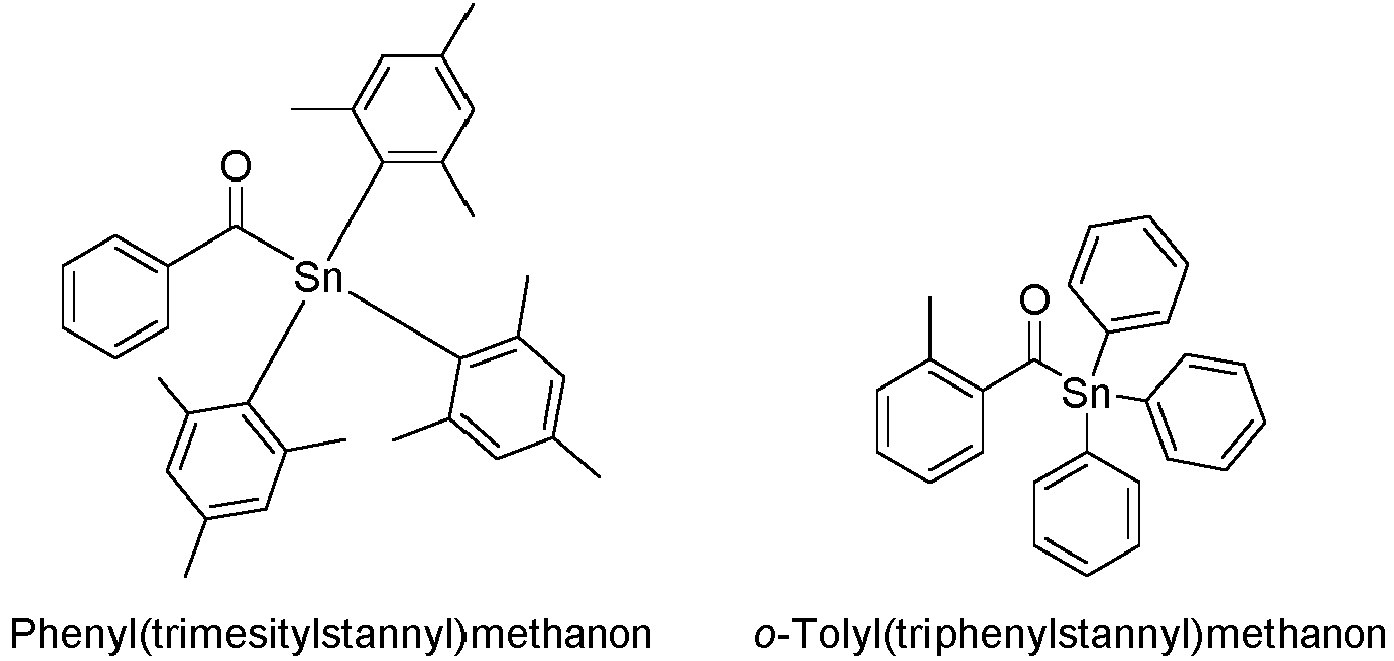


-


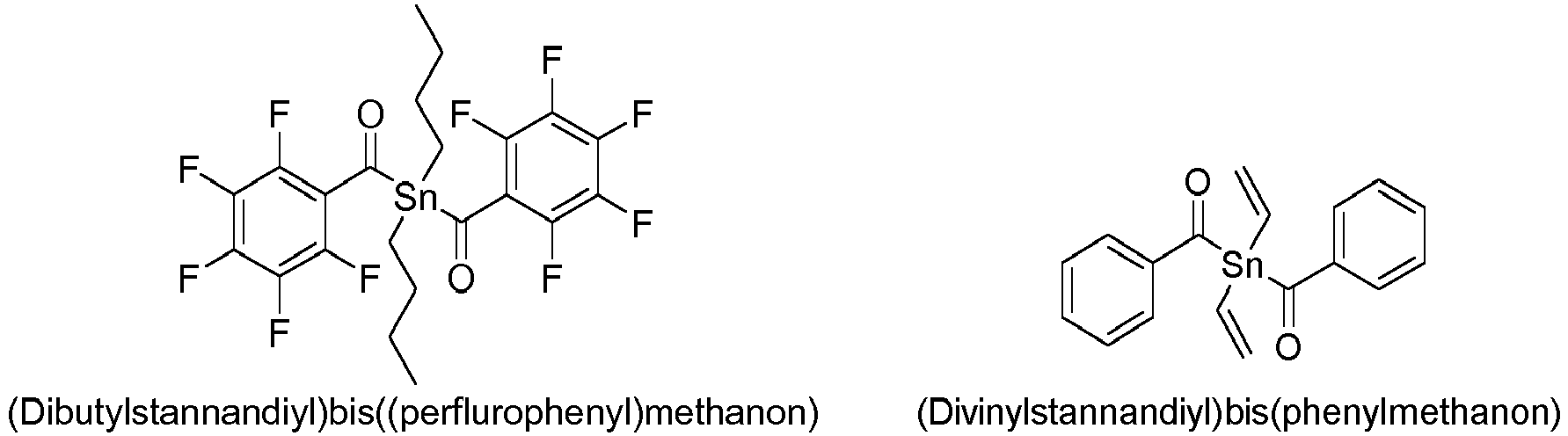
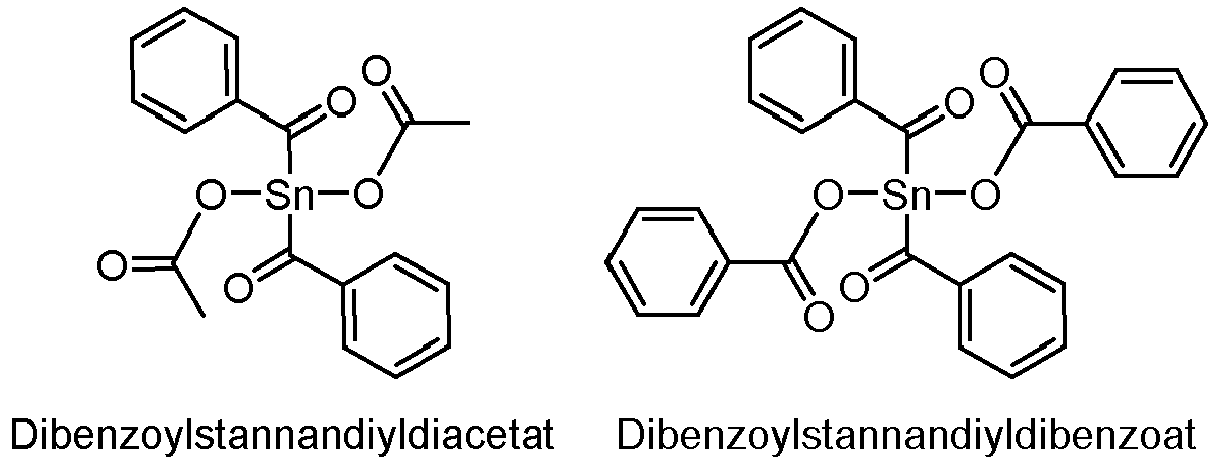

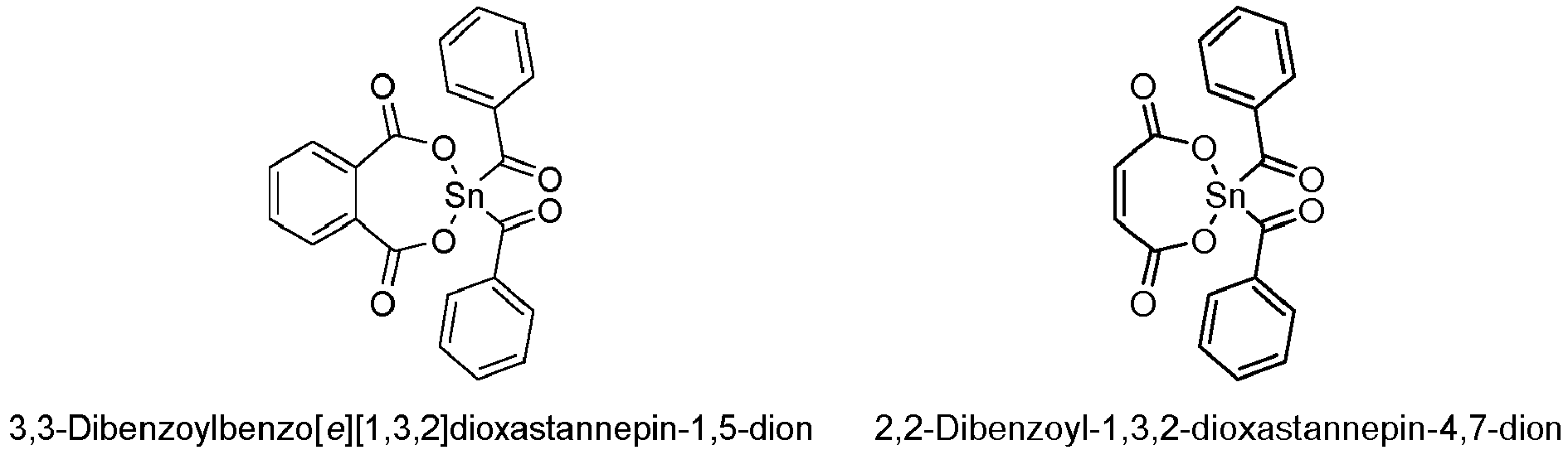


-
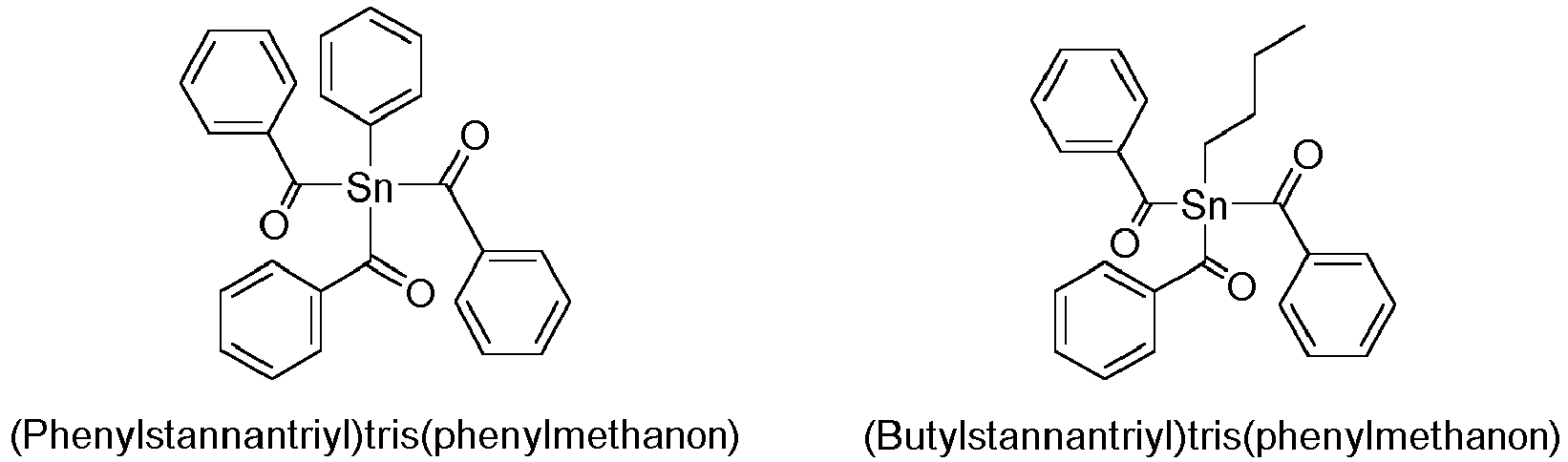


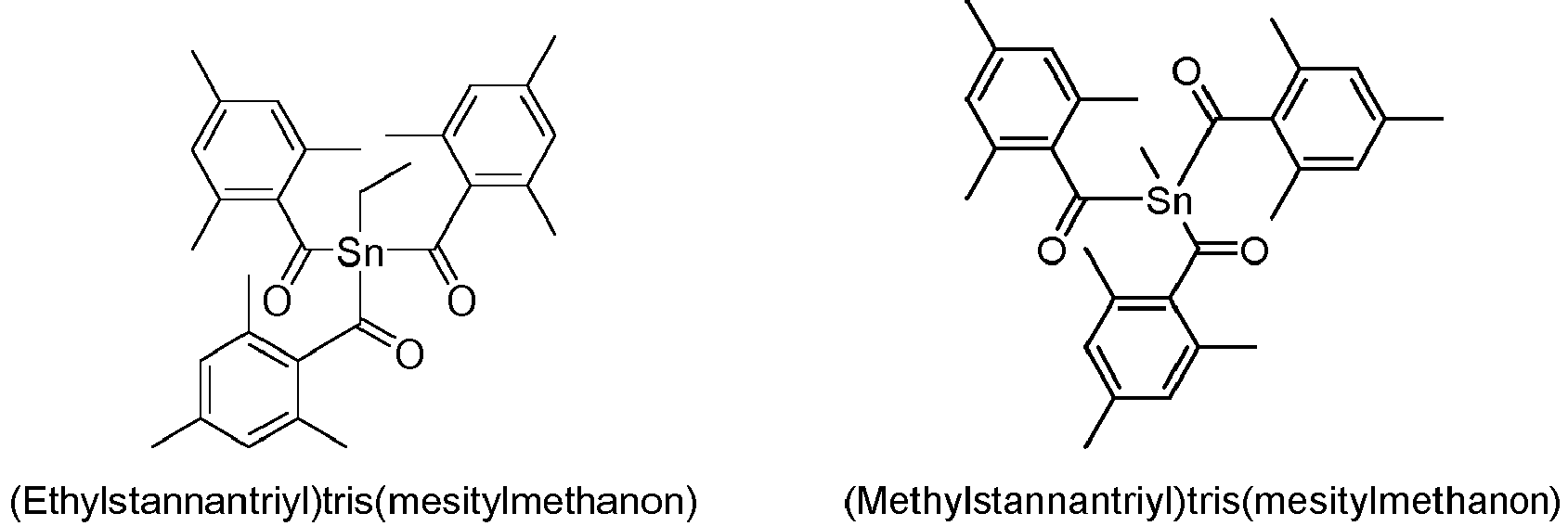

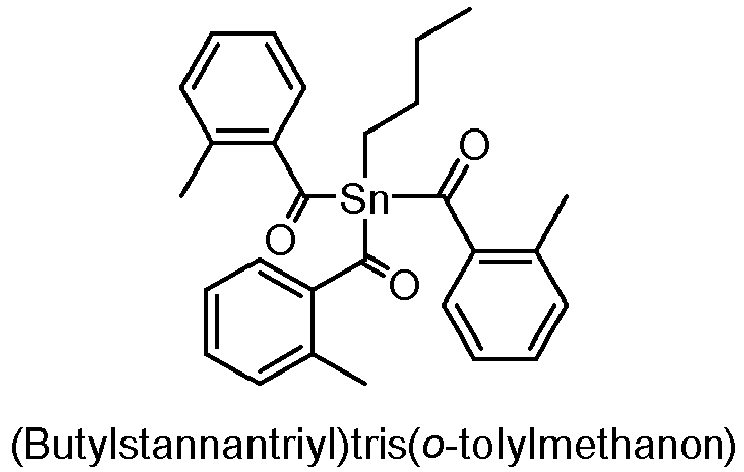


-


- Es wurde überraschend gefunden, dass sich die Verbindungen der Formel (I) hervorragend als Photoinitiatoren für die Polymerisation und insbesondere für die radikalische Polymerisation eignen, besonders zur Initiierung von Zusammensetzungen auf Basis der nachfolgend definierten Monomere. Die Verbindungen der Formel (I) sind relativ einfach zugänglich und zeigen eine sehr gute polymerisationsauslösende Wirkung und ein ausgezeichnetes Bleachverhalten. Sie eignen sich darüber hinaus auch als Photoinitiatoren für andere Polyreaktionen wie z.B. die Polyaddition.
- Die Verbindungen der Formel (I) eignen sich besonders für medizinische Anwendungen, beispielsweise zur Herstellung von Knochenzementen und von Kontaktlinsen, Intraokularlinsen oder anderen medizinischen Formteilen, wie z.B. von Gehörschalen, Knorpelimplantaten und künstlichen Gewebeteilen, und ganz besonders zur Herstellung von Dentalwerkstoffen wie Adhäsiven, Beschichtungen, Zementen und Kompositen. Die Acylzinn-Verbindungen der Formel (I) eignen sich darüber hinaus auch zur Herstellung von Werkstoffen für die Herstellung von Formteilen durch stereolithographische Verfahren.
- Ausserdem eignen sich die Initiatoren der Formel (I) für eine Vielzahl von nicht-medizinischen Anwendungszwecken, wie zum Beispiel zur Herstellung von Formteilen, z.B. von Stäben, Platten, Scheiben oder Linsen etc., Druck- oder Anstrichfarben, Lacken, Adhäsiven, zur Herstellung von Druckplatten, integrierten Schaltkreisen, Photoresists, Lötmasken, Tinten für Farbdrucker, als Materialien für die holographische Datenspeicherung, zur Herstellung von nanodimensionierten mikroelektromechanischen Elementen, Lichtwellenleitern, Formteilen und zur optischen Herstellung von Informationsträgern. Ein wichtiges Anwendungsgebiet ist die Verwendung als Photoinitiator bei der stereolithographischen Herstellung von technischen Formteilen, z.B. von Präzisionsformteilen und von keramischen Grünkörpern.
- Die erfindungsgemässen Zusammensetzungen enthalten bezogen auf die Gesamtmasse der Zusammensetzung vorzugsweise 0,001 bis 5 Gew.-%, besonders bevorzugt 0,01 bis 1,0 Gew.-% der Acylzinn-Verbindung der Formel (I).
- Neben der Acylzinn-Verbindung der Formel (I) enthalten die Zusammensetzungen vorzugsweise auch ein polymerisierbares Bindemittel. Bevorzugte Bindemittel sind radikalisch und/oder kationisch polymerisierbare Monomere und/oder Prepolymere, besonders bevorzugt radikalisch polymerisierbare Monomere, radikalisch polymerisierbare Prepolymere oder eine Mischung davon.
- Als radikalisch polymerisierbare Bindemittel eignen sich besonders mono- oder multifunktionelle (Meth)acrylate oder deren Mischungen. Unter monofunktionellen (Meth)acrylverbindungen werden Verbindungen mit einer, unter mehrfach funktionellen (Meth)acrylverbindungen Verbindungen mit zwei oder mehr, vorzugsweise 2 bis 3, polymerisierbaren Gruppen verstanden.
- Diesbezügliche Beispiele sind Methyl-, Ethyl-, Hydroxyethyl-, Butyl-, Benzyl-, Tetrahydrofurfuryl- oder Isobornyl(meth)acrylat, Bisphenol-A-di(meth)acrylat, Bis-GMA (ein Additionsprodukt aus Methacrylsäure und Bisphenol-A-diglycidylether), UDMA (ein Additionsprodukt aus 2-Hydroxyethylmethacrylat und 2,2,4-Trimethylhexamethylendiisocyanat), Di-, Tri- oder Tetraethylenglycoldi(meth)acrylat, Trimethylolpropantri(meth)acrylat, Pentaerythrittetra(meth)acrylat, sowie Gylcerindi- und -trimethacrylat, 1,4-Butandioldi(meth)acrylat, 1,10-Decandioldi(meth)acrylat oder 1,12-Dodecandioldi(meth)acrylat. Zusammensetzungen, die mindestens ein radikalisch polymerisierbares Monomer mit 2 oder mehr, vorzugsweise 2 bis 3, radikalisch polymerisierbaren Gruppen enthalten, sind besonders bevorzugt. Mehrfach funktionelle Monomere haben vernetzende Eigenschaften.
- Als radikalisch polymerisierbare Bindemittel lassen sich auch hydrolysestabile Verdünnermonomere wie hydrolysestabile Mono-(meth)acrylate, z.B. Mesitylmethacrylat oder 2-(Alkoyxymethyl)-acrylsäuren, z.B. 2-(Ethoxymethyl)acrylsäure, 2-(Hydroxymethyl)-acrylsäure, N-mono- oder -disubstitiuierte Acrylamide, wie z.B. N-Ethylacrylamid, N,N-Dimethacrylamid, N-(2-Hydroxyethyl)acrylamid oder N-Methyl-N-(2-hydroxyethyl)acrylamid, bzw. N-monosubstituierte Methacrylamide, wie z.B. N-Ethylmethacrylamid oder N-(2-Hydroxyethyl)methacrylamid sowie ausserdem N-Vinylpyrrolidon oder Allylether einsetzen. Bevorzugte Beispiele für hydrolysestabile Vernetzermonomere sind Urethane aus 2-(Hydroxymethyl)-acrylsäure und Diisocyanten, wie 2,2,4-Trimethylhexamethylendiisocyanat oder Isophorondiisocyanat, vernetzende Pyrrolidone, wie z.B. 1,6-Bis(3-vinyl-2-pyrrolidonyl)-hexan, oder kommerziell zugängliche Bisacrylamide wie Methylen- oder Ethylenbisacrylamid, bzw. Bis(meth)acrylamide, wie z.B. N,N'-Diethyl-1,3-bis-(acrylamido)-propan, 1,3-Bis(methacrylamido)-propan, 1,4-Bis(acrylamido)-butan oder 1,4-Bis(acryloyl)-piperazin, die durch Umsetzung aus den entsprechenden Diaminen mit (Meth)acrylsäurechlorid synthetisiert werden können.
- Weiterhin lassen sich als radikalisch polymerisierbare Bindemittel auch bekannte schrumpfungsarme radikalisch ringöffnend polymerisierbare Monomere wie z.B. mono- oder multifunktionelle Vinylcyclopropane bzw. bicyclische Cyclopropanderivate (vgl.
DE 196 16 183 C2 bzw.EP 1 413 569 A1 ) oder cyclische Allylsulfide (vgl.US 6,043,361 oderUS 6,344,556 ) einsetzen, die darüber hinaus auch in Kombination mit den voranstehend aufgeführten Di(meth)acrylat-Vernetzern verwendet werden können. Geeignete ringöffnend polymerisierbare Monomere sind solche Vinylcyclopropane, wie 1,1-Di(ethoxycarbonyl)- oder 1,1-Di(methoxycarbonyl)-2-vinylcyclopropan oder die Ester der 1-Ethoxycarbonyl- oder 1-Methoxycarbonyl-2-vinylcyclopropancarbonsäure mit Ethylenglycol, 1,1,1-Trimethylolpropan, 1,4-Cyclohexandiol oder Resorcin. Geeignete bicyclische Cyclopropanderivate sind 2-(Bicyclo[3.1.0]hex-1-yl)acrylsäuremethyl- oder -ethylester oder deren Disubstitutionsprodukte in 3-Stellung wie (3,3-Bis(ethoxycarbonyl)bicyclo[3.1.0]-hex-1-yl)acrylsäuremethyl- oder -ethylester. Geeignete cyclische Allylsulfide sind die Additionsprodukte von 2-(Hydroxymethyl)-6-methylen-1,4-dithiepan oder 7-Hydroxy-3-methylen-1,5-dithiacylooctan mit 2,2,4-Trimethylhexamethylen-1,6-diisocyanat oder einem asymmetrischen Hexamethylendiisocyanat-Trimeren (z.B. Desmodur® VP LS 2294 der Bayer AG). - Bevorzugt sind auch Formulierungen auf Basis von Vinylestern, Vinylcarbonaten und Vinylcarbamaten als radikalisch polymerisierbare Monomere. Ausserdem können als Monomere auch Styrol, Styrolderivate oder Divinylbenzol, ungesättigte Polyesterharze sowie Allylverbindungen oder radikalisch polymerisierbare Polysiloxane, die aus geeigneten Methacrylsilanen, wie z.B. 3-(Methacryloyloxy)propyltrimethoxysilan, hergestellt werden können und z.B. in der
DE 199 03 177 C2 beschrieben sind, eingesetzt werden. - Weiterhin lassen sich als radikalisch polymerisierbare Bindemittel auch Mischungen der voranstehend genannten Monomere mit radikalisch polymerisierbaren, säuregruppenhaltigen Monomeren verwenden, die auch als Haftmonomere bezeichnet werden. Bevorzugte säuregruppenhaltige Monomere sind polymerisationsfähige Carbonsäuren, wie Maleinsäure, Acrylsäure, Methacrylsäure, 2-(Hydroxymethyl)acrylsäure, 4-(Meth)acryloyloxyethyltrimellitsäureanhydrid, 10-Methacryloyloxydecylmalonsäure, N-(2-Hydroxy-3-methacryloyloxypropyl)-N-phenylglycin oder 4-Vinylbenzoesäure.
- Als Haftmonomere eignen sich auch radikalisch polymerisierbare Phosphonsäuremonomere, insbesondere Vinylphosphonsäure, 4-Vinylphenylphosphonsäure, 4-Vinylbenzylphosphonsäure, 2-Methacryloyloxyethylphosphonsäure, 2-Methacrylamidoethylphosphonsäure, 4-Methacrylamido-4-methyl-pentyl-phosphonsäure, 2-[4-(Dihydroxyphosphoryl)-2-oxa-butyl]-acrylsäure oder 2-[2-Dihydroxyphosphoryl)-ethoxymethyl]-acrylsäure-ethyl- oder 2,4,6-trimethylphenylester.
- Zudem eignen sich als Haftmonomere acide polymerisationsfähige Phosphorsäureester, insbesondere 2-Methacryloyloxypropylmono- oder -dihydrogenphosphat, 2-Methacryloyloxyethylmono- oder -dihydrogenphosphat, 2-Methacryloyloxyethylphenyl-hydrogenphosphat, Dipentaerythritol-pentamethacryloyloxyphosphat, 10-Methacryloyloxydecyldihydrogenphosphat, Dipentaerythritolpentamethacryloyloxyphosphat, Phosphorsäuremono-(1-acryloyl-piperidin-4-yl)-ester, 6-(Methacrylamido)hexyldihydrogenphosphat und 1,3-Bis-(N-acryloyl-N-propylamino)-propan-2-yl-dihydrogenphosphat.
- Darüber hinaus eignen sich polymerisationsfähige Sulfonsäuren als Haftmonomere, insbesondere Vinylsulfonsäure, 4-Vinylphenylsulfonsäure oder 3-(Methacrylamido)propylsulfonsäure.
- Als durch Polyaddition härtbare Bindemittel eignen sich besonders Thiol-En-Harze, die Mischungen von mono- oder multifunktionellen Mecaptoverbindungen und di- oder multifunktionellen ungesättigten Monomeren, vor allem Allyl- oder Norbonenverbindungen, enthalten.
- Beispiele für mono- oder multifunktionellen Mecaptoverbindungen sind o-, m- bzw. p-Dimercaptobenzol und Ester der Thioglykol- oder der 3-Mercaptopropionsäure mit Ethylen-, Propylen- oder Butylenglykol, Hexandiol, Glycerin, Trimethylolpropan oder Pentaerythrit.
- Beispiele für di- oder multifunktionelle Allylverbindungen sind Ester von Allylalkohol mit Di- oder Tricarbonsäuren, wie Malon-, Malein-, Glutar-, Bernstein-, Adipin-, Sebacin-, Phthal-, Terephthal- oder Gallussäure sowie mono- oder trifunktionelle Allylether, wie z.B. Diallylether, α,ω-Bis[allyloxy]alkane, Resorcin- oder Hydrochinondiallylether sowie Pyrogalloltriallylether, oder andere Verbindungen wie z.B. 1,3,5-Triallyl-1,3,5-triazin-2,4,6-(1H,3H,5H)-trion, Tetraallylsilan oder Tetraallylorthosilikat.
- Beispiele für di- oder multifunktionelle Norbonenverbindungen sind Diels-Alder-Additionsprodukte von Cyclopentadien oder Furan mit di- oder multifunktionellen (Meth)acrylaten sowie Ester bzw. Urethane von 5-Norbornen-2-methanol oder 5-Norbornen-2-ol mit Di- oder Polycarbonsäuren, wie z.B. Malon-, Malein-, Glutar-, Bernstein-, Adipin-, Sebacin-, Phthal-, Terephthal- oder Gallussäure, bzw. Di- oder Polyisocyanaten, wie Hexamethylendiisocyanat bzw. dessen cyclischem Trimer, 2,2,4-Trimethylhexamethylendiisocyanat, Toluylendiisocyanat oder Isophorondiisocyanat.
- Neben Acylzinn-Verbindungen der allgemeinen Formel (I) können die erfindungsgemässen Zusammensetzungen vorteilhaft zusätzlich auch bekannte Photoinitiatoren (vgl. J.P. Fouassier, J.F. Rabek (Hrsg.), Radiation Curing in Polymer Science and Technology, Vol. II, Elsevier Applied Science, London und New York 1993) für den UV- oder sichtbaren Bereich, wie z.B. Benzoinether, Dialkylbenzilketale, Dialkoxyacetophenone, Acyl- oder Bisacylphosphinoxide, α-Diketone wie 9,10-Phenanthrenchinon, Diacetyl, Furil, Anisil, 4,4'-Dichlorbenzil und 4,4'-Dialkoxybenzil und Campherchinon enthalten. Gut geeignet sind Kombinationen mit Norrish-Typ-I-Photoinitiatoren, vor allem Acyl- oder Bisacylphosphinoxiden, wie beispielsweise die kommerziell erhältlichen Verbindungen 2,4,6-Trimethylbenzoyldiphenylphosphinoxid und Bis-(2,4,6-trimethylbenzoyl)phenylphosphinoxid, und besonders geeignet sind Monoacyltrialkyl-, Diacyldialkylgermanium-, Triacylalkyl- sowie Tetraacylgermanium-Verbindungen, wie z.B. Benzoyltrimethylgermanium, Dibenzoyldiethylgermanium oder Bis(4-methoxybenzoyl)diethylgermanium sowie Tetrabenzoylgermanium. Dabei lassen sich auch Mischungen verschiedener Photoinitiatoren einsetzen. Es können auch Initiatorkombinationen der Acylzinn-Verbindungen der allgemeinen Formel (I) eingesetzt werden, die zusätzlich aromatische Diaryliodonium- oder Triarylsulfoniumsalzen enthalten, beispielsweise die kommerziell zugänglichen Verbindungen 4-Octyloxyphenyl-phenyl-iodoniumhexafluoroantimonat oder Isopropylphenyl-methylphenyl-iodoniumtetrakis(pentafluorphenyl)borat.
- Ausserdem können die erfindungsgemässen Zusammensetzungen neben den Acylzinn-Verbindungen der allgemeinen Formel (I) zur dualen Härtung auch Azoverbindungen, wie 2,2'-Azobis(isobutyronitril) (AIBN) oder Azobis-(4-cyanovaleriansäure), oder Peroxide, wie Dibenzoylperoxid, Dilauroylperoxid, tert-Butylperoctoat, tert-Butylperbenzoat oder Di-(tert-butyl)-peroxid enthalten. Zur Beschleunigung der Initiierung mittels Peroxiden lassen sich auch Kombinationen mit aromatischen Aminen einsetzen. Redoxsysteme, die sich bereits bewährt haben, sind: Kombinationen aus Benzoylperoxid mit Aminen, wie N,N-Dimethyl-p-toluidin, N,N-Dihydroxyethyl-p-toluidin, p-Dimethylaminobenzoesäureethylester oder strukturverwandte Systeme. Darüber hinaus sind auch Redoxsysteme bestehend aus Peroxiden und solchen Reduktionsmitteln, wie z.B. Ascorbinsäure, Barbiturate oder Sulfinsäuren oder Kombinationen von Hydroperoxiden mit Reduktionsmitteln und katalytischen Metallionen, wie z.B. eine Mischung von Cumolhydroperoxid, einem Thioharnstoffderivat und Kupfer(II)-acetylacetonat, für die duale Aushärtung geeignet.
- Erfindungsgemäss sind Zusammensetzungen bevorzugt, die einen oder mehrere Füllstoffe, vorzugsweise organische oder anorganische partikuläre Füllstoffe enthalten. Vorzugsweise werden als Füllstoffe partikuläre Materialien mit einer mittleren Partikelgrösse von 1 nm bis 10 µm, vorzugsweise von 5 nm bis 5 µm verwendet. Der Begriff "mittlere Partikelgrösse" bezieht sich hier jeweils auf das Volumenmittel.
- Bevorzugte anorganische partikulären Füllstoffe, insbesondere für den dentalen Bereich, sind amorphe kugelförmige nanopartikuläre Füllstoffe auf der Basis von Oxiden, wie pyrogene Kieselsäure oder Fällungskieselsäure, ZrO2 und TiO2 oder Mischoxide aus SiO2, ZrO2 und/oder TiO2 mit einer mittleren Partikelgrösse von 10 bis 200 nm, Minifüllstoffe, wie Quarz-, Glaskeramik- oder Glaspulver mit einer mittleren Partikelgrösse von 0,2 bis 5 µm sowie röntgenopake Füllstoffe, wie Ytterbiumtrifluorid oder nanopartikuläres Tantal(V)-oxid bzw. Bariumsulfat. Darüber hinaus können auch faserförmige Füllstoffe wie Nanofasern, Glasfasern, Polyamid- oder Kohlenstoff-Fasern eingesetzt werden.
- Für nichtdentale Anwendungen kommen neben den oben genannten Materialien ausserdem Homo- und/oder Copolymere, vorzugsweise Poly((meth)acrylat)e, Vinylpolymere, vorzugsweise Polystyrol oder Polyvinylacetat, oder Kondensationspolymere, vorzugsweise Polyester, als Füllstoffe in Betracht. Diese Füllstoffe werden vorzugsweise als Pulver mit einer mittleren Partikelgrösse zwischen 0,5 und 100 µm eingesetzt. Sie sind zum Teil im Monomer löslich. Weiterhin können für nichtdentale Anwendungen auch anorganische Füllstoffe wie z.B. CaCO3, Talkum, TiO2, CaSO4, Silikate, Glas, Kohlenstoffpulver oder -fasern oder Metallpulver auf Basis von Al, Zn, Cu oder Ni eingesetzt werden.
- Ausserdem können die erfindungsgemässen Zusammensetzungen im Bedarfsfalle weitere Additive, wie z.B. Stabilisatoren, UV-Absorber, Farbstoffe oder Pigmente, sowie Lösungsmittel, wie z.B. Wasser, Ethanol, Aceton oder Ethylacetat, oder Gleitmittel enthalten.
- Die erfindungsgemässen Werkstoffe enthalten vorzugsweise:
- (a) 0,001 bis 5 Gew.-% Acylzinn-Verbindung(en) der allgemeinen Formel (I),
- (b) 10 bis 99,999 Gew.-% radikalisch polymerisierbares Bindemittel,
- (c) 0 bis 85 Gew.-% Füllstoff und
- (d) 0 bis 70 Gew.-% Additiv(e).
- Alle Prozentangaben beziehen sich, wenn nicht anders angegeben, auf die Gesamtmasse des Materials.
- Werkstoffe, die sich besonders als dentale Zemente eignen, enthalten bevorzugt:
- (a) 0,001 bis 5 Gew.-% Acylzinn-Verbindung(en) der allgemeinen Formel (I),
- (b) 10 bis 50 Gew.-% radikalisch polymerisierbares Bindemittel,
- (c) 40 bis 70 Gew.-% Füllstoff und
- (d) 0 bis 5 Gew.-% Additiv(e).
- Werkstoffe, die sich besonders als dentale Komposite eignen, enthalten bevorzugt:
- (a) 0,001 bis 5 Gew.-% Acylzinn-Verbindung(en) der allgemeinen Formel (I),
- (b) 10 bis 40 Gew.-% radikalisch polymerisierbares Bindemittel,
- (c) 50 bis 85 Gew.-% Füllstoff und
- (d) 0 bis 5 Gew.-% Additiv(e).
- Werkstoffe, die sich besonders als dentale Beschichtungsmaterialien eignen, enthalten bevorzugt:
- (a) 0,001 bis 5 Gew.-% Acylzinn-Verbindung(en) der allgemeinen Formel (I),
- (b) 10 bis 99,989 Gew.-% radikalisch polymerisierbares Bindemittel,
- (c) 0 bis 20 Gew.-% nanopartikuläre Füllstoffe,
- (d) 0,01 bis 2 Gew.-% Additiv(e) und
- (e) 0 bis 70 Gew.-% Lösungsmittel.
- Werkstoffe, die sich besonders als dentale Adhäsive eignen, enthalten bevorzugt:
- (a) 0,001 bis 5 Gew.-% Acylzinn-Verbindung(en) der allgemeinen Formel (I),
- (b) 0 bis 98,989 Gew.-% radikalisch polymerisierbares Bindemittel,
- (c) 0 bis 20 Gew.-% nanopartikuläre Füllstoffe,
- (d) 0,01 bis 2 Gew.-% Additiv,
- (e) 0 bis 50 Gew.-% Lösungsmittel und
- (f) 1 bis 20 Gew.-% radikalisch polymerisierbares Haftmonomer.
- Werkstoffe, die sich besonders für die Stereolithographie oder den 3D-Druck eignen, enthalten bevorzugt:
- (a) 0,001 bis 5 Gew.-% Acylzinn-Verbindung(en) der allgemeinen Formel (I),
- (b) 0 bis 99 Gew.-% radikalisch polymerisierbares Bindemittel,
- (c) 0 bis 80 Gew.-% Füllstoff(e) und
- (d) 0 bis 10 Gew.-% Additiv(e).
- Werkstoffe, die sich besonders als Beschichtungen eignen, enthalten bevorzugt:
- (a) 0,001 bis 5 Gew.-% Acylzinn-Verbindung(en) der allgemeinen Formel (I),
- (b) 20 bis 99 Gew.-% radikalisch polymerisierbares Bindemittel,
- (c) 0 bis 20 Gew.-% Farbstoff(e) und/oder Pigment(e) und
- (d) 0 bis 10 Gew.-% weitere Additiv(e).
- Werkstoffe, die sich besonders als Druckfarben eignen, enthalten bevorzugt:
- (a) 0,001 bis 5 Gew.-% Acylzinn-Verbindung(en) der allgemeinen Formel (I),
- (b) 20 bis 95 Gew.-% radikalisch polymerisierbares Bindemittel,
- (c) 1 bis 20 Gew.-% Farbstoff(e) und/oder Pigment(e) und
- (d) 0 bis 10 Gew.-% weitere Additiv(e).
- Die erfindungsgemässen Zusammensetzungen eignen sich zur Herstellung von Photopolymerisaten sowie als Komposite, Zemente, Beschichtungsmaterialien, Primer oder Adhäsive. Sie eignen sich besonders für Anwendungen im medizinischen Bereich, vor allem als Dentalwerkstoffe, wie Füllungskomposite, Befestigungszemente, Adhäsive, Prothesenmaterialien, Verblendmaterialien, sowie zur Herstellung von Kronen, Inlays oder von Beschichtungen.
- Die Dentalwerkstoffe eignen sich zur intraoralen Anwendung durch den Zahnarzt zur Restauration geschädigter Zähne, d.h. zur therapeutischen Anwendung, z.B. als dentale Zemente, Füllungskomposite und Verblendmaterialien. Sie können aber auch extraoral eingesetzt werden, beispielsweise bei der Herstellung oder Reparatur von Dentalrestaurationen, wie Prothesen, künstlichen Zähnen, Inlays, Onlays, Kronen und Brücken.
- Ferner eignen sich die erfindungsgemässen Materialien zur medizinischen Anwendung in der Chirurgie, z.B. in der Geweberegeneration, zur Herstellung von Gehörhilfen oder in der Augenheilkunde zur Herstellung von Intraokularlinsen oder Kontaktlinsen.
- Bei technischen Anwendungen lassen sich die erfindungsgemässen Zusammensetzungen in der Stereolithographie oder im 3D-Druck zur Herstellung von Formkörpern, Prototypen oder Grünkörpern, im Beschichtungsbereich oder auch in der Mikroelektronik z.B. in der Photoresist-Technologie oder der Nano-Inprint-Lithographie einsetzen. Eine besonders bevorzugte Anwendung der erfindungsgemässen Materialien liegt dabei im Bereich des 3D-Drucks von Keramik- oder Metallpulvern über Lithographie-basierte Verfahren. Hierbei stellt das erfindungsgemäss hergestellte Photopolymer die Opferstruktur beim Sinterprozess dar. Aufgrund des relativ langwelligen Absorptionsmaximums der erfindungsgemässen Verbindungen der Formel (I) können dabei auch Keramiken, wie z.B. Zirkonoxide, Carbide und Nitride, z.B. auf Siliziumbasis, und sogar Metallpulver, z.B. Edelstahl oder Werkzeugstähle, gedruckt werden.
- Ausserdem eignen sich die erfindungsgemässen Zusammensetzungen und die daraus hergestellten Polymerisate auch als Lacke oder Beschichtungen auf diversen Oberflächen, z.B. als dekorative Beschichtungen und Schutzschichten auf Holz, Papier, Karton und insbesondere Kunststoff, Keramik oder Metall. Dabei bietet das relativ langwellige Absorptionsmaximum der erfindungsgemässen Verbindungen der Formel (I) besondere Vorteile insbesondere für die Durchhärtungstiefe von pigmentierten oder gefüllten Systemen etwa im Bereich der Inkjet-Verfahrens. Ferner können die erfindungsgemässen Zusammensetzungen und die daraus hergestellten Polymerisate auch als Klebstoffe zum Verbinden unterschiedlichster Werkstoffe oder auch zur Herstellung von Formkörpern durch Giessen, Pressen, Rapid Prototyping oder 3D-Druck dienen.
- Die Erfindung wird im Folgenden anhand von Beispielen näher erläutert.
- Unter Zuhilfenahme einer Glove Box wurden 1 Äq. (1,69 g) Triphenylzinnchlorid und 3 Äq. (0,09 g) Lithiumfolie in separate Schlenkkolben eingewogen und danach zu jedem dieser Kolben 10 ml wasserfreies THF hinzugefügt. Die Reaktionsgefässe wurden an eine Inertgashahnleiste im Orangelichtlabor angeschlossen und anschliessend wurden 0,05 Äq. (0,03 g) Naphthalin (als Katalysator) zur Lithiumsuspension zugegeben. Die Suspension wurde für 20 Minuten bei Raumtemperatur (RT) in ein Ultraschallbad gestellt und danach für weitere 30 Minuten intensiv gerührt, woraufhin sich die Suspension rasch dunkel färbte. Die Triphenylzinnchlorid-Lösung wurde dann mittels Spritze und Septum zur Lithiumsuspension bei RT über einen Zeitraum von 20 Minuten zugetropft, wodurch sich die Reaktionsmischung kurzzeitig wieder entfärbte. Es wurde für 4 h bei RT gerührt und ein weiterer Schlenkkolben mit 10 ml einer Lösung von 1,06 Äq. (0,54 ml) Benzoylchlorid in trockenem THF vorbereitet. Beide Lösungen wurden mittels einer Aceton/N2-Mischung auf -78 °C gekühlt und die erste Reaktionsmischung dann über einen Zeitraum von 20 Minuten zur Benzoylchlorid-Lösung zugetropft. Nach beendeter Zugabe wurde das Kühlbad entfernt und die Mischung unter Lichtausschluss für 18 h bei RT gerührt. Das Lösungsmittel wurde Feinvakuum abgezogen. Das verbleibende Substanzgemisch wurde in 20 ml wasserfreiem n-Pentan aufgenommen und dann unter inerten Bedingungen filtriert. Es wurde dann zweimal mit je 10 ml wasserfreiem n-Pentan nachgewaschen und das Lösungsmittel dann unter Lichtausschluss vom Filtrat abgezogen. Die erhaltenen intensiv gelben Kristalle wurden dann im Hochvakuum getrocknet und unter Lichtausschluss und unter Argon im Kühlschrank (4°C) gelagert. Das erhaltene Produkt (1,25 g, 63% der Theorie, Schmelzpunkt: 58 °C) weist bereits ohne Aufreinigungsschritt eine sehr gute Reinheit auf, was durch GC-MS, HPLC und NMR-Spektroskopie bestätigt werden konnte.
GC-MS (CH2Cl2) : m/z (rel.) : 455 (M, 4%), 379 (6%), 351 (100%), 197 (44%), 120 (10%), 77 (10%).
1H-NMR: δH (400 MHz, CDCl3): 7, 82-7, 28 (20H, m, Ar-H). 13C-NMR: δC (100MHz, CDCl3) : 161,35 (C=O) ; 141,56; 137,24; 136,14; 135,11; 132,64; 128,31; 128,04; 127,82; 127,73 (C arom). 119Sn-NMR: δSn (CDCl3): -217,74. - Das Absorptionsspektrum einer Acetonitrillösung von BtPhSn mit einer Konzentration von 1,0 mmol/l im Vergleich zu Benzoyltrimethylgermanium ist in
Figur 1 dargestellt. Das Absorptionsmaximum von BtPhSn liegt bei 430 nm (Benzoyltrimethylgermanium: 411 nm) und der Extinktionskoeffizient beträgt 309 1/cm·mol (Benzoyltrimethylgermanium: 146 1/cm·mol). Ausserdem wird bei BtPhSn erst bei Wellenlängen oberhalb von 500 nm keine signifikante Absorption mehr beobachtet, während dies bei Benzoyltrimethylgermanium bereits ab etwa 465 nm der Fall ist. Der Vergleich zeigt, dass das Benzoylchromophor der Sn-Verbindung stärker und langwelliger im Vergleich zur Ge-Verbindung absorbiert, was für die Anwendung als Photoinitiator vorteilhaft ist. - Eine Acetonitrillösung von BtPhSn aus Beispiel 1 mit einer Konzentration von 1,0 mmol/l und einer MMA-Konzentration von 0,5 mol/L wurde in einer 1-cm-Küvette mit der Polywave LED Bluephase 20 i (Ivoclar Vivadent AG) mit einem halogenähnlichen Breitbandspektrum von 385-515 nm bestrahlt und das Absorptionsspektrum in Abhängigkeit von der Bestrahlungszeit aufgenommen. Die Ergebnisse sind im Vergleich zu Benzoyltrimethylgermanium (BtMGe) in
Figur 2 dargestellt. Die Ergebnisse belegen, dass der Sn-Photoinitiator BtPhSn bei Bestrahlung deutlich schneller ausbleicht als ein analoger Ge-Photoinitiator BtMGe. - Aus einer Mischung (Angaben in Masse-%) der Dimethacrylate UDMA (Additionsprodukt aus 2-Hydroxyethylmethacrylat und 2,2,4-Trimethylhexamethylendiisocyanat) bzw. TEGDMA (Triethylenglycol) bzw. Bis-GMA (Additionsprodukt aus Methacrylsäure und Bisphenol-A-diglycidylether) und dem Sn-Photoinitiator BtPhSn aus Beispiel 1 sowie Füllstoffen: OX-50, sil. (silanisierte pyrogenen Kieselsäure, Degussa), YbF3 (Ytterbiumtrifluorid, Sukgyung, Südkorea), SiO2-ZrO2-Mischoixid, sil. (silanisiertes SiO2-ZrO2-Mischoxid, Transparent Materials, USA) und Glasfüller GM 27884, sil. (silanisierter Glasfüller GM 27884, 1,0 µm, Schott) (Tabelle 1) wurden die lichthärtende Komposite C1 (zementähnliche Konsistenz) und C2 (Füllungskomposit) mittels eines Walzenstuhles "Exakt" (Exakt Apparatebau, Norderstedt) hergestellt.
Tabelle 1: Zusammensetzung der Komposite C1 und C2 Komponente/Harz [Gew.-%] C1 C2 BtPhSn 0, 82 0,10 UDMA 31,34 7,49 TEGDMA 7,86 4,05 Bis-GMA - 8,46 OX-50, sil. 41,21 1, 02 YbF3 18,77 17,21 SiO2-ZrO2-Mischoixid, sil. - 10,12 Glasfüller GM 27884, sil. - 51,55 - Von den Materialien wurden entsprechende Prüfkörper präpariert, die 2 mal 3 Minuten mit einer dentalen Lichtquelle (Spectramat®, Ivoclar Vivadent AG) bestrahlt und damit ausgehärtet wurden. Nach der ISO-Norm ISO-4049 (Dentistry - Polymer-based filling, restorative and luting materials) erfolgte die Bestimmung der Biegefestigkeit und des Biege-E-Moduls nach 24 h Lagerung der Prüfkörper bei Raumtemperatur (RT) oder 24 h Lagerung in Wasser bei 37 °C (WL) (Tabelle 2).
Tabelle 2: Biegefestigkeit und des Biege-E-Moduls der polymerisierten Komposite C1 und C2 Parameter C1 C2 BF1), RT 99,8+8,0 66,1±3,4 BF1), WL 116,7±7,6 72,7±6,6 BM2), RT 4,60±0,18 3,71±0,15 BM2), WL 5,03±0,20 3,92±0,30 1) Biegefestigkeit (BF) in MPa
2) Biege-E-Moduls (BM), GPa
Claims (14)
- Polymerisierbare Zusammensetzung, dadurch gekennzeichnet, dass sie als Photoinitiator mindestens eine Acylzinn-Verbindung gemäss der allgemeinen Formel (I) enthält,
 R1,R2,R3 unabhängig voneinander jeweils eine Gruppe der Formel (II)
ein cyclischer, verzweigter oder vorzugsweise linearer C1-20-Alkyl-, C1-20-Alkenyl-, C1-20-Alkoxy-, C1-20-Alkylthio-, C1-20-Alkenoxy- oder C1-20-Acyloxy-Rest, der ein- oder mehrfach durch -O-, -S- oder -NR9- unterbrochen und/oder durch eine oder mehrere radikalisch polymerisationsfähige Gruppen und/oder Reste R10 substituiert sein kann, oder ein Benzoyloxy-Rest, -H, Trimethylsilyl, -OH, Halogen oder -CN sind,
wobei R1 und R2 auch zusammengefasst ein doppelt gebundenes Sauerstoff- oder Schwefelatom darstellen können oder zusammen mit dem Sn-Atom, an das sie gebunden sind, einen aliphatischen gesättigten oder ungesättigten Ring bilden können, der neben dem Sn-Atom 2 bis 6 Kohlenstoffatome und ggf. ein oder mehrere Sauerstoffatome enthält, wobei ein oder mehrere Kohlenstoffatome mit einem doppelt gebundenen Sauerstoffatom substituiert sein können und/oder der Ring mit einem aromatischen Ring anneliert sein kann,R4, R5, R6, R7, R8 unabhängig voneinander jeweils -H, ein cyclischer, verzweigter oder vorzugsweise linearer C1-20-Alkyl-, C1-20-Alkenyl-, C1-20-Alkyloxy- oder C1-20-Alkenoxy-Rest, der ein- oder mehrfach durch -O-, -S-, oder -NR9- unterbrochen und/oder durch eine oder mehrere radikalisch polymerisationsfähige Gruppen und/oder Reste R10 substituiert sein kann, -OR9, Halogen, -SR9, -N(R9)2, -CF3, -CN, -NO2, -COOR9 oder -CONHR9 sind,R9 -H oder ein cyclischer, verzweigter oder vorzugsweise linearer C1-20-Alkyl- oder C1-20-Alkenyl-Rest ist undR10 -OH, -CxF2x+1 mit x = 1 bis 20 oder -[Si(CH3)2]y-CH3 mit y = 1 bis 20 ist. - Polymerisierbare Zusammensetzung nach Anspruch 1, bei der jeweils unabhängig voneinanderR1,R2,R3 unabhängig voneinander jeweils eine Gruppe der Formel (II), ein aromatischer C6-15-Rest, der durch einen oder mehrere verzweigte oder vorzugsweise lineare C1-12-Alkyl- oder C1-12-Alkoxy-Reste substituiert sein kann, wobei die genannten Substituenten ihrerseits ein- oder mehrfach durch -O- unterbrochen und/oder durch eine oder mehrere radikalisch polymerisationsfähige Gruppen und/oder -OH substituiert sein können, ein verzweigter oder vorzugsweise linearer C1-12-Alkyl-, C1-12-Alkenyl-, C1-12-Alkoxy-, C1-12-Alkylthio- oder C1-12-Acyloxy-Rest, der ein- oder mehrfach durch -O- unterbrochen und/oder durch eine oder mehrere radikalisch polymerisationsfähige Gruppen und/oder -OH substituiert sein kann, ein Benzoyloxy-Rest, Trimethylsilyl, -OH, Halogen oder -CN sind,
wobei R1 und R2 auch zusammengefasst ein doppelt gebundenes Sauerstoff- oder Schwefelatom darstellen können oder zusammen mit dem Sn-Atom, an das sie gebunden sind, einen aliphatischen gesättigten oder ungesättigten Ring bilden können, der neben dem Sn-Atom 2 bis 6, insbesondere 4, Kohlenstoffatome und ggf. ein oder mehrere, insbesondere 2, Sauerstoffatome enthält, wobei ein oder mehrere, insbesondere 2, Kohlenstoffatome mit einem doppelt gebundenen Sauerstoffatom substituiert sein können und/oder der Ring mit einem aromatischen, insbesondere sechsgliedrigen, Ring anneliert sein kann,R4, R5, R8 unabhängig voneinander jeweils -H, ein verzweigter oder vorzugsweise linearer C1-12-Alkyl-, C1-12-Alkenyl-, C1-12-Alkyloxy- oder C1-12-Alkenoxy-Rest sind, der ein- oder mehrfach durch -O- unterbrochen und/oder durch eine oder mehrere radikalisch polymerisationsfähige Gruppen und/oder -OH substituiert sein kann, -OR9, Halogen, -SR9, -N(R9)2, -CF3, -CN oder -NO2 sind,R6, R7 unabhängig voneinander jeweils -H oder -F oder ein verzweigter oder vorzugsweise linearer C1-12-Alkyl-, C1-12-Alkenyl-, C1-12-Alkyloxy- oder C1-12-Alkenoxy-Rest, der ein- oder mehrfach durch -O- unterbrochen und/oder durch eine oder mehrere radikalisch polymerisationsfähige Gruppen und/oder -OH substituiert sein kann, sind undR9 -H oder Methyl ist. - Polymerisierbare Zusammensetzung nach Anspruch 1 oder 2, bei der jeweils unabhängig voneinanderR1,R2,R3 unabhängig voneinander jeweils eine Gruppe der Formel (II), Phenyl, Trimethylphenyl, ein verzweigter oder vorzugsweise linearer C1-8-Alkyl-, C1-12-Alkylthio- oder C1-12-Acyloxy-Rest, ein Benzoyloxy-, Vinyl- oder Methacryloyl-Rest, Trimethylsilyl, -OH, -Cl oder -CN sind,
wobei R1 und R2 auch zusammengefasst ein doppelt gebundenes Sauerstoff- oder Schwefelatom darstellen können oder zusammen mit dem Sn-Atom, an das sie gebunden sind, einen Dioxastannepin-Ring bilden können, wobei ein oder vorzugsweise zwei Kohlenstoffatome des Dioxastannepin-Rings mit einem doppelt gebundenen Sauerstoffatom substituiert sein können und/oder der Ring mit einem Benzol-Ring anneliert sein kann,R4, R5, R8 unabhängig voneinander jeweils -H, ein verzweigter oder vorzugsweise linearer C1-8-Alkyl-Rest sind, der durch 1 bis 3 O-Atome unterbrochen und/oder durch Vinyl substituiert sein kann, -OR9, Halogen, -SR9, -N(R9)2, -CF3, -CN oder -NO2 sind,R6,R7 unabhängig voneinander jeweils -H, -F oder ein verzweigter oder vorzugsweise linearer C1-8-Alkyl-Rest sind, der durch 1 bis 3 O-Atome unterbrochen und/oder durch Vinyl substituiert sein kann, undR9 -H oder Methyl ist. - Polymerisierbare Zusammensetzung nach einem der Ansprüche 1 bis 3, bei der jeweils unabhängig voneinanderR1,R2,R3 unabhängig voneinander jeweils eine Gruppe der Formel (II), Phenyl, ein linearer C1-C8-Alkylrest oder Trimethylsilyl sind,R4, R5, R8 unabhängig voneinander jeweils -H, Methyl, -OR9 oder -F sind,R6,R7 unabhängig voneinander jeweils -H oder -F sind undR9 -H oder Methyl ist.
- Zusammensetzung nach einem der Ansprüche 1 bis 4, die bezogen auf ihre Gesamtmasse 0,001 bis 5 Gew.-% einer Acylzinn-Verbindung der Formel (I) und mindestens ein polymerisierbares Bindemittel enthält.
- Zusammensetzung nach Anspruch 5, die als polymerisierbares Bindemittel mindestens ein radikalisch polymerisierbares Monomer und/oder Prepolymer enthält.
- Zusammensetzung nach Anspruch 6, die als Bindemittel mindestens ein mono- oder multifunktionelles (Meth)acrylat oder eine Mischung davon enthält.
- Zusammensetzung nach einem der Ansprüche 5 bis 7, die(a) 0,001 bis 5 Gew.-% Acylzinn-Verbindung(en) der allgemeinen Formel (I),(b) 10 bis 99,999 Gew.-% radikalisch polymerisierbares Bindemittel,(c) 0 bis 85 Gew.-% Füllstoff und(d) 0 bis 70 Gew.-% Additiv(e) enthält,jeweils bezogen auf die Gesamtmasse der Zusammensetzung.
- Zusammensetzung nach einem der Anspruche 1 bis 8 zur Verwendung als Dentalwerkstoff.
- Zusammensetzung nach Anspruch 9 zur intraoralen Anwendung als Zement, Füllungskomposit oder Verblendmaterial.
- Verwendung einer Zusammensetzung nach einem der Ansprüche 1 bis 8 zur extraoralen Herstellung oder Reparatur von Dentalrestaurationen, Prothesen, künstlichen Zähnen, Inlays, Onlays, Kronen oder Brücken.
- Verwendung einer Zusammensetzung nach einem der Ansprüche 1 bis 8 zur Herstellung eines Formkörpers durch ein generatives Verfahren.
- Verwendung einer Zusammensetzung nach einem der Ansprüche 1 bis 8 zur Herstellung von Gehörhilfen, Intraokularlinsen, Kontaktlinsen, Formkörpern, Prototypen, Grünkörpern, Beschichtungen, Lacken, Klebstoffen oder Photoresists.
- Verwendung einer Acylzinn-Verbindung gemäss Formel (I) als Initiator für die radikalische Polymerisation.
Priority Applications (6)
| Application Number | Priority Date | Filing Date | Title |
|---|---|---|---|
| ES16187716T ES2841406T3 (es) | 2016-09-07 | 2016-09-07 | Composiciones polimerizables con fotoiniciadores de acilestaño |
| EP16187716.2A EP3293215B1 (de) | 2016-09-07 | 2016-09-07 | Polymerisierbare zusammensetzungen mit acylzinn-photoinitiatoren |
| PCT/EP2017/072099 WO2018046438A1 (de) | 2016-09-07 | 2017-09-04 | Polymerisierbare zusammensetzungen mit acylzinn-photoinitiatoren |
| JP2019512730A JP7096814B2 (ja) | 2016-09-07 | 2017-09-04 | アシルスズ化合物を含む重合性組成物 |
| CN201780053325.8A CN109661410B (zh) | 2016-09-07 | 2017-09-04 | 含有酰基锡光引发剂的可聚合组合物 |
| US16/329,987 US11142592B2 (en) | 2016-09-07 | 2017-09-04 | Polymerizable compositions with acyltin photoinitiators |
Applications Claiming Priority (1)
| Application Number | Priority Date | Filing Date | Title |
|---|---|---|---|
| EP16187716.2A EP3293215B1 (de) | 2016-09-07 | 2016-09-07 | Polymerisierbare zusammensetzungen mit acylzinn-photoinitiatoren |
Publications (2)
| Publication Number | Publication Date |
|---|---|
| EP3293215A1 true EP3293215A1 (de) | 2018-03-14 |
| EP3293215B1 EP3293215B1 (de) | 2020-10-21 |
Family
ID=57123779
Family Applications (1)
| Application Number | Title | Priority Date | Filing Date |
|---|---|---|---|
| EP16187716.2A Active EP3293215B1 (de) | 2016-09-07 | 2016-09-07 | Polymerisierbare zusammensetzungen mit acylzinn-photoinitiatoren |
Country Status (6)
| Country | Link |
|---|---|
| US (1) | US11142592B2 (de) |
| EP (1) | EP3293215B1 (de) |
| JP (1) | JP7096814B2 (de) |
| CN (1) | CN109661410B (de) |
| ES (1) | ES2841406T3 (de) |
| WO (1) | WO2018046438A1 (de) |
Cited By (6)
| Publication number | Priority date | Publication date | Assignee | Title |
|---|---|---|---|---|
| EP3669853A1 (de) | 2018-12-21 | 2020-06-24 | Ivoclar Vivadent AG | Zusammensetzungen für die herstellung von bruchzähen dentalwerkstücken mittels stereolithographie |
| EP3669856A1 (de) | 2018-12-21 | 2020-06-24 | Ivoclar Vivadent AG | Zusammensetzungen für die herstellung von transparenten dentalwerkstücken mittels stereolithographie |
| EP4368167A1 (de) | 2022-11-08 | 2024-05-15 | Ivoclar Vivadent AG | Dentalwerkstoff zur herstellung dentaler voll- oder teilprothesen |
| WO2024227533A1 (de) | 2023-05-02 | 2024-11-07 | Mühlbauer Technology Gmbh | Radikalisch polymerisierbare verbindung und zusammensetzung |
| WO2025131708A1 (de) | 2023-12-19 | 2025-06-26 | Mühlbauer Technology Gmbh | Radikalisch polymerisierbare verbindung und zusammensetzung |
| AT527821A4 (de) * | 2024-02-23 | 2025-07-15 | Univ Wien Tech | Photoinitiator und dessen Verwendung |
Families Citing this family (8)
| Publication number | Priority date | Publication date | Assignee | Title |
|---|---|---|---|---|
| JP7504865B2 (ja) * | 2018-08-30 | 2024-06-24 | コベストロ (ネザーランズ) ビー.ヴィー. | 光ファイバーをコーティングするための放射線硬化性組成物 |
| EP3924393A4 (de) * | 2019-02-15 | 2023-03-08 | Ohio State Innovation Foundation | Einkomponenten-klebstoffzusammensetzungen |
| KR102573327B1 (ko) | 2020-04-02 | 2023-08-30 | 삼성에스디아이 주식회사 | 반도체 포토레지스트용 조성물 및 이를 이용한 패턴 형성 방법 |
| KR102619719B1 (ko) | 2020-05-12 | 2023-12-28 | 삼성에스디아이 주식회사 | 반도체 포토레지스트용 조성물 및 이를 이용한 패턴 형성 방법 |
| KR102690557B1 (ko) | 2020-12-18 | 2024-07-30 | 삼성에스디아이 주식회사 | 반도체 포토레지스트용 조성물, 이의 제조 방법 및 이를 이용한 패턴 형성 방법 |
| KR102598259B1 (ko) | 2020-12-18 | 2023-11-02 | 삼성에스디아이 주식회사 | 반도체 포토레지스트용 조성물 및 이를 이용한 패턴 형성 방법 |
| TW202406726A (zh) * | 2022-04-28 | 2024-02-16 | 瑞士商愛爾康公司 | 用於製造uv吸收性和hevl吸收性眼科鏡片之方法 |
| JP2024116011A (ja) | 2023-02-15 | 2024-08-27 | 信越化学工業株式会社 | パターン形成方法 |
Citations (15)
| Publication number | Priority date | Publication date | Assignee | Title |
|---|---|---|---|---|
| GB1408265A (en) | 1971-10-18 | 1975-10-01 | Ici Ltd | Photopolymerisable composition |
| US4457818A (en) | 1978-12-18 | 1984-07-03 | Imperial Chemical Industries Plc | Dental compositions from urethane acrylate, diacrylate monomer, camphorquinone and dimethylaminoethyl methacrylate |
| US4525256A (en) | 1983-07-01 | 1985-06-25 | Johnson & Johnson Dental Products Company | Photopolymerizable composition including catalyst comprising diketone plus 4-(N,N-dimethylamino)benzoic acid or ester thereof |
| EP0405786A2 (de) * | 1989-06-24 | 1991-01-02 | Imperial Chemical Industries Plc | Katalysator |
| DE19616183C2 (de) | 1996-03-20 | 1999-05-12 | Ivoclar Ag | Funktionalisiertes und polymerisierbares Polymer |
| US6043361A (en) | 1994-12-22 | 2000-03-28 | Commonwealth Scientific And Industrial Research Organisation | Polymerisable monomers and polymers |
| WO2001051533A1 (en) | 2000-01-13 | 2001-07-19 | Uv Specialties, Inc. | Uv curable woodcoat compositions |
| DE19903177C2 (de) | 1999-01-21 | 2001-07-26 | Ivoclar Ag Schaan | Dentalmaterialien auf der Basis von Polysiloxanen |
| EP1247843A2 (de) | 2001-03-30 | 2002-10-09 | Alcatel | UV-härtbare Beschichtungszusammensetzung fur optische Glasfasern mit schneller Aushärtung und verbesserter Haftung am Glas |
| EP1413569A1 (de) | 2002-10-22 | 2004-04-28 | Ivoclar Vivadent AG | Polymerisationsfähige bicyclische Cyclopropanderivate und deren Verwendung zur Herstellung von Dentalmaterialien |
| US20050282700A1 (en) * | 2004-06-16 | 2005-12-22 | Jerald Feldman | Air-activated organotin catalysts for polyurethane synthesis |
| EP1905413A1 (de) | 2006-09-27 | 2008-04-02 | Ivoclar Vivadent AG | Polymerisierbare Zusammensetzungen mit Acylgermanen als Initiatoren |
| EP1905415A1 (de) | 2006-09-27 | 2008-04-02 | Ivoclar Ag | Polymerisierbare Zusammensetzungen mit Acylgermanium-Verbindungen als Initiatoren |
| EP2103297A1 (de) | 2008-03-20 | 2009-09-23 | Ivoclar Vivadent AG | Polymerisierbare Zusammensetzung mit mehrere Germanium-Atome enthaltenden Initiatoren |
| WO2015067815A1 (en) | 2013-11-11 | 2015-05-14 | Dentsply Detrey Gmbh | Dental composition |
Family Cites Families (1)
| Publication number | Priority date | Publication date | Assignee | Title |
|---|---|---|---|---|
| US4178425A (en) * | 1976-07-07 | 1979-12-11 | Rohm And Haas Company | Polyurethane coating compositions containing unsaturated esters of glycol monodicyclopentenyl ethers |
-
2016
- 2016-09-07 EP EP16187716.2A patent/EP3293215B1/de active Active
- 2016-09-07 ES ES16187716T patent/ES2841406T3/es active Active
-
2017
- 2017-09-04 US US16/329,987 patent/US11142592B2/en active Active
- 2017-09-04 WO PCT/EP2017/072099 patent/WO2018046438A1/de not_active Ceased
- 2017-09-04 CN CN201780053325.8A patent/CN109661410B/zh active Active
- 2017-09-04 JP JP2019512730A patent/JP7096814B2/ja active Active
Patent Citations (16)
| Publication number | Priority date | Publication date | Assignee | Title |
|---|---|---|---|---|
| GB1408265A (en) | 1971-10-18 | 1975-10-01 | Ici Ltd | Photopolymerisable composition |
| US4457818A (en) | 1978-12-18 | 1984-07-03 | Imperial Chemical Industries Plc | Dental compositions from urethane acrylate, diacrylate monomer, camphorquinone and dimethylaminoethyl methacrylate |
| US4525256A (en) | 1983-07-01 | 1985-06-25 | Johnson & Johnson Dental Products Company | Photopolymerizable composition including catalyst comprising diketone plus 4-(N,N-dimethylamino)benzoic acid or ester thereof |
| EP0405786A2 (de) * | 1989-06-24 | 1991-01-02 | Imperial Chemical Industries Plc | Katalysator |
| US6344556B1 (en) | 1994-12-22 | 2002-02-05 | Commonwealth Scientific And Industrial Research Organisation | Polymerisable monomers and polymers |
| US6043361A (en) | 1994-12-22 | 2000-03-28 | Commonwealth Scientific And Industrial Research Organisation | Polymerisable monomers and polymers |
| DE19616183C2 (de) | 1996-03-20 | 1999-05-12 | Ivoclar Ag | Funktionalisiertes und polymerisierbares Polymer |
| DE19903177C2 (de) | 1999-01-21 | 2001-07-26 | Ivoclar Ag Schaan | Dentalmaterialien auf der Basis von Polysiloxanen |
| WO2001051533A1 (en) | 2000-01-13 | 2001-07-19 | Uv Specialties, Inc. | Uv curable woodcoat compositions |
| EP1247843A2 (de) | 2001-03-30 | 2002-10-09 | Alcatel | UV-härtbare Beschichtungszusammensetzung fur optische Glasfasern mit schneller Aushärtung und verbesserter Haftung am Glas |
| EP1413569A1 (de) | 2002-10-22 | 2004-04-28 | Ivoclar Vivadent AG | Polymerisationsfähige bicyclische Cyclopropanderivate und deren Verwendung zur Herstellung von Dentalmaterialien |
| US20050282700A1 (en) * | 2004-06-16 | 2005-12-22 | Jerald Feldman | Air-activated organotin catalysts for polyurethane synthesis |
| EP1905413A1 (de) | 2006-09-27 | 2008-04-02 | Ivoclar Vivadent AG | Polymerisierbare Zusammensetzungen mit Acylgermanen als Initiatoren |
| EP1905415A1 (de) | 2006-09-27 | 2008-04-02 | Ivoclar Ag | Polymerisierbare Zusammensetzungen mit Acylgermanium-Verbindungen als Initiatoren |
| EP2103297A1 (de) | 2008-03-20 | 2009-09-23 | Ivoclar Vivadent AG | Polymerisierbare Zusammensetzung mit mehrere Germanium-Atome enthaltenden Initiatoren |
| WO2015067815A1 (en) | 2013-11-11 | 2015-05-14 | Dentsply Detrey Gmbh | Dental composition |
Non-Patent Citations (12)
| Title |
|---|
| "Radiation Curing in Polymer Science and Technology", vol. II, 1993, ELSEVIER APPLIED SCIENCE |
| A. G. BROOK; J. M. DUFF; P. F. JONES; N. R. DAVIS, J. AM. CHEM. SOC., vol. 89, 1967, pages 431 - 434 |
| B. GANSTER; U. K. FISCHER; N. MOSZNER; R. LISKA: "New photocleavable structures, Diacylgerman-based photoinitiators for visible light curing", MACROMOLECULES, vol. 41, 2008, pages 2394 - 2400 |
| G. J. D. PEDDLE, J. ORGANOMETAL. CHEM., vol. 14, 1968, pages 139 - 147 |
| J. P. QUINTARD; B. ELISSONDO; D. MOUKO-MPEGNA, J. ORGANOMET. CHEM., vol. 251, 1983, pages 175 - 187 |
| J.-P. BOUILLON; C. PORTELLA, EUR. J. ORG. CHEM., 1999, pages 1571 - 1580 |
| MOSZNER N ET AL: "Benzoyl germanium derivatives as novel visible light photoinitiators for dental materials", DENTAL MATERIALS, ELSEVIER, AMSTERDAM, NL, vol. 24, no. 7, 1 July 2008 (2008-07-01), pages 901 - 907, XP022671145, ISSN: 0109-5641, [retrieved on 20071221], DOI: 10.1016/J.DENTAL.2007.11.004 * |
| N. MOSZNER; F. ZEUNER; I. LAMPARTH; U. K. FISCHER: "Benzoylgermanium derivatives as novel visible-light photoinitiators for dental composites", MACROMOL. MATER. ENG., vol. 294, 2009, pages 877 - 886 |
| N. MOSZNER; R. LISKA: "Basics and Applications of Photopolymerization Reactions", vol. 1, 2010, RESEARCH SIGNPOST, KERALA, article "Photoinitiators for direct adhesive restorative materials", pages: 93 - 114 |
| N. MOSZNER; U.K. FISCHER; B. GANSTER; R. LISKA; V. RHEINBERGER: "Benzoyl germanium derivatives as novel visible light photoinitiators for dental materials", DENT. MATER., vol. 24, 2008, pages 901 - 907, XP022671145, DOI: doi:10.1016/j.dental.2007.11.004 |
| T. N. MITCHELL; K. KWETKAT, J. ORGANOMET. CHEM., vol. 439, 1992, pages 127 - 138 |
| T. NAKAMURA; H. YORIMITSU; H. SHINOKUBO; K. OSHIMA, TETRAHEDRON, vol. 57, 2001, pages 9827 - 9836 |
Cited By (8)
| Publication number | Priority date | Publication date | Assignee | Title |
|---|---|---|---|---|
| EP3669853A1 (de) | 2018-12-21 | 2020-06-24 | Ivoclar Vivadent AG | Zusammensetzungen für die herstellung von bruchzähen dentalwerkstücken mittels stereolithographie |
| EP3669856A1 (de) | 2018-12-21 | 2020-06-24 | Ivoclar Vivadent AG | Zusammensetzungen für die herstellung von transparenten dentalwerkstücken mittels stereolithographie |
| EP4368167A1 (de) | 2022-11-08 | 2024-05-15 | Ivoclar Vivadent AG | Dentalwerkstoff zur herstellung dentaler voll- oder teilprothesen |
| WO2024227533A1 (de) | 2023-05-02 | 2024-11-07 | Mühlbauer Technology Gmbh | Radikalisch polymerisierbare verbindung und zusammensetzung |
| DE102023111186A1 (de) | 2023-05-02 | 2024-11-07 | Mühlbauer Technology Gmbh | Radikalisch polymerisierbare Verbindung und Zusammensetzung |
| WO2025131708A1 (de) | 2023-12-19 | 2025-06-26 | Mühlbauer Technology Gmbh | Radikalisch polymerisierbare verbindung und zusammensetzung |
| AT527821A4 (de) * | 2024-02-23 | 2025-07-15 | Univ Wien Tech | Photoinitiator und dessen Verwendung |
| AT527821B1 (de) * | 2024-02-23 | 2025-07-15 | Univ Wien Tech | Photoinitiator und dessen Verwendung |
Also Published As
| Publication number | Publication date |
|---|---|
| CN109661410A (zh) | 2019-04-19 |
| CN109661410B (zh) | 2021-08-17 |
| JP2019532139A (ja) | 2019-11-07 |
| WO2018046438A1 (de) | 2018-03-15 |
| EP3293215B1 (de) | 2020-10-21 |
| US20190194362A1 (en) | 2019-06-27 |
| US11142592B2 (en) | 2021-10-12 |
| ES2841406T3 (es) | 2021-07-08 |
| JP7096814B2 (ja) | 2022-07-06 |
Similar Documents
| Publication | Publication Date | Title |
|---|---|---|
| EP3293215B1 (de) | Polymerisierbare zusammensetzungen mit acylzinn-photoinitiatoren | |
| EP3150641B1 (de) | Acylgermanium-photoinitiatoren und verfahren zu deren herstellung | |
| EP1905415B1 (de) | Polymerisierbare Zusammensetzungen mit Acylgermanium-Verbindungen als Initiatoren | |
| EP2103297B1 (de) | Polymerisierbare Zusammensetzung mit mehrere Germanium-Atome enthaltenden Initiatoren | |
| EP1905413A1 (de) | Polymerisierbare Zusammensetzungen mit Acylgermanen als Initiatoren | |
| EP3166569B1 (de) | Komposite mit gesteuerter netzwerkstruktur | |
| EP3166568B1 (de) | Dentalmaterialien mit debonding-on-demand eigenschaften | |
| EP1970042B1 (de) | Verwendung von polymerisierbaren Calix[n]arenen als Dentalmaterialien | |
| JP7560376B2 (ja) | 長波吸収光開始剤 | |
| EP3119377B1 (de) | Photopolymerisierbare und dualhärtende dentalwerkstoffe auf der basis von thioharnstoffderivaten | |
| DE102012001978A1 (de) | Dentale Kompositmaterialien enthaltend tricyclische Weichmacher | |
| WO2017064042A1 (de) | Polymerisierbare zusammensetzungen auf basis von thermisch spaltbaren verbindungen | |
| DE102016214389A1 (de) | Dentalmaterialien auf der Basis von monofunktionellen Vinylcyclopropan-Derivaten | |
| EP1825843B1 (de) | Dentalmaterialien auf der Basis von multicyclischen Allylsulfiden | |
| EP3184096B1 (de) | Dentalmaterialien mit lichtinduzierter reversibler farbgebung | |
| EP4257592A1 (de) | Bisacyldigermaniumverbindungen, ihre herstellung und ihre verwendung als fotoinitiator für radikalische polymerisation | |
| WO2015139811A1 (de) | Monomermischung zur herstellung von dentalwerkstoffen | |
| EP3932383A1 (de) | Komposite mit verringerter polymerisationsschrumpfungsspannung |
Legal Events
| Date | Code | Title | Description |
|---|---|---|---|
| PUAI | Public reference made under article 153(3) epc to a published international application that has entered the european phase |
Free format text: ORIGINAL CODE: 0009012 |
|
| STAA | Information on the status of an ep patent application or granted ep patent |
Free format text: STATUS: THE APPLICATION HAS BEEN PUBLISHED |
|
| AK | Designated contracting states |
Kind code of ref document: A1 Designated state(s): AL AT BE BG CH CY CZ DE DK EE ES FI FR GB GR HR HU IE IS IT LI LT LU LV MC MK MT NL NO PL PT RO RS SE SI SK SM TR |
|
| AX | Request for extension of the european patent |
Extension state: BA ME |
|
| STAA | Information on the status of an ep patent application or granted ep patent |
Free format text: STATUS: REQUEST FOR EXAMINATION WAS MADE |
|
| 17P | Request for examination filed |
Effective date: 20180829 |
|
| RBV | Designated contracting states (corrected) |
Designated state(s): AL AT BE BG CH CY CZ DE DK EE ES FI FR GB GR HR HU IE IS IT LI LT LU LV MC MK MT NL NO PL PT RO RS SE SI SK SM TR |
|
| REG | Reference to a national code |
Ref country code: DE Ref legal event code: R079 Ref document number: 502016011476 Country of ref document: DE Free format text: PREVIOUS MAIN CLASS: C08F0020100000 Ipc: A61K0006000000 |
|
| GRAP | Despatch of communication of intention to grant a patent |
Free format text: ORIGINAL CODE: EPIDOSNIGR1 |
|
| STAA | Information on the status of an ep patent application or granted ep patent |
Free format text: STATUS: GRANT OF PATENT IS INTENDED |
|
| RIC1 | Information provided on ipc code assigned before grant |
Ipc: A61K 6/00 20200101AFI20200619BHEP Ipc: C08F 20/10 20060101ALI20200619BHEP Ipc: C08F 2/50 20060101ALI20200619BHEP Ipc: A61K 6/62 20200101ALI20200619BHEP Ipc: A61K 6/887 20200101ALI20200619BHEP |
|
| INTG | Intention to grant announced |
Effective date: 20200721 |
|
| GRAS | Grant fee paid |
Free format text: ORIGINAL CODE: EPIDOSNIGR3 |
|
| GRAA | (expected) grant |
Free format text: ORIGINAL CODE: 0009210 |
|
| STAA | Information on the status of an ep patent application or granted ep patent |
Free format text: STATUS: THE PATENT HAS BEEN GRANTED |
|
| RIN1 | Information on inventor provided before grant (corrected) |
Inventor name: KNAACK, PATRICK Inventor name: BURTSCHER, PETER Inventor name: LISKA, ROBERT Inventor name: FISCHER, URS KARL Inventor name: MITTERBAUER, MORITZ Inventor name: MOZNER, NORBERT |
|
| AK | Designated contracting states |
Kind code of ref document: B1 Designated state(s): AL AT BE BG CH CY CZ DE DK EE ES FI FR GB GR HR HU IE IS IT LI LT LU LV MC MK MT NL NO PL PT RO RS SE SI SK SM TR |
|
| REG | Reference to a national code |
Ref country code: GB Ref legal event code: FG4D Free format text: NOT ENGLISH |
|
| REG | Reference to a national code |
Ref country code: CH Ref legal event code: EP |
|
| REG | Reference to a national code |
Ref country code: DE Ref legal event code: R096 Ref document number: 502016011476 Country of ref document: DE |
|
| REG | Reference to a national code |
Ref country code: IE Ref legal event code: FG4D Free format text: LANGUAGE OF EP DOCUMENT: GERMAN |
|
| REG | Reference to a national code |
Ref country code: AT Ref legal event code: REF Ref document number: 1325097 Country of ref document: AT Kind code of ref document: T Effective date: 20201115 |
|
| REG | Reference to a national code |
Ref country code: CH Ref legal event code: NV Representative=s name: KELLER SCHNEIDER PATENT- UND MARKENANWAELTE AG, CH |
|
| REG | Reference to a national code |
Ref country code: NL Ref legal event code: FP |
|
| PG25 | Lapsed in a contracting state [announced via postgrant information from national office to epo] |
Ref country code: FI Free format text: LAPSE BECAUSE OF FAILURE TO SUBMIT A TRANSLATION OF THE DESCRIPTION OR TO PAY THE FEE WITHIN THE PRESCRIBED TIME-LIMIT Effective date: 20201021 Ref country code: GR Free format text: LAPSE BECAUSE OF FAILURE TO SUBMIT A TRANSLATION OF THE DESCRIPTION OR TO PAY THE FEE WITHIN THE PRESCRIBED TIME-LIMIT Effective date: 20210122 Ref country code: PT Free format text: LAPSE BECAUSE OF FAILURE TO SUBMIT A TRANSLATION OF THE DESCRIPTION OR TO PAY THE FEE WITHIN THE PRESCRIBED TIME-LIMIT Effective date: 20210222 Ref country code: RS Free format text: LAPSE BECAUSE OF FAILURE TO SUBMIT A TRANSLATION OF THE DESCRIPTION OR TO PAY THE FEE WITHIN THE PRESCRIBED TIME-LIMIT Effective date: 20201021 Ref country code: NO Free format text: LAPSE BECAUSE OF FAILURE TO SUBMIT A TRANSLATION OF THE DESCRIPTION OR TO PAY THE FEE WITHIN THE PRESCRIBED TIME-LIMIT Effective date: 20210121 |
|
| REG | Reference to a national code |
Ref country code: LT Ref legal event code: MG4D |
|
| PG25 | Lapsed in a contracting state [announced via postgrant information from national office to epo] |
Ref country code: BG Free format text: LAPSE BECAUSE OF FAILURE TO SUBMIT A TRANSLATION OF THE DESCRIPTION OR TO PAY THE FEE WITHIN THE PRESCRIBED TIME-LIMIT Effective date: 20210121 Ref country code: IS Free format text: LAPSE BECAUSE OF FAILURE TO SUBMIT A TRANSLATION OF THE DESCRIPTION OR TO PAY THE FEE WITHIN THE PRESCRIBED TIME-LIMIT Effective date: 20210221 Ref country code: LV Free format text: LAPSE BECAUSE OF FAILURE TO SUBMIT A TRANSLATION OF THE DESCRIPTION OR TO PAY THE FEE WITHIN THE PRESCRIBED TIME-LIMIT Effective date: 20201021 Ref country code: PL Free format text: LAPSE BECAUSE OF FAILURE TO SUBMIT A TRANSLATION OF THE DESCRIPTION OR TO PAY THE FEE WITHIN THE PRESCRIBED TIME-LIMIT Effective date: 20201021 Ref country code: SE Free format text: LAPSE BECAUSE OF FAILURE TO SUBMIT A TRANSLATION OF THE DESCRIPTION OR TO PAY THE FEE WITHIN THE PRESCRIBED TIME-LIMIT Effective date: 20201021 |
|
| PG25 | Lapsed in a contracting state [announced via postgrant information from national office to epo] |
Ref country code: HR Free format text: LAPSE BECAUSE OF FAILURE TO SUBMIT A TRANSLATION OF THE DESCRIPTION OR TO PAY THE FEE WITHIN THE PRESCRIBED TIME-LIMIT Effective date: 20201021 |
|
| REG | Reference to a national code |
Ref country code: ES Ref legal event code: FG2A Ref document number: 2841406 Country of ref document: ES Kind code of ref document: T3 Effective date: 20210708 |
|
| REG | Reference to a national code |
Ref country code: DE Ref legal event code: R097 Ref document number: 502016011476 Country of ref document: DE |
|
| PG25 | Lapsed in a contracting state [announced via postgrant information from national office to epo] |
Ref country code: RO Free format text: LAPSE BECAUSE OF FAILURE TO SUBMIT A TRANSLATION OF THE DESCRIPTION OR TO PAY THE FEE WITHIN THE PRESCRIBED TIME-LIMIT Effective date: 20201021 Ref country code: SK Free format text: LAPSE BECAUSE OF FAILURE TO SUBMIT A TRANSLATION OF THE DESCRIPTION OR TO PAY THE FEE WITHIN THE PRESCRIBED TIME-LIMIT Effective date: 20201021 Ref country code: CZ Free format text: LAPSE BECAUSE OF FAILURE TO SUBMIT A TRANSLATION OF THE DESCRIPTION OR TO PAY THE FEE WITHIN THE PRESCRIBED TIME-LIMIT Effective date: 20201021 Ref country code: EE Free format text: LAPSE BECAUSE OF FAILURE TO SUBMIT A TRANSLATION OF THE DESCRIPTION OR TO PAY THE FEE WITHIN THE PRESCRIBED TIME-LIMIT Effective date: 20201021 Ref country code: SM Free format text: LAPSE BECAUSE OF FAILURE TO SUBMIT A TRANSLATION OF THE DESCRIPTION OR TO PAY THE FEE WITHIN THE PRESCRIBED TIME-LIMIT Effective date: 20201021 Ref country code: LT Free format text: LAPSE BECAUSE OF FAILURE TO SUBMIT A TRANSLATION OF THE DESCRIPTION OR TO PAY THE FEE WITHIN THE PRESCRIBED TIME-LIMIT Effective date: 20201021 |
|
| PLBE | No opposition filed within time limit |
Free format text: ORIGINAL CODE: 0009261 |
|
| STAA | Information on the status of an ep patent application or granted ep patent |
Free format text: STATUS: NO OPPOSITION FILED WITHIN TIME LIMIT |
|
| PG25 | Lapsed in a contracting state [announced via postgrant information from national office to epo] |
Ref country code: DK Free format text: LAPSE BECAUSE OF FAILURE TO SUBMIT A TRANSLATION OF THE DESCRIPTION OR TO PAY THE FEE WITHIN THE PRESCRIBED TIME-LIMIT Effective date: 20201021 |
|
| 26N | No opposition filed |
Effective date: 20210722 |
|
| PG25 | Lapsed in a contracting state [announced via postgrant information from national office to epo] |
Ref country code: AL Free format text: LAPSE BECAUSE OF FAILURE TO SUBMIT A TRANSLATION OF THE DESCRIPTION OR TO PAY THE FEE WITHIN THE PRESCRIBED TIME-LIMIT Effective date: 20201021 |
|
| PG25 | Lapsed in a contracting state [announced via postgrant information from national office to epo] |
Ref country code: SI Free format text: LAPSE BECAUSE OF FAILURE TO SUBMIT A TRANSLATION OF THE DESCRIPTION OR TO PAY THE FEE WITHIN THE PRESCRIBED TIME-LIMIT Effective date: 20201021 |
|
| REG | Reference to a national code |
Ref country code: BE Ref legal event code: MM Effective date: 20210930 |
|
| PG25 | Lapsed in a contracting state [announced via postgrant information from national office to epo] |
Ref country code: IS Free format text: LAPSE BECAUSE OF FAILURE TO SUBMIT A TRANSLATION OF THE DESCRIPTION OR TO PAY THE FEE WITHIN THE PRESCRIBED TIME-LIMIT Effective date: 20210221 Ref country code: MC Free format text: LAPSE BECAUSE OF FAILURE TO SUBMIT A TRANSLATION OF THE DESCRIPTION OR TO PAY THE FEE WITHIN THE PRESCRIBED TIME-LIMIT Effective date: 20201021 |
|
| PG25 | Lapsed in a contracting state [announced via postgrant information from national office to epo] |
Ref country code: LU Free format text: LAPSE BECAUSE OF NON-PAYMENT OF DUE FEES Effective date: 20210907 Ref country code: IE Free format text: LAPSE BECAUSE OF NON-PAYMENT OF DUE FEES Effective date: 20210907 Ref country code: BE Free format text: LAPSE BECAUSE OF NON-PAYMENT OF DUE FEES Effective date: 20210930 |
|
| REG | Reference to a national code |
Ref country code: AT Ref legal event code: MM01 Ref document number: 1325097 Country of ref document: AT Kind code of ref document: T Effective date: 20210907 |
|
| PG25 | Lapsed in a contracting state [announced via postgrant information from national office to epo] |
Ref country code: AT Free format text: LAPSE BECAUSE OF NON-PAYMENT OF DUE FEES Effective date: 20210907 |
|
| PG25 | Lapsed in a contracting state [announced via postgrant information from national office to epo] |
Ref country code: HU Free format text: LAPSE BECAUSE OF FAILURE TO SUBMIT A TRANSLATION OF THE DESCRIPTION OR TO PAY THE FEE WITHIN THE PRESCRIBED TIME-LIMIT; INVALID AB INITIO Effective date: 20160907 |
|
| PG25 | Lapsed in a contracting state [announced via postgrant information from national office to epo] |
Ref country code: CY Free format text: LAPSE BECAUSE OF FAILURE TO SUBMIT A TRANSLATION OF THE DESCRIPTION OR TO PAY THE FEE WITHIN THE PRESCRIBED TIME-LIMIT Effective date: 20201021 |
|
| P01 | Opt-out of the competence of the unified patent court (upc) registered |
Effective date: 20230607 |
|
| PG25 | Lapsed in a contracting state [announced via postgrant information from national office to epo] |
Ref country code: MK Free format text: LAPSE BECAUSE OF FAILURE TO SUBMIT A TRANSLATION OF THE DESCRIPTION OR TO PAY THE FEE WITHIN THE PRESCRIBED TIME-LIMIT Effective date: 20201021 |
|
| PG25 | Lapsed in a contracting state [announced via postgrant information from national office to epo] |
Ref country code: MT Free format text: LAPSE BECAUSE OF FAILURE TO SUBMIT A TRANSLATION OF THE DESCRIPTION OR TO PAY THE FEE WITHIN THE PRESCRIBED TIME-LIMIT Effective date: 20201021 |
|
| PGFP | Annual fee paid to national office [announced via postgrant information from national office to epo] |
Ref country code: DE Payment date: 20250917 Year of fee payment: 10 |
|
| PGFP | Annual fee paid to national office [announced via postgrant information from national office to epo] |
Ref country code: NL Payment date: 20250919 Year of fee payment: 10 |
|
| PGFP | Annual fee paid to national office [announced via postgrant information from national office to epo] |
Ref country code: GB Payment date: 20250926 Year of fee payment: 10 |
|
| REG | Reference to a national code |
Ref country code: CH Ref legal event code: U11 Free format text: ST27 STATUS EVENT CODE: U-0-0-U10-U11 (AS PROVIDED BY THE NATIONAL OFFICE) Effective date: 20251016 |
|
| PGFP | Annual fee paid to national office [announced via postgrant information from national office to epo] |
Ref country code: FR Payment date: 20250926 Year of fee payment: 10 |
|
| PG25 | Lapsed in a contracting state [announced via postgrant information from national office to epo] |
Ref country code: TR Free format text: LAPSE BECAUSE OF FAILURE TO SUBMIT A TRANSLATION OF THE DESCRIPTION OR TO PAY THE FEE WITHIN THE PRESCRIBED TIME-LIMIT Effective date: 20201021 |
|
| PGFP | Annual fee paid to national office [announced via postgrant information from national office to epo] |
Ref country code: IT Payment date: 20250912 Year of fee payment: 10 |
|
| PGFP | Annual fee paid to national office [announced via postgrant information from national office to epo] |
Ref country code: CH Payment date: 20251016 Year of fee payment: 10 |
|
| PGFP | Annual fee paid to national office [announced via postgrant information from national office to epo] |
Ref country code: ES Payment date: 20251010 Year of fee payment: 10 |