EP3293592B1 - Controle de convoyeurs - Google Patents
Controle de convoyeurs Download PDFInfo
- Publication number
- EP3293592B1 EP3293592B1 EP17175170.4A EP17175170A EP3293592B1 EP 3293592 B1 EP3293592 B1 EP 3293592B1 EP 17175170 A EP17175170 A EP 17175170A EP 3293592 B1 EP3293592 B1 EP 3293592B1
- Authority
- EP
- European Patent Office
- Prior art keywords
- object stream
- speed
- conveyor
- objects
- information
- Prior art date
- Legal status (The legal status is an assumption and is not a legal conclusion. Google has not performed a legal analysis and makes no representation as to the accuracy of the status listed.)
- Active
Links
Images


Classifications
-
- B—PERFORMING OPERATIONS; TRANSPORTING
- B65—CONVEYING; PACKING; STORING; HANDLING THIN OR FILAMENTARY MATERIAL
- B65G—TRANSPORT OR STORAGE DEVICES, e.g. CONVEYORS FOR LOADING OR TIPPING, SHOP CONVEYOR SYSTEMS OR PNEUMATIC TUBE CONVEYORS
- B65G15/00—Conveyors having endless load-conveying surfaces, i.e. belts and like continuous members, to which tractive effort is transmitted by means other than endless driving elements of similar configuration
- B65G15/22—Conveyors having endless load-conveying surfaces, i.e. belts and like continuous members, to which tractive effort is transmitted by means other than endless driving elements of similar configuration comprising a series of co-operating units
- B65G15/24—Conveyors having endless load-conveying surfaces, i.e. belts and like continuous members, to which tractive effort is transmitted by means other than endless driving elements of similar configuration comprising a series of co-operating units in tandem
-
- B—PERFORMING OPERATIONS; TRANSPORTING
- B65—CONVEYING; PACKING; STORING; HANDLING THIN OR FILAMENTARY MATERIAL
- B65G—TRANSPORT OR STORAGE DEVICES, e.g. CONVEYORS FOR LOADING OR TIPPING, SHOP CONVEYOR SYSTEMS OR PNEUMATIC TUBE CONVEYORS
- B65G43/00—Control devices, e.g. for safety, warning or fault-correcting
- B65G43/08—Control devices operated by article or material being fed, conveyed or discharged
-
- B—PERFORMING OPERATIONS; TRANSPORTING
- B65—CONVEYING; PACKING; STORING; HANDLING THIN OR FILAMENTARY MATERIAL
- B65G—TRANSPORT OR STORAGE DEVICES, e.g. CONVEYORS FOR LOADING OR TIPPING, SHOP CONVEYOR SYSTEMS OR PNEUMATIC TUBE CONVEYORS
- B65G43/00—Control devices, e.g. for safety, warning or fault-correcting
- B65G43/10—Sequence control of conveyors operating in combination
-
- B—PERFORMING OPERATIONS; TRANSPORTING
- B65—CONVEYING; PACKING; STORING; HANDLING THIN OR FILAMENTARY MATERIAL
- B65G—TRANSPORT OR STORAGE DEVICES, e.g. CONVEYORS FOR LOADING OR TIPPING, SHOP CONVEYOR SYSTEMS OR PNEUMATIC TUBE CONVEYORS
- B65G47/00—Article or material-handling devices associated with conveyors; Methods employing such devices
- B65G47/22—Devices influencing the relative position or the attitude of articles during transit by conveyors
- B65G47/26—Devices influencing the relative position or the attitude of articles during transit by conveyors arranging the articles, e.g. varying spacing between individual articles
- B65G47/30—Devices influencing the relative position or the attitude of articles during transit by conveyors arranging the articles, e.g. varying spacing between individual articles during transit by a series of conveyors
- B65G47/31—Devices influencing the relative position or the attitude of articles during transit by conveyors arranging the articles, e.g. varying spacing between individual articles during transit by a series of conveyors by varying the relative speeds of the conveyors forming the series
-
- G—PHYSICS
- G05—CONTROLLING; REGULATING
- G05B—CONTROL OR REGULATING SYSTEMS IN GENERAL; FUNCTIONAL ELEMENTS OF SUCH SYSTEMS; MONITORING OR TESTING ARRANGEMENTS FOR SUCH SYSTEMS OR ELEMENTS
- G05B19/00—Program-control systems
- G05B19/02—Program-control systems electric
- G05B19/418—Total factory control, i.e. centrally controlling a plurality of machines, e.g. direct or distributed numerical control [DNC], flexible manufacturing systems [FMS], integrated manufacturing systems [IMS] or computer integrated manufacturing [CIM]
-
- B—PERFORMING OPERATIONS; TRANSPORTING
- B65—CONVEYING; PACKING; STORING; HANDLING THIN OR FILAMENTARY MATERIAL
- B65G—TRANSPORT OR STORAGE DEVICES, e.g. CONVEYORS FOR LOADING OR TIPPING, SHOP CONVEYOR SYSTEMS OR PNEUMATIC TUBE CONVEYORS
- B65G2201/00—Indexing codes relating to handling devices, e.g. conveyors, characterised by the type of product or load being conveyed or handled
- B65G2201/02—Articles
- B65G2201/0285—Postal items, e.g. letters, parcels
-
- B—PERFORMING OPERATIONS; TRANSPORTING
- B65—CONVEYING; PACKING; STORING; HANDLING THIN OR FILAMENTARY MATERIAL
- B65G—TRANSPORT OR STORAGE DEVICES, e.g. CONVEYORS FOR LOADING OR TIPPING, SHOP CONVEYOR SYSTEMS OR PNEUMATIC TUBE CONVEYORS
- B65G2203/00—Indexing code relating to control or detection of the articles or the load carriers during conveying
- B65G2203/02—Control or detection
- B65G2203/0266—Control or detection relating to the load carrier(s)
- B65G2203/0291—Speed of the load carrier
-
- B—PERFORMING OPERATIONS; TRANSPORTING
- B65—CONVEYING; PACKING; STORING; HANDLING THIN OR FILAMENTARY MATERIAL
- B65G—TRANSPORT OR STORAGE DEVICES, e.g. CONVEYORS FOR LOADING OR TIPPING, SHOP CONVEYOR SYSTEMS OR PNEUMATIC TUBE CONVEYORS
- B65G2203/00—Indexing code relating to control or detection of the articles or the load carriers during conveying
- B65G2203/04—Detection means
-
- B—PERFORMING OPERATIONS; TRANSPORTING
- B65—CONVEYING; PACKING; STORING; HANDLING THIN OR FILAMENTARY MATERIAL
- B65G—TRANSPORT OR STORAGE DEVICES, e.g. CONVEYORS FOR LOADING OR TIPPING, SHOP CONVEYOR SYSTEMS OR PNEUMATIC TUBE CONVEYORS
- B65G2811/00—Indexing codes relating to common features for more than one conveyor kind or type
- B65G2811/06—Devices controlling the relative position of articles
- B65G2811/0605—Devices controlling the relative position of articles by arranging articles in groups or arranging grouped articles
- B65G2811/0615—Devices for arranging grouped articles in a single lane
-
- B—PERFORMING OPERATIONS; TRANSPORTING
- B65—CONVEYING; PACKING; STORING; HANDLING THIN OR FILAMENTARY MATERIAL
- B65G—TRANSPORT OR STORAGE DEVICES, e.g. CONVEYORS FOR LOADING OR TIPPING, SHOP CONVEYOR SYSTEMS OR PNEUMATIC TUBE CONVEYORS
- B65G2811/00—Indexing codes relating to common features for more than one conveyor kind or type
- B65G2811/06—Devices controlling the relative position of articles
- B65G2811/0631—Devices controlling the relative position of articles by varying the spacing between individual articles
Definitions
- the present invention relates to a method which can be used in particular for controlling conveyors.
- the invention relates to a computer program for such a method and a system in which such a method is implemented.
- Conveyor systems with funding, such as conveyor belts are known from practice for a variety of applications.
- Conveyor systems can be provided, for example, to automatically transport objects such as piece goods and, for example, to separate them. The individual piece goods can then be sorted, fed to other conveyor belts and/or placed in a roll container.
- General cargo can be, for example, packages such as parcels or letters, but also other items such as unpackaged goods or intermediate products.
- WO 0 066 280 A2 a method, comprising: determining first geometry information of a first object stream of a plurality of objects, which are transported on a first conveyor; and determining second geometric information of a second object stream of a plurality of objects which are transported on a second conveyor; wherein the first conveyor is arranged to transport objects at a first speed and the second conveyor is arranged to transport objects at a second speed, wherein the first conveyor and the second conveyor are arranged such that the first conveyor transported objects transfer to the second conveyor; and wherein the method further comprises setting the first speed of the first conveyor and/or setting the second speed of the second conveyor based on the determined first geometry information and/or the determined second geometry information.
- packages can be transported as bulk goods in vehicles and stored as bulk goods in parts of a conveyor system. Modern methods of unloading technology also allow swap bodies with packages to be unloaded efficiently in such a way that packages can be fed to the conveyor system as bulk goods.
- Bulk goods in logistics can essentially be divided into three classes: 3D bulk, 2D bulk and 1D bulk.
- 3D bulk packages are stacked on top of or under each other, next to each other and in front of or behind one another in a random order.
- packages are next to each other and in front of or behind one another in a random order, but not above or below one another.
- packages are in a random order, one behind the other, but not next to each other, or below or above each other. Packages are located one behind the other in particular when essentially no two packages overlap when viewed from the side (at right angles to the conveying direction). The distance between the packages is irrelevant. In addition, packages are considered to be isolated if they are arranged in a 1D bulk or 2D bulk with a spacing greater than zero.
- the transport initially takes place as a 3D bulk or as a 2D bulk.
- the packages are then transported as piece goods, i.e. as 1D bulk, since this is the only way the individual package can be fed to its end point in the system.
- the packages are usually to be brought into the conveyor system as a 3D bulk and then have to be subjected to a separation process (singulation) in order to first create a 2D bulk and finally a 1D bulk from the 3D bulk.
- separation process separation process
- the 3D bulk can contain packages of the most varied sizes in the most varied of arrangements and sequences.
- One of the objects of the invention is to enable a particularly efficient use of a conveyor system and in particular to optimize the throughput.
- the method according to the invention includes determining first geometric information of a first object stream of a plurality of objects which are transported on a first conveyor.
- the method also includes determining second geometric information of a second object flow of a plurality of objects which are transported on a second conveyor.
- the first conveyor is configured to transport objects at a first speed and the second conveyor is configured to transport objects at a second speed.
- the first conveyor and the second conveyor are arranged in such a way that the objects transported by the first conveyor are transferred by falling from the first conveyor to the second conveyor under the action of gravity.
- the method also includes setting the first speed of the first conveyor and/or setting the second speed of the second conveyor based on the ascertained first piece of geometry information and/or the ascertained second piece of geometry information.
- the first item of geometry information includes first item of height information of the first object stream, and the second item of geometry includes second item of item of height of the second object stream.
- the system according to the invention comprises a device comprising means for initiating the method according to the invention, as well as the first conveyor means and the second conveyor means, and acquisition means arranged to acquire the first and the second geometry information.
- the system can include any other elements.
- the computer program according to the invention comprises program instructions that are set up to cause a system according to the invention to carry out the method according to the invention when they are executed by at least one processor.
- the computer program may be stored in a tangible computer-readable medium, such as in a volatile or non-volatile program memory of a device or on a memory chip or memory stick. However, it can also be transmitted via the Internet and/or via wired lines.
- first and second piece of geometry information and the use of the determined first and second Geometry information for speed adjustment allows the throughput of a conveyor system to be increased and/or adjusted depending on a desired throughput of a conveyor system.
- This takes advantage of the fact that information about each individual object in an object stream does not necessarily have to be ascertained, but instead geometric information about the object stream comprising the objects is ascertained.
- geometric information about the object stream comprising the objects is ascertained.
- the method can be used to avoid gaps or distances between the objects in the second object stream that are too large or too small, which contributes to an increase in throughput.
- the respective geometry information is determined, for example, with the help of detection means.
- the detection means can be chosen arbitrarily, as long as they are suitable for detecting the respective piece of geometric information or information from which the respective piece of geometric information can be determined.
- the detection means can advantageously include, for example, laser-based sensors (LMS), time-of-flight sensors (TIM sensor) and/or image-based sensors, to name just a few examples.
- LMS laser-based sensors
- TIM sensor time-of-flight sensors
- image-based sensors to name just a few examples.
- the detection means can also include additional sensors and/or be set up to determine additional information.
- the respective geometry information includes surface information and height information of the respective object stream.
- the respective piece of geometry information includes, for example, information representative of a surface characteristic of the respective object stream.
- the respective piece of geometry information includes information representative of a surface structure of the surface.
- the respective geometry information includes information representative of a geometric property of the surface, for example the size of the respective surface.
- geometry information can only describe the object stream itself, for example in the second object stream, in which the objects are already present as isolated objects in a 2D bulk, for example, geometry information also describe individual objects of the object stream.
- the respective geometry information is preferably recorded over a (predetermined) period of time in which the objects of the respective object stream continue to move.
- the respective geometry information is recorded, for example, in one or more specific spatial sections or segments of the respective object stream.
- the fact that the objects pass from the first conveying means to the second conveying means means that the objects (among other things) get from the first to the second conveying means under the influence of gravity.
- the objects can tip or slide off the first conveyor onto the second conveyor.
- the objects fall from the first conveyor onto the second conveyor.
- the objects can (temporarily) be in free fall.
- the first and the second funding means are part of a conveyor system, which in particular can also have other funding means.
- the respective speed can be set by suitable control means. Due to the reaction of the set speed on the respective object stream, the respective speed can thus be regulated.
- the method described is or includes an adaptive control for setting the first and/or second speed.
- the respective funding can be controlled efficiently by means of an adaptive control.
- the first speed is set, for example in order to set the supply of objects from the first object stream into the second object stream.
- the second speed is adjusted, for example in order to adjust the removal of objects in the second object stream.
- Both the first and the second speed are preferably set based on the first and/or second piece of geometry information.
- the difference and/or the ratio between the first and the second speed can be adjusted.
- the difference or the ratio of the first speed to the second speed can be adjusted dynamically.
- the difference or the ratio of the first speed to the second speed preferably remains essentially constant.
- both the first and the second speed are then set.
- the difference or the ratio of the first to the second speed is valid within an ⁇ environment (epsilon environment).
- the algorithm for setting the first and/or second speed is stable according to Lyapunov.
- the basic principle of stability according to Lyapunov within an e-environment is known to those skilled in the field of control engineering, for example from the textbook " Nonlinear Systems", Hassan K. Khalil, 2nd Edition, Verlag Prentice-Hall, ISBN 0132280248, Section 10.1.3 .
- the other (e.g. the second) determined item of geometry information can advantageously be used to check the setting, for example by checking whether an expected distribution of the objects takes place in the second object stream.
- something is based on something or that something is based on something should be understood to mean that it is based or based at least in part on it.
- the first conveyor is set up to transport the objects of the first object stream to one end of the first conveyor and the objects at the end of the first conveyor are transferred to the second conveyor.
- the first and the second conveyor can for example be arranged one behind the other to form a step.
- the first stream of objects includes objects that are transported at least partially on top of one another and/or next to one another on the first conveyor.
- the objects of the first object stream are preferably transported both one on top of the other and next to each other on the first conveyor (3D bulk).
- the first object stream has the form of what is known as a broad-height bulk, that is to say an object stream that is essentially rectangular in cross section.
- the first object stream has the form of what is known as a broadly heaped bulk, that is to say a bulk that essentially narrows upwards in cross-section.
- the objects of the first stream of objects are only transported one on top of the other and one behind the other, but essentially not next to one another on the first conveying means.
- the first object stream then has the form of what is known as a narrowly accumulated bulk.
- the objects of accumulated bulks can be separated efficiently using the method described, even without having to determine geometry information of individual objects of the bulk.
- the first conveyor and the second conveyor are arranged in such a way that objects transported on top of one another in the first object stream on the first conveyor can be distributed by passing over to the second conveyor in such a way that these objects previously transported on top of one another in the first object stream are in the second object stream on the second Subsidies are at least partially no longer transported on top of each other.
- the objects are preferably distributed in such a way that none of the objects that were previously transported on top of one another in the first object flow are no longer transported on top of one another in the second object flow on the second conveying means.
- the objects in the second flow of objects are transported essentially next to one another and/or one behind the other on the second conveyor.
- the objects in the second object stream are preferably transported next to one another and one behind the other on the second conveyor (2D bulk).
- the second stream of objects has the form of a so-called broad-area bulk, in which objects are preferably isolated, that is to say spaced apart.
- the objects are then preferably transferred to a 1D bulk.
- the objects in the second stream of objects are already transported exclusively one after the other on the second conveyor.
- the first piece of geometry information includes first surface information, in particular representative of a size of the surface of the first object stream and/or the second piece of geometry includes second piece of surface information, in particular representative of a size of the surface of the second object stream.
- first and/or second piece of surface information is or includes the surface of the respective object stream. In this case, for example, the surface of a specific section or segment of the object stream is determined.
- the first item of geometry information includes first information about the extent of the first object stream and/or the second item of geometry includes second information about the extent of the second object stream.
- the extension information relates in particular to an extension of the respective object stream across the respective object stream.
- the extent information is representative of the width, the cross-sectional area and/or the diameter of the respective object stream.
- the first and/or the second extent information is representative of a diameter of the respective object stream.
- the respective extent information is a diameter of the respective object stream.
- it is the diameter along a specific axis or the mean diameter.
- the method further comprises determining a first surface area to diameter ratio of the first object stream based on the first surface area information and the first extent information, determining a second surface area to diameter ratio of the second object stream based on the second surface area information and the second extent information, wherein adjusting the first speed of the first conveyor and/or adjusting the second speed of the second conveyor is based on the determined first ratio and on the determined second ratio.
- the setting of the first speed and/or the second speed is also based on the determined first and/or second described ratio, the setting of the speed can be further optimized and thus the throughput of a conveyor system can ultimately be further increased. It has been shown that using the ratio of the surface area to the diameter of an object stream as an input value for controlling or regulating the respective speed of the conveying means can be used advantageously in order to achieve an increased throughput.
- Setting the respective speed based on the determined first ratio and based on the determined second ratio can advantageously represent a regulation.
- the already described setting of the respective speed based on the determined first surface information and the determined second surface information represent a condition to be observed in the regulation.
- the setting of the first speed and/or the setting of the second speed is based on a comparison of the surface of the second object stream with the surface of the first object stream.
- setting the first speed and/or setting the second speed is influenced by determining whether the surface of the second object stream changes, in particular increases, compared to the surface of the first object stream.
- the first and/or the second speed can then be set in such a way that objects can continue to be fed from the first object stream into the second object stream. For example, speeds are maintained. If, on the other hand, it is determined, for example, that the surface does not (or not sufficiently) enlarge from the first to the second stream of objects, this can be seen as a sign that the objects are not (or not sufficiently) isolated.
- the first and/or the second speed can then be set in such a way that a supply of objects from the first object stream into the second object stream is (temporarily) reduced or prevented. For example, it is conceivable that the speed difference is increased, in particular while maintaining the ratio of the first speed to the second speed. For example, the first speed is reduced for this purpose. It is also conceivable that the second speed is increased.
- Determining whether the surface is increasing can be established, for example, by comparing the sizes of the respective surfaces themselves.
- the roughness of the surfaces is compared, with an increase in roughness, an increase in surface area can be inferred.
- the roughness can be derived, for example, based on a frequency spectrum from an envelope curve describing the respective object stream.
- adjusting the first speed and/or adjusting the second speed is based on a comparison of the surface area to diameter ratio of the first object stream to the surface area to diameter ratio of the second object stream.
- setting the first speed and/or setting the second speed is influenced by determining whether the ratio of the surface area to the diameter of the first object stream changes, in particular decreases, compared to the ratio of the surface area to the diameter of the second object stream.
- the respective ratio of the surface to the diameter can advantageously be obtained from the surface information already described and the expansion information already described.
- the first piece of geometry information comprises first piece of height information, in particular a height profile, of the first object stream
- the second piece of geometry piece of information comprises second piece of height information, in particular a height profile, of the second object stream.
- the height information of the first object stream is representative of the height of the object stream
- the height information of the second object stream can be particularly representative of the height of individual objects in the object stream due to the objects having already been isolated in the best case.
- the first extent information is representative of a width of the first object stream and/or the second extent information is representative of a width of the second object stream.
- the extent information representative of the width of the respective object stream can be determined from the height information, in particular the height profile.
- both the height and the width of the object stream can be derived from a height profile transverse to the transport direction.
- the cross-sectional area of the respective object stream can be derived from this information.
- the extent information is representative of the cross-sectional area of the corresponding object stream.
- adjusting the first speed of the first conveyor and/or adjusting the second speed of the second conveyor is based on the first height information of the first object stream and the first extent information representative of a width of the first object stream.
- geometry information can be recorded, for example, which includes a height profile from which both the height and the width (and thus the cross-sectional area) of the corresponding object flow can be determined. It is also conceivable that on the basis of the height information, for example a height profile, expansion information representative of the cross-sectional area of the object stream is determined and the setting of the respective speed is based on this.
- the one speed (for example the first speed) can thus be set based on the ascertained (first) geometric information, for example the height H and the width B or the cross-sectional area B * H .
- adjusting the first speed of the first conveyor and/or adjusting the second speed of the second conveyor is based on an assumption of a size of one or more objects of the first object stream.
- an assumption of a size of the objects can be an assumption or guess about the dimensions or the volume of the objects. This assumption can be checked later when the objects are sufficiently isolated.
- an assumption about V n in expression (1) above can be made without having to measure V n .
- adjusting the first speed of the first conveyor and/or adjusting the second speed of the second conveyor is based on a requested throughput of the objects.
- a required throughput is, for example, the number of objects per time, for example the number of packages per minute.
- the velocity v can be determined as a function of the quantity Q in expression (1) above.
- the second piece of geometry information includes size information of one or more objects in the second object stream. Using the size information, the previously made assumption about the size of one or multiple objects are verified. This is possible because the objects in the second object stream are sufficiently isolated and corresponding size information can be obtained from the determined second piece of geometry information.
- H h
- the velocity v Q ⁇ a ⁇ b / B results.
- the first and/or the second speed can be adjusted in particular based on the object dimensions and/or a required throughput.
- the first and/or the second speed can be adjusted in particular based on a required gap distribution in the second object stream.
- the method also includes determining information that is representative of an area occupancy of the first and/or the second conveyor. This can be used to control a desired area occupancy. For example, if the area occupancy does not correspond to the desired area occupancy, setting the first and/or the second speed can be influenced.
- an average height of the first and/or second object stream can be determined, for example.
- the average height of the first and second object streams can be compared. Does the average height not or not change from the first to the second stream of objects sufficient, it can be concluded that there is insufficient isolation. If the average height decreases (sufficiently) from the first to the second stream of objects, on the other hand (sufficient) isolation can be concluded. Such a comparison can also influence an adjustment of the first and/or the second speed.
- the method further includes determining a throughput of the objects.
- a throughput is to be understood in particular as a number of objects per time.
- the throughput is preferably determined after the transfer to the second conveyor.
- the throughput can also be determined after the second conveyor.
- the ratio of the first speed of the first conveyor to the second speed of the second conveyor remains substantially constant.
- the first and the second speed are adjusted in such a way that a constant ratio of the first speed of the first conveyor to the second speed of the second conveyor arises.
- a substantially constant ratio is understood to mean that a deviation of 5% from a specified speed, for example, is tolerated.
- the ratio of the first speed of the first conveyor to the second speed of the second conveyor is between 1:1.5 and 1:3, preferably substantially 1:2. It has been found that a ratio in this range enables efficient use of a conveyor system and in particular enables throughput to be optimised.
- adjusting the first and/or second speed is based on a calculation and/or a lookup table. If setting the speed is based on a calculation, this can be used for any cases can be set precisely. If the setting of the speed is based on a conversion table, the speed can be determined on the basis of stored parameters. In particular, parameters depending on different object categories (for example object sizes) can be stored in the conversion table.
- a distance distribution between the objects of the second stream of objects is set in a targeted manner by setting the first and/or the second speed. It has been shown that the distance or gap distribution between the objects is particularly relevant for the throughput of a conveyor system. Not only excessive distances or gaps but also too small distances or gaps between the objects are disadvantageous.
- the first and/or the second speed are set in such a way that the distance between two adjacent objects in the second object stream is between 0.5 m and 7 m, preferably between 1 m and 6 m, particularly preferably between 1 2m and 5m lies.
- a majority of the objects is understood to mean in particular more than 50%, preferably more than 70%, particularly preferably more than 90% of the objects.
- the distance between each two adjacent objects of the second object stream is in each case or on average in the respective area.
- the first funding means and the second funding means are arranged directly one behind the other.
- no further funding is arranged between the first and the second funding.
- further funding can be provided before the first funding and/or after the second funding.
- the first conveyor and the second conveyor each comprise a conveyor belt or are designed as such.
- the objects packages and the first object stream and the second object stream are each a package stream.
- FIG 1 shows an embodiment of a system according to the invention.
- the system includes a control device 1, for example a control or regulating device.
- the system includes a first conveyor 10 and a second conveyor 20 of a conveyor system.
- the system comprises detection means 11, 12 designed as sensors arranged to determine a first and a second piece of geometric information.
- the control device 1 is an embodiment of a device according to the invention.
- the control device 1 can be a special device or an appropriately equipped conventional computer or server.
- the control device 1 includes a processor, a program memory, a main memory, a user interface and various communication interfaces.
- the processor is connected to each of these components.
- Program memory is non-volatile memory that stores computer programs with program instructions. It can also store parameters and other data.
- the processor is configured to read and execute program instructions from the program memory.
- Memory can be volatile memory that can be used by the processor to cache program instructions and data.
- the user interface can have any input and output means, such as a screen, possibly with a touchscreen, loudspeakers, a keyboard and/or buttons, etc.
- the user interface can be provided for maintenance, optimization and operational purposes.
- the communication interfaces can include at least one interface for a connection to the detection means 11, 21 and at least one interface for a connection to the conveying means 10, 20. All interfaces can be wired or wireless. An interface for wireless connections - e.g. a WLAN interface - could also be shared for all intended wireless connections using different channels.
- the control device 1 can include various other components, for example an additional memory in which specifications from an operator and other data can be stored. The control device 1 can be assigned specifically to the funding means 10, 20 or to other funding means of the conveyor system. In the latter case, there are interfaces for communication with the other funds and possible recording means.
- the funding means 10, 20 are each designed as a conveyor belt and are arranged directly one behind the other.
- the conveyor system can also include other conveyors, such as conveyor belt 30, which is partially shown.
- a first stream of objects in the form of a package stream 12 of a plurality of objects in the form of packages 2 is transported on the first conveyor belt 10 at a first speed, which is indicated by arrow 13 .
- a second stream of packages 22 of a plurality of packages 2 is transported at a second speed, which is indicated by arrow 23.
- the first package stream 12 includes packages 2, which are at least partially transported on top of each other and side by side in a 3D bulk on the first conveyor belt 10.
- the packages 2 of the first stream 12 of packages are transported to one end of the first conveyor belt 10 .
- the packages 2 fall at the end of the first conveyor belt 10 onto the second conveyor belt 20 , as shown by arrow 40 .
- the first conveyor belt 10 and the second conveyor belt 20 are arranged in such a way that the packages 2 transported one on top of the other in the first package stream 12 on the first conveyor belt 10 are distributed by falling (arrow 40) onto the second conveyor belt 20 in such a way that the previously in the first Package stream 12 packages transported on top of one another in the second package stream 22 on the second conveyor belt 20 are at least partially no longer transported on top of one another. Instead, in the second package flow 22 , the packages 12 are transported essentially as a 2D block next to one another and one behind the other on the second conveyor belt 20 .
- the system can execute exemplary embodiments of the method according to the invention.
- FIG. 2 shows a flowchart 200 with method steps 201-205 of an exemplary embodiment of the method according to the invention.
- the device 1 can determine a first item of geometric information, in particular a measure of the size of the surface of the first flow of packages 12 (action 201). The packages then go to the second conveyor 20 (action 202).
- the device 1 can determine a second item of geometric information, in particular a measure of the size of the surface of the second flow of packages 22 (action 203).
- the first speed 13 of the first conveyor belt 10 and/or the second speed 23 of the second conveyor belt 20 can now be set (action 205) on the basis of the change in the surface from the first package stream 12 to the second package stream 22 .
- a gap distribution between the packages 2 of the second package stream 22 can be set in a targeted manner.
- the distance 24 between two adjacent packages 2 of the second package stream 22 is preferably between 1.2 m and 5 m for the packages.
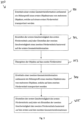
- FIG. 3 shows a flowchart 300 with method steps 301-305 of an exemplary second embodiment of the method according to the invention.
- the device 1 first determines first geometric information comprising a height profile of the first flow of packages 12 (action 301).
- the first speed 13 of the first conveyor belt 10 and/or the second speed 23 of the second conveyor belt 20 can be set (action 302).
- the packages then go to the second conveyor 20 (action 303).
- the device 1 With the aid of the sensor 21, the device 1 ascertains a second item of geometric information comprising a height profile of the second flow of packages 22 (action 204).
- the height profile can also be used to determine the size of individual packages, so that the assumption for V n in particular can be checked.
- the first speed 13 of the first conveyor belt 10 and/or the second speed 23 of the second conveyor belt 20 can be set again based on the first and second geometric information (action 205).
Landscapes
- Engineering & Computer Science (AREA)
- Mechanical Engineering (AREA)
- General Engineering & Computer Science (AREA)
- Manufacturing & Machinery (AREA)
- Quality & Reliability (AREA)
- Physics & Mathematics (AREA)
- General Physics & Mathematics (AREA)
- Automation & Control Theory (AREA)
- Control Of Conveyors (AREA)
Claims (30)
- Procédé comportant de :- déterminer une première information de géométrie d'un premier flux d'objets (12) d'une pluralité d'objets (2) qui sont transportés sur un premier convoyeur (10), et- déterminer une seconde information de géométrie d'un second flux d'objets (22) d'une pluralité d'objets (2) qui sont transportés sur un second convoyeur (20),- dans lequel le premier convoyeur (10) est configuré pour transporter des objets (2) à une première vitesse (13), et le second convoyeur (20) est configuré pour transporter des objets (2) à une seconde vitesse (23),- dans lequel le premier convoyeur (10) et le second convoyeur (20) sont agencés de telle sorte que les objets (2) transportés par le premier convoyeur (10) passent sur le second convoyeur (20) en tombant (40), sous l'effet de la force de gravité, à partir du premier convoyeur (10) sur le second convoyeur (20), et- dans lequel le procédé comporte en outre un réglage de la première vitesse (13) du premier convoyeur (10) et/ou un réglage de la seconde vitesse (23) du second convoyeur (20) sur la base de la première information de géométrie déterminée et/ou de la seconde information de géométrie déterminée, et- dans lequel la première information de géométrie comporte une première information de hauteur du premier flux d'objets (12), et la seconde information de géométrie comporte une seconde information de hauteur du second flux d'objets (22).
- Procédé selon la revendication 1, caractérisé en ce que le premier convoyeur est configuré pour transporter les objets (2) du premier flux d'objets (12) jusqu'à une extrémité du premier convoyeur (10) et les objets (2) passent sur le second convoyeur (20) à l'extrémité du premier convoyeur (10).
- Procédé selon l'une des revendications précédentes, caractérisé en ce que le premier flux d'objets (12) comporte des objets (2) qui sont transportés au moins partiellement les uns sur les autres et/ou les uns à côté des autres sur le premier convoyeur (10).
- Procédé selon l'une des revendications précédentes, caractérisé en ce que le premier convoyeur (10) et le second convoyeur (20) sont agencés de telle sorte que des objets (2) transportés les uns sur les autres dans le premier flux d'objets (12) sur le premier convoyeur (10) peuvent être distribués en passant sur le second convoyeur (20) de telle sorte que ces objets (2) précédemment transportés les uns sur les autres dans le premier flux d'objets (12) ne sont plus transportés au moins partiellement les uns sur les autres dans le second flux d'objets (22) sur le second convoyeur (20).
- Procédé selon l'une des revendications précédentes, caractérisé en ce que dans le second flux d'objets (22), les objets (2) sont transportés sensiblement les uns à côté des autres et/ou les uns derrière les autres sur le second convoyeur (20).
- Procédé selon l'une des revendications précédentes, caractérisé en ce que la première information de géométrie comporte de plus une première information de surface, en particulier représentative d'une taille de la surface du premier flux d'objets (12) et/ou en ce que la seconde information de géométrie comporte de plus une seconde information de surface, en particulier représentative d'une taille de la surface du second flux d'objets (22).
- Procédé selon l'une des revendications précédentes, caractérisé en ce que la première information de géométrie comporte en outre une première information d'étendue du premier flux d'objets (12) et/ou en ce que la seconde information de géométrie comporte en outre une seconde information d'étendue du second flux d'objets (12).
- Procédé selon la revendication 7, caractérisé en ce que la première et/ou seconde information d'étendue est représentative d'un diamètre du flux d'objets (12, 22) respectif.
- Procédé selon les revendications 6 et 8, caractérisé en ce que le procédé comporte en outre de :- déterminer un premier rapport de la surface sur le diamètre du premier flux d'objets (12) sur la base de la première information de surface et de la première information d'étendue,- déterminer un second rapport de la surface sur le diamètre du second flux d'objets (22) sur la base de la seconde information de surface et de la seconde information d'étendue, et- dans lequel le réglage de la première vitesse (13) du premier convoyeur (10) et/ou le réglage de la seconde vitesse (23) du second convoyeur (20) est basé sur le premier rapport déterminé et sur le second rapport déterminé.
- Procédé selon la revendication 6, caractérisé en ce que le réglage de la première vitesse (13) et/ou le réglage de la seconde vitesse (23) est basé sur une comparaison de la surface du second flux d'objets (22) avec la surface du premier flux d'objets (12).
- Procédé selon la revendication 9, caractérisé en ce que le réglage de la première vitesse (13) et/ou le réglage de la seconde vitesse (23) est basé sur une comparaison du rapport de la surface sur le diamètre du premier flux d'objets (12) avec le rapport de la surface sur le diamètre du second flux d'objets (22).
- Procédé selon l'une des revendications précédentes, caractérisé en ce que la première information de hauteur est un profil de hauteur du premier flux d'objets (12) et/ou en ce que la seconde information de hauteur est un profil de hauteur du second flux d'objets (22).
- Procédé selon la revendication 7, caractérisé en ce que la première information d'étendue est représentative d'une largeur du premier flux d'objets (12) et/ou la seconde information d'étendue est représentative d'une largeur du second flux d'objets (22).
- Procédé selon les revendications 12 et 13, caractérisé en ce que le réglage de la première vitesse (13) du premier convoyeur (10) et/ou le réglage de la seconde vitesse (23) du second convoyeur (20) est basé sur la première information de hauteur du premier flux d'objets (12) et/ou sur la première information d'étendue représentative d'une largeur du premier flux d'objets.
- Procédé selon l'une des revendications précédentes, caractérisé en ce que le réglage de la première vitesse (13) du premier convoyeur (10) et/ou le réglage de la seconde vitesse (23) du second convoyeur (20) est basé sur une hypothèse de taille d'un ou plusieurs objets (2) du premier flux d'objets (12).
- Procédé selon l'une des revendications précédentes, caractérisé en ce que le réglage de la première vitesse (13) du premier convoyeur (10) et/ou le réglage de la seconde vitesse (23) du second convoyeur (20) est basé sur un débit exigé des objets (2).
- Procédé selon l'une des revendications précédentes, caractérisé en ce que la seconde information de géométrie comporte une information de taille d'un ou plusieurs objets (2) du second flux d'objets (22).
- Procédé selon l'une des revendications précédentes, caractérisé en ce que le procédé comporte en outre de :- déterminer une information représentative d'une couverture de surface du premier et/ou second convoyeur (10, 20).
- Procédé selon l'une des revendications précédentes, caractérisé en ce que le procédé comporte en outre de :- déterminer un débit des objets (2).
- Procédé selon l'une des revendications précédentes, caractérisé en ce que le rapport de la première vitesse (13) du premier convoyeur (10) sur la seconde vitesse (23) du second convoyeur (20) reste sensiblement constant.
- Procédé selon l'une des revendications précédentes, caractérisé en ce que le rapport de la première vitesse (13) du premier convoyeur (10) sur la seconde vitesse (23) du second convoyeur (20) est compris entre 1:1,5 et 1:3 et est de préférence sensiblement égal à 1:2.
- Procédé selon l'une des revendications précédentes, caractérisé en ce que le réglage de la première et/ou seconde vitesse (13, 23) est basé sur un calcul et/ou sur une table de conversion.
- Procédé selon l'une des revendications précédentes, caractérisé en ce qu'une répartition de la distance entre les objets (2) du second flux d'objets (20) est réglée spécifiquement par le réglage de la première et/ou seconde vitesse.
- Procédé selon l'une des revendications précédentes, caractérisé en ce que la première et/ou la seconde vitesse sont réglées de telle sorte que la distance (24) entre deux objets (2) voisins du second flux d'objets (22) pour une majorité des objets (2) est respectivement comprise entre 0,5 m et 7 m, de manière préférée entre 1 m et 6 m, de manière particulièrement préférée entre 1,2 m et 5 m.
- Procédé selon l'une des revendications précédentes, caractérisé en ce que le premier convoyeur (10) et le second convoyeur (20) sont agencés directement l'un derrière l'autre.
- Procédé selon l'une des revendications précédentes, caractérisé en ce que le premier convoyeur (10) et le second convoyeur (20) comportent respectivement une bande de convoyage.
- Procédé selon l'une des revendications précédentes, caractérisé en ce que les objets (2) sont des colis et le premier flux d'objets (12) et le second flux d'objets (22) sont respectivement un flux de colis.
- Système comportant :- un dispositif (1) comportant des moyens pour permettre au système de mettre en oeuvre le procédé selon l'une des revendications 1 à 27,- le premier convoyeur (10) et le second convoyeur (20), et- des moyens de détection (11, 21) agencés pour détecter les première et seconde informations de géométrie.
- Système selon la revendication 28, dans lequel le dispositif (1) est ou comporte :- un module pour un dispositif de contrôle ou- un dispositif de contrôle ou- un ordinateur ou- un serveur.
- Programme informatique comportant des instructions de programme qui sont configurées pour permettre à un système selon la revendication 28 ou 29 de mettre en oeuvre le procédé selon l'une des revendications 1 à 27 lorsqu'elles sont exécutées par au moins un processeur.
Applications Claiming Priority (1)
| Application Number | Priority Date | Filing Date | Title |
|---|---|---|---|
| DE102016111110.4A DE102016111110A1 (de) | 2016-06-17 | 2016-06-17 | Ansteuerung von Fördermitteln |
Publications (3)
| Publication Number | Publication Date |
|---|---|
| EP3293592A1 EP3293592A1 (fr) | 2018-03-14 |
| EP3293592C0 EP3293592C0 (fr) | 2023-06-07 |
| EP3293592B1 true EP3293592B1 (fr) | 2023-06-07 |
Family
ID=59034567
Family Applications (1)
| Application Number | Title | Priority Date | Filing Date |
|---|---|---|---|
| EP17175170.4A Active EP3293592B1 (fr) | 2016-06-17 | 2017-06-09 | Controle de convoyeurs |
Country Status (4)
| Country | Link |
|---|---|
| US (1) | US10647520B2 (fr) |
| EP (1) | EP3293592B1 (fr) |
| CN (1) | CN107521907B (fr) |
| DE (1) | DE102016111110A1 (fr) |
Families Citing this family (25)
| Publication number | Priority date | Publication date | Assignee | Title |
|---|---|---|---|---|
| US10315859B1 (en) * | 2017-03-20 | 2019-06-11 | Amazon Technologies, Inc. | Automatic singulation of items |
| DE102017106533B4 (de) * | 2017-03-27 | 2019-10-10 | Sick Ag | Vorrichtung und Verfahren zum Positionieren von Objekten |
| US11440744B2 (en) | 2018-07-30 | 2022-09-13 | Laitram, L.L.C. | Conveyor package-flow measuring system |
| CN112689603B (zh) | 2018-09-07 | 2022-10-04 | 派克赛泽有限责任公司 | 用于包装机的自适应加速控制 |
| US10781053B1 (en) | 2018-12-13 | 2020-09-22 | Amazon Technologies, Inc. | Control system for automated singulation system |
| US10961060B1 (en) * | 2018-12-13 | 2021-03-30 | Amazon Technologies, Inc. | Automated singulation system |
| US11724887B2 (en) * | 2019-01-03 | 2023-08-15 | Körber Supply Chain Llc | System and method for fix pitch parcel distribution |
| US10807808B1 (en) * | 2019-04-22 | 2020-10-20 | Amazon Technologies, Inc. | Systems and methods for automated item separation and presentation |
| US20220169450A1 (en) * | 2019-04-25 | 2022-06-02 | Siemens Logistics Llc | System and method for parcel accumulation and normalization |
| DE102019114469B4 (de) * | 2019-05-29 | 2025-10-16 | Deutsche Post Ag | Verfahren zur Überwachung und/oder Instandhaltung einer Förderanlage und Förderanlage |
| JP7388855B2 (ja) * | 2019-09-18 | 2023-11-29 | 東芝テック株式会社 | コンベア |
| US11537982B1 (en) | 2019-10-11 | 2022-12-27 | Amazon Technologies, Inc. | Inventory sorting and transport |
| US11407595B2 (en) * | 2019-12-10 | 2022-08-09 | Intelligrated Headquarters, Llc | Methods and apparatuses for performing article singulation |
| US11230435B1 (en) | 2019-12-12 | 2022-01-25 | Amazon Technologies, Inc. | Multi-asin consolidation and transportation system |
| US11420823B1 (en) | 2019-12-12 | 2022-08-23 | Amazon Technologies, Inc. | Consolidation and transportation of items |
| EP4110712A4 (fr) * | 2020-02-24 | 2024-03-20 | Material Handling Systems, Inc. | Système de gestion de flux de colis avec un transporteur de retenue |
| NL2025084B1 (en) | 2020-03-09 | 2021-10-19 | Rexnord Flattop Europe Bv | Flow control of product transport |
| EP3971116A1 (fr) * | 2020-09-17 | 2022-03-23 | Caljan A/S | Systèmes, dispositifs et procédés pour transporteurs extensibles |
| US11420828B1 (en) * | 2020-12-11 | 2022-08-23 | Amazon Technologies, Inc. | System and method for item singulation |
| CN115367407B (zh) * | 2021-05-19 | 2025-08-08 | 威海新北洋正棋机器人股份有限公司 | 物件处理设备和物件处理方法 |
| WO2022256887A1 (fr) * | 2021-06-07 | 2022-12-15 | MARTINS, Andrea Luciana | Procédé et dispositif pour l'empaquetage d'emballages cartonnés |
| CN115924492A (zh) * | 2021-08-16 | 2023-04-07 | 山东新北洋信息技术股份有限公司 | 包裹分离方法和设备 |
| JP2023045031A (ja) | 2021-09-21 | 2023-04-03 | 株式会社東芝 | 供給装置 |
| EP4159650B1 (fr) | 2021-09-29 | 2025-06-04 | Fameccanica.Data S.p.A. | Procédé permettant de modifier l'agencement spatial de produits |
| US12371265B2 (en) | 2021-10-12 | 2025-07-29 | Intelligrated Headquarters, Llc | Methods, apparatuses and computer program products for providing dynamic control in automated storage and retrieval systems |
Citations (1)
| Publication number | Priority date | Publication date | Assignee | Title |
|---|---|---|---|---|
| EP2375380A1 (fr) * | 2010-04-01 | 2011-10-12 | Siemens Aktiengesellschaft | Procédé et dispositif de mesure d'un paramètre lors du transport d'objets vers un dispositif de traitement |
Family Cites Families (13)
| Publication number | Priority date | Publication date | Assignee | Title |
|---|---|---|---|---|
| JPS6161004A (ja) * | 1984-08-31 | 1986-03-28 | Rheon Autom Mach Co Ltd | 食品材料の連続体の連続計量方法 |
| DE3616023A1 (de) * | 1986-05-13 | 1987-11-19 | Seitz Enzinger Noll Masch | Puffertransporteur fuer als puffer wirkende foerderer von gefaessbehandlungsanlagen fuer flaschen oder dgl. gefaesse |
| EP1189707A4 (fr) * | 1999-04-30 | 2008-03-05 | Siemens Ag | Systeme de separation d'elements |
| US6471044B1 (en) * | 1999-04-30 | 2002-10-29 | Siemens Electrocom, L.P. | Hold and release singulator |
| US6629593B2 (en) * | 2000-05-11 | 2003-10-07 | Rapistan Systems Advertising Corp. | Conveyor induction system |
| US6910569B2 (en) * | 2002-01-29 | 2005-06-28 | Siemens Technology-To-Business Center, Llc | Load singulation system and method |
| DK1556297T3 (da) * | 2002-10-29 | 2008-07-21 | Siemens Ag | Transportindretning med håndtering af fordelte genstande |
| CN101027236A (zh) * | 2004-06-21 | 2007-08-29 | 西门子共同研究公司 | 高速率节省空间的物品单一化装置 |
| CN103748024B (zh) * | 2011-06-07 | 2017-02-15 | 康尔富盛德国326有限公司 | 将存入自动化仓库的计件货物分离的装置 |
| DE102014116516A1 (de) * | 2014-11-12 | 2016-05-12 | Krones Ag | Vorrichtung und Verfahren zur Ermittlung eines Belegungsgrads einer Transporteinrichtung |
| DE102014224147A1 (de) * | 2014-11-26 | 2016-06-02 | Siemens Aktiengesellschaft | Verfahren zur Packgutzusammenführung und Packgutfördervorrichtung |
| US9771222B2 (en) * | 2014-12-31 | 2017-09-26 | Fives Intralogistics Corp. | Vision based conveyor package flow management system |
| US10061308B2 (en) * | 2016-09-16 | 2018-08-28 | Siemens Industry, Inc. | Parcel delayering systems and methods for automatic parcel processing based on accurate de-layering |
-
2016
- 2016-06-17 DE DE102016111110.4A patent/DE102016111110A1/de active Pending
-
2017
- 2017-06-09 EP EP17175170.4A patent/EP3293592B1/fr active Active
- 2017-06-14 US US15/622,784 patent/US10647520B2/en active Active
- 2017-06-19 CN CN201710463664.5A patent/CN107521907B/zh active Active
Patent Citations (1)
| Publication number | Priority date | Publication date | Assignee | Title |
|---|---|---|---|---|
| EP2375380A1 (fr) * | 2010-04-01 | 2011-10-12 | Siemens Aktiengesellschaft | Procédé et dispositif de mesure d'un paramètre lors du transport d'objets vers un dispositif de traitement |
Also Published As
| Publication number | Publication date |
|---|---|
| EP3293592C0 (fr) | 2023-06-07 |
| EP3293592A1 (fr) | 2018-03-14 |
| US20170362036A1 (en) | 2017-12-21 |
| US10647520B2 (en) | 2020-05-12 |
| DE102016111110A1 (de) | 2017-12-21 |
| DE102016111110A9 (de) | 2018-03-08 |
| CN107521907A (zh) | 2017-12-29 |
| CN107521907B (zh) | 2021-02-23 |
Similar Documents
| Publication | Publication Date | Title |
|---|---|---|
| EP3293592A1 (fr) | Controle de convoyeurs | |
| EP3153242B1 (fr) | Commande de transporteur | |
| EP3678964B1 (fr) | Dispositif et procédé d'orientation de lots de produits | |
| EP2375380A1 (fr) | Procédé et dispositif de mesure d'un paramètre lors du transport d'objets vers un dispositif de traitement | |
| EP4150317B1 (fr) | Procédé de détermination de la répartition granulométrique de parties d'un matériau en vrac introduit sur une bande transporteuse | |
| EP2181311B1 (fr) | Procédé et dispositif de pesée dynamique de contrôle | |
| EP3038818A1 (fr) | Procédé et dispositif de production d'un matériau de départ pour pneus de véhicules | |
| EP3395728A1 (fr) | Réglage de l'écart entre des marchandises au détail à acheminer | |
| DE202011110089U1 (de) | Vorrichtung zum Ausrichten eines nicht-kreisrunden oder mehreckigen Gegenstands | |
| DE2248177A1 (de) | Verfahren zum abtrennen der restlaengen von den auf verkaufslaenge unterteilten walzstaeben | |
| EP3964460A1 (fr) | Dispositif et procédé d'alignement de produits en vrac | |
| EP2818254B1 (fr) | Dispositif de séparation d'objets | |
| CH719300A1 (de) | Verfahren und Vorrichtung zum phasengenauen Übergeben von Stückgut. | |
| EP2181312B1 (fr) | Procédé et dispositif de pesée dynamique de contrôle | |
| AT523807B1 (de) | Verfahren zur Staubniederhaltung bei Brechern mit Sprüheinrichtungen | |
| EP2777902B1 (fr) | Procédé d'usinage d'arêtes de pièces en forme de plaques | |
| EP4150316B1 (fr) | Procédé de détermination, par parts, du volume d'un matériau en vrac amené sur une bande transporteuse | |
| AT523805B1 (de) | Verfahren zur Verschleißerkennung bei Brechern in Leerfahrt | |
| DE202017004165U1 (de) | Vorrichtung zum Wiegen eines Produkts in einer Fertigungslinie | |
| EP4309156B1 (fr) | Système et procédé pour traiter des documents de valeur, en particulier des billets de banque | |
| DE202025104284U1 (de) | Vorrichtung zum Wiegen von geförderten Produkten im Rückwärtsbetrieb | |
| DE202026100747U1 (de) | Vorrichtung zum Wiegen von geförderten Produkten im Rückwärtsbetrieb | |
| DE102008007373A1 (de) | Vorrichtung zum Wenden von flachen Gegenständen |
Legal Events
| Date | Code | Title | Description |
|---|---|---|---|
| PUAI | Public reference made under article 153(3) epc to a published international application that has entered the european phase |
Free format text: ORIGINAL CODE: 0009012 |
|
| STAA | Information on the status of an ep patent application or granted ep patent |
Free format text: STATUS: THE APPLICATION HAS BEEN PUBLISHED |
|
| AK | Designated contracting states |
Kind code of ref document: A1 Designated state(s): AL AT BE BG CH CY CZ DE DK EE ES FI FR GB GR HR HU IE IS IT LI LT LU LV MC MK MT NL NO PL PT RO RS SE SI SK SM TR |
|
| AX | Request for extension of the european patent |
Extension state: BA ME |
|
| STAA | Information on the status of an ep patent application or granted ep patent |
Free format text: STATUS: REQUEST FOR EXAMINATION WAS MADE |
|
| 17P | Request for examination filed |
Effective date: 20180905 |
|
| RBV | Designated contracting states (corrected) |
Designated state(s): AL AT BE BG CH CY CZ DE DK EE ES FI FR GB GR HR HU IE IS IT LI LT LU LV MC MK MT NL NO PL PT RO RS SE SI SK SM TR |
|
| STAA | Information on the status of an ep patent application or granted ep patent |
Free format text: STATUS: EXAMINATION IS IN PROGRESS |
|
| 17Q | First examination report despatched |
Effective date: 20201110 |
|
| GRAP | Despatch of communication of intention to grant a patent |
Free format text: ORIGINAL CODE: EPIDOSNIGR1 |
|
| STAA | Information on the status of an ep patent application or granted ep patent |
Free format text: STATUS: GRANT OF PATENT IS INTENDED |
|
| INTG | Intention to grant announced |
Effective date: 20221209 |
|
| GRAS | Grant fee paid |
Free format text: ORIGINAL CODE: EPIDOSNIGR3 |
|
| GRAA | (expected) grant |
Free format text: ORIGINAL CODE: 0009210 |
|
| STAA | Information on the status of an ep patent application or granted ep patent |
Free format text: STATUS: THE PATENT HAS BEEN GRANTED |
|
| AK | Designated contracting states |
Kind code of ref document: B1 Designated state(s): AL AT BE BG CH CY CZ DE DK EE ES FI FR GB GR HR HU IE IS IT LI LT LU LV MC MK MT NL NO PL PT RO RS SE SI SK SM TR |
|
| REG | Reference to a national code |
Ref country code: GB Ref legal event code: FG4D Free format text: NOT ENGLISH |
|
| REG | Reference to a national code |
Ref country code: CH Ref legal event code: EP Ref country code: AT Ref legal event code: REF Ref document number: 1576956 Country of ref document: AT Kind code of ref document: T Effective date: 20230615 |
|
| REG | Reference to a national code |
Ref country code: DE Ref legal event code: R096 Ref document number: 502017014793 Country of ref document: DE |
|
| U01 | Request for unitary effect filed |
Effective date: 20230705 |
|
| U07 | Unitary effect registered |
Designated state(s): AT BE BG DE DK EE FI FR IT LT LU LV MT NL PT SE SI Effective date: 20230714 |
|
| U20 | Renewal fee for the european patent with unitary effect paid |
Year of fee payment: 7 Effective date: 20230713 |
|
| REG | Reference to a national code |
Ref country code: LT Ref legal event code: MG9D |
|
| PG25 | Lapsed in a contracting state [announced via postgrant information from national office to epo] |
Ref country code: NO Free format text: LAPSE BECAUSE OF FAILURE TO SUBMIT A TRANSLATION OF THE DESCRIPTION OR TO PAY THE FEE WITHIN THE PRESCRIBED TIME-LIMIT Effective date: 20230907 Ref country code: ES Free format text: LAPSE BECAUSE OF FAILURE TO SUBMIT A TRANSLATION OF THE DESCRIPTION OR TO PAY THE FEE WITHIN THE PRESCRIBED TIME-LIMIT Effective date: 20230607 |
|
| PG25 | Lapsed in a contracting state [announced via postgrant information from national office to epo] |
Ref country code: RS Free format text: LAPSE BECAUSE OF FAILURE TO SUBMIT A TRANSLATION OF THE DESCRIPTION OR TO PAY THE FEE WITHIN THE PRESCRIBED TIME-LIMIT Effective date: 20230607 Ref country code: HR Free format text: LAPSE BECAUSE OF FAILURE TO SUBMIT A TRANSLATION OF THE DESCRIPTION OR TO PAY THE FEE WITHIN THE PRESCRIBED TIME-LIMIT Effective date: 20230607 Ref country code: GR Free format text: LAPSE BECAUSE OF FAILURE TO SUBMIT A TRANSLATION OF THE DESCRIPTION OR TO PAY THE FEE WITHIN THE PRESCRIBED TIME-LIMIT Effective date: 20230908 |
|
| PG25 | Lapsed in a contracting state [announced via postgrant information from national office to epo] |
Ref country code: SK Free format text: LAPSE BECAUSE OF FAILURE TO SUBMIT A TRANSLATION OF THE DESCRIPTION OR TO PAY THE FEE WITHIN THE PRESCRIBED TIME-LIMIT Effective date: 20230607 |
|
| PG25 | Lapsed in a contracting state [announced via postgrant information from national office to epo] |
Ref country code: IS Free format text: LAPSE BECAUSE OF FAILURE TO SUBMIT A TRANSLATION OF THE DESCRIPTION OR TO PAY THE FEE WITHIN THE PRESCRIBED TIME-LIMIT Effective date: 20231007 |
|
| PG25 | Lapsed in a contracting state [announced via postgrant information from national office to epo] |
Ref country code: SM Free format text: LAPSE BECAUSE OF FAILURE TO SUBMIT A TRANSLATION OF THE DESCRIPTION OR TO PAY THE FEE WITHIN THE PRESCRIBED TIME-LIMIT Effective date: 20230607 Ref country code: SK Free format text: LAPSE BECAUSE OF FAILURE TO SUBMIT A TRANSLATION OF THE DESCRIPTION OR TO PAY THE FEE WITHIN THE PRESCRIBED TIME-LIMIT Effective date: 20230607 Ref country code: RO Free format text: LAPSE BECAUSE OF FAILURE TO SUBMIT A TRANSLATION OF THE DESCRIPTION OR TO PAY THE FEE WITHIN THE PRESCRIBED TIME-LIMIT Effective date: 20230607 Ref country code: IS Free format text: LAPSE BECAUSE OF FAILURE TO SUBMIT A TRANSLATION OF THE DESCRIPTION OR TO PAY THE FEE WITHIN THE PRESCRIBED TIME-LIMIT Effective date: 20231007 Ref country code: CZ Free format text: LAPSE BECAUSE OF FAILURE TO SUBMIT A TRANSLATION OF THE DESCRIPTION OR TO PAY THE FEE WITHIN THE PRESCRIBED TIME-LIMIT Effective date: 20230607 |
|
| REG | Reference to a national code |
Ref country code: CH Ref legal event code: PL |
|
| PG25 | Lapsed in a contracting state [announced via postgrant information from national office to epo] |
Ref country code: PL Free format text: LAPSE BECAUSE OF FAILURE TO SUBMIT A TRANSLATION OF THE DESCRIPTION OR TO PAY THE FEE WITHIN THE PRESCRIBED TIME-LIMIT Effective date: 20230607 |
|
| REG | Reference to a national code |
Ref country code: DE Ref legal event code: R097 Ref document number: 502017014793 Country of ref document: DE |
|
| PG25 | Lapsed in a contracting state [announced via postgrant information from national office to epo] |
Ref country code: MC Free format text: LAPSE BECAUSE OF FAILURE TO SUBMIT A TRANSLATION OF THE DESCRIPTION OR TO PAY THE FEE WITHIN THE PRESCRIBED TIME-LIMIT Effective date: 20230607 |
|
| REG | Reference to a national code |
Ref country code: IE Ref legal event code: MM4A |
|
| PG25 | Lapsed in a contracting state [announced via postgrant information from national office to epo] |
Ref country code: MC Free format text: LAPSE BECAUSE OF FAILURE TO SUBMIT A TRANSLATION OF THE DESCRIPTION OR TO PAY THE FEE WITHIN THE PRESCRIBED TIME-LIMIT Effective date: 20230607 |
|
| PLBE | No opposition filed within time limit |
Free format text: ORIGINAL CODE: 0009261 |
|
| STAA | Information on the status of an ep patent application or granted ep patent |
Free format text: STATUS: NO OPPOSITION FILED WITHIN TIME LIMIT |
|
| PG25 | Lapsed in a contracting state [announced via postgrant information from national office to epo] |
Ref country code: IE Free format text: LAPSE BECAUSE OF NON-PAYMENT OF DUE FEES Effective date: 20230609 |
|
| PG25 | Lapsed in a contracting state [announced via postgrant information from national office to epo] |
Ref country code: IE Free format text: LAPSE BECAUSE OF NON-PAYMENT OF DUE FEES Effective date: 20230609 Ref country code: CH Free format text: LAPSE BECAUSE OF NON-PAYMENT OF DUE FEES Effective date: 20230630 |
|
| 26N | No opposition filed |
Effective date: 20240308 |
|
| U20 | Renewal fee for the european patent with unitary effect paid |
Year of fee payment: 8 Effective date: 20240620 |
|
| PGFP | Annual fee paid to national office [announced via postgrant information from national office to epo] |
Ref country code: GB Payment date: 20250624 Year of fee payment: 9 |
|
| PG25 | Lapsed in a contracting state [announced via postgrant information from national office to epo] |
Ref country code: CY Free format text: LAPSE BECAUSE OF FAILURE TO SUBMIT A TRANSLATION OF THE DESCRIPTION OR TO PAY THE FEE WITHIN THE PRESCRIBED TIME-LIMIT; INVALID AB INITIO Effective date: 20170609 |
|
| U20 | Renewal fee for the european patent with unitary effect paid |
Year of fee payment: 9 Effective date: 20250624 |
|
| PG25 | Lapsed in a contracting state [announced via postgrant information from national office to epo] |
Ref country code: HU Free format text: LAPSE BECAUSE OF FAILURE TO SUBMIT A TRANSLATION OF THE DESCRIPTION OR TO PAY THE FEE WITHIN THE PRESCRIBED TIME-LIMIT; INVALID AB INITIO Effective date: 20170609 |
|
| PG25 | Lapsed in a contracting state [announced via postgrant information from national office to epo] |
Ref country code: TR Free format text: LAPSE BECAUSE OF FAILURE TO SUBMIT A TRANSLATION OF THE DESCRIPTION OR TO PAY THE FEE WITHIN THE PRESCRIBED TIME-LIMIT Effective date: 20230607 |