EP3313449B1 - Composés ionisabses, leurs compositions et utilisations - Google Patents
Composés ionisabses, leurs compositions et utilisations Download PDFInfo
- Publication number
- EP3313449B1 EP3313449B1 EP16815348.4A EP16815348A EP3313449B1 EP 3313449 B1 EP3313449 B1 EP 3313449B1 EP 16815348 A EP16815348 A EP 16815348A EP 3313449 B1 EP3313449 B1 EP 3313449B1
- Authority
- EP
- European Patent Office
- Prior art keywords
- mmol
- dcm
- compound
- mixture
- composition
- Prior art date
- Legal status (The legal status is an assumption and is not a legal conclusion. Google has not performed a legal analysis and makes no representation as to the accuracy of the status listed.)
- Active
Links
- 0 CC(C)*(C1)CC1C(F)(F)F Chemical compound CC(C)*(C1)CC1C(F)(F)F 0.000 description 10
- GNVWVYIAQBJHGV-UHFFFAOYSA-N OCC1CNC1 Chemical compound OCC1CNC1 GNVWVYIAQBJHGV-UHFFFAOYSA-N 0.000 description 2
- GEGMPIBCGUMXIG-HGCBZMORSA-N CCCCC/C=C\C/C=C\CCCCCCCC(OCCN(CCOC(CCCCCCC/C=C\C/C=C\CCCCC)=O)C(CN(C[C@H]1O)C[C@H]1O)=O)=O Chemical compound CCCCC/C=C\C/C=C\CCCCCCCC(OCCN(CCOC(CCCCCCC/C=C\C/C=C\CCCCC)=O)C(CN(C[C@H]1O)C[C@H]1O)=O)=O GEGMPIBCGUMXIG-HGCBZMORSA-N 0.000 description 1
- BVSKRKYWZMZEEQ-PGUFJCEWSA-N CCCCCCCCCCCCCC(OCCN(CCOC(CCCCCCCCCCCCC)=O)C(CN(CC1)C[C@@H]1O)=O)=O Chemical compound CCCCCCCCCCCCCC(OCCN(CCOC(CCCCCCCCCCCCC)=O)C(CN(CC1)C[C@@H]1O)=O)=O BVSKRKYWZMZEEQ-PGUFJCEWSA-N 0.000 description 1
- FJECRFWGTFAGGN-HDXUUTQWSA-N CCCCCCCCCOC(CC(CC(OCCCCCCCC/C=C\C/C=C\CCCCC)=O)NC(CN1CC(CO)C1)=O)=O Chemical compound CCCCCCCCCOC(CC(CC(OCCCCCCCC/C=C\C/C=C\CCCCC)=O)NC(CN1CC(CO)C1)=O)=O FJECRFWGTFAGGN-HDXUUTQWSA-N 0.000 description 1
- KGAJEEQMXGQUBR-UHFFFAOYSA-N CCNCCOC(C)=O Chemical compound CCNCCOC(C)=O KGAJEEQMXGQUBR-UHFFFAOYSA-N 0.000 description 1
Images








Classifications
-
- C—CHEMISTRY; METALLURGY
- C07—ORGANIC CHEMISTRY
- C07C—ACYCLIC OR CARBOCYCLIC COMPOUNDS
- C07C271/00—Derivatives of carbamic acids, i.e. compounds containing any of the groups, the nitrogen atom not being part of nitro or nitroso groups
- C07C271/06—Esters of carbamic acids
- C07C271/08—Esters of carbamic acids having oxygen atoms of carbamate groups bound to acyclic carbon atoms
- C07C271/10—Esters of carbamic acids having oxygen atoms of carbamate groups bound to acyclic carbon atoms with the nitrogen atoms of the carbamate groups bound to hydrogen atoms or to acyclic carbon atoms
- C07C271/16—Esters of carbamic acids having oxygen atoms of carbamate groups bound to acyclic carbon atoms with the nitrogen atoms of the carbamate groups bound to hydrogen atoms or to acyclic carbon atoms to carbon atoms of hydrocarbon radicals substituted by singly-bound oxygen atoms
-
- A—HUMAN NECESSITIES
- A61—MEDICAL OR VETERINARY SCIENCE; HYGIENE
- A61K—PREPARATIONS FOR MEDICAL, DENTAL OR TOILETRY PURPOSES
- A61K31/00—Medicinal preparations containing organic active ingredients
- A61K31/70—Carbohydrates; Sugars; Derivatives thereof
- A61K31/7088—Compounds having three or more nucleosides or nucleotides
- A61K31/7105—Natural ribonucleic acids, i.e. containing only riboses attached to adenine, guanine, cytosine or uracil and having 3'-5' phosphodiester links
-
- A—HUMAN NECESSITIES
- A61—MEDICAL OR VETERINARY SCIENCE; HYGIENE
- A61K—PREPARATIONS FOR MEDICAL, DENTAL OR TOILETRY PURPOSES
- A61K31/00—Medicinal preparations containing organic active ingredients
- A61K31/70—Carbohydrates; Sugars; Derivatives thereof
- A61K31/7088—Compounds having three or more nucleosides or nucleotides
- A61K31/713—Double-stranded nucleic acids or oligonucleotides
-
- A—HUMAN NECESSITIES
- A61—MEDICAL OR VETERINARY SCIENCE; HYGIENE
- A61K—PREPARATIONS FOR MEDICAL, DENTAL OR TOILETRY PURPOSES
- A61K47/00—Medicinal preparations characterised by the non-active ingredients used, e.g. carriers or inert additives; Targeting or modifying agents chemically bound to the active ingredient
- A61K47/06—Organic compounds, e.g. natural or synthetic hydrocarbons, polyolefins, mineral oil, petrolatum or ozokerite
- A61K47/16—Organic compounds, e.g. natural or synthetic hydrocarbons, polyolefins, mineral oil, petrolatum or ozokerite containing nitrogen, e.g. nitro-, nitroso-, azo-compounds, nitriles, cyanates
-
- A—HUMAN NECESSITIES
- A61—MEDICAL OR VETERINARY SCIENCE; HYGIENE
- A61K—PREPARATIONS FOR MEDICAL, DENTAL OR TOILETRY PURPOSES
- A61K47/00—Medicinal preparations characterised by the non-active ingredients used, e.g. carriers or inert additives; Targeting or modifying agents chemically bound to the active ingredient
- A61K47/06—Organic compounds, e.g. natural or synthetic hydrocarbons, polyolefins, mineral oil, petrolatum or ozokerite
- A61K47/22—Heterocyclic compounds, e.g. ascorbic acid, tocopherol or pyrrolidones
-
- A—HUMAN NECESSITIES
- A61—MEDICAL OR VETERINARY SCIENCE; HYGIENE
- A61K—PREPARATIONS FOR MEDICAL, DENTAL OR TOILETRY PURPOSES
- A61K47/00—Medicinal preparations characterised by the non-active ingredients used, e.g. carriers or inert additives; Targeting or modifying agents chemically bound to the active ingredient
- A61K47/06—Organic compounds, e.g. natural or synthetic hydrocarbons, polyolefins, mineral oil, petrolatum or ozokerite
- A61K47/24—Organic compounds, e.g. natural or synthetic hydrocarbons, polyolefins, mineral oil, petrolatum or ozokerite containing atoms other than carbon, hydrogen, oxygen, halogen, nitrogen or sulfur, e.g. cyclomethicone or phospholipids
-
- A—HUMAN NECESSITIES
- A61—MEDICAL OR VETERINARY SCIENCE; HYGIENE
- A61K—PREPARATIONS FOR MEDICAL, DENTAL OR TOILETRY PURPOSES
- A61K9/00—Medicinal preparations characterised by special physical form
- A61K9/10—Dispersions; Emulsions
- A61K9/127—Synthetic bilayered vehicles, e.g. liposomes or liposomes with cholesterol as the only non-phosphatidyl surfactant
-
- A—HUMAN NECESSITIES
- A61—MEDICAL OR VETERINARY SCIENCE; HYGIENE
- A61K—PREPARATIONS FOR MEDICAL, DENTAL OR TOILETRY PURPOSES
- A61K9/00—Medicinal preparations characterised by special physical form
- A61K9/48—Preparations in capsules, e.g. of gelatin, of chocolate
- A61K9/50—Microcapsules having a gas, liquid or semi-solid filling; Solid microparticles or pellets surrounded by a distinct coating layer, e.g. coated microspheres, coated drug crystals
- A61K9/51—Nanocapsules; Nanoparticles
- A61K9/5107—Excipients; Inactive ingredients
- A61K9/5123—Organic compounds, e.g. fats, sugars
-
- A—HUMAN NECESSITIES
- A61—MEDICAL OR VETERINARY SCIENCE; HYGIENE
- A61P—SPECIFIC THERAPEUTIC ACTIVITY OF CHEMICAL COMPOUNDS OR MEDICINAL PREPARATIONS
- A61P43/00—Drugs for specific purposes, not provided for in groups A61P1/00-A61P41/00
-
- C—CHEMISTRY; METALLURGY
- C07—ORGANIC CHEMISTRY
- C07C—ACYCLIC OR CARBOCYCLIC COMPOUNDS
- C07C237/00—Carboxylic acid amides, the carbon skeleton of the acid part being further substituted by amino groups
- C07C237/02—Carboxylic acid amides, the carbon skeleton of the acid part being further substituted by amino groups having the carbon atoms of the carboxamide groups bound to acyclic carbon atoms of the carbon skeleton
- C07C237/04—Carboxylic acid amides, the carbon skeleton of the acid part being further substituted by amino groups having the carbon atoms of the carboxamide groups bound to acyclic carbon atoms of the carbon skeleton the carbon skeleton being acyclic and saturated
- C07C237/08—Carboxylic acid amides, the carbon skeleton of the acid part being further substituted by amino groups having the carbon atoms of the carboxamide groups bound to acyclic carbon atoms of the carbon skeleton the carbon skeleton being acyclic and saturated having the nitrogen atom of at least one of the carboxamide groups bound to an acyclic carbon atom of a hydrocarbon radical substituted by singly-bound oxygen atoms
-
- C—CHEMISTRY; METALLURGY
- C07—ORGANIC CHEMISTRY
- C07C—ACYCLIC OR CARBOCYCLIC COMPOUNDS
- C07C237/00—Carboxylic acid amides, the carbon skeleton of the acid part being further substituted by amino groups
- C07C237/02—Carboxylic acid amides, the carbon skeleton of the acid part being further substituted by amino groups having the carbon atoms of the carboxamide groups bound to acyclic carbon atoms of the carbon skeleton
- C07C237/16—Carboxylic acid amides, the carbon skeleton of the acid part being further substituted by amino groups having the carbon atoms of the carboxamide groups bound to acyclic carbon atoms of the carbon skeleton the carbon skeleton being acyclic and unsaturated
-
- C—CHEMISTRY; METALLURGY
- C07—ORGANIC CHEMISTRY
- C07C—ACYCLIC OR CARBOCYCLIC COMPOUNDS
- C07C237/00—Carboxylic acid amides, the carbon skeleton of the acid part being further substituted by amino groups
- C07C237/50—Carboxylic acid amides, the carbon skeleton of the acid part being further substituted by amino groups having the nitrogen atom of at least one of the carboxamide groups quaternised
-
- C—CHEMISTRY; METALLURGY
- C07—ORGANIC CHEMISTRY
- C07D—HETEROCYCLIC COMPOUNDS
- C07D205/00—Heterocyclic compounds containing four-membered rings with one nitrogen atom as the only ring hetero atom
- C07D205/02—Heterocyclic compounds containing four-membered rings with one nitrogen atom as the only ring hetero atom not condensed with other rings
- C07D205/04—Heterocyclic compounds containing four-membered rings with one nitrogen atom as the only ring hetero atom not condensed with other rings having no double bonds between ring members or between ring members and non-ring members
-
- C—CHEMISTRY; METALLURGY
- C07—ORGANIC CHEMISTRY
- C07D—HETEROCYCLIC COMPOUNDS
- C07D207/00—Heterocyclic compounds containing five-membered rings not condensed with other rings, with one nitrogen atom as the only ring hetero atom
- C07D207/02—Heterocyclic compounds containing five-membered rings not condensed with other rings, with one nitrogen atom as the only ring hetero atom with only hydrogen or carbon atoms directly attached to the ring nitrogen atom
- C07D207/04—Heterocyclic compounds containing five-membered rings not condensed with other rings, with one nitrogen atom as the only ring hetero atom with only hydrogen or carbon atoms directly attached to the ring nitrogen atom having no double bonds between ring members or between ring members and non-ring members
- C07D207/08—Heterocyclic compounds containing five-membered rings not condensed with other rings, with one nitrogen atom as the only ring hetero atom with only hydrogen or carbon atoms directly attached to the ring nitrogen atom having no double bonds between ring members or between ring members and non-ring members with hydrocarbon radicals, substituted by hetero atoms, attached to ring carbon atoms
- C07D207/09—Radicals substituted by nitrogen atoms, not forming part of a nitro radical
-
- C—CHEMISTRY; METALLURGY
- C07—ORGANIC CHEMISTRY
- C07D—HETEROCYCLIC COMPOUNDS
- C07D207/00—Heterocyclic compounds containing five-membered rings not condensed with other rings, with one nitrogen atom as the only ring hetero atom
- C07D207/02—Heterocyclic compounds containing five-membered rings not condensed with other rings, with one nitrogen atom as the only ring hetero atom with only hydrogen or carbon atoms directly attached to the ring nitrogen atom
- C07D207/04—Heterocyclic compounds containing five-membered rings not condensed with other rings, with one nitrogen atom as the only ring hetero atom with only hydrogen or carbon atoms directly attached to the ring nitrogen atom having no double bonds between ring members or between ring members and non-ring members
- C07D207/10—Heterocyclic compounds containing five-membered rings not condensed with other rings, with one nitrogen atom as the only ring hetero atom with only hydrogen or carbon atoms directly attached to the ring nitrogen atom having no double bonds between ring members or between ring members and non-ring members with hetero atoms or with carbon atoms having three bonds to hetero atoms with at the most one bond to halogen, e.g. ester or nitrile radicals, directly attached to ring carbon atoms
- C07D207/12—Oxygen or sulfur atoms
-
- C—CHEMISTRY; METALLURGY
- C07—ORGANIC CHEMISTRY
- C07D—HETEROCYCLIC COMPOUNDS
- C07D211/00—Heterocyclic compounds containing hydrogenated pyridine rings, not condensed with other rings
- C07D211/04—Heterocyclic compounds containing hydrogenated pyridine rings, not condensed with other rings with only hydrogen or carbon atoms directly attached to the ring nitrogen atom
- C07D211/68—Heterocyclic compounds containing hydrogenated pyridine rings, not condensed with other rings with only hydrogen or carbon atoms directly attached to the ring nitrogen atom having one double bond between ring members or between a ring member and a non-ring member
- C07D211/72—Heterocyclic compounds containing hydrogenated pyridine rings, not condensed with other rings with only hydrogen or carbon atoms directly attached to the ring nitrogen atom having one double bond between ring members or between a ring member and a non-ring member with hetero atoms or with carbon atoms having three bonds to hetero atoms, with at the most one bond to halogen, directly attached to ring carbon atoms
- C07D211/74—Oxygen atoms
-
- C—CHEMISTRY; METALLURGY
- C07—ORGANIC CHEMISTRY
- C07D—HETEROCYCLIC COMPOUNDS
- C07D211/00—Heterocyclic compounds containing hydrogenated pyridine rings, not condensed with other rings
- C07D211/04—Heterocyclic compounds containing hydrogenated pyridine rings, not condensed with other rings with only hydrogen or carbon atoms directly attached to the ring nitrogen atom
- C07D211/80—Heterocyclic compounds containing hydrogenated pyridine rings, not condensed with other rings with only hydrogen or carbon atoms directly attached to the ring nitrogen atom having two double bonds between ring members or between ring members and non-ring members
- C07D211/82—Heterocyclic compounds containing hydrogenated pyridine rings, not condensed with other rings with only hydrogen or carbon atoms directly attached to the ring nitrogen atom having two double bonds between ring members or between ring members and non-ring members with only hydrogen atoms, hydrocarbon or substituted hydrocarbon radicals, directly attached to ring carbon atoms
-
- C—CHEMISTRY; METALLURGY
- C07—ORGANIC CHEMISTRY
- C07D—HETEROCYCLIC COMPOUNDS
- C07D211/00—Heterocyclic compounds containing hydrogenated pyridine rings, not condensed with other rings
- C07D211/04—Heterocyclic compounds containing hydrogenated pyridine rings, not condensed with other rings with only hydrogen or carbon atoms directly attached to the ring nitrogen atom
- C07D211/80—Heterocyclic compounds containing hydrogenated pyridine rings, not condensed with other rings with only hydrogen or carbon atoms directly attached to the ring nitrogen atom having two double bonds between ring members or between ring members and non-ring members
- C07D211/84—Heterocyclic compounds containing hydrogenated pyridine rings, not condensed with other rings with only hydrogen or carbon atoms directly attached to the ring nitrogen atom having two double bonds between ring members or between ring members and non-ring members with hetero atoms or with carbon atoms having three bonds to hetero atoms, with at the most one bond to halogen directly attached to ring carbon atoms
- C07D211/86—Oxygen atoms
-
- C—CHEMISTRY; METALLURGY
- C07—ORGANIC CHEMISTRY
- C07F—ACYCLIC, CARBOCYCLIC OR HETEROCYCLIC COMPOUNDS CONTAINING ELEMENTS OTHER THAN CARBON, HYDROGEN, HALOGEN, OXYGEN, NITROGEN, SULFUR, SELENIUM OR TELLURIUM
- C07F9/00—Compounds containing elements of Groups 5 or 15 of the Periodic Table
- C07F9/02—Phosphorus compounds
- C07F9/06—Phosphorus compounds without P—C bonds
-
- C—CHEMISTRY; METALLURGY
- C07—ORGANIC CHEMISTRY
- C07F—ACYCLIC, CARBOCYCLIC OR HETEROCYCLIC COMPOUNDS CONTAINING ELEMENTS OTHER THAN CARBON, HYDROGEN, HALOGEN, OXYGEN, NITROGEN, SULFUR, SELENIUM OR TELLURIUM
- C07F9/00—Compounds containing elements of Groups 5 or 15 of the Periodic Table
- C07F9/02—Phosphorus compounds
- C07F9/06—Phosphorus compounds without P—C bonds
- C07F9/08—Esters of oxyacids of phosphorus
- C07F9/09—Esters of phosphoric acids
- C07F9/10—Phosphatides, e.g. lecithin
- C07F9/106—Adducts, complexes, salts of phosphatides
-
- A—HUMAN NECESSITIES
- A61—MEDICAL OR VETERINARY SCIENCE; HYGIENE
- A61K—PREPARATIONS FOR MEDICAL, DENTAL OR TOILETRY PURPOSES
- A61K2300/00—Mixtures or combinations of active ingredients, wherein at least one active ingredient is fully defined in groups A61K31/00 - A61K41/00
Definitions
- This invention relates to the fields of biopharmaceuticals and therapeutics. More particularly, this invention relates to compounds, compositions and methods for providing nanoparticles to deliver and distribute active agents or drug compounds to cells, tissues, organs, and subjects.
- Therapeutic agents such as drug compounds, nucleic acid molecules and other active agents operate by uptake into cells, tissues, and organs of a subject. Transfection of agents and molecules into cells is often a limiting step in therapeutic action.
- one way to carry out transfection of nucleic acids is to encapsulate the active molecules in a lipid nanoparticle.
- Drawbacks of this methodology include potential toxicity in various modalities of delivery, such as intravenous injection, and low rates of cell penetration.
- compositions and compounds for forming nanoparticles for active agents There is a continuing need for lipid-like molecules and compositions for efficient transfection and distribution of nucleic acid molecules and other agents to cells and subjects.
- This invention relates to molecules and compositions thereof for use in biopharmaceuticals and therapeutics. More particularly, this invention relates to compounds, compositions and methods for providing nanoparticles to deliver and distribute active agents or drug compounds to cells, tissues, organs, and subjects.
- This invention provides a range of ionizable compounds.
- the ionizable compounds of this invention can be used to form nanoparticles to deliver and distribute active agents.
- compositions containing an ionizable compound above and a pharmaceutically acceptable carrier may contain nanoparticles.
- This disclosure includes pharmaceutical compositions comprising an ionizable compound above, an active agent, and a pharmaceutically acceptable carrier.
- the ionizable compound may be from 15 mol% to 40 mol% of the lipids of the composition.
- the composition may comprise nanoparticles.
- An active agent of this disclosure may be one or more RNAi molecules.
- An active agent may be one or more RNAi molecules selected from small interfering RNAs (siRNA), double stranded RNAs (dsRNA) that are Dicer substrates, microRNAs (miRNA), short hairpin RNAs (shRNA), DNA-directed RNAs (ddRNA), Piwi-interacting RNAs (piRNA), repeat associated siRNAs (rasiRNA), and modified forms thereof.
- siRNA small interfering RNAs
- dsRNA double stranded RNAs
- shRNA short hairpin RNAs
- ddRNA DNA-directed RNAs
- piRNA Piwi-interacting RNAs
- rasiRNA repeat associated siRNAs
- An active agent of this disclosure may be one or more active pharmaceutical ingredients.
- this invention includes compositions for use in distributing an active agent for treating a condition or disease in a subject, the composition comprising an ionizable compound above, a structural lipid, a stabilizer lipid, and a lipid for reducing immunogenicity of the composition.
- the active agent can be one or more RNAi molecules and the composition may comprise nanoparticles that encapsulate the RNAi molecules.
- compositions containing an ionizable compound and one or more pharmaceutically acceptable excipients.
- a composition of this invention can be a nanoparticle composed, at least in part, of an ionizable compound.
- compositions for use in distributing an active agent in a subject where the composition includes an ionizable compound.
- a composition of this invention can be used in distributing an active agent for treating a condition or disease in a subject.
- a composition for use in distributing an active agent for treating a condition or disease in a subject can include an ionizable compound, a structural lipid, and a lipid for reducing immunogenicity of the composition.
- This invention provides a range of ionizable molecules that are amphiphiles with lipid-like properties.
- the ionizable compounds of this invention can be used in delivering therapeutic agents to cells, tissues or organs, organisms, and subjects.
- this invention provides compounds for forming lipid nanoparticles for encapsulating and delivering active agents such as nucleic acid molecules to cells and subjects.
- This invention can provide a composition for use in distributing an active agent in cells, tissues or organs, organisms, and subjects, where the composition includes one or more of the ionizable molecules of this invention.
- compositions of this invention may include one or more of the ionizable molecules, along with a structural lipid, and one or more lipids for reducing immunogenicity of the composition.
- An ionizable molecule of this invention can be any mol% of a composition of this invention.
- compositions of this invention may include one or more of the ionizable molecules, along with a structural lipid, and one or more lipids for reducing immunogenicity of the composition.
- compositions of this invention may include one or more of the ionizable molecules, along with a structural lipid, one or more stabilizer lipids, and one or more lipids for reducing immunogenicity of the composition.
- a component of a formulation can be a single compound, or can be a combination of one or more suitable lipid compounds.
- a stabilizer lipid can refer to a single stabilizer lipid, or to a combination of one or more suitable stabilizer lipids.
- the ionizable compounds of a composition of this invention can be from 50 mol% to 80 mol% of the lipid components of the composition. In certain embodiments, the ionizable molecules of a composition can be from 55 mol% to 65 mol% of the lipid components of the composition. In further embodiments, the ionizable molecules of a composition can be about 60 mol% of the lipid components of the composition.
- the structural lipid of a composition of this invention can be from 20 mol% to 50 mol% of the lipid components of the composition. In certain embodiments, the structural lipid of a composition can be from 35 mol% to 45 mol% of the lipid components of the composition.
- the one or more lipids for reducing immunogenicity of the composition can be from a total of 1 mol% to 8 mol% of the lipid components of the composition. In certain embodiments, the one or more lipids for reducing immunogenicity of the composition can be from a total of 1 mol% to 5 mol% of the lipid components of the composition.
- a composition of this invention can further include a cationic lipid, which can be from 5 mol% to 25 mol% of the lipid components of the composition. In certain embodiments, a composition of this invention can further include a cationic lipid, which can be from 5 mol% to 15 mol% of the lipid components of the composition. In these aspects, the molar ratio of the concentrations of the cationic lipid to the ionizable molecules of a composition of this invention can be from 5:80 to 25:50.
- the entirety of the lipid components may include one or more of the ionizable compound molecular components, a structural lipid, and one or more lipids for reducing immunogenicity of the composition.
- compositions with four components are provided.
- the ionizable molecules of a composition of this invention can be from 15 mol% to 40 mol% of the lipid components of the composition. In certain embodiments, the ionizable molecules of a composition can be from 20 mol% to 35 mol% of the lipid components of the composition. In further embodiments, the ionizable molecules of a composition can be from 25 mol% to 30 mol% of the lipid components of the composition.
- the structural lipid of a composition of this invention can be from 25 mol% to 40 mol% of the lipid components of the composition. In certain embodiments, the structural lipid of a composition can be from 30 mol% to 35 mol% of the lipid components of the composition.
- the sum of the stabilizer lipids of a composition of this invention can be from 25 mol% to 40% mol% of the lipid components of the composition. In certain embodiments, the sum of the stabilizer lipids of a composition can be from 30 mol% to 40 mol% of the lipid components of the composition.
- a composition of this invention can include two or more stabilizer lipids, where each of the stabilizer lipids individually can be from 5 mol% to 35 mol% of the lipid components of the composition. In certain embodiments, a composition of this invention can include two or more stabilizer lipids, where each of the stabilizer lipids individually can be from 10 mol% to 30 mol% of the lipid components of the composition.
- the sum of the one or more stabilizer lipids can be from 25 mol% to 40 mol% of the lipids of the composition, wherein each of the stabilizer lipids individually can be from 5 mol% to 35% mol%.
- the sum of the one or more stabilizer lipids can be from 30 mol% to 40 mol% of the lipids of the composition, wherein each of the stabilizer lipids individually can be from 10 mol% to 30% mol%.
- the one or more lipids for reducing immunogenicity of the composition can be from a total of 1 mol% to 8 mol% of the lipid components of the composition. In certain embodiments, the one or more lipids for reducing immunogenicity of the composition can be from a total of 1 mol% to 5 mol% of the lipid components of the composition.
- a composition of this invention can further include a cationic lipid, which can be from 5 mol% to 25 mol% of the lipid components of the composition. In certain embodiments, a composition of this invention can further include a cationic lipid, which can be from 5 mol% to 15 mol% of the lipid components of the composition. In these aspects, the molar ratio of the concentrations of the cationic lipid to the ionizable molecules of a composition of this invention can be from 5:35 to 25:15.
- the entirety of the lipid components of a composition may include one or more of the ionizable compound molecular components, a structural lipid, one or more lipids for reducing immunogenicity of the composition, and one or more stabilizer lipids.
- three lipid-like components i.e. one or more ionizable molecules, a structural lipid, and one or more lipids for reducing immunogenicity of the composition can be 100% of the lipid components of the composition.
- a cationic lipid can be included.
- compositions of this invention are shown in Table 1.
- Table 1 Compositions of lipid components (each in mol% of total) Ionizable Cationic Structural Reduce immun. 60 0 32 8 60 0 35 5 55 0 44 1 65 0 32 3 60 0 36 4 65 0 32 3 70 0 25 5 74 0 20 6 78 0 20 2 50 10 35 5 55 15 25 5 55 20 20 5
- four lipid-like components i.e. one or more ionizable molecules, a structural lipid, and one or more lipids for reducing immunogenicity of the composition, and one or more stabilizer lipids can be 100% of the lipid components of the composition.
- compositions of this invention are shown in Table 2.
- Table 2 Compositions of lipid components (each in mol% of total) Ionizable Cationic Structural Stabilizer Reduce immun. 17 0 35 40 8 20 0 35 40 5 25 0 35 39 1 25 0 35 35 5 25 0 30 40 5 25 0 40 30 5 30 0 25 40 5 35 0 25 35 5 40 0 30 25 5 25 5 30 35 5 25 10 30 30 5 25 15 25 30 5
- compositions for selective biodistribution are provided.
- aspects of this invention can provide a range of compositions for use in distributing an active agent to various organs or tissues of a subject.
- compositions of this invention can contain an ionizable lipid, a structural lipid, and a lipid for reducing immunogenicity of the composition.
- compositions of this invention can contain an ionizable lipid, a structural lipid, one or more stabilizer lipids, and a lipid for reducing immunogenicity of the composition.
- compositions of this invention may provide a surprisingly selective biodistribution of the active agent to a particular organ or tissue.
- composition of this invention can provide a surprisingly selective biodistribution of the active agent to the lung of a subject.
- composition of this invention can provide a surprisingly selective biodistribution of the active agent to the liver of a subject.
- composition of this invention can provide a surprisingly selective biodistribution of the active agent to the colon of a subject.
- a composition of this invention can provide a surprisingly selective biodistribution of the active agent to the pancreas of a subject.
- the ratio of the distribution of the active agent to the lung over the distribution of the active agent to the subject's liver can be at least 1.5.
- the ratio of the distribution of the active agent to the lung to the distribution of the active agent to the subject's liver can be at least 5.
- the ionizable compounds of this invention can have lipid-like properties, for example, as amphiphiles.
- each of the alkenyl groups can have from one to two double bonds.
- alkyl, hydroxyalkyl, and aminoalkyl refer to C(1-6)alkyl, hydroxyl[C(1-6)alkyl], and amino[C(1-6)alkyl].
- each of the alkenyl groups can have from one to two double bonds.
- R 4 and R 5 are independently for each occurrence a C(14-18) alkyl group, or a C(14-18) alkenyl group.
- an ionizable compound examples include the following compound A1: which is ((2-(3-(hydroxymethyl)azetidin-1-yl)acetyl)azanediyl)bis(ethane-2,1-diyl) (9Z,9'Z,12Z,12' Z )-bis(octadeca-9,12-dienoate).
- Examples of an ionizable compound include the following compound A2:
- Examples of an ionizable compound include the following compound A3:
- Examples of an ionizable compound include the following compound A4: which is ((2-((3 S ,4 S )-3,4-dihydroxypyrrolidin-1-yl)acetyl)azanediyl)bis(ethane-2,1-diyl) ditetradecanoate.
- Examples of an ionizable compound include the following compound A5: which is ((2-((3 R ,4 R )-3,4-dihydroxypyrrolidin-1-yl)acetyl)azanediyl)bis(ethane-2,1-diyl) (9 Z ,9' Z ,12 Z ,12'Z)-bis(octadeca-9,12-dienoate).
- Examples of an ionizable compound include the following compound A6: which is ((2-((3 S ,4 R )-3,4-dihydroxypyrrolidin-1-yl)acetyl)azanediyl)bis(ethane-2,1-diyl) (9 Z ,9' Z ,12 Z ,12'Z)-bis(octadeca-9,12-dienoate).
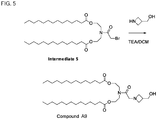
- Examples of an ionizable compound include the following compound A9: which is ((2-(3-(hydroxymethyl)azetidin-1-yl)acetyl)azanediyl)bis(ethane-2,1-diyl) ditetradecanoate.
- an ionizable compound examples include the following compound AA: which is ((2-(4-(2-hydroxyethyl)piperazin-1-yl)acetyl)azanediyl)bis(ethane-2,1-diyl) (9 Z ,9' Z ,12 Z ,12' Z )-bis(octadeca-9,12-dienoate).
- Examples of an ionizable compound include the following compound AB: which is ((2-(4-(2-hydroxyethyl)piperazin-1-yl)acetyl)azanediyl)bis(ethane-2,1-diyl) (9 Z ,9' Z ,12 Z ,12'Z)-bis(octadeca-9,12-dienoate).
- Examples of an ionizable compound include the following compound AC:
- Examples of an ionizable compound include the following compound AD:
- Examples of an ionizable compound include the following compound AE:
- Examples of an ionizable compound include the following compound AF:
- Examples of an ionizable compound include the following compound B2:
- Examples of an ionizable compound include the following compound B3:
- Examples of an ionizable compound include the following compound B4:
- Examples of an ionizable compound include the following compound B5:
- Examples of an ionizable compound include the following compound B6:
- Examples of an ionizable compound include the following compound B7:
- Examples of structural lipids include cholesterols, sterols, and steroids.
- Examples of structural lipids include cholanes, cholestanes, ergostanes, campestanes, poriferastanes, stigmastanes, gorgostanes, lanostanes, gonanes, estranes, androstanes, pregnanes, and cycloartanes.
- structural lipids include sterols and zoosterols such as cholesterol, lanosterol, zymosterol, zymostenol, desmosterol, stigmastanol, dihydrolanosterol, and 7-dehydrocholesterol.
- Examples of structural lipids include pegylated cholesterols, and cholestane 3-oxo-(C1-22)acyl compounds, for example, cholesteryl acetate, cholesteryl arachidonate, cholesteryl butyrate, cholesteryl hexanoate, cholesteryl myristate, cholesteryl palmitate, cholesteryl behenate, cholesteryl stearate, cholesteryl caprylate, cholesteryl n-decanoate, cholesteryl dodecanoate, cholesteryl nervonate, cholesteryl pelargonate, cholesteryl n-valerate, cholesteryl oleate, cholesteryl elaidate, cholesteryl erucate, cholesteryl heptanoate, cholesteryl linolelaidate, and cholesteryl linoleate.
- cholesteryl acetate cholesteryl arachidonate, cholesteryl buty
- lipids examples include sterols such as phytosterols, beta-sitosterol, campesterol, ergosterol, brassicasterol, delta-7-stigmasterol, and delta-7-avenasterol.
- sterols such as phytosterols, beta-sitosterol, campesterol, ergosterol, brassicasterol, delta-7-stigmasterol, and delta-7-avenasterol.
- stabilizer lipids examples include zwitterionic lipids.
- stabilizer lipids include compounds such as phospholipids.
- phospholipids include phosphatidylcholine, phosphatidylethanolamine, phosphatidylserine, phosphatidylinositol, phosphatidic acid, palmitoyloleoyl phosphatidylcholine, lysophosphatidylcholine, lysophosphatidylethanolamine, dipalmitoylphosphatidylcholine, dioleoylphosphatidylcholine, distearoylphosphatidylcholine and ordilinoleoylphosphatidylcholine.
- stabilizer lipids include phosphatidyl ethanolamine compounds and phosphatidyl choline compounds.
- stabilizer lipids examples include 1,2-dioleoyl- sn -Glycero-3-Phosphocholine (DOPC).
- DOPC 1,2-dioleoyl- sn -Glycero-3-Phosphocholine
- stabilizer lipids examples include diphytanoyl phosphatidyl ethanolamine (DPhPE) and 1,2-Diphytanoyl- sn -Glycero-3-Phosphocholine (DPhPC).
- DPhPE diphytanoyl phosphatidyl ethanolamine
- DPhPC 1,2-Diphytanoyl- sn -Glycero-3-Phosphocholine
- stabilizer lipids examples include 1,2-distearoyl-sn-glycero-3-phosphocholine (DSPC), 1,2-dipalmitoyl-sn-glycero-3-phosphocholine (DPPC), 1,2-dipalmitoyl-sn-glycero-3-phosphoethanolamine (DPPE), and 1,2-dioleoyl-sn-glycero-3-phosphoethanolamine (DOPE).
- DSPC 1,2-distearoyl-sn-glycero-3-phosphocholine
- DPPC 1,2-dipalmitoyl-sn-glycero-3-phosphocholine
- DPPE 1,2-dipalmitoyl-sn-glycero-3-phosphoethanolamine
- DOPE 1,2-dioleoyl-sn-glycero-3-phosphoethanolamine
- stabilizer lipids examples include 1,2-dilauroyl-sn-glycerol (DLG); 1,2-dimyristoyl-sn-glycerol (DMG); 1,2-dipalmitoyl-sn-glycerol (DPG); 1,2-distearoyl-sn-glycerol (DSG); 1,2-diarachidoyl-sn-glycero-3-phosphocholine (DAPC); 1,2-dilauroyl-sn-glycero-3-phosphocholine (DLPC); 1,2-dimyristoyl-sn-glycero-3-phosphocholine (DMPC); 1,2-dipalmitoyl-sn-glycero-O-ethyl-3-phosphocholine (DPePC); 1,2-dilauroyl-sn-glycero-3-phosphoethanolamine (DLPE); 1,2-dimyristoyl-sn-glycero-3-phosphoethanolamine (DMPE); 1,2-distearoyl-s
- lipids for reducing immunogenicity include polymeric compounds and polymer-lipid conjugates.
- lipids for reducing immunogenicity examples include pegylated lipids having polyethyleneglycol (PEG) regions.
- PEG regions can be of any molecular mass.
- a PEG region can have a molecular mass of 200, 300, 350, 400, 500, 550, 750, 1000, 1500, 2000, 3000, 3500, 4000 or 5000 Da.
- lipids for reducing immunogenicity include compounds having a methoxypolyethyleneglycol region.
- lipids for reducing immunogenicity include compounds having a carbonyl-methoxypolyethyleneglycol region.
- lipids for reducing immunogenicity include compounds having a multi-branched PEG region.
- lipids for reducing immunogenicity include compounds having a polyglycerine region.
- lipids for reducing immunogenicity examples include polymeric lipids such as DSPE-mPEG, DMPE-mPEG, DPPE-mPEG, and DOPE-mPEG.
- lipids for reducing immunogenicity examples include PEG-phospholipids and PEG-ceramides.
- cationic lipids examples include cationic HEDC compounds as described in US 2013/0330401 A1 . Some examples of cationic lipids are given in US 2013/0115274 A1 .
- a composition can contain the ionizable compound A6, the structural lipid cholesterol, the stabilizer lipids DOPC and DOPE, and the lipid for reducing immunogenicity DPPE-mPEG.
- compound A6 can be 15 to 25 mol% of the composition; the cholesterol, DOPC, and DOPE combined can be 75 to 85 mol% of the composition; and DPPE-mPEG can be 5 mol% of the composition.
- compound A6 can be 25 mol% of the composition; cholesterol can be 30 mol% of the composition, DOPC can be 20 mol% of the composition, DOPE can be 20 mol% of the composition; and DPPE-mPEG(2000) can be 5 mol% of the composition.
- Embodiments of this invention can provide liposome nanoparticle compositions.
- the ionizable molecules of this invention can be used to form liposome compositions, which can have one or more bilayer structures of lipid-like molecules.
- a nanoparticle composition can have one or more of the ionizable molecules of this invention in a liposomal structure, a bilayer structure, a micelle, a lamellar structure, or a mixture thereof.
- a composition can include one or more liquid vehicle components.
- a liquid vehicle suitable for delivery of active agents of this invention can be a pharmaceutically acceptable liquid vehicle.
- a liquid vehicle can include an organic solvent, or a combination of water and an organic solvent.
- Embodiments of this invention can provide lipid nanoparticles having a size of from 10 to 1000 nm. In some embodiments, the liposome nanoparticles can have a size of from 10 to 150 nm.
- This invention further contemplates methods for distributing an active agent to an organ of a subject for treating fibrosis by administering to the subject a composition of this invention.
- Organs that can be treated include lung, liver, pancreas, kidney, colon, heart, bone marrow, skin, intestine, brain and eye.
- this invention provides methods for treating a lung fibrosis disease by administering to the subject a composition of this invention.
- fibrosis disease examples include idiopathic lung fibrosis and liver cirrhosis.
- this invention provides a range of pharmaceutical formulations.
- a pharmaceutical formulation herein can include an active agent, as well as a drug carrier, or a lipid of this invention, along with a pharmaceutically acceptable carrier or diluent.
- active agents of this description include siRNAs, active agents for fibrosis, as well as any small molecule drug.
- a pharmaceutical formulation of this invention may contain one or more of each of the following: a surface active agent, a diluent, an excipient, a preservative, a stabilizer, a dye, and a suspension agent.
- preservatives examples include sodium benzoate, ascorbic acid, and esters of p-hydroxybenzoic acid.
- Examples of surface active agents include alcohols, esters, sulfated aliphatic alcohols.
- excipients include sucrose, glucose, lactose, starch, crystallized cellulose, mannitol, light anhydrous silicate, magnesium aluminate, magnesium metasilicate aluminate, synthetic aluminum silicate, calcium carbonate, sodium acid carbonate, calcium hydrogen phosphate, and calcium carboxymethyl cellulose.
- suspension agents examples include coconut oil, olive oil, sesame oil, peanut oil, soya, cellulose acetate phthalate, methylacetate-methacrylate copolymer, and ester phthalates.
- a compound of this invention may have one or more lipophilic tails that contain one or more alkyl or alkenyl groups.
- lipophilic tails having alkenyl groups include C(14:1(5))alkenyl, C(14:1(9))alkenyl, C(16:1(7))alkenyl, C(16:1(9))alkenyl, C(18:1(3))alkenyl, C(18:1(5))alkenyl, C(18:1(7))alkenyl, C(18:1(7))alkenyl, C(18:1(9))alkenyl, C(18:1(11))alkenyl, C(18:1(12))alkenyl, C(18:2(9,12))alkenyl, C(18:2(9,11)alkenyl, C(18:3(9,12,15))alkenyl, C(18:3(6,9,12))alkenyl, C(18:3
- lipophilic tails include the following structures:
- lipophilic tails may have one or more additional chemical branches.
- alkyl refers to a hydrocarbyl radical of a saturated aliphatic group, which can be of any length.
- An alkyl group can be a branched or unbranched, substituted or unsubstituted aliphatic group containing from 1 to 22 carbon atoms. This definition also applies to the alkyl portion of other groups such as, for example, cycloalkyl, alkoxy, alkanoyl, and aralkyl, for example.
- C(1-5)alkyl includes C(1)alkyl, C(2)alkyl, C(3)alkyl, C(4)alkyl, and C(5)alkyl.
- C(3-22)alkyl includes C(1)alkyl, C(2)alkyl, C(3)alkyl, C(4)alkyl, C(5)alkyl, C(6)alkyl, C(7)alkyl, C(8)alkyl, C(9)alkyl, C(10)alkyl, C(11)alkyl, C(12)alkyl, C(13)alkyl, C(14)alkyl, C(15)alkyl, C(16)alkyl, C(17)alkyl, C(18)alkyl, C(19)alkyl, C(20)alkyl, C(21)alkyl, and C(22)alkyl.
- an alkyl group may be designated by a term such as Me (methyl, -CH 3 ), Et (ethyl, -CH 2 CH 3 ), Pr (any propyl group), n Pr (n-Pr, n-propyl), i Pr (i-Pr, isopropyl), Bu (any butyl group), n Bu (n-Bu, n-butyl), i Bu (i-Bu, isobutyl), s Bu (s-Bu, sec-butyl), and t Bu (t-Bu, tert-butyl).
- alkenyl refers to hydrocarbyl radical having at least one carbon-carbon double bond.
- An alkenyl group can be branched or unbranched, substituted or unsubstituted hydrocarbyl radical having 2 to 22 carbon atoms and at least one carbon-carbon double bond.
- An “alkenyl” group has one or more carbon-carbon double bonds.
- substituted refers to an atom having one or more substitutions or substituents which can be the same or different and may include a hydrogen substituent.
- alkyl, cycloalkyl, alkenyl, alkoxy, alkanoyl, and aryl refer to groups which can include substituted variations.
- Substituted variations include linear, branched, and cyclic variations, and groups having a substituent or substituents replacing one or more hydrogens attached to any carbon atom of the group.
- a compound may contain one or more chiral centers.
- Compounds containing one or more chiral centers may include those described as an "isomer,” a “stereoisomer,” a “diastereomer,” an "enantiomer,” an “optical isomer,” or as a “racemic mixture.”
- Conventions for stereochemical nomenclature for example the stereoisomer naming rules of Cahn, Ingold and Prelog, as well as methods for the determination of stereochemistry and the separation of stereoisomers are known in the art. See, for example, Michael B. Smith and Jerry March, March's Advanced Organic Chemistry, 5th edition, 2001 .
- This invention encompasses any and all tautomeric, solvated or unsolvated, hydrated or unhydrated forms, as well as any atom isotope forms of the compounds and compositions disclosed herein.
- This invention encompasses any and all crystalline polymorphs or different crystalline forms of the compounds and compositions disclosed herein.
- Example 1 A scheme for the preparation of Compound A6 is shown in Fig. 1.
- reaction mixture was concentrated using a rotavapor, washed with saturated NaHCO 3 aqueous solution (300 mL), and extracted with DCM (300 mL, 200 mL). The combined organic layers were then dried over Na 2 SO 4 (20 g), filtered, and concentrated under reduced pressure.
- the crude was dissolved in 20 mL DCM and purified with a 330 g silica column using a gradient of hexane for 5 min, then 10% EtOAc/hexane for 20 min followed by 20% EtOAc/hexane for 20 min under the flow rate at 60 mL/min.
- the product fractions were collected and concentrated to yield Intermediate 2 (41.4 g, 82% yield) as a clear yellow liquid.
- Example 2 A scheme for the preparation of Compound AB is shown in Fig. 2.
- the crude was purified by flash chromatography purification system. Material directly loaded onto a 24 g silica column and using a gradient of DCM for 3 min, then 0-8% MeOH/DCM for 7 min followed by 8% MeOH/DCM for 20 min under the flow rate at 25 mL/min. The product fractions were collected and concentrated to yield Compound AB (379 mg, 76% yield) as a yellow liquid.
- Example 3 A scheme for the preparation of Compound A4 is shown in Fig. 3.
- Example 4 A scheme for the preparation of Compound B8 is shown in Fig. 4.
- Example 5 A scheme for the preparation of Compound A9 is shown in Fig. 5.
- Example 6 A scheme for the preparation of Compound AA is shown in Fig. 6.
- Example 7 A scheme for the preparation of Compound A5 is shown in Fig. 7.
- Example 8 A scheme for the preparation of Compound A1 is shown in Fig. 8.
- Example 9 A scheme for the preparation of Compound D22 is shown in Fig. 9.
- Example 10 A scheme for the preparation of Compounds A7 and A8 is shown in Fig. 10.
- Compound A8 Compound A7 (160 mg, 0.22 mmol) was added to methyl iodide (2 mL) in an oven-dried vial (20 mL) with a magnetic bar. The mixture was stirred at ambient temperature for 2 hours. Next, methyl iodide was removed under vacuum. The crude was dissolved in 1 mL DCM and purified with a 12 g silica column using a gradient of 2-20% MeOH/DCM for 30 min under the flow rate at 20 mL/min. The product fractions were collected and performed iodide to chloride anion exchange using resin Amberst 26. The resulting solution was finally concentrated under reduced pressure to give Compound A8 (100 mg, 59% yield) as a clear liquid.
- Example 11 A scheme for the preparation of Compounds C3 and C2 is shown in Fig. 11.
- Compound C2 Compound C3 (890 mg, 1.22 mmol) was dissolved in acetonitrile (9 mL) and iodomethane (1 mL) was added. Vial was flushed with argon gas and allowed to stir at 50 °C overnight. Next day, the reaction mixture was concentrated in vacuo and purified by flash chromatography purification system (40 g silica gel column) using a gradient of DCM for 2 min, then 0-8% MeOH/DCM for 20 min, then 8% MeOH/DCM for 5 min under the flow rate at 40 mL/min.
- flash chromatography purification system 40 g silica gel column
- Example 12 A scheme for the preparation of Compound DD is shown in Fig. 12.
- Example 13 A scheme for the preparation of Compound E4 is shown in Fig. 13.
- Example 14 A scheme for the preparation of Compound CA is shown in Fig. 14.
- Example 15 A scheme for the preparation of Compound D1 is shown in Fig. 15.
- Example 16 A scheme for the preparation of Compound D7 is shown in Fig. 16.
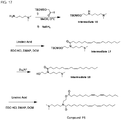
- Example 17 A scheme for the preparation of Compound F6 is shown in Fig. 17.
- the crude was purified by flash chromatography purification system (24 g silica gel column) using a gradient of DCM for 1 min, then 0-10% MeOH/DCM for 2 min, then 10% MeOH/DCM for 7 min, then 10-30% MeOH/DCM for 2 min, then 30% MeOH/DCM for 7 min under the flow rate at 35 mL/min.
- the product fractions were collected and concentrated to yield Intermediate 17 (460 mg, 24% yield) as a clear liquid.
- the product was verified with LC-MS prior to executing the next step.
- Example 18 A scheme for the preparation of Compounds F5 and F7 is shown in Fig. 18.
- Compound F7 Compound F5 (6.1 g, 9.04 mmol) was dissolved in acetonitrile (18 mL) and methyl iodide (2 mL) was added. Vial was flushed with argon gas and the mixture was allowed to stir at 40 °C for 4 hours. Afterwards, the mixture was concentrated in vacuo and purified by flash chromatography with loading the crude oil directly onto 120 g silica gel column and using a gradient of DCM for 2 min, then 0-10% MeOH/DCM for 10 min, then 10% MeOH/DCM for 5 min, then 10-15% MeOH/DCM for 5 min, then 15% MeOH/DCM for 5 min under the flow rate at 85 mL/min.
- Example 19 A scheme for the preparation of Compounds F8 and F9 is shown in Fig. 19.
- Compound F9 Compound F8 (620 mg, 1.09 mmol) was dissolved in acetonitrile (9 mL) and methyl iodide (1 mL) was added. The vial was flushed with argon gas and allowed to stir at 40 °C for 4 hours. Afterwards, the mixture was concentrated in vacuo and purified by flash chromatography with loading the crude oil directly onto 24 g silica gel column and using a gradient of DCM for 1 min, then 0-25% MeOH/DCM for 25 min under the flow rate at 32 mL/min.
- Example 20 A scheme for the preparation of Compounds C25 and C24 is shown in Fig. 20.
- reaction mixture was concentrated under reduced pressure, dissolved in 5 mL DCM and purified by flash chromatography purification system (220 g silica gel column) using a gradient of 0-50% EtOAc/hexane for 30 min under the flow rate at 60 mL/min.
- product fractions were collected and concentrated to yield Intermediate 24 (15.2 g, 100 % yield) as a clear liquid.
- reaction mixture was washed with 10% aqueous K 2 CO 3 solution (50 mL), extracted with DCM (2 x 50mL), dried over Na 2 SO 4 and concentrated by rotavapor.
- the crude was dissolved in 2 mL DCM and purified with a 40 g silica column using a gradient of 0-15% MeOH/DCM for 30 min under the flow rate at 40 mL/min.
- the product fractions were collected and concentrated to yield Compound C25 (1.5 g, 76.6% yield) as a clear liquid.
- Compound C24 Compound C25 (1.5 g, 2.14 mmol) was added to methyl iodide (2 mL) in an oven-dried vial (20 mL) with a magnetic bar. The mixture was stirred at ambient temperature overnight (17 hours). Next, the excess reagent was removed under vacuum. The crude was dissolved in 1 mL DCM and purified with a 40 g silica column using a gradient of 0-15% MeOH/DCM for 30 min under the flow rate at 30 mL/min. The product fractions were combined, concentrated, and subjected to Amberlyst A26 Anion Exchange resin to yield Compound C24 (1.6 g, 96% yield) as a clear liquid.
- Example 21 A scheme for the preparation of Compound D16 is shown in Fig. 21.
- Example 22 A scheme for the preparation of Compound D17 is shown in Fig. 22.
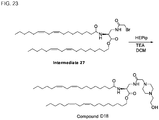
- Example 23 A scheme for the preparation of Compound D18 is shown in Fig. 23.
- Example 24 A scheme for the preparation of Compound D19 is shown in Fig. 24.
- Example 25 A scheme for the preparation of Compound D20 is shown in Fig. 25.
- Example 26 A scheme for the preparation of Compound D21 is shown in Fig. 26.
- reaction mixture was filtered, and concentrated under reduced pressure, which was purified with a 12 g silica column using a gradient of 0-20% MeOH/DCM for 30 min under the flow rate at 20 mL/min.
- product fractions were collected and concentrated to yield Compound D21 (150 mg, 30% yield) as a clear liquid.
- Example 27 A scheme for the preparation of Compound E37 is shown in Fig. 27.
- reaction mixture was concentrated under reduced pressure and purified by flash chromatography purification system (24 g silica gel column) using a gradient of 0-10% MeOH/DCM for 30 min under the flow rate at 25 mL/min.
- product fractions were collected and concentrated to yield Compound E37 (2.0 g, 92% yield) as a clear oil.
- Example 28 A scheme for the preparation of Compounds E38 and E39 is shown in Fig. 28.
- reaction mixture was then diluted with DCM (25 mL), washed with sodium bicarbonate (20 mL), dried over Na 2 SO 4 (5 g), filtered, and concentrated under reduced pressure.
- the crude was purified by flash chromatography purification system (120 g silica gel column) using a gradient of 0-10% MeOH/DCM for 30 min under the flow rate at 25 mL/min.
- the product fractions were collected and concentrated to yield Intermediate 35 (6.1 g, 80% yield) as a clear oil.
- reaction mixture was concentrated under reduced pressure and purified by flash chromatography purification system (24 g silica gel column) using a gradient of 0-10% MeOH/DCM for 30 min under the flow rate at 25 mL/min.
- product fractions were collected and concentrated to yield Compound E38 (750 mg, 95% yield) as a clear oil.
- Compound E39 Compound E38 (350 mg, 0.46 mmol) was added to methyl iodide (2 mL) in an oven-dried vial (20 mL) with a magnetic bar. The mixture was stirred at ambient temperature overnight (17 hours). Next, the excess reagent was removed under vacuum. The crude was dissolved in 1 mL DCM and purified with a 40 g silica column using a gradient of 0-15% MeOH/DCM for 30 min under the flow rate at 30 mL/min. The product fractions were combined, concentrated, and subjected to Amberlyst A26 Anion Exchange resin to yield Compound E39 (165 mg, 82% yield) as a clear liquid.
- Example 29 A scheme for the preparation of Compound E40 is shown in Fig. 29.
- the reaction mixture was diluted with DCM (25 mL), washed with sodium bicarbonate (20 mL) dried over Na 2 SO 4 (5 g), filtered, and concentrated under reduced pressure.
- the crude was purified by flash chromatography purification system (330 g silica gel column) using a gradient of 0-20% MeOH/DCM for 30 min under the flow rate at 25 mL/min.
- the product fractions were collected and concentrated to yield Intermediate 41 (5.8 g, 94% yield) as a colorless oil.
- Example 30 A scheme for the preparation of Compound A23 is shown in Fig. 30.
- Example 31 A scheme for the preparation of Compound A24 is shown in Fig. 31.
- reaction mixture was diluted with DCM (100 mL), washed with sodium bicarbonate (20 mL) dried over Na 2 SO 4 (5 g), filtered, and concentrated under reduced pressure.
- the crude was purified by flash chromatography purification system (120 g silica gel column) using 1:2 v/v EtOAc/hexane for 30 min under the flow rate at 25 mL/min.
- the product fractions were collected and concentrated to yield Intermediate 46 (4.3 g, 90% yield) as a clear oil.
- Example 32 A scheme for the preparation of Compound A25 is shown in Fig. 32.
- Example 33 Example formulations are prepared for encapsulating a small interfering nucleic acid agents (siRNA), as shown in Table 3.
- siRNA small interfering nucleic acid agents
- Table 3 Lipid formulations for siRNA No. Compound C2 (mol%) Cholesterol (mol%) DOPE (mol%) DOPC (mol%) DPPE-mPEG(2000) (mol%) EE* (%) 1 25 30 30 10 5 >90 2 25 30 25 15 5 >90 3 25 30 20 20 5 >90 4 25 30 15 25 5 >90 5 25 30 10 30 5 >90 6 25 35 15 20 5 >90 7 25 35 20 15 5 >90 8 30 30 15 20 5 >90 9 30 30 20 15 5 >90 10 35 30 15 15 5 >90 * Encapsulation efficiency for siRNA.
- Example 34 Example formulations are prepared for encapsulating a small interfering nucleic acid agents (siRNA), as shown in Table 4.
- siRNA small interfering nucleic acid agents
- Table 4 Lipid formulations for siRNA No. Compound A9 (mol%) Cholesterol (mol%) DOPE (mol%) DOPC (mol%) DPPE-mPEG(2000) (mol%) EE* (%) 1 25 30 30 10 5 >90 2 25 30 25 15 5 >90 3 25 30 20 20 5 >90 4 25 30 15 25 5 >90 5 25 30 10 30 5 >90 6 25 35 15 20 5 >90 7 25 35 20 15 5 >90 8 30 30 15 20 5 >90 9 30 30 20 15 5 >90 10 35 30 15 15 5 >90 * Encapsulation efficiency for siRNA.
- Example 35 Example formulations are prepared for encapsulating a small interfering nucleic acid agents (siRNA), as shown in Table 5.
- siRNA small interfering nucleic acid agents
- Example 36 Example formulations are prepared for encapsulating a small interfering nucleic acid agents (siRNA), as shown in Table 6.
- siRNA small interfering nucleic acid agents
- Table 6 Lipid formulations for siRNA No. Compound F5 (mol%) Cholesterol (mol%) DOPE (mol%) DOPC (mol%) DPPE-mPEG(2000) (mol%) EE* (%) 1 25 30 30 10 5 >90 2 25 30 25 15 5 >90 3 25 30 20 20 5 >90 4 25 30 15 25 5 >90 5 25 30 10 30 5 >90 6 25 35 15 20 5 >90 7 25 35 20 15 5 >90 8 30 30 15 20 5 >90 9 30 30 20 15 5 >90 10 35 30 15 15 5 >90 * Encapsulation efficiency for siRNA.
- Example 37 Formulations were prepared for encapsulating a small interfering nucleic acid agents (siRNA), as shown in Table 7.
- siRNA small interfering nucleic acid agents
- Table 7 Lipid formulations for siRNA No. Compound A6 (mol%) Cholesterol (mol%) DOPE (mol%) DOPC (mol%) DPPE-mPEG(2000) (mol%) EE* (%) 1 25 30 30 10 5 92 2 25 30 25 15 5 91 3 25 30 20 20 5 87 4 25 30 15 25 5 93 5 25 30 10 30 5 92 6 25 35 15 20 5 93 7 25 35 20 15 5 95 8 30 30 15 20 5 87 9 30 30 20 15 5 92 10 35 30 15 15 5 88 * Encapsulation efficiency for siRNA.
- Example 38 Formulations were prepared for encapsulating a small interfering nucleic acid agents (siRNA).
- Lipid nanoparticle formulations were prepared with the following compositions: (Ionizable compound/DOPE/DOPC/Cholesterol/DMPE-PEG) mol%
- Table 8 Characteristics of the nanoparticle formulations are shown in Table 8. The formulations had superior properties for encapsulating the siRNA, and in having small particle size. Table 8: Lipid formulations for siRNA Compound No. Z (ave) nm EE* (%) C2 111 95 A6 121 96 A9 97 95 D15 117 96 C24 127 98 DD 132 92 E4 131 94 AA 120 90 * Encapsulation efficiency for siRNA.
- Example 39 Formulations were prepared for encapsulating a small interfering nucleic acid agents (siRNA).
- Lipid nanoparticle formulations were prepared with the following compositions: (Ionizable compound/DOPE/Cholesterol/DMPE-PEG) mol% 50/28/21/1.
- Example 40 Example formulations are prepared for encapsulating a small interfering nucleic acid agents (siRNA).
- siRNA small interfering nucleic acid agents
- Lipid nanoparticle formulations are prepared with the following compositions: (Ionizable compound/DOPE/Cholesterol/DMPE-PEG) mol% 50/28/21/1.
- Serum stability of a nanoparticle formulation is measured and is shown in Table 10.
- the formulations are capable of encapsulating the siRNA, and retaining stability in human serum.
- Table 10 Lipid formulations for siRNA Compound t(1/2) (hr) human serum 37C C24 > 50 AB > 50 A6 > 50 B8 > 50 A23 > 50 A5 > 50 A7 > 50 A8 > 50 E38 > 50 DD > 50 E4 > 50 C25 > 50 E39 > 50
- a compound, molecule or composition of this invention may have an ionic form for which the corresponding counterion or counterions are not shown.
- counterion or counterions will exist as necessary. Examples of counterions include alkali metal ions, Cl - , and pharmaceutically acceptable counterions.
Landscapes
- Chemical & Material Sciences (AREA)
- Health & Medical Sciences (AREA)
- Organic Chemistry (AREA)
- Life Sciences & Earth Sciences (AREA)
- General Health & Medical Sciences (AREA)
- Veterinary Medicine (AREA)
- Public Health (AREA)
- Animal Behavior & Ethology (AREA)
- Medicinal Chemistry (AREA)
- Pharmacology & Pharmacy (AREA)
- Epidemiology (AREA)
- Engineering & Computer Science (AREA)
- Molecular Biology (AREA)
- Biochemistry (AREA)
- Chemical Kinetics & Catalysis (AREA)
- General Chemical & Material Sciences (AREA)
- Bioinformatics & Cheminformatics (AREA)
- Oil, Petroleum & Natural Gas (AREA)
- Optics & Photonics (AREA)
- Nanotechnology (AREA)
- Biomedical Technology (AREA)
- Physics & Mathematics (AREA)
- Biophysics (AREA)
- Dispersion Chemistry (AREA)
- Nuclear Medicine, Radiotherapy & Molecular Imaging (AREA)
- Pharmaceuticals Containing Other Organic And Inorganic Compounds (AREA)
- Medicinal Preparation (AREA)
- Organic Low-Molecular-Weight Compounds And Preparation Thereof (AREA)
- Pyrrole Compounds (AREA)
- Medicines That Contain Protein Lipid Enzymes And Other Medicines (AREA)
- Hydrogenated Pyridines (AREA)
- Plural Heterocyclic Compounds (AREA)
- Acyclic And Carbocyclic Compounds In Medicinal Compositions (AREA)
Claims (12)
- Composé comprenant la structure présentée dans la Formule I

R1 = CH2(CH2)nOC(=O)R4
R2 = CH2(CH2)mOC(=O)R5
dans lequel n et m sont chacun indépendamment de 1 à 2 ; et R4 et R5 sont indépendamment pour chaque occurrence un groupe alkyle en C(12-20), ou un groupe alcényle en C(12-20) ;
dans lequel R3 est sélectionné parmi
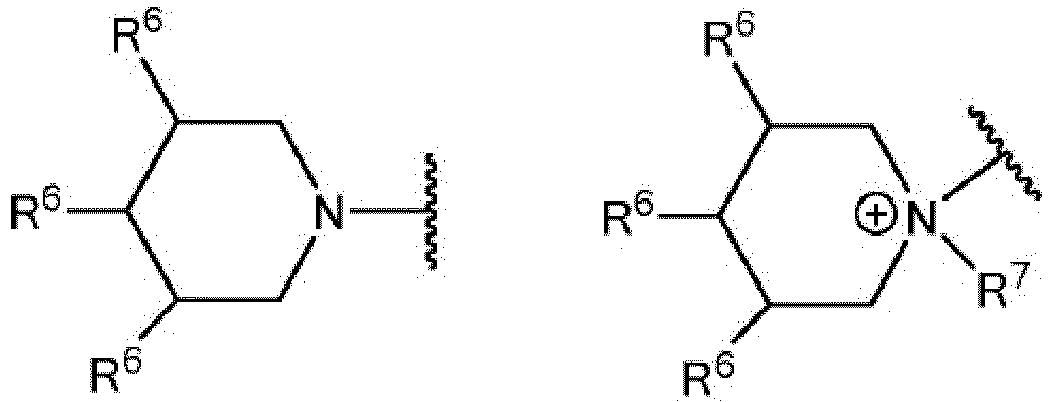

 chaque R6 est indépendamment sélectionné parmi H, un alkyle, un hydroxyle, un hydroxyalkyle, un alcoxy, un alcoxyalcoxy, et un aminoalkyle ;chaque R7 est indépendamment sélectionné parmi H, un alkyle, un hydroxyalkyle, et un aminoalkyle ;Q est O ou NR7,dans lequel l'alkyle est un alkyle en C(1-6), l'hydroxyalkyle est un hydroxyl[alkyle en C(1-6)], et l'aminoalkyle est un amino[alkyle en C(1-6)].
 - Composé selon la revendication 1, dans lequel R4 et R5 sont indépendamment pour chaque occurrence un groupe alkyle en C(14-18), ou un groupe alcényle en C(14-18).
- Composé selon la revendication 1, dans lequel Q est O, dans lequel n et m sont chacun 1.
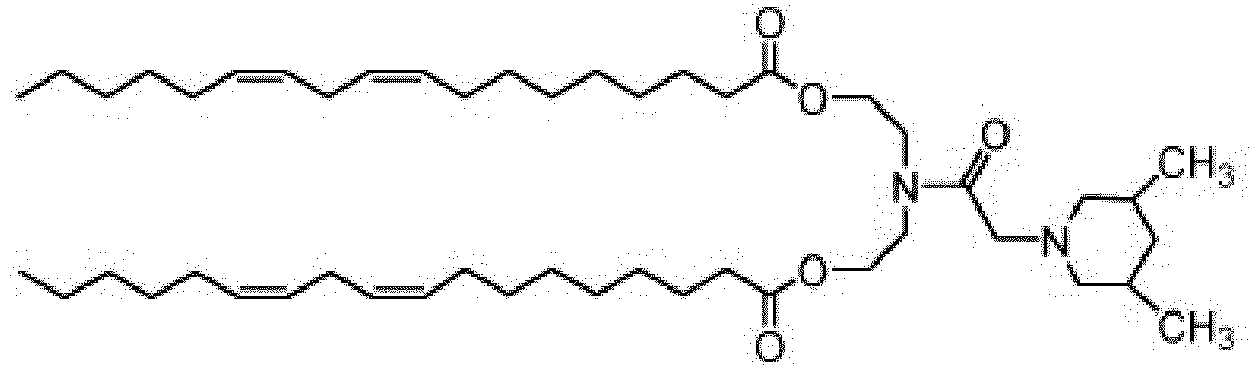
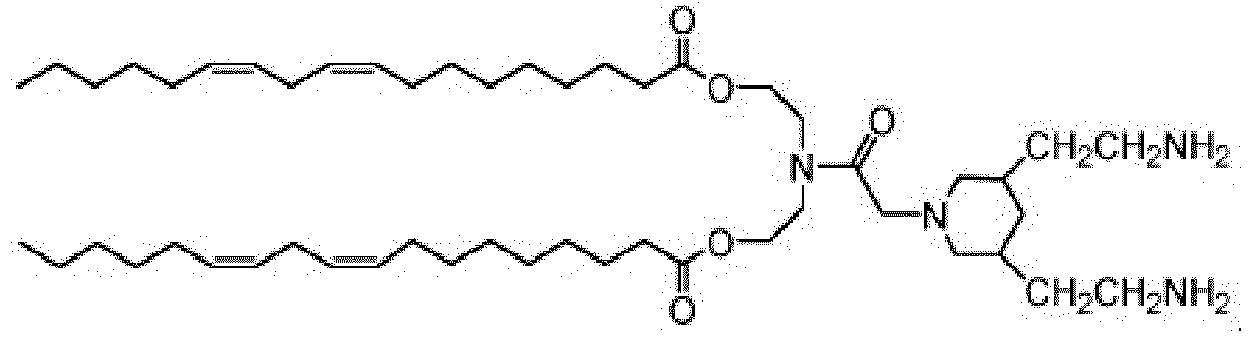
- Composé selon la revendication 1, ayant une structure sélectionnée parmi


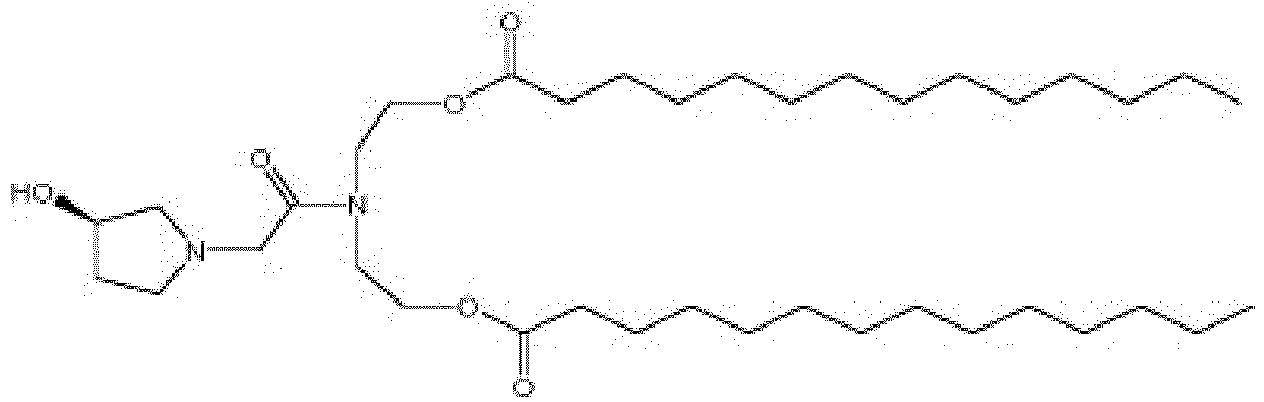


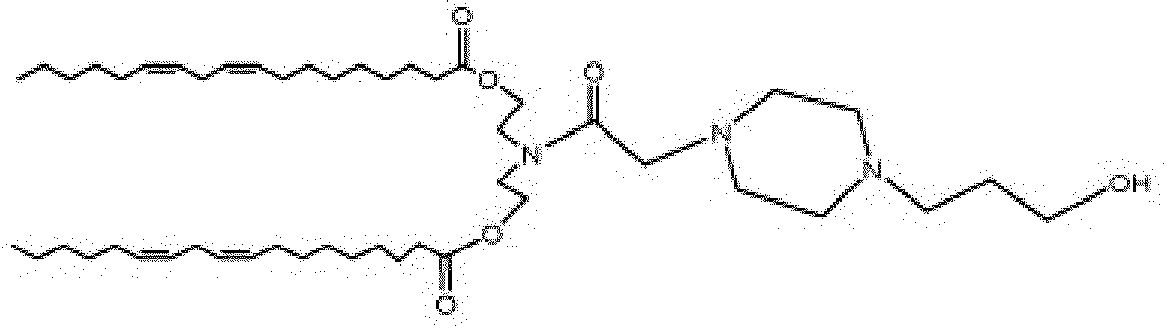


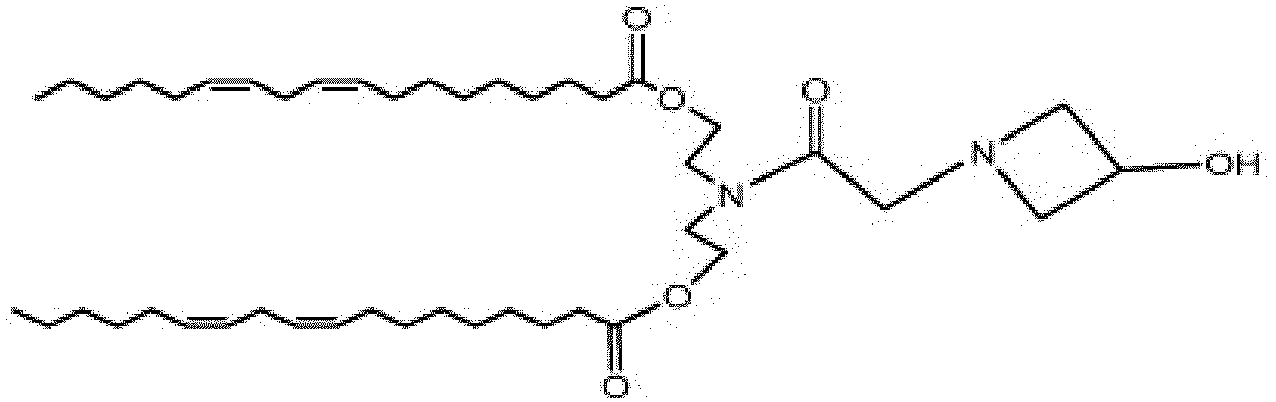


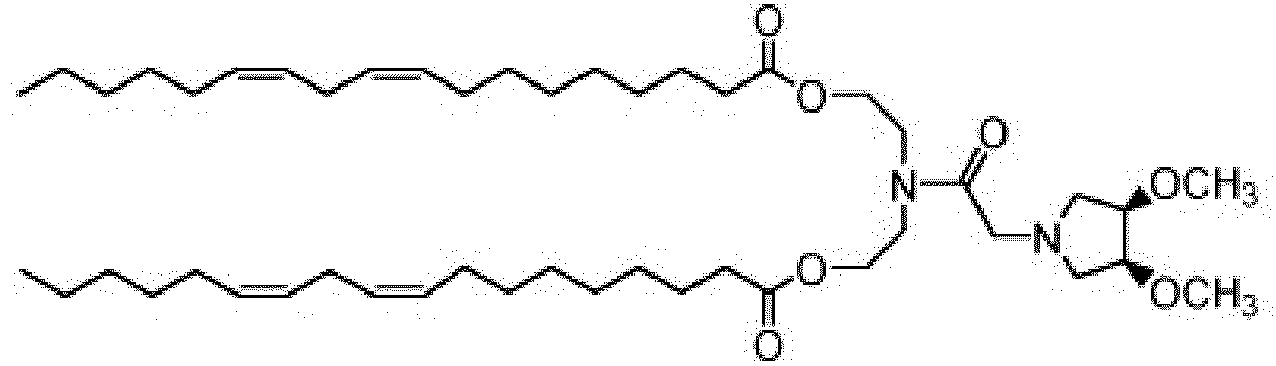




- Composition comprenant un composé ionisable selon l'une quelconque des revendications 1 à 4 et un vecteur pharmaceutiquement acceptable.
- Composition selon la revendication 5, dans laquelle la composition comprend des nanoparticules.
- Composition pharmaceutique comprenant un composé ionisable selon l'une quelconque des revendications 1 à 4, un agent actif et un vecteur pharmaceutiquement acceptable.
- Composition selon la revendication 7, dans laquelle le composé ionisable est de 15 % en moles à 40 % en moles des lipides de la composition.
- Composition selon la revendication 7, dans laquelle la composition comprend des nanoparticules.
- Composition selon la revendication 7, dans laquelle l'agent actif est une ou plusieurs molécules d'ARNi.
- Composition selon la revendication 7, dans laquelle l'agent actif est une ou plusieurs molécules d'ARNi sélectionnées parmi les petits ARN interférents (ARNsi), les ARN bicaténaires (ARNdb) qui sont des substrats de Dicer, les micros ARN (miARN), les ARN en épingle à cheveux courts (ARNsh), les ARN dirigés par l'ADN (ARNdd), les ARN interagissant avec Piwi (ARNpi), les ARNsi associés à des répétitions (ARNrasi), et les formes modifiées de ceux-ci.
- Composition selon la revendication 7, comprenant en outre, un lipide structural, un lipide stabilisateur, et un lipide pour réduire l'immunogénicité de la composition.
Priority Applications (1)
| Application Number | Priority Date | Filing Date | Title |
|---|---|---|---|
| EP20163284.1A EP3686184A3 (fr) | 2015-06-24 | 2016-06-23 | Composés et compositions ionisables et leurs utilisations |
Applications Claiming Priority (2)
| Application Number | Priority Date | Filing Date | Title |
|---|---|---|---|
| US201562184188P | 2015-06-24 | 2015-06-24 | |
| PCT/US2016/039114 WO2016210190A1 (fr) | 2015-06-24 | 2016-06-23 | Composés ionisabses, leurs compositions et utilisations |
Related Child Applications (2)
| Application Number | Title | Priority Date | Filing Date |
|---|---|---|---|
| EP20163284.1A Division-Into EP3686184A3 (fr) | 2015-06-24 | 2016-06-23 | Composés et compositions ionisables et leurs utilisations |
| EP20163284.1A Division EP3686184A3 (fr) | 2015-06-24 | 2016-06-23 | Composés et compositions ionisables et leurs utilisations |
Publications (3)
| Publication Number | Publication Date |
|---|---|
| EP3313449A1 EP3313449A1 (fr) | 2018-05-02 |
| EP3313449A4 EP3313449A4 (fr) | 2018-11-07 |
| EP3313449B1 true EP3313449B1 (fr) | 2020-09-23 |
Family
ID=57585619
Family Applications (2)
| Application Number | Title | Priority Date | Filing Date |
|---|---|---|---|
| EP16815348.4A Active EP3313449B1 (fr) | 2015-06-24 | 2016-06-23 | Composés ionisabses, leurs compositions et utilisations |
| EP20163284.1A Pending EP3686184A3 (fr) | 2015-06-24 | 2016-06-23 | Composés et compositions ionisables et leurs utilisations |
Family Applications After (1)
| Application Number | Title | Priority Date | Filing Date |
|---|---|---|---|
| EP20163284.1A Pending EP3686184A3 (fr) | 2015-06-24 | 2016-06-23 | Composés et compositions ionisables et leurs utilisations |
Country Status (11)
| Country | Link |
|---|---|
| US (4) | US10167253B2 (fr) |
| EP (2) | EP3313449B1 (fr) |
| JP (1) | JP6480025B2 (fr) |
| KR (1) | KR102659774B1 (fr) |
| CN (1) | CN107708739A (fr) |
| AU (1) | AU2016281685B2 (fr) |
| CA (1) | CA2990668C (fr) |
| ES (1) | ES2828717T3 (fr) |
| PT (1) | PT3313449T (fr) |
| TW (1) | TWI746442B (fr) |
| WO (1) | WO2016210190A1 (fr) |
Families Citing this family (26)
| Publication number | Priority date | Publication date | Assignee | Title |
|---|---|---|---|---|
| EP3313449B1 (fr) * | 2015-06-24 | 2020-09-23 | Nitto Denko Corporation | Composés ionisabses, leurs compositions et utilisations |
| US12491261B2 (en) | 2016-10-26 | 2025-12-09 | Acuitas Therapeutics, Inc. | Lipid nanoparticle formulations |
| JP6997862B2 (ja) * | 2018-08-21 | 2022-02-10 | 株式会社東芝 | 生分解性化合物、脂質粒子、脂質粒子を含む組成物、およびキット |
| JP7543259B2 (ja) | 2018-10-18 | 2024-09-02 | アクイタス セラピューティクス インコーポレイテッド | 活性剤の脂質ナノ粒子送達のための脂質 |
| EP4365289A3 (fr) * | 2018-11-16 | 2024-07-10 | Nitto Denko Corporation | Formulation d'administration d'interférence arn et procédés pour des tumeurs malignes |
| MY202837A (en) * | 2019-01-11 | 2024-05-24 | Acuitas Therapeutics Inc | Lipids for lipid nanoparticle delivery of active agents |
| JP7681617B2 (ja) * | 2020-04-09 | 2025-05-22 | スージョウ・アボジェン・バイオサイエンシズ・カンパニー・リミテッド | 脂質ナノ粒子組成物 |
| EP4132576A1 (fr) | 2020-04-09 | 2023-02-15 | Suzhou Abogen Biosciences Co., Ltd. | Vaccins à base d'acide nucléique pour coronavirus |
| US20220049251A1 (en) * | 2020-05-20 | 2022-02-17 | Nitto Denko Corporation | dsRNA Directed to Coronavirus Proteins |
| WO2022016070A1 (fr) | 2020-07-16 | 2022-01-20 | Acuitas Therapeutics, Inc. | Lipides cationiques destinés à être utilisés dans des nanoparticules lipidiques |
| MX2023000802A (es) * | 2020-07-17 | 2023-02-27 | Sanofi Pasteur | Compuestos lipidicos escindibles, composiciones que los contienen y usos de los mismos. |
| CN113185421B (zh) * | 2020-11-27 | 2022-01-25 | 广州市锐博生物科技有限公司 | 脂质化合物及其组合物 |
| MX2023009345A (es) * | 2021-02-10 | 2023-10-24 | Oncorus Inc | Compuestos, composiciones y metodos de uso de estos. |
| CN115466269A (zh) * | 2021-06-11 | 2022-12-13 | 复旦大学 | 一种胆碱碳酸酯类前药及其制备方法和应用 |
| CA3242402A1 (fr) | 2021-12-16 | 2023-06-22 | Acuitas Therapeutics, Inc. | Lipides destines a etre utilises dans des formulations de nanoparticules lipidiques |
| US20250108007A1 (en) * | 2021-12-23 | 2025-04-03 | Suzhou Abogen Biosciences Co., Ltd. | Lipid compound and lipid nanoparticle composition |
| WO2023126053A1 (fr) * | 2021-12-28 | 2023-07-06 | BioNTech SE | Formulations à base de lipides pour administration d'arn |
| CN116396244B (zh) * | 2021-12-31 | 2025-07-11 | 厦门赛诺邦格生物科技股份有限公司 | 一种含氮杂环的阳离子脂质及其应用 |
| EP4393511A4 (fr) * | 2022-07-11 | 2025-04-02 | Themedium Therapeutics Co., Ltd. | Composé lipidique et son utilisation |
| WO2024032754A1 (fr) * | 2022-08-12 | 2024-02-15 | 上海蓝鹊生物医药有限公司 | Composé à chaîne contenant de l'azote, son procédé de préparation, composition contenant ledit composé et utilisation associée |
| CN115947672B (zh) * | 2023-01-04 | 2024-02-27 | 成都威斯津生物医药科技有限公司 | 用于递送药物的化合物、脂质体及药物载体 |
| WO2024226958A2 (fr) * | 2023-04-28 | 2024-10-31 | Nitto Denko Corporation | Lipides, compositions pharmaceutiques les comprenant et procédés d'administration d'ingrédients pharmaceutiques actifs |
| EP4480943A1 (fr) * | 2023-06-22 | 2024-12-25 | Oz Biosciences | Nouvelle classe de lipides pour l'administration de principes actifs dans des cellules |
| WO2025059107A1 (fr) * | 2023-09-11 | 2025-03-20 | The Trustees Of The University Of Pennsylvania | Composés lipidiques ramifiés, dégradables, leurs procédés de préparation, nanoparticules lipidiques (lnps) les comprenant et leurs procédés d'utilisation |
| AU2024344058A1 (en) * | 2023-09-18 | 2026-04-02 | Flagship Pioneering Innovations Vii, Llc | Ionizable lipidoid compositions and therapeutic uses thereof |
| CN121419967A (zh) * | 2023-12-29 | 2026-01-27 | 厦门赛诺邦格生物科技股份有限公司 | 一种哌嗪环支化的不对称阳离子脂质 |
Family Cites Families (56)
| Publication number | Priority date | Publication date | Assignee | Title |
|---|---|---|---|---|
| US4115548A (en) | 1974-01-18 | 1978-09-19 | The Procter & Gamble Company | Detergent compositions comprising modified proteins |
| CS226907B1 (en) * | 1981-08-07 | 1984-04-16 | Kasafirek Evzen | Alkylamides of carboxyalkanoylpeptides |
| DE3806852A1 (de) | 1988-03-03 | 1989-09-14 | Knoll Ag | Neue (alpha)-aminodicarbonsaeure-derivate, ihre herstellung und verwendung |
| EP0490919B1 (fr) | 1989-08-29 | 2001-01-17 | Virginia Commonwealth University | COMPOSES CYTOPROTECTEURS PORTANT DES GROUPEMENTS HYDROCARBONES INSATURES AYANT DE 16 à 20 ATOMES DE CARBONE |
| US5082683A (en) | 1990-08-01 | 1992-01-21 | Nabisco Brands, Inc. | Amide/amine ester derivatives as low calorie fat mimetics |
| JP2575235B2 (ja) | 1991-04-11 | 1997-01-22 | 株式会社トクヤマ | イオン感応膜の製造方法 |
| DE4112971A1 (de) | 1991-04-20 | 1992-10-22 | Hoechst Ag | Sulfonsaeureester von 2,4,6-tris-(2-hydroxy-ethoxy)-(1,3,5)triazin, ein damit hergestelltes positiv arbeitendes strahlungsempfindliches gemisch und aufzeichnungsmaterial |
| MY111077A (en) | 1992-11-13 | 1999-08-30 | Kao Corp | Agricultural chemical composition |
| JP2994898B2 (ja) | 1992-12-28 | 1999-12-27 | 花王株式会社 | 液体柔軟仕上剤 |
| JPH06336466A (ja) * | 1993-05-26 | 1994-12-06 | Lion Corp | 新規なアミドエステルアミン化合物、その中間体及びその製造方法と柔軟剤 |
| JPH0718570A (ja) | 1993-06-29 | 1995-01-20 | Lion Corp | 柔軟剤組成物 |
| JPH0718569A (ja) | 1993-06-29 | 1995-01-20 | Lion Corp | 柔軟剤組成物 |
| JPH08295657A (ja) | 1995-04-27 | 1996-11-12 | Kanebo Ltd | 界面活性剤の中間体 |
| DE19605175A1 (de) * | 1996-02-13 | 1997-08-14 | Sourovoi Andrej Dr | Lipidverbindungen und deren Verwendung |
| NZ513800A (en) | 1996-08-12 | 2001-09-28 | Welfide Corp | Treatment of diseases using Rho kinase inhibitors |
| DE19637043A1 (de) | 1996-09-12 | 1998-03-19 | Boehringer Mannheim Gmbh | Neue Aminoalkoholderivate, Verfahren zu deren Herstellung und diese Verbindungen enthaltende Arzneimittel und Reagenzien |
| US5958894A (en) | 1997-04-04 | 1999-09-28 | Megabios Corporation | Amphiphilic biguanide derivatives |
| JP2001500162A (ja) * | 1997-06-12 | 2001-01-09 | トランジェーヌ、ソシエテ、アノニム | 少なくとも1種の治療上有効な物質、特にポリヌクレオチド、を標的細胞に導入するための新規脂質複合体および遺伝子治療における使用 |
| US6372254B1 (en) * | 1998-04-02 | 2002-04-16 | Impax Pharmaceuticals Inc. | Press coated, pulsatile drug delivery system suitable for oral administration |
| US6399629B1 (en) * | 1998-06-01 | 2002-06-04 | Microcide Pharmaceuticals, Inc. | Efflux pump inhibitors |
| JP2001247532A (ja) | 2000-03-08 | 2001-09-11 | Chukyo Yushi Kk | 脂肪酸アミド化合物およびその用途 |
| GB0024428D0 (en) * | 2000-10-05 | 2000-11-22 | King S College | Absorption enhancers |
| AU1201502A (en) * | 2000-10-13 | 2002-04-22 | Shire Biochem Inc | Dioxolane analogs for improved inter-cellular delivery |
| JP4823430B2 (ja) * | 2001-03-28 | 2011-11-24 | 花王株式会社 | 界面活性剤組成物 |
| JP2004250343A (ja) | 2003-02-18 | 2004-09-09 | Fuji Photo Film Co Ltd | ヨードアリール基を有するアミノ酸誘導体 |
| WO2005054486A1 (fr) * | 2003-12-05 | 2005-06-16 | Fukuoka Prefectural Government | Procede de preparation de reactif de transfert genetique |
| JP2006254877A (ja) * | 2005-03-18 | 2006-09-28 | Fukuoka Prefecture | 糖脂質を含んだキャリア及びそれを用いた遺伝子導入法 |
| CR9465A (es) * | 2005-03-25 | 2008-06-19 | Surface Logix Inc | Compuestos mejorados farmacocineticamente |
| US7915230B2 (en) | 2005-05-17 | 2011-03-29 | Molecular Transfer, Inc. | Reagents for transfection of eukaryotic cells |
| EP2604255B1 (fr) | 2006-05-05 | 2017-10-25 | Molecular Transfer, Inc. | Nouveaux réactifs de transfection de cellules eucaryotes |
| US20080132500A1 (en) * | 2006-10-20 | 2008-06-05 | Kun Liu | Antibiotic compounds |
| WO2008108944A2 (fr) * | 2007-03-01 | 2008-09-12 | Mallinckrodt Inc. | Petites molécules photoactives intégrées et leurs utilisations |
| GB0720486D0 (en) | 2007-10-19 | 2007-11-28 | Univ Edinburgh | Cationic lipids |
| US20110052673A1 (en) | 2008-01-29 | 2011-03-03 | Arthur Tzianabos | Therapeutic compositions |
| JP5062042B2 (ja) | 2008-05-28 | 2012-10-31 | コニカミノルタビジネステクノロジーズ株式会社 | 静電荷像現像用トナーと画像形成方法 |
| EP2143726A1 (fr) * | 2008-07-11 | 2010-01-13 | Novosom AG | Acide nucléique comprenant des nucleéotides zwitterioniques |
| WO2010054384A1 (fr) | 2008-11-10 | 2010-05-14 | Alnylam Pharmaceuticals, Inc. | Lipides et compositions pour l’administration d’agents thérapeutiques |
| JP5515360B2 (ja) | 2009-03-30 | 2014-06-11 | 日油株式会社 | 脂質誘導体 |
| CN101648121B (zh) | 2009-08-21 | 2012-08-29 | 江苏钟山化工有限公司 | 一种水溶性增稠剂及其制法和在农药制剂中的应用 |
| JP5902616B2 (ja) * | 2010-04-28 | 2016-04-13 | 協和発酵キリン株式会社 | カチオン性脂質 |
| US20160015656A2 (en) * | 2010-08-05 | 2016-01-21 | Nitto Denko Corporation | Composition for regenerating normal tissue from fibrotic tissue |
| CA2824526C (fr) * | 2011-01-11 | 2020-07-07 | Alnylam Pharmaceuticals, Inc. | Lipides pegyles et leur utilisation pour une administration de medicament |
| WO2012132022A1 (fr) | 2011-03-30 | 2012-10-04 | Fukuoka Prefectural Government | Agent pour promouvoir le transfert de gène et procédé de transfert de gène utilisant cet agent |
| AU2012242455A1 (en) | 2011-04-15 | 2013-11-28 | Molecular Transfer, Inc. | Agents for improved delivery of nucleic acids to eukaryotic cells |
| WO2013158127A1 (fr) | 2012-04-16 | 2013-10-24 | Molecular Transfer, Inc. | Agents permettant d'améliorer l'administration d'acides nucléiques dans des cellules eucaryotes |
| WO2012162210A1 (fr) | 2011-05-26 | 2012-11-29 | Merck Sharp & Dohme Corp. | Lipides cationiques maintenus dans un anneau pour une fourniture d'oligonucléotides |
| US9011903B2 (en) * | 2011-06-08 | 2015-04-21 | Nitto Denko Corporation | Cationic lipids for therapeutic agent delivery formulations |
| CN107043334B (zh) * | 2011-06-08 | 2020-06-16 | 日东电工株式会社 | 用于定向药物输送和增强siRNA活性的化合物 |
| JP2013095755A (ja) * | 2011-11-02 | 2013-05-20 | Kyowa Hakko Kirin Co Ltd | カチオン性脂質 |
| US9579338B2 (en) | 2011-11-04 | 2017-02-28 | Nitto Denko Corporation | Method of producing lipid nanoparticles for drug delivery |
| JP6288911B2 (ja) * | 2011-12-01 | 2018-03-07 | 学校法人東京薬科大学 | リードスルー活性を有する化合物 |
| US9603800B2 (en) | 2012-04-12 | 2017-03-28 | Yale University | Methods of treating inflammatory and autoimmune diseases and disorders using nanolipogels |
| SI2858974T1 (sl) | 2012-06-08 | 2019-01-31 | Nitto Denko Corporation | Lipidi za formulacije za dostavo terapevtskega sredstva |
| US10264976B2 (en) * | 2014-12-26 | 2019-04-23 | The University Of Akron | Biocompatible flavonoid compounds for organelle and cell imaging |
| WO2016134146A2 (fr) * | 2015-02-19 | 2016-08-25 | Nitto Denko Corporation | Agents thérapeutiques à interférence arn dirigés contre le virus ebola |
| EP3313449B1 (fr) | 2015-06-24 | 2020-09-23 | Nitto Denko Corporation | Composés ionisabses, leurs compositions et utilisations |
-
2016
- 2016-06-23 EP EP16815348.4A patent/EP3313449B1/fr active Active
- 2016-06-23 CA CA2990668A patent/CA2990668C/fr active Active
- 2016-06-23 US US15/191,511 patent/US10167253B2/en active Active
- 2016-06-23 EP EP20163284.1A patent/EP3686184A3/fr active Pending
- 2016-06-23 WO PCT/US2016/039114 patent/WO2016210190A1/fr not_active Ceased
- 2016-06-23 CN CN201680037092.8A patent/CN107708739A/zh active Pending
- 2016-06-23 ES ES16815348T patent/ES2828717T3/es active Active
- 2016-06-23 JP JP2017566796A patent/JP6480025B2/ja active Active
- 2016-06-23 AU AU2016281685A patent/AU2016281685B2/en active Active
- 2016-06-23 KR KR1020187002177A patent/KR102659774B1/ko active Active
- 2016-06-23 PT PT168153484T patent/PT3313449T/pt unknown
- 2016-06-24 TW TW105120027A patent/TWI746442B/zh active
-
2018
- 2018-12-20 US US16/228,054 patent/US11384051B2/en active Active
-
2022
- 2022-04-05 US US17/658,075 patent/US12319643B2/en active Active
-
2025
- 2025-04-22 US US19/186,484 patent/US20250250226A1/en active Pending
Non-Patent Citations (1)
| Title |
|---|
| None * |
Also Published As
| Publication number | Publication date |
|---|---|
| ES2828717T3 (es) | 2021-05-27 |
| TWI746442B (zh) | 2021-11-21 |
| US10167253B2 (en) | 2019-01-01 |
| CA2990668C (fr) | 2024-07-02 |
| US20220242820A1 (en) | 2022-08-04 |
| EP3313449A4 (fr) | 2018-11-07 |
| JP6480025B2 (ja) | 2019-03-06 |
| US11384051B2 (en) | 2022-07-12 |
| CN107708739A (zh) | 2018-02-16 |
| KR102659774B1 (ko) | 2024-04-23 |
| AU2016281685B2 (en) | 2021-08-12 |
| TW201713614A (zh) | 2017-04-16 |
| US20190127318A1 (en) | 2019-05-02 |
| CA2990668A1 (fr) | 2016-12-29 |
| JP2018524330A (ja) | 2018-08-30 |
| RU2018102536A3 (fr) | 2019-11-08 |
| EP3686184A3 (fr) | 2020-08-26 |
| HK1253031A1 (en) | 2019-06-06 |
| US20160376229A1 (en) | 2016-12-29 |
| EP3686184A2 (fr) | 2020-07-29 |
| WO2016210190A1 (fr) | 2016-12-29 |
| US20250250226A1 (en) | 2025-08-07 |
| PT3313449T (pt) | 2020-10-30 |
| AU2016281685A1 (en) | 2018-01-18 |
| EP3313449A1 (fr) | 2018-05-02 |
| RU2018102536A (ru) | 2019-07-24 |
| KR20180021115A (ko) | 2018-02-28 |
| US12319643B2 (en) | 2025-06-03 |
Similar Documents
| Publication | Publication Date | Title |
|---|---|---|
| EP3313449B1 (fr) | Composés ionisabses, leurs compositions et utilisations | |
| EP4122920A1 (fr) | Composé lipidique ainsi que support lipidique, composition de nanoparticules lipidiques d'acide nucléique et préparation pharmaceutique les contenant | |
| JP7429536B2 (ja) | 核酸含有脂質ナノ粒子 | |
| AU2023202793B2 (en) | Fusogenic compounds for delivery of biologically active molecules | |
| EP3733647B1 (fr) | Lipide cationique | |
| CN118265692B (zh) | 一种碳核阳离子脂质 | |
| EP3162794B1 (fr) | Azetidines substitues par alkyle en tant que lipide cationique | |
| RU2776478C2 (ru) | Ионизируемые соединения и композиции и их применения | |
| HK1253031B (en) | Ionizable compounds and compositions and uses thereof | |
| BR112017027458B1 (pt) | Composto, e, composição | |
| RU2808990C2 (ru) | Фузогенные соединения для доставки биологически активных молекул | |
| KR20250103031A (ko) | 갈산 유도체 지질을 포함하는 지질 나노입자 조성물 및 이의 용도 | |
| WO2025242231A1 (fr) | Lipides cationiques et leur procédé de préparation |
Legal Events
| Date | Code | Title | Description |
|---|---|---|---|
| STAA | Information on the status of an ep patent application or granted ep patent |
Free format text: STATUS: THE INTERNATIONAL PUBLICATION HAS BEEN MADE |
|
| PUAI | Public reference made under article 153(3) epc to a published international application that has entered the european phase |
Free format text: ORIGINAL CODE: 0009012 |
|
| STAA | Information on the status of an ep patent application or granted ep patent |
Free format text: STATUS: REQUEST FOR EXAMINATION WAS MADE |
|
| 17P | Request for examination filed |
Effective date: 20180122 |
|
| AK | Designated contracting states |
Kind code of ref document: A1 Designated state(s): AL AT BE BG CH CY CZ DE DK EE ES FI FR GB GR HR HU IE IS IT LI LT LU LV MC MK MT NL NO PL PT RO RS SE SI SK SM TR |
|
| AX | Request for extension of the european patent |
Extension state: BA ME |
|
| DAV | Request for validation of the european patent (deleted) | ||
| DAX | Request for extension of the european patent (deleted) | ||
| A4 | Supplementary search report drawn up and despatched |
Effective date: 20181010 |
|
| RIC1 | Information provided on ipc code assigned before grant |
Ipc: A61K 47/16 20060101AFI20181004BHEP Ipc: A61K 47/18 20170101ALI20181004BHEP Ipc: A61K 47/22 20060101ALI20181004BHEP |
|
| REG | Reference to a national code |
Ref country code: HK Ref legal event code: DE Ref document number: 1253031 Country of ref document: HK |
|
| GRAP | Despatch of communication of intention to grant a patent |
Free format text: ORIGINAL CODE: EPIDOSNIGR1 |
|
| STAA | Information on the status of an ep patent application or granted ep patent |
Free format text: STATUS: GRANT OF PATENT IS INTENDED |
|
| INTG | Intention to grant announced |
Effective date: 20191009 |
|
| GRAJ | Information related to disapproval of communication of intention to grant by the applicant or resumption of examination proceedings by the epo deleted |
Free format text: ORIGINAL CODE: EPIDOSDIGR1 |
|
| STAA | Information on the status of an ep patent application or granted ep patent |
Free format text: STATUS: REQUEST FOR EXAMINATION WAS MADE |
|
| GRAP | Despatch of communication of intention to grant a patent |
Free format text: ORIGINAL CODE: EPIDOSNIGR1 |
|
| STAA | Information on the status of an ep patent application or granted ep patent |
Free format text: STATUS: GRANT OF PATENT IS INTENDED |
|
| INTC | Intention to grant announced (deleted) | ||
| INTG | Intention to grant announced |
Effective date: 20200226 |
|
| GRAJ | Information related to disapproval of communication of intention to grant by the applicant or resumption of examination proceedings by the epo deleted |
Free format text: ORIGINAL CODE: EPIDOSDIGR1 |
|
| STAA | Information on the status of an ep patent application or granted ep patent |
Free format text: STATUS: REQUEST FOR EXAMINATION WAS MADE |
|
| GRAP | Despatch of communication of intention to grant a patent |
Free format text: ORIGINAL CODE: EPIDOSNIGR1 |
|
| STAA | Information on the status of an ep patent application or granted ep patent |
Free format text: STATUS: GRANT OF PATENT IS INTENDED |
|
| INTC | Intention to grant announced (deleted) | ||
| GRAS | Grant fee paid |
Free format text: ORIGINAL CODE: EPIDOSNIGR3 |
|
| GRAA | (expected) grant |
Free format text: ORIGINAL CODE: 0009210 |
|
| STAA | Information on the status of an ep patent application or granted ep patent |
Free format text: STATUS: THE PATENT HAS BEEN GRANTED |
|
| INTG | Intention to grant announced |
Effective date: 20200727 |
|
| AK | Designated contracting states |
Kind code of ref document: B1 Designated state(s): AL AT BE BG CH CY CZ DE DK EE ES FI FR GB GR HR HU IE IS IT LI LT LU LV MC MK MT NL NO PL PT RO RS SE SI SK SM TR |
|
| REG | Reference to a national code |
Ref country code: GB Ref legal event code: FG4D |
|
| RIN1 | Information on inventor provided before grant (corrected) |
Inventor name: YING, WENBIN Inventor name: NUKUI, SEIJI Inventor name: BAI, HAO Inventor name: WANG, HAI Inventor name: ADAMI, ROGER Inventor name: GAUDETTE, JOHN Inventor name: YIN, HAIQING Inventor name: TSANG, KWOK YIN Inventor name: MAJETI, BHARAT |
|
| REG | Reference to a national code |
Ref country code: CH Ref legal event code: EP |
|
| REG | Reference to a national code |
Ref country code: IE Ref legal event code: FG4D |
|
| REG | Reference to a national code |
Ref country code: CH Ref legal event code: NV Representative=s name: VALIPAT S.A. C/O BOVARD SA NEUCHATEL, CH Ref country code: DE Ref legal event code: R096 Ref document number: 602016044644 Country of ref document: DE Ref country code: AT Ref legal event code: REF Ref document number: 1315718 Country of ref document: AT Kind code of ref document: T Effective date: 20201015 |
|
| REG | Reference to a national code |
Ref country code: PT Ref legal event code: SC4A Ref document number: 3313449 Country of ref document: PT Date of ref document: 20201030 Kind code of ref document: T Free format text: AVAILABILITY OF NATIONAL TRANSLATION Effective date: 20201023 |
|
| REG | Reference to a national code |
Ref country code: NL Ref legal event code: FP |
|
| REG | Reference to a national code |
Ref country code: SE Ref legal event code: TRGR |
|
| PG25 | Lapsed in a contracting state [announced via postgrant information from national office to epo] |
Ref country code: HR Free format text: LAPSE BECAUSE OF FAILURE TO SUBMIT A TRANSLATION OF THE DESCRIPTION OR TO PAY THE FEE WITHIN THE PRESCRIBED TIME-LIMIT Effective date: 20200923 Ref country code: BG Free format text: LAPSE BECAUSE OF FAILURE TO SUBMIT A TRANSLATION OF THE DESCRIPTION OR TO PAY THE FEE WITHIN THE PRESCRIBED TIME-LIMIT Effective date: 20201223 Ref country code: NO Free format text: LAPSE BECAUSE OF FAILURE TO SUBMIT A TRANSLATION OF THE DESCRIPTION OR TO PAY THE FEE WITHIN THE PRESCRIBED TIME-LIMIT Effective date: 20201223 Ref country code: FI Free format text: LAPSE BECAUSE OF FAILURE TO SUBMIT A TRANSLATION OF THE DESCRIPTION OR TO PAY THE FEE WITHIN THE PRESCRIBED TIME-LIMIT Effective date: 20200923 Ref country code: GR Free format text: LAPSE BECAUSE OF FAILURE TO SUBMIT A TRANSLATION OF THE DESCRIPTION OR TO PAY THE FEE WITHIN THE PRESCRIBED TIME-LIMIT Effective date: 20201224 |
|
| PG25 | Lapsed in a contracting state [announced via postgrant information from national office to epo] |
Ref country code: RS Free format text: LAPSE BECAUSE OF FAILURE TO SUBMIT A TRANSLATION OF THE DESCRIPTION OR TO PAY THE FEE WITHIN THE PRESCRIBED TIME-LIMIT Effective date: 20200923 Ref country code: LV Free format text: LAPSE BECAUSE OF FAILURE TO SUBMIT A TRANSLATION OF THE DESCRIPTION OR TO PAY THE FEE WITHIN THE PRESCRIBED TIME-LIMIT Effective date: 20200923 |
|
| REG | Reference to a national code |
Ref country code: LT Ref legal event code: MG4D |
|
| PG25 | Lapsed in a contracting state [announced via postgrant information from national office to epo] |
Ref country code: CZ Free format text: LAPSE BECAUSE OF FAILURE TO SUBMIT A TRANSLATION OF THE DESCRIPTION OR TO PAY THE FEE WITHIN THE PRESCRIBED TIME-LIMIT Effective date: 20200923 Ref country code: RO Free format text: LAPSE BECAUSE OF FAILURE TO SUBMIT A TRANSLATION OF THE DESCRIPTION OR TO PAY THE FEE WITHIN THE PRESCRIBED TIME-LIMIT Effective date: 20200923 Ref country code: LT Free format text: LAPSE BECAUSE OF FAILURE TO SUBMIT A TRANSLATION OF THE DESCRIPTION OR TO PAY THE FEE WITHIN THE PRESCRIBED TIME-LIMIT Effective date: 20200923 Ref country code: SM Free format text: LAPSE BECAUSE OF FAILURE TO SUBMIT A TRANSLATION OF THE DESCRIPTION OR TO PAY THE FEE WITHIN THE PRESCRIBED TIME-LIMIT Effective date: 20200923 Ref country code: EE Free format text: LAPSE BECAUSE OF FAILURE TO SUBMIT A TRANSLATION OF THE DESCRIPTION OR TO PAY THE FEE WITHIN THE PRESCRIBED TIME-LIMIT Effective date: 20200923 |
|
| REG | Reference to a national code |
Ref country code: ES Ref legal event code: FG2A Ref document number: 2828717 Country of ref document: ES Kind code of ref document: T3 Effective date: 20210527 |
|
| PG25 | Lapsed in a contracting state [announced via postgrant information from national office to epo] |
Ref country code: AL Free format text: LAPSE BECAUSE OF FAILURE TO SUBMIT A TRANSLATION OF THE DESCRIPTION OR TO PAY THE FEE WITHIN THE PRESCRIBED TIME-LIMIT Effective date: 20200923 Ref country code: IS Free format text: LAPSE BECAUSE OF FAILURE TO SUBMIT A TRANSLATION OF THE DESCRIPTION OR TO PAY THE FEE WITHIN THE PRESCRIBED TIME-LIMIT Effective date: 20210123 Ref country code: PL Free format text: LAPSE BECAUSE OF FAILURE TO SUBMIT A TRANSLATION OF THE DESCRIPTION OR TO PAY THE FEE WITHIN THE PRESCRIBED TIME-LIMIT Effective date: 20200923 |
|
| REG | Reference to a national code |
Ref country code: DE Ref legal event code: R097 Ref document number: 602016044644 Country of ref document: DE |
|
| PG25 | Lapsed in a contracting state [announced via postgrant information from national office to epo] |
Ref country code: SK Free format text: LAPSE BECAUSE OF FAILURE TO SUBMIT A TRANSLATION OF THE DESCRIPTION OR TO PAY THE FEE WITHIN THE PRESCRIBED TIME-LIMIT Effective date: 20200923 |
|
| PLBE | No opposition filed within time limit |
Free format text: ORIGINAL CODE: 0009261 |
|
| STAA | Information on the status of an ep patent application or granted ep patent |
Free format text: STATUS: NO OPPOSITION FILED WITHIN TIME LIMIT |
|
| PG25 | Lapsed in a contracting state [announced via postgrant information from national office to epo] |
Ref country code: SI Free format text: LAPSE BECAUSE OF FAILURE TO SUBMIT A TRANSLATION OF THE DESCRIPTION OR TO PAY THE FEE WITHIN THE PRESCRIBED TIME-LIMIT Effective date: 20200923 Ref country code: DK Free format text: LAPSE BECAUSE OF FAILURE TO SUBMIT A TRANSLATION OF THE DESCRIPTION OR TO PAY THE FEE WITHIN THE PRESCRIBED TIME-LIMIT Effective date: 20200923 |
|
| 26N | No opposition filed |
Effective date: 20210624 |
|
| PG25 | Lapsed in a contracting state [announced via postgrant information from national office to epo] |
Ref country code: MC Free format text: LAPSE BECAUSE OF FAILURE TO SUBMIT A TRANSLATION OF THE DESCRIPTION OR TO PAY THE FEE WITHIN THE PRESCRIBED TIME-LIMIT Effective date: 20200923 |
|
| P01 | Opt-out of the competence of the unified patent court (upc) registered |
Effective date: 20230515 |
|
| PG25 | Lapsed in a contracting state [announced via postgrant information from national office to epo] |
Ref country code: CY Free format text: LAPSE BECAUSE OF FAILURE TO SUBMIT A TRANSLATION OF THE DESCRIPTION OR TO PAY THE FEE WITHIN THE PRESCRIBED TIME-LIMIT Effective date: 20200923 |
|
| PG25 | Lapsed in a contracting state [announced via postgrant information from national office to epo] |
Ref country code: HU Free format text: LAPSE BECAUSE OF FAILURE TO SUBMIT A TRANSLATION OF THE DESCRIPTION OR TO PAY THE FEE WITHIN THE PRESCRIBED TIME-LIMIT; INVALID AB INITIO Effective date: 20160623 |
|
| PG25 | Lapsed in a contracting state [announced via postgrant information from national office to epo] |
Ref country code: MK Free format text: LAPSE BECAUSE OF FAILURE TO SUBMIT A TRANSLATION OF THE DESCRIPTION OR TO PAY THE FEE WITHIN THE PRESCRIBED TIME-LIMIT Effective date: 20200923 |
|
| PG25 | Lapsed in a contracting state [announced via postgrant information from national office to epo] |
Ref country code: MT Free format text: LAPSE BECAUSE OF FAILURE TO SUBMIT A TRANSLATION OF THE DESCRIPTION OR TO PAY THE FEE WITHIN THE PRESCRIBED TIME-LIMIT Effective date: 20200923 |
|
| PGFP | Annual fee paid to national office [announced via postgrant information from national office to epo] |
Ref country code: NL Payment date: 20250516 Year of fee payment: 10 |
|
| PGFP | Annual fee paid to national office [announced via postgrant information from national office to epo] |
Ref country code: DE Payment date: 20250429 Year of fee payment: 10 |
|
| PGFP | Annual fee paid to national office [announced via postgrant information from national office to epo] |
Ref country code: GB Payment date: 20250501 Year of fee payment: 10 |
|
| PGFP | Annual fee paid to national office [announced via postgrant information from national office to epo] |
Ref country code: LU Payment date: 20250611 Year of fee payment: 10 Ref country code: BE Payment date: 20250516 Year of fee payment: 10 Ref country code: IT Payment date: 20250522 Year of fee payment: 10 |
|
| PGFP | Annual fee paid to national office [announced via postgrant information from national office to epo] |
Ref country code: PT Payment date: 20250623 Year of fee payment: 10 |
|
| PGFP | Annual fee paid to national office [announced via postgrant information from national office to epo] |
Ref country code: FR Payment date: 20250508 Year of fee payment: 10 |
|
| PGFP | Annual fee paid to national office [announced via postgrant information from national office to epo] |
Ref country code: AT Payment date: 20250528 Year of fee payment: 10 |
|
| PGFP | Annual fee paid to national office [announced via postgrant information from national office to epo] |
Ref country code: TR Payment date: 20250619 Year of fee payment: 10 |
|
| PGFP | Annual fee paid to national office [announced via postgrant information from national office to epo] |
Ref country code: IE Payment date: 20250509 Year of fee payment: 10 |
|
| PGFP | Annual fee paid to national office [announced via postgrant information from national office to epo] |
Ref country code: SE Payment date: 20250514 Year of fee payment: 10 |
|
| PGFP | Annual fee paid to national office [announced via postgrant information from national office to epo] |
Ref country code: ES Payment date: 20250701 Year of fee payment: 10 |
|
| PGFP | Annual fee paid to national office [announced via postgrant information from national office to epo] |
Ref country code: CH Payment date: 20250701 Year of fee payment: 10 |