EP3344123B1 - Verfahren zur drahtlosen patientenüberwachung - Google Patents
Verfahren zur drahtlosen patientenüberwachung Download PDFInfo
- Publication number
- EP3344123B1 EP3344123B1 EP16763684.4A EP16763684A EP3344123B1 EP 3344123 B1 EP3344123 B1 EP 3344123B1 EP 16763684 A EP16763684 A EP 16763684A EP 3344123 B1 EP3344123 B1 EP 3344123B1
- Authority
- EP
- European Patent Office
- Prior art keywords
- patient
- sensor
- wireless
- wireless sensor
- physiological sensor
- Prior art date
- Legal status (The legal status is an assumption and is not a legal conclusion. Google has not performed a legal analysis and makes no representation as to the accuracy of the status listed.)
- Active
Links
Images









Classifications
-
- A—HUMAN NECESSITIES
- A61—MEDICAL OR VETERINARY SCIENCE; HYGIENE
- A61B—DIAGNOSIS; SURGERY; IDENTIFICATION
- A61B5/00—Measuring for diagnostic purposes; Identification of persons
- A61B5/02—Detecting, measuring or recording for evaluating the cardiovascular system, e.g. pulse, heart rate, blood pressure or blood flow
- A61B5/0205—Simultaneously evaluating both cardiovascular conditions and different types of body conditions, e.g. heart and respiratory condition
- A61B5/02055—Simultaneously evaluating both cardiovascular condition and temperature
-
- A—HUMAN NECESSITIES
- A61—MEDICAL OR VETERINARY SCIENCE; HYGIENE
- A61B—DIAGNOSIS; SURGERY; IDENTIFICATION
- A61B5/00—Measuring for diagnostic purposes; Identification of persons
- A61B5/0002—Remote monitoring of patients using telemetry, e.g. transmission of vital signals via a communication network
- A61B5/0004—Remote monitoring of patients using telemetry, e.g. transmission of vital signals via a communication network characterised by the type of physiological signal transmitted
-
- A—HUMAN NECESSITIES
- A61—MEDICAL OR VETERINARY SCIENCE; HYGIENE
- A61B—DIAGNOSIS; SURGERY; IDENTIFICATION
- A61B5/00—Measuring for diagnostic purposes; Identification of persons
- A61B5/0002—Remote monitoring of patients using telemetry, e.g. transmission of vital signals via a communication network
- A61B5/0015—Remote monitoring of patients using telemetry, e.g. transmission of vital signals via a communication network characterised by features of the telemetry system
-
- A—HUMAN NECESSITIES
- A61—MEDICAL OR VETERINARY SCIENCE; HYGIENE
- A61B—DIAGNOSIS; SURGERY; IDENTIFICATION
- A61B5/00—Measuring for diagnostic purposes; Identification of persons
- A61B5/0002—Remote monitoring of patients using telemetry, e.g. transmission of vital signals via a communication network
- A61B5/0015—Remote monitoring of patients using telemetry, e.g. transmission of vital signals via a communication network characterised by features of the telemetry system
- A61B5/002—Monitoring the patient using a local or closed circuit, e.g. in a room or building
-
- A—HUMAN NECESSITIES
- A61—MEDICAL OR VETERINARY SCIENCE; HYGIENE
- A61B—DIAGNOSIS; SURGERY; IDENTIFICATION
- A61B5/00—Measuring for diagnostic purposes; Identification of persons
- A61B5/0002—Remote monitoring of patients using telemetry, e.g. transmission of vital signals via a communication network
- A61B5/0015—Remote monitoring of patients using telemetry, e.g. transmission of vital signals via a communication network characterised by features of the telemetry system
- A61B5/0022—Monitoring a patient using a global network, e.g. telephone networks, internet
-
- A—HUMAN NECESSITIES
- A61—MEDICAL OR VETERINARY SCIENCE; HYGIENE
- A61B—DIAGNOSIS; SURGERY; IDENTIFICATION
- A61B5/00—Measuring for diagnostic purposes; Identification of persons
- A61B5/0033—Features or image-related aspects of imaging apparatus, e.g. for MRI, optical tomography or impedance tomography apparatus; Arrangements of imaging apparatus in a room
- A61B5/004—Features or image-related aspects of imaging apparatus, e.g. for MRI, optical tomography or impedance tomography apparatus; Arrangements of imaging apparatus in a room adapted for image acquisition of a particular organ or body part
-
- A—HUMAN NECESSITIES
- A61—MEDICAL OR VETERINARY SCIENCE; HYGIENE
- A61B—DIAGNOSIS; SURGERY; IDENTIFICATION
- A61B5/00—Measuring for diagnostic purposes; Identification of persons
- A61B5/01—Measuring temperature of body parts ; Diagnostic temperature sensing, e.g. for malignant or inflamed tissue
-
- A—HUMAN NECESSITIES
- A61—MEDICAL OR VETERINARY SCIENCE; HYGIENE
- A61B—DIAGNOSIS; SURGERY; IDENTIFICATION
- A61B5/00—Measuring for diagnostic purposes; Identification of persons
- A61B5/02—Detecting, measuring or recording for evaluating the cardiovascular system, e.g. pulse, heart rate, blood pressure or blood flow
- A61B5/0205—Simultaneously evaluating both cardiovascular conditions and different types of body conditions, e.g. heart and respiratory condition
-
- A—HUMAN NECESSITIES
- A61—MEDICAL OR VETERINARY SCIENCE; HYGIENE
- A61B—DIAGNOSIS; SURGERY; IDENTIFICATION
- A61B5/00—Measuring for diagnostic purposes; Identification of persons
- A61B5/02—Detecting, measuring or recording for evaluating the cardiovascular system, e.g. pulse, heart rate, blood pressure or blood flow
- A61B5/024—Measuring pulse rate or heart rate
- A61B5/0245—Measuring pulse rate or heart rate by using sensing means generating electric signals, i.e. ECG signals
-
- A—HUMAN NECESSITIES
- A61—MEDICAL OR VETERINARY SCIENCE; HYGIENE
- A61B—DIAGNOSIS; SURGERY; IDENTIFICATION
- A61B5/00—Measuring for diagnostic purposes; Identification of persons
- A61B5/05—Detecting, measuring or recording for diagnosis by means of electric currents or magnetic fields; Measuring using microwaves or radio waves
-
- A—HUMAN NECESSITIES
- A61—MEDICAL OR VETERINARY SCIENCE; HYGIENE
- A61B—DIAGNOSIS; SURGERY; IDENTIFICATION
- A61B5/00—Measuring for diagnostic purposes; Identification of persons
- A61B5/05—Detecting, measuring or recording for diagnosis by means of electric currents or magnetic fields; Measuring using microwaves or radio waves
- A61B5/053—Measuring electrical impedance or conductance of a portion of the body
-
- A—HUMAN NECESSITIES
- A61—MEDICAL OR VETERINARY SCIENCE; HYGIENE
- A61B—DIAGNOSIS; SURGERY; IDENTIFICATION
- A61B5/00—Measuring for diagnostic purposes; Identification of persons
- A61B5/103—Measuring devices for testing the shape, pattern, colour, size or movement of the body or parts thereof, for diagnostic purposes
- A61B5/11—Measuring movement of the entire body or parts thereof, e.g. head or hand tremor or mobility of a limb
- A61B5/1113—Local tracking of patients, e.g. in a hospital or private home
-
- A—HUMAN NECESSITIES
- A61—MEDICAL OR VETERINARY SCIENCE; HYGIENE
- A61B—DIAGNOSIS; SURGERY; IDENTIFICATION
- A61B5/00—Measuring for diagnostic purposes; Identification of persons
- A61B5/103—Measuring devices for testing the shape, pattern, colour, size or movement of the body or parts thereof, for diagnostic purposes
- A61B5/11—Measuring movement of the entire body or parts thereof, e.g. head or hand tremor or mobility of a limb
- A61B5/1113—Local tracking of patients, e.g. in a hospital or private home
- A61B5/1115—Monitoring leaving of a patient support, e.g. a bed or a wheelchair
-
- A—HUMAN NECESSITIES
- A61—MEDICAL OR VETERINARY SCIENCE; HYGIENE
- A61B—DIAGNOSIS; SURGERY; IDENTIFICATION
- A61B5/00—Measuring for diagnostic purposes; Identification of persons
- A61B5/103—Measuring devices for testing the shape, pattern, colour, size or movement of the body or parts thereof, for diagnostic purposes
- A61B5/11—Measuring movement of the entire body or parts thereof, e.g. head or hand tremor or mobility of a limb
- A61B5/1116—Determining posture transitions
-
- A—HUMAN NECESSITIES
- A61—MEDICAL OR VETERINARY SCIENCE; HYGIENE
- A61B—DIAGNOSIS; SURGERY; IDENTIFICATION
- A61B5/00—Measuring for diagnostic purposes; Identification of persons
- A61B5/103—Measuring devices for testing the shape, pattern, colour, size or movement of the body or parts thereof, for diagnostic purposes
- A61B5/11—Measuring movement of the entire body or parts thereof, e.g. head or hand tremor or mobility of a limb
- A61B5/1116—Determining posture transitions
- A61B5/1117—Fall detection
-
- A—HUMAN NECESSITIES
- A61—MEDICAL OR VETERINARY SCIENCE; HYGIENE
- A61B—DIAGNOSIS; SURGERY; IDENTIFICATION
- A61B5/00—Measuring for diagnostic purposes; Identification of persons
- A61B5/103—Measuring devices for testing the shape, pattern, colour, size or movement of the body or parts thereof, for diagnostic purposes
- A61B5/11—Measuring movement of the entire body or parts thereof, e.g. head or hand tremor or mobility of a limb
- A61B5/1118—Determining activity level
-
- A—HUMAN NECESSITIES
- A61—MEDICAL OR VETERINARY SCIENCE; HYGIENE
- A61B—DIAGNOSIS; SURGERY; IDENTIFICATION
- A61B5/00—Measuring for diagnostic purposes; Identification of persons
- A61B5/103—Measuring devices for testing the shape, pattern, colour, size or movement of the body or parts thereof, for diagnostic purposes
- A61B5/11—Measuring movement of the entire body or parts thereof, e.g. head or hand tremor or mobility of a limb
- A61B5/1121—Determining geometric values, e.g. centre of rotation or angular range of movement
-
- A—HUMAN NECESSITIES
- A61—MEDICAL OR VETERINARY SCIENCE; HYGIENE
- A61B—DIAGNOSIS; SURGERY; IDENTIFICATION
- A61B5/00—Measuring for diagnostic purposes; Identification of persons
- A61B5/103—Measuring devices for testing the shape, pattern, colour, size or movement of the body or parts thereof, for diagnostic purposes
- A61B5/11—Measuring movement of the entire body or parts thereof, e.g. head or hand tremor or mobility of a limb
- A61B5/1126—Measuring movement of the entire body or parts thereof, e.g. head or hand tremor or mobility of a limb using a particular sensing technique
-
- A—HUMAN NECESSITIES
- A61—MEDICAL OR VETERINARY SCIENCE; HYGIENE
- A61B—DIAGNOSIS; SURGERY; IDENTIFICATION
- A61B5/00—Measuring for diagnostic purposes; Identification of persons
- A61B5/103—Measuring devices for testing the shape, pattern, colour, size or movement of the body or parts thereof, for diagnostic purposes
- A61B5/11—Measuring movement of the entire body or parts thereof, e.g. head or hand tremor or mobility of a limb
- A61B5/113—Measuring movement of the entire body or parts thereof, e.g. head or hand tremor or mobility of a limb occurring during breathing
-
- A—HUMAN NECESSITIES
- A61—MEDICAL OR VETERINARY SCIENCE; HYGIENE
- A61B—DIAGNOSIS; SURGERY; IDENTIFICATION
- A61B5/00—Measuring for diagnostic purposes; Identification of persons
- A61B5/145—Measuring characteristics of blood in vivo, e.g. gas concentration or pH-value ; Measuring characteristics of body fluids or tissues, e.g. interstitial fluid or cerebral tissue
- A61B5/1455—Measuring characteristics of blood in vivo, e.g. gas concentration or pH-value ; Measuring characteristics of body fluids or tissues, e.g. interstitial fluid or cerebral tissue using optical sensors, e.g. spectral photometrical oximeters
- A61B5/14551—Measuring characteristics of blood in vivo, e.g. gas concentration or pH-value ; Measuring characteristics of body fluids or tissues, e.g. interstitial fluid or cerebral tissue using optical sensors, e.g. spectral photometrical oximeters for measuring blood gases
- A61B5/14552—Details of sensors specially adapted therefor
-
- A—HUMAN NECESSITIES
- A61—MEDICAL OR VETERINARY SCIENCE; HYGIENE
- A61B—DIAGNOSIS; SURGERY; IDENTIFICATION
- A61B5/00—Measuring for diagnostic purposes; Identification of persons
- A61B5/24—Detecting, measuring or recording bioelectric or biomagnetic signals of the body or parts thereof
- A61B5/25—Bioelectric electrodes therefor
- A61B5/251—Means for maintaining electrode contact with the body
- A61B5/256—Wearable electrodes, e.g. having straps or bands
-
- A—HUMAN NECESSITIES
- A61—MEDICAL OR VETERINARY SCIENCE; HYGIENE
- A61B—DIAGNOSIS; SURGERY; IDENTIFICATION
- A61B5/00—Measuring for diagnostic purposes; Identification of persons
- A61B5/24—Detecting, measuring or recording bioelectric or biomagnetic signals of the body or parts thereof
- A61B5/25—Bioelectric electrodes therefor
- A61B5/263—Bioelectric electrodes therefor characterised by the electrode materials
-
- A—HUMAN NECESSITIES
- A61—MEDICAL OR VETERINARY SCIENCE; HYGIENE
- A61B—DIAGNOSIS; SURGERY; IDENTIFICATION
- A61B5/00—Measuring for diagnostic purposes; Identification of persons
- A61B5/24—Detecting, measuring or recording bioelectric or biomagnetic signals of the body or parts thereof
- A61B5/25—Bioelectric electrodes therefor
- A61B5/279—Bioelectric electrodes therefor specially adapted for particular uses
- A61B5/28—Bioelectric electrodes therefor specially adapted for particular uses for electrocardiography [ECG]
-
- A—HUMAN NECESSITIES
- A61—MEDICAL OR VETERINARY SCIENCE; HYGIENE
- A61B—DIAGNOSIS; SURGERY; IDENTIFICATION
- A61B5/00—Measuring for diagnostic purposes; Identification of persons
- A61B5/24—Detecting, measuring or recording bioelectric or biomagnetic signals of the body or parts thereof
- A61B5/316—Modalities, i.e. specific diagnostic methods
- A61B5/318—Heart-related electrical modalities, e.g. electrocardiography [ECG]
- A61B5/33—Heart-related electrical modalities, e.g. electrocardiography [ECG] specially adapted for cooperation with other devices
-
- A—HUMAN NECESSITIES
- A61—MEDICAL OR VETERINARY SCIENCE; HYGIENE
- A61B—DIAGNOSIS; SURGERY; IDENTIFICATION
- A61B5/00—Measuring for diagnostic purposes; Identification of persons
- A61B5/44—Detecting, measuring or recording for evaluating the integumentary system, e.g. skin, hair or nails
- A61B5/441—Skin evaluation, e.g. for skin disorder diagnosis
- A61B5/447—Skin evaluation, e.g. for skin disorder diagnosis specially adapted for aiding the prevention of ulcer or pressure sore development, i.e. before the ulcer or sore has developed
-
- A—HUMAN NECESSITIES
- A61—MEDICAL OR VETERINARY SCIENCE; HYGIENE
- A61B—DIAGNOSIS; SURGERY; IDENTIFICATION
- A61B5/00—Measuring for diagnostic purposes; Identification of persons
- A61B5/68—Arrangements of detecting, measuring or recording means, e.g. sensors, in relation to patient
- A61B5/6801—Arrangements of detecting, measuring or recording means, e.g. sensors, in relation to patient specially adapted to be attached to or worn on the body surface
-
- A—HUMAN NECESSITIES
- A61—MEDICAL OR VETERINARY SCIENCE; HYGIENE
- A61B—DIAGNOSIS; SURGERY; IDENTIFICATION
- A61B5/00—Measuring for diagnostic purposes; Identification of persons
- A61B5/68—Arrangements of detecting, measuring or recording means, e.g. sensors, in relation to patient
- A61B5/6801—Arrangements of detecting, measuring or recording means, e.g. sensors, in relation to patient specially adapted to be attached to or worn on the body surface
- A61B5/6813—Specially adapted to be attached to a specific body part
- A61B5/6823—Trunk, e.g., chest, back, abdomen, hip
-
- A—HUMAN NECESSITIES
- A61—MEDICAL OR VETERINARY SCIENCE; HYGIENE
- A61B—DIAGNOSIS; SURGERY; IDENTIFICATION
- A61B5/00—Measuring for diagnostic purposes; Identification of persons
- A61B5/68—Arrangements of detecting, measuring or recording means, e.g. sensors, in relation to patient
- A61B5/6801—Arrangements of detecting, measuring or recording means, e.g. sensors, in relation to patient specially adapted to be attached to or worn on the body surface
- A61B5/683—Means for maintaining contact with the body
- A61B5/6832—Means for maintaining contact with the body using adhesives
- A61B5/6833—Adhesive patches
-
- A—HUMAN NECESSITIES
- A61—MEDICAL OR VETERINARY SCIENCE; HYGIENE
- A61B—DIAGNOSIS; SURGERY; IDENTIFICATION
- A61B5/00—Measuring for diagnostic purposes; Identification of persons
- A61B5/68—Arrangements of detecting, measuring or recording means, e.g. sensors, in relation to patient
- A61B5/6801—Arrangements of detecting, measuring or recording means, e.g. sensors, in relation to patient specially adapted to be attached to or worn on the body surface
- A61B5/683—Means for maintaining contact with the body
- A61B5/6832—Means for maintaining contact with the body using adhesives
- A61B5/68335—Means for maintaining contact with the body using adhesives including release sheets or liners
-
- A—HUMAN NECESSITIES
- A61—MEDICAL OR VETERINARY SCIENCE; HYGIENE
- A61B—DIAGNOSIS; SURGERY; IDENTIFICATION
- A61B5/00—Measuring for diagnostic purposes; Identification of persons
- A61B5/72—Signal processing specially adapted for physiological signals or for diagnostic purposes
- A61B5/7235—Details of waveform analysis
- A61B5/7264—Classification of physiological signals or data, e.g. using neural networks, statistical classifiers, expert systems or fuzzy systems
-
- A—HUMAN NECESSITIES
- A61—MEDICAL OR VETERINARY SCIENCE; HYGIENE
- A61B—DIAGNOSIS; SURGERY; IDENTIFICATION
- A61B5/00—Measuring for diagnostic purposes; Identification of persons
- A61B5/72—Signal processing specially adapted for physiological signals or for diagnostic purposes
- A61B5/7271—Specific aspects of physiological measurement analysis
- A61B5/7275—Determining trends in physiological measurement data; Predicting development of a medical condition based on physiological measurements, e.g. determining a risk factor
-
- A—HUMAN NECESSITIES
- A61—MEDICAL OR VETERINARY SCIENCE; HYGIENE
- A61B—DIAGNOSIS; SURGERY; IDENTIFICATION
- A61B5/00—Measuring for diagnostic purposes; Identification of persons
- A61B5/72—Signal processing specially adapted for physiological signals or for diagnostic purposes
- A61B5/7271—Specific aspects of physiological measurement analysis
- A61B5/7282—Event detection, e.g. detecting unique waveforms indicative of a medical condition
-
- A—HUMAN NECESSITIES
- A61—MEDICAL OR VETERINARY SCIENCE; HYGIENE
- A61B—DIAGNOSIS; SURGERY; IDENTIFICATION
- A61B5/00—Measuring for diagnostic purposes; Identification of persons
- A61B5/74—Details of notification to user or communication with user or patient; User input means
- A61B5/742—Details of notification to user or communication with user or patient; User input means using visual displays
-
- A—HUMAN NECESSITIES
- A61—MEDICAL OR VETERINARY SCIENCE; HYGIENE
- A61B—DIAGNOSIS; SURGERY; IDENTIFICATION
- A61B5/00—Measuring for diagnostic purposes; Identification of persons
- A61B5/74—Details of notification to user or communication with user or patient; User input means
- A61B5/742—Details of notification to user or communication with user or patient; User input means using visual displays
- A61B5/743—Displaying an image simultaneously with additional graphical information, e.g. symbols, charts, function plots
-
- A—HUMAN NECESSITIES
- A61—MEDICAL OR VETERINARY SCIENCE; HYGIENE
- A61B—DIAGNOSIS; SURGERY; IDENTIFICATION
- A61B5/00—Measuring for diagnostic purposes; Identification of persons
- A61B5/74—Details of notification to user or communication with user or patient; User input means
- A61B5/746—Alarms related to a physiological condition, e.g. details of setting alarm thresholds or avoiding false alarms
-
- G—PHYSICS
- G01—MEASURING; TESTING
- G01K—MEASURING TEMPERATURE; MEASURING QUANTITY OF HEAT; THERMALLY-SENSITIVE ELEMENTS NOT OTHERWISE PROVIDED FOR
- G01K1/00—Details of thermometers not specially adapted for particular types of thermometer
- G01K1/16—Special arrangements for conducting heat from the object to the sensitive element
-
- A—HUMAN NECESSITIES
- A61—MEDICAL OR VETERINARY SCIENCE; HYGIENE
- A61B—DIAGNOSIS; SURGERY; IDENTIFICATION
- A61B2560/00—Constructional details of operational features of apparatus; Accessories for medical measuring apparatus
- A61B2560/04—Constructional details of apparatus
- A61B2560/0475—Special features of memory means, e.g. removable memory cards
-
- A—HUMAN NECESSITIES
- A61—MEDICAL OR VETERINARY SCIENCE; HYGIENE
- A61B—DIAGNOSIS; SURGERY; IDENTIFICATION
- A61B2562/00—Details of sensors; Constructional details of sensor housings or probes; Accessories for sensors
- A61B2562/02—Details of sensors specially adapted for in-vivo measurements
- A61B2562/0204—Acoustic sensors
-
- A—HUMAN NECESSITIES
- A61—MEDICAL OR VETERINARY SCIENCE; HYGIENE
- A61B—DIAGNOSIS; SURGERY; IDENTIFICATION
- A61B2562/00—Details of sensors; Constructional details of sensor housings or probes; Accessories for sensors
- A61B2562/02—Details of sensors specially adapted for in-vivo measurements
- A61B2562/0219—Inertial sensors, e.g. accelerometers, gyroscopes, tilt switches
-
- A—HUMAN NECESSITIES
- A61—MEDICAL OR VETERINARY SCIENCE; HYGIENE
- A61B—DIAGNOSIS; SURGERY; IDENTIFICATION
- A61B2562/00—Details of sensors; Constructional details of sensor housings or probes; Accessories for sensors
- A61B2562/02—Details of sensors specially adapted for in-vivo measurements
- A61B2562/0223—Magnetic field sensors
-
- A—HUMAN NECESSITIES
- A61—MEDICAL OR VETERINARY SCIENCE; HYGIENE
- A61B—DIAGNOSIS; SURGERY; IDENTIFICATION
- A61B2562/00—Details of sensors; Constructional details of sensor housings or probes; Accessories for sensors
- A61B2562/02—Details of sensors specially adapted for in-vivo measurements
- A61B2562/0271—Thermal or temperature sensors
-
- A—HUMAN NECESSITIES
- A61—MEDICAL OR VETERINARY SCIENCE; HYGIENE
- A61B—DIAGNOSIS; SURGERY; IDENTIFICATION
- A61B2562/00—Details of sensors; Constructional details of sensor housings or probes; Accessories for sensors
- A61B2562/02—Details of sensors specially adapted for in-vivo measurements
- A61B2562/029—Humidity sensors
-
- A—HUMAN NECESSITIES
- A61—MEDICAL OR VETERINARY SCIENCE; HYGIENE
- A61B—DIAGNOSIS; SURGERY; IDENTIFICATION
- A61B2562/00—Details of sensors; Constructional details of sensor housings or probes; Accessories for sensors
- A61B2562/16—Details of sensor housings or probes; Details of structural supports for sensors
- A61B2562/166—Details of sensor housings or probes; Details of structural supports for sensors the sensor is mounted on a specially adapted printed circuit board
-
- A—HUMAN NECESSITIES
- A61—MEDICAL OR VETERINARY SCIENCE; HYGIENE
- A61B—DIAGNOSIS; SURGERY; IDENTIFICATION
- A61B5/00—Measuring for diagnostic purposes; Identification of persons
- A61B5/0002—Remote monitoring of patients using telemetry, e.g. transmission of vital signals via a communication network
- A61B5/0004—Remote monitoring of patients using telemetry, e.g. transmission of vital signals via a communication network characterised by the type of physiological signal transmitted
- A61B5/0008—Temperature signals
-
- A—HUMAN NECESSITIES
- A61—MEDICAL OR VETERINARY SCIENCE; HYGIENE
- A61B—DIAGNOSIS; SURGERY; IDENTIFICATION
- A61B5/00—Measuring for diagnostic purposes; Identification of persons
- A61B5/08—Measuring devices for evaluating the respiratory organs
- A61B5/0816—Measuring devices for examining respiratory frequency
-
- A—HUMAN NECESSITIES
- A61—MEDICAL OR VETERINARY SCIENCE; HYGIENE
- A61B—DIAGNOSIS; SURGERY; IDENTIFICATION
- A61B5/00—Measuring for diagnostic purposes; Identification of persons
- A61B5/145—Measuring characteristics of blood in vivo, e.g. gas concentration or pH-value ; Measuring characteristics of body fluids or tissues, e.g. interstitial fluid or cerebral tissue
- A61B5/1455—Measuring characteristics of blood in vivo, e.g. gas concentration or pH-value ; Measuring characteristics of body fluids or tissues, e.g. interstitial fluid or cerebral tissue using optical sensors, e.g. spectral photometrical oximeters
- A61B5/14551—Measuring characteristics of blood in vivo, e.g. gas concentration or pH-value ; Measuring characteristics of body fluids or tissues, e.g. interstitial fluid or cerebral tissue using optical sensors, e.g. spectral photometrical oximeters for measuring blood gases
-
- A—HUMAN NECESSITIES
- A61—MEDICAL OR VETERINARY SCIENCE; HYGIENE
- A61B—DIAGNOSIS; SURGERY; IDENTIFICATION
- A61B5/00—Measuring for diagnostic purposes; Identification of persons
- A61B5/24—Detecting, measuring or recording bioelectric or biomagnetic signals of the body or parts thereof
- A61B5/25—Bioelectric electrodes therefor
- A61B5/251—Means for maintaining electrode contact with the body
- A61B5/257—Means for maintaining electrode contact with the body using adhesive means, e.g. adhesive pads or tapes
-
- A—HUMAN NECESSITIES
- A61—MEDICAL OR VETERINARY SCIENCE; HYGIENE
- A61B—DIAGNOSIS; SURGERY; IDENTIFICATION
- A61B5/00—Measuring for diagnostic purposes; Identification of persons
- A61B5/24—Detecting, measuring or recording bioelectric or biomagnetic signals of the body or parts thereof
- A61B5/25—Bioelectric electrodes therefor
- A61B5/263—Bioelectric electrodes therefor characterised by the electrode materials
- A61B5/266—Bioelectric electrodes therefor characterised by the electrode materials containing electrolytes, conductive gels or pastes
-
- A—HUMAN NECESSITIES
- A61—MEDICAL OR VETERINARY SCIENCE; HYGIENE
- A61G—TRANSPORT, PERSONAL CONVEYANCES, OR ACCOMMODATION SPECIALLY ADAPTED FOR PATIENTS OR DISABLED PERSONS; OPERATING TABLES OR CHAIRS; CHAIRS FOR DENTISTRY; FUNERAL DEVICES
- A61G2203/00—General characteristics of devices
- A61G2203/30—General characteristics of devices characterised by sensor means
- A61G2203/32—General characteristics of devices characterised by sensor means for force
-
- A—HUMAN NECESSITIES
- A61—MEDICAL OR VETERINARY SCIENCE; HYGIENE
- A61G—TRANSPORT, PERSONAL CONVEYANCES, OR ACCOMMODATION SPECIALLY ADAPTED FOR PATIENTS OR DISABLED PERSONS; OPERATING TABLES OR CHAIRS; CHAIRS FOR DENTISTRY; FUNERAL DEVICES
- A61G2203/00—General characteristics of devices
- A61G2203/30—General characteristics of devices characterised by sensor means
- A61G2203/36—General characteristics of devices characterised by sensor means for motion
-
- A—HUMAN NECESSITIES
- A61—MEDICAL OR VETERINARY SCIENCE; HYGIENE
- A61G—TRANSPORT, PERSONAL CONVEYANCES, OR ACCOMMODATION SPECIALLY ADAPTED FOR PATIENTS OR DISABLED PERSONS; OPERATING TABLES OR CHAIRS; CHAIRS FOR DENTISTRY; FUNERAL DEVICES
- A61G2203/00—General characteristics of devices
- A61G2203/30—General characteristics of devices characterised by sensor means
- A61G2203/42—General characteristics of devices characterised by sensor means for inclination
-
- A—HUMAN NECESSITIES
- A61—MEDICAL OR VETERINARY SCIENCE; HYGIENE
- A61G—TRANSPORT, PERSONAL CONVEYANCES, OR ACCOMMODATION SPECIALLY ADAPTED FOR PATIENTS OR DISABLED PERSONS; OPERATING TABLES OR CHAIRS; CHAIRS FOR DENTISTRY; FUNERAL DEVICES
- A61G2203/00—General characteristics of devices
- A61G2203/30—General characteristics of devices characterised by sensor means
- A61G2203/46—General characteristics of devices characterised by sensor means for temperature
-
- A—HUMAN NECESSITIES
- A61—MEDICAL OR VETERINARY SCIENCE; HYGIENE
- A61G—TRANSPORT, PERSONAL CONVEYANCES, OR ACCOMMODATION SPECIALLY ADAPTED FOR PATIENTS OR DISABLED PERSONS; OPERATING TABLES OR CHAIRS; CHAIRS FOR DENTISTRY; FUNERAL DEVICES
- A61G7/00—Beds specially adapted for nursing; Devices for lifting patients or disabled persons
- A61G7/05—Parts, details or accessories of beds
- A61G7/057—Arrangements for preventing bed-sores or for supporting patients with burns, e.g. mattresses specially adapted therefor
-
- G—PHYSICS
- G01—MEASURING; TESTING
- G01K—MEASURING TEMPERATURE; MEASURING QUANTITY OF HEAT; THERMALLY-SENSITIVE ELEMENTS NOT OTHERWISE PROVIDED FOR
- G01K13/00—Thermometers specially adapted for specific purposes
- G01K13/20—Clinical contact thermometers for use with humans or animals
-
- G—PHYSICS
- G16—INFORMATION AND COMMUNICATION TECHNOLOGY [ICT] SPECIALLY ADAPTED FOR SPECIFIC APPLICATION FIELDS
- G16H—HEALTHCARE INFORMATICS, i.e. INFORMATION AND COMMUNICATION TECHNOLOGY [ICT] SPECIALLY ADAPTED FOR THE HANDLING OR PROCESSING OF MEDICAL OR HEALTHCARE DATA
- G16H50/00—ICT specially adapted for medical diagnosis, medical simulation or medical data mining; ICT specially adapted for detecting, monitoring or modelling epidemics or pandemics
- G16H50/30—ICT specially adapted for medical diagnosis, medical simulation or medical data mining; ICT specially adapted for detecting, monitoring or modelling epidemics or pandemics for calculating health indices; for individual health risk assessment
Definitions
- the present disclosure relates to the field of patient monitoring. More specifically, the disclosure describes among other things a wearable sensor that measures a patient's position, orientation, and movement and wirelessly communicates the measured information to a patient monitoring system.
- Pressure ulcers which may also be referred to as "bed sores,” “pressure sores,” and “decubitus ulcers,” comprise injury to a patient's skin, and often the underlying tissue, which results from prolonged pressure forces applied to a site on the patient's body.
- pressure ulcers develop on skin that covers bony areas of the body which have less muscle and/or fat tissue below the surface to distribute pressure applied thereto resulting from prolonged contact with the surface of a bed or chair.
- body locations include the back or side of the head, shoulders, shoulder blades, elbows, spine, hips, lower back, tailbone, heels, ankles, and skin behind the knees.
- Pressure ulcers are caused by application of pressure at an anatomical site that occludes blood flow to the skin and other tissue near the location.
- Sustained pressure between a structural surface (such as a bed) and a particular point on the patient's body can restrict blood flow when the applied pressure is greater than the blood pressure flowing through the capillaries that deliver oxygen and other nutrients to the skin and other tissue.
- the skin cells can become damaged, leading to tissue necrosis in as few as 2 to 6 hours.
- Risk factors for pressure ulcers can be categorized as modifiable and non-modifiable.
- Modifiable risk factors include actions that healthcare providers can take, while non-modifiable risk factors include aspects of patient health and behavior. It is valuable to document such non-modifiable risk factors so that caregivers can identify and attend to patients at risk of developing pressure ulcers. It is recommended that caregivers develop a documented risk assessment policy to predict the risk of a patient developing a pressure ulcer.
- Such an assessment can encompass all aspects of a patient's health and environment, and may employ commonly used measures in the field, such as the Braden and Norton scales.
- the risk assessment tool may be used to direct preventative strategies not only when a patient is at rest in his or her bed, but also when undergoing surgery.
- Friction can occur when skin is dragged across a surface which can happen when patients are moved, especially when the skin is moist. Such frictional forces can damage the skin and make it more vulnerable to injury, including formation of a pressure ulcer.
- a shear is when two forces move in opposite directions. For example, when the head portion of a bed is elevated at an incline, the patient's spine, tailbone, and hip regions tend to slide downward due to gravity. As the bony portion of the patient's body moves downward, the skin covering the area can stay in its current position, thereby pulling in the opposite direction of the skeletal structure. Such shear motion can injure the skin and blood vessels at the site, causing the skin and other local tissue to be vulnerable to formation of a pressure ulcer.
- An established practice for patients at risk of forming pressure ulcers is to follow a turning protocol by which the patient is periodically repositioned, or "turned” to redistribute pressure forces placed on various points of the patient's body. Individuals at risk for a pressure ulcer are be repositioned regularly. It is commonly suggested that patients be repositioned every 2 hours at specific inclination angles, and that the method of doing so minimizes the amount of friction and shear on the patient's skin.
- a repositioning log can be maintained and include key information, such as the time, body orientation, and outcome.
- Pressure ulcer prevention programs have been effective and can reduce long-term costs associated with treatment.
- a 2002 study employed a comprehensive prevention program in two long-term care facilities, costing $519.73 per resident per month. Results of the program revealed pressure ulcer prevalence to be reduced by 87% and 76% in the two facilities.
- prevention strategies were able to reduce pressure ulcer prevalence from 29.6% to 0% in a medical intensive care unit, and from 9.2% to 6.6% across all units of the hospital.
- These interventions employed strategies such as manual patient repositioning and logging, tissue visualization and palpation, pressure-reducing mattresses, and use of risk assessment tools.
- Turning protocols do not take into consideration position changes made by the patient between established turn intervals, which are neither observed nor recorded. Thus it is possible that in some circumstances, the act of following a turn protocol can have an unintended negative clinical effect.
- US 2011/263950 A1 discloses a system for monitoring medical conditions including pressure ulcers, pressure-induced ischemia and related medical conditions comprises at least one sensor adapted to detect one or more patient characteristic including at least position, orientation, temperature, acceleration, moisture, resistance, stress, heart rate, respiration rate, and blood oxygenation, a host for processing the data received from the sensors together with historical patient data to develop an assessment of patient condition and suggested course of treatment.
- the system can further include a support surface having one or more sensors incorporated therein either in addition to sensors affixed to the patient or as an alternative thereof.
- a short range reader which may also be the same reader as the reader for receiving sensor data, but placed in a short range read mode may be used.
- US 2011/264035 A1 discloses methods, systems, devices and articles, including method for adaptive wireless communication transmissions between units of an ambulatory portable medical device.
- the method includes obtaining data relating to wireless transmissions between the units of the medical device, and setting one or more attributes of wireless transmission of one or more messages between the units of the medical device based, at least in part, on the obtained data. It is also explained that, during a pairing procedure, a transmission range of a unit may be reduced to allow communication only over a short range, thus minimizing the chance for mispairing.
- the present invention is defined by the features of independent method claim 1. Further preferred embodiments of the present invention are defined in the dependent method claims.
- This disclosure describes, among other things, embodiments of systems, devices, and methods for monitoring the position and orientation of a patient at risk of forming one or more pressure ulcers.
- One aspect of the present disclosure comprises a patient turn and movement monitoring system configured to help manage a patient that is at risk of forming one or more pressure ulcers.
- Some embodiments of the patient turn and monitoring system include a patient-worn, wireless sensor having one or more sensors configured to obtain information describing the patient's orientation and to wirelessly transmit information indicative of the sensed orientation information.
- the system also includes a patient monitor configured to receive, store, and process the information transmitted by the wireless sensor and to display and transmit information (or data) indicative of the patient's orientation to help caregivers manage the patient's risk of formation of one or more pressure ulcers.
- the patient turn and movement monitoring system can identify the present orientation of the patient and determine how long the patient has been in the present orientation.
- a patient orientation duration timer is used to monitor such orientation times.
- a signal repeater located within reception range of the wireless sensor, is used to receive and forward the information indicative of the sensed orientation information from the wireless sensor to a network-based processing node.
- a wireless sensor including one or more sensors configured to obtain position, orientation, and motion information from the patient.
- the one or more sensors can include an accelerometer, a gyroscope, and a magnetometer, which are configured to determine the patient's position and orientation in three-dimensional space.
- the wireless sensor is configured to wirelessly transmit the sensor data, and/or information representative of the sensor data, to a patient monitor.
- the patient monitor can be configured to process the received information, to display information indicative of, or derived from the received data, and to transmit information - including displays, alarms, alerts, and notifications - to a multi-patient monitoring system which may be located, for example, at a nurse's station.
- the wireless sensor includes an activation tab which, when removed, activates the wireless sensor.
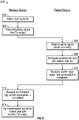
- a wireless transceiver in the wireless sensor emits a low-power pairing signal having a pairing signal transmission range of e.g. up to approximately 7.62cm (three inches).
- the wireless sensor has a switch or button which, when depressed, places the wireless sensor in a pairing mode of operation, causing the wireless sensor to emit the low-power pairing signal.
- the wireless sensor and the patient monitor associate, thereby configuring the wireless sensor and patient monitor to communicate with each other.
- the wireless sensor changes into a patient parameter sensing mode of operation in which the wireless sensor transmits a patient parameter sensing signal.
- the patient parameter sensing signal has a patient signal transmission range that is substantially greater than the pairing signal transmission range. The wireless sensor is then in condition to be placed on the patient.
- the patient's position and orientation are monitored and recorded.
- the wireless sensor is affixed to the patient's body, such as, for example, the patient's torso
- sensor data corresponding to the patient's motion e.g., acceleration and angular velocity
- the patient monitor stores and further processes the received data to determine the patient's orientation.
- the patient monitor can determine whether the patient is standing, sitting, or lying down in the prone, supine, left side, or right side positions.
- the patient monitor determines the precise orientation of the patient's body. For example, the patient monitor can determine the degree to which the patient's body is inclined, vertically and/or horizontally, thereby generating an accurate description of the patient's position relative to the support structure (such as a bed) upon which the patient lies.
- the support structure such as a bed
- the patient monitor stores the determined position and orientation information and keeps track of how long the patient remains in each determined position, thereby creating a continuous record of the patient's positional history.
- the patient monitor analyzes and processes the stored data to provide clinically-relevant, actionable information to the patient's care providers.
- the patient monitor counts the number of in-bed turns performed by the patient and monitors and displays the amount of time that has elapsed since the patient last turned. When the elapsed time exceeds a clinician-defined duration (e.g., two hours), the patient monitor displays an indication that the maximum time between patient turns has been exceeded.
- a clinician-defined duration e.g., two hours
- the patient monitor can also transmit a notification to one or more clinicians responsible for caring for the patient via, for example, a multi-patient monitoring system, a clinician notification device, or the like.
- the patient monitor can also determine and display statistical information, such as the average, minimum, and maximum amount of time between turns for a given clinician-defined time period, such as for example, twenty-four hours.
- the patient monitor can also determine and display the number of turns in the same position and orientation over a clinician-defined period of time.
- the patient monitor can display the total amount of time the patient remained in each specific position within a clinician-defined period.
- the patient monitor can determine the frequency and duration of periods during which the patient remained in clinically-defined acceptable positions.
- the patient monitor determines the mobility status of the patient, e.g., whether the patient is ambulatory, standing, sitting, reclining, or falling.
- the wireless monitoring system can include an alert system to alert the caregiver that the patient is falling, getting out of bed, or otherwise moving in a prohibited manner or in a manner that requires caregiver attention.
- the alert can be an audible and/or visual alarm on the monitoring system, or the alert can be transmitted to a caregiver (e.g., nurses' station, clinician device, pager, cell phone, computer, or otherwise).
- the patient monitor can display the patient's mobility status and transmit a notification that the patient is active and away from the bed.
- the patient monitor can determine whether the patient contravenes a clinician's order, such as, for example, instructions to remain in bed, or to walk to the bathroom only with the assistance of an attendant. In such circumstances, a notification, alert, or alarm can be transmitted to the appropriate caregivers.
- a clinician's order such as, for example, instructions to remain in bed, or to walk to the bathroom only with the assistance of an attendant.
- a notification, alert, or alarm can be transmitted to the appropriate caregivers.
- the information received by the wireless sensor can be used to create a time-sequenced representation of the patient's movement.
- This representation can be displayed on the patient monitor or transmitted to a nurses' station or other processing nodes to enable the caregiver to monitor the patient.
- the time-sequenced representation can be viewed in real time and/or be recorded for playback. For example, if an alarm alerts the caregiver that the patient has fallen out of bed, the caregiver can access and review the historical sequence of the patient's movements prior to and during that period of time.
- Another aspect of the present disclosure is directed to predicting a patient's risk of falling based on the patient's gait and other information (such as, for example, the patient's current medication regimen).
- the patient monitor determines that the patient's risk of falling is above a predetermined threshold, the patient monitor can issue an alarm or alert to notify care providers of the identified risk in an effort to anticipate and therefore prevent a patient fall. Additionally, the patient monitor can determine when a patient has fallen and issue the appropriate alarms and alerts to summon care provider assistance.
- the patient monitor accesses the patient's health records and clinician input via a network.
- the patients' positional history data, analyzed in view of the patient's health records may reveal or suggest a turning protocol (or other treatment protocol) that will likely yield favorable clinical outcomes for the particular patient.
- the patient monitor analyzes the accessed information in conjunction with the received information from the wireless sensor to determine a recommended patient turn protocol (or other treatment protocol) for the patient.
- the patient monitor assesses caregiver and facility compliance with the clinician-defined patient turn protocol established for the patient. For example, the patient monitor can identify the number of times that the patient remains in a position for a period greater than the prescribed duration, indicating a patient turn protocol violation, as well as the length of each such overexposure. The patient monitor can also track the clinician's response time upon issuance of a notification, alert, or alarm.
- care provider workflow productivity, efficiency, and effectiveness can be determined, based on aggregated positional history data corresponding to multiple patients wherein each patient is equipped with the disclosed wireless sensor. Additionally, care for patients in a particular location, such as a hospital ward or nursing home floor where the ratio of patients to staff is relatively high, can be prioritized based on the determined risk of formation of pressure ulcers. Thus, patients determined to have the highest risk are designated to receive attention first.
- the wireless sensor includes sensors to obtain additional physiological measurements from the patient.
- the wireless sensor can include a temperature sensor configured to measure the patient's body core body temperature by insulating the patient's skin surface around the temperature sensor. As a result of the insulation surrounding the temperature sensor, the natural temperature difference between the patient's skin surface and body core reach equilibrium, thereby arriving at the patient's body core temperature (which is typically higher in temperature than the patient's skin surface).
- the wireless sensor can also include an acoustic respiration sensor configured to sense vibrational motion generated by the patient's chest. The acoustic respiration sensor is configured to mechanically transmit the sensed vibrations through rigid structures of the device to the accelerometer.
- Processing of the accelerometer signal can provide, among other things, the patient's respiration and heart rates.
- An electrocardiogram (ECG) sensor configured to sense electrical signals from two or more electrodes in electrical contact with the patient's chest may also be included in the wireless sensor.
- the ECG signal can be processed to detect arrhythmias, such as bradycardia, tachyarrhythmia, ventricular fibrillation and the like.
- the accelerometer signal (containing information indicative of the mechanicallytransmitted vibrations from the acoustic respiration sensor) and/or the ECG signal can be processed to identify respiratory distress or dysfunction, including without limitation, snoring, coughing, choking, wheezing, apneic events, and airway obstruction.
- the patient monitor can determine a score that describes the patient's wellness/sickness state, which may also be referred to as a "Halo Index.”
- the patient monitor accesses and analyzes the patient's health records, clinician input, positional history data provided by the wireless sensor, surface structure pressure data, and other physiological parameter data collected and provided by the wireless sensor (such as, by way of non-limiting example, the patient's temperature, respiration rate, heart rate, ECG signal, and the like) to assess the patient's overall health condition.
- the patient monitor accesses information provided by the patient's support structure (e.g., bed, mattress, bed sheet, mattress pad, and the like) to determine the extent of pressure forces exerted on particular anatomical sites of the patient's body.
- the patient's support structure can be configured with an array of pressure sensors that measure the pressure force exerted on the support structure by the patient at specific locations.
- the patient monitor can analyze the patient's postural history data in conjunction with the information provided by the support structure to determine a likelihood of pressure ulcer formation at a specific anatomical location based on the measured amount of pressure exerted on the anatomical location multiplied by the amount of time the anatomical location has been under such pressure.
- the patient monitor can issue an alarm and/or an alert to reposition the patient so as to avoid formation of a pressure ulcer in the specified anatomical location. Additionally, the patient monitor can suggest particular positions and/or a patient turn protocol based on the combined analysis of pressure force exerted and length of time under such pressure.
- the pairing signal comprises wirelessly transmitting said pairing signal configured to be effective approximately zero (0) to approximately 91.44cm ((36) thirty six inches). In some aspects, the wirelessly transmitting said pairing signal comprises wirelessly transmitting said pairing signal configured to be effective approximately zero (0) to approximately 30.48cm (twelve (12) inches). In some aspects, the wirelessly transmitting said pairing signal comprises wirelessly transmitting said pairing signal configured to be effective approximately zero (0) to approximately 15.24cm (six (6) inches). In some aspects, the pairing signal comprises wirelessly transmitting said pairing signal configured to be effective approximately zero (0) to approximately 7.62cm (three (3) inches).
- the patient parameter sensing signal comprises wirelessly transmitting said patient parameter sensing signal configured to be effective approximately 3.048m (ten (10) feet) to approximately 9.144m (thirty (30) feet). In some aspects, the patient parameter sensing signal comprises wirelessly transmitting said patient parameter sensing signal configured to be effective approximately 3.048m (ten (10) feet). In some aspects, the wirelessly transmitting said patient parameter sensing signal comprises wirelessly transmitting said patient parameter sensing signal configured to be effective approximately three (3) meters. In some aspects, the pairing signal and said patient parameter sensing signal comprises wirelessly transmitting said patient parameter sensing signal configured to be effective an order of magnitude greater than said wirelessly transmitting said pairing signal.
- the method includes wherein said transmitting said pairing signal and said patient parameter sensing signal further comprises transmitting to an extender/repeater, and wherein said receiving said confirmation signal further comprises receiving from said extender/repeater.
- the method includes sensing acceleration using an accelerometer of said patient movement sensor and angular velocity using a gyroscope of said patient movement sensor; with said first processor, processing signals responsive to said sensed acceleration and angular velocity; and with said first wireless transceiver, transmitting said patient parameter sensing signal responsive to said processing.
- the pairing signal further comprises transmitting a message indicating that said wireless physiological sensor has been previously activated. In some aspects, the pairing signal further comprises transmitting a notification indicating that a quality standard associated with said physiological sensor is compromised. In some aspects, the patient parameter sensing signal further comprises transmitting a message indicating that said physiological sensor is nearing an end of service life.
- said initiating said pairing mode of operation further comprises activating said wireless physiological sensor.
- activating said wireless physiological sensor comprises removing a battery isolator from said wireless physiological sensor.
- activating said wireless physiological sensor comprises depressing for a predetermined duration a button on said wireless physiological sensor.
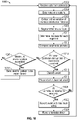
- the said patient parameter sensing signal is responsive to an orientation of said patient at a first time period and at a second time period; the method further comprises processing said patient parameter sensing signal to determine whether there is a sufficient difference in said patient parameter sensing signal between said first time period and said second time period to indicate a patient turn.
- the patient parameter sensing signal is responsive to a sensor data vector comprising data elements; the method comprises electronically: processing said data elements to determine a plurality of features indicative of a patient fall to form a feature vector; applying a weight vector to said feature vector to derive an activation value; analyzing said activation value to determine whether the patient has fallen; and reporting a patient fall in response to a determination that a patient fall has occurred.
- a system for reducing a risk that a monitored patient will develop one or more pressure ulcers by pairing a wireless sensor with a portable computing device in a caregiver environment where other wireless sensors may be paired with and communicating with other computing devices comprises a wireless sensor comprising an accelerometer, a gyroscope, a first processor, and a first wireless transceiver, said wireless sensor configured to operate in an association mode to transmit an association signal a desired association transmission range, the wireless sensor also configured to operate in a patient parameter measurement mode to transmit a measurement signal a desired measurement transmission range, wherein said association transmission range is substantially less than said measurement signal transmission range; and a portable computing device comprising a second processor, a memory device, a storage device, a display, and a second wireless transceiver, said computing device configured to receive said association signal, said patient monitor also configured to transmit an association confirmation signal, and said patient monitor also configured to receive said measurement signal; wherein said computing device, in response to receiving said association signal, associates said wireless sensor with said computing device and
- a system for monitoring an orientation of a patient to reduce a risk of the patient developing a pressure ulcer comprises a sensor including an accelerometer, a processor, and a first wireless transceiver, said sensor configured to output a signal responsive to acceleration, said acceleration indicative of a possible change in an orientation of said patient when said sensor is worn by said patient; and a patient monitor comprising a signal processor, a memory device, a storage device, and a second wireless transceiver, said second wireless transceiver is configured to receive said signal, and said signal processor is configured to process said signal to determine whether said possible change corresponds to an actual change in said orientation, when said actual change has occurred, configured to record a patient turn event, to compare said patient turn event with a patient turn protocol, and when said possible change is not said actual change and no patient turn event occurs according to the patient turn protocol, said patient monitor is configured to notify a caregiver of a patient turn protocol violation, wherein said signal processor configured to determine whether said possible change corresponds to said actual change includes being configured to determine a
- said signal processor of said patient monitor is further configured to reset a patient orientation duration timer when said processor records said patient turn event.
- the system comprises a third wireless transceiver, said third wireless transceiver configured to receive said signal from said sensor and to transmit said signal to said patient monitor.
- the system comprises a power supply for said third wireless transceiver different from a power supply for said sensor or said patient monitor.
- said sensor comprises a gyroscope.
- said sensor comprises an acoustic sensor.
- said sensor comprises a temperature sensor.
- said sensor comprises an ECG sensor.
- said sensor comprises one or more of an acoustic sensor, a temperature sensor and an ECG sensor.
- said patient monitor is configured to determine measurements of one or more of the following parameters: an acceleration, an angular velocity, a magnetic field, a respiration rate, a temperature, an impedance value, a moisture value, an oximetry value and an electrocardiogram.
- a method to determine a patient's change in orientation by monitoring patient movement with a patient-worn sensor communicating a signal indicative of said monitoring to a processing device, receiving said signal at said processing device, and processing using a signal processor said signal to determine whether said change in orientation has occurred
- said patient-worn sensor including an accelerometer, a processor, and a first wireless transceiver
- said processing device including said signal processor, a memory device, a storage device, and a second wireless transceiver
- said processing device including said signal processor, a memory device, a storage device, and a second wireless transceiver, comprises: receiving, from said patient-worn sensor, information indicative of a patient's orientation at a first time period; receiving, from said patient-worn sensor, information indicative of the patient's orientation at a second time period, wherein said first time period is prior to, and in close temporal proximity to said second time period; and with said signal processor, processing said information including: combining said received information to form a time window of patient orientation information, wherein said time window span
- the method comprises determining whether the patient has remained in an orientation for a period of time that exceeds a predetermined maximum duration and transmitting an alert in response to said determination.
- said receiving information indicative of said patient's orientation at said first and second time periods comprises receiving acceleration data at said first and second time periods.
- said acceleration data includes a roll axis value and a pitch axis value.
- the method comprises determining a change in a longitudinal axis of said patient responsive to said roll axis value and determining a change relative to an axis aligned with hips of the patient responsive to said pitch axis value.
- said classifying said patient turn event comprises comparing said segment values with a table of profiles of patient orientation change actions.
- each of said segment values comprises a roll axis median and a pitch axis median, and wherein said roll axis median and said pitch axis median are in units of degrees ranging from -180 degrees to +180 degrees.
- said predetermined threshold of said difference between said segment values is 45 degrees.
- a method to determine a patient's change in orientation by monitoring patient movement with a patient-worn sensor communicating a signal indicative of said monitoring to a processing device, receiving said signal at said processing device, and processing using a signal processor said signal to determine whether said change in orientation has occurred
- said patient-worn sensor including an accelerometer, a processor, and a first wireless transceiver
- said processing device including said signal processor, a memory device, a storage device, and a second wireless transceiver
- said processing device including said signal processor, a memory device, a storage device, and a second wireless transceiver
- said received information comprises a plurality of samples, sampled at a sampling rate.
- said sampling rate is configured to be between approximately 10 Hz and approximately 100Hz.
- said sampling rate is configured to be between approximately 5 Hz and approximately 40Hz.
- processing said information further comprises: determining a roll axis orientation indicative of said patient's orientation relative to a longitudinal axis of the patient; and determining a pitch axis orientation indicative of said patient's orientation relative to an axis aligned with hips of the patient.
- said received information comprises a plurality of samples, sampled at a sampling rate
- processing said information further comprises determining, for each of said plurality of samples, a roll axis value indicative of said patient's orientation relative to a longitudinal axis of the patient and a pitch axis value indicative of said patient's orientation relative to an axis aligned with hips of the patient.
- determining said roll and pitch axis values includes determining said values in units of degrees ranging from -180 degrees to +180 degrees.
- determining said segment values comprises determining a roll axis median and a pitch axis median said roll and pitch axis medians in units of degrees ranging from -180 degrees to +180 degrees.
- comparing said segment values comprises determining a difference between roll axis medians and a difference between pitch axis medians.
- determining whether a patient turn event is indicated comprises determining whether said difference between roll axis medians or said difference between pitch axis medians exceeds a predetermined threshold, when said predetermined threshold is exceeded, a patient turn event is determined to have occurred.
- the method further comprises determining that said patient has remained in an orientation for a period of time that exceeds a predetermined duration; and transmitting an alert that said patient has remained in the orientation for a period of time that exceeds said predetermined duration.
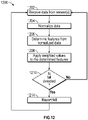
- a method of detecting at least one of whether a monitored patient has fallen or is about to fall by processing signals indicative of movement by the patient, the signals output from a wireless sensor and communicated to a processing device, the sensor including an accelerometer, a gyroscope, a first processor, and a first wireless transceiver, the sensor being configured to be worn by the patient, the processing device having a signal processor, a memory device, a storage device, a display, and a second wireless transceiver, the processing device configured to process the signals to determine at least one of whether the patient has fallen or is about to fall comprises receiving, by said processing device from said wireless sensor, signals responsive to a linear acceleration and an angular velocity of said patient; and processing said signals with said signal processor of said processing device, including electronically: forming a sensor data vector comprising data elements responsive to said linear acceleration and said angular velocity; normalizing said data elements to form a normalized sensor data vector; determining from said normalized sensor data vector, a plurality of features indicative of
- said receiving said signals includes receiving said signals indicative of said linear acceleration responsive to an output of an accelerometer and receiving said signals indicative of said angular velocity responsive to an output of a gyroscope.
- the method further comprises wherein said receiving said signals indicative of said linear acceleration includes receiving said signals indicative of said linear acceleration in three dimensions, wherein said receiving said signals indicative of said angular velocity includes receiving said signals indicative of said angular velocity in three dimensions, and wherein said sensor vector comprises six data elements.
- said normalizing said data elements comprises: normalizing each of said data elements to have zero-mean and unit-variance; and forming said normalized sensor data vector comprising normalized data elements, wherein certain of said normalized data elements correspond to said linear acceleration and certain of said normalized data elements correspond to said angular velocity.
- determining said plurality of features to form a feature vector further comprises: determining an acceleration magnitude; determining an angular velocity magnitude; determining a jerk magnitude; determining a fall duration; determining a pitch change; and determining vertical velocities.
- said applying said weight vector to said feature vector to derive said activation value comprises computing an inner product of said feature vector with said weight vector.
- said applying said weight vector to said feature vector to derive said activation value comprises: presenting, to a supervised learning algorithm, training data that include example inputs and known outputs; and mapping, by said supervised learning algorithm, said example inputs to said known outputs to derive said weight vector.
- said mapping said example inputs to said known outputs to derive said weight vector is performed by Fishers' linear discriminant.
- said analyzing said derived activation value to determine at least one of whether a patient fall has occurred or is about to occur comprises identifying a sign attribute of said derived activation value, wherein a positive sign attribute of said derived activation value indicates that said patient has fallen or is about to fall.
- a wireless physiological sensor including an accelerometer, a gyroscope, a processor, and a first wireless transceiver, said sensor configured to sense a linear acceleration
- said patient monitor is further configured to determine from said received information one or more of an acceleration magnitude, an angular velocity magnitude, a jerk magnitude, a fall duration, and a pitch change, and to form a feature vector comprising said determined acceleration magnitude, angular velocity magnitude, jerk magnitude, fall duration, and pitch change.
- said patient monitor is further configured to apply a weight vector to said feature vector.
- said patient monitor is further configured to determine an inner product of said weight vector and said feature vector.
- said accelerometer comprises a three-axis accelerometer and said gyroscope comprises a three-axis gyroscope.
- said weight vector is derived using a supervised learning algorithm comprising executable instructions stored on a computer-readable medium.
- said supervised learning algorithm is configured to execute on a processing device, to receive a set of training data having example inputs and known outputs, and to map said example inputs to said known outputs to derive said weight vector.
- said supervised learning algorithm is Fisher's linear discriminant.
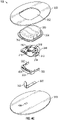
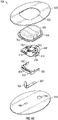
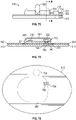
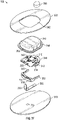
- a wireless physiological sensor for measuring acceleration of a patient, the physiological sensor comprising: a base including a bottom surface and a top surface, said base also including a first aperture, a second aperture, and a third aperture, wherein each of said first, second, and third apertures extends between said bottom surface and said top surface of said base; a substrate layer including conductive tracks and connection pads, a top side, and a bottom side, said bottom side of said substrate layer being disposed above said top surface of said base, said substrate layer also including a first through-hole via and a second through-hole via, wherein each of said first and second through-hole vias extends through said substrate layer between said top and bottom sides of said substrate layer; a temperature sensor responsive to thermal energy of said patient, said temperature sensor mounted on said top side of said substrate layer, said temperature sensor including a thermal contact in thermal communication with said top side of said substrate layer, wherein said first through-hole via is aligned with said thermal contact of said temperature sensor on said top side of said substrate layer and with said first aperture
- the senor further comprises an information element configured to store information indicative of whether said physiological sensor has been previously activated.
- the sensor further comprises a gyroscope, mounted on said substrate layer, said gyroscope responsive to an angular velocity of said patient.
- said base insulates a portion of said patient's body surrounding said portion of said bottom surface of said base corresponding to said first aperture.
- the sensor further comprises a wireless transceiver configured to wirelessly transmit information representative of said thermal energy, said electrical signals, said linear acceleration, and said vibrational motion.
- said wireless transceiver is configured to transmit a pairing signal.
- said wireless transceiver is configured to transmit a message indicating that said physiological sensor has been previously activated.
- said wireless transceiver is configured to transmit a notification that a quality standard associated with said physiological sensor is compromised.
- said wireless transceiver is configured to transmit a message indicating that said physiological sensor is nearing an end of service life.
- the senor further comprises a battery, mounted on said bottom side of said substrate layer and between said bottom side of said substrate layer and said top surface of said base, said battery being in electrical contact with said substrate layer, wherein said battery forms a recess between a portion of said bottom side of said substrate layer and said top surface of said base; and a mounting frame, disposed to fill said formed recess, said mounting frame configured to provide rigid structural support between said base and said substrate layer.
- said mounting frame further comprises: a first mounting frame aperture aligned with said first through-hole via and with said first aperture of said base, wherein said first mounting aperture is at least filled with said thermally conductive material to cause said temperature sensor to be in thermal communication with said portion of said bottom surface of said base corresponding to said first aperture; and a second mounting frame aperture aligned with said second through-hole via and with said second aperture of said base, wherein said second mounting aperture is at least filled with said electrically conductive material to cause said ECG sensor to be in electrical communication with said portion of said bottom surface of said base corresponding to said second aperture.
- the senor further comprises a gyroscope, mounted on said substrate layer, said gyroscope responsive to an angular velocity of said patient; a magnetometer, mounted on said substrate layer, said magnetometer responsive to a magnetic field; a processor, mounted on said substrate layer and in communication with said temperature sensor, ECG sensor, accelerometer, gyroscope, and magnetometer, said processor configured to generate signals representative of said thermal energy, electrical signals, linear acceleration, vibratory motion, angular velocity, and magnetic field; and a wireless transceiver, mounted on said substrate layer and in communication with said processor, said wireless transceiver configured to transmit said generated signals representative of said thermal energy, electrical signals, linear acceleration, vibrational motion, angular velocity and magnetic field.
- a gyroscope mounted on said substrate layer, said gyroscope responsive to an angular velocity of said patient
- a magnetometer mounted on said substrate layer, said magnetometer responsive to a magnetic field
- a processor mounted on said substrate layer and in communication with said temperature
- the sensor further comprises an impedance sensor, mounted on said substrate layer and in electrical communication with said portion of said bottom surface of said base corresponding to said second aperture.
- said accelerometer is a three-dimensional accelerometer and said gyroscope is a three-dimensional gyroscope.
- a wearable wireless sensor for monitoring at least one of pressure ulcer risk, fall detection, or fall risk, comprises : a base including a first aperture; a circuit layer including a first through-hole via extending through said circuit layer; and a temperature sensor responsive to a thermal energy of a patient, said temperature sensor mounted on said circuit layer, said temperature sensor including a thermal contact in thermal communication with said circuit layer, wherein said first through-hole via is aligned with said thermal contact of said temperature sensor and with said first aperture of said base, and wherein said first aperture and said first through-hole via include a thermally conductive material to cause said temperature sensor to be in thermal communication with a portion of said base corresponding to said first aperture.
- said base insulates a portion of said patient's body surrounding said portion of said base corresponding to said first aperture.
- the sensor further comprises a second aperture in said base; a second through-hole via extending through said circuit layer between said top side and bottom side of said circuit layer; an ECG sensor mounted on said circuit layer, said ECG sensor responsive to electrical signals, said ECG sensor including an extendible lead with an electrode responsive to said electrical signals, said ECG lead also including an electrical contact in electrical communication with said circuit layer, wherein said second through-hole via is aligned with said electrical contact of said ECG sensor on said circuit layer and with said second aperture of said base, and wherein said second aperture of said base and said second through-hole via of said circuit layer include an electrically conductive material, said ECG sensor in electrical communication with a portion of said base corresponding to said second aperture through said conductive material.
- the senor further comprises an accelerometer, mounted on said circuit layer, said accelerometer responsive to a linear acceleration of said patient; a third aperture in said base; and an acoustic respiration sensor responsive to vibrational motion of said patient, said acoustic respiration sensor being disposed on said circuit layer and extending through said third aperture in said base, wherein said acoustic respiration sensor is in rigid structural communication with said circuit layer so as to mechanically transmit sensed vibrational motion to said accelerometer.
- the senor further comprises a gyroscope mounted on said circuit layer, said gyroscope responsive to an angular velocity of said patient.
- said accelerometer comprises a three-dimensional accelerometer and said gyroscope comprises a three-dimensional gyroscope.
- the sensor further comprises an information element configured to store information indicative of whether said physiological sensor has been previously activated.
- the system comprises a patient-worn, wireless sensor including one or more sensors configured to obtain position, orientation and movement information from the patient.
- the one or more sensors can include one or more accelerometers, gyroscopes, and magnetometers (i.e., compasses).
- the sensors continuously or periodically (e.g., every second) obtain information that describes the patient's orientation in three dimensions.
- the wireless sensor includes a processor that is configured to process the obtained sensor information.
- the wireless sensor also includes a transceiver configured to wirelessly transmit the processed sensor data, and/or information representative of the sensor data, to a patient monitor (or other processing device) for further processing.
- the patient monitor can be configured to store and further process the received information, to display information indicative of or derived from the received data, and to transmit information -- including displays, alarms, alerts, and notifications -- to other patient care systems including a multi-patient monitoring system which may be accessible from, for example, a nurses' station.
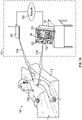
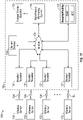
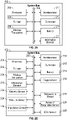
- FIG. 1A is a perspective illustration of an embodiment of the disclosed patient monitoring system 100 in a clinical setting.
- the patient monitoring system 100 includes a wireless sensor 102 worn by a patient, in proximity to a patient monitor 106 located on a table 116 at the side of the patient's bed 118.
- the wireless sensor 102 may also be referred to herein as "a wireless physiological sensor 102," “a patient-worn sensor 102,” “a movement sensor 102,” and “a wearable wireless sensor 102.”
- the wireless sensor 102 includes one or more sensors configured to measure the patient's position, orientation, and motion.
- the wireless sensor 102 includes an accelerometer configured to measure linear acceleration of the patient and a gyroscope configured to measure angular velocity of the patient.
- the measured linear acceleration and angular velocity information can be processed to determine the patient's orientation in three dimensions.
- a magnetometer is included in the wireless sensor 102 to measure the Earth's gravitational field. Information measured by the magnetometer can be used to improve accuracy of the determined orientation of the patient.
- the wireless sensor 102 also includes a wireless transceiver 206 (shown in FIGS. 2A and 2B ) which can transmit to the patient monitor 106 information representative of sensor data obtained by the wireless sensor 102 from the patient.
- a wireless transceiver 206 shown in FIGS. 2A and 2B .
- the patient is not physically coupled to the bedside patient monitor 106 and can therefore move freely into different positions on the bed 118.
- the wireless sensor 102 is affixed to the skin of the patient's body under the patient's garment as reflected in FIG. 1A by the phantom drawing of the wireless sensor 102. More particularly, the wireless sensor 102 can be placed on the patient's chest over the patient's manubrium, the broad upper portion of the sternum. In this position, the wireless sensor 102 is approximately centered relative to the longitudinal axis of the patient's body and near the patient's center of mass, a position that is useful in determining the patient's orientation when, for example, the patient is in bed.
- the wireless sensor 102 can be affixed to the patient's skin using any form of medically-appropriate adherent material, including a pressure-sensitive adhesive that is coated or applied to the bottom surface of the wireless sensor 102.
- a pressure-sensitive adhesive that is coated or applied to the bottom surface of the wireless sensor 102.
- One skilled in the art will appreciate that many other materials and techniques can be used to affix the wireless sensor 102 to the patient without departing from the scope of the present disclosure.
- each sensor that is attached to a patient transmits, often by cable, the obtained physiological data to a nearby monitoring device configured to receive and process the sensor data, and transform it into clinical information to be used by the care providers to monitor and manage the patient's condition.
- the number of cables and the number of bedside monitoring devices used can be excessive and can limit the patient's freedom of movement and impede care providers' access to the patient.
- the cables connecting the patient to the bedside monitoring devices can also make it more difficult to move the patient from room to room or to switch to different bedside monitors.
- the disclosed wireless sensor 102 can transmit data, wirelessly, to a patient data processing environment 105 in which the sensor data can be processed using one or more processing capabilities.
- the wireless sensor 102 transmits data via a wireless communications link 104.
- the wireless communications link 104 can be received by the bedside patient monitor 106, and/or by an extender/repeater 107.
- Both the patient monitor 106 and expander/repeater 107 provide access, by way of high-speed and reliable communications interfaces, to the patient data processing environment 105.
- both the patient monitor 106 and the extender/repeater 107 are illustrated in FIG. 1A .
- the wireless communications link 104 can use any of a variety of wireless technologies, such as Wi-Fi (802.11x), Bluetooth, ZigBee, cellular telephony, infrared, RFID, satellite transmission, proprietary protocols, combinations of the same, and the like.
- the wireless sensor 102 can be configured to perform telemetry functions, such as measuring and reporting position, orientation, and movement information about the patient. According to one embodiment, the wireless sensor 102 uses the Bluetooth wireless communications standard to communicate wirelessly with the patient monitor 106.
- the extender/repeater 107 can receive sensor data from the wireless sensor 102 by way of the wireless communications link 104 and forward the received sensor data, via the network 108, to one or more processing nodes within the patient data processing environment 105.
- the extender/repeater 107 can forward the received sensor data to a patient monitor 106 that might be located beyond the range of the wireless communications link 104 of a particular wireless sensor 102.
- the extender/repeater 107 can route the sensor data to other processing nodes within the patient data processing environment 105, such as, for example, a multi-patient monitoring system 110 or a nurses' station system 113.
- processing nodes and systems can be used to process the data transmitted by the wireless sensor 102.
- FIG. 1A also illustrates an embodiment of the patient monitor 106, which may also be referred to herein as "a processing device 106," "a portable computing device 106,” and "a patient monitoring device 106.”
- a patient monitor 106 Examples of a patient monitor 106 are disclosed in U.S. Pat. Pub. Nos. 2013/0262730 and 2015/0099955 , assigned to the assignee of the present disclosure.
- the patient monitor 106 is a processing device, and therefore includes the necessary components to perform the functions of a processing device, including at least one processor, a memory device, a storage device, input/output devices, and communications connections, all connected via one or more communication buses.
- the patient monitor 106 is configured to process the sensor data provided by the wireless sensor 102.
- processing of the sensor data can be performed by other processing nodes within the patient data processing environment 105.
- the patient monitor 106 is configured to wirelessly communicate with the wireless sensor 102.
- the patient monitor 106 includes a display 120, and a docking station, which is configured to mechanically and electrically mate with a portable patient monitor 122 also having a display 130.
- the patient monitor 106 is housed in a movable, mountable, and portable housing formed in a generally upright, inclined shape configured to rest on a horizontal flat surface, as shown in FIG. 1A .
- the housing can be affixed in a wide variety of positions and mountings and can comprise a wide variety of shapes and sizes.
- the display 120 may present a wide variety of measurement and/or treatment data in numerical, graphical, waveform, or other display indicia.
- the display 120 can display a variety of patient-specific configurations and/or parameters, such as the patient's weight, age, type of treatment, type of disease, type of medical condition, nutrition, hydration and/or length of stay, among others.
- the display 120 occupies much of a front face of the housing, although an artisan will appreciate the display 120 may comprise a table or tabletop horizontal configuration, a laptop-like configuration, or the like.
- FIG. 1A the upright inclined configuration of the patient monitor 106, as illustrated in FIG. 1A , displays information to a caregiver in an easily viewable manner.
- the portable patient monitor 122 of FIG. 1A may advantageously include an oximeter, co-oximeter, respiratory monitor, depth of sedation monitor, noninvasive blood pressure monitor, vital signs monitor or the like, such as those commercially available from Masimo Corporation of Irvine, CA, and/or disclosed in U.S. Pat. Pub. Nos. 2002/0140675 , 2010/0274099 , 2011/0213273 , 2012/0226117 , 2010/0030040 ; U.S. Pat. App. Ser. Nos. 61/242,792 , 61/387457 , 61/645,570 , 13/554,908 and U.S. Pat. Nos. 6,157,850 , 6,334,065 .
- the portable patient monitor 122 may communicate with a variety of noninvasive and/or minimally invasive devices such as, by way of non-limiting example, wireless sensor 102, optical sensors with light emission and detection circuitry, acoustic sensors, devices that measure blood parameters from a finger prick, cuffs, ventilators, and the like.
- the portable patient monitor 122 may include its own display 130 presenting its own display indicia. The display indicia may change based on a docking state of the portable patient monitor 122. When undocked, the display 130 may include parameter information and may alter its display orientation based on information provided by, for example, a gravity sensor or an accelerometer.
- FIG. 1B is a functional block diagram of an embodiment of the display 120 of the disclosed patient monitor 106 and the display 130 of the portable patient monitor 122.
- Display 120 of the patient monitor 106 can be configured to present patient physiological data 124, patient turn data 126, and/or additional, optional patient data 128.
- Patient physiological data can include, by way of non-limiting example, oxygen saturation, pulse rate, respiration rate, fractional arterial oxygen saturation, total hemoglobin, plethysmograph variability index, methemoglobin, carboxyhemoglobin, perfusion index, and oxygen content.
- the display 120 is configurable to permit the user to adjust the manner by which the physiologic parameters 124, patient turn data 126, and optional patient data 128 are presented on the display 120.
- information of greater interest or importance to the clinician may be displayed in larger format and may also be displayed in both numerical and graphical formats to convey the current measurement as well as the historical trend of measurements for a period of time, such as, for example, the preceding hour.
- the display 130 of the portable patient monitor 130 is an optional feature of the patient monitor 106 which may be configured to present patient physiological data 134, patient turn data 136, and additional, optional patient data 138.
- FIG. 1C is a simplified functional block diagram of an embodiment of the disclosed patient monitoring system 100.
- the system includes the patient-worn wireless sensor 102 having one or more sensors, a wireless communications link 104, through which sensor data from the wireless sensor 102 accesses the patient data processing environment 105 which includes a patient monitor 106, a communications network 108, a multi-patient monitoring system 110, a hospital or facility information system 112, one or more nurses' station systems 113, and one or more clinician devices 114.
- a patient monitor 106 includes a patient monitor 106, a communications network 108, a multi-patient monitoring system 110, a hospital or facility information system 112, one or more nurses' station systems 113, and one or more clinician devices 114.
- a multi-patient monitoring system 110 includes a patient monitor 106, a communications network 108, a multi-patient monitoring system 110, a hospital or facility information system 112, one or more nurses' station systems 113, and one or more clinician devices 114.
- nurses' station systems 113 includes
- the wireless sensor 102 is worn by a patient who has been determined to be at risk of forming one or more pressure ulcers, e.g., a patient who is confined to bed for an extended period of time.
- the wireless sensor 102 is capable of monitoring on a continuous or periodic (e.g., every second) basis the orientation of the patient to help determine whether the patient is repositioned frequently enough to reduce the patient's risk of forming a pressure ulcer.
- the wireless sensor 102 minimally processes measured acceleration and/or angular velocity data and wirelessly transmits the minimally-processed data to the patient monitor 106 by way of the wireless communications link 104.
- the wireless sensor 102 and the patient monitor 106 can be configured to utilize different wireless technologies to form the wireless communications link 104.
- it may be desirable to transmit data over Bluetooth or ZigBee for example, when the distance between the wireless sensor 102 and the patient monitor 106 is within range of Bluetooth or ZigBee communication.
- Transmitting data using Bluetooth or ZigBee is advantageous because these technologies require less power than other wireless technologies. Accordingly, longevity of embodiments of the disclosed wireless sensor 102 using batteries may be increased by using Bluetooth or ZigBee protocols.
- Wi-Fi or cellular telephony it may be desirable to transmit data using Wi-Fi or cellular telephony, for example, when the distance between the wireless sensor 102 and the patient monitor 106 is out of range of communication for Bluetooth or ZigBee.
- a wireless sensor 102 may be able to transmit data over a greater distance using Wi-Fi or cellular telephony than other wireless technologies.
- the wireless sensor 102 automatically transmits data over Bluetooth or ZigBee when the wireless sensor 102 is within a pre-determined distance from the bedside patient monitor 106.
- the wireless sensor 102 automatically transmits data over Wi-Fi or cellular telephony when the wireless sensor 102 is beyond a pre-determined distance away from the bedside patient monitor 106.
- the wireless sensor 102 can automatically convert from Bluetooth or ZigBee to Wi-Fi or cellular telephony, and vice versa, depending on the distance between the wireless sensor 102 and the bedside patient monitor 106.
- the wireless sensor 102 automatically transmits data over Bluetooth or ZigBee when the Bluetooth or ZigBee signal strength is sufficiently strong or when there is interference with Wi-Fi or cellular telephony.
- the wireless sensor 102 automatically transmits data over Wi-Fi or cellular telephony when the Bluetooth or ZigBee signal strength is not sufficiently strong.
- the wireless sensor 102 can automatically convert from Bluetooth or ZigBee to Wi-Fi or cellular telephony, and vice versa, depending on signal strength.
- the patient monitor 106 can be operable to receive, store and process the measured acceleration and angular velocity data transmitted by the wireless sensor 102 to determine the patient's orientation. Once determined, the patient monitor 106 can display the patient's current orientation. In some embodiments, the patient monitor 106 displays the patient's current orientation along with the patient's previous orientations over time, thereby providing the user the ability to view a historical record of the patient's orientation. In certain embodiments, e.g., as illustrated in FIGS. 13A-F and 14 , the patient orientation is displayed by icons, such stick figures, enabling the clinician to readily understand the patient's present positional state and the patient's positional history. The patient monitor 106 can also be configured to keep track of the length of time the patient remains in a particular orientation.
- the patient monitor 106 displays the amount of time the patient has been in the current orientation. Additionally, the patient monitor 106 can determine when the patient remains in a particular orientation for a duration greater than that prescribed by a clinician according to a repositioning protocol. Under such conditions, the patent monitor 106 can issue alarms, alerts, and/or notifications to the patient and/or to caregivers indicating that the patient should be repositioned to adhere to the prescribed repositioning protocol to reduce the risk of pressure ulcer formation.
- the patient monitor 106 communicates over a network 108 with a patient data processing environment 105 that includes a multi-patient monitoring system 110, a hospital/facility system 112, nurses' station systems 113, and clinician devices 114.
- a patient data processing environment 105 that includes a multi-patient monitoring system 110, a hospital/facility system 112, nurses' station systems 113, and clinician devices 114.
- Examples of network-based clinical processing environments, including multi-patient monitoring systems 110 are disclosed in U.S. Pat. Pub. Nos. 2011/0105854 , 2011/0169644 , and 2007/0180140 .
- the multi-patient monitoring system 110 communicates with a hospital/facility system 112, the nurses' station systems 113, and clinician devices 114.
- the hospital/facility system 112 can include systems such as electronic medical record (EMR) and/or and admit, discharge, and transfer (ADT) systems.
- EMR electronic medical record
- ADT admit, discharge, and transfer
- the multi-patient monitoring system 110 may advantageously obtain through push, pull or combination technologies patient information entered at patient admission, such as patient identity information, demographic information, billing information, and the like.
- the patient monitor 106 can access this information to associate the monitored patient with the hospital/facility systems 112.
- Communication between the multi-patient monitoring system 110, the hospital/facility system 112, the nurses' station systems 113, the clinician devices 114, and the patient monitor 106 may be accomplished by any technique recognizable to an artisan from the disclosure herein, including wireless, wired, over mobile or other computing networks, or the like.
- FIG. 1D is a simplified functional block diagram of the disclosed patient monitoring system 100 of FIG. 1C expanded to illustrate use of multiple wireless sensors 102 with multiple patients within a caretaking environment.
- the patient monitoring system 100 can provide individual patient information on, for example, a patient monitor 106, as well as aggregated patient information on, for example, a nurses' station server or system 114.
- a caretaker can have an overview of positional information corresponding to a population of patients located, for example, in a hospital floor or unit.
- a bedside patient monitor 106 associated with a wireless sensor 102 being worn by a patient.
- the clinical environment might be staffed such that patient data are collected, analyzed, displayed, and monitored at a central observation station, such as a nurses' station, rather than at the patient's bedside.
- portable clinician devices 114 such as, for example, tablets, PDAs or the like, may be used by caregivers to access the required patient-specific information while at the patient's bedside.
- the wireless sensor 102 can communicate to the various systems of the clinical computing environment by way of a signal extender/repeater 107.
- the extender/repeater 107 is located within range of the wireless sensor 102 (e.g., near the patient's bed 118) and configured to relay data, via the network 108, between the wireless sensor 102 and one or more computing systems capable of processing, storing, displaying, and/or transmitting the data collected by the wireless sensor 102.
- a relatively low cost extender/repeater 107 can be used to receive signals transmitted from one or more wireless sensors 102 over the wireless communications link(s) 104 using a shorter-range, lower-power-consuming transmission mode, such as for example, Bluetooth or ZigBee.
- the extender/repeater 107 can then retransmit the received signals to one or more computing systems in the patient data processing environment 105 over the network 108.
- the extender/repeater 107 is a Bluetooth-to-Ethernet gateway that retransmits signals received from the wireless sensor 102 to computing nodes, such as, for example, the multi-patient monitoring system 110, over the network 108.
- the extender/repeater 107 is a Bluetooth-to-WiFi bridge that provides access to the network 108 for the wireless sensor 102.
- a skilled artisan will recognize that there are numerous ways to implement the extender/repeater 107.
- FIG. 2A illustrates a simplified hardware block diagram of an embodiment of the disclosed wireless sensor 102.
- the wireless sensor 102 can include a processor 202, a data storage device 204, a wireless transceiver 206, a system bus 208, an accelerometer 210, a gyroscope 212, a battery 214, and an information element 215.
- the processor 202 can be configured, among other things, to process data, execute instructions to perform one or more functions, such as the methods disclosed herein, and control the operation of the wireless sensor 102.
- the data storage device 204 can include one or more memory devices that store data, including without limitation, random access memory (RAM) and read-only memory (ROM).
- the wireless transceiver 206 can be configured to use any of a variety of wireless technologies, such as Wi-Fi (802.11x), Bluetooth, ZigBee, cellular telephony, infrared, RFID, satellite transmission, proprietary protocols, combinations of the same, and the like.
- the components of the wireless sensor 102 can be coupled together by way of a system bus 208, which may represent one or more buses.
- the battery 214 provides power for the hardware components of the wireless sensor 102 described herein. As illustrated in FIG. 2A , the battery 214 communicates with other components over system bus 208.
- the battery 214 can communicate with one or more of the hardware functional components depicted in FIG. 2A by one or more separate electrical connections.
- the information element 215 can be a memory storage element that stores, in non-volatile memory, information used to help maintain a standard of quality associated with the wireless sensor 102.
- the information element 215 can store information regarding whether the sensor 102 has been previously activated and whether the sensor 102 has been previously operational for a prolonged period of time, such as, for example, four hours. The information stored in the information element 215 can be used to help detect improper re-use of the wireless sensor 102.
- the accelerometer 210 is a three-dimensional (3D) accelerometer.
- 3D accelerometer as used herein includes its broad meaning known to a skilled artisan.
- the accelerometer 210 provides outputs responsive to acceleration of the wireless sensor 102 in three orthogonal axes, sometimes denoted as the "X,” “Y,” and “Z" axes.
- An accelerometer 210 may measure acceleration that it experiences relative to Earth's gravity.
- An accelerometer 210 may provide acceleration information along three axes, and it and may provide acceleration information which is the equivalent of inertial acceleration minus local gravitational acceleration. Accelerometers 210 are well known to those skilled in the art.
- the accelerometer 210 may be a microelectromechanical system (MEMS), and it may include piezo-resistors, among other forms of implementation.
- the accelerometer 210 may be a high-impedance charge output or a low-impedance charge output accelerometer 210.
- the accelerometer 210 may be a tri-axis accelerometer, and the output of the accelerometer 210 may include three signals, each of which represents measured acceleration in particular axis.
- the output of the accelerometer 210 may be 8-bit, 12-bit, or any other appropriate-sized output signal.
- the outputs of the accelerometer may be in analog or digital form.
- the accelerometer 210 may be used to determine the position, orientation, and/or motion of the patient to which the wireless sensor 102 is attached.
- the gyroscope 212 is a three-axis digital gyroscope with angle resolution of two degrees and with a sensor drift adjustment capability of one degree.
- the term three-axis gyroscope as used herein includes its broad meaning known to a skilled artisan.
- the gyroscope 212 provides outputs responsive to sensed angular velocity of the wireless sensor 102 (as affixed to the patient) in three orthogonal axes corresponding to measurements of pitch, yaw, and roll.
- a skilled artisan will appreciate that numerous other gyroscopes 212 can be used in the wireless sensor 102 without departing from the scope of the disclosure herein.
- the accelerometer 210 and gyroscope 212 can be integrated into a single hardware component which may be referred to as an inertial measurement unit (IMU).
- the IMU can also include an embedded processor that handles, among other things, signal sampling, buffering, sensor calibration, and sensor fusion processing of the sensed inertial data.
- the processor 202 can perform these functions.
- the sensed inertial data are minimally processed by the components of the wireless sensor 102 and transmitted to an external system, such as the patient monitor 106, for further processing, thereby minimizing the complexity, power consumption, and cost of the wireless sensor 102, which may be a single-use, disposable product.
- FIG. 2B is a simplified hardware functional block diagram of an embodiment of the disclosed wireless sensor 102 that includes the following optional (as reflected by dotted lines) sensing components: a magnetometer 216 which may also be referred to as a compass, a temperature sensor 218, an acoustic respiration sensor 220, an electrocardiogram (ECG) sensor 222, one or more oximetry sensors 224, a moisture sensor 226, and an impedance sensor 228.
- the magnetometer 216 is a three-dimensional magnetometer that provides information indicative of magnetic fields, including the Earth's magnetic field. While depicted in FIG. 2B as separate functional elements, a skilled artisan will understand that the accelerometer 210, gyroscope 212, and magnetometer 214 can be integrated into a single hardware component such as an inertial measurement unit.
- a system and method are described herein to calculate three-dimensional position and orientation of an object derived from inputs from three sensors attached to the object: an accelerometer 210 configured to measure linear acceleration along three axes; a gyroscope 212 configured to measure angular velocity around three axes; and a magnetometer 214 configured to measure the strength of a magnetic field (such as the Earth's magnetic field) along three axes.
- the three sensors 210, 212, and 214 are attached to the wireless sensor 102 which is affixed to the patient.
- the sensors 210, 212, and 214 are sampled at a rate between approximately 10 Hz and approximately 100 Hz.
- the sensors 210, 212, and 214 can be sampled at different rates without deviating from the scope of the present disclosure.
- the sampled data from the three sensors 210, 212, and 214, which provide nine sensor inputs, are processed to describe the patient's position and orientation in three-dimensional space.
- the patient's position and orientation are described in terms of Euler angles as a set of rotations around a set of X-Y-Z axes of the patient.
- a temperature sensor 218 which may be used to measure the patient's body core temperature which is a vital sign used by clinicians to monitor and manage patients' conditions.
- the temperature sensor 218 can include a thermocouple, a temperature-measuring device having two dissimilar conductors or semiconductors that contact each other at one or more spots. A temperature differential is experienced by the different conductors.
- the thermocouple produces a voltage when the contact spot differs from a reference temperature.
- thermocouples are self-powered and therefore do not require an external power source for operation.
- the temperature sensor 218 includes a thermistor.
- a thermistor is a type of resistor whose resistance value varies depending on its temperature. Thermistors typically offer a high degree of precision within a limited temperature range.
- the acoustic respiration sensor 220 can be used to sense vibrational motion from the patient's body (e.g., the patient's chest) that are indicative of various physiologic parameters and/or conditions, including without limitation, heart rate, respiration rate, snoring, coughing, choking, wheezing, and respiratory obstruction (e.g., apneic events).
- the ECG sensor 222 can be used to measure the patient's cardiac activity. According to an embodiment, the ECG sensor 222 includes two electrodes and a single lead.
- the oximetry sensor(s) 224 can be used to monitor the patient's pulse oximetry, a widely accepted noninvasive procedure for measuring the oxygen saturation level of arterial blood, an indicator of a person's oxygen supply.
- a typical pulse oximetry system utilizes an optical sensor clipped onto a portion of the patient's body (such as, for example, a fingertip, an ear lobe, a nostril, and the like) to measure the relative volume of oxygenated hemoglobin in pulsatile arterial blood flowing within the portion of the body being sensed.
- Oxygen saturation (SpO2), pulse rate, a plethysmograph waveform, perfusion index (PI), pleth variability index (PVI), methemoglobin (MetHb), carboxyhemoglobin (CoHb), total hemoglobin (tHb), glucose, and/or otherwise can be measured and monitored using the oximetry sensor(s) 224.
- the moisture sensor 226 can be used to determine a moisture content of the patient's skin which is a relevant clinical factor in assessing the patient's risk of forming a pressure ulcer.
- the impedance sensor 228 can be used to track fluid levels of the patient. For example, the impedance sensor 228 can monitor and detect edema, heart failure progression, and sepsis in the patient.
- FIG. 3A is a schematic exploded perspective view of an embodiment of the disclosed wireless sensor 102 including a bottom base 310, a removable battery isolator 320, a mounting frame 330, a circuit board 340, a housing 350, and a top base 360.
- the bottom base 310 is a substrate having a top surface on which various components of the wireless sensor 102 are positioned, and a bottom surface that is used to affix the wireless sensor 102 to the patient's body.
- the bottom base 310 and top base 360 can be made of medical-grade foam material such as white polyethylene, polyurethane, or reticulated polyurethane foams, to name a few. As illustrated in the embodiment illustrated in Fig.
- the bottom base 310 and the top base 360 are each in a substantially oval shape, with a thickness of approximately 1 mm.
- the top base 360 includes a cut-out 362 through which the housing 350 fits during assembly.
- the bottom surface of the bottom base 310 is coated with a high tack, medical-grade adhesive, which when applied to the patient's skin, is suitable for long-term monitoring, such as, for example two days or longer. Portions of the top surface of the bottom base 310 are also coated with a medical-grade adhesive, as the bottom base 310 and the top base 360 are adhered together during assembly of the wireless sensor 102.
- the removable battery isolator 320 is a flexible strip made of an electrically insulating material that serves to block electrical communication between the battery 214 and an electrical contact (not shown) on the circuit board 340.
- the battery isolator 320 is used to preserve battery power until the wireless sensor 102 is ready for use.
- the battery isolator 320 blocks electrical connection between the battery 214 and the circuit board 340 until the battery isolator 320 is removed from the wireless sensor 102.
- the battery isolator 320 can be made of any material that possesses adequate flexibility to be slidably removed from its initial position and adequate dielectric properties so as to electrically isolate the battery from the circuit board 340.
- the battery isolator can be made of plastic, polymer film, paper, foam, combinations of such materials, or the like.
- the battery isolator 320 includes a pull tab 322 that extends through a slot 352 of the housing 350 when the wireless sensor 102 is assembled.
- the pull tab 322 can be textured to provide a frictional surface to aid in gripping and sliding the pull tab 322 out of its original assembled position.
- the mounting frame 330 is a structural support element that helps secure the battery 214 to the circuit board 340.
- the mounting frame 340 has wings 342 that, when assembled are slid between battery contacts 342 and the battery 214. Additionally, the mounting frame 330 serves to provide rigid structure between the circuit board 340 and the bottom base 310. According to some embodiments that include an acoustic respiratory sensor, the rigid structure transmits vibrational motion (vibrations) emanating from the patient (such as, for example, vibrational motions related to respiration, heartbeat, snoring, coughing, choking, wheezing, respiratory obstruction, and the like) to the accelerometer 210 positioned on the circuit board 340.
- vibrational motion emanating from the patient
- the circuit board 340 which may also be referred to herein as a substrate layer 340 and a circuit layer 340, mechanically supports and electrically connects electrical components to perform many of the functions of the wireless sensor 102.
- the circuit board 340 includes conduction tracks and connection pads.
- Such electrical components can include without limitation, the processor 202, the storage device 204, the wireless transceiver 206, the accelerometer 210, the gyroscope 212, the magnetomer 214, the temperature sensor 218, the acoustic respiration sensor 220, the ECG sensor 222, the oximetry sensor 224, the moisture sensor 226, and the impedance sensor 228.
- the circuit board 340 is double sided having electronic components mounted on a top side and a battery contact (not shown) on a bottom side.
- a skilled artisan will recognize other possibilities for mounting and interconnecting the electrical and electronic components of the wireless sensor 102.
- a battery holder 342 is attached to two sides of the top portion circuit board 340 and extends (forming a support structure) under the bottom side of the circuit board 340 to hold the battery 214 in position relative to the circuit board 340.
- the battery holder 342 is made of electrically conductive material.
- the battery 214 is a coin cell battery having a cathode on the top side and an anode on the bottom side. Electrical connection between the anode of the battery 214 and the circuit board 340 is made by way of the battery holder which is in electrical contact with the anode of the battery 214 and the circuit board 340.
- the cathode of the battery 214 is positioned to touch a battery contact (not shown) on the bottom side of the circuit board 340.
- the battery contact includes a spring arm that applies force on the battery contact to ensure that contact is made between the anode of the battery 214 and the battery contact.
- the battery isolator 320 is inserted between the anode of the battery 214 and the battery connector to block electrical contact.
- the housing 350 is a structural component that serves to contain and protect the components of the wireless sensor 102.
- the housing 350 can be made of any material that is capable of adequately protecting the electronic components of the wireless sensor 102. Examples of such materials include without limitation thermoplastics and thermosetting polymers.
- the housing 350 includes a slot 352 through which the battery isolator 320 is inserted during assembly.
- the housing 350 also includes a rim 354 that extends around the outer surface of the housing 350. The rim 354 is used to secure the housing 350 in position relative to the bottom base 310 and the top base 360 when the wireless sensor 102 is assembled.
- Assembly of the wireless sensor 102 is as follows: The circuit board 340 and battery holder 342 holding the battery 214 are placed into the housing 350. The wings 332 of the mounting frame 330 are inserted in between the battery 214 and the battery holder 342, so as to align the mounting frame 330 with the circuit board 340. The battery isolator 320 is then positioned between the battery contact and the battery 214. The pull tab 322 of the battery isolator 320 is then fed through the slot 352 in the housing 350. The top base 360 is then positioned over the housing 350, which now houses the assembled circuit board 340, battery holder 342, battery 214, mounting frame 330, and battery isolator 320, using the cut-out 362 for alignment.
- the rim 354 of the housing 350 adheres to the bottom surface of the top base 360, which is coated with high tack, medical-grade adhesive.
- the partial assembly which now includes the top base 360, the housing 350, the circuit board 340, the battery holder 342, the battery 214, the mounting frame 330, and the battery isolator 320, is positioned centrally onto the top surface of the bottom base 310, aligning the edges of the base top 360 with the edges of the base bottom 310.
- a coupon or die cutting tool
- the bottom surface of the bottom base 310 is then coated with a high tack, medical-grade adhesive, and a release liner (not shown) is placed on the bottom surface of the bottom base 3310 to protect the adhesive until it is time for use.
- FIG. 3B A schematic perspective view of the assembled wireless sensor 102 is illustrated in FIG. 3B .
- a button/switch 324 located on a top portion of the housing 350.
- the button/switch 324 can be used to change modes of the wireless sensor 102. For example, in some embodiments, pressing and holding the button/switch 324 can cause the wireless sensor 102 to switch into a pairing mode of operation.
- the pairing mode is used to associate the wireless sensor 102 with a patient monitor 106 or with an extender/repeater 107.
- FIG. 3C provides a schematic side view of an embodiment of the assembled wireless sensor 102 with cross-section line A-A identified.
- FIGS. 4A and 4B an embodiment of the wireless sensor 102 is disclosed which includes a temperature sensor 218.
- FIG. 4A is a schematic cross-sectional view, sectioned along line A-A of FIG. 3C , illustrating an assembled embodiment of the disclosed wireless sensor 102 which includes the temperature sensor 218.
- the battery isolator 320 and the battery holder 342 are not illustrated.
- FIG. 4B is a schematic bottom view of the embodiment of the disclosed wireless sensor of FIG. 4A .
- the bottom surface of the bottom base 310 is illustrated.
- Also illustrated in phantom i.e., dotted lines
- is the outline of cut-out 362 which also indicates the position of the housing 350 in relation to the bottom surface of the bottom base 310.
- the top surface of the bottom base 310 is in contact with and adhered to the bottom surface of the top base 360.
- the rim 354 of the housing 350 is sandwiched between the two bases 310 and 360 to secure the housing 350.
- the housing 350 also protrudes through the cut-out 362 of the top base 360.
- the battery 214 and the mounting frame 330 are adjacent the top surface of the bottom base 310.
- the temperature sensor 218 is mounted on the circuit board 340. To perform its temperature sensing function, the temperature sensor 218 is in thermal contact with the patient's skin. To achieve this, structure to transmit thermal energy from the patient's body to the temperature sensor 218 is provided. In particular, inputs to the temperature sensor 218 are thermally connected to multiple through-hole vias 410 located in the circuit board 340.
- a through-hole via is a small vertical opening or pathway in the circuit board 340 through which thermally and/or electrically conductive material can be placed, thereby permitting transmission of thermal and/or electrical energy from one side of the circuit board 340 to the other side.
- the through-hole vias 410 Under the through-hole vias 410 is an aperture or opening 404 which extends through the mounting frame 330 (to form a mounting frame aperture) and through the bottom base 310 of the wireless sensor 102.
- the aperture 404 provides access from the temperature sensor 218 to the patient's skin when the wireless sensor 102 is worn by the patient.
- the aperture 404 and the through-hole vias 410 are filled with thermally conductive material 402.
- Thermally conductive materials are well known in the art and can include, by way of non-limiting example, thermally conductive elastomers, polymers, and resins, to name a few.
- the wireless sensor 102 is affixed to the patient's skin.
- the thermally conductive material 402 exposed to the patient's skin, transmits thermal energy from the patient's body through the aperture 404 and the through-hole vias 410 to arrive at the inputs to the temperature sensor 218.
- the disclosed wireless sensor 102 can measure the patient's body core temperature (an established and useful vital sign) with the temperature sensor 218 using a technique by which deep tissue temperature can be measured from the skin surface.
- body core temperature an established and useful vital sign
- the temperature sensor 218 can measure the patient's body core temperature (an established and useful vital sign) with the temperature sensor 218 using a technique by which deep tissue temperature can be measured from the skin surface.
- the body core temperature is typically at a higher temperature than that of the skin surface.
- heat flows from the body core to the skin By insulating the skin surface at and around the point at which the skin temperature is measured -- thereby blocking heat from escapingthe temperature gradient between the body core and the skin surface will decrease.
- the skin temperature, under the insulated area will rise until it reaches equilibrium with the warmest region (i.e., the body core) under the insulation, thereby approaching the body core temperature.
- the bottom base 310 and top base 360 of the wireless sensor 102 which are in contact with the patient's skin around the temperature sensor 218, possess thermal insulation properties.
- the bottom base 310 and top base 360 can be made thermally insulating materials including polyurethane foam, polystyrene foam, neoprene foam, neoprene rubber, polyester (Mylar), polytetrafluoroethylene (PTFE), silicone foam, silicone rubber, or the like.
- the temperature sensor 218 can measure the patient's body core temperature.
- FIG. 4C is a schematic exploded perspective view of the embodiment of the disclosed wireless sensor of FIGS. 4A and 4B .
- the temperature sensor 218 is mounted on the top surface of the circuit board 340.
- the aperture 404 extends through the mounting frame 330 and the bottom base 310 and is aligned vertically with the through-hole vias 410 (not shown in FIG. 4C ) and the temperature sensor 218.
- the aperture 404 and the through-hole vias 410 are filled with thermally conductive material 402.
- the disclosed structure provides thermal connectivity between the patient's skin and the temperature sensor 218.
- FIGS. 5A and 5B an embodiment of the wireless sensor 102 is disclosed which includes an acoustic respiration sensor 220.
- FIG. 5A is a schematic cross-sectional view, sectioned along line A-A of FIG. 3C , illustrating an assembled embodiment of the disclosed wireless sensor 102 which includes the acoustic respiration sensor 220.
- the battery isolator 320 and the battery holder 342 are not illustrated.
- FIG. 5B is a schematic bottom view of the embodiment of the disclosed wireless sensor of FIG. 5A .
- the bottom surface of the bottom base 310 is illustrated.
- Also illustrated in phantom i.e., dotted lines
- is the outline of cut-out 362 which indicates the position of the housing 350 in relation to the bottom surface of the bottom base 310.
- the acoustic respiration sensor 220 is mounted underneath the battery 214.
- the acoustic respiration sensor 220 detects vibratory motion emanating from the patient's body (e.g., the patient's chest) and mechanically transmits the detected vibratory motion to the accelerometer 210.
- the accelerometer 210 senses the mechanically transmitted vibratory motion.
- the signal collected by accelerometer 210 can be processed to extract the vibratory motion from other sensed acceleration signals. Examples of such vibratory motion can include, without limitation, heart beats, respiration activity, coughing, wheezing, snoring, choking, and respiratory obstruction (e.g., apneic events).
- the acoustic respiration sensor 220 is in rigid structural contact with the accelerometer 210. To achieve this, the acoustic respiration sensor 220 is mounted to the bottom side of the battery 214. In particular, the acoustic respiration sensor 220 includes a rim 221 that is sandwiched between the bottom surface of the battery 214 and the bottom base 310. Accordingly, the rim 221 serves to rigidly secure the acoustic respiration sensor 220 to the bottom surface of the battery 214.
- the acoustic respiration sensor 220 protrudes through an aperture or opening 502 in the bottom base 310, beyond the plane created by the bottom base 310. This is to ensure that the acoustic respiration sensor 220 is in direct contact with the patient's body (e.g., chest) so as to sense the vibrational motion emanating from the patient.
- a flexible wire or other such structure under slight tension such that when the wire is exposed to vibratory motion, it will vibrate in a manner that is proportional to the sensed vibratory motion with respect to both frequency and magnitude of the sensed vibratory motion.
- the acoustic respiration sensor 220 is configured to transmit the sensed vibratory motion through rigid structures of the wireless sensor 102 such that the transmitted vibratory motion is sensed by the accelerometer 210.
- the rigid structure includes the battery 214 and the circuit board 340.
- FIG. 5C is a schematic exploded perspective view of the embodiment of the disclosed wireless sensor of FIGS. 5A-B .
- the accelerometer 210 is mounted on the top surface of the circuit board 340 over the battery 214 which is secured underneath the circuit board 340.
- the acoustic respiration sensor 220 (not shown in FIG. 5C ) fits between the battery 214 and the bottom base 310.
- the aperture 502 extends through the bottom base 310 and is aligned vertically with battery 214 such that the acoustic respiration sensor 220 is secured to rigid structure of the wireless sensor 102.
- the disclosed structure provides the ability for the acoustic respiration sensor 220 to mechanically transmit vibratory motion from the patient's chest to the accelerometer 210.
- FIGS. 6A-C illustrate an embodiment of the disclosed wireless sensor 102 which includes a temperature sensor 218 and an acoustic respiration sensor 220.
- FIG. 6A is a schematic cross-sectional view, sectioned along line A-A of FIG. 3C , illustrating an assembled embodiment of the disclosed wireless sensor 102 which includes the temperature sensor 218 and acoustic respiration sensor 220. For easier visibility, the battery isolator 320 and the battery holder 342 are not illustrated.
- FIG. 6B is a schematic bottom view of the embodiment of the disclosed wireless sensor of FIG. 6A .
- FIG. 6C is a schematic exploded perspective view of the embodiment of the disclosed wireless sensor 102 of FIGS. 6A and 6B .
- the embodiment depicted in FIGS. 6A-C is a combination of the embodiments depicted in FIGS. 4A-C and 5A-C .
- the temperature sensor 218 is mounted on the circuit board 340.
- inputs to the temperature sensor 218 are thermally coupled to multiple through-hole vias 410 located in the circuit board 340.
- Under the through-hole vias 410 is an aperture 404 which extends through the mounting frame 330 and through the bottom base 310 of the wireless sensor 102.
- the aperture 404 provides access from the temperature sensor 218 to the patient's skin when the wireless sensor 102 is worn by the patient.
- the aperture 404 and the through-hole vias 410 are filled with thermally conductive material 402.
- the wireless sensor 102 is affixed to the patient's skin.
- the thermally conductive material 402 exposed to the patient's skin, transmits thermal energy from the patient's body through the aperture 404 and the through-hole vias 410 to arrive at the inputs to the temperature sensor 218.
- the acoustic respiration sensor 220 is mounted underneath the battery 214.
- the acoustic respiration sensor 220 includes rim 221 that is sandwiched between the bottom surface of the battery 214 and the bottom base 310. Accordingly, the rim 221 serves to rigidly secure the acoustic respiration sensor 220 to the bottom surface of the battery 214.
- the acoustic respiration sensor 220 protrudes through the aperture 502 in the bottom base 310, beyond the plane created by the bottom base 310.
- the acoustic respiration sensor 220 is configured to transmit vibratory motion sensed from the patient (e.g., from the patient's chest) through rigid structures of the wireless sensor 102 such that the transmitted vibratory motion is sensed by the accelerometer 210.
- the rigid structure includes the battery 214 and the circuit board 340.
- FIG. 6C is a schematic exploded perspective view of the embodiment of the disclosed wireless sensor of FIGS. 6A and 6B .
- the temperature sensor 218 is mounted on the top surface of the circuit board 340.
- the aperture 404 extends through the mounting frame 330 and the bottom base 310 and is aligned vertically with the through-hole vias 410 (not shown in FIG. 4C ) and the temperature sensor 218.
- the aperture 404 and the through-hole vias 410 are filled with thermally conductive material 402.
- the accelerometer 210 is mounted on the top surface of the circuit board 340 over the battery 214 which is secured underneath the circuit board 340.
- the acoustic respiration sensor 220 (not shown in FIG.
- the acoustic respiration sensor 220 abuts against the mounting frame 330 in a manner such that the acoustic respiration sensor 220, the mounting frame 330, the battery 214 and the circuit board 340 form a rigid structure capable of mechanically transmitting vibratory motion sensed by the acoustic respiration sensor 220 to the accelerometer 210 mounted on the circuit board 340.
- the aperture 502 extends through the bottom base 310 and is aligned vertically with battery 214 such that the acoustic respiration sensor 220 is secured to rigid structure of the wireless sensor 102.
- the disclosed embodiment provides thermal connectivity between the patient's skin and the temperature sensor 218 and the ability for the acoustic respiration sensor 220 to mechanically transmit vibratory motion from the patient's chest to the accelerometer 210.
- the embodiment disclosed in FIGS. 6A-C is capable of providing, among other things, three vital signs: body core temperature, pulse rate, and respiration rate.
- Vital signs are measurements of the body's most basic functions and are used routinely by healthcare providers to assess and monitor a patient's status.
- the patient's body core temperature can be provided by the temperature sensor 218.
- the patient's pulse rate and respiration rate can be provided by the acoustic respiration sensor 220 in combination with the accelerometer 210.
- FIGS. 7A-F an embodiment of the disclosed wireless sensor 102 is shown which includes an electrocardiogram (ECG) sensor 222.
- ECG electrocardiogram
- Chip-scale and/or component-scale ECG sensors, suitable for mounting on circuit boards are known in the art.
- solid state ECG sensors are offered by Texas Instruments and by Plessy Semiconductors Ltd., to name a few.
- FIG. 7A is a perspective view of the embodiment of the disclosed patient-worn wireless sensor 102 having an ECG sensor 222 including an ECG lead 706 that extends from the housing 350.
- the wireless sensor 102 is adhered to the patient's chest, for example, over the manubrium as illustrated in FIG. 7A .
- the ECG lead 706 extends from the housing 350 of the wireless sensor 102 to a location on the patient's chest suitable to sense electrical signals generated by the patient's heart.
- the ECG lead 706 is in electrical communication with an ECG electrode 707 which, in operation, is adhered to the patient's chest.
- the ECG electrode 707 includes conducting gel embedded in the middle of a self-adhesive pad.
- the ECG electrode 707 the senses electrical signals from the patient's chest and transmits the sensed signals, via the lead 706, to the ECG sensor 222.
- the electrode 707 adheres to the patient's skin and senses electrical signals therefrom.
- a skilled artisan will appreciate that many structures, forms, and formats of ECG electrodes are well known in the art and can be used to implement the ECG electrode 707.
- the ECG lead 706 extends to the left side of the patient's chest to a position across the heart from where the wireless sensor 102 is located.
- Another ECG electrode 702 (described below), also in contact with the patient's skin, is formed beneath the housing 350 at the bottom base 310.
- a vector is formed between the ECG lead electrode 707 and the ECG electrode 702 by which the electrical signals of the patient's heart can be sensed.
- the ECG sensor 222 can sense ECG signals that are similar in morphology to ECG signals detected on Lead I or Lead II of a standard 12-lead ECG.
- FIG. 7B is a schematic assembled perspective view of the embodiment of the disclosed wireless sensor 102 of FIG. 7A .
- the ECG lead 706 is connected to the ECG sensor 222 (shown in FIG. 7D ) which is mounted on the circuit board 340.
- the ECG lead extends through the housing 350 to a lockable retractable reel 708 that stores the ECG lead 706 in a coil when not in use.
- the ECG lead 706 can be extended from the reel 708 and locked in the desired position, thereby enabling placement of the ECG lead electrode 707 at a desired location on the patient's chest.
- the locking mechanism is engaged and disengaged by applying a pulling force on the lead 706.
- Various forms and versions of lockable retractable reels are well known in the art and may be used to implement the reel 708.
- FIG. 7C provides a schematic side view of the embodiment of the assembled wireless sensor 102 of FIGS. 7A and 7B with cross-section line B-B identified.
- FIG. 7D is a cross-sectional view of the embodiment of FIGS. 7A-C sectioned along line B-B.
- the ECG sensor 222 is mounted on the circuit board 340. To perform its sensing function, the ECG sensor 222 is in electrical contact with at least two points on the patient's skin. Two electrodes 702 and 707 are provided to achieve this purpose. While ECG electrode 707 has been described above, description of the ECG electrode 702 follows herewith.
- ECG electrode 702 is located within the bottom base 310 of the wireless sensor 102.
- An input to the ECG sensor 222 is electrically connected to multiple through-hole vias 710 located in the circuit board 340.
- through-hole vias are small vertical openings, or pathways, in the circuit board 340 through which electrically conductive material can be placed, thereby permitting transmission of electrical signals from one side of the circuit board 340 to the other side.
- Under the through-hole vias 710 is an aperture or opening 704 which extends through the mounting frame 330 (to form a mounting frame aperture) and through the bottom base 310 of the wireless sensor 102.
- the aperture 704 provides access from the ECG sensor 222 to the patient's skin when the wireless sensor 102 is worn by the patient.
- the aperture 704 and the through-hole vias 710 are filled with electrically conductive material to form the ECG electrode 702.
- Electrically conductive materials are well known in the art and can include, by way of non-limiting example, electrically conductive silicones, elastomers, polymers, epoxies, and resins, to name a few.
- the wireless sensor 102 is affixed to the patient's skin and the ECG electrode 702, exposed to the patient's skin, senses and transmits electrical signals from the patient's skin surface through the aperture 704 and the through-hole vias 710 to arrive at an input to the ECG sensor 222.
- FIG. 7E is a schematic bottom view of the embodiment of the disclosed wireless sensor of FIGS. 7A-D .
- the bottom surface of the bottom base 310 is illustrated.
- Also illustrated in phantom i.e., dotted lines) are the outline of cut-out 362 which also indicates the position of the housing 350 in relation to the bottom surface of the bottom base 310, and the lockable retractable reel 708.
- the ECG electrode 702 is also illustrated as it is positioned to make contact with the patient's skin.
- the ECG electrode may be coated with a conducting gel to improve the electrode-to-skin interface.
- FIG. 7F is a schematic exploded perspective view of the embodiment of the disclosed wireless sensor of FIGS. 7A-7E .
- the ECG sensor 222 is mounted on the top surface of the circuit board 340.
- the aperture 704 extends through the mounting frame 330 and the bottom base 310 and is aligned vertically with the through-hole vias 710 (not shown in FIG. 7F ) and the ECG sensor 222.
- the aperture 704 and the through-hole vias 710 are filled with electrically conductive material to form electrode 702.
- the disclosed structure provides electrical connectivity between the patient's skin and the ECG sensor 222.
- FIG. 8A is a schematic exploded perspective view of an embodiment of the disclosed wireless sensor having a temperature sensor 218, an acoustic respiration sensor 220, and an ECG sensor 222.
- FIG. 8B is a schematic bottom view of the disclosed wireless sensor of FIG. 8A .
- the embodiment depicted in FIGS. 8A-B is a combination of the embodiments depicted in FIGS. 4A-C and 5A-C and 7A-F .
- the temperature sensor 218 is mounted on the circuit board 340. As previously described, inputs to the temperature sensor 218 are thermally coupled to multiple through-hole vias 410 located in the circuit board 340.
- an aperture 404 which extends through the mounting frame 330 and through the bottom base 310 of the wireless sensor 102.
- the aperture 404 provides access from the temperature sensor 218 to the patient's skin when the wireless sensor 102 is worn by the patient.
- the aperture 404 and the through-hole vias 410 are filled with thermally conductive material 402.
- the acoustic respiration sensor 220 is mounted underneath the battery 214, held in place by rim 221 that is sandwiched between the bottom surface of the battery 214 and the bottom base 310. Accordingly, the rim 221 serves to rigidly secure the acoustic respiration sensor 220 to the bottom surface of the battery 214.
- the acoustic respiration sensor 220 protrudes through the aperture 502 in the bottom base 310, beyond the plane created by the bottom base 310.
- the acoustic respiration sensor 220 transmits vibratory motion sensed from the patient (e.g., from the patient's chest) through rigid structures of the wireless sensor 102 such that the transmitted vibratory motion is sensed by the accelerometer 210.
- the rigid structure through which the vibratory motion is transmitted includes the battery 214 and the circuit board 340.
- the ECG electrode 702 is located within the bottom base 310 of the wireless sensor 102.
- An input to the ECG sensor 222 is electrically coupled to multiple through-hole vias 710 located in the circuit board 340.
- Under the through-hole vias 710 is an aperture or opening 704 which extends through the mounting frame 330 and through the bottom base 310 of the wireless sensor 102.
- the aperture 704 provides access from the ECG sensor 222 to the patient's skin when the wireless sensor 102 is worn by the patient.
- the aperture 704 and the through-hole vias 710 are filled with electrically conductive material to form the ECG electrode 702.
- the wireless sensor 102 is affixed to the patient's skin.
- the thermally conductive material 402 exposed to the patient's skin, transmits thermal energy from the patient's body through the aperture 404 and the through-hole vias 410 to arrive at the inputs to the temperature sensor 218.
- the acoustic respiratory sensor 220 senses vibratory motion from the patient and mechanically transmits the vibratory motion to the accelerometer 210 mounted on the circuit board.
- the ECG electrodes 702 and 707 exposed to the patient's skin, sense and transmit electrical signals from the patient's skin surface to arrive at inputs to the ECG sensor 222.
- FIG. 8B is a schematic bottom view of the embodiment of the disclosed wireless sensor of FIGS. 8A .
- the bottom surface of the bottom base 310 is illustrated.
- Also illustrated in phantom (i.e., dotted lines) are the outline of cut-out 362 and the lockable retractable reel 708.
- Three sensor access points are shown in FIG 8B .
- the thermally conductive material 402 provides a pathway for thermal energy to be transmitted from the patient's skin the temperature sensor 218 mounted on the circuit board 340.
- the acoustic respiration sensor 220 is in direct contact with the patient's skin and in rigid structural contact with the accelerometer 210 so as to mechanically transmit sensed vibratory motion emanating from the patient to the accelerometer 210 mounted on the circuit board 340.
- the ECG electrode 702 provides a pathway for electrical signals to be transmitted from the patient's skin to the ECG sensor 220 mounted on the circuit board 340.
- patient-specific information can include, by way of non-limiting example, the patient's name, age, gender, weight, identification number (e.g., social security number, insurance number, hospital identification number, or the like), admission date, length of stay, physician's name and contact information, diagnoses, type of treatment, perfusion rate, hydration, nutrition, pressure ulcer formation risk assessments, patient turn protocol instructions, treatment plans, lab results, health score assessments, and the like.
- pairing the wireless sensor 102 with the patient monitor 106 can be performed to provide data security and to protect patient confidentiality.
- Some wireless systems require the care provider to program the wireless sensor 102 to communicate with the correct patient monitor 106.
- Other wireless systems require a separate token or encryption key and several steps to pair the wireless device 102 with the correct bedside patient monitors 106.
- Some systems require the token to be connected to the bedside patient monitor 106, then connected to the wireless device 102, and then reconnected to the bedside patient monitor 106.
- security tokens may be desirable to use security tokens to ensure that the correct bedside patient monitor 106 receives the correct wirelessly transmitted data.
- Security tokens prevent the bedside patient monitor 106 from accessing the transmitted data unless the wireless sensor 102 and bedside patient monitor 106 share the same password.
- the password may be a word, passphrase, or an array of randomly chosen bytes.
- FIG. 9 illustrates an exemplary method of associating a wireless sensor 102 with a patient monitor 106, which may be referred to as "pairing.”
- the wireless sensor 102 is set to operate in a pairing mode.
- a user initiates the pairing mode of operation for the wireless sensor 102. This may include powering on the wireless sensor 102, switching the wireless sensor 102 to a special paring state, and/or the like.
- the wireless sensor 102 may include a battery isolator 320 which, when removed, activates the wireless sensor 102.
- the default mode of operation is the pairing mode.
- the wireless sensor 102 may have a button/switch 324 that can be used to activate the wireless sensor 102 and place it in the pairing mode of operation.
- a depressible button/switch 324 can be located on the top portion of the housing 350. When the button/switch 324 is depressed and continuously held down, the wireless sensor 102 enters into the pairing mode of operation and remains in the pairing mode of operation for as long as the button/switch 324 is depressed.
- the wireless sensor 102 transmits a pairing signal indicating that it is ready to pair, or associate, with a patient monitor 106.
- the wireless transceiver 206 of the wireless sensor 102 is configured to emit a low-power pairing signal having a limited pairing signal transmission range.
- the limited pairing signal transmission range helps to prevent unintended or incidental association of the wireless sensor 102 with a patient monitor 106 that might be nearby but which is not intended to be paired with the wireless sensor 102. Such circumstances can occur in hospitals, healthcare facilities, nursing homes, and the like where patients, sensors 102 patient monitors 106 are located in close physical proximity to one another.
- the low-power pairing signal has a pairing signal transmission range of up to approximately 7.62cm (three inches). In other embodiments, the low-power pairing signal has a pairing signal transmission range of up to approximately 15.24 cm (six inches). According to the claimed invention, the low-power pairing signal has a pairing signal transmission range of at most up to approximately one foot (i.e., 30.48cm (twelve inches)). Within this limitation, a skilled artisan will recognize that other ranges can be used for the pairing signal transmission range.
- the patient monitor 106 when within the pairing signal transmission range, receives the pairing signal from the wireless sensor 102.
- the patient monitor 106 associates with the wireless sensor 102 thereby configuring the wireless sensor 102 and patient monitor 106 to communicate with each other.
- the patient monitor 106 transmits a confirmation signal confirming that the patient-worn sensor 102 is associated with the patient monitor 106, thereby indicating that the paring process has been successfully completed, as reflected in block 910.
- the wireless sensor 102 receives the confirmation signal.
- the wireless sensor 102 exits the pairing mode of operation and enters into a patient parameter sensing mode of operation.
- the patient-worn sensor 102 transmits a patient parameter sensing signal having a patient parameter sensing signal transmission range.
- the The wireless sensor 102 increases the power of the patient parameter sensing signal transmission range to a standard operating range of at most up to 914.4 cm (30 feet), such as for example, approximately three meters.
- the patient parameter sensing signal transmission range is approximately 3.048m (ten feet).
- the patient parameter sensing signal transmission range is approximately 9.144m(thirty feet).
- the paring signal transmission range is between approximately 7.62cm (three) and 30.48cm (twelve inches), while the patient parameter sensing signal transmission range is approximately 3 meters (ten feet).
- the pairing signal transmission range is substantially less than the patient parameter sensing transmission range.
- an extender/repeater 107 is used to communicate with the wireless sensor 102 instead of than a patient monitor 106. Pairing with the booster/repeater may be performed in the same manner described above with respect to FIG. 9 .
- the disclosed patient monitoring system 100 helps to manage a patient that is at risk of forming one or more pressure ulcers by, among other things, detecting changes in the patient's orientation and by determining how long the patient remains in the present orientation.
- the system 100 can detect when the patient is repositioned and begin timing the duration that the patient remains in that new orientation. Thus, if the patient repositions on his own without the observation of a care provider, the monitoring system 100 can detect the repositioning event and restart a timer.
- the patient monitoring system 100 can aid in the administration of a clinician-established turning protocol for the patient. For example, if the patient remains in an orientation beyond a predefined, clinician-prescribed duration, the system 100 can notify the patient and/or caretakers that the patient is due to be repositioned.
- the wireless sensor 102 obtains sensor information indicative of the patient's orientation (e.g., acceleration data), pre-processes the sensed data, and transmits it to a processing device capable of processing the measurement data, such as, for example, the patient monitor 106.
- Other devices capable of processing the measurement data include, without limitation, clinician devices 114, nurses' station systems 113, the multi-patient monitoring system 110, a dedicated processing node, or the like.
- the description herein will describe the processing device as the patient monitor 106; however, a skilled artisan will appreciate that a large number of processing devices may be used to perform the described functions without departing from the scope of the present disclosure.
- the patient monitor 106 stores and further processes the received data to determine the patient's orientation. According to some embodiments, the patient monitor 106 can determine whether the patient is standing, sitting, or lying in the prone, supine, left side, or right side positions. The patient monitor 106 can store the determined orientation information and keep track of how long the patient remains in each determined orientation, thereby creating a continuous record of the patient's positional history. In certain embodiments, the information received from the wireless sensor 102 can be used to create a time-sequenced representation of the patient's positional history. This representation can be displayed on the patient monitor 106 or transmitted to a nurses' station or other processing node to enable caregivers to monitor the patient's position in bed.
- the time-sequenced representation can be viewed in real time and/or be accessed for playback. For example, if an alarm alerts the caregiver that the patient has exceeded the maximum amount of time to remain in the present orientation, the caregiver can access and review the historical sequence of the patient's orientations prior to and during that period of time to determine the next orientation to which the patient may be repositioned. In some embodiments, the system 100 suggests the orientation to which the patient may be repositioned.
- the patient monitor 106 counts the number of in-bed turns performed by the patient and displays the amount of time that has elapsed since the patient last turned. When the elapsed time exceeds a clinician-defined duration (e.g., two hours), the patient monitor 106 displays an indication that the maximum time between patient turns has been exceeded.
- the patient monitor 106 can also transmit a notification to clinicians responsible for caring for the patient via, for example, the multi-patient monitoring system 110, a clinician notification device 114, or the like.
- the patient monitor 106 can also determine and display statistical information, such as the average, minimum, and maximum amount of time between turns for a given clinician-defined time period, such as for example, twenty-four hours.
- the patient monitor 106 can also determine and display the number of patient turns in the same orientation over a clinician-defined period of time. Similarly, the patient monitor 106 can display the total amount of time the patient has remained in each specific orientation within a clinician-defined period. Moreover, the patient monitor 106 can determine the frequency and duration of periods that the patient remained in clinically-defined acceptable orientations.
- the patient monitor 106 accesses the patient's health records and clinician input via the network 108.
- the patients' positional history data, analyzed in view of the patient's health records may reveal or suggest a turning protocol (or other treatment protocol) that will likely yield favorable clinical outcomes for the particular patient.
- the patient monitor 106 analyzes the accessed information in conjunction with the received information from the wireless sensor 102 to determine a recommended patient turn protocol (or other treatment protocol) for the patient.
- the patient monitor 106 assesses caregiver and facility compliance with the clinician-defined turning protocol established for the patient. For example, the patient monitor 106 can identify the number of times that the patient remains in a position for a period greater than the prescribed duration, as well as the length of each such overexposure. The patient monitor 106 can also track the time between issuance of a notification, alert, or alarm and action taken in response to the event that triggered the issuance, corresponding to clinician response time.
- FIG. 10 illustrates a method 1000 of estimating and monitoring the orientation of a patient in bed according to an embodiment of the present disclosure.
- the method 1000 also identifies when the patient changes orientation and keeps track of the amount of time the patient spends in in that orientation.
- the patient orientations that may be determined include, without limitation, whether the patient is prone, supine, on the left side, on the right side, sitting, and lying.
- the patient monitor 106 determines the precise orientation of the patient's body. For example, the patient monitor 106 can determine the degree to which the patient's body is inclined, vertically and/or horizontally, thereby generating an accurate description of the patient's orientation relative to the support structure (such as a bed) upon which the patient lies.
- measurements from the accelerometer 210 of the wireless sensor 102 are used to determine the patient's orientation.
- the accelerometer 210 measures linear acceleration of the patient with respect to gravity.
- the accelerometer 210 measures linear acceleration in three axes.
- One axis, referred to as "roll,” corresponds to the longitudinal axis of the patient's body. Accordingly, the roll reference measurement is used to determine whether the patient is in the prone position (i.e., face down), the supine position (i.e., face up), or on a side.
- Another reference axis of the accelerometer 210 is referred to as "pitch.”
- the pitch axis corresponds to the locations about the patient's hip.
- the pitch measurement is used to determine whether the patient is sitting up or lying down.
- a third reference axis of the accelerometer 210 is referred to as "yaw.”
- the yaw axis corresponds to the horizontal plane in which the patient is located.
- the yaw measurement is not used to determine the patient's orientation when in bed.
- the described method 1000 continuously or periodically (e.g., every second) determines the patient's orientation based on the measurements of pitch and roll provided by the accelerometer 210.
- the measurements are tracked over time, and the current measurement is compared to one or more measurements in the recent past (e.g., the previous few seconds) to determine whether an orientation change event has occurred.
- the method 1000 begins at block 1002 in which acceleration measurement data are received from the wireless sensor 102 by a device capable of processing the measurement data, such as, for example, the patient monitor 106.
- a device capable of processing the measurement data include, without limitation, clinician devices 114, nurses' station systems 113, the multi-patient monitoring system 110, a processing node, or the like.
- clinician devices 114 include, without limitation, clinician devices 114, nurses' station systems 113, the multi-patient monitoring system 110, a processing node, or the like.
- the description herein will describe the processing device as the patient monitor 106; however, a skilled artisan will appreciate that a large number of devices may be used to perform the described method 1000 without departing from the scope of the present disclosure.
- the acceleration measurement data may be provided directly from the wireless sensor 102 to the patient monitor 106, or the measurement data may be relayed over a network such as network 108, by an extender/repeater 107, for example.
- the acceleration measurement data may be initially sampled at a sampling rate suitable to provide an acceptable degree of precision, such as for example, 100 Hz.
- the measured data are sub-sampled by the wireless sensor 102 before being transmitted in order to reduce power consumption of the battery 214 of the wireless sensor 102.
- the acceleration measurement data are initially sampled at 100 Hz and subsequently down-sampled, for transmission purposes, to a rate of 26 Hz.
- the acceleration measurement data are initially sampled at a range between approximately 10Hz and approximately 200 Hz and subsequently down-sampled, for transmission purposes, at a rate between approximately 5Hz and approximately 40Hz.
- sampling rates and sub-sampling rates may be used.
- the patent monitor 106 determines the present orientation of the patient.
- the received acceleration measurement data are processed to determine orientation values for the roll and pitch axes.
- the processed acceleration measurement data are provided in units of degrees, ranging from -180 degrees to +180 degrees.
- a lookup table based on empirical data, provides a correlation between pairs of roll and pitch measurements and patient orientations.
- a roll measurement of 180 degrees can mean that the patient is on his back
- a pitch measurement of 0 degrees can mean that the patient is lying down.
- the combination of a roll measurement of 180 degrees and a pitch measurement of 0 degrees can correspond to an orientation in which the patient is lying down on his back.
- a combination of a roll measurement of 180 degrees and a pitch measurement of 90 degrees can correspond to an orientation in which the patient is lying on his right side.
- FIG. 11A illustrates an exemplary plot 1100 of processed accelerometer 210 data over time (from 0 to 450 seconds) used to determine a patient's orientation according to an embodiment of the present disclosure.
- the data corresponding to the roll (i.e., body length) axis 1102 is at approximately 180 degrees, indicating that the patient is on his back (i.e., in the supine orientation).
- the data corresponding to the pitch (i.e., hip rotation) axis 1104 is at approximately 0 degrees, indicating that the patient is reclining.
- the orientation information provided by the accelerometer 210 with respect to the roll and pitch axes 1102 and 1104 the patient is determined to be lying on his back.
- the data oscillates, as illustrated in the data representing the pitch axis at transition point 1108 and in the data representing the roll axis at transition point 1110.
- the oscillations can be caused by, among other things, jostling of the patient while moving from one position to the next.
- the data achieves a steady state, as reflected by relatively stable graphs 112 and 114.
- the data indicative of the pitch axis 1102 has moved from approximately 180 degrees to approximately 90 degrees. This corresponds to a ninety-degree rotation of the patient's longitudinal body axis to the patient's right side.
- the data indicative of the roll axis remains at approximately zero degrees, indicating that the patient remains in the reclining position.
- the patient is determined to be lying on his right side.
- a lookup table of patient orientation change actions can be created.
- the table identifies profiles (e.g., combinations of pitch and roll axis measurements, within certain tolerances) of various possible orientations that a patient can assume while in bed.
- the table of profiles of patient orientation change actions can be based on empirical data that is collected and analyzed.
- previous patient orientation determinations are extracted and combined with the current orientation determinations to form a time window of patient orientation information.
- the time window can include information indicative of the patient's orientation from one or more time periods that are in close temporal proximity to the present information indicative of the patient's orientation, such as for example, the previous few seconds.
- the patient's orientation determinations for the previous two seconds are combined with the present determination to create a three-second time window of the patient's orientation. The purpose for creating the time window is to determine whether the patient has recently repositioned.
- the time window is divided into segments for purposes of analysis. Any number of segments can be used for such analysis of the time window data.
- the time window is segmented into three segments.
- the time window is segmented into two segments.
- the measured data used for the time window contains multiple sources of noise, some of which can have spikes of notable magnitude.
- a segment value for each segment is determined.
- the median value of the sampled data within each segment is used to determine the segment values for each segment. By taking the median value of each segment, a segment value is determined with minimal impact of potential noisy spikes.
- the segment value is a vector comprising values corresponding to each axis of measured data.
- each segment value comprises a vector including a roll axis segment component and a pitch axis segment component.
- the units of the determined segment values and/or segment components are in units of degrees ranging from -180 degrees to +180 degrees.
- the median values of each segment are pairwise compared.
- a time window that is segmented into three sections would have three pairwise comparisons: the first segment value compared to the second segment value, the first segment value compared to the third segment value, and the second segment value compared to the third segment value.
- each pairwise comparison is analyzed to determine whether an orientation change event occurred. The determination is made by comparing the magnitude of the difference of each pairwise comparison with a predetermined threshold value. If the magnitude of the difference of a pairwise comparison exceeds the threshold, then an orientation change event is considered to have occurred. If the magnitude of the difference of a pairwise comparison does not exceed the threshold, then no change in orientation is considered to have occurred.
- a change that exceeds a certain threshold in the roll dimension corresponds to an orientation change event that includes a rotation about the longitudinal axis of the patient's body.
- a change that exceeds a certain threshold in the pitch dimension corresponds to an orientation change event that includes a transition from sitting up to lying down, or vice versa.
- a change that exceeds a certain threshold in both the roll and pitch dimensions corresponds to and orientation change event that includes a rotation about the longitudinal axis of the patient's body and a transition from sitting up to lying down, or vice versa.
- the threshold is 45 degrees and thus, if the magnitude of difference between any two segment values is greater than 45 degrees, then an orientation change event is determined to have occurred.
- an additional comparison is made between consecutive one-second segments of data to determine whether a change of at least 30 degrees has occurred. This is to prevent repeated posture changes, when for instance, the patient is in a posture near 135 degrees, that is, right in the middle between two postures.
- each profile includes four data points: a "before” and an “after” measurement for the roll axis, and a "before” and an “after” measurement for the pitch axis.
- the profile of the orientation event activity of turning from lying on the back to lying on the right side can be as follows: Table 1 Roll Before Roll After Pitch Before Pitch After 180 degrees 90 degrees 0 degrees 0 degrees
- the roll axis changes from 180 degrees to 90 degrees indicating that the patient rotated from lying on his back to lying on his right side.
- the pitch axis does not change because the patient remains in a reclining orientation.
- the table of events is developed and updated off-line and is based on the analysis of empirical data of known orientation change events. Accordingly, classification of orientation change events can be performed by identifying in the look-up table of events the orientation event profile that matches the data of the pairwise comparison when the magnitude of the difference of the pairwise comparison exceeds the predetermined threshold.
- a vote is placed for the classified event.
- the vote would be for the orientation change event profile of turning from lying on the back to lying on the right side.
- the method 1000 repeats the acts of determining whether an orientation change event occurred, classifying the orientation change event (if an event occurred), and voting for the classified orientation change event (again, if an event occurred), for each pairwise comparison. The maximum number of iterations for these blocks will be equal to the number of segments in the time window.
- the method 1000 tallies the votes recorded at block 1018.
- the orientation change event that has the most votes is determined to be the orientation change event that occurred.
- the determined orientation change event is then reported as the orientation of the patient.
- an orientation duration timer is reset to keep track of the time the patient remains in the new orientation. The method 1000 then returns to block 1002 to begin the analysis again with respect to the next incremental (e.g., second) of measurement data.
- the method 1000 progresses to block 1026 to determine whether the patient has remained in the present orientation for a period of time greater than a predefined maximum duration, which may also be referred to herein as a predetermined duration or a predetermined maximum duration. If not, the method 1000 returns to block 1002 to begin the analysis again with respect to the next incremental set (e.g., second) of measurement data.
- a predefined maximum duration which may also be referred to herein as a predetermined duration or a predetermined maximum duration.
- an alert is sent to, for example, the patient's caregiver, to notify the caregiver that the patient should be repositioned.
- the method 1000 then returns to block 1002 to begin the analysis again with respect to the next incremental (e.g., second) of measurement data.
- FIG. 11B is an exemplary plot of an embodiment of a patient position monitoring paradigm for determining when a patient's orientation needs to be changed, according to an embodiment of the present disclosure.
- the plot 1102B may be part of a display to a caregiver on a bedside monitor, a multi-room monitor, both, or the like.
- the plot can be updated in real time, at predefined intervals, and/or manually.
- the paradigm may be illustrative of the signal processing performed by a signal processor to determine when to activate an alarm informing a caregiver of the potential of a pressure ulcer if a patient is not repositioned.
- each portion of the paradigm may be customized to a particular patient, patient demographics, hospital protocol, unit protocol such as, for example, a protocol specific to a surgical ICU or other hospital unit, home care, or the like.
- a patient's position is monitored over time.
- a vertical axis 1105B represents time and a horizontal axis 1107B represents a patient movement event, such as, for example,
- an alarm is set to alert a caregiver when a patient has been in a certain position for 3 hours or more.
- the illustrated embodiment is a non-limiting example, as the alarm can be set to alert the caregiver at 1 hour, 2 hours, 3 hours, 4 hours, 5 hours, 6 hours, 7 hours, 8 hours, 9 hours, and/or 10 or more hours.
- the alarm can include a noise, color, and/or other indicator that will alert the caregiver.
- the alarm can indicate to the caregiver that the patient has remained in the same position for a threshold amount of time (e.g., 3 hours).
- the threshold amount of time can be predefined or adjusted over time.
- the alarm indicates to the caregiver that the patient has fallen, moved into an incorrect position, left the bed and/or the like.
- empirical data about a particular patient, or a group of like patients can be used to customized some or all of the parameters for the alarm discussed herein.
- the monitor begins monitoring a patient as the patient is in Position 1 (e.g., the patient is lying on their back, side, front, sitting slightly up, sitting mostly up, or the like).
- Position 1 e.g., the patient is lying on their back, side, front, sitting slightly up, sitting mostly up, or the like.
- a timing mechanism starts and a line 1101B as its growth line.
- the slope of the line 1101B depicts a growth rate as the patient remains in the same position.
- the growth rate can be depicted linearly.
- the growth rate can be linear, non-linear, exponential, and/or the like.
- the growth rate is predefined.
- the growth rate can change in real time and/or adjust to various physiological parameters and/or empirical data, as described below.
- the growth rate can depend on a number of factors and empirical data already known and/or determined by the system, depending on for example, how the patient's skin reacts to remaining in a single position, how fast negative effects experienced by the patient (e.g., pressure sores) form or heal, the particular position the patient is lying in, and/or demographic information about the patient, including the patient's age, health, blood perfusion rates, hydration, and/or nutrition, among others. Accordingly, in some embodiments, the growth rate can indicate a growth rate of the effects (e.g. bed sores) as the patient remains in the same position (e.g., Position 1) over a period of time.
- the effects e.g. bed sores
- Position 2 is a different position from Position 1.
- the timing mechanism can restart a new line 1102B and begin to measure, track, monitor, and/or calculate the amount of time the patient remains in Position 2.
- line 1101B transforms into its decay line.
- the decay line of line 1101B can comprise data relating to a decay rate of a bed sore, potential bed sore, particular area of a patient's skin, and/or the amount of time the patient or a group of like patients, or all patients, takes to recover from remaining in a particular position (e.g., Position 1), among other things.
- the decay rate can be linear, non-linear, and/or exponential, among others.
- the decay rate is predefined.
- the decay rate can change in real time and/or adjust to various physiological parameters and/or empirical data, as described below.
- the decay rate may depend on a number of factors and empirical data, depending on for example, how the patient's skin reacts to remaining in a single position, how fast negative effects experienced by the patient (e.g., pressure sores) heal, how quickly the patient recovers, the particular position the patient is lying in, and/or demographic information about the patient, including the patient's age, health, blood perfusion rates, hydration, and/or nutrition, among others.
- the decay line of Position 1 continues to decay at the decay rate. That is, in an embodiment, the decay line of Position 1 will continue to decay at its decay rate through one or multiple other positions until it approaches zero so long as that other one or multiple positions do not include Position 1.
- the decay rate, or recovery rate for example, approaches zero more quickly the longer the patient remains not in Position 1.
- the patient turns and/or is turned again at Turn 2.
- Turn 2 occurs at a time before the threshold amount of time is reached, and therefore, before the alarm alerts the caregiver to turn the patient.
- the patient turns/is turned to Position 3.
- Position 3 is the same as Position 1.
- a line 1104B starts at zero as its growth line for Position 3/1.
- Position 3 is a different position from Position 1.
- Position 3 is different from Position 1 and its growth rate for line 1104B is different from that of Position 1.
- the decay line of Position 1 can continue to decay as the decay line of Position 2 continues to decay when the patient turns and/or is turned to Position 3 as long as Position 3 is different from Positions 1 and 2.
- the patient can continue to heal as a result of the effects of remaining in both Positions 1 and 2.
- Position 1 continues to decay as the patient turned and/or is turned to multiple positions, such as a second, third, fourth, and/or fifth or more positions.
- the patient remains in Position 3 for a relatively short period of time. During that time, any effects of remaining in Position 2 begin to decay. Thereafter, however the patient turns and/or is turned back to Position 2.
- the system can determine that the patient has turned back to Position 2 and the timing mechanism begins timing from the current value of the decay line of Line 1102B, which corresponds to point or time 1103B.
- Time 1103B is greater than zero in this example, but less than the threshold amount of time. Additionally, in this example, the time 1103B is less than the amount of time the patient originally remained in Position 2. In some embodiments time 1103B can be equal to the time the patient turned from Position 2.
- Time 1103B can be determined by the system through a number of methods.
- the system can subtract the recovery time from the growth time, and/or count down from the time of the turn (e.g., Turn 2), among other methods.
- the preferred embodiment of the system can ensure the patient does not exceed the threshold total time, taking into account the growth and decay rate, a patient spends in a particular location.
- the system restarts the timer at each turn, without accounting for the previous time the patient spent at a particular position, such embodiments may not be as precise in allowing adequately recovery of tissue, blood pooling, or the like caused by the previous position, and therefore, a patient may be more likely to experience negative effects (e.g., bed sores). Accordingly, the preferred embodiment of the system can more precisely reduce a likelihood of a patient developing harmful effects, such as bed sores by ensuring a patient would not remain in a particular position for too long.
- the threshold time e.g. 3 hours in this example
- the alarm will alert the caregiver until the patient turns and/or is turned again, for example as illustrated by Turn 4 in Fig. 11B .
- the growth line will continue to grow, thus requiring longer for the line to decay, when a patient has not been turned within the threshold time. Such continued growth ensures that a patient will not be too soon returned to a position where the patient spent too much time and can help ensure that the corresponding tissue has sufficient time to recover from a particular patient position.
- the decay rate of the line is adjusted to account for exceed the threshold limit. As shown in the illustrated embodiment, the decay rate is reduced after exceed a threshold, meaning it will take longer for the line corresponding to the alarmed position to reach zero.
- the growth line will exceed the threshold time, as indicated by the plot of Fig. 11B .
- the decay line can be shown above the threshold (e.g. alarm) line.
- the patient may take longer to recover when the time spent in a particular position exceeds the threshold time.
- the alarm can alert the caregiver that the decay line has reached the threshold time as the line continues to decay towards zero and the patient remains in a different position. In some embodiments, the alarm does not alert the caregiver that the decay line has passed the threshold time.
- the patient monitor 106 determines the mobility status of the patient, e.g., whether the patient is ambulatory, standing, sitting, reclining, or falling.
- the wireless monitoring system 100 can include an alert system to alert the caregiver that the patient is falling, getting out of bed, or otherwise moving in a prohibited manner or in a manner that requires caregiver attention.
- the alert can be an audible and/or visual alarm on the monitoring system or transmitted to a caregiver (e.g., nurses' station system 113, clinician device 114, pager, cell phone, computer, or otherwise).
- the patient monitor 106 can display the patient's mobility status and transmit a notification that the patient is active and away from the bed.
- the patient monitor 106 can determine whether the patient contravenes a clinician's order, such as, for example, instructions to remain in bed, or to walk to the bathroom only with the assistance of an attendant. In such circumstances, a notification, alert, or alarm can be transmitted to the appropriate caregivers.
- a clinician's order such as, for example, instructions to remain in bed, or to walk to the bathroom only with the assistance of an attendant.
- a notification, alert, or alarm can be transmitted to the appropriate caregivers.
- the information received from the wireless sensor 102 can be used to create a time-sequenced representation of the patient's movement.
- This representation can be displayed on the patient monitor or transmitted to a nurses' station or other processing node to enable the caregiver to monitor the patient.
- the time-sequenced representation can be viewed in real time and/or be recorded for playback. For example, if an alarm alerts the caregiver that the patient has fallen, the caregiver can access and review the historical sequence of the patient's movements prior to and during that period of time.
- the patient monitoring system 100 can predict a patient's risk of falling based on analysis of the patient's movement (e.g., gait) and other information (such as, for example, the patient's current medication regimen).
- the patient monitor 106 determines that the patient's risk of falling is above a predetermined threshold, the patient monitor 106 can issue an alarm or alert to notify care providers of the identified risk in an effort to anticipate and therefore prevent a patient fall. Additionally, the patient monitor 106 can determine when a patient has fallen and issue the appropriate alarms and alerts to summon care provider assistance.
- FIG. 12 illustrates a method 1200 of determining whether a patient has fallen according to an embodiment of the present disclosure.
- the method 1200 uses, among other things, information sensed by the accelerometer 210 and by the gyroscope 212 of the wireless sensor 102 to determine whether the patient has fallen.
- the method 1200 can be performed by the wireless sensor 102, using its processor 202 and storage device 204, or it can be performed by an external processing device that receives the sensed information from the wireless sensor 102, such as, for example, the patient monitor 106.
- measurements from the accelerometer 210 and the gyroscope 212 of the wireless sensor 102 are used, among other things, to determine whether the patient has fallen.
- the accelerometer 210 measures linear acceleration of the patient with respect to gravity in three axes.
- the three axes of the accelerometer 210 are represented in fixed, inertial references.
- the roll axis corresponds to the longitudinal axis of the patient's body. Accordingly, the roll reference measurement is used to determine whether the patient is in the prone position (i.e., face down), the supine position (i.e., face up), or on a side.
- the pitch axis corresponds to the locations about the patient's hip.
- the pitch measurement is used to determine whether the patient is upright or lying down.
- the pitch axis provided by the accelerometer 210 can be a useful source of information in determining whether a patient has fallen because it can indicate a change in the patient's orientation from standing to lying, a frequently-seen scenario when a patient falls.
- the yaw axis corresponds to the horizontal plane in which the patient is located.
- the gyroscope 212 provides outputs responsive to sensed angular velocity of the wireless sensor 102, as positioned on the patient, in three orthogonal axes corresponding to measurements of pitch, yaw, and roll.
- the frame of reference provided by the gyroscope is relative to the patient's body, which moves.
- the method 1200 begins in which acceleration measurement data and angular velocity data are received from the wireless sensor 102 by a device capable of processing the measurement data, such as, for example, the patient monitor 106.
- a device capable of processing the measurement data include, without limitation, clinician devices 114, nurses' station systems 113, the multi-patient monitoring system 110, or the like.
- clinician devices 114 include, without limitation, clinician devices 114, nurses' station systems 113, the multi-patient monitoring system 110, or the like.
- the description herein will describe the processing device as the patient monitor 106.
- a skilled artisan will appreciate that a large number of devices may be used to perform the described method 1200 without departing from the scope of the present disclosure.
- the received data are normalized, which may also be referred to as "scaling,” to adjust values measured on different scales to a common scale, prior to further processing.
- training data are used to normalize the received data.
- the training data can include empirical data of multiple fall scenarios as well as non-fall scenarios that can be challenging to discriminate from fall scenarios.
- the training data are collected and analyzed to serve as the basis for establishing a weight vector (discussed below with respect to block 1208) used to determine whether a patient has fallen.
- the training data can include multiple falling and non-falling scenarios, performed multiple times, by multiple subjects.
- the training data can include the fall and non-fall scenarios described in Table 2.
- each sample of the training data includes six dimensions of information, corresponding to the three axes of accelerometer 210 data, and the three axes of gyroscope 212 data.
- Normalizing the received data standardizes the range of the variables of the received data. Since the range of values of raw data can vary widely, analytical algorithms may not work properly without normalization. For example, many classifiers calculate the distance between two points. If one of the independent variables has a broad range of values, the distance will be governed by this particular variable. Therefore, the range of all variables can be normalized so that each feature contributes approximately proportionately to the final distance. Normalization causes the values of each variable in the data to have zero-mean (when subtracting the mean in the numerator) and unit-variance.
- the general method of calculation is to determine the distribution mean and standard deviation for each variable of the entire set of training data. Next each determined mean is subtracted from the corresponding variable of the received data. Then the new value of each variable (having the mean already subtracted) is divided by the determined standard deviation. The result is a normalized set of values that can be further processed by the method 1200.
- the normalized set of values is processed to determine features that are useful in determining whether a patient is falling.
- the method determines the following five features: the magnitude of the acceleration data (provided by the accelerometer 210), the magnitude of the angular velocity data (provided by the gyroscope 212), the magnitude of the jerk ( i.e., the rate of change of acceleration); the fall duration which is used to characterize a fall starting point and a fall impact point, and the change in pitch between two consecutively received data points.
- Other features can features can be used in determining whether a patient is falling such as, by way of non-limiting example, vertical velocities.
- the magnitude of the received acceleration data is determined by calculating the Euclidian norm of the three-dimensional vector made up of the measurements from the accelerometer's 210 three axes. As is well understood by an artisan, this corresponds to the square root of the sum of the squares of the three accelerometer values, pitch, roll and yaw.
- the magnitude of the angular velocity data is determined by calculating the Euclidian norm of the three-dimensional vector made up of the measurements from the gyroscope's 212 three axes.
- the magnitude of the jerk which can also be referred to as "jolt,” “surge,” or “lurch,” is calculated by taking the derivative of the acceleration vector, and then calculating the Euclidean norm of the derivative.
- the fall duration which is a scalar value, is determined by evaluating the acceleration magnitude profile of the patient's motion over a short duration of time. In particular, as the fall begins, acceleration of the patient relative to gravity decreases because the patient is falling. (A patient that is not falling would register an acceleration value in the up and down dimension equal to the force of gravity ( i.e., 1g or approximately 9.80665 m/s 2 ). Thus, if the magnitude of the acceleration is below a first threshold, then it is considered to be a starting point of a fall, and the value of the fall duration is incremented by 1. If the magnitude of the acceleration is above the first threshold, then the value of the fall duration is decremented by 1.
- the first threshold is 0.6g (or approximately 5.88399 m/s 2 ).
- a second threshold is used to determine the impact point of the fall.
- the second threshold is 0.8g (or approximately 7.84532 m/s 2 ). If the magnitude of the acceleration is below the second threshold, then it is considered to be an impact point of the fall, and the value of the fall duration is incremented by 1. If the magnitude of the acceleration is above the second threshold, then the value of the fall duration is decremented by 1.
- the pitch change feature is the result of a comparison of the present pitch orientation (as determined by the accelerometer 210 data) with the pitch orientation determined one second earlier.
- the pitch dimension of the accelerometer data is useful in detecting a fall because it distinguishes between the patient being in an upright position (e.g., standing up or sitting up) and reclining. Thus a change in pitch from being upright to reclining can indicate that a fall has occurred.
- the output of block 1206 is a five-dimensional feature vector made up of the five determined features.
- a weight vector of values is applied to the determined features.
- the inner product of the received five-dimensional feature vector and a weight vector is calculated.
- the weight vector is derived using a machine learning algorithm.
- Machine learning is a sub-field of computer science based on the study of pattern recognition and computational learning theory in artificial intelligence. It includes the development of algorithms that can learn from and make predictions on data. Algorithms developed through machine learning operate by building a model from example inputs in order to make data-driven predictions or decisions, rather than following strictly static program instructions. Machine learning is employed in a range of computing tasks where use of explicit computer programs is infeasible. When employed in industrial contexts, machine learning methods may be referred to as predictive analytics or predictive modelling.
- the machine learning system includes supervised learning, where the machine learning algorithm is presented with training data that include example inputs and their known outputs, given by a "teacher", and the goal is to learn a general rule that maps the inputs to the outputs.
- Fisher's linear discriminant is employed to derive the weight vector. Fisher's linear discriminant is a method used to find a linear combination of features that characterizes or separates two or more classes of objects or events. The resulting combination may be used as a linear classifier or for dimensionality reduction before later classification.
- Other methods of machine learning that can be used with the present disclosure include, without limitation, linear discriminant analysis, analysis of variance, regression analysis, logistic regression, and probit regression, to name a few. A skilled artisan will recognize that many other machine learning algorithms can be used to determine the weight vector without departing from the scope of the present disclosure.
- the training data include empirical data collected from multiple fall and non-fall scenarios which can be used to identify the predictive indicators of patient falls.
- the five features described above with respect to block 1206 are determined and provided as input to the machine learning system.
- an output is provided for each training scenario that identifies whether the scenario describes a falling event or a non-falling event.
- the machine learning system analyzes the training data to derive a rule that maps the inputs to the outputs.
- the output of the machine learning system is five-dimensional weight vector that weights each of the five features according to their relative value in determining whether or not a fall has occurred.
- the weight vector is determined off-line and is provided as a fixed, five-dimensional vector to the method 1200.
- the weight vector can be updated, based on analysis of additional empirical data.
- the inner product (also referred to as the "dot product” and the “scalar product”) of the received five-dimensional feature vector and the weight vector is calculated in a manner well understood by skilled artisans.
- the inner product yields a scaler value, also referred to herein as an activation value, that may be either positive or negative.
- the method 1200 determines whether a fall has been detected. According to some embodiments, the sign of the inner product of the received five-dimensional feature vector and the weight vector indicates whether a fall has occurred. If the inner product is less than zero, then no fall has been detected, and the method returns to block 1202 to begin analyzing the next set of data from the wireless sensor 102.
- the method 1200 progresses to block 1214, where a notification, alarm, and/or alert indicating that the patient has fallen is transmitted to, for example, clinician devices 114, nurses' station systems 113, multi-patient monitoring system 110, and the like.
- the method returns to block 1202 to begin analyzing the next set of data from the wireless sensor 102.
- the system can determine a spatial location of the patient within the patient's room.
- the system can monitor the room and spatially monitor and/or calculate how long the patient has been in a position, when the patient was in the position, and/or how long the patient was in the position, among other parameters.
- the system uses, among other things, information sensed by the accelerometer 210 and by the gyroscope 212 of the wireless sensor 102 to track the patient. This method can be performed by the wireless sensor 102, using its processor 202 and storage device 204, or it can be performed by an external processing device that receives the sensed information from the wireless sensor 102, such as, for example, the patient monitor 106.
- the system can determine the position of the patient within the patient's room, relative to certain features of the patient's room, such as the patient's bed, a bathroom, a monitor, a doorway, and/or a window, among other room feature.
- the system can determine a patient's vertical position, vertical displacement, horizontal position, horizontal displacement, angular position and/or angular displacement in the patient's room.
- the accelerometer 210 and/or the gyroscope 212 can monitor the patient's movements as the patient walks throughout the patient's room. The system can determine whether the patient is falling, getting out of bed, or otherwise moving in a prohibited manner or in a manner that requires caregiver attention.
- measurements from the accelerometer 210 and the gyroscope 212 of the wireless sensor 102 are used, among other things, to determine whether the patient is bending down and/or has fallen and/or where the patient has fallen (for example, by measuring the vertical displacement of the patient and/or the height of the patient relative to the floor).
- the clinician can determine the location of the fall according to an embodiment of the present disclosure.
- the accelerometer 210 measures linear acceleration of the patient with respect to gravity in three axes. The three axes of the accelerometer 210 are represented in fixed, inertial references.
- the gyroscope 212 provides outputs responsive to sensed angular velocity of the wireless sensor 102, as positioned on the patient, in three orthogonal axes corresponding to measurements of pitch, yaw, and roll. Based on these measurements, the system can determine whether the patient has fallen according to methods described herein.
- the system can record the position of the patient.
- the information received from the wireless sensor 102 can be used to create a time-sequenced representation of the patient's movement.
- This representation can be displayed on the display 120 or transmitted to a nurses' station or other processing node to enable the caregiver to monitor the patient.
- the time-sequenced representation can be viewed in real time and/or be recorded for playback. For example, if an alarm alerts the caregiver that the patient has fallen, the caregiver can access and review the historical sequence of the patient's movements prior to and during that period of time.
- Figures 15A-H illustrate various configurations of a room display displayed on the patient display monitor.
- the caregiver and/or patient can select any number of room items and/or configurations of the room items.
- the caregiver can select a room item, and place it within the room on the room display.
- the caregiver can rotate and/or place the room item in any configuration.
- the caregiver could select the location of a major element of a room at a time. For example, the caregiver could select a position of the bed, then a position of the bathroom, then a position of the door, equipment, tables, chairs, couches, etc.
- various room layout approximation are some to fully presented in selection screens and the determination of layout is made in one or just a few caregiver selections.
- Figure 16 illustrates an example method 1600 for detecting and/or predicting a patient's fall, determining a particular location of a patient within a patient's room, and/or determining whether the patient has moved outside of a prescribed movement of the patient, among others, for example.
- the caregiver can enter a room configuration.
- the caregiver can select any number of room items to be displayed in any number of configurations within a patient room display.
- the room items can include a patient's bed, a bathroom, a monitor, a doorway, and/or a window, among other room items.
- the caregiver can select a room item by selecting, dragging, and/or dropping each room item around the room display.
- the caregiver can select a certain size for each room item.
- the caregiver can simply select a room item and select the location within the room display for the room item to be oriented and displayed.
- the room item can be snapped into place in the room display.
- the caregiver can optionally enter a movement prescription.
- the caregiver can enter instructions to the patient, including instructions to remain in bed, and/or to walk to the bathroom only with the assistance of an attendant.
- one or more of the sensors described herein can be activated.
- the caregiver manually activates the one or more sensors.
- the system activates the one or more sensors automatically to begin tracking, monitoring, measuring, and/or calculating certain physiological parameters, according to methods described herein.
- the patient monitoring system 100 can predict and/or detect a patient's fall and/or risk of falling based on analysis of the patient's movement (e.g., gait) and other information (such as, for example, the patient's current medication regimen).
- the patient monitor 106 can issue an alarm or alert to notify care providers of the identified risk in an effort to anticipate and therefore prevent a patient fall.
- the patient monitor 106 can determine when a patient has fallen and issue the appropriate alarms and alerts to summon care provider assistance.
- the alert system can alert the caregiver that the patient is falling, getting out of bed, or otherwise moving in a prohibited manner or in a manner that requires caregiver attention.
- the alert can be an audible and/or visual alarm on the monitoring system or transmitted to a caregiver (e.g., nurses' station system 113, clinician device 114, pager, cell phone, computer, or otherwise).
- the patient monitoring system 100 can optionally determine whether the patient has moved outside of the movement prescription. For example, as described above, the patient monitor 106 can determine the mobility status of the patient, e.g., whether the patient is ambulatory, standing, sitting, reclining, or falling.
- a caregiver's order such as, for example, instructions to remain in bed, or to walk to the bathroom only with the assistance of an attendant
- a notification, alert, or alarm can be transmitted to the appropriate caregivers at block 1612.
- the system 100 determines that the patient has not contravened a caregiver's order, the system will return to block 1610 to detect and/or predict whether the patient has fallen.
- FIGS. 13A-F illustrate embodiments of icon displays reflecting a patient's position according to an embodiment of the present disclosure.
- the graphical icons are used to visually depict the detected orientation of the patient.
- the icons of FIGS. 13A-F show, in stick figure-type format, the patient sitting, standing, and lying in the supine position (on the back), the prone position (on the belly), on the left side, and on the right side, respectively.
- FIG. 14 illustrates an example of how the icons described with respect to FIGS. 13A-F can be presented on the display 120 of the patient monitor 106.
- Toward the bottom of the main display 120 are a set of 3 icons 1402, 1404, and 1406 indicating the patient's position.
- the left-most icon 1404 shows the patient lying on his right side.
- the two icons to the right of the left-most icon 1404 and 1406 show the patient lying on his back.
- the display 120 of the patient monitor 106 can include a touchscreen interface.
- the touchscreen interface can enable finger controls, including a touch gesture, a touch and move gesture, and a flick gesture.
- a clinician may use the touch gesture on an icon 1406 to expand the icon in the display 120 to include additional information associated with that icon 1406.
- additional information associated with the "touched" icon 1406 can include, the time at which the patient assumed the particular orientation, the time (if available) at which the patient moved from the orientation, the total duration of time the patient spent in the particular orientation, the number if discrete times that the patient has been in the particular orientation over a defined period (such as 24 hours), the total duration of time that the patient the patient has been in the particular orientation over a defined period (such as 24 hours), and the like.
- the clinician may also use the flick finger gesture to scroll right and left, corresponding to moving forward and backward in time, to access the historical positional record of the patient.
- the service life of the wireless sensor 102 disclosed herein can vary depending on, among other things, battery size, and data transmission characteristics such as data rate, frequency of transmission, and quantity of data transmitted.
- the wireless sensor 102 is configured to operate continuously or near continuously (e.g., waking up every second or so to sense and transmit the patient's physiological data) for approximately two days, after which the wireless sensor 102 is to be disposed of properly.
- Other embodiments of the wireless sensor 102, equipped with a larger battery, for example, are configured to operate for longer periods of time before disposal. Some embodiments can be configured for sterilization and reuse.
- Certain medical device manufacturers implement quality control measures for disposable medical devices, such as embodiments of the disclosed wireless sensor 102, to carefully control and manage the performance characteristics of their disposable devices.
- quality control measures for disposable medical devices, such as embodiments of the disclosed wireless sensor 102, to carefully control and manage the performance characteristics of their disposable devices.
- used and disposed-of wireless sensors 102 can be salvaged and refurbished or retrofitted for additional use beyond the defined and intended service life of the wireless sensor 102.
- Features can be included in the disclosed patient monitoring system 100 to help prevent improper use of the wireless sensor 102 beyond its defined service life.
- the wireless sensor 102 is configured to set an activation flag in the storage device 204 of the wireless sensor 102 upon initial activation, indicating that the wireless sensor 102 has been activated for use.
- the activation flag is set in an information element 215 which is provided to store information about the usage of the wireless sensor 102 to help maintain quality control.
- the activation flag is set in nonvolatile memory of the storage device 204, or in the information element 215, so that disconnection from the battery 214 will not disrupt or erase the set activation flag.
- the activation flag will indicate, through a standard sensor 102 start-up routine, that the sensor 102 has been previously activated.
- the wireless sensor 102 can transmit a prior activation message and/or alert which can serve as a warning notification that the quality of the sensor 102 may be compromised.
- the transmitted warning or alert can be received by, for example, a patient monitor 106 which can then provide a menu of actions that the user may take in response to the transmitted quality warning or alert.
- the menu of actions can include the option to shut down the wireless sensor 102. In certain situations it may be desirable to continue to use the wireless sensor 102.
- a battery isolator 322 may be initially removed from the sensor 102 but then re-inserted so as to once again isolate the battery 214 from the electronic circuitry of the wireless sensor 102. Removing the battery isolator 322 a second time will result in transmission of a quality warning or alert as described above. In such a situation the user, being aware of the circumstances that led to the quality warning, may choose to continue to use the wireless sensor 102.
- the wireless sensor 102 is configured to set a prolonged service flag, after the wireless sensor has been in an activated state for a predefined period of time, such as, for example, four hours.
- the prolonged service flag can serve to indicate upon start-up that the sensor 102 has previously been active for a prolonged duration of time.
- the wireless sensor 102 tracks and records on the storage device 204 the duration of time that the sensor 102 has been active.
- the sensor 102 can issue notifications and/or alerts to the user that the sensor 102 is nearing the end of service life, providing the user an opportunity to take steps to replace the wireless sensor 102 before it ceases to operate.
- the recorded duration of time that the sensor 102 has been active can serve to detect when a sensor 102 has been refurbished to operate beyond its intended service life. The appropriate warning can then be transmitted to the user.
- the sensor 102 sets a flag in the storage device 204, or otherwise configures itself to prohibit the sensor 102 from operating further.
- the wireless sensor 102 transmits to the patient monitor 106 a unique identifier such as, for example, a product serial number that is encoded in one of the hardware components of the wireless sensor 102.
- a unique identifier such as, for example, a product serial number that is encoded in one of the hardware components of the wireless sensor 102.
- the patient monitor 106 or the expander/repeater 107 can check the central repository to determine whether the wireless sensor 102 that is attempting to pair has been listed on in the central repository, thereby indicating that the wireless sensor 102 might have quality issues.
- the wireless sensor 102 includes a sensor information element 215, which can be provided through an active circuit such as a transistor network, memory chip, EEPROM (electronically erasable programmable read-only memory), EPROM (erasable programmable read-only memory), or other identification device, such as multi-contact single wire memory devices or other devices, such as those commercially available from Dallas Semiconductor or the like.
- the sensor information element 215 may advantageously store some or all of a wide variety of information, including, for example, sensor type designation, sensor configuration, patient information, sensor characteristics, software such as scripts or executable code, algorithm upgrade information, software or firmware version information, or many other types of data.
- the sensor information element 215 may also store useful life data indicating whether some or all of the sensor components have expired.
- a general purpose processor can be a microprocessor, but in the alternative, the processor can be a controller, microcontroller, or state machine, combinations of the same, or the like.
- a processor can include electrical circuitry configured to process computer-executable instructions.
- a processor includes an FPGA or other programmable device that performs logic operations without processing computer-executable instructions.
- a processor can also be implemented as a combination of computing devices, e.g., a combination of a DSP and a microprocessor, a plurality of microprocessors, one or more microprocessors in conjunction with a DSP core, or any other such configuration.
- a computing environment can include any type of computer system, including, but not limited to, a computer system based on a microprocessor, a mainframe computer, a digital signal processor, a portable computing device, a device controller, or a computational engine within an appliance, to name a few.
- a software module can reside in RAM memory, flash memory, ROM memory, EPROM memory, EEPROM memory, registers, hard disk, a removable disk, a CD-ROM, or any other form of non-transitory computer-readable storage medium, media, or physical computer storage known in the art.
- An example storage medium can be coupled to the processor such that the processor can read information from, and write information to, the storage medium. In the alternative, the storage medium can be integral to the processor.
- the storage medium can be volatile or nonvolatile.
- the processor and the storage medium can reside in an ASIC.
- the apparatuses and methods described herein may be implemented by one or more computer programs executed by one or more processors.
- the computer programs include processor-executable instructions that are stored on a non-transitory tangible computer readable medium.
- the computer programs may also include stored data.
- Non-limiting examples of the non-transitory tangible computer readable medium are nonvolatile memory, magnetic storage, and optical storage.
Landscapes
- Health & Medical Sciences (AREA)
- Life Sciences & Earth Sciences (AREA)
- Engineering & Computer Science (AREA)
- Physics & Mathematics (AREA)
- Animal Behavior & Ethology (AREA)
- Veterinary Medicine (AREA)
- Public Health (AREA)
- General Health & Medical Sciences (AREA)
- Pathology (AREA)
- Molecular Biology (AREA)
- Surgery (AREA)
- Medical Informatics (AREA)
- Heart & Thoracic Surgery (AREA)
- Biomedical Technology (AREA)
- Biophysics (AREA)
- Physiology (AREA)
- Cardiology (AREA)
- Oral & Maxillofacial Surgery (AREA)
- Dentistry (AREA)
- Computer Networks & Wireless Communication (AREA)
- Nuclear Medicine, Radiotherapy & Molecular Imaging (AREA)
- Radiology & Medical Imaging (AREA)
- Artificial Intelligence (AREA)
- Signal Processing (AREA)
- Computer Vision & Pattern Recognition (AREA)
- Psychiatry (AREA)
- Pulmonology (AREA)
- Dermatology (AREA)
- Optics & Photonics (AREA)
- Geometry (AREA)
- Spectroscopy & Molecular Physics (AREA)
- Evolutionary Computation (AREA)
- Fuzzy Systems (AREA)
- Mathematical Physics (AREA)
- General Physics & Mathematics (AREA)
- Measuring And Recording Apparatus For Diagnosis (AREA)
- Nursing (AREA)
Claims (11)
- Verfahren zur Kopplung eines physiologischen Drahtlossensors (102) mit einer Patientenmonitoringvorrichtung (106) in einer Pflegeumgebung, wo andere Drahtlossensoren mit anderen Patientenmonitoringvorrichtungen gekoppelt werden können und mit diesen kommunizieren,wobei der physiologische Drahtlossensor (102) einen Bewegungssensor, einen ersten Prozessor und einen ersten Drahtlos-Sendeempfänger aufweist, wobei der physiologische Drahtlossensor (102) konfiguriert ist, um schließlich bezüglich einer Oberfläche des überwachten Patienten positioniert zu werden, um Informationen in Reaktion auf eine Bewegung des Patienten, eine ausbleibende Bewegung des Patienten oder beides zu senden,wobei die Patientenmonitoringvorrichtung (106) einen zweiten Prozessor, eine Speichervorrichtung, einen Speicher, eine Anzeige (120) und einen zweiten Drahtlos-Sendeempfänger aufweist, wobei die Patientenmonitoringvorrichtung (106) auf die gesendeten Informationen von dem physiologischen Sensor (102) reagiert, um einem Pfleger Patienteninformationen darzustellen, die ein Risiko von Druckgeschwüren angeben,dadurch gekennzeichnet, dass das Verfahren umfasst:nach der Aktivierung eines Anfangsstroms in dem physiologischen Drahtlossensor (102) das automatische Eintreten eines voreingestellten Betriebsmodus in den physiologischen Drahtlossensor (102), wobei der voreingestellte Betriebsmodus ein Kopplungsbetriebsmodus in dem physiologischen Drahtlossensor (102) ist;die Drahtlosübertragung von dem physiologischen Drahtlossensor (102) eines Kopplungssignals mit geringer Leistung, das so konfiguriert ist, dass es für einen beschränkten Kopplungssignalsendebereich wirksam ist, wodurch eine unbeabsichtigte oder zufällige Verknüpfung des physiologischen Drahtlossensors (102) mit anderen Patientenmonitoringvorrichtungen, die sich in der Nähe befinden können, welche jedoch nicht mit dem physiologischen Drahtlossensor (102) verbunden werden sollen, verhindert wird, wobei das Low-Power-Kopplungssignal Informationen aufweist, die den physiologischen Drahtlossensor (102) kennzeichnen;in dem physiologischen Drahtlossensor (102), das Empfangen eines Bestätigungssignals von der Patientenmonitoringvorrichtung (106), das bestätigt, dass der physiologische Drahtlossensor (102) mit der Patientenmonitoringvorrichtung (106) gekoppelt worden ist;bei Empfangen des Bestätigungssignals in dem physiologischen Drahtlossensor (102), automatisches Verlassen des Kopplungsbetriebsmodus in dem physiologischen Drahtlossensor (102) und anschließend Initiieren eines Patientenparametererfassungsbetriebsmodus in dem physiologischen Drahtlossensor;unddie Drahtlosübertragung zu der Patientenmonitoringvorrichtung (106) von dem physiologischen Drahtlossensor (102) eines Patientenparametersensiersignals, das konfiguriert ist, um für einen Patientenparametersensiersignal-Sendebereich wirksam zu sein, und mit dem physiologischen Drahtlossensor (102), das Erhöhen der Leistung, um einen Sendebereich des physiologischen Drahtlossensor (102) auf den Patientenparametersensiersignal-Sendebereich zu vergrößern, wobei das Patientenparametersensiersignal Informationen aufweist, die das Risiko der Druckgeschwüre angeben,wobei der beschränkte Kopplungssignalsendebereich konfiguriert ist, um bei bis hin zu 30,48 cm (12 Zoll) wirksam zu sein, und der Patientenparametererfassungssendebereich konfiguriert ist, um bis hin zu 914,4 cm (30 Fuß) wirksam zu sein.
- Verfahren nach Anspruch 1, wobei die Drahtlosübertragung des Low-Power-Kopplungssignals die Drahtlosübertragung des Low-Power-Kopplungssignals umfasst, das konfiguriert ist, um von ungefähr 0 cm bis hin zu ungefähr 15,24 cm (6 Zoll) wirksam zu sein.
- Verfahren nach einem der Ansprüche 1 bis 2, wobei die Drahtlosübertragung des Low-Power-Kopplungssignals die Drahtlosübertragung des Low-Power-Kopplungssignals umfasst, das konfiguriert ist, um von ungefähr 0 cm bis hin zu ungefähr 7,62 cm (3 Zoll) wirksam zu sein.
- Verfahren nach einem der Ansprüche 1 bis 3, wobei die Drahtlosübertragung des Patientenparametersensiersignals die Drahtlosübertragung des Patientenparametersensiersignals umfasst, das konfiguriert ist, um von ungefähr 3,048 m (10 Fuß) bis hin zu ungefähr 9,144 m (30 Fuß) wirksam zu sein.
- Verfahren nach Anspruch 4, wobei die Drahtlosübertragung des Patientenparametersensiersignals die Drahtlosübertragung des Patientenparametersensiersignals umfasst, das konfiguriert ist, um ungefähr 3,048 m (10 Fuß) wirksam zu sein.
- Verfahren nach einem der Ansprüche 1 bis 5, wobei die Drahtlosübertragung des Low-Power-Kopplungssignals und des Patientenparametersensiersignals die Drahtlosübertragung des Patientenparametersensiersignals umfasst, das konfiguriert ist, um in einer Größenordnung wirksam zu sein, die größer als die Drahtlosübertragung des Low-Power-Kopplungssignals ist.
- Verfahren nach einem der Ansprüche 1 bis 6,wobei das Senden des Low-Power-Kopplungssignals und des Patientenparametersensiersignals ferner das Senden zu einem Extender/Repeater umfasst, undwobei das Empfangen des Bestätigungssignals ferner das Empfangen von dem Extender/Repeater umfasst.
- Verfahren nach einem der Ansprüche 1 bis 7, umfassend:das Sensieren einer Beschleunigung unter Verwendung eines Beschleunigungsmessers des Patientenbewegungssensors und einer Winkelgeschwindigkeit unter Verwendung eines Gyroskops des Bewegungssensors;mit dem ersten Prozessor, das Verarbeiten von Signalen in Reaktion auf die erfasste Beschleunigung und die erfasste Winkelgeschwindigkeit; undmit dem ersten Drahtlos-Sendeempfänger, Senden des Patientenparametersensiersignals in Reaktion auf die Verarbeitung.
- Verfahren nach einem der Ansprüche 1 bis 8, wobei das Senden des Low-Power-Kopplungssignals ferner das Senden einer Nachricht umfasst, die angibt, dass der physiologische Drahtlossensor aktiviert worden ist.
- Verfahren nach einem der Ansprüche 1 bis 9, wobei das Senden des Low-Power-Kopplungssignals ferner das Senden einer Benachrichtigung umfasst, die angibt, dass ein Qualitätsstandard, der mit dem physiologischen Drahtlossensor (102) verknüpft ist, beeinträchtigt ist.
- Verfahren nach einem der Ansprüche 1 bis 10, wobei das Senden des Patientenparametersensiersignals ferner das Senden einer Nachricht umfasst, die angibt, dass sich der physiologische Drahtlossensor (102) einem Ende der Lebensdauer nähert.
Priority Applications (1)
| Application Number | Priority Date | Filing Date | Title |
|---|---|---|---|
| EP22200474.9A EP4173554B1 (de) | 2015-08-31 | 2016-08-31 | Drahtloses patientenüberwachungssystem |
Applications Claiming Priority (5)
| Application Number | Priority Date | Filing Date | Title |
|---|---|---|---|
| US201562212480P | 2015-08-31 | 2015-08-31 | |
| US201562212467P | 2015-08-31 | 2015-08-31 | |
| US201562212472P | 2015-08-31 | 2015-08-31 | |
| US201562212484P | 2015-08-31 | 2015-08-31 | |
| PCT/US2016/049751 WO2017040700A2 (en) | 2015-08-31 | 2016-08-31 | Wireless patient monitoring systems and methods |
Related Child Applications (1)
| Application Number | Title | Priority Date | Filing Date |
|---|---|---|---|
| EP22200474.9A Division EP4173554B1 (de) | 2015-08-31 | 2016-08-31 | Drahtloses patientenüberwachungssystem |
Publications (2)
| Publication Number | Publication Date |
|---|---|
| EP3344123A2 EP3344123A2 (de) | 2018-07-11 |
| EP3344123B1 true EP3344123B1 (de) | 2022-10-26 |
Family
ID=56896829
Family Applications (2)
| Application Number | Title | Priority Date | Filing Date |
|---|---|---|---|
| EP16763684.4A Active EP3344123B1 (de) | 2015-08-31 | 2016-08-31 | Verfahren zur drahtlosen patientenüberwachung |
| EP22200474.9A Active EP4173554B1 (de) | 2015-08-31 | 2016-08-31 | Drahtloses patientenüberwachungssystem |
Family Applications After (1)
| Application Number | Title | Priority Date | Filing Date |
|---|---|---|---|
| EP22200474.9A Active EP4173554B1 (de) | 2015-08-31 | 2016-08-31 | Drahtloses patientenüberwachungssystem |
Country Status (8)
| Country | Link |
|---|---|
| US (9) | US10736518B2 (de) |
| EP (2) | EP3344123B1 (de) |
| JP (2) | JP6940483B2 (de) |
| KR (1) | KR102612874B1 (de) |
| CN (2) | CN108348162B (de) |
| AU (2) | AU2016315947B2 (de) |
| CA (1) | CA2996196C (de) |
| WO (1) | WO2017040700A2 (de) |
Cited By (2)
| Publication number | Priority date | Publication date | Assignee | Title |
|---|---|---|---|---|
| US20170068785A1 (en) * | 2015-09-09 | 2017-03-09 | Humetrix.Com, Inc. | Secure real-time health record exchange |
| US20210378895A1 (en) * | 2018-11-19 | 2021-12-09 | Universita' Degli Studi Magna Graecia Di Catanzaro | System for preventing falls from a bed |
Families Citing this family (560)
| Publication number | Priority date | Publication date | Assignee | Title |
|---|---|---|---|---|
| EP2319398B1 (de) | 1998-06-03 | 2019-01-16 | Masimo Corporation | Stereo puls oximeter |
| US6684090B2 (en) | 1999-01-07 | 2004-01-27 | Masimo Corporation | Pulse oximetry data confidence indicator |
| ATE549969T1 (de) | 2000-08-18 | 2012-04-15 | Masimo Corp | Pulsoximeter mit dualmodus |
| US6850787B2 (en) | 2001-06-29 | 2005-02-01 | Masimo Laboratories, Inc. | Signal component processor |
| US6697658B2 (en) | 2001-07-02 | 2004-02-24 | Masimo Corporation | Low power pulse oximeter |
| US7355512B1 (en) | 2002-01-24 | 2008-04-08 | Masimo Corporation | Parallel alarm processor |
| US6850788B2 (en) | 2002-03-25 | 2005-02-01 | Masimo Corporation | Physiological measurement communications adapter |
| US6920345B2 (en) | 2003-01-24 | 2005-07-19 | Masimo Corporation | Optical sensor including disposable and reusable elements |
| US7003338B2 (en) | 2003-07-08 | 2006-02-21 | Masimo Corporation | Method and apparatus for reducing coupling between signals |
| US7500950B2 (en) | 2003-07-25 | 2009-03-10 | Masimo Corporation | Multipurpose sensor port |
| US7483729B2 (en) | 2003-11-05 | 2009-01-27 | Masimo Corporation | Pulse oximeter access apparatus and method |
| WO2005087097A1 (en) | 2004-03-08 | 2005-09-22 | Masimo Corporation | Physiological parameter system |
| EP1863380B1 (de) | 2005-03-01 | 2019-10-02 | Masimo Laboratories, Inc. | Mehrwellenlängen-sensoranbringung |
| EP1874178A4 (de) | 2005-04-13 | 2009-12-09 | Glucolight Corp | Verfahren zur datenreduzierung und kalibrierung eines blutzuckermonitors auf oct-basis |
| US12014328B2 (en) | 2005-07-13 | 2024-06-18 | Vccb Holdings, Inc. | Medicine bottle cap with electronic embedded curved display |
| US7962188B2 (en) | 2005-10-14 | 2011-06-14 | Masimo Corporation | Robust alarm system |
| US8182443B1 (en) | 2006-01-17 | 2012-05-22 | Masimo Corporation | Drug administration controller |
| US8219172B2 (en) | 2006-03-17 | 2012-07-10 | Glt Acquisition Corp. | System and method for creating a stable optical interface |
| US7941199B2 (en) | 2006-05-15 | 2011-05-10 | Masimo Laboratories, Inc. | Sepsis monitor |
| US10188348B2 (en) | 2006-06-05 | 2019-01-29 | Masimo Corporation | Parameter upgrade system |
| US8457707B2 (en) | 2006-09-20 | 2013-06-04 | Masimo Corporation | Congenital heart disease monitor |
| US8840549B2 (en) | 2006-09-22 | 2014-09-23 | Masimo Corporation | Modular patient monitor |
| US8265723B1 (en) | 2006-10-12 | 2012-09-11 | Cercacor Laboratories, Inc. | Oximeter probe off indicator defining probe off space |
| US7880626B2 (en) | 2006-10-12 | 2011-02-01 | Masimo Corporation | System and method for monitoring the life of a physiological sensor |
| US9192329B2 (en) | 2006-10-12 | 2015-11-24 | Masimo Corporation | Variable mode pulse indicator |
| US9861305B1 (en) | 2006-10-12 | 2018-01-09 | Masimo Corporation | Method and apparatus for calibration to reduce coupling between signals in a measurement system |
| US8255026B1 (en) | 2006-10-12 | 2012-08-28 | Masimo Corporation, Inc. | Patient monitor capable of monitoring the quality of attached probes and accessories |
| WO2008045538A2 (en) | 2006-10-12 | 2008-04-17 | Masimo Corporation | Perfusion index smoother |
| US8600467B2 (en) | 2006-11-29 | 2013-12-03 | Cercacor Laboratories, Inc. | Optical sensor including disposable and reusable elements |
| EP2096994B1 (de) | 2006-12-09 | 2018-10-03 | Masimo Corporation | Bestimmung der variabilität eines plethysmografen |
| US8852094B2 (en) | 2006-12-22 | 2014-10-07 | Masimo Corporation | Physiological parameter system |
| US8652060B2 (en) | 2007-01-20 | 2014-02-18 | Masimo Corporation | Perfusion trend indicator |
| US8374665B2 (en) | 2007-04-21 | 2013-02-12 | Cercacor Laboratories, Inc. | Tissue profile wellness monitor |
| US8571617B2 (en) | 2008-03-04 | 2013-10-29 | Glt Acquisition Corp. | Flowometry in optical coherence tomography for analyte level estimation |
| EP2278911A1 (de) | 2008-05-02 | 2011-02-02 | Masimo Corporation | System für bildschirmkonfiguration |
| WO2009137524A2 (en) | 2008-05-05 | 2009-11-12 | Masimo Corporation | Pulse oximetry system with electrical decoupling circuitry |
| US20100004518A1 (en) | 2008-07-03 | 2010-01-07 | Masimo Laboratories, Inc. | Heat sink for noninvasive medical sensor |
| US8203438B2 (en) | 2008-07-29 | 2012-06-19 | Masimo Corporation | Alarm suspend system |
| US8203704B2 (en) | 2008-08-04 | 2012-06-19 | Cercacor Laboratories, Inc. | Multi-stream sensor for noninvasive measurement of blood constituents |
| SE532941C2 (sv) | 2008-09-15 | 2010-05-18 | Phasein Ab | Gasprovtagningsledning för andningsgaser |
| US8771204B2 (en) | 2008-12-30 | 2014-07-08 | Masimo Corporation | Acoustic sensor assembly |
| US8588880B2 (en) | 2009-02-16 | 2013-11-19 | Masimo Corporation | Ear sensor |
| US10032002B2 (en) | 2009-03-04 | 2018-07-24 | Masimo Corporation | Medical monitoring system |
| EP3605550A1 (de) | 2009-03-04 | 2020-02-05 | Masimo Corporation | Medizinisches überwachungssystem |
| US9323894B2 (en) | 2011-08-19 | 2016-04-26 | Masimo Corporation | Health care sanitation monitoring system |
| US10007758B2 (en) | 2009-03-04 | 2018-06-26 | Masimo Corporation | Medical monitoring system |
| US8388353B2 (en) | 2009-03-11 | 2013-03-05 | Cercacor Laboratories, Inc. | Magnetic connector |
| WO2019018167A1 (en) * | 2017-07-20 | 2019-01-24 | Leaf Healthcare, Inc. | SYSTEMS AND METHODS FOR DISPLAYING SENSOR-BASED USER ORIENTATION INFORMATION |
| US10631732B2 (en) | 2009-03-24 | 2020-04-28 | Leaf Healthcare, Inc. | Systems and methods for displaying sensor-based user orientation information |
| US11278237B2 (en) | 2010-04-22 | 2022-03-22 | Leaf Healthcare, Inc. | Devices, systems, and methods for preventing, detecting, and treating pressure-induced ischemia, pressure ulcers, and other conditions |
| US8989831B2 (en) | 2009-05-19 | 2015-03-24 | Masimo Corporation | Disposable components for reusable physiological sensor |
| US8571619B2 (en) | 2009-05-20 | 2013-10-29 | Masimo Corporation | Hemoglobin display and patient treatment |
| US20110208015A1 (en) | 2009-07-20 | 2011-08-25 | Masimo Corporation | Wireless patient monitoring system |
| US8473020B2 (en) | 2009-07-29 | 2013-06-25 | Cercacor Laboratories, Inc. | Non-invasive physiological sensor cover |
| US9579039B2 (en) | 2011-01-10 | 2017-02-28 | Masimo Corporation | Non-invasive intravascular volume index monitor |
| US20110137297A1 (en) | 2009-09-17 | 2011-06-09 | Kiani Massi Joe E | Pharmacological management system |
| US20110082711A1 (en) | 2009-10-06 | 2011-04-07 | Masimo Laboratories, Inc. | Personal digital assistant or organizer for monitoring glucose levels |
| WO2011047216A2 (en) | 2009-10-15 | 2011-04-21 | Masimo Corporation | Physiological acoustic monitoring system |
| US8755535B2 (en) | 2009-10-15 | 2014-06-17 | Masimo Corporation | Acoustic respiratory monitoring sensor having multiple sensing elements |
| US8430817B1 (en) | 2009-10-15 | 2013-04-30 | Masimo Corporation | System for determining confidence in respiratory rate measurements |
| US8821415B2 (en) | 2009-10-15 | 2014-09-02 | Masimo Corporation | Physiological acoustic monitoring system |
| US8790268B2 (en) | 2009-10-15 | 2014-07-29 | Masimo Corporation | Bidirectional physiological information display |
| US9724016B1 (en) | 2009-10-16 | 2017-08-08 | Masimo Corp. | Respiration processor |
| US9839381B1 (en) | 2009-11-24 | 2017-12-12 | Cercacor Laboratories, Inc. | Physiological measurement system with automatic wavelength adjustment |
| US8801613B2 (en) | 2009-12-04 | 2014-08-12 | Masimo Corporation | Calibration for multi-stage physiological monitors |
| US9153112B1 (en) | 2009-12-21 | 2015-10-06 | Masimo Corporation | Modular patient monitor |
| US11289199B2 (en) | 2010-01-19 | 2022-03-29 | Masimo Corporation | Wellness analysis system |
| WO2011109312A2 (en) | 2010-03-01 | 2011-09-09 | Masimo Corporation | Adaptive alarm system |
| EP2544591B1 (de) | 2010-03-08 | 2021-07-21 | Masimo Corporation | Wiederverarbeitung eines physiologischen sensors |
| US9307928B1 (en) | 2010-03-30 | 2016-04-12 | Masimo Corporation | Plethysmographic respiration processor |
| US10588565B2 (en) | 2010-04-22 | 2020-03-17 | Leaf Healthcare, Inc. | Calibrated systems, devices and methods for preventing, detecting, and treating pressure-induced ischemia, pressure ulcers, and other conditions |
| JP6192032B2 (ja) | 2010-04-22 | 2017-09-06 | リーフ ヘルスケア インコーポレイテッド | 患者の生理学的状況をモニタリングするシステム |
| US11369309B2 (en) | 2010-04-22 | 2022-06-28 | Leaf Healthcare, Inc. | Systems and methods for managing a position management protocol based on detected inclination angle of a person |
| US11980449B2 (en) | 2010-04-22 | 2024-05-14 | Leaf Healthcare, Inc. | Systems and methods for monitoring orientation and biometric data using acceleration data |
| US11051751B2 (en) | 2010-04-22 | 2021-07-06 | Leaf Healthcare, Inc. | Calibrated systems, devices and methods for preventing, detecting, and treating pressure-induced ischemia, pressure ulcers, and other conditions |
| US10758162B2 (en) | 2010-04-22 | 2020-09-01 | Leaf Healthcare, Inc. | Systems, devices and methods for analyzing a person status based at least on a detected orientation of the person |
| US11272860B2 (en) | 2010-04-22 | 2022-03-15 | Leaf Healthcare, Inc. | Sensor device with a selectively activatable display |
| US10852069B2 (en) | 2010-05-04 | 2020-12-01 | Fractal Heatsink Technologies, LLC | System and method for maintaining efficiency of a fractal heat sink |
| US8666468B1 (en) | 2010-05-06 | 2014-03-04 | Masimo Corporation | Patient monitor for determining microcirculation state |
| WO2011143071A2 (en) | 2010-05-08 | 2011-11-17 | The Regents Of The University Of California | Sem scanner sensing apparatus, system and methodology for early detection of ulcers |
| EP3165161B1 (de) | 2010-05-12 | 2020-05-06 | Irhythm Technologies, Inc. | Gerätefunktionen und design-elemente für eine langzeithaftung |
| US8672837B2 (en) | 2010-06-24 | 2014-03-18 | Hansen Medical, Inc. | Methods and devices for controlling a shapeable medical device |
| US9408542B1 (en) | 2010-07-22 | 2016-08-09 | Masimo Corporation | Non-invasive blood pressure measurement system |
| EP2621333B1 (de) | 2010-09-28 | 2015-07-29 | Masimo Corporation | Bewusstseinstiefenmonitor mit oximeter |
| US12198790B1 (en) | 2010-10-07 | 2025-01-14 | Masimo Corporation | Physiological monitor sensor systems and methods |
| US9211095B1 (en) | 2010-10-13 | 2015-12-15 | Masimo Corporation | Physiological measurement logic engine |
| US20120226117A1 (en) | 2010-12-01 | 2012-09-06 | Lamego Marcelo M | Handheld processing device including medical applications for minimally and non invasive glucose measurements |
| WO2012109671A1 (en) | 2011-02-13 | 2012-08-16 | Masimo Corporation | Medical characterization system |
| US9066666B2 (en) | 2011-02-25 | 2015-06-30 | Cercacor Laboratories, Inc. | Patient monitor for monitoring microcirculation |
| US9986919B2 (en) | 2011-06-21 | 2018-06-05 | Masimo Corporation | Patient monitoring system |
| US9532722B2 (en) | 2011-06-21 | 2017-01-03 | Masimo Corporation | Patient monitoring system |
| US11439329B2 (en) | 2011-07-13 | 2022-09-13 | Masimo Corporation | Multiple measurement mode in a physiological sensor |
| US9782077B2 (en) | 2011-08-17 | 2017-10-10 | Masimo Corporation | Modulated physiological sensor |
| EP3603502B1 (de) | 2011-10-13 | 2023-10-04 | Masimo Corporation | Physiologisches akustisches überwachungssystem |
| JP6104920B2 (ja) | 2011-10-13 | 2017-03-29 | マシモ・コーポレイション | 医療用監視ハブ |
| US9943269B2 (en) | 2011-10-13 | 2018-04-17 | Masimo Corporation | System for displaying medical monitoring data |
| US9808188B1 (en) | 2011-10-13 | 2017-11-07 | Masimo Corporation | Robust fractional saturation determination |
| US9778079B1 (en) | 2011-10-27 | 2017-10-03 | Masimo Corporation | Physiological monitor gauge panel |
| US12004881B2 (en) | 2012-01-04 | 2024-06-11 | Masimo Corporation | Automated condition screening and detection |
| US11172890B2 (en) | 2012-01-04 | 2021-11-16 | Masimo Corporation | Automated condition screening and detection |
| US9392945B2 (en) | 2012-01-04 | 2016-07-19 | Masimo Corporation | Automated CCHD screening and detection |
| US9267572B2 (en) | 2012-02-08 | 2016-02-23 | Masimo Corporation | Cable tether system |
| US10307111B2 (en) | 2012-02-09 | 2019-06-04 | Masimo Corporation | Patient position detection system |
| US10149616B2 (en) | 2012-02-09 | 2018-12-11 | Masimo Corporation | Wireless patient monitoring device |
| EP2845086B1 (de) | 2012-03-25 | 2021-12-22 | Masimo Corporation | Berührungsbildschirmschnittstelle für physiologischen monitor |
| JP6490577B2 (ja) | 2012-04-17 | 2019-03-27 | マシモ・コーポレイション | パルスオキシメーターデバイスの作動方法 |
| WO2013184965A1 (en) | 2012-06-07 | 2013-12-12 | Masimo Corporation | Depth of consciousness monitor |
| US9697928B2 (en) | 2012-08-01 | 2017-07-04 | Masimo Corporation | Automated assembly sensor cable |
| US10827961B1 (en) | 2012-08-29 | 2020-11-10 | Masimo Corporation | Physiological measurement calibration |
| US9877650B2 (en) | 2012-09-20 | 2018-01-30 | Masimo Corporation | Physiological monitor with mobile computing device connectivity |
| US9749232B2 (en) | 2012-09-20 | 2017-08-29 | Masimo Corporation | Intelligent medical network edge router |
| US9955937B2 (en) | 2012-09-20 | 2018-05-01 | Masimo Corporation | Acoustic patient sensor coupler |
| US9560996B2 (en) | 2012-10-30 | 2017-02-07 | Masimo Corporation | Universal medical system |
| US9787568B2 (en) | 2012-11-05 | 2017-10-10 | Cercacor Laboratories, Inc. | Physiological test credit method |
| US9750461B1 (en) | 2013-01-02 | 2017-09-05 | Masimo Corporation | Acoustic respiratory monitoring sensor with probe-off detection |
| US9724025B1 (en) | 2013-01-16 | 2017-08-08 | Masimo Corporation | Active-pulse blood analysis system |
| US20140206977A1 (en) | 2013-01-24 | 2014-07-24 | Irhythm Technologies, Inc. | Physiological monitoring device |
| US10441181B1 (en) | 2013-03-13 | 2019-10-15 | Masimo Corporation | Acoustic pulse and respiration monitoring system |
| US9057600B2 (en) | 2013-03-13 | 2015-06-16 | Hansen Medical, Inc. | Reducing incremental measurement sensor error |
| WO2014164139A1 (en) | 2013-03-13 | 2014-10-09 | Masimo Corporation | Systems and methods for monitoring a patient health network |
| US9936917B2 (en) | 2013-03-14 | 2018-04-10 | Masimo Laboratories, Inc. | Patient monitor placement indicator |
| US10456038B2 (en) | 2013-03-15 | 2019-10-29 | Cercacor Laboratories, Inc. | Cloud-based physiological monitoring system |
| US9271663B2 (en) | 2013-03-15 | 2016-03-01 | Hansen Medical, Inc. | Flexible instrument localization from both remote and elongation sensors |
| US9629595B2 (en) | 2013-03-15 | 2017-04-25 | Hansen Medical, Inc. | Systems and methods for localizing, tracking and/or controlling medical instruments |
| US9014851B2 (en) | 2013-03-15 | 2015-04-21 | Hansen Medical, Inc. | Systems and methods for tracking robotically controlled medical instruments |
| US11020016B2 (en) | 2013-05-30 | 2021-06-01 | Auris Health, Inc. | System and method for displaying anatomy and devices on a movable display |
| US12178572B1 (en) | 2013-06-11 | 2024-12-31 | Masimo Corporation | Blood glucose sensing system |
| US9891079B2 (en) | 2013-07-17 | 2018-02-13 | Masimo Corporation | Pulser with double-bearing position encoder for non-invasive physiological monitoring |
| US10555678B2 (en) | 2013-08-05 | 2020-02-11 | Masimo Corporation | Blood pressure monitor with valve-chamber assembly |
| WO2015038683A2 (en) | 2013-09-12 | 2015-03-19 | Cercacor Laboratories, Inc. | Medical device management system |
| US12367973B2 (en) | 2013-09-12 | 2025-07-22 | Willow Laboratories, Inc. | Medical device calibration |
| US11262258B2 (en) | 2013-10-05 | 2022-03-01 | Bertec Limited | Force measurement system |
| US11604106B2 (en) | 2013-10-05 | 2023-03-14 | Bertec Limited | Force measurement assembly |
| US11054325B2 (en) | 2013-10-05 | 2021-07-06 | Bertec Limited | Force measurement system |
| US10765936B2 (en) * | 2013-10-05 | 2020-09-08 | Bertec Limited | Force measurement system |
| WO2015054161A2 (en) | 2013-10-07 | 2015-04-16 | Masimo Corporation | Regional oximetry sensor |
| US11147518B1 (en) | 2013-10-07 | 2021-10-19 | Masimo Corporation | Regional oximetry signal processor |
| US10828007B1 (en) | 2013-10-11 | 2020-11-10 | Masimo Corporation | Acoustic sensor with attachment portion |
| US10832818B2 (en) | 2013-10-11 | 2020-11-10 | Masimo Corporation | Alarm notification system |
| JP6656148B2 (ja) | 2013-10-24 | 2020-03-04 | オーリス ヘルス インコーポレイテッド | ロボット支援管腔内手術のためのシステムおよび関連する方法 |
| US10279247B2 (en) | 2013-12-13 | 2019-05-07 | Masimo Corporation | Avatar-incentive healthcare therapy |
| US11259745B2 (en) | 2014-01-28 | 2022-03-01 | Masimo Corporation | Autonomous drug delivery system |
| US10086138B1 (en) | 2014-01-28 | 2018-10-02 | Masimo Corporation | Autonomous drug delivery system |
| US10531977B2 (en) | 2014-04-17 | 2020-01-14 | Coloplast A/S | Thermoresponsive skin barrier appliances |
| US10123729B2 (en) | 2014-06-13 | 2018-11-13 | Nanthealth, Inc. | Alarm fatigue management systems and methods |
| US10231670B2 (en) | 2014-06-19 | 2019-03-19 | Masimo Corporation | Proximity sensor in pulse oximeter |
| US10111591B2 (en) | 2014-08-26 | 2018-10-30 | Nanthealth, Inc. | Real-time monitoring systems and methods in a healthcare environment |
| WO2016036985A1 (en) | 2014-09-04 | 2016-03-10 | Masimo Corportion | Total hemoglobin index system |
| US10383520B2 (en) | 2014-09-18 | 2019-08-20 | Masimo Semiconductor, Inc. | Enhanced visible near-infrared photodiode and non-invasive physiological sensor |
| WO2016057553A1 (en) | 2014-10-07 | 2016-04-14 | Masimo Corporation | Modular physiological sensors |
| US10353359B1 (en) | 2014-10-07 | 2019-07-16 | State Farm Mutual Automobile Insurance Company | Systems and methods for managing smart devices based upon electrical usage data |
| AU2015338967A1 (en) | 2014-10-31 | 2017-05-11 | Irhythm Technologies, Inc. | Wireless physiological monitoring device and systems |
| US12114995B2 (en) | 2014-11-10 | 2024-10-15 | Walgreen Health Solutions, Llc | Wireless pressure-sensitive dressing assemblies and wireless monitoring systems equipped therewith |
| CN107405108B (zh) | 2015-01-23 | 2020-10-23 | 迈心诺瑞典公司 | 鼻腔/口腔插管系统及制造 |
| WO2016127125A1 (en) | 2015-02-06 | 2016-08-11 | Masimo Corporation | Connector assembly with pogo pins for use with medical sensors |
| CN107405075B (zh) | 2015-02-06 | 2021-03-05 | 迈心诺公司 | 用于光学探针的折叠柔性电路 |
| US10568553B2 (en) | 2015-02-06 | 2020-02-25 | Masimo Corporation | Soft boot pulse oximetry sensor |
| US10182740B2 (en) | 2015-04-24 | 2019-01-22 | Bruin Biometrics, Llc | Apparatus and methods for determining damaged tissue using sub-epidermal moisture measurements |
| US10524738B2 (en) | 2015-05-04 | 2020-01-07 | Cercacor Laboratories, Inc. | Noninvasive sensor system with visual infographic display |
| US11653862B2 (en) | 2015-05-22 | 2023-05-23 | Cercacor Laboratories, Inc. | Non-invasive optical physiological differential pathlength sensor |
| US10448871B2 (en) | 2015-07-02 | 2019-10-22 | Masimo Corporation | Advanced pulse oximetry sensor |
| JP6855443B2 (ja) | 2015-08-11 | 2021-04-07 | マシモ・コーポレイション | 身体組織によって低減された光に反応する識別マークを含む医学的モニタリング分析および再生 |
| EP3344123B1 (de) | 2015-08-31 | 2022-10-26 | Masimo Corporation | Verfahren zur drahtlosen patientenüberwachung |
| US11504066B1 (en) | 2015-09-04 | 2022-11-22 | Cercacor Laboratories, Inc. | Low-noise sensor system |
| EP4070723B1 (de) | 2015-09-18 | 2025-08-06 | Auris Health, Inc. | Navigation von rohrförmigen netzwerken |
| US10143526B2 (en) | 2015-11-30 | 2018-12-04 | Auris Health, Inc. | Robot-assisted driving systems and methods |
| US11679579B2 (en) | 2015-12-17 | 2023-06-20 | Masimo Corporation | Varnish-coated release liner |
| US11141100B2 (en) | 2015-12-23 | 2021-10-12 | Coloplast A/S | Moisture assessment system and method for wound care |
| EP3546954B1 (de) | 2016-01-07 | 2022-12-14 | Analog Devices, Inc. | 3-achsen-winkelbeschleunigungsmesser |
| US10692011B2 (en) * | 2016-01-21 | 2020-06-23 | Verily Life Sciences Llc | Adaptive model-based system to automatically quantify fall risk |
| US11020035B2 (en) | 2016-02-01 | 2021-06-01 | Epitel, Inc. | Self-contained EEG recording system |
| US10471159B1 (en) | 2016-02-12 | 2019-11-12 | Masimo Corporation | Diagnosis, removal, or mechanical damaging of tumor using plasmonic nanobubbles |
| US10993662B2 (en) | 2016-03-04 | 2021-05-04 | Masimo Corporation | Nose sensor |
| US10537285B2 (en) | 2016-03-04 | 2020-01-21 | Masimo Corporation | Nose sensor |
| US10489661B1 (en) | 2016-03-08 | 2019-11-26 | Ocuvera LLC | Medical environment monitoring system |
| DK3426859T3 (da) * | 2016-03-11 | 2021-09-13 | Georgia Pacific Gypsum Llc | Gipspanel, anvendelse af et sådant panel og fremgangsmåde til fremstilling af et sådant panel |
| US11191484B2 (en) | 2016-04-29 | 2021-12-07 | Masimo Corporation | Optical sensor tape |
| US10314514B2 (en) * | 2016-05-29 | 2019-06-11 | Ankon Medical Technologies (Shanghai) Co., Ltd. | System and method for using a capsule device |
| EP3463053A1 (de) | 2016-06-06 | 2019-04-10 | University of Massachusetts | Systeme und verfahren zur verhinderung von dekubitalgeschwüren |
| WO2018009612A1 (en) | 2016-07-06 | 2018-01-11 | Patient Doctor Technologies, Inc. | Secure and zero knowledge data sharing for cloud applications |
| US10617302B2 (en) | 2016-07-07 | 2020-04-14 | Masimo Corporation | Wearable pulse oximeter and respiration monitor |
| US20180064349A1 (en) * | 2016-09-06 | 2018-03-08 | Prolego Health, Inc. | Portable wireless thermometer with location determination |
| US11314846B1 (en) * | 2016-09-29 | 2022-04-26 | OR Link, Inc. | Surgical communication and computerization infrastructure |
| EP3525661B1 (de) | 2016-10-13 | 2025-07-23 | Masimo Corporation | Systeme und verfahren zur erkennung fallender patienten |
| WO2018081795A1 (en) | 2016-10-31 | 2018-05-03 | Zipline Medical, Inc. | Systems and methods for monitoring physical therapy of the knee and other joints |
| GB2555640A (en) * | 2016-11-07 | 2018-05-09 | The Newcastle Upon Tyne Hospitals Nhs Found Trust | Sensor housing and associated disposable element |
| GB2557199B (en) | 2016-11-30 | 2020-11-04 | Lidco Group Plc | Haemodynamic monitor with improved filtering |
| US11504058B1 (en) | 2016-12-02 | 2022-11-22 | Masimo Corporation | Multi-site noninvasive measurement of a physiological parameter |
| CN110072443B (zh) * | 2016-12-13 | 2022-04-08 | 阿莫生命科学有限公司 | 贴片型传感器模块 |
| WO2018119239A1 (en) | 2016-12-22 | 2018-06-28 | Cercacor Laboratories, Inc | Methods and devices for detecting intensity of light with translucent detector |
| US10284982B1 (en) * | 2016-12-28 | 2019-05-07 | X Development Llc | Bone conduction speaker patch |
| US10600204B1 (en) | 2016-12-28 | 2020-03-24 | Ocuvera | Medical environment bedsore detection and prevention system |
| US10244926B2 (en) | 2016-12-28 | 2019-04-02 | Auris Health, Inc. | Detecting endolumenal buckling of flexible instruments |
| US10512750B1 (en) | 2016-12-28 | 2019-12-24 | X Development Llc | Bone conduction speaker patch |
| US10475206B1 (en) * | 2017-01-04 | 2019-11-12 | Ocuvera | Medical environment event parsing system |
| US10721785B2 (en) | 2017-01-18 | 2020-07-21 | Masimo Corporation | Patient-worn wireless physiological sensor with pairing functionality |
| MX2019004923A (es) | 2017-02-03 | 2019-06-20 | Bruin Biometrics Llc | Medicion de la susceptibilidad a ulceras del pie diabetico. |
| LT3515296T (lt) | 2017-02-03 | 2024-02-12 | Bbi Medical Innovations, Llc | Audinio gyvybingumo matavimas |
| KR102402347B1 (ko) | 2017-02-03 | 2022-05-30 | 브루인 바이오메트릭스, 엘엘씨 | 부종의 측정 |
| US11024064B2 (en) | 2017-02-24 | 2021-06-01 | Masimo Corporation | Augmented reality system for displaying patient data |
| WO2018156648A1 (en) | 2017-02-24 | 2018-08-30 | Masimo Corporation | Managing dynamic licenses for physiological parameters in a patient monitoring environment |
| US11086609B2 (en) | 2017-02-24 | 2021-08-10 | Masimo Corporation | Medical monitoring hub |
| WO2018156804A1 (en) | 2017-02-24 | 2018-08-30 | Masimo Corporation | System for displaying medical monitoring data |
| US10388120B2 (en) | 2017-02-24 | 2019-08-20 | Masimo Corporation | Localized projection of audible noises in medical settings |
| US10327713B2 (en) | 2017-02-24 | 2019-06-25 | Masimo Corporation | Modular multi-parameter patient monitoring device |
| EP3592231A1 (de) | 2017-03-10 | 2020-01-15 | Masimo Corporation | Pneumonie-screener |
| US10918325B2 (en) * | 2017-03-23 | 2021-02-16 | Fuji Xerox Co., Ltd. | Brain wave measuring device and brain wave measuring system |
| US11490782B2 (en) * | 2017-03-31 | 2022-11-08 | Auris Health, Inc. | Robotic systems for navigation of luminal networks that compensate for physiological noise |
| WO2018194992A1 (en) | 2017-04-18 | 2018-10-25 | Masimo Corporation | Nose sensor |
| US10918281B2 (en) | 2017-04-26 | 2021-02-16 | Masimo Corporation | Medical monitoring device having multiple configurations |
| CN110891472B (zh) | 2017-04-28 | 2023-04-04 | 迈心诺公司 | 抽查测量系统 |
| USD835282S1 (en) | 2017-04-28 | 2018-12-04 | Masimo Corporation | Medical monitoring device |
| US10325471B1 (en) | 2017-04-28 | 2019-06-18 | BlueOwl, LLC | Systems and methods for detecting a medical emergency event |
| USD835285S1 (en) | 2017-04-28 | 2018-12-04 | Masimo Corporation | Medical monitoring device |
| USD835284S1 (en) | 2017-04-28 | 2018-12-04 | Masimo Corporation | Medical monitoring device |
| USD835283S1 (en) | 2017-04-28 | 2018-12-04 | Masimo Corporation | Medical monitoring device |
| KR102559598B1 (ko) | 2017-05-08 | 2023-07-25 | 마시모 코오퍼레이션 | 동글을 이용하여 의료 시스템을 네트워크 제어기에 페어링하기 위한 시스템 |
| KR102933948B1 (ko) | 2017-06-23 | 2026-03-03 | 덱스콤, 인크. | 경피성 분석 센서, 이를 위한 어플리케이터 및 관련 방법 |
| US10022192B1 (en) | 2017-06-23 | 2018-07-17 | Auris Health, Inc. | Automatically-initialized robotic systems for navigation of luminal networks |
| US11832889B2 (en) | 2017-06-28 | 2023-12-05 | Auris Health, Inc. | Electromagnetic field generator alignment |
| KR102578978B1 (ko) | 2017-06-28 | 2023-09-19 | 아우리스 헬스, 인코포레이티드 | 전자파 왜곡 검출 |
| US11026604B2 (en) | 2017-07-13 | 2021-06-08 | Cercacor Laboratories, Inc. | Medical monitoring device for harmonizing physiological measurements |
| US10758142B2 (en) * | 2017-07-17 | 2020-09-01 | San Diego State University Research Foundation | Apparatus and method of real-time health and exercise sensor mechanism with biopotential electrode integrated double 3D gyroscope network |
| CN107411721A (zh) * | 2017-07-19 | 2017-12-01 | 东南大学 | 一种柔性贴片式无线监测计及其判断流程 |
| US20190038455A1 (en) * | 2017-08-01 | 2019-02-07 | Verily Life Sciences Llc | Ambient Condition Resistant Body Mountable Thermal Coupling Devices |
| US11331019B2 (en) | 2017-08-07 | 2022-05-17 | The Research Foundation For The State University Of New York | Nanoparticle sensor having a nanofibrous membrane scaffold |
| USD880477S1 (en) | 2017-08-15 | 2020-04-07 | Masimo Corporation | Connector |
| USD906970S1 (en) | 2017-08-15 | 2021-01-05 | Masimo Corporation | Connector |
| CN111031908B (zh) | 2017-08-15 | 2023-07-14 | 梅西莫股份有限公司 | 用于无创性患者监护仪的防水连接器 |
| USD890708S1 (en) | 2017-08-15 | 2020-07-21 | Masimo Corporation | Connector |
| EP3678544A4 (de) * | 2017-09-05 | 2021-05-19 | Breathevision Ltd. | Überwachungssystem |
| US10727956B2 (en) * | 2017-09-06 | 2020-07-28 | Hill-Rom Services, Inc. | Wireless sensors in medical environments |
| US11282361B2 (en) | 2017-09-29 | 2022-03-22 | Apple Inc. | Detecting falls using a mobile device |
| US11282363B2 (en) | 2017-09-29 | 2022-03-22 | Apple Inc. | Detecting falls using a mobile device |
| US10629048B2 (en) * | 2017-09-29 | 2020-04-21 | Apple Inc. | Detecting falls using a mobile device |
| US11527140B2 (en) | 2017-09-29 | 2022-12-13 | Apple Inc. | Detecting falls using a mobile device |
| US11282362B2 (en) | 2017-09-29 | 2022-03-22 | Apple Inc. | Detecting falls using a mobile device |
| US11482126B2 (en) * | 2017-10-03 | 2022-10-25 | ExtendView, Inc. | Augmented reality system for providing movement sequences and monitoring performance |
| US11049321B2 (en) * | 2017-10-03 | 2021-06-29 | ExtendView Inc. | Sensor-based object tracking and monitoring |
| US10846934B2 (en) * | 2017-10-03 | 2020-11-24 | ExtendView Inc. | Camera-based object tracking and monitoring |
| US10555778B2 (en) | 2017-10-13 | 2020-02-11 | Auris Health, Inc. | Image-based branch detection and mapping for navigation |
| US11058493B2 (en) | 2017-10-13 | 2021-07-13 | Auris Health, Inc. | Robotic system configured for navigation path tracing |
| CN111212599B (zh) | 2017-10-19 | 2024-07-02 | 迈心诺公司 | 医疗监测系统的显示布置 |
| US10910888B2 (en) | 2017-10-24 | 2021-02-02 | Stryker Corporation | Power transfer system with patient transport apparatus and power transfer device to transfer power to the patient transport apparatus |
| US11394252B2 (en) | 2017-10-24 | 2022-07-19 | Stryker Corporation | Power transfer system with patient support apparatus and power transfer device to transfer power to the patient support apparatus |
| US10797524B2 (en) | 2017-10-24 | 2020-10-06 | Stryker Corporation | Techniques for power transfer through wheels of a patient support apparatus |
| DK3928687T3 (da) | 2017-10-24 | 2024-09-30 | Dexcom Inc | Bærbar indretning med på forhånd forbundet analytsensor |
| US11331022B2 (en) | 2017-10-24 | 2022-05-17 | Dexcom, Inc. | Pre-connected analyte sensors |
| US11139666B2 (en) | 2017-10-24 | 2021-10-05 | Stryker Corporation | Energy harvesting and propulsion assistance techniques for a patient support apparatus |
| US11389357B2 (en) | 2017-10-24 | 2022-07-19 | Stryker Corporation | Energy storage device management for a patient support apparatus |
| KR102783952B1 (ko) | 2017-10-31 | 2025-03-19 | 마시모 코오퍼레이션 | 산소 상태 표시를 디스플레이 하기 위한 시스템 |
| USD925597S1 (en) | 2017-10-31 | 2021-07-20 | Masimo Corporation | Display screen or portion thereof with graphical user interface |
| AU2018368709C1 (en) | 2017-11-16 | 2025-07-17 | Bruin Biometrics, Llc | Providing a continuity of care across multiple care settings |
| PL240457B1 (pl) * | 2017-12-11 | 2022-04-04 | Univ Slaski | Układ do monitorowania funkcji lokomotorycznych organizmu i/lub czynności oddechowych i/lub pulsu |
| US11600365B2 (en) | 2017-12-12 | 2023-03-07 | Vyaire Medical, Inc. | Nasal and oral respiration sensor |
| US11510736B2 (en) | 2017-12-14 | 2022-11-29 | Auris Health, Inc. | System and method for estimating instrument location |
| AU2018390476B2 (en) | 2017-12-18 | 2024-03-28 | Auris Health, Inc. | Methods and systems for instrument tracking and navigation within luminal networks |
| US11627891B2 (en) | 2017-12-22 | 2023-04-18 | Coloplast A/S | Calibration methods for medical appliance tools |
| US10500084B2 (en) | 2017-12-22 | 2019-12-10 | Coloplast A/S | Accessory devices of an ostomy system, and related methods for communicating leakage state |
| WO2019120441A1 (en) | 2017-12-22 | 2019-06-27 | Coloplast A/S | Sensor assembly part and a base plate for an ostomy appliance and a method for manufacturing a sensor assembly part and a base plate |
| EP3727247B1 (de) | 2017-12-22 | 2022-04-20 | Coloplast A/S | Werkzeuge und verfahren zur platzierung einer stomavorrichtung an einem benutzer |
| US10849781B2 (en) | 2017-12-22 | 2020-12-01 | Coloplast A/S | Base plate for an ostomy appliance |
| CN111432756B (zh) | 2017-12-22 | 2022-07-29 | 科洛普拉斯特公司 | 具有泄漏传感器的造口术系统的底板和传感器组件部 |
| US11654043B2 (en) | 2017-12-22 | 2023-05-23 | Coloplast A/S | Sensor assembly part and a base plate for a medical appliance and a method for manufacturing a base plate or a sensor assembly part |
| US11998473B2 (en) | 2017-12-22 | 2024-06-04 | Coloplast A/S | Tools and methods for cutting holes in a medical appliance |
| JP7282781B2 (ja) | 2017-12-22 | 2023-05-29 | コロプラスト アクティーゼルスカブ | 角度範囲漏出検出機能を備えるオストミー装具 |
| AU2018386865B2 (en) | 2017-12-22 | 2024-03-14 | Coloplast A/S | Ostomy system and monitor device with angular leakage detection |
| US10799385B2 (en) | 2017-12-22 | 2020-10-13 | Coloplast A/S | Ostomy appliance with layered base plate |
| EP3729456B1 (de) | 2017-12-22 | 2021-12-01 | Coloplast A/S | Überwachungsvorrichtung eines stomasystems und zugehöriges verfahren zum betrieb einer überwachungsvorrichtung |
| EP3727224B1 (de) | 2017-12-22 | 2022-11-02 | Coloplast A/S | Grundplatte und sensorbauteil eines stomasystems mit feuchtigkeitssensor |
| EP3727227B1 (de) | 2017-12-22 | 2023-06-07 | Coloplast A/S | Grundplatte für eine stomavorrichtung und sensorbauteil für eine grundplatte und verfahren zur herstellung einer grundplatte und eines sensorbauteil |
| EP3727241A1 (de) | 2017-12-22 | 2020-10-28 | Coloplast A/S | Datensammelschemata für eine stomavorrichtung und zugehörige verfahren |
| EP4595934A3 (de) | 2017-12-22 | 2025-11-05 | Coloplast A/S | Überwachungsvorrichtung für ein stomasystem mit einem verbinder zur verbindung mit einer grundplatte und einer zubehörvorrichtung |
| US11612508B2 (en) | 2017-12-22 | 2023-03-28 | Coloplast A/S | Sensor assembly part for a medical appliance and a method for manufacturing a sensor assembly part |
| EP3998051B1 (de) | 2017-12-22 | 2025-05-07 | Coloplast A/S | Zubehörvorrichtungen eines stomasystems und zugehörige verfahren zur kommunikation des betriebszustands |
| WO2019120458A1 (en) | 2017-12-22 | 2019-06-27 | Coloplast A/S | Base plate for an ostomy appliance, a monitor device and a system for an ostomy appliance |
| US12064369B2 (en) | 2017-12-22 | 2024-08-20 | Coloplast A/S | Processing schemes for an ostomy system, monitor device for an ostomy appliance and related methods |
| LT3727228T (lt) | 2017-12-22 | 2022-08-10 | Coloplast A/S | Pagrindinė plokštė ir jutiklių konstrukcijos dalis ostomijos prietaisui ir būdas pagrindinei plokštei ir jutiklių konstrukcijos daliai gaminti |
| US11628084B2 (en) | 2017-12-22 | 2023-04-18 | Coloplast A/S | Sensor assembly part and a base plate for a medical appliance and a device for connecting to a base plate or a sensor assembly part |
| WO2019120452A1 (en) | 2017-12-22 | 2019-06-27 | Coloplast A/S | Coupling part with a hinge for an ostomy base plate and sensor assembly part |
| EP3727220B1 (de) | 2017-12-22 | 2023-07-12 | Coloplast A/S | Stomasystem, überwachungsvorrichtung und verfahren zur überwachung eines stomas |
| EP4640191A3 (de) | 2017-12-22 | 2026-01-07 | Coloplast A/S | Datenübertragungsschemata für ein stomasystem, überwachungsvorrichtung für eine stomavorrichtung und zugehörige verfahren |
| BR112020011316B1 (pt) | 2017-12-22 | 2023-12-05 | Coloplast A/S | Placa-base para um aparelho de ostomia, e, método para fabricar uma placa-base de um aparelho de ostomia |
| US11819443B2 (en) | 2017-12-22 | 2023-11-21 | Coloplast A/S | Moisture detecting base plate for a medical appliance and a system for determining moisture propagation in a base plate and/or a sensor assembly part |
| JP7149069B2 (ja) * | 2017-12-26 | 2022-10-06 | 日本光電工業株式会社 | 携帯情報端末、センサ、生体情報管理方法、生体情報処理プログラム、およびコンピュータが読み取り可能な記憶媒体 |
| US12564526B2 (en) * | 2017-12-28 | 2026-03-03 | Sleep Number Corporation | Bed having sensor fusing features useful for determining snore and breathing parameters |
| WO2019135971A1 (en) * | 2018-01-05 | 2019-07-11 | Sleep Number Corporation | Bed having physiological event detecting feature |
| WO2019139114A1 (ja) * | 2018-01-12 | 2019-07-18 | 株式会社村田製作所 | 電子機器 |
| US11615687B2 (en) | 2018-01-26 | 2023-03-28 | University Of Cincinnati | Automated identification and creation of personalized kinetic state models of an individual |
| US11766198B2 (en) | 2018-02-02 | 2023-09-26 | Cercacor Laboratories, Inc. | Limb-worn patient monitoring device |
| PT3749181T (pt) | 2018-02-09 | 2024-05-15 | Bruin Biometrics Llc | Deteção de lesões nos tecidos |
| KR102082357B1 (ko) * | 2018-02-14 | 2020-02-27 | 주식회사 아이센스 | 센서 사용 정보를 이용한 생체 정보의 관리 방법 |
| EP3755283B1 (de) | 2018-02-20 | 2024-05-01 | Coloplast A/S | Sensorbaugruppenteil und eine grundplatte und ein stomabeutel für eine stomavorrichtung und vorrichtung zum anschluss an eine grundplatte und/oder ein sensorbaugruppenteil |
| EP4631480A3 (de) | 2018-02-20 | 2025-12-10 | Coloplast A/S | Zubehörgeräte für ein stomasystem und zugehörige verfahren zum wechseln einer stomavorrichtung auf der grundlage eines zukünftigen betriebszustands |
| WO2019161861A1 (en) | 2018-02-20 | 2019-08-29 | Coloplast A/S | Sensor assembly part and a base plate for an ostomy appliance and a device for connecting to a base plate and/or a sensor assembly part |
| WO2019162272A1 (en) | 2018-02-21 | 2019-08-29 | T.J.Smith And Nephew, Limited | Monitoring of body loading and body position for the treatment of pressure ulcers or other injuries |
| WO2019174692A1 (en) | 2018-03-15 | 2019-09-19 | Coloplast A/S | Apparatus and methods for determining ostomy appliance wear time based on location data |
| WO2019174696A1 (en) | 2018-03-15 | 2019-09-19 | Coloplast A/S | Apparatus and methods for determining ostomy appliance wear time based on sensor data |
| EP4079266B1 (de) | 2018-03-15 | 2024-06-05 | Coloplast A/S | Verfahren zur verwaltung der resttragezeit einer stomavorrichtung und zugehörige zubehörgeräte |
| US11998474B2 (en) | 2018-03-15 | 2024-06-04 | Coloplast A/S | Apparatus and methods for navigating ostomy appliance user to changing room |
| WO2019174698A1 (en) | 2018-03-15 | 2019-09-19 | Coloplast A/S | Methods of configuring ostomy notifications and related accessory devices |
| WO2019183502A1 (en) | 2018-03-22 | 2019-09-26 | Bussert Research Inc. | Therapeutic seat cushion equipped for pressure monitoring and inflation system for same |
| JP7214747B2 (ja) | 2018-03-28 | 2023-01-30 | オーリス ヘルス インコーポレイテッド | 位置センサの位置合わせのためのシステム及び方法 |
| WO2019191143A1 (en) | 2018-03-28 | 2019-10-03 | Auris Health, Inc. | Systems and methods for displaying estimated location of instrument |
| US11094180B1 (en) | 2018-04-09 | 2021-08-17 | State Farm Mutual Automobile Insurance Company | Sensing peripheral heuristic evidence, reinforcement, and engagement system |
| US11504071B2 (en) | 2018-04-10 | 2022-11-22 | Hill-Rom Services, Inc. | Patient risk assessment based on data from multiple sources in a healthcare facility |
| US11908581B2 (en) | 2018-04-10 | 2024-02-20 | Hill-Rom Services, Inc. | Patient risk assessment based on data from multiple sources in a healthcare facility |
| WO2019204368A1 (en) | 2018-04-19 | 2019-10-24 | Masimo Corporation | Mobile patient alarm display |
| US11883129B2 (en) | 2018-04-24 | 2024-01-30 | Cercacor Laboratories, Inc. | Easy insert finger sensor for transmission based spectroscopy sensor |
| WO2019217368A1 (en) * | 2018-05-08 | 2019-11-14 | University Of Pittsburgh-Of The Commonwealth System Of Higher Education | System for monitoring and providing alerts of a fall risk by predicting risk of experiencing symptoms related to abnormal blood pressure(s) and/or heart rate |
| US11419549B2 (en) * | 2018-05-16 | 2022-08-23 | Murata Manufacturing Co., Ltd. | Sticking-type device for living body |
| CN110831486B (zh) | 2018-05-30 | 2022-04-05 | 奥瑞斯健康公司 | 用于基于定位传感器的分支预测的系统和方法 |
| EP3801280B1 (de) | 2018-05-31 | 2024-10-02 | Auris Health, Inc. | Robotersysteme zur navigation eines luminalen netzwerks zur detektion physiologischer geräusche |
| US10898286B2 (en) | 2018-05-31 | 2021-01-26 | Auris Health, Inc. | Path-based navigation of tubular networks |
| MX2020012904A (es) | 2018-05-31 | 2021-02-26 | Auris Health Inc | Analisis y mapeo de vias respiratorias basados en imagen. |
| US11451965B2 (en) | 2018-06-04 | 2022-09-20 | T.J.Smith And Nephew, Limited | Device communication management in user activity monitoring systems |
| WO2019234838A1 (ja) * | 2018-06-05 | 2019-12-12 | 株式会社Fuji | 介助装置の管理装置および管理方法 |
| US12097043B2 (en) | 2018-06-06 | 2024-09-24 | Masimo Corporation | Locating a locally stored medication |
| CN112512406A (zh) | 2018-06-06 | 2021-03-16 | 梅西莫股份有限公司 | 阿片类药物过量监测 |
| USD875254S1 (en) * | 2018-06-08 | 2020-02-11 | Biolinq, Inc. | Intradermal biosensor |
| USD870291S1 (en) * | 2018-06-22 | 2019-12-17 | Dexcom, Inc. | Wearable medical monitoring device |
| USD926325S1 (en) | 2018-06-22 | 2021-07-27 | Dexcom, Inc. | Wearable medical monitoring device |
| US10779098B2 (en) | 2018-07-10 | 2020-09-15 | Masimo Corporation | Patient monitor alarm speaker analyzer |
| MX2021000628A (es) | 2018-07-16 | 2021-05-27 | Bbi Medical Innovations Llc | Medicion de perfusion y oxigenacion. |
| GB2574074B (en) | 2018-07-27 | 2020-05-20 | Mclaren Applied Tech Ltd | Time synchronisation |
| EP3603492B1 (de) * | 2018-08-01 | 2021-06-16 | Hill-Rom Services, Inc. | Systeme zur erkennung und bestätigung des drehens eines patienten |
| JP7460603B2 (ja) | 2018-08-15 | 2024-04-02 | コロプラスト アクティーゼルスカブ | オストミーシステムの付属デバイス及び問題識別の関連方法 |
| US11872156B2 (en) | 2018-08-22 | 2024-01-16 | Masimo Corporation | Core body temperature measurement |
| AU2019347754B2 (en) | 2018-09-28 | 2024-10-03 | Auris Health, Inc. | Robotic systems and methods for concomitant endoscopic and percutaneous medical procedures |
| WO2020071925A1 (en) * | 2018-10-04 | 2020-04-09 | ONiO AS | Sensor system and method for continuous and wireless monitoring and analysis of respiratory sounds, heart rate and core temperature in organisms |
| US11389093B2 (en) | 2018-10-11 | 2022-07-19 | Masimo Corporation | Low noise oximetry cable |
| CA3115263A1 (en) | 2018-10-11 | 2020-04-16 | Bruin Biometrics, Llc | Device with disposable element |
| USD998630S1 (en) | 2018-10-11 | 2023-09-12 | Masimo Corporation | Display screen or portion thereof with a graphical user interface |
| USD1041511S1 (en) | 2018-10-11 | 2024-09-10 | Masimo Corporation | Display screen or portion thereof with a graphical user interface |
| USD999246S1 (en) | 2018-10-11 | 2023-09-19 | Masimo Corporation | Display screen or portion thereof with a graphical user interface |
| USD917564S1 (en) | 2018-10-11 | 2021-04-27 | Masimo Corporation | Display screen or portion thereof with graphical user interface |
| US11406286B2 (en) | 2018-10-11 | 2022-08-09 | Masimo Corporation | Patient monitoring device with improved user interface |
| USD916135S1 (en) | 2018-10-11 | 2021-04-13 | Masimo Corporation | Display screen or portion thereof with a graphical user interface |
| CN119014866A (zh) | 2018-10-11 | 2024-11-26 | 迈心诺公司 | 具有垂直棘爪的患者连接器组件 |
| USD917550S1 (en) | 2018-10-11 | 2021-04-27 | Masimo Corporation | Display screen or portion thereof with a graphical user interface |
| USD998631S1 (en) | 2018-10-11 | 2023-09-12 | Masimo Corporation | Display screen or portion thereof with a graphical user interface |
| USD897098S1 (en) | 2018-10-12 | 2020-09-29 | Masimo Corporation | Card holder set |
| USD957648S1 (en) | 2018-10-12 | 2022-07-12 | Masimo Corporation | Dongle |
| AU2019357721B2 (en) * | 2018-10-12 | 2025-05-08 | Masimo Corporation | System for transmission of sensor data using dual communication protocol |
| US12495968B2 (en) | 2018-10-12 | 2025-12-16 | Masimo Corporation | System for transmission of sensor data using dual communication protocol |
| CN109480795A (zh) * | 2018-10-12 | 2019-03-19 | 青岛中物云传智能科技有限公司 | 一种睡眠检测装置 |
| US11464410B2 (en) | 2018-10-12 | 2022-10-11 | Masimo Corporation | Medical systems and methods |
| USD1013179S1 (en) | 2018-10-12 | 2024-01-30 | Masimo Corporation | Sensor device |
| US11853874B2 (en) * | 2018-10-19 | 2023-12-26 | Covidien Lp | Prediction and reporting of medical events |
| CN109060186A (zh) * | 2018-10-22 | 2018-12-21 | 山东协和学院 | 一种用于体温监测的系统及监测方法 |
| US12004869B2 (en) | 2018-11-05 | 2024-06-11 | Masimo Corporation | System to monitor and manage patient hydration via plethysmograph variablity index in response to the passive leg raising |
| WO2020096079A1 (ko) * | 2018-11-07 | 2020-05-14 | (주)에프에스알엔티 | 치매환자 실시간 모니터링 시스템 |
| US20200152330A1 (en) * | 2018-11-13 | 2020-05-14 | CurieAI, Inc. | Scalable Personalized Treatment Recommendation |
| US11445928B2 (en) | 2018-11-26 | 2022-09-20 | Murata Vios, Inc. | Configuration detection for a sensor assembly |
| US11986289B2 (en) | 2018-11-27 | 2024-05-21 | Willow Laboratories, Inc. | Assembly for medical monitoring device with multiple physiological sensors |
| US20200253474A1 (en) | 2018-12-18 | 2020-08-13 | Masimo Corporation | Modular wireless physiological parameter system |
| CN113260341A (zh) | 2018-12-20 | 2021-08-13 | 科洛普拉斯特公司 | 利用掩蔽进行造口术状况分类的装置和相关方法 |
| JP7460630B2 (ja) | 2018-12-20 | 2024-04-02 | コロプラスト アクティーゼルスカブ | 画像データ変換によるオストミー条件分類、装置及び関連する方法 |
| US11684296B2 (en) | 2018-12-21 | 2023-06-27 | Cercacor Laboratories, Inc. | Noninvasive physiological sensor |
| CN109549633B (zh) * | 2018-12-27 | 2021-06-29 | 南华大学附属南华医院 | 一种连续监测受试者的组织状况的监测系统 |
| CN109464125B (zh) * | 2018-12-27 | 2021-08-24 | 四川大学华西第二医院 | 一种能够无线充电的组织状况监测系统 |
| US12066426B1 (en) | 2019-01-16 | 2024-08-20 | Masimo Corporation | Pulsed micro-chip laser for malaria detection |
| KR102807748B1 (ko) | 2019-01-31 | 2025-05-14 | 컬러플라스트 에이/에스 | 스토마용 센서 패치 |
| US11612512B2 (en) | 2019-01-31 | 2023-03-28 | Coloplast A/S | Moisture detecting base plate for an ostomy appliance and a system for determining moisture propagation in a base plate and/or a sensor assembly part |
| EP4674392A3 (de) | 2019-01-31 | 2026-04-01 | Coloplast A/S | Sensoreinrichtung für eine ostomievorrichtung |
| US11517469B2 (en) * | 2019-01-31 | 2022-12-06 | Coloplast A/S | Base plate and sensor assembly part of an ostomy system having a moisture sensor |
| US12558250B2 (en) | 2019-01-31 | 2026-02-24 | Coloplast A/S | Base plate and a sensor assembly part for an ostomy appliance |
| US12232998B2 (en) | 2019-01-31 | 2025-02-25 | Coloplast A/S | Application of a stomal sensor patch |
| US12076159B2 (en) | 2019-02-07 | 2024-09-03 | Masimo Corporation | Combining multiple QEEG features to estimate drug-independent sedation level using machine learning |
| US11857309B2 (en) * | 2019-02-07 | 2024-01-02 | Casey Marie Campbell | Respiration monitoring device and methods for use |
| US12220207B2 (en) | 2019-02-26 | 2025-02-11 | Masimo Corporation | Non-contact core body temperature measurement systems and methods |
| EP3930642B1 (de) | 2019-02-28 | 2023-10-25 | Coloplast A/S | Sensorpflaster zur befestigung an einer grundplatte |
| CN111143909B (zh) * | 2019-03-14 | 2022-08-26 | 广东小天才科技有限公司 | 一种可穿戴设备的防丢检测方法及可穿戴设备 |
| US12478444B2 (en) | 2019-03-21 | 2025-11-25 | The Board Of Trustees Of The Leland Stanford Junior University | Systems and methods for localization based on machine learning |
| US10905601B2 (en) * | 2019-04-12 | 2021-02-02 | Verily Life Sciences Llc | Wearable sensor enclosure |
| USD909894S1 (en) * | 2019-04-12 | 2021-02-09 | Verily Life Sciences Llc | Sensor enclosure |
| MX2021012686A (es) * | 2019-04-17 | 2022-01-06 | Masimo Corp | Sistemas, dispositivos y metodos para monitoreo del paciente. |
| US12588843B2 (en) * | 2019-04-22 | 2026-03-31 | Medtronic Minimed, Inc. | Sensor with substrate including integrated electrical and chemical components and methods for fabricating the same |
| CN110169769A (zh) * | 2019-04-25 | 2019-08-27 | 联想(北京)有限公司 | 电极及电子设备 |
| CN113660904B (zh) * | 2019-05-01 | 2024-12-06 | T.J.史密夫及内修有限公司 | 用户活动监测系统中的通信和用户界面控制 |
| CN110013246A (zh) * | 2019-05-05 | 2019-07-16 | 烟台宏远氧业股份有限公司 | 一种高压氧舱生命体征监测方法及系统 |
| US11308783B2 (en) | 2019-05-29 | 2022-04-19 | Medtronic, Inc. | Medical device for fall detection |
| EP3982821B1 (de) * | 2019-06-11 | 2023-12-27 | SunMed Group Holdings, LLC | Nasaler und oraler atemsensor |
| CN114126478B (zh) * | 2019-06-21 | 2025-12-19 | 史赛克公司 | 具有护理人员提醒的患者支撑设备 |
| US11800993B2 (en) * | 2019-06-28 | 2023-10-31 | Hill-Rom Services, Inc. | Exit monitoring system for patient support apparatus |
| US11894129B1 (en) | 2019-07-03 | 2024-02-06 | State Farm Mutual Automobile Insurance Company | Senior living care coordination platforms |
| US12170143B1 (en) | 2019-07-03 | 2024-12-17 | State Farm Mutual Automobile Insurance Company | Multi-sided match making platforms |
| KR102292512B1 (ko) | 2019-08-08 | 2021-08-24 | 주식회사 아이센스 | 연속 혈당 측정 시스템의 알림 방법 |
| KR20210017659A (ko) | 2019-08-09 | 2021-02-17 | 주식회사 아이센스 | 연속 혈당 측정 시스템의 통신 연결 방법 |
| EP3777675B1 (de) * | 2019-08-12 | 2023-06-07 | Onera Technologies B.V. | Wearable-sensorvorrichtung |
| USD921202S1 (en) | 2019-08-16 | 2021-06-01 | Masimo Corporation | Holder for a blood pressure device |
| US12207901B1 (en) | 2019-08-16 | 2025-01-28 | Masimo Corporation | Optical detection of transient vapor nanobubbles in a microfluidic device |
| USD917704S1 (en) | 2019-08-16 | 2021-04-27 | Masimo Corporation | Patient monitor |
| EP4013297A4 (de) | 2019-08-16 | 2023-12-13 | Poltorak Technologies, LLC | Vorrichtung und verfahren für medizinische diagnostik |
| USD919094S1 (en) | 2019-08-16 | 2021-05-11 | Masimo Corporation | Blood pressure device |
| USD919100S1 (en) | 2019-08-16 | 2021-05-11 | Masimo Corporation | Holder for a patient monitor |
| USD985498S1 (en) | 2019-08-16 | 2023-05-09 | Masimo Corporation | Connector |
| US20250349419A1 (en) | 2019-08-19 | 2025-11-13 | State Farm Mutual Automobile Insurance Company | Senior living engagement and care support platforms |
| KR102564942B1 (ko) * | 2019-08-27 | 2023-08-09 | (주)한국아이티에스 | 환자의 복용약물 및 동선을 이용한 낙상 예측 시스템 |
| US11832940B2 (en) | 2019-08-27 | 2023-12-05 | Cercacor Laboratories, Inc. | Non-invasive medical monitoring device for blood analyte measurements |
| KR20220058918A (ko) | 2019-08-30 | 2022-05-10 | 아우리스 헬스, 인코포레이티드 | 기구 이미지 신뢰성 시스템 및 방법 |
| CN114340542B (zh) | 2019-08-30 | 2023-07-21 | 奥瑞斯健康公司 | 用于位置传感器的基于权重的配准的系统和方法 |
| RU2734099C1 (ru) * | 2019-09-02 | 2020-10-13 | Общество с ограниченной ответственностью "ТрансИнжКом" | Устройство и система для контроля объектов |
| WO2021044297A1 (en) | 2019-09-03 | 2021-03-11 | Auris Health, Inc. | Electromagnetic distortion detection and compensation |
| JP7056633B2 (ja) * | 2019-09-18 | 2022-04-19 | カシオ計算機株式会社 | 判定装置、判定方法及びプログラム |
| US12131661B2 (en) | 2019-10-03 | 2024-10-29 | Willow Laboratories, Inc. | Personalized health coaching system |
| USD927699S1 (en) | 2019-10-18 | 2021-08-10 | Masimo Corporation | Electrode pad |
| US12235941B2 (en) | 2019-10-18 | 2025-02-25 | Masimo Corporation | Display layout and interactive objects for patient monitoring |
| GB2588236B (en) | 2019-10-18 | 2024-03-20 | Mclaren Applied Ltd | Gyroscope bias estimation |
| CA3157995A1 (en) | 2019-10-25 | 2021-04-29 | Cercacor Laboratories, Inc. | Indicator compounds, devices comprising indicator compounds, and methods of making and using the same |
| US12272445B1 (en) | 2019-12-05 | 2025-04-08 | Masimo Corporation | Automated medical coding |
| US20210193294A1 (en) * | 2019-12-20 | 2021-06-24 | Hill-Rom Services, Inc. | Patient management based on sensed activities |
| CN111000552B (zh) * | 2019-12-23 | 2021-10-01 | 深圳市凯沃尔电子有限公司 | 一种智能心电图机 |
| KR102384211B1 (ko) | 2019-12-30 | 2022-04-07 | 연세대학교 원주산학협력단 | 센서를 이용한 환자 모니터링 시스템 및 그 방법 |
| JP7646675B2 (ja) | 2019-12-31 | 2025-03-17 | オーリス ヘルス インコーポレイテッド | 経皮的アクセスのための位置合わせ技術 |
| CN114097203B (zh) * | 2019-12-31 | 2024-02-23 | 深圳迈瑞生物医疗电子股份有限公司 | 信号发送电路、信号接收电路及便携式监护设备 |
| CN114901194B (zh) | 2019-12-31 | 2024-08-30 | 奥瑞斯健康公司 | 解剖特征识别和瞄准 |
| CN113057642A (zh) * | 2019-12-31 | 2021-07-02 | 吴智良 | 生理讯号监测装置 |
| CN118383870A (zh) | 2019-12-31 | 2024-07-26 | 奥瑞斯健康公司 | 用于经皮进入的对准界面 |
| US12158382B1 (en) | 2020-01-04 | 2024-12-03 | Bertec Corporation | Force measurement system |
| US11850078B1 (en) | 2020-01-04 | 2023-12-26 | Bertec Corporation | Force measurement system |
| US11763935B2 (en) | 2020-01-06 | 2023-09-19 | National Cheng Kung University | Care system for predicting bed exit and patient management system including the same |
| CA3167295A1 (en) | 2020-01-13 | 2021-07-22 | Masimo Corporation | Wearable device with physiological parameters monitoring |
| KR20220132615A (ko) | 2020-01-30 | 2022-09-30 | 세르카코르 래버러토리즈, 인크. | 리던던트 스태거링된 포도당 센서 질병 관리 시스템 |
| WO2021163331A1 (en) | 2020-02-12 | 2021-08-19 | Irhythm Technologies, Inc | Non-invasive cardiac monitor and methods of using recorded cardiac data to infer a physiological characteristic of a patient |
| WO2021163447A1 (en) | 2020-02-13 | 2021-08-19 | Masimo Corporation | System and method for monitoring clinical activities |
| US11879960B2 (en) | 2020-02-13 | 2024-01-23 | Masimo Corporation | System and method for monitoring clinical activities |
| CN111243721A (zh) * | 2020-03-02 | 2020-06-05 | 毛红玲 | 基于嵌入式无线通讯模块的高危病人医疗中控系统及方法 |
| US12048534B2 (en) | 2020-03-04 | 2024-07-30 | Willow Laboratories, Inc. | Systems and methods for securing a tissue site to a sensor |
| KR102338667B1 (ko) * | 2020-03-11 | 2021-12-13 | 주식회사 아이센스 | 연속혈당측정용 센서트랜스미터의 제조 방법 |
| WO2021188999A2 (en) | 2020-03-20 | 2021-09-23 | Masimo Corporation | Health monitoring system for limiting the spread of an infection in an organization |
| CN111436941B (zh) * | 2020-03-23 | 2021-12-07 | 未来穿戴技术有限公司 | 潜在疾病预防的提醒系统及方法以及服务器 |
| US11737663B2 (en) | 2020-03-30 | 2023-08-29 | Auris Health, Inc. | Target anatomical feature localization |
| CA3173469A1 (en) | 2020-04-01 | 2021-10-07 | Omid SAYADI | Systems and methods for remote patient screening and triage |
| US20210307672A1 (en) | 2020-04-05 | 2021-10-07 | Epitel, Inc. | Eeg recording and analysis |
| WO2021209105A1 (en) | 2020-04-14 | 2021-10-21 | Coloplast A/S | Monitor device for a personal care system, and related methods |
| USD933232S1 (en) | 2020-05-11 | 2021-10-12 | Masimo Corporation | Blood pressure monitor |
| EP4104751A4 (de) | 2020-04-21 | 2024-02-28 | Murata Manufacturing Co., Ltd. | Umwandlungsadapter |
| US12127838B2 (en) | 2020-04-22 | 2024-10-29 | Willow Laboratories, Inc. | Self-contained minimal action invasive blood constituent system |
| CN111586560B (zh) * | 2020-04-26 | 2022-03-11 | 郑州大学 | 实时位置反馈的瘫痪病人交互性可穿戴装置 |
| USD979516S1 (en) | 2020-05-11 | 2023-02-28 | Masimo Corporation | Connector |
| DE202020103225U1 (de) | 2020-06-04 | 2021-09-07 | Dewertokin Gmbh | Schlaf- oder Ruhemöbel mit einem Sensor |
| US11742080B2 (en) * | 2020-06-10 | 2023-08-29 | Fresenius Medical Care Holdings, Inc. | Secure artificial intelligence enabled wearable medical sensor platforms |
| US12575797B2 (en) | 2020-06-11 | 2026-03-17 | Willow Laboratories, Inc. | Blood glucose disease management system |
| WO2021262877A1 (en) | 2020-06-25 | 2021-12-30 | Cercacor Laboratories, Inc. | Combination spirometer-inhaler |
| US12518871B2 (en) | 2020-07-09 | 2026-01-06 | State Farm Mutual Automobile Insurance Company | Systems and methods for home health evaluation and remediation |
| KR20230038655A (ko) * | 2020-07-14 | 2023-03-21 | 어센시아 다이어비티즈 케어 홀딩스 아게 | 연속 포도당 모니터링 센서의 재삽입 검출 |
| USD980091S1 (en) | 2020-07-27 | 2023-03-07 | Masimo Corporation | Wearable temperature measurement device |
| USD974193S1 (en) | 2020-07-27 | 2023-01-03 | Masimo Corporation | Wearable temperature measurement device |
| US12303455B2 (en) * | 2020-08-03 | 2025-05-20 | Hill-Rom Services, Inc. | Therapeutic technique using electrical impedance spectroscopy |
| US12082926B2 (en) | 2020-08-04 | 2024-09-10 | Masimo Corporation | Optical sensor with multiple detectors or multiple emitters |
| AU2021322280B2 (en) | 2020-08-06 | 2025-02-06 | Irhythm Technologies, Inc. | Adhesive physiological monitoring device |
| WO2022032118A1 (en) | 2020-08-06 | 2022-02-10 | Irhythm Technologies, Inc. | Electrical components for physiological monitoring device |
| WO2022040231A1 (en) | 2020-08-19 | 2022-02-24 | Masimo Corporation | Strap for a wearable device |
| US12178852B2 (en) | 2020-09-30 | 2024-12-31 | Willow Laboratories, Inc. | Insulin formulations and uses in infusion devices |
| USD946597S1 (en) | 2020-09-30 | 2022-03-22 | Masimo Corporation | Display screen or portion thereof with graphical user interface |
| USD946598S1 (en) | 2020-09-30 | 2022-03-22 | Masimo Corporation | Display screen or portion thereof with graphical user interface |
| USD946596S1 (en) | 2020-09-30 | 2022-03-22 | Masimo Corporation | Display screen or portion thereof with graphical user interface |
| US12478293B1 (en) | 2020-10-14 | 2025-11-25 | Masimo Corporation | Systems and methods for assessment of placement of a detector of a physiological monitoring device |
| USD1061585S1 (en) | 2020-10-16 | 2025-02-11 | Masimo Corporation | Display screen or portion thereof with graphical user interface |
| USD1072836S1 (en) | 2020-10-16 | 2025-04-29 | Masimo Corporation | Display screen or portion thereof with graphical user interface |
| USD1072837S1 (en) | 2020-10-27 | 2025-04-29 | Masimo Corporation | Display screen or portion thereof with graphical user interface |
| US12048506B2 (en) * | 2020-10-28 | 2024-07-30 | Drägerwerk AG & Co. KGaA | Patient physiological monitor mounting detection |
| RU209370U1 (ru) * | 2020-11-23 | 2022-03-15 | Общество с ограниченной ответственностью "Форексис" | Носимое устройство регистрации физической активности для систем мониторинга и анализа ручного труда |
| CN114550703B (zh) * | 2020-11-24 | 2025-02-18 | 亚信科技(中国)有限公司 | 语音识别系统的训练方法和装置、语音识别方法和装置 |
| EP4254421A4 (de) * | 2020-11-24 | 2024-10-16 | Suntory Holdings Limited | Gesundheitsunterstützungsvorrichtung, gesundheitsunterstützungsverfahren und aufzeichnungsmedium |
| CN112472075B (zh) * | 2020-12-21 | 2025-02-18 | 福州数据技术研究院有限公司 | 一种跌倒检测方法、系统和存储设备 |
| US12478272B2 (en) | 2020-12-23 | 2025-11-25 | Masimo Corporation | Patient monitoring systems, devices, and methods |
| US11688516B2 (en) | 2021-01-19 | 2023-06-27 | State Farm Mutual Automobile Insurance Company | Alert systems for senior living engagement and care support platforms |
| US12243641B2 (en) | 2021-01-29 | 2025-03-04 | State Farm Mutual Automobile Insurance Company | Senior living engagement and care support platforms with chatbot and list integration |
| US11642075B2 (en) | 2021-02-03 | 2023-05-09 | Bruin Biometrics, Llc | Methods of treating deep and early-stage pressure induced tissue damage |
| KR102437403B1 (ko) * | 2021-02-04 | 2022-08-29 | 인제대학교 산학협력단 | 집중치료환자의 동작 감시 시스템 |
| US20220375588A1 (en) * | 2021-03-03 | 2022-11-24 | Edward Lehman | Procedural sedation monitoring system and method |
| USD988160S1 (en) | 2021-03-16 | 2023-06-06 | Biolinq Incorporated | Wearable dermal sensor |
| USD1085102S1 (en) | 2021-03-19 | 2025-07-22 | Masimo Corporation | Display screen or portion thereof with graphical user interface |
| KR20220133439A (ko) * | 2021-03-25 | 2022-10-05 | 연세대학교 산학협력단 | 웨어러블 욕창 감지 센서 및 이를 포함하는 욕창 감지 시스템 |
| CN113180606B (zh) * | 2021-04-28 | 2023-01-24 | 青岛歌尔智能传感器有限公司 | 可穿戴设备的信号调整方法、可穿戴设备及可读存储介质 |
| CN117279567A (zh) * | 2021-05-11 | 2023-12-22 | 泰帝产品有限责任公司 | 患者监测系统和方法 |
| WO2022240765A1 (en) | 2021-05-11 | 2022-11-17 | Masimo Corporation | Optical physiological nose sensor |
| US12521506B2 (en) | 2021-05-26 | 2026-01-13 | Masimo Corporation | Low deadspace airway adapter |
| JP7655786B2 (ja) * | 2021-05-28 | 2025-04-02 | アルプスアルパイン株式会社 | 検出装置 |
| US11785418B1 (en) | 2021-06-11 | 2023-10-10 | Nocell Technologies, LLC | System and method for determining network device handling |
| USD997365S1 (en) | 2021-06-24 | 2023-08-29 | Masimo Corporation | Physiological nose sensor |
| US12109160B2 (en) * | 2021-07-12 | 2024-10-08 | Sage Products, Llc | Apparatus for turning and positioning a patient with sensor elements and methods of use thereof |
| EP4370022A1 (de) | 2021-07-13 | 2024-05-22 | Masimo Corporation | Tragbare vorrichtung mit überwachung physiologischer parameter |
| WO2023003980A1 (en) | 2021-07-21 | 2023-01-26 | Masimo Corporation | Wearable band for health monitoring device |
| USD1063079S1 (en) | 2021-08-06 | 2025-02-18 | Irhythm Technologies, Inc. | Physiological monitoring device |
| USD1036293S1 (en) | 2021-08-17 | 2024-07-23 | Masimo Corporation | Straps for a wearable device |
| US12362596B2 (en) | 2021-08-19 | 2025-07-15 | Masimo Corporation | Wearable physiological monitoring devices |
| CN217548018U (zh) * | 2021-08-26 | 2022-10-11 | 荣耀终端有限公司 | 电子设备 |
| US12191020B2 (en) * | 2021-08-31 | 2025-01-07 | International Business Machines Corporation | Patient monitoring and treatment using electronic textiles |
| WO2023034879A1 (en) | 2021-08-31 | 2023-03-09 | Masimo Corporation | Privacy switch for mobile communications device |
| US20230079301A1 (en) * | 2021-09-01 | 2023-03-16 | Perjey Llc | Device for diagnosing male infertility |
| KR102577807B1 (ko) | 2021-09-03 | 2023-09-12 | 충남대학교병원 | 혈압 측정장치 및 혈압 측정 오차 자동 보정 방법 |
| USD1000975S1 (en) | 2021-09-22 | 2023-10-10 | Masimo Corporation | Wearable temperature measurement device |
| EP4404831A1 (de) * | 2021-09-22 | 2024-07-31 | Masimo Corporation | Tragbare vorrichtung zur nichtinvasiven körpertemperaturmessung |
| US20240389890A1 (en) * | 2021-09-27 | 2024-11-28 | Medtrum Technologies Inc. | Analyte detection system |
| USD1048571S1 (en) | 2021-10-07 | 2024-10-22 | Masimo Corporation | Bite block |
| WO2023057633A1 (en) * | 2021-10-07 | 2023-04-13 | Quantium Medical Slu | Device, system and method for processing patient sensor data |
| US20250278430A1 (en) | 2021-10-29 | 2025-09-04 | State Farm Mutual Automobile Insurance Company | Systems and methods for relational video data storage |
| USD1110333S1 (en) | 2021-11-05 | 2026-01-27 | Howmedica Osteonics Corp. | Display screen or portion thereof with animated graphical user interface |
| USD1084008S1 (en) | 2021-11-05 | 2025-07-15 | Howmedica Osteonics Corp. | Display screen or portion thereof with graphical user interface |
| USD1053901S1 (en) | 2021-11-05 | 2024-12-10 | Howmedica Osteonics Corp. | Display screen or portion thereof with graphical user interface |
| USD1067239S1 (en) | 2021-11-05 | 2025-03-18 | Howmedica Osteonics Corp. | Display screen or portion thereof with animated graphical user interface |
| USD1120934S1 (en) | 2021-11-05 | 2026-03-31 | Howmedica Osteonics Corp. | Display screen or portion thereof with graphical user interface |
| USD1013544S1 (en) | 2022-04-29 | 2024-02-06 | Biolinq Incorporated | Wearable sensor |
| USD996999S1 (en) | 2021-11-16 | 2023-08-29 | Biolinq Incorporated | Wearable sensor |
| US12369829B2 (en) * | 2021-12-23 | 2025-07-29 | Bittium Biosignals Oy | Electric apparatus and its manufacturing method |
| EP4432919A1 (de) | 2022-01-05 | 2024-09-25 | Masimo Corporation | Am handgelenk und am finger getragenes pulsoximetriesystem |
| US12236767B2 (en) | 2022-01-11 | 2025-02-25 | Masimo Corporation | Machine learning based monitoring system |
| CN114305443B (zh) * | 2022-01-25 | 2025-03-25 | 英华达(上海)科技有限公司 | 生理特征检测装置、生理特征检测系统及照护系统 |
| CA3188477A1 (en) | 2022-02-07 | 2023-08-07 | Inovonics Wireless Corporation | Devices, systems and methods for fall detection and preventing false alarms |
| USD1063893S1 (en) | 2022-03-11 | 2025-02-25 | Masimo Corporation | Electronic device |
| USD1057159S1 (en) | 2022-03-29 | 2025-01-07 | Masimo Corporation | Electronic measurement device |
| USD1057160S1 (en) | 2022-03-29 | 2025-01-07 | Masimo Corporation | Electronic measurement device |
| EP4510920A4 (de) * | 2022-04-16 | 2026-03-25 | Sibel Health Inc | Sensor für physiologische belastung |
| USD1012744S1 (en) | 2022-05-16 | 2024-01-30 | Biolinq Incorporated | Wearable sensor with illuminated display |
| USD1095288S1 (en) | 2022-07-20 | 2025-09-30 | Masimo Corporation | Set of straps for a wearable device |
| JP2025529763A (ja) | 2022-08-12 | 2025-09-09 | マシモ・コーポレイション | 生理学的機能監視ウェアラブルデバイス |
| US12598658B2 (en) | 2022-08-30 | 2026-04-07 | GE Precision Healthcare LLC | Systems and methods for wirelessly pairing medical devices |
| TWD226582S (zh) * | 2022-08-31 | 2023-07-21 | 華廣生技股份有限公司 | 生理訊號監測貼片 |
| TWD226584S (zh) * | 2022-08-31 | 2023-07-21 | 華廣生技股份有限公司 | 生理訊號監測貼片 |
| USD1092244S1 (en) | 2023-07-03 | 2025-09-09 | Masimo Corporation | Band for an electronic device |
| USD1083653S1 (en) | 2022-09-09 | 2025-07-15 | Masimo Corporation | Band |
| CN115590524B (zh) * | 2022-09-14 | 2024-09-24 | 苏州大学 | 基于卷积神经网络的qt间期延长识别方法及系统 |
| USD1095483S1 (en) | 2022-09-23 | 2025-09-30 | Masimo Corporation | Caregiver notification device |
| USD1048908S1 (en) | 2022-10-04 | 2024-10-29 | Masimo Corporation | Wearable sensor |
| USD1071195S1 (en) | 2022-10-06 | 2025-04-15 | Masimo Corporation | Mounting device for a medical transducer |
| US12539046B2 (en) | 2022-10-17 | 2026-02-03 | Masimo Corporation | Physiological monitoring soundbar |
| US11918368B1 (en) | 2022-10-19 | 2024-03-05 | Epitel, Inc. | Systems and methods for electroencephalogram monitoring |
| KR20250110254A (ko) * | 2022-11-07 | 2025-07-18 | 아비오메드, 인크. | 혈역학적 신호 또는 지표의 보조 디스플레이를 위한 시스템 및 방법 |
| KR20240079168A (ko) * | 2022-11-28 | 2024-06-04 | 오승현 | 자세 측정 및 연관 서비스 제공방법 |
| USD1042596S1 (en) | 2022-12-12 | 2024-09-17 | Masimo Corporation | Monitoring camera |
| USD1078689S1 (en) | 2022-12-12 | 2025-06-10 | Masimo Corporation | Electronic device |
| WO2024162559A1 (ko) * | 2023-02-01 | 2024-08-08 | 서울과학기술대학교 산학협력단 | 전기 자극 시스템 및 전기 자극 시스템에 의한 전기 자극 방법 |
| US12538084B1 (en) | 2023-02-06 | 2026-01-27 | Masimo Corporation | Systems and methods for generating an equal-loudness contour response using an auricular device |
| US12587806B2 (en) | 2023-02-06 | 2026-03-24 | Viper Holdings Corporation | Systems for using an auricular device configured with an indicator and beamformer filter unit |
| WO2024178152A1 (en) | 2023-02-22 | 2024-08-29 | Masimo Corporation | Wearable monitoring device |
| USD1083977S1 (en) | 2023-02-28 | 2025-07-15 | Biolinq Incorporated | Display with graphical user interface for a wearable sensor |
| USD1068516S1 (en) | 2023-02-28 | 2025-04-01 | Biolinq Incorporated | Wearable sensor |
| USD1035004S1 (en) | 2023-02-28 | 2024-07-09 | Biolinq Incorporated | Wearable sensor |
| USD1066244S1 (en) | 2023-05-11 | 2025-03-11 | Masimo Corporation | Charger |
| USD1068656S1 (en) | 2023-05-11 | 2025-04-01 | Masimo Corporation | Charger |
| USD1083640S1 (en) | 2023-05-16 | 2025-07-15 | Biolinq Incorporated | Wearable sensor |
| USD1094735S1 (en) | 2023-05-25 | 2025-09-23 | Masimo Corporation | Wearable device for physiological monitoring |
| CN119318472A (zh) * | 2023-07-17 | 2025-01-17 | 深圳迈瑞生物医疗电子股份有限公司 | 一种监护设备及其监护风险的提示方法 |
| USD1102622S1 (en) | 2023-08-03 | 2025-11-18 | Masimo Corporation | Holder |
| USD1093406S1 (en) | 2023-08-07 | 2025-09-16 | Masimo Corporation | Display screen or portion thereof with graphical user interface |
| CN117179702B (zh) * | 2023-09-06 | 2025-01-24 | 中国人民解放军陆军军医大学第二附属医院 | 一种髋关节置换术后防脱位预警系统 |
| CN117315853B (zh) * | 2023-09-19 | 2025-10-21 | 交通运输部科学研究院 | 一种基于身份识别的智能终端存储柜存放系统 |
| KR20250119258A (ko) | 2024-01-31 | 2025-08-07 | 박채연 | 환자 상태 측정 장치를 포함하는 모니터링 시스템 및 방법 |
| CN117898681B (zh) * | 2024-03-19 | 2024-06-21 | 深圳启脉科技有限公司 | 一种基于无线监护的水肿信号的获取方法及装置 |
| WO2025230165A1 (ko) * | 2024-04-29 | 2025-11-06 | 주식회사 인바디 | 신체 부위들의 체성분 차이를 결정하는 전자 장치 및 그 동작 방법 |
| WO2025262473A1 (en) * | 2024-06-21 | 2025-12-26 | Byborg Ip S.A.R.L. | Techniques to facilitate communications between adult toys over a network |
| KR20260015391A (ko) | 2024-07-24 | 2026-02-03 | 가톨릭대학교 산학협력단 | 인공지능 기반 욕창 위험 감지 기능이 탑재된 욕창 예방 및 조기발견 가이드 패드, 시스템 및 그 방법 |
| US20260047778A1 (en) * | 2024-08-13 | 2026-02-19 | Growth Armor, LLC | Systems and methods for monitoring body orientation of a subject |
| DE102024123222A1 (de) * | 2024-08-14 | 2026-02-19 | Lorenz Grünerbel | Kabellos verwendbares Sensorsystem zur Bestimmung der menschlichen Gewebegesundheit |
| USD1106466S1 (en) | 2024-08-30 | 2025-12-16 | Masimo Corporation | Electrical stimulation device |
| CN118800009B (zh) * | 2024-09-12 | 2024-12-13 | 广州华立科技股份有限公司 | 游戏卡激活方法、装置及存储介质 |
| CN120740803B (zh) * | 2025-06-21 | 2026-03-24 | 淄博幸福家网络科技有限公司 | 一种智能感应人脸识别测温预警装置 |
Citations (1)
| Publication number | Priority date | Publication date | Assignee | Title |
|---|---|---|---|---|
| US20110264035A1 (en) * | 2008-10-16 | 2011-10-27 | Ofer Yodfat | Method and System for Adaptive Communication Transmission |
Family Cites Families (1446)
| Publication number | Priority date | Publication date | Assignee | Title |
|---|---|---|---|---|
| US3554908A (en) | 1968-02-23 | 1971-01-12 | Mobil Oil Corp | Phosphorodithioate salts as antiwear agents |
| US3646606A (en) | 1969-08-06 | 1972-02-29 | Care Electronics Inc | Physiological monitoring system |
| US3690313A (en) | 1970-10-09 | 1972-09-12 | Mennen Greatbatch Electronics | Electrically isolated signal path means for a physiological monitor |
| US3978849A (en) | 1975-04-17 | 1976-09-07 | International Telephone And Telegraph Corporation | Pulse rate indicator |
| US4108166A (en) | 1976-05-19 | 1978-08-22 | Walter Schmid | Cardiac frequency measuring instrument |
| US4129125A (en) | 1976-12-27 | 1978-12-12 | Camin Research Corp. | Patient monitoring system |
| US4231354A (en) | 1978-07-14 | 1980-11-04 | Howmedica, Incorporated | Pulsatile blood pumping apparatus and method |
| USD278363S (en) | 1982-03-09 | 1985-04-09 | Alza Corporation | Bandage |
| US4589415A (en) | 1984-08-31 | 1986-05-20 | Haaga John R | Method and system for fragmenting kidney stones |
| US4662378A (en) | 1984-10-30 | 1987-05-05 | Wendl Thomis | Device for monitoring body signals |
| USD297460S (en) | 1985-09-20 | 1988-08-30 | Fukuda Denshi Co., Ltd. | Electrode pad for electrocardiograph |
| US4838275A (en) | 1985-11-29 | 1989-06-13 | Lee Arnold St J | Home medical surveillance system |
| JPS6399840A (ja) | 1986-10-17 | 1988-05-02 | テルモ株式会社 | 生体信号計測装置 |
| US4966154A (en) | 1988-02-04 | 1990-10-30 | Jonni Cooper | Multiple parameter monitoring system for hospital patients |
| US5069213A (en) | 1988-04-29 | 1991-12-03 | Thor Technology Corporation | Oximeter sensor assembly with integral cable and encoder |
| US5041187A (en) | 1988-04-29 | 1991-08-20 | Thor Technology Corporation | Oximeter sensor assembly with integral cable and method of forming the same |
| US4964408A (en) | 1988-04-29 | 1990-10-23 | Thor Technology Corporation | Oximeter sensor assembly with integral cable |
| DE3817052A1 (de) | 1988-05-19 | 1989-11-30 | Draegerwerk Ag | Verfahren zur ueberwachung von patientendaten und schaltungsanordnung hierzu |
| US4960128A (en) | 1988-11-14 | 1990-10-02 | Paramed Technology Incorporated | Method and apparatus for continuously and non-invasively measuring the blood pressure of a patient |
| US5163438A (en) | 1988-11-14 | 1992-11-17 | Paramed Technology Incorporated | Method and apparatus for continuously and noninvasively measuring the blood pressure of a patient |
| US4852570A (en) | 1989-02-09 | 1989-08-01 | Levine Alfred B | Comparative medical-physical analysis |
| US5296688A (en) | 1989-12-04 | 1994-03-22 | Hamilton David W | Apparatus and method for recording progress notes |
| US5358519A (en) | 1989-12-06 | 1994-10-25 | Medtronic, Inc. | Muscle control and monitoring system |
| CA2078136A1 (en) | 1990-03-16 | 1991-09-17 | John M. Zanetti | Myocardial ischemia detection system |
| GB9011887D0 (en) | 1990-05-26 | 1990-07-18 | Le Fit Ltd | Pulse responsive device |
| US5503149A (en) | 1990-07-09 | 1996-04-02 | Beavin; William C. | Computer simulation of live organ using arthroscopic and/or laparoscopic data |
| US5822544A (en) | 1990-07-27 | 1998-10-13 | Executone Information Systems, Inc. | Patient care and communication system |
| CU22179A1 (es) | 1990-11-09 | 1994-01-31 | Neurociencias Centro | Metodo y sistema para la evaluacion y graficacion de la actividad fisiologica electromagnetica anormal del cerebro y corazon |
| JPH0614922B2 (ja) | 1991-02-15 | 1994-03-02 | 日本光電工業株式会社 | パルスオキシメータ用校正試験装置 |
| US5319355A (en) | 1991-03-06 | 1994-06-07 | Russek Linda G | Alarm for patient monitor and life support equipment system |
| MX9702434A (es) | 1991-03-07 | 1998-05-31 | Masimo Corp | Aparato de procesamiento de señales. |
| US5632272A (en) | 1991-03-07 | 1997-05-27 | Masimo Corporation | Signal processing apparatus |
| US5490505A (en) | 1991-03-07 | 1996-02-13 | Masimo Corporation | Signal processing apparatus |
| ATE184716T1 (de) | 1991-03-07 | 1999-10-15 | Masimo Corp | Gerät und verfahren zur signalverarbeitung |
| US5645440A (en) | 1995-10-16 | 1997-07-08 | Masimo Corporation | Patient cable connector |
| US6580086B1 (en) | 1999-08-26 | 2003-06-17 | Masimo Corporation | Shielded optical probe and method |
| US5638818A (en) | 1991-03-21 | 1997-06-17 | Masimo Corporation | Low noise optical probe |
| US5995855A (en) | 1998-02-11 | 1999-11-30 | Masimo Corporation | Pulse oximetry sensor adapter |
| US6541756B2 (en) | 1991-03-21 | 2003-04-01 | Masimo Corporation | Shielded optical probe having an electrical connector |
| US5377676A (en) | 1991-04-03 | 1995-01-03 | Cedars-Sinai Medical Center | Method for determining the biodistribution of substances using fluorescence spectroscopy |
| US5161539A (en) | 1991-05-09 | 1992-11-10 | Physio-Control | Method and apparatus for performing mapping-type analysis including use of limited electrode sets |
| IL98613A (en) | 1991-06-25 | 1996-01-31 | Technion Res & Dev Foundation | Method and apparatus for analyzing the electrical activity of the heart |
| US5277189A (en) | 1991-08-16 | 1994-01-11 | Nid, Inc. | Method and apparatus for the measurement and analysis of cardiac rates and amplitude variations |
| US5623193A (en) | 1991-09-26 | 1997-04-22 | Braun Aktiengesellschaft | Apparatus for controlling battery discharge |
| AU667199B2 (en) | 1991-11-08 | 1996-03-14 | Physiometrix, Inc. | EEG headpiece with disposable electrodes and apparatus and system and method for use therewith |
| US5353793A (en) | 1991-11-25 | 1994-10-11 | Oishi-Kogyo Company | Sensor apparatus |
| JPH05168013A (ja) | 1991-12-16 | 1993-07-02 | Matsushita Electric Ind Co Ltd | 在宅診療システム |
| US7497828B1 (en) | 1992-01-10 | 2009-03-03 | Wilk Ultrasound Of Canada, Inc. | Ultrasonic medical device and associated method |
| US5544649A (en) | 1992-03-25 | 1996-08-13 | Cardiomedix, Inc. | Ambulatory patient health monitoring techniques utilizing interactive visual communication |
| JP3158636B2 (ja) | 1992-04-30 | 2001-04-23 | 株式会社島津製作所 | 超音波診断装置 |
| US5262944A (en) | 1992-05-15 | 1993-11-16 | Hewlett-Packard Company | Method for use of color and selective highlighting to indicate patient critical events in a centralized patient monitoring system |
| US5331549A (en) | 1992-07-30 | 1994-07-19 | Crawford Jr John M | Medical monitor system |
| US5494041A (en) | 1992-08-19 | 1996-02-27 | Wilk; Peter J. | Method for use in surgical operation |
| US7758503B2 (en) | 1997-01-27 | 2010-07-20 | Lynn Lawrence A | Microprocessor system for the analysis of physiologic and financial datasets |
| US5333106A (en) | 1992-10-09 | 1994-07-26 | Circadian, Inc. | Apparatus and visual display method for training in the power use of aerosol pharmaceutical inhalers |
| US6101478A (en) | 1997-04-30 | 2000-08-08 | Health Hero Network | Multi-user remote health monitoring system |
| US6168563B1 (en) | 1992-11-17 | 2001-01-02 | Health Hero Network, Inc. | Remote health monitoring and maintenance system |
| ATE165962T1 (de) | 1992-12-07 | 1998-05-15 | Andromed Inc | Elektronisches stethoskop |
| WO1994014128A2 (en) | 1992-12-11 | 1994-06-23 | Siemens Medical Systems, Inc. | Docking station for a patient monitoring system |
| US5685314A (en) | 1992-12-11 | 1997-11-11 | Siemens Medical Systems, Inc. | Auxiliary docking station for a patient monitoring system |
| DE69328011T2 (de) | 1992-12-11 | 2000-08-03 | Siemens Medical Systems, Inc. | Tragbares modulares Patientenüberwachungsgerät mit Datenerfassungsmodul |
| US5566676A (en) | 1992-12-11 | 1996-10-22 | Siemens Medical Systems, Inc. | Pressure data acquisition device for a patient monitoring system |
| USD360596S (en) | 1993-01-07 | 1995-07-25 | Pyromation, Inc. | RTD transmitter assembly |
| US5416695A (en) | 1993-03-09 | 1995-05-16 | Metriplex, Inc. | Method and apparatus for alerting patients and medical personnel of emergency medical situations |
| US5576952A (en) | 1993-03-09 | 1996-11-19 | Metriplex, Inc. | Medical alert distribution system with selective filtering of medical information |
| US5400794A (en) | 1993-03-19 | 1995-03-28 | Gorman; Peter G. | Biomedical response monitor and technique using error correction |
| US5341805A (en) | 1993-04-06 | 1994-08-30 | Cedars-Sinai Medical Center | Glucose fluorescence monitor and method |
| US5558638A (en) | 1993-04-30 | 1996-09-24 | Healthdyne, Inc. | Patient monitor and support system |
| US5494043A (en) | 1993-05-04 | 1996-02-27 | Vital Insite, Inc. | Arterial sensor |
| USD353195S (en) | 1993-05-28 | 1994-12-06 | Gary Savage | Electronic stethoscope housing |
| USD353196S (en) | 1993-05-28 | 1994-12-06 | Gary Savage | Stethoscope head |
| US5523534A (en) | 1993-06-28 | 1996-06-04 | Vital Connections, Inc. | Shielded carbon lead for medical electrodes |
| US5452717A (en) | 1993-07-14 | 1995-09-26 | Masimo Corporation | Finger-cot probe |
| US5337744A (en) | 1993-07-14 | 1994-08-16 | Masimo Corporation | Low noise finger cot probe |
| US6983179B2 (en) | 1993-07-20 | 2006-01-03 | Biosense, Inc. | Method for mapping a heart using catheters having ultrasonic position sensors |
| US6285898B1 (en) | 1993-07-20 | 2001-09-04 | Biosense, Inc. | Cardiac electromechanics |
| US5566678B1 (en) | 1993-09-10 | 1999-11-30 | Cadwell Ind Inc | Digital eeg noise synthesizer |
| US5456252A (en) | 1993-09-30 | 1995-10-10 | Cedars-Sinai Medical Center | Induced fluorescence spectroscopy blood perfusion and pH monitor and method |
| US5689641A (en) | 1993-10-01 | 1997-11-18 | Vicor, Inc. | Multimedia collaboration system arrangement for routing compressed AV signal through a participant site without decompressing the AV signal |
| US7376453B1 (en) | 1993-10-06 | 2008-05-20 | Masimo Corporation | Signal processing apparatus |
| US5505202A (en) | 1993-12-08 | 1996-04-09 | Casio Computer Co., Ltd. | Portable and collapsable electrocardiograph |
| US5533511A (en) | 1994-01-05 | 1996-07-09 | Vital Insite, Incorporated | Apparatus and method for noninvasive blood pressure measurement |
| USD359546S (en) | 1994-01-27 | 1995-06-20 | The Ratechnologies Inc. | Housing for a dental unit disinfecting device |
| US5436499A (en) | 1994-03-11 | 1995-07-25 | Spire Corporation | High performance GaAs devices and method |
| US5640967A (en) | 1994-03-29 | 1997-06-24 | Quinton Electrophysiology Corporation | Monitoring system and method for use during an electrophysiology study |
| US5810734A (en) | 1994-04-15 | 1998-09-22 | Vital Insite, Inc. | Apparatus and method for measuring an induced perturbation to determine a physiological parameter |
| US5785659A (en) | 1994-04-15 | 1998-07-28 | Vital Insite, Inc. | Automatically activated blood pressure measurement device |
| US5791347A (en) | 1994-04-15 | 1998-08-11 | Vital Insite, Inc. | Motion insensitive pulse detector |
| US5590649A (en) | 1994-04-15 | 1997-01-07 | Vital Insite, Inc. | Apparatus and method for measuring an induced perturbation to determine blood pressure |
| US6371921B1 (en) | 1994-04-15 | 2002-04-16 | Masimo Corporation | System and method of determining whether to recalibrate a blood pressure monitor |
| US5904654A (en) | 1995-10-20 | 1999-05-18 | Vital Insite, Inc. | Exciter-detector unit for measuring physiological parameters |
| JP2914170B2 (ja) | 1994-04-18 | 1999-06-28 | 松下電器産業株式会社 | 映像変化点検出方法 |
| USD361840S (en) | 1994-04-21 | 1995-08-29 | Gary Savage | Stethoscope head |
| USD363120S (en) | 1994-04-21 | 1995-10-10 | Gary Savage | Stethoscope ear tip |
| USD362063S (en) | 1994-04-21 | 1995-09-05 | Gary Savage | Stethoscope headset |
| US5561275A (en) | 1994-04-28 | 1996-10-01 | Delstar Services Informatiques (1993) Inc. | Headset for electronic stethoscope |
| US5734739A (en) | 1994-05-31 | 1998-03-31 | University Of Washington | Method for determining the contour of an in vivo organ using multiple image frames of the organ |
| US5724983A (en) | 1994-08-01 | 1998-03-10 | New England Center Hospitals, Inc. | Continuous monitoring using a predictive instrument |
| EP1905352B1 (de) | 1994-10-07 | 2014-07-16 | Masimo Corporation | Signalverarbeitungsmethode |
| US8019400B2 (en) | 1994-10-07 | 2011-09-13 | Masimo Corporation | Signal processing apparatus |
| US5579001A (en) | 1994-10-20 | 1996-11-26 | Hewlett-Packard Co. | Paging-based backchannel in a medical telemetry system |
| US5725308A (en) | 1994-12-23 | 1998-03-10 | Rtd Technology, Inc. | Quick registering thermometer |
| USD372787S (en) | 1995-01-31 | 1996-08-13 | Dozier Glenda S | Bandage |
| US5562002A (en) | 1995-02-03 | 1996-10-08 | Sensidyne Inc. | Positive displacement piston flow meter with damping assembly |
| US5553609A (en) | 1995-02-09 | 1996-09-10 | Visiting Nurse Service, Inc. | Intelligent remote visual monitoring system for home health care service |
| US5593431A (en) | 1995-03-30 | 1997-01-14 | Medtronic, Inc. | Medical service employing multiple DC accelerometers for patient activity and posture sensing and method |
| AU5530996A (en) | 1995-03-31 | 1996-10-16 | Michael W. Cox | System and method of generating prognosis reports for corona ry health management |
| US6329139B1 (en) | 1995-04-25 | 2001-12-11 | Discovery Partners International | Automated sorting system for matrices with memory |
| US5619991A (en) | 1995-04-26 | 1997-04-15 | Lucent Technologies Inc. | Delivery of medical services using electronic data communications |
| US5760910A (en) | 1995-06-07 | 1998-06-02 | Masimo Corporation | Optical filter for spectroscopic measurement and method of producing the optical filter |
| US6517283B2 (en) | 2001-01-16 | 2003-02-11 | Donald Edward Coffey | Cascading chute drainage system |
| US6931268B1 (en) | 1995-06-07 | 2005-08-16 | Masimo Laboratories, Inc. | Active pulse blood constituent monitoring |
| US5743262A (en) | 1995-06-07 | 1998-04-28 | Masimo Corporation | Blood glucose monitoring system |
| US5758644A (en) | 1995-06-07 | 1998-06-02 | Masimo Corporation | Manual and automatic probe calibration |
| US5638816A (en) | 1995-06-07 | 1997-06-17 | Masimo Corporation | Active pulse blood constituent monitoring |
| SG38866A1 (en) | 1995-07-31 | 1997-04-17 | Instrumentation Metrics Inc | Liquid correlation spectrometry |
| US5942986A (en) | 1995-08-09 | 1999-08-24 | Cedars-Sinai Medical Center | System and method for automatic critical event notification |
| US6010937A (en) | 1995-09-05 | 2000-01-04 | Spire Corporation | Reduction of dislocations in a heteroepitaxial semiconductor structure |
| KR100197580B1 (ko) | 1995-09-13 | 1999-06-15 | 이민화 | 무선 통신망을 이용한 실시간 생체신호모니터링시스템 |
| USD393830S (en) | 1995-10-16 | 1998-04-28 | Masimo Corporation | Patient cable connector |
| US5726440A (en) | 1995-11-06 | 1998-03-10 | Spire Corporation | Wavelength selective photodetector |
| US5671914A (en) | 1995-11-06 | 1997-09-30 | Spire Corporation | Multi-band spectroscopic photodetector array |
| US5813403A (en) | 1995-11-08 | 1998-09-29 | Soller; Babs R. | Optical measurement of tissue pH |
| US6232609B1 (en) | 1995-12-01 | 2001-05-15 | Cedars-Sinai Medical Center | Glucose monitoring apparatus and method using laser-induced emission spectroscopy |
| US5931160A (en) | 1995-12-08 | 1999-08-03 | Cardiopulmonary Corporation | Ventilator control system and method |
| CN1080016C (zh) | 1995-12-14 | 2002-02-27 | 皇家菲利浦电子有限公司 | 包括充电电池和顺序显示电池状态标志的显示器的装置 |
| US6915149B2 (en) | 1996-01-08 | 2005-07-05 | Biosense, Inc. | Method of pacing a heart using implantable device |
| US6040578A (en) | 1996-02-02 | 2000-03-21 | Instrumentation Metrics, Inc. | Method and apparatus for multi-spectral analysis of organic blood analytes in noninvasive infrared spectroscopy |
| US5747806A (en) | 1996-02-02 | 1998-05-05 | Instrumentation Metrics, Inc | Method and apparatus for multi-spectral analysis in noninvasive nir spectroscopy |
| US6253097B1 (en) | 1996-03-06 | 2001-06-26 | Datex-Ohmeda, Inc. | Noninvasive medical monitoring instrument using surface emitting laser devices |
| US5822546A (en) | 1996-03-08 | 1998-10-13 | George; Stanley W. | Hand held docking station with deployable light source, rechargeable battery pack and recessed grip, for connecting to a palm top computer |
| US5782805A (en) | 1996-04-10 | 1998-07-21 | Meinzer; Randolph | Medical infusion pump |
| US5941836A (en) | 1996-06-12 | 1999-08-24 | Friedman; Mark B. | Patient position monitor |
| US5890929A (en) | 1996-06-19 | 1999-04-06 | Masimo Corporation | Shielded medical connector |
| US6027452A (en) | 1996-06-26 | 2000-02-22 | Vital Insite, Inc. | Rapid non-invasive blood pressure measuring device |
| US5687717A (en) | 1996-08-06 | 1997-11-18 | Tremont Medical, Inc. | Patient monitoring system with chassis mounted or remotely operable modules and portable computer |
| US5910139A (en) | 1996-08-29 | 1999-06-08 | Storz Instrument Co. | Numeric keypad simulated on touchscreen |
| US5772585A (en) | 1996-08-30 | 1998-06-30 | Emc, Inc | System and method for managing patient medical records |
| US5987519A (en) | 1996-09-20 | 1999-11-16 | Georgia Tech Research Corporation | Telemedicine system using voice video and data encapsulation and de-encapsulation for communicating medical information between central monitoring stations and remote patient monitoring stations |
| US5924074A (en) | 1996-09-27 | 1999-07-13 | Azron Incorporated | Electronic medical records system |
| US6018673A (en) | 1996-10-10 | 2000-01-25 | Nellcor Puritan Bennett Incorporated | Motion compatible sensor for non-invasive optical blood analysis |
| US6364834B1 (en) | 1996-11-13 | 2002-04-02 | Criticare Systems, Inc. | Method and system for remotely monitoring multiple medical parameters in an integrated medical monitoring system |
| US5855550A (en) | 1996-11-13 | 1999-01-05 | Lai; Joseph | Method and system for remotely monitoring multiple medical parameters |
| US5921920A (en) | 1996-12-12 | 1999-07-13 | The Trustees Of The University Of Pennsylvania | Intensive care information graphical display |
| WO1998029790A2 (en) | 1996-12-30 | 1998-07-09 | Imd Soft Ltd. | Medical information system |
| US5950189A (en) * | 1997-01-02 | 1999-09-07 | At&T Corp | Retrieval system and method |
| US6066204A (en) | 1997-01-08 | 2000-05-23 | Bandwidth Semiconductor, Llc | High pressure MOCVD reactor system |
| WO1998040014A1 (en) | 1997-03-10 | 1998-09-17 | Robin Medical Inc. | Method and apparatus for the assessment and display of variability in mechanical activity of the heart, and enhancement of ultrasound contrast imaging by variability analysis |
| US6032678A (en) | 1997-03-14 | 2000-03-07 | Shraga Rottem | Adjunct to diagnostic imaging systems for analysis of images of an object or a body part or organ |
| US5919134A (en) | 1997-04-14 | 1999-07-06 | Masimo Corp. | Method and apparatus for demodulating signals in a pulse oximetry system |
| US6229856B1 (en) | 1997-04-14 | 2001-05-08 | Masimo Corporation | Method and apparatus for demodulating signals in a pulse oximetry system |
| US6002952A (en) | 1997-04-14 | 1999-12-14 | Masimo Corporation | Signal processing apparatus and method |
| JPH10336064A (ja) | 1997-05-29 | 1998-12-18 | Hitachi Denshi Ltd | 無線機 |
| US6269262B1 (en) | 1997-06-20 | 2001-07-31 | Hitachi, Ltd. | Biomagnetic field measuring apparatus |
| US6124597A (en) | 1997-07-07 | 2000-09-26 | Cedars-Sinai Medical Center | Method and devices for laser induced fluorescence attenuation spectroscopy |
| US6115673A (en) | 1997-08-14 | 2000-09-05 | Instrumentation Metrics, Inc. | Method and apparatus for generating basis sets for use in spectroscopic analysis |
| US6415167B1 (en) | 2000-05-02 | 2002-07-02 | Instrumentation Metrics, Inc. | Fiber optic probe placement guide |
| AU9570198A (en) | 1997-09-16 | 1999-04-05 | Kinetic Concepts, Inc. | Critical care management system incorporating remote imaging and telemetry |
| US6255708B1 (en) | 1997-10-10 | 2001-07-03 | Rengarajan Sudharsanan | Semiconductor P-I-N detector |
| US6139494A (en) | 1997-10-15 | 2000-10-31 | Health Informatics Tools | Method and apparatus for an integrated clinical tele-informatics system |
| US5987343A (en) | 1997-11-07 | 1999-11-16 | Datascope Investment Corp. | Method for storing pulse oximetry sensor characteristics |
| US6032063A (en) | 1997-12-09 | 2000-02-29 | Vital Connections, Inc. | Distributed resistance leadwire harness assembly for physiological monitoring during magnetic resonance imaging |
| US6230142B1 (en) | 1997-12-24 | 2001-05-08 | Homeopt, Llc | Health care data manipulation and analysis system |
| US6184521B1 (en) | 1998-01-06 | 2001-02-06 | Masimo Corporation | Photodiode detector with integrated noise shielding |
| US6860266B2 (en) | 2000-11-03 | 2005-03-01 | Dartmouth-Hitchcock Clinic | Physiological object displays |
| US6006119A (en) | 1998-02-04 | 1999-12-21 | Polestar Technologies, Inc. | Non-invasive optical measurement of blood hematocrit |
| US6014346A (en) | 1998-02-12 | 2000-01-11 | Accucure, L.L.C. | Medical timer/monitor and method of monitoring patient status |
| US6241683B1 (en) | 1998-02-20 | 2001-06-05 | INSTITUT DE RECHERCHES CLINIQUES DE MONTRéAL (IRCM) | Phonospirometry for non-invasive monitoring of respiration |
| US6267723B1 (en) | 1998-03-02 | 2001-07-31 | Nihon Kohden Corporation | Medical telemetery system, and a sensor device and a receiver for the same |
| US6195576B1 (en) | 1998-03-09 | 2001-02-27 | New York University | Quantitative magnetoencephalogram system and method |
| US6525386B1 (en) | 1998-03-10 | 2003-02-25 | Masimo Corporation | Non-protruding optoelectronic lens |
| US6024699A (en) | 1998-03-13 | 2000-02-15 | Healthware Corporation | Systems, methods and computer program products for monitoring, diagnosing and treating medical conditions of remotely located patients |
| US6165005A (en) | 1998-03-19 | 2000-12-26 | Masimo Corporation | Patient cable sensor switch |
| US5997343A (en) | 1998-03-19 | 1999-12-07 | Masimo Corporation | Patient cable sensor switch |
| US6171237B1 (en) | 1998-03-30 | 2001-01-09 | Boaz Avitall | Remote health monitoring system |
| US7899518B2 (en) | 1998-04-06 | 2011-03-01 | Masimo Laboratories, Inc. | Non-invasive tissue glucose level monitoring |
| US6505059B1 (en) | 1998-04-06 | 2003-01-07 | The General Hospital Corporation | Non-invasive tissue glucose level monitoring |
| US6721582B2 (en) | 1999-04-06 | 2004-04-13 | Argose, Inc. | Non-invasive tissue glucose level monitoring |
| US6728560B2 (en) | 1998-04-06 | 2004-04-27 | The General Hospital Corporation | Non-invasive tissue glucose level monitoring |
| US6106463A (en) | 1998-04-20 | 2000-08-22 | Wilk; Peter J. | Medical imaging device and associated method including flexible display |
| US6175752B1 (en) | 1998-04-30 | 2001-01-16 | Therasense, Inc. | Analyte monitoring device and methods of use |
| EP2319398B1 (de) | 1998-06-03 | 2019-01-16 | Masimo Corporation | Stereo puls oximeter |
| US6093146A (en) | 1998-06-05 | 2000-07-25 | Matsushita Electric Works, Ltd. | Physiological monitoring |
| US6036718A (en) | 1998-07-02 | 2000-03-14 | Welch Allyn, Inc. | Bladderless blood pressure cuff |
| US6128521A (en) | 1998-07-10 | 2000-10-03 | Physiometrix, Inc. | Self adjusting headgear appliance using reservoir electrodes |
| US6285896B1 (en) | 1998-07-13 | 2001-09-04 | Masimo Corporation | Fetal pulse oximetry sensor |
| US6558320B1 (en) | 2000-01-20 | 2003-05-06 | Medtronic Minimed, Inc. | Handheld personal data assistant (PDA) with a medical device and method of using the same |
| US6129675A (en) | 1998-09-11 | 2000-10-10 | Jay; Gregory D. | Device and method for measuring pulsus paradoxus |
| US7612999B2 (en) | 1998-09-18 | 2009-11-03 | Flo Healthcare Solutions, Llc | Mobile clinical workstation |
| US6185448B1 (en) | 1998-09-29 | 2001-02-06 | Simcha Borovsky | Apparatus and method for locating and mapping a catheter in intracardiac operations |
| US6167258A (en) | 1998-10-09 | 2000-12-26 | Cleveland Medical Devices Inc. | Programmable wireless data acquisition system |
| US6721585B1 (en) | 1998-10-15 | 2004-04-13 | Sensidyne, Inc. | Universal modular pulse oximeter probe for use with reusable and disposable patient attachment devices |
| US6519487B1 (en) | 1998-10-15 | 2003-02-11 | Sensidyne, Inc. | Reusable pulse oximeter probe and disposable bandage apparatus |
| US6684091B2 (en) | 1998-10-15 | 2004-01-27 | Sensidyne, Inc. | Reusable pulse oximeter probe and disposable bandage method |
| US6343224B1 (en) | 1998-10-15 | 2002-01-29 | Sensidyne, Inc. | Reusable pulse oximeter probe and disposable bandage apparatus |
| US7245953B1 (en) | 1999-04-12 | 2007-07-17 | Masimo Corporation | Reusable pulse oximeter probe and disposable bandage apparatii |
| US6321100B1 (en) | 1999-07-13 | 2001-11-20 | Sensidyne, Inc. | Reusable pulse oximeter probe with disposable liner |
| USRE41912E1 (en) | 1998-10-15 | 2010-11-02 | Masimo Corporation | Reusable pulse oximeter probe and disposable bandage apparatus |
| US6144868A (en) | 1998-10-15 | 2000-11-07 | Sensidyne, Inc. | Reusable pulse oximeter probe and disposable bandage apparatus |
| US6132218A (en) | 1998-11-13 | 2000-10-17 | Benja-Athon; Anuthep | Images for communication of medical information in computer |
| US6385589B1 (en) | 1998-12-30 | 2002-05-07 | Pharmacia Corporation | System for monitoring and managing the health care of a patient population |
| US6463311B1 (en) | 1998-12-30 | 2002-10-08 | Masimo Corporation | Plethysmograph pulse recognition processor |
| US6606511B1 (en) | 1999-01-07 | 2003-08-12 | Masimo Corporation | Pulse oximetry pulse indicator |
| US6684090B2 (en) | 1999-01-07 | 2004-01-27 | Masimo Corporation | Pulse oximetry data confidence indicator |
| US6280381B1 (en) | 1999-07-22 | 2001-08-28 | Instrumentation Metrics, Inc. | Intelligent system for noninvasive blood analyte prediction |
| US6770028B1 (en) | 1999-01-25 | 2004-08-03 | Masimo Corporation | Dual-mode pulse oximeter |
| CA2358454C (en) | 1999-01-25 | 2010-03-23 | Masimo Corporation | Universal/upgrading pulse oximeter |
| US6658276B2 (en) | 1999-01-25 | 2003-12-02 | Masimo Corporation | Pulse oximeter user interface |
| US20020140675A1 (en) | 1999-01-25 | 2002-10-03 | Ali Ammar Al | System and method for altering a display mode based on a gravity-responsive sensor |
| US7208119B1 (en) | 2000-03-01 | 2007-04-24 | Roche Diagnostics Operations, Inc. | Hospital meter system |
| US6358201B1 (en) | 1999-03-02 | 2002-03-19 | Doc L. Childre | Method and apparatus for facilitating physiological coherence and autonomic balance |
| US6360114B1 (en) | 1999-03-25 | 2002-03-19 | Masimo Corporation | Pulse oximeter probe-off detector |
| US6308089B1 (en) | 1999-04-14 | 2001-10-23 | O.B. Scientific, Inc. | Limited use medical probe |
| US6291096B1 (en) | 1999-04-16 | 2001-09-18 | The Gillette Company | Pass/fail battery indicator and tester |
| US7577475B2 (en) | 1999-04-16 | 2009-08-18 | Cardiocom | System, method, and apparatus for combining information from an implanted device with information from a patient monitoring apparatus |
| US6290646B1 (en) | 1999-04-16 | 2001-09-18 | Cardiocom | Apparatus and method for monitoring and communicating wellness parameters of ambulatory patients |
| US8442618B2 (en) | 1999-05-18 | 2013-05-14 | Mediguide Ltd. | Method and system for delivering a medical device to a selected position within a lumen |
| US6312378B1 (en) | 1999-06-03 | 2001-11-06 | Cardiac Intelligence Corporation | System and method for automated collection and analysis of patient information retrieved from an implantable medical device for remote patient care |
| EP1199977A2 (de) | 1999-06-18 | 2002-05-02 | Masimo Corporation | Puls oximeter fühlerlostrennung messvorrichtung |
| US7454360B2 (en) | 1999-06-23 | 2008-11-18 | Visicu, Inc. | Order evaluation system for use in a healthcare location |
| US7315825B2 (en) | 1999-06-23 | 2008-01-01 | Visicu, Inc. | Rules-based patient care system for use in healthcare locations |
| US7454359B2 (en) | 1999-06-23 | 2008-11-18 | Visicu, Inc. | System and method for displaying a health status of hospitalized patients |
| US8175895B2 (en) | 1999-06-23 | 2012-05-08 | Koninklijke Philips Electronics N.V. | Remote command center for patient monitoring |
| US7467094B2 (en) | 1999-06-23 | 2008-12-16 | Visicu, Inc. | System and method for accounting and billing patients in a hospital environment |
| US8401874B2 (en) | 1999-06-23 | 2013-03-19 | Koninklijke Philips Electronics N.V. | Rules-based system for maternal-fetal care |
| US7991625B2 (en) | 1999-06-23 | 2011-08-02 | Koninklijke Philips Electronics N.V. | System for providing expert care to a basic care medical facility from a remote location |
| US7321862B2 (en) | 1999-06-23 | 2008-01-22 | Visicu, Inc. | System and method for patient-worn monitoring of patients in geographically dispersed health care locations |
| US6804656B1 (en) | 1999-06-23 | 2004-10-12 | Visicu, Inc. | System and method for providing continuous, expert network critical care services from a remote location(s) |
| US7395216B2 (en) | 1999-06-23 | 2008-07-01 | Visicu, Inc. | Using predictive models to continuously update a treatment plan for a patient in a health care location |
| US7650291B2 (en) | 1999-06-23 | 2010-01-19 | Koninklijke Philips Electronics N.V. | Video visitation system and method for a health care location |
| US7475019B2 (en) | 1999-11-18 | 2009-01-06 | Visicu, Inc. | System and method for physician note creation and management |
| US7256708B2 (en) | 1999-06-23 | 2007-08-14 | Visicu, Inc. | Telecommunications network for remote patient monitoring |
| US7411509B2 (en) | 1999-06-23 | 2008-08-12 | Visicu, Inc. | System and method for observing patients in geographically dispersed health care locations |
| US7433827B2 (en) | 1999-06-23 | 2008-10-07 | Visicu, Inc. | System and method for displaying a health status of hospitalized patients |
| US20030018243A1 (en) | 1999-07-07 | 2003-01-23 | Gerhardt Thomas J. | Selectively plated sensor |
| US6301493B1 (en) | 1999-07-10 | 2001-10-09 | Physiometrix, Inc. | Reservoir electrodes for electroencephalograph headgear appliance |
| US6338039B1 (en) | 1999-07-20 | 2002-01-08 | Michael Lonski | Method for automated collection of psychotherapy patient information and generating reports and treatment plans |
| USRE41333E1 (en) | 1999-07-22 | 2010-05-11 | Sensys Medical, Inc. | Multi-tier method of developing localized calibration models for non-invasive blood analyte prediction |
| US6354235B1 (en) | 1999-07-30 | 2002-03-12 | Robert C. Davies | Convoy of towed ocean going cargo vessels and method for shipping across an ocean |
| US6515273B2 (en) | 1999-08-26 | 2003-02-04 | Masimo Corporation | System for indicating the expiration of the useful operating life of a pulse oximetry sensor |
| US20020052311A1 (en) | 1999-09-03 | 2002-05-02 | Beka Solomon | Methods and compostions for the treatment and/or diagnosis of neurological diseases and disorders |
| US20040013647A1 (en) | 1999-09-03 | 2004-01-22 | Ramot At Tel-Aviv University Ltd. | Methods and compositions for treating a plaque-forming disease |
| US6385476B1 (en) | 1999-09-21 | 2002-05-07 | Biosense, Inc. | Method and apparatus for intracardially surveying a condition of a chamber of a heart |
| EP1217942A1 (de) | 1999-09-24 | 2002-07-03 | Healthetech, Inc. | Physiologisches überwachungsgerät und damit verbundener computer, anzeigegerät und kommunikationseinheit |
| US6411373B1 (en) | 1999-10-08 | 2002-06-25 | Instrumentation Metrics, Inc. | Fiber optic illumination and detection patterns, shapes, and locations for use in spectroscopic analysis |
| WO2003076883A2 (en) | 2002-03-08 | 2003-09-18 | Sensys Medical, Inc. | Compact apparatus for noninvasive measurement of glucose through near-infrared spectroscopy |
| US6470893B1 (en) | 2000-05-15 | 2002-10-29 | Peter V. Boesen | Wireless biopotential sensing device and method with capability of short-range radio frequency transmission and reception |
| US6694180B1 (en) | 1999-10-11 | 2004-02-17 | Peter V. Boesen | Wireless biopotential sensing device and method with capability of short-range radio frequency transmission and reception |
| US6943348B1 (en) | 1999-10-19 | 2005-09-13 | Masimo Corporation | System for detecting injection holding material |
| EP1229830B1 (de) | 1999-10-27 | 2006-05-24 | Hospira Sedation, Inc. | Modul zur gewinnung von elektroenzephalographiesignalen eines patienten |
| US6317627B1 (en) | 1999-11-02 | 2001-11-13 | Physiometrix, Inc. | Anesthesia monitoring system based on electroencephalographic signals |
| WO2001033201A1 (en) | 1999-11-03 | 2001-05-10 | Argose, Inc. | Asynchronous fluorescence scan |
| US8326649B2 (en) | 1999-11-18 | 2012-12-04 | Koninklijke Philips Electronics N.V. | System for providing expert care to outpatients from a remote location |
| AU779567B2 (en) | 1999-11-24 | 2005-01-27 | Nuvasive, Inc. | Electromyography system |
| WO2001040914A2 (en) | 1999-11-30 | 2001-06-07 | Vercel Development Corporation | Hand held internet browser with folding keyboard |
| US6542764B1 (en) | 1999-12-01 | 2003-04-01 | Masimo Corporation | Pulse oximeter monitor for expressing the urgency of the patient's condition |
| US7413546B2 (en) | 1999-12-07 | 2008-08-19 | Univeristy Of Utah Research Foundation | Method and apparatus for monitoring dynamic cardiovascular function using n-dimensional representations of critical functions |
| US7654966B2 (en) | 1999-12-07 | 2010-02-02 | University Of Utah Research Foundation | Method and apparatus for monitoring dynamic cardiovascular function using n-dimensional representatives of critical functions |
| US6377829B1 (en) | 1999-12-09 | 2002-04-23 | Masimo Corporation | Resposable pulse oximetry sensor |
| US6671531B2 (en) | 1999-12-09 | 2003-12-30 | Masimo Corporation | Sensor wrap including foldable applicator |
| US6950687B2 (en) | 1999-12-09 | 2005-09-27 | Masimo Corporation | Isolation and communication element for a resposable pulse oximetry sensor |
| US6152754A (en) | 1999-12-21 | 2000-11-28 | Masimo Corporation | Circuit board based cable connector |
| WO2001045550A2 (en) | 1999-12-23 | 2001-06-28 | Therus Corporation | Ultrasound transducers for imaging and therapy |
| US6587196B1 (en) | 2000-01-26 | 2003-07-01 | Sensys Medical, Inc. | Oscillating mechanism driven monochromator |
| JP2001216044A (ja) | 2000-02-01 | 2001-08-10 | Nec Yonezawa Ltd | セキュリティ機能付き情報処理装置 |
| JP2003522578A (ja) | 2000-02-18 | 2003-07-29 | アーゴス インク | 不均質組織における空間的に平均された励起−発光マップの生成 |
| US20010039483A1 (en) | 2000-02-18 | 2001-11-08 | Derek Brand | Reduction of inter-subject variation via transfer standardization |
| WO2001060246A2 (en) | 2000-02-18 | 2001-08-23 | Argose, Inc. | Multivariate analysis of green to ultraviolet spectra of cell and tissue samples |
| US6477421B1 (en) | 2000-02-24 | 2002-11-05 | Pacesetter, Inc. | Method and apparatus for position and motion sensing |
| US6587199B1 (en) | 2000-02-25 | 2003-07-01 | Sensys Medical, Inc. | Embedded data acquisition and control system for non-invasive glucose prediction instrument |
| US6650939B2 (en) | 2000-03-17 | 2003-11-18 | Medtronic, Inc. | Universal interface for implantable medical device data management |
| USD437058S1 (en) | 2000-03-31 | 2001-01-30 | Shai N. Gozani | Hand-held monitor |
| US20010046366A1 (en) | 2000-04-11 | 2001-11-29 | Susskind Robert Aaron | System for controlling a remotely located video recording device |
| US6441747B1 (en) | 2000-04-18 | 2002-08-27 | Motorola, Inc. | Wireless system protocol for telemetry monitoring |
| US7509153B2 (en) | 2000-09-26 | 2009-03-24 | Sensys Medical, Inc. | Method and apparatus for control of skin perfusion for indirect glucose measurement |
| US7606608B2 (en) | 2000-05-02 | 2009-10-20 | Sensys Medical, Inc. | Optical sampling interface system for in-vivo measurement of tissue |
| US6534012B1 (en) | 2000-08-02 | 2003-03-18 | Sensys Medical, Inc. | Apparatus and method for reproducibly modifying localized absorption and scattering coefficients at a tissue measurement site during optical sampling |
| US7519406B2 (en) | 2004-04-28 | 2009-04-14 | Sensys Medical, Inc. | Noninvasive analyzer sample probe interface method and apparatus |
| AU2001261618A1 (en) | 2000-05-18 | 2001-11-26 | Argose, Inc. | Pre-and post-processing of spectral data for calibration using multivariate analysis techniques |
| DE60144299D1 (de) | 2000-05-19 | 2011-05-05 | Welch Allyn Protocol Inc | Vorrichtung zur überwachung von patienten |
| US7395158B2 (en) | 2000-05-30 | 2008-07-01 | Sensys Medical, Inc. | Method of screening for disorders of glucose metabolism |
| US6487429B2 (en) | 2000-05-30 | 2002-11-26 | Sensys Medical, Inc. | Use of targeted glycemic profiles in the calibration of a noninvasive blood glucose monitor |
| US6430525B1 (en) | 2000-06-05 | 2002-08-06 | Masimo Corporation | Variable mode averager |
| US6646556B1 (en) | 2000-06-09 | 2003-11-11 | Bed-Check Corporation | Apparatus and method for reducing the risk of decubitus ulcers |
| US7378975B1 (en) | 2000-06-09 | 2008-05-27 | Bed-Check Corporation | Method and apparatus for mitigating the risk of pressure sores |
| WO2001095800A2 (en) | 2000-06-15 | 2001-12-20 | Instrumentation Metrics, Inc. | Classification and screening of test subjects according to optical thickness of skin |
| US7689437B1 (en) | 2000-06-16 | 2010-03-30 | Bodymedia, Inc. | System for monitoring health, wellness and fitness |
| US6470199B1 (en) | 2000-06-21 | 2002-10-22 | Masimo Corporation | Elastic sock for positioning an optical probe |
| US6697656B1 (en) | 2000-06-27 | 2004-02-24 | Masimo Corporation | Pulse oximetry sensor compatible with multiple pulse oximetry systems |
| US6735379B2 (en) | 2000-06-28 | 2004-05-11 | Fisher & Paykel Healthcare Limited | Energy sensor |
| WO2002002006A1 (en) | 2000-07-05 | 2002-01-10 | Seely Andrew J E | Method and apparatus for multiple patient parameter variability analysis and display |
| US6961285B2 (en) | 2000-07-07 | 2005-11-01 | Ddms Holdings L.L.C. | Drug delivery management system |
| US6855112B2 (en) | 2000-07-14 | 2005-02-15 | The University Of Hong Kong | Method of and system for health treatment |
| EP1305333A4 (de) | 2000-07-31 | 2006-04-12 | Active Motif | Peptid-vermittelte lieferung von molekülen in zellen |
| US6640116B2 (en) | 2000-08-18 | 2003-10-28 | Masimo Corporation | Optical spectroscopy pathlength measurement system |
| ATE549969T1 (de) | 2000-08-18 | 2012-04-15 | Masimo Corp | Pulsoximeter mit dualmodus |
| JP3936833B2 (ja) | 2000-08-28 | 2007-06-27 | 株式会社日立製作所 | 体動センシング装置及び体動センシングシステム |
| US6907237B1 (en) | 2000-08-28 | 2005-06-14 | Motorola, Inc. | Communication system that provides backup communication services to a plurality of communication devices |
| US6368283B1 (en) | 2000-09-08 | 2002-04-09 | Institut De Recherches Cliniques De Montreal | Method and apparatus for estimating systolic and mean pulmonary artery pressures of a patient |
| US7722542B2 (en) | 2000-09-25 | 2010-05-25 | Welch Allyn, Inc. | Blood pressure measuring apparatus |
| US6422086B1 (en) | 2000-09-25 | 2002-07-23 | Welch Allyn, Inc. | Low profile pressure measuring device |
| US6640117B2 (en) | 2000-09-26 | 2003-10-28 | Sensys Medical, Inc. | Method and apparatus for minimizing spectral effects attributable to tissue state variations during NIR-based non-invasive blood analyte determination |
| US6816241B2 (en) | 2000-09-26 | 2004-11-09 | Sensys Medical, Inc. | LED light source-based instrument for non-invasive blood analyte determination |
| EP1195139A1 (de) | 2000-10-05 | 2002-04-10 | Ecole Polytechnique Féderale de Lausanne (EPFL) | Körperbewegungsüberwachungssystem und -Verfahren |
| WO2002032036A2 (en) | 2000-10-10 | 2002-04-18 | University Of Utah Research Foundation | Method and apparatus for monitoring anesthesia drug dosages, concentrations, and effects using n-dimensional representations of critical functions |
| US20020045836A1 (en) | 2000-10-16 | 2002-04-18 | Dima Alkawwas | Operation of wireless biopotential monitoring system |
| US6990087B2 (en) | 2002-04-25 | 2006-01-24 | Raytheon Company | Dynamic wireless resource utilization |
| AU2002218080A1 (en) | 2000-11-07 | 2002-05-21 | Research In Motion Limited | Communication device with multiple detachable communication modules |
| AU2002230429A1 (en) | 2000-11-13 | 2002-05-21 | Argose, Inc. | Reduction of spectral site to site variation |
| US7033761B2 (en) | 2000-11-14 | 2006-04-25 | Shafer David A | Expression miniarrays and uses thereof |
| US6524240B1 (en) | 2000-11-22 | 2003-02-25 | Medwave, Inc. | Docking station for portable medical devices |
| US6746404B2 (en) | 2000-12-18 | 2004-06-08 | Biosense, Inc. | Method for anchoring a medical device between tissue |
| US6760607B2 (en) | 2000-12-29 | 2004-07-06 | Masimo Corporation | Ribbon cable substrate pulse oximetry sensor |
| US6837848B2 (en) | 2003-01-15 | 2005-01-04 | Medtronic, Inc. | Methods and apparatus for accessing and stabilizing an area of the heart |
| US6551243B2 (en) | 2001-01-24 | 2003-04-22 | Siemens Medical Solutions Health Services Corporation | System and user interface for use in providing medical information and health care delivery support |
| AU2002249985B2 (en) | 2001-01-26 | 2005-11-17 | Sensys Medical, Inc. | Noninvasive measurement of glucose through the optical properties of tissue |
| WO2002063269A2 (en) | 2001-02-06 | 2002-08-15 | Argose, Inc. | Layered calibration standard for tissue sampling |
| EP1383420A2 (de) | 2001-05-03 | 2004-01-28 | Masimo Corporation | Durch flexible leiterplatte abgeschirmter optischer sensor und verfahren zu dessen herstellung |
| US20070093721A1 (en) | 2001-05-17 | 2007-04-26 | Lynn Lawrence A | Microprocessor system for the analysis of physiologic and financial datasets |
| US6582393B2 (en) | 2001-05-29 | 2003-06-24 | Therafuse, Inc. | Compensating drug delivery system |
| US6783492B2 (en) | 2001-06-26 | 2004-08-31 | Steven Dominguez | System and method for monitoring body functions |
| MXPA04000083A (es) | 2001-06-29 | 2005-06-06 | Johnson & Johnson | Sistema y metodo para evaluar la funcion urinaria. |
| US6850787B2 (en) | 2001-06-29 | 2005-02-01 | Masimo Laboratories, Inc. | Signal component processor |
| US6697658B2 (en) | 2001-07-02 | 2004-02-24 | Masimo Corporation | Low power pulse oximeter |
| US20030013975A1 (en) | 2001-07-12 | 2003-01-16 | Kiani Massi E. | Method of selling a continuous mode blood pressure monitor |
| US6595316B2 (en) | 2001-07-18 | 2003-07-22 | Andromed, Inc. | Tension-adjustable mechanism for stethoscope earpieces |
| WO2003014871A2 (en) | 2001-08-03 | 2003-02-20 | Hill-Rom Services, Inc. | Patient point-of-care computer system |
| US6788965B2 (en) | 2001-08-03 | 2004-09-07 | Sensys Medical, Inc. | Intelligent system for detecting errors and determining failure modes in noninvasive measurement of blood and tissue analytes |
| US6876931B2 (en) | 2001-08-03 | 2005-04-05 | Sensys Medical Inc. | Automatic process for sample selection during multivariate calibration |
| US20030058838A1 (en) | 2001-09-06 | 2003-03-27 | Michael Wengrovitz | System and method for transmitting information via a call center SIP server |
| US6635559B2 (en) | 2001-09-06 | 2003-10-21 | Spire Corporation | Formation of insulating aluminum oxide in semiconductor substrates |
| WO2003023356A2 (en) | 2001-09-07 | 2003-03-20 | Argose, Inc. | Portable non-invasive glucose monitor |
| US7025729B2 (en) | 2001-09-14 | 2006-04-11 | Biancamed Limited | Apparatus for detecting sleep apnea using electrocardiogram signals |
| WO2003030724A2 (en) | 2001-10-12 | 2003-04-17 | University Of Utah Research Foundation | Anesthesia drug monitor |
| AU2002359257A1 (en) | 2001-10-15 | 2003-04-28 | University Of Massachusetts | Tissue oxygen measurement system |
| US6807050B1 (en) | 2002-10-25 | 2004-10-19 | Hewlett-Packard Development Company | Configurable image display with integral docking station |
| US6746406B2 (en) | 2001-12-19 | 2004-06-08 | Welch Allyn, Inc. | Blood pressure measuring apparatus |
| US6997882B1 (en) * | 2001-12-21 | 2006-02-14 | Barron Associates, Inc. | 6-DOF subject-monitoring device and method |
| US7022072B2 (en) | 2001-12-27 | 2006-04-04 | Medtronic Minimed, Inc. | System for monitoring physiological characteristics |
| US7399277B2 (en) | 2001-12-27 | 2008-07-15 | Medtronic Minimed, Inc. | System for monitoring physiological characteristics |
| US20030212312A1 (en) | 2002-01-07 | 2003-11-13 | Coffin James P. | Low noise patient cable |
| US6934570B2 (en) | 2002-01-08 | 2005-08-23 | Masimo Corporation | Physiological sensor combination |
| US6822564B2 (en) | 2002-01-24 | 2004-11-23 | Masimo Corporation | Parallel measurement alarm processor |
| US7355512B1 (en) | 2002-01-24 | 2008-04-08 | Masimo Corporation | Parallel alarm processor |
| US7015451B2 (en) | 2002-01-25 | 2006-03-21 | Masimo Corporation | Power supply rail controller |
| US10173008B2 (en) | 2002-01-29 | 2019-01-08 | Baxter International Inc. | System and method for communicating with a dialysis machine through a network |
| US6795724B2 (en) | 2002-02-19 | 2004-09-21 | Mark Bradford Hogan | Color-based neurofeedback |
| US20030156288A1 (en) | 2002-02-20 | 2003-08-21 | Barnum P. T. | Sensor band for aligning an emitter and a detector |
| DE60332094D1 (de) | 2002-02-22 | 2010-05-27 | Masimo Corp | Aktive pulsspektrophotometrie |
| US7509494B2 (en) | 2002-03-01 | 2009-03-24 | Masimo Corporation | Interface cable |
| US20040122487A1 (en) | 2002-12-18 | 2004-06-24 | John Hatlestad | Advanced patient management with composite parameter indices |
| US7468032B2 (en) | 2002-12-18 | 2008-12-23 | Cardiac Pacemakers, Inc. | Advanced patient management for identifying, displaying and assisting with correlating health-related data |
| US8718738B2 (en) | 2002-03-08 | 2014-05-06 | Glt Acquisition Corp. | Method and apparatus for coupling a sample probe with a sample site |
| US7697966B2 (en) | 2002-03-08 | 2010-04-13 | Sensys Medical, Inc. | Noninvasive targeting system method and apparatus |
| US6998247B2 (en) | 2002-03-08 | 2006-02-14 | Sensys Medical, Inc. | Method and apparatus using alternative site glucose determinations to calibrate and maintain noninvasive and implantable analyzers |
| US8504128B2 (en) | 2002-03-08 | 2013-08-06 | Glt Acquisition Corp. | Method and apparatus for coupling a channeled sample probe to tissue |
| EP2286782B1 (de) | 2002-03-18 | 2017-01-18 | Hill-Rom Services, Inc. | Steuergerät für ein Krankenhausbett |
| US6850788B2 (en) | 2002-03-25 | 2005-02-01 | Masimo Corporation | Physiological measurement communications adapter |
| US8239780B2 (en) | 2002-04-23 | 2012-08-07 | Draeger Medical Systems, Inc. | System and user interface supporting trend indicative display of patient medical parameters |
| JP2003322569A (ja) | 2002-04-30 | 2003-11-14 | Yokohama Rubber Co Ltd:The | 温度センサ付送信装置 |
| US20050005710A1 (en) | 2002-05-15 | 2005-01-13 | Therafuse, Inc. | Liquid metering system |
| US6932796B2 (en) | 2002-05-15 | 2005-08-23 | Tearafuse, Inc. | Liquid metering system |
| US6917293B2 (en) | 2002-05-17 | 2005-07-12 | Tactilitics, Inc. | Integral, flexible, electronic patient sensing and monitoring system |
| US7590950B2 (en) | 2002-06-05 | 2009-09-15 | Gtech Rhode Island Corporation | Mobile lottery terminal including features facilitating use by visually impaired ticket agents |
| US6661161B1 (en) | 2002-06-27 | 2003-12-09 | Andromed Inc. | Piezoelectric biological sound monitor with printed circuit board |
| US6817979B2 (en) | 2002-06-28 | 2004-11-16 | Nokia Corporation | System and method for interacting with a user's virtual physiological model via a mobile terminal |
| US7314446B2 (en) | 2002-07-22 | 2008-01-01 | Ep Medsystems, Inc. | Method and apparatus for time gating of medical images |
| US7096054B2 (en) | 2002-08-01 | 2006-08-22 | Masimo Corporation | Low noise optical housing |
| US20040186357A1 (en) | 2002-08-20 | 2004-09-23 | Welch Allyn, Inc. | Diagnostic instrument workstation |
| US7020508B2 (en) | 2002-08-22 | 2006-03-28 | Bodymedia, Inc. | Apparatus for detecting human physiological and contextual information |
| US7341559B2 (en) | 2002-09-14 | 2008-03-11 | Masimo Corporation | Pulse oximetry ear sensor |
| US7142901B2 (en) | 2002-09-25 | 2006-11-28 | Masimo Corporation | Parameter compensated physiological monitor |
| US7274955B2 (en) | 2002-09-25 | 2007-09-25 | Masimo Corporation | Parameter compensated pulse oximeter |
| USD483872S1 (en) | 2002-09-27 | 2003-12-16 | Baxter International Inc. | Display portion for a medical machine |
| WO2004031804A2 (en) | 2002-09-30 | 2004-04-15 | Shmuel Shapira | System and method for monitoring changes in body position |
| US7096052B2 (en) | 2002-10-04 | 2006-08-22 | Masimo Corporation | Optical probe including predetermined emission wavelength based on patient type |
| AU2003275491A1 (en) | 2002-10-09 | 2004-05-04 | Bodymedia, Inc. | Method and apparatus for auto journaling of continuous or discrete body states utilizing physiological and/or contextual parameters |
| AU2003282961A1 (en) | 2002-10-18 | 2004-05-04 | Trustees Of Boston University | Patient activity monitor |
| US7049469B2 (en) | 2002-10-24 | 2006-05-23 | Boehringer Ingelheim Pharma Gmbh & Co. Kg | Process for preparing (R)-salbutamol |
| KR100488012B1 (ko) | 2002-11-11 | 2005-05-06 | 엘지전자 주식회사 | 휴대용 컴퓨터 시스템 |
| WO2004044557A2 (en) | 2002-11-12 | 2004-05-27 | Argose, Inc. | Non-invasive measurement of analytes |
| US20040106163A1 (en) | 2002-11-12 | 2004-06-03 | Workman Jerome James | Non-invasive measurement of analytes |
| CN100415160C (zh) | 2002-11-15 | 2008-09-03 | 皇家飞利浦电子股份有限公司 | 利用简化电极固定与个体生物电交互的系统 |
| US20040147818A1 (en) | 2002-11-18 | 2004-07-29 | Andrew Levy | Portable system for monitoring and processing patient parameters in multiple oprational modes |
| WO2004047631A2 (en) | 2002-11-22 | 2004-06-10 | Masimo Laboratories, Inc. | Blood parameter measurement system |
| US6956649B2 (en) | 2002-11-26 | 2005-10-18 | Sensys Medical, Inc. | Spectroscopic system and method using a ceramic optical reference |
| KR20050086806A (ko) | 2002-11-28 | 2005-08-30 | 코닌클리케 필립스 일렉트로닉스 엔.브이. | 사용자와 승인 수단간의 바이오-링크 |
| US6970792B1 (en) | 2002-12-04 | 2005-11-29 | Masimo Laboratories, Inc. | Systems and methods for determining blood oxygen saturation values using complex number encoding |
| US9107615B2 (en) | 2002-12-18 | 2015-08-18 | Active Protective Technologies, Inc. | Method and apparatus for body impact protection |
| US20040122787A1 (en) | 2002-12-18 | 2004-06-24 | Avinash Gopal B. | Enhanced computer-assisted medical data processing system and method |
| US7919713B2 (en) | 2007-04-16 | 2011-04-05 | Masimo Corporation | Low noise oximetry cable including conductive cords |
| US20050038680A1 (en) | 2002-12-19 | 2005-02-17 | Mcmahon Kevin Lee | System and method for glucose monitoring |
| AU2003303382A1 (en) | 2002-12-20 | 2004-07-22 | Axon Medical, Inc. | System providing emergency medical care with real-time instructions and associated methods |
| US7356178B2 (en) | 2002-12-31 | 2008-04-08 | Koninklijke Philips Electronics N.V. | System and method for improved multiple-dimension image displays |
| US20060142648A1 (en) | 2003-01-07 | 2006-06-29 | Triage Data Networks | Wireless, internet-based, medical diagnostic system |
| US7396330B2 (en) | 2003-01-07 | 2008-07-08 | Triage Data Networks | Wireless, internet-based medical-diagnostic system |
| US20050148882A1 (en) | 2004-01-06 | 2005-07-07 | Triage Wireless, Incc. | Vital signs monitor used for conditioning a patient's response |
| US7225006B2 (en) | 2003-01-23 | 2007-05-29 | Masimo Corporation | Attachment and optical probe |
| US6920345B2 (en) | 2003-01-24 | 2005-07-19 | Masimo Corporation | Optical sensor including disposable and reusable elements |
| US7848935B2 (en) | 2003-01-31 | 2010-12-07 | I.M.D. Soft Ltd. | Medical information event manager |
| US8620678B2 (en) | 2003-01-31 | 2013-12-31 | Imd Soft Ltd. | Medical information query system |
| WO2004071279A2 (en) | 2003-02-07 | 2004-08-26 | Alfred E. Mann Institute For Biomedical Engineering At The University Of Southern California | Surgical drain with sensors for tissue monitoring |
| US7640140B2 (en) | 2003-03-07 | 2009-12-29 | Sensys Medical, Inc. | Method of processing noninvasive spectra |
| US7620674B2 (en) | 2003-03-07 | 2009-11-17 | Sensys Medical, Inc. | Method and apparatus for enhanced estimation of an analyte property through multiple region transformation |
| US6980419B2 (en) | 2003-03-12 | 2005-12-27 | Zonare Medical Systems, Inc. | Portable ultrasound unit and docking station |
| EP1606758B1 (de) | 2003-03-21 | 2015-11-18 | Welch Allyn, Inc. | Physiologisches überwachungssystem |
| KR20040087870A (ko) | 2003-04-09 | 2004-10-15 | (주)에이치쓰리시스템 | 가정용 의료기를 이용한 온라인 건강 관리 방법 및 시스템 |
| USD511384S1 (en) | 2003-04-15 | 2005-11-08 | Masatoshi Masuda | Skin care pad |
| USD511004S1 (en) | 2003-04-15 | 2005-10-25 | Masatoshi Masuda | Skin care pad |
| SE525095C2 (sv) | 2003-04-25 | 2004-11-30 | Phasein Ab | Fönster för IR-gasanalysator samt förfarande för framställning av sådant fönster |
| EP1622510A4 (de) | 2003-05-06 | 2009-06-03 | Everest Biomedical Instr Compa | Anästhesie- und sedierungsüberwachungssystem und verfahren |
| US7079035B2 (en) | 2003-05-19 | 2006-07-18 | Ge Medical Systems Information Technologies, Inc. | Method and apparatus for controlling an alarm while monitoring |
| US7639145B2 (en) | 2003-05-19 | 2009-12-29 | Ge Medical Systems Information Technologies, Inc. | Method and apparatus for communicating an alarm while monitoring |
| US20050055276A1 (en) | 2003-06-26 | 2005-03-10 | Kiani Massi E. | Sensor incentive method |
| US20070250286A1 (en) | 2003-07-01 | 2007-10-25 | Queensland University Of Technology | Motion Monitoring and Analysis System |
| US7003338B2 (en) | 2003-07-08 | 2006-02-21 | Masimo Corporation | Method and apparatus for reducing coupling between signals |
| WO2005007215A2 (en) | 2003-07-09 | 2005-01-27 | Glucolight Corporation | Method and apparatus for tissue oximetry |
| US7967749B2 (en) | 2003-07-23 | 2011-06-28 | Ge Medical Systems Information Technologies, Inc. | Monitoring system and method using rules |
| US7500950B2 (en) | 2003-07-25 | 2009-03-10 | Masimo Corporation | Multipurpose sensor port |
| US7549961B1 (en) | 2003-07-31 | 2009-06-23 | Sonosite, Inc. | System and method supporting imaging and monitoring applications |
| AU2004263115B2 (en) | 2003-08-04 | 2010-06-10 | Carefusion 203, Inc. | Portable ventilator system |
| US20070185390A1 (en) | 2003-08-19 | 2007-08-09 | Welch Allyn, Inc. | Information workflow for a medical diagnostic workstation |
| US7254431B2 (en) | 2003-08-28 | 2007-08-07 | Masimo Corporation | Physiological parameter tracking system |
| EP1661511A1 (de) | 2003-09-02 | 2006-05-31 | Matsushita Electric Industrial Co., Ltd. | Biologischer sensor und diesen verwendendes unterstützungssystem |
| JP4306380B2 (ja) | 2003-09-10 | 2009-07-29 | 株式会社日立メディコ | 医用画像表示方法及び装置 |
| US7361155B2 (en) | 2003-09-16 | 2008-04-22 | Therafuse, Inc. | Compensating liquid delivery system and method |
| US7254434B2 (en) | 2003-10-14 | 2007-08-07 | Masimo Corporation | Variable pressure reusable sensor |
| US7396331B2 (en) | 2003-10-27 | 2008-07-08 | Home Guardian, Llc | System and process for non-invasive collection and analysis of physiological signals |
| WO2005044090A2 (en) | 2003-11-04 | 2005-05-19 | General Hospital Corporation | Respiration motion detection and health state assessment system |
| US7483729B2 (en) | 2003-11-05 | 2009-01-27 | Masimo Corporation | Pulse oximeter access apparatus and method |
| US7373193B2 (en) | 2003-11-07 | 2008-05-13 | Masimo Corporation | Pulse oximetry data capture system |
| EP1690209A1 (de) | 2003-11-12 | 2006-08-16 | Draeger Medical Systems, Inc. | Gesundheitsversorgungs-verarbeitungseinrichtung und display-system |
| US7783879B2 (en) * | 2003-11-20 | 2010-08-24 | Nokia Corporation | Method and device relating to security in a radio communication network |
| EP1709084A4 (de) | 2003-12-23 | 2008-05-28 | Nono Inc | Polypeptide zur modulierung der bindung von trp-kanalproteinen und trp-assoziierten proteinen |
| WO2005065241A2 (en) | 2003-12-24 | 2005-07-21 | Argose, Inc. | Smmr (small molecule metabolite reporters) for use as in vivo glucose biosensors |
| WO2005065418A2 (en) | 2003-12-31 | 2005-07-21 | Board Of Regents, The University Of Texas System | Compositions and methods of use of targeting peptides for diagnosis and therapy |
| US7280858B2 (en) | 2004-01-05 | 2007-10-09 | Masimo Corporation | Pulse oximetry sensor |
| US20070167850A1 (en) | 2004-01-15 | 2007-07-19 | Russell James K | Adaptive physiological monitoring system and methods of using the same |
| WO2005067790A1 (en) | 2004-01-16 | 2005-07-28 | Compumedics Ltd | Method and apparatus for ecg-derived sleep disordered breathing monitoring, detection and classification |
| US7510849B2 (en) | 2004-01-29 | 2009-03-31 | Glucolight Corporation | OCT based method for diagnosis and therapy |
| JP2005218036A (ja) | 2004-02-02 | 2005-08-11 | Fuji Xerox Co Ltd | ネットワークサーバ |
| US7371981B2 (en) | 2004-02-20 | 2008-05-13 | Masimo Corporation | Connector switch |
| JP2005237479A (ja) | 2004-02-24 | 2005-09-08 | Paramount Bed Co Ltd | 姿勢判断装置、姿勢判断による床ずれ予防装置、姿勢判断方法及び姿勢判断による床ずれ予防方法 |
| DE602005022282D1 (de) | 2004-02-27 | 2010-08-26 | Koninkl Philips Electronics Nv | Tragbare drahtlose vorrichtung zur überwachung, analyse und mitteilung des physiologischen status |
| US7438683B2 (en) | 2004-03-04 | 2008-10-21 | Masimo Corporation | Application identification sensor |
| WO2005087097A1 (en) | 2004-03-08 | 2005-09-22 | Masimo Corporation | Physiological parameter system |
| US20050208648A1 (en) | 2004-03-17 | 2005-09-22 | Therafuse, Inc. | Microdialysis needle assembly |
| US20050209518A1 (en) | 2004-03-17 | 2005-09-22 | Therafuse, Inc. | Self-calibrating body analyte monitoring system |
| WO2005089640A2 (en) | 2004-03-19 | 2005-09-29 | Masimo Corporation | Low power and personal pulse oximetry systems |
| US7439856B2 (en) | 2004-03-20 | 2008-10-21 | Welch Allyn, Inc. | Health care patient status event processing and reporting |
| EP2574275A3 (de) | 2004-03-22 | 2013-06-26 | BodyMedia, Inc. | Nichtinvasive Temperaturüberwachungsvorrichtung |
| WO2005096922A1 (en) | 2004-03-31 | 2005-10-20 | Masimo Corporation | Physiological assessment system |
| JP2005295375A (ja) | 2004-04-02 | 2005-10-20 | Omron Corp | 情報取得支援システム |
| US7179228B2 (en) | 2004-04-07 | 2007-02-20 | Triage Wireless, Inc. | Cuffless system for measuring blood pressure |
| US20050228244A1 (en) | 2004-04-07 | 2005-10-13 | Triage Wireless, Inc. | Small-scale, vital-signs monitoring device, system and method |
| US20060009697A1 (en) | 2004-04-07 | 2006-01-12 | Triage Wireless, Inc. | Wireless, internet-based system for measuring vital signs from a plurality of patients in a hospital or medical clinic |
| US20060009698A1 (en) | 2004-04-07 | 2006-01-12 | Triage Wireless, Inc. | Hand-held monitor for measuring vital signs |
| US7238159B2 (en) | 2004-04-07 | 2007-07-03 | Triage Wireless, Inc. | Device, system and method for monitoring vital signs |
| US7004907B2 (en) | 2004-04-07 | 2006-02-28 | Triage Wireless, Inc. | Blood-pressure monitoring device featuring a calibration-based analysis |
| US20050261598A1 (en) | 2004-04-07 | 2005-11-24 | Triage Wireless, Inc. | Patch sensor system for measuring vital signs |
| CA2464029A1 (en) | 2004-04-08 | 2005-10-08 | Valery Telfort | Non-invasive ventilation monitor |
| CA2464634A1 (en) | 2004-04-16 | 2005-10-16 | Andromed Inc. | Pap estimator |
| US7245373B2 (en) | 2004-04-26 | 2007-07-17 | University Of Massachusetts | Spectrometer system for optical reflectance measurements |
| US8868147B2 (en) | 2004-04-28 | 2014-10-21 | Glt Acquisition Corp. | Method and apparatus for controlling positioning of a noninvasive analyzer sample probe |
| CA2565745A1 (en) | 2004-05-14 | 2005-12-01 | James V. Manzione | Combination of multi-modality imaging technologies |
| US20050277872A1 (en) | 2004-05-24 | 2005-12-15 | Colby John E Jr | Apparatus and method for mobile medical services |
| US7761167B2 (en) | 2004-06-10 | 2010-07-20 | Medtronic Urinary Solutions, Inc. | Systems and methods for clinician control of stimulation systems |
| US20070100222A1 (en) | 2004-06-14 | 2007-05-03 | Metronic Minimed, Inc. | Analyte sensing apparatus for hospital use |
| US7806830B2 (en) | 2004-06-16 | 2010-10-05 | Cordeus, Inc. | Apparatus and method for determination of stroke volume using the brachial artery |
| US7261697B2 (en) | 2004-06-16 | 2007-08-28 | Bernstein Donald P | Apparatus for determination of stroke volume using the brachial artery |
| US7343186B2 (en) | 2004-07-07 | 2008-03-11 | Masimo Laboratories, Inc. | Multi-wavelength physiological monitor |
| US9341565B2 (en) | 2004-07-07 | 2016-05-17 | Masimo Corporation | Multiple-wavelength physiological monitor |
| US7937128B2 (en) | 2004-07-09 | 2011-05-03 | Masimo Corporation | Cyanotic infant sensor |
| US7319386B2 (en) | 2004-08-02 | 2008-01-15 | Hill-Rom Services, Inc. | Configurable system for alerting caregivers |
| US7559520B2 (en) | 2004-08-06 | 2009-07-14 | Hewlett-Packard Development Company, L.P. | Apparatuses and methods for supporting peripheral devices |
| US7254429B2 (en) | 2004-08-11 | 2007-08-07 | Glucolight Corporation | Method and apparatus for monitoring glucose levels in a biological tissue |
| US8036727B2 (en) | 2004-08-11 | 2011-10-11 | Glt Acquisition Corp. | Methods for noninvasively measuring analyte levels in a subject |
| US7976472B2 (en) | 2004-09-07 | 2011-07-12 | Masimo Corporation | Noninvasive hypovolemia monitor |
| WO2006033104A1 (en) | 2004-09-22 | 2006-03-30 | Shalon Ventures Research, Llc | Systems and methods for monitoring and modifying behavior |
| WO2006039350A1 (en) | 2004-09-29 | 2006-04-13 | Masimo Corporation | Multiple key position plug |
| KR100657901B1 (ko) | 2004-10-12 | 2006-12-14 | 삼성전자주식회사 | 건강상태에 따른 아바타 영상 생성 방법 및 장치 |
| US20060084878A1 (en) | 2004-10-18 | 2006-04-20 | Triage Wireless, Inc. | Personal computer-based vital signs monitor |
| ATE474399T1 (de) | 2004-10-29 | 2010-07-15 | Draeger Medical Systems Inc | Automatische umschaltung zwischen drahtlosem pan/lan |
| JP5108522B2 (ja) | 2004-11-12 | 2012-12-26 | コーニンクレッカ フィリップス エレクトロニクス エヌ ヴィ | 無線医療装置の安全な通信のためのメッセージインテグリティ |
| USD529616S1 (en) | 2004-11-19 | 2006-10-03 | Sensys Medical, Inc. | Noninvasive glucose analyzer |
| USD526719S1 (en) | 2004-11-19 | 2006-08-15 | Sensys Medical, Inc. | Noninvasive glucose analyzer |
| US7514725B2 (en) | 2004-11-30 | 2009-04-07 | Spire Corporation | Nanophotovoltaic devices |
| US7658716B2 (en) | 2004-12-07 | 2010-02-09 | Triage Wireless, Inc. | Vital signs monitor using an optical ear-based module |
| US7947030B2 (en) | 2004-12-30 | 2011-05-24 | Reynaldo Calderon | Retrograde perfusion of tumor sites |
| JP2008526443A (ja) | 2005-01-13 | 2008-07-24 | ウェルチ・アリン・インコーポレーテッド | 生命兆候モニタ |
| US7881892B2 (en) | 2005-01-21 | 2011-02-01 | University Of Massachusetts | Standardization methods for correcting spectral differences across multiple spectroscopic instruments |
| USD566282S1 (en) | 2005-02-18 | 2008-04-08 | Masimo Corporation | Stand for a portable patient monitor |
| USD554263S1 (en) | 2005-02-18 | 2007-10-30 | Masimo Corporation | Portable patient monitor |
| US20060189871A1 (en) | 2005-02-18 | 2006-08-24 | Ammar Al-Ali | Portable patient monitor |
| EP1863380B1 (de) | 2005-03-01 | 2019-10-02 | Masimo Laboratories, Inc. | Mehrwellenlängen-sensoranbringung |
| US8956292B2 (en) | 2005-03-02 | 2015-02-17 | Spacelabs Healthcare Llc | Trending display of patient wellness |
| US8690771B2 (en) | 2005-03-02 | 2014-04-08 | Spacelabs Healthcare, Llc | Trending display of patient wellness |
| US20090054735A1 (en) | 2005-03-08 | 2009-02-26 | Vanderbilt University Office Of Technology Transfer And Enterprise Development | System and method for remote monitoring of multiple healthcare patients |
| US7937129B2 (en) | 2005-03-21 | 2011-05-03 | Masimo Corporation | Variable aperture sensor |
| US7248172B2 (en) | 2005-03-22 | 2007-07-24 | Freescale Semiconductor, Inc. | System and method for human body fall detection |
| EP1874178A4 (de) | 2005-04-13 | 2009-12-09 | Glucolight Corp | Verfahren zur datenreduzierung und kalibrierung eines blutzuckermonitors auf oct-basis |
| EP3539463A1 (de) * | 2005-04-14 | 2019-09-18 | Hidalgo Limited | Überwachungsvorrichtung und -system |
| CN101511261B (zh) | 2005-04-25 | 2011-09-28 | 马萨诸塞大学 | 用于校准光反射测量的系统和方法 |
| US20060282021A1 (en) | 2005-05-03 | 2006-12-14 | Devaul Richard W | Method and system for fall detection and motion analysis |
| US7630755B2 (en) | 2005-05-04 | 2009-12-08 | Cardiac Pacemakers Inc. | Syncope logbook and method of using same |
| US7593230B2 (en) | 2005-05-05 | 2009-09-22 | Sensys Medical, Inc. | Apparatus for absorbing and dissipating excess heat generated by a system |
| US8597193B2 (en) | 2005-05-06 | 2013-12-03 | Vasonova, Inc. | Apparatus and method for endovascular device guiding and positioning using physiological parameters |
| JP4723281B2 (ja) | 2005-05-16 | 2011-07-13 | Hoya株式会社 | 電子内視鏡システム |
| US7768408B2 (en) | 2005-05-17 | 2010-08-03 | Abbott Diabetes Care Inc. | Method and system for providing data management in data monitoring system |
| US7698105B2 (en) | 2005-05-23 | 2010-04-13 | Sensys Medical, Inc. | Method and apparatus for improving performance of noninvasive analyte property estimation |
| FR2886532B1 (fr) | 2005-06-07 | 2008-03-28 | Commissariat Energie Atomique | Procede et systeme de detection de chute d'une personne |
| US7335053B2 (en) * | 2005-06-17 | 2008-02-26 | I.Q. Innovations, Llc | ECG cable management system |
| US12014328B2 (en) | 2005-07-13 | 2024-06-18 | Vccb Holdings, Inc. | Medicine bottle cap with electronic embedded curved display |
| US20070027368A1 (en) | 2005-07-14 | 2007-02-01 | Collins John P | 3D anatomical visualization of physiological signals for online monitoring |
| US20080221396A1 (en) | 2005-07-25 | 2008-09-11 | Becton Dickinson And Company | Method and System for Monitoring Medical Treatment |
| US8033996B2 (en) | 2005-07-26 | 2011-10-11 | Adidas Ag | Computer interfaces including physiologically guided avatars |
| US20070032748A1 (en) * | 2005-07-28 | 2007-02-08 | 608442 Bc Ltd. | System for detecting and analyzing body motion |
| US8295576B2 (en) | 2005-08-09 | 2012-10-23 | Mednova | System and method for automated medical diagnostic interpretation and report generation |
| US20070073116A1 (en) | 2005-08-17 | 2007-03-29 | Kiani Massi E | Patient identification using physiological sensor |
| US20070055540A1 (en) | 2005-09-08 | 2007-03-08 | Searete Llc, A Limited Liability Corporation | Data techniques related to tissue coding |
| US8038625B2 (en) | 2005-09-15 | 2011-10-18 | St. Jude Medical, Atrial Fibrillation Division, Inc. | System and method for three-dimensional mapping of electrophysiology information |
| US20070060798A1 (en) | 2005-09-15 | 2007-03-15 | Hagai Krupnik | System and method for presentation of data streams |
| US20080058614A1 (en) | 2005-09-20 | 2008-03-06 | Triage Wireless, Inc. | Wireless, internet-based system for measuring vital signs from a plurality of patients in a hospital or medical clinic |
| US8206312B2 (en) | 2005-09-22 | 2012-06-26 | Nuvasive, Inc. | Multi-channel stimulation threshold detection algorithm for use in neurophysiology monitoring |
| JP5282347B2 (ja) | 2005-09-27 | 2013-09-04 | 株式会社デンソーウェーブ | 情報読取システム |
| US7962188B2 (en) | 2005-10-14 | 2011-06-14 | Masimo Corporation | Robust alarm system |
| US7420472B2 (en) | 2005-10-16 | 2008-09-02 | Bao Tran | Patient monitoring apparatus |
| US8234129B2 (en) | 2005-10-18 | 2012-07-31 | Wellstat Vaccines, Llc | Systems and methods for obtaining, storing, processing and utilizing immunologic and other information of individuals and populations |
| US7530942B1 (en) | 2005-10-18 | 2009-05-12 | Masimo Corporation | Remote sensing infant warmer |
| US20070232941A1 (en) | 2005-10-27 | 2007-10-04 | Stan Rabinovich | System, apparatus, and method for imaging and treating tissue |
| US20070096897A1 (en) | 2005-10-31 | 2007-05-03 | Welch Allyn, Inc. | Attachment/location monitoring of a signal generating entity |
| CN101267765B (zh) | 2005-11-04 | 2011-01-05 | 诺基亚公司 | 检测身体状况的装置 |
| US7588558B2 (en) | 2005-11-10 | 2009-09-15 | Thera Fuse, Inc. | Laminated sprinkler hypodermic needle |
| US20070118399A1 (en) | 2005-11-22 | 2007-05-24 | Avinash Gopal B | System and method for integrated learning and understanding of healthcare informatics |
| EP1956968B1 (de) | 2005-11-29 | 2020-04-15 | Masimo Corporation | Optischer sensor mit einweg- und wiederverwendbaren elementen |
| CN101321494B (zh) | 2005-11-30 | 2011-04-06 | 皇家飞利浦电子股份有限公司 | 用于薄医疗监测垫片的机电连接器 |
| WO2007065015A2 (en) | 2005-12-03 | 2007-06-07 | Masimo Corporation | Physiological alarm notification system |
| US20080021731A1 (en) | 2005-12-09 | 2008-01-24 | Valence Broadband, Inc. | Methods and systems for monitoring patient support exiting and initiating response |
| US20070132597A1 (en) | 2005-12-09 | 2007-06-14 | Valence Broadband, Inc. | Methods and systems for monitoring patient support exiting and initiating response |
| US20070288263A1 (en) | 2005-12-09 | 2007-12-13 | Valence Broadband, Inc. | Methods and systems for monitoring quality and performance at a healthcare facility |
| US20070142715A1 (en) | 2005-12-20 | 2007-06-21 | Triage Wireless, Inc. | Chest strap for measuring vital signs |
| JP2007174051A (ja) | 2005-12-20 | 2007-07-05 | Fujifilm Corp | デジタルカメラおよびプログラム |
| US20070157285A1 (en) | 2006-01-03 | 2007-07-05 | The Navvo Group Llc | Distribution of multimedia content |
| US7990382B2 (en) | 2006-01-03 | 2011-08-02 | Masimo Corporation | Virtual display |
| ATE500783T1 (de) | 2006-01-07 | 2011-03-15 | Arthur Koblasz | Verwendung von rfid zur verhinderung oder erkennung von stürzen, umhergehen, bettausstieg sowie medizinischen fehlern |
| US8182443B1 (en) | 2006-01-17 | 2012-05-22 | Masimo Corporation | Drug administration controller |
| CH711838B1 (de) | 2006-01-30 | 2017-05-31 | Hamilton Medical Ag | Vorrichtung zur Vereinfachung einer diagnostischen Beurteilung eines mechanisch beatmeten Patienten. |
| US20070185393A1 (en) | 2006-02-03 | 2007-08-09 | Triage Wireless, Inc. | System for measuring vital signs using an optical module featuring a green light source |
| US20080021854A1 (en) | 2006-02-24 | 2008-01-24 | Searete Llc, A Limited Liability Corporation Of The State Of Delaware | Search techniques related to tissue coding |
| EP1997234A1 (de) * | 2006-03-13 | 2008-12-03 | Novo Nordisk A/S | Medizinisches system mit zweifach verwendbaren kommunikationsmitteln |
| WO2007104755A1 (en) * | 2006-03-13 | 2007-09-20 | Novo Nordisk A/S | Secure pairing of electronic devices using dual means of communication |
| US20070244377A1 (en) | 2006-03-14 | 2007-10-18 | Cozad Jenny L | Pulse oximeter sleeve |
| USD558882S1 (en) | 2006-03-14 | 2008-01-01 | Unomedical Limited | Biomedical electrode for attachment to skin |
| US8219172B2 (en) | 2006-03-17 | 2012-07-10 | Glt Acquisition Corp. | System and method for creating a stable optical interface |
| US20070244724A1 (en) | 2006-04-13 | 2007-10-18 | Pendergast John W | Case based outcome prediction in a real-time monitoring system |
| US8770482B2 (en) | 2006-04-26 | 2014-07-08 | Roche Diagnostics Operations, Inc. | Apparatus and method to administer and manage an intelligent base unit for a handheld medical device |
| US20070254593A1 (en) | 2006-04-28 | 2007-11-01 | Medtronic Minimed, Inc. | Wireless data communication for a medical device network that supports a plurality of data communication modes |
| US20070255126A1 (en) | 2006-04-28 | 2007-11-01 | Moberg Sheldon B | Data communication in networked fluid infusion systems |
| US20070255125A1 (en) | 2006-04-28 | 2007-11-01 | Moberg Sheldon B | Monitor devices for networked fluid infusion systems |
| EP2044584A4 (de) | 2006-05-04 | 2017-11-22 | Capstone Mobile Technologies, LLC | System und verfahren zur fernüberwachung und -steuerung eines wasserzählers |
| JP2007296266A (ja) | 2006-05-08 | 2007-11-15 | Physio Trace Kk | 生体センサ装置 |
| WO2007134190A2 (en) | 2006-05-10 | 2007-11-22 | Regents Of The University Of Minnesota | Methods and apparatus of three dimensional cardiac electrophysiological imaging |
| CN101563030B (zh) | 2006-05-12 | 2012-11-14 | 因维沃公司 | 用于mri兼容的无线患者监视器的隔离系统 |
| US8323189B2 (en) | 2006-05-12 | 2012-12-04 | Bao Tran | Health monitoring appliance |
| US9060683B2 (en) | 2006-05-12 | 2015-06-23 | Bao Tran | Mobile wireless appliance |
| US8998809B2 (en) | 2006-05-15 | 2015-04-07 | Cercacor Laboratories, Inc. | Systems and methods for calibrating minimally invasive and non-invasive physiological sensor devices |
| US9176141B2 (en) | 2006-05-15 | 2015-11-03 | Cercacor Laboratories, Inc. | Physiological monitor calibration system |
| US7941199B2 (en) | 2006-05-15 | 2011-05-10 | Masimo Laboratories, Inc. | Sepsis monitor |
| US7539533B2 (en) | 2006-05-16 | 2009-05-26 | Bao Tran | Mesh network monitoring appliance |
| US9907473B2 (en) | 2015-04-03 | 2018-03-06 | Koninklijke Philips N.V. | Personal monitoring system |
| US7988639B2 (en) | 2006-05-17 | 2011-08-02 | St. Jude Medical, Atrial Fibrillation Division, Inc. | System and method for complex geometry modeling of anatomy using multiple surface models |
| US7993275B2 (en) | 2006-05-25 | 2011-08-09 | Sotera Wireless, Inc. | Bilateral device, system and method for monitoring vital signs |
| US9149192B2 (en) | 2006-05-26 | 2015-10-06 | Sotera Wireless, Inc. | System for measuring vital signs using bilateral pulse transit time |
| CN101489482B (zh) | 2006-05-30 | 2012-01-18 | 马萨诸塞大学 | 测量组织氧合度的方法 |
| WO2007140478A2 (en) | 2006-05-31 | 2007-12-06 | Masimo Corporation | Respiratory monitoring |
| ATE454848T1 (de) | 2006-05-31 | 2010-01-15 | Koninkl Philips Electronics Nv | Anzeige von verläufen und erwarteten verläufen von mitigation |
| SE530331C2 (sv) | 2006-06-02 | 2008-05-06 | Gripping Heart Ab | Gränssnittssystem för tillståndsmaskin |
| US10188348B2 (en) | 2006-06-05 | 2019-01-29 | Masimo Corporation | Parameter upgrade system |
| BRPI0712706A2 (pt) | 2006-06-12 | 2012-07-03 | Koninkl Philips Electronics Nv | cobertura de corpo para apliacação à pele, e, método de comunicar uma variação na temperatura da pele. |
| JP2009542341A (ja) | 2006-06-30 | 2009-12-03 | ディーセラピューティクス・エルエルシー | 体内管腔接合の位置特定 |
| USD592507S1 (en) | 2006-07-06 | 2009-05-19 | Vitality, Inc. | Top for medicine container |
| TW200819540A (en) | 2006-07-11 | 2008-05-01 | Genelux Corp | Methods and compositions for detection of microorganisms and cells and treatment of diseases and disorders |
| JP2008027030A (ja) | 2006-07-19 | 2008-02-07 | Sysmex Corp | 床ずれ通報システム |
| PT2061512T (pt) | 2006-08-23 | 2020-01-14 | Yeda Res & Dev | Conjugados de péptidos com rgd e fotossensibilizantes de (bacterio)clorofila e as suas utilizações |
| US9957293B2 (en) | 2006-08-23 | 2018-05-01 | Yeda Research And Development Company Ltd. | Conjugates of RGD peptides and porphyrin or (bacterio)chlorophyll photosynthesizers and their uses |
| US9370312B2 (en) | 2006-09-06 | 2016-06-21 | Biosense Webster, Inc. | Correlation of cardiac electrical maps with body surface measurements |
| US8442607B2 (en) | 2006-09-07 | 2013-05-14 | Sotera Wireless, Inc. | Hand-held vital signs monitor |
| US20080064965A1 (en) | 2006-09-08 | 2008-03-13 | Jay Gregory D | Devices and methods for measuring pulsus paradoxus |
| US20080082004A1 (en) | 2006-09-08 | 2008-04-03 | Triage Wireless, Inc. | Blood pressure monitor |
| USD587657S1 (en) | 2007-10-12 | 2009-03-03 | Masimo Corporation | Connector assembly |
| USD609193S1 (en) | 2007-10-12 | 2010-02-02 | Masimo Corporation | Connector assembly |
| USD614305S1 (en) | 2008-02-29 | 2010-04-20 | Masimo Corporation | Connector assembly |
| US8315683B2 (en) | 2006-09-20 | 2012-11-20 | Masimo Corporation | Duo connector patient cable |
| US8457707B2 (en) | 2006-09-20 | 2013-06-04 | Masimo Corporation | Congenital heart disease monitor |
| US9161696B2 (en) | 2006-09-22 | 2015-10-20 | Masimo Corporation | Modular patient monitor |
| US8840549B2 (en) | 2006-09-22 | 2014-09-23 | Masimo Corporation | Modular patient monitor |
| US20080103375A1 (en) | 2006-09-22 | 2008-05-01 | Kiani Massi E | Patient monitor user interface |
| US8048069B2 (en) | 2006-09-29 | 2011-11-01 | Medtronic, Inc. | User interface for ablation therapy |
| RU2009116246A (ru) | 2006-09-29 | 2010-11-10 | Конинклейке Филипс Электроникс Н.В. (Nl) | Способ и устройство для ультразвукового исследования, оставляющее руки свободными |
| WO2008045538A2 (en) | 2006-10-12 | 2008-04-17 | Masimo Corporation | Perfusion index smoother |
| US8255026B1 (en) | 2006-10-12 | 2012-08-28 | Masimo Corporation, Inc. | Patient monitor capable of monitoring the quality of attached probes and accessories |
| US20080094228A1 (en) | 2006-10-12 | 2008-04-24 | Welch James P | Patient monitor using radio frequency identification tags |
| US7880626B2 (en) | 2006-10-12 | 2011-02-01 | Masimo Corporation | System and method for monitoring the life of a physiological sensor |
| US9192329B2 (en) | 2006-10-12 | 2015-11-24 | Masimo Corporation | Variable mode pulse indicator |
| US9861305B1 (en) | 2006-10-12 | 2018-01-09 | Masimo Corporation | Method and apparatus for calibration to reduce coupling between signals in a measurement system |
| US20080091089A1 (en) | 2006-10-12 | 2008-04-17 | Kenneth Shane Guillory | Single use, self-contained surface physiological monitor |
| US8265723B1 (en) | 2006-10-12 | 2012-09-11 | Cercacor Laboratories, Inc. | Oximeter probe off indicator defining probe off space |
| US20080091090A1 (en) * | 2006-10-12 | 2008-04-17 | Kenneth Shane Guillory | Self-contained surface physiological monitor with adhesive attachment |
| US8326545B2 (en) | 2006-10-18 | 2012-12-04 | General Electric Company | System and method for displaying a pharmacokinetic and pharmacodynamic drug model |
| US7794407B2 (en) | 2006-10-23 | 2010-09-14 | Bard Access Systems, Inc. | Method of locating the tip of a central venous catheter |
| US7684845B2 (en) | 2006-11-01 | 2010-03-23 | G Pulse International Co., Ltd. | Physiological measurement display |
| US8214007B2 (en) | 2006-11-01 | 2012-07-03 | Welch Allyn, Inc. | Body worn physiological sensor device having a disposable electrode module |
| US8449469B2 (en) | 2006-11-10 | 2013-05-28 | Sotera Wireless, Inc. | Two-part patch sensor for monitoring vital signs |
| FR2908293B1 (fr) | 2006-11-15 | 2009-07-31 | Commissariat Energie Atomique | Dispositif et procede de suivi du mouvement d'un etre vivant |
| US8600467B2 (en) | 2006-11-29 | 2013-12-03 | Cercacor Laboratories, Inc. | Optical sensor including disposable and reusable elements |
| US8217795B2 (en) | 2006-12-05 | 2012-07-10 | John Carlton-Foss | Method and system for fall detection |
| EP2091424B1 (de) | 2006-12-07 | 2016-05-04 | Koninklijke Philips N.V. | Repositionierbarer hand-ekg-detektor |
| EP2096994B1 (de) | 2006-12-09 | 2018-10-03 | Masimo Corporation | Bestimmung der variabilität eines plethysmografen |
| CN101611152B (zh) | 2006-12-21 | 2013-10-16 | 克格诺西有限公司 | 用于调控set的方法及其用途 |
| US7791155B2 (en) | 2006-12-22 | 2010-09-07 | Masimo Laboratories, Inc. | Detector shield |
| US8852094B2 (en) | 2006-12-22 | 2014-10-07 | Masimo Corporation | Physiological parameter system |
| US8312174B2 (en) | 2007-01-11 | 2012-11-13 | Koninklijke Philips Electronics N.V. | Protocol converter for wireless patient monitoring |
| US8500451B2 (en) | 2007-01-16 | 2013-08-06 | Simbionix Ltd. | Preoperative surgical simulation |
| US20080169922A1 (en) | 2007-01-16 | 2008-07-17 | Peter Alan Issokson | Portable deterrent alarm system |
| US8652060B2 (en) | 2007-01-20 | 2014-02-18 | Masimo Corporation | Perfusion trend indicator |
| US20080188795A1 (en) | 2007-02-02 | 2008-08-07 | Katz Hal H | Patient monitoring and drug delivery system and method of use |
| US20080194918A1 (en) | 2007-02-09 | 2008-08-14 | Kulik Robert S | Vital signs monitor with patient entertainment console |
| US20080208912A1 (en) | 2007-02-26 | 2008-08-28 | Garibaldi Jeffrey M | System and method for providing contextually relevant medical information |
| US20080221399A1 (en) | 2007-03-05 | 2008-09-11 | Triage Wireless, Inc. | Monitor for measuring vital signs and rendering video images |
| US20080221461A1 (en) | 2007-03-05 | 2008-09-11 | Triage Wireless, Inc. | Vital sign monitor for cufflessly measuring blood pressure without using an external calibration |
| US20090093687A1 (en) | 2007-03-08 | 2009-04-09 | Telfort Valery G | Systems and methods for determining a physiological condition using an acoustic monitor |
| US20080221418A1 (en) | 2007-03-09 | 2008-09-11 | Masimo Corporation | Noninvasive multi-parameter patient monitor |
| US8036736B2 (en) | 2007-03-21 | 2011-10-11 | Neuro Vista Corporation | Implantable systems and methods for identifying a contra-ictal condition in a subject |
| US8781544B2 (en) | 2007-03-27 | 2014-07-15 | Cercacor Laboratories, Inc. | Multiple wavelength optical sensor |
| CN101646470B (zh) | 2007-03-27 | 2012-08-22 | 皇家飞利浦电子股份有限公司 | 基于由加速度传感器测量的患者活动状态的给药 |
| JP5539857B2 (ja) | 2007-04-19 | 2014-07-02 | コーニンクレッカ フィリップス エヌ ヴェ | 転倒検知システム |
| US8374665B2 (en) | 2007-04-21 | 2013-02-12 | Cercacor Laboratories, Inc. | Tissue profile wellness monitor |
| US8821418B2 (en) * | 2007-05-02 | 2014-09-02 | Earlysense Ltd. | Monitoring, predicting and treating clinical episodes |
| US8585607B2 (en) * | 2007-05-02 | 2013-11-19 | Earlysense Ltd. | Monitoring, predicting and treating clinical episodes |
| DE102007024154A1 (de) | 2007-05-24 | 2008-11-27 | Siemens Ag | Verfahren zur automatischen Auswahl eines Darstellungsmodus für einen Bilddatensatz eines zu untersuchenden Organs |
| WO2008153754A1 (en) | 2007-05-24 | 2008-12-18 | Peter Salgo | System and method for patient monitoring |
| JP2008301329A (ja) | 2007-06-01 | 2008-12-11 | Renesas Technology Corp | 無線通信システム、simカード、移動通信端末およびデータの保証方法 |
| US8852127B2 (en) | 2007-06-08 | 2014-10-07 | Ric Investments, Llc | System and method for monitoring information related to sleep |
| WO2008154647A1 (en) | 2007-06-12 | 2008-12-18 | Triage Wireless, Inc. | Vital sign monitor for cufflessly measuring blood pressure corrected for vascular index |
| WO2008154643A1 (en) | 2007-06-12 | 2008-12-18 | Triage Wireless, Inc. | Vital sign monitor for measuring blood pressure using optical, electrical, and pressure waveforms |
| US20100130875A1 (en) | 2008-06-18 | 2010-05-27 | Triage Wireless, Inc. | Body-worn system for measuring blood pressure |
| US11607152B2 (en) | 2007-06-12 | 2023-03-21 | Sotera Wireless, Inc. | Optical sensors for use in vital sign monitoring |
| US8602997B2 (en) | 2007-06-12 | 2013-12-10 | Sotera Wireless, Inc. | Body-worn system for measuring continuous non-invasive blood pressure (cNIBP) |
| US20080312542A1 (en) | 2007-06-13 | 2008-12-18 | Triage Wireless, Inc. | Multi-sensor array for measuring blood pressure |
| US8313432B2 (en) | 2007-06-20 | 2012-11-20 | Surgmatix, Inc. | Surgical data monitoring and display system |
| US20080319327A1 (en) | 2007-06-25 | 2008-12-25 | Triage Wireless, Inc. | Body-worn sensor featuring a low-power processor and multi-sensor array for measuring blood pressure |
| US20090005651A1 (en) | 2007-06-27 | 2009-01-01 | Welch Allyn, Inc. | Portable systems, devices and methods for displaying varied information depending on usage circumstances |
| US8764671B2 (en) | 2007-06-28 | 2014-07-01 | Masimo Corporation | Disposable active pulse sensor |
| US8068104B2 (en) | 2007-06-29 | 2011-11-29 | Carlyle Rampersad | Totally integrated intelligent dynamic systems display |
| JP5215602B2 (ja) | 2007-07-10 | 2013-06-19 | フクダ電子株式会社 | 生体情報送信システム |
| WO2009009761A1 (en) | 2007-07-11 | 2009-01-15 | Triage Wireless, Inc. | Device for determining respiratory rate and other vital signs |
| AU2008311221B2 (en) | 2007-07-13 | 2014-08-21 | University Of Massachusetts | Physical performance monitoring and monitors |
| EP2173241B1 (de) | 2007-07-24 | 2017-12-27 | Philips Intellectual Property & Standards GmbH | Verfahren und vorrichtung zur überwachung einer fetalen herzfrequenz |
| CN101772320B (zh) | 2007-07-26 | 2012-08-15 | 皇家飞利浦电子股份有限公司 | 用于自动传感器位置识别的系统和方法 |
| US9788744B2 (en) | 2007-07-27 | 2017-10-17 | Cyberonics, Inc. | Systems for monitoring brain activity and patient advisory device |
| US20090036759A1 (en) | 2007-08-01 | 2009-02-05 | Ault Timothy E | Collapsible noninvasive analyzer method and apparatus |
| US7865232B1 (en) | 2007-08-07 | 2011-01-04 | Pacesetter, Inc. | Method and system for automatically calibrating ischemia detection parameters |
| US20090044334A1 (en) | 2007-08-13 | 2009-02-19 | Valence Broadband, Inc. | Automatically adjusting patient platform support height in response to patient related events |
| US7551717B2 (en) | 2007-08-21 | 2009-06-23 | Wisconsin Alumni Research Foundation | Virtual 4D treatment suite |
| WO2009036150A2 (en) | 2007-09-11 | 2009-03-19 | Aid Networks, Llc | Wearable wireless electronic patient data communications and physiological monitoring device |
| USD569280S1 (en) | 2007-09-13 | 2008-05-20 | Innova Electronics Corporation | 337X infrared thermometer |
| US8048040B2 (en) | 2007-09-13 | 2011-11-01 | Masimo Corporation | Fluid titration system |
| EP2194847A1 (de) * | 2007-09-14 | 2010-06-16 | Corventis, Inc. | Haftende vorrichtung mit mehreren physiologischen sensoren |
| US8442630B2 (en) | 2007-10-09 | 2013-05-14 | University of Pittsburgh—of the Commonwealth System of Higher Education | Automated assessment of atrioventricular and ventriculoatrial conduction |
| US8355766B2 (en) | 2007-10-12 | 2013-01-15 | Masimo Corporation | Ceramic emitter substrate |
| US8206325B1 (en) | 2007-10-12 | 2012-06-26 | Biosensics, L.L.C. | Ambulatory system for measuring and monitoring physical activity and risk of falling and for automatic fall detection |
| US8310336B2 (en) | 2008-10-10 | 2012-11-13 | Masimo Corporation | Systems and methods for storing, analyzing, retrieving and displaying streaming medical data |
| US20090095926A1 (en) | 2007-10-12 | 2009-04-16 | Macneish Iii William Jack | Physiological parameter detector |
| EP2227843B1 (de) | 2007-10-12 | 2019-03-06 | Masimo Corporation | Verbinderanordnung |
| US8274360B2 (en) | 2007-10-12 | 2012-09-25 | Masimo Corporation | Systems and methods for storing, analyzing, and retrieving medical data |
| US20090247984A1 (en) | 2007-10-24 | 2009-10-01 | Masimo Laboratories, Inc. | Use of microneedles for small molecule metabolite reporter delivery |
| AU2008317311B2 (en) | 2007-10-24 | 2013-07-04 | Nuvasive, Inc. | Surgical trajectory monitoring system and related methods |
| US20090112072A1 (en) | 2007-10-26 | 2009-04-30 | Triage Wireless, Inc. | System that displays both vital sign information and entertainment content on a common video monitor |
| US20090118628A1 (en) | 2007-11-01 | 2009-05-07 | Triage Wireless, Inc. | System for measuring blood pressure featuring a blood pressure cuff comprising size information |
| US7987069B2 (en) | 2007-11-12 | 2011-07-26 | Bee Cave, Llc | Monitoring patient support exiting and initiating response |
| US20090124867A1 (en) | 2007-11-13 | 2009-05-14 | Hirsh Robert A | Method and device to administer anesthetic and or vosactive agents according to non-invasively monitored cardiac and or neurological parameters |
| EP2232670A4 (de) | 2007-11-26 | 2012-06-27 | Gwacs Defense Inc | Intelligentes batteriesystem und verwendungsverfahren |
| BRPI0820715A8 (pt) | 2007-12-06 | 2015-11-10 | Koninklijke Philips Electronics Nv | Aparelho e método para processar dados de um indivíduo para detectar síncopes vasovagais iminentes |
| FR2924847B1 (fr) | 2007-12-06 | 2014-08-29 | Vigilio | Procede et equipement de detection de situation critique d'un sujet |
| US20100036209A1 (en) | 2008-08-07 | 2010-02-11 | Searete Llc, A Limited Liability Corporation Of The State Of Delaware | Circulatory monitoring systems and methods |
| US20090287120A1 (en) | 2007-12-18 | 2009-11-19 | Searete Llc, A Limited Liability Corporation Of The State Of Delaware | Circulatory monitoring systems and methods |
| US20090171170A1 (en) | 2007-12-28 | 2009-07-02 | Nellcor Puritan Bennett Llc | Medical Monitoring With Portable Electronic Device System And Method |
| US20110098583A1 (en) | 2009-09-15 | 2011-04-28 | Texas Instruments Incorporated | Heart monitors and processes with accelerometer motion artifact cancellation, and other electronic systems |
| US11260133B2 (en) | 2008-02-21 | 2022-03-01 | Sanford-Burnham Medical Research Institute | Methods and compositions related to peptides and proteins with C-terminal elements |
| US8152745B2 (en) | 2008-02-25 | 2012-04-10 | Shriners Hospitals For Children | Activity monitoring |
| US8588924B2 (en) | 2008-03-04 | 2013-11-19 | Cardiac Pacemakers, Inc. | Loaded RF antenna for implantable device |
| US8571617B2 (en) | 2008-03-04 | 2013-10-29 | Glt Acquisition Corp. | Flowometry in optical coherence tomography for analyte level estimation |
| WO2009112975A1 (en) | 2008-03-10 | 2009-09-17 | Koninklijke Philips Electronics N.V. | Watertight cardiac monitoring system |
| CN101965150B (zh) | 2008-03-10 | 2017-04-12 | 皇家飞利浦电子股份有限公司 | 具有充电座站的ecg监测系统 |
| RU2499550C2 (ru) | 2008-03-10 | 2013-11-27 | Конинклейке Филипс Электроникс Н.В. | Система контроля экг с конфигурируемыми пределами включения сигналов тревоги |
| JP5543380B2 (ja) | 2008-03-10 | 2014-07-09 | コーニンクレッカ フィリップス エヌ ヴェ | 連続的な外来患者のecg監視システム |
| RU2501520C2 (ru) | 2008-03-10 | 2013-12-20 | Конинклейке Филипс Электроникс Н.В. | Система контроля экг с беспроводной связью |
| USD610690S1 (en) | 2008-04-16 | 2010-02-23 | Hisamitsu Pharmaceutical Co., Inc. | Combined medical patch and package |
| USD617463S1 (en) | 2008-04-16 | 2010-06-08 | Hisamitsu Pharmaceutical Co., Inc. | Combined medical patch and package |
| US8494608B2 (en) | 2008-04-18 | 2013-07-23 | Medtronic, Inc. | Method and apparatus for mapping a structure |
| ITPI20080032A1 (it) | 2008-04-18 | 2009-10-19 | Antonio Mazzeo | Dispositivo di supporto di sensori e/o attuatori facenti parte di una rete di nodi di misura e/o attuazione |
| US9883809B2 (en) | 2008-05-01 | 2018-02-06 | Earlysense Ltd. | Monitoring, predicting and treating clinical episodes |
| EP2278911A1 (de) | 2008-05-02 | 2011-02-02 | Masimo Corporation | System für bildschirmkonfiguration |
| WO2009135185A1 (en) | 2008-05-02 | 2009-11-05 | The Regents Of The University Of California | External ear-placed non-invasive physiological sensor |
| WO2009137524A2 (en) | 2008-05-05 | 2009-11-12 | Masimo Corporation | Pulse oximetry system with electrical decoupling circuitry |
| US8384551B2 (en) * | 2008-05-28 | 2013-02-26 | MedHab, LLC | Sensor device and method for monitoring physical stresses placed on a user |
| CN102112049B (zh) | 2008-05-29 | 2014-10-22 | 伊塔马医疗有限公司 | 用于利用声学信息针对特定生理状况检查对象的方法和装置 |
| JP2010000286A (ja) | 2008-06-23 | 2010-01-07 | Business Design Kenkyusho:Kk | 生体情報収集器 |
| US9704369B2 (en) | 2008-06-27 | 2017-07-11 | Barron Associates, Inc. | Autonomous fall monitor using an altimeter with opposed sensing ports |
| US8773269B2 (en) | 2008-06-27 | 2014-07-08 | Neal T. RICHARDSON | Autonomous fall monitor |
| US20100004518A1 (en) | 2008-07-03 | 2010-01-07 | Masimo Laboratories, Inc. | Heat sink for noninvasive medical sensor |
| USD621516S1 (en) | 2008-08-25 | 2010-08-10 | Masimo Laboratories, Inc. | Patient monitoring sensor |
| USD606659S1 (en) | 2008-08-25 | 2009-12-22 | Masimo Laboratories, Inc. | Patient monitor |
| US8323218B2 (en) | 2008-07-11 | 2012-12-04 | Medtronic, Inc. | Generation of proportional posture information over multiple time intervals |
| US10722562B2 (en) | 2008-07-23 | 2020-07-28 | Immudex Aps | Combinatorial analysis and repair |
| US8203438B2 (en) | 2008-07-29 | 2012-06-19 | Masimo Corporation | Alarm suspend system |
| US8203704B2 (en) | 2008-08-04 | 2012-06-19 | Cercacor Laboratories, Inc. | Multi-stream sensor for noninvasive measurement of blood constituents |
| CN102176864B (zh) | 2008-08-07 | 2014-12-31 | 马萨诸塞大学 | 分光镜传感器 |
| JP5624038B2 (ja) | 2008-08-20 | 2014-11-12 | コーニンクレッカ フィリップス エヌ ヴェ | ボディセンサネットワークを用いる患者のバイタルパラメータのモニタリング |
| US8600777B2 (en) | 2008-08-28 | 2013-12-03 | I.M.D. Soft Ltd. | Monitoring patient conditions |
| CN102132331B (zh) | 2008-08-28 | 2014-09-24 | 皇家飞利浦电子股份有限公司 | 跌倒检测和/或预防系统 |
| JP5016718B2 (ja) | 2008-09-01 | 2012-09-05 | 学校法人同志社 | 動脈硬化評価装置 |
| US8911377B2 (en) | 2008-09-15 | 2014-12-16 | Masimo Corporation | Patient monitor including multi-parameter graphical display |
| US20100099964A1 (en) | 2008-09-15 | 2010-04-22 | Masimo Corporation | Hemoglobin monitor |
| SE532941C2 (sv) | 2008-09-15 | 2010-05-18 | Phasein Ab | Gasprovtagningsledning för andningsgaser |
| US8401602B2 (en) | 2008-10-13 | 2013-03-19 | Masimo Corporation | Secondary-emitter sensor position indicator |
| US8346330B2 (en) | 2008-10-13 | 2013-01-01 | Masimo Corporation | Reflection-detector sensor position indicator |
| AU2009305075B2 (en) | 2008-10-17 | 2014-09-11 | Koninklijke Philips Electronics N.V. | A fall detection system and a method of operating a fall detection system |
| CN102204246B (zh) | 2008-11-07 | 2014-12-24 | 皇家飞利浦电子股份有限公司 | 带有分级访问控制的医院tv/监视器显示控制 |
| TW201019898A (en) | 2008-11-17 | 2010-06-01 | Univ Nat Yang Ming | Method and apparatus for presenting heart rate variability by sound and/or light |
| US9439566B2 (en) * | 2008-12-15 | 2016-09-13 | Proteus Digital Health, Inc. | Re-wearable wireless device |
| US8771204B2 (en) | 2008-12-30 | 2014-07-08 | Masimo Corporation | Acoustic sensor assembly |
| JP5167156B2 (ja) | 2009-01-19 | 2013-03-21 | 株式会社デンソー | 生体状態評価装置、生体状態評価システム、プログラム、及び記録媒体 |
| WO2010088610A2 (en) | 2009-01-31 | 2010-08-05 | Mayo Foundation For Medical Education And Research | Presentation of critical patient data |
| US9486138B2 (en) | 2009-02-05 | 2016-11-08 | Roche Diabetes Care, Inc. | Portable handheld medical diagnostic device having a mezzanine circuit board with a universal connection interface |
| US8588880B2 (en) | 2009-02-16 | 2013-11-19 | Masimo Corporation | Ear sensor |
| US8764672B2 (en) | 2009-02-17 | 2014-07-01 | Preston K. Manwaring | System, method and device for monitoring the condition of an internal organ |
| US10032002B2 (en) | 2009-03-04 | 2018-07-24 | Masimo Corporation | Medical monitoring system |
| US9323894B2 (en) | 2011-08-19 | 2016-04-26 | Masimo Corporation | Health care sanitation monitoring system |
| US10007758B2 (en) | 2009-03-04 | 2018-06-26 | Masimo Corporation | Medical monitoring system |
| EP3605550A1 (de) | 2009-03-04 | 2020-02-05 | Masimo Corporation | Medizinisches überwachungssystem |
| US8388353B2 (en) | 2009-03-11 | 2013-03-05 | Cercacor Laboratories, Inc. | Magnetic connector |
| US20100234718A1 (en) | 2009-03-12 | 2010-09-16 | Anand Sampath | Open architecture medical communication system |
| US20100305412A1 (en) | 2009-03-23 | 2010-12-02 | Darrah Mark I | Device and system for wireless monitoring of the vital signs of patients |
| US8897847B2 (en) | 2009-03-23 | 2014-11-25 | Masimo Corporation | Digit gauge for noninvasive optical sensor |
| US10631732B2 (en) | 2009-03-24 | 2020-04-28 | Leaf Healthcare, Inc. | Systems and methods for displaying sensor-based user orientation information |
| WO2019018167A1 (en) | 2017-07-20 | 2019-01-24 | Leaf Healthcare, Inc. | SYSTEMS AND METHODS FOR DISPLAYING SENSOR-BASED USER ORIENTATION INFORMATION |
| US9728061B2 (en) | 2010-04-22 | 2017-08-08 | Leaf Healthcare, Inc. | Systems, devices and methods for the prevention and treatment of pressure ulcers, bed exits, falls, and other conditions |
| WO2010111363A2 (en) | 2009-03-24 | 2010-09-30 | Wound Sentry, Llc | Patient movement detection system and method |
| US11278237B2 (en) | 2010-04-22 | 2022-03-22 | Leaf Healthcare, Inc. | Devices, systems, and methods for preventing, detecting, and treating pressure-induced ischemia, pressure ulcers, and other conditions |
| WO2013052123A1 (en) | 2011-10-03 | 2013-04-11 | Centauri Medical Inc. | System and method for analyzing patient orientation, location and movement |
| US8094013B1 (en) | 2009-03-31 | 2012-01-10 | Lee Taek Kyu | Baby monitoring system |
| JP5654567B2 (ja) | 2009-04-06 | 2015-01-14 | コーニンクレッカ フィリップス エヌ ヴェ | 体温測定のための温度センサ |
| WO2010126878A1 (en) | 2009-04-27 | 2010-11-04 | Mayo Foundation For Medical Education And Research | Fall detection |
| DE102009019767B4 (de) * | 2009-04-28 | 2017-07-20 | Universität Rostock | Vorrichtung und Verfahren zur Sturzerkennung |
| US8105208B2 (en) | 2009-05-18 | 2012-01-31 | Adidas Ag | Portable fitness monitoring systems with displays and applications thereof |
| US8989831B2 (en) | 2009-05-19 | 2015-03-24 | Masimo Corporation | Disposable components for reusable physiological sensor |
| US10555676B2 (en) | 2009-05-20 | 2020-02-11 | Sotera Wireless, Inc. | Method for generating alarms/alerts based on a patient's posture and vital signs |
| US20150164437A1 (en) | 2009-05-20 | 2015-06-18 | Sotera Wireless, Inc. | Graphical mapping system for continuously monitoring a patient's vital signs, motion, and location |
| ES2626909T3 (es) | 2009-05-20 | 2017-07-26 | Koninklijke Philips N.V. | Dispositivo de detección para detectar una posición de uso |
| US8571619B2 (en) | 2009-05-20 | 2013-10-29 | Masimo Corporation | Hemoglobin display and patient treatment |
| US8475370B2 (en) | 2009-05-20 | 2013-07-02 | Sotera Wireless, Inc. | Method for measuring patient motion, activity level, and posture along with PTT-based blood pressure |
| USD621515S1 (en) | 2009-06-02 | 2010-08-10 | The Procter & Gamble Company | Skin analyzing device |
| US9843743B2 (en) | 2009-06-03 | 2017-12-12 | Flir Systems, Inc. | Infant monitoring systems and methods using thermal imaging |
| US8501093B2 (en) | 2009-06-11 | 2013-08-06 | Roche Diagnostics Operations, Inc. | Portable handheld medical diagnostic devices with color-changing indicatior |
| US8418524B2 (en) | 2009-06-12 | 2013-04-16 | Masimo Corporation | Non-invasive sensor calibration device |
| US9775529B2 (en) | 2009-06-17 | 2017-10-03 | Sotera Wireless, Inc. | Body-worn pulse oximeter |
| EP2445405B1 (de) | 2009-06-24 | 2018-06-13 | The Medical Research, Infrastructure, And Health Services Fund Of The Tel Aviv Medical Center | Automatischer fallgefahrdetektor |
| US9104789B2 (en) | 2009-06-29 | 2015-08-11 | Koninklijke Philips Electronics N.V. | Patient monitoring with automatic resizing of display sectors |
| EP2448473A4 (de) | 2009-06-30 | 2014-06-25 | Edwards Lifesciences Corp | Systeme und verfahren zur überwachung und anzeige eines patientenstatus |
| US8670811B2 (en) | 2009-06-30 | 2014-03-11 | Masimo Corporation | Pulse oximetry system for adjusting medical ventilation |
| US20110040197A1 (en) | 2009-07-20 | 2011-02-17 | Masimo Corporation | Wireless patient monitoring system |
| US20110208015A1 (en) | 2009-07-20 | 2011-08-25 | Masimo Corporation | Wireless patient monitoring system |
| US8471713B2 (en) | 2009-07-24 | 2013-06-25 | Cercacor Laboratories, Inc. | Interference detector for patient monitor |
| US8473020B2 (en) | 2009-07-29 | 2013-06-25 | Cercacor Laboratories, Inc. | Non-invasive physiological sensor cover |
| US20110028806A1 (en) | 2009-07-29 | 2011-02-03 | Sean Merritt | Reflectance calibration of fluorescence-based glucose measurements |
| US20110028809A1 (en) | 2009-07-29 | 2011-02-03 | Masimo Corporation | Patient monitor ambient display device |
| US20110087081A1 (en) | 2009-08-03 | 2011-04-14 | Kiani Massi Joe E | Personalized physiological monitor |
| US8491504B2 (en) | 2009-08-04 | 2013-07-23 | University Of South Carolina | Devices and methods for monitoring sit to stand transfers |
| DE102009038500A1 (de) | 2009-08-21 | 2011-03-03 | Osypka, Peter, Dr.- Ing. | Vorrichtung zur Messung der Größe einer intrakardialen Öffnung |
| EP2473963A4 (de) | 2009-08-31 | 2014-01-08 | Abbott Diabetes Care Inc | Medizinische geräte und verfahren |
| US8688183B2 (en) | 2009-09-03 | 2014-04-01 | Ceracor Laboratories, Inc. | Emitter driver for noninvasive patient monitor |
| US8239010B2 (en) | 2009-09-14 | 2012-08-07 | Sotera Wireless, Inc. | System for measuring vital signs during hemodialysis |
| US8740807B2 (en) | 2009-09-14 | 2014-06-03 | Sotera Wireless, Inc. | Body-worn monitor for measuring respiration rate |
| US20110172498A1 (en) | 2009-09-14 | 2011-07-14 | Olsen Gregory A | Spot check monitor credit system |
| US8364250B2 (en) | 2009-09-15 | 2013-01-29 | Sotera Wireless, Inc. | Body-worn vital sign monitor |
| US8321004B2 (en) | 2009-09-15 | 2012-11-27 | Sotera Wireless, Inc. | Body-worn vital sign monitor |
| US8527038B2 (en) | 2009-09-15 | 2013-09-03 | Sotera Wireless, Inc. | Body-worn vital sign monitor |
| US20110066044A1 (en) | 2009-09-15 | 2011-03-17 | Jim Moon | Body-worn vital sign monitor |
| US9579039B2 (en) | 2011-01-10 | 2017-02-28 | Masimo Corporation | Non-invasive intravascular volume index monitor |
| US20110137297A1 (en) | 2009-09-17 | 2011-06-09 | Kiani Massi Joe E | Pharmacological management system |
| US9510779B2 (en) | 2009-09-17 | 2016-12-06 | Masimo Corporation | Analyte monitoring using one or more accelerometers |
| US8571618B1 (en) | 2009-09-28 | 2013-10-29 | Cercacor Laboratories, Inc. | Adaptive calibration system for spectrophotometric measurements |
| US9554739B2 (en) | 2009-09-29 | 2017-01-31 | Covidien Lp | Smart cable for coupling a medical sensor to an electronic patient monitor |
| US20110078596A1 (en) | 2009-09-30 | 2011-03-31 | Nellcor Puritan Bennett Llc | Protocol Analyzer System And Method For Medical Monitoring Module |
| US8565847B2 (en) | 2009-09-30 | 2013-10-22 | Covidien Lp | Evaluation board for a medical monitoring module system and method |
| US20110082711A1 (en) | 2009-10-06 | 2011-04-07 | Masimo Laboratories, Inc. | Personal digital assistant or organizer for monitoring glucose levels |
| JP5909037B2 (ja) | 2009-10-07 | 2016-04-26 | 日本光電工業株式会社 | アラーム優先度の変更機能付き生体情報モニタ装置及びアラーム制御方法 |
| CA2775921C (en) | 2009-10-08 | 2017-11-21 | The Regents Of The University Of Michigan | Real-time visual alert display |
| US20110087084A1 (en) | 2009-10-09 | 2011-04-14 | Electronics And Telecommunications Research Institute | Face mask type vital signs measuring apparatus and vital signs management system using the same |
| US8886792B2 (en) | 2009-10-13 | 2014-11-11 | Cardiopulmonary Corp. | Method and apparatus for displaying and storing data from medical devices and alarming in response to triggers by a plurality of alarm types |
| US9106038B2 (en) | 2009-10-15 | 2015-08-11 | Masimo Corporation | Pulse oximetry system with low noise cable hub |
| US8430817B1 (en) | 2009-10-15 | 2013-04-30 | Masimo Corporation | System for determining confidence in respiratory rate measurements |
| US8790268B2 (en) | 2009-10-15 | 2014-07-29 | Masimo Corporation | Bidirectional physiological information display |
| US8755535B2 (en) | 2009-10-15 | 2014-06-17 | Masimo Corporation | Acoustic respiratory monitoring sensor having multiple sensing elements |
| WO2011047216A2 (en) | 2009-10-15 | 2011-04-21 | Masimo Corporation | Physiological acoustic monitoring system |
| US8821415B2 (en) | 2009-10-15 | 2014-09-02 | Masimo Corporation | Physiological acoustic monitoring system |
| US9724016B1 (en) | 2009-10-16 | 2017-08-08 | Masimo Corp. | Respiration processor |
| US8600166B2 (en) | 2009-11-06 | 2013-12-03 | Sony Corporation | Real time hand tracking, pose classification and interface control |
| US20110118561A1 (en) | 2009-11-13 | 2011-05-19 | Masimo Corporation | Remote control for a medical monitoring device |
| US8577433B2 (en) | 2009-11-18 | 2013-11-05 | Covidien Lp | Medical device alarm modeling |
| US9839381B1 (en) | 2009-11-24 | 2017-12-12 | Cercacor Laboratories, Inc. | Physiological measurement system with automatic wavelength adjustment |
| US9176932B2 (en) | 2009-11-25 | 2015-11-03 | Koninklijke Philips N.V. | Method for detecting falls and a fall detector |
| US8801613B2 (en) | 2009-12-04 | 2014-08-12 | Masimo Corporation | Calibration for multi-stage physiological monitors |
| US20120239434A1 (en) | 2009-12-11 | 2012-09-20 | Koninklijke Philips Electronics N.V. | System and method for generating graphical representation of patient status |
| US9153112B1 (en) | 2009-12-21 | 2015-10-06 | Masimo Corporation | Modular patient monitor |
| US8744875B2 (en) | 2009-12-23 | 2014-06-03 | Mindray Ds Usa, Inc. | Systems and methods for synchronizing data of a patient monitor and a portable sensor module |
| USD659836S1 (en) | 2009-12-29 | 2012-05-15 | Cardionet, Inc. | Portable heart monitor |
| US11289199B2 (en) | 2010-01-19 | 2022-03-29 | Masimo Corporation | Wellness analysis system |
| US9057689B2 (en) | 2010-01-22 | 2015-06-16 | University Of Massachusetts | Methods and systems for analyte measurement |
| US8683996B2 (en) | 2010-01-22 | 2014-04-01 | Carleton Technologies, Inc. | Life support and microclimate integrated system and process |
| WO2011091517A1 (en) | 2010-01-27 | 2011-08-04 | Xsensor Technology Corporation | Risk modeling for pressure ulcer formation |
| US8348840B2 (en) | 2010-02-04 | 2013-01-08 | Robert Bosch Gmbh | Device and method to monitor, assess and improve quality of sleep |
| US10238794B2 (en) | 2010-02-05 | 2019-03-26 | Deka Products Limited Partnership | Devices, methods and systems for wireless control of medical devices |
| WO2011109312A2 (en) | 2010-03-01 | 2011-09-09 | Masimo Corporation | Adaptive alarm system |
| WO2011113070A1 (en) | 2010-03-07 | 2011-09-15 | Centauri Medical, INC. | Systems, devices and methods for preventing, detecting, and treating pressure-induced ischemia, pressure ulcers, and other conditions |
| EP2544591B1 (de) | 2010-03-08 | 2021-07-21 | Masimo Corporation | Wiederverarbeitung eines physiologischen sensors |
| US20110224500A1 (en) | 2010-03-10 | 2011-09-15 | Sotera Wireless, Inc. | Body-worn vital sign monitor |
| CN102905616B (zh) | 2010-03-21 | 2017-02-08 | 太空实验室健康护理有限公司 | 多显示器床旁监护系统 |
| US9307928B1 (en) | 2010-03-30 | 2016-04-12 | Masimo Corporation | Plethysmographic respiration processor |
| US8909497B1 (en) | 2010-04-06 | 2014-12-09 | Keynetik, Inc. | System and method for fall detection |
| US8747330B2 (en) | 2010-04-19 | 2014-06-10 | Sotera Wireless, Inc. | Body-worn monitor for measuring respiratory rate |
| US8888700B2 (en) | 2010-04-19 | 2014-11-18 | Sotera Wireless, Inc. | Body-worn monitor for measuring respiratory rate |
| US9339209B2 (en) | 2010-04-19 | 2016-05-17 | Sotera Wireless, Inc. | Body-worn monitor for measuring respiratory rate |
| US9173593B2 (en) | 2010-04-19 | 2015-11-03 | Sotera Wireless, Inc. | Body-worn monitor for measuring respiratory rate |
| US9173594B2 (en) | 2010-04-19 | 2015-11-03 | Sotera Wireless, Inc. | Body-worn monitor for measuring respiratory rate |
| US8979765B2 (en) | 2010-04-19 | 2015-03-17 | Sotera Wireless, Inc. | Body-worn monitor for measuring respiratory rate |
| US20170265781A1 (en) | 2010-04-22 | 2017-09-21 | Leaf Healthcare, Inc. | Sensor Device with a Selectively Activatable Display |
| US10588565B2 (en) | 2010-04-22 | 2020-03-17 | Leaf Healthcare, Inc. | Calibrated systems, devices and methods for preventing, detecting, and treating pressure-induced ischemia, pressure ulcers, and other conditions |
| US20220192588A1 (en) | 2010-04-22 | 2022-06-23 | Leaf Healthcare, Inc. | Display Of Monitored Patient Position Information |
| US20220202314A1 (en) | 2010-04-22 | 2022-06-30 | Leaf Healthcare, Inc. | Sensor device with a selectively activatable display |
| JP6192032B2 (ja) * | 2010-04-22 | 2017-09-06 | リーフ ヘルスケア インコーポレイテッド | 患者の生理学的状況をモニタリングするシステム |
| US10758162B2 (en) | 2010-04-22 | 2020-09-01 | Leaf Healthcare, Inc. | Systems, devices and methods for analyzing a person status based at least on a detected orientation of the person |
| WO2017176667A1 (en) | 2010-04-22 | 2017-10-12 | Leaf Healthcare, Inc. | Pressure ulcer detection methods, devices and techniques |
| US11980449B2 (en) | 2010-04-22 | 2024-05-14 | Leaf Healthcare, Inc. | Systems and methods for monitoring orientation and biometric data using acceleration data |
| US10140837B2 (en) | 2010-04-22 | 2018-11-27 | Leaf Healthcare, Inc. | Systems, devices and methods for the prevention and treatment of pressure ulcers, bed exits, falls, and other conditions |
| US20160256080A1 (en) | 2010-04-22 | 2016-09-08 | Leaf Healthcare, Inc. | Systems, Devices and Methods for the Prevention and Treatment of Pressure Ulcers, Bed Exits, Falls, and Other Conditions |
| US11369309B2 (en) | 2010-04-22 | 2022-06-28 | Leaf Healthcare, Inc. | Systems and methods for managing a position management protocol based on detected inclination angle of a person |
| US11051751B2 (en) | 2010-04-22 | 2021-07-06 | Leaf Healthcare, Inc. | Calibrated systems, devices and methods for preventing, detecting, and treating pressure-induced ischemia, pressure ulcers, and other conditions |
| US9655546B2 (en) | 2010-04-22 | 2017-05-23 | Leaf Healthcare, Inc. | Pressure Ulcer Detection Methods, Devices and Techniques |
| US9138180B1 (en) | 2010-05-03 | 2015-09-22 | Masimo Corporation | Sensor adapter cable |
| US8712494B1 (en) | 2010-05-03 | 2014-04-29 | Masimo Corporation | Reflective non-invasive sensor |
| US8666468B1 (en) | 2010-05-06 | 2014-03-04 | Masimo Corporation | Patient monitor for determining microcirculation state |
| USD629524S1 (en) | 2010-05-21 | 2010-12-21 | Imaging Sciences International Llc | Intraoral X-ray sensor |
| US8852994B2 (en) | 2010-05-24 | 2014-10-07 | Masimo Semiconductor, Inc. | Method of fabricating bifacial tandem solar cells |
| US8428677B2 (en) | 2010-05-28 | 2013-04-23 | Covidien Lp | Retinopathy of prematurity determination and alarm system |
| US9326712B1 (en) | 2010-06-02 | 2016-05-03 | Masimo Corporation | Opticoustic sensor |
| US8957777B2 (en) | 2010-06-30 | 2015-02-17 | Welch Allyn, Inc. | Body area network pairing improvements for clinical workflows |
| US9271660B2 (en) | 2010-07-02 | 2016-03-01 | Gangming Luo | Virtual prosthetic limb system |
| US8620625B2 (en) | 2010-07-30 | 2013-12-31 | Hill-Rom Services, Inc. | Above bed sensor |
| US8740792B1 (en) | 2010-07-12 | 2014-06-03 | Masimo Corporation | Patient monitor capable of accounting for environmental conditions |
| US9408542B1 (en) | 2010-07-22 | 2016-08-09 | Masimo Corporation | Non-invasive blood pressure measurement system |
| US20120029300A1 (en) | 2010-07-27 | 2012-02-02 | Carefusion 303, Inc. | System and method for reducing false alarms and false negatives based on motion and position sensing |
| CA2806830A1 (en) | 2010-07-29 | 2012-02-02 | J & M I.P. Holding Company, Llc | Fall-responsive emergency device, system, and method |
| US8578082B2 (en) | 2010-07-29 | 2013-11-05 | Covidien LLP | Configurable patient monitoring system |
| WO2012017355A1 (en) | 2010-08-04 | 2012-02-09 | Koninklijke Philips Electronics N.V. | Monitoring of vital body signals during movement |
| US8315812B2 (en) | 2010-08-12 | 2012-11-20 | Heartflow, Inc. | Method and system for patient-specific modeling of blood flow |
| US8961438B2 (en) | 2010-08-26 | 2015-02-24 | The Regents Of The University Of California | System for evaluating infant movement |
| WO2012027613A1 (en) | 2010-08-26 | 2012-03-01 | Masimo Corporation | Blood pressure measurement system |
| US20130310422A1 (en) | 2010-09-01 | 2013-11-21 | The General Hospital Corporation | Reversal of general anesthesia by administration of methylphenidate, amphetamine, modafinil, amantadine, and/or caffeine |
| US8455290B2 (en) | 2010-09-04 | 2013-06-04 | Masimo Semiconductor, Inc. | Method of fabricating epitaxial structures |
| US9204823B2 (en) | 2010-09-23 | 2015-12-08 | Stryker Corporation | Video monitoring system |
| US9934427B2 (en) | 2010-09-23 | 2018-04-03 | Stryker Corporation | Video monitoring system |
| US9775545B2 (en) | 2010-09-28 | 2017-10-03 | Masimo Corporation | Magnetic electrical connector for patient monitors |
| EP2621333B1 (de) | 2010-09-28 | 2015-07-29 | Masimo Corporation | Bewusstseinstiefenmonitor mit oximeter |
| US20120165629A1 (en) | 2010-09-30 | 2012-06-28 | Sean Merritt | Systems and methods of monitoring a patient through frequency-domain photo migration spectroscopy |
| US20120089000A1 (en) | 2010-10-08 | 2012-04-12 | Jon Mikalson Bishay | Ambulatory Electrocardiographic Monitor For Providing Ease Of Use In Women And Method Of Use |
| US9211095B1 (en) | 2010-10-13 | 2015-12-15 | Masimo Corporation | Physiological measurement logic engine |
| US8723677B1 (en) | 2010-10-20 | 2014-05-13 | Masimo Corporation | Patient safety system with automatically adjusting bed |
| CN103238152A (zh) * | 2010-10-28 | 2013-08-07 | 茵汉斯瑟菲斯动力公司 | 用于预防压力损伤的形成的压力传感器组件和相关联的方法 |
| GB201018774D0 (en) | 2010-11-05 | 2010-12-22 | Learning Clinic The Ltd | A system and method for monitoring the health of a hospital patient |
| US8560648B2 (en) | 2010-11-10 | 2013-10-15 | Microsoft Corporation | Location control service |
| US20120123231A1 (en) | 2010-11-11 | 2012-05-17 | O'reilly Michael | Monitoring cardiac output and vessel fluid volume |
| US20120123799A1 (en) | 2010-11-15 | 2012-05-17 | Cerner Innovation, Inc. | Interactive organ diagrams |
| BR112013012329B1 (pt) | 2010-11-19 | 2021-05-04 | Spacelabs Healthcare, Llc | Dispositivo de tela para uso em um sistema de monitoramento de paciente e sistema de monitoramento de paciente |
| US20120226117A1 (en) | 2010-12-01 | 2012-09-06 | Lamego Marcelo M | Handheld processing device including medical applications for minimally and non invasive glucose measurements |
| US8907287B2 (en) | 2010-12-01 | 2014-12-09 | Hill-Rom Services, Inc. | Patient monitoring system |
| US20120253142A1 (en) | 2010-12-07 | 2012-10-04 | Earlysense Ltd. | Monitoring, predicting and treating clinical episodes |
| US10722131B2 (en) | 2010-12-28 | 2020-07-28 | Sotera Wireless, Inc. | Body-worn system for continuous, noninvasive measurement of cardiac output, stroke volume, cardiac power, and blood pressure |
| US20120209084A1 (en) | 2011-01-21 | 2012-08-16 | Masimo Corporation | Respiratory event alert system |
| US9875339B2 (en) | 2011-01-27 | 2018-01-23 | Simbionix Ltd. | System and method for generating a patient-specific digital image-based model of an anatomical structure |
| US9195799B2 (en) | 2011-02-08 | 2015-11-24 | Aulisa Medtech International, Inc. | Wireless patient monitoring system |
| WO2012109671A1 (en) | 2011-02-13 | 2012-08-16 | Masimo Corporation | Medical characterization system |
| US9439574B2 (en) | 2011-02-18 | 2016-09-13 | Sotera Wireless, Inc. | Modular wrist-worn processor for patient monitoring |
| US9066666B2 (en) | 2011-02-25 | 2015-06-30 | Cercacor Laboratories, Inc. | Patient monitor for monitoring microcirculation |
| JP5250064B2 (ja) | 2011-03-03 | 2013-07-31 | 富士フイルム株式会社 | 超音波診断装置および超音波画像生成方法 |
| CA3177719A1 (en) | 2011-04-04 | 2012-10-04 | Alarm.Com Incorporated | Fall detection and reporting technology |
| USD665085S1 (en) | 2011-04-05 | 2012-08-07 | Ndi Medical, Llc | Electrical stimulator and mounting patch assembly |
| EP2699161A1 (de) | 2011-04-18 | 2014-02-26 | Cercacor Laboratories, Inc. | Sensor eines pädiatrischen monitors mit stillstandsspiel |
| US8830449B1 (en) | 2011-04-18 | 2014-09-09 | Cercacor Laboratories, Inc. | Blood analysis system |
| US9095316B2 (en) | 2011-04-20 | 2015-08-04 | Masimo Corporation | System for generating alarms based on alarm patterns |
| US10354555B2 (en) | 2011-05-02 | 2019-07-16 | Simbionix Ltd. | System and method for performing a hybrid simulation of a medical procedure |
| CA2835001A1 (en) | 2011-05-02 | 2012-11-08 | Topera, Inc. | System and method for targeting heart rhythm disorders using shaped ablation |
| EP2704630B1 (de) | 2011-05-06 | 2023-07-26 | The General Hospital Corporation | System zur verfolgung von hirnzuständen während der verabreichung eines anästhetikums |
| JP2012237670A (ja) | 2011-05-12 | 2012-12-06 | Wakayama Univ | 体温計及びこれを備えた血圧計 |
| US9622692B2 (en) | 2011-05-16 | 2017-04-18 | Masimo Corporation | Personal health device |
| US8965327B2 (en) | 2011-06-09 | 2015-02-24 | Alan H. Davis | Interactive multi-channel communication system |
| US9986919B2 (en) | 2011-06-21 | 2018-06-05 | Masimo Corporation | Patient monitoring system |
| US9532722B2 (en) | 2011-06-21 | 2017-01-03 | Masimo Corporation | Patient monitoring system |
| US9245668B1 (en) | 2011-06-29 | 2016-01-26 | Cercacor Laboratories, Inc. | Low noise cable providing communication between electronic sensor components and patient monitor |
| US20150130613A1 (en) | 2011-07-12 | 2015-05-14 | Aliphcom | Selectively available information storage and communications system |
| US11439329B2 (en) | 2011-07-13 | 2022-09-13 | Masimo Corporation | Multiple measurement mode in a physiological sensor |
| US20130023775A1 (en) | 2011-07-20 | 2013-01-24 | Cercacor Laboratories, Inc. | Magnetic Reusable Sensor |
| US9192351B1 (en) | 2011-07-22 | 2015-11-24 | Masimo Corporation | Acoustic respiratory monitoring sensor with probe-off detection |
| US8755872B1 (en) | 2011-07-28 | 2014-06-17 | Masimo Corporation | Patient monitoring system for indicating an abnormal condition |
| US20130035603A1 (en) | 2011-08-03 | 2013-02-07 | Jochen Jarausch | Troponin based rule-in and rule-out algorithm of myocardial infarction |
| US20130060147A1 (en) | 2011-08-04 | 2013-03-07 | Masimo Corporation | Occlusive non-inflatable blood pressure device |
| JP2013034511A (ja) | 2011-08-04 | 2013-02-21 | Sharp Corp | センサ機器装着ベルト |
| US9408573B2 (en) | 2011-08-11 | 2016-08-09 | Sotera Wireless, Inc. | Patient interface for reusable optical sensor |
| US20130096405A1 (en) | 2011-08-12 | 2013-04-18 | Masimo Corporation | Fingertip pulse oximeter |
| US20130046197A1 (en) | 2011-08-16 | 2013-02-21 | Daniel F. Dlugos, Jr. | Docking station for patient bedside monitoring units |
| US9782077B2 (en) | 2011-08-17 | 2017-10-10 | Masimo Corporation | Modulated physiological sensor |
| USD699255S1 (en) | 2011-08-24 | 2014-02-11 | Lg Electronics Inc. | Display screen with graphical user interface |
| US9402568B2 (en) | 2011-08-29 | 2016-08-02 | Verizon Telematics Inc. | Method and system for detecting a fall based on comparing data to criteria derived from multiple fall data sets |
| US20140257057A1 (en) * | 2011-09-23 | 2014-09-11 | Tomorrow Options-Microelectronics, S.A. | System And Method For Monitoring And Registering The Inclination And Direction Of An Individual |
| JP6104920B2 (ja) | 2011-10-13 | 2017-03-29 | マシモ・コーポレイション | 医療用監視ハブ |
| EP3603502B1 (de) | 2011-10-13 | 2023-10-04 | Masimo Corporation | Physiologisches akustisches überwachungssystem |
| US9808188B1 (en) | 2011-10-13 | 2017-11-07 | Masimo Corporation | Robust fractional saturation determination |
| US9943269B2 (en) | 2011-10-13 | 2018-04-17 | Masimo Corporation | System for displaying medical monitoring data |
| US9247004B2 (en) | 2011-10-25 | 2016-01-26 | Vital Connect, Inc. | System and method for reliable and scalable health monitoring |
| US9778079B1 (en) | 2011-10-27 | 2017-10-03 | Masimo Corporation | Physiological monitor gauge panel |
| US20130109929A1 (en) | 2011-10-28 | 2013-05-02 | Mindray Ds Usa, Inc. | Systems and methods for patient monitors to automatically identify patients |
| US9588135B1 (en) | 2011-11-14 | 2017-03-07 | Vital Connect, Inc. | Method and system for fall detection of a user |
| US9818281B2 (en) | 2011-11-14 | 2017-11-14 | Vital Connect, Inc. | Method and system for fall detection of a user |
| US8614630B2 (en) | 2011-11-14 | 2013-12-24 | Vital Connect, Inc. | Fall detection using sensor fusion |
| US10262506B2 (en) | 2011-11-21 | 2019-04-16 | Vital Connect, Inc. | Method and system for pairing a sensor device to a user |
| US9936382B2 (en) | 2011-11-21 | 2018-04-03 | Vital Connect, Inc. | Method and system for pairing a sensor device to a user |
| WO2013076656A1 (en) | 2011-11-22 | 2013-05-30 | Koninklijke Philips Electronics N.V. | Wearable measurement device for measuring a physiological parameter of a user |
| US9700222B2 (en) * | 2011-12-02 | 2017-07-11 | Lumiradx Uk Ltd | Health-monitor patch |
| US9014038B2 (en) | 2011-12-19 | 2015-04-21 | Bandwidth.Com, Inc. | Intelligent multi-streaming for enhancing or avoiding dropped and interrupted communication sessions |
| US9445759B1 (en) | 2011-12-22 | 2016-09-20 | Cercacor Laboratories, Inc. | Blood glucose calibration system |
| US9392945B2 (en) | 2012-01-04 | 2016-07-19 | Masimo Corporation | Automated CCHD screening and detection |
| US11172890B2 (en) | 2012-01-04 | 2021-11-16 | Masimo Corporation | Automated condition screening and detection |
| US20140343889A1 (en) | 2012-01-13 | 2014-11-20 | Enhanced Surface Dynamics, Inc. | System and methods for risk management analysis of a pressure sensing system |
| US9681205B1 (en) | 2012-01-18 | 2017-06-13 | Vital Connect, Inc. | Pairing a health-monitoring wireless sensor device using a contact motion |
| US8898369B1 (en) | 2012-01-18 | 2014-11-25 | Vital Connect, Inc. | Code storage using volatile memory |
| US9515376B2 (en) | 2012-01-25 | 2016-12-06 | Stryker Combo, L.L.C. | Antenna coupler mechanism |
| USD701964S1 (en) | 2012-01-25 | 2014-04-01 | Kabushiki Kaisha Toshiba | Wireless biosensor module |
| USD679018S1 (en) | 2012-02-02 | 2013-03-26 | Cardiac Pacemakers, Inc. | Communicator |
| WO2013120014A1 (en) * | 2012-02-08 | 2013-08-15 | Easyg Llc | Ecg system with multi mode electrode units |
| US9267572B2 (en) | 2012-02-08 | 2016-02-23 | Masimo Corporation | Cable tether system |
| US10307111B2 (en) | 2012-02-09 | 2019-06-04 | Masimo Corporation | Patient position detection system |
| US9480435B2 (en) | 2012-02-09 | 2016-11-01 | Masimo Corporation | Configurable patient monitoring system |
| US10149616B2 (en) | 2012-02-09 | 2018-12-11 | Masimo Corporation | Wireless patient monitoring device |
| US9214196B2 (en) | 2012-02-16 | 2015-12-15 | Vital Connect, Inc. | System and method for powering a wireless sensor device |
| WO2013124750A1 (en) | 2012-02-21 | 2013-08-29 | Koninklijke Philips N.V. | Wearable measurement device for measuring a physiological parameter of a user |
| US8947239B1 (en) | 2012-03-05 | 2015-02-03 | Fitbit, Inc. | Near field communication system, and method of operating same |
| US9204816B2 (en) | 2012-03-13 | 2015-12-08 | Vital Connect, Inc. | Method and system for determining body impedance |
| EP2845086B1 (de) | 2012-03-25 | 2021-12-22 | Masimo Corporation | Berührungsbildschirmschnittstelle für physiologischen monitor |
| CA2907979C (en) | 2012-04-02 | 2023-09-26 | Podimetrics, Inc. | Method and apparatus for indicating the emergence of a pre-ulcer and its progression |
| JP6490577B2 (ja) | 2012-04-17 | 2019-03-27 | マシモ・コーポレイション | パルスオキシメーターデバイスの作動方法 |
| US9183738B1 (en) | 2012-04-19 | 2015-11-10 | iDevices, LLC | Wireless thermometer and method of use thereof |
| US11026632B2 (en) | 2012-04-20 | 2021-06-08 | Vital Connect, Inc. | Determining respiratory rate via impedance pneumography |
| US8974115B2 (en) | 2012-04-27 | 2015-03-10 | Kinsa, Inc. | Temperature measurement system and method |
| US20130296672A1 (en) | 2012-05-02 | 2013-11-07 | Masimo Corporation | Noninvasive physiological sensor cover |
| JP6261879B2 (ja) | 2012-05-22 | 2018-01-17 | ヒル−ロム サービシズ,インコーポレイテッド | 使用者離床予測システム、方法および装置 |
| US9277864B2 (en) * | 2012-05-24 | 2016-03-08 | Vital Connect, Inc. | Modular wearable sensor device |
| WO2013181376A1 (en) * | 2012-05-31 | 2013-12-05 | Lifewave, Inc. | Medical radar system for guiding cardiac resuscitation |
| US10357163B1 (en) | 2012-06-01 | 2019-07-23 | Vital Connect, Inc. | Respiratory rate detection using decomposition of ECG |
| WO2013184965A1 (en) | 2012-06-07 | 2013-12-12 | Masimo Corporation | Depth of consciousness monitor |
| US20130340175A1 (en) | 2012-06-20 | 2013-12-26 | International Business Machines Corporation | Managing mattress pressure on wounds |
| US20130345921A1 (en) | 2012-06-22 | 2013-12-26 | Masimo Corporation | Physiological monitoring of moving vehicle operators |
| US9035794B2 (en) | 2012-07-12 | 2015-05-19 | Vital Connect, Inc. | Posture calibration for activity monitoring |
| US10719574B2 (en) | 2012-07-12 | 2020-07-21 | Vital Connect, Inc. | Calibration of a chest-mounted wireless sensor device for posture and activity detection |
| US9632981B2 (en) | 2012-07-12 | 2017-04-25 | Vital Connect, Inc. | Calibration of a chest-mounted wireless sensor device for posture and activity detection |
| WO2014015254A1 (en) | 2012-07-19 | 2014-01-23 | Sotera Wireless, Inc. | Apparatus to secure and adjust flexible conduit |
| US9697928B2 (en) | 2012-08-01 | 2017-07-04 | Masimo Corporation | Automated assembly sensor cable |
| US20150219542A1 (en) | 2012-08-09 | 2015-08-06 | Koninklijke Philips N.V. | Device for home monitoring of haematological parameters of patients |
| US10827961B1 (en) | 2012-08-29 | 2020-11-10 | Masimo Corporation | Physiological measurement calibration |
| US11076810B2 (en) | 2012-09-05 | 2021-08-03 | Vital Connect, Inc. | Continuous assessment of ECG signal quality |
| USD709846S1 (en) | 2012-09-07 | 2014-07-29 | Jonathan Oswaks | Wristband with communication device enclosed therein |
| US9814405B2 (en) | 2012-09-07 | 2017-11-14 | Vital Connect, Inc. | R-R interval measurement using multi-rate ECG processing |
| US9955937B2 (en) | 2012-09-20 | 2018-05-01 | Masimo Corporation | Acoustic patient sensor coupler |
| USD692145S1 (en) | 2012-09-20 | 2013-10-22 | Masimo Corporation | Medical proximity detection token |
| US9877650B2 (en) | 2012-09-20 | 2018-01-30 | Masimo Corporation | Physiological monitor with mobile computing device connectivity |
| US9749232B2 (en) | 2012-09-20 | 2017-08-29 | Masimo Corporation | Intelligent medical network edge router |
| KR101571688B1 (ko) | 2012-09-21 | 2015-11-25 | 프로테우스 디지털 헬스, 인코포레이티드 | 무선 웨어러블 장치, 시스템, 및 방법 |
| US20140180160A1 (en) | 2012-10-12 | 2014-06-26 | Emery N. Brown | System and method for monitoring and controlling a state of a patient during and after administration of anesthetic compound |
| US9717458B2 (en) | 2012-10-20 | 2017-08-01 | Masimo Corporation | Magnetic-flap optical sensor |
| US10213146B2 (en) | 2012-10-30 | 2019-02-26 | Vital Connect, Inc. | Measuring psychological stress from cardiovascular and activity signals |
| US9307908B2 (en) | 2012-10-30 | 2016-04-12 | Vital Connect, Inc. | Measuring psychological stress from cardiovascular and activity signals |
| US9560996B2 (en) | 2012-10-30 | 2017-02-07 | Masimo Corporation | Universal medical system |
| US9980678B2 (en) | 2012-10-30 | 2018-05-29 | Vital Connect, Inc. | Psychological acute stress measurement using a wireless sensor |
| US9999376B2 (en) | 2012-11-02 | 2018-06-19 | Vital Connect, Inc. | Determining body postures and activities |
| US9787568B2 (en) | 2012-11-05 | 2017-10-10 | Cercacor Laboratories, Inc. | Physiological test credit method |
| US8775128B2 (en) * | 2012-11-07 | 2014-07-08 | Sensor Platforms, Inc. | Selecting feature types to extract based on pre-classification of sensor measurements |
| US8866620B2 (en) | 2012-11-29 | 2014-10-21 | Centrak, Inc. | System and method for fall prevention and detection |
| DE112013005730B4 (de) | 2012-11-30 | 2021-09-09 | Uchiya Thermostat Co., Ltd. | Temperatursensor |
| US20140166076A1 (en) | 2012-12-17 | 2014-06-19 | Masimo Semiconductor, Inc | Pool solar power generator |
| US9750461B1 (en) | 2013-01-02 | 2017-09-05 | Masimo Corporation | Acoustic respiratory monitoring sensor with probe-off detection |
| US10194834B2 (en) | 2013-01-16 | 2019-02-05 | Vital Connect, Inc. | Detection of sleep apnea using respiratory signals |
| US9724025B1 (en) | 2013-01-16 | 2017-08-08 | Masimo Corporation | Active-pulse blood analysis system |
| US9872634B2 (en) | 2013-02-08 | 2018-01-23 | Vital Connect, Inc. | Respiratory rate measurement using a combination of respiration signals |
| US20140257850A1 (en) | 2013-03-05 | 2014-09-11 | Clinton Colin Graham Walker | Automated interactive health care application for patient care |
| US9750442B2 (en) | 2013-03-09 | 2017-09-05 | Masimo Corporation | Physiological status monitor |
| USD711905S1 (en) | 2013-03-12 | 2014-08-26 | Arthrocare Corporation | Display screen for electrosurgical controller with graphical user interface |
| US10772522B2 (en) * | 2013-03-12 | 2020-09-15 | Vital Connect, Inc. | Disposable biometric patch device |
| US10441181B1 (en) | 2013-03-13 | 2019-10-15 | Masimo Corporation | Acoustic pulse and respiration monitoring system |
| WO2014164139A1 (en) | 2013-03-13 | 2014-10-09 | Masimo Corporation | Systems and methods for monitoring a patient health network |
| US20150005600A1 (en) | 2013-03-13 | 2015-01-01 | Cercacor Laboratories, Inc. | Finger-placement sensor tape |
| US9936917B2 (en) | 2013-03-14 | 2018-04-10 | Masimo Laboratories, Inc. | Patient monitor placement indicator |
| WO2014158820A1 (en) | 2013-03-14 | 2014-10-02 | Cercacor Laboratories, Inc. | Patient monitor as a minimally invasive glucometer |
| WO2014159132A1 (en) | 2013-03-14 | 2014-10-02 | Cercacor Laboratories, Inc. | Systems and methods for testing patient monitors |
| US9636029B1 (en) | 2013-03-14 | 2017-05-02 | Vital Connect, Inc. | Adaptive selection of digital ECG filter |
| US20140275871A1 (en) | 2013-03-14 | 2014-09-18 | Cercacor Laboratories, Inc. | Wireless optical communication between noninvasive physiological sensors and patient monitors |
| US9986952B2 (en) | 2013-03-14 | 2018-06-05 | Masimo Corporation | Heart sound simulator |
| US20140275888A1 (en) | 2013-03-15 | 2014-09-18 | Venture Gain LLC | Wearable Wireless Multisensor Health Monitor with Head Photoplethysmograph |
| US20140276238A1 (en) | 2013-03-15 | 2014-09-18 | Ivan Osorio | Method, system and apparatus for fall detection |
| US10456038B2 (en) | 2013-03-15 | 2019-10-29 | Cercacor Laboratories, Inc. | Cloud-based physiological monitoring system |
| US20140266690A1 (en) | 2013-03-15 | 2014-09-18 | SaferAging, Inc. | Automated event severity determination in an emergency assistance system |
| US10448849B2 (en) | 2013-03-15 | 2019-10-22 | Vital Connect, Inc. | Contextual heart rate monitoring |
| US9833192B2 (en) * | 2013-03-15 | 2017-12-05 | Thought Technology Ltd. | Finger mounted physiology sensor |
| AU2014233947A1 (en) | 2013-03-22 | 2015-11-12 | Koninklijke Philips N.V. | Method for detecting falls and a fall detector |
| SG11201508128RA (en) | 2013-04-02 | 2015-10-29 | Sotera Wireless Inc | Devices and methods for sterilization/disinfection control of medical devices |
| USD781314S1 (en) | 2013-04-05 | 2017-03-14 | Medtronic Bakken Research Center B.V. | Display screen or portion thereof with a graphical user interface |
| WO2014167457A1 (en) | 2013-04-10 | 2014-10-16 | Koninklijke Philips N.V. | System and method for enhancing sleep slow wave activity based on cardiac activity |
| WO2014176356A1 (en) | 2013-04-23 | 2014-10-30 | The General Hospital Corporation | System and method for monitoring anesthesia and sedation using measures of brain coherence and synchrony |
| EP2988658A1 (de) | 2013-04-23 | 2016-03-02 | The General Hospital Corporation | Überwachung des gehirnstoffwechsels und -aktivität unter verwendung von elektroenzephalogramm und optischer bildgebung |
| WO2014176444A1 (en) | 2013-04-24 | 2014-10-30 | The General Hospital Corporation | System and method for estimating high time-frequency resolution eeg spectrograms to monitor patient state |
| WO2014176441A1 (en) | 2013-04-24 | 2014-10-30 | The General Hospital Corporation | System and method for monitoring level of dexmedatomidine-induced sedation |
| USD719267S1 (en) | 2013-05-21 | 2014-12-09 | Echo Therapeutics, Inc. | Analyte sensor |
| CN103308069B (zh) | 2013-06-04 | 2015-06-24 | 电子科技大学 | 一种跌倒检测装置及方法 |
| CN105358211B (zh) | 2013-06-05 | 2018-08-28 | 皇家飞利浦有限公司 | 适配器 |
| EP4275605A3 (de) * | 2013-06-06 | 2024-01-17 | LifeLens Technologies, Inc. | Modulare physiologische überwachungssysteme, kits und verfahren |
| CN105263411B (zh) | 2013-06-06 | 2019-11-01 | 皇家飞利浦有限公司 | 跌倒检测系统及方法 |
| US10039463B1 (en) | 2013-06-27 | 2018-08-07 | Vital Connect, Inc. | Signal quality metric for cardiovascular time series |
| US10383574B2 (en) | 2013-06-28 | 2019-08-20 | The General Hospital Corporation | Systems and methods to infer brain state during burst suppression |
| US10373714B1 (en) | 2013-07-12 | 2019-08-06 | Vital Connect, Inc. | Determination of bed-time duration using wearable sensors |
| US9891079B2 (en) | 2013-07-17 | 2018-02-13 | Masimo Corporation | Pulser with double-bearing position encoder for non-invasive physiological monitoring |
| US10422814B2 (en) | 2013-07-18 | 2019-09-24 | Vital Connect, Inc. | Fall detection using machine learning |
| US10555678B2 (en) | 2013-08-05 | 2020-02-11 | Masimo Corporation | Blood pressure monitor with valve-chamber assembly |
| US20150045628A1 (en) | 2013-08-09 | 2015-02-12 | Vital Connect, Inc. | Multi-layer patch for wireless sensor devices |
| WO2015018752A1 (en) | 2013-08-09 | 2015-02-12 | Koninklijke Philips N.V. | Processing apparatus and processing method for determining a respiratory signal of a subject |
| US20150057562A1 (en) | 2013-08-26 | 2015-02-26 | Podimetrics, Inc. | Apparatus for measuring temperature distribution across the sole of the foot |
| JP6923319B2 (ja) | 2013-09-11 | 2021-08-18 | コーニンクレッカ フィリップス エヌ ヴェKoninklijke Philips N.V. | 転倒検出システム、方法及びコンピュータプログラム |
| WO2015038683A2 (en) | 2013-09-12 | 2015-03-19 | Cercacor Laboratories, Inc. | Medical device management system |
| US10602978B2 (en) | 2013-09-13 | 2020-03-31 | The General Hospital Corporation | Systems and methods for improved brain monitoring during general anesthesia and sedation |
| US9737224B2 (en) | 2013-09-25 | 2017-08-22 | Bardy Diagnostics, Inc. | Event alerting through actigraphy embedded within electrocardiographic data |
| US9795299B2 (en) * | 2013-09-27 | 2017-10-24 | Covidien Lp | Modular physiological sensing patch |
| US20150094618A1 (en) | 2013-10-01 | 2015-04-02 | Covidien Lp | Automated pressure ulcer prevention |
| WO2015049108A1 (en) | 2013-10-02 | 2015-04-09 | Koninklijke Philips N.V. | Body illumination system and method |
| US11147518B1 (en) | 2013-10-07 | 2021-10-19 | Masimo Corporation | Regional oximetry signal processor |
| WO2015054161A2 (en) | 2013-10-07 | 2015-04-16 | Masimo Corporation | Regional oximetry sensor |
| US10828007B1 (en) | 2013-10-11 | 2020-11-10 | Masimo Corporation | Acoustic sensor with attachment portion |
| JP6591406B2 (ja) | 2013-10-11 | 2019-10-16 | マシモ・コーポレイション | 医療監視データを表示するシステム |
| US10832818B2 (en) | 2013-10-11 | 2020-11-10 | Masimo Corporation | Alarm notification system |
| CN104586398A (zh) | 2013-10-30 | 2015-05-06 | 广州华久信息科技有限公司 | 一种基于多传感器融合的老人跌倒检测方法及系统 |
| CN105705089B (zh) | 2013-11-01 | 2019-12-24 | 皇家飞利浦有限公司 | 用于确定对象的生命体征信息的系统和方法 |
| US9352134B2 (en) | 2013-11-01 | 2016-05-31 | Biosense Webster (Israel) Ltd. | Segmented balloon catheter |
| CN105873504A (zh) | 2013-11-01 | 2016-08-17 | 美敦力监控公司 | 充血性心力衰竭风险状态确定方法及相关设备 |
| EP3323342B1 (de) | 2013-11-15 | 2020-11-11 | Leaf Healthcare, Inc. | Vorbeugung und behandlung des verlassens des bettes, des fallens aus dem bett oder anderer leiden |
| US9275322B2 (en) | 2013-11-25 | 2016-03-01 | VivaLnk Limited (Cayman Islands) | Stretchable multi-layer wearable tag capable of wireless communications |
| US9986951B1 (en) | 2013-11-25 | 2018-06-05 | Vital Connect, Inc. | Low-distortion ECG denoising |
| US9615794B2 (en) | 2013-12-03 | 2017-04-11 | Qualcomm Incorporated | Method, devices and systems for sensor with removable nodes |
| TWM480991U (zh) | 2013-12-05 | 2014-07-01 | Yofa Biotechnology Co Ltd | 貼片式溫度量測裝置 |
| US9545227B2 (en) | 2013-12-13 | 2017-01-17 | Vital Connect, Inc. | Sleep apnea syndrome (SAS) screening using wearable devices |
| US10279247B2 (en) | 2013-12-13 | 2019-05-07 | Masimo Corporation | Avatar-incentive healthcare therapy |
| CA2875843A1 (en) | 2013-12-20 | 2015-06-20 | Solutions Novika | Activity, posture and heart monitoring system and method |
| USD724450S1 (en) | 2014-01-02 | 2015-03-17 | Kinsa, Inc. | Thermometer probe |
| US9655559B2 (en) | 2014-01-03 | 2017-05-23 | Vital Connect, Inc. | Automated sleep staging using wearable sensors |
| EP3094247A1 (de) | 2014-01-17 | 2016-11-23 | Koninklijke Philips N.V. | Erfassung und verarbeitung zuverlässiger ekg-signale und taktimpulse in einer magnetischen resonanzumgebung |
| US11259745B2 (en) | 2014-01-28 | 2022-03-01 | Masimo Corporation | Autonomous drug delivery system |
| US10086138B1 (en) | 2014-01-28 | 2018-10-02 | Masimo Corporation | Autonomous drug delivery system |
| US9691253B2 (en) | 2014-02-04 | 2017-06-27 | Covidien Lp | Preventing falls using posture and movement detection |
| WO2015123157A1 (en) * | 2014-02-14 | 2015-08-20 | Zansors | Wearable sensor |
| US10532174B2 (en) | 2014-02-21 | 2020-01-14 | Masimo Corporation | Assistive capnography device |
| US20150269825A1 (en) | 2014-03-20 | 2015-09-24 | Bao Tran | Patient monitoring appliance |
| WO2015153676A1 (en) | 2014-03-31 | 2015-10-08 | Angulus Corp. | Accelerometer and wireless notification system |
| US9459089B2 (en) | 2014-04-09 | 2016-10-04 | Qualcomm Incorporated | Method, devices and systems for detecting an attachment of an electronic patch |
| CN203914879U (zh) * | 2014-05-08 | 2014-11-05 | 司南 | 一种检测人体体表皮肤温度的装置 |
| WO2015172246A1 (en) | 2014-05-15 | 2015-11-19 | EM Medical LLC | Multifunctional monitoring system comprising sensors attached to an absorbent article |
| USD745167S1 (en) | 2014-05-26 | 2015-12-08 | Shenzhen Mindray Bio-Medical Electronic Co., Ltd. | Telemetry monitor |
| US9924897B1 (en) | 2014-06-12 | 2018-03-27 | Masimo Corporation | Heated reprocessing of physiological sensors |
| US10123729B2 (en) | 2014-06-13 | 2018-11-13 | Nanthealth, Inc. | Alarm fatigue management systems and methods |
| US10231670B2 (en) | 2014-06-19 | 2019-03-19 | Masimo Corporation | Proximity sensor in pulse oximeter |
| US20160004952A1 (en) | 2014-07-02 | 2016-01-07 | VivaLnk, Inc. | Wearable tag capable of wireless communications |
| US10143383B2 (en) | 2014-07-08 | 2018-12-04 | Iweecare Co., Ltd. | Attachable monitoring device |
| CN104127181B (zh) | 2014-07-22 | 2017-04-12 | 杭州电子科技大学 | 基于wkfda的肌电信号跌倒检测方法 |
| US9513666B2 (en) | 2014-07-25 | 2016-12-06 | VivaLnk, Inc. | Highly compliant wearable wireless patch having stress-relief capability |
| US9844341B2 (en) | 2014-08-14 | 2017-12-19 | Zoll Medical Corporation | Patient interface for reusable optical sensor |
| US10004409B2 (en) | 2014-08-22 | 2018-06-26 | Sotera Wireless, Inc. | System for calibrating a blood pressure measurement based on vascular transit of a pulse wave |
| US10111591B2 (en) | 2014-08-26 | 2018-10-30 | Nanthealth, Inc. | Real-time monitoring systems and methods in a healthcare environment |
| WO2016036985A1 (en) | 2014-09-04 | 2016-03-10 | Masimo Corportion | Total hemoglobin index system |
| US9993203B2 (en) | 2014-09-05 | 2018-06-12 | VivaLnk, Inc. | Electronic stickers with modular structures |
| US10595776B1 (en) | 2014-09-09 | 2020-03-24 | Vital Connect, Inc. | Determining energy expenditure using a wearable device |
| US10383520B2 (en) | 2014-09-18 | 2019-08-20 | Masimo Semiconductor, Inc. | Enhanced visible near-infrared photodiode and non-invasive physiological sensor |
| USD759828S1 (en) | 2014-09-18 | 2016-06-21 | Steven Riedle | Adhesive bandage |
| US10258267B2 (en) | 2014-09-22 | 2019-04-16 | Capsule Technologies, Inc. | Pulse oximeter with an accelerometer |
| CN107106058A (zh) | 2014-10-02 | 2017-08-29 | 皇家飞利浦有限公司 | 光学生命体征传感器 |
| CN106999096B (zh) * | 2014-10-03 | 2021-02-05 | 海港医学中心洛杉矶生物医学研究所 | 配置成促进肺部疾病诊断和/或评估的可穿戴装置及相应方法 |
| WO2016057553A1 (en) | 2014-10-07 | 2016-04-14 | Masimo Corporation | Modular physiological sensors |
| US11076763B2 (en) | 2014-10-15 | 2021-08-03 | Atlasense Biomed Ltd. | Remote physiological monitor |
| GB2544239A (en) | 2014-10-17 | 2017-05-10 | Andmine Pty Ltd | Improvements to positional feedback devices |
| US9861289B2 (en) | 2014-10-22 | 2018-01-09 | VivaLnk, Inc. | Compliant wearable patch capable of measuring electrical signals |
| EP4513503A3 (de) | 2014-10-22 | 2025-05-14 | DexCom, Inc. | Benutzerschnittstellen zur kontinuierlichen glucoseüberwachung |
| USD779504S1 (en) | 2014-11-14 | 2017-02-21 | Dexcom, Inc. | Display screen or portion thereof with graphical user interface for presentation of analyte data |
| USD773529S1 (en) | 2014-11-14 | 2016-12-06 | Dexcom, Inc. | Display screen or portion thereof with icon for presentation of analyte data |
| US10062958B2 (en) | 2014-11-21 | 2018-08-28 | Qualcomm Incorporated | Wearable electronic patch with antenna enhancement |
| JP1531996S (de) | 2014-11-26 | 2015-08-24 | ||
| WO2016083240A1 (en) | 2014-11-27 | 2016-06-02 | Koninklijke Philips N.V. | A wearable pain monitor using accelerometry |
| US9378450B1 (en) | 2014-12-05 | 2016-06-28 | Vivalnk, Inc | Stretchable electronic patch having a circuit layer undulating in the thickness direction |
| US9483726B2 (en) | 2014-12-10 | 2016-11-01 | VivaLnk Inc. | Three dimensional electronic patch |
| BR112017012758A2 (pt) | 2014-12-18 | 2017-12-26 | Koninklijke Philips Nv | aparelho de detecção para ser usado junto corpo, e método para medir um parâmetro fisiológico |
| WO2016102284A1 (en) | 2014-12-22 | 2016-06-30 | Koninklijke Philips N.V. | Wearable kit with smart patch |
| US9693689B2 (en) | 2014-12-31 | 2017-07-04 | Blue Spark Technologies, Inc. | Body temperature logging patch |
| USD789391S1 (en) | 2014-12-31 | 2017-06-13 | Dexcom, Inc. | Display screen or portion thereof with graphical user interface and icons |
| US9872619B2 (en) | 2015-01-05 | 2018-01-23 | Salutron Inc. | Physiological sensor pod with reset circuit |
| CN204394477U (zh) * | 2015-01-08 | 2015-06-17 | 江波涛 | 一种体表测量装置及测量系统 |
| US20160206277A1 (en) * | 2015-01-21 | 2016-07-21 | Invensense Incorporated | Systems and methods for monitoring heart rate using acoustic sensing |
| USD746161S1 (en) | 2015-01-22 | 2015-12-29 | Tempdrop Ltd. | Temperature sensing device |
| CN107405108B (zh) | 2015-01-23 | 2020-10-23 | 迈心诺瑞典公司 | 鼻腔/口腔插管系统及制造 |
| JP6827935B2 (ja) | 2015-01-28 | 2021-02-10 | コーニンクレッカ フィリップス エヌ ヴェKoninklijke Philips N.V. | 被験者の呼吸努力を決定及び/又は監視するための装置並びに方法 |
| CN204468059U (zh) * | 2015-02-03 | 2015-07-15 | 奚济孝 | 一种便携扣式健康监测装置 |
| US10568553B2 (en) | 2015-02-06 | 2020-02-25 | Masimo Corporation | Soft boot pulse oximetry sensor |
| USD755392S1 (en) | 2015-02-06 | 2016-05-03 | Masimo Corporation | Pulse oximetry sensor |
| WO2016127125A1 (en) | 2015-02-06 | 2016-08-11 | Masimo Corporation | Connector assembly with pogo pins for use with medical sensors |
| US10251593B2 (en) | 2015-02-06 | 2019-04-09 | Binay Sugla | System and method for prevention of pressure ulcers |
| CN107405075B (zh) | 2015-02-06 | 2021-03-05 | 迈心诺公司 | 用于光学探针的折叠柔性电路 |
| USD775185S1 (en) | 2015-03-06 | 2016-12-27 | Apple Inc. | Display screen or portion thereof with graphical user interface |
| EP3268882B1 (de) | 2015-03-09 | 2021-12-15 | Koninklijke Philips N.V. | Tragbare vorrichtung mit abnehmbarer gesundheitsparametervorrichtung und verfahren sowie software dafür |
| WO2016153472A1 (en) | 2015-03-23 | 2016-09-29 | Advanced Imaging Research, Inc. | Isolette environment controller and method |
| US20180049656A1 (en) | 2015-03-23 | 2018-02-22 | Koninklijke Philips N.V. | Optical vital signs sensor |
| US10376169B2 (en) | 2015-03-24 | 2019-08-13 | Zoll Medical Corporation | Systems and methods of determining location using a medical device |
| EP3274035B1 (de) | 2015-03-25 | 2019-10-23 | Koninklijke Philips N.V. | Am körper tragbare vorrichtung zur unterstützung von schlaf |
| CN104739420B (zh) * | 2015-03-30 | 2017-07-14 | 成都云卫康医疗科技有限公司 | 一种方便测量人体血氧饱和度的医用智能手环 |
| CN107466222B (zh) | 2015-04-09 | 2021-01-05 | 皇家飞利浦有限公司 | 生命体征监测系统 |
| JP6770527B2 (ja) | 2015-04-16 | 2020-10-14 | コーニンクレッカ フィリップス エヌ ヴェKoninklijke Philips N.V. | 対象の疾患を検出するデバイス、システム、方法及びコンピュータプログラム |
| US10582862B1 (en) | 2015-04-22 | 2020-03-10 | Vital Connect, Inc. | Determination and monitoring of basal heart rate |
| WO2016176139A1 (en) | 2015-04-25 | 2016-11-03 | Leaf Healthcare, Inc. | Sensor-based systems and methods for monitoring maternal position and other parameters |
| US10603429B2 (en) | 2015-04-27 | 2020-03-31 | Capsule Technologies, Inc. | Subcutaneous injection system with adhesive injection site indicator |
| US10524738B2 (en) | 2015-05-04 | 2020-01-07 | Cercacor Laboratories, Inc. | Noninvasive sensor system with visual infographic display |
| US10410538B2 (en) | 2015-05-07 | 2019-09-10 | Dexcom, Inc. | System and method for educating users, including responding to patterns |
| EP3296708B1 (de) | 2015-05-15 | 2021-12-22 | Murata Manufacturing Co., Ltd. | Tiefkörperthermometer |
| US11653862B2 (en) | 2015-05-22 | 2023-05-23 | Cercacor Laboratories, Inc. | Non-invasive optical physiological differential pathlength sensor |
| EP3302285B1 (de) | 2015-05-28 | 2019-07-24 | Koninklijke Philips N.V. | Vorrichtung und verfahren zur bestimmung der blutströmungsgeschwindigkeit |
| US10448871B2 (en) | 2015-07-02 | 2019-10-22 | Masimo Corporation | Advanced pulse oximetry sensor |
| US20170024748A1 (en) | 2015-07-22 | 2017-01-26 | Patient Doctor Technologies, Inc. | Guided discussion platform for multiple parties |
| US20180220966A1 (en) * | 2015-08-06 | 2018-08-09 | Upright Technologies Ltd. | Body movement feedback system and method |
| JP6855443B2 (ja) | 2015-08-11 | 2021-04-07 | マシモ・コーポレイション | 身体組織によって低減された光に反応する識別マークを含む医学的モニタリング分析および再生 |
| CN107920760B (zh) | 2015-08-21 | 2021-09-17 | 皇家飞利浦有限公司 | 用于监测对象的血压的监测装置 |
| US10212165B1 (en) | 2015-08-25 | 2019-02-19 | Vital Connect, Inc. | Secured vital sign data group streams |
| EP3344123B1 (de) | 2015-08-31 | 2022-10-26 | Masimo Corporation | Verfahren zur drahtlosen patientenüberwachung |
| US11504066B1 (en) | 2015-09-04 | 2022-11-22 | Cercacor Laboratories, Inc. | Low-noise sensor system |
| USD776699S1 (en) | 2015-10-13 | 2017-01-17 | Lutron Electronics Co., Inc. | Display screen or portion thereof with graphical user interface |
| EP3367907B1 (de) | 2015-10-28 | 2020-12-09 | Koninklijke Philips N.V. | Vorrichtung zur suv-bestimmung in der emissionstomografie |
| WO2017081284A1 (en) | 2015-11-13 | 2017-05-18 | Koninklijke Philips N.V. | Device, system and method for sensor position guidance |
| US9640057B1 (en) | 2015-11-23 | 2017-05-02 | MedHab, LLC | Personal fall detection system and method |
| EP3380002B1 (de) | 2015-11-24 | 2020-04-01 | Koninklijke Philips N.V. | Tragbare vorrichtung und system zur erfassung von physiologischen daten einer person |
| WO2017093150A1 (en) | 2015-12-02 | 2017-06-08 | Koninklijke Philips N.V. | Monitoring apparatus and monitoring method for determining vital sign information of a subject |
| USD805926S1 (en) | 2015-12-07 | 2017-12-26 | Samsung Electronics Co., Ltd. | Medical thermometer |
| USD795252S1 (en) | 2015-12-11 | 2017-08-22 | Samsung Electronics Co., Ltd. | Wearable data terminal |
| EP3389472B1 (de) | 2015-12-14 | 2019-05-08 | Koninklijke Philips N.V. | Tragbare vorrichtung und verfahren zur bestimmung der elektrodermalen aktivität eines subjekts |
| US11679579B2 (en) | 2015-12-17 | 2023-06-20 | Masimo Corporation | Varnish-coated release liner |
| BR112018012423A2 (pt) | 2015-12-21 | 2018-12-18 | Koninklijke Philips Nv | sensor de fluxo de calor passivo, método para medir a temperatura de um indivíduo, e disposição de detecção de temperatura |
| USD789809S1 (en) | 2015-12-22 | 2017-06-20 | Shanghai Wener Information Technology Co., Ltd. | Tumor cell thermometer |
| CN106934444B (zh) | 2015-12-30 | 2020-04-17 | 维灵(杭州)信息技术有限公司 | 模块化结构电子贴片 |
| US10147296B2 (en) | 2016-01-12 | 2018-12-04 | Fallcall Solutions, Llc | System for detecting falls and discriminating the severity of falls |
| US9955939B2 (en) | 2016-02-02 | 2018-05-01 | Qualcomm Incorporated | Stethoscope system including a sensor array |
| US10471159B1 (en) | 2016-02-12 | 2019-11-12 | Masimo Corporation | Diagnosis, removal, or mechanical damaging of tumor using plasmonic nanobubbles |
| WO2017140525A1 (en) | 2016-02-16 | 2017-08-24 | Koninklijke Philips N.V. | Heat-flow sensor and sensor arrangement |
| US10537285B2 (en) | 2016-03-04 | 2020-01-21 | Masimo Corporation | Nose sensor |
| US10993662B2 (en) | 2016-03-04 | 2021-05-04 | Masimo Corporation | Nose sensor |
| US20170251974A1 (en) | 2016-03-04 | 2017-09-07 | Masimo Corporation | Nose sensor |
| USD796350S1 (en) | 2016-03-11 | 2017-09-05 | Drayson Technologies (Europe) Limited | Measuring instrument |
| WO2017173434A1 (en) | 2016-04-02 | 2017-10-05 | Peabody Steven R | Medical diagnostic device, system, and method of use |
| US20170296124A1 (en) | 2016-04-18 | 2017-10-19 | Koninklijke Philips N.V. | System and method for detecting when a sensor is worn |
| USD795714S1 (en) | 2016-04-25 | 2017-08-29 | VivaLnk, Inc. | Wearable thermometer having three electric pads |
| USD795713S1 (en) | 2016-04-25 | 2017-08-29 | VivaLnk, Inc. | Wearable thermometer having three electric pads |
| US11191484B2 (en) | 2016-04-29 | 2021-12-07 | Masimo Corporation | Optical sensor tape |
| WO2017192397A1 (en) | 2016-05-02 | 2017-11-09 | Dexcom, Inc. | System and method for providing alerts optimized for a user |
| WO2017191036A1 (en) | 2016-05-04 | 2017-11-09 | Koninklijke Philips N.V. | A method and apparatus for determining at least one of a position and an orientation of a wearable device on a subject |
| USD886129S1 (en) | 2016-05-10 | 2020-06-02 | Citrix Systems, Inc. | Display screen or portion thereof with graphical user interface |
| WO2017198788A1 (en) | 2016-05-18 | 2017-11-23 | Koninklijke Philips N.V. | Single heat flux sensor arrangement |
| WO2017218725A1 (en) | 2016-06-15 | 2017-12-21 | Leaf Healthcare, Inc. | Systems, devices, and methods for monitoring a person using a wearable sensor and managing a turn schedule for the person |
| US10226204B2 (en) | 2016-06-17 | 2019-03-12 | Philips North America Llc | Method for detecting and responding to falls by residents within a facility |
| US10524672B2 (en) | 2016-06-21 | 2020-01-07 | Capsule Technologies, Inc. | Diastolic blood pressure measurement calibration |
| WO2017223184A1 (en) | 2016-06-22 | 2017-12-28 | Leaf Healthcare, Inc. | Systems and methods for displaying sensor-based user orientation information |
| EP3474739B1 (de) | 2016-06-22 | 2023-11-01 | Koninklijke Philips N.V. | Verfahren und vorrichtung zur bestimmung der ateminformationen für eine person |
| US11253190B2 (en) | 2016-07-01 | 2022-02-22 | University Of Cincinnati | Devices with reduced microfluidic volume between sensors and sweat glands |
| WO2018009612A1 (en) | 2016-07-06 | 2018-01-11 | Patient Doctor Technologies, Inc. | Secure and zero knowledge data sharing for cloud applications |
| US10617302B2 (en) | 2016-07-07 | 2020-04-14 | Masimo Corporation | Wearable pulse oximeter and respiration monitor |
| USD846746S1 (en) | 2016-07-25 | 2019-04-23 | Masscons Co., Ltd. | Equipment for measuring human body information |
| US20180028072A1 (en) | 2016-07-29 | 2018-02-01 | VivaLnk, Inc. | Wearable thermometer patch capable of measuring human skin temperature at high duty cycle |
| US10420473B2 (en) | 2016-07-29 | 2019-09-24 | VivaLnk, Inc. | Wearable thermometer patch for correct measurement of human skin temperature |
| US20180035909A1 (en) | 2016-08-04 | 2018-02-08 | Cardiac Insight, Inc. | Ambulatory heart monitor with conductive adhesive connection to electronics module |
| US10582854B2 (en) | 2016-08-05 | 2020-03-10 | Vital Connect, Inc. | Temperature sensor for measuring thermistor resistance |
| USD795100S1 (en) | 2016-08-10 | 2017-08-22 | Alla France | Thermometer |
| CN114711763B (zh) | 2016-08-12 | 2026-03-24 | 德克斯康公司 | 连续葡萄糖监测的数据可视化和用户支持工具系统和方法 |
| US11647967B2 (en) | 2016-09-22 | 2023-05-16 | Vital Connect, Inc. | Generating automated alarms for clinical monitoring |
| EP3525661B1 (de) | 2016-10-13 | 2025-07-23 | Masimo Corporation | Systeme und verfahren zur erkennung fallender patienten |
| US11751810B2 (en) | 2016-11-08 | 2023-09-12 | Koninkliike Philips N.V. | Lifting sensor patch |
| USD821593S1 (en) | 2016-11-23 | 2018-06-26 | Elira, Inc. | Electro-dermal patch for use as a medical device |
| US10827958B2 (en) | 2016-11-29 | 2020-11-10 | Dexcom, Inc. | Sensor holder device for invasive biosensors |
| GB2557199B (en) | 2016-11-30 | 2020-11-04 | Lidco Group Plc | Haemodynamic monitor with improved filtering |
| US11504058B1 (en) | 2016-12-02 | 2022-11-22 | Masimo Corporation | Multi-site noninvasive measurement of a physiological parameter |
| US10856741B2 (en) | 2016-12-14 | 2020-12-08 | Vital Connect, Inc. | Core body temperature detection device |
| TWD188636S (zh) | 2016-12-20 | 2018-02-21 | 海成帝愛斯股份有限公司 | 黏式溫度計的組件 |
| KR101796199B1 (ko) | 2016-12-20 | 2017-11-10 | 해성디에스 주식회사 | 온도 센서 패치 및 이를 포함하는 접착식 온도계 |
| TWD188637S (zh) | 2016-12-20 | 2018-02-21 | 海成帝愛斯股份有限公司 | 黏式溫度計 |
| CH713267A1 (de) | 2016-12-21 | 2018-06-29 | Greenteg Ag | Sensoreinheit für ein tragbares Computersystem und Integration der Sensoreinheit in das Gehäuse des Computersystems. |
| WO2018119239A1 (en) | 2016-12-22 | 2018-06-28 | Cercacor Laboratories, Inc | Methods and devices for detecting intensity of light with translucent detector |
| USD838372S1 (en) | 2017-01-03 | 2019-01-15 | Vytal Corporation | Wearable biometric sensor |
| EP3567648A4 (de) | 2017-01-05 | 2020-08-26 | Maxell Holdings, Ltd. | Wearable-patch und blattförmige zelle |
| US10721785B2 (en) | 2017-01-18 | 2020-07-21 | Masimo Corporation | Patient-worn wireless physiological sensor with pairing functionality |
| JP6762242B2 (ja) | 2017-01-30 | 2020-09-30 | ジーコム コーポレイションGecom Corporation | 車両用ドアラッチ装置 |
| US11234623B2 (en) | 2017-02-14 | 2022-02-01 | Dexcom, Inc. | Needle alignment for wearable biosensors |
| US11024064B2 (en) | 2017-02-24 | 2021-06-01 | Masimo Corporation | Augmented reality system for displaying patient data |
| WO2018156648A1 (en) | 2017-02-24 | 2018-08-30 | Masimo Corporation | Managing dynamic licenses for physiological parameters in a patient monitoring environment |
| AU2018223205B2 (en) | 2017-02-24 | 2023-05-18 | Jacqueline Sarah SAVAGE | Temperature sensor |
| US10327713B2 (en) | 2017-02-24 | 2019-06-25 | Masimo Corporation | Modular multi-parameter patient monitoring device |
| KR102638911B1 (ko) | 2017-02-24 | 2024-02-22 | 삼성전자 주식회사 | 복수의 IoT 장치들을 제어하기 위한 방법 및 장치 |
| US11086609B2 (en) | 2017-02-24 | 2021-08-10 | Masimo Corporation | Medical monitoring hub |
| WO2018156804A1 (en) | 2017-02-24 | 2018-08-30 | Masimo Corporation | System for displaying medical monitoring data |
| US10388120B2 (en) | 2017-02-24 | 2019-08-20 | Masimo Corporation | Localized projection of audible noises in medical settings |
| EP3366211A1 (de) | 2017-02-27 | 2018-08-29 | Koninklijke Philips N.V. | Wearable-vorrichtung |
| EP3592231A1 (de) | 2017-03-10 | 2020-01-15 | Masimo Corporation | Pneumonie-screener |
| US10321872B2 (en) | 2017-03-13 | 2019-06-18 | VivaLnk, Inc. | Multi-purpose wearable patch for measurement and treatment |
| JP7142642B2 (ja) | 2017-03-21 | 2022-09-27 | エフ ホフマン-ラ ロッシュ アクチェン ゲゼルシャフト | 医療装置、および医療装置を製造するための方法 |
| EP3384827A1 (de) | 2017-04-03 | 2018-10-10 | Koninklijke Philips N.V. | System zur bestimmung eines physiologischen parameters einer person |
| WO2018194992A1 (en) | 2017-04-18 | 2018-10-25 | Masimo Corporation | Nose sensor |
| US10959681B2 (en) | 2017-04-19 | 2021-03-30 | Vital Connect, Inc. | Noninvasive blood pressure measurement and monitoring |
| US10444769B2 (en) | 2017-04-24 | 2019-10-15 | Rain Bird Corporation | Sensor-based interruption of an irrigation controller |
| USD822215S1 (en) | 2017-04-26 | 2018-07-03 | Masimo Corporation | Medical monitoring device |
| US10918281B2 (en) | 2017-04-26 | 2021-02-16 | Masimo Corporation | Medical monitoring device having multiple configurations |
| US10182750B1 (en) | 2017-04-27 | 2019-01-22 | Verily Life Sciences Llc | Electrically-isolated and moisture-resistant designs for wearable devices |
| USD822216S1 (en) | 2017-04-28 | 2018-07-03 | Masimo Corporation | Medical monitoring device |
| USD835283S1 (en) | 2017-04-28 | 2018-12-04 | Masimo Corporation | Medical monitoring device |
| USD835285S1 (en) | 2017-04-28 | 2018-12-04 | Masimo Corporation | Medical monitoring device |
| CN110891472B (zh) | 2017-04-28 | 2023-04-04 | 迈心诺公司 | 抽查测量系统 |
| USD835284S1 (en) | 2017-04-28 | 2018-12-04 | Masimo Corporation | Medical monitoring device |
| USD835282S1 (en) | 2017-04-28 | 2018-12-04 | Masimo Corporation | Medical monitoring device |
| KR102559598B1 (ko) | 2017-05-08 | 2023-07-25 | 마시모 코오퍼레이션 | 동글을 이용하여 의료 시스템을 네트워크 제어기에 페어링하기 위한 시스템 |
| USD833624S1 (en) | 2017-05-09 | 2018-11-13 | Masimo Corporation | Medical device |
| US10506953B2 (en) | 2017-06-30 | 2019-12-17 | Biointellisense, Inc. | Operation-verifying wearable vapor sensor |
| US11026604B2 (en) | 2017-07-13 | 2021-06-08 | Cercacor Laboratories, Inc. | Medical monitoring device for harmonizing physiological measurements |
| EP3430980A1 (de) | 2017-07-21 | 2019-01-23 | Koninklijke Philips N.V. | Vorrichtung zur messung eines physiologischen parameters mit einem am körper tragbaren sensor |
| EP3434190A1 (de) | 2017-07-26 | 2019-01-30 | Koninklijke Philips N.V. | Hautmontierbare vorrichtung und montageverfahren |
| US20190038455A1 (en) | 2017-08-01 | 2019-02-07 | Verily Life Sciences Llc | Ambient Condition Resistant Body Mountable Thermal Coupling Devices |
| US10922302B2 (en) | 2017-08-07 | 2021-02-16 | Vital Connect, Inc. | Data time stamps |
| JP7362593B2 (ja) | 2017-08-08 | 2023-10-17 | コーニンクレッカ フィリップス エヌ ヴェ | ウェアラブル超音波パッチ及びそのようなパッチの貼付方法 |
| USD864120S1 (en) | 2017-08-15 | 2019-10-22 | Masimo Corporation | Connector |
| USD906970S1 (en) | 2017-08-15 | 2021-01-05 | Masimo Corporation | Connector |
| USD880477S1 (en) | 2017-08-15 | 2020-04-07 | Masimo Corporation | Connector |
| CN111031908B (zh) | 2017-08-15 | 2023-07-14 | 梅西莫股份有限公司 | 用于无创性患者监护仪的防水连接器 |
| USD890708S1 (en) | 2017-08-15 | 2020-07-21 | Masimo Corporation | Connector |
| US10987018B2 (en) | 2017-08-28 | 2021-04-27 | Vital Connect, Inc. | Method and system for determining body impedance |
| US20190082968A1 (en) | 2017-09-15 | 2019-03-21 | Prasad Karnik | System and method of continuous health monitoring |
| EP3459464A1 (de) | 2017-09-20 | 2019-03-27 | Koninklijke Philips N.V. | Am körper tragbarer ultraschallpatch und anbringungsverfahren solch eines patches |
| EP3459437A1 (de) | 2017-09-21 | 2019-03-27 | Koninklijke Philips N.V. | Bestimmung einer ausrichtung einer am körper tragbaren vorrichtung |
| US12004852B2 (en) | 2017-09-28 | 2024-06-11 | Vital Connect, Inc. | Sensor calibration considering subject-dependent variables and/or body positions |
| US10629048B2 (en) | 2017-09-29 | 2020-04-21 | Apple Inc. | Detecting falls using a mobile device |
| USD861508S1 (en) | 2017-10-10 | 2019-10-01 | Konica Minolta, Inc. | Clothing-mounted temperature meter |
| CN111212599B (zh) | 2017-10-19 | 2024-07-02 | 迈心诺公司 | 医疗监测系统的显示布置 |
| USD925597S1 (en) | 2017-10-31 | 2021-07-20 | Masimo Corporation | Display screen or portion thereof with graphical user interface |
| KR102783952B1 (ko) | 2017-10-31 | 2025-03-19 | 마시모 코오퍼레이션 | 산소 상태 표시를 디스플레이 하기 위한 시스템 |
| EP3485813A1 (de) | 2017-11-16 | 2019-05-22 | Koninklijke Philips N.V. | System und verfahren zur erfassung physiologischer parameter |
| EP3488776A1 (de) | 2017-11-23 | 2019-05-29 | Koninklijke Philips N.V. | Wearable-vorrichtung mit ppg-sensor zur optischen kommunikation |
| JP1626491S (de) | 2017-11-27 | 2019-03-11 | ||
| US10080524B1 (en) | 2017-12-08 | 2018-09-25 | VivaLnk, Inc. | Wearable thermometer patch comprising a temperature sensor array |
| US20190221803A1 (en) | 2018-01-17 | 2019-07-18 | Vital Connect Inc. | Safety mechanism for sealed packages containing a battery |
| US20190223722A1 (en) | 2018-01-25 | 2019-07-25 | VivaLnk, Inc. | Smart telehealth ECG recording system |
| US11766198B2 (en) | 2018-02-02 | 2023-09-26 | Cercacor Laboratories, Inc. | Limb-worn patient monitoring device |
| US11062804B2 (en) | 2018-02-16 | 2021-07-13 | Vital Connect, Inc. | Synthetic simulation system for testing of physiological monitoring devices |
| WO2019161277A1 (en) | 2018-02-16 | 2019-08-22 | Northwestern University | Wireless medical sensors and methods |
| USD867906S1 (en) | 2018-02-23 | 2019-11-26 | Mobile Doctor Co., Ltd | Thermometer |
| EP3773155B1 (de) | 2018-03-30 | 2023-03-01 | Koninklijke Philips N.V. | System und verfahren zur nichtinvasiven bestimmung des blutdruckabfalls auf basis trainierter vorhersagemodelle |
| USD886303S1 (en) | 2018-04-03 | 2020-06-02 | Bionime Corporation | Monitor patch |
| USD947208S1 (en) | 2018-04-19 | 2022-03-29 | Abb Schweiz Ag | Display screen or portion thereof with graphical user interface |
| WO2019204368A1 (en) | 2018-04-19 | 2019-10-24 | Masimo Corporation | Mobile patient alarm display |
| US11883129B2 (en) | 2018-04-24 | 2024-01-30 | Cercacor Laboratories, Inc. | Easy insert finger sensor for transmission based spectroscopy sensor |
| EP3560551A1 (de) | 2018-04-26 | 2019-10-30 | Koninklijke Philips N.V. | Wearable-patch |
| EP3566644A1 (de) | 2018-05-09 | 2019-11-13 | Koninklijke Philips N.V. | Steuerung der haftung eines wearable-patches |
| US20220296161A1 (en) | 2018-06-06 | 2022-09-22 | Masimo Corporation | Time-based critical opioid blood oxygen monitoring |
| CN112512406A (zh) | 2018-06-06 | 2021-03-16 | 梅西莫股份有限公司 | 阿片类药物过量监测 |
| US20210161465A1 (en) | 2018-06-06 | 2021-06-03 | Masimo Corporation | Kit for opioid overdose monitoring |
| EP3578096A1 (de) | 2018-06-07 | 2019-12-11 | Koninklijke Philips N.V. | Wearable-vorrichtung |
| USD898924S1 (en) | 2018-06-15 | 2020-10-13 | Proteus Digital Health, Inc. | Re-wearable patch receiver |
| US11185287B2 (en) | 2018-06-22 | 2021-11-30 | Vital Connect, Inc. | Adhesive overlay |
| WO2020002133A1 (en) | 2018-06-27 | 2020-01-02 | Koninklijke Philips N.V. | Methods and apparatus for administering measurements using a multi-electrode, single-lead patch |
| CN112334062B (zh) | 2018-06-28 | 2024-11-08 | 皇家飞利浦有限公司 | 身体上传感器系统和方法 |
| JP7391054B2 (ja) | 2018-06-28 | 2023-12-04 | コーニンクレッカ フィリップス エヌ ヴェ | オンボディセンサシステムおよび方法 |
| US10779098B2 (en) | 2018-07-10 | 2020-09-15 | Masimo Corporation | Patient monitor alarm speaker analyzer |
| EP3594963A1 (de) | 2018-07-11 | 2020-01-15 | Koninklijke Philips N.V. | Vorrichtung, system und verfahren zur bestimmung des stressniveaus eines benutzers |
| EP3598950A1 (de) | 2018-07-24 | 2020-01-29 | Koninklijke Philips N.V. | Ultraschallsteuergeräteeinheit und -verfahren |
| US11521753B2 (en) | 2018-07-27 | 2022-12-06 | Koninklijke Philips N.V. | Contextual annotation of medical data |
| USD884165S1 (en) | 2018-08-16 | 2020-05-12 | Spr Therapeutics, Inc. | Mounting cradle |
| US11109765B2 (en) | 2018-08-20 | 2021-09-07 | VivaLnk, Inc. | Wearable thermometer patch comprising a temperature sensor array |
| US11872156B2 (en) | 2018-08-22 | 2024-01-16 | Masimo Corporation | Core body temperature measurement |
| US11172909B2 (en) | 2018-08-30 | 2021-11-16 | Biointellisense, Inc. | Sensor fusion to validate sound-producing behaviors |
| US11172882B2 (en) | 2018-09-05 | 2021-11-16 | Vital Connect, Inc. | Monitoring system |
| EP3846679A4 (de) | 2018-09-07 | 2022-05-04 | Vital Connect, Inc. | Screening-vorrichtung, -verfahren und -system für strukturelle herzkrankheiten |
| USD887549S1 (en) | 2018-09-10 | 2020-06-16 | Masino Corporation | Cap for a flow alarm device |
| USD887548S1 (en) | 2018-09-10 | 2020-06-16 | Masimo Corporation | Flow alarm device housing |
| EP3622880A1 (de) | 2018-09-11 | 2020-03-18 | Koninklijke Philips N.V. | Verfahren und vorrichtung zur differentiellen schweissmessung |
| US20200086133A1 (en) | 2018-09-18 | 2020-03-19 | Biointellisense, Inc. | Validation, compliance, and/or intervention with ear device |
| EP3626159A1 (de) | 2018-09-24 | 2020-03-25 | Koninklijke Philips N.V. | Körpermontierbare sensoreinheit |
| US20200111552A1 (en) | 2018-10-08 | 2020-04-09 | Masimo Corporation | Patient database analytics |
| EP4368155B1 (de) | 2018-10-09 | 2026-03-18 | Hollister Incorporated | Stomavorrichtung mit thermischen sensoren |
| USD999246S1 (en) | 2018-10-11 | 2023-09-19 | Masimo Corporation | Display screen or portion thereof with a graphical user interface |
| CN119014866A (zh) | 2018-10-11 | 2024-11-26 | 迈心诺公司 | 具有垂直棘爪的患者连接器组件 |
| USD998631S1 (en) | 2018-10-11 | 2023-09-12 | Masimo Corporation | Display screen or portion thereof with a graphical user interface |
| USD916135S1 (en) | 2018-10-11 | 2021-04-13 | Masimo Corporation | Display screen or portion thereof with a graphical user interface |
| USD998630S1 (en) | 2018-10-11 | 2023-09-12 | Masimo Corporation | Display screen or portion thereof with a graphical user interface |
| US11406286B2 (en) | 2018-10-11 | 2022-08-09 | Masimo Corporation | Patient monitoring device with improved user interface |
| USD917564S1 (en) | 2018-10-11 | 2021-04-27 | Masimo Corporation | Display screen or portion thereof with graphical user interface |
| USD917550S1 (en) | 2018-10-11 | 2021-04-27 | Masimo Corporation | Display screen or portion thereof with a graphical user interface |
| US11389093B2 (en) | 2018-10-11 | 2022-07-19 | Masimo Corporation | Low noise oximetry cable |
| AU2019357721B2 (en) | 2018-10-12 | 2025-05-08 | Masimo Corporation | System for transmission of sensor data using dual communication protocol |
| USD957648S1 (en) | 2018-10-12 | 2022-07-12 | Masimo Corporation | Dongle |
| USD1013179S1 (en) | 2018-10-12 | 2024-01-30 | Masimo Corporation | Sensor device |
| USD897098S1 (en) | 2018-10-12 | 2020-09-29 | Masimo Corporation | Card holder set |
| US11464410B2 (en) | 2018-10-12 | 2022-10-11 | Masimo Corporation | Medical systems and methods |
| US20200113520A1 (en) | 2018-10-16 | 2020-04-16 | Masimo Corporation | Stretch band with indicators or limiters |
| CN112868066B (zh) | 2018-10-16 | 2024-05-14 | 皇家飞利浦有限公司 | 身体上传感器系统 |
| WO2020078842A1 (en) | 2018-10-16 | 2020-04-23 | Koninklijke Philips N.V. | On-body communication system and method of commissioning the same |
| USD883819S1 (en) | 2018-10-22 | 2020-05-12 | Kinsa, Inc. | Thermometer probe |
| US20200138399A1 (en) | 2018-11-02 | 2020-05-07 | VivaLnk, Inc. | Wearable stethoscope patch |
| US12004869B2 (en) | 2018-11-05 | 2024-06-11 | Masimo Corporation | System to monitor and manage patient hydration via plethysmograph variablity index in response to the passive leg raising |
| US20200138314A1 (en) | 2018-11-07 | 2020-05-07 | VivaLnk, Inc. | Modular ECG recording system suitable for wearable and handheld measurements |
| EP3876830B1 (de) | 2018-11-11 | 2025-06-25 | Biobeat Technologies Ltd | Wearable-vorrichtung und verfahren zur überwachung medizinischer eigenschaften |
| EP3653121A1 (de) | 2018-11-14 | 2020-05-20 | Koninklijke Philips N.V. | Sensoreinheit, körperflüssigkeitsüberwachungsvorrichtung und verfahren zum nachweis eines analyten |
| US11986289B2 (en) | 2018-11-27 | 2024-05-21 | Willow Laboratories, Inc. | Assembly for medical monitoring device with multiple physiological sensors |
| USD933508S1 (en) | 2018-12-10 | 2021-10-19 | Vetter Pharma-Fertigung GmbH & Co. KG | Protective cover for test device |
| CN113242717B (zh) | 2018-12-11 | 2025-01-28 | 皇家飞利浦有限公司 | 一种用于在分娩期间监测产程的可穿戴设备 |
| US20200253474A1 (en) | 2018-12-18 | 2020-08-13 | Masimo Corporation | Modular wireless physiological parameter system |
| US11684296B2 (en) | 2018-12-21 | 2023-06-27 | Cercacor Laboratories, Inc. | Noninvasive physiological sensor |
| WO2020141617A1 (ko) | 2018-12-31 | 2020-07-09 | (주)오비이랩 | 신체 조직을 모니터링하기 위한 방법, 시스템 및 비일시성의 컴퓨터 판독 가능한 기록 매체 |
| WO2020144075A1 (en) | 2019-01-07 | 2020-07-16 | Koninklijke Philips N.V. | Ultrasound-based closed-loop control of patient therapy |
| CA190775S (en) | 2019-01-09 | 2020-10-07 | Pietrasanta Pharma S P A | Eye patch |
| US12076159B2 (en) | 2019-02-07 | 2024-09-03 | Masimo Corporation | Combining multiple QEEG features to estimate drug-independent sedation level using machine learning |
| US12220207B2 (en) | 2019-02-26 | 2025-02-11 | Masimo Corporation | Non-contact core body temperature measurement systems and methods |
| US20200288983A1 (en) | 2019-02-26 | 2020-09-17 | Masimo Corporation | Respiratory core body temperature measurement systems and methods |
| EP3711668A1 (de) | 2019-03-18 | 2020-09-23 | Koninklijke Philips N.V. | Schweisserfassungssystem |
| EP3725232A1 (de) | 2019-04-17 | 2020-10-21 | Koninklijke Philips N.V. | Patch-sensor für eine medizinische vorrichtung |
| WO2020205987A1 (en) | 2019-04-01 | 2020-10-08 | VivaLnk, Inc. | Systems, devices, and methods for non-invasive cardiac monitoring |
| MX2021012686A (es) | 2019-04-17 | 2022-01-06 | Masimo Corp | Sistemas, dispositivos y metodos para monitoreo del paciente. |
| US20220218232A1 (en) | 2019-04-23 | 2022-07-14 | Koninklijke Philips N.V. | A device, system, and method for measuring physiological phenomena and physical activivies in a subject |
| US11457810B2 (en) | 2019-05-29 | 2022-10-04 | Dexcom, Inc. | System and method for wireless communication of analyte data |
| TWI699189B (zh) | 2019-05-29 | 2020-07-21 | 華廣生技股份有限公司 | 生物感測裝置及生物感測裝置啟動方法 |
| USD920138S1 (en) | 2019-07-02 | 2021-05-25 | Kawasaki Jukogyo Kabushiki Kaisha | Vibration and temperature sensor with wireless communication function |
| USD919100S1 (en) | 2019-08-16 | 2021-05-11 | Masimo Corporation | Holder for a patient monitor |
| USD919094S1 (en) | 2019-08-16 | 2021-05-11 | Masimo Corporation | Blood pressure device |
| USD921202S1 (en) | 2019-08-16 | 2021-06-01 | Masimo Corporation | Holder for a blood pressure device |
| USD917704S1 (en) | 2019-08-16 | 2021-04-27 | Masimo Corporation | Patient monitor |
| USD985498S1 (en) | 2019-08-16 | 2023-05-09 | Masimo Corporation | Connector |
| US11832940B2 (en) | 2019-08-27 | 2023-12-05 | Cercacor Laboratories, Inc. | Non-invasive medical monitoring device for blood analyte measurements |
| USD943437S1 (en) | 2019-10-01 | 2022-02-15 | Brunswick Corporation | Wireless electronic fob for a marine vessel |
| US12131661B2 (en) | 2019-10-03 | 2024-10-29 | Willow Laboratories, Inc. | Personalized health coaching system |
| US12235941B2 (en) | 2019-10-18 | 2025-02-25 | Masimo Corporation | Display layout and interactive objects for patient monitoring |
| USD927699S1 (en) | 2019-10-18 | 2021-08-10 | Masimo Corporation | Electrode pad |
| CA3157995A1 (en) | 2019-10-25 | 2021-04-29 | Cercacor Laboratories, Inc. | Indicator compounds, devices comprising indicator compounds, and methods of making and using the same |
| CA3167295A1 (en) | 2020-01-13 | 2021-07-22 | Masimo Corporation | Wearable device with physiological parameters monitoring |
| KR20220132615A (ko) | 2020-01-30 | 2022-09-30 | 세르카코르 래버러토리즈, 인크. | 리던던트 스태거링된 포도당 센서 질병 관리 시스템 |
| WO2021163331A1 (en) | 2020-02-12 | 2021-08-19 | Irhythm Technologies, Inc | Non-invasive cardiac monitor and methods of using recorded cardiac data to infer a physiological characteristic of a patient |
| WO2021163447A1 (en) | 2020-02-13 | 2021-08-19 | Masimo Corporation | System and method for monitoring clinical activities |
| US11879960B2 (en) | 2020-02-13 | 2024-01-23 | Masimo Corporation | System and method for monitoring clinical activities |
| US12048534B2 (en) | 2020-03-04 | 2024-07-30 | Willow Laboratories, Inc. | Systems and methods for securing a tissue site to a sensor |
| WO2021188999A2 (en) | 2020-03-20 | 2021-09-23 | Masimo Corporation | Health monitoring system for limiting the spread of an infection in an organization |
| JP7138249B2 (ja) | 2020-03-30 | 2022-09-15 | 日東電工株式会社 | 生体センサ |
| USD933232S1 (en) | 2020-05-11 | 2021-10-12 | Masimo Corporation | Blood pressure monitor |
| US12127838B2 (en) | 2020-04-22 | 2024-10-29 | Willow Laboratories, Inc. | Self-contained minimal action invasive blood constituent system |
| USD979516S1 (en) | 2020-05-11 | 2023-02-28 | Masimo Corporation | Connector |
| TWD209383S (zh) | 2020-06-04 | 2021-01-11 | 廣達電腦股份有限公司 | 體溫貼片 |
| US12575797B2 (en) | 2020-06-11 | 2026-03-17 | Willow Laboratories, Inc. | Blood glucose disease management system |
| WO2021262877A1 (en) | 2020-06-25 | 2021-12-30 | Cercacor Laboratories, Inc. | Combination spirometer-inhaler |
| US11692934B2 (en) | 2020-07-23 | 2023-07-04 | Masimo Corporation | Solid-state spectrometer |
| USD974193S1 (en) | 2020-07-27 | 2023-01-03 | Masimo Corporation | Wearable temperature measurement device |
| USD980091S1 (en) | 2020-07-27 | 2023-03-07 | Masimo Corporation | Wearable temperature measurement device |
| AU2021318950A1 (en) | 2020-07-29 | 2022-11-24 | Dexcom, Inc. | Population malady identification with a wearable glucose monitoring device |
| US12082926B2 (en) | 2020-08-04 | 2024-09-10 | Masimo Corporation | Optical sensor with multiple detectors or multiple emitters |
| WO2022040231A1 (en) | 2020-08-19 | 2022-02-24 | Masimo Corporation | Strap for a wearable device |
| US20220026946A1 (en) | 2020-09-01 | 2022-01-27 | Kuei Ann WEN | Wearable device |
| US20220071562A1 (en) | 2020-09-08 | 2022-03-10 | Masimo Corporation | Face mask with integrated physiological sensors |
| US12178852B2 (en) | 2020-09-30 | 2024-12-31 | Willow Laboratories, Inc. | Insulin formulations and uses in infusion devices |
| USD946598S1 (en) | 2020-09-30 | 2022-03-22 | Masimo Corporation | Display screen or portion thereof with graphical user interface |
| USD946617S1 (en) | 2020-09-30 | 2022-03-22 | Masimo Corporation | Display screen or portion thereof with graphical user interface |
| USD950580S1 (en) | 2020-09-30 | 2022-05-03 | Masimo Corporation | Display screen or portion thereof with graphical user interface |
| USD971933S1 (en) | 2020-09-30 | 2022-12-06 | Masimo Corporation | Display screen or portion thereof with graphical user interface |
| USD946596S1 (en) | 2020-09-30 | 2022-03-22 | Masimo Corporation | Display screen or portion thereof with graphical user interface |
| USD950599S1 (en) | 2020-09-30 | 2022-05-03 | Masimo Corporation | Display screen or portion thereof with graphical user interface |
| USD946597S1 (en) | 2020-09-30 | 2022-03-22 | Masimo Corporation | Display screen or portion thereof with graphical user interface |
| US11534086B2 (en) | 2020-10-30 | 2022-12-27 | Medtronic Minimed, Inc. | Low-profile wearable medical device |
| US20220133184A1 (en) | 2020-10-30 | 2022-05-05 | Medtronic Minimed, Inc. | Low-profile wearable medical device |
| USD956785S1 (en) | 2020-11-17 | 2022-07-05 | Massachusetts Mutual Life Insurance Company | Display screen or portion thereof with a graphical user interface |
| KR20230123944A (ko) | 2020-11-18 | 2023-08-24 | 세르카코르 래버러토리즈, 인크. | 포도당 센서 및 제조 방법 |
| US12478272B2 (en) | 2020-12-23 | 2025-11-25 | Masimo Corporation | Patient monitoring systems, devices, and methods |
| WO2022150715A1 (en) | 2021-01-11 | 2022-07-14 | Masimo Corporation | A system for displaying physiological data of event participants |
| US11872369B1 (en) | 2021-02-18 | 2024-01-16 | Fresenius Kabi Deutschland Gmbh | Wearable medicament delivery device with leakage and skin contact sensing and method of use thereof |
| US12357804B2 (en) | 2021-03-01 | 2025-07-15 | Deka Products Limited Partnership | Medical agent dispensing systems, methods, and apparatuses |
| WO2022240765A1 (en) | 2021-05-11 | 2022-11-17 | Masimo Corporation | Optical physiological nose sensor |
| US12569199B2 (en) | 2021-05-20 | 2026-03-10 | Medtronic Minimed, Inc. | Skin adhesive patch with refreshable perimeter, and related device assembly |
| US12521506B2 (en) | 2021-05-26 | 2026-01-13 | Masimo Corporation | Low deadspace airway adapter |
| US20220392610A1 (en) | 2021-06-03 | 2022-12-08 | Cercacor Laboratories, Inc. | Individualized meal kit with real-time feedback and continuous adjustments based on lifestyle tracking |
| US20220395402A1 (en) | 2021-06-09 | 2022-12-15 | Orthosensor Inc. | Wearable medical devices and related systems and methods |
| USD997365S1 (en) | 2021-06-24 | 2023-08-29 | Masimo Corporation | Physiological nose sensor |
| EP4370022A1 (de) | 2021-07-13 | 2024-05-22 | Masimo Corporation | Tragbare vorrichtung mit überwachung physiologischer parameter |
| WO2023003980A1 (en) | 2021-07-21 | 2023-01-26 | Masimo Corporation | Wearable band for health monitoring device |
| EP4380645A2 (de) | 2021-08-04 | 2024-06-12 | Willow Laboratories, Inc. | Pumpe zur verabreichung von medikamenten mit glukosesensor |
| US20230038389A1 (en) | 2021-08-04 | 2023-02-09 | Cercacor Laboratories, Inc. | Systems and methods for kink detection in a cannula |
| US20230045647A1 (en) | 2021-08-04 | 2023-02-09 | Cercacor Laboratories, Inc. | Applicator for disease management system |
| USD1036293S1 (en) | 2021-08-17 | 2024-07-23 | Masimo Corporation | Straps for a wearable device |
| US12362596B2 (en) | 2021-08-19 | 2025-07-15 | Masimo Corporation | Wearable physiological monitoring devices |
| US20230058342A1 (en) | 2021-08-20 | 2023-02-23 | Masimo Corporation | Physiological monitoring chair |
| WO2023034879A1 (en) | 2021-08-31 | 2023-03-09 | Masimo Corporation | Privacy switch for mobile communications device |
| USD1000975S1 (en) | 2021-09-22 | 2023-10-10 | Masimo Corporation | Wearable temperature measurement device |
| EP4404831A1 (de) | 2021-09-22 | 2024-07-31 | Masimo Corporation | Tragbare vorrichtung zur nichtinvasiven körpertemperaturmessung |
| US20230110152A1 (en) | 2021-10-07 | 2023-04-13 | Masimo Corporation | System and devices for monitoring a hemodynamic status of a patient |
| US20230138098A1 (en) | 2021-10-07 | 2023-05-04 | Masimo Corporation | Opioid overdose detection using pattern recognition |
| US20230111198A1 (en) | 2021-10-07 | 2023-04-13 | Masimo Corporation | Bite block and assemblies including same |
| WO2023077027A1 (en) | 2021-10-29 | 2023-05-04 | Cercacor Laboratories, Inc. | Electrode systems for electrochemical sensors |
| WO2023076992A1 (en) | 2021-10-29 | 2023-05-04 | Cercacor Laboratories, Inc. | Implantable micro-electrochemical cell |
| USD1019674S1 (en) | 2021-10-29 | 2024-03-26 | Medtrum Technologies Inc. | Display screen or portion thereof with graphical user interface |
| USD1010816S1 (en) | 2021-12-03 | 2024-01-09 | Tandem Diabetes Care, Inc. | User-wearable holder for medical device |
| EP4432919A1 (de) | 2022-01-05 | 2024-09-25 | Masimo Corporation | Am handgelenk und am finger getragenes pulsoximetriesystem |
| US12236767B2 (en) | 2022-01-11 | 2025-02-25 | Masimo Corporation | Machine learning based monitoring system |
| US20230226331A1 (en) | 2022-01-18 | 2023-07-20 | Cercacor Laboratories, Inc. | Modular wearable device for patient monitoring and drug administration |
| USD1011730S1 (en) | 2022-01-21 | 2024-01-23 | Motivationmed Inc | Stethoscope holder |
| CA3242591A1 (en) | 2022-03-10 | 2023-09-14 | Stephen SCRUGGS | Foot worn physiological sensor and systems including same |
| EP4489659A1 (de) | 2022-03-11 | 2025-01-15 | Masimo Corporation | Kontinuierliche nichtinvasive blutdruckmessung |
| US12575760B2 (en) | 2022-03-20 | 2026-03-17 | Sibel Health Inc. | Closed-loop wearable sensor and method |
| USD1019958S1 (en) | 2022-04-25 | 2024-03-26 | TegoSens, Inc. | Medical sensor |
| US20230346993A1 (en) | 2022-04-27 | 2023-11-02 | Cercacor Laboratories, Inc. | Ultraviolet sterilization for minimally invasive systems |
| US20230389837A1 (en) | 2022-05-05 | 2023-12-07 | Cercacor Laboratories, Inc. | Analyte sensor for measuring at varying depths within a user |
| US20230371893A1 (en) | 2022-05-17 | 2023-11-23 | Masimo Corporation | Hydration measurement using optical sensors |
| EP4558045A1 (de) | 2022-07-18 | 2025-05-28 | Willow Laboratories, Inc. | Elektrochemische vorrichtungen und verfahren zur genauen bestimmung eines analyten |
| US20240016419A1 (en) | 2022-07-18 | 2024-01-18 | Cercacor Laboratories, Inc. | Electrochemical glucose sensing by equilibrium glucose binding to genetically engineered glucose binding proteins |
| US20240049310A1 (en) | 2022-08-05 | 2024-02-08 | Masimo Corporation | Permission-based transferring of wireless physiological monitoring |
| JP2025529763A (ja) | 2022-08-12 | 2025-09-09 | マシモ・コーポレイション | 生理学的機能監視ウェアラブルデバイス |
| USD1083653S1 (en) | 2022-09-09 | 2025-07-15 | Masimo Corporation | Band |
| US12539046B2 (en) | 2022-10-17 | 2026-02-03 | Masimo Corporation | Physiological monitoring soundbar |
| USD1034546S1 (en) | 2022-11-01 | 2024-07-09 | Raptorex LLC | Speaker mount |
| US20240180456A1 (en) | 2022-12-05 | 2024-06-06 | Masimo Corporation | Clip-on optical or ecg light based physiological measurement device |
| WO2024123768A1 (en) | 2022-12-07 | 2024-06-13 | Masimo Corporation | Wearable device with physiological parameters monitoring |
| US20240245855A1 (en) | 2023-01-24 | 2024-07-25 | Willow Laboratories, Inc. | Medication bladder for medication storage |
| US20240260894A1 (en) | 2023-02-03 | 2024-08-08 | Willow Laboratories, Inc. | Allergen reaction biofeedback systems and methods |
| US12587806B2 (en) | 2023-02-06 | 2026-03-24 | Viper Holdings Corporation | Systems for using an auricular device configured with an indicator and beamformer filter unit |
-
2016
- 2016-08-31 EP EP16763684.4A patent/EP3344123B1/de active Active
- 2016-08-31 JP JP2018511028A patent/JP6940483B2/ja active Active
- 2016-08-31 KR KR1020187007938A patent/KR102612874B1/ko active Active
- 2016-08-31 CN CN201680063055.4A patent/CN108348162B/zh active Active
- 2016-08-31 AU AU2016315947A patent/AU2016315947B2/en active Active
- 2016-08-31 EP EP22200474.9A patent/EP4173554B1/de active Active
- 2016-08-31 WO PCT/US2016/049751 patent/WO2017040700A2/en not_active Ceased
- 2016-08-31 US US15/253,482 patent/US10736518B2/en active Active
- 2016-08-31 US US15/253,567 patent/US10383527B2/en active Active
- 2016-08-31 CN CN202110829862.5A patent/CN113367671B/zh active Active
- 2016-08-31 CA CA2996196A patent/CA2996196C/en active Active
- 2016-08-31 US US15/253,536 patent/US10226187B2/en active Active
- 2016-08-31 US US15/253,355 patent/US10448844B2/en active Active
-
2019
- 2019-01-08 US US16/242,507 patent/US11576582B2/en active Active
- 2019-09-11 US US16/567,584 patent/US12150739B2/en active Active
-
2020
- 2020-10-20 US US17/075,510 patent/US11089963B2/en active Active
-
2021
- 2021-05-04 AU AU2021202800A patent/AU2021202800B2/en active Active
- 2021-06-15 JP JP2021099344A patent/JP7321214B2/ja active Active
- 2021-07-05 US US17/305,325 patent/US12133717B2/en active Active
-
2022
- 2022-07-07 US US17/811,163 patent/US20230038381A1/en active Pending
Patent Citations (1)
| Publication number | Priority date | Publication date | Assignee | Title |
|---|---|---|---|---|
| US20110264035A1 (en) * | 2008-10-16 | 2011-10-27 | Ofer Yodfat | Method and System for Adaptive Communication Transmission |
Cited By (3)
| Publication number | Priority date | Publication date | Assignee | Title |
|---|---|---|---|---|
| US20170068785A1 (en) * | 2015-09-09 | 2017-03-09 | Humetrix.Com, Inc. | Secure real-time health record exchange |
| US20210378895A1 (en) * | 2018-11-19 | 2021-12-09 | Universita' Degli Studi Magna Graecia Di Catanzaro | System for preventing falls from a bed |
| US12029693B2 (en) * | 2018-11-19 | 2024-07-09 | Universita' Degli Studi Magna Graecia Di Catanzaro | System for preventing falls from a bed |
Also Published As
Similar Documents
| Publication | Publication Date | Title |
|---|---|---|
| AU2021202800B2 (en) | Wireless patient monitoring systems and methods | |
| US12521039B2 (en) | Systems and methods for monitoring orientation to reduce pressure ulcer formation | |
| US20230045000A1 (en) | Patient monitoring device with improved user interface |
Legal Events
| Date | Code | Title | Description |
|---|---|---|---|
| STAA | Information on the status of an ep patent application or granted ep patent |
Free format text: STATUS: THE INTERNATIONAL PUBLICATION HAS BEEN MADE |
|
| PUAI | Public reference made under article 153(3) epc to a published international application that has entered the european phase |
Free format text: ORIGINAL CODE: 0009012 |
|
| STAA | Information on the status of an ep patent application or granted ep patent |
Free format text: STATUS: REQUEST FOR EXAMINATION WAS MADE |
|
| 17P | Request for examination filed |
Effective date: 20180331 |
|
| AK | Designated contracting states |
Kind code of ref document: A2 Designated state(s): AL AT BE BG CH CY CZ DE DK EE ES FI FR GB GR HR HU IE IS IT LI LT LU LV MC MK MT NL NO PL PT RO RS SE SI SK SM TR |
|
| AX | Request for extension of the european patent |
Extension state: BA ME |
|
| DAV | Request for validation of the european patent (deleted) | ||
| DAX | Request for extension of the european patent (deleted) | ||
| STAA | Information on the status of an ep patent application or granted ep patent |
Free format text: STATUS: EXAMINATION IS IN PROGRESS |
|
| 17Q | First examination report despatched |
Effective date: 20210420 |
|
| REG | Reference to a national code |
Ref country code: DE Ref legal event code: R079 Ref document number: 602016075888 Country of ref document: DE Free format text: PREVIOUS MAIN CLASS: A61B0005000000 Ipc: A61B0005110000 |
|
| RIC1 | Information provided on ipc code assigned before grant |
Ipc: A61G 7/057 20060101ALN20220321BHEP Ipc: G16H 50/30 20180101ALI20220321BHEP Ipc: A61B 5/00 20060101ALI20220321BHEP Ipc: A61B 5/11 20060101AFI20220321BHEP |
|
| GRAP | Despatch of communication of intention to grant a patent |
Free format text: ORIGINAL CODE: EPIDOSNIGR1 |
|
| STAA | Information on the status of an ep patent application or granted ep patent |
Free format text: STATUS: GRANT OF PATENT IS INTENDED |
|
| RIC1 | Information provided on ipc code assigned before grant |
Ipc: A61G 7/057 20060101ALN20220414BHEP Ipc: G16H 50/30 20180101ALI20220414BHEP Ipc: A61B 5/00 20060101ALI20220414BHEP Ipc: A61B 5/11 20060101AFI20220414BHEP |
|
| INTG | Intention to grant announced |
Effective date: 20220517 |
|
| GRAS | Grant fee paid |
Free format text: ORIGINAL CODE: EPIDOSNIGR3 |
|
| GRAA | (expected) grant |
Free format text: ORIGINAL CODE: 0009210 |
|
| STAA | Information on the status of an ep patent application or granted ep patent |
Free format text: STATUS: THE PATENT HAS BEEN GRANTED |
|
| AK | Designated contracting states |
Kind code of ref document: B1 Designated state(s): AL AT BE BG CH CY CZ DE DK EE ES FI FR GB GR HR HU IE IS IT LI LT LU LV MC MK MT NL NO PL PT RO RS SE SI SK SM TR |
|
| REG | Reference to a national code |
Ref country code: GB Ref legal event code: FG4D |
|
| REG | Reference to a national code |
Ref country code: CH Ref legal event code: EP |
|
| REG | Reference to a national code |
Ref country code: AT Ref legal event code: REF Ref document number: 1526464 Country of ref document: AT Kind code of ref document: T Effective date: 20221115 |
|
| REG | Reference to a national code |
Ref country code: DE Ref legal event code: R096 Ref document number: 602016075888 Country of ref document: DE |
|
| REG | Reference to a national code |
Ref country code: IE Ref legal event code: FG4D |
|
| REG | Reference to a national code |
Ref country code: LT Ref legal event code: MG9D |
|
| REG | Reference to a national code |
Ref country code: NL Ref legal event code: MP Effective date: 20221026 |
|
| REG | Reference to a national code |
Ref country code: AT Ref legal event code: MK05 Ref document number: 1526464 Country of ref document: AT Kind code of ref document: T Effective date: 20221026 |
|
| PG25 | Lapsed in a contracting state [announced via postgrant information from national office to epo] |
Ref country code: NL Free format text: LAPSE BECAUSE OF FAILURE TO SUBMIT A TRANSLATION OF THE DESCRIPTION OR TO PAY THE FEE WITHIN THE PRESCRIBED TIME-LIMIT Effective date: 20221026 |
|
| PG25 | Lapsed in a contracting state [announced via postgrant information from national office to epo] |
Ref country code: SE Free format text: LAPSE BECAUSE OF FAILURE TO SUBMIT A TRANSLATION OF THE DESCRIPTION OR TO PAY THE FEE WITHIN THE PRESCRIBED TIME-LIMIT Effective date: 20221026 Ref country code: PT Free format text: LAPSE BECAUSE OF FAILURE TO SUBMIT A TRANSLATION OF THE DESCRIPTION OR TO PAY THE FEE WITHIN THE PRESCRIBED TIME-LIMIT Effective date: 20230227 Ref country code: NO Free format text: LAPSE BECAUSE OF FAILURE TO SUBMIT A TRANSLATION OF THE DESCRIPTION OR TO PAY THE FEE WITHIN THE PRESCRIBED TIME-LIMIT Effective date: 20230126 Ref country code: LT Free format text: LAPSE BECAUSE OF FAILURE TO SUBMIT A TRANSLATION OF THE DESCRIPTION OR TO PAY THE FEE WITHIN THE PRESCRIBED TIME-LIMIT Effective date: 20221026 Ref country code: FI Free format text: LAPSE BECAUSE OF FAILURE TO SUBMIT A TRANSLATION OF THE DESCRIPTION OR TO PAY THE FEE WITHIN THE PRESCRIBED TIME-LIMIT Effective date: 20221026 Ref country code: ES Free format text: LAPSE BECAUSE OF FAILURE TO SUBMIT A TRANSLATION OF THE DESCRIPTION OR TO PAY THE FEE WITHIN THE PRESCRIBED TIME-LIMIT Effective date: 20221026 Ref country code: AT Free format text: LAPSE BECAUSE OF FAILURE TO SUBMIT A TRANSLATION OF THE DESCRIPTION OR TO PAY THE FEE WITHIN THE PRESCRIBED TIME-LIMIT Effective date: 20221026 |
|
| PG25 | Lapsed in a contracting state [announced via postgrant information from national office to epo] |
Ref country code: RS Free format text: LAPSE BECAUSE OF FAILURE TO SUBMIT A TRANSLATION OF THE DESCRIPTION OR TO PAY THE FEE WITHIN THE PRESCRIBED TIME-LIMIT Effective date: 20221026 Ref country code: PL Free format text: LAPSE BECAUSE OF FAILURE TO SUBMIT A TRANSLATION OF THE DESCRIPTION OR TO PAY THE FEE WITHIN THE PRESCRIBED TIME-LIMIT Effective date: 20221026 Ref country code: LV Free format text: LAPSE BECAUSE OF FAILURE TO SUBMIT A TRANSLATION OF THE DESCRIPTION OR TO PAY THE FEE WITHIN THE PRESCRIBED TIME-LIMIT Effective date: 20221026 Ref country code: IS Free format text: LAPSE BECAUSE OF FAILURE TO SUBMIT A TRANSLATION OF THE DESCRIPTION OR TO PAY THE FEE WITHIN THE PRESCRIBED TIME-LIMIT Effective date: 20230226 Ref country code: HR Free format text: LAPSE BECAUSE OF FAILURE TO SUBMIT A TRANSLATION OF THE DESCRIPTION OR TO PAY THE FEE WITHIN THE PRESCRIBED TIME-LIMIT Effective date: 20221026 Ref country code: GR Free format text: LAPSE BECAUSE OF FAILURE TO SUBMIT A TRANSLATION OF THE DESCRIPTION OR TO PAY THE FEE WITHIN THE PRESCRIBED TIME-LIMIT Effective date: 20230127 |
|
| P01 | Opt-out of the competence of the unified patent court (upc) registered |
Effective date: 20230601 |
|
| REG | Reference to a national code |
Ref country code: DE Ref legal event code: R097 Ref document number: 602016075888 Country of ref document: DE |
|
| PG25 | Lapsed in a contracting state [announced via postgrant information from national office to epo] |
Ref country code: SM Free format text: LAPSE BECAUSE OF FAILURE TO SUBMIT A TRANSLATION OF THE DESCRIPTION OR TO PAY THE FEE WITHIN THE PRESCRIBED TIME-LIMIT Effective date: 20221026 Ref country code: RO Free format text: LAPSE BECAUSE OF FAILURE TO SUBMIT A TRANSLATION OF THE DESCRIPTION OR TO PAY THE FEE WITHIN THE PRESCRIBED TIME-LIMIT Effective date: 20221026 Ref country code: EE Free format text: LAPSE BECAUSE OF FAILURE TO SUBMIT A TRANSLATION OF THE DESCRIPTION OR TO PAY THE FEE WITHIN THE PRESCRIBED TIME-LIMIT Effective date: 20221026 Ref country code: DK Free format text: LAPSE BECAUSE OF FAILURE TO SUBMIT A TRANSLATION OF THE DESCRIPTION OR TO PAY THE FEE WITHIN THE PRESCRIBED TIME-LIMIT Effective date: 20221026 Ref country code: CZ Free format text: LAPSE BECAUSE OF FAILURE TO SUBMIT A TRANSLATION OF THE DESCRIPTION OR TO PAY THE FEE WITHIN THE PRESCRIBED TIME-LIMIT Effective date: 20221026 |
|
| PG25 | Lapsed in a contracting state [announced via postgrant information from national office to epo] |
Ref country code: SK Free format text: LAPSE BECAUSE OF FAILURE TO SUBMIT A TRANSLATION OF THE DESCRIPTION OR TO PAY THE FEE WITHIN THE PRESCRIBED TIME-LIMIT Effective date: 20221026 Ref country code: AL Free format text: LAPSE BECAUSE OF FAILURE TO SUBMIT A TRANSLATION OF THE DESCRIPTION OR TO PAY THE FEE WITHIN THE PRESCRIBED TIME-LIMIT Effective date: 20221026 |
|
| PLBE | No opposition filed within time limit |
Free format text: ORIGINAL CODE: 0009261 |
|
| STAA | Information on the status of an ep patent application or granted ep patent |
Free format text: STATUS: NO OPPOSITION FILED WITHIN TIME LIMIT |
|
| 26N | No opposition filed |
Effective date: 20230727 |
|
| PG25 | Lapsed in a contracting state [announced via postgrant information from national office to epo] |
Ref country code: SI Free format text: LAPSE BECAUSE OF FAILURE TO SUBMIT A TRANSLATION OF THE DESCRIPTION OR TO PAY THE FEE WITHIN THE PRESCRIBED TIME-LIMIT Effective date: 20221026 |
|
| PG25 | Lapsed in a contracting state [announced via postgrant information from national office to epo] |
Ref country code: MC Free format text: LAPSE BECAUSE OF FAILURE TO SUBMIT A TRANSLATION OF THE DESCRIPTION OR TO PAY THE FEE WITHIN THE PRESCRIBED TIME-LIMIT Effective date: 20221026 |
|
| REG | Reference to a national code |
Ref country code: CH Ref legal event code: PL |
|
| PG25 | Lapsed in a contracting state [announced via postgrant information from national office to epo] |
Ref country code: MC Free format text: LAPSE BECAUSE OF FAILURE TO SUBMIT A TRANSLATION OF THE DESCRIPTION OR TO PAY THE FEE WITHIN THE PRESCRIBED TIME-LIMIT Effective date: 20221026 |
|
| PG25 | Lapsed in a contracting state [announced via postgrant information from national office to epo] |
Ref country code: LU Free format text: LAPSE BECAUSE OF NON-PAYMENT OF DUE FEES Effective date: 20230831 |
|
| PG25 | Lapsed in a contracting state [announced via postgrant information from national office to epo] |
Ref country code: LU Free format text: LAPSE BECAUSE OF NON-PAYMENT OF DUE FEES Effective date: 20230831 Ref country code: CH Free format text: LAPSE BECAUSE OF NON-PAYMENT OF DUE FEES Effective date: 20230831 |
|
| REG | Reference to a national code |
Ref country code: BE Ref legal event code: MM Effective date: 20230831 |
|
| REG | Reference to a national code |
Ref country code: IE Ref legal event code: MM4A |
|
| PG25 | Lapsed in a contracting state [announced via postgrant information from national office to epo] |
Ref country code: IT Free format text: LAPSE BECAUSE OF FAILURE TO SUBMIT A TRANSLATION OF THE DESCRIPTION OR TO PAY THE FEE WITHIN THE PRESCRIBED TIME-LIMIT Effective date: 20221026 |
|
| PG25 | Lapsed in a contracting state [announced via postgrant information from national office to epo] |
Ref country code: IE Free format text: LAPSE BECAUSE OF NON-PAYMENT OF DUE FEES Effective date: 20230831 |
|
| PG25 | Lapsed in a contracting state [announced via postgrant information from national office to epo] |
Ref country code: IE Free format text: LAPSE BECAUSE OF NON-PAYMENT OF DUE FEES Effective date: 20230831 |
|
| PG25 | Lapsed in a contracting state [announced via postgrant information from national office to epo] |
Ref country code: BE Free format text: LAPSE BECAUSE OF NON-PAYMENT OF DUE FEES Effective date: 20230831 |
|
| PG25 | Lapsed in a contracting state [announced via postgrant information from national office to epo] |
Ref country code: BG Free format text: LAPSE BECAUSE OF FAILURE TO SUBMIT A TRANSLATION OF THE DESCRIPTION OR TO PAY THE FEE WITHIN THE PRESCRIBED TIME-LIMIT Effective date: 20221026 |
|
| PG25 | Lapsed in a contracting state [announced via postgrant information from national office to epo] |
Ref country code: BG Free format text: LAPSE BECAUSE OF FAILURE TO SUBMIT A TRANSLATION OF THE DESCRIPTION OR TO PAY THE FEE WITHIN THE PRESCRIBED TIME-LIMIT Effective date: 20221026 |
|
| PG25 | Lapsed in a contracting state [announced via postgrant information from national office to epo] |
Ref country code: CY Free format text: LAPSE BECAUSE OF FAILURE TO SUBMIT A TRANSLATION OF THE DESCRIPTION OR TO PAY THE FEE WITHIN THE PRESCRIBED TIME-LIMIT; INVALID AB INITIO Effective date: 20160831 |
|
| PG25 | Lapsed in a contracting state [announced via postgrant information from national office to epo] |
Ref country code: HU Free format text: LAPSE BECAUSE OF FAILURE TO SUBMIT A TRANSLATION OF THE DESCRIPTION OR TO PAY THE FEE WITHIN THE PRESCRIBED TIME-LIMIT; INVALID AB INITIO Effective date: 20160831 |
|
| PGFP | Annual fee paid to national office [announced via postgrant information from national office to epo] |
Ref country code: DE Payment date: 20250702 Year of fee payment: 10 |
|
| PGFP | Annual fee paid to national office [announced via postgrant information from national office to epo] |
Ref country code: GB Payment date: 20250703 Year of fee payment: 10 |
|
| PGFP | Annual fee paid to national office [announced via postgrant information from national office to epo] |
Ref country code: FR Payment date: 20250703 Year of fee payment: 10 |
|
| PG25 | Lapsed in a contracting state [announced via postgrant information from national office to epo] |
Ref country code: TR Free format text: LAPSE BECAUSE OF FAILURE TO SUBMIT A TRANSLATION OF THE DESCRIPTION OR TO PAY THE FEE WITHIN THE PRESCRIBED TIME-LIMIT Effective date: 20221026 |