EP3352111B1 - Procédé de détection d'événements critiques - Google Patents
Procédé de détection d'événements critiques Download PDFInfo
- Publication number
- EP3352111B1 EP3352111B1 EP18151988.5A EP18151988A EP3352111B1 EP 3352111 B1 EP3352111 B1 EP 3352111B1 EP 18151988 A EP18151988 A EP 18151988A EP 3352111 B1 EP3352111 B1 EP 3352111B1
- Authority
- EP
- European Patent Office
- Prior art keywords
- event
- value
- nodes
- map
- node
- Prior art date
- Legal status (The legal status is an assumption and is not a legal conclusion. Google has not performed a legal analysis and makes no representation as to the accuracy of the status listed.)
- Active
Links
Images



Classifications
-
- G—PHYSICS
- G06—COMPUTING OR CALCULATING; COUNTING
- G06V—IMAGE OR VIDEO RECOGNITION OR UNDERSTANDING
- G06V20/00—Scenes; Scene-specific elements
- G06V20/50—Context or environment of the image
- G06V20/52—Surveillance or monitoring of activities, e.g. for recognising suspicious objects
-
- G—PHYSICS
- G06—COMPUTING OR CALCULATING; COUNTING
- G06F—ELECTRIC DIGITAL DATA PROCESSING
- G06F18/00—Pattern recognition
- G06F18/20—Analysing
- G06F18/25—Fusion techniques
- G06F18/254—Fusion techniques of classification results, e.g. of results related to same input data
- G06F18/256—Fusion techniques of classification results, e.g. of results related to same input data of results relating to different input data, e.g. multimodal recognition
Definitions
- the invention relates to a method for recognizing critical events that occur at a specific time of detection.
- the invention relates to a method for the detection of security-critical events in areas to be monitored in public places that occur at a specific detection time.
- the invention has the task of improving such a method mentioned at the beginning in several respects:
- the methods known from the prior art only take into account the temporal course of the individual sensor measured values to a limited extent, so that measurement artifacts increasingly lead to the detection of critical events.
- the invention also aims to provide a robust, consistent algorithm with which individual moving objects such as people or vehicles and their movement are localized and critical events occur can be examined.
- the invention solves all of the problems mentioned in a method of the type mentioned at the beginning with the features of claim 1.
- nodes of the shared map or the event cards are arranged in the form of a grid, in particular in a grid with rows and columns, enables the shared map to be represented graphically in a simple manner.
- a particularly easy-to-implement embodiment of the invention provides that the same decay function is used for all events on the same event card, with different decay functions being used for different event cards in particular.
- each event card overlaps with another event card in at least one node, so that for each event card there is at least one node that is mapped to the same node of the common card as at least one node of another Event card.
- the measured values of at least one sensor are used in the formation of a plurality of event cards.
- a maximum decay time is specified for all the decay functions, after which the value of the decay functions corresponds to the neutral value, and / or that only events are used for the accumulation whose recording time or recording time span is less than this decay time before the detection time.
- a particularly simple decay behavior which evaluates all occurring intensity values equally, provides that when an event occurs, an intensity value is assigned to the nodes of an event card, these intensity values being added to the event values of the relevant nodes of the common event card according to the respective transformation, whereby the event values on the common event card decay exponentially after time with a predetermined half-life.
- a sensor for tracking people or objects is used to create one of the event cards, with a path being established for individual people in relation to the event card and a path for individual nodes that are located within an environment around the path Event value is specified or increased.
- step i) thermal imaging cameras or cameras are used that are sensitive to the visible area to create the second event map, that a transformation into the second event map is specified for the respective camera image of both cameras, with common recording areas of the cameras being mapped to common nodes, and that the event values for each node are determined by means of an image analysis method which indicates the probability of a person appearing in the camera image.
- step ii) a spatial localization of the received noises is carried out on the basis of the transit time differences of the mutually assigned microphones and the nodes of the first event card are each assigned an intensity value or event value that corresponds to the probability that a noise is emanating from the point in question.
- a degree of conformity is determined for the creation of events, which indicates the extent to which the determined noise corresponds to or is similar to one or more reference noises, and the nodes for the relevant event are each assigned an intensity value that corresponds to the probability that a noise that corresponds to the reference noise emanates from the relevant location, wherein the intensity value is weighted in particular with the intensity of the noise, the weakening of the signal caused by the distance of the area assigned to the node to the microphone being compensated if necessary.
- Fig. 1 shows two sensors that generate measured values and the transmission of these measured values in event cards or a shared card.
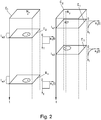
- Fig. 2 shows the further processing of events or occurring intensity values over time.
- Fig. 3 shows the individual event values occurring in the shared map as well as the detection of a critical event.
- the Figures 4a and 4b show the individual event values that result from accumulation in the first or second event card.
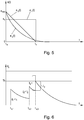
- Fig. 5 shows a variety of different possible decay behavior.
- Fig. 6 shows a possible, alternative embodiment of the invention with different specifications for determining the decay behavior.
- Figure 7a shows a specific application of a method according to the invention for the detection of critical events in large gatherings of people in public space.
- Figure 7b shows a digital image recorded by an image sensor in the course of this application.
- sensors S 1 , S 2 are shown, which in each case continuously, ie always recurring, supply sensor measured values m 1 , m 2 at predetermined times.
- the sensors S 1 , S 2 are a camera S 2 on the one hand and two pairs of microphones S 1 jointly arranged at a predetermined distance on the other hand.
- the camera S 2 delivers sensor readings in the form of digital images.
- the camera S 2 can be a thermal imaging camera or a camera that is sensitive to the visible area.
- the two pairs of microphones S 1 deliver - after post-processing steps have been carried out - sensor measured values as a noise distribution in the form of a noise image, with the Image areas or pixels of the noise image are each assigned intensity values which correspond to the probability that a noise emanates from a specific point in the recording area of both microphone pairs S 1.
- the concrete creation of the sound images is, for example, in Friedlander, B .: A passive localization algorithm and its accuracy analysis. In: Oceanic Engineering, IEEE Journal of 12 (1987), No. 1, pp. 234-245 described in more detail.
- a spatial localization of the received noises is carried out on the basis of the transit time differences of the microphones assigned to one another.
- a degree of agreement can be determined for the creation of events E 1 , E 2 , E 3 , E 4 , which indicates the extent to which a determined noise corresponds to or is similar to one or more reference noises.
- This measure of correspondence can, for example, represent an event in a further event map which has intensity values within a radius around the microphone which correspond to the range of the microphone. The individual measured values are ultimately distributed over a large number of nodes.
- sensors S 1 , S 2 can in principle be freely determined and adapted to the critical events to be recognized.
- acoustic sensors such as microphones, directional microphones, floor vibration sensors or ODTR sensors can also be used in order to detect acoustic processes that indicate critical events.
- cameras S 2 with different sensitivities for individual wavelength ranges are typical, with gray-scale cameras and RGB color cameras normally being used.
- other cameras S 2 such as infrared cameras or thermal imaging cameras can also be used.
- Door and window contacts or glass breakage sensors can also be used to detect events that relate to certain buildings. If the movements of people, vehicles or animals can be observed, motion detectors or motion detectors can also be used within the scope of the invention.
- sensors can also be used to determine persons and the paths covered by these persons, which determine the communication via WLAN and Bluetooth.
- microwave radar as a sensor for the detection of people, animals or things, with a spatial intensity distribution being able to be determined with such a sensor.
- the event cards C 1 , C 2 shown essentially have the form of a two-dimensional array of values, which can also be interpreted as a digital image with a large number of channels.
- the individual nodes N x , N y are arranged in a two-dimensional, regular position that can be defined by two coordinate values, in particular in the form of a grid with a grid with rows and columns.
- the individual nodes N x , N y of the event cards C 1 , C 2 can each be assigned values, if necessary in several channels.
- At least a large number of the nodes N x , N y, in particular each of the nodes N x , N y of the event cards C 1 , C 2 is assigned to at least one area in the measurement area of at least one of the sensors S 1 , S 2 .
- the individual measured noise values m 1 of the noise sensor or of the two pairs of microphones S 1 are each assigned to a measuring range, in relation to which the respective measured noise value is defined.
- a line of sight or a cone of vision of a pixel sensor of a camera S 2 is assigned to the individual measured values m 2 of the camera S 2.
- the relevant line of sight or cone of vision of a pixel sensor represents a sub-area of the recording area of the camera S 2 .
- the two sensors S 1 , S 2 are positioned in such a way that they partially overlap the same scene with different sensitivity from different spatial directions, so that individual measurement areas of the two sensors S 1 , S 2 show measured values relating to the same scene from different angles . Based on the knowledge of the specific alignment of the two sensors S 1 , S 2 , it is possible to assign measured values that were recorded with regard to the same recording area to the same node on an event card.
- the assignment of the individual measured values to the recording areas can also take place approximately.
- the recording area of an image sensor of a camera S 2 positioned in an interior space can be assumed to be the area that the camera S 2 records when there are no objects in the recording area.
- That area of the first event map C 1 for which measured values m 1 are available is denoted by the reference symbol C 1 '.
- That area of the second event map C 2 for which measured values m 2 are available is denoted by the reference symbol C 2 '.
- the event cards C 1 , C 2 to which different measured values have been applied in each case, become a common card C. together, being provided for each event card C 1, C 2 each represent an illustration T 1, T 2, which reflects the single event cards C 1, C 2 on the same map C.
- the event cards C 1 , C 2 are designed to overlap, so that at least two nodes N x , N y of the two different event cards C 1 , C 2 are each mapped to the same node M z of the common card C.
- this requirement does not have to be fulfilled for all points on an event card C 1 , C 2 and also not for all points on the common card C.
- each of these event cards overlaps with another event card in at least one of its nodes N x , N y , so that for each event card there is at least one node N x that has the same node M z of the common card C is mapped as at least one node N y of another event card.
- the images of the individual event cards under the transformations T 1 , T 2 used in each case result in a coherent area on the common card C, that is, not individual images T 1 (C 1 ), T 2 (C 2 ) of the event cards C 1 , C 2 under the respective transformation Transformations T 1 , T 2 do not overlap with any of the other images T 1 (C 1 ), T 2 (C 2 ) of the event cards.
- the common card C is specified with a number of nodes M z.
- the nodes M z of the common map C can preferably be arranged in the form of a grid, in particular in a grid with rows and columns.
- the individual transformations T 1 , T 2 are in particular selected in such a way that they map measured values relating to the same measuring range or overlapping measuring ranges onto the same nodes M z of the common map C.
- the images T 1 , T 2 can also have a certain continuity or continuity in such a way that measured values relating to neighboring measurement areas are mapped onto neighboring nodes of the common map C.
- an interpolation can also be used in the context of mapping to the common map C, since in connection with the invention it is by no means required that the nodes of the event maps C 1 , C 2 by the mappings T 1 , T 2 exactly on the nodes of the common Map C. Rather, there is also the possibility that the values of individual nodes on the event cards C 1 , C 2 are mapped onto a plurality of nodes on the common card C. Conversely, several nodes of the event cards C 1 , C 2 located adjacent to the original image of the relevant node of the images T 1 , T 2 can also be used to determine values on nodes of the common map C. Different interpolation methods known from the prior art can be used for this.
- Figures 7a and 7b depicted scene drawn closer.
- the image created by the camera S 2 is in Figure 7b shown in more detail and shows, on the one hand, a passerby I who is not considered dangerous and an angry noisy crowd II comprising a total of seven people, who pose a potential danger to the public space.
- Figure 7a shows the transformed event cards C 1, C 2 and the common card C illustrated one above the other, wherein the event cards C 1, C 2 in accordance with their associated transformations T 1, T 2 are already distorted such that superposed points to each other due to the transformations T 1 , T 2 are assigned.
- the in Figure 7a The cylinder shown vertically intersects in the two event maps C 1 , C 2 and in the common map C those areas that are affected by the crowd II.
- different detection rules can basically be used depending on the type of sensors S 1 , S 2 used.
- searching for events in the camera images created by the camera S 2 it is possible to identify moving persons in the camera image by means of a pattern matching method.
- the probability can be determined as to whether a person in the one node of the event map C 2 assigned measuring field, the Camera S 2 is located.
- an event E 1 , E 2 , E 3 , E 4 can be determined or determined for the relevant point in time t a, 1 , t a, 2 , t a, 3 , t a, 4, the relevant event E 1 , E 2 , E 3 , E 4 being evaluated in terms of its intensity by a number of intensity values each assigned to a node.
- the probability of whether there is a sound source with a sound level exceeding a threshold value can be determined in one node of the event map C 1 associated measuring range of the two microphone pairs S 1 is located.
- the intensity value assigned to the event is weighted in particular with the intensity or volume of the noise. If necessary, the weakening of the signal caused by the distance between the area assigned to the node and the microphone can be compensated for.
- individual events can also be created at predetermined times, with the intensity values of the respective event indicating the direction in which the directional microphone in question has received noises.
- the point in time t a, 1 , t a, 2 , t a, 3 , t a, 4 can also be determined at which the sound level of the sound source exceeded the relevant threshold value and this point in time t a, 1 , t a, 2 , t a, 3 , t a, 4 assigned to the event.
- the event E 1 , E 2 , E 3 , E 4 is assigned a number of intensity values I, each assigned to a node, which indicate the intensity of the event E 1 , E 2 , E 3 , E 4 in the relevant measurement range assigned to the node.
- each of the events E 1 , E 2 , E 3 , E 4 is additionally a decay function is assigned which indicates the time span over which the relevant event E 1 , E 2 , E 3 , E 4 should be effective in the future.
- E 1 , E 2 , E 3 , E 4 can decay relatively quickly, for example exponentially with a half-life of one second, while other events, such as very loud noises in particular, last longer, for example constantly one or two seconds into the future and, if events occur again later at the same point, rather indicate critical events EK at the relevant node N x , N y , M z or area.
- the individually determined sensor measured values do not necessarily need to be assigned to individual recording times t a, 1 , t a, 2 , t a, 3 , t a, 4 in order to be able to classify their temporal occurrence.
- recording time spans can also be used in order to be able to relate the individual sensor measured values to the other sensor measured values in terms of time and to be able to calculate the decay processes.
- the decay function defines a decay behavior over time, ie the effect of the event for the future when critical events are identified. As already mentioned, this depends on the type of event E 1 , E 2 , E 3 , E 4 .
- the decay function has a predetermined neutral value, in the present case, when a predetermined time span t c is exceeded after the time t a of the respective event Case 0, on. If a convergent decay behavior is desired, the decay function can also converge towards this neutral value, in the present case 0.
- the decay behavior can also be modified by the duration of the relevant recording time period.
- the time interval between the times t a and t c of the decay function can be determined by the duration of the recording time span.
- the function also increases for a specific time range after the point in time t a of the event E 1 , E 2 , E 3 , E 4 . After this time range, however, the function converges monotonically to the neutral value 0.
- a total of four events E 1 , E 2 , E 3 , E 4 are shown, with an event time t a, 1 , t a, 3 or an event time span t a, 2 , t a, 4 being assigned to each of the events.
- the relevant event is assigned intensity values that have a value different from the neutral value 0 in the circled areas.
- the two events E 2 and E 4 of the first event map C 1 are each assigned a decay function with a rectangular profile
- the two events E 1 and E 3 of the second event map C 2 are each assigned a decay function with an exponential decay profile.
- the in Fig. 2 The illustrated embodiment example uses the same rectangular decay function for all events E 2 , E 4 of the first event map C 1, and the same exponential decay function for all events E 1 , E 3 of the second event map C 2.
- event values are formed node-wise in that the individual intensity values from the same node on the event card C 1 , C 2 are weighted and accumulated with a predetermined accumulation rule and the event value is determined in this way.
- the accumulation rule also basically defines the neutral value used for the decay functions. Since the, possibly weighted, addition is used as the accumulation rule, in this preferred working example the value zero (0) is used as the neutral value, which represents the neutral element with regard to the addition and does not change the result of an accumulation. If the multiplication is used as the accumulation rule, the value (1) is used as the neutral value, which represents the neutral element with regard to the multiplication and does not change the result of an accumulation.
- event values V z were formed node-wise for all nodes N x , N y of the event cards C 1 , C 2 by weighting the individual intensity values from the same node of the event card and accumulating the event value for the nodes N x , N y of the event cards C 1 , C 2 was determined.
- a second step ( Fig. 3 ) the individual event values V z of those nodes of the event map C 1 , C 2 that were mapped to the relevant node M z of the common map C on the basis of the mapping T 1 , T 2 or were used for an interpolation, with the same accumulation rule, namely by addition, accumulated and an event value V z for the node M z of the common card C is determined in this way.
- This procedure has the significant advantage that almost any decay functions and decay behavior of events can be used and individually adapted to the application in question.
- a critical event EK in the relevant node M z of the shared card C as well as in this node M z assigned area in the measuring range of one of the sensors S 1 , S 2 can be determined.
- FIG Fig. 3 The course of the event value determined by the two events in relation to the node M z is shown in FIG Fig. 3 shown. It can be seen here that the close chronological succession of different events led to the threshold value Th being exceeded by the event value V z , as a result of which a critical event EK was determined.
- all of them are assigned the same exponential decay function a 3 (t), which decays exponentially after time with a predetermined half-life.
- a 3 (t) which decays exponentially after time with a predetermined half-life.
- no intensity values that occurred in the past need to be stored during the ongoing formation of the event values V z. Since all intensity values decay with the same half-life, a single event value V z can be determined for the individual nodes of the common map C, which decays according to the decay function. If an event with an intensity value is detected in a node of an event card C 1 , C 2 , the event value V z of the relevant node or nodes M z of the common card C is increased by the intensity value or a value corresponding by interpolation of the intensity value.
- a sensor (not shown) is used to track people or objects. If a person has moved along a path on the event map and this has been detected, an event can have a very long decay time can be determined for each of which a predetermined intensity value is set on the entire movement path.
Landscapes
- Engineering & Computer Science (AREA)
- Theoretical Computer Science (AREA)
- Physics & Mathematics (AREA)
- General Physics & Mathematics (AREA)
- Multimedia (AREA)
- Data Mining & Analysis (AREA)
- Life Sciences & Earth Sciences (AREA)
- Artificial Intelligence (AREA)
- Bioinformatics & Cheminformatics (AREA)
- Bioinformatics & Computational Biology (AREA)
- Computer Vision & Pattern Recognition (AREA)
- Evolutionary Biology (AREA)
- Evolutionary Computation (AREA)
- General Engineering & Computer Science (AREA)
- Testing Or Calibration Of Command Recording Devices (AREA)
Claims (13)
- Procédé de détection d'événements critiques (EK) survenant à un moment de détection (td) défini sur des zones à surveiller dans des lieux publics,a) dans lequel des valeurs de mesure de capteur (m1, m2) sont déterminées avec divers capteurs (S1, S2), et plusieurs cartes d'événements (C1, C2) sont créées avec respectivement un nombre de nœuds (Nx, Ny), dans lequel chacun des nœuds (Nx, Ny) ou une pluralité de nœuds (Nx, Ny) d'au moins une carte d'événements (C1, C2) est associé à une zone dans la plage de mesure d'au moins un des capteurs (S1, S2),b) dans lequel une carte commune (C) est spécifiée avec un nombre de nœuds (Mz), dans lequel chacun des nœuds (Mz) ou une pluralité des nœuds de la carte commune (C) est associé à une plage dans la plage de mesure d'au moins un des capteurs (S1, S2),
dans lequel les nœuds (Mz, Nx, Ny) de la carte commune (C) ou des cartes d'événements (C1, C2) sont disposés en forme de trame, en particulier en une trame avec des lignes et des colonnes,c) dans lequel respectivement une reproduction (T1, T2) est spécifiée sur la carte commune (C) au préalable pour chacune des diverses cartes d'événements (C1, C2),
qui reproduit en particulier des valeurs de mesure (m1, m2) concernant la même zone de mesure sur les mêmes nœuds (Mz) de la carte commune (C) et/ou reproduit des valeurs de mesure concernant des zones de mesure voisines sur des nœuds voisins de la carte commune (C),d) dans lequel des événements (E1, E2, E3, E4) sont créés selon des critères spécifiés pour une pluralité de moments d'enregistrement (ta; ta,1, ta,2, ta,3, ta,4) ou périodes d'enregistrement respectivement en raison des valeurs de mesure de capteur (m1, m2) déterminées d'un ou de plusieurs capteurs (S1, S2), dans lequel sont déterminés ou fixés dans le cas de la création d'un événement (E1, E2, E3, E4)- le moment d'enregistrement (ta) ou une période d'enregistrement- une valeur d'intensité (I) associée à l'événement (E1, E2, E3, E4) pour chaque nœud (Nx, Ny) de la carte d'événements (C1, C2),- une fonction d'affaiblissement (a1(t); a2(t) ; a3(t)) pour fixer un comportement d'affaiblissement dans le temps en raison du type de l'événement (E1, E2, E3, E4), dans lequel la fonction d'affaiblissement présente une valeur neutre (0) spécifiée ou converge vers ladite valeur neutre (0) en cas de dépassement d'une période spécifiée (ta),e) dans lequel une valeur d'événement (Vz) est définie nœud par nœuds pour le moment de détection (td) ainsi que pour un nombre de nœuds (Mz) de la carte commune (C) en ce
que les diverses valeurs d'intensité (I) de tous les événements (E1, E2, E3, E4) concernant le nœud (Nx, Ny) de la carte d'événements (C1, C2), qui sont reproduites en raison de la reproduction (T1, T2) sur le nœud (Mz) concerné de la carte commune (C) ou sont prises en compte pour une interpolation, ou des apports (J) dérivés desdites valeurs sont cumulés de manière pondérée avec une spécification de cumul, où le cumul de la valeur neutre (0) n'offre aucun apport au résultat de cumul et ainsi la valeur d'événement (Vz) est déterminée pour le moment de détection (td) concerné,f) dans lequel les valeurs d'intensité (I) ou les apports (J), qui offrent les valeurs d'intensité (I) d'événements pour le cumul, sont pondérés lors de la création de la valeur d'événement (Vz) dans le cadre du cumul respectivement avec une valeur, qui correspond au résultat de l'application de la fonction d'affaiblissement de l'événement respectif sur la période (td-ta) entre le moment de détection (td) et le moment d'enregistrement (ta) ou à un moment dans la période d'enregistrement de l'événement (E1, E2, E3, E4), etg) dans lequel si une valeur d'événement (Vz) dépasse dans la carte commune (C) une valeur de seuil (Th) spécifiée, un événement critique (EK) est fixé dans le nœud (Mz) concerné de la carte commune (C) ainsi que dans la zone associée audit nœud (Mz) dans la zone de mesure d'un des capteurs (S1, S2), et
dans lequel- des valeurs de seuil (Th) respectivement différentes sont spécifiées pour divers nœuds (Mz, Nx, Ny) des cartes d'événements (C1, C2) et- plusieurs cartes d'événements (C1, C2) sont réalisées de manière à se chevaucher si bien qu'au moins deux nœuds (Nx, Ny) de deux cartes d'événements (C1, C2) différentes sont reproduits respectivement sur le même nœud (Mz) de la carte commune (C). - Procédé selon la revendication 1, caractérisé en ce que respectivement la même fonction d'affaiblissement (a1(t) ; a2(t) ; a3(t)) est utilisée pour tous les événements (E1, E2, E3, E4) de la même carte d'événements (C1, C2), dans lequel des fonctions d'affaiblissement (a1(t)) ; a2(t) ; a3(t)) différentes les unes des autres sont utilisées en particulier pour des cartes d'événements (C1, C2) différentes.
- Procédé selon la revendication 1 ou 2, caractérisé en ce que lors d'une première étape- des valeurs d'événement (Vz) sont obtenues nœud par nœud pour tous les nœuds (Nx, Ny) des cartes d'événements (C1, C2) en ce que les diverses valeurs d'intensité (I) du même nœud (Nx, Ny) de la carte d'événements (C1, C2) sont cumulées de manière pondérée avec une spécification de cumul spécifiée et ainsi la valeur d'événement (Vz) est déterminée,- les valeurs d'intensité (I) sont pondérées respectivement avec une valeur, qui correspond au résultat de l'application de la fonction d'affaiblissement sur la période (td-ta) entre le moment d'enregistrement (ta) ou la période d'enregistrement de l'événement (E1, E2, E3, E4) et le moment de détection (td),et lors d'une deuxième étape, les diverses valeurs d'événement (Vz) des nœuds (Nx, Ny) de la carte d'événements (C1, C2), qui précisément sont reproduites en raison de la reproduction sur le nœud concerné (Mz) de la carte commune (C) ou sont prises en compte pour une interpolation, sont cumulées de manière pondérée avec la même spécification de cumul et ainsi la valeur d'événement (Vz) est déterminée.
- Procédé selon l'une quelconque des revendications précédentes, caractérisé en ce que chaque carte d'événements (C1, C2) chevauche respectivement en au moins un nœud (Nx) une autre carte d'événements (C1, C2) si bien qu'il existe pour chaque carte d'événements (C1, C2) au moins un nœud (Ny), qui est reproduit sur le même nœud (Mz) de la carte commune (C) qu'au moins un nœud (Ny) d'une autre carte d'événements (C2).
- Procédé selon l'une quelconque des revendications précédentes, caractérisé en ce que les valeurs de mesure de capteur (m1, m2) d'au moins un capteur (S1, S2) sont prises en compte lors de l'obtention d'une multitude de cartes d'événements (C1, C2).
- Procédé selon l'une quelconque des revendications précédentes, caractérisé en ce qu'est utilisée en tant que fonction d'affaiblissement (a1(t) ; a2(t) ; a3(t)) une fonction- qui présente une valeur spécifiée (ac) et par la suite la valeur neutre (0) pour une période spécifiée (tc) après le moment d'enregistrement (ta) ou la période d'enregistrement, et/ou- qui présente une valeur baissant de manière monotone, en particulier de manière linéaire, en partant d'une valeur maximale spécifiée (amax) et, par la suite, présente la valeur neutre (0) pour une période spécifiée (tc) après le moment d'enregistrement (ta) ou la période d'enregistrement, et/ou- qui présente une valeur baissant de manière exponentielle et monotone à partir d'une valeur maximale spécifiée (amax), qui converge vers la valeur neutre (0), après le moment d'enregistrement (ta) ou la période d'enregistrement.
- Procédé selon l'une quelconque des revendications précédentes, caractérisé en ce que pour toutes les fonctions d'affaiblissement (a1(t)) un temps d'affaiblissement maximal (tc) est spécifié, après lequel la valeur des fonctions d'affaiblissement (a1(tc)) correspond à la valeur neutre (0), et/ou
que pour le cumul exclusivement des événements (E1, E2, E3, E4) sont pris en compte, dont le moment d'enregistrement (ta) ou la période d'enregistrement est inférieur audit temps d'affaiblissement avant le moment de détection (td). - Procédé selon l'une quelconque des revendications précédentes, caractérisé en ce qu'en présence d'un événement, respectivement une valeur d'intensité (I) est associée aux nœuds (Nx, Ny) d'une carte d'événements (C1, C2), dans lequel lesdites valeurs d'intensité (I) viennent s'ajouter, conformément à la transformation (T1, T2) respective aux valeurs d'événement (Vz) des nœuds (Mz) concernés de la carte d'événements commune (C), dans lequel les valeurs d'événement baissent ou s'affaiblissent de manière exponentielle sur la carte d'événements commune (C) après le temps avec une demi-vie spécifiée.
- Procédé selon l'une quelconque des revendications précédentes, caractérisé en ce que lors de l'étape a) chacun des nœuds (Nx, Ny) ou une pluralité de nœuds (Nx, Ny) d'au moins une carte d'événements (C1, C2) est associé à une zone dans la zone de mesure d'au moins un des capteurs (S1, S2), en ce quei) au moins une première carte d'événements est créée en partant des valeurs de mesure de capteur d'au moins une paire de microphones (S1) ou de deux paires de microphones (S1) disposées ensemble à une distance spécifiée, dans lequel est attribuée aux nœuds (Nx) de la première carte d'événements (C1) respectivement une valeur de mesure, qui correspond à la probabilité qu'un bruit sorte de l'emplacement concerné,ii) au moins une deuxième carte d'événements (C2) est créée en partant des valeurs de mesure de capteur d'au moins une caméra ou de deux caméras (S2), dans lequel est attribuée aux nœuds (Ny) de ladite deuxième carte d'événements (C2) respectivement une valeur de mesure, qui correspond à la probabilité qu'au moins une personne se trouve sur l'emplacement concerné.
- Procédé selon la revendication 9, caractérisé en ce que lors de l'étape i) sont utilisées pour créer la deuxième carte d'événements (C2) des caméras thermiques ou des caméras qui sont sensibles au domaine visible,
qu'une transformation est spécifiée dans la deuxième carte d'événements (C2) pour la caméra thermique respective des deux caméras, dans lequel des zones d'enregistrement communes des caméras sont reproduites sur des nœuds communs, et
que les valeurs d'événement sont déterminées pour chaque nœud au moyen d'un procédé d'analyse d'images, qui indique la probabilité de l'apparition d'une personne sur l'image de caméra. - Procédé selon la revendication 9 ou 10, caractérisé en ce que lors de l'étape ii), une localisation spatiale des bruits reçus est effectuée sur la base des différences de temps de propagation des microphones associés les uns aux autres, et dans lequel est attribuée aux nœuds de la première carte d'événements (C1) respectivement une valeur d'intensité ou une valeur d'événement, qui correspond à la probabilité qu'un bruit sorte de l'emplacement concerné.
- Procédé selon l'une quelconque des revendications 9 à 11, caractérisé en ce qu'est définie pour la création d'événements une mesure de concordance, qui indique dans quelle mesure le bruit déterminé coïncide à un ou plusieurs bruits de référence ou y est similaire et dans lequel est attribuée aux nœuds (Nx, Ny) pour l'événement concerné (E) respectivement une valeur d'intensité (I), qui correspond à la probabilité qu'un bruit coïncidant avec le bruit de référence sorte de l'emplacement concerné,
dans lequel la valeur d'intensité (I) est pondérée en particulier avec l'intensité du bruit, dans lequel éventuellement l'affaiblissement du signal provoqué par la distance entre la zone attribuée au nœud et le microphone est compensé. - Procédé selon l'une quelconque des revendications précédentes, caractérisé en ce qu'un capteur pour suivre des personnes ou des objets est utilisé pour la création d'une des cartes d'événements, dans lequel un trajet est fixé par rapport à la carte d'événements (Cx) pour les diverses personnes et une valeur d'événement (Vz) est spécifiée ou augmentée pour divers nœuds (Nx, Ny) qui se trouvent dans une région autour du trajet.
Applications Claiming Priority (2)
| Application Number | Priority Date | Filing Date | Title |
|---|---|---|---|
| AT500462017 | 2017-01-24 | ||
| AT500442017 | 2017-01-24 |
Publications (2)
| Publication Number | Publication Date |
|---|---|
| EP3352111A1 EP3352111A1 (fr) | 2018-07-25 |
| EP3352111B1 true EP3352111B1 (fr) | 2021-08-11 |
Family
ID=61027433
Family Applications (1)
| Application Number | Title | Priority Date | Filing Date |
|---|---|---|---|
| EP18151988.5A Active EP3352111B1 (fr) | 2017-01-24 | 2018-01-17 | Procédé de détection d'événements critiques |
Country Status (1)
| Country | Link |
|---|---|
| EP (1) | EP3352111B1 (fr) |
Families Citing this family (1)
| Publication number | Priority date | Publication date | Assignee | Title |
|---|---|---|---|---|
| CN110890977B (zh) * | 2019-10-15 | 2022-06-21 | 平安科技(深圳)有限公司 | 云平台的主机节点监控方法、装置和计算机设备 |
-
2018
- 2018-01-17 EP EP18151988.5A patent/EP3352111B1/fr active Active
Non-Patent Citations (1)
| Title |
|---|
| None * |
Also Published As
| Publication number | Publication date |
|---|---|
| EP3352111A1 (fr) | 2018-07-25 |
Similar Documents
| Publication | Publication Date | Title |
|---|---|---|
| EP2297701B1 (fr) | Analyse vidéo | |
| DE102012221563B4 (de) | Funktionsdiagnose und validierung eines fahrzeugbasierten bildgebungssystems | |
| WO2009003793A2 (fr) | Dispositif pour identifier et/ou classifier des modèles de mouvements dans une séquence d'images d'une scène de surveillance, procédé et programme informatique | |
| WO2012110653A1 (fr) | Procédé de détection d'objets cibles dans une zone de surveillance | |
| EP2553660B1 (fr) | Procédé pour visualiser des zones d'activité accrue dans des scènes de surveillance | |
| EP1531342A1 (fr) | Procédé de détection des piétons | |
| WO2013029722A2 (fr) | Procédé de représentation de l'environnement | |
| EP2875498B1 (fr) | Système de surveillance à zone de protection dépendante de la position, procédé de surveillance d'une zone à surveiller et programme informatique | |
| DE19621612C2 (de) | Vorrichtung zur Überwachung eines Gleisabschnittes in einem Bahnhof | |
| EP3847575A1 (fr) | Dispositif de surveillance et procédé de détection d'homme à la mer | |
| EP3663881B1 (fr) | Procédé de commande d'un véhicule autonome en fonction des vecteurs de mouvement estimés | |
| EP3352111B1 (fr) | Procédé de détection d'événements critiques | |
| DE102007041333B4 (de) | Berührungslos arbeitendes Zählsystem | |
| DE102009026091A1 (de) | Verfahren und System zur Überwachung eines dreidimensionalen Raumbereichs mit mehreren Kameras | |
| DE112022002520T5 (de) | Verfahren zur automatischen Kalibrierung von Kameras und Erstellung von Karten | |
| DE102019114451A1 (de) | Aktivitätsbereiche in Videoinhalten | |
| DE10049366A1 (de) | Verfahren zum Überwachen eines Sicherheitsbereichs und entsprechendes System | |
| EP3021256A1 (fr) | Procede de traitement d'images, detecteur de presence et systeme d'eclairage | |
| DE102013219218A1 (de) | Überwachungsanlage, Verfahren zur Überwachung eines Überwachungsbereichs sowie Computerprogramm | |
| DE102018117274A1 (de) | Sichere Kamera und Verfahren zur sicheren Aufnahme und Auswertung von Bilddaten | |
| AT520863B1 (de) | Verfahren zur Detektion von Körperbewegungen einer schlafenden Person | |
| DE102008057176B4 (de) | Automatisierbares 3D-Rekonstruktionsverfahren und Überwachungsvorrichtung | |
| DE102004007049A1 (de) | Verfahren zur Klassifizierung eines Objekts mit einer Stereokamera | |
| WO2017144033A1 (fr) | Procédé de détermination et de visualisation de changements dans un environnement réel comportant un terrain réel et des objets réels se trouvant sur ce terrain | |
| DE102015200784A1 (de) | Multi-Kamera-Videobranderkennung |
Legal Events
| Date | Code | Title | Description |
|---|---|---|---|
| PUAI | Public reference made under article 153(3) epc to a published international application that has entered the european phase |
Free format text: ORIGINAL CODE: 0009012 |
|
| STAA | Information on the status of an ep patent application or granted ep patent |
Free format text: STATUS: THE APPLICATION HAS BEEN PUBLISHED |
|
| AK | Designated contracting states |
Kind code of ref document: A1 Designated state(s): AL AT BE BG CH CY CZ DE DK EE ES FI FR GB GR HR HU IE IS IT LI LT LU LV MC MK MT NL NO PL PT RO RS SE SI SK SM TR |
|
| AX | Request for extension of the european patent |
Extension state: BA ME |
|
| STAA | Information on the status of an ep patent application or granted ep patent |
Free format text: STATUS: REQUEST FOR EXAMINATION WAS MADE |
|
| 17P | Request for examination filed |
Effective date: 20181128 |
|
| RBV | Designated contracting states (corrected) |
Designated state(s): AL AT BE BG CH CY CZ DE DK EE ES FI FR GB GR HR HU IE IS IT LI LT LU LV MC MK MT NL NO PL PT RO RS SE SI SK SM TR |
|
| STAA | Information on the status of an ep patent application or granted ep patent |
Free format text: STATUS: EXAMINATION IS IN PROGRESS |
|
| 17Q | First examination report despatched |
Effective date: 20200721 |
|
| GRAP | Despatch of communication of intention to grant a patent |
Free format text: ORIGINAL CODE: EPIDOSNIGR1 |
|
| STAA | Information on the status of an ep patent application or granted ep patent |
Free format text: STATUS: GRANT OF PATENT IS INTENDED |
|
| INTG | Intention to grant announced |
Effective date: 20210318 |
|
| GRAS | Grant fee paid |
Free format text: ORIGINAL CODE: EPIDOSNIGR3 |
|
| GRAA | (expected) grant |
Free format text: ORIGINAL CODE: 0009210 |
|
| STAA | Information on the status of an ep patent application or granted ep patent |
Free format text: STATUS: THE PATENT HAS BEEN GRANTED |
|
| AK | Designated contracting states |
Kind code of ref document: B1 Designated state(s): AL AT BE BG CH CY CZ DE DK EE ES FI FR GB GR HR HU IE IS IT LI LT LU LV MC MK MT NL NO PL PT RO RS SE SI SK SM TR |
|
| REG | Reference to a national code |
Ref country code: CH Ref legal event code: EP |
|
| REG | Reference to a national code |
Ref country code: DE Ref legal event code: R096 Ref document number: 502018006482 Country of ref document: DE |
|
| REG | Reference to a national code |
Ref country code: IE Ref legal event code: FG4D Free format text: LANGUAGE OF EP DOCUMENT: GERMAN Ref country code: AT Ref legal event code: REF Ref document number: 1420135 Country of ref document: AT Kind code of ref document: T Effective date: 20210915 |
|
| REG | Reference to a national code |
Ref country code: DE Ref legal event code: R079 Ref document number: 502018006482 Country of ref document: DE Free format text: PREVIOUS MAIN CLASS: G06K0009000000 Ipc: G06V0010000000 |
|
| REG | Reference to a national code |
Ref country code: LT Ref legal event code: MG9D |
|
| REG | Reference to a national code |
Ref country code: NL Ref legal event code: MP Effective date: 20210811 |
|
| PG25 | Lapsed in a contracting state [announced via postgrant information from national office to epo] |
Ref country code: RS Free format text: LAPSE BECAUSE OF FAILURE TO SUBMIT A TRANSLATION OF THE DESCRIPTION OR TO PAY THE FEE WITHIN THE PRESCRIBED TIME-LIMIT Effective date: 20210811 Ref country code: SE Free format text: LAPSE BECAUSE OF FAILURE TO SUBMIT A TRANSLATION OF THE DESCRIPTION OR TO PAY THE FEE WITHIN THE PRESCRIBED TIME-LIMIT Effective date: 20210811 Ref country code: FI Free format text: LAPSE BECAUSE OF FAILURE TO SUBMIT A TRANSLATION OF THE DESCRIPTION OR TO PAY THE FEE WITHIN THE PRESCRIBED TIME-LIMIT Effective date: 20210811 Ref country code: ES Free format text: LAPSE BECAUSE OF FAILURE TO SUBMIT A TRANSLATION OF THE DESCRIPTION OR TO PAY THE FEE WITHIN THE PRESCRIBED TIME-LIMIT Effective date: 20210811 Ref country code: HR Free format text: LAPSE BECAUSE OF FAILURE TO SUBMIT A TRANSLATION OF THE DESCRIPTION OR TO PAY THE FEE WITHIN THE PRESCRIBED TIME-LIMIT Effective date: 20210811 Ref country code: PT Free format text: LAPSE BECAUSE OF FAILURE TO SUBMIT A TRANSLATION OF THE DESCRIPTION OR TO PAY THE FEE WITHIN THE PRESCRIBED TIME-LIMIT Effective date: 20211213 Ref country code: NO Free format text: LAPSE BECAUSE OF FAILURE TO SUBMIT A TRANSLATION OF THE DESCRIPTION OR TO PAY THE FEE WITHIN THE PRESCRIBED TIME-LIMIT Effective date: 20211111 Ref country code: BG Free format text: LAPSE BECAUSE OF FAILURE TO SUBMIT A TRANSLATION OF THE DESCRIPTION OR TO PAY THE FEE WITHIN THE PRESCRIBED TIME-LIMIT Effective date: 20211111 Ref country code: LT Free format text: LAPSE BECAUSE OF FAILURE TO SUBMIT A TRANSLATION OF THE DESCRIPTION OR TO PAY THE FEE WITHIN THE PRESCRIBED TIME-LIMIT Effective date: 20210811 |
|
| PG25 | Lapsed in a contracting state [announced via postgrant information from national office to epo] |
Ref country code: PL Free format text: LAPSE BECAUSE OF FAILURE TO SUBMIT A TRANSLATION OF THE DESCRIPTION OR TO PAY THE FEE WITHIN THE PRESCRIBED TIME-LIMIT Effective date: 20210811 Ref country code: LV Free format text: LAPSE BECAUSE OF FAILURE TO SUBMIT A TRANSLATION OF THE DESCRIPTION OR TO PAY THE FEE WITHIN THE PRESCRIBED TIME-LIMIT Effective date: 20210811 Ref country code: GR Free format text: LAPSE BECAUSE OF FAILURE TO SUBMIT A TRANSLATION OF THE DESCRIPTION OR TO PAY THE FEE WITHIN THE PRESCRIBED TIME-LIMIT Effective date: 20211112 |
|
| PG25 | Lapsed in a contracting state [announced via postgrant information from national office to epo] |
Ref country code: NL Free format text: LAPSE BECAUSE OF FAILURE TO SUBMIT A TRANSLATION OF THE DESCRIPTION OR TO PAY THE FEE WITHIN THE PRESCRIBED TIME-LIMIT Effective date: 20210811 |
|
| PG25 | Lapsed in a contracting state [announced via postgrant information from national office to epo] |
Ref country code: DK Free format text: LAPSE BECAUSE OF FAILURE TO SUBMIT A TRANSLATION OF THE DESCRIPTION OR TO PAY THE FEE WITHIN THE PRESCRIBED TIME-LIMIT Effective date: 20210811 |
|
| PGFP | Annual fee paid to national office [announced via postgrant information from national office to epo] |
Ref country code: DE Payment date: 20220119 Year of fee payment: 5 |
|
| REG | Reference to a national code |
Ref country code: DE Ref legal event code: R097 Ref document number: 502018006482 Country of ref document: DE |
|
| PG25 | Lapsed in a contracting state [announced via postgrant information from national office to epo] |
Ref country code: SM Free format text: LAPSE BECAUSE OF FAILURE TO SUBMIT A TRANSLATION OF THE DESCRIPTION OR TO PAY THE FEE WITHIN THE PRESCRIBED TIME-LIMIT Effective date: 20210811 Ref country code: SK Free format text: LAPSE BECAUSE OF FAILURE TO SUBMIT A TRANSLATION OF THE DESCRIPTION OR TO PAY THE FEE WITHIN THE PRESCRIBED TIME-LIMIT Effective date: 20210811 Ref country code: RO Free format text: LAPSE BECAUSE OF FAILURE TO SUBMIT A TRANSLATION OF THE DESCRIPTION OR TO PAY THE FEE WITHIN THE PRESCRIBED TIME-LIMIT Effective date: 20210811 Ref country code: EE Free format text: LAPSE BECAUSE OF FAILURE TO SUBMIT A TRANSLATION OF THE DESCRIPTION OR TO PAY THE FEE WITHIN THE PRESCRIBED TIME-LIMIT Effective date: 20210811 Ref country code: CZ Free format text: LAPSE BECAUSE OF FAILURE TO SUBMIT A TRANSLATION OF THE DESCRIPTION OR TO PAY THE FEE WITHIN THE PRESCRIBED TIME-LIMIT Effective date: 20210811 Ref country code: AL Free format text: LAPSE BECAUSE OF FAILURE TO SUBMIT A TRANSLATION OF THE DESCRIPTION OR TO PAY THE FEE WITHIN THE PRESCRIBED TIME-LIMIT Effective date: 20210811 |
|
| PLBE | No opposition filed within time limit |
Free format text: ORIGINAL CODE: 0009261 |
|
| STAA | Information on the status of an ep patent application or granted ep patent |
Free format text: STATUS: NO OPPOSITION FILED WITHIN TIME LIMIT |
|
| 26N | No opposition filed |
Effective date: 20220512 |
|
| PG25 | Lapsed in a contracting state [announced via postgrant information from national office to epo] |
Ref country code: IT Free format text: LAPSE BECAUSE OF FAILURE TO SUBMIT A TRANSLATION OF THE DESCRIPTION OR TO PAY THE FEE WITHIN THE PRESCRIBED TIME-LIMIT Effective date: 20210811 |
|
| PG25 | Lapsed in a contracting state [announced via postgrant information from national office to epo] |
Ref country code: SI Free format text: LAPSE BECAUSE OF FAILURE TO SUBMIT A TRANSLATION OF THE DESCRIPTION OR TO PAY THE FEE WITHIN THE PRESCRIBED TIME-LIMIT Effective date: 20210811 Ref country code: MC Free format text: LAPSE BECAUSE OF FAILURE TO SUBMIT A TRANSLATION OF THE DESCRIPTION OR TO PAY THE FEE WITHIN THE PRESCRIBED TIME-LIMIT Effective date: 20210811 |
|
| REG | Reference to a national code |
Ref country code: CH Ref legal event code: PL |
|
| GBPC | Gb: european patent ceased through non-payment of renewal fee |
Effective date: 20220117 |
|
| REG | Reference to a national code |
Ref country code: BE Ref legal event code: MM Effective date: 20220131 |
|
| PG25 | Lapsed in a contracting state [announced via postgrant information from national office to epo] |
Ref country code: LU Free format text: LAPSE BECAUSE OF NON-PAYMENT OF DUE FEES Effective date: 20220117 Ref country code: GB Free format text: LAPSE BECAUSE OF NON-PAYMENT OF DUE FEES Effective date: 20220117 |
|
| PG25 | Lapsed in a contracting state [announced via postgrant information from national office to epo] |
Ref country code: FR Free format text: LAPSE BECAUSE OF NON-PAYMENT OF DUE FEES Effective date: 20220131 Ref country code: BE Free format text: LAPSE BECAUSE OF NON-PAYMENT OF DUE FEES Effective date: 20220131 |
|
| PG25 | Lapsed in a contracting state [announced via postgrant information from national office to epo] |
Ref country code: LI Free format text: LAPSE BECAUSE OF NON-PAYMENT OF DUE FEES Effective date: 20220131 Ref country code: CH Free format text: LAPSE BECAUSE OF NON-PAYMENT OF DUE FEES Effective date: 20220131 |
|
| PG25 | Lapsed in a contracting state [announced via postgrant information from national office to epo] |
Ref country code: IE Free format text: LAPSE BECAUSE OF NON-PAYMENT OF DUE FEES Effective date: 20220117 |
|
| REG | Reference to a national code |
Ref country code: DE Ref legal event code: R119 Ref document number: 502018006482 Country of ref document: DE |
|
| PG25 | Lapsed in a contracting state [announced via postgrant information from national office to epo] |
Ref country code: DE Free format text: LAPSE BECAUSE OF NON-PAYMENT OF DUE FEES Effective date: 20230801 |
|
| REG | Reference to a national code |
Ref country code: AT Ref legal event code: MM01 Ref document number: 1420135 Country of ref document: AT Kind code of ref document: T Effective date: 20230117 |
|
| PG25 | Lapsed in a contracting state [announced via postgrant information from national office to epo] |
Ref country code: HU Free format text: LAPSE BECAUSE OF FAILURE TO SUBMIT A TRANSLATION OF THE DESCRIPTION OR TO PAY THE FEE WITHIN THE PRESCRIBED TIME-LIMIT; INVALID AB INITIO Effective date: 20180117 |
|
| PG25 | Lapsed in a contracting state [announced via postgrant information from national office to epo] |
Ref country code: AT Free format text: LAPSE BECAUSE OF NON-PAYMENT OF DUE FEES Effective date: 20230117 |
|
| PG25 | Lapsed in a contracting state [announced via postgrant information from national office to epo] |
Ref country code: MK Free format text: LAPSE BECAUSE OF FAILURE TO SUBMIT A TRANSLATION OF THE DESCRIPTION OR TO PAY THE FEE WITHIN THE PRESCRIBED TIME-LIMIT Effective date: 20210811 Ref country code: CY Free format text: LAPSE BECAUSE OF FAILURE TO SUBMIT A TRANSLATION OF THE DESCRIPTION OR TO PAY THE FEE WITHIN THE PRESCRIBED TIME-LIMIT Effective date: 20210811 Ref country code: AT Free format text: LAPSE BECAUSE OF NON-PAYMENT OF DUE FEES Effective date: 20230117 |
|
| PG25 | Lapsed in a contracting state [announced via postgrant information from national office to epo] |
Ref country code: TR Free format text: LAPSE BECAUSE OF FAILURE TO SUBMIT A TRANSLATION OF THE DESCRIPTION OR TO PAY THE FEE WITHIN THE PRESCRIBED TIME-LIMIT Effective date: 20210811 |
|
| PG25 | Lapsed in a contracting state [announced via postgrant information from national office to epo] |
Ref country code: MT Free format text: LAPSE BECAUSE OF FAILURE TO SUBMIT A TRANSLATION OF THE DESCRIPTION OR TO PAY THE FEE WITHIN THE PRESCRIBED TIME-LIMIT Effective date: 20210811 |
|
| PGFP | Annual fee paid to national office [announced via postgrant information from national office to epo] |
Ref country code: AT Payment date: 20260410 Year of fee payment: 5 |