EP3363833A1 - Thermoplastisches harz und thermoplastische harzzusammensetzung - Google Patents
Thermoplastisches harz und thermoplastische harzzusammensetzung Download PDFInfo
- Publication number
- EP3363833A1 EP3363833A1 EP17866372.0A EP17866372A EP3363833A1 EP 3363833 A1 EP3363833 A1 EP 3363833A1 EP 17866372 A EP17866372 A EP 17866372A EP 3363833 A1 EP3363833 A1 EP 3363833A1
- Authority
- EP
- European Patent Office
- Prior art keywords
- weight
- thermoplastic resin
- parts
- seed
- rubbery polymer
- Prior art date
- Legal status (The legal status is an assumption and is not a legal conclusion. Google has not performed a legal analysis and makes no representation as to the accuracy of the status listed.)
- Granted
Links
Images
Classifications
-
- C—CHEMISTRY; METALLURGY
- C08—ORGANIC MACROMOLECULAR COMPOUNDS; THEIR PREPARATION OR CHEMICAL WORKING-UP; COMPOSITIONS BASED THEREON
- C08L—COMPOSITIONS OF MACROMOLECULAR COMPOUNDS
- C08L71/00—Compositions of polyethers obtained by reactions forming an ether link in the main chain; Compositions of derivatives of such polymers
- C08L71/08—Polyethers derived from hydroxy compounds or from their metallic derivatives
- C08L71/10—Polyethers derived from hydroxy compounds or from their metallic derivatives from phenols
- C08L71/12—Polyphenylene oxides
- C08L71/123—Polyphenylene oxides not modified by chemical after-treatment
-
- C—CHEMISTRY; METALLURGY
- C08—ORGANIC MACROMOLECULAR COMPOUNDS; THEIR PREPARATION OR CHEMICAL WORKING-UP; COMPOSITIONS BASED THEREON
- C08F—MACROMOLECULAR COMPOUNDS OBTAINED BY REACTIONS ONLY INVOLVING CARBON-TO-CARBON UNSATURATED BONDS
- C08F279/00—Macromolecular compounds obtained by polymerising monomers on to polymers of monomers having two or more carbon-to-carbon double bonds as defined in group C08F36/00
- C08F279/02—Macromolecular compounds obtained by polymerising monomers on to polymers of monomers having two or more carbon-to-carbon double bonds as defined in group C08F36/00 on to polymers of conjugated dienes
- C08F279/04—Vinyl aromatic monomers and nitriles as the only monomers
-
- C—CHEMISTRY; METALLURGY
- C08—ORGANIC MACROMOLECULAR COMPOUNDS; THEIR PREPARATION OR CHEMICAL WORKING-UP; COMPOSITIONS BASED THEREON
- C08J—WORKING-UP; GENERAL PROCESSES OF COMPOUNDING; AFTER-TREATMENT NOT COVERED BY SUBCLASSES C08B, C08C, C08F, C08G or C08H
- C08J3/00—Processes of treating or compounding macromolecular substances
- C08J3/12—Powdering or granulating
- C08J3/126—Polymer particles coated by polymer, e.g. core shell structures
-
- C—CHEMISTRY; METALLURGY
- C08—ORGANIC MACROMOLECULAR COMPOUNDS; THEIR PREPARATION OR CHEMICAL WORKING-UP; COMPOSITIONS BASED THEREON
- C08L—COMPOSITIONS OF MACROMOLECULAR COMPOUNDS
- C08L55/00—Compositions of homopolymers or copolymers, obtained by polymerisation reactions only involving carbon-to-carbon unsaturated bonds, not provided for in groups C08L23/00 - C08L53/00
- C08L55/02—ABS [Acrylonitrile-Butadiene-Styrene] polymers
-
- C—CHEMISTRY; METALLURGY
- C08—ORGANIC MACROMOLECULAR COMPOUNDS; THEIR PREPARATION OR CHEMICAL WORKING-UP; COMPOSITIONS BASED THEREON
- C08L—COMPOSITIONS OF MACROMOLECULAR COMPOUNDS
- C08L71/00—Compositions of polyethers obtained by reactions forming an ether link in the main chain; Compositions of derivatives of such polymers
- C08L71/08—Polyethers derived from hydroxy compounds or from their metallic derivatives
- C08L71/10—Polyethers derived from hydroxy compounds or from their metallic derivatives from phenols
- C08L71/12—Polyphenylene oxides
-
- C—CHEMISTRY; METALLURGY
- C08—ORGANIC MACROMOLECULAR COMPOUNDS; THEIR PREPARATION OR CHEMICAL WORKING-UP; COMPOSITIONS BASED THEREON
- C08L—COMPOSITIONS OF MACROMOLECULAR COMPOUNDS
- C08L2207/00—Properties characterising the ingredient of the composition
- C08L2207/53—Core-shell polymer
Definitions
- the present invention relates to a thermoplastic resin and a thermoplastic resin composition. More particularly, the present invention relates to a thermoplastic resin having a composition capable of improving graft density, and a thermoplastic resin composition capable of improving dispersion and providing high gloss by including the thermoplastic resin.
- ABS resin Acrylonitrile-butadiene-styrene (hereinafter referred to as "ABS") resin has been widely applied to automotive components, electrical and electronic products, office equipment, and the like due to stiffness and chemical resistance of acrylonitrile, processability, mechanical strength, and aesthetically pleasing appearance of butadiene and styrene, and the like.
- Surface gloss and dispersion of various blended resins including such an ABS resin are important factors determining the quality of processed molded articles.
- Patent Document 1 US Patent No. 4,360,618
- the present invention has been made in view of the above problems, and it is one object of the present invention to provide a thermoplastic resin having a composition capable of improving graft density, and a thermoplastic resin composition capable of improving dispersion and providing high gloss by including the thermoplastic resin.
- thermoplastic resin that is a graft copolymer having a seed-shell structure and includes a bimodal seed including a large-diameter rubbery polymer having an average particle diameter of greater than 2,000 ⁇ and 3,500 ⁇ or less and a small-diameter rubbery polymer having an average particle diameter of 500 ⁇ to 2,000 ⁇ ; and an aromatic vinyl-vinyl cyan polymer shell enclosing the seed, wherein the vinyl cyan compound is included in an amount of 5 % by weight to 28 % by weight based on a total weight of the aromatic vinyl-vinyl cyan polymer shell.
- thermoplastic resin composition including the thermoplastic resin and polyarylene ether, wherein the thermoplastic resin is included in an amount of 15 to 50 % by weight and the polyarylene ether is included in an amount of 50 to 85 % by weight.
- the present invention provides a thermoplastic resin having a composition capable of improving graft density, and a thermoplastic resin composition capable of improving dispersion and providing high gloss by including the thermoplastic resin.
- a thermoplastic resin according to the present invention is a graft copolymer having a seed-shell structure and includes a bimodal seed including a large-diameter rubbery polymer having an average particle diameter of greater than 2,000 ⁇ and 3,500 ⁇ or less and a small-diameter rubbery polymer having an average particle diameter of 500 ⁇ to 2,000 ⁇ ; and an aromatic vinyl-vinyl cyan polymer shell enclosing the seed, wherein the vinyl cyan compound is included in an amount of 5 % by weight to 28 % by weight based on a total weight of the aromatic vinyl-vinyl cyan polymer shell.
- the thermoplastic resin is a graft copolymer having a seed-shell structure and may include, for example, (a) a seed including a conjugated bimodal diene-based rubbery polymer; and (b) a shell enclosing the seed and prepared by polymerizing an aromatic vinyl compound, a vinyl cyan compound, and a fatty acid dimer or a metal salt thereof.
- the conjugated diene-based rubbery polymer of the seed may be prepared by polymerizing one or more conjugated diene-based compounds selected from the group consisting of 1,3-butadiene, 2,3-dimethyl-1,3-butadiene, 2-ethyl-1,3-butadiene, 1,3-pentadiene, and isoprene.
- the seed may be prepared, for example, by emulsion polymerization. In this case, superior mechanical properties are provided.
- An emulsion polymerization method is not specifically limited so long as it is a general method.
- the seed may have a latex form wherein a polymerized rubbery polymer is dispersed in water in a colloidal state.
- the seed may be a bimodal seed including a large-diameter seed having, for example, an average particle diameter of greater than 2,000 ⁇ and 3,500 ⁇ or less, 2,500 ⁇ or more to 3,500 ⁇ or less, or 3,000 ⁇ or more to 3,500 ⁇ or less, and a gel content of 60 to 95 % by weight, 65 to 80 % by weight, or 65 to 75 % by weight and a small-diameter seed having, for example, an average particle diameter of 500 ⁇ to 2,000 ⁇ , 1,000 ⁇ to 2,000 ⁇ , or 1,000 ⁇ to 1,500 ⁇ and a gel content of 60 to 95 % by weight, 70 to 95 % by weight, or 80 to 95 % by weight. Within this range, superior impact strength and mechanical properties are provided.
- average particle diameter is measured according to a dynamic laser light scaling method by means of a Nicomp 370HPL device manufactured by Nicomp, USA.
- a weight ratio of the large-diameter seed to the small-diameter seed constituting the seed may be, for example, 50 : 50 to 90 : 10, 60 : 40 to 75 : 25, 60 : 40 to 70 : 20, or 70 : 30 to 75 : 25. Within this range, superior dispersion and surface characteristics are provided.
- the seed may be included, for example, in an amount of 30 to 80 % by weight, 40 to 75 % by weight, or 50 to 70 % by weight based on 100 % by weight of a total of the conjugated diene-based rubbery polymer, the aromatic vinyl compound, and the vinyl cyan compound. Within this range, superior mechanical properties and surface characteristics are provided.
- the shell encloses the bimodal seed and is prepared by emulsion-graft-polymerizing a fatty acid having an average carbon number and an average molecular weight or a metal salt thereof.
- the fatty acid or the metal salt thereof may be included in an amount of 20 to 70 % by weight, 25 to 60 % by weight, or 30 to 50 % by weight based on 100 % by weight of a total of the conjugated diene-based rubbery polymer, the aromatic vinyl compound, and the vinyl cyan compound. Within this range, superior mechanical properties and property balance are provided.
- the aromatic vinyl compound may be, for example, one or more selected from the group consisting of styrene, ⁇ -methyl styrene, ⁇ -ethyl styrene, p-methyl styrene, o-methyl styrene, o-t-butyl styrene, bromostyrene, chlorostyrene, trichlorostyrene, and derivatives thereof
- the vinyl cyan compound may be, for example, one or more selected from the group consisting of acrylonitrile, methacrylonitrile, ethacrylonitrile, and derivatives thereof.
- the expression “derivative” may refer to a compound, one or more hydrogen atoms of which are substituted with a halogen group, an alkyl group, or a hydroxyl group.
- the vinyl cyan compound is preferably included in an amount of 5 to 28 % by weight, 5 % by weight or more to less than 25 % by weight, 5 to 20 % by weight, 5 to 15 % by weight, or 5 to 10 % by weight based on a total weight of the shell (aromatic vinyl-vinyl cyan polymer shell). Within this range, superior mechanical properties and property balance are provided.
- the aromatic vinyl compound and the vinyl cyan compound included in the shell may be included, for example, in a weight ratio of 90 : 10 to 99 : 1.
- the fatty acid may be, for example, two or more, two to ten, or two to five fatty acid dimer types having different carbon atom number chains, a metal salt thereof, or a mixture thereof.
- An average carbon atom number of a chain of the fatty acid may be, for example, 10 or more, 33 or more, 33 to 44, or 33 to 36.
- the fatty acid may include, for example, an unsaturated fatty acid dimer having an unsaturation degree of 1 to 20, 1 to 10, 1 to 5, or 2 to 3. Within this range, an amount of volatilized substances is small during extrusion and injection-molding.
- the fatty acid may have, for example, a molecular weight of 500 g/mol or more, 500 to 2000 g/mol, or 500 to 1000 g/mol. Within this range, thermal stability is superior, thereby reducing a gas generation amount during extrusion and injection-molding.
- molecular weight refers to an average molecular weight or a weight average molecular weight obtained by, after dissolving a solid in THF to a concentration of 0.2 % by weight, drying in a 120°C oven for 15 minutes, and measuring the dissolved solution by means of gel permeation chromatography (GPC).
- the fatty acid may include, for example, one or more selected from the group consisting of oleic acid, an oleic acid-based dimer, myristoleic acid, linoleic acid, and a metal salt thereof.
- a metal of the metal salt is, for example, an alkali metal, particularly potassium, sodium, or the like.
- the fatty acid may be included, for example, in an amount of 0.1 to 3 parts by weight, 0.1 to 2 parts by weight, or 0.1 to 1 part by weight, or 0.1 to 0.3 parts by weight based on 100 parts by weight of a total content of the conjugated diene-based rubbery polymer, the aromatic vinyl compound, and the vinyl cyan compound. Within this range, polymerization stability and storage stability of a polymer are increased.
- the fatty acid may include, for example, 50 % by weight or more, 60 to 100 % by weight, or 61 to 100 % by weight of the oleic acid-based dimer. Within this range, thermal stability is excellent, thereby reducing a gas generation amount during extrusion and injection-molding.
- the fatty acid may be included, for example, in an amount of 0.1 to 3 parts by weight, 0.1 to 2 parts by weight, or 0.1 to 1 part by weight, or 0.1 to 0.3 parts by weight based on 100 parts by weight of a total content of the conjugated diene-based rubbery polymer, the aromatic vinyl compound, and the vinyl cyan compound.
- thermoplastic resin of the present invention may have, for example, a graft rate of 50 % or more, 60 to 90 %, or 70 to 85 %. Within this range, surface gloss and dispersion are superior and mechanical properties are excellent.
- the thermoplastic resin of the present invention may have, for example, a weight average molecular weight of 20,000 to 200,000 g/mol, 20,000 to 150,000 g/mol, 20,000 to 100,000 g/mol, 30,000 g/mol or more and less than 85,000 g/mol, or 30,000 to 70,000 g/mol. Within this range, surface gloss and dispersion are superior and mechanical properties are excellent.
- thermoplastic resin of the present invention may have, as another example, a weight average molecular weight of 100,000 to 200,000 g/mol, 120,000 to 180,000 g/mol, or 130,000 to 170,000 g/mol. Within this range, surface gloss and dispersion are superior and mechanical properties are excellent.
- weight average molecular weight refers to a molecular weight measured by gel permeation chromatography (GPC).
- thermoplastic resin of the present invention may have a graft density ( ⁇ ) of greater than 0.12 and 0.80 or less, 0.20 to 0.70, or 0.30 to 0.64. Within this range, surface gloss and dispersion are superior and mechanical properties are excellent.
- the sol-gel separation method may be performed by, for example, adding 1 g of an obtained powder-type thermoplastic resin to 50 g of acetone, dissolving the same by stirring for 24 hours, separating the resultant solution under conditions of 20,000 rpm and -20 °C using a centrifuge, and separating a separated supernatant into a sol and a gel.
- the salt may be, for example, a sulfate such as MgSO4, a calcium salt such as CaCl2, a carbonate, or a mixture thereof.
- a sulfate such as MgSO4
- a calcium salt such as CaCl2
- a carbonate or a mixture thereof.
- thermoplastic resin of the present invention provides a composition capable of improving a graft density, thereby increasing dispersion of a blended resin and thus providing high gloss.
- a method of preparing the thermoplastic resin of the present invention is not specifically limited and may include, for example, a step of polymerizing a seed; and a step of preparing a shell by emulsion-graft-polymerizing the seed with a fatty acid having a chain of 10 or more carbon atoms on average and a molecular weight of 500 to 2000 g/mol or a metal salt thereof.
- the seed may include, for example, a large-diameter rubbery polymer having an average particle diameter of greater than 2,000 ⁇ and 3,500 ⁇ or less and a small-diameter rubbery polymer having an average particle diameter of 500 ⁇ to 2,000 ⁇ .
- the seed polymerization for example, may be performed through emulsion polymerization.
- the seed polymerization and the emulsion graft polymerization are not specifically limited so long as they are methods generally used to prepare an ABS resin.
- one or more selected from the group consisting of alkyl aryl sulfonate, alkali methyl alkyl sulfate, sulfonated alkyl ester, and a metal salt of unsaturated fatty acid may be additionally included as an emulsifier upon the seed polymerization and/or the emulsion graft polymerization, and may be added in an amount of 1.0 to 3.0 parts by weight based on 100 parts by weight of a total of the monomers (including the rubbery polymer upon emulsion graft polymerization).
- a water-soluble initiator or a liposoluble initiator may be used an initiator upon seed polymerization and/or emulsion graft polymerization.
- the water-soluble initiator includes, for example, sodium persulfate, potassium persulfate, ammonium persulfate, and the like
- the liposoluble initiator includes cumene hydroperoxide, diisopropyl benzene hydroperoxide, tertiary butyl hydroperoxide, paramenthane hydroperoxide, benzoyl peroxide, and the like.
- a combination of the water-soluble initiator and the liposoluble initiator may be used.
- the initiator may be used, for example, in an amount of 0.01 to 0.5 parts by weight or 0.1 to 0.3 parts by weight based on 100 parts by weight of a total of the monomers (including the rubbery polymer upon the emulsion graft polymerization). Within this range, excessive reaction does not occur and a polymer having a desired particle diameter and size distribution may be produced.
- thermoplastic resin of the present invention one or more selected from the group consisting of, for example, sodium formaldehyde sulfoxylate, sodium ethylene diamine tetraacetate, ferrous sulfate, dextrose, pyrrole sodium phosphate, and sodium sulfite may be included as an oxidation-reduction catalyst upon the seed polymerization and/or the emulsion graft polymerization.
- the oxidation-reduction catalyst may be used, for example, in an amount of 0.001 to 0.4 parts by weight, 0.005 to 0.2 parts by weight, or 0.01 to 0.2 parts by weight based on 100 parts by weight of a total of the monomers (including the rubbery polymer upon the emulsion graft polymerization). Within this range, polymerization is facilitated and thus the thermoplastic resin may be rapidly prepared.
- the emulsion graft polymerization is preferably performed at 60 to 90 °C or 60 to 80 °C for 3 to 5 hours or 2 to 4 hours after adding the reactants.
- the initiator is activated, whereby polymerization is initiated and heat removal is easy.
- temperature and reaction time are controlled within the range, a polymer having uniform size distribution may be produced.
- the step of emulsion-graft-polymerizing the shell may further include 0.1 to 1 part by weight, 0.2 to 0.6 parts by weight, or 0.3 to 0.5 parts by weight of a molecular weight regulator, as needed, based on 100 parts by weight of a total content of the conjugated diene-based rubbery polymer, the aromatic vinyl compound, and the vinyl cyan compound.
- a molecular weight regulator is included within this range, a polymer having a desired average particle diameter may be advantageously formed and a polymer having a uniform size is provided.
- a mercaptan-based compound such as tertiary dodecyl mercaptan, may be used.
- the initiator and the oxidation-reduction catalyst used in the graft polymerization may be added batchwise at an initial reaction stage.
- reaction heat may be easily removed, and a content of unreacted monomers may be reduced while preventing side reactions, thereby improving quality and productivity of a resultant polymer.
- temperature is elevated up to 60 to 100 °C, or 70 to 90 °C at a temperature elevation rate of 5 to 30/hr, or 10 to 20/hr, thereby performing second graft polymerization.
- reaction temperature is elevated within this range, reaction of unreacted monomers is facilitated, thereby rapidly accomplishing a high conversion rate.
- the polymerization is preferably terminated, for example, when a polymerization conversion rate is 90 to 99 %, 95 to 99 % or 97 to 99 %. Within this range, a content of unreacted monomers in a product is low and a polymer having a high polymerization degree may be produced.
- reaction conditions such as graft rate and reaction pressure, other than the aforementioned conditions, are not specifically limited so long as they have generally been performed in the technical art to which the present invention pertains, and may be properly selected and used as needed.
- the graft copolymer latex according to the present invention may be prepared into a powder form through general processes such as the aforementioned salt coagulation, washing, and drying.
- the resultant powder-type graft copolymer latex is mixed with a non-polar resin, such as a poly(arylene ether) resin, and then is subjected to extrusion and injection-molding, thereby being prepared into a molded article.
- a non-polar resin such as a poly(arylene ether) resin
- thermoplastic resin composition of the present invention is characterized by including the thermoplastic resin and the polyarylene ether resin.
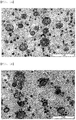
- thermoplastic resin composition for example, may have a form wherein the thermoplastic resin is dispersed in a matrix resin composed of a polyarylene ether resin (see FIG. 1 ). In this case, balance between properties, such as impact strength and gloss, is superior.
- the poly(arylene ether) resin may be, for example, a homopolymer of a compound represented by Formula 1 or 2 below, or a copolymer of a compound including Formula 1 or 2 below: [Formula 1] -Ar(R a ) n -O- wherein Ra, R1, R2, R3 and R4 are substituents of an arylene group (Ar) or a phenylene group and are each independently or simultaneously hydrogen, chlorine, bromine, iodine, methyl, ethyl, propyl, allyl, phenyl, methylbenzyl, chloromethyl, bromomethyl, cyanoethyl, cyano, methoxy, phenoxy, or a nitro group, the n is an integer of 4 to 20, and Ar is an arylene group having 7 to 20 carbon atoms.
- R1 and R2 may be an alkyl group or a C1 to C4 alkyl group
- R3 and R4 may be
- the poly(arylene ether) resin may be, for example, a poly(phenylene ether)-based resin.
- the poly(phenylene ether)-based resin refers to a poly(arylene ether) resin capable of being represented by [Formula 3] below: wherein each of W, X, Y, and Z are hydrogen or a substituent, and n is a repeat unit.
- W, X, Y, and Z are each independently or simultaneously hydrogen, chlorine, bromine, iodine, methyl, ethyl, propyl, allyl, phenyl, methylbenzyl, chloromethyl, bromomethyl, cyanoethyl, cyano, methoxy, phenoxy, or a nitro group, and n is an integer of 4 to 20.
- the homopolymer of the poly(arylene ether) resin is not specifically limited and, as a particular example, may be one or more selected from the group consisting of poly(2,6-dimethyl-1,4-phenylene) ether, poly(2,6-diethyl-1,4-phenylene) ether, poly(2-methyl-6-propyl-1,4-phenylene) ether, poly(2,6-dipropyl-1,4-phenylene) ether, poly(2-ethyl-6-propyl-1,4-phenylene) ether, poly(2,6-dimethoxy-1,4-phenylene) ether, poly(2,6-dichloromethyl-1,4-phenylene) ether, poly(2,6-dibromomethyl-1,4-phenylene) ether, poly(2,6-diphenyl-1,4-phenylene) ether, and poly(2,5-dimethyl-1,4-phenylene) ether.
- the copolymer of the poly(arylene ether) resin is not specifically limited and, as a particular example, may be one or more selected from the group consisting of a copolymer of 2,6-dimethylphenol and 2,3,6-trimethylphenol, a copolymer of 2,6-dimethylphenol and o-cresol, and a copolymer of 2,3,6-trimethylphenol and o-cresol.
- the poly(arylene ether) resin may be included, for example, in an amount of 50 to 85 % by weight, or 50 to 80 % by weight based on a total weight of the resin composition according to the present invention. Within this range, superior impact strength, mechanical properties, and surface gloss are provided.
- the poly(arylene ether) resin may have, for example, a weight average molecular weight of 10,000 to 100,000 g/mol, 10,000 to 70,000 g/mol, or 15,000 to 45,000 g/mol. Within this range, dimensional stability and property balance are excellent.
- thermoplastic resin composition may further include, for example, an additive such as a heat stabilizer, a light stabilizer, an antioxidant, an antistatic agent, an antimicrobial agent, or a lubricant, within a range within which properties thereof are not affected.
- an additive such as a heat stabilizer, a light stabilizer, an antioxidant, an antistatic agent, an antimicrobial agent, or a lubricant, within a range within which properties thereof are not affected.
- a specimen manufactured by melt-extruding the thermoplastic resin composition of the present invention may have a high surface gloss of greater than 66, greater than 80, 85 to 99, or 88 to 96 under a 45° light source.
- the specimen may have an improved tensile elongation of greater than 32 %, 40 % or more, or 42 to 65 %, which is measured according to ASTM D 638.
- the specimen may be manufactured by injection-molding or extruding the thermoplastic resin composition at a processing temperature of 250 to 300 °C to prepare a pellet, followed by injection-molding and die processing.
- thermoplastic resin composition of the present invention has superior mechanical strength and excellent gloss, thereby being suitable as a substitute for conventional blended materials.
- 100 parts by weight of deionized water, 50 parts by weight (based on solids) of the polybutadiene rubber latex (large-diameter seed) polymerized in the seed polymerization step, and 5 parts by weight (based on solids) of the polybutadiene rubber latex (small-diameter seed) polymerized in the seed polymerization step were fed into a polymerization reactor filled with nitrogen.
- a monomer mixture of styrene and acrylonitrile (acrylonitrile content: 5 % by weight)
- TDDM tertiary dodecyl mercaptan
- t-butyl hydroperoxide as an polymerization initiator
- an oxidation-reduction catalyst including 0.035 parts by weight of dextrose, 0.06 parts by weight of sodium pyrophosphate, and 0.0015 parts by weight of ferrous sulfate was added thereto batchwise, and polymerization was performed while elevating temperature to 70 °C over a period of 1 hour.
- C36 oleic acid dimer
- cumene hydroperoxide as a polymerization initiator
- a polymerization conversion rate was about 95 %.
- a polymerization conversion rate of a final polymer was about 98.8 %.
- ABS graft copolymer latex having a seed-shell structure was coagulated with 2 parts by weight of a sulfate, and then washed, thereby obtaining a powder (a1).
- Example 2 An experiment was carried out in the same manner as in Example 1, except that the polybutadiene rubber latex (large-diameter seed) polymerized in the seed polymerization step was added in an amount of 35 parts by weight instead of 50 parts by weight and the polybutadiene rubber latex (small-diameter seed) polymerized in the seed polymerization step was added in an amount of 20 parts by weight instead of 5 parts by weight in the shell polymerization step. As a result, an ABS graft copolymer powder (a2) was obtained.
- Example 2 An experiment was carried out in the same manner as in Example 1, except that an ABS graft copolymer powder (a2) was added instead of the ABS graft copolymer powder (a1) in the thermoplastic resin composition preparation step of Example 1. As a result, a specimen (A2) of Example 2 was manufactured.
- Example 3 An experiment was carried out in the same manner as in Example 1, except that, in the thermoplastic resin composition preparation step, the ABS graft copolymer powder (a1) was added in an amount of 50 parts by weight instead of 25 parts by weight and the polyphenylene ether was added in an amount of 50 parts by weight instead of 75 parts by weight. As a result, a specimen (A3) of Example 3 was manufactured.
- Example 2 An experiment was carried out in the same manner as in Example 1, except that an ABS graft copolymer powder (a4) was added instead of the ABS graft copolymer powder (a1) in the thermoplastic resin composition preparation step of Example 1. As a result, a specimen (A4) of Example 2 was manufactured.
- Example 5 Polymerization was carried out using the same composition in the same manner as in Example 2, except that a large-diameter seed having a particle diameter of 3600 ⁇ and a small-diameter seed having a particle diameter of 900 ⁇ were used. As a result, an ABS graft powder (a5) was obtained. The ABS graft powder (a5) was processed in the same manner as in Example 2, thereby manufacturing a specimen (A5) of Example 5.
- Example 6 Polymerization was carried out in the same manner as in Example 1, except that a myristoleic acid dimer was used in the same amount instead of the oleic acid dimer in the cell polymerization step. As a result, an ABS graft powder (a6) was obtained. The ABS graft powder (a6) was processed in the same manner as in Example 1, thereby manufacturing a specimen (A6).
- the polybutadiene rubber latex (large-diameter seed) polymerized in the seed polymerization step was added in an amount of 40 parts by weight instead of 50 parts by weight, and the polybutadiene rubber latex (small-diameter seed) polymerized in the seed polymerization step was added in an amount of 15 parts by weight instead of 5 parts by weight.
- an oxidation-reduction catalyst including 0.035 parts by weight of dextrose, 0.06 parts by weight of sodium pyrophosphate, and 0.0015 parts by weight of ferrous sulfate was added thereto batchwise, and polymerization was performed while elevating temperature to 70 °C over a period of 1 hour.
- C36 oleic acid dimer
- cumene hydroperoxide as a polymerization initiator
- a polymerization conversion rate was about 95 %.
- a polymerization conversion rate of a final polymer was about 98.8 %.
- ABS graft copolymer latex having a seed-shell structure was coagulated with 2 parts by weight of a sulfate, and then washed, thereby obtaining a powder (a7).
- Example 7 Further, an experiment was carried out in the same manner as in Example 1, except that an ABS graft copolymer powder (a7) was added instead of the ABS graft copolymer powder (a1) in the thermoplastic resin composition preparation step. As a result, a specimen (A7) of Example 7 was manufactured.
- the polybutadiene rubber latex (large-diameter seed) polymerized in the seed polymerization step was added in an amount of 40 parts by weight instead of 50 parts by weight, and the polybutadiene rubber latex (small-diameter seed) polymerized in the seed polymerization step was added in an amount of 15 parts by weight instead of 5 parts by weight.
- a monomer mixture of styrene and acrylonitrile (acrylonitrile content: 5 % by weight), 0.02 parts by weight of tertiary dodecyl mercaptan (TDDM) as a molecular weight regulator, and 0.2 parts by weight of t-butyl hydroperoxide as an polymerization initiator were sequentially added thereto, followed by stirring at 50 °C for 30 minutes.
- TDDM tertiary dodecyl mercaptan
- an oxidation-reduction catalyst including 0.035 parts by weight of dextrose, 0.06 parts by weight of sodium pyrophosphate, and 0.0015 parts by weight of ferrous sulfate was added thereto batchwise, and polymerization was performed while elevating temperature to 70 °C over a period of 1 hour.
- C36 oleic acid dimer
- cumene hydroperoxide as a polymerization initiator
- a polymerization conversion rate was about 95 %.
- a polymerization conversion rate of a final polymer was about 98.8 %.
- ABS graft copolymer latex having a seed-shell structure was coagulated with 2 parts by weight of a sulfate, and then washed, thereby obtaining a powder (a8).
- Example 8 Further, an experiment was carried out in the same manner as in Example 1, except that an ABS graft copolymer powder (a8) was added instead of the ABS graft copolymer powder (a1) in the thermoplastic resin composition preparation step. As a result, a specimen (A8) of Example 8 was manufactured.
- Example 1 An experiment was carried out in the same manner as in Example 1, except that an ABS graft copolymer powder (b1) was added instead of the ABS graft copolymer powder (a1) in the thermoplastic resin composition preparation step. As a result, a specimen (B1) of Comparative Example 1 was manufactured.
- thermoplastic resin polymerization step was not performed and SG910 (manufactured by LG chemistry), as a high-impact polystyrene (hereinafter referred to as "HIPS"), was used in an amount of 25 parts by weight.
- HIPS high-impact polystyrene
- Example 3 An experiment was carried out in the same manner as in Example 1, except that the polyphenylene ether was added in an amount of 50 parts by weight instead of 75 parts by weight and HIPS used in Comparative Example 2 was added in an amount of 50 parts by weight instead of 25 parts by weight. As a result, a specimen (B3) of Comparative Example 3 was manufactured.
- a polymer was prepared in the same manner as in Comparative Example 1, except that 55 parts by weight of a large-diameter rubbery polymer were used alone as the rubbery polymer. Using the polymer, a powder (b2) was prepared. A specimen (B4) was manufactured using the method and the composition used in Comparative Example 1.
- a polymer was prepared in the same manner as in Comparative Example 1, except that 55 parts by weight of a small-diameter rubbery polymer were used alone as the rubbery polymer. Using the polymer, a powder (b3) was prepared. A specimen (B5) was manufactured using the method and the composition used in Comparative Example 1.
- Average particle diameter ( ⁇ ) Measured by a dynamic laser light scattering method using a Nicomp 370HPL device manufactured by Nicomp, US.
- Graft rate Obtained according to Mathematical Equation 6 below and used as index an amount of a grafted polymer based on a total weight of added rubber during general graft polymerization.
- a Graft rate indicates a weight ratio of grafted polymer and has a different meaning from graft density. For example, a graft density is high as a molecular weight is small when a graft rate is the same.
- Graft rate Grafted polymer / Rubber ⁇ 100 * Gel content (% by weight): A polybutadiene rubber latex was coagulated using a dilute acid or a metal salt and then washed, followed by drying for 24 hours in a 60 °C vacuum oven. An obtained rubber mass was finely cut with scissors and then 1 g of a rubber piece was immersed in 100 g of toluene, followed by storing in a room-temperature dark room for 48 hours.
- thermoplastic resin composition specimens A1, A2, A3, A4, A5, A6, A7, A8, B1, B2, and B3 of Examples 1 to 8 and Comparative Examples 1 to 3 were measured according to the following methods. Results are summarized in Table 3 below.
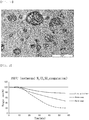
- FIG. 1 illustrates SEM images of Example 1 and Comparative Examples 1 and 2 summarized in Table 3. Particularly, the SEM images illustrate that the thermoplastic resin composition of each thereof is dispersed as a domain in a polyphenylene ether matrix. Referring to FIG. 1 , it can be confirmed that, in the case of the thermoplastic resin composition prepared according to the present invention, dispersion is improved compared to Comparative Example 1 or Comparative Example 2.
- FIG. 2 illustrates thermogravimetric analysis (TGA) graphs of an oleic acid dimer, rosin soap (rosin acid potassium salt), and fatty soap (fatty acid potassium salt) including an emulsifier as summarized in Tables 1 and 2.
- TGA thermogravimetric analysis
- the present invention may provide a blended material having equal or superior gloss and mechanical properties upon extrusion molding and injection-molding molding, compared to properties of conventional blended resins, by improving dispersion through blending of the thermoplastic resin having a composition capable of improving graft density.
Landscapes
- Chemical & Material Sciences (AREA)
- Health & Medical Sciences (AREA)
- Chemical Kinetics & Catalysis (AREA)
- Medicinal Chemistry (AREA)
- Polymers & Plastics (AREA)
- Organic Chemistry (AREA)
- Crystallography & Structural Chemistry (AREA)
- Graft Or Block Polymers (AREA)
- Compositions Of Macromolecular Compounds (AREA)
Applications Claiming Priority (3)
| Application Number | Priority Date | Filing Date | Title |
|---|---|---|---|
| KR20160149954 | 2016-11-11 | ||
| KR1020170094026A KR102044364B1 (ko) | 2016-11-11 | 2017-07-25 | 열가소성 수지 및 열가소성 수지 조성물 |
| PCT/KR2017/008347 WO2018088677A1 (ko) | 2016-11-11 | 2017-08-02 | 열가소성 수지 및 열가소성 수지 조성물 |
Publications (3)
| Publication Number | Publication Date |
|---|---|
| EP3363833A1 true EP3363833A1 (de) | 2018-08-22 |
| EP3363833A4 EP3363833A4 (de) | 2019-02-27 |
| EP3363833B1 EP3363833B1 (de) | 2022-07-20 |
Family
ID=62453534
Family Applications (1)
| Application Number | Title | Priority Date | Filing Date |
|---|---|---|---|
| EP17866372.0A Active EP3363833B1 (de) | 2016-11-11 | 2017-08-02 | Thermoplastisches harz und thermoplastische harzzusammensetzung |
Country Status (6)
| Country | Link |
|---|---|
| US (1) | US11352495B2 (de) |
| EP (1) | EP3363833B1 (de) |
| JP (1) | JP6810147B2 (de) |
| KR (1) | KR102044364B1 (de) |
| CN (1) | CN108368210B (de) |
| TW (1) | TWI738913B (de) |
Cited By (6)
| Publication number | Priority date | Publication date | Assignee | Title |
|---|---|---|---|---|
| EP3363819A4 (de) * | 2016-11-01 | 2019-01-23 | LG Chem, Ltd. | Verfahren zur herstellung eines dienbasierten kautschuklatex, verfahren zur herstellung eines abs-basierten pfropfcopolymers damit und verfahren zur herstellung eines abs-basierten spritzgussrodukts |
| EP3381957A4 (de) * | 2016-11-01 | 2019-03-27 | LG Chem, Ltd. | Verfahren zur herstellung einer abs-harzzusammensetzung und verfahren zur herstellung eines spritzgegossenen abs-produkts damit |
| EP3385292A4 (de) * | 2016-11-01 | 2019-04-17 | LG Chem, Ltd. | Verfahren zur herstellung von abs-pfropfcopolymeren mit verbesserter schlagfestigkeit und verfahren zur herstellung eines spritzgegossenen abs-produkts damit |
| EP3770192A4 (de) * | 2018-12-20 | 2021-09-01 | Lg Chem, Ltd. | Dienbasiertes kautschuklatex, herstellungsverfahren dafür, und kern-schale-strukturierte pfropfcopolymere damit |
| EP3916026A4 (de) * | 2019-09-20 | 2022-03-23 | Lg Chem, Ltd. | Verfahren zur herstellung eines dienbasierten kautschukpolymers und verfahren zur herstellung eines pfropfpolymers damit |
| US20220227987A1 (en) * | 2019-09-27 | 2022-07-21 | Lg Chem, Ltd. | Method for preparing conjugated diene-based polymer |
Families Citing this family (2)
| Publication number | Priority date | Publication date | Assignee | Title |
|---|---|---|---|---|
| KR102297798B1 (ko) * | 2018-12-14 | 2021-09-06 | 주식회사 엘지화학 | 비닐시안 화합물-공액디엔 화합물-방향족 비닐 화합물 그라프트 공중합체의 제조방법 및 이 그라프트 공중합체를 포함하는 열가소성 수지 조성물 |
| KR102829690B1 (ko) | 2020-04-27 | 2025-07-04 | 주식회사 엘지화학 | 그라프트 공중합체 조성물 제조방법, 그라프트 공중합체 조성물 및 이를 포함하는 수지 조성물 |
Family Cites Families (29)
| Publication number | Priority date | Publication date | Assignee | Title |
|---|---|---|---|---|
| US3833688A (en) * | 1971-10-14 | 1974-09-03 | Gen Electric | Composition of a polyphenylene ether and an acrylic resin in combination with a diene rubber-containing resin |
| US4360618A (en) | 1981-11-19 | 1982-11-23 | Monsanto Company | Low acrylonitrile content styrene-acrylonitrile polymers blended with polyphenylene oxide |
| JP2636424B2 (ja) * | 1989-06-19 | 1997-07-30 | ダイセル化学工業株式会社 | 耐熱・耐衝撃性樹脂組成物 |
| SG34284A1 (en) | 1994-12-02 | 1996-12-06 | Gen Electric | Impact modified vinyl chloride resin composition and graft copolymer compositions |
| US6084054A (en) | 1998-03-30 | 2000-07-04 | General Electric Company | Flame retardant polycarbonate resin/ABS graft copolymer blends having low melt viscosity |
| KR100417054B1 (ko) | 1998-07-22 | 2004-05-03 | 제일모직주식회사 | 스티렌계열가소성수지조성물 |
| JP2001163929A (ja) * | 1998-11-20 | 2001-06-19 | Daicel Chem Ind Ltd | ゴム含有スチレン系樹脂及びその製造方法 |
| KR20010078716A (ko) | 1999-02-04 | 2001-08-21 | 고지마 아끼로, 오가와 다이스께 | 열가소성 수지조성물 |
| KR100530568B1 (ko) | 1999-02-04 | 2005-11-22 | 제일모직주식회사 | 조립완구용 스티렌계 수지 조성물 |
| DE10008418A1 (de) * | 2000-02-23 | 2001-08-30 | Bayer Ag | ABS-Formmassen mit verbesserter Verarbeitbarkeit und hohem Glanz |
| KR100364060B1 (ko) | 2000-07-19 | 2002-12-12 | 제일모직주식회사 | 열가소성 난연성 수지 조성물 |
| US6492467B1 (en) * | 2001-05-09 | 2002-12-10 | Bayer Corporation | Process for making ABS polymeric blends |
| DE10145773A1 (de) * | 2001-09-17 | 2003-04-03 | Bayer Ag | ABS-Zusammensetzungen mit verbesserten Eigenschaftskombinationen |
| EP1499676B1 (de) * | 2002-04-26 | 2008-10-01 | Cheil Industries Inc. | Thermoplastharzzusammensetzung |
| KR100570430B1 (ko) * | 2003-11-26 | 2006-04-11 | 주식회사 엘지화학 | 열가소성 수지 조성물 및 그의 제조방법 |
| WO2005063826A1 (en) | 2003-12-30 | 2005-07-14 | Lg Chem, Ltd. | Polymer latex having excellent impact-resistance and powder flow property and method for preparing the same |
| JP2006045252A (ja) * | 2004-07-30 | 2006-02-16 | Toray Ind Inc | 熱可塑性樹脂組成物 |
| KR100653503B1 (ko) * | 2004-08-19 | 2006-12-04 | 주식회사 엘지화학 | 고무강화 열가소성 수지의 제조방법 및 이를 이용한고무강화 열가소성 수지 조성물 |
| KR100708991B1 (ko) | 2005-05-19 | 2007-04-18 | 주식회사 엘지화학 | 아크릴로니트릴-부타디엔-스티렌 라텍스의 제조방법 |
| KR101020054B1 (ko) * | 2008-08-19 | 2011-03-09 | 주식회사 엘지화학 | 이형성 및 착색성이 우수한 열가소성 수지 조성물 |
| CN102132212B (zh) | 2008-09-04 | 2013-08-28 | 日立化成株式会社 | 正型感光性树脂组合物、抗蚀图形的制造方法以及电子部件 |
| KR101322102B1 (ko) | 2009-10-12 | 2013-10-25 | 주식회사 엘지화학 | 2 캐비티 블로우 몰딩에 적합한 열가소성 수지 조성물 |
| CN102199253B (zh) * | 2010-03-26 | 2013-02-13 | 中国石油天然气股份有限公司 | 一种abs树脂的双峰乳液接枝制备方法 |
| KR101503115B1 (ko) * | 2011-08-11 | 2015-03-18 | 주식회사 엘지화학 | 알킬 〔메트〕아크릴레이트계 열가소성 수지 조성물, 및 내스크래치성과 황색도가 조절된 열가소성 수지 |
| KR101534378B1 (ko) * | 2012-01-11 | 2015-07-10 | 주식회사 엘지화학 | 열 안정화제 프리 열가소성 수지 조성물 및 그 제조방법 |
| KR101425309B1 (ko) * | 2012-02-03 | 2014-08-04 | 주식회사 엘지화학 | 고무강화 열가소성 수지의 제조방법 및 열가소성 수지 조성물 |
| BR112017023472B1 (pt) * | 2015-05-13 | 2021-10-13 | Unilever Ip Holdings B.V | Partícula de fornecimento de agente benéfico, composição e processo de produção de partículas |
| KR102013184B1 (ko) * | 2016-11-01 | 2019-08-22 | 주식회사 엘지화학 | 디엔계 고무 라텍스의 제조방법, 이를 포함하는 abs계 그라프트 공중합체의 제조방법 및 abs계 사출성형품의 제조방법 |
| WO2019066375A2 (ko) * | 2017-09-29 | 2019-04-04 | 주식회사 엘지화학 | 열가소성 수지 조성물 및 이로부터 제조된 열가소성 수지 성형품 |
-
2017
- 2017-07-25 KR KR1020170094026A patent/KR102044364B1/ko active Active
- 2017-08-02 JP JP2018528558A patent/JP6810147B2/ja active Active
- 2017-08-02 US US15/775,340 patent/US11352495B2/en active Active
- 2017-08-02 EP EP17866372.0A patent/EP3363833B1/de active Active
- 2017-08-02 CN CN201780004324.4A patent/CN108368210B/zh active Active
- 2017-11-07 TW TW106138435A patent/TWI738913B/zh active
Cited By (13)
| Publication number | Priority date | Publication date | Assignee | Title |
|---|---|---|---|---|
| EP3363819A4 (de) * | 2016-11-01 | 2019-01-23 | LG Chem, Ltd. | Verfahren zur herstellung eines dienbasierten kautschuklatex, verfahren zur herstellung eines abs-basierten pfropfcopolymers damit und verfahren zur herstellung eines abs-basierten spritzgussrodukts |
| EP3381957A4 (de) * | 2016-11-01 | 2019-03-27 | LG Chem, Ltd. | Verfahren zur herstellung einer abs-harzzusammensetzung und verfahren zur herstellung eines spritzgegossenen abs-produkts damit |
| EP3385292A4 (de) * | 2016-11-01 | 2019-04-17 | LG Chem, Ltd. | Verfahren zur herstellung von abs-pfropfcopolymeren mit verbesserter schlagfestigkeit und verfahren zur herstellung eines spritzgegossenen abs-produkts damit |
| US10711130B2 (en) | 2016-11-01 | 2020-07-14 | Lg Chem, Ltd. | Method of preparing ABS-based graft copolymer having improved impact strength and method of manufacturing ABS-based injection-molded article including the same |
| US10717802B2 (en) | 2016-11-01 | 2020-07-21 | Lg Chem, Ltd. | Method of preparing ABS-based resin composition and method of manufacturing ABS-based injection-molded article including the same |
| US10988604B2 (en) | 2016-11-01 | 2021-04-27 | Lg Chem, Ltd. | Method of preparing diene-based rubber latex, method of preparing ABS-based graft copolymer and method of manufacturing injection-molded article |
| EP3770192A4 (de) * | 2018-12-20 | 2021-09-01 | Lg Chem, Ltd. | Dienbasiertes kautschuklatex, herstellungsverfahren dafür, und kern-schale-strukturierte pfropfcopolymere damit |
| US11932709B2 (en) | 2018-12-20 | 2024-03-19 | Lg Chem, Ltd. | Diene-based rubber latex, method for preparing thereof and graft copolymer with core-shell structure comprising the same |
| EP3916026A4 (de) * | 2019-09-20 | 2022-03-23 | Lg Chem, Ltd. | Verfahren zur herstellung eines dienbasierten kautschukpolymers und verfahren zur herstellung eines pfropfpolymers damit |
| US12103998B2 (en) | 2019-09-20 | 2024-10-01 | Lg Chem, Ltd. | Method of preparing diene-based rubber polymer and method of preparing graft polymer including the diene-based rubber polymer |
| US20220227987A1 (en) * | 2019-09-27 | 2022-07-21 | Lg Chem, Ltd. | Method for preparing conjugated diene-based polymer |
| EP4036128A4 (de) * | 2019-09-27 | 2022-11-30 | Lg Chem, Ltd. | Verfahren zur herstellung von konjugiertem dienbasiertem polymer |
| US12291630B2 (en) * | 2019-09-27 | 2025-05-06 | Lg Chem, Ltd. | Method for preparing conjugated diene-based polymer |
Also Published As
| Publication number | Publication date |
|---|---|
| TW201829496A (zh) | 2018-08-16 |
| CN108368210B (zh) | 2020-11-27 |
| JP6810147B2 (ja) | 2021-01-06 |
| KR102044364B1 (ko) | 2019-11-13 |
| CN108368210A (zh) | 2018-08-03 |
| EP3363833B1 (de) | 2022-07-20 |
| US11352495B2 (en) | 2022-06-07 |
| JP2018536743A (ja) | 2018-12-13 |
| US20210163736A1 (en) | 2021-06-03 |
| TWI738913B (zh) | 2021-09-11 |
| EP3363833A4 (de) | 2019-02-27 |
| KR20180053219A (ko) | 2018-05-21 |
Similar Documents
| Publication | Publication Date | Title |
|---|---|---|
| EP3363833B1 (de) | Thermoplastisches harz und thermoplastische harzzusammensetzung | |
| EP3412726B1 (de) | Nichthalogene flammenhemmende harzzusammensetzung | |
| EP3248994B1 (de) | Kautschukpolymer und herstellungsverfahren dafür, pfropfcopolymer und thermoplastische harzzusammensetzung | |
| JP6942453B2 (ja) | 樹脂組成物、樹脂組成物の製造方法、および成形体 | |
| US4742115A (en) | Heat resistant, thermoplastic resin composition | |
| JPS63146960A (ja) | 熱可塑性樹脂組成物 | |
| JPS6356895B2 (de) | ||
| EP3434732B1 (de) | Abs-basiertes pfropfpolymer, herstellungsverfahren dafür und thermoplastische harzzusammensetzung damit | |
| KR860001431B1 (ko) | 열가소성 수지 조성물 | |
| JP5752505B2 (ja) | 熱可塑性樹脂組成物 | |
| JP2005239998A (ja) | ポリフェニレンエーテル系樹脂組成物 | |
| JP4741202B2 (ja) | 熱可塑性樹脂組成物およびその成形品 | |
| EP4284874B1 (de) | Hochschlagfeste thermoplastische zusammensetzungen | |
| JPS6086151A (ja) | ポリフエニレンエ−テル樹脂組成物 | |
| JPS59193950A (ja) | 艶消しされたポリカ−ボネ−ト系樹脂組成物 | |
| JPH069825A (ja) | ゴム変性スチレン系樹脂組成物、およびその製造方法 | |
| CN116554408A (zh) | 聚苯醚类树脂用改性剂、以及含有该改性剂的聚苯醚类树脂组合物及其用途 | |
| JPH0227378B2 (ja) | Taishogekiseinetsukasoseijushisoseibutsu | |
| JPS61166846A (ja) | 熱可塑性樹脂組成物 | |
| JPS6036554A (ja) | 熱可塑性樹脂組成物 | |
| JPS6036555A (ja) | ポリフエニレンエ−テル樹脂組成物 | |
| JPS6053554A (ja) | ポリフエニレンエ−テル樹脂組成物 | |
| JPS6162550A (ja) | ポリフエニレンエ−テル樹脂組成物 | |
| JPS6079060A (ja) | ポリフエニレンエ−テル樹脂組成物 | |
| EP4581070A1 (de) | Verfahren zur herstellung von abs-pfropfcopolymerisaten |
Legal Events
| Date | Code | Title | Description |
|---|---|---|---|
| STAA | Information on the status of an ep patent application or granted ep patent |
Free format text: STATUS: UNKNOWN |
|
| STAA | Information on the status of an ep patent application or granted ep patent |
Free format text: STATUS: THE INTERNATIONAL PUBLICATION HAS BEEN MADE |
|
| PUAI | Public reference made under article 153(3) epc to a published international application that has entered the european phase |
Free format text: ORIGINAL CODE: 0009012 |
|
| STAA | Information on the status of an ep patent application or granted ep patent |
Free format text: STATUS: REQUEST FOR EXAMINATION WAS MADE |
|
| 17P | Request for examination filed |
Effective date: 20180509 |
|
| AK | Designated contracting states |
Kind code of ref document: A1 Designated state(s): AL AT BE BG CH CY CZ DE DK EE ES FI FR GB GR HR HU IE IS IT LI LT LU LV MC MK MT NL NO PL PT RO RS SE SI SK SM TR |
|
| AX | Request for extension of the european patent |
Extension state: BA ME |
|
| RIN1 | Information on inventor provided before grant (corrected) |
Inventor name: JEON, TAE YOUNG Inventor name: KIM, CHANG SULL Inventor name: JUNG, YU SUNG Inventor name: PARK, EUN SEON Inventor name: KIM, JONG BEOM Inventor name: KIM, YOUNG MIN Inventor name: CHAI, JOO BYUNG |
|
| RIC1 | Information provided on ipc code assigned before grant |
Ipc: C08F 279/04 20060101AFI20190117BHEP Ipc: C08L 55/02 20060101ALI20190117BHEP Ipc: C08J 3/12 20060101ALI20190117BHEP Ipc: C08L 71/12 20060101ALI20190117BHEP |
|
| A4 | Supplementary search report drawn up and despatched |
Effective date: 20190124 |
|
| RIN1 | Information on inventor provided before grant (corrected) |
Inventor name: KIM, CHANG SULL Inventor name: KIM, JONG BEOM Inventor name: KIM, YOUNG MIN Inventor name: PARK, EUN SEON Inventor name: JUNG, YU SUNG Inventor name: CHAI, JOO BYUNG Inventor name: JEON, TAE YOUNG |
|
| RIN1 | Information on inventor provided before grant (corrected) |
Inventor name: PARK, EUN SEON Inventor name: CHAI, JOO BYUNG Inventor name: JUNG, YU SUNG Inventor name: KIM, CHANG SULL Inventor name: KIM, JONG BEOM Inventor name: KIM, YOUNG MIN Inventor name: JEON, TAE YOUNG |
|
| DAV | Request for validation of the european patent (deleted) | ||
| DAX | Request for extension of the european patent (deleted) | ||
| STAA | Information on the status of an ep patent application or granted ep patent |
Free format text: STATUS: EXAMINATION IS IN PROGRESS |
|
| 17Q | First examination report despatched |
Effective date: 20200724 |
|
| GRAP | Despatch of communication of intention to grant a patent |
Free format text: ORIGINAL CODE: EPIDOSNIGR1 |
|
| STAA | Information on the status of an ep patent application or granted ep patent |
Free format text: STATUS: GRANT OF PATENT IS INTENDED |
|
| GRAS | Grant fee paid |
Free format text: ORIGINAL CODE: EPIDOSNIGR3 |
|
| GRAA | (expected) grant |
Free format text: ORIGINAL CODE: 0009210 |
|
| STAA | Information on the status of an ep patent application or granted ep patent |
Free format text: STATUS: THE PATENT HAS BEEN GRANTED |
|
| INTG | Intention to grant announced |
Effective date: 20220524 |
|
| AK | Designated contracting states |
Kind code of ref document: B1 Designated state(s): AL AT BE BG CH CY CZ DE DK EE ES FI FR GB GR HR HU IE IS IT LI LT LU LV MC MK MT NL NO PL PT RO RS SE SI SK SM TR |
|
| REG | Reference to a national code |
Ref country code: CH Ref legal event code: EP |
|
| REG | Reference to a national code |
Ref country code: DE Ref legal event code: R096 Ref document number: 602017059737 Country of ref document: DE |
|
| REG | Reference to a national code |
Ref country code: AT Ref legal event code: REF Ref document number: 1505515 Country of ref document: AT Kind code of ref document: T Effective date: 20220815 |
|
| REG | Reference to a national code |
Ref country code: IE Ref legal event code: FG4D |
|
| REG | Reference to a national code |
Ref country code: LT Ref legal event code: MG9D |
|
| REG | Reference to a national code |
Ref country code: NL Ref legal event code: MP Effective date: 20220720 |
|
| PG25 | Lapsed in a contracting state [announced via postgrant information from national office to epo] |
Ref country code: SE Free format text: LAPSE BECAUSE OF FAILURE TO SUBMIT A TRANSLATION OF THE DESCRIPTION OR TO PAY THE FEE WITHIN THE PRESCRIBED TIME-LIMIT Effective date: 20220720 Ref country code: RS Free format text: LAPSE BECAUSE OF FAILURE TO SUBMIT A TRANSLATION OF THE DESCRIPTION OR TO PAY THE FEE WITHIN THE PRESCRIBED TIME-LIMIT Effective date: 20220720 Ref country code: PT Free format text: LAPSE BECAUSE OF FAILURE TO SUBMIT A TRANSLATION OF THE DESCRIPTION OR TO PAY THE FEE WITHIN THE PRESCRIBED TIME-LIMIT Effective date: 20221121 Ref country code: NO Free format text: LAPSE BECAUSE OF FAILURE TO SUBMIT A TRANSLATION OF THE DESCRIPTION OR TO PAY THE FEE WITHIN THE PRESCRIBED TIME-LIMIT Effective date: 20221020 Ref country code: NL Free format text: LAPSE BECAUSE OF FAILURE TO SUBMIT A TRANSLATION OF THE DESCRIPTION OR TO PAY THE FEE WITHIN THE PRESCRIBED TIME-LIMIT Effective date: 20220720 Ref country code: LV Free format text: LAPSE BECAUSE OF FAILURE TO SUBMIT A TRANSLATION OF THE DESCRIPTION OR TO PAY THE FEE WITHIN THE PRESCRIBED TIME-LIMIT Effective date: 20220720 Ref country code: LT Free format text: LAPSE BECAUSE OF FAILURE TO SUBMIT A TRANSLATION OF THE DESCRIPTION OR TO PAY THE FEE WITHIN THE PRESCRIBED TIME-LIMIT Effective date: 20220720 Ref country code: FI Free format text: LAPSE BECAUSE OF FAILURE TO SUBMIT A TRANSLATION OF THE DESCRIPTION OR TO PAY THE FEE WITHIN THE PRESCRIBED TIME-LIMIT Effective date: 20220720 Ref country code: ES Free format text: LAPSE BECAUSE OF FAILURE TO SUBMIT A TRANSLATION OF THE DESCRIPTION OR TO PAY THE FEE WITHIN THE PRESCRIBED TIME-LIMIT Effective date: 20220720 |
|
| REG | Reference to a national code |
Ref country code: AT Ref legal event code: MK05 Ref document number: 1505515 Country of ref document: AT Kind code of ref document: T Effective date: 20220720 |
|
| PG25 | Lapsed in a contracting state [announced via postgrant information from national office to epo] |
Ref country code: PL Free format text: LAPSE BECAUSE OF FAILURE TO SUBMIT A TRANSLATION OF THE DESCRIPTION OR TO PAY THE FEE WITHIN THE PRESCRIBED TIME-LIMIT Effective date: 20220720 Ref country code: IS Free format text: LAPSE BECAUSE OF FAILURE TO SUBMIT A TRANSLATION OF THE DESCRIPTION OR TO PAY THE FEE WITHIN THE PRESCRIBED TIME-LIMIT Effective date: 20221120 Ref country code: HR Free format text: LAPSE BECAUSE OF FAILURE TO SUBMIT A TRANSLATION OF THE DESCRIPTION OR TO PAY THE FEE WITHIN THE PRESCRIBED TIME-LIMIT Effective date: 20220720 Ref country code: GR Free format text: LAPSE BECAUSE OF FAILURE TO SUBMIT A TRANSLATION OF THE DESCRIPTION OR TO PAY THE FEE WITHIN THE PRESCRIBED TIME-LIMIT Effective date: 20221021 |
|
| REG | Reference to a national code |
Ref country code: CH Ref legal event code: PL |
|
| REG | Reference to a national code |
Ref country code: DE Ref legal event code: R097 Ref document number: 602017059737 Country of ref document: DE |
|
| PG25 | Lapsed in a contracting state [announced via postgrant information from national office to epo] |
Ref country code: SM Free format text: LAPSE BECAUSE OF FAILURE TO SUBMIT A TRANSLATION OF THE DESCRIPTION OR TO PAY THE FEE WITHIN THE PRESCRIBED TIME-LIMIT Effective date: 20220720 Ref country code: RO Free format text: LAPSE BECAUSE OF FAILURE TO SUBMIT A TRANSLATION OF THE DESCRIPTION OR TO PAY THE FEE WITHIN THE PRESCRIBED TIME-LIMIT Effective date: 20220720 Ref country code: MC Free format text: LAPSE BECAUSE OF FAILURE TO SUBMIT A TRANSLATION OF THE DESCRIPTION OR TO PAY THE FEE WITHIN THE PRESCRIBED TIME-LIMIT Effective date: 20220720 Ref country code: LU Free format text: LAPSE BECAUSE OF NON-PAYMENT OF DUE FEES Effective date: 20220802 Ref country code: LI Free format text: LAPSE BECAUSE OF NON-PAYMENT OF DUE FEES Effective date: 20220831 Ref country code: DK Free format text: LAPSE BECAUSE OF FAILURE TO SUBMIT A TRANSLATION OF THE DESCRIPTION OR TO PAY THE FEE WITHIN THE PRESCRIBED TIME-LIMIT Effective date: 20220720 Ref country code: CZ Free format text: LAPSE BECAUSE OF FAILURE TO SUBMIT A TRANSLATION OF THE DESCRIPTION OR TO PAY THE FEE WITHIN THE PRESCRIBED TIME-LIMIT Effective date: 20220720 Ref country code: CH Free format text: LAPSE BECAUSE OF NON-PAYMENT OF DUE FEES Effective date: 20220831 Ref country code: AT Free format text: LAPSE BECAUSE OF FAILURE TO SUBMIT A TRANSLATION OF THE DESCRIPTION OR TO PAY THE FEE WITHIN THE PRESCRIBED TIME-LIMIT Effective date: 20220720 |
|
| REG | Reference to a national code |
Ref country code: BE Ref legal event code: MM Effective date: 20220831 |
|
| PLBE | No opposition filed within time limit |
Free format text: ORIGINAL CODE: 0009261 |
|
| STAA | Information on the status of an ep patent application or granted ep patent |
Free format text: STATUS: NO OPPOSITION FILED WITHIN TIME LIMIT |
|
| PG25 | Lapsed in a contracting state [announced via postgrant information from national office to epo] |
Ref country code: SK Free format text: LAPSE BECAUSE OF FAILURE TO SUBMIT A TRANSLATION OF THE DESCRIPTION OR TO PAY THE FEE WITHIN THE PRESCRIBED TIME-LIMIT Effective date: 20220720 Ref country code: EE Free format text: LAPSE BECAUSE OF FAILURE TO SUBMIT A TRANSLATION OF THE DESCRIPTION OR TO PAY THE FEE WITHIN THE PRESCRIBED TIME-LIMIT Effective date: 20220720 |
|
| 26N | No opposition filed |
Effective date: 20230421 |
|
| PG25 | Lapsed in a contracting state [announced via postgrant information from national office to epo] |
Ref country code: AL Free format text: LAPSE BECAUSE OF FAILURE TO SUBMIT A TRANSLATION OF THE DESCRIPTION OR TO PAY THE FEE WITHIN THE PRESCRIBED TIME-LIMIT Effective date: 20220720 |
|
| PG25 | Lapsed in a contracting state [announced via postgrant information from national office to epo] |
Ref country code: IE Free format text: LAPSE BECAUSE OF NON-PAYMENT OF DUE FEES Effective date: 20220802 |
|
| PG25 | Lapsed in a contracting state [announced via postgrant information from national office to epo] |
Ref country code: SI Free format text: LAPSE BECAUSE OF FAILURE TO SUBMIT A TRANSLATION OF THE DESCRIPTION OR TO PAY THE FEE WITHIN THE PRESCRIBED TIME-LIMIT Effective date: 20220720 |
|
| PG25 | Lapsed in a contracting state [announced via postgrant information from national office to epo] |
Ref country code: BE Free format text: LAPSE BECAUSE OF NON-PAYMENT OF DUE FEES Effective date: 20220831 |
|
| PG25 | Lapsed in a contracting state [announced via postgrant information from national office to epo] |
Ref country code: HU Free format text: LAPSE BECAUSE OF FAILURE TO SUBMIT A TRANSLATION OF THE DESCRIPTION OR TO PAY THE FEE WITHIN THE PRESCRIBED TIME-LIMIT; INVALID AB INITIO Effective date: 20170802 |
|
| PG25 | Lapsed in a contracting state [announced via postgrant information from national office to epo] |
Ref country code: MK Free format text: LAPSE BECAUSE OF FAILURE TO SUBMIT A TRANSLATION OF THE DESCRIPTION OR TO PAY THE FEE WITHIN THE PRESCRIBED TIME-LIMIT Effective date: 20220720 Ref country code: CY Free format text: LAPSE BECAUSE OF FAILURE TO SUBMIT A TRANSLATION OF THE DESCRIPTION OR TO PAY THE FEE WITHIN THE PRESCRIBED TIME-LIMIT Effective date: 20220720 |
|
| PG25 | Lapsed in a contracting state [announced via postgrant information from national office to epo] |
Ref country code: TR Free format text: LAPSE BECAUSE OF FAILURE TO SUBMIT A TRANSLATION OF THE DESCRIPTION OR TO PAY THE FEE WITHIN THE PRESCRIBED TIME-LIMIT Effective date: 20220720 |
|
| PG25 | Lapsed in a contracting state [announced via postgrant information from national office to epo] |
Ref country code: BG Free format text: LAPSE BECAUSE OF FAILURE TO SUBMIT A TRANSLATION OF THE DESCRIPTION OR TO PAY THE FEE WITHIN THE PRESCRIBED TIME-LIMIT Effective date: 20220720 |
|
| PG25 | Lapsed in a contracting state [announced via postgrant information from national office to epo] |
Ref country code: MT Free format text: LAPSE BECAUSE OF FAILURE TO SUBMIT A TRANSLATION OF THE DESCRIPTION OR TO PAY THE FEE WITHIN THE PRESCRIBED TIME-LIMIT Effective date: 20220720 |
|
| PGFP | Annual fee paid to national office [announced via postgrant information from national office to epo] |
Ref country code: DE Payment date: 20250721 Year of fee payment: 9 |
|
| PGFP | Annual fee paid to national office [announced via postgrant information from national office to epo] |
Ref country code: IT Payment date: 20250722 Year of fee payment: 9 |
|
| PGFP | Annual fee paid to national office [announced via postgrant information from national office to epo] |
Ref country code: GB Payment date: 20250722 Year of fee payment: 9 |
|
| PGFP | Annual fee paid to national office [announced via postgrant information from national office to epo] |
Ref country code: FR Payment date: 20250725 Year of fee payment: 9 |