EP3410367A1 - Verfahren zur verwaltung der wiederverwendung einer mehrwegflasche - Google Patents
Verfahren zur verwaltung der wiederverwendung einer mehrwegflasche Download PDFInfo
- Publication number
- EP3410367A1 EP3410367A1 EP18152918.1A EP18152918A EP3410367A1 EP 3410367 A1 EP3410367 A1 EP 3410367A1 EP 18152918 A EP18152918 A EP 18152918A EP 3410367 A1 EP3410367 A1 EP 3410367A1
- Authority
- EP
- European Patent Office
- Prior art keywords
- reuse
- bottle body
- bottle
- returnable
- product identification
- Prior art date
- Legal status (The legal status is an assumption and is not a legal conclusion. Google has not performed a legal analysis and makes no representation as to the accuracy of the status listed.)
- Ceased
Links
Images

Classifications
-
- G—PHYSICS
- G06—COMPUTING OR CALCULATING; COUNTING
- G06Q—INFORMATION AND COMMUNICATION TECHNOLOGY [ICT] SPECIALLY ADAPTED FOR ADMINISTRATIVE, COMMERCIAL, FINANCIAL, MANAGERIAL OR SUPERVISORY PURPOSES; SYSTEMS OR METHODS SPECIALLY ADAPTED FOR ADMINISTRATIVE, COMMERCIAL, FINANCIAL, MANAGERIAL OR SUPERVISORY PURPOSES, NOT OTHERWISE PROVIDED FOR
- G06Q10/00—Administration; Management
- G06Q10/30—Administration of product recycling or disposal
-
- B—PERFORMING OPERATIONS; TRANSPORTING
- B07—SEPARATING SOLIDS FROM SOLIDS; SORTING
- B07C—POSTAL SORTING; SORTING INDIVIDUAL ARTICLES, OR BULK MATERIAL FIT TO BE SORTED PIECE-MEAL, e.g. BY PICKING
- B07C5/00—Sorting according to a characteristic or feature of the articles or material being sorted, e.g. by control effected by devices which detect or measure such characteristic or feature; Sorting by manually actuated devices, e.g. switches
- B07C5/34—Sorting according to other particular properties
- B07C5/3412—Sorting according to other particular properties according to a code applied to the object which indicates a property of the object, e.g. quality class, contents or incorrect indication
-
- B—PERFORMING OPERATIONS; TRANSPORTING
- B65—CONVEYING; PACKING; STORING; HANDLING THIN OR FILAMENTARY MATERIAL
- B65D—CONTAINERS FOR STORAGE OR TRANSPORT OF ARTICLES OR MATERIALS, e.g. BAGS, BARRELS, BOTTLES, BOXES, CANS, CARTONS, CRATES, DRUMS, JARS, TANKS, HOPPERS, FORWARDING CONTAINERS; ACCESSORIES, CLOSURES, OR FITTINGS THEREFOR; PACKAGING ELEMENTS; PACKAGES
- B65D25/00—Details of other kinds or types of rigid or semi-rigid containers
- B65D25/20—External fittings
-
- G—PHYSICS
- G06—COMPUTING OR CALCULATING; COUNTING
- G06K—GRAPHICAL DATA READING; PRESENTATION OF DATA; RECORD CARRIERS; HANDLING RECORD CARRIERS
- G06K19/00—Record carriers for use with machines and with at least a part designed to carry digital markings
- G06K19/06—Record carriers for use with machines and with at least a part designed to carry digital markings characterised by the kind of the digital marking, e.g. shape, nature, code
- G06K19/06009—Record carriers for use with machines and with at least a part designed to carry digital markings characterised by the kind of the digital marking, e.g. shape, nature, code with optically detectable marking
- G06K19/06037—Record carriers for use with machines and with at least a part designed to carry digital markings characterised by the kind of the digital marking, e.g. shape, nature, code with optically detectable marking multi-dimensional coding
-
- G—PHYSICS
- G06—COMPUTING OR CALCULATING; COUNTING
- G06Q—INFORMATION AND COMMUNICATION TECHNOLOGY [ICT] SPECIALLY ADAPTED FOR ADMINISTRATIVE, COMMERCIAL, FINANCIAL, MANAGERIAL OR SUPERVISORY PURPOSES; SYSTEMS OR METHODS SPECIALLY ADAPTED FOR ADMINISTRATIVE, COMMERCIAL, FINANCIAL, MANAGERIAL OR SUPERVISORY PURPOSES, NOT OTHERWISE PROVIDED FOR
- G06Q10/00—Administration; Management
- G06Q10/08—Logistics, e.g. warehousing, loading or distribution; Inventory or stock management
- G06Q10/083—Shipping
- G06Q10/0833—Tracking
-
- B—PERFORMING OPERATIONS; TRANSPORTING
- B65—CONVEYING; PACKING; STORING; HANDLING THIN OR FILAMENTARY MATERIAL
- B65D—CONTAINERS FOR STORAGE OR TRANSPORT OF ARTICLES OR MATERIALS, e.g. BAGS, BARRELS, BOTTLES, BOXES, CANS, CARTONS, CRATES, DRUMS, JARS, TANKS, HOPPERS, FORWARDING CONTAINERS; ACCESSORIES, CLOSURES, OR FITTINGS THEREFOR; PACKAGING ELEMENTS; PACKAGES
- B65D2203/00—Decoration means, markings, information elements, contents indicators
- B65D2203/06—Arrangements on packages concerning bar-codes
-
- B—PERFORMING OPERATIONS; TRANSPORTING
- B65—CONVEYING; PACKING; STORING; HANDLING THIN OR FILAMENTARY MATERIAL
- B65D—CONTAINERS FOR STORAGE OR TRANSPORT OF ARTICLES OR MATERIALS, e.g. BAGS, BARRELS, BOTTLES, BOXES, CANS, CARTONS, CRATES, DRUMS, JARS, TANKS, HOPPERS, FORWARDING CONTAINERS; ACCESSORIES, CLOSURES, OR FITTINGS THEREFOR; PACKAGING ELEMENTS; PACKAGES
- B65D2501/00—Containers having bodies formed in one piece
- B65D2501/24—Boxes or like containers with moulded compartments or partitions
- B65D2501/24006—Details relating to bottle crates
- B65D2501/24866—Other details
- B65D2501/24872—Information, identification or detection means
-
- Y—GENERAL TAGGING OF NEW TECHNOLOGICAL DEVELOPMENTS; GENERAL TAGGING OF CROSS-SECTIONAL TECHNOLOGIES SPANNING OVER SEVERAL SECTIONS OF THE IPC; TECHNICAL SUBJECTS COVERED BY FORMER USPC CROSS-REFERENCE ART COLLECTIONS [XRACs] AND DIGESTS
- Y02—TECHNOLOGIES OR APPLICATIONS FOR MITIGATION OR ADAPTATION AGAINST CLIMATE CHANGE
- Y02W—CLIMATE CHANGE MITIGATION TECHNOLOGIES RELATED TO WASTEWATER TREATMENT OR WASTE MANAGEMENT
- Y02W90/00—Enabling technologies or technologies with a potential or indirect contribution to greenhouse gas [GHG] emissions mitigation
Definitions
- the present invention relates to a method of managing reuse of a returnable bottle.
- a returnable bottle which is reused 20 times is considered to be improved from "large environmental impact (rank 5) to "small environmental impact” (rank 1 or 2) compared with one-way bottles in respect to the categories of evaluation of global warming CO 2 , air pollution, energy consumption, and solid waste ("Relative Comparison of Containers by Inventory Analysis", Glass Bottle Recycling Promoter Association, "Returnable Bottle Navi”).
- the number of times of reuse is an extremely important element in terms of the above-mentioned environmental load of course and also the operations of bottle manufacturers and beverage manufacturers.
- the number of times of use cannot be precisely determined.
- whether or not a bottle body may be reused tends to be judged by the state of appearance through visual inspection etc. It has not been easy to determine the actual number of times of reuse (turnover) or the years of use. Further, in conventional inspection of bottle bodies, the standard for inspection of aging and other factors, which cannot be determined from outside appearance, has not been clearly laid out.
- the inventor came up with the idea of individually managing returnable bottles so as to manage reuse linked with the individual states of use. Due to this, accurate, scientific management of reuse becomes possible and aging and other factors not able to be determined from the outside appearance can also be efficiently inspected.
- the present invention provides a novel method of managing reuse of a returnable bottle which individually manages returnable bottles so as to manage reuse linked with their individual states of use and thereby enable reusable bottles to be accurately, easily, and efficiently separated from other bottles in a scientific manner and enable efficient inspection of aging and other factors which cannot be determined from outside appearance. Further, the present invention provides a method of managing reuse of a returnable bottle efficiently promoting reuse of returnable bottles and thereby lowering the costs relating to reuse and reducing energy and otherwise benefitting the environment.
- the aspect of the invention of claim 1 relates to a method of managing reuse of a returnable bottle comprising, at the time of new production of a returnable bottle body, forming on a bottle body surface a product identification mark part engraved with an identification code as product identification data of the bottle body, reading the product identification mark part and writing and storing the product identification data of the bottle body in the storage medium linked with individual usage state data, and judging permission for continued reuse of the bottle body based on the individual usage state data stored in the storage medium.
- the aspect of the invention of claim 2 relates to a method of managing reuse of a returnable bottle according to claim 1, wherein the individual usage state data is data on the number of times of use and the permission for continued reuse is judged by the data on the number of times of use of the bottle body indicating a predetermined number.
- the aspect of the invention of claim 3 relates to a method of managing reuse of a returnable bottle according to claim 1, wherein the product identification mark part is formed on the bottle body surface by laser engraving at the time of the hot end of the process for producing the bottle body.
- the aspect of the invention of claim 4 relates to a method of managing reuse of a returnable bottle according to claims 1, wherein the product identification mark part is formed with a two-dimensional code.
- the bottle body surface is formed with a product identification mark part engraved with an identification code as product identification data of the bottle body, the product identification mark part is read and the product identification data of the bottle body is written and stored in the storage medium linked with individual usage state data, permission for continued reuse of the bottle body is judged based on the individual usage state data stored in the storage medium by managing individually how many years have elapsed from when a recovered bottle was manufactured, how many times it was reused, etc., so it is possible to accurately, easily, and efficiently separate reusable bottles from other bottles in a scientific manner and efficiently inspect for aging and other factors which cannot be determined from outside appearance. Further, it efficiently promotes reuse of returnable bottles and thereby lowers the costs relating to reuse and reduces energy and otherwise benefits the environment.
- the aspect of the invention of claim 1 wherein the individual usage state data is data on the number of times of use and permission for continued reuse is judged by the data on the number of times of use of the bottle body indicating a predetermined number, so it is possible to accurately, easily, and efficiently separate bottles able to be reused from other bottles in a scientific manner.
- the aspect of the invention of claim 1 wherein the product identification mark part is formed at the bottle body surface by laser engraving at the time of the hot end of the process for manufacturing the bottle body, so the product identification mark part of the bottle body surface becomes resistant to fine cracks etc.
- the aspect of the invention of claim 1 wherein the product identification mark part is formed with a two-dimensional code, so it is possible to reduce the size of the product identification mark part of the bottle body surface and the aesthetic appearance is also excellent.
- Bottles are recycled by collecting the bottles from stores and local collection points, washing them at bottle dealers and bottle washing plants etc., refilling them at bottling plants, and shipping them out to stores in a continuously circulating system.
- the management method of the present invention is a management method enabling easy separation of reusable bottles from other bottles in the processes from the washing process to the refilling process.
- the method of managing reuse of a returnable bottle is a method of managing a returnable bottle which is collected after use, washed, then refilled for reuse.
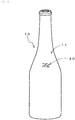
- the surface 11 of the bottle body 10 of a returnable bottle is formed with a product identification mark part 20.
- the individual mark part 20 should be formed at a position such as the shoulder which is resistant to scratching so as to prevent rubbing etc. from making identification difficult.
- This product identification mark part 20, as described in claim 3 is formed by laser engraving at the time of the hot end of the process for manufacturing the bottle body. Since this is done at the time of the hot end of the process, it is possible to protect the mark part from fine cracks and other trouble and the strength of the bottle body 10 is not damaged. Further, since the bottle body is high in temperature, formation by laser engraving is excellent in precision and thereby preferred.
- the product identification mark part 20 is formed at the bottle body engraved with a product identification code enabling identification of individual products.
- the product identification code may, for example, be one encoding the manufacturing date (year, month, day, hour, minute, and second) or manufacturing line etc. It is sufficient that it be data enabling identification of the individual bottle.
- the product identification mark part, as described in claim 4, may be formed with a two-dimensional code. A two-dimensional code enables a greater amount of information to be encoded compared with a one-dimensional code (bar code), so the engraved area can be reduced in size and therefore the appearance of the bottle body can be kept from being harmed and the aesthetic appeal can be kept excellent.
- the storage medium stores individual usage state data linked with the product identification data. Permission for continued reuse of the bottle body is judged based on the individual usage state data.
- the identification data assigned to the bottle body and usage state data are tied together.
- the usage state data is called up to judge if the bottle can be reused so as to separate the bottle from others.
- the individual usage state data is data on the number of times of use. Permission for continued reuse is judged by the data on the number of times of use indicating a predetermined number.
- a collected bottle is sent to a washing process where the bottle body is washed. Due to the washing, the product identification mark part becomes easier to recognize.
- the product identification data of the product identification mark part of the bottle body is read. The reading can be performed by infrared rays, optical recognition, image recognition, or other known means.
- the product identification data can be stored in the storage medium linked with shapes, colors, sizes, etc. so as to enable the bottles to be separated into different types without image recognition, weight measurement, or other complicated separation processes.
- the recognized product identification data is compared against product identification data in the storage medium to call up the individual usage state data of the bottle body.
- the data on the number of times of use (k) of the called up individual usage state data is a predetermined number (M) or less (k ⁇ M)
- the bottle is sent on to the next inspection process, while if the data is larger than the predetermined number (k>M), the bottle body is disposed of.
- scratches and cracking of the bottle body etc. are also checked for.
- visual inspection, image recognition, optical recognition, etc. is used to finally examine the bottle body for scratches, cracks, fractures, etc.
- permission for continued reuse of the bottle body is judged scientifically based on individual usage state data of the bottle body. A certain number of bottle bodies is discarded so as to reduce the number of bottle bodies processed in the final inspection process and thereby make the bottle recycling process more efficient and cut costs. Further, permission for reuse is judged by the number of times of use and other scientific data, so the standard for judging permission for reuse becomes clear and the quality becomes stable.
- a bottle body judged able to be reused is filled in the filling process and then shipped out.
- the data of the number of times of use of the individual usage state data of a bottle body judged able to be reused in the final inspection process is stored at any timing from the inspection process to shipment by incrementing it by "+1". Due to this the data on the number of times of use of the reused then collected bottle body becomes "k+1" and the bottle is again managed and separated by the flow chart.
- individual usage state data other than the above data on the number of times of use for example, the time, location, content, and other additional data relating to reuse can be written in and stored.
- additional data may be efficiently and advantageously used for management of reuse of returnable bottles together with the data on the number of times of use or independently.
- a novel method of managing reuse of a returnable bottle which individually manages returnable bottles so as to manage reuse linked with their individual states of use and thereby enable reusable bottles to be accurately, easily, and efficiently separated from other bottles in a scientific manner and enable efficient inspection of aging and other factors which cannot be determined from outside appearance, also, a method of managing reuse of a returnable bottle efficiently promoting reuse of returnable bottles and thereby lowering the costs relating to reuse and reducing energy and otherwise benefitting the environment, comprising, at the time of new production of a returnable bottle body, forming on a bottle body surface a product identification mark part engraved with an identification code as product identification data of the bottle body, reading the product identification mark part and writing and storing the product identification data of the bottle body in the storage medium linked with individual usage state data, and judging permission for continued reuse of the bottle body based on the individual usage state data stored in the storage medium.
Landscapes
- Business, Economics & Management (AREA)
- Engineering & Computer Science (AREA)
- Human Resources & Organizations (AREA)
- Economics (AREA)
- Theoretical Computer Science (AREA)
- General Physics & Mathematics (AREA)
- Physics & Mathematics (AREA)
- Tourism & Hospitality (AREA)
- Quality & Reliability (AREA)
- Strategic Management (AREA)
- Operations Research (AREA)
- Marketing (AREA)
- General Business, Economics & Management (AREA)
- Entrepreneurship & Innovation (AREA)
- Life Sciences & Earth Sciences (AREA)
- Sustainable Development (AREA)
- Development Economics (AREA)
- Mechanical Engineering (AREA)
- Details Of Rigid Or Semi-Rigid Containers (AREA)
- Management, Administration, Business Operations System, And Electronic Commerce (AREA)
Applications Claiming Priority (1)
| Application Number | Priority Date | Filing Date | Title |
|---|---|---|---|
| JP2017108143A JP6434083B1 (ja) | 2017-05-31 | 2017-05-31 | リターナブルガラス壜の再使用管理方法 |
Publications (1)
| Publication Number | Publication Date |
|---|---|
| EP3410367A1 true EP3410367A1 (de) | 2018-12-05 |
Family
ID=61024590
Family Applications (1)
| Application Number | Title | Priority Date | Filing Date |
|---|---|---|---|
| EP18152918.1A Ceased EP3410367A1 (de) | 2017-05-31 | 2018-01-23 | Verfahren zur verwaltung der wiederverwendung einer mehrwegflasche |
Country Status (5)
| Country | Link |
|---|---|
| US (1) | US20180349864A1 (de) |
| EP (1) | EP3410367A1 (de) |
| JP (1) | JP6434083B1 (de) |
| KR (1) | KR20180131379A (de) |
| CN (1) | CN108971019A (de) |
Cited By (1)
| Publication number | Priority date | Publication date | Assignee | Title |
|---|---|---|---|---|
| EP4132859A4 (de) * | 2020-04-08 | 2024-04-17 | The Coca-Cola Company | Systeme und verfahren zur verfolgung von nachfüllbaren verpackungen, die in einer abfüllanlage gefüllt sind |
Families Citing this family (10)
| Publication number | Priority date | Publication date | Assignee | Title |
|---|---|---|---|---|
| US20190306385A1 (en) | 2014-01-31 | 2019-10-03 | Digimarc Corporation | Concerning digital marking and reading of plastic items, useful in recycling |
| US11962876B2 (en) | 2014-01-31 | 2024-04-16 | Digimarc Corporation | Recycling methods and systems, and related plastic containers |
| US12348840B2 (en) | 2019-03-01 | 2025-07-01 | Digimarc Corporation | Recycling methods and systems, and related plastic containers |
| EP3903228B1 (de) | 2019-03-13 | 2022-09-14 | Digimarc Corporation | Digitale markierung |
| JP2021043818A (ja) * | 2019-09-12 | 2021-03-18 | 花王株式会社 | 包装袋の資源活用の選択を支援する選択支援システム |
| USD913103S1 (en) * | 2019-09-20 | 2021-03-16 | Cielo E Terra S.P.A. | Bottle |
| EP4128027A1 (de) | 2020-03-26 | 2023-02-08 | Digimarc Corporation | Anordnungen zum digitalen markieren und lesen von gegenständen, verwendbar beim recycling |
| CA3215397A1 (en) | 2021-04-16 | 2022-10-20 | Tomas FILLER | Methods and arrangements to aid recycling |
| CN114034646A (zh) * | 2021-10-25 | 2022-02-11 | 太初环塑科技(浙江)有限公司 | 一种回收塑料瓶识别系统 |
| WO2024015385A1 (en) | 2022-07-14 | 2024-01-18 | Digimarc Corporation | Methods and arrangements to utilize end-of-life data generated during recycling and waste sortation for counterfeit deterrence and other actions |
Citations (17)
| Publication number | Priority date | Publication date | Assignee | Title |
|---|---|---|---|---|
| WO1985000454A1 (en) * | 1983-07-11 | 1985-01-31 | Imperial Chemical Industries Plc | Apparatus for checking refillable containers |
| EP0516956A2 (de) * | 1991-06-07 | 1992-12-09 | Elpatronic Ag | Verfahren und Vorrichtung zum Kennzeichnen von wiederbefüllbaren Behältern, insbesondere Kunststoff-Flaschen sowie Code-Symbol zur Kennzeichnung von Kunststoff-Flaschen |
| US5414777A (en) * | 1992-11-27 | 1995-05-09 | Elpatronic Ag | Process for the removal of multi-trip bottles from circulation |
| US5422744A (en) * | 1992-06-12 | 1995-06-06 | Symbol Technologies, Inc. | Bar code incorporated into holographic display |
| US5612525A (en) * | 1992-06-02 | 1997-03-18 | Elpatronic Ag | Apparatus for marking refillable containers, more especially plastic bottles |
| JPH09128578A (ja) * | 1995-10-27 | 1997-05-16 | Precision:Kk | ガラス容器の刻印型番による型番管理方法 |
| US5718457A (en) * | 1994-07-29 | 1998-02-17 | Elpatronic Ag | Method of marking objects with code symbols |
| EP0977137A2 (de) * | 1998-07-27 | 2000-02-02 | Hitachi, Ltd. | Verfahren und System zum Verwalten von Produkt-Lebenszyklen |
| JP2001338026A (ja) * | 2000-05-30 | 2001-12-07 | Konica Corp | 製品のリサイクルシステム、及び再利用が考慮された製品 |
| JP2002154547A (ja) * | 2000-11-17 | 2002-05-28 | Kurita Water Ind Ltd | 容器および容器管理システム |
| US6732921B1 (en) * | 1999-01-29 | 2004-05-11 | Heuft Systemtechnik Gmbh | System for managing a large number of reusable and returnable containers and code especially useful for this purpose |
| US20040220824A1 (en) * | 2002-06-17 | 2004-11-04 | Hiroaki Imai | Method and apparatus for providing services in recycling products |
| WO2008100236A2 (en) * | 2007-02-15 | 2008-08-21 | Ase Plastik Sanayi Ve Ticaret Limited Sirketi | Coding and tracing system with input for the liquid containers |
| US20100102032A1 (en) * | 2006-10-18 | 2010-04-29 | Guillaume Bathelet | Process and installation for the hot marking of translucent or transparent objects |
| JP5552147B2 (ja) | 2008-03-21 | 2014-07-16 | 東洋ガラス株式会社 | リターナブルガラスびんのコーティング方法 |
| US20160077020A1 (en) * | 2013-05-03 | 2016-03-17 | Mic & Sgcc | Method and device for observing and analysing optical singularities in glass containers |
| WO2016097911A1 (en) * | 2014-12-17 | 2016-06-23 | Sabic Global Technologies B.V. | Identifying a characteristic of a material for additive manufacturing |
Family Cites Families (14)
| Publication number | Priority date | Publication date | Assignee | Title |
|---|---|---|---|---|
| JP2657892B2 (ja) * | 1993-07-01 | 1997-09-30 | 株式会社キリンテクノシステム | 金型番号読取り装置 |
| JP2000085783A (ja) * | 1998-09-11 | 2000-03-28 | Goshina Sangyo Kk | 容器類流通方法および容器類流通システム |
| JP2002109155A (ja) * | 2000-09-29 | 2002-04-12 | Starway Co Ltd | 環境対応物流管理システム、そのシステムに適用可能なサーバ、及びそのサーバのための記録媒体 |
| JP2004280676A (ja) * | 2003-03-18 | 2004-10-07 | Nihon Yamamura Glass Co Ltd | リターナブル容器管理システム及び当該システムによって管理されるrfidチップ付きリターナブル容器 |
| US7562025B2 (en) * | 2003-09-19 | 2009-07-14 | Vesta Medical, Llc | Waste sorting system with query function, and method thereof |
| US20100153220A1 (en) * | 2008-09-10 | 2010-06-17 | Eco Rebox Llc | Method of reusing shipping and packing materials |
| JP5124540B2 (ja) * | 2009-07-29 | 2013-01-23 | 株式会社日立ハイテクノロジーズ | 物品搬送システム,検体処理システム |
| WO2012096645A1 (en) * | 2011-01-10 | 2012-07-19 | Hallberg Christopher | Thermal beverage container with secure account identifier |
| US10853832B2 (en) * | 2013-09-20 | 2020-12-01 | Matthew Frank WITTEK | System and method for reminding and tracking use of reusable container and carry products |
| US9536404B2 (en) * | 2014-08-28 | 2017-01-03 | Steven M. Glamuzina, JR. | Bottle fraud detection system and method |
| CN104867024A (zh) * | 2015-06-04 | 2015-08-26 | 佛山市碳联科技有限公司 | 一种利用垃圾回收实现碳交易的方法 |
| EP3104306B2 (de) * | 2015-06-11 | 2023-11-01 | Scantrust SA | Zweidimensionaler strichcode |
| US10776729B2 (en) * | 2015-09-01 | 2020-09-15 | Owens-Brockway Glass Container Inc. | Method and system for tracking containers |
| ITUB20161045A1 (it) * | 2016-02-25 | 2017-08-25 | Riccardo Zorzi | Contenitore multiuso per alimenti da asporto in materiale metallico |
-
2017
- 2017-05-31 JP JP2017108143A patent/JP6434083B1/ja active Active
-
2018
- 2018-01-23 EP EP18152918.1A patent/EP3410367A1/de not_active Ceased
- 2018-04-10 US US15/949,481 patent/US20180349864A1/en not_active Abandoned
- 2018-04-16 KR KR1020180043699A patent/KR20180131379A/ko not_active Ceased
- 2018-05-31 CN CN201810546765.3A patent/CN108971019A/zh active Pending
Patent Citations (17)
| Publication number | Priority date | Publication date | Assignee | Title |
|---|---|---|---|---|
| WO1985000454A1 (en) * | 1983-07-11 | 1985-01-31 | Imperial Chemical Industries Plc | Apparatus for checking refillable containers |
| EP0516956A2 (de) * | 1991-06-07 | 1992-12-09 | Elpatronic Ag | Verfahren und Vorrichtung zum Kennzeichnen von wiederbefüllbaren Behältern, insbesondere Kunststoff-Flaschen sowie Code-Symbol zur Kennzeichnung von Kunststoff-Flaschen |
| US5612525A (en) * | 1992-06-02 | 1997-03-18 | Elpatronic Ag | Apparatus for marking refillable containers, more especially plastic bottles |
| US5422744A (en) * | 1992-06-12 | 1995-06-06 | Symbol Technologies, Inc. | Bar code incorporated into holographic display |
| US5414777A (en) * | 1992-11-27 | 1995-05-09 | Elpatronic Ag | Process for the removal of multi-trip bottles from circulation |
| US5718457A (en) * | 1994-07-29 | 1998-02-17 | Elpatronic Ag | Method of marking objects with code symbols |
| JPH09128578A (ja) * | 1995-10-27 | 1997-05-16 | Precision:Kk | ガラス容器の刻印型番による型番管理方法 |
| EP0977137A2 (de) * | 1998-07-27 | 2000-02-02 | Hitachi, Ltd. | Verfahren und System zum Verwalten von Produkt-Lebenszyklen |
| US6732921B1 (en) * | 1999-01-29 | 2004-05-11 | Heuft Systemtechnik Gmbh | System for managing a large number of reusable and returnable containers and code especially useful for this purpose |
| JP2001338026A (ja) * | 2000-05-30 | 2001-12-07 | Konica Corp | 製品のリサイクルシステム、及び再利用が考慮された製品 |
| JP2002154547A (ja) * | 2000-11-17 | 2002-05-28 | Kurita Water Ind Ltd | 容器および容器管理システム |
| US20040220824A1 (en) * | 2002-06-17 | 2004-11-04 | Hiroaki Imai | Method and apparatus for providing services in recycling products |
| US20100102032A1 (en) * | 2006-10-18 | 2010-04-29 | Guillaume Bathelet | Process and installation for the hot marking of translucent or transparent objects |
| WO2008100236A2 (en) * | 2007-02-15 | 2008-08-21 | Ase Plastik Sanayi Ve Ticaret Limited Sirketi | Coding and tracing system with input for the liquid containers |
| JP5552147B2 (ja) | 2008-03-21 | 2014-07-16 | 東洋ガラス株式会社 | リターナブルガラスびんのコーティング方法 |
| US20160077020A1 (en) * | 2013-05-03 | 2016-03-17 | Mic & Sgcc | Method and device for observing and analysing optical singularities in glass containers |
| WO2016097911A1 (en) * | 2014-12-17 | 2016-06-23 | Sabic Global Technologies B.V. | Identifying a characteristic of a material for additive manufacturing |
Non-Patent Citations (1)
| Title |
|---|
| ANONYMOUS: "Laser engraving - Wikipedia", 21 April 2017 (2017-04-21), XP055571973, Retrieved from the Internet <URL:https://en.wikipedia.org/w/index.php?title=Laser_engraving&oldid=776544676> [retrieved on 20190320] * |
Cited By (2)
| Publication number | Priority date | Publication date | Assignee | Title |
|---|---|---|---|---|
| EP4132859A4 (de) * | 2020-04-08 | 2024-04-17 | The Coca-Cola Company | Systeme und verfahren zur verfolgung von nachfüllbaren verpackungen, die in einer abfüllanlage gefüllt sind |
| US12269646B2 (en) | 2020-04-08 | 2025-04-08 | The Coca-Cola Company | Systems and methods for tracking refillable packages filled at a bottling facility |
Also Published As
| Publication number | Publication date |
|---|---|
| CN108971019A (zh) | 2018-12-11 |
| US20180349864A1 (en) | 2018-12-06 |
| KR20180131379A (ko) | 2018-12-10 |
| JP2018205898A (ja) | 2018-12-27 |
| JP6434083B1 (ja) | 2018-12-05 |
Similar Documents
| Publication | Publication Date | Title |
|---|---|---|
| EP3410367A1 (de) | Verfahren zur verwaltung der wiederverwendung einer mehrwegflasche | |
| US10328468B2 (en) | Method of managing reuse of returnable bottle | |
| US11783276B2 (en) | Concepts for monitoring shipments | |
| Patel | Harmonizing sustainability, functionality, and cost: navigating responsible packaging innovations in modern supply chains | |
| EP4230375A2 (de) | Recyclingverfahren und markierungsmittel für ein recyclingfähiges produkt | |
| CA2958961C (en) | Concepts for monitoring shipments | |
| US20110042452A1 (en) | Method and system for identifying and tracking reusable packing crates | |
| JP7682192B2 (ja) | ボトリング施設で充填した詰替可能なパッケージを追跡するためのシステム及び方法 | |
| CN101609626A (zh) | 产品防伪防窜货的附标方法 | |
| Visich et al. | Empirical applications of RFID in the manufacturing environment | |
| Bø et al. | Environmental impact of refillable vs. non-refillable plastic beverage bottles in Norway | |
| van Dalen et al. | The chip in crate: the Heineken case | |
| CN101927862A (zh) | 智能防伪瓶塞 | |
| HK40001634A (en) | Method for managing reuse of recyclable bottle | |
| HK40001922A (en) | Method of managing reuse of returnable bottle | |
| JP2017030818A (ja) | リターナブル瓶、icタグラベル付リターナブル瓶およびicタグラベル | |
| HK40001922B (zh) | 可回收瓶的再使用管理方法 | |
| CN201447124U (zh) | 智能防伪瓶塞 | |
| JP2002211574A (ja) | 再使用型容器およびその使用方法 | |
| CN210883117U (zh) | 能重复使用的水容器 | |
| CN206271033U (zh) | 一种瓶盖内喷码、采集及检验一体化装置 | |
| WO2006009223A1 (ja) | 板状体の分別管理方法 | |
| Monsreal | Reverse logistics of recovery and recycling of non-returnable beverage containers in the brewery industry: A “Profitable Visit” algorithm | |
| Martire | Splendour in the glass | |
| IT202400004282A1 (it) | Sistema e metodo di anticontraffazione di alimenti |
Legal Events
| Date | Code | Title | Description |
|---|---|---|---|
| STAA | Information on the status of an ep patent application or granted ep patent |
Free format text: STATUS: EXAMINATION IS IN PROGRESS |
|
| PUAI | Public reference made under article 153(3) epc to a published international application that has entered the european phase |
Free format text: ORIGINAL CODE: 0009012 |
|
| 17P | Request for examination filed |
Effective date: 20180906 |
|
| AK | Designated contracting states |
Kind code of ref document: A1 Designated state(s): AL AT BE BG CH CY CZ DE DK EE ES FI FR GB GR HR HU IE IS IT LI LT LU LV MC MK MT NL NO PL PT RO RS SE SI SK SM TR |
|
| AX | Request for extension of the european patent |
Extension state: BA ME |
|
| STAA | Information on the status of an ep patent application or granted ep patent |
Free format text: STATUS: THE APPLICATION HAS BEEN REFUSED |
|
| 18R | Application refused |
Effective date: 20200218 |