EP3419060A1 - Solarzellenstapel - Google Patents
Solarzellenstapel Download PDFInfo
- Publication number
- EP3419060A1 EP3419060A1 EP18000531.6A EP18000531A EP3419060A1 EP 3419060 A1 EP3419060 A1 EP 3419060A1 EP 18000531 A EP18000531 A EP 18000531A EP 3419060 A1 EP3419060 A1 EP 3419060A1
- Authority
- EP
- European Patent Office
- Prior art keywords
- layer
- solar cell
- subcell
- lattice constant
- tunnel diode
- Prior art date
- Legal status (The legal status is an assumption and is not a legal conclusion. Google has not performed a legal analysis and makes no representation as to the accuracy of the status listed.)
- Granted
Links
Images


Classifications
-
- H—ELECTRICITY
- H10—SEMICONDUCTOR DEVICES; ELECTRIC SOLID-STATE DEVICES NOT OTHERWISE PROVIDED FOR
- H10F—INORGANIC SEMICONDUCTOR DEVICES SENSITIVE TO INFRARED RADIATION, LIGHT, ELECTROMAGNETIC RADIATION OF SHORTER WAVELENGTH OR CORPUSCULAR RADIATION
- H10F10/00—Individual photovoltaic cells, e.g. solar cells
- H10F10/10—Individual photovoltaic cells, e.g. solar cells having potential barriers
- H10F10/16—Photovoltaic cells having only PN heterojunction potential barriers
- H10F10/161—Photovoltaic cells having only PN heterojunction potential barriers comprising multiple PN heterojunctions, e.g. tandem cells
-
- H—ELECTRICITY
- H10—SEMICONDUCTOR DEVICES; ELECTRIC SOLID-STATE DEVICES NOT OTHERWISE PROVIDED FOR
- H10F—INORGANIC SEMICONDUCTOR DEVICES SENSITIVE TO INFRARED RADIATION, LIGHT, ELECTROMAGNETIC RADIATION OF SHORTER WAVELENGTH OR CORPUSCULAR RADIATION
- H10F19/00—Integrated devices, or assemblies of multiple devices, comprising at least one photovoltaic cell covered by group H10F10/00, e.g. photovoltaic modules
- H10F19/40—Integrated devices, or assemblies of multiple devices, comprising at least one photovoltaic cell covered by group H10F10/00, e.g. photovoltaic modules comprising photovoltaic cells in a mechanically stacked configuration
-
- H—ELECTRICITY
- H10—SEMICONDUCTOR DEVICES; ELECTRIC SOLID-STATE DEVICES NOT OTHERWISE PROVIDED FOR
- H10F—INORGANIC SEMICONDUCTOR DEVICES SENSITIVE TO INFRARED RADIATION, LIGHT, ELECTROMAGNETIC RADIATION OF SHORTER WAVELENGTH OR CORPUSCULAR RADIATION
- H10F10/00—Individual photovoltaic cells, e.g. solar cells
- H10F10/10—Individual photovoltaic cells, e.g. solar cells having potential barriers
- H10F10/14—Photovoltaic cells having only PN homojunction potential barriers
- H10F10/142—Photovoltaic cells having only PN homojunction potential barriers comprising multiple PN homojunctions, e.g. tandem cells
-
- H—ELECTRICITY
- H10—SEMICONDUCTOR DEVICES; ELECTRIC SOLID-STATE DEVICES NOT OTHERWISE PROVIDED FOR
- H10F—INORGANIC SEMICONDUCTOR DEVICES SENSITIVE TO INFRARED RADIATION, LIGHT, ELECTROMAGNETIC RADIATION OF SHORTER WAVELENGTH OR CORPUSCULAR RADIATION
- H10F10/00—Individual photovoltaic cells, e.g. solar cells
- H10F10/10—Individual photovoltaic cells, e.g. solar cells having potential barriers
- H10F10/16—Photovoltaic cells having only PN heterojunction potential barriers
- H10F10/163—Photovoltaic cells having only PN heterojunction potential barriers comprising only Group III-V materials, e.g. GaAs/AlGaAs or InP/GaInAs photovoltaic cells
-
- H—ELECTRICITY
- H10—SEMICONDUCTOR DEVICES; ELECTRIC SOLID-STATE DEVICES NOT OTHERWISE PROVIDED FOR
- H10F—INORGANIC SEMICONDUCTOR DEVICES SENSITIVE TO INFRARED RADIATION, LIGHT, ELECTROMAGNETIC RADIATION OF SHORTER WAVELENGTH OR CORPUSCULAR RADIATION
- H10F19/00—Integrated devices, or assemblies of multiple devices, comprising at least one photovoltaic cell covered by group H10F10/00, e.g. photovoltaic modules
- H10F19/10—Integrated devices, or assemblies of multiple devices, comprising at least one photovoltaic cell covered by group H10F10/00, e.g. photovoltaic modules comprising photovoltaic cells in arrays in a single semiconductor substrate, the photovoltaic cells having vertical junctions or V-groove junctions
-
- H—ELECTRICITY
- H10—SEMICONDUCTOR DEVICES; ELECTRIC SOLID-STATE DEVICES NOT OTHERWISE PROVIDED FOR
- H10F—INORGANIC SEMICONDUCTOR DEVICES SENSITIVE TO INFRARED RADIATION, LIGHT, ELECTROMAGNETIC RADIATION OF SHORTER WAVELENGTH OR CORPUSCULAR RADIATION
- H10F77/00—Constructional details of devices covered by this subclass
- H10F77/10—Semiconductor bodies
- H10F77/12—Active materials
- H10F77/124—Active materials comprising only Group III-V materials, e.g. GaAs
- H10F77/1248—Active materials comprising only Group III-V materials, e.g. GaAs having three or more elements, e.g. GaAlAs, InGaAs or InGaAsP
-
- Y—GENERAL TAGGING OF NEW TECHNOLOGICAL DEVELOPMENTS; GENERAL TAGGING OF CROSS-SECTIONAL TECHNOLOGIES SPANNING OVER SEVERAL SECTIONS OF THE IPC; TECHNICAL SUBJECTS COVERED BY FORMER USPC CROSS-REFERENCE ART COLLECTIONS [XRACs] AND DIGESTS
- Y02—TECHNOLOGIES OR APPLICATIONS FOR MITIGATION OR ADAPTATION AGAINST CLIMATE CHANGE
- Y02E—REDUCTION OF GREENHOUSE GAS [GHG] EMISSIONS, RELATED TO ENERGY GENERATION, TRANSMISSION OR DISTRIBUTION
- Y02E10/00—Energy generation through renewable energy sources
- Y02E10/50—Photovoltaic [PV] energy
- Y02E10/544—Solar cells from Group III-V materials
-
- Y—GENERAL TAGGING OF NEW TECHNOLOGICAL DEVELOPMENTS; GENERAL TAGGING OF CROSS-SECTIONAL TECHNOLOGIES SPANNING OVER SEVERAL SECTIONS OF THE IPC; TECHNICAL SUBJECTS COVERED BY FORMER USPC CROSS-REFERENCE ART COLLECTIONS [XRACs] AND DIGESTS
- Y02—TECHNOLOGIES OR APPLICATIONS FOR MITIGATION OR ADAPTATION AGAINST CLIMATE CHANGE
- Y02P—CLIMATE CHANGE MITIGATION TECHNOLOGIES IN THE PRODUCTION OR PROCESSING OF GOODS
- Y02P70/00—Climate change mitigation technologies in the production process for final industrial or consumer products
- Y02P70/50—Manufacturing or production processes characterised by the final manufactured product
Definitions
- the invention relates to a solar cell stack.
- From the EP 2 251 912 A1 is a stacked monolithic multiple solar cell with improved power line between the solar cells known.
- a tunnel diode with mutually strained degenerate layers is arranged between two successive solar cells.
- a tensilely strained degenerated layer is compensated with a compressively strained degenerate layer.
- the degenerate layers are designed either as degenerate p + doped with carbon or as degenerate n + layers doped with tellurium or silicon.
- the degenerate layers of the tunnel diode are included for voltage compensation. While the degenerate n + layer is always unstrained and the Lattice constant of the immediately adjacent barrier layer, in the present case, the degenerate p + layer is always tensioned either tensil or compressively. Accordingly, the voltage applied to the degenerate p + layer barrier layer is compressed or tensile tensed. By compensating the strain again, no strain acts on the layers surrounding the barrier layer, in other words the sum of the strain is zero.
- the typical procedure for tunnel diode materials of new solar cell concepts with metamorphic buffers is a lattice matching of the tunnel diode layers to the substrate lattice constant or to the new virtual substrate lattice constant in metamorphic structures.
- the tunnel diode layers should have a sufficiently high doping for the current carrying capacity and a sufficiently high transparency for underlying sub-cells.
- the degenerate p + layer plastically relaxes and induces thread dislocations or cracks and reduces the efficiency of the metamorphic multiple solar cell.
- An alternative p-doped tunnel diode material is (Al) GaAsSb.
- This material system can be adapted to different lattice constants by the As / Sb ratio and at the same time highly p-doped (e.g., intrinsic carbon or CBr4 doping).
- (Al) GaAsSb is thus used to produce lattice-matched tunnel diode structures.
- MOVPE organometallic vapor phase epitaxy
- the object of the invention is to provide a device which further develops the prior art and in particular increases the efficiency of the metamorphic solar cells by a better lattice matching of the p + layer and at the same time reduces the current carrying capacity of the tunnel diode as little as possible.
- a solar cell stack is provided with a predominant number of III-V semiconductor layers, wherein the solar cell stack has a first partial cell with a first bandgap and with a first lattice constant, and a second partial cell with a second bandgap and with a second lattice constant.
- the interlayer sequence has a first barrier layer and a first tunnel diode and a second barrier layer, wherein the layers are arranged in said order.
- the tunnel diode has a degenerate n + layer with a third lattice constant and a degenerate p + layer with a fourth lattice constant, wherein the fourth lattice constant is less than the third lattice constant and the first bandgap is less than the second bandgap and the p + layer has a different material composition with indium than the n + layer.
- the n + layer is disposed between the first barrier layer and the p + layer.
- the p + layer is disposed between the n + layer and the second barrier layer.
- the first subcell and the second subcell are lattice matched, and the p + layer has a smaller lattice constant with a lattice mismatch of at least 0.5%.
- a metamorphic buffer is formed between the first subcell and the second subcell, wherein the degenerate p + layer of the tunnel diode is lattice-matched neither to the first subcell nor to the second subcell.
- the fourth lattice constant is between the first lattice constant and the second lattice constant.
- the third lattice constant of the degenerate n + layer of the tunnel diode is lattice-matched to the first subcell or to the second subcell.
- the degenerate p + layer has a different material combination than the degenerate n + layer.
- the degenerate p + layer contains at least 5% indium and as carbon dopant.
- the layers of the tunnel diode and the further layers of the interlayer sequence are not voltage-compensated with respect to one another.
- lattice matching is understood to mean a difference in lattice constants of two consecutive layers smaller than 0.1%.
- non-stress-compensated means that a strain is generated by the lattice mismatch of the degenerate p + layer and the stress is not compensated by the degenerate n + layer or by the barrier layers.
- the third lattice constant or lattice constants of the two barrier layers are equal to either the first lattice constant or equal to the second lattice constant.
- III-V semiconductor layers refers to a multiple solar cell, of which layers more than 50%, preferably more than 80%, consist of III-V materials.
- such a subcell often also includes a Ge subcell, the further subcells of the solar cell stack consisting of the III-V materials or compounds.
- the term sub-cell is used interchangeably with the term of the sub-solar cell.
- the solar cell stack consists of a plurality of partial solar cells, which are interconnected in series by means of tunnel diodes.
- material composition for example an InGaAs material composition, denotes a compound of the cited elements, wherein in addition to the cited elements also other elements may be included.
- degenerate layer in the present case means a highly doped tunnel diode layer.
- the concept of degeneracy thus refers to the fact that the Fermi level of the n + layer is in the conduction band and the Fermi level of the p + layer is in the valence band, i. the semiconductor layers have a metallic conductivity.
- the layers directly surrounding the tunnel diode are not stressed. Based on the interlayer sequence, only the degenerate p.sup. + Layer of the tunnel diode is lattice-mismatched with respect to the barrier layers or with respect to at least one of the lattice constants of the sub-cells and thus has a tensile stress. In other words, the barrier layers have the lattice constants of adjacent sub-cells.
- a compromise can be achieved from sufficiently high lattice matching and sufficiently high p-doping and sufficiently high transparency of the p + layer.
- the plastic relaxation of the p + layer is avoided with the formation of dislocations or cracks and increases the material quality of the adjacent sub-cells.
- the efficiency of the multi-junction metamorphic cell is increased.
- Another advantage is that by means of both alternatives can reduce the strain and thereby the curvature of the wafer.
- n + -layer lattice-matched to one of the sub-cells or to both sub-cells ie having the same or nearly the same lattice constant as a subcell or both subcells, always assumes a tensile strain from the p + layer of the tunnel diode and thereby from the interlayer sequence. That is, the p + layer of the tunnel diode is tensilely tensed, the surrounding layers are lattice-matched to one of the sub-cells or to both sub-cells and thus unstrained.
- the bracing is thus not compensated in the intermediate layer sequence, but preferably at least partially by other layers of the solar cell stack.
- One advantage is that with the tensioning of the p.sup. + Layer, the compressive stresses incorporated during the epitaxy process both before the production and after the production of the intermediate layer sequence are at least partially compensated.
- Another advantage, in particular of the second alternative, is that even with a metamorphic buffer between the first subcell and the second subcell and the rest of the wafer resulting from the installation of the buffer by means of the degenerate p + layer of the tunnel diode whose lattice constant neither the first subcell is lattice matched yet to the second subcell, can perform an at least partial compensation.
- the degenerate p + layer of the tunnel diode has a lattice mismatch to the degenerate n + layer of the tunnel diode between 0.5% and 2.0%.
- the degenerate p + layer of the tunnel diode consists of a material composition of AlInGaAs, wherein the carbon concentration in the material is greater than 1E19 cm-3.
- the indium content of the degenerate p + -type AlInGaAs layer of the tunnel diode is between 5% and 20%, the aluminum content of the degenerate p + -conducting layer being between 10% and 80%.
- the lattice constant of the degenerate p + -type layer of the tunnel diode is between 5,674 A and 5,734 A.
- the lattice constant is also influenced by the indium content.
- the degenerate p + layer of the tunnel diode contains no antimony or up to a maximum of 5% antimony.
- the degenerate n + -type layer of the tunnel diode consists of a compound of InGaP or AlInGaP or AlInP and is doped with tellurium, silicon, selenium or germanium, the lattice constant being between 5,714 ⁇ and 5,785 ⁇ .
- the indium content of the degenerate n + -type layer of the tunnel diode is between 63% and 80%.
- the aluminum content is a maximum of 37%.
- the indium content for InAlP is max. 63% and the aluminum content at max. 37%.
- the indium content for InAlP is about 70% and the aluminum content at max. about 30%.
- the indium content is X and the aluminum content is Y, and this gives, for example, an X value of 0.15 for an indium content of 15% and for a maximum aluminum content of 85%, a maximum Y value of 0.85.
- the solar cell stack comprises a Ge or a GaAs substrate.
- the Ge substrate is at the top, i. against the direction of light incidence on an n-doped layer.
- the Ge subcell is formed as the lowest subcell.
- the solar cell stack comprises exactly three subcells, wherein a further tunnel diode is formed between the second subcell and the third subcell. It is understood that the tensions the two tunnel diodes do not compensate. Alternatively, only one of the two tunnel diodes is braced. Preferably, the tunnel diode between the second subcell and the third subcell is not clamped.
- the strained tunnel diode is present once or twice. It is understood that the strained tunnel diodes are each arranged between two directly successive sub-cells. Preferably, three of the four sub-cells are located above the metamorphic buffer. Preferably, an undamped tunnel diode is formed between the lowermost subcell and the metamorphic buffer.
- the strained tunnel diode is present one to three times in the stack-shaped upright metamorphic fourfold multiple solar cell.
- One of the strained tunneling diode is located between the metamorphic buffer and the subcell above the metamorphic buffer.
- Three of the four sub-cells are arranged above the metamorphic buffer, wherein in each case a strained tunnel diode is arranged between adjacent sub-cells.
- individual strained tunnel diodes can be replaced by grid-tuned tunnel diodes or other tunnel diodes.
- the strained tunnel diode is present one to three times in the stacked upright metamorphic five times multiple solar cell, and is located between each two sub-cells, with four of the five sub-cells located above the metamorphic buffer.
- an undamped tunnel diode is formed between the lowermost subcell and the metamorphic buffer.
- individual strained tunnel diodes can be replaced by grid-tuned tunnel diodes or other tunnel diodes.
- the strained tunnel diode is present one to four times in a stack-shaped upright metamorphic five times multiple solar cell, wherein four of the five sub-cells are located above the metamorphic buffer.
- the strained tunnel diode is formed between the metamorphic buffer and the adjoining sub-cell and arranged in each case between two adjacent sub-cells above the metamorphic buffer.
- individual strained tunnel diodes can be replaced by grid-tuned tunnel diodes or other tunnel diodes.
- the layers of the metamorphic buffer in the second embodiment consist of material compositions of InGaAs and / or AlInGaAs and / or InGaP, wherein the metamorphic buffer has a sequence of at least three layers and the lattice constant in the sequence towards the second subcell of Layer to layer increases and wherein the lattice constants of the layers of the buffer are greater than the lattice constant of the first subcell and wherein a layer of the metamorphic buffer has a third lattice constant and the third lattice constant is greater than the lattice constant of the second subcell.
- the metamorphic buffer has a sequence of at least five layers or exactly five layers. In one development, one of the layers has a compressive strain in the metamorphic buffer.
- the degenerate p + layer of the tunnel diode is voltage-compensated neither by a layer following in relation to the tunnel diode nor by a layer preceding it with respect to the tunnel diode. It is understood that the term of the subsequent layers hereby denotes layers which are deposited during the epitaxial process only after the p + layer.
- the solar cell stack is monolithic.
- novel tunnel diode which generates a tensile strain, can be advantageously used both in upright and inverted grown multiple solar cells.
- the FIG. 1 shows a solar cell stack ST with a first subcell SC1 and a second subcell SC2 and with a tunnel diode according to the invention TD1.
- the solar cell stack ST has predominantly III-V semiconductor layers. In this case, the light incidence L takes place through the second solar cell SC2.
- the size of the lattice constant a is illustrated by an arrow.
- the illustrated lateral extent of the individual layers, ie the extent in the direction of the arrow corresponds to the size of the lattice constant.
- the first subcell SC1 has a first bandgap with a first lattice constant.
- the second subcell SC2 has a second bandgap with a second lattice constant.
- the second subcell SC2 has an equal to or greater band gap than the first subcell SC1.
- the interlayer sequence ZF has a first barrier layer B1 and the tunnel diode TD1 with a degenerate n + layer with a third lattice constant and a degenerate p + layer with a fourth lattice constant and a second barrier layer B2, wherein the layers are arranged in the named order.
- the fourth lattice constant is smaller than the third lattice constant.
- the first bandgap is smaller than the second bandgap.
- the degenerate p + layer has a different material composition than the degenerate n + layer.
- the p + layer has a smaller lattice constant with a lattice mismatch of at least 0.5% to the n + layer.
- the layers of the tunnel diode TD1 and the further layers of the interlayer sequence ZF i. the two barrier layers B1 and B2 are not voltage-compensated to one another.
- the degenerate p + layer contains not only indium but also carbon as a dopant.
- the first subcell SC1 and the second subcell SC2 are lattice-matched to one another, i. the two lattice constants are the same.
- the degenerate n + layer is also lattice-matched to the two subcells SC1 and SC2.
- the solar cell stack ST has a tensile stress caused by the degenerate p + layer.
- FIG. 2 shows the qualitative correlation between indium and carbon content and the relaxation probability for the degenerate p + layer of the tunnel diode.
- the abscissa qualitatively represents the indium content, while the ordinate reflects the qualitative carbon content C and the crack probability WC.
- the solid line here represents the active carbon content C as a function of the indium content.
- the crack probability WC as a function of the indium content is shown by the dashed line.
- the transparency TV of the p + layer as a function of the indium content is qualitatively illustrated by the semicolon line.
- the p + layer has a high carbon doping.
- this material is very far from the lattice matching LM to at least one of the adjacent sub-cells removed, so that the crack probability WC is also very high.
- the transparency TV of the p + layer at an indium content near 0% is high.
- the p + layer with a high indium content lattice-matched LM to at least one of the adjacent sub-cells.
- the carbon doping and the cracking probability are minimized, so that the tunnel diode does not disturb the crystal, but is no longer sufficiently current-carrying.
- the transparency TV of the p + layer is low, so that the irradiated light is unfavorably absorbed in this layer.
- the degenerate p + layer of the tunnel diode according to the invention is selected by the indium content at the point NF so that both a sufficiently high carbon doping is incorporated in the material and there is a low probability of cracking and at the same time a sufficiently high transparency is ensured.
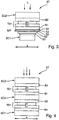
- a solar cell stack ST is shown with two subcells SC1 and SC2 and with a tunnel diode TD1 according to the invention and with a metamorphic buffer MP.
- the following are just the differences from the illustration of FIG. 1 explained.
- the first subcell SC1 has a smaller lattice constant than the second subcell SC2.
- the metamorphic buffer comprises a first layer S1 arranged immediately above the first subcell SC1 and a second layer S2 and a third layer S3 and a fourth layer S4 and a fifth layer S5, the layers S1-S5 being arranged in the named order.
- the first layer S1 is lattice-matched to the first subcell SC1.
- the fifth layer S5 is lattice-matched to the second subcell SC2.
- the second layer S2 has a larger lattice constant than the first layer S1.
- the third layer S3 has a larger lattice constant than the second layer S2.
- the fourth layer S4 has a larger lattice constant than the third layer S3, while the lattice constant of the fifth layer S5 is smaller than the lattice constant of the fourth layer S4.
- metamorphic buffers MP can be formed with more or less than five layers.
- the tunnel diode TD1 is arranged between the metamorphic buffer MP and the second subcell SC2.
- the degenerate n + layer of the tunnel diode TD1 is lattice-matched to the second subcell SC2.
- the degenerate p + layer of the tunnel diode TD1 is lattice-matched neither to the first subcell SC1 nor to the second subcell SC2.
- FIG. 4 a solar cell stack ST with three subcells SC1-SC3 and with two tunnel diodes TD1 according to the invention is shown. The following are just the differences from the illustration of FIG. 1 explained.
- All three sub-cells SC1-SC3 of the solar cell stack ST are lattice-matched to one another.
- a further intermediate layer sequence with a further first barrier layer B1 and a further tunnel diode TD1 and a further second barrier layer B2 is arranged.
- a third subcell SC3 is arranged.
- the incidence of light L takes place through the third subcell SC3.
- FIG. 5 1 shows a solar cell stack ST with four subcells SC1-SC4 and with two tunnel diodes TD1 according to the invention and a non-strained tunnel diode TDLM.
- the following are just the differences from the illustration of FIG. 4 explained.
- a fourth subcell SC4 is arranged.
- the incidence of light L takes place through the fourth subcell SC4.
- All four sub-cells SC1-SC4 of the solar cell stack ST are lattice-matched to one another.
- an unstrained tunnel diode TDLM is arranged between the second subcell SC2 and the third subcell SC3 between the second subcell SC2 and the third subcell SC3. Both degenerate layers of the tunnel diode TDLM are lattice-matched to the sub-cells SC1-SC4.
- two strained tunnel diodes TD1 are installed, also adds the caused by the two p + layers tensile strain.
- the course of the height of the lattice constant is also shown to the right next to the representation of the solar cell stack ST. It turns out that in the case of the two strained tunnel diodes TD1 there is in each case a tensile strain, so that the solar cell stack as a whole has at least a first approximation the sum of the tensile strain from the two strained tunnel diodes TD1.
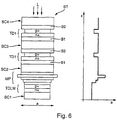
- FIG. 2 shows a solar cell stack ST with four subcells SC1-SC4 and with two tunnel diodes TD1 according to the invention and one metamorphic buffer MP and a non-strained tunnel diode TDLM.
- the following are just the differences from the illustration of FIG. 3 and the FIG. 5 explained.
- the three subcells SC2-SC4 of the solar cell stack ST are lattice-matched to one another.
- the tunnel diode TDLM of the prior art is arranged between the first subcell SC1 and the metamorphic buffer MP1.
- a first strained tunnel diode TD1 and between the third subcell SC3 and the fourth subcell SC4 a further second strained tunnel diode TD1 is arranged.
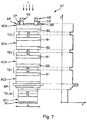
- FIG. 7 a solar cell stack ST with five subcells SC1-SC5 and with three tunnel diodes TD1 according to the invention and a metamorphic buffer MP and a non-strained tunnel diode TDLM is illustrated. The following are just the differences from the illustration of FIG. 6 explained.
- the second subcell are SC2 up to and including the fifth subcell SC5 of the solar cell stack ST lattice matched to each other.
- TD1 is arranged between the fourth subcell SC4 and the fifth subcell SC5.
- the representation of the profile of the lattice constant a to the right of the stack shows that the compressive stress caused by the large lattice constant of the fourth layer S4 of the metamorphic buffer MP, without additional layers, is at least partially or completely by means of the three tensile-stressed tunnel diode layers of TD1 compensate.
- a first full-area metal contact connection layer M1 is formed on the underside of the solar cell stack ST.
- an antireflection film AR is applied by means of a masking process.
- the antireflection layer is interrupted for the formation of a finger-like interconnect structure.
- the conductor track structure comprises an electrically conductive termination layer CP arranged on the upper side of the fifth subcell SC5 and a second metal contact connection layer M2 formed above the attachment layer.
- the layer thicknesses of the respective subcell can be reduced by at least 30% compared to a subcell without a Bragg mirror.
Landscapes
- Photovoltaic Devices (AREA)
- Life Sciences & Earth Sciences (AREA)
- Engineering & Computer Science (AREA)
- Sustainable Energy (AREA)
Abstract
Description
- Die Erfindung betrifft einen Solarzellenstapel.
- Ein derartiger Solarzellenstapel ist aus W. Guter et al, "Investigation and development of III-V-triple-junction concentrator solar cells", in 22nd European Photovoltaic Solar Energy Conference, 3-7 September 2007, Milan Italy, S.122-125, bekannt.
- Aus A. Bett et al, "Highest efficiency multi-junction solar cell for terrestrial and space applications", in 24th European Photovoltaic Solar Energy Conference and Exhibition, 21-25 September 2009, Hamburg, Germany, Session 1AP.1.1, Pages 1-6, ist eine Mehrfachsolarzelle mit einer spannungskompensierten Tunneldiode bekannt.
- Aus der
EP 2 251 912 A1 ist eine stapelförmige monolithische Mehrfachsolarzelle mit verbesserter Stromleitung zwischen den Solarzellen bekannt. Hierzu wird zwischen zwei aufeinanderfolgenden Solarzellen eine Tunneldiode mit zueinander verspannten entarteten Schichten angeordnet. Eine tensil verspannte entartete Schicht ist mit einer kompressiv verspannten entarteten Schicht kompensiert. Die entarteten Schichten sind entweder als mit Kohlenstoff dotierte entartete p+- oder als mit Tellur oder Silizium dotierte entartete n+-Schichten ausgeführt. Indem die Verspannung kompensiert ist, wirkt keine Verspannung auf die die Tunneldiode umgebenden Schichten, anders ausgedrückt die Summe der Verspannung ist null. - In einer anderen Ausführungsform werden zur Spannungskompensation nicht nur die entarteten Schichten der Tunneldiode, sondern auch die die Tunneldiode unmittelbar umgebenden Schichten vorzugsweise Barriereschichten einbezogen. Während die entartete n+-Schicht immer unverspannt ist und die Gitterkonstante der unmittelbar anliegenden Barriereschicht aufweist, ist vorliegend immer die entartete p+-Schicht entweder tensil oder kompressiv verspannt. Entsprechend ist die an die entartete p+-Schicht anliegende Barriereschicht kompressiv oder tensil verspannt. Indem die Verspannung wiederum kompensiert ist, wirkt keine Verspannung auf die die Barriereschicht umgebenden Schichten, anders ausgedrückt die Summe der Verspannung ist null.
- Das typische Vorgehen für Tunneldioden-Materialien neuer Solarzellkonzepte mit metamorphen Puffern ist eine Gitteranpassung der Tunneldioden-Schichten an die Substratgitterkonstante bzw. an die neue virtuelle Substratgitterkonstante in metamorphen Strukturen. Gleichzeitig sollen die Tunneldioden-Schichten eine ausreichend hohe Dotierung für die Stromtragfähigkeit und eine ausreichend hohe Transparenz für darunterliegende Teilzellen aufweisen.
- Im Falle der spannungskompensierten Tunneldioden im metamorphen Solarzellkonzept mit Indium-Gehalten deutlich größer als 5% kommt es zu einem großen Gitterkonstantenunterschied zwischen den sich kompensierenden entarteten p+- und n+-Schichten, z.B. spannungskompensierte Tunneldioden-Schichten aus
EP 2 251 192 A1 , so dass die tensil verspannte Tunneldioden-Schicht plastisch relaxiert und reißt. Die dadurch entstehenden Fadenversetzungen oder sogar Risse können bis zum p-n Übergang angrenzender Teilzellen hinein reichen und dort als Zentren für nichtstrahlende Rekombination der generierten Ladungsträger wirken, so dass die Effizienz der Mehrfachsolarzelle deutlich reduziert wird. - Wie aus W. Guter et al, "Investigation and development of III-V-triple-junction concentrator solar cells", in 22nd European Photovoltaic Solar Energy Conference, 3-7 September 2007, Milan Italy, S.122-125, bekannt ist, führt eine entartete p+-Schicht, bestehend aus AlInGaAs, mit hohem In-Gehalt in metamorphen Mehrfachsolarzell-Strukturen zwar zu einer verbesserten Gitterkonstantenanpassung zum virtuellen Substrat. Dieses Material ist jedoch im Vergleich zu AlGaAs schwer p-dotierbar. Bei extrinsischer Dotierung mittels Kohlenstofftetrabromid (CBr4) treten außerdem Vorreaktionen im MOVPE-Reaktor z.B. mit TMIn auf, was zu einem unterdrückten In-Einbau und somit zu einer schlechten Gitteranpassung führt.
- In der Folge relaxiert die entartete p+-Schicht plastisch und erzeugt Fadenversetzungen oder Risse und bewirkt eine Reduzierung der Effizienz der metamorphen Mehrfachsolarzelle.
- Ein alternatives, p-dotiertes Tunneldioden-Material stellt (Al)GaAsSb dar. Dieses Materialsystem kann durch das As/Sb-Verhältnis auf verschiedene Gitterkonstanten angepasst und gleichzeitig hoch p-dotiert werden (z.B. intrinsischer Kohlenstoff oder CBr4 Dotierung). (Al)GaAsSb wird also zur Herstellung gitterangepasster Tunneldiodenstrukturen verwendet. Allerdings ist für dieses Materialsystem im Vergleich zu Arseniden und Phosphiden oftmals eine spezielle Konfiguration des MOVPE (metallorganische Gasphasenepitaxie) Reaktors und spezielle Ausgangsmaterialien notwendig.
- Vor diesem Hintergrund besteht die Aufgabe der Erfindung darin, eine Vorrichtung anzugeben, die den Stand der Technik weiterbildet und insbesondere die Effizienz der metamorphen Solarzellen durch eine bessere Gitteranpassung der p+-Schicht erhöht und gleichzeitig die Stromtragfähigkeit der Tunneldiode möglichst wenig reduziert.
- Die Aufgabe wird durch einen Solarzellenstapel mit den Merkmalen des Patentanspruchs 1 gelöst. Vorteilhafte Ausgestaltungen der Erfindung sind Gegenstand von Unteransprüchen.
- Gemäß dem Gegenstand der Erfindung wird ein Solarzellenstapel mit einer überwiegenden Anzahl von III-V Halbleiterschichten bereitgestellt, wobei der Solarzellenstapel eine erste Teilzelle mit einer ersten Bandlücke und mit einer ersten Gitterkonstanten, und eine zweite Teilzelle mit einer zweiten Bandlücke und mit einer zweiten Gitterkonstanten aufweist.
- Zwischen den beiden Solarzellen ist eine Zwischenschichtfolge angeordnet. Die Zwischenschichtfolge weist eine erste Barriereschicht und eine erste Tunneldiode und eine zweite Barriereschicht auf, wobei die Schichten in der genannten Reihenfolge angeordnet sind.
- Die Tunneldiode weist eine entartete n+-Schicht mit einer dritten Gitterkonstanten und eine entartete p+-Schicht mit einer vierten Gitterkonstanten auf, wobei die vierte Gitterkonstante kleiner als die dritte Gitterkonstante ist und die erste Bandlücke kleiner ist als die zweite Bandlücke ist und die p+-Schicht eine andere Materialkomposition mit Indium als die n+-Schicht aufweist. Die n+-Schicht ist zwischen der ersten Barriereschicht und der p+-Schicht angeordnet. Die p+-Schicht ist zwischen der n+-Schicht und der zweiten Barriereschicht angeordnet.
- In einer ersten Alternative sind die erste Teilzelle und die zweite Teilzelle zueinander gitterangepasst, und die p+-Schicht weist eine kleinere Gitterkonstante mit einer Gitterfehlanpassung von mindestens 0,5% auf.
- In einer zweiten Alternative ist zwischen der ersten Teilzelle und der zweiten Teilzelle ein metamorpher Puffer ausgebildet, wobei die entartete p+-Schicht der Tunneldiode weder zu der ersten Teilzelle noch zu der zweiten Teilzelle gitterangepasst ist. Vorzugsweise liegt die vierte Gitterkonstante zwischen der ersten Gitterkonstante und der zweiten Gitterkonstante.
- Die dritte Gitterkonstante der entarteten n+-Schicht der Tunneldiode ist gitterangepasst zu der ersten Teilzelle oder zu der zweiten Teilzelle.
- Für beide Alternativen gilt, dass die entartete p+-Schicht eine andere Materialkombination als die entartete n+-Schicht aufweist.
- Die entartete p+-Schicht enthält mindestens 5% Indium und als Dotierstoff Kohlenstoff.
- Die Schichten der Tunneldiode und die weiteren Schichten der Zwischenschichtfolge sind zueinander nicht spannungskompensiert.
- Es sei angemerkt, dass mit dem Begriff der Gitteranpassung ein Unterschied in den Gitterkonstanten von zwei aufeinanderfolgenden Schichten kleiner als 0,1% verstanden ist.
- Mit dem Begriff "nicht spannungskompensiert" ist verstanden, dass durch die Gitterfehlanpassung der entarteten p+-Schicht eine Verspannung erzeugt ist und die Verspannung nicht durch die entartete n+-Schicht oder mittels der Barriereschichten kompensiert wird.
- Anders ausgedrückt die dritte Gitterkonstante oder die Gitterkonstanten der beiden Barriereschichten sind gleich entweder zu der ersten Gitterkonstante oder gleich zu der zweiten Gitterkonstante.
- Es versteht sich, dass mit dem Begriff "überwiegend III-V Halbleiterschichten" eine Mehrfachsolarzelle bezeichnet wird, von deren Schichten mehr als 50 % vorzugsweise mehr als 80% aus III-V Materialien bestehen.
- Eine derartige Teilzelle umfasst insbesondere oft auch eine Ge-Teilzelle, wobei die weiteren Teilzellen des Solarzellenstapels aus den III-V Materialien bzw. Verbindungen bestehen.
- Es versteht sich weiterhin, dass der Begriff der Teilzelle synonym mit dem Begriff der Teilsolarzelle verwendet wird. Anders ausgedrückt besteht der Solarzellenstapel aus mehreren Teilsolarzellen, die miteinander mittels Tunneldioden in Serie verschaltet sind.
- Es sei angemerkt, dass mit dem Begriff der Materialkomposition, beispielsweise eine InGaAs-Materialkomposition, eine Verbindung aus den angeführten Elementen bezeichnet wird, wobei zusätzlich zu den angeführten Elementen auch weitere Elemente umfasst sein können.
- Bestehen Schichten aus einer gegebenen Materialkomposition, versteht es sich, dass zusätzlich zu der angeführten Materialkomposition insbesondere Dotierstoffe wie beispielsweise Zink oder Kohlenstoff mitumfasst sind, ohne dass die Dotierstoffe explizit erwähnt sind.
- Es sei angemerkt, dass mit dem Begriff der entarteten Schicht vorliegend eine hochdotierte Tunneldioden-Schicht verstanden wird. Der Begriff der Entartung bezieht sich also darauf, dass das Fermi-Niveau der n+-Schicht in dem Leitungsband und das Fermi-Niveau der p+-Schicht in dem Valenzband liegt, d.h. die Halbleiterschichten eine metallische Leitfähigkeit aufweisen.
- Des Weiteren sei angemerkt, dass die unmittelbar die Tunneldiode umgebenden Schichten, insbesondere die Barriereschichten nicht verspannt sind. Bezogen auf die Zwischenschichtfolge ist ausschließlich die entartete p+-Schicht der Tunneldiode gegenüber den Barriereschichten bzw. gegenüber wenigstens einer der Gitterkonstanten der Teilzellen gitterfehlangepasst und weist hierdurch eine tensile Verspannung auf. Anders ausgedrückt, die Barriereschichten weisen die Gitterkonstanten von benachbarten Teilzellen auf.
- Überraschenderweise hat sich gezeigt, dass es möglich ist, das Material der entarteten p+-Schicht einer verspannten Tunneldiode für metamorphe Mehrfachsolarzellen, entgegen des Stands der Technik, so herzustellen, dass einerseits die Gitterfehlanpassung der entarteten p+-Schicht durch den Einbau von Indium und gleichzeitiger intrinsischer Kohlenstoffdotierung verringert wird, und sich andererseits die Transparenz und die elektrische Leitfähigkeit der Tunneldiode nicht merklich verringert.
- Insbesondere lässt sich somit ein Kompromiss aus genügend hoher Gitteranpassung und genügend hoher p-Dotierung und genügend hoher Transparenz der p+-Schicht erreichen. Hierdurch wird die plastische Relaxation der p+-Schicht mit der Entstehung von Versetzungen oder Rissen vermieden und die Materialqualität der angrenzenden Teilzellen erhöht. Ferner wird der Wirkungsgrad der metamorphen Mehrfachsolarzelle erhöht.
- Ein weiterer Vorteil ist, dass sich mittels beider Alternativen die Verspannung und hierdurch die Krümmung der Wafer reduzieren lässt. Indem die n+-Schicht zu einer der Teilzellen oder zu beiden Teilzellen gitterangepasst ist, d.h. die gleiche oder nahezu die gleiche Gitterkonstante wie eine Teilzelle oder wie beide Teilzellen aufweist, geht von der p+-Schicht der Tunneldiode und hierdurch von der Zwischenschichtfolge immer in Summe eine tensile Verspannung aus. Das heißt, die p+-Schicht der Tunneldiode ist tensil verspannt, wobei die umliegenden Schichten zu einer der Teilzellen oder zu beiden Teilzellen gitterangepasst und somit unverspannt sind.
- Die Verspannung wird also vorliegend nicht in der Zwischenschichtfolge kompensiert, sondern vorzugsweise wenigstens teilweise durch andere Schichten des Solarzellenstapels. Ein Vorteil ist, dass sich mit der Verspannung der p+-Schicht die während des Epitaxieprozesses sowohl vor der Herstellung als auch nach der Herstellung der Zwischenschichtfolge eingebaute kompressive Verspannungen wenigstens teilweise kompensieren.
- Ein weiterer Vorteil insbesondere der zweiten Alternative ist, dass gerade bei einem Einbau eines metamorphen Puffers zwischen der ersten Teilzelle und der zweiten Teilzelle und der zumeist aus dem Einbau des Puffers resultierenden Restverspannung des Wafers mittels der entarteten p+-Schicht der Tunneldiode, deren Gitterkonstante weder zu der ersten Teilzelle noch zu der zweiten Teilzelle gitterangepasst ist, eine wenigstens teilweise Kompensation durchführen lässt.
- In einer Ausführungsform weist die entartete p+-Schicht der Tunneldiode eine Gitterfehlanpassung zu der entarteten n+-Schicht der Tunneldiode zwischen 0.5% und 2.0% auf.
- In einer Weiterbildung besteht die entartete p+-Schicht der Tunneldiode aus einer Materialkomposition von AlInGaAs, wobei die Kohlenstoffkonzentration in dem Material größer als 1E19 cm-3 ist. In einer anderen Weiterbildung liegt der Indium-Gehalt der entarteten p+-leitenden AlInGaAs Schicht der Tunneldiode zwischen 5% und 20%, wobei der Aluminium-Gehalt der entarteten p+-leitenden Schicht zwischen 10% und 80% liegt.
- Vorzugsweise liegt die Gitterkonstante der entarteten p+-leitenden Schicht der Tunneldiode zwischen 5.674 Ä und 5.734 Ä. Vorzugsweise wird die Gitterkonstante auch durch den Indium-Gehalt beeinflusst. In einer anderen Ausführungsform enthält die entartete p+-Schicht der Tunneldiode kein Antimon oder bis zu maximal 5% Antimon.
- In einer Ausführungsform besteht die entartete n+-leitende Schicht der Tunneldiode aus einer Verbindung aus InGaP oder AlInGaP oder AlInP und ist mit Tellur, Silizium, Selen oder Germanium dotiert, wobei die Gitterkonstante zwischen 5.714 Ä und 5.785 Ä liegt. Vorzugsweise liegt der Indium-Gehalt der entarteten n+-leitenden Schicht der Tunneldiode zwischen 63% und 80%. Der Aluminium-Gehalt beträgt maximal 37%. In einer Ausführungsform liegt für InAlP der Indium-Gehalt bei max. 63 % und der Aluminium-Gehalt bei max. 37%. In einer anderen Ausführungsform liegt für InAlP der Indium-Gehalt bei ca. 70 % und der Aluminium-Gehalt bei max. ca. 30 %.
- Es versteht sich, dass die Prozentzahlen der angegebenen Indium- und Aluminium-Gehalte auf den Gesamtgehalt der Gruppe-III Atome bezogen sind.
- D.h. bei der Verbindung AlyInxGa1-x-yAs beträgt der Indium-Gehalt den Wert X und der Aluminium-Gehalt den Wert Y und hierdurch ergibt sich z.B. für einen Indium-Gehalt von 15% ein X-Wert von 0,15 und für einen Aluminium-Gehalt von maximal 85% ein Y-Wert von maximal 0,85.
- In einer Ausführungsform weist der Solarzellenstapel ein Ge- oder ein GaAs-Substrat auf.
- Vorzugsweise weist das Ge Substrat an der Oberseite, d.h. gegen die Richtung des Lichteinfalls eine n-dotierte Schicht auf. Hierbei ist die Ge-Teilzelle als unterste Teilzelle ausbildet.
- In einer anderen Weiterbildung umfasst der Solarzellenstapel genau drei Teilzellen, wobei zwischen der zweiten Teilzelle und der dritten Teilzelle eine weitere Tunneldiode ausgebildet ist. Es versteht sich, dass sich die Verspannungen der beiden Tunneldioden nicht kompensieren. Alternativ ist nur eine der zwei Tunneldioden verspannt. Vorzugsweise ist die Tunneldiode zwischen der zweiten Teilzelle und der dritten Teilzelle nicht verspannt.
- In einer Ausführungsform ist in der stapelförmig aufrecht metamorphen vierfachen Mehrfachsolarzelle die verspannte Tunneldiode ein- bis zweimal vorhanden. Es versteht sich, dass die verspannten Tunneldioden jeweils zwischen zwei unmittelbar aufeinanderfolgenden Teilzellen angeordnet sind. Vorzugsweise sind drei der vier Teilzellen oberhalb des metamorphen Puffers angeordnet. Vorzugsweise ist zwischen der untersten Teilzelle und dem metamorphem Puffer eine nichtverspannte Tunneldiode ausgebildet.
- In einer Weiterbildung ist die verspannte Tunneldiode ein- bis dreimal in der stapelförmig aufrecht metamorphen vierfachen Mehrfachsolarzelle vorhanden. Eine der verspannten Tunneldiode befindet sich zwischen dem metamorphem Puffer und der oberhalb des metamorphen Puffers liegenden Teilzelle. Drei der vier Teilzellen sind oberhalb des metamorphen Puffers angeordnet, wobei jeweils zwischen benachbarten Teilzellen eine verspannte Tunneldiode angeordnet ist. Einzelne verspannte Tunneldioden können natürlich durch gitterangepasste Tunneldioden oder weitere Tunneldioden ersetzt werden.
- In einer anderen Ausführungsform ist die verspannte Tunneldiode ein- bis dreimal in der stapelförmig aufrecht metamorphen fünffachen Mehrfachsolarzelle vorhanden und befindet sich jeweils zwischen zwei Teilzellen, wobei vier der fünf Teilzellen oberhalb des metamorphen Puffers angeordnet sind. Vorzugsweise ist zwischen der untersten Teilzelle und dem metamorphem Puffer eine nichtverspannte Tunneldiode ausgebildet. Einzelne verspannte Tunneldioden können natürlich durch gitterangepasste Tunneldioden oder weitere Tunneldioden ersetzt werden.
- In einer Weiterbildung ist die verspannte Tunneldiode ein- bis viermal in einer stapelförmig aufrecht metamorphen fünffachen Mehrfachsolarzelle vorhanden, wobei vier der fünf Teilzellen oberhalb des metamorphen Puffers angeordnet sind. Die verspannte Tunneldiode ist zwischen dem metamorphen Puffer und der sich anschließenden Teilzelle ausgebildet und jeweils zwischen zwei benachbarten Teilzellen oberhalb des metamorphen Puffers angeordnet. Einzelne verspannte Tunneldioden können natürlich durch gitterangepasste Tunneldioden oder weitere Tunneldioden ersetzt werden.
- In einer Ausführungsform bestehen die Schichten des metamorphen Puffers in der zweiten Ausführungsform aus Materialkompositionen von InGaAs und/oder AlInGaAs und/oder InGaP, wobei der metamorphe Puffer eine Abfolge von mindestens drei Schichten aufweist und die Gitterkonstante bei der Abfolge in Richtung zu der zweiten Teilzelle von Schicht zu Schicht ansteigt und wobei die Gitterkonstanten der Schichten des Puffers größer als die Gitterkonstante der ersten Teilzelle sind und wobei eine Schicht des metamorphen Puffers eine dritte Gitterkonstante aufweist und die dritte Gitterkonstante größer als die Gitterkonstante der zweiten Teilzelle ist. Vorzugsweise weist der metamorphe Puffer eine Abfolge von wenigstens fünf Schichten oder genau fünf Schichten auf. In einer Weiterbildung weist bei dem metamorphen Puffer eine der Schichten eine kompressive Verspannung auf.
- In einer Weiterbildung ist die entartete p+-Schicht der Tunneldiode weder von einer in Bezug auf die Tunneldiode darauffolgenden Schicht noch von einer in Bezug auf die Tunneldiode vorangegangenen Schicht spannungskompensiert. Es versteht sich, dass mit dem Begriff der drauffolgenden Schichten hiermit Schichten bezeichnet werden, welche während des Epitaxieprozesses erst nach der p+-Schicht abgeschieden werden. In einer Ausführungsform ist der Solarzellenstapel monolithisch aufgebaut.
- Ferner sei angemerkt, dass sich die neuartige Tunneldiode, welche eine tensile Verspannung erzeugt, sowohl bei aufrecht gewachsenen als auch bei invertiert gewachsenen Mehrfachsolarzellen vorteilhaft einsetzen lässt.
- Die Erfindung wird nachfolgend unter Bezugnahme auf die Zeichnungen näher erläutert. Hierbei werden gleichartige Teile mit identischen Bezeichnungen beschriftet. Die dargestellten Ausführungsformen sind stark schematisiert, d.h. die Abstände und die lateralen und die vertikalen Erstreckungen sind nicht maßstäblich und weisen, sofern nicht anders angegeben, auch keine ableitbaren geometrischen Relationen zueinander auf. Darin zeigt, die:
- Figur 1
- einen Solarzellenstapel mit zwei Teilzellen und mit einer erfindungsgemäßen Tunneldiode,
- Figur 2
- ein Diagramm mit qualitativem Zusammenhang zwischen Indium- und Kohlenstoff-Gehalt sowie der Transparenz und der Relaxationswahrscheinlichkeit für die entartete p+-Schicht der Tunneldiode,
- Figur 3
- einen Solarzellenstapel mit zwei Teilzellen und mit einer erfindungsgemäßen Tunneldiode und einem metamorphen Puffer,
- Figur 4
- einen Solarzellenstapel mit drei Teilzellen und mit zwei erfindungsgemäßen Tunneldioden,
- Figur 5
- einen Solarzellenstapel mit vier Teilzellen und mit zwei erfindungsgemäßen Tunneldioden und einer Tunneldiode nach dem Stand der Technik,
- Figur 6
- einen Solarzellenstapel mit vier Teilzellen und mit zwei erfindungsgemäßen Tunneldioden und einer Tunneldiode nach dem Stand der Technik und einem metamorphen Puffer.
- Figur 7
- einen Solarzellenstapel mit fünf Teilzellen und mit drei erfindungsgemäßen Tunneldioden und einer Tunneldiode nach dem Stand der Technik und einem metamorphen Puffer.
- Die
Figur 1 zeigt einen Solarzellenstapel ST mit einer ersten Teilzelle SC1 und einer zweiten Teilzelle SC2 und mit einer erfindungsgemäßen Tunneldiode TD1. Der Solarzellenstapel ST weist überwiegend III-V Halbleiterschichten auf. Hierbei findet der Lichteinfall L durch die zweite Solarzelle SC2 statt. - Unterhalb des abgebildeten Solarzellenstapels ST ist die Größe der Gitterkonstanten a mit einem Pfeil veranschaulicht. Anders ausgedrückt die dargestellte laterale Ausdehnung der einzelnen Schichten, also die Ausdehnung in Richtung des Pfeiles korrespondiert mit der Größe der Gitterkonstante.
- Die erste Teilzelle SC1 weist eine erste Bandlücke mit einer ersten Gitterkonstante auf. Die zweite Teilzelle SC2 weist eine zweite Bandlücke mit einer zweiten Gitterkonstante auf. Vorzugsweise weist die zweite Teilzelle SC2 eine gleich große oder größere Bandlücke als die erste Teilzelle SC1 auf.
- Zwischen den beiden Teilzellen SC1 und SC2 ist eine Zwischenschichtfolge ZF angeordnet. Die Zwischenschichtfolge ZF weist eine erste Barriereschicht B1 und die Tunneldiode TD1 mit einer entarteten n+-Schicht mit einer dritten Gitterkonstanten und einer entarteten p+-Schicht mit einer vierten Gitterkonstanten und eine zweite Barriereschicht B2 auf, wobei die Schichten in der genannten Reihenfolge angeordnet sind.
- Die vierte Gitterkonstante ist kleiner als die dritte Gitterkonstante. Auch ist die erste Bandlücke kleiner als die zweite Bandlücke. Die entartete p+-Schicht weist eine andere Materialkomposition als die entartete n+-Schicht auf. Auch weist die p+-Schicht eine kleinere Gitterkonstante mit einer Gitterfehlanpassung von mindestens 0.5% zu der n+-Schicht auf.
- Die Schichten der Tunneldiode TD1 und die weiteren Schichten der Zwischenschichtfolge ZF d.h. die beiden Barriereschichten B1 und B2 sind zueinander nicht spannungskompensiert.
- Vorliegend enthält die entartete p+-Schicht neben Indium auch Kohlenstoff als Dotierstoff.
- In der vorliegenden Ausführungsform, welche als erste Alternative bezeichnet ist gilt, dass die erste Teilzelle SC1 und die zweite Teilzelle SC2 zueinander gitterangepasst sind, d.h. die beiden Gitterkonstanten sind gleich. Auch die entartete n+-Schicht ist gitterangepasst zu den beiden Teilzellen SC1 und SC2.
- Im Ergebnis weist der Solarzellenstapel ST eine mittels der entarteten p+-Schicht bewirkte tensile Verspannung auf.
- In der Abbildung der
Figur 2 ist der qualitative Zusammenhang zwischen Indium- und Kohlenstoff-Gehalt und der Relaxationswahrscheinlichkeit für die entartete p+-Schicht der Tunneldiode dargestellt. - Im Diagramm stellt die Abszisse den Indium-Gehalt qualitativ dar, während die Ordinate den qualitativen Kohlenstoff-Gehalt C und die Risswahrscheinlichkeit WC widerspiegelt.
- Die durchgezogene Linie stellt hierbei den aktiven Kohlenstoff-Gehalt C in Abhängigkeit vom Indium-Gehalt dar. Die Risswahrscheinlichkeit WC in Abhängigkeit vom Indium-Gehalt wird durch die gestrichelte Linie dargestellt.
- Die Transparenz TV der p+-Schicht in Abhängigkeit vom Indium-Gehalt wird qualitativ durch die Strichpunkt-Linie veranschaulicht.
- Für den Fall, dass ein Indium-Gehalt nahe 0% in der p+-Schicht der Tunneldiode gewählt wird, weist die p+-Schicht eine hohe Kohlenstoff-Dotierung auf. Gleichzeitig liegt dieses Material sehr weit von der Gitteranpassung LM zu mindestens einer der angrenzenden Teilzellen entfernt, so dass die Risswahrscheinlichkeit WC ebenfalls sehr hoch ist. Die Transparenz TV der p+-Schicht bei einem Indium-Gehalt nahe 0% ist hingegen hoch.
- Im entgegengesetzten Fall ist die p+-Schicht mit einem hohen Indium-Gehalt gitterangepasst LM zu mindestens einer der angrenzenden Teilzellen. Hierbei ist dementsprechend die Kohlenstoff-Dotierung und die Risswahrscheinlichkeit minimiert, so dass die Tunneldiode den Kristall zwar wenig stört, aber nicht mehr ausreichend stromtragfähig ist.
- Gleichzeitig ist im gitterangepassten Fall die Transparenz TV der p+-Schicht niedrig, so dass das eingestrahlte Licht ungünstigerweise verstärkt in dieser Schicht absorbiert wird.
- Die entartete p+-Schicht der erfindungsgemäßen Tunneldiode ist vom Indium-Gehalt am Punkt NF so gewählt, dass sowohl eine genügend hohe Kohlenstoff-Dotierung im Material eingebaut wird als auch eine niedrige Rissbildungswahrscheinlichkeit besteht und gleichzeitig eine genügend hohe Transparenz gewährleistet wird.
- Entscheidend ist hierbei, dass die Abhängigkeit der Rissbildungswahrscheinlichkeit sowie die Abhängigkeit der Kohlenstoff-Dotierung und die Abhängigkeit der Transparenz qualitativ unterschiedlich vom In-Gehalt abhängen.
- In der Abbildung der
Figur 3 ist gemäß einer zweiten Alternative ein Solarzellenstapel ST mit zwei Teilzellen SC1 und SC2 und mit einer erfindungsgemäßen Tunneldiode TD1 und mit einem metamorphen Puffer MP dargestellt. Im Folgenden werden nur die Unterschiede zu der Abbildung derFigur 1 erläutert. - Die erste Teilzelle SC1 weist eine kleinere Gitterkonstante als die zweite Teilzelle SC2 auf.
- Zwischen der ersten Teilzelle SC1 und der zweiten Teilzelle SC2 ist ein metamorpher Puffer MP ausgebildet. Vorliegend umfasst der metamorphe Puffer eine unmittelbar oberhalb der ersten Teilzelle SC1 angeordnete erste Schicht S1 und eine zweite Schicht S2 und eine dritte Schicht S3 und eine vierte Schicht S4 und eine fünfte Schicht S5, wobei die Schichten S1 - S5 in der genannten Reihenfolge angeordnet sind.
- Die erste Schicht S1 ist gitterangepasst an die erste Teilzelle SC1. Die fünfte Schicht S5 ist gitterangepasst zu der zweiten Teilzelle SC2. Die zweite Schicht S2 weist eine größere Gitterkonstante als die erste Schicht S1 auf. Die dritte Schicht S3 weist eine größere Gitterkonstante als die zweite Schicht S2 auf. Die vierte Schicht S4 weist eine größere Gitterkonstante als die dritte Schicht S3 auf, während die Gitterkonstante der fünften Schicht S5 kleiner ist als die Gitterkonstante der vierten Schicht S4.
- Es sei angemerkt, dass sich auch metamorphe Puffer MP mit mehr oder weniger als fünf Schichten ausbilden lassen.
- Die Tunneldiode TD1 ist zwischen dem metamorphen Puffer MP und der zweiten Teilzelle SC2 angeordnet.
- Die entartete n+-Schicht der Tunneldiode TD1 ist zu der zweiten Teilzelle SC2 gitterangepasst. Die entartete p+-Schicht der Tunneldiode TD1 ist weder zu der ersten Teilzelle SC1 noch zu der zweiten Teilzelle SC2 gitterangepasst.
- In der Abbildung der
Figur 4 ist ein Solarzellenstapel ST mit drei Teilzellen SC1 - SC3 und mit zwei erfindungsgemäßen Tunneldioden TD1 dargestellt. Im Folgenden werden nur die Unterschiede zu der Abbildung derFigur 1 erläutert. - Alle drei Teilzellen SC1- SC3 des Solarzellenstapels ST sind zueinander gitterangepasst.
- Oberhalb der zweiten Solarzelle SC2 ist eine weitere Zwischenschichtfolge mit einer weiteren ersten Barriereschicht B1 und einer weiteren Tunneldiode TD1 und einer weiteren zweiten Barriereschicht B2 angeordnet.
- Oberhalb der weiteren Zwischenschichtfolge ist eine dritte Teilzelle SC3 angeordnet. Der Lichteinfall L findet durch die dritte Teilzelle SC3 statt.
- Indem zwei verspannte Tunneldioden TD1 eingebaut sind, addiert sich auch die mittels der beiden p+-Schichten bewirkte tensile Verspannung.
- In der Abbildung der
Figur 5 ist ein Solarzellenstapel ST mit vier Teilzellen SC1 - SC4 und mit zwei erfindungsgemäßen Tunneldioden TD1 und einer nicht verspannten Tunneldiode TDLM dargestellt. Im Folgenden werden nur die Unterschiede zu der Abbildung derFigur 4 erläutert. - Oberhalb der weiteren Zwischenschichtfolge ist eine vierte Teilzelle SC4 angeordnet. Der Lichteinfall L findet durch die vierte Teilzelle SC4 statt. Alle vier Teilzellen SC1- SC4 des Solarzellenstapels ST sind zueinander gitterangepasst.
- Zwischen der zweiten Teilzelle SC2 und der dritten Teilzelle SC3 ist eine unverspannte Tunneldiode TDLM angeordnet. Beide entartenten Schichten der Tunneldiode TDLM sind gitterangepasst zu den Teilzellen SC1-SC4.
- Indem wie in der Ausführungsform, dargestellt in der
Figur 4 , zwei verspannte Tunneldioden TD1 eingebaut sind, addiert sich auch die mittels der beiden p+-Schichten bewirkten tensilen Verspannung. - Zur Veranschaulichung der Gitteranpassung ist rechts neben der Darstellung des Solarzellenstapels ST auch der Verlauf der Höhe der Gitterkonstanten dargestellt. Es zeigt sich, dass bei den beiden verspannten Tunneldioden TD1 sich jeweils eine tensile Verspannung ergibt, so dass der Solarzellenstapel insgesamt wenigstens in erster Näherung die Summe der tensilen Verspannung aus den beiden verspannten Tunneldioden TD1 aufweist.
- In der Abbildung der
Figur 6 ist ein Solarzellenstapel ST mit vier Teilzellen SC1 - SC4 und mit zwei erfindungsgemäßen Tunneldioden TD1 und einem metamorphen Puffer MP und einer nicht verspannten Tunneldiode TDLM dargestellt. Im Folgenden werden nur die Unterschiede zu der Abbildung derFigur 3 und derFigur 5 erläutert. - Oberhalb des metamorphen Puffers MP sind die drei Teilzellen SC2- SC4 des Solarzellenstapels ST zueinander gitterangepasst.
- Die Tunneldiode TDLM nach dem Stand der Technik ist zwischen der ersten Teilzelle SC1 und dem metamorphen Puffer MP1 angeordnet.
- Zwischen der zweiten Teilzelle SC2 und der dritten Teilzelle SC3 ist eine erste verspannte Tunneldiode TD1 und zwischen der dritten Teilzelle SC3 und der vierten Teilzelle SC4 eine weitere zweite verspannte Tunneldiode TD1 angeordnet.
- In der Darstellung des Verlaufs der Gitterkonstanten a rechts neben des Stapels zeigt sich deutlich, dass mittels der beiden tensil verspannten Tunneldiodenschichten der TD1 sich die kompressive Verspannung, bewirkt durch die große Gitterkonstante der vierten Schicht S4 des metamorphen Puffers MP, auf einfache Weise ohne zusätzliche Schichten wenigstens teilweise oder vollständig kompensieren lässt.
- In der Abbildung der
Figur 7 ist ein Solarzellenstapel ST mit fünf Teilzellen SC1 - SC5 und mit drei erfindungsgemäßen Tunneldioden TD1 und einem metamorphen Puffer MP und einer nicht verspannten Tunneldiode TDLM dargestellt. Im Folgenden werden nur die Unterschiede zu der Abbildung derFigur 6 erläutert. - Oberhalb der vierten Teilzellen SC4 ist eine weitere gitterangepasste fünfte Teilzelle SC5 ausgebildet. Anders ausgedrückt sind die zweite Teilzelle SC2 bis einschließlich der fünften Teilzelle SC5 des Solarzellenstapels ST zueinander gitterangepasst.
- Zwischen der vierten Teilzelle SC4 und der fünften Teilzelle SC5 ist eine weitere dritte verspannte Tunneldiode TD1 angeordnet.
- In der Darstellung des Verlaufs der Gitterkonstanten a rechts neben des Stapels zeigt sich, dass mittels der drei tensil verspannten Tunneldiodenschichten der TD1 sich die kompressive Verspannung, bewirkt durch die große Gitterkonstante der vierten Schicht S4 des metamorphen Puffers MP, ohne zusätzliche Schichten wenigstens teilweise oder vollständig kompensieren lässt.
- An der Unterseite des Solarzellenstapels ST ist eine erste ganzflächige Metallkontaktanschlussschicht M1 ausgebildet. Auf der Oberseite des Solarzellenstapels ST, d.h. die Seite an der das Licht L zuerst auf den Solarzellenstapels ST auftrifft, ist eine Antireflexschicht AR mittels eines Maskenprozesses aufgebracht.
- Die Antireflexschicht ist für die Ausbildung einer fingerartigen Leiterbahnstruktur unterbrochen. Die Leiterbahnstruktur umfasst eine auf der Oberseite der fünften Teilzelle SC5 angeordnete elektrisch leitfähige Abschlussschicht CP und einer oberhalb der Anschlussschicht ausgebildeten zweiten Metallkontaktanschlussschicht M2 auf.
- Es versteht sich, dass es vorteilhaft ist zur Erhöhung der Strahlungsstabilität bei den vorgenannten Ausführungsformen einen Braggspiegel unterhalb einer Teilzelle anzuordnen. Mittels des Einbaus eines Braggspiegels lassen sich die Schichtdicken der jeweiligen Teilzelle um wenigstens 30% gegenüber einer Teilzelle ohne einen Braggspiegel reduzieren.
Claims (17)
- Solarzellenstapel (ST) aufweisend überwiegend III-V Halbleiterschichten, mit
einer ersten Teilzelle (SC1) mit einer ersten Bandlücke und mit einer ersten Gitterkonstanten, und
einer zweiten Teilzelle (SC2) mit einer zweiten Bandlücke und mit einer zweiten Gitterkonstanten, und
einer zwischen den beiden Teilzellen (SC1, SC2) angeordneten Zwischenschichtfolge, wobei die Zwischenschichtfolge eine erste Barriereschicht (B1) und eine Tunneldiode (TD1) und eine zweite Barriereschicht (B2) aufweist, und wobei die Tunneldiode (TD1) eine entartete n+-Schicht mit einer dritten Gitterkonstanten und eine entartete p+-Schicht mit einer vierten Gitterkonstanten aufweist, und die Schichten in der genannten Reihenfolge angeordnet sind,
die vierte Gitterkonstante kleiner als die dritte Gitterkonstante ist, und die erste Bandlücke kleiner ist als die zweite Bandlücke ist, und
die p+-Schicht eine andere Materialkomposition als die n+-Schicht aufweist, und
in einer ersten Alternative die erste Teilzelle (SC1) und die zweite Teilzelle (SC2) zueinander gitterangepasst sind, und
die entartete p+-Schicht eine Gitterfehlanpassung von mindestens 0.5% aufweist und die Gitterkonstante der p+-Schicht eine kleinere Gitterkonstante als die erste Gitterkonstante und die zweite Gitterkonstante aufweist, und die dritte Gitterkonstante der entarteten n+-Schicht gitterangepasst zu der ersten Gitterkonstanten oder zu der zweiten Gitterkonstanten ist,
in einer zweiten Alternative zwischen der ersten Teilzelle (SC1) und der zweiten Teilzelle (SC2) ein metamorpher Puffer (MP) ausgebildet ist, wobei die p+-Schicht der Tunneldiode (TD1) weder zu der ersten Teilzelle (SC1) noch zu der zweiten Teilzelle (SC2) gitterangepasst ist und die vierte Gitterkonstante zwischen der ersten Gitterkonstante und der zweiten Gitterkonstanten liegt, und
die entartete n+-Schicht gitterangepasst zu der ersten Teilzelle (SC1) oder zu der zweiten Teilzelle (SC2) ist,
dadurch gekennzeichnet, dass
die p+-Schicht min. 5% Indium enthält und als Dotierstoff Kohlenstoff enthält, und
die Schichten der Tunneldiode (TD1) und die weiteren Schichten (B1, B2) der Zwischenschichtfolge zueinander nicht spannungskompensiert sind. - Solarzellenstapel (ST) nach Anspruch 1, dadurch gekennzeichnet, dass die entartete p+-Schicht der Tunneldiode (TD1) eine Gitterfehlanpassung zur entarteten n+-Schicht der Tunneldiode (TD1) zwischen 0.5% und 2.0% aufweist.
- Solarzellenstapel (ST) nach einem der vorangegangenen Ansprüche, dadurch gekennzeichnet, dass die entartete p+-Schicht der Tunneldiode (TD1) eine AlInGaAs-Materialkomposition umfasst oder aus einer Materialkomposition von AlInGaAs besteht, wobei die Kohlenstoffkonzentration im Material größer als 1E19 cm-3 ist.
- Solarzellenstapel (ST) nach einem der vorangegangenen Ansprüche, dadurch gekennzeichnet, dass der Indium-Gehalt der entarteten p+-Schicht der Tunneldiode (TD1), bestehend aus AlInGaAs, zwischen 5% und 20% und der Aluminium-Gehalt der entarteten p+-Schicht der Tunneldiode (TD1) zwischen 10% und 80% liegt.
- Solarzellenstapel (ST) nach einem der vorangegangenen Ansprüche, dadurch gekennzeichnet, dass die Gitterkonstante der entarteten p+-Schicht der Tunneldiode (TD1) zwischen 5.674 Ä und 5.734 Å liegt.
- Solarzellenstapel (ST) nach einem der vorangegangenen Ansprüche, dadurch gekennzeichnet, dass die entartete p+-Schicht der Tunneldiode (TD1) kein Antimon oder bis zu maximal 5% Antimon enthält.
- Solarzellenstapel (ST) nach Anspruch 1 und 2, dadurch gekennzeichnet, dass die entartete n+-Schicht der Tunneldiode (TD1) aus der Verbindung aus InGaP, AlInGaP oder AlInP besteht und mit Tellur, Silizium, Selen oder Germanium dotiert ist und die Gitterkonstante zwischen 5.714 Å und 5.785 Å liegt.
- Solarzellenstapel (ST) nach Anspruch 7, dadurch gekennzeichnet, dass der Indium-Gehalt der entarteten n+-Schicht der Tunneldiode (TD1) zwischen 63% und 80% liegt und der Aluminium-Gehalt bis zu 37% beträgt.
- Solarzellenstapel (ST) nach einem der vorangegangenen Ansprüche, dadurch gekennzeichnet, dass der Solarzellenstapel (ST) ein Ge oder GaAs Substrat aufweist.
- Solarzellenstapel (ST) nach Anspruch 9, dadurch gekennzeichnet, dass das Ge Substrat eine n+-Schicht aufweist und eine Ge-Teilzelle als unterste Teilzelle (SC1) ausbildet.
- Solarzellenstapel (ST) nach einem der vorangegangenen Ansprüche, dadurch gekennzeichnet, dass in der stapelförmig aufrecht metamorphen vierfach Mehrfachsolarzelle die Tunneldiode (TD1) ein- bis zweimal vorhanden ist und sich jeweils zwischen zwei Teilzellen befindet, wobei drei der vier Teilzellen oberhalb des metamorphen Puffers angeordnet sind.
- Solarzellenstapel (ST) nach einem der vorangegangenen Ansprüche, dadurch gekennzeichnet, dass die Tunneldiode (TD1) ein- bis dreimal in der stapelförmig monolithischen aufrecht metamorphen vierfach Mehrfachsolarzelle vorhanden ist und sich davon einmal zwischen metamorphem Puffer (MP) und darüber liegender Teilzelle und ein- bis zweimal zwischen zwei benachbarten Teilzellen befindet, wobei drei der vier Teilzellen oberhalb des metamorphen Puffers (MP) angeordnet sind.
- Solarzellenstapel (ST) nach einem der vorangegangenen Ansprüche, dadurch gekennzeichnet, dass die Tunneldiode (TD1) ein- bis dreimal in der stapelförmig aufrecht metamorphen fünffach Mehrfachsolarzelle vorhanden ist und sich jeweils zwischen zwei Teilzellen befindet, wobei vier der fünf Teilzellen oberhalb des metamorphen Puffers (MP) angeordnet sind.
- Solarzellenstapel (ST) nach einem der vorangegangen Ansprüche, dadurch gekennzeichnet, dass die Tunneldiode (TD1) ein- bis viermal in der stapelförmig aufrecht metamorphen fünffach Mehrfachsolarzelle vorhanden ist und sich davon einmal zwischen metamorphem Puffer (MP) und darüber liegender Teilzelle und ein- bis dreimal zwischen zwei benachbarten Teilzellen befindet, wobei vier der fünf Teilzellen oberhalb des metamorphen Puffers (MP) angeordnet sind.
- Solarzellenstapel (ST) nach einem der vorangegangenen Ansprüche, dadurch gekennzeichnet, dass die Schichten des metamorphen Puffers in der zweiten Ausführungsform aus Materialkompositionen von InGaAs und/oder AlInGaAs und/oder InGaP bestehen und der metamorphe Puffer eine Abfolge von mindestens drei Schichten aufweist und die Gitterkonstante bei der Abfolge in Richtung zu der zweiten Teilzelle von Schicht zu Schicht ansteigt und wobei die Gitterkonstanten der Schichten des Puffers größer als die Gitterkonstante der ersten Teilzelle (SC1) sind und wobei eine Schicht des metamorphen Puffers (MP) eine dritte Gitterkonstante aufweist und die dritte Gitterkonstante größer als die Gitterkonstante der zweiten Teilzelle (SC2) ist.
- Solarzellenstapel (ST) nach einem der vorangegangenen Ansprüche, dadurch gekennzeichnet, dass die p+-Schicht der Tunneldiode (TD1) nicht spannungskompensiert durch eine darauffolgende Schicht im Solarzellenstapel (ST) ist.
- Solarzellenstapel (ST) nach einem der vorangegangenen Ansprüche, dadurch gekennzeichnet, dass der Solarzellenstapel (ST) monolithisch ausgebildet ist.
Applications Claiming Priority (1)
| Application Number | Priority Date | Filing Date | Title |
|---|---|---|---|
| DE102017005950.0A DE102017005950A1 (de) | 2017-06-21 | 2017-06-21 | Solarzellenstapel |
Publications (2)
| Publication Number | Publication Date |
|---|---|
| EP3419060A1 true EP3419060A1 (de) | 2018-12-26 |
| EP3419060B1 EP3419060B1 (de) | 2019-06-12 |
Family
ID=62712705
Family Applications (1)
| Application Number | Title | Priority Date | Filing Date |
|---|---|---|---|
| EP18000531.6A Active EP3419060B1 (de) | 2017-06-21 | 2018-06-18 | Solarzellenstapel |
Country Status (5)
| Country | Link |
|---|---|
| US (1) | US10896986B2 (de) |
| EP (1) | EP3419060B1 (de) |
| CN (1) | CN109103293B (de) |
| DE (1) | DE102017005950A1 (de) |
| ES (1) | ES2744857T3 (de) |
Cited By (1)
| Publication number | Priority date | Publication date | Assignee | Title |
|---|---|---|---|---|
| EP3712965A1 (de) * | 2019-03-22 | 2020-09-23 | AZUR SPACE Solar Power GmbH | Stapelförmige, monolithische, aufrecht metamorphe, terrestrische konzentrator-solarzelle |
Families Citing this family (7)
| Publication number | Priority date | Publication date | Assignee | Title |
|---|---|---|---|---|
| US20230207717A1 (en) * | 2016-10-14 | 2023-06-29 | Solaero Technologies Corp. | Multijunction metamorphic solar cells |
| US20220190181A1 (en) * | 2017-08-18 | 2022-06-16 | Solaero Technologies Corp. | Multijunction metamorphic solar cells |
| RU2701873C1 (ru) * | 2019-04-15 | 2019-10-02 | Федеральное государственное бюджетное учреждение науки Физико-технический институт им. А.Ф. Иоффе Российской академии наук | Полупроводниковая структура многопереходного фотопреобразователя |
| DE102020001185A1 (de) | 2020-02-25 | 2021-08-26 | Azur Space Solar Power Gmbh | Stapelförmige monolithische aufrecht-metamorphe lll-V-Mehrfachsolarzelle |
| CN113540281B (zh) * | 2020-04-13 | 2024-03-29 | 隆基绿能科技股份有限公司 | 叠层光伏器件 |
| EP3937259A1 (de) * | 2020-07-10 | 2022-01-12 | AZUR SPACE Solar Power GmbH | Monolithische metamorphe mehrfachsolarzelle |
| EP3965169B1 (de) * | 2020-09-07 | 2023-02-15 | AZUR SPACE Solar Power GmbH | Stapelförmige monolithische mehrfachsolarzelle |
Citations (2)
| Publication number | Priority date | Publication date | Assignee | Title |
|---|---|---|---|---|
| JPH0964386A (ja) * | 1995-08-18 | 1997-03-07 | Japan Energy Corp | 多接合太陽電池 |
| EP2251912A1 (de) * | 2009-05-11 | 2010-11-17 | Fraunhofer-Gesellschaft zur Förderung der angewandten Forschung e.V. | Tunneldioden aus spannungskompensierten Verbindungshalbleiterschichten |
Family Cites Families (14)
| Publication number | Priority date | Publication date | Assignee | Title |
|---|---|---|---|---|
| US6933539B1 (en) * | 2004-05-17 | 2005-08-23 | Corning Incorporated | Tunnel junctions for long-wavelength VCSELs |
| IT1394221B1 (it) | 2009-05-15 | 2012-06-01 | Colbachini Spa | Tubo flessibile di tipo perfezionato per il trasporto di materiali fluidi e di corrente elettrica. |
| US11417788B2 (en) * | 2010-11-19 | 2022-08-16 | The Boeing Company | Type-II high bandgap tunnel junctions of InP lattice constant for multijunction solar cells |
| CN102184980B (zh) * | 2011-04-02 | 2013-10-30 | 中国科学院苏州纳米技术与纳米仿生研究所 | 基于晶片键合的三结太阳能电池及其制备方法 |
| CN102339889A (zh) * | 2011-09-14 | 2012-02-01 | 中国科学院苏州纳米技术与纳米仿生研究所 | 双结串行式InGaAs/InGaAsP双端太阳电池及其制作方法 |
| DE102012004734A1 (de) * | 2012-03-08 | 2013-09-12 | Fraunhofer-Gesellschaft zur Förderung der angewandten Forschung e.V. | Mehrfachsolarzelle und deren Verwendung |
| US20140196773A1 (en) * | 2013-01-11 | 2014-07-17 | International Business Machines Corporation | Multi-junction iii-v solar cell |
| JP6550691B2 (ja) * | 2013-07-30 | 2019-07-31 | 株式会社リコー | 化合物半導体太陽電池 |
| ES2749215T3 (es) * | 2014-03-13 | 2020-03-19 | Azur Space Solar Power Gmbh | Célula solar múltiple |
| EP2947702B1 (de) * | 2014-05-21 | 2019-03-20 | AZUR SPACE Solar Power GmbH | Solarzellenstapel |
| JP6582591B2 (ja) * | 2014-07-11 | 2019-10-02 | 株式会社リコー | 化合物半導体太陽電池、及び、化合物半導体太陽電池の製造方法 |
| CN104201229B (zh) * | 2014-09-18 | 2016-09-28 | 厦门市三安光电科技有限公司 | 多结太阳能电池及其制备方法 |
| US20170084771A1 (en) * | 2015-09-21 | 2017-03-23 | The Boeing Company | Antimonide-based high bandgap tunnel junction for semiconductor devices |
| DE102015016047A1 (de) | 2015-12-10 | 2017-06-14 | Azur Space Solar Power Gmbh | Mehrfach-Solarzelle |
-
2017
- 2017-06-21 DE DE102017005950.0A patent/DE102017005950A1/de not_active Withdrawn
-
2018
- 2018-06-18 ES ES18000531T patent/ES2744857T3/es active Active
- 2018-06-18 EP EP18000531.6A patent/EP3419060B1/de active Active
- 2018-06-21 CN CN201810642075.8A patent/CN109103293B/zh active Active
- 2018-06-21 US US16/014,554 patent/US10896986B2/en active Active
Patent Citations (2)
| Publication number | Priority date | Publication date | Assignee | Title |
|---|---|---|---|---|
| JPH0964386A (ja) * | 1995-08-18 | 1997-03-07 | Japan Energy Corp | 多接合太陽電池 |
| EP2251912A1 (de) * | 2009-05-11 | 2010-11-17 | Fraunhofer-Gesellschaft zur Förderung der angewandten Forschung e.V. | Tunneldioden aus spannungskompensierten Verbindungshalbleiterschichten |
Non-Patent Citations (2)
| Title |
|---|
| ANDREAS W. BETT ET AL: "Highest efficiency multi-junction solar cell for terrestrial and space applications", PROCEEDINGS OF THE 24TH EUROPEAN PHOTOVOLTAIC SOLAR ENERGY CONFERENCE AND EXHIBITION, 21 September 2009 (2009-09-21) - 25 September 2009 (2009-09-25), Hamburg-GERMANY, pages 1 - 6, XP040529663, ISBN: 978-3-936338-25-6 * |
| W. GUTER ET AL: "Investigation and development of III-V-triple-junction concentrator solar cells", PROCEEDINGS OF THE 22ND EUROPEAN PHOTOVOLTAIC SOLAR ENERGY CONFERENCE, 3 September 2007 (2007-09-03) - 7 September 2007 (2007-09-07), Milan-ITALY, pages 122 - 125, XP040512959, ISBN: 978-3-936338-22-5 * |
Cited By (2)
| Publication number | Priority date | Publication date | Assignee | Title |
|---|---|---|---|---|
| EP3712965A1 (de) * | 2019-03-22 | 2020-09-23 | AZUR SPACE Solar Power GmbH | Stapelförmige, monolithische, aufrecht metamorphe, terrestrische konzentrator-solarzelle |
| US11984523B2 (en) | 2019-03-22 | 2024-05-14 | Azur Space Solar Power Gmbh | Stacked, monolithic, upright metamorphic, terrestrial concentrator solar cell |
Also Published As
| Publication number | Publication date |
|---|---|
| US10896986B2 (en) | 2021-01-19 |
| DE102017005950A1 (de) | 2018-12-27 |
| ES2744857T3 (es) | 2020-02-26 |
| EP3419060B1 (de) | 2019-06-12 |
| CN109103293A (zh) | 2018-12-28 |
| CN109103293B (zh) | 2021-12-10 |
| US20180374973A1 (en) | 2018-12-27 |
Similar Documents
| Publication | Publication Date | Title |
|---|---|---|
| EP3419060B1 (de) | Solarzellenstapel | |
| DE102008034711B4 (de) | Invertierte metamorphe Multijunction-Solarzelle mit Barrierenschicht und Verfahren zur Herstellung | |
| EP2430672B1 (de) | Tunneldioden aus spannungskompensierten verbindungshalbleiterschichten | |
| EP2919276B1 (de) | Mehrfach-Solarzelle | |
| EP3179521A1 (de) | Mehrfach-solarzelle | |
| DE102014000156A1 (de) | Mehrfachsolarzelle mit einer einen niedrigen Bandabstand aufweisenden Absorptionsschicht in der Mittelzelle | |
| DE2607005C2 (de) | Integrierte Tandem-Solarzelle | |
| DE202012104415U1 (de) | Mehrfachübergangs-Solarzellen hohen Wirkungsgrades | |
| DE102015016822B4 (de) | Stapelförmige Mehrfach-Solarzelle | |
| WO2018134016A1 (de) | Mehrfachsolarzelle mit rückseitiger germanium-teilzelle und deren verwendung | |
| DE102018203509B4 (de) | Vierfach-Solarzelle für Raumanwendungen | |
| EP3012874B1 (de) | Stapelförmige integrierte Mehrfachsolarzelle | |
| EP3018718B1 (de) | Solarzellenstapel | |
| EP3667742A1 (de) | Stapelförmige monolithische aufrecht-metamorphe mehrfachsolarzelle | |
| DE102010010880A1 (de) | Multijunction-Solarzellen basierend auf Gruppe-IV/III-V Hybrid-Halbleiterverbindungen | |
| DE102016116192B3 (de) | Photovoltaikmodul mit integriert serienverschalteten Stapel-Solarzellen und Verfahren zu seiner Herstellung | |
| EP3965168B1 (de) | Stapelförmige monolithische mehrfachsolarzelle | |
| EP3712965A1 (de) | Stapelförmige, monolithische, aufrecht metamorphe, terrestrische konzentrator-solarzelle | |
| DE102018009850B4 (de) | Stapelförmige Mehrfachsolarzelle | |
| DE102016005640A1 (de) | Invertierte Mehrfach-Solarzelle | |
| EP3937259A1 (de) | Monolithische metamorphe mehrfachsolarzelle | |
| EP3937260A1 (de) | Monolithische metamorphe mehrfachsolarzelle | |
| EP3965169B1 (de) | Stapelförmige monolithische mehrfachsolarzelle | |
| EP3799136B1 (de) | Monolithische mehrfachsolarzelle mit genau vier teilzellen | |
| DE102020000549B4 (de) | Stapelförmiges photonisches III-V-Halbleiterbauelement |
Legal Events
| Date | Code | Title | Description |
|---|---|---|---|
| PUAI | Public reference made under article 153(3) epc to a published international application that has entered the european phase |
Free format text: ORIGINAL CODE: 0009012 |
|
| STAA | Information on the status of an ep patent application or granted ep patent |
Free format text: STATUS: THE APPLICATION HAS BEEN PUBLISHED |
|
| STAA | Information on the status of an ep patent application or granted ep patent |
Free format text: STATUS: REQUEST FOR EXAMINATION WAS MADE |
|
| AK | Designated contracting states |
Kind code of ref document: A1 Designated state(s): AL AT BE BG CH CY CZ DE DK EE ES FI FR GB GR HR HU IE IS IT LI LT LU LV MC MK MT NL NO PL PT RO RS SE SI SK SM TR |
|
| AX | Request for extension of the european patent |
Extension state: BA ME |
|
| 17P | Request for examination filed |
Effective date: 20181210 |
|
| RBV | Designated contracting states (corrected) |
Designated state(s): AL AT BE BG CH CY CZ DE DK EE ES FI FR GB GR HR HU IE IS IT LI LT LU LV MC MK MT NL NO PL PT RO RS SE SI SK SM TR |
|
| GRAP | Despatch of communication of intention to grant a patent |
Free format text: ORIGINAL CODE: EPIDOSNIGR1 |
|
| RIC1 | Information provided on ipc code assigned before grant |
Ipc: H01L 31/0304 20060101ALI20190124BHEP Ipc: H01L 31/0687 20120101AFI20190124BHEP |
|
| STAA | Information on the status of an ep patent application or granted ep patent |
Free format text: STATUS: GRANT OF PATENT IS INTENDED |
|
| INTG | Intention to grant announced |
Effective date: 20190228 |
|
| GRAS | Grant fee paid |
Free format text: ORIGINAL CODE: EPIDOSNIGR3 |
|
| GRAA | (expected) grant |
Free format text: ORIGINAL CODE: 0009210 |
|
| STAA | Information on the status of an ep patent application or granted ep patent |
Free format text: STATUS: THE PATENT HAS BEEN GRANTED |
|
| AK | Designated contracting states |
Kind code of ref document: B1 Designated state(s): AL AT BE BG CH CY CZ DE DK EE ES FI FR GB GR HR HU IE IS IT LI LT LU LV MC MK MT NL NO PL PT RO RS SE SI SK SM TR |
|
| REG | Reference to a national code |
Ref country code: GB Ref legal event code: FG4D Free format text: NOT ENGLISH |
|
| REG | Reference to a national code |
Ref country code: CH Ref legal event code: EP |
|
| REG | Reference to a national code |
Ref country code: AT Ref legal event code: REF Ref document number: 1143719 Country of ref document: AT Kind code of ref document: T Effective date: 20190615 |
|
| REG | Reference to a national code |
Ref country code: DE Ref legal event code: R096 Ref document number: 502018000043 Country of ref document: DE |
|
| REG | Reference to a national code |
Ref country code: IE Ref legal event code: FG4D Free format text: LANGUAGE OF EP DOCUMENT: GERMAN |
|
| REG | Reference to a national code |
Ref country code: NL Ref legal event code: FP |
|
| REG | Reference to a national code |
Ref country code: LT Ref legal event code: MG4D |
|
| PG25 | Lapsed in a contracting state [announced via postgrant information from national office to epo] |
Ref country code: HR Free format text: LAPSE BECAUSE OF FAILURE TO SUBMIT A TRANSLATION OF THE DESCRIPTION OR TO PAY THE FEE WITHIN THE PRESCRIBED TIME-LIMIT Effective date: 20190612 Ref country code: SE Free format text: LAPSE BECAUSE OF FAILURE TO SUBMIT A TRANSLATION OF THE DESCRIPTION OR TO PAY THE FEE WITHIN THE PRESCRIBED TIME-LIMIT Effective date: 20190612 Ref country code: AL Free format text: LAPSE BECAUSE OF FAILURE TO SUBMIT A TRANSLATION OF THE DESCRIPTION OR TO PAY THE FEE WITHIN THE PRESCRIBED TIME-LIMIT Effective date: 20190612 Ref country code: FI Free format text: LAPSE BECAUSE OF FAILURE TO SUBMIT A TRANSLATION OF THE DESCRIPTION OR TO PAY THE FEE WITHIN THE PRESCRIBED TIME-LIMIT Effective date: 20190612 Ref country code: NO Free format text: LAPSE BECAUSE OF FAILURE TO SUBMIT A TRANSLATION OF THE DESCRIPTION OR TO PAY THE FEE WITHIN THE PRESCRIBED TIME-LIMIT Effective date: 20190912 Ref country code: LT Free format text: LAPSE BECAUSE OF FAILURE TO SUBMIT A TRANSLATION OF THE DESCRIPTION OR TO PAY THE FEE WITHIN THE PRESCRIBED TIME-LIMIT Effective date: 20190612 |
|
| PG25 | Lapsed in a contracting state [announced via postgrant information from national office to epo] |
Ref country code: RS Free format text: LAPSE BECAUSE OF FAILURE TO SUBMIT A TRANSLATION OF THE DESCRIPTION OR TO PAY THE FEE WITHIN THE PRESCRIBED TIME-LIMIT Effective date: 20190612 Ref country code: BG Free format text: LAPSE BECAUSE OF FAILURE TO SUBMIT A TRANSLATION OF THE DESCRIPTION OR TO PAY THE FEE WITHIN THE PRESCRIBED TIME-LIMIT Effective date: 20190912 Ref country code: LV Free format text: LAPSE BECAUSE OF FAILURE TO SUBMIT A TRANSLATION OF THE DESCRIPTION OR TO PAY THE FEE WITHIN THE PRESCRIBED TIME-LIMIT Effective date: 20190612 Ref country code: GR Free format text: LAPSE BECAUSE OF FAILURE TO SUBMIT A TRANSLATION OF THE DESCRIPTION OR TO PAY THE FEE WITHIN THE PRESCRIBED TIME-LIMIT Effective date: 20190913 |
|
| PG25 | Lapsed in a contracting state [announced via postgrant information from national office to epo] |
Ref country code: EE Free format text: LAPSE BECAUSE OF FAILURE TO SUBMIT A TRANSLATION OF THE DESCRIPTION OR TO PAY THE FEE WITHIN THE PRESCRIBED TIME-LIMIT Effective date: 20190612 Ref country code: SK Free format text: LAPSE BECAUSE OF FAILURE TO SUBMIT A TRANSLATION OF THE DESCRIPTION OR TO PAY THE FEE WITHIN THE PRESCRIBED TIME-LIMIT Effective date: 20190612 Ref country code: CZ Free format text: LAPSE BECAUSE OF FAILURE TO SUBMIT A TRANSLATION OF THE DESCRIPTION OR TO PAY THE FEE WITHIN THE PRESCRIBED TIME-LIMIT Effective date: 20190612 Ref country code: RO Free format text: LAPSE BECAUSE OF FAILURE TO SUBMIT A TRANSLATION OF THE DESCRIPTION OR TO PAY THE FEE WITHIN THE PRESCRIBED TIME-LIMIT Effective date: 20190612 Ref country code: PT Free format text: LAPSE BECAUSE OF FAILURE TO SUBMIT A TRANSLATION OF THE DESCRIPTION OR TO PAY THE FEE WITHIN THE PRESCRIBED TIME-LIMIT Effective date: 20191014 |
|
| REG | Reference to a national code |
Ref country code: ES Ref legal event code: FG2A Ref document number: 2744857 Country of ref document: ES Kind code of ref document: T3 Effective date: 20200226 |
|
| PG25 | Lapsed in a contracting state [announced via postgrant information from national office to epo] |
Ref country code: SM Free format text: LAPSE BECAUSE OF FAILURE TO SUBMIT A TRANSLATION OF THE DESCRIPTION OR TO PAY THE FEE WITHIN THE PRESCRIBED TIME-LIMIT Effective date: 20190612 Ref country code: IS Free format text: LAPSE BECAUSE OF FAILURE TO SUBMIT A TRANSLATION OF THE DESCRIPTION OR TO PAY THE FEE WITHIN THE PRESCRIBED TIME-LIMIT Effective date: 20191012 |
|
| REG | Reference to a national code |
Ref country code: DE Ref legal event code: R097 Ref document number: 502018000043 Country of ref document: DE |
|
| PG25 | Lapsed in a contracting state [announced via postgrant information from national office to epo] |
Ref country code: MC Free format text: LAPSE BECAUSE OF FAILURE TO SUBMIT A TRANSLATION OF THE DESCRIPTION OR TO PAY THE FEE WITHIN THE PRESCRIBED TIME-LIMIT Effective date: 20190612 Ref country code: TR Free format text: LAPSE BECAUSE OF FAILURE TO SUBMIT A TRANSLATION OF THE DESCRIPTION OR TO PAY THE FEE WITHIN THE PRESCRIBED TIME-LIMIT Effective date: 20190612 |
|
| PLBE | No opposition filed within time limit |
Free format text: ORIGINAL CODE: 0009261 |
|
| STAA | Information on the status of an ep patent application or granted ep patent |
Free format text: STATUS: NO OPPOSITION FILED WITHIN TIME LIMIT |
|
| PG25 | Lapsed in a contracting state [announced via postgrant information from national office to epo] |
Ref country code: PL Free format text: LAPSE BECAUSE OF FAILURE TO SUBMIT A TRANSLATION OF THE DESCRIPTION OR TO PAY THE FEE WITHIN THE PRESCRIBED TIME-LIMIT Effective date: 20190612 Ref country code: DK Free format text: LAPSE BECAUSE OF FAILURE TO SUBMIT A TRANSLATION OF THE DESCRIPTION OR TO PAY THE FEE WITHIN THE PRESCRIBED TIME-LIMIT Effective date: 20190612 |
|
| 26N | No opposition filed |
Effective date: 20200313 |
|
| PG25 | Lapsed in a contracting state [announced via postgrant information from national office to epo] |
Ref country code: IS Free format text: LAPSE BECAUSE OF FAILURE TO SUBMIT A TRANSLATION OF THE DESCRIPTION OR TO PAY THE FEE WITHIN THE PRESCRIBED TIME-LIMIT Effective date: 20200224 |
|
| PG2D | Information on lapse in contracting state deleted |
Ref country code: IS |
|
| PG25 | Lapsed in a contracting state [announced via postgrant information from national office to epo] |
Ref country code: LU Free format text: LAPSE BECAUSE OF NON-PAYMENT OF DUE FEES Effective date: 20200618 |
|
| PG25 | Lapsed in a contracting state [announced via postgrant information from national office to epo] |
Ref country code: IE Free format text: LAPSE BECAUSE OF NON-PAYMENT OF DUE FEES Effective date: 20200618 |
|
| PG25 | Lapsed in a contracting state [announced via postgrant information from national office to epo] |
Ref country code: HU Free format text: LAPSE BECAUSE OF FAILURE TO SUBMIT A TRANSLATION OF THE DESCRIPTION OR TO PAY THE FEE WITHIN THE PRESCRIBED TIME-LIMIT; INVALID AB INITIO Effective date: 20180618 |
|
| REG | Reference to a national code |
Ref country code: CH Ref legal event code: PL |
|
| PG25 | Lapsed in a contracting state [announced via postgrant information from national office to epo] |
Ref country code: LI Free format text: LAPSE BECAUSE OF NON-PAYMENT OF DUE FEES Effective date: 20210630 Ref country code: CH Free format text: LAPSE BECAUSE OF NON-PAYMENT OF DUE FEES Effective date: 20210630 |
|
| PG25 | Lapsed in a contracting state [announced via postgrant information from national office to epo] |
Ref country code: MT Free format text: LAPSE BECAUSE OF FAILURE TO SUBMIT A TRANSLATION OF THE DESCRIPTION OR TO PAY THE FEE WITHIN THE PRESCRIBED TIME-LIMIT Effective date: 20190612 Ref country code: CY Free format text: LAPSE BECAUSE OF FAILURE TO SUBMIT A TRANSLATION OF THE DESCRIPTION OR TO PAY THE FEE WITHIN THE PRESCRIBED TIME-LIMIT Effective date: 20190612 |
|
| PG25 | Lapsed in a contracting state [announced via postgrant information from national office to epo] |
Ref country code: MK Free format text: LAPSE BECAUSE OF FAILURE TO SUBMIT A TRANSLATION OF THE DESCRIPTION OR TO PAY THE FEE WITHIN THE PRESCRIBED TIME-LIMIT Effective date: 20190612 |
|
| PG25 | Lapsed in a contracting state [announced via postgrant information from national office to epo] |
Ref country code: SI Free format text: LAPSE BECAUSE OF FAILURE TO SUBMIT A TRANSLATION OF THE DESCRIPTION OR TO PAY THE FEE WITHIN THE PRESCRIBED TIME-LIMIT Effective date: 20190612 |
|
| P01 | Opt-out of the competence of the unified patent court (upc) registered |
Free format text: CASE NUMBER: APP_40037/2024 Effective date: 20240704 |
|
| REG | Reference to a national code |
Ref country code: AT Ref legal event code: MM01 Ref document number: 1143719 Country of ref document: AT Kind code of ref document: T Effective date: 20230618 |
|
| PG25 | Lapsed in a contracting state [announced via postgrant information from national office to epo] |
Ref country code: AT Free format text: LAPSE BECAUSE OF NON-PAYMENT OF DUE FEES Effective date: 20230618 |
|
| PG25 | Lapsed in a contracting state [announced via postgrant information from national office to epo] |
Ref country code: AT Free format text: LAPSE BECAUSE OF NON-PAYMENT OF DUE FEES Effective date: 20230618 |
|
| REG | Reference to a national code |
Ref country code: DE Ref legal event code: R079 Ref document number: 502018000043 Country of ref document: DE Free format text: PREVIOUS MAIN CLASS: H01L0031068700 Ipc: H10F0010142000 |
|
| PGFP | Annual fee paid to national office [announced via postgrant information from national office to epo] |
Ref country code: DE Payment date: 20250618 Year of fee payment: 8 |
|
| PGFP | Annual fee paid to national office [announced via postgrant information from national office to epo] |
Ref country code: GB Payment date: 20250618 Year of fee payment: 8 |
|
| PGFP | Annual fee paid to national office [announced via postgrant information from national office to epo] |
Ref country code: NL Payment date: 20250618 Year of fee payment: 8 Ref country code: BE Payment date: 20250618 Year of fee payment: 8 |
|
| PGFP | Annual fee paid to national office [announced via postgrant information from national office to epo] |
Ref country code: FR Payment date: 20250625 Year of fee payment: 8 |
|
| PGFP | Annual fee paid to national office [announced via postgrant information from national office to epo] |
Ref country code: ES Payment date: 20250728 Year of fee payment: 8 |
|
| PGFP | Annual fee paid to national office [announced via postgrant information from national office to epo] |
Ref country code: IT Payment date: 20250624 Year of fee payment: 8 |
|
| PGFP | Annual fee paid to national office [announced via postgrant information from national office to epo] |
Ref country code: AT Payment date: 20260410 Year of fee payment: 5 |