EP3424934B1 - Organische elektrolumineszente materialien und vorrichtungen - Google Patents
Organische elektrolumineszente materialien und vorrichtungen Download PDFInfo
- Publication number
- EP3424934B1 EP3424934B1 EP18186898.5A EP18186898A EP3424934B1 EP 3424934 B1 EP3424934 B1 EP 3424934B1 EP 18186898 A EP18186898 A EP 18186898A EP 3424934 B1 EP3424934 B1 EP 3424934B1
- Authority
- EP
- European Patent Office
- Prior art keywords
- compound
- group
- ligand
- host
- carbon
- Prior art date
- Legal status (The legal status is an assumption and is not a legal conclusion. Google has not performed a legal analysis and makes no representation as to the accuracy of the status listed.)
- Active
Links
- 0 CCCCc1cc(-c2ccccc2C(CC)(*2CC)I)*2cc1 Chemical compound CCCCc1cc(-c2ccccc2C(CC)(*2CC)I)*2cc1 0.000 description 5
- FWFDHVSOSIQBJN-UHFFFAOYSA-N C(C1c2c3c4c5cccc4)=CC=CC1Sc2c(cccc1)c1c3[n]5-c1nc(cccc2)c2c(-c2ccccc2)n1 Chemical compound C(C1c2c3c4c5cccc4)=CC=CC1Sc2c(cccc1)c1c3[n]5-c1nc(cccc2)c2c(-c2ccccc2)n1 FWFDHVSOSIQBJN-UHFFFAOYSA-N 0.000 description 1
- LGJJNWNOJPGKDY-UHFFFAOYSA-N C1C=Cc2c3[o]c(cccc4)c4c3c(c(cccc3)c3[n]3-c4nc(cccc5)c5c(-c5ccccc5)n4)c3c2C1 Chemical compound C1C=Cc2c3[o]c(cccc4)c4c3c(c(cccc3)c3[n]3-c4nc(cccc5)c5c(-c5ccccc5)n4)c3c2C1 LGJJNWNOJPGKDY-UHFFFAOYSA-N 0.000 description 1
- ZVFQEOPUXVPSLB-UHFFFAOYSA-N CC(C)(C)c(cc1)ccc1-c1nnc(-c(cc2)ccc2-c2ccccc2)[n]1-c1ccccc1 Chemical compound CC(C)(C)c(cc1)ccc1-c1nnc(-c(cc2)ccc2-c2ccccc2)[n]1-c1ccccc1 ZVFQEOPUXVPSLB-UHFFFAOYSA-N 0.000 description 1
- XZCJVWCMJYNSQO-UHFFFAOYSA-N CC(C)(C)c(cc1)ccc1-c1nnc(-c(cc2)ccc2-c2ccccc2)[o]1 Chemical compound CC(C)(C)c(cc1)ccc1-c1nnc(-c(cc2)ccc2-c2ccccc2)[o]1 XZCJVWCMJYNSQO-UHFFFAOYSA-N 0.000 description 1
- XNIDMKHWDLAROW-UHFFFAOYSA-N CC(C)C(N(C)C1C(C)(C)C(C)(C)c2ccc3)=C4N1c2c3-c1cccnc41 Chemical compound CC(C)C(N(C)C1C(C)(C)C(C)(C)c2ccc3)=C4N1c2c3-c1cccnc41 XNIDMKHWDLAROW-UHFFFAOYSA-N 0.000 description 1
- SATFGQYNAOTXJA-UHFFFAOYSA-N CC(C)c1cccc2c1-c(nccc1C3(C)C)c1N1C2=CN(C)C1C3(C)C=C Chemical compound CC(C)c1cccc2c1-c(nccc1C3(C)C)c1N1C2=CN(C)C1C3(C)C=C SATFGQYNAOTXJA-UHFFFAOYSA-N 0.000 description 1
- XFUKZWYJIAFFGB-UHFFFAOYSA-N N#Cc(cc1)ccc1-[n](c(cccc1)c1c1c2)c1ccc2-c(cc1c2c3cccc2)ccc1[n]3-c1c2[s]c(ccc(-c3cccc(-[n]4c(ccc(-c(cc5)cc(c6ccccc66)c5[n]6-c(cc5c6ccccc66)ccc5[n]6-c5ccccc5)c5)c5c5c4cccc5)c3)c3)c3c2ccc1 Chemical compound N#Cc(cc1)ccc1-[n](c(cccc1)c1c1c2)c1ccc2-c(cc1c2c3cccc2)ccc1[n]3-c1c2[s]c(ccc(-c3cccc(-[n]4c(ccc(-c(cc5)cc(c6ccccc66)c5[n]6-c(cc5c6ccccc66)ccc5[n]6-c5ccccc5)c5)c5c5c4cccc5)c3)c3)c3c2ccc1 XFUKZWYJIAFFGB-UHFFFAOYSA-N 0.000 description 1
- MKDZSDONEYEQJZ-UHFFFAOYSA-N c(cc1)cc(c2c3cccc2)c1[n]3-c(cc1)ccc1-c1cc(-c2ccc(c3ccccc3c3ccccc33)c3c2)ccc1 Chemical compound c(cc1)cc(c2c3cccc2)c1[n]3-c(cc1)ccc1-c1cc(-c2ccc(c3ccccc3c3ccccc33)c3c2)ccc1 MKDZSDONEYEQJZ-UHFFFAOYSA-N 0.000 description 1
- QKVWPNRUXZYLQV-UHFFFAOYSA-N c(cc1)cc(c2ccc3)c1[s]c2c3-c1cccc(-c2cc3c(cccc4)c4c(cccc4)c4c3cc2)c1 Chemical compound c(cc1)cc(c2ccc3)c1[s]c2c3-c1cccc(-c2cc3c(cccc4)c4c(cccc4)c4c3cc2)c1 QKVWPNRUXZYLQV-UHFFFAOYSA-N 0.000 description 1
- MZYDBGLUVPLRKR-UHFFFAOYSA-N c(cc1)cc(c2ccccc22)c1[n]2-c1cc(-[n]2c3ccccc3c3c2cccc3)ccc1 Chemical compound c(cc1)cc(c2ccccc22)c1[n]2-c1cc(-[n]2c3ccccc3c3c2cccc3)ccc1 MZYDBGLUVPLRKR-UHFFFAOYSA-N 0.000 description 1
- GDFXSYKLNOCFQI-UHFFFAOYSA-N c(cc1)ccc1-[n]1c(ccc(-c(cc2)cc(c3ccccc33)c2[n]3-c2ccc3[s]c4ccccc4c3c2)c2)c2c2c1cccc2 Chemical compound c(cc1)ccc1-[n]1c(ccc(-c(cc2)cc(c3ccccc33)c2[n]3-c2ccc3[s]c4ccccc4c3c2)c2)c2c2c1cccc2 GDFXSYKLNOCFQI-UHFFFAOYSA-N 0.000 description 1
- FSKUJQKLNUZGRN-UHFFFAOYSA-N c(cc1)ccc1-c1cccc2c1[s]c1c2cccc1-c1cc(-c2cc3c(cccc4)c4c(cccc4)c4c3cc2)ccc1 Chemical compound c(cc1)ccc1-c1cccc2c1[s]c1c2cccc1-c1cc(-c2cc3c(cccc4)c4c(cccc4)c4c3cc2)ccc1 FSKUJQKLNUZGRN-UHFFFAOYSA-N 0.000 description 1
- DWGFNVHVOLLNKR-UHFFFAOYSA-N c(cc1)ccc1[SH-](c1ccccc1)(c1cc(-[n]2c3ccccc3c3c2cccc3)ccc1)c1cccc(c2c3)c1[s]c2ccc3-c1ccc(c(-c2cc(-c(cc3)cc(cc4)c3cc4-c3cc4ccccc4cc3)ccc2)cc2c3cccc2)c3c1 Chemical compound c(cc1)ccc1[SH-](c1ccccc1)(c1cc(-[n]2c3ccccc3c3c2cccc3)ccc1)c1cccc(c2c3)c1[s]c2ccc3-c1ccc(c(-c2cc(-c(cc3)cc(cc4)c3cc4-c3cc4ccccc4cc3)ccc2)cc2c3cccc2)c3c1 DWGFNVHVOLLNKR-UHFFFAOYSA-N 0.000 description 1
- YSNIIKPSIVIQIQ-UHFFFAOYSA-N c(cc1)ccc1[Si+](c1ccccc1)(c1cc(-[n]2c3ccccc3c3c2cccc3)ccc1)c(cccc1c2c3)c1[s]c2ccc3-c(cc1)cc2c1c(-c1cc(-c(cc3)cc(cc4)c3cc4-c3cc4ccccc4cc3)ccc1)cc1ccccc21 Chemical compound c(cc1)ccc1[Si+](c1ccccc1)(c1cc(-[n]2c3ccccc3c3c2cccc3)ccc1)c(cccc1c2c3)c1[s]c2ccc3-c(cc1)cc2c1c(-c1cc(-c(cc3)cc(cc4)c3cc4-c3cc4ccccc4cc3)ccc1)cc1ccccc21 YSNIIKPSIVIQIQ-UHFFFAOYSA-N 0.000 description 1
Images






Classifications
-
- C—CHEMISTRY; METALLURGY
- C07—ORGANIC CHEMISTRY
- C07F—ACYCLIC, CARBOCYCLIC OR HETEROCYCLIC COMPOUNDS CONTAINING ELEMENTS OTHER THAN CARBON, HYDROGEN, HALOGEN, OXYGEN, NITROGEN, SULFUR, SELENIUM OR TELLURIUM
- C07F15/00—Compounds containing elements of Groups 8, 9, 10 or 18 of the Periodic Table
- C07F15/0006—Compounds containing elements of Groups 8, 9, 10 or 18 of the Periodic Table compounds of the platinum group
- C07F15/0033—Iridium compounds
-
- C—CHEMISTRY; METALLURGY
- C07—ORGANIC CHEMISTRY
- C07F—ACYCLIC, CARBOCYCLIC OR HETEROCYCLIC COMPOUNDS CONTAINING ELEMENTS OTHER THAN CARBON, HYDROGEN, HALOGEN, OXYGEN, NITROGEN, SULFUR, SELENIUM OR TELLURIUM
- C07F15/00—Compounds containing elements of Groups 8, 9, 10 or 18 of the Periodic Table
- C07F15/0006—Compounds containing elements of Groups 8, 9, 10 or 18 of the Periodic Table compounds of the platinum group
- C07F15/0086—Platinum compounds
-
- C—CHEMISTRY; METALLURGY
- C09—DYES; PAINTS; POLISHES; NATURAL RESINS; ADHESIVES; COMPOSITIONS NOT OTHERWISE PROVIDED FOR; APPLICATIONS OF MATERIALS NOT OTHERWISE PROVIDED FOR
- C09B—ORGANIC DYES OR CLOSELY-RELATED COMPOUNDS FOR PRODUCING DYES, e.g. PIGMENTS; MORDANTS; LAKES
- C09B57/00—Other synthetic dyes of known constitution
-
- C—CHEMISTRY; METALLURGY
- C09—DYES; PAINTS; POLISHES; NATURAL RESINS; ADHESIVES; COMPOSITIONS NOT OTHERWISE PROVIDED FOR; APPLICATIONS OF MATERIALS NOT OTHERWISE PROVIDED FOR
- C09B—ORGANIC DYES OR CLOSELY-RELATED COMPOUNDS FOR PRODUCING DYES, e.g. PIGMENTS; MORDANTS; LAKES
- C09B57/00—Other synthetic dyes of known constitution
- C09B57/10—Metal complexes of organic compounds not being dyes in uncomplexed form
-
- C—CHEMISTRY; METALLURGY
- C09—DYES; PAINTS; POLISHES; NATURAL RESINS; ADHESIVES; COMPOSITIONS NOT OTHERWISE PROVIDED FOR; APPLICATIONS OF MATERIALS NOT OTHERWISE PROVIDED FOR
- C09K—MATERIALS FOR MISCELLANEOUS APPLICATIONS, NOT PROVIDED FOR ELSEWHERE
- C09K11/00—Luminescent materials, e.g. electroluminescent or chemiluminescent
- C09K11/06—Luminescent materials, e.g. electroluminescent or chemiluminescent containing organic luminescent materials
-
- H—ELECTRICITY
- H10—SEMICONDUCTOR DEVICES; ELECTRIC SOLID-STATE DEVICES NOT OTHERWISE PROVIDED FOR
- H10K—ORGANIC ELECTRIC SOLID-STATE DEVICES
- H10K50/00—Organic light-emitting devices
- H10K50/10—OLEDs or polymer light-emitting diodes [PLED]
- H10K50/11—OLEDs or polymer light-emitting diodes [PLED] characterised by the electroluminescent [EL] layers
-
- H—ELECTRICITY
- H10—SEMICONDUCTOR DEVICES; ELECTRIC SOLID-STATE DEVICES NOT OTHERWISE PROVIDED FOR
- H10K—ORGANIC ELECTRIC SOLID-STATE DEVICES
- H10K85/00—Organic materials used in the body or electrodes of devices covered by this subclass
- H10K85/30—Coordination compounds
- H10K85/341—Transition metal complexes, e.g. Ru(II)polypyridine complexes
- H10K85/342—Transition metal complexes, e.g. Ru(II)polypyridine complexes comprising iridium
-
- H—ELECTRICITY
- H10—SEMICONDUCTOR DEVICES; ELECTRIC SOLID-STATE DEVICES NOT OTHERWISE PROVIDED FOR
- H10K—ORGANIC ELECTRIC SOLID-STATE DEVICES
- H10K85/00—Organic materials used in the body or electrodes of devices covered by this subclass
- H10K85/30—Coordination compounds
- H10K85/341—Transition metal complexes, e.g. Ru(II)polypyridine complexes
- H10K85/346—Transition metal complexes, e.g. Ru(II)polypyridine complexes comprising platinum
-
- C—CHEMISTRY; METALLURGY
- C09—DYES; PAINTS; POLISHES; NATURAL RESINS; ADHESIVES; COMPOSITIONS NOT OTHERWISE PROVIDED FOR; APPLICATIONS OF MATERIALS NOT OTHERWISE PROVIDED FOR
- C09K—MATERIALS FOR MISCELLANEOUS APPLICATIONS, NOT PROVIDED FOR ELSEWHERE
- C09K2211/00—Chemical nature of organic luminescent or tenebrescent compounds
- C09K2211/10—Non-macromolecular compounds
- C09K2211/1003—Carbocyclic compounds
- C09K2211/1007—Non-condensed systems
-
- C—CHEMISTRY; METALLURGY
- C09—DYES; PAINTS; POLISHES; NATURAL RESINS; ADHESIVES; COMPOSITIONS NOT OTHERWISE PROVIDED FOR; APPLICATIONS OF MATERIALS NOT OTHERWISE PROVIDED FOR
- C09K—MATERIALS FOR MISCELLANEOUS APPLICATIONS, NOT PROVIDED FOR ELSEWHERE
- C09K2211/00—Chemical nature of organic luminescent or tenebrescent compounds
- C09K2211/10—Non-macromolecular compounds
- C09K2211/1003—Carbocyclic compounds
- C09K2211/1011—Condensed systems
-
- C—CHEMISTRY; METALLURGY
- C09—DYES; PAINTS; POLISHES; NATURAL RESINS; ADHESIVES; COMPOSITIONS NOT OTHERWISE PROVIDED FOR; APPLICATIONS OF MATERIALS NOT OTHERWISE PROVIDED FOR
- C09K—MATERIALS FOR MISCELLANEOUS APPLICATIONS, NOT PROVIDED FOR ELSEWHERE
- C09K2211/00—Chemical nature of organic luminescent or tenebrescent compounds
- C09K2211/10—Non-macromolecular compounds
- C09K2211/1018—Heterocyclic compounds
- C09K2211/1025—Heterocyclic compounds characterised by ligands
- C09K2211/1029—Heterocyclic compounds characterised by ligands containing one nitrogen atom as the heteroatom
-
- C—CHEMISTRY; METALLURGY
- C09—DYES; PAINTS; POLISHES; NATURAL RESINS; ADHESIVES; COMPOSITIONS NOT OTHERWISE PROVIDED FOR; APPLICATIONS OF MATERIALS NOT OTHERWISE PROVIDED FOR
- C09K—MATERIALS FOR MISCELLANEOUS APPLICATIONS, NOT PROVIDED FOR ELSEWHERE
- C09K2211/00—Chemical nature of organic luminescent or tenebrescent compounds
- C09K2211/10—Non-macromolecular compounds
- C09K2211/1018—Heterocyclic compounds
- C09K2211/1025—Heterocyclic compounds characterised by ligands
- C09K2211/1044—Heterocyclic compounds characterised by ligands containing two nitrogen atoms as heteroatoms
-
- C—CHEMISTRY; METALLURGY
- C09—DYES; PAINTS; POLISHES; NATURAL RESINS; ADHESIVES; COMPOSITIONS NOT OTHERWISE PROVIDED FOR; APPLICATIONS OF MATERIALS NOT OTHERWISE PROVIDED FOR
- C09K—MATERIALS FOR MISCELLANEOUS APPLICATIONS, NOT PROVIDED FOR ELSEWHERE
- C09K2211/00—Chemical nature of organic luminescent or tenebrescent compounds
- C09K2211/10—Non-macromolecular compounds
- C09K2211/1018—Heterocyclic compounds
- C09K2211/1025—Heterocyclic compounds characterised by ligands
- C09K2211/1096—Heterocyclic compounds characterised by ligands containing other heteroatoms
-
- C—CHEMISTRY; METALLURGY
- C09—DYES; PAINTS; POLISHES; NATURAL RESINS; ADHESIVES; COMPOSITIONS NOT OTHERWISE PROVIDED FOR; APPLICATIONS OF MATERIALS NOT OTHERWISE PROVIDED FOR
- C09K—MATERIALS FOR MISCELLANEOUS APPLICATIONS, NOT PROVIDED FOR ELSEWHERE
- C09K2211/00—Chemical nature of organic luminescent or tenebrescent compounds
- C09K2211/18—Metal complexes
- C09K2211/185—Metal complexes of the platinum group, i.e. Os, Ir, Pt, Ru, Rh or Pd
-
- H—ELECTRICITY
- H10—SEMICONDUCTOR DEVICES; ELECTRIC SOLID-STATE DEVICES NOT OTHERWISE PROVIDED FOR
- H10K—ORGANIC ELECTRIC SOLID-STATE DEVICES
- H10K2101/00—Properties of the organic materials covered by group H10K85/00
- H10K2101/10—Triplet emission
Definitions
- the present invention relates to compounds for use as emitters and devices, such as organic light emitting diodes, including the same.
- Opto-electronic devices that make use of organic materials are becoming increasingly desirable for a number of reasons. Many of the materials used to make such devices are relatively inexpensive, so organic opto-electronic devices have the potential for cost advantages over inorganic devices. In addition, the inherent properties of organic materials, such as their flexibility, may make them well suited for particular applications such as fabrication on a flexible substrate. Examples of organic opto-electronic devices include organic light emitting devices (OLEDs), organic phototransistors, organic photovoltaic cells, and organic photodetectors. For OLEDs, the organic materials may have performance advantages over conventional materials. For example, the wavelength at which an organic emissive layer emits light may generally be readily tuned with appropriate dopants.
- OLEDs organic light emitting devices
- the wavelength at which an organic emissive layer emits light may generally be readily tuned with appropriate dopants.
- OLEDs make use of thin organic films that emit light when voltage is applied across the device. OLEDs are becoming an increasingly interesting technology for use in applications such as flat panel displays, illumination, and backlighting. Several OLED materials and configurations are described in U.S. Pat. Nos. 5,844,363 , 6,303,238 , and 5,707,745 .
- phosphorescent emissive molecules is a full color display.
- Industry standards for such a display call for pixels adapted to emit particular colors, referred to as "saturated" colors.
- these standards call for saturated red, green, and blue pixels. Color may be measured using CIE coordinates, which are well known to the art.
- a green emissive molecule is tris(2-phenylpyridine) iridium, denoted Ir(ppy) 3 , which has the following structure:
- organic includes polymeric materials as well as small molecule organic materials that may be used to fabricate organic opto-electronic devices.
- Small molecule refers to any organic material that is not a polymer, and "small molecules” may actually be quite large. Small molecules may include repeat units in some circumstances. For example, using a long chain alkyl group as a substituent does not remove a molecule from the "small molecule” class. Small molecules may also be incorporated into polymers, for example as a pendent group on a polymer backbone or as a part of the backbone. Small molecules may also serve as the core moiety of a dendrimer, which consists of a series of chemical shells built on the core moiety.
- the core moiety of a dendrimer may be a fluorescent or phosphorescent small molecule emitter.
- a dendrimer may be a "small molecule,” and it is believed that all dendrimers currently used in the field of OLEDs are small molecules.
- top means furthest away from the substrate, while “bottom” means closest to the substrate.
- first layer is described as “disposed over” a second layer, the first layer is disposed further away from substrate. There may be other layers between the first and second layer, unless it is specified that the first layer is "in contact with” the second layer.
- a cathode may be described as “disposed over” an anode, even though there are various organic layers in between.
- solution processible means capable of being dissolved, dispersed, or transported in and/or deposited from a liquid medium, either in solution or suspension form.
- a ligand may be referred to as "photoactive” when it is believed that the ligand directly contributes to the photoactive properties of an emissive material.
- a ligand may be referred to as "ancillary” when it is believed that the ligand does not contribute to the photoactive properties of an emissive material, although an ancillary ligand may alter the properties of a photoactive ligand.
- a first "Highest Occupied Molecular Orbital” (HOMO) or “Lowest Unoccupied Molecular Orbital” (LUMO) energy level is “greater than” or "higher than” a second HOMO or LUMO energy level if the first energy level is closer to the vacuum energy level.
- IP ionization potentials
- a higher HOMO energy level corresponds to an IP having a smaller absolute value (an IP that is less negative).
- a higher LUMO energy level corresponds to an electron affinity (EA) having a smaller absolute value (an EA that is less negative).
- the LUMO energy level of a material is higher than the HOMO energy level of the same material.
- a "higher” HOMO or LUMO energy level appears closer to the top of such a diagram than a "lower” HOMO or LUMO energy level.
- a first work function is "greater than” or “higher than” a second work function if the first work function has a higher absolute value. Because work functions are generally measured as negative numbers relative to vacuum level, this means that a "higher” work function is more negative. On a conventional energy level diagram, with the vacuum level at the top, a “higher” work function is illustrated as further away from the vacuum level in the downward direction. Thus, the definitions of HOMO and LUMO energy levels follow a different convention than work functions.
- a proposed mechanism for the decomposition of complexes that contain an uncoordinated nitrogen is an event where the uncoordinated nitrogen acts as a base by deprotonating a neighboring molecule, leading to non-emissive and potentially ionic reaction products. This event may happen in the excited state or in the presence of charged states found in the device environment.
- some methods used to minimize protonation of the uncoordinated nitrogen may negatively affect other properties of the complex, such as by decreasing photoluminescent quantum yield (PLQY).
- PLQY photoluminescent quantum yield
- D1 provides a recommendation for a novel definition of the hydrogen bond, taking into account the theoretical and experimental knowledge acquired over the past century. This definition requires some evidence, and six criteria are listed that could be used as evidence for the presence of a hydrogen bond.
- D2 provides an organic electroluminescent element, which can be driven at a low voltage, is excellent in luminous efficiency (external extraction efficiency) and element life during high-temperature storage, and is improved in dark spot resistance, initial deterioration resistance, and emission unevenness resistance during continuous driving, and to provide a method for manufacturing the same, and a lighting device and a display device each provided with the organic electroluminescent element.
- D3 provides novel phosphorescent tetradentate platinum (II) compounds that may be used in OLEDs and that contain an isoimidazole moiety.
- D4 provides phosphorescent tetradentate platinum compounds that contain a dibenzo moiety that may be used in OLEDs.
- D5 discloses novel heteroleptic iridium complexes that contain a phenyl pyridine ligand and another ligand containing a dibenzofuran, dibenzothiophene, dibenzoselenophene, or carbazole linked to an imidazole or benzimidazole fragment.
- D6 provides phosphorescent heteroleptic iridium complexes with phenylpyridine and dibenzo-containing ligands, which have low sublimation temperatures.
- D7 provides cyclometallated tetradentate Pt(II) compounds, which comprise two ligands that contain a 5-membered carbocyclic or heterocyclic ring, one of which contains an imidazole ring with a twisted aryl group attached to N-1 and a second aromatic ring that is attached to the platinum via a carbon atom.
- D8 provides a light-emitting layer that contains an iridium or platinum complex having as a ligand a triarylene group containing one aromatic complex five-membered ring in constitutive arylene, and an electron transport layer that contains an imidazole or pyrazole chemical compound.
- D9 describes compounds comprising phosphorescent metal complexes comprising cyclometallated imidazo [1, 2-f] phenanthridine, or isoelectronic or benzannulated analogs thereof.
- D10 describes multidentate metal complexes useful as phosphorescent emitters in display and lighting applications.
- a compound comprising a ligand L selected from the group A consisting of:
- the proton NMR chemical shift of H is shifted downfield by at least ppm, compared to the compound when Z 2 is carbon.
- the compound has a room temperature emission blue shifted relative to 77K.
- M is Ir or Pt.
- the compound is homoleptic.
- the compound is heteroleptic.
- Z 1 is at least 4 covalent bonds away from Z 2 .
- Z 1 is at least 5 covalent bonds away from Z 2 .
- the compound has a formula of Ir(L) n (L') 3-n ; wherein L' is selected from group A; and wherein n is 1, 2, or 3.
- n is 3. In another embodiment, L' is different from L.
- the compound has a formula of Pt(L) m (L') 2-m ; wherein L' is selected from group A; and wherein m is 1, or 2.
- m is 1, and L and L' are connected to form a tetradentate ligand. In another embodiment, m is 1; and L and L' are connected at two places to form a macrocyclic tetradentate ligand.
- the ligand L is selected from the group consisting of:
- the compound is selected from the group consisting of:
- a compound that comprises a ligand L selected from the group A consisting of:
- the proton NMR chemical shift of H is shifted downfield by at least 35%, preferably at least 37% compared to the compound when Z 2 is carbon.
- a first device comprising a first organic light emitting device.
- the first organic light emitting device can include an anode, a cathode, and an organic layer, disposed between the anode and the cathode.
- the organic layer can include a compound comprising a ligand L.
- the first device can be a consumer product, an organic light-emitting device, an electronic component module, and/or a lighting panel.
- the first device comprises a first organic light emitting device, the first organic light emitting device comprising:
- the proton NMR chemical shift of H is shifted downfield by at least 1.3 ppm compared to the compound when Z 2 is carbon; or, in scheme 1, the proton NMR chemical shift of H is shifted downfield by at least 35% compared to the compound when Z 2 is carbon.
- the first device is selected from the group consisting of a consumer product, an electronic component module, an organic light-emitting device, and a lighting panel.
- the organic layer is an emissive layer and the compound is an emissive dopant or a non-emissive dopant.
- the organic layer is a charge transporting layer and the compound is a charge transporting material in the organic layer.
- the organic layer is a blocking layer and the compound is a blocking material in the organic layer.
- the organic layer further comprises a host; wherein the host comprises a triphenylene containing benzo-fused thiophene or benzo-fused furan;
- the organic layer further comprises a host, wherein the host comprises at least one chemical group selected from the group consisting of triphenylene, carbazole, dibenzothiphene, dibenzofuran, dibenzoselenophene, azatriphenylene, azacarbazole, aza-dibenzothiophene, aza-dibenzofuran, and aza-dibenzoselenophene.
- the host comprises at least one chemical group selected from the group consisting of triphenylene, carbazole, dibenzothiphene, dibenzofuran, dibenzoselenophene, azatriphenylene, azacarbazole, aza-dibenzothiophene, aza-dibenzofuran, and aza-dibenzoselenophene.
- the organic layer further comprises a host and the host is selected from the group consisting of: and combinations thereof.
- the organic layer further comprises a host and the host comprises a metal complex.
- a formulation comprising a compound of the invention is also provided.
- an OLED comprises at least one organic layer disposed between and electrically connected to an anode and a cathode.
- the anode injects holes and the cathode injects electrons into the organic layer(s).
- the injected holes and electrons each migrate toward the oppositely charged electrode.
- an "exciton” which is a localized electron-hole pair having an excited energy state, is formed.
- Light is emitted when the exciton relaxes via a photoemissive mechanism.
- the exciton may be localized on an excimer or an exciplex. Non-radiative mechanisms, such as thermal relaxation, may also occur, but are generally considered undesirable.
- the initial OLEDs used emissive molecules that emitted light from their singlet states ("fluorescence") as disclosed, for example, in U.S. Pat. No. 4,769,292 . Fluorescent emission generally occurs in a time frame of less than 10 nanoseconds.
- FIG. 1 shows an organic light emitting device 100.
- Device 100 may include a substrate 110, an anode 115, a hole injection layer 120, a hole transport layer 125, an electron blocking layer 130, an emissive layer 135, a hole blocking layer 140, an electron transport layer 145, an electron injection layer 150, a protective layer 155, a cathode 160, and a barrier layer 170.
- Cathode 160 is a compound cathode having a first conductive layer 162 and a second conductive layer 164.
- Device 100 may be fabricated by depositing the layers described, in order. The properties and functions of these various layers, as well as example materials, are described in more detail in US 7,279,704 .
- a flexible and transparent substrate-anode combination is disclosed in U.S. Pat. No. 5,844,363 .
- An example of a p-doped hole transport layer is m-MTDATA doped with F 4 -TCNQ at a molar ratio of 50:1, as disclosed in U.S. Patent Application Publication No. 2003/0230980 .
- Examples of emissive and host materials are disclosed in U.S. Pat. No. 6,303,238 to Thompson et al. .
- An example of an n-doped electron transport layer is BPhen doped with Li at a molar ratio of 1:1, as disclosed in U.S. Patent Application Publication No. 2003/0230980 .
- U.S. Pat. Nos. 5,703,436 and 5,707,745 disclose examples of cathodes including compound cathodes having a thin layer of metal such as Mg:Ag with an overlying transparent, electrically-conductive, sputter-deposited ITO layer.
- the theory and use of blocking layers is described in more detail in U.S. Pat. No. 6,097,147 and U.S. Patent Application Publication No. 2003/0230980 .
- Examples of injection layers are provided in U.S. Patent Application Publication No. 2004/0174116 .
- a description of protective layers may be found in U.S. Patent Application Publication No. 2004/0174116 .
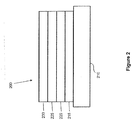
- FIG. 2 shows an inverted OLED 200.
- the device includes a substrate 210, a cathode 215, an emissive layer 220, a hole transport layer 225, and an anode 230.
- Device 200 may be fabricated by depositing the layers described, in order. Because the most common OLED configuration has a cathode disposed over the anode, and device 200 has cathode 215 disposed under anode 230, device 200 may be referred to as an "inverted" OLED. Materials similar to those described with respect to device 100 may be used in the corresponding layers of device 200.
- FIG. 2 provides one example of how some layers may be omitted from the structure of device 100.
- FIGS. 1 and 2 The simple layered structure illustrated in FIGS. 1 and 2 is provided by way of non-limiting example, and it is understood that embodiments of the invention may be used in connection with a wide variety of other structures.
- the specific materials and structures described are exemplary in nature, and other materials and structures may be used.
- Functional OLEDs may be achieved by combining the various layers described in different ways, or layers may be omitted entirely, based on design, performance, and cost factors. Other layers not specifically described may also be included. Materials other than those specifically described may be used. Although many of the examples provided herein describe various layers as comprising a single material, it is understood that combinations of materials, such as a mixture of host and dopant, or more generally a mixture, may be used. Also, the layers may have various sublayers.
- hole transport layer 225 transports holes and injects holes into emissive layer 220, and may be described as a hole transport layer or a hole injection layer.
- an OLED may be described as having an "organic layer" disposed between a cathode and an anode. This organic layer may comprise a single layer, or may further comprise multiple layers of different organic materials as described, for example, with respect to FIGS. 1 and 2 .
- OLEDs comprised of polymeric materials (PLEDs) such as disclosed in U.S. Pat. No. 5,247,190 to Friend et al. .
- PLEDs polymeric materials
- OLEDs having a single organic layer may be used.
- OLEDs may be stacked, for example as described in U.S. Pat. No. 5,707,745 to Forrest et al.
- the OLED structure may deviate from the simple layered structure illustrated in FIGS. 1 and 2 .
- the substrate may include an angled reflective surface to improve out-coupling, such as a mesa structure as described in U.S. Pat. No. 6,091,195 to Forrest et al. , and/or a pit structure as described in U.S. Pat. No. 5,834,893 to Bulovic et al. .
- any of the layers of the various embodiments may be deposited by any suitable method.
- preferred methods include thermal evaporation, ink-jet, such as described in U.S. Pat. Nos. 6,013,982 and 6,087,196 , organic vapor phase deposition (OVPD), such as described in U.S. Pat. No. 6,337,102 to Forrest et al. , and deposition by organic vapor jet printing (OVJP), such as described in U.S. Pat. No. 7,431,968 .
- OVPD organic vapor phase deposition
- OJP organic vapor jet printing
- Other suitable deposition methods include spin coating and other solution based processes. Solution based processes are preferably carried out in nitrogen or an inert atmosphere.
- preferred methods include thermal evaporation.
- Preferred patterning methods include deposition through a mask, cold welding such as described in U.S. Pat. Nos. 6,294,398 and 6,468,819 , and patterning associated with some of the deposition methods such as ink-jet and OVJD. Other methods may also be used.
- the materials to be deposited may be modified to make them compatible with a particular deposition method.
- substituents such as alkyl and aryl groups, branched or unbranched, and preferably containing at least 3 carbons, may be used in small molecules to enhance their ability to undergo solution processing. Substituents having 20 carbons or more may be used, and 3-20 carbons is a preferred range. Materials with asymmetric structures may have better solution processibility than those having symmetric structures, because asymmetric materials may have a lower tendency to recrystallize. Dendrimer substituents may be used to enhance the ability of small molecules to undergo solution processing.
- Devices fabricated in accordance with embodiments of the present invention may further optionally comprise a barrier layer.
- a barrier layer One purpose of the barrier layer is to protect the electrodes and organic layers from damaging exposure to harmful species in the environment including moisture, vapor and/or gases, etc.
- the barrier layer may be deposited over, under or next to a substrate, an electrode, or over any other parts of a device including an edge.
- the barrier layer may comprise a single layer, or multiple layers.
- the barrier layer may be formed by various known chemical vapor deposition techniques and may include compositions having a single phase as well as compositions having multiple phases. Any suitable material or combination of materials may be used for the barrier layer.
- the barrier layer may incorporate an inorganic or an organic compound or both.
- the preferred barrier layer comprises a mixture of a polymeric material and a non-polymeric material as described in U.S. Pat. No. 7,968,146 , PCT Pat. Application Nos. PCT/US2007/023098 and PCT/US2009/042829 .
- the aforesaid polymeric and non-polymeric materials comprising the barrier layer should be deposited under the same reaction conditions and/or at the same time.
- the weight ratio of polymeric to non-polymeric material may be in the range of 95:5 to 5:95.
- the polymeric material and the non-polymeric material may be created from the same precursor material.
- the mixture of a polymeric material and a non-polymeric material consists essentially of polymeric silicon and inorganic silicon.
- Devices fabricated in accordance with embodiments of the invention can be incorporated into a wide variety of electronic component modules (or units) that can be incorporated into a variety of electronic products or intermediate components. Examples of such electronic products or intermediate components include display screens, lighting devices such as discrete light source devices or lighting panels, etc. that can be utilized by the end-user product manufacturers. Such electronic component modules can optionally include the driving electronics and/or power source(s). Devices fabricated in accordance with embodiments of the invention can be incorporated into a wide variety of consumer products that have one or more of the electronic component modules (or units) incorporated therein. Such consumer products would include any kind of products that include one or more light source(s) and/or one or more of some type of visual displays.
- Some examples of such consumer products include flat panel displays, computer monitors, medical monitors, televisions, billboards, lights for interior or exterior illumination and/or signaling, heads-up displays, fully or partially transparent displays, flexible displays, laser printers, telephones, cell phones, tablets, phablets, personal digital assistants (PDAs), laptop computers, digital cameras, camcorders, viewfinders, micro-displays, 3-D displays, vehicles, a large area wall, theater or stadium screen, or a sign.
- PDAs personal digital assistants
- Various control mechanisms may be used to control devices fabricated in accordance with the present invention, including passive matrix and active matrix. Many of the devices are intended for use in a temperature range comfortable to humans, such as 18 degrees C. to 30 degrees C., and more preferably at room temperature (20-25 degrees C), but could be used outside this temperature range, for example, from -40 degree C to + 80 degree C.
- the materials and structures described herein may have applications in devices other than OLEDs.
- other optoelectronic devices such as organic solar cells and organic photodetectors may employ the materials and structures.
- organic devices such as organic transistors, may employ the materials and structures.
- halo includes fluorine, chlorine, bromine, and iodine.
- alkyl as used herein contemplates both straight and branched chain alkyl radicals.
- Preferred alkyl groups are those containing from one to fifteen carbon atoms and includes methyl, ethyl, propyl, isopropyl, butyl, isobutyl, tert-butyl, and the like. Additionally, the alkyl group may be optionally substituted.
- cycloalkyl as used herein contemplates cyclic alkyl radicals.
- Preferred cycloalkyl groups are those containing 3 to 7 carbon atoms and includes cyclopropyl, cyclopentyl, cyclohexyl, and the like. Additionally, the cycloalkyl group may be optionally substituted.
- alkenyl as used herein contemplates both straight and branched chain alkene radicals.
- Preferred alkenyl groups are those containing two to fifteen carbon atoms. Additionally, the alkenyl group may be optionally substituted.
- alkynyl as used herein contemplates both straight and branched chain alkyne radicals. Preferred alkynyl groups are those containing two to fifteen carbon atoms. Additionally, the alkynyl group may be optionally substituted.
- aralkyl or "arylalkyl” as used herein are used interchangeably and contemplate an alkyl group that has as a substituent an aromatic group. Additionally, the aralkyl group may be optionally substituted.
- heterocyclic group contemplates aromatic and non-aromatic cyclic radicals.
- Hetero-aromatic cyclic radicals also means heteroaryl.
- Preferred hetero-non-aromatic cyclic groups are those containing 3 or 7 ring atoms which includes at least one hetero atom, and includes cyclic amines such as morpholino, piperdino, pyrrolidino, and the like, and cyclic ethers, such as tetrahydrofuran, tetrahydropyran, and the like. Additionally, the heterocyclic group may be optionally substituted.
- aryl or "aromatic group” as used herein contemplates single-ring groups and polycyclic ring systems.
- the polycyclic rings may have two or more rings in which two carbons are common to two adjoining rings (the rings are "fused") wherein at least one of the rings is aromatic, e.g., the other rings can be cycloalkyls, cycloalkenyls, aryl, heterocycles, and/or heteroaryls.
- the aryl group may be optionally substituted, and may comprise, e.g., six to twenty carbon atoms.
- heteroaryl as used herein contemplates single-ring hetero-aromatic groups that may include from one to three heteroatoms and three to twenty carbon atoms, for example, pyrrole, furan, thiophene, imidazole, oxazole, thiazole, triazole, pyrazole, pyridine, pyrazine and pyrimidine, and the like.
- heteroaryl also includes polycyclic hetero-aromatic systems having two or more rings in which two atoms are common to two adjoining rings (the rings are "fused") wherein at least one of the rings is a heteroaryl, e.g., the other rings can be cycloalkyls, cycloalkenyls, aryl, heterocycles, and/or heteroaryls. Additionally, the heteroaryl group may be optionally substituted.
- alkyl, cycloalkyl, alkenyl, alkynyl, aralkyl, heterocyclic group, aryl, and heteroaryl may be optionally substituted with one or more substituents selected from the group consisting of hydrogen, deuterium, halogen, alkyl, cycloalkyl, heteroalkyl, arylalkyl, alkoxy, aryloxy, amino, cyclic amino, silyl, alkenyl, cycloalkenyl, heteroalkenyl, alkynyl, aryl, heteroaryl, acyl, carbonyl, carboxylic acid, ether, ester, nitrile, isonitrile, sulfanyl, sulfinyl, sulfonyl, phosphino, and combinations thereof.
- substituted indicates that a substituent other than H is bonded to the relevant position, such as carbon.
- substituent other than H such as carbon.
- R 1 is mono-substituted
- one R 1 must be other than H.
- R 1 is di-substituted
- two of R 1 must be other than H.
- R 1 is hydrogen for all available positions.
- aza-dibenzofuran i.e. aza-dibenzofuran, aza-dibenzothiophene, etc.
- azatriphenylene encompasses both dibenzo[ f , h ]quinoxaline and dibenzo[ f , h ]quinoline.
- a proposed mechanism for the decomposition of complexes that contain an uncoordinated nitrogen is an event where the uncoordinated nitrogen acts as a base by deprotonating a neighboring molecule, leading to non-emissive and potentially ionic reaction products. This event may happen in the excited state or in the presence of charged states found in the device environment.
- Multi-ring scaffolds such as the azaphenanthridine benzimidazole (APBI) ligand, may be useful to provide a functional site that can be substituted in order to address this decomposition mechanism.
- APBI azaphenanthridine benzimidazole
- the first approach places a steric group at the site in order to shield the lone pair of the uncoordinated nitrogen from exposure to protons on a neighboring molecule.
- Compounds 1-6 contain substitution designed to sterically shield the nitrogen from protonation:
- an aryl group is substituted on the ring opposite the uncoordinated nitrogen. Due to steric interaction, the ring is largely twisted out of plane, leading to a minimal increase in triplet energy. In addition, the plane of the aryl ring sits over the lone pair of the uncoordinated nitrogen, which should inhibit its exposure to nearby protons of neighboring molecules.
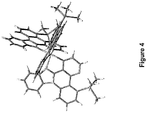
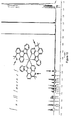
- the configuration of the aryl ring can be seen in the X-Ray crystal structure of Compound 1 ( Figure 3 ). However, an unexpected negative consequence of an aromatic substitution at this site is a decrease in PLQY.
- a second approach to improve stability comprises providing a hydrogen atom such that a static hydrogen bonding interaction is established between it and the lone pair of electrons on the uncoordinated nitrogen.
- This configuration serves to mitigate the reactivity of the lone pair, stabilizing the molecule from intermolecular degradation, and therefore improving the stability of the complex in a device.
- An exemplary azaphenanthridine benzimidazole (APBI) ligand is depicted below, wherein the hydrogen is defined as H*: It can be seen that H* points towards the lone pair of the nitrogen. It is believed that the proximity of the proton to the uncoordinated nitrogen is caused by steric repulsion between the methyl substituents on the isopropyl group and the ring system on the APBI.
- complexes can be designed to place a proton in close proximity to the lone pair of the nitrogen in order to form a static intramolecular hydrogen bond. Therefore if the lone pair of the nitrogen were to increase in basicity in the excited or charged state, then the lone pair and H* should be able to reversibly interact. On the other hand, a molecule without an intramolecular hydrogen bond could induce an irreversible degradation event by deprotonating a nearby molecule in the excited or charged state.
- the compounds of the present invention may be synthesized using techniques well-known in the art of organic synthesis.
- the starting materials and intermediates required for the synthesis may be obtained from commercial sources or synthesized according to methods known to those skilled in the art.
- the compound of the invention is a compound comprising a ligand L selected from the group A consisting of:
- the compound of the invention is a compound comprising a ligand L selected from the group A consisting of
- the compound of the invention is a compound comprising a ligand L selected from the group A consisting of:
- the metal M is selected from the group consisting of Ir, Rh, Re, Ru, Os, Pt, Au, and Cu. In another embodiment, M is Ir or Pt. In one embodiment, M is Ir. In another embodiment, M is Pt.
- the compounds of the invention include at least one intramolecular hydrogen bonding interaction to prevent deprotonation of neighboring molecules and to prevent protonation of an uncoordinated nitrogen.
- An exemplary intramolecular hydrogen bonding interaction can be found in scheme 1: Z 1 -H----Z 2 , scheme 1.
- Z 1 is carbon of alkyl
- Z 2 is one of X 1 to X 13 , and is nitrogen of pyridine.
- the location within the compound of Z 1 relative to Z 2 may be determined by the number of covalent bonds between Z 1 and Z 2 .
- Z 1 is at least 3 covalent bonds away from Z 2 .
- Z 1 is at least 4 covalent bonds away from Z 2 .
- Z 1 is at least 5 covalent bonds away from Z 2 .
- Z 1 is at least 6 covalent bonds away from Z 2 .
- An interaction between the hydrogen and Z 2 can be determined using any method known in the art.
- the interaction is determined using computational methods, such as by inspecting the Z 2 -H distance and spatial positioning in the minimized geometry.
- the distance between H and Z 2 ranges from 1.5 ⁇ to 2.4 ⁇ .
- the distance between H and Z 2 is equal to or less than 2.2 ⁇ .
- the distance between H and Z 2 is equal to or less than 2.16 ⁇ .
- the distance between H and Z 2 is equal to or less than 2.15 ⁇ .
- the interaction is determined using experimental methods, such as by measuring the 1 H (proton) NMR chemical shift of the hydrogen-bonding proton.
- the proton NMR chemical shift of H is shifted downfield by between 4.5 ppm and 7.0 ppm compared to the compound when Z 2 is carbon.
- the NMR chemical shift of H is shifted downfield by at least 1.3 ppm, more preferably at least 1.4 ppm, at least 1.5 ppm, at least 1.6 ppm, at least 1.7 ppm, at least 1.8 ppm, at least 1.9 ppm, or at least 2.0 ppm compared to the compound when Z 2 is carbon.
- the proton NMR chemical shift of H is shifted downfield by at least 1.3 ppm compared to the compound when Z 2 is carbon.
- the proton NMR chemical shift of H is shifted downfield by at least 1.4 ppm compared to the compound when Z 2 is carbon. In one embodiment, the proton NMR chemical shift of H is shifted downfield by between 30% and 60% compared to the compound when Z 2 is carbon. In some embodiments, the proton NMR chemical shift of H may be shifted downfield by at least 35%, at least 37%, at least 39%, at least 40%, at least 45%, or at least 50% compared to the compound when Z 2 is carbon. In one embodiment, the proton NMR chemical shift of H is shifted downfield by at least 35% compared to the compound when Z 2 is carbon. In another embodiment, the proton NMR chemical shift of H is shifted downfield by at least 37% compared to the compound when Z 2 is carbon
- the interaction is determined by measuring the emission of the first peak wavelength at the high energy end at room temperature and comparing it to the emission at a different temperature.
- room temperature refers to a temperature from about 20 °C to about 30 °C.
- compounds exhibiting an intramolecular hydrogen bonding interaction may also have an unusual triplet emission blue-shift in room temperature solution compared to the emission at a lower temperature.
- the compound has an room temperature emission blue shifted relative to 77K.
- the ligand L is selected from the group consisting of:
- the compound is homoleptic.
- a compound may be homoleptic when it comprises two or more ligands L, wherein the two or more ligands L are the same ligands.
- the compound is heteroleptic.
- a compound may be heteroleptic when it comprises two or more ligands L, wherein at least one of the ligands L is a different ligand from the other ligands L.
- the compound comprises at least one ligand L and at least one ligand L'.
- L' is a different ligand from L.
- L' is the same ligand as L.
- L is selected from group A. L' is not particularly limited.
- L' is a bidentate ligand.
- ligands L' may be optionally substituted, and any adjacent substituents may be optionally fused or joined to form a ring or form a multidentate ligand.
- L and L' are connected to form a multidentate ligand, such as a tridentate, tetradentate, pentadentate, or hexadentate ligand.
- L and L' are connected to form a tetradentate ligand.
- L and L' may be connected at one location or place to form a multidentate ligand, or L and L' may be connected at two or more locations or places to form a macrocyclic multidentate ligand.
- L and L' are connected at two places to form a macrocyclic tetradentate ligand.
- the compound has a formula of Ir(L) n (L') 3-n ; wherein L' is selected from group A; and wherein n is 1, 2, or 3.
- n is 1. In another embodiment, n is 2. In another embodiment, n is 3.
- the compound has a formula of Pt(L) m (L') 2-m ; wherein L' is selected from group A; and wherein m is 1, or 2.
- n is 1. In another embodiment, m is 2.
- the compound is selected from the group consisting of:
- the compound can be an emissive dopant.
- the compound can produce emissions via phosphorescence, fluorescence, thermally activated delayed fluorescence, i.e., TADF (also referred to as E-type delayed fluorescence), triplet-triplet annihilation, or combinations of these processes.
- TADF thermally activated delayed fluorescence
- a first device includes a first organic light emitting device, that includes an anode, a cathode, and an organic layer disposed between the anode and the cathode.
- the organic layer may include a host and a phosphorescent dopant.
- the emissive layer can include a compound comprising a ligand L, and its variations as described herein.
- the first device can be one or more of a consumer product, an electronic component module, an organic light-emitting device and a lighting panel.
- the organic layer can be an emissive layer and the compound can be an emissive dopant in some embodiments, while the compound can be a non-emissive dopant in other embodiments.
- the organic layer can be a charge transporting layer and the compound can be a charge transporting material in the organic layer in some embodiments.
- the organic layer can be a blocking layer and the compound can be a blocking material in the organic layer in some embodiments.
- the organic layer can also include a host.
- the host can include a metal complex.
- n can range from 1 to 10; and Ar 1 and Ar 2 can be independently selected from the group consisting of benzene, biphenyl, naphthalene, triphenylene, carbazole, and heteroaromatic analogs thereof.
- the host can be a compound comprising at least one chemical group selected from the group consisting of triphenylene, carbazole, dibenzothiphene, dibenzofuran, dibenzoselenophene, azatriphenylene, azacarbazole, aza-dibenzothiophene, aza-dibenzofuran, and aza-dibenzoselenophene.
- the host can include a metal complex.
- the host can be a specific compound selected from the group consisting of: and combinations thereof.
- a formulation that comprises a compound comprising a ligand L is described.
- the formulation can include one or more components selected from the group consisting of a solvent, a host, a hole injection material, hole transport material, and an electron transport layer material, disclosed herein.
- the materials described herein as useful for a particular layer in an organic light emitting device may be used in combination with a wide variety of other materials present in the device.
- emissive dopants disclosed herein may be used in conjunction with a wide variety of hosts, transport layers, blocking layers, injection layers, electrodes and other layers that may be present.
- the materials described or referred to below are non-limiting examples of materials that may be useful in combination with the compounds disclosed herein, and one of skill in the art can readily consult the literature to identify other materials that may be useful in combination.
- a hole injecting/transporting material to be used in the present invention is not particularly limited, and any compound may be used as long as the compound is typically used as a hole injecting/transporting material.
- the material include, but are not limited to: a phthalocyanine or porphyrin derivative; an aromatic amine derivative; an indolocarbazole derivative; a polymer containing fluorohydrocarbon; a polymer with conductivity dopants; a conducting polymer, such as PEDOT/PSS; a self-assembly monomer derived from compounds such as phosphonic acid and silane derivatives; a metal oxide derivative, such as MoO x ; a p-type semiconducting organic compound, such as 1,4,5,8,9,12-Hexaazatriphenylenehexacarbonitrile; a metal complex, and cross-linkable compounds.
- aromatic amine derivatives used in HIL or HTL include, but are not limited to the following general structures:
- Each of Ar 1 to Ar 9 is selected from the group consisting of aromatic hydrocarbon cyclic compounds such as benzene, biphenyl, triphenyl, triphenylene, naphthalene, anthracene, phenalene, phenanthrene, fluorene, pyrene, chrysene, perylene, and azulene; the group consisting of aromatic heterocyclic compounds such as dibenzothiophene, dibenzofuran, dibenzoselenophene, furan, thiophene, benzofuran, benzothiophene, benzoselenophene, carbazole, indolocarbazole, pyridylindole, pyrrolodipyridine, pyrazole, imidazole, triazole, oxazole, thiazole, oxadiazole, oxatriazole, dioxazole, thiadiazole, pyridine, pyridazine
- each Ar is further substituted by a substituent selected from the group consisting of hydrogen, deuterium, halide, alkyl, cycloalkyl, heteroalkyl, arylalkyl, alkoxy, aryloxy, amino, silyl, alkenyl, cycloalkenyl, heteroalkenyl, alkynyl, aryl, heteroaryl, acyl, carbonyl, carboxylic acids, ester, nitrile, isonitrile, sulfanyl, sulfinyl, sulfonyl, phosphino, and combinations thereof.
- a substituent selected from the group consisting of hydrogen, deuterium, halide, alkyl, cycloalkyl, heteroalkyl, arylalkyl, alkoxy, aryloxy, amino, silyl, alkenyl, cycloalkenyl, heteroalkenyl, alkynyl, aryl, heteroaryl, acy
- Ar 1 to Ar 9 is independently selected from the group consisting of: wherein k is an integer from 1 to 20; X 101 to X 108 is C (including CH) or N; Z 101 is NAr 1 , O, or S; Ar 1 has the same group defined above.
- metal complexes used in HIL or HTL include, but are not limited to the following general formula: wherein Met is a metal, which can have an atomic weight greater than 40; (Y 101 -Y 102 ) is a bidentate ligand, Y 101 and Y 102 are independently selected from C, N, O, P, and S; L 101 is an ancillary ligand; k' is an integer value from 1 to the maximum number of ligands that may be attached to the metal; and k'+k" is the maximum number of ligands that may be attached to the metal.
- (Y 101 -Y 102 ) is a 2-phenylpyridine derivative. In another aspect, (Y 101 -Y 102 ) is a carbene ligand. In another aspect, Met is selected from Ir, Pt, Os, and Zn. In a further aspect, the metal complex has a smallest oxidation potential in solution vs. Fc + /Fc couple less than about 0.6 V.
- the light emitting layer of the organic EL device of the present invention preferably contains at least a metal complex as light emitting material, and may contain a host material using the metal complex as a dopant material.
- the host material are not particularly limited, and any metal complexes or organic compounds may be used as long as the triplet energy of the host is larger than that of the dopant. While the Table below categorizes host materials as preferred for devices that emit various colors, any host material may be used with any dopant so long as the triplet criteria is satisfied.
- Examples of metal complexes used as host are preferred to have the following general formula: wherein Met is a metal; (Y 103 -Y 104 ) is a bidentate ligand, Y 103 and Y 104 are independently selected from C, N, O, P, and S; L 101 is an another ligand; k' is an integer value from 1 to the maximum number of ligands that may be attached to the metal; and k'+k" is the maximum number of ligands that may be attached to the metal.
- the metal complexes are: wherein (O-N) is a bidentate ligand, having metal coordinated to atoms O and N.
- Met is selected from Ir and Pt.
- (Y 103 -Y 104 ) is a carbene ligand.
- organic compounds used as host are selected from the group consisting of aromatic hydrocarbon cyclic compounds such as benzene, biphenyl, triphenyl, triphenylene, naphthalene, anthracene, phenalene, phenanthrene, fluorene, pyrene, chrysene, perylene, and azulene; the group consisting of aromatic heterocyclic compounds such as dibenzothiophene, dibenzofuran, dibenzoselenophene, furan, thiophene, benzofuran, benzothiophene, benzoselenophene, carbazole, indolocarbazole, pyridylindole, pyrrolodipyridine, pyrazole, imidazole, triazole, oxazole, thiazole, oxadiazole, oxatriazole, dioxazole, thiadiazole, pyridine, pyridazine,
- each group is further substituted by a substituent selected from the group consisting of hydrogen, deuterium, halide, alkyl, cycloalkyl, heteroalkyl, arylalkyl, alkoxy, aryloxy, amino, silyl, alkenyl, cycloalkenyl, heteroalkenyl, alkynyl, aryl, heteroaryl, acyl, carbonyl, carboxylic acids, ester, nitrile, isonitrile, sulfanyl, sulfinyl, sulfonyl, phosphino, and combinations thereof.
- a substituent selected from the group consisting of hydrogen, deuterium, halide, alkyl, cycloalkyl, heteroalkyl, arylalkyl, alkoxy, aryloxy, amino, silyl, alkenyl, cycloalkenyl, heteroalkenyl, alkynyl, aryl, heteroaryl, acy
- the host compound contains at least one of the following groups in the molecule:
- a hole blocking layer may be used to reduce the number of holes and/or excitons that leave the emissive layer.
- the presence of such a blocking layer in a device may result in substantially higher efficiencies as compared to a similar device lacking a blocking layer.
- a blocking layer may be used to confine emission to a desired region of an OLED.
- the compound used in the HBL contains the same molecule or the same functional groups used as the host described above.
- the compound used in the HBL contains at least one of the following groups in the molecule: wherein k is an integer from 1 to 20; L 101 is an another ligand, k' is an integer from 1 to 3.
- Electron transport layer may include a material capable of transporting electrons. Electron transport layer may be intrinsic (undoped), or doped. Doping may be used to enhance conductivity. Examples of the ETL material are not particularly limited, and any metal complexes or organic compounds may be used as long as they are typically used to transport electrons.
- the compound used in ETL contains at least one of the following groups in the molecule: wherein R 101 is selected from the group consisting of hydrogen, deuterium, halide, alkyl, cycloalkyl, heteroalkyl, arylalkyl, alkoxy, aryloxy, amino, silyl, alkenyl, cycloalkenyl, heteroalkenyl, alkynyl, aryl, heteroaryl, acyl, carbonyl, carboxylic acids, ester, nitrile, isonitrile, sulfanyl, sulfinyl, sulfonyl, phosphino, and combinations thereof, when it is aryl or heteroaryl, it has the similar definition as Ar's mentioned above.
- Ar 1 to Ar 3 has the similar definition as Ar's mentioned above.
- k is an integer from 1 to 20.
- X 101 to X 108 is selected from C (including CH) or N.
- the metal complexes used in ETL contains, but is not limited to, the following general formula: wherein (O-N) or (N-N) is a bidentate ligand, having metal coordinated to atoms O, N or N, N; L 101 is another ligand; k' is an integer value from 1 to the maximum number of ligands that may be attached to the metal.
- the hydrogen atoms can be partially or fully deuterated.
- any specifically listed substituent such as, without limitation, methyl, phenyl, pyridyl, etc. encompasses undeuterated, partially deuterated, and fully deuterated versions thereof.
- classes of substituents such as, without limitation, alkyl, aryl, cycloalkyl, heteroaryl, etc. also encompass undeuterated, partially deuterated, and fully deuterated versions thereof.
- hole injection materials In addition to and / or in combination with the materials disclosed herein, many hole injection materials, hole transporting materials, host materials, dopant materials, exiton/hole blocking layer materials, electron transporting and electron injecting materials may be used in an OLED.
- Non-limiting examples of the materials that may be used in an OLED in combination with materials disclosed herein are listed in Table A below. Table A lists non-limiting classes of materials, non-limiting examples of compounds for each class, and references that disclose the materials. TABLE A MATERIAL EXAMPLES OF MATERIAL PUBLICATIONS Hole injection materials Phthalocyanine and porphyrin compounds Appl. Phys. Lett. 69, 2160 (1996 ) Starburst triarylamines J. Lumin.
- Non-limiting examples of compounds of the invention that contain intramolecular hydrogen bonding include:
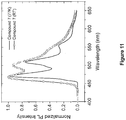
- FIG. 11 shows the emission spectra of Compound 7 in 2-methyl tetrahydrofuran (2-MeTHF) solvent at room temperature and 77 K.
- the room temperature emission was found to be significantly blue-shifted relative to 77 K, unlike any other Ir(APBI) 3 complex yet measured.
- this blue shift may be due to an inductive withdrawing effect, which reduces electron density on the covalently attached ring, thereby blue shifting the emission spectra.
Landscapes
- Chemical & Material Sciences (AREA)
- Organic Chemistry (AREA)
- Engineering & Computer Science (AREA)
- Materials Engineering (AREA)
- Crystallography & Structural Chemistry (AREA)
- Inorganic Chemistry (AREA)
- Physics & Mathematics (AREA)
- Optics & Photonics (AREA)
- Electroluminescent Light Sources (AREA)
- Luminescent Compositions (AREA)
Claims (16)
- Eine Verbindung umfassend einen Liganden L ausgewählt aus der Gruppe A bestehend aus:
 wobei jedes X1 bis X13 unabhängig ausgewählt ist aus der Gruppe bestehend aus Kohlenstoff und Stickstoff;wobei jedes Ra, Rb, Rc, und Rd für mono-Substitution bis zur maximal möglichen Anzahl an Substitutionen, oder keine Substitution steht;wobei jedes Ra, Rb, Rc, und Rd unabhängig ausgewählt ist aus der Gruppe bestehend aus Wasserstoff, Deuterium, Halogen, Alkyl, Cycloalkyl, Heteroalkyl, Arylalkyl, Alkoxy, Aryloxy, Amino, Silyl, Alkenyl, Cycloalkenyl, Heteroalkenyl, Alkinyl, Aryl, Heteroaryl, Acyl, Carbonyl, Carbonsäuren, Ester, Nitril, Isonitril, Sulfanyl, Sulfinyl, Sulfonyl, Phosphino, und Kombinationen davon;wobei der Ligand L an ein Metall M koordiniert ist, welches aus der Gruppe bestehend aus Ir, Rh, Re, Ru, Os, Pt, Au, und Cu ausgewählt ist;wobei der Ligand L gegebenenfalls mit anderen Liganden verknüpft ist um einen tridentaten-, tetradentaten-, pentadentaten- oder hexadentaten Liganden zu bilden;wobei die Verbindung mindestens eine intramolekulare Wasserstoffbindungswechselwirkung umfasst, die bestimmt wird durch Messen der 1H(Protonen) NMR chemischen Verschiebung wie im Schema gezeigt:
 wobei die chemische Verschiebung von H feldabwärts um mindestens 1,3 ppm verschoben ist verglichen mit der Verbindung worin Z2 Kohlenstoff ist,wobei Z1 Kohlenstoff von Alkyl ist; undwobei Z2 eines von X1 bis X13 ist, und Stickstoff von Pyridin ist.
 - Die Verbindung nach Anspruch 1, wobei im Schema 1 die chemische Verschiebung von H im Protonen NMR feldabwärts um mindestens 1,4 ppm verschoben ist verglichen mit der Verbindung worin Z2 Kohlenstoff ist.
- Die Verbindung nach Anspruch 1 oder 2, wobei die Raumtemperaturemission relativ zu 77K blauverschoben ist.
- Die Verbindung nach einem der Ansprüche 1 bis 3, wobei M für Ir oder Pt steht.
- Die Verbindung nach einem der Ansprüche 1 bis 4, wobei Z1 mindestens 4 kovalente Bindungen von Z2 entfernt ist.
- Die Verbindung nach einem der Ansprüche 1 bis 3 oder 5, wobei die Verbindung eine Formel Ir(L)n(L')3-n aufweist;
wobei L' ausgewählt ist aus der Gruppe A; und
wobei n 1, 2, oder 3 ist. - Die Verbindung nach einem der Ansprüche 1 bis 3 oder 5, wobei die Verbindung eine Formel Pt(L)m(L')2-m aufweist;
wobei L' ausgewählt ist aus der Gruppe A; und
wobei m 1 oder 2 ist. - Die Verbindung nach einem der Ansprüche 1 bis 7, wobei der Ligand L ausgewählt ist aus der Gruppe bestehend aus:

- Die Verbindung nach einem der Ansprüche 1 bis 3, wobei die Verbindung ausgewählt ist aus der Gruppe bestehend aus:

- Eine erste Vorrichtung umfassend eine erste organische Licht emittierende Vorrichtung, die erste organische Licht emittierende Vorrichtung umfassend:eine Anode;eine Kathode; undeine organische Schicht, angeordnet zwischen der Anode und der Kathode, umfassend eine Verbindung wie in einem der Ansprüche 1 bis 9 definiert.
- Die erste Vorrichtung nach Anspruch 10, wobei die erste Vorrichtung ausgewählt ist aus der Gruppe bestehend aus einem Konsumentenprodukt, einem elektronischen Komponentenmodul, einer organischen Licht emittierenden Vorrichtung und einer Lichtleiste.
- Die erste Vorrichtung nach den Ansprüchen 10 oder 11, wobei die organische Schicht eine emittierende Schicht und die Verbindung ein emittierender Dotierstoff oder ein nicht emittierender Dotierstoff ist.
- Die erste Vorrichtung nach einem der Ansprüche 10 bis 12, wobei die organische Schicht ferner einen Wirt umfasst; wobei der Wirt ein Triphenylen enthaltendes Benzo-fusioniertes Thiophen oder Benzo-fusioniertes Furan umfasst;
wobei jeder Substituent in dem Wirt ein nicht fusionierter Substituent ist, der unabhängig ausgewählt ist aus der Gruppe bestehend aus CnH2n+1, OCnH2n+1, OAr1, N(CnH2n+1)2, N(Ar1)(Ar2), CH=CH-CnH2n+1, C≡CCnH2n+1, Ar1, Ar1-Ar2, CnH2n-Ar1, oder keine Substitution;
wobei n von 1 bis 10 ist; und
wobei Ar1 und Ar2 unabhängig ausgewählt sind aus der Gruppe bestehend aus Benzol, Biphenyl, Naphthalin, Triphenylen, Carbazol, und heteroaromatischen Analoga davon. - Die erste Vorrichtung nach einem der Ansprüche 10 bis 13, wobei die organische Schicht ferner einen Wirt umfasst, wobei der Wirt mindestens eine chemische Gruppe umfasst, die ausgewählt ist aus der Gruppe bestehend aus Triphenylen, Carbazol, Dibenzothiophen, Dibenzofuran, Dibenzoselenophen, Azatriphenylen, Azacarbazol, Aza-dibenzothiophen, Aza-dibenzofuran, und Aza-dibenzoselenophen.
- Die erste Vorrichtung nach einem der Ansprüche 10 bis 13, wobei die organische Schicht ferner einen Wirt umfasst und der Wirt ausgewählt ist aus der Gruppe bestehend aus:


- Eine Verbindung wie in einem der Ansprüche 1 bis 9 definiert,
wobei in Schema 1 die chemische Verschiebung von H im Protonen NMR feldabwärts um mindestens 35% verschoben ist verglichen mit der Verbindung worin Z2 Kohlenstoff ist.
Applications Claiming Priority (4)
| Application Number | Priority Date | Filing Date | Title |
|---|---|---|---|
| US201461979103P | 2014-04-14 | 2014-04-14 | |
| US201461991720P | 2014-05-12 | 2014-05-12 | |
| US14/672,034 US10008679B2 (en) | 2014-04-14 | 2015-03-27 | Organic electroluminescent materials and devices |
| EP15163179.3A EP2933259B1 (de) | 2014-04-14 | 2015-04-10 | Organische elektrolumineszente materialien und vorrichtungen |
Related Parent Applications (2)
| Application Number | Title | Priority Date | Filing Date |
|---|---|---|---|
| EP15163179.3A Division EP2933259B1 (de) | 2014-04-14 | 2015-04-10 | Organische elektrolumineszente materialien und vorrichtungen |
| EP15163179.3A Division-Into EP2933259B1 (de) | 2014-04-14 | 2015-04-10 | Organische elektrolumineszente materialien und vorrichtungen |
Publications (2)
| Publication Number | Publication Date |
|---|---|
| EP3424934A1 EP3424934A1 (de) | 2019-01-09 |
| EP3424934B1 true EP3424934B1 (de) | 2021-07-14 |
Family
ID=52829007
Family Applications (2)
| Application Number | Title | Priority Date | Filing Date |
|---|---|---|---|
| EP18186898.5A Active EP3424934B1 (de) | 2014-04-14 | 2015-04-10 | Organische elektrolumineszente materialien und vorrichtungen |
| EP15163179.3A Active EP2933259B1 (de) | 2014-04-14 | 2015-04-10 | Organische elektrolumineszente materialien und vorrichtungen |
Family Applications After (1)
| Application Number | Title | Priority Date | Filing Date |
|---|---|---|---|
| EP15163179.3A Active EP2933259B1 (de) | 2014-04-14 | 2015-04-10 | Organische elektrolumineszente materialien und vorrichtungen |
Country Status (6)
| Country | Link |
|---|---|
| US (3) | US10008679B2 (de) |
| EP (2) | EP3424934B1 (de) |
| JP (2) | JP6684048B2 (de) |
| KR (2) | KR102444007B1 (de) |
| CN (2) | CN110606861A (de) |
| TW (2) | TWI676629B (de) |
Families Citing this family (23)
| Publication number | Priority date | Publication date | Assignee | Title |
|---|---|---|---|---|
| US10008679B2 (en) | 2014-04-14 | 2018-06-26 | Universal Display Corporation | Organic electroluminescent materials and devices |
| US9847498B2 (en) * | 2014-04-14 | 2017-12-19 | Universal Display Corporation | Organic electroluminescent materials and devices |
| US10608186B2 (en) | 2016-09-14 | 2020-03-31 | Universal Display Corporation | Organic electroluminescent materials and devices |
| KR102149077B1 (ko) | 2016-09-23 | 2020-08-27 | 주식회사 엘지화학 | 유기 발광 소자 |
| KR101893310B1 (ko) | 2016-10-31 | 2018-08-29 | 주식회사 엘지화학 | 헤테로고리 화합물 및 이를 포함하는 유기 전자 소자 |
| US12317745B2 (en) | 2016-11-09 | 2025-05-27 | Universal Display Corporation | Organic electroluminescent materials and devices |
| US11152579B2 (en) * | 2016-12-28 | 2021-10-19 | Universal Display Corporation | Organic electroluminescent materials and devices |
| WO2018160003A1 (ko) | 2017-02-28 | 2018-09-07 | 주식회사 엘지화학 | 헤테로고리 화합물 및 이를 포함하는 유기 발광 소자 |
| WO2018182300A1 (ko) | 2017-03-27 | 2018-10-04 | 주식회사 엘지화학 | 헤테로고리 화합물 및 이를 포함하는 유기 발광 소자 |
| US11814403B2 (en) | 2017-06-23 | 2023-11-14 | Universal Display Corporation | Organic electroluminescent materials and devices |
| US12577268B2 (en) | 2017-06-23 | 2026-03-17 | Universal Display Corporation | Organic electroluminescent materials and devices |
| US11832510B2 (en) | 2017-06-23 | 2023-11-28 | Universal Display Corporation | Organic electroluminescent materials and devices |
| US11802136B2 (en) | 2017-06-23 | 2023-10-31 | Universal Display Corporation | Organic electroluminescent materials and devices |
| US12459946B2 (en) | 2017-10-05 | 2025-11-04 | Universal Display Corporation | Organic host materials for electroluminescent devices |
| CN107629786B (zh) * | 2017-10-24 | 2019-03-01 | 济南大学 | 2-甲基咪唑啉作为pH值和Fe3+双功能荧光探针的应用及其荧光探针 |
| KR102088095B1 (ko) | 2018-03-19 | 2020-03-11 | 주식회사 엘지화학 | 헤테로고리 화합물 및 이를 포함하는 유기 발광 소자 |
| JP2020158491A (ja) * | 2019-03-26 | 2020-10-01 | ユニバーサル ディスプレイ コーポレイション | 有機エレクトロルミネセンス材料及びデバイス |
| US11926638B2 (en) * | 2019-07-22 | 2024-03-12 | Universal Display Corporation | Organic electroluminescent materials and devices |
| CN114206886B (zh) * | 2019-07-29 | 2024-02-27 | 广东聚华印刷显示技术有限公司 | 金(iii)化合物、其制备方法及使用其的有机发光器件 |
| KR102811430B1 (ko) * | 2019-11-27 | 2025-05-23 | 삼성디스플레이 주식회사 | 유기금속 화합물 및 이를 포함한 유기 발광 소자 |
| KR102838031B1 (ko) * | 2020-03-04 | 2025-07-25 | 삼성디스플레이 주식회사 | 유기 전계 발광 소자 및 유기 전계 발광 소자용 유기 금속 화합물 |
| KR102853327B1 (ko) | 2020-05-14 | 2025-09-01 | 삼성디스플레이 주식회사 | 유기금속 화합물 및 이를 포함한 유기 발광 소자 |
| CN119409858B (zh) * | 2024-10-23 | 2026-03-24 | 天津师范大学 | 一种吡啶衍生物的质子化产物及其复合物、制备方法与应用 |
Citations (1)
| Publication number | Priority date | Publication date | Assignee | Title |
|---|---|---|---|---|
| WO2015027060A1 (en) * | 2013-08-21 | 2015-02-26 | Arizona Board Of Regents On Behalf Of Arizona State University | Phosphorescent tetradentate metal complexes having modified emission spectra |
Family Cites Families (170)
| Publication number | Priority date | Publication date | Assignee | Title |
|---|---|---|---|---|
| US4769292A (en) | 1987-03-02 | 1988-09-06 | Eastman Kodak Company | Electroluminescent device with modified thin film luminescent zone |
| GB8909011D0 (en) | 1989-04-20 | 1989-06-07 | Friend Richard H | Electroluminescent devices |
| US5061569A (en) | 1990-07-26 | 1991-10-29 | Eastman Kodak Company | Electroluminescent device with organic electroluminescent medium |
| EP0650955B1 (de) | 1993-11-01 | 1998-08-19 | Hodogaya Chemical Co., Ltd. | Aminverbindung und sie enthaltende Elektrolumineszenzvorrichtung |
| US5707745A (en) | 1994-12-13 | 1998-01-13 | The Trustees Of Princeton University | Multicolor organic light emitting devices |
| US5703436A (en) | 1994-12-13 | 1997-12-30 | The Trustees Of Princeton University | Transparent contacts for organic devices |
| US6939625B2 (en) | 1996-06-25 | 2005-09-06 | Nôrthwestern University | Organic light-emitting diodes and methods for assembly and enhanced charge injection |
| US5844363A (en) | 1997-01-23 | 1998-12-01 | The Trustees Of Princeton Univ. | Vacuum deposited, non-polymeric flexible organic light emitting devices |
| US6091195A (en) | 1997-02-03 | 2000-07-18 | The Trustees Of Princeton University | Displays having mesa pixel configuration |
| US5834893A (en) | 1996-12-23 | 1998-11-10 | The Trustees Of Princeton University | High efficiency organic light emitting devices with light directing structures |
| US6013982A (en) | 1996-12-23 | 2000-01-11 | The Trustees Of Princeton University | Multicolor display devices |
| US6303238B1 (en) | 1997-12-01 | 2001-10-16 | The Trustees Of Princeton University | OLEDs doped with phosphorescent compounds |
| US6337102B1 (en) | 1997-11-17 | 2002-01-08 | The Trustees Of Princeton University | Low pressure vapor phase deposition of organic thin films |
| US6087196A (en) | 1998-01-30 | 2000-07-11 | The Trustees Of Princeton University | Fabrication of organic semiconductor devices using ink jet printing |
| US6528187B1 (en) | 1998-09-08 | 2003-03-04 | Fuji Photo Film Co., Ltd. | Material for luminescence element and luminescence element using the same |
| US6830828B2 (en) | 1998-09-14 | 2004-12-14 | The Trustees Of Princeton University | Organometallic complexes as phosphorescent emitters in organic LEDs |
| US6097147A (en) | 1998-09-14 | 2000-08-01 | The Trustees Of Princeton University | Structure for high efficiency electroluminescent device |
| US6294398B1 (en) | 1999-11-23 | 2001-09-25 | The Trustees Of Princeton University | Method for patterning devices |
| US6458475B1 (en) | 1999-11-24 | 2002-10-01 | The Trustee Of Princeton University | Organic light emitting diode having a blue phosphorescent molecule as an emitter |
| KR100377321B1 (ko) | 1999-12-31 | 2003-03-26 | 주식회사 엘지화학 | 피-형 반도체 성질을 갖는 유기 화합물을 포함하는 전기소자 |
| US20020121638A1 (en) | 2000-06-30 | 2002-09-05 | Vladimir Grushin | Electroluminescent iridium compounds with fluorinated phenylpyridines, phenylpyrimidines, and phenylquinolines and devices made with such compounds |
| EP1325671B1 (de) | 2000-08-11 | 2012-10-24 | The Trustees Of Princeton University | Organometallische verbdindungen und emissionsverschobene organische elektrolumineszens |
| US6579630B2 (en) | 2000-12-07 | 2003-06-17 | Canon Kabushiki Kaisha | Deuterated semiconducting organic compounds used for opto-electronic devices |
| JP3812730B2 (ja) | 2001-02-01 | 2006-08-23 | 富士写真フイルム株式会社 | 遷移金属錯体及び発光素子 |
| JP4307000B2 (ja) | 2001-03-08 | 2009-08-05 | キヤノン株式会社 | 金属配位化合物、電界発光素子及び表示装置 |
| JP4310077B2 (ja) | 2001-06-19 | 2009-08-05 | キヤノン株式会社 | 金属配位化合物及び有機発光素子 |
| CN100440568C (zh) | 2001-06-20 | 2008-12-03 | 昭和电工株式会社 | 发光材料和有机发光装置 |
| US7071615B2 (en) | 2001-08-20 | 2006-07-04 | Universal Display Corporation | Transparent electrodes |
| US7250226B2 (en) | 2001-08-31 | 2007-07-31 | Nippon Hoso Kyokai | Phosphorescent compound, a phosphorescent composition and an organic light-emitting device |
| US7431968B1 (en) | 2001-09-04 | 2008-10-07 | The Trustees Of Princeton University | Process and apparatus for organic vapor jet deposition |
| US6835469B2 (en) | 2001-10-17 | 2004-12-28 | The University Of Southern California | Phosphorescent compounds and devices comprising the same |
| US7166368B2 (en) | 2001-11-07 | 2007-01-23 | E. I. Du Pont De Nemours And Company | Electroluminescent platinum compounds and devices made with such compounds |
| US6863997B2 (en) | 2001-12-28 | 2005-03-08 | The Trustees Of Princeton University | White light emitting OLEDs from combined monomer and aggregate emission |
| KR100691543B1 (ko) | 2002-01-18 | 2007-03-09 | 주식회사 엘지화학 | 새로운 전자 수송용 물질 및 이를 이용한 유기 발광 소자 |
| US20030230980A1 (en) | 2002-06-18 | 2003-12-18 | Forrest Stephen R | Very low voltage, high efficiency phosphorescent oled in a p-i-n structure |
| US7189989B2 (en) | 2002-08-22 | 2007-03-13 | Fuji Photo Film Co., Ltd. | Light emitting element |
| JP4313308B2 (ja) | 2002-08-27 | 2009-08-12 | 富士フイルム株式会社 | 有機金属錯体、有機el素子及び有機elディスプレイ |
| US6687266B1 (en) | 2002-11-08 | 2004-02-03 | Universal Display Corporation | Organic light emitting materials and devices |
| JP4365196B2 (ja) | 2002-12-27 | 2009-11-18 | 富士フイルム株式会社 | 有機電界発光素子 |
| JP4365199B2 (ja) | 2002-12-27 | 2009-11-18 | 富士フイルム株式会社 | 有機電界発光素子 |
| US7338722B2 (en) | 2003-03-24 | 2008-03-04 | The University Of Southern California | Phenyl and fluorenyl substituted phenyl-pyrazole complexes of Ir |
| US7090928B2 (en) | 2003-04-01 | 2006-08-15 | The University Of Southern California | Binuclear compounds |
| EP1618170A2 (de) | 2003-04-15 | 2006-01-25 | Covion Organic Semiconductors GmbH | Mischungen von organischen zur emission befähigten halbleitern und matrixmaterialien, deren verwendung und elektronikbauteile enthaltend diese mischungen |
| US7029765B2 (en) | 2003-04-22 | 2006-04-18 | Universal Display Corporation | Organic light emitting devices having reduced pixel shrinkage |
| JP4673744B2 (ja) | 2003-05-29 | 2011-04-20 | 新日鐵化学株式会社 | 有機電界発光素子 |
| WO2004111066A1 (ja) | 2003-06-09 | 2004-12-23 | Hitachi Chemical Co., Ltd. | 金属配位化合物、ポリマー組成物、およびこれらを用いた有機エレクトロルミネセンス素子 |
| JP2005011610A (ja) | 2003-06-18 | 2005-01-13 | Nippon Steel Chem Co Ltd | 有機電界発光素子 |
| US20050025993A1 (en) | 2003-07-25 | 2005-02-03 | Thompson Mark E. | Materials and structures for enhancing the performance of organic light emitting devices |
| TWI390006B (zh) | 2003-08-07 | 2013-03-21 | Nippon Steel Chemical Co | Organic EL materials with aluminum clamps |
| DE10338550A1 (de) | 2003-08-19 | 2005-03-31 | Basf Ag | Übergangsmetallkomplexe mit Carbenliganden als Emitter für organische Licht-emittierende Dioden (OLEDs) |
| US20060269780A1 (en) | 2003-09-25 | 2006-11-30 | Takayuki Fukumatsu | Organic electroluminescent device |
| JP4822687B2 (ja) | 2003-11-21 | 2011-11-24 | 富士フイルム株式会社 | 有機電界発光素子 |
| US7332232B2 (en) | 2004-02-03 | 2008-02-19 | Universal Display Corporation | OLEDs utilizing multidentate ligand systems |
| EP2918590A1 (de) | 2004-03-11 | 2015-09-16 | Mitsubishi Chemical Corporation | Zusammensetzung für eine ladungstransportfolie und ionenzusammensetzung, ladetransportfolie und organische elektrolumineszenzvorrichtung damit, und herstellungsverfahren der organischen elektrolumineszenzvorrichtung und herstellungsverfahren der ladungstransportfolie |
| TW200531592A (en) | 2004-03-15 | 2005-09-16 | Nippon Steel Chemical Co | Organic electroluminescent device |
| JP4869565B2 (ja) | 2004-04-23 | 2012-02-08 | 富士フイルム株式会社 | 有機電界発光素子 |
| US7491823B2 (en) | 2004-05-18 | 2009-02-17 | The University Of Southern California | Luminescent compounds with carbene ligands |
| US7393599B2 (en) | 2004-05-18 | 2008-07-01 | The University Of Southern California | Luminescent compounds with carbene ligands |
| US7154114B2 (en) | 2004-05-18 | 2006-12-26 | Universal Display Corporation | Cyclometallated iridium carbene complexes for use as hosts |
| US7534505B2 (en) | 2004-05-18 | 2009-05-19 | The University Of Southern California | Organometallic compounds for use in electroluminescent devices |
| US7445855B2 (en) | 2004-05-18 | 2008-11-04 | The University Of Southern California | Cationic metal-carbene complexes |
| US7279704B2 (en) | 2004-05-18 | 2007-10-09 | The University Of Southern California | Complexes with tridentate ligands |
| WO2005123873A1 (ja) | 2004-06-17 | 2005-12-29 | Konica Minolta Holdings, Inc. | 有機エレクトロルミネッセンス素子材料、有機エレクトロルミネッセンス素子、表示装置及び照明装置 |
| BRPI0512641A (pt) | 2004-06-28 | 2008-03-25 | Ciba Sc Holding Ag | complexos metálicos eletroluminescentes com triazóis e benzotriazóis |
| US20060008670A1 (en) | 2004-07-06 | 2006-01-12 | Chun Lin | Organic light emitting materials and devices |
| EP2271183B1 (de) | 2004-07-23 | 2015-03-18 | Konica Minolta Holdings, Inc. | Organisches Elektrolumineszenzbauelement, Bildschirm und Beleuchtungseinheit |
| DE102004057072A1 (de) | 2004-11-25 | 2006-06-01 | Basf Ag | Verwendung von Übergangsmetall-Carbenkomplexen in organischen Licht-emittierenden Dioden (OLEDs) |
| US8362463B2 (en) | 2004-12-30 | 2013-01-29 | E. I. Du Pont De Nemours And Company | Organometallic complexes |
| GB2437453B (en) | 2005-02-04 | 2011-05-04 | Konica Minolta Holdings Inc | Material for organic electroluminescence element, organic electroluminescence element, display device and lighting device |
| KR100803125B1 (ko) | 2005-03-08 | 2008-02-14 | 엘지전자 주식회사 | 적색 인광 화합물 및 이를 사용한 유기전계발광소자 |
| JP5125502B2 (ja) | 2005-03-16 | 2013-01-23 | コニカミノルタホールディングス株式会社 | 有機エレクトロルミネッセンス素子材料、有機エレクトロルミネッセンス素子 |
| DE102005014284A1 (de) | 2005-03-24 | 2006-09-28 | Basf Ag | Verwendung von Verbindungen, welche aromatische oder heteroaromatische über Carbonyl-Gruppen enthaltende Gruppen verbundene Ringe enthalten, als Matrixmaterialien in organischen Leuchtdioden |
| JPWO2006103874A1 (ja) | 2005-03-29 | 2008-09-04 | コニカミノルタホールディングス株式会社 | 有機エレクトロルミネッセンス素子材料、有機エレクトロルミネッセンス素子、表示装置及び照明装置 |
| WO2006114966A1 (ja) | 2005-04-18 | 2006-11-02 | Konica Minolta Holdings, Inc. | 有機エレクトロルミネッセンス素子、表示装置及び照明装置 |
| US7807275B2 (en) | 2005-04-21 | 2010-10-05 | Universal Display Corporation | Non-blocked phosphorescent OLEDs |
| JP4533796B2 (ja) | 2005-05-06 | 2010-09-01 | 富士フイルム株式会社 | 有機電界発光素子 |
| US9051344B2 (en) | 2005-05-06 | 2015-06-09 | Universal Display Corporation | Stability OLED materials and devices |
| WO2006130598A2 (en) | 2005-05-31 | 2006-12-07 | Universal Display Corporation | Triphenylene hosts in phosphorescent light emitting diodes |
| CN101193875B (zh) | 2005-06-07 | 2011-05-11 | 新日铁化学株式会社 | 有机金属络合物和使用了其的有机电致发光元件 |
| US7638072B2 (en) | 2005-06-27 | 2009-12-29 | E. I. Du Pont De Nemours And Company | Electrically conductive polymer compositions |
| WO2007004380A1 (ja) | 2005-07-01 | 2007-01-11 | Konica Minolta Holdings, Inc. | 有機エレクトロルミネッセンス素子材料、有機エレクトロルミネッセンス素子、表示装置及び照明装置 |
| WO2007028417A1 (en) | 2005-09-07 | 2007-03-15 | Technische Universität Braunschweig | Triplett emitter having condensed five-membered rings |
| JP4887731B2 (ja) | 2005-10-26 | 2012-02-29 | コニカミノルタホールディングス株式会社 | 有機エレクトロルミネッセンス素子、表示装置及び照明装置 |
| JPWO2007063796A1 (ja) | 2005-12-01 | 2009-05-07 | 新日鐵化学株式会社 | 有機電界発光素子 |
| WO2007063754A1 (ja) | 2005-12-01 | 2007-06-07 | Nippon Steel Chemical Co., Ltd. | 有機電界発光素子用化合物及び有機電界発光素子 |
| BRPI0707552B8 (pt) * | 2006-02-10 | 2020-05-05 | Universal Display Corp | complexos metálicos de ligantes imidazo [1,2-f] fenantridina e diimizado [1,2-a:1', 2'-c] quinazolina ciclometalados e análogos isoeletrônicos e benzanulados dos mesmos e dispositivos oled que os englobam |
| JP4823730B2 (ja) | 2006-03-20 | 2011-11-24 | 新日鐵化学株式会社 | 発光層化合物及び有機電界発光素子 |
| WO2007125714A1 (ja) | 2006-04-26 | 2007-11-08 | Idemitsu Kosan Co., Ltd. | 芳香族アミン誘導体及びそれらを用いた有機エレクトロルミネッセンス素子 |
| KR101384046B1 (ko) | 2006-05-11 | 2014-04-09 | 이데미쓰 고산 가부시키가이샤 | 유기 전계발광 소자 |
| KR20090016684A (ko) | 2006-06-02 | 2009-02-17 | 이데미쓰 고산 가부시키가이샤 | 유기 전기발광 소자용 재료 및 그것을 이용한 유기 전기발광 소자 |
| KR20090040896A (ko) | 2006-08-23 | 2009-04-27 | 이데미쓰 고산 가부시키가이샤 | 방향족 아민 유도체 및 이들을 이용한 유기 전기발광 소자 |
| JP5589251B2 (ja) | 2006-09-21 | 2014-09-17 | コニカミノルタ株式会社 | 有機エレクトロルミネッセンス素子材料 |
| WO2008044723A1 (fr) | 2006-10-13 | 2008-04-17 | Konica Minolta Holdings, Inc. | Matériau de dispositif électroluminescent organique, dispositif électroluminescent organique, dispositif d'affichage et d'éclairage |
| US20080102223A1 (en) | 2006-11-01 | 2008-05-01 | Sigurd Wagner | Hybrid layers for use in coatings on electronic devices or other articles |
| US7968146B2 (en) | 2006-11-01 | 2011-06-28 | The Trustees Of Princeton University | Hybrid layers for use in coatings on electronic devices or other articles |
| US8062769B2 (en) | 2006-11-09 | 2011-11-22 | Nippon Steel Chemical Co., Ltd. | Indolocarbazole compound for use in organic electroluminescent device and organic electroluminescent device |
| JP5133259B2 (ja) | 2006-11-24 | 2013-01-30 | 出光興産株式会社 | 芳香族アミン誘導体及びそれを用いた有機エレクトロルミネッセンス素子 |
| US8119255B2 (en) | 2006-12-08 | 2012-02-21 | Universal Display Corporation | Cross-linkable iridium complexes and organic light-emitting devices using the same |
| US8778508B2 (en) | 2006-12-08 | 2014-07-15 | Universal Display Corporation | Light-emitting organometallic complexes |
| JP5546255B2 (ja) | 2007-02-23 | 2014-07-09 | ビーエーエスエフ ソシエタス・ヨーロピア | 電界発光性のベンゾトリアゾールとの金属錯体 |
| EP2150556B1 (de) | 2007-04-26 | 2011-01-12 | Basf Se | Silane enthaltend phenothiazin-s-oxid oder phenothiazin-s,s-dioxid-gruppen und deren verwendung in oleds |
| WO2008156879A1 (en) * | 2007-06-20 | 2008-12-24 | Universal Display Corporation | Blue phosphorescent imidazophenanthridine materials |
| KR101539789B1 (ko) | 2007-06-22 | 2015-07-27 | 바스프 에스이 | 발광 cu(i) 착물 |
| KR101577465B1 (ko) | 2007-07-05 | 2015-12-14 | 바스프 에스이 | 카르벤 전이 금속 착체 이미터, 및 디실릴카르바졸, 디실릴디벤조푸란, 디실릴디벤조티오펜, 디실릴디벤조포스폴, 디실릴디벤조티오펜 s-옥사이드 및 디실릴디벤조티오펜 s,s-디옥사이드로부터 선택된 1종 이상의 화합물을 포함하는 유기 발광 다이오드 |
| JP5295957B2 (ja) | 2007-07-07 | 2013-09-18 | 出光興産株式会社 | ナフタレン誘導体、有機el素子用材料及びそれを用いた有機el素子 |
| KR20100031723A (ko) | 2007-07-07 | 2010-03-24 | 이데미쓰 고산 가부시키가이샤 | 크리센 유도체 및 이를 이용한 유기 전계 발광 소자 |
| US8779655B2 (en) | 2007-07-07 | 2014-07-15 | Idemitsu Kosan Co., Ltd. | Organic electroluminescence device and material for organic electroluminescence device |
| US20090045731A1 (en) | 2007-07-07 | 2009-02-19 | Idemitsu Kosan Co., Ltd. | Organic electroluminescence device and material for organic electroluminescence device |
| TW200909560A (en) | 2007-07-07 | 2009-03-01 | Idemitsu Kosan Co | Organic electroluminescence device and material for organic electroluminescence devcie |
| US8080658B2 (en) | 2007-07-10 | 2011-12-20 | Idemitsu Kosan Co., Ltd. | Material for organic electroluminescent element and organic electroluminescent element employing the same |
| WO2009008100A1 (ja) | 2007-07-10 | 2009-01-15 | Idemitsu Kosan Co., Ltd. | 有機エレクトロルミネッセンス素子用材料及びそれを用いた有機エレクトロルミネッセンス素子 |
| CN101688052A (zh) | 2007-07-27 | 2010-03-31 | E.I.内穆尔杜邦公司 | 包含无机纳米颗粒的导电聚合物的含水分散体 |
| EP3159333B1 (de) | 2007-08-08 | 2020-04-22 | Universal Display Corporation | Benzokondensierte thiophen- oder furan- verbindungen mit einer triphenylengruppe |
| JP2009040728A (ja) | 2007-08-09 | 2009-02-26 | Canon Inc | 有機金属錯体及びこれを用いた有機発光素子 |
| US8383249B2 (en) * | 2007-10-04 | 2013-02-26 | Universal Display Corporation | Complexes with tridentate ligands |
| WO2009050290A1 (de) | 2007-10-17 | 2009-04-23 | Basf Se | Übergangsmetallkomplexe mit verbrückten carbenliganden und deren verwendung in oleds |
| US20090101870A1 (en) | 2007-10-22 | 2009-04-23 | E. I. Du Pont De Nemours And Company | Electron transport bi-layers and devices made with such bi-layers |
| JP5067114B2 (ja) | 2007-10-24 | 2012-11-07 | コニカミノルタホールディングス株式会社 | 有機エレクトロルミネッセンス素子材料、有機エレクトロルミネッセンス素子、表示装置及び照明装置 |
| US7914908B2 (en) | 2007-11-02 | 2011-03-29 | Global Oled Technology Llc | Organic electroluminescent device having an azatriphenylene derivative |
| DE102007053771A1 (de) | 2007-11-12 | 2009-05-14 | Merck Patent Gmbh | Organische Elektrolumineszenzvorrichtungen |
| CN101861291A (zh) | 2007-11-15 | 2010-10-13 | 出光兴产株式会社 | 苯并*衍生物及使用该衍生物的有机电致发光元件 |
| EP2221897A4 (de) | 2007-11-22 | 2012-08-08 | Idemitsu Kosan Co | Organisches el-element und ein organisches el-material enthaltende lösung |
| CN101868868A (zh) | 2007-11-22 | 2010-10-20 | 出光兴产株式会社 | 有机el元件 |
| US8221905B2 (en) | 2007-12-28 | 2012-07-17 | Universal Display Corporation | Carbazole-containing materials in phosphorescent light emitting diodes |
| WO2009085344A2 (en) | 2007-12-28 | 2009-07-09 | Universal Display Corporation | Dibenzothiophene-containing materials in phosphorescent light emitting diodes |
| WO2009100991A1 (en) | 2008-02-12 | 2009-08-20 | Basf Se | Electroluminescent metal complexes with dibenzo[f,h]quinoxalines |
| CN102046841B (zh) | 2008-05-07 | 2014-05-28 | 普林斯顿大学理事会 | 用于电子器件或其他物品上的涂层中的混合层 |
| JP5801193B2 (ja) | 2008-11-03 | 2015-10-28 | エルジー・ケム・リミテッド | 新しい含窒素複素環化合物およびそれを用いた有機電子素子 |
| JP5629970B2 (ja) | 2008-11-14 | 2014-11-26 | コニカミノルタ株式会社 | 有機エレクトロルミネッセンス素子、表示装置及び照明装置 |
| JP5412809B2 (ja) | 2008-11-21 | 2014-02-12 | コニカミノルタ株式会社 | イミダゾール化合物の製造方法 |
| JP5707665B2 (ja) | 2008-12-03 | 2015-04-30 | コニカミノルタ株式会社 | 有機エレクトロルミネッセンス素子、該素子を備えた照明装置及び表示装置 |
| US8709615B2 (en) | 2011-07-28 | 2014-04-29 | Universal Display Corporation | Heteroleptic iridium complexes as dopants |
| US8722205B2 (en) | 2009-03-23 | 2014-05-13 | Universal Display Corporation | Heteroleptic iridium complex |
| JP4523990B1 (ja) | 2009-08-31 | 2010-08-11 | 富士フイルム株式会社 | 有機電界発光素子用材料及び有機電界発光素子 |
| JP4551480B1 (ja) * | 2009-08-31 | 2010-09-29 | 富士フイルム株式会社 | 有機電界発光素子 |
| US8748011B2 (en) * | 2011-02-23 | 2014-06-10 | Universal Display Corporation | Ruthenium carbene complexes for OLED material |
| KR102120606B1 (ko) * | 2011-02-23 | 2020-06-09 | 유니버셜 디스플레이 코포레이션 | 신규한 4좌 백금 착물 |
| US9315724B2 (en) * | 2011-06-14 | 2016-04-19 | Basf Se | Metal complexes comprising azabenzimidazole carbene ligands and the use thereof in OLEDs |
| EP2730634B1 (de) | 2011-07-08 | 2019-10-09 | LG Chem, Ltd. | Neue verbindung und diese verwendende organische elektronische vorrichtung |
| US9783564B2 (en) | 2011-07-25 | 2017-10-10 | Universal Display Corporation | Organic electroluminescent materials and devices |
| KR101950039B1 (ko) * | 2011-07-25 | 2019-02-19 | 유니버셜 디스플레이 코포레이션 | 4좌 배위자 백금 착물 |
| US9493698B2 (en) * | 2011-08-31 | 2016-11-15 | Universal Display Corporation | Organic electroluminescent materials and devices |
| US9193745B2 (en) | 2011-11-15 | 2015-11-24 | Universal Display Corporation | Heteroleptic iridium complex |
| JP2013107558A (ja) | 2011-11-23 | 2013-06-06 | Tachi S Co Ltd | シート・トラック |
| KR101968371B1 (ko) | 2012-01-12 | 2019-04-11 | 유디씨 아일랜드 리미티드 | 디벤조[f,h]퀴녹살린과의 금속 착물 |
| US10211413B2 (en) | 2012-01-17 | 2019-02-19 | Universal Display Corporation | Organic electroluminescent materials and devices |
| JP5870782B2 (ja) | 2012-03-15 | 2016-03-01 | コニカミノルタ株式会社 | 有機エレクトロルミネッセンス素子、有機エレクトロルミネッセンス素子の製造方法、照明装置及び表示装置 |
| EP2882763B1 (de) * | 2012-08-07 | 2018-08-22 | Merck Patent GmbH | Metallkomplexe |
| EP3001475B1 (de) * | 2013-05-22 | 2022-11-16 | Merck Patent GmbH | Organisches elektrolumineszierendes element |
| JP5403179B1 (ja) * | 2013-05-22 | 2014-01-29 | コニカミノルタ株式会社 | 電荷移動性薄膜 |
| CN104232076B (zh) * | 2013-06-10 | 2019-01-15 | 代表亚利桑那大学的亚利桑那校董会 | 具有改进的发射光谱的磷光四齿金属络合物 |
| US20160372687A1 (en) * | 2013-07-02 | 2016-12-22 | Basf Se | Monosubstituted diazabenzimidazole carbene metal complexes for use in organic light emitting diodes |
| JP6804823B2 (ja) * | 2013-10-14 | 2020-12-23 | アリゾナ・ボード・オブ・リージェンツ・オン・ビハーフ・オブ・アリゾナ・ステイト・ユニバーシティーArizona Board of Regents on behalf of Arizona State University | 白金錯体およびデバイス |
| KR101546788B1 (ko) * | 2013-12-27 | 2015-08-24 | 희성소재 (주) | 헤테로고리 화합물 및 이를 이용한 유기발광소자 |
| US10008679B2 (en) * | 2014-04-14 | 2018-06-26 | Universal Display Corporation | Organic electroluminescent materials and devices |
| US9847498B2 (en) * | 2014-04-14 | 2017-12-19 | Universal Display Corporation | Organic electroluminescent materials and devices |
| JP6675304B2 (ja) * | 2014-04-25 | 2020-04-01 | 住友化学株式会社 | 発光素子 |
| US10403830B2 (en) * | 2014-05-08 | 2019-09-03 | Universal Display Corporation | Organic electroluminescent materials and devices |
| KR101763222B1 (ko) * | 2014-06-27 | 2017-07-31 | 희성소재 (주) | 헤테로고리 화합물 및 이를 이용한 유기 발광 소자 |
| US10672995B2 (en) * | 2014-07-24 | 2020-06-02 | Samsung Electronics Co., Ltd. | Organometallic compound and organic light-emitting device including the same |
| KR101772746B1 (ko) | 2014-08-12 | 2017-08-30 | 주식회사 엘지화학 | 유기 발광 소자 |
| WO2016068633A2 (ko) * | 2014-10-29 | 2016-05-06 | 희성소재(주) | 함질소 다환 화합물 및 이를 이용한 유기발광소자 |
| US9882151B2 (en) * | 2014-11-14 | 2018-01-30 | Universal Display Corporation | Organic electroluminescent materials and devices |
| WO2016091217A1 (zh) * | 2014-12-11 | 2016-06-16 | 广州华睿光电材料有限公司 | 一种有机金属配合物、包含其的聚合物、混合物、组合物、有机电子器件及应用 |
| US9911928B2 (en) * | 2015-03-19 | 2018-03-06 | Universal Display Corporation | Organic electroluminescent materials and devices |
| KR20170030427A (ko) * | 2015-09-09 | 2017-03-17 | 주식회사 엘지화학 | 유기전계발광소자 |
| US11024808B2 (en) | 2015-12-29 | 2021-06-01 | Universal Display Corporation | Organic electroluminescent materials and devices |
| US20170324049A1 (en) * | 2016-05-05 | 2017-11-09 | Universal Display Corporation | Organic Electroluminescent Materials and Devices |
| US11152579B2 (en) | 2016-12-28 | 2021-10-19 | Universal Display Corporation | Organic electroluminescent materials and devices |
| US11765970B2 (en) | 2017-07-26 | 2023-09-19 | Universal Display Corporation | Organic electroluminescent materials and devices |
-
2015
- 2015-03-27 US US14/672,034 patent/US10008679B2/en active Active
- 2015-04-10 EP EP18186898.5A patent/EP3424934B1/de active Active
- 2015-04-10 EP EP15163179.3A patent/EP2933259B1/de active Active
- 2015-04-13 TW TW104111836A patent/TWI676629B/zh active
- 2015-04-13 JP JP2015081348A patent/JP6684048B2/ja active Active
- 2015-04-13 TW TW108141401A patent/TWI724627B/zh active
- 2015-04-13 KR KR1020150051710A patent/KR102444007B1/ko active Active
- 2015-04-14 CN CN201910823646.2A patent/CN110606861A/zh active Pending
- 2015-04-14 CN CN201510175589.3A patent/CN104974190B/zh active Active
-
2018
- 2018-05-31 US US15/993,863 patent/US11005052B2/en active Active
-
2020
- 2020-03-27 JP JP2020057655A patent/JP6983270B2/ja active Active
-
2021
- 2021-03-24 US US17/211,357 patent/US11793066B2/en active Active
-
2022
- 2022-09-13 KR KR1020220114803A patent/KR102739341B1/ko active Active
Patent Citations (1)
| Publication number | Priority date | Publication date | Assignee | Title |
|---|---|---|---|---|
| WO2015027060A1 (en) * | 2013-08-21 | 2015-02-26 | Arizona Board Of Regents On Behalf Of Arizona State University | Phosphorescent tetradentate metal complexes having modified emission spectra |
Also Published As
| Publication number | Publication date |
|---|---|
| KR102444007B1 (ko) | 2022-09-15 |
| JP2020117515A (ja) | 2020-08-06 |
| CN104974190A (zh) | 2015-10-14 |
| TWI676629B (zh) | 2019-11-11 |
| EP2933259A1 (de) | 2015-10-21 |
| TW202003537A (zh) | 2020-01-16 |
| JP2015221780A (ja) | 2015-12-10 |
| CN110606861A (zh) | 2019-12-24 |
| US10008679B2 (en) | 2018-06-26 |
| US20150295190A1 (en) | 2015-10-15 |
| KR20150118549A (ko) | 2015-10-22 |
| KR102739341B1 (ko) | 2024-12-05 |
| TW201602118A (zh) | 2016-01-16 |
| EP3424934A1 (de) | 2019-01-09 |
| JP6684048B2 (ja) | 2020-04-22 |
| US11793066B2 (en) | 2023-10-17 |
| TWI724627B (zh) | 2021-04-11 |
| EP2933259B1 (de) | 2018-09-19 |
| CN104974190B (zh) | 2019-09-27 |
| US20210217972A1 (en) | 2021-07-15 |
| US20180287078A1 (en) | 2018-10-04 |
| JP6983270B2 (ja) | 2021-12-17 |
| US11005052B2 (en) | 2021-05-11 |
| KR20220131206A (ko) | 2022-09-27 |
Similar Documents
| Publication | Publication Date | Title |
|---|---|---|
| KR102739341B1 (ko) | 유기 전계발광 물질 및 소자 | |
| KR102685764B1 (ko) | 유기 전계발광 물질 및 디바이스 | |
| KR102739343B1 (ko) | 유기 전계발광 물질 및 소자 | |
| EP3968404B1 (de) | Organische elektrolumineszente materialien und vorrichtungen | |
| EP2982729B1 (de) | Organische elektrolumineszente materialien und vorrichtungen | |
| KR20230121984A (ko) | 유기 전계발광 물질 및 소자 | |
| EP2891659B1 (de) | Organische elektrolumineszente Materialien und Vorrichtungen | |
| EP3398953B1 (de) | Organische elektrolumineszente materialien und vorrichtungen | |
| EP3178832A1 (de) | Heteroleptische iridium-carben-komplexe und lichtemittierende vorrichtung zur verwendung davon | |
| EP3447053B1 (de) | Organische elektrolumineszente materialien und vorrichtungen | |
| KR102891783B1 (ko) | 유기 전계발광 물질 및 디바이스 | |
| KR20170133281A (ko) | 유기 전계발광 물질 및 디바이스 | |
| KR20150083017A (ko) | 유기 전계발광 물질 및 소자 | |
| KR20220100836A (ko) | 유기 전계발광 재료 및 소자 | |
| KR102557211B1 (ko) | 유기 전계발광 물질 및 디바이스 | |
| KR20230112098A (ko) | 유기 전계발광 물질 및 디바이스 | |
| KR20200068554A (ko) | 유기 전계발광 물질 및 디바이스 | |
| KR20200030002A (ko) | 유기 전계발광 물질 및 디바이스 | |
| EP3220441B1 (de) | Organische elektrolumineszente materialien und vorrichtungen | |
| EP2963038B1 (de) | Organische elektrolumineszente materialien und vorrichtungen |
Legal Events
| Date | Code | Title | Description |
|---|---|---|---|
| PUAI | Public reference made under article 153(3) epc to a published international application that has entered the european phase |
Free format text: ORIGINAL CODE: 0009012 |
|
| STAA | Information on the status of an ep patent application or granted ep patent |
Free format text: STATUS: REQUEST FOR EXAMINATION WAS MADE |
|
| 17P | Request for examination filed |
Effective date: 20180801 |
|
| AC | Divisional application: reference to earlier application |
Ref document number: 2933259 Country of ref document: EP Kind code of ref document: P |
|
| AK | Designated contracting states |
Kind code of ref document: A1 Designated state(s): AL AT BE BG CH CY CZ DE DK EE ES FI FR GB GR HR HU IE IS IT LI LT LU LV MC MK MT NL NO PL PT RO RS SE SI SK SM TR |
|
| RAP1 | Party data changed (applicant data changed or rights of an application transferred) |
Owner name: UNIVERSAL DISPLAY CORPORATION |
|
| STAA | Information on the status of an ep patent application or granted ep patent |
Free format text: STATUS: EXAMINATION IS IN PROGRESS |
|
| 17Q | First examination report despatched |
Effective date: 20200616 |
|
| GRAP | Despatch of communication of intention to grant a patent |
Free format text: ORIGINAL CODE: EPIDOSNIGR1 |
|
| STAA | Information on the status of an ep patent application or granted ep patent |
Free format text: STATUS: GRANT OF PATENT IS INTENDED |
|
| INTG | Intention to grant announced |
Effective date: 20210212 |
|
| RIN1 | Information on inventor provided before grant (corrected) |
Inventor name: SZIGETHY, GEZA Inventor name: BEERS, SCOTT Inventor name: CHEN, HSIAO-FAN Inventor name: BROOKS, JASON |
|
| GRAS | Grant fee paid |
Free format text: ORIGINAL CODE: EPIDOSNIGR3 |
|
| GRAA | (expected) grant |
Free format text: ORIGINAL CODE: 0009210 |
|
| STAA | Information on the status of an ep patent application or granted ep patent |
Free format text: STATUS: THE PATENT HAS BEEN GRANTED |
|
| AC | Divisional application: reference to earlier application |
Ref document number: 2933259 Country of ref document: EP Kind code of ref document: P |
|
| AK | Designated contracting states |
Kind code of ref document: B1 Designated state(s): AL AT BE BG CH CY CZ DE DK EE ES FI FR GB GR HR HU IE IS IT LI LT LU LV MC MK MT NL NO PL PT RO RS SE SI SK SM TR |
|
| REG | Reference to a national code |
Ref country code: GB Ref legal event code: FG4D |
|
| REG | Reference to a national code |
Ref country code: IE Ref legal event code: FG4D |
|
| REG | Reference to a national code |
Ref country code: DE Ref legal event code: R096 Ref document number: 602015071400 Country of ref document: DE |
|
| REG | Reference to a national code |
Ref country code: AT Ref legal event code: REF Ref document number: 1410575 Country of ref document: AT Kind code of ref document: T Effective date: 20210815 |
|
| REG | Reference to a national code |
Ref country code: LT Ref legal event code: MG9D |
|
| REG | Reference to a national code |
Ref country code: NL Ref legal event code: MP Effective date: 20210714 |
|
| REG | Reference to a national code |
Ref country code: AT Ref legal event code: MK05 Ref document number: 1410575 Country of ref document: AT Kind code of ref document: T Effective date: 20210714 |
|
| PG25 | Lapsed in a contracting state [announced via postgrant information from national office to epo] |
Ref country code: NO Free format text: LAPSE BECAUSE OF FAILURE TO SUBMIT A TRANSLATION OF THE DESCRIPTION OR TO PAY THE FEE WITHIN THE PRESCRIBED TIME-LIMIT Effective date: 20211014 Ref country code: NL Free format text: LAPSE BECAUSE OF FAILURE TO SUBMIT A TRANSLATION OF THE DESCRIPTION OR TO PAY THE FEE WITHIN THE PRESCRIBED TIME-LIMIT Effective date: 20210714 Ref country code: PT Free format text: LAPSE BECAUSE OF FAILURE TO SUBMIT A TRANSLATION OF THE DESCRIPTION OR TO PAY THE FEE WITHIN THE PRESCRIBED TIME-LIMIT Effective date: 20211115 Ref country code: AT Free format text: LAPSE BECAUSE OF FAILURE TO SUBMIT A TRANSLATION OF THE DESCRIPTION OR TO PAY THE FEE WITHIN THE PRESCRIBED TIME-LIMIT Effective date: 20210714 Ref country code: BG Free format text: LAPSE BECAUSE OF FAILURE TO SUBMIT A TRANSLATION OF THE DESCRIPTION OR TO PAY THE FEE WITHIN THE PRESCRIBED TIME-LIMIT Effective date: 20211014 Ref country code: LT Free format text: LAPSE BECAUSE OF FAILURE TO SUBMIT A TRANSLATION OF THE DESCRIPTION OR TO PAY THE FEE WITHIN THE PRESCRIBED TIME-LIMIT Effective date: 20210714 Ref country code: SE Free format text: LAPSE BECAUSE OF FAILURE TO SUBMIT A TRANSLATION OF THE DESCRIPTION OR TO PAY THE FEE WITHIN THE PRESCRIBED TIME-LIMIT Effective date: 20210714 Ref country code: RS Free format text: LAPSE BECAUSE OF FAILURE TO SUBMIT A TRANSLATION OF THE DESCRIPTION OR TO PAY THE FEE WITHIN THE PRESCRIBED TIME-LIMIT Effective date: 20210714 Ref country code: HR Free format text: LAPSE BECAUSE OF FAILURE TO SUBMIT A TRANSLATION OF THE DESCRIPTION OR TO PAY THE FEE WITHIN THE PRESCRIBED TIME-LIMIT Effective date: 20210714 Ref country code: FI Free format text: LAPSE BECAUSE OF FAILURE TO SUBMIT A TRANSLATION OF THE DESCRIPTION OR TO PAY THE FEE WITHIN THE PRESCRIBED TIME-LIMIT Effective date: 20210714 Ref country code: ES Free format text: LAPSE BECAUSE OF FAILURE TO SUBMIT A TRANSLATION OF THE DESCRIPTION OR TO PAY THE FEE WITHIN THE PRESCRIBED TIME-LIMIT Effective date: 20210714 |
|
| PG25 | Lapsed in a contracting state [announced via postgrant information from national office to epo] |
Ref country code: PL Free format text: LAPSE BECAUSE OF FAILURE TO SUBMIT A TRANSLATION OF THE DESCRIPTION OR TO PAY THE FEE WITHIN THE PRESCRIBED TIME-LIMIT Effective date: 20210714 Ref country code: LV Free format text: LAPSE BECAUSE OF FAILURE TO SUBMIT A TRANSLATION OF THE DESCRIPTION OR TO PAY THE FEE WITHIN THE PRESCRIBED TIME-LIMIT Effective date: 20210714 Ref country code: GR Free format text: LAPSE BECAUSE OF FAILURE TO SUBMIT A TRANSLATION OF THE DESCRIPTION OR TO PAY THE FEE WITHIN THE PRESCRIBED TIME-LIMIT Effective date: 20211015 |
|
| REG | Reference to a national code |
Ref country code: DE Ref legal event code: R097 Ref document number: 602015071400 Country of ref document: DE |
|
| PG25 | Lapsed in a contracting state [announced via postgrant information from national office to epo] |
Ref country code: DK Free format text: LAPSE BECAUSE OF FAILURE TO SUBMIT A TRANSLATION OF THE DESCRIPTION OR TO PAY THE FEE WITHIN THE PRESCRIBED TIME-LIMIT Effective date: 20210714 |
|
| PLBE | No opposition filed within time limit |
Free format text: ORIGINAL CODE: 0009261 |
|
| STAA | Information on the status of an ep patent application or granted ep patent |
Free format text: STATUS: NO OPPOSITION FILED WITHIN TIME LIMIT |
|
| PG25 | Lapsed in a contracting state [announced via postgrant information from national office to epo] |
Ref country code: SM Free format text: LAPSE BECAUSE OF FAILURE TO SUBMIT A TRANSLATION OF THE DESCRIPTION OR TO PAY THE FEE WITHIN THE PRESCRIBED TIME-LIMIT Effective date: 20210714 Ref country code: SK Free format text: LAPSE BECAUSE OF FAILURE TO SUBMIT A TRANSLATION OF THE DESCRIPTION OR TO PAY THE FEE WITHIN THE PRESCRIBED TIME-LIMIT Effective date: 20210714 Ref country code: RO Free format text: LAPSE BECAUSE OF FAILURE TO SUBMIT A TRANSLATION OF THE DESCRIPTION OR TO PAY THE FEE WITHIN THE PRESCRIBED TIME-LIMIT Effective date: 20210714 Ref country code: EE Free format text: LAPSE BECAUSE OF FAILURE TO SUBMIT A TRANSLATION OF THE DESCRIPTION OR TO PAY THE FEE WITHIN THE PRESCRIBED TIME-LIMIT Effective date: 20210714 Ref country code: CZ Free format text: LAPSE BECAUSE OF FAILURE TO SUBMIT A TRANSLATION OF THE DESCRIPTION OR TO PAY THE FEE WITHIN THE PRESCRIBED TIME-LIMIT Effective date: 20210714 Ref country code: AL Free format text: LAPSE BECAUSE OF FAILURE TO SUBMIT A TRANSLATION OF THE DESCRIPTION OR TO PAY THE FEE WITHIN THE PRESCRIBED TIME-LIMIT Effective date: 20210714 |
|
| 26N | No opposition filed |
Effective date: 20220419 |
|
| PG25 | Lapsed in a contracting state [announced via postgrant information from national office to epo] |
Ref country code: IT Free format text: LAPSE BECAUSE OF FAILURE TO SUBMIT A TRANSLATION OF THE DESCRIPTION OR TO PAY THE FEE WITHIN THE PRESCRIBED TIME-LIMIT Effective date: 20210714 |
|
| REG | Reference to a national code |
Ref country code: CH Ref legal event code: PL |
|
| GBPC | Gb: european patent ceased through non-payment of renewal fee |
Effective date: 20220410 |
|
| REG | Reference to a national code |
Ref country code: BE Ref legal event code: MM Effective date: 20220430 |
|
| PG25 | Lapsed in a contracting state [announced via postgrant information from national office to epo] |
Ref country code: LU Free format text: LAPSE BECAUSE OF NON-PAYMENT OF DUE FEES Effective date: 20220410 Ref country code: MC Free format text: LAPSE BECAUSE OF FAILURE TO SUBMIT A TRANSLATION OF THE DESCRIPTION OR TO PAY THE FEE WITHIN THE PRESCRIBED TIME-LIMIT Effective date: 20210714 Ref country code: LI Free format text: LAPSE BECAUSE OF NON-PAYMENT OF DUE FEES Effective date: 20220430 Ref country code: GB Free format text: LAPSE BECAUSE OF NON-PAYMENT OF DUE FEES Effective date: 20220410 Ref country code: FR Free format text: LAPSE BECAUSE OF NON-PAYMENT OF DUE FEES Effective date: 20220430 Ref country code: CH Free format text: LAPSE BECAUSE OF NON-PAYMENT OF DUE FEES Effective date: 20220430 |
|
| PG25 | Lapsed in a contracting state [announced via postgrant information from national office to epo] |
Ref country code: BE Free format text: LAPSE BECAUSE OF NON-PAYMENT OF DUE FEES Effective date: 20220430 |
|
| PG25 | Lapsed in a contracting state [announced via postgrant information from national office to epo] |
Ref country code: IE Free format text: LAPSE BECAUSE OF NON-PAYMENT OF DUE FEES Effective date: 20220410 |
|
| P01 | Opt-out of the competence of the unified patent court (upc) registered |
Effective date: 20230501 |
|
| PG25 | Lapsed in a contracting state [announced via postgrant information from national office to epo] |
Ref country code: HU Free format text: LAPSE BECAUSE OF FAILURE TO SUBMIT A TRANSLATION OF THE DESCRIPTION OR TO PAY THE FEE WITHIN THE PRESCRIBED TIME-LIMIT; INVALID AB INITIO Effective date: 20150410 |
|
| PG25 | Lapsed in a contracting state [announced via postgrant information from national office to epo] |
Ref country code: MK Free format text: LAPSE BECAUSE OF FAILURE TO SUBMIT A TRANSLATION OF THE DESCRIPTION OR TO PAY THE FEE WITHIN THE PRESCRIBED TIME-LIMIT Effective date: 20210714 Ref country code: CY Free format text: LAPSE BECAUSE OF FAILURE TO SUBMIT A TRANSLATION OF THE DESCRIPTION OR TO PAY THE FEE WITHIN THE PRESCRIBED TIME-LIMIT Effective date: 20210714 |
|
| PG25 | Lapsed in a contracting state [announced via postgrant information from national office to epo] |
Ref country code: MT Free format text: LAPSE BECAUSE OF FAILURE TO SUBMIT A TRANSLATION OF THE DESCRIPTION OR TO PAY THE FEE WITHIN THE PRESCRIBED TIME-LIMIT Effective date: 20210714 |
|
| PGFP | Annual fee paid to national office [announced via postgrant information from national office to epo] |
Ref country code: DE Payment date: 20250429 Year of fee payment: 11 |
|
| PG25 | Lapsed in a contracting state [announced via postgrant information from national office to epo] |
Ref country code: TR Free format text: LAPSE BECAUSE OF FAILURE TO SUBMIT A TRANSLATION OF THE DESCRIPTION OR TO PAY THE FEE WITHIN THE PRESCRIBED TIME-LIMIT Effective date: 20210714 |