EP3429355B1 - Substituierte sulfonylamide zur bekämpfung tierischer schädlinge - Google Patents
Substituierte sulfonylamide zur bekämpfung tierischer schädlinge Download PDFInfo
- Publication number
- EP3429355B1 EP3429355B1 EP17708548.7A EP17708548A EP3429355B1 EP 3429355 B1 EP3429355 B1 EP 3429355B1 EP 17708548 A EP17708548 A EP 17708548A EP 3429355 B1 EP3429355 B1 EP 3429355B1
- Authority
- EP
- European Patent Office
- Prior art keywords
- alkyl
- alkoxy
- cycloalkyl
- radical
- spp
- Prior art date
- Legal status (The legal status is an assumption and is not a legal conclusion. Google has not performed a legal analysis and makes no representation as to the accuracy of the status listed.)
- Active
Links
- 0 CC(C)c1c(*)[n]c(*)n1 Chemical compound CC(C)c1c(*)[n]c(*)n1 0.000 description 97
- GPOFSFLJOIAMSA-UHFFFAOYSA-N CCc(cc1)ccc1Cl Chemical compound CCc(cc1)ccc1Cl GPOFSFLJOIAMSA-UHFFFAOYSA-N 0.000 description 2
- KWLWVGAAGRYCAG-UHFFFAOYSA-N Cc(c(Cl)c1C)ccc1Cl Chemical compound Cc(c(Cl)c1C)ccc1Cl KWLWVGAAGRYCAG-UHFFFAOYSA-N 0.000 description 2
- RCTKUIOMKBEGTG-UHFFFAOYSA-N Cc(c(Cl)cc(Cl)c1)c1Cl Chemical compound Cc(c(Cl)cc(Cl)c1)c1Cl RCTKUIOMKBEGTG-UHFFFAOYSA-N 0.000 description 2
- RKVUCIFREKHYTL-UHFFFAOYSA-N Cc(cccn1)c1Cl Chemical compound Cc(cccn1)c1Cl RKVUCIFREKHYTL-UHFFFAOYSA-N 0.000 description 2
- ITQTTZVARXURQS-UHFFFAOYSA-N Cc1cnccc1 Chemical compound Cc1cnccc1 ITQTTZVARXURQS-UHFFFAOYSA-N 0.000 description 2
- CBQWQTYHVSHKBO-UHFFFAOYSA-N Bc(ccc(OC)c1)c1NC Chemical compound Bc(ccc(OC)c1)c1NC CBQWQTYHVSHKBO-UHFFFAOYSA-N 0.000 description 1
- DJIFUPZDDLQUGH-UHFFFAOYSA-N CC(C)(C)OC(c1c[n](C)c(-c(c(F)ccc2)c2F)n1)=O Chemical compound CC(C)(C)OC(c1c[n](C)c(-c(c(F)ccc2)c2F)n1)=O DJIFUPZDDLQUGH-UHFFFAOYSA-N 0.000 description 1
- GXZUMHALIJKQKY-UHFFFAOYSA-N CC(C)(C)OC(c1c[n](C)c(Br)n1)=O Chemical compound CC(C)(C)OC(c1c[n](C)c(Br)n1)=O GXZUMHALIJKQKY-UHFFFAOYSA-N 0.000 description 1
- SOXCUYKWCXNSJN-UHFFFAOYSA-N CC(C)Cc1ccccc1Cl Chemical compound CC(C)Cc1ccccc1Cl SOXCUYKWCXNSJN-UHFFFAOYSA-N 0.000 description 1
- WQANYARJQKKIAE-UHFFFAOYSA-N CC(C)O[B-](c(nccc1)c1Cl)(OC(C)C)OC(C)C Chemical compound CC(C)O[B-](c(nccc1)c1Cl)(OC(C)C)OC(C)C WQANYARJQKKIAE-UHFFFAOYSA-N 0.000 description 1
- YCFRHJHMPSLTRD-UHFFFAOYSA-N CC(C)c(cc(cc1)OC)c1[N+]([O-])=O Chemical compound CC(C)c(cc(cc1)OC)c1[N+]([O-])=O YCFRHJHMPSLTRD-UHFFFAOYSA-N 0.000 description 1
- XRZHTSIHKHVOFB-UHFFFAOYSA-N CC(C)c(cc1F)c(C)cc1F Chemical compound CC(C)c(cc1F)c(C)cc1F XRZHTSIHKHVOFB-UHFFFAOYSA-N 0.000 description 1
- RNEMUWDQJSRDMQ-UHFFFAOYSA-N CC(C)c(cccc1)c1Cl Chemical compound CC(C)c(cccc1)c1Cl RNEMUWDQJSRDMQ-UHFFFAOYSA-N 0.000 description 1
- QYFOQGSITSQZQS-UHFFFAOYSA-N CC(C)c1c(C(F)(F)F)cccc1[SiH-](C)(C)C Chemical compound CC(C)c1c(C(F)(F)F)cccc1[SiH-](C)(C)C QYFOQGSITSQZQS-UHFFFAOYSA-N 0.000 description 1
- UCQTWEXMLQVPJI-UHFFFAOYSA-N CC(C)c1cc(C(F)(F)F)ccc1C Chemical compound CC(C)c1cc(C(F)(F)F)ccc1C UCQTWEXMLQVPJI-UHFFFAOYSA-N 0.000 description 1
- SSJCHBSNWSFLAJ-UHFFFAOYSA-N CC(C)c1cc(C(F)(F)F)ccc1C(F)(F)F Chemical compound CC(C)c1cc(C(F)(F)F)ccc1C(F)(F)F SSJCHBSNWSFLAJ-UHFFFAOYSA-N 0.000 description 1
- GJMDSQWPLYVMDU-UHFFFAOYSA-N CC(C)c1cc(Cl)ccc1Br Chemical compound CC(C)c1cc(Cl)ccc1Br GJMDSQWPLYVMDU-UHFFFAOYSA-N 0.000 description 1
- LOXBELRNKUFSRD-UHFFFAOYSA-N CC(C)c1ccc[s]1 Chemical compound CC(C)c1ccc[s]1 LOXBELRNKUFSRD-UHFFFAOYSA-N 0.000 description 1
- DJDJPXQQTPJBGR-UHFFFAOYSA-N CC(C1N)C=CC=C1N Chemical compound CC(C1N)C=CC=C1N DJDJPXQQTPJBGR-UHFFFAOYSA-N 0.000 description 1
- RWCIMRJQDRSDJX-UHFFFAOYSA-N CC(CC(F)=C1N)C=C1F Chemical compound CC(CC(F)=C1N)C=C1F RWCIMRJQDRSDJX-UHFFFAOYSA-N 0.000 description 1
- QTYVEXMPDBRIBU-UHFFFAOYSA-N CCCc(cccc1)c1S(CC)(=O)=O Chemical compound CCCc(cccc1)c1S(CC)(=O)=O QTYVEXMPDBRIBU-UHFFFAOYSA-N 0.000 description 1
- MWOUGPLLVVEUMM-UHFFFAOYSA-N CCNc1ccccc1C Chemical compound CCNc1ccccc1C MWOUGPLLVVEUMM-UHFFFAOYSA-N 0.000 description 1
- PEOBWQURPKRBFL-UHFFFAOYSA-N CCOC(c1c(C)[n](C)c(-c(c(F)ccc2)c2F)n1)=O Chemical compound CCOC(c1c(C)[n](C)c(-c(c(F)ccc2)c2F)n1)=O PEOBWQURPKRBFL-UHFFFAOYSA-N 0.000 description 1
- CYVXRFKUXYKUBY-UHFFFAOYSA-N CCOC(c1c[nH]c(-c(nccc2)c2Br)n1)=O Chemical compound CCOC(c1c[nH]c(-c(nccc2)c2Br)n1)=O CYVXRFKUXYKUBY-UHFFFAOYSA-N 0.000 description 1
- FVHDQIILXFEQBB-UHFFFAOYSA-N CCOc(c(C)ccc1)c1Cl Chemical compound CCOc(c(C)ccc1)c1Cl FVHDQIILXFEQBB-UHFFFAOYSA-N 0.000 description 1
- GGLWSLBFZLEDEF-UHFFFAOYSA-N CCc(c(F)c1)ccc1F Chemical compound CCc(c(F)c1)ccc1F GGLWSLBFZLEDEF-UHFFFAOYSA-N 0.000 description 1
- NUJDMTLYBGMXBM-UHFFFAOYSA-N CCc1c(C(C)C)c(OC(F)F)ccc1 Chemical compound CCc1c(C(C)C)c(OC(F)F)ccc1 NUJDMTLYBGMXBM-UHFFFAOYSA-N 0.000 description 1
- JCCBTDBBAOKBOR-UHFFFAOYSA-N CCc1ccc(C)cc1N1CCC1 Chemical compound CCc1ccc(C)cc1N1CCC1 JCCBTDBBAOKBOR-UHFFFAOYSA-N 0.000 description 1
- HUOKOOOUUFAWGZ-UHFFFAOYSA-N CCc1cccc(C(F)(F)F)c1C(C)C Chemical compound CCc1cccc(C(F)(F)F)c1C(C)C HUOKOOOUUFAWGZ-UHFFFAOYSA-N 0.000 description 1
- GBNSKJVOGSGWQD-UHFFFAOYSA-N CCc1cccc(OS(C)(=O)=O)c1C Chemical compound CCc1cccc(OS(C)(=O)=O)c1C GBNSKJVOGSGWQD-UHFFFAOYSA-N 0.000 description 1
- MLPVBIWIRCKMJV-UHFFFAOYSA-N CCc1ccccc1N Chemical compound CCc1ccccc1N MLPVBIWIRCKMJV-UHFFFAOYSA-N 0.000 description 1
- PWUDEQWWYMBSAF-UHFFFAOYSA-N CNc([s]c(Cl)c1)c1Br Chemical compound CNc([s]c(Cl)c1)c1Br PWUDEQWWYMBSAF-UHFFFAOYSA-N 0.000 description 1
- FYRGAOZTXCHMGK-UHFFFAOYSA-N CNc(c(F)ccc1)c1F Chemical compound CNc(c(F)ccc1)c1F FYRGAOZTXCHMGK-UHFFFAOYSA-N 0.000 description 1
- WVJLYSAXAFISSC-UHFFFAOYSA-N CNc1cc(OC)ccc1F Chemical compound CNc1cc(OC)ccc1F WVJLYSAXAFISSC-UHFFFAOYSA-N 0.000 description 1
- VMPITZXILSNTON-UHFFFAOYSA-N COc(cccc1)c1N Chemical compound COc(cccc1)c1N VMPITZXILSNTON-UHFFFAOYSA-N 0.000 description 1
- FCYRVOSUYDVGCY-UHFFFAOYSA-N C[n]1c(-c(c(F)ccc2)c2F)ncc1C(O)=O Chemical compound C[n]1c(-c(c(F)ccc2)c2F)ncc1C(O)=O FCYRVOSUYDVGCY-UHFFFAOYSA-N 0.000 description 1
- JSMMZMYGEVUURX-UHFFFAOYSA-N Cc([s]1)ccc1Cl Chemical compound Cc([s]1)ccc1Cl JSMMZMYGEVUURX-UHFFFAOYSA-N 0.000 description 1
- RTEUDRWHKUPKJB-UHFFFAOYSA-N Cc([s]1)cnc1Cl Chemical compound Cc([s]1)cnc1Cl RTEUDRWHKUPKJB-UHFFFAOYSA-N 0.000 description 1
- ILDMRHXOKJDILE-UHFFFAOYSA-N Cc([s]c(Cl)c1)c1Br Chemical compound Cc([s]c(Cl)c1)c1Br ILDMRHXOKJDILE-UHFFFAOYSA-N 0.000 description 1
- XXLNKGOPDHIOCS-UHFFFAOYSA-N Cc(c(C(F)(F)F)c1)ccc1F Chemical compound Cc(c(C(F)(F)F)c1)ccc1F XXLNKGOPDHIOCS-UHFFFAOYSA-N 0.000 description 1
- HHBADVDGSLERMV-UHFFFAOYSA-N Cc(c(C)c(cc1)Cl)c1OC Chemical compound Cc(c(C)c(cc1)Cl)c1OC HHBADVDGSLERMV-UHFFFAOYSA-N 0.000 description 1
- WYHBENDEZDFJNU-UHFFFAOYSA-N Cc(c(C)c1)ccc1F Chemical compound Cc(c(C)c1)ccc1F WYHBENDEZDFJNU-UHFFFAOYSA-N 0.000 description 1
- QNMYJMZVOFQIRD-UHFFFAOYSA-N Cc(c(Cl)ccc1)c1SC Chemical compound Cc(c(Cl)ccc1)c1SC QNMYJMZVOFQIRD-UHFFFAOYSA-N 0.000 description 1
- HZOPYQZRWCJGDT-UHFFFAOYSA-N Cc(cc(cn1)Cl)c1Cl Chemical compound Cc(cc(cn1)Cl)c1Cl HZOPYQZRWCJGDT-UHFFFAOYSA-N 0.000 description 1
- IZFVIEYHUOUPPH-UHFFFAOYSA-N Cc(cc1)c(C(F)(F)F)cc1Br Chemical compound Cc(cc1)c(C(F)(F)F)cc1Br IZFVIEYHUOUPPH-UHFFFAOYSA-N 0.000 description 1
- NFQGQMBFMIIIOR-UHFFFAOYSA-N Cc(cc1)cnc1OC Chemical compound Cc(cc1)cnc1OC NFQGQMBFMIIIOR-UHFFFAOYSA-N 0.000 description 1
- UJCFZCTTZWHRNL-UHFFFAOYSA-N Cc(cc1C)ccc1OC Chemical compound Cc(cc1C)ccc1OC UJCFZCTTZWHRNL-UHFFFAOYSA-N 0.000 description 1
- FMKNFJSUFXCXJR-UHFFFAOYSA-N Cc(ccc(N)c1)c1S Chemical compound Cc(ccc(N)c1)c1S FMKNFJSUFXCXJR-UHFFFAOYSA-N 0.000 description 1
- WCOYPFBMFKXWBM-UHFFFAOYSA-N Cc(cccc1)c1Oc1ccccc1 Chemical compound Cc(cccc1)c1Oc1ccccc1 WCOYPFBMFKXWBM-UHFFFAOYSA-N 0.000 description 1
- PLAZTCDQAHEYBI-UHFFFAOYSA-N Cc(cccc1)c1[N+]([O-])=O Chemical compound Cc(cccc1)c1[N+]([O-])=O PLAZTCDQAHEYBI-UHFFFAOYSA-N 0.000 description 1
- FGJHHVNCAJEXAN-ZZXKWVIFSA-N Cc1c(C2SC2)cccc1NCC/C=C/C(C1)C1=C Chemical compound Cc1c(C2SC2)cccc1NCC/C=C/C(C1)C1=C FGJHHVNCAJEXAN-ZZXKWVIFSA-N 0.000 description 1
- SEBRPHZZSLCDRQ-UHFFFAOYSA-N Cc1c[s]c2ccccc12 Chemical compound Cc1c[s]c2ccccc12 SEBRPHZZSLCDRQ-UHFFFAOYSA-N 0.000 description 1
- LHPJOUKIBAEPMW-UHFFFAOYSA-N Cc1cccc(Cl)c1F Chemical compound Cc1cccc(Cl)c1F LHPJOUKIBAEPMW-UHFFFAOYSA-N 0.000 description 1
- AXNUJYHFQHQZBE-UHFFFAOYSA-N Cc1cccc(N)c1N Chemical compound Cc1cccc(N)c1N AXNUJYHFQHQZBE-UHFFFAOYSA-N 0.000 description 1
- FKNQCJSGGFJEIZ-UHFFFAOYSA-N Cc1ccncc1 Chemical compound Cc1ccncc1 FKNQCJSGGFJEIZ-UHFFFAOYSA-N 0.000 description 1
- QSNSCYSYFYORTR-UHFFFAOYSA-N Nc(cc1)ccc1Cl Chemical compound Nc(cc1)ccc1Cl QSNSCYSYFYORTR-UHFFFAOYSA-N 0.000 description 1
- LYFRUBQVZGVXPR-UHFFFAOYSA-N Sc1c[nH]c2c1cccc2 Chemical compound Sc1c[nH]c2c1cccc2 LYFRUBQVZGVXPR-UHFFFAOYSA-N 0.000 description 1
Classifications
-
- A—HUMAN NECESSITIES
- A01—AGRICULTURE; FORESTRY; ANIMAL HUSBANDRY; HUNTING; TRAPPING; FISHING
- A01N—PRESERVATION OF BODIES OF HUMANS OR ANIMALS OR PLANTS OR PARTS THEREOF; BIOCIDES, e.g. AS DISINFECTANTS, AS PESTICIDES OR AS HERBICIDES; PEST REPELLANTS OR ATTRACTANTS; PLANT GROWTH REGULATORS
- A01N43/00—Biocides, pest repellants or attractants, or plant growth regulators containing heterocyclic compounds
- A01N43/48—Biocides, pest repellants or attractants, or plant growth regulators containing heterocyclic compounds having rings with two nitrogen atoms as the only ring hetero atoms
- A01N43/50—1,3-Diazoles; Hydrogenated 1,3-diazoles
-
- A—HUMAN NECESSITIES
- A01—AGRICULTURE; FORESTRY; ANIMAL HUSBANDRY; HUNTING; TRAPPING; FISHING
- A01M—CATCHING, TRAPPING OR SCARING OF ANIMALS; APPARATUS FOR THE DESTRUCTION OF NOXIOUS ANIMALS OR NOXIOUS PLANTS
- A01M1/00—Stationary means for catching or killing insects
- A01M1/20—Poisoning, narcotising, or burning insects
-
- A—HUMAN NECESSITIES
- A01—AGRICULTURE; FORESTRY; ANIMAL HUSBANDRY; HUNTING; TRAPPING; FISHING
- A01M—CATCHING, TRAPPING OR SCARING OF ANIMALS; APPARATUS FOR THE DESTRUCTION OF NOXIOUS ANIMALS OR NOXIOUS PLANTS
- A01M25/00—Devices for dispensing poison for animals
-
- A—HUMAN NECESSITIES
- A01—AGRICULTURE; FORESTRY; ANIMAL HUSBANDRY; HUNTING; TRAPPING; FISHING
- A01N—PRESERVATION OF BODIES OF HUMANS OR ANIMALS OR PLANTS OR PARTS THEREOF; BIOCIDES, e.g. AS DISINFECTANTS, AS PESTICIDES OR AS HERBICIDES; PEST REPELLANTS OR ATTRACTANTS; PLANT GROWTH REGULATORS
- A01N25/00—Biocides, pest repellants or attractants, or plant growth regulators, characterised by their forms, or by their non-active ingredients or by their methods of application, e.g. seed treatment or sequential application; Substances for reducing the noxious effect of the active ingredients to organisms other than pests
- A01N25/30—Biocides, pest repellants or attractants, or plant growth regulators, characterised by their forms, or by their non-active ingredients or by their methods of application, e.g. seed treatment or sequential application; Substances for reducing the noxious effect of the active ingredients to organisms other than pests characterised by the surfactants
-
- A—HUMAN NECESSITIES
- A01—AGRICULTURE; FORESTRY; ANIMAL HUSBANDRY; HUNTING; TRAPPING; FISHING
- A01N—PRESERVATION OF BODIES OF HUMANS OR ANIMALS OR PLANTS OR PARTS THEREOF; BIOCIDES, e.g. AS DISINFECTANTS, AS PESTICIDES OR AS HERBICIDES; PEST REPELLANTS OR ATTRACTANTS; PLANT GROWTH REGULATORS
- A01N43/00—Biocides, pest repellants or attractants, or plant growth regulators containing heterocyclic compounds
- A01N43/48—Biocides, pest repellants or attractants, or plant growth regulators containing heterocyclic compounds having rings with two nitrogen atoms as the only ring hetero atoms
- A01N43/56—1,2-Diazoles; Hydrogenated 1,2-diazoles
-
- A—HUMAN NECESSITIES
- A01—AGRICULTURE; FORESTRY; ANIMAL HUSBANDRY; HUNTING; TRAPPING; FISHING
- A01N—PRESERVATION OF BODIES OF HUMANS OR ANIMALS OR PLANTS OR PARTS THEREOF; BIOCIDES, e.g. AS DISINFECTANTS, AS PESTICIDES OR AS HERBICIDES; PEST REPELLANTS OR ATTRACTANTS; PLANT GROWTH REGULATORS
- A01N43/00—Biocides, pest repellants or attractants, or plant growth regulators containing heterocyclic compounds
- A01N43/64—Biocides, pest repellants or attractants, or plant growth regulators containing heterocyclic compounds having rings with three nitrogen atoms as the only ring hetero atoms
- A01N43/647—Triazoles; Hydrogenated triazoles
- A01N43/653—1,2,4-Triazoles; Hydrogenated 1,2,4-triazoles
-
- A—HUMAN NECESSITIES
- A01—AGRICULTURE; FORESTRY; ANIMAL HUSBANDRY; HUNTING; TRAPPING; FISHING
- A01N—PRESERVATION OF BODIES OF HUMANS OR ANIMALS OR PLANTS OR PARTS THEREOF; BIOCIDES, e.g. AS DISINFECTANTS, AS PESTICIDES OR AS HERBICIDES; PEST REPELLANTS OR ATTRACTANTS; PLANT GROWTH REGULATORS
- A01N43/00—Biocides, pest repellants or attractants, or plant growth regulators containing heterocyclic compounds
- A01N43/72—Biocides, pest repellants or attractants, or plant growth regulators containing heterocyclic compounds having rings with nitrogen atoms and oxygen or sulfur atoms as ring hetero atoms
- A01N43/80—Biocides, pest repellants or attractants, or plant growth regulators containing heterocyclic compounds having rings with nitrogen atoms and oxygen or sulfur atoms as ring hetero atoms five-membered rings with one nitrogen atom and either one oxygen atom or one sulfur atom in positions 1,2
-
- A—HUMAN NECESSITIES
- A61—MEDICAL OR VETERINARY SCIENCE; HYGIENE
- A61P—SPECIFIC THERAPEUTIC ACTIVITY OF CHEMICAL COMPOUNDS OR MEDICINAL PREPARATIONS
- A61P33/00—Antiparasitic agents
- A61P33/02—Antiprotozoals, e.g. for leishmaniasis, trichomoniasis, toxoplasmosis
-
- A—HUMAN NECESSITIES
- A61—MEDICAL OR VETERINARY SCIENCE; HYGIENE
- A61P—SPECIFIC THERAPEUTIC ACTIVITY OF CHEMICAL COMPOUNDS OR MEDICINAL PREPARATIONS
- A61P33/00—Antiparasitic agents
- A61P33/10—Anthelmintics
-
- A—HUMAN NECESSITIES
- A61—MEDICAL OR VETERINARY SCIENCE; HYGIENE
- A61P—SPECIFIC THERAPEUTIC ACTIVITY OF CHEMICAL COMPOUNDS OR MEDICINAL PREPARATIONS
- A61P33/00—Antiparasitic agents
- A61P33/14—Ectoparasiticides, e.g. scabicides
-
- C—CHEMISTRY; METALLURGY
- C07—ORGANIC CHEMISTRY
- C07D—HETEROCYCLIC COMPOUNDS
- C07D213/00—Heterocyclic compounds containing six-membered rings, not condensed with other rings, with one nitrogen atom as the only ring hetero atom and three or more double bonds between ring members or between ring members and non-ring members
- C07D213/90—Heterocyclic compounds containing six-membered rings, not condensed with other rings, with one nitrogen atom as the only ring hetero atom and three or more double bonds between ring members or between ring members and non-ring members having more than three double bonds between ring members or between ring members and non-ring members
-
- C—CHEMISTRY; METALLURGY
- C07—ORGANIC CHEMISTRY
- C07D—HETEROCYCLIC COMPOUNDS
- C07D231/00—Heterocyclic compounds containing 1,2-diazole or hydrogenated 1,2-diazole rings
- C07D231/02—Heterocyclic compounds containing 1,2-diazole or hydrogenated 1,2-diazole rings not condensed with other rings
- C07D231/10—Heterocyclic compounds containing 1,2-diazole or hydrogenated 1,2-diazole rings not condensed with other rings having two or three double bonds between ring members or between ring members and non-ring members
- C07D231/14—Heterocyclic compounds containing 1,2-diazole or hydrogenated 1,2-diazole rings not condensed with other rings having two or three double bonds between ring members or between ring members and non-ring members with hetero atoms or with carbon atoms having three bonds to hetero atoms with at the most one bond to halogen, e.g. ester or nitrile radicals, directly attached to ring carbon atoms
- C07D231/18—One oxygen or sulfur atom
- C07D231/20—One oxygen atom attached in position 3 or 5
-
- C—CHEMISTRY; METALLURGY
- C07—ORGANIC CHEMISTRY
- C07D—HETEROCYCLIC COMPOUNDS
- C07D233/00—Heterocyclic compounds containing 1,3-diazole or hydrogenated 1,3-diazole rings, not condensed with other rings
- C07D233/54—Heterocyclic compounds containing 1,3-diazole or hydrogenated 1,3-diazole rings, not condensed with other rings having two double bonds between ring members or between ring members and non-ring members
- C07D233/66—Heterocyclic compounds containing 1,3-diazole or hydrogenated 1,3-diazole rings, not condensed with other rings having two double bonds between ring members or between ring members and non-ring members with hetero atoms or with carbon atoms having three bonds to hetero atoms with at the most one bond to halogen, e.g. ester or nitrile radicals, directly attached to ring carbon atoms
- C07D233/90—Carbon atoms having three bonds to hetero atoms with at the most one bond to halogen, e.g. ester or nitrile radicals
-
- C—CHEMISTRY; METALLURGY
- C07—ORGANIC CHEMISTRY
- C07D—HETEROCYCLIC COMPOUNDS
- C07D249/00—Heterocyclic compounds containing five-membered rings having three nitrogen atoms as the only ring hetero atoms
- C07D249/02—Heterocyclic compounds containing five-membered rings having three nitrogen atoms as the only ring hetero atoms not condensed with other rings
- C07D249/08—1,2,4-Triazoles; Hydrogenated 1,2,4-triazoles
- C07D249/10—1,2,4-Triazoles; Hydrogenated 1,2,4-triazoles with hetero atoms or with carbon atoms having three bonds to hetero atoms with at the most one bond to halogen, e.g. ester or nitrile radicals, directly attached to ring carbon atoms
-
- C—CHEMISTRY; METALLURGY
- C07—ORGANIC CHEMISTRY
- C07D—HETEROCYCLIC COMPOUNDS
- C07D401/00—Heterocyclic compounds containing two or more hetero rings, having nitrogen atoms as the only ring hetero atoms, at least one ring being a six-membered ring with only one nitrogen atom
- C07D401/02—Heterocyclic compounds containing two or more hetero rings, having nitrogen atoms as the only ring hetero atoms, at least one ring being a six-membered ring with only one nitrogen atom containing two hetero rings
- C07D401/04—Heterocyclic compounds containing two or more hetero rings, having nitrogen atoms as the only ring hetero atoms, at least one ring being a six-membered ring with only one nitrogen atom containing two hetero rings directly linked by a ring-member-to-ring-member bond
-
- C—CHEMISTRY; METALLURGY
- C07—ORGANIC CHEMISTRY
- C07D—HETEROCYCLIC COMPOUNDS
- C07D401/00—Heterocyclic compounds containing two or more hetero rings, having nitrogen atoms as the only ring hetero atoms, at least one ring being a six-membered ring with only one nitrogen atom
- C07D401/02—Heterocyclic compounds containing two or more hetero rings, having nitrogen atoms as the only ring hetero atoms, at least one ring being a six-membered ring with only one nitrogen atom containing two hetero rings
- C07D401/12—Heterocyclic compounds containing two or more hetero rings, having nitrogen atoms as the only ring hetero atoms, at least one ring being a six-membered ring with only one nitrogen atom containing two hetero rings linked by a chain containing hetero atoms as chain links
-
- C—CHEMISTRY; METALLURGY
- C07—ORGANIC CHEMISTRY
- C07D—HETEROCYCLIC COMPOUNDS
- C07D403/00—Heterocyclic compounds containing two or more hetero rings, having nitrogen atoms as the only ring hetero atoms, not provided for by group C07D401/00
- C07D403/02—Heterocyclic compounds containing two or more hetero rings, having nitrogen atoms as the only ring hetero atoms, not provided for by group C07D401/00 containing two hetero rings
- C07D403/04—Heterocyclic compounds containing two or more hetero rings, having nitrogen atoms as the only ring hetero atoms, not provided for by group C07D401/00 containing two hetero rings directly linked by a ring-member-to-ring-member bond
-
- C—CHEMISTRY; METALLURGY
- C07—ORGANIC CHEMISTRY
- C07D—HETEROCYCLIC COMPOUNDS
- C07D403/00—Heterocyclic compounds containing two or more hetero rings, having nitrogen atoms as the only ring hetero atoms, not provided for by group C07D401/00
- C07D403/02—Heterocyclic compounds containing two or more hetero rings, having nitrogen atoms as the only ring hetero atoms, not provided for by group C07D401/00 containing two hetero rings
- C07D403/12—Heterocyclic compounds containing two or more hetero rings, having nitrogen atoms as the only ring hetero atoms, not provided for by group C07D401/00 containing two hetero rings linked by a chain containing hetero atoms as chain links
-
- C—CHEMISTRY; METALLURGY
- C07—ORGANIC CHEMISTRY
- C07D—HETEROCYCLIC COMPOUNDS
- C07D405/00—Heterocyclic compounds containing both one or more hetero rings having oxygen atoms as the only ring hetero atoms, and one or more rings having nitrogen as the only ring hetero atom
- C07D405/02—Heterocyclic compounds containing both one or more hetero rings having oxygen atoms as the only ring hetero atoms, and one or more rings having nitrogen as the only ring hetero atom containing two hetero rings
- C07D405/04—Heterocyclic compounds containing both one or more hetero rings having oxygen atoms as the only ring hetero atoms, and one or more rings having nitrogen as the only ring hetero atom containing two hetero rings directly linked by a ring-member-to-ring-member bond
-
- C—CHEMISTRY; METALLURGY
- C07—ORGANIC CHEMISTRY
- C07D—HETEROCYCLIC COMPOUNDS
- C07D405/00—Heterocyclic compounds containing both one or more hetero rings having oxygen atoms as the only ring hetero atoms, and one or more rings having nitrogen as the only ring hetero atom
- C07D405/02—Heterocyclic compounds containing both one or more hetero rings having oxygen atoms as the only ring hetero atoms, and one or more rings having nitrogen as the only ring hetero atom containing two hetero rings
- C07D405/12—Heterocyclic compounds containing both one or more hetero rings having oxygen atoms as the only ring hetero atoms, and one or more rings having nitrogen as the only ring hetero atom containing two hetero rings linked by a chain containing hetero atoms as chain links
-
- C—CHEMISTRY; METALLURGY
- C07—ORGANIC CHEMISTRY
- C07D—HETEROCYCLIC COMPOUNDS
- C07D409/00—Heterocyclic compounds containing two or more hetero rings, at least one ring having sulfur atoms as the only ring hetero atoms
- C07D409/02—Heterocyclic compounds containing two or more hetero rings, at least one ring having sulfur atoms as the only ring hetero atoms containing two hetero rings
- C07D409/04—Heterocyclic compounds containing two or more hetero rings, at least one ring having sulfur atoms as the only ring hetero atoms containing two hetero rings directly linked by a ring-member-to-ring-member bond
-
- C—CHEMISTRY; METALLURGY
- C07—ORGANIC CHEMISTRY
- C07D—HETEROCYCLIC COMPOUNDS
- C07D409/00—Heterocyclic compounds containing two or more hetero rings, at least one ring having sulfur atoms as the only ring hetero atoms
- C07D409/02—Heterocyclic compounds containing two or more hetero rings, at least one ring having sulfur atoms as the only ring hetero atoms containing two hetero rings
- C07D409/12—Heterocyclic compounds containing two or more hetero rings, at least one ring having sulfur atoms as the only ring hetero atoms containing two hetero rings linked by a chain containing hetero atoms as chain links
-
- C—CHEMISTRY; METALLURGY
- C07—ORGANIC CHEMISTRY
- C07D—HETEROCYCLIC COMPOUNDS
- C07D409/00—Heterocyclic compounds containing two or more hetero rings, at least one ring having sulfur atoms as the only ring hetero atoms
- C07D409/14—Heterocyclic compounds containing two or more hetero rings, at least one ring having sulfur atoms as the only ring hetero atoms containing three or more hetero rings
-
- C—CHEMISTRY; METALLURGY
- C07—ORGANIC CHEMISTRY
- C07D—HETEROCYCLIC COMPOUNDS
- C07D413/00—Heterocyclic compounds containing two or more hetero rings, at least one ring having nitrogen and oxygen atoms as the only ring hetero atoms
- C07D413/02—Heterocyclic compounds containing two or more hetero rings, at least one ring having nitrogen and oxygen atoms as the only ring hetero atoms containing two hetero rings
- C07D413/12—Heterocyclic compounds containing two or more hetero rings, at least one ring having nitrogen and oxygen atoms as the only ring hetero atoms containing two hetero rings linked by a chain containing hetero atoms as chain links
-
- C—CHEMISTRY; METALLURGY
- C07—ORGANIC CHEMISTRY
- C07D—HETEROCYCLIC COMPOUNDS
- C07D417/00—Heterocyclic compounds containing two or more hetero rings, at least one ring having nitrogen and sulfur atoms as the only ring hetero atoms, not provided for by group C07D415/00
- C07D417/02—Heterocyclic compounds containing two or more hetero rings, at least one ring having nitrogen and sulfur atoms as the only ring hetero atoms, not provided for by group C07D415/00 containing two hetero rings
- C07D417/12—Heterocyclic compounds containing two or more hetero rings, at least one ring having nitrogen and sulfur atoms as the only ring hetero atoms, not provided for by group C07D415/00 containing two hetero rings linked by a chain containing hetero atoms as chain links
Definitions
- the present application relates to the use of substituted sulfonylamides for controlling animal pests, an agent containing substituted sulfonylamides for controlling animal pests, a process for controlling animal pests, an agrochemical formulation containing the substituted sulfonylamides, new substituted sulfonylamides and a process and intermediates for Preparation of the substituted sulfonylamides.
- the object of the present invention was to provide compounds for use in combating animal pests which supplement the spectrum of pesticides from various aspects.
- M represents a radical selected from the formulas (IIa-IIf), where R 1 , R 2 , R 3 each independently of one another H or a substituted or unsubstituted (C 1 -C 4 ) alkyl, (C 3 -C 6 ) Cycloalkyl, (C 2 -C 4 ) alkenyl, pyridyl or phenyl radical, where R 2 in the case of (IIc) and (IIe) can additionally be a halogen radical or an alkoxy radical and where R 3 additionally in the case (IIa ), (IId) and (IIe) can be a halogen radical;
- Q is a substituted or unsubstituted phenyl, naphthyl or heteroaryl radical which can contain one to three heteroatoms from the series consisting of oxygen, sulfur and nitrogen; in case (IIe) it is not 2-pyrimidinyl;
- D is a substituted or unsubstituted alky
- M is a radical selected from the radicals of the formulas (IIa) to (IIf), where in the case (IIa) R 2 is H, methyl or ethyl or phenyl which is optionally substituted by halogen, and R 3 is H, methyl, ethyl, iso-propyl or halogen, in the case (IIb) R 2 is H, methyl or ethyl, in the case of (IIc) R 2 is H or methyl and R 3 is H, methyl or ethyl, in the case of (IId) R 1 is H or methyl and R 3 is H or halogen, in the case (IIe) R 2 is H, methyl, methoxy, phenyl substituted with halogen or pyridyl substituted with halogen and R 3 H, in the case (IIf) R 3 is H, methyl or ethyl and Q is defined as in configuration (0-1), preferred area (1-1), preferred area (2-1
- M is a residue selected from the residues of the formulas (Va-Vz):
- Q is a radical selected from the radicals of the formulas (VIa-VIz and VIa1 - VIa30): and
- D is a radical selected from the radicals of the formulas (VIII-VII192)
- the use of a compound of the formula (I) is provided for protecting the propagation material of plants.
- the invention also relates to an agent containing at least one compound of the formula (I) and conventional extenders and / or surface-active substances, in particular for controlling animal pests.
- Another object of the invention is a method for controlling animal pests, in which at least one compound of the formula (I) or an agent according to the invention is allowed to act on the animal pests and / or their habitat, the surgical, therapeutic and diagnostic treatment of the human or animal body is excluded.
- the invention further relates to an agrochemical formulation comprising at least one compound of the formula (I) according to the invention in biologically active contents of between 0.00000001 and 98% by weight, based on the weight of the agrochemical formulation, and extenders and / or surface-active substances ,
- a preferred embodiment of the formulation according to the invention additionally contains a further agrochemical active ingredient.
- M ' represents a radical according to one of the formulas (IIa) to (IIf) and in the case of (IIa) R 2 ' , R 3' are each, independently of one another, H or a substituted or unsubstituted (C 1 -C 4 ) alkyl, (C 3 -C 6 ) cycloalkyl or phenyl radical, where R 3 'is additional can be a halogen radical; in the case of (IIb) R 2 'is H or a substituted or unsubstituted (C 1 -C 4 ) alkyl or (C 3 -C 6 ) cycloalkyl radical, in the case of (IIc) R 2 ' , R 3' are each, independently of one another, H or a substituted or unsubstituted (C 1 -C 4 ) alkyl, (C 3 halogen radical; in the case of (IIb) R 2 'is H or a substituted or un
- M ' is a radical selected from the radicals of the formulas (IIa) to (IIf), where in the case (IIa) R 2 'is H, methyl or ethyl or phenyl which is optionally substituted by halogen and R 3' is H, methyl, ethyl, isopropyl or halogen, in the case (IIb) R 2 'is H, methyl or ethyl, in the case (IIc) R 2 'is H or methyl and R 3' is H, methyl or ethyl, in the case of (IId) R 1 'is H or methyl and R 3' H or halogen, in the case (IIe) R 2 'is H, methyl, methoxy, phenyl or pyridyl substituted by halogen and R 3' H, in the case (IIf) R 3 'is H, methyl or ethyl and Q 'is an unsubstitute
- M ' is a residue selected from the residues of the formulas (Va-Vz):
- Q ' is a radical selected from the radicals of the formulas (VIa-VIz and VIa1-VIa30):
- D ' is a radical selected from the radicals of the formulas (VII1-VII192)
- the invention also relates to intermediates of the formulas XIa-XIq:
- R 2 , R 3 are each, independently of one another, H or a substituted or unsubstituted C 1 -C 4 alkyl, C 3 -C 6 cycloalkyl or phenyl radical, where R 3 can additionally be a halogen radical
- R 2 is H or a substituted or unsubstituted C 1 -C 4 alkyl, or C 3 -C 6 cycloalkyl radical
- R 2 , R 3 are each, independently of one another, H or a substituted or unsubstituted C 1 -C 4 -alkyl, C 3 -C 6 -cycloalkyl or phenyl radical
- R 1 , R 3 are each, independently of one another, H or a substituted or unsubstituted C 1 -C 4 alkyl, C 3 -C 6 cycloalkyl radical
- M is a residue selected from the residues of the formulas (Va-Vr):
- Q is a radical selected from the radicals of the formulas (VIa-VIv):
- D is a radical selected from the radicals of the formulas (VII1-VII62)
- the use of a compound of the formula (I) is provided for protecting the propagation material of plants.
- the invention also relates to an agent containing at least one compound of the formula (I) and conventional extenders and / or surface-active substances, in particular for controlling animal pests.
- Another object of the invention is a method for controlling animal pests, in which at least one compound of the formula (I) or an agent according to the invention is allowed to act on the animal pests and / or their habitat, the surgical, therapeutic and diagnostic treatment of the human or animal body is excluded.
- the invention further relates to an agrochemical formulation comprising at least one compound of the formula (I) according to one of Claims 1 to 8 in biologically active contents of between 0.00000001 and 98% by weight, based on the weight of the agrochemical formulation, and Extender and / or surfactants.
- a preferred embodiment of the formulation according to the invention additionally contains a further agrochemical active ingredient.
- M ' is a residue selected from the residues of the formulas (Va-Vr):
- Q ' is a radical selected from the radicals of the formulas (VIa-VIv):
- D ' is a radical selected from the radicals of the formulas (VII1-VII62)
- the compounds of the formula (I) can be present in different compositions as geometric and / or as optically active isomers or corresponding isomer mixtures.
- These stereoisomers are, for example, enantiomers, diastereomers, atropisomers or geometric isomers.
- the invention thus encompasses both pure stereoisomers and any mixtures of these isomers.
- the invention also relates to methods for controlling animal pests, in which compounds of the formula (I) are allowed to act on animal pests and / or their habitat. Control of animal pests is preferably carried out in agriculture and forestry and in material protection. Procedures for the surgical or therapeutic treatment of the human or animal body and diagnostic procedures that are carried out on the human or animal body are excluded.
- the invention further relates to the use of the compounds of the formula (I) as pesticides, in particular crop protection agents.
- pesticides always includes the term crop protection agents.
- the compounds of formula (I) are suitable with good plant tolerance, favorable warm-blood toxicity and good environmental compatibility for protecting plants and plant organs from biotic and abiotic stress factors, for increasing crop yields, improving the quality of the crop and for controlling animal pests, especially insects, Arachnids, helminths, in particular nematodes, and mollusks, which are found in agriculture, horticulture, animal husbandry, aquaculture, forestry, gardens and leisure facilities, in the protection of stored goods and materials, and in the hygiene sector.
- the term "hygiene” is to be understood to mean any and all measures, regulations and procedures whose aim is to prevent diseases, in particular infectious diseases, and which serve the health of people and protect animals and / or protect the environment and / or maintain cleanliness. According to the invention, this includes, in particular, measures for cleaning, disinfection and sterilization, for example of textiles or hard surfaces, in particular surfaces made of glass, wood, cement, porcelain, ceramic, plastic or metal (s), in order to ensure that these are free from hygiene pests and / or their excretions.
- surgical or therapeutic treatment instructions to be applied to the human body or the bodies of animals and diagnostic instructions which are carried out on the human body or the bodies of animals are preferably excluded from the scope of protection of the invention.
- honeygiene sector covers all areas, technical fields and industrial applications in which these hygiene measures, regulations and procedures are important, for example with regard to hygiene in kitchens, bakeries, airports, bathrooms, swimming pools, department stores, hotels, Hospitals, stables, animal husbandry, etc.
- the term "hygiene pest” is therefore to be understood to mean one or more animal pests whose presence in the hygiene sector is problematic, in particular for health reasons. It is therefore a primary goal to avoid or minimize the presence of and / or exposure to hygiene pests in the hygiene sector. This can be achieved in particular by using a pesticide which can be used both to prevent an infestation and to prevent an already existing infestation. Preparations that prevent or reduce exposure to pests can also be used.
- hygiene pests include the organisms mentioned below.
- the compounds of the formula (I) can, if appropriate in certain concentrations or application rates, also as herbicides, safeners, growth regulators or agents for improving the plant properties, as microbicides or gametocides, for example as fungicides, antifungals, bactericides, viricides (including agents against viroids) or used as a remedy for MLO (Mycoplasmalike-organism) and RLO (Rickettsia-like-organism). If appropriate, they can also be used as intermediates or precursors for the synthesis of further active compounds.
- the present invention further relates to formulations and use forms prepared therefrom as pesticides such.
- B. drench, drip and spray broths comprising at least one compound of formula (I).
- the use forms contain further pesticides and / or adjuvants which improve the effect, such as penetration promoters, for.
- B. vegetable oils such as rapeseed oil, sunflower oil, mineral oils such as paraffin oils, alkyl esters of vegetable fatty acids such as rapeseed oil or soybean oil methyl esters or alkanol alkoxylates and / or spreading agents such as alkylsiloxanes and / or salts, e.g. B.
- organic or inorganic ammonium or phosphonium salts such as ammonium sulfate or diammonium hydrogen phosphate and / or the retention-promoting agents such.
- B. glycerol and / or fertilizers such as ammonium, potassium or phosphorus-containing fertilizers.
- Typical formulations are, for example, water-soluble liquids (SL), emulsion concentrates (EC), emulsions in water (EW), suspension concentrates (SC, SE, FS, OD), water-dispersible granules (WG), granules (GR) and capsule concentrates (CS) ; these and other possible types of formulations are described, for example, by Crop Life International and in Pesticide Specifications, Manual on development and use of FAO and WHO specifications for pesticides, FAO Plant Production and Protection Papers - 173, prepared by the FAO / WHO Joint Meeting on Pesticide Specifications, 2004, ISBN: 9251048576.
- the formulations may contain, in addition to one or more compounds of the formula (I), further agrochemical active ingredients.
- auxiliaries such as, for example, extenders, solvents, spontaneity promoters, carriers, emulsifiers, dispersants, antifreeze agents, biocides, thickeners and / or further auxiliaries such as, for example, adjuvants.
- An adjuvant in this context is a component that improves the biological effect of the formulation without the component itself having a biological effect.
- Examples of adjuvants are agents that promote retention, spreading behavior, adherence to the leaf surface or penetration.
- formulations are prepared in a known manner, e.g. B. by mixing the compounds of formula (I) with auxiliaries such as extenders, solvents and / or solid carriers and / or other auxiliaries such as surfactants.
- auxiliaries such as extenders, solvents and / or solid carriers and / or other auxiliaries such as surfactants.
- the formulations are either produced in suitable plants or before or during use.
- Auxiliaries which can be used are substances which are suitable, the formulation of the compounds of the formula (I) or the use forms prepared from these formulations (such as usable pesticides such as spray liquors or seed dressings), special properties such as certain physical, technical and / or to impart biological properties.
- polar and non-polar organic chemical liquids z. B from the classes of aromatic and non-aromatic hydrocarbons (such as paraffins, alkylbenzenes, alkylnaphthalenes, chlorobenzenes), alcohols and polyols (which may also be substituted, etherified and / or esterified), the ketones (such as acetone, cyclohexanone ), Esters (also fats and oils) and (poly) ethers, the simple and substituted amines, amides, lactams (such as N-alkylpyrrolidones) and lactones, the sulfones and sulfoxides (such as dimethyl sulfoxide).
- aromatic and non-aromatic hydrocarbons such as paraffins, alkylbenzenes, alkylnaphthalenes, chlorobenzenes
- alcohols and polyols which may also be substituted, etherified and / or esterified
- organic solvents can also be used as auxiliary solvents.
- the following are essentially suitable as liquid solvents: aromatics such as xylene, toluene or alkylnaphthalenes, chlorinated aromatics or chlorinated aliphatic hydrocarbons such as chlorobenzenes, chlorethylenes or methylene chloride, aliphatic hydrocarbons such as cyclohexane or paraffins, e.g. B.
- Suitable solvents are, for example, aromatic hydrocarbons such as. B. xylene, toluene or alkylnaphthalenes, chlorinated aromatic or chlorinated aliphatic hydrocarbons such as. As chlorobenzene, chloroethylene, or methylene chloride, aliphatic hydrocarbons such as. B. cyclohexane, paraffins, petroleum fractions, mineral and vegetable oils, alcohols such as. B. methanol, ethanol, iso-propanol, butanol or glycol and their ethers and esters, ketones such as. As acetone, methyl ethyl ketone, methyl isobutyl ketone or cyclohexanone, strongly polar solvents such as dimethyl sulfoxide and water.
- aromatic hydrocarbons such as. B. xylene, toluene or alkylnaphthalenes
- chlorinated aromatic or chlorinated aliphatic hydrocarbons such as.
- Suitable carriers for granules are: B.
- broken and fractionated natural rocks such as calcite, marble, pumice, sepiolite, dolomite and synthetic granules from inorganic and organic flours as well as granules from organic material such as sawdust, paper, coconut shells, corn cobs and tobacco stems.
- Liquefied gaseous extenders or solvents can also be used.
- Particularly suitable extenders or carriers are those which are gaseous at normal temperature and pressure, e.g. B. aerosol propellants such as halogenated hydrocarbons and butane, propane, nitrogen and carbon dioxide.
- emulsifiers and / or foaming agents, dispersants or wetting agents with ionic or nonionic properties or mixtures of these surface-active substances are salts of polyacrylic acid, salts of lignosulfonic acid, salts of phenolsulfonic acid or naphthalenesulfonic acid, polycondensates of ethylene oxide with fatty alcohols or with fatty acids or with fatty amines, with substituted phenols (preferably alkylphenols or arylphenols), salts of sulfosuccinic acid esters, taurine derivatives (preferably alkyl taurates), phosphoric acid esters of polyethoxylated alcohols or phenols, fatty acid esters of polyols and derivatives of the compounds containing sulfates, sulfonates and phosphates, e.g.
- B alkylaryl polyglycol ethers, alkyl sulfonates, alkyl sulfates, aryl sulfonates, protein hydrolyzates, lignin sulfite liquors and methyl cellulose.
- a surface-active substance is advantageous if one of the compounds of the formula (I) and / or one of the inert carriers is not soluble in water and if the application is carried out in water.
- dyes such as inorganic pigments, for.
- iron oxide, titanium oxide, ferrocyan blue and organic dyes such as alizarin, azo and metal phthalocyanine dyes and nutrients and trace nutrients such as salts of iron, manganese, boron, copper, cobalt, molybdenum and zinc can be present.
- Stabilizers such as cold stabilizers, preservatives, antioxidants, light stabilizers or other agents which improve chemical and / or physical stability can also be present. Foam-producing agents or defoamers can also be contained.
- formulations and use forms derived therefrom can also contain adhesives such as carboxymethyl cellulose, natural and synthetic polymers in the form of powders, granules or latices, such as gum arabic, polyvinyl alcohol, polyvinyl acetate and natural phospholipids such as cephalins and lecithins and synthetic phospholipids, as additional auxiliaries.
- additional auxiliaries can be mineral and vegetable oils.
- auxiliaries can be contained in the formulations and the use forms derived therefrom.
- additives are, for example, fragrances, protective colloids, binders, adhesives, thickeners, thixotropic substances, penetration promoters, retention promoters, stabilizers, sequestering agents, complexing agents, humectants, spreading agents.
- the compounds of formula (I) can be combined with any solid or liquid additive that is commonly used for formulation purposes.
- penetration promoters include all those substances that are usually used to improve the penetration of agrochemical active substances into plants.
- Penetration promoters are defined in this context by the fact that they penetrate into the plant's cuticle from the (usually aqueous) application broth and / or from the spray coating and can thereby increase the mobility of the active ingredients in the cuticle.
- the in the literature Baur et al., 1997, Pesticide Science 51, 131-152 ) described method can be used to determine this property.
- Examples include alcohol alkoxylates such as coconut fat ethoxylate (10) or isotridecyl ethoxylate (12), fatty acid esters such as rapeseed oil or soybean oil methyl esters, fatty amine alkoxylates such as tallowamine ethoxylate (15) or ammonium and / or phosphonium salts such as ammonium sulfate or diammonium hydrogen phosphate.
- alcohol alkoxylates such as coconut fat ethoxylate (10) or isotridecyl ethoxylate (12)
- fatty acid esters such as rapeseed oil or soybean oil methyl esters
- fatty amine alkoxylates such as tallowamine ethoxylate (15) or ammonium and / or phosphonium salts such as ammonium sulfate or diammonium hydrogen phosphate.
- the formulations preferably contain between 0.00000001 and 98% by weight of the compound of the formula (I), particularly preferably between 0.01 and 95% by weight of the compound of the formula (I), very particularly preferably between 0.5 and 90% by weight of the compound of formula (I), based on the weight of the formulation.
- the content of the compound of the formula (I) in the use forms (in particular pesticides) prepared from the formulations can vary within wide limits.
- the concentration of the compound of the formula (I) in the use forms can usually be between 0.00000001 and 95% by weight of the compound of the formula (I), preferably between 0.00001 and 1% by weight, based on the weight of the use form , lie.
- the application takes place in a customary manner adapted to the application forms.
- the compounds of formula (I) can also be mixed with one or more suitable fungicides, bactericides, acaricides, molluscicides, nematicides, insecticides, microbiologicals, beneficials, herbicides, fertilizers, avian repellents, phytotonics, sterilants, safeners, semiochemicals and / or plant growth regulators can be used, e.g. B. to broaden the spectrum of activity, to prolong the duration of action, to increase the speed of action, to prevent repellency or to prevent the development of resistance.
- active ingredient combinations can affect plant growth and / or tolerance to abiotic factors such as. B. high or low temperatures, against dryness or against increased water or soil salt content.
- Flowering and fruiting behavior can also be improved, germination and rooting optimized, harvesting easier and crop yield increased, ripeness influenced, the quality and / or nutritional value of the harvested products increased, the shelf life extended and / or the workability of the harvested products improved.
- the compounds of the formula (I) can furthermore be present in a mixture with further active compounds or semiochemicals, such as attractants and / or bird repellents and / or plant activators and / or growth regulators and / or fertilizers.
- the compounds of formula (I) can be used to improve plant properties such as growth, yield and quality of the crop.
- the compounds of the formula (I) are present in formulations or in the use forms prepared from these formulations in a mixture with further compounds, preferably those as described below.
- the compounds of formula (I) can be combined with biological pesticides.
- Biological pesticides include, in particular, bacteria, fungi, yeasts, plant extracts and those products which have been formed by microorganisms, including proteins and secondary metabolic products.
- Biological pesticides include bacteria such as spore-forming bacteria, root-colonizing bacteria, and bacteria that act as biological insecticides, fungicides, or nematicides.
- Bacillus amyloliquefaciens examples include Bacillus amyloliquefaciens , strain FZB42 (DSM 231179), or Bacillus cereus, in particular B. cereus strain CNCM I-1562 or Bacillus firmus , strain I-1582 (Accession number CNCM I-1582) or Bacillus pumilus, in particular strain GB34 (Accession No. ATCC 700814) and strain QST2808 (Accession No. NRRL B-30087), or Bacillus subtilis, in particular strain GB03 (Accession No. ATCC SD-1397), or Bacillus subtilis strain QST713 (Accession No.
- NRRL B-21661 Bacillus subtilis Strain OST 30002 (Accession No. NRRL B-50421), Bacillus thuringiensis, in particular B. thuringiensis subspecies israelensis (serotype H-14), strain AM65-52 (Accession No. ATCC 1276), or B. thuringiensis subsp. aizawai, especially strain ABTS-1857 (SD-1372), or B. thuringiensis subsp. kurstaki strain HD-1, or B. thuringiensis subsp. tenebrionis strain NB 176 (SD-5428), Pasteuria penetrans , Pasteuria spp.
- fungi and yeasts that can be used as biological pesticides are: Beauveria bassiana , in particular strain ATCC 74040, Coniothyrium minitans , in particular strain CON / M / 91-8 (Accession No.
- Lecanicillium spp . In particular strain HRO LEC 12, Lecanicillium lecanii (formerly known as Verticillium lecanii ), in particular Strain KV01, metarhician anisopliae , in particular strain F52 (DSM3884 / ATCC 90448), Metschnikowia fructicola , in particular strain NRRL Y-30752, Paecilomyces fumosoroseus ( new: Isaria fumosorosea) , in particular strain IFPC 200613, or strain Apopka 97 (Accession No. ATCC 2087 ), Paecilomyces lilacinus , in particular P.
- lilacinus strain 251 AGAL 89/030550
- Talaromyces flavus in particular strain V117b
- Trichoderma atroviride in particular strain SC1 (Accession Number CBS 122089)
- Trichoderma harzianum in particular T. harzianum rifai T39. (Accession Number CNCM I-952).
- viruses that can be used as biological pesticides are: Adoxophyes orana (Apfelschalenwickler) granulosis (GV), Cydia pomonella (codling moth) granulosis (GV), Helicoverpa armigera (cotton bollworm) nuclear polyhedrosis virus (NPV), Spodoptera exigua (beet armyworm) MNPV, Spodoptera frugiperda (fall armyworm) MNPV, Spodoptera littoralis (African Cottonworm) NPV.
- Adoxophyes orana Apfelschalenwickler granulosis
- GV Cydia pomonella (codling moth) granulosis
- NPV Helicoverpa armigera (cotton bollworm) nuclear polyhedrosis virus
- Spodoptera exigua beet armyworm
- Spodoptera frugiperda fall armyworm
- Spodoptera littoralis Africann Cottonworm
- Bacteria and fungi are also included, which are added to plants or parts of plants or plant organs as 'inoculant' and which promote plant growth and plant health through their special properties. Examples are: Agrobacterium spp., Azorhizobium caulinodans, Azospirillum spp., Azotobacter spp., Bradyrhizobium spp ., Burkholderia spp., In particular Burkholderia cepacia (formerly known as Pseudomonas cepacia ), Gigaspora spp., Or Gigaspora spp., Or Gigaspora monosporum .
- Agrobacterium spp. Azorhizobium caulinodans
- Azospirillum spp. Azotobacter spp.
- Bradyrhizobium spp . Bradyrhizobium spp .
- Burkholderia spp. In particular Burk
- plant extracts and products which have been formed from microorganisms, including proteins and secondary metabolites, which can be used as biological pesticides are: Allium sativum, Artemisia absinthium, Azadirachtin, Biokeeper WP, Cassia nigricans, Celastrus angulatus, Chenopodium anthelminticum, Chitin, Armor-Zen, Dryopteris filix-mas, Equisetum arvense, Fortune Aza, Fungastop, Heads Up (Chenopodium quinoa saponin extract), Pyrethrum / Pyrethrine, Quassia amara, Quercus, Quillaja, Regalia, "Requiem TM Insecticide", Rotenon, Ryania / Ryanodine, Symphytum officinale, Tanacetum vulgare, Thymol, Tria TriCon, Tropaeulum majus, Urtica dioica, Veratrin, Viscum album, Brassicacae
- the compounds of the formula (I) can be combined with safeners, such as, for example, benoxacor, cloquintocet (-mexyl), cyometrinil, cyprosulfamide, dichlormid, fenchlorazole (-ethyl), fenclorim, flurazole, fluxofenim, furilazole, isoxadifen (-ethyl), Mefenpyr (-diethyl), naphthalic anhydride, oxabetrinil, 2-methoxy-N - ( ⁇ 4 - [(methylcarbamoyl) amino] phenyl ⁇ sulfonyl) benzamide ( CAS 129531-12-0 ), 4- (dichloroacetyl) -1-oxa-4-azaspiro [4.5] decane ( CAS 71526-07-3 ), 2,2,5-trimethyl-3- (dichloroacetyl) -1,3-ox
- Plants are understood to mean all plants and plant populations such as desired and undesirable wild plants or crop plants (including naturally occurring crop plants), for example cereals (wheat, rice, triticale, barley, rye, oats), corn, soybeans, potatoes, sugar beets, sugar cane, tomatoes , Bell pepper, cucumber, melon, carrot, watermelon, onion, lettuce, spinach, leek, beans, Brassica oleracea (e.g. cabbage) and other vegetables, cotton, tobacco, rapeseed, and fruit plants (with the fruits apples, pears, Citrus and grapes).
- cereals wheat, rice, triticale, barley, rye, oats
- corn soybeans
- potatoes sugar beets
- sugar cane tomatoes , Bell pepper, cucumber, melon, carrot, watermelon
- onion lettuce
- spinach leek
- beans Brassica oleracea
- Brassica oleracea e.g. cabbage
- Cultivated plants can be plants which can be obtained by conventional breeding and optimization methods or by biotechnological and genetic engineering methods or combinations of these methods, including the transgenic plants and including the plant cultivars which can or cannot be protected by plant breeders' rights.
- Plants should be understood to mean all stages of development such as seeds, cuttings, young (immature) plants and mature plants.
- Plant parts are to be understood to mean all above-ground and underground parts and organs of plants, such as shoots, leaves, flowers and roots, examples being leaves, needles, stems, stems, flowers, fruiting bodies, fruits and seeds, and roots, tubers and rhizomes.
- the plant parts also include harvested plants or harvested plant parts and vegetative and generative propagation material, for example cuttings, tubers, rhizomes, offshoots and seeds.
- the treatment of the plants and parts of plants according to the invention with the compounds of the formula (I) is carried out directly or by the action of the compounds on the environment, the habitat or the storage space by the customary treatment methods, for. B. by immersion, spraying, evaporation, Misting, spreading, spreading, injecting and, in the case of propagation material, in particular seed, furthermore by means of single- or multi-layer coating.
- plants and their parts can be treated according to the invention.
- plant species and plant varieties and their parts occurring wildly or obtained by conventional organic breeding methods such as crossing or protoplast fusion are treated.
- transgenic plants and plant cultivars which have been obtained by genetic engineering methods, if appropriate in combination with conventional methods (genetically modified organisms) and their parts are treated.
- the term "parts” or “parts of plants” or “plant parts” was explained above. Plants of the plant varieties which are in each case commercially available or in use are particularly preferably treated according to the invention. Plant cultivars are understood to mean plants with new properties (“traits”) which have been obtained by conventional breeding, by mutagenesis or by recombinant DNA techniques. These can be varieties, breeds, bio and genotypes.
- the preferred transgenic (genetically engineered) plants or plant cultivars to be treated according to the invention include all plants which have received genetic material through the genetic engineering modification, which gives these plants particularly advantageous, valuable properties (“traits”). Examples of such properties are better plant growth, increased tolerance to high or low temperatures, increased tolerance to drought or to water or soil salt content, increased flowering performance, easier harvesting, accelerated ripening, higher harvest yields, higher quality and / or higher nutritional value of the harvested products , higher shelf life and / or workability of the harvested products. Further and particularly highlighted examples of such properties are an increased ability of the plants to defend themselves against animal and microbial pests, such as insects, arachnids, nematodes, mites, snails. B.
- microbial pests such as insects, arachnids, nematodes, mites, snails.
- SAR systemically acquired resistance
- systemin phytoalexins
- elicitors and resistance genes and correspondingly expressed proteins and toxins
- an increased tolerance of the plants to certain herbicidal active ingredients for example imidazolinones, sulfonylureas, glyphosate or phosphinotricin (e.g. "PAT "-Gene).
- PAT phosphinotricin
- the genes imparting the desired properties (“traits”) can also occur in combinations with one another in the transgenic plants.
- transgenic plants are the important crop plants, such as cereals (wheat, rice, triticale, barley, rye, oats), maize, soybeans, potatoes, sugar beets, sugar cane, tomatoes, peas and other vegetables, cotton, tobacco, rapeseed and fruit plants (with the fruits apples, pears, citrus fruits and grapes), with corn, soy, wheat, rice, potatoes, cotton, sugar cane, tobacco and rapeseed being particularly emphasized.
- the properties (“traits”) that are particularly emphasized are the plants' increased resistance to insects, arachnids, nematodes and snails.
- the treatment of the plants and parts of plants with the compounds of the formula (I) is carried out directly or by acting on their surroundings, living space or storage space by the customary treatment methods, for. B. by dipping, spraying, spraying, sprinkling, evaporating, atomizing, atomizing, scattering, foaming, brushing, spreading, injecting, watering (drenching), drip irrigation and with propagation material, in particular in the case of seed, furthermore by dry pickling, wet pickling, slurry pickling, incrusting , single or multi-layer coating, etc. It is also possible to apply the compounds of the formula (I) by the ultra-low-volume method or to inject the use form or the compound of the formula (I) into the soil itself.
- a preferred direct treatment of the plants is leaf application, i.e. H. the compounds of formula (I) are applied to the foliage, the treatment frequency and the application rate should be matched to the infestation pressure of the respective pest.
- the compounds of the formula (I) also get into the plants via the root system.
- the plants are then treated by the action of the compounds of the formula (I) on the habitat of the plant.
- This can be, for example, by drenching, mixing into the soil or the nutrient solution, i.e. H. the location of the plant (e.g. soil or hydroponic systems) is impregnated with a liquid form of the compounds of formula (I), or by soil application, i.e. H. the compounds of the formula (I) according to the invention are introduced in solid form (for example in the form of granules) into the location of the plants. In the case of water rice crops, this can also be done by metering the compound of the formula (I) into a solid application form (for example as granules) into a flooded rice field.
- the present invention therefore also relates in particular to a method for protecting seed and germinating plants from attack by pests by treating the seed with one of the compounds of the formula (I).
- the method according to the invention for protecting seed and germinating plants from pest infestation further comprises a method in which the seed is treated simultaneously in one process or sequentially with a compound of the formula (I) and a mixture component. It also includes a method in which the seed is treated at different times with a compound of formula (I) and a mixture component.
- the invention also relates to the use of the compounds of the formula (I) for the treatment of seeds in order to protect the seeds and the plant resulting therefrom from animal pests.
- the invention further relates to seeds which have been treated with a compound of the formula (I) according to the invention for protection against animal pests.
- the invention also relates to seeds which have been treated at the same time with a compound of formula (I) and a mixture component.
- the invention further relates to seeds which have been treated at different times with a compound of the formula (I) and a mixture component.
- the individual substances can be present on the seed in different layers.
- the layers which contain a compound of formula (I) and mixture components can optionally be separated by an intermediate layer.
- the invention also relates to seeds in which a compound of the formula (I) and a mixture component are applied as part of a covering or as a further layer or further layers in addition to a covering.
- the invention further relates to seeds which, after treatment with a compound of the formula (I), are subjected to a film coating process in order to avoid dust abrasion on the seeds.
- Compounds of the formula (I) can also be used in combination with signaling agents, as a result of which there is better colonization with symbionts, such as, for example, rhizobia, mycorrhiza and / or endophytic bacteria or fungi, and / or there is an optimized nitrogen fixation.
- symbionts such as, for example, rhizobia, mycorrhiza and / or endophytic bacteria or fungi, and / or there is an optimized nitrogen fixation.
- the compounds of the formula (I) are suitable for protecting seeds of any type of plant which is used in agriculture, in the greenhouse, in forests or in horticulture.
- these are seeds of cereals (e.g. wheat, barley, rye, millet and oats), corn, cotton, soybeans, rice, potatoes, sunflower, coffee, tobacco, canola, rapeseed, beet (e.g. Sugar beet and fodder beet), peanut, vegetables (e.g. tomato, cucumber, bean, cabbage, onions and lettuce), fruit plants, lawn and ornamental plants.
- cereals e.g. wheat, barley, rye and oats
- corn, soybeans, cotton, canola, rapeseed, vegetables and rice is of particular importance.
- transgenic seeds with a compound of formula (I) are of particular importance.
- the heterologous genes in transgenic seeds can originate from microorganisms such as Bacillus, Rhizobium, Pseudomonas, Serratia, Trichoderma, Clavibacter, Glomus or Gliocladium.
- the present invention is particularly suitable for the treatment of transgenic seeds which contain at least one heterologous gene which is derived from Bacillus sp. comes. It is particularly preferably a heterologous gene which comes from Bacillus thuringiensis.
- the compound of the formula (I) is applied to the seed.
- the seed is preferably treated in a state in which it is so stable that no damage occurs during the treatment.
- the seed can be treated at any time between harvesting and sowing.
- seeds are used that have been separated from the plant and freed of pistons, shells, stems, casings, wool or pulp.
- seeds can be used that have been harvested, cleaned and dried to a storable moisture content.
- seeds can also be used after drying e.g. B. was treated with water and then dried again, for example priming.
- the compounds of the formula (I) are generally applied to the seed in the form of a suitable formulation.
- suitable formulations and methods for seed treatment are known to the person skilled in the art.
- the compounds of the formula (I) can be converted into the customary mordant formulations, such as solutions, emulsions, suspensions, powders, foams, slurries or other coating compositions for seeds, and also ULV formulations.
- formulations are prepared in a known manner by mixing the compounds of the formula (I) with customary additives, for example customary extenders and solvents or diluents, dyes, wetting agents, dispersants, emulsifiers, defoamers, preservatives, secondary thickeners, adhesives, Gibberelline and also water.
- customary additives for example customary extenders and solvents or diluents, dyes, wetting agents, dispersants, emulsifiers, defoamers, preservatives, secondary thickeners, adhesives, Gibberelline and also water.
- Suitable dyes which can be present in the mordant formulations which can be used according to the invention are all dyes customary for such purposes. Both pigments that are sparingly soluble in water and dyes that are soluble in water can be used. Examples include those under the names Rhodamine B, C.I. Pigment Red 112 and C.I. Solvent Red 1 known dyes.
- Suitable wetting agents which can be contained in the mordant formulations which can be used according to the invention are all wetting-promoting substances which are customary for the formulation of agrochemical active compounds.
- Alkyl naphthalenesulfonates such as diisopropyl or diisobutylnaphthalenesulfonates, can preferably be used.
- Suitable dispersants and / or emulsifiers which can be contained in the mordant formulations which can be used according to the invention are all nonionic, anionic and cationic dispersants customary for the formulation of agrochemical active ingredients.
- Nonionic or anionic dispersants or mixtures of nonionic or anionic dispersants are preferably usable.
- Suitable nonionic dispersants are to name in particular ethylene oxide-propylene oxide block polymers, alkylphenol polyglycol ethers and tristryrylphenol polyglycol ethers and their phosphated or sulfated derivatives.
- Suitable anionic dispersants are, in particular, lignin sulfonates, polyacrylic acid salts and aryl sulfonate-formaldehyde condensates.
- the mordant formulations which can be used according to the invention can contain, as defoamers, all of the foam-inhibiting substances which are customary for formulating active agrochemicals. Silicone defoamers and magnesium stearate can preferably be used.
- All substances which can be used in agrochemical compositions for such purposes can be present as preservatives in the mordant formulations which can be used according to the invention.
- Examples include dichlorophene and benzyl alcohol hemiform.
- Secondary thickeners which can be contained in the mordant formulations which can be used according to the invention are all substances which can be used for such purposes in agrochemical compositions. Cellulose derivatives, acrylic acid derivatives, xanthan, modified clays and highly disperse silica are preferred.
- Suitable adhesives which can be contained in the mordant formulations which can be used according to the invention are all binders customarily used in mordants.
- Polyvinylpyrrolidone, polyvinyl acetate, polyvinyl alcohol and tylose are preferred.
- the Gibberellins are known (cf. R. Wegler "Chemistry of pesticides and pesticides", Vol. 2, Springer Verlag, 1970, pp. 401-412 ).
- the seed dressing formulations which can be used according to the invention can be used either directly or after prior dilution with water for treating a wide variety of seeds.
- the concentrates or the preparations obtainable therefrom by dilution with water can be used to dress the seeds of cereals, such as wheat, barley, rye, oats and triticale, and the seeds of corn, rice, rape, peas, beans, cotton, sunflowers , Soy and beets or vegetable seeds of all kinds.
- the seed dressing formulations which can be used according to the invention or their dilute use forms can also be used for dressing seeds of transgenic plants.
- the procedure for pickling is that the seeds are placed in a mixer in batch or continuous operation, the desired amount of dressing formulations is added either as such or after prior dilution with water and mixed until the formulation is uniformly distributed on the seeds. If necessary, a drying process follows.
- the application rate of the mordant formulations which can be used according to the invention can be varied within a relatively wide range. It depends on the respective content of the compounds of the formula (I) in the formulations and on the seed.
- the application rates for the compound of the formula (I) are generally between 0.001 and 50 g per kilogram of seed, preferably between 0.01 and 15 g per kilogram of seed.
- the compounds of the formula (I) are active against animal parasites, in particular ectoparasites or endoparasites.
- animal parasites in particular, ectoparasites or endoparasites.
- endoparasite includes, in particular, helminths and protozoa such as coccidia.
- Ectoparasites are typically and preferably arthropods, especially insects or acarids.
- the compounds of the formula (I), which have a favorable toxicity to warm-blooded animals, are suitable for combating parasites which occur in animal breeding and animal husbandry in farm animals, breeding animals, zoo animals, laboratory animals, experimental animals and domestic animals. They are effective against all or individual stages of the development of the parasites.
- Agricultural animals include, for example, mammals such as sheep, goats, horses, donkeys, camels, buffaloes, rabbits, reindeer, fallow deer and in particular cattle and pigs; or poultry such as turkeys, ducks, geese and especially chickens; or fish or crustaceans, e.g. B. in aquaculture, or possibly insects such as bees.
- Pets include, for example, mammals such as hamsters, guinea pigs, rats, mice, chinchillas, ferrets and in particular dogs, cats, house birds; Reptiles, amphibians or aquarium fish.
- the compounds of formula (I) are administered to mammals.
- the compounds of the formula (I) are administered to birds, namely house birds or, in particular, poultry.
- control means that the compounds of the formula (I) are effective in the occurrence of the respective parasite in an animal which is infected with such parasites to a harmless extent , is reduced. More specifically, in the present context, "combating” means that the compounds of the formula (I) kill the particular parasite, prevent its growth or prevent its multiplication.
- the arthropods include, for example, but are not limited to, from the order Anoplurida, for example Haematopinus spp., Linognathus spp., Pediculus spp., Phtirus spp., Solenopotes spp .; from the order Mallophagida and the subordinates Amblycerina and Ischnocerina, for example Bovicola spp., Damalina spp., Felicola spp .; Lepikentron spp., Menopon spp., Trichodectes spp., Trimenopon spp., Trinoton spp., Werneckiella spp; from the order Diptera and the subordinates Nematocerina and Brachycerina, for example Aedes spp., Anopheles spp., Atylotus spp., Braula spp., Calliphora spp., Chry
- Melophagus spp. Melophagus spp., Morellia spp., Musca spp., O-dagmia spp., Oestrus spp., Philipomyia spp., Phlebotomus spp., Rhinoestrus spp., Sarcophaga spp., Simulium spp., Stomoxys spp., Tabanus spp.
- the following Akari are examples of the arthropods, but are not limited to them: From the subclass Akari (Acarina) and the order Metastigmata, for example from the Argasidae family, such as Argas spp., Ornithodorus spp., Otobius spp., From the Ixodidae family, such as Amblyomma spp., Dermacentor spp., Haemaphysalis spp., Hyalomma spp., Ixodes spp., Rhipicephalus (Boophilus) spp., Rhipicephalus spp.
- parasitic protozoa examples include, but are not limited to: Mastigophora (Flagellata), such as: Metamonada: from the order Vaccinonadida, for example Giardia spp., Spironucleus spp.
- Mastigophora Frallata
- Metamonada from the order Vaccinonadida, for example Giardia spp., Spironucleus spp.
- Trichomonadida for example Histomonas spp., Pentatrichomonas spp., Tetratrichomonas spp., Trichomonas spp., Tritrichomonas spp.
- Euglenozoa from the order Trypanosomatida, for example Leishmania spp., Trypanosoma spp.
- Sarcomastigophora such as Entamoebidae, for example Entamoeba spp., Centramoebidae, for example Acanthamoeba sp., Euamoebidae, e.g. B. Hartmanella sp.
- Alveolata such as Apicomplexa (Sporozoa): e.g. B. Cryptosporidium spp .; from the order Eimeriida, for example Besnoitia spp., Cystoisospora spp., Eimeria spp., Hammondia spp., Isospora spp., Neospora spp., Sarcocystis spp., Toxoplasma spp .; from the order Adeleida z. B. Hepatozoon spp., Klossiella spp .; from the order Haemosporida z. B.
- Leucocytozoon spp. Plasmodium spp .; from the order Piroplasmida z.
- Microspora such as Encephalitozoon spp., Enterocytozoon spp., Globidium spp., Nosema spp., And also e.g. B. Myxozoa spp.
- Helminths pathogenic to humans or animals include, for example, acanthocephala, nematodes, pentastomas and platyhelminths (e.g. Monogenea, Cestodes and Trematodes).
- Cyclophyllida for example: Andyra spp., Anoplocephala spp., Avitellina spp., Bertiella spp., Cittotaenia spp., Davainea spp., Diorchis spp., Diplopylidium spp., Dipylidium spp., Echinococcus spp., Echinocotyle spp.
- Echinolepis spp. Hydatigera spp., Hymenolepis spp., Joyeuxiella spp., Mesocestoides spp., Moniezia spp., Paranoplocephala spp., Raillietina spp., Stilesia spp., Taenia spp., Thysaniezia spp., Thysanosoma
- Trematodes from the Digenea class, for example: Austrobilharzia spp., Brachylaima spp., Calicophoron spp., Catatropis spp., Clonorchis spp.
- Collyriclum spp. Cotylophoron spp., Cyclocoelum spp., Dicrocoelium spp., Diplostomum spp., Echinochasmus spp., Echinoparyphium spp., Echinostoma spp., Eurytrema spp., Fasciola spp., Fascioliol sppis., Fascppiolides spp ., Gastrothylacus spp., Gigantobilharzia spp., Gigantocotyle spp., Heterophyes spp., Hypoderaeum spp., Leucochloridium spp., Metagonimus spp., Metorchis spp., Nanophyetus spp., Notocotylus spp., Opisthorchith.
- Spp. Paragonimus spp. Paramphistomum spp.
- Plagiorchis spp. Posthodiplostomum spp.
- Prosthogonimus spp. Prosthogonimus spp.
- Schistosoma spp. Trichobilharzia spp.
- Troglotrema spp. Typhlocoelum spp.
- Nematodes from the order Trichinellida, for example: Capillaria spp., Trichinella spp., Trichomosoides spp., Trichuris spp.
- Rhabditina From the order Rhabditina, for example: Aelurostrongylus spp., Amidostomum spp., Ancylostoma spp., Angiostrongylus spp., Bronchonema spp., Bunostomum spp., Chabertia spp., Cooperia spp., Cooperioides spp., Crenathoma spp.
- Cyclococercus spp. Cyclodontostomum spp., Cylicocyclus spp., Cylicostephanus spp., Cylindropharynx spp., Cystocaulus spp., Dictyocaulus spp., Elaphostrongylus spp., Filaroides spp., Globocephalus spp., Graphidemonpp., Graphid spp., Heligmosomoides spp., Hyostrongylus spp., Marshallagia spp., Metastrongylus spp., Muellerius spp., Necator spp., Nematodirus spp., Neostrongylus spp., Nippostrongylus spp., Obeliscoides spp., Oesophagumesus.
- Ollulanus spp . Ollulanus spp .; Ornithostrongylus spp., Oslerus spp., Ostertagia spp., Paracooperia spp., Paracrenosoma spp., Parafilaroides spp., Parelaphostrongylus spp., Pneumocaulus spp., Pneumostrongylus spp., Poteriostomum spp., Stephanost.
- Spp. Protostrong .
- Strongylus spp. Syngamus spp.
- Teladorsagia spp. Trichonema spp.
- Trichostrongylus spp. Triodontophorus spp.
- Troglostrongylus spp. Uncinaria spp.
- Spirurida for example: Acanthocheilonema spp., Anisakis spp., Ascaridia spp .; Ascaris spp., Ascarops spp., Aspiculuris spp., Baylisascaris spp., Brugia spp., Cercopithifilaria spp., Crassicauda spp., Dipetalonema spp., Dirofilaria spp., Dracunculus spp .; Draschia spp., Enterobius spp., Filaria spp., Gnathostoma spp., Gongylonema spp., Habronema spp., Heterakis spp .; Litomosoides spp., Loa spp., Onchocerca spp., Oxyuris spp., Parabronema spp., Parafilaria
- Acanthocephala from the order Oligacanthorhynchida, for example: Macracanthorhynchus spp., Prosthenorchis spp .; from the order Moniliformida, for example: Moniliformis spp., From the order Polymorphida, for example: Filicollis spp .; from the order Echinorhynchida, for example Acanthocephalus spp., Echinorhynchus spp., Leptorhynchoides spp.
- Pentastoma from the order Porocephalida, for example Linguatula spp.
- the compounds of the formula (I) are administered by generally known methods, such as enterally, parenterally, dermally or nasally, in the form of suitable preparations. Administration can be prophylactic; metaphylactic or therapeutic.
- One embodiment of the present invention thus relates to the compounds of the formula (I) for use as a medicament.
- Another aspect relates to the compounds of formula (I) for use as an anti-endoparasitic.
- Another special aspect of the invention relates to the compounds of the formula (I) for use as an antihelminthic agent, in particular for use as a nematicide, platymelminthicide, acanthocephalicide or pentastomicide.
- Another specific aspect of the invention relates to the compounds of formula (I) for use as an antiprotozoal.
- Another aspect relates to the compounds of the formula (I) for use as an antiectoparasitic, in particular an arthropodicide, very particularly an insecticide or an acaricide.
- veterinary formulations which comprise an effective amount of at least one compound of the formula (I) and at least one of the following: a pharmaceutically acceptable excipient (for example solid or liquid diluents), a pharmaceutically acceptable auxiliary (for example surfactants), in particular one Pharmaceutically acceptable excipients conventionally used in veterinary formulations and / or a pharmaceutically acceptable adjuvant commonly used in veterinary formulations.
- a pharmaceutically acceptable excipient for example solid or liquid diluents
- auxiliary for example surfactants
- a related aspect of the invention is a process for the preparation of a veterinary formulation as described herein which comprises the step of mixing at least one compound of formula (I) with pharmaceutically acceptable excipients and / or auxiliaries, particularly with pharmaceutically acceptable excipients and conventionally used in veterinary formulations / or comprises auxiliaries conventionally used in veterinary formulations.
- veterinary formulations selected from the group of ectoparasiticidal and endoparasiticidal formulations, in particular selected from the group of anthelmintic, antiprotozolic and arthropodicidal formulations, very particularly selected from the group of nematicidal, platyhelminthicidal, acanthocephalicidal, insecticidal, and pentastomicidal, according to pentastomicidal, pentastomicidal, and pentastomicidal, pentastomicidal, and pentastomicidal, pentastomicidal, and pentastomicidal, pentastomicidal, and pentastomicidal, pentastomicidal, and pentastomicidal, pentastomicidal, and pentastomicidal, pentastomici
- Another aspect relates to a method for treating a parasitic infection, in particular an infection by a parasite selected from the group of the ectoparasites and endoparasites mentioned here, by using an effective amount of a compound of the formula (I) in an animal, in particular a non-human Animal that needs it.
- Another aspect relates to a method of treating a parasitic infection, in particular a parasite infection selected from the group of the ectoparasites and endoparasites mentioned here, by applying a veterinary formulation as defined here to an animal, in particular a non-human animal, the latter requirement.
- Another aspect relates to the use of the compounds of the formula (I) in the treatment of a parasite infection, in particular an infection by a parasite selected from the group of the ectoparasites and endoparasites mentioned here, in an animal, in particular a non-human animal.
- treatment includes prophylactic, metaphylactic and therapeutic treatment.
- mixtures of at least one compound of the formula (I) with other active compounds, in particular with endo- and ectoparasiticides, are hereby provided for the veterinary field.
- blend not only means that two (or more) different active ingredients are formulated in a common formulation and used accordingly together, but also refers to products that include separate formulations for each active ingredient. Accordingly, if more than two active ingredients are to be used, all active ingredients can be formulated in a common formulation or all active ingredients can be formulated in separate formulations; Mixed forms are also conceivable, in which some of the active ingredients are formulated together and some of the active ingredients are formulated separately. Separate formulations allow the active substances in question to be used separately or in succession.
- Exemplary active ingredients from the group of ectoparasiticides as mixing partners include, but are not intended to be a limitation, the insecticides and accaricides listed in detail above.
- Other active ingredients that can be used are listed below according to the classification mentioned above, which is based on the current IRAC Mode of Action Classification Scheme: (1) acetylcholinesterase (AChE) inhibitors; (2) GABA controlled chloride channel blockers; (3) sodium channel modulators; (4) competitive modulators of the nicotinic acetylcholine receptor (nAChR); (5) allosteric modulators of the nicotinic acetylcholine receptor (nAChR); (6) allosteric modulators of the glutamate-dependent chloride channel (GluCl); (7) juvenile hormone mimetics; (8) various non-specific (multi-site) inhibitors; (9) chordotonic organ modulators; (10) mite growth inhibitors; (12) inhibitors of mitochondrial ATP synthase, such as ATP
- nithiazine Dicloromezotiaz triflumezopyrim macrocyclic lactones, e.g. B. nemadectin, ivermectin, latidectin, moxidectin, selamectin, eprinomectin, doramectin, emamectin benzoate; milbemycin Tripren, epofenonan, diofenolan; Biologicals, hormones or pheromones, for example natural products, e.g. thuringiensine, codlemon or neem components Dinitrophenols, e.g. B.
- Benzoyl ureas e.g. B. fluazuron, penfluron, Amidine derivatives, e.g. B. chloromebuform, cymiazole, demiditraz Beehive varroa acaricides, for example organic acids, e.g. formic acid, oxalic acid.
- Exemplary active ingredients from the group of endoparasiticides, as mixing partners, include, but are not limited to, anthelmintic active ingredients and antiprotozoic active ingredients.
- a vector in the sense of the present invention is an arthropod, in particular an insect or arachnid, which is capable of pathogens such as.
- B. Viruses, worms, unicellular organisms and bacteria from a reservoir (plant, animal, human, etc.) to a host.
- the pathogens can either be transferred mechanically (e.g. trachoma from non-stinging flies) to a host, or after injection (e.g. malaria parasites from mosquitoes) into a host.
- vectors in the sense of the present invention are insects, for example aphids, flies, cicadas or thrips, which plant viruses can transmit to plants.
- Other vectors that plant viruses can transmit are spider mites, lice, beetles and nematodes.
- vectors in the sense of the present invention are insects and arachnids such as mosquitoes, in particular of the genera Aedes, Anopheles, e.g. B. A. gambiae, A. arabiensis, A. funestus, A. dirus (malaria) and Culex, psychodids such as phlebotomus, lutzomyia, lice, fleas, flies, mites and ticks, which can transmit pathogens to animals and / or humans.
- insects and arachnids such as mosquitoes, in particular of the genera Aedes, Anopheles, e.g. B. A. gambiae, A. arabiensis, A. funestus, A. dirus (malaria) and Culex, psychodids such as phlebotomus, lutzomyia, lice, fleas, flies, mites and ticks, which can transmit pathogens to animals and / or humans.
- Compounds of formula (I) are suitable for use in the prevention of diseases and / or pathogens which are transmitted by vectors.
- another aspect of the present invention is the use of compounds of formula (I) for vector control, e.g. B. in agriculture, horticulture, forests, gardens and leisure facilities as well as in the protection of supplies and materials.
- the compounds of formula (I) are suitable for protecting industrial materials against attack or destruction by insects, for. B. from the orders Coleoptera, Hymenoptera, Isoptera, Lepidoptera, Psocoptera and Zygentoma.
- technical materials are understood to mean non-living materials, such as preferably plastics, adhesives, glues, papers and cartons, leather, wood, wood processing products and paints.
- non-living materials such as preferably plastics, adhesives, glues, papers and cartons, leather, wood, wood processing products and paints.
- the use of the invention to protect wood is particularly preferred.
- the compounds of the formula (I) are used together with at least one further insecticide and / or at least one fungicide.
- the compounds of the formula (I) are present as a ready-to-use pesticide, ie. that is, they can be applied to the corresponding material without further changes.
- Other insecticides or fungicides in particular are those mentioned above.
- the compounds of the formula (I) can be used to protect objects, in particular hulls, sieves, nets, structures, quay systems and signaling systems which come into contact with sea or brackish water, against fouling.
- the compounds of formula (I) can be used alone or in combinations with other active ingredients as antifouling agents.
- the compounds of the formula (I) are suitable for controlling animal pests in the hygiene sector.
- the invention can be used in household, hygiene and storage protection, especially for controlling insects, arachnids, ticks and mites that occur in closed rooms, such as, for example, apartments, factories, offices, vehicle cabins, animal husbandry systems.
- the compounds of the formula (I) are used alone or in combination with other active compounds and / or auxiliaries. They are preferably used in household insecticide products.
- the compounds of formula (I) are active against sensitive and resistant species and against all stages of development.
- pests from the Arachnida class from the Scorpiones, Araneae and Opiliones orders, from the Chilopoda and Diplopoda classes, from the Insecta class the Blattodea order, from the Coleoptera, Dermaptera, Diptera, Heteroptera orders, Hymenoptera, Isoptera, Lepidoptera, Phthiraptera, Psocoptera, Saltatoria or Orthoptera, Siphonaptera and Zygentoma and from the Malacostraca class the order Isopoda.
- the application takes place, for example, in aerosols, unpressurized sprays, e.g. B. pump and atomizer sprays, fog machines, foggers, foams, gels, vaporizer products with vaporizer plates made of cellulose or plastic, liquid vaporizers, gel and membrane vaporizers, propeller-driven vaporizers, energy-free or passive evaporation systems, moth papers, moth bags and moth gels, as granules or dust, in lures or bait stations.
- unpressurized sprays e.g. B. pump and atomizer sprays
- fog machines e.g. B. pump and atomizer sprays
- fog machines e.g. B. pump and atomizer sprays
- fog machines e.g. B. pump and atomizer sprays
- fog machines e.g. B. pump and atomizer sprays
- fog machines e.g. B. pump and atomizer sprays
- fog machines e.g. B. pump and atom
- the compounds of the formula (I) can also be prepared by reacting a carboxamide of the formula (XI) with a sulfochloride of the formula (XIII) in the presence of a base such as sodium hydride, see for example US2004 / 6143 .
- a base such as sodium hydride
- the required amides of the formula (XI) can be obtained from the acids of the formula (X), for example by reaction with a coupling reagent and ammonium acetate, see for example US5300498 ,
- the required sulfonamides and sulfochlorides of the formulas (XII) and (XIII) are known or can be prepared by generally known methods.
- the sulfonamides can be obtained from the sulfochlorides by reaction with ammonia, see also WO2014 / 146490 . Eur. J. Med. Chem. 2013, 62, 597-604 ; Bioorg. Med. Chem. 2005, 13, 7, 2459-2468 ,
- R x can be, for example, H or alkyl (also cyclic).
- R y can be, for example, methyl, ethyl, propyl or tert-butyl.
- the ester is hydrolysed to the target compound XIV in accordance with generally known conditions (LiOH, H 2 O, THF or NaOH, EtOH).
- R y tert-butyl
- the ester is hydrolyzed under acidic conditions, for example with trifluoroacetic acid in dichloromethane.
- Boronic acids or boronic acid esters of the formula (XVI) are either commercially available or can be prepared by known methods.
- the bromides of the formula XV required are prepared according to scheme 2.
- the starting material of the general formula XVIII is either commercially available or can be prepared by known methods.
- R y can be, for example, methyl, ethyl, propyl or tert-butyl.
- the starting material of the formula (XXII) is either commercially available or can be prepared by known methods.
- the ester is hydrolysed to the target compound XXI in accordance with generally known conditions (LiOH, H 2 O, THF or NaOH, EtOH).
- R y tert-butyl
- the ester is hydrolyzed under acidic conditions, for example with trifluoroacetic acid in dichloromethane.
- R x can be, for example, H or alkyl (also cyclic).
- R y can be, for example, methyl, ethyl, propyl or tert-butyl.
- esters XXVII required as starting material are either commercially available or can be prepared by esterification of the corresponding acid by known methods.
- the bromination is carried out analogously using a bromination reagent such as N-bromosuccinimide WO2014 / 191894 A1, 2014 carried out.
- a bromination reagent such as N-bromosuccinimide WO2014 / 191894 A1, 2014 carried out.
- Bromides of the formula (XXVIII) can then be reacted with a boronic acid or a boronic ester of the formula (XVI), a palladium catalyst such as, for example, tetrakis (triphenylphosphine) palladium or chloro (2-dicyclohexylphosphino-2 ', 4', 6'-triisopropyl- 1,1'-biphenyl) [2- (2'-amino-1,1'-biphenyl)] palladium (II) (XPhos Pd G2) and a base such as potassium phosphate in a solvent such as 1,4- Dioxane or THF, are converted under reflux into compounds of the formula XXIX. See for example WO2014 / 115077 A1, 2014 or J. Am. Chem. Soc., 2010, 132, 14073 ,
- Boronic acids or boronic acid esters of the formula (XVI) are either commercially available or can be prepared by known methods.
- the ester is hydrolysed to the target compound XXVI in accordance with generally known conditions (LiOH, H 2 O, THF or NaOH, EtOH).
- R y tert-butyl
- the ester is hydrolyzed under acidic conditions, for example with trifluoroacetic acid in dichloromethane.
- the ester is hydrolysed to the target compound XXX in accordance with generally known conditions (LiOH, H 2 O, THF or NaOH, EtOH).
- R y tert-butyl
- the ester is hydrolyzed under acidic conditions, for example with trifluoroacetic acid in dichloromethane.
- the required brominated building block XXXI is produced according to scheme 7.
- the cyclization of a 1,3,5-trialkyl-1,3,5-triazinane XXXIV with a 2- (hydroxyimino) -3-oxocarboxylic acid ester XXXIII is, for example, in Helvetica Chimica Acta, 2008, 91, 1916 described.
- the subsequent reduction can be carried out by adding a suitable heterogeneous catalyst such as Raney nickel in a suitable solvent such as ethanol.
- the reaction is preferably carried out at room temperature under elevated pressure (for example 2 bar). Analog reactions are for example in Tetrahedron Asymmetry, 2013, 24, 958 described.
- the imidazole of the formula XXXVI can, for example, be analogous EP2518054 A1, 2012 can be converted into the required building block XXXI by bromination with N-bromosuccinimide in acetonitrile.
- R y can be, for example, methyl, ethyl, propyl or tert-butyl.
- a ⁇ -ketoster XXXVIII which is commercially available or which can be prepared under generally known conditions is converted into an oxime of the general formula XXXIX by reaction with sodium nitrite and acetic acid in water. This can be done analogously by heating with an amine in a suitable solvent (for example acetonitrile or toluene)
- a suitable solvent for example acetonitrile or toluene
- the ester is hydrolysed to the target compound XXXVII in accordance with generally known conditions (LiOH, H 2 O, THF or NaOH, EtOH).
- R y tert-butyl
- the ester is hydrolyzed under acidic conditions, for example with trifluoroacetic acid in dichloromethane.
- R x can be, for example, H or alkyl (also cyclic).
- R y can be, for example, methyl, ethyl, propyl or tert-butyl.
- XLVI arylhydrazine XLVII and a diketone XLVII.
- the cyclization can be base or acid catalyzed, for example in US2007 / 287734 A1, 2007 (Base: sodium hydroxide in ethanol) or US6020357 A1, 2000 (Acid: para-toluenesulfonic acid, in ethanol).
- the hydrolysis of the ester to the target compound XLVI is carried out in accordance with generally known conditions (LiOH, H 2 O, THF or NaOH, EtOH).
- esters (XLIXb) which are obtained according to formula scheme 11a.
- an arylhydrazine of the formula (XLVIII) is reacted with a diazodicarboxylic acid ester, see for example US2004 / 248881 Page 25-26.
- the ester (XLIXa) obtained is then alkylated with an alkylating agent such as methyl iodide in the presence of a base such as potassium carbonate to give the ester of the formula (XLIXb); see for example US2014 / 315934 ⁇ 0919, which can then be implemented according to the way described above.
- the imidazole of type LV obtained can either be saponified directly to La (as has already been described several times above), or it is chlorinated beforehand by reaction with SO 2 Cl 2 or oxalyl chloride to form a precursor of the type LVI, which in turn can be saponified to Lb ,
- SO 2 Cl 2 or oxalyl chloride for chlorination see for example WO2005 / 99705 A2, 2005 or EP2196459 A1, 2010 .
- a triisopropoxyborate of the formula (LVII) can be reacted with a triisopropoxyborate of the formula (LVII) in the presence of a palladium catalyst (consisting of palladium salt and optionally another ligand), a copper salt and a base instead of with a boronic acid with a triisopropoxyborate.
- a suitable reaction system is, for example, the combination of palladium acetate, 1,1'-bis (diphenylphosphino) ferrocene, copper (I) iodide and cesium carbonate as in Org. Lett., 2009, (11), 345 described.
- the reaction can take place in a solvent which is inert under the reaction conditions, such as, for example, dimethylformamide.
- the reaction usually takes place in a temperature range of 50 - 150 ° C.
- the ester is hydrolysed to the target compound XXVI in accordance with generally known conditions (LiOH, water / THF or NaOH, EtOH).
- the ester is hydrolyzed under acidic conditions, for example with trifluoroacetic acid in dichloromethane.
- compounds of the formula (XLII, R 1 ⁇ H) can be prepared starting from nitriles of the formula (LVIII).
- the first step is according to Bioorganic and Medicinal Chemistry Letters, 2012, vol. 22, # 22 p. 6974-6979.6 or WO2007 / 75749 A2, 2007 Compound (LVIII) converted to amidoxime (LIX) by reaction with hydroxylamine in the presence of a base.
- Suitable bases are, for example, K2CO3 or NaOH.
- the reaction can be carried out in a solvent such as ethanol, methanol or water.
- the (LIX) is cyclized with a propiolate (LX) to the imidazole (LXI), see for example US4853383 A1, 1989 . US6492516 B1, 2002 ,
- the reaction usually takes place at 50-200 ° C.
- Suitable solvents are alcohols such as methanol or high-boiling solvents such as diphenyl ether.
- compound (LXI) is produced using an alkylating reagent and in the presence of a base imidazole (XXIX).
- Suitable alkylating agents are, for example, alkyl halides such as methyl iodide.
- Suitable bases are sodium hydride, potassium carbonate, potassium terbutanolate. See also WO2008 / 84218 A1, 2008 . WO2007 / 113276 A1, 2007 WO2016 / 46230 A1, 2016 ,
- the reaction can be carried out in a solvent which is inert under the reaction conditions, for example THF.
- the hydrolysis of the ester (XXIX) to the target compound (XXVI) is carried out according to generally known conditions (LiOH, water / THF or NaOH, EtOH).
- Ry tert-butyl
- the ester is hydrolyzed under acidic conditions, for example with trifluoroacetic acid in dichloromethane.
- the logP values were determined in accordance with EEC Directive 79/831 Annex V.A8 by HPLC (High Performance Liquid Chromatography) on a phase reversal column (C18). Temperature 43 ° C.
- the calibration is carried out with unbranched alkan-2-ones (with 3 to 16 carbon atoms), the logP values of which are known.
- the M + was determined with the LC-MS in the acidic range at pH 2.7 with 0.1% aqueous formic acid and acetonitrile (contains 0.1% formic acid) as eluents; linear gradient from 10% acetonitrile to 95% acetonitrile, device: Agilent 1100 LC system, Agilent MSD system, HTS PAL.
- the M + with the LC-MS was determined in the neutral range at pH 7.8 with 0.001 molar aqueous ammonium hydrogen carbonate solution and acetonitrile as eluent; linear gradient from 10% acetonitrile to 95% acetonitrile.
- NMR data of selected examples are given either in classic form ( ⁇ values, multiplet splitting, number of H atoms) or as NMR peak lists.
- the 1 H-NMR data of selected examples are noted in the form of 1 H-NMR peak lists. For each signal peak, the ⁇ value is shown in ppm and then the signal intensity in parentheses. The ⁇ -value-signal intensity-number pairs of different signal peaks are listed separated from one another by semicolons.
- the peak list of an example therefore has the form: ⁇ 1 (intensity 1 ); ⁇ 2 (intensity 2 ); ........; ⁇ i (intensity i ); ......; ⁇ n (intensity n )
- the intensity of sharp signals correlates with the height of the signals in a printed example of an NMR spectrum in cm and shows the real relationships of the signal intensities. With wide signals, multiple peaks or the center of the signal and their relative intensity can be shown compared to the most intense signal in the spectrum.
- the peaks of stereoisomers of the target compounds and / or peaks of impurities usually have a lower intensity on average than the peaks of the target compounds (for example with a purity of> 90%).
- Such stereoisomers and / or impurities can be typical of the respective manufacturing process. Your peaks can thus help to identify the reproduction of our manufacturing process from "by-product fingerprints”.
- An expert who calculates the peaks of the target compounds using known methods can isolate the peaks of the target compounds as required, using additional intensity filters if necessary. This isolation would be similar to the relevant peak picking in the classic 1 H NMR interpretation.
- 1-methyl-1H-imidazole carboxylic acid (100.0 g, 792 mmol) was dissolved in 1.1 L dichloromethane and 0.5 ml DMF was added.
- Oxalyl chloride (120.8 g, 951 mmol) was added at room temperature and the mixture was stirred at room temperature for 12 h. The solvent was removed and the residue was dissolved in 795 ml THF and cooled to -30 ° C.
- Lithium tert-butoxide solution (2.2 M in THF, 896.4 ml, 1972 mmol) was slowly added dropwise to the mixture. After the addition was complete, the reaction mixture was slowly warmed to room temperature.
- Ethyl 2- (2,6-difluorophenyl) -1,5-dimethyl-1H-imidazole-4-carboxylate can be prepared analogously to tert-butyl-2- (2,6-difluorophenyl) -1-methyl-1 H- imidazole-4-carboxylate.
- logP neutral
- MH + 281.1
- 1H-NMR 400MHz, D6-DMSO) ⁇ ppm: 7.68 (m, 1H), 7.32 (m, 2H), 4.22 (m, 2H), 3.41 (s, 3H), 2.49 (s, 3H), 1.28 ( m, 3H).
- tert-butyl-1-methyl-1H-imidazole-5-carboxylate (1.00 g, 5.38 mmol, 1 eq.) was dissolved in 30 ml of dry THF under an argon atmosphere. The solution was cooled to -90 °. 1.05 eq.
- n-Butyllithium (in hexane) was added dropwise.
- 1,2-dibromo-1,1,2,2-tetrachloroethane (1.75 g, 5.38 mmol, 1 eq .; dissolved in 15 ml THF) was added dropwise over a period of 20 min. The mixture was stirred at -80 ° C.
- Tert-butyl-2- (2,6-difluorophenyl) -1-methyl-1H-imidazole-5-carboxylate can be prepared analogously to tert-butyl-2- (2,6-difluorophenyl) -1-methyl-1 H- imidazole-4-carboxylate.
- logP neutral
- MH + 295.1
- 1H-NMR 400MHz, D6-DMSO
- 2- (2,6-difluorophenyl) -1-methyl-1H-imidazole-5-carboxylic acid can be prepared analogously to 2- (2,6-difluorophenyl) -1-methyl-1H-imidazole-4-carboxylic acid.
- logP acidic
- MH + 239.1
- 1H-NMR 400MHz, D6-DMSO
- ppm 7.83 (s, 1H), 7.72 (m, 1H), 7.35 (m, 2H), 3.70 (s, 3H).
- reaction solution was flushed with argon for a few minutes, then palladium acetate (8 mg, 0.03 mmol, 0.025 eq) was added.
- the reaction mixture was heated to 100 ° C for 12 h. After cooling, the solvent was distilled off and the residue was taken up in ethyl acetate.
- the organic phase was washed first with saturated ammonium chloride solution, then with water, dried over sodium sulfate and freed from the solvent on a rotary evaporator. The residue would be purified by chromatography (SiO 2 , mobile phase: cyclohexane / ethyl acetate 1: 1).
- tert-Butyl-2- (3-chloropyridin-2-yl) -1-methyl-1H-imidazole-4-carboxylate (1.53 g, 5.07 mmol, 1 eq.) was dissolved in dichloromethane (15 ml) and treated with trifluoroacetic acid ( 5.8 g, 50.7 mmol, 10 eq.) Added. The reaction solution was stirred for 48 h at room temperature, then the solvent was removed and the residue was purified by chromatography (SiO 2 , mobile phase: ethyl acetate).
- the mixture was warmed to room temperature and stirred for a further 12 h. After adding dilute hydrochloric acid, the solution was concentrated. The residue was taken up in water and triethylamine was added. The aqueous phase was extracted with ethyl acetate. The combined organic extracts were dried over sodium sulfate and freed from the solvent. The residue was purified by chromatography (SiO 2 , mobile phase cyclohexane ethyl acetate).
- the solution was decanted off, the solid obtained was purified by chromatography (reversed phase; solvent: acetonitrile, water).
- the supernatant hexane phase was concentrated and also purified by chromatography (SiO 2 , mobile phase: cyclohexane ethyl acetate; then reversed phase, mobile phase acetonitrile / water).
- Table 1 lists further compounds of the formula (I) which were prepared analogously to the examples listed above.
- the acid precursors were either synthesized as described above, or the acids were commercially available.
- 1 ⁇ l of the active ingredient solution is injected into the abdomen of 5 fully soaked, adult female ticks (Boophilus microplus). The animals are transferred into trays and kept in an air-conditioned room.
- the death rate is determined in%. 100% means that all larvae have been killed; 0% means that no larvae have been killed.
- the following compounds of the preparation examples have an action of 100% at an application rate of 100 ppm: 18, 23, 25, 27, 36, 37, 54, 56, 68, 101, 102, 107, 109, 120, 186, 218, 219, 231, 285, 341, 364, 383, 397, 401, 519, 539, 558, 572, 576, 584
- Vessels containing a sponge that has been treated with sugar solution and the active ingredient preparation of the desired concentration are populated with 10 adult houseflies (Musca domestica).
- the death rate is determined in%. 100% means that all flies have been killed; 0% means that none of the flies have been killed.
- Vessels are filled with sand, active ingredient solution, an egg-larva suspension of the southern root bile (Meloidogyne incognita) and lettuce seeds.
- the lettuce seeds germinate and the plantlets develop.
- the galls develop at the roots.
- the nematicidal activity is determined on the basis of the formation of galls in%. 100% means that no galls were found; 0% means that the number of galls on the treated plants corresponds to the untreated control.
- Solvent 78 Parts by weight of acetone 1.5 Parts by weight of dimethylformamide emulsifier: Alkylarylpolyglykolether
- active compound 1 part by weight of active compound is dissolved with the stated parts by weight of solvent and the mixture is filled with water which contains an emulsifier concentration of 1000 ppm until the desired concentration is reached. To prepare further test concentrations, dilute with water containing emulsifier.
- Chinese cabbage leaf slices (Brassica pekinensis), which are affected by all stages of the green peach aphid (Myzus persicae), are sprayed with an active ingredient preparation of the desired concentration.
- Solvent 14 parts by weight of dimethylformamide emulsifier: Alkylarylpolyglykolether
- active compound 1 part by weight of active compound is dissolved with the stated parts by weight of solvent and the mixture is filled with water which contains an emulsifier concentration of 1000 ppm until the desired concentration is reached. To prepare further test concentrations, dilute with water containing emulsifier. If it is necessary to add ammonium salts or / and penetration enhancers, these are each added to the preparation solution in a concentration of 1000 ppm.
- Paprika plants Capsicum annuum
- Myzus persicae green peach aphid
- the death rate is determined in%. 100% means that all lice have been killed; 0% means that no lice have been killed.
- Solvent 78.0 Parts by weight of acetone 1.5 Parts by weight of dimethylformamide emulsifier: Alkylarylpolyglykolether
- active compound 1 part by weight of active compound is dissolved with the stated parts by weight of solvent and the mixture is filled with water which contains an emulsifier concentration of 1000 ppm until the desired concentration is reached. To prepare further test concentrations, dilute with water containing emulsifier.
- Chinese cabbage leaf slices (Brassica pekinensis) are sprayed with an active ingredient preparation of the desired concentration and, after drying, are populated with larvae of the horseradish leaf beetle (Phaedon cochleariae).
- Solvent 78.0 Parts by weight of acetone 1.5 Parts by weight of dimethylformamide emulsifier: Alkylarylpolyglykolether
- active compound 1 part by weight of active compound is dissolved with the stated parts by weight of solvent and the mixture is filled with water which contains an emulsifier concentration of 1000 ppm until the desired concentration is reached. To prepare further test concentrations, dilute with water containing emulsifier.
- Bean leaf slices Phaseolus vulgaris
- Triticae Tricholine dexase
- Bean leaf slices Phaseolus vulgaris
- which are affected by all stages of the common spider mite Tetranychus urticae
- an active ingredient preparation of the desired concentration is sprayed with an active ingredient preparation of the desired concentration.
- the following compounds of the preparation examples have an activity of 90% at an application rate of 500 g / ha: 46, 70, 78, 82, 87, 101, 104, 173, 195, 212, 291, 315, 318, 351, 406, 407, 495, 568, 573, 582
- Solvent 14 parts by weight of dimethylformamide emulsifier: Alkylarylpolyglykolether
- active compound 1 part by weight of active compound is dissolved with the stated parts by weight of solvent and the mixture is filled with water which contains an emulsifier concentration of 1000 ppm until the desired concentration is reached. To prepare further test concentrations, dilute with water containing emulsifier. If it is necessary to add ammonium salts or / and penetration enhancers, these are each added to the preparation solution in a concentration of 1000 ppm.
- Cotton plants that are heavily infested with the cotton aphid (Aphis gossypii) are sprayed with an active ingredient preparation of the desired concentration.
- the death rate is determined in%. 100% means that all aphids have been killed; 0% means that no aphids have been killed.
- Solvent 78 Parts by weight of acetone 1.5 Parts by weight of dimethylformamide emulsifier: Alkylarylpolyglykolether
- active compound 1 part by weight of active compound is dissolved with the stated parts by weight of solvent and the mixture is filled with water which contains an emulsifier concentration of 1000 ppm until the desired concentration is reached. To prepare further test concentrations, dilute with water containing emulsifier.
- Pre-swollen wheat grains (Triticum aestivum) are incubated for one day in a multiwell plate filled with agar and a little water (5 seeds per cavity). The germinated wheat grains are sprayed with an active ingredient preparation of the desired concentration. Then each cavity is infected with 10-20 beetle larvae from Diabrotica balteata.
- the active ingredient preparation 50 ⁇ l of the active ingredient preparation are transferred to microtiter plates and filled with 150 ⁇ l IPL41 insect medium (33% + 15% sugar) to a final volume of 200 ⁇ l.
- the plates are then sealed with parafilm through which a mixed population of green peach aphids (Myzus persicae), which is located in a second microtiter plate, can pierce and the solution can be taken up.
- a mixed population of green peach aphids Myzus persicae
Landscapes
- Chemical & Material Sciences (AREA)
- Organic Chemistry (AREA)
- Life Sciences & Earth Sciences (AREA)
- Health & Medical Sciences (AREA)
- General Health & Medical Sciences (AREA)
- Pest Control & Pesticides (AREA)
- Environmental Sciences (AREA)
- Zoology (AREA)
- Wood Science & Technology (AREA)
- Engineering & Computer Science (AREA)
- Dentistry (AREA)
- Plant Pathology (AREA)
- Agronomy & Crop Science (AREA)
- Veterinary Medicine (AREA)
- Toxicology (AREA)
- Insects & Arthropods (AREA)
- Nuclear Medicine, Radiotherapy & Molecular Imaging (AREA)
- Tropical Medicine & Parasitology (AREA)
- Animal Behavior & Ethology (AREA)
- Pharmacology & Pharmacy (AREA)
- Medicinal Chemistry (AREA)
- General Chemical & Material Sciences (AREA)
- Chemical Kinetics & Catalysis (AREA)
- Public Health (AREA)
- Plural Heterocyclic Compounds (AREA)
- Agricultural Chemicals And Associated Chemicals (AREA)
- Pharmaceuticals Containing Other Organic And Inorganic Compounds (AREA)
- Organic Low-Molecular-Weight Compounds And Preparation Thereof (AREA)
- Nitrogen Condensed Heterocyclic Rings (AREA)
- Acyclic And Carbocyclic Compounds In Medicinal Compositions (AREA)
- Nitrogen And Oxygen Or Sulfur-Condensed Heterocyclic Ring Systems (AREA)
- Heterocyclic Carbon Compounds Containing A Hetero Ring Having Nitrogen And Oxygen As The Only Ring Hetero Atoms (AREA)
Description
- Die vorliegende Anmeldung betrifft die Verwendung substituierter Sulfonylamide zur Bekämpfung von tierischen Schädlingen, ein Mittel enthaltend substituierte Sulfonylamide zur Bekämpfung von tierischen Schädlingen, ein Verfahren zur Bekämpfung von tierischen Schädlingen, eine agrochemische Formulierung enthaltend die substituierten Sulfonylamide, neue substituierte Sulfonylamide sowie ein Verfahren und Zwischenprodukte zur Herstellung der substituierten Sulfonylamide.
- In der Literatur sind Sulfonylamide und deren Eignung als Wirkstoffe beispielsweise in den Patentanmeldungen
WO 2005/099705 ,WO 2003/040107 ,WO 2014/077285 undWO 2014/023367 beschrieben. - Darüber hinaus ist z.B. aus den Dokumenten
WO 2010/129500 ,WO 2012/054233 ,WO 2013/055584 ,WO 2014/109933 ,WO 2015/007668 ,WO 2015/011082 undWO 2015/169776 bekannt, das bestimmte Sulfonylamide als Nematizide verwendet werden können. - Aus der
EP 2092824 sind zusätzlich auch Sulfonylamide bekannt, die als Insektizide verwendet werden können. - Moderne Insektizide müssen vielen Anforderungen genügen, beispielsweise in Bezug auf Höhe, Dauer und Breite ihrer Wirkung und möglichen Verwendung. Es spielen Fragen der Toxizität, der Nützling- und Bestäuberschonung, der Umwelteigenschaften, der Aufwandmengen, der Kombinierbarkeit mit anderen Wirkstoffen oder Formulierhilfsmitteln eine Rolle sowie die Frage des Aufwands, der für die Synthese eines Wirkstoffs betrieben werden muss, ferner können Resistenzen auftreten, um nur einige Paramenter zu nennen. Schon aus all diesen Gründen kann die Suche nach neuen Pflanzenschutzmitteln nicht als abgeschlossen betrachtet werden und es besteht ständig Bedarf an neuen Verbindungen mit gegenüber den bekannten Verbindungen zumindest in Bezug auf einzelne Aspekte verbesserten Eigenschaften.
- Aufgabe der vorliegenden Erfindung war es, Verbindungen zur Verwendung zur Bekämpfung von tierischen Schädlingen bereitzustellen, durch die das Spektrum der Schädlingsbekämpfungsmittel unter verschiedenen Aspekten ergänzt wird.
- Gelöst wird die Aufgabe, sowie weitere nicht explizit genannte Aufgaben, die aus den hierin diskutierten Zusammenhängen ableitbar oder erschließbar sind, durch die Verwendung einer Verbindung der Formel (I)

M für einen Rest ausgewählt aus den Formeln (IIa-IIf) steht: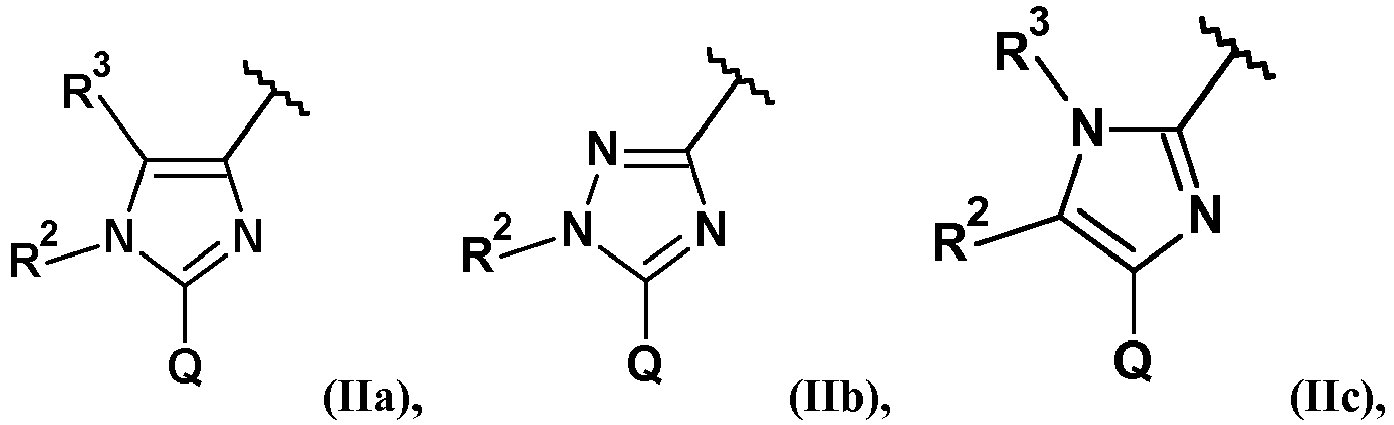

- R1, R2, R3 jeweils unabhängig voneinander H oder ein substituierter oder unsubstituierter Alkyl, Cycloalkyl, Alkenyl, Cycloalkenyl, Cyloheteroalkyl, Aryl oder Heteroaryl Rest sind, wobei R2 im Falle (IIc) und (IIe) zusätzlich ein Halogen Rest oder ein Alkoxy Rest sein kann, und R3 zusätzlich im Falle (IIa), (IId) und (IIe) ein Halogen Rest sein kann;
- Q ein substituierter oder unsubstituierter Aryl oder Heteroaryl Rest, im Falle (IIe) aber nicht 2-Pyrimidinyl ist;
- D ein substituierter oder unsubstituierter Alkyl, Heteroalkyl, gegebenenfalls teilweise ungesättigter Cycloalkyl, Cycloheteroalkyl, Heteroaryl, Aryl oder Phenylalkyl Rest oder ein substituierter oder unsubstituierter Stickstoff Rest ist,
- zur Bekämpfung von tierischen Schädlingen.
- M für einen Rest ausgewählt aus den Formeln (IIa-IIf) steht, wobei R1, R2, R3 jeweils unabhängig voneinander H oder ein substituierter oder unsubstituierter (C1-C4)-Alkyl, (C3-C6)-Cycloalkyl, (C2-C4)-Alkenyl, Pyridyl oder Phenyl Rest sind, wobei R2 im Falle (IIc) und (IIe) zusätzlich ein Halogen Rest oder ein Alkoxy Rest sein kann und wobei R3 zusätzlich im Falle (IIa), (IId) und (IIe) ein Halogen Rest sein kann;
Q ein substituierter oder unsubstituierter Phenyl, Naphthyl oder Heteroaryl Rest ist, der ein bis drei Heteroatome aus der Reihe Sauerstoff, Schwefel, Stickstoff enthalten kann; im Falle (IIe) aber nicht 2-Pyrimidinyl ist;
D ein substituierter oder unsubstituierter Alkyl, Heteroalkyl, Cycloalkyl, Heteroaryl, Aryl oder Phenyl-(C1-C8)alkyl Rest oder ein substituierter oder unsubstituierter Stickstoff Rest ist. - M für einen Rest ausgewählt aus den Formeln (IIa-IIf) steht, wobei R1, R2, R3 definiert sind wie in Ausgestaltung (0-1) oder Vorzugsbereich (1-1) und
Q ein unsubstituierter oder mit einem oder mehreren Resten R4 substituierter Phenyl, Naphthyl, Pyridyl, Pyrimidinyl, Thiophen, Benzthiophen, Isochinolin, Benzdioxol oder Pyrazol Rest ist, im Falle (IIe) aber nicht 2-Pyrimidinyl ist,
wobei der oder die Substituenten R4 jeweils unabhängig voneinander ausgewählt sind aus: - Cyano, Halogen, Nitro, Acetyl, Hydroxy, Carboxy, Amino, SCN, Tri-(C1-C6)alkylsilyl, (C3-C8)Cycloalkyl, (C3-C8)Cycloalkyloxy, (C3-C8)Cycloalkyl-(C3-C8)cycloalkyl, (C1-C6)Alkyl-(C3-C8)cycloalkyl, Halogen(C3-C8)cycloalkyl, (C1-C6)Alkyl, (C1-C6)Halogenalkyl, (C1-C6)Cyanoalkyl, (C1-C6)Hydroxyalkyl, Hydroxycarbonyl-(C1-C6)-alkoxy, (C1-C6)Alkoxycarbonyl-(C1-C6)alkyl, (C1-C6)Alkoxy-(C1-C6)alkyl, (C2-C6)Alkenyl, (C2-C6)Halogenalkenyl, (C2-C6)Cyanoalkenyl, (C2-C6)Alkinyl, (C2-C6)Halogenalkinyl, (C2-C6)Cyanoalkinyl, (C1-C6)Alkoxy, (C1-C6)Halogenalkoxy, (C1-C6)Cyanoalkoxy, (C1-C6)Alkoxycarbonyl-(C1-C6)alkoxy, (C1-C6)Alkoxy-(C1-C6)alkoxy, (C1-C6)Alkylhydroxyimino, (C1-C6)Alkoxyimino, (C1-C6)Alkyl-(C1-C6)alkoxyimino, (C1-C6)Halogenalkyl-(C1-C6)alkoxyimino, (C1-C6)Alkylthio, (C1-C6)Halogenalkylthio, (C1-C6)Alkoxy-(C1-C6)alkylthio, (C1-C6)Alkylthio-(C1-C6)alkyl, (C1-C6)Alkylsulfinyl, (C1-C6)Halogenalkylsulfinyl, (C1-C6)Alkoxy-(C1-C6)alkylsulfinyl, (C1-C6)Alkylsulfinyl-(C1-C6)alkyl, (C1-C6)Alkylsulfonyl, (C1-C6)Halogenalkylsulfonyl, (C1-C6)Alkoxy-(C1-C6)alkylsulfonyl, (C1-C6)Alkylsulfonyl-(C1-C6)alkyl, (C1-C6)Alkylsulfonyloxy, (C1-C6)Alkylcarbonyl, (C1-C6)Alkylthiocarbonyl, (C1-C6)Halogenalkylcarbonyl, (C1-C6)Alkylcarbonyloxy, (C1-C6)Alkoxycarbonyl, (C1-C6)Halogenalkoxycarbonyl, Aminocarbonyl, (C1-C6)Alkylaminocarbonyl, (C1-C6)Alkylaminothiocarbonyl, Di-(C1-C6)alkyl-aminocarbonyl, Di-(C1-C6)alkyl-aminothiocarbonyl, (C2-C6)Alkenylaminocarbonyl, Di-(C2-C6)-alkenylaminocarbonyl, (C3-C8)Cycloalkylaminocarbonyl, (C1-C6)Alkylsulfonylamino, (C1-C6)Alkylamino, Di-(C1-C6)Alkylamino, Aminosulfonyl, (C1-C6)Alkylaminosulfonyl, Di-(C1-C6)alkyl-aminosulfonyl, (C1-C6)Alkylsulfoximino, Aminothiocarbonyl, (C1-C6)Alkylaminothiocarbonyl, Di-(C1-C6)alkyl-aminothiocarbonyl, (C3-C8)Cycloalkylamino, NHCO-(C1-C6)alkyl ((C1-C6)Alkylcarbonylamino) und/oder
- gegebenenfalls einfach oder mehrfach, gleich oder verschieden substituiertes Aryl, Aryloxy oder Hetaryl, wobei (im Fall von Hetaryl) gegebenenfalls mindestens eine Carbonylgruppe enthalten sein kann und wobei als Substituenten jeweils in Frage kommen: Cyano, Carboxyl, Halogen, Nitro, Acetyl, Hydroxy, Amino, SCN, Tri-(C1-C6)alkylsilyl, (C3-C8)Cycloalkyl, (C3-C8)Cycloalkyl-(C3-C8)cycloalkyl, (C1-C6)Alkyl-(C3-C8)cycloalkyl, Halogen(C3-C8)cycloalkyl, (C1-C6)Alkyl, (C1-C6)Halogenalkyl, (C1-C6)Cyanoalkyl, (C1-C6)Hydroxyalkyl, Hydroxycarbonyl-(C1-C6)-alkoxy, (C1-C6)Alkoxycarbonyl-(C1-C6)alkyl, (C1-C6)Alkoxy-(C1-C6)alkyl, (C2-C6)Alkenyl, (C2-C6)Halogenalkenyl, (C2-C6)Cyanoalkenyl, (C2-C6)Alkinyl, (C2-C6)Halogenalkinyl, (C2-C6)Cyanoalkinyl, (C1-C6)Alkoxy, (C1-C6)Halogenalkoxy, (C1-C6)Cyanoalkoxy, (C1-C6)Alkoxycarbonyl-(C1-C6)alkoxy, (C1-C6)Alkoxy-(C1-C6)alkoxy, (C1-C6)Alkylhydroxyimino, (C1-C6)Alkoxyimino, (C1-C6)Alkyl-(C1-C6)alkoxyimino, (C1-C6)Halogenalkyl-(C1-C6)alkoxyimino, (C1-C6)Alkylthio, (C1-C6)Halogenalkylthio, (C1-C6)Alkoxy-(C1-C6)alkylthio, (C1-C6)Alkylthio-(C1-C6)alkyl, (C1-C6)Alkylsulfinyl, (C1-C6)Halogenalkylsulfinyl, (C1-C6)Alkoxy-(C1-C6)alkylsulfinyl, (C1-C6)Alkylsulfinyl-(C1-C6)alkyl, (C1-C6)Alkylsulfonyl, (C1-C6)Halogenalkylsulfonyl, (C1-C6)Alkoxy-(C1-C6)alkylsulfonyl, (C1-C6)Alkylsulfonyl-(C1-C6)alkyl, (C1-C6)Alkylsulfonyloxy, (C1-C6)Alkylcarbonyl, (C1-C6)Halogenalkylcarbonyl, (C1-C6)Alkylcarbonyloxy, (C1-C6)Alkoxycarbonyl, (C1-C6)Halogenalkoxycarbonyl, Aminocarbonyl, (C1-C6)Alkylaminocarbonyl, Di-(C1-C6)alkyl-aminocarbonyl, (C2-C6)Alkenylaminocarbonyl, Di-(C2-C6)-alkenylaminocarbonyl, (C3-C8)Cycloalkylaminocarbonyl, (C1-C6)Alkylsulfonylamino, (C1-C6)Alkylamino, Di-(C1-C6)Alkylamino, Aminosulfonyl, (C1-C6)Alkylaminosulfonyl, Di-(C1-C6)alkylaminosulfonyl, (C1-C6)Alkylsulfoximino, Aminothiocarbonyl, (C1-C6)Alkylaminothiocarbonyl, Di-(C1-C6)alkylaminothiocarbonyl, (C3-C8)Cycloalkylamino und (C1-C6)Alkylcarbonylamino und
- D ein unsubstituierter oder mit einem oder mehreren Resten R5 substituierter (C1-C6)-Alkyl, Phenyl, Phenyl-(C1-C2)alkyl oder Heteroaryl Rest ist, der ein bis drei Heteroatome aus der Reihe Sauerstoff, Schwefel, Stickstoff enthalten kann oder ein NR6R7 Rest ist,
- Cyano, Halogen, Nitro, Acetyl, Hydroxy, Carboxy, Amino, SCN, Tri-(C1-C6)alkylsilyl, (C3-C8)Cycloalkyl, (C3-C8)Cycloalkyloxy, (C3-C8)Cycloalkyl-(C3-C8)Cycloalkyl, (C1-C6)Alkyl-(C3-C8)cycloalkyl, Halogen(C3-C8)cycloalkyl, (C1-C6)Alkyl, (C1-C6)Halogenalkyl, (C1-C6)Cyanoalkyl, (C1-C6)Hydroxyalkyl, Hydroxycarbonyl-(C1-C6)-alkoxy, (C1-C6)Alkoxycarbonyl-(C1-C6)alkyl, (C1-C6)Alkoxy-(C1-C6)alkyl, (C2-C6)Alkenyl, (C2-C6)Halogenalkenyl, (C2-C6)Cyanoalkenyl, (C2-C6)Alkinyl, (C2-C6)Halogenalkinyl, (C2-C6)Cyanoalkinyl, (C1-C6)Alkoxy, (C1-C6)Halogenalkoxy, (C1-C6)Cyanoalkoxy, (C1-C6)Alkoxycarbonyl-(C1-C6)alkoxy, (C1-C6)Alkoxy-(C1-C6)alkoxy, (C1-C6)Alkylhydroxyimino, (C1-C6)Alkoxyimino, (C1-C6)Alkyl-(C1-C6)alkoxyimino, (C1-C6)Halogenalkyl-(C1-C6)alkoxyimino, (C1-C6)Alkylthio, (C1-C6)Halogenalkylthio, (C1-C6)Alkoxy-(C1-C6)alkylthio, (C1-C6)Alkylthio-(C1-C6)alkyl, (C1-C6)Alkylsulfinyl, (C1-C6)Halogenalkylsulfinyl, (C1-C6)Alkoxy-(C1-C6)alkylsulfinyl, (C1-C6)Alkylsulfinyl-(C1-C6)alkyl, (C1-C6)Alkylsulfonyl, (C1-C6)Halogenalkylsulfonyl, (C1-C6)Alkoxy-(C1-C6)alkylsulfonyl, (C1-C6)Alkylsulfonyl-(C1-C6)alkyl, (C1-C6)Alkylsulfonyloxy, (C1-C6)Alkylcarbonyl, (C1-C6)Alkylthiocarbonyl, (C1-C6)Halogenalkylcarbonyl, (C1-C6)Alkylcarbonyloxy, (C1-C6)Alkoxycarbonyl, (C1-C6)Halogenalkoxycarbonyl, Aminocarbonyl, (C1-C6)Alkylaminocarbonyl, (C1-C6)Alkylaminothiocarbonyl, Di-(C1-C6)alkyl-aminocarbonyl, Di-(C1-C6)alkyl-aminothiocarbonyl, (C2-C6)Alkenylaminocarbonyl, Di-(C2-C6)-alkenylaminocarbonyl, (C3-C8)Cycloalkylaminocarbonyl, (C1-C6)Alkylsulfonylamino, (C1-C6)Alkylamino, Di-(C1-C6)Alkylamino, Aminosulfonyl, (C1-C6)Alkylaminosulfonyl, Di-(C1-C6)alkyl-aminosulfonyl, (C1-C6)Alkylsulfoximino, Aminothiocarbonyl, (C1-C6)Alkylaminothiocarbonyl, Di-(C1-C6)alkyl-aminothiocarbonyl, (C3-C8)Cycloalkylamino, (C1-C6)Alkylcarbonylamino und 1-Pyrazolyl-(C1-C3)alkyl
- und /oder
- einfach oder mehrfach, gleich oder verschieden substituiertes Aryl oder Hetaryl, wobei (im Fall von Hetaryl) gegebenenfalls mindestens eine Carbonylgruppe enthalten sein kann und wobei als Substituenten jeweils in Frage kommen: Cyano, Carboxyl, Halogen, Nitro, Acetyl, Hydroxy, Amino, SCN, Tri-(C1-C6)alkylsilyl, (C3-C8)Cycloalkyl, (C3-C8)Cycloalkyl-(C3-C8)cycloalkyl, (C1-C6)Alkyl-(C3-C8)cycloalkyl, Halogen(C3-C8)cycloalkyl, (C1-C6)Alkyl, (C1-C6)Halogenalkyl, (C1-C6)Cyanoalkyl, (C1-C6)Hydroxyalkyl, Hydroxycarbonyl-(C1-C6)-alkoxy, (C1-C6)Alkoxycarbonyl-(C1-C6)alkyl, (C1-C6)Alkoxy-(C1-C6)alkyl, (C2-C6)Alkenyl, (C2-C6)Halogenalkenyl, (C2-C6)Cyanoalkenyl, (C2-C6)Alkinyl, (C2-C6)Halogenalkinyl, (C2-C6)Cyanoalkinyl, (C1-C6)Alkoxy, (C1-C6)Halogenalkoxy, (C1-C6)Cyanoalkoxy, (C1-C6)Alkoxycarbonyl-(C1-C6)alkoxy, (C1-C6)Alkoxy-(C1-C6)alkoxy, (C1-C6)Alkylhydroxyimino, (C1-C6)Alkoxyimino, (C1-C6)Alkyl-(C1-C6)alkoxyimino, (C1-C6)Halogenalkyl-(C1-C6)alkoxyimino, (C1-C6)Alkylthio, (C1-C6)Halogenalkylthio, (C1-C6)Alkoxy-(C1-C6)alkylthio, (C1-C6)Alkylthio-(C1-C6)alkyl, (C1-C6)Alkylsulfinyl, (C1-C6)Halogenalkylsulfinyl, (C1-C6)Alkoxy-(C1-C6)alkylsulfinyl, (C1-C6)Alkylsulfinyl-(C1-C6)alkyl, (C1-C6)Alkylsulfonyl, (C1-C6)Halogenalkylsulfonyl, (C1-C6)Alkoxy-(C1-C6)alkylsulfonyl, (C1-C6)Alkylsulfonyl-(C1-C6)alkyl, (C1-C6)Alkylsulfonyloxy, (C1-C6)Alkylcarbonyl, (C1-C6)Halogenalkylcarbonyl, (C1-C6)Alkylcarbonyloxy, (C1-C6)Alkoxycarbonyl, (C1-C6)Halogenalkoxycarbonyl, Aminocarbonyl, (C1-C6)Alkylaminocarbonyl, Di-(C1-C6)alkyl-aminocarbonyl, (C2-C6)Alkenylaminocarbonyl, Di-(C2-C6)-alkenylaminocarbonyl, (C3-C8)Cycloalkylaminocarbonyl, (C1-C6)Alkylsulfonylamino, (C1-C6)Alkylamino, Di-(C1-C6)Alkylamino, Aminosulfonyl, (C1-C6)Alkylaminosulfonyl, Di-(C1-C6)alkylaminosulfonyl, (C1-C6)Alkylsulfoximino, Aminothiocarbonyl, (C1-C6)Alkylaminothiocarbonyl, Di-(C1-C6)alkylaminothiocarbonyl, (C3-C8)Cycloalkylamino und (C1-C6)Alkylcarbonylamino
- und wobei R6 und R7 jeweils unabhängig voneinander H, (C1-C6)-Alkyl oder ein substituierter oder unsubstituierter Phenyl Rest sind oder R6 und R7 gemeinsam einen unsubstituierten oder substituierten 4- bis 8- gliedrigen, gesättigten oder gegebenenfalls ganz oder teilweise ungesättigten Ring bilden können der von 1 bis 3 Heteroatomen aus der Reihe Sauerstoff, Schwefel, Stickstoff unterbrochen sein kann und der einfach oder mehrfach mit einer der Definition von R5 entsprechenden Substitution versehen sein kann.
- M für einen Rest ausgewählt aus den Formeln (IIa-IIf) steht, wobei R1, R2, R3 definiert sind wie in Ausgestaltung (0-1) oder Vorzugsbereich (1-1) und
Q ein unsubstituierter oder mit einem oder mehreren Resten R4 substituierter Phenyl, Naphthyl, Pyridyl, Pyrimidinyl, Thiophen, Benzthiophen, Isochinolin, Benzdioxol oder Pyrazol Rest ist, im Falle (IIe) aber nicht 2-Pyrimidinyl ist,
wobei der oder die Substituenten R4 jeweils unabhängig voneinander ausgewählt sind aus: - Cyano, Halogen, Nitro, Acetyl, Hydroxy, Carboxy, Amino, Tri-(C1-C6)alkylsilyl, (C3-C8)Cycloalkyl, (C3-C8)Cycloalkyl-(C3-C8)Cycloalkyl, (C1-C6)Alkyl-(C3-C8)cycloalkyl, Halogen(C3-C8)cycloalkyl, (C1-C6)Alkyl, (C1-C6)Halogenalkyl, (C1-C6)Cyanoalkyl, (C1-C6)Hydroxyalkyl, Hydroxycarbonyl-(Ci-C6)-alkoxy, (C1-C6)Alkoxycarbonyl-(C1-C6)alkyl, (C1-C6)Alkoxy-(C1-C6)alkyl, (C2-C6)Alkenyl, (C2-C6)Halogenalkenyl, (C2-C6)Cyanoalkenyl, (C2-C6)Alkinyl, (C2-C6)Halogenalkinyl, (C2-C6)Cyanoalkinyl, (C1-C6)Alkoxy, (C1-C6)Halogenalkoxy, (C1-C6)Cyanoalkoxy, (C1-C6)Alkoxycarbonyl-(C1-C6)alkoxy, (C1-C6)Alkoxy-(C1-C6)alkoxy, (C1-C6)Alkylhydroxyimino, (C1-C6)Alkoxyimino, (C1-C6)Alkyl-(C1-C6)alkoxyimino, (C1-C6)Halogenalkyl-(C1-C6)alkoxyimino, (C1-C6)Alkylthio, (C1-C6)Halogenalkylthio, (C1-C6)Alkoxy-(C1-C6)alkylthio, (C1-C6)Alkylthio-(C1-C6)alkyl, (C1-C6)Alkylsulfinyl, (C1-C6)Halogenalkylsulfinyl, (C1-C6)Alkoxy-(C1-C6)alkylsulfinyl, (C1-C6)Alkylsulfinyl-(C1-C6)alkyl, (C1-C6)Alkylsulfonyl, (C1-C6)Halogenalkylsulfonyl, (C1-C6)Alkoxy-(C1-C6)alkylsulfonyl, (C1-C6)Alkylsulfonyl-(C1-C6)alkyl, (C1-C6)Alkylsulfonyloxy, (C1-C6)Alkylcarbonyl, (C1-C6)Alkylthiocarbonyl, (C1-C6)Halogenalkylcarbonyl, (C1-C6)Alkylcarbonyloxy, (C1-C6)Alkoxycarbonyl, (C1-C6)Halogenalkoxycarbonyl, Aminocarbonyl, (C1-C6)Alkylaminocarbonyl, (C1-C6)Alkylaminothiocarbonyl, Di-(C1-C6)alkyl-aminocarbonyl, Di-(C1-C6)alkyl-aminothiocarbonyl, (C2-C6)Alkenylaminocarbonyl, Di-(C2-C6)-alkenylaminocarbonyl, (C3-C8)Cycloalkylaminocarbonyl, (C1-C6)Alkylsulfonylamino, (C1-C6)Alkylamino, Di-(C1-C6)Alkylamino, Aminosulfonyl, (C1-C6)Alkylaminosulfonyl, Di-(C1-C6)alkyl-aminosulfonyl, (C1-C6)Alkylsulfoximino, Aminothiocarbonyl, (C1-C6)Alkylaminothiocarbonyl, Di-(C1-C6)alkyl-aminothiocarbonyl, (C3-C8)Cycloalkylamino, (C1-C6)Alkylcarbonylamino, Phenyl, Halogenphenyl, Phenoxy oder Halogenphenoxy und
- D ein unsubstituierter oder mit einem oder mehreren Resten R5 substituierter (C1-C6)-Alkyl, Phenyl, Phenyl-(C1-C2)alkyl oder Heteroaryl Rest ist, der ein bis drei Heteroatome aus der Reihe Sauerstoff, Schwefel oder Stickstoff enthalten kann oder ein NR6R7 Rest ist,
- Cyano, Halogen, Nitro, Acetyl, Hydroxy, Carboxy, Amino, Tri-(C1-C6)alkylsilyl, (C3-C8)Cycloalkyl, (C3-C8)Cycloalkyloxy, (C3-C8)Cycloalkyl-(C3-C8)Cycloalkyl, (C1-C6)Alkyl-(C3-C8)cycloalkyl, Halogen(C3-C8)cycloalkyl, (C1-C6)Alkyl, (C1-C6)Halogenalkyl, (C1-C6)Cyanoalkyl, (C1-C6)Hydroxyalkyl, Hydroxycarbonyl-(C1-C6)-alkoxy, (C1-C6)Alkoxycarbonyl-(C1-C6)alkyl, (C1-C6)Alkoxy-(C1-C6)alkyl, (C2-C6)Alkenyl, (C2-C6)Halogenalkenyl, (C2-C6)Cyanoalkenyl, (C2-C6)Alkinyl, (C2-C6)Halogenalkinyl, (C2-C6)Cyanoalkinyl, (C1-C6)Alkoxy, (C1-C6)Halogenalkoxy, (C1-C6)Cyanoalkoxy, (C1-C6)Alkoxycarbonyl-(C1-C6)alkoxy, (C1-C6)Alkoxy-(C1-C6)alkoxy, (C1-C6)Alkylhydroxyimino, (C1-C6)Alkoxyimino, (C1-C6)Alkyl-(C1-C6)alkoxyimino, (C1-C6)Halogenalkyl-(C1-C6)alkoxyimino, (C1-C6)Alkylthio, (C1-C6)Halogenalkylthio, (C1-C6)Alkoxy-(C1-C6)alkylthio, (C1-C6)Alkylthio-(C1-C6)alkyl, (C1-C6)Alkylsulfinyl, (C1-C6)Halogenalkylsulfinyl, (C1-C6)Alkoxy-(C1-C6)alkylsulfinyl, (C1-C6)Alkylsulfinyl-(C1-C6)alkyl, (C1-C6)Alkylsulfonyl, (C1-C6)Halogenalkylsulfonyl, (C1-C6)Alkoxy-(C1-C6)alkylsulfonyl, (C1-C6)Alkylsulfonyl-(C1-C6)alkyl, (C1-C6)Alkylsulfonyloxy, (C1-C6)Alkylcarbonyl, (C1-C6)Alkylthiocarbonyl, (C1-C6)Halogenalkylcarbonyl, (C1-C6)Alkylcarbonyloxy, (C1-C6)Alkoxycarbonyl, (C1-C6)Halogenalkoxycarbonyl, Aminocarbonyl, (C1-C6)Alkylaminocarbonyl, (C1-C6)Alkylaminothiocarbonyl, Di-(C1-C6)alkyl-aminocarbonyl, Di-(C1-C6)alkyl-aminothiocarbonyl, (C2-C6)Alkenylaminocarbonyl, Di-(C2-C6)-alkenylaminocarbonyl, (C3-C8)Cycloalkylaminocarbonyl, (C1-C6)Alkylsulfonylamino, (C1-C6)Alkylamino, Di-(C1-C6)Alkylamino, Aminosulfonyl, (C1-C6)Alkylaminosulfonyl, Di-(C1-C6)alkyl-aminosulfonyl, (C1-C6)Alkylsulfoximino, Aminothiocarbonyl, (C1-C6)Alkylaminothiocarbonyl, Di-(C1-C6)alkyl-aminothiocarbonyl, (C3-C8)Cycloalkylamino, (C1-C6)Alkylcarbonylamino und 1-Pyrazolyl-(C1-C3)Alkyl und
- R6 und R7 jeweils unabhängig voneinander H, ein (C1-C6)-Alkyl, (C1-C6)Halogenalkyl, (C1-C6)Alkoxy-(C1-C6)alkyl Rest oder ein unsubstituierter Phenyl oder mit Halogen, (C1-C6)Alkyl, (C1-C6)-Alkoxy, (C1-C6)Halogenalkyl, (C1-C6)Alkoxy-(C1-C6)alkyl substituierter Phenyl Rest sind,
- oder
- R6 und R7 gemeinsam einen unsubstituierten oder substituierten 5- bis 6- gliedrigen , gesättigten oder gegebenenfalls ganz oder teilweise ungesättigten Ring, bilden können der von 1 bis 3 Heteroatomen aus der Reihe Sauerstoff, Schwefel oder Stickstoff unterbrochen sein kann, und der einfach oder mehrfach mit einer der Definition von R5 entsprechenden Substitution versehen sein kann.
- M für einen Rest ausgewählt aus den Formeln (IIa-IIf) steht, wobei
im Falle (IIa) R2, R3 jeweils unabhängig voneinander H oder ein substituierter oder unsubstituierter (C1-C4)-Alkyl, (C3-C6)-Cycloalkyl oder Phenyl Rest sind, wobei R3 zusätzlich ein Halogen Rest sein kann,
im Falle (IIb) R2 H oder ein substituierter oder unsubstituierter (C1-C4)-Alkyl oder (C3-C6)-Cycloalkyl Rest ist,
im Falle (IIc) R2, R3 jeweils unabhängig voneinander H oder ein substituierter oder unsubstituierter (C1-C4)-Alkyl, (C3-C6)-Cycloalkyl oder Phenyl Rest sind und R2 zusätzlich ein Halogen oder (C1-C4)-Alkoxy Rest sein kann,
im Falle (IId) R1, R3 jeweils unabhängig voneinander H oder ein substituierter oder unsubstituierter (C1-C4)-Alkyl oder (C3-C6)-Cycloalkyl Rest sind, wobei R3 zusätzlich ein Halogen Rest sein kann,
im Falle (IIe) R2, R3 jeweils unabhängig voneinander H, Halogen oder ein substituierter oder unsubstituierter (C1-C4)-Alkyl, (C3-C6)-Cycloalkyl, Pyridyl oder Phenyl Rest sind und R2 zusätzlich ein (C1-C4)-Alkoxy Rest sein kann und
im Falle (IIf) R3 H oder ein substituierter oder unsubstituierter (C1-C4)-Alkyl, oder (C3-C6)-Cycloalkyl Rest ist
und Q definiert ist wie in Ausgestaltung (0-1), Vorzugsbereich (1-1), Vorzugsbereich (2-1) oder Vorzugsbereich (3-1) und
D ein unsubstituierter oder mit einem oder mehreren Resten R5 substituierter (C1-C6)-Alkyl, Phenyl, Naptht-2-yl, Pyridin, Pyrimidin, Pyrazol, Triazol, Thiazol, Oxazol, Thiadiazol, Oxadiazol, Thiophen, Pyrrol, Furan, Tetrahydrofuran, Dioxan, Isoxazol, Benzyl, 2,3-Dihydro-1,4-benzodioxin-5-yl, 2,3-Dihydro-1-benzofuran-7-yl, Chinoxalin-5-yl oder Indol-7-yl Rest oder ein NR6R7 Rest ist,
wobei der oder die Substituenten R5 jeweils unabhängig voneinander ausgewählt sind aus: - Cyano, Halogen, Nitro, Acetyl, Hydroxy, Carboxy, Amino, Tri-(C1-C6)alkylsilyl, (C3-C8)Cycloalkyl, (C3-C8)Cycloalkyloxy, (C3-C8)Cycloalkyl-(C3-C8)Cycloalkyl, (C1-C6)Alkyl-(C3-C8)cycloalkyl, Halogen(C3-C8)cycloalkyl, (C1-C6)Alkyl, (C1-C6)Halogenalkyl, (C1-C6)Cyanoalkyl, (C1-C6)Hydroxyalkyl, Hydroxycarbonyl-(C1-C6)-alkoxy, (C1-C6)Alkoxycarbonyl-(C1-C6)alkyl, (C1-C6)Alkoxy-(C1-C6)alkyl, (C2-C6)Alkenyl, (C2-C6)Halogenalkenyl, (C2-C6)Cyanoalkenyl, (C2-C6)Alkinyl, (C2-C6)Halogenalkinyl, (C2-C6)Cyanoalkinyl, (C1-C6)Alkoxy, (C1-C6)Halogenalkoxy, (C1-C6)Cyanoalkoxy, (C1-C6)Alkoxycarbonyl-(C1-C6)alkoxy, (C1-C6)Alkoxy-(C1-C6)alkoxy, (C1-C6)Alkylhydroxyimino, (C1-C6)Alkoxyimino, (C1-C6)Alkyl-(C1-C6)alkoxyimino, (C1-C6)Halogenalkyl-(C1-C6)alkoxyimino, (C1-C6)Alkylthio, (C1-C6)Halogenalkylthio, (C1-C6)Alkoxy-(C1-C6)alkylthio, (C1-C6)Alkylthio-(C1-C6)alkyl, (C1-C6)Alkylsulfinyl, (C1-C6)Halogenalkylsulfinyl, (C1-C6)Alkoxy-(C1-C6)alkylsulfinyl, (C1-C6)Alkylsulfinyl-(C1-C6)alkyl, (C1-C6)Alkylsulfonyl, (C1-C6)Halogenalkylsulfonyl, (C1-C6)Alkoxy-(C1-C6)alkylsulfonyl, (C1-C6)Alkylsulfonyl-(C1-C6)alkyl, (C1-C6)Alkylsulfonyloxy, (C1-C6)Alkylcarbonyl, (C1-C6)Alkylthiocarbonyl, (C1-C6)Halogenalkylcarbonyl, (C1-C6)Alkylcarbonyloxy, (C1-C6)Alkoxycarbonyl, (C1-C6)Halogenalkoxycarbonyl, Aminocarbonyl, (C1-C6)Alkylaminocarbonyl, (C1-C6)Alkylaminothiocarbonyl, Di-(C1-C6)alkyl-aminocarbonyl, Di-(C1-C6)alkyl-aminothiocarbonyl, (C2-C6)Alkenylaminocarbonyl, Di-(C2-C6)-alkenylaminocarbonyl, (C3-C8)Cycloalkylaminocarbonyl, (C1-C6)Alkylsulfonylamino, (C1-C6)Alkylamino, Di-(C1-C6)Alkylamino, Aminosulfonyl, (C1-C6)Alkylaminosulfonyl, Di-(C1-C6)alkyl-aminosulfonyl, (C1-C6)Alkylsulfoximino, Aminothiocarbonyl, (C1-C6)Alkylaminothiocarbonyl, Di-(C1-C6)alkyl-aminothiocarbonyl, (C3-C8)Cycloalkylamino, (C1-C6)Alkylcarbonylamino, 1-Pyrazolyl-(C1-C3)Alkyl und
- R6 und R7 jeweils unabhängig voneinander H, ein (C1-C6)-Alkyl, (C1-C6)Halogenalkyl, (C1-C6)Alkoxy-(C1-C6)alkyl Rest oder ein unsubstituierter Phenyl oder mit Halogen, (C1-C6)-Alkyl, (C1-C6)-Alkoxy, (C1-C6)Halogenalkyl oder (C1-C6)Alkoxy-(C1-C6)alkyl substituierter Phenyl Rest sind,
- oder einen Ring aus der Reihe Pyrrolidin, Morpholin, Piperidin bilden.
- M ein Rest ausgewählt aus den Resten der Formeln (IIa) bis (IIf) ist, wobei
im Falle (IIa) R2 H, Methyl oder Ethyl oder gegebenenfalls mit Halogen substituiertes Phenyl ist, und R3 H, Methyl, Ethyl, iso-Propyl oder Halogen ist,
im Falle (IIb) R2 H, Methyl oder Ethyl ist,
im Falle (IIc) R2 H oder Methyl und R3 H, Methyl oder Ethyl ist,
im Falle (IId) R1 H oder Methyl und R3 H oder Halogen ist,
im Falle (IIe) R2 H, Methyl, Methoxy, mit Halogen substituiertes Phenyl oder mit Halogen substituiertes Pyridyl und R3 H ist,
im Falle (IIf) R3 H, Methyl oder Ethyl ist
und Q definiert ist wie in Ausgestaltung (0-1), Vorzugsbereich (1-1), Vorzugsbereich (2-1) oder Vorzugsbereich (3-1). - M ausgewählt ist aus einer der Formeln (IIa) bis (IIf) oder (IVa) bis (IVf), wobei R1 bis R3 definiert sind wie in Ausgestaltung (0-1), Vorzugsbereich (1-1), Vorzugsbereich (4-1) oder Vorzugsbereich (5-1) und
Q ein unsubstituierter oder mit einem oder mehreren Resten R4 substituierter Phenyl, Napht-1-yl, Pyridyl, Pyrimidinyl, Thiophen-2-yl, Benzthiophen-2-yl, Benzthiophen-3-yl, Isochinolin-1-yl, Benzdioxol-4-yl oder Pyrazol-5-yl Rest ist, im Falle (IVe) aber nicht 2-Pyrimidinyl ist,
wobei der oder die Substituenten R4 unabhängig voneinander sind: - Cyano, Halogen, Nitro, Acetyl, (C3-C6)Cycloalkyl, (C3-C6)Cycloalkyloxy, (C3-C6)Cycloalkyl-(C3-C6)Cycloalkyl, (C1-C6)Alkyl-(C3-C8)cycloalkyl, Halogen(C3-C6)cycloalkyl, (C1-C6)Alkyl, (C1-C6)Halogenalkyl, (C1-C6)Cyanoalkyl, (C1-C6)Hydroxyalkyl, (C1-C6)Alkoxycarbonyl-(C1-C6)alkyl, (C1-C6)Alkoxy-(C1-C6)alkyl, (C2-C6)Alkenyl, (C2-C6)Halogenalkenyl, (C2-C6)Alkinyl, (C1-C6)Alkoxy, (C1-C6)Halogenalkoxy, (C1-C6)Alkylthio, (C1-C6)Halogenalkylthio, (C1-C6)Alkylthio-(C1-C6)alkyl, (C1-C6)Alkylsulfinyl, (C1-C6)Halogenalkylsulfinyl, (C1-C6)Alkylsulfonyl, (C1-C6)Halogenalkylsulfonyl, (C1-C6)Alkylsulfonyloxy, (C1-C6)Alkylcarbonyl, (C1-C6)Alkylamino, Di-(C1-C6)Alkylamino, (C1-C6)Alkylcarbonylamino, Phenyl, Halogenphenyl, Phenoxy oder Halogenphenoxy und
- D ein unsubstituierter oder mit einem oder mehreren Resten R5 substituierter (C1-C6)-Alkyl, Phenyl, Naptht-2-yl, Pyridin, Pyrimidin, Pyrazol, Triazol, Thiazol, Oxazol, Thiadiazol, Oxadiazol, Thiophen, Pyrrol, Furan, Tetrahydrofuran, Dioxan, Isoxazol, Benzyl, 2,3-Dihydro-1,4-benzodioxin-5-yl, 2,3-Dihydro-1-benzofuran-7-yl, Chinoxalin-5-yl oder Indol-7-yl Rest oder ein NR6R7 Rest ist,
- wobei der oder die Substituenten R5 unabhängig voneinander sind:
Cyano, Halogen, Nitro, Acetyl, Hydroxy, Carboxy, Amino, (C3-C6)Cycloalkyl, (C3-C6)Cycloalkyloxy, (C3-C6)Cycloalkyl-(C3-C6)Cycloalkyl, (C1-C6)Alkyl-(C3-C8)cycloalkyl, Halogen(C3-C6)cycloalkyl, (C1-C6)Alkyl, (C1-C6)Halogenalkyl, (C1-C6)Cyanoalkyl, (C1-C6)Hydroxyalkyl, (C1-C6)Alkoxycarbonyl-(C1-C6)alkyl, (C1-C6)Alkoxy-(C1-C6)alkyl, (C2-C6)Alkenyl, (C2-C6)Halogenalkenyl, (C2-C6)Alkinyl, (C1-C6)Alkoxy, (C1-C6)Halogenalkoxy, (C1-C6)Alkylthio, (C1-C6)Halogenalkylthio, (C1-C6)Alkylthio-(C1-C6)alkyl, (C1-C6)Alkylsulfinyl, (C1-C6)Halogenalkylsulfinyl, (C1-C6)Alkylsulfonyl, (C1-C6)Halogenalkylsulfonyl, (C1-C6)Alkylsulfonyloxy, (C1-C6)Alkylcarbonyl, (C1-C6)Alkylamino, Di-(C1-C6)Alkylamino, (C1-C6)Alkylcarbonylamino, 1-Pyrazolyl-(C1-C3)Alkyl, - R6 und R7 jeweils unabhängig voneinander H, ein (C1-C6)-Alkyl, Phenyl,Alkoxyphenyl oder Halogenphenyl sind oder einen Ring aus der Reihe
- Pyrrolidin, Morpholin, Piperidin bilden.
- M ein Rest ausgewählt aus den Resten der Formeln (Va-Vz) ist:


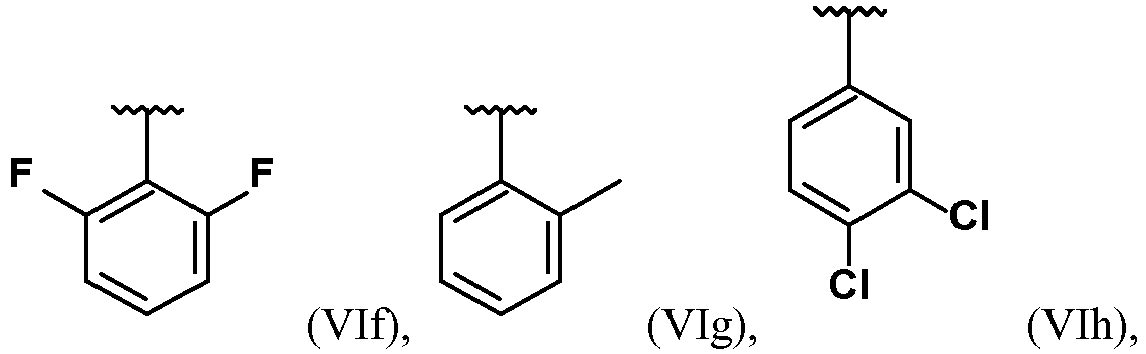


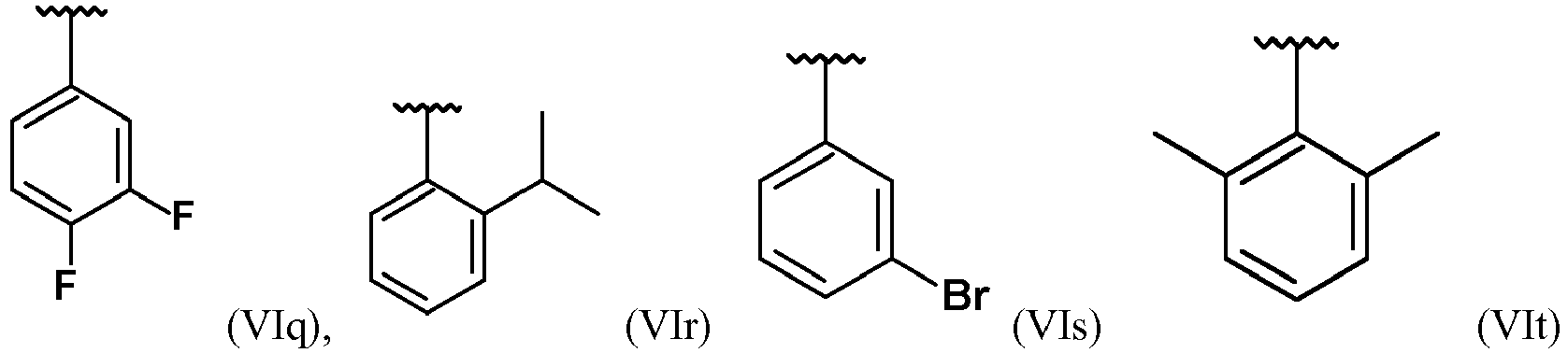

















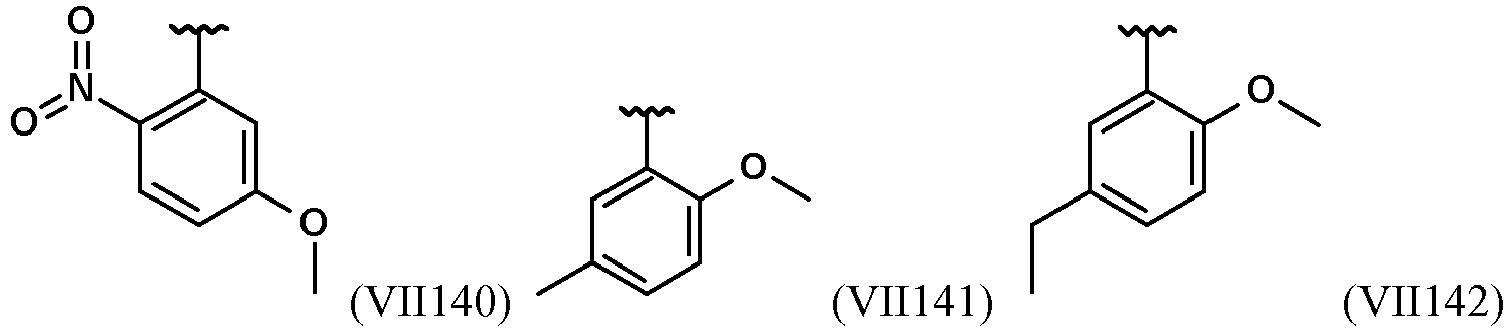





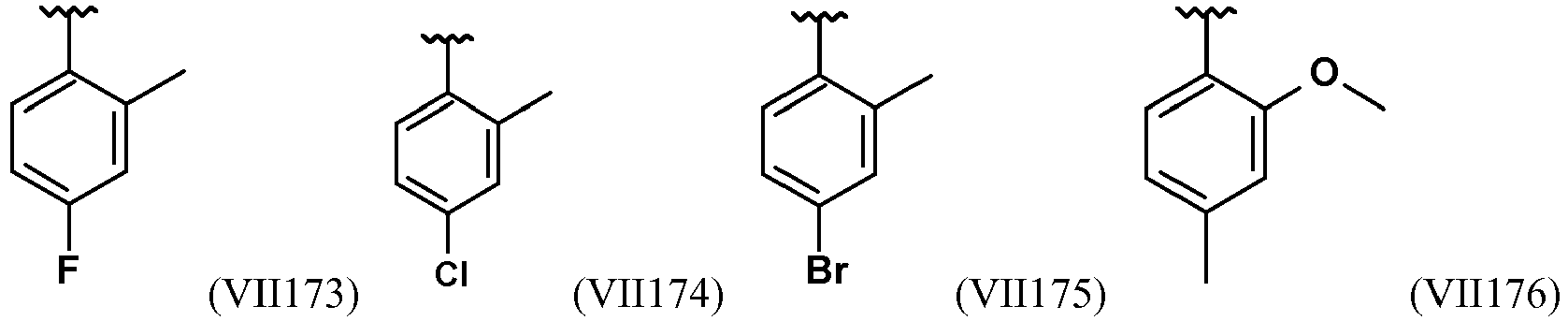


- Gemäß einer weiteren bevorzugten Ausführungsform der Erfindung ist die Verwendung einer Verbindung gemäß Formel (I) zum Schutz des Vermehrungsmaterials von Pflanzen vorgesehen.
- Gegenstand der Erfindung ist auch ein Mittel, mit einem Gehalt von mindestens einer Verbindung gemäß Formel (I) und üblichen Streckmitteln und/oder oberflächenaktiven Substanzen insbesondere zur Bekämpfung von tierischen Schädlingen.
- Ein weiterer Gegenstand der Erfindung ist ein Verfahren zur Bekämpfung von tierischen Schädlingen, bei dem man wenigstens eine Verbindung gemäß Formel (I) oder ein erfindungsgemäßes Mittel auf die tierischen Schädlinge und/oder ihren Lebensraum einwirken lässt, wobei die chirurgische, therapeutische und diagnostische Behandlung des menschlichen oder tierischen Körpers ausgeschlossen ist.
- Noch weiterer Gegenstand der Erfindung ist eine agrochemische Formulierung enthaltend wenigstens eine erfindungsgemäße Verbindung gemäß Formel (I) in biologisch wirksamen Gehalten von zwischen 0,00000001 und 98 Gew.-%, bezogen auf das Gewicht der agrochemischen Formulierung, sowie Streckmittel und/oder oberflächenaktive Stoffe.
- Eine bevorzugte Ausgestaltung der erfindungsgemäßen Formulierung enthält zusätzlich einen weiteren agrochemischen Wirkstoff.
- Ebenfalls Gegenstand der Erfindung sind Verbindungen der Formel (VIII)

M' für einen Rest der Formel (II) steht, ausgewählt aus:

- R1', R2', R3' jeweils unabhängig voneinander H oder ein substituierter oder unsubstituierter Alkyl, Cycloalkyl, Alkenyl, Cycloalkenyl, Cyloheteroalkyl, Aryl oder Heteroaryl Rest sind, wobei R2' im Falle (IIc) und (IIe) zusätzlich ein Halogen Rest oder ein Alkoxy Rest sein kann und R2' im Falle (IIa) und (IIb) nur H oder ein substituierter oder unsubstituierter Alkyl oder Cycloalkyl Rest sein kann, R3' zusätzlich im Falle (IIa), (IId) und (IIe) ein Halogen Rest sein kann,
- Q' ein substituierter oder unsubstituierter Aryl oder Heteroaryl Rest, aber im Falle (IIa), (IId) im Falle R1'=H und R3'=Methyl nicht 3-Methoxyphenyl ist, im Falle (IId) nicht 3-Pyridyl ist, im Falle (IIe) nicht 2-Pyrimidinyl, nicht unsubstituiertes Phenyl, nicht 3,4-Dichlorphenyl und nicht 3,5-bis-tert-Butyl ist;
- D' ein substituierter oder unsubstituierter Alkyl, Heteroalkyl, gegebenenfalls teilweise ungesättigter Cycloalkyl, Cycloheteroalkyl, Heteroaryl, Aryl oder Phenylalkyl Rest oder im Falle, daß Q' mindestens einen Substituenten in 2-Stellung trägt, ein substituierter oder unsubstituierter Stickstoff Rest ist.
- Gemäß einer ersten bevorzugten Ausführungsform (Vorzugsbereich 1-2) der erfindungsgemäßen Verbindungen ist vorgesehen, dass
M' für einen Rest gemäß einer der Formeln (IIa) bis (IIf) steht und
im Falle (IIa) R2', R3' jeweils unabhängig voneinander H oder ein substituierter oder unsubstituierter (C1-C4)-Alkyl, (C3-C6)-Cycloalkyl oder Phenyl Rest sind, wobei R3' zusätzlich ein Halogen Rest sein kann;
im Falle (IIb) R2' H oder ein substituierter oder unsubstituierter (C1-C4)-Alkyl oder (C3-C6)-Cycloalkyl Rest ist,
im Falle (IIc) R2', R3' jeweils unabhängig voneinander H oder ein substituierter oder unsubstituierter (C1-C4)-Alkyl, (C3-C6)-Cycloalkyl oder Phenyl Rest sind, wobei R2' zusätzlich ein Halogen Rest oder ein (C1-C4)-Alkoxy Rest sein kann,
im Falle (IId) R1', R3' jeweils unabhängig voneinander H oder ein substituierter oder unsubstituierter (C1-C4)-Alkyl oder (C3-C6)-Cycloalkyl Rest sind und R3' zusätzlich ein Halogen Rest sein kann;
im Falle (IIe) R2', R3' jeweils unabhängig H, Halogen oder ein substituierter oder unsubstituierter (C1-C4)-Alkyl, (C3-C6)-Cycloalkyl, Pyridyl oder Phenyl Rest sind und R2 zusätzlich ein (C1-C4)-Alkoxy Rest sein kann und
im Falle (IIf) R3 H oder ein substituierter oder unsubstituierter (C1-C4)-Alkyl oder (C3-C6)-Cycloalkyl Rest ist,
Q' ein substituierter oder unsubstituierter Phenyl, Naphthyl oder Heteroaryl Rest ist, der ein bis drei Heteroatome aus der Reihe Sauerstoff, Schwefel oder Stickstoff enthalten kann, aber im Falle (IIa), (IId) im Falle R1'=H und R3'=Methyl nicht 3-Methoxyphenyl ist, im Falle (IId) nicht 3-Pyridyl ist, im Falle (IIe) nicht 2-Pyrimidinyl, nicht unsubstituiertes Phenyl und nicht 3,4-Dichlorphenyl ist,
D' ein substituierter oder unsubstituierter Alkyl, Heteroalkyl, Cycloalkyl, Heteroaryl, Aryl oder Phenyl-(C1-8)alkyl Rest oder im Falle, daß Q' mindestens einen Substituenten in 2-Stellung trägt, ein substituierter oder unsubstituierter Stickstoff Rest ist. - M' für einen Rest ausgewählt aus den Formeln (IIa-IIf) steht, wobei R1', R2', R3' definiert sind wie in Ausgestaltung (0-2) oder Vorzugsbereich (1-2) und
Q' ein unsubstituierter oder mit einem oder mehreren Resten R4' substituierter Phenyl, Naphthyl, Pyridyl, Pyrimidinyl, Thiophen, Benzthiophen, Isochinolin, Benzdioxol oder Pyrazol-Rest ist, aber im Falle (IIa), (IId) im Falle R1'=H und R3'=Methyl nicht 3-Methoxyphenyl ist, im Falle (IId) nicht 3-Pyridyl ist, im Falle (IIe) nicht 2-Pyrimidinyl, nicht unsubstituiertes Phenyl und nicht 3,4-Dichlorphenyl und
wobei der oder die Substituenten R4' jeweils unabhängig voneinander ausgewählt sind aus: - Cyano, Halogen, Nitro, Acetyl, Hydroxy, Carboxy, Amino, SCN, Tri-(C1-C6)alkylsilyl, (C3-C8)Cycloalkyl, (C3-C8)Cycloalkyloxy, (C3-C8)Cycloalkyl-(C3-C8)Cycloalkyl, (C1-C6)Alkyl-(C3-C8)cycloalkyl, Halogen(C3-C8)cycloalkyl, (C1-C6)Alkyl, (C1-C6)Halogenalkyl, (C1-C6)Cyanoalkyl, (C1-C6)Hydroxyalkyl, Hydroxycarbonyl-(C1-C6)-alkoxy, (C1-C6)Alkoxycarbonyl-(C1-C6)alkyl, (C1-C6)Alkoxy-(C1-C6)alkyl, (C2-C6)Alkenyl, (C2-C6)Halogenalkenyl, (C2-C6)Cyanoalkenyl, (C2-C6)Alkinyl, (C2-C6)Halogenalkinyl, (C2-C6)Cyanoalkinyl, (C1-C6)Alkoxy, (C1-C6)Halogenalkoxy, (C1-C6)Cyanoalkoxy, (C1-C6)Alkoxycarbonyl-(C1-C6)alkoxy, (C1-C6)Alkoxy-(C1-C6)alkoxy, (C1-C6)Alkylhydroxyimino, (C1-C6)Alkoxyimino, (C1-C6)Alkyl-(C1-C6)alkoxyimino, (C1-C6)Halogenalkyl-(C1-C6)alkoxyimino, (C1-C6)Alkylthio, (C1-C6)Halogenalkylthio, (C1-C6)Alkoxy-(C1-C6)alkylthio, (C1-C6)Alkylthio-(C1-C6)alkyl, (C1-C6)Alkylsulfinyl, (C1-C6)Halogenalkylsulfinyl, (C1-C6)Alkoxy-(C1-C6)alkylsulfinyl, (C1-C6)Alkylsulfinyl-(C1-C6)alkyl, (C1-C6)Alkylsulfonyl, (C1-C6)Halogenalkylsulfonyl, (C1-C6)Alkoxy-(C1-C6)alkylsulfonyl, (C1-C6)Alkylsulfonyl-(C1-C6)alkyl, (C1-C6)Alkylsulfonyloxy, (C1-C6)Alkylcarbonyl, (C1-C6)Alkylthiocarbonyl, (C1-C6)Halogenalkylcarbonyl, (C1-C6)Alkylcarbonyloxy, (C1-C6)Alkoxycarbonyl, (C1-C6)Halogenalkoxycarbonyl, Aminocarbonyl, (C1-C6)Alkylaminocarbonyl, (C1-C6)Alkylaminothiocarbonyl, Di-(C1-C6)alkyl-aminocarbonyl, Di-(C1-C6)alkyl-aminothiocarbonyl, (C2-C6)Alkenylaminocarbonyl, Di-(C2-C6)-alkenylaminocarbonyl, (C3-C8)Cycloalkylaminocarbonyl, (C1-C6)Alkylsulfonylamino, (C1-C6)Alkylamino, Di-(C1-C6)Alkylamino, Aminosulfonyl, (C1-C6)Alkylaminosulfonyl, Di-(C1-C6)alkyl-aminosulfonyl, (C1-C6)Alkylsulfoximino, Aminothiocarbonyl, (C1-C6)Alkylaminothiocarbonyl, Di-(C1-C6)alkyl-aminothiocarbonyl, (C3-C8)Cycloalkylamino, (C1-C6)Alkylcarbonylamino und/oder
- gegebenenfalls einfach oder mehrfach, gleich oder verschieden substituiertes Aryl, Aryloxy oder Hetaryl, wobei (im Fall von Hetaryl) gegebenenfalls mindestens eine Carbonylgruppe enthalten sein kann und wobei als Substituenten jeweils in Frage kommen: Cyano, Carboxyl, Halogen, Nitro, Acetyl, Hydroxy, Amino, SCN, Tri-(C1-C6)alkylsilyl, (C3-C8)Cycloalkyl, (C3-C8)Cycloalkyl-(C3-C8)cycloalkyl, (C1-C6)Alkyl-(C3-C8)cycloalkyl, Halogen(C3-C8)cycloalkyl, (C1-C6)Alkyl, (C1-C6)Halogenalkyl, (C1-C6)Cyanoalkyl, (C1-C6)Hydroxyalkyl, Hydroxycarbonyl-(C1-C6)-alkoxy, (C1-C6)Alkoxycarbonyl-(C1-C6)alkyl, (C1-C6)Alkoxy-(C1-C6)alkyl, (C2-C6)Alkenyl, (C2-C6)Halogenalkenyl, (C2-C6)Cyanoalkenyl, (C2-C6)Alkinyl, (C2-C6)Halogenalkinyl, (C2-C6)Cyanoalkinyl, (C1-C6)Alkoxy, (C1-C6)Halogenalkoxy, (C1-C6)Cyanoalkoxy, (C1-C6)Alkoxycarbonyl-(C1-C6)alkoxy, (C1-C6)Alkoxy-(C1-C6)alkoxy, (C1-C6)Alkylhydroxyimino, (C1-C6)Alkoxyimino, (C1-C6)Alkyl-(C1-C6)alkoxyimino, (C1-C6)Halogenalkyl-(C1-C6)alkoxyimino, (C1-C6)Alkylthio, (C1-C6)Halogenalkylthio, (C1-C6)Alkoxy-(C1-C6)alkylthio, (C1-C6)Alkylthio-(C1-C6)alkyl, (C1-C6)Alkylsulfinyl, (C1-C6)Halogenalkylsulfinyl, (C1-C6)Alkoxy-(C1-C6)alkylsulfinyl, (C1-C6)Alkylsulfinyl-(C1-C6)alkyl, (C1-C6)Alkylsulfonyl, (C1-C6)Halogenalkylsulfonyl, (C1-C6)Alkoxy-(C1-C6)alkylsulfonyl, (C1-C6)Alkylsulfonyl-(C1-C6)alkyl, (C1-C6)Alkylsulfonyloxy, (C1-C6)Alkylcarbonyl, (C1-C6)Halogenalkylcarbonyl, (C1-C6)Alkylcarbonyloxy, (C1-C6)Alkoxycarbonyl, (C1-C6)Halogenalkoxycarbonyl, Aminocarbonyl, (C1-C6)Alkylaminocarbonyl, Di-(C1-C6)alkyl-aminocarbonyl, (C2-C6)Alkenylaminocarbonyl, Di-(C2-C6)-alkenylaminocarbonyl, (C3-C8)Cycloalkylaminocarbonyl, (C1-C6)Alkylsulfonylamino, (C1-C6)Alkylamino, Di-(C1-C6)Alkylamino, Aminosulfonyl, (C1-C6)Alkylaminosulfonyl, Di-(C1-C6)alkylaminosulfonyl, (C1-C6)Alkylsulfoximino, Aminothiocarbonyl, (C1-C6)Alkylaminothiocarbonyl, Di-(C1-C6)alkylaminothiocarbonyl, (C3-C8)Cycloalkylamino und (C1-C6)Alkylcarbonylamino und
- D' ein unsubstituierter oder mit einem oder mehreren Resten R5' substituierter (C1-C6)-Alkyl, Phenyl oder Heteroaryl Rest ist, der ein bis drei Heteroatome aus der Reihe Sauerstoff, Schwefel oder Stickstoff enthalten kann oder oder im Falle, daß Q' mindestens einen Substituenten in 2-Stellung trägt, ein NR6'R7' Rest ist,
- wobei der oder die Substituenten R5' jeweils unabhängig voneinander ausgewählt sind aus:
- Cyano, Halogen, Nitro, Acetyl, Hydroxy, Carboxy, Amino, SCN, Tri-(C1-C6)alkylsilyl, (C3-C8)Cycloalkyl, (C3-C8)Cycloalkyloxy, (C3-C8)Cycloalkyl-(C3-C8)Cycloalkyl, (C1-C6)Alkyl-(C3-C8)cycloalkyl, Halogen(C3-C8)cycloalkyl, (C1-C6)Alkyl, (C1-C6)Halogenalkyl, (C1-C6)Cyanoalkyl, (C1-C6)Hydroxyalkyl, Hydroxycarbonyl-(C1-C6)-alkoxy, (C1-C6)Alkoxycarbonyl-(C1-C6)alkyl, (C1-C6)Alkoxy-(C1-C6)alkyl, (C2-C6)Alkenyl, (C2-C6)Halogenalkenyl, (C2-C6)Cyanoalkenyl, (C2-C6)Alkinyl, (C2-C6)Halogenalkinyl, (C2-C6)Cyanoalkinyl, (C1-C6)Alkoxy, (C1-C6)Halogenalkoxy, (C1-C6)Cyanoalkoxy, (C1-C6)Alkoxycarbonyl-(C1-C6)alkoxy, (C1-C6)Alkoxy-(C1-C6)alkoxy, (C1-C6)Alkylhydroxyimino, (C1-C6)Alkoxyimino, (C1-C6)Alkyl-(C1-C6)alkoxyimino, (C1-C6)Halogenalkyl-(C1-C6)alkoxyimino, (C1-C6)Alkylthio, (C1-C6)Halogenalkylthio, (C1-C6)Alkoxy-(C1-C6)alkylthio, (C1-C6)Alkylthio-(C1-C6)alkyl, (C1-C6)Alkylsulfinyl, (C1-C6)Halogenalkylsulfinyl, (C1-C6)Alkoxy-(C1-C6)alkylsulfinyl, (C1-C6)Alkylsulfinyl-(C1-C6)alkyl, (C1-C6)Alkylsulfonyl, (C1-C6)Halogenalkylsulfonyl, (C1-C6)Alkoxy-(C1-C6)alkylsulfonyl, (C1-C6)Alkylsulfonyl-(C1-C6)alkyl, (C1-C6)Alkylsulfonyloxy, (C1-C6)Alkylcarbonyl, (C1-C6)Alkylthiocarbonyl, (C1-C6)Halogenalkylcarbonyl, (C1-C6)Alkylcarbonyloxy, (C1-C6)Alkoxycarbonyl, (C1-C6)Halogenalkoxycarbonyl, Aminocarbonyl, (C1-C6)Alkylaminocarbonyl, (C1-C6)Alkylaminothiocarbonyl, Di-(C1-C6)alkyl-aminocarbonyl, Di-(C1-C6)alkyl-aminothiocarbonyl, (C2-C6)Alkenylaminocarbonyl, Di-(C2-C6)-alkenylaminocarbonyl, (C3-C8)Cycloalkylaminocarbonyl, (C1-C6)Alkylsulfonylamino, (C1-C6)Alkylamino, Di-(C1-C6)Alkylamino, Aminosulfonyl, (C1-C6)Alkylaminosulfonyl, Di-(C1-C6)alkyl-aminosulfonyl, (C1-C6)Alkylsulfoximino, Aminothiocarbonyl, (C1-C6)Alkylaminothiocarbonyl, Di-(C1-C6)alkyl-aminothiocarbonyl, (C3-C8)Cycloalkylamino, (C1-C6)Alkylcarbonylamino und 1-Pyrazolyl-(C1-C3)alkyl
- und /oder
- einfach oder mehrfach, gleich oder verschieden substituiertes Aryl oder Hetaryl, wobei (im Fall von Hetaryl) gegebenenfalls mindestens eine Carbonylgruppe enthalten sein kann und wobei als Substituenten jeweils in Frage kommen: Cyano, Carboxyl, Halogen, Nitro, Acetyl, Hydroxy, Amino, SCN, Tri-(C1-C6)alkylsilyl, (C3-C8)Cycloalkyl, (C3-C8)Cycloalkyl-(C3-C8)cycloalkyl, (C1-C6)Alkyl-(C3-C8)cycloalkyl, Halogen(C3-C8)cycloalkyl, (C1-C6)Alkyl, (C1-C6)Halogenalkyl, (C1-C6)Cyanoalkyl, (C1-C6)Hydroxyalkyl, Hydroxycarbonyl-(C1-C6)-alkoxy, (C1-C6)Alkoxycarbonyl-(C1-C6)alkyl, (C1-C6)Alkoxy-(C1-C6)alkyl, (C2-C6)Alkenyl, (C2-C6)Halogenalkenyl, (C2-C6)Cyanoalkenyl, (C2-C6)Alkinyl, (C2-C6)Halogenalkinyl, (C2-C6)Cyanoalkinyl, (C1-C6)Alkoxy, (C1-C6)Halogenalkoxy, (C1-C6)Cyanoalkoxy, (C1-C6)Alkoxycarbonyl-(C1-C6)alkoxy, (C1-C6)Alkoxy-(C1-C6)alkoxy, (C1-C6)Alkylhydroxyimino, (C1-C6)Alkoxyimino, (C1-C6)Alkyl-(C1-C6)alkoxyimino, (C1-C6)Halogenalkyl-(C1-C6)alkoxyimino, (C1-C6)Alkylthio, (C1-C6)Halogenalkylthio, (C1-C6)Alkoxy-(C1-C6)alkylthio, (C1-C6)Alkylthio-(C1-C6)alkyl, (C1-C6)Alkylsulfinyl, (C1-C6)Halogenalkylsulfinyl, (C1-C6)Alkoxy-(C1-C6)alkylsulfinyl, (C1-C6)Alkylsulfinyl-(C1-C6)alkyl, (C1-C6)Alkylsulfonyl, (C1-C6)Halogenalkylsulfonyl, (C1-C6)Alkoxy-(C1-C6)alkylsulfonyl, (C1-C6)Alkylsulfonyl-(C1-C6)alkyl, (C1-C6)Alkylsulfonyloxy, (C1-C6)Alkylcarbonyl, (C1-C6)Halogenalkylcarbonyl, (C1-C6)Alkylcarbonyloxy, (C1-C6)Alkoxycarbonyl, (C1-C6)Halogenalkoxycarbonyl, Aminocarbonyl, (C1-C6)Alkylaminocarbonyl, Di-(C1-C6)alkyl-aminocarbonyl, (C2-C6)Alkenylaminocarbonyl, Di-(C2-C6)-alkenylaminocarbonyl, (C3-C8)Cycloalkylaminocarbonyl, (C1-C6)Alkylsulfonylamino, (C1-C6)Alkylamino, Di-(C1-C6)Alkylamino, Aminosulfonyl, (C1-C6)Alkylaminosulfonyl, Di-(C1-C6)alkylaminosulfonyl, (C1-C6)Alkylsulfoximino, Aminothiocarbonyl, (C1-C6)Alkylaminothiocarbonyl, Di-(C1-C6)alkylaminothiocarbonyl, (C3-C8)Cycloalkylamino und (C1-C6)Alkylcarbonylamino,
- und wobei R6' und R7' jeweils unabhängig voneinander H, ein (C1-C6)-Alkyl, (C1-C6)Halogenalkyl, (C1-C6)Alkoxy-(C1-C6)alkyl Rest oder ein unsubstituierter Phenyl oder mit Halogen, (C1-C6)-Alkyl, (C1-C6)-Alkoxy, (C1-C6)Halogenalkyl, (C1-C6)Alkoxy-(C1-C6)alkyl substituierter Phenyl Rest sind oder
- R6' und R7' gemeinsam einen unsubstituierten oder substituierten 5- bis 6- gliedrigen, gesättigten oder gegebenenfalls ganz oder teilweise ungesättigten Ring bilden können der von 1 bis 3 Heteroatomen aus der Reihe Sauerstoff, Schwefel, Stickstoff unterbrochen sein kann, und der einfach oder mehrfach mit einer der Definition von R5' entsprechenden Substitution versehen sein kann.
- M' für einen Rest ausgewählt aus den Formeln (IIa-IIf) steht, wobei R1', R2', R3' definiert sind wie in Ausgestaltung (0-2) oder Vorzugsbereich (1-2) und
Q' ein unsubstituierter oder mit einem oder mehreren Resten R4' substituierter Phenyl, Naphthyl, Pyridyl, Pyrimidinyl, Thiophen, Benzthiophen, Isochinolin, Benzdioxol oder Pyrazol-Rest ist, aber im Falle (IIa), (IId) im Falle R1'=H und R3'=Methyl nicht 3-Methoxyphenyl ist, im Falle (IId) nicht 3-Pyridyl ist, im Falle (IIe) nicht 2-Pyrimidinyl, nicht unsubstituiertes Phenyl und nicht 3,4-Dichlorphenyl ist
und der oder die Substituenten R4' jeweils unabhängig voneinander ausgewählt sind aus:Cyano, Halogen, Nitro, Acetyl, Hydroxy, Carboxy, Amino, Tri-(C1-C6)alkylsilyl, (C3-C8)Cycloalkyl, (C3-C8)Cycloalkyloxy, (C3-C8)Cycloalkyl-(C3-C8)Cycloalkyl, (C1-C6)Alkyl-(C3-C8)cycloalkyl, Halogen(C3-C8)cycloalkyl, (C1-C6)Alkyl, (C1-C6)Halogenalkyl, (C1-C6)Cyanoalkyl, (C1-C6)Hydroxyalkyl, Hydroxycarbonyl-(C1-C6)-alkoxy, (C1-C6)Alkoxycarbonyl-(C1-C6)alkyl, (C1-C6)Alkoxy-(C1-C6)alkyl, (C2-C6)Alkenyl, (C2-C6)Halogenalkenyl, (C2-C6)Cyanoalkenyl, (C2-C6)Alkinyl, (C2-C6)Halogenalkinyl, (C2-C6)Cyanoalkinyl, (C1-C6)Alkoxy, (C1-C6)Halogenalkoxy, (C1-C6)Cyanoalkoxy, (C1-C6)Alkoxycarbonyl-(C1-C6)alkoxy, (C1-C6)Alkoxy-(C1-C6)alkoxy, (C1-C6)Alkylhydroxyimino, (C1-C6)Alkoxyimino, (C1-C6)Alkyl-(C1-C6)alkoxyimino, (C1-C6)Halogenalkyl-(C1-C6)alkoxyimino, (C1-C6)Alkylthio, (C1-C6)Halogenalkylthio, (C1-C6)Alkoxy-(C1-C6)alkylthio, (C1-C6)Alkylthio-(C1-C6)alkyl, (C1-C6)Alkylsulfinyl, (C1-C6)Halogenalkylsulfinyl, (C1-C6)Alkoxy-(C1-C6)alkylsulfinyl, (C1-C6)Alkylsulfinyl-(C1-C6)alkyl, (C1-C6)Alkylsulfonyl, (C1-C6)Halogenalkylsulfonyl, (C1-C6)Alkoxy-(C1-C6)alkylsulfonyl, (C1-C6)Alkylsulfonyl-(C1-C6)alkyl, (C1-C6)Alkylsulfonyloxy, (C1-C6)Alkylcarbonyl, (C1-C6)Alkylthiocarbonyl, (C1-C6)Halogenalkylcarbonyl, (C1-C6)Alkylcarbonyloxy, (C1-C6)Alkoxycarbonyl, (C1-C6)Halogenalkoxycarbonyl, Aminocarbonyl, (C1-C6)Alkylaminocarbonyl, (C1-C6)Alkylaminothiocarbonyl, Di-(C1-C6)alkyl-aminocarbonyl, Di-(C1-C6)alkyl-aminothiocarbonyl, (C2-C6)Alkenylaminocarbonyl, Di-(C2-C6)-alkenylaminocarbonyl, (C3-C8)Cycloalkylaminocarbonyl, (C1-C6)Alkylsulfonylamino, (C1-C6)Alkylamino, Di-(C1-C6)Alkylamino, Aminosulfonyl, (C1-C6)Alkylaminosulfonyl, Di-(C1-C6)alkyl-aminosulfonyl, (C1-C6)Alkylsulfoximino, Aminothiocarbonyl, (C1-C6)Alkylaminothiocarbonyl, Di-(C1-C6)alkyl-aminothiocarbonyl, (C3-C8)Cycloalkylamino, (C1-C6)Alkylcarbonylamino, Phenyl, Halogenphenyl, Phenoxy oder Halogenphenoxy und
D' ein unsubstituierter oder mit einem oder mehreren Resten R5' substituierter Phenyl, Pyridin, Pyrimidin, Pyrazol, Triazol, Thiazol, Oxazol, Thiadiazol, Oxadiazol, Thiophen, Pyrrol, Furan, Tetrahydrofuran, Dioxan oder (C1-C6)Alkyl Rest oder ein NR6'R7' Rest ist,
wobei der oder die Substituenten R5' jeweils unabhängig voneinander ausgewählt sind aus: - Cyano, Halogen, Nitro, Acetyl, Hydroxy, Carboxy, Amino, Tri-(C1-C6)alkylsilyl, (C3-C8)Cycloalkyl, (C3-C8)Cycloalkyloxy, (C3-C8)Cycloalkyl-(C3-C8)Cycloalkyl, (C1-C6)Alkyl-(C3-C8)cycloalkyl, Halogen(C3-C8)cycloalkyl, (C1-C6)Alkyl, (C1-C6)Halogenalkyl, (C1-C6)Cyanoalkyl, (C1-C6)Hydroxyalkyl, Hydroxycarbonyl-(C1-C6)-alkoxy, (C1-C6)Alkoxycarbonyl-(C1-C6)alkyl, (C1-C6)Alkoxy-(C1-C6)alkyl, (C2-C6)Alkenyl, (C2-C6)Halogenalkenyl, (C2-C6)Cyanoalkenyl, (C2-C6)Alkinyl, (C2-C6)Halogenalkinyl, (C2-C6)Cyanoalkinyl, (C1-C6)Alkoxy, (C1-C6)Halogenalkoxy, (C1-C6)Cyanoalkoxy, (C1-C6)Alkoxycarbonyl-(C1-C6)alkoxy, (C1-C6)Alkoxy-(C1-C6)alkoxy, (C1-C6)Alkylhydroxyimino, (C1-C6)Alkoxyimino, (C1-C6)Alkyl-(C1-C6)alkoxyimino, (C1-C6)Halogenalkyl-(C1-C6)alkoxyimino, (C1-C6)Alkylthio, (C1-C6)Halogenalkylthio, (C1-C6)Alkoxy-(C1-C6)alkylthio, (C1-C6)Alkylthio-(C1-C6)alkyl, (C1-C6)Alkylsulfinyl, (C1-C6)Halogenalkylsulfinyl, (C1-C6)Alkoxy-(C1-C6)alkylsulfinyl, (C1-C6)Alkylsulfinyl-(C1-C6)alkyl, (C1-C6)Alkylsulfonyl, (C1-C6)Halogenalkylsulfonyl, (C1-C6)Alkoxy-(C1-C6)alkylsulfonyl, (C1-C6)Alkylsulfonyl-(C1-C6)alkyl, (C1-C6)Alkylsulfonyloxy, (C1-C6)Alkylcarbonyl, (C1-C6)Alkylthiocarbonyl, (C1-C6)Halogenalkylcarbonyl, (C1-C6)Alkylcarbonyloxy, (C1-C6)Alkoxycarbonyl, (C1-C6)Halogenalkoxycarbonyl, Aminocarbonyl, (C1-C6)Alkylaminocarbonyl, (C1-C6)Alkylaminothiocarbonyl, Di-(C1-C6)alkyl-aminocarbonyl, Di-(C1-C6)alkyl-aminothiocarbonyl, (C2-C6)Alkenylaminocarbonyl, Di-(C2-C6)-alkenylaminocarbonyl, (C3-C8)Cycloalkylaminocarbonyl, (C1-C6)Alkylsulfonylamino, (C1-C6)Alkylamino, Di-(C1-C6)Alkylamino, Aminosulfonyl, (C1-C6)Alkylaminosulfonyl, Di-(C1-C6)alkyl-aminosulfonyl, (C1-C6)Alkylsulfoximino, Aminothiocarbonyl, (C1-C6)Alkylaminothiocarbonyl, Di-(C1-C6)alkyl-aminothiocarbonyl, (C3-C8)Cycloalkylamino, (C1-C6)Alkylcarbonylamino und (1-Pyrazolyl)-(C1-C3)alkyl,
- und wobei R6' und R7' jeweils unabhängig voneinander H, ein (C1-C4)-Alkyl, (C1-C4)Halogenalkyl, (C1-C4)Alkoxy-(C1-C4)alkyl Rest oder ein unsubstituierter Phenyl oder mit Halogen, (C1-C4)-Alkyl, (C1-C4)-Alkoxy, (C1-C4)Halogenalkyl, (C1-C4)Alkoxy-(C1-C4)alkyl substituierter Phenyl Rest sind oder
- R6' und R7' gemeinsam einen unsubstituierten oder substituierten 5- bis 6- gliedrigen, gesättigten oder gegebenenfalls ganz oder teilweise ungesättigten Ring bilden können der von 1 bis 3 Heteroatomen aus der Reihe Sauerstoff, Schwefel, Stickstoff unterbrochen sein kann, und der einfach oder mehrfach mit einer der Definition von R5' entsprechenden Substitution versehen sein kann.
- D' ein unsubstituierter oder mit einem oder mehreren Resten R5' substituierter (C1-C6)-Alkyl Rest, Phenyl Rest, Pyridin, Pyrimidin, Pyrazol, Triazol, Thiazol, Oxazol, Thiadiazol, Oxadiazol, Thiophen, Pyrrol, Furan, Tetrahydrofuran, Dioxan, Isoxazol, Benzyl, 2,3-Dihydro-1,4-benzodioxin-5-yl, 2,3-Dihydro-1-benzofuran-7-yl, Chinoxalin-5-yl oder Indol-7-yl Rest oder ein NR6'R7' Rest ist, wobei der oder die Substituenten R5' jeweils unabhängig voneinander ausgewählt sind aus:
- Cyano, Halogen, Nitro, Acetyl, Hydroxy, Carboxy, Amino, Tri-(C1-C6)alkylsilyl, (C3-C8)Cycloalkyl, (C3-C8)Cycloalkyloxy, (C3-C8)Cycloalkyl-(C3-C8)Cycloalkyl, (C1-C6)Alkyl-(C3-C8)cycloalkyl, Halogen(C3-C8)cycloalkyl, (C1-C6)Alkyl, (C1-C6)Halogenalkyl, (C1-C6)Cyanoalkyl, (C1-C6)Hydroxyalkyl, Hydroxycarbonyl-(C1-C6)-alkoxy, (C1-C6)Alkoxycarbonyl-(C1-C6)alkyl, (C1-C6)Alkoxy-(C1-C6)alkyl, (C2-C6)Alkenyl, (C2-C6)Halogenalkenyl, (C2-C6)Cyanoalkenyl, (C2-C6)Alkinyl, (C2-C6)Halogenalkinyl, (C2-C6)Cyanoalkinyl, (C1-C6)Alkoxy, (C1-C6)Halogenalkoxy, (C1-C6)Cyanoalkoxy, (C1-C6)Alkoxycarbonyl-(C1-C6)alkoxy, (C1-C6)Alkoxy-(C1-C6)alkoxy, (C1-C6)Alkylhydroxyimino, (C1-C6)Alkoxyimino, (C1-C6)Alkyl-(C1-C6)alkoxyimino, (C1-C6)Halogenalkyl-(C1-C6)alkoxyimino, (C1-C6)Alkylthio, (C1-C6)Halogenalkylthio, (C1-C6)Alkoxy-(C1-C6)alkylthio, (C1-C6)Alkylthio-(C1-C6)alkyl, (C1-C6)Alkylsulfinyl, (C1-C6)Halogenalkylsulfinyl, (C1-C6)Alkoxy-(C1-C6)alkylsulfinyl, (C1-C6)Alkylsulfinyl-(C1-C6)alkyl, (C1-C6)Alkylsulfonyl, (C1-C6)Halogenalkylsulfonyl, (C1-C6)Alkoxy-(C1-C6)alkylsulfonyl, (C1-C6)Alkylsulfonyl-(C1-C6)alkyl, (C1-C6)Alkylsulfonyloxy, (C1-C6)Alkylcarbonyl, (C1-C6)Alkylthiocarbonyl, (C1-C6)Halogenalkylcarbonyl, (C1-C6)Alkylcarbonyloxy, (C1-C6)Alkoxycarbonyl, (C1-C6)Halogenalkoxycarbonyl, Aminocarbonyl, (C1-C6)Alkylaminocarbonyl, (C1-C6)Alkylaminothiocarbonyl, Di-(C1-C6)alkyl-aminocarbonyl, Di-(C1-C6)alkyl-aminothiocarbonyl, (C2-C6)Alkenylaminocarbonyl, Di-(C2-C6)-alkenylaminocarbonyl, (C3-C8)Cycloalkylaminocarbonyl, (C1-C6)Alkylsulfonylamino, (C1-C6)Alkylamino, Di-(C1-C6)Alkylamino, Aminosulfonyl, (C1-C6)Alkylaminosulfonyl, Di-(C1-C6)alkyl-aminosulfonyl, (C1-C6)Alkylsulfoximino, Aminothiocarbonyl, (C1-C6)Alkylaminothiocarbonyl, Di-(C1-C6)alkyl-aminothiocarbonyl, (C3-C8)Cycloalkylamino, (C1-C6)Alkylcarbonylamino und 1-Pyrazolyl-(C1-C3)Alkyl und
- R6' und R7' jeweils unabhängig voneinander H, ein (C1-C6)-Alkyl, (C1-C6)Halogenalkyl, (C1-C6)Alkoxy-(C1-C6)alkyl Rest oder unsubstituierter Phenyl oder mit Halogen, (C1-C6)-Alkyl, (C1-C6)Halogenalkyl oder (C1-C6)Alkoxy-(C1-C6)alkyl substituierter Phenyl Rest sind
- oder einen Ring aus der Reihe Pyrrolidin, Morpholin, Piperidin bilden.
- M' ein Rest ausgewählt aus den Resten der Formeln (IIa) bis (IIf) ist, wobei
im Falle (IIa) R2' H, Methyl oder Ethyl oder gegebenenfalls mit Halogen substituiertes Phenyl ist und R3' H, Methyl, Ethyl, iso-Propyl oder Halogen ist,
im Falle (IIb) R2' H, Methyl oder Ethyl ist,
im Falle (IIc) R2' H oder Methyl und R3' H, Methyl oder Ethyl ist,
im Falle (IId) R1' H oder Methyl und R3' H oder Halogen ist,
im Falle (IIe) R2' H, Methyl, Methoxy, mit Halogen substituiertes Phenyl oder Pyridyl und R3' H ist,
im Falle (IIf) R3' H, Methyl oder Ethyl ist und
Q' ein unsubstituierter oder mit einem oder mehreren Resten R4' substituierter Phenyl, Napht-1-yl, Pyridyl, Pyrimidinyl, Thiophen-2-yl, Benzthiophen-2-yl, Benzthiophen-3-yl, Isochinolin-1-yl, Benzdioxol-4-yl oder Pyrazol-5-yl Rest ist, aber im Falle (IIa), (IId) im Falle R1'=H und R3'=Methyl nicht 3-Methoxyphenyl ist, im Falle (IId) nicht 3-Pyridyl ist, im Falle (IIe) nicht 2-Pyrimidinyl, nicht unsubstituiertes Phenyl und nicht 3,4-Dichlorphenyl ist und
wobei die Substituenten R4' definiert sind wie in Vorzugsbereich (2-2) oder (3-2). - Q' ein unsubstituierter oder mit einem oder mehreren Resten R4' substituierter Phenyl, Napht-1-yl, Pyridyl, Pyrimidinyl, Thiophen-2-yl, Benzthiophen-2-yl, Benzthiophen-3-yl, Isochinolin-1-yl, Benzdioxol-4-yl oder Pyrazol-5-yl Rest ist, aber im Falle (IIa), (IId) im Falle R1'=H und R3'=Methyl nicht 3-Methoxyphenyl ist, im Falle (IId) nicht 3-Pyridyl ist, im Falle (IIe) nicht 2-Pyrimidinyl, nicht unsubstituiertes Phenyl und nicht 3,4-Dichlorphenyl ist und
wobei der oder die Substituenten R4' unabhängig voneinander ausgewählt sind aus: - Cyano, Halogen, Nitro, Acetyl, (C3-C6)Cycloalkyl, (C3-C6)Cycloalkyloxy, (C3-C6)Cycloalkyl-(C3-C6)Cycloalkyl, (C1-C6)Alkyl-(C3-C8)cycloalkyl, Halogen(C3-C6)cycloalkyl, (C1-C6)Alkyl, (C1-C6)Halogenalkyl, (C1-C6)Cyanoalkyl, (C1-C6)Hydroxyalkyl, (C1-C6)Alkoxycarbonyl-(C1-C6)alkyl, (C1-C6)Alkoxy-(C1-C6)alkyl, (C2-C6)Alkenyl, (C2-C6)Halogenalkenyl, (C2-C6)Alkinyl, (C1-C6)Alkoxy, (C1-C6)Halogenalkoxy, (C1-C6)Alkylthio, (C1-C6)Halogenalkylthio, (C1-C6)Alkylthio-(C1-C6)alkyl, (C1-C6)Alkylsulfinyl, (C1-C6)Halogenalkylsulfinyl, (C1-C6)Alkylsulfonyl, (C1-C6)Halogenalkylsulfonyl, (C1-C6)Alkylsulfonyloxy, (C1-C6)Alkylcarbonyl, (C1-C6)Alkylamino, Di-(C1-C6)Alkylamino, (C1-C6)Alkylcarbonylamino, Phenyl, Halogenphenyl, Phenoxy oder Halogenphenoxy;
- D' ein unsubstituierter oder mit einem oder mehreren Resten R5' substituierter (C1-C6)-Alkyl, Phenyl, Pyridin, Pyrimidin, Pyrazol, Triazol, Thiazol, Oxazol, Thiadiazol, Oxadiazol, Thiophen, Pyrrol, Furan, Tetrahydrofuran oder Dioxan Rest ist,
- wobei der oder die Substituenten R5' unabhängig voneinander ausgewählt sind aus:
- Cyano, Halogen, Nitro, Acetyl, Hydroxy, Carboxy, Amino, (C3-C6)Cycloalkyl, (C3-C6)Cycloalkyloxy, (C3-C6)Cycloalkyl-(C3-C6)Cycloalkyl, (C1-C6)Alkyl-(C3-C8)cycloalkyl, Halogen(C3-C6)cycloalkyl, (C1-C6)Alkyl, (C1-C6)Halogenalkyl, (C1-C6)Cyanoalkyl, (C1-C6)Hydroxyalkyl, (C1-C6)Alkoxycarbonyl-(C1-C6)alkyl, (C1-C6)Alkoxy-(C1-C6)alkyl, (C2-C6)Alkenyl, (C2-C6)Halogenalkenyl, (C2-C6)Alkinyl, (C1-C6)Alkoxy, (C1-C6)Halogenalkoxy, (C1-C6)Alkylthio, (C1-C6)Halogenalkylthio, (C1-C6)Alkylthio-(C1-C6)alkyl, (C1-C6)Alkylsulfinyl, (C1-C6)Halogenalkylsulfinyl, (C1-C6)Alkylsulfonyl, (C1-C6)Halogenalkylsulfonyl, (C1-C6)Alkylsulfonyloxy, (C1-C6)Alkylcarbonyl, (C1-C6)Alkylamino, Di-(C1-C6)Alkylamino, (C1-C6)Alkylcarbonylamino oder 1-Pyrazolyl-(C1-C3)alkyl und
- R6' und R7' jeweils unabhängig voneinander H, ein (C1-C6)-Alkyl, Phenyl,Alkoxyphenyl oder Halogenphenyl sind oder einen Ring aus der Reihe Pyrrolidin, Morpholin, Piperidin bilden.
- M' ein Rest ausgewählt aus den Resten der Formeln (Va-Vz) ist:


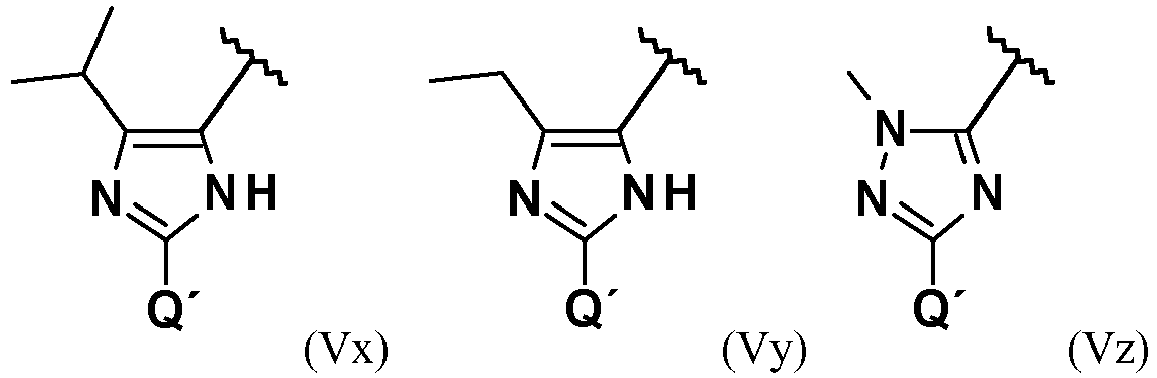


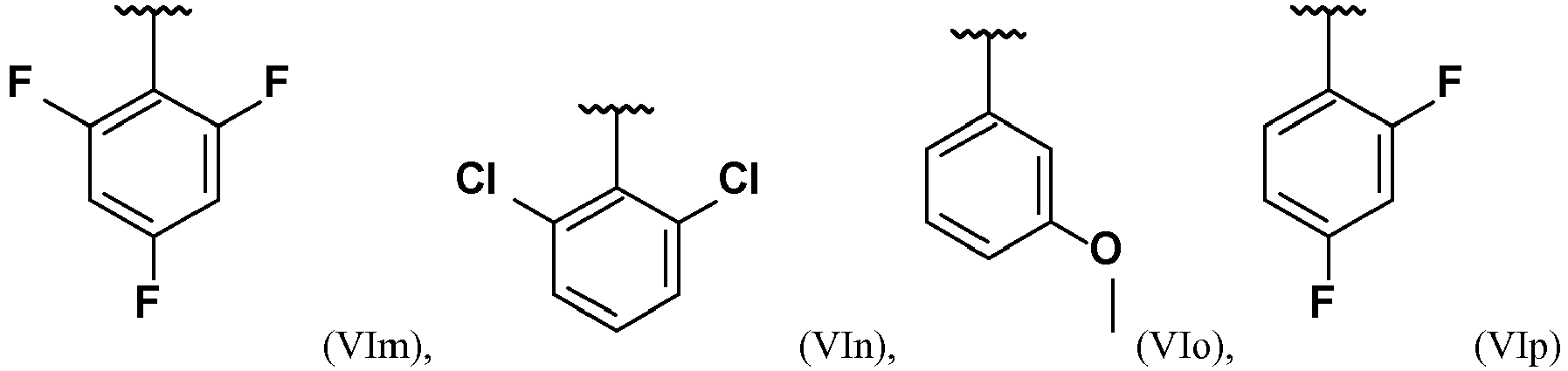
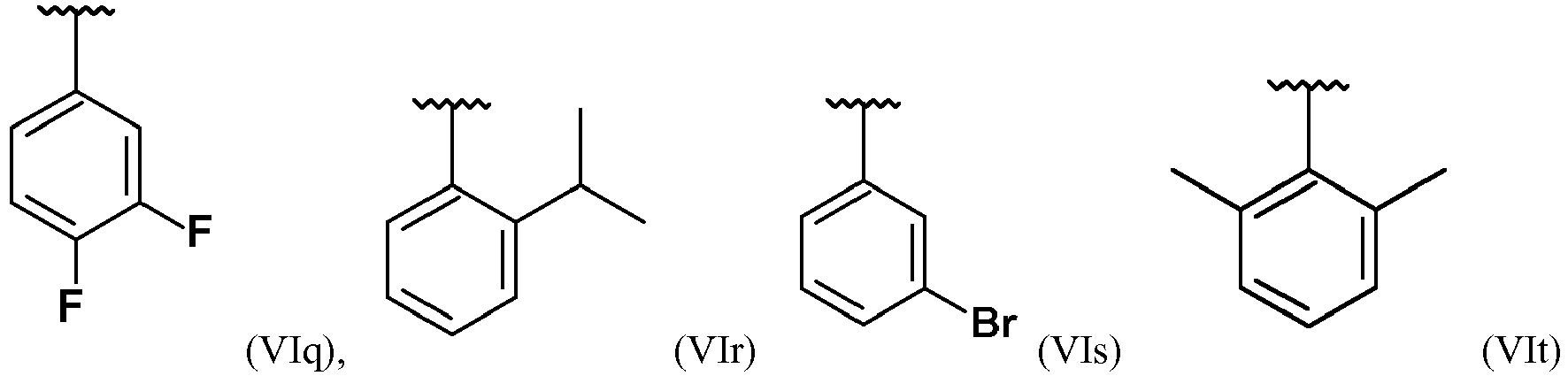




















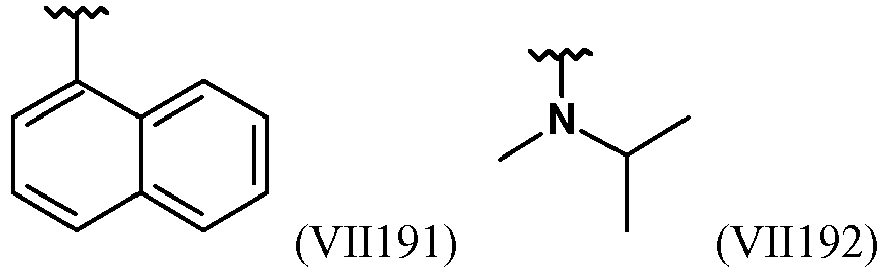
-


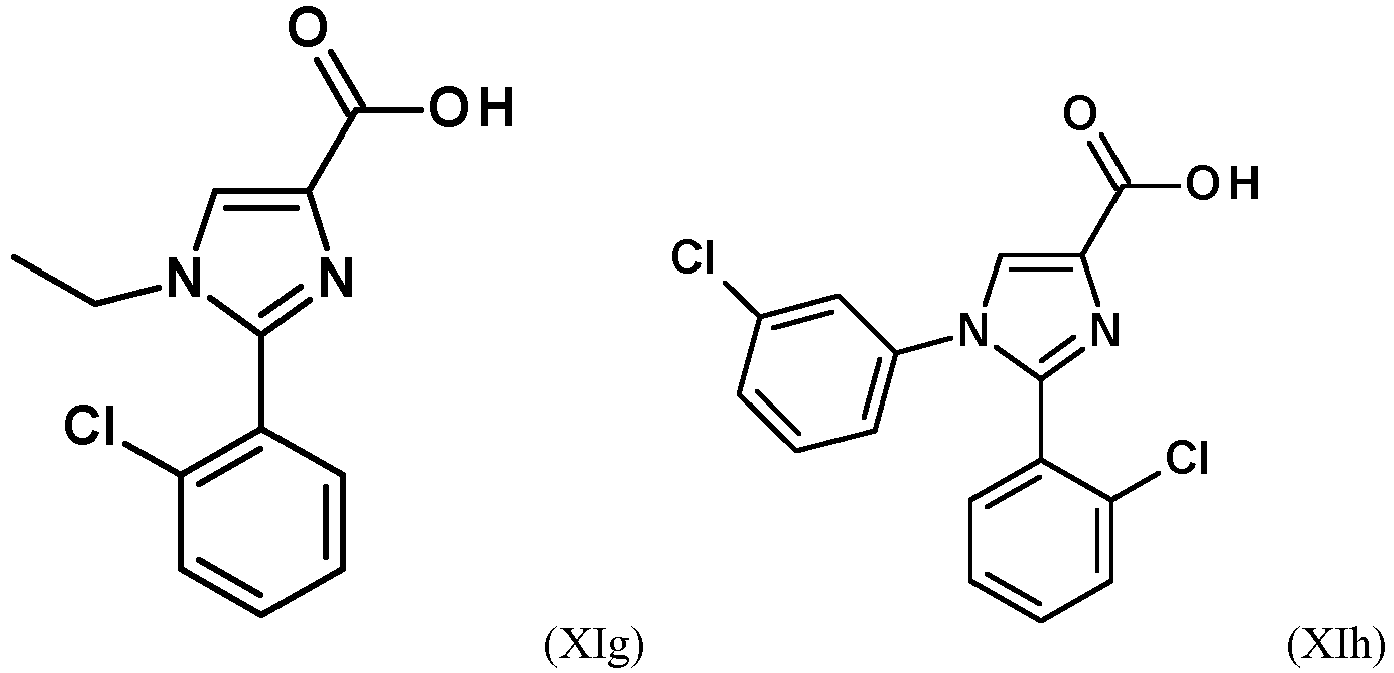
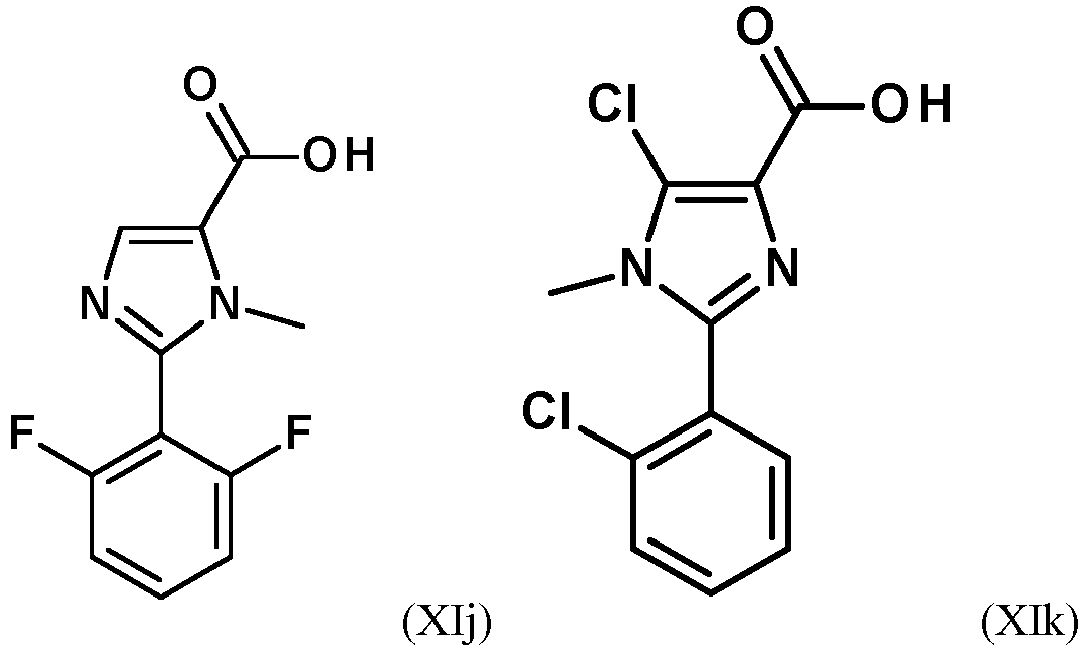


- Weitere Vorzugsbereiche der Erfindung sind im Folgenden aufgeführt:
Verwendung einer Verbindung der Formel (I)
M für einen Rest ausgewählt aus den Formeln (IIa-IIe) steht:

- R1, R2, R3 jeweils unabhängig voneinander H oder ein substituierter oder unsubstituierter Alkyl, Cycloalkyl, Alkenyl, Cycloalkenyl, Cyloheteroalkyl, Aryl, Heteroaryl Rest sind, wobei R2 im Falle (IIc) und (IIe) zusätzlich ein Halogen Rest sein kann, und R3 zusätzlich im Falle (IIa), (IId) und (IIe) ein Halogen Rest sein kann;
- Q ein substituierter oder unsubstituierter Aryl oder Heteroaryl Rest, im Falle (IIe) aber nicht 2-Pyrimidinyl ist;
- D ein substituierter oder unsubstituierter Alkyl, Heteroalkyl, gegebenenfalls teilweise ungesättigter Cycloalkyl, Cycloheteroalkyl, Heteroaryl, Aryl oder Phenylalkyl Rest oder ein substituierter oder unsubstituierter Stickstoff Rest ist,
- zur Bekämpfung von tierischen Schädlingen.
- Bevorzugt ist eine Ausführunsgform, bei der
R1, R2, R3 jeweils unabhängig voneinander H oder ein substituierter oder unsubstituierter C1-C4-Alkyl, C3-C6-Cycloalkyl, C2-C4-Alkenyl oder Phenyl Rest sind, wobei R2 im Falle (IIc) und (IIe) zusätzlich ein Halogen Rest sein kann und wobei R3 zusätzlich im Falle (IIa), (IId) und (IIe) ein Halogen Rest sein kann;
Q ein substituierter oder unsubstituierter Phenyl, Naphthyl, oder Heteroaryl Rest ist, der ein bis drei Heteroatome aus der Reihe Sauerstoff, Schwefel, Stickstoff enthalten kann; im Falle (IIe) aber nicht 2-Pyrimidinyl ist;
D ein substituierter oder unsubstituierter Alkyl, Heteroalkyl, Cycloalkyl, Heteroaryl, Aryl oder Phenyl-(C1-C8)alkyl Rest oder ein substituierter oder unsubstituierter Stickstoff Rest ist.
Weiter bevorzugt ist eine Ausführunsgform, bei der
Q ein unsubstituierter oder mit einem oder mehreren Resten R4 substituierter Phenyl, Naphthyl, Pyridyl, Pyrimidinyl, Thiophen oder Pyrazol Rest ist, im Falle (IIe) aber nicht 2-Pyrimidinyl ist;
wobei der oder die Substituenten R4 jeweils unabhängig voneinander sind: - Wasserstoff, Cyano, Halogen, Nitro, Acetyl, Hydroxy, Carboxy, Amino, SCN, Tri-(C1-C6)alkylsilyl, (C3-C8)Cycloalkyl, (C3-C8)Cycloalkyloxy, (C3-C8)Cycloalkyl-(C3-C8)cycloalkyl, (C1-C6)Alkyl-(C3-C8)cycloalkyl, Halogen(C3-C8)cycloalkyl, (C1-C6)Alkyl, (C1-C6)Halogenalkyl, (C1-C6)Cyanoalkyl, (C1-C6)Hydroxyalkyl, Hydroxycarbonyl-(C1-C6)-alkoxy, (C1-C6)Alkoxycarbonyl-(C1-C6)alkyl, (C1-C6)Alkoxy-(C1-C6)alkyl, (C2-C6)Alkenyl, (C2-C6)Halogenalkenyl, (C2-C6)Cyanoalkenyl, (C2-C6)Alkinyl, (C2-C6)Halogenalkinyl, (C2-C6)Cyanoalkinyl, (C1-C6)Alkoxy, (C1-C6)Halogenalkoxy, (C1-C6)Cyanoalkoxy, (C1-C6)Alkoxycarbonyl-(C1-C6)alkoxy, (C1-C6)Alkoxy-(C1-C6)alkoxy, (C1-C6)Alkylhydroxyimino, (C1-C6)Alkoxyimino, (C1-C6)Alkyl-(C1-C6)alkoxyimino, (C1-C6)Halogenalkyl-(C1-C6)alkoxyimino, (C1-C6)Alkylthio, (C1-C6)Halogenalkylthio, (C1-C6)Alkoxy-(C1-C6)alkylthio, (C1-C6)Alkylthio-(C1-C6)alkyl, (C1-C6)Alkylsulfinyl, (C1-C6)Halogenalkylsulfinyl, (C1-C6)Alkoxy-(C1-C6)alkylsulfinyl, (C1-C6)Alkylsulfinyl-(C1-C6)alkyl, (C1-C6)Alkylsulfonyl, (C1-C6)Halogenalkylsulfonyl, (C1-C6)Alkoxy-(C1-C6)alkylsulfonyl, (C1-C6)Alkylsulfonyl-(C1-C6)alkyl, (C1-C6)Alkylsulfonyloxy, (C1-C6)Alkylcarbonyl, (C1-C6)Alkylthiocarbonyl, (C1-C6)Halogenalkylcarbonyl, (C1-C6)Alkylcarbonyloxy, (C1-C6)Alkoxycarbonyl, (C1-C6)Halogenalkoxycarbonyl, Aminocarbonyl, (C1-C6)Alkylaminocarbonyl, (C1-C6)Alkylaminothiocarbonyl, Di-(C1-C6)alkyl-aminocarbonyl, Di-(C1-C6)alkyl-aminothiocarbonyl, (C2-C6)Alkenylaminocarbonyl, Di-(C2-C6)-alkenylaminocarbonyl, (C3-C8)Cycloalkylaminocarbonyl, (C1-C6)Alkylsulfonylamino, (C1-C6)Alkylamino, Di-(C1-C6)Alkylamino, Aminosulfonyl, (C1-C6)Alkylaminosulfonyl, Di-(C1-C6)alkyl-aminosulfonyl, (C1-C6)Alkylsulfoximino, Aminothiocarbonyl, (C1-C6)Alkylaminothiocarbonyl, Di-(C1-C6)alkyl-aminothiocarbonyl, (C3-C8)Cycloalkylamino, NHCO-(C1-C6)alkyl ((C1-C6)Alkylcarbonylamino); und/oder
- gegebenenfalls einfach oder mehrfach, gleich oder verschieden substituiertes Aryl oder Hetaryl, wobei (im Fall von Hetaryl) gegebenenfalls mindestens eine Carbonylgruppe enthalten sein kann und/oder wobei als Substituenten jeweils in Frage kommen: Cyano, Carboxyl, Halogen, Nitro, Acetyl, Hydroxy, Amino, SCN, Tri-(C1-C6)alkylsilyl, (C3-C8)Cycloalkyl, (C3-C8)Cycloalkyl-(C3-C8)cycloalkyl, (C1-C6)Alkyl-(C3-C8)cycloalkyl, Halogen(C3-C8)cycloalkyl, (C1-C6)Alkyl, (C1-C6)Halogenalkyl, (C1-C6)Cyanoalkyl, (C1-C6)Hydroxyalkyl, Hydroxycarbonyl-(C1-C6)-alkoxy, (C1-C6)Alkoxycarbonyl-(C1-C6)alkyl, (C1-C6)Alkoxy-(C1-C6)alkyl, (C2-C6)Alkenyl, (C2-C6)Halogenalkenyl, (C2-C6)Cyanoalkenyl, (C2-C6)Alkinyl, (C2-C6)Halogenalkinyl, (C2-C6)Cyanoalkinyl, (C1-C6)Alkoxy, (C1-C6)Halogenalkoxy, (C1-C6)Cyanoalkoxy, (C1-C6)Alkoxycarbonyl-(C1-C6)alkoxy, (C1-C6)Alkoxy-(C1-C6)alkoxy, (C1-C6)Alkylhydroxyimino, (C1-C6)Alkoxyimino, (C1-C6)Alkyl-(C1-C6)alkoxyimino, (C1-C6)Halogenalkyl-(C1-C6)alkoxyimino, (C1-C6)Alkylthio, (C1-C6)Halogenalkylthio, (C1-C6)Alkoxy-(C1-C6)alkylthio, (C1-C6)Alkylthio-(C1-C6)alkyl, (C1-C6)Alkylsulfinyl, (C1-C6)Halogenalkylsulfinyl, (C1-C6)Alkoxy-(C1-C6)alkylsulfinyl, (C1-C6)Alkylsulfinyl-(C1-C6)alkyl, (C1-C6)Alkylsulfonyl, (C1-C6)Halogenalkylsulfonyl, (C1-C6)Alkoxy-(C1-C6)alkylsulfonyl, (C1-C6)Alkylsulfonyl-(C1-C6)alkyl, (C1-C6)Alkylsulfonyloxy, (C1-C6)Alkylcarbonyl, (C1-C6)Halogenalkylcarbonyl, (C1-C6)Alkylcarbonyloxy, (C1-C6)Alkoxycarbonyl, (C1-C6)Halogenalkoxycarbonyl, Aminocarbonyl, (C1-C6)Alkylaminocarbonyl, Di-(C1-C6)alkyl-aminocarbonyl, (C2-C6)Alkenylaminocarbonyl, Di-(C2-C6)-alkenylaminocarbonyl, (C3-C8)Cycloalkylaminocarbonyl, (C1-C6)Alkylsulfonylamino, (C1-C6)Alkylamino, Di-(C1-C6)Alkylamino, Aminosulfonyl, (C1-C6)Alkylaminosulfonyl, Di-(C1-C6)alkylaminosulfonyl, (C1-C6)Alkylsulfoximino, Aminothiocarbonyl, (C1-C6)Alkylaminothiocarbonyl, Di-(C1-C6)alkylaminothiocarbonyl, (C3-C8)Cycloalkylamino, (C1-C6)Alkylcarbonylamino;
- D ein unsubstituierter oder mit einem oder mehreren Resten R5 substituierter C1-C6-Alkyl, Phenyl, Phenyl-(C1-C2)alkyl oder Heteroaryl Rest ist, der ein bis drei Heteroatome aus der Reihe Sauerstoff, Schwefel, Stickstoff enthalten kann oder ein NR6R7 Rest ist,
- wobei der oder die Substituenten R5 jeweils unabhängig voneinander sind:
- Wasserstoff, Cyano, Halogen, Nitro, Acetyl, Hydroxy, Carboxy, Amino, SCN, Tri-(C1-C6)alkylsilyl, (C3-C8)Cycloalkyl, (C3-C8)Cycloalkyloxy, (C3-C8)Cycloalkyl-(C3-C8)Cycloalkyl, (C1-C6)Alkyl-(C3-C8)cycloalkyl, Halogen(C3-C8)cycloalkyl, (C1-C6)Alkyl, (C1-C6)Halogenalkyl, (C1-C6)Cyanoalkyl, (C1-C6)Hydroxyalkyl, Hydroxycarbonyl-(C1-C6)-alkoxy, (C1-C6)Alkoxycarbonyl-(C1-C6)alkyl, (C1-C6)Alkoxy-(C1-C6)alkyl, (C2-C6)Alkenyl, (C2-C6)Halogenalkenyl, (C2-C6)Cyanoalkenyl, (C2-C6)Alkinyl, (C2-C6)Halogenalkinyl, (C2-C6)Cyanoalkinyl, (C1-C6)Alkoxy, (C1-C6)Halogenalkoxy, (C1-C6)Cyanoalkoxy, (C1-C6)Alkoxycarbonyl-(C1-C6)alkoxy, (C1-C6)Alkoxy-(C1-C6)alkoxy, (C1-C6)Alkylhydroxyimino, (C1-C6)Alkoxyimino, (C1-C6)Alkyl-(C1-C6)alkoxyimino, (C1-C6)Halogenalkyl-(C1-C6)alkoxyimino, (C1-C6)Alkylthio, (C1-C6)Halogenalkylthio, (C1-C6)Alkoxy-(C1-C6)alkylthio, (C1-C6)Alkylthio-(C1-C6)alkyl, (C1-C6)Alkylsulfinyl, (C1-C6)Halogenalkylsulfinyl, (C1-C6)Alkoxy-(C1-C6)alkylsulfinyl, (C1-C6)Alkylsulfinyl-(C1-C6)alkyl, (C1-C6)Alkylsulfonyl, (C1-C6)Halogenalkylsulfonyl, (C1-C6)Alkoxy-(C1-C6)alkylsulfonyl, (C1-C6)Alkylsulfonyl-(C1-C6)alkyl, (C1-C6)Alkylsulfonyloxy, (C1-C6)Alkylcarbonyl, (C1-C6)Alkylthiocarbonyl, (C1-C6)Halogenalkylcarbonyl, (C1-C6)Alkylcarbonyloxy, (C1-C6)Alkoxycarbonyl, (C1-C6)Halogenalkoxycarbonyl, Aminocarbonyl, (C1-C6)Alkylaminocarbonyl, (C1-C6)Alkylaminothiocarbonyl, Di-(C1-C6)alkyl-aminocarbonyl, Di-(C1-C6)alkyl-aminothiocarbonyl, (C2-C6)Alkenylaminocarbonyl, Di-(C2-C6)-alkenylaminocarbonyl, (C3-C8)Cycloalkylaminocarbonyl, (C1-C6)Alkylsulfonylamino, (C1-C6)Alkylamino, Di-(C1-C6)Alkylamino, Aminosulfonyl, (C1-C6)Alkylaminosulfonyl, Di-(C1-C6)alkyl-aminosulfonyl, (C1-C6)Alkylsulfoximino, Aminothiocarbonyl, (C1-C6)Alkylaminothiocarbonyl, Di-(C1-C6)alkyl-aminothiocarbonyl, (C3-C8)Cycloalkylamino, (C1-C6)Alkylcarbonylamino, 1-Pyrazolyl-(C1-C3)Alkyl,
- und /oder
- einfach oder mehrfach, gleich oder verschieden substituiertes Aryl oder Hetaryl, wobei (im Fall von Hetaryl) gegebenenfalls mindestens eine Carbonylgruppe enthalten sein kann und/oder wobei als Substituenten jeweils in Frage kommen: Cyano, Carboxyl, Halogen, Nitro, Acetyl, Hydroxy, Amino, SCN, Tri-(C1-C6)alkylsilyl, (C3-C8)Cycloalkyl, (C3-C8)Cycloalkyl-(C3-C8)cycloalkyl, (C1-C6)Alkyl-(C3-C8)cycloalkyl, Halogen(C3-C8)cycloalkyl, (C1-C6)Alkyl, (C1-C6)Halogenalkyl, (C1-C6)Cyanoalkyl, (C1-C6)Hydroxyalkyl, Hydroxycarbonyl-(C1-C6)-alkoxy, (C1-C6)Alkoxycarbonyl-(C1-C6)alkyl, (C1-C6)Alkoxy-(C1-C6)alkyl, (C2-C6)Alkenyl, (C2-C6)Halogenalkenyl, (C2-C6)Cyanoalkenyl, (C2-C6)Alkinyl, (C2-C6)Halogenalkinyl, (C2-C6)Cyanoalkinyl, (C1-C6)Alkoxy, (C1-C6)Halogenalkoxy, (C1-C6)Cyanoalkoxy, (C1-C6)Alkoxycarbonyl-(C1-C6)alkoxy, (C1-C6)Alkoxy-(C1-C6)alkoxy, (C1-C6)Alkylhydroxyimino, (C1-C6)Alkoxyimino, (C1-C6)Alkyl-(C1-C6)alkoxyimino, (C1-C6)Halogenalkyl-(C1-C6)alkoxyimino, (C1-C6)Alkylthio, (C1-C6)Halogenalkylthio, (C1-C6)Alkoxy-(C1-C6)alkylthio, (C1-C6)Alkylthio-(C1-C6)alkyl, (C1-C6)Alkylsulfinyl, (C1-C6)Halogenalkylsulfinyl, (C1-C6)Alkoxy-(C1-C6)alkylsulfinyl, (C1-C6)Alkylsulfinyl-(C1-C6)alkyl, (C1-C6)Alkylsulfonyl, (C1-C6)Halogenalkylsulfonyl, (C1-C6)Alkoxy-(C1-C6)alkylsulfonyl, (C1-C6)Alkylsulfonyl-(C1-C6)alkyl, (C1-C6)Alkylsulfonyloxy, (C1-C6)Alkylcarbonyl, (C1-C6)Halogenalkylcarbonyl, (C1-C6)Alkylcarbonyloxy, (C1-C6)Alkoxycarbonyl, (C1-C6)Halogenalkoxycarbonyl, Aminocarbonyl, (C1-C6)Alkylaminocarbonyl, Di-(C1-C6)alkyl-aminocarbonyl, (C2-C6)Alkenylaminocarbonyl, Di-(C2-C6)-alkenylaminocarbonyl, (C3-C8)Cycloalkylaminocarbonyl, (C1-C6)Alkylsulfonylamino, (C1-C6)Alkylamino, Di-(C1-C6)Alkylamino, Aminosulfonyl, (C1-C6)Alkylaminosulfonyl, Di-(C1-C6)alkylaminosulfonyl, (C1-C6)Alkylsulfoximino, Aminothiocarbonyl, (C1-C6)Alkylaminothiocarbonyl, Di-(C1-C6)alkylaminothiocarbonyl, (C3-C8)Cycloalkylamino, (C1-C6)Alkylcarbonylamino;
- und wobei R6 und R7 jeweils unabhängig voneinander H, ein C1-C6-Alkyl, substituierter oder unsubstituierter Phenyl Rest sind, oder R6 und R7 gemeinsam einen unsubstituierten oder substituierten 4-bis 8- gliedrigen , gesättigten oder gegebenenfalls ganz oder teilweise ungesättigten Ring, bilden können der von 1 bis 3 Heteroatomen aus der Reihe Sauerstoff, Schwefel, Stickstoff unterbrochen sein kann, und der einfach oder mehrfach mit einer der Definition von R5 entsprechenden Substitution versehen sein kann.
- Noch weiter bevorzugt ist, wenn der oder die Substituenten R4 jeweils unabhängig voneinander sind:
Wasserstoff, Cyano, Halogen, Nitro, Acetyl, Hydroxy, Carboxy, Amino, Tri-(C1-C6)alkylsilyl, (C3-C8)Cycloalkyl, (C3-C8)Cycloalkyl-(C3-C8)Cycloalkyl, (C1-C6)Alkyl-(C3-C8)cycloalkyl, Halogen(C3-C8)cycloalkyl, (C1-C6)Alkyl, (C1-C6)Halogenalkyl, (C1-C6)Cyanoalkyl, (C1-C6)Hydroxyalkyl, Hydroxycarbonyl-(C1-C6)-alkoxy, (C1-C6)Alkoxycarbonyl-(C1-C6)alkyl, (C1-C6)Alkoxy-(C1-C6)alkyl, (C2-C6)Alkenyl, (C2-C6)Halogenalkenyl, (C2-C6)Cyanoalkenyl, (C2-C6)Alkinyl, (C2-C6)Halogenalkinyl, (C2-C6)Cyanoalkinyl, (C1-C6)Alkoxy, (C1-C6)Halogenalkoxy, (C1-C6)Cyanoalkoxy, (C1-C6)Alkoxycarbonyl-(C1-C6)alkoxy, (C1-C6)Alkoxy-(C1-C6)alkoxy, (C1-C6)Alkylhydroxyimino, (C1-C6)Alkoxyimino, (C1-C6)Alkyl-(C1-C6)alkoxyimino, (C1-C6)Halogenalkyl-(C1-C6)alkoxyimino, (C1-C6)Alkylthio, (C1-C6)Halogenalkylthio, (C1-C6)Alkoxy-(C1-C6)alkylthio, (C1-C6)Alkylthio-(C1-C6)alkyl, (C1-C6)Alkylsulfinyl, (C1-C6)Halogenalkylsulfinyl, (C1-C6)Alkoxy-(C1-C6)alkylsulfinyl, (C1-C6)Alkylsulfinyl-(C1-C6)alkyl, (C1-C6)Alkylsulfonyl, (C1-C6)Halogenalkylsulfonyl, (C1-C6)Alkoxy-(C1-C6)alkylsulfonyl, (C1-C6)Alkylsulfonyl-(C1-C6)alkyl, (C1-C6)Alkylsulfonyloxy, (C1-C6)Alkylcarbonyl, (C1-C6)Alkylthiocarbonyl, (C1-C6)Halogenalkylcarbonyl, (C1-C6)Alkylcarbonyloxy, (C1-C6)Alkoxycarbonyl, (C1-C6)Halogenalkoxycarbonyl, Aminocarbonyl, (C1-C6)Alkylaminocarbonyl, (C1-C6)Alkylaminothiocarbonyl, Di-(C1-C6)alkyl-aminocarbonyl, Di-(C1-C6)alkyl-aminothiocarbonyl, (C2-C6)Alkenylaminocarbonyl, Di-(C2-C6)-alkenylaminocarbonyl, (C3-C8)Cycloalkylaminocarbonyl, (C1-C6)Alkylsulfonylamino, (C1-C6)Alkylamino, Di-(C1-C6)Alkylamino, Aminosulfonyl, (C1-C6)Alkylaminosulfonyl, Di-(C1-C6)alkyl-aminosulfonyl, (C1-C6)Alkylsulfoximino, Aminothiocarbonyl, (C1-C6)Alkylaminothiocarbonyl, Di-(C1-C6)alkyl-aminothiocarbonyl, (C3-C8)Cycloalkylamino, (C1-C6)Alkylcarbonylamino;
der oder die Substituenten R5 jeweils unabhängig voneinander sind: - Wasserstoff, Cyano, Halogen, Nitro, Acetyl, Hydroxy, Carboxy, Amino, Tri-(C1-C6)alkylsilyl, (C3-C8)Cycloalkyl, (C3-C8)Cycloalkyloxy, (C3-C8)Cycloalkyl-(C3-C8)Cycloalkyl, (C1-C6)Alkyl-(C3-C8)cycloalkyl, Halogen(C3-C8)cycloalkyl, (C1-C6)Alkyl, (C1-C6)Halogenalkyl, (C1-C6)Cyanoalkyl, (C1-C6)Hydroxyalkyl, Hydroxycarbonyl-(C1-C6)-alkoxy, (C1-C6)Alkoxycarbonyl-(C1-C6)alkyl, (C1-C6)Alkoxy-(C1-C6)alkyl, (C2-C6)Alkenyl, (C2-C6)Halogenalkenyl, (C2-C6)Cyanoalkenyl, (C2-C6)Alkinyl, (C2-C6)Halogenalkinyl, (C2-C6)Cyanoalkinyl, (C1-C6)Alkoxy, (C1-C6)Halogenalkoxy, (C1-C6)Cyanoalkoxy, (C1-C6)Alkoxycarbonyl-(C1-C6)alkoxy, (C1-C6)Alkoxy-(C1-C6)alkoxy, (C1-C6)Alkylhydroxyimino, (C1-C6)Alkoxyimino, (C1-C6)Alkyl-(C1-C6)alkoxyimino, (C1-C6)Halogenalkyl-(C1-C6)alkoxyimino, (C1-C6)Alkylthio, (C1-C6)Halogenalkylthio, (C1-C6)Alkoxy-(C1-C6)alkylthio, (C1-C6)Alkylthio-(C1-C6)alkyl, (C1-C6)Alkylsulfinyl, (C1-C6)Halogenalkylsulfinyl, (C1-C6)Alkoxy-(C1-C6)alkylsulfinyl, (C1-C6)Alkylsulfinyl-(C1-C6)alkyl, (C1-C6)Alkylsulfonyl, (C1-C6)Halogenalkylsulfonyl, (C1-C6)Alkoxy-(C1-C6)alkylsulfonyl, (C1-C6)Alkylsulfonyl-(C1-C6)alkyl, (C1-C6)Alkylsulfonyloxy, (C1-C6)Alkylcarbonyl, (C1-C6)Alkylthiocarbonyl, (C1-C6)Halogenalkylcarbonyl, (C1-C6)Alkylcarbonyloxy, (C1-C6)Alkoxycarbonyl, (C1-C6)Halogenalkoxycarbonyl, Aminocarbonyl, (C1-C6)Alkylaminocarbonyl, (C1-C6)Alkylaminothiocarbonyl, Di-(C1-C6)alkyl-aminocarbonyl, Di-(C1-C6)alkyl-aminothiocarbonyl, (C2-C6)Alkenylaminocarbonyl, Di-(C2-C6)-alkenylaminocarbonyl, (C3-C8)Cycloalkylaminocarbonyl, (C1-C6)Alkylsulfonylamino, (C1-C6)Alkylamino, Di-(C1-C6)Alkylamino, Aminosulfonyl, (C1-C6)Alkylaminosulfonyl, Di-(C1-C6)alkyl-aminosulfonyl, (C1-C6)Alkylsulfoximino, Aminothiocarbonyl, (C1-C6)Alkylaminothiocarbonyl, Di-(C1-C6)alkyl-aminothiocarbonyl, (C3-C8)Cycloalkylamino, (C1-C6)Alkylcarbonylamino, 1-Pyrazolyl-(C1-C3)Alkyl;
- R6 und R7 jeweils unabhängig voneinander H, ein C1-C6-Alkyl, (C1-C6)Halogenalkyl, (C1-C6)Alkoxy-(C1-C6)alkyl Rest oder ein unsubstituierter Phenyl oder mit Halogen, C1-C6-Alkyl, (C1-C6)Halogenalkyl, (C1-C6)Alkoxy-(C1-C6)alkyl substituierter Phenyl Rest sind,
- oder
- R6 und R7 gemeinsam einen unsubstituierten oder substituierten 5- bis 6- gliedrigen , gesättigten oder gegebenenfalls ganz oder teilweise ungesättigten Ring, bilden können der von 1 bis 3 Heteroatomen aus der Reihe Sauerstoff, Schwefel, Stickstoff unterbrochen sein kann, und der einfach oder mehrfach mit einer der Definition von R5 entsprechenden Substitution versehen sein kann.
- Insbesonders bevorzugt ist eine Ausführunsgform, bei der
im Falle (IIa), R2, R3 jeweils unabhängig voneinander H oder ein substituierter oder unsubstituierter C1-C4-Alkyl, C3-C6-Cycloalkyl oder Phenyl Rest sind, wobei R3 zusätzlich ein Halogen Rest sein kann,
im Falle (IIb) R2 H oder ein substituierter oder unsubstituierter C1-C4-Alkyl, oder C3-C6-Cycloalkyl Rest ist,
im Falle (IIc) R2, R3 jeweils unabhängig voneinander H oder ein substituierter oder unsubstituierter C1-C4-Alkyl, C3-C6-Cycloalkyl oder Phenyl Rest sind,
im Falle (IId) R1, R3 jeweils unabhängig voneinander H oder ein substituierter oder unsubstituierter C1-C4-Alkyl, C3-C6-Cycloalkyl Rest sind,
im Falle (IIe) R2, R3 jeweils unabhängig voneinander H oder Halogen oder ein substituierter oder unsubstituierter C1-C4-Alkyl, C3-C6-Cycloalkyl, oder Phenyl Rest sind,
D ein unsubstituierter oder mit einem oder mehreren Resten R5' substituierter C1-C6-Alkyl Rest oder Phenyl Rest oder Pyridin, Pyrimidin, Pyrazol, Triazol, Thiazol, Oxazol, Thiadiazol, Oxadiazol, Thiophen, Pyrrol, Furan, Tetrahydrofuran, Dioxan Rest oder ein NR6'R7' Rest ist, wobei
R6 und R7 jeweils unabhängig voneinander H, ein C1-C6-Alkyl, (C1-C6)Halogenalkyl, (C1-C6)Alkoxy-(C1-C6)alkyl Rest oder ein unsubstituierter Phenyl oder mit Halogen, C1-C6-Alkyl, (C1-C6)Halogenalkyl, (C1-C6)Alkoxy-(C1-C6)alkyl substituierter Phenyl Rest sind,
oder einen Ring aus der Reihe Pyrrolidin, Morpholin, Piperidin bilden. - Noch weiter bevorzugt ist eine Ausführungsform, bei der
M ein Rest ausgewählt aus den Resten der Formeln (IVa), (IVb), (IVc) (IVd), (IVe)

wobei
im Falle (IVa) R2 H, Methyl oder Ethyl oder mit Halogen substituiertes Phenyl ist, undR3 H, Methyl, Ethyl oder Halogen ist, und
im Falle (IVb) R2 H, Methyl oder Ethyl ist.
Ganz besonders bevorzugt ist eine Ausführungsform, bei der
Q ein unsubstituierter oder mit einem oder mehreren Resten R4 substituierter Phenyl, Naphthyl, Pyridyl, Pyrimidinyl, Thiophen oder Pyrazol-Rest ist; im Falle (IVe) aber nicht 2-Pyrimidinyl ist,
wobei der oder die Substituenten R4 unabhängig voneinander sind: - Wasserstoff, Cyano, Halogen, Nitro, Acetyl, (C3-C6)Cycloalkyl, (C3-C6)Cycloalkyloxy, (C3-C6)Cycloalkyl-(C3-C6)Cycloalkyl, (C1-C6)Alkyl-(C3-C8)cycloalkyl, Halogen(C3-C6)cycloalkyl, (C1-C6)Alkyl, (C1-C6)Halogenalkyl, (C1-C6)Cyanoalkyl, (C1-C6)Hydroxyalkyl, (C1-C6)Alkoxycarbonyl-(C1-C6)alkyl, (C1-C6)Alkoxy-(C1-C6)alkyl, (C2-C6)Alkenyl, (C2-C6)Halogenalkenyl, (C2-C6)Alkinyl, (C1-C6)Alkoxy, (C1-C6)Halogenalkoxy, (C1-C6)Alkylthio, (C1-C6)Halogenalkylthio, (C1-C6)Alkylthio-(C1-C6)alkyl, (C1-C6)Alkylsulfinyl, (C1-C6)Halogenalkylsulfinyl, (C1-C6)Alkylsulfonyl, (C1-C6)Halogenalkylsulfonyl, (C1-C6)Alkylsulfonyloxy, (C1-C6)Alkylcarbonyl, (C1-C6)Alkylamino, Di-(C1-C6)Alkylamino, (C1-C6)Alkylcarbonylamino,
- wobei der oder die Substituenten R5 unabhängig voneinander sind:
- Wasserstoff, Cyano, Halogen, Nitro, Acetyl, Hydroxy, Carboxy, Amino, (C3-C6)Cycloalkyl, (C3-C6)Cycloalkyloxy, (C3-C6)Cycloalkyl-(C3-C6)Cycloalkyl, (C1-C6)Alkyl-(C3-C8)cycloalkyl, Halogen(C3-C6)cycloalkyl, (C1-C6)Alkyl, (C1-C6)Halogenalkyl, (C1-C6)Cyanoalkyl, (C1-C6)Hydroxyalkyl, (C1-C6)Alkoxycarbonyl-(C1-C6)alkyl, (C1-C6)Alkoxy-(C1-C6)alkyl, (C2-C6)Alkenyl, (C2-C6)Halogenalkenyl, (C2-C6)Alkinyl, (C1-C6)Alkoxy, (C1-C6)Halogenalkoxy, (C1-C6)Alkylthio, (C1-C6)Halogenalkylthio, (C1-C6)Alkylthio-(C1-C6)alkyl, (C1-C6)Alkylsulfinyl, (C1-C6)Halogenalkylsulfinyl, (C1-C6)Alkylsulfonyl, (C1-C6)Halogenalkylsulfonyl, (C1-C6)Alkylsulfonyloxy, (C1-C6)Alkylcarbonyl, (C1-C6)Alkylamino, Di-(C1-C6)Alkylamino, (C1-C6)Alkylcarbonylamino, 1-Pyrazolyl-(C1-C3)Alkyl,
- R6 und R7 jeweils unabhängig voneinander H, ein C1-C6-Alkyl sind oder einen Ring aus der Reihe
- Pyrrolidin, Morpholin, Piperidin bilden.
- Noch weiter bevorzugt ist, wenn
M ein Rest ausgewählt aus den Resten der Formeln (Va-Vr) ist:


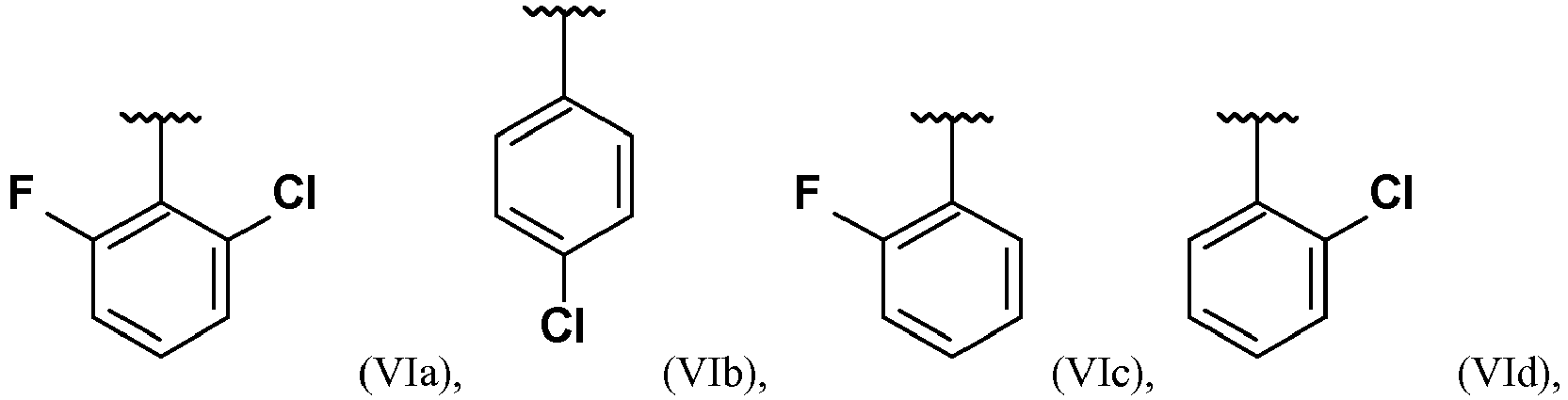


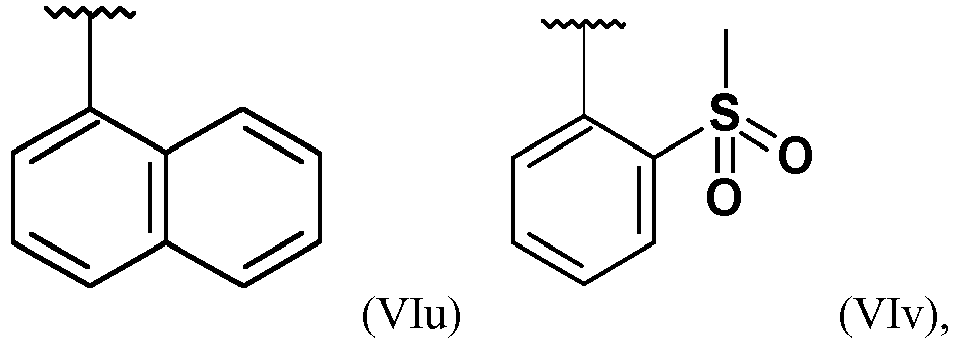





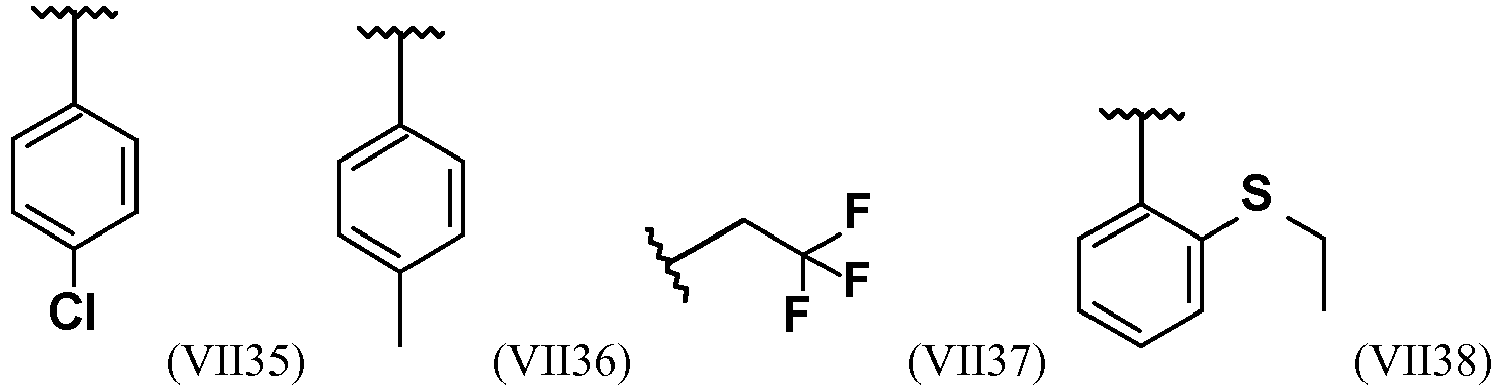




- Gemäß einer weiteren bevorzugten Ausführungsform der Erfindung ist die Verwendung einer Verbindung gemäß Formel (I) zum Schutz des Vermehrungsmaterials von Pflanzen vorgesehen.
- Gegenstand der Erfindung ist auch ein Mittel, mit einem Gehalt von mindestens einer Verbindung gemäß Formel (I) und üblichen Streckmitteln und/oder oberflächenaktiven Substanzen insbesondere zur Bekämpfung von tierischen Schädlingen.
- Ein weiterer Gegenstand der Erfindung ist ein Verfahren zur Bekämpfung von tierischen Schädlingen, bei dem man wenigstens eine Verbindung gemäß Formel (I) oder ein erfindungsgemäßes Mittel auf die tierischen Schädlinge und/oder ihren Lebensraum einwirken lässt, wobei die chirurgische, therapeutische und diagnostische Behandlung des menschlichen oder tierischen Körpers ausgeschlossen ist.
- Noch weiterer Gegenstand der Erfindung ist eine agrochemische Formulierung enthaltend wenigstens eine Verbindung gemäß Formel (I) nach einem der Ansprüche 1 bis 8 in biologisch wirksamen Gehalten von zwischen 0,00000001 und 98 Gew.-%, bezogen auf das Gewicht der agrochemischen Formulierung, sowie Streckmittel und/oder oberflächenaktive Stoffe.
- Eine bevorzugte Asugestaltung der erfindungsgemäßen Fromulierung enthält zusätzlich einen weiteren agrochemischen Wirkstoff.
- Ebenfalls Gegenstand der Erfinungs sind Verbindungen der Formel (VIII)
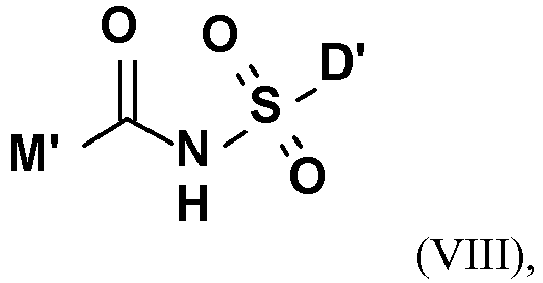
M' für einen Rest der Formel (II) steht, ausgewählt aus: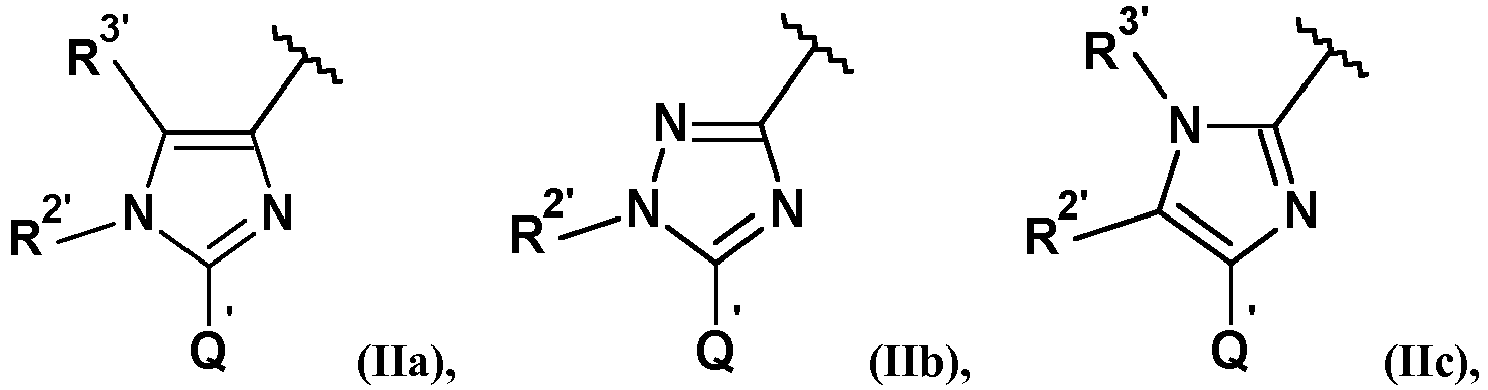
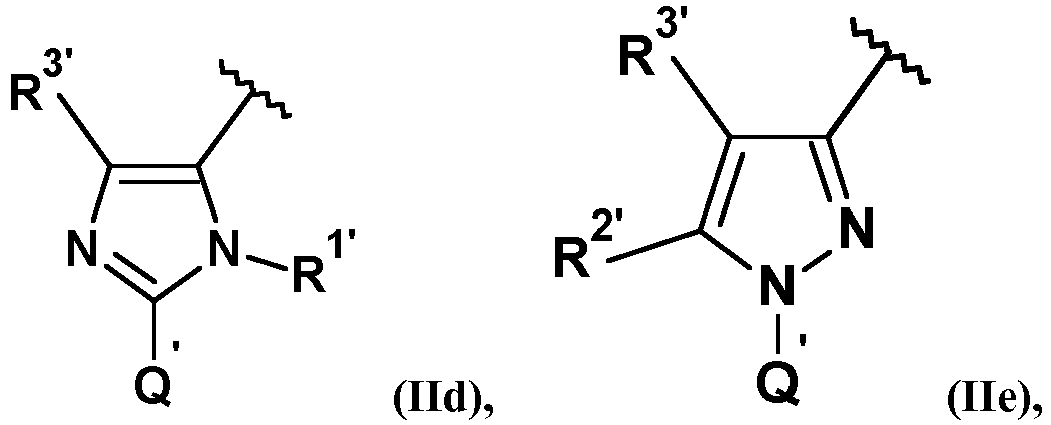
- R1', R2', R3' jeweils unabhängig voneinander H oder ein substituierter oder unsubstituierter Alkyl, Cycloalkyl, Alkenyl, Cycloalkenyl, Cyloheteroalkyl, Aryl, Heteroaryl Rest sind, wobei R2' im Falle (IIc) und (IIe) zusätzlich ein Halogen Rest sein kann, und R2' im Falle (IIa) und (IIb) nur H oder ein substituierter oder unsubstituierter Alkyl, Cycloalkyl Rest sein kann, R3' zusätzlich im Falle (IIa), (IId) und (IIe) ein Halogen Rest sein kann;
- Q' ein substituierter oder unsubstituierter Aryl oder Heteroaryl Rest, aber im Falle (IIa), (IId) im Falle R1'=H und R3' =Methyl nicht 3-Methoxyphenyl ist, im Falle (IId) nicht 3-Pyridyl ist, im Falle (IIe) nicht 2-Pyrimidinyl, nicht unsubstituiertes Phenyl, nicht 3,4-Dichlorphenyl und nicht 3,5-bis-tert-Butyl ist;
- D' ein substituierter oder unsubstituierter Alkyl, Heteroalkyl, gegebenenfalls teilweise ungesättigter Cycloalkyl, Cycloheteroalkyl, Heteroaryl, Aryl oder Phenylalkyl Rest oder im Falle, daß Q' mindestens einen Substituenten in 2-Stellung trägt, ein substituierter oder unsubstituierter Stickstoff Rest ist.
- Gemäß einer ersten bevorzugten Ausführungsfrom der erfindungsgemäßen Verbindungen ist vorgesehen, dass
- Q' ein substituierter oder unsubstituierter Phenyl, Naphthyl, Heteroaryl Rest ist, der ein bis drei Heteroatome aus der Reihe Sauerstoff, Schwefel, Stickstoff enthalten kann;
- D' ein substituierter oder unsubstituierter Alkyl, Heteroalkyl, Cycloalkyl, Heteroaryl, Aryl oder Phenyl-(C1-C8)alkyl Rest oder im Falle, daß Q' mindestens einen Substituenten in 2-Stellung trägt, ein substituierter oder unsubstituierter Stickstoff Rest ist;
- im Falle (IIa) R2', R3' jeweils unabhängig voneinander H oder ein substituierter oder unsubstituierter C1-C4-Alkyl, C3-C6-Cycloalkyl Rest sind, wobei R3 zusätzlich ein Halogen Rest sein kann;
- im Falle (IIb) R2' H oder ein substituierter oder unsubstituierter C1-C4-Alkyl, oder C3-C6-Cycloalkyl Rest ist,
- im Falle (IIc) R2', R3' jeweils unabhängig voneinander H oder ein substituierter oder unsubstituierter C1-C4-Alkyl, C3-C6-Cycloalkyl oder Phenyl Rest sind, im Falle (IId) R1', R3' jeweils unabhängig voneinander H oder ein substituierter oder unsubstituierter C1-C4-Alkyl, C3-C6-Cycloalkyl Rest sind und R3 zusätzlich ein Halogen Rest sein kann;
- im Falle (IIe) R2', R3' jeweils unabhängig voneinander H oder Halogen oder ein substituierter oder unsubstituierter C1-C4-Alkyl, C3-C6-Cycloalkyl Rest sind.
- Weiter bevorzugt ist, wenn
Q' ein unsubstituierter oder mit einem oder mehreren Resten R4' substituierter Phenyl, Naphthyl, Pyridyl, Pyrimidinyl, Thiophen oder Pyrazol-Rest ist; wobei der oder die Substituenten R4' jeweils unabhängig voneinander sind: - Wasserstoff, Cyano, Halogen, Nitro, Acetyl, Hydroxy, Carboxy, Amino, SCN, Tri-(C1-C6)alkylsilyl, (C3-C8)Cycloalkyl, (C3-C8)Cycloalkyloxy, (C3-C8)Cycloalkyl-(C3-C8)Cycloalkyl, (C1-C6)Alkyl-(C3-C8)cycloalkyl, Halogen(C3-C8)cycloalkyl, (C1-C6)Alkyl, (C1-C6)Halogenalkyl, (C1-C6)Cyanoalkyl, (C1-C6)Hydroxyalkyl, Hydroxycarbonyl-(C1-C6)-alkoxy, (C1-C6)Alkoxycarbonyl-(C1-C6)alkyl, (C1-C6)Alkoxy-(C1-C6)alkyl, (C2-C6)Alkenyl, (C2-C6)Halogenalkenyl, (C2-C6)Cyanoalkenyl, (C2-C6)Alkinyl, (C2-C6)Halogenalkinyl, (C2-C6)Cyanoalkinyl, (C1-C6)Alkoxy, (C1-C6)Halogenalkoxy, (C1-C6)Cyanoalkoxy, (C1-C6)Alkoxycarbonyl-(C1-C6)alkoxy, (C1-C6)Alkoxy-(C1-C6)alkoxy, (C1-C6)Alkylhydroxyimino, (C1-C6)Alkoxyimino, (C1-C6)Alkyl-(C1-C6)alkoxyimino, (C1-C6)Halogenalkyl-(C1-C6)alkoxyimino, (C1-C6)Alkylthio, (C1-C6)Halogenalkylthio, (C1-C6)Alkoxy-(C1-C6)alkylthio, (C1-C6)Alkylthio-(C1-C6)alkyl, (C1-C6)Alkylsulfinyl, (C1-C6)Halogenalkylsulfinyl, (C1-C6)Alkoxy-(C1-C6)alkylsulfinyl, (C1-C6)Alkylsulfinyl-(C1-C6)alkyl, (C1-C6)Alkylsulfonyl, (C1-C6)Halogenalkylsulfonyl, (C1-C6)Alkoxy-(C1-C6)alkylsulfonyl, (C1-C6)Alkylsulfonyl-(C1-C6)alkyl, (C1-C6)Alkylsulfonyloxy, (C1-C6)Alkylcarbonyl, (C1-C6)Alkylthiocarbonyl, (C1-C6)Halogenalkylcarbonyl, (C1-C6)Alkylcarbonyloxy, (C1-C6)Alkoxycarbonyl, (C1-C6)Halogenalkoxycarbonyl, Aminocarbonyl, (C1-C6)Alkylaminocarbonyl, (C1-C6)Alkylaminothiocarbonyl, Di-(C1-C6)alkyl-aminocarbonyl, Di-(C1-C6)alkyl-aminothiocarbonyl, (C2-C6)Alkenylaminocarbonyl, Di-(C2-C6)-alkenylaminocarbonyl, (C3-C8)Cycloalkylaminocarbonyl, (C1-C6)Alkylsulfonylamino, (C1-C6)Alkylamino, Di-(C1-C6)Alkylamino, Aminosulfonyl, (C1-C6)Alkylaminosulfonyl, Di-(C1-C6)alkyl-aminosulfonyl, (C1-C6)Alkylsulfoximino, Aminothiocarbonyl, (C1-C6)Alkylaminothiocarbonyl, Di-(C1-C6)alkyl-aminothiocarbonyl, (C3-C8)Cycloalkylamino, (C1-C6)Alkylcarbonylamino; und/oder
- gegebenenfalls einfach oder mehrfach, gleich oder verschieden substituiertes Aryl oder Hetaryl, wobei (im Fall von Hetaryl) gegebenenfalls mindestens eine Carbonylgruppe enthalten sein kann und/oder wobei als Substituenten jeweils in Frage kommen: Cyano, Carboxyl, Halogen, Nitro, Acetyl, Hydroxy, Amino, SCN, Tri-(C1-C6)alkylsilyl, (C3-C8)Cycloalkyl, (C3-C8)Cycloalkyl-(C3-C8)cycloalkyl, (C1-C6)Alkyl-(C3-C8)cycloalkyl, Halogen(C3-C8)cycloalkyl, (C1-C6)Alkyl, (C1-C6)Halogenalkyl, (C1-C6)Cyanoalkyl, (C1-C6)Hydroxyalkyl, Hydroxycarbonyl-(C1-C6)-alkoxy, (C1-C6)Alkoxycarbonyl-(C1-C6)alkyl, (C1-C6)Alkoxy-(C1-C6)alkyl, (C2-C6)Alkenyl, (C2-C6)Halogenalkenyl, (C2-C6)Cyanoalkenyl, (C2-C6)Alkinyl, (C2-C6)Halogenalkinyl, (C2-C6)Cyanoalkinyl, (C1-C6)Alkoxy, (C1-C6)Halogenalkoxy, (C1-C6)Cyanoalkoxy, (C1-C6)Alkoxycarbonyl-(C1-C6)alkoxy, (C1-C6)Alkoxy-(C1-C6)alkoxy, (C1-C6)Alkylhydroxyimino, (C1-C6)Alkoxyimino, (C1-C6)Alkyl-(C1-C6)alkoxyimino, (C1-C6)Halogenalkyl-(C1-C6)alkoxyimino, (C1-C6)Alkylthio, (C1-C6)Halogenalkylthio, (C1-C6)Alkoxy-(C1-C6)alkylthio, (C1-C6)Alkylthio-(C1-C6)alkyl, (C1-C6)Alkylsulfinyl, (C1-C6)Halogenalkylsulfinyl, (C1-C6)Alkoxy-(C1-C6)alkylsulfinyl, (C1-C6)Alkylsulfinyl-(C1-C6)alkyl, (C1-C6)Alkylsulfonyl, (C1-C6)Halogenalkylsulfonyl, (C1-C6)Alkoxy-(C1-C6)alkylsulfonyl, (C1-C6)Alkylsulfonyl-(C1-C6)alkyl, (C1-C6)Alkylsulfonyloxy, (C1-C6)Alkylcarbonyl, (C1-C6)Halogenalkylcarbonyl, (C1-C6)Alkylcarbonyloxy, (C1-C6)Alkoxycarbonyl, (C1-C6)Halogenalkoxycarbonyl, Aminocarbonyl, (C1-C6)Alkylaminocarbonyl, Di-(C1-C6)alkyl-aminocarbonyl, (C2-C6)Alkenylaminocarbonyl, Di-(C2-C6)-alkenylaminocarbonyl, (C3-C8)Cycloalkylaminocarbonyl, (C1-C6)Alkylsulfonylamino, (C1-C6)Alkylamino, Di-(C1-C6)Alkylamino, Aminosulfonyl, (C1-C6)Alkylaminosulfonyl, Di-(C1-C6)alkylaminosulfonyl, (C1-C6)Alkylsulfoximino, Aminothiocarbonyl, (C1-C6)Alkylaminothiocarbonyl, Di-(C1-C6)alkylaminothiocarbonyl, (C3-C8)Cycloalkylamino, (C1-C6)Alkylcarbonylamino;
- D' ein unsubstituierter oder mit einem oder mehreren Resten R5' substituierter C1-C6-Alkyl, Phenyl oder Heteroaryl Rest ist, der ein bis drei Heteroatome aus der Reihe Sauerstoff, Schwefel, Stickstoff enthalten kann oder oder im Falle, daß Q mindestens einen Substituenten in 2-Stellung trägt, ein NR6'R7' Rest ist,
- wobei der oder die Substituenten R5' jeweils unabhängig voneinander sind:
- Wasserstoff, Cyano, Halogen, Nitro, Acetyl, Hydroxy, Carboxy, Amino, SCN, Tri-(C1-C6)alkylsilyl, (C3-C8)Cycloalkyl, (C3-C8)Cycloalkyloxy, (C3-C8)Cycloalkyl-(C3-C8)Cycloalkyl, (C1-C6)Alkyl-(C3-C8)cycloalkyl, Halogen(C3-C8)cycloalkyl, (C1-C6)Alkyl, (C1-C6)Halogenalkyl, (C1-C6)Cyanoalkyl, (C1-C6)Hydroxyalkyl, Hydroxycarbonyl-(C1-C6)-alkoxy, (C1-C6)Alkoxycarbonyl-(C1-C6)alkyl, (C1-C6)Alkoxy-(C1-C6)alkyl, (C2-C6)Alkenyl, (C2-C6)Halogenalkenyl, (C2-C6)Cyanoalkenyl, (C2-C6)Alkinyl, (C2-C6)Halogenalkinyl, (C2-C6)Cyanoalkinyl, (C1-C6)Alkoxy, (C1-C6)Halogenalkoxy, (C1-C6)Cyanoalkoxy, (C1-C6)Alkoxycarbonyl-(C1-C6)alkoxy, (C1-C6)Alkoxy-(C1-C6)alkoxy, (C1-C6)Alkylhydroxyimino, (C1-C6)Alkoxyimino, (C1-C6)Alkyl-(C1-C6)alkoxyimino, (C1-C6)Halogenalkyl-(C1-C6)alkoxyimino, (C1-C6)Alkylthio, (C1-C6)Halogenalkylthio, (C1-C6)Alkoxy-(C1-C6)alkylthio, (C1-C6)Alkylthio-(C1-C6)alkyl, (C1-C6)Alkylsulfinyl, (C1-C6)Halogenalkylsulfinyl, (C1-C6)Alkoxy-(C1-C6)alkylsulfinyl, (C1-C6)Alkylsulfinyl-(C1-C6)alkyl, (C1-C6)Alkylsulfonyl, (C1-C6)Halogenalkylsulfonyl, (C1-C6)Alkoxy-(C1-C6)alkylsulfonyl, (C1-C6)Alkylsulfonyl-(C1-C6)alkyl, (C1-C6)Alkylsulfonyloxy, (C1-C6)Alkylcarbonyl, (C1-C6)Alkylthiocarbonyl, (C1-C6)Halogenalkylcarbonyl, (C1-C6)Alkylcarbonyloxy, (C1-C6)Alkoxycarbonyl, (C1-C6)Halogenalkoxycarbonyl, Aminocarbonyl, (C1-C6)Alkylaminocarbonyl, (C1-C6)Alkylaminothiocarbonyl, Di-(C1-C6)alkyl-aminocarbonyl, Di-(C1-C6)alkyl-aminothiocarbonyl, (C2-C6)Alkenylaminocarbonyl, Di-(C2-C6)-alkenylaminocarbonyl, (C3-C8)Cycloalkylaminocarbonyl, (C1-C6)Alkylsulfonylamino, (C1-C6)Alkylamino, Di-(C1-C6)Alkylamino, Aminosulfonyl, (C1-C6)Alkylaminosulfonyl, Di-(C1-C6)alkyl-aminosulfonyl, (C1-C6)Alkylsulfoximino, Aminothiocarbonyl, (C1-C6)Alkylaminothiocarbonyl, Di-(C1-C6)alkyl-aminothiocarbonyl, (C3-C8)Cycloalkylamino, (C1-C6)Alkylcarbonylamino, 1-Pyrazolyl-(C1-C3)Alkyl,
- und /oder
- einfach oder mehrfach, gleich oder verschieden substituiertes Aryl oder Hetaryl, wobei (im Fall von Hetaryl) gegebenenfalls mindestens eine Carbonylgruppe enthalten sein kann und/oder wobei als Substituenten jeweils in Frage kommen: Cyano, Carboxyl, Halogen, Nitro, Acetyl, Hydroxy, Amino, SCN, Tri-(C1-C6)alkylsilyl, (C3-C8)Cycloalkyl, (C3-C8)Cycloalkyl-(C3-C8)cycloalkyl, (C1-C6)Alkyl-(C3-C8)cycloalkyl, Halogen(C3-C8)cycloalkyl, (C1-C6)Alkyl, (C1-C6)Halogenalkyl, (C1-C6)Cyanoalkyl, (C1-C6)Hydroxyalkyl, Hydroxycarbonyl-(C1-C6)-alkoxy, (C1-C6)Alkoxycarbonyl-(C1-C6)alkyl, (C1-C6)Alkoxy-(C1-C6)alkyl, (C2-C6)Alkenyl, (C2-C6)Halogenalkenyl, (C2-C6)Cyanoalkenyl, (C2-C6)Alkinyl, (C2-C6)Halogenalkinyl, (C2-C6)Cyanoalkinyl, (C1-C6)Alkoxy, (C1-C6)Halogenalkoxy, (C1-C6)Cyanoalkoxy, (C1-C6)Alkoxycarbonyl-(C1-C6)alkoxy, (C1-C6)Alkoxy-(C1-C6)alkoxy, (C1-C6)Alkylhydroxyimino, (C1-C6)Alkoxyimino, (C1-C6)Alkyl-(C1-C6)alkoxyimino, (C1-C6)Halogenalkyl-(C1-C6)alkoxyimino, (C1-C6)Alkylthio, (C1-C6)Halogenalkylthio, (C1-C6)Alkoxy-(C1-C6)alkylthio, (C1-C6)Alkylthio-(C1-C6)alkyl, (C1-C6)Alkylsulfinyl, (C1-C6)Halogenalkylsulfinyl, (C1-C6)Alkoxy-(C1-C6)alkylsulfinyl, (C1-C6)Alkylsulfinyl-(C1-C6)alkyl, (C1-C6)Alkylsulfonyl, (C1-C6)Halogenalkylsulfonyl, (C1-C6)Alkoxy-(C1-C6)alkylsulfonyl, (C1-C6)Alkylsulfonyl-(C1-C6)alkyl, (C1-C6)Alkylsulfonyloxy, (C1-C6)Alkylcarbonyl, (C1-C6)Halogenalkylcarbonyl, (C1-C6)Alkylcarbonyloxy, (C1-C6)Alkoxycarbonyl, (C1-C6)Halogenalkoxycarbonyl, Aminocarbonyl, (C1-C6)Alkylaminocarbonyl, Di-(C1-C6)alkyl-aminocarbonyl, (C2-C6)Alkenylaminocarbonyl, Di-(C2-C6)-alkenylaminocarbonyl, (C3-C8)Cycloalkylaminocarbonyl, (C1-C6)Alkylsulfonylamino, (C1-C6)Alkylamino, Di-(C1-C6)Alkylamino, Aminosulfonyl, (C1-C6)Alkylaminosulfonyl, Di-(C1-C6)alkylaminosulfonyl, (C1-C6)Alkylsulfoximino, Aminothiocarbonyl, (C1-C6)Alkylaminothiocarbonyl, Di-(C1-C6)alkylaminothiocarbonyl, (C3-C8)Cycloalkylamino, (C1-C6)Alkylcarbonylamino,
- und wobei R6' und R7' jeweils unabhängig voneinander H, ein C1-C6-Alkyl, substituierter oder ein unsubstituierter Phenyl Rest sind, oder R6' und R7' gemeinsam einen unsubstituierten oder substituierten 5- bis 6- gliedrigen, gesättigten oder gegebenenfalls ganz oder teilweise ungesättigten Ring bilden können der von 1 bis 3 Heteroatomen aus der Reihe Sauerstoff, Schwefel, Stickstoff unterbrochen sein kann, und der einfach oder mehrfach mit einer der Definition von R5' entsprechenden Substitution versehen sein kann.
- Noch weiter bevorzugt ist, wenn
der oder die Substituenten R4' jeweils unabhängig voneinander sind: - Wasserstoff, Cyano, Halogen, Nitro, Acetyl, Hydroxy, Carboxy, Amino, Tri-(C1-C6)alkylsilyl, (C3-C8)Cycloalkyl, (C3-C8)Cycloalkyloxy, (C3-C8)Cycloalkyl-(C3-C8)Cycloalkyl, (C1-C6)Alkyl-(C3-C8)cycloalkyl, Halogen(C3-C8)cycloalkyl, (C1-C6)Alkyl, (C1-C6)Halogenalkyl, (C1-C6)Cyanoalkyl, (C1-C6)Hydroxyalkyl, Hydroxycarbonyl-(C1-C6)-alkoxy, (C1-C6)Alkoxycarbonyl-(C1-C6)alkyl, (C1-C6)Alkoxy-(C1-C6)alkyl, (C2-C6)Alkenyl, (C2-C6)Halogenalkenyl, (C2-C6)Cyanoalkenyl, (C2-C6)Alkinyl, (C2-C6)Halogenalkinyl, (C2-C6)Cyanoalkinyl, (C1-C6)Alkoxy, (C1-C6)Halogenalkoxy, (C1-C6)Cyanoalkoxy, (C1-C6)Alkoxycarbonyl-(C1-C6)alkoxy, (C1-C6)Alkoxy-(C1-C6)alkoxy, (C1-C6)Alkylhydroxyimino, (C1-C6)Alkoxyimino, (C1-C6)Alkyl-(C1-C6)alkoxyimino, (C1-C6)Halogenalkyl-(C1-C6)alkoxyimino, (C1-C6)Alkylthio, (C1-C6)Halogenalkylthio, (C1-C6)Alkoxy-(C1-C6)alkylthio, (C1-C6)Alkylthio-(C1-C6)alkyl, (C1-C6)Alkylsulfinyl, (C1-C6)Halogenalkylsulfinyl, (C1-C6)Alkoxy-(C1-C6)alkylsulfinyl, (C1-C6)Alkylsulfinyl-(C1-C6)alkyl, (C1-C6)Alkylsulfonyl, -(C1-C6)Halogenalkylsulfonyl, (C1-C6)Alkoxy-(C1-C6)alkylsulfonyl, (C1-C6)Alkylsulfonyl-(C1-C6)alkyl, (C1-C6)Alkylsulfonyloxy, (C1-C6)Alkylcarbonyl, (C1-C6)Alkylthiocarbonyl, -(C1-C6)Halogenalkylcarbonyl, (C1-C6)Alkylcarbonyloxy, (C1-C6)Alkoxycarbonyl, (C1-C6)Halogenalkoxycarbonyl, Aminocarbonyl, (C1-C6)Alkylaminocarbonyl, -(C1-C6)Alkylaminothiocarbonyl, Di-(C1-C6)alkyl-aminocarbonyl, Di-(C1-C6)alkyl-aminothiocarbonyl, (C2-C6)Alkenylaminocarbonyl, Di-(C2-C6)-alkenylaminocarbonyl, (C3-C8)Cycloalkylaminocarbonyl, (C1-C6)Alkylsulfonylamino, (C1-C6)Alkylamino, Di-(C1-C6)Alkylamino, Aminosulfonyl, (C1-C6)Alkylaminosulfonyl, Di-(C1-C6)alkyl-aminosulfonyl, (C1-C6)Alkylsulfoximino, Aminothiocarbonyl, (C1-C6)Alkylaminothiocarbonyl, Di-(C1-C6)alkyl-aminothiocarbonyl, (C3-C8)Cycloalkylamino, (C1-C6)Alkylcarbonylamino;
- D' ein unsubstituierter oder mit einem oder mehreren Resten R5' substituierter Phenyl, Pyridin, Pyrimidin, Pyrazol, Triazol, Thiazol, Oxazol, Thiadiazol, Oxadiazol, Thiophen, Pyrrol, Furan, Tetrahydrofuran, Dioxan oder C1-C6-Alkyl Rest oder ein NR6'R7' Rest ist,
- wobei der oder die Substituenten R5' jeweils unabhängig voneinander sind:
- Wasserstoff, Cyano, Halogen, Nitro, Acetyl, Hydroxy, Carboxy, Amino, Tri-(C1-C6)alkylsilyl, (C3-C8)Cycloalkyl, (C3-C8)Cycloalkyloxy, (C3-C8)Cycloalkyl-(C3-C8)Cycloalkyl, (C1-C6)Alkyl-(C3-C8)cycloalkyl, Halogen(C3-C8)cycloalkyl, (C1-C6)Alkyl, (C1-C6)Halogenalkyl, (C1-C6)Cyanoalkyl, (C1-C6)Hydroxyalkyl, Hydroxycarbonyl-(C1-C6)-alkoxy, (C1-C6)Alkoxycarbonyl-(C1-C6)alkyl, (C1-C6)Alkoxy-(C1-C6)alkyl, (C2-C6)Alkenyl, (C2-C6)Halogenalkenyl, (C2-C6)Cyanoalkenyl, (C2-C6)Alkinyl, (C2-C6)Halogenalkinyl, (C2-C6)Cyanoalkinyl, (C1-C6)Alkoxy, (C1-C6)Halogenalkoxy, (C1-C6)Cyanoalkoxy, (C1-C6)Alkoxycarbonyl-(C1-C6)alkoxy, (C1-C6)Alkoxy-(C1-C6)alkoxy, (C1-C6)Alkylhydroxyimino, (C1-C6)Alkoxyimino, (C1-C6)Alkyl-(C1-C6)alkoxyimino, (C1-C6)Halogenalkyl-(C1-C6)alkoxyimino, (C1-C6)Alkylthio, (C1-C6)Halogenalkylthio, (C1-C6)Alkoxy-(C1-C6)alkylthio, (C1-C6)Alkylthio-(C1-C6)alkyl, (C1-C6)Alkylsulfinyl, (C1-C6)Halogenalkylsulfinyl, (C1-C6)Alkoxy-(C1-C6)alkylsulfinyl, (C1-C6)Alkylsulfinyl-(C1-C6)alkyl, (C1-C6)Alkylsulfonyl, (C1-C6)Halogenalkylsulfonyl, (C1-C6)Alkoxy-(C1-C6)alkylsulfonyl, (C1-C6)Alkylsulfonyl-(C1-C6)alkyl, (C1-C6)Alkylsulfonyloxy, (C1-C6)Alkylcarbonyl, (C1-C6)Alkylthiocarbonyl, (C1-C6)Halogenalkylcarbonyl, (C1-C6)Alkylcarbonyloxy, (C1-C6)Alkoxycarbonyl, (C1-C6)Halogenalkoxycarbonyl, Aminocarbonyl, (C1-C6)Alkylaminocarbonyl, (C1-C6)Alkylaminothiocarbonyl, Di-(C1-C6)alkyl-aminocarbonyl, Di-(C1-C6)alkyl-aminothiocarbonyl, (C2-C6)Alkenylaminocarbonyl, Di-(C2-C6)-alkenylaminocarbonyl, (C3-C8)Cycloalkylaminocarbonyl, (C1-C6)Alkylsulfonylamino, (C1-C6)Alkylamino, Di-(C1-C6)Alkylamino, Aminosulfonyl, (C1-C6)Alkylaminosulfonyl, Di-(C1-C6)alkyl-aminosulfonyl, (C1-C6)Alkylsulfoximino, Aminothiocarbonyl, (C1-C6)Alkylaminothiocarbonyl, Di-(C1-C6)alkyl-aminothiocarbonyl, (C3-C8)Cycloalkylamino, (C1-C6)Alkylcarbonylamino, 1-Pyrazolyl-(C1-C3)Alkyl,
- und wobei R6' und R7' jeweils unabhängig voneinander H, ein C1-C6-Alkyl, (C1-C6)Halogenalkyl, (C1-C6)Alkoxy-(C1-C6)alkyl Rest oder ein unsubstituierter Phenyl oder mit Halogen, C1-C6-Alkyl, (C1-C6)Halogenalkyl, (C1-C6)Alkoxy-(C1-C6)alkyl substituierter Phenyl Rest sind.
- Insbesonders bevorzugt ist eine Ausführunsgform, bei der
M ein Rest ausgewählt aus den Resten der Formeln (IIa), (IIb), (IIc) (IId), (IIe)
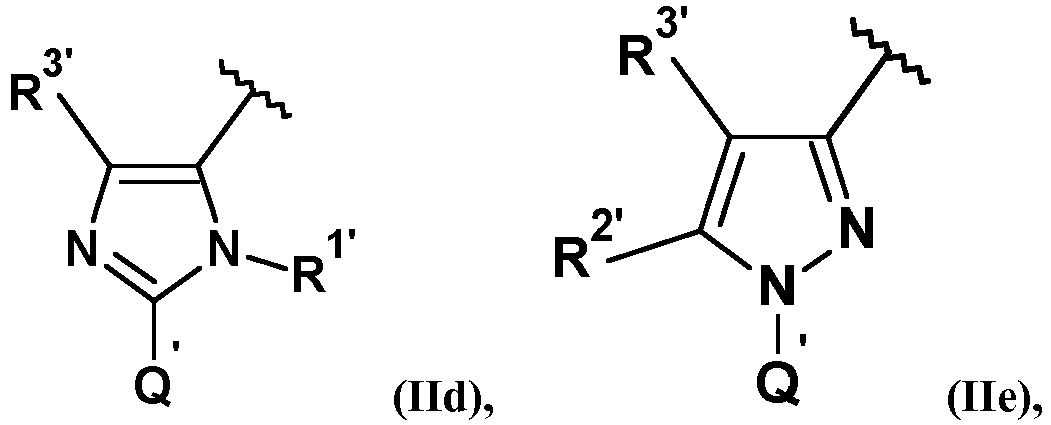
wobei - im Falle (IIa) R2', R3' jeweils unabhängig voneinander H oder ein substituierter oder unsubstituierter C1-C4-Alkyl, C3-C6-Cycloalkyl Rest sind, wobei R3 zusätzlich ein Halogen Rest sein kann,
- im Falle (IIb) R2' H oder ein substituierter oder unsubstituierter C1-C4-Alkyl, oder C3-C6-Cycloalkyl Rest ist,
- im Falle (IIc) R2', R3' jeweils unabhängig voneinander H oder ein substituierter oder unsubstituierter C1-C4-Alkyl, C3-C6-Cycloalkyl oder Phenyl Rest sind,
- im Falle (IId) R1', R3' jeweils unabhängig voneinander H oder ein substituierter oder unsubstituierter C1-C4-Alkyl, C3-C6-Cycloalkyl Rest sind und R3 zusätzlich ein Halogen Rest sein kann,
- im Falle (IIe) R2', R3' jeweils unabhängig voneinander H oder Halogen oder ein substituierter oder unsubstituierter C1-C4-Alkyl, C3-C6-Cycloalkyl Rest sind;
- D' ein unsubstituierter oder mit einem oder mehreren Resten R5' substituierter C1-C6-Alkyl Rest oder Phenyl Rest oder Pyridin, Pyrimidin, Pyrazol, Triazol, Thiazol, Oxazol, Thiadiazol, Oxadiazol, Thiophen, Pyrrol, Furan, Tetrahydrofuran, Dioxan Rest oder ein NR6'R7' Rest ist, wobei
- R6' und R7' jeweils unabhängig voneinander H, ein C1-C6-Alkyl, (C1-C6)Halogenalkyl, (C1-C6)Alkoxy-(C1-C6)alkyl Rest oder unsubstituierter Phenyl oder mit Halogen, C1-C6-Alkyl, (C1-C6)Halogenalkyl, (C1-C6)Alkoxy-(C1-C6)alkyl substituierter Phenyl Rest sind,
- oder einen Ring aus der Reihe Pyrrolidin, Morpholin, Piperidin bilden.
- Ganz besonders bevorzugt ist, wenn
M' ein Rest ausgewählt aus den Resten der Formeln (IVa), (IVb), (IVc), (IVd), (IVe) ist,

- im Falle (IVa) R2'' H, Methyl oder Ethyl ist, R3' H, Methyl, Ethyl oder Halogen ist;
- im Falle (IVb) R2' H, Methyl oder Ethyl ist;
- Q' ein unsubstituierter oder mit einem oder mehreren Resten R4' substituierter Phenyl, Naphthyl, Pyridyl, Pyrimidinyl, Thiophen oder Pyrazol-Rest ist;
- D' ein unsubstituierter oder mit einem oder mehreren Resten R5' substituierter Phenyl, Pyridin, Pyrimidin, Pyrazol, Triazol, Thiazol, Oxazol, Thiadiazol, Oxadiazol, Thiophen, Pyrrol, Furan, Tetrahydrofuran, Dioxan oder C1-C6-Alkyl Rest oder ein NR6'R7' Rest ist.
- Noch weiter bevorzugt ist, wenn
Q' ein unsubstituierter oder mit einem oder mehreren Resten R4' substituierter Phenyl, Naphthyl, Pyridyl, Pyrimidinyl, Thiophen oder Pyrazol-Rest ist;
wobei der oder die Substituenten R4' unabhängig voneinander sind: - Wasserstoff, Cyano, Halogen, Nitro, Acetyl, (C3-C6)Cycloalkyl, (C3-C6)Cycloalkyloxy, (C3-C6)Cycloalkyl-(C3-C6)Cycloalkyl, (C1-C6)Alkyl-(C3-C8)cycloa!kyl, Halogen(C3-C6)cycloalkyl, (C1-C6)Alkyl, (C1-C6)Halogenalkyl, (C1-C6)Cyanoalkyl, (C1-C6)Hydroxyalkyl, (C1-C6)Alkoxycarbonyl-(C1-C6)alkyl, (C1-C6)Alkoxy-(C1-C6)alkyl, (C2-C6)Alkenyl, (C2-C6)Halogenalkenyl, (C2-C6)Alkinyl, (C1-C6)Alkoxy, (C1-C6)Halogenalkoxy, (C1-C6)Alkylthio, (C1-C6)Halogenalkylthio, (C1-C6)Alkylthio-(C1-C6)alkyl, (C1-C6)Alkylsulfinyl, (C1-C6)Halogenalkylsulfinyl, (C1-C6)Alkylsulfonyl, (C1-C6)Halogenalkylsulfonyl, (C1-C6)Alkylsulfonyloxy, (C1-C6)Alkylcarbonyl, (C1-C6)Alkylamino, Di-(C1-C6)Alkylamino, (C1-C6)Alkylcarbonylamino;
- D' ein unsubstituierter oder mit einem oder mehreren Resten R5' substituierter C1-C6-Alkyl Rest oder Phenyl Rest oder Pyridin, Pyrimidin, Pyrazol, Triazol, Thiazol, Oxazol, Thiadiazol, Oxadiazol, Thiophen, Pyrrol, Furan, Tetrahydrofuran, Dioxan Rest ist,
- wobei der oder die Substituenten R5' unabhängig voneinander sind:
- Wasserstoff, Cyano, Halogen, Nitro, Acetyl, Hydroxy, Carboxy, Amino, (C3-C6)Cycloalkyl, (C3-C6)Cycloalkyloxy, (C3-C6)Cycloalkyl-(C3-C6)Cycloalkyl, (C1-C6)Alkyl-(C3-C8)cycloalkyl, Halogen(C3-C6)cycloalkyl, (C1-C6)Alkyl, (C1-C6)Halogenalkyl, (C1-C6)Cyanoalkyl, (C1-C6)Hydroxyalkyl, (C1-C6)Alkoxycarbonyl-(C1-C6)alkyl, (C1-C6)Alkoxy-(C1-C6)alkyl, (C2-C6)Alkenyl, (C2-C6)Halogenalkenyl, (C2-C6)Alkinyl, (C1-C6)Alkoxy, (C1-C6)Halogenalkoxy, (C1-C6)Alkylthio, (C1-C6)Halogenalkylthio, (C1-C6)Alkylthio-(C1-C6)alkyl, (C1-C6)Alkylsulfinyl, (C1-C6)Halogenalkylsulfinyl, (C1-C6)Alkylsulfonyl, (C1-C6)Halogenalkylsulfonyl, (C1-C6)Alkylsulfonyloxy, (C1-C6)Alkylcarbonyl, (C1-C6)Alkylamino, Di-(C1-C6)Alkylamino, (C1-C6)Alkylcarbonylamino, 1-Pyrazolyl- (C1-C3)Alkyl,
- R6' und R7' jeweils unabhängig voneinander
- H, ein C1-C6-Alkyl, (C1-C6)Halogenalkyl, (C1-C6)Alkoxy-(C1-C6)alkyl Rest oder unsubstituierter Phenyl oder mit Halogen, C1-C6-Alkyl, (C1-C6)Halogenalkyl, (C1-C6)Alkoxy-(C1-C6)alkyl substituierter Phenyl Rest sind.
- Schließlich besonders bevorzugt ist auch, wenn
M' ein Rest ausgewählt aus den Resten der Formeln (Va-Vr) ist:


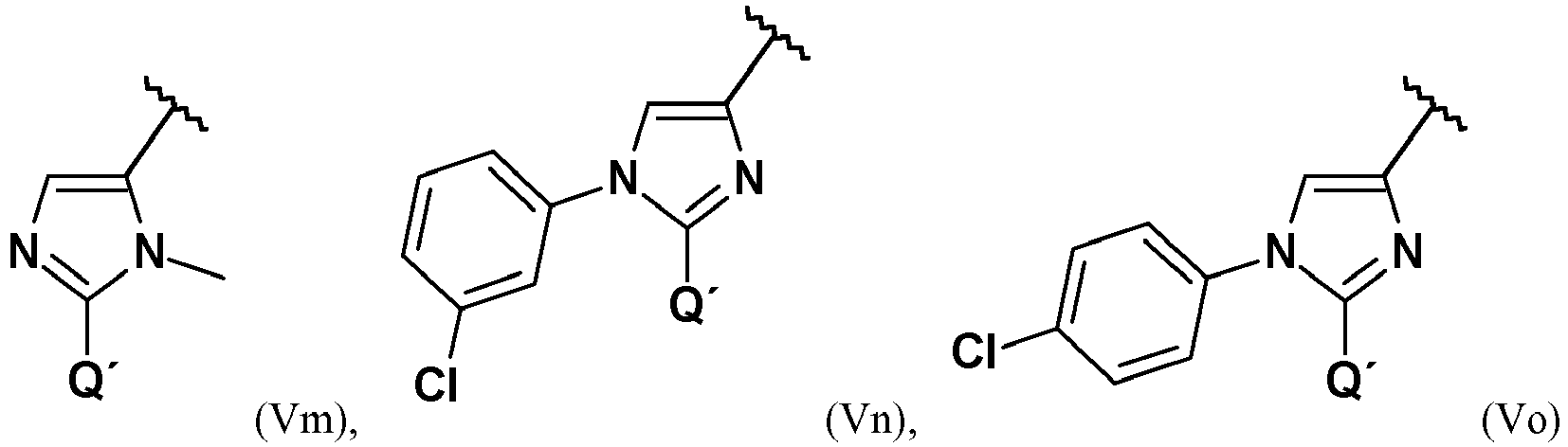

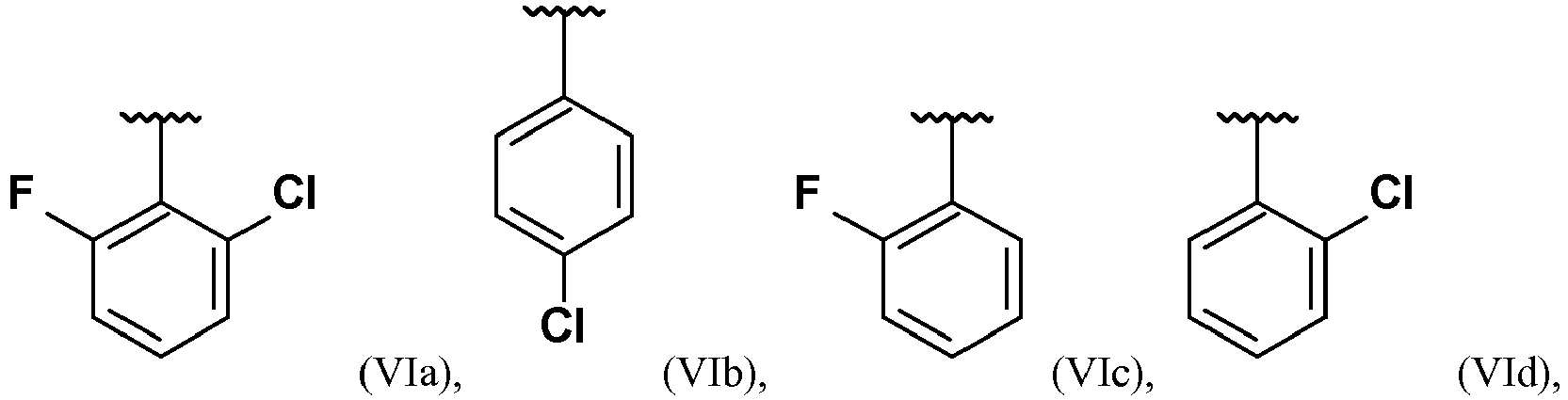







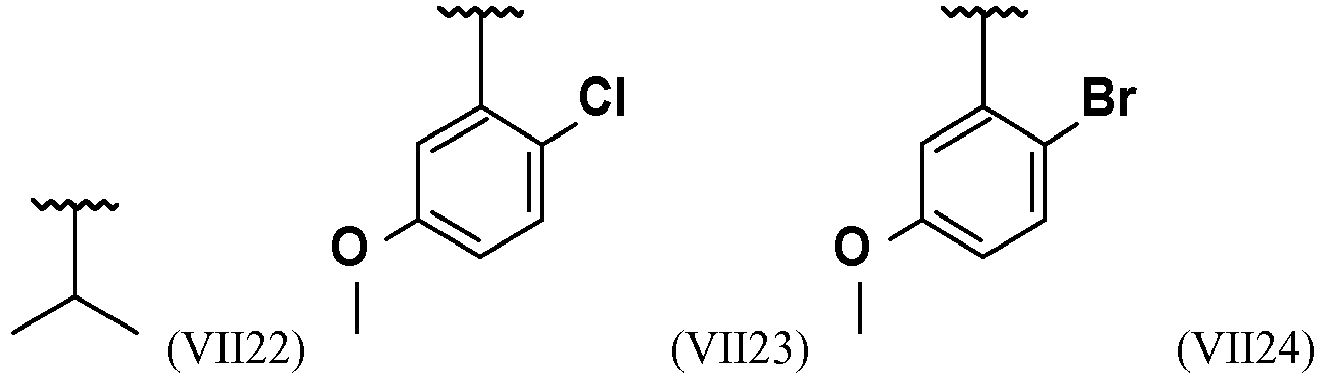


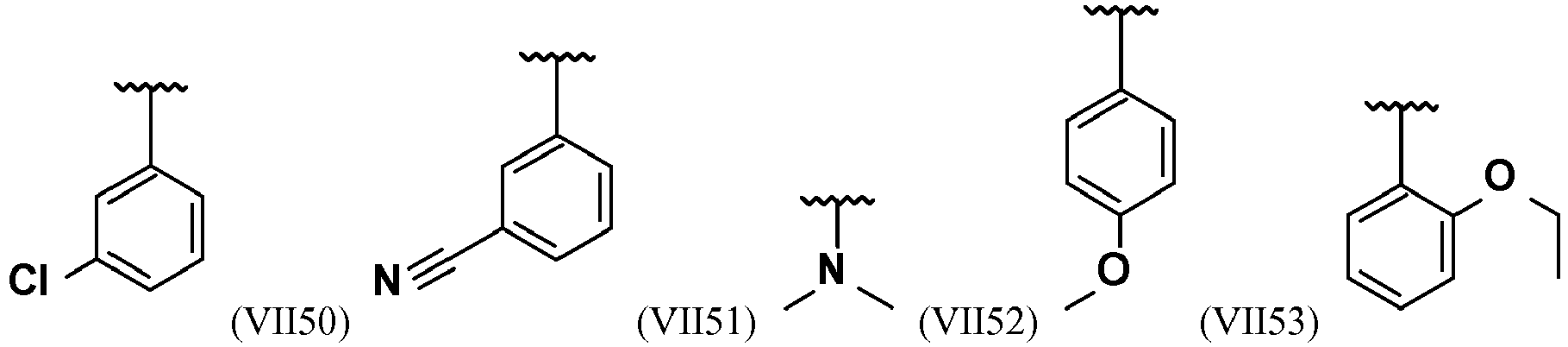


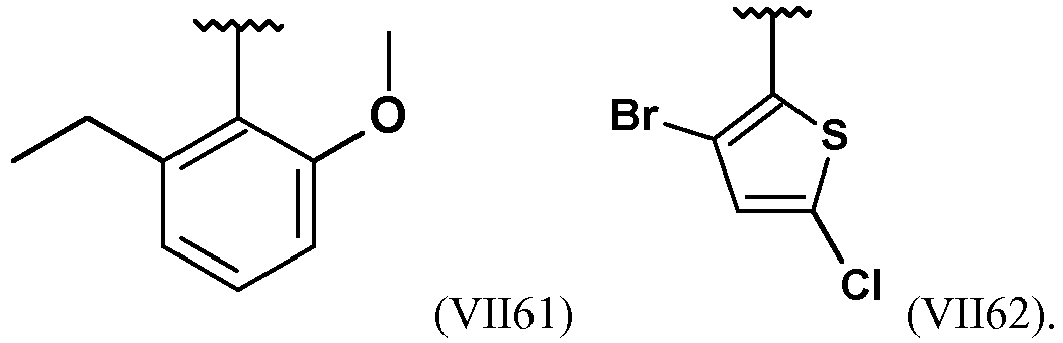
- Im Folgenden ist der Ausdruck Formel (I) gleichbedeutend mit Formel (I) oder Formel (VIII), das heißt alle Ausführungen gelten analog auch für Verbindungen der Formel (VIII).
- Die Verbindungen der Formel (I) können in Abhängigkeit von der Art der Substituenten als geometrische und/oder als optisch aktive Isomere oder entsprechende Isomerengemische in unterschiedlicher Zusammensetzung vorliegen. Diese Stereoisomere sind beispielsweise Enantiomere, Diastereomere, Atropisomere oder geometrische Isomere. Die Erfindung umfasst somit sowohl reine Stereoisomere als auch beliebige Gemische dieser Isomere.
- Die Erfindung betrifft auch Verfahren zur Bekämpfung von tierischen Schädlingen, bei dem man Verbindungen der Formel (I) auf tierische Schädlinge und/oder ihren Lebensraum einwirken lässt. Bevorzugt wird die Bekämpfung der tierischen Schädlinge in der Land- und Forstwirtschaft und im Materialschutz durchgeführt. Verfahren zur chirurgischen oder therapeutischen Behandlung des menschlichen oder tierischen Körpers und Diagnostizierverfahren, die am menschlichen oder tierischen Körper vorgenommen werden, sind ausgeschlossen.
- Die Erfindung betrifft ferner die Verwendung der Verbindungen der Formel (I) als Schädlingsbekämpfungsmittel, insbesondere Pflanzenschutzmittel.
- Im Rahmen der vorliegenden Anmeldung umfasst der Begriff Schädlingsbekämpfungsmittel jeweils immer auch den Begriff Pflanzenschutzmittel.
- Die Verbindungen der Formel (I) eignen sich bei guter Pflanzenverträglichkeit, günstiger Warmblütertoxizität und guter Umweltverträglichkeit zum Schutz von Pflanzen und Pflanzenorganen vor biotischen und abiotischen Stressfaktoren, zur Steigerung der Ernteerträge, Verbesserung der Qualität des Erntegutes und zur Bekämpfung von tierischen Schädlingen, insbesondere Insekten, Spinnentieren, Helminthen, insbesondere Nematoden, und Mollusken, die in der Landwirtschaft, im Gartenbau, bei der Tierzucht, in Aquakulturen, in Forsten, in Gärten und Freizeiteinrichtungen, im Vorrats- und Materialschutz sowie auf dem Hygienesektor vorkommen.
- Im Rahmen der vorliegenden Patentanmeldung ist der Begriff "Hygiene" so zu verstehen, dass damit jegliche und alle Maßnahmen, Vorschriften und Verfahrensweisen gemeint sind, deren Ziel es ist, Krankheiten, insbesondere Infektionskrankheiten, zu verhindern, und die dazu dienen, die Gesundheit von Menschen und Tieren zu schützen und/oder die Umwelt zu schützen, und/oder die Sauberkeit aufrechterhalten. Erfindungsgemäß schließt dies insbesondere Maßnahmen zur Reinigung, Desinfektion und Sterilisation beispielsweise von Textilien oder harten Oberflächen, insbesondere Oberflächen aus Glas, Holz, Zement, Porzellan, Keramik, Kunststoff oder auch Metall(en) ein, um sicherzustellen, dass diese frei von Hygieneschädlingen und/oder ihren Ausscheidungen sind. Vorzugsweise ausgeschlossen vom Schutzbereich der Erfindung sind in dieser Hinsicht chirurgische oder therapeutische, auf den menschlichen Körper oder die Körper von Tieren anzuwendende Behandlungsvorschriften und diagnostische Vorschriften, die am menschlichen Körper oder den Körpern von Tieren durchgeführt werden.
- Der Begriff "Hygienesektor" deckt alle Gebiete, technischen Felder und industriellen Anwendungen ab, bei denen diese Hygienemaßnahmen, -vorschriften und -verfahrensweisen wichtig sind, zum Beispiel im Hinblick auf Hygiene in Küchen, Bäckereien, Flughäfen, Badezimmern, Schwimmbecken, Kaufhäusern, Hotels, Krankenhäusern, Ställen, Tierhaltungen usw.
- Der Begriff "Hygieneschädling" ist daher so zu verstehen, dass damit ein oder mehrere Tierschädlinge gemeint sind, deren Gegenwart im Hygienesektor problematisch ist, insbesondere aus Gesundheitsgründen. Es ist daher ein Hauptziel, das Vorhandensein von Hygieneschädlingen und/oder das Ausgesetztsein ihnen gegenüber im Hygienesektor zu vermeiden oder auf ein Mindestmaß zu begrenzen. Dies lässt sich insbesondere durch die Anwendung eines Pestizids erreichen, das sich sowohl zum Verhindern eines Befalls als auch zum Verhindern eines bereits vorhandenen Befalls einsetzen lässt. Man kann auch Zubereitungen verwenden, die eine Exposition gegenüber Schädlingen verhindern oder reduzieren. Hygieneschädlinge schließen zum Beispiel die unten erwähnten Organismen ein.
- Der Begriff "Hygieneschutz" deckt somit alle Handlungen ab, mit denen diese Hygienemaßnahmen, -vorschriften und -verfahrensweisen aufrechterhalten und/oder verbessert werden.
- Die Verbindungen der Formel (I) können vorzugsweise als Schädlingsbekämpfungsmittel eingesetzt werden. Sie sind gegen normal sensible und resistente Arten sowie gegen alle oder einzelne Entwicklungsstadien wirksam. Zu den oben erwähnten Schädlingen gehören:
- Schädlinge aus dem Stamm der Arthropoda, insbesondere aus der Klasse der Arachnida z. B. Acarus spp., z. B. Acarus siro, Aceria kuko, Aceria sheldoni, Aculops spp., Aculus spp., z. B. Aculus fockeui, Aculus schlechtendali, Amblyomma spp., Amphitetranychus viennensis, Argas spp., Boophilus spp., Brevipalpus spp., z. B. Brevipalpus phoenicis, Bryobia graminum, Bryobia praetiosa, Centruroides spp., Chorioptes spp., Dermanyssus gallinae, Dermatophagoides pteronyssinus, Dermatophagoides farinae, Dermacentor spp., Eotetranychus spp., z. B. Eotetranychus hicoriae, Epitrimerus pyri, Eutetranychus spp., z. B. Eutetranychus banksi, Eriophyes spp., z. B. Eriophyes pyri, Glycyphagus domesticus, Halotydeus destructor, Hemitarsonemus spp., z. B. Hemitarsonemus latus (=Polyphagotarsonemus latus), Hyalomma spp., Ixodes spp., Latrodectus spp., Loxosceles spp., Neutrombicula autumnalis, Nuphersa spp., Oligonychus spp., z. B. Oligonychus coffeae, Oligonychus coniferarum, Oligonychus ilicis, Oligonychus indicus, Oligonychus mangiferus, Oligonychus pratensis, Oligonychus punicae, Oligonychus yothersi, Ornithodorus spp., Ornithonyssus spp., Panonychus spp., z. B. Panonychus citri (=Metatetranychus citri), Panonychus ulmi (=Metatetranychus ulmi), Phyllocoptruta oleivora, Platytetranychus multidigituli, Polyphagotarsonemus latus, Psoroptes spp., Rhipicephalus spp., Rhizoglyphus spp., Sarcoptes spp., Scorpio maurus, Steneotarsonemus spp., Steneotarsonemus spinki, Tarsonemus spp., z. B. Tarsonemus confusus, Tarsonemus pallidus, Tetranychus spp., z. B. Tetranychus canadensis, Tetranychus cinnabarinus, Tetranychus turkestani, Tetranychus urticae, Trombicula alfreddugesi, Vaejovis spp., Vasates lycopersici;
- aus der Klasse der Chilopoda z. B. Geophilus spp., Scutigera spp.;
- aus der Ordnung oder der Klasse der Collembola z. B. Onychiurus armatus; Sminthurus viridis;
- aus der Klasse der Diplopoda z. B. Blaniulus guttulatus;
- aus der Klasse der Insecta, z. B. aus der Ordnung der Blattodea z. B. Blatta orientalis, Blattella asahinai, Blattella germanica, Leucophaea maderae, Loboptera decipiens, Neostylopyga rhombifolia, Panchlora spp., Parcoblatta spp., Periplaneta spp., z. B. Periplaneta americana, Periplaneta australasiae, Pycnoscelus surinamensis, Supella longipalpa;
- aus der Ordnung der Coleoptera z. B. Acalymma vittatum, Acanthoscelides obtectus, Adoretus spp., Aethina tumida, Agelastica alni, Agriotes spp., z. B. Agriotes linneatus, Agriotes mancus, Alphitobius diaperinus, Amphimallon solstitialis, Anobium punctatum, Anoplophora spp., Anthonomus spp., z. B. Anthonomus grandis, Anthrenus spp., Apion spp., Apogonia spp., Atomaria spp., z. B. Atomaria linearis, Attagenus spp., Baris caerulescens, Bruchidius obtectus, Bruchus spp., z. B. Bruchus pisorum, Bruchus rufimanus, Cassida spp., Cerotoma trifurcata, Ceutorrhynchus spp., z. B. Ceutorrhynchus assimilis, Ceutorrhynchus quadridens, Ceutorrhynchus rapae, Chaetocnema spp., z. B. Chaetocnema confinis, Chaetocnema denticulata, Chaetocnema ectypa, Cleonus mendicus, Conoderus spp., Cosmopolites spp., z. B. Cosmopolites sordidus, Costelytra zealandica, Ctenicera spp., Curculio spp., z. B. Curculio caryae, Curculio caryatrypes, Curculio obtusus, Curculio sayi, Cryptolestes ferrugineus, Cryptolestes pusillus, Cryptorhynchus lapathi, Cryptorhynchus mangiferae, Cylindrocopturus spp., Cylindrocopturus adspersus, Cylindrocopturus furnissi, Dermestes spp., Diabrotica spp., z. B. Diabrotica balteata, Diabrotica barberi, Diabrotica undecimpunctata howardi, Diabrotica undecimpunctata undecimpunctata, Diabrotica virgifera virgifera, Diabrotica virgifera zeae, Dichocrocis spp., Dicladispa armigera, Diloboderus spp., Epicaerus spp., Epilachna spp., z. B. Epilachna borealis, Epilachna varivestis, Epitrix spp., z. B. Epitrix cucumeris, Epitrix fuscula, Epitrix hirtipennis, Epitrix subcrinita, Epitrix tuberis, Faustinus spp., Gibbium psylloides, Gnathocerus cornutus, Hellula undalis, Heteronychus arator, Heteronyx spp., Hylamorpha elegans, Hylotrupes bajulus, Hypera postica, Hypomeces squamosus, Hypothenemus spp., z. B. Hypothenemus hampei, Hypothenemus obscurus, Hypothenemus pubescens, Lachnosterna consanguinea, Lasioderma serricorne, Latheticus oryzae, Lathridius spp., Lema spp., Leptinotarsa decemlineata, Leucoptera spp., z. B. Leucoptera coffeella, Lissorhoptrus oryzophilus, Listronotus (=Hyperodes) spp., Lixus spp., Luperodes spp., Luperomorpha xanthodera, Lyctus spp., Megascelis spp., Melanotus spp., z. B. Melanotus longulus oregonensis, Meligethes aeneus, Melolontha spp., z. B. Melolontha melolontha, Migdolus spp., Monochamus spp., Naupactus xanthographus, Necrobia spp., Neogalerucella spp., Niptus hololeucus, Oryctes rhinoceros, Oryzaephilus surinamensis, Oryzaphagus oryzae, Otiorhynchus spp., z. B. Otiorhynchus cribricollis, Otiorhynchus ligustici, Otiorhynchus ovatus, Otiorhynchus rugosostriarus, Otiorhynchus sulcatus, Oulema spp., z. B. Oulema melanopus, Oulema oryzae, Oxycetonia jucunda, Phaedon cochleariae, Phyllophaga spp., Phyllophaga helleri, Phyllotreta spp., z. B. Phyllotreta armoraciae, Phyllotreta pusilla, Phyllotreta ramosa, Phyllotreta striolata, Popillia japonica, Premnotrypes spp., Prostephanus truncatus, Psylliodes spp., z. B. Psylliodes affinis, Psylliodes chrysocephala, Psylliodes punctulata, Ptinus spp., Rhizobius ventralis, Rhizopertha dominica, Rhynchophorus spp., Rhynchophorus ferrugineus, Rhynchophorus palmarum, Sinoxylon perforans, Sitophilus spp., z. B. Sitophilus granarius, Sitophilus linearis, Sitophilus oryzae, Sitophilus zeamais, Sphenophorus spp., Stegobium paniceum, Sternechus spp., z. B. Sternechus paludatus, Symphyletes spp., Tanymecus spp., z. B. Tanymecus dilaticollis, Tanymecus indicus, Tanymecus palliatus, Tenebrio molitor, Tenebrioides mauretanicus, Tribolium spp., z. B. Tribolium audax, Tribolium castaneum, Tribolium confusum, Trogoderma spp., Tychius spp., Xylotrechus spp., Zabrus spp., z. B. Zabrus tenebrioides;
- aus der Ordnung der Dermaptera z. B. Anisolabis maritime, Forficula auricularia, Labidura riparia;
- aus der Ordnung der Diptera z. B. Aedes spp., z. B. Aedes aegypti, Aedes albopictus, Aedes sticticus, Aedes vexans, Agromyza spp., z. B. Agromyza frontella, Agromyza parvicornis, Anastrepha spp., Anopheles spp., z. B. Anopheles quadrimaculatus, Anopheles gambiae, Asphondylia spp., Bactrocera spp., z. B. Bactrocera cucurbitae, Bactrocera dorsalis, Bactrocera oleae, Bibio hortulanus, Calliphora erythrocephala, Calliphora vicina, Ceratitis capitata, Chironomus spp., Chrysomya spp., Chrysops spp., Chrysozona pluvialis, Cochliomya spp., Contarinia spp., z. B. Contarinia johnsoni, Contarinia nasturtii, Contarinia pyrivora, Contarinia schulzi, Contarinia sorghicola, Contarinia tritici, Cordylobia anthropophaga, Cricotopus sylvestris, Culex spp., z. B. Culex pipiens, Culex quinquefasciatus, Culicoides spp., Culiseta spp., Cuterebra spp., Dacus oleae, Dasineura spp., z. B. Dasineura brassicae, Delia spp., z. B. Delia antiqua, Delia coarctata, Delia florilega, Delia platura, Delia radicum, Dermatobia hominis, Drosophila spp., z. B. Drosphila melanogaster, Drosophila suzukii, Echinocnemus spp., Euleia heraclei, Fannia spp., Gasterophilus spp., Glossina spp., Haematopota spp., Hydrellia spp., Hydrellia griseola, Hylemya spp., Hippobosca spp., Hypoderma spp., Liriomyza spp., z. B. Liriomyza brassicae, Liriomyza huidobrensis, Liriomyza sativae, Lucilia spp., z. B. Lucilia cuprina, Lutzomyia spp., Mansonia spp., Musca spp., z. B. Musca domestica, Musca domestica vicina, Oestrus spp., Oscinella frit, Paratanytarsus spp., Paralauterborniella subcincta, Pegomya oder Pegomyia spp., z. B. Pegomya betae, Pegomya hyoscyami, Pegomya rubivora, Phlebotomus spp., Phorbia spp., Phormia spp., Piophila casei, Platyparea poeciloptera, Prodiplosis spp., Psila rosae, Rhagoletis spp., z. B. Rhagoletis cingulata, Rhagoletis completa, Rhagoletis fausta, Rhagoletis indifferens, Rhagoletis mendax, Rhagoletis pomonella, Sarcophaga spp., Simulium spp., z. B. Simulium meridionale, Stomoxys spp., Tabanus spp., Tetanops spp., Tipula spp., z. B. Tipula paludosa, Tipula simplex, Toxotrypana curvicauda;
- aus der Ordnung der Hemiptera z. B. Acizzia acaciaebaileyanae, Acizzia dodonaeae, Acizzia uncatoides, Acrida turrita, Acyrthosipon spp., z. B. Acyrthosiphon pisum, Acrogonia spp., Aeneolamia spp., Agonoscena spp., Aleurocanthus spp., Aleyrodes proletella, Aleurolobus barodensis, Aleurothrixus floccosus, Allocaridara malayensis, Amrasca spp., z. B. Amrasca bigutulla, Amrasca devastans, Anuraphis cardui, Aonidiella spp., z. B. Aonidiella aurantii, Aonidiella citrina, Aonidiella inornata, Aphanostigma piri, Aphis spp., z. B. Aphis citricola, Aphis craccivora, Aphis fabae, Aphis forbesi, Aphis glycines, Aphis gossypii, Aphis hederae, Aphis illinoisensis, Aphis middletoni, Aphis nasturtii, Aphis nerii, Aphis pomi, Aphis spiraecola, Aphis viburniphila, Arboridia apicalis, Arytainilla spp., Aspidiella spp., Aspidiotus spp., z. B. Aspidiotus nerii, Atanus spp., Aulacorthum solani, Bemisia tabaci, Blastopsylla occidentalis, Boreioglycaspis melaleucae, Brachycaudus helichrysi, Brachycolus spp., Brevicoryne brassicae, Cacopsylla spp., z. B. Cacopsylla pyricola, Calligypona marginata, Capulinia spp., Carneocephala fulgida, Ceratovacuna lanigera, Cercopidae, Ceroplastes spp., Chaetosiphon fragaefolii, Chionaspis tegalensis, Chlorita onukii, Chondracris rosea, Chromaphis juglandicola, Chrysomphalus aonidum, Chrysomphalus ficus, Cicadulina mbila, Coccomytilus halli, Coccus spp., z. B. Coccus hesperidum, Coccus longulus, Coccus pseudomagnoliarum, Coccus viridis, Cryptomyzus ribis, Cryptoneossa spp., Ctenarytaina spp., Dalbulus spp., Dialeurodes chittendeni, Dialeurodes citri, Diaphorina citri, Diaspis spp., Diuraphis spp., Doralis spp., Drosicha spp., Dysaphis spp., z. B. Dysaphis apiifolia, Dysaphis plantaginea, Dysaphis tulipae, Dysmicoccus spp., Empoasca spp., z. B. Empoasca abrupta, Empoasca fabae, Empoasca maligna, Empoasca solana, Empoasca stevensi, Eriosoma spp., z. B. Eriosoma americanum, Eriosoma lanigerum, Eriosoma pyricola, Erythroneura spp., Eucalyptolyma spp., Euphyllura spp., Euscelis bilobatus, Ferrisia spp., Fiorinia spp., Furcaspis oceanica, Geococcus coffeae, Glycaspis spp., Heteropsylla cubana, Heteropsylla spinulosa, Homalodisca coagulata, Hyalopterus arundinis, Hyalopterus pruni, Icerya spp., z. B. Icerya purchasi, Idiocerus spp., Idioscopus spp., Laodelphax striatellus, Lecanium spp., z. B. Lecanium corni (=Parthenolecanium corni), Lepidosaphes spp., z. B. Lepidosaphes ulmi, Lipaphis erysimi, Lopholeucaspis japonica, Lycorma delicatula, Macrosiphum spp., z. B. Macrosiphum euphorbiae, Macrosiphum lilii, Macrosiphum rosae, Macrosteles facifrons, Mahanarva spp., Melanaphis sacchari, Metcalfiella spp., Metcalfa pruinosa, Metopolophium dirhodum, Monellia costalis, Monelliopsis pecanis, Myzus spp., z. B. Myzus ascalonicus, Myzus cerasi, Myzus ligustri, Myzus ornatus, Myzus persicae, Myzus nicotianae, Nasonovia ribisnigri, Neomaskellia spp., Nephotettix spp., z. B. Nephotettix cincticeps, Nephotettix nigropictus, Nettigoniclla spectra, Nilaparvata lugens, Oncometopia spp., Orthezia praelonga, Oxya chinensis, Pachypsylla spp., Parabemisia myricae, Paratrioza spp., z. B. Paratrioza cockerelli, Parlatoria spp., Pemphigus spp., z. B. Pemphigus bursarius, Pemphigus populivenae, Peregrinus maidis, Perkinsiella spp., Phenacoccus spp., z. B. Phenacoccus madeirensis, Phloeomyzus passerinii, Phorodon humuli, Phylloxera spp., z. B. Phylloxera devastatrix, Phylloxera notabilis, Pinnaspis aspidistrae, Planococcus spp., z. B. Planococcus citri, Prosopidopsylla flava, Protopulvinaria pyriformis, Pseudaulacaspis pentagona, Pseudococcus spp., z. B. Pseudococcus calceolariae, Pseudococcus comstocki, Pseudococcus longispinus, Pseudococcus maritimus, Pseudococcus viburni, Psyllopsis spp., Psylla spp., z. B. Psylla buxi, Psylla mali, Psylla pyri, Pteromalus spp., Pulvinaria spp., Pyrilla spp., Quadraspidiotus spp., z. B. Quadraspidiotus juglansregiae, Quadraspidiotus ostreaeformis, Quadraspidiotus perniciosus, Quesada gigas, Rastrococcus spp., Rhopalosiphum spp., z. B. Rhopalosiphum maidis, Rhopalosiphum oxyacanthae, Rhopalosiphum padi, Rhopalosiphum rufiabdominale, Saissetia spp., z. B. Saissetia coffeae, Saissetia miranda, Saissetia neglecta, Saissetia oleae, Scaphoideus titanus, Schizaphis graminum, Selenaspidus articulatus, Sipha flava, Sitobion avenae, Sogata spp., Sogatella furcifera, Sogatodes spp., Stictocephala festina, Siphoninus phillyreae, Tenalaphara malayensis, Tetragonocephela spp., Tinocallis caryaefoliae, Tomaspis spp., Toxoptera spp., z. B. Toxoptera aurantii, Toxoptera citricidus, Trialeurodes vaporariorum, Trioza spp., z. B. Trioza diospyri, Typhlocyba spp., Unaspis spp., Viteus vitifolii, Zygina spp.;
- aus der Unterordnung der Heteroptera z. B. Aelia spp., Anasa tristis, Antestiopsis spp., Boisea spp., Blissus spp., Calocoris spp., Campylomma livida, Cavelerius spp., Cimex spp., z. B. Cimex adjunctus, Cimex hemipterus, Cimex lectularius, Cimex pilosellus, Collaria spp., Creontiades dilutus, Dasynus piperis, Dichelops furcatus, Diconocoris hewetti, Dysdercus spp., Euschistus spp., z. B. Euschistus heros, Euschistus servus, Euschistus tristigmus, Euschistus variolarius, Eurydema spp., Eurygaster spp., Halyomorpha halys, Heliopeltis spp., Horcias nobilellus, Leptocorisa spp., Leptocorisa varicornis, Leptoglossus occidentalis, Leptoglossus phyllopus, Lygocoris spp., z. B. Lygocoris pabulinus, Lygus spp., z. B. Lygus elisus, Lygus hesperus, Lygus lineolaris, Macropes excavatus, Megacopta cribraria, Miridae, Monalonion atratum, Nezara spp., z. B. Nezara viridula, Nysius spp., Oebalus spp., Pentomidae, Piesma quadrata, Piezodorus spp., z. B. Piezodorus guildinii, Psallus spp., Pseudacysta persea, Rhodnius spp., Sahlbergella singularis, Scaptocoris castanea, Scotinophora spp., Stephanitis nashi, Tibraca spp., Triatoma spp.;
- aus der Ordnung der Hymenoptera z. B. Acromyrmex spp., Athalia spp., z. B. Athalia rosae, Atta spp., Camponotus spp., Dolichovespula spp., Diprion spp., z. B. Diprion similis, Hoplocampa spp., z. B. Hoplocampa cookei, Hoplocampa testudinea, Lasius spp., Linepithema (Iridiomyrmex) humile, Monomorium pharaonis, Paratrechina spp., Paravespula spp., Plagiolepis spp., Sirex spp., Solenopsis invicta, Tapinoma spp., Technomyrmex albipes, Urocerus spp., Vespa spp., z. B. Vespa crabro, Wasmannia auropunctata, Xeris spp.;
- aus der Ordnung der Isopoda z. B. Armadillidium vulgare, Oniscus asellus, Porcellio scaber;
- aus der Ordnung der Isoptera z. B. Coptotermes spp., z. B. Coptotermes formosanus, Cornitermes cumulans, Cryptotermes spp., Incisitermes spp., Kalotermes spp., Microtermes obesi, Nasutitermis spp., Odontotermes spp., Porotermes spp., Reticulitermes spp., z. B. Reticulitermes flavipes, Reticulitermes hesperus;
- aus der Ordnung der Lepidoptera z. B. Achroia grisella, Acronicta major, Adoxophyes spp., z. B. Adoxophyes orana, Aedia leucomelas, Agrotis spp., z. B. Agrotis segetum, Agrotis ipsilon, Alabama spp., z. B. Alabama argillacea, Amyelois transitella, Anarsia spp., Anticarsia spp., z. B. Anticarsia gemmatalis, Argyroploce spp., Autographa spp., Barathra brassicae, Blastodacna atra, Borbo cinnara, Bucculatrix thurberiella, Bupalus piniarius, Busseola spp., Cacoecia spp., Caloptilia theivora, Capua reticulana, Carpocapsa pomonella, Carposina niponensis, Cheimatobia brumata, Chilo spp., z. B. Chilo plejadellus, Chilo suppressalis, Choreutis pariana, Choristoneura spp., Chrysodeixis chalcites, Clysia ambiguella, Cnaphalocerus spp., Cnaphalocrocis medinalis, Cnephasia spp., Conopomorpha spp., Conotrachelus spp., Copitarsia spp., Cydia spp., z. B. Cydia nigricana, Cydia pomonella, Dalaca noctuides, Diaphania spp., Diparopsis spp., Diatraea saccharalis, Earias spp., Ecdytolopha aurantium, Elasmopalpus lignosellus, Eldana saccharina, Ephestia spp., z. B. Ephestia elutella, Ephestia kuehniella, Epinotia spp., Epiphyas postvittana, Erannis spp., Erschoviella musculana, Etiella spp., Eudocima spp., Eulia spp., Eupoecilia ambiguella, Euproctis spp., z. B. Euproctis chrysorrhoea, Euxoa spp., Feltia spp., Galleria mellonella, Gracillaria spp., Grapholitha spp., z. B. Grapholita molesta, Grapholita prunivora, Hedylepta spp., Helicoverpa spp., z. B. Helicoverpa armigera, Helicoverpa zea, Heliothis spp., z. B. Heliothis virescens Hofmannophila pseudospretella, Homoeosoma spp., Homona spp., Hyponomeuta padella, Kakivoria flavofasciata, Lampides spp., Laphygma spp., Laspeyresia molesta, Leucinodes orbonalis, Leucoptera spp., z. B. Leucoptera coffeella, Lithocolletis spp., z. B. Lithocolletis blancardella, Lithophane antennata, Lobesia spp., z. B. Lobesia botrana, Loxagrotis albicosta, Lymantria spp., z. B. Lymantria dispar, Lyonetia spp., z. B. Lyonetia clerkella, Malacosoma neustria, Maruca testulalis, Mamestra brassicae, Melanitis leda, Mocis spp., Monopis obviella, Mythimna separata, Nemapogon cloacellus, Nymphula spp., Oiketicus spp., Omphisa spp., Operophtera spp., Oria spp., Orthaga spp., Ostrinia spp., z. B. Ostrinia nubilalis, Panolis flammea, Parnara spp., Pectinophora spp., z. B. Pectinophora gossypiella, Perileucoptera spp., Phthorimaea spp., z. B. Phthorimaea operculella, Phyllocnistis citrella, Phyllonorycter spp., z. B. Phyllonorycter blancardella, Phyllonorycter crataegella, Pieris spp., z. B. Pieris rapae, Platynota stultana, Plodia interpunctella, Plusia spp., Plutella xylostella (=Plutella maculipennis), Prays spp., Prodenia spp., Protoparce spp., Pseudaletia spp., z. B. Pseudaletia unipuncta, Pseudoplusia includens, Pyrausta nubilalis, Rachiplusia nu, Schoenobius spp., z. B. Schoenobius bipunctifer, Scirpophaga spp., z. B. Scirpophaga innotata, Scotia segetum, Sesamia spp., z. B. Sesamia inferens, Sparganothis spp., Spodoptera spp., z. B. Spodoptera eradiana, Spodoptera exigua, Spodoptera frugiperda, Spodoptera praefica, Stathmopoda spp., Stenoma spp., Stomopteryx subsecivella, Synanthedon spp., Tecia solanivora, Thaumetopoea spp., Thermesia gemmatalis, Tinea cloacella, Tinea pellionella, Tineola bisselliella, Tortrix spp., Trichophaga tapetzella, Trichoplusia spp., z. B. Trichoplusia ni, Tryporyza incertulas, Tuta absoluta, Virachola spp.;
- aus der Ordnung der Orthoptera oder Saltatoria z. B. Acheta domesticus, Dichroplus spp., Gryllotalpa spp., z. B. Gryllotalpa gryllotalpa, Hieroglyphus spp., Locusta spp., z. B. Locusta migratoria, Melanoplus spp., z. B. Melanoplus devastator, Paratlanticus ussuriensis, Schistocerca gregaria;
- aus der Ordnung der Phthiraptera z. B. Damalinia spp., Haematopinus spp., Linognathus spp., Pediculus spp., Phylloxera vastatrix, Phthirus pubis, Trichodectes spp.;
- aus der Ordnung der Psocoptera z. B. Lepinotus spp., Liposcelis spp.;
- aus der Ordnung der Siphonaptera z. B. Ceratophyllus spp., Ctenocephalides spp., z. B. Ctenocephalides canis, Ctenocephalides felis, Pulex irritans, Tunga penetrans, Xenopsylla cheopis;
- aus der Ordnung der Thysanoptera z. B. Anaphothrips obscurus, Baliothrips biformis, Chaetanaphothrips leeuweni, Drepanothrips reuteri, Enneothrips flavens, Frankliniella spp., z. B. Frankliniella fusca, Frankliniella occidentalis, Frankliniella schultzei, Frankliniella tritici, Frankliniella vaccinii, Frankliniella williamsi, Haplothrips spp., Heliothrips spp., Hercinothrips femoralis, Kakothrips spp., Rhipiphorothrips cruentatus, Scirtothrips spp., Taeniothrips cardamomi, Thrips spp., z. B. Thrips palmi, Thrips tabaci;
- aus der Ordnung der Zygentoma (= Thysanura), z. B. Ctenolepisma spp., Lepisma saccharina, Lepismodes inquilinus, Thermobia domestica;
- aus der Klasse der Symphyla z. B. Scutigerella spp., z. B. Scutigerella immaculata;
- Schädlinge aus dem Stamm der Mollusca, z. B. aus der Klasse der Bivalvia, z. B. Dreissena spp.;
- sowie aus der Klasse der Gastropoda z. B. Arion spp., z. B. Arion ater rufus, Biomphalaria spp., Bulinus spp., Deroceras spp., z. B. Deroceras laeve, Galba spp., Lymnaea spp., Oncomelania spp., Pomacea spp., Succinea spp.;
- Pflanzenschädlinge aus dem Stamm der Nematoda, d. h. pflanzenparasitäre Nematoden, insbesondere Aglenchus spp., z. B. Aglenchus agricola, Anguina spp., z. B. Anguina tritici, Aphelenchoides spp., z. B. Aphelenchoides arachidis, Aphelenchoides fragariae, Belonolaimus spp., z. B. Belonolaimus gracilis, Belonolaimus longicaudatus, Belonolaimus nortoni, Bursaphelenchus spp., z. B. Bursaphelenchus cocophilus, Bursaphelenchus eremus, Bursaphelenchus xylophilus, Cacopaurus spp., z. B. Cacopaurus pestis, Criconemella spp., z. B. Criconemella curvata, Criconemella onoensis, Criconemella ornata, Criconemella rusium, Criconemella xenoplax (= Mesocriconema xenoplax), Criconemoides spp., z. B. Criconemoides ferniae, Criconemoides onoense, Criconemoides ornatum, Ditylenchus spp., z. B. Ditylenchus dipsaci, Dolichodorus spp., Globodera spp., z. B. Globodera pallida, Globodera rostochiensis, Helicotylenchus spp., z. B. Helicotylenchus dihystera, Hemicriconemoides spp., Hemicycliophora spp., Heterodera spp., z. B. Heterodera avenae, Heterodera glycines, Heterodera schachtii, Hirschmaniella spp., Hoplolaimus spp., Longidorus spp., z. B. Longidorus africanus, Meloidogyne spp., z. B. Meloidogyne chitwoodi, Meloidogyne fallax, Meloidogyne hapla, Meloidogyne incognita, Meloinema spp., Nacobbus spp., Neotylenchus spp., Paralongidorus spp., Paraphelenchus spp., Paratrichodorus spp., z. B. Paratrichodorus minor, Paratylenchus spp., Pratylenchus spp., z. B. Pratylenchus penetrans, Pseudohalenchus spp., Psilenchus spp., Punctodera spp., Quinisulcius spp., Radopholus spp., z. B. Radopholus citrophilus, Radopholus similis, Rotylenchulus spp., Rotylenchus spp., Scutellonema spp., Subanguina spp., Trichodorus spp., z. B. Trichodorus obtusus, Trichodorus primitivus, Tylenchorhynchus spp., z. B. Tylenchorhynchus annulatus, Tylenchulus spp., z. B. Tylenchulus semipenetrans, Xiphinema spp., z. B. Xiphinema index.
- Die Verbindungen der Formel (I) können gegebenenfalls in bestimmten Konzentrationen bzw. Aufwandmengen auch als Herbizide, Safener, Wachstumsregulatoren oder Mittel zur Verbesserung der Pflanzeneigenschaften, als Mikrobizide oder Gametozide, beispielsweise als Fungizide, Antimykotika, Bakterizide, Virizide (einschließlich Mittel gegen Viroide) oder als Mittel gegen MLO (Mycoplasmalike-organism) und RLO (Rickettsia-like-organism) verwendet werden. Sie lassen sich gegebenenfalls auch als Zwischen- oder Vorprodukte für die Synthese weiterer Wirkstoffe einsetzen.
- Die vorliegende Erfindung betrifft weiterhin Formulierungen und daraus bereitete Anwendungsformen als Schädlingsbekämpfungsmittel wie z. B. Drench-, Drip- und Spritzbrühen, umfassend mindestens eine Verbindung der Formel (I). Gegebenenfalls enthalten die Anwendungsformen weitere Schädlingsbekämpfungsmittel und/oder die Wirkung verbessernde Adjuvantien wie Penetrationsförderer, z. B. pflanzliche Öle wie beispielsweise Rapsöl, Sonnenblumenöl, Mineralöle wie beispielsweise Paraffinöle, Alkylester pflanzlicher Fettsäuren wie beispielsweise Rapsöl- oder Sojaölmethylester oder Alkanol-alkoxylate und/oder Spreitmittel wie beispielsweise Alkylsiloxane und/oder Salze, z. B. organische oder anorganische Ammonium- oder Phosphoniumsalze wie beispielsweise Ammoniumsulfat oder Diammonium-hydrogenphosphat und/oder die Retention fördernde Mittel wie z. B. Dioctylsulfosuccinat oder Hydroxypropyl-guar-Polymere und/oder Humectants wie z. B. Glycerin und/oder Dünger wie beispielsweise Ammonium, Kalium oder Phosphor enthaltende Dünger.
- Übliche Formulierungen sind beispielsweise wasserlösliche Flüssigkeiten (SL), Emulsionskonzentrate (EC), Emulsionen in Wasser (EW), Suspensionskonzentrate (SC, SE, FS, OD), in Wasser dispergierbare Granulate (WG), Granulate (GR) und Kapselkonzentrate (CS); diese und weitere mögliche Formuliertypen sind beispielsweise durch Crop Life International und in Pesticide Specifications, Manual on development and use of FAO and WHO specifications for pesticides, FAO Plant Production and Protection Papers - 173, prepared by the FAO/WHO Joint Meeting on Pesticide Specifications, 2004, ISBN: 9251048576 beschrieben. Gegebenenfalls enthalten die Formulierungen neben einer oder mehreren Verbindungen der Formel (I) weitere agrochemische Wirkstoffe.
- Vorzugsweise handelt es sich um Formulierungen oder Anwendungsformen, welche Hilfsstoffe wie beispielsweise Streckmittel, Lösemittel, Spontanitätsförderer, Trägerstoffe, Emulgiermittel, Dispergiermittel, Frostschutzmittel, Biozide, Verdicker und/oder weitere Hilfsstoffe wie beispielsweise Adjuvantien enthalten. Ein Adjuvant in diesem Kontext ist eine Komponente, die die biologische Wirkung der Formulierung verbessert, ohne dass die Komponente selbst eine biologische Wirkung hat. Beispiele für Adjuvantien sind Mittel, die die Retention, das Spreitverhalten, das Anhaften an der Blattoberfläche oder die Penetration fördern.
- Diese Formulierungen werden in bekannter Weise hergestellt, z. B. durch Vermischen der Verbindungen der Formel (I) mit Hilfsstoffen wie beispielsweise Streckmitteln, Lösemitteln und/oder festen Trägerstoffen und/oder weiteren Hilfsstoffen wie beispielsweise oberflächenaktiven Stoffen. Die Herstellung der Formulierungen erfolgt entweder in geeigneten Anlagen oder auch vor oder während der Anwendung.
- Als Hilfsstoffe können solche Stoffe Verwendung finden, die geeignet sind, der Formulierung der Verbindungen der Formel (I) oder den aus diesen Formulierungen bereiteten Anwendungsformen (wie z. B. gebrauchsfähigen Schädlingsbekämpfungsmitteln wie Spritzbrühen oder Saatgutbeizen) besondere Eigenschaften, wie bestimmte physikalische, technische und/oder biologische Eigenschaften zu verleihen.
- Als Streckmittel eignen sich z. B. Wasser, polare und unpolare organische chemische Flüssigkeiten z. B. aus den Klassen der aromatischen und nicht-aromatischen Kohlenwasserstoffe (wie Paraffine, Alkylbenzole, Alkylnaphthaline, Chlorbenzole), der Alkohole und Polyole (die ggf. auch substituiert, verethert und/oder verestert sein können), der Ketone (wie Aceton, Cyclohexanon), Ester (auch Fette und Öle) und (Poly-)Ether, der einfachen und substituierten Amine, Amide, Lactame (wie N-Alkylpyrrolidone) und Lactone, der Sulfone und Sulfoxide (wie Dimethylsulfoxid).
- Im Falle der Benutzung von Wasser als Streckmittel können z. B. auch organische Lösemittel als Hilfslösemittel verwendet werden. Als flüssige Lösemittel kommen im Wesentlichen infrage: Aromaten wie Xylol, Toluol oder Alkylnaphthaline, chlorierte Aromaten oder chlorierte aliphatische Kohlenwasserstoffe wie Chlorbenzole, Chlorethylene oder Methylenchlorid, aliphatische Kohlenwasserstoffe, wie Cyclohexan oder Paraffine, z. B. Erdölfraktionen, mineralische und pflanzliche Öle, Alkohole wie Butanol oder Glykol sowie deren Ether und Ester, Ketone wie Aceton, Methylethylketon, Methylisobutylketon oder Cyclohexanon, stark polare Lösemittel wie Dimethylformamid und Dimethylsulfoxid sowie Wasser.
- Grundsätzlich können alle geeigneten Lösemittel verwendet werden. Geeignete Lösemittel sind beispielsweise aromatische Kohlenwasserstoffe wie z. B. Xylol, Toluol oder Alkylnaphthaline, chlorierte aromatische oder chlorierte aliphatische Kohlenwasserstoffe wie z. B. Chlorbenzol, Chlorethylen, oder Methylenchlorid, aliphatische Kohlenwasserstoffe wie z. B. Cyclohexan, Paraffine, Erdölfraktionen, mineralische und pflanzliche Öle, Alkohole wie z. B. Methanol, Ethanol, iso-Propanol, Butanol oder Glykol sowie deren Ether und Ester, Ketone wie z. B. Aceton, Methylethylketon, Methylisobutylketon oder Cyclohexanon, stark polare Lösemittel wie Dimethylsulfoxid sowie Wasser.
- Grundsätzlich können alle geeigneten Trägerstoffe eingesetzt werden. Als Trägerstoffe kommen insbesondere infrage: z. B. Ammoniumsalze und natürliche Gesteinsmehle wie Kaoline, Tonerden, Talkum, Kreide, Quarz, Attapulgit, Montmorillonit oder Diatomeenerde und synthetische Gesteinsmehle, wie hochdisperse Kieselsäure, Aluminiumoxid und natürliche oder synthetische Silikate, Harze, Wachse und/oder feste Düngemittel. Mischungen solcher Trägerstoffe können ebenfalls verwendet werden. Als Trägerstoffe für Granulate kommen infrage: z. B. gebrochene und fraktionierte natürliche Gesteine wie Calcit, Marmor, Bims, Sepiolith, Dolomit sowie synthetische Granulate aus anorganischen und organischen Mehlen sowie Granulate aus organischem Material wie Sägemehl, Papier, Kokosnussschalen, Maiskolben und Tabakstängel.
- Auch verflüssigte gasförmige Streckmittel oder Lösemittel können eingesetzt werden. Insbesondere eignen sich solche Streckmittel oder Trägerstoffe, welche bei normaler Temperatur und unter Normaldruck gasförmig sind, z. B. Aerosol-Treibgase wie Halogenkohlenwasserstoffe sowie Butan, Propan, Stickstoff und Kohlendioxid.
- Beispiele für Emulgier- und/oder Schaum erzeugende Mittel, Dispergiermittel oder Benetzungsmittel mit ionischen oder nicht-ionischen Eigenschaften oder Mischungen dieser oberflächenaktiven Stoffe sind Salze von Polyacrylsäure, Salze von Lignosulfonsäure, Salze von Phenolsulfonsäure oder Naphthalinsulfonsäure, Polykondensate von Ethylenoxid mit Fettalkoholen oder mit Fettsäuren oder mit Fettaminen, mit substituierten Phenolen (vorzugsweise Alkylphenole oder Arylphenole), Salze von Sulfobernsteinsäureestern, Taurinderivate (vorzugsweise Alkyltaurate), Phosphorsäureester von polyethoxylierten Alkoholen oder Phenolen, Fettsäureester von Polyolen und Derivate der Verbindungen enthaltend Sulfate, Sulfonate und Phosphate, z. B. Alkylarylpolyglycolether, Alkylsulfonate, Alkylsulfate, Arylsulfonate, Eiweißhydrolysate, Lignin-Sulfitablaugen und Methylcellulose. Die Anwesenheit einer oberflächenaktiven Substanz ist vorteilhaft, wenn eine der Verbindungen der Formel (I) und/oder einer der inerten Trägerstoffe nicht in Wasser löslich ist und wenn die Anwendung in Wasser erfolgt.
- Als weitere Hilfsstoffe können in den Formulierungen und den daraus abgeleiteten Anwendungsformen Farbstoffe wie anorganische Pigmente, z. B. Eisenoxid, Titanoxid, Ferrocyanblau und organische Farbstoffe wie Alizarin-, Azo- und Metallphthalocyaninfarbstoffe und Nähr- und Spurennährstoffe wie Salze von Eisen, Mangan, Bor, Kupfer, Kobalt, Molybdän und Zink vorhanden sein.
- Weiterhin enthalten sein können Stabilisatoren wie Kältestabilisatoren, Konservierungsmittel, Oxidationsschutzmittel, Lichtschutzmittel oder andere die chemische und/oder physikalische Stabilität verbessernde Mittel. Weiterhin enthalten sein können schaumerzeugende Mittel oder Entschäumer.
- Ferner können die Formulierungen und daraus abgeleiteten Anwendungsformen als zusätzliche Hilfsstoffe auch Haftmittel wie Carboxymethylcellulose, natürliche und synthetische pulverige, körnige oder latexförmige Polymere enthalten wie Gummiarabikum, Polyvinylalkohol, Polyvinylacetat sowie natürliche Phospholipide wie Kephaline und Lecithine und synthetische Phospholipide. Weitere Hilfsstoffe können mineralische und pflanzliche Öle sein.
- Gegebenenfalls können noch weitere Hilfsstoffe in den Formulierungen und den daraus abgeleiteten Anwendungsformen enthalten sein. Solche Zusatzstoffe sind beispielsweise Duftstoffe, schützende Kolloide, Bindemittel, Klebstoffe, Verdicker, thixotrope Stoffe, Penetrationsförderer, Retentionsförderer, Stabilisatoren, Sequestiermittel, Komplexbildner, Feuchthaltemittel, Spreitmittel. Im Allgemeinen können die Verbindungen der Formel (I) mit jedem festen oder flüssigen Zusatzstoff, welcher für Formulierungszwecke gewöhnlich verwendet wird, kombiniert werden.
- Als Retentionsförderer kommen alle diejenigen Substanzen in Betracht, die die dynamische Oberflächenspannung verringern wie beispielsweise Dioctylsulfosuccinat oder die die Visko-Elastizität erhöhen wie beispielsweise Hydroxypropyl-guar-Polymere.
- Als Penetrationsförderer kommen im vorliegenden Zusammenhang alle diejenigen Substanzen in Betracht, die üblicherweise eingesetzt werden, um das Eindringen von agrochemischen Wirkstoffen in Pflanzen zu verbessern. Penetrationsförderer werden in diesem Zusammenhang dadurch definiert, dass sie aus der (in der Regel wässerigen) Applikationsbrühe und/oder aus dem Spritzbelag in die Kutikula der Pflanze eindringen und dadurch die Beweglichkeit der Wirkstoffe in der Kutikula erhöhen können. Die in der Literatur (Baur et al., 1997, Pesticide Science 51, 131-152) beschriebene Methode kann zur Bestimmung dieser Eigenschaft eingesetzt werden. Beispielhaft werden genannt Alkoholalkoxylate wie beispielsweise Kokosfettethoxylat (10) oder Isotridecylethoxylat (12), Fettsäureester wie beispielsweise Rapsöl- oder Sojaölmethylester, Fettaminalkoxylate wie beispielsweise Tallowamineethoxylat (15) oder Ammonium- und/oder Phosphonium-Salze wie beispielsweise Ammoniumsulfat oder Diammonium-hydrogenphosphat.
- Die Formulierungen enthalten bevorzugt zwischen 0,00000001 und 98 Gew.-% der Verbindung der Formel (I), besonders bevorzugt zwischen 0,01 und 95 Gew.-% der Verbindung der Formel (I), ganz besonders bevorzugt zwischen 0,5 und 90 Gew.-% der Verbindung der Formel (I), bezogen auf das Gewicht der Formulierung.
- Der Gehalt an der Verbindung der Formel (I) in den aus den Formulierungen bereiteten Anwendungsformen (insbesondere Schädlingsbekämpfungsmittel) kann in weiten Bereichen variieren. Die Konzentration der Verbindung der Formel (I) in den Anwendungsformen kann üblicherweise zwischen 0,00000001 und 95 Gew.-% der Verbindung der Formel (I), vorzugsweise zwischen 0,00001 und 1 Gew.-%, bezogen auf das Gewicht der Anwendungsform, liegen. Die Anwendung geschieht in einer den Anwendungsformen angepaßten üblichen Weise.
- Die Verbindungen der Formel (I) können auch in Mischung mit einem oder mehreren geeigneten Fungiziden, Bakteriziden, Akariziden, Molluskiziden, Nematiziden, Insektiziden, Mikrobiologika, Nützlingen, Herbiziden, Düngemitteln, Vogelrepellentien, Phytotonics, Sterilantien, Safenern, Semiochemicals und/oder Pflanzenwachstumsregulatoren verwendet werden, um so z. B. das Wirkungsspektrum zu verbreitern, die Wirkdauer zu verlängern, die Wirkgeschwindigkeit zu steigern, Repellenz zu verhindern oder Resistenzentwicklungen vorzubeugen. Des Weiteren können solche Wirkstoffkombinationen das Pflanzenwachstum und/oder die Toleranz gegenüber abiotischen Faktoren wie z. B. hohen oder niedrigen Temperaturen, gegen Trockenheit oder gegen erhöhten Wasser- bzw. Bodensalzgehalt verbessern. Auch lässt sich das Blüh- und Fruchtverhalten verbessern, die Keimfähigkeit und Bewurzelung optimieren, die Ernte erleichtern und Ernteertrag steigern, die Reife beeinflussen, die Qualität und/oder der Ernährungswert der Ernteprodukte steigern, die Lagerfähigkeit verlängern und/oder die Bearbeitbarkeit der Ernteprodukte verbessern.
- Weiterhin können die Verbindungen der Formel (I) in Mischung mit weiteren Wirkstoffen oder Semiochemicals, wie Lockstoffen und/oder Vogelrepellentien und/oder Pflanzenaktivatoren und/oder Wachstumsregulatoren und/oder Düngemitteln vorliegen. Gleichfalls können die Verbindungen der Formel (I) zur Verbesserung der Pflanzeneigenschaften wie zum Beispiel Wuchs, Ertrag und Qualität des Erntegutes eingesetzt werden.
- In einer besonderen erfindungsgemäßen Ausführungsform liegen die Verbindungen der Formel (I) in Formulierungen bzw. in den aus diesen Formulierungen bereiteten Anwendungsformen in Mischung mit weiteren Verbindungen vor, vorzugsweise solchen wie nachstehend beschrieben.
- Wenn eine der im Folgenden genannten Verbindungen in verschiedenen tautomeren Formen vorkommen kann, sind auch diese Formen mit umfasst, auch wenn sie sie nicht in jedem Fall explizit genannt wurden. Alle genannten Mischungspartner können außerdem, wenn sie auf Grund ihrer funktionellen Gruppen dazu imstande sind, gegebenenfalls mit geeigneten Basen oder Säuren Salze bilden.
- Die hier mit ihrem "Common Name" genannten Wirkstoffe sind bekannt und beispielsweise im Pestizidhandbuch ("The Pesticide Manual" 16th Ed., British Crop Protection Council 2012) beschrieben oder im Internet recherchierbar (z. B. http://www.alanwood.net/pesticides). Die Klassifizierung basiert auf dem zum Zeitpunkt der Einreichung dieser Patentanmeldung gültigen IRAC Mode of Action Classification Scheme.
- (1) Acetylcholinesterase(AChE)-Inhibitoren, wie beispielsweise Carbamate, z. B. Alanycarb, Aldicarb, Bendiocarb, Benfuracarb, Butocarboxim, Butoxycarboxim, Carbaryl, Carbofuran, Carbosulfan, Ethiofencarb, Fenobucarb, Formetanate, Furathiocarb, Isoprocarb, Methiocarb, Methomyl, Metolcarb, Oxamyl, Pirimicarb, Propoxur, Thiodicarb, Thiofanox, Triazamate, Trimethacarb, XMC und Xylylcarb oder Organophosphate, z. B. Acephat, Azamethiphos, Azinphos-ethyl, Azinphos-methyl, Cadusafos, Chlorethoxyfos, Chlorfenvinphos, Chlormephos, Chlorpyrifos-methyl, Coumaphos, Cyanophos, Demeton-S-methyl, Diazinon, Dichlorvos/DDVP, Dicrotophos, Dimethoat, Dimethylvinphos, Disulfoton, EPN, Ethion, Ethoprophos, Famphur, Fenamiphos, Fenitrothion, Fenthion, Fosthiazat, Heptenophos, Imicyafos, Isofenphos, Isopropyl-O-(methoxyaminothio-phosphoryl)salicylat, Isoxathion, Malathion, Mecarbam, Methamidophos, Methidathion, Mevinphos, Monocrotophos, Naled, Omethoate, Oxydemeton-methyl, Parathion-methyl, Phenthoat, Phorat, Phosalon, Phosmet, Phosphamidon, Phoxim, Pirimiphos-methyl, Profenofos, Propetamphos, Prothiofos, Pyraclofos, Pyridaphenthion, Quinalphos, Sulfotep, Tebupirimfos, Temephos, Terbufos, Tetrachlorvinphos, Thiometon, Triazophos, Triclorfon und Vamidothion.
- (2) GABA-gesteuerte Chlorid-Kanal-Blocker, wie beispielsweise Cyclodien-organochlorine, z. B. Chlordan und Endosulfan oder Phenylpyrazole (Fiprole), z. B. Ethiprol und Fipronil.
- (3) Natrium-Kanal-Modulatoren, wie beispielsweise Pyrethroide, z. B. Acrinathrin, Allethrin, d-cistrans-Allethrin, d-trans-Allethrin, Bifenthrin, Bioallethrin, Bioallethrin-S-cyclopentenyl-Isomer, Bioresmethrin, Cycloprothrin, Cyfluthrin, beta-Cyfluthrin, Cyhalothrin, lambda-Cyhalothrin, gamma-Cyhalothrin, Cypermethrin, alpha-Cypermethrin, beta-Cypermethrin, theta-Cypermethrin, zeta-Cypermethrin, Cyphenothrin [(1R)-trans-Isomer], Deltamethrin, Empenthrin [(EZ)-(1R)-Isomer], Esfenvalerat, Etofenprox, Fenpropathrin, Fenvalerat, Flucythrinat, Flumethrin, tau-Fluvalinat, Halfenprox, Imiprothrin, Kadethrin, Momfluorothrin, Permethrin, Phenothrin [(1R)-trans-Isomer], Prallethrin, Pyrethrine (pyrethrum), Resmethrin, Silafluofen, Tefluthrin, Tetramethrin, Tetramethrin [(1R)-Isomer], Tralomethrin und Transfluthrin oder DDT oder Methoxychlor.
- (4) Kompetitive Modulatoren des nicotinischen Acetylcholin-Rezeptors (nAChR), wie beispielsweise Neonicotinoide, z. B. Acetamiprid, Clothianidin, Dinotefuran, Imidacloprid, Nitenpyram, Thiacloprid und Thiamethoxam oder Nicotin oder Sulfoxaflor oder Flupyradifurone.
- (5) Allosterische Modulatoren des nicotinischen Acetylcholin-Rezeptors (nAChR), wie beispielsweise Spinosyne, z. B. Spinetoram und Spinosad.
- (6) Allosterische Modulatoren des Glutamat-abhängigen Chloridkanals(GluCl), wie beispielsweise Avermectine/Milbemycine, z. B. Abamectin, Emamectin-benzoat, Lepimectin und Milbemectin.
- (7) Juvenilhormon-Mimetika, wie beispielsweise Juvenilhormon-Analoge, z. B. Hydropren, Kinopren und Methopren oder Fenoxycarb oder Pyriproxyfen.
- (8) Verschiedene nicht spezifische (multi-site) Inhibitoren, wie beispielsweise Alkylhalogenide, z. B. Methylbromid und andere Alkylhalogenide; oder Chloropicrin oder Sulfurylfluorid oder Borax oder Brechweinstein oder Methylisocyanaterzeuger, z. B. Diazomet und Metam.
- (9) Modulatoren chordotonaler Organe, z. B. Pymetrozin oder Flonicamid.
- (10) Milbenwachstumsinhibitoren, wie z. B. Clofentezin, Hexythiazox und Diflovidazin oder Etoxazol.
- (11) Mikrobielle Disruptoren der Insektendarmmembran, wie z. B. Bacillus thuringiensis Subspezies israelensis, Bacillus sphaericus, Bacillus thuringiensis Subspezies aizawai, Bacillus thuringiensis Subspezies kurstaki, Bacillus thuringiensis Subspezies tenebrionis und B.t.-Pflanzenproteine: Cry1Ab, Cry1Ac, Cry1Fa, CrylA.105, Cry2Ab, VIP3A, mCry3A, Cry3Ab, Cry3Bb, Cry34Ab1/35Ab1.
- (12) Inhibitoren der mitochondrialen ATP-Synthase, wie ATP-Disruptoren, wie beispielsweise Diafenthiuron oder Organozinnverbindungen, z. B. Azocyclotin, Cyhexatin und Fenbutatin-oxid oder Propargit oder Tetradifon.
- (13) Entkoppler der oxidativen Phoshorylierung durch Störung des Protonengradienten, wie beispielsweise Chlorfenapyr, DNOC und Sulfluramid.
- (14) Blocker des nicotinischen Acetylcholinrezeptorkanals, wie beispielsweise Bensultap, Cartaphydrochlorid, Thiocyclam und Thiosultap-Natrium.
- (15) Inhibitoren der Chitinbiosynthese, Typ 0, wie beispielsweise Bistrifluron, Chlorfluazuron, Diflubenzuron, Flucycloxuron, Flufenoxuron, Hexaflumuron, Lufenuron, Novaluron, Noviflumuron, Teflubenzuron und Triflumuron.
- (16) Inhibitoren der Chitinbiosynthese, Typ 1, wie beispielsweise Buprofezin.
- (17) Häutungsdisruptor (insbesondere bei Dipteren, d. h. Zweiflüglern), wie beispielsweise Cyromazin.
- (18) Ecdyson-Rezeptor-Agonisten, wie beispielsweise Chromafenozid, Halofenozid, Methoxyfenozid und Tebufenozid.
- (19) Oktopamin-Rezeptor-Agonisten, wie beispielsweise Amitraz.
- (20) Mitochondriale Komplex-III-Elektronentransportinhibitoren, wie beispielsweise Hydramethylnon oder Acequinocyl oder Fluacrypyrim.
- (21) Mitochondriale Komplex-I-Elektronentransportinhibitoren, wie beispielsweise METI-Akarizide, z. B. Fenazaquin, Fenpyroximat, Pyrimidifen, Pyridaben, Tebufenpyrad und Tolfenpyrad oder Rotenon (Derris).
- (22) Blocker des spannungsabhängigen Natriumkanals, wie z. B. Indoxacarb oder Metaflumizone.
- (23) Inhibitoren der Acetyl-CoA-Carboxylase, wie beispielsweise Tetron- und Tetramsäurederivate, z. B. Spirodiclofen, Spiromesifen und Spirotetramat.
- (24) Inhibitoren des mitochondrialen Komplex-IV-Elektronentransports, wie beispielsweise Phosphine, z. B. Aluminiumphosphid, Calciumphosphid, Phosphin und Zinkphosphid oder Cyanide, Calciumcyanid, Kaliumcyanid und Natriumcyanid.
- (25) Inhibitoren des mitochondrialen Komplex-II-Elektronentransports, wie beispielsweise beta-Ketonitrilderivate, z. B. Cyenopyrafen und Cyflumetofen und Carboxanilide, wie beispielsweise Pyflubumid.
- (28) Ryanodinrezeptor-Modulatoren, wie beispielsweise Diamide, z. B. Chlorantraniliprol, Cyantraniliprol und Flubendiamid,
- Die hier mit ihrem "Common Name" spezifizierten Wirkstoffe sind bekannt und beispielsweise im "Pesticide Manual" (16. Aufl. British Crop Protection Council) oder im Internet recherchierbar (beispielsweise: http://www.alanwood.net/pesticides) beschrieben.
- Alle genannten Mischungspartner der Klassen (1) bis (15) können, wenn sie auf Grund ihrer funktionellen Gruppen dazu imstande sind, gegebenenfalls mit geeigneten Basen oder Säuren Salze bilden. Alle genannten fungiziden Mischungspartner der Klassen (1) bis (15) können gegebenenfalls tautomere Formen einschließen.
- 1) Inhibitoren der Ergosterol-Biosynthese, beispielsweise (1.001) Cyproconazol, (1.002) Difenoconazol, (1.003) Epoxiconazol, (1.004) Fenhexamid, (1.005) Fenpropidin, (1.006) Fenpropimorph, (1.007) Fenpyrazamin, (1.008) Fluquinconazol, (1.009) Flutriafol, (1.010) Imazalil, (1.011) Imazalil Sulfat, (1.012) Ipconazol, (1.013) Metconazol, (1.014) Myclobutanil, (1.015) Paclobutrazol, (1.016) Prochloraz, (1.017) Propiconazol, (1.018) Prothioconazol, (1.019) Pyrisoxazol, (1.020) Spiroxamin, (1.021) Tebuconazol, (1.022) Tetraconazol, (1.023) Triadimenol, (1.024) Tridemorph, (1.025) Triticonazol, (1.026) (1R,2S,5S)-5-(4-Chlorbenzyl)-2-(chlormethyl)-2-methyl-1-(1H-1,2,4-triazol-1-ylmethyl)cyclopentanol, (1.027) (1S,2R,5R)-5-(4-Chlorbenzyl)-2-(chlormethyl)-2-methyl-1-(1H-1,2,4-triazol-1-ylmethyl)cyclopentanol, (1.028) (2R)-2-(1-Chlorcyclopropyl)-4-[(1R)-2,2-dichlorcyclopropyl]-1-(1H-1,2,4-triazol-1-yl)butan-2-ol (1.029) (2R)-2-(1-Chlorcyclopropyl)-4-[(1S)-2,2-dichlorcyclopropyl]-1-(1H-1,2,4-triazol-1-yl)butan-2-ol, (1.030) (2R)-2-[4-(4-Chlorphenoxy)-2-(trifluormethyl)phenyl]-1-(1H-1,2,4-triazol-1-yl)propan-2-ol, (1.031) (2S)-2-(1-Chlorcyclopropyl)-4-[(1R)-2,2-dichlorcyclopropyl]-1-(1H-1,2,4-triazol-1-yl)butan-2-ol, (1.032) (2S)-2-(1-Chlorcyclopropyl)-4-[(1S)-2,2-dichlorcyclopropyl]-1-(1H-1,2,4-triazol-1-yl)butan-2-ol, (1.033) (2S)-2-[4-(4-Chlorphenoxy)-2-(trifluormethyl)phenyl]-1-(1H-1,2,4-triazol-1-yl)propan-2-ol, (1.034) (R)-[3-(4-Chlor-2-fluorphenyl)-5-(2,4-difluorphenyl)-1,2-oxazol-4-yl](pyridin-3-yl)methanol, (1.035) (S)-[3-(4-Chlor-2-fluorphenyl)-5-(2,4-difluorphenyl)-1,2-oxazol-4-yl](pyridin-3-yl)methanol, (1.036) [3-(4-Chlor-2-fluorphenyl)-5-(2,4-difluorphenyl)-1,2-oxazol-4-yl](pyridin-3-yl)methanol, (1.037) 1-({(2R,4S)-2-[2-Chlor-4-(4-chlorphenoxy)phenyl]-4-methyl-1,3-dioxolan-2-yl}methyl)-1H-1,2,4-triazol, (1.038) 1-({(2S,4S)-2-[2-Chlor-4-(4-chlorphenoxy)phenyl]-4-methyl-1,3-dioxolan-2-yl}methyl)-1H-1,2,4-triazol, (1.039) 1-{[3-(2-Chlorphenyl)-2-(2,4-difluorphenyl)oxiran-2-yl]methyl}-1H-1,2,4-triazol-5-yl-thiocyanat, (1.040) 1-{[rel(2R,3R)-3-(2-Chlorphenyl)-2-(2,4-difluorphenyl)oxiran-2-yl]methyl}-1H-1,2,4-triazol-5-yl-thiocyanat, (1.041) 1-{[rel(2R,3S)-3-(2-Chlorphenyl)-2-(2,4-difluorphenyl)oxiran-2-yl]methyl}-1H-1,2,4-triazol-5-yl-thiocyanat, (1.042) 2-[(2R,4R,5R)-1-(2,4-Dichlorphenyl)-5-hydroxy-2,6,6-trimethylheptan-4-yl]-2,4-dihydro-3H-1,2,4-triazol-3-thion, (1.043) 2-[(2R,4R,5S)-1-(2,4-Dichlorphenyl)-5-hydroxy-2,6,6-trimethylheptan-4-yl]-2,4-dihydro-3H-1,2,4-triazol-3-thion, (1.044) 2-[(2R,4S,5R)-1-(2,4-Dichlorophenyl)-5-hydroxy-2,6,6-trimethylheptan-4-yl]-2,4-dihydro-3H-1,2,4-triazol-3-thion, (1.045) 2-[(2R,4S,5S)-1-(2,4-Dichlorphenyl)-5-hydroxy-2,6,6-trimethylheptan-4-yl]-2,4-dihydro-3H-1,2,4-triazol-3-thion, (1.046) 2-[(2S,4R,5R)-1-(2,4-Dichlorphenyl)-5-hydroxy-2,6,6-trimethylheptan-4-yl]-2,4-dihydro-3H-1,2,4-triazol-3-thion, (1.047) 2-[(2S,4R,5S)-1-(2,4-Dichlorphenyl)-5-hydroxy-2,6,6-trimethylheptan-4-yl]-2,4-dihydro-3H-1,2,4-triazol-3-thion, (1.048) 2-[(2S,4S,5R)-1-(2,4-Dichlorphenyl)-5-hydroxy-2,6,6-trimethylheptan-4-yl]-2,4-dihydro-3H-1,2,4-triazol-3-thion, (1.049) 2-[(2S,4S,5S)-1-(2,4-Dichlorphenyl)-5-hydroxy-2,6,6-trimethylheptan-4-yl]-2,4-dihydro-3H-1,2,4-triazol-3-thion, (1.050) 2-[1-(2,4-Dichlorphenyl)-5-hydroxy-2,6,6-trimethylheptan-4-yl]-2,4-dihydro-3H-1,2,4-triazol-3-thion, (1.051) 2-[2-Chlor-4-(2,4-dichlorophenoxy)phenyl]-1-(1H-1,2,4-triazol-1-yl)propan-2-ol, (1.052) 2-[2-Chlor-4-(4-chlorphenoxy)phenyl]-1-(1H-1,2,4-triazol-1-yl)butan-2-ol, (1.053) 2-[4-(4-Chlorphenoxy)-2-(trifluormethyl)phenyl]-1-(1H-1,2,4-triazol-1-yl)butan-2-ol, (1.054) 2-[4-(4-Chlorphenoxy)-2-(trifluormethyl)phenyl]-1-(1H-1,2,4-triazol-1-yl)pentan-2-ol, (1.055) 2-[4-(4-Chlorphenoxy)-2-(trifluormethyl)phenyl]-1-(1H-1,2,4-triazol-1-yl)propan-2-ol, (1.056) 2-{[3-(2-Chlorphenyl)-2-(2,4-difluorphenyl)oxiran-2-yl]methyl}-2,4-dihydro-3H-1,2,4-triazol-3-thion, (1.057) 2-{[rel(2R,3R)-3-(2-Chlorphenyl)-2-(2,4-difluorphenyl)oxiran-2-yl]methyl}-2,4-dihydro-3H-1,2,4-triazol-3-thion, (1.058) 2-{[rel(2R,3S)-3-(2-Chlorphenyl)-2-(2,4-difluorphenyl)oxiran-2-yl]methyl}-2,4-dihydro-3H-1,2,4-triazol-3-thion, (1.059) 5-(4-Chlorbenzyl)-2-(chlormethyl)-2-methyl-1-(1H-1,2,4-triazol-1-ylmethyl)cyclopentanol, (1.060) 5-(Allylsulfanyl)-1-{[3-(2-chlorphenyl)-2-(2,4-difluorphenyl)oxiran-2-yl]methyl}-1H-1,2,4-triazol, (1.061) 5-(Allylsulfanyl)-1-{[rel(2R,3R)-3-(2-chlorphenyl)-2-(2,4-difluorphenyl)oxiran-2-yl]methyl}-1H-1,2,4-triazol, (1.062) 5-(Allylsulfanyl)-1-{[rel(2R,3S)-3-(2-chlorphenyl)-2-(2,4-difluorphenyl)oxiran-2-yl]methyl}-1H-1,2,4-triazol, (1.063) N'-(2,5-Dimethyl-4-{[3-(1,1,2,2-tetrafluorethoxy)phenyl]sulfanyl}phenyl)-N-ethyl-N-methylimidoformamid, (1.064) N'-(2,5-Dimethyl-4-{[3-(2,2,2-trifluorethoxy)phenyl]sulfanyl}phenyl)-N-ethyl-N-methylimidoformamid, (1.065) N'-(2,5-Dimethyl-4-{[3-(2,2,3,3-tetrafluorpropoxy)phenyl]sulfanyl}phenyl)-N-ethyl-N-methylimidoformamid, (1.066) N'-(2,5-Dimethyl-4-{[3-(pentafluorethoxy)phenyl]sulfanyl}phenyl)-N-ethyl-N-methylimidoformamid, (1.067) N'-(2,5-Dimethyl-4-{3-[(1,1,2,2-tetrafluorethyl)sulfanyl]phenoxy}phenyl)-N-ethyl-N-methylimidoformamid, (1.068) N'-(2,5-Dimethyl-4- {3-[(2,2,2-trifluorethyl)sulfanyl]phenoxy}phenyl)-N-ethyl-N-methylimidoformamid, (1.069) N'-(2,5-Dimethyl-4- {3-[(2,2,3,3-tetrafluorpropyl)sulfanyl]phenoxy}phenyl)-N-ethyl-N-methylimidoformamid, (1.070) N'-(2,5-Dimethyl-4-{3-[(pentafluorethyl)sulfanyl]phenoxy}phenyl)-N-ethyl-N-methylimidoformamid, (1.071) N'-(2,5-Dimethyl-4-phenoxyphenyl)-N-ethyl-N-methylimidoformamid, (1.072) N'-(4- {[3-(Difluormethoxy)phenyl]sulfanyl} -2,5-dimethylphenyl)-N-ethyl-N-methylimidoformamid, (1.073) N'-(4-{3-[(Difluormethyl)sulfanyl]phenoxy}-2,5-dimethylphenyl)-N-ethyl-N-methylimidoformamid, (1.074) N'-[5-Brom-6-(2,3-dihydro-1H-inden-2-yloxy)-2-methylpyridin-3-yl]-N-ethyl-N-methylimidoformamid, (1.075) N'-{4-[(4,5-Dichlor-1,3-thiazol-2-yl)oxy]-2,5-dimethylphenyl} -N-ethyl-N-methylimidoformamid, (1.076) N'-{5-Brom-6-[(1R)-1-(3,5-difluorophenyl)ethoxy]-2-methylpyridin-3-yl}-N-ethyl-N-methylimidoformamid, (1.077) N'-{5-Brom-6-[(1S)-1-(3,5-difluorphenyl)ethoxy]-2-methylpyridin-3-yl} -N-ethyl-N-methylimidoformamid, (1.078) N'- {5-Brom-6-[(cis-4-isopropylcyclohexyl)oxy]-2-methylpyridin-3-yl}-N-ethyl-N-methylimidoformamid, (1.079) N'-{5-Brom-6-[(trans-4-isopropylcyclohexyl)oxy]-2-methylpyridin-3-yl}-N-ethyl-N-methylimidoformamid, (1.080) N'-{5-Bromo-6-[1-(3,5-difluorphenyl)ethoxy]-2-methylpyridin-3-yl}-N-ethyl-N-methylimidoformamid.
- 2) Inhibitoren der Atmungskette am Komplex I oder II beispielsweise (2.001) Benzovindiflupyr, (2.002) Bixafen, (2.003) Boscalid, (2.004) Carboxin, (2.005) Fluopyram, (2.006) Flutolanil, (2.007) Fluxapyroxad, (2.008) Furametpyr, (2.009) Isofetamid, (2.010) Isopyrazam (anti-epimeres Enantiomer 1R,4S,9S), (2.011) Isopyrazam (anti-epimeres Enantiomer 1S,4R,9R), (2.012) Isopyrazam (anti-epimeres Racemat 1RS,4SR,9SR), (2.013) Isopyrazam (Mischung des syn-epimeren Razemates 1RS,4SR,9RS und des anti-epimeren Razemates 1RS,4SR,9SR), (2.014) Isopyrazam (syn-epimeres Enantiomer 1R,4S,9R), (2.015) Isopyrazam (syn-epimeres Enantiomer 1S,4R,9S), (2.016) Isopyrazam (syn-epimeres Racemat 1RS,4SR,9RS), (2.017) Penflufen, (2.018) Penthiopyrad, (2.019) Pydiflumetofen, (2.020) Pyraziflumid, (2.021) Sedaxane, (2.022) 1,3-Dimethyl-N-(1,1,3-trimethyl-2,3-dihydro-1H-inden-4-yl)-1H-pyrazol-4-carboxamid, (2.023) 1,3-Dimethyl-N-[(3R)-1,1,3-trimethyl-2,3-dihydro-1H-inden-4-yl]-1H-pyrazol-4-carboxamid, (2.024) 1,3-Dimethyl-N-[(3S)-1,1,3-trimethyl-2,3-dihydro-1H-inden-4-yl]-1H-pyrazol-4-carboxamid, (2.025) 1-Methyl-3-(trifluormethyl)-N-[2'-(trifluormethyl)biphenyl-2-yl]-1H-pyrazol-4-carboxamid, (2.026) 2-Fluor-6-(trifluoromethyl)-N-(1,1,3-trimethyl-2,3-dihydro-1H-inden-4-yl)benzamid, (2.027) 3-(Difluormethyl)-1-methyl-N-(1,1,3-trimethyl-2,3-dihydro-1H-inden-4-yl)-1H-pyrazol-4-carboxamid, (2.028) 3-(Difluormethyl)-1-methyl-N-[(3R)-1,1,3-trimethyl-2,3-dihydro-1H-inden-4-yl]-1H-pyrazol-4-carboxamid, (2.029) 3-(Difluormethyl)-1-methyl-N-[(3S)-1,1,3-trimethyl-2,3-dihydro-1H-inden-4-yl]-1H-pyrazol-4-carboxamid, (2.030) 3-(Difluormethyl)-N-(7-fluor-1,1,3-trimethyl-2,3-dihydro-1H-inden-4-yl)-1-methyl-1H-pyrazol-4-carboxamid, (2.031) 3-(Difluormethyl)-N-[(3R)-7-fluor-1,1,3-trimethyl-2,3-dihydro-1H-inden-4-yl]-1-methyl-1H-pyrazol-4-carboxamid, (2.032) 3-(Difluoromethyl)-N-[(3S)-7-fluor-1,1,3-trimethyl-2,3-dihydro-1H-inden-4-yl]-1-methyl-1H-pyrazol-4-carboxamid, (2.033) 5,8-Difluor-N-[2-(2-fluor-4-{[4-(trifluormethyl)pyridin-2-yl]oxy}phenyl)ethyl]quinazolin-4-amin, (2.034) N-(2-Cyclopentyl-5-fluorbenzyl)-N-cyclopropyl-3-(difluormethyl)-5-fluor-1-methyl-1H-pyrazol-4-carboxamid, (2.035) N-(2-tert-Butyl-5-methylbenzyl)-N-cyclopropyl-3-(difluormethyl)-5-fluor-1-methyl-1H-pyrazol-4-carboxamid, (2.036) N-(2-tert-Butylbenzyl)-N-cyclopropyl-3-(difluormethyl)-5-fluor-1-methyl-1H-pyrazol-4-carboxamid, (2.037) N-(5-Chlor-2-ethylbenzyl)-N-cyclopropyl-3-(difluormethyl)-5-fluor-1-methyl-1H-pyrazol-4-carboxamid, (2.038) N-(5-Chlor-2-isopropylbenzyl)-N-cyclopropyl-3-(difluormethyl)-5-fluor-1-methyl-1H-pyrazol-4-carboxamid, (2.039) N-[(1R,4S)-9-(Dichlormethylen)-1,2,3,4-tetrahydro-1,4-methanonaphthalen-5-yl]-3-(difluormethyl)-1-methyl-1H-pyrazol-4-carboxamid, (2.040) N-[(1S,4R)-9-(Dichlormethylen)-1,2,3,4-tetrahydro-1,4-methanonaphthalen-5-yl]-3-(difluormethyl)-1-methyl-1H-pyrazol-4-carboxamid, (2.041) N-[1-(2,4-Dichlorphenyl)-1 -methoxypropan-2-yl] -3 -(difluormethyl)-1 -methyl-1 H-pyrazol-4-carboxamid, (2.042) N-[2-Chlor-6-(trifluormethyl)benzyl]-N-cyclopropyl-3-(difluormethyl)-5-fluor-1-methyl-1H-pyrazol-4-carboxamid, (2.043) N-[3-Chlor-2-fluor-6-(trifluormethyl)benzyl]-N-cyclopropyl-3-(difluormethyl)-5-fluor-1-methyl-1H-pyrazol-4-carboxamid, (2.044) N-[5-Chlor-2-(trifluormethyl)benzyl]-N-cyclopropyl-3-(difluormethyl)-5-fluor-1-methyl-1H-pyrazol-4-carboxamid, (2.045) N-Cyclopropyl-3-(difluormethyl)-5-fluor-1-methyl-N-[5-methyl-2-(trifluormethyl)benzyl]-1H-pyrazol-4-carboxamid, (2.046) N-Cyclopropyl-3-(difluormethyl)-5-fluor-N-(2-fluor-6-isopropylbenzyl)-1-methyl-1H-pyrazol-4-carboxamid, (2.047) N-Cyclopropyl-3-(difluormethyl)-5-fluor-N-(2-isopropyl-5-methylbenzyl)-1-methyl-1H-pyrazol-4-carboxamid, (2.048) N-Cyclopropyl-3-(difluormethyl)-5-fluor-N-(2-isopropylbenzyl)-1-methyl-1H-pyrazol-4-carbothioamid, (2.049) N-Cyclopropyl-3-(difluoromethyl)-5-fluor-N-(2-isopropylbenzyl)-1-methyl-1H-pyrazol-4-carboxamid, (2.050) N-Cyclopropyl-3-(difluormethyl)-5-fluor-N-(5-fluor-2-isopropylbenzyl)-1-methyl-1H-pyrazol-4-carboxamid, (2.051) N-Cyclopropyl-3-(difluormethyl)-N-(2-ethyl-4,5-dimethylbenzyl)-5-fluor-1-methyl-1H-pyrazol-4-carboxamid, (2.052) N-Cyclopropyl-3-(difluormethyl)-N-(2-ethyl-5-fluorbenzyl)-5-fluor-1-methyl-1H-pyrazol-4-carboxamid, (2.053) N-Cyclopropyl-3-(difluormethyl)-N-(2-ethyl-5-methylbenzyl)-5-fluor-1-methyl-1H-pyrazole-4-carboxamid, (2.054) N-Cyclopropyl-N-(2-cyclopropyl-5-fluorbenzyl)-3-(difluormethyl)-5-fluor-1-methyl-1H-pyrazole-4-carboxamid, (2.055) N-Cyclopropyl-N-(2-cyclopropyl-5-methylbenzyl)-3-(difluormethyl)-5-fluor-1-methyl-1H-pyrazole-4-carboxamid, (2.056) N-Cyclopropyl-N-(2-cyclopropylbenzyl)-3-(difluormethyl)-5-fluor-1-methyl-1H-pyrazole-4-carboxamid.
- 3) Inhibitoren der Atmungskette am Komplex III, beispielsweise (3.001) Ametoctradin, (3.002) Amisulbrom, (3.003) Azoxystrobin, (3.004) Coumethoxystrobin, (3.005) Coumoxystrobin, (3.006) Cyazofamid, (3.007) Dimoxystrobin, (3.008) Enoxastrobin, (3.009) Famoxadon, (3.010) Fenamidon, (3.011) Flufenoxystrobin, (3.012) Fluoxastrobin, (3.013) Kresoxim-Methyl, (3.014) Metominostrobin, (3.015) Orysastrobin, (3.016) Picoxystrobin, (3.017) Pyraclostrobin, (3.018) Pyrametostrobin, (3.019) Pyraoxystrobin, (3.020) Trifloxystrobin (3.021) (2E)-2-{2-[({[(1E)-1-(3-{[(E)-1-Fluor-2-phenylvinyl]oxy}phenyl)ethyliden]amino}oxy)methyl]phenyl}-2-(methoxyimino)-N-methylacetamid, (3.022) (2E,3Z)-5-{[1-(4-Chlorphenyl)-1H-pyrazol-3-yl]oxy}-2-(methoxyimino)-N,3-dimethylpent-3-enamid, (3.023) (2R)-2-{2-[(2,5-Dimethylphenoxy)methyl]phenyl}-2-methoxy-N-methylacetamid, (3.024) (2S)-2-{2-[(2,5-Dimethylphenoxy)methyl]phenyl}-2-methoxy-N-methylacetamid, (3.025) (3S,6S,7R,8R)-8-Benzyl-3-[({3-[(isobutyryloxy)methoxy]-4-methoxypyridin-2-yl}carbonyl)amino]-6-methyl-4,9-dioxo-1,5-dioxonan-7-yl-2-methylpropanoat, (3.026) 2-{2-[(2,5-Dimethylphenoxy)methyl]phenyl}-2-methoxy-N-methylacetamid, (3.027) N-(3-Ethyl-3,5,5-trimethylcyclohexyl)-3-formamido-2-hydroxybenzamid, (3.028) (2E,3Z)-5-{[1-(4-Chlor-2-fluorphenyl)-1H-pyrazol-3-yl]oxy}-2-(methoxyimino)-N,3-dimethylpent-3-enamid.
- 4) Inhibitoren der Mitose und Zellteilung, beispielsweise (4.001) Carbendazim, (4.002) Diethofencarb, (4.003) Ethaboxam, (4.004) Fluopicolid, (4.005) Pencycuron, (4.006) Thiabendazol, (4.007) Thiophanat-Methyl, (4.008) Zoxamid, , (4.009) 3-Chlor-4-(2,6-difluorphenyl)-6-methyl-5-phenylpyridazin, (4.010) 3-Chlor-5-(4-chlorphenyl)-4-(2,6-difluorphenyl)-6-methylpyridazin, (4.011) 3-Chlor-5-(6-chlorpyridin-3-yl)-6-methyl-4-(2,4,6-trifluorphenyl)pyridazin, (4.012) 4-(2-Brom-4-fluorphenyl)-N-(2,6-difluorphenyl)-1,3-dimethyl-1H-pyrazol-5-amin, (4.013) 4-(2-Brom-4-fluorphenyl)-N-(2-brom-6-fluorphenyl)-1,3-dimethyl-1H-pyrazol-5-amin, (4.014) 4-(2-Brom-4-fluorphenyl)-N-(2-bromphenyl)-1,3-dimethyl-1H-pyrazol-5-amin, (4.015) 4-(2-Brom-4-fluorphenyl)-N-(2-chlor-6-fluorphenyl)-1,3-dimethyl-1H-pyrazol-5-amin, (4.016) 4-(2-Brom-4-fluorphenyl)-N-(2-chlorphenyl)-1,3-dimethyl-1H-pyrazol-5-amin, (4.017) 4-(2-Brom-4-fluorphenyl)-N-(2-fluorphenyl)-1,3-dimethyl-1H-pyrazol-5-amin, (4.018) 4-(2-Chlor-4-fluorphenyl)-N-(2,6-difluorphenyl)-1,3-dimethyl-1H-pyrazol-5-amin, (4.019) 4-(2-Chlor-4-fluorphenyl)-N-(2-chlor-6-fluorphenyl)-1,3-dimethyl-1H-pyrazol-5-amin, (4.020) 4-(2-Chlor-4-fluorphenyl)-N-(2-chlorphenyl)-1,3-dimethyl-1H-pyrazol-5-amin, (4.021) 4-(2-Chlor-4-fluorphenyl)-N-(2-fluorphenyl)-1,3-dimethyl-1H-pyrazol-5-amin, (4.022) 4-(4-Chlorphenyl)-5-(2,6-difluorphenyl)-3,6-dimethylpyridazin, (4.023) N-(2-Brom-6-fluorphenyl)-4-(2-chlor-4-fluorphenyl)-1,3-dimethyl-1H-pyrazol-5-amin, (4.024) N-(2-Bromphenyl)-4-(2-chlor-4-fluorphenyl)-1,3-dimethyl-1H-pyrazol-5-amin, (4.025) N-(4-Chlor-2,6-difluorphenyl)-4-(2-chlor-4-fluorphenyl)-1,3-dimethyl-1H-pyrazol-5-amin.
- 5) Verbindungen mit Befähigung zu Multisite-Aktivität, beispielsweise (5.001) Bordeauxmischung, (5.002) Captafol, (5.003) Captan, (5.004) Chlorthalonil, (5.005) Kupferhydroxid, (5.006) Kupfernaphthenat, (5.007) Kupferoxid, (5.008) Kupferoxychlorid, (5.009) Kupfer(2+)-sulfat, (5.010) Dithianon, (5.011) Dodin, (5.012) Folpet, (5.013) Mancozeb, (5.014) Maneb, (5.015) Metiram, (5.016) Zinkmetiram, (5.017) Kupfer-Oxin, (5.018) Propineb, (5.019) Schwefel und Schwefelzubereitungen einschließlich Calciumpolysulfid, (5.020) Thiram, (5.021) Zineb, (5.022) Ziram.
- 6) Verbindungen, die zum Auslösen einer Wirtsabwehr befähigt sind, beispielsweise (6.001) Acibenzolar-S-Methyl, (6.002) Isotianil, (6.003) Probenazol, (6.004) Tiadinil.
- 7) Inhibitoren der Aminosäure- und/oder Protein-Biosynthese, beispielsweise (7.001) Cyprodinil, (7.002) Kasugamycin, (7.003) Kasugamycinhydrochlorid-hydrat, (7.004) Oxytetracyclin (7.005) Pyrimethanil, (7.006) 3-(5-Fluor-3,3,4,4-tetramethyl-3,4-dihydroisochinolin-1-yl)chinolin.
- (8) Inhibitoren der ATP-Produktion, beispielsweise (8.001) Silthiofam.
- 9) Inhibitoren der Zellwandsynthese, beispielsweise (9.001) Benthiavalicarb, (9.002) Dimethomorph, (9.003) Flumorph, (9.004) Iprovalicarb, (9.005) Mandipropamid, (9.006) Pyrimorph, (9.007) Valifenalat, (9.008) (2E)-3-(4-tert.-Buty|phenyl)-3-(2-chlorpyridin-4-yl)-1-(morpholin-4-yl)prop-2-en-1-on, (9.009) (2Z)-3-(4-tert.-Butylphenyl)-3-(2-chlorpyridin-4-yl)-1-(morpholin-4-yl)prop-2-en-1-on.
- 10) Inhibitoren der Lipid- und Membran-Synthese, beispielsweise (10.001) Propamocarb, (10.002) Propamocarbhydrochlorid, (10.003) Tolclofos-Methyl.
- 11) Inhibitoren der Melanin-Biosynthese, beispielsweise (11.001) Tricyclazol, (11.002) 2,2,2-Trifluorethyl-{3-methyl-1-[(4-methylbenzoyl)amino]butan-2-yl}carbamat.
- 12) Inhibitoren der Nukleinsäuresynthese, beispielsweise (12.001) Benalaxyl, (12.002) Benalaxyl-M (Kiralaxyl), (12.003) Metalaxyl, (12.004) Metalaxyl-M (Mefenoxam).
- 13) Inhibitoren der Signaltransduktion, beispielsweise (13.001) Fludioxonil, (13.002) Iprodion, (13.003) Procymidon, (13.004) Proquinazid, (13.005) Quinoxyfen, (13.006) Vinclozolin.
- 14) Verbindungen, die als Entkoppler wirken können, beispielsweise (14.001) Fluazinam, (14.002) Meptyldinocap.
- 15) Weitere Verbindungen, beispielsweise (15.001) Abscisinsäure, (15.002) Benthiazol, (15.003) Bethoxazin, (15.004) Capsimycin, (15.005) Carvon, (15.006) Chinomethionat, (15.007) Cufraneb, (15.008) Cyflufenamid, (15.009) Cymoxanil, (15.010) Cyprosulfamid, (15.011) Flutianil, (15.012) Fosetyl-Aluminium, (15.013) Fosetyl-Calcium, (15.014) Fosetyl-Natrium, (15.015) Methylisothiocyanat, (15.016) Metrafenon, (15.017) Mildiomycin, (15.018) Natamycin, (15.019) Nickel-Dimethyldithiocarbamat, (15.020) Nitrothal-Isopropyl, (15.021) Oxamocarb, (15.022) Oxathiapiprolin, (15.023) Oxyfenthiin, (15.024) Pentachlorphenol und Salze, (15.025) Phosphonsäure und deren Salze, (15.026) Propamocarb-fosetylat, (15.027) Pyriofenone (Chlazafenone) (15.028) Tebufloquin, (15.029) Tecloftalam, (15.030) Tolnifanide, (15.031) 1-(4-{4-[(5R)-5-(2,6-Difluorphenyl)-4,5-dihydro-1,2-oxazol-3-yl]-1,3-thiazol-2-yl}piperidin-1-yl)-2-[5-methyl-3-(trifluormethyl)-1H-pyrazol-1-yl]ethanon, (15.032) 1-(4-{4-[(5S)-5-(2,6-Difluorphenyl)-4,5-dihydro-1,2-oxazol-3-yl]-1,3-thiazol-2-yl}piperidin-1-yl)-2-[5-methyl-3-(trifluormethyl)-1H-pyrazol-1-yl]ethanon, (15.033) 2-(6-Benzylpyridin-2-yl)quinazolin, (15.034) 2,6-Dimethyl-1H,5H-[1,4]dithiino[2,3-c:5,6-c']dipyrrol-1,3,5,7(2H,6H)-tetron, (15.035) 2-[3,5-Bis(difluormethyl)-1H-pyrazol-l-yl]-1-[4-(4-{5-[2-(prop-2-in-1-yloxy)phenyl]-4,5-dihydro-1,2-oxazol-3-yl}-1,3-thiazol-2-yl)piperidin-1-yl]ethanon, (15.036) 2-[3,5-Bis(difluormethyl)-1H-pyrazol-1-yl]-1-[4-(4-{5-[2-chlor-6-(prop-2-in-1-yloxy)phenyl]-4,5-dihydro-1,2-oxazol-3-yl}-1,3-thiazol-2-yl)piperidin-1-yl]ethanon, (15.037) 2-[3,5-Bis(difluormethyl)-1H-pyrazol-1-yl]-1-[4-(4-{5-[2-fluor-6-(prop-2-in-1-yloxy)phenyl]-4,5-dihydro-1,2-oxazol-3-yl}-1,3-thiazol-2-yl)piperidin-1-yl]ethanon, (15.038) 2-[6-(3-Fluor-4-methoxyphenyl)-5-methylpyridin-2-yl]quinazolin, (15.039) 2-{(5R)-3-[2-(1-{[3,5-Bis(difluormethyl)-1H-pyrazol-1-yl]acetyl}piperidin-4-yl)-1,3-thiazol-4-yl]-4,5-dihydro-1,2-oxazol-5-yl}-3-chlorphenyl methanesulfonat, (15.040) 2-{(5S)-3-[2-(1-{[3,5-Bis(difluormethyl)-1H-pyrazol-1-yl]acetyl}piperidin-4-yl)-1,3-thiazol-4-yl]-4,5-dihydro-1,2-oxazol-5-yl}-3-chlorphenyl methanesulfonat, (15.041) 2-{2-[(7,8-Difluor-2-methylquinolin-3-yl)oxy]-6-fluorphenyl}propan-2-ol, (15.042) 2-{2-Fluor-6-[(8-fluor-2-methylquinolin-3-yl)oxy]phenyl}propan-2-ol, (15.043) 2-{3-[2-(1-{[3,5-Bis(difluormethyl)-1H-pyrazol-1-yl]acetyl}piperidin-4-yl)-1,3-thiazol-4-yl]-4,5-dihydro-1,2-oxazol-5-yl}-3-chlorphenyl-methansulfonat, (15.044) 2-{3-[2-(1-{[3,5-Bis(difluormethyl)-1H-pyrazol-1-yl]acetyl}piperidin-4-yl)-1,3-thiazol-4-yl]-4,5-dihydro-1,2-oxazol-5-yl}phenyl methanesulfonat, (15.045) 2-Phenylphenol und deren Salze, (15.046) 3-(4,4,5-Trifluor-3,3-dimethyl-3,4-dihydroisoquinolin-1-yl)quinolin, (15.047) 3-(4,4-Difluor-3,3-dimethyl-3,4-dihydroisoquinolin-1-yl)quinolin, (15.048) 4-Amino-5-fluorpyrimidin-2-ol (Tautomere Form: 4-Amino-5-fluorpyrimidin-2(1H)-on), (15.049) 4-Oxo-4-[(2-phenylethyl)amino]buttersäure, (15.050) 5-Amino-1,3,4-thiadiazol-2-thiol, (15.051) 5-Chlor-N'-phenyl-N'-(prop-2-yn-1-yl)thiophen-2-sulfonohydrazid, (15.052) 5-Fluor-2-[(4-fluorbenzyl)oxy]pyrimidin-4-amin, (15.053) 5-Fluor-2-[(4-methylbenzyl)oxy]pyrimidin-4-amin, (15.054) 9-Fluor-2,2-dimethyl-5-(quinolin-3-yl)-2,3-dihydro-1,4-benzoxazepin, (15.055) But-3-yn-1-yl{6-[({[(Z)-(1-methyl-1H-tetrazol-5-yl)(phenyl)methylen]amino}oxy)methyl]pyridin-2-yl}carbamat, (15.056) Ethyl (2Z)-3-amino-2-cyano-3-phenylacrylat, (15.057) Phenazin-1-carbonsäure, (15.058) Propyl 3,4,5-trihydroxybenzoat, (15.059) Quinolin-8-ol, (15.060) Quinolin-8-ol sulfat (2:1), (15.061) tert-Butyl{6-[({[(1-methyl-1H-tetrazol-5-yl)(phenyl)methylene]amino}oxy)methyl]pyridin-2-yl}carbamat.
- Die Verbindungen der Formel (I) können mit biologischen Schädlingsbekämpfungsmitteln kombiniert werden.
- Biologische Schädlingsbekämpfungsmittel umfassen insbesondere Bakterien, Pilze, Hefen, Pflanzenextrakte und solche Produkte, die von Mikroorganismen gebildet wurden inklusive Proteine und sekundäre Stoffwechselprodukte.
- Biologische Schädlingsbekämpfungsmittel umfassen Bakterien wie sporenbildende Bakterien, wurzelbesiedelnde Bakterien und Bakterien, die als biologische Insektizide, Fungizide oder Nematizide wirken.
- Beispiele für solche Bakterien, die als biologische Schädlingsbekämpfungsmittel eingesetzt werden bzw. verwendet werden können, sind:
Bacillus amyloliquefaciens, Stamm FZB42 (DSM 231179), oder Bacillus cereus, insbesondere B. cereus Stamm CNCM I-1562 oder Bacillus firmus, Stamm I-1582 (Accession number CNCM I-1582) oder Bacillus pumilus, insbesondere Stamm GB34 (Accession No. ATCC 700814) und Stamm QST2808 (Accession No. NRRL B-30087), oder Bacillus subtilis, insbesondere Stamm GB03 (Accession No. ATCC SD-1397), oder Bacillus subtilis Stamm QST713 (Accession No. NRRL B-21661) oder Bacillus subtilis Stamm OST 30002 (Accession No. NRRL B-50421), Bacillus thuringiensis, insbesondere B. thuringiensis Subspezies israelensis (Serotyp H-14), Stamm AM65-52 (Accession No. ATCC 1276), oder B. thuringiensis subsp. aizawai, insbesondere Stamm ABTS-1857 (SD-1372), oder B. thuringiensis subsp. kurstaki Stamm HD-1, oder B. thuringiensis subsp. tenebrionis Stamm NB 176 (SD-5428), Pasteuria penetrans, Pasteuria spp. (Rotylenchulus reniformis nematode)-PR3 (Accession Number ATCC SD-5834), Streptomyces microflavus Stamm AQ6121 (= QRD 31.013, NRRL B-50550), Streptomyces galbus Stamm AQ 6047 (Acession Number NRRL 30232). - Beispiele für Pilze und Hefen, die als biologische Schädlingsbekämpfungsmittel eingesetzt werden bzw. verwendet werden können, sind:
Beauveria bassiana, insbesondere Stamm ATCC 74040, Coniothyrium minitans, insbesondere Stamm CON/M/91-8 (Accession No. DSM-9660), Lecanicillium spp., insbesondere Stamm HRO LEC 12, Lecanicillium lecanii (ehemals bekannt als Verticillium lecanii), insbesondere Stamm KV01, Metarhizium anisopliae, insbesondere Stamm F52 (DSM3884/ ATCC 90448), Metschnikowia fructicola, insbesondere Stamm NRRL Y-30752, Paecilomyces fumosoroseus (neu: Isaria fumosorosea), insbesondere Stamm IFPC 200613, oder Stamm Apopka 97 (Accesion No. ATCC 20874), Paecilomyces lilacinus, insbesondere P. lilacinus Stamm 251 (AGAL 89/030550), Talaromyces flavus, insbesondere Stamm V117b, Trichoderma atroviride, insbesondere Stamm SC1 (Accession Number CBS 122089), Trichoderma harzianum, insbesondere T. harzianum rifai T39. (Accession Number CNCM I-952). - Beispiele für Viren, die als biologische Schädlingsbekämpfungsmittel eingesetzt werden bzw. verwendet werden können, sind:
Adoxophyes orana (Apfelschalenwickler) Granulosevirus (GV), Cydia pomonella (Apfelwickler) Granulosevirus (GV), Helicoverpa armigera (Baumwollkapselwurm) Nuklear Polyhedrosis Virus (NPV), Spodoptera exigua (Zuckerrübeneule) mNPV, Spodoptera frugiperda (Heerwurm) mNPV, Spodoptera littoralis (Afrikanischer Baumwollwurm) NPV. - Es sind auch Bakterien und Pilze umfasst, die als 'Inokulant' Pflanzen oder Pflanzenteilen oder Pflanzenorganen beigegeben werden und durch ihre besonderen Eigenschaften das Pflanzenwachstum und die Pflanzengesundheit fördern. Als Beispiele sind genannt:
Agrobacterium spp., Azorhizobium caulinodans, Azospirillum spp., Azotobacter spp., Bradyrhizobium spp., Burkholderia spp., insbesondere Burkholderia cepacia (ehemals bekannt als Pseudomonas cepacia), Gigaspora spp., oder Gigaspora monosporum, Glomus spp., Laccaria spp., Lactobacillus buchneri, Paraglomus spp., Pisolithus tinctorus, Pseudomonas spp., Rhizobium spp., insbesondere Rhizobium trifolii, Rhizopogon spp., Scleroderma spp., Suillus spp., Streptomyces spp.. - Beispiele für Pflanzenextrakte und solche Produkte, die von Mikroorganismen gebildet wurden inklusive Proteine und sekundäre Stoffwechselprodukte, die als biologische Schädlingsbekämpfungsmittel eingesetzt werden bzw. verwendet werden können, sind:
Allium sativum, Artemisia absinthium, Azadirachtin, Biokeeper WP, Cassia nigricans, Celastrus angulatus, Chenopodium anthelminticum, Chitin, Armour-Zen, Dryopteris filix-mas, Equisetum arvense, Fortune Aza, Fungastop, Heads Up (Chenopodium quinoa-Saponinextrakt), Pyrethrum/Pyrethrine, Quassia amara, Quercus, Quillaja, Regalia, "Requiem ™ Insecticide", Rotenon, Ryania/Ryanodine, Symphytum officinale, Tanacetum vulgare, Thymol, Triact 70, TriCon, Tropaeulum majus, Urtica dioica, Veratrin, Viscum album, Brassicacaeen-Extrakt, insbesondere Raps- oder Senfpulver. - Die Verbindungen der Formel (I) können mit Safenern kombiniert werden, wie zum Beispiel Benoxacor, Cloquintocet (-mexyl), Cyometrinil, Cyprosulfamide, Dichlormid, Fenchlorazole (-ethyl), Fenclorim, Flurazole, Fluxofenim, Furilazole, Isoxadifen (-ethyl), Mefenpyr (-diethyl), Naphthalic anhydride, Oxabetrinil, 2-Methoxy-N-({4-[(methylcarbamoyl)amino]phenyl}sulfonyl)benzamid (CAS 129531-12-0), 4-(Dichloracetyl)-1-oxa-4-azaspiro[4.5]decan (CAS 71526-07-3), 2,2,5-Trimethyl-3-(dichloracetyl)-1,3-oxazolidin (CAS 52836-31-4).
- Erfindungsgemäß können alle Pflanzen und Pflanzenteile behandelt werden. Unter Pflanzen werden hierbei alle Pflanzen und Pflanzenpopulationen verstanden wie erwünschte und unerwünschte Wildpflanzen oder Kulturpflanzen (einschließlich natürlich vorkommender Kulturpflanzen), beispielsweise Getreide (Weizen, Reis, Triticale, Gerste, Roggen, Hafer), Mais, Soja, Kartoffel, Zuckerrüben, Zuckerrohr, Tomaten, Paprika, Gurke, Melone, Möhre, Wassermelone, Zwiebel, Salat, Spinat, Porree, Bohnen, Brassica oleracea (z. B. Kohl) und andere Gemüsesorten, Baumwolle, Tabak, Raps, sowie Obstpflanzen (mit den Früchten Äpfel, Birnen, Zitrusfrüchte und Weintrauben). Kulturpflanzen können Pflanzen sein, die durch konventionelle Züchtungs- und Optimierungsmethoden oder durch biotechnologische und gentechnologische Methoden oder Kombinationen dieser Methoden erhalten werden können, einschließlich der transgenen Pflanzen und einschließlich der durch Sortenschutzrechte schützbaren oder nicht schützbaren Pflanzensorten. Unter Pflanzen sollen alle Entwicklungsstadien wie Saatgut, Stecklinge, junge (unausgereifte) Pflanzen bis hin zu ausgereiften Pflanzen verstanden werden. Unter Pflanzenteilen sollen alle oberirdischen und unterirdischen Teile und Organe der Pflanzen wie Spross, Blatt, Blüte und Wurzel verstanden werden, wobei beispielhaft Blätter, Nadeln, Stängel, Stämme, Blüten, Fruchtkörper, Früchte und Samen sowie Wurzeln, Knollen und Rhizome aufgeführt werden. Zu den Pflanzenteilen gehören auch geerntete Pflanzen oder geerntete Pflanzenteile sowie vegetatives und generatives Vermehrungsmaterial, beispielsweise Stecklinge, Knollen, Rhizome, Ableger und Samen.
- Die erfindungsgemäße Behandlung der Pflanzen und Pflanzenteile mit den Verbindungen der Formel (I) erfolgt direkt oder durch Einwirkung der Verbindungen auf die Umgebung, den Lebensraum oder den Lagerraum nach den üblichen Behandlungsmethoden, z. B. durch Eintauchen, Spritzen, Verdampfen, Vernebeln, Streuen, Aufstreichen, Injizieren und bei Vermehrungsmaterial, insbesondere bei Saatgut, weiterhin durch ein- oder mehrschichtiges Umhüllen.
- Wie bereits oben erwähnt, können erfindungsgemäß alle Pflanzen und deren Teile behandelt werden. In einer bevorzugten Ausführungsform werden wild vorkommende oder durch konventionelle biologische Zuchtmethoden wie Kreuzung oder Protoplastenfusion erhaltene Pflanzenarten und Pflanzensorten sowie deren Teile behandelt. In einer weiteren bevorzugten Ausführungsform werden transgene Pflanzen und Pflanzensorten, die durch gentechnologische Methoden gegebenenfalls in Kombination mit konventionellen Methoden erhalten wurden (Genetically Modified Organisms) und deren Teile behandelt. Der Begriff "Teile" bzw. "Teile von Pflanzen" oder "Pflanzenteile" wurde oben erläutert. Besonders bevorzugt werden erfindungsgemäß Pflanzen der jeweils handelsüblichen oder in Gebrauch befindlichen Pflanzensorten behandelt. Unter Pflanzensorten versteht man Pflanzen mit neuen Eigenschaften ("Traits"), die durch konventionelle Züchtung, durch Mutagenese oder durch rekombinante DNA-Techniken erhalten worden sind. Dies können Sorten, Rassen, Bio- und Genotypen sein.
- Zu den bevorzugten erfindungsgemäß zu behandelnden transgenen (gentechnologisch erhaltenen) Pflanzen bzw. Pflanzensorten gehören alle Pflanzen, die durch die gentechnologische Modifikation genetisches Material erhielten, welches diesen Pflanzen besondere vorteilhafte wertvolle Eigenschaften ("Traits") verleiht. Beispiele für solche Eigenschaften sind besseres Pflanzenwachstum, erhöhte Toleranz gegenüber hohen oder niedrigen Temperaturen, erhöhte Toleranz gegen Trockenheit oder gegen Wasser- bzw. Bodensalzgehalt, erhöhte Blühleistung, erleichterte Ernte, Beschleunigung der Reife, höhere Ernteerträge, höhere Qualität und/oder höherer Ernährungswert der Ernteprodukte, höhere Lagerfähigkeit und/oder Bearbeitbarkeit der Ernteprodukte. Weitere und besonders hervorgehobene Beispiele für solche Eigenschaften sind eine erhöhte Abwehrfähigkeit der Pflanzen gegen tierische und mikrobielle Schädlinge, wie Insekten, Spinnentiere, Nematoden, Milben, Schnecken, bewirkt z. B. durch in den Pflanzen entstehende Toxine, insbesondere solche, die durch das genetische Material aus Bacillus Thuringiensis (z. B. durch die Gene CryIA(a), CryIA(b), CryIA(c), CryIIA, CryIIIA, CryIIIB2, Cry9c Cry2Ab, Cry3Bb und CryIF sowie deren Kombinationen) in den Pflanzen erzeugt werden, ferner eine erhöhte Abwehrfähigkeit der Pflanzen gegen pflanzenpathogene Pilze, Bakterien und/oder Viren, bewirkt z. B. durch Systemisch Akquirierte Resistenz (SAR), Systemin, Phytoalexine, Elicitoren sowie Resistenzgene und entsprechend exprimierte Proteine und Toxine, sowie eine erhöhte Toleranz der Pflanzen gegen bestimmte herbizide Wirkstoffe, beispielsweise Imidazolinone, Sulfonylharnstoffe, Glyphosat oder Phosphinotricin (z. B. "PAT"-Gen). Die jeweils die gewünschten Eigenschaften ("Traits") verleihenden Gene können auch in Kombinationen miteinander in den transgenen Pflanzen vorkommen. Als Beispiele transgener Pflanzen werden die wichtigen Kulturpflanzen, wie Getreide (Weizen, Reis, Triticale, Gerste, Roggen, Hafer), Mais, Soja, Kartoffel, Zuckerrüben, Zuckerrohr, Tomaten, Erbsen und andere Gemüsesorten, Baumwolle, Tabak, Raps, sowie Obstpflanzen (mit den Früchten Äpfel, Birnen, Zitrusfrüchte und Weintrauben) erwähnt, wobei Mais, Soja, Weizen, Reis, Kartoffel, Baumwolle, Zuckerrohr, Tabak und Raps besonders hervorgehoben werden. Als Eigenschaften ("Traits") werden besonders hervorgehoben die erhöhte Abwehrfähigkeit der Pflanzen gegen Insekten, Spinnentiere, Nematoden und Schnecken.
- Die Behandlung der Pflanzen und Pflanzenteile mit den Verbindungen der Formel (I) erfolgt direkt oder durch Einwirkung auf deren Umgebung, Lebensraum oder Lagerraum nach den üblichen Behandlungsmethoden, z. B. durch Tauchen, Spritzen, Sprühen, Berieseln, Verdampfen, Zerstäuben, Vernebeln, Verstreuen, Verschäumen, Bestreichen, Verstreichen, Injizieren, Gießen (drenchen), Tröpfchenbewässerung und bei Vermehrungsmaterial, insbesondere bei Saatgut, weiterhin durch Trockenbeizen, Nassbeizen, Schlämmbeizen, Inkrustieren, ein- oder mehrschichtiges Umhüllen, usw. Es ist ferner möglich, die Verbindungen der Formel (I) nach dem Ultra-Low-Volume-Verfahren auszubringen oder die Anwendungsform oder die Verbindung der Formel (I) selbst in den Boden zu injizieren.
- Eine bevorzugte direkte Behandlung der Pflanzen ist die Blattapplikation, d. h. die Verbindungen der Formel (I) werden auf das Blattwerk aufgebracht, wobei die Behandlungsfrequenz und die Aufwandmenge auf den Befallsdruck des jeweiligen Schädlings abgestimmt sein sollte.
- Bei systemisch wirksamen Wirkstoffen gelangen die Verbindungen der Formel (I) auch über das Wurzelwerk in die Pflanzen. Die Behandlung der Pflanzen erfolgt dann durch Einwirkung der Verbindungen der Formel (I) auf den Lebensraum der Pflanze. Das kann beispielsweise durch Drenchen, Einmischen in den Boden oder die Nährlösung sein, d. h. der Standort der Pflanze (z. B. Boden oder hydroponische Systeme) wird mit einer flüssigen Form der Verbindungen der Formel (I) getränkt, oder durch die Bodenapplikation, d. h. die erfindungsgemäßen Verbindungen der Formel (I) werden in fester Form (z. B. in Form eines Granulats) in den Standort der Pflanzen eingebracht. Bei Wasserreiskulturen kann das auch durch Zudosieren der Verbindung der Formel (I) in einer festen Anwendungsform (z. B. als Granulat) in ein überflutetes Reisfeld sein.
- Die Bekämpfung von tierischen Schädlingen durch die Behandlung des Saatguts von Pflanzen ist seit langem bekannt und ist Gegenstand ständiger Verbesserungen. Dennoch ergeben sich bei der Behandlung von Saatgut eine Reihe von Problemen, die nicht immer zufriedenstellend gelöst werden können. So ist es erstrebenswert, Verfahren zum Schutz des Saatguts und der keimenden Pflanze zu entwickeln, die das zusätzliche Ausbringen von Schädlingsbekämpfungsmitteln bei der Lagerung, nach der Saat oder nach dem Auflaufen der Pflanzen überflüssig machen oder zumindest deutlich verringern. Es ist weiterhin erstrebenswert, die Menge des eingesetzten Wirkstoffs dahingehend zu optimieren, dass das Saatgut und die keimende Pflanze vor dem Befall durch tierische Schädlinge bestmöglich geschützt werden, ohne jedoch die Pflanze selbst durch den eingesetzten Wirkstoff zu schädigen. Insbesondere sollten Verfahren zur Behandlung von Saatgut auch die intrinsischen insektiziden bzw. nematiziden Eigenschaften schädlingsresistenter bzw. -toleranter transgener Pflanzen einbeziehen, um einen optimalen Schutz des Saatguts und auch der keimenden Pflanze bei einem minimalen Aufwand an Schädlingsbekämpfungsmitteln zu erreichen.
- Die vorliegende Erfindung bezieht sich daher insbesondere auch auf ein Verfahren zum Schutz von Saatgut und keimenden Pflanzen vor dem Befall von Schädlingen, indem das Saatgut mit einer der Verbindungen der Formel (I) behandelt wird. Das erfindungsgemäße Verfahren zum Schutz von Saatgut und keimenden Pflanzen vor dem Befall von Schädlingen umfasst ferner ein Verfahren, in dem das Saatgut gleichzeitig in einem Vorgang oder sequentiell mit einer Verbindung der Formel (I) und einer Mischungskomponente behandelt wird. Es umfasst ferner auch ein Verfahren, in dem das Saatgut zu unterschiedlichen Zeiten mit einer Verbindung der Formel (I) und einer Mischungskomponente behandelt wird.
- Die Erfindung bezieht sich ebenfalls auf die Verwendung der Verbindungen der Formel (I) zur Behandlung von Saatgut zum Schutz des Saatguts und der daraus entstehenden Pflanze vor tierischen Schädlingen.
- Weiterhin bezieht sich die Erfindung auf Saatgut, welches zum Schutz vor tierischen Schädlingen mit einer erfindungsgemäßen Verbindung der Formel (I) behandelt wurde. Die Erfindung bezieht sich auch auf Saatgut, welches zur gleichen Zeit mit einer Verbindung der Formel (I) und einer Mischungskomponente behandelt wurde. Die Erfindung bezieht sich weiterhin auf Saatgut, welches zu unterschiedlichen Zeiten mit einer Verbindung der Formel (I) und einer Mischungskomponente behandelt wurde. Bei Saatgut, welches zu unterschiedlichen Zeiten mit einer Verbindung der Formel (I) und einer Mischungskomponente behandelt wurde, können die einzelnen Substanzen in unterschiedlichen Schichten auf dem Saatgut vorhanden sein. Dabei können die Schichten, die eine Verbindung der Formel (I) und Mischungskomponenten enthalten, gegebenenfalls durch eine Zwischenschicht getrennt sein. Die Erfindung bezieht sich auch auf Saatgut, bei dem eine Verbindung der Formel (I) und eine Mischungskomponente als Bestandteil einer Umhüllung oder als weitere Schicht oder weitere Schichten zusätzlich zu einer Umhüllung aufgebracht sind.
- Des Weiteren bezieht sich die Erfindung auf Saatgut, welches nach der Behandlung mit einer Verbindung der Formel (I) einem Filmcoating-Verfahren unterzogen wird, um Staubabrieb am Saatgut zu vermeiden.
- Einer der auftretenden Vorteile, wenn eine Verbindung der Formel (I) systemisch wirkt, ist es, dass die Behandlung des Saatguts nicht nur das Saatgut selbst, sondern auch die daraus hervorgehenden Pflanzen nach dem Auflaufen vor tierischen Schädlingen schützt. Auf diese Weise kann die unmittelbare Behandlung der Kultur zum Zeitpunkt der Aussaat oder kurz danach entfallen.
- Ein weiterer Vorteil ist darin zu sehen, dass durch die Behandlung des Saatguts mit einer Verbindung der Formel (I) Keimung und Auflauf des behandelten Saatguts gefördert werden können.
- Ebenso ist es als vorteilhaft anzusehen, dass Verbindungen der Formel (I) insbesondere auch bei transgenem Saatgut eingesetzt werden können.
- Verbindungen der Formel (I) können ferner in Kombination mit Mitteln der Signaltechnologie eingesetzt werden, wodurch eine bessere Besiedlung mit Symbionten, wie zum Beispiel Rhizobien, Mycorrhiza und/oder endophytischen Bakterien oder Pilzen, stattfindet und/oder es zu einer optimierten Stickstofffixierung kommt.
- Die Verbindungen der Formel (I) eignen sich zum Schutz von Saatgut jeglicher Pflanzensorte, die in der Landwirtschaft, im Gewächshaus, in Forsten oder im Gartenbau eingesetzt wird. Insbesondere handelt es sich dabei um Saatgut von Getreide (z. B. Weizen, Gerste, Roggen, Hirse und Hafer), Mais, Baumwolle, Soja, Reis, Kartoffeln, Sonnenblume, Kaffee, Tabak, Canola, Raps, Rübe (z. B. Zuckerrübe und Futterrübe), Erdnuss, Gemüse (z. B. Tomate, Gurke, Bohne, Kohlgewächse, Zwiebeln und Salat), Obstpflanzen, Rasen und Zierpflanzen. Besondere Bedeutung kommt der Behandlung des Saatguts von Getreide (wie Weizen, Gerste, Roggen und Hafer), Mais, Soja, Baumwolle, Canola, Raps, Gemüse und Reis zu.
- Wie vorstehend bereits erwähnt, kommt auch der Behandlung von transgenem Saatgut mit einer Verbindung der Formel (I) eine besondere Bedeutung zu. Dabei handelt es sich um das Saatgut von Pflanzen, die in der Regel zumindest ein heterologes Gen enthalten, das die Expression eines Polypeptids mit insbesondere insektiziden bzw. nematiziden Eigenschaften steuert. Die heterologen Gene in transgenem Saatgut können dabei aus Mikroorganismen wie Bacillus, Rhizobium, Pseudomonas, Serratia, Trichoderma, Clavibacter, Glomus oder Gliocladium stammen. Die vorliegende Erfindung eignet sich besonders für die Behandlung von transgenem Saatgut, das zumindest ein heterologes Gen enthält, das aus Bacillus sp. stammt. Besonders bevorzugt handelt es sich dabei um ein heterologes Gen, das aus Bacillus thuringiensis stammt.
- Im Rahmen der vorliegenden Erfindung wird die Verbindung der Formel (I) auf das Saatgut aufgebracht. Vorzugsweise wird das Saatgut in einem Zustand behandelt, in dem es so stabil ist, dass keine Schäden bei der Behandlung auftreten. Im Allgemeinen kann die Behandlung des Saatguts zu jedem Zeitpunkt zwischen der Ernte und der Aussaat erfolgen. Üblicherweise wird Saatgut verwendet, das von der Pflanze getrennt und von Kolben, Schalen, Stängeln, Hüllen, Wolle oder Fruchtfleisch befreit wurde. So kann zum Beispiel Saatgut verwendet werden, das geerntet, gereinigt und bis zu einem lagerfähigen Feuchtigkeitsgehalt getrocknet wurde. Alternativ kann auch Saatgut verwendet werden, das nach dem Trocknen z. B. mit Wasser behandelt und dann erneut getrocknet wurde, zum Beispiel Priming. Im Fall von Reis-Saatgut ist es auch möglich, Saatgut zu verwenden, das getränkt wurde, zum Beispiel in Wasser bis zu einem bestimmten Stadium des Reisembryos ("Pigeon Breast Stage"), wodurch die Keimung und ein einheitlicheres Auflaufen stimuliert wird.
- Im Allgemeinen muss bei der Behandlung des Saatguts darauf geachtet werden, dass die Menge der auf das Saatgut aufgebrachten Verbindung der Formel (I) und/oder weiterer Zusatzstoffe so gewählt wird, dass die Keimung des Saatguts nicht beeinträchtigt bzw. die daraus hervorgehende Pflanze nicht geschädigt wird. Dies ist vor allem bei Wirkstoffen zu beachten, die in bestimmten Aufwandmengen phytotoxische Effekte zeigen können.
- Die Verbindungen der Formel (I) werden in der Regel in Form einer geeigneten Formulierung auf das Saatgut aufgebracht. Geeignete Formulierungen und Verfahren für die Saatgutbehandlung sind dem Fachmann bekannt.
- Die Verbindungen der Formel (I) können in die üblichen Beizmittel-Formulierungen überführt werden, wie Lösungen, Emulsionen, Suspensionen, Pulver, Schäume, Slurries oder andere Hüllmassen für Saatgut, sowie ULV-Formulierungen.
- Diese Formulierungen werden in bekannter Weise hergestellt, indem man die Verbindungen der Formel (I) mit üblichen Zusatzstoffen vermischt, wie zum Beispiel übliche Streckmittel sowie Lösungs- oder Verdünnungsmittel, Farbstoffe, Netzmittel, Dispergiermittel, Emulgatoren, Entschäumer, Konservierungsmittel, sekundäre Verdickungsmittel, Kleber, Gibberelline und auch Wasser.
- Als Farbstoffe, die in den erfindungsgemäß verwendbaren Beizmittel-Formulierungen enthalten sein können, kommen alle für derartige Zwecke üblichen Farbstoffe in Betracht. Dabei sind sowohl in Wasser wenig lösliche Pigmente als auch in Wasser lösliche Farbstoffe verwendbar. Als Beispiele genannt seien die unter den Bezeichnungen Rhodamin B, C.I. Pigment Red 112 und C.I. Solvent Red 1 bekannten Farbstoffe.
- Als Netzmittel, die in den erfindungsgemäß verwendbaren Beizmittel-Formulierungen enthalten sein können, kommen alle zur Formulierung von agrochemischen Wirkstoffen üblichen, die Benetzung fördernden Stoffe in Frage. Vorzugsweise verwendbar sind Alkylnaphthalinsulfonate, wie Diisopropyl- oder Diisobutylnaphthalinsulfonate.
- Als Dispergiermittel und/oder Emulgatoren, die in den erfindungsgemäß verwendbaren Beizmittel-Formulierungen enthalten sein können, kommen alle zur Formulierung von agrochemischen Wirkstoffen üblichen nichtionischen, anionischen und kationischen Dispergiermittel in Betracht. Vorzugsweise verwendbar sind nichtionische oder anionische Dispergiermittel oder Gemische von nichtionischen oder anionischen Dispergiermitteln. Als geeignete nichtionische Dispergiermittel sind insbesondere Ethylenoxid-Propylenoxid-Blockpolymere, Alkylphenolpolyglykolether sowie Tristryrylphenolpolyglykolether und deren phosphatierte oder sulfatierte Derivate zu nennen. Geeignete anionische Dispergiermittel sind insbesondere Ligninsulfonate, Polyacrylsäuresalze und Arylsulfonat-Formaldehydkondensate.
- Als Entschäumer können in den erfindungsgemäß verwendbaren Beizmittel-Formulierungen alle zur Formulierung von agrochemischen Wirkstoffen üblichen schaumhemmenden Stoffe enthalten sein. Vorzugsweise verwendbar sind Silikonentschäumer und Magnesiumstearat.
- Als Konservierungsmittel können in den erfindungsgemäß verwendbaren Beizmittel-Formulierungen alle für derartige Zwecke in agrochemischen Mitteln einsetzbaren Stoffe vorhanden sein. Beispielhaft genannt seien Dichlorophen und Benzylalkoholhemiformal.
- Als sekundäre Verdickungsmittel, die in den erfindungsgemäß verwendbaren Beizmittel-Formulierungen enthalten sein können, kommen alle für derartige Zwecke in agrochemischen Mitteln einsetzbaren Stoffe in Frage. Vorzugsweise in Betracht kommen Cellulosederivate, Acrylsäurederivate, Xanthan, modifizierte Tone und hochdisperse Kieselsäure.
- Als Kleber, die in den erfindungsgemäß verwendbaren Beizmittel-Formulierungen enthalten sein können, kommen alle üblichen in Beizmitteln einsetzbaren Bindemittel in Frage. Vorzugsweise genannt seien Polyvinylpyrrolidon, Polyvinylacetat, Polyvinylalkohol und Tylose.
- Als Gibberelline, die in den erfindungsgemäß verwendbaren Beizmittel-Formulierungen enthalten sein können, kommen vorzugsweise die Gibberelline A1, A3 (= Gibberellinsäure), A4 und A7 infrage, besonders bevorzugt verwendet man die Gibberellinsäure. Die Gibberelline sind bekannt (vgl. R. Wegler "Chemie der Pflanzenschutz- und Schädlingsbekämpfungsmittel", Bd. 2, Springer Verlag, 1970, S. 401-412).
- Die erfindungsgemäß verwendbaren Beizmittel-Formulierungen können entweder direkt oder nach vorherigem Verdünnen mit Wasser zur Behandlung von Saatgut der verschiedensten Art eingesetzt werden. So lassen sich die Konzentrate oder die daraus durch Verdünnen mit Wasser erhältlichen Zubereitungen einsetzen zur Beizung des Saatgutes von Getreide, wie Weizen, Gerste, Roggen, Hafer und Triticale, sowie des Saatgutes von Mais, Reis, Raps, Erbsen, Bohnen, Baumwolle, Sonnenblumen, Soja und Rüben oder auch von Gemüsesaatgut der verschiedensten Natur. Die erfindungsgemäß verwendbaren Beizmittel-Formulierungen oder deren verdünnte Anwendungsformen können auch zum Beizen von Saatgut transgener Pflanzen eingesetzt werden.
- Zur Behandlung von Saatgut mit den erfindungsgemäß verwendbaren Beizmittel-Formulierungen oder dem daraus durch Zugabe von Wasser hergestellten Anwendungsformen kommen alle üblicherweise für die Beizung einsetzbaren Mischgeräte in Betracht. Im Einzelnen geht man bei der Beizung so vor, dass man das Saatgut in einen Mischer im diskontinuierlichen oder kontinuierlichen Betrieb gibt, die jeweils gewünschte Menge an Beizmittel-Formulierungen entweder als solche oder nach vorherigem Verdünnen mit Wasser hinzufügt und bis zur gleichmäßigen Verteilung der Formulierung auf dem Saatgut mischt. Gegebenenfalls schließt sich ein Trocknungsvorgang an.
- Die Aufwandmenge an den erfindungsgemäß verwendbaren Beizmittel-Formulierungen kann innerhalb eines größeren Bereiches variiert werden. Sie richtet sich nach dem jeweiligen Gehalt der Verbindungen der Formel (I) in den Formulierungen und nach dem Saatgut. Die Aufwandmengen bei der Verbindung der Formel (I) liegen im Allgemeinen zwischen 0,001 und 50 g pro Kilogramm Saatgut, vorzugsweise zwischen 0,01 und 15 g pro Kilogramm Saatgut.
- Auf dem Gebiet der Tiergesundheit, d. h. dem Gebiet der Tiermedizin, sind die Verbindungen der Formel (I) gegen Tierparasiten, insbesondere Ektoparasiten oder Endoparasiten, wirksam. Der Begriff Endoparasit umfasst insbesondere Helminthen und Protozoen wie Kokzidien. Ektoparasiten sind typischerweise und bevorzugt Arthropoden, insbesondere Insekten oder Akariden.
- Auf dem Gebiet der Tiermedizin eignen sich die Verbindungen der Formel (I), die eine günstige Toxizität gegenüber Warmblütern aufweisen, für die Bekämpfung von Parasiten, die in der Tierzucht und Tierhaltung bei Nutztieren, Zuchttieren, Zootieren, Laboratoriumstieren, Versuchstieren und Haustieren auftreten. Sie sind gegen alle oder einzelne Entwicklungsstadien der Parasiten wirksam.
- Zu den landwirtschaftlichen Nutztieren zählen zum Beispiel Säugetiere wie Schafe, Ziegen, Pferde, Esel, Kamele, Büffel, Kaninchen, Rentiere, Damhirsche und insbesondere Rinder und Schweine; oder Geflügel wie Truthähne, Enten, Gänse und insbesondere Hühner; oder Fische oder Krustentiere, z. B. in der Aquakultur, oder gegebenenfalls Insekten wie Bienen.
- Zu den Haustieren zählen zum Beispiel Säugetiere wie Hamster, Meerschweinchen, Ratten, Mäuse, Chinchillas, Frettchen und insbesondere Hunde, Katzen, Stubenvögel; Reptilien, Amphibien oder Aquariumfische.
- Gemäß einer bestimmten Ausführungsform werden die Verbindungen der Formel (I) an Säugetiere verabreicht.
- Gemäß einer weiteren bestimmten Ausführungsform werden die Verbindungen der Formel (I) an Vögel, nämlich Stubenvögel oder insbesondere Geflügel, verabreicht.
- Durch Verwendung der Verbindungen der Formel (I) für die Bekämpfung von Tierparasiten sollen Krankheit, Todesfälle und Leistungsminderungen (bei Fleisch, Milch, Wolle, Häuten, Eiern, Honig und dergleichen) verringert bzw. vorgebeugt werden, so dass eine wirtschaftlichere und einfachere Tierhaltung ermöglicht wird und ein besseres Wohlbefinden der Tiere erzielbar ist.
- In Bezug auf das Gebiet der Tiergesundheit bedeutet der Begriff "Bekämpfung" oder "bekämpfen" im vorliegenden Zusammenhang, dass durch die Verbindungen der Formel (I) wirksam das Auftreten des jeweiligen Parasiten in einem Tier, das mit solchen Parasiten in einem harmlosen Ausmaß infiziert ist, reduziert wird. Genauer gesagt bedeutet "bekämpfen" im vorliegenden Zusammenhang, dass die Verbindungen der Formel (I) den jeweiligen Parasiten abtöten, sein Wachstum verhindern oder seine Vermehrung verhindern.
- Zu den Arthropoden zählen beispielsweise, ohne hierauf beschränkt zu sein,
aus der Ordnung Anoplurida zum Beispiel Haematopinus spp., Linognathus spp., Pediculus spp., Phtirus spp., Solenopotes spp.;
aus der Ordnung Mallophagida und den Unterordnungen Amblycerina und Ischnocerina, zum Beispiel Bovicola spp., Damalina spp., Felicola spp.; Lepikentron spp., Menopon spp., Trichodectes spp., Trimenopon spp., Trinoton spp., Werneckiella spp;
aus der Ordnung Diptera und den Unterordnungen Nematocerina und Brachycerina, zum Beispiel Aedes spp., Anopheles spp., Atylotus spp., Braula spp., Calliphora spp., Chrysomyia spp., Chrysops spp., Culex spp., Culicoides spp., Eusimulium spp., Fannia spp., Gasterophilus spp., Glossina spp., Haematobia spp., Haematopota spp., Hippobosca spp., Hybomitra spp., Hydrotaea spp., Hypoderma spp., Lipoptena spp., Lucilia spp., Lutzomyia spp., Melophagus spp., Morellia spp., Musca spp., O-dagmia spp., Oestrus spp., Philipomyia spp., Phlebotomus spp., Rhinoestrus spp., Sarcophaga spp., Simulium spp., Stomoxys spp., Tabanus spp., Tipula spp., Wilhelmia spp., Wohlfahrtia spp.;
aus der Ordnung Siphonapterida, zum Beispiel Ceratophyllus spp., Ctenocephalides spp., Pulex spp., Tunga spp., Xenopsylla spp.;
aus der Ordnung Heteropterida, zum Beispiel Cimex spp., Panstrongylus spp., Rhodnius spp., Triatoma spp.; sowie Lästlinge und Hygieneschädlinge aus der Ordnung Blattarida. - Weiterhin sind bei den Arthropoden beispielhaft, ohne hierauf beschränkt zu sein, die folgenden Akari zu nennen:
Aus der Unterklasse Akari (Acarina) und der Ordnung Metastigmata, zum Beispiel aus der Familie Argasidae, wie Argas spp., Ornithodorus spp., Otobius spp., aus der Familie Ixodidae, wie Amblyomma spp., Dermacentor spp., Haemaphysalis spp., Hyalomma spp., Ixodes spp., Rhipicephalus (Boophilus) spp., Rhipicephalus spp. (die ursprüngliche Gattung der mehrwirtigen Zecken); aus der Ordnung Mesostigmata, wie Dermanyssus spp., Ornithonyssus spp., Pneumonyssus spp., Raillietia spp., Sternostoma spp., Tropilaelaps spp., Varroa spp.; aus der Ordnung Actinedida (Prostigmata), zum Beispiel Acarapis spp., Cheyletiella spp., Demodex spp., Listrophorus spp., Myobia spp., Neotrombicula spp., Ornithocheyletia spp., Psorergates spp., Trombicula spp.; und aus der Ordung der Acaridida (Astigmata), zum Beispiel Acarus spp., Caloglyphus spp., Chorioptes spp., Cytodites spp., Hypodectes spp., Knemidocoptes spp., Laminosioptes spp., Notoedres spp., Otodectes spp., Psoroptes spp., Pterolichus spp., Sarcoptes spp., Trixacarus spp., Tyrophagus spp. - Zu Beispielen für parasitäre Protozoen zählen, ohne hierauf beschränkt zu sein:
Mastigophora (Flagellata), wie:
Metamonada: aus der Ordnung Diplomonadida zum Beispiel Giardia spp., Spironucleus spp. - Parabasala: aus der Ordnung Trichomonadida zum Beispiel Histomonas spp., Pentatrichomonas spp., Tetratrichomonas spp., Trichomonas spp., Tritrichomonas spp.
- Euglenozoa: aus der Ordnung Trypanosomatida zum Beispiel Leishmania spp., Trypanosoma spp.
- Sarcomastigophora (Rhizopoda), wie Entamoebidae, zum Beispiel Entamoeba spp., Centramoebidae, zum Beispiel Acanthamoeba sp., Euamoebidae, z. B. Hartmanella sp.
- Alveolata wie Apicomplexa (Sporozoa): z. B. Cryptosporidium spp.; aus der Ordnung Eimeriida zum Beispiel Besnoitia spp., Cystoisospora spp., Eimeria spp., Hammondia spp., Isospora spp., Neospora spp., Sarcocystis spp., Toxoplasma spp.; aus der Ordnung Adeleida z. B. Hepatozoon spp., Klossiella spp.; aus der Ordnung Haemosporida z. B. Leucocytozoon spp., Plasmodium spp.; aus der Ordnung Piroplasmida z. B. Babesia spp., Ciliophora spp., Echinozoon spp., Theileria spp.; aus der Ordnung Vesibuliferida z. B. Balantidium spp., Buxtonella spp.
- Microspora wie Encephalitozoon spp., Enterocytozoon spp., Globidium spp., Nosema spp., und außerdem z. B. Myxozoa spp.
- Zu den für Menschen oder Tiere pathogenen Helminthen zählen zum Beispiel Acanthocephala, Nematoden, Pentastoma und Platyhelminthen (z.B. Monogenea, Cestodes und Trematodes).
- Zu beispielhaften Helminthen zählen, ohne hierauf beschränkt zu sein:
- Monogenea: z. B.: Dactylogyrus spp., Gyrodactylus spp., Microbothrium spp., Polystoma spp., Troglecephalus spp.;
- Cestodes: aus der Ordnung Pseudophyllidea zum Beispiel: Bothridium spp., Diphyllobothrium spp., Diplogonoporus spp. Ichthyobothrium spp., Ligula spp., Schistocephalus spp., Spirometra spp.
- Aus der Ordnung Cyclophyllida zum Beispiel: Andyra spp., Anoplocephala spp., Avitellina spp., Bertiella spp., Cittotaenia spp., Davainea spp., Diorchis spp., Diplopylidium spp., Dipylidium spp., Echinococcus spp., Echinocotyle spp., Echinolepis spp., Hydatigera spp., Hymenolepis spp., Joyeuxiella spp., Mesocestoides spp., Moniezia spp., Paranoplocephala spp., Raillietina spp., Stilesia spp., Taenia spp., Thysaniezia spp., Thysanosoma spp.
- Trematodes: aus der Klasse Digenea zum Beispiel: Austrobilharzia spp., Brachylaima spp., Calicophoron spp., Catatropis spp., Clonorchis spp. Collyriclum spp., Cotylophoron spp., Cyclocoelum spp., Dicrocoelium spp., Diplostomum spp., Echinochasmus spp., Echinoparyphium spp., Echinostoma spp., Eurytrema spp., Fasciola spp., Fasciolides spp., Fasciolopsis spp., Fischoederius spp., Gastrothylacus spp., Gigantobilharzia spp., Gigantocotyle spp., Heterophyes spp., Hypoderaeum spp., Leucochloridium spp., Metagonimus spp., Metorchis spp., Nanophyetus spp., Notocotylus spp., Opisthorchis spp., Ornithobilharzia spp., Paragonimus spp., Paramphistomum spp., Plagiorchis spp., Posthodiplostomum spp., Prosthogonimus spp., Schistosoma spp., Trichobilharzia spp., Troglotrema spp., Typhlocoelum spp.
- Nematoden: aus der Ordnung Trichinellida zum Beispiel: Capillaria spp., Trichinella spp., Trichomosoides spp., Trichuris spp.
- Aus der Ordnung Tylenchida zum Beispiel: Micronema spp., Parastrangyloides spp., Strongyloides spp.
- Aus der Ordnung Rhabditina zum Beispiel: Aelurostrongylus spp., Amidostomum spp., Ancylostoma spp., Angiostrongylus spp., Bronchonema spp., Bunostomum spp., Chabertia spp., Cooperia spp., Cooperioides spp., Crenosoma spp., Cyathostomum spp., Cyclococercus spp., Cyclodontostomum spp., Cylicocyclus spp., Cylicostephanus spp., Cylindropharynx spp., Cystocaulus spp., Dictyocaulus spp., Elaphostrongylus spp., Filaroides spp., Globocephalus spp., Graphidium spp., Gyalocephalus spp., Haemonchus spp., Heligmosomoides spp., Hyostrongylus spp., Marshallagia spp., Metastrongylus spp., Muellerius spp., Necator spp., Nematodirus spp., Neostrongylus spp., Nippostrongylus spp., Obeliscoides spp., Oesophagodontus spp., Oesophagostomum spp., Ollulanus spp.; Ornithostrongylus spp., Oslerus spp., Ostertagia spp., Paracooperia spp., Paracrenosoma spp., Parafilaroides spp., Parelaphostrongylus spp., Pneumocaulus spp., Pneumostrongylus spp., Poteriostomum spp., Protostrongylus spp., Spicocaulus spp., Stephanurus spp., Strongylus spp., Syngamus spp., Teladorsagia spp., Trichonema spp., Trichostrongylus spp., Triodontophorus spp., Troglostrongylus spp., Uncinaria spp.
- Aus der Ordnung Spirurida zum Beispiel: Acanthocheilonema spp., Anisakis spp., Ascaridia spp.; Ascaris spp., Ascarops spp., Aspiculuris spp., Baylisascaris spp., Brugia spp., Cercopithifilaria spp., Crassicauda spp., Dipetalonema spp., Dirofilaria spp., Dracunculus spp.; Draschia spp., Enterobius spp., Filaria spp., Gnathostoma spp., Gongylonema spp., Habronema spp., Heterakis spp.; Litomosoides spp., Loa spp., Onchocerca spp., Oxyuris spp., Parabronema spp., Parafilaria spp., Parascaris spp., Passalurus spp., Physaloptera spp., Probstmayria spp., Pseudofilaria spp., Setaria spp., Skjrabinema spp., Spirocerca spp., Stephanofilaria spp., Strongyluris spp., Syphacia spp., Thelazia spp., Toxascaris spp., Toxocara spp., Wuchereria spp.
- Acanthocephala: aus der Ordnung Oligacanthorhynchida z.B: Macracanthorhynchus spp., Prosthenorchis spp.; aus der Ordnung Moniliformida zum Beispiel: Moniliformis spp.,
Aus der Ordnung Polymorphida zum Beispiel: Filicollis spp.; aus der Ordnung Echinorhynchida zum Beispiel Acanthocephalus spp., Echinorhynchus spp., Leptorhynchoides spp. - Pentastoma: aus der Ordnung Porocephalida zum Beispiel Linguatula spp.
- Auf dem Gebiet der Tiermedizin und der Tierhaltung erfolgt die Verabreichung der Verbindungen der Formel (I) nach allgemein fachbekannten Verfahren, wie enteral, parenteral, dermal oder nasal in Form von geeigneten Präparaten. Die Verabreichung kann prophylaktisch; metaphylaktisch oder therapeutisch erfolgen.
- So bezieht sich eine Ausführungsform der vorliegenden Erfindung auf die Verbindungen der Formel (I) zur Verwendung als Arzneimittel.
- Ein weiterer Aspekt bezieht sich auf die Verbindungen der Formel (I) zur Verwendung als Antiendoparasitikum.
- Ein weiterer spezieller Aspekt der Erfindung betrifft die Verbindungen der Formel (I) zur Verwendung als Antihelminthikum, insbesondere zur Verwendung als Nematizid, Platymelminthizid, Acanthocephalizid oder Pentastomizid.
- Ein weiterer spezieller Aspekt der Erfindung betrifft die Verbindungen der Formel (I) zur Verwendung als Antiprotozoikum.
- Ein weiterer Aspekt betrifft die Verbindungen der Formel (I) zur Verwendung als Antiektoparasitikum, insbesondere ein Arthropodizid, ganz besonders ein Insektizid oder ein Akarizid.
- Weitere Aspekte der Erfindung sind veterinärmedizinische Formulierungen, die eine wirksame Menge mindestens einer Verbindung der Formel (I) und mindestens einen der folgenden umfassen: einen pharmazeutisch unbedenklichen Exzipienten (z.B. feste oder flüssige Verdünnungsmittel), ein pharmazeutisch unbedenkliches Hilfsmittel (z.B. Tenside), insbesondere einen herkömmlicherweise in veterinärmedizinischen Formulierungen verwendeten pharmazeutisch unbedenklichen Exzipienten und/oder ein herkömmlicherweise in veterinärmedizinischen Formulierungen verwendetes pharmazeutisch unbedenkliches Hilfsmittel.
- Ein verwandter Aspekt der Erfindung ist ein Verfahren zur Herstellung einer wie hier beschriebenen veterinärmedizinischen Formulierung, welches den Schritt des Mischens mindestens einer Verbindung der Formel (I) mit pharmazeutisch unbedenklichen Exzipienten und/oder Hilfsmitteln, insbesondere mit herkömmlicherweise in veterinärmedizinischen Formulierungen verwendeten pharmazeutisch unbedenklichen Exzipienten und/oder herkömmlicherweise in veterinärmedizinischen Formulierungen verwendeten Hilfsmitteln umfasst.
- Ein anderer spezieller Aspekt der Erfindung sind veterinärmedizinische Formulierungen ausgewählt aus der Gruppe ektoparasitizider und endoparasitizider Formulierungen, insbesondere ausgewählt aus der Gruppe anthelmintischer, antiprotozolischer und arthropodizider Formulierungen, ganz besonders ausgewählt aus der Gruppe nematizider, platyhelminthizider, acanthocephalizider, pentastomizider, insektizider und akkarizider Formulierungen, gemäß den erwähnten Aspekten, sowie Verfahren zu ihrer Herstellung.
- Ein anderer Aspekt bezieht sich auf ein Verfahren zur Behandlung einer parasitischen Infektion, insbesondere einer Infektion durch einen Parasiten ausgewählt aus der Gruppe der hier erwähnten Ektoparasiten und Endoparasiten, durch Anwendung einer wirksamen Menge einer Verbindung der Formel (I) bei einem Tier, insbesondere einem nichthumanen Tier, das dessen bedarf.
- Ein anderer Aspekt bezieht sich auf ein Verfahren zur Behandlung einer parasitischen Infektion, insbesondere einer Infektion durch einen Parasiten ausgewählt aus der Gruppe der hier erwähnten Ektoparasiten und Endoparasiten, durch Anwendung einer wie hier definierten veterinärmedizinischen Formulierung bei einem Tier, insbesondere einem nichthumanen Tier, das dessen bedarf.
- Ein anderer Aspekt bezieht sich auf die Verwendung der Verbindungen der Formel (I) bei der Behandlung einer Parasiteninfektion, insbesondere einer Infektion durch einen Parasiten ausgewählt aus der Gruppe der hier erwähnten Ektoparasiten und Endoparasiten, bei einem Tier, insbesondere einem nichthumanen Tier.
- Im vorliegenden tiergesundheitlichen oder veterinärmedizinischen Zusammenhang schließt der Begriff "Behandlung" die prophylaktische, die metaphylaktische und die therapeutische Behandlung ein.
- Bei einer bestimmten Ausführungsform werden hiermit Mischungen mindestens einer Verbindung der Formel (I) mit anderen Wirkstoffen, insbesondere mit Endo- und Ektoparasitiziden, für das veterinärmedizinische Gebiet bereitgestellt.
- Auf dem Gebiet der Tiergesundheit bedeutet "Mischung" nicht nur, dass zwei (oder mehr) verschiedene Wirkstoffe in einer gemeinsamen Formulierung formuliert werden und entsprechend zusammen angewendet werden, sondern bezieht sich auch auf Produkte, die für jeden Wirkstoff getrennte Formulierungen umfassen. Dementsprechend können, wenn mehr als zwei Wirkstoffe angewendet werden sollen, alle Wirkstoffe in einer gemeinsamen Formulierung formuliert werden oder alle Wirkstoffe in getrennten Formulierungen formuliert werden; ebenfalls denkbar sind gemischte Formen, bei denen einige der Wirkstoffe gemeinsam formuliert und einige der Wirkstoffe getrennt formuliert sind. Getrennte Formulierungen erlauben die getrennte oder aufeinanderfolgende Anwendung der in Rede stehenden Wirkstoffe.
- Die hier mit ihrem "Common Name" spezifizierten Wirkstoffe sind bekannt und beispielsweise im "Pesticide Manual" (siehe oben) beschrieben oder im Internet recherchierbar (z.B. http://www.alanwood.net/pesticides).
- Beispielhafte Wirkstoffe aus der Gruppe der Ektoparasitizide als Mischungspartner schließen, ohne dass dies eine Einschränkung darstellen soll, die oben ausführlich aufgelisteten Insektizide und Akkarizide ein. Weitere verwendbare Wirkstoffe sind unten gemäß der oben erwähnten Klassifikation, die auf dem aktuellen IRAC Mode of Action Classification Scheme beruht, aufgeführt: (1) Acetylcholinesterase (AChE)-Inhibitoren; (2) GABA-gesteuerte Chlorid-Kanal-Blocker; (3) Natrium-Kanal-Modulatoren; (4) kompetitive Modulatoren des nicotinischen Acetylcholin-Rezeptors (nAChR); (5) allosterische Modulatoren des nicotinischen Acetylcholin-Rezeptors (nAChR); (6) allosterische Modulatoren des Glutamat-abhängigen Chloridkanals (GluCl); (7) Juvenilhormon-Mimetika; (8) verschiedene nichtspezifische (Multi-Site) Inhibitoren; (9) Modulatoren Chordotonaler Organe; (10) Milbenwachstumsinhibitoren; (12) Inhibitoren der mitochondrialen ATP-Synthase, wie ATP-Disruptoren; (13) Entkoppler der oxidativen Phosphorylierung durch Störung des Protonengradienten; (14) Blocker des nicotinischen Acetylcholinrezeptorkanals; (15) Inhibitoren der Chitinbiosynthese, Typ 0; (16) Inhibitoren der Chitinbiosynthese, Typ 1; (17) Häutungsdisruptor (insbesondere bei Dipteren, d.h. Zweiflüglern); (18) Ecdyson-Rezeptor-Agonisten; (19) Octopamin-Rezeptor-Agonisten; (21) mitochondriale Komplex-I-Elektronentransportinhibitoren; (25) mitochondriale Komplex-II-Elektronentransportinhibitoren; (20) mitochondriale Komplex-III-Elektronentransportinhibitoren; (22) Blocker des spannungsabhängigen Natriumkanals; (23) Inhibitoren der Acetyl-CoA-Carboxylase; (28) Ryanodinrezeptor-Modulatoren;
Wirkstoffe mit unbekannten oder nicht spezifischen Wirkmechanismen, z. B. Fentrifanil, Fenoxacrim, Cyclopren, Chlorobenzilat, Chlordimeform, Flubenzimin, Dicyclanil, Amidoflumet, Quinomethionat, Triarathen, Clothiazoben, Tetrasul, Kaliumoleat, Petroleum, Metoxadiazon, Gossyplur, Flutenzin, Brompropylat, Cryolit;
Verbindungen aus anderen Klassen, z.B. Butacarb, Dimetilan, Cloethocarb, Phosphocarb, Pirimiphos(-ethyl), Parathion(-ethyl), Methacrifos, Isopropyl-o-salicylat, Trichlorfon, Sulprofos, Propaphos, Sebufos, Pyridathion, Prothoat, Dichlofenthion, Demeton-S-methylsulfon, Isazofos, Cyanofenphos, Dialifos, Carbophenothion, Autathiofos, Aromfenvinfos(-methyl), Azinphos(-ethyl), Chlorpyrifos(-ethyl), Fosmethilan, Iodofenphos, Dioxabenzofos, Formothion, Fonofos, Flupyrazofos, Fensulfothion, Etrimfos;
Organochlorverbindungen, z. B. Camphechlor, Lindan, Heptachlor; oder Phenylpyrazole, z. B. Acetoprol, Pyrafluprol, Pyriprol, Vaniliprol, Sisapronil; oder Isoxazoline, z. B. Sarolaner, Afoxolaner, Lotilaner, Fluralaner;
Pyrethroide, z. B. (cis-, trans-)Metofluthrin, Profluthrin, Flufenprox, Flubrocythrinat, Fubfenprox, Fenfluthrin, Protrifenbut, Pyresmethrin, RU15525, Terallethrin, cis-Resmethrin, Heptafluthrin, Bioethanomethrin, Biopermethrin, Fenpyrithrin, cis-Cypermethrin, cis-Permethrin, Clocythrin, Cyhalothrin (lambda-), Chlovaporthrin, oder halogenierte Kohlenwasserstoffverbindungen (HCHs),
Neonicotinoide, z. B. Nithiazin
Dicloromezotiaz, Triflumezopyrim
makrocyclische Lactone, z. B. Nemadectin, Ivermectin, Latidectin, Moxidectin, Selamectin, Eprinomectin, Doramectin, Emamectinbenzoat; Milbemycinoxim
Tripren, Epofenonan, Diofenolan;
Biologicals, Hormone oder Pheromone, zum Beispiel natürliche Produkte, z.B. Thuringiensin, Codlemon oder Neem-Komponenten
Dinitrophenole, z. B. Dinocap, Dinobuton, Binapacryl;
Benzoylharnstoffe, z. B. Fluazuron, Penfluron,
Amidinderivate, z. B. Chlormebuform, Cymiazol, Demiditraz
Bienenstockvarroa-Akarizide, zum Beispiel organische Säuren, z.B. Ameisensäure, Oxalsäure. - Zu beispielhaften Wirkstoffen aus der Gruppe der Endoparasitizide, als Mischungspartner, zählen, ohne hierauf beschränkt zu sein, anthelmintische Wirkstoffe und antiprotozoische Wirkstoffe.
- Zu den anthelmintischen Wirkstoffen zählen, ohne hierauf beschränkt zu sein, die folgenden nematiziden, trematiziden und/oder cestoziden Wirkstoffe:
- aus der Klasse der makrocyclischen Lactone zum Beispiel: Eprinomectin, Abamectin, Nemadectin, Moxidectin, Doramectin, Selamectin, Lepimectin, Latidectin, Milbemectin, Ivermectin, Emamectin, Milbemycin;
- aus der Klasse der Benzimidazole und Probenzimidazole zum Beispiel: Oxibendazol, Mebendazol, Triclabendazol, Thiophanat, Parbendazol, Oxfendazol, Netobimin, Fenbendazol, Febantel, Thiabendazol, Cyclobendazol, Cambendazol, Albendazol-sulfoxid, Albendazol, Flubendazol;
- aus der Klasse der Depsipeptide, vorzugsweise cyclischen Depsipetide, insbesondere 24-gliedrigen cyclischen Depsipeptide, zum Beispiel: Emodepsid, PF1022A;
- aus der Klasse der Tetrahydropyrimidine zum Beispiel: Morantel, Pyrantel, Oxantel;
- aus der Klasse der Imidazothiazole zum Beispiel: Butamisol, Levamisol, Tetramisol;
- aus der Klasse der Aminophenylamidine zum Beispiel: Amidantel, deacyliertes Amidantel (dAMD), Tribendimidin;
- aus der Klasse der Aminoacetonitrile zum Beispiel: Monepantel;
- aus der Klasse der Paraherquamide zum Beispiel: Paraherquamid, Derquantel;
- aus der Klasse der Salicylanilide zum Beispiel: Tribromsalan, Bromoxanid, Brotianid, Clioxanid, Closantel, Niclosamid, Oxyclozanid, Rafoxanid;
- aus der Klasse der substituierten Phenole zum Beispiel: Nitroxynil, Bithionol, Disophenol, Hexachlorophen, Niclofolan, Meniclopholan;
- aus der Klasse der Organophosphate zum Beispiel: Trichlorfon, Naphthalofos, Dichlorvos/DDVP, Crufomat, Coumaphos, Haloxon;
- aus der Klasse der Piperazinone/Chinoline zum Beispiel: Praziquantel, Epsiprantel;
- aus der Klasse der Piperazine zum Beispiel: Piperazin, Hydroxyzin;
- aus der Klasse der Tetracycline zum Beispiel: Tetracyclin, Chlorotetracyclin, Doxycyclin, Oxytetracyclin, Rolitetracyclin;
- aus diversen anderen Klassen zum Beispiel: Bunamidin, Niridazol, Resorantel, Omphalotin, Oltipraz, Nitroscanat, Nitroxynil, Oxamniquin, Mirasan, Miracil, Lucanthon, Hycanthon, Hetolin, Emetin, Diethylcarbamazin, Dichlorophen, Diamfenetid, Clonazepam, Bephenium, Amoscanat, Clorsulon.
- Antiprotozoische Wirkstoffe, darunter, ohne hierauf beschränkt zu sein, die folgenden Wirkstoffe:
- aus der Klasse der Triazine zum Beispiel: Diclazuril, Ponazuril, Letrazuril, Toltrazuril;
- aus der Klasse Polyletherionophor zum Beispiel: Monensin, Salinomycin, Maduramicin, Narasin;
- aus der Klasse der makrocyclischen Lactone zum Beispiel: Milbemycin, Erythromycin;
- aus der Klasse der Chinolone zum Beispiel: Enrofloxacin, Pradofloxacin;
- aus der Klasse der Chinine zum Beispiel: Chloroquin;
- aus der Klasse der Pyrimidine zum Beispiel: Pyrimethamin;
- aus der Klasse der Sulfonamide zum Beispiel: Sulfachinoxalin, Trimethoprim, Sulfaclozin;
- aus der Klasse der Thiamine zum Beispiel: Amprolium;
- aus der Klasse der Lincosamide zum Beispiel: Clindamycin;
- aus der Klasse der Carbanilide zum Beispiel: Imidocarb;
- aus der Klasse der Nitrofurane zum Beispiel: Nifurtimox;
- aus der Klasse der Chinazolinonalkaloide zum Beispiel: Halofuginon;
- aus diversen anderen Klassen zum Beispiel: Oxamniquin, Paromomycin;
- aus der Klasse der Vakzine oder Antigene aus Mikroorganismen zum Beispiel: Babesia canis rossi, Eimeria tenella, Eimeria praecox, Eimeria necatrix, Eimeria mitis, Eimeria maxima, Eimeria brunetti, Eimeria acervulina, Babesia canis vogeli, Leishmania infantum, Babesia canis canis, Dictyocaulus viviparus.
- Alle genannten Mischungspartner können außerdem, wenn sie auf Grund ihrer funktionellen Gruppen dazu imstande sind, gegebenenfalls mit geeigneten Basen oder Säuren Salze bilden.
- Die Verbindungen der Formel (I) können auch in der Vektorbekämpfung eingesetzt werden. Ein Vektor im Sinne der vorliegenden Erfindung ist ein Arthropode, insbesondere ein Insekt oder Arachnide, der in der Lage ist, Krankheitserreger wie z. B. Viren, Würmer, Einzeller und Bakterien aus einem Reservoir (Pflanze, Tier, Mensch, etc.) auf einen Wirt zu übertragen. Die Krankheitserreger können entweder mechanisch (z. B. Trachoma durch nicht-stechende Fliegen) auf einem Wirt, oder nach Injektion (z. B. Malaria-Parasiten durch Mücken) in einen Wirt übertragen werden.
- Beispiele für Vektoren und die von ihnen übertragenen Krankheiten bzw. Krankheitserreger sind:
- 1) Mücken
- Anopheles: Malaria, Filariose;
- Culex: Japanische Encephalitis, Filariasis, weitere virale Erkrankungen, Übertragung von anderen Würmern;
- Aedes: Gelbfieber, Dengue-Fieber, weitere virale Erkrankungen, Filariasis;
- Simulien: Übertragung von Würmern, insbesondere Onchocerca volvulus;
- Psychodidae: Übertragung von Leishmaniose
- 2) Läuse: Hautinfektionen, epidemisches Fleckfieber;
- 3) Flöhe: Pest, endemisches Fleckfieber, Bandwürmer;
- 4) Fliegen: Schlafkrankheit (Trypanosomiasis); Cholera, weitere bakterielle Erkrankungen;
- 5) Milben: Acariose, epidemisches Fleckfieber, Rickettsipocken, Tularämie, Saint-Louis-Enzephalitis, Frühsommer-Meningoenzephalitis (FSME), Krim-Kongo-Fieber, Borreliose;
- 6) Zecken: Borelliosen wie Borrelia bungdorferi sensu lato., Borrelia duttoni, Frühsommer-Meningoenzephalitis, Q-Fieber (Coxiella burnetii), Babesien (Babesia canis canis), Ehrlichiose.
- Beispiele für Vektoren im Sinne der vorliegenden Erfindung sind Insekten, zum Beispiel Aphiden, Fliegen, Zikaden oder Thripse, die Pflanzenviren auf Pflanzen übertragen können. Weitere Vektoren, die Pflanzenviren übertragen können, sind Spinnmilben, Läuse, Käfer und Nematoden.
- Weitere Beispiele für Vektoren im Sinne der vorliegenden Erfindung sind Insekten und Arachniden wie Mücken, insbesondere der Gattungen Aedes, Anopheles, z. B. A. gambiae, A. arabiensis, A. funestus, A. dirus (Malaria) und Culex, Psychodide wie Phlebotomus, Lutzomyia, Läuse, Flöhe, Fliegen, Milben und Zecken, die Krankheitserreger auf Tiere und/oder Menschen übertragen können.
- Eine Vektorbekämpfung ist auch möglich, wenn die Verbindungen der Formel (I) Resistenz-brechend sind.
- Verbindungen der Formel (I) sind zur Verwendung in der Prävention von Krankheiten und/oder Krankheitserregern, die durch Vektoren übertragen werden, geeignet. Somit ist ein weiterer Aspekt der vorliegenden Erfindung die Verwendung von Verbindungen der Formel (I) zur Vektorbekämpfung, z. B. in der Landwirtschaft, im Gartenbau, in Forsten, in Gärten und Freizeiteinrichtungen sowie im Vorrats- und Materialschutz.
- Die Verbindungen der Formel (I) eignen sich zum Schutz von technischen Materialien gegen Befall oder Zerstörung durch Insekten, z. B. aus den Ordnungen Coleoptera, Hymenoptera, Isoptera, Lepidoptera, Psocoptera und Zygentoma.
- Unter technischen Materialien sind im vorliegenden Zusammenhang nicht lebende Materialien zu verstehen, wie vorzugsweise Kunststoffe, Klebstoffe, Leime, Papiere und Kartone, Leder, Holz, Holzverarbeitungsprodukte und Anstrichmittel. Die Anwendung der Erfindung zum Schutz von Holz ist besonders bevorzugt.
- In einer weiteren Ausführungsform werden die Verbindungen der Formel (I) zusammen mit mindestens einem weiteren Insektizid und/oder mindestens einem Fungizid eingesetzt.
- In einer weiteren Ausführungsform liegen die Verbindungen der Formel (I) als ein anwendungsfertiges (ready-to-use) Schädlingsbekämpfungsmittel vor, d. h., sie können ohne weitere Änderungen auf das entsprechende Material aufgebracht werden. Als weitere Insektizide oder Fungizide kommen insbesondere die oben genannten in Frage.
- Überraschenderweise wurde auch gefunden, dass die Verbindungen der Formel (I) zum Schutz vor Bewuchs von Gegenständen, insbesondere von Schiffskörpern, Sieben, Netzen, Bauwerken, Kaianlagen und Signalanlagen, welche mit See- oder Brackwasser in Verbindung kommen, verwendet werden können. Gleichfalls können die Verbindungen der Formel (I) allein oder in Kombinationen mit anderen Wirkstoffen als Antifouling-Mittel eingesetzt werden.
- Die Verbindungen der Formel (I) eignen sich zur Bekämpfung von tierischen Schädlingen auf dem Hygienesektor. Insbesondere kann die Erfindung im Haushalts-, Hygiene- und Vorratsschutz verwendet werden, vor allem zur Bekämpfung von Insekten, Spinnentieren, Zecken und Milben, die in geschlossenen Räumen, wie beispielsweise Wohnungen, Fabrikhallen, Büros, Fahrzeugkabinen, Tierzuchtanlagen vorkommen. Zur Bekämpfung der tierischen Schädlinge werden die Verbindungen der Formel (I) allein oder in Kombination mit anderen Wirk- und/oder Hilfsstoffen verwendet. Bevorzugt werden sie in Haushaltsinsektizid-Produkten verwendet. Die Verbindungen der Formel (I) sind gegen sensible und resistente Arten sowie gegen alle Entwicklungsstadien wirksam.
- Zu diesen Schädlingen gehören beispielsweise Schädlinge aus der Klasse Arachnida, aus den Ordnungen Scorpiones, Araneae und Opiliones, aus den Klassen Chilopoda und Diplopoda, aus der Klasse Insecta die Ordnung Blattodea, aus den Ordnungen Coleoptera, Dermaptera, Diptera, Heteroptera, Hymenoptera, Isoptera, Lepidoptera, Phthiraptera, Psocoptera, Saltatoria oder Orthoptera, Siphonaptera und Zygentoma und aus der Klasse Malacostraca die Ordnung Isopoda.
- Die Anwendung erfolgt beispielsweise in Aerosolen, drucklosen Sprühmitteln, z. B. Pump- und Zerstäubersprays, Nebelautomaten, Foggern, Schäumen, Gelen, Verdampferprodukten mit Verdampferplättchen aus Cellulose oder Kunststoff, Flüssigverdampfern, Gel- und Membranverdampfern, propellergetriebenen Verdampfern, energielosen bzw. passiven Verdampfungssystemen, Mottenpapieren, Mottensäckchen und Mottengelen, als Granulate oder Stäube, in Streuködern oder Köderstationen.
- Beispielhaft und ergänzend wird die Herstellung von Verbindungen der Formel (I) in den folgenden Formelschemata erläutert. An dieser Stelle sei auch auf die Herstellungsbeispiele verwiesen.
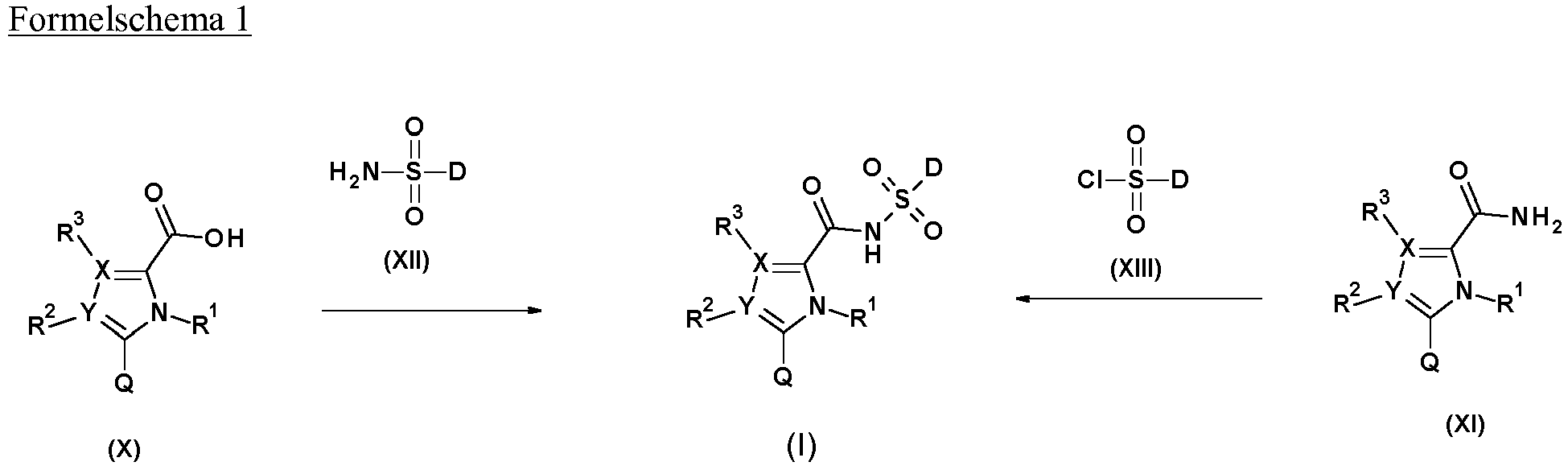
- Die Herstellung von erfindungsgemäßen Verbindungen der Formel (I) erfolgt entsprechend Formelschema 1 ausgehend von Carbonsäuren der Formel (X) durch Umsetzung mit einem Kupplungsreagenz und Sulfonamiden der Formel (XII), siehe dazu beispielsweise
WO2012/80447 WO2006/114313 ,WO2015/11082 WO2010/129500 ,US2008/227769 undWO2009/67108 US2004/6143 US5300498 . - Die benötigten Sulfonamide und Sulfochloride der Formel (XII) und (XIII) sind bekannt oder lassen sich nach im Allgemeinen bekannten Methoden herstellen. Dabei können die Sulfonamide aus den Sulfochloriden durch Umsetzung mit Ammoniak erhalten werden, siehe dazu
WO2014/146490 , Eur. J. Med. Chem. 2013, 62, 597-604; Bioorg. Med. Chem. 2005, 13, 7, 2459-2468. -
- 3-Chlorbenzolsulfonylamid: Coll. Czech. Chem. Comm. 1984, 49, 5, 1182-1192
- 2-Chlorbenzolsulfonsäurechlorid:
US5099025 - 2-Chlor-5-Methoxy-benzolsulfonylamid:
WO2010/129500 - Isopropylsulfonylamid:
US542803 - Die benötigten Carbonsäuren der Formel (X) sind bekannt oder können in Analogie zu im Allgemeinen bekannten Verfahren oder nach bekannten Verfahren oder entsprechend der im Folgenden beschriebenen Verfahren A bis G hergestellt werden.
- Beispiele für bekannte Säuren der Formel (X):
- Für 5-Methyl-1-[2-(trifluormethyl)phenyl]-1H-pyrazol-3-carbonsäure siehe Bioorg. Med. Chem. Lett. 2001, Vol 11, #17, 287-2290
- Für 2-(2-Chlorphenyl)-5-methyl-1H-imidazol-4-carbonsäure siehe
WO2004/60870 A1 - Für 2-(2-Chlorphenyl)-1-(4-chlorphenyl)-1H-imidazol-4-carbonsäure siehe Bioorg. Med. Chem. Lett. 2007, Vol 17, #10, 2706-2711
-

- Die Herstellung von Verbindungen der Formel (XIV) erfolgt entsprechend Formelschema 1 ausgehend von Bromiden der Formel (XV) durch Umsetzung mit einer Boronsäure oder einem Boronsäureester der Formel (XVI), einem Palladiumkatalysator wie zum Beispiel Tetrakis(triphenylphosphin)palladium oder (1,1'-bis(diphenylphosphino)ferrocen)palladium Dichlorid und einer Base wie beispielsweise Kaliumcarbonat, in einem hochsiedenden Lösemittel wie zum Beispiel DMF. Siehe dazu beispielsweise
WO2011/149874 A2 oderEP2518054 A1 . - In Formelschema 1 kann Rx zum Beispiel H oder Alkyl (auch cyclisch) sein. Ry kann beispielsweise Methyl, Ethyl, Propyl oder tert-Butyl sein.


- Die Hydrolyse des Esters zur Zielverbindung XIV erfolgt gemäß allgemein bekannter Bedingungen (LiOH, H2O, THF oder NaOH, EtOH). Im Falle von Ry = tert-Butyl wird der Ester unter sauren Bedingungen hydrolysiert, beispielsweise mit Trifluoressigsäure in Dichlormethan.
- Boronsäuren bzw. Boronsäureester der Formel (XVI) sind entweder kommerziell erhältlich oder können nach bekannten Methoden hergestellt werden.
- Die Herstellung der benötigten Bromide der Formel XV erfolgt gemäß Schema 2. Das Ausgangsmaterial der allgemeinen Formel XVIII ist entweder kommerziell erhältlich oder kann nach bekannten Methoden hergestellt werden.

- Durch Umsetzung eines Imidazols XVIII mit Trichloracetylchlorid wie in Bioorganic and Medicinal Chemistry Letters, 2008, 18, 4325 oder
EP2518054 A1 beschrieben, wird Zwischenverbindung (XIX) erhalten. Diese wird wie beispielsweise inWO2008/85302 A1 WO2015/25025 A1 WO2007/45096 A1 -

- Die Herstellung von Verbindungen der Formel (XXI) erfolgt entsprechend Formelschema 4 wie allgemein in Tetrahedron Letters, 2012, 53, 6078 beschrieben. In Formelschema 4 kann Ry beispielsweise Methyl, Ethyl, Propyl oder tert-Butyl sein.
- Das Ausgangsmaterial der Formel (XXII) ist entweder kommerziell erhältlich oder kann nach bekannten Methoden hergestellt werden.

- Durch Umsetzung der Säure XXII mit einem Alkylhydrazin und einem geeigneten Kupplungsreagenz/Katalysator-System (z.B. 2,3,4,5,6-Pentafluorophenol / 1-Ethyl-(3-(3-dimethylamino)propyl)-carbodiimid hydrochlorid) wird Zwischenstufe (XXIII) erhalten, welche mit Ethyl-amino(thioxo)acetat in Gegenwart von Essigsäure in Toluol cyclisiert wird.
- Die Hydrolyse des Esters zur Zielverbindung XXI erfolgt gemäß allgemein bekannter Bedingungen (LiOH, H2O, THF oder NaOH, EtOH). Im Falle von Ry = tert-Butyl wird der Ester unter sauren Bedingungen hydrolysiert, beispielsweise mit Trifluoressigsäure in Dichlormethan.
-

- Die Herstellung von Verbindungen der Formel (XXVI) erfolgt entsprechend Formelschema 5. In Formelschema 5 kann Rx zum Beispiel H oder Alkyl (auch cyclisch) sein. Ry kann beispielsweise Methyl, Ethyl, Propyl oder tert-Butyl sein.
- Die als Ausgangsmaterial benötigten Ester XXVII sind entweder kommerziell erhältlich oder können durch Veresterung der entsprechenden Säure nach bekannten Methoden hergestellt werden.


- Die Bromierung wird Mit Hilfe eines Bromierungsreagenzes wie beispielsweise N-Bromsuccinimid analog
WO2014/191894 A1, 2014 durchgeführt. - Bromide der Formel (XXVIII) können anschließend durch Umsetzung mit einer Boronsäure oder einem Boronsäureester der Formel (XVI), einem Palladiumkatalysator wie zum Beispiel Tetrakis(triphenylphosphin)palladium oder Chloro(2-dicyclohexylphosphino-2',4',6'-triisopropyl-1,1'-biphenyl)[2-(2'-amino-1,1'-biphenyl)]palladium(II) (XPhos Pd G2) und einer Base wie beispielsweise Kaliumphosphat, in einem Lösemittel wie zum Beispiel 1,4-Dioxan oder THF, unter Rückfluss in Verbindungen der Formel XXIX überführt werden. Siehe dazu beispielsweise
WO2014/115077 A1, 2014 oder J. Am. Chem. Soc., 2010, 132, 14073. - Boronsäuren bzw. Boronsäureester der Formel (XVI) sind entweder kommerziell erhältlich oder können nach bekannten Methoden hergestellt werden.
- Die Hydrolyse des Esters zur Zielverbindung XXVI erfolgt gemäß allgemein bekannter Bedingungen (LiOH, H2O, THF oder NaOH, EtOH). Im Falle von Ry = tert-Butyl wird der Ester unter sauren Bedingungen hydrolysiert, beispielsweise mit Trifluoressigsäure in Dichlormethan.
-

- Die Herstellung von erfindungsgemäßen Verbindungen der Formel (XXX) erfolgt entsprechend Formelschema 6 ausgehend von Bromiden der Formel (XXXI) durch Umsetzung mit einer kommerziell erhältlichen oder unter bekannten Bedingungen herstellbaren Boronsäure oder einem Boronsäureester der Formel (XVI), einem Palladiumkatalysator wie zum Beispiel [1,1'-bis(diphenylphosphino)-ferrocen]palladium(II)chlorid Dichlormethan Komplex und einer Base wie beispielsweise Cäsiumcarbonat in einem hochsiedenden Lösemittel wie zum Beispiel Toluol unter Rückfluss. Siehe dazu beispielsweise Journal of Organic Chemistry, 2004, 69, 8829. In Formelschema 6 kann Rx zum Beispiel H oder Alkyl (auch cyclisch) sein. Ry kann beispielsweise Methyl, Ethyl, Propyl oder tert-Butyl sein.
- Die Hydrolyse des Esters zur Zielverbindung XXX erfolgt gemäß allgemein bekannter Bedingungen (LiOH, H2O, THF oder NaOH, EtOH). Im Falle von Ry = tert-Butyl wird der Ester unter sauren Bedingungen hydrolysiert, beispielsweise mit Trifluoressigsäure in Dichlormethan.

- Boronsäuren der Formel (XVI) sind entweder kommerziell erhältlich oder können nach bekannten Methoden hergestellt werden.
- Der benötigte bromierte Baustein XXXI wird gemäß Schema 7 hergestellt.

- Die Cyclisierung eines 1,3,5-Trialkyl-1,3,5-triazinans XXXIV mit einem 2-(hydroxyimino)-3-oxocarbonsäureester XXXIII ist beispielsweise in Helvetica Chimica Acta, 2008, 91, 1916 beschrieben. Die nachfolgende Reduktion kann durch Zugabe eines geeigneten heterogenen Katalysators wie beispielsweise Raney Nickel in einem geeigneten Lösemittel wie beispielsweise Ethanol erfolgen. Bevorzugt wird die Reaktion bei Raumtemperatur unter erhöhtem Druck (beispielsweise 2 bar) durchgeführt. Analoge Reaktionen sind zum Beispiel in Tetrahedron Asymmetry, 2013, 24, 958 beschrieben.
- Das Imidazol der Formel XXXVI kann beispielsweise analog
EP2518054 A1, 2012 durch Bromierung mit N-Bromsuccinimid in Acetonitril zum benötigten Baustein XXXI umgesetzt werden. -

- Die Herstellung von erfindungsgemäßen Verbindungen der Formel (XXXVII) erfolgt entsprechend Formelschema 8. In Formelschema 8 kann Ry beispielsweise Methyl, Ethyl, Propyl oder tert-Butyl sein.

- Gemäß
WO2011/119777 A2, 2011 oderUS2012/238599 A1, 2012 wird ein kommerziell erhältlicher oder nach allgemein bekannten Bedingungen herstellbarer α-Ketoster XXXVIII durch Umsetzung mit Natriumnitrit und Essigsäure in Wasser in ein Oxim der allgemeinen Formel XXXIX umgesetzt. Dieses kann durch Erhitzen mit einem Amin in einem geeigneten Lösemittel (beispielsweise Acetonitril oder Toluol) analogWO2005/99705 A2, 2005 US6288061 B1, 2001 zu einem Imidazol der Formel XLI cyclisiert werden. - Die Hydrolyse des Esters zur Zielverbindung XXXVII erfolgt gemäß allgemein bekannter Bedingungen (LiOH, H2O, THF oder NaOH, EtOH). Im Falle von Ry = tert-Butyl wird der Ester unter sauren Bedingungen hydrolysiert, beispielsweise mit Trifluoressigsäure in Dichlormethan. Verfahren F:


- Die Herstellung von erfindungsgemäßen Verbindungen der Formel (XLII) erfolgt ausgehend von 2-Halogenimidazolen der Formel (XLIII) durch Umsetzung mit einer Boronsäure oder Boronsäureester der Formel (XVI). In Formelschema 9 kann Rx zum Beispiel H oder Alkyl (auch cyclisch) sein. Ry kann beispielsweise Methyl, Ethyl, Propyl oder tert-Butyl sein.
- Beispielsweise erhält man durch Umsetzung eines Bromides der Formel (XLIII) mit einem Boronsäureester der Formel (XVI) in Gegenwart eines Palladium-Katalysators wie zum Beispiel Tetrakis(triphenylphosphin)palladium oder [1,1'-Bis(diphenylphosphino)ferrocen]dichlorpalladium und einer Hilfsbase wie Kalium- oder Caesiumcarbonat die Verbindungen der Formel (XLIV). Siehe beispielsweise für 2-Brom-3-methyl-3H-imidazol-4-carbonsäuremethylester:
US2009/23707 A1 . Aus diesen Estern der Formel (XLIV) kann im Falle, dass Ry = tButy, durch Umsetzung mit einer Säure wie zum Beispiel Trifluoressigsäure die Verbindungen der Formel (XLII) freigesetzt werden. Siehe beispielsweise für tert-Butyl 2-(2-chlorphenyl)-5-methyl-1-(4-nitrophenyl)-1H-imidazol-4-carboxylat:WO2005/99705 A2 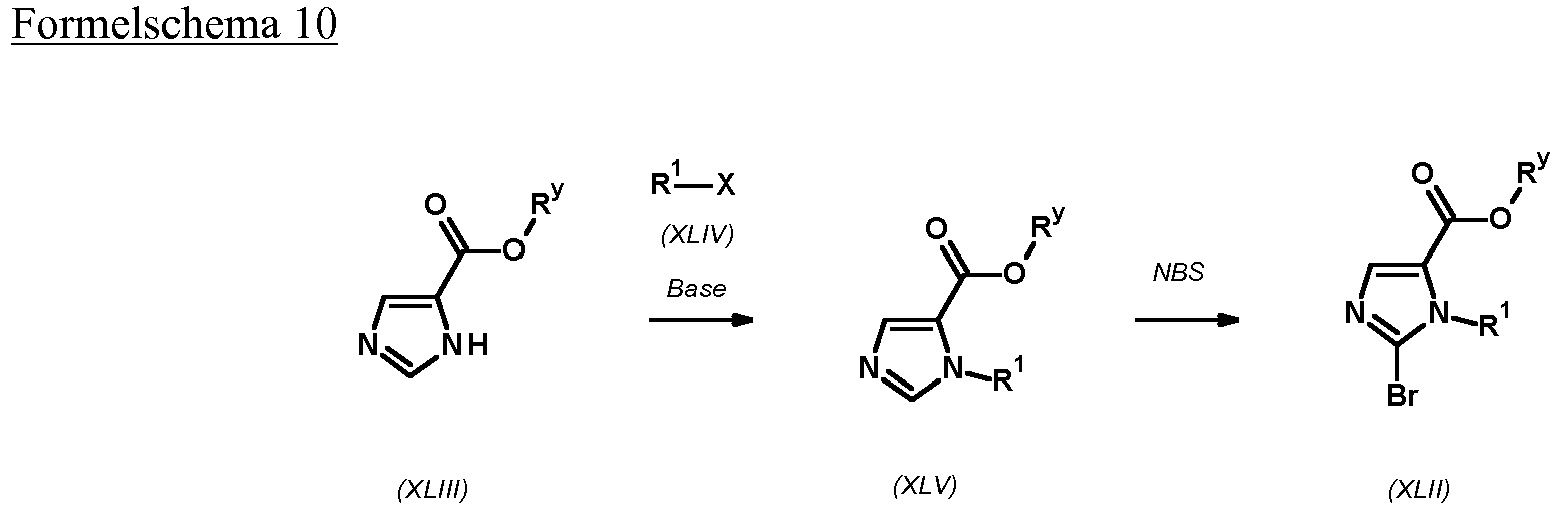
- Die Herstellung von erfindungsgemäßen Verbindungen der Formel (XLII) erfolgt ausgehend von Imidazolen der Formel (XLIII) durch Umsetzung mit Halogeniden der Formel (XLIV) und einer starken oder schwachen Base wie zum Beispiel Natriumhydrid oder Kaliumcarbonat. Siehe beispielsweise für Imidazol-5-carbonsaeure-ethylester: Green Chemistry 2013, 15, 2740-2746. Imidazole der Formel (XLV) können mit N-Bromsuccinimid in Verbindungen der Formel (XLII) überführt werden. Siehe beispielsweise für tert-Butyl-1-methyl-1H-imidazol-5-carboxylat: Journal of Chemical Research - Part S, 2000, 5, 230-231.
-

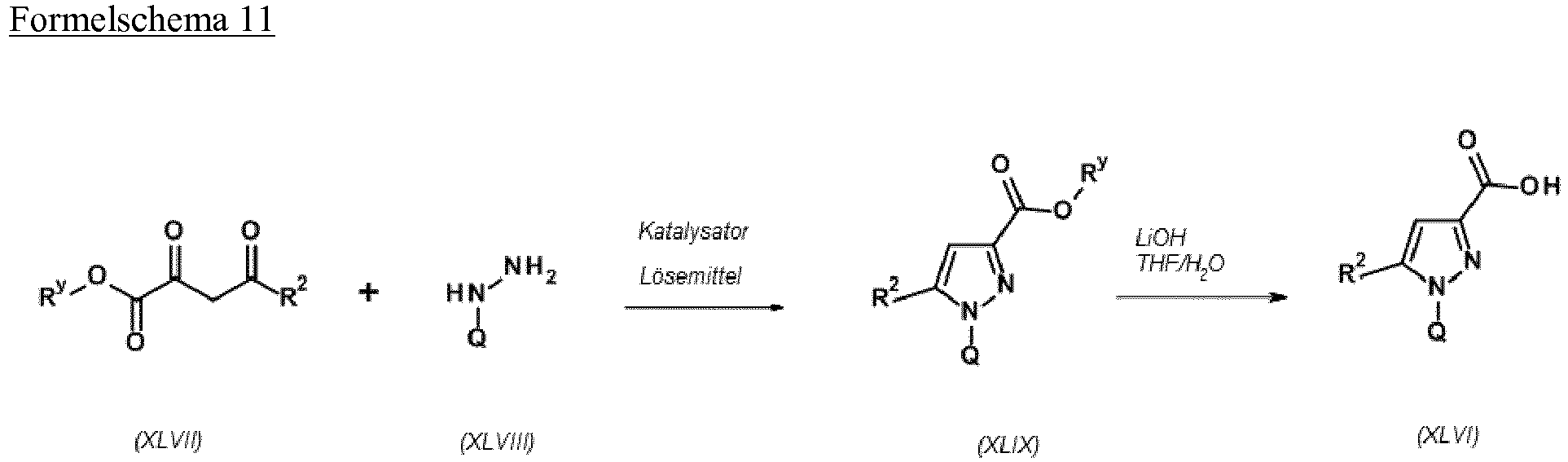
- Die Herstellung von erfindungsgemäßen Verbindungen der Formel (XLVI) erfolgt ausgehend von einem entsprechenden Arylhydrazin XLVII und einem Diketon XLVII. Die Cyclisierung kann basen- oder säurekatalysiert erfolgen wie beispielsweise in
US2007/287734 A1, 2007 (Base: Natriumhydroxid in Ethanol) oderUS6020357 A1, 2000 (Säure: para-Toluolsulfonsäure, in Ethanol) beschrieben. - Die Hydrolyse des Esters zur Zielverbindung XLVI erfolgt gemäß allgemein bekannter Bedingungen (LiOH, H2O, THF oder NaOH, EtOH).
- Die Herstellung von denjenigen erfindungsgemäßen Verbindungen der Formel (XLVI) mit R2= Alkoxy erfolgt ausgehend der Ester (XLIXb), die gemäß Formelschema 11a erhalten werden. Dazu wird ein Arylhydrazin der Formel (XLVIII) mit einem Diazodicarbonsäureester umgesetzt, siehe dazu beispielsweise
US2004/248881 Seite 25-26. Der erhaltene Ester (XLIXa) wird dann mit einem Alkylierungsmittel wie Methyliodid in Gegenwart einer Base wie Kaliumcarbonat zum Ester der Formel (XLIXb) alkyliert; siehe dazu beispielsweiseUS2014/315934 §0919, der dann entsprechend dem oben beschriebenen Weg weiter umgesetzt werden kann.
-


- Die Herstellung von erfindungsgemäßen Verbindungen der Formel (L) erfolgt ausgehend von einem entsprechenden Nitril LII und einem Amin LI, die unter Zuhilfenahme einer Base wie beispielsweise NaHMDS zu einem Amidin LIII verknüpft werden. Siehe hierzu z.B. Journal of Medicinal Chemistry, 2005, (48), 1823. Das Amidin kann zum Beispiel basenkatalysiert (z.B. mit NaHCO3) in einem polar-protischen Lösemittel wie Isopropanol mit einem α-Bromoketon LIV zum Imidazol LV cyclisiert werden. Siehe hierzu
US2004/122074 A1, 2004 . - Das erhaltene Imidazol des Typs LV kann entweder direkt basisch zu L-a verseift werden (wie bereits oben mehrfach beschrieben), oder es wird durch Umsetzung mit SO2Cl2 oder Oxalylchlorid zuvor zu einer Vorstufe des Typs LVI chloriert, die ihrerseits zu L-b verseift werden kann. Zur Chlorierung siehe beispielsweise
WO2005/99705 A2, 2005 EP2196459 A1, 2010 . - Handelt es sich bei Q um ein Pyridinderivat wie zum Beispiel im Fall Q = (VIz), (VIa1), (VIa6), (VIa17) so erfolgt die Herstellung von erfindungsgemäßen Verbindungen der Formel (XLII, R1 ≠ H) entsprechend Formelschema 13 und Formelschema 14 nach zwei möglichen Verfahren.
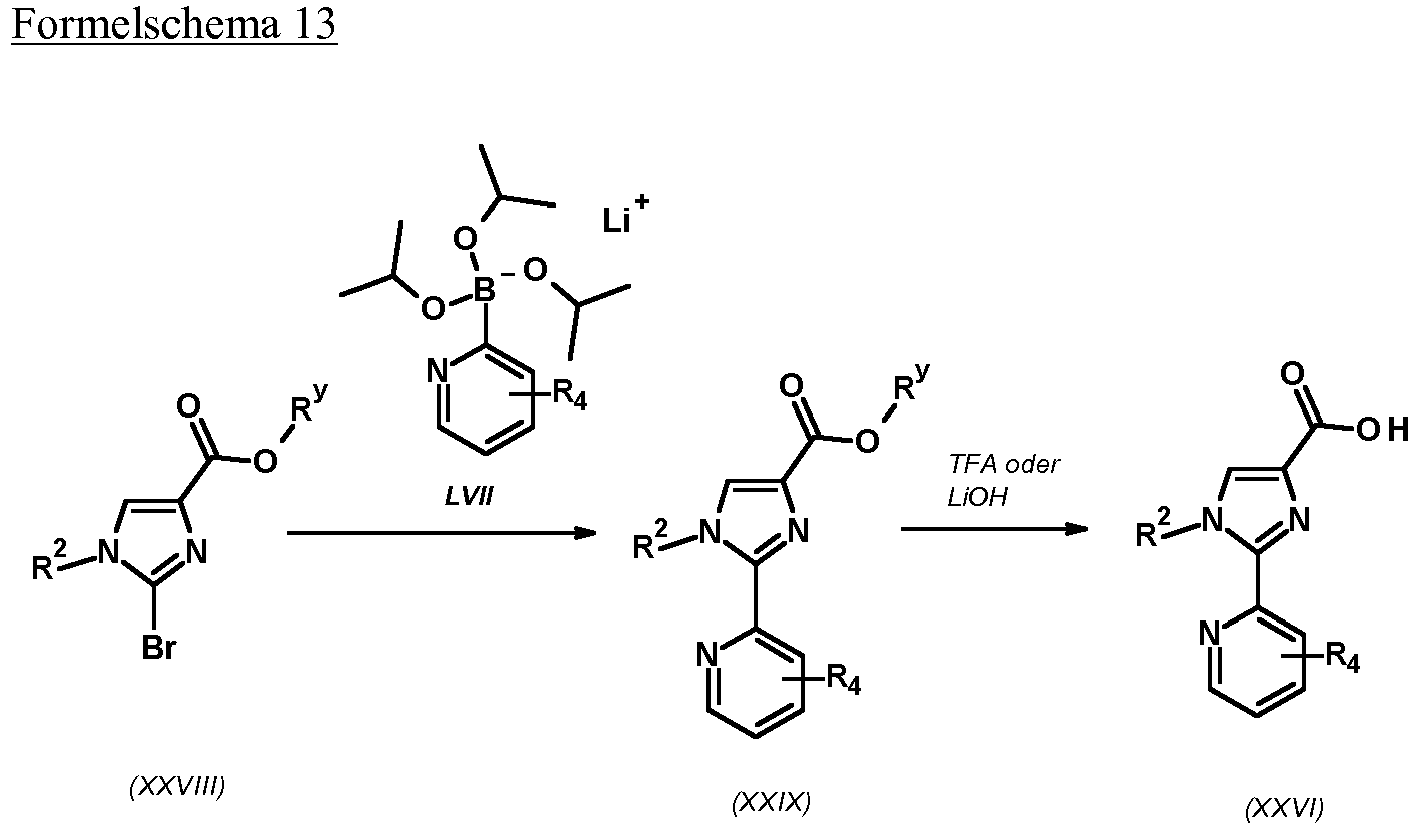
- Verbindungen der Formel (XXVIII) können ähnlich Verfahren C statt mit einer Boronsäure mit einem Triisopropoxyborat der Formel (LVII) in Gegenwart eines Palladiumkatalysators (bestehend aus Palladiumsalz und gegebenenfalls einem weiteren Liganden), eines Kupfersalzes und einer Base zu Reaktion gebracht werden. Ein geeignetes Reaktionssystem ist beispielsweise die Kombination aus Palladiumacetat, 1,1'-Bis(diphenylphosphino)ferrocen, Kupfer(I)iodid und Cäsiumcarbonat wie in Org. Lett., 2009, (11), 345 beschrieben. Die Reaktion kann in einem unter den Reaktionsbedingungen inerten Lösemittel, wie zum Beispiel Dimethylformamid, erfolgen. Die Reaktion erfolgt üblicherweise in einem Temperaturbereich von 50 - 150°C.
- Die allgemeine Herstellung von Triisopropoxyboraten der Formel (LVII) ist in Tet. Lett. 2012 (53), 4873 oder
WO2011103435A2 beschrieben. - Die Hydrolyse des Esters zur Zielverbindung XXVI erfolgt gemäß allgemein bekannter Bedingungen (LiOH, Wasser/THF oder NaOH, EtOH). Im Falle von Ry = tert-Butyl wird der Ester unter sauren Bedingungen hydrolysiert, beispielsweise mit Trifluoressigsäure in Dichlormethan.

- Alternativ zu dem oben beschriebenen Verfahren lassen sich Verbindungen der Formel (XLII, R1 ≠ H) ausgehend von Nitrilen der Formel (LVIII) herstellen.
- Im ersten Schritt wird gemäß Bioorganic and Medicinal Chemistry Letters, 2012, vol. 22, # 22 p. 6974 - 6979,6 oder
WO2007/75749 A2, 2007 - In einem zweiten Schritt erfolgt die Cyclisierung von (LIX) mit einem Propiolat (LX) zum Imidazol (LXI), siehe hierzu beispielsweise
US4853383 A1, 1989 ,US6492516 B1, 2002 . Die Reaktion erfolgt üblicherweise bei 50-200°C. Geeignete Lösemittel sind Alkohole wie Methanol oder hochsiedende Lösemittel wie Diphenylether. - Im dritten Schritt wird aus Verbindung (LXI) mit Hilfe eines Alkylierungsreagenzes und in Gegenwart einer Base Imidazol (XXIX) hergestellt. Geeignete Alkylierungsmittel sind beispielsweise Alkylhalogenide wie Methyliodid. Als Basen eignen sich Natriumhydrid, Kaliumcarbonat, Kaliumterbutanolat. Siehe hierzu
WO2008/84218 A1, 2008 WO2007/113276 A1, 2007 WO2016/46230 A1, 2016 - Die Hydrolyse des Esters (XXIX) zur Zielverbindung (XXVI) erfolgt gemäß allgemein bekannter Bedingungen (LiOH, Wasser/THF oder NaOH, EtOH). Im Falle von Ry = tert-Butyl wird der Ester unter sauren Bedingungen hydrolysiert, beispielsweise mit Trifluoressigsäure in Dichlormethan.
- Die folgenden Herstellungs- und Verwendungsbeispiele illustrieren die Erfindung, ohne sie zu beschränken.
- Die Bestimmung der logP-Werte erfolgte gemäß EEC Directive 79/831 Annex V.A8 durch HPLC (High Performance Liquid Chromatography) an einer Phasenumkehrsäule (C18). Temperatur 43 °C. Die Eichung erfolgt mit unverzweigten Alkan-2-onen (mit 3 bis 16 Kohlenstoffatomen), deren logP Werte bekannt sind.
- Die Bestimmung des M+ mit der LC-MS im sauren Bereich erfolgte bei pH 2,7 mit 0,1 % wässriger Ameisensäure und Acetonitril (enthält 0,1% Ameisensäure) als Eluenten; linearer Gradient von 10% Acetonitril bis 95% Acetonitril, Gerät: Agilent 1100 LC-System, Agilent MSD System, HTS PAL.
- Die Bestimmung des M+ mit der LC-MS im neutralen Bereich erfolgte bei pH 7.8 mit 0,001 molarer wässriger Ammoniumhydrogencarbonat-Lösung und Acetonitril als Eluenten; linearer Gradient von 10 % Acetonitril bis 95 % Acetonitril.
- In den Tabellen und Herstellungsbeispielen wurden die logP Werte für den sauren Bereich (als logP [a]) und/oder für den neutralen Bereich (als logP [n]) angegeben.
- b) Die Bestimmung der 1H-NMR-Daten erfolgte mit einem Bruker Avance 400 ausgestattet mit einem Durchflussprobenkopf (60 µl Volumen), mit Tetramethylsilan als Referenz (0.0) und den Lösungsmitteln CD3CN, CDCl3 oder D6-DMSO oder mit einem Bruker Avance III HD 300MHz Digital NMR mit einem 5mm Probenkopf.
- Die NMR-Daten ausgewählter Beispiele werden entweder in klassischer Form (δ-Werte, Multiplettaufspaltung, Anzahl der H-Atome) oder als NMR-Peak-Listen aufgeführt.
- Die 1H-NMR-Daten ausgewählter Beispiele werden in Form von 1H-NMR-Peaklisten notiert. Zu jedem Signalpeak wird erst der δ -Wert in ppm und dann die Signalintensität in runden Klammern aufgeführt. Die δ -Wert - Signalintensitäts- Zahlenpaare von verschiedenen Signalpeaks werden durch Semikolons voneinander getrennt aufgelistet.
- Die Peakliste eines Beispieles hat daher die Form:
δ1 (Intensität1); δ2 (Intensität2);........; δi (Intensitäti);......; δn (Intensitätn) - Die Intensität scharfer Signale korreliert mit der Höhe der Signale in einem gedruckten Beispiel eines NMR-Spektrums in cm und zeigt die wirklichen Verhältnisse der Signalintensitäten. Bei breiten Signalen können mehrere Peaks oder die Mitte des Signals und ihre relative Intensität im Vergleich zum intensivsten Signal im Spektrum gezeigt werden.
- Zur Kalibrierung der chemischen Verschiebung von 1H-NMR-Spektren benutzen wir Tetramethylsilan und/oder die chemische Verschiebung des Lösungsmittels, besondern im Falle von Spektren, die in DMSO gemessen werden. Daher kann in NMR-Peaklisten der Tetramethylsilan-Peak vorkommen, muss es aber nicht.
- Die Listen der 1H-NMR-Peaks sind ähnlich den klassischen 1H-NMR-Ausdrucken und enthalten somit gewöhnlich alle Peaks, die bei einer klassischen NMR-Interpretation aufgeführt werden.
- Darüber hinaus können sie wie klassische 1H-NMR-Ausdrucke Lösungsmittelsignale, Signale von Stereoisomeren der Zielverbindungen, die ebenfalls Gegenstand der Erfindung sind, und/oder Peaks von Verunreinigungen zeigen.
- Bei der Angabe von Verbindungssignalen im Delta-Bereich von Lösungsmitteln und/oder Wasser sind in unseren Listen von 1H-NMR-Peaks die gewöhnlichen Lösungsmittelpeaks, zum Beispiel Peaks von DMSO in DMSO-D6 und der Peak von Wasser, gezeigt, die gewöhnlich im Durchschnitt eine hohe Intensität aufweisen.
- Die Peaks von Stereoisomeren der Targetverbindungen und/oder Peaks von Verunreinigungen haben gewöhnlich im Durchschnitt eine geringere Intensität als die Peaks der Zielverbindungen (zum Beispiel mit einer Reinheit von >90%).
- Solche Stereoisomere und/oder Verunreinigungen können typisch für das jeweilige Herstellungsverfahren sein. Ihre Peaks können somit dabei helfen, die Reproduktion unseres Herstellungsverfahrens anhand von "Nebenprodukt-Fingerabdrücken" zu erkennen.
- Einem Experten, der die Peaks der Zielverbindungen mit bekannten Verfahren (MestreC, ACD-Simulation, aber auch mit empirisch ausgewerteten Erwartungswerten) berechnet, kann je nach Bedarf die Peaks der Zielverbindungen isolieren, wobei gegebenenfalls zusätzliche Intensitätsfilter eingesetzt werden. Diese Isolierung wäre ähnlich dem betreffenden Peak-Picking bei der klassischen 1H-NMR-Interpretation.
- Weitere Details zu 1H-NMR-Peaklisten können der Research Disclosure Database Number 564025 entnommen werden.
-
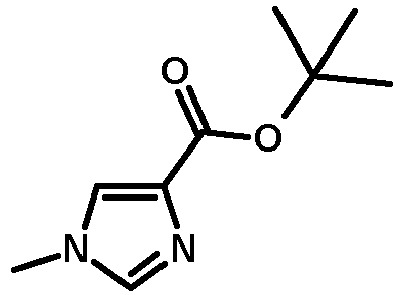
- Unter einer Argon-Atmosphäre wurden 1-Methyl-1H-Imidazol-carbonsäure (100.0 g, 792 mmol) in 1.1 L Dichlormethan gelöst und es wurden 0.5 ml DMF zugegeben. Bei Raumtemperatur wurde Oxalylchlorid (120.8 g, 951 mmol) zugegeben und es wurde für 12 h bei Raumtemperatur gerührt. Das Lösemittel wurde entfernt und der Rückstand wurde in 795 ml THF gelöst und auf -30°C gekühlt. Langsam wurde zu dem Gemisch Lithium-tert-Butoxid-Lösung (2.2 M in THF, 896.4 ml, 1972 mmol) getropft. Nach Abschluss der Addition wurde das Reaktionsgemisch langsam auf Raumtemperatur erwärmt. Es wurde für 12 h bei Raumtemperatur gerührt und dann gesättigte NaHCO3-Lösung zugegeben. Das Zwei-Phasengemisch wurde für 1 h gerührt, dann wurde das Lösemittel weitgehend am Rotationsverdampfer entfernt. Der Rückstand wurde mit Ethylacetat aufgenommen und die organische Phase wurde mit Wasser gewaschen. Die wässrige Phase wurde mit Ethylacetat extrahiert. Die vereinigten organischen Extrakte wurden mit gesättigter NaCl-Lösung gewaschen, über Na2SO4 getrocknet und das Lösemittel wurde am Rotationsverdampfer entfernt. Das Rohprodukt (86.7 g, 72%) wurde in der folgenden Reaktion ohne weitere Aufreinigung umgesetzt.
logP (sauer): 0.63; MH+: 183; 1H-NMR (400MHz, D6-DMSO) δ ppm: 7.71 (s, 1H), 7.64 (s, 1H), 3.67 (s, 3H), 1.49 (s, 9H) -

- Unter Argon-Atmosphäre wurden tert-Butyl-1-methyl-1H-imidazol-4-carboxylat (64.0 g, 351 mmol, 1 eq.) und 1,2-Dibrom-1,1,2,2-tetrachlorethan (114.4 g, 351 mmol, 1 eq.) in 1200 ml THF gelöst, und es wurde bei -10 - 0°C portionsweise Lithium-tert-butoxid (84.3 g, 1.05 mmol, 3 eq.) zugegeben. Das Reaktionsgemisch wurde für 12 h bei Raumtemperatur gerührt. Nach entfernen des Lösemittels wurde der Rückstand in Ethylacetat aufgenommen. Die organische Lösung wurde mit Wasser gewaschen, über Na2SO4 getrocknet und am Rotationsverdampfer vom Lösemittel befreit. Das Rohprodukt wurde chromatographisch aufgereinigt (Laufmittel: Cyclohexan/Ethylacetat). Es wurden 45.8 g (50%) des gewünschten Produktes erhalten.
logP (sauer): 2.41; MH+: 261; 1H-NMR (400MHz, D6-DMSO) δ ppm: 7.94 (s, 1H), 3.63 (s, 3H), 1.49 (s, 9H). -

- Zu einer Lösung von tert-Butyl-2-brom-1-methyl-1H-imidazol-4-carboxylat (100 mg, 0,38 mmol) in THF (15 mL) wurde eine Lösung von Kaliumphosphat (152 mg, 0,71 mmol) in Wasser (2,5 mL), Xphos Pd G2 Katalysator (15 mg, 0,01 mmol) und 2-(2,6-Difluorphenyl)-4,4,5,5-tetramethyl-1,3,2-dioxaborolan (276 mg, 1,14 mmol) gegeben. Das Reaktionsgemisch wurde 6 h bei 80 °C gerührt. Anschließend wurde eine zweite Portion 2-(2,6-Difluorphenyl)-4,4,5,5-tetramethyl-1,3,2-dioxaborolan (183 mg) zugegeben und das Gemisch weitere 15 h bei 65 °C gerührt. Die Reaktionsmischung wurde mit Wasser (50 mL) verdünnt und mit Ethylacetat (3 x 50 mL) extrahiert. Die vereinte organische Phase wurde über Na2SO4 getrocknet und das Lösungsmittel im Vakuum entfernt. Aufreinigung des Rohproduktes mittels HPLC lieferte das gewünschte Produkt (58,1 mg, 52%).
logP (neutral): 2,3; MH+: 295,1; 1H-NMR (400MHz, D6-DMSO) δ ppm: 8.00 (s, 1H), 7.67 (m, 1H), 7.32 (m, 2H), 3.54 (s, 3H), 1.51 (s, 9H). -

- Tert-Butyl-2-(2,6-difluorphenyl)-1-methyl-1H-imidazol-4-carboxylat (58,0 mg, 0,19 mmol) wurde in Dichlormethan (0,5 mL) vorgelegt und Trifluoressigsäure (0,11 mL) zugegeben. Das Reaktionsgemisch wurde 15 h bei Raumtemperatur gerührt. Das Lösungsmittel wurde im Vakuum entfernt und der Rückstand mit Dichlormethan codestilliert.
logP (neutral): 2,3; MH+: 239,1; 1H-NMR (400MHz, D6-DMSO) δ ppm: 8.01 (s, 1H), 7.70 (m, 1H), 7.33 (m, 2H), 3.57 (s, 3H). -

- Ethyl-1,5-dimethyl-1H-imidazol-4-carboxylat-3-oxid (19.0 g, 103.1 mmol, 1 eq.; Herstellung analog European Journal of Organic Chemistry (2011), (13), 2542-2547,S2542/1-S2542/8. Helvetica Chimica Acta (2011), 94(10), 1764-1777. Helvetica Chimica Acta (2008), 91(10), 1916-1933) wurde in 93 ml Ethanol gelöst. Es wurde Raney-Nickel (Ra-Ni 400, 4 g) zugegeben und unter 5 bar WasserstoffAtmosphäre für 1 h bei Raumtemperatur gerührt. Nach Entfernen des Katalysators durch Filtration über Kieselgel wurde die Lösung eingeengt und das Rohprodukt (17.8 g, 91%) ohne weitere Aufreinigung in der nächsten Reaktion eingesetzt.
logP (neutral): 0.85; MH+: 169; -
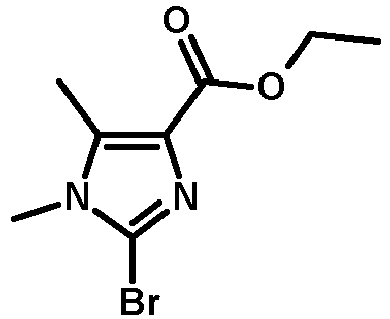
- Ethyl-1,5-dimethyl-1H-imidazol-4-carboxylat (1.00 g; 5.49 mmol) und N-Bromsuccinimid (0.98 g; 5.49 mmol) wurde in 100 ml Acetonitril gelöst und für 4 h bei Raumtemperatur gerührt. Das Lösemittel wurde am Rotationsverdampfer entfernt und der Rückstand wurde in Ethylacetat aufgenommen. Die organische Phase wurde mit NaHCO3-Lösung und NaCl-Lösung gewaschen, über MgSO4 getrocknet und vom Lösemittel befreit. Der Rückstand wurde chromatographisch aufgereinigt. Es wurden 616 mg (43%) des gewünschten Produktes erhalten.
logP (neutral): 1.69; MH+: 263; -
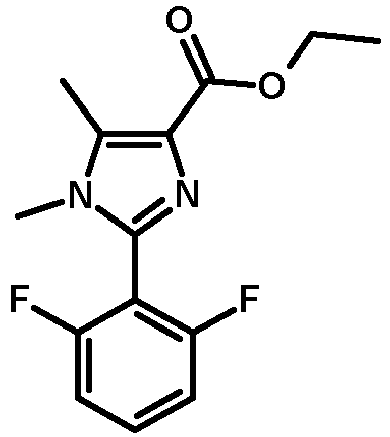
- Ethyl-2-(2,6-difluorphenyl)-1,5-dimethyl-1H-imidazol-4-carboxylat kann in Analogie zu tert-Butyl-2-(2,6-difluorphenyl)-1 -methyl-1 H-imidazol-4-carboxylat hergestellt werden.
logP (neutral): 2,0; MH+: 281,1; 1H-NMR (400MHz, D6-DMSO) δ ppm: 7.68 (m, 1H), 7.32 (m, 2H), 4.22 (m, 2H), 3.41 (s, 3H), 2.49 (s, 3H), 1.28 (m, 3H). -

- Eine Lösung von Ethyl-2-(2,6-difluorphenyl)-1,5-dimethyl-1H-imidazol-4-carboxylat (779 mg, 2.77 mmol) und Lithiumhydroxid (79.9 mg, 3.33 mmol) in THF/Wasser (3:1, 15 mL) wurde 15 h bei 60 °C gerührt. Das Lösungsmittel wurde im Vakuum entfernt.
logP (neutral): 2,0; MH+: 253,1; 1H-NMR (400MHz, D6-DMSO) δ ppm: 8.32 (s, 1H), 7.63 (m, 1H), 7.29 (m, 2H), 3.45 (s, 3H), 2.46 (s, 3H). -

- Ethyl-(2Z)-2-(hydroxyimino)-3-oxopentanoat (4.33 g, 25 mmol, 1 eq.: Herstellung siehe Chemical & Pharmaceutical Bulletin, 2013, 61 (12), 1248) und 2,6-Difluobenzylamin (3.94 g, 27.5 mmol, 1.1 eq.) wurden in 30 ml Acetonitril gelöst und für 12 h zum Rückfluss erhitzt. Das Reaktionsgemisch wurde auf konzentriert und der Rückstand chromatographisch aufgereinigt. Es wurden 1.82 g (24%) des gewünschten Produktes erhalten.
logP (sauer): 1.73; MH+: 281; 1H-NMR (400MHz, D6-DMSO) δ ppm: 13.10 (2 s, 1H), 7.58 (m, 1H), 7.26 (m, 2H), 4.26 (m, 2H), 2.98 (m, 2H), 1.29 (m, 3H), 1.21 (m, 3H). -

- Analog der Herstellung von 2-(2,6-Difluorphenyl)-1,5-dimethyl-1H-imidazol-4-carbonsäure (xx) wurde Ethyl-2-(2,6-difluorphenyl)-5-ethyl-1H-imidazol-4-carboxylat (1.7 g, 6.07 mmol) mit Natronlauge in EtOH zur freien Säure 2-(2,6-Difluorphenyl)-5-ethyl-1H-imidazol-4-carbonsäure (1.3 g, 68%) verseift.
logP (neutral): 0.45; MH+: 253; -

- 1-Methyl-1H-imidazol-5-carbonsäure (18.0 g; 142.7 mmol; 1 eq.) wurde in 106 g tert-Butanol gelöst und es wurden Pyridin (79.0 g, 999 mmol, 7 eq.) und Tosylchlorid (54.4 g, 285.4 mmol, 2 eq.) zugegeben. Das Reaktionsgemisch wurde für 12 h bei Raumtemperatur gerührt und dann aufkonzentriert. Der Rückstand wurde in Dichlormethan aufgenommen und mit NaHCO3-Lösung versetzt bis ein pH-Wert von 8-9 erreicht wurde. Die wässrige Phase wurde mehrfach mit Dichlormethan extrahiert und die vereinigten organischen Extrakte wurden über MgSO4 getrocknet. Nach Entfernen des Lösemittels wurde der Rückstand chromatographisch aufgereinigt (Laufmittel: Cyclohexan/Ethylacetat). Es wurden 14.7 g (56%) des gewünschten Produktes erhalten.
logP (neutral): 1.71; MH+: 183; 1H-NMR (400MHz, D6-DMSO) δ ppm: 7.84 (s, 1H), 7.51 (s, 1H), 3.80 (s, 3H), 1.51 (s, 9H). -
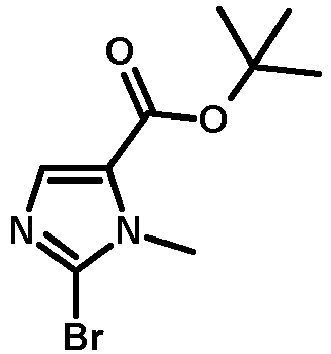
- In einem ausgeheizten Schlenkgefäß wurde unter Argonatmosphäre tert-Butyl-1-methyl-1H-imidazol-5-carboxylat (1.00 g, 5.38 mmol, 1 eq.) in 30 ml trockenem THF gelöst. Die Lösung wurde auf -90° gekühlt. Über 20 min wurden 1.05 eq. n-Butyllithium (in Hexan) zugetropft. Nach Rühren für 0.5 h wurde 1,2-Dibrom-1,1,2,2-tetrachlorethan (1.75 g, 5.38 mmol, 1 eq.; gelöst in 15 ml THF) über einen Zeitraum von 20 min zugetropft. Es wurde für 2.5 h bei -80°C gerührt, dann wurde über 30 min auf Raumtemperatur erwärmt. Nach Zugabe von Kieselgur wurde das Gemisch aufkonzentriert und mehrfach chromatographisch aufgereinigt (Laufmittel: Dichlormethan/Methanol). Es wurden 438 mg (30%) des gewünschten Produktes erhalten
logP (neutral): 2.54; MH+: 263; 1H-NMR (400MHz, D6-DMSO) δ ppm: 7.56 (m, 1H), 3.79 (m, 3H), 1.52 (s, 9H). -

- Tert-Butyl-2-(2,6-difluorphenyl)-1-methyl-1H-imidazol-5-carboxylat kann in Analogie zu tert-Butyl-2-(2,6-difluorphenyl)-1 -methyl-1 H-imidazol-4-carboxylat hergestellt werden.
logP (neutral): 3,0; MH+: 295,1; 1H-NMR (400MHz, D6-DMSO) δ ppm: 7.74 (s, 1H), 7.71 (m, 1H), 7.34 (m, 2H), 3.66 (s, 3H), 1.55 (s, 9H). -

- 2-(2,6-Difluorphenyl)-1-methyl-1H-imidazol-5-carbonsäure kann in Analogie zu 2-(2,6-Difluorphenyl)-1-methyl-1H-imidazol-4-carbonsäure hergestellt werden.
logP (sauer): 0,46; MH+: 239,1; 1H-NMR (400MHz, D6-DMSO) δ ppm: 7.83 (s, 1H), 7.72 (m, 1H), 7.35 (m, 2H), 3.70 (s, 3H). -

- 16,9g (94,3mmol) 2-Chlorphenylhydrazin-Hydrochlorid wurden mit 16,15g (95mmol) Acetylendicarbonsäurediethylester in ca 250 ml absolutem Ethanol mit 26,5g (191mmol) Kalimcarbonat über Nacht unter Rückfluß erhitzt. Nach Abdampfen des Lösungsmittel wurde mit Wasser versetzt, durch Sand/Celite abgesaugt, mit wäßriger Zitronensäure bis pH=4 versetzt, 1h gerührt, abgesaugt und der Rückstand getrocknet. Ausbeute 20,68g .
logP (sauer): 1,75; MH+: 267,1; 1H-NMR (400MHz, D6-DMSO) δ ppm: 1,3 (t, 3H), 4,25 (q, 2H), 5,9 (s, 1H), 7,5-7,6 (m, 3H), 7,7 (m, 1H) -

- 4,75g (17,8mmol) Ethyl-1-(2-chlorphenyl)-5-hydroxy-1H-pyrazol-3-carboxylat wurden in ca 200 ml Aceton sukzessive in 2 Chargen mit insgesamt 16,5 g (120,5mmol) Methyliodid und 22,5g (162mmol) Kaliumcarbonat gerührt. Man saugte ab, dampfte das Lösungsmittel ab, löste den Rückstand in wäßrigem Natrimchlorid, Ethylacetat, Na-EDTA-Puffer bei pH=9, extrahierte zweimal mit Ethylacetat, trocknete die vereinigten organischen Phasen mit Natriumsulfat und dampfte das Lösungsmittel ab. Der Rückstand wurde durch Chromatographie an Kieselgel (Petrolether/Aceton) gereinigt.
Ausbeute 2,2g.
logP (sauer): 2,61; MH+: 281,1; 1H-NMR (400MHz, D6-DMSO) δ ppm: 1,3 (t, 3H), 3,9 (s, 3H), 4,3 (q, 2H), 6,3 (s, 1H), 7,5-7,6 (m, 3H), 7,7 (m, 1H) -
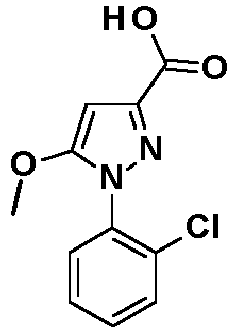
- 2,1g (7,5mmol) Ethyl-1-(2-chlorphenyl)-5-methoxy-1H-pyrazol-3-carboxylat wurden in Ethanol/Wasser mit Natronlauge versetzt und über Nacht bei 70°C gerührt. Das Lösungsmittel wurde abgedampft, der Rückstand mit Wasser versetzt, bei Eisbadkühlung mit verdünnter Salzsäure versetzt, über Nacht gerührt, abgesaugt, mit Wasser gewaschen und getrocknet.
Ausbeute 2g
logP (sauer): 1,63; MH+: 253,0; 1H-NMR (400MHz, D6-DMSO) δ ppm: 3,9 (s, 3H), 6,3 (s, 1H), 7,5-7,6 (m, 3H), 7,7 (m, 1H), 13 (s, 1H) -

- Unter Argon wurde 2-Brom-3-chlorpyridin (50.0 g, 260 mmol) in trockenem THF (200 ml) und trockenem Toluol (800 ml) gelöst und auf -78°C gekühlt. Langsam wurde eine 2.5 M Lösung n-BuLi in Hexan (100 mL, 250 mmol) zugetropft. Das Reaktionsgemisch wurde 2 h bei -78°C gerührt , dann wurde Triisopropyl borat (244 g, 1300 mmol) zugegeben. Nach weiteren 2 h bei -78°C wurde das Gemisch auf Raumtemperatur erwärmt. Es wurde Isopropanol (100 ml) zugegeben und die resultierende Lösung wurde bei 40°C aufkonzentriert. Zu dem Rückstand wurde Aceton (300 ml) addiert und es wurde für 30 min gerührt. Der ausgefallene Feststoff wurde durch Filtration isoliert, mit Aceton(2 x 100 ml) gewaschen und getrocknet.
1H-NMR (400MHz, D2O) δ ppm: 8.30 (b-s, 1H), 7.80 (b-s, 1H), 7.30 (b-s, 1H), 3.85 (b-s, 3H), 1.00 (b-s, 18H). -
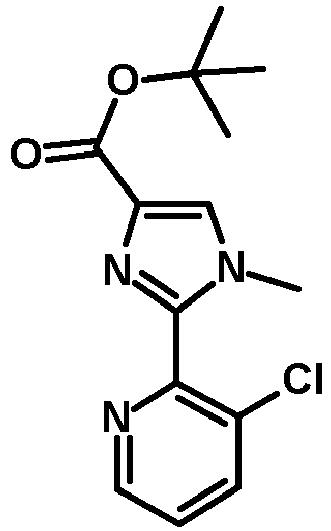
- Unter Argon wurden Lithium (3-chloropyridin-2-yl)[tris(propan-2-olato)]borat(1-) (487 mg, 1.50 mmol, 1 eq), tert-Butyl-2-brom-1-methyl-1H-imidazol-4-carboxylat (196 mg, 0.75 mmol, 0.5 eq), Kupfer(I)chlorid (74 mg, 0.75 mmol, 0.5 eq.), Cäsiumcarbonat (677 mg, 3 mmol, 2 eq.), 1,1'-Bis(diphenylphosphino)ferrocen (42 mg, 0.07 mmol, 0.05 eq.), in DMF (15 ml) gelöst. Die Reaktionslösung wurde einige Minuten mit Argon gespült, dann wurde Palladiumacetat (8 mg, 0.03 mmol, 0.025 eq) zugegeben. Das Reaktionsgemisch wurde für 12 h auf 100°C erhitzt. Nach Abkühlen wurde das Lösemittel abdestilliert und der Rückstand in Ethylacetat aufgenommen. Die organische Phase wurde zuerst mit gesättigter Ammoniumchloridlösung, dann mit Wasser gewaschen, über Natriumsulfat getrocknet und am Rotationsverdampfer vom Lösemittel befreit. Der Rückstand würde chromatographisch aufgereinigt (SiO2, Laufmittel: Cyclohexan/Ethylacetat 1:1).
MH+: 294; 1H-NMR (400MHz, D6-DMSO) δ ppm: 8.68 - 8.67 (m, 1H); 8.16 - 8.14 (m, 1H), 7.95 (s, 1H), 7.61 - 7.58 (m, 1H), 3.64 (s, 3H), 1.52 (s, 9H). -

- tert-Butyl-2-(3-chlorpyridin-2-yl)-1-methyl-1H-imidazol-4-carboxylat (1.53 g, 5.07 mmol, 1 eq.) wurde in Dichlormethan (15 ml) gelöst und mit Trifluoressigsäure (5.8 g, 50.7 mmol, 10 eq.) versetzt. Die Reaktionslösung wurde für 48 h bei Raumtemperatur gerührt, dann wurde das Lösemittel entfernt und der Rückstand chormatographisch aufgereinigt (SiO2, Laufmittel: Ethylacetat).
MH+: 238; 1H-NMR (400MHz, D6-DMSO) δ ppm: DMSO 8.68 - 8.67 (m, 1H), 8.16 - 8.14 (m, 1H), 8.01 (s, 1H), 7.60 - 7.57 (m, 1H), 3.66 (s, 3H). -

- Ethyl-2-(3-brompyridin-2-yl)-1-methyl-1H-imidazol-4-carboxylat (2.11 g, 6.8 mmol, 1 eq.) und Lithiumhydroxid (0.244 g, 10.2 mmol, 1.5 eq.) wurden in einem Gemisch von THF (31 ml) und Wasser (31 ml) gelöst. Die Reaktionsmischung wurde über Nacht zum Rückfluss erhitzt. Nach Aufkonzentrieren wurde verdünnte Salzsäure zugegeben, bis ein pH-wert von 4 erreicht wurde und für 1 h bei Raumtemperatur gerührt. Der entstehende Niederschlag wurde durch Filtration isoliert, mit wenig Wasser gewaschen und getrocknet.
MH+: 284; 1H-NMR (400MHz, D6-DMSO) δ ppm: 8.71 - 8.70 (m, 1H), 8.30 - 8.28 (m, 1H), 8.00 (s, 1H), 7.52 - 7.48 (m, 1H), 3.05 (s, 3H). -

- Unter Argon-Atmosphäre wurde Ethyl-2-(3-brompyridin-2-yl)-1H-imidazol-4-carboxylat (3.25 g, 10.3 mmol, 1 eq.) in trockenem THF (50 ml) gelöst. Die Lösung wurde auf -5°C gekühlt und es wurde Natriumhydrid (0.289 g, 11.4 mmol, 1.1 eq.) zugegeben. Nach 30 min Rühren wurde bei -5°C Iodmethan (1.61 g, 11.4 mmol, 1.1 eq.) gelöst in THF (10 ml) zu getropft und weitere 3 h bei 0°C gerührt. Das Gemisch wurde auf Raumtemperatur erwärmt und weitere 12 h gerührt. Nach Zugabe von verdünnter Salzsäure wurde die Lösung auf konzentriert. Der Rückstand wurde in Wasser aufgenommen und mit Triethylamin versetzt. Die wässrige Phase wurde mit Ethylacetat extrahiert. Die vereinigten organischen Extrakte wurden über Natriumsulfat getrocknet und vom Lösemittel befreit. Der Rückstand wurde chromatographisch aufgereinigt (SiO2, Laufmittel Cyclohexan Essigester).
MH+: 312; 1H-NMR (400MHz, D6-DMSO) δ ppm: 8.72 - 8.70 (m, 1H), 8.31 - 8.29 (m, 1H), 8.07 (s, 1H), 7.53 - 7.50 (m, 1H), 4.27-4.22 (q, 2H), 3.62 (s, 3H), 1.30 - 1.27 (t, 3H). -

- 3-Brom-N'-hydroxypyridin-2-carboximidamid (9.81 g, 45.4 mmol, 1 eq.) und Ethylpropiolat (4.46 g, 45.4 mmol, 1 eq.) wurden in Ethanol (44 ml) gelöst und für 12 h zum Rückfluß erhitzt. Ethanol wurde abdestilliert, der Rückstand mit Toluol versetzt und das Lösemittel ein weiteres Mal abdestilliert. Der Rückstand wurde in Diphenylether (27 ml) aufgenommen und für 2.5 h auf 195°C erhitzt. Nach Abkühlen auf 70°C wurde Hexan (200 ml) zugegeben und das Gemisch 3 h gerührt. Die Lösung wurde abdekantiert, der erhaltene Feststoff wurde chromatographisch gereinigt (reversed phase; Lösemittel: Acetonitril, Wasser). Die überstehende Hexanphase wurde aufkonzentriert und ebenfalls chromatographisch gereinigt (SiO2, Laufmittel: Cyclohexan Essigester; Anschließend Reversed Phase, Laufmittel Acetonitril/Wasser).
MH+: 298; 1H-NMR (400MHz, D6-DMSO) δ ppm: 8.68 - 8.66 (m, 1H), 8.26 - 8.24 (m, 1H), 7.93 - 7.92 (m, 1H), 7.42 - 7.39 (m, 1H), 4.29 - 4.24 (q, 2H), 1.31 - 1.27 (t, 3H). -

- 3-Brompyridin-2-carbonitril (13.2 g, 72.1 mmol, 1 eq.), Hydroxylammoniumchlorid (11.0 g, 158 mmol, 2.2 eq.) und Kaliumcarbonat (21.9 g, 158 mmol, 2.2 eq.) wurden in Ethanol (100 ml) gelöst und für 12 h zum Rückfluß erhitzt. Das Reaktionsgemisch wurde aufkonzentriert und in Wasser gelöst. Durch Zugabe von verdünnter Salzsäure wurde ein pH von 4 eingestellt und 1 h gerührt. Der entstehende Feststoff wurde durch Filtration isoliert, gewaschen und getrocknet.
MH+: 217; 1H-NMR (400MHz, D6-DMSO) δ ppm: 9.72 (s, 1H), 8.58 - 8.57 (s, 1H), 8.14 - 8.12 (s, 1H), 7.38 - 7.35 (m, 1H), 5.81 (s, 2H). -

- 5-Chlor-2-(2-chlorphenyl)-1-methyl-1H-imidazol-4-carbonsäure (163 mg; 0.60 mmol; 1 eq.) wurde in 10 ml Dichlormethan gelöst. Nach Zugabe von 1-Ethyl-3-(3-dimethylaminopropyl)carbodiimid hydrochlorid (345 mg, 1.8 mmol, 3 eq.) und DMAP (220 mg, 1.8 mmol, 3 eq.) wurde das Gemisch für 1 h bei Raumtemperatur gerührt. Dann wurde 2-Methylbenzolsulfonamid (103 mg; 0.6 mmol, 1 eq.) zugegeben und anschließend für 48 h bei Raumtemperatur gerührt. Das Lösemittel wurde am Rotationsverdampfer entfernt und der Rückstand chromatographisch aufgereinigt (reversed Phase; Laufmittel: Acetonitril, H2O). Es wurden 134 mg (52%) des gewünschten Produktes erhalten.
logP (sauer): 3.17; MH+: 424; 1H-NMR (400MHz, D6-DMSO) δ ppm: 8.04 (d, 1H); 7.65 - 7.52 (m, 5H), 7.46 - 7.38 (m, 2H), 3.41 (s, 3H); 2.61 (s, 3H). - Tabelle 1 führt weitere Verbindungen der Formel (I) auf, die analog zu den oben aufgeführten Beispielen hergestellt wurden. Die Synthese der Säurevorstufen erfolgte entweder wie oben beschrieben, oder die Säuren waren kommerziell erhältlich.


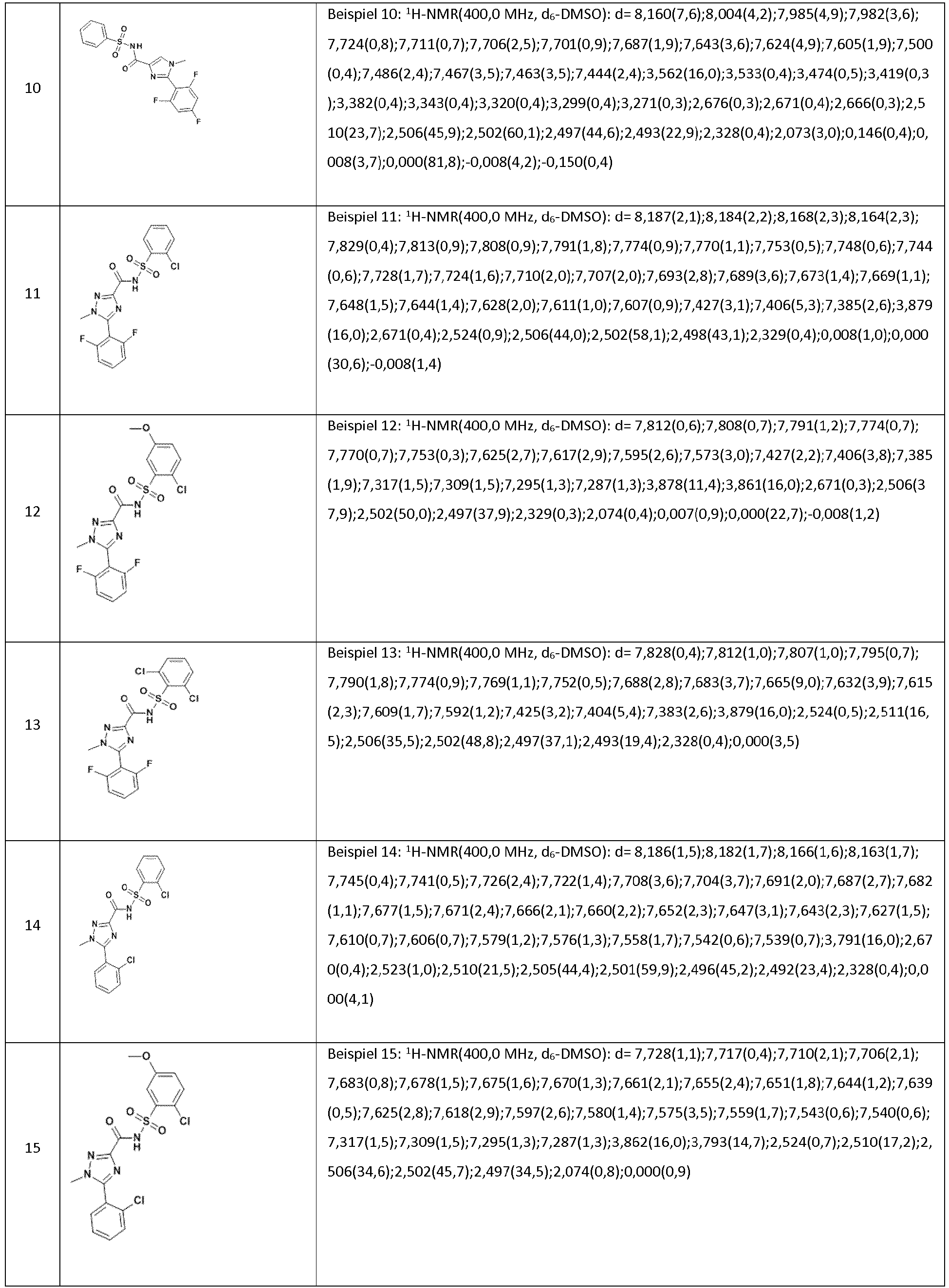


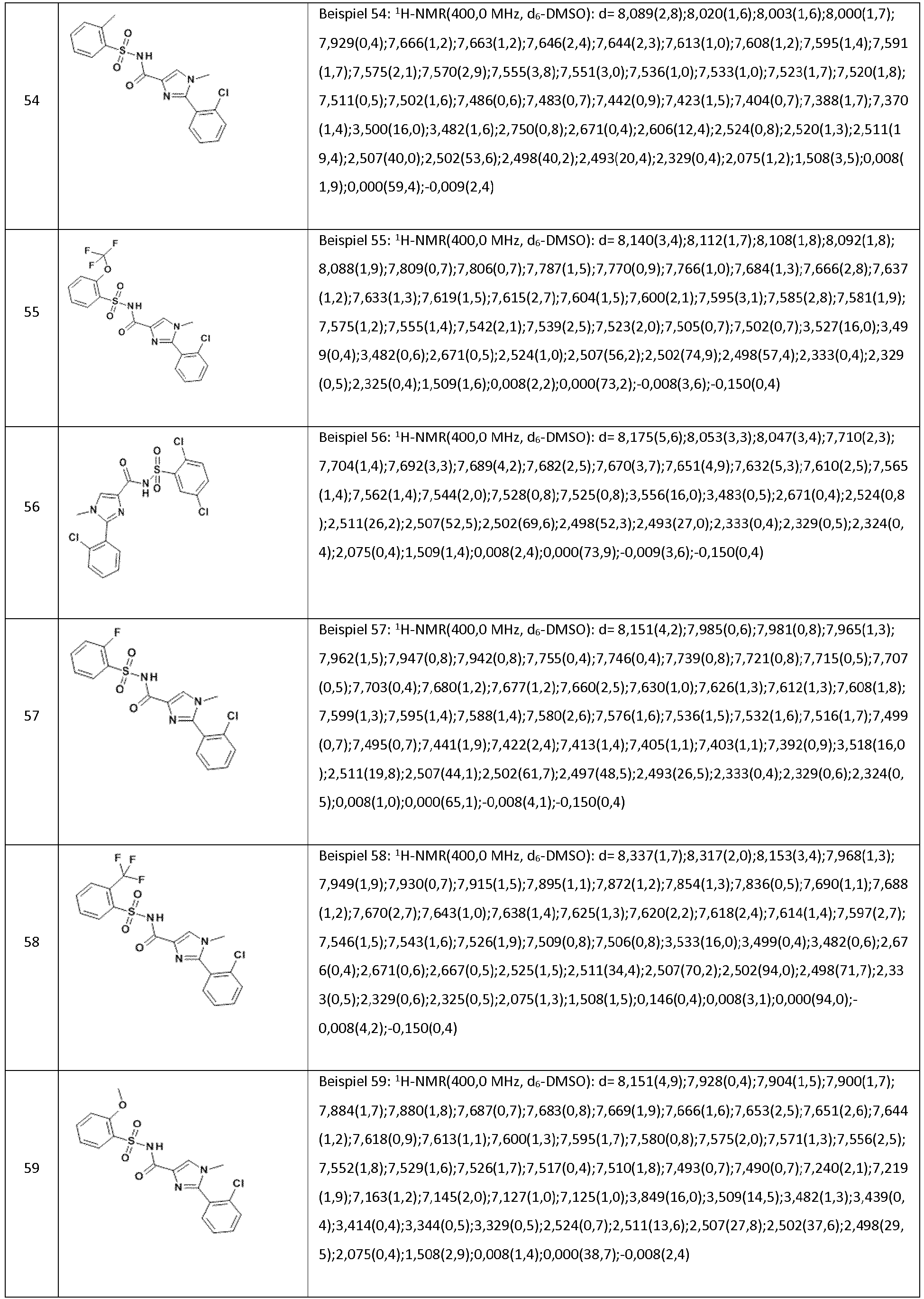
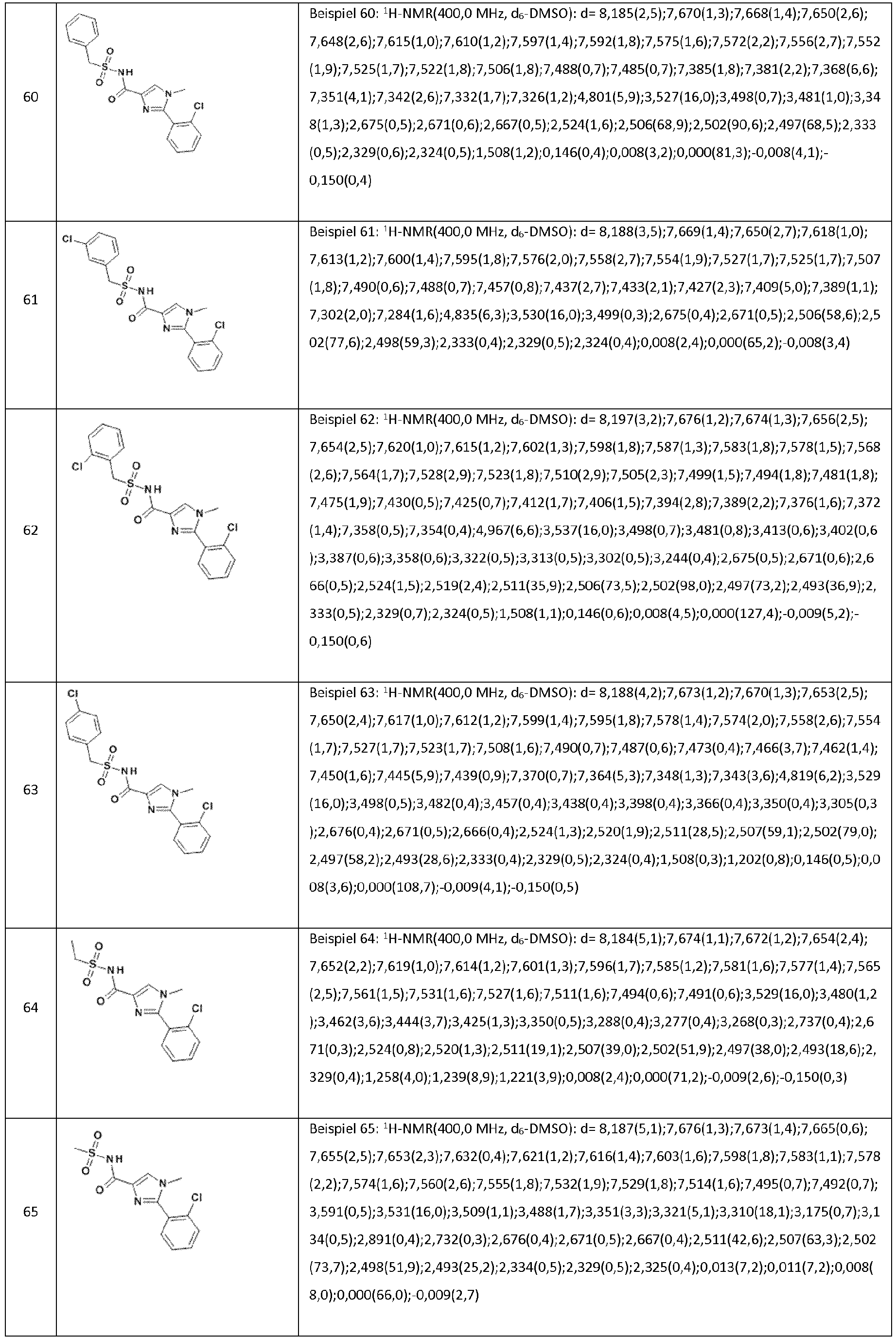


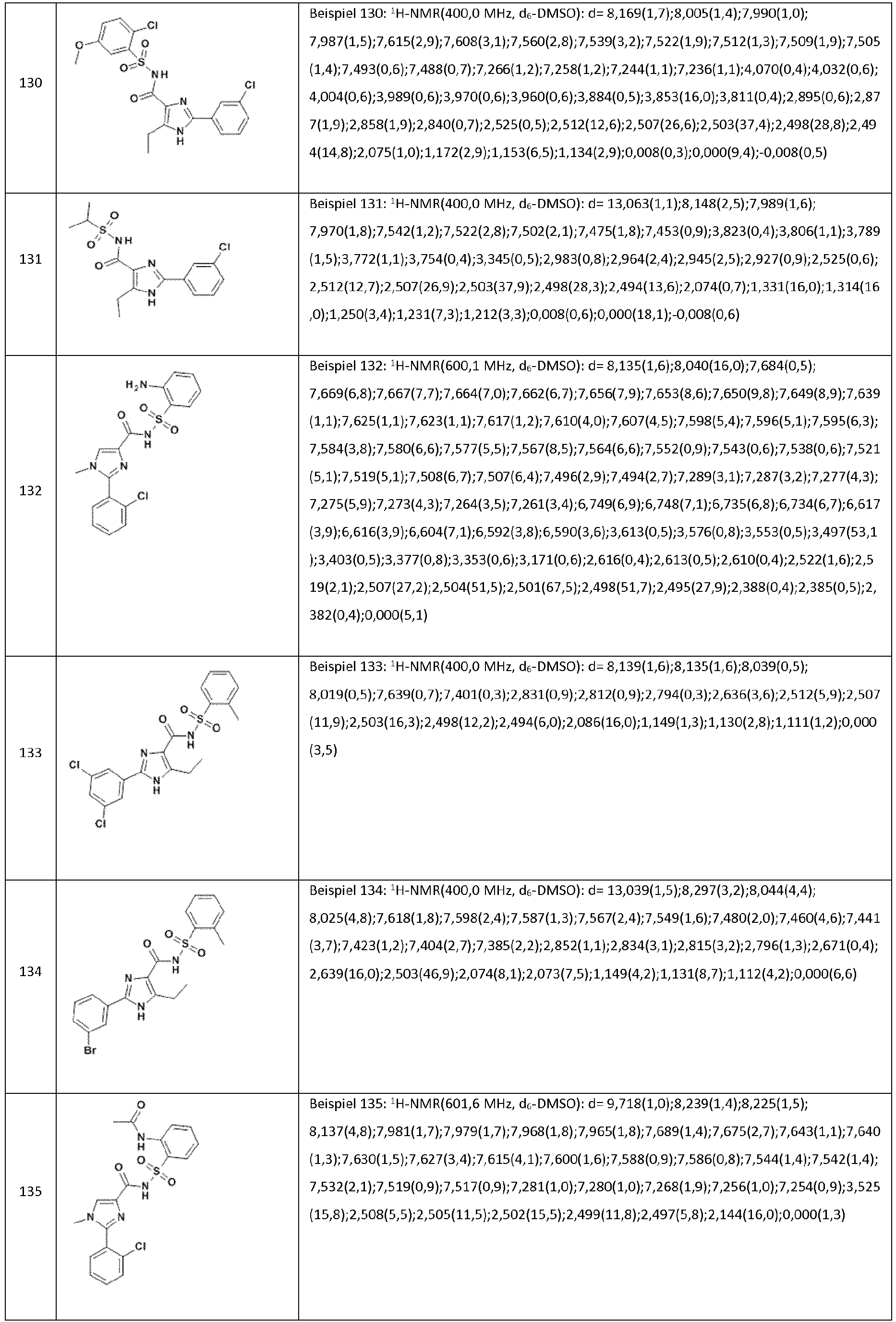


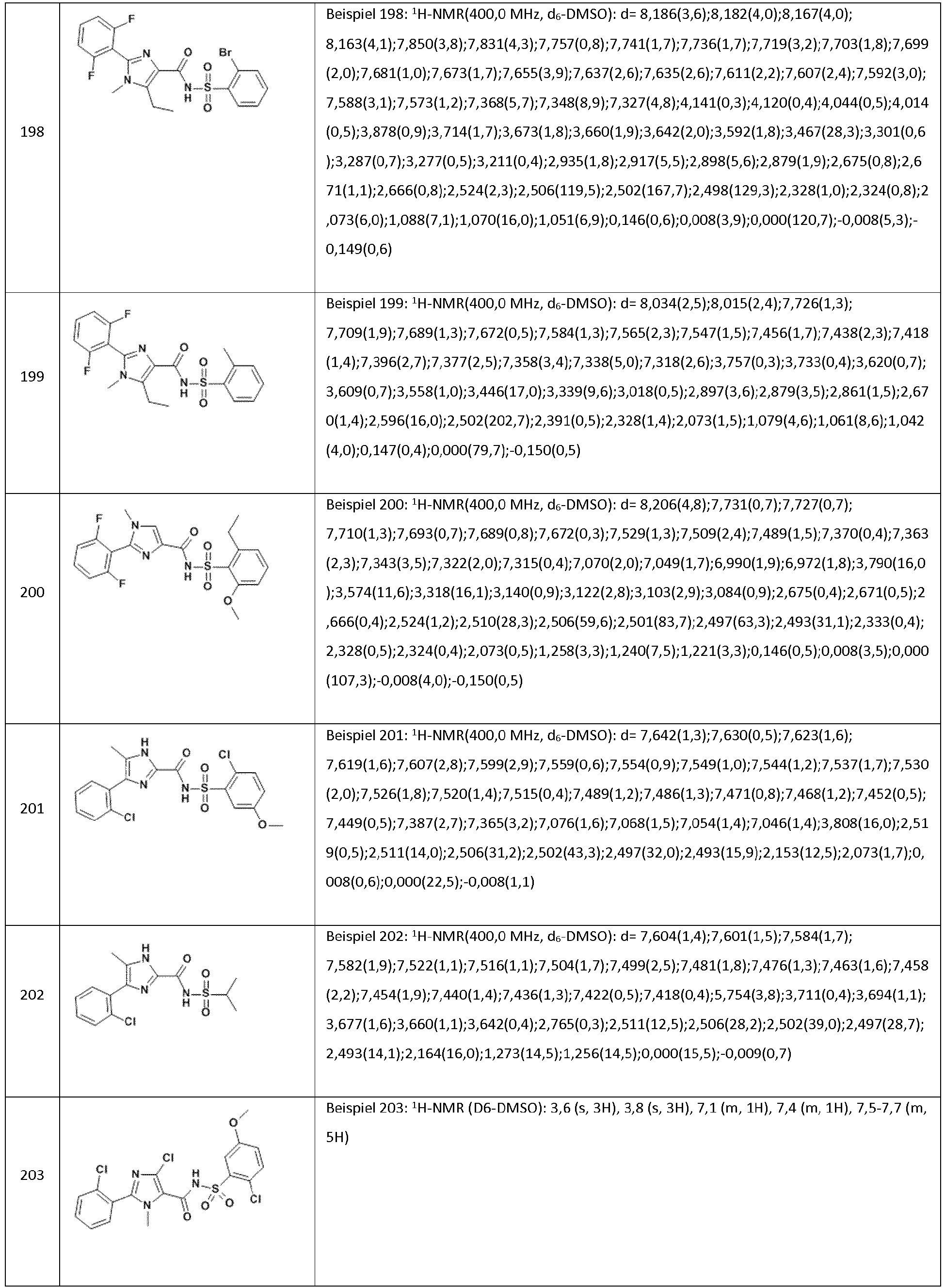


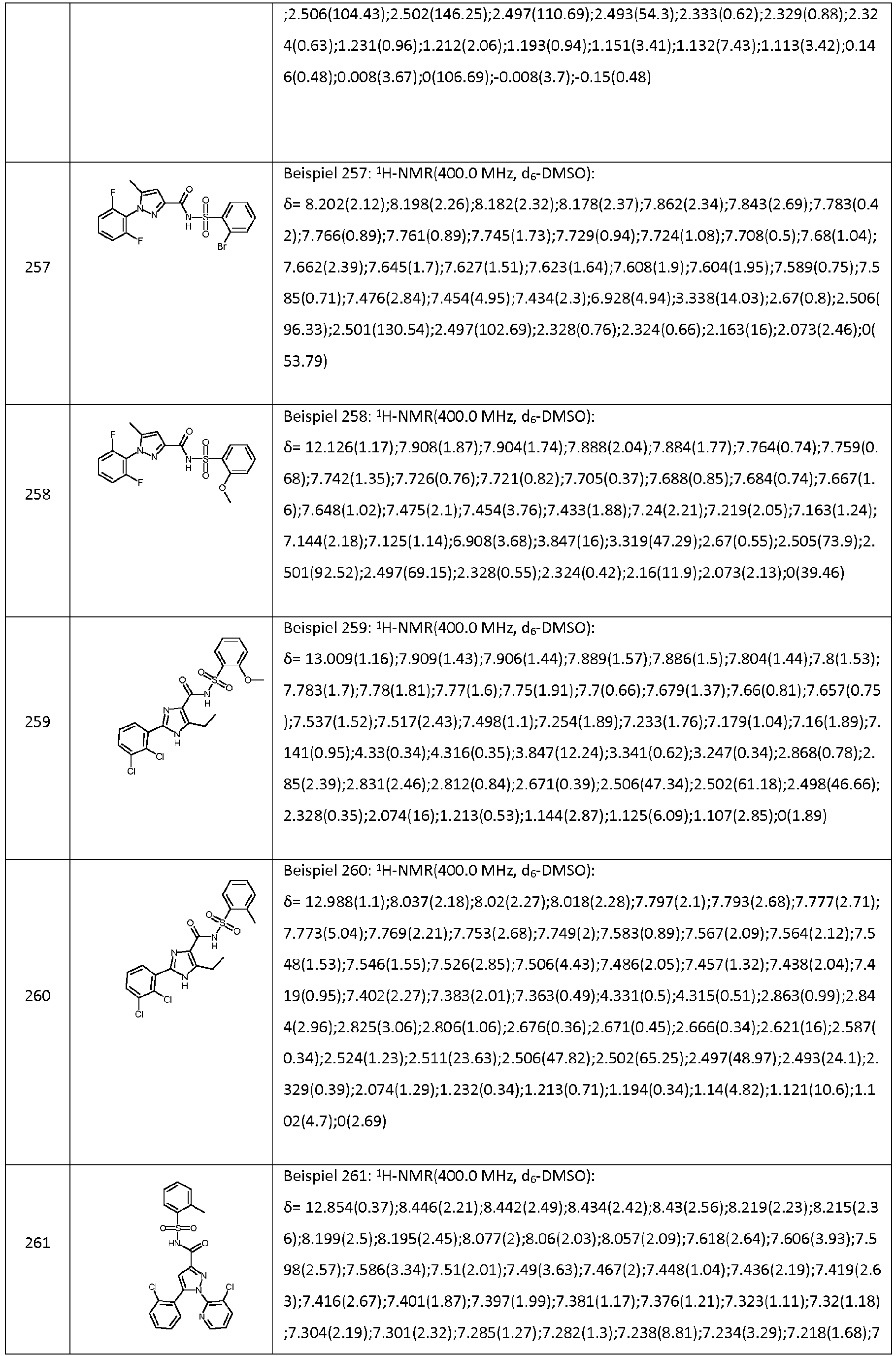


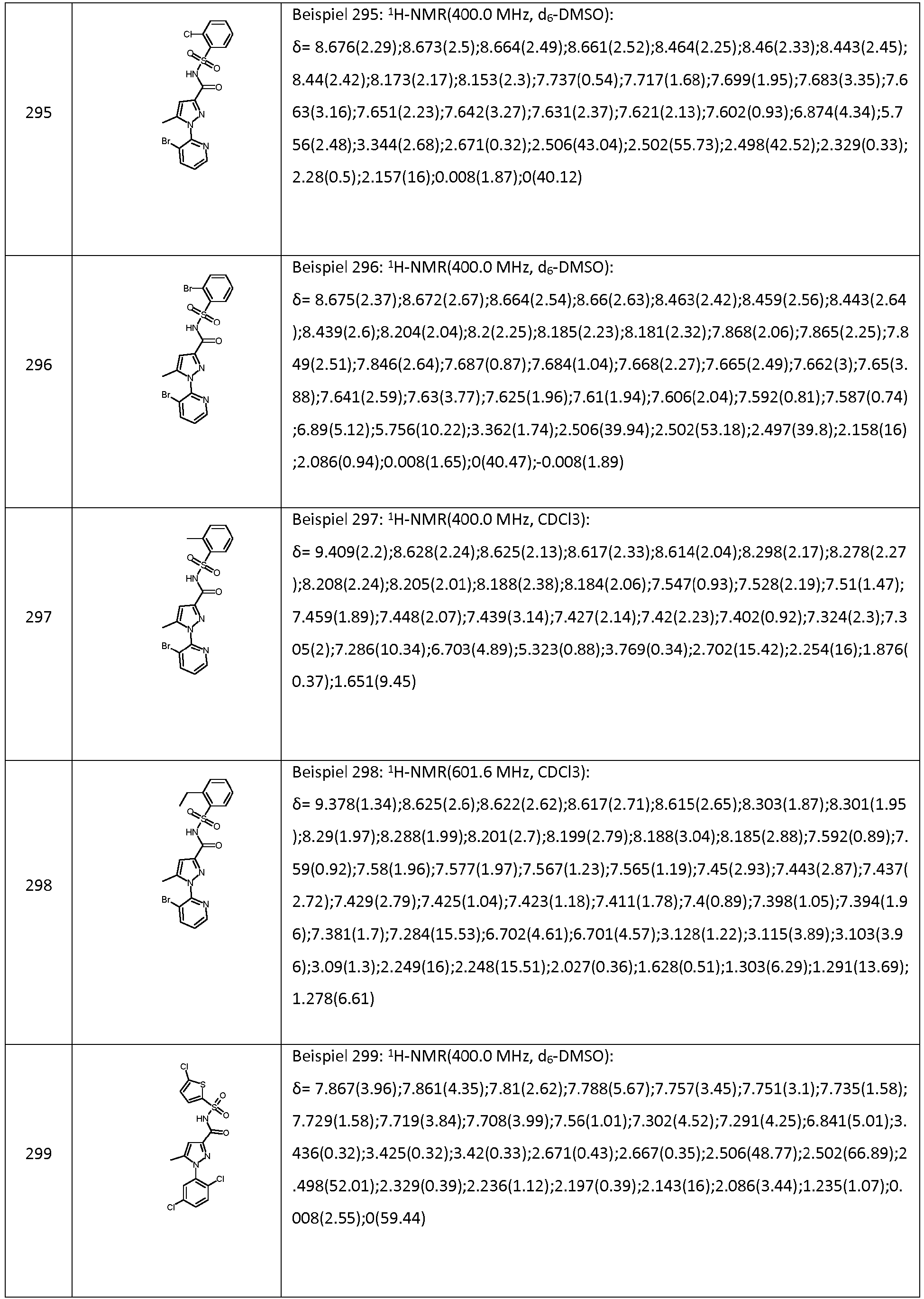


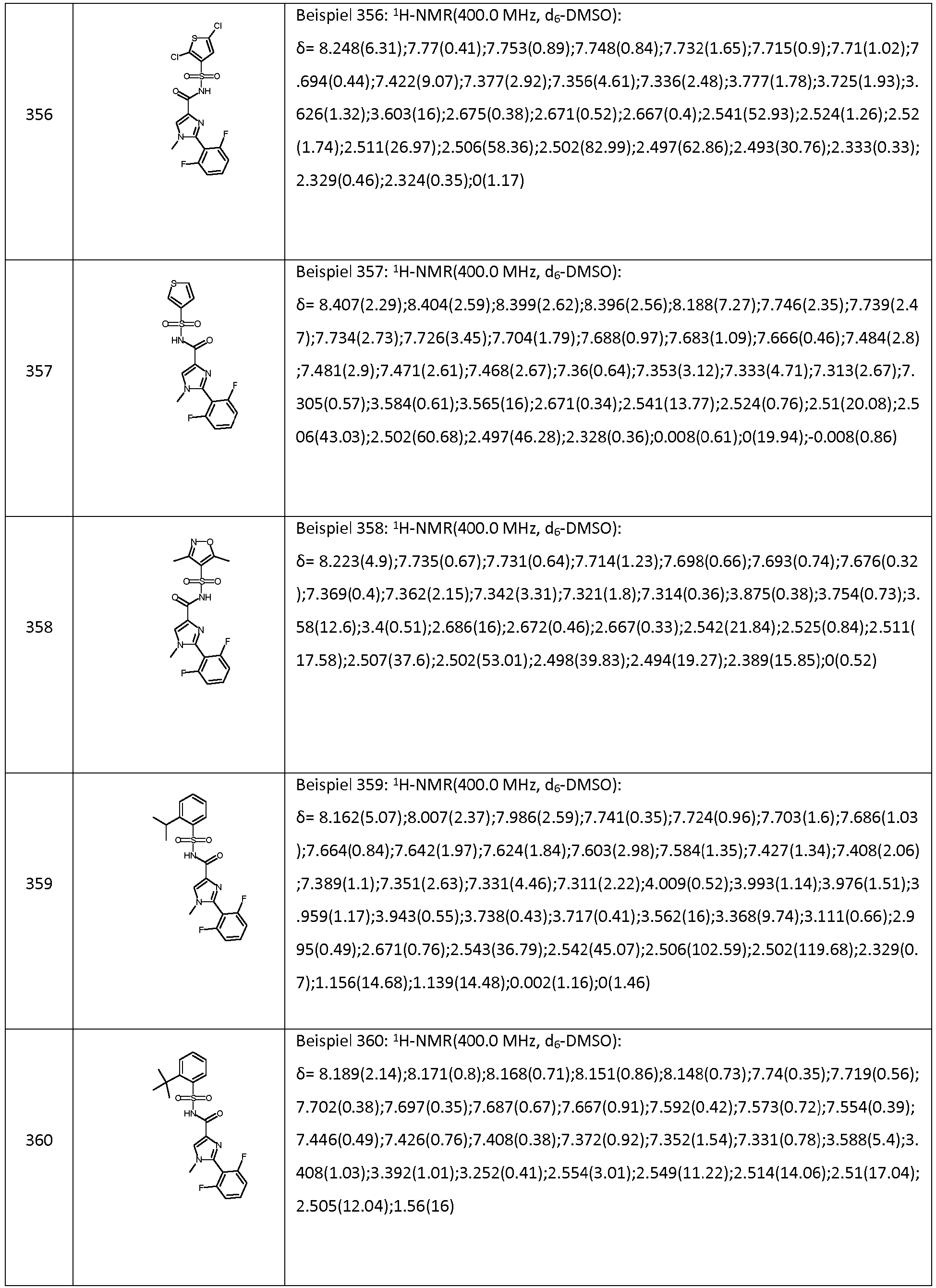


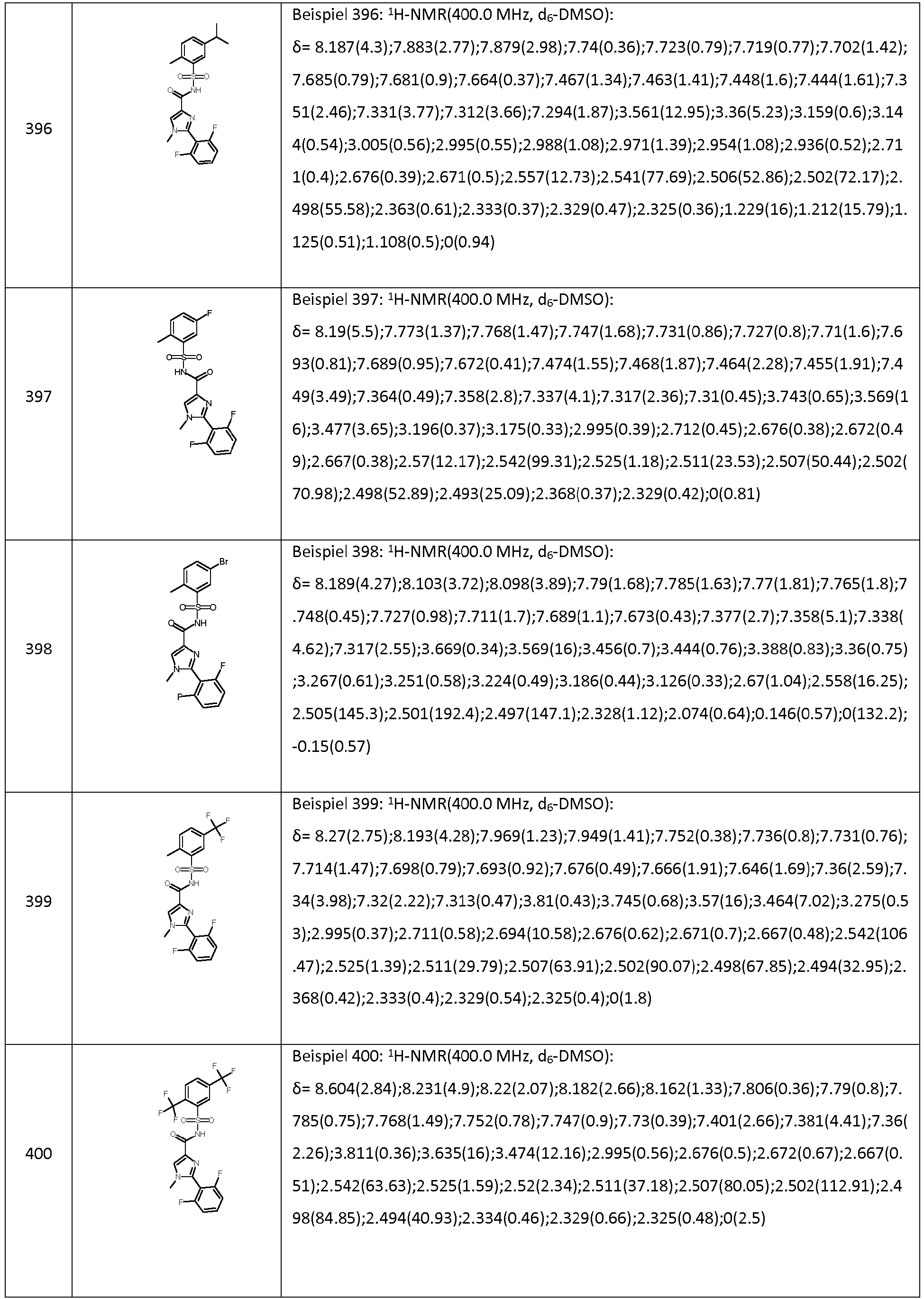


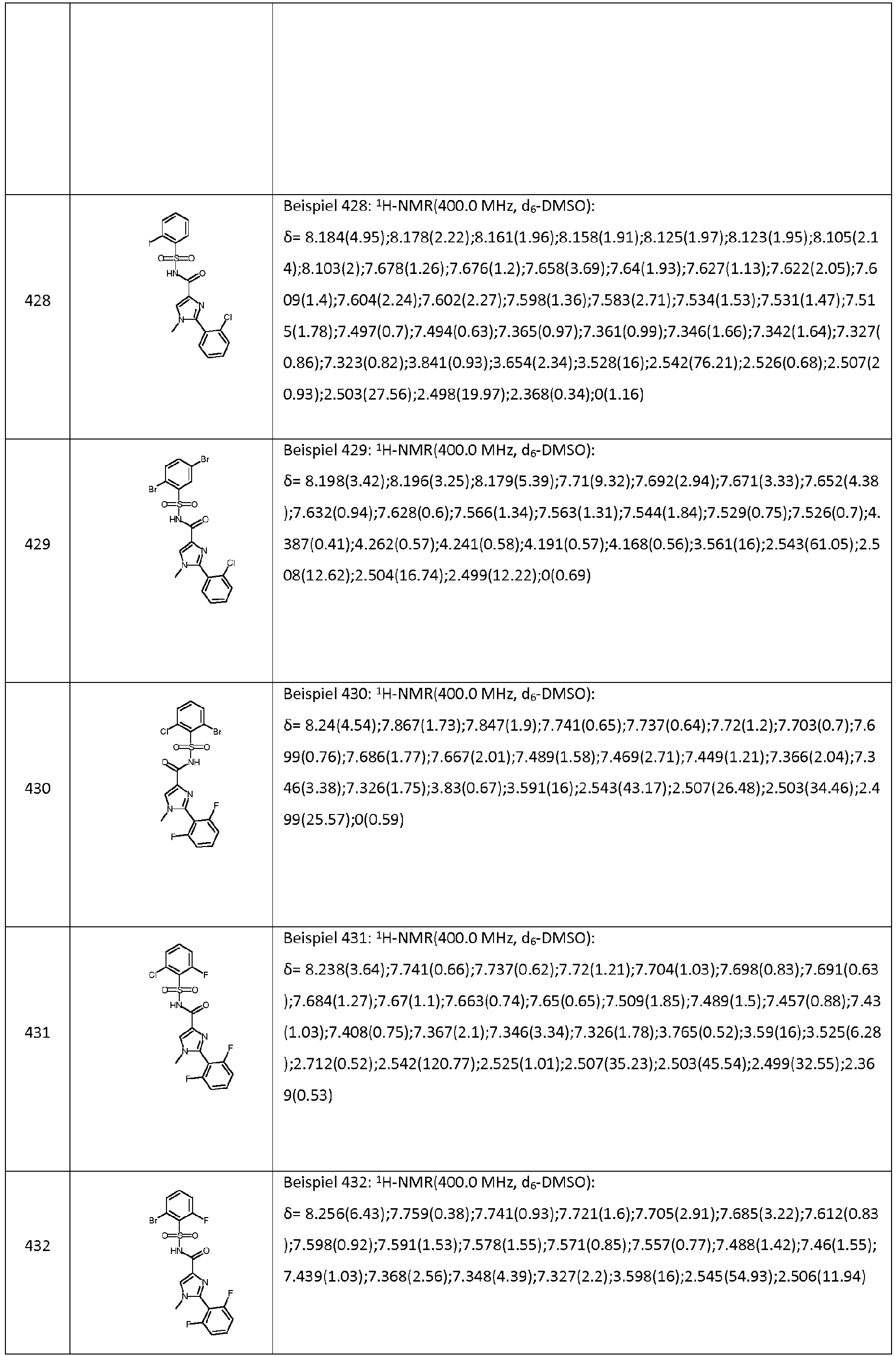


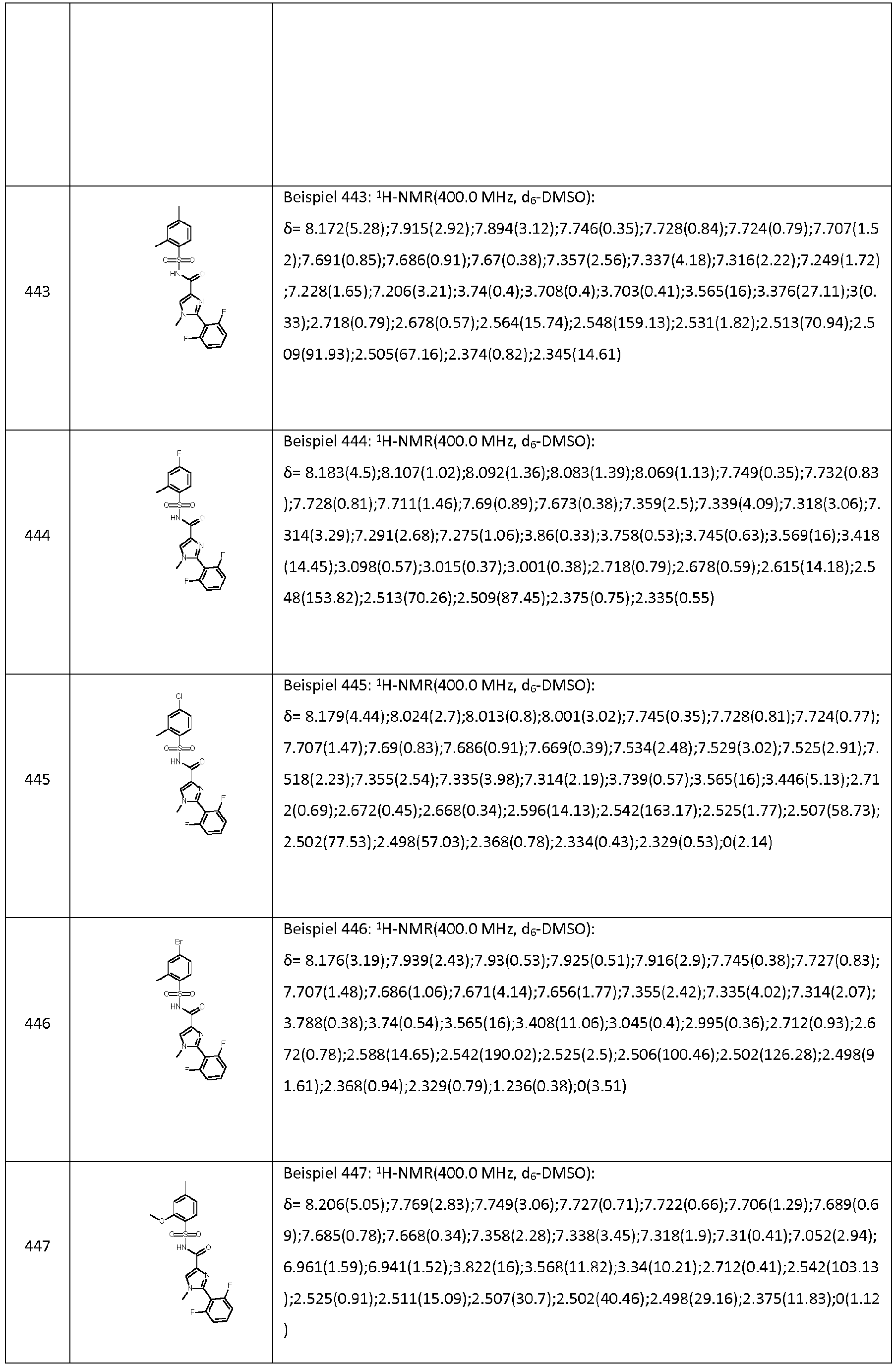


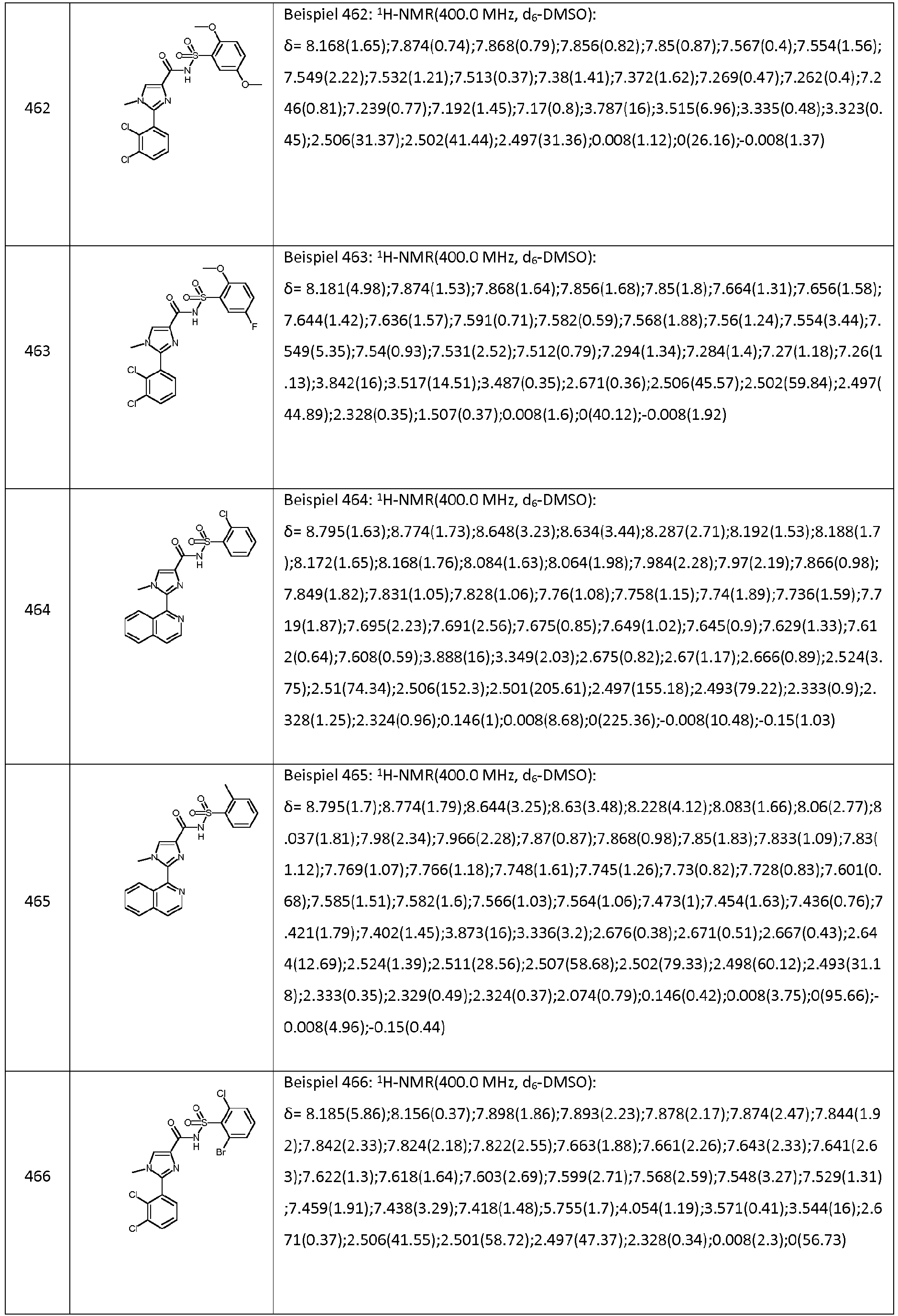

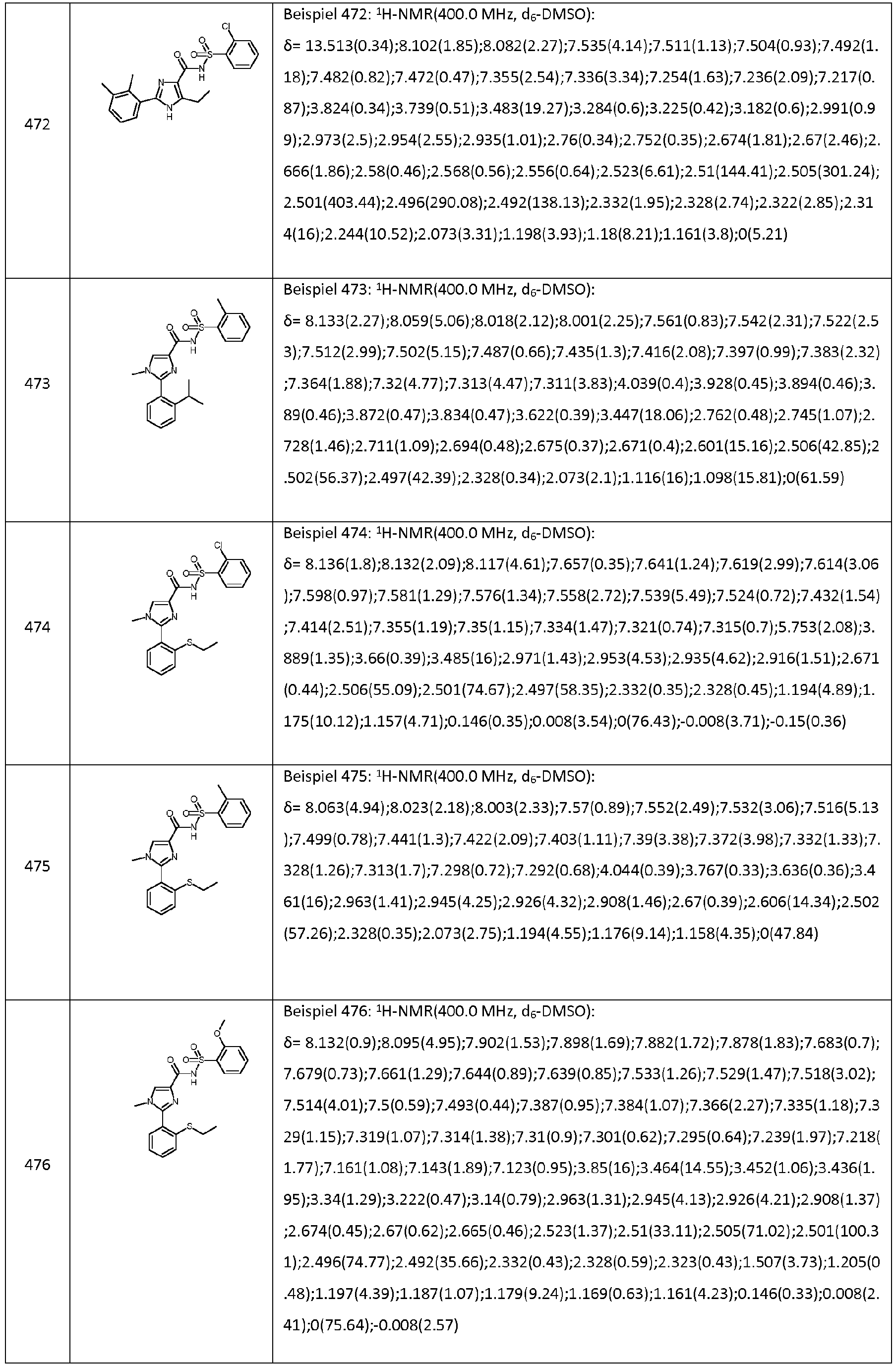


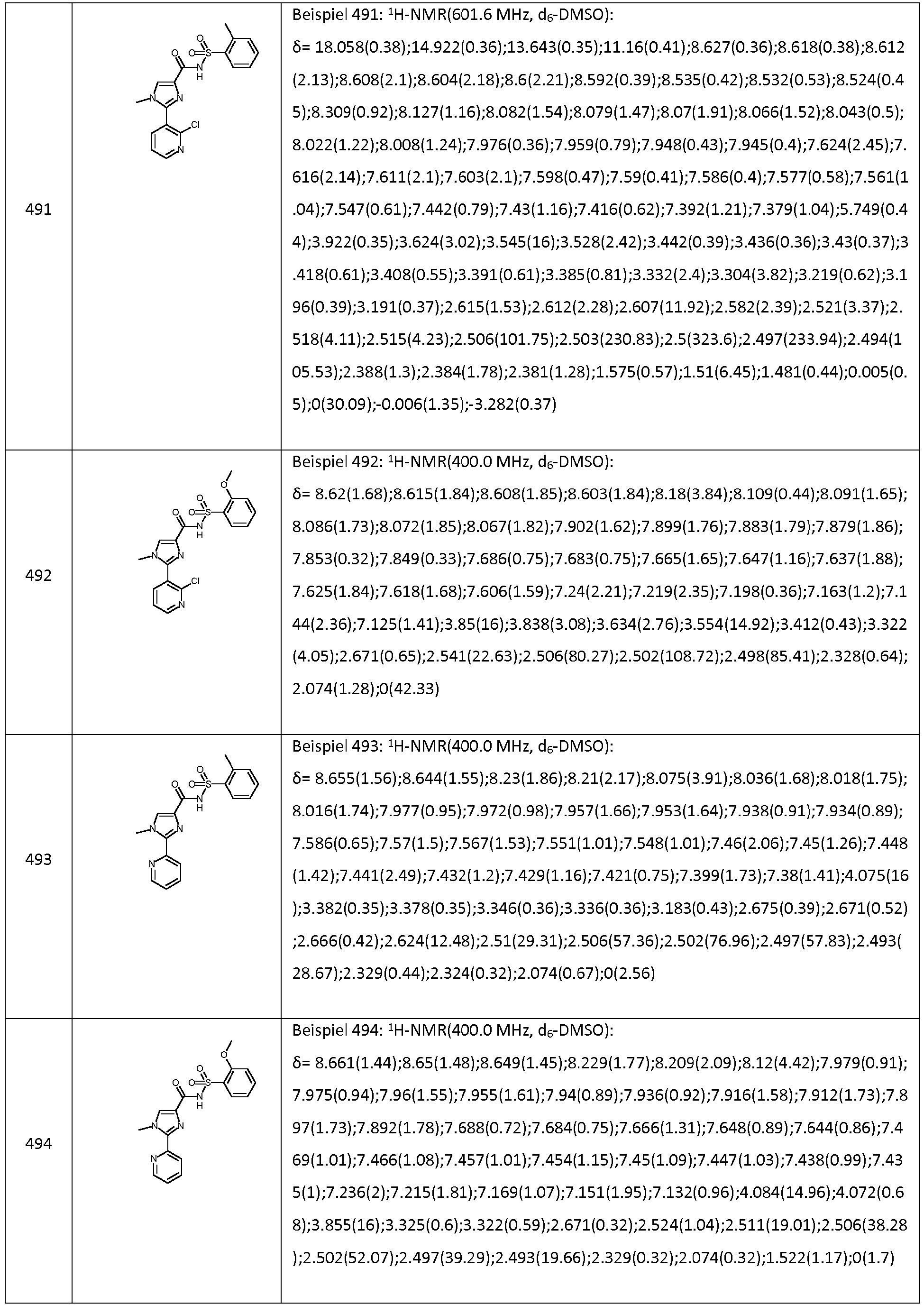


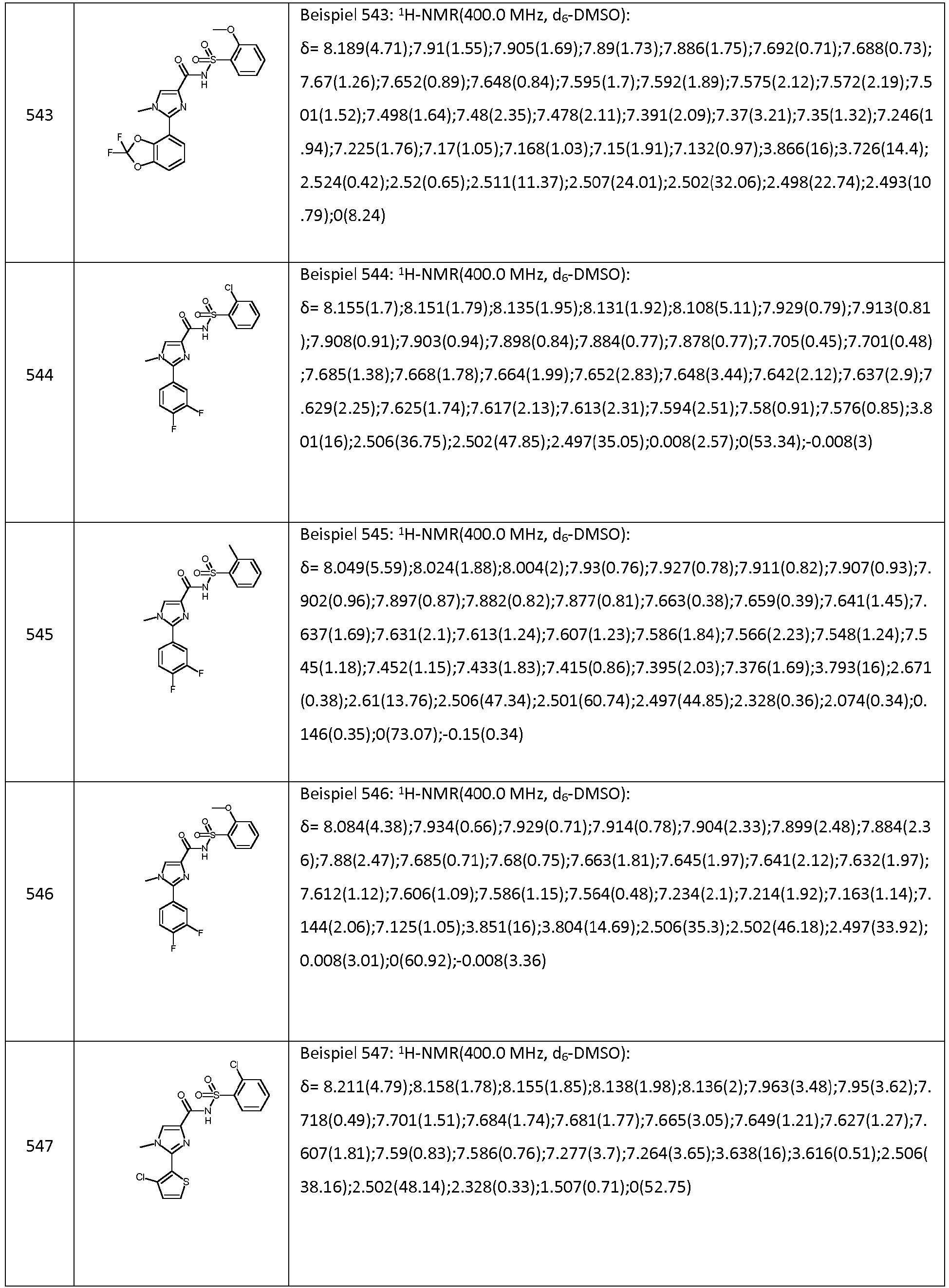

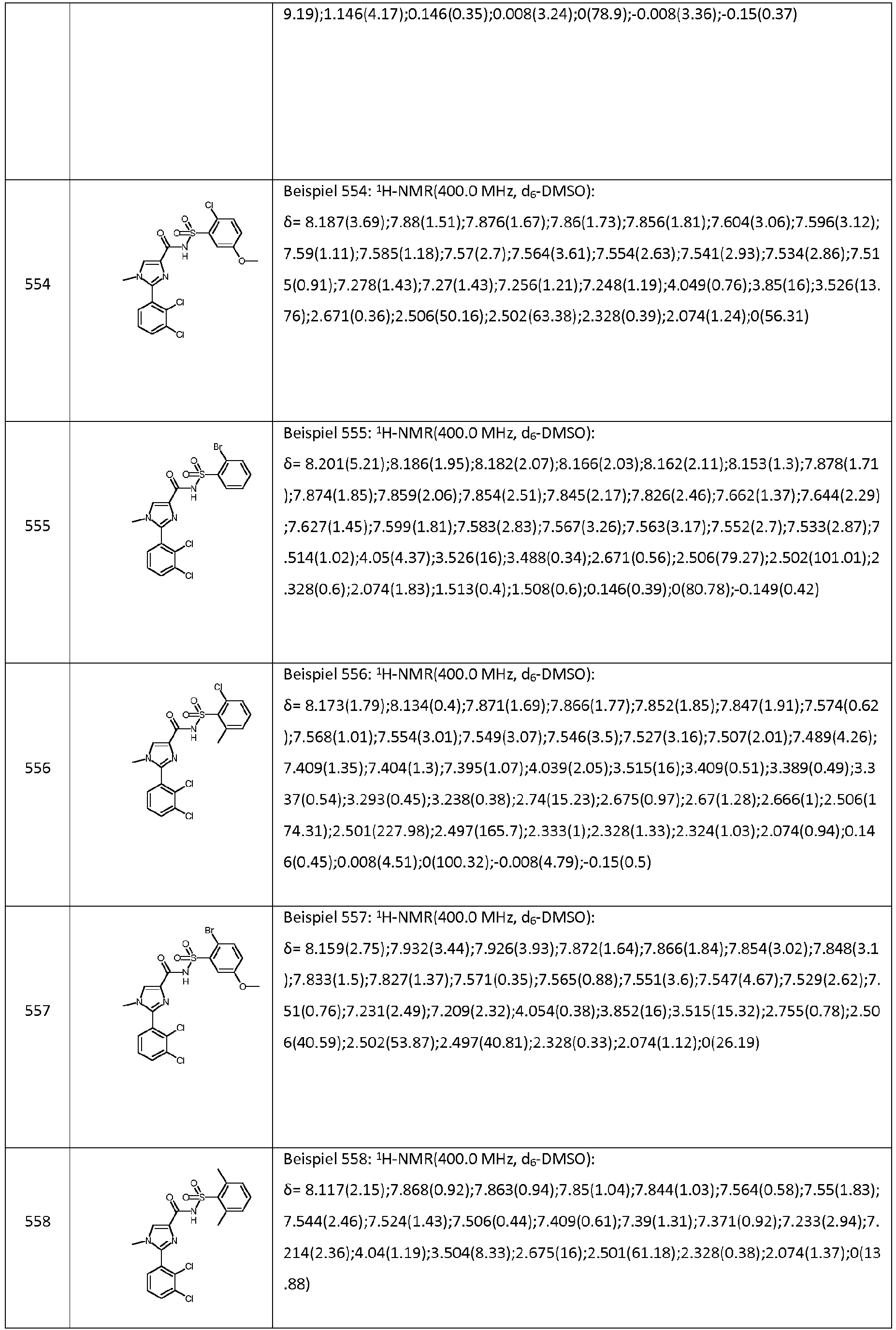


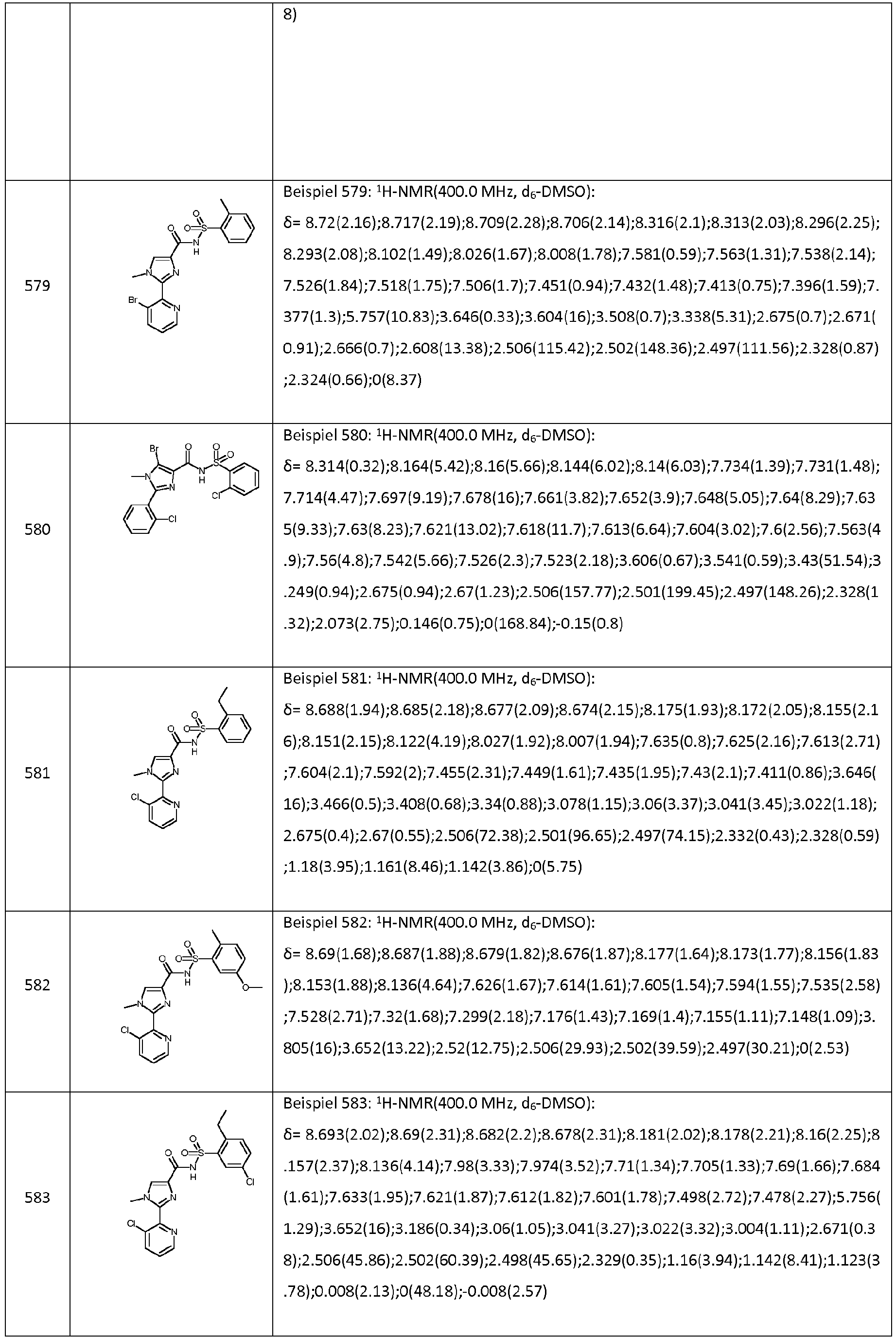


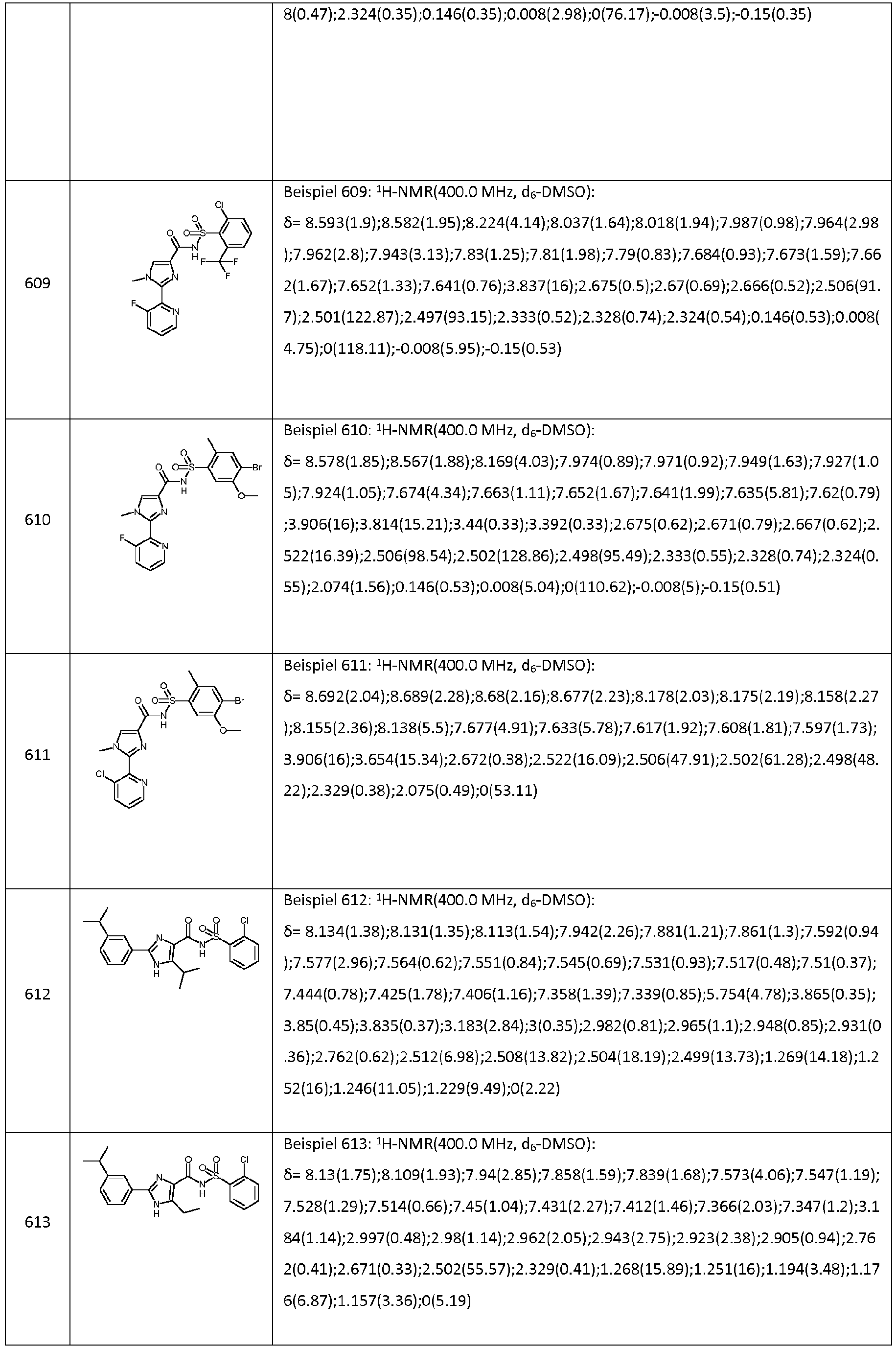


-
Lösungsmittel: Dimethylsulfoxid - Zur Herstellung einer zweckmäßigen Wirkstoffzubereitung vermischt man 10 mg Wirkstoff mit 0,5 ml Lösungsmittel und verdünnt das Konzentrat mit Lösungsmittel auf die gewünschte Konzentration.
- 1µl der Wirkstofflösung wird in das Abdomen von 5 vollgesogenen, adulten, weiblichen Rinderzecken (Boophilus microplus) injiziert. Die Tiere werden in Schalen überführt und in einem klimatisierten Raum aufbewahrt.
- Die Wirkungskontrolle erfolgt nach 7 Tagen auf Ablage fertiler Eier. Eier, deren Fertilität nicht äußerlich sichtbar ist, werden bis zum Larvenschlupf nach etwa 42 Tagen im Klimaschrank aufbewahrt. Eine Wirkung von 100 % bedeutet, dass keine der Zecken fertile Eier gelegt hat, 0% bedeutet, dass alle Eier fertil sind.
- Bei diesem Test zeigen z.B. die folgenden Verbindungen der Herstellungsbeispiele eine Wirkung von 80% bei einer Aufwandmenge von 20µg/Tier: 219
-
Lösungsmittel: Dimethylsulfoxid - Zur Herstellung einer zweckmäßigen Wirkstoffzubereitung vermischt man 10 mg Wirkstoff mit 0,5 ml Dimethylsulfoxid und verdünnt das Konzentrat mit Wasser auf die gewünschte Konzentration.
- Ca. 20 L1-Larven der Australischen Schafgoldfliege (Lucilia cuprina) werden in ein Testgefäß überführt, welches gehacktes Pferdefleisch und die Wirkstoffzubereitung der gewünschten Konzentration enthält.
- Nach 2 Tagen wird die Abtötung in % bestimmt. Dabei bedeutet 100 %, dass alle Larven abgetötet wurden; 0 % bedeutet, dass keine Larven abgetötet wurden.
- Bei diesem Test zeigen z.B. die folgenden Verbindungen der Herstellungsbeispiele eine Wirkung von 100% bei einer Aufwandmenge von 100ppm: 18, 23, 25, 27, 36, 37, 54, 56, 68, 101, 102, 107, 109, 120, 186, 218, 219, 231, 285, 341, 364, 383, 397, 401, 519, 539, 558, 572, 576, 584
- Bei diesem Test zeigen z.B. die folgenden Verbindungen der Herstellungsbeispiele eine Wirkung von 95% bei einer Aufwandmenge von 100ppm: 92, 108, 274, 336, 394
-
Lösungsmittel: Dimethylsulfoxid - Zur Herstellung einer zweckmäßigen Wirkstoffzubereitung vermischt man 10 mg Wirkstoff mit 0,5 ml Dimethylsulfoxid und verdünnt das Konzentrat mit Wasser auf die gewünschte Konzentration.
- Gefäße, die einen Schwamm enthalten, der mit Zuckerlösung und der Wirkstoffzubereitung der gewünschten Konzentration behandelt wurde, werden mit 10 adulten Stubenfliegen (Musca domestica) besetzt.
- Nach 2 Tagen wird die Abtötung in % bestimmt. Dabei bedeutet 100 %, dass alle Fliegen abgetötet wurden; 0 % bedeutet, dass keine der Fliegen abgetötet wurde.
- Bei diesem Test zeigen z.B. die folgenden Verbindungen der Herstellungsbeispiele eine Wirkung von 100% bei einer Aufwandmenge von 100ppm: 107, 151, 231, 394, 576
- Bei diesem Test zeigen z.B. die folgenden Verbindungen der Herstellungsbeispiele eine Wirkung von 90% bei einer Aufwandmenge von 100ppm: 172, 174
- Bei diesem Test zeigen z.B. die folgenden Verbindungen der Herstellungsbeispiele eine Wirkung von 85% bei einer Aufwandmenge von 100ppm: 186, 219
- Bei diesem Test zeigen z.B. die folgenden Verbindungen der Herstellungsbeispiele eine Wirkung von 80% bei einer Aufwandmenge von 100ppm: 32, 52, 68, 152, 153, 155, 185, 337
-
Lösungsmittel: 125,0 Gewichtsteile Aceton - Zur Herstellung einer zweckmäßigen Wirkstoffzubereitung vermischt man 1 Gewichtsteil Wirkstoff mit der angegebenen Menge Lösungsmittel und verdünnt das Konzentrat mit Wasser auf die gewünschte Konzentration.
- Gefäße werden mit Sand, Wirkstofflösung, einer Ei-Larven-Suspension des südlichen Wurzelgallenälchens (Meloidogyne incognita) und Salatsamen gefüllt. Die Salatsamen keimen und die Pflänzchen entwickeln sich. An den Wurzeln entwickeln sich die Gallen.
- Nach 14 Tagen wird die nematizide Wirkung anhand der Gallenbildung in % bestimmt. Dabei bedeutet 100 %, dass keine Gallen gefunden wurden; 0 % bedeutet, dass die Zahl der Gallen an den behandelten Pflanzen der unbehandelten Kontrolle entspricht.
- Bei diesem Test zeigen z. B. die folgenden Verbindungen der Herstellungsbeispiele Wirkung von 100% bei einer Aufwandmenge von 20ppm: 1, 6, 8, 9, 33, 34, 36, 37, 38, 40, 42, 43, 44, 45, 46, 47, 49, 51, 54, 60, 61, 63, 81, 96, 103, 106, 113, 114, 140, 152, 171, 172, 173, 174, 175, 176, 178, 182, 183, 184, 188, 197, 200, 203, 205, 206, 221, 222, 227, 228, 230, 231, 238, 260, 263,264, 265, 267, 269, 270, 271, 272, 275, 276, 279, 281, 282, 285, 286, 294, 307, 309, 310, 311, 315, 329, 336, 338, 339, 341, 352, 362, 364, 380, 414, 415, 417, 429, 434, 440, 441, 443, 444, 445, 449, 450, 456, 457, 484, 496, 502, 511, 513, 517, 519, 520, 525, 535, 537, 541, 542, 544, 545, 546, 547, 560, 561, 577, 580, 581, 599, 600, 614, 616, 618, 623, 625
- Bei diesem Test zeigen z. B. die folgenden Verbindungen der Herstellungsbeispiele Wirkung von 90% bei einer Aufwandmenge von 20ppm: 2, 4, 10, 13, 14, 15, 16, 18, 21, 27, 29, 32, 35, 39, 41, 48, 50, 52, 55, 56, 58, 62, 64, 67, 68, 69, 71, 77, 78, 79, 82, 85, 93, 98, 99, 100, 101, 102, 104, 108, 109, 118, 119, 120, 123, 129, 134, 139, 141, 142, 149, 153, 156, 158, 164, 169, 179, 185, 186, 187, 192, 193,194, 195, 199, 202, 207, 209, 212, 216, 217, 218, 219, 232, 233, 235, 239, 243, 244, 246, 251, 253, 254, 257, 261, 262, 266, 273, 273, 274, 277, 280, 283, 284, 287, 288, 289, 291, 292, 293, 295, 296, 308, 312, 313, 314, 316, 317, 318, 319, 320, 321, 323, 324, 325, 330, 331, 334, 335, 337, 340, 343, 344, 350, 351, 353, 354, 355, 356, 357, 358, 359, 360, 361, 363, 365, 369, 371, 372, 373, 375, 376, 377, 378, 382, 384, 385, 386, 392, 393, 394, 395, 396, 397, 398, 399, 401, 403, 405, 406, 407, 408, 409, 410, 411, 419, 416, 420, 421, 422, 423, 424, 425, 426, 427, 428, 431, 435, 436, 437, 438, 439, 442, 446, 448, 453, 471, 472, 473, 475, 477, 478, 479, 480, 481, 485, 486, 487, 495, 497, 498, 499, 500, 503, 504, 505, 506, 507, 508, 510, 512, 514, 515, 516, 518, 522, 527, 528, 530, 532, 534, 536, 538, 543, 548, 550, 551, 552, 553, 554, 555, 556, 557, 558, 567, 568, 575, 579, 582, 583, 584, 586, 587, 588, 590, 593, 594, 595, 596, 597, 602, 603, 605, 613, 621, 622, 624, 626, 627
- Bei diesem Test zeigen z. B. die folgenden Verbindungen der Herstellungsbeispiele Wirkung von 80% bei einer Aufwandmenge von 20ppm: 225, 226
-
Lösungsmittel: 78 Gewichtsteile Aceton 1,5 Gewichtsteile Dimethylformamid Emulgator: Alkylarylpolyglykolether - Zur Herstellung einer zweckmäßigen Wirkstoffzubereitung löst man 1 Gewichtsteil Wirkstoff mit den angegebenen Gewichtsteilen Lösungsmittel und füllt mit Wasser, welches eine Emulgatorkonzentration von 1000 ppm enthält, bis zum Erreichen der gewünschten Konzentration auf. Zur Herstellung weiterer Testkonzentrationen wird mit emulgatorhaltigem Wasser verdünnt.
- Chinakohlblattscheiben (Brassica pekinensis), die von allen Stadien der Grünen Pfirsichblattlaus (Myzus persicae) befallen sind, werden mit einer Wirkstoffzubereitung der gewünschten Konzentration gespritzt.
- Nach 5-6 Tagen wird die Wirkung in % bestimmt. Dabei bedeutet 100 %, dass alle Blattläuse abgetötet wurden; 0 % bedeutet, dass keine Blattläuse abgetötet wurden.
- Bei diesem Test zeigen z. B. die folgenden Verbindungen der Herstellungsbeispiele Wirkung von 100% bei einer Aufwandmenge von 500g/ha: 1, 6, 11, 13, 18, 22, 23, 25, 26, 27, 28, 29, 36, 42, 53, 54, 56, 57, 66, 75, 79, 84, 86, 87, 90, 92, 94, 96, 97, 100, 102, 107, 108, 109, 111, 115, 116, 117, 118, 119, 120, 138, 140, 142, 147, 151, 153, 156, 157, 158, 164, 169, 173, 174, 181, 183, 185, 186, 193, 200, 204, 206, 211, 212, 218, 219, 220, 225, 226, 227, 228, 229, 230, 235, 238, 269, 271, 272, 273, 274, 277, 278, 283, 284, 290, 294, 295, 298, 301, 303, 304,315, 318, 319, 320, 321, 323, 324, 342, 343, 349, 350, 354, 358, 363, 364, 365, 369, 372, 373, 374, 381, 383, 385, 387, 390, 393, 394, 395, 397, 399, 401, 403, 419, 420, 421, 423, 425, 426, 427, 428, 430, 432, 434, 435, 437, 438, 440, 445, 448, 449, 450, 460, 461, 463, 464, 465, 467, 491, 492, 493, 499, 500, 501, 510, 513, 514, 528, 529, 540, 549, 553, 559, 560, 562, 563, 564, 565, 566, 567, 568, 569, 570, 571, 572, 574, 576, 578, 579, 581, 582, 583, 584, 585, 586, 589, 591, 592, 593, 596, 597, 599, 600, 605, 608, 610
- Bei diesem Test zeigen z. B. die folgenden Verbindungen der Herstellungsbeispiele Wirkung von 90% bei einer Aufwandmenge von 500g/ha: 2, 5, 7, 8, 9, 10, 12, 14, 15, 16, 17, 19, 24, 30, 32, 33, 34, 37, 38, 39, 41, 43, 44, 45, 46, 47, 48, 51, 52, 55, 58, 59, 62, 64, 65, 67, 69, 70, 71, 72, 78, 80, 81, 82, 83, 89, 91, 93, 95, 98, 99, 101, 106, 110, 112, 113, 114, 121, 122, 123, 124, 125, 126, 127, 139, 143, 145, 148, 149, 150, 152, 154, 155, 159, 160, 162, 165, 166, 167, 168, 170, 171, 172, 175, 176, 178, 179, 182, 184, 188, 197, 207, 217, 224, 231, 257, 266, 268, 270, 275, 279, 280, 281, 282, 285, 289, 296, 297, 300, 310, 312, 313, 316, 317, 335, 336, 337, 338, 339, 341, 346, 352, 356, 357, 367, 370, 371, 388, 389, 391, 398, 400, 413, 422, 424, 429, 431, 433, 436, 439, 441, 442, 443, 444, 446, 447, 453, 454, 455, 458, 459, 462, 466, 469, 483, 488, 490, 497, 503, 512, 515, 517, 519, 520, 524, 526, 539, 542, 547, 548, 550, 552, 554, 555, 556, 557, 558, 561, 573, 575, 587, 588, 594, 595, 598, 602, 603, 604, 607, 609, 611
- Bei diesem Test zeigen z. B. die folgenden Verbindungen der Herstellungsbeispiele Wirkung von 90% bei einer Aufwandmenge von 100g/ha: 351, 378, 613
-
Lösungsmittel: 14 Gewichtsteile Dimethylformamid Emulgator: Alkylarylpolyglykolether - Zur Herstellung einer zweckmäßigen Wirkstoffzubereitung löst man 1 Gewichtsteil Wirkstoff mit den angegebenen Gewichtsteilen Lösungsmittel und füllt mit Wasser, welches eine Emulgatorkonzentration von 1000 ppm enthält, bis zum Erreichen der gewünschten Konzentration auf. Zur Herstellung weiterer Testkonzentrationen wird mit emulgatorhaltigem Wasser verdünnt. Bei erforderlicher Zugabe von Ammoniumsalzen oder/und Penetrationsförderern werden diese jeweils in einer Konzentration von 1000 ppm der Präparatelösung zugefügt.
- Paprikapflanzen (Capsicum annuum), die stark von der Grünen Pfirsichblattlaus (Myzus persicae) befallen sind, werden durch Sprühen mit der Wirkstoffzubereitung in der gewünschten Konzentration behandelt.
- Nach 6 Tagen wird die Abtötung in % bestimmt. Dabei bedeutet 100 %, dass alle Läuse abgetötet wurden; 0 % bedeutet, dass keine Läuse abgetötet wurden.
- Bei diesem Test zeigen z. B. die folgenden Verbindungen der Herstellungsbeispiele Wirkung von 100% bei einer Aufwandmenge von 100ppm: 68, 415, 538
Bei diesem Test zeigen z. B. die folgenden Verbindungen der Herstellungsbeispiele Wirkung von 99% bei einer Aufwandmenge von 100ppm: 478
Bei diesem Test zeigen z. B. die folgenden Verbindungen der Herstellungsbeispiele Wirkung von 97% bei einer Aufwandmenge von 100ppm: 616
Bei diesem Test zeigen z. B. die folgenden Verbindungen der Herstellungsbeispiele Wirkung von 95% bei einer Aufwandmenge von 100ppm: 518
Bei diesem Test zeigen z. B. die folgenden Verbindungen der Herstellungsbeispiele Wirkung von 90% bei einer Aufwandmenge von 100ppm: 146, 237, 347, 533
Bei diesem Test zeigen z. B. die folgenden Verbindungen der Herstellungsbeispiele Wirkung von 85% bei einer Aufwandmenge von 100ppm: 60
Bei diesem Test zeigen z. B. die folgenden Verbindungen der Herstellungsbeispiele Wirkung von 80% bei einer Aufwandmenge von 100ppm: 536
Bei diesem Test zeigen z. B. die folgenden Verbindungen der Herstellungsbeispiele Wirkung von 80% bei einer Aufwandmenge von 20ppm: 195 -
Lösungsmittel: 78,0 Gewichtsteile Aceton 1,5 Gewichtsteile Dimethylformamid Emulgator: Alkylarylpolyglykolether - Zur Herstellung einer zweckmäßigen Wirkstoffzubereitung löst man 1 Gewichtsteil Wirkstoff mit den angegebenen Gewichtsteilen Lösungsmittel und füllt mit Wasser, welches eine Emulgatorkonzentration von 1000 ppm enthält, bis zum Erreichen der gewünschten Konzentration auf. Zur Herstellung weiterer Testkonzentrationen wird mit emulgatorhaltigem Wasser verdünnt.
- Chinakohlblattscheiben (Brassica pekinensis) werden mit einer Wirkstoffzubereitung der gewünschten Konzentration gespritzt und nach dem Abtrocknen mit Larven des Meerrettichblattkäfers (Phaedon cochleariae) besetzt.
- Nach 7 Tagen wird die Wirkung in % bestimmt. Dabei bedeutet 100 %, dass alle Käferlarven abgetötet wurden; 0 % bedeutet, dass keine Käferlarven abgetötet wurden.
- Bei diesem Test zeigen z. B. die folgenden Verbindungen der Herstellungsbeispiele Wirkung von 100% bei einer Aufwandmenge von 500g/ha: 2, 18, 23, 27, 36, 37, 42, 56, 58, 100, 101, 102, 104, 105, 106, 107, 108, 120, 143, 152, 153, 164, 165, 172, 186, 188, 195, 196, 205, 216, 218, 221, 222, 231, 279, 280, 282, 285, 286, 289, 290, 294, 300, 304, 307, 308, 309, 313, 316, 318, 319, 324, 334, 336, 337, 338, 339, 340, 341, 361, 363, 364, 369, 370, 373, 383, 385, 387, 394, 397, 398, 399, 401, 405, 423, 424, 425, 428, 429, 430, 434, 436, 439, 445, 446, 448, 449, 450, 461, 464, 465, 466, 467, 469, 479, 502, 510, 517, 519, 540, 550, 556, 558, 561, 576, 577, 579, 581, 583, 584, 586, 587, 597, 599, 603, 610, 611
- Bei diesem Test zeigen z. B. die folgenden Verbindungen der Herstellungsbeispiele Wirkung von 83% bei einer Aufwandmenge von 500g/ha: 171, 174, 176, 217, 227, 269, 303, 311, 413, 420, 460, 548, 552, 568, 572, 575, 582, 602
-
Lösungsmittel: 78,0 GewichtsteileAceton 1,5 Gewichtsteile Dimethylformamid Emulgator: Alkylarylpolyglykolether - Zur Herstellung einer zweckmäßigen Wirkstoffzubereitung löst man 1 Gewichtsteil Wirkstoff mit den angegebenen Gewichtsteilen Lösungsmittel und füllt mit Wasser, welches eine Emulgatorkonzentration von 1000 ppm enthält, bis zum Erreichen der gewünschten Konzentration auf. Zur Herstellung weiterer Testkonzentrationen wird mit emulgatorhaltigem Wasser verdünnt.
- Bohnenblattscheiben (Phaseolus vulgaris), die von allen Stadien der Gemeinen Spinnmilbe (Tetranychus urticae) befallen sind, werden mit einer Wirkstoffzubereitung der gewünschten Konzentration gespritzt.
- Nach 6 Tagen wird die Wirkung in % bestimmt. Dabei bedeutet 100 %, dass alle Spinnmilben abgetötet wurden; 0 % bedeutet, dass keine Spinnmilben abgetötet wurden.
- Bei diesem Test zeigen z. B. die folgenden Verbindungen der Herstellungsbeispiele eine Wirkung von 100% bei einer Aufwandmenge von 500g/ha: 74, 217, 293
- Bei diesem Test zeigen z. B. die folgenden Verbindungen der Herstellungsbeispiele eine Wirkung von 90% bei einer Aufwandmenge von 500g/ha: 46, 70, 78, 82, 87, 101, 104, 173, 195, 212, 291, 315, 318, 351, 406, 407, 495, 568, 573, 582
-
Lösungsmittel: 14 Gewichtsteile Dimethylformamid Emulgator: Alkylarylpolyglykolether - Zur Herstellung einer zweckmäßigen Wirkstoffzubereitung löst man 1 Gewichtsteil Wirkstoff mit den angegebenen Gewichtsteilen Lösungsmittel und füllt mit Wasser, welches eine Emulgatorkonzentration von 1000 ppm enthält, bis zum Erreichen der gewünschten Konzentration auf. Zur Herstellung weiterer Testkonzentrationen wird mit emulgatorhaltigem Wasser verdünnt. Bei erforderlicher Zugabe von Ammoniumsalzen oder/und Penetrationsförderern werden diese jeweils in einer Konzentration von 1000 ppm der Präparatelösung zugefügt.
- Baumwollpflanzen (Gossypium hirsutum), die stark von der Baumwollblattlaus (Aphis gossypii) befallen sind, werden mit einer Wirkstoffzubereitung der gewünschten Konzentration gespritzt.
- Nach 6 Tagen wird die Abtötung in % bestimmt. Dabei bedeutet 100 %, dass alle Blattläuse abgetötet wurden; 0 % bedeutet, dass keine Blattläuse abgetötet wurden.
- Bei diesem Test zeigt z. B. die folgende Verbindungen der Herstellungsbeispiele Wirkung von 100% bei einer Aufwandmenge von 100ppm: 194
Bei diesem Test zeigt z. B. die folgende Verbindungen der Herstellungsbeispiele Wirkung von 98% bei einer Aufwandmenge von 100ppm: 103
Bei diesem Test zeigt z. B. die folgende Verbindungen der Herstellungsbeispiele Wirkung von 95% bei einer Aufwandmenge von 100ppm: 502 -
Lösungsmittel: 78 Gewichtsteile Aceton 1,5 Gewichtsteile Dimethylformamid Emulgator: Alkylarylpolyglykolether - Zur Herstellung einer zweckmäßigen Wirkstoffzubereitung löst man 1 Gewichtsteil Wirkstoff mit den angegebenen Gewichtsteilen Lösungsmittel und füllt mit Wasser, welches eine Emulgatorkonzentration von 1000 ppm enthält, bis zum Erreichen der gewünschten Konzentration auf. Zur Herstellung weiterer Testkonzentrationen wird mit emulgatorhaltigem Wasser verdünnt.
- Vorgequollene Weizenkörner (Triticum aestivum) werden in einer mit Agar und etwas Wasser gefüllten Multiwell-Platte für einen Tag inkubiert (5 Saatkörner pro Kavität). Die gekeimten Weizenkörner werden mit einer Wirkstoffzubereitung der gewünschten Konzentration gespritzt. Anschließend wird jede Kavität mit 10-20 Käferlarven von Diabrotica balteata infiziert.
- Nach 7 Tagen wird die Wirkung in % bestimmt. Dabei bedeutet 100 %, dass alle Maispflanzen wie in der unbehandelten, nicht infizierten Kontrolle gewachsen sind; 0 % bedeutet, dass keine Maispflanze gewachsen ist.
- Bei diesem Test zeigen z. B. die folgenden Verbindungen der Herstellungsbeispiele Wirkung von 100% bei einer Aufwandmenge von 160µg/Kavität: 102, 218, 279, 336, 337, 339, 341, 364, 369, 394, 429, 518, 519, 558
- Bei diesem Test zeigen z. B. die folgenden Verbindungen der Herstellungsbeispiele Wirkung von 80% bei einer Aufwandmenge von 160µg/Kavität: 280, 282, 361, 398, 399, 401, 405, 423, 424, 446, 450, 510
- Bei diesem Test zeigen z. B. die folgenden Verbindungen der Herstellungsbeispiele Wirkung von 80% bei einer Aufwandmenge von 80µg/Kavität: 363, 397
-
Lösungsmittel: 100 Gewichtsteile Aceton - Zur Herstellung einer zweckmäßigen Wirkstoffzubereitung löst man 1 Gewichtsteil Wirkstoff mit den angegebenen Gewichtsteilen Lösungsmittel und füllt mit Wasser bis zum Erreichen der gewünschten Konzentration auf.
- 50 µl der Wirkstoffzubereitung werden in Mikrotiterplatten überführt und mit 150µl IPL41Insektenmedium (33% + 15% Zucker) auf eine Endvolumen von 200 µl aufgefüllt. Anschließend werden die Platten mit Parafilm verschlossen, durch den eine gemischte Population der Grünen Pfirsichblattlaus (Myzus persicae), die sich in einer zweiten Mikrotiterplatte befindet, hindurchstechen und die Lösung aufnehmen kann.
- Nach 5 Tagen wird die Wirkung in % bestimmt. Dabei bedeutet 100 %, dass alle Blattläuse abgetötet wurden; 0 % bedeutet, dass keine Blattläuse abgetötet wurden.
- Bei diesem Test zeigen z. B. die folgenden Verbindungen der Herstellungsbeispiele Wirkung von 100% bei einer Aufwandmenge von 20ppm: 1, 11, 13, 14, 15, 17, 18, 19, 21, 22, 23, 25, 26, 27, 28, 29, 30, 32, 33, 36, 37, 38, 40, 49, 52, 53, 54, 55, 56, 57, 58, 59, 60, 61, 62, 63, 66, 67, 68, 69, 70, 71, 91, 92, 93, 94, 95, 96, 97, 98, 99, 100, 101, 102, 103, 104, 106, 107, 108, 109, 110, 111, 112, 113, 114, 116,118, 119, 120, 124, 125, 132, 134, 140, 147, 148, 152, 153, 155, 156, 157, 158, 159, 162, 163, 169, 170, 171, 172, 173, 174, 178, 179, 180, 182, 183, 184, 185, 186, 187, 188, 192, 194, 195, 196, 198, 199, 201, 202, 205, 211, 212, 213, 214, 216, 216, 217, 218, 219, 220, 221, 225, 226, 233, 235, 237, 238, 239, 245, 247, 248, 257, 265, 266, 268, 269, 270, 271, 272, 273, 274, 275, 276, 277, 278, 279, 280, 281, 282, 283, 284, 285, 286, 289, 290, 294, 295, 297, 298, 300, 302, 303, 304, 306, 311, 312, 313, 314, 315, 316, 317, 318, 319, 320, 323, 324, 325, 331, 336, 337, 338, 339, 341, 342, 348, 352, 354, 358, 363, 364, 367, 369, 370, 371, 372, 373, 378, 381, 383, 385, 386, 387, 388, 389, 390, 393, 394, 397, 398, 399, 401, 403, 405, 411, 414, 415, 419, 420, 421, 422, 423, 424, 425, 426, 427, 428, 429, 430, 431, 432, 433, 434, 435, 436, 437, 439, 440, 443, 444, 446, 447, 448, 449, 452, 453, 454, 456, 459, 461, 463, 465, 466, 467, 469, 470, 478, 483, 490, 491, 492, 497, 498, 499, 500, 501, 502, 503, 509, 510, 511, 512, 513, 514, 515, 517, 518, 519, 520, 524, 525, 528, 532, 533, 536, 538, 539, 540, 549, 553, 554, 555, 556, 557, 558, 559, 560, 561, 562, 563, 564, 565, 566, 567, 568, 569, 570, 571, 572, 573, 574, 575, 576, 578, 579, 583, 584, 585, 587, 588, 589, 590, 591, 592, 593, 594, 595, 596, 597, 598, 599, 600, 602, 603, 605, 607, 609, 610, 611, 612, 613, 615, 616, 617, 618, 619
Bei diesem Test zeigen z. B. die folgenden Verbindungen der Herstellungsbeispiele Wirkung von 90% bei einer Aufwandmenge von 20ppm: 7, 12, 39, 41, 43, 44, 45, 51, 75, 77, 81, 115, 117, 126, 130, 131, 136, 137, 141, 143, 150, 165, 176, 181, 191, 206, 208, 209, 215, 236, 296, 299, 301, 305, 327, 330, 343, 345, 347, 350, 353, 368, 395, 412, 416, 418, 438, 445, 446, 450, 462, 464, 477, 496, 531, 547, 548, 601, 604, 620, 625
Bei diesem Test zeigen z. B. die folgenden Verbindungen der Herstellungsbeispiele Wirkung von 100% bei einer Aufwandmenge von 4ppm: 581, 582, 586
Claims (22)
- Verwendung einer Verbindung der Formel (I)

M für einen Rest ausgewählt aus den Formeln (IIa-IIf) steht:
 R1, R2, R3 jeweils unabhängig voneinander H oder ein substituierter oder unsubstituierter Alkyl, Cycloalkyl, Alkenyl, Cycloalkenyl, Cyloheteroalkyl, Aryl oder Heteroaryl Rest sind, wobei R2 im Falle (IIc) und (IIe) zusätzlich ein Halogen Rest oder ein Alkoxy Rest sein kann, und R3 zusätzlich im Falle (IIa), (IId) und (IIe) ein Halogen Rest sein kann;Q ein substituierter oder unsubstituierter Aryl oder Heteroaryl Rest, im Falle (IIe) aber nicht 2-Pyrimidinyl ist;D ein substituierter oder unsubstituierter Alkyl, Heteroalkyl, gegebenenfalls teilweise ungesättigter Cycloalkyl, Cycloheteroalkyl, Heteroaryl, Aryl oder Phenylalkyl Rest oder ein substituierter oder unsubstituierter Stickstoff Rest ist,zur Bekämpfung von tierischen Schädlingen, wobei die chirurgische, therapeutische oder diagnostische Behandlung des menschlichen oder tierischen Körpers ausgeschlossen ist.
- Verwendung nach Anspruch 1, bei der
M für einen Rest ausgewählt aus den Formeln (IIa-IIf) steht, wobei R1, R2, R3 jeweils unabhängig voneinander H oder ein substituierter oder unsubstituierter (C1-C4)-Alkyl, (C3-C6)-Cycloalkyl, (C2-C4)-Alkenyl, Pyridyl oder Phenyl Rest sind, wobei R2 im Falle (IIc) und (IIe) zusätzlich ein Halogen Rest oder ein Alkoxy Rest sein kann und wobei R3 zusätzlich im Falle (IIa), (IId) und (IIe) ein Halogen Rest sein kann;
Q ein substituierter oder unsubstituierter Phenyl, Naphthyl oder Heteroaryl Rest ist, der ein bis drei Heteroatome aus der Reihe Sauerstoff, Schwefel, Stickstoff enthalten kann; im Falle (IIe) aber nicht 2-Pyrimidinyl ist;
D ein substituierter oder unsubstituierter Alkyl, Heteroalkyl, Cycloalkyl, Heteroaryl, Aryl oder Phenyl-(C1-C8)alkyl Rest oder ein substituierter oder unsubstituierter Stickstoff Rest ist. - Verwendung nach Anspruch 1 oder 2, bei der
M für einen Rest ausgewählt aus den Formeln (IIa-IIf) steht, wobei R1, R2, R3 definiert sind wie in Anspruch 1 oder 2 und
Q ein unsubstituierter oder mit einem oder mehreren Resten R4 substituierter Phenyl, Naphthyl, Pyridyl, Pyrimidinyl, Thiophen, Benzthiophen, Isochinolin, Benzdioxol oder Pyrazol Rest ist, im Falle (IIe) aber nicht 2-Pyrimidinyl ist,
wobei der oder die Substituenten R4 jeweils unabhängig voneinander ausgewählt sind aus:Cyano, Halogen, Nitro, Acetyl, Hydroxy, Carboxy, Amino, SCN, Tri-(C1-C6)alkylsilyl, (C3-C8)Cycloalkyl, (C3-C8)Cycloalkyloxy, (C3-C8)Cycloalkyl-(C3-C8)cycloalkyl, (C1-C6)Alkyl-(C3-C8)cycloalkyl, Halogen(C3-C8)cycloalkyl, (C1-C6)Alkyl, (C1-C6)Halogenalkyl, (C1-C6)Cyanoalkyl, (C1-C6)Hydroxyalkyl, Hydroxycarbonyl-(C1-C6)-alkoxy, (C1-C6)Alkoxycarbonyl-(C1-C6)alkyl, (C1-C6)Alkoxy-(C1-C6)alkyl, (C2-C6)Alkenyl, (C2-C6)Halogenalkenyl, (C2-C6)Cyanoalkenyl, (C2-C6)Alkinyl, (C2-C6)Halogenalkinyl, (C2-C6)Cyanoalkinyl, (C1-C6)Alkoxy, (C1-C6)Halogenalkoxy, (C1-C6)Cyanoalkoxy, (C1-C6)Alkoxycarbonyl-(C1-C6)alkoxy, (C1-C6)Alkoxy-(C1-C6)alkoxy, (C1-C6)Alkylhydroxyimino, (C1-C6)Alkoxyimino, (C1-C6)Alkyl-(C1-C6)alkoxyimino, (C1-C6)Halogenalkyl-(C1-C6)alkoxyimino, (C1-C6)Alkylthio, (C1-C6)Halogenalkylthio, (C1-C6)Alkoxy-(C1-C6)alkylthio, (C1-C6)Alkylthio-(C1-C6)alkyl, (C1-C6)Alkylsulfinyl, (C1-C6)Halogenalkylsulfinyl, (C1-C6)Alkoxy-(C1-C6)alkylsulfinyl, (C1-C6)Alkylsulfinyl-(C1-C6)alkyl, (C1-C6)Alkylsulfonyl, (C1-C6)Halogenalkylsulfonyl, (C1-C6)Alkoxy-(C1-C6)alkylsulfonyl, (C1-C6)Alkylsulfonyl-(C1-C6)alkyl, (C1-C6)Alkylsulfonyloxy, (C1-C6)Alkylcarbonyl, (C1-C6)Alkylthiocarbonyl, (C1-C6)Halogenalkylcarbonyl, (C1-C6)Alkylcarbonyloxy, (C1-C6)Alkoxycarbonyl, (C1-C6)Halogenalkoxycarbonyl, Aminocarbonyl, (C1-C6)Alkylaminocarbonyl, (C1-C6)Alkylaminothiocarbonyl, Di-(C1-C6)alkyl-aminocarbonyl, Di-(C1-C6)alkyl-aminothiocarbonyl, (C2-C6)Alkenylaminocarbonyl, Di-(C2-C6)-alkenylaminocarbonyl, (C3-C8)Cycloalkylaminocarbonyl, (C1-C6)Alkylsulfonylamino, (C1-C6)Alkylamino, Di-(C1-C6)Alkylamino, Aminosulfonyl, (C1-C6)Alkylaminosulfonyl, Di-(C1-C6)alkyl-aminosulfonyl, (C1-C6)Alkylsulfoximino, Aminothiocarbonyl, (C1-C6)Alkylaminothiocarbonyl, Di-(C1-C6)alkyl-aminothiocarbonyl, (C3-C8)Cycloalkylamino, NHCO-(C1-C6)alkyl ((C1-C6)Alkylcarbonylamino) und/odergegebenenfalls einfach oder mehrfach, gleich oder verschieden substituiertes Aryl, Aryloxy oder Hetaryl, wobei (im Fall von Hetaryl) gegebenenfalls mindestens eine Carbonylgruppe enthalten sein kann und wobei als Substituenten jeweils in Frage kommen: Cyano, Carboxyl, Halogen, Nitro, Acetyl, Hydroxy, Amino, SCN, Tri-(C1-C6)alkylsilyl, (C3-C8)Cycloalkyl, (C3-C8)Cycloalkyl-(C3-C8)cycloalkyl, (C1-C6)Alkyl-(C3-C8)cycloalkyl, Halogen(C3-C8)cycloalkyl, (C1-C6)Alkyl, (C1-C6)Halogenalkyl, (C1-C6)Cyanoalkyl, (C1-C6)Hydroxyalkyl, Hydroxycarbonyl-(C1-C6)-alkoxy, (C1-C6)Alkoxycarbonyl-(C1-C6)alkyl, (C1-C6)Alkoxy-(C1-C6)alkyl, (C2-C6)Alkenyl, (C2-C6)Halogenalkenyl, (C2-C6)Cyanoalkenyl, (C2-C6)Alkinyl, (C2-C6)Halogenalkinyl, (C2-C6)Cyanoalkinyl, (C1-C6)Alkoxy, (C1-C6)Halogenalkoxy, (C1-C6)Cyanoalkoxy, (C1-C6)Alkoxycarbonyl-(C1-C6)alkoxy, (C1-C6)Alkoxy-(C1-C6)alkoxy, (C1-C6)Alkylhydroxyimino, (C1-C6)Alkoxyimino, (C1-C6)Alkyl-(C1-C6)alkoxyimino, (C1-C6)Halogenalkyl-(C1-C6)alkoxyimino, (C1-C6)Alkylthio, (C1-C6)Halogenalkylthio, (C1-C6)Alkoxy-(C1-C6)alkylthio, (C1-C6)Alkylthio-(C1-C6)alkyl, (C1-C6)Alkylsulfinyl, (C1-C6)Halogenalkylsulfinyl, (C1-C6)Alkoxy-(C1-C6)alkylsulfinyl, (C1-C6)Alkylsulfinyl-(C1-C6)alkyl, (C1-C6)Alkylsulfonyl, (C1-C6)Halogenalkylsulfonyl, (C1-C6)Alkoxy-(C1-C6)alkylsulfonyl, (C1-C6)Alkylsulfonyl-(C1-C6)alkyl, (C1-C6)Alkylsulfonyloxy, (C1-C6)Alkylcarbonyl, (C1-C6)Halogenalkylcarbonyl, (C1-C6)Alkylcarbonyloxy, (C1-C6)Alkoxycarbonyl, (C1-C6)Halogenalkoxycarbonyl, Aminocarbonyl, (C1-C6)Alkylaminocarbonyl, Di-(C1-C6)alkyl-aminocarbonyl, (C2-C6)Alkenylaminocarbonyl, Di-(C2-C6)-alkenylaminocarbonyl, (C3-C8)Cycloalkylaminocarbonyl, (C1-C6)Alkylsulfonylamino, (C1-C6)Alkylamino, Di-(C1-C6)Alkylamino, Aminosulfonyl, (C1-C6)Alkylaminosulfonyl, Di-(C1-C6)alkylaminosulfonyl, (C1-C6)Alkylsulfoximino, Aminothiocarbonyl, (C1-C6)Alkylaminothiocarbonyl, Di-(C1-C6)alkylaminothiocarbonyl, (C3-C8)Cycloalkylamino und (C1-C6)Alkylcarbonylamino undD ein unsubstituierter oder mit einem oder mehreren Resten R5 substituierter (C1-C6)-Alkyl, Phenyl, Phenyl-(C1-C2)alkyl oder Heteroaryl Rest ist, der ein bis drei Heteroatome aus der Reihe Sauerstoff, Schwefel, Stickstoff enthalten kann oder ein NR6R7 Rest ist,wobei der oder die Substituenten R5 jeweils unabhängig voneinander ausgewählt sind aus:Cyano, Halogen, Nitro, Acetyl, Hydroxy, Carboxy, Amino, SCN, Tri-(C1-C6)alkylsilyl, (C3-C8)Cycloalkyl, (C3-C8)Cycloalkyloxy, (C3-C8)Cycloalkyl-(C3-C8)Cycloalkyl, (C1-C6)Alkyl-(C3-C8)cycloalkyl, Halogen(C3-C8)cycloalkyl, (C1-C6)Alkyl, (C1-C6)Halogenalkyl, (C1-C6)Cyanoalkyl, (C1-C6)Hydroxyalkyl, Hydroxycarbonyl-(C1-C6)-alkoxy, (C1-C6)Alkoxycarbonyl-(C1-C6)alkyl, (C1-C6)Alkoxy-(C1-C6)alkyl, (C2-C6)Alkenyl, (C2-C6)Halogenalkenyl, (C2-C6)Cyanoalkenyl, (C2-C6)Alkinyl, (C2-C6)Halogenalkinyl, (C2-C6)Cyanoalkinyl, (C1-C6)Alkoxy, (C1-C6)Halogenalkoxy, (C1-C6)Cyanoalkoxy, (C1-C6)Alkoxycarbonyl-(C1-C6)alkoxy, (C1-C6)Alkoxy-(C1-C6)alkoxy, (C1-C6)Alkylhydroxyimino, (C1-C6)Alkoxyimino, (C1-C6)Alkyl-(C1-C6)alkoxyimino, (C1-C6)Halogenalkyl-(C1-C6)alkoxyimino, (C1-C6)Alkylthio, (C1-C6)Halogenalkylthio, (C1-C6)Alkoxy-(C1-C6)alkylthio, (C1-C6)Alkylthio-(C1-C6)alkyl, (C1-C6)Alkylsulfinyl, (C1-C6)Halogenalkylsulfinyl, (C1-C6)Alkoxy-(C1-C6)alkylsulfinyl, (C1-C6)Alkylsulfinyl-(C1-C6)alkyl, (C1-C6)Alkylsulfonyl, (C1-C6)Halogenalkylsulfonyl, (C1-C6)Alkoxy-(C1-C6)alkylsulfonyl, (C1-C6)Alkylsulfonyl-(C1-C6)alkyl, (C1-C6)Alkylsulfonyloxy, (C1-C6)Alkylcarbonyl, (C1-C6)Alkylthiocarbonyl, (C1-C6)Halogenalkylcarbonyl, (C1-C6)Alkylcarbonyloxy, (C1-C6)Alkoxycarbonyl, (C1-C6)Halogenalkoxycarbonyl, Aminocarbonyl, (C1-C6)Alkylaminocarbonyl, (C1-C6)Alkylaminothiocarbonyl, Di-(C1-C6)alkyl-aminocarbonyl, Di-(C1-C6)alkylaminothiocarbonyl, (C2-C6)Alkenylaminocarbonyl, Di-(C2-C6)-alkenylaminocarbonyl, (C3-C8)Cycloalkylaminocarbonyl, (C1-C6)Alkylsulfonylamino, (C1-C6)Alkylamino, Di-(C1-C6)Alkylamino, Aminosulfonyl, (C1-C6)Alkylaminosulfonyl, Di-(C1-C6)alkyl-aminosulfonyl, (C1-C6)Alkylsulfoximino, Aminothiocarbonyl, (C1-C6)Alkylaminothiocarbonyl, Di-(C1-C6)alkyl-aminothiocarbonyl, (C3-C8)Cycloalkylamino, (C1-C6)Alkylcarbonylamino und 1-Pyrazolyl-(C1-C3)alkylund /odereinfach oder mehrfach, gleich oder verschieden substituiertes Aryl oder Hetaryl, wobei (im Fall von Hetaryl) gegebenenfalls mindestens eine Carbonylgruppe enthalten sein kann und wobei als Substituenten jeweils in Frage kommen: Cyano, Carboxyl, Halogen, Nitro, Acetyl, Hydroxy, Amino, SCN, Tri-(C1-C6)alkylsilyl, (C3-C8)Cycloalkyl, (C3-C8)Cycloalkyl-(C3-C8)cycloalkyl, (C1-C6)Alkyl-(C3-C8)cycloalkyl, Halogen(C3-C8)cycloalkyl, (C1-C6)Alkyl, (C1-C6)Halogenalkyl, (C1-C6)Cyanoalkyl, (C1-C6)Hydroxyalkyl, Hydroxycarbonyl-(C1-C6)-alkoxy, (C1-C6)Alkoxycarbonyl-(C1-C6)alkyl, (C1-C6)Alkoxy-(C1-C6)alkyl, (C2-C6)Alkenyl, (C2-C6)Halogenalkenyl, (C2-C6)Cyanoalkenyl, (C2-C6)Alkinyl, (C2-C6)Halogenalkinyl, (C2-C6)Cyanoalkinyl, (C1-C6)Alkoxy, (C1-C6)Halogenalkoxy, (C1-C6)Cyanoalkoxy, (C1-C6)Alkoxycarbonyl-(C1-C6)alkoxy, (C1-C6)Alkoxy-(C1-C6)alkoxy, (C1-C6)Alkylhydroxyimino, (C1-C6)Alkoxyimino, (C1-C6)Alkyl-(C1-C6)alkoxyimino, (C1-C6)Halogenalkyl-(C1-C6)alkoxyimino, (C1-C6)Alkylthio, (C1-C6)Halogenalkylthio, (C1-C6)Alkoxy-(C1-C6)alkylthio, (C1-C6)Alkylthio-(C1-C6)alkyl, (C1-C6)Alkylsulfinyl, (C1-C6)Halogenalkylsulfinyl, (C1-C6)Alkoxy-(C1-C6)alkylsulfinyl, (C1-C6)Alkylsulfinyl-(C1-C6)alkyl, (C1-C6)Alkylsulfonyl, (C1-C6)Halogenalkylsulfonyl, (C1-C6)Alkoxy-(C1-C6)alkylsulfonyl, (C1-C6)Alkylsulfonyl-(C1-C6)alkyl, (C1-C6)Alkylsulfonyloxy, (C1-C6)Alkylcarbonyl, (C1-C6)Halogenalkylcarbonyl, (C1-C6)Alkylcarbonyloxy, (C1-C6)Alkoxycarbonyl, (C1-C6)Halogenalkoxycarbonyl, Aminocarbonyl, (C1-C6)Alkylaminocarbonyl, Di-(C1-C6)alkyl-aminocarbonyl, (C2-C6)Alkenylaminocarbonyl, Di-(C2-C6)-alkenylaminocarbonyl, (C3-C8)Cycloalkylaminocarbonyl, (C1-C6)Alkylsulfonylamino, (C1-C6)Alkylamino, Di-(C1-C6)Alkylamino, Aminosulfonyl, (C1-C6)Alkylaminosulfonyl, Di-(C1-C6)alkylaminosulfonyl, (C1-C6)Alkylsulfoximino, Aminothiocarbonyl, (C1-C6)Alkylaminothiocarbonyl, Di-(C1-C6)alkylaminothiocarbonyl, (C3-C8)Cycloalkylamino und (C1-C6)Alkylcarbonylaminound wobei R6 und R7 jeweils unabhängig voneinander H, (C1-C6)-Alkyl oder ein substituierter oder unsubstituierter Phenyl Rest sind oder R6 und R7 gemeinsam einen unsubstituierten oder substituierten 4- bis 8- gliedrigen, gesättigten oder gegebenenfalls ganz oder teilweise ungesättigten Ring bilden können der von 1 bis 3 Heteroatomen aus der Reihe Sauerstoff, Schwefel, Stickstoff unterbrochen sein kann und der einfach oder mehrfach mit einer der Definition von R5 entsprechenden Substitution versehen sein kann. - Verwendung nach einem der Ansprüche 1 bis 3, bei der
M für einen Rest ausgewählt aus den Formeln (IIa-IIf) steht, wobei R1, R2, R3 definiert sind wie in Anspruch 1 oder 2 und
Q ein unsubstituierter oder mit einem oder mehreren Resten R4 substituierter Phenyl, Naphthyl, Pyridyl, Pyrimidinyl, Thiophen, Benzthiophen, Isochinolin, Benzdioxol oder Pyrazol Rest ist, im Falle (IIe) aber nicht 2-Pyrimidinyl ist,
wobei der oder die Substituenten R4 jeweils unabhängig voneinander ausgewählt sind aus:Cyano, Halogen, Nitro, Acetyl, Hydroxy, Carboxy, Amino, Tri-(C1-C6)alkylsilyl, (C3-C8)Cycloalkyl, (C3-C8)Cycloalkyl-(C3-C8)Cycloalkyl, (C1-C6)Alkyl-(C3-C8)cycloalkyl, Halogen(C3-C8)cycloalkyl, (C1-C6)Alkyl, (C1-C6)Halogenalkyl, (C1-C6)Cyanoalkyl, (C1-C6)Hydroxyalkyl, Hydroxycarbonyl-(C1-C6)-alkoxy, (C1-C6)Alkoxycarbonyl-(C1-C6)alkyl, (C1-C6)Alkoxy-(C1-C6)alkyl, (C2-C6)Alkenyl, (C2-C6)Halogenalkenyl, (C2-C6)Cyanoalkenyl, (C2-C6)Alkinyl, (C2-C6)Halogenalkinyl, (C2-C6)Cyanoalkinyl, (C1-C6)Alkoxy, (C1-C6)Halogenalkoxy, (C1-C6)Cyanoalkoxy, (C1-C6)Alkoxycarbonyl-(C1-C6)alkoxy, (C1-C6)Alkoxy-(C1-C6)alkoxy, (C1-C6)Alkylhydroxyimino, (C1-C6)Alkoxyimino, (C1-C6)Alkyl-(C1-C6)alkoxyimino, (C1-C6)Halogenalkyl-(C1-C6)alkoxyimino, (C1-C6)Alkylthio, (C1-C6)Halogenalkylthio, (C1-C6)Alkoxy-(C1-C6)alkylthio, (C1-C6)Alkylthio-(C1-C6)alkyl, (C1-C6)Alkylsulfinyl, (C1-C6)Halogenalkylsulfinyl, (C1-C6)Alkoxy-(C1-C6)alkylsulfinyl, (C1-C6)Alkylsulfinyl-(C1-C6)alkyl, (C1-C6)Alkylsulfonyl, (C1-C6)Halogenalkylsulfonyl, (C1-C6)Alkoxy-(C1-C6)alkylsulfonyl, (C1-C6)Alkylsulfonyl-(C1-C6)alkyl, (C1-C6)Alkylsulfonyloxy, (C1-C6)Alkylcarbonyl, (C1-C6)Alkylthiocarbonyl, (C1-C6)Halogenalkylcarbonyl, (C1-C6)Alkylcarbonyloxy, (C1-C6)Alkoxycarbonyl, (C1-C6)Halogenalkoxycarbonyl, Aminocarbonyl, (C1-C6)Alkylaminocarbonyl, (C1-C6)Alkylaminothiocarbonyl, Di-(C1-C6)alkyl-aminocarbonyl, Di-(C1-C6)alkyl-aminothiocarbonyl, (C2-C6)Alkenylaminocarbonyl, Di-(C2-C6)-alkenylaminocarbonyl, (C3-C8)Cycloalkylaminocarbonyl, (C1-C6)Alkylsulfonylamino, (C1-C6)Alkylamino, Di-(C1-C6)Alkylamino, Aminosulfonyl, (C1-C6)Alkylaminosulfonyl, Di-(C1-C6)alkyl-aminosulfonyl, (C1-C6)Alkylsulfoximino, Aminothiocarbonyl, (C1-C6)Alkylaminothiocarbonyl, Di-(C1-C6)alkyl-aminothiocarbonyl, (C3-C8)Cycloalkylamino, (C1-C6)Alkylcarbonylamino, Phenyl, Halogenphenyl, Phenoxy oder Halogenphenoxy undD ein unsubstituierter oder mit einem oder mehreren Resten R5 substituierter (C1-C6)-Alkyl, Phenyl, Phenyl-(C1-C2)alkyl oder Heteroaryl Rest ist, der ein bis drei Heteroatome aus der Reihe Sauerstoff, Schwefel oder Stickstoff enthalten kann oder ein NR6R7 Rest ist,wobei der oder die Substituenten R5 jeweils unabhängig voneinander ausgewählt sind aus:Cyano, Halogen, Nitro, Acetyl, Hydroxy, Carboxy, Amino, Tri-(C1-C6)alkylsilyl, (C3-C8)Cycloalkyl, (C3-C8)Cycloalkyloxy, (C3-C8)Cycloalkyl-(C3-C8)Cycloalkyl, (C1-C6)Alkyl-(C3-C8)cycloalkyl, Halogen(C3-C8)cycloalkyl, (C1-C6)Alkyl, (C1-C6)Halogenalkyl, (C1-C6)Cyanoalkyl, (C1-C6)Hydroxyalkyl, Hydroxycarbonyl-(C1-C6)-alkoxy, (C1-C6)Alkoxycarbonyl-(C1-C6)alkyl, (C1-C6)Alkoxy-(C1-C6)alkyl, (C2-C6)Alkenyl, (C2-C6)Halogenalkenyl, (C2-C6)Cyanoalkenyl, (C2-C6)Alkinyl, (C2-C6)Halogenalkinyl, (C2-C6)Cyanoalkinyl, (C1-C6)Alkoxy, (C1-C6)Halogenalkoxy, (C1-C6)Cyanoalkoxy, (C1-C6)Alkoxycarbonyl-(C1-C6)alkoxy, (C1-C6)Alkoxy-(C1-C6)alkoxy, (C1-C6)Alkylhydroxyimino, (C1-C6)Alkoxyimino, (C1-C6)Alkyl-(C1-C6)alkoxyimino, (C1-C6)Halogenalkyl-(C1-C6)alkoxyimino, (C1-C6)Alkylthio, (C1-C6)Halogenalkylthio, (C1-C6)Alkoxy-(C1-C6)alkylthio, (C1-C6)Alkylthio-(C1-C6)alkyl, (C1-C6)Alkylsulfinyl, (C1-C6)Halogenalkylsulfinyl, (C1-C6)Alkoxy-(C1-C6)alkylsulfinyl, (C1-C6)Alkylsulfinyl-(C1-C6)alkyl, (C1-C6)Alkylsulfonyl, (C1-C6)Halogenalkylsulfonyl, (C1-C6)Alkoxy-(C1-C6)alkylsulfonyl, (C1-C6)Alkylsulfonyl-(C1-C6)alkyl, (C1-C6)Alkylsulfonyloxy, (C1-C6)Alkylcarbonyl, (C1-C6)Alkylthiocarbonyl, (C1-C6)Halogenalkylcarbonyl, (C1-C6)Alkylcarbonyloxy, (C1-C6)Alkoxycarbonyl, (C1-C6)Halogenalkoxycarbonyl, Aminocarbonyl, (C1-C6)Alkylaminocarbonyl, (C1-C6)Alkylaminothiocarbonyl, Di-(C1-C6)alkyl-aminocarbonyl, Di-(C1-C6)alkyl-aminothiocarbonyl, (C2-C6)Alkenylaminocarbonyl, Di-(C2-C6)-alkenylaminocarbonyl, (C3-C8)Cycloalkylaminocarbonyl, (C1-C6)Alkylsulfonylamino, (C1-C6)Alkylamino, Di-(C1-C6)Alkylamino, Aminosulfonyl, (C1-C6)Alkylaminosulfonyl, Di-(C1-C6)alkyl-aminosulfonyl, (C1-C6)Alkylsulfoximino, Aminothiocarbonyl, (C1-C6)Alkylaminothiocarbonyl, Di-(C1-C6)alkyl-aminothiocarbonyl, (C3-C8)Cycloalkylamino, (C1-C6)Alkylcarbonylamino oder 1-Pyrazolyl-(C1-C3)Alkyl undR6 und R7 jeweils unabhängig voneinander H, ein (C1-C6)-Alkyl, (C1-C6)Halogenalkyl, (C1-C6)Alkoxy-(C1-C6)alkyl Rest oder ein unsubstituierter Phenyl oder mit Halogen, (C1-C6)Alkyl, (C1-C6)-Alkoxy, (C1-C6)Halogenalkyl, (C1-C6)Alkoxy-(C1-C6)alkyl substituierter Phenyl Rest sindoderR6 und R7 gemeinsam einen unsubstituierten oder substituierten 5- bis 6- gliedrigen , gesättigten oder gegebenenfalls ganz oder teilweise ungesättigten Ring, bilden können der von 1 bis 3 Heteroatomen aus der Reihe Sauerstoff, Schwefel oder Stickstoff unterbrochen sein kann, und der einfach oder mehrfach mit einer der Definition von R5 entsprechenden Substitution versehen sein kann. - Verwendung nach einem der Ansprüche 1 bis 4, bei der
M für einen Rest ausgewählt aus den Formeln (IIa-IIf) steht, wobei
im Falle (IIa) R2, R3 jeweils unabhängig voneinander H oder ein substituierter oder unsubstituierter (C1-C4)-Alkyl, (C3-C6)-Cycloalkyl oder Phenyl Rest sind, wobei R3 zusätzlich ein Halogen Rest sein kann,
im Falle (IIb) R2 H oder ein substituierter oder unsubstituierter (C1-C4)-Alkyl oder (C3-C6)-Cycloalkyl Rest ist,
im Falle (IIc) R2, R3 jeweils unabhängig voneinander H oder ein substituierter oder unsubstituierter (C1-C4)-Alkyl, (C3-C6)-Cycloalkyl oder Phenyl Rest sind und R2 zusätzlich ein Halogen oder (C1-C4)-Alkoxy Rest sein kann,
im Falle (IId) R1, R3 jeweils unabhängig voneinander H oder ein substituierter oder unsubstituierter (C1-C4)-Alkyl oder (C3-C6)-Cycloalkyl Rest sind, wobei R3 zusätzlich ein Halogen Rest sein kann,
im Falle (IIe) R2, R3 jeweils unabhängig voneinander H, Halogen oder ein substituierter oder unsubstituierter (C1-C4)-Alkyl, (C3-C6)-Cycloalkyl, Pyridyl oder Phenyl Rest sind und R2 zusätzlich ein (C1-C4)-Alkoxy Rest sein kann und
im Falle (IIf) R3 H oder ein substituierter oder unsubstituierter (C1-C4)-Alkyl oder (C3-C6)-Cycloalkyl Rest ist
und Q definiert ist wie in einem der Ansprüche 1 bis 4 und
D ein unsubstituierter oder mit einem oder mehreren Resten R5 substituierter (C1-C6)-Alkyl, Phenyl, Naptht-2-yl, Pyridin, Pyrimidin, Pyrazol, Triazol, Thiazol, Oxazol, Thiadiazol, Oxadiazol, Thiophen, Pyrrol, Furan, Tetrahydrofuran, Dioxan, Isoxazol, Benzyl, 2,3-Dihydro-1,4-benzodioxin-5-yl, 2,3-Dihydro-1-benzofuran-7-yl, Chinoxalin-5-yl oder Indol-7-yl Rest oder ein NR6R7 Rest ist,
wobei der oder die Substituenten R5 jeweils unabhängig voneinander ausgewählt sind aus:Cyano, Halogen, Nitro, Acetyl, Hydroxy, Carboxy, Amino, Tri-(C1-C6)alkylsilyl, (C3-C8)Cycloalkyl, (C3-C8)Cycloalkyloxy, (C3-C8)Cycloalkyl-(C3-C8)Cycloalkyl, (C1-C6)Alkyl-(C3-C8)cycloalkyl, Halogen(C3-C8)cycloalkyl, (C1-C6)Alkyl, (C1-C6)Halogenalkyl, (C1-C6)Cyanoalkyl, (C1-C6)Hydroxyalkyl, Hydroxycarbonyl-(C1-C6)-alkoxy, (C1-C6)Alkoxycarbonyl-(C1-C6)alkyl, (C1-C6)Alkoxy-(C1-C6)alkyl, (C2-C6)Alkenyl, (C2-C6)Halogenalkenyl, (C2-C6)Cyanoalkenyl, (C2-C6)Alkinyl, (C2-C6)Halogenalkinyl, (C2-C6)Cyanoalkinyl, (C1-C6)Alkoxy, (C1-C6)Halogenalkoxy, (C1-C6)Cyanoalkoxy, (C1-C6)Alkoxycarbonyl-(C1-C6)alkoxy, (C1-C6)Alkoxy-(C1-C6)alkoxy, (C1-C6)Alkylhydroxyimino, (C1-C6)Alkoxyimino, (C1-C6)Alkyl-(C1-C6)alkoxyimino, (C1-C6)Halogenalkyl-(C1-C6)alkoxyimino, (C1-C6)Alkylthio, (C1-C6)Halogenalkylthio, (C1-C6)Alkoxy-(C1-C6)alkylthio, (C1-C6)Alkylthio-(C1-C6)alkyl, (C1-C6)Alkylsulfinyl, (C1-C6)Halogenalkylsulfinyl, (C1-C6)Alkoxy-(C1-C6)alkylsulfinyl, (C1-C6)Alkylsulfinyl-(C1-C6)alkyl, (C1-C6)Alkylsulfonyl, (C1-C6)Halogenalkylsulfonyl, (C1-C6)Alkoxy-(C1-C6)alkylsulfonyl, (C1-C6)Alkylsulfonyl-(C1-C6)alkyl, (C1-C6)Alkylsulfonyloxy, (C1-C6)Alkylcarbonyl, (C1-C6)Alkylthiocarbonyl, (C1-C6)Halogenalkylcarbonyl, (C1-C6)Alkylcarbonyloxy, (C1-C6)Alkoxycarbonyl, (C1-C6)Halogenalkoxycarbonyl, Aminocarbonyl, (C1-C6)Alkylaminocarbonyl, (C1-C6)Alkylaminothiocarbonyl, Di-(C1-C6)alkyl-aminocarbonyl, Di-(C1-C6)alkyl-aminothiocarbonyl, (C2-C6)Alkenylaminocarbonyl, Di-(C2-C6)-alkenylaminocarbonyl, (C3-C8)Cycloalkylaminocarbonyl, (C1-C6)Alkylsulfonylamino, (C1-C6)Alkylamino, Di-(C1-C6)Alkylamino, Aminosulfonyl, (C1-C6)Alkylaminosulfonyl, Di-(C1-C6)alkyl-aminosulfonyl, (C1-C6)Alkylsulfoximino, Aminothiocarbonyl, (C1-C6)Alkylaminothiocarbonyl, Di-(C1-C6)alkyl-aminothiocarbonyl, (C3-C8)Cycloalkylamino, (C1-C6)Alkylcarbonylamino oder 1-Pyrazolyl-(C1-C3)Alkyl undR6 und R7 jeweils unabhängig voneinander H, ein (C1-C6)-Alkyl, (C1-C6)Halogenalkyl, (C1-C6)Alkoxy-(C1-C6)alkyl Rest oder ein unsubstituierter Phenyl oder mit Halogen, (C1-C6)-Alkyl, (C1-C6)-Alkoxy, (C1-C6)Halogenalkyl oder (C1-C6)Alkoxy-(C1-C6)alkyl substituierter Phenyl Rest sind,oder einen Ring aus der Reihe Pyrrolidin, Morpholin, Piperidin bilden. - Verwendung nach einem der Ansprüche 1 bis 5, bei der
M ein Rest ausgewählt aus den Resten der Formeln (IIa) bis (IIf) ist, wobei
im Falle (IIa) R2 H, Methyl oder Ethyl oder gegebenenfalls mit Halogen substituiertes Phenyl ist, und R3 H, Methyl, Ethyl, iso-Propyl oder Halogen ist,
im Falle (IIb) R2 H, Methyl oder Ethyl ist,
im Falle (IIc) R2 H oder Methyl und R3 H, Methyl oder Ethyl ist,
im Falle (IId) R1 H oder Methyl und R3 H oder Halogen ist,
im Falle (IIe) R2 H, Methyl, Methoxy, mit Halogen substituiertes Phenyl oder mit Halogen substituiertes Pyridyl und R3 H ist,
im Falle (IIf) R3 H, Methyl oder Ethyl ist
und Q definiert ist wie in einem der Ansprüche 1 bis 4. - Verwendung nach einem der Ansprüche 1 bis 6, bei der
M ausgewählt ist aus einer der Formeln (IIa) bis (IIf) oder (IVa) bis (IVf), wobei R1 bis R3 definiert sind wie in einem der Ansprüche 1, 2, 5 oder 6 und
Q ein unsubstituierter oder mit einem oder mehreren Resten R4 substituierter Phenyl, Napht-1-yl, Pyridyl, Pyrimidinyl, Thiophen-2-yl, Benzthiophen-2-yl, Benzthiophen-3-yl, Isochinolin-1-yl, Benzdioxol-4-yl oder Pyrazol-5-yl Rest ist, im Falle (IVe) aber nicht 2-Pyrimidinyl ist,
wobei der oder die Substituenten R4 unabhängig voneinander sind:Cyano, Halogen, Nitro, Acetyl, (C3-C6)Cycloalkyl, (C3-C6)Cycloalkyloxy, (C3-C6)Cycloalkyl-(C3-C6)Cycloalkyl, (C1-C6)Alkyl-(C3-C8)cycloalkyl, Halogen(C3-C6)cycloalkyl, (C1-C6)Alkyl, (C1-C6)Halogenalkyl, (C1-C6)Cyanoalkyl, (C1-C6)Hydroxyalkyl, (C1-C6)Alkoxycarbonyl-(C1-C6)alkyl, (C1-C6)Alkoxy-(C1-C6)alkyl, (C2-C6)Alkenyl, (C2-C6)Halogenalkenyl, (C2-C6)Alkinyl, (C1-C6)Alkoxy, (C1-C6)Halogenalkoxy, (C1-C6)Alkylthio, (C1-C6)Halogenalkylthio, (C1-C6)Alkylthio-(C1-C6)alkyl, (C1-C6)Alkylsulfinyl, (C1-C6)Halogenalkylsulfinyl, (C1-C6)Alkylsulfonyl, (C1-C6)Halogenalkylsulfonyl, (C1-C6)Alkylsulfonyloxy, (C1-C6)Alkylcarbonyl, (C1-C6)Alkylamino, Di-(C1-C6)Alkylamino, (C1-C6)Alkylcarbonylamino, Phenyl, Halogenphenyl, Phenoxy oder Halogenphenoxy undD ein unsubstituierter oder mit einem oder mehreren Resten R5 substituierter (C1-C6)-Alkyl, Phenyl, Naptht-2-yl, Pyridin, Pyrimidin, Pyrazol, Triazol, Thiazol, Oxazol, Thiadiazol, Oxadiazol, Thiophen, Pyrrol, Furan, Tetrahydrofuran, Dioxan, Isoxazol, Benzyl, 2,3-Dihydro-1,4-benzodioxin-5-yl, 2,3-Dihydro-1-benzofuran-7-yl, Chinoxalin-5-yl oder Indol-7-yl Rest oder ein NR6R7 Rest ist,wobei der oder die Substituenten R5 unabhängig voneinander sind:Cyano, Halogen, Nitro, Acetyl, Hydroxy, Carboxy, Amino, (C3-C6)Cycloalkyl, (C3-C6)Cycloalkyloxy, (C3-C6)Cycloalkyl-(C3-C6)Cycloalkyl, (C1-C6)Alkyl-(C3-C8)cycloalkyl, Halogen(C3-C6)cycloalkyl, (C1-C6)Alkyl, (C1-C6)Halogenalkyl, (C1-C6)Cyanoalkyl, (C1-C6)Hydroxyalkyl, (C1-C6)Alkoxycarbonyl-(C1-C6)alkyl, (C1-C6)Alkoxy-(C1-C6)alkyl, (C2-C6)Alkenyl, (C2-C6)Halogenalkenyl, (C2-C6)Alkinyl, (C1-C6)Alkoxy, (C1-C6)Halogenalkoxy, (C1-C6)Alkylthio, (C1-C6)Halogenalkylthio, (C1-C6)Alkylthio-(C1-C6)alkyl, (C1-C6)Alkylsulfinyl, (C1-C6)Halogenalkylsulfinyl, (C1-C6)Alkylsulfonyl, (C1-C6)Halogenalkylsulfonyl, (C1-C6)Alkylsulfonyloxy, (C1-C6)Alkylcarbonyl, (C1-C6)Alkylamino, Di-(C1-C6)Alkylamino, (C1-C6)Alkylcarbonylamino oder 1-Pyrazolyl-(C1-C3)alkyl undR6 und R7 jeweils unabhängig voneinander H, ein (C1-C6)-Alkyl, Phenyl,Alkoxyphenyl oder Halogenphenyl sind oder einen Ring aus der Reihe Pyrrolidin, Morpholin, Piperidin bilden. - Verwendung nach einem der Ansprüche 1 bis 7, bei der
M ein Rest ausgewählt aus den Resten der Formeln (Va-Vz) ist:




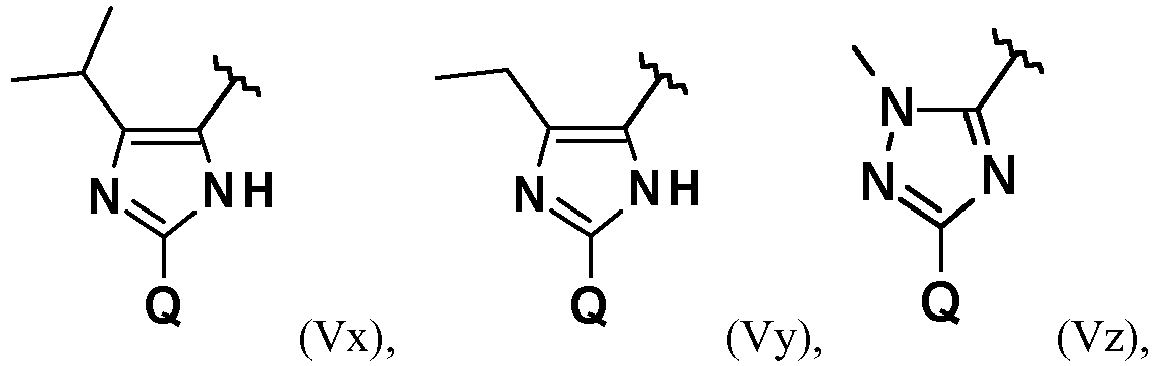








D ein Rest ausgewählt aus den Resten der Formeln (VII1-VII192) ist

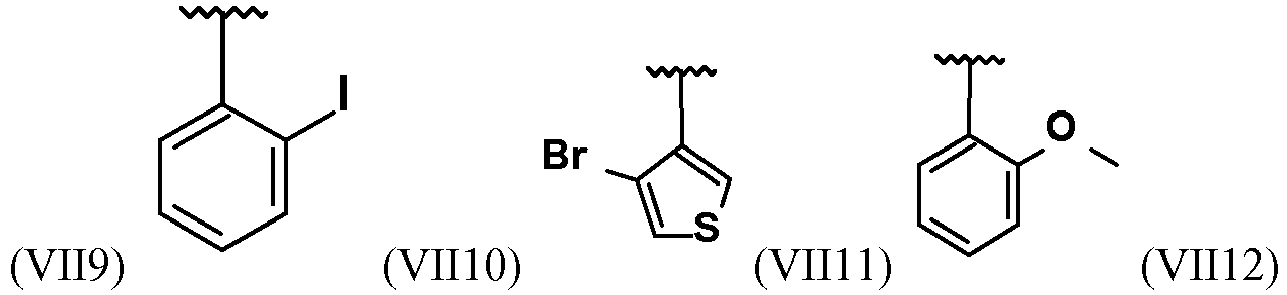








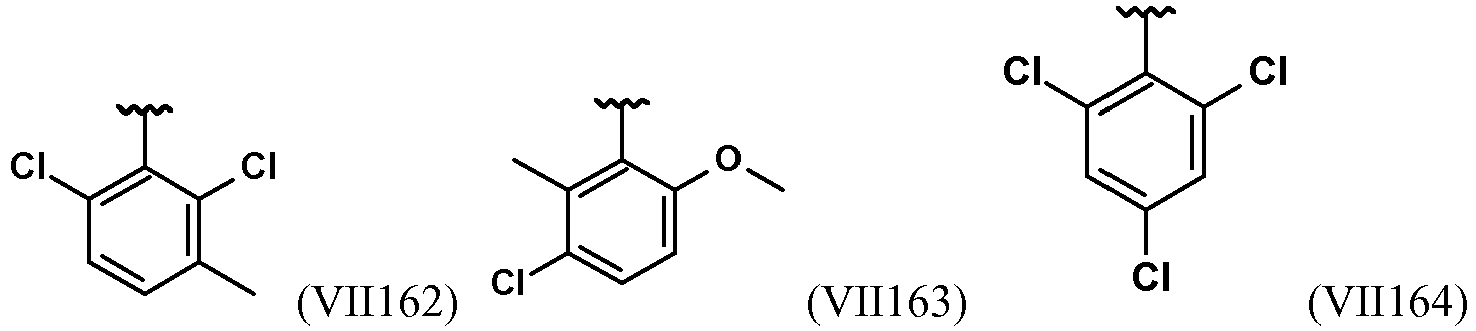


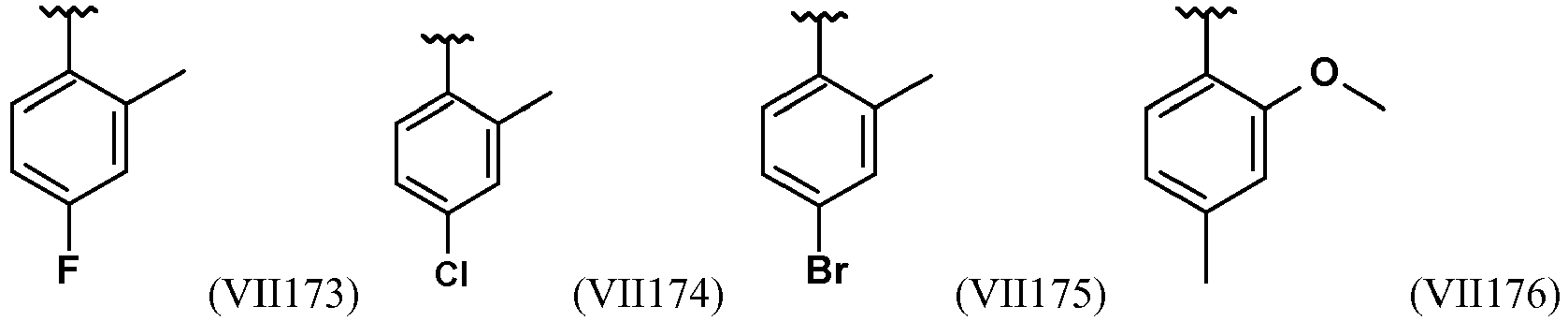

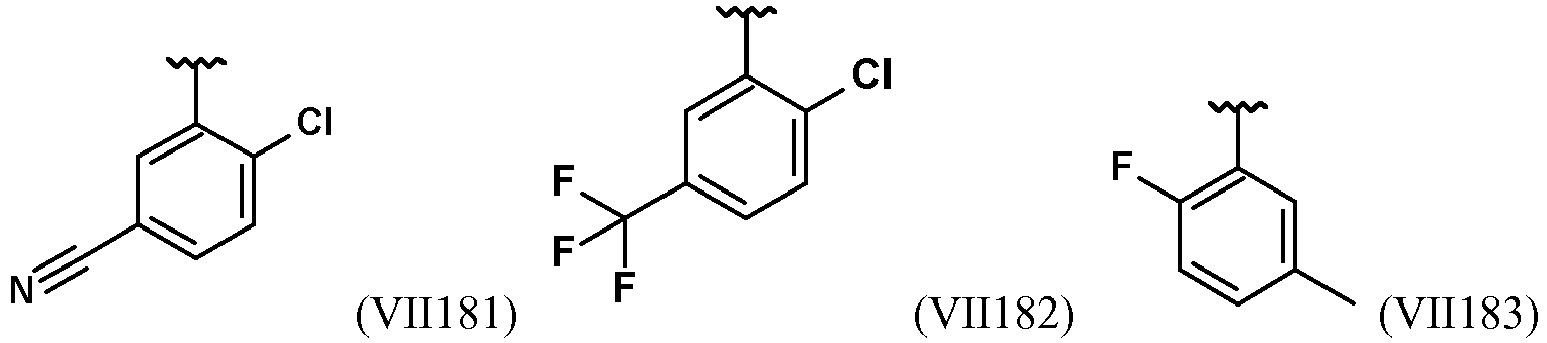

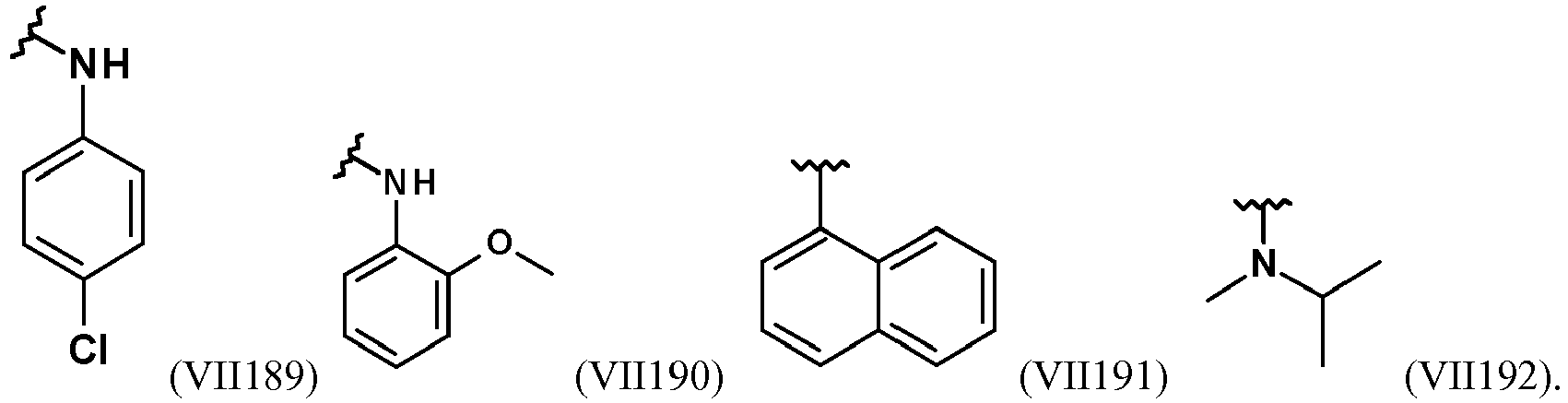
- Verwendung nach einem der Ansprüche 1 bis 8 zum Schutz des Vermehrungsmaterials von Pflanzen.
- Mittel, mit einem Gehalt von mindestens einer Verbindung gemäß Formel (I) nach einem der Ansprüche 1 bis 8 und üblichen Streckmitteln und/oder oberflächenaktiven Substanzen insbesondere zur Bekämpfung von tierischen Schädlingen.
- Verfahren zur Bekämpfung von tierischen Schädlingen, bei dem man wenigstens eine Verbindung gemäß Formel (I) nach einem der Ansprüche 1 bis 8 oder ein Mittel gemäß Anspruch 10 auf die tierischen Schädlinge und/oder ihren Lebensraum einwirken lässt, bei dem die chirurgische, therapeutische und diagnostische Behandlung des menschlichen oder tierischen Körpers ausgeschlossen ist.
- Agrochemische Formulierung enthaltend wenigstens eine Verbindung gemäß Formel (I) nach einem der Ansprüche 1 bis 8 in biologisch wirksamen Gehalten von zwischen 0,00000001 und 98 Gew.-%, bezogen auf das Gewicht der agrochemischen Formulierung, sowie Streckmittel und/oder oberflächenaktive Stoffe.
- Agrochemische Formulierung gemäß Anspruch 12 zusätzlich enthaltend wenigstens einen weiteren agrochemischen Wirkstoff.
- Verbindungen der Formel (VIII)

M' für einen Rest der Formel (II) steht, ausgewählt aus:
 R1', R2', R3' jeweils unabhängig voneinander H oder ein substituierter oder unsubstituierter Alkyl, Cycloalkyl, Alkenyl, Cycloalkenyl, Cyloheteroalkyl, Aryl oder Heteroaryl Rest sind, wobei R2' im Falle (IIc) und (IIe) zusätzlich ein Halogen Rest oder ein Alkoxy Rest sein kann und R2' im Falle (IIa) und (IIb) nur H oder ein substituierter oder unsubstituierter Alkyl oder Cycloalkyl Rest sein kann, R3' zusätzlich im Falle (IIa), (IId) und (IIe) ein Halogen Rest sein kann,Q' ein substituierter oder unsubstituierter Aryl oder Heteroaryl Rest, aber im Falle (IIa), (IId) im Falle R1'=H und R3'=Methyl nicht 3-Methoxyphenyl ist, im Falle (IId) nicht 3-Pyridyl ist, im Falle (IIe) nicht 2-Pyrimidinyl, nicht unsubstituiertes Phenyl, nicht 3,4-Dichlorphenyl und nicht 3,5-bis-tert-Butyl ist;D' ein substituierter oder unsubstituierter Alkyl, Heteroalkyl, gegebenenfalls teilweise ungesättigter Cycloalkyl, Cycloheteroalkyl, Heteroaryl, Aryl oder Phenylalkyl Rest oder im Falle, daß Q' mindestens einen Substituenten in 2-Stellung trägt, ein substituierter oder unsubstituierter Stickstoff Rest ist.
- Verbindungen nach Anspruch 14, bei derM' für einen Rest gemäß einer der Formeln (IIa) bis (IIf) steht undim Falle (IIa) R2', R3' jeweils unabhängig voneinander H oder ein substituierter oder unsubstituierter (C1-C4)-Alkyl, (C3-C6)-Cycloalkyl oder Phenyl Rest sind, wobei R3' zusätzlich ein Halogen Rest sein kann;im Falle (IIb) R2' H oder ein substituierter oder unsubstituierter (C1-C4)-Alkyl oder (C3-C6)-Cycloalkyl Rest ist,im Falle (IIc) R2', R3' jeweils unabhängig voneinander H oder ein substituierter oder unsubstituierter (C1-C4)-Alkyl, (C3-C6)-Cycloalkyl oder Phenyl Rest sind, wobei R2' zusätzlich ein Halogen Rest oder ein (C1-C4)-Alkoxy Rest sein kann,im Falle (IId) R1', R3' jeweils unabhängig voneinander H oder ein substituierter oder unsubstituierter (C1-C4)-Alkyl oder (C3-C6)-Cycloalkyl Rest sind und R3' zusätzlich ein Halogen Rest sein kann;im Falle (IIe) R2', R3' jeweils unabhängig H, Halogen oder ein substituierter oder unsubstituierter (C1-C4)-Alkyl, (C3-C6)-Cycloalkyl, Pyridyl oder Phenyl Rest sind und R2 zusätzlich ein (C1-C4)-Alkoxy Rest sein kann undim Falle (IIf) R3 H oder ein substituierter oder unsubstituierter (C1-C4)-Alkyl oder (C3-C6)-Cycloalkyl Rest ist,Q' ein substituierter oder unsubstituierter Phenyl, Naphthyl oder Heteroaryl Rest ist, der ein bis drei Heteroatome aus der Reihe Sauerstoff, Schwefel oder Stickstoff enthalten kann, aber im Falle (IIa), (IId) im Falle R1'=H und R3'=Methyl nicht 3-Methoxyphenyl ist, im Falle (IId) nicht 3-Pyridyl ist, im Falle (IIe) nicht 2-Pyrimidinyl, nicht unsubstituiertes Phenyl und nicht 3,4-Dichlorphenyl ist,D' ein substituierter oder unsubstituierter Alkyl, Heteroalkyl, Cycloalkyl, Heteroaryl, Aryl oder Phenyl-(C1-C8)alkyl Rest oder im Falle, daß Q' mindestens einen Substituenten in 2-Stellung trägt, ein substituierter oder unsubstituierter Stickstoff Rest ist.
- Verbindungen nach Anspruch 14 oder 15, bei derM' für einen Rest ausgewählt aus den Formeln (IIa-IIf) steht, wobei R1', R2', R3' definiert sind wie in Anspruch 14 oder 15 undQ' ein unsubstituierter oder mit einem oder mehreren Resten R4' substituierter Phenyl, Naphthyl, Pyridyl, Pyrimidinyl, Thiophen, Benzthiophen, Isochinolin, Benzdioxol oder Pyrazol-Rest ist, aber im Falle (IIa), (IId) im Falle R1'=H und R3'=Methyl nicht 3-Methoxyphenyl ist, im Falle (IId) nicht 3-Pyridyl ist, im Falle (IIe) nicht 2-Pyrimidinyl, nicht unsubstituiertes Phenyl und nicht 3,4-Dichlorphenyl undwobei der oder die Substituenten R4' jeweils unabhängig voneinander ausgewählt sind aus:Cyano, Halogen, Nitro, Acetyl, Hydroxy, Carboxy, Amino, SCN, Tri-(C1-C6)alkylsilyl, (C3-C8)Cycloalkyl, (C3-C8)Cycloalkyloxy, (C3-C8)Cycloalkyl-(C3-C8)Cycloalkyl, (C1-C6)Alkyl-(C3-C8)cycloalkyl, Halogen(C3-C8)cycloalkyl, (C1-C6)Alkyl, (C1-C6)Halogenalkyl, (C1-C6)Cyanoalkyl, (C1-C6)Hydroxyalkyl, Hydroxycarbonyl-(C1-C6)-alkoxy, (C1-C6)Alkoxycarbonyl-(C1-C6)alkyl, (C1-C6)Alkoxy-(C1-C6)alkyl, (C2-C6)Alkenyl, (C2-C6)Halogenalkenyl, (C2-C6)Cyanoalkenyl, (C2-C6)Alkinyl, (C2-C6)Halogenalkinyl, (C2-C6)Cyanoalkinyl, (C1-C6)Alkoxy, (C1-C6)Halogenalkoxy, (C1-C6)Cyanoalkoxy, (C1-C6)Alkoxycarbonyl-(C1-C6)alkoxy, (C1-C6)Alkoxy-(C1-C6)alkoxy, (C1-C6)Alkylhydroxyimino, (C1-C6)Alkoxyimino, (C1-C6)Alkyl-(C1-C6)alkoxyimino, (C1-C6)Halogenalkyl-(C1-C6)alkoxyimino, (C1-C6)Alkylthio, (C1-C6)Halogenalkylthio, (C1-C6)Alkoxy-(C1-C6)alkylthio, (C1-C6)Alkylthio-(C1-C6)alkyl, (C1-C6)Alkylsulfinyl, (C1-C6)Halogenalkylsulfinyl, (C1-C6)Alkoxy-(C1-C6)alkylsulfinyl, (C1-C6)Alkylsulfinyl-(C1-C6)alkyl, (C1-C6)Alkylsulfonyl, (C1-C6)Halogenalkylsulfonyl, (C1-C6)Alkoxy-(C1-C6)alkylsulfonyl, (C1-C6)Alkylsulfonyl-(C1-C6)alkyl, (C1-C6)Alkylsulfonyloxy, (C1-C6)Alkylcarbonyl, (C1-C6)Alkylthiocarbonyl, (C1-C6)Halogenalkylcarbonyl, (C1-C6)Alkylcarbonyloxy, (C1-C6)Alkoxycarbonyl, (C1-C6)Halogenalkoxycarbonyl, Aminocarbonyl, (C1-C6)Alkylaminocarbonyl, (C1-C6)Alkylaminothiocarbonyl, Di-(C1-C6)alkyl-aminocarbonyl, Di-(C1-C6)alkyl-aminothiocarbonyl, (C2-C6)Alkenylaminocarbonyl, Di-(C2-C6)-alkenylaminocarbonyl, (C3-C8)Cycloalkylaminocarbonyl, (C1-C6)Alkylsulfonylamino, (C1-C6)Alkylamino, Di-(C1-C6)Alkylamino, Aminosulfonyl, (C1-C6)Alkylaminosulfonyl, Di-(C1-C6)alkyl-aminosulfonyl, (C1-C6)Alkylsulfoximino, Aminothiocarbonyl, (C1-C6)Alkylaminothiocarbonyl, Di-(C1-C6)alkyl-aminothiocarbonyl, (C3-C8)Cycloalkylamino, (C1-C6)Alkylcarbonylamino; und/odergegebenenfalls einfach oder mehrfach, gleich oder verschieden substituiertes Aryl, Aryloxy oder Hetaryl, wobei (im Fall von Hetaryl) gegebenenfalls mindestens eine Carbonylgruppe ent-halten sein kann und wobei als Substituenten jeweils in Frage kommen: Cyano, Carboxyl, Halogen, Nitro, Acetyl, Hydroxy, Amino, SCN, Tri-(C1-C6)alkylsilyl, (C3-C8)Cycloalkyl, (C3-C8)Cycloalkyl-(C3-C8)cycloalkyl, (C1-C6)Alkyl-(C3-C8)cycloalkyl, Halogen(C3-C8)cycloalkyl, (C1-C6)Alkyl, (C1-C6)Halogenalkyl, (C1-C6)Cyanoalkyl, (C1-C6)Hydroxyalkyl, Hydroxycarbonyl-(C1-C6)-alkoxy, (C1-C6)Alkoxycarbonyl-(C1-C6)alkyl, (C1-C6)Alkoxy-(C1-C6)alkyl, (C2-C6)Alkenyl, (C2-C6)Halogenalkenyl, (C2-C6)Cyanoalkenyl, (C2-C6)Alkinyl, (C2-C6)Halogenalkinyl, (C2-C6)Cyanoalkinyl, (C1-C6)Alkoxy, (C1-C6)Halogenalkoxy, (C1-C6)Cyanoalkoxy, (C1-C6)Alkoxycarbonyl-(C1-C6)alkoxy, (C1-C6)Alkoxy-(C1-C6)alkoxy, (C1-C6)Alkylhydroxyimino, (C1-C6)Alkoxyimino, (C1-C6)Alkyl-(C1-C6)alkoxyimino, (C1-C6)Halogenalkyl-(C1-C6)alkoxyimino, (C1-C6)Alkylthio, (C1-C6)Halogenalkylthio, (C1-C6)Alkoxy-(C1-C6)alkylthio, (C1-C6)Alkylthio-(C1-C6)alkyl, (C1-C6)Alkylsulfinyl, (C1-C6)Halogenalkylsulfinyl, (C1-C6)Alkoxy-(C1-C6)alkylsulfinyl, (C1-C6)Alkylsulfinyl-(C1-C6)alkyl, (C1-C6)Alkylsulfonyl, (C1-C6)Halogenalkylsulfonyl, (C1-C6)Alkoxy-(C1-C6)alkylsulfonyl, (C1-C6)Alkylsulfonyl-(C1-C6)alkyl, (C1-C6)Alkylsulfonyloxy, (C1-C6)Alkylcarbonyl, (C1-C6)Halogenalkylcarbonyl, (C1-C6)Alkylcarbonyloxy, (C1-C6)Alkoxycarbonyl, (C1-C6)Halogenalkoxycarbonyl, Aminocarbonyl, (C1-C6)Alkylaminocarbonyl, Di-(C1-C6)alkyl-aminocarbonyl, (C2-C6)Alkenylaminocarbonyl, Di-(C2-C6)-alkenylaminocarbonyl, (C3-C8)Cycloalkylaminocarbonyl, (C1-C6)Alkylsulfonylamino, (C1-C6)Alkylamino, Di-(C1-C6)Alkylamino, Aminosulfonyl, (C1-C6)Alkylaminosulfonyl, Di-(C1-C6)alkylaminosulfonyl, (C1-C6)Alkylsulfoximino, Aminothiocarbonyl, (C1-C6)Alkylaminothiocarbonyl, Di-(C1-C6)alkylaminothiocarbonyl, (C3-C8)Cycloalkylamino und (C1-C6)Alkylcarbonylamino undD' ein unsubstituierter oder mit einem oder mehreren Resten R5' substituierter (C1-C6)-Alkyl, Phenyl oder Heteroaryl Rest ist, der ein bis drei Heteroatome aus der Reihe Sauerstoff, Schwefel oder Stickstoff enthalten kann oder im Falle, daß Q' mindestens einen Substituenten in 2-Stellung trägt, ein NR6'R7' Rest ist,wobei der oder die Substituenten R5' jeweils unabhängig voneinander ausgewählt sind aus:Cyano, Halogen, Nitro, Acetyl, Hydroxy, Carboxy, Amino, SCN, Tri-(C1-C6)alkylsilyl, (C3-C8)Cycloalkyl, (C3-C8)Cycloalkyloxy, (C3-C8)Cycloalkyl-(C3-C8)Cycloalkyl, (C1-C6)Alkyl-(C3-C8)cycloalkyl, Halogen(C3-C8)cycloalkyl, (C1-C6)Alkyl, (C1-C6)Halogenalkyl, (C1-C6)Cyanoalkyl, (C1-C6)Hydroxyalkyl, Hydroxycarbonyl-(C1-C6)-alkoxy, (C1-C6)Alkoxycarbonyl-(C1-C6)alkyl, (C1-C6)Alkoxy-(C1-C6)alkyl, (C2-C6)Alkenyl, (C2-C6)Halogenalkenyl, (C2-C6)Cyanoalkenyl, (C2-C6)Alkinyl, (C2-C6)Halogenalkinyl, (C2-C6)Cyanoalkinyl, (C1-C6)Alkoxy, (C1-C6)Halogenalkoxy, (C1-C6)Cyanoalkoxy, (C1-C6)Alkoxycarbonyl-(C1-C6)alkoxy, (C1-C6)Alkoxy-(C1-C6)alkoxy, (C1-C6)Alkylhydroxyimino, (C1-C6)Alkoxyimino, (C1-C6)Alkyl-(C1-C6)alkoxyimino, (C1-C6)Halogenalkyl-(C1-C6)alkoxyimino, (C1-C6)Alkylthio, (C1-C6)Halogenalkylthio, (C1-C6)Alkoxy-(C1-C6)alkylthio, (C1-C6)Alkylthio-(C1-C6)alkyl, (C1-C6)Alkylsulfinyl, (C1-C6)Halogenalkylsulfinyl, (C1-C6)Alkoxy-(C1-C6)alkylsulfinyl, (C1-C6)Alkylsulfinyl-(C1-C6)alkyl, (C1-C6)Alkylsulfonyl, (C1-C6)Halogenalkylsulfonyl, (C1-C6)Alkoxy-(C1-C6)alkylsulfonyl, (C1-C6)Alkylsulfonyl-(C1-C6)alkyl, (C1-C6)Alkylsulfonyloxy, (C1-C6)Alkylcarbonyl, (C1-C6)Alkylthiocarbonyl, (C1-C6)Halogenalkylcarbonyl, (C1-C6)Alkylcarbonyloxy, (C1-C6)Alkoxycarbonyl, (C1-C6)Halogenalkoxycarbonyl, Aminocarbonyl, (C1-C6)Alkylaminocarbonyl, (C1-C6)Alkylaminothiocarbonyl, Di-(C1-C6)alkyl-aminocarbonyl, Di-(C1-C6)alkyl-aminothiocarbonyl, (C2-C6)Alkenylaminocarbonyl, Di-(C2-C6)-alkenylaminocarbonyl, (C3-C8)Cycloalkylaminocarbonyl, (C1-C6)Alkylsulfonylamino, (C1-C6)Alkylamino, Di-(C1-C6)Alkylamino, Aminosulfonyl, (C1-C6)Alkylaminosulfonyl, Di-(C1-C6)alkyl-aminosulfonyl, (C1-C6)Alkylsulfoximino, Aminothiocarbonyl, (C1-C6)Alkylaminothiocarbonyl, Di-(C1-C6)alkyl-aminothiocarbonyl, (C3-C8)Cycloalkylamino, (C1-C6)Alkylcarbonylamino und 1-Pyrazolyl-(C1-C3)alkyl,und /odereinfach oder mehrfach, gleich oder verschieden substituiertes Aryl oder Hetaryl, wobei (im Fall von Hetaryl) gegebenenfalls mindestens eine Carbonylgruppe enthalten sein kann und wobei als Substituenten jeweils in Frage kommen: Cyano, Carboxyl, Halogen, Nitro, Acetyl, Hydroxy, Amino, SCN, Tri-(C1-C6)alkylsilyl, (C3-C8)Cycloalkyl, (C3-C8)Cycloalkyl-(C3-C8)cycloalkyl, (C1-C6)Alkyl-(C3-C8)cycloalkyl, Halogen(C3-C8)cycloalkyl, (C1-C6)Alkyl, (C1-C6)Halogenalkyl, (C1-C6)Cyanoalkyl, (C1-C6)Hydroxyalkyl, Hydroxycarbonyl-(C1-C6)-alkoxy, (C1-C6)Alkoxycarbonyl-(C1-C6)alkyl, (C1-C6)Alkoxy-(C1-C6)alkyl, (C2-C6)Alkenyl, (C2-C6)Halogenalkenyl, (C2-C6)Cyanoalkenyl, (C2-C6)Alkinyl, (C2-C6)Halogenalkinyl, (C2-C6)Cyanoalkinyl, (C1-C6)Alkoxy, (C1-C6)Halogenalkoxy, (C1-C6)Cyanoalkoxy, (C1-C6)Alkoxycarbonyl-(C1-C6)alkoxy, (C1-C6)Alkoxy-(C1-C6)alkoxy, (C1-C6)Alkylhydroxyimino, (C1-C6)Alkoxyimino, (C1-C6)Alkyl-(C1-C6)alkoxyimino, (C1-C6)Halogenalkyl-(C1-C6)alkoxyimino, (C1-C6)Alkylthio, (C1-C6)Halogenalkylthio, (C1-C6)Alkoxy-(C1-C6)alkylthio, (C1-C6)Alkylthio-(C1-C6)alkyl, (C1-C6)Alkylsulfinyl, (C1-C6)Halogenalkylsulfinyl, (C1-C6)Alkoxy-(C1-C6)alkylsulfinyl, (C1-C6)Alkylsulfinyl-(C1-C6)alkyl, (C1-C6)Alkylsulfonyl, (C1-C6)Halogenalkylsulfonyl, (C1-C6)Alkoxy-(C1-C6)alkylsulfonyl, (C1-C6)Alkylsulfonyl-(C1-C6)alkyl, (C1-C6)Alkylsulfonyloxy, (C1-C6)Alkylcarbonyl, (C1-C6)Halogenalkylcarbonyl, (C1-C6)Alkylcarbonyloxy, (C1-C6)Alkoxycarbonyl, (C1-C6)Halogenalkoxycarbonyl, Aminocarbonyl, (C1-C6)Alkylaminocarbonyl, Di-(C1-C6)alkyl-aminocarbonyl, (C2-C6)Alkenylaminocarbonyl, Di-(C2-C6)-alkenylaminocarbonyl, (C3-C8)Cycloalkylaminocarbonyl, (C1-C6)Alkylsulfonylamino, (C1-C6)Alkylamino, Di-(C1-C6)Alkylamino, Aminosulfonyl, (C1-C6)Alkylaminosulfonyl, Di-(C1-C6)alkylaminosulfonyl, (C1-C6)Alkylsulfoximino, Aminothiocarbonyl, (C1-C6)Alkylaminothiocarbonyl, Di-(C1-C6)alkylaminothiocarbonyl, (C3-C8)Cycloalkylamino und (C1-C6)Alkylcarbonylamino,und wobei R6' und R7' jeweils unabhängig voneinander H, ein (C1-C6)-Alkyl, (C1-C6)Halogenalkyl, (C1-C6)Alkoxy-(C1-C6)alkyl Rest oder ein unsubstituierter Phenyl oder mit Halogen, (C1-C6)-Alkyl, (C1-C6)-Alkoxy, (C1-C6)Halogenalkyl, (C1-C6)Alkoxy-(C1-C6)alkyl substituierter Phenyl Rest sind oderR6' und R7' gemeinsam einen unsubstituierten oder substituierten 5- bis 6- gliedrigen, gesättigten oder gegebenenfalls ganz oder teilweise ungesättigten Ring bilden können der von 1 bis 3 Heteroatomen aus der Reihe Sauerstoff, Schwefel, Stickstoff unterbrochen sein kann, und der einfach oder mehrfach mit einer der Definition von R5' entsprechenden Substitution versehen sein kann.
- Verbindungen nach einem der Ansprüche 14 bis 16, bei derM' für einen Rest ausgewählt aus den Formeln (IIa-IIf) steht, wobei R1', R2', R3' definiert sind wie in Anspruch 14 oder 15 undQ' ein unsubstituierter oder mit einem oder mehreren Resten R4' substituierter Phenyl, Naphthyl, Pyridyl, Pyrimidinyl, Thiophen, Benzthiophen, Isochinolin, Benzdioxol oder Pyrazol-Rest ist, aber im Falle (IIa), (IId) im Falle R1'=H und R3'=Methyl nicht 3-Methoxyphenyl ist, im Falle (IId) nicht 3-Pyridyl ist, im Falle (IIe) nicht 2-Pyrimidinyl, nicht unsubstituiertes Phenyl und nicht 3,4-Dichlorphenyl istund der oder die Substituenten R4' jeweils unabhängig voneinander ausgewählt sind aus:Cyano, Halogen, Nitro, Acetyl, Hydroxy, Carboxy, Amino, Tri-(C1-C6)alkylsilyl, (C3-C8)Cycloalkyl, (C3-C8)Cycloalkyloxy, (C3-C8)Cycloalkyl-(C3-C8)Cycloalkyl, (C1-C6)Alkyl-(C3-C8)cycloalkyl, Halogen(C3-C8)cycloalkyl, (C1-C6)Alkyl, (C1-C6)Halogenalkyl, (C1-C6)Cyanoalkyl, (C1-C6)Hydroxyalkyl, Hydroxycarbonyl-(C1-C6)-alkoxy, (C1-C6)Alkoxycarbonyl-(C1-C6)alkyl, (C1-C6)Alkoxy-(C1-C6)alkyl, (C2-C6)Alkenyl, (C2-C6)Halogenalkenyl, (C2-C6)Cyanoalkenyl, (C2-C6)Alkinyl, (C2-C6)Halogenalkinyl, (C2-C6)Cyanoalkinyl, (C1-C6)Alkoxy, (C1-C6)Halogenalkoxy, (C1-C6)Cyanoalkoxy, (C1-C6)Alkoxycarbonyl-(C1-C6)alkoxy, (C1-C6)Alkoxy-(C1-C6)alkoxy, (C1-C6)Alkylhydroxyimino, (C1-C6)Alkoxyimino, (C1-C6)Alkyl-(C1-C6)alkoxyimino, (C1-C6)Halogenalkyl-(C1-C6)alkoxyimino, (C1-C6)Alkylthio, (C1-C6)Halogenalkylthio, (C1-C6)Alkoxy-(C1-C6)alkylthio, (C1-C6)Alkylthio-(C1-C6)alkyl, (C1-C6)Alkylsulfinyl, (C1-C6)Halogenalkylsulfinyl, (C1-C6)Alkoxy-(C1-C6)alkylsulfinyl, (C1-C6)Alkylsulfinyl-(C1-C6)alkyl, (C1-C6)Alkylsulfonyl, (C1-C6)Halogenalkylsulfonyl, (C1-C6)Alkoxy-(C1-C6)alkylsulfonyl, (C1-C6)Alkylsulfonyl-(C1-C6)alkyl, (C1-C6)Alkylsulfonyloxy, (C1-C6)Alkylcarbonyl, (C1-C6)Alkylthiocarbonyl, (C1-C6)Halogenalkylcarbonyl, (C1-C6)Alkylcarbonyloxy, (C1-C6)Alkoxycarbonyl, (C1-C6)Halogenalkoxycarbonyl, Aminocarbonyl, (C1-C6)Alkylaminocarbonyl, (C1-C6)Alkylaminothiocarbonyl, Di-(C1-C6)alkyl-aminocarbonyl, Di-(C1-C6)alkyl-aminothiocarbonyl, (C2-C6)Alkenylaminocarbonyl, Di-(C2-C6)-alkenylaminocarbonyl, (C3-C8)Cycloalkylaminocarbonyl, (C1-C6)Alkylsulfonylamino, (C1-C6)Alkylamino, Di-(C1-C6)Alkylamino, Aminosulfonyl, (C1-C6)Alkylaminosulfonyl, Di-(C1-C6)alkyl-aminosulfonyl, (C1-C6)Alkylsulfoximino, Aminothiocarbonyl, (C1-C6)Alkylaminothiocarbonyl, Di-(C1-C6)alkyl-aminothiocarbonyl, (C3-C8)Cycloalkylamino, (C1-C6)Alkylcarbonylamino, Phenyl, Halogenphenyl, Phenoxy oder Halogenphenoxy undD' ein unsubstituierter oder mit einem oder mehreren Resten R5' substituierter Phenyl, Pyridin, Pyrimidin, Pyrazol, Triazol, Thiazol, Oxazol, Thiadiazol, Oxadiazol, Thiophen, Pyrrol, Furan, Tetrahydrofuran, Dioxan oder (C1-C6)Alkyl Rest oder ein NR6'R7' Rest ist,wobei der oder die Substituenten R5' jeweils unabhängig voneinander ausgewählt sind aus:Cyano, Halogen, Nitro, Acetyl, Hydroxy, Carboxy, Amino, Tri-(C1-C6)alkylsilyl, (C3-C8)Cycloalkyl, (C3-C8)Cycloalkyloxy, (C3-C8)Cycloalkyl-(C3-C8)Cycloalkyl, (C1-C6)Alkyl-(C3-C8)cycloalkyl, Halogen(C3-C8)cycloalkyl, (C1-C6)Alkyl, (C1-C6)Halogenalkyl, (C1-C6)Cyanoalkyl, (C1-C6)Hydroxyalkyl, Hydroxycarbonyl-(C1-C6)-alkoxy, (C1-C6)Alkoxycarbonyl-(C1-C6)alkyl, (C1-C6)Alkoxy-(C1-C6)alkyl, (C2-C6)Alkenyl, (C2-C6)Halogenalkenyl, (C2-C6)Cyanoalkenyl, (C2-C6)Alkinyl, (C2-C6)Halogenalkinyl, (C2-C6)Cyanoalkinyl, (C1-C6)Alkoxy, (C1-C6)Halogenalkoxy, (C1-C6)Cyanoalkoxy, (C1-C6)Alkoxycarbonyl-(C1-C6)alkoxy, (C1-C6)Alkoxy-(C1-C6)alkoxy, (C1-C6)Alkylhydroxyimino, (C1-C6)Alkoxyimino, (C1-C6)Alkyl-(C1-C6)alkoxyimino, (C1-C6)Halogenalkyl-(C1-C6)alkoxyimino, (C1-C6)Alkylthio, (C1-C6)Halogenalkylthio, (C1-C6)Alkoxy-(C1-C6)alkylthio, (C1-C6)Alkylthio-(C1-C6)alkyl, (C1-C6)Alkylsulfinyl, (C1-C6)Halogenalkylsulfinyl, (C1-C6)Alkoxy-(C1-C6)alkylsulfinyl, (C1-C6)Alkylsulfinyl-(C1-C6)alkyl, (C1-C6)Alkylsulfonyl, (C1-C6)Halogenalkylsulfonyl, (C1-C6)Alkoxy-(C1-C6)alkylsulfonyl, (C1-C6)Alkylsulfonyl-(C1-C6)alkyl, (C1-C6)Alkylsulfonyloxy, (C1-C6)Alkylcarbonyl, (C1-C6)Alkylthiocarbonyl, (C1-C6)Halogenalkylcarbonyl, (C1-C6)Alkylcarbonyloxy, (C1-C6)Alkoxycarbonyl, (C1-C6)Halogenalkoxycarbonyl, Aminocarbonyl, (C1-C6)Alkylaminocarbonyl, (C1-C6)Alkylaminothiocarbonyl, Di-(C1-C6)alkyl-aminocarbonyl, Di-(C1-C6)alkyl-aminothiocarbonyl, (C2-C6)Alkenylaminocarbonyl, Di-(C2-C6)-alkenylaminocarbonyl, (C3-C8)Cycloalkylaminocarbonyl, (C1-C6)Alkylsulfonylamino, (C1-C6)Alkylamino, Di-(C1-C6)Alkylamino, Aminosulfonyl, (C1-C6)Alkylaminosulfonyl, Di-(C1-C6)alkyl-aminosulfonyl, (C1-C6)Alkylsulfoximino, Aminothiocarbonyl, (C1-C6)Alkylaminothiocarbonyl, Di-(C1-C6)alkyl-aminothiocarbonyl, (C3-C8)Cycloalkylamino, (C1-C6)Alkylcarbonylamino und 1-Pyrazolyl-(C1-C3)Alkyl,und wobei R6' und R7' jeweils unabhängig voneinander H, ein (C1-C4)-Alkyl, (C1-C4)Halogenalkyl, (C1-C4)Alkoxy-(C1-C4)alkyl Rest oder ein unsubstituierter Phenyl oder mit Halogen, (C1-C4)-Alkyl, (C1-C4)-Alkoxy, (C1-C4)Halogenalkyl, (C1-C4)Alkoxy-(C1-C4)alkyl substituierter Phenyl Rest sind oderR6' und R7' gemeinsam einen unsubstituierten oder substituierten 5- bis 6- gliedrigen, gesättigten oder gegebenenfalls ganz oder teilweise ungesättigten Ring bilden können der von 1 bis 3 Heteroatomen aus der Reihe Sauerstoff, Schwefel, Stickstoff unterbrochen sein kann, und der einfach oder mehrfach mit einer der Definition von R5' entsprechenden Substitution versehen sein kann.
- Verbindungen nach einem der Ansprüche 14 bis 17, bei derD' ein unsubstituierter oder mit einem oder mehreren Resten R5' substituierter (C1-C6)-Alkyl Rest, Phenyl Rest, Pyridin, Pyrimidin, Pyrazol, Triazol, Thiazol, Oxazol, Thiadiazol, Oxadiazol, Thiophen, Pyrrol, Furan, Tetrahydrofuran, Dioxan, Isoxazol, Benzyl, 2,3-Dihydro-1,4-benzodioxin-5-yl, 2,3-Dihydro-1-benzofuran-7-yl, Chinoxalin-5-yl oder Indol-7-yl Rest oder ein NR6'R7' Rest ist,wobei der oder die Substituenten R5' jeweils unabhängig voneinander ausgewählt sind aus:Cyano, Halogen, Nitro, Acetyl, Hydroxy, Carboxy, Amino, Tri-(C1-C6)alkylsilyl, (C3-C8)Cycloalkyl, (C3-C8)Cycloalkyloxy, (C3-C8)Cycloalkyl-(C3-C8)Cycloalkyl, (C1-C6)Alkyl-(C3-C8)cycloalkyl, Halogen(C3-C8)cycloalkyl, (C1-C6)Alkyl, (C1-C6)Halogenalkyl, (C1-C6)Cyanoalkyl, (C1-C6)Hydroxyalkyl, Hydroxycarbonyl-(C1-C6)-alkoxy, (C1-C6)Alkoxycarbonyl-(C1-C6)alkyl, (C1-C6)Alkoxy-(C1-C6)alkyl, (C2-C6)Alkenyl, (C2-C6)Halogenalkenyl, (C2-C6)Cyanoalkenyl, (C2-C6)Alkinyl, (C2-C6)Halogenalkinyl, (C2-C6)Cyanoalkinyl, (C1-C6)Alkoxy, (C1-C6)Halogenalkoxy, (C1-C6)Cyanoalkoxy, (C1-C6)Alkoxycarbonyl-(C1-C6)alkoxy, (C1-C6)Alkoxy-(C1-C6)alkoxy, (C1-C6)Alkylhydroxyimino, (C1-C6)Alkoxyimino, (C1-C6)Alkyl-(C1-C6)alkoxyimino, (C1-C6)Halogenalkyl-(C1-C6)alkoxyimino, (C1-C6)Alkylthio, (C1-C6)Halogenalkylthio, (C1-C6)Alkoxy-(C1-C6)alkylthio, (C1-C6)Alkylthio-(C1-C6)alkyl, (C1-C6)Alkylsulfinyl, (C1-C6)Halogenalkylsulfinyl, (C1-C6)Alkoxy-(C1-C6)alkylsulfinyl, (C1-C6)Alkylsulfinyl-(C1-C6)alkyl, (C1-C6)Alkylsulfonyl, (C1-C6)Halogenalkylsulfonyl, (C1-C6)Alkoxy-(C1-C6)alkylsulfonyl, (C1-C6)Alkylsulfonyl-(C1-C6)alkyl, (C1-C6)Alkylsulfonyloxy, (C1-C6)Alkylcarbonyl, (C1-C6)Alkylthiocarbonyl, (C1-C6)Halogenalkylcarbonyl, (C1-C6)Alkylcarbonyloxy, (C1-C6)Alkoxycarbonyl, (C1-C6)Halogenalkoxycarbonyl, Aminocarbonyl, (C1-C6)Alkylaminocarbonyl, (C1-C6)Alkylaminothiocarbonyl, Di-(C1-C6)alkyl-aminocarbonyl, Di-(C1-C6)alkyl-aminothiocarbonyl, (C2-C6)Alkenylaminocarbonyl, Di-(C2-C6)-alkenylaminocarbonyl, (C3-C8)Cycloalkylaminocarbonyl, (C1-C6)Alkylsulfonylamino, (C1-C6)Alkylamino, Di-(C1-C6)Alkylamino, Aminosulfonyl, (C1-C6)Alkylaminosulfonyl, Di-(C1-C6)alkyl-aminosulfonyl, (C1-C6)Alkylsulfoximino, Aminothiocarbonyl, (C1-C6)Alkylaminothiocarbonyl, Di-(C1-C6)alkyl-aminothiocarbonyl, (C3-C8)Cycloalkylamino, (C1-C6)Alkylcarbonylamino und 1-Pyrazolyl-(C1-C3)Alkyl undR6' und R7' jeweils unabhängig voneinander H, ein (C1-C6)-Alkyl, (C1-C6)Halogenalkyl, (C1-C6)Alkoxy-(C1-C6)alkyl Rest oder unsubstituierter Phenyl oder mit Halogen, (C1-C6)-Alkyl, (C1-C6)Halogenalkyl oder (C1-C6)Alkoxy-(C1-C6)alkyl substituierter Phenyl Rest sindoder einen Ring aus der Reihe Pyrrolidin, Morpholin, Piperidin bilden.
- Verbindungen nach einem der Ansprüche 14 bis 18, bei derM' ein Rest ausgewählt aus den Resten der Formeln (IIa) bis (IIf) ist, wobeiim Falle (IIa) R2' H, Methyl oder Ethyl oder gegebenenfalls mit Halogen substituiertes Phenyl ist und R3' H, Methyl, Ethyl, iso-Propyl oder Halogen ist,im Falle (IIb) R2' H, Methyl oder Ethyl ist,im Falle (IIc) R2' H oder Methyl und R3' H, Methyl oder Ethyl ist,im Falle (IId) R1' H oder Methyl und R3' H oder Halogen ist,im Falle (IIe) R2' H, Methyl, Methoxy, mit Halogen substituiertes Phenyl oder Pyridyl und R3' H ist,im Falle (IIf) R3' H, Methyl oder Ethyl ist undQ' ein unsubstituierter oder mit einem oder mehreren Resten R4' substituierter Phenyl, Napht-1-yl, Pyridyl, Pyrimidinyl, Thiophen-2-yl, Benzthiophen-2-yl, Benzthiophen-3-yl, Isochinolin-1-yl, Benzdioxol-4-yl oder Pyrazol-5-yl Rest ist, aber im Falle (IIa), (IId) im Falle R1'=H und R3'=Methyl nicht 3-Methoxyphenyl ist, im Falle (IId) nicht 3-Pyridyl ist, im Falle (IIe) nicht 2-Pyrimidinyl, nicht unsubstituiertes Phenyl und nicht 3,4-Dichlorphenyl ist undwobei die Substituenten R4' definiert sind wie in Anspruch 17 oder 18.
- Verbindungen nach einem der Ansprüche 14 bis 19, bei derQ' ein unsubstituierter oder mit einem oder mehreren Resten R4' substituierter Phenyl, Napht-1-yl, Pyridyl, Pyrimidinyl, Thiophen-2-yl, Benzthiophen-2-yl, Benzthiophen-3-yl, Isochinolin-1-yl, Benzdioxol-4-yl oder Pyrazol-5-yl Rest ist, aber im Falle (IIa), (IId) im Falle R1'=H und R3'=Methyl nicht 3-Methoxyphenyl ist, im Falle (IId) nicht 3-Pyridyl ist, im Falle (IIe) nicht 2-Pyrimidinyl, nicht unsubstituiertes Phenyl und nicht 3,4-Dichlorphenyl ist undwobei der oder die Substituenten R4' unabhängig voneinander ausgewählt sind aus:Cyano, Halogen, Nitro, Acetyl, (C3-C6)Cycloalkyl, (C3-C6)Cycloalkyloxy, (C3-C6)Cycloalkyl-(C3-C6)Cycloalkyl, (C1-C6)Alkyl-(C3-C8)cycloalkyl, Halogen(C3-C6)cycloalkyl, (C1-C6)Alkyl, (C1-C6)Halogenalkyl, (C1-C6)Cyanoalkyl, (C1-C6)Hydroxyalkyl, (C1-C6)Alkoxycarbonyl-(C1-C6)alkyl, (C1-C6)Alkoxy-(C1-C6)alkyl, (C2-C6)Alkenyl, (C2-C6)Halogenalkenyl, (C2-C6)Alkinyl, (C1-C6)Alkoxy, (C1-C6)Halogenalkoxy, (C1-C6)Alkylthio, (C1-C6)Halogenalkylthio, (C1-C6)Alkylthio-(C1-C6)alkyl, (C1-C6)Alkylsulfinyl, (C1-C6)Halogenalkylsulfinyl, (C1-C6)Alkylsulfonyl, (C1-C6)Halogenalkylsulfonyl, (C1-C6)Alkylsulfonyloxy, (C1-C6)Alkylcarbonyl, (C1-C6)Alkylamino, Di-(C1-C6)Alkylamino, (C1-C6)Alkylcarbonylamino, Phenyl, Halogenphenyl, Phenoxy oder Halogenphenoxy;D' ein unsubstituierter oder mit einem oder mehreren Resten R5' substituierter (C1-C6)-Alkyl, Phenyl, Pyridin, Pyrimidin, Pyrazol, Triazol, Thiazol, Oxazol, Thiadiazol, Oxadiazol, Thiophen, Pyrrol, Furan, Tetrahydrofuran oder Dioxan Rest ist,wobei der oder die Substituenten R5' unabhängig voneinander ausgewählt sind aus:Cyano, Halogen, Nitro, Acetyl, Hydroxy, Carboxy, Amino, (C3-C6)Cycloalkyl, (C3-C6)Cycloalkyloxy, (C3-C6)Cycloalkyl-(C3-C6)Cycloalkyl, (C1-C6)Alkyl-(C3-C8)cycloalkyl, Halogen(C3-C6)cycloalkyl, (C1-C6)Alkyl, (C1-C6)Halogenalkyl, (C1-C6)Cyanoalkyl, (C1-C6)Hydroxyalkyl, (C1-C6)Alkoxycarbonyl-(C1-C6)alkyl, (C1-C6)Alkoxy-(C1-C6)alkyl, (C2-C6)Alkenyl, (C2-C6)Halogenalkenyl, (C2-C6)Alkinyl, (C1-C6)Alkoxy, (C1-C6)Halogenalkoxy, (C1-C6)Alkylthio, (C1-C6)Halogenalkylthio, (C1-C6)Alkylthio-(C1-C6)alkyl, (C1-C6)Alkylsulfinyl, (C1-C6)Halogenalkylsulfinyl, (C1-C6)Alkylsulfonyl, (C1-C6)Halogenalkylsulfonyl, (C1-C6)Alkylsulfonyloxy, (C1-C6)Alkylcarbonyl, (C1-C6)Alkylamino, Di-(C1-C6)Alkylamino, (C1-C6)Alkylcarbonylamino oder 1-Pyrazolyl-(C1-C3)alkyl undR6' und R7' jeweils unabhängig voneinander H, ein (C1-C6)-Alkyl, Phenyl, Alkoxyphenyl oder Halogenphenyl sind oder einen Ring aus der Reihe Pyrrolidin, Morpholin, Piperidin bilden.
- Verbindungen nach einem der Ansprüche 14 bis 20, bei der
M' ein Rest ausgewählt aus den Resten der Formeln (Va-Vz) ist:
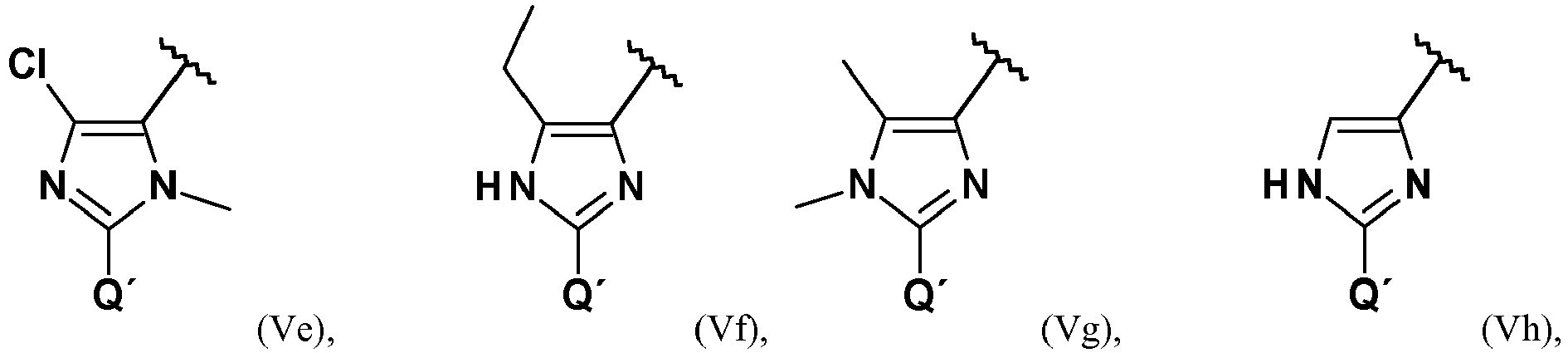


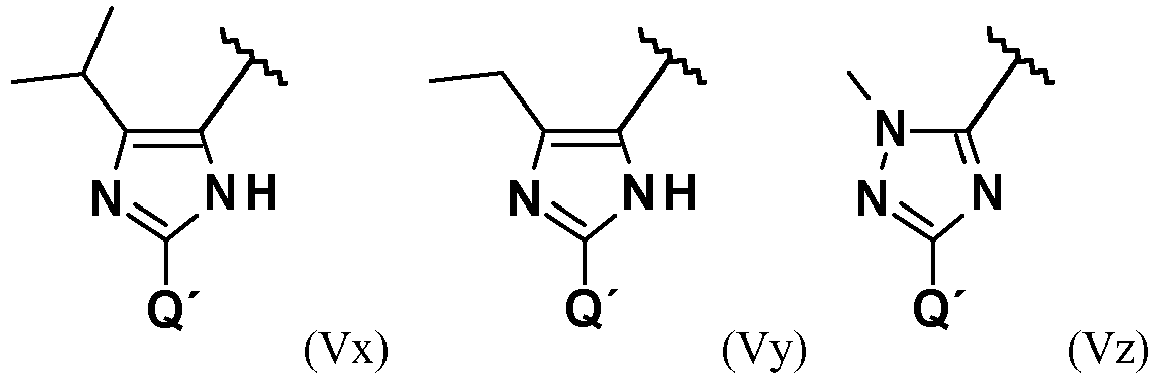


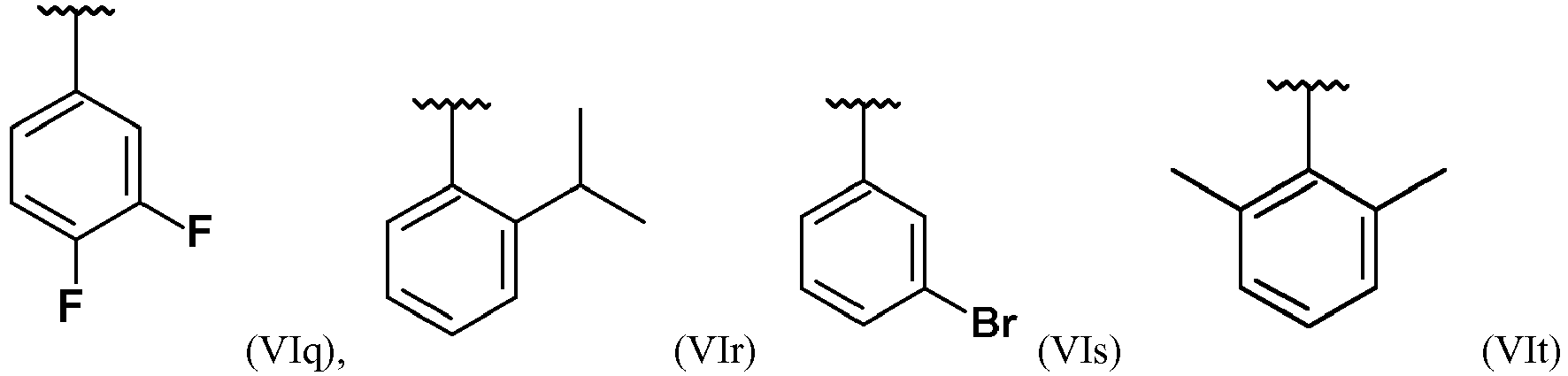







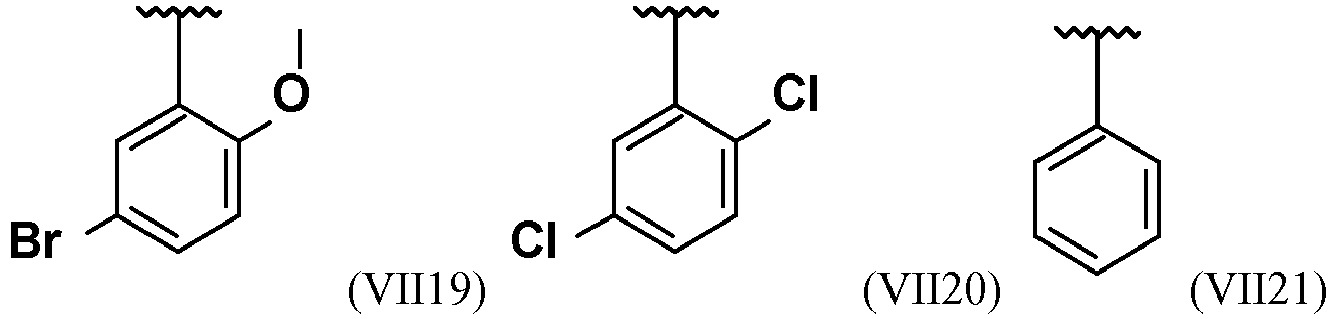





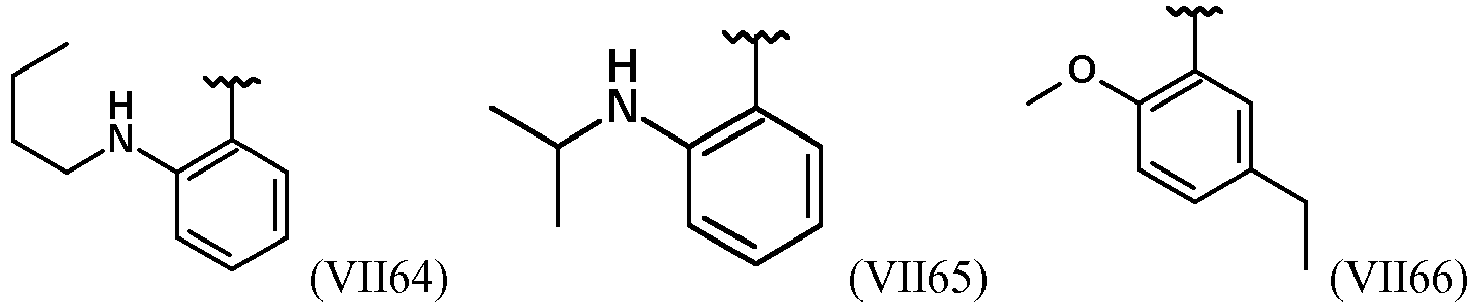














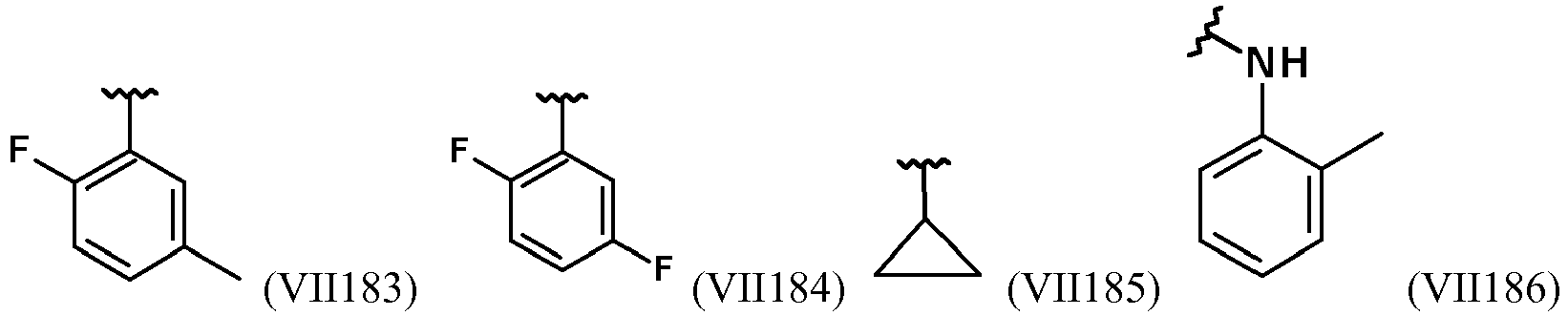
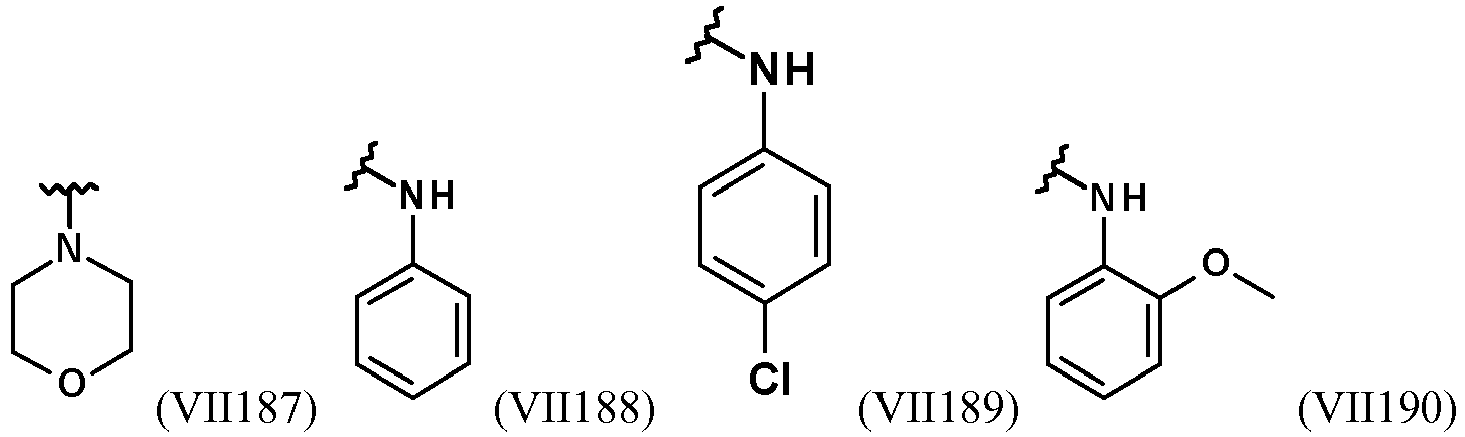

- Zwischenprodukte der Formeln XIa - XIq


Applications Claiming Priority (2)
| Application Number | Priority Date | Filing Date | Title |
|---|---|---|---|
| EP16160293 | 2016-03-15 | ||
| PCT/EP2017/055405 WO2017157735A1 (de) | 2016-03-15 | 2017-03-08 | Substituierte sulfonylamide zur bekämpfung tierischer schädlinge |
Publications (2)
| Publication Number | Publication Date |
|---|---|
| EP3429355A1 EP3429355A1 (de) | 2019-01-23 |
| EP3429355B1 true EP3429355B1 (de) | 2020-02-05 |
Family
ID=55532175
Family Applications (1)
| Application Number | Title | Priority Date | Filing Date |
|---|---|---|---|
| EP17708548.7A Active EP3429355B1 (de) | 2016-03-15 | 2017-03-08 | Substituierte sulfonylamide zur bekämpfung tierischer schädlinge |
Country Status (19)
| Country | Link |
|---|---|
| US (1) | US20200288710A1 (de) |
| EP (1) | EP3429355B1 (de) |
| JP (1) | JP2019510020A (de) |
| KR (1) | KR20180125960A (de) |
| CN (1) | CN109152368A (de) |
| AR (1) | AR107877A1 (de) |
| AU (1) | AU2017233739A1 (de) |
| BR (1) | BR112018068638A2 (de) |
| CA (1) | CA3017547A1 (de) |
| CL (1) | CL2018002645A1 (de) |
| CO (1) | CO2018009677A2 (de) |
| ES (1) | ES2775782T3 (de) |
| IL (1) | IL261403A (de) |
| MX (1) | MX2018011214A (de) |
| PE (1) | PE20181719A1 (de) |
| PH (1) | PH12018501966A1 (de) |
| TW (1) | TW201808103A (de) |
| UY (1) | UY37153A (de) |
| WO (1) | WO2017157735A1 (de) |
Cited By (1)
| Publication number | Priority date | Publication date | Assignee | Title |
|---|---|---|---|---|
| US11802110B2 (en) | 2016-10-07 | 2023-10-31 | Oxford Drug Design Limited | 2-amino-N-(arylsulfinyl)-acetamide compounds as inhibitors of bacterial aminoacyl-tRNA synthetase |
Families Citing this family (7)
| Publication number | Priority date | Publication date | Assignee | Title |
|---|---|---|---|---|
| TW201822637A (zh) * | 2016-11-07 | 2018-07-01 | 德商拜耳廠股份有限公司 | 用於控制動物害蟲的經取代磺醯胺類 |
| CN109608415B (zh) * | 2019-01-21 | 2020-12-01 | 暨南大学 | 噻唑甲酰胺类化合物及其合成和应用 |
| EP4055010A1 (de) * | 2019-11-07 | 2022-09-14 | Bayer Aktiengesellschaft | Substituierte sulfonylamide zur bekämpfung tierischer schädlinge |
| US10947552B1 (en) | 2020-09-30 | 2021-03-16 | Alpine Roads, Inc. | Recombinant fusion proteins for producing milk proteins in plants |
| WO2022072718A1 (en) | 2020-09-30 | 2022-04-07 | Nobell Foods, Inc. | Recombinant milk proteins and food compositions comprising the same |
| US10894812B1 (en) | 2020-09-30 | 2021-01-19 | Alpine Roads, Inc. | Recombinant milk proteins |
| US20250129031A1 (en) | 2022-01-27 | 2025-04-24 | Pi Industries Ltd. | 1,2,3-triazole carbonyl sulfonylamide compounds and use thereof |
Family Cites Families (75)
| Publication number | Priority date | Publication date | Assignee | Title |
|---|---|---|---|---|
| US4853383A (en) | 1975-03-03 | 1989-08-01 | Merck & Co., Inc. | β-blocking substituted imidazoles |
| DE4020052A1 (de) | 1990-06-23 | 1992-01-02 | Bayer Ag | Verfahren zur herstellung von 2-chlor-5-methyl-pyridin |
| US5300498A (en) | 1993-06-04 | 1994-04-05 | Hoechst-Roussel Pharmaceuticals Incorporated | 6-piperazinyl-1H-pyrazolo[3,4-b]pyridine-3-carboxylic acids, esters, amides and related compounds |
| JPH08114887A (ja) * | 1994-10-17 | 1996-05-07 | Fuji Photo Film Co Ltd | ハロゲン化銀写真感光材料 |
| US6020357A (en) | 1996-12-23 | 2000-02-01 | Dupont Pharmaceuticals Company | Nitrogen containing heteroaromatics as factor Xa inhibitors |
| US6288061B1 (en) | 1997-12-26 | 2001-09-11 | Welfide Corporation | Imidazole derivatives |
| US6492516B1 (en) | 1999-05-14 | 2002-12-10 | Merck & Co., Inc. | Compounds having cytokine inhibitory activity |
| PE20030547A1 (es) * | 2001-09-24 | 2003-08-18 | Bayer Corp | Derivados de imidazol para el tratamiento de la obesidad |
| GB0213715D0 (en) | 2002-06-14 | 2002-07-24 | Syngenta Ltd | Chemical compounds |
| KR100693367B1 (ko) | 2002-06-27 | 2007-03-12 | 아스텔라스세이야쿠 가부시키가이샤 | 아미노알콜 유도체 |
| US7247628B2 (en) | 2002-12-12 | 2007-07-24 | Pfizer, Inc. | Cannabinoid receptor ligands and uses thereof |
| TW200413328A (en) | 2003-01-02 | 2004-08-01 | Hoffmann La Roche | Novel CB 1 receptor inverse agonists |
| TWI312272B (en) | 2003-05-12 | 2009-07-21 | Sumitomo Chemical Co | Pyrimidine compound and pests controlling composition containing the same |
| US7232823B2 (en) | 2003-06-09 | 2007-06-19 | Pfizer, Inc. | Cannabinoid receptor ligands and uses thereof |
| WO2005099705A2 (en) | 2004-03-24 | 2005-10-27 | Bayer Pharmaceuticals Corporation | Preparation of imidazole derivatives and methods of use |
| GB0414438D0 (en) | 2004-06-28 | 2004-07-28 | Syngenta Participations Ag | Chemical compounds |
| KR101310073B1 (ko) | 2004-10-20 | 2013-09-24 | 이하라케미칼 고교가부시키가이샤 | 3-트리아졸릴페닐설파이드 유도체 및 그것을유효성분으로서 함유하는 살충·살진드기·살선충제 |
| GB0508472D0 (en) | 2005-04-26 | 2005-06-01 | Glaxo Group Ltd | Compounds |
| EP1932844B1 (de) | 2005-10-06 | 2015-09-02 | Nippon Soda Co., Ltd. | Quervernetzte cyclische aminverbindungen und mittel zur schädlingsbekämpfung |
| WO2007045096A1 (en) | 2005-10-21 | 2007-04-26 | University Of Saskatchewan | Oligoheteroaromatic luminiscent assemblies as high-affinity dna sequence-directed ligands |
| CA2633042A1 (en) | 2005-12-20 | 2007-07-05 | Merck & Co., Inc. | Niacin receptor agonists, compositions containing such compounds and methods of treatment |
| GB0606774D0 (en) | 2006-04-03 | 2006-05-10 | Novartis Ag | Organic compounds |
| US20070287734A1 (en) | 2006-06-09 | 2007-12-13 | Auspex Pharmaceuticals, Inc. | Preparation and utility of substituted pyrazole compounds with cannabinoid receptor activity |
| EP2120938A4 (de) | 2006-12-20 | 2010-12-08 | Merck Sharp & Dohme | Imidazopyridin-analoga als cb2-rezeptor-modulatoren zur behandlung von schmerzen, atemwegs- und nicht-atemwegserkrankungen |
| WO2008084218A1 (en) | 2007-01-12 | 2008-07-17 | Boehringer Ingelheim International Gmbh | Benzazole derivatives for the treatment of inflammations |
| US7547690B2 (en) | 2007-03-14 | 2009-06-16 | Bristol-Myers Squibb Company | Compounds for the treatment of Hepatitis C |
| CA2693138A1 (en) | 2007-07-16 | 2009-01-22 | Wyeth Llc | Aminoalkylazole derivatives as histamine-3 antagonists |
| JP5379690B2 (ja) | 2007-09-28 | 2013-12-25 | 武田薬品工業株式会社 | 5員複素環化合物 |
| EP2209789B1 (de) | 2007-11-20 | 2011-11-16 | Bristol-Myers Squibb Company | Cyclopropylkondensierte indolobenzazepine als hcv-ns5b-inhibitoren |
| EP2092824A1 (de) * | 2008-02-25 | 2009-08-26 | Bayer CropScience AG | Heterocyclyl-Pyrimidine |
| JP5268461B2 (ja) | 2008-07-14 | 2013-08-21 | Meiji Seikaファルマ株式会社 | Pf1364物質、その製造方法、生産菌株、及び、それを有効成分とする農園芸用殺虫剤 |
| CN101337937B (zh) | 2008-08-12 | 2010-12-22 | 国家农药创制工程技术研究中心 | 具有杀虫活性的n-苯基-5-取代氨基吡唑类化合物 |
| CN101337940B (zh) | 2008-08-12 | 2012-05-02 | 国家农药创制工程技术研究中心 | 具杀虫活性的含氮杂环二氯烯丙醚类化合物 |
| JP2010070514A (ja) * | 2008-09-19 | 2010-04-02 | Toray Ind Inc | ピラゾール誘導体及びその医薬用途 |
| CN101715774A (zh) | 2008-10-09 | 2010-06-02 | 浙江化工科技集团有限公司 | 一个具有杀虫活性化合物制备及用途 |
| EP2184273A1 (de) | 2008-11-05 | 2010-05-12 | Bayer CropScience AG | Halogen-substituierte Verbindungen als Pestizide |
| GB0820344D0 (en) | 2008-11-06 | 2008-12-17 | Syngenta Ltd | Herbicidal compositions |
| TWI482771B (zh) | 2009-05-04 | 2015-05-01 | Du Pont | 磺醯胺殺線蟲劑 |
| EP2518054A1 (de) | 2009-12-24 | 2012-10-31 | Takeda Pharmaceutical Company Limited | Amidverbindung |
| WO2011085575A1 (zh) | 2010-01-15 | 2011-07-21 | 江苏省农药研究所股份有限公司 | 邻杂环甲酰苯胺类化合物及其合成方法和应用 |
| WO2011103435A2 (en) | 2010-02-18 | 2011-08-25 | The Board Of Trustees Of The University Of Illinois | Methods for forming protected organoboronic acids |
| WO2011119777A2 (en) | 2010-03-23 | 2011-09-29 | The Johns Hopkins University | Compositions and methods for treatment of neurodegenerative disease |
| CN103119034B (zh) * | 2010-04-16 | 2016-08-03 | 拜耳知识产权有限责任公司 | 作为害虫防治剂的杂环化合物 |
| EP2627650A2 (de) | 2010-05-26 | 2013-08-21 | Merck Sharp & Dohme Corp. | N-phenyl-imidazol-carboxamid-hemmer von 3-phosphoinositidabhängiger proteinkinase-1 |
| AU2011297160B2 (en) | 2010-08-31 | 2014-11-20 | Mitsui Chemicals Crop & Life Solutions, Inc. | Noxious organism control agent |
| CN101967139B (zh) | 2010-09-14 | 2013-06-05 | 中化蓝天集团有限公司 | 一种含一氟甲氧基吡唑的邻甲酰氨基苯甲酰胺类化合物、其合成方法及应用 |
| KR101941300B1 (ko) | 2010-10-18 | 2019-01-22 | 이 아이 듀폰 디 네모아 앤드 캄파니 | 살선충성 설폰아미드 |
| TWI515187B (zh) | 2010-12-16 | 2016-01-01 | 健生科學愛爾蘭無限公司 | 作為呼吸道融合病毒抗病毒劑之吲哚類 |
| US20120238599A1 (en) | 2011-03-17 | 2012-09-20 | Chemizon, A Division Of Optomagic Co., Ltd. | Heterocyclic compounds as mek inhibitors |
| EP2540163A1 (de) * | 2011-06-30 | 2013-01-02 | Bayer CropScience AG | Nematozide N-Cyclopropylsulfonylamidderivate |
| WO2013050317A1 (en) | 2011-10-03 | 2013-04-11 | Syngenta Limited | Polymorphs of an isoxazoline derivative |
| TWI577286B (zh) | 2011-10-13 | 2017-04-11 | 杜邦股份有限公司 | 殺線蟲磺醯胺之固體形態 |
| CN102391261A (zh) | 2011-10-14 | 2012-03-28 | 上海交通大学 | 一种n-取代噁二嗪类化合物及其制备方法和应用 |
| CN104125957B (zh) | 2011-12-21 | 2016-05-25 | 拜耳知识产权有限责任公司 | 取代的苄基吡唑 |
| CN104202981B (zh) | 2012-03-30 | 2018-01-30 | 巴斯夫欧洲公司 | 防治动物害虫的n‑取代的吡啶亚基化合物和衍生物 |
| EP2647626A1 (de) | 2012-04-03 | 2013-10-09 | Syngenta Participations AG. | 1-Aza-spiro[4.5]dec-3-en- und 1,8-Diaza-spiro[4.5]dec-3-enderivate als Pestizide |
| CA2870090A1 (en) | 2012-04-27 | 2013-10-31 | Dow Agrosciences Llc | Pesticidal compositions and processes related thereto |
| US9282739B2 (en) | 2012-04-27 | 2016-03-15 | Dow Agrosciences Llc | Pesticidal compositions and processes related thereto |
| JO3215B1 (ar) * | 2012-08-09 | 2018-03-08 | Phenex Pharmaceuticals Ag | حلقات غير متجانسة بها 5 ذرات تحتوي على النيتروجين بها استبدال بكربوكساميد أو سلفوناميد كمعدلات لمستقبل نووي غير محمي RORy |
| PE20150974A1 (es) | 2012-11-14 | 2015-07-04 | Teijin Pharma Ltd | Derivados de piridina |
| TWI605045B (zh) | 2013-01-14 | 2017-11-11 | 杜邦股份有限公司 | 殺線蟲磺醯胺之製備 |
| US9403827B2 (en) | 2013-01-22 | 2016-08-02 | Novartis Ag | Substituted purinone compounds |
| CN103232431B (zh) | 2013-01-25 | 2014-11-05 | 青岛科技大学 | 一种二卤代吡唑酰胺类化合物及其应用 |
| CN103109816B (zh) | 2013-01-25 | 2014-09-10 | 青岛科技大学 | 硫代苯甲酰胺类化合物及其应用 |
| US20140275503A1 (en) | 2013-03-13 | 2014-09-18 | Dow Agrosciences Llc | Process for the preparation of certain triaryl rhamnose carbamates |
| WO2014146246A1 (en) | 2013-03-19 | 2014-09-25 | Merck Sharp & Dohme Corp. | Cycloalkyl nitrile pyrazolo pyridones as janus kinase inhibitors |
| EP3021673A1 (de) | 2013-07-17 | 2016-05-25 | Bayer CropScience Aktiengesellschaft | Heterocyclische sulfonylamino(thio)carbonyl-derivate mit nematiziden eigenschaften |
| MX2016000820A (es) | 2013-07-23 | 2016-05-24 | Bayer Cropscience Ag | Imidazotiazol sulfonamidas como nematicidas. |
| JP2016533385A (ja) | 2013-08-22 | 2016-10-27 | エフ.ホフマン−ラ ロシュ アーゲーF. Hoffmann−La Roche Aktiengesellschaft | アルキニルアルコール及び使用方法 |
| CN103524422B (zh) | 2013-10-11 | 2015-05-27 | 中国农业科学院植物保护研究所 | 苯并咪唑衍生物及其制备方法和用途 |
| KR20160072155A (ko) | 2013-10-17 | 2016-06-22 | 다우 아그로사이언시즈 엘엘씨 | 살충성 화합물의 제조 방법 |
| CN105636441B (zh) | 2013-10-17 | 2018-06-15 | 美国陶氏益农公司 | 制备杀虫化合物的方法 |
| WO2015162452A1 (en) * | 2014-04-23 | 2015-10-29 | Piramal Enterprises Limited | Substituted pyrazole compounds as cb1 receptor antagonists and uses thereof |
| AU2015257746B2 (en) | 2014-05-08 | 2018-11-22 | Bayer Cropscience Aktiengesellschaft | Pyrazolopyridine sulfonamides as nematicides |
| GB201417094D0 (en) | 2014-09-26 | 2014-11-12 | Glaxosmithkline Ip Dev Ltd | Novel compounds |
-
2017
- 2017-03-08 AU AU2017233739A patent/AU2017233739A1/en not_active Abandoned
- 2017-03-08 WO PCT/EP2017/055405 patent/WO2017157735A1/de not_active Ceased
- 2017-03-08 CN CN201780029972.5A patent/CN109152368A/zh active Pending
- 2017-03-08 KR KR1020187026374A patent/KR20180125960A/ko not_active Withdrawn
- 2017-03-08 BR BR112018068638-7A patent/BR112018068638A2/pt not_active Application Discontinuation
- 2017-03-08 PE PE2018001817A patent/PE20181719A1/es unknown
- 2017-03-08 CA CA3017547A patent/CA3017547A1/en not_active Abandoned
- 2017-03-08 US US16/084,159 patent/US20200288710A1/en not_active Abandoned
- 2017-03-08 MX MX2018011214A patent/MX2018011214A/es unknown
- 2017-03-08 EP EP17708548.7A patent/EP3429355B1/de active Active
- 2017-03-08 ES ES17708548T patent/ES2775782T3/es active Active
- 2017-03-08 JP JP2018548442A patent/JP2019510020A/ja active Pending
- 2017-03-13 TW TW106108115A patent/TW201808103A/zh unknown
- 2017-03-15 AR ARP170100636A patent/AR107877A1/es unknown
- 2017-03-15 UY UY0001037153A patent/UY37153A/es not_active Application Discontinuation
-
2018
- 2018-08-27 IL IL261403A patent/IL261403A/en unknown
- 2018-09-12 PH PH12018501966A patent/PH12018501966A1/en unknown
- 2018-09-14 CL CL2018002645A patent/CL2018002645A1/es unknown
- 2018-09-14 CO CONC2018/0009677A patent/CO2018009677A2/es unknown
Non-Patent Citations (1)
| Title |
|---|
| None * |
Cited By (1)
| Publication number | Priority date | Publication date | Assignee | Title |
|---|---|---|---|---|
| US11802110B2 (en) | 2016-10-07 | 2023-10-31 | Oxford Drug Design Limited | 2-amino-N-(arylsulfinyl)-acetamide compounds as inhibitors of bacterial aminoacyl-tRNA synthetase |
Also Published As
| Publication number | Publication date |
|---|---|
| US20200288710A1 (en) | 2020-09-17 |
| AU2017233739A1 (en) | 2018-09-20 |
| IL261403A (en) | 2018-10-31 |
| PH12018501966A1 (en) | 2019-06-24 |
| CA3017547A1 (en) | 2017-09-21 |
| UY37153A (es) | 2017-10-31 |
| JP2019510020A (ja) | 2019-04-11 |
| CN109152368A (zh) | 2019-01-04 |
| BR112018068638A2 (pt) | 2019-02-05 |
| AR107877A1 (es) | 2018-06-13 |
| WO2017157735A1 (de) | 2017-09-21 |
| TW201808103A (zh) | 2018-03-16 |
| ES2775782T3 (es) | 2020-07-28 |
| EP3429355A1 (de) | 2019-01-23 |
| MX2018011214A (es) | 2019-03-28 |
| CO2018009677A2 (es) | 2018-09-28 |
| KR20180125960A (ko) | 2018-11-26 |
| CL2018002645A1 (es) | 2019-01-18 |
| PE20181719A1 (es) | 2018-10-26 |
Similar Documents
| Publication | Publication Date | Title |
|---|---|---|
| EP3515921B1 (de) | Pyrazolo[1,5-a]pyridin- derivative und ihre verwendung als schädlingsbekämpfungsmittel | |
| EP3814346B1 (de) | Heterocyclen-derivate als schädlingsbekämpfungsmittel | |
| EP3755700B1 (de) | Kondensierte bicyclische heterocyclen-derivate als schädlingsbekämpfungsmittel | |
| EP3568392B1 (de) | Imidazol-derivate als schädlingsbekämpfungsmittel | |
| WO2017072039A1 (de) | Kondensierte bicyclische heterocyclen-derivate als schädlingsbekämpfungsmittel | |
| EP3544978A1 (de) | 2-[3-(alkylsulfonyl)-2h-indazol-2-yl]-3h-imidazo[4,5-b]pyridin-derivate und ähnliche verbindungen als schädlingsbekämpfungsmittel | |
| EP3931192B1 (de) | Kondensierte bicyclische heterocyclen-derivate als schädlingsbekämpfungsmittel | |
| WO2017125340A1 (de) | Kondensierte bicyclische heterocyclen-derivate als schädlingsbekämpfungsmittel | |
| EP3487860B1 (de) | Kondensierte bicyclische heterocyclen-derivate als schädlingsbekämpfungsmittel | |
| WO2018141954A1 (de) | Aryl- oder heteroaryl-substituierte imidazopyridinderivate und deren anwendung als schädlingsbekämpfungsmittel | |
| WO2020053282A1 (de) | Heterocyclen-derivate als schädlingsbekämpfungsmittel | |
| EP3497102A1 (de) | Kondensierte bicyclische heterocyclen-derivate als schädlingsbekämpfungsmittel | |
| WO2017144341A1 (de) | Kondensierte bicyclische heterocyclen-derivate als schädlingsbekämpfungsmittel | |
| EP3568395A1 (de) | Heterocyclen-derivate als schädlingsbekämpfungsmittel | |
| EP3429355A1 (de) | Substituierte sulfonylamide zur bekämpfung tierischer schädlinge | |
| EP3765465A1 (de) | Kondensierte bicyclische heterocyclen-derivate als schädlingsbekämpfungsmittel | |
| EP3619213A1 (de) | 2-(het)aryl-substituierte kondensierte heterocyclen-derivate als schädlingsbekämpfungsmittel | |
| EP3619212B1 (de) | 2-(het)aryl-substituierte kondensierte heterocyclen-derivate als schädlingsbekämpfungsmittel | |
| EP3615540B1 (de) | Kondensierte bicyclische heterocyclen-derivate als schädlingsbekämpfungsmittel | |
| EP3241830A1 (de) | Kondensierte bicyclische heterocyclen-derivate als schädlingsbekämpfungsmittel | |
| EP3523299B1 (de) | 2-(het)aryl-substituierte kondensierte bicyclische heterocyclen-derivate als schädlings-bekämpfungsmittel | |
| WO2018065288A1 (de) | 2-[2-phenyl-1-(sulfonylmethyl)vinyl]-imidazo[4,5-b]pyridin-derivate und verwandte verbindungen als schädlingsbekämpfungsmittel im pflanzenschutz | |
| EP3284739A1 (de) | Substituierte (het)arylverbindungen als schädlingsbekämpfungsmittel | |
| EP3414240B1 (de) | Substituierte imidazolyl-carboxamide als schädlingsbekämpfungsmittel |
Legal Events
| Date | Code | Title | Description |
|---|---|---|---|
| STAA | Information on the status of an ep patent application or granted ep patent |
Free format text: STATUS: UNKNOWN |
|
| STAA | Information on the status of an ep patent application or granted ep patent |
Free format text: STATUS: THE INTERNATIONAL PUBLICATION HAS BEEN MADE |
|
| PUAI | Public reference made under article 153(3) epc to a published international application that has entered the european phase |
Free format text: ORIGINAL CODE: 0009012 |
|
| STAA | Information on the status of an ep patent application or granted ep patent |
Free format text: STATUS: REQUEST FOR EXAMINATION WAS MADE |
|
| 17P | Request for examination filed |
Effective date: 20181015 |
|
| AK | Designated contracting states |
Kind code of ref document: A1 Designated state(s): AL AT BE BG CH CY CZ DE DK EE ES FI FR GB GR HR HU IE IS IT LI LT LU LV MC MK MT NL NO PL PT RO RS SE SI SK SM TR |
|
| AX | Request for extension of the european patent |
Extension state: BA ME |
|
| DAV | Request for validation of the european patent (deleted) | ||
| DAX | Request for extension of the european patent (deleted) | ||
| GRAP | Despatch of communication of intention to grant a patent |
Free format text: ORIGINAL CODE: EPIDOSNIGR1 |
|
| STAA | Information on the status of an ep patent application or granted ep patent |
Free format text: STATUS: GRANT OF PATENT IS INTENDED |
|
| RIC1 | Information provided on ipc code assigned before grant |
Ipc: C07D 403/12 20060101ALI20190823BHEP Ipc: C07D 249/10 20060101ALI20190823BHEP Ipc: C07D 401/04 20060101ALI20190823BHEP Ipc: A01P 7/04 20060101ALI20190823BHEP Ipc: C07D 405/04 20060101ALI20190823BHEP Ipc: C07D 417/12 20060101ALI20190823BHEP Ipc: C07D 409/04 20060101ALI20190823BHEP Ipc: C07D 413/12 20060101ALI20190823BHEP Ipc: A01N 43/56 20060101ALI20190823BHEP Ipc: C07D 233/90 20060101ALI20190823BHEP Ipc: C07D 401/12 20060101ALI20190823BHEP Ipc: C07D 405/12 20060101ALI20190823BHEP Ipc: C07D 409/14 20060101ALI20190823BHEP Ipc: C07D 409/12 20060101ALI20190823BHEP Ipc: A01N 43/653 20060101ALI20190823BHEP Ipc: A01N 43/50 20060101AFI20190823BHEP Ipc: C07D 403/04 20060101ALI20190823BHEP |
|
| INTG | Intention to grant announced |
Effective date: 20190911 |
|
| GRAS | Grant fee paid |
Free format text: ORIGINAL CODE: EPIDOSNIGR3 |
|
| GRAA | (expected) grant |
Free format text: ORIGINAL CODE: 0009210 |
|
| STAA | Information on the status of an ep patent application or granted ep patent |
Free format text: STATUS: THE PATENT HAS BEEN GRANTED |
|
| AK | Designated contracting states |
Kind code of ref document: B1 Designated state(s): AL AT BE BG CH CY CZ DE DK EE ES FI FR GB GR HR HU IE IS IT LI LT LU LV MC MK MT NL NO PL PT RO RS SE SI SK SM TR |
|
| REG | Reference to a national code |
Ref country code: GB Ref legal event code: FG4D Free format text: NOT ENGLISH |
|
| REG | Reference to a national code |
Ref country code: AT Ref legal event code: REF Ref document number: 1229308 Country of ref document: AT Kind code of ref document: T Effective date: 20200215 |
|
| REG | Reference to a national code |
Ref country code: DE Ref legal event code: R096 Ref document number: 502017003706 Country of ref document: DE |
|
| REG | Reference to a national code |
Ref country code: IE Ref legal event code: FG4D Free format text: LANGUAGE OF EP DOCUMENT: GERMAN |
|
| REG | Reference to a national code |
Ref country code: CH Ref legal event code: EP |
|
| REG | Reference to a national code |
Ref country code: NL Ref legal event code: MP Effective date: 20200205 |
|
| REG | Reference to a national code |
Ref country code: ES Ref legal event code: FG2A Ref document number: 2775782 Country of ref document: ES Kind code of ref document: T3 Effective date: 20200728 |
|
| PG25 | Lapsed in a contracting state [announced via postgrant information from national office to epo] |
Ref country code: PT Free format text: LAPSE BECAUSE OF FAILURE TO SUBMIT A TRANSLATION OF THE DESCRIPTION OR TO PAY THE FEE WITHIN THE PRESCRIBED TIME-LIMIT Effective date: 20200628 Ref country code: NO Free format text: LAPSE BECAUSE OF FAILURE TO SUBMIT A TRANSLATION OF THE DESCRIPTION OR TO PAY THE FEE WITHIN THE PRESCRIBED TIME-LIMIT Effective date: 20200505 Ref country code: FI Free format text: LAPSE BECAUSE OF FAILURE TO SUBMIT A TRANSLATION OF THE DESCRIPTION OR TO PAY THE FEE WITHIN THE PRESCRIBED TIME-LIMIT Effective date: 20200205 Ref country code: RS Free format text: LAPSE BECAUSE OF FAILURE TO SUBMIT A TRANSLATION OF THE DESCRIPTION OR TO PAY THE FEE WITHIN THE PRESCRIBED TIME-LIMIT Effective date: 20200205 |
|
| REG | Reference to a national code |
Ref country code: LT Ref legal event code: MG4D |
|
| PG25 | Lapsed in a contracting state [announced via postgrant information from national office to epo] |
Ref country code: IS Free format text: LAPSE BECAUSE OF FAILURE TO SUBMIT A TRANSLATION OF THE DESCRIPTION OR TO PAY THE FEE WITHIN THE PRESCRIBED TIME-LIMIT Effective date: 20200605 Ref country code: GR Free format text: LAPSE BECAUSE OF FAILURE TO SUBMIT A TRANSLATION OF THE DESCRIPTION OR TO PAY THE FEE WITHIN THE PRESCRIBED TIME-LIMIT Effective date: 20200506 Ref country code: BG Free format text: LAPSE BECAUSE OF FAILURE TO SUBMIT A TRANSLATION OF THE DESCRIPTION OR TO PAY THE FEE WITHIN THE PRESCRIBED TIME-LIMIT Effective date: 20200505 Ref country code: LV Free format text: LAPSE BECAUSE OF FAILURE TO SUBMIT A TRANSLATION OF THE DESCRIPTION OR TO PAY THE FEE WITHIN THE PRESCRIBED TIME-LIMIT Effective date: 20200205 Ref country code: SE Free format text: LAPSE BECAUSE OF FAILURE TO SUBMIT A TRANSLATION OF THE DESCRIPTION OR TO PAY THE FEE WITHIN THE PRESCRIBED TIME-LIMIT Effective date: 20200205 Ref country code: HR Free format text: LAPSE BECAUSE OF FAILURE TO SUBMIT A TRANSLATION OF THE DESCRIPTION OR TO PAY THE FEE WITHIN THE PRESCRIBED TIME-LIMIT Effective date: 20200205 |
|
| PG25 | Lapsed in a contracting state [announced via postgrant information from national office to epo] |
Ref country code: NL Free format text: LAPSE BECAUSE OF FAILURE TO SUBMIT A TRANSLATION OF THE DESCRIPTION OR TO PAY THE FEE WITHIN THE PRESCRIBED TIME-LIMIT Effective date: 20200205 |
|
| PG25 | Lapsed in a contracting state [announced via postgrant information from national office to epo] |
Ref country code: DK Free format text: LAPSE BECAUSE OF FAILURE TO SUBMIT A TRANSLATION OF THE DESCRIPTION OR TO PAY THE FEE WITHIN THE PRESCRIBED TIME-LIMIT Effective date: 20200205 Ref country code: SK Free format text: LAPSE BECAUSE OF FAILURE TO SUBMIT A TRANSLATION OF THE DESCRIPTION OR TO PAY THE FEE WITHIN THE PRESCRIBED TIME-LIMIT Effective date: 20200205 Ref country code: RO Free format text: LAPSE BECAUSE OF FAILURE TO SUBMIT A TRANSLATION OF THE DESCRIPTION OR TO PAY THE FEE WITHIN THE PRESCRIBED TIME-LIMIT Effective date: 20200205 Ref country code: LT Free format text: LAPSE BECAUSE OF FAILURE TO SUBMIT A TRANSLATION OF THE DESCRIPTION OR TO PAY THE FEE WITHIN THE PRESCRIBED TIME-LIMIT Effective date: 20200205 Ref country code: EE Free format text: LAPSE BECAUSE OF FAILURE TO SUBMIT A TRANSLATION OF THE DESCRIPTION OR TO PAY THE FEE WITHIN THE PRESCRIBED TIME-LIMIT Effective date: 20200205 Ref country code: CZ Free format text: LAPSE BECAUSE OF FAILURE TO SUBMIT A TRANSLATION OF THE DESCRIPTION OR TO PAY THE FEE WITHIN THE PRESCRIBED TIME-LIMIT Effective date: 20200205 Ref country code: SM Free format text: LAPSE BECAUSE OF FAILURE TO SUBMIT A TRANSLATION OF THE DESCRIPTION OR TO PAY THE FEE WITHIN THE PRESCRIBED TIME-LIMIT Effective date: 20200205 |
|
| REG | Reference to a national code |
Ref country code: CH Ref legal event code: PL |
|
| REG | Reference to a national code |
Ref country code: DE Ref legal event code: R097 Ref document number: 502017003706 Country of ref document: DE |
|
| PG25 | Lapsed in a contracting state [announced via postgrant information from national office to epo] |
Ref country code: MC Free format text: LAPSE BECAUSE OF FAILURE TO SUBMIT A TRANSLATION OF THE DESCRIPTION OR TO PAY THE FEE WITHIN THE PRESCRIBED TIME-LIMIT Effective date: 20200205 |
|
| PLBE | No opposition filed within time limit |
Free format text: ORIGINAL CODE: 0009261 |
|
| STAA | Information on the status of an ep patent application or granted ep patent |
Free format text: STATUS: NO OPPOSITION FILED WITHIN TIME LIMIT |
|
| REG | Reference to a national code |
Ref country code: BE Ref legal event code: MM Effective date: 20200331 |
|
| PG25 | Lapsed in a contracting state [announced via postgrant information from national office to epo] |
Ref country code: LU Free format text: LAPSE BECAUSE OF NON-PAYMENT OF DUE FEES Effective date: 20200308 |
|
| 26N | No opposition filed |
Effective date: 20201106 |
|
| PG25 | Lapsed in a contracting state [announced via postgrant information from national office to epo] |
Ref country code: CH Free format text: LAPSE BECAUSE OF NON-PAYMENT OF DUE FEES Effective date: 20200331 Ref country code: FR Free format text: LAPSE BECAUSE OF NON-PAYMENT OF DUE FEES Effective date: 20200405 Ref country code: IT Free format text: LAPSE BECAUSE OF FAILURE TO SUBMIT A TRANSLATION OF THE DESCRIPTION OR TO PAY THE FEE WITHIN THE PRESCRIBED TIME-LIMIT Effective date: 20200205 Ref country code: LI Free format text: LAPSE BECAUSE OF NON-PAYMENT OF DUE FEES Effective date: 20200331 Ref country code: IE Free format text: LAPSE BECAUSE OF NON-PAYMENT OF DUE FEES Effective date: 20200308 |
|
| PG25 | Lapsed in a contracting state [announced via postgrant information from national office to epo] |
Ref country code: SI Free format text: LAPSE BECAUSE OF FAILURE TO SUBMIT A TRANSLATION OF THE DESCRIPTION OR TO PAY THE FEE WITHIN THE PRESCRIBED TIME-LIMIT Effective date: 20200205 Ref country code: PL Free format text: LAPSE BECAUSE OF FAILURE TO SUBMIT A TRANSLATION OF THE DESCRIPTION OR TO PAY THE FEE WITHIN THE PRESCRIBED TIME-LIMIT Effective date: 20200205 Ref country code: BE Free format text: LAPSE BECAUSE OF NON-PAYMENT OF DUE FEES Effective date: 20200331 |
|
| PGFP | Annual fee paid to national office [announced via postgrant information from national office to epo] |
Ref country code: DE Payment date: 20210224 Year of fee payment: 5 |
|
| PGFP | Annual fee paid to national office [announced via postgrant information from national office to epo] |
Ref country code: ES Payment date: 20210402 Year of fee payment: 5 |
|
| GBPC | Gb: european patent ceased through non-payment of renewal fee |
Effective date: 20210308 |
|
| PG25 | Lapsed in a contracting state [announced via postgrant information from national office to epo] |
Ref country code: GB Free format text: LAPSE BECAUSE OF NON-PAYMENT OF DUE FEES Effective date: 20210308 |
|
| PG25 | Lapsed in a contracting state [announced via postgrant information from national office to epo] |
Ref country code: TR Free format text: LAPSE BECAUSE OF FAILURE TO SUBMIT A TRANSLATION OF THE DESCRIPTION OR TO PAY THE FEE WITHIN THE PRESCRIBED TIME-LIMIT Effective date: 20200205 Ref country code: MT Free format text: LAPSE BECAUSE OF FAILURE TO SUBMIT A TRANSLATION OF THE DESCRIPTION OR TO PAY THE FEE WITHIN THE PRESCRIBED TIME-LIMIT Effective date: 20200205 Ref country code: CY Free format text: LAPSE BECAUSE OF FAILURE TO SUBMIT A TRANSLATION OF THE DESCRIPTION OR TO PAY THE FEE WITHIN THE PRESCRIBED TIME-LIMIT Effective date: 20200205 |
|
| PG25 | Lapsed in a contracting state [announced via postgrant information from national office to epo] |
Ref country code: MK Free format text: LAPSE BECAUSE OF FAILURE TO SUBMIT A TRANSLATION OF THE DESCRIPTION OR TO PAY THE FEE WITHIN THE PRESCRIBED TIME-LIMIT Effective date: 20200205 Ref country code: AL Free format text: LAPSE BECAUSE OF FAILURE TO SUBMIT A TRANSLATION OF THE DESCRIPTION OR TO PAY THE FEE WITHIN THE PRESCRIBED TIME-LIMIT Effective date: 20200205 |
|
| REG | Reference to a national code |
Ref country code: DE Ref legal event code: R119 Ref document number: 502017003706 Country of ref document: DE |
|
| PG25 | Lapsed in a contracting state [announced via postgrant information from national office to epo] |
Ref country code: DE Free format text: LAPSE BECAUSE OF NON-PAYMENT OF DUE FEES Effective date: 20221001 |
|
| REG | Reference to a national code |
Ref country code: ES Ref legal event code: FD2A Effective date: 20230428 |
|
| REG | Reference to a national code |
Ref country code: AT Ref legal event code: MM01 Ref document number: 1229308 Country of ref document: AT Kind code of ref document: T Effective date: 20220308 |
|
| PG25 | Lapsed in a contracting state [announced via postgrant information from national office to epo] |
Ref country code: ES Free format text: LAPSE BECAUSE OF NON-PAYMENT OF DUE FEES Effective date: 20220309 Ref country code: AT Free format text: LAPSE BECAUSE OF NON-PAYMENT OF DUE FEES Effective date: 20220308 |