EP3432057A1 - Procédé et dispositif de détermination du port de tête habituel - Google Patents
Procédé et dispositif de détermination du port de tête habituel Download PDFInfo
- Publication number
- EP3432057A1 EP3432057A1 EP18188534.4A EP18188534A EP3432057A1 EP 3432057 A1 EP3432057 A1 EP 3432057A1 EP 18188534 A EP18188534 A EP 18188534A EP 3432057 A1 EP3432057 A1 EP 3432057A1
- Authority
- EP
- European Patent Office
- Prior art keywords
- head
- head posture
- posture
- recording
- subject
- Prior art date
- Legal status (The legal status is an assumption and is not a legal conclusion. Google has not performed a legal analysis and makes no representation as to the accuracy of the status listed.)
- Pending
Links
Images

Classifications
-
- G—PHYSICS
- G02—OPTICS
- G02C—SPECTACLES; SUNGLASSES OR GOGGLES INSOFAR AS THEY HAVE THE SAME FEATURES AS SPECTACLES; CONTACT LENSES
- G02C13/00—Assembling; Repairing; Cleaning
- G02C13/003—Measuring during assembly or fitting of spectacles
- G02C13/005—Measuring geometric parameters required to locate ophtalmic lenses in spectacles frames
-
- A—HUMAN NECESSITIES
- A61—MEDICAL OR VETERINARY SCIENCE; HYGIENE
- A61B—DIAGNOSIS; SURGERY; IDENTIFICATION
- A61B3/00—Apparatus for testing the eyes; Instruments for examining the eyes
- A61B3/10—Objective types, i.e. instruments for examining the eyes independent of the patients' perceptions or reactions
-
- A—HUMAN NECESSITIES
- A61—MEDICAL OR VETERINARY SCIENCE; HYGIENE
- A61B—DIAGNOSIS; SURGERY; IDENTIFICATION
- A61B5/00—Measuring for diagnostic purposes; Identification of persons
- A61B5/0059—Measuring for diagnostic purposes; Identification of persons using light, e.g. diagnosis by transillumination, diascopy, fluorescence
- A61B5/0077—Devices for viewing the surface of the body, e.g. camera, magnifying lens
-
- A—HUMAN NECESSITIES
- A61—MEDICAL OR VETERINARY SCIENCE; HYGIENE
- A61B—DIAGNOSIS; SURGERY; IDENTIFICATION
- A61B5/00—Measuring for diagnostic purposes; Identification of persons
- A61B5/103—Measuring devices for testing the shape, pattern, colour, size or movement of the body or parts thereof, for diagnostic purposes
- A61B5/11—Measuring movement of the entire body or parts thereof, e.g. head or hand tremor or mobility of a limb
- A61B5/1113—Local tracking of patients, e.g. in a hospital or private home
- A61B5/1114—Tracking parts of the body
-
- A—HUMAN NECESSITIES
- A61—MEDICAL OR VETERINARY SCIENCE; HYGIENE
- A61B—DIAGNOSIS; SURGERY; IDENTIFICATION
- A61B5/00—Measuring for diagnostic purposes; Identification of persons
- A61B5/103—Measuring devices for testing the shape, pattern, colour, size or movement of the body or parts thereof, for diagnostic purposes
- A61B5/11—Measuring movement of the entire body or parts thereof, e.g. head or hand tremor or mobility of a limb
- A61B5/1121—Determining geometric values, e.g. centre of rotation or angular range of movement
-
- A—HUMAN NECESSITIES
- A61—MEDICAL OR VETERINARY SCIENCE; HYGIENE
- A61B—DIAGNOSIS; SURGERY; IDENTIFICATION
- A61B5/00—Measuring for diagnostic purposes; Identification of persons
- A61B5/103—Measuring devices for testing the shape, pattern, colour, size or movement of the body or parts thereof, for diagnostic purposes
- A61B5/11—Measuring movement of the entire body or parts thereof, e.g. head or hand tremor or mobility of a limb
- A61B5/1126—Measuring movement of the entire body or parts thereof, e.g. head or hand tremor or mobility of a limb using a particular sensing technique
- A61B5/1127—Measuring movement of the entire body or parts thereof, e.g. head or hand tremor or mobility of a limb using a particular sensing technique using markers
-
- A—HUMAN NECESSITIES
- A61—MEDICAL OR VETERINARY SCIENCE; HYGIENE
- A61B—DIAGNOSIS; SURGERY; IDENTIFICATION
- A61B5/00—Measuring for diagnostic purposes; Identification of persons
- A61B5/68—Arrangements of detecting, measuring or recording means, e.g. sensors, in relation to patient
- A61B5/6801—Arrangements of detecting, measuring or recording means, e.g. sensors, in relation to patient specially adapted to be attached to or worn on the body surface
- A61B5/6813—Specially adapted to be attached to a specific body part
- A61B5/6814—Head
-
- G—PHYSICS
- G02—OPTICS
- G02C—SPECTACLES; SUNGLASSES OR GOGGLES INSOFAR AS THEY HAVE THE SAME FEATURES AS SPECTACLES; CONTACT LENSES
- G02C7/00—Optical parts
- G02C7/02—Lenses; Lens systems ; Methods of designing lenses
- G02C7/024—Methods of designing ophthalmic lenses
- G02C7/025—Methods of designing ophthalmic lenses considering parameters of the viewed object
-
- A—HUMAN NECESSITIES
- A61—MEDICAL OR VETERINARY SCIENCE; HYGIENE
- A61B—DIAGNOSIS; SURGERY; IDENTIFICATION
- A61B2560/00—Constructional details of operational features of apparatus; Accessories for medical measuring apparatus
- A61B2560/02—Operational features
- A61B2560/0223—Operational features of calibration, e.g. protocols for calibrating sensors
Definitions
- the invention relates to a method for determining the habitual head posture of a subject according to the preamble of patent claim 1 and to a device for determining the habitual head posture of a subject according to the preamble of patent claim 13. Finally, the invention relates to a computer program for carrying out the methods specified above.
- the customer is asked to take the most natural head and body posture.
- the definition of the centering values is then carried out by marking the viewing points in the disk plane of the spectacle frame by means of a pen or video recording and subsequent manual (as in the case of the video infringer marketed by the applicant) or automated (such as in the case of the applicant distributed under the brand "RV Terminal” video centering) Zentrier Schemear.
- a tool named "Y-Stick” In order to determine the pretilt angle, a tool named "Y-Stick” is known, which "freezes" the pretilt angle of the eyeglass frame at one time so that it can subsequently be read. The pretilt angle thus detected is used in a subsequent step to position the customer in the same position in front of a centering system.
- a measuring device for determining the inclination of the head is known, which is assigned by the applicant of the EP 1 591 064 sold under the name "Ysis”.
- This gauge is attached to the eyeglass frame.
- This proposal aims to capture the "normal" head posture at a time for both near and distant vision. From the head inclinations that are taken when looking into the distance as well as while reading, The difference in head tilt between distance and near vision tasks is determined. From this, the associated viewing points are determined by the spectacle lens.
- the WO 01/62139 A1 discloses classifying the behavior of a spectacle wearer in terms of his gaze habits. It is determined the typical head and eye movement in various visual tasks. Depending on this, the gaze behavior of the subject is categorized according to "mobility" of the eyes and the head ("head / eye mover"). The results of the analysis are used as a basis for the selection of a suitable spectacle lens.
- the DE 2004 063 160 A1 describes a method and a device for adjusting a pair of spectacles, in particular for detecting the habitus head posture of a test person, whose measurement data is included in the video centration data determination.
- the subject produces a plurality of video photos for determining the head posture angle of a subject in various head posture positions, detects the head posture angle, and aligns with the pretilt angle of the spectacle frame and the corneal vertex distance.
- the corresponding video photos are taken in a moment when, in the opinion of the operator, the subject has taken his natural Habitus head posture.
- a Zentrier tard so a measurement in which all the necessary information for the correct centering of spectacle lenses in a spectacle frame for the individual application of the customer or subjects are determined, represents a forced situation for the customer of the optician. Although it is known from the Zentrierzu, how the client held his head during a recording, but this head position does not necessarily correspond to his "normal", ie most frequent head posture in actually informal situations.
- the object of the invention is now to provide an improved method for determining the habitual head posture of a subject, in such a way that the determined head posture is closer to the actual "normal" head posture of the test person than in the prior art methods described above the case is.
- Another object of the invention is to provide a corresponding device for more precise determination of the habitual head posture of a subject.
- the first object is achieved by a generic method for determining the habitual head posture of a subject with the features of the characterizing part of patent claim 1.
- the habitual head posture of the subject is erroneously assumed to be a head posture recorded or determined at random at a particular time, which does not correspond to his usual head posture, as this may be the case according to the method described in the introduction to the description of the prior art.
- the object initially posed is thus fully solved by this method and the corresponding device.
- habitual head posture as the preferred head posture determined from a head posture recorded over a period of time allows e.g. also to correct the head posture measured during the centering measurement (e.g., using video centering devices sold by the Applicant under the terms Relaxed Vision Terminal and Video Infral) so that the centering data is determined based on "normal" rather than random head posture.
- the time span during which the head posture is recorded can be predetermined.
- the head posture can only be recorded during the time during which reliable data on the habitual attitude of the subject's head can be found.
- the recording of forced and / or unnatural head postures can be avoided.
- the period of time can be set individually so that the recorded data material allows a sufficiently reliable statement about the actual habitual head posture. It is favorable, for example, if only those time periods for determining the habitual head posture are selected from the record, within which the test subject has also adopted a head and / or posture which corresponds to ergonomic principles.
- the preferred head posture is the head posture in which the test person holds his head with a certain probability in a given visual task. Typical values for this probability are for example over 30%, over 50%, over 80% or even over 90% for the specific visual task.
- Such an analysis can be performed by conventional mathematical / statistical methods. Appropriate software algorithms may, if required or automatically with the assistance of the user, eliminate extreme values (outliers) from the recorded data amount of habitual head posture before determining a typical head posture. For example, a selection is made from the set of these most likely head postures.
- the recorded posture of the head can be selected, in which the subject holds the head with the greatest likelihood.
- the invention provides e.g. to choose as a preferred head posture one of the recorded postures, in which the subject holds the head when looking in the vicinity and / or when looking into the distance.
- the invention therefore provides for the preferred head posture to be one of the recorded postures during which the subject stands and / or sits.
- Habitual posture depends to a great extent on the activity of the subject and the visual impressions the subject perceives. It is therefore further favorable to offer the subject concrete everyday situations and / or everyday visual tasks under which his habitual head posture should be determined.
- the associated advantage is that the test person / customer is distracted from the actual measurement situation and thus does not take an unnatural head posture.
- the visual tasks can be that the test person / customer eg moves freely in the shop of the optician who records the habitual head posture and looks at the displays, for example, or that he is tracking traffic situations that have an electronic medium such as a display, a beamer, etc ., be represented as this example in the US 2007 / 0229761A1 described or asked to read a document.
- the visual tasks are chosen, for example, so that a typical head position can be determined while standing and / or sitting. When centering data acquisition for a reading glasses, for example, the habitual head posture must be taken into account, during which the subject sits and reads.
- the subject / customer for dynamic determination of habitual head posture over a time interval everyday situations or everyday visual tasks in the near and / or distant area can be presented.
- the head posture possibly in combination with the associated posture and possibly also the (relative) position such as. the inclination of the glasses or spectacle lenses, which the test person wears continuously measured.
- the measurement is made in such a way that the subject / customer is not affected.
- the respectively most frequent head posture as far as recorded also the associated posture and possibly also the position, in particular inclination of the spectacles or the spectacle lenses, can be determined and taken into account later in the determination of the centering data.
- the viewing points in local and / or television tasks the so-called inset and / or the corridor length can be determined.
- the spectacle lens determines the size of the inset.
- the size of the inset can be determined, as well as the length of the corridor of the near section.
- a possible difference between head direction and viewing direction can be taken into account when determining the viewpoints and / or the inset.
- the subject's head posture can be determined in many different ways.
- This position recorder may indirectly, e.g. be attached to the eyeglass frame or directly to the head of the client.
- This position recorder can operate on the principle of a data logger with subsequent data transfer via a base station, or the data transfer can simultaneously be performed over a wireless connection, such as WPAN (Wireless Personal Area Network), e.g. via Bluetooth, or WLAN (Wireless Local Area Network) online during the entire measurement interval.
- WPAN Wireless Personal Area Network
- WLAN Wireless Local Area Network
- the position recorder can either measure absolute position information or changes in position.
- the sensor must be brought into a reference position before and / or after the measuring process, the orientation of which is known.
- a reference position e.g. a horizontal table surface or the support of a specially designed holder serve.
- the recording of the head posture may additionally or alternatively be performed by means of an image recorder.
- an image recording device may be, for example, a video or digital camera system with an associated automated image analysis.
- the image data can be further processed either as two-dimensional (2D) data directly or after creation of a three-dimensional (3D) model as 3D data. From this data, e.g. Also typical parameters such as preadjustment, side tilt, etc., the glasses are determined.
- the determined actual instantaneous head posture can be corrected by means of the determined habitual head posture such that the centering data are determined on the basis of the habitual and not the random head posture.
- the correction can be carried out, for example, by determining the deviation of the current head posture from the habitual head posture and by means of this deviation converting / correcting the centering values.
- the determined habitual head posture of the subject / customer and possibly also determined pretilt angle of the glasses can also serve for forced alignment of the customer for the conventional Zentrier schemesar by an automatic triggering of the imaging units is initiated or a signal when reaching the desired pretilt angle of the glasses the operator is given that now the Zentrier schemesar can be done.
- the invention also provides that the above-described methods for determining habitual head posture and for centering data determination are in the form of computer programs that can be executed in a computer with program codes.
- the computer programs can be stored on a machine-readable data carrier.
- the o.a. Recording device for recording the head posture over a period of time may include a position-recording device attachable to the subject's head and / or an image recording device. Position recorder and / or image recorder may e.g. be formed in the manner described above.
- the determination device for determining a preferred head pose from the recording may comprise a computer.
- the head posture determination device for determining the actual current head posture of a subject may comprise a position recording device and / or an image recording device, in particular of the type described above.
- the determining device for determining the arrangement of a spectacle frame relative to the specific actual instantaneous head posture may comprise an image recording device, in particular a video or digital camera, and / or a computer.
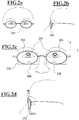
- the FIG. 1 shows a device for Zentrier schemesar 100.
- This device for Zentrier schemesar 100 includes a Videozentrier réelle 110 with video camera 112 and computer 114 with keyboard 116, screen 118 and storage medium 120. It is a calibrated system, so a system for recording and determining dimensions ,
- the face of the customer is received with adapted socket 202 in the zero direction from the front and from the side with the video camera 112, as shown in the FIGS. 2a ) and b) is shown.
- the socket form 202 is detected. Furthermore, the pupil centers 204, for example in the coincidence method, are determined relative to the frame form 202.
- the side view is used to determine the corneal vertex distance HSA and the frame inclination ⁇ to fulfill the eye pivot point requirement, as described in US Pat Figure 2d ) is shown.
- the habitual head posture and the inclination of the spectacles e.g. record with the help of the calibrated video camera over a longer period of time and determine a habitual head posture and a preferred inclination of the glasses.
- the thus determined head posture and the associated pretilt angle of the spectacles as well as other measured data such as the arrangement of the spectacles in the frame or disc plane in x, y are used to convert the centering data conventionally determined by the video centering device 110 (eg remote reference point 206, local measuring circle 208), if the customer had adopted a head position deviating from normal head posture (cf. Figure 2c ).
Landscapes
- Health & Medical Sciences (AREA)
- Life Sciences & Earth Sciences (AREA)
- Physics & Mathematics (AREA)
- General Health & Medical Sciences (AREA)
- Animal Behavior & Ethology (AREA)
- Medical Informatics (AREA)
- Veterinary Medicine (AREA)
- Public Health (AREA)
- Surgery (AREA)
- Molecular Biology (AREA)
- Biophysics (AREA)
- Heart & Thoracic Surgery (AREA)
- Engineering & Computer Science (AREA)
- Biomedical Technology (AREA)
- Pathology (AREA)
- Ophthalmology & Optometry (AREA)
- Oral & Maxillofacial Surgery (AREA)
- Dentistry (AREA)
- Physiology (AREA)
- Optics & Photonics (AREA)
- General Physics & Mathematics (AREA)
- Geometry (AREA)
- Eyeglasses (AREA)
- Measurement Of The Respiration, Hearing Ability, Form, And Blood Characteristics Of Living Organisms (AREA)
- Length Measuring Devices By Optical Means (AREA)
- Eye Examination Apparatus (AREA)
Priority Applications (1)
| Application Number | Priority Date | Filing Date | Title |
|---|---|---|---|
| EP21157838.0A EP3842855A1 (fr) | 2009-06-17 | 2010-05-08 | Méthode, appareil et programme ordinateur pour la détermination des données de centrage |
Applications Claiming Priority (3)
| Application Number | Priority Date | Filing Date | Title |
|---|---|---|---|
| DE102009025215.0A DE102009025215B4 (de) | 2009-06-17 | 2009-06-17 | Methode und Vorrichtung zur Zentrierdatenermittlung |
| PCT/EP2010/002821 WO2010145736A1 (fr) | 2009-06-17 | 2010-05-08 | Procédé et dispositif de détermination du port de tête habituel |
| EP10722933.8A EP2467751B1 (fr) | 2009-06-17 | 2010-05-08 | Procédé et appareil pour déterminer la posture habituelle de la tête |
Related Parent Applications (2)
| Application Number | Title | Priority Date | Filing Date |
|---|---|---|---|
| EP10722933.8A Division-Into EP2467751B1 (fr) | 2009-06-17 | 2010-05-08 | Procédé et appareil pour déterminer la posture habituelle de la tête |
| EP10722933.8A Division EP2467751B1 (fr) | 2009-06-17 | 2010-05-08 | Procédé et appareil pour déterminer la posture habituelle de la tête |
Related Child Applications (1)
| Application Number | Title | Priority Date | Filing Date |
|---|---|---|---|
| EP21157838.0A Division EP3842855A1 (fr) | 2009-06-17 | 2010-05-08 | Méthode, appareil et programme ordinateur pour la détermination des données de centrage |
Publications (1)
| Publication Number | Publication Date |
|---|---|
| EP3432057A1 true EP3432057A1 (fr) | 2019-01-23 |
Family
ID=42734821
Family Applications (3)
| Application Number | Title | Priority Date | Filing Date |
|---|---|---|---|
| EP18188534.4A Pending EP3432057A1 (fr) | 2009-06-17 | 2010-05-08 | Procédé et dispositif de détermination du port de tête habituel |
| EP21157838.0A Pending EP3842855A1 (fr) | 2009-06-17 | 2010-05-08 | Méthode, appareil et programme ordinateur pour la détermination des données de centrage |
| EP10722933.8A Revoked EP2467751B1 (fr) | 2009-06-17 | 2010-05-08 | Procédé et appareil pour déterminer la posture habituelle de la tête |
Family Applications After (2)
| Application Number | Title | Priority Date | Filing Date |
|---|---|---|---|
| EP21157838.0A Pending EP3842855A1 (fr) | 2009-06-17 | 2010-05-08 | Méthode, appareil et programme ordinateur pour la détermination des données de centrage |
| EP10722933.8A Revoked EP2467751B1 (fr) | 2009-06-17 | 2010-05-08 | Procédé et appareil pour déterminer la posture habituelle de la tête |
Country Status (9)
| Country | Link |
|---|---|
| US (1) | US9500885B2 (fr) |
| EP (3) | EP3432057A1 (fr) |
| CN (1) | CN102460278B (fr) |
| CA (2) | CA2768317C (fr) |
| DE (1) | DE102009025215B4 (fr) |
| ES (1) | ES2709483T3 (fr) |
| PL (1) | PL2467751T3 (fr) |
| TR (1) | TR201901459T4 (fr) |
| WO (1) | WO2010145736A1 (fr) |
Families Citing this family (13)
| Publication number | Priority date | Publication date | Assignee | Title |
|---|---|---|---|---|
| FR2971860B1 (fr) * | 2011-02-21 | 2013-08-30 | Essilor Int | Procede de determination, en posture naturelle, d'au moins un parametre geometrico-physionomique associe au montage d'une lentille ophtalmique dans une monture de lunettes |
| FR3015058B1 (fr) * | 2013-12-16 | 2017-12-08 | Essilor Int | Procede de controle de la conformite de montage d'une monture et de verres correcteurs |
| DE102014012452A1 (de) * | 2014-08-21 | 2016-02-25 | Rodenstock Gmbh | Ermittlung von Benutzerdaten unter Berücksichtigung von Bilddaten einer ausgewählten Brillenfassung |
| DE102015219868B4 (de) * | 2015-10-13 | 2019-02-21 | Carl Zeiss Vision International Gmbh | System und Verfahren für das Trainieren von Kopfbewegungen |
| US11099631B2 (en) | 2015-11-13 | 2021-08-24 | Andrew R. Basile, JR. | Virtual reality system with posture control |
| EP3384845B1 (fr) | 2015-11-30 | 2019-09-18 | Alps Alpine Co., Ltd. | Procédé d'étalonnage, dispositif portable, et programme |
| US10386657B2 (en) | 2017-05-06 | 2019-08-20 | Optikam Tech, Inc. | System and method for obtaining lens fabrication measurements that accurately account for natural head position |
| EP3413123A1 (fr) * | 2017-06-09 | 2018-12-12 | Essilor International | Procédé et dispositif de mesure de données d'adaptation d'une lentille ophtalmique dans un cadre pour un individu donné |
| EP3422087B1 (fr) | 2017-06-28 | 2019-12-25 | Carl Zeiss Vision International GmbH | Procédé de correction de paramètres de centrage et/ou d'une position d'axe et programme informatique correspondant et procédé |
| DE102017011129A1 (de) * | 2017-11-24 | 2019-05-29 | Leonid Sverdlov | Vorrichtung und Verfahren zur Haltungskontrolle einer Person |
| ES2789583T3 (es) | 2017-12-06 | 2020-10-26 | Essilor Int | Método y aparato para determinar la postura de referencia de la cabeza de un sujeto |
| EP4086693A1 (fr) * | 2021-05-07 | 2022-11-09 | Carl Zeiss Vision International GmbH | Procédé, dispositif de traitement et système permettant de déterminer au moins un paramètre de centrage pour aligner des verres de lunettes dans une monture de lunettes sur les yeux d'un utilisateur |
| DE102021207049A1 (de) | 2021-07-05 | 2023-01-05 | Rodenstock Gmbh | Zentriersystem und Verfahren zum Generieren von Zentrierdaten eines Probanden |
Citations (12)
| Publication number | Priority date | Publication date | Assignee | Title |
|---|---|---|---|---|
| EP0898930A2 (fr) * | 1997-08-26 | 1999-03-03 | Löw, Bernhard, Dr. med. | Procédé et dispositif pour l'examen de la vision binoculaire |
| WO2001062139A1 (fr) | 2000-02-25 | 2001-08-30 | Sola International Holdings Ltd | Procede et systeme de prescription et/ou preparation de lentilles ophtalmiques |
| US20030143391A1 (en) * | 2001-06-04 | 2003-07-31 | Lai Shui T. | Apparatus and method of fabricating a compensating element for wavefront correction using spatially localized curing of resin mixtures |
| EP1591064A1 (fr) | 2004-04-30 | 2005-11-02 | Rupp + Hubrach Optik GmbH | appareil de mesure |
| EP1637067A1 (fr) * | 2004-09-10 | 2006-03-22 | Eric Fischer | Appareil pour la détection de l'élevation du centre de la pupille vis-à-vis du bord inférieur d'une monture ou d'un verre à lunettes |
| WO2006029875A1 (fr) * | 2004-09-15 | 2006-03-23 | Carl Zeiss Vision Gmbh | ETRIER DE MESURE, DISPOSITIF ET PROCEDE POUR DETERMINER L'ANGLE D'INCLINAISON ANTERIEURE ($G(A)) D'UNE MONTURE DE LUNETTES |
| DE102004063160A1 (de) | 2004-12-29 | 2006-07-13 | Ollendorf, Hans-Joachim, Dipl.-Ing. | Verfahren und Einrichtung zum Anpassen einer Brille |
| EP1747750A1 (fr) | 2004-05-06 | 2007-01-31 | INDO Internacional, S.A. | Procede et materiel pour etablir le comportement visuel d'une personne et procede de personnalisation d'un verre pour monture |
| WO2007045694A2 (fr) * | 2005-10-21 | 2007-04-26 | Interactif Visuel Systeme (I V S) | Systeme d'aide pour la correction de la vue |
| FR2896682A1 (fr) * | 2006-01-31 | 2007-08-03 | Acep France Sarl | Dispositif de mesure de l'angle, pour un patient porteur de lunettes, entre la vision de loin et la vision de pres. |
| US20090207375A1 (en) * | 2004-09-10 | 2009-08-20 | Eric Fischer | Device and Method for Accurately Determining the Rear Vertex Distance Between the Eye and the Lenses in Eyeglasses |
| DE102008018198A1 (de) * | 2008-04-10 | 2009-10-15 | Optik Schlemmer E.K. | Vorbereitungsverfahren und Verfahren zur benutzerabhängigen Anpassung von Brillengläsern an ein Brillengestell sowie Vorbereitungsvorrichtung und Vorrichtung zur Durchführung dieser Verfahren |
Family Cites Families (14)
| Publication number | Priority date | Publication date | Assignee | Title |
|---|---|---|---|---|
| US4310225A (en) * | 1979-08-06 | 1982-01-12 | Gentex Corporation | Ophthalmic lens series |
| DE29910680U1 (de) | 1998-03-06 | 1999-10-07 | Neuhof, Judith, Dipl.-Ing., 35767 Breitscheid | Anlage zum Durchführen von Seh-Untersuchungen |
| DE10033983A1 (de) * | 2000-04-27 | 2001-10-31 | Frank Mothes | Einrichtung zur Bestimmung der Brillenglas-Zentrierdaten |
| US6849050B1 (en) * | 2001-05-07 | 2005-02-01 | The United States Of America As Represented By The Secretary Of The Army | System and method for determining visual alertness |
| DE20122900U1 (de) | 2001-07-12 | 2009-12-03 | Aquanova Ag | Ubichinon Konzentrat |
| PT1704437E (pt) | 2004-01-16 | 2015-10-20 | Carl Zeiss Vision Gmbh | Dispositivo e processo para a determinação de dados de centragem para óculos |
| DE102005003699B4 (de) | 2005-01-26 | 2018-07-05 | Rodenstock Gmbh | Vorrichtung und Verfahren zum Bestimmen von optischen Parametern eines Benutzers; Computerprogrammprodukt |
| FR2884130B1 (fr) * | 2005-04-08 | 2008-02-15 | Essilor Int | Procede et dispositif de determination du centre de rotation d'un oeil |
| US20120010533A1 (en) * | 2005-10-17 | 2012-01-12 | Arnett G William | Method for determining the correct natural head position location of references planes relative to a three-dimensional computerized image of a patient's head |
| US8066373B2 (en) * | 2009-02-03 | 2011-11-29 | Pixeloptics, Inc. | Multifocal measurement device |
| FR2944609B1 (fr) | 2009-04-17 | 2011-04-22 | Essilor Int | Procede de determination d'au moins un parametre geomerico-postural d'implantation d'une monture de lunettes de correction visuelle sur le visage d'un porteur dans sa posture anatomique |
| GB0915136D0 (en) * | 2009-08-28 | 2009-10-07 | Cambridge Entpr Ltd | Visual perimeter measurement system and method |
| JP2011138064A (ja) * | 2009-12-29 | 2011-07-14 | Seiko Epson Corp | 視線移動量測定方法および視線移動量測定治具 |
| FR2980592B1 (fr) * | 2011-09-28 | 2014-05-16 | Essilor Int | Procede de mesure de parametres morpho-geometriques d'un individu porteur de lunettes |
-
2009
- 2009-06-17 DE DE102009025215.0A patent/DE102009025215B4/de active Active
-
2010
- 2010-05-08 PL PL10722933T patent/PL2467751T3/pl unknown
- 2010-05-08 EP EP18188534.4A patent/EP3432057A1/fr active Pending
- 2010-05-08 CA CA2768317A patent/CA2768317C/fr active Active
- 2010-05-08 WO PCT/EP2010/002821 patent/WO2010145736A1/fr not_active Ceased
- 2010-05-08 CN CN201080027200.6A patent/CN102460278B/zh active Active
- 2010-05-08 EP EP21157838.0A patent/EP3842855A1/fr active Pending
- 2010-05-08 CA CA2994490A patent/CA2994490C/fr active Active
- 2010-05-08 TR TR2019/01459T patent/TR201901459T4/tr unknown
- 2010-05-08 EP EP10722933.8A patent/EP2467751B1/fr not_active Revoked
- 2010-05-08 ES ES10722933T patent/ES2709483T3/es active Active
-
2011
- 2011-12-16 US US13/329,043 patent/US9500885B2/en active Active
Patent Citations (13)
| Publication number | Priority date | Publication date | Assignee | Title |
|---|---|---|---|---|
| EP0898930A2 (fr) * | 1997-08-26 | 1999-03-03 | Löw, Bernhard, Dr. med. | Procédé et dispositif pour l'examen de la vision binoculaire |
| WO2001062139A1 (fr) | 2000-02-25 | 2001-08-30 | Sola International Holdings Ltd | Procede et systeme de prescription et/ou preparation de lentilles ophtalmiques |
| US20030143391A1 (en) * | 2001-06-04 | 2003-07-31 | Lai Shui T. | Apparatus and method of fabricating a compensating element for wavefront correction using spatially localized curing of resin mixtures |
| EP1591064A1 (fr) | 2004-04-30 | 2005-11-02 | Rupp + Hubrach Optik GmbH | appareil de mesure |
| US20070229761A1 (en) | 2004-05-06 | 2007-10-04 | Indo Internacional, S.A. | Method And Device For Determining The Visual Behaviour Of A Person And Method Of Customising A Spectacle Lens |
| EP1747750A1 (fr) | 2004-05-06 | 2007-01-31 | INDO Internacional, S.A. | Procede et materiel pour etablir le comportement visuel d'une personne et procede de personnalisation d'un verre pour monture |
| EP1637067A1 (fr) * | 2004-09-10 | 2006-03-22 | Eric Fischer | Appareil pour la détection de l'élevation du centre de la pupille vis-à-vis du bord inférieur d'une monture ou d'un verre à lunettes |
| US20090207375A1 (en) * | 2004-09-10 | 2009-08-20 | Eric Fischer | Device and Method for Accurately Determining the Rear Vertex Distance Between the Eye and the Lenses in Eyeglasses |
| WO2006029875A1 (fr) * | 2004-09-15 | 2006-03-23 | Carl Zeiss Vision Gmbh | ETRIER DE MESURE, DISPOSITIF ET PROCEDE POUR DETERMINER L'ANGLE D'INCLINAISON ANTERIEURE ($G(A)) D'UNE MONTURE DE LUNETTES |
| DE102004063160A1 (de) | 2004-12-29 | 2006-07-13 | Ollendorf, Hans-Joachim, Dipl.-Ing. | Verfahren und Einrichtung zum Anpassen einer Brille |
| WO2007045694A2 (fr) * | 2005-10-21 | 2007-04-26 | Interactif Visuel Systeme (I V S) | Systeme d'aide pour la correction de la vue |
| FR2896682A1 (fr) * | 2006-01-31 | 2007-08-03 | Acep France Sarl | Dispositif de mesure de l'angle, pour un patient porteur de lunettes, entre la vision de loin et la vision de pres. |
| DE102008018198A1 (de) * | 2008-04-10 | 2009-10-15 | Optik Schlemmer E.K. | Vorbereitungsverfahren und Verfahren zur benutzerabhängigen Anpassung von Brillengläsern an ein Brillengestell sowie Vorbereitungsvorrichtung und Vorrichtung zur Durchführung dieser Verfahren |
Also Published As
| Publication number | Publication date |
|---|---|
| CA2994490C (fr) | 2018-11-13 |
| CN102460278A (zh) | 2012-05-16 |
| CA2768317C (fr) | 2018-07-03 |
| ES2709483T3 (es) | 2019-04-16 |
| CA2768317A1 (fr) | 2010-12-23 |
| WO2010145736A1 (fr) | 2010-12-23 |
| DE102009025215A1 (de) | 2010-12-30 |
| US9500885B2 (en) | 2016-11-22 |
| PL2467751T3 (pl) | 2019-04-30 |
| CN102460278B (zh) | 2014-03-26 |
| US20120182521A1 (en) | 2012-07-19 |
| EP2467751B1 (fr) | 2018-10-31 |
| EP2467751A1 (fr) | 2012-06-27 |
| DE102009025215B4 (de) | 2025-03-27 |
| EP3842855A1 (fr) | 2021-06-30 |
| CA2994490A1 (fr) | 2010-12-23 |
| TR201901459T4 (tr) | 2019-02-21 |
Similar Documents
| Publication | Publication Date | Title |
|---|---|---|
| EP2467751B1 (fr) | Procédé et appareil pour déterminer la posture habituelle de la tête | |
| EP3413122B1 (fr) | Procédé, dispositif et programme informatique destinés à déterminer un point de vue proche | |
| DE102011115239B4 (de) | Bestimmung der Scheibenform unter Berücksichtigung von Tracerdaten | |
| EP3422087B1 (fr) | Procédé de correction de paramètres de centrage et/ou d'une position d'axe et programme informatique correspondant et procédé | |
| DE60121562T2 (de) | Verfahren zur Montage von ophthalmischen Linsen | |
| EP3355104A1 (fr) | Procédé et dispositif ainsi que programme informatique destinés à déterminer une représentation d'un bord de verre de lunettes | |
| DE102016113374B3 (de) | Fern-Durchblickpunkt-Bestimmung für ein Brillenglas | |
| WO2015107063A1 (fr) | Détermination de paramètres d'adaptation pour un verre de lunettes dans une face de monture | |
| EP3256036A1 (fr) | Dispositif et procédé de détermination de distance et/ou de centrage à l'aide des réflexions cornéennes | |
| EP4143628B1 (fr) | Procédé mis en oeuvre par ordinateur de détermination des paramètres de centrage pour terminaux mobiles, terminal mobile et programme informatique | |
| EP3192432B1 (fr) | Procédé d'examen des yeux | |
| DE102008018198A1 (de) | Vorbereitungsverfahren und Verfahren zur benutzerabhängigen Anpassung von Brillengläsern an ein Brillengestell sowie Vorbereitungsvorrichtung und Vorrichtung zur Durchführung dieser Verfahren | |
| EP1450201B1 (fr) | Méthode pour déterminer l'écart pupillaire | |
| EP4185920B1 (fr) | Procédé mise en uvre par ordinateur de génération de données destinées à la fabrication d'au moins un verre de lunettes et procédé de fabrication de lunettes | |
| DE10216824B4 (de) | Verfahren und Vorrichtung zum Konstruieren einer Maßbrille | |
| DE102004063160A1 (de) | Verfahren und Einrichtung zum Anpassen einer Brille | |
| WO2022022765A1 (fr) | Procédé et dispositif de détermination automatique de paramètres de fabrication pour une paire de lunettes | |
| WO2020182867A1 (fr) | Procédé, dispositif de centrage et produit programme d'ordinateur permettant de mesurer la distance entre un utilisateur et un dispositif de centrage | |
| DE19752729A1 (de) | Verfahren und Vorrichtung zum Herstellen von Brillen | |
| WO2017178092A1 (fr) | Procédé de détermination de paramètres optiques d'un sujet d'expérience et produit programme informatique de mise en œuvre du procédé | |
| DE212022000239U1 (de) | Zentriersystem zum Generieren von Zentrierdaten eines Probanden | |
| WO2025098571A1 (fr) | Procédé de mesure de montures de lunettes au moyen d'un dispositif d'enregistrement optique et utilisation d'un dispositif d'enregistrement optique mobile pour mesure de montures de lunettes | |
| DE10207316A1 (de) | Verfahren und Vorrichtung zur Anpassung einer Sehhilfe | |
| DE202004020054U1 (de) | Video-Zentrier-Beratungsspiegel |
Legal Events
| Date | Code | Title | Description |
|---|---|---|---|
| PUAI | Public reference made under article 153(3) epc to a published international application that has entered the european phase |
Free format text: ORIGINAL CODE: 0009012 |
|
| STAA | Information on the status of an ep patent application or granted ep patent |
Free format text: STATUS: THE APPLICATION HAS BEEN PUBLISHED |
|
| AC | Divisional application: reference to earlier application |
Ref document number: 2467751 Country of ref document: EP Kind code of ref document: P |
|
| AK | Designated contracting states |
Kind code of ref document: A1 Designated state(s): AL AT BE BG CH CY CZ DE DK EE ES FI FR GB GR HR HU IE IS IT LI LT LU LV MC MK MT NL NO PL PT RO SE SI SK SM TR |
|
| STAA | Information on the status of an ep patent application or granted ep patent |
Free format text: STATUS: REQUEST FOR EXAMINATION WAS MADE |
|
| 17P | Request for examination filed |
Effective date: 20190723 |
|
| RBV | Designated contracting states (corrected) |
Designated state(s): AL AT BE BG CH CY CZ DE DK EE ES FI FR GB GR HR HU IE IS IT LI LT LU LV MC MK MT NL NO PL PT RO SE SI SK SM TR |
|
| STAA | Information on the status of an ep patent application or granted ep patent |
Free format text: STATUS: EXAMINATION IS IN PROGRESS |
|
| 17Q | First examination report despatched |
Effective date: 20191105 |
|
| GRAP | Despatch of communication of intention to grant a patent |
Free format text: ORIGINAL CODE: EPIDOSNIGR1 |
|
| STAA | Information on the status of an ep patent application or granted ep patent |
Free format text: STATUS: GRANT OF PATENT IS INTENDED |
|
| RIC1 | Information provided on ipc code assigned before grant |
Ipc: G02C 13/00 20060101AFI20260624BHEP Ipc: A61B 5/11 20060101ALN20260624BHEP |
|
| INTG | Intention to grant announced |
Effective date: 20260703 |