EP3434233A1 - Sonde bicanaliculaire autostable - Google Patents
Sonde bicanaliculaire autostable Download PDFInfo
- Publication number
- EP3434233A1 EP3434233A1 EP18183951.5A EP18183951A EP3434233A1 EP 3434233 A1 EP3434233 A1 EP 3434233A1 EP 18183951 A EP18183951 A EP 18183951A EP 3434233 A1 EP3434233 A1 EP 3434233A1
- Authority
- EP
- European Patent Office
- Prior art keywords
- sleeves
- tubular element
- probe according
- tube
- central tubular
- Prior art date
- Legal status (The legal status is an assumption and is not a legal conclusion. Google has not performed a legal analysis and makes no representation as to the accuracy of the status listed.)
- Granted
Links
Images
Classifications
-
- A—HUMAN NECESSITIES
- A61—MEDICAL OR VETERINARY SCIENCE; HYGIENE
- A61F—FILTERS IMPLANTABLE INTO BLOOD VESSELS; PROSTHESES; DEVICES PROVIDING PATENCY TO, OR PREVENTING COLLAPSING OF, TUBULAR STRUCTURES OF THE BODY, e.g. STENTS; ORTHOPAEDIC, NURSING OR CONTRACEPTIVE DEVICES; FOMENTATION; TREATMENT OR PROTECTION OF EYES OR EARS; BANDAGES, DRESSINGS OR ABSORBENT PADS; FIRST-AID KITS
- A61F9/00—Methods or devices for treatment of the eyes; Devices for putting in contact-lenses; Devices to correct squinting; Apparatus to guide the blind; Protective devices for the eyes, carried on the body or in the hand
- A61F9/007—Methods or devices for eye surgery
- A61F9/00772—Apparatus for restoration of tear ducts
-
- A—HUMAN NECESSITIES
- A61—MEDICAL OR VETERINARY SCIENCE; HYGIENE
- A61B—DIAGNOSIS; SURGERY; IDENTIFICATION
- A61B17/00—Surgical instruments, devices or methods
- A61B17/12—Surgical instruments, devices or methods for ligaturing or otherwise compressing tubular parts of the body, e.g. blood vessels or umbilical cord
- A61B17/12022—Occluding by internal devices, e.g. balloons or releasable wires
Definitions
- the present invention relates to a bi-alical probe for insertion into the nasolacrimal duct of a patient.
- a two-channel probe intended to be inserted into the nasolacrimal duct of a patient comprises a central tube forming a probe made of a material compatible with an insertion into the human body, in particular silicone, which is connected to its two opposite ends terminating elements, for example guidewires, mandrels or the like, which allow the introduction of the central silicone tube into the nasolacrimal duct.
- the present invention aims at overcoming the drawbacks of the prior art by proposing a bicalicular probe intended to be inserted into the nasolacrimal duct of a patient, as defined in claim 1.
- the two extra thicknesses are made in the form of two sleeves fixed around the central tubular element.
- the two extra thicknesses are at the same distance, respectively, from the fastening end of the termination element on the opposite side to the other excess thickness, in particular the sleeve.
- the two extra thicknesses in particular the two sleeves, extend along the tube over a length of between 4 mm and 8 mm, in particular between 5 mm and 7 mm.
- the distance between the two extra thicknesses, in particular the two sleeves, along the tube corresponds to a central segment and is between 30mm and 40mm, in particular between 32mm and 35mm.
- the two sleeves are glued to the central tubular element.
- the two terminations consist of guide wires, the connection to the tube of each guide wire being made so as to have no protruding protruding laterally and being able to tap "when insertion ".
- a metal mandrel in particular with an outside diameter of 0.4 mm and a length of 60 mm, glued inside the silicone tube.
- a marker midway between the two sleeves, to help the pose by the surgeon.
- the surgeon can ensure that the two sleeves, during the placement of the probe, are arranged in the lacrimal sac and not in the horizontal part of the canaliculi or in the tear duct. -nasal.
- the probe is thus more mobile and free in position in the canal by creating less traction on the meatus, avoiding the phenomena of "Cheese wiring".
- it is no longer necessary to tie the silicone strands at the end of the pose the withdrawal is made by pulling on the central segment, and it is no longer necessary to cut knot in the nose.
- the stability of the probe is particularly good, linked to the presence of the two sleeves in the bag. Finally the central mark helps to position the probe by pulling, during installation, on the ends of the strands so that the sleeves are precisely in the bag.
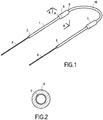
- FIG. 1 there is shown a two-channel probe for insertion into the channel nasolacrimal duct of a patient.
- This probe consists of a silicone tube 1 which extends between two end points 2 and 3.
- Two end elements 4 and 5 come from the end points 2 and 3 and allow the insertion of the probe .
- the elements 4 and 5 have a thickness smaller than that of the tube 1.
- termination elements may be guide wires, in particular made of PEEK, in particular as described in the patent FR-A-2992851 and the tube / guide wire connection is chamfered to prevent any roughness can hit during insertion against the nasal wall.
- Elements 4 and 5 can also be mandrels as shown in the document US Patent 4380239 and whose tube / mandrel connection is also in the form of a chamfer. They may also be mandrels, in particular with an outer diameter of 0.80 mm and a length of 80 mm, assembled with the silicone tube 1 as described in the patent. FR-A-2700722 . They can also be metal mandrels of outer diameter 0,4mm and length 60mm glued inside the silicone tube.
- the silicone tube 1 has a diameter of 0.3 mm to 0.64 mm, the total length of the silicone tube, that is to say out terminations, being for example 300 mm.
- Two sleeves 6 and 7 forming extra thickness of the tube project laterally from the tube 1 of silicone. They can in particular be attached to the tube by gluing, welding or the like. They can also be made by molding or overmolding. These two sleeves 6 and 7 extend along a length along the tube 1 between 4mm and 8mm, especially between 5mm and 7mm. Between the two sleeves 6 and 7, there is defined a central segment of the silicone tube 1 which has a length measured along the tube between 30mm and 40mm, in particular between 32mm and 35mm. At the midpoint, that is to say halfway between the two sleeves 6 and 7, there is formed a central mark 10 defining the exact midpoint for the surgeon and allowing him a simplified pose, especially in making sure that both sleeves 6 and 7 are well in the lacrimal sac.
- the central mark 10 may consist of a thin section of the central tube 1. It may also consist of a marking, in particular by means of pad printing with a biocompatible colored ink in the form of a point on the surface of the tube, of a continuous or discontinuous line of 360 ° or less on the surface around the tube, of a portion of the central tube filled with ink or silicone glue (translucent material), or any other form of reference or similar markings.
- the two sleeves or oversizes extend between two respective distal and proximal end points 8, 9 of the sleeve 1.
- the two proximal points 9 are at a distance from each other.
- Each distal point 8 is spaced from the point 2, 3 of the respective tube which is on the opposite side to the respective proximal point 9 and from which extends the respective element 4, 5.
Landscapes
- Health & Medical Sciences (AREA)
- Ophthalmology & Optometry (AREA)
- Vascular Medicine (AREA)
- Life Sciences & Earth Sciences (AREA)
- Surgery (AREA)
- Engineering & Computer Science (AREA)
- Biomedical Technology (AREA)
- Heart & Thoracic Surgery (AREA)
- Plastic & Reconstructive Surgery (AREA)
- Nuclear Medicine, Radiotherapy & Molecular Imaging (AREA)
- Animal Behavior & Ethology (AREA)
- General Health & Medical Sciences (AREA)
- Public Health (AREA)
- Veterinary Medicine (AREA)
- Media Introduction/Drainage Providing Device (AREA)
- Prostheses (AREA)
- Materials For Medical Uses (AREA)
- Surgical Instruments (AREA)
Abstract
Description
- La présente invention se rapporte à une sonde bicanaliculaire destinée à être insérée dans le canal lacrymo-nasal d'un patient.
- Classiquement, une sonde bicanaliculaire destinée à être insérée dans le canal lacrymo-nasal d'un patient comporte un tube central formant sonde réalisé en un matériau compatible avec une insertion dans le corps humain, notamment en silicone, qui est relié à ses deux extrémités opposées à des éléments de terminaison, par exemple des fils de guidage, des mandrins ou analogues, qui permettent l'introduction du tube central en silicone dans le canal lacrymo-nasal.
- Ces dispositifs de l'art antérieur, bien que constituant une solution particulièrement appropriée pour être inséré dans le canal lacrymo-nasal, restent difficiles à manipuler par le chirurgien pour obtenir un bon positionnement dans le canal lacrymo-nasal et nécessitent de nouer les brins du tube central en fin de pose.
- De
US 6 117 116 , on connaît une sonde suivant le préambule de la revendication 1. Un manchon est formé au niveau de l'interface entre le tube central et les éléments de terminaison respectifs. - La présente invention vise à surmonter les inconvénients de l'art antérieur en proposant une sonde bicanaliculaire destinée à être insérée dans le canal lacrymo-nasal d'un patient, telle que définie à la revendication 1.
- De préférence, les deux surépaisseurs sont réalisées sous la forme de deux manchons fixés autour de l'élément tubulaire central.
- De préférence, les deux surépaisseurs, notamment les deux manchons, sont à une même distance respective de l'extrémité de fixation de l'élément de terminaison du côté opposé à l'autre surépaisseur, notamment manchon.
- De préférence, les deux surépaisseurs, notamment les deux manchons, s'étendent le long du tube sur une longueur comprise entre 4mm et 8mm, notamment entre 5mm et 7mm.
- De préférence, la distance entre les deux surépaisseurs, notamment les deux manchons, le long du tube, correspond à un segment central et est comprise entre 30mm et 40mm, notamment entre 32mm et 35mm.
- Suivant un mode de réalisation préféré de l'invention, les deux manchons sont collés à l'élément tubulaire central.
- Suivant un mode de réalisation préféré de l'invention, les deux terminaisons sont constituées de fils de guidage, la liaison au tube de chaque fil de guidage étant réalisée de manière à ne pas présenter d'aspérité faisant saillie latéralement et pouvant taper « lors de l'insertion ».
- Suivant un autre mode de réalisation, on peut prévoir un mandrin métallique, notamment d'un diamètre extérieur de 0,4mm et d'une longueur de 60mm, collé à l'intérieur du tube de silicone.
- Suivant un perfectionnement, il est prévu un repère à mi-distance entre les deux manchons, pour aider à la pose par le chirurgien.
- En prévoyant une telle sonde bicanaliculaire suivant l'invention, le chirurgien peut faire en sorte que les deux manchons, lors de la pose de la sonde, soient disposés dans le sac lacrymal et non pas dans la partie horizontale des canalicules ni dans le canal lacrymo-nasal. La sonde est ainsi plus mobile et libre en position dans le canal en créant moins de traction sur les méats, évitant les phénomènes de « Cheese wiring ». En outre, il n'est plus nécessaire de nouer les brins de silicone en fin de pose, le retrait s'effectue en tirant sur le segment central, et il n'est plus nécessaire d'aller couper de noeud dans le nez.
- La stabilité de la sonde est particulièrement bonne, liée à la présence des deux manchons dans le sac. Enfin le repère central aide à positionner la sonde en tirant, lors de la pose, sur les brins des terminaisons de façon à ce que les manchons se trouvent précisément dans le sac.
- A titre d'exemple, on décrit maintenant un mode de réalisation préféré de l'invention en se reportant aux dessins, dans lesquels :
- La
figure 1 est une vue schématique d'une sonde bicanaliculaire suivant l'invention ; - La
figure 2 est une vue en coupe suivant la ligne A-A de lafigure 1 . - A la
figure 1 , il est représenté une sonde bicanaliculaire destinée à être insérée dans le canal lacrymo-nasal d'un patient. Cette sonde est constituée d'un tube 1 en silicone qui s'étend entre deux points d'extrémité 2 et 3. Deux éléments de terminaison 4 et 5 sont issus des points d'extrémité 2 et 3 et permettent l'insertion de la sonde. Les éléments 4 et 5 ont une épaisseur plus petite que celle du tube 1. - Ces éléments de terminaison peuvent être des fils de guidage, notamment en PEEK, notamment comme décrit dans le brevet
FR-A-2992851 - Les éléments 4 et 5 peuvent également être des mandrins tels que représentés au document
US-A-4380239 et dont la liaison tube/mandrin est également sous forme de chanfrein. Ils peuvent également être des mandrins, notamment de diamètre 0,80mm extérieur et de longueur 80mm, assemblé avec le tube 1 en silicone comme décrit dans le brevetFR-A-2700722 - Le tube 1 en silicone a un diamètre de 0,3mm à 0,64mm, la longueur totale du tube en silicone, c'est-à-dire hors terminaisons, étant par exemple de 300mm.
- Deux manchons 6 et 7 formant des surépaisseurs du tube font saillie latéralement du tube 1 en silicone. Ils peuvent notamment être fixés au tube par collage, soudage ou analogue. Ils peuvent également être réalisés par moulage ou surmoulage. Ces deux manchons 6 et 7 s'étendent sur une longueur le long du tube 1 comprise entre 4mm et 8mm, notamment entre 5mm et 7mm. Entre les deux manchons 6 et 7, il est défini un segment central du tube 1 en silicone qui a une longueur mesurée le long du tube comprise entre 30mm et 40mm, notamment entre 32mm et 35mm. Au niveau du point médian, c'est-à-dire à mi-distance entre les deux manchons 6 et 7, il est formé un repère 10 central définissant l'exact point milieu pour le chirurgien et lui permettant une pose simplifiée, notamment en s'assurant que les deux manchons 6 et 7 se trouvent bien dans le sac lacrymal.
- Le repère 10 central peut être constitué d'un tronçon aminci du tube 1 central. Il peut également être constitué d'un marquage, notamment par tampongraphie avec une encre colorée biocompatible sous la forme d'un point en surface du tube, d'un trait continu ou discontinu sur 360° ou moins en surface autour du tube, d'une portion du tube central remplie d'encre ou de colle silicone (matière translucide), ou toutes autres formes de repères ou marquages analogues.
- Les deux manchons ou surépaisseurs s'étendent entre deux points d'extrémité 8, 9 distal et proximal respectifs du manchon 1.
- Les deux points 9 proximaux sont à distance l'un de l'autre.
- Chaque point 8 distal est à distance du point 2, 3 du tube respectif qui se trouve du côté opposé au point 9 proximal respectif et à partir duquel s'étend l'élément 4, 5 respectif.
Claims (9)
- Sonde bicanaliculaire destinée à être insérée dans le canal lacrymo-nasal d'un patient, comportant un élément (1) central tubulaire réalisé en un matériau compatible avec une insertion dans le corps humain, notamment en silicone, et deux éléments (4, 5) de terminaison fixés chacun à l'élément central de manière à faire saillie de ce dernier à deux extrémités (2, 3) respectives de l'élément tubulaire central, caractérisée en ce que deux surépaisseurs (6, 7) à distance l'une de l'autre font saillies de l'élément tubulaire central, les deux surépaisseurs étant chacune à distance des extrémités (2, 3) respectives de l'élément tubulaire central.
- Sonde suivant la revendication 1, caractérisée en ce que les deux surépaisseurs (6, 7) sont réalisées sous la forme de deux manchons fixés autour de l'élément tubulaire central.
- Sonde suivant la revendication 1 ou 2, caractérisée en ce que la distance entre les deux surépaisseurs, notamment les deux manchons, le long du tube, correspond à un segment central et est comprise entre 30mm et 40mm.
- Sonde suivant l'une des revendications 1 à 3, caractérisée en ce que les deux surépaisseurs, notamment les deux manchons, s'étendent le long du tube sur une longueur comprise entre 4mm et 8mm.
- Sonde suivant la revendication 4, caractérisée en ce que les deux surépaisseurs, notamment les deux manchons, s'étendent le long du tube sur une longueur comprise entre 5mm et 7mm.
- Sonde suivant l'une des revendications 1 à 5, caractérisée en ce que les deux surépaisseurs, notamment les deux manchons, sont à une même distance respective de l'extrémité (2, 3) de l'élément tubulaire central du côté opposé à l'autre surépaisseur, notamment manchon.
- Sonde suivant la revendication 6, caractérisée en ce que la distance entre les deux surépaisseurs, notamment les deux manchons, le long du tube, correspond à un segment central et est comprise entre 32mm et 35mm.
- Sonde suivant l'une des revendications 1 à 7, caractérisée en ce que les deux manchons sont collés à l'élément tubulaire central par une couche de colle respective.
- Sonde suivant l'une des revendications 1 à 8, caractérisée en ce qu'il est prévu un repère à mi-distance entre les deux manchons.
Applications Claiming Priority (1)
| Application Number | Priority Date | Filing Date | Title |
|---|---|---|---|
| FR1770792A FR3069433B1 (fr) | 2017-07-25 | 2017-07-25 | Sonde bicanaliculaire autostable |
Publications (2)
| Publication Number | Publication Date |
|---|---|
| EP3434233A1 true EP3434233A1 (fr) | 2019-01-30 |
| EP3434233B1 EP3434233B1 (fr) | 2020-09-09 |
Family
ID=59974723
Family Applications (1)
| Application Number | Title | Priority Date | Filing Date |
|---|---|---|---|
| EP18183951.5A Active EP3434233B1 (fr) | 2017-07-25 | 2018-07-17 | Sonde bicanaliculaire autostable |
Country Status (5)
| Country | Link |
|---|---|
| US (1) | US11160684B2 (fr) |
| EP (1) | EP3434233B1 (fr) |
| JP (1) | JP2019055175A (fr) |
| ES (1) | ES2836479T3 (fr) |
| FR (1) | FR3069433B1 (fr) |
Families Citing this family (3)
| Publication number | Priority date | Publication date | Assignee | Title |
|---|---|---|---|---|
| US12486747B1 (en) | 2024-05-30 | 2025-12-02 | Halliburton Energy Services, Inc. | Well plug integrity |
| US12618313B2 (en) | 2024-05-30 | 2026-05-05 | Halliburton Energy Services, Inc. | Subsurface condition detection using tube waves in a multi-well system |
| US12523143B2 (en) | 2024-05-30 | 2026-01-13 | Halliburton Energy Services, Inc. | Addressing plug movement in hydraulic fracturing |
Citations (5)
| Publication number | Priority date | Publication date | Assignee | Title |
|---|---|---|---|---|
| US5021043A (en) * | 1989-09-11 | 1991-06-04 | C. R. Bard, Inc. | Method and catheter for dilatation of the lacrimal system |
| FR2735697A1 (fr) * | 1995-06-22 | 1996-12-27 | Fayet Bruno | Sonde pour voies lacrymales |
| FR2741538A1 (fr) * | 1995-11-28 | 1997-05-30 | Fayet Bruno | Sonde et conformateur pour voies lacrymales |
| US6117116A (en) * | 1995-11-22 | 2000-09-12 | Walsh Medical Devices Inc. | Intubation of lacrimal ducts |
| US20140364790A1 (en) * | 2012-01-26 | 2014-12-11 | Kaneka Corporation | Lacrimal duct tube |
Family Cites Families (6)
| Publication number | Priority date | Publication date | Assignee | Title |
|---|---|---|---|---|
| US3948272A (en) * | 1975-04-08 | 1976-04-06 | Procedure Medical Products, Inc. | Reconstruction device for lacrimal drainage ducts |
| US5437625A (en) * | 1992-04-06 | 1995-08-01 | Kurihashi; Katsuaki | Apparatus for intubation of lacrimal drainage pathway |
| US6547765B1 (en) * | 1998-09-29 | 2003-04-15 | Walsh Medical Devices Inc. | Device for intubating lacrimal ducts |
| JP2000308655A (ja) * | 1999-04-28 | 2000-11-07 | M L C:Kk | 涙道内挿管器具 |
| JP5124721B2 (ja) * | 2006-04-27 | 2013-01-23 | 医療法人 すぎもと眼科医院 | 涙道治療用具 |
| US8469989B2 (en) * | 2010-12-15 | 2013-06-25 | Cook Medical Technologies Llc | Pushable coaxial balloon catheter |
-
2017
- 2017-07-25 FR FR1770792A patent/FR3069433B1/fr active Active
-
2018
- 2018-06-19 JP JP2018115739A patent/JP2019055175A/ja active Pending
- 2018-07-17 ES ES18183951T patent/ES2836479T3/es active Active
- 2018-07-17 EP EP18183951.5A patent/EP3434233B1/fr active Active
- 2018-07-25 US US16/044,667 patent/US11160684B2/en active Active
Patent Citations (5)
| Publication number | Priority date | Publication date | Assignee | Title |
|---|---|---|---|---|
| US5021043A (en) * | 1989-09-11 | 1991-06-04 | C. R. Bard, Inc. | Method and catheter for dilatation of the lacrimal system |
| FR2735697A1 (fr) * | 1995-06-22 | 1996-12-27 | Fayet Bruno | Sonde pour voies lacrymales |
| US6117116A (en) * | 1995-11-22 | 2000-09-12 | Walsh Medical Devices Inc. | Intubation of lacrimal ducts |
| FR2741538A1 (fr) * | 1995-11-28 | 1997-05-30 | Fayet Bruno | Sonde et conformateur pour voies lacrymales |
| US20140364790A1 (en) * | 2012-01-26 | 2014-12-11 | Kaneka Corporation | Lacrimal duct tube |
Also Published As
| Publication number | Publication date |
|---|---|
| EP3434233B1 (fr) | 2020-09-09 |
| JP2019055175A (ja) | 2019-04-11 |
| ES2836479T3 (es) | 2021-06-25 |
| FR3069433A1 (fr) | 2019-02-01 |
| US20190029884A1 (en) | 2019-01-31 |
| US11160684B2 (en) | 2021-11-02 |
| FR3069433B1 (fr) | 2019-09-06 |
Similar Documents
| Publication | Publication Date | Title |
|---|---|---|
| EP3434233B1 (fr) | Sonde bicanaliculaire autostable | |
| EP2086479B1 (fr) | Ensemble d'intubation monocanaliculonasal et/ou monocanaliculaire, notamment pour l'imperforation lacrymonasale | |
| ES2218830T3 (es) | Sistema de cateter que presenta una fuerte resistencia a la deformacion. | |
| EP0175625B1 (fr) | Poignée de bâton de ski | |
| EP0778040A3 (fr) | Guide fil creux à spirales pour catheter | |
| FR2754718A1 (fr) | Catheter a corps souple allonge | |
| FR2526303A1 (fr) | Instrument de coagulation | |
| FR2729862A1 (fr) | Cathter de dilatation a ouverture laterale | |
| CA2516755A1 (fr) | Instrument medical intracorporel allonge | |
| FR2517537A1 (fr) | Ancrage dentaire et outil dentaire pour former un canal dans une dent | |
| CA2642063A1 (fr) | Lunettes de type sans entourage a branches filaires | |
| EP0123635B2 (fr) | Ski | |
| CA2347180C (fr) | Fixation d'un pont et d'une charniere de branche au verre de lunettes glace | |
| FR2826283A1 (fr) | Sonde medico-chirurgicale et notamment sonde endotracheale | |
| EP0836504B1 (fr) | Catheter de dilatation du type guide sur un fil | |
| FR3038829B1 (fr) | Implant penien notamment pour transsexuel femme vers homme | |
| FR2646087A1 (fr) | Seringue medicale en matiere plastique a usage uniqu e de reutilisation impossible par desolidarisation de la tete et du manche (une piece intermediaire restee en hauteur libere un verrou) | |
| CA2577234A1 (fr) | Lunettes de type sans entourage, a branches filaires deformables en flexion sans articulation | |
| FR2806296A1 (fr) | Dispositif d'insertion pour la mise en place d'un dispositif intra-uterin du type en forme de t | |
| US20070017048A1 (en) | Interdental brush device with sliding cap | |
| CA2687798A1 (fr) | Dispositif pour le traitement du larmoiement de l'oeil | |
| FR2634119A1 (fr) | Coussin antilumbago | |
| EP1265331B1 (fr) | Conduit de câblage sécable | |
| FR2880534A1 (fr) | Jeu de butees positives et encliquetables pour contre-angle de dentisterie et son support de presentation | |
| EP2682078B1 (fr) | Canule à fond biseauté |
Legal Events
| Date | Code | Title | Description |
|---|---|---|---|
| PUAI | Public reference made under article 153(3) epc to a published international application that has entered the european phase |
Free format text: ORIGINAL CODE: 0009012 |
|
| STAA | Information on the status of an ep patent application or granted ep patent |
Free format text: STATUS: THE APPLICATION HAS BEEN PUBLISHED |
|
| AK | Designated contracting states |
Kind code of ref document: A1 Designated state(s): AL AT BE BG CH CY CZ DE DK EE ES FI FR GB GR HR HU IE IS IT LI LT LU LV MC MK MT NL NO PL PT RO RS SE SI SK SM TR |
|
| AX | Request for extension of the european patent |
Extension state: BA ME |
|
| STAA | Information on the status of an ep patent application or granted ep patent |
Free format text: STATUS: REQUEST FOR EXAMINATION WAS MADE |
|
| 17P | Request for examination filed |
Effective date: 20190730 |
|
| RBV | Designated contracting states (corrected) |
Designated state(s): AL AT BE BG CH CY CZ DE DK EE ES FI FR GB GR HR HU IE IS IT LI LT LU LV MC MK MT NL NO PL PT RO RS SE SI SK SM TR |
|
| GRAP | Despatch of communication of intention to grant a patent |
Free format text: ORIGINAL CODE: EPIDOSNIGR1 |
|
| STAA | Information on the status of an ep patent application or granted ep patent |
Free format text: STATUS: GRANT OF PATENT IS INTENDED |
|
| INTG | Intention to grant announced |
Effective date: 20200312 |
|
| GRAS | Grant fee paid |
Free format text: ORIGINAL CODE: EPIDOSNIGR3 |
|
| GRAA | (expected) grant |
Free format text: ORIGINAL CODE: 0009210 |
|
| STAA | Information on the status of an ep patent application or granted ep patent |
Free format text: STATUS: THE PATENT HAS BEEN GRANTED |
|
| AK | Designated contracting states |
Kind code of ref document: B1 Designated state(s): AL AT BE BG CH CY CZ DE DK EE ES FI FR GB GR HR HU IE IS IT LI LT LU LV MC MK MT NL NO PL PT RO RS SE SI SK SM TR |
|
| REG | Reference to a national code |
Ref country code: GB Ref legal event code: FG4D Free format text: NOT ENGLISH |
|
| REG | Reference to a national code |
Ref country code: AT Ref legal event code: REF Ref document number: 1310641 Country of ref document: AT Kind code of ref document: T Effective date: 20200915 Ref country code: CH Ref legal event code: EP |
|
| REG | Reference to a national code |
Ref country code: IE Ref legal event code: FG4D Free format text: LANGUAGE OF EP DOCUMENT: FRENCH |
|
| REG | Reference to a national code |
Ref country code: DE Ref legal event code: R096 Ref document number: 602018007555 Country of ref document: DE |
|
| REG | Reference to a national code |
Ref country code: LT Ref legal event code: MG4D |
|
| PG25 | Lapsed in a contracting state [announced via postgrant information from national office to epo] |
Ref country code: NO Free format text: LAPSE BECAUSE OF FAILURE TO SUBMIT A TRANSLATION OF THE DESCRIPTION OR TO PAY THE FEE WITHIN THE PRESCRIBED TIME-LIMIT Effective date: 20201209 Ref country code: HR Free format text: LAPSE BECAUSE OF FAILURE TO SUBMIT A TRANSLATION OF THE DESCRIPTION OR TO PAY THE FEE WITHIN THE PRESCRIBED TIME-LIMIT Effective date: 20200909 Ref country code: SE Free format text: LAPSE BECAUSE OF FAILURE TO SUBMIT A TRANSLATION OF THE DESCRIPTION OR TO PAY THE FEE WITHIN THE PRESCRIBED TIME-LIMIT Effective date: 20200909 Ref country code: GR Free format text: LAPSE BECAUSE OF FAILURE TO SUBMIT A TRANSLATION OF THE DESCRIPTION OR TO PAY THE FEE WITHIN THE PRESCRIBED TIME-LIMIT Effective date: 20201210 Ref country code: FI Free format text: LAPSE BECAUSE OF FAILURE TO SUBMIT A TRANSLATION OF THE DESCRIPTION OR TO PAY THE FEE WITHIN THE PRESCRIBED TIME-LIMIT Effective date: 20200909 Ref country code: LT Free format text: LAPSE BECAUSE OF FAILURE TO SUBMIT A TRANSLATION OF THE DESCRIPTION OR TO PAY THE FEE WITHIN THE PRESCRIBED TIME-LIMIT Effective date: 20200909 Ref country code: BG Free format text: LAPSE BECAUSE OF FAILURE TO SUBMIT A TRANSLATION OF THE DESCRIPTION OR TO PAY THE FEE WITHIN THE PRESCRIBED TIME-LIMIT Effective date: 20201209 |
|
| REG | Reference to a national code |
Ref country code: AT Ref legal event code: MK05 Ref document number: 1310641 Country of ref document: AT Kind code of ref document: T Effective date: 20200909 |
|
| REG | Reference to a national code |
Ref country code: NL Ref legal event code: MP Effective date: 20200909 |
|
| PG25 | Lapsed in a contracting state [announced via postgrant information from national office to epo] |
Ref country code: RS Free format text: LAPSE BECAUSE OF FAILURE TO SUBMIT A TRANSLATION OF THE DESCRIPTION OR TO PAY THE FEE WITHIN THE PRESCRIBED TIME-LIMIT Effective date: 20200909 Ref country code: PL Free format text: LAPSE BECAUSE OF FAILURE TO SUBMIT A TRANSLATION OF THE DESCRIPTION OR TO PAY THE FEE WITHIN THE PRESCRIBED TIME-LIMIT Effective date: 20200909 Ref country code: LV Free format text: LAPSE BECAUSE OF FAILURE TO SUBMIT A TRANSLATION OF THE DESCRIPTION OR TO PAY THE FEE WITHIN THE PRESCRIBED TIME-LIMIT Effective date: 20200909 |
|
| PG25 | Lapsed in a contracting state [announced via postgrant information from national office to epo] |
Ref country code: SM Free format text: LAPSE BECAUSE OF FAILURE TO SUBMIT A TRANSLATION OF THE DESCRIPTION OR TO PAY THE FEE WITHIN THE PRESCRIBED TIME-LIMIT Effective date: 20200909 Ref country code: EE Free format text: LAPSE BECAUSE OF FAILURE TO SUBMIT A TRANSLATION OF THE DESCRIPTION OR TO PAY THE FEE WITHIN THE PRESCRIBED TIME-LIMIT Effective date: 20200909 Ref country code: PT Free format text: LAPSE BECAUSE OF FAILURE TO SUBMIT A TRANSLATION OF THE DESCRIPTION OR TO PAY THE FEE WITHIN THE PRESCRIBED TIME-LIMIT Effective date: 20210111 Ref country code: RO Free format text: LAPSE BECAUSE OF FAILURE TO SUBMIT A TRANSLATION OF THE DESCRIPTION OR TO PAY THE FEE WITHIN THE PRESCRIBED TIME-LIMIT Effective date: 20200909 Ref country code: CZ Free format text: LAPSE BECAUSE OF FAILURE TO SUBMIT A TRANSLATION OF THE DESCRIPTION OR TO PAY THE FEE WITHIN THE PRESCRIBED TIME-LIMIT Effective date: 20200909 |
|
| PG25 | Lapsed in a contracting state [announced via postgrant information from national office to epo] |
Ref country code: AT Free format text: LAPSE BECAUSE OF FAILURE TO SUBMIT A TRANSLATION OF THE DESCRIPTION OR TO PAY THE FEE WITHIN THE PRESCRIBED TIME-LIMIT Effective date: 20200909 Ref country code: AL Free format text: LAPSE BECAUSE OF FAILURE TO SUBMIT A TRANSLATION OF THE DESCRIPTION OR TO PAY THE FEE WITHIN THE PRESCRIBED TIME-LIMIT Effective date: 20200909 Ref country code: IS Free format text: LAPSE BECAUSE OF FAILURE TO SUBMIT A TRANSLATION OF THE DESCRIPTION OR TO PAY THE FEE WITHIN THE PRESCRIBED TIME-LIMIT Effective date: 20210109 |
|
| REG | Reference to a national code |
Ref country code: DE Ref legal event code: R097 Ref document number: 602018007555 Country of ref document: DE |
|
| REG | Reference to a national code |
Ref country code: ES Ref legal event code: FG2A Ref document number: 2836479 Country of ref document: ES Kind code of ref document: T3 Effective date: 20210625 |
|
| PG25 | Lapsed in a contracting state [announced via postgrant information from national office to epo] |
Ref country code: SK Free format text: LAPSE BECAUSE OF FAILURE TO SUBMIT A TRANSLATION OF THE DESCRIPTION OR TO PAY THE FEE WITHIN THE PRESCRIBED TIME-LIMIT Effective date: 20200909 |
|
| PLBE | No opposition filed within time limit |
Free format text: ORIGINAL CODE: 0009261 |
|
| STAA | Information on the status of an ep patent application or granted ep patent |
Free format text: STATUS: NO OPPOSITION FILED WITHIN TIME LIMIT |
|
| 26N | No opposition filed |
Effective date: 20210610 |
|
| PG25 | Lapsed in a contracting state [announced via postgrant information from national office to epo] |
Ref country code: SI Free format text: LAPSE BECAUSE OF FAILURE TO SUBMIT A TRANSLATION OF THE DESCRIPTION OR TO PAY THE FEE WITHIN THE PRESCRIBED TIME-LIMIT Effective date: 20200909 Ref country code: DK Free format text: LAPSE BECAUSE OF FAILURE TO SUBMIT A TRANSLATION OF THE DESCRIPTION OR TO PAY THE FEE WITHIN THE PRESCRIBED TIME-LIMIT Effective date: 20200909 |
|
| REG | Reference to a national code |
Ref country code: CH Ref legal event code: PL |
|
| PG25 | Lapsed in a contracting state [announced via postgrant information from national office to epo] |
Ref country code: MC Free format text: LAPSE BECAUSE OF FAILURE TO SUBMIT A TRANSLATION OF THE DESCRIPTION OR TO PAY THE FEE WITHIN THE PRESCRIBED TIME-LIMIT Effective date: 20200909 |
|
| REG | Reference to a national code |
Ref country code: BE Ref legal event code: MM Effective date: 20210731 |
|
| PG25 | Lapsed in a contracting state [announced via postgrant information from national office to epo] |
Ref country code: LI Free format text: LAPSE BECAUSE OF NON-PAYMENT OF DUE FEES Effective date: 20210731 Ref country code: CH Free format text: LAPSE BECAUSE OF NON-PAYMENT OF DUE FEES Effective date: 20210731 |
|
| PG25 | Lapsed in a contracting state [announced via postgrant information from national office to epo] |
Ref country code: LU Free format text: LAPSE BECAUSE OF NON-PAYMENT OF DUE FEES Effective date: 20210717 |
|
| PG25 | Lapsed in a contracting state [announced via postgrant information from national office to epo] |
Ref country code: IE Free format text: LAPSE BECAUSE OF NON-PAYMENT OF DUE FEES Effective date: 20210717 Ref country code: BE Free format text: LAPSE BECAUSE OF NON-PAYMENT OF DUE FEES Effective date: 20210731 |
|
| PG25 | Lapsed in a contracting state [announced via postgrant information from national office to epo] |
Ref country code: NL Free format text: LAPSE BECAUSE OF NON-PAYMENT OF DUE FEES Effective date: 20200923 Ref country code: CY Free format text: LAPSE BECAUSE OF FAILURE TO SUBMIT A TRANSLATION OF THE DESCRIPTION OR TO PAY THE FEE WITHIN THE PRESCRIBED TIME-LIMIT Effective date: 20200909 |
|
| PG25 | Lapsed in a contracting state [announced via postgrant information from national office to epo] |
Ref country code: HU Free format text: LAPSE BECAUSE OF FAILURE TO SUBMIT A TRANSLATION OF THE DESCRIPTION OR TO PAY THE FEE WITHIN THE PRESCRIBED TIME-LIMIT; INVALID AB INITIO Effective date: 20180717 |
|
| PG25 | Lapsed in a contracting state [announced via postgrant information from national office to epo] |
Ref country code: MK Free format text: LAPSE BECAUSE OF FAILURE TO SUBMIT A TRANSLATION OF THE DESCRIPTION OR TO PAY THE FEE WITHIN THE PRESCRIBED TIME-LIMIT Effective date: 20200909 |
|
| PG25 | Lapsed in a contracting state [announced via postgrant information from national office to epo] |
Ref country code: MT Free format text: LAPSE BECAUSE OF FAILURE TO SUBMIT A TRANSLATION OF THE DESCRIPTION OR TO PAY THE FEE WITHIN THE PRESCRIBED TIME-LIMIT Effective date: 20200909 |
|
| PGFP | Annual fee paid to national office [announced via postgrant information from national office to epo] |
Ref country code: FR Payment date: 20250610 Year of fee payment: 8 |
|
| PGFP | Annual fee paid to national office [announced via postgrant information from national office to epo] |
Ref country code: ES Payment date: 20250811 Year of fee payment: 8 |
|
| PGFP | Annual fee paid to national office [announced via postgrant information from national office to epo] |
Ref country code: DE Payment date: 20250711 Year of fee payment: 8 |
|
| PGFP | Annual fee paid to national office [announced via postgrant information from national office to epo] |
Ref country code: TR Payment date: 20250709 Year of fee payment: 8 Ref country code: IT Payment date: 20250708 Year of fee payment: 8 |
|
| PGFP | Annual fee paid to national office [announced via postgrant information from national office to epo] |
Ref country code: GB Payment date: 20250723 Year of fee payment: 8 |