EP3435522A1 - Rotor et son procédé de fabrication - Google Patents
Rotor et son procédé de fabrication Download PDFInfo
- Publication number
- EP3435522A1 EP3435522A1 EP17769729.9A EP17769729A EP3435522A1 EP 3435522 A1 EP3435522 A1 EP 3435522A1 EP 17769729 A EP17769729 A EP 17769729A EP 3435522 A1 EP3435522 A1 EP 3435522A1
- Authority
- EP
- European Patent Office
- Prior art keywords
- hub
- outer peripheral
- rotor
- peripheral part
- resin
- Prior art date
- Legal status (The legal status is an assumption and is not a legal conclusion. Google has not performed a legal analysis and makes no representation as to the accuracy of the status listed.)
- Pending
Links
Images



Classifications
-
- H—ELECTRICITY
- H02—GENERATION; CONVERSION OR DISTRIBUTION OF ELECTRIC POWER
- H02K—DYNAMO-ELECTRIC MACHINES
- H02K1/00—Details of the magnetic circuit
- H02K1/06—Details of the magnetic circuit characterised by the shape, form or construction
- H02K1/22—Rotating parts of the magnetic circuit
- H02K1/27—Rotor cores with permanent magnets
- H02K1/2786—Outer rotors
- H02K1/2787—Outer rotors the magnetisation axis of the magnets being perpendicular to the rotor axis
-
- B—PERFORMING OPERATIONS; TRANSPORTING
- B29—WORKING OF PLASTICS; WORKING OF SUBSTANCES IN A PLASTIC STATE IN GENERAL
- B29C—SHAPING OR JOINING OF PLASTICS; SHAPING OF MATERIAL IN A PLASTIC STATE, NOT OTHERWISE PROVIDED FOR; AFTER-TREATMENT OF THE SHAPED PRODUCTS, e.g. REPAIRING
- B29C45/00—Injection moulding, i.e. forcing the required volume of moulding material through a nozzle into a closed mould; Apparatus therefor
- B29C45/0046—Details relating to the filling pattern or flow paths or flow characteristics of moulding material in the mould cavity
-
- H—ELECTRICITY
- H02—GENERATION; CONVERSION OR DISTRIBUTION OF ELECTRIC POWER
- H02K—DYNAMO-ELECTRIC MACHINES
- H02K1/00—Details of the magnetic circuit
- H02K1/06—Details of the magnetic circuit characterised by the shape, form or construction
- H02K1/22—Rotating parts of the magnetic circuit
- H02K1/27—Rotor cores with permanent magnets
-
- H—ELECTRICITY
- H02—GENERATION; CONVERSION OR DISTRIBUTION OF ELECTRIC POWER
- H02K—DYNAMO-ELECTRIC MACHINES
- H02K1/00—Details of the magnetic circuit
- H02K1/06—Details of the magnetic circuit characterised by the shape, form or construction
- H02K1/22—Rotating parts of the magnetic circuit
- H02K1/28—Means for mounting or fastening rotating magnetic parts on to, or to, the rotor structures
-
- H—ELECTRICITY
- H02—GENERATION; CONVERSION OR DISTRIBUTION OF ELECTRIC POWER
- H02K—DYNAMO-ELECTRIC MACHINES
- H02K15/00—Processes or apparatus specially adapted for manufacturing, assembling, maintaining or repairing of dynamo-electric machines
- H02K15/02—Processes or apparatus specially adapted for manufacturing, assembling, maintaining or repairing of dynamo-electric machines of stator or rotor bodies
-
- H—ELECTRICITY
- H02—GENERATION; CONVERSION OR DISTRIBUTION OF ELECTRIC POWER
- H02K—DYNAMO-ELECTRIC MACHINES
- H02K15/00—Processes or apparatus specially adapted for manufacturing, assembling, maintaining or repairing of dynamo-electric machines
- H02K15/02—Processes or apparatus specially adapted for manufacturing, assembling, maintaining or repairing of dynamo-electric machines of stator or rotor bodies
- H02K15/03—Processes or apparatus specially adapted for manufacturing, assembling, maintaining or repairing of dynamo-electric machines of stator or rotor bodies having permanent magnets
-
- B—PERFORMING OPERATIONS; TRANSPORTING
- B29—WORKING OF PLASTICS; WORKING OF SUBSTANCES IN A PLASTIC STATE IN GENERAL
- B29C—SHAPING OR JOINING OF PLASTICS; SHAPING OF MATERIAL IN A PLASTIC STATE, NOT OTHERWISE PROVIDED FOR; AFTER-TREATMENT OF THE SHAPED PRODUCTS, e.g. REPAIRING
- B29C45/00—Injection moulding, i.e. forcing the required volume of moulding material through a nozzle into a closed mould; Apparatus therefor
- B29C2045/0093—Injection moulding, i.e. forcing the required volume of moulding material through a nozzle into a closed mould; Apparatus therefor of articles provided with an attaching element
-
- B—PERFORMING OPERATIONS; TRANSPORTING
- B29—WORKING OF PLASTICS; WORKING OF SUBSTANCES IN A PLASTIC STATE IN GENERAL
- B29L—INDEXING SCHEME ASSOCIATED WITH SUBCLASS B29C, RELATING TO PARTICULAR ARTICLES
- B29L2031/00—Other particular articles
- B29L2031/748—Machines or parts thereof not otherwise provided for
- B29L2031/7498—Rotors
-
- H—ELECTRICITY
- H02—GENERATION; CONVERSION OR DISTRIBUTION OF ELECTRIC POWER
- H02K—DYNAMO-ELECTRIC MACHINES
- H02K21/00—Synchronous motors having permanent magnets; Synchronous generators having permanent magnets
- H02K21/12—Synchronous motors having permanent magnets; Synchronous generators having permanent magnets with stationary armatures and rotating magnets
- H02K21/22—Synchronous motors having permanent magnets; Synchronous generators having permanent magnets with stationary armatures and rotating magnets with magnets rotating around the armatures, e.g. flywheel magnetos
Definitions
- the present invention relates to a rotor for use in a motor of, for example, a compressor or a blower, and a production method for the rotor.
- a conventional rotor includes a connection component, ribs, and an outer peripheral part (refer to, for example, JP 2001-320844 A (Patent Literature 1)).
- the connection component is formed in a tubular shape.
- the ribs radially outward extend from the connection component of the rotor.
- the outer peripheral part is connected to a radially outer end of the ribs and surrounds the connection component.
- connection component has an inner peripheral face that is fixed to an outer peripheral face of a shaft.
- the connection component also has a central axis that coincides with a central axis of the shaft.
- the connection component is integrally formed with the ribs and the outer peripheral part, by integral molding using a thermoplastic resin.
- the outer peripheral part has an outer peripheral face to which a magnetic pole part is fixed.
- the magnetic pole part is formed in an annular shape and is made of a plastic magnet.
- the magnetic pole part is made of a resin that is harder than the thermoplastic resin and contains, for example, a magnetic material (hereinafter, such a resin will be referred to as a "plastic magnet material resin").
- Patent Literature 1 JP 2001-320844 A
- the plastic magnet material resin is injected into an annular space for forming the magnetic pole part in a die, from a plurality of resin injection gates provided in a circumferential direction of the annular space at predetermined intervals in the die.
- a space inside a die is filled with the plastic magnet material resin, with the shaft partially disposed in the space inside the die.
- the plastic magnet material resin flows from an annular space for forming the magnetic pole part, into a tubular space for forming the connection component, via radial spaces for forming the ribs.
- connection component may cause a problem of a reduction in fixation strength between the connection component and the shaft, because of an increase in weld lines on the connection component, the weld lines being formed when the plastic magnet material resin flows from the radial space into the tubular spaces.
- a rotor of the present invention comprises:
- a die used for producing the rotor has a resin injection gate disposed opposite the one axial end face of the shaft.
- the hub is formed in a space into which the molten resin is directly injected from the resin injection gate.
- connection parts are each inclined to form an acute angle with respect to an axial direction of the rotor.
- connection parts are each inclined to form an acute angle with respect to the axial direction. In forming the connection parts, therefore, the molten resin is allowed to smoothly flow into a space for forming the connection parts.
- the hub, the connection parts, and the outer peripheral part are each made of a plastic magnet.
- the hub, the connection parts, and the outer peripheral part are each made of the plastic magnet
- the hub, the connection parts, and the outer peripheral part are integrally formed with the shaft by integral molding with ease.
- the outer peripheral part is magnetized with ease.
- a production method for a rotor, the rotor includes:
- the resin injection gate mark is on the one axial end face of the hub. This configuration enables a reduction in number of weld lines on the hub and therefore enhances fixation strength between the hub and the shaft.
- the molten resin is injected into the hub formation space through the resin injection gate disposed opposite the one axial end face of the shaft in the die.
- the molten resin is then allowed to flow from the hub formation space into the outer peripheral part formation space via the connection part formation spaces.
- FIG. 1 is a schematic top perspective view of a rotor according to a first embodiment of the present invention as seen from obliquely above.
- FIG. 2 is a schematic top view of the rotor as seen from above.
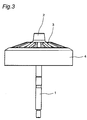
- FIG. 3 is a schematic side view of the rotor as seen laterally.
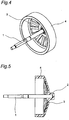
- FIG. 4 is a schematic bottom perspective view of the rotor as seen from below.
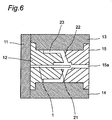
- FIG. 5 is a schematic sectional view taken along line V-V in FIG. 2 .
- the rotor includes a shaft 1, a hub 2 that is fixed to one axial end part of the shaft 1, a plurality of connection parts 3 that radially outward extend from the hub 2 of the rotor, and an outer peripheral part 4 that is connected to the hub 2 via the connection parts 3.
- the shaft is made of, for example, a metal and is integrated with the hub 2, the connection parts 3, and the outer peripheral part 4. Therefore, when the outer peripheral part 4 rotates about the shaft 1, the shaft 1 also rotates together with the outer peripheral part 4.
- the hub 2 is made of a plastic magnet as an example of a resin, and is formed to cover one axial end face of the shaft 1.
- a resin injection gate mark 5 formed in a circular shape is provided on one axial end face of the hub 2.
- the one axial end face of the hub 2 has molecular orientation due to a resin flow from its radially inner side to its radially outer side.
- connection parts 3 are provided in a circumferential direction of the rotor at substantially equal intervals and are each made of the plastic magnet.
- Each of the connection parts 3 is inclined to form an acute angle with respect to an axial direction of the rotor.
- a radially outer end part of each connection part 3 is located closer to the other axial end part (i.e., an end part not covered with the hub 2) of the shaft 1 than a radially inner end part of each connection part 3 is.
- a through space in the axial direction is defined between adjoining two of the connection parts 3.
- the outer peripheral part 4 is also made of the plastic magnet.
- the outer peripheral part 4 is formed in a tubular shape and is disposed around the hub 2.
- the outer peripheral part 4 is subjected to magnetization processing such that north poles and south poles are alternately arranged in the circumferential direction.
- a die used for producing the rotor has a resin injection gate disposed opposite the one axial end face of the shaft 1.
- a molten resin containing, for example, a magnetic material powder hereinafter, such a resin will be referred to as a "molten magnetic resin”
- molten magnetic resin a molten resin containing, for example, a magnetic material powder
- the molten magnetic resin is injected at a certain temperature into each section of the space for forming the hub 2. Therefore, since the molten magnetic resin shrinks substantially uniformly in the space, the hub 2 is obtained with reduced variation in strength.
- connection parts 3 are each inclined to form an acute angle with respect to the axial direction, the molten magnetic resin smoothly flows into spaces for forming the connection parts 3, in forming the connection parts 3.
- the hub 2, the connection parts 3, and the outer peripheral part 4 are made of the plastic magnet, the hub 2, the connection parts 3, and the outer peripheral part 4 are obtained by integral molding with ease. In addition, the outer peripheral part 4 is magnetized with ease.
- a plurality of dies 11 to 15 are engaged with each other. These dies 11 to 15 thus define a hub formation space 21 for forming the hub 2, connection part formation spaces 22 for forming the connection parts 3, and an outer peripheral part formation space 23 for forming the outer peripheral part 4, with the hub formation space 21, the connection part formation spaces 22, and the outer peripheral part formation space 23 communicating with each other.
- the one axial end face of the shaft 1 is disposed in the hub formation space 21.
- a molten magnetic resin is injected into the hub formation space 21 through the resin injection gate 15a disposed opposite the one axial end face of the hub 2 in the die 15.
- the molten magnetic resin is then allowed to flow from the hub formation space into the outer peripheral part formation space 23 via the connection part formation spaces 22.
- the molten magnetic resin in each of the hub formation space 21, the connection part formation spaces 22, and the outer peripheral part formation space 23 is cured.
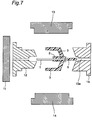
- the dies 11 to 15 are then disengaged from each other as illustrated in FIG. 7 .
- the hub 2, the connection parts 3, and the outer peripheral part 4 each integrated with the shaft 1 are thus obtained.
- the resin injection gate mark 5 (illustrated in FIG. 1 ) is formed when a runner 6 illustrated in FIG. 7 is removed.
- the molten magnetic resin injected into the hub formation space 21 through the resin injection gate 15a flows into the outer peripheral part formation space 23 via the connection part formation spaces 22.
- This configuration enables a reduction in number of weld lines on the hub 2 and therefore enhances the fixation strength between the shaft 1 and the hub 2.
- connection part formation spaces 22 are inclined to form an acute angle with respect to the axial direction.
- the molten magnetic resin is therefore allowed to smoothly flow through the connection part formation spaces 22 from the hub formation space 21 toward the outer peripheral part formation space 23.
- a die 115 illustrated in FIG. 8 is used instead of the die 15.
- a molten magnetic resin is injected into an outer peripheral part formation space 23 through a plurality of resin injection gates 115a provided in a circumferential direction of the die 115 at predetermined intervals in the die 115.
- the molten magnetic resin flows from the outer peripheral part formation space 23 into a hub formation space 21 via connection part formation spaces 22, which may cause an increase in number of weld lines on the hub 2.
- connection parts 3 are each inclined to form an acute angle with respect to the axial direction.
- connection parts 3 may be formed to be orthogonal to the axial direction.
- the intervals between adjoining two of the connection parts 3 in the circumferential direction are substantially the same, but may be different.
- FIG. 9 is a schematic sectional view of a rotor according to a second embodiment of the present invention, as seen from a plane parallel to an axial direction.
- the rotor includes a hub 202, connection parts 203, and an outer peripheral part 204 that differ only in material from the hub 2, the connection parts 3, and the outer peripheral part 4 described in the first embodiment. More specifically, the hub 202, the connection parts 203, and the outer peripheral part 204 are integrally formed with one another by integral molding, using a thermoplastic resin such as polyethylene or polypropylene.
- An annular magnet 207 is fixed by press fitting to an outer peripheral face of the outer peripheral part 204.
- the annular magnet 207 is a sintered magnet that is obtained through a sintering step, a heat treatment step, a magnetization processing step, and the like. Also in the annular magnet 207, north poles and south poles are alternately arranged in a circumferential direction of the rotor, as in the outer peripheral part 4 described in the first embodiment.
- the hub 202, the connection parts 203, and the outer peripheral part 204 are also formed by a similar production method to that for the hub 2, the connection parts 3, and the outer peripheral part 4 described in the first embodiment.
- a circular resin injection gate mark is therefore left on one axial end face of the hub 202.
- a metal ring formed of, for example, an iron plate or a steel plate is interposed between the outer peripheral face of the outer peripheral part 204 and the annular magnet 207.
- the rotor having the configuration described above produces functional effects similar to those described in the first embodiment, and the annular magnet 207 is retrofittable.
- the rotor having the configuration described above therefore has high versatility.
- the annular magnet 207 is fixed by press fitting to the outer peripheral face of the outer peripheral part 204.
- a plastic magnet may be fixed by double molding to the outer peripheral face of the outer peripheral part 204.
- an iron plate or a steel plate is interposed between the outer peripheral face of the outer peripheral part 204 and the annular magnet 207.
- an iron plate or steel plate is not necessarily interposed between the outer peripheral face of the outer peripheral part 204 and the annular magnet 207.
- the present invention is applicable to rotors of various motors such as a brushless motor and a stepping motor, and production methods for such rotors.
Landscapes
- Engineering & Computer Science (AREA)
- Power Engineering (AREA)
- Manufacturing & Machinery (AREA)
- Mechanical Engineering (AREA)
- Permanent Field Magnets Of Synchronous Machinery (AREA)
- Manufacture Of Motors, Generators (AREA)
- Moulds For Moulding Plastics Or The Like (AREA)
- Permanent Magnet Type Synchronous Machine (AREA)
Applications Claiming Priority (2)
| Application Number | Priority Date | Filing Date | Title |
|---|---|---|---|
| JP2016062565A JP6160730B1 (ja) | 2016-03-25 | 2016-03-25 | ロータおよびその製造方法 |
| PCT/JP2017/005695 WO2017163682A1 (fr) | 2016-03-25 | 2017-02-16 | Rotor et son procédé de fabrication |
Publications (2)
| Publication Number | Publication Date |
|---|---|
| EP3435522A1 true EP3435522A1 (fr) | 2019-01-30 |
| EP3435522A4 EP3435522A4 (fr) | 2019-11-13 |
Family
ID=59308861
Family Applications (1)
| Application Number | Title | Priority Date | Filing Date |
|---|---|---|---|
| EP17769729.9A Pending EP3435522A4 (fr) | 2016-03-25 | 2017-02-16 | Rotor et son procédé de fabrication |
Country Status (7)
| Country | Link |
|---|---|
| US (1) | US20190123625A1 (fr) |
| EP (1) | EP3435522A4 (fr) |
| JP (1) | JP6160730B1 (fr) |
| CN (1) | CN108713283B (fr) |
| AU (1) | AU2017237623B2 (fr) |
| MY (1) | MY186468A (fr) |
| WO (1) | WO2017163682A1 (fr) |
Families Citing this family (4)
| Publication number | Priority date | Publication date | Assignee | Title |
|---|---|---|---|---|
| IT202000014392A1 (it) * | 2020-06-16 | 2021-12-16 | Baruffaldi Spa | Rotore esterno in materiale plastomagnetico |
| WO2023157131A1 (fr) * | 2022-02-16 | 2023-08-24 | 三菱電機株式会社 | Rotor à aimant permanent et procédé de fabrication de rotor à aimant permanent |
| DE102023132247A1 (de) * | 2023-11-20 | 2025-05-22 | Minebea Mitsumi Inc. | Verfahren zum Herstellen eines Kunststoffkörpers, der dauerhaft magnetisiert ist, Kunststoffkörper mit einem dauerhaft magnetisierten Material und Rotor für eine permanent erregte elektrische Maschine |
| DE102023132249A1 (de) * | 2023-11-20 | 2025-05-22 | Minebea Mitsumi Inc. | Verfahren zum Herstellen eines Kunststoffkörpers, der dauerhaft magnetisiert ist, und Rotor für eine permanent erregte elektrische Maschine |
Family Cites Families (18)
| Publication number | Priority date | Publication date | Assignee | Title |
|---|---|---|---|---|
| JPS5836581B2 (ja) * | 1977-05-30 | 1983-08-10 | オムロン株式会社 | 磁性ロ−タの製造方法 |
| JPS59136053A (ja) * | 1983-01-21 | 1984-08-04 | Daido Steel Co Ltd | 回転電機用ロ−タの製造方法およびその装置 |
| JPS60152256A (ja) * | 1984-01-18 | 1985-08-10 | Atsugi Motor Parts Co Ltd | モ−タの製造方法 |
| JPH04217834A (ja) * | 1990-12-19 | 1992-08-07 | Yamauchi Corp | プラスチック・マグネット付きロータ |
| JP3895095B2 (ja) * | 2000-05-09 | 2007-03-22 | 三菱電機株式会社 | プラスチックマグネットロータ及び空気調和機 |
| US20060273677A1 (en) * | 2005-06-07 | 2006-12-07 | Sunonwealth Electric Machine Industry Co., Ltd. | Rotor for motor |
| WO2007099790A1 (fr) * | 2006-03-02 | 2007-09-07 | Ntn Corporation | Dispositif de palier fluide |
| JP2008004143A (ja) * | 2006-06-20 | 2008-01-10 | Fujifilm Corp | リール及び記録テープカートリッジ |
| CN101442228A (zh) * | 2007-11-20 | 2009-05-27 | 建凖电机工业股份有限公司 | 一种马达转子 |
| JP2009211779A (ja) * | 2008-03-05 | 2009-09-17 | Fujifilm Corp | リール及び記録テープカートリッジ |
| DE202008004881U1 (de) * | 2008-04-08 | 2008-07-31 | Industrialpartners Gmbh | Bürstenloser Elektromotor |
| US20110050027A1 (en) * | 2009-08-28 | 2011-03-03 | Alex Horng | Motor Rotor |
| JP2011172371A (ja) * | 2010-02-18 | 2011-09-01 | Nippon Densan Corp | モータ、ディスク駆動装置、およびモータの製造方法 |
| MX341039B (es) * | 2010-04-19 | 2016-08-04 | Kolektor Magnet Tech Gmbh | Bomba de refrigerante para automovil electrica. |
| CN201966774U (zh) * | 2011-03-09 | 2011-09-07 | 上海航天汽车机电股份有限公司舒航电器分公司 | 一种无刷电机外转子 |
| JP5965712B2 (ja) * | 2012-04-25 | 2016-08-10 | 株式会社不二工機 | 電動弁用駆動モータのステータ |
| CN103095003A (zh) * | 2012-12-14 | 2013-05-08 | 泰信电机(苏州)有限公司 | 洗衣机变频电机用注塑磁圆形转子装置及制备方法 |
| CN105262265B (zh) * | 2015-11-13 | 2018-08-07 | 汕头市杰泰电子科技有限公司 | 一种无刷直流电机外转子机壳及其制作工艺 |
-
2016
- 2016-03-25 JP JP2016062565A patent/JP6160730B1/ja active Active
-
2017
- 2017-02-16 WO PCT/JP2017/005695 patent/WO2017163682A1/fr not_active Ceased
- 2017-02-16 MY MYPI2018001575A patent/MY186468A/en unknown
- 2017-02-16 AU AU2017237623A patent/AU2017237623B2/en active Active
- 2017-02-16 CN CN201780014287.5A patent/CN108713283B/zh active Active
- 2017-02-16 US US16/087,497 patent/US20190123625A1/en not_active Abandoned
- 2017-02-16 EP EP17769729.9A patent/EP3435522A4/fr active Pending
Also Published As
| Publication number | Publication date |
|---|---|
| US20190123625A1 (en) | 2019-04-25 |
| WO2017163682A1 (fr) | 2017-09-28 |
| AU2017237623A1 (en) | 2018-10-11 |
| JP2017175882A (ja) | 2017-09-28 |
| AU2017237623B2 (en) | 2019-08-22 |
| CN108713283B (zh) | 2021-05-11 |
| CN108713283A (zh) | 2018-10-26 |
| MY186468A (en) | 2021-07-22 |
| EP3435522A4 (fr) | 2019-11-13 |
| JP6160730B1 (ja) | 2017-07-12 |
Similar Documents
| Publication | Publication Date | Title |
|---|---|---|
| EP3435522A1 (fr) | Rotor et son procédé de fabrication | |
| EP2573917B1 (fr) | Procédé de production d'un rotor, et d'un moteur sans balais de type à rotor interne | |
| EP3128657B1 (fr) | Procédé de fabrication d'un rotor interne à aimants permanents internes et dispositif de fabrication de ce dernier | |
| CN107046338B (zh) | 电动机的转子及制造电动机的转子的方法 | |
| JP7353080B2 (ja) | 電気モータのためのロータアセンブリ | |
| US20160352199A1 (en) | Manufacturing method of rotor core, manufacturing method of rotor, rotor and motor | |
| WO2015036780A3 (fr) | Surmoulage de plaque de stator | |
| US20160344274A1 (en) | Pole to pole variation in shape of injection molded magnets of internal permanent magnet machines | |
| KR20140004163A (ko) | 로터 유닛, 회전형 전기 기기 및 로터 유닛을 제조하는 방법 | |
| US20150303752A1 (en) | Rotor of an electric motor and method for producing the rotor | |
| KR20150095172A (ko) | 수지 케이싱의 성형 방법 및 모터 | |
| US20180309351A1 (en) | Bonded-magnet injection molding device and bonded-magnet injection molding method | |
| US20190207490A1 (en) | Method for manufacturing an electrical machine | |
| EP3477830B1 (fr) | Rotor et machine électrique rotative | |
| US10486349B2 (en) | Manufacturing method of insert molded article | |
| JP6692870B2 (ja) | アウターロータ型電動機用ロータ | |
| CN110118190B (zh) | 泵轮、用于制造泵轮的方法和带有泵轮的泵 | |
| US8628716B1 (en) | Method of manufacturing a powdered metal-filled plastic member | |
| KR102175934B1 (ko) | 로터 및 이를 포함하는 모터 | |
| EP4404444A1 (fr) | Procédé de fabrication de rotor, rotor, et machine électrique rotative | |
| EP2747248B1 (fr) | Unité de rotor magnétique | |
| JP6155574B2 (ja) | 永久磁石電動機、ロータ構造体、および、ロータ構造体の製造方法 | |
| CN113675972B (zh) | 马达的转子及其制造方法 | |
| CN102856993A (zh) | 开关磁阻电机 | |
| KR20200128498A (ko) | 로터 및 이를 포함하는 모터 |
Legal Events
| Date | Code | Title | Description |
|---|---|---|---|
| STAA | Information on the status of an ep patent application or granted ep patent |
Free format text: STATUS: THE INTERNATIONAL PUBLICATION HAS BEEN MADE |
|
| PUAI | Public reference made under article 153(3) epc to a published international application that has entered the european phase |
Free format text: ORIGINAL CODE: 0009012 |
|
| STAA | Information on the status of an ep patent application or granted ep patent |
Free format text: STATUS: REQUEST FOR EXAMINATION WAS MADE |
|
| 17P | Request for examination filed |
Effective date: 20180920 |
|
| AK | Designated contracting states |
Kind code of ref document: A1 Designated state(s): AL AT BE BG CH CY CZ DE DK EE ES FI FR GB GR HR HU IE IS IT LI LT LU LV MC MK MT NL NO PL PT RO RS SE SI SK SM TR |
|
| AX | Request for extension of the european patent |
Extension state: BA ME |
|
| DAV | Request for validation of the european patent (deleted) | ||
| DAX | Request for extension of the european patent (deleted) | ||
| A4 | Supplementary search report drawn up and despatched |
Effective date: 20191015 |
|
| RIC1 | Information provided on ipc code assigned before grant |
Ipc: H02K 15/03 20060101ALI20191009BHEP Ipc: H02K 1/28 20060101ALI20191009BHEP Ipc: H02K 21/22 20060101ALI20191009BHEP Ipc: H02K 1/27 20060101AFI20191009BHEP Ipc: H02K 15/02 20060101ALI20191009BHEP Ipc: H02K 21/12 20060101ALI20191009BHEP |
|
| STAA | Information on the status of an ep patent application or granted ep patent |
Free format text: STATUS: EXAMINATION IS IN PROGRESS |
|
| 17Q | First examination report despatched |
Effective date: 20201202 |
|
| RAP3 | Party data changed (applicant data changed or rights of an application transferred) |
Owner name: DAIKIN INDUSTRIES, LTD. |
|
| P01 | Opt-out of the competence of the unified patent court (upc) registered |
Effective date: 20230525 |