EP3441107B1 - Micro-aiguille utilisant un métal bioabsorbable - Google Patents
Micro-aiguille utilisant un métal bioabsorbable Download PDFInfo
- Publication number
- EP3441107B1 EP3441107B1 EP17779369.2A EP17779369A EP3441107B1 EP 3441107 B1 EP3441107 B1 EP 3441107B1 EP 17779369 A EP17779369 A EP 17779369A EP 3441107 B1 EP3441107 B1 EP 3441107B1
- Authority
- EP
- European Patent Office
- Prior art keywords
- needle
- microneedle
- skin
- substrate portion
- substrate
- Prior art date
- Legal status (The legal status is an assumption and is not a legal conclusion. Google has not performed a legal analysis and makes no representation as to the accuracy of the status listed.)
- Active
Links
Images


Classifications
-
- A—HUMAN NECESSITIES
- A61—MEDICAL OR VETERINARY SCIENCE; HYGIENE
- A61M—DEVICES FOR INTRODUCING MEDIA INTO, OR ONTO, THE BODY; DEVICES FOR TRANSDUCING BODY MEDIA OR FOR TAKING MEDIA FROM THE BODY; DEVICES FOR PRODUCING OR ENDING SLEEP OR STUPOR
- A61M37/00—Other apparatus for introducing media into the body; Percutany, i.e. introducing medicines into the body by diffusion through the skin
- A61M37/0015—Other apparatus for introducing media into the body; Percutany, i.e. introducing medicines into the body by diffusion through the skin by using microneedles
-
- A—HUMAN NECESSITIES
- A61—MEDICAL OR VETERINARY SCIENCE; HYGIENE
- A61K—PREPARATIONS FOR MEDICAL, DENTAL OR TOILETRY PURPOSES
- A61K9/00—Medicinal preparations characterised by special physical form
- A61K9/0012—Galenical forms characterised by the site of application
- A61K9/0019—Injectable compositions; Intramuscular, intravenous, arterial, subcutaneous administration; Compositions to be administered through the skin in an invasive manner
- A61K9/0021—Intradermal administration, e.g. through microneedle arrays or needleless injectors
-
- A—HUMAN NECESSITIES
- A61—MEDICAL OR VETERINARY SCIENCE; HYGIENE
- A61L—METHODS OR APPARATUS FOR STERILISING MATERIALS OR OBJECTS IN GENERAL; DISINFECTION, STERILISATION OR DEODORISATION OF AIR; CHEMICAL ASPECTS OF BANDAGES, DRESSINGS, ABSORBENT PADS OR SURGICAL ARTICLES; MATERIALS FOR BANDAGES, DRESSINGS, ABSORBENT PADS OR SURGICAL ARTICLES
- A61L31/00—Materials for other surgical articles, e.g. stents, stent-grafts, shunts, surgical drapes, guide wires, materials for adhesion prevention, occluding devices, surgical gloves, tissue fixation devices
- A61L31/02—Inorganic materials
- A61L31/022—Metals or alloys
-
- A—HUMAN NECESSITIES
- A61—MEDICAL OR VETERINARY SCIENCE; HYGIENE
- A61L—METHODS OR APPARATUS FOR STERILISING MATERIALS OR OBJECTS IN GENERAL; DISINFECTION, STERILISATION OR DEODORISATION OF AIR; CHEMICAL ASPECTS OF BANDAGES, DRESSINGS, ABSORBENT PADS OR SURGICAL ARTICLES; MATERIALS FOR BANDAGES, DRESSINGS, ABSORBENT PADS OR SURGICAL ARTICLES
- A61L31/00—Materials for other surgical articles, e.g. stents, stent-grafts, shunts, surgical drapes, guide wires, materials for adhesion prevention, occluding devices, surgical gloves, tissue fixation devices
- A61L31/08—Materials for coatings
- A61L31/10—Macromolecular materials
-
- A—HUMAN NECESSITIES
- A61—MEDICAL OR VETERINARY SCIENCE; HYGIENE
- A61L—METHODS OR APPARATUS FOR STERILISING MATERIALS OR OBJECTS IN GENERAL; DISINFECTION, STERILISATION OR DEODORISATION OF AIR; CHEMICAL ASPECTS OF BANDAGES, DRESSINGS, ABSORBENT PADS OR SURGICAL ARTICLES; MATERIALS FOR BANDAGES, DRESSINGS, ABSORBENT PADS OR SURGICAL ARTICLES
- A61L31/00—Materials for other surgical articles, e.g. stents, stent-grafts, shunts, surgical drapes, guide wires, materials for adhesion prevention, occluding devices, surgical gloves, tissue fixation devices
- A61L31/14—Materials characterised by their function or physical properties, e.g. injectable or lubricating compositions, shape-memory materials, surface modified materials
- A61L31/148—Materials at least partially resorbable by the body
-
- A—HUMAN NECESSITIES
- A61—MEDICAL OR VETERINARY SCIENCE; HYGIENE
- A61L—METHODS OR APPARATUS FOR STERILISING MATERIALS OR OBJECTS IN GENERAL; DISINFECTION, STERILISATION OR DEODORISATION OF AIR; CHEMICAL ASPECTS OF BANDAGES, DRESSINGS, ABSORBENT PADS OR SURGICAL ARTICLES; MATERIALS FOR BANDAGES, DRESSINGS, ABSORBENT PADS OR SURGICAL ARTICLES
- A61L31/00—Materials for other surgical articles, e.g. stents, stent-grafts, shunts, surgical drapes, guide wires, materials for adhesion prevention, occluding devices, surgical gloves, tissue fixation devices
- A61L31/14—Materials characterised by their function or physical properties, e.g. injectable or lubricating compositions, shape-memory materials, surface modified materials
- A61L31/16—Biologically active materials, e.g. therapeutic substances
-
- A—HUMAN NECESSITIES
- A61—MEDICAL OR VETERINARY SCIENCE; HYGIENE
- A61P—SPECIFIC THERAPEUTIC ACTIVITY OF CHEMICAL COMPOUNDS OR MEDICINAL PREPARATIONS
- A61P17/00—Drugs for dermatological disorders
-
- A—HUMAN NECESSITIES
- A61—MEDICAL OR VETERINARY SCIENCE; HYGIENE
- A61P—SPECIFIC THERAPEUTIC ACTIVITY OF CHEMICAL COMPOUNDS OR MEDICINAL PREPARATIONS
- A61P29/00—Non-central analgesic, antipyretic or antiinflammatory agents, e.g. antirheumatic agents; Non-steroidal antiinflammatory drugs [NSAID]
-
- A—HUMAN NECESSITIES
- A61—MEDICAL OR VETERINARY SCIENCE; HYGIENE
- A61P—SPECIFIC THERAPEUTIC ACTIVITY OF CHEMICAL COMPOUNDS OR MEDICINAL PREPARATIONS
- A61P43/00—Drugs for specific purposes, not provided for in groups A61P1/00-A61P41/00
-
- A—HUMAN NECESSITIES
- A61—MEDICAL OR VETERINARY SCIENCE; HYGIENE
- A61L—METHODS OR APPARATUS FOR STERILISING MATERIALS OR OBJECTS IN GENERAL; DISINFECTION, STERILISATION OR DEODORISATION OF AIR; CHEMICAL ASPECTS OF BANDAGES, DRESSINGS, ABSORBENT PADS OR SURGICAL ARTICLES; MATERIALS FOR BANDAGES, DRESSINGS, ABSORBENT PADS OR SURGICAL ARTICLES
- A61L2300/00—Biologically active materials used in bandages, wound dressings, absorbent pads or medical devices
- A61L2300/60—Biologically active materials used in bandages, wound dressings, absorbent pads or medical devices characterised by a special physical form
- A61L2300/602—Type of release, e.g. controlled, sustained, slow
- A61L2300/604—Biodegradation
-
- A—HUMAN NECESSITIES
- A61—MEDICAL OR VETERINARY SCIENCE; HYGIENE
- A61L—METHODS OR APPARATUS FOR STERILISING MATERIALS OR OBJECTS IN GENERAL; DISINFECTION, STERILISATION OR DEODORISATION OF AIR; CHEMICAL ASPECTS OF BANDAGES, DRESSINGS, ABSORBENT PADS OR SURGICAL ARTICLES; MATERIALS FOR BANDAGES, DRESSINGS, ABSORBENT PADS OR SURGICAL ARTICLES
- A61L2300/00—Biologically active materials used in bandages, wound dressings, absorbent pads or medical devices
- A61L2300/60—Biologically active materials used in bandages, wound dressings, absorbent pads or medical devices characterised by a special physical form
- A61L2300/606—Coatings
-
- A—HUMAN NECESSITIES
- A61—MEDICAL OR VETERINARY SCIENCE; HYGIENE
- A61M—DEVICES FOR INTRODUCING MEDIA INTO, OR ONTO, THE BODY; DEVICES FOR TRANSDUCING BODY MEDIA OR FOR TAKING MEDIA FROM THE BODY; DEVICES FOR PRODUCING OR ENDING SLEEP OR STUPOR
- A61M37/00—Other apparatus for introducing media into the body; Percutany, i.e. introducing medicines into the body by diffusion through the skin
- A61M37/0015—Other apparatus for introducing media into the body; Percutany, i.e. introducing medicines into the body by diffusion through the skin by using microneedles
- A61M2037/0023—Drug applicators using microneedles
-
- A—HUMAN NECESSITIES
- A61—MEDICAL OR VETERINARY SCIENCE; HYGIENE
- A61M—DEVICES FOR INTRODUCING MEDIA INTO, OR ONTO, THE BODY; DEVICES FOR TRANSDUCING BODY MEDIA OR FOR TAKING MEDIA FROM THE BODY; DEVICES FOR PRODUCING OR ENDING SLEEP OR STUPOR
- A61M37/00—Other apparatus for introducing media into the body; Percutany, i.e. introducing medicines into the body by diffusion through the skin
- A61M37/0015—Other apparatus for introducing media into the body; Percutany, i.e. introducing medicines into the body by diffusion through the skin by using microneedles
- A61M2037/0046—Solid microneedles
-
- A—HUMAN NECESSITIES
- A61—MEDICAL OR VETERINARY SCIENCE; HYGIENE
- A61M—DEVICES FOR INTRODUCING MEDIA INTO, OR ONTO, THE BODY; DEVICES FOR TRANSDUCING BODY MEDIA OR FOR TAKING MEDIA FROM THE BODY; DEVICES FOR PRODUCING OR ENDING SLEEP OR STUPOR
- A61M37/00—Other apparatus for introducing media into the body; Percutany, i.e. introducing medicines into the body by diffusion through the skin
- A61M37/0015—Other apparatus for introducing media into the body; Percutany, i.e. introducing medicines into the body by diffusion through the skin by using microneedles
- A61M2037/0053—Methods for producing microneedles
-
- A—HUMAN NECESSITIES
- A61—MEDICAL OR VETERINARY SCIENCE; HYGIENE
- A61M—DEVICES FOR INTRODUCING MEDIA INTO, OR ONTO, THE BODY; DEVICES FOR TRANSDUCING BODY MEDIA OR FOR TAKING MEDIA FROM THE BODY; DEVICES FOR PRODUCING OR ENDING SLEEP OR STUPOR
- A61M37/00—Other apparatus for introducing media into the body; Percutany, i.e. introducing medicines into the body by diffusion through the skin
- A61M37/0015—Other apparatus for introducing media into the body; Percutany, i.e. introducing medicines into the body by diffusion through the skin by using microneedles
- A61M2037/0061—Methods for using microneedles
Definitions
- the present invention relates generally to a microneedle using a bioabsorbable metal according to the preamble of claim 1, and, more particularly, to a microneedle using a bioabsorbable metal, the microneedle being capable of supplying a drug into the body together with functional substances beneficial to the human body.
- a drug delivery system refers to a technology for delivering drugs having pharmacological activity to cells, tissues, organs, and the like using various physical and chemical methods.
- oral drug delivery which provides delivery of a drug through the mouth
- other routes of drug administration include transdermal drug delivery which provides delivery of a drug through the skin to a desired location in the human body, and the like.
- drug delivery in which a metal hypodermic needle is used to be pierced through the skin to create a hole that serves as conduit for delivery of a liquid drug has been widely used for a long time.
- the above method requires a vaccination provider who has knowledge of the use of a syringe, so a ) patient may not administer a drug using a syringe by himself or herself.
- a micro needle is a system for physically piercing the stratum corneum of the skin and delivering a drug.
- the Prausnitz group at Georgia Institute of Technology developed a microneedle array with a silicon device using a semiconductor process technology and proposed a possibility of drug delivery. Accordingly, much research regarding the microneedle has been actively carried out, and microneedles of various sizes and shapes are being made based on various materials such as metals, polymers, glasses, ceramics, and the like as well as silicon.
- microneedles are used for delivery of active substances, such as drugs, vaccines, and the like in vivo, and detection and biopsy of analytes in the body.
- the microneddles also find application in injecting skin-care substances or drugs into skin tissues or extracting body fluids such as blood under the skin.
- microneedles are one of the drug delivery systems that have been rapidly used in various fields in recent years because local and sustained drug injection is possible and pain on insertion into the skin can be minimized.
- a microneedle in the related art is required to be in contact with the skin of the user for a long time in order to spread a drug contained on the microneedle into the body, thus causing inflammation to the skin of the user due to material properties of the needle.
- the microneedle has to maintain a sufficiently high physical strength such that the needle can be inserted into the skin without bending or breaking and thus is required to have properties for controlling the strength and shape suitable therefor.
- the microneedle in the related art is generally made of a degradable polymer and a metallic material. Accordingly, a microneedle made of a degradable polymer may not be sufficiently effective in delivering a drug into the body due to low strength inherent to the degradable polymer and difficulty of molding. Furthermore, a microneedle made of a metallic material may cause an inflammatory response to a user when the needle is broken when inserted in the subcutaneous tissue of the skin, and should not be used for a user who is allergic to the metallic material. Additionally, the microneedle made of a metallic material has a limit in manufacturing.
- the related art document related thereto corresponds to Korean Patent No. 10-1634911 , entitled "Method of manufacturing a micro-sized needle”.
- WO 2005/016441 A1 discloses a microprojection array having at least first and second microprojections, wherein the first and second microprojections have inner and outer faces, with the first microprojection inner face being disposed substantially parallel to the second microprojection inner face. Also, a biocompatible coating is disposed on the first and second microprojection inner faces, with the first and second ) microprojections being adapted to substantially restrict contact of the coating with biological tissue during insertion of the first and second microprojections into the tissue.
- US 8,778,012 B2 teaches an extracellular matrix construct with a biodegradable support scaffold that includes a plurality of biodegradable microneedles capable of piercing tissue and anchoring therein, and with at least a first layer of first ECM material disposed on the top surface of the support scaffold.
- WO 2013/192083 A2 shows and described a 3D microelectrode device including a flexible substrate containing poly-dimethyl siloxane (PDMS).
- the device may be fabricated in a miniature form factor suitable for attachment to a small organ such as a lateral gastrocnemius muscle of a live rat.
- the device provides an anchoring action via one or more microelectrodes, each having an insertable tip particularly shaped to provide the anchoring action.
- a base portion of each of the microelectrodes is embedded inside conductive poly-dimethyl siloxane cPDMS.
- the cPDMS is contained in a pad that is coupled to a conductive track embedded in the flexible substrate.
- KR 2010 0025509 discloses a microneedle device having microneedles that are easy to inject into the skin surface and dissolve or swell in the skin surface, wherein the microneedle device has a base and a microneedle for insertion into the skin surface of a conical or polygonal cone arranged on the base, which microneedle is formed from a material which contains at least 50% by weight of one or more biomaterials selected from the group consisting of chitosan, collagen, gelatin and hyaluronic acid and which can be dissolved or swelled in vivo.
- US 2015/157840 A1 shows and describes a microneedle sheet comprising a plurality of microneedles formed on a sheet substantially along a principal surface of the sheet, wherein the sheet is bent to raise the microneedles from the principal surface, and wherein the raised microneedles pierce skin.
- an objective of the present invention is to provide a microneedle, which is configured to prevent pain and infection from occurring to a user even when the microneedle is in contact with the skin of the user for a long time or remains in the body.
- Another objective of the present invention is to provide a microneedle, which is capable of delivering a drug carried on the microneedle into the body of a user together with minerals beneficial to the human body.
- the present invention provides a microneedle using a bioabsorbable metal having the features of claim 1, the microneedle including: a substrate portion; a needle portion provided at the substrate portion and protruding from the substrate portion to be inserted into the skin; and a perforated portion provided at a junction between the needle portion and the substrate portion, wherein either of the substrate portion and the needle portion is made of the bioabsorbable metal.
- the needle portion When the substrate portion is removed from the skin, the needle portion may be separated from the substrate portion and thus remain in the skin.
- the needle portion may include: a needle cutout formed in the substrate portion; a needle first portion connected at a first end thereof to the substrate portion while being received in the needle cutout; and a needle second portion received in the needle cutout while being connected at a first end thereof with a second end of the needle first portion.
- the needle second portion may be formed in a shape such that a width thereof gradually decreases from the first end to a second end thereof, the first end being larger than the needle first portion in width so as to have a barb formed thereat.
- the barb When the substrate portion which has been in contact with the skin is removed from the skin, the barb may become caught in a subcutaneous tissue such that the needle first portion and the needle second portion are embedded in the subcutaneous tissue.
- the perforated portion may include multiple perforations provided at the first end of the needle first portion to be arranged along a transverse direction of the needle first portion at predetermined intervals.
- the perforated portion may further include a notch, wherein the notch is formed at the first end of the needle first portion to be positioned at opposite corners of the needle first portion in a width direction thereof, respective notches communicating with the needle cutout.
- Either of the needle first portion and the needle second portion may be provided with multiple drug carrying ) recesses formed on a peripheral surface thereof to be arranged along the peripheral surface of either of the needle first portion and the needle second portion.
- the drug carrying recesses may be further provided on either of an upper surface and a lower surface 5 of either of the needle first portion and the needle second portion.
- the bioabsorbable metal may include at least one of magnesium, calcium, zinc, and iron.
- the microneedle using the bioabsorbable metal according to the embodiment of the present invention having the above described configuration can deliver substances (magnesium, calcium, zinc, iron, and the like) included in the bioabsorbable metal into the body as well as delivering drugs for treatment and thus supply minerals together with the drugs to the user.
- substances magnesium, calcium, zinc, iron, and the like
- the microneedle using the bioabsorbable metal according to the embodiment of the present invention can allow the needle portion to remain in the subcutaneous tissue through a simple process of removing the substrate portion in contact with the skin therefrom.
- the body of the user can accommodate the beneficial bioabsorbable metal without undergoing any other application or treatment.
- the microneedle using the bioabsorbable metal according to the embodiment of the present invention can allow the by-products (hydrogen gas), which are produced when the needle portion made of the bioabsorbable metal degrades in the subcutaneous tissue, to provide a swelling effect in the subcutaneous tissue and thus reduce the skin wrinkles of the user.
- the bioabsorbable metal constituted by the magnesium produces magnesium ions, magnesium hydroxide, and hydrogen gas as the by-products, resulting in the magnesium being intensively injected into a local region of the skin and resulting in the produced hydrogen gas swelling in the subcutaneous tissue to reduce skin wrinkles of the user. Accordingly, approximately 1 L of hydrogen gas is produced per 1 g of magnesium and thus the present invention can be highly efficient even in a small amount.
- the microneedle using the bioabsorbable metal according to the embodiment of the present invention can allow the substrate portion and the needle portion that are made of the bioabsorbable metal to serve as a drug delivery enhancer and thus to provide rapid delivery of a drug carried thereon to the subcutaneous tissue. This makes it possible for a required drug to be quickly delivered into the body of the user for treatment.
- FIG. 1 a microneedle using a bioabsorbable metal according to an embodiment of the present invention will be described in detail with reference to FIGS. 1 to 6 .
- FIG. 1 it is to be noted that, when the functions of conventional elements and the detailed description of elements related with the present invention may make the gist of the present invention unclear, a detailed description of those elements will be omitted.
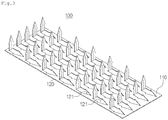
- FIG. 1 is a perspective view showing a microneedle according to an embodiment of the present invention
- FIG. 2 is an enlarged plan view showing a portion A shown in FIG. 1
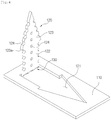
- FIG. 3 is a perspective view showing a state in which a needle portion is erected on a substrate portion according to the embodiment of the present invention
- FIG. 4 is an enlarged perspective view showing a portion A shown in FIG. 3
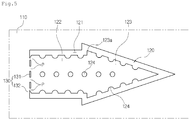
- FIG. 5 is a plan view showing perforations formed in the needle portion according to the embodiment of the present invention
- FIG. 6 is a view showing the needle portion remaining in skin when the substrate portion attached to the skin is removed from the skin.
- a microneedle 100 using a bioabsorbable metal includes: a substrate portion 110 being in contact with skin; a needle portion 120 provided at the substrate portion 110 and protruding from the substrate portion 110 to be inserted into the skin; and a perforated portion 130 provided at a junction between the needle 5 portion 120 and the substrate portion 110.
- the substrate portion 110 may have a thin plate shape having a predetermined area and thickness, and may carry a drug to be delivered to the subcutaneous tissue of the skin.
- a method of carrying a drug on the substrate portion 110 there are various known methods such as a method of coating the substrate portion 110 by immersing the substrate portion in a container containing the drug therein, a method of coating the substrate portion 110 by applying the drug to the substrate portion, and the like.
- drugs carried on the substrate portion 110 may include drugs or genetic materials for disease prevention and treatment and epidermal growth factor (EGF) or hyaluronic acid for skin care.
- EGF epidermal growth factor
- hyaluronic acid for skin care.
- the substrate portion 110 may be made of the bioabsorbable metal.
- the substrate portion 110 may be made of a metal including at least one of magnesium, calcium, zinc, and iron, which is used as the bioabsorbable metal.
- the substrate portion 110 having the above-described configuration may be attached to the skin of a user in the form of a patch in a state of being placed on an adhesive sheet (not shown) coated with an adhesive material.
- the needle portion 120 is a component that can be formed by processing the substrate portion 110 with a laser cutting device, and may be provided in plural such that multiple needle portions are arranged on the substrate portion 110 at predetermined intervals. Accordingly, the needle portion 120 may also be made of the bioabsorbable metal.
- the needle portion 120 may be bent to protrude vertically on the substrate portion 110 through a known forming process.
- the needle portion 120 can be said to be a portion that is inserted into the subcutaneous tissue of the skin of the user to deliver a drug when the substrate portion 110 comes into contact with the skin of the user.
- the needle portion 120 may include a needle cutout 121 formed in the substrate portion 110, a needle first portion 122 connected at a first end thereof to the substrate portion 110 while being received in the needle cutout 121, and a needle second portion 123 received in the needle cutout 121 while being connected at a first end thereof with a second end of the needle first portion 122.
- the needle cutout 121 may be formed on the substrate portion 110 by cutting using a laser cutting machine or by sheet metal working. In this process, the needle first portion 122 and the needle second portion 123 may be formed.
- the shape and size of the needle cutout 121 may be a factor that determines the shape and size of the needle first portion 122 and the needle second portion 123.
- the shape and size of the needle cutout may vary corresponding to the shape and size of the needle first portion 122 and the needle second portion 123.
- the needle first portion 122 and the needle second portion 123 may substantially have an arrowhead shape.
- the needle first portion 122 may have a predetermined width and may be connected at the first end thereof in a lengthwise direction thereof to an inner edge of the substrate portion 110, the inner edge defining the needle cutout 121.
- the needle second portion 123 may be formed in an arrowhead shape such that a width thereof gradually decreases from the first end to a second end thereof in a lengthwise direction thereof.
- the first end of the needle second portion in the lengthwise direction thereof may be connected with the second end of the needle first portion 122 in the lengthwise direction thereof as described above.
- the needle second portion 123 may be configured such that the first end thereof in the lengthwise direction thereof is larger than the second end of the needle first portion 122 in the lengthwise direction thereof in width so as to have a barb 123a formed at opposite corners of the needle second portion in a width direction thereof.
- the perforated portion 130 may be configured such that when the substrate portion 110 which has been in contact with the skin is removed therefrom, the first end of the needle first portion 122 in the lengthwise direction thereof is efficiently separated from the substrate portion 110, resulting in the needle first and second portions 122 and 123 inserted into the subcutaneous tissue of the skin remaining therein. In other words, as shown in FIG. 6 , when the substrate portion 110 is removed from the skin, the perforated portion 130 may allow the needle portion 120 to remain in the subcutaneous tissue of the skin.
- the perforated portion 130 may be configured as multiple perforations 131 provided at the first end of the needle first portion 122 in the lengthwise direction thereof to be arranged along a width direction of the needle first portion 122 at predetermined intervals.
- the perforations 131 are perforated in a thickness direction of the substrate portion 110 and serve to reduce the area of a junction between the needle first ) portion 122 and the substrate portion 110 such that the first end of the needle first portion in the lengthwise direction thereof is efficiently separated from the substrate portion.
- the needle first portion 122 and the needle ) second portion 123 inserted into the subcutaneous tissue of the skin may be embedded in the subcutaneous tissue by retraction of the subcutaneous tissue.
- the needle first portion 122 and the needle second portion 123 are pulled with a force larger than the retraction of the subcutaneous tissue, the needle first portion 122 and the needle second portion 123 are caused to be pulled out of the skin and separated together with the substrate portion 110.
- the multiple perforations 131 of the perforated portion 130 are formed at the junction between the substrate portion 110 and the needle first portion 122, thereby causing the force of the substrate portion 110 acting to pull the needle first portion 122 and the needle second portion 123 to decrease to be smaller than the retraction provided by the subcutaneous tissue. Because of this, the needle first portion 122 and the needle second portion 123 remain in the subcutaneous tissue.
- the barb 123a formed at the needle second portion 123 may become caught in the subcutaneous tissue, resulting in the needle first portion 122 and the needle second portion 123 inserted into the subcutaneous tissue being more firmly embedded therein.
- the junction between the needle first portion 122 and the substrate portion 110 is caused to be efficiently broken.
- the needle first portion 122 and the needle second portion 123 remaining in the subcutaneous tissue of the skin may deliver the drug carried on the substrate portion 110 to the subcutaneous tissue together with minerals contained in the bioabsorbable metal.
- the magnesium, calcium, zinc, and iron used as the bioabsorbable metal may be delivered to the subcutaneous tissue, resulting in minerals contained therein being supplied into the body.
- the bioabsorbable metal has been manufactured as a magnesium-based alloy for application to orthopedic implants and has been commercialized domestically and overseas.
- the bioabsorbable metal applied to orthopedic implants has focused on reducing the degradation rate in the body as much as possible or improving the corrosion resistance for the purpose of safe fracture fixation.
- the bioabsorbable metal used for the microneedle 100 accelerates the degradation rate thereof in the body, unlike the bioabsorbable metal used for orthopedic implants.
- a mechanism of supplying minerals as well as releasing the drug may be applied.
- magnesium, calcium, and zinc which are used as the bioabsorbable metal, have a mechanism of releasing hydrogen gas through a reaction with water while degrading as shown in the following chemical formulas 1 to 3, respectively.
- the substrate portion 110 and the needle portion 120 made of the bioabsorbable metal described above release ions and degradation products from the subcutaneous tissue during degradation, resulting in production of hydrogen gas as by-products.
- the hydrogen gas exerts a swelling effect in the subcutaneous tissue, leading to an anti-wrinkle effect in the skin.
- ZnO and MgCl which are byproducts produced when magnesium and zinc constituting the bioabsorbable metal are inserted into the body, may be caused to remain in the subcutaneous tissue of the skin so as to serve as a drug delivery enhancer, the drug delivery enhancer improving absorption of the drug carried on the substrate portion 110 and the needle portion 120 to the subcutaneous tissue.
- the substrate portion 110 and the needle portion 120 made of the bioabsorbable metal enables the drug carried thereon to be effectively delivered to the user.
- the perforated portion 130 may further include a notch 132 as shown in FIG. 5 .
- the notch 132 may be formed at the first end of the needle first portion 122 in the lengthwise direction thereof to be positioned at opposite corners of the needle first portion 122 in a width direction thereof, respective notches communicating with the needle cutout 121.
- the notches 132 serve to enable the first end of the needle first portion 122 in the lengthwise direction thereof to be more efficiently separated from the substrate portion 110 when the substrate portion 110 which has been in contact with the skin is removed therefrom and also serve to relieve stretching of the skin of the user which may be caused when the needle first portion 122 is separated from the substrate portion 110.
- the notches 132 may be formed such that when the first end of the needle first portion 122 in the lengthwise direction thereof connected to the substrate portion 110 is separated from the substrate portion 110, either of the opposite corners of the needle first portion in the width direction thereof is primarily broken. This causes the needle first portion 122 to be efficiently separated.
- the notches 132 enable that the junction P between the substrate portion 110 and the needle first portion 122 to be broken along the width direction of the needle first portion 122, the junction having the multiple perforations 131 arranged at intervals. This causes the needle first portion 122 to be quickly separated from the substrate portion 110. Additionally, the notches 131 relive the stretching of the skin of the user which may be caused when the needle portion 120 which has been in contact with the skin is removed therefrom.
- either of the needle first portion 122 and the needle second portion 123 may have a drug carrying recess 124 formed on a peripheral surface thereof.
- Multiple drug carrying recesses 124 may be provided along the peripheral surface of either of the needle first portion 122 and the needle second portion 123 at predetermined intervals to form a serrated shape. Each of the drug carrying recesses 124 may be formed to correspond to the thickness of either of the needle first portion 122 and the needle second portion 123.
- the drug carrying recesses 124 serve to control the amount of the drug to be carried on either of the needle first portion 122 and the needle second portion 123.
- the drug carrying recesses 124 allows the side surface area of either of the needle first portion 122 and the needle second portion 123 to increase or decrease according to the number of the recesses. Accordingly, controlling of the amount of the drug to be carried on either of the needle first portion 122 and the needle second portion 123 is possible.
- the drug carrying recesses 124 are formed on the peripheral surface of either of the needle first portion 122 or the needle second portion 123 to have a serrated shape as described above, resulting in the subcutaneous tissue being retracted in a state of being received in spaces defined by the drug carrying recesses 124.
- the drug carrying recesses 124 formed on the peripheral surface of either of the needle first portion 122 or the needle second portion 123 enable that the needle first portion 122 and the needle second portion 123 inserted into the subcutaneous tissue are more firmly embedded in the subcutaneous tissue. This makes it possible to prevent the needle first portion 122 from being pulled out of the skin by the substrate portion 110 and thus separated from the subcutaneous tissue when the substrate portion 110 which has been in contact with the skin is removed therefrom.
- the multiple drug carrying recesses 124 are not limited to the peripheral surface of either of the needle first portion 122 and the needle second portion 123 but may be provided on either of an upper surface and a lower surface of either of the needle first portion 122 and the needle second portion 123 to be arranged at predetermined intervals. Accordingly, controlling of the amount of the drug to be carried on either of the upper and lower surfaces of either of the needle first portion 122 and the needle second portion 123 is also possible.
- the microneedle 100 using the bioabsorbable metal according to the embodiment of the present invention having the above described configuration can deliver substances (magnesium, calcium, zinc, iron, and the like) included in the bioabsorbable metal into the body as well as delivering drugs for treatment and thus supply minerals together with the drugs to the user.
- substances magnesium, calcium, zinc, iron, and the like
- the microneedle 100 using the bioabsorbable metal according to the embodiment of the present invention can allow the needle portion 120 to remain in the subcutaneous tissue through a simple process of removing the substrate portion 110 in contact with the skin therefrom.
- the body of the user can accommodate the bioabsorbable metal beneficial to the human body without undergoing any other application or treatment.
- the microneedle 100 using the bioabsorbable metal according to the embodiment of the present invention can allow the by-products (hydrogen gas), which are produced when the needle portion 120 made of the bioabsorbable metal degrades in the subcutaneous tissue, to provide the swelling effect in the subcutaneous tissue and thus reduce the skin wrinkles of the user.
- hydroogen gas hydrogen gas
- the microneedle 100 using the bioabsorbable metal according to the embodiment of the present invention can allow the substrate portion 110 and the needle portion 120 that are made of the bioabsorbable metal to serve as the drug delivery enhancer and thus to provide rapid delivery of the drug carried thereon to the subcutaneous tissue. This makes it possible for a required drug to be quickly delivered into the body of the user for treatment.
- the microneedle using the bioabsorbable metal according to the present invention can be commercialized and used in various industrial fields such as medical field, skin beauty field, and the like.
Landscapes
- Health & Medical Sciences (AREA)
- Life Sciences & Earth Sciences (AREA)
- Veterinary Medicine (AREA)
- Public Health (AREA)
- General Health & Medical Sciences (AREA)
- Animal Behavior & Ethology (AREA)
- Heart & Thoracic Surgery (AREA)
- Epidemiology (AREA)
- Engineering & Computer Science (AREA)
- Vascular Medicine (AREA)
- Surgery (AREA)
- Chemical & Material Sciences (AREA)
- Dermatology (AREA)
- Medicinal Chemistry (AREA)
- Biomedical Technology (AREA)
- Pharmacology & Pharmacy (AREA)
- Medical Informatics (AREA)
- Anesthesiology (AREA)
- Hematology (AREA)
- Molecular Biology (AREA)
- Organic Chemistry (AREA)
- General Chemical & Material Sciences (AREA)
- Chemical Kinetics & Catalysis (AREA)
- Nuclear Medicine, Radiotherapy & Molecular Imaging (AREA)
- Inorganic Chemistry (AREA)
- Bioinformatics & Cheminformatics (AREA)
- Pain & Pain Management (AREA)
- Rheumatology (AREA)
- Pharmaceuticals Containing Other Organic And Inorganic Compounds (AREA)
- Medicinal Preparation (AREA)
- Media Introduction/Drainage Providing Device (AREA)
- Materials For Medical Uses (AREA)
- Medicines That Contain Protein Lipid Enzymes And Other Medicines (AREA)
- Infusion, Injection, And Reservoir Apparatuses (AREA)
Claims (10)
- Micro-aiguille (100) utilisant un métal bioabsorbable, la micro-aiguille (100) comprenant :une partie de substrat (110) ; etune partie d'aiguille (120) prévue au niveau de la partie de substrat (110) et faisant saillie de la partie de substrat (110) pour être insérée dans la peau ;caractérisée en ce que :une partie perforée (130) est prévue au niveau d'une jonction entre la partie d'aiguille (120) et la partie de substrat (110),dans laquelle l'une ou l'autre parmi la partie de substrat (110) et la partie d'aiguille (120) est réalisée à partir d'un métal bioabsorbable.
- Micro-aiguille (100) selon la revendication 1, dans laquelle lorsque la partie de substrat (110) est retirée de la peau, la partie d'aiguille (120) est séparée de la partie de substrat (110) et reste ainsi dans la peau.
- Micro-aiguille (100) selon la revendication 2, dans laquelle la partie d'aiguille (120) comprend :une découpe d'aiguille (121) formée dans la partie de substrat (110) ;une première partie d'aiguille (122) raccordée, au niveau de sa première extrémité, à la partie de substrat (110) tout en étant reçue dans la découpe d'aiguille (121) ; etune seconde partie d'aiguille (123) reçue dans la découpe d'aiguille (121) tout en étant raccordée, au niveau de sa première extrémité, avec une seconde extrémité de la première partie d'aiguille (122).
- Micro-aiguille (100) selon la revendication 3, dans laquelle la seconde partie d'aiguille (123) est formée selon une forme de sorte que sa largeur diminue progressivement de la première extrémité à sa seconde extrémité, la première extrémité étant supérieure à la première partie d'aiguille (122) en largeur afin d'avoir un ardillon (123a) formé au niveau cette dernière.
- Micro-aiguille (100) selon la revendication 4, dans laquelle lorsque la partie de substrat (110) qui a été en contact avec la peau, est retirée de la peau, l'ardillon (123a) s'accroche dans le tissu sous-cutané de sorte que les première et seconde parties d'aiguille (122, 123) sont encastrées dans le tissu sous-cutané.
- Micro-aiguille (100) selon la revendication 3, dans laquelle la partie perforée (130) comprend :
plusieurs perforations (131) prévues au niveau de la première extrémité de la première partie d'aiguille (122) pour être agencées le long d'une direction transversale de la première partie d'aiguille (122) à intervalles prédéterminés. - Micro-aiguille (100) selon la revendication 6, dans laquelle la partie perforée (130) comprend en outre :
une encoche (132), dans laquelle :
l'encoche (132) est formée au niveau de la première extrémité de la première partie d'aiguille (122) pour être positionnée au niveau des coins opposés de la première partie d'aiguille (122) dans la direction de sa largeur, les encoches (132) respectives communiquant avec la découpe d'aiguille (121). - Micro-aiguille (100) selon la revendication 3, dans laquelle l'une ou l'autre parmi la première partie d'aiguille (122) et la seconde partie d'aiguille (123) est prévue avec plusieurs évidements de support de médicament (124) formés sur sa surface périphérique, pour être agencés le long de la surface périphérique de l'une ou l'autre parmi la première partie d'aiguille (122) et la seconde partie d'aiguille (123).
- Micro-aiguille (100) selon la revendication 8, dans laquelle les évidements de support de médicament (124) sont en outre prévus sur l'une ou l'autre parmi une surface supérieure et une surface inférieure de l'une ou l'autre parmi la première partie d'aiguille (122) et la seconde partie d'aiguille (123).
- Micro-aiguille (100) selon l'une quelconque des revendications 1 à 9, dans laquelle le métal bioabsorbable comprend au moins l'un parmi le magnésium, le calcium, le zinc et le fer.
Priority Applications (1)
| Application Number | Priority Date | Filing Date | Title |
|---|---|---|---|
| PL17779369T PL3441107T3 (pl) | 2016-04-07 | 2017-04-06 | Mikroigła wykorzystująca bioabsorbowalny metal |
Applications Claiming Priority (3)
| Application Number | Priority Date | Filing Date | Title |
|---|---|---|---|
| KR20160042690 | 2016-04-07 | ||
| KR1020160181865A KR101879851B1 (ko) | 2016-04-07 | 2016-12-29 | 생체흡수성 금속을 이용한 마이크로 니들 |
| PCT/KR2017/003775 WO2017176069A2 (fr) | 2016-04-07 | 2017-04-06 | Micro-aiguille utilisant un métal bioabsorbable |
Publications (3)
| Publication Number | Publication Date |
|---|---|
| EP3441107A2 EP3441107A2 (fr) | 2019-02-13 |
| EP3441107A4 EP3441107A4 (fr) | 2020-01-08 |
| EP3441107B1 true EP3441107B1 (fr) | 2021-01-20 |
Family
ID=60297749
Family Applications (2)
| Application Number | Title | Priority Date | Filing Date |
|---|---|---|---|
| EP17779369.2A Active EP3441107B1 (fr) | 2016-04-07 | 2017-04-06 | Micro-aiguille utilisant un métal bioabsorbable |
| EP17779377.5A Active EP3444003B1 (fr) | 2016-04-07 | 2017-04-07 | Micro-aiguille mettant en oeuvre un métal biodégradable |
Family Applications After (1)
| Application Number | Title | Priority Date | Filing Date |
|---|---|---|---|
| EP17779377.5A Active EP3444003B1 (fr) | 2016-04-07 | 2017-04-07 | Micro-aiguille mettant en oeuvre un métal biodégradable |
Country Status (9)
| Country | Link |
|---|---|
| US (2) | US20190151638A1 (fr) |
| EP (2) | EP3441107B1 (fr) |
| JP (2) | JP6995830B2 (fr) |
| KR (5) | KR20170115429A (fr) |
| CN (2) | CN109069812B (fr) |
| BR (1) | BR112018070666A2 (fr) |
| ES (2) | ES2863905T3 (fr) |
| MX (2) | MX2018012334A (fr) |
| PL (2) | PL3441107T3 (fr) |
Cited By (1)
| Publication number | Priority date | Publication date | Assignee | Title |
|---|---|---|---|---|
| DE102023102257A1 (de) * | 2023-01-31 | 2024-08-01 | Forschungszentrum Jülich GmbH | Herstellung dreidimensional strukturierten elektrodenlagen, insbesondere im kirigami-prinzip |
Families Citing this family (29)
| Publication number | Priority date | Publication date | Assignee | Title |
|---|---|---|---|---|
| KR20170115429A (ko) * | 2016-04-07 | 2017-10-17 | 랩앤피플주식회사 | 생체분해성 금속을 이용한 마이크로 니들 |
| EP3493872A4 (fr) * | 2016-08-03 | 2020-04-08 | Verndari, Inc. | Système de microréseaux. |
| KR102119675B1 (ko) * | 2017-12-11 | 2020-06-05 | 랩앤피플주식회사 | 고밀도 마이크로 니들 |
| KR102022968B1 (ko) * | 2018-01-12 | 2019-09-19 | 주식회사 에스엔비아 | 마이크로 니들 시트 구조 및 그 제조방법 |
| KR102094744B1 (ko) * | 2018-01-26 | 2020-03-30 | 가천대학교 산학협력단 | 마이크로 니들 및 이의 제조방법 |
| WO2019190267A1 (fr) * | 2018-03-30 | 2019-10-03 | 랩앤피플주식회사 | Micro-aiguille multi-type |
| KR102291392B1 (ko) * | 2018-03-30 | 2021-08-20 | 랩앤피플주식회사 | 멀티형 마이크로 니들 |
| KR102310566B1 (ko) * | 2018-05-21 | 2021-10-08 | 랩앤피플주식회사 | 여드름 완화 및 예방용 패치 |
| WO2019225948A1 (fr) | 2018-05-21 | 2019-11-28 | 랩앤피플주식회사 | Timbre pour l'atténuation et la prévention de l'acné |
| KR102114474B1 (ko) * | 2018-06-26 | 2020-05-22 | 랩앤피플주식회사 | 백신 접종 피하 삽입용 생체흡수성 약물 전달 캡슐 |
| KR102651395B1 (ko) * | 2018-07-05 | 2024-03-26 | 랩앤피플주식회사 | 여드름 완화 및 예방용 화장품 조성물 |
| JP7320301B2 (ja) * | 2018-09-17 | 2023-08-03 | ラボエヌピープル カンパニー,リミテッド | 埋線療法用ロープ及びこれを含む埋線療法用ニードル装置 |
| US20210353822A1 (en) * | 2018-09-17 | 2021-11-18 | Labnpeople Co.,Ltd. | Thread embedding therapy rope and thread embedding therapy needle apparatus comprising same |
| KR102194089B1 (ko) * | 2019-03-18 | 2020-12-22 | 랩앤피플주식회사 | 항산화 활성 및 미백 효과를 갖는 플렉시블 금속 패치 및 그 사용방법 |
| CN111686309A (zh) * | 2019-04-09 | 2020-09-22 | 珠海天威飞马打印耗材有限公司 | 一种3d打印皮肤的制备方法 |
| KR102258194B1 (ko) * | 2019-08-08 | 2021-06-02 | (주) 반도체로박 | 침 기구 |
| US20220176096A1 (en) * | 2019-09-10 | 2022-06-09 | The Trustees Of Columbia University In The City Of New York | Microneedles to deliver therapeutic agent across membranes |
| JP2021040977A (ja) * | 2019-09-11 | 2021-03-18 | 株式会社ライトニックス | 薬物投与デバイス |
| KR102414580B1 (ko) * | 2020-07-17 | 2022-07-01 | 한국과학기술연구원 | 수술 전 감염 방지를 위한 마이크로니들 패치 및 마이크로니들 패치를 이용한 수술 전처리 방법 |
| EP4215222A4 (fr) * | 2020-11-04 | 2025-08-20 | Korea Institute Materials Science | Alliage de magnésium biodégradable à haute résistance, hautement anti-corrosif, et implant l'utilisant |
| KR102674799B1 (ko) * | 2020-11-04 | 2024-06-17 | 한국재료연구원 | 고강도 고내식 생분해성 마그네슘 합금 및 이를 이용하는 임플란트 |
| CN112274771B (zh) * | 2020-11-26 | 2022-04-19 | 南京鼓楼医院 | 一种仿火箭的微针微马达及其制备方法 |
| KR102593524B1 (ko) * | 2021-01-29 | 2023-10-25 | 김병준 | 환경오염 방지 및 야생동물을 보호하기 위한 마스크 |
| KR102565721B1 (ko) * | 2021-03-15 | 2023-08-11 | 주식회사 비즈엔몰드 | 피부 약물 주입기용 바늘 |
| US20250345579A1 (en) * | 2022-05-26 | 2025-11-13 | Nippon Telegraph And Telephone Corporation | Biological Tissue Transdermal Patch |
| KR20230172308A (ko) * | 2022-06-15 | 2023-12-22 | 랩앤피플주식회사 | 피부 부착성이 우수한 여드름 완화 및 예방용 패치 |
| KR102858745B1 (ko) * | 2022-09-19 | 2025-09-11 | 랩앤피플주식회사 | 고용량의 약물 전달이 가능한 스탬프형 약물전달장치 |
| JP7842503B2 (ja) | 2022-09-20 | 2026-04-08 | ラブンピープル カンパニー リミテッド | 生体内分解性金属を含む自己電流発生皮膚適用パッチ |
| CN115887349A (zh) * | 2022-09-27 | 2023-04-04 | 上海交通大学 | 一种生物降解镁氢微针 |
Family Cites Families (50)
| Publication number | Priority date | Publication date | Assignee | Title |
|---|---|---|---|---|
| ATE444773T1 (de) * | 2001-04-20 | 2009-10-15 | Alza Corp | Mikroprojektionsanordnung mit einem überzug, der ein vorteilhaftes mittel enthält |
| SE0102736D0 (sv) * | 2001-08-14 | 2001-08-14 | Patrick Griss | Side opened out-of-plane microneedles for microfluidic transdermal interfacing and fabrication process of side opened out-of-plane microneedles |
| AU2003279641B2 (en) * | 2002-06-28 | 2009-06-18 | Alza Corporation | Transdermal drug delivery devices having coated microprotrusions |
| JP2007501071A (ja) * | 2003-08-04 | 2007-01-25 | アルザ・コーポレーシヨン | 経皮作用剤流率を向上させる方法および装置 |
| WO2005087305A1 (fr) * | 2004-03-12 | 2005-09-22 | Agency For Science, Technology And Research | Procedes et moules s'utilisant dans la fabrication de micro-aiguilles a orifice lateral |
| TW200700094A (en) * | 2005-01-31 | 2007-01-01 | Alza Corp | Coated microprojections having reduced variability and method for producing same |
| US20060253078A1 (en) * | 2005-04-25 | 2006-11-09 | Wu Jeffrey M | Method of treating skin disorders with stratum corneum piercing device |
| US20060258973A1 (en) * | 2005-04-27 | 2006-11-16 | Kevin Volt | Micro-current Iontophoretic Percutaneous Absorptive Patch |
| WO2006138719A2 (fr) * | 2005-06-17 | 2006-12-28 | Georgia Tech Research Corporation | Microstructures revetues et procede de fabrication de celles-ci |
| JP2007014588A (ja) * | 2005-07-08 | 2007-01-25 | Nano Device & System Research Inc | 経皮投与装置,経皮投与装置製造用金型 |
| DE102005060203B4 (de) | 2005-12-14 | 2009-11-12 | Gkss-Forschungszentrum Geesthacht Gmbh | Biokompatibler Magnesiumwerkstoff, Verfahren zu seiner Herstellung und seiner Verwendung |
| US7658728B2 (en) * | 2006-01-10 | 2010-02-09 | Yuzhakov Vadim V | Microneedle array, patch, and applicator for transdermal drug delivery |
| WO2008020632A1 (fr) * | 2006-08-18 | 2008-02-21 | Toppan Printing Co., Ltd. | Micro-aiguille et timbre à micro-aiguilles |
| CN102512711A (zh) * | 2006-09-22 | 2012-06-27 | 友和安股份公司 | 由生物可降解金属构成的植入物及其制造方法 |
| WO2008062832A1 (fr) * | 2006-11-22 | 2008-05-29 | Toppan Printing Co., Ltd. | Matrice à micro-aiguilles et son procédé de production |
| US8778012B2 (en) * | 2012-11-27 | 2014-07-15 | Cormatrix Cardiovascular, Inc. | ECM constructs for tissue regeneration |
| JP2008284318A (ja) * | 2007-05-15 | 2008-11-27 | Kosumedei Seiyaku Kk | 生体由来物質からなる投薬用微細針 |
| JP5034777B2 (ja) * | 2007-08-22 | 2012-09-26 | 凸版印刷株式会社 | 針状体の作製方法ならびに製造方法及び針状体 |
| DE102008003453A1 (de) * | 2008-01-08 | 2009-07-09 | Robert Bosch Gmbh | Verfahren zur Herstellung poröser Mikrostrukturen, nach diesem Verfahren hergestellte poröse Mikrostrukturen sowie deren Verwendung |
| US20090326447A1 (en) * | 2008-06-27 | 2009-12-31 | Joshi Ashok V | Transdermal Delivery Apparatus and Method |
| JP2010069270A (ja) * | 2008-09-17 | 2010-04-02 | Yoshiichi Tobinaga | 機能剤投与デバイス、その製造方法及び製造装置 |
| US20110014181A1 (en) * | 2009-07-20 | 2011-01-20 | Medtronic Vascular, Inc. | Microneedle Delivery Device and Methods of Using Same |
| JP2011083387A (ja) * | 2009-10-14 | 2011-04-28 | Kyushu Institute Of Technology | 針状体の製造方法並びに針状体および針状体保持シート |
| KR20110065391A (ko) * | 2009-12-07 | 2011-06-15 | 유앤아이 주식회사 | 마그네슘 합금을 이용한 약물 전달체 |
| CN102770176B (zh) * | 2010-02-24 | 2015-11-25 | 久光制药株式会社 | 微针装置及其制造方法 |
| CA2802753C (fr) * | 2010-06-21 | 2018-07-31 | Zorion Medical, Inc. | Implants bioabsorbables |
| CA2827956C (fr) * | 2011-02-23 | 2019-05-07 | Ams Research Corporation | Methode et systeme de traitement pelvien par liberation d'un medicament |
| JP2012217653A (ja) * | 2011-04-08 | 2012-11-12 | Asti Corp | マイクロニードルとマイクロニードルアレイとマイクロニードルアレイ製造方法 |
| US10624847B2 (en) | 2011-08-02 | 2020-04-21 | AnPac BioMedical Science Co., Ltd. | Decomposable apparatus and methods for fabricating same |
| US20150157840A1 (en) * | 2012-06-12 | 2015-06-11 | Hisamitsu Pharmaceutical Co., Inc. | Microneedle Sheet |
| WO2013192083A2 (fr) * | 2012-06-18 | 2013-12-27 | Axion Biosystems, Inc. | Dispositif à microélectrode 3d pour applications à des tissus vivants |
| US10358709B2 (en) * | 2012-06-26 | 2019-07-23 | Biotronik Ag | Magnesium-zinc-calcium alloy, method for production thereof, and use thereof |
| US10246763B2 (en) | 2012-08-24 | 2019-04-02 | The Regents Of The University Of California | Magnesium-zinc-strontium alloys for medical implants and devices |
| US9469889B2 (en) | 2012-08-31 | 2016-10-18 | DePuy Synthes Products, Inc. | Ultrapure magnesium alloy with adjustable degradation rate |
| BR112015005073B1 (pt) * | 2012-09-13 | 2021-06-01 | Amir Avraham | Aplicador configurado para a administração de uma composição de melhoria de pele para uma pele e/ou subcútis de um sujeito, uso de um, microagulha e método para manufaturar uma microagulha |
| US11376349B2 (en) | 2012-10-05 | 2022-07-05 | University of Pittsburgh—of the Commonwealth System of Higher Education | Biodegradable iron-containing compositions, methods of preparing and applications therefor |
| US9526884B2 (en) * | 2012-11-16 | 2016-12-27 | City University Of Hong Kong | Mechanically robust fast-dissolving microneedles for transdermal drug and vaccine delivery |
| EP2934660B1 (fr) * | 2012-12-21 | 2019-07-17 | Corium, Inc. | Micro-réseau pour la distribution d'un agent thérapeutique et son procédé de fabrication |
| CN202987775U (zh) * | 2012-12-27 | 2013-06-12 | 浙江诚德包装有限公司 | 设有易撕线开口的软包装袋 |
| SG11201506326YA (en) | 2013-02-13 | 2015-09-29 | Hisamitsu Pharmaceutical Co | Microneedle coating composition and microneedle device |
| WO2014126958A1 (fr) * | 2013-02-15 | 2014-08-21 | Boston Scientific Scimed, Inc. | Microstructures d'alliage de magnésium bioérodables pour des endoprothèses |
| US10478529B2 (en) * | 2013-03-14 | 2019-11-19 | DePuy Synthes Products, Inc. | Magnesium alloy with adjustable degradation rate |
| CN103203072B (zh) * | 2013-03-25 | 2015-05-20 | 清华大学 | 金属微针阵列柔性贴片、经皮给药器件及经皮给药贴片 |
| CN105126240A (zh) * | 2014-06-03 | 2015-12-09 | 陈彦彪 | 一种可降解超微针片 |
| KR101703050B1 (ko) | 2014-07-10 | 2017-02-07 | 주식회사 주빅 | 경피전달용 미세돌기 구조체 |
| CN104212998B (zh) * | 2014-08-21 | 2017-02-01 | 北京大学 | 一种Zn‑Mg系锌合金及其制备方法与应用 |
| KR101785766B1 (ko) | 2014-11-14 | 2017-10-18 | 가천대학교 산학협력단 | 코팅 마이크로니들의 생산 방법 및 그 방법에 의하여 생산된 코팅 마이크로니들 |
| WO2016149152A1 (fr) * | 2015-03-13 | 2016-09-22 | The University Of North Carolina At Chapel Hill | Micro-aiguilles polymères et fabrication additive rapide de ces dernières |
| KR101622388B1 (ko) | 2015-10-21 | 2016-05-19 | 한국과학기술원 | 실리콘 마이크로 니들 스탬프 및 그 제조방법 |
| KR20170115429A (ko) * | 2016-04-07 | 2017-10-17 | 랩앤피플주식회사 | 생체분해성 금속을 이용한 마이크로 니들 |
-
2016
- 2016-11-30 KR KR1020160162337A patent/KR20170115429A/ko active Pending
- 2016-12-29 KR KR1020160181865A patent/KR101879851B1/ko active Active
-
2017
- 2017-04-06 US US16/091,677 patent/US20190151638A1/en not_active Abandoned
- 2017-04-06 PL PL17779369T patent/PL3441107T3/pl unknown
- 2017-04-06 KR KR1020170044692A patent/KR102114472B1/ko active Active
- 2017-04-06 ES ES17779369T patent/ES2863905T3/es active Active
- 2017-04-06 MX MX2018012334A patent/MX2018012334A/es unknown
- 2017-04-06 EP EP17779369.2A patent/EP3441107B1/fr active Active
- 2017-04-06 CN CN201780021560.7A patent/CN109069812B/zh active Active
- 2017-04-06 JP JP2019503880A patent/JP6995830B2/ja active Active
- 2017-04-07 MX MX2018012236A patent/MX2018012236A/es unknown
- 2017-04-07 CN CN201780021995.1A patent/CN109069814A/zh active Pending
- 2017-04-07 PL PL17779377.5T patent/PL3444003T3/pl unknown
- 2017-04-07 US US16/091,718 patent/US11135415B2/en active Active
- 2017-04-07 EP EP17779377.5A patent/EP3444003B1/fr active Active
- 2017-04-07 JP JP2019503883A patent/JP6794528B2/ja active Active
- 2017-04-07 BR BR112018070666A patent/BR112018070666A2/pt not_active Application Discontinuation
- 2017-04-07 KR KR1020170045449A patent/KR102074388B1/ko active Active
- 2017-04-07 ES ES17779377T patent/ES2913153T3/es active Active
-
2019
- 2019-06-20 KR KR1020190073666A patent/KR102114984B1/ko active Active
Cited By (1)
| Publication number | Priority date | Publication date | Assignee | Title |
|---|---|---|---|---|
| DE102023102257A1 (de) * | 2023-01-31 | 2024-08-01 | Forschungszentrum Jülich GmbH | Herstellung dreidimensional strukturierten elektrodenlagen, insbesondere im kirigami-prinzip |
Also Published As
| Publication number | Publication date |
|---|---|
| KR20170115449A (ko) | 2017-10-17 |
| PL3444003T3 (pl) | 2022-07-18 |
| KR102074388B1 (ko) | 2020-02-06 |
| KR20170115431A (ko) | 2017-10-17 |
| KR20170115429A (ko) | 2017-10-17 |
| ES2863905T3 (es) | 2021-10-13 |
| EP3441107A4 (fr) | 2020-01-08 |
| MX2018012334A (es) | 2019-03-28 |
| JP2019510618A (ja) | 2019-04-18 |
| CN109069812A (zh) | 2018-12-21 |
| KR101879851B1 (ko) | 2018-07-18 |
| JP6794528B2 (ja) | 2020-12-02 |
| EP3444003A1 (fr) | 2019-02-20 |
| US11135415B2 (en) | 2021-10-05 |
| EP3444003B1 (fr) | 2022-03-09 |
| PL3441107T3 (pl) | 2021-08-02 |
| US20190091456A1 (en) | 2019-03-28 |
| CN109069814A (zh) | 2018-12-21 |
| EP3441107A2 (fr) | 2019-02-13 |
| US20190151638A1 (en) | 2019-05-23 |
| CN109069812B (zh) | 2021-05-07 |
| EP3444003A4 (fr) | 2019-11-13 |
| JP2019515949A (ja) | 2019-06-13 |
| BR112018070658A2 (pt) | 2019-02-05 |
| KR102114984B1 (ko) | 2020-05-26 |
| KR102114472B1 (ko) | 2020-05-22 |
| MX2018012236A (es) | 2019-03-28 |
| JP6995830B2 (ja) | 2022-01-17 |
| BR112018070666A2 (pt) | 2019-02-05 |
| KR20170115458A (ko) | 2017-10-17 |
| ES2913153T3 (es) | 2022-05-31 |
| KR20190075033A (ko) | 2019-06-28 |
Similar Documents
| Publication | Publication Date | Title |
|---|---|---|
| EP3441107B1 (fr) | Micro-aiguille utilisant un métal bioabsorbable | |
| KR102417440B1 (ko) | 멀티형 마이크로 니들 | |
| JP7141646B2 (ja) | マイクロニードルパッチの製造方法 | |
| KR20190080325A (ko) | 마이크로 니들 | |
| CN109689149B (zh) | 微针 | |
| JP2009066104A (ja) | 微細針構造体及び微細針構造体デバイス | |
| US12083306B2 (en) | High-density microneedle | |
| WO2017176069A2 (fr) | Micro-aiguille utilisant un métal bioabsorbable | |
| KR101947624B1 (ko) | 멀티형 마이크로 니들 | |
| BR112018070658B1 (pt) | Microagulha utilizando metal bioabsorvível | |
| KR20200038009A (ko) | 각성 효과를 갖는 마이크로 니들 패치 | |
| KR20260014415A (ko) | 마이크로 니들 패치 | |
| BR112019004939B1 (pt) | Arranjo de microagulha | |
| KR20250009619A (ko) | 약물전달을 위한 체내 삽입형 용해성 마이크로 니들, 그 마이크로 니들 제조방법, 마이크로 니들 주입기, 및 그 마이크로 니들 주입기를 이용한 마이크로 니들 사용방법 |
Legal Events
| Date | Code | Title | Description |
|---|---|---|---|
| STAA | Information on the status of an ep patent application or granted ep patent |
Free format text: STATUS: THE INTERNATIONAL PUBLICATION HAS BEEN MADE |
|
| PUAI | Public reference made under article 153(3) epc to a published international application that has entered the european phase |
Free format text: ORIGINAL CODE: 0009012 |
|
| STAA | Information on the status of an ep patent application or granted ep patent |
Free format text: STATUS: REQUEST FOR EXAMINATION WAS MADE |
|
| 17P | Request for examination filed |
Effective date: 20181105 |
|
| AK | Designated contracting states |
Kind code of ref document: A2 Designated state(s): AL AT BE BG CH CY CZ DE DK EE ES FI FR GB GR HR HU IE IS IT LI LT LU LV MC MK MT NL NO PL PT RO RS SE SI SK SM TR |
|
| AX | Request for extension of the european patent |
Extension state: BA ME |
|
| DAV | Request for validation of the european patent (deleted) | ||
| DAX | Request for extension of the european patent (deleted) | ||
| A4 | Supplementary search report drawn up and despatched |
Effective date: 20191206 |
|
| RIC1 | Information provided on ipc code assigned before grant |
Ipc: A61M 37/00 20060101AFI20191202BHEP Ipc: A61L 31/14 20060101ALI20191202BHEP Ipc: A61L 31/16 20060101ALI20191202BHEP Ipc: A61L 31/02 20060101ALI20191202BHEP Ipc: A61K 9/00 20060101ALI20191202BHEP Ipc: A61L 31/10 20060101ALI20191202BHEP |
|
| RIC1 | Information provided on ipc code assigned before grant |
Ipc: A61P 43/00 20060101ALI20200709BHEP Ipc: A61M 37/00 20060101AFI20200709BHEP Ipc: A61L 31/14 20060101ALI20200709BHEP Ipc: A61P 29/00 20060101ALI20200709BHEP Ipc: A61K 9/00 20060101ALI20200709BHEP Ipc: A61L 31/16 20060101ALI20200709BHEP Ipc: A61L 31/02 20060101ALI20200709BHEP Ipc: A61L 31/10 20060101ALI20200709BHEP Ipc: A61P 17/00 20060101ALI20200709BHEP |
|
| GRAP | Despatch of communication of intention to grant a patent |
Free format text: ORIGINAL CODE: EPIDOSNIGR1 |
|
| STAA | Information on the status of an ep patent application or granted ep patent |
Free format text: STATUS: GRANT OF PATENT IS INTENDED |
|
| INTG | Intention to grant announced |
Effective date: 20200828 |
|
| GRAS | Grant fee paid |
Free format text: ORIGINAL CODE: EPIDOSNIGR3 |
|
| GRAA | (expected) grant |
Free format text: ORIGINAL CODE: 0009210 |
|
| STAA | Information on the status of an ep patent application or granted ep patent |
Free format text: STATUS: THE PATENT HAS BEEN GRANTED |
|
| RAP1 | Party data changed (applicant data changed or rights of an application transferred) |
Owner name: LABNPEOPLE CO.,LTD. |
|
| AK | Designated contracting states |
Kind code of ref document: B1 Designated state(s): AL AT BE BG CH CY CZ DE DK EE ES FI FR GB GR HR HU IE IS IT LI LT LU LV MC MK MT NL NO PL PT RO RS SE SI SK SM TR |
|
| REG | Reference to a national code |
Ref country code: GB Ref legal event code: FG4D |
|
| REG | Reference to a national code |
Ref country code: CH Ref legal event code: EP |
|
| REG | Reference to a national code |
Ref country code: DE Ref legal event code: R096 Ref document number: 602017031722 Country of ref document: DE |
|
| REG | Reference to a national code |
Ref country code: AT Ref legal event code: REF Ref document number: 1355840 Country of ref document: AT Kind code of ref document: T Effective date: 20210215 |
|
| REG | Reference to a national code |
Ref country code: IE Ref legal event code: FG4D |
|
| REG | Reference to a national code |
Ref country code: NL Ref legal event code: FP |
|
| REG | Reference to a national code |
Ref country code: SE Ref legal event code: TRGR |
|
| REG | Reference to a national code |
Ref country code: LT Ref legal event code: MG9D |
|
| REG | Reference to a national code |
Ref country code: AT Ref legal event code: MK05 Ref document number: 1355840 Country of ref document: AT Kind code of ref document: T Effective date: 20210120 |
|
| PG25 | Lapsed in a contracting state [announced via postgrant information from national office to epo] |
Ref country code: NO Free format text: LAPSE BECAUSE OF FAILURE TO SUBMIT A TRANSLATION OF THE DESCRIPTION OR TO PAY THE FEE WITHIN THE PRESCRIBED TIME-LIMIT Effective date: 20210420 Ref country code: PT Free format text: LAPSE BECAUSE OF FAILURE TO SUBMIT A TRANSLATION OF THE DESCRIPTION OR TO PAY THE FEE WITHIN THE PRESCRIBED TIME-LIMIT Effective date: 20210520 Ref country code: FI Free format text: LAPSE BECAUSE OF FAILURE TO SUBMIT A TRANSLATION OF THE DESCRIPTION OR TO PAY THE FEE WITHIN THE PRESCRIBED TIME-LIMIT Effective date: 20210120 Ref country code: GR Free format text: LAPSE BECAUSE OF FAILURE TO SUBMIT A TRANSLATION OF THE DESCRIPTION OR TO PAY THE FEE WITHIN THE PRESCRIBED TIME-LIMIT Effective date: 20210421 Ref country code: HR Free format text: LAPSE BECAUSE OF FAILURE TO SUBMIT A TRANSLATION OF THE DESCRIPTION OR TO PAY THE FEE WITHIN THE PRESCRIBED TIME-LIMIT Effective date: 20210120 Ref country code: BG Free format text: LAPSE BECAUSE OF FAILURE TO SUBMIT A TRANSLATION OF THE DESCRIPTION OR TO PAY THE FEE WITHIN THE PRESCRIBED TIME-LIMIT Effective date: 20210420 Ref country code: LT Free format text: LAPSE BECAUSE OF FAILURE TO SUBMIT A TRANSLATION OF THE DESCRIPTION OR TO PAY THE FEE WITHIN THE PRESCRIBED TIME-LIMIT Effective date: 20210120 |
|
| PG25 | Lapsed in a contracting state [announced via postgrant information from national office to epo] |
Ref country code: RS Free format text: LAPSE BECAUSE OF FAILURE TO SUBMIT A TRANSLATION OF THE DESCRIPTION OR TO PAY THE FEE WITHIN THE PRESCRIBED TIME-LIMIT Effective date: 20210120 Ref country code: LV Free format text: LAPSE BECAUSE OF FAILURE TO SUBMIT A TRANSLATION OF THE DESCRIPTION OR TO PAY THE FEE WITHIN THE PRESCRIBED TIME-LIMIT Effective date: 20210120 Ref country code: AT Free format text: LAPSE BECAUSE OF FAILURE TO SUBMIT A TRANSLATION OF THE DESCRIPTION OR TO PAY THE FEE WITHIN THE PRESCRIBED TIME-LIMIT Effective date: 20210120 |
|
| PG25 | Lapsed in a contracting state [announced via postgrant information from national office to epo] |
Ref country code: IS Free format text: LAPSE BECAUSE OF FAILURE TO SUBMIT A TRANSLATION OF THE DESCRIPTION OR TO PAY THE FEE WITHIN THE PRESCRIBED TIME-LIMIT Effective date: 20210520 |
|
| REG | Reference to a national code |
Ref country code: ES Ref legal event code: FG2A Ref document number: 2863905 Country of ref document: ES Kind code of ref document: T3 Effective date: 20211013 |
|
| REG | Reference to a national code |
Ref country code: DE Ref legal event code: R097 Ref document number: 602017031722 Country of ref document: DE |
|
| PG25 | Lapsed in a contracting state [announced via postgrant information from national office to epo] |
Ref country code: CZ Free format text: LAPSE BECAUSE OF FAILURE TO SUBMIT A TRANSLATION OF THE DESCRIPTION OR TO PAY THE FEE WITHIN THE PRESCRIBED TIME-LIMIT Effective date: 20210120 Ref country code: EE Free format text: LAPSE BECAUSE OF FAILURE TO SUBMIT A TRANSLATION OF THE DESCRIPTION OR TO PAY THE FEE WITHIN THE PRESCRIBED TIME-LIMIT Effective date: 20210120 Ref country code: SM Free format text: LAPSE BECAUSE OF FAILURE TO SUBMIT A TRANSLATION OF THE DESCRIPTION OR TO PAY THE FEE WITHIN THE PRESCRIBED TIME-LIMIT Effective date: 20210120 |
|
| PLBE | No opposition filed within time limit |
Free format text: ORIGINAL CODE: 0009261 |
|
| STAA | Information on the status of an ep patent application or granted ep patent |
Free format text: STATUS: NO OPPOSITION FILED WITHIN TIME LIMIT |
|
| PG25 | Lapsed in a contracting state [announced via postgrant information from national office to epo] |
Ref country code: MC Free format text: LAPSE BECAUSE OF FAILURE TO SUBMIT A TRANSLATION OF THE DESCRIPTION OR TO PAY THE FEE WITHIN THE PRESCRIBED TIME-LIMIT Effective date: 20210120 Ref country code: SK Free format text: LAPSE BECAUSE OF FAILURE TO SUBMIT A TRANSLATION OF THE DESCRIPTION OR TO PAY THE FEE WITHIN THE PRESCRIBED TIME-LIMIT Effective date: 20210120 Ref country code: DK Free format text: LAPSE BECAUSE OF FAILURE TO SUBMIT A TRANSLATION OF THE DESCRIPTION OR TO PAY THE FEE WITHIN THE PRESCRIBED TIME-LIMIT Effective date: 20210120 Ref country code: RO Free format text: LAPSE BECAUSE OF FAILURE TO SUBMIT A TRANSLATION OF THE DESCRIPTION OR TO PAY THE FEE WITHIN THE PRESCRIBED TIME-LIMIT Effective date: 20210120 |
|
| 26N | No opposition filed |
Effective date: 20211021 |
|
| PG25 | Lapsed in a contracting state [announced via postgrant information from national office to epo] |
Ref country code: LU Free format text: LAPSE BECAUSE OF NON-PAYMENT OF DUE FEES Effective date: 20210406 |
|
| REG | Reference to a national code |
Ref country code: BE Ref legal event code: MM Effective date: 20210430 |
|
| PG25 | Lapsed in a contracting state [announced via postgrant information from national office to epo] |
Ref country code: AL Free format text: LAPSE BECAUSE OF FAILURE TO SUBMIT A TRANSLATION OF THE DESCRIPTION OR TO PAY THE FEE WITHIN THE PRESCRIBED TIME-LIMIT Effective date: 20210120 Ref country code: CH Free format text: LAPSE BECAUSE OF NON-PAYMENT OF DUE FEES Effective date: 20210430 Ref country code: LI Free format text: LAPSE BECAUSE OF NON-PAYMENT OF DUE FEES Effective date: 20210430 |
|
| PG25 | Lapsed in a contracting state [announced via postgrant information from national office to epo] |
Ref country code: SI Free format text: LAPSE BECAUSE OF FAILURE TO SUBMIT A TRANSLATION OF THE DESCRIPTION OR TO PAY THE FEE WITHIN THE PRESCRIBED TIME-LIMIT Effective date: 20210120 |
|
| PG25 | Lapsed in a contracting state [announced via postgrant information from national office to epo] |
Ref country code: IE Free format text: LAPSE BECAUSE OF NON-PAYMENT OF DUE FEES Effective date: 20210406 |
|
| REG | Reference to a national code |
Ref country code: DE Ref legal event code: R082 Ref document number: 602017031722 Country of ref document: DE Representative=s name: SIMMONS & SIMMONS LLP, DE Ref country code: DE Ref legal event code: R082 Ref document number: 602017031722 Country of ref document: DE Representative=s name: KADOR & PARTNER PART MBB PATENTANWAELTE, DE |
|
| PG25 | Lapsed in a contracting state [announced via postgrant information from national office to epo] |
Ref country code: IS Free format text: LAPSE BECAUSE OF FAILURE TO SUBMIT A TRANSLATION OF THE DESCRIPTION OR TO PAY THE FEE WITHIN THE PRESCRIBED TIME-LIMIT Effective date: 20210520 |
|
| PG25 | Lapsed in a contracting state [announced via postgrant information from national office to epo] |
Ref country code: BE Free format text: LAPSE BECAUSE OF NON-PAYMENT OF DUE FEES Effective date: 20210430 |
|
| PG25 | Lapsed in a contracting state [announced via postgrant information from national office to epo] |
Ref country code: CY Free format text: LAPSE BECAUSE OF FAILURE TO SUBMIT A TRANSLATION OF THE DESCRIPTION OR TO PAY THE FEE WITHIN THE PRESCRIBED TIME-LIMIT Effective date: 20210120 |
|
| PG25 | Lapsed in a contracting state [announced via postgrant information from national office to epo] |
Ref country code: HU Free format text: LAPSE BECAUSE OF FAILURE TO SUBMIT A TRANSLATION OF THE DESCRIPTION OR TO PAY THE FEE WITHIN THE PRESCRIBED TIME-LIMIT; INVALID AB INITIO Effective date: 20170406 |
|
| PG25 | Lapsed in a contracting state [announced via postgrant information from national office to epo] |
Ref country code: MK Free format text: LAPSE BECAUSE OF FAILURE TO SUBMIT A TRANSLATION OF THE DESCRIPTION OR TO PAY THE FEE WITHIN THE PRESCRIBED TIME-LIMIT Effective date: 20210120 |
|
| PG25 | Lapsed in a contracting state [announced via postgrant information from national office to epo] |
Ref country code: MT Free format text: LAPSE BECAUSE OF FAILURE TO SUBMIT A TRANSLATION OF THE DESCRIPTION OR TO PAY THE FEE WITHIN THE PRESCRIBED TIME-LIMIT Effective date: 20210120 |
|
| PGFP | Annual fee paid to national office [announced via postgrant information from national office to epo] |
Ref country code: SE Payment date: 20250311 Year of fee payment: 9 |
|
| PGFP | Annual fee paid to national office [announced via postgrant information from national office to epo] |
Ref country code: TR Payment date: 20250326 Year of fee payment: 9 |
|
| PGFP | Annual fee paid to national office [announced via postgrant information from national office to epo] |
Ref country code: NL Payment date: 20250422 Year of fee payment: 9 |
|
| PGFP | Annual fee paid to national office [announced via postgrant information from national office to epo] |
Ref country code: DE Payment date: 20250304 Year of fee payment: 9 |
|
| PGFP | Annual fee paid to national office [announced via postgrant information from national office to epo] |
Ref country code: ES Payment date: 20250519 Year of fee payment: 9 |
|
| PGFP | Annual fee paid to national office [announced via postgrant information from national office to epo] |
Ref country code: IT Payment date: 20250430 Year of fee payment: 9 |
|
| PGFP | Annual fee paid to national office [announced via postgrant information from national office to epo] |
Ref country code: FR Payment date: 20250422 Year of fee payment: 9 |
|
| REG | Reference to a national code |
Ref country code: DE Ref legal event code: R082 Ref document number: 602017031722 Country of ref document: DE Representative=s name: KADOR & PARTNER PART MBB PATENTANWAELTE, DE |
|
| PGFP | Annual fee paid to national office [announced via postgrant information from national office to epo] |
Ref country code: GB Payment date: 20260324 Year of fee payment: 10 |
|
| PGFP | Annual fee paid to national office [announced via postgrant information from national office to epo] |
Ref country code: PL Payment date: 20260324 Year of fee payment: 10 |