EP3442977B1 - Inhibiteurs du récepteur alk (« activin receptor-like kinase ») - Google Patents
Inhibiteurs du récepteur alk (« activin receptor-like kinase ») Download PDFInfo
- Publication number
- EP3442977B1 EP3442977B1 EP17733108.9A EP17733108A EP3442977B1 EP 3442977 B1 EP3442977 B1 EP 3442977B1 EP 17733108 A EP17733108 A EP 17733108A EP 3442977 B1 EP3442977 B1 EP 3442977B1
- Authority
- EP
- European Patent Office
- Prior art keywords
- alkyl
- alkylene
- heterocyclyl
- mmol
- isopropyl
- Prior art date
- Legal status (The legal status is an assumption and is not a legal conclusion. Google has not performed a legal analysis and makes no representation as to the accuracy of the status listed.)
- Active
Links
Classifications
-
- C—CHEMISTRY; METALLURGY
- C07—ORGANIC CHEMISTRY
- C07D—HETEROCYCLIC COMPOUNDS
- C07D487/00—Heterocyclic compounds containing nitrogen atoms as the only ring hetero atoms in the condensed system, not provided for by groups C07D451/00 - C07D477/00
- C07D487/02—Heterocyclic compounds containing nitrogen atoms as the only ring hetero atoms in the condensed system, not provided for by groups C07D451/00 - C07D477/00 in which the condensed system contains two hetero rings
- C07D487/04—Ortho-condensed systems
-
- A—HUMAN NECESSITIES
- A61—MEDICAL OR VETERINARY SCIENCE; HYGIENE
- A61K—PREPARATIONS FOR MEDICAL, DENTAL OR TOILETRY PURPOSES
- A61K31/00—Medicinal preparations containing organic active ingredients
- A61K31/33—Heterocyclic compounds
- A61K31/395—Heterocyclic compounds having nitrogen as a ring hetero atom, e.g. guanethidine or rifamycins
- A61K31/495—Heterocyclic compounds having nitrogen as a ring hetero atom, e.g. guanethidine or rifamycins having six-membered rings with two or more nitrogen atoms as the only ring heteroatoms, e.g. piperazine or tetrazines
- A61K31/50—Pyridazines; Hydrogenated pyridazines
- A61K31/5025—Pyridazines; Hydrogenated pyridazines ortho- or peri-condensed with heterocyclic ring systems
-
- A—HUMAN NECESSITIES
- A61—MEDICAL OR VETERINARY SCIENCE; HYGIENE
- A61K—PREPARATIONS FOR MEDICAL, DENTAL OR TOILETRY PURPOSES
- A61K31/00—Medicinal preparations containing organic active ingredients
- A61K31/33—Heterocyclic compounds
- A61K31/395—Heterocyclic compounds having nitrogen as a ring hetero atom, e.g. guanethidine or rifamycins
- A61K31/535—Heterocyclic compounds having nitrogen as a ring hetero atom, e.g. guanethidine or rifamycins having six-membered rings with at least one nitrogen and one oxygen as the ring hetero atoms, e.g. 1,2-oxazines
- A61K31/5375—1,4-Oxazines, e.g. morpholine
- A61K31/5377—1,4-Oxazines, e.g. morpholine not condensed and containing further heterocyclic rings, e.g. timolol
-
- A—HUMAN NECESSITIES
- A61—MEDICAL OR VETERINARY SCIENCE; HYGIENE
- A61K—PREPARATIONS FOR MEDICAL, DENTAL OR TOILETRY PURPOSES
- A61K31/00—Medicinal preparations containing organic active ingredients
- A61K31/33—Heterocyclic compounds
- A61K31/395—Heterocyclic compounds having nitrogen as a ring hetero atom, e.g. guanethidine or rifamycins
- A61K31/535—Heterocyclic compounds having nitrogen as a ring hetero atom, e.g. guanethidine or rifamycins having six-membered rings with at least one nitrogen and one oxygen as the ring hetero atoms, e.g. 1,2-oxazines
- A61K31/5375—1,4-Oxazines, e.g. morpholine
- A61K31/5383—1,4-Oxazines, e.g. morpholine ortho- or peri-condensed with heterocyclic ring systems
-
- A—HUMAN NECESSITIES
- A61—MEDICAL OR VETERINARY SCIENCE; HYGIENE
- A61P—SPECIFIC THERAPEUTIC ACTIVITY OF CHEMICAL COMPOUNDS OR MEDICINAL PREPARATIONS
- A61P19/00—Drugs for skeletal disorders
-
- A—HUMAN NECESSITIES
- A61—MEDICAL OR VETERINARY SCIENCE; HYGIENE
- A61P—SPECIFIC THERAPEUTIC ACTIVITY OF CHEMICAL COMPOUNDS OR MEDICINAL PREPARATIONS
- A61P25/00—Drugs for disorders of the nervous system
-
- A—HUMAN NECESSITIES
- A61—MEDICAL OR VETERINARY SCIENCE; HYGIENE
- A61P—SPECIFIC THERAPEUTIC ACTIVITY OF CHEMICAL COMPOUNDS OR MEDICINAL PREPARATIONS
- A61P35/00—Antineoplastic agents
-
- A—HUMAN NECESSITIES
- A61—MEDICAL OR VETERINARY SCIENCE; HYGIENE
- A61P—SPECIFIC THERAPEUTIC ACTIVITY OF CHEMICAL COMPOUNDS OR MEDICINAL PREPARATIONS
- A61P43/00—Drugs for specific purposes, not provided for in groups A61P1/00-A61P41/00
-
- C—CHEMISTRY; METALLURGY
- C07—ORGANIC CHEMISTRY
- C07D—HETEROCYCLIC COMPOUNDS
- C07D519/00—Heterocyclic compounds containing more than one system of two or more relevant hetero rings condensed among themselves or condensed with a common carbocyclic ring system not provided for in groups C07D453/00 or C07D455/00
Definitions
- This invention relates to inhibitors of Activin receptor-like kinase-2 (ALK2).
- ALK2 Activin receptor-like kinase-2
- ACVR1 Activin A receptor, type I gene
- ALK2 is a serine/threonine kinase in the bone morphogenetic protein (BMP) pathway ( Shore et al., Nature Genetics 2006, 38: 525-27 ). It binds to complexes comprising bone morphogenetic proteins (BMPs) and is responsible for transducing BMP signals. Certain mutations in ALK2 cause the kinase to be constitutively active and are associated with various diseases.
- BMP bone morphogenetic protein pathway
- Fibrodysplasia ossificans progressiva is a rare, severely debilitating heritable disorder characterized by progressive heterotopic ossification in extraskeletal sites. Individuals with this disease experience significantly reduced mobility and shortened lifespan. Current therapy is limited to ameliorating swellings (flare-ups) that characterize the disease.
- mice with an inhibitor of BMP receptor type 1 kinases resulted in inhibition of SMAD signaling and reduction in ectopic ossification and associated functional impairment ( Fukuda et al., Genesis 2006, 44, 159-167 ).
- Other mutations in ALK2 that have been associated with FOP include but are not limited to L196P, PF197-8L, R202I, R258S, R258G, G328A, G328W, G328E, G328R, G356D, and R375P ( Kaplan et al., Hum Mutat.
- heterotopic ossification can also be induced in people who are wild-type ALK2. These circumstances can include major surgical interventions, trauma (such as head or blast injuries), protracted immobilization, or severe burns.
- An ALK2 inhibitor could potentially be an effective therapy for the treatment of FOP and other conditions caused by HO.
- DIPG Diffuse intrinsic pontine glioma
- ALK2 mutations found in DIPG overlap with those found in FOP, suggesting a potential synergy between inhibitor development efforts for the two diseases (e.g., via overlapping screening funnels and chemistry efforts).
- the finding that a significant proportion of DIPG contain activating ALK2 mutations suggests that ALK2 inhibitors may be of clinical benefit for DIPG patients.
- Anemia of chronic disease, inflammation or cancer can develop in settings of chronic inflammatory, infectious, or neoplastic disease.
- inflammatory cytokines induce hepatic expression of hepcidin, which negatively regulates iron bioavailability by inactivating ferroportin.
- Hepcidin is transcriptionally regulated by amongst other things bone morphogenetic protein (BMP) signaling.
- BMP bone morphogenetic protein
- Inhibition of BMP phosphorylation through inhibition of ALK2 can modulate BMP-mediated signaling, thus reducing hepcidin expression.
- Reduced hepcidin expression may be an effective strategy for the treatment of anemia of chronic disease, inflammation, or cancer.
- the present invention and disclosure provides inhibitors of ALK2 and ALK2 mutants, e.g., ALK2 mutants as defined herein, for example, inhibitors of structural formula (I) and formula (Ia) and pharmaceutically acceptable salts and compositions thereof.
- the present invention further provides the compounds of the invention, and pharmaceutically acceptable salts and compositions thereof, for use to inhibit the activity of ALK2 or ALK2 mutants in a cell or in a patient.
- the present invention further provides the compounds of the invention and pharmaceutically acceptable salts and compositions thereof, for use to treat a subject or patient suffering from a condition mediated by aberrant ALK2 activity, e.g., at least one of fibrodysplasia ossificans progressiva (FOP) or heterotopic ossification or diffuse intrinsic pontine glioma (DIPG) or anemia of chronic disease or anemia of inflammation or anemia of cancer.
- a condition mediated by aberrant ALK2 activity e.g., at least one of fibrodysplasia ossificans progressiva (FOP) or heterotopic ossification or diffuse intrinsic pontine glioma (DIPG) or anemia of chronic disease or anemia of inflammation or anemia of cancer.
- FOP fibrodysplasia ossificans progressiva
- DIPG diffuse intrinsic pontine glioma
- the invention features a compound of structural formula (I) or at least one pharmaceutically acceptable salt thereof: wherein each of ring A, R 1 , R 2 , R 3 , and n is defined as described in the claims.
- the present invention provides pharmaceutical compositions comprising a compound of structural formula (I) or a pharmaceutically acceptable salt thereof and a pharmaceutically acceptable carrier.
- the present invention provides a compound for use in a method for treating or ameliorating fibrodysplasia ossificans progressiva in a subject comprising administering to the subject a therapeutically effective amount of a compound of structural formula (I) or a pharmaceutically acceptable salt or composition thereof.
- the subject has a mutation in an ALK2 gene that results in the expression of an ALK2 enzyme having an amino acid modification selected from one or more of L196P, PF197-8L, R202I, R206H, Q207E, R258S, R258G, G328A, G328W, G328E, G328R, G356D, and R375P.
- the present invention provides a compound for use in a method of treating or ameliorating diffuse intrinsic pontine glioma in a subject comprising administering to the subject a therapeutically effective amount of a compound of structural formula (I) or a pharmaceutically acceptable salt or composition thereof.
- the subject has a mutation in an ALK2 gene that results in the expression of an ALK2 enzyme having an amino acid modification selected from one or more of R206H, G328V, G328W, G328E, and G356D.
- the present disclosure provides a compound for use in a method of inhibiting aberrant ALK2 activity in a subject.
- said method comprises administering to the subject a therapeutically effective amount of a compound of structural formula (I) or a pharmaceutically acceptable salt or composition thereof.
- the subject has a mutation in an ALK2 gene that results in the expression of an ALK2 enzyme having an amino acid modification selected from one or more of L196P, PF197-8L, R202I, R206H, Q207E, R258S, R258G, G328A, G328V, G328W, G328E, G328R, G356D, and R375P.
- Various evaluation steps may be carried out prior to, during, and/or following treatment with a compound of the invention.
- the subject may be evaluated e.g., by visualizing heterotopic ossification in the subject. This may be achieved by spectroscopic analysis, e . g ., magnetic resonance-based analysis, e . g ., MRI, positron emission tomography (PET), micro computed tomography ( ⁇ CT), or by histology.
- spectroscopic analysis e . g ., magnetic resonance-based analysis, e . g ., MRI, positron emission tomography (PET), micro computed tomography ( ⁇ CT), or by histology.
- PET positron emission tomography
- ⁇ CT micro computed tomography
- the evaluation may comprise evaluating a pre-treatment or baseline level of the heterotopic ossification in a subject, e.g., using spectroscopic analysis, e.g., magnetic resonance-based analysis, e . g ., MRI, positron emission tomography (PET), micro computed tomography ( ⁇ CT), or by histology.
- spectroscopic analysis e.g., magnetic resonance-based analysis, e . g ., MRI, positron emission tomography (PET), micro computed tomography ( ⁇ CT), or by histology.
- the evaluation may alternatively comprise evaluating the post-treatment level of heterotopic ossification after administering to the subject a compound of the invention, e.g., by using spectroscopic analysis, e.g., magnetic resonance-based analysis, e.g ., MRI, positron emission tomography (PET), micro computed tomography ( ⁇ CT) , or by histology; comparing the post-treatment level of heterotopic ossification in the subject with the pre-treatment or baseline level of heterotopic ossification; and determining whether to continue treatment, e.g., using spectroscopic analysis, e.g., magnetic resonance-based analysis, e.g., MRI, positron emission tomography (PET), micro computed tomography ( ⁇ CT), or by histology.
- the heterotopic ossification may be preceded by edema, e . g ., sustained edema.
- a "patient,” “subject,” “individual,” and “host” refer to either a human or a non-human animal suffering from or suspected of suffering from a disease or disorder associated with aberrant ALK2 activity (i.e. , aberrant ALK2 activity due to a mutation in an ALK2 gene that results in the expression of an ALK2 enzyme having an amino acid modification) or aberrant ALK2 biological activity.
- Treating such a disease or disorder refers to ameliorating at least one symptom of the disease or disorder described herein.
- These terms when used in connection with a condition such as fibrodysplasia ossificans progressiva, refer to one or more of: controlling the rate of heterotropic bone growth; relieving pain and inflammation associated with development of new bone; extending the expected survival time of the patient; reducing the size or the number of heterotopic bone growth lesions; maintaining or improving mobility; preventing or treating new flare ups; inhibiting the development of new heterotopic bone lesions; enabling surgery to remove existing heterotopic ossifications to restore limb function and/or mobility; prolonging survival; prolonging progression-free survival; prolonging time to progression; inhibiting FOP related injury induced edema, and/or enhancing quality of life.
- these terms refer to one or more of: impeding growth of the glioma, causing the glioma to shrink by weight or volume, extending the expected survival time of the patient, inhibiting glial tissue growth, reducing glial tumor mass, reducing size or number of metastatic lesions, inhibiting the development of new metastatic lesions, prolonging survival, prolonging progression-free survival, prolonging time to progression, and/or enhancing quality of life.
- therapeutic effect refers to a beneficial local or systemic effect in animals, particularly mammals, and more particularly humans, caused by administration of a compound or composition of the disclosure.
- therapeutically effective amount means that amount of a compound or composition of the disclosure that is effective to treat a disease or condition associated with aberrant ALK2 activity at a reasonable benefit/risk ratio.
- the therapeutically effective amount of such substance will vary, for example, depending upon the subject and disease condition being treated, the weight and age of the subject, the severity of the disease condition, the manner of administration, etc., which can readily be determined by one of skill in the art.
- Alkylene refers to a divalent radical of an alkyl group, e.g., -CH 2 -, -CH 2 CH 2 -, and -CH 2 CH 2 CH 2 -.
- Alkyl or “alkyl group” refers to a monovalent radical of a saturated straight or branched hydrocarbon, such as a straight or branched group of 1-12, 1-10, or 1-6 carbon atoms, referred to herein as C 1 -C 12 alkyl, C 1 -C 10 alkyl, and C 1 -C 6 alkyl, respectively.
- Exemplary alkyl groups include, but are not limited to, methyl, ethyl, propyl, isopropyl, 2-methyl-1-propyl, 2-methyl-2-propyl, 2-methyl-1-butyl, 3-methyl-1-butyl, 2-methyl-3-butyl, 2,2-dimethyl-1-propyl, 2-methyl-1-pentyl, 3-methyl-1-pentyl, 4-methyl-1-pentyl, 2-methyl-2-pentyl, 3-methyl-2-pentyl, 4-methyl-2-pentyl, 2,2-dimethyl-1-butyl, 3,3-dimethyl-1-butyl, 2-ethyl-1-butyl, butyl, isobutyl, t-butyl, pentyl, isopentyl, neopentyl, hexyl, heptyl, octyl, etc.
- Aromatic when referring to a ring is art-recognized, and refers to a fully conjugated, unsaturated ring that has 4n + 2 ⁇ electrons and is often characterized by structural formulae showing alternating double and single bonds.
- Aromatic rings include both benzene and rings containing one or more heteroatoms selected from N, O and S.
- Aryl refers to a ring system is art-recognized and refers to a monocyclic, bicyclic or polycyclic hydrocarbon ring system wherein at least one ring is aromatic.
- Halo refers to a radical of any halogen, e.g., -F, -Cl, -Br, or -I.
- Carbocyclic ring system refers to a monocyclic, bicyclic or polycyclic hydrocarbon ring system, wherein each ring is either completely saturated or contains one or more units of unsaturation, but where no ring is aromatic.
- Carbocyclyl refers to a monovalent radical of a carbocyclic ring system.
- Representative carbocyclyl groups include cycloalkyl groups ( e . g ., cyclopentyl, cyclobutyl, cyclopentyl, cyclohexyl and the like), and cycloalkenyl groups ( e . g ., cyclopentenyl, cyclohexenyl, cyclopentadienyl, and the like).
- Cycloalkyl refers to a cyclic, bicyclic, tricyclic, or polycyclic non-aromatic hydrocarbon groups having 3 to 12 carbons. Any substitutable ring atom may be substituted ( e.g ., by one or more substituents).
- the cycloalkyl groups can contain fused or spiro rings. Fused rings are rings that share at least two common (carbon) atoms. Examples of cycloalkyl moieties include, but are not limited to, cyclopropyl, cyclohexyl, methylcyclohexyl, adamantyl, and norbornyl.
- Heteroalkyl refers to a monovalent, straight or branched alkyl chain where one methylene unit other than the methylene unit bound to the rest of the molecule is replaced with - O-, -S-, or -N(R d ), wherein R d is defined below.
- R d is defined below.
- the moiety -CH 2 -NH-CH 3 would be a heteroalkyl, but -NH-CH 2 -CH 3 would not because the -NH group is bound to the rest of the molecule.
- Heteroalkylene refers to a divalent radical of a heteroalkyl group.
- Heteroaromatic ring system is art-recognized and refers to a monocyclic, bicyclic or polycyclic ring system wherein at least one ring is both aromatic and comprises at least one heteroatom (e.g., N, O, or S); and wherein no other rings are heterocyclyl (as defined below).
- a ring which is aromatic and comprises a heteroatom contains 1, 2, 3, or 4 ring heteroatoms in such ring.
- Heteroaryl refers to a monovalent radical of a heteroaromatic ring system.
- Representative heteroaryl groups include ring systems where (i) each ring comprises a heteroatom and is aromatic, e . g ., imidazolyl, oxazolyl, thiazolyl, triazolyl, pyrrolyl, furanyl, thiophenyl, pyrazolyl, pyridinyl, pyrazinyl, pyridazinyl, pyrimidinyl, indolizinyl, purinyl, naphthyridinyl, and pteridinyl; (ii) each ring is aromatic or carbocyclyl, at least one aromatic ring comprises a heteroatom and at least one other ring is a hydrocarbon ring or e.g., indolyl, isoindolyl, benzothienyl, benzofuranyl, dibenzofuranyl, indazolyl
- Heterocyclic ring system refers to monocyclic, bicyclic and polycyclic ring systems where at least one ring is saturated or partially unsaturated (but not aromatic) and that ring comprises at least one heteroatom.
- a heterocyclic ring system can be attached to its pendant group at any heteroatom or carbon atom that results in a stable structure and any of the ring atoms can be optionally substituted.
- Heterocyclic ring systems may be fused rings.
- Heterocyclyl refers to a monovalent radical of a heterocyclic ring system.
- Representative heterocyclyls include ring systems in which (i) every ring is non-aromatic and at least one ring comprises a heteroatom, e .
- At least one ring is non-aromatic and comprises a heteroatom and at least one other ring is aromatic and comprises a heteroatom, e . g ., 3,4-dihydro-1H-pyrano[4,3-c]pyridine, and 1,2,3,4-tetrahydro-2,6-naphthyridine.
- Cyano refers to a -CN radical.
- Certain compounds of the present invention may exist in particular geometric or stereoisomeric forms.
- the present disclosure contemplates all such compounds, including cis- and trans-isomers, R- and S-enantiomers, diastereomers, (D)-isomers, (L)-isomers, the racemic mixtures thereof, and other mixtures thereof, as falling within the scope of the disclosure.
- Additional asymmetric carbon atoms may be present in a substituent such as an alkyl group. All such isomers, as well as mixtures thereof, are intended to be included in this disclosure.
- a disclosed compound when a disclosed compound is named or depicted by a structure without specifying the stereochemistry and has one or more chiral centers, it is understood to represent all possible stereoisomers of the compound, as well as enantiomeric mixtures thereof.
- a disclosed compound when a disclosed compound is named or depicted by a structure specifying stereochemistry at each chiral center, it is understood to represent only the compound having the designated stereochemistry at such chiral centers.
- a disclosed compound specifies stereochemistry at some, but not all chiral centers, it is understood to represent all possible stereoisomers at the non-specified chiral centers of the compound, as well as enantiomeric mixtures thereof.
- a particular enantiomer of compound of the present disclosure may be prepared by asymmetric synthesis, or by derivation with a chiral auxiliary, where the resulting diastereomeric mixture is separated and the auxiliary group cleaved to provide the pure desired enantiomers.
- the molecule contains a basic functional group, such as amino, or an acidic functional group, such as carboxyl, diastereomeric salts are formed with an appropriate optically-active acid or base, followed by resolution of the diastereomers thus formed by fractional crystallization or chromatographic means well known in the art, and subsequent recovery of the pure enantiomers.
- enantiomeric excess or "% enantiomeric excess” of a composition can be calculated using the equation shown below.
- a composition contains 90% of one enantiomer, e.g., the S enantiomer, and 10% of the other enantiomer, i.e ., the R enantiomer.
- composition containing 90% of one enantiomer and 10% of the other enantiomer is said to have an enantiomeric excess of 80%.
- the compounds or compositions described herein may contain an enantiomeric excess of at least 50%, 75%, 90%, 95%, or 99% of one form of the compound, e.g., the S-enantiomer. In other words such compounds or compositions contain an enantiomeric excess of the S enantiomer over the R enantiomer.
- the compounds described herein may also contain unnatural proportions of atomic isotopes at one or more of the atoms that constitute such compounds.
- the compounds may be radiolabeled with radioactive isotopes, such as for example deuterium ( 2 H), tritium ( 3 H), carbon-13 ( 13 C), or carbon-14 ( 14 C). All isotopic variations of the compounds disclosed herein, whether radioactive or not, are intended to be encompassed within the scope of the present disclosure. In addition, all tautomeric forms of the compounds described herein are intended to be within the scope of the claimed disclosure.
- the compound can be useful as the free base or as a salt.
- Representative salts include the hydrobromide, hydrochloride, sulfate, bisulfate, phosphate, nitrate, acetate, valerate, oleate, palmitate, stearate, laurate, benzoate, lactate, phosphate, tosylate, citrate, maleate, fumarate, succinate, tartrate, naphthalate, mesylate, glucoheptonate, lactobionate, and laurylsulfonate salts and the like.
- compounds of the invention may contain "optionally substituted” moieties.
- substituted whether preceded by the term “optionally” or not, means that one or more hydrogens of the designated moiety are replaced with a suitable substituent.
- an “optionally substituted” group may have a suitable substituent at each substitutable position of the group, and when more than one position in any given structure may be substituted with more than one substituent selected from a specified group, the substituent may be either the same or different at each position.
- Combinations of substituents envisioned under this invention are preferably those that result in the formation of stable or chemically feasible compounds.
- stable refers to compounds that are not substantially altered when subjected to conditions to allow for their production, detection, and, in certain embodiments, their recovery, purification, and use for one or more of the purposes disclosed herein.
- the present invention features a compound having the structural formula (I): or a pharmaceutically acceptable salt thereof, wherein:
- the compound is a compound of Formula (I) or a pharmaceutically acceptable salt thereof, wherein:
- n is 0; or n is 1 and and R 3 is selected from methyl, ethyl, and -CHF 2 .
- ring A is selected from: wherein:
- ring A is selected from: and , wherein:
- ring A is selected from phenyl and pyridinyl. In one aspect of this embodiment, ring A is selected from phenyl and pyridin-2-yl.
- ring A is optionally substituted with 1, or 2 substituents in addition to R 2 , wherein each optional substituent is independently selected from halo, methyl, -cyano, and -OCHF 2 .
- R 1 is selected from -C(O)-(C 1 -C 3 alkyl), C 1 -C 3 alkyl, -O-(C 1 -C 5 alkyl), -NH(C 1 -C 5 alkyl), -N(C 1 -C 4 alkyl) 2 , -NH-(C 3 -C 6 cycloalkyl), C 3 -C 6 cycloalkyl, -O-(C 3 -C 6 cycloalkyl), -O-(C 1 -C 3 alkylene)-(C 3 -C 6 cycloalkyl), -(C 1 -C 3 alkylene)-(C 3 -C 6 cycloalkyl), -O-(C 0 -C 3 alkylene)-(O-containing heterocyclyl), -NH-(C 0 -C 3 alkylene)-(O-containing heterocyclyl), an O-containing heterocyclyl, and an N-
- R 1 is selected from -O-(C 0 -C 3 alkylene)-(N-containing heterocyclyl), -S-(C 0 -C 3 alkylene)-(O-containing heterocyclyl), -NH-O-(C 1 -C 3 alkyl), and -NH-phenyl, wherein any alkyl, alkylene, phenyl, or heterocyclyl portion of R 1 is unsubstituted, or is substituted with 1, 2, or 3 substituents independently selected from deuterium, halo, cyano, acetyl, C 1 -C 4 alkyl, C 1 -C 4 haloalkyl, -O-C 1 -C 4 alkyl, -C 1 -C 4 alkylene-O-C 1 -C 4 alkyl, optionally substituted heteroaryl, optionally substituted phenyl, optionally substituted cycloalkyl, -COOH, and -OH.
- R 1 is selected from -C(O)-(C 1 -C 3 alkyl), C 1 -C 3 alkyl, -O-(C 1 -C 3 alkyl), -NH(C 1 -C 3 alkyl), -N(C 1 -C 4 alkyl) 2 , -NH-(C 3 -C 6 cycloalkyl), C 3 -C 6 cycloalkyl, -O-(C 3 -C 6 cycloalkyl), -O-(C 1 -C 3 alkylene)-(C 3 -C 6 cycloalkyl), -(C 1 -C 3 alkylene)-(C 3 -C 6 cycloalkyl), and an N-containing heterocyclyl, wherein any alkyl, cycloalkyl, or heterocyclyl portion of R 1 is optionally substituted with 1, 2, or 3 substituents independently selected from halo, cyano, acetyl, C 1
- R 1 is selected from 1-(3-chlorophenyl)cyclopropyl, 1-(3-fluorophenyl)cyclopropyl, 1-acetylcyclopropyl, 1-cyclopropylcyclopropyl, 1-difluoromethylcyclopropyl, 1-fluorocyclopropyl, 1-methylpropylamino, 1-pyridin-3-ylcyclopropyl, 1-thiazol-2-ylcyclopropyl, 1-thien-2-ylcyclopropyl, 1-trifluoromethylcyclopropyl, 2-(4-chlorophenyl)cyclopropyl, 2,2,2-trifluoroethoxy, 2,2-difluorocyclopropyl, 2,2-dimethylcyclopropyl, 2-cyanocyclopropyl, 2-cyanoethyl, 2-cyanoethylamino, 2-cyclobutylcyclopropyl, 2-fluorocyclopropyl, 2-fluoro
- R 1 is selected from 1,3-dihydroxypropan-2-yloxy, 1-acetylazetidin-3-yloxy, 1-hydroxy-2-hydroxycarbonylethan-2-yloxy, 1-methyl-2-fluoroethoxy, 2,2-difluoroethylamino, 2-cyanoethan-1-yloxy, 2-fluoroethylamino, 2-fluorophenylamino, 2-fluoropropoxy, 2-methyloxetan-3-yloxy, 3-cyano-oxetan-3-yloxy, 3-deutero-oxetan-3-yloxy, 6-oxa-1-azaspiro[3.3]heptan-1-yl, cyclopropoxy, ethoxyamino, oxetan-3-ylthio, perdeuteroethoxy, phenylamino, tetrahydrofuran-2-yloxy, and tetrahydrofuran-3-yl.
- R 1 is selected from 1-(3-chlorophenyl)cyclopropyl, 1-(3-fluorophenyl)cyclopropyl, 1-acetylcyclopropyl, 1-cyclopropylcyclopropyl, 1-difluoromethylcyclopropyl, 1-fluorocyclopropyl, 1-methylpropylamino1-pyridin-3-ylcyclopropyl, 1-thiazol-2-ylcyclopropyl, 1-thien-2-ylcyclopropyl, 1-trifluoromethylcyclopropyl, 2-(4-chlorophenyl)cyclopropyl, 2,2,2-trifluoroethoxy, 2,2-difluorocyclopropyl, 2,2-dimethylcyclopropyl, 2-cyanocyclopropyl, 2-cyanoethyl, 2-cyanoethylamino, 2-cyclobutylcyclopropyl, 2-fluorocyclopropyl, 2-fluoro
- R 2 is selected from halo, cycloalkyl, heterocyclyl, -O-(C 0 -C 4 alkylene)-(heterocyclyl), -(C 1 -C 3 alkylene)-heterocyclyl, -(C 1 -C 3 alkylene)-NH-(C 1 -C 3 alkyl), - (hydroxy-substituted C 1 -C 3 alkylene)-NH-(C 1 -C 3 alkyl), C 1 -C 3 alkyl substituted with both hydroxy and amino, and cyano-substituted C 1 -C 4 alkyl, C 1 -C 4 alkyl substituted with both hydroxy and one or more of amino, C 1 -C 4 alkylamino or di-C 1 -C 4 alkylamino cyano-substituted C 1 -C 4 alkyl, hydroxy, -S(O) 2 -C 1 -C 4 alkyl,
- R 2 is selected from -OH, -S(O) 2 -C 1 -C 4 alkyl, -(amino substituted C 1 -C 3 alkylene)-heterocyclyl, C 4 alkyl, C 1 -C 3 alkyl substituted with both hydroxy and either C 1 -C 4 alkylamino or di-C 1 -C 4 alkylamino.
- R 2 is selected from 1-(1-hydroxypropan-2-yl)-4-methoxypiperidin-4-yl, 1-(3-difluoromethoxy)propan-2-yl-4-methoxypiperidin-4-yl, 1-(3-methoxy)propan-2-yl-4-methoxypiperidin-4-yl, 1-(oxetan-3-yl)-4-methoxypiperidin-4-yl, 1-(oxetan-3-yl)piperidin-4-yl, 1-(propan-2-yl)piperidin-3-yl, 1-(propan-2-yl)piperidin-4-yl, 1-(pyrrolidin-1-yl)ethan-1-yl, 1,2,3,6-tetrahydropyridin-4-yl, 1,4-diazabicyclo[4.2.0]octan-4-yl, 1-acetylpiperdin-4-yl, 1-cyclobutylpiperidin-3-yl
- R 2 is selected from 1-(1-fluoropropan-2-yl)-4-ethoxypiperidin-4-yl, 1-(1-fluoropropan-2-yl)-4-methoxypiperidin-4-yl, 1-(2-fluoropropyl)-4-ethoxypiperidin-4-yl, 1-(2-fluoropropyl)-4-ethoxypiperidin-4-yl, 1-(3-(difluoromethoxy)propan-2-yl)-4-methoxypiperidin-4-yl, 1-(oxetan-3-yl)-4-ethoxypiperidin-4-yl, 1-(tetrahydrofuran-2-yl)-1-aminomethyl, 1-amino-2-hydroxy-2-methylpropyl, 1-amino-2-methoxyethyl, 1-azabicyclo[2.2.1]heptan-4-yl, 1-cyclopropyl-4-ethoxypiperidin-4-yl, 1-diethyl
- R 2 is selected from 1-(oxetan-3-yl)piperidin-4-yl, 1-acetylpiperdin-4-yl, 1-cyclobutylpiperidin-3-yl, 1-ethyl-3-fluoropiperidin-4-yl, 1-ethyl-3-hydroxyazetidin-3-yl, 1-ethyl-4-fluoropyrrolidin-3-yl, 1-ethylazetidin-3-yl, 1-ethylpiperidin-3-yl, 1-ethylpiperidin-4-yl, 1-ethylpyrrolidin-3-yl, 1-isopropyl-3-hydroxyazetidin-3-yl, 1-isopropyl-3-hydroxypiperidin-3-yl, 1-isopropylazetidin-3-yl, 1-isopropylpiperidin-3-yl, 1-isopropylazetidin-3-yl, 1-isopropylpiperidin-3-yl,
- the compound has formula (Ia): or a pharmaceutically acceptable salt thereof, wherein ring A, R 1 and R 2 are as defined as for Formula (I).
- ring A is selected from: wherein:
- ring A is selected from: and wherein:
- ring A is selected from: and wherein:
- ring A is optionally substituted with up to 1 substituent in addition to R 2 , wherein the substituent, if present, is halo or methyl. In an embodiment, ring A is optionally substituted with up to 1 substituent in addition to R 2 , wherein the substituent, if present, is halo.
- R 1 is selected from 2,2,2-trifluoroethoxy, 2,2,2-trifluoroethylamino, 2,2-difluoroethoxy, 2,2-dimethylcyclopropyl, 2,2-dimethylpropoxy, 2-cyanocyclopropyl, 2-cyanoethyl, 2-cyanoethylamino, 2-fluorocyclopropyl, 2-methylcyclopropyl, 3-cyanoazetidin-1-yl, 3-cyanocyclobutoxy, 3-cyanocyclobutyl, 3-fluorocyclobutyl, 3-hydroxy-3-methylcyclobutyl, 3-hydroxy-3-trifluoromethylcyclobutyl, 3-hydroxyazetidin-1-yl, 3-hydroxycyclobutyl, 4-cyanocyclohexyl, 4-hydroxycyclohexyl, 4-methylcyclohexyl, cyclobutoxy, cyclobutyl, cyclobutylamino, cyclopropyl, eth
- R 1 is selected from 2,2,2-trifluoroethoxy, 2,2-dimethylcyclopropyl, 2-cyanocyclopropyl, 2-cyanoethyl, 2-fluorocyclopropyl, 2-methylcyclopropyl, 3-cyanoazetidin-1-yl, 3-cyanocyclobutyl, 3-fluorocyclobutyl, 3-hydroxy-3-methylcyclobutyl, 3-hydroxy-3-trifluoromethylcyclobutyl, 3-hydroxyazetidin-1-yl, 3-hydroxycyclobutyl, 4-cyanocyclohexyl, 4-hydroxycyclohexyl, 4-methylcyclohexyl, cyclobutoxy, cyclobutyl, cyclobutylamino, cyclopropyl, ethoxy, ethylamino, isopropoxy, isopropylamino, and propylamino.
- R 2 is selected from 1-(1-hydroxypropan-2-yl)-4-methoxypiperidin-4-yl, 1-(3-difluoromethoxy)propan-2-yl-4-methoxypiperidin-4-yl, 1-(3-methoxy)propan-2-yl-4-methoxypiperidin-4-yl, 1-(oxetan-3-yl)-4-methoxypiperidin-4-yl, 1-(propan-2-yl)piperidin-3-yl, 1-(propan-2-yl)piperidin-4-yl, 1-(pyrrolidin-1-yl)ethan-1-yl, 1,2,3,6-tetrahydropyridin-4-yl, 1-cyclobutylpiperidin-3-yl, 1-ethyl-3-fluoropiperidin-4-yl, 1-ethyl-3-hydroxyazetidin-3-yl, 1-ethyl-4-fluoropyrrolidin-3-yl,
- R 2 is selected from 1-cyclobutylpiperidin-3-yl, 1-ethyl-3-fluoropiperidin-4-yl, 1-ethyl-3-hydroxyazetidin-3-yl, 1-ethyl-4-fluoropyrrolidin-3-yl, 1-ethylazetidin-3-yl, 1-ethylazetidin-3-yloxy, 1-ethylpiperidin-3-yl, 1-ethylpiperidin-3-yloxy, 1-ethylpiperidin-4-yl, 1-ethylpyrrolidin-3-yl, 1-ethylpyrrolidin-3-ylmethoxy, 1-ethylpyrrolidin-3-yloxy, 1-isopropyl-3-hydroxyazetidin-3-yl, 1-isopropyl-3-hydroxypiperidin-3-yl, 1-isopropyl-3-methoxypiperidin-3-yl, 1-isopropyl-4-
- R 3a is selected from hydrogen and methyl.
- ring A is substituted with 0 or 1 substituent in addition to R 2 , wherein the substituent, if present, is halo.
- ring A is substituted with 0 or 1 substituent in addition to R 2 , wherein the substituent, if present, is selected from chloro, fluoro, and methyl.
- the compound is a compound of formula (II): or a pharmaceutically acceptable salt thereof, wherein:
- the compound is a compound of Formula IIa: or a pharmaceutically acceptable salt thereof, wherein:
- the compound is a compound of Formula IIb-2: or a pharmaceutically acceptable salt thereof, wherein X, R 11 , R 12 , R 14 , R 15 R 16 , and subvariables thereof are as defined in Formula lib.
- R 14 is absent.
- R 13 is hydrogen
- R 11 is selected from -NH-C 1 -C 3 alkyl; -O-C 1 -C 3 alkyl optionally substituted with one or more substituents selected from fluoro, hydroxy, cyano, and deuterium; oxetan-3-yl and tetrahydrofuran-3-yloxy.
- R 11 is selected from -OCH 2 CH 3 , -NHCH(CH 3 ) 2 , oxetan-3-yl and tetrahydrofuran-3 -yloxy.
- the compound is a compound of Formula I or Formula Ia that is not a compound of any of Formula II, IIa, lib, IIb-1 or IIb-2.
- the compound is a compound of any of Formulae I, Ia, II, II, IIb, IIb-1, or Ilb-2 selected from a compound in Table 1.
- the present disclosure features a pharmaceutical composition
- a pharmaceutical composition comprising a compound of any of Formulae I, Ia, II, II, lib, IIb-1, or IIb-2 described herein ( e.g ., a compound in Table 1) or a pharmaceutically acceptable salt thereof, and a pharmaceutically acceptable carrier.
- the present invention features the compounds of the invention as described herein for use in a method of treating or ameliorating fibrodysplasia ossificans progressiva in a subject, comprising administering to the subject a pharmaceutically effective amount of a compound described herein (e . g ., a compound in Table 1) or a pharmaceutically acceptable salt thereof, or a pharmaceutical composition thereof.
- a pharmaceutically effective amount of a compound described herein e . g ., a compound in Table 1
- a pharmaceutically acceptable salt thereof e. g ., a compound in Table 1
- the present invention features the compounds of the invention as described herein for use in a method of treating or ameliorating diffuse intrinsic pontine glioma in a subject, comprising administering to the subject a pharmaceutically effective amount of a compound described herein (e.g ., a compound in Table 1) or a pharmaceutically acceptable salt thereof, or a pharmaceutical composition thereof.
- a compound described herein e.g ., a compound in Table 1
- a pharmaceutically acceptable salt thereof e.g a compound in Table 1
- “Pharmaceutically acceptable salt” refers to any salt of a compound of the disclosure which retains its biological properties and which is not toxic or otherwise undesirable for pharmaceutical use.
- Pharmaceutically acceptable salts may be derived from a variety of organic and inorganic counter-ions. Such salts include one or more of: (1) acid addition salts formed with organic or inorganic acids such as hydrochloric, hydrobromic, sulfuric, nitric, phosphoric, sulfamic, acetic, trifluoroacetic, trichloroacetic, propionic, hexanoic, cyclopentylpropionic, glycolic, glutaric, pyruvic, lactic, malonic, succinic, sorbic, ascorbic, malic, maleic, fumaric, tartaric, citric, benzoic, 3-(4-hydroxybenzoyl)benzoic, picric, cinnamic, mandelic, phthalic, lauric, methanesulfonic, ethan
- Pharmaceutically acceptable salts further include, by way of example only, sodium, potassium, calcium, magnesium, ammonium, tetraalkylammonium and the like, and when the compound contains a basic functionality, salts of non-toxic organic or inorganic acids, such as hydrochloride, hydrobromide, tartrate, mesylate, besylate, acetate, maleate, oxalate and the like.
- a pharmaceutically acceptable salt according to the disclosure includes at least one salt, and also may be mixtures of more than one salt.
- compositions of the invention and disclosure comprise one or more compounds of the invention and one or more pharmaceutically acceptable carrier(s).
- pharmaceutically acceptable carrier refers to a pharmaceutically-acceptable material, composition or vehicle, such as a liquid or solid filler, diluent, excipient, solvent or encapsulating material, involved in carrying or transporting any subject composition or component thereof.
- Each carrier must be “acceptable” in the sense of being compatible with the subject composition and its components and not injurious to the patient.
- materials which may serve as pharmaceutically acceptable carriers include: (1) sugars, such as lactose, glucose and sucrose; (2) starches, such as corn starch and potato starch; (3) cellulose, and its derivatives, such as sodium carboxymethyl cellulose, ethyl cellulose and cellulose acetate; (4) powdered tragacanth; (5) malt; (6) gelatin; (7) talc; (8) excipients, such as cocoa butter and suppository waxes; (9) oils, such as peanut oil, cottonseed oil, safflower oil, sesame oil, olive oil, corn oil and soybean oil; (10) glycols, such as propylene glycol; (11) polyols, such as glycerin, sorbitol, mannitol and polyethylene glycol; (12) esters, such as ethyl oleate and ethyl laurate; (13) agar; (14) buffering agents, such as magnesium hydroxide and aluminum hydroxide;
- compositions of the disclosure may be administered orally, parenterally, by inhalation spray, topically, rectally, nasally, buccally, vaginally, or via an implanted reservoir.
- parenteral as used herein includes subcutaneous, intravenous, intramuscular, intra-articular, intra-synovial, intrasternal, intrathecal, intrahepatic, intralesional and intracranial injection or infusion techniques.
- the compositions of the disclosure are administered orally, intraperitoneally or intravenously.
- Sterile injectable forms of the compositions of this disclosure may be aqueous or oleaginous suspension. These suspensions may be formulated according to techniques known in the art using suitable dispersing or wetting agents and suspending agents.
- the sterile injectable preparation may also be a sterile injectable solution or suspension in a non-toxic parenterally acceptable diluent or solvent, for example as a solution in 1,3-butanediol.
- a non-toxic parenterally acceptable diluent or solvent for example as a solution in 1,3-butanediol.
- acceptable vehicles and solvents that may be employed are water, Ringer's solution and isotonic sodium chloride solution.
- sterile, fixed oils are conventionally employed as a solvent or suspending medium.
- any bland fixed oil may be employed including synthetic mono- or diglycerides.
- Fatty acids such as oleic acid and its glyceride derivatives are useful in the preparation of injectables, as are natural pharmaceutically-acceptable oils, such as olive oil or castor oil, especially in their polyoxyethylated versions.
- These oil solutions or suspensions may also contain a long-chain alcohol diluent or dispersant, such as carboxymethyl cellulose or similar dispersing agents that are commonly used in the formulation of pharmaceutically acceptable dosage forms including emulsions and suspensions.
- Other commonly used surfactants such as Tween, Spans and other emulsifying agents or bioavailability enhancers which are commonly used in the manufacture of pharmaceutically acceptable solid, liquid, or other dosage forms may also be used for the purposes of formulation.
- compositions of this disclosure may be orally administered in any orally acceptable dosage form including, but not limited to, capsules, tablets, aqueous suspensions, or solutions.
- carriers commonly used include lactose and corn starch.
- Lubricating agents, such as magnesium stearate, are also typically added.
- useful diluents include lactose and dried cornstarch.
- aqueous suspensions are required for oral use, the active ingredient is combined with emulsifying and suspending agents. If desired, certain sweetening, flavoring, or coloring agents may also be added.
- compositions of this disclosure may be administered in the form of suppositories for rectal administration.
- suppositories for rectal administration.
- suppositories can be prepared by mixing the agent with a suitable non-irritating excipient that is solid at room temperature but liquid at rectal temperature and therefore will melt in the rectum to release the drug.
- suitable non-irritating excipient include cocoa butter, beeswax and polyethylene glycols.
- compositions of this disclosure may also be administered topically, especially when the target of treatment includes areas or organs readily accessible by topical application, including diseases of the eye, the skin, or the lower intestinal tract. Suitable topical formulations are readily prepared for each of these areas or organs. Topical application for the lower intestinal tract can be effected in a rectal suppository formulation (see above) or in a suitable enema formulation. Topically-transdermal patches may also be used.
- the pharmaceutically acceptable compositions may be formulated in a suitable ointment containing the active component suspended or dissolved in one or more carriers.
- Carriers for topical administration of the compounds of this disclosure include, but are not limited to, mineral oil, liquid petrolatum, white petrolatum, propylene glycol, polyoxyethylene, polyoxypropylene compound, emulsifying wax and water.
- the pharmaceutically acceptable compositions can be formulated in a suitable lotion or cream containing the active components suspended or dissolved in one or more pharmaceutically acceptable carriers.
- Suitable carriers include, but are not limited to, mineral oil, sorbitan monostearate, polysorbate 60, cetyl esters wax, cetearyl alcohol, 2-octyldodecanol, benzyl alcohol and water.
- compositions of this disclosure may also be administered by nasal aerosol or inhalation.
- Such compositions are prepared according to techniques well-known in the art of pharmaceutical formulation and may be prepared as solutions in saline, employing benzyl alcohol or other suitable preservatives, absorption promoters to enhance bioavailability, fluorocarbons, and/or other conventional solubilizing or dispersing agents.
- the amount of the compounds of the present disclosure that may be combined with the carrier to produce a composition in a single dosage form will vary depending upon the host treated, the particular mode of administration, and other factors determined by the person administering the single dosage form.
- Toxicity and therapeutic efficacy of compounds of the disclosure can be determined by standard pharmaceutical procedures in cell cultures or experimental animals.
- the LD 50 is the dose lethal to 50% of the population.
- the ED 50 is the dose therapeutically effective in 50% of the population.
- the dose ratio between toxic and therapeutic effects (LD 50 / ED 50 ) is the therapeutic index.
- Compounds that exhibit large therapeutic indexes are preferred. While compounds that exhibit toxic side effects may be used, care should be taken to design a delivery system that targets such compounds to the site of affected tissue in order to minimize potential damage to uninfected cells and, thereby, reduce side effects.
- the dosage of such compounds may lie within a range of circulating concentrations that include the ED 50 with little or no toxicity.
- the dosage may vary within this range depending upon the dosage form employed and the route of administration utilized.
- the therapeutically effective dose can be estimated initially from cell culture assays.
- a dose may be formulated in animal models to achieve a circulating plasma concentration range that includes the IC 50 (i.e ., the concentration of the test compound that achieves a half-maximal inhibition of symptoms) as determined in cell culture.
- IC 50 i.e ., the concentration of the test compound that achieves a half-maximal inhibition of symptoms
- levels in plasma may be measured, for example, by high performance liquid chromatography.
- a specific dosage and treatment regimen for any particular patient will depend upon a variety of factors, including but not limited to the activity of the specific compound employed, the age, body weight, general health, sex, diet, time of administration, rate of excretion, drug combination, and the judgment of the treating physician and the severity of the particular disease being treated.
- the amount of a compound of the present disclosure in the composition will also depend upon the particular compound in the composition.
- sequence information for ALK2 is found on the National Center for Biological Information (NCBI) webpage (https://www.ncbi.nlm.nih.gov/) under ACVR1 activin A receptor type 1 [ Homo sapiens (human) ]; Entrez Gene ID (NCBI): 90. It is also known as: FOP; ALK2; SKR1; TSRI; ACTRI; ACVR1A; ACVRLK2said sequence information is incorporated herein.
- the disclosure provides the compounds for use in a method of inhibiting aberrant ALK2 activity in a subject comprising the step of administering to the subject in need thereof a pharmaceutically effective amount of at least one compound or pharmaceutical composition described herein.
- the aberrant ALK2 activity is caused by a mutation in an ALK2 gene that results in the expression of an ALK2 enzyme having an amino acid modification selected from one or more of L196P, PF197-8L, R202I, R206H, Q207E, R258S, R258G, G328A, G328V, G328W, G328E, G328R, G356D, and R375P.
- the ALK2 enzyme has the amino acid modification R206H.
- the compounds described herein can be used to treat a patient with a condition associated with aberrant ALK2 activity.
- the condition associated with aberrant ALK2 activity is fibrodysplasia ossificans progressiva.
- FOP diagnosis is based on the presence of congenital malformations of the great toes (hallux valgus) and the formation of fibrous nodules in soft tissues. The nodules may or may not transform into heterotopic bone. These soft tissue lesions are often first noted in the head, neck back. -97% of FOP patients have the same c.617G>A; R206H mutation in the ACVR1 (Alk2) gene.
- There is a genetic test available through the University of Pennsylvania Kaplan et all, Pediatrics 2008, 121(5): e1295-e1300 ).
- FOP is commonly misdiagnosed ( ⁇ 80%; cancer or fibromatosis) and patients are frequently subjected to inappropriate diagnostic procedures such as biopsies that exacerbate disease and cause permanent disability.
- the present invention provides the compounds of the invention as described herein for use in a method of treating or ameliorating fibrodysplasia ossificans progressiva in a subject, comprising administering to the subject in need thereof a pharmaceutically effective amount of a compound or pharmaceutical composition described herein.
- the condition associated with aberrant ALK2 activity is fibrodysplasia ossificans progressiva (FOP) and the subject has a mutation in an ALK2 gene that results in the expression of an ALK2 enzyme having an amino acid modification selected from one or more of L196P, PF197-8L, R202I, R206H, Q207E, R258S, R258G, G328A, G328W, G328E, G328R, G356D, and R375P.
- the ALK2 enzyme has the amino acid modification R206H.
- the disclosure includes methods of identifying and/or diagnosing patients for treatment with one or more of the compounds or pharmaceutical compositions described herein.
- the disclosure provides a method of detecting a condition associated with aberrant ALK2 activity e.g., FOB in a subject, wherein the method includes a. obtaining a sample e.g., plasma from the subject e.g., a human patient; and b. detecting whether one or more mutations in an ALK2 gene as described herein are present in the sample.
- the disclosure provides a method of diagnosing a condition associated with aberrant ALK2 activity in a subject, said method comprising: a. obtaining a sample from the subject; b.
- the present disclosure provides a method of diagnosing and treating a condition associated with aberrant ALK2 activity in a subject, said method comprising a. obtaining a sample from a subject; b.
- the disclosure provides a method of treating a condition associated with aberrant ALK2 activity in a subject, said method comprising a. determining if, having determined if, or receiving information that the subject has one or more mutations in an ALK2 gene as described herein; b. identifying the subject as responsive to one or more compounds or a pharmaceutical composition described herein; and c. administering an effective amount of the one or more compounds or pharmaceutical compositions to the subject.
- the condition associated with aberrant ALK2 activity is a brain tumor, e.g., glial tumor.
- the glial tumor is diffuse intrinsic pontine glioma (DIPG).
- DIPG diffuse intrinsic pontine glioma
- the invention provides the compounds of the invention as described herein for use in a method of treating or ameliorating diffuse intrinsic pontine glioma in a subject, comprising administering to the subject in need thereof a pharmaceutically effective amount of a compound or pharmaceutical composition described herein.
- condition associated with aberrant ALK2 activity is diffuse intrinsic pontine glioma and the subject has a mutation in an ALK2 gene that results in the expression of an ALK2 enzyme having an amino acid modification selected from one or more of R206H, G328V, G328W, G328E, and G356D.
- the ALK2 enzyme has the amino acid modification R206H.
- ALK2 activity is associated with inflammation, cancer or chronic disease or trauma- or surgery-induced heterotopic ossification.
- a compound of the invention is suitable for co-administration (either as part of a combination dosage form or as a separate dosage form administered prior to, sequentially with, of after administration) with a second therapeutic agent useful in treating the disease to be treated e.g., FOP, for example a steroid ( e . g ., prednisone) or other anti-allergenic agents such as omalizumab.
- a second therapeutic agent useful in treating the disease to be treated
- FOP for example a steroid (e . g ., prednisone) or other anti-allergenic agents such as omalizumab.
- a compound of the invention is suitable for co-administration with a RAR- ⁇ agonist or an antibody against activing for treating the disease to be treated e.g., FOP, such as the RAR- ⁇ agonist palovarotene and the antibody against activin REGN2477.
- a RAR- ⁇ agonist or an antibody against activing for treating the disease to be treated e.g., FOP, such as the RAR- ⁇ agonist palovarotene and the antibody against activin REGN2477.
- a compound of the invention is suitable for co-administration with therapies that target mast cells useful in treating FOP, such as a mast cell inhibitor including, but not limited to a KIT inhibitor.
- a mast cell inhibitor to be co-administered are cromolyn sodium (or sodium cromoglicate); brentuximab (ADCETRIS ® ); ibrutinib (IMBRUVICA ® ); omalizumab (XOLAIR ® ); anti-leukotriene agents (e.g., montelukast (SINGULAIR ® ) or zileuton (ZYFLO ® or ZYFLO CR ® )); and KIT inhibitors (e.g., imatinib (GLEEVEC ® ), midostaurin (PKC412A), masitinib (MASIVET ® or KINAVET ® ), BLU-285, DCC-2618, PLX9486).
- imatinib
- Tf trifluoromethyl sulfonyl
- LG 2 leaving group
- PG protecting group
- R C is an optional capping group
- R 2' R 2 or a precursor to R 2 if capped with R C
- Z a Pd-mediated cross coupling partner for a halide, e.g., a boronic ester/acid, a tin group or a zinc group.
- the pyrrolopyridazine 1 having a leaving group can be coupled with a functionalized piperazine 2 via a substitution reaction to provide an intermediate 3 with a new carbon-nitrogen bond formed.
- the functionalized piperazine 2 can be formed by reaction with such groups as carboxylic acids/acid chlorides, chloroformates and isocyanates (or activated carbamates, etc.) to form amides, carbamates and ureas, respectively, via well-established reaction protocols; followed by deprotection (if necessary).
- the resulting pyrrolopyridazine 3 can be coupled to intermediate 4 via a palladium-mediated coupling reaction, e .
- LG 2 can be, e.g., Cl, Br, or I.
- Z can be boronate, boronate ester, or trialkyltin.
- R 2' can be, for example, Br, OH, N-linked alkyl or cycloalkylamine, or C-linked alkyl or cycloalkylamine.
- the resulting intermediate 5 can be further functionalized (following protecting group removal, if necessary) by capping reactions including alkylation, reductive amination with carbonyl containing compounds, acylation, ether formation via Mitsunobu coupling, amination using the Buchwald reaction, or alkyl/cycloalkylamine formation achieved through vinylboronic acid addition followed by hydrogenation.
- Synthesis of exemplary compounds prepared using Synthetic Protocol 1 are disclosed in certain of the Examples below.
- the pyrrolopyridazine 1 can be coupled with a functionalized piperazine 2 via a substitution reaction to provide an intermediate with a new carbon-nitrogen bond formed.
- the resulting intermediate can be converted to a boronate ester by palladium mediated coupling with bis-pinacolato diboron to give intermediate 3' .
- the R 1 group can be replaced with a different R 1 group e.g., replacement nitrophenyloxy with oxetanyloxy.
- the resulting pyrrolopyridazine boronate can be coupled to an aryl halide ( 4' ) via a palladium-mediated coupling reaction, e .
- the pyrrolopyridazine 7 can be coupled with substituted aryl boronic acids 4 (R 2' can be, for example, Br, OH, N-linked alkyl or cycloalkylamine, or C-linked alky or cycloalkylamine) to form a new carbon-carbon bond.
- R 2' can be, for example, Br, OH, N-linked alkyl or cycloalkylamine, or C-linked alky or cycloalkylamine
- the resulting intermediate 8 can be further functionalized (following protecting group removal, if necessary) by capping reactions including alkylation, reductive amination with carbonyl containing compounds, acylation, ether formation via Mitsunobu coupling, or amination using the Buchwald reaction.
- Removal of the BOC group in intermediate 9 can be followed by capping reactions of the resulting free NH using activated carboxylic acids, chloroformates, carbamoyl chlorides/isocyanates to give amides, carbamates, or ureas respectively via well-established reaction protocols.
- Synthesis of exemplary compounds prepared using Synthetic Protocol 3 are disclosed in certain of the Examples below.
- the pyrrolopyridazine boronate ester 10 can be coupled with aryl halides 4' to provide intermediate 8.
- LG 2 can be, e.g., Cl, Br, or I.
- R 2' can be, for example, Br, OH, N-linked alkyl or cycloalkylamine, or C-linked alky or cycloalkylamine).
- Intermediate 8 can be further functionalized (following protecting group removal, if necessary) by capping reactions including alkylation, reductive amination with carbonyl containing compounds, acylation, ether formation via Mitsunobu coupling, or amination using the Buchwald reaction to provide intermediate 9.
- Removal of the BOC group in intermediate 9 can be followed by capping reactions of the resulting free NH using activated carboxylic acids, chloroformates, carbamoyl chlorides/isocyanates to give amides, carbamates, or ureas respectively via well-established reaction protocols.
- Synthesis of exemplary compounds prepared using Synthetic Protocol 4 are disclosed in certain of the Examples below.
- the pyrrolopyridazine bromide 7 can be converted to the boronate ester 10, via a Pd-mediate reaction. Removal of the BOC group in intermediate 10 can be followed by capping reactions of the resulting free NH using activated carboxylic acids, chloroformates, carbamoyl chlorides/isocyanates to give amides, carbamates, or ureas respectively via well-established reaction protocols.
- the pyrrolopyridazine boronate ester 3' can be coupled with aryl halides 4' to provide intermediate 5.
- LG 2 can be, e.g., Cl, Br, or I.
- R 2' can be, for example, Br, OH, N-linked alkyl or cycloalkylamine, or C-linked alky or cycloalkylamine).
- Intermediate 5 can be further functionalized (following protecting group removal, if necessary) by capping reactions including alkylation, reductive amination with carbonyl containing compounds, acylation, ether formation via Mitsunobu coupling, or amination using the Buchwald reaction to provide 6.
- Synthesis of exemplary compounds prepared using Synthetic Protocol 5 are disclosed in certain of the Examples below.
- the invention provides an intermediate for synthesizing compounds of the disclosure.
- the intermediate is 6-bromopyrrolo[1,2-b]pyridazin-4-ol:
- the invention provides a process for synthesizing said intermediate.
- the method of synthesizing 6-bromopyrrolo[1,2-b]pyridazin-4-ol comprises the step of combining a compound of Formula C-1: with a compound of Formula D-1: wherein:
- R 21 is bromo
- R 22 is selected from -N(R 24 )(R 25 ) and -OR 24 , wherein each of R 24 and R 25 is an independently selected C 1 -C 4 alkyl. In more specific aspects of these embodiments, R 22 is -N(CH 3 ) 2 .
- R 23 is selected from methylcarbonyl, t-butylcarbonyl, 4-nitrophenylcarbonyl, 4-cyanophenylcarbonyl, 4-trifluoromethylphenylcarbonyl, 4-fluorophenylcarbonyl, 4-trifluoromethylcarbonylphenylcarbonyl, 4-ethoxycarbonylphenylcarbonyl, 4-trifluoromethylsulfonylphenylcarbonyl, 2,4,6-trimethylphenylcarbonyl, 2,4,6-trimethyl-3,5-dinitrophenylcarbonyl, 2-trifluoromethyl-4-nitrophenyl, 2,4-dintirophenyl and diphenylphosphinyl. In more specific aspects of these embodiments, R 23 is 4-nitrophenylcarbonyl.
- the starting materials are dissolved in a polar solvent.
- polar solvent can be made from any known in the art. More specifically, the polar solvent is selected from N-methyl-2-pyrrolidine (“NMP"), N,N-dimethylacetamide (“DMAC”), dimethylformamide (“DMF”), tetrahydrofuran (“THF”), methyl-tetrahydrofuran (“MeTHF”), dimethyl sulfoxide (“DMSO”), and cyclopentylmethyl ether (“CPME”). Even more specifically, the polar solvent is NMP or DMAC.
- the base is selected from KOC(CH 3 ) 3 , NaOC(CH 3 ) 3 , LiOC(CH 3 ) 3 , LiC(CH 3 ) 3 , Li(CH 2 ) 3 CH 3 , LiN(C 3 H 7 ) 2 , NaOCH 3 , NaOCH 2 CH 3 , KOCH 3 , LiOCH 3 , LiOCH 2 CH 3 , and KOCH 2 CH 3 .
- the base is KOC(CH 3 ) 3 .
- C-1 Treatment of C-1 with a base is performed at a temperature of between about 15 to 30°C for 0.5-2 hours with stirring.
- the base-treated C-1 solution is then optionally cooled to -8 to -5°C before adding reagent D-1.
- D-1 is also dissolved in a polar solvent at a temperature of between -5 to 30°C optionally under a N 2 atmosphere and then slowly added to base-treated C-1. The resulting mixture is stirred for 1-2 hrs until at least 90% of C-1 has disappeared as determined by LCMS or IPC.
- a protonating agent is added at acid pH and at a temperature of between about -5 to 10°C.
- the choice of protonating agent can be made from any known in the art. More specifically, the protonating agent is selected from NH 4 Cl, NaHCO 3 , KHCO 3 , LiHCO 3 , acetic acid, HCl, HBr, and H 2 SO 4 . Even more specifically, the protonating agent is NH 4 Cl.
- the pH of the reaction with the protonating agent is adjusted to between about 1 and 5, more specifically between about 2 and 4 with an acidifying agent.
- the acidifying agent is HCl. The protonation reaction is allowed to proceed for between 0.5-2 hrs at 0-10°C.
- the resulting mixture is then optionally filtered before extracting the insoluble material with an extraction agent. If filtered, the filter cake is extracted multiple times with the extraction agent and filtered after each extraction. The original filtrate is then combined with all of the extraction filtrates and the resulting solution is allowed to separate into an organic and an aqueous phase. The aqueous phase is then extracted several more times with the extraction agent and all organic phases are combined. If the mixture resulting from the protonation reaction is not filtered, it is extracted multiple times with the extraction agent, with all organic phases resulting from the extractions being pooled.
- the choice of extraction agent may be made from any agent known in the art that is capable of extracting material from an aqueous phase into an organic phase. More specifically, the extraction agent is selected from methyl tert-butyl ether ("MTBE"), MeTHF, dichloromethane (“DCM”), CPME, diethyl ether, ethyl acetate, toluene, and isopropyl acetate. Even more specifically, the extraction agent is MTBE.
- the pooled organic layers resulting from the extractions are optionally washed with saturated NaCl, dried over anhydrous Na 2 SO 4 , filtered if any insoluble material remains, and the soluble material then concentrated to dryness. This process typically results in at least 90% pure 6-bromopyrrolo[1,2-b]pyridazin-4-ol as determined by LCMS, HPLC or quantitative 1 H-NMR.
- Suitable solvents can be substantially non-reactive with the starting materials (reactants), the intermediates, or products at the temperatures at which the reactions are carried out, e . g ., temperatures which can range from the solvent's freezing temperature to the solvent's boiling temperature.
- a given reaction can be carried out in one solvent or a mixture of more than one solvent.
- suitable solvents for a particular reaction step can be selected by the skilled artisan.
- Preparation of compounds of the disclosure can involve the protection and deprotection of various chemical groups.
- the need for protection and deprotection, and the selection of appropriate protecting groups, can be readily determined by one skilled in the art.
- the chemistry of protecting groups can be found, for example, in Wuts and Greene, Protective Groups in Organic Synthesis, 4th ed., John Wiley & Sons: New Jersey, (2006 ), which is incorporated herein by reference in its entirety.
- Reactions can be monitored according to any suitable method known in the art.
- product formation can be monitored by spectroscopic means, such as nuclear magnetic resonance (NMR) spectroscopy (e . g ., 1 H or 13 C), infrared (IR) spectroscopy, spectrophotometry ( e .
- NMR nuclear magnetic resonance
- IR infrared
- spectrophotometry e .
- LC-MS liquid chromatography-mass spectrometry
- the mobile phase consisted of a mixture of solvent 0.1% formic acid in water and 0.1% formic acid in acetonitrile. A constant gradient from 95% aqueous/5% organic to 5% aqueous/95% organic mobile phase over the course of 4 minutes was utilized. The flow rate was constant at 1mL/min.
- LC-MS data was obtained using the following columns and mobile phases.
- Basic Mobile Phase A: water (10 mM NH 4 HCO 3 ) B: ACN; Gradient: 5% B increase to 95% B within 1.2 min, 95% B for 1.3 min, back to 5% B within 0.01 min; Flow Rate: 2 mL/min; Column: XBridge, 3.5 um, 50*4.6 mm; Oven Temperature: 50 °C.
- Acidic Mobile Phase A: water (0.01% TFA) B: CAN (0.01% TFA); Gradient: 5% B increase to 95% B within 1.2 min, 95% B for 1.3 min, back to 5% B within 0.01 min; Flow Rate: 2 mL/min; Column: Sunfire, 3.5 um, 50*4.6 mm; Oven Temperature: 50 °C.
- HPLC data was obtained using the following columns and mobile phases.
- Basic Mobile Phase A: water (10 mM NH 4 HCO 3 ) B: ACN; Gradient: 5% B increase to 95% B within 1.2 min, 95% B for 1.3 min, back to 5% B within 0.01 min; Flow Rate: 2 mL/min; Column: XBridge, 3.5 um, 50*4.6 mm; Oven Temperature: 50 °C.
- Acidic Mobile Phase A: water (0.01% TFA) B: ACN (0.01% TFA); Gradient: 0 min 5% B, 3 min 5% B, 10 min 95% B, 15 min 95% B; Flow Rate: 1.2 mL /min; Column: Eclipse XDB-C18, 4.6*150 mm, 5 um; Oven Temperature: 40 °C.
- Prep LC-MS Preparative HPLC was performed on a Shimadzu Discovery VP ® Preparative system fitted with a Luna 5u C18(2) 100A, AXIA packed, 250 ⁇ 21.2 mm reverse-phase column at 22.4 degrees Celsius.
- the mobile phase consisted of a mixture of solvent 0.1% formic acid in water and 0.1% formic acid in acetonitrile.
- a constant gradient from 95% aqueous/5% organic to 5% aqueous/95% organic mobile phase over the course of 25 minutes was utilized.
- the flow rate was constant at 20 mL/min. Reactions carried out in a microwave were done so in a Biotage Initiator microwave unit.
- Silica gel chromatography was performed on either a Teledyne Isco COMBIFLASH ® Rf unit or a BIOTAGE ® Isolera Four unit.
- Amberlyst 15 (0.09 g/g-bulk-LR) was added to a solution of commercially available 1-(1H-pyrrol-2-yl)ethanone (70 g; 1.00 equiv; 641.45 mmoles) in tetrahydrofuran (10 mL/g-bulk-LR; 9.71 moles; 700.00 mL; 700.00 g) at room temperature (RT) (around 25 °C).
- 1-bromopyrrolidine-2,5-dione (1 equiv (molar); 641.45 mmoles; 114.17 g) was added in portions at -30 to -20°C and stirred for approximately 1 h until LCMS indicated that the reaction was complete.
- Step 2 Synthesis of (E)-1-(4-bromo-1H-pyrrol-2-yl)-3-(dimethylamino)prop-2-en-1-one (Intermediate C)
- 1-(4-bromo-1H-pyrrol-2-yl)ethanone (50 g; 1.00 equiv; 265.92 mmoles; 50.00 g) was added to 1,1-dimethoxy-N,N-dimethylmethanamine (5 mL/g-pure-LR; 2.10 moles; 250.00 mL; 250.00 g;) at room temperature (around 25 °C) and then the reaction mixture was heated at 70-80 °C for 12 h when LCMS indicated that the reaction was complete resulting in a suspension. The reaction mixture was filtered and the cake washed with PE (300mL).
- 6-bromopyrrolo[1,2-b]pyridazin-4-ol E; 10 g; 1.00 equiv; 46.94 mmoles; 10.00 g
- dichloromethane 15 mL/g-bulk-LR; 2.34 moles; 150.00 mL; 198.75 g
- triethylamine (1.18 equiv (molar); 55.39 mmoles; 7.68 mL; 5.61 g
- Trifluoromethanesulfonic anhydride (1.15 equiv (molar); 1.15 equiv; 53.98 mmoles; 9.08 mL; 15.23 g) was added dropwise and the temperature was kept between 0-20°C.
- the reaction mixture was warmed to 25 O C and stirred for an additional 2 h until LC-MS showed the reaction was completed.
- the mixture was then diluted with DCM (160 mL) and washed with sat.NaHCO 3 solution (2 x 80 mL).
- the organic phases were combinated and dried over Na 2 SO 4 , filtered and concentrated under reduced pressure.
- MTBE (80mL) and PE (80mL) were added to dilute the crude product with stirring.
- Step 1 Synthesis of (4-(6-bromopyrrolo[1,2-b]pyridazin-4-yl)piperazin-1-yl)(cyclopropyl)methanone.
- Step 2 Synthesis of cyclopropyl(4-(6-(4-(piperazin-1-yl)phenyl)pyrrolo[1,2-b]pyridazin-4-yl)piperazin-1-yl)methanone (Compound 127).
- Step 1 Synthesis of tert-butyl 4-(4-(4-(4-(cyclopropanecarbonyl)piperazin-1-yl)pyrrolo(1,2-b]pyridazin-6-yl)phenyl)piperazine-1-carboxylate
- Step 2 Synthesis of cyclopropyl(4-(6-(4-(piperazin-1-yl)phenyl)pyrrolo[1,2-b]pyridazin-4-yl)piperazin-1-yl)methanone
- Step 3 Synthesis of cyclopropyl(4-(6-(4-(4-(oxetan-3-yl)piperazin-1-yl)phenyl)pyrrolo(1,2-b]pyridazin-4-yl)piperazin-1-yl)methanone
- Example 5 Synthesis of cyclopropyl(4-(6-(4-(2-(piperazin-1-yl)ethoxy)phenyl)pyrrolo[1,2-b]pyridazin-4-yl)piperazin-1-yl)methanone (Compound 273) and (4-(6-(4-(2-(4-ethylpiperazin-1-yl)ethoxy)phenyl)pyrrolo[1,2-b]pyridazin-4-yl)piperazin-1-yl)methanone (Compound 390).
- Step 1 Synthesis of tert-butyl 4-(2-(4-bromophenoxy)ethyl)piperazine-1-carboxylate
- Step 2 Synthesis of tert-butyl 4-(2-(4-(4,4,5,5-tetramethyl-1,3,2-dioxaborolan-2-yl)phenoxy)ethyl)piperazine-1-carboxylate
- Step 3 Synthesis of tert-butyl 4-(2-(4-(4-(4-(cyclopropanecarbonyl)piperazin-1-yl)pyrrolo(1,2-b]pyridazin-6-yl)phenoxy)ethyl)piperazine-1-carboxylate
- Step 4 Synthesis of cyclopropyl(4-(6-(4-(2-(piperazin-1-yl)ethoxy)phenyl)pyrrolo[1,2-b]pyridazin-4-yl)piperazin-1-yl)methanone (Compound 273)
- Step 5 Synthesis of cyclopropyl(4-(6-(4-(2-(4-ethylpiperazin-1-yl)ethoxy)phenyl)pyrrolo[1,2-b]pyridazin-4-yl)piperazin-1-yl)methanone (Compound 390)
- Step 1 Synthesis of tert-butyl 5-oxo-5,6-dihydropyridine-1(2H)-carboxylate
- Step 2 Synthesis of (4-(6-(1H-pyrazol-4-yl)pyrrolo[1,2-b]pyridazin-4-yl)piperazin-1-yl)(cyclopropyl)methanone
- Step 3 Synthesis of tert-butyl 3-(4-(4-(4-(cyclopropanecarbonyl)piperazin-1-yl)pyrrolo[1,2-b]pyridazin-6-yl)-1H-pyrazol-1-yl)-5-oxopiperidine-1-carboxylate
- Step 4 Synthesis of tert-butyl 5-(4-(4-(4-(cyclopropanecarbonyl)piperazin-1-yl)pyrrolo[1,2-b]pyridazin-6-yl)-1H-pyrazol-1-yl)-3,3-difluoropiperidine-1-carboxylate
- Step 5 Synthesis of cyclopropyl(4-(6-(1-(5,5-difluoropiperidin-3-yl)-1H-pyrazol-4-yl)pyrrolo[1,2-b]pyridazin-4-yl)piperazin-1-yl)methanone
- Step 1 Synthesis of cyclopropyl(4-(6-(4,4,5,5-tetramethyl-1,3,2-dioxaborolan-2-yl)pyrrolo(1,2-b]pyridazin-4-yl)piperazin-1-yl)methanone
- Step 2 Synthesis of (S)-cyclopropyl(4-(6-(4-(morpholin-2-yl)phenyl)pyrrolo[1,2-b]pyridazin-4-yl)piperazin-1-yl)methanone (Compound 130) and (R)-cyclopropyl(4-(6-(4-(morpholin-2-yl)phenyl)pyrrolo(1,2-b)pyridazin-4-yl)piperazin-1-yl)methanone (Compound 131)
- Step 2 Synthesis of (4-(6-(4-(4-benzyl-2-(trifluoromethyl)piperazin-1-yl)phenyl)pyrrolo[1,2-b]pyridazin-4-yl)piperazin-1-yl)(cyclopropyl)methanone
- Step 3 Synthesis of cyclopropyl(4-(6-(4-(2-(trifluoromethyl)piperazin-1-yl)phenyl)pyrrolo[1,2-b]pyridazin-4-yl)piperazin-1-yl)methanone (Compound 374)
- Step 1 Synthesis of 6-(4-(1-ethylpiperidin-4-yl)phenyl)-4-(piperazin-1-yl)pyrrolo[1,2-b]pyridazine
- Step 2 Synthesis of ethyl 4-(6-(4-(1-ethylpiperidin-4-yl)phenyl)pyrrolo[1,2-b]pyridazin-4-yl)piperazine- I -carboxylate (Compound 230).
- Step 1 Synthesis of tert-butyl-4-(6-bromo-pyrrolo[1,2-b]pyridazin-4-yl)piperazine-1-carboxylate
- Step 2 Synthesis of tert-butyl-4-(6-(4,4,5,5-tetramethyl-1,3,2-dioxaborolan-2-yl)pyrrolo[1,2-b]pyridazin-4-yl)piperazine-1-carboxylate
- Step 3 Synthesis of tert-butyl tert-butyl 4-(6-(4-(1-ispropylpiperidin-4-yl)phenyl)pyrrolo[1,2-b]pyridazin-4-yl)piperazine-1-carboxylate
- Step 4 Synthesis of 6-(4-(1-isopropylpiperidin-4-yl)phenyl)-4-(piperazin-1-yl)pyrrolo[1,2-b]pyridazine hydrochloride
- Step 5 Synthesis of N-ethyl-4-(6-(4-(1-isopropylpiperidin-4-yl)phenyl)pyrrolo[1,2-b]pyridazin-4-yl)piperazine-1-carboxamide (Compound 275)
- Step 1 Synthesis of tert-butyl 4-(6-(4-(1-isopropylazetidin-3-yl)phenyl)pyrrolo[1,2-b]pyridazin-4-yl)piperazine-1-carboxylate
- Step 2 Synthesis of 6-(4-(1-isopropylazetidin-3-yl)phenyl)-4-(piperazin-1-yl)pyrrolo[1,2-b]pyridazine
- Step 3 Synthesis of cyclopropyl(4-(6-(4-(1-isopropylazetidin-3-yl)phenyl)pyrrolo(1,2-b]pyridazin-4-yl)piperazin-1-yl)methanone
- Step 1 Synthesis of tert-butyl 4-(5-bromopyrazin-2-yl)piperazine-1-carboxylate
- Step 4 Synthesis of tert-butyl 4-(6-(5-(4-isopropylpiperazin-1-yl)pyrazin-2-yl)pyrrolo[1,2-b]pyridazin-4-yl)piperazine-1-carboxylate
- Step 5 Synthesis of 6-(5-(4-isopropylpiperazin-1-yl)pyrazin-2-yl)-4-(piperazin-1-yl)pyrrolo[1,2-b]pyridazine hydrochloride
- Step 6 Synthesis of ethyl 4-(6-(5-(4-isopropylpiperazin-1-yl)pyrazin-2-yl)pyrrolo[1,2-b]pyridazin-4-yl)piperazine-1-carboxylate (Compound 448).
- Step 1 Synthesis of tert-butyl 4-(6-(4-(1-ethylpyrrolidin-3-yl)phenyl)pyrrolo[1,2-b]pyridazin-4-yl)piperazine-1-carboxylate
- Step 2 Synthesis of 6-(4-(1-ethylpyrrolidin-3-yl)phenyl)-4-(piperazin-1-yl)pyrrolo[1,2-b]pyridazine
- Step 3 Synthesis of 1-(4-(6-(4-(1-ethylpyrrolidin-3-yl)phenyl)pyrrolo[1,2-b]pyridazin-4-yl)piperazine-1-carbonyl)azetidine-3-carbonitrile
- Step 2 Synthesis of (4-(6-(4-(2-oxa-5,8-diazaspiro[3.5]nonan-8-yl)phenyl)pyrrolo(1,2-b]pyridazin-4-yl)piperazin-1-yl)(cyclopropyl)methanone (Compound 260)
- Step 2 Synthesis of 1-ethyl-4-(4-(4,4,5,5-tetramethyl-1,3,2-dioxaborolan-2-yl)phenyl)piperazine
- Step 4 Synthesis of 6-(4-(4-ethylpiperazin-1-yl)phenyl)-4-((2-(trimethylsilyl)ethoxy)methoxy)pyrrolo[1,2-b]pyridazine
- Step 5 Synthesis of 6-(4-(4-ethylpiperazin-1-yl)phenyl)pyrrolo[1,2-b]pyridazin-4-ol
- Step 6 Synthesis of 6-(4-(4-ethylpiperazin-1-yl)phenyl)pyrrolo(1,2-b)pyridazin-4-yl trifluoromethanesulfonate
- Step 7 Synthesis of 2-(6-(4-(4-ethylpiperazin-1-yl)phenyl)pyrrolo(1,2-b)pyridazin-4-yl)hexahydropyrrolo[1,2-a]pyrazin-6(7H)-one
- Step 2 Synthesis of 4-(3-(difluoromethyl)piperazin-1-yl)-6-(4-(4-ethylpiperazin-1-yl)phenyl)pyrrolo[1,2-b]pyridazine
- Step 3 Synthesis of cyclopropyl(2-(difluoromethyl)-4-(6-(4-(4-ethylpiperazin-1-yl)phenyl)pyrrolo[1,2-b]pyridazin-4-yl)piperazin-1-yl)methanone (Compound 403)
- Step 1 Synthesis of 4-(4-(4-(cyclopropanecarbonyl)piperazin-1-yl)pyrrolo(1,2-b)pyridazin-6-yl)benzaldehyde
- Step 2 Synthesis of cyclopropyl(4-(6-(4-(4,5-dihydro-1H-imidazol-2-yl)phenyl)pyrrolo[1,2-b]pyridazin-4-yl)piperazin-1-yl)methanone (Compound 111)
- Step 1 Synthesis of (4-(6-(4-aminophenyl)pyrrolo[1,2-b]pyridazin-4-yl)piperazin-1-yl)(cyclopropyl)methanone
- Step 2 Synthesis of dimethyl 4-(4-(4-(cyclopropanecarbonyl)piperazin-1-yl)pyrrolo[1,2-b]pyridazin-6-yl)phenylcarbonimidodithioate
- Step 3 Synthesis of cyclopropyl(4-(6-(4-(4,5-dihydro-1H-imidazol-2-ylamino)phenyl)pyrrolo[1,2-b]pyridazin-4-yl)piperazin-1-yl)methanone (Compound 121)
- Step 1 Synthesis of 4-(piperazin-1-yl)-6-(4-(4,4,5,5-tetramethyl-1,3,2-dioxaborolan-2-yl)phenyl)pyrrolo[1,2-b]pyridazine
- Step 2 Synthesis of ethyl 4-(6-(4-(4,4,5,5-tetramethyl-1,3,2-dioxaborolan-2-yl)phenyl)pyrrolo[1,2-b]pyridazin-4-yl)piperazine-1-carboxylate
- Step 3 Synthesis of ethyl 4-(6-(2-fluoro-4-(1-isopropyl-4-methoxypiperidin-4-yl)phenyl)pyrrolo[1,2-b]pyridazin-4-yl)piperazine-1-carboxylate (Compound 701)
- Step 1 Synthesis of 4-(piperazin-1-yl)-6-(4,4,5,5-tetramethyl-1,3,2-dioxaborolan-2-yl)pyrrolo[1,2-b]pyridazine hydrochloride
- Step 2 Synthesis of 4-nitrophenyl4-(6-(4,4,5,5-tetramethyl-1,3,2-dioxaborolan-2-yl)pyrrolo[1,2-b]pyridazin-4-yl)piperazine-1-carboxylate
- Step 3 Synthesis of oxetan-3-yl 4-(6-(4,4,5,5-tetramethyl-1,3,2-dioxaborolan-2-yl)pyrrolo[1,2-b]pyridazin-4-yl)piperazine-1-carboxylate
- Step 4 Synthesis of (S)-oxetan-3-yl 4-(6-(4-(1-isopropylpiperidin-3-yl)phenyl)pyrrolo(1,2-b]pyridazin-4-yl)piperazine-1 -carboxylate
- Step 3 Synthesis of 1-(2,2-difluoroethyl)-4-(4-(4,4,5,5-tetramethyl-1,3,2-dioxaborolan-2-yl)phenyl)piperazine
- Step 1 Synthesis of tert-butyl 4-benzyl-3-(hydroxymethyl)piperazine-1 -carboxylate
- Step 2 Synthesis of tert-butyl 4-benzyl-3-(hydroxymethyl)piperazine-1-carboxylate
- Step 3 Synthesis of tert-butyl 4-benzyl-3-(difluoromethyl)piperazine-1-carboxylate
- Step 4 Synthesis of tert-butyl 3-(difluoromethyl)piperazine-1-carboxylate
- Step 5 Synthesis of tert-butyl 4-(4-bromophenyl)-3-(difluoromethyl)piperazine-1 -carboxylate
- Step 1 Synthesis of tert-butyl 3-(4-bromophenyl)-3-hydroxypiperidine-1-carboxylate
- Step 2 Synthesis of tert-butyl 3-(4-bromophenyl)-3-fluoropiperidine-1-carboxylate
- Step 1 Synthesis of tert-butyl 3-(4-bromophenyl)-2,5-dihydro-1H-pyrrole-1-carboxylate
- Step 2 Synthesis of tert-butyl 3-(4-bromophenyl)-4-hydroxypyrrolidine-1-carboxylate
- Step 3 Synthesis of tert-butyl 3-(4-bromophenyl)-4-fluoropyrrolidine-1-carboxylate
- Step 1 Synthesis of tert-butyl 4-(4-bromophenyl)-4-hydroxypiperidine-1-carboxylate
- Step 2 Synthesis of tert-butyl 4-(4-bromophenyl)-4-methoxypiperidine-1-carboxylate
- Step 1 Synthesis of tert-butyl 4-methoxy-4-(4-(4,4,5,5-tetramethyl-1,3,2-dioxaborolan-2-yl)phenyl)piperidine-1-carboxylate
- Step 2 Synthesis of 4-methoxy-4-(4-(4,4,5,5-tetramethyl-1,3,2-dioxaborolan-2-yl)phenyl)piperidine
- Step 3 Synthesis of 1-isopropyl-4-methoxy-4-(4-(4,4,5,5-tetramethyl-1,3,2-dioxaborolan-2-yl)phenyl)piperidine
- Step 2 Synthesis of tert-butyl 4-(4-bromo-3-(difluoromethoxy)phenyl)piperazine-1-carboxylate
- Step 3 Synthesis of tert-butyl 4-(3-(difluoromethoxy)-4-(4,4,5,5-tetramethyl-1,3,2-dioxaborolan-2-yl)phenyl)piperazine-1-carboxylate
- Step 1 Synthesis of tert-butyl 2-(4-chlorophenyl)-2-methylpyrrolidine-1-carboxylate
- the aqueous layer was then made basic to pH-12-13 with 6M NaOH and then extracted with ethyl acetate (x2) and combined organics washed with brine and dried over sodium sulfate. Filter and evaporate to give the crude product, which consisted of desired product and the starting material. The two were difficult to separate by chromatography so were converted to the Boc protected product to facilitate separation: The crude product was dissolved in 30mL dichloromethane and then Boc anhydride (1.74g, 8.0mmole) was added as a solution in 5mL dichloromethane, followed by DMAP (100mg, 0.8mmole) and the mixture stirred at room temperature overnight.
- Boc anhydride (1.74g, 8.0mmole
- reaction mixture was evaporated and then subjected to flash chromatography (0 to 40% ethyl acetate/hexane, collecting all fractions due to low UV activity). Pure fractions combined and evaporated to give 920mg (28%) of the title compound as a colorless oil that crystallized on standing.
- Step 1 Synthesis of benzyl 4-(4-bromophenyl)-4-hydroxypiperidine-1-carboxylate.
- Benzyl 4-oxopiperidine-1-carboxylate (937mg, 4.0mmole) and 1,4-dibromobenzene (790mg, 3.4mmole) were dissolved in 15mL THF and cooled to -78°C.
- nBuLi (1.47mL of 2.5M solution in hexanes, 3.7mmole) was added dropwise and the reaction mixture was allowed to warm to room temperature over several hours.
- the reaction was quenched with saturated ammonium chloride solution and diluted with ethyl acetate and transferred to a separatory funnel.
- the organic layer was washed with brine and dried over sodium sulfate.
- Step 2 Synthesis of benzyl 4-(4-bromophenyl)-4-fluoropiperidine-1-carboxylate
- Benzyl 4-(4-bromophenyl)-4-hydroxypiperidine-1-carboxylate (731mg, 1.87mmole) was dissolved in 8mL dichloromethane and cooled to -78 o C.
- DAST (272uL, 2.06mmole) was added dropwise and then allowed to warm slowly to room temperature over a couple hours. The reaction was quenched with saturated sodium bicarbonate solution and diluted with dichloromethane and transferred to a separatory funnel. The organic layer was dried over sodium sulfate, filtered and evaporated to give the crude product. Purification by flash chromatography using a gradient of 0 to 35% ethyl acetate/hexane, collecting all fractions and monitoring by ELSD. Clean fractions combined and evaporated to give 236mg (32%) of the desired product as a colorless oil.
- Step 1 Synthesis of ethyl 2-(6-chloropyridin-3-yl)propanoate
- Step 2 Synthesis of ethyl 2-bromo-2-(6-chloropyridin-3-yl)propanoate
- Step 4 Synthesis of tert-butyl 3-(6-chloropyridin-3-yl)-3-methylpiperazine-1-carboxylate
- Step 1 Synthesis of tert-butyl 4-(6-chloro-5-fluoropyridin-3-yl)-4-hydroxypiperidine-1-carboxylate
- Step 2 Synthesis of tert-butyl 4-(6-chloro-5-fluoropyridin-3-yl)-4-methoxypiperidine-1-carboxylate
- Step 1 Synthesis of tert-butyl 3-(4-bromo-2-fluorophenyl)-5,6-dihydropyridine-1(2H)-carboxylate
- Step 2 Synthesis of 5-(4-bromo-2-fluorophenyl)-1,2,3,6-tetrahydropyridine HCl salt
- Step 3 Synthesis of methyl 2-bromo-2-(4-bromophenyl)propanoate
- Step 5 Synthesis of tert-butyl 3-(4-bromophenyl)-3-methylpiperazine-1-carboxylate
- Step 1 Synthesis of tert-butyl 6'-bromo-5,6-dihydro-[3,3'-bipyridine]-1(2H)-carboxylate
- Step 3 Synthesis of 6'-bromo-1-isopropyl-1,2,5,6-tetrahydro-3,3'-bipyridine
- Step 1 Synthesis of tert-butyl 4-(6-bromopyridin-3-yl)-4-hydroxypiperidine-1-carboxylate
- Step 2 Synthesis of tert-butyl 4-(6-bromopyridin-3-yl)-4-ethoxypiperidine-1-carboxylate
- Step 2 Chiral separation of 2-(4-(6-bromopyridin-3-yl)-4-methoxypiperidin-1-yl)propan-1-ol
- Step 3 Synthesis of 2-bromo-5-(1-(1-(difluoromethoxy)propan-2-yl)-4-methoxypiperidin-4-yl)pyridine
- Step 1 Synthesis of (S)-2-bromo-5-(4-methoxy-1-(1-methoxypropan-2-yl)piperidin-4-yl)pyridine
- Step 2 Synthesis of (R)-2-bromo-5-(4-methoxy-1-(1-methoxypropan-2-yl)piperidin-4-yl)pyridine
- Step 1 Synthesis of tert-butyl 3-(4-bromophenyl)-5,6-dihydropyridine-1(2H)-carboxylate
- the resulting mixture was stirred at room temperature for 17 hours, then cooled in an ice bath, and sodium hydroxide (12.65 mL of a 2 N solution, 24.25 mmol) added in a dropwise manner, followed by hydrogen peroxide (9.2 mL of a 30% solution).
- the resulting mixture was stirred at RT for 3-5 hours, then poured into water (100 mL) and extracted with ethyl acetate (3 ⁇ 150 mL).
- Step 3 Separation of (3S,4S)-tert-butyl 3-(4-bromophenyl)-4-hydroxypiperidine-1-carboxylate and (3R,4R)-tert-butyl 3-(4-bromophenyl)-4-hydroxypiperidine-1-carboxylate
- the enantiomers were separated on a S,S-Whelk-O1 column (4.6 ⁇ 100 ⁇ 5um; Co-Solvent: MeOH (0.2% Methanol Ammonia); Column Temperature: 40°C; CO 2 Flow Rate:3.6.
- Step 1 Synthesis of tert-butyl 4-(4-bromophenyl)-4-hydroxypiperidine-1-carboxylate
- Step 2 Synthesis of tert-butyl 4-(4-bromophenyl)-4-methoxypiperidine-1-carboxylate
- Step 4a Synthesis of (R)-1-methoxypropan-2-yl methanesulfonate
- Step 4b Synthesis of (S)-1-methoxypropan-2-yl methanesulfonate
- Step 5a Synthesis of (S)-4-(4-bromophenyl)-4-methoxy-1-(1-methoxypropan-2-yl)piperidine
- Step 5b Synthesis of (R)-4-(4-bromophenyl)-4-methoxy-1-(1-methoxypropan-2-yl)piperidine
- Step 1 Synthesis of tert-butyl 3-(6-(benzyloxy)pyridin-3-yl)-5,6-dihydropyridine-l(2H)-carboxylate
- Step 2 Synthesis of (S)-tert-butyl 3-(6-hydroxypyridin-3-yl)piperidine-1-carboxylate (P1) and (R)-tert-butyl 3-(6-hydroxypyridin-3-yl)piperidine-1-carboxylate (P2)
- Step 3 Synthesis of (S)-tert-butyl 3-(6-(trifluoromethylsulfonyloxy)pyridin-3-yl)piperidine-1-carboxylate
- Step 1 Synthesis of tert-butyl 4-(4-bromo-3-chlorophenyl)-5,6-dihydropyridine-l(2H)-carboxylate
- Step 1 Synthesis of tert-butyl 4-(4-bromo-3-fluorophenyl)-4-hydroxypiperidine-1-carboxylate
- Step 1 Synthesis of tert-butyl 4-(4-methoxyphenyl)-5, 6-dihydropyridine-1 (2H)-carboxylate
- Step 2 Synthesis of tert-butyl 4-(4-methoxyphenyl)-4-methyl-3,4-dihydropyridine-1(2H)-carboxylate
- Step 4 Synthesis of tert-butyl 4-(4-(tert-butoxycarbonyloxy)phenyl)-4-methyl-3,4-dihydropyridine-1(2H)-carboxylate
- Step 5 Synthesis of tert-butyl 4-(4-(tert-butoxycarbonyloxy)phenyl)-4-methylpiperidine-1-carboxylate
- Step 6 Synthesis of tert-butyl 4-(4-hydroxyphenyl)-4-methylpiperidine-1-carboxylate
- Step 7 Synthesis of tert-butyl 4-methyl-4-(4-(trifluoromethylsulfonyloxy)phenyl)piperidine-1-carboxylate
- Step 1 Synthesis of tert-butyl 4-(6-bromopyridin-3-yl)-4-hydroxypiperidine-1-carboxylate
- Step 2 Synthesis of tert-butyl 4-(6-bromopyridin-3-yl)-4-methoxypiperidine-1-carboxylate
- Step 1 Synthesis of tert-butyl 3-(6-bromopyridin-3-yl)-3-hydroxypiperidine-1-carboxylate
- Step 3 Chiral separation of 6-bromo-4-(piperazin-1-yl)pyrrolo[1,2-b]pyridazine
- Table 1 indicates which Synthetic Protocol 1, 2, 3, or 4 described in the disclosure was used to synthesize various compounds described herein. Blank values indicate that a synthetic scheme other than one of Synthetic Protocols 1-4 was used and that the synthetic scheme for such compound is set forth in the Examples. Table 1. Synthetic Protocols used for Exemplary Compounds Compound Synthetic Scheme 100 2 101 2 102 2 103 1 104 1 105 2 106 2 107 2 108 2 109 2 110 1 111 Ex. 18 112 1 113 2 114 1 115 4 116 2 117 1 118 1 119 2 120 2 121 Ex.
- LANTHASCREEN ® is a competitive binding, displacement assay where the assumed steady state occupancy of the binding site is measured using a time-resolved, fluorescence energy transfer (TR-FRET) readout between a fluorescent tracer and Europium (Eu)-tagged antibody specific for the kinase or expression tag (e.g. GST) of interest.
- TR-FRET fluorescence energy transfer
- Eu Europium
- Displacement of the tracer by a compound of the disclosure reduces, and is directly proportional to, the TR-FRET between the tracer and the antibody.
- Tracer was used at a concentration equal to or near to its K d for the kinase.
- the Eu-tagged antibody was typically used in excess to ensure sampling of all competent protein capable of binding the tracer.
- ALK2 was N-terminally tagged with GST (ALK2 R206H Carna Bioscience (09-148) or ALK2 R206H ThermoFisher (PV6232)); a Eu-tagged anti-GST antibody (ThermoFisher) and Kinase Tracer 178 (ThermoFisher).
- the kinase (2-5 nM) was mixed with Eu-tagged antibody (10 nM) mix and tracer (50 nM) were incubated with test compound titrations prepared in 100% DMSO (1% DMSO final) for 30 minutes at room temperature.
- a HEK293 (ATCC, Cat # CRL1573) based stable cell line expressing human ALK2 R206H cDNA (synthesized by GeneScript, Piscataway, NJ) and a FLAG tag at the C-terminus was generated by lentivirus transduction and subsequent blasticidin (Life Technologies, Cat # -A1113902) selection at 10 ⁇ g/ml for >2 wks.
- This cell line was named HEK293-ALK2-R206H.
- HEK293-ALK2-R206H cells were grown, harvested and then resuspended in serum-free, phenol red-free DMEM high glucose media (Life Technologies, Cat # -31053). The media also contained 50 units/ml penicillin and 50 ⁇ g/ml streptomycin (Life Technologies, Cat # -15070-063). HEK293-ALK2-R206H cells were then plated in white opaque 384-wells microplates (2 ⁇ 10 4 /well) (OptiPlate-384, PerkinElmer, Waltham, MA, Cat # 6007299) overnight (>16h) at 37° C, 5% CO 2 for use in the assay.
- Test compounds were first diluted to 4 mM or 0.4 mM and then serially diluted 3-fold into 10 different concentrations using DMSO. Each concentration of compound was further diluted 40-fold with phenol red-free DMEM (Life Technologies, Cat # -31053). Two ⁇ l of the diluted compounds were then dispensed into the HEK293-ALK2-R206H cell-containing wells of the microplates in duplicates. In this way, each compound was tested in 10 doses (3-fold serial dilution with the top concentration being 10 ⁇ M or 1 ⁇ M). Liquid handling was achieved using a Bravo Automated Liquid Handling Platform (Agilent Technologies). DMSO without compound was used as a negative control. The positive control was 1 ⁇ M LDN193189, a known bone morphogenetic protein (BMP inhibitor).
- BMP inhibitor bone morphogenetic protein
- the disclosure encompasses all variations, combinations, and permutations in which one or more limitations, elements, clauses, and descriptive terms from one or more of the listed claims are introduced into another claim.
- any claim that is dependent on another claim can be modified to include one or more limitations found in any other claim that is dependent on the same base claim.
- elements are presented as lists, e.g., in Markush group format, each subgroup of the elements is also disclosed, and any element(s) can be removed from the group. It should it be understood that, in general, where the disclosure, or aspects of the disclosure, is/are referred to as comprising particular elements and/or features, certain embodiments of the disclosure or aspects of the disclosure consist, or consist essentially of, such elements and/or features.
Landscapes
- Chemical & Material Sciences (AREA)
- Organic Chemistry (AREA)
- Health & Medical Sciences (AREA)
- Veterinary Medicine (AREA)
- Medicinal Chemistry (AREA)
- Pharmacology & Pharmacy (AREA)
- Life Sciences & Earth Sciences (AREA)
- Animal Behavior & Ethology (AREA)
- General Health & Medical Sciences (AREA)
- Public Health (AREA)
- General Chemical & Material Sciences (AREA)
- Chemical Kinetics & Catalysis (AREA)
- Nuclear Medicine, Radiotherapy & Molecular Imaging (AREA)
- Epidemiology (AREA)
- Engineering & Computer Science (AREA)
- Bioinformatics & Cheminformatics (AREA)
- Physical Education & Sports Medicine (AREA)
- Neurosurgery (AREA)
- Neurology (AREA)
- Biomedical Technology (AREA)
- Pharmaceuticals Containing Other Organic And Inorganic Compounds (AREA)
- Medicines That Contain Protein Lipid Enzymes And Other Medicines (AREA)
- Nitrogen Condensed Heterocyclic Rings (AREA)
- Nitrogen And Oxygen Or Sulfur-Condensed Heterocyclic Ring Systems (AREA)
- Plural Heterocyclic Compounds (AREA)
- Acyclic And Carbocyclic Compounds In Medicinal Compositions (AREA)
- Organic Low-Molecular-Weight Compounds And Preparation Thereof (AREA)
Claims (18)
- Composé selon la formule I:
 le cycle A est un groupe phényle ou hétéroaryle, le cycle A étant optionnellement substitué avec 1, 2, ou 3 substituants sélectionnés indépendamment parmi des groupes halo, =O, -cyano, -ORc, -NRdRe, -S(O)kRc, -NRcS(O)2Rc, -S(O)2NRdRe, -C(=O)ORc, -OC(=O)OR c, -OC(=O)Rc, -OC(=S)ORc, -C(=S)ORc, -O(C=S)Rc, -C(=O)NRdRe, -NRcC(=O)Rc, -C(=S) NRdRe, -NRcC(=S)Rc, -NRc(C=O)ORc,-O(C=O)NRdRe, -NRc(C=S)ORc, -O(C=S)NRdRe, - NRc(C=O)NRdRe, -NRc(C=S)NRdRe, -C(=S)Rc, -C(=O)Rc, alkyle C1-C6, haloalkyle C1-C6, hétéroalkyle C1-C6, carbocyclyle, (alkylène C1-C6)-carbocyclyle, (hétéroalkylène C1-C6)-carbocyclyle, hétérocyclyle, (alkylène C1-C6)-hétérocyclyle, (hétéroalkylène C1-C6)-hétérocyclyle, aryle, (alkylène C1-C6)-aryle, (hétéroalkylène C1-C6)-aryle, hétéroaryle, (alkylène C1-C6)-hétéroaryle et (hétéroalkylène C1-C6)-hétéroaryle, chacun desdits groupes alkyle, alkylène, hétéroalkyle, hétéroalkylène, carbocyclyle, hétérocyclyle, aryle et hétéroaryle étant optionnellement substitué avec un ou plusieurs de groupes halo, ORc, -NO2, cyano, -NRcC(=O)Rc, -NRdRe, -S(O)kRc, -C(=O)ORc, -C(=O)NRdRe, -C(=O)Rc, alkyle C1-C6, haloalkyle C1-C6 ou hétéroalkyle C1-C6 en plus de R2;R1 est sélectionné parmi des groupes NH(alkyle C1-C6), N(alkyle C1-C6)2, alkyle C1-C6, -O-alkyle C1-C6, -C(O)-alkyle C1-C4, carbocyclyle, hétérocyclyle, -O-(alkylène C0-C4)-carbocyclyle, -O-(alkylène C0-C4)-hétérocyclyle, -NH-(alkylène C0-C4)-carbocyclyle, - NH-aryle, -NH-O-(alkyle C1-C4), -S-hétérocyclyle, -S-(alkylène C0-C3)-(hétérocyclyle contenant 10) et -NH-(alkylène C0-C4)-hétérocyclyle, chaque partie alkyle, alkylène, carbocyclyle, aryle et hétérocyclyle de R1 étant optionnellement substituée avec 1, 2, 3, ou 4 substituants sélectionnés indépendamment parmi un atome de deutérium et des groupes halo, -=O, -cyano, -ORc, -NRdRe, -S(O)kRc, -NRcS(O)2Rc, -S(O)2NRdRe, -C(=O)ORc, -OC(= O)ORc, -OC(=O)Rc, -OC(=S)ORc, -C(=S)ORc, -O(C=S)Rc, -C(=O)NRdRe, -NRcC(=O)Rc, - C(=S)NRdRe, -NRcC(=S)Rc, -NRc(C=O)ORc, -O(C=O)NRdRe, -NRc(C=S)ORc, -O(C=S)NR dRe, -NRc(C=O)NRdRe, -NRc(C=S)NRdRe, -C(=S)Rc, -C(=O)Rc, alkyle C1-C6, haloalkyle C1-C6, hétéroalkyle C1-C6, carbocyclyle, (alkylène C1-C6)-carbocyclyle, (hétéroalkylène C1-C6)-carbocyclyle, hétérocyclyle, (alkylène C1-C6)-hétérocyclyle, (hétéroalkylène C1-C6)-hétérocyclyle, aryle, (alkylène C1-C6)-aryle, (hétéroalkylène C1-C6)-aryle, hétéroaryle, (alkylène C1-C6)-hétéroaryle et (hétéroalkylène C1-C6)-hétéroaryle, chacun desdits groupes alkyle, alkylène, hétéroalkyle, hétéroalkylène, carbocyclyle, hétérocyclyle, aryle et hétéroaryle étant optionnellement substitué avec un ou plusieurs de groupes halo, ORc, -NO2, cyano, -NRcC(=O)Rc, -NRdRe, -S(O)kRc, -C(=O)ORc, -C(=O)NRdRe, -C(=O)Rc, alkyle C1-C6, haloalkyle C1-C6 ou hétéroalkyle C1-C6, ouR1, conjointement avec un groupe R3, forme un cycle saturé condensé avec le cycle pipérazine dans la formule (I), et le cycle formé par R1 et R3 étant optionnellement substitué avec 1, 2, ou 3 substituants sélectionnés indépendamment parmi des groupes halo, =O, cyano, -ORc, -NRdRe, -S(O)kRc, -NRcS(O)2Rc, -S(O)2NRdRe, -C(=O)ORc, -OC(=O)ORc, -O C(=O)Rc, -OC(=S)ORc, -C(=S)ORc, -O(C=S)Rc, -C(=O)NRdRe, -NRcC(=O)Rc, -C(=S)NRd Re, -NRcC(=S)Rc, -NRc(C=O)ORc, -O(C=O)NRdRe, -NRc(C=S)ORc, -O(C=S)NRdRe, -NRc( C=O)NRdRe, -NRc(C=S)NRdRe, -C(=S)Rc, -C(=O)Rc, alkyle C1-C6, haloalkyle C1-C6, hétéroalkyle C1-C6, carbocyclyle, (alkylène C1-C6)-carbocyclyle, (hétéroalkylène C1-C6)-carbocyclyle, hétérocyclyle, (alkylène C1-C6)-hétérocyclyle, (hétéroalkylène C1-C6)-hétérocyclyle, aryle, (alkylène C1-C6)-aryle, (hétéroalkylène C1-C6)-aryle, hétéroaryle, (alkylène C1-C6)-hétéroaryle et (hétéroalkylène C1-C6)-hétéroaryle, chacun desdits groupes alkyle, alkylène, hétéroalkyle, hétéroalkylène, carbocyclyle, hétérocyclyle, aryle et hétéroaryle étant optionnellement substitué avec un ou plusieurs de groupes halo, ORc, -NO2, cyano, -NRcC(=O)Rc, -NRdRe, -S(O)kRc, -C(=O)ORc, -C(=O)NRdRe, -C(=O)Rc, alkyle C1-C6, haloalkyle C1-C6 ou hétéroalkyle C1-C6,R2 est sélectionné parmi des groupes halo, alkyle C1-C6, hétérocyclyle, cycloalkyle, -NH-(alkylène C0-C4)-hétérocyclyle, -(alkylène C1-C4)-hétérocyclyle, - (alkylène C1-C4 -NH-hétérocyclyle et -O-(alkylène C0-C4)-hétérocyclyle, n'importe quelle partie hétérocyclyle, cycloalkyle, alkyle ou alkylène de R2 étant optionnellement substituée avec 1, 2, 3, ou 4 substituants sélectionnés indépendamment parmi des groupes halo, =O, cyano, -ORc, -NRdRe, -S(O)kRc, -NRcS(O)2Rc, -S(O)2NRdRe, -C(=O)ORc, -OC(=O)ORc, -O C(=O)Rc, -OC(=S)ORc, -C(=S)ORc, -O(C=S)Rc, -C(=O)NRdRe, -NRcC(=O)Rc, -C(=S)NRd Re, -NRcC(=S)Rc, -NRc(C=O)ORc, -O(C=O)NRdRe, -NRc(C=S)ORc, -O(C=S)NRdRe, -NRc( C=O)NRdRe, -NRc(C=S)NRdRe, -C(=S)Rc, -C(=O)Rc, alkyle C1-C6, haloalkyle C1-C6, hétéroalkyle C1-C6, carbocyclyle, (alkylène C1-C6)-carbocyclyle, (hétéroalkylène C1-C6)-carbocyclyle, hétérocyclyle, (alkylène C1-C6)-hétérocyclyle, (hétéroalkylène C1-C6)-hétérocyclyle, aryle, (alkylène C1-C6)-aryle, (hétéroalkylène C1-C6)-aryle, hétéroaryle, (alkylène C1-C6)-hétéroaryle et (hétéroalkylène C1-C6)-hétéroaryle, chacun desdits groupes alkyle, alkylène, hétéroalkyle, hétéroalkylène, carbocyclyle, hétérocyclyle, aryle et hétéroaryle étant optionnellement substitué avec un ou plusieurs de groupes halo, ORc, -NO2, cyano, -NRcC(=O)Rc, -NRdRe, -S(O)kRc, -C(=O)ORc, -C(=O)NRdRe, -C(=O)Rc, alkyle C1-C6, haloalkyle C1-C6 ou hétéroalkyle C1-C6, ou R2, conjointement avec n'importe quel atome cyclique dans le cycle A, formant un cycle cycloalkyle ou hétérocyclyle saturé qui est condensé avec le cycle A, et le cycle formé par R2 et l'atome cyclique dans le cycle A étant optionnellement substitué avec 1, 2 ou 3 substituants sélectionnés indépendamment parmi des groupes halo, =O, cyano, ORc, NRdRe, S(O)kRc, NRcS(O)2Rc, S(O)2NRdRe, C(=O)ORc, -OC(=O)ORc, -OC(=O)Rc, -OC(=S)ORc, -C(=S)ORc, -O(C=S)Rc, -C(=O)NRdRe , -NRcC(=O)Rc, -C(=S)NRdRe, -NRcC(=S)Rc, -NRc(C=O)ORc, -O(C=O)NRdRe, -NRc(C=S) ORc, -O(C=S)NRdRe, -NRc(C=O)NRdRe, -NRc(C=S)NRdRe, -C(=S)Rc, -C(=O)Rc, alkyle Ci-C6, haloalkyle C1-C6, hétéroalkyle C1-C6, carbocyclyle, (alkylène C1-C6)-carbocyclyle, (hétéroalkylène C1-C6)-carbocyclyle, hétérocyclyle, (alkylène C1-C6)-hétérocyclyle, (hétéroalkylène C1-C6)-hétérocyclyle, aryle, (alkylène C1-C6)-aryle, (hétéroalkylène C1-C6)-aryle, hétéroaryle, (alkylène C1-C6)-hétéroaryle et (hétéroalkylène C1-C6)-hétéroaryle, chacun desdits groupes alkyle, alkylène, hétéroalkyle, hétéroalkylène, carbocyclyle, hétérocyclyle, aryle et hétéroaryle étant optionnellement substitué avec un ou plusieurs de groupes halo, ORc, -NO2, cyano, NRcC(=O)Rc, NRdRe, S(O)kRc, C(=O)ORc, C(=O)NRdRe, -C(=O)Rc, alkyle C1-C6, haloalkyle C1-C6 ou hétéroalkyle C1-C6, ouR2, conjointement avec n'importe quel atome cyclique saturé dans le cycle A, forme un cycle cycloalkyle ou hétérocyclyle saturé qui est condensé, spiro-condensé ou ponté avec le cycle A, et le cycle formé par R2 et l'atome cyclique dans le cycle A étant optionnellement substitué avec 1, 2 ou 3 substituants sélectionnés indépendamment parmi des groupes halo, =O, cyano, ORc, NRdRe, S(O)kRc, NRcS(O)2Rc, S(O)2NRdRe, C(=O)ORc, OC(=O)ORc, -OC(=O)Rc, -OC(=S)ORc, -C(=S)ORc, -O(C=S)Rc, -C(=O)NRdRe, -NRcC(=O) Rc, -C(=S)NRdRe, -NRcC(=S)Rc, -NRc(C=O)ORc, -O(C=O)NRdRe, -NRc(C=S)ORc, -O(C=S )NRdRe, -NRc(C=O)NRdRe, -NRc(C=S)NRdRe, -C(=S)Rc, -C(=O)Rc, alkyle C1-C6, haloalkyle C1-C6, hétéroalkyle C1-C6, carbocyclyle, (alkylène C1-C6)-carbocyclyle, (hétéroalkylène C1-C6)-carbocyclyle, hétérocyclyle, (alkylène C1-C6)-hétérocyclyle, (hétéroalkylène C1-C6)-hétérocyclyle, aryle, (alkylène C1-C6)-aryle, (hétéroalkylène C1-C6)-aryle, hétéroaryle, (alkylène C1-C6)-hétéroaryle et (hétéroalkylène C1-C6)-hétéroaryle, chacun desdits groupes alkyle, alkylène, hétéroalkyle, hétéroalkylène, carbocyclyle, hétérocyclyle, aryle et hétéroaryle étant optionnellement substitué avec un ou plusieurs de groupes halo, ORc, -NO2, cyano, NRcC(=O)Rc, NRdRe, -S(O)kRc, C(=O)ORc, C(=O)NRdRe, C(=O)Rc, alkyle C1-C6, haloalkyle C1-C6 ou hétéroalkyle C1-C6,chaque groupe R3 est sélectionné indépendamment parmi des groupes alkyle C1-C4 et haloalkyle C1-C4;chaque groupe Rc est sélectionné parmi un atome d'hydrogène et des groupes hydroxy, alkyle C1-C6, hétéroalkyle C1-C6, carbocyclyle, (alkylène C1-C6)-carbocyclyle, (hétéroalkylène C1-C6)-carbocyclyle, hétérocyclyle, (alkylène C1-C6)-hétérocyclyle, (hétéroalkylène C1-C6)-hétérocyclyle, aryle, (alkylène C1-C6)-aryle, (hétéroalkylène Ci-C6)-aryle, hétéroaryle, (alkylène C1-C6)-hétéroaryle ou (hétéroalkylène C1-C6)-hétéroaryle, chacun de ceux-ci étant optionnellement substitué avec un ou plusieurs de groupes halo, hydroxy, alkyle C1-C6, haloalkyle C1-C6, hétéroalkyle C1-C6, carbocyclyle, hétérocyclyle, aryle ou hétéroaryle;chaque groupe Rd et Re est sélectionné indépendamment parmi un atome d'hydrogène et des groupes alkyle C1-C6 ou hétéroalkyle C1-C6,chaque k vaut indépendamment 0, 1 ou 2; etn vaut 0, 1, 2 ou 3;
 - Composé selon la revendication 1 ou sel pharmaceutiquement acceptable de celui-ci, dans lequel n vaut 0; ou n vaut 1 et R3 est sélectionné parmi des groupes méthyle, éthyle et -CHF2.
- Composé selon la revendication 1 ou la revendication 2 ou sel pharmaceutiquement acceptable de celui-ci, dans lequel le cycle A est sélectionné parmi:


 1 représente une partie du cycle A liée à une fraction pyrrolo[1,2-b]pyridazine;2 représente une partie du cycle A liée à R2; etle cycle A est optionnellement substitué avec 1, 2 ou 3 substituants sélectionnés indépendamment parmi des groupes halo, =O, cyano, ORc, NRdRe, S(O)kRc, NRcS(O)2Rc, S(O)2NRdRe, -C(=O)ORc, -OC(=O)ORc, -OC(=O)Rc, -OC(=S)ORc, -C(=S)ORc, -O(C=S)Rc, -C(=O)NRdRe, -NRcC(=O)Rc, -C(=S)NRdRe, -NRcC(=S)Rc, -NRc(C=O)ORc, -O(C=O)NRdR e, -NRc(C=S)ORc, -O(C=S)NRdRe, -NRc(C=O)NRdRe, -NRc(C=S)NRdRe, -C(=S)Rc, -C(=O) Rc, alkyle C1-C6, haloalkyle C1-C6, hétéroalkyle C1-C6, carbocyclyle, (alkylène C1-C6)-carbocyclyle, (hétéroalkylène C1-C6)-carbocyclyle, hétérocyclyle, (alkylène C1-C6)-hétérocyclyle, (hétéroalkylène C1-C6)-hétérocyclyle, aryle, (alkylène C1-C6)-aryle, (hétéroalkylène C1-C6)-aryle, hétéroaryle, (alkylène C1-C6)-hétéroaryle et (hétéroalkylène C1-C6)-hétéroaryle, chacun desdits groupes alkyle, alkylène, hétéroalkyle, hétéroalkylène, carbocyclyle, hétérocyclyle, aryle et hétéroaryle étant optionnellement substitué avec un ou plusieurs de groupes halo, ORc, -NO2, cyano, NRcC(=O)Rc, NRdRe, -S(O)kRc, C(=O)ORc, C(=O)NRdRe, -C(=O)Rc, alkyle C1-C6, haloalkyle C1-C6 ou hétéroalkyle C1-C6 en plus de R2, le cycle A étant optionnellement sélectionné parmi
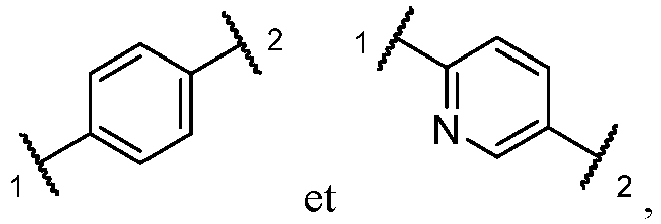 dans lequel le cycle A est optionnellement substitué avec 1 ou 2 substituants en plus de R2, chaque substituant optionnel étant sélectionné indépendamment parmi des groupes cyano, halo, méthyle et -OCHF2.
 - Composé selon l'une quelconque des revendications 1 à 3 ou sel pharmaceutiquement acceptable de celui-ci, dans lequel R1 est sélectionné parmi des groupes -C(O)-(alkyle C1-C3), alkyle C1-C3, -O-(alkyle C1-C5), -NH(alkyle C1-C5), -N(alkyle C1-C4)2, -NH-(cycloalkyle C3-C6), cycloalkyle C3-C6, -O-(cycloalkyle C3-C6), -O-(alkylène C1-C3)-(cycloalkyle C3-C6), -(alkylène C1-C3)-(cycloalkyle C3-C6), -O-(alkylène C0-C3)-(hétérocyclyle contenant O), -NH-(alkylène C0-C3)-(hétérocyclyle contenant O), hétérocyclyle contenant O, hétérocyclyle contenant N, -O-(alkylène C0-C3)-(hétérocyclyle contenant N), -S-(alkylène C0-C3)-(hétérocyclyle contenant O), -NH-O-(alkyle C1-C3) et -NH-phényle, n'importe quelle partie alkyle, cycloalkyle, phényle ou hétérocyclyle de R1 étant optionnellement substituée avec 1, 2, ou 3 substituants sélectionnés indépendamment parmi un atome de deutérium et des groupes halo, cyano, acétyle, alkyle C1-C4, haloalkyle C1-C4, -O- alkyle C1-C4, alkylène C1-C4-O-alkyle C1-C4, hétéroaryle, phényle, cycloalkyle, -COOH et hydroxy, chacun desdits groupes hétéroaryle, phényle et cycloalkyle étant optionnellement substitué avec un ou plusieurs de groupes halo, ORc, -NO2, cyano, NRcC(=O)Rc, NRdRe, -S(O)kRc, C(=O)ORc, C(=O)NRdRe, C(=O)Rc, alkyle C1-C6, haloalkyle C1-C6 ou hétéroalkyle C1-C6, ou R1, conjointement avec n'importe quel atome cyclique dans la fraction pipérazine selon la formule (I), forme un cycle carbocyclyle ou hétérocyclyle condensé avec la fraction pipérazine,
et/ou
dans lequel R1 est sélectionné parmi des groupes 1-(3-chlorophényl)cyclopropyle, 1-(3-fluorophényl)cyclopropyle, 1-acétylcyclopropyle, 1-cyclopropylcyclopropyle, 1-difluorométhylcyclopropyle, 1-fluorocyclopropyle, 1-méthylpropylamino1-pyridin-3 - ylcyclopropyle, 1-thiazol-2-ylcyclopropyle, 1-thién-2-ylcyclopropyle, 1-trifluorométhylcyclopropyle, 2-(4-chlorophényl)cyclopropyle, 2,2,2-trifluoroéthoxy, 2,2-difluorocyclopropyle, 2,2-diméthylcyclopropyle, 2-cyanocyclopropyle, 2-cyanoéthyle, 2-cyanoéthylamino-2-cyclobutylcyclopropyle, 2-fluorocyclopropyle, 2-fluoroéthoxy, 2-hydroxyéthylamino, 2-méthoxyéthoxy, 2-méthylcyclopropyle, 2-oxa-6-azaspiro[3.3]heptan-6-yle, 3,3-difluorocyclobutyle, 3-cyanoazétidin-1-yle, 3-cyanocyclobutyle, 3-fluorocyclobutyle, 3-hydroxy-3-méthylcyclobutyle, 3-hydroxy-3-trifluorométhylcyclobutyle, 3-hydroxyazétidin-1-yle, 3-hydroxycyclobutyle, 3-méthoxyazétidin-1-yle, 3-méthoxyméthylazétidin-1-yle, 3-phényl-3-hydroxycyclobutyle, 4-cyanocyclohexyle, 4-cyanoypipéridin-1-yle, 4-hydroxy-4-méthylcyclohexyle, 4-hydroxycyclohexyle, 4-hydroxypipéridin-1-yle, 4-méthylcyclohexyle, acétyle, azétidin-1-yle, cyclobutoxy, cyclobutyle, cyclobutylamino, cyclopentylamino, cyclopropyle, cyclopropylméthyle, diéthylamino, éthoxy, éthyle, éthylamino, isobutoxy, isopropoxy, isopropyle, isopropylamino, méthoxyméthyle, N-éthyl-N-méthylamino, pentylamino, pipéridin-1-yle, propylamino, propyloxypyrrolidin-1-yle et t-butylamino, t-butoxy, 2,2-diméthylpropoxy, 2,2-difluoroéthoxy, N-(2,2-diméthylpropyl)amino, N-(1,2-diméthylpropyl)amino, 2,2,2-trifluoroéthylamino, N-(méthoxyméthyl)amino, oxétan-3-yloxy, oxétan-3-yle, oxétan-3-ylamino, oxétan-3-ylméthoxy, N-(oxétan-3-ylméthyl)amino, tétrahydrofuran-3-yloxy, tétrahydropyran-4-yloxy, 3-cyanocyclobutoxy, 1,3-dihydroxypropan-2-yloxy, 1-acétylazétidin-3-yloxy, 1-hydroxy-2-hydroxycarbonyléthan-2-yloxy, 1-méthyl-2-fluoroéthoxy, 2,2-difluoroéthylamino, 2-cyanoéthan-1-yloxy, 2-fluoroéthylamino, 2-fluorophénylamino, 2-fluoropropoxy, 2-méthyloxétan-3-yloxy, 3-cyano-oxétan-3-yloxy, 3 -deutéro-oxétan-3 -yloxy, 6-oxa-1-azaspiro[3.3]heptan-1-yle, cyclopropoxy, éthoxyamino, oxétan-3-ylthio, perdeutéroéthoxy, phénylamino, tétrahydrofuran-2-yloxy et tétrahydrofuran-3-yle, ou
R1, conjointement avec un atome cyclique dans la fraction pipérazine, forme un groupe 6-oxohexahydropyrrolo[1,2-a]pyrazin-2-yle ou 2-éthyl-3-oxohexahydroimidazo[1,5-a]pyrazin-7-yle. - Composé selon l'une quelconque des revendications 1 à 4 ou sel pharmaceutiquement acceptable de celui-ci, dans lequel R2 est sélectionné parmi des groupes halo, cycloalkyle, hétérocyclyle, -O-(alkylène C0-C4)-(hétérocyclyle), -(alkylène C1-C3)-hétérocyclyle, -(alkylène C1-C3)-NH-(alkyl C1-C3), -(alkylène C1-C3 à substitution hydroxy)-NH-(alkyle C1-C3), alkyle C1-C4 substitué à la fois avec un groupe hydroxy et un ou plusieurs de groupes amino, alkylamino C1-C4 ou di-alkylamino C1-C4 alkyle C1-C4 à substitution cyano, hydroxy, -S(O)2-alkyle C1-C4 et -(alkylène C1-C3 à substitution amino)-hétérocyclyle, ou R2, conjointement avec un atome cyclique dans le cycle A, forme un groupe hétérocyclyle ou un groupe carbocyclyle qui est condensé avec le cycle A, n'importe quel groupe hétérocyclyle ou carbocyclyle étant optionnellement substitué avec 1, 2 ou 3 substituants sélectionnés indépendamment parmi des groupes halo, cyano, hydroxy, -NH2, - NH(alkyle C1-C4), -NH-C(O)-O-(alkyle C1-C4), =O, -C(O)-alkyle C1-C4, -alkyle C1-C4, alkyle C1-C4 deutéré, -haloalkyle C1-C4, -alkyle C1-C4 à substitution hydroxy, -O-alkyle Ci-C4, -O-haloalkyle C1-C4, -(alkylène C1-C4)-O-(alkyle C1-C4), -(alkylène C1-C4 à substitution amino)-O-(alkyle C1-C4), -(alkylène C1-C4)-O-(haloalkyle C1-C4), -C(O)-O-alkyle C1-C4, - COOH, cycloalkyle C3-C6, hétérocyclyle et -NH-hétérocyclyle, chacun desdits groupes hétérocyclyle étant optionnellement substitué avec un ou plusieurs de groupes halo, ORc, -NO2, cyano, -NRcC(=O)Rc, -NRdRe, -S(O)kRc, -C(=O)ORc, -C(=O)NRdRe, -C(=O)Rc, alkyle C1-C6, haloalkyle C1-C6, ou hétéroalkyle C1-C6,
et/oudans lequel R2 est sélectionné parmi des groupes 1-(1-hydroxypropan-2-yl)-4-méthoxypipéridin-4-yle, 1-(3 -difluorométhoxy)propan-2-yl-4-méthoxypipéridin-4-yle, 1-(3-méthoxy)propan-2-yl-4-méthoxypipéridin-4-yle, 1-(oxétan-3-yl)-4-méthoxypipéridin-4-yle, 1-(oxétan-3-yl)pipéridin-4-yle, 1-(propan-2-yl)pipéridin-3-yle, 1-(propan-2-yl)pipéridin-4-yle, 1-(pyrrolidin-1-yl)éthan-1-yle, 1,2,3,6-tétrahydropyridin-4-yle, 1,4-diazabicyclo[4.2.0]octan-4-yle, 1-acétylpipéridin-4-yle, 1-cyclobutylpipéridin-3-yle, 1-éthyl-3,3-difluoropipéridin-4-yle, 1-éthyl-3-fluoropipéridin-4-yle, 1-éthyl-3-hydroxyazétidin-3-yle, 1-éthyl-4-fluoropyrrolidin-3-yle, 1-éthylazétidin-3-yle, 1-éthylazétidin-3-yloxy, 1-éthylpipéridin-3-yle, 1-éthylpipéridin-3-yloxy, 1-éthylpipéridin-4-yle, 1-éthylpipéridin-4-yloxy, 1-éthylpyrrolidin-3-yle, 1-éthylpyrrolidin-3-ylméthoxy, 1-éthylpyrrolidin-3-yloxy, 1H-pyrrolidin-2-yle, 1-hydroxy-2-aminoprop-2-yle, 1-isopropyl-1,2,3,6-tétrahydropyridin-4-yle, 1-isopropyl-2-méthylpyrrolidin-2-yle, 1-isopropyl-3,4-diméthylpipérazin-3 -yle, 1-isopropyl-3-éthoxypipéridin-3-yle, 1-isopropyl-3-fluoropipéridin-3-yle, 1-isopropyl-3-hydroxyazétidin-3-yle, 1-isopropyl-3-hydroxypipéridin-3-yle, 1-isopropyl-3-hydroxypyrrolidin-3-yle, 1-isopropyl-3-méthoxyazétidin-3-yle, 1-isopropyl-3-méthoxypipéridin-3-yle, 1-isopropyl-3-méthoxypyrrolidin-3-yle, 1-isopropyl-3-méthylpipérazin-3-yle, 1-isopropyl-4-cyanopipéridin-4-yle, 1-isopropyl-4-éthoxypipéridin-4-yle, 1-isopropyl-4-fluoropipéridin-4-yle, 1-isopropyl-4-fluoropyrrolidin-3-yle, 1-isopropyl-4-hydroxypipéridin-3-yle, 1-isopropyl-4-hydroxypipéridin-4-yle, 1-isopropyl-4-méthoxypipéridin-4-yle, 1-isopropyl-4-méthylpipérazin-3-yle, 1-isopropyl-4-méthylpipéridin-4-yle, 1-isopropyl-4-trifluorométhylpipéridin-4-yle, 1-isopropyl-5-méthylpyrrolidin-3-yle, 1-isopropylazétidin-2-ylméthoxy, 1-isopropylazétidin-3-yle, 1-isopropylazétidin-3-ylméthoxy, 1-isopropylazétidin-3-yloxy, 1-isopropylpipérazin-3-yle, 1-isopropylpipérazin-4-yle, 1-isopropylpipéridin-2-yle, 1-isopropylpipéridin-3-yle, 1-isopropylpipéridin-4-yle, 1-isopropylpyrrolidin-2-yle, 1-isopropylpyrrolidin-3-yle, 1-méthyl-1-cyanoéthyle, 1-sec-butylpipéridin-4-yle, 1-t-butoxycarbonyl-4-aminopipéridin-4-yle, 2-(isopropylamino)-3-hydroxypropan-2-yle, 2-(isopropylamino)-propan-2-yle, 2,3,5,6-tétrahydroimidazo[2,1-b]thiazol-6-yle, 2,6-diazaspiro[3.3]heptan-2-yle, 2,6-diazaspiro[3.4]octan-2-yle, 2,6-diazaspiro[3.4]octan-6-yle, 2,7-diazaspiro[4.4]nonan-2-yle, 2-difluorométhylpipérazin-1-yle, 2-isopropyl-2,6-diazaspiro[3.3]heptan-6-yle, 2-méthyl-1H-pyrrolidin-2-yle, 2-oxa-5,8-diazaspiro[3.5]nonan-8-yle, 2-oxo-4-éthylpipérazin-1-yle, 2-oxopipérazin-1-yle, 2-trifluorométhylpipérazin-1-yle, 3,3-difluoropipéridin-4-yle, 3,3-diméthyl-4-éthylpipérazin-1-yle, 3-aminopyrrolidin-1-yle, 3-fluoropipéridin-3-yle, 3-fluoropipéridin-4-yle, 3-hydroxyazétidin-3-yle, 3-hydroxyquinuclidin-3-yle, 3-méthyl-4-éthylpipérazin-1-yle, 3-méthylpipérazin-1-yle, 3-trifluorométhylpipérazin-1-yle, 4-(1,1,2,2,2-pentadeutéroéthyl)pipérazin-1-yle, 4-(2,2-difluoroéthyl)pipérazin-1-yle, haloalkyle4-(2-hydroxyéthyl)pipérazin-1-yle, 4-(2-méthoxyéthyl)pipérazin-1-yle, 4-(méthoxycarbonylamino)pipéridin-4-yle, 4-(oxétan-3-yl)pipérazin-1-yle, 4,5-dihydro-1H-imidazol-2-yle, 4,5-dihydro-1H-imidazol-2-ylamino, 4-aminopipéridin-1-yle, 4-cyanopipéridin-4-yle, 4-éthoxypipéridin-4-yle, 4-éthylmorpholin-2-yle, 4-éthylpipérazin-1-yle, 4-éthylpipérazin-1-yléthoxy, 4-fluoropipéridin-4-yle, 4-fluoropyrrolidin-3-yle, 4-hydroxy-tétrahydro-2H-pyran-4-yle, 4-isopropylmorpholin-3-yle, 4-isopropylpipérazin-1-yle, 4-méthoxypipéridin-4-yle, 4-méthylpipérazin-1-yle, 4-méthylpipéridin-4-yle, 5,5-difluoropipéridin-3-yle, 5-éthyl-2,5-diazabicyclo[2.2.1]heptan-2-yle, 6-éthyl-2,6-diazaspiro[3.3]heptan-2-yle, 6-isopropyl-2,6-diazaspiro[3.3]heptan-2-yle, 6-méthylmorpholin-2-yle, azétidin-2-ylméthoxy, azétidin-3-yle, bromo, cyclopentyle, hexahydropyrazino[2,1-c][1,4]oxazin-8(1H)-yle, hexahydropyrrolo[1,2-a]pyrazin-2(1H)-yle, morpholin-2-yle, morpholin-3-yle, octahydro-2H-pyrido[1,2-a]pyrazin-2-yle, pipérazin-1-yle, pipérazin-1-yléthoxy, pipéridin-4-yle, pipéridin-2-yle, pipéridin-3-yle, pipéridin-3-yloxy, pipéridin-4-yloxy, pyrrolidin-2-yle, pyrrolidin-3-yle, pyrrolidin-3-ylméthoxy, pyrrolidin-3-yloxy, quinuclidin-4-yle, tétrahydro-2H-pyran-4-yle, 1-(1-fluoropropan-2-yl)-4-éthoxypipéridin-4-yle, 1-(1-fluoropropan-2-yl)-4-méthoxypipéridin-4-yle, 1-(2-fluoropropyl)-4-éthoxypipéridin-4-yle, 1-(2-fluoropropyl)-4-éthoxypipéridin-4-yle, 1-(3-(difluorométhoxy)propan-2-yl)-4-méthoxypipéridin-4-yle, 1-(oxétan-3 -yl)-4-éthoxypipéridin-4-yle, 1-(tétrahydrofuran-2-yl)-1-aminométhyle, 1-amino-2-hydroxy-2-méthylpropyle, 1-amino-2-méthoxyéthyle, 1-azabicyclo[2.2.1]heptan-4-yle, 1-cyclopropyl-4-éthoxypipéridin-4-yle, 1-diéthylamino-2-hydroxyéthyle, 1-éthylamino-2-hydroxyéthyle, 1-isopropyl-4-difluorométhoxypipéridin-3-yle, 1-isopropyl-4-difluorométhoxypipéridin-4-yle, 1-isopropyl-4-hydroxyméthylpipéridin-4-yle, 1-isopropyl-4-méthoxycarbonylpipéridin-4-yle, 1-isopropyl-4-(méthoxyméthyl)pipéridin-4-yle, 1-isopropyl-4-méthoxypipéridin-4-yle, 1-méthyl-1-isopropylamino-2-hydroxyéthyle, 2,2,5,5-tétraméthyl-4-hydroxypipéridin-4-yle, 2,2-diméthyl-4-méthoxypipéridin-4-yle, 2-amino-1-hydroxyéthyle, 2-amino-3-hydroxypropyle, 2-azaspiro[3.3]heptan-6-yle, 2-hydroxy-1-aminoéthyle, 2-hydroxy-1-isopropylaminoéthyle, 2-hydroxyéthylaminométhyle, 3-amino-oxétan-3-yle, 3-éthoxypipéridin-3-yle, 3-méthoxypipéridin-3-yle, 4-amino-tétrahydropyran-4-yle, 4-éthoxytétrahydropyran-4-yle, 4-hydroxycarbonylpipéridin-4-yle, 4-hydroxyméthylpipéridin-4-yle, 4-méthoxycarbonylpipéridin-4-yle, 4-méthoxytétrahydropyran-4-yle, 4-trifluorométhylpipéridin-4-yle, éthylsulfonyle et oxétan-3-ylaminométhyle, ouR2, conjointement avec le cycle A, forme un groupe 3'H-spiro[azétidine-3,1'-isobenzofuran]-5'-yle, 6-isopropyl-4,5,6,7-tétrahydrothiéno[2,3-c]pyridin-2-yle, 4,5,6,7-tétrahydrothiazolo[4,5-c]pyridin-2-yle, 4,5,6,7-tétrahydrothiazolo[5,4-c]pyridin-2-yle, 5,6,7,8-tétrahydroimidazo[1,5-a]pyrazin-3-yle, 7-méthyl-5,6,7,8-tétrahydroimidazo[1,5-a]pyrazin-3-yle, 4,5,6,7-tétrahydrothiéno[2,3-c]pyridin-2-yle, 5-isopropyl-4,5,6,7-tétrahydrothiazolo[5,4-c]pyridin-2-yle, 1-amino-2,3-dihydro-1H-indén-5-yle, ou 1-(isopropylamino)-2,3-dihydro-1H-indén-5-yle. - Composé selon la revendication 1 ou sel pharmaceutiquement acceptable de celui-ci, le composé étant un composé selon la formule (II):
 X est un groupe C(R13) ou N;R11 est sélectionné parmi un groupe -NH-(cycloalkyle C3-C4); un groupe -NH-alkyle C1-C3; un groupe -O-cycloalkyle C3-C4; un groupe -O-alkyle C1-C3 optionnellement substitué avec un ou plusieurs substituants sélectionnés parmi des groupes fluoro, hydroxy, cyano et un atome de deutérium; et un groupe -O-(hétérocycle contenant O);R12 est sélectionné parmi:un groupe pipéridin-3-yle optionnellement substitué en position 3 avec un groupe alcoxy C1-C3, fluoro, alkyle C1-C3, ou cyano; etun groupe pipéridin-4-yle optionnellement substitué en position 4 avec un groupe alcoxy C1-C3, fluoro, alkyle C1-C3, cyano,dans lequel R12 est en outre optionnellement substitué en position 1 avec un groupe alkyle C1-C5 optionnellement substitué avec un ou plusieurs groupes hydroxy et/ou un ou plusieurs groupes -NH2;R13 est sélectionné parmi un atome d'hydrogène et des groupes cyano et fluoro; etR14 est un groupe fluoro,
 - Composé selon la revendication 6, ou sel pharmaceutiquement acceptable de celui-ci, le composé étant:(A) un composé selon la formule (IIa):
 X est un groupe C(R13) ou N;R11 est sélectionné parmi un groupe -NH-(cycloalkyle C3-C4); un groupe -NH-alkyle C1-C3; un groupe -O-cycloalkyle C3-C4; un groupe -O-(alkyle C1-C3) optionnellement substitué avec un ou plusieurs substituants sélectionnés parmi des groupes fluoro, hydroxy, cyano et un atome de deutérium; et un groupe -O-(hétérocycle contenant O);R13 est sélectionné parmi un atome d'hydrogène et des groupes cyano et fluoro,R14 est un groupe fluoro,R15 est sélectionné parmi un atome d'hydrogène et des groupes alcoxy C1-C3, fluoro, alkyle C1-C3 et cyano; etR16 est un atome d'hydrogène ou un groupe alkyle C1-C5 optionnellement substitué avec un ou plusieurs groupes hydroxy et/ou un ou plusieurs groupes -NH2; ou(B) un composé selon la formule (IIb):
 X est un groupe C(R13) ou N;R11 est sélectionné parmi un groupe -NH-(cycloalkyle C3-C4); un groupe -NH-alkyle C1-C3; un groupe -O-cycloalkyle C3-C4; un groupe -O-(alkyle C1-C3) optionnellement substitué avec un ou plusieurs substituants sélectionnés parmi des groupes fluoro, hydroxy, cyano et un atome de deutérium; et un groupe -O-(hétérocycle contenant O);R13 est sélectionné parmi un atome d'hydrogène et des groupes cyano et fluoro,R14 est un groupe fluoro,R15 est sélectionné parmi un atome d'hydrogène et des groupes alcoxy C1-C3, fluoro, alkyle C1-C3 et cyano; etR16 est un atome d'hydrogène ou un groupe alkyle C1-C5 optionnellement substitué avec un ou plusieurs groupes hydroxy et/ou un ou plusieurs groupes -NH2,optionnellement dans lequel le composé selon la formule IIb est soit un composé selon la formule (IIb-1):
soit un composé selon la formule (IIb-2):
- Composé selon la revendication 6 ou la revendication 7 ou sel pharmaceutiquement acceptable de celui-ci, dans lequel:R14 est absent; ouR13 est un atome d'hydrogène; ouR11 est sélectionné parmi un groupe -NH-alkyle C1-C3; un groupe -O-alkyle C1-C3 optionnellement substitué avec un ou plusieurs substituants sélectionnés parmi des groupes fluoro, hydroxy, cyano et un atome de deutérium; un groupe oxétan-3-yloxy et un groupe tétrahydrofuran-3-yloxy, R11 étant optionnellement sélectionné parmi des groupes - OCH2CH3, -NHCH(CH3)2, oxétan-3-yloxy et tétrahydrofuran-3-yloxy.
- Composé selon la revendication 1, le composé étant sélectionné parmi l'un quelconque des composés suivants:


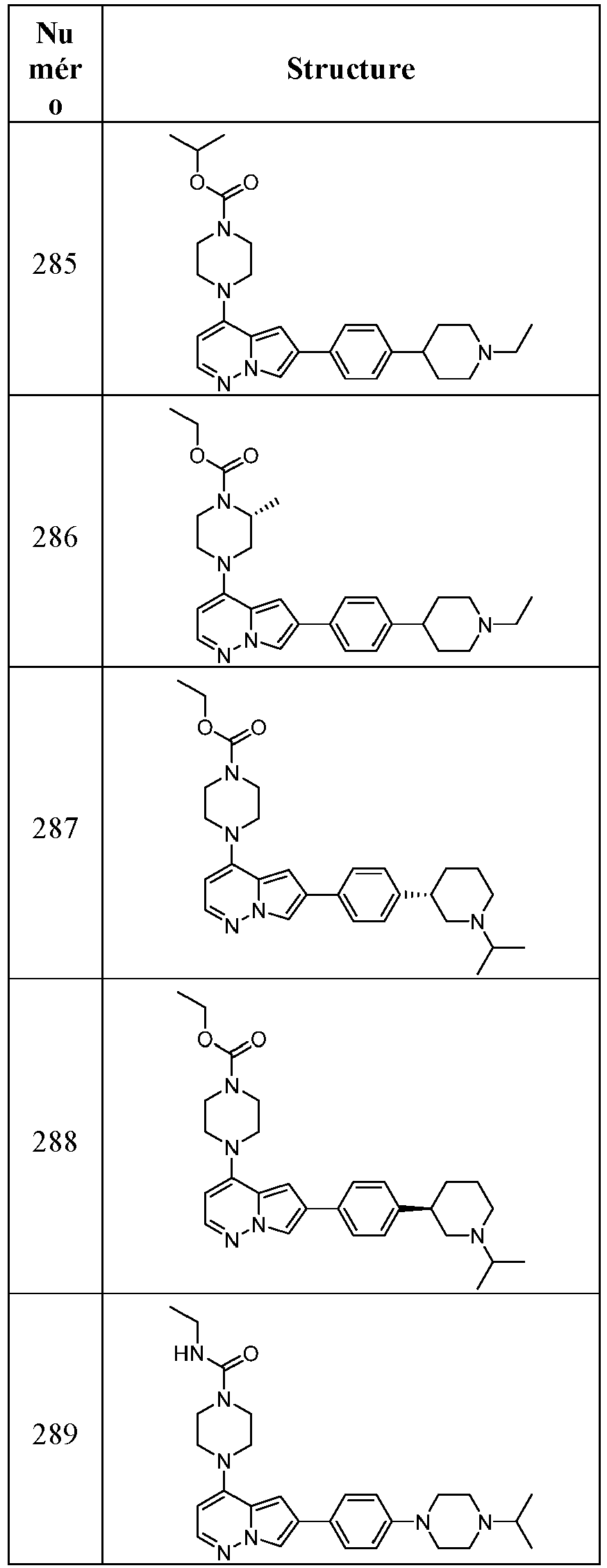


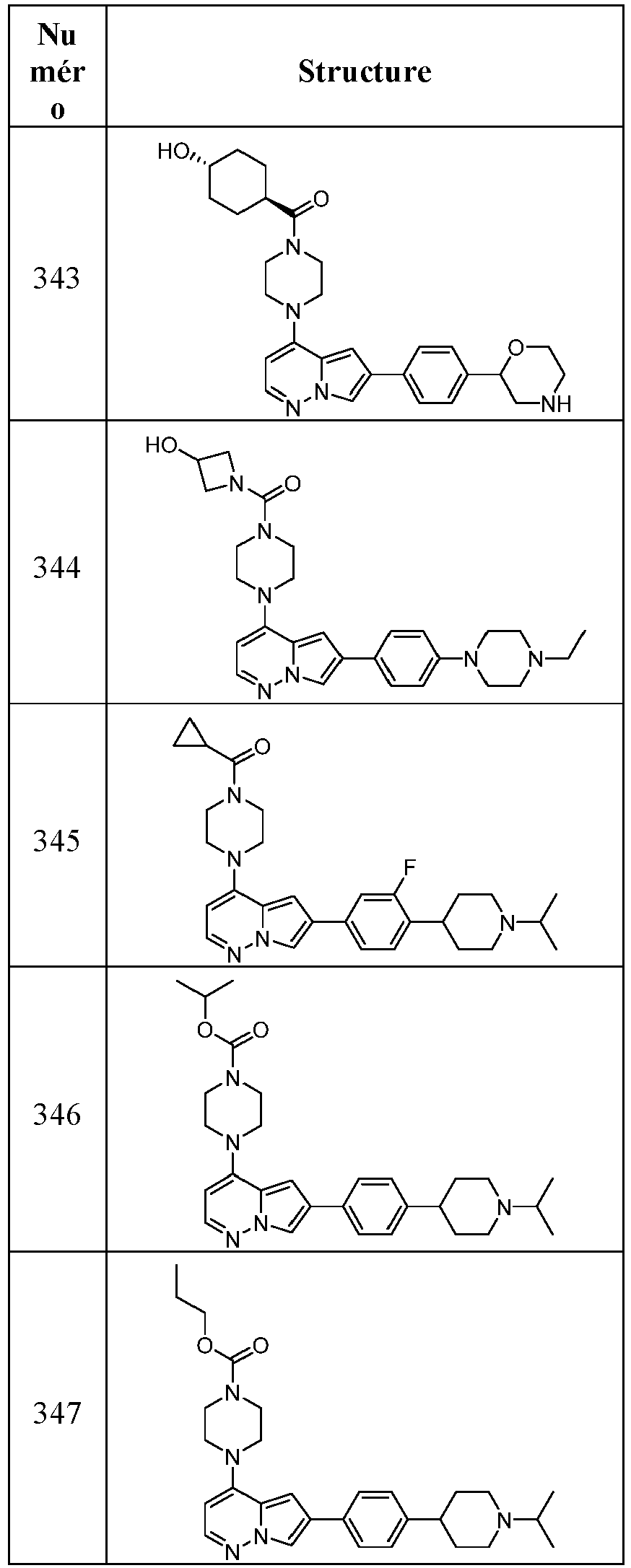


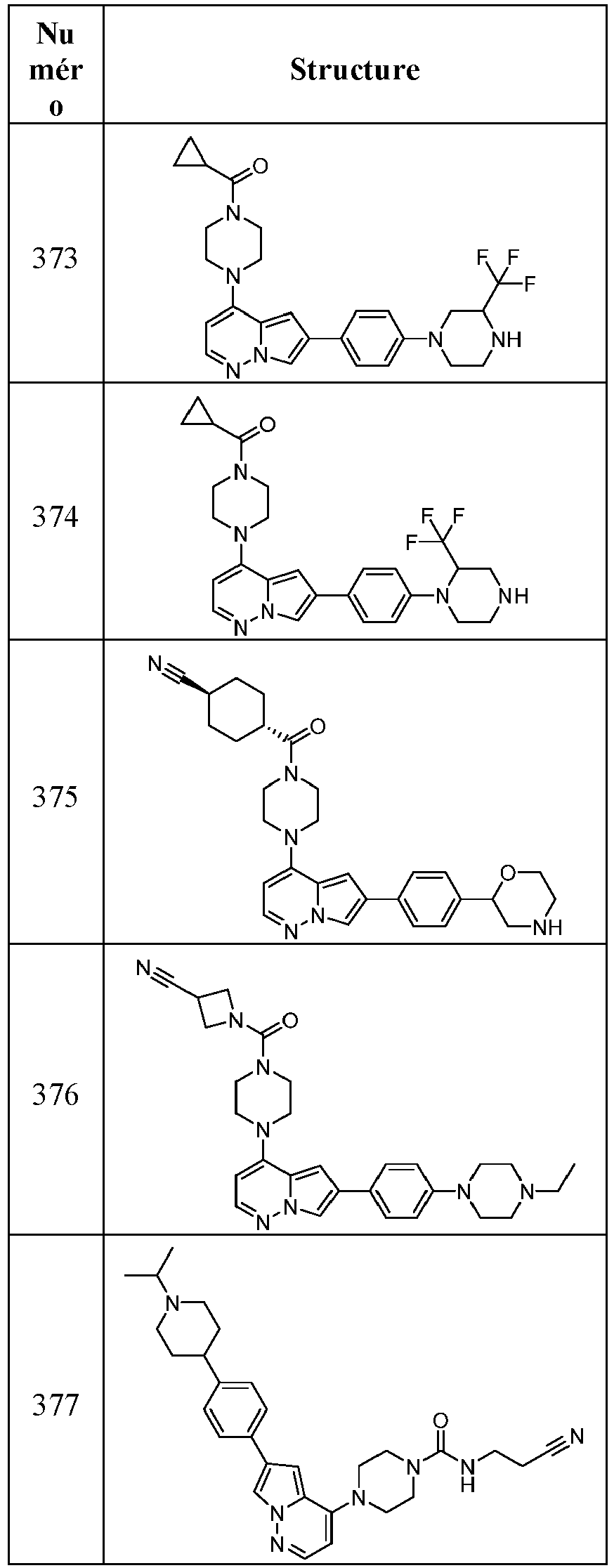


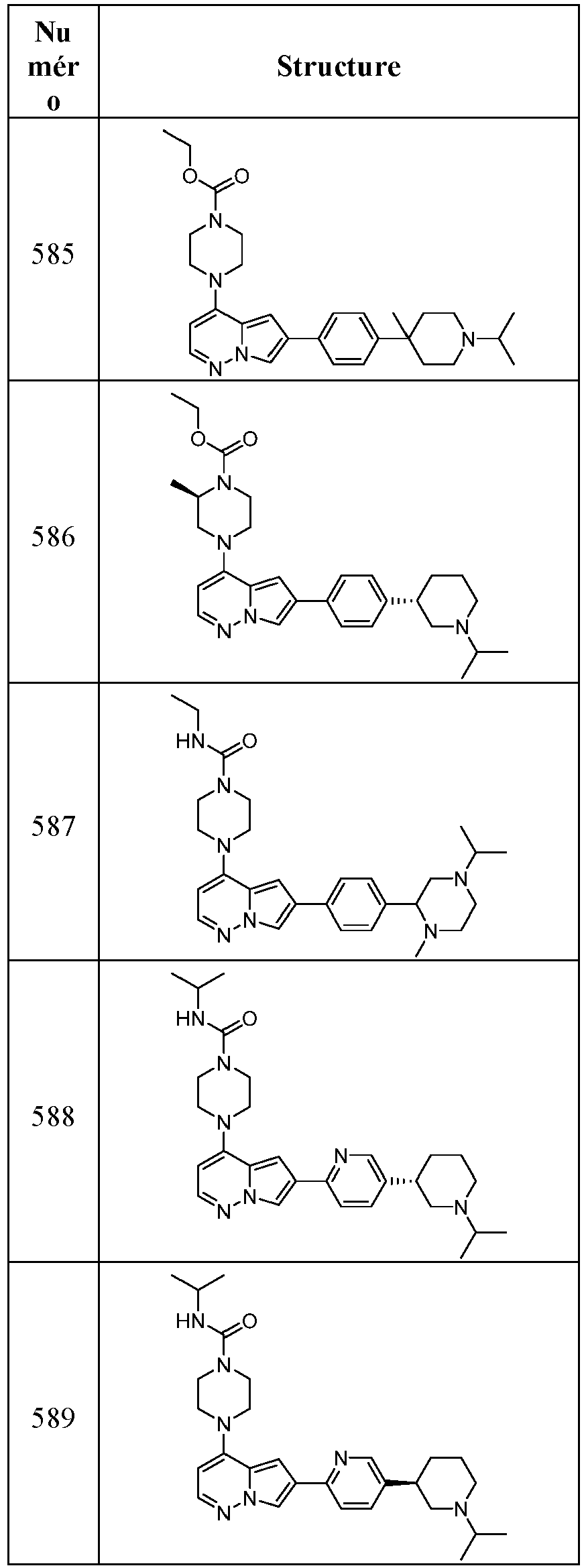


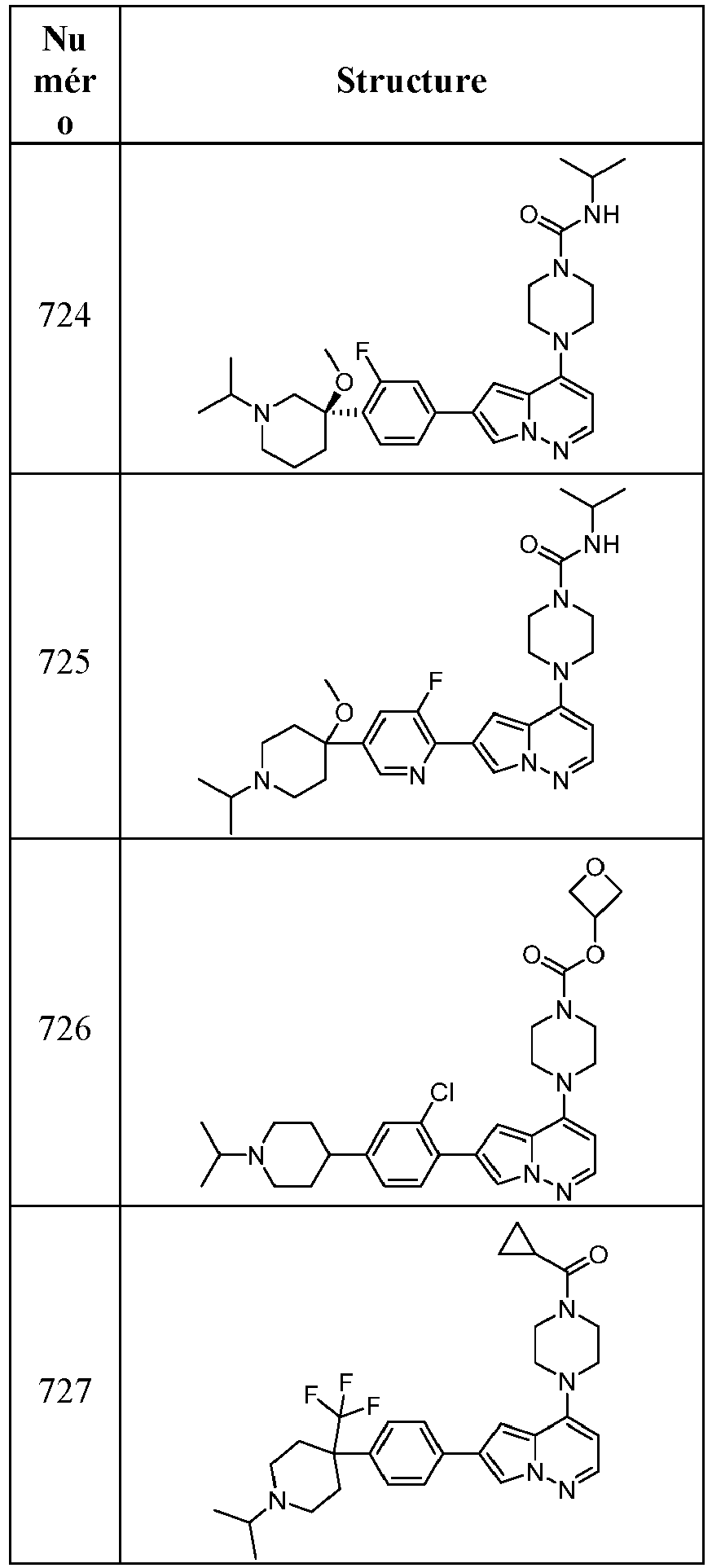


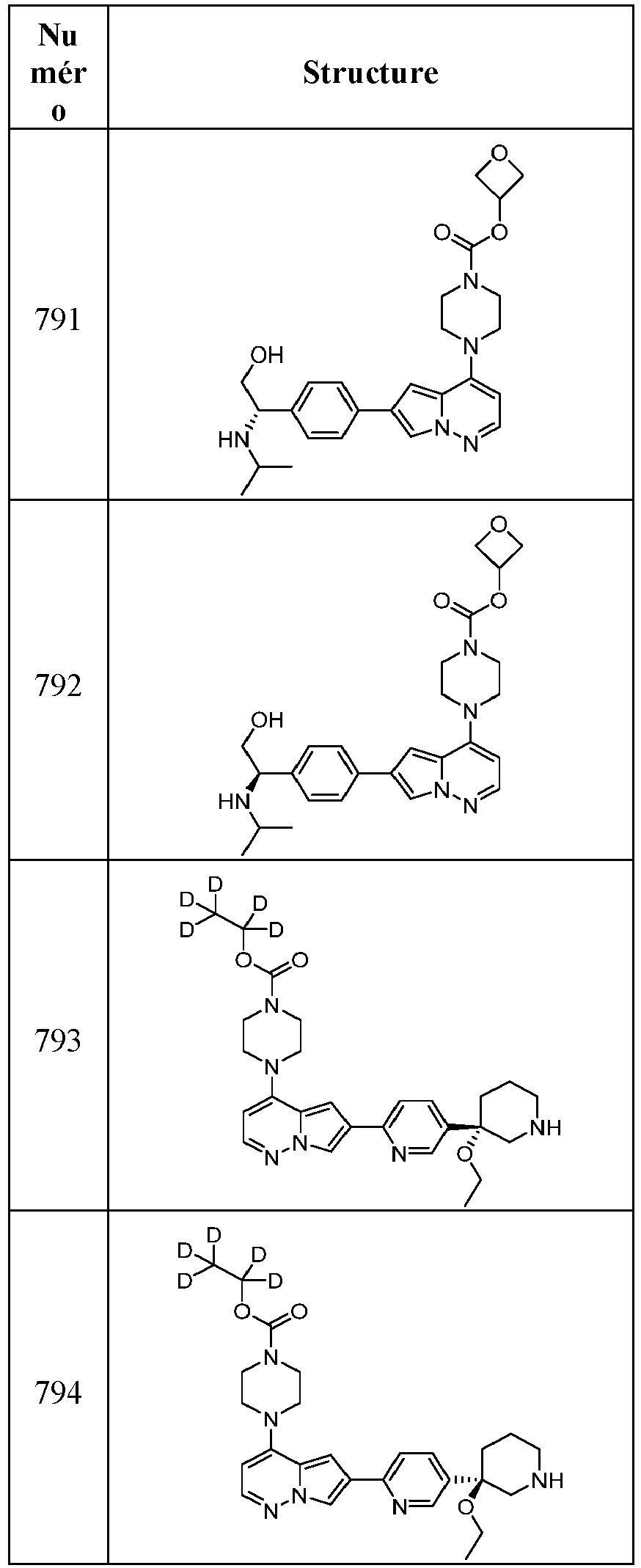
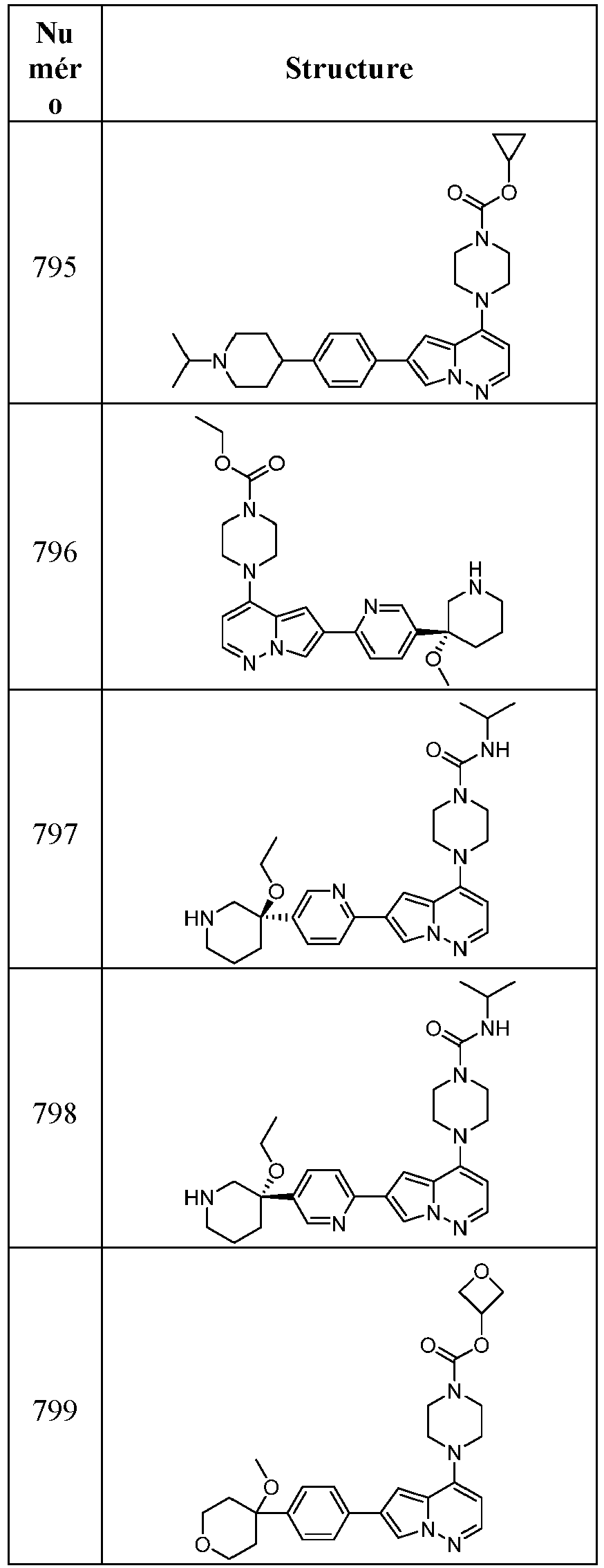


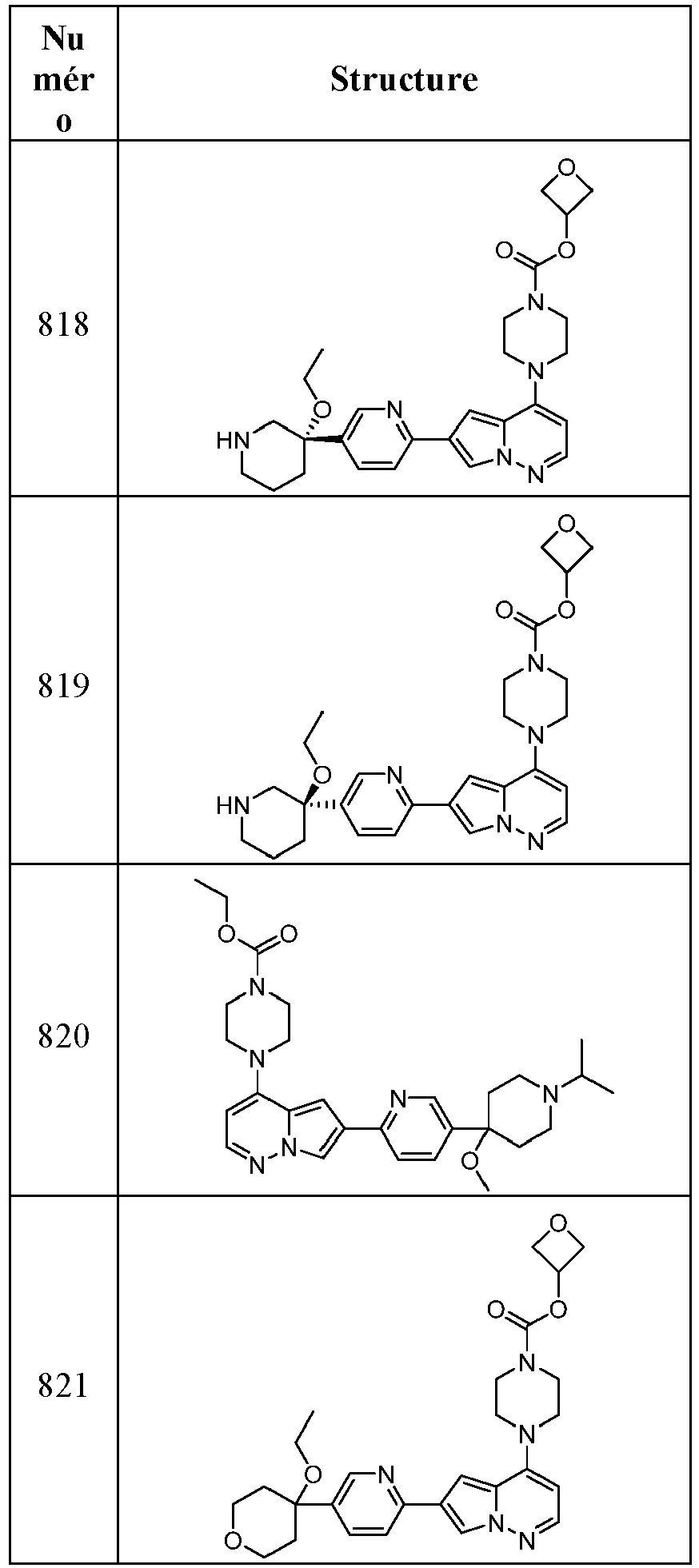


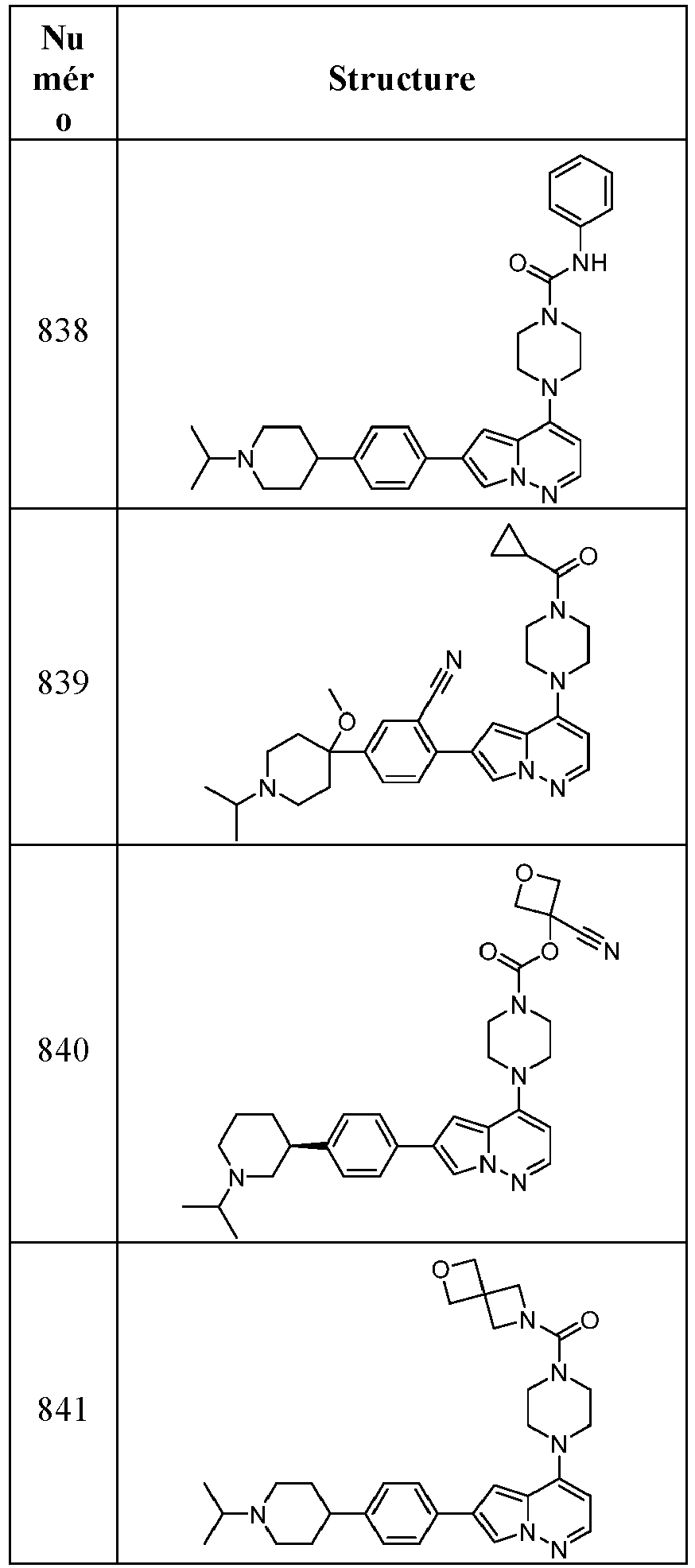


 ou sel pharmaceutiquement acceptable de celui-ci.
- Composé selon la revendication 1, le composé étant selon la formule suivante:

- Composition pharmaceutique, comprenant au moins un composé selon l'une quelconque des revendications 1 à 10 ou un sel pharmaceutiquement acceptable de celui-ci et un support pharmaceutiquement acceptable.
- Composé qui est le 6-halo-pyrrolo[1,2-b]pyridazin-4-ol, dans lequel le groupe halo est sélectionné parmi Cl, I et Br, en particulier le 6-bromopyrrolo[1,2-b]pyridazin-4-ol, le composé ayant optionnellement une pureté supérieure à 90%.
- Procédé de synthèse d'un composé selon la revendication 12, comprenant l'étape qui consiste à combiner un composé selon la formule C-1:

R23-O-NH2 (D-1),
dans lequel:R21 est un groupe chloro, bromo ou iodo, et est préférablement un groupe bromo;R22 est un groupe partant sélectionné préférablement parmi -N(R24)(R25) et - OR24, chacun de R24 et R21 étant indépendamment un groupe alkyle C1-C4, et étant plus préférablement un groupe -N(CH3)2; etR23 est un groupe soustracteur d'électrons sélectionné préférablement parmi des groupes méthylcarbonyle, t-butylcarbonyle, 4-nitrophénylcarbonyle, 4-cyanophénylcarbonyle, 4-trifluorométhylphénylcarbonyle, 4-fluorophénylcarbonyle, 4-trifluorométhylcarbonylphénylcarbonyle, 4-éthoxycarbonylphénylcarbonyle, 4-trifluorométhylsulfonylphénylcarbonyle, 2,4,6-triméthylphénylcarbonyle, 2,4,6-triméthyl-3,5-dinitrophénylcarbonyle, 2-trifluorométhyl-4-nitrophényle, 2,4-dinitrophényle et diphénylphosphinyle, et est plus préférablement un groupe 4-nitrophénylcarbonyle. - Procédé selon la revendication 13, dans lequel le composé selon la formule C-1 et le composé selon la formule D-1 sont dissous dans un solvant polaire, ledit solvant polaire étant préférablement sélectionné parmi la N-méthyl-2-pyrrolidine (NMP), le N,N-diméthylacétamide (DMAC), le diméthylformamide (DMF), le tétrahydrofurane (THF), le méthyl-tétrahydrofurane (MeTHF), le diméthylsulfoxyde (DMSO) et l'éther cyclopentylméthylique (CPME), et étant sélectionné plus préférablement parmi la NMP et le DMAC.
- Procédé selon la revendication 13, dans lequel le composé selon la formule C-1 est traité avec une base, ladite base étant préférablement sélectionnée parmi KOC(CH3)3, NaOC(CH3)3, LiOC(CH3)3, LiC(CH3)3, Li(CH2)3CH3, LiN(C3H7)2, NaOCH3, NaOCH2CH3, KOCH3, LiOCH3, LiOCH2CH3 et KOCH2CH3, et étant plus préférablement KOC(CH3)3.
- Procédé selon la revendication 13, le procédé comprenant en outre l'ajout d'un agent de protonation, ledit agent de protonation étant préférablement sélectionné parmi NH4Cl, NaHCO3, KHCO3, LiHCO3, l'acide acétique, HCl, HBr et H2SO4, et étant plus préférablement NH4Cl.
- Composé destiné à une utilisation dans une méthode de traitement ou d'amélioration d'une fibrodysplasie ossifiante progressive chez un sujet, comprenant l'étape qui consiste à administrer au sujet qui en a besoin une quantité pharmaceutiquement efficace d'au moins un composé selon l'une quelconque des revendications 1 à 10 ou un sel pharmaceutiquement acceptable de celui-ci ou une composition pharmaceutique selon la revendication 11,
le sujet présentant optionnellement une mutation dans un gène ALK2 qui entraîne l'expression d'une enzyme ALK2 comportant une modification d'acide aminé sélectionnée parmi une ou plusieurs de L196P, PF197-8L, R202I, R206H, Q207E, R258S, R258G, G328A, G328W, G328E, G328R, G356D et R375P, par exemple l'enzyme ALK2 comportant la modification d'acide aminé R206H. - Composé destiné à une utilisation dans une méthode de traitement ou d'amélioration d'un gliome pontique intrinsèque diffus chez un sujet, comprenant l'étape qui consiste à administrer au sujet qui en a besoin une quantité pharmaceutiquement efficace d'au moins un composé selon l'une quelconque des revendications 1 à 10 ou un sel pharmaceutiquement acceptable de celui-ci ou une composition pharmaceutique selon la revendication 11,
le sujet présentant optionnellement une mutation dans un gène ALK2 qui entraîne l'expression d'une enzyme ALK2 comportant une modification d'acide aminé sélectionnée parmi une ou plusieurs de R206H, G328V, G328W, G328E et G356D, par exemple l'enzyme ALK2 comportant la modification d'acide aminé R206H.
Priority Applications (1)
| Application Number | Priority Date | Filing Date | Title |
|---|---|---|---|
| EP23181727.1A EP4285996A3 (fr) | 2016-04-15 | 2017-04-14 | Inhibiteurs du récepteur alk (« activin receptor-like kinase ») |
Applications Claiming Priority (3)
| Application Number | Priority Date | Filing Date | Title |
|---|---|---|---|
| US201662322948P | 2016-04-15 | 2016-04-15 | |
| US201662411172P | 2016-10-21 | 2016-10-21 | |
| PCT/US2017/027775 WO2017181117A1 (fr) | 2016-04-15 | 2017-04-14 | Inhibiteurs du récepteur alk (« activin receptor-like kinase ») |
Related Child Applications (1)
| Application Number | Title | Priority Date | Filing Date |
|---|---|---|---|
| EP23181727.1A Division EP4285996A3 (fr) | 2016-04-15 | 2017-04-14 | Inhibiteurs du récepteur alk (« activin receptor-like kinase ») |
Publications (2)
| Publication Number | Publication Date |
|---|---|
| EP3442977A1 EP3442977A1 (fr) | 2019-02-20 |
| EP3442977B1 true EP3442977B1 (fr) | 2023-06-28 |
Family
ID=59215888
Family Applications (2)
| Application Number | Title | Priority Date | Filing Date |
|---|---|---|---|
| EP17733108.9A Active EP3442977B1 (fr) | 2016-04-15 | 2017-04-14 | Inhibiteurs du récepteur alk (« activin receptor-like kinase ») |
| EP23181727.1A Withdrawn EP4285996A3 (fr) | 2016-04-15 | 2017-04-14 | Inhibiteurs du récepteur alk (« activin receptor-like kinase ») |
Family Applications After (1)
| Application Number | Title | Priority Date | Filing Date |
|---|---|---|---|
| EP23181727.1A Withdrawn EP4285996A3 (fr) | 2016-04-15 | 2017-04-14 | Inhibiteurs du récepteur alk (« activin receptor-like kinase ») |
Country Status (19)
| Country | Link |
|---|---|
| US (4) | US10233186B2 (fr) |
| EP (2) | EP3442977B1 (fr) |
| JP (1) | JP7017521B2 (fr) |
| KR (1) | KR102426043B1 (fr) |
| CN (1) | CN109311889B (fr) |
| AU (1) | AU2017250302B2 (fr) |
| CA (1) | CA3020870C (fr) |
| CL (1) | CL2018002945A1 (fr) |
| DK (1) | DK3442977T3 (fr) |
| ES (1) | ES2957233T3 (fr) |
| FI (1) | FI3442977T3 (fr) |
| HU (1) | HUE063042T2 (fr) |
| IL (1) | IL262345B (fr) |
| PH (1) | PH12018502205A1 (fr) |
| PL (1) | PL3442977T3 (fr) |
| PT (1) | PT3442977T (fr) |
| SG (1) | SG11201808907PA (fr) |
| WO (1) | WO2017181117A1 (fr) |
| ZA (2) | ZA201807256B (fr) |
Families Citing this family (41)
| Publication number | Priority date | Publication date | Assignee | Title |
|---|---|---|---|---|
| NZ703495A (en) | 2012-07-11 | 2018-02-23 | Blueprint Medicines Corp | Inhibitors of the fibroblast growth factor receptor |
| JP6433974B2 (ja) | 2013-03-14 | 2018-12-05 | トレロ ファーマシューティカルズ, インコーポレイテッド | Jak2およびalk2阻害剤およびその使用方法 |
| WO2014160521A1 (fr) | 2013-03-15 | 2014-10-02 | Blueprint Medicines Corporation | Dérivés de pipérazine et leur utilisation comme modulateurs de kit |
| LT3057969T (lt) | 2013-10-17 | 2018-07-10 | Blueprint Medicines Corporation | Kompozicijos, naudojamos gydyti sutrikimams, susijusiems su kit |
| DK3395814T3 (da) | 2013-10-25 | 2022-07-04 | Blueprint Medicines Corp | Hæmmere af fibroblastvækstfaktorreceptoren |
| WO2015108992A1 (fr) | 2014-01-15 | 2015-07-23 | Blueprint Medicines Corporation | Composés hétérobicycliques et leur utilisation en tant qu'inhibiteurs du récepteur fgfr4 |
| WO2016127074A1 (fr) | 2015-02-06 | 2016-08-11 | Blueprint Medicines Corporation | Utilisation de dérivés 2-(pyridine-3-yl)-pyrimidine en tant qu'inhibiteurs de ret |
| AU2016297754A1 (en) | 2015-07-24 | 2018-02-15 | Blueprint Medicines Corporation | Compounds useful for treating disorders related to KIT and PDGFR |
| CA2995997A1 (fr) | 2015-08-26 | 2017-03-02 | Blueprint Medicines Corporation | Composes et compositions utiles pour traiter des troubles associes au gene ntrk |
| NZ742351A (en) | 2015-11-02 | 2023-03-31 | Blueprint Medicines Corp | Inhibitors of ret |
| MX2018006195A (es) | 2015-11-19 | 2018-09-05 | Blueprint Medicines Corp | Compuestos y composiciones utiles para el tratamiento de trastornos relacionados con ntrk. |
| UY37155A (es) | 2016-03-17 | 2017-10-31 | Blueprint Medicines Corp | Inhibidores de ret |
| FI3442977T3 (fi) | 2016-04-15 | 2023-09-26 | Blueprint Medicines Corp | Aktiviinireseptorin kaltaisen kinaasin estäjät |
| ES2793239T3 (es) | 2016-04-15 | 2020-11-13 | Abbvie Inc | Inhibidores del bromodominio |
| WO2018017983A1 (fr) | 2016-07-22 | 2018-01-25 | Blueprint Medicines Corporation | Composés utiles pour traiter des troubles liés à ret |
| US10035789B2 (en) | 2016-07-27 | 2018-07-31 | Blueprint Medicines Corporation | Compounds useful for treating disorders related to RET |
| US11040979B2 (en) | 2017-03-31 | 2021-06-22 | Blueprint Medicines Corporation | Substituted pyrrolo[1,2-b]pyridazines for treating disorders related to KIT and PDGFR |
| WO2018195450A1 (fr) | 2017-04-21 | 2018-10-25 | Epizyme, Inc. | Thérapies d'association avec des inhibiteurs d'ehmt2 |
| CN109081828B (zh) * | 2017-06-14 | 2021-03-26 | 上海时莱生物技术有限公司 | 聚(adp-核糖)聚合酶抑制剂、制备方法及用途 |
| EP3697786B1 (fr) | 2017-10-18 | 2022-08-31 | Blueprint Medicines Corporation | Pyrrolopyridines substituées utilisées en tant qu'inhibiteurs de la kinase apparentée au récepteur de l'activine |
| EP3773589B1 (fr) | 2018-04-03 | 2023-11-01 | Blueprint Medicines Corporation | Inhibiteur de ret destiné à être utilisé dans le traitement du cancer présentant une altération du ret |
| WO2020023910A1 (fr) | 2018-07-26 | 2020-01-30 | Tolero Pharmaceuticals, Inc. | Procédés de traitement de maladies associées à l'expression anormale d'acvr1 et inhibiteurs d'acvr1 destinés à être utilisés dans ceux-ci |
| CA3117695A1 (fr) | 2018-10-26 | 2020-04-30 | Keros Therapeutics, Inc. | Formes cristallines d'un inhibiteur d'alk2 |
| CN109456253B (zh) * | 2019-01-11 | 2020-04-07 | 上海博璞诺科技发展有限公司 | 一种手性诱导合成(s)-3-(4-溴苯基)-哌啶或其盐的方法 |
| ES2966512T3 (es) | 2019-04-12 | 2024-04-22 | Blueprint Medicines Corp | Formas cristalinas de (S)-1-(4-fluorofenil)-1-(2-(4-(6-(1-metil-1H-pirazol-4-il)pirrolo[2,1-f][1,2,4]triazin-4-il)piperazinil)-pirimidin-5-il)etan-1-amina y métodos de elaboración |
| CN114222745B (zh) * | 2019-08-13 | 2025-03-25 | 缆图药品公司 | 活化素受体样激酶抑制剂的盐和晶体形式 |
| JP2022549506A (ja) | 2019-09-27 | 2022-11-25 | ディスク・メディシン・インコーポレイテッド | 骨髄線維症および関連状態を処置するための方法 |
| KR20260057225A (ko) | 2019-10-02 | 2026-04-27 | 블루프린트 메디신즈 코포레이션 | 액티빈 수용체-유사 키나제 억제제를 제조하는 방법 |
| CN110698388A (zh) * | 2019-11-01 | 2020-01-17 | 暨明医药科技(苏州)有限公司 | 一种工业化生产(s)-3-(4-溴苯基)哌啶的方法 |
| WO2021222875A1 (fr) | 2020-04-30 | 2021-11-04 | Keros Therapeutics, Inc. | Procédés d'utilisation d'inhibiteurs d'alk2 |
| KR20230012539A (ko) | 2020-05-13 | 2023-01-26 | 디스크 메디슨, 인크. | 골수섬유증을 치료하기 위한 항-헤모주벨린 (hjv) 항체 |
| CA3183728A1 (fr) | 2020-05-29 | 2021-12-02 | Blueprint Medicines Corporation | Formes solide de pralsetinib |
| US20230235036A1 (en) * | 2020-06-05 | 2023-07-27 | The J. David Gladstone Institutes, a testamentary trust established under the Will of J. David Glads | Acvr1 (alk2) receptor inhibition to treat neurological diseases |
| WO2022098812A1 (fr) | 2020-11-04 | 2022-05-12 | Keros Therapeutics, Inc. | Méthodes de traitement d'une surcharge en fer |
| US12115154B2 (en) | 2020-12-16 | 2024-10-15 | Srx Cardio, Llc | Compounds for the modulation of proprotein convertase subtilisin/kexin type 9 (PCSK9) |
| IL303812A (en) * | 2020-12-21 | 2023-08-01 | Biocryst Pharm Inc | Dosing regimens for oral ALK2 kinase inhibitors |
| JP7813290B2 (ja) * | 2021-01-07 | 2026-02-12 | バイオジェン・エムエイ・インコーポレイテッド | Tyk2阻害剤 |
| JP2025525350A (ja) * | 2022-06-24 | 2025-08-05 | エフ. ホフマン-ラ ロシュ アーゲー | Magl阻害剤としての新規複素環-カルボニル-環式化合物 |
| CN117800974A (zh) * | 2023-12-22 | 2024-04-02 | 西南科技大学 | 一种高能低感稠环含能化合物的制备方法 |
| GB202414353D0 (en) | 2024-09-30 | 2024-11-13 | Univ Nottingham | Multi-tissue organoid platform for developmental and disease modelling applications |
| CN118955554B (zh) * | 2024-10-15 | 2025-08-29 | 浙江瑞博制药有限公司 | 一种取代氧杂环化合物及其制备方法 |
Family Cites Families (35)
| Publication number | Priority date | Publication date | Assignee | Title |
|---|---|---|---|---|
| JP2007519605A (ja) | 2004-01-30 | 2007-07-19 | 日本たばこ産業株式会社 | 食欲抑制薬 |
| US20120121540A1 (en) | 2007-08-10 | 2012-05-17 | Franz Ulrich Schmitz | Certain Nitrogen Containing Bicyclic Chemical Entities For Treating Viral Infections |
| AR070127A1 (es) | 2008-01-11 | 2010-03-17 | Novartis Ag | Pirrolo - pirimidinas y pirrolo -piridinas |
| NZ596185A (en) * | 2009-04-16 | 2013-01-25 | Ct Nac Investigaciones Oncologicas Cnio | Imidazopyrazines for use as kinase inhibitors |
| AR077428A1 (es) | 2009-07-29 | 2011-08-24 | Sanofi Aventis | (aza) indolizinacarboxamidas ciclicas su preparacion y su uso como agentes farmaceuticos |
| NZ630719A (en) * | 2012-03-09 | 2017-01-27 | Lexicon Pharmaceuticals Inc | Imidazo [1, 2 - b] pyridazine - based compounds, compositions comprising them, and uses thereof |
| KR102181318B1 (ko) | 2012-04-17 | 2020-11-20 | 길리애드 사이언시즈, 인코포레이티드 | 항바이러스 치료를 위한 화합물 및 방법 |
| WO2013157022A1 (fr) | 2012-04-20 | 2013-10-24 | Advinus Therapeutics Limited | Composés hétéro-bicycliques substitués, compositions et leurs applications médicinales |
| NZ703495A (en) | 2012-07-11 | 2018-02-23 | Blueprint Medicines Corp | Inhibitors of the fibroblast growth factor receptor |
| TWI629266B (zh) | 2012-12-28 | 2018-07-11 | 藍印藥品公司 | 纖維母細胞生長因子受體之抑制劑 |
| US20160115167A1 (en) * | 2013-03-04 | 2016-04-28 | The Brigham And Women's Hospital, Inc. | Bmp inhibitors and methods of use thereof |
| UY35419A (es) | 2013-03-14 | 2014-10-31 | Abbvie Inc | Inhibidores de cdk9 quinasa de pirrolo (2,3- b) piridina |
| JP6433974B2 (ja) | 2013-03-14 | 2018-12-05 | トレロ ファーマシューティカルズ, インコーポレイテッド | Jak2およびalk2阻害剤およびその使用方法 |
| WO2014160521A1 (fr) | 2013-03-15 | 2014-10-02 | Blueprint Medicines Corporation | Dérivés de pipérazine et leur utilisation comme modulateurs de kit |
| WO2014143241A1 (fr) | 2013-03-15 | 2014-09-18 | Vertex Pharmaceuticals Incorporated | Composés utiles en tant qu'inhibiteurs de la kinase atr |
| LT3057969T (lt) | 2013-10-17 | 2018-07-10 | Blueprint Medicines Corporation | Kompozicijos, naudojamos gydyti sutrikimams, susijusiems su kit |
| US9334263B2 (en) | 2013-10-17 | 2016-05-10 | Blueprint Medicines Corporation | Compositions useful for treating disorders related to kit |
| DK3395814T3 (da) | 2013-10-25 | 2022-07-04 | Blueprint Medicines Corp | Hæmmere af fibroblastvækstfaktorreceptoren |
| WO2015108992A1 (fr) | 2014-01-15 | 2015-07-23 | Blueprint Medicines Corporation | Composés hétérobicycliques et leur utilisation en tant qu'inhibiteurs du récepteur fgfr4 |
| TW201613916A (en) | 2014-06-03 | 2016-04-16 | Gilead Sciences Inc | TANK-binding kinase inhibitor compounds |
| US9688680B2 (en) | 2014-08-04 | 2017-06-27 | Blueprint Medicines Corporation | Compositions useful for treating disorders related to kit |
| JP2017523988A (ja) | 2014-08-05 | 2017-08-24 | アリオス バイオファーマ インク. | パラミクソウイルスを治療するための併用療法 |
| WO2016127074A1 (fr) | 2015-02-06 | 2016-08-11 | Blueprint Medicines Corporation | Utilisation de dérivés 2-(pyridine-3-yl)-pyrimidine en tant qu'inhibiteurs de ret |
| CA2982664A1 (fr) | 2015-04-16 | 2016-10-20 | Merck Patent Gmbh | Derives de 3-(1h-benzimidazol-2-yl)-1h-pyridin-2-one |
| AU2016297754A1 (en) | 2015-07-24 | 2018-02-15 | Blueprint Medicines Corporation | Compounds useful for treating disorders related to KIT and PDGFR |
| CA2995997A1 (fr) | 2015-08-26 | 2017-03-02 | Blueprint Medicines Corporation | Composes et compositions utiles pour traiter des troubles associes au gene ntrk |
| NZ742351A (en) | 2015-11-02 | 2023-03-31 | Blueprint Medicines Corp | Inhibitors of ret |
| MX2018006195A (es) | 2015-11-19 | 2018-09-05 | Blueprint Medicines Corp | Compuestos y composiciones utiles para el tratamiento de trastornos relacionados con ntrk. |
| UY37155A (es) | 2016-03-17 | 2017-10-31 | Blueprint Medicines Corp | Inhibidores de ret |
| FI3442977T3 (fi) | 2016-04-15 | 2023-09-26 | Blueprint Medicines Corp | Aktiviinireseptorin kaltaisen kinaasin estäjät |
| WO2018017983A1 (fr) | 2016-07-22 | 2018-01-25 | Blueprint Medicines Corporation | Composés utiles pour traiter des troubles liés à ret |
| US10035789B2 (en) | 2016-07-27 | 2018-07-31 | Blueprint Medicines Corporation | Compounds useful for treating disorders related to RET |
| WO2018049233A1 (fr) | 2016-09-08 | 2018-03-15 | Nicolas Stransky | Inhibiteurs du récepteur du facteur de croissance des fibroblastes en combinaison avec des inhibiteurs de kinase dépendant de la cycline |
| EP3519402A1 (fr) * | 2016-09-29 | 2019-08-07 | Araxes Pharma LLC | Inhibiteurs de protéines mutantes kras g12c |
| CN114222745B (zh) * | 2019-08-13 | 2025-03-25 | 缆图药品公司 | 活化素受体样激酶抑制剂的盐和晶体形式 |
-
2017
- 2017-04-14 FI FIEP17733108.9T patent/FI3442977T3/fi active
- 2017-04-14 CN CN201780035906.9A patent/CN109311889B/zh active Active
- 2017-04-14 AU AU2017250302A patent/AU2017250302B2/en active Active
- 2017-04-14 WO PCT/US2017/027775 patent/WO2017181117A1/fr not_active Ceased
- 2017-04-14 SG SG11201808907PA patent/SG11201808907PA/en unknown
- 2017-04-14 ES ES17733108T patent/ES2957233T3/es active Active
- 2017-04-14 PL PL17733108.9T patent/PL3442977T3/pl unknown
- 2017-04-14 EP EP17733108.9A patent/EP3442977B1/fr active Active
- 2017-04-14 KR KR1020187032927A patent/KR102426043B1/ko active Active
- 2017-04-14 PT PT177331089T patent/PT3442977T/pt unknown
- 2017-04-14 HU HUE17733108A patent/HUE063042T2/hu unknown
- 2017-04-14 JP JP2018553961A patent/JP7017521B2/ja active Active
- 2017-04-14 DK DK17733108.9T patent/DK3442977T3/da active
- 2017-04-14 EP EP23181727.1A patent/EP4285996A3/fr not_active Withdrawn
- 2017-04-14 US US15/488,257 patent/US10233186B2/en active Active
- 2017-04-14 CA CA3020870A patent/CA3020870C/fr active Active
-
2018
- 2018-10-14 IL IL262345A patent/IL262345B/en unknown
- 2018-10-15 PH PH12018502205A patent/PH12018502205A1/en unknown
- 2018-10-16 CL CL2018002945A patent/CL2018002945A1/es unknown
- 2018-10-30 ZA ZA2018/07256A patent/ZA201807256B/en unknown
-
2019
- 2019-03-05 US US16/293,317 patent/US10669277B2/en active Active
-
2020
- 2020-05-29 US US16/887,262 patent/US11634422B2/en active Active
- 2020-08-27 ZA ZA2020/05341A patent/ZA202005341B/en unknown
-
2023
- 2023-04-20 US US18/137,228 patent/US12595265B2/en active Active
Also Published As
Similar Documents
| Publication | Publication Date | Title |
|---|---|---|
| US12595265B2 (en) | Inhibitors of activin receptor-like kinase | |
| RU2605096C2 (ru) | Пиразолохинолиновое производное | |
| EP3697786B1 (fr) | Pyrrolopyridines substituées utilisées en tant qu'inhibiteurs de la kinase apparentée au récepteur de l'activine | |
| TW201720826A (zh) | 用於治療神經促進性酪氨酸受體激酶相關之異常的化合物與組成物 | |
| WO2017019442A1 (fr) | Composés utiles pour traiter des troubles associés à kit et pdgfr | |
| EP3341374A1 (fr) | Composés et compositions utiles pour traiter des troubles associés au gène ntrk | |
| WO2015073763A1 (fr) | Dérivés de 4,5,6,7-tétrahydropyrazolo[1,5-a]pyrazine substitués en tant qu'inhibiteurs de caséine kinase 1 d/e | |
| EP4055013B1 (fr) | Inhibiteurs et modulateurs de wdr5 | |
| US10501466B2 (en) | WDR5 inhibitors and modulators | |
| JP6718553B2 (ja) | 突然変異型idh抑制活性を有する化合物、その製造方法および使用 | |
| EP4538274A1 (fr) | Inhibiteur de hpk1 et son utilisation médicale | |
| JP2024542221A (ja) | 15-pgdh阻害剤及び使用 | |
| HK40003732A (en) | Inhibitors of activin receptor-like kinase | |
| HK40003732B (zh) | 激活素受体样激酶抑制剂 | |
| BR112018071184B1 (pt) | Compostos inibidores do receptor de activina tipo quinase, composição farmacêutica compreendendo os referidos compostos, uso e método para sintetizar os mesmos | |
| BR122024017489A2 (pt) | Compostos inibidores do receptor de activina tipo quinase, composição farmacêutica compreendendo os referidos compostos, uso e método para sintetizar os mesmos | |
| JP2011516522A (ja) | PKC−シータ阻害剤としてのピロロ[2,3−d]ピリミジン−2−イル−アミン誘導体 | |
| EA040675B1 (ru) | Ингибиторы активин-подобной рецепторной киназы |
Legal Events
| Date | Code | Title | Description |
|---|---|---|---|
| STAA | Information on the status of an ep patent application or granted ep patent |
Free format text: STATUS: UNKNOWN |
|
| STAA | Information on the status of an ep patent application or granted ep patent |
Free format text: STATUS: THE INTERNATIONAL PUBLICATION HAS BEEN MADE |
|
| PUAI | Public reference made under article 153(3) epc to a published international application that has entered the european phase |
Free format text: ORIGINAL CODE: 0009012 |
|
| STAA | Information on the status of an ep patent application or granted ep patent |
Free format text: STATUS: REQUEST FOR EXAMINATION WAS MADE |
|
| 17P | Request for examination filed |
Effective date: 20181114 |
|
| AK | Designated contracting states |
Kind code of ref document: A1 Designated state(s): AL AT BE BG CH CY CZ DE DK EE ES FI FR GB GR HR HU IE IS IT LI LT LU LV MC MK MT NL NO PL PT RO RS SE SI SK SM TR |
|
| AX | Request for extension of the european patent |
Extension state: BA ME |
|
| RIN1 | Information on inventor provided before grant (corrected) |
Inventor name: WILSON, DOUGLAS Inventor name: WILSON, KEVIN, J. Inventor name: BROOIJMANS, NATASJA Inventor name: BRUBAKER, JASON, D. Inventor name: CRONIN, MARK Inventor name: FLEMING, PAUL, E. Inventor name: HODOUS, BRIAN, L. Inventor name: WAETZIG, JOSH Inventor name: KIM, JOSEPH, L. Inventor name: WILLIAMS, BRETT |
|
| DAV | Request for validation of the european patent (deleted) | ||
| DAX | Request for extension of the european patent (deleted) | ||
| STAA | Information on the status of an ep patent application or granted ep patent |
Free format text: STATUS: EXAMINATION IS IN PROGRESS |
|
| 17Q | First examination report despatched |
Effective date: 20201202 |
|
| GRAP | Despatch of communication of intention to grant a patent |
Free format text: ORIGINAL CODE: EPIDOSNIGR1 |
|
| STAA | Information on the status of an ep patent application or granted ep patent |
Free format text: STATUS: GRANT OF PATENT IS INTENDED |
|
| INTG | Intention to grant announced |
Effective date: 20230105 |
|
| GRAS | Grant fee paid |
Free format text: ORIGINAL CODE: EPIDOSNIGR3 |
|
| GRAA | (expected) grant |
Free format text: ORIGINAL CODE: 0009210 |
|
| STAA | Information on the status of an ep patent application or granted ep patent |
Free format text: STATUS: THE PATENT HAS BEEN GRANTED |
|
| AK | Designated contracting states |
Kind code of ref document: B1 Designated state(s): AL AT BE BG CH CY CZ DE DK EE ES FI FR GB GR HR HU IE IS IT LI LT LU LV MC MK MT NL NO PL PT RO RS SE SI SK SM TR |
|
| P01 | Opt-out of the competence of the unified patent court (upc) registered |
Effective date: 20230522 |
|
| REG | Reference to a national code |
Ref country code: CH Ref legal event code: EP |
|
| REG | Reference to a national code |
Ref country code: AT Ref legal event code: REF Ref document number: 1582615 Country of ref document: AT Kind code of ref document: T Effective date: 20230715 |
|
| REG | Reference to a national code |
Ref country code: IE Ref legal event code: FG4D |
|
| REG | Reference to a national code |
Ref country code: DE Ref legal event code: R096 Ref document number: 602017070647 Country of ref document: DE |
|
| REG | Reference to a national code |
Ref country code: FI Ref legal event code: FGE |
|
| REG | Reference to a national code |
Ref country code: RO Ref legal event code: EPE |
|
| REG | Reference to a national code |
Ref country code: NL Ref legal event code: FP Ref country code: PT Ref legal event code: SC4A Ref document number: 3442977 Country of ref document: PT Date of ref document: 20231004 Kind code of ref document: T Free format text: AVAILABILITY OF NATIONAL TRANSLATION Effective date: 20230927 |
|
| REG | Reference to a national code |
Ref country code: DK Ref legal event code: T3 Effective date: 20231002 |
|
| REG | Reference to a national code |
Ref country code: LT Ref legal event code: MG9D |
|
| REG | Reference to a national code |
Ref country code: SE Ref legal event code: TRGR |
|
| REG | Reference to a national code |
Ref country code: NO Ref legal event code: T2 Effective date: 20230628 |
|
| PG25 | Lapsed in a contracting state [announced via postgrant information from national office to epo] |
Ref country code: RS Free format text: LAPSE BECAUSE OF FAILURE TO SUBMIT A TRANSLATION OF THE DESCRIPTION OR TO PAY THE FEE WITHIN THE PRESCRIBED TIME-LIMIT Effective date: 20230628 Ref country code: LV Free format text: LAPSE BECAUSE OF FAILURE TO SUBMIT A TRANSLATION OF THE DESCRIPTION OR TO PAY THE FEE WITHIN THE PRESCRIBED TIME-LIMIT Effective date: 20230628 Ref country code: LT Free format text: LAPSE BECAUSE OF FAILURE TO SUBMIT A TRANSLATION OF THE DESCRIPTION OR TO PAY THE FEE WITHIN THE PRESCRIBED TIME-LIMIT Effective date: 20230628 Ref country code: HR Free format text: LAPSE BECAUSE OF FAILURE TO SUBMIT A TRANSLATION OF THE DESCRIPTION OR TO PAY THE FEE WITHIN THE PRESCRIBED TIME-LIMIT Effective date: 20230628 |
|
| REG | Reference to a national code |
Ref country code: GR Ref legal event code: EP Ref document number: 20230401691 Country of ref document: GR Effective date: 20231113 |
|
| REG | Reference to a national code |
Ref country code: HU Ref legal event code: AG4A Ref document number: E063042 Country of ref document: HU |
|
| REG | Reference to a national code |
Ref country code: ES Ref legal event code: FG2A Ref document number: 2957233 Country of ref document: ES Kind code of ref document: T3 Effective date: 20240115 |
|
| PG25 | Lapsed in a contracting state [announced via postgrant information from national office to epo] |
Ref country code: SK Free format text: LAPSE BECAUSE OF FAILURE TO SUBMIT A TRANSLATION OF THE DESCRIPTION OR TO PAY THE FEE WITHIN THE PRESCRIBED TIME-LIMIT Effective date: 20230628 |
|
| PG25 | Lapsed in a contracting state [announced via postgrant information from national office to epo] |
Ref country code: IS Free format text: LAPSE BECAUSE OF FAILURE TO SUBMIT A TRANSLATION OF THE DESCRIPTION OR TO PAY THE FEE WITHIN THE PRESCRIBED TIME-LIMIT Effective date: 20231028 |
|
| PG25 | Lapsed in a contracting state [announced via postgrant information from national office to epo] |
Ref country code: SM Free format text: LAPSE BECAUSE OF FAILURE TO SUBMIT A TRANSLATION OF THE DESCRIPTION OR TO PAY THE FEE WITHIN THE PRESCRIBED TIME-LIMIT Effective date: 20230628 Ref country code: SK Free format text: LAPSE BECAUSE OF FAILURE TO SUBMIT A TRANSLATION OF THE DESCRIPTION OR TO PAY THE FEE WITHIN THE PRESCRIBED TIME-LIMIT Effective date: 20230628 Ref country code: IS Free format text: LAPSE BECAUSE OF FAILURE TO SUBMIT A TRANSLATION OF THE DESCRIPTION OR TO PAY THE FEE WITHIN THE PRESCRIBED TIME-LIMIT Effective date: 20231028 Ref country code: EE Free format text: LAPSE BECAUSE OF FAILURE TO SUBMIT A TRANSLATION OF THE DESCRIPTION OR TO PAY THE FEE WITHIN THE PRESCRIBED TIME-LIMIT Effective date: 20230628 |
|
| PG25 | Lapsed in a contracting state [announced via postgrant information from national office to epo] |
Ref country code: PL Free format text: LAPSE BECAUSE OF FAILURE TO SUBMIT A TRANSLATION OF THE DESCRIPTION OR TO PAY THE FEE WITHIN THE PRESCRIBED TIME-LIMIT Effective date: 20230628 |
|
| REG | Reference to a national code |
Ref country code: DE Ref legal event code: R097 Ref document number: 602017070647 Country of ref document: DE |
|
| PLBE | No opposition filed within time limit |
Free format text: ORIGINAL CODE: 0009261 |
|
| STAA | Information on the status of an ep patent application or granted ep patent |
Free format text: STATUS: NO OPPOSITION FILED WITHIN TIME LIMIT |
|
| 26N | No opposition filed |
Effective date: 20240402 |
|
| PG25 | Lapsed in a contracting state [announced via postgrant information from national office to epo] |
Ref country code: SI Free format text: LAPSE BECAUSE OF FAILURE TO SUBMIT A TRANSLATION OF THE DESCRIPTION OR TO PAY THE FEE WITHIN THE PRESCRIBED TIME-LIMIT Effective date: 20230628 |
|
| PG2D | Information on lapse in contracting state deleted |
Ref country code: PL |
|
| REG | Reference to a national code |
Ref country code: AT Ref legal event code: UEP Ref document number: 1582615 Country of ref document: AT Kind code of ref document: T Effective date: 20230628 |
|
| PG25 | Lapsed in a contracting state [announced via postgrant information from national office to epo] |
Ref country code: BG Free format text: LAPSE BECAUSE OF FAILURE TO SUBMIT A TRANSLATION OF THE DESCRIPTION OR TO PAY THE FEE WITHIN THE PRESCRIBED TIME-LIMIT Effective date: 20230628 |
|
| PG25 | Lapsed in a contracting state [announced via postgrant information from national office to epo] |
Ref country code: MC Free format text: LAPSE BECAUSE OF FAILURE TO SUBMIT A TRANSLATION OF THE DESCRIPTION OR TO PAY THE FEE WITHIN THE PRESCRIBED TIME-LIMIT Effective date: 20230628 |
|
| PG25 | Lapsed in a contracting state [announced via postgrant information from national office to epo] |
Ref country code: MC Free format text: LAPSE BECAUSE OF FAILURE TO SUBMIT A TRANSLATION OF THE DESCRIPTION OR TO PAY THE FEE WITHIN THE PRESCRIBED TIME-LIMIT Effective date: 20230628 Ref country code: BG Free format text: LAPSE BECAUSE OF FAILURE TO SUBMIT A TRANSLATION OF THE DESCRIPTION OR TO PAY THE FEE WITHIN THE PRESCRIBED TIME-LIMIT Effective date: 20230628 |
|
| PG25 | Lapsed in a contracting state [announced via postgrant information from national office to epo] |
Ref country code: LU Free format text: LAPSE BECAUSE OF NON-PAYMENT OF DUE FEES Effective date: 20240414 |
|
| PG25 | Lapsed in a contracting state [announced via postgrant information from national office to epo] |
Ref country code: LU Free format text: LAPSE BECAUSE OF NON-PAYMENT OF DUE FEES Effective date: 20240414 |
|
| REG | Reference to a national code |
Ref country code: DE Ref legal event code: R082 Ref document number: 602017070647 Country of ref document: DE |
|
| PGFP | Annual fee paid to national office [announced via postgrant information from national office to epo] |
Ref country code: TR Payment date: 20250327 Year of fee payment: 9 |
|
| PGFP | Annual fee paid to national office [announced via postgrant information from national office to epo] |
Ref country code: FI Payment date: 20250421 Year of fee payment: 9 |
|
| PGFP | Annual fee paid to national office [announced via postgrant information from national office to epo] |
Ref country code: DE Payment date: 20250305 Year of fee payment: 9 |
|
| PGFP | Annual fee paid to national office [announced via postgrant information from national office to epo] |
Ref country code: ES Payment date: 20250509 Year of fee payment: 9 Ref country code: DK Payment date: 20250411 Year of fee payment: 9 |
|
| PGFP | Annual fee paid to national office [announced via postgrant information from national office to epo] |
Ref country code: HU Payment date: 20250327 Year of fee payment: 9 Ref country code: NO Payment date: 20250409 Year of fee payment: 9 |
|
| PGFP | Annual fee paid to national office [announced via postgrant information from national office to epo] |
Ref country code: PT Payment date: 20250410 Year of fee payment: 9 |
|
| PGFP | Annual fee paid to national office [announced via postgrant information from national office to epo] |
Ref country code: CH Payment date: 20250501 Year of fee payment: 9 |
|
| PGFP | Annual fee paid to national office [announced via postgrant information from national office to epo] |
Ref country code: AT Payment date: 20250325 Year of fee payment: 9 |
|
| PGFP | Annual fee paid to national office [announced via postgrant information from national office to epo] |
Ref country code: CZ Payment date: 20250331 Year of fee payment: 9 |
|
| PG25 | Lapsed in a contracting state [announced via postgrant information from national office to epo] |
Ref country code: CY Free format text: LAPSE BECAUSE OF FAILURE TO SUBMIT A TRANSLATION OF THE DESCRIPTION OR TO PAY THE FEE WITHIN THE PRESCRIBED TIME-LIMIT; INVALID AB INITIO Effective date: 20170414 |
|
| PGFP | Annual fee paid to national office [announced via postgrant information from national office to epo] |
Ref country code: SE Payment date: 20260312 Year of fee payment: 10 |
|
| PGFP | Annual fee paid to national office [announced via postgrant information from national office to epo] |
Ref country code: GB Payment date: 20260312 Year of fee payment: 10 |
|
| PGFP | Annual fee paid to national office [announced via postgrant information from national office to epo] |
Ref country code: IE Payment date: 20260310 Year of fee payment: 10 |
|
| PGFP | Annual fee paid to national office [announced via postgrant information from national office to epo] |
Ref country code: RO Payment date: 20260330 Year of fee payment: 10 Ref country code: BE Payment date: 20260317 Year of fee payment: 10 Ref country code: IT Payment date: 20260320 Year of fee payment: 10 |
|
| PGFP | Annual fee paid to national office [announced via postgrant information from national office to epo] |
Ref country code: NL Payment date: 20260317 Year of fee payment: 10 |
|
| PGFP | Annual fee paid to national office [announced via postgrant information from national office to epo] |
Ref country code: FR Payment date: 20260309 Year of fee payment: 10 |
|
| PGFP | Annual fee paid to national office [announced via postgrant information from national office to epo] |
Ref country code: GR Payment date: 20260310 Year of fee payment: 10 Ref country code: PL Payment date: 20260316 Year of fee payment: 10 |
|
| REG | Reference to a national code |
Ref country code: CH Ref legal event code: U11 Free format text: ST27 STATUS EVENT CODE: U-0-0-U10-U11 (AS PROVIDED BY THE NATIONAL OFFICE) Effective date: 20260501 |