EP3447158B1 - Schwefelhaltige metallische gläser bildende legierung - Google Patents
Schwefelhaltige metallische gläser bildende legierung Download PDFInfo
- Publication number
- EP3447158B1 EP3447158B1 EP17001437.7A EP17001437A EP3447158B1 EP 3447158 B1 EP3447158 B1 EP 3447158B1 EP 17001437 A EP17001437 A EP 17001437A EP 3447158 B1 EP3447158 B1 EP 3447158B1
- Authority
- EP
- European Patent Office
- Prior art keywords
- alloy
- sulfur
- weight
- amorphous
- purity
- Prior art date
- Legal status (The legal status is an assumption and is not a legal conclusion. Google has not performed a legal analysis and makes no representation as to the accuracy of the status listed.)
- Active
Links
Images


Classifications
-
- C—CHEMISTRY; METALLURGY
- C22—METALLURGY; FERROUS OR NON-FERROUS ALLOYS; TREATMENT OF ALLOYS OR NON-FERROUS METALS
- C22C—ALLOYS
- C22C45/00—Amorphous alloys
- C22C45/02—Amorphous alloys with iron as the major constituent
-
- B—PERFORMING OPERATIONS; TRANSPORTING
- B33—ADDITIVE MANUFACTURING TECHNOLOGY
- B33Y—ADDITIVE MANUFACTURING, i.e. MANUFACTURING OF THREE-DIMENSIONAL [3D] OBJECTS BY ADDITIVE DEPOSITION, ADDITIVE AGGLOMERATION OR ADDITIVE LAYERING, e.g. BY 3D PRINTING, STEREOLITHOGRAPHY OR SELECTIVE LASER SINTERING
- B33Y10/00—Processes of additive manufacturing
-
- C—CHEMISTRY; METALLURGY
- C22—METALLURGY; FERROUS OR NON-FERROUS ALLOYS; TREATMENT OF ALLOYS OR NON-FERROUS METALS
- C22C—ALLOYS
- C22C1/00—Making non-ferrous alloys
- C22C1/11—Making amorphous alloys
-
- C—CHEMISTRY; METALLURGY
- C22—METALLURGY; FERROUS OR NON-FERROUS ALLOYS; TREATMENT OF ALLOYS OR NON-FERROUS METALS
- C22C—ALLOYS
- C22C45/00—Amorphous alloys
- C22C45/001—Amorphous alloys with Cu as the major constituent
-
- C—CHEMISTRY; METALLURGY
- C22—METALLURGY; FERROUS OR NON-FERROUS ALLOYS; TREATMENT OF ALLOYS OR NON-FERROUS METALS
- C22C—ALLOYS
- C22C45/00—Amorphous alloys
- C22C45/003—Amorphous alloys with one or more of the noble metals as major constituent
-
- C—CHEMISTRY; METALLURGY
- C22—METALLURGY; FERROUS OR NON-FERROUS ALLOYS; TREATMENT OF ALLOYS OR NON-FERROUS METALS
- C22C—ALLOYS
- C22C45/00—Amorphous alloys
- C22C45/006—Amorphous alloys with Cr as the major constituent
-
- C—CHEMISTRY; METALLURGY
- C22—METALLURGY; FERROUS OR NON-FERROUS ALLOYS; TREATMENT OF ALLOYS OR NON-FERROUS METALS
- C22C—ALLOYS
- C22C45/00—Amorphous alloys
- C22C45/04—Amorphous alloys with nickel or cobalt as the major constituent
-
- C—CHEMISTRY; METALLURGY
- C22—METALLURGY; FERROUS OR NON-FERROUS ALLOYS; TREATMENT OF ALLOYS OR NON-FERROUS METALS
- C22C—ALLOYS
- C22C45/00—Amorphous alloys
- C22C45/10—Amorphous alloys with molybdenum, tungsten, niobium, tantalum, titanium, or zirconium or Hf as the major constituent
Definitions
- the present invention relates to alloys forming sulfur-containing metallic glasses and to a method for their production.
- Metallic glasses or amorphous metallic alloys have become more and more important in recent years because of their excellent mechanical properties. In doing so, alloys were found which form solid metallic glasses, have high corrosion resistance and in which the cooling rates required to obtain an amorphous structure could be greatly reduced. For this purpose, the addition of phosphorus to the metal alloys has proven to be very advantageous, see for example US Pat US 2013/0048152 A1 and US 2014/0116579 A1 .
- the DE 1 245 139 C2 discloses metal alloys for the production of permanent magnets, which can contain up to 1% by weight of sulfur, but are not amorphous, but crystalline, since they were not subjected to rapid cooling but, on the contrary, were sintered.
- the DE 32 43 964 describes amorphous metal alloys for the production of writing tips for writing implements, which may contain sulfur, but without mentioning specific sulfur-containing alloys or sulfur components.
- the DD 225 721 A1 discloses starting particles made of Ni-CS with a sulfur content of 0.02 to 0.15% by mass produced by melting metallurgy, which are produced via a Ni-S master alloy with preferably 10-20% by mass of sulfur.
- the US 2009/0162629 A1 describes amorphous metal alloys containing sulfur with a very high palladium content, which can also contain phosphorus as a non-metal.
- the US 2013/048152 discloses examples of alloys forming sulfur-containing metallic glasses with a high nickel content.
- a major disadvantage of using phosphorus in metallic glasses is the formation of toxic white phosphorus during manufacture.
- storage and processing are problematic due to their easy flammability and the associated risk of explosion.
- Elemental phosphorus does not have a stable molten phase at normal pressure, so that direct sublimation occurs, which makes the production of master alloy more difficult.
- the Figures 2 , 4th and 6th show diffractograms of the alloys produced in Examples 1-4.
- the alloy formula given in the summary of the invention comprises several groups of elements, each element within a bracket can be present either alone or in combination with other elements within the bracket in an alloy according to the invention.
- the subscript letters after the brackets each stand for a range of weight percentages, which are the sum of all weight percentages of the elements within the brackets.
- Fe appears as Fe (1) and Fe (2) in two different brackets in the formula, where Fe (2) is only present when Fe (1) is absent. This unusual form of representation was necessary in order to indicate in a compact way the necessary presence of alloying elements that can be converted into a master alloy either with sulfur or with phosphorus.
- the letter A stands for rare earth elements (lanthanides + yttrium), the total weight of which is a maximum of 10% or one tenth of the weight of all elements in this bracket. It is known to the person skilled in the art that a limited percentage replacement of the elements Ti, Zr, Nb, Hf, Fe in the first bracket with rare earth metals (lanthanides and yttrium) improves the glass-forming properties.
- the weight percentage a of Ti, Zr, Nb, Hf, Fe and A in the first bracket is 0 - 15% by weight
- the weight percentage b of the element Pd is high, ie> 35 - 68% by weight, is.
- Pd can partially or completely replace the elements Ti, Zr, Nb, Hf, Fe and A.
- the total weight percentage of a + b is 30-97% by weight.
- All alloys contain at least two metals. There must always be at least one of the metals that can easily form a master alloy with sulfur or phosphorus. These are the elements Pd with the weight percentage b, Cu and Ni with the weight percentage c and Co, Cr and Fe with the weight percentage e.
- the total weight percentage x of the elements P and S depends on the proportion of the elements Ti, Zr, Nb, Hf, Fe and A to the element Pd.
- the total weight percentage x of P and S is relatively high, ie 8-16.5% by weight and preferably 9 or also 10-68% by weight.
- the total weight percentage a of Ti, Zr, Nb, Hf, Fe and A is high, i.e., 30-90 wt% and the total weight percentage b of Pd is correspondingly lower, i.e.
- the total weight percentage x of P and S is 0.21-9 wt%.
- the ratio of the weight percentage x1 of S to the total weight percentage x of P and S is in the range of 1/10 to 1. It is preferably 1, i. Phosphorus is not present in the alloy in this case.
- alloys containing Fe (1) , Ni and Al are at least 50% by volume amorphous.
- alloys containing Fe (1) , Ni and Al can be in amorphous or partially amorphous (e.g. at least 50% by volume amorphous) or crystalline form exist.
- weight percentages f, g, h, i, and j of the remaining elements of the alloy require no special explanation, with the exception of j, the weight percentage of Be, which is preferably 0% by weight, since Be is known to be toxic.
- an alloy of the formula is also preferred ((Nb, Hf) a Pd b (Cu, Ni) c (Fe (2) , Co) e (P, S x1 ) x
- Table 1 shows specific alloy examples which were produced with the aid of the following general process specification, with rapid cooling by means of casting in a cooled copper mold being used. All of these alloys are at least 50% amorphous with a thickness of 250 ⁇ m. It is known to those skilled in the art that in such a case, using a more efficient rapid cooling method, e.g. a melt spinning process, 100% amorphous alloys (metallic glasses) can be obtained.
- alloys Due to the amorphous structure, the alloys have a higher hardness, elasticity and strength than their crystalline counterparts.
- alloy No. 276 in Table 1 shows a hardness of 566 HV5, an elasticity of more than 2%, and a flexural strength of about 3 GPa.
- the purity of the starting materials used must be such that the maximum amounts described above in the summary of the invention in the first aspect , Cu or Co with sulfur and optionally one or more master alloys made of Fe, Pd, Ni, Cr, Cu or Co with phosphorus.
- the metal and sulfur or phosphorus are heated and alloyed under an inert gas, preferably argon, in a suitable heat-resistant vessel (e.g. quartz glass).
- the heating and alloying is preferably accomplished by inductive heating for 1 to 10 minutes at 50-100 ° C. above the melting point of the highest melting component of the alloy.
- the master alloy can be subjected to a flux process with B 2 O 3 for cleaning.
- the raw master alloy is melted under inert gas, preferably argon, together with 5-15 percent by weight B 2 O 3 and for 2 to 24 hours, preferably 4 hours at a temperature of 1000 to 1300 ° C, preferably at least about 100 ° C above the melting point the alloy held.
- the non-sulfidic and possibly non-phosphidic impurities are transferred into the B 2 O 3 melt, since this reduces the free energy of the overall system.
- a suitable furnace under inert gas, preferably argon, or under vacuum preferably done in an electric arc furnace, the alloy being melted for a total of about 30-180 seconds in an electric arc furnace at 1000-2000 ° C., preferably about 500 ° C. above the melting point of the highest melting component. Multiple 30-second melting with subsequent turning of the alloy is preferred.
- amorphous or partially amorphous alloys metallic glasses
- amorphous or partially amorphous alloys metallic glasses
- the alloy is subjected to rapid cooling.
- This can e.g. using a permanent mold casting process, such as tilt, centrifugal, suction or pressure casting into cooled molds, or more efficiently using a melt spinning process or a powder production process in which the alloy melt is processed into a powder under a protective gas atmosphere, or by so-called splat quenching .
- Shaped bodies from the alloys can be produced, for example, from amorphous alloy powder by thermoplastic molding or cold forming, or from amorphous and / or (partially) crystalline alloy powder by laser beam melting (3D printing).
- amorphous means that at least 50% by volume of the sample is amorphous.
- Example 1 Production of the alloy Ti 8.58 Zr 69.43 Ni 10.75 Cu 8.22 S 3.02
- Ni 73.3 S 26.7 21.99 g of nickel and 8.01 g of sulfur were weighed out and placed in a quartz glass under argon inductively at max. 1500 ° C alloyed for 5 min.
- the alloy was melted under argon with 3.4 g of B 2 O 3 and held at 1000 ° C. for 4 h.
- contamination is transferred from the metallic melt to the B 2 O 3 melt.
- the B 2 O 3 together with the impurities was dissolved or slurried in water and poured from the master alloy with this, leaving a highly pure master alloy.
- the top curve shows the thermogram of this alloy with a thickness of 0.5 mm.
- the crystallization event at 488 ° C and the glass transition at 398 ° C reveal (partially) amorphous structures.
- the top curve shows the diffractogram (Cu-K- ⁇ radiation) of this alloy with a thickness of 1 mm.
- the broad diffraction hill shows the (partially) amorphous structure.
- Example 2 Production of the alloy Ti 74.1 Ni 20.6 S 5.3
- the master alloy Ni 69.11 S 30.89 was produced as in Example 1A, but with an initial weight of 13.822 g of nickel and 6.178 g of sulfur and 2.1 g of B 2 O 3 .
- amorphous parts with a thickness of 0.5 mm were then produced by pouring them into copper molds that were heated to room temperature.
- the bottom curve shows the thermogram of this alloy with a thickness of 0.5 mm.
- the crystallization event at 462 ° C and the glass transition at 423 ° C reveal (partially) amorphous structures.
- the bottom curve shows the diffractogram (Cu-K- ⁇ radiation) of this alloy with a thickness of 0.5 mm.
- the broad diffraction hill shows the (partially) amorphous structure.
- the Figures 1 and 2 also show the thermograms or diffractograms of two further alloys which contain Ti, Zr, NI or Pd, Cu and S (alloys No. 218 and 248 of Table 1 of Example 6).
- the master alloy Ni 69.11 S 30.89 was produced as in Example 2A.
- the pure elements, the nickel-sulfur alloy and the palladium-sulfur alloy can be alloyed in quartz glass.
- the lower curve shows the diffractogram (Cu-K- ⁇ radiation) of this alloy with a thickness of 1.5 mm.
- the broad diffraction hill shows the (partially) amorphous structure.
- the Figures 3 and 4 also show in the lower curve the thermogram or diffractogram of a further alloy which contains Pd, Ni and S (alloy no. 56 of Table 1 of Example 6).
- the master alloy Ni 69.11 S 30.89 was produced as in Example 2A.
- amorphous parts with a thickness of 0.5-3 mm were then produced by pouring them into copper molds heated to room temperature.
- the Figure 5 also shows the thermogram or diffractogram of a further alloy which contains Nb, Ni, Pd and S (alloy no. 20 of Table 1 of Example 6).
- Ni 84.06 S 15.94 16.812 g of nickel and 3.188 g of sulfur were weighed out and placed in a quartz glass under argon inductively at max. 1500 ° C alloyed for 5 min.
- the alloy was melted under argon with 2.7 g of B 2 O 3 and held at 1250 ° C. for 4 h.
- contamination is transferred from the metallic melt to the B 2 O 3 melt.
- the B 2 O 3 together with the impurities was dissolved or slurried in water and poured from the master alloy with this, leaving a highly pure master alloy.
- amorphous parts with a thickness of 0.5 mm were then produced by pouring them into copper molds that were heated to room temperature.
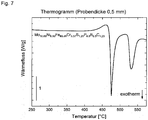
- thermogram of this alloy is shown with a thickness of 0.5 mm.
- the crystallization event at 496 ° C and the glass transition at 427 ° C reveal (partially) amorphous structures.
- Example 6 Further alloys produced
- Table 1 shows further examples which were prepared analogously to Examples 1-5.
- Table 1 ⁇ b> Table 1 ⁇ /b> 1 Fe69,48Mo10,68Ni6,59Cr3,37S1,25P6,9B0,5C1,23 2 Nb41.94 Ni54.91S3.15 3 N b43.48 Ni54.04 S2.48 4th Nb44.97 Ni53.19S1.84 5 Nb46.43Ni52.36S1.21 6th Nb47.67Ni46.01 Cu2.72Cr2.22S1.38 7th Nb47.77 Ni48.62Cr2.23S1.38 8th Nb47.85Ni51.55S0.6 9 Nb48.11 Ni49.59S2.3 10 Nb48.34 Ni49.83 S1.83 11 Nb48.57 Ni50.06S1.37 12 Nb48.71Ni45.75Cu2.7Cr1.47S1.37 13 Nb48.82 Ni48.34 Cr1.48S1.36 14th Nb48.8Ni5
Landscapes
- Chemical & Material Sciences (AREA)
- Engineering & Computer Science (AREA)
- Materials Engineering (AREA)
- Mechanical Engineering (AREA)
- Metallurgy (AREA)
- Organic Chemistry (AREA)
- Manufacturing & Machinery (AREA)
- Continuous Casting (AREA)
- Powder Metallurgy (AREA)
- Materials For Medical Uses (AREA)
- Manufacture Of Metal Powder And Suspensions Thereof (AREA)
Description
- Die vorliegende Erfindung betrifft schwefelhaltige metallische Gläser bildende Legierungen und ein Verfahren zu deren Herstellung.
- Metallische Gläser oder amorphe metallische Legierungen haben wegen ihrer herausragenden mechanischen Eigenschaften in den letzten Jahren immer mehr an Bedeutung gewonnen. Dabei wurden Legierungen gefunden, die massive metallische Gläser bilden, hohe Korrosionsbeständigkeiten aufweisen und bei denen die erforderlichen Abkühlungsgeschwindigkeiten zum Erhalt einer amorphen Struktur stark verringert werden konnten. Für diesen Zweck hat sich die Zugabe von Phosphor zu den Metalllegierungen als sehr vorteilhaft herausgestellt, siehe zum Beispiel die
US 2013/0048152 A1 undUS 2014/0116579 A1 . - Hingegen haben schwefelhaltige Metalllegierungen wesentlich weniger Aufmerksamkeit auf sich gezogen. Die
DE 1 245 139 C2 offenbart für die Herstellung von Dauermagneten Metalllegierungen, die bis zu 1 Gew. % Schwefel enthalten können, aber nicht amorph, sondern kristallin sind, da sie keiner Schnellabkühlung unterzogen, sondern im Gegenteil gesintert wurden. DieDE 32 43 964 beschreibt amorphe Metalllegierungen für die Herstellung von Schreibspitzen für Schreibgeräte, die gegebenenfalls Schwefel enthalten können, jedoch ohne dass konkrete schwefelhaltige Legierungen oder Schwefelanteile erwähnt werden. DieDD 225 721 A1 US 2009/0162629 A1 beschreibt schwefelhaltige amorphe Metalllegierungen mit einem sehr hohen Palladiumgehalt, die außerdem noch Phosphor als Nichtmetall enthalten können. DieUS 2013/048152 offenbart Beispiele schwefelhaltiger metallische Gläser bildender Legierungen mit einem hohen Nickelgehalt. - Ein Hauptnachteil beim Einsatz von Phosphor in metallischen Gläsern besteht in der Bildung von giftigem weißem Phosphor während der Herstellung. Außerdem ist die Lagerung und Verarbeitung durch die leichte Entzündbarkeit und die damit einhergehende Explosionsgefahr problematisch. Elementarer Phosphor besitzt bei Normaldruck keine stabile schmelzflüssige Phase, so dass es zur direkten Sublimation kommt, wodurch die Herstellung von Vorlegierung erschwert wird.
- Es wurde nun überraschend gefunden, dass in einer sehr großen Vielfalt von metallische Gläser bildenden Legierungen unter Beibehaltung guter mechanischer und glasbildender Eigenschaften Schwefel ganz oder teilweise anstelle von Phosphor eingesetzt werden kann, was die oben genannten Nachteile abmildert oder vermeidet. Zudem konnte eine Vielzahl gänzlich neuartiger schwefelhaltiger Legierungssysteme amorph hergestellt werden.
- Dementsprechend betrifft die Erfindung in einem ersten Aspekt eine schwefelhaltige metallische Gläser bildende Legierung mit der folgenden Formel:
(Ti, Zr, Nb, Hf, Fe(1). Aa1)aPdb(Cu,Ni)c(V,Mo,Ta,W)d(Co.Cr,Fe(2))e,(Mn,Al,In,Ga,Ag,Si,Ge)f SngBeh(B,C)i(O, H, N)j(P, Sx1)x
worin: - a = 0 - 15 Gew.% oder 30 - 90 Gew.%,
- b = 0 - 68 Gew.% und
- a + b = 30 - 97 Gew.%,
- wobei, wenn a = 0 - 15 Gew.%, b = 35 - 68 Gew.%,
- A ein oder mehrere Elemente der Gruppe der Seltenen Erden (Lanthanide + Yttrium) ist, wobei a1/a = 0 - 1/10,
- c = 0 - 65 Gew.%,
- d = 0 - 15 Gew.%,
- e = 0 - 15 Gew.%,
- f = 0 -15 Gew.%,
- g = 0 - 23 Gew.%,
- h = 0 - 1 Gew.%,
- i = 0 - 3,5 Gew.% und
- j = 0 - 0,20 Gew.%
- wobei, wenn b = 0, a und mindestens eines von c und e > 0, und, wenn a = 0 - 15 Gew. % und b = 35 - 68 Gew.%,-mindestens eines von c,d,e,f,g > 0 und Fe(1) und Fe(2) jeweils für Fe stehen, wobei Fe(2) nur vorhanden ist, wenn a = 0,
- x = 0,21 - 9 Gew.%, wenn a= 30 - 90 Gew%., und
- x = 8 - 16,5 Gew. %, wenn a = 0 - 15 Gew.% und b > 35 Gew., und
- x1/x = 1/10 bis 1,
- und
- die Summe aller Gew.% a + b + c + d + e + f + g + h + i + j + x = 100 Gew.%,
- wobei zumindest, wenn x1/x = 1 und x = 0,21 - 1 Gew.% ist, Legierungen, die Fe(1), Ni und Al enthalten, zu mindestens 50 Vol.% amorph sind.
- Ferner betrifft die Erfindung ein Verfahren zur Herstellung der vorstehend genannten Legierung, in dem
- eines oder mehrere der Elemente Fe, Pd, Ni, Cr, Cu und Co unter Argon in einem geeigneten Gefäß einzeln mit Schwefel und gegebenenfalls in einem gesonderten Gefäß einzeln mit Phosphor erwärmt und legiert werden,
- die resultierende(n) Legierung(en), falls erforderlich, zur Reinigung mit B2O3 einem Fluxprozess unterzogen werden und das überschüssige B2O3 ,und die nicht- - sulfidischen und gegebenenfalls nicht-phosphidischen Verunreinigungen von der resultierenden hochreinen Sulfid- und gegebenenfalls Phosphorlegierung abgetrennt werden, und
- die hochreine Schwefellegierung, gegebenenfalls zusammen mit der hochreinen Phosphorlegierung, mit den übrigen Elementen der Legierung in hochreiner Form und gegebenenfalls mit weiterem Fe, Pd, Ni, Cr, Cu und/oder Co in hochreiner Form in einem geeigneten Ofen unter Argon geschmolzen und legiert werden
und, falls ein metallisches Glas gebildet werden soll, anschließend einer Schnellabkühlung unterzogen werden. - Die
Figuren 1 ,3 ,5 und7 zeigen Thermogramme der in den Beispielen 1-5 hergestellten Legierungen. - Die
Figuren 2 ,4 und6 zeigen Diffraktogramme der in den Beispielen 1-4 hergestellten Legierungen. - Die in der Zusammenfassung der Erfindung angegebene Legierungsformel umfasst mehrere Gruppen von Elementen, wobei jedes Element innerhalb einer Klammer entweder allein oder in Kombination mit anderen Elementen innerhalb der Klammer in einer erfindungsgemäßen Legierung vorhanden sein kann. Die tiefgestellten Buchstaben nach der Klammer stehen jeweils für einen Bereich von Gewichtsprozenten, welche die Summe aller Gewichtsprozente der Elemente innerhalb der Klammer sind.
- Dabei gelten die folgenden Besonderheiten:
Fe taucht als Fe(1) und Fe(2) in zwei verschiedenen Klammern in der Formel auf, wobei Fe(2) nur anwesend ist, wenn Fe(1) fehlt. Diese ungewöhnliche Form der Darstellung war notwendig, um auf kompakte Weise die notwendige Anwesenheit von Legierungselementen anzugeben, die in einer Vorlegierung entweder mit Schwefel oder mit Phosphor umgesetzt werden können. - Der Buchstabe A steht für Seltene Erdelemente (Lanthanide + Yttrium), deren Gesamtgewicht maximal 10 % oder ein Zehntel des Gewichts aller Elemente in dieser Klammer ausmacht. Es ist dem Fachmann bekannt, dass ein prozentual begrenzter Ersatz der Elemente Ti, Zr, Nb, Hf, Fe in der ersten Klammer durch Seltene Erdmetalle (Lanthaniden und Yttrium) die Glasbildungseigenschaften verbessert.
- Weiter gilt, dass, wenn der Gewichtsprozentsatz a von Ti, Zr, Nb, Hf, Fe und A in der ersten Klammer 0 - 15 Gew.% beträgt, der Gewichtsprozentsatz b des Elementes Pd hoch, d.h. > 35 - 68 Gew.%, ist. Pd kann, bedingt durch seine Größe, teilweise oder ganz die Elemente Ti, Zr, Nb, Hf, Fe und A ersetzen. Der Gesamtgewichtsprozentsatz von a + b beträgt 30 - 97 Gew.%.
- Alle Legierungen enthalten mindestens zwei Metalle. Unter den Metallen muss immer mindestens eines vorhanden sein, das mit Schwefel oder Phosphor leicht eine Vorlegierung bilden kann. Dies sind die Elemente Pd mit dem Gewichtsprozentsatz b, Cu und Ni mit dem Gewichtsprozentsatz c und Co, Cr und Fe mit dem Gewichtsprozentsatz e.
- Der Gesamtgewichtsprozentsatz x der Elemente P und S hängt von dem Mengenverhältnis der Elemente Ti, Zr, Nb, Hf, Fe und A zum Element Pd ab. Wenn die Elemente Ti, Zr, Nb, Hf, Fe und A nur mit einem Gesamtgewichtsprozentsatz a von 0 - 15 Gew.% vorliegen und demgemäß der Gewichtsprozentsatz b von Pd 35 - 68 Gew.% beträgt, ist der Gesamtgewichtsprozentsatz x von P und S relativ hoch, d.h. 8 - 16,5 Gew. % und bevorzugt 9 oder auch 10 - 68 Gew.%. Wenn der Gesamtgewichtsprozentsatz a von Ti, Zr, Nb, Hf, Fe und A hoch, d.h. 30 - 90 Gew.% ist und der Gesamtgewichtsprozentsatz b von Pd dementsprechend niedriger, d.h. 0 - 40 Gew.% ist, ist der Gesamtgewichtsprozentsatz x von P und S 0,21 - 9 Gew.%. Das Verhältnis der Gewichtsprozentsatzes x1 von S zum Gesamtgewichtsprozentsatz x von P und S liegt im Bereich von 1/10 bis 1. Es beträgt bevorzugt 1, d.h. Phosphor ist in diesem Fall in der Legierung nicht anwesend.
- Wenn x1/x = 1 und x = 0,21 - 1 Gew.%, sind Legierungen, die Fe(1), Ni und Al enthalten, zu mindestens 50 Vol.% amorph. Im anderen Fall, also neben der in der Zusammenfassung im ersten Aspekt beschriebenen Legierungsformel auch in jedem der nachstehend erörterten Fälle von Legierungen mit bevorzugter Legierungsformel, können sie in amorpher oder teilamorpher (z. B. zu mindestens 50 Vol.% amorph) oder kristalliner Form vorliegen.
- Die Gewichtsprozentsätze f, g, h, i, und j der übrigen Elemente der Legierung bedürfen keiner besonderen Erklärung, mit der Ausnahme von j, dem Gewichtsprozentsatz von Be, der bevorzugt 0 Gew.% ist, da Be bekanntermaßen toxisch ist.
- Nachfolgend werden noch weitere bevorzugte Gruppen von erfindungsgemäßen Legierungen erläutert.
- Eine bevorzugte Legierung weist die Formel (Ti, Zr, Nb)a Pdb(Cu, Ni)cAlfSng(P,Sx1)x auf, worin a = 30 - 90 Gew.%, b = 0 - 40 Gew.%, a + b = 30 - 97 Gew.%, c, f, g, x1, x, und die Summe aller Gew.% wie in der Zusammenfassung im ersten Aspekt der Erfindung definiert sind und mindestens eines von b und c > 0 Gew.% ist.
- Eine weitere bevorzugte Legierung weist die Formel
(Ti, Zr, Nb, Hf, Fe(1).Aa1)aPdb(Cu,Ni)c(V,Mo,Ta,W)d(Co,Cr,Fe(2)e,(Mn,Al,In,Ga,Ag,Si,Ge)f Sng (B,C)i(O, H, N)j(P, Sx1)x
auf, worin a = 0 - 15 Gew.%, b = > 35 - 68 Gew.% und die restlichen Gewichtsprozente und sonstigen Randbedingungen wie in der Zusammenfassung im ersten Aspekt der Erfindung definiert sind. - Noch eine weitere bevorzugte Legierung weist die Formel
NbaPdb(Cu, Ni)cCre(P,Sx1)x
auf, worin a = 41 - 59 Gew.%, x = 0,5 - 3,5 Gew.%, x1/x = 1, c = 35 - 65 Gew.% bevorzugt c = 40 - 55 Gew.%, e = 0 - 1,5 Gew.% und die restlichen Gewichtsprozente und sonstigen Randbedingungen sowie die Summe aller Gew.% wie in der Zusammenfassung im ersten Aspekt der Erfindung definiert sind. - Die Legierung, die die Formel
(Zr, Fe(1))a(Ni)c(Mo)dCre(B,C)i(P,Sx1)x
aufweist, worin a = 62 - 79 Gew.%, bevorzugt 65 - 79 Gew.%, c = 0 - 22 Gew.% d = 0 - 15 Gew.%, e = 0 - 6 Gew.%, wobei c + d + e = 13 - 24 Gew.%, x = 0,3 - 8,5 Gew.%, bevorzugt 0,5 - 8,5 Gew.%, x1/x und i und die sonstigen Randbedingungen sowie die Summe aller Gew.% wie in der Zusammenfassung im ersten Aspekt der Erfindung definiert sind, ist ebenfalls bevorzugt. - Bevorzugt ist schließlich auch noch eine Legierung der Formel
((Nb, Hf)aPdb(Cu, Ni)c(Fe(2), Co)e(P,Sx1)x
worin a = 0 - 15 Gew.%, besonders bevorzugt a = 0 Gew.%, b = 35 - 68 Gew.%, c, e, x und x1 sowie die Summe aller Gew.% wie in der Zusammenfassung im ersten Aspekt der Erfindung definiert sind, wobei x1/x = 1 besonders bevorzugt ist und, wenn a = 0 Gew.%, mindestens eines von c und e > 0 Gew.%. - Tabelle 1 zeigt konkrete Legierungsbeispiele, die mit Hilfe der nachstehenden allgemeinen Verfahrensvorschrift hergestellt wurden, wobei eine Schnellabkühlung mittels Gießen in eine gekühlte Kupferkokille verwendet wurde. Alle diese Legierungen sind bei einer Dicke von 250 µm zu mindestens 50% amorph. Es ist dem Fachmann bekannt, dass in einem solchen Fall bei Verwendung einer effizienteren Schnellabkühlungsmethode, wie z.B. eines Schmelzspinnverfahrens, 100 % amorphe Legierungen (metallische Gläser) erhalten werden können.
- Durch die amorphe Struktur weisen die Legierungen eine höhere Härte, Elastizität und Festigkeit als ihre kristallinen Pendants auf. Beispielsweise zeigt die Legierung Nr. 276 in Tabelle 1 eine Härte von 566 HV5, eine Elastizität von mehr als 2 % und eine Biegefestigkeit von etwa 3 GPa.
- Für die Herstellung der Legierungen muss die Reinheit der eingesetzten Ausgangsmaterialien so beschaffen sein, dass die vorstehend in der Zusammenfassung der Erfindung im ersten Aspekt beschriebenen Höchstmengen Im allgemeinen Verfahren zur Herstellung der erfindungsgemäßen Legierungen werden zunächst eine oder mehrere Vorlegierungen aus Fe, Pd, Ni, Cr, Cu oder Co mit Schwefel und gegebenenfalls eine oder mehrere Vorlegierungen aus Fe, Pd, Ni, Cr, Cu oder Co mit Phosphor hergestellt. Dazu werden das Metall und Schwefel oder Phosphor unter Inertgas, vorzugsweise Argon, in einem hitzebeständigen geeigneten Gefäß (z.B. Quarzglas) erwärmt und legiert. Das Erwärmen und Legieren wird vorzugsweise durch 1- bis 10-minütige induktive Erwärmung bei 50 - 100 °C über dem Schmelzpunkt des am höchsten schmelzenden Bestandteils der Legierung bewerkstelligt.
- Falls für die Vorlegierung keine hochreinen Elemente eingesetzt werden, kann die Vorlegierung zur Reinigung einem Fluxprozes mit B2O3 unterzogen werden. Dabei wird die rohe Vorlegierung unter Inertgas, vorzugsweise Argon, zusammen mit 5 - 15 Gewichtsprozent B2O3 geschmolzen und 2 - 24 Stunden, bevorzugt 4 Stunden bei einer Temperatur von 1000 bis 1300 °C, bevorzugt mindestens etwa 100 °C über dem Schmelzpunkt der Legierung gehalten. Dabei gehen die nicht-sulfidischen und gegebenenfalls nicht-phosphidischen Verunreinigungen in die B2O3-Schmelze über, da dadurch die Freie Energie des Gesamtsystems reduziert wird.
- Nach Abkühlen auf Raumtemperatur wird das überschüssige B2O3 mit den darin enthaltenen Verunreinigungen, welches sich oben auf der Legierung befinden, in Wasser gelöst bzw. aufgeschlämmt und mit diesem abgegossen, wodurch eine hochreine Vorlegierung zurückbleibt.
- Die bevorzugt hochreinen schwefelhaltige(n) Vorlegierung(en) werden, gegebenenfalls zusammen mit der oder den bevorzugt hochreinen Phosphorlegierung(en) mit den übrigen Elementen der Legierung, die ebenfalls bevorzugt in hochreiner Form eingesetzt werden, und gegebenenfalls mit weiterem Fe, Pd, Ni, Cr, Cu und/oder Co, bevorzugt ebenfalls in hochreiner Form, in einem geeigneten Ofen unter Inertgas, vorzugsweise Argon, oder unter Vakuum geschmolzen und legiert. Dies geschieht bevorzugt in einem Lichtbogenofen, wobei die Legierung insgesamt etwa 30 - 180 Sekunden in einem Lichtbogenofen bei 1000 - 2000°C, bevorzugt etwa 500 °C oberhalb des Schmelzpunktes des höchstschmelzenden Bestandteils geschmolzen wird. Dabei wird mehrfaches 30-sekündiges Aufschmelzen mit einem jeweils angeschlossenem Wenden der Legierung bevorzugt.
- Zur Herstellung amorpher oder teilamorpher - hierin zusammen auch als (teil-)amorph bezeichnet, was mindestens 50 Vol.% amorph bedeutet und vollständig amorph einschließt - Legierungen (metallischer Gläser) wir dann die Legierung einer Schnellabkühlung unterzogen. Dies kann z.B. unter Verwendung eines Kokillengussverfahrens, wie Kipp-, Schleuder-, Saug- oder Druckguss in gekühlte Kokillen, oder effizienter unter Verwendung eines Schmelzspinnverfahren oder eines Pulverherstellungsverfahrens, bei dem die Legierungsschmelze unter Schutzgasatmosphäre zu einem Pulver verarbeitet wird, oder durch sogenanntes Splat-Quenching bewerkstelligt werden.
- Formkörper aus den Legierungen können z.B. aus amorphem Legierungspulver durch thermoplastisches Formen oder Kaltumformung oder aus amorphem und/oder (teil-)kristallinem Legierungspulver durch Laser-Strahlschmelzen (3D-Druck) hergestellt werden.
- In den Beispielen, die folgen, bedeutet (teil-)amorph, dass mindestens 50 Vol.% der Probe amorph sind.
- Zum Herstellen von 30 g hochreiner Ni-S Legierung Ni73,3S26,7 wurden 21,99 g Nickel und 8,01 g Schwefel eingewogen und in einem Quarzglas unter Argon induktiv bei max. 1500 °C für 5 min legiert. Die Legierung wurde im anschließenden Reinigungsprozess unter Argon mit 3,4 g B2O3 erschmolzen und für 4 h bei 1000 °C gehalten. Beim Reinigungsprozess gehen Verunreinigung aus der metallischen Schmelze in die B2O3-Schmelze über. Nach dem Abkühlen auf Raumtemperatur wurde das B2O3 samt den Verunreinigungen in Wasser gelöst bzw. aufgeschlämmt und mit diesem von der Vorlegierung abgegossen, wodurch eine hochreine Vorlegierung zurückblieb.
- 15 g der Legierung Ti8,58Zr69,43Ni10,75Cu8,22S3,02 wurden durch Einwaage von 0,3689 g Nickel, 10,4145 g Zirkonium, 1,2870 g Titan, 1,2330 g Kupfer und 1,6966 g Nickel-Schwefel Legierung der Zusammensetzung Ni73,3S26,7 hergestellt. Die Reinelemente und die Nickel-Schwefel Legierung wurden unter Argon in einem Lichtbogenofen bei etwas 2000 °C legiert. Der Legierungsknopf wurde mindestens drei Mal gewendet und erschmolzen (etwas 30 s), um die Homogenität der Legierung zu gewährleisten.
- Die Herstellung (teil-)amorpher Teile mit einer Dicke von 0,5 - 1 mm erfolgte anschließend durch Gießen in auf Raumtemperatur temperierte Kupferkokillen.
- In
Figur 1 ist in der obersten Kurve das Thermogramm dieser Legierung mit einer Dicke von 0,5 mm gezeigt. Das Kristallisationsereignis 488 °C und der Glasübergang bei 398 °C lassen (teil-)amorphe Strukturen erkennen. - In
Figur 2 ist in der obersten Kurve das Diffraktogramm (Cu-K-α-Strahlung) dieser Legierung mit einer Dicke von 1 mm gezeigt. Der breite Beugungshügel zeigt die (teil-)amorphe Struktur. - Die Herstellung der Vorlegierung Ni69,11S30,89 erfolgte wie in Beispiel 1A, aber mit Einwaage von 13,822 g Nickel und 6,178 g Schwefel und 2,1 g B2O3.
- 8 g der Legierung Ti74,1Ni20,6S5,3 wurden durch Einwaage von 0,6994 g Nickel, 5,9280 g Titan, und 1,3726 g Nickel-Schwefel Legierung der Zusammensetzung Ni69,11S30,89 hergestellt. Die Reinelemente und die Nickel-Schwefel Legierung wurden unter Argon in einem Lichtbogenofen bei etwa 2000 °C legiert. Der Legierungsknopf wurde mindestens drei Mal gewendet und erschmolzen (etwa 30 s), um die Homogenität der Legierung zu gewährleisten.
- Die Herstellung (teil-)amorpher Teile mit einer Dicke von 0,5 mm erfolgte anschließend durch Gießen in auf Raumtemperatur temperierte Kupferkokillen.
- In
Figur 1 ist in der untersten Kurve das Thermogramm dieser Legierung mit einer Dicke von 0,5 mm gezeigt. Das Kristallisationsereignis bei 462 °C und der Glasübergang bei 423 °C lassen (teil-)amorphe Strukturen erkennen. - In
Figur 2 ist in der untersten Kurve das Diffraktogramm (Cu-K-α-Strahlung) dieser Legierung mit einer Dicke von 0,5 mm gezeigt. Der breite Beugungshügel zeigt die (teil-)amorphe Struktur. - Die
Figuren 1 und 2 zeigen außerdem die Thermogramme bzw. Diffraktogramme von zwei weiteren Legierungen, die Ti, Zr, NI oder Pd, Cu und S enthalten (Legierungen Nr. 218 und 248 der Tabelle 1 von Beispiel 6). - Die Herstellung der Vorlegierung Ni69,11S30,89 erfolgte wie in Beispiel 2A.
- Zum Herstellen von 30 g hochreiner Pd-S Legierung Pd86,04S13,96 wurden 25,812 g Palladium und 4,188 g Schwefel eingewogen und in einem Quarzglas unter Argon induktiv bei max. 1600 °C für 5 min legiert. Die Legierung wurde im anschließenden Reinigungsprozess unter Argon mit 2,9 g B2O3 erschmolzen und für 4 h bei 1000 °C gehalten. Beim Reinigungsprozess gehen Verunreinigung aus der metallischen Schmelze in die B2O3-Schmelze über. Nach dem Abkühlen auf Raumtemperatur kann das B2O3 samt den Verunreinigungen in Wasser gelöst werden, so dass eine hochreine Vorlegierung übrig bleibt.
- 20 g der Legierung Pd56,71Ni31,28S12,01 wurden durch Einwaage von 3,5693 g Nickel, 3,9415 g Palladium, 3,8872 g Nickel-Schwefel-Legierung der Zusammensetzung Ni69,11S30,89 und 8,6020 g Palladium-Schwefel-Legierung der Zusammensetzung Pd86,04S13,96 hergestellt. Die Reinelemente, die Nickel-Schwefel-Legierung und die Palladium-Schwefel-Legierung wurden unter Argon in einem Lichtbogenofen bei etwas 2000 °C legiert. Der Legierungsknopf wurde mindestens drei Mal gewendet und erschmolzen (etwas 30 s), um die Homogenität der Legierung zu gewährleisten
- Die Herstellung (teil-)amorpher Teile mit einer Dicke von 0,5 - 1,5 mm erfolgte anschließend durch Gießen in auf Raumtemperatur temperierte Kupferkokillen.
- Alternativ können die Reinelemente die Nickel-Schwefel-Legierung und die Palladium-Schwefel-Legierung in Quarzglas legiert werden.
- In
Figur 3 ist in der unteren Kurve das Thermogramm dieser Legierung mit einer Dicke von 0,5 mm gezeigt. Das Kristallisationsereignis bei 176,2 °C und der Glasübergang bei 152,9 °C lassen (teil-)amorphe Strukturen erkennen. - In
Figur 4 ist in der unteren Kurve das Diffraktogramm (Cu-K-α-Strahlung) dieser Legierung mit einer Dicke von 1,5 mm gezeigt. Der breite Beugungshügel zeigt die (teil-)amorphe Struktur. - Die
Figuren 3 und 4 zeigen in der unteren Kurve außerdem das Thermogramm bzw. Diffraktogramm von einer weiteren Legierungen, die Pd, Ni und S enthält (Legierung Nr. 56 der Tabelle 1 von Beispiel 6). - Die Herstellung der Vorlegierung Ni69,11S30,89 erfolgte wie in Beispiel 2A.
- 6,3 g der Legierung Nb50.76Ni45.22Cu2,67S1,35 wurden durch Einwaage von 2,6586 g Nickel, 3,1979 g Niob, 0,2753 g Nickel-Schwefel Legierung der Zusammensetzung Ni69,11S30,89 und 0,1682 g Kupfer hergestellt. Die Reinelemente und die Nickel-Schwefel Legierung wurden unter Argon in einem Lichtbogenofen bei etwas 2000 °C legiert. Der Legierungsknopf wurde mindestens drei Mal gewendet und erschmolzen (etwas 30 s), um die Homogenität der Legierung zu gewährleisten
- Die Herstellung (teil-)amorpher Teile mit einer Dicke von 0,5 - 3 mm erfolgte anschließend durch Gießen in auf Raumtemperatur temperierte Kupferkokillen.
- In
Figur 5 ist in der unteren Kurve das Thermogramm dieser Legierung mit einer Dicke von 0,5 mm gezeigt. Das Kristallisationsereignis bei 696 °C und der Glasübergang bei 635 °C lassen (teil-)amorphe Strukturen erkennen. - In
Figur 6 ist in das Diffraktogramm (Cu-K-α-Strahlung) dieser Legierung mit einer Dicke von 3 mm gezeigt. Der breite Beugungshügel zeigt die (teil-)amorphe Struktur. - Die
Figur 5 zeigt in der oberen Kurve außerdem das Thermogramm bzw. Diffraktogramm von einer weiteren Legierung, die Nb, Ni, Pd und S enthält (Legierung Nr. 20 der Tabelle 1 von Beispiel 6). - Zum Herstellen von 20 g hochreiner Ni-S Legierung Ni84.06S15.94 wurden 16,812 g Nickel und 3,188 g Schwefel eingewogen und in einem Quarzglas unter Argon induktiv bei max. 1500 °C für 5 min legiert. Die Legierung wurde im anschließenden Reinigungsprozess unter Argon mit 2,7 g B2O3 erschmolzen und für 4 h bei 1250 °C gehalten. Beim Reinigungsprozess gehen Verunreinigung aus der metallischen Schmelze in die B2O3-Schmelze über. Nach dem Abkühlen auf Raumtemperatur wurde das B2O3 samt den Verunreinigungen in Wasser gelöst bzw. aufgeschlämmt und mit diesem von der Vorlegierung abgegossen, wodurch eine hochreine Vorlegierung zurückblieb.
- Zum Herstellen von 25 g hochreiner Fe-P Legierung Fe90,97P9,03 wurden 22,7425 g Eisen und 2,2575 g Phosphor eingewogen und in einem Quarzglas unter Argon induktiv bei max. 1600 °C für 5 min legiert. Die Legierung wurde im anschließenden Reinigungsprozess unter Argon mit 1,5 g B2O3 erschmolzen und für 4 h bei 1250 °C gehalten. Beim Reinigungsprozess gehen Verunreinigung aus der metallischen Schmelze in die B2O3-Schmelze über. Nach dem Abkühlen auf Raumtemperatur wurde das B2O3 samt den Verunreinigungen in Wasser gelöst bzw. aufgeschlämmt und mit diesem von der Vorlegierung abgegossen, wodurch eine hochreine Vorlegierung zurückblieb.
- 20 g der Legierung Mo10,68Ni6,59Fe69,48Cr3,37S1,25P6,90B0,50C1,23 wurden durch Einwaage von 2,136 g Molybdän, 0,674 g Chrom, 0,246 g Kohlenstoff, 0,100 g Bor, 15,276 g Eisen-Phosphor Legierung der Zusammensetzung Fe 90,97 P 9,03 und 1,568 g Nickel-Schwefel Legierung der Zusammensetzung Ni84.06Si5.94 hergestellt. Die Reinelemente, die Nickel-Schwefel-Legierung und die Eisen-Phosphor-Legierung wurden unter Argon in einem Lichtbogenofen bei etwa 2000 °C legiert. Der Legierungsknopf wurde mindestens drei Mal gewendet und erschmolzen (etwas 30 s), um die Homogenität der Legierung zu gewährleisten
- Die Herstellung (teil-)amorpher Teile mit einer Dicke von 0,5 mm erfolgte anschließend durch Gießen in auf Raumtemperatur temperierte Kupferkokillen.
- In
Figur 7 ist das Thermogramm dieser Legierung mit einer Dicke von 0,5 mm gezeigt. Das Kristallisationsereignis bei 496 °C und der Glasübergang bei 427 °C lassen (teil-)amorphe Strukturen erkennen. - In Tabelle 1 sind weitere Beispiele gezeigt, die analog zu den Beispielen 1-5 hergestellt wurden.
Tabelle 1 1 Fe69,48Mo10,68Ni6,59Cr3,37S1,25P6,9B0,5C1,23 2 Nb41,94Ni54,91S3,15 3 N b43,48Ni54,04S2,48 4 Nb44,97Ni53,19S1,84 5 Nb46,43Ni52,36S1,21 6 Nb47,67Ni46,01Cu2,72Cr2,22S1,38 7 Nb47,77Ni48,62Cr2,23S1,38 8 Nb47,85Ni51,55S0,6 9 Nb48,11Ni49,59S2,3 10 Nb48,34Ni49,83S1,83 11 Nb48,57Ni50,06S1,37 12 Nb48,71Ni45,75Cu2,7Cr1,47S1,37 13 Nb48,82Ni48,34Cr1,48S1,36 14 Nb48,8Ni50,3S0,9 15 Nb49,02Ni50,53S0,45 16 Nb49,51Ni41,7Cu2,6Sn4,87S1,32 17 Nb49,61Ni44,2Sn4,88S1,31 18 Nb49,74Ni45,48Cu2,69Cr0,73S1,36 19 Nb49,84Ni48,06Cr0,73S1,37 20 Nb49,86Pd4,39Ni44,42S1,33 21 Nb49,8Ni48,85S1,35 22 Nb50,34Ni44,03Cu2,65Sn1,65S1,33 23 Nb50,42Pd1,48Ni44,11Cu2,65S1,34 24 Nb50,44Ni46,57Sn1,65S1,34 25 Nb50,52Pd1,48Ni46,65S1,35 26 Nb50,62Ni41,82Cu6,21S1,35 27 Nb50,69Ni43,52Cu4,45S1,34 28 Nb50,76Ni45,22Cu2,67S1,35 29 Nb50,79Ni46,08Cu1,78S1,35 30 Nb50,83Ni46,93Cu0,89S1,35 31 Nb50,86Ni47,79S1,35 32 Nb50,91Ni47,01Cr0,73S1,35 33 Nb50,96Ni46,23Cr1,46S1,35 34 Nb51,92Ni46,74S1,34 35 Nb52,96Ni45,7S1,34 36 Nb54,1Ni43,13Cr1,44S1,33 37 Nb54Ni44,67S1,33 38 Nb55,07Ni42,88Cr0,72S1,33 39 Nb55,85Ni38,49Cu4,34S1,32 40 Nb55,93Ni40,15Cu2,61S1,31 41 Nb55,96Ni40,98Cu1,74S1,32 42 Nb56,04Ni42,64S1,32 43 Nb56,09Ni41,88Cr0,71S1,32 44 Nb56,14Ni41,11Cr1,43S1,32 45 Nb56,19Ni40,34Cr2,14S1,33 46 Nb56Ni41,81Cu0,87S1,32 47 Nb58,04Ni40,65S1,31 48 Pd35,33Ni48,71S15,96 49 Pd47,04Ni40,26S12,7 50 Pd48,5Ni38,34S13,16 51 Pd49,54Ni31,73Cu5,73S13 52 Pd49,61Ni33,54Cu3,82S13,03 53 Pd49,69Ni35,36Cu1,91S13,04 54 Pd49,75Ni33,64Co3,56S13,05 55 Pd49,76Ni35,41Co1,78S13,05 56 Pd49,76Ni37,18S13,06 57 Pd49,85Ni33,7Fe3,38S13,07 58 Pd49,89Ni31,95Fe5,07S13,09 59 Pd49,8Ni35,44Fe1,69S13,07 60 Pd50,4Ni38,22S11,38 61 Pd52,22Ni34,91S12,87 62 Pd52,61Ni35,08S12,31 63 Pd53,42Ni33,8S12,78 64 Pd53,98Ni34,87S11,15 65 Pd54,1Ni29,84S16,06 66 Pd55,26Ni30,47S14,27 67 Pd56,36Ni31,08S12,56 68 Pd56,71Ni31,28S12,01 69 Pd56,77Ni31,31S9,02P2,9 70 Pd56,83Ni31,34S6,02P5,81 71 Pd56,89Ni31,37S3,01P8,73 72 Pd56Ni30,88S13,12 73 Pd57,06Ni31,47S11,47 74 Pd57,37Ni29,08S13,55 75 Pd57,41Ni31,66S10,93 76 Pd58,97Ni29,19S11,84 77 Pd59,19Ni28,46S12,35 78 Pd60,85Ni26,93S12,22 79 Pd67,92Ni21,85S10,23 80 Ti0,68Nb49,87Ni48,09S1,36 81 Ti1,9Zr66,86Ni11,5Cu15,24Al3,62S0,88 82 Ti2,55Zr66,6Ni16,26Cu10,84Al2,87S0,88 83 Ti2,56Zr65,67Ni11,51Cu16,12Al3,26S0,88 84 Ti2,56Zr65,76Ni13,14Cu14,4Al3,26S0,88 85 Ti2,57Zr65,85Ni14,77Cu12,67Al3,26S0,88 86 Ti2,57Zr65,94Ni16,4Cu10,94Al3,27S0,88 87 Ti2,57Zr66,01Ni11,57Cu15,33Al3,64S0,88 88 Ti2,59Zr65,26Ni16,55Cu11,03Al3,67S0,9 89 Ti3,04Zr81,04Ni12,66S3,26 90 Ti3,18Zr61,97Hf2,94Ni11,63Cu15,43Fe0,14Al3,66S0,88C0,04O0,11N0,02 91 Ti3,19Zr63,88Ni11,43Cu15,18Al3,6S2,72 92 Ti3,19Zr65,12Ni11,65Cu15,46Fe0,01Al3,67S0,8900,01 93 Ti3,22Zr64,49Ni11,54Cu15,31Al3,63S1,81 94 Ti3,24Zr61,93Hf2,96Ni11,62Cu15,42Fe0,13Al3,66S0,89C0,03O0,1N0,02 95 Ti3,24Zr64,79Ni11,59Cu15,39Al3,65S1,34 96 Ti3,24Zr64,81Ni11,58Cu16,22Al3,28S0,87 97 Ti3,24Zr64,87Ni11,61Cu15,41Al3,65S1,22 98 Ti3,24Zr64,97Ni11,61Cu15,82Al3,47S0,89 99 Ti3,25Zr60,15Hf2,83Nb1,9Ni11,62Cu15,42Fe0,13A13,66S0,89C0,03O0,1N0,02 100 Ti3,25Zr64,94Ni11,62Cu15,42Al3,66S1,11 101 Ti3,25Zr65,01Ni11,63Cu15,44Al3,66S1,01 102 Ti3,25Zr65,09Ni11,65Cu15,46Al3,67S0,88 103 Ti3,25Zr65,16Ni11,66Cu15,47Al3,67S0,79 104 Ti3,25Zr65,18Ni12,46Cu14,55Al3,67S0,89 105 Ti3,26Zr65,23Ni11,67Cu15,49Al3,68S0,67 106 Ti3,26Zr65,23Ni13,28Cu13,67Al3,67S0,89 107 Ti3,26Zr65,27Ni14,11Cu12,8Al3,67S0,89 108 Ti3,26Zr65,31Ni14,93Cu11,93Al3,68S0,89 109 Ti3,26Zr65,36Ni15,76Cul1,05Al3,68S0,89 110 Ti3,26Zr65,3Ni11,67Cu15,02Al3,86S0,89 111 Ti3,27Zr65,45Ni17,42Cu9,29Al3,68S0,89 112 Ti3,27Zr65,47Ni11,7Cu14,61Al4,06S0,89 113 Ti3,27Zr65,4Ni16,59Cu10,17Al3,68S0,89 114 Ti3,28Zr65,64Ni11,73Cu14,2Al4,26S0,89 115 Ti3,94Zr64,26Ni11,71Cu15,51Al3,69S0,89 116 Ti4,43Zr39,83Cu45,4Ag8,56S1,78 117 Ti4,47Zr40,19Cu45,82Ag8,64S0,88 118 Ti4,64Zr63,37Ni11,78Cu15,61Al3,71S0,89 119 Ti5,34Zr62,47Ni11,85Cu15,7Al3,73S0,91 120 Ti5,75Zr71,21Ni10,34Cu7,88A11,47S3,35 121 Ti5,83Zr72,27Ni10,5Cu8S3,4 122 Ti5,86Zr72,65Ni10,51Cu8,03S2,95 123 Ti5,86Zr72,65Ni5,81Cu13,17S2,51 124 Ti5,87Zr72,76Ni7,66Cu11,2S2,51 125 Ti5,89Zr72,93Ni10,6Cu8,07S2,51 126 Ti5,91Zr73,3Ni10,61Cu8,1S2,08 127 Ti5,98Zr74,41Ni8,47Cu6,39A11,45S3,3 128 Ti5,99Zr73,86Ni9,58Cu7,19S3,38 129 Ti5,9Zr72,78Ni9,44Cu7,09Al1,46S3,33 130 Ti6,05Zr61,56Ni11,92Cu15,8Al3,76S0,91 131 Ti6,07Zr75,5Ni8,59Cu6,48S3,36 132 Ti6,08Zr75,36Ni7,46Cu5,65A12,19S3,26 133 Ti6,13Zr75,93Ni7,52Cu5,7A11,44S3,28 134 Ti6,18Zr76,49Ni7,57Cu5,74Al0,71S3,31 135 Ti6,22Zr77,04Ni7,63Cu5,78S3,33 136 Ti6,25Zr77,38Ni13,02S3,35 137 Ti6,37Zr78,57Ni6,67Cu5,09S3,3 138 Ti6,45Zr80,14Ni5,72Cu4,4S3,29 139 Ti6,68Zr38,21Cu53,24S1,87 140 Ti6,75Zr38,58Cu53,75S0,92 141 Ti6,77Zr60,64Ni12Cu15,9Al3,78S0,91 142 Ti7,08Zr69,62Ni10,46Cu7,97Al1,48S3,39 143 Ti7,19Zr70,67Ni10,62Cu8,09S3,43 144 Ti7,5Zr59,7Ni12,07Cu16Al3,8S0,93 145 Ti8,24Zr58,76Ni12,15Cu16,1Al3,83S0,92 146 Ti8,37Zr67,45Ni10,5Cu8Al2,28S3,4 147 Ti8,44Zr67,99Ni10,58Cu8,06Al1,5S3,43 148 Ti8,57Zr69,02Ni10,74Cu8,19S3,48 149 Ti8,58Zr69,43Ni10,75Cu8,22S3,02 150 Ti8,5Zr68,51Ni10,66Cu8,13Al0,74S3,46 151 Ti8,62Zr69,38Ni5,95Cu13,48S2,57 152 Ti8,64Zr69,49Ni7,84Cu11,46S2,57 153 Ti8,66Zr69,66Ni10,85Cu8,2652,57 154 Ti8,67Zr69,96Ni10,86Cu8,38S2,13 155 Ti9,64Zr73,51Ni13,4S3,45 156 Ti9,75Zr56,83Ni12,3Cu16,3Al3,88S0,94 157 Ti9,94Zr67,07Ni11,23Cu8,68S3,08 158 Ti9,98Zr67,34Ni10,87Cu8,28S3,53 159 Ti9,9Zr66,81Ni11,59Cu9,08S2,62 160 Ti11,3Zr54,85Ni12,46Cu16,51Al3,93S0,95 161 Ti11,43Zr65,62Ni11Cu8,38S3,57 162 Ti13,24Zr69,41Ni13,8S3,55 163 Ti14,52Zr50,74Ni12,79Cu16,95Al4,03S0,97 164 Ti15,56Zr31,75Ni6,99Cu44,72S0,98 165 Ti17,07Zr65,05Ni14,23S3,65 166 Ti17,25Zr29,35Ni7,08Cu45,32S1 167 Ti18,85Zr15,96Ni7,51Cu56,63S1,05 168 Ti18,99Zr26,89Ni7,18Cu45,93S1,01 169 Ti20,77Zr24,36Ni7,28Cu46,57S1,02 170 Ti21,13Zr60,41Ni14,68S3,78 171 Ti21,34Zr16,09Ni7,57Cu53,96S1,04 172 Ti22,61Zr21,76Ni7,38Cu47,22S1,03 173 Ti23,87Zr16,21Ni7,63Cu51,24S1,05 174 Ti24,49Zr19,09Ni7,48Cu47,89S1,05 175 Ti24,52Zr43,62Pd28,35S3,51 176 Ti25,01Zr16,45Ni7,74Cu48,8S1,06Si0,94 177 Ti25,47Zr55,47Ni15,17S3,89 178 Ti25,4Zr15,7Ta5,77Ni5,52Cu46,59S1,02 179 Ti25,87Zr15,95Ni7,46Cu47,47S3,25 180 Ti25,95Zr16,04Ni5,64Cu47,S91n3,74S1,04 181 Ti26,01Zr16,08Ni5,65Cu47,7Ag3,S2S1,04 182 Ti26,11Zr16,14Mo3,14Ni5,67Cu47,88S1,06 183 Ti26,16Zr16,13Ni7,55Cu48,01S2,15 184 Ti26,34Zr16,28Ni5,72Cu48,3Ga2,3S1,06 185 Ti26,43Zr16,23Ni7,61Cu48,4S1,33 186 Ti26,43Zr16,34Ni5,74Cu48,47Col,95S1,07 187 Ti26,43Zr16,34Ni7,59Cu48,58S1,06 188 Ti26,45Zr16,31Ni7,63Cu48,54S1,07 189 Ti26,47Zr16,36Ni5,75Cu48,54Mn1,82S1,06 190 Ti26,47Zr16,36Ni9,55Cu46,54S1,08 191 Ti26,49Zr16,37Ni5,76Cu48,58Cr1,73S1,07 192 Ti26,51Zr16,39Ni7,71Cu46,5Mn1,83S1,06 193 Ti26,52Zr16,39Ni11,52Cu44,51S1,06 194 Ti26,54Zr16,3Ni7,67Cu48,69S0,8 195 Ti26,56Zr16,42Ni13,5Cu42,46S1,06 196 Ti26,75Zr16,53Ni7,78Cu46,92S1,08Si0,94 197 Ti26,86Zr16,6Ni5,84Cu49,26S1,08B0,36 198 Ti28,64Zr38,53Pd29,22S3,61 199 Ti29,04Zr16,47Ni7,75Cu45,67S1,07 200 Ti29,42Zr49,06Ni9,02Cu6,83Al1,73S3,94 201 Ti29,43Zr43,47Ni9,02Cu6,84Sn7,3S3,94 202 Ti29,43Zr49,07Ni9,02Cu4,88Sn3,65S3,95 203 Ti29,47Zr43,53Ni10,84Cu4,89Sn7,31S3,96 204 Ti29,49Zr54,8Ni11,75S3,96 205 Ti29.56Zr45,06Ni9,06Cu6,87Sn5,5S3,95 206 Ti29,68Zr46,67Ni9,1Cu6,9Sn3,68S3,97 207 Ti29,68Zr49,49Ni9,1Cu6,9Al0,85S3,98 208 Ti29,6Zr45,13Ni10,89Cu4,91Sn5,51S3,96 209 Ti29,73Zr46,74Ni10,93Cu4,93Sn3,69S3,98 210 Ti29,79Zr52,52Ni13,7S3,99 211 Ti29,81Zr48,29Ni9,14Cu6,93Sn1,85S3,98 212 Ti29,85Zr48,36Ni10,98Cu4,95Sn1,85S4,01 213 Ti29,85Zr49,77Ni17,38S3 214 Ti29,91Zr45,61Nb4,35Ni9,17Cu6,95S4,01 215 Ti29,94Zr49,92Ni9,18Cu6,95S4,01 216 Ti29,95Zr49,94Ni16,71S3,4 217 Ti29,97Zr49,98Ni16,54S3,51 218 Ti29,98Zr50Ni11,03Cu4,98S4,01 219 Ti30,03Zr50,07Ni12,89Cu2,99S4,02 220 Ti30,05Zr41,52Nb8,75Ni15,66S4,02 221 Ti30,07Zr45,85Nb4,38Ni15,67S4,03 222 Ti30,14Zr50,2SNi12,93Fe2,64S4,04 223 Ti30,16Zr50,3Ni11,1Fe4,4S4,04 224 Ti30,1Zr50,19Ni15,68S4,03 225 Ti30,22Zr50,4Ni14,82S4,56 226 Ti30,35Zr50,61Ni13,96S5,08 227 Ti30,41Zr47,81Ni17,71S4,07 228 Ti30,72Zr45,38Ni19,78S4,12 229 Ti31,69Zr16,6Ni7,81Cu42,82S1,08 230 Ti33,02Zr33,12Pd30,14S3,72 231 Ti33,81Zr33,72Ni17,84Cu12,53S2,1 232 Ti34,38Zr16,73Ni7,87Cu39,93S1,09 233 Ti35,05Zr44,54Ni16,24S4,17 234 Ti36,43Zr30,51Ni18,16Cu12,75S2,15 235 Ti37,68Zr27,36Pd31,12S3,84 236 Ti39,14Zr27,19Ni18,5Cu12,99S2,18 237 Ti39,4Zr37,55Ni9,66Cu7,3Al1,85S4,24 238 Ti40,14Zr38,25Ni9,84Cu7,46S4,31 239 Ti40,37Zr38,47Ni16,83S4,33 240 Ti41,95Zr23,75Ni18,84Cu13,23S2,23 241 Ti42,66Zr21,21Pd32,16S3,97 242 Ti44,87Zr20,17Ni19,2Cu13,49S2,27 243 Ti45,84Zr31,77Ni18,6S3,79 244 Ti46,09Zr31,94Ni17,47S4,5 245 Ti47,91Zr16,45Ni19,58Cu13,75S2,31 246 Ti47,98Zr14,63Pd33,28S4,11 247 Ti48,4Zr24,71Ni22,26S4,63 248 Ti49,69Zr15,15Pd25,63Cu5,28S4,25 249 Ti50,33Zr24,81Ni20,22S4,64 250 Ti50,62Zr20,9Ta6,38Ni17,58S4,52 251 Ti50,69Zr16,1Ni10,36Cu7,8SSn10,48S4,52 252 Ti50,89Zr25,08Ni18,29S4,71Si1,03 253 Ti50,93Zr17,8Ni10,41Cu7,89Sn8,42S4,55 254 Ti50,93Zr24,27Ni10,41Cu5,63Sn4,21S4,55 255 Ti50,99Zr16,2Ni17,72Sn10,54S4,55 256 Ti51,02Zr17,83Ni12,51Cu5,64Sn8,44S4,56 257 Ti51,06Zr12,58Ni19,97Cu14,02S2,37 258 Ti51,06Zr30,81Ni13,57S4,56 259 Ti51,18Zr19,51Ni10,46Cu7,93Sn6,35S4,57 260 Ti51,22Zr25,24Ni18,41S4,73B0,4 261 Ti51,27Zr19,54Ni12,57Cu5,67Sn6,36S4,59 262 Ti51,44Zr21,24Ni10,51Cu7,97Sn4,25S4,59 263 Ti51,53Zr21,28Ni12,64Cu5,7Sn4,26S4,59 264 Ti51,66Zr27,89Ni15,84S4,61 265 Ti51,69Zr22,99Ni10,56Cu8,01Sn2,14S4,61 266 Ti51,69Zr24,63Ni12,89Cu6,86S3,93 267 Ti51,77Zr24,66Ni20,1S3,47 268 Ti51,78Zr23,03Ni12,7Cu5,73Sn2,14S4,62 269 Ti51,82Zr21,4Ni181n4,14S4,64 270 Ti51,83Zr24,69Ni16,1Cu3,44S3,94 271 Ti51,95Zr21,45Ni18,05Ag3,9S4,65 272 Ti51,95Zr24,75Ni10,62Cu8,05S4,63 273 Ti51,97Zr24,76Ni19,33S3,94 274 Ti51,9Zr19,78Nb5,04Ni10,61Cu8,04S4,63 275 Ti52,02Zr24,78Ni19,13S4,07 276 Ti52,04Zr24,79Ni12,76Cu5,76S4,65 277 Ti52,13Zr24,84Ni14,92Cu3,46S4,65 278 Ti52,17Zr14,91Nb10,13Ni18,13S4,66 279 Ti52,18Zr21,55Mo3,49Ni18,13S4,65 280 Ti52,22Zr19,9Nb5,07Ni18,14S4,67 281 Ti52,27Zr24,9Ni18,16S4,67 282 Ti52,35Zr24,94Ni14,98Fe3,05S4,68 283 Ti52,4Zr24,97Ni12,85Fe5,09S4,69 284 Ti52,52Zr25,02Ni17,17S5,29 285 Ti52,68Zr21,75Ni18,3Ga2,56S4,71 286 Ti52,78Zr25,15Ni16,18S5,89 287 Ti52,9Zr21,84Ni20,54S4,72 288 Ti53,54Zr18,71Ni22,98S4,77 289 Ti53,5Zr22,09Ni18,59S4,77Si1,05 290 Ti53,68Zr7,58Pd34,48S4,26 291 Ti53,85Zr22,23Ni18,71S4,8B0,41 292 Ti54,22Zr25Ni16,09S4,69 293 Ti54,35Zr8,56Ni20,38Cu14,31S2,4 294 Ti55,66Zr7,86Pd26,58Cu5,47S4,43 295 Ti56,03Ni17,97Sn21,38S4,62 296 Ti56,2Zr25,1Ni14S4,7 297 Ti56,33Pd39,36S4,31 298 Ti56,89Ni20,98Cu19,65S2,48 299 Ti57,1Ni25,62Cu14,79S2,49 300 Ti57,77Zr4,37Ni20,8Cu14,61S2,45 301 Ti58,28Zr17,09Ni13,41Cu7,14S4,08 302 Ti58,41Nb17,44Ni20,05S4,1 303 Ti58,44Zr17,13Ni16,76Cu3,58S4,09 304 Ti58,57Zr17,17Ni11,05Cu8,37S4,84 305 Ti58,6Ni25,46Cu14,7S1,24 306 Ti58,6Zr17,18Ni20,12S4,1 307 Ti58,95Zr17,28Ni18,9S4,87 308 Ti59,1Ni21,11Cu17,3S2,49 309 Ti59,81Pd35,77S4,42 310 Ti60,7Ni23,29Cu14,76S1,25 311 Ti60,81Ni25,62Cu12,33S1,24 312 Ti61,01Ni22,27Cu14,84S1,88 313 Ti61,08Pd33,48S5,44 314 Ti61,17Ni21,76Cu14,88S2,19 315 Ti61,1Ni16,59Cu19,81S2,5 316 Ti61,22Ni18,91Cu17,37S2,5 317 Ti61,33Ni21,24Cu14,92S2,51 318 Ti61,49Ni20,72Cu14,96S2,83 319 Ti61,57Ni25,93Cu9,98S2,52 320 Ti61,82Ni19,67Cu15,03S3,48 321 Ti61,98Ni19,14Cu15,07S3,81 322 Ti62,64Ni17Cu15,23S5,13 323 Ti62,97Ni15,91Cu15,32S5,8 324 Ti63,48Pd31,99S4,53 325 Ti64,04Ni11,22Cu8,5Sn11,34S4,9 326 Ti64,11Pd30,88S5,01 327 Ti64,15Ni13,49Cu6,08Sn11,36S4,92 328 Ti64,27Ni15,76Cu3,66Sn11,39S4,92 329 Ti64,39Ni18,05Cu1,22Sn11,41S4,93 330 Ti64,45Ni19,19Sn11,42S4,94 331 Ti65,76Zr8,95Ni11,52Cu8,73S5,04 332 Ti65,89Zr8,97Ni13,85Cu6,25S5,04 333 Ti66,01Zr8,99Ni16,19Cu3,76S5,05 334 Ti66,14Zr9Ni18,54Cu1,25S5,07 335 Ti66,27Pd23,57Ni5,42S4,74 336 Ti66,2Zr9,01Ni19,71S5,08 337 Ti68,03Ni27,41S4,56 338 Ti68,07Pd18,16Ni8,9S4,87 339 Ti68,77Nb5,56Ni21,32S4,35 340 Ti68,84Zr5,47Ni21,34S4,35 341 Ti69,11Ni19,87Sn5,91S5,11 342 Ti69,97Pd12,45Ni12,58S5 343 Ti70,05Ni26,78S3,17 344 Ti70,54V3,13Ni21,87S4,46 345 Ti70,61Ni15,01Sn9,34S5,04 346 Ti70,78Ni24,78S4,44 347 Ti71,63Ni22,41S5,96 348 Ti71,6Ni22,19Al1,68S4,53 349 Ti71,96Ni11,77Cu6,37Sn4,76S5,14 350 Ti71,98Nb1,89Ni21,71S4,42 351 Ti71,98Pd6,4Ni16,48S5,14 352 Ti71Ni17,64Sn7,04S4,32 353 Ti72,07Ni20,3Sn2,42S5,21 354 Ti72,32Ni17,73Sn4,78S5,17 355 Ti72,59V1,04Ni21,89S4,48 356 Ti72,92Ni10,13Cu12,52S4,43 357 Ti72,95Ni22Al0,56S4,49 358 Ti72,96Ni21,76S5,28 359 Ti72Zr1,85Ni21,71S4,44 360 Ti73,01Ni2,39Cu19,39S5,21 361 Ti73,16Ni4,78Cu16,83S5,23 362 Ti73,19Ni14,6Cu7,77S4,44 363 Ti73,22Ni22,98S3,8 364 Ti73,2Ni19,15Sn2,42S5,23 365 Ti73,3Ni7,19Cu14,27S5,24 366 Ti73,45Ni9,61Cu11,7S5,24 367 Ti73,4Ni18,24Cu3,9S4,46 368 Ti73,55Ni20,68Cu1,3S4,47 369 Ti73,59Ni12,03Cu9,12S5,26 370 Ti73,61Ni18,29Co3,63S4,47 371 Ti73,62Ni20,7Co1,21S4,47 372 Ti73,62Ni21,91S4,47 373 Ti73,74Ni14,47Cu6,53S5,26 374 Ti73,89Ni16,91Cu3,92S5,28 375 Ti74,11Ni20,6S5,29 376 Ti74,24Ni16,99Fe3,46S5,31 377 Ti74,37Ni13,37Fe6,94S5,32 378 Ti74,72Ni18,94S6,34 379 Ti75,26Ni19,43S5,31 380 Ti75,75Ni20,97S3,28 381 Ti76,5Ni19S4,5 382 Ti77,44Ni16,54S6,02 383 Zr36,16Cu51,38Ag11,6S0,86 384 Zr66,77Hf3,16Nb2,11Cu23,79Fe0,14A13,6550,21C0,04O0,11N0,02 385 Zr67,06Hf3,18Nb1,81Cu23,79Fe0,14A13,65S0,21C0,04O0,11N0,02 386 Zr69,1Nb1,79Cu23,38Al3,58S2,15 387 Zr69,41Nb1,79Cu23,48Al3,6S1,72 388 Zr69,72Nb1,8Cu23,58Al3,62S1,28 389 Zr70,03Nb1,8Cu23,69Al3,63S0,85 390 Zr70,32Nb1,83Cu23,78Al3,65S0,42 391 Zr70,47Nb1,81Cu23,85Al3,66S0,21 392 Zr72,29Cu23,85Al3,65S0,21
Claims (10)
- Schwefelhaltige metallische Gläser bildende Legierung mit der folgenden Formel:
(Ti, Zr, Nb, Hf, Fe(1). Aa1)aPdb(Cu,Ni)c(V,Mo,Ta,W)d(Co,Cr,Fe(2))e.(Mn,Al,In,Ga,Ag,Si,Ge)f SngBeh(B,C)i(O, H, N)j(P, Sx1)x
worin:a = 0 - 15 Gew.% oder 30 - 90 Gew.%,b = 0 - 68 Gew.% unda + b = 30 - 97 Gew.%,wobei, wenn a = 0 - 15 Gew.%, b = 35 - 68 Gew.%,A ein oder mehrere Elemente der Gruppe der Seltenen Erden ist, wobei sich Seltene Erden auf Lanthanide und Yttrium beziehen,wobei a1/a = 0 - 1/10,c = 0 - 65 Gew.%,d = 0 - 15 Gew.%,e = 0 - 15 Gew.%,f = 0 - 15 Gew.%,g = 0 - 23 Gew.%,h = 0 -1 Gew.%,i = 0 - 3,5 Gew.% undj = 0 - 0,20 Gew.%wobei, wenn b = 0, a und mindestens eines von c und e > 0, und, wenn a = 0 - 15 Gew. % und b = 35 - 68 Gew.%,-mindestens eines von c,d,e, f, g > 0 Gew.%, undFe(1) und Fe(2) jeweils für Fe stehen, wobei Fe(2) nur vorhanden ist, wenn a = 0,x = 0,21 - 9 Gew.%, wenn a= 30 - 90 Gew.%, undx = 8 - 16,5 Gew. %, wenn a = 0 - 15 Gew.% und b > 35 Gew., undx1/x ≥ 1/10 bis 1,unddie Summe aller Gew.% a + b + c + d + e + f + g + h + i + j + x = 100 Gew.%,wobei zumindest, wenn x1/x = 1 und x = 0,21 - 1 Gew.%, Legierungen, die Fe(1), Ni und Al enthalten, zu mindestens 50 Vol.% amorph sind. - Legierung nach Anspruch 1, dadurch gekennzeichnet, dass sie die Formel (Ti, Zr, Nb, Hf, Fe(1). Aa1)aPdb(Cu,Ni)c(V,Mo,Ta,W)d(Co,Cr,Fe(2))e,(Mn,Al,In,Ga,Ag,Si,Ge)f Sng(B,C)i(O, H, N)j(P, Sx1)x aufweist,
worina = 30 - 90 Gew.%,b = 0 - 40 Gew.%,x = 0,21 - 9 Gew.%, bevorzugt = 0,21 - 8,5 Gew.%mindestens eines von b, c, e > 0,A, Fe(1), Fe(2), a1, c, d, e, f, g, i, j, x1, die sonstigen Randbedingungen und die Summe der Gewichtsprozente wie in Anspruch 1 definiert sind. - Legierung nach Anspruch 2, dadurch gekennzeichnet, dass sie die Formel (Ti, Zr, Nb)a Pdb(Cu, Ni)cAlfSng(P,Sx1)x aufweist,
worin
a = 30 - 90 Gew.%, b = 0 - 40 Gew.%, a+ b = 30 - 97 Gew.%, c, f, g wie in Anspruch 1 definiert sind und mindestens eines von b, c > 0 Gew.%, und x1, x, und die Summe aller Gew.% wie in Anspruch 1 definiert sind. - Legierung nach Anspruch 1, dadurch gekennzeichnet, dass sie die Formel (Ti, Zr, Nb, Hf, Fe(1). Aa1)aPdb(Cu,Ni)c(V,Mo,Ta,W)d(Co,Cr,Fe(2)e,(Mn,Al,in,Ga,Ag,Si,Ge)f Sng (B,C)i(O, H, N)j(P, Sx1)x
aufweist
worina = 0 -15 Gew.%,b = > 35 - 68 Gew.%und die restlichen Gewichtsprozente und sonstigen Randbedingungen wie in Anspruch 1 definiert sind. - Legierung nach einem der Ansprüche 1-4, dadurch gekennzeichnet, dass x1/x = 1.
- Verfahren zur schmelzmetallurgischen Herstellung einer Legierung nach einem der Ansprüche 1-5, dadurch gekennzeichnet, dass- eines oder mehrere der Elemente Fe, Pd, Ni, Cr, Cu und Co unter Argon in einem geeigneten Gefäß einzeln mit Schwefel und gegebenenfalls in einem gesonderten Gefäß einzeln mit Phosphor erwärmt und legiert werden,- die resultierende(n) Legierung(en), falls erforderlich, zur Reinigung mit B2O3 einem Fluxprozess unterzogen werden und das überschüssige B2O3, und die nicht- - sulfidischen und gegebenenfalls nicht-phosphidischen Verunreinigungen von der resultierenden hochreinen Schwefel- und gegebenenfalls Phosphorvorlegierung abgetrennt werden, und- die hochreine(n) Schwefellegierung(en), gegebenenfalls zusammen mit der oder den hochreinen Phosphorlegierung(en) mit den übrigen Elementen der Legierung in hochreiner Form und gegebenenfalls mit weiterem Fe, Pd, Ni, Cr, Cu und/oder Co in hochreiner Form in einem geeigneten Ofen oder in einem geeigneten Gefäß unter Argon geschmolzen und legiert werden und, falls ein metallisches Glas gebildet werden soll,- anschließend einer Schnellabkühlung unterzogen werden.
- Verfahren nach Anspruch 6, dadurch gekennzeichnet, dass die Schnellabkühlung unter Verwendung eines Kokillengussverfahren, wie ein Kipp-, Schleuder- oder Druckguss in gekühlte Kokillen, oder eines Schmelzspinnverfahren oder mittels eines Pulverherstellungsverfahrens bewerkstelligt wird.
- Verfahren nach Anspruch 6 oder 7, dadurch gekennzeichnet, dass das Gefäß zur Herstellung der Schwefel- und Phosphorvorlegierung ein Quarzgefäß ist.
- Verfahren nach einem der Ansprüche 6 bis 8, dadurch gekennzeichnet, dass es sich bei dem Ofen um einen Lichtbogenofen handelt.
- Formkörper, hergestellt aus einer amorphen, teilamorphen oder kristallinen Legierung nach einem der Ansprüche 1 bis 5.
Priority Applications (7)
| Application Number | Priority Date | Filing Date | Title |
|---|---|---|---|
| EP17001437.7A EP3447158B1 (de) | 2017-08-25 | 2017-08-25 | Schwefelhaltige metallische gläser bildende legierung |
| JP2020510590A JP2020531687A (ja) | 2017-08-25 | 2018-08-24 | 金属ガラスを形成する硫黄含有合金 |
| KR1020207008161A KR102606024B1 (ko) | 2017-08-25 | 2018-08-24 | 유황 금속 유리 성형 합금 |
| PCT/EP2018/072852 WO2019038415A1 (de) | 2017-08-25 | 2018-08-24 | Schwefelhaltige metallische gläser bildende legierung |
| CN201880055303.XA CN111279001B (zh) | 2017-08-25 | 2018-08-24 | 形成金属玻璃的含硫合金 |
| US16/795,986 US11384417B2 (en) | 2017-08-25 | 2020-02-20 | Sulfurous metallic glass forming alloy |
| JP2023201740A JP2024028788A (ja) | 2017-08-25 | 2023-11-29 | 金属ガラスを形成する硫黄含有合金 |
Applications Claiming Priority (1)
| Application Number | Priority Date | Filing Date | Title |
|---|---|---|---|
| EP17001437.7A EP3447158B1 (de) | 2017-08-25 | 2017-08-25 | Schwefelhaltige metallische gläser bildende legierung |
Publications (2)
| Publication Number | Publication Date |
|---|---|
| EP3447158A1 EP3447158A1 (de) | 2019-02-27 |
| EP3447158B1 true EP3447158B1 (de) | 2020-09-30 |
Family
ID=59738098
Family Applications (1)
| Application Number | Title | Priority Date | Filing Date |
|---|---|---|---|
| EP17001437.7A Active EP3447158B1 (de) | 2017-08-25 | 2017-08-25 | Schwefelhaltige metallische gläser bildende legierung |
Country Status (6)
| Country | Link |
|---|---|
| US (1) | US11384417B2 (de) |
| EP (1) | EP3447158B1 (de) |
| JP (2) | JP2020531687A (de) |
| KR (1) | KR102606024B1 (de) |
| CN (1) | CN111279001B (de) |
| WO (1) | WO2019038415A1 (de) |
Families Citing this family (2)
| Publication number | Priority date | Publication date | Assignee | Title |
|---|---|---|---|---|
| EP3804885A1 (de) | 2019-10-11 | 2021-04-14 | Heraeus Additive Manufacturing GmbH | Verfahren zur herstellung eines metallischen bauteils, das einen abschnitt mit hohem aspektverhältnis aufweist |
| DE102021111186A1 (de) | 2021-04-30 | 2022-11-03 | Haimer Gmbh | Werkzeugmaschinenkomponente sowie Verfahren zur Herstellung einer solchen Werkzeugmaschinenkomponente |
Family Cites Families (21)
| Publication number | Priority date | Publication date | Assignee | Title |
|---|---|---|---|---|
| DE225721C (de) | ||||
| DE1245139B (de) | 1960-11-02 | 1967-07-20 | Beteiligungs & Patentverw Gmbh | Verfahren zur Herstellung gesinterter Legierungen auf der Basis Eisení¬Nickelí¬Aluminium |
| JPS5928623B2 (ja) * | 1975-07-25 | 1984-07-14 | 新日本製鐵株式会社 | 強度、耐食性および磁気特性のすぐれた非晶質合金 |
| DE3243964A1 (de) | 1982-11-27 | 1984-05-30 | Fa. J.S. Staedtler, 8500 Nürnberg | Schreibspitze fuer schreibgeraete und verfahren zu deren herstellung |
| DD225721B1 (de) | 1984-05-25 | 1989-03-29 | Funk A Bergbau Huettenkombinat | Verfahren zur herstellung von startpartikeln fuer die elektrolytische abscheidung von stuecknickel |
| CN1016271B (zh) | 1990-03-07 | 1992-04-15 | 中国石油化工总公司北京设计院 | 外取热器 |
| DE60122568D1 (de) * | 2000-11-14 | 2006-10-05 | California Inst Of Techn | Verfahren und vorrichtung zur identifizierung, verarbeitung und herstellung von mehrkomponenten-legierungen geeignet für metalische gläser , unter anwendung grosser trägheitkräfte, sowie gegenstände aus diesen legierungen |
| JP4212820B2 (ja) * | 2001-03-27 | 2009-01-21 | アルプス電気株式会社 | Fe基軟磁性合金とその製造方法 |
| JP2005163171A (ja) * | 2003-10-07 | 2005-06-23 | Gmwt Global Micro Wire Technologies Ltd | 高強度ニッケル基非晶質合金 |
| JP2008169411A (ja) * | 2007-01-10 | 2008-07-24 | Daido Steel Co Ltd | 型材用鋼 |
| JP5316921B2 (ja) * | 2007-03-16 | 2013-10-16 | 日立金属株式会社 | Fe基軟磁性合金、およびこれを用いた磁性部品 |
| US8066827B2 (en) | 2007-07-12 | 2011-11-29 | California Institute Of Technology | Ni and Cu free Pd-based metallic glasses |
| CN101451223B (zh) * | 2007-11-30 | 2010-08-25 | 比亚迪股份有限公司 | 一种锆基非晶合金及其制备方法 |
| JP2014505164A (ja) * | 2010-12-15 | 2014-02-27 | カリフォルニア・インスティテュート・オブ・テクノロジー | Ni及びCuを含まないPd基金属ガラス |
| US9085814B2 (en) | 2011-08-22 | 2015-07-21 | California Institute Of Technology | Bulk nickel-based chromium and phosphorous bearing metallic glasses |
| EP2597166B1 (de) * | 2011-11-24 | 2014-10-15 | Universität des Saarlandes | Massives metallisches Glas bildende Legierung |
| CN104619875A (zh) * | 2012-09-10 | 2015-05-13 | 日立金属株式会社 | 超微晶合金薄带、微晶软磁合金薄带及使用其的磁性部件 |
| US9863024B2 (en) | 2012-10-30 | 2018-01-09 | Glassimetal Technology, Inc. | Bulk nickel-based chromium and phosphorus bearing metallic glasses with high toughness |
| JP6651082B2 (ja) * | 2015-07-31 | 2020-02-19 | Jfeスチール株式会社 | 軟磁性圧粉磁芯の製造方法 |
| CN105177469A (zh) * | 2015-09-25 | 2015-12-23 | 天津大学 | 一种高铁含量的非晶软磁合金及其制备方法 |
| EP3477660A1 (de) * | 2017-10-26 | 2019-05-01 | Westinghouse Electric Sweden AB | Hüllrohr und ein verfahren zur herstellung eines hüllrohrs |
-
2017
- 2017-08-25 EP EP17001437.7A patent/EP3447158B1/de active Active
-
2018
- 2018-08-24 JP JP2020510590A patent/JP2020531687A/ja active Pending
- 2018-08-24 KR KR1020207008161A patent/KR102606024B1/ko active Active
- 2018-08-24 CN CN201880055303.XA patent/CN111279001B/zh active Active
- 2018-08-24 WO PCT/EP2018/072852 patent/WO2019038415A1/de not_active Ceased
-
2020
- 2020-02-20 US US16/795,986 patent/US11384417B2/en active Active
-
2023
- 2023-11-29 JP JP2023201740A patent/JP2024028788A/ja active Pending
Non-Patent Citations (1)
| Title |
|---|
| None * |
Also Published As
| Publication number | Publication date |
|---|---|
| US20200239987A1 (en) | 2020-07-30 |
| JP2024028788A (ja) | 2024-03-05 |
| WO2019038415A1 (de) | 2019-02-28 |
| EP3447158A1 (de) | 2019-02-27 |
| CN111279001A (zh) | 2020-06-12 |
| US11384417B2 (en) | 2022-07-12 |
| KR20200044859A (ko) | 2020-04-29 |
| KR102606024B1 (ko) | 2023-11-23 |
| JP2020531687A (ja) | 2020-11-05 |
| CN111279001B (zh) | 2022-01-04 |
Similar Documents
| Publication | Publication Date | Title |
|---|---|---|
| DE2364131C2 (de) | Metallegierungen, Verfahren zu deren Herstellung und deren Verwendung | |
| DE69620998T2 (de) | Oxidationsbeständige molybdänlegierung | |
| DE69508319T2 (de) | Hochfeste und hochduktile Aluminium-Legierung und Verfahren zu deren Herstellung | |
| WO2020187368A1 (de) | Nickel-legierung mit guter korrosionsbeständigkeit und hoher zugfestigkeit sowie verfahren zur herstellung von halbzeugen | |
| DE3043503A1 (de) | Kristalline metallegierung | |
| DE19822663A1 (de) | Sinteraktive Metall- und Legierungspulver für pulvermetallurgische Anwendungen und Verfahren zu deren Herstellung und deren Verwendung | |
| DE69105805T2 (de) | Kupferlegierung und Verfahren zu ihrer Herstellung. | |
| EP3444370B1 (de) | Kupfer-basierte legierung für die herstellung metallischer massivgläser | |
| DE60111216T2 (de) | Verfahren zur herstellung von mineralwolle, kobalt-basislegierungen für das verfahren und andere anwendungen | |
| EP3447158B1 (de) | Schwefelhaltige metallische gläser bildende legierung | |
| DE10244972B4 (de) | Wärmefester Stahl und Verfahren zur Herstellung desselben | |
| DE3822616A1 (de) | Entfernung von lithiumnitrid aus lithiummetall | |
| DE1921359A1 (de) | Gusslegierungen | |
| DE69427281T2 (de) | Leichtmetall beryllium - aluminiumlegierung mit hoher festigkeit | |
| DE3042196A1 (de) | Verfahren zur herstellung von metallglaspulver | |
| DE4327227A1 (de) | Kornfeinungsmittel, seine Herstellung und Verwendung | |
| CH673843A5 (de) | ||
| DE69422981T2 (de) | Duktile, leiche, hochfeste beryllium-aluminium kompositgusslegierung | |
| DE102016008074A1 (de) | Massivglasbildende Weißgoldlegierung | |
| DE102019104492B4 (de) | Verfahren zur herstellung einer kristallinen aluminium-eisen-silizium-legierung | |
| DE2653936A1 (de) | Gusstueck mit gerichtetem gefuege | |
| DE102017008066A1 (de) | Schwefelhaltige metallische gläser bildende legierung | |
| AT413544B (de) | Hochharte nickelbasislegierung für verschleissfeste hochtemperaturwerkzeuge | |
| DE102007050487A1 (de) | Zur Schmelzpunktabsenkung modifiziertes MoRu-Hochtemperaturlot | |
| EP0848070B1 (de) | Warmfester Platinwerkstoff |
Legal Events
| Date | Code | Title | Description |
|---|---|---|---|
| PUAI | Public reference made under article 153(3) epc to a published international application that has entered the european phase |
Free format text: ORIGINAL CODE: 0009012 |
|
| STAA | Information on the status of an ep patent application or granted ep patent |
Free format text: STATUS: THE APPLICATION HAS BEEN PUBLISHED |
|
| AK | Designated contracting states |
Kind code of ref document: A1 Designated state(s): AL AT BE BG CH CY CZ DE DK EE ES FI FR GB GR HR HU IE IS IT LI LT LU LV MC MK MT NL NO PL PT RO RS SE SI SK SM TR |
|
| AX | Request for extension of the european patent |
Extension state: BA ME |
|
| STAA | Information on the status of an ep patent application or granted ep patent |
Free format text: STATUS: REQUEST FOR EXAMINATION WAS MADE |
|
| 17P | Request for examination filed |
Effective date: 20190827 |
|
| RBV | Designated contracting states (corrected) |
Designated state(s): AL AT BE BG CH CY CZ DE DK EE ES FI FR GB GR HR HU IE IS IT LI LT LU LV MC MK MT NL NO PL PT RO RS SE SI SK SM TR |
|
| GRAP | Despatch of communication of intention to grant a patent |
Free format text: ORIGINAL CODE: EPIDOSNIGR1 |
|
| STAA | Information on the status of an ep patent application or granted ep patent |
Free format text: STATUS: GRANT OF PATENT IS INTENDED |
|
| RIC1 | Information provided on ipc code assigned before grant |
Ipc: C22C 45/00 20060101ALI20200204BHEP Ipc: C22C 45/10 20060101ALI20200204BHEP Ipc: C22C 45/04 20060101ALI20200204BHEP Ipc: C22C 1/00 20060101AFI20200204BHEP Ipc: B33Y 10/00 20150101ALI20200204BHEP Ipc: B22F 9/00 20060101ALI20200204BHEP Ipc: C22C 45/02 20060101ALI20200204BHEP |
|
| INTG | Intention to grant announced |
Effective date: 20200310 |
|
| GRAS | Grant fee paid |
Free format text: ORIGINAL CODE: EPIDOSNIGR3 |
|
| GRAA | (expected) grant |
Free format text: ORIGINAL CODE: 0009210 |
|
| STAA | Information on the status of an ep patent application or granted ep patent |
Free format text: STATUS: THE PATENT HAS BEEN GRANTED |
|
| AK | Designated contracting states |
Kind code of ref document: B1 Designated state(s): AL AT BE BG CH CY CZ DE DK EE ES FI FR GB GR HR HU IE IS IT LI LT LU LV MC MK MT NL NO PL PT RO RS SE SI SK SM TR |
|
| REG | Reference to a national code |
Ref country code: CH Ref legal event code: EP Ref country code: GB Ref legal event code: FG4D Free format text: NOT ENGLISH |
|
| REG | Reference to a national code |
Ref country code: AT Ref legal event code: REF Ref document number: 1318866 Country of ref document: AT Kind code of ref document: T Effective date: 20201015 |
|
| REG | Reference to a national code |
Ref country code: DE Ref legal event code: R096 Ref document number: 502017007455 Country of ref document: DE |
|
| REG | Reference to a national code |
Ref country code: IE Ref legal event code: FG4D Free format text: LANGUAGE OF EP DOCUMENT: GERMAN |
|
| REG | Reference to a national code |
Ref country code: CH Ref legal event code: NV Representative=s name: E. BLUM AND CO. AG PATENT- UND MARKENANWAELTE , CH |
|
| PG25 | Lapsed in a contracting state [announced via postgrant information from national office to epo] |
Ref country code: BG Free format text: LAPSE BECAUSE OF FAILURE TO SUBMIT A TRANSLATION OF THE DESCRIPTION OR TO PAY THE FEE WITHIN THE PRESCRIBED TIME-LIMIT Effective date: 20201230 Ref country code: SE Free format text: LAPSE BECAUSE OF FAILURE TO SUBMIT A TRANSLATION OF THE DESCRIPTION OR TO PAY THE FEE WITHIN THE PRESCRIBED TIME-LIMIT Effective date: 20200930 Ref country code: GR Free format text: LAPSE BECAUSE OF FAILURE TO SUBMIT A TRANSLATION OF THE DESCRIPTION OR TO PAY THE FEE WITHIN THE PRESCRIBED TIME-LIMIT Effective date: 20201231 Ref country code: NO Free format text: LAPSE BECAUSE OF FAILURE TO SUBMIT A TRANSLATION OF THE DESCRIPTION OR TO PAY THE FEE WITHIN THE PRESCRIBED TIME-LIMIT Effective date: 20201230 Ref country code: FI Free format text: LAPSE BECAUSE OF FAILURE TO SUBMIT A TRANSLATION OF THE DESCRIPTION OR TO PAY THE FEE WITHIN THE PRESCRIBED TIME-LIMIT Effective date: 20200930 Ref country code: HR Free format text: LAPSE BECAUSE OF FAILURE TO SUBMIT A TRANSLATION OF THE DESCRIPTION OR TO PAY THE FEE WITHIN THE PRESCRIBED TIME-LIMIT Effective date: 20200930 |
|
| PG25 | Lapsed in a contracting state [announced via postgrant information from national office to epo] |
Ref country code: RS Free format text: LAPSE BECAUSE OF FAILURE TO SUBMIT A TRANSLATION OF THE DESCRIPTION OR TO PAY THE FEE WITHIN THE PRESCRIBED TIME-LIMIT Effective date: 20200930 Ref country code: LV Free format text: LAPSE BECAUSE OF FAILURE TO SUBMIT A TRANSLATION OF THE DESCRIPTION OR TO PAY THE FEE WITHIN THE PRESCRIBED TIME-LIMIT Effective date: 20200930 |
|
| REG | Reference to a national code |
Ref country code: NL Ref legal event code: MP Effective date: 20200930 |
|
| REG | Reference to a national code |
Ref country code: LT Ref legal event code: MG4D |
|
| PG25 | Lapsed in a contracting state [announced via postgrant information from national office to epo] |
Ref country code: CZ Free format text: LAPSE BECAUSE OF FAILURE TO SUBMIT A TRANSLATION OF THE DESCRIPTION OR TO PAY THE FEE WITHIN THE PRESCRIBED TIME-LIMIT Effective date: 20200930 Ref country code: RO Free format text: LAPSE BECAUSE OF FAILURE TO SUBMIT A TRANSLATION OF THE DESCRIPTION OR TO PAY THE FEE WITHIN THE PRESCRIBED TIME-LIMIT Effective date: 20200930 Ref country code: PT Free format text: LAPSE BECAUSE OF FAILURE TO SUBMIT A TRANSLATION OF THE DESCRIPTION OR TO PAY THE FEE WITHIN THE PRESCRIBED TIME-LIMIT Effective date: 20210201 Ref country code: LT Free format text: LAPSE BECAUSE OF FAILURE TO SUBMIT A TRANSLATION OF THE DESCRIPTION OR TO PAY THE FEE WITHIN THE PRESCRIBED TIME-LIMIT Effective date: 20200930 Ref country code: SM Free format text: LAPSE BECAUSE OF FAILURE TO SUBMIT A TRANSLATION OF THE DESCRIPTION OR TO PAY THE FEE WITHIN THE PRESCRIBED TIME-LIMIT Effective date: 20200930 Ref country code: EE Free format text: LAPSE BECAUSE OF FAILURE TO SUBMIT A TRANSLATION OF THE DESCRIPTION OR TO PAY THE FEE WITHIN THE PRESCRIBED TIME-LIMIT Effective date: 20200930 |
|
| PG25 | Lapsed in a contracting state [announced via postgrant information from national office to epo] |
Ref country code: IS Free format text: LAPSE BECAUSE OF FAILURE TO SUBMIT A TRANSLATION OF THE DESCRIPTION OR TO PAY THE FEE WITHIN THE PRESCRIBED TIME-LIMIT Effective date: 20210130 Ref country code: AL Free format text: LAPSE BECAUSE OF FAILURE TO SUBMIT A TRANSLATION OF THE DESCRIPTION OR TO PAY THE FEE WITHIN THE PRESCRIBED TIME-LIMIT Effective date: 20200930 Ref country code: ES Free format text: LAPSE BECAUSE OF FAILURE TO SUBMIT A TRANSLATION OF THE DESCRIPTION OR TO PAY THE FEE WITHIN THE PRESCRIBED TIME-LIMIT Effective date: 20200930 |
|
| PG25 | Lapsed in a contracting state [announced via postgrant information from national office to epo] |
Ref country code: SK Free format text: LAPSE BECAUSE OF FAILURE TO SUBMIT A TRANSLATION OF THE DESCRIPTION OR TO PAY THE FEE WITHIN THE PRESCRIBED TIME-LIMIT Effective date: 20200930 Ref country code: NL Free format text: LAPSE BECAUSE OF FAILURE TO SUBMIT A TRANSLATION OF THE DESCRIPTION OR TO PAY THE FEE WITHIN THE PRESCRIBED TIME-LIMIT Effective date: 20200930 |
|
| REG | Reference to a national code |
Ref country code: DE Ref legal event code: R097 Ref document number: 502017007455 Country of ref document: DE |
|
| PLBE | No opposition filed within time limit |
Free format text: ORIGINAL CODE: 0009261 |
|
| STAA | Information on the status of an ep patent application or granted ep patent |
Free format text: STATUS: NO OPPOSITION FILED WITHIN TIME LIMIT |
|
| PG25 | Lapsed in a contracting state [announced via postgrant information from national office to epo] |
Ref country code: DK Free format text: LAPSE BECAUSE OF FAILURE TO SUBMIT A TRANSLATION OF THE DESCRIPTION OR TO PAY THE FEE WITHIN THE PRESCRIBED TIME-LIMIT Effective date: 20200930 |
|
| 26N | No opposition filed |
Effective date: 20210701 |
|
| PG25 | Lapsed in a contracting state [announced via postgrant information from national office to epo] |
Ref country code: SI Free format text: LAPSE BECAUSE OF FAILURE TO SUBMIT A TRANSLATION OF THE DESCRIPTION OR TO PAY THE FEE WITHIN THE PRESCRIBED TIME-LIMIT Effective date: 20200930 |
|
| PG25 | Lapsed in a contracting state [announced via postgrant information from national office to epo] |
Ref country code: MC Free format text: LAPSE BECAUSE OF FAILURE TO SUBMIT A TRANSLATION OF THE DESCRIPTION OR TO PAY THE FEE WITHIN THE PRESCRIBED TIME-LIMIT Effective date: 20200930 |
|
| REG | Reference to a national code |
Ref country code: BE Ref legal event code: MM Effective date: 20210831 |
|
| PG25 | Lapsed in a contracting state [announced via postgrant information from national office to epo] |
Ref country code: IS Free format text: LAPSE BECAUSE OF FAILURE TO SUBMIT A TRANSLATION OF THE DESCRIPTION OR TO PAY THE FEE WITHIN THE PRESCRIBED TIME-LIMIT Effective date: 20210130 Ref country code: LU Free format text: LAPSE BECAUSE OF NON-PAYMENT OF DUE FEES Effective date: 20210825 |
|
| PG25 | Lapsed in a contracting state [announced via postgrant information from national office to epo] |
Ref country code: IE Free format text: LAPSE BECAUSE OF NON-PAYMENT OF DUE FEES Effective date: 20210825 Ref country code: BE Free format text: LAPSE BECAUSE OF NON-PAYMENT OF DUE FEES Effective date: 20210831 |
|
| PG25 | Lapsed in a contracting state [announced via postgrant information from national office to epo] |
Ref country code: CY Free format text: LAPSE BECAUSE OF FAILURE TO SUBMIT A TRANSLATION OF THE DESCRIPTION OR TO PAY THE FEE WITHIN THE PRESCRIBED TIME-LIMIT Effective date: 20200930 |
|
| PG25 | Lapsed in a contracting state [announced via postgrant information from national office to epo] |
Ref country code: HU Free format text: LAPSE BECAUSE OF FAILURE TO SUBMIT A TRANSLATION OF THE DESCRIPTION OR TO PAY THE FEE WITHIN THE PRESCRIBED TIME-LIMIT; INVALID AB INITIO Effective date: 20170825 |
|
| PG25 | Lapsed in a contracting state [announced via postgrant information from national office to epo] |
Ref country code: MK Free format text: LAPSE BECAUSE OF FAILURE TO SUBMIT A TRANSLATION OF THE DESCRIPTION OR TO PAY THE FEE WITHIN THE PRESCRIBED TIME-LIMIT Effective date: 20200930 |
|
| PG25 | Lapsed in a contracting state [announced via postgrant information from national office to epo] |
Ref country code: TR Free format text: LAPSE BECAUSE OF FAILURE TO SUBMIT A TRANSLATION OF THE DESCRIPTION OR TO PAY THE FEE WITHIN THE PRESCRIBED TIME-LIMIT Effective date: 20200930 |
|
| PG25 | Lapsed in a contracting state [announced via postgrant information from national office to epo] |
Ref country code: MT Free format text: LAPSE BECAUSE OF FAILURE TO SUBMIT A TRANSLATION OF THE DESCRIPTION OR TO PAY THE FEE WITHIN THE PRESCRIBED TIME-LIMIT Effective date: 20200930 |
|
| PGFP | Annual fee paid to national office [announced via postgrant information from national office to epo] |
Ref country code: GB Payment date: 20240822 Year of fee payment: 8 |
|
| PGFP | Annual fee paid to national office [announced via postgrant information from national office to epo] |
Ref country code: AT Payment date: 20240819 Year of fee payment: 8 |
|
| PGFP | Annual fee paid to national office [announced via postgrant information from national office to epo] |
Ref country code: PL Payment date: 20240813 Year of fee payment: 8 |
|
| PGFP | Annual fee paid to national office [announced via postgrant information from national office to epo] |
Ref country code: IT Payment date: 20240830 Year of fee payment: 8 |
|
| PGFP | Annual fee paid to national office [announced via postgrant information from national office to epo] |
Ref country code: DE Payment date: 20250819 Year of fee payment: 9 |
|
| PGFP | Annual fee paid to national office [announced via postgrant information from national office to epo] |
Ref country code: FR Payment date: 20250821 Year of fee payment: 9 |
|
| PGFP | Annual fee paid to national office [announced via postgrant information from national office to epo] |
Ref country code: CH Payment date: 20250901 Year of fee payment: 9 |
|
| PG25 | Lapsed in a contracting state [announced via postgrant information from national office to epo] |
Ref country code: AT Free format text: LAPSE BECAUSE OF NON-PAYMENT OF DUE FEES Effective date: 20250825 |
|
| REG | Reference to a national code |
Ref country code: AT Ref legal event code: MM01 Ref document number: 1318866 Country of ref document: AT Kind code of ref document: T Effective date: 20250825 |