EP3448114A1 - Procédé et appareil pour émettre et recevoir des données entre une station de base dans un système de communication mobile - Google Patents
Procédé et appareil pour émettre et recevoir des données entre une station de base dans un système de communication mobile Download PDFInfo
- Publication number
- EP3448114A1 EP3448114A1 EP17803058.1A EP17803058A EP3448114A1 EP 3448114 A1 EP3448114 A1 EP 3448114A1 EP 17803058 A EP17803058 A EP 17803058A EP 3448114 A1 EP3448114 A1 EP 3448114A1
- Authority
- EP
- European Patent Office
- Prior art keywords
- connection
- user equipment
- rat
- timer
- traffic
- Prior art date
- Legal status (The legal status is an assumption and is not a legal conclusion. Google has not performed a legal analysis and makes no representation as to the accuracy of the status listed.)
- Withdrawn
Links
Images








Classifications
-
- H—ELECTRICITY
- H04—ELECTRIC COMMUNICATION TECHNIQUE
- H04W—WIRELESS COMMUNICATION NETWORKS
- H04W76/00—Connection management
- H04W76/10—Connection setup
- H04W76/15—Setup of multiple wireless link connections
- H04W76/16—Involving different core network technologies, e.g. a packet-switched [PS] bearer in combination with a circuit-switched [CS] bearer
-
- H—ELECTRICITY
- H04—ELECTRIC COMMUNICATION TECHNIQUE
- H04W—WIRELESS COMMUNICATION NETWORKS
- H04W36/00—Hand-off or reselection arrangements
- H04W36/0005—Control or signalling for completing the hand-off
- H04W36/0055—Transmission or use of information for re-establishing the radio link
- H04W36/0058—Transmission of hand-off measurement information, e.g. measurement reports
-
- H—ELECTRICITY
- H04—ELECTRIC COMMUNICATION TECHNIQUE
- H04W—WIRELESS COMMUNICATION NETWORKS
- H04W76/00—Connection management
- H04W76/30—Connection release
- H04W76/38—Connection release triggered by timers
-
- H—ELECTRICITY
- H04—ELECTRIC COMMUNICATION TECHNIQUE
- H04W—WIRELESS COMMUNICATION NETWORKS
- H04W36/00—Hand-off or reselection arrangements
- H04W36/0005—Control or signalling for completing the hand-off
- H04W36/0055—Transmission or use of information for re-establishing the radio link
- H04W36/0069—Transmission or use of information for re-establishing the radio link in case of dual connectivity, e.g. decoupled uplink/downlink
- H04W36/00698—Transmission or use of information for re-establishing the radio link in case of dual connectivity, e.g. decoupled uplink/downlink using different RATs
-
- H—ELECTRICITY
- H04—ELECTRIC COMMUNICATION TECHNIQUE
- H04W—WIRELESS COMMUNICATION NETWORKS
- H04W36/00—Hand-off or reselection arrangements
- H04W36/0005—Control or signalling for completing the hand-off
- H04W36/0083—Determination of parameters used for hand-off, e.g. generation or modification of neighbour cell lists
- H04W36/0085—Hand-off measurements
-
- H—ELECTRICITY
- H04—ELECTRIC COMMUNICATION TECHNIQUE
- H04W—WIRELESS COMMUNICATION NETWORKS
- H04W36/00—Hand-off or reselection arrangements
- H04W36/0005—Control or signalling for completing the hand-off
- H04W36/0083—Determination of parameters used for hand-off, e.g. generation or modification of neighbour cell lists
- H04W36/0085—Hand-off measurements
- H04W36/0088—Scheduling hand-off measurements
-
- H—ELECTRICITY
- H04—ELECTRIC COMMUNICATION TECHNIQUE
- H04W—WIRELESS COMMUNICATION NETWORKS
- H04W48/00—Access restriction; Network selection; Access point selection
- H04W48/18—Selecting a network or a communication service
-
- H—ELECTRICITY
- H04—ELECTRIC COMMUNICATION TECHNIQUE
- H04W—WIRELESS COMMUNICATION NETWORKS
- H04W68/00—User notification, e.g. alerting and paging, for incoming communication, change of service or the like
- H04W68/12—Inter-network notification
-
- H—ELECTRICITY
- H04—ELECTRIC COMMUNICATION TECHNIQUE
- H04W—WIRELESS COMMUNICATION NETWORKS
- H04W76/00—Connection management
- H04W76/20—Manipulation of established connections
- H04W76/27—Transitions between radio resource control [RRC] states
-
- H—ELECTRICITY
- H04—ELECTRIC COMMUNICATION TECHNIQUE
- H04W—WIRELESS COMMUNICATION NETWORKS
- H04W76/00—Connection management
- H04W76/20—Manipulation of established connections
- H04W76/28—Discontinuous transmission [DTX]; Discontinuous reception [DRX]
-
- H—ELECTRICITY
- H04—ELECTRIC COMMUNICATION TECHNIQUE
- H04W—WIRELESS COMMUNICATION NETWORKS
- H04W76/00—Connection management
- H04W76/30—Connection release
-
- H—ELECTRICITY
- H04—ELECTRIC COMMUNICATION TECHNIQUE
- H04W—WIRELESS COMMUNICATION NETWORKS
- H04W76/00—Connection management
- H04W76/30—Connection release
- H04W76/34—Selective release of ongoing connections
-
- H—ELECTRICITY
- H04—ELECTRIC COMMUNICATION TECHNIQUE
- H04W—WIRELESS COMMUNICATION NETWORKS
- H04W88/00—Devices specially adapted for wireless communication networks, e.g. terminals, base stations or access point devices
- H04W88/02—Terminal devices
- H04W88/06—Terminal devices adapted for operation in multiple networks or having at least two operational modes, e.g. multi-mode terminals
-
- H—ELECTRICITY
- H04—ELECTRIC COMMUNICATION TECHNIQUE
- H04W—WIRELESS COMMUNICATION NETWORKS
- H04W48/00—Access restriction; Network selection; Access point selection
- H04W48/16—Discovering, processing access restriction or access information
-
- H—ELECTRICITY
- H04—ELECTRIC COMMUNICATION TECHNIQUE
- H04W—WIRELESS COMMUNICATION NETWORKS
- H04W84/00—Network topologies
- H04W84/18—Self-organising networks, e.g. ad-hoc networks or sensor networks
-
- Y—GENERAL TAGGING OF NEW TECHNOLOGICAL DEVELOPMENTS; GENERAL TAGGING OF CROSS-SECTIONAL TECHNOLOGIES SPANNING OVER SEVERAL SECTIONS OF THE IPC; TECHNICAL SUBJECTS COVERED BY FORMER USPC CROSS-REFERENCE ART COLLECTIONS [XRACs] AND DIGESTS
- Y02—TECHNOLOGIES OR APPLICATIONS FOR MITIGATION OR ADAPTATION AGAINST CLIMATE CHANGE
- Y02D—CLIMATE CHANGE MITIGATION TECHNOLOGIES IN INFORMATION AND COMMUNICATION TECHNOLOGIES [ICT], I.E. INFORMATION AND COMMUNICATION TECHNOLOGIES AIMING AT THE REDUCTION OF THEIR OWN ENERGY USE
- Y02D30/00—Reducing energy consumption in communication networks
- Y02D30/70—Reducing energy consumption in communication networks in wireless communication networks
Definitions
- the present disclosure relates to a communication system and, more particularly, to a method and apparatus for reducing a control burden on a network, power consumption and consumption power of a user equipment.
- the 5G communication system or pre-5G communication system is called a beyond 4G network communication system or a post LTE system.
- the 5G communication system is considered to be implemented in an mmWave band (e.g., 60 GHz band).
- mmWave band e.g. 60 GHz band.
- beamforming, massive MIMO, full dimensional MIMO (FD-MIMO), array antenna, analog beam-forming and large scale antenna technologies are being discussed in the 5G communication system.
- technologies such as an improved small cell, an advanced small cell, a cloud radio access network (cloud RAN), an ultra-dense network, device to device communication (D2D), wireless backhaul, a moving network, cooperative communication, coordinated multi-points (CoMP) and reception interference cancellation, are being developed in the 5G communication system.
- cloud RAN cloud radio access network
- D2D device to device communication
- wireless backhaul a moving network
- cooperative communication coordinated multi-points (CoMP) and reception interference cancellation
- FQAM FSK and QAM modulation
- SWSC sliding window superposition coding
- ACM advanced coding modulation
- FBMC filter bank multicarrier
- NOMA non-orthogonal multiple access
- SCMA sparse code multiple access
- the Internet evolves from a human-centered connection network over which human generates and consumes information to Internet of Things (IoT) in which information is exchanged and process between distributed elements, such as things.
- IoT Internet of Things
- An Internet of Everything (IoE) technology in which a big data processing technology through a connection with a cloud server is combined with the IoT technology is emerging.
- technical elements such as the sensing technology, wired/wireless communication and network infrastructure, service interface technology and security technology, are required. Accordingly, technologies, such as a sensor network, machine to machine (M2M) and machine type communication (MTC) for a connection between things, are recently researched.
- M2M machine to machine
- MTC machine type communication
- an intelligent Internet technology (IT) service in which a new value is created for human life by collecting and analyzing data generated from connected things may be provided.
- the IoT may be applied to fields, such as a smart home, a smart building, a smart city, a smart car or a connected car, a smart grid, health care, smart home appliances, and advanced medical services, through convergence and composition between the existing information technology (IT) and various industries.
- 5G communication technologies such as a sensor network, machine to machine (M2M) and machine type communication (MTC) are implemented by schemes, such as beamforming, MIMO, and an array antenna.
- M2M machine to machine
- MTC machine type communication
- cloud RAN cloud wireless access network
- a radio resource control (RRC) state in which a wireless communication terminal transmits and receives data has been conservatively designed based on a previous generation communication system based on a voice call.
- a terminal has severe power consumption because it maintains the standby time (e.g., Connected DRX) in the RRC connected state although there is no traffic arrival for a given time after traffic reception.
- the standby time e.g., Connected DRX
- QoS user quality of service
- a terminal performs communication with a macrocell and a small cell by consecutively performing measurement on the macrocell and the small cell and activating a plurality of modems in the RRC connected state through the dual connectivity technology. This may result in a problem in that power consumption of a terminal is deepened when taking into consideration power consumption in the mmWave beamforming environment of a high frequency band.
- an RRC Idle interval is extended and user equipment power efficiency is improved by minimizing the RRC connected state for a 5G cell through CP tail minimization control of a base station.
- a 5G cell link activation state (RRC Connected state and measurement execution) of a user equipment is minimized, and QoS (specifically, latency criterion) of a user is also satisfied.
- QoS specifically, latency criterion
- network (N/W) signaling overhead and power consumption of a user equipment are minimized.
- a method of a user equipment supporting a first radio access technology (RAT) and a second RAT in a mobile communication system includes detecting whether a condition for activating a second connection based the second RAT is satisfied through a first connection based the first RAT and releasing the second connection when the transmission and reception of traffic through the second connection is completed and a timer configured with respect to the second connection expires.
- the timer for the second connection and a timer for the first connection are differently configured.
- condition for activating the second connection may be determined based on the capacity of a buffer for data to be transmitted and received by the user equipment, and the timer for the second connection may be configured to be shorter than the timer for the first connection.
- the method further includes performing measurement on the second connection prior to the detecting.
- the measurement may be performed based on at least one of whether the user equipment is present in coverage of the second connection, information about a service to be provided through the second connection, and information about traffic to be transmitted and received through the second connection.
- the method further includes identifying that the user equipment enters coverage of the second connection using an indicator received through the first connection prior to the detecting.
- a user equipment supporting a first radio access technology (RAT) and a second RAT in a mobile communication system includes a transceiver unit configured to transmit and receive signals and a controller configured to detect whether a condition for activating a second connection based the second RAT is satisfied through a first connection based the first RAT and to release the second connection when the transmission and reception of traffic through the second connection is completed and a timer configured with respect to the second connection expires.
- the timer for the second connection and a timer for the first connection are differently configured.
- condition for activating the second connection may be determined based on the capacity of a buffer for data to be transmitted and received by the user equipment, and the timer for the second connection may be configured to be shorter than the timer for the first connection.
- the controller may be configured to perform measurement on the second connection prior to the detecting.
- the measurement may be performed based on at least one of whether the user equipment is present in coverage of the second connection, information about a service to be provided through the second connection, and information about traffic to be transmitted and received through the second connection.
- the controller may be configured to identify that the user equipment enters coverage of the second connection using an indicator received through the first connection prior to the detecting.
- a method of a base station to communicate with a user equipment supporting a first radio access technology (RAT) and a second RAT in a mobile communication system includes activating a second connection with the user equipment when the user equipment detects that a condition for activating the second connection based the second RAT is satisfied through a first connection based the first RAT and releasing the second connection when the transmission and reception of traffic the second connection is completed and a timer configured with respect to the second connection expires.
- the timer for the second connection and a timer for the first connection are differently configured.
- the condition for activating the second connection may be determined based on the capacity of a buffer for data to be transmitted and received by the user equipment.
- the timer for the second connection may be configured to be shorter than the timer for the first connection.
- the user equipment may perform measurement on the second connection before the user equipment detects that the condition is satisfied.
- the measurement may be performed based on at least one of whether the user equipment is present in coverage of the second connection, information about a service to be provided through the second connection, and information about traffic to be transmitted and received through the second connection.
- the user equipment may identify that the user equipment enters coverage of the second connection using an indicator received through the first connection prior to the detecting.
- a base station to communicate with a user equipment supporting a first radio access technology (RAT) and a second RAT in a mobile communication system includes a transceiver unit configured to transmit and receive signals and a controller configured to activate a second connection with the user equipment when the user equipment detects that a condition for activating the second connection based the second RAT is satisfied through a first connection based the first RAT and to release the second connection when the transmission and reception of traffic the second connection is completed and a timer configured with respect to the second connection expires.
- the timer for the second connection and a timer for the first connection are differently configured.
- the condition for activating the second connection may be determined based on the capacity of a buffer for data to be transmitted and received by the user equipment.
- the timer for the second connection may be configured to be shorter than the timer for the first connection.
- the user equipment may perform measurement on the second connection before the user equipment detects that the condition is satisfied.
- the measurement may be performed based on at least one of whether the user equipment is present in coverage of the second connection, information about a service to be provided through the second connection, and information about traffic to be transmitted and received through the second connection.
- the user equipment may identify that the user equipment enters coverage of the second connection using an indicator received through the first connection prior to the detecting.
- a power consumption reduction effect of a UE is expected because the 5G cell RRC connected state of UEs capable of a 5G multi-RAT is maintained to a minimum through a CP tail minimization control operation of a BS. Furthermore, a cost efficiency effect through a power consumption reduction in a 5G BS (RU/TRxP) is expected because a measurement operation for a 5G cell of a UE is limitedly performed. Furthermore, an increase in radio resource use efficiency is expected through a reduction in 5G inter-cell surrounding interference.
- each block of the flowchart illustrations and combinations of the blocks in the flowchart illustrations can be executed by computer program instructions.
- These computer program instructions may be mounted on the processor of a general purpose computer, a special purpose computer, or other programmable data processing apparatus, so that the instructions executed by the processor of the computer or other programmable data processing apparatus create means for executing the functions specified in the flowchart block(s).
- These computer program instructions may also be stored in computer-usable or computer-readable memory that can direct a computer or other programmable data processing equipment to function in a particular manner, such that the instructions stored in the computer-usable or computer-readable memory produce an article of manufacture including instruction means that implement the function specified in the flowchart block(s).
- the computer program instructions may also be loaded into a computer or other programmable data processing apparatus to cause a series of operational steps to be performed on the computer or other programmable apparatus to produce a computer-executed process, so that the instructions performing the computer or other programmable apparatus provide steps for executing the functions described in the flowchart block(s).
- each block of the flowchart illustrations may represent a portion of a module, a segment, or code, which includes one or more executable instructions for implementing a specified logical function(s). It should also be noted that in some alternative implementations, the functions noted in the blocks may occur out of order. For example, two blocks shown in succession may in fact be executed substantially concurrently, or the blocks may sometimes be executed in the reverse order, depending upon the functionality involved.
- unit means software or a hardware component, such as a field programmable gate array (FPGA) or an application-specific integrated circuit (ASIC), and the “unit” performs specific tasks.
- the “unit” may advantageously be configured to reside on an addressable storage medium and configured to operate on one or more processors. Accordingly, the “unit” may include, for example, components, such as software components, object-oriented software components, class components, and task components, processes, functions, attributes, procedures, subroutines, segments of program code, drivers, firmware, microcode, circuitry, data, databases, data structures, tables, arrays, and variables.
- the functionalities provided in the components and "units” may be combined into fewer components and “units” or may be further separated into additional components and “units.” Furthermore, the components and “units” may be implemented to operation on one or more CPUs within a device or a security multimedia card.
- the present disclosure proposes an operation of a base station (BS) and user equipment (UE) and an apparatus therefor, for achieving energy efficiency KPI being discussed in a 3 rd generation partnership project (3GPP) radio access network (RAN) 5 generation (5G) communication system standardization process.
- 3GPP 3 rd generation partnership project
- RAN radio access network
- 5G 5 generation
- an energy efficient operation is defined by aiming at a main target of improving power efficiency [bit/J] of a UE and BS network 1000 times or more within 10 years.
- a control method of reducing the active operation time of a UE is being discussed in order to solve an additional power consumption possibility according to an essential beamforming transmission method,.
- the present disclosure proposes contents regarding a method of controlling and maintaining an RRC connection in an LTE-5G Tight Integration environment (non-stand alone environment (NSA)) and an LTE-5G Independent environment (stand alone environment (SA)) based on multi-link (ML), that is, 5G network architecture candidates.
- NSA non-stand alone environment
- SA stand alone environment
- ML multi-link
- the RRC state for transmitting and receiving data has been conservatively designed based on the design of a previous generation based on a voice call. For example, a UE has severe power consumption because it maintains a standby time (e.g., Connected DRX) in the RRC connected state although there is no traffic arrival for a given time after traffic reception. Furthermore, in the case of a smartphone user, data, such as a keep alive message not related to user quality of service (QoS), frequently occurs. If an RRC connection therefor is maintained as at the present, user equipment power consumption may become further deteriorated.
- a standby time e.g., Connected DRX
- QoS user quality of service
- a power consumption reduction effect of a UE is expected because the 5G cell RRC connected state of 5G multi-RAT UEs is maintained to a minimum through CP tail minimization control of a BE. Furthermore, there is proposed a method of improving cost efficiency through a reduction in the power consumption of a 5G BS (RU/TRxP) and radio resource use efficiency through a reduction in 5G inter-cell surrounding interference because a 5G cell measurement operation of a UE is limitedly performed.
- a radio access technology (RAT) named 5G is a new RAT for supporting high capacity traffic, and refers to an RAT that belongs to RATs supported by a multi-RAT capable UE and that is capable of higher QoS support, such as a high link capacity or shorter latency.
- a legacy RAT refers to an RAT that belongs to RATs supported by a multi-RAT capable UE and that is capable of relatively low QoS support, but is advantageous in the energy efficiency aspect because power consumption is small.
- the 5G RAT may be understood as a high frequency BS due to the nature of an occupied frequency band.
- 4G LTE that is, the legacy RAT
- 4G LTE may be understood as a low frequency BS because it occupies a relatively low frequency band.
- a sub-6 GHz band and an above-6 GHz band are functionally separated within a communication system according to the 5G RAT, and may be responsible for the roles of the aforementioned low frequency BS and high frequency BS.
- the following contents of the invention may also be applied to a communication system in which a 4G cell operates as a master node (MN) and an NR mmWave cell operates as a secondary node (SN) and may also be applied to a communication system in which a sub-6 GHz (low frequency (LF)) BS operates as a master node (MN) and an above-6 GHz (high frequency (HF)) BS operates as a secondary node (SN).
- a sub-6 GHz (low frequency (LF)) BS operates as a master node (MN)
- an above-6 GHz (high frequency (HF)) BS operates as a secondary node (SN).
- FIG. 1 is a diagram schematically showing an Scell addition/release operation method according to the dual connectivity of a communication system.
- a macrocell BS controls the RRC connection of a small cell through an RRC message and adds/releases the connection with the small cell.
- the Scell link connection of a UE is controlled based on such control.
- a paging operation providing notification of whether data has been reached in the RRC idle state of a UE also operates through a macrocell link.
- FIG. 2 is a diagram showing an example of a small cell measurement configuration and UE/BS operation according to the dual connectivity of a communication system (e.g., 3GPP Release 12).
- the UE continuously performs measurement on a macrocell and a small cell and operates along with macrocell and small cell BSs in the RRC connected state.
- a small cell measurement configuration for dual connectivity (e.g., described in 3GPP Release 12) is completed through an RRC reconfiguration message (S210)
- the UE/BS perform (S270) measurement on the small cell and a measurement report (MR) process (S220, S230).
- the UE operates (in RRC Connected) (S280) by turning on an Scell modem based on an addition message (RRC Message, S240) for the small cell from the macrocell BS.
- RRC Message, S240 addition message
- the UE continues to perform measurement on the Scell even prior to the Scell addition.
- the UE turns off the Scell modem based on a release message (RRC message, S260) for the small cell from the macrocell BS.
- Such a dual connectivity technology has a problem in that power consumption of a UE is deteriorated because the UE must continuously perform measurement on a macrocell and a small cell and the UE turns on a plurality of modems (performs macrocell and small cell operations) in the RRC connected state.
- an Idle interval needs to be expanded and UE power efficiency needs to be improved by minimizing a 5G cell RRC connected state through CP tail minimization control of a BS. Furthermore, a 5G cell link activation state (RRC_connected state and a measurement operation) of a UE is minimized and user QoS also needs to be satisfied (latency criterion is satisfied). Furthermore, network (N/W) signaling overhead and power consumption of a UE, occurring due to frequent transition from the Idle state to the connected state although a UE enters an early Idle state due to a CP tail reduction, need to be minimized.
- N/W network
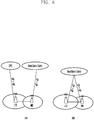
- FIG. 3 is a diagram showing an example of a core network architecture and the connection state of a control plane (CP) and user plane (UP) between a UE and a BS in an LTE-5G Tight Integration (non-standalone (NSA)) operation environment according to an embodiment of the present disclosure.
- CP control plane
- UP user plane
- LTE-5G Tight Integration non-standalone
- a process of selectively operating a measurement operation for a 5G cell of a UE is described as a first operation method for minimizing the 5G link activation state of a UE.
- a multi-RAT capable UE may transmit and receive traffic of a low data rate through a legacy RAT (4G/3G/2G, etc.) prior to 5G, and is thus advantageous from the viewpoint of power consumption in minimizing the activation state of a 5G cell link within the UE for the traffic transmission of a higher data rate.
- a UE chiefly operates in the standby time not having transmission rather than a transmission progress time for a 5G cell link. Accordingly, such an improved measurement operation is very important for the power efficiency improvement of a UE.
- An RRC state operation between the LTE and 5G connections of a multi-RAT capable UE may chiefly operate according to the following two methods.
- the first is an LTE-5G interworking operation shown in FIGS. 3 to 7 , and is a BS and UE operation in a 5G non-standalone (NSA) environment.
- the second is an LTE-5G independent operation shown in FIGS. 8 to 12 and is a BS and UE operation in a 5G standalone (SA) environment.
- SA 5G standalone
- FIG. 3 is a diagram showing an example of a core network architecture and a control plane (CP) and user plane (UP) connection state between a UE and a BS in an LTE-5G Tight Integration (NSA) operation environment, that is, one of 5G network architecture candidates, in a communication system according to an embodiment of the present disclosure.
- an LTE BS can operate as a macrocell and provide wider coverage because it uses a frequency band of 6 GHz or less.
- a 5G BS can operate as a small cell because it uses frequency bands of 28 GHz and 6 GHz or more including an mmWave band.
- the 4G and 5G core networks are separately present, but there is an interface connecting them.
- a 4G (LTE) link can connect both a control plane (CP) and user plane (UP) between a UE and a BS.
- 5G new radio (NR)
- NR new radio
- CP control plane
- UP user plane
- an operation of implementing some control functions of a control plane (CP) between a UE and a BS in an LTE BS, implementing the remaining control functions through a 5G link, and transmitting and receiving a user plane (UP) through a 5G connection may be considered.
- CP control plane
- UP user plane
- FIG. 4 is a diagram showing an example of a connection state between BSs and signaling between protocol layers in an LTE-5G Tight Integration (NSA) operation environment, that is, one of 5G network configuration candidates according to an embodiment of the present disclosure.
- FIG. 4 divides and shows whether 4G and 5G protocol layers will operate a radio resource control (RRC) layer, a packet data convergence protocol (PDCP) layer, a radio link control (RLC) layer, a medium access control (MAC) layer and a physical (PHY) layer as independent protocol layers or a merged protocol layer.
- RRC radio resource control
- PDCP packet data convergence protocol
- RLC radio link control
- MAC medium access control
- PHY physical
- FIG. 5 is an RRC connection management method for low energy of a UE and is a diagram illustrating a state diagram for a multi-RAT (4G, 5G) low energy operation in the LTE-5G Tight Integration(NSA) operation environment.
- 4G, 5G multi-RAT
- detailed operation scenarios of a UE include 1) a 5G link activation necessity and availability sensing operation, 2) a 5G modem turn-on time determination operation, and 3) a different configurations and application operations of C-DRX standby intervals of 4G and 5G in the RRC connected state.
- a UE needs to perform a preliminary operation (e.g., beam scanning or measurement) before it turns on a high frequency band modem receiver of 5G (NW).
- a preliminary operation e.g., beam scanning or measurement
- NW high frequency band modem receiver of 5G
- at least one of a) whether a UE is in coverage of a NR BS, b) QoS necessary for service information (e.g., service type) and service of traffic that needs to be transmitted, and c) the amount of data for traffic that requires transmission support and the state of a buffer accumulated in a UE/BS (i.e., the amount of data accumulated in a buffer) may be selected as a criterion for detecting that such a preliminary operation needs to be started.
- a process of performing the aforementioned preliminary operation may be configured by a 4G BS not a 5G BS, and may be performed by a UE. More specifically, a 4G BS may configure a condition for triggering an event for a preliminary operation performed by a UE. The UE performs the preliminary operation (beam scanning and/or measurement) on a 5G BS in response to the event configured by the 4G BS.
- a 5G RAT connection may be supported through a 4G RAT connection between a UE and an LTE BS.
- a 4G modem is first turned on (510).
- the UE moves and enters 5G Coverage.
- the UE performs a 5G discovery operation (520).
- a process of sensing the entry into 5G coverage includes a determination operation based on indication provided by a BS (network). For example, a 5G indicator of 1 bit may be newly added on system information broadcasted by a 4G BS.
- the UE that has received a 5G indicator from a 4G BS may be aware that a 5G BS is present within coverage of the corresponding 4G BS.
- the UE starts scanning in a 5G (NR)-related frequency band.
- 5G coverage-related indication provided by the BS (network) will be transmitted as system information of an LTE BS because the UE has not yet turned on the high frequency band modem receiver of 5G (NW).
- the 5G indicator of 1 bit is information for notifying the UE that a 5G small cell is present within a macrocell of the corresponding LTE BS.
- a service type of uplink or downlink traffic may become another criterion as the criterion for an operation for a UE to start 5G scanning in addition to the indication provided by a BS (network).
- a UE may start a preliminary operation (scanning or measurement) for turning on the high frequency band modem receiver of 5G (NW).
- the UE may start a preliminary operation (scanning or measurement) for turning on the high frequency band modem receiver of 5G (NW) using the amount of uplink or downlink traffic, expected by the UE or the BS, as another criterion.
- a BS may transmit an RRC (re)configuration message to a UE using a unicast method.
- a method for a network to instruct a UE to perform the preliminary operation by transmitting on-demand system information is also possible as an operation for a BS to notify the UE that the UE needs to start a preliminary operation (scanning or measurement) for turning on the modem receiver of an NR (5G) frequency band.
- a UE transmits a traffic event report to a BS through a 4G RAT or a low frequency link as UE feedback by notifying the BS of the need of the preliminary operation.
- a BS may transmit an RRC (re)configuration message to a UE using a unicast method based on the traffic event report of the UE.
- a method for a network to instruct a UE to perform a preliminary operation by transmitting system information, common system information (or minimum system information), on-demand system information or other system information is also possible as an operation for a BS to notify a UE that a preliminary operation (e.g., beam scanning and/or measurement) for turning on the modem receiver of an NR (5G) frequency band needs to be started.
- a preliminary operation e.g., beam scanning and/or measurement
- the UE When a UE recognizes that it needs to start a preliminary operation (scanning or measurement) for turning on the high frequency band modem receiver of 5G (NW) through an indicator transmitted by a 4G BS according to the aforementioned process or through an RRC (re)configuration or on-demand SI provided by a BS (network), the UE may identify that it will start the preliminary operation for turning on the 5G modem by transmitting a response signal to the BS.
- an operation for a UE to determine a 5G modem turn-on time (5G ON time determination) after a 5G discovery process is terminated may operate based on a) a buffer state for each UE of a BS and b) the buffer state of a UE.
- Various layers such as i) the PDCP layer, ii) the RLC layer, iii) the MAC layer, and iv) the PHY layer, may correspond to protocol layers, that is, a criterion for the buffer state of a BS and a UE.
- the 5G modem of the UE will be turned on based on the PDCP buffer state of each UE of a BS and/or the PDCP buffer state of a UE (530).
- the BS recognizes that it needs to start a preliminary operation (scanning or measurement) for turning on the high frequency band modem receiver of 5G (NW) (520). Thereafter, when the capacity of a buffer for each UE of a BS or the capacity of the buffer of the UE increases to a second threshold TH_2 (TH_1 ⁇ TH_2) or more, an operation of turning on the 5G (NR) high frequency band modem receiver of the UE is performed (530).
- TH_2 TH_1 ⁇ TH_2
- the aforementioned two operations (preliminary operation and 5G modem turn-on operation prior to 5G modem turn-on) according to the capacity of a buffer may be started based a 5G link activation request signal of a UE or BS, may be performed based on the time when the reception of a response feedback message corresponding to such an activation request signal is completed or may be performed by starting data transmission after a timer (time gap for configuring a transmission and reception (Tx/Rx) beam of a UE and a BS) configured in the aforementioned response feedback message.
- a timer time gap for configuring a transmission and reception (Tx/Rx) beam of a UE and a BS
- the operation for the UE to determine the 5G modem turn-on time (5G ON time determination) after the 5G discovery process is terminated may be determined based on c) PDCP duplication activation. More specifically, the operation includes an operation for a master node (4G macrocell, a lower frequency BS) to configure whether to activate PDCP duplication in RRC based on a PDCP duplication operation and to determine the 5G modem turn-on time based on an operation of dynamically controlling whether to activate PDCP duplication through a MAC CE.
- a master node (4G macrocell, a lower frequency BS) to configure whether to activate PDCP duplication in RRC based on a PDCP duplication operation and to determine the 5G modem turn-on time based on an operation of dynamically controlling whether to activate PDCP duplication through a MAC CE.
- the operation for the UE to determine the 5G modem turn-on time (5G ON time determination) after the 5G discovery process is terminated may be determined based on d) mobility support according to UE mobility speed (performance requirements for a handover failure, handover latency and a radio link failure).
- UE mobility speed performance requirements for a handover failure, handover latency and a radio link failure.
- the operation is performed using an MN link, and includes an operation of performing data transmission without turning on an SN or using a continuously turned-on SN without turning off the SN.
- the operation includes an operation of performing mobility support of a UE through a continuously turned-on MN without turning off the MN.
- An operation for the 4G/5G CP Tail differentiation operations may include an operation of first changing a 5G Link to a low energy mode (C-DRX or Idle DRX) if there is no transmitted and received traffic.
- the 5G modem may be first deactivated after 1 second from the last transmission and reception traffic, and the 4G modem may remain in the C-DRX state and may be deactivated after 10 seconds, so the UE makes transition to the RRC idle state.
- MAC-MainConfig field descriptions drx-Config Used to configure DRX as specified in TS 36.321 [6].
- E-UTRAN configures the values in DRX-Config-v1130 only if the UE indicates support for IDC indication.
- E-UTRAN configures drx-Config-v1130 only if drx-Config (without suffix) is configured.
- Value psfl corresponds to 1 PDCCH sub-frame
- psf2 corresponds to 2 PDCCH sub-frames and so on.
- Value psfl corresponds to 1 PDCCH sub-frame
- psf2 corresponds to 2 PDCCH sub-frames and so on.
- drx-RetransmissionTimer-v1130 is signalled, the UE shall ignore drx-RetransmissionTimer (i.e. without suffix).
- RRM-Config field descriptions ue-InactiveTime Duration while UE has not received or transmitted any user data. Thus the timer is still running in case e.g., UE measures the neighbour cells for the HO purpose.
- Value s1 corresponds to 1 second.
- s2 corresponds to 2 seconds and so on.
- Value min1 corresponds to 1 minute
- value minls2C corresponds to 1 minute and 20 seconds
- value min1s40 corresponds to 1 minute and 40 seconds and so on.
- RRM-Config :: SEQUENCE ⁇ ue InactiveTime ENUMERATED ⁇ s10, s15, s20, s1, s2, s3, s5, s7, min1, min1s20c, min1s40, s25, s30, s40, s50, min3s30, min4, min5, min6, min2, min2s30, min3, min10, min12, min14, min17, min20, min7, min8, min9, min38, min44, min50, hr1, min24, min28, min33, hr2min30, hr3, hr3min30, hr4, hr5, hr6, hr1min30, hr2, hr16, hr20, day1, day1hr12, day2, hr8, hr
- drx-Config, drx-InactivityTimer, drx-RetransmissionTimer, and drxShortCycleTimer parameters included in the MAC-MainConfig field configured between a UE and a BS, the ue-InactiveTime parameter of the RRM-Config field, and a setting value corresponding to a sub-parameter, described in Table 1 to Table 4, may be separated, configured and applied as an LTE set (or low/lower frequency or a sub-6 GHz link) and an NR set (or high/higher frequency or an above-6 GHz link) not one set in 5G.
- a UE can differentially configure and operate C-DRX standby intervals of 4G and 5G by configuring separate drx sets for 5G in the MAC-MainConfig field and the RRM-Config field.
- "nr" is added to a parameter configuring a new drx set for 5G and indicated.
- the parameters shown in Table 5 and Table 6 are merely simple examples, and other parameters may be additionally configured in order to differently operate C-DRX between 4G and 5G.
- parameters may be configured in a form in which some parameters have been omitted.
- the parameters to which "nr" has been added for a 5G connection may be configured as a value shorter than or longer than parameters for a 4G connection, and some parameters may be configured as the same value.
- the parameters in a process of dualizing C-DRX parameters for a 4G connection and a 5G connection, several criteria may be applied.
- a method of dualizing and configuring the parameters depending on beamforming is possible.
- a method of dualizing and configuring the parameters based on a beam number threshold wide beam and narrow beam
- the parameters dualized and configured according to the aforementioned embodiment may include the drx-Config, drx-InactivityTimer, drx-RetransmissionTimer, and drxShortCycleTimer parameter corresponding to the MAC-MainConfig field related to the illustrated Connected DRX (C-DRX), and ue-InactiveTime of the RRM-Config field.
- the parameters may further include other parameters and some of the parameters may be excluded.
- a user-inactivity timer that is, a timer for the RRC state transition of a UE, may be differentially configured and operated for each 4G/5G link.
- the user-inactivity timer is a parameter related to the aforementioned CP tail and radio tail.
- a BS implements and applies User-inactivity timer_1 and User-inactivity timer_2 as separate parameters or configures them in the UE
- the UE can automatically release an RRC connection and make transition to an idle state or inactive state even without signaling to the BS.
- the aforementioned process may be separately applied to a timer, that is, a criterion for switching from the RRC connected state to the idle state, and a timer, that is, a criterion for switching from the RRC connected state to the inactive state.
- This may mean an operation of changing the RRC state from Connected to the idle or inactive state through RRC signaling (RRC release or RRC inactivation signaling) when a corresponding timer expires.
- the user-inactivity timer a) may be dualized and configured with respect to a 4G link and a 5G link
- b) may be configured by dualizing related parameters with respect to a 6 GHz or less frequency band link and a 6 GHz or more frequency band link for each frequency band
- c) may be configured by dualizing related parameters depending on beamforming
- d) may be configured by dualizing related parameters based on a beam number threshold (wide beam and narrow beam)
- e) may be configured by dualizing related parameters based on a modem having high power efficiency and a modem having low power efficiency.
- the parameters may be dualized and configured through a combination of two or more of the aforementioned criteria.
- parameters related to DRX and an inactivity timer may also be determined and configured based on whether each of requirements for whether coverage of a secondary node (SN) BS is included, service information of traffic and QoS required by a service, the amount of data for traffic, the state (amount) of a buffer accumulated in a UE/BS, whether PDCP duplication is activated, mobility speed of a UE, and mobility support, and a combination of two or more of them.
- SN secondary node
- an event trigger defined based on each of conditions based on the cases where a UE is in coverage of a secondary node (SN) BS, service information of traffic and QoS required by a service are low latency or a high capacity, the amount of data for traffic and a buffer capacity accumulated in a UE/MN or an SN BS is a threshold or more, and a PDCP Duplication operation is activated and thus a PDCP packet is transmitted and received both links of the MN and SN, and in the case of mobility support (handover and radio link failure performance requirements) according to UE mobility speed and defined based on a combination of a plurality of the conditions, may be configured and applied.
- SN secondary node
- the meaning that the values are conservatively determined and set may mean a method of setting the user inactivity timer relatively long, a method of setting drx-Config and drx-InactivityTimer, that is, sub-parameters of C-DRX, relatively long, a method of setting drx-RetransmissionTimer relatively long, or a method of setting drxShortCycleTimer relatively long.
- the UE when traffic does not occur in the state 530, the UE enters a C-DRX mode based on the 5G C-DRX parameter (540).
- the UE first enters a 5G discovery state when the CP tail of a relatively shorter configured 5G connection expires based on the dualized and configured user-inactivity timer (550). That is, the CP tail operates relatively shorter with respect to a 5G connection, thereby being capable of reducing power consumption of the UE for the 5G connection.
- the user-inactivity timer configured with respect to the 4G connection of the UE expires and the RRC connection is released, the UE operates in the RRC idle state (560).
- the UE has one RRC state at one time. Accordingly, the UE becomes the RRC connection state other than the RRC idle state (560), that is, the state in which all the modems for the 4G connection and the 5G connection have been turned off
- a method of i) introducing a an extended long-period discovery reference signal (RS) design for a low energy operation of a UE and ii) operating 4G LTE link C-DRX or Idle DRX when a 5G (NR) link is activated is also possible.
- RS long-period discovery reference signal
- a method of operating C-DRX or Idle DRX may also be implemented if the UE is a low-speed moving state and the latency requirement is not low latency and permits some latency.
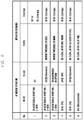
- FIG. 6 is an RRC connection management method for low energy of a UE and is an embodiment of a UE modem operation for each state according to operation scenarios for a multi-RAT (4G, 5G) low energy operation in the LTE-5G Tight Integration operation environment.
- FIG. 6 shows that operations of the 4G modem and 5G modem of a UE are separated depending on the number of cases and the operation scenarios of the UE according to the cases are matched.
- the operation of the UE may be divided into four modes depending on whether a multi-RAT modem (4G, 5G) is activated.
- the modem operation period of the UE is assumed to be (TP1> TP2> TP3> 0).
- the following operation mode change condition (triggering event) may be configured with respect to measurement operation options.
- an event according to the relation between the movement of a UE and 5G coverage may be configured.
- the event according to the relation between the movement of a UE and cell coverage may include (1-1) a triggering event in which the UE moves into 5G coverage, (1-2) a triggering event in which the UE moves out of 5G coverage, and (1-3) a triggering event in which the UE moves to a 5G coverage cell center.
- a determination of whether the UE is in 5G coverage may include i) a determination operation based on network (N/W) information (e.g., ANDSF, MME Pre-configuration information) and a message structure of Pre-configuration information and ii) an operation based on an Indication Message of a Legacy RAT BS a Tight-Interworking or multi-link operation within a multi-RAT UE.
- N/W network
- this includes the design of a new message structure (new field), such as a 1 bit 5G cell indicator within an RRC connection response message, an operation for a BS to configure the new field, signal it to a UE, and apply it to the UE.
- a determination of whether the UE is in 5G coverage includes iii) an operation based on a signal received from a legacy RAT BS in a Tight-Interworking or multi-link within a multi-RAT UE. Whether the UE is in 5G coverage may be determined by combining the aforementioned three criteria i), ii) and iii).
- an event operation may be configured based on a buffer size within a UE. All of PDCP/RLC/MAC/PHY buffers within a UE may correspond to such a buffer. Furthermore, all of PDCP/RLC/MAC/PHY buffers for each UE, supported by BSs of a legacy RAT and new RAT, may correspond to such a buffer. An event according to the buffer sizes of a UE and a BS is divided into the number of cases and described in detail.
- an event based on required QoS information may be configured.
- the triggering event based on required QoS information may operate based on QoS requirements of a service generated by a UE or server (BS), and the service may operate based on traffic/Bearer/logical CH/RAN Slice (PHY/MAC Resource/Configuration combination) and a combination of them.
- the triggering event based on required QoS information is divided and described below.
- a triggering event based on a recent traffic transmission and reception time may be configured as the event of each of the subframe time of a physical downlink control channel (PDCCH) recently received by a UE/BS, the time when a UE buffer is zero, and the time when a buffer for each UE of a (Legacy and/or New RAT) BS is zero or a combination of two or more of them.
- the triggering event includes a criterion time and a given time lapse after the criterion time.
- FIG. 6 shows operation mode change triggering events (cell coverage, a buffer state, based on required QoS information and a lapse time from the recent traffic arrival time) of a UE according to the aforementioned several conditions, operations for a 5G cell of a UE according to a combination of them, and operations of the connection state to switch and make transition.
- the 5G cell modem operation of a UE may include remaining in a 5G cell modem OFF state in the aforementioned mode 1 upon initial access, making transition to a 5G cell discovery state based on a 5G cell coverage event (mode 2), then making transition to a 5G cell measurement mode based on a combination of a buffer size-based event (TH1_2x) or/and a (TR1_3x) required QoS information-based event TH1 (mode 3), and making transition to a 5G cell channel detailed measurement or continuous active mode based on a combination of a buffer size-based event (TH2_2x) and/or a (TR2_3x) required QoS information-based eventTH1 (mode 4).
- mode 2 a buffer size-based event
- TR1_3x required QoS information-based event TH1
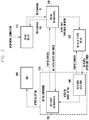
- FIG. 7 is an RRC connection management method for low energy of a UE according to an embodiment of the present disclosure and is a diagram illustrating an example of a control signaling flow and a BS/UE modem operation process for a multi-RAT (4G, 5G) low energy operation in an LTE-5G Tight Integration operation environment.
- an indicator indicative of information about 5G coverage is delivered from a BS supporting the 4G connection of the UE to the UE (S705).
- the UE receives a parameter for configuring a short CP tail while performing a 5G discovery procedure.
- a parameter related to the CP tail may be a parameter for differentially configuring and operating 4G/5G C-DRX standby intervals as described above.
- the UE performs a beam training procedure (S710) through a measurement process for a 5G cell through a 5G discovery procedure (S765), and feeds information about the scanned best beam to the 5G BS (S715).
- a triggering event for enabling the UE to initiate the 5G discovery procedure may be generated based on the capacity of the buffer of the BS (S720).
- the 4G BS indicates 5G cell addition with respect to the UE (S725).
- a connection between the 5G BS, that is, a cell of a mmW band, and the UE is established (S770).
- the UE exchanges data through the connection with the 5G BS (S730).
- the buffer capacity threshold TH1 of the triggering event for enabling the UE to initiate 5G cell measurement and the buffer capacity threshold TH2 of a triggering event for a measurement report (MR) for enabling the UE to report measurement results to the BS may be differently configured.
- a UE/BS RLC buffer is the threshold TH2 or more, an operation of transmitting a measurement report (MR) is performed. This is an operation of consuming UE UL transmission power.
- a MeNB that is, 4G LTE, determines cell addition, a UE performs only an operation of performing measurement and transmitting a measurement report (MR).
- FIG. 8 is a diagram showing an example of the connection state of a control plane (CP) and user plane (UP) between a core network and a BS in an LTE-5G Independent environment based on a multi-link (ML) in a communication system according to an embodiment of the present disclosure.
- CP control plane
- UP user plane
- a core network and a BS in an LTE-5G Independent environment based on a multi-link (ML) in a communication system according to an embodiment of the present disclosure.
- an LTE BS and a 5G (NR) BS independently operate.
- Such a case may include all of a case where 4G and 5G core networks are separately present, but an interface is present between them, a case where 4G and 5G core networks are separately present, but an interface is not present between them, and a case where a 4G core network evolves and merges with a 5G core network.
- LTE BS and the 5G (NR) BS independently operate, to connect both a control plane (CP) and user plane (UP) between a UE and a BS in the case of a 4G (LTE) link and to connect both a control plane (CP) and user plane (UP) between a UE and a BS in the case of 5G (NR) may be considered.
- CP control plane
- UP user plane
- FIG. 9 is a diagram showing an example of a connection state between BSs and signaling between protocol layers in an LTE-5G Independent environment (multi-link (ML)) according to an embodiment of the present disclosure.
- LTE-5G Independent environment multi-link (ML)
- ML multi-link
- 4G and 5G protocol layers may operate as independent protocol layers with respect to the RRC, PDCP, RLC, MAC and PHY layers.
- FIG. 10 is a diagram illustrating a state diagram for a multi-RAT (4G, 5G) low energy operation in an LTE-5G Independent operation environment according to an embodiment of the present disclosure.
- 4G and 5G connections are independently controlled (including paging). Such a control operation includes a paging RAT selection process based on cell coverage wherein a UE is placed. Furthermore, in the LTE-5G independent operation environment, a gateway stage may support a flow aggregation. In each of 4G/5G connections, an operation of determining whether traffic/coverage/QoS support for a UE is necessary, determining whether a multi-link will be turned on (1020) or a single link (5G only or 4G only) will be turned on (1010, 1030) based on a result of the determination, and applying a result of the determination may be performed.
- Such a process may operate based on coverage of a cell where a UE is placed. Specifically, a determination operation based on each criterion and combination may be performed based on a 4G cell /5G cell received signal level or coverage-related indication from a network. Alternatively, such a process may operate based on the type of high quality traffic (e.g., VoIP or a new URLLC service) that may be supported for a UE or a determination operation based on a buffer state within a BS/UE may be performed based on a QoS condition.
- VoIP Voice over IP
- a new URLLC service e.g., VoIP or a new URLLC service
- FIG. 11 is a diagram illustrating an example of a UE modem operation for each state according to an operation scenario for a multi-RAT (4G, 5G) low energy operation in an LTE-5G Independent operation environment according to an embodiment of the present disclosure.
- An RRC state operation of a multi-RAT capable UE may include the following four states.
- the RRC_connected state is divided into a continuous reception mode and a C-DRX mode.
- the RRC_Idle state is subdivided into an Idle DRX (paging) step and an inactive mode in which all of modem circuits are turned off
- a multi-RAT capable UE operating in the four different states may operate based on the condition of each of an event (TRiggering event 1 (TR1): event 1) depending on new RAT (5G) cell coverage, an event (TR2) according to a buffer condition (buffer size), an event (TR3) depending on whether high QoS traffic is present, and an event (TR4) based on required QoS information or a combination of two or more of them.
- TR1 triggering event 1
- TR2 event 1
- TR2 new RAT (5G) cell coverage
- TR2 an event
- TR3 depending on whether high QoS traffic is present
- TR4 based on required QoS information or a combination of two or more of them.
- Such a multi-RAT capable UE may operate as follows while changing the aforementioned RRC state in response to the event according to the aforementioned several conditions.
- an operation for a UE to determine a 5G modem turn-on time includes an operation of determining a 5G modem turn-on time based on mobility support (performance requirements for a handover failure, handover latency and a radio link failure) according to UE mobility speed.
- the operation when UE moving speed is high speed and thus a threshold (e.g., 120 km/h) or more and a handover latency requirement is a threshold (e.g., 1 second or 0) or less, the operation is performed using an MN link, and includes an operation of performing data transmission without turning on an SN or using a continuously turned-on SN without turning off the SN. Furthermore, the operation includes an operation of performing mobility support of a UE through a continuously turned-on MN without turning off the MN.
- a threshold e.g. 120 km/h
- a handover latency requirement is a threshold (e.g., 1 second or 0) or less
- the operation is performed using an MN link, and includes an operation of performing data transmission without turning on an SN or using a continuously turned-on SN without turning off the SN.
- the operation includes an operation of performing mobility support of a UE through a continuously turned-on MN without turning off the MN.
- a UE In the LTE-5G interworking, NSA environment, a UE has operated to receive LTE (4G) paging in the RRC idle state. In contrast, in the LTE-5G independent, SA environment, a UE may operate to receive paging based on a recent RAT that has been recently turned on. That is, a multi-RAT capable UE may operate to randomly select one of the two RATs and to receive a paging message and may operate to select an RAT whose connection has been terminated most recently and to receive a paging message.
- RRC state connection control of a multi-RAT capable UE may include a process of operating a CP tail for a new RAT (NR) relatively shorter than a CP tail for the legacy RAT.
- RRC state connection control of a multi-RAT capable UE may include an operation of designing the CP tail for the new RAT close to zero (0) + margin (margin ⁇ 1) and immediately making transition to the RRC idle state right after NR traffic is transmitted and received.
- a paging association operation is determined depending on the LTE-5G interworking environment and the LTE-5G independent environment.
- Information related to the paging association operation may be delivered to a multi-RAT UE using a method for a core network, such as an ANDSF or MME, to notify the multi-RAT UE of the information through a legacy RAT or new RAT BS when the UE first accesses an N/W.
- a 5G BS/UE may perform at least one of:
- a 5G BS/UE may perform at least one of:
- the embodiment in which DRX and inactivity timer sets for HF and LF cells in the SA environment, among the aforementioned embodiments, are differentiated, configured and operated may also include a method for a BS to configure a corresponding parameter as a fixed value and operate it.
- Another embodiment may also include an operation of determining and configuring parameters related to DRX and an inactivity timer based on each of the requirements for whether coverage of a secondary node (SN) BS is included, service information of traffic and QoS required by a service, the amount of data for traffic, the state (amount) of a buffer accumulated in a UE/BS, mobility speed of a UE, and mobility support, and a combination of two or more of them is also possible.
- SN secondary node
- an event trigger defined based on each of conditions based on the cases where a UE is in coverage of a secondary node (SN) BS, service information of traffic and QoS required by a service are low latency or a high capacity, the amount of data for traffic and a buffer capacity accumulated in a UE/MN or an SN BS is a threshold or more, and in the case of mobility support (handover and radio link failure performance requirements) according to UE mobility speed and defined based on a combination of a plurality of the conditions, may be configured and applied.
- SN secondary node
- the meaning that the values are conservatively determined and set may mean a method of setting the user inactivity timer relatively long, a method of setting drx-Config and drx-InactivityTimer, that is, sub-parameters of C-DRX, relatively long, a method of setting drx-RetransmissionTimer relatively long, or a method of setting drxShortCycleTimer relatively long.
- FIG. 12 is a diagram illustrating an example of a control signaling flow and a BS/UE modem operation process for a multi-RAT (4G, 5G) low energy operation in an LTE-5G Independent operation environment according to an embodiment of the present disclosure.
- a paging message is delivered from a BS, supporting the 4G connection of the UE, to the UE (S1200).
- the UE recognizes a necessity to turn on a 5G connection in response to a triggering event (S1205) to compare the capacity of a buffer with a given threshold TH1, the UE performs a 5G discovery procedure (S1265) and performs a beamforming random access channel (RACH) procedure on a BS supporting a 5G connection (S1210).
- a triggering event S1205
- RACH beamforming random access channel
- the UE When a connection between the UE and the 5G BS is established and a triggering event (S1215) is satisfied by comparing the capacity of the buffer of the UE with another threshold TH2, the UE adds a 5G cell and exchanges data through the connection with the 5G BS (S1220, S1225). In such a process, only the 5G connection of the UE is activated and the 4G modem may operate in the RRC idle state (S1270). Meanwhile, after data transmission through the 5G connection of the UE is completed, when a given time elapses (S1230), the 5G modem of the UE is turned off through a 5G cell release process of the UE (S1235). Such a time may be a time interval corresponding to the aforementioned short CP tail.
- the 4G connection of the UE is the RRC idle state, and the UE receives a 5G paging message (S1240) in the 5G discovery state (S1275).
- S1240 a 5G paging message
- S1275 the 5G discovery state
- S1245 the time interval for the 4G connection expires
- S1250 the connection with the 4G cell of the UE is also released (S1250).
- the UE operates in the state in which a 4G paging message is received (S1255).
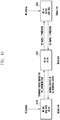
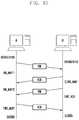
- FIG. 13 shows an example of a UE connection standby time reduction operation based on a traffic end point (TCP flag FIN) for an efficient 5G radio tail (user inactivity timer) interval reduction operation according to an embodiment of the present disclosure.
- This drawing shows the final (FIN) indication of a TCP packet from a transmission stage and a reception stage and ACK transmission for identifying the final indication.
- the TCP is a protocol of a transmission layer.
- the TCP splits data received from a data stream and generates a TCP segment by adding a TCP header.
- the TCP enables the exchange of data between network nodes to be performed stably without an error.
- a transmission node sets the FIN flag of flags 1410, included in a TCP header, to 1 bit and performs transmission, this means that there is no data to be transmitted by the transmission side, that is, the last of transmission.
- a reception node that has received the FIN flag set to 1 sets an ACK flag to 1 bit and transmits it as a response thereto.
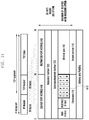
- FIG. 14 is a basis technology for showing an example of a UE connection standby time reduction operation based on a traffic end point (TCP flag FIN) for an efficient 5G radio tail (user inactivity timer) interval reduction operation according to an embodiment of the present disclosure, and is a diagram including FIN indicative of the last of transmission as the type of flag marked in a TCP header.
- TCP flag FIN traffic end point
- 5G radio tail user inactivity timer
- FIG. 15 is a basis technology for showing an example of a UE connection standby time reduction operation based on a traffic end point (TCP flag FIN) for an efficient 5G radio tail (user inactivity timer) interval reduction operation according to an embodiment of the present disclosure, and is a diagram showing a hierarchical structure and unit in a wireless communication protocol.
- TCP flag FIN traffic end point
- 5G radio tail user inactivity timer
- a TCP-related embodiment is described specifically.
- a UE inactivity timer (CP tail) for a 5G cell may be configured based on several criteria. For example, in accordance with a first criterion, the UE inactivity timer (CP tail) may be configured based on a traffic end point (TCP flag FIN). When a FIN value, that is, one of the TCP header flags (6 bits), is received, the UE inactivity timer (CP tail) may be configured to early terminate a connection or may be configured to maintain a connection until an ACK flag value is received as a response to the FIN flag. Furthermore, the UE inactivity timer (CP tail) may be configured and operated to extend a connection based on an SYN value, that is, a different flag value of the TCP Header flags (6 bits).
- information of the corresponding flag may be identified by performing TCP header parsing on IP (TCP) traffic Header information implemented in the AP of a UE when a PDCP implemented in a UE CP is generated.
- TCP IP
- Header information implemented in the AP of a UE when a PDCP implemented in a UE CP is generated.
- PPI power preference indicator
- CP tail radio tail
- the UE and the BS may perform a PPI determination operation based on the number of TPC connections through IP (TCP) flag parsing in order to manage the total number of TCP connections of the plurality of TPC connections.
- TCP IP
- the UE and the BS perform the aforementioned operation for RRC release when the total number of TCP connections is 0 through a number increase (++) operation based on a TCP connection request (SYN) flag and a number reduction (--) based on a TCP connection termination (FIN) flag.
- a BS may identify information of a corresponding flag by performing TCP header parsing.
- a method of performing a radio tail reduction operation by performing the RRC release of the BS without UE feedback transmission is also possible.
- i) whether DL data has been transmitted after corresponding UL data, ii) whether ACK/NACK reception is necessary, iii) Keep alive message dedicated, and iv) whether the server has been updated (involving DL transmission) may become conditions for extending the 5G connection of a UE.
- a combination of two or more of the conditions is also possible.
- the BS may use information indicative of such criteria by incorporating them in a DRX period and radio tail coordination process.
- a method of marking in a buffer status report (BSR) new field as a method of marking in a new field of the existing MAC control element or ii) an operation of marking in an UL data MAC header and transmission may be performed based on new/existing control signaling.
- BSR buffer status report
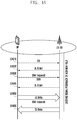
- FIG. 16 is a diagram showing an example of an operation based on DL traffic occurrence as a server operation according to a UE request (UL) for a 5G CP tail interval minimization control operation according to an embodiment of the present disclosure.
- SR scheduling request
- BSR buffer status report
- Such transmission and reception process of the UE and the BS may operate according to i) a method of marking in a new field of the existing MAC control element, for example, a method of marking a data request from the UE in a buffer status report (BSR) new field or ii) a method of marking in an UL data MAC header.
- BSR buffer status report
- the BS may control a C-DRX and idle DRX period for a corresponding link and a standby time (radio tail) from the last transmission and reception traffic based on the received information, may configure the C-DRX and idle DRX period and the standby time (radio tail), and may control the UE by applying them.
- FIG. 17 is a diagram showing an example of an operation based on DL traffic occurrence as a server operation based on the cost of a process for a UE to make transition from the RRC Idle state to the RRC connected state for the purpose of a 5G CP Tail interval minimization control operation according to an embodiment of the present disclosure.
- a short tail is configured and operated based on an operation based on the cost of an RRC state transition process of a UE, problems of an increase in signaling load when traffic prediction is impossible and QoE deterioration may occur.
- Such problems may result in, specifically, i) a burden of UE request transmission and BS connection release configuration, ii) power consumption attributable to UE uplink transmission and control resource consumption when multiple UE operations are performed, iii) a burden of a connection reconfiguration after entry into the idle state when the prediction of a traffic pattern is impossible, and iv) LTE UE-based transmission power consumption (523 mW) and latency occurrence (1.4 second: paging latency 1.28 second, and connection reconfiguration 84 ms latency expected).
- an RRC inactive (1720) state (or light connection) in which a procedure consumed when a UE makes transition to the RRC connected state has been minimized may be introduced, instead of immediately entering an RRC idle (1730) state when an RRC connection in an RRC Connected (1710) state is released.
- Such an RRC inactive state is different in that an RRC connection is not fully released, but is deactivated, unlike the RRC idle state.
- a 5G Tail interval minimization operation needs to be designed by taking into consideration a case where the RRC inactive state makes transition to the RRC connected state again.
- the promotion cost (transition to the RRC connected state) of a UE is changed depending on whether a corresponding network operates in legacy idle or in the RRC inactive state after the RRC connected state.
- a method operating based on i) a latency occurrence time attributable to N/W signaling overhead and ii) BS power consumption of a UE for a corresponding procedure may be implemented as an operation of controlling a CP tail by incorporating such a cost.
- an RRC suspend state (ECM Connected state) in which a network, such as a BS, retains context of a UE may be introduced. Transition to the RRC connected state is made through a procedure resumed in the RRC suspend state.
- a C-DRX and idle DRX period and a standby time (radio tail) from the last transmission and reception traffic may be controlled by taking into consideration a beamforming synchronization operation, switching on hardware circuit including precise-clock, an RF circuit with massive antennas, and an additional high speed core processor, and they may be signaled.
- information related to a promotion time and promotion energy may be added to UE category information, and a network may transmit the UE category information to a BS.
- the BS may perform RRC release based on the received UE category information.
- a minimum idle interval (i.e., the time maintained to a minimum when making transition to RRC Idle) may be determined based on such promotion cost-related information, and transition to the RRC_connected state may be delayed. Accordingly, a power reduction effect of a UE when the UE enters the idle mode can be guaranteed because the minimum idle interval maintained to a minimum when the UE makes transition to RRC Idle is applied.
- an NR CP tail may be set to zero (if there is no possibility that the will be out of 5G coverage) or paging disable (if there is no possibility that the will be in 5G coverage) may operate.
- the method may operate based on Tight-Interworking within a multi-RAT UE or information from a multi-link or legacy RAT BS.
- an operation of early executing RRC Release when there is no data in an UL PDCP buffer and when there is no data in a BS DL PDCP buffer is also possible in addition to an operation of delaying PPI transmission when data is present in a UE UL PDCP buffer and an operation of delaying RRC Release when data is present in the BS DL PDCP buffer.
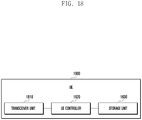
- FIG. 18 is a diagram showing the configuration of a UE according to an embodiment of the present disclosure.
- the UE may include a transceiver unit 1810, a UE controller 1820, and a storage unit 1830.
- the UE controller 1820 may be defined as a circuit- or application-specific integrated circuit or at least one processor.
- the transceiver unit 1810 transmits and receives signals to and from a different network entity.
- the transceiver unit 1810 may receive system information from a network entity (e.g., a CU, a DU and/or a BS), for example, and may receive a synchronization signal or a reference signal.
- the transceiver unit 1810 may be implemented in the form of an RF unit including a modem.
- the UE controller 1820 may control an overall operation of the UE according to the embodiments proposed in the present disclosure.
- the UE controller 1820 may control the transceiver unit 1810 and the storage unit 1830 to perform operations according to the embodiments described in the drawings.
- the UE controller 1820 may differently configure the UE inactivity timer for each RAT or may differently turn on/off the modem included in the transceiver unit 1810 for each RAT according to an embodiment of the present disclosure.
- the storage unit 1830 may store at least of information transmitted and received through the transceiver unit 1810 and information generated through the UE controller 1820.
- the storage unit 1830 may store UE inactivity timer-related information received through the transceiver unit 1810.
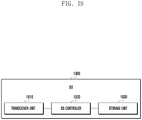
- FIG. 19 is a diagram showing the configuration of a BS according to an embodiment of the present disclosure.
- the BS may include a transceiver unit 1910, a BS controller 1920, and a storage unit 1930.
- the BS controller 1920 may be defined as a circuit- or application-specific integrated circuit or at least one processor.
- the transceiver unit 1910 may transmit and receive signals to and from a different network entity.
- the transceiver unit 1910 may transmit system information to a UE, for example, and may transmit a synchronization signal or a reference signal.
- the transceiver unit 1910 may be implemented in the form of an RF unit including a modem.
- the BS controller 1920 may control an overall operation of the BS according to the embodiments proposed in the present disclosure.
- the BS controller 1920 may control the transceiver unit 1910 and the storage unit 1930 to perform operations according to the embodiments described in the drawings.
- the BS controller 1920 may establish or release an RRC connection with a UE according to an embodiment of the present disclosure.
- the storage unit 1930 may store at least one of information transmitted and received through the transceiver unit 1910 and information generated through the BS controller 1920.
- the storage unit 1930 of a CU/DU may store information or a value related to the UE inactivity timer, that is, a standby time in order to release an RRC connection with a UE.
Landscapes
- Engineering & Computer Science (AREA)
- Computer Networks & Wireless Communication (AREA)
- Signal Processing (AREA)
- Computer Security & Cryptography (AREA)
- Mobile Radio Communication Systems (AREA)
Applications Claiming Priority (2)
| Application Number | Priority Date | Filing Date | Title |
|---|---|---|---|
| US201662340757P | 2016-05-24 | 2016-05-24 | |
| PCT/KR2017/005364 WO2017204539A1 (fr) | 2016-05-24 | 2017-05-24 | Procédé et appareil pour émettre et recevoir des données entre une station de base dans un système de communication mobile |
Publications (2)
| Publication Number | Publication Date |
|---|---|
| EP3448114A1 true EP3448114A1 (fr) | 2019-02-27 |
| EP3448114A4 EP3448114A4 (fr) | 2019-05-15 |
Family
ID=60412328
Family Applications (1)
| Application Number | Title | Priority Date | Filing Date |
|---|---|---|---|
| EP17803058.1A Withdrawn EP3448114A4 (fr) | 2016-05-24 | 2017-05-24 | Procédé et appareil pour émettre et recevoir des données entre une station de base dans un système de communication mobile |
Country Status (4)
| Country | Link |
|---|---|
| US (1) | US11228952B2 (fr) |
| EP (1) | EP3448114A4 (fr) |
| KR (1) | KR102318011B1 (fr) |
| WO (1) | WO2017204539A1 (fr) |
Cited By (8)
| Publication number | Priority date | Publication date | Assignee | Title |
|---|---|---|---|---|
| WO2020258995A1 (fr) * | 2019-06-25 | 2020-12-30 | 中兴通讯股份有限公司 | Procédé et dispositif de gestion de faisceau basés sur un système nsa de mise en réseau non indépendante |
| EP3857941A4 (fr) * | 2018-09-27 | 2021-11-17 | ZTE Corporation | Établissement de rapports de mesures pour procédés et systèmes de maintenance de réseau |
| EP3905789A4 (fr) * | 2019-01-14 | 2022-03-09 | Guangdong Oppo Mobile Telecommunications Corp., Ltd. | Procédé de traitement d'appel et produit associé |
| WO2022056799A1 (fr) | 2020-09-18 | 2022-03-24 | Qualcomm Incorporated | Commutation rapide de tranchage par l'intermédiaire d'une suspension ou d'une activation de scg |
| US11317352B2 (en) | 2019-04-26 | 2022-04-26 | Samsung Electronics Co., Ltd. | Method and system for mobility measurements in new radio (NR) based mobile communication network |
| CN114503680A (zh) * | 2019-09-29 | 2022-05-13 | 高通股份有限公司 | 无线电资源控制(rrc)连接释放定时器 |
| US12089163B2 (en) | 2019-06-14 | 2024-09-10 | Google Llc | Saving power in a communication device |
| US12238600B2 (en) | 2019-03-01 | 2025-02-25 | Samsung Electronics Co., Ltd. | IRAT RRC re-establishment procedure and IRAT resume procedure |
Families Citing this family (40)
| Publication number | Priority date | Publication date | Assignee | Title |
|---|---|---|---|---|
| US11659563B2 (en) * | 2017-01-04 | 2023-05-23 | Huawei Technologies Co., Ltd. | System and method for user equipment identifier configuration |
| WO2018126419A1 (fr) * | 2017-01-05 | 2018-07-12 | 广东欧珀移动通信有限公司 | Procédé de transmission de signaux pour une réception discontinue, terminal et dispositif réseau |
| US10536878B2 (en) * | 2017-03-24 | 2020-01-14 | Mediatek Inc. | User equipment and methods for PDCP duplication in 5G RAN |
| US11343694B2 (en) | 2017-05-19 | 2022-05-24 | Qualcomm Incorporated | Options to provide a network icon in non-standalone mode |
| US11240720B2 (en) * | 2017-06-02 | 2022-02-01 | FG Innovation Company Limited | Methods, devices, and systems for service-driven mobility management |
| KR102362403B1 (ko) * | 2017-06-05 | 2022-02-14 | 삼성전자 주식회사 | 차세대 이동통신 시스템에서 프리엠블을 이용하여 시스템 정보를 요청하는 방법 및 장치 |
| WO2019053340A1 (fr) * | 2017-09-15 | 2019-03-21 | Nokia Technologies Oy | Validité basée sur le temps permettant une gestion de faisceau avec une réception discontinue en mode connecté |
| PL3533259T3 (pl) * | 2017-10-10 | 2020-07-13 | Telefonaktiebolaget Lm Ericsson (Publ) | Raportowanie wskaźnika NSA/SA NR |
| KR102482670B1 (ko) * | 2017-12-01 | 2022-12-29 | 삼성전자주식회사 | 무선 통신 시스템에서 데이터를 송수신하는 전자 장치 및 이를 위한 방법 |
| US10849177B2 (en) * | 2018-01-08 | 2020-11-24 | Htc Corporation | Method of handling radio access technology indication and related communication device |
| US10499323B2 (en) * | 2018-02-28 | 2019-12-03 | T-Mobile Usa, Inc. | Indicating network availability in dual coverage regions |
| US10993154B2 (en) * | 2018-04-02 | 2021-04-27 | T-Mobile Usa, Inc. | Optimizing new radio standalone and dual connectivity access |
| WO2019195680A1 (fr) | 2018-04-05 | 2019-10-10 | Convida Wireless, Llc | Configuration et signalisation pour des opérations d'accès multiple non orthogonal (noma) de liaison montante (ul) |
| CN110475389B (zh) * | 2018-05-09 | 2022-10-14 | 中兴通讯股份有限公司 | 一种空口非激活态维持方法和装置 |
| US20210227450A1 (en) * | 2018-06-25 | 2021-07-22 | Lg Electronics Inc. | Method for accessing network in wireless communication system, and device therefor |
| KR102875502B1 (ko) * | 2018-06-25 | 2025-10-24 | 삼성전자 주식회사 | 차량 통신 서비스 제공 방법 및 장치 |
| CN110784904A (zh) * | 2018-07-31 | 2020-02-11 | 夏普株式会社 | 接入控制方法及用户设备 |
| US11729067B2 (en) | 2018-08-06 | 2023-08-15 | Apple Inc. | Management data analytical KPIS for 5G network traffic and resource |
| WO2020048339A1 (fr) * | 2018-09-04 | 2020-03-12 | Oppo广东移动通信有限公司 | Procédé et dispositif pour afficher un identifiant de service, dispositif électronique et support de stockage |
| KR20210017030A (ko) | 2019-08-06 | 2021-02-17 | 삼성전자주식회사 | 전력 소모를 줄이기 위한 전자 장치 및 그의 동작 방법 |
| CN110913506B (zh) * | 2018-09-14 | 2022-04-01 | 大唐移动通信设备有限公司 | 一种下行数据的缓存方法、upf实体及amf实体 |
| US11895507B2 (en) * | 2018-11-26 | 2024-02-06 | T-Mobile Usa, Inc. | Spectrum sharing optimization within a base station node |
| CN114650588B (zh) | 2019-03-09 | 2024-06-25 | 荣耀终端有限公司 | 网络连接的处理方法、相关设备及计算机存储介质 |
| US11659474B2 (en) * | 2019-03-27 | 2023-05-23 | T-Mobile Usa, Inc. | Intelligent selection between singular and dual connectivity |
| CN113632524A (zh) * | 2019-03-29 | 2021-11-09 | 株式会社Ntt都科摩 | 用户装置以及测量方法 |
| WO2021137306A1 (fr) * | 2019-12-30 | 2021-07-08 | 엘지전자 주식회사 | Dispositif électronique et procédé de commande de dispositif électronique |
| CN115244983A (zh) * | 2020-03-23 | 2022-10-25 | 夏普株式会社 | 基站、终端、通信系统以及控制方法 |
| US11395245B1 (en) | 2020-05-14 | 2022-07-19 | Sprint Communications Company Lp | Synchronized data communications over multiple wireless links and access nodes |
| CN113709900B (zh) * | 2020-05-20 | 2023-07-18 | 华为技术有限公司 | 一种终端网络连接的控制方法及其介质和芯片 |
| CN114126013B (zh) * | 2020-08-28 | 2025-02-11 | 中兴通讯股份有限公司 | 无线制式能力的管理方法和装置、电子设备、存储介质 |
| CN112291861A (zh) * | 2020-10-13 | 2021-01-29 | 珠海格力电器股份有限公司 | 一种双连接管理方法、装置、终端及存储介质 |
| US11539830B2 (en) * | 2020-10-29 | 2022-12-27 | At&T Intellectual Property I, L.P. | Facilitation of display of 5G icons or other next generation network icons |
| CN116472744A (zh) * | 2020-11-24 | 2023-07-21 | 三星电子株式会社 | 用于执行越区切换的电子装置及其操作方法 |
| US20220312314A1 (en) * | 2021-03-26 | 2022-09-29 | Canon Kabushiki Kaisha | Communication apparatus, communication method, and storage medium |
| US11843983B1 (en) * | 2021-08-06 | 2023-12-12 | T-Mobile Innovations Llc | Re-directing a dual configuration (NSA/SA) UE to standalone 5G NR node |
| US11864113B2 (en) * | 2021-09-22 | 2024-01-02 | Qualcomm Incorporated | Techniques for reducing wakeup latency |
| US12086301B2 (en) | 2022-06-01 | 2024-09-10 | Sphere Entertainment Group, Llc | System for multi-user collaboration within a virtual reality environment |
| US12225503B2 (en) | 2022-07-15 | 2025-02-11 | Dell Products L.P. | Adaptive paging in wireless communication networks |
| US20240040650A1 (en) * | 2022-07-29 | 2024-02-01 | Skylo Technologies, Inc. | Managing a User Equipment Connection to a Wireless Network |
| US12369139B2 (en) | 2022-08-12 | 2025-07-22 | Dell Products L.P. | Adaptive paging in wireless communication networks |
Family Cites Families (33)
| Publication number | Priority date | Publication date | Assignee | Title |
|---|---|---|---|---|
| CN105721122B (zh) | 2008-09-22 | 2020-06-05 | 交互数字专利控股公司 | 检测无线电链路失败的方法及设备 |
| US9179499B1 (en) * | 2009-07-08 | 2015-11-03 | Zte (Usa) Inc. | Network selection at a wireless communication device in wireless communications based on two or more radio access technologies |
| CN102026272B (zh) * | 2009-12-09 | 2013-07-24 | 电信科学技术研究院 | 多载波系统的测量评估方法、系统及装置 |
| JP4814386B1 (ja) * | 2010-04-28 | 2011-11-16 | 株式会社エヌ・ティ・ティ・ドコモ | 移動通信方法、無線基地局及び移動局 |
| EP3565147B1 (fr) * | 2010-08-19 | 2022-05-04 | Samsung Electronics Co., Ltd. | Procédés et appareil permettant d'activer et de désactiver des cellules secondaires dans un environnement d'agrégation de porteuses |
| US8792376B2 (en) * | 2011-01-11 | 2014-07-29 | Samsung Electronics Co., Ltd. | Secondary carrier activation/deactivation method and apparatus for mobile communication system supporting carrier aggregation |
| CN102917392B (zh) * | 2011-08-05 | 2016-03-09 | 华为技术有限公司 | 小区测量和测量控制的方法及设备 |
| US9137841B2 (en) | 2011-10-03 | 2015-09-15 | Mediatek Inc. | Enhancement for scheduling request triggering based on traffic condition |
| KR20130049121A (ko) * | 2011-11-03 | 2013-05-13 | 주식회사 팬택 | 무선통신 시스템에서 기기 내 공존 간섭을 제어하는 장치 및 방법 |
| ES2576630T3 (es) * | 2012-03-02 | 2016-07-08 | Telefonaktiebolaget Lm Ericsson (Publ) | Métodos y aparatos para detectar un posible traspaso repetitivo entre diferentes tecnologías de acceso de radio |
| US9479955B2 (en) * | 2012-03-30 | 2016-10-25 | Qualcomm Incorporated | Dynamic measurement rates to speed up cell reselections |
| WO2014022847A1 (fr) | 2012-08-03 | 2014-02-06 | Intel Corporation | Reconfiguration de réception discontinue (drx) |
| US8755318B2 (en) | 2012-09-05 | 2014-06-17 | Apple Inc. | Synchronizing uplink and downlink transmissions in a wireless device |
| EP2907347B1 (fr) | 2012-10-10 | 2016-12-07 | Telefonaktiebolaget LM Ericsson (publ) | Procédé de réception discontinue et équipement utilisateur l'utilisant |
| US9084264B2 (en) * | 2013-02-26 | 2015-07-14 | Blackberry Limited | Method and apparatus for small cell configuration in a heterogeneous network architecture |
| US9986473B2 (en) | 2013-05-07 | 2018-05-29 | Qualcomm Incorporated | User equipment panic state(s) under connected mode discontinuous reception state in long term evolution |
| US10231222B2 (en) | 2013-08-19 | 2019-03-12 | Nokia Technologies Oy | Method and apparatus for handling carrier aggregation and related signaling |
| EP2863698B1 (fr) * | 2013-10-16 | 2019-02-27 | Alcatel Lucent | Réseau de communications, macro-cellule, petite cellule, système de communication et procédé de communication |
| US20150334589A1 (en) * | 2014-05-15 | 2015-11-19 | Qualcomm Incorporated | Multi-radio access technology (rat) measurement scheduling |
| JP5970506B2 (ja) * | 2014-07-31 | 2016-08-17 | 株式会社Nttドコモ | ユーザ装置、及び上り送信タイミング制御方法 |
| US10075888B2 (en) * | 2014-09-25 | 2018-09-11 | Qualcomm Incorporated | Service-specific air-interface selection |
| EP3205170B1 (fr) * | 2014-10-06 | 2019-05-08 | Telefonaktiebolaget LM Ericsson (publ) | Activation et désactivation de cellule secondaire pour équipement utilisateur de dispositif à dispositif, en fonction d'une charge |
| WO2016072903A1 (fr) * | 2014-11-07 | 2016-05-12 | Telefonaktiebolaget L M Ericsson (Publ) | Détection optimisée d'un transfert intercellulaire inter-technologies d'accès radio (rat) inutile |
| US10194362B2 (en) * | 2015-01-21 | 2019-01-29 | Nokia Solutions And Networks Oy | Service based cell re-selection |
| WO2017034230A1 (fr) * | 2015-08-21 | 2017-03-02 | 삼성전자 주식회사 | Procédé de communication et dispositif de terminal dans un système de communication sans fil |
| KR102107327B1 (ko) * | 2016-01-08 | 2020-05-06 | 닛본 덴끼 가부시끼가이샤 | 무선국 시스템, 무선 단말, 및 이들을 위한 방법 |
| US11184785B2 (en) * | 2017-03-17 | 2021-11-23 | Qualcomm Incorporated | Radio measurement and configuration |
| US10326576B2 (en) * | 2017-04-28 | 2019-06-18 | Qualcomm Incorporated | Reusing long-term evolution (LTE) reference signals for nested system operations |
| EP3668144B1 (fr) * | 2017-08-09 | 2023-04-12 | Nec Corporation | Terminal de communication, station de base et procédé de communication d'exécution de la double connectivité |
| US20190053136A1 (en) * | 2017-08-10 | 2019-02-14 | Qualcomm Incorporated | Techniques and apparatuses for 5th generation icon display for a shared base station |
| WO2019144399A1 (fr) * | 2018-01-29 | 2019-08-01 | Oppo广东移动通信有限公司 | Procédé et dispositif de resélection de cellule, et support de stockage informatique |
| US10499323B2 (en) * | 2018-02-28 | 2019-12-03 | T-Mobile Usa, Inc. | Indicating network availability in dual coverage regions |
| US10952132B2 (en) * | 2019-06-14 | 2021-03-16 | At&T Intellectual Property I, L.P. | Facilitation of icons for 5G or other next generation network |
-
2017
- 2017-05-24 EP EP17803058.1A patent/EP3448114A4/fr not_active Withdrawn
- 2017-05-24 US US16/303,954 patent/US11228952B2/en active Active
- 2017-05-24 WO PCT/KR2017/005364 patent/WO2017204539A1/fr not_active Ceased
- 2017-05-24 KR KR1020170063877A patent/KR102318011B1/ko active Active
Cited By (19)
| Publication number | Priority date | Publication date | Assignee | Title |
|---|---|---|---|---|
| EP3857941A4 (fr) * | 2018-09-27 | 2021-11-17 | ZTE Corporation | Établissement de rapports de mesures pour procédés et systèmes de maintenance de réseau |
| EP4443948A3 (fr) * | 2018-09-27 | 2025-01-01 | ZTE Corporation | Rapport de mesure pour procédés et systèmes de maintenance de réseau |
| EP3905789A4 (fr) * | 2019-01-14 | 2022-03-09 | Guangdong Oppo Mobile Telecommunications Corp., Ltd. | Procédé de traitement d'appel et produit associé |
| US12238600B2 (en) | 2019-03-01 | 2025-02-25 | Samsung Electronics Co., Ltd. | IRAT RRC re-establishment procedure and IRAT resume procedure |
| EP4472100A3 (fr) * | 2019-04-26 | 2025-02-26 | Samsung Electronics Co., Ltd | Procédé et système de mesures de mobilité dans un réseau de communication mobile basé sur une nouvelle radio (nr) |
| US11317352B2 (en) | 2019-04-26 | 2022-04-26 | Samsung Electronics Co., Ltd. | Method and system for mobility measurements in new radio (NR) based mobile communication network |
| EP3900427A4 (fr) * | 2019-04-26 | 2022-06-22 | Samsung Electronics Co., Ltd. | Procédé et système de mesures de mobilité dans un réseau de communication mobile basé sur une nouvelle radio (nr) |
| US12089163B2 (en) | 2019-06-14 | 2024-09-10 | Google Llc | Saving power in a communication device |
| WO2020258995A1 (fr) * | 2019-06-25 | 2020-12-30 | 中兴通讯股份有限公司 | Procédé et dispositif de gestion de faisceau basés sur un système nsa de mise en réseau non indépendante |
| EP4035462A4 (fr) * | 2019-09-29 | 2023-06-21 | Qualcomm Incorporated | Temporisateur de libération de connexion de commande de ressources radio (rrc) |
| CN114503680B (zh) * | 2019-09-29 | 2024-05-07 | 高通股份有限公司 | 无线电资源控制(rrc)连接释放定时器 |
| TWI865616B (zh) * | 2019-09-29 | 2024-12-11 | 美商高通公司 | 無線電資源控制(rrc)連接釋放計時器 |
| US12207339B2 (en) | 2019-09-29 | 2025-01-21 | Qualcomm Incorporated | Radio resource control (RRC) connection release timer |
| CN114503680A (zh) * | 2019-09-29 | 2022-05-13 | 高通股份有限公司 | 无线电资源控制(rrc)连接释放定时器 |
| EP4214999A4 (fr) * | 2020-09-18 | 2024-06-19 | Qualcomm Incorporated | Commutation rapide de tranchage par l'intermédiaire d'une suspension ou d'une activation de scg |
| CN116097861A (zh) * | 2020-09-18 | 2023-05-09 | 高通股份有限公司 | 经由scg暂停或激活的快速切片切换 |
| WO2022056799A1 (fr) | 2020-09-18 | 2022-03-24 | Qualcomm Incorporated | Commutation rapide de tranchage par l'intermédiaire d'une suspension ou d'une activation de scg |
| CN116097861B (zh) * | 2020-09-18 | 2025-09-23 | 高通股份有限公司 | 经由scg暂停或激活的快速切片切换 |
| US12452780B2 (en) | 2020-09-18 | 2025-10-21 | Qualcomm Incorporated | Fast slicing switching via SCG suspension or activation |
Also Published As
| Publication number | Publication date |
|---|---|
| KR102318011B1 (ko) | 2021-10-27 |
| WO2017204539A1 (fr) | 2017-11-30 |
| US20200322854A1 (en) | 2020-10-08 |
| EP3448114A4 (fr) | 2019-05-15 |
| KR20170132687A (ko) | 2017-12-04 |
| US11228952B2 (en) | 2022-01-18 |
Similar Documents
| Publication | Publication Date | Title |
|---|---|---|
| EP3448114A1 (fr) | Procédé et appareil pour émettre et recevoir des données entre une station de base dans un système de communication mobile | |
| CN113395751B (zh) | 用于管理电力使用的系统和方法 | |
| US20240172120A1 (en) | Communication method and related apparatus | |
| US11234193B2 (en) | Method of receiving a wake-up signal, wireless device and computer program | |
| JP7793609B2 (ja) | デュアルモードユーザ機器のためのエネルギー効率の良いページング手順 | |
| EP2564637B1 (fr) | Procédé, dispositif et système pour améliorer la mobilité dans un mode drx | |
| TW202249526A (zh) | 利用多鏈路操作(mlo)的站效能增強 | |
| JP2022548745A (ja) | 省電力動作のための方法及び装置 | |
| WO2021027918A1 (fr) | Procédé d'économie d'énergie de terminal, appareil d'économie d'énergie, procédé et appareil d'envoi d'informations, support d'informations et dispositif électronique | |
| CA3135030A1 (fr) | Bwp active a economie d'energie | |
| US20170048918A1 (en) | Macro-cell assisted small cell discovery and activation | |
| US20140119255A1 (en) | User equipment and method for quality of experience based discontinuous reception in lte-a networks | |
| EP4014566A1 (fr) | Systèmes et procédés pour une opération d'équipement utilisateur (ue) en présence de cca | |
| CN113796039A (zh) | 在节能模式下确定在开启持续时间期间的pdcch监测 | |
| US20120320791A1 (en) | Method and apparatus to provide assistance information for reconfiguration in a wireless communication system | |
| WO2020030085A1 (fr) | Procédé et appareil de communication | |
| CN102883408A (zh) | 一种小小区的发现方法和装置 | |
| US11039496B2 (en) | Method and apparatus | |
| US20150030001A1 (en) | Ue reporting of mobility information useful for optimizing ue parameter settings | |
| WO2017016167A1 (fr) | Procédé de notification de transfert intercellulaire de canal de réseau local sans fil assisté par réseau cellulaire | |
| EP3874803B1 (fr) | Adaptation fondée sur un événement de mesures d'ue | |
| CN116506926A (zh) | 信号发送方法、信号接收方法、配置发送方法及相关设备 | |
| US20250212114A1 (en) | Method, device, and system for power saving in wireless networks | |
| CN103024776B (zh) | 一种drx模式下优化切换性能的方法 | |
| AU2018313633A1 (en) | Radio network node, wireless device and methods performed therein |
Legal Events
| Date | Code | Title | Description |
|---|---|---|---|
| STAA | Information on the status of an ep patent application or granted ep patent |
Free format text: STATUS: THE INTERNATIONAL PUBLICATION HAS BEEN MADE |
|
| PUAI | Public reference made under article 153(3) epc to a published international application that has entered the european phase |
Free format text: ORIGINAL CODE: 0009012 |
|
| STAA | Information on the status of an ep patent application or granted ep patent |
Free format text: STATUS: REQUEST FOR EXAMINATION WAS MADE |
|
| 17P | Request for examination filed |
Effective date: 20181122 |
|
| AK | Designated contracting states |
Kind code of ref document: A1 Designated state(s): AL AT BE BG CH CY CZ DE DK EE ES FI FR GB GR HR HU IE IS IT LI LT LU LV MC MK MT NL NO PL PT RO RS SE SI SK SM TR |
|
| AX | Request for extension of the european patent |
Extension state: BA ME |
|
| A4 | Supplementary search report drawn up and despatched |
Effective date: 20190412 |
|
| RIC1 | Information provided on ipc code assigned before grant |
Ipc: H04W 76/34 20180101ALI20190408BHEP Ipc: H04W 36/00 20090101ALN20190408BHEP Ipc: H04W 36/14 20090101ALN20190408BHEP Ipc: H04W 68/12 20090101AFI20190408BHEP Ipc: H04W 88/06 20090101ALN20190408BHEP Ipc: H04W 76/16 20180101ALI20190408BHEP |
|
| DAV | Request for validation of the european patent (deleted) | ||
| DAX | Request for extension of the european patent (deleted) | ||
| STAA | Information on the status of an ep patent application or granted ep patent |
Free format text: STATUS: EXAMINATION IS IN PROGRESS |
|
| 17Q | First examination report despatched |
Effective date: 20191014 |
|
| STAA | Information on the status of an ep patent application or granted ep patent |
Free format text: STATUS: THE APPLICATION IS DEEMED TO BE WITHDRAWN |
|
| 18D | Application deemed to be withdrawn |
Effective date: 20250612 |