EP3448974B1 - Waschmittelzusammensetzung mit einem carbinolfunktionellen trisiloxan - Google Patents
Waschmittelzusammensetzung mit einem carbinolfunktionellen trisiloxan Download PDFInfo
- Publication number
- EP3448974B1 EP3448974B1 EP17722304.7A EP17722304A EP3448974B1 EP 3448974 B1 EP3448974 B1 EP 3448974B1 EP 17722304 A EP17722304 A EP 17722304A EP 3448974 B1 EP3448974 B1 EP 3448974B1
- Authority
- EP
- European Patent Office
- Prior art keywords
- detergent composition
- component
- trisiloxane
- group
- functional group
- Prior art date
- Legal status (The legal status is an assumption and is not a legal conclusion. Google has not performed a legal analysis and makes no representation as to the accuracy of the status listed.)
- Active
Links
- 0 CCC(CC1CC(CC(C*)[C@@]2*C2)CC1)C1CCCC1 Chemical compound CCC(CC1CC(CC(C*)[C@@]2*C2)CC1)C1CCCC1 0.000 description 7
- UWJWWDLPPRJQAJ-UHFFFAOYSA-N CCCCOCC(CNC(CO)(CO)CO)O Chemical compound CCCCOCC(CNC(CO)(CO)CO)O UWJWWDLPPRJQAJ-UHFFFAOYSA-N 0.000 description 2
- LENZDBCJOHFCAS-UHFFFAOYSA-N NC(CO)(CO)CO Chemical compound NC(CO)(CO)CO LENZDBCJOHFCAS-UHFFFAOYSA-N 0.000 description 1
Images


Classifications
-
- C—CHEMISTRY; METALLURGY
- C11—ANIMAL OR VEGETABLE OILS, FATS, FATTY SUBSTANCES OR WAXES; FATTY ACIDS THEREFROM; DETERGENTS; CANDLES
- C11D—DETERGENT COMPOSITIONS; USE OF SINGLE SUBSTANCES AS DETERGENTS; SOAP OR SOAP-MAKING; RESIN SOAPS; RECOVERY OF GLYCEROL
- C11D3/00—Other compounding ingredients of detergent compositions covered in group C11D1/00
- C11D3/16—Organic compounds
- C11D3/162—Organic compounds containing Si
-
- C—CHEMISTRY; METALLURGY
- C07—ORGANIC CHEMISTRY
- C07F—ACYCLIC, CARBOCYCLIC OR HETEROCYCLIC COMPOUNDS CONTAINING ELEMENTS OTHER THAN CARBON, HYDROGEN, HALOGEN, OXYGEN, NITROGEN, SULFUR, SELENIUM OR TELLURIUM
- C07F7/00—Compounds containing elements of Groups 4 or 14 of the Periodic Table
- C07F7/02—Silicon compounds
- C07F7/08—Compounds having one or more C—Si linkages
- C07F7/0834—Compounds having one or more O-Si linkage
- C07F7/0838—Compounds with one or more Si-O-Si sequences
-
- C—CHEMISTRY; METALLURGY
- C11—ANIMAL OR VEGETABLE OILS, FATS, FATTY SUBSTANCES OR WAXES; FATTY ACIDS THEREFROM; DETERGENTS; CANDLES
- C11D—DETERGENT COMPOSITIONS; USE OF SINGLE SUBSTANCES AS DETERGENTS; SOAP OR SOAP-MAKING; RESIN SOAPS; RECOVERY OF GLYCEROL
- C11D1/00—Detergent compositions based essentially on surface-active compounds; Use of these compounds as a detergent
- C11D1/02—Anionic compounds
-
- C—CHEMISTRY; METALLURGY
- C11—ANIMAL OR VEGETABLE OILS, FATS, FATTY SUBSTANCES OR WAXES; FATTY ACIDS THEREFROM; DETERGENTS; CANDLES
- C11D—DETERGENT COMPOSITIONS; USE OF SINGLE SUBSTANCES AS DETERGENTS; SOAP OR SOAP-MAKING; RESIN SOAPS; RECOVERY OF GLYCEROL
- C11D1/00—Detergent compositions based essentially on surface-active compounds; Use of these compounds as a detergent
- C11D1/66—Non-ionic compounds
-
- C—CHEMISTRY; METALLURGY
- C11—ANIMAL OR VEGETABLE OILS, FATS, FATTY SUBSTANCES OR WAXES; FATTY ACIDS THEREFROM; DETERGENTS; CANDLES
- C11D—DETERGENT COMPOSITIONS; USE OF SINGLE SUBSTANCES AS DETERGENTS; SOAP OR SOAP-MAKING; RESIN SOAPS; RECOVERY OF GLYCEROL
- C11D1/00—Detergent compositions based essentially on surface-active compounds; Use of these compounds as a detergent
- C11D1/66—Non-ionic compounds
- C11D1/83—Mixtures of non-ionic with anionic compounds
-
- C—CHEMISTRY; METALLURGY
- C11—ANIMAL OR VEGETABLE OILS, FATS, FATTY SUBSTANCES OR WAXES; FATTY ACIDS THEREFROM; DETERGENTS; CANDLES
- C11D—DETERGENT COMPOSITIONS; USE OF SINGLE SUBSTANCES AS DETERGENTS; SOAP OR SOAP-MAKING; RESIN SOAPS; RECOVERY OF GLYCEROL
- C11D17/00—Detergent materials or soaps characterised by their shape or physical properties
- C11D17/0008—Detergent materials or soaps characterised by their shape or physical properties aqueous liquid non soap compositions
-
- C—CHEMISTRY; METALLURGY
- C11—ANIMAL OR VEGETABLE OILS, FATS, FATTY SUBSTANCES OR WAXES; FATTY ACIDS THEREFROM; DETERGENTS; CANDLES
- C11D—DETERGENT COMPOSITIONS; USE OF SINGLE SUBSTANCES AS DETERGENTS; SOAP OR SOAP-MAKING; RESIN SOAPS; RECOVERY OF GLYCEROL
- C11D3/00—Other compounding ingredients of detergent compositions covered in group C11D1/00
- C11D3/43—Solvents
-
- C—CHEMISTRY; METALLURGY
- C11—ANIMAL OR VEGETABLE OILS, FATS, FATTY SUBSTANCES OR WAXES; FATTY ACIDS THEREFROM; DETERGENTS; CANDLES
- C11D—DETERGENT COMPOSITIONS; USE OF SINGLE SUBSTANCES AS DETERGENTS; SOAP OR SOAP-MAKING; RESIN SOAPS; RECOVERY OF GLYCEROL
- C11D1/00—Detergent compositions based essentially on surface-active compounds; Use of these compounds as a detergent
- C11D1/02—Anionic compounds
- C11D1/12—Sulfonic acids or sulfuric acid esters; Salts thereof
- C11D1/22—Sulfonic acids or sulfuric acid esters; Salts thereof derived from aromatic compounds
-
- C—CHEMISTRY; METALLURGY
- C11—ANIMAL OR VEGETABLE OILS, FATS, FATTY SUBSTANCES OR WAXES; FATTY ACIDS THEREFROM; DETERGENTS; CANDLES
- C11D—DETERGENT COMPOSITIONS; USE OF SINGLE SUBSTANCES AS DETERGENTS; SOAP OR SOAP-MAKING; RESIN SOAPS; RECOVERY OF GLYCEROL
- C11D1/00—Detergent compositions based essentially on surface-active compounds; Use of these compounds as a detergent
- C11D1/02—Anionic compounds
- C11D1/12—Sulfonic acids or sulfuric acid esters; Salts thereof
- C11D1/29—Sulfates of polyoxyalkylene ethers
-
- C—CHEMISTRY; METALLURGY
- C11—ANIMAL OR VEGETABLE OILS, FATS, FATTY SUBSTANCES OR WAXES; FATTY ACIDS THEREFROM; DETERGENTS; CANDLES
- C11D—DETERGENT COMPOSITIONS; USE OF SINGLE SUBSTANCES AS DETERGENTS; SOAP OR SOAP-MAKING; RESIN SOAPS; RECOVERY OF GLYCEROL
- C11D1/00—Detergent compositions based essentially on surface-active compounds; Use of these compounds as a detergent
- C11D1/66—Non-ionic compounds
- C11D1/72—Ethers of polyoxyalkylene glycols
-
- C—CHEMISTRY; METALLURGY
- C11—ANIMAL OR VEGETABLE OILS, FATS, FATTY SUBSTANCES OR WAXES; FATTY ACIDS THEREFROM; DETERGENTS; CANDLES
- C11D—DETERGENT COMPOSITIONS; USE OF SINGLE SUBSTANCES AS DETERGENTS; SOAP OR SOAP-MAKING; RESIN SOAPS; RECOVERY OF GLYCEROL
- C11D2111/00—Cleaning compositions characterised by the objects to be cleaned; Cleaning compositions characterised by non-standard cleaning or washing processes
- C11D2111/10—Objects to be cleaned
- C11D2111/12—Soft surfaces, e.g. textile
-
- C—CHEMISTRY; METALLURGY
- C11—ANIMAL OR VEGETABLE OILS, FATS, FATTY SUBSTANCES OR WAXES; FATTY ACIDS THEREFROM; DETERGENTS; CANDLES
- C11D—DETERGENT COMPOSITIONS; USE OF SINGLE SUBSTANCES AS DETERGENTS; SOAP OR SOAP-MAKING; RESIN SOAPS; RECOVERY OF GLYCEROL
- C11D2111/00—Cleaning compositions characterised by the objects to be cleaned; Cleaning compositions characterised by non-standard cleaning or washing processes
- C11D2111/10—Objects to be cleaned
- C11D2111/14—Hard surfaces
Definitions
- the present invention generally relates to a detergent composition, and more specifically to a detergent composition comprising a trisiloxane having at least one carbinol functional group.
- the trisiloxane is typically free of polyoxyalkylene groups, e.g. the trisiloxane is PEG-free, and is useful as a detergent additive in the detergent composition while generally meeting requirements according to Regulation (EC) No. 648/2004 of the European Parliament and of the Council on detergents.
- Trisiloxane polyether materials are known to be effective surfactants. They can reduce the surface energy of aqueous solutions to around 20 dynes/cm at low concentrations. This has allowed them to be utilized in a range of applications such as agricultural adjuvants, inks and coatings.
- trisiloxane polyether materials Unfortunately, the chemical makeup of trisiloxane polyether materials has presented a number of issues. For example, the use of trisiloxane polyether materials in many detergent applications has been limited because most commercial trisiloxane polyether materials are either soluble or easily dispersible in water. This classifies the trisiloxane polyether materials as "surfactants" per the European Union (EU) detergent directive (i.e., Regulation (EC) No. 648/2004 of the European Parliament and of the Council on detergents). Thus, the trisiloxane polyether materials must be readily biodegradable by methods defined in the EU detergent directive. Based on the common methodology of biodegradation, trisiloxane polyether materials are not known to biodegrade sufficiently to satisfy the EU detergent directive. Hence, the use of trisiloxane polyether materials in these applications is limited.
- EU European Union
- WO 2009/085300 discloses hydrolysis resistant organomodified trisiloxane ionic surfactants and EP 0 691 327 discloses an amine derivative and dermatologic preparation containing same.
- the present invention relates to a detergent composition
- a detergent composition comprising a trisiloxane having at least one carbinol functional group, said trisiloxane comprising the reaction product of (A) an initial trisiloxane having a pendant silicon-bonded functional group selected from a hydrogen atom and an epoxy-containing group; and (B) an organic compound having a functional group reactive with the pendant silicon-bonded functional group of component (A) and at least one hydroxyl functional group; wherein component (A) is free of a terminal silicon-bonded functional group selected from a hydrogen atom, an epoxy-containing group, an ethylenically unsaturated group, and an amine group; wherein component (A) is free of polyoxyalkylene groups; wherein said trisiloxane is present in an amount of from 0.001 to 20 parts by weight based on 100 parts by weight of said detergent composition; and wherein one of the following provisos 1) and 2) is true:
- the trisiloxane is of the following general formula (I): (R 1 3 SiO 1/2 )(R 1 R 3 SiO 2/2 )(R 1 3 SiO 1/2 ) (I) .
- each R 1 is an independently selected hydrocarbyl group.
- R 3 is selected from the following groups (i) to (iii) and (v) to (x): and Examples or embodiments described herein which do not fall under the definition of the claims do not form part of the present invention.
- ambient temperature or "room temperature” refers to a temperature between about 20°C and about 30°C. Usually, room temperature ranges from about 20°C to about 25°C. All viscosity measurements referred to herein were measured at 25°C unless otherwise indicated. The following abbreviations have these meanings herein: “Me” means methyl, “Et” means ethyl, “Pr” means propyl, “Bu” means butyl, “g” means grams, “ppm” means parts per million, “h” means hours, “GC/MS” means gas chromatography and mass spectrometry, and “NMR” means nuclear magnetic resonance.
- Hydrocarbyl means a monovalent hydrocarbon group which may be substituted or unsubstituted. Specific examples of hydrocarbyl groups include alkyl groups, alkenyl groups, alkynyl groups, aryl groups, aralkyl groups, etc.
- Alkyl means an acyclic, branched or unbranched, saturated monovalent hydrocarbon group. Alkyl is exemplified by, but not limited to, Me, Et, Pr (e.g. iso-Pr and/or n-Pr), Bu (e.g. iso-Bu, n-Bu, tert-Bu, and/or sec-Bu), pentyl (e.g.
- Alkyl groups may have 1-30, alternatively 1-24, alternatively 1-20, alternatively 1-12, alternatively 1-10, and alternatively 1-6, carbon atoms.
- Alkenyl means an acyclic, branched or unbranched, monovalent hydrocarbon group having one or more carbon-carbon double bonds. Alkenyl is exemplified by, but not limited to, vinyl, allyl, methallyl, propenyl, and hexenyl. Alkenyl groups may have 2-30, alternatively 2-24, alternatively 2-20, alternatively 2-12, alternatively 2-10, and alternatively 2-6, carbon atoms.
- Alkynyl means an acyclic, branched or unbranched, monovalent hydrocarbon group having one or more carbon-carbon triple bonds. Alkynyl is exemplified by, but not limited to, ethynyl, propynyl, and butynyl. Alkynyl groups may have 2-30, alternatively 2-24, alternatively 2-20, alternatively 2-12, alternatively 2-10, and alternatively 2-6, carbon atoms.
- Aryl means a cyclic, fully unsaturated, hydrocarbon group.
- Aryl is exemplified by, but not limited to, cyclopentadienyl, phenyl, anthracenyl, and naphthyl.
- Monocyclic aryl groups may have 5-9, alternatively 6-7, and alternatively 5-6, carbon atoms.
- Polycyclic aryl groups may have 10-17, alternatively 10-14, and alternatively 12-14, carbon atoms.
- Alkyl means an alkyl group having a pendant and/or terminal aryl group or an aryl group having a pendant alkyl group.
- exemplary aralkyl groups include tolyl, xylyl, mesityl, benzyl, phenylethyl, phenyl propyl, and phenyl butyl.
- Alkenylene means an acyclic, branched or unbranched, divalent hydrocarbon group having one or more carbon-carbon double bonds.
- Alkylene means an acyclic, branched or unbranched, saturated divalent hydrocarbon group.
- Alkynylene means an acyclic, branched or unbranched, divalent hydrocarbon group having one or more carbon-carbon triple bonds.
- Alrylene means a cyclic, fully unsaturated, divalent hydrocarbon group.
- Carbocycle and “carbocyclic” each mean a hydrocarbon ring.
- Carbocycles may be monocyclic or alternatively may be fused, bridged, or spiro polycyclic rings.
- Monocyclic carbocycles may have 3-9, alternatively 4-7, and alternatively 5-6, carbon atoms.
- Polycyclic carbocycles may have 7-17, alternatively 7-14, and alternatively 9-10, carbon atoms.
- Carbocycles may be saturated or partially unsaturated.
- Cycloalkyl means a saturated carbocycle. Monocyclic cycloalkyl groups are exemplified by cyclobutyl, cyclopentyl, and cyclohexyl. "Cycloalkylene” means a divalent saturated carbocycle.
- substituted as used in relation to another group, e.g. a hydrocarbyl group, means, unless indicated otherwise, one or more hydrogen atoms in the hydrocarbyl group has been replaced with another substituent.
- substituents include, for example, halogen atoms such as chlorine, fluorine, bromine, and iodine; halogen atom containing groups such as chloromethyl, perfluorobutyl, trifluoroethyl, and nonafluorohexyl; oxygen atoms; oxygen atom containing groups such as (meth)acrylic and carboxyl; nitrogen atoms; nitrogen atom containing groups such as amines, amino-functional groups, amido-functional groups, and cyano-functional groups; sulphur atoms; and sulphur atom containing groups such as mercapto groups.
- M, D, T, and Q units are generally represented as R u SiO( 4-u ) /2 , where u is 3, 2, 1, and 0 for M, D, T, and Q, respectively, and R is an independently selected hydrocarbyl group.
- the M, D, T, Q designate one ( M ono), two ( D i), three ( T ri), or four ( Q uad) oxygen atoms covalently bonded to a silicon atom that is linked into the rest of the molecular structure.
- a detergent composition comprising a trisiloxane is provided.
- the detergent composition may simply be referred to as a detergent.
- the term "detergent” generally means any substance, composition, formulation or preparation containing soaps and/or other surfactants intended for washing and cleaning processes. Suitable detergent compositions may be in any form (e.g. a liquid, gel, powder, paste, bar, cake, molded piece, shape, etc.) and marketed for or used in household, institutional, or industrial purposes.
- the detergent composition is not limited to a particular form. Typically, the detergent composition is in a form suitable for dish washing, laundry washing, or hard surface washing.
- the term “washing” generally means the cleaning of laundry, fabrics, dishes and other soft or hard surfaces.
- the detergent composition is in the form of a liquid (including concentrate and dilute forms), a gel, or a powder. Combinations of forms can also be utilized, such as pouches or sachets including, for example, at least two forms selected from liquids, gels, and/or powders (including free flowing and compressed powders).
- auxiliary washing preparations which are generally intended for soaking (pre-washing), rinsing, cleaning or bleaching clothes, household linens, etc.
- laundry fabric-softeners which are generally intended to modify the feel of fabrics in processes which are to complement the washing of fabrics
- cleaning preparations which are generally intended for domestic all purposes cleaners and/or other cleaning of surfaces (e.g. materials, products, machinery, mechanical appliances, means of transport and associated equipment, instruments, apparatuses, etc.); and other cleaning and washing preparations, which are generally intended for any other washing and cleaning processes.
- the trisiloxane may be referred to as a detergent additive.
- the trisiloxane meets requirements according to Regulation (EC) No. 648/2004 of the European Parliament and of the Council on detergents, along with any subsequent amendments/annexes thereof including EC Nos. 907/2006 and 551/2009.
- the trisiloxane is generally not a "surfactant" as defined according to EC No. 648/2004. Specifically, referring to EC No.
- surfactant is generally defined as any organic substance and/or preparation used in detergents, which has surface-active properties and which consists of one or more hydrophilic and one or more hydrophobic groups of such a nature and size that it is capable of reducing the surface tension of water, and of forming spreading or adsorption monolayers at the water/air interface, and of forming emulsions and/or microemulsions and/or micelles, and of adsorption at water-solid interfaces. Additional aspects in this regard can be appreciated with reference to the Examples section below.
- the trisiloxane has at least one carbinol functional group.
- carbinol refers to a hydroxyl group bound to a carbon atom (C-OH) and is differentiated from a hydroxyl group bound to a silicon atom (Si-OH).
- the carbinol functional group is generally linked to the siloxane backbone by a non-hydrolyzable moiety.
- the trisiloxane may also be referred to as a carbinol-functional trisiloxane, as a hydroxy-functional trisiloxane, and in some instances, as a polyol-functional trisiloxane.
- trisiloxanes generally include a D unit flanked on each said by an M unit, i.e., by terminal M units. Moreover, trisiloxanes are generally free of both T and Q units.
- the trisiloxane has one (1) to six (6), alternatively two (2) to five (5), and alternatively three (3) to four (4), carbinol functional groups.
- carbinol functional group(s) of the trisiloxane remain free at least prior to incorporation into the detergent composition, more typically after incorporation and prior to end use of the detergent composition (e.g. for washing).
- Carbinol functional groups are generally useful for aqueous applications due to their hydrophilicity, whereas siloxane backbones are useful for their hydrophobicity.
- the trisiloxane comprises the reaction product of (A) an initial trisiloxane and (B) an organic compound.
- the term "initial” means that component (A) is different from the trisiloxane of the present invention, which is formed via reaction of components (A) and (B).
- organic means that component (B) comprises carbon, alternatively comprises carbon and hydrogen. In many embodiments, component (B) is free of silicon.
- the reaction product consists essentially of components (A) and (B).
- the phrase “consisting essentially of” generally encompasses the specifically recited elements/components for a particular embodiment. Further, the phrase “consisting essentially of” generally encompasses and allows for the presence of additional or optional elements/components that do not materially impact the basic and/or novel characteristics of that particular embodiment. In certain embodiments, “consisting essentially of” allows for the presence of ⁇ 10, ⁇ 5, or ⁇ 1, weight percent (wt%) of additional or optional components based on the total weight of the reaction product. In other embodiments, the reaction product consists of components (A) and (B).
- Component (A) has a pendant silicon-bonded functional group.
- the pendant silicon-bonded functional group is selected from a hydrogen atom and an epoxy-containing group.
- the "pendant" silicon-bonded functional group is linked to the D unit of the trisiloxane.
- the pendant silicon-bonded functional group is a hydrogen atom. In other embodiments, the pendant silicon-bonded functional group is an epoxy-containing group.
- the epoxy-containing group may be an epoxy group or an epoxy group linked to the silicone backbone by a non-hydrolyzable moiety.
- component (A) is free of a terminal silicon-bonded functional group selected from a hydrogen atom, an epoxy-containing group, an ethylenically unsaturated group, and an amine group. If they were present, such "terminal" silicon-bonded functional groups would be linked to at least one of the M units of the trisiloxane.
- Component (A) is free of polyoxyalkylene groups. If they were present, polyoxyalkylene groups may be imparted by, for example, the polymerization of ethylene oxide (EO), propylene oxide (PO), butylene oxide (BO), 1,2-epoxyhexane, 1,2-epoxyoctance, and/or cyclic epoxides, such as cyclohexene oxide or exo-2,3-epoxynorborane. Common polyoxyalkylene moieties in the art include oxyethylene units (C 2 H 4 O), oxypropylene units (C 3 H 6 O), oxybutylene units (C 4 H 8 O), or mixtures thereof.
- EO ethylene oxide
- PO propylene oxide
- BO butylene oxide
- 1,2-epoxyhexane 1,2-epoxyoctance
- cyclic epoxides such as cyclohexene oxide or exo-2,3-epoxynorborane.
- the trisiloxane may be referred to as being polyether-free, e.g. PEG-free, PEO-free, POE-free, PPG-free, PPOX-free, POP-free, PTMG-free, PTMEG-free, or PTHF-free.
- polyether-free e.g. PEG-free, PEO-free, POE-free, PPG-free, PPOX-free, POP-free, PTMG-free, PTMEG-free, or PTHF-free.
- the trisiloxane is free of polyoxyalkylene groups.
- component (A) is of the following general formula (A1): (R 1 3 SiO 1/2 )(R 1 R 2 SiO 2/2 )(R 1 3 SiO 1/2 ) (A1).
- each R 1 is an independently selected hydrocarbyl group. In certain embodiments, each R 1 is an independently selected C 1 -C 6 alkyl group. In specific embodiments, each R 1 is a methyl group. R 2 is the pendant silicon-bonded functional group.
- R 2 is the hydrogen atom; so component (A) may be referred to as a hydrogentrisiloxane.
- R 2 is the epoxy-containing group; so component (A) may be referred to as an epoxy-functional trisiloxane.
- Component (B) has at least one hydroxyl (-OH) functional group.
- the hydroxyl functional group is generally inert with respect to component (A).
- “generally inert” it is meant that reaction of the hydroxyl functional group(s) is not intended. Specifically, while hydroxyl functional groups are reactive, e.g. with Si-H groups, reaction is minimized or generally avoided during formation of the trisiloxane such that a majority to all of the hydroxyl groups remain free.
- the hydroxyl functional group(s) of component (B) can be protected from side-reaction during formation of the trisiloxane by methods understood in the art, such as by controlling reaction conditions, order of addition, temporary blocking/capping, etc.
- the carbinol functional group(s) of the trisiloxane is/are typically linked to the D unit of the trisiloxane and is/are generally imparted by at least the hydroxyl functional group(s) of component (B), and optionally, an opened epoxy ring (the epoxy ring being present prior to reaction of components (A) and (B)).
- the hydroxyl functional group(s) may be terminal and/or pendant (with respect to the group/moiety pending from the D unit of the trisiloxane).
- Component (B) also has a functional group reactive with the pendant silicon-bonded functional group of component (A).
- the trisiloxane is subject to the following provisos. If the pendant silicon-bonded functional group of component (A) is the hydrogen atom, the functional group of component (B) is an ethylenically unsaturated group. If the pendant silicon-bonded functional group of component (A) is the epoxy-containing group, the functional group of component (B) is an amine group.
- the functional group of component (B) may be terminal, internal or pendant. In various embodiments, the functional group of component (B) is terminal.
- Suitable ethylenically unsaturated groups for component (B) include alkenyl groups, e.g. vinyl, allyl, methallyl, propenyl, hexenyl, etc.
- component (B) has a terminal alkenyl group, e.g. an allyl group.
- suitable allyl compounds as component (B) include allyl glycerol, allyl diglycerol, allyl glycidyl ether (AGE), allyl sorbitol, etc. Allyl glycerol may also be referred to as allyloxyethanol. Allyl glycerol may also be referred to as allyl monoglycerol or allyloxy 1,2-propanediol.
- component (B) may be an amine compound, e.g. a secondary amine, provided there is also at least one hydroxyl functional group.
- suitable amine compounds as component (B) include alkanol modified amines such as generally: HNRR' where R and R' are alkyl and/or alkanol functionalities. One of R or R' typically contains a secondary hydroxyl functionality to provide the hydroxyl functional group(s).
- suitable alkanol amines as component (B) include diisopropanol amine (DIPA), diethanol amine (DEA), etc.
- DIPA diisopropanol amine
- DEA diethanol amine
- Other compounds having at least one amine group and generally 1-6 hydroxyl group(s) are also contemplated.
- the pendant silicon-bonded functional group of component (A) is the hydrogen atom and component (B) is selected from the following components (B1) to (B6):
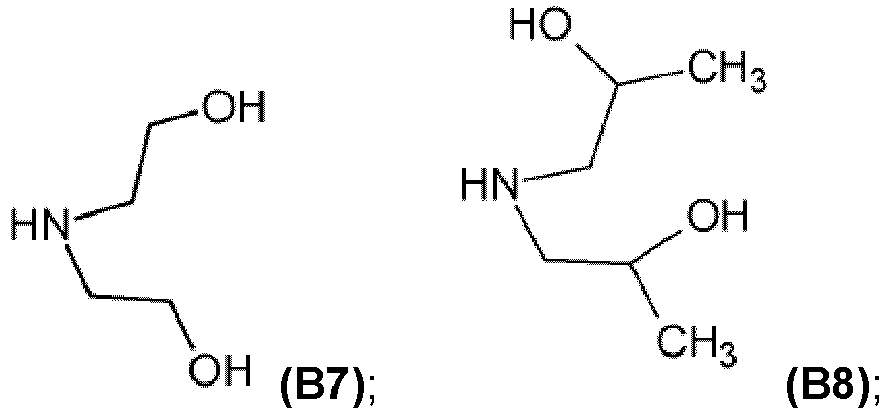
- the pendant silicon-bonded functional group of component (A) is an epoxy-containing group and component (B) is selected from the following components (B7) to (B9): and
- component (A) is an epoxy-containing group and component (B) is selected from the following component (B10):
- component (B) is component: (B1); (B2); (B3); (B4); (B5); (B6); (B7); (B8); or (B9). Combinations of components (A) and (B) may be utilized.
- the trisiloxane is of the following general formula (I): (R 1 3 SiO 1/2 )(R 1 R 3 SiO 2/2 )(R 1 3 SiO 1/2 ) (I) .
- each R 1 is as described above with formula (A1).
- R 3 is typically an organic-based group having from 1-6 hydroxyl groups.
- R 3 is selected from the following groups (i) to (iii) and (v) to (x).
- Group (iv) is also disclosed but not in accordance with the invention.
- R 3 in general formula (I) above is group: (i); (ii); or (iii). Also disclosed is where R 3 in general formula (I) above is group (iv). In other embodiments, R 3 in general formula (I) above is group: (v); (vi); (vii); (viii); (ix); or (x).
- a method of forming the trisiloxane comprises the steps of 1) providing component (A) and 2) providing component (B). The method further comprises the step of 3) reacting components (A) and (B) to form the trisiloxane.
- Components (A) and (B) are as described above. Each of components (A) and (B) may be obtained or formed. For example, one or both of components (A) and (B) can be commercially obtained from a chemical supplier such as Dow Corning of Midland, MI. Otherwise, one or both of components (A) and (B) can be formed from respective starting materials.
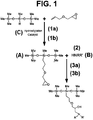
- step 1) is further defined as 1a) reacting a hydrogentrisiloxane with an epoxy compound having an ethylenically unsaturated group in the presence of (C) a hydrosilylation catalyst to form a reaction intermediate having the epoxy-containing group.
- the reaction intermediate is component (A), specifically an epoxy-functional trisiloxane.
- step 3) is further defined as 3a) reacting component (B) and the reaction intermediate formed in step 1a) to form the trisiloxane.
- Component (B) is an amine compound.
- the method further comprises the step(s) of 1b) removing unreacted epoxy compound after step 1a), and/or 3b) removing unreacted component (B) after step 3a).
- Such removal may be accomplished via methods understood in the art, e.g. via stripping, evaporating, pulling vacuum, etc.
- Other reactants, carrier fluids, and/or reaction-intermediates can similarly be removed as desired.
- An example of the first general example of the method is illustrated in Figure 1 .
- step 2) is further defined as 2a) reacting an amine compound having at least one hydroxyl functional group with an epoxy compound having an ethylenically unsaturated group to form a reaction intermediate having the ethylenically unsaturated group.
- the reaction intermediate is component (B).
- step 3) is further defined as 3a) reacting component (A) and the reaction intermediate formed in step 2a) in the presence of (C) a hydrosilylation catalyst to form the trisiloxane.
- Component (A) is a hydrogentrisiloxane (or silicone hydride).
- the method further comprises the step(s) of 2b) removing unreacted compounds after step 2a), and/or 3b) removing unreacted component (A) after step 3a).
- removal may be accomplished via methods understood in the art.
- Other reactants, carrier fluids, and/or reaction-intermediates can similarly be removed as desired.
- An example of the second general example of the method is illustrated in Figure 2 .
- step 1) is further defined as 1a) reacting a hydrogentrisiloxane with an amine compound having an ethylenically unsaturated group in the presence of (C) a hydrosilylation catalyst to form a reaction intermediate having an amine group.
- the reaction intermediate is component (A), specifically an amine-functional trisiloxane.
- step 3) is further defined as 3a) reacting component (B) and the reaction intermediate formed in step 1a) to form the trisiloxane.
- Component (B) is an epoxy compound, such as glycidol.
- the method further comprises the step(s) of 1b) removing unreacted amine compound after step 1a), and/or 3b) removing unreacted component (B) after step 3a).
- removal may be accomplished via methods understood in the art.
- Other reactants, carrier fluids, and/or reaction-intermediates can similarly be removed as desired.
- the amine-functional trisiloxane (A) can be made in alternate manners understood in the art. For example, a chloropropyl functional trisiloxane can be reacted with ammonia to form component (A).
- One skilled in the art can readily appreciate other manners in which to obtain amine-functional trisiloxanes suitable as component (A) for forming the trisiloxane.
- step 2) is further defined as 2a) reacting an epoxy compound having at least one hydroxyl functional group with an amine compound having an ethylenically unsaturated group to form a reaction intermediate having the ethylenically unsaturated group.
- the reaction intermediate is component (B).
- step 3) is further defined as 3a) reacting component (A) and the reaction intermediate formed in step 2a) in the presence of (C) a hydrosilylation catalyst to form the trisiloxane.
- Component (A) is a hydrogentrisiloxane (or silicone hydride).
- the method further comprises the step(s) of 2b) removing unreacted compounds after step 2a), and/or 3b) removing unreacted component (A) after step 3a).
- removal may be accomplished via methods understood in the art.
- Other reactants, carrier fluids, and/or reaction-intermediates can similarly be removed as desired.
- Components (A) and (B) can be reacted in various amounts to form the trisiloxane. Based on the number of respective functional groups, the components can be utilized in a 1:1 stoichiometric ratio (A:B). Higher or lower ratios may also be utilized. For example, excess component (A) or (B) may be desired for certain end-uses/applications of the trisiloxane or composition including the trisiloxane. Reaction conditions are not particularly limited. In certain examples, reaction is performed at a temperature of from room temperature to a reflux temperature for 1-24, alternatively 1-10, hours.
- the hydrosilylation (or addition) reaction typically takes place in the presence of (C) a hydrosilylation catalyst.
- the hydrosilylation catalyst may be conventional to the art.
- the hydrosilylation catalyst may be a platinum group metal-containing catalyst.
- platinum group it is meant ruthenium, rhodium, palladium, osmium, iridium and platinum and complexes thereof. Examples of hydrosilylation catalysts useful herein are described in US Pat. Nos.
- the hydrosilylation catalyst can be platinum metal, platinum metal deposited on a carrier, such as silica gel or powdered charcoal, or a compound or complex of a platinum group metal.
- Typical hydrosilylation catalysts include chloroplatinic acid, either in hexahydrate form or anhydrous form, and/or a platinum-containing catalyst which is obtained by a method comprising reacting chloroplatinic acid with an aliphatically unsaturated organosilicon compound, such as divinyltetramethyldisiloxane, or alkene-platinum-silyl complexes as described in US Pat. No. 6,605,734 .
- alkene-platinum-silyl complexes may be prepared, e.g. by mixing 0.015 mole (COD)PtCl 2 with 0.045 mole COD and 0.0612 moles HMeSiCl 2 .
- Karstedt's catalyst is a platinum divinyl tetramethyl disiloxane complex typically containing about 1 wt% of platinum in a solvent, such as toluene.
- Another suitable platinum catalyst type is a reaction product of chloroplatinic acid and an organosilicon compound containing terminal aliphatic unsaturation (described in US Pat. No. 3,419,593 ).
- the amount of hydrosilylation catalyst used is not particularly limited and typically depends upon the particular catalyst.
- the hydrosilylation catalyst is typically utilized in an amount sufficient to provide at least 2 ppm, more typically 4-200 ppm of platinum based on total weight percent solids (all non-solvent ingredients), based on one million parts of component (A) or (B).
- the hydrosilylation catalyst is present in an amount sufficient to provide 1-150 weight ppm of platinum on the same basis.
- the hydrosilylation catalyst may be added as a single species or as a mixture of two or more different species.
- the trisiloxane and/or components thereof are typically formed and/or provided in (D) a carrier fluid.
- Suitable carrier fluids include silicones, both linear and cyclic, organic oils, organic solvents and mixtures of these. Specific examples of solvents may be found in US Pat. No. 6,200,581 .
- the carrier fluid comprises a volatile siloxane, an organic solvent, or combination thereof.
- the carrier fluid is a low viscosity silicone, a volatile methyl siloxane, a volatile ethyl siloxane, or a volatile methyl ethyl siloxane, having a viscosity at 25°C in the range of 1-1,000 mm 2 /sec.
- Suitable silicones/siloxanes include hexamethyldisiloxane, hexamethylcyclotrisiloxane, octamethylcyclotetrasiloxane (D4), decamethylcyclopentasiloxane (D5), dodecamethylcyclohexasiloxane, octamethyltrisiloxane, decamethyltetrasiloxane, dodecamethylpentasiloxane, tetradecamethylhexasiloxane, hexadeamethylheptasiloxane, heptamethyl-3- ⁇ (trimethylsilypoxy) ⁇ trisiloxane, hexamethyl-3,3,bis ⁇ (trimethylsilyl)oxy ⁇ trisiloxane, and pentamethyl ⁇ (trimethylsilyl)oxy ⁇ cyclotrisiloxane, as well as polydimethylsiloxanes, polyethylsiloxanes, poly
- Suitable organic solvents include aromatic hydrocarbons (e.g. toluene, xylene, etc.), aliphatic or alicyclic hydrocarbons (e.g. n-pentane, n-hexane, cyclohexane, etc.), alcohols (e.g. methanol, isopropanol, etc.), aldehydes, ketones, esters, ethers, glycols, glycol ethers, alkyl halides and aromatic halides.
- Suitable hydrocarbons include isododecane, isohexadecane, Isopar L (C 11 -C 13 ), Isopar H (C 11 -C 12 ), and hydrogenated polydecen.
- Suitable halogenated hydrocarbons include dichloromethane, chloroform, and carbon tetrachloride.
- Suitable ethers and esters include isodecyl neopentanoate, neopentylglycol heptanoate, glycol distearate, dicaprylyl carbonate, diethylhexyl carbonate, propylene glycol n-butyl ether, ethyl-3 ethoxypropionate, propylene glycol methyl ether acetate, tridecyl neopentanoate, propylene glycol methylether acetate (PGMEA), propylene glycol methylether (PGME), octyldodecyl neopentanoate, diisobutyl adipate, diisopropyl adipate, propylene glycol dicaprylate/dicaprate, and octyl palmitate.
- Additional organic carrier fluids suitable as a stand-alone compound or as an ingredient to the carrier fluid include fats, oils, fatty acids, and fatty alcohols. Additional examples of suitable carriers/solvents are described as "carrier fluids" in US Pat. App. Pub. No. 2010/0330011 .
- the carrier fluid should be inert with respect to the reactants/reaction-intermediates utilized to form the trisiloxane.
- the carrier fluid shouldn't have epoxy, Si-H, ethylenically unsaturated, and/or amine functional groups.
- the amount of carrier fluid used is not particularly limited. Combinations of carrier fluids can be utilized.
- Detergent Composition (Detergent)
- the detergent composition can be utilized for various applications and it is generally not limited to a particular one.
- the detergent composition can be a dishwashing detergent composition (e.g. an auto dishwashing detergent (ADW) composition), a laundry detergent composition, a stain removal/pre-treatment composition, or a hard surface detergent composition (e.g. an auto care detergent).
- Further detergent applications include: personal care and personal cleansing products (e.g. body washes, shampoos, and conditioners); dishwashing products including hand dishwashing, automatic dishwashing, and dishwashing additives; laundry care including laundry detergents (e.g. hand wash/automatic detergents), fabric softeners, carpet cleaners, and laundry aids (e.g.
- surface care including multi-purpose cleaners, cleaners for ovens, window/glass, metal, kitchen, floor, bathroom surfaces, descalers, drain openers, scouring agents, household antiseptics/disinfectants, and household care wipes and floor cleaning systems; and toilet care products including in-cistern devices, rim blocks and liquids, and liquids, foams, gels and tablets for toilet care.
- the cleaning composition can be an aqueous solution, a gel, or a powder.
- the cleaning composition can be dispensed as such directly onto laundry fabrics or via a spray, a roll-on, and/or an adhesive patch (also directly onto the laundry fabrics) before a washing process.
- Such cleaning compositions can also be delivered within the washing and/or rinse phase of an automatic or manual laundry washing process.
- the trisiloxane can be utilized in the detergent composition in various amounts. Suitable amounts for a particular end-use/application can be readily determined via routine experimentation. Combinations of trisiloxanes can be utilized.
- the trisiloxane is present in an amount of from about 0.001 to about 20, alternatively about 0.001 to about 15, alternatively about 0.001 to about 10, alternatively about 0.01 to about 5, and alternatively about 0.01 to about 1, part(s) by weight, based on 100 parts by weight of the detergent composition.
- Such ranges are generally associated with a "final" or “consumer” detergent composition.
- the amounts above can be increased or decreased by orders of magnitude to account for change in concentration and/or form.
- the amounts above may be increased by about 10%, 25%, 50%, 100%, 200%, 300%, 400%, 500%, or more. If the detergent composition is diluted, the amounts above may be decreased in a similar manner.
- the detergent composition further comprises at least one dispersant.
- dispersant comprises propylene glycol.
- the dispersant is useful for increasing compatibility of certain embodiments of the trisiloxane and/or amounts thereof in the detergent composition.
- the dispersant may also be a solvent.
- the dispersant is present in an amount of from about 0.01 to about 50, alternatively about 0.1 to about 40, alternatively about 0.1 to about 30, alternatively about 0.1 to about 25, alternatively about 1 to about 20, alternatively about 2 to about 15, alternatively about 2 to about 10, and alternatively about 2 to about 5, part(s) by weight, based on 100 parts by weight of the detergent composition.
- Such ranges are generally associated with a "final” or “consumer” detergent composition. As such, the amounts above can be increased or decreased to account for change in concentration and/or form.
- the amounts above may be increased by about 10%, 25%, 50%, 100%, 200%, 300%, 400%, 500%, or more. If the detergent composition is diluted, the amounts above may be decreased in a similar manner.
- the detergent composition may further comprise any number of conventional compounds or additives understood in the art and such components can be utilized in various amounts.
- additional components may be primary or secondary, supplemental, or auxiliary components of the detergent composition in addition to the trisiloxane.
- additional components are described in greater detail below. It is to be appreciated that certain components may be classified under different terms of art and just because a component is classified under such a term does not mean that they are limited to that function. If utilized, the additional component(s) may be present in the detergent composition in various amounts.
- One of skill in the art can readily determine suitable amounts for a particular detergent composition.
- additional components suitable for the detergent composition include surfactants, such as anionic surfactants, cationic surfactants, zwitterionic (amphoteric) surfactants, nonionic surfactants, or combinations thereof.
- Further components suitable for the detergent composition include abrasives, acids, alkalis/bases, antimicrobial agents, antiredeposition agents, antiscalants, bleaches, builders, chelating agents, colorants, complexing agents, corrosion inhibitors, electrolytes, enzymes, extenders, extracts, fabric softening agents, fillers, fluorescent whitening agents, fragrances/perfumes, foam inhibitors, formulation auxiliaries, hydrotropes, microfibers, opacifiers, preservatives, processing aids, rheology modifiers, salts, soaps, soil release polymers, solvents, solubility improvers, suds control agents, oils, thickeners, oxidizing agents, viscosity control agents, or combinations thereof. Further examples on some of these components and others are below.
- the detergent composition is an aqueous detergent composition including water (e.g. demineralized and/or DI water).
- suitable solvents include ethylene glycol, propylene glycol, 2-butoxyethanol, butyldiglycol, and alkyl glycol ethers.
- suitable solvents include alkanolamines, and alcohols such as ethanol and isopropanol, or combinations thereof.
- Suitable alkanolamines include triisopropanolamine, N-methyldiethanolamine, and N-ethyldiethanolamine.
- the alkanolamine is an ethanolamine.
- suitable ethanolamines include monoethanolamine (MEA), diethanolamine, triethanolamine, diethylethanolamine, triisopropanolamine, and dimethylethanolamine.
- water is present in an amount of from about 50 to about 95, alternatively about 55 to about 90, alternatively about 60 to about 80, and alternatively about 60 to about 70, parts be weight, based on 100 parts by weight of the detergent composition. Such amounts can be increased or decreased as described above, e.g. to account for concentrating or diluting of the detergent composition. In some embodiments, the detergent composition is substantially to completely free of water.
- suitable anionic surfactants for the detergent composition include linear alkylbenzene sulfonate (LAS), alcohol ethoxylates, and alky sulfates; suitable nonionic surfactants for the detergent composition include alcohol ethoxylates; suitable cationic surfactants for the detergent composition include quaternary ammonium compounds; and suitable amphoteric surfactants for the detergent composition include imidazolines, and betaines. Further suitable surfactants are described below.
- LAS linear alkylbenzene sulfonate
- suitable nonionic surfactants for the detergent composition include alcohol ethoxylates
- suitable cationic surfactants for the detergent composition include quaternary ammonium compounds
- suitable amphoteric surfactants for the detergent composition include imidazolines, and betaines. Further suitable surfactants are described below.
- Anionic surfactants suitable for the detergent composition include fatty alcohol sulfates, alkyl sulfates, fatty alcohol ether sulfates/alkyl ether sulfates, alkanesulfonates, and alkylbenzenesulfonates.
- Further examples in this context are C 12 -C 18 fatty alcohol sulfates (FAS), e.g. SULFOPON® K 35 from BASF Corporation, C 12 fatty alcohol ether sulfate, e.g. TEXAPON® N70 from BASF Corporation, secondary C 13 -C 17 alkanesulfonates (SAS), e.g.
- FAS C 12 -C 18 fatty alcohol sulfates
- SAS secondary C 13 -C 17 alkanesulfonates
- the terms “sulfate” and “sulfonate” also comprise, besides relevant anionic compounds that are present in the form of salts, the free acids, i.e. in particular the corresponding alkylsulfuric acids or alkylsulfonic acids.
- At least one anionic surfactant is present in an amount of from about 0.1 to about 25, alternatively about 1 to about 15, alternatively about 2 to about 10, and alternatively about 3 to about 7, part(s) be weight, based on 100 parts by weight of the detergent composition. Such amounts can be increased or decreased as described above, e.g. to account for concentrating or diluting of the detergent composition.
- Nonionic surfactants suitable for the detergent composition include polyalkylene oxide surfactants (also known as polyoxyalkylene surfactants or polyalkylene glycol surfactants).
- Suitable polyalkylene oxide surfactants include polyoxypropylene surfactants and polyoxyethylene glycol surfactants.
- Suitable surfactants of this type are synthetic organic polyoxypropylene (PO)-polyoxyethylene (EO) block copolymers. These surfactants generally comprise a di-block polymer comprising an EO block and a PO block, a center block of PO units, and having blocks of EO grafted onto the PO unit or a center block of EO with attached PO blocks. Further, this surfactant can have further blocks of either EO or PO in the molecules.
- the surfactant may also include butylene oxide (BO) blocks, and can include random incorporations of two or three alkylene oxides, e.g. EO/PO/BO, EO/PO/PO, EO/EO/PO, etc.
- BO butylene oxide
- Such surfactants may be referred to in the art as "heteric" block surfactants.
- Additional nonionic surfactants suitable for the detergent composition include alcohol alkoxylates.
- Suitable alcohol alkoxylates include linear alcohol ethoxylates.
- Additional alcohol alkoxylates include alkylphenol ethoxylates, branched alcohol ethoxylates, secondary alcohol ethoxylates, castor oil ethoxylates, alkylamine ethoxylates (also known as alkoxylated alkyl amines), tallow amine ethoxylates, fatty acid ethoxylates, sorbital oleate ethoxylates, end-capped ethoxylates, or combinations thereof.
- nonionic surfactants include amides such as fatty alkanolamides, alkyldiethanolamides, coconut diethanolamide, lauramide diethanolamide, cocoamide diethanolamide, polyethylene glycol cocoamide, oleic diethanolamide, or combinations thereof.
- nonionic surfactants include polyalkoxylated aliphatic base, polyalkoxylated amide, glycol esters, glycerol esters, amine oxides, phosphate esters, alcohol phosphate, fatty triglycerides, fatty triglyceride esters, alkyl ether phosphate, alkyl esters, alkyl phenol ethoxylate phosphate esters, alkyl polysaccharides, block copolymers, alkyl polyglucocides, or combinations thereof.
- At least one nonionic surfactant is present in an amount of from about 0.1 to about 25, alternatively about 1 to about 15, alternatively about 2 to about 10, and alternatively about 2 to about 5, part(s) be weight, based on 100 parts by weight of the detergent composition. Such amounts can be increased or decreased as described above, e.g. to account for concentrating or diluting of the detergent composition. Other types of surfactants may also be utilized in similar amounts.
- suitable surfactant components for the detergent composition are commercially available from BASF Corporation, under the trade names of LUTENSOL®, such as LUTENSOL® XP 80, LUTENSOL® TO 8, LUTENSOL® GD 70; TETRONIC®, such as TETRONIC® 304; PLURAFAC®, such as PLURAFAC® SLF 180 and PLURAFAC® LF 711; and LUTENSIT®, such as LUTENSIT® AS 2230.
- LUTENSOL® such as LUTENSOL® XP 80, LUTENSOL® TO 8, LUTENSOL® GD 70
- TETRONIC® such as TETRONIC® 304
- PLURAFAC® such as PLURAFAC® SLF 180 and PLURAFAC® LF 711
- LUTENSIT® such as LUTENSIT® AS 2230.
- EMPILAN® such as EMPILAN® KB and EMPILAN® KC
- SURFONIC® such as SURFONIC® L12
- TERIC® such as TERIC® 12A
- ECOTERIC® such as ECOTERIC® B30 and ECOTERIC® B35.
- NatSurfTM such as NatSurfTM 265.
- BIO-SOFT® such as the BIO-SOFT® N1, BIO-SOFT® N23, BIO-SOFT® N91, and BIO-SOFT® S-101
- STEPANATE® such as STEPANATE® SXS
- STEOL® such as STEOL® CS-330
- Yet further examples are commercially available from Air Products, under the trade names of NONIDET®; and TOMADOL®, such as TOMADOL® 1-7 and TOMADOL® 25-7.
- Suitable abrasives for the detergent composition include calcite, feldspar, quartz, sand, or combinations thereof.
- suitable acids for the detergent composition include organic acids, inorganic acids, or combinations thereof. Further examples of suitable organic acids include straight chain or branched carboxylic acids including lactic acid, acetic acid, formic acid, ascorbic acid, oxalic acid, hydroxymaleic acid, methanesulphonic acid, mandelic acid, glycolic acid, salicylic acid, a pyranosidyl acid such as glucuronic acid or galacturonic acid, citric acid, tartaric acid, pamoic acid, alginic acid, gentisic acid, lactobionic acid, succinic acid, trichloroisocyanuric acid, polymers of maleic acid and acrylic acid, and copolymers thereof.
- suitable inorganic acids include hydrochloric acid, hypochlorous and chlorous acid, sulfuric acid, sulphurous acid, nitric acid, phosphoric acid, amidosulfonic/sulfamic acid, peracids, and phosphorous acid.
- suitable alkalis for the detergent composition examples include ammonium hydroxide, potassium hydroxide, ethanolamines, sodium carbonate, sodium hydroxide, sodium silicate, or combinations thereof.
- suitable antimicrobial agents for the detergent composition include pine oil, quaternary ammonium compounds, sodium hypochlorite, triclocarban, triclosan, or combinations thereof.
- suitable antiredeposition agents for the detergent composition include carboxymethyl cellulose, polycarboxylates, polyethylene glycol, sodium silicate, or combinations thereof.
- suitable bleaches for the detergent composition include chlorine bleaches and oxygen bleaches, such as sodium hypochlorite, sodium perborate, sodium percarbonate, or combinations thereof. At least one bleach activator may also be utilized, which are especially useful in combination with certain oxygen bleaches.
- suitable antiscalants for the detergent composition include certain polymer components.
- the polymer component may be referred to in the art as a dispersant and/or antiscalant.
- the polymer component comprises a carboxylate functional polymer or a modified carboxylate functional polymer.
- the polymer component comprises a polyacrylic acid (PAA) and/or an acrylic/maleic copolymer.
- PAA polyacrylic acid
- the polymer component comprises PAA.
- suitable polymers included polyacrylates having a molecular weight of from about 1,000 to about 400,000 and polymers based on acrylic acid combined with other moieties.
- acrylic acid combined with maleic acid; methacrylic acid; phosphonate; maleic acid and vinyl acetate; acrylamide; sulfophenol methallyl ether; 2-acrylamido-2-methylpropane sulfonic acid; 2-acrylamido-2-methylpropane sulfonic acid and sodium styrene sulfonate; methyl methacrylate, sodium methallyl sulfonate and sulfophenol methallyl ether; polymaleates; polymethacrylates; polyaspartates; ethylenediamine disuccinate; organo polyphosphonic acids and their salts.
- Suitable polymeric components are commercially available from BASF Corporation under the trade name SOKALAN®, such as SOKALAN® CP 5, SOKALAN® CP 42, SOKALAN® CP 50, SOKALAN® PA 25 CL, and PA SOKALAN® PA 30 CL, SOKALAN® CP 10 S, SOKALAN® CP 12 S, and SOKALAN® 13 S.
- SOKALAN® such as SOKALAN® CP 5, SOKALAN® CP 42, SOKALAN® CP 50, SOKALAN® PA 25 CL, and PA SOKALAN® PA 30 CL, SOKALAN® CP 10 S, SOKALAN® CP 12 S, and SOKALAN® 13 S.
- CP generally designates a copolymer
- PA generally designates a polyacrylate.
- Suitable builders for the detergent composition include metal citrates, complex phosphates, sodium citrate, sodium carbonate, sodium silicate, sodium metasilicate, sodium aluminosilicate (zeolite), or combinations thereof. Certain builders, such as sodium citrate, can also be utilized for controlling water hardness.
- Suitable chelating agents for the detergent composition include aminocarboxylates and salts thereof, such as methylglycine-N-N-diacetic acid (MGDA), nitrilotriacetic acid (NTA), hydroxyethylethylenediaminetriacetic acid (HEDTA), N,N-bis(carboxymethyl)-L-glutamate (GLDA), ethylenediaminetetraacetic acid (EDTA), diethylenetriaminepentaacetic acid (DTPA), or combinations thereof.
- MGDA methylglycine-N-N-diacetic acid
- NTA nitrilotriacetic acid
- HEDTA hydroxyethylethylenediaminetriacetic acid
- GLDA N,N-bis(carboxymethyl)-L-glutamate
- EDTA ethylenediaminetetraacetic acid
- DTPA diethylenetriaminepentaacetic acid
- suitable colorants for the detergent composition include pigments, dyes, or combinations thereof.
- An example of a suitable corrosion inhibitor for the detergent composition is sodium silicate.
- suitable enzymes for the detergent composition include amylase, lipase, protease, cellulase, or combinations thereof.
- suitable fabric softening agents for the detergent composition include quaternary ammonium compounds.
- suitable fluorescent whitening agents (also referred to as optical brighteners) for the detergent composition include colorless fluorescing compounds.
- Suitable hydrotropes for the detergent composition include sulfonates, such as xylene sulfonates, cumene sulfonates, toluene sulfonates, and dihexyl sodium sulfonate; alkyl sulfates such as sodium octyl sulfate; urea; isopropanol and other alcohols such as ethyl alcohols; alcohol alkoxylates; glycols, such as hexylene glycol and propylene glycol; and those described in U.S. Pat. No. 3,563,901 and U.S. Pat. No. 4,443,270 .
- suitable hydrotrope components are commercially available from BASF Corporation, under the trade name TEXAPON®, such as TEXAPON® 842.
- At least one hydrotrope is present in an amount of from about 0.1 to about 25, alternatively about 0.1 to about 15, alternatively about 0.5 to about 10, and alternatively about 1 to about 5, part(s) be weight, based on 100 parts by weight of the detergent compositions. Such amounts can be increased or decreased as described above, e.g. to account for concentrating or diluting of the detergent composition.
- suitable opacifiers for the detergent composition include polymers, titanium dioxide, zinc oxide, or combinations thereof.
- suitable preservatives for the detergent composition include butylated hydroxytoluene, ethylene diamine tetraacetic acid, glutaraldehyde, or combinations thereof.
- suitable processing aids for the detergent composition include clays, polymers, sodium silicate, sodium sulfate, solvents, or combinations thereof.
- suitable suds control agents for the detergent composition include suds stabilizers and suds suppressors, such as alkanolamides, alkylamine oxides, alkyl phosphates, silicones, soaps, or combinations thereof.
- the detergent composition typically has a pH of from about 5 to about 13, alternatively about 6 to about 12, alternatively about 7 to about 11, and alternatively about 7 to about 10, or any range between the lowest and highest of these values.
- the pH of the detergent composition is generally imparted by the type and amount of components utilized to form the detergent composition.
- pH buffer systems e.g. a phosphate buffer or a citrate buffer, may be used for stabilizing the pH; however, they are not required.
- the detergent composition is substantially free of phosphorus-containing compounds, making the detergent composition more environmentally acceptable.
- Phosphorus-free refers to a composition, mixture, or ingredients to which phosphorus-containing compounds are not added. Should phosphorus-containing compounds be present through contamination of a phosphorus-free composition, mixture, or ingredient, the level of phosphorus-containing compounds in the resulting detergent composition is typically less than about 0.5, alternatively less than about 0.1, and alternatively less than about 0.01, wt%, each based on 100 parts by weight of the detergent composition. In various embodiments, the detergent composition completely excludes phosphorus-containing compounds.
- the detergent composition is free of a chlorine-containing component.
- components containing chlorine include chlorine bleaches, which generally belong to a group of strong oxidizing agents, all of which have one or more chlorine atoms in their molecule.
- Specific examples of chlorine bleaches used in the art include chlorinated isocyanurates, chlorinated trisodium phosphate, hypochlorite, and sodium hypochlorite.
- free of a chlorine-containing component it is generally meant that the detergent composition is free of a purposefully added component including chlorine, such as the addition of chlorine bleach, e.g. sodium hypochlorite.
- the detergent composition includes some trace amount of chlorine, such as a trace amount of chlorine present in one or more of the components.
- the detergent composition includes chlorine in an amount of from about 0.50 to approaching zero (0), alternatively about 0.25 to approaching 0, and alternatively about 0.10 to approaching 0, wt%, each based on 100 parts by weight of the detergent composition. In certain embodiments, the detergent composition completely excludes chlorine.
- the detergent composition is free of a bleach component. While chlorine bleaches tend to be commonly used bleach components, other bleaches include non-chlorine bleaches, such as peroxygen compounds, which release active oxygen in wash water. Further examples of non-chlorine bleaches include perborates/sodium perborates, potassium monopersulfates, sodium percarbonates, hydrogen peroxides, and organic peracids.
- the detergent composition includes the bleach component in an amount of from about 15 to approaching zero (0), alternatively about 10 to approaching 0, alternatively about 5.0 to approaching 0, and alternatively about 1.0 to approaching 0, wt%, each based on 100 parts by weight of the detergent composition. In certain embodiments, the detergent composition completely excludes the bleach component.
- the detergent composition can be formed by various methods. Typically, the detergent composition is formed by simply combining, e.g. mixing, all of the components together.
- the detergent composition is not limited to any particular method of manufacture. One of ordinary skill in the art can readily determine suitable methods of manufacture based on a particular detergent composition, form, and/or end use thereof.
- Example 2 hydrosilylation of heptamethyltrisiloxane and trimethylolpropane allyl ether
- the chemical composition after stripping was as follows: BisH-Trimethylolpropane allyl ether - 95.58 wt%; trimethylolpropane allyl ether isomers - 4.37 wt%; and toluene - 0.05 wt%.
- the trisiloxane formed in this example has two hydroxyl functional groups. A reaction scheme of this example is illustrated immediately below.
- 125.58g of 1,1,1,3,5,5,5-Heptamethyltrisiloxane (BisH), 22.5g of allyl glycerol and 168g of isopropyl alcohol (IPA) were added to a reaction flask under a nitrogen purge and mixed by an agitator. The mixture was kept under the nitrogen purge and heated to 70°C. 0.3g of a 1.1% platinum complex in hexamethyldisiloxane/IPA was added. The reaction exothermed initially. 25.2g of allyl glycerol, 16.8g of IPA and 0.3g of 1.1% platinum complex in hexamethyldisiloxane/IPA were added as a 2nd step.
- IPA isopropyl alcohol
- the sample was treated with activated carbon and filtered. Unreacted BisH and IPA were stripped off using a vacuum pump for 2 hours (80°C, ⁇ 10 mmHg). 1H, 29Si and 13C confirmed the target hydrosilylated reaction product, with only trace isomers remaining.
- the chemical composition after stripping was as follows: BisH-allyl glycerol - 96.50 wt%; and allyl glycerol isomers - 3.50 wt%.
- the trisiloxane formed in this example has two hydroxyl functional groups as illustrated immediately below.
- Example 5 hydrosilylation of heptamethyltrisiloxane and allyl glycidyl ether
- the IPA was removed using simple vacuum distillation for 3 hours (45°C, ⁇ 5 mmHg). The reaction progress was tracked via H1 NMR. The reaction was considered complete once the CH peak on the epoxy shifted completely from -3.1 ppm to -3.9 ppm.
- the chemical composition after vacuum distillation was as follows: BisH-AGE-DEA - 99.70 wt%; and IPA - 0.30 wt%.
- the trisiloxane formed in this example has three hydroxyl functional groups. A reaction scheme of this example is illustrated immediately below.
- the IPA was removed using simple vacuum distillation for 3 hours (45°C, ⁇ 5 mmHg). The reaction progress was tracked via H1 NMR. The reaction was considered complete once the CH peak on the epoxy shifted completely from -3.1 ppm to -3.9 ppm.
- the chemical composition after vacuum distillation was as follows: BisH-AGE-DIPA - 99.70 wt%; and IPA - 0.30 wt%.
- the trisiloxane formed in this example has three hydroxyl functional groups. A reaction scheme of this example is illustrated immediately below.
- the chemical composition after reaction was as follows: BisH-allyl diglycerol - 88.88 wt%; and isomers - 11.12 wt%.
- the trisiloxane formed in this example has three hydroxyl functional groups as illustrated immediately below.
- the IPA and methanol were stripped off using a Rotovap (75°C, 3 mbar).
- the reaction progress was tracked via H1 NMR.
- the reaction was considered complete once the CH peak on the epoxy shifted completely from -3.1 ppm to -3.9 ppm.
- the chemical composition after stripping was as follows: BisH-AGE-Tris - 99.70 wt%; and IPA - 0.30 wt%.
- the trisiloxane formed in this example has four hydroxyl functional groups. A reaction scheme of this example is illustrated immediately below.
- Example 11 (Comparative Example): epoxy ring-opening reaction of BisH-AGE and n-methylglucamine
- the methanol and IPA were stripped off using a Rotovap for 3 hours (75°C, 3 mbar).
- the reaction progress was tracked via H1 NMR.
- the reaction was considered complete once the C H peak on the epoxy shifted completely from ⁇ 3.1 ppm to ⁇ 3.9 ppm.
- the chemical composition after stripping was as follows: BisH-AGE-NMG - 98.20 wt%; and IPA - 1.80 wt%.
- the trisiloxane formed in this example has six hydroxyl functional groups. A reaction scheme of this example is illustrated immediately below.
- Example 12 epoxy ring-opening reaction of AGE and DIPA
- the toluene was stripped off using a Rotovap for 3 hours (75°C, 3 mbar). The reaction progress was tracked via H1 NMR. The reaction was considered complete once the CH peak on the epoxy shifted completely from ⁇ 3.1 ppm to ⁇ 3.9 ppm.
- the chemical composition after stripping was as follows: AGE-DIPA - 99.70 wt%; and toluene - 0.30 wt%. A reaction scheme of this example is illustrated immediately below (where each R is a propanol group).
- the reaction was considered complete when there was no longer an unreacted Si-H peak at ⁇ 4.56 ppm in the H1 NMR spectra.
- the IPA was stripped off using a Rotovap for 4 hours (75°C, 3 mbar).
- the chemical composition after stripping was as follows: BisH-AGE-DIPA - 89.77 wt%; AGE-DIPA isomers - 9.99 wt%; and IPA - 0.24 wt%.
- the trisiloxane formed in this example has three hydroxyl functional groups. A reaction scheme of this example is illustrated immediately below.
- trisiloxane materials including trisiloxane polyether materials were studied in view of the EU detergent directive ("directive"; EC No. 648/2004). It was found that many trisiloxane polyether materials, especially those containing high levels of polyethylene oxide, were classifiable as "surfactants" according to the directive. Thus, such surfactants are bound by the corresponding biodegradability requirements of the directive. In contrast, other trisiloxane materials were found to be outside the scope of classifiable surfactants according to the directive. Thus, such "non-surfactants” are generally considered non-water soluble fluids or form solid particulates in water and as such are not bound by the corresponding biodegradability requirements of the directive. As such, certain non-surfactant trisiloxanes can be utilized in Europe in detergent composition because they comply with the directive.
- a surfactant was generally defined as a material capable of:
- biodegradation requirements were generally determined by the amount of CO 2 liberated/mole of material. Alternately, biodegradation can be measured by the amount of oxygen consumed during the degradation process. Because silicone materials do not normally degrade liberating CO 2 or by consuming oxygen, they do not pass this requirement. As such, a protocol was developed to determine if a silicone material was indeed a surfactant. Utilizing this protocol, existing trisiloxane polyether materials, which are primarily high in EO content, are considered surfactants and additionally do not pass the biodegradation standards in general.
- aqueous solution, fluid, or mixture can readily be determined by various methods understood in the art. Generally, for stable solutions or mixtures, an equilibrium method such as the Wilhelmy plate method or Du Noüy ring method can be utilized. Alternately, for more dynamic systems, a pendant drop method can be utilized. This technique results in a fresh surface for each measurement. This method is also useful to reduce the potential for insoluble hydrophobic impurities or oils which could impact the surface tension measurement resulting in artificially low surface tension values.
- trisiloxane materials were evaluated including trisiloxane polyether materials containing polyethylene oxide groups and the trisiloxanes formed according to the Examples above.
- each of the trisiloxane polyether containing polyethylene oxide materials evaluated were classified as a surfactant.
- surfactants cannot be marketed for or utilized in EU detergent compositions. Without being bound or limited to any particular theory, it is thought that some trisiloxane polyethers containing all PO or EO/PO groups with low levels of EO in the ratio may also be low in solubility and may thus be shown to be non-surfactants per this protocol.
- FIG. 3 An example of such a surfactant assessment/classification is illustrated in the flow diagram of Figure 3 .
- the initial assessment is whether or not a 0.5 wt% mixture of the material being tested is soluble in water. Mixtures were prepared by adding 0.5% of the material to distilled water at 20°C and mixing with a magnetic stir bar for one hour. If the material is soluble in water, as indicated, for example, by the formation of a clear or slightly hazy mixture, then surface tension (a) is determined. If ⁇ is >45 mN/m, the material is not classified as a surfactant. If ⁇ is ⁇ 45 mN/m, and micelles are not present, the material is not classified as a surfactant. Conversely, if micelles are present, the material is classified as a surfactant.
- the material is not soluble in water, and no emulsion is present (e.g. solid particles or gels are present instead), then the material is not classified as a surfactant. If an emulsion is present (e.g. droplets are present) and the emulsion in stable, then ⁇ is determined. If ⁇ is >45 mN/m, the material is not classified as a surfactant. Conversely, if ⁇ is ⁇ 45 mN/m, the material is classified as a surfactant.
- the material is not soluble in water, and an emulsion is present (e.g. droplets are present) and the emulsion is not stable, the emulsion is then centrifuged.
- the (clear) main phase (or supernatant) of the emulsion is further studied and the ⁇ is determined. If ⁇ is >45 mN/m, the material is not classified as a surfactant. Conversely, if ⁇ is ⁇ 45 mN/m, and micelles are not present, the material is not classified as a surfactant. Conversely, if micelles are present, the material is classified as a surfactant.
- the trisiloxanes formed in Examples 1, 2, 3, 4, 6-10, and 13 were classified as non-surfactants. Specifically, each of these trisiloxanes failed to be a surfactant according to the aforementioned protocol/flow diagram. Such "non-surfactants" can be marketed for or utilized in EU detergent compositions. Obviously, they can also be used elsewhere in the world.
- Some of the trisiloxanes including mostly those having one or two hydroxyl groups, formed one or more oil layers that are unstable and/or not water soluble. Such oil layers may also not form stable emulsions or micelles in water. As the number of hydroxyl groups increases to three or four per trisiloxane the situation generally changes. In addition to forming a separate oil layer that is not stable and phase separates, some of these materials may form a solid particulate or gel. Even after mixing overnight, a 0.5 wt% mixture of these materials in water did not solubilize. It is believed that Example 14 would have similar results. All of these would be considered "non-surfactants.” It is thought that other trisiloxane compositions containing similar numbers of hydroxyl groups would exhibit similar non-surfactant behavior.
- Example 11 Comparative Example, it was considered to be a surfactant according to the protocol/flow diagram.
- the trisiloxane of Example 11 was generally insoluble, formed a hazy mixture, was stable, and yielded an aqueous surface tension of ⁇ 45 dynes/cm. It is to be appreciated that further evaluation of Example 11 may yield different results in this regard. In addition, it is to be appreciated that such materials can be used elsewhere in the world and/or for different types of compositions/applications.
- Table 1 Component (wt%) Detergent Comp. 1 Solvent 73.9% Dispersant 2.0% Hydrotrope 2.0% Neutralization Agent 2.4% Anionic Surfactant 1 6.0% Nonionic Surfactant 3.0% Anionic Surfactant 2 7.6% Water Hardness Control Agent 2.0% hole 1.0%
- Solvent is DI water.
- Dispersant is propylene glycol, which is commercially available form Fisher Scientific.
- Hydrotrope is a 41% actives solution of sodium xylene sulfonate, which is commercially available from Stepan.
- Neutralization Agent is a 45% KOH solution, which is commercially available form Fisher Scientific.
- Anionic Surfactant 1 is a 96% actives solution of linear alkylbenzene sulfonic acid, which is commercially available from Stepan.
- Nonionic Surfactant is a 100% actives ethoxylated C 11 alcohol (7 moles EO average), which is commercially available from Air Products.
- Anionic Surfactant 2 is a 28% actives solution of sodium laureth sulfate (3 moles EO average), which is commercially available from Stepan.
- Water Hardness Control Agent is sodium citrate, which is commercially available form Fisher Scientific.
- a hyphen "-” or dash “_” in a range of values is “to” or “through”; a “>” is “above” or “greater-than”; a “ ⁇ ” is “at least” or “greater-than or equal to”; a “ ⁇ ” is “below” or “less-than”; and a “ ⁇ ” is “at most” or “less-than or equal to.”
- any ranges and subranges relied upon in describing various embodiments of the present invention independently and collectively fall within the scope of the appended claims, and are understood to describe and contemplate all ranges including whole and/or fractional values therein, even if such values are not expressly written herein.
- One of skill in the art readily recognizes that the enumerated ranges and subranges sufficiently describe and enable various embodiments of the present invention, and such ranges and subranges may be further delineated into relevant halves, thirds, quarters, fifths, and so on.
- a range "of from 0.1 to 0.9" may be further delineated into a lower third, i.e., from 0.1 to 0.3, a middle third, i.e., from 0.4 to 0.6, and an upper third, i.e., from 0.7 to 0.9, which individually and collectively are within the scope of the appended claims, and may be relied upon individually and/or collectively and provide adequate support for specific embodiments within the scope of the appended claims.
- a range such as "at least,” “greater than,” “less than,” “no more than,” and the like, it is to be understood that such language includes subranges and/or an upper or lower limit.
- a range of "at least 10" inherently includes a subrange of from at least 10 to 35, a subrange of from at least 10 to 25, a subrange of from 25 to 35, and so on, and each subrange may be relied upon individually and/or collectively and provides adequate support for specific embodiments within the scope of the appended claims.
- an individual number within a disclosed range may be relied upon and provides adequate support for specific embodiments within the scope of the appended claims.
- a range "of from 1 to 9" includes various individual integers, such as 3, as well as individual numbers including a decimal point (or fraction), such as 4.1, which may be relied upon and provide adequate support for specific embodiments within the scope of the appended claims.
Landscapes
- Chemical & Material Sciences (AREA)
- Organic Chemistry (AREA)
- Life Sciences & Earth Sciences (AREA)
- Engineering & Computer Science (AREA)
- Chemical Kinetics & Catalysis (AREA)
- Oil, Petroleum & Natural Gas (AREA)
- Wood Science & Technology (AREA)
- Detergent Compositions (AREA)
- Silicon Polymers (AREA)
- Low-Molecular Organic Synthesis Reactions Using Catalysts (AREA)
Claims (12)
- Eine Waschmittelzusammensetzung, beinhaltend ein Trisiloxan mit mindestens einer carbinolfunktionellen Gruppe, wobei das Trisiloxan das Reaktionsprodukt von Folgendem beinhaltet:(A) einem anfänglichen Trisiloxan mit einer anhängenden siliciumgebundenen funktionellen Gruppe, ausgewählt aus einem Wasserstoffatom und einer epoxidhaltigen Gruppe; und(B) einer organischen Verbindung mit einer funktionellen Gruppe, die mit der anhängenden siliciumgebundenen funktionellen Gruppe von Bestandteil (A) und mindestens einer hydroxyfunktionellen Gruppe reaktiv ist;wobei Bestandteil (A) frei von einer endständigen siliciumgebundenen funktionellen Gruppe ist, ausgewählt aus einem Wasserstoffatom, einer epoxidhaltigen Gruppe, einer ethylenisch ungesättigten Gruppe und einer Amingruppe;
wobei Bestandteil (A) frei von Polyoxyalkylengruppen ist;
wobei das Trisiloxan, bezogen auf 100 Gewichtsteile der Waschmittelzusammensetzung, in einer Menge von 0,001 bis 20 Gewichtsteilen vorhanden ist; und
wobei eine der folgenden Maßgaben 1) und 2) gilt:1) die anhängende siliciumgebundene funktionelle Gruppe von Bestandteil (A) ist ein Wasserstoffatom und Bestandteil (B) ist aus den folgenden Bestandteilen (B1) bis (B6) ausgewählt:

 2) die anhängende siliciumgebundene funktionelle Gruppe von Bestandteil (A) ist eine epoxidhaltige Gruppe und Bestandteil (B) ist aus den folgenden Bestandteilen (B7) bis (B9) ausgewählt:

- Waschmittelzusammensetzung gemäß Anspruch 1, wobei Bestandteil (A) die folgende allgemeine Formel (A1) aufweist:
(R1 3SiO1/2)(R1R2SiO2/2)(R1 3SiO1/2) (A1);
wobei jedes R1 eine unabhängig ausgewählte Hydrocarbylgruppe ist, optional jedes R1 eine unabhängig ausgewählte C1-C6-Alkylgruppe ist und R2 die obenstehend definierte anhängende siliciumgebundene funktionelle Gruppe ist. - Waschmittelzusammensetzung gemäß einem der vorhergehenden Ansprüche, wobei das Trisiloxan eine bis sechs carbinolfunktionelle Gruppen aufweist, optional drei bis vier carbinolfunktionelle Gruppen aufweist.
- Waschmittelzusammensetzung gemäß einem der vorhergehenden Ansprüche, wobei Maßgabe 1) gilt, sodass die anhängende siliciumgebundene funktionelle Gruppe von Bestandteil (A) ein Wasserstoffatom ist und Bestandteil (B) aus den folgenden Bestandteil (B1) bis (B6) ausgewählt ist:


- Waschmittelzusammensetzung gemäß einem der Ansprüche 1 bis 3, wobei Maßgabe 2) gilt, sodass die anhängende siliciumgebundene funktionelle Gruppe von Bestandteil (A) eine epoxidhaltige Gruppe ist und Bestandteil (B) aus den folgenden Bestandteilen (B7) bis (B9) ausgewählt ist:

- Waschmittelzusammensetzung, beinhaltend ein Trisiloxan der folgenden allgemeinen Formel (I):
(R1 3SiO1/2)(R1R3SiO2/2)(R1 3SiO1/2) (I);
wobei jedes R1 eine unabhängig ausgewählte Hydrocarbylgruppe ist und R3 aus den folgenden Gruppen (i) bis (iii) und (v) bis (x) ausgewählt ist;


- Waschmittelzusammensetzung gemäß Anspruch 6, wobei jedes R1 eine unabhängig ausgewählte C1-C6-Alkylgruppe ist, optional jedes R1 eine Methylgruppe ist.
- Waschmittelzusammensetzung gemäß einem der vorhergehenden Ansprüche, ferner beinhaltend mindestens ein Dispergiermittel, optional ferner beinhaltend Propylenglycol.
- Waschmittelzusammensetzung gemäß Anspruch 8, wobei das Dispergiermittel, bezogen auf 100 Gewichtsteile der Waschmittelzusammensetzung, in einer Menge von 0,01 bis 50, optional in einer Menge von 0,1 bis 40 Gewichtsteilen, vorhanden ist.
- Waschmittelzusammensetzung gemäß einem der vorhergehenden Ansprüche, ferner beinhaltend Wasser und ferner definiert als wässrige Waschmittelzusammensetzung.
- Waschmittelzusammensetzung gemäß einem der vorhergehenden Ansprüche, ferner beinhaltend mindestens ein Tensid, optional ferner beinhaltend mindestens ein anionisches Tensid und mindestens ein nichtionisches Tensid.
- Waschmittelzusammensetzung gemäß einem der vorhergehenden Ansprüche, ferner definiert als eine Geschirrspülwaschmittelzusammensetzung, eine Wäschewaschmittelzusammensetzung, eine Fleckenentfernungs-/Vorbehandlungszusammensetzung oder eine Reinigungszusammensetzung für harte Oberflächen, optional ferner definiert als Waschmittelzusammensetzung für das automatische Geschirrspülen (ADW).
Applications Claiming Priority (2)
| Application Number | Priority Date | Filing Date | Title |
|---|---|---|---|
| US201662328072P | 2016-04-27 | 2016-04-27 | |
| PCT/US2017/029597 WO2017189703A1 (en) | 2016-04-27 | 2017-04-26 | Detergent composition comprising a carbinol functional trisiloxane |
Publications (2)
| Publication Number | Publication Date |
|---|---|
| EP3448974A1 EP3448974A1 (de) | 2019-03-06 |
| EP3448974B1 true EP3448974B1 (de) | 2021-07-07 |
Family
ID=58672773
Family Applications (1)
| Application Number | Title | Priority Date | Filing Date |
|---|---|---|---|
| EP17722304.7A Active EP3448974B1 (de) | 2016-04-27 | 2017-04-26 | Waschmittelzusammensetzung mit einem carbinolfunktionellen trisiloxan |
Country Status (6)
| Country | Link |
|---|---|
| US (1) | US10829718B2 (de) |
| EP (1) | EP3448974B1 (de) |
| JP (1) | JP6791981B2 (de) |
| KR (1) | KR102147473B1 (de) |
| CN (1) | CN109196085B (de) |
| WO (1) | WO2017189703A1 (de) |
Families Citing this family (12)
| Publication number | Priority date | Publication date | Assignee | Title |
|---|---|---|---|---|
| EP3429699B1 (de) | 2016-03-18 | 2021-08-18 | Tyco Fire Products LP | Polyorganosiloxanverbindungen als wirkstoffe in fluorfreien brandschutzschäumen |
| JP6831805B2 (ja) * | 2018-02-22 | 2021-02-17 | 信越化学工業株式会社 | シリコーン、及びその製造方法 |
| KR20260018198A (ko) | 2019-08-22 | 2026-02-06 | 어드밴식스 레진즈 앤드 케미컬즈 엘엘씨 | 표면-활성 특성을 갖는 아미노산의 실록산 유도체 |
| KR102774201B1 (ko) | 2019-12-19 | 2025-02-26 | 어드밴식스 레진즈 앤드 케미컬즈 엘엘씨 | 잉크, 페인트 및 접착제용 계면활성제 |
| KR102811902B1 (ko) | 2019-12-19 | 2025-05-23 | 어드밴식스 레진즈 앤드 케미컬즈 엘엘씨 | 개인 관리 및 화장품 제품에 사용하기 위한 계면활성제 |
| EP4075973A1 (de) | 2019-12-19 | 2022-10-26 | AdvanSix Resins & Chemicals LLC | Tenside für landwirtschaftliche produkte |
| KR102830141B1 (ko) | 2019-12-20 | 2025-07-08 | 어드밴식스 레진즈 앤드 케미컬즈 엘엘씨 | 클리닝 제품용 계면활성제 |
| MY196955A (en) | 2019-12-20 | 2023-05-12 | Advansix Resins & Chemicals Llc | Surfactants for use in healthcare products |
| BR112022012538A2 (pt) | 2019-12-31 | 2022-09-06 | Advansix Resins & Chemicals Llc | Formulação para a recuperação de hidrocarbonetos, e método de recuperação de um hidrocarboneto |
| PL4101009T3 (pl) | 2020-02-05 | 2024-08-19 | Advansix Resins & Chemicals Llc | Środki powierzchniowo czynne dla elektroniki |
| EP4174157A1 (de) * | 2021-11-01 | 2023-05-03 | Sani-Marc Inc. | Nichtchlorierte oxidierende alkalische entfettungsgele und verwendungen davon |
| MX2024010270A (es) | 2022-02-23 | 2024-08-28 | Advansix Resins & Chemicals Llc | Derivados de siloxano de aminoacidos que tienen propiedades tensoactivas. |
Family Cites Families (96)
| Publication number | Priority date | Publication date | Assignee | Title |
|---|---|---|---|---|
| US3159601A (en) | 1962-07-02 | 1964-12-01 | Gen Electric | Platinum-olefin complex catalyzed addition of hydrogen- and alkenyl-substituted siloxanes |
| US3220972A (en) | 1962-07-02 | 1965-11-30 | Gen Electric | Organosilicon process using a chloroplatinic acid reaction product as the catalyst |
| US3296291A (en) | 1962-07-02 | 1967-01-03 | Gen Electric | Reaction of silanes with unsaturated olefinic compounds |
| NL134016C (de) | 1963-08-27 | |||
| BE666745A (de) | 1964-07-14 | 1966-01-12 | ||
| NL131800C (de) | 1965-05-17 | |||
| AU2373767A (en) | 1966-08-12 | 1969-01-09 | W. R. Grace & Co | Rinse and compositions |
| US3516946A (en) | 1967-09-29 | 1970-06-23 | Gen Electric | Platinum catalyst composition for hydrosilation reactions |
| US3814730A (en) | 1970-08-06 | 1974-06-04 | Gen Electric | Platinum complexes of unsaturated siloxanes and platinum containing organopolysiloxanes |
| US3715334A (en) | 1970-11-27 | 1973-02-06 | Gen Electric | Platinum-vinylsiloxanes |
| GB1476314A (en) | 1973-06-23 | 1977-06-10 | Dow Corning Ltd | Coating process |
| US3923705A (en) | 1974-10-30 | 1975-12-02 | Dow Corning | Method of preparing fire retardant siloxane foams and foams prepared therefrom |
| US3989668A (en) | 1975-07-14 | 1976-11-02 | Dow Corning Corporation | Method of making a silicone elastomer and the elastomer prepared thereby |
| JPS52114699A (en) | 1976-03-22 | 1977-09-26 | Toshiba Silicone Co Ltd | Preparation of silicones modified with amino acids |
| US4492646A (en) | 1980-02-05 | 1985-01-08 | The Procter & Gamble Company | Liquid dishwashing detergent containing anionic surfactant, suds stabilizer and highly ethoxylated nonionic drainage promotor |
| JPS57149290A (en) * | 1981-03-13 | 1982-09-14 | Shin Etsu Chem Co Ltd | Production of glycerol-modified silicone |
| ATE16403T1 (de) | 1981-07-17 | 1985-11-15 | Procter & Gamble | Spuelhilfsmittel-zusammensetzung. |
| JPS5939808A (ja) | 1982-08-31 | 1984-03-05 | Shin Etsu Chem Co Ltd | 衛生・農業害虫駆除剤 |
| JPS6268820A (ja) | 1985-09-19 | 1987-03-28 | Kao Corp | 糖残基を含有するオルガノポリシロキサンの製造法 |
| JPS63139106A (ja) | 1986-12-02 | 1988-06-10 | Kao Corp | 化粧料 |
| JPS63312385A (ja) * | 1987-06-16 | 1988-12-20 | Daikin Ind Ltd | 汚水飛散防止剤 |
| US4911852A (en) | 1988-10-07 | 1990-03-27 | The Procter & Gamble Company | Liquid laundry detergent with curable amine functional silicone for fabric wrinkle reduction |
| US4911853A (en) | 1988-12-21 | 1990-03-27 | The Procter & Gamble Company | Dry cleaning fluid with curable amine functional silicone for fabric wrinkle reduction |
| US5036117A (en) | 1989-11-03 | 1991-07-30 | Dow Corning Corporation | Heat-curable silicone compositions having improved bath life |
| JPH0689147B2 (ja) | 1990-05-15 | 1994-11-09 | 信越化学工業株式会社 | 変性シリコーン化合物及びその製造方法 |
| GB9103191D0 (en) | 1991-02-14 | 1991-04-03 | Dow Corning | Platinum complexes and use thereof |
| CA2079308A1 (en) | 1991-09-30 | 1993-03-31 | Lenin J. Petroff | Herbicidal compositions containing a silicone adjuvant |
| WO1994021595A1 (fr) * | 1993-03-17 | 1994-09-29 | Kao Corporation | Derive amine et preparation dermatologique renfermant ce derive |
| DE4318536A1 (de) | 1993-06-04 | 1994-12-08 | Bayer Ag | Siloxanylmodifizierte polyhydroxylierte Kohlenwasserstoffe |
| DE4318537A1 (de) | 1993-06-04 | 1994-12-08 | Bayer Ag | Kationische siloxanylmodifizierte polyhydroxylierte Kohlenwasserstoffe |
| FR2706766B1 (fr) | 1993-06-21 | 1995-08-18 | Oreal | Compositions cosmetiques filtrantes contenant un agent hydrophile comportant au moins un radical acide |
| JPH0741794A (ja) | 1993-07-28 | 1995-02-10 | Shiseido Co Ltd | 洗浄剤組成物 |
| GB9503596D0 (en) | 1995-02-23 | 1995-04-12 | Unilever Plc | Cleaning composition comprising quaternised poly-dimethylsiloxane and nonionic surfactant |
| JP3580894B2 (ja) * | 1995-03-23 | 2004-10-27 | 三洋化成工業株式会社 | アニオン性界面活性剤 |
| JPH08316085A (ja) * | 1995-05-12 | 1996-11-29 | Mitsubishi Materials Corp | 半導体コンデンサ及びそのトリミング方法 |
| DE19524815A1 (de) | 1995-07-07 | 1997-01-09 | Bayer Ag | Siloxaneinheiten enthaltende hydroxyfunktionalisierte Kohlenwasserstoffhomo- und -copolymere |
| US5762647A (en) | 1995-11-21 | 1998-06-09 | The Procter & Gamble Company | Method of laundering with a low sudsing granular detergent composition containing optimally selected levels of a foam control agent bleach activator/peroxygen bleaching agent system and enzyme |
| US5750483A (en) | 1995-12-06 | 1998-05-12 | Basf Corporation | Non-phosphate machine dishwashing compositions containing polycarboxylate polymers and nonionic graft copolymers of vinyl acetate and polyalkylene oxide |
| US6077317A (en) | 1996-01-25 | 2000-06-20 | Lever Brothers Company, Division Of Conopco, Inc. | Prewash stain remover composition with siloxane based surfactant |
| JPH09278891A (ja) * | 1996-04-09 | 1997-10-28 | Kao Corp | ノニオン変性オルガノ(ポリ)シロキサン、その製造方法、及びそれを含有する洗浄剤組成物 |
| JPH09316085A (ja) * | 1996-05-23 | 1997-12-09 | Nippon Unicar Co Ltd | 反応性シロキサン化合物 |
| US6040288A (en) | 1997-02-21 | 2000-03-21 | Rhodia Inc. | Fabric color protection compositions and methods |
| ZA981377B (en) | 1997-02-21 | 1998-11-17 | Rhone Poulenc Inc | Fabric color protection and fragrance retention methods |
| US6169063B1 (en) | 1997-04-04 | 2001-01-02 | The Procter & Gamble Company | Low sudsing granular detergent composition containing optimally selected levels of a foam control agent and enzymes |
| KR100281513B1 (ko) | 1997-05-22 | 2001-02-15 | 울프 크라스텐센, 스트라쎄 로텐베르그 | 특히 당 라디칼 또는 당유도체인 폴리하이드록시오가닐 라디칼 및 폴리옥시 알킬렌 라디칼로 구성되는 오카노 폴리실록산 |
| AU8176198A (en) | 1997-06-30 | 1999-01-19 | Procter & Gamble Company, The | Light-duty liquid or gel dishwashing detergent compositions having controlled phand desirable food soil removal, rheological and sudsing characteristics |
| US6197876B1 (en) | 1999-02-24 | 2001-03-06 | Ck Witco Corporation | Heterocyclic amine modified siloxanes |
| JP4020531B2 (ja) | 1999-03-26 | 2007-12-12 | アキレス株式会社 | ホーロー板用断熱パネル |
| US6310029B1 (en) | 1999-04-09 | 2001-10-30 | General Electric Company | Cleaning processes and compositions |
| US6200581B1 (en) | 1999-04-28 | 2001-03-13 | Dow Corning Corporation | Elastomeric silicone terpolymer |
| EP1075863B8 (de) | 1999-08-13 | 2008-10-08 | Dow Corning Europe Sa | Silikonhaltiges Schaumregulierungsmittel |
| US6548465B2 (en) | 2000-03-10 | 2003-04-15 | General Electric Company | Siloxane dry cleaning composition and process |
| WO2001087063A2 (en) * | 2000-05-17 | 2001-11-22 | Crompton Corporation | Agricultural compositions employing organosiloxanes containing polyhydric groups |
| US20040005991A1 (en) | 2000-11-29 | 2004-01-08 | The Procter & Gamble Company | Hand dishwashing composition containing a suds suppresser and a method of use therefor |
| EP1425457A1 (de) | 2001-09-10 | 2004-06-09 | The Procter & Gamble Company | Silikonpolymere für lipophile fluidsysteme |
| US6605734B2 (en) | 2001-12-07 | 2003-08-12 | Dow Corning Corporation | Alkene-platinum-silyl complexes |
| US7655744B2 (en) | 2002-03-25 | 2010-02-02 | Kao Corporation | Branched polyglycerol-modified silicone |
| US7998903B2 (en) * | 2004-05-19 | 2011-08-16 | Shin-Etsu Chemical Co., Ltd. | Glycerol-modified silicone spreading agent and a composition comprising the same |
| JP4430458B2 (ja) | 2004-05-25 | 2010-03-10 | 信越化学工業株式会社 | 低起泡性展着剤組成物 |
| DE102004044411A1 (de) | 2004-09-14 | 2006-03-30 | Basf Ag | Reinigungsformulierungen für die maschinelle Geschirrreinigung enthaltend hydrophob modifizierte Polycarboxylate |
| CA2575589C (en) | 2004-09-23 | 2013-11-12 | Unilever Plc | Laundry treatment compositions comprising hydrophobic dyes |
| EP1885331A2 (de) | 2005-05-23 | 2008-02-13 | Dow Corning Corporation | Körperpflegezusammensetzungen mit saccharid-siloxan-copolymeren |
| GB0520380D0 (en) | 2005-10-07 | 2005-11-16 | Unilever Plc | Stain removal |
| US20070125716A1 (en) * | 2005-12-07 | 2007-06-07 | Ian Procter | Process for separating mixtures |
| EP1803801A1 (de) | 2006-01-03 | 2007-07-04 | Basf Aktiengesellschaft | Mischpulver oder Mischgranulat auf Basis von Glutaminsäure-N,N-diessigsäure und ihren Salzen |
| DE102006005100A1 (de) | 2006-02-04 | 2007-08-09 | Goldschmidt Gmbh | Verfahren zur Herstellung organomodifizierter Siloxane |
| EP2450413A1 (de) * | 2007-03-08 | 2012-05-09 | Momentive Performance Materials Inc. | Hydrolysebeständige organomodifizierte Trisiloxantenside |
| WO2008122388A1 (en) | 2007-04-05 | 2008-10-16 | Ashland Licensing And Intellectual Property Llc | Biodegradable cleaning agent |
| ATE529090T1 (de) | 2007-06-29 | 2011-11-15 | Dow Corning | Silikon-organische gele mit polyalkyloxylenvernetzten silikonelastomeren |
| DE102007041028A1 (de) | 2007-08-29 | 2009-03-05 | Evonik Goldschmidt Gmbh | Verwendung estermodifizierter Organopolysiloxane zur Herstellung kosmetischer oder pharmazeutischer Kompositionen |
| EP2039748A1 (de) * | 2007-09-17 | 2009-03-25 | The Procter and Gamble Company | Verfahren zur Behandlung von geneigten harten Oberflächen |
| US20090176893A1 (en) * | 2007-12-26 | 2009-07-09 | Momentive Performance Materials Inc. | Hydrolysis resistant organomodified trisiloxane ionic surfactants |
| US20090173912A1 (en) | 2007-12-26 | 2009-07-09 | Momentive Performance Materials Inc. | Mixtures of hydrolysis resistant organomodified trisiloxane ionic surfactants |
| US8512480B2 (en) | 2008-01-22 | 2013-08-20 | The Procter & Gamble Company | Liquid detergent composition comprising a hydrophobically modified cellulosic polymer |
| US7994111B2 (en) | 2008-02-15 | 2011-08-09 | The Procter & Gamble Company | Liquid detergent composition comprising an external structuring system comprising a bacterial cellulose network |
| DE102008000903A1 (de) * | 2008-04-01 | 2009-10-08 | Evonik Goldschmidt Gmbh | Neue Organosiloxangruppen tragende Polyetheralkohole durch Alkoxylierung epoxidfunktioneller (Poly)Organosiloxane an Doppelmetallcyanid (DMC)-Katalysatoren, sowie Verfahren zu deren Herstellung |
| GB0823370D0 (en) | 2008-12-23 | 2009-01-28 | Dow Corning | Silicone dispersions |
| US20110112005A1 (en) | 2009-11-12 | 2011-05-12 | Alan Thomas Brooker | Laundry Detergent Composition |
| US9340650B2 (en) | 2009-11-24 | 2016-05-17 | Momentive Performance Materials Gmbh | Hydrophilic/lipophilic modified polysiloxanes as emsulsifiers |
| AU2011208524A1 (en) | 2010-01-19 | 2012-08-30 | Reckitt Benckiser Llc | Light-duty dishwashing detergent compositions |
| US8246696B2 (en) | 2010-09-17 | 2012-08-21 | Ecolab Usa Inc. | Cleaning compositions employing extended chain anionic surfactants |
| GB201019988D0 (en) | 2010-11-25 | 2011-01-05 | Reckitt Benckiser Nv | Composition |
| GB201102750D0 (en) | 2011-02-16 | 2011-03-30 | Dow Corning | Foam control composition |
| DE102011118037A1 (de) | 2011-06-16 | 2012-12-20 | Henkel Ag & Co. Kgaa | Geschirrspülmittel mit Bleichkatalysator und Protease |
| DE102011084934A1 (de) | 2011-10-21 | 2013-04-25 | Henkel Ag & Co. Kgaa | Klarspül- und Geschirrspülmittel |
| JP6313540B2 (ja) | 2011-12-27 | 2018-04-18 | 東レ・ダウコーニング株式会社 | ジグリセリン誘導体変性シリコーン、それを含有してなる油中水型エマルション用乳化剤、外用剤および化粧料 |
| JP6105920B2 (ja) * | 2011-12-27 | 2017-03-29 | 東レ・ダウコーニング株式会社 | 共変性オルガノポリシロキサン、それを含有してなる油中水型エマルション用乳化剤、外用剤および化粧料 |
| EP2836582A1 (de) | 2012-04-12 | 2015-02-18 | Basf Se | Reinigungsmittelzusammensetzung für geschirrspülmaschinen |
| WO2014037700A1 (en) | 2012-09-07 | 2014-03-13 | Reckitt Benckiser N.V. | Packaged detergent composition |
| CN103665826A (zh) * | 2012-09-21 | 2014-03-26 | 莫门蒂夫性能材料股份有限公司 | 用于制造软质泡沫的有机硅表面活性剂 |
| US9663432B2 (en) * | 2012-12-28 | 2017-05-30 | Dow Corning Toray Co., Ltd. | High-purity monoalkenyl-containing glycerin derivative and method of manufacturing same |
| WO2014121037A1 (en) | 2013-02-01 | 2014-08-07 | Dow Corning Corporation | Hydroxylamine-terminated polysiloxane and methods of making and using the same |
| US20140261561A1 (en) | 2013-03-14 | 2014-09-18 | Clariant International Ltd. | Automatic Dishwashing Detergent Compositions Comprising Ethercarboxylic Acids Or Their Salts, Which Are Free Of Nonionic Surfactants |
| WO2016008765A1 (en) | 2014-07-17 | 2016-01-21 | Basf Se | Liquid detergent compositions and their manufacture |
| US20160100573A1 (en) * | 2014-10-10 | 2016-04-14 | Momentive Performance Materials Inc. | Quaternary organosilicon surfactants, methods of making same and applications containing the same |
| KR102159534B1 (ko) * | 2016-04-27 | 2020-09-25 | 다우 실리콘즈 코포레이션 | 카르비놀 작용성 트라이실록산 및 이의 형성 방법 |
-
2017
- 2017-04-26 WO PCT/US2017/029597 patent/WO2017189703A1/en not_active Ceased
- 2017-04-26 EP EP17722304.7A patent/EP3448974B1/de active Active
- 2017-04-26 CN CN201780033525.7A patent/CN109196085B/zh active Active
- 2017-04-26 US US16/096,979 patent/US10829718B2/en active Active
- 2017-04-26 JP JP2018555524A patent/JP6791981B2/ja active Active
- 2017-04-26 KR KR1020187032817A patent/KR102147473B1/ko active Active
Non-Patent Citations (1)
| Title |
|---|
| None * |
Also Published As
| Publication number | Publication date |
|---|---|
| CN109196085B (zh) | 2021-03-30 |
| US10829718B2 (en) | 2020-11-10 |
| JP2019515075A (ja) | 2019-06-06 |
| CN109196085A (zh) | 2019-01-11 |
| KR102147473B1 (ko) | 2020-08-25 |
| WO2017189703A1 (en) | 2017-11-02 |
| US20190112549A1 (en) | 2019-04-18 |
| JP6791981B2 (ja) | 2020-11-25 |
| KR20180133491A (ko) | 2018-12-14 |
| EP3448974A1 (de) | 2019-03-06 |
Similar Documents
| Publication | Publication Date | Title |
|---|---|---|
| US10829718B2 (en) | Detergent composition comprising a carbinol functional trisiloxane | |
| ES2355743T3 (es) | Composiciones limpiadoras con polialquileniminas alcoxiladas. | |
| JP6475617B2 (ja) | ポリエステル | |
| KR102350475B1 (ko) | 이타콘산 폴리머 및 코폴리머 | |
| JP5341023B2 (ja) | 液体洗浄剤組成物 | |
| CA2734887A1 (en) | Laundry detergent or cleaning composition comprising a polyoxyalkylene-based polymer composition | |
| DE102007056525A1 (de) | Polyoxyalkylenamine zur verbesserten Duftausbeute | |
| CN104271268A (zh) | 烷氧基化醇及其在硬表面清洁用配制剂中的用途 | |
| US9012388B2 (en) | Gel surfactant composition | |
| JP6656410B2 (ja) | カルビノール官能トリシロキサン及びそれを形成する方法 | |
| EP2046927A1 (de) | Oh-gruppenhaltige esterquats zur verbesserten duftstoffausbeute | |
| WO2017073741A1 (ja) | 液体洗浄剤 | |
| CN105525303B (zh) | 一种金属清洗剂 | |
| US6365785B1 (en) | Process for preparing ether-capped poly(oxyalkylated) alcohol surfactants | |
| JP2011032456A (ja) | 洗浄剤組成物 | |
| CN113272412B (zh) | 硅酮组合物及其在洗涤剂组合物中作为添加剂以增强起泡性和清洁效果的应用 | |
| WO2021118774A1 (en) | Fabric care composition | |
| US10316271B2 (en) | Carbonate ester anti-foaming agent and use thereof in detergents | |
| JP2001040400A (ja) | 液体洗剤 |
Legal Events
| Date | Code | Title | Description |
|---|---|---|---|
| STAA | Information on the status of an ep patent application or granted ep patent |
Free format text: STATUS: UNKNOWN |
|
| STAA | Information on the status of an ep patent application or granted ep patent |
Free format text: STATUS: THE INTERNATIONAL PUBLICATION HAS BEEN MADE |
|
| PUAI | Public reference made under article 153(3) epc to a published international application that has entered the european phase |
Free format text: ORIGINAL CODE: 0009012 |
|
| STAA | Information on the status of an ep patent application or granted ep patent |
Free format text: STATUS: REQUEST FOR EXAMINATION WAS MADE |
|
| 17P | Request for examination filed |
Effective date: 20181121 |
|
| AK | Designated contracting states |
Kind code of ref document: A1 Designated state(s): AL AT BE BG CH CY CZ DE DK EE ES FI FR GB GR HR HU IE IS IT LI LT LU LV MC MK MT NL NO PL PT RO RS SE SI SK SM TR |
|
| AX | Request for extension of the european patent |
Extension state: BA ME |
|
| DAV | Request for validation of the european patent (deleted) | ||
| DAX | Request for extension of the european patent (deleted) | ||
| STAA | Information on the status of an ep patent application or granted ep patent |
Free format text: STATUS: EXAMINATION IS IN PROGRESS |
|
| RAP1 | Party data changed (applicant data changed or rights of an application transferred) |
Owner name: DOW TORAY CO., LTD. Owner name: DOW SILICONES CORPORATION |
|
| 17Q | First examination report despatched |
Effective date: 20190816 |
|
| GRAP | Despatch of communication of intention to grant a patent |
Free format text: ORIGINAL CODE: EPIDOSNIGR1 |
|
| STAA | Information on the status of an ep patent application or granted ep patent |
Free format text: STATUS: GRANT OF PATENT IS INTENDED |
|
| INTG | Intention to grant announced |
Effective date: 20210305 |
|
| GRAS | Grant fee paid |
Free format text: ORIGINAL CODE: EPIDOSNIGR3 |
|
| GRAA | (expected) grant |
Free format text: ORIGINAL CODE: 0009210 |
|
| STAA | Information on the status of an ep patent application or granted ep patent |
Free format text: STATUS: THE PATENT HAS BEEN GRANTED |
|
| AK | Designated contracting states |
Kind code of ref document: B1 Designated state(s): AL AT BE BG CH CY CZ DE DK EE ES FI FR GB GR HR HU IE IS IT LI LT LU LV MC MK MT NL NO PL PT RO RS SE SI SK SM TR |
|
| REG | Reference to a national code |
Ref country code: GB Ref legal event code: FG4D |
|
| REG | Reference to a national code |
Ref country code: AT Ref legal event code: REF Ref document number: 1408616 Country of ref document: AT Kind code of ref document: T Effective date: 20210715 |
|
| REG | Reference to a national code |
Ref country code: DE Ref legal event code: R096 Ref document number: 602017041617 Country of ref document: DE |
|
| REG | Reference to a national code |
Ref country code: IE Ref legal event code: FG4D |
|
| REG | Reference to a national code |
Ref country code: LT Ref legal event code: MG9D |
|
| REG | Reference to a national code |
Ref country code: NL Ref legal event code: MP Effective date: 20210707 |
|
| REG | Reference to a national code |
Ref country code: AT Ref legal event code: MK05 Ref document number: 1408616 Country of ref document: AT Kind code of ref document: T Effective date: 20210707 |
|
| PG25 | Lapsed in a contracting state [announced via postgrant information from national office to epo] |
Ref country code: SE Free format text: LAPSE BECAUSE OF FAILURE TO SUBMIT A TRANSLATION OF THE DESCRIPTION OR TO PAY THE FEE WITHIN THE PRESCRIBED TIME-LIMIT Effective date: 20210707 Ref country code: RS Free format text: LAPSE BECAUSE OF FAILURE TO SUBMIT A TRANSLATION OF THE DESCRIPTION OR TO PAY THE FEE WITHIN THE PRESCRIBED TIME-LIMIT Effective date: 20210707 Ref country code: HR Free format text: LAPSE BECAUSE OF FAILURE TO SUBMIT A TRANSLATION OF THE DESCRIPTION OR TO PAY THE FEE WITHIN THE PRESCRIBED TIME-LIMIT Effective date: 20210707 Ref country code: NL Free format text: LAPSE BECAUSE OF FAILURE TO SUBMIT A TRANSLATION OF THE DESCRIPTION OR TO PAY THE FEE WITHIN THE PRESCRIBED TIME-LIMIT Effective date: 20210707 Ref country code: PT Free format text: LAPSE BECAUSE OF FAILURE TO SUBMIT A TRANSLATION OF THE DESCRIPTION OR TO PAY THE FEE WITHIN THE PRESCRIBED TIME-LIMIT Effective date: 20211108 Ref country code: NO Free format text: LAPSE BECAUSE OF FAILURE TO SUBMIT A TRANSLATION OF THE DESCRIPTION OR TO PAY THE FEE WITHIN THE PRESCRIBED TIME-LIMIT Effective date: 20211007 Ref country code: FI Free format text: LAPSE BECAUSE OF FAILURE TO SUBMIT A TRANSLATION OF THE DESCRIPTION OR TO PAY THE FEE WITHIN THE PRESCRIBED TIME-LIMIT Effective date: 20210707 Ref country code: ES Free format text: LAPSE BECAUSE OF FAILURE TO SUBMIT A TRANSLATION OF THE DESCRIPTION OR TO PAY THE FEE WITHIN THE PRESCRIBED TIME-LIMIT Effective date: 20210707 Ref country code: BG Free format text: LAPSE BECAUSE OF FAILURE TO SUBMIT A TRANSLATION OF THE DESCRIPTION OR TO PAY THE FEE WITHIN THE PRESCRIBED TIME-LIMIT Effective date: 20211007 Ref country code: AT Free format text: LAPSE BECAUSE OF FAILURE TO SUBMIT A TRANSLATION OF THE DESCRIPTION OR TO PAY THE FEE WITHIN THE PRESCRIBED TIME-LIMIT Effective date: 20210707 Ref country code: LT Free format text: LAPSE BECAUSE OF FAILURE TO SUBMIT A TRANSLATION OF THE DESCRIPTION OR TO PAY THE FEE WITHIN THE PRESCRIBED TIME-LIMIT Effective date: 20210707 |
|
| PG25 | Lapsed in a contracting state [announced via postgrant information from national office to epo] |
Ref country code: PL Free format text: LAPSE BECAUSE OF FAILURE TO SUBMIT A TRANSLATION OF THE DESCRIPTION OR TO PAY THE FEE WITHIN THE PRESCRIBED TIME-LIMIT Effective date: 20210707 Ref country code: LV Free format text: LAPSE BECAUSE OF FAILURE TO SUBMIT A TRANSLATION OF THE DESCRIPTION OR TO PAY THE FEE WITHIN THE PRESCRIBED TIME-LIMIT Effective date: 20210707 Ref country code: GR Free format text: LAPSE BECAUSE OF FAILURE TO SUBMIT A TRANSLATION OF THE DESCRIPTION OR TO PAY THE FEE WITHIN THE PRESCRIBED TIME-LIMIT Effective date: 20211008 |
|
| REG | Reference to a national code |
Ref country code: DE Ref legal event code: R097 Ref document number: 602017041617 Country of ref document: DE |
|
| PG25 | Lapsed in a contracting state [announced via postgrant information from national office to epo] |
Ref country code: DK Free format text: LAPSE BECAUSE OF FAILURE TO SUBMIT A TRANSLATION OF THE DESCRIPTION OR TO PAY THE FEE WITHIN THE PRESCRIBED TIME-LIMIT Effective date: 20210707 |
|
| PLBE | No opposition filed within time limit |
Free format text: ORIGINAL CODE: 0009261 |
|
| STAA | Information on the status of an ep patent application or granted ep patent |
Free format text: STATUS: NO OPPOSITION FILED WITHIN TIME LIMIT |
|
| PG25 | Lapsed in a contracting state [announced via postgrant information from national office to epo] |
Ref country code: SM Free format text: LAPSE BECAUSE OF FAILURE TO SUBMIT A TRANSLATION OF THE DESCRIPTION OR TO PAY THE FEE WITHIN THE PRESCRIBED TIME-LIMIT Effective date: 20210707 Ref country code: SK Free format text: LAPSE BECAUSE OF FAILURE TO SUBMIT A TRANSLATION OF THE DESCRIPTION OR TO PAY THE FEE WITHIN THE PRESCRIBED TIME-LIMIT Effective date: 20210707 Ref country code: RO Free format text: LAPSE BECAUSE OF FAILURE TO SUBMIT A TRANSLATION OF THE DESCRIPTION OR TO PAY THE FEE WITHIN THE PRESCRIBED TIME-LIMIT Effective date: 20210707 Ref country code: EE Free format text: LAPSE BECAUSE OF FAILURE TO SUBMIT A TRANSLATION OF THE DESCRIPTION OR TO PAY THE FEE WITHIN THE PRESCRIBED TIME-LIMIT Effective date: 20210707 Ref country code: CZ Free format text: LAPSE BECAUSE OF FAILURE TO SUBMIT A TRANSLATION OF THE DESCRIPTION OR TO PAY THE FEE WITHIN THE PRESCRIBED TIME-LIMIT Effective date: 20210707 Ref country code: AL Free format text: LAPSE BECAUSE OF FAILURE TO SUBMIT A TRANSLATION OF THE DESCRIPTION OR TO PAY THE FEE WITHIN THE PRESCRIBED TIME-LIMIT Effective date: 20210707 |
|
| 26N | No opposition filed |
Effective date: 20220408 |
|
| PG25 | Lapsed in a contracting state [announced via postgrant information from national office to epo] |
Ref country code: IT Free format text: LAPSE BECAUSE OF FAILURE TO SUBMIT A TRANSLATION OF THE DESCRIPTION OR TO PAY THE FEE WITHIN THE PRESCRIBED TIME-LIMIT Effective date: 20210707 |
|
| REG | Reference to a national code |
Ref country code: CH Ref legal event code: PL |
|
| GBPC | Gb: european patent ceased through non-payment of renewal fee |
Effective date: 20220426 |
|
| REG | Reference to a national code |
Ref country code: BE Ref legal event code: MM Effective date: 20220430 |
|
| PG25 | Lapsed in a contracting state [announced via postgrant information from national office to epo] |
Ref country code: MC Free format text: LAPSE BECAUSE OF FAILURE TO SUBMIT A TRANSLATION OF THE DESCRIPTION OR TO PAY THE FEE WITHIN THE PRESCRIBED TIME-LIMIT Effective date: 20210707 Ref country code: LU Free format text: LAPSE BECAUSE OF NON-PAYMENT OF DUE FEES Effective date: 20220426 Ref country code: LI Free format text: LAPSE BECAUSE OF NON-PAYMENT OF DUE FEES Effective date: 20220430 Ref country code: GB Free format text: LAPSE BECAUSE OF NON-PAYMENT OF DUE FEES Effective date: 20220426 Ref country code: FR Free format text: LAPSE BECAUSE OF NON-PAYMENT OF DUE FEES Effective date: 20220430 Ref country code: CH Free format text: LAPSE BECAUSE OF NON-PAYMENT OF DUE FEES Effective date: 20220430 |
|
| PG25 | Lapsed in a contracting state [announced via postgrant information from national office to epo] |
Ref country code: BE Free format text: LAPSE BECAUSE OF NON-PAYMENT OF DUE FEES Effective date: 20220430 |
|
| PG25 | Lapsed in a contracting state [announced via postgrant information from national office to epo] |
Ref country code: IE Free format text: LAPSE BECAUSE OF NON-PAYMENT OF DUE FEES Effective date: 20220426 |
|
| P01 | Opt-out of the competence of the unified patent court (upc) registered |
Effective date: 20230526 |
|
| PG25 | Lapsed in a contracting state [announced via postgrant information from national office to epo] |
Ref country code: HU Free format text: LAPSE BECAUSE OF FAILURE TO SUBMIT A TRANSLATION OF THE DESCRIPTION OR TO PAY THE FEE WITHIN THE PRESCRIBED TIME-LIMIT; INVALID AB INITIO Effective date: 20170426 |
|
| PG25 | Lapsed in a contracting state [announced via postgrant information from national office to epo] |
Ref country code: MK Free format text: LAPSE BECAUSE OF FAILURE TO SUBMIT A TRANSLATION OF THE DESCRIPTION OR TO PAY THE FEE WITHIN THE PRESCRIBED TIME-LIMIT Effective date: 20210707 Ref country code: CY Free format text: LAPSE BECAUSE OF FAILURE TO SUBMIT A TRANSLATION OF THE DESCRIPTION OR TO PAY THE FEE WITHIN THE PRESCRIBED TIME-LIMIT Effective date: 20210707 |
|
| PG25 | Lapsed in a contracting state [announced via postgrant information from national office to epo] |
Ref country code: TR Free format text: LAPSE BECAUSE OF FAILURE TO SUBMIT A TRANSLATION OF THE DESCRIPTION OR TO PAY THE FEE WITHIN THE PRESCRIBED TIME-LIMIT Effective date: 20210707 |
|
| PG25 | Lapsed in a contracting state [announced via postgrant information from national office to epo] |
Ref country code: MT Free format text: LAPSE BECAUSE OF FAILURE TO SUBMIT A TRANSLATION OF THE DESCRIPTION OR TO PAY THE FEE WITHIN THE PRESCRIBED TIME-LIMIT Effective date: 20210707 |
|
| PGFP | Annual fee paid to national office [announced via postgrant information from national office to epo] |
Ref country code: DE Payment date: 20250305 Year of fee payment: 9 |