EP3456831A1 - Modification ciblée du génome d'un rat - Google Patents
Modification ciblée du génome d'un rat Download PDFInfo
- Publication number
- EP3456831A1 EP3456831A1 EP18187581.6A EP18187581A EP3456831A1 EP 3456831 A1 EP3456831 A1 EP 3456831A1 EP 18187581 A EP18187581 A EP 18187581A EP 3456831 A1 EP3456831 A1 EP 3456831A1
- Authority
- EP
- European Patent Office
- Prior art keywords
- nucleic acid
- rat
- locus
- cell
- acid sequence
- Prior art date
- Legal status (The legal status is an assumption and is not a legal conclusion. Google has not performed a legal analysis and makes no representation as to the accuracy of the status listed.)
- Granted
Links
Images













Classifications
-
- C—CHEMISTRY; METALLURGY
- C12—BIOCHEMISTRY; BEER; SPIRITS; WINE; VINEGAR; MICROBIOLOGY; ENZYMOLOGY; MUTATION OR GENETIC ENGINEERING
- C12N—MICROORGANISMS OR ENZYMES; COMPOSITIONS THEREOF; PROPAGATING, PRESERVING, OR MAINTAINING MICROORGANISMS; MUTATION OR GENETIC ENGINEERING; CULTURE MEDIA
- C12N15/00—Mutation or genetic engineering; DNA or RNA concerning genetic engineering, vectors, e.g. plasmids, or their isolation, preparation or purification; Use of hosts therefor
- C12N15/09—Recombinant DNA-technology
- C12N15/63—Introduction of foreign genetic material using vectors; Vectors; Use of hosts therefor; Regulation of expression
- C12N15/79—Vectors or expression systems specially adapted for eukaryotic hosts
- C12N15/85—Vectors or expression systems specially adapted for eukaryotic hosts for animal cells
- C12N15/8509—Vectors or expression systems specially adapted for eukaryotic hosts for animal cells for producing genetically modified animals, e.g. transgenic
-
- A—HUMAN NECESSITIES
- A01—AGRICULTURE; FORESTRY; ANIMAL HUSBANDRY; HUNTING; TRAPPING; FISHING
- A01K—ANIMAL HUSBANDRY; AVICULTURE; APICULTURE; PISCICULTURE; FISHING; REARING OR BREEDING ANIMALS, NOT OTHERWISE PROVIDED FOR; NEW BREEDS OF ANIMALS
- A01K67/00—Rearing or breeding animals, not otherwise provided for; New or modified breeds of animals
- A01K67/027—New or modified breeds of vertebrates
- A01K67/0275—Genetically modified vertebrates, e.g. transgenic
- A01K67/0276—Knock-out vertebrates
-
- A—HUMAN NECESSITIES
- A01—AGRICULTURE; FORESTRY; ANIMAL HUSBANDRY; HUNTING; TRAPPING; FISHING
- A01K—ANIMAL HUSBANDRY; AVICULTURE; APICULTURE; PISCICULTURE; FISHING; REARING OR BREEDING ANIMALS, NOT OTHERWISE PROVIDED FOR; NEW BREEDS OF ANIMALS
- A01K67/00—Rearing or breeding animals, not otherwise provided for; New or modified breeds of animals
- A01K67/027—New or modified breeds of vertebrates
- A01K67/0275—Genetically modified vertebrates, e.g. transgenic
- A01K67/0278—Knock-in vertebrates, e.g. humanised vertebrates
-
- A—HUMAN NECESSITIES
- A61—MEDICAL OR VETERINARY SCIENCE; HYGIENE
- A61D—VETERINARY INSTRUMENTS, IMPLEMENTS, TOOLS, OR METHODS
- A61D19/00—Instruments or methods for reproduction or fertilisation
- A61D19/04—Instruments or methods for reproduction or fertilisation for embryo transplantation
-
- C—CHEMISTRY; METALLURGY
- C07—ORGANIC CHEMISTRY
- C07K—PEPTIDES
- C07K14/00—Peptides having more than 20 amino acids; Gastrins; Somatostatins; Melanotropins; Derivatives thereof
- C07K14/435—Peptides having more than 20 amino acids; Gastrins; Somatostatins; Melanotropins; Derivatives thereof from animals; from humans
- C07K14/705—Receptors; Cell surface antigens; Cell surface determinants
- C07K14/715—Receptors; Cell surface antigens; Cell surface determinants for cytokines; for lymphokines; for interferons
- C07K14/7155—Receptors; Cell surface antigens; Cell surface determinants for cytokines; for lymphokines; for interferons for interleukins [IL]
-
- C—CHEMISTRY; METALLURGY
- C07—ORGANIC CHEMISTRY
- C07K—PEPTIDES
- C07K14/00—Peptides having more than 20 amino acids; Gastrins; Somatostatins; Melanotropins; Derivatives thereof
- C07K14/435—Peptides having more than 20 amino acids; Gastrins; Somatostatins; Melanotropins; Derivatives thereof from animals; from humans
- C07K14/775—Apolipopeptides
-
- C—CHEMISTRY; METALLURGY
- C12—BIOCHEMISTRY; BEER; SPIRITS; WINE; VINEGAR; MICROBIOLOGY; ENZYMOLOGY; MUTATION OR GENETIC ENGINEERING
- C12N—MICROORGANISMS OR ENZYMES; COMPOSITIONS THEREOF; PROPAGATING, PRESERVING, OR MAINTAINING MICROORGANISMS; MUTATION OR GENETIC ENGINEERING; CULTURE MEDIA
- C12N15/00—Mutation or genetic engineering; DNA or RNA concerning genetic engineering, vectors, e.g. plasmids, or their isolation, preparation or purification; Use of hosts therefor
- C12N15/09—Recombinant DNA-technology
- C12N15/87—Introduction of foreign genetic material using processes not otherwise provided for, e.g. co-transformation
- C12N15/90—Stable introduction of foreign DNA into chromosome
- C12N15/902—Stable introduction of foreign DNA into chromosome using homologous recombination
- C12N15/907—Stable introduction of foreign DNA into chromosome using homologous recombination in mammalian cells
-
- A—HUMAN NECESSITIES
- A01—AGRICULTURE; FORESTRY; ANIMAL HUSBANDRY; HUNTING; TRAPPING; FISHING
- A01K—ANIMAL HUSBANDRY; AVICULTURE; APICULTURE; PISCICULTURE; FISHING; REARING OR BREEDING ANIMALS, NOT OTHERWISE PROVIDED FOR; NEW BREEDS OF ANIMALS
- A01K2217/00—Genetically modified animals
- A01K2217/07—Animals genetically altered by homologous recombination
-
- A—HUMAN NECESSITIES
- A01—AGRICULTURE; FORESTRY; ANIMAL HUSBANDRY; HUNTING; TRAPPING; FISHING
- A01K—ANIMAL HUSBANDRY; AVICULTURE; APICULTURE; PISCICULTURE; FISHING; REARING OR BREEDING ANIMALS, NOT OTHERWISE PROVIDED FOR; NEW BREEDS OF ANIMALS
- A01K2227/00—Animals characterised by species
- A01K2227/10—Mammal
- A01K2227/105—Murine
-
- A—HUMAN NECESSITIES
- A01—AGRICULTURE; FORESTRY; ANIMAL HUSBANDRY; HUNTING; TRAPPING; FISHING
- A01K—ANIMAL HUSBANDRY; AVICULTURE; APICULTURE; PISCICULTURE; FISHING; REARING OR BREEDING ANIMALS, NOT OTHERWISE PROVIDED FOR; NEW BREEDS OF ANIMALS
- A01K2267/00—Animals characterised by purpose
- A01K2267/03—Animal model, e.g. for test or diseases
- A01K2267/035—Animal model for multifactorial diseases
- A01K2267/0362—Animal model for lipid/glucose metabolism, e.g. obesity, type-2 diabetes
-
- A—HUMAN NECESSITIES
- A01—AGRICULTURE; FORESTRY; ANIMAL HUSBANDRY; HUNTING; TRAPPING; FISHING
- A01K—ANIMAL HUSBANDRY; AVICULTURE; APICULTURE; PISCICULTURE; FISHING; REARING OR BREEDING ANIMALS, NOT OTHERWISE PROVIDED FOR; NEW BREEDS OF ANIMALS
- A01K2267/00—Animals characterised by purpose
- A01K2267/03—Animal model, e.g. for test or diseases
- A01K2267/035—Animal model for multifactorial diseases
- A01K2267/0381—Animal model for diseases of the hematopoietic system
-
- C—CHEMISTRY; METALLURGY
- C12—BIOCHEMISTRY; BEER; SPIRITS; WINE; VINEGAR; MICROBIOLOGY; ENZYMOLOGY; MUTATION OR GENETIC ENGINEERING
- C12N—MICROORGANISMS OR ENZYMES; COMPOSITIONS THEREOF; PROPAGATING, PRESERVING, OR MAINTAINING MICROORGANISMS; MUTATION OR GENETIC ENGINEERING; CULTURE MEDIA
- C12N15/00—Mutation or genetic engineering; DNA or RNA concerning genetic engineering, vectors, e.g. plasmids, or their isolation, preparation or purification; Use of hosts therefor
- C12N15/09—Recombinant DNA-technology
- C12N15/63—Introduction of foreign genetic material using vectors; Vectors; Use of hosts therefor; Regulation of expression
- C12N15/79—Vectors or expression systems specially adapted for eukaryotic hosts
- C12N15/85—Vectors or expression systems specially adapted for eukaryotic hosts for animal cells
- C12N15/8509—Vectors or expression systems specially adapted for eukaryotic hosts for animal cells for producing genetically modified animals, e.g. transgenic
- C12N2015/8527—Vectors or expression systems specially adapted for eukaryotic hosts for animal cells for producing genetically modified animals, e.g. transgenic for producing animal models, e.g. for tests or diseases
-
- C—CHEMISTRY; METALLURGY
- C12—BIOCHEMISTRY; BEER; SPIRITS; WINE; VINEGAR; MICROBIOLOGY; ENZYMOLOGY; MUTATION OR GENETIC ENGINEERING
- C12N—MICROORGANISMS OR ENZYMES; COMPOSITIONS THEREOF; PROPAGATING, PRESERVING, OR MAINTAINING MICROORGANISMS; MUTATION OR GENETIC ENGINEERING; CULTURE MEDIA
- C12N2800/00—Nucleic acids vectors
- C12N2800/30—Vector systems comprising sequences for excision in presence of a recombinase, e.g. loxP or FRT
-
- C—CHEMISTRY; METALLURGY
- C12—BIOCHEMISTRY; BEER; SPIRITS; WINE; VINEGAR; MICROBIOLOGY; ENZYMOLOGY; MUTATION OR GENETIC ENGINEERING
- C12N—MICROORGANISMS OR ENZYMES; COMPOSITIONS THEREOF; PROPAGATING, PRESERVING, OR MAINTAINING MICROORGANISMS; MUTATION OR GENETIC ENGINEERING; CULTURE MEDIA
- C12N2810/00—Vectors comprising a targeting moiety
Definitions
- sequence listing is submitted electronically via EFS-Web as an ASCII formatted sequence listing with a file named 444701SEQLIST.TXT, created on April 16, 2014, and having a size of 15 kilobytes, and is filed concurrently with the specification.
- sequence listing contained in this ASCII formatted document is part of the specification and is herein incorporated by reference in its entirety.
- Isolated non-human totipotent or pluripotent stem cells in particular rat embryonic stem cells, that are capable of sustaining pluripotency following one or more serial genetic modifications in vitro, and that are capable of transmitting the targeted genetic modifications to subsequent generations through germline.
- LTVEC large targeting vector
- Compositions and methods for producing a genetically modified rat comprising one or more targeted genetic modifications.
- rats have been regarded as an important animal model system that can recapitulate the pathology of various human diseases, including, but not limited to, cardiovascular (e.g., hypertension), metabolic (e.g., obesity, diabetes), neurological (e.g., pain pathologies), and a variety of cancers
- cardiovascular e.g., hypertension
- metabolic e.g., obesity, diabetes
- neurological e.g., pain pathologies
- the use of rats in modeling human diseases has been limited as compared to mice, due in part to unavailability of germline-transmittable pluripotent rat cells, which can sustain their pluripotency following a series of genetic modifications in vitro, e.g., one or more serial electroporations, and due in part to lack of efficient targeting technologies that allow introduction or deletion of large genomic DNA sequences, or replacement of large endogenous genomic DNA sequences with exogenous nucleic acid sequences in pluripotent rat cells.
- compositions and methods that allow precise targeted changes in the genome of a rat, which can open or expand current areas of target discovery and validate therapeutic agents more quickly and easily.
- Such a method comprises (a) introducing into the pluripotent cell a large targeting vector (LTVEC) comprising an insert nucleic acid flanked with a 5' homology arm and a 3' homology arm; and (b) identifying a genetically modified pluripotent cell comprising the targeted genetic modification at the genomic locus of interest, wherein the targeted genetic modification is capable of being transmitted through the germline.
- LTVEC large targeting vector
- the pluripotent cell is derived from a non-human animal, including, but not limited to, a rodent, a human, a rat, a mouse, a hamster, a rabbit, a pig, a bovine, a deer, a sheep, a goat, a chicken, a cat, a dog, a ferret, a primate (e.g., marmoset, rhesus monkey), a domesticated mammal or an agricultural mammal, or any other organism of interest.
- a non-human animal including, but not limited to, a rodent, a human, a rat, a mouse, a hamster, a rabbit, a pig, a bovine, a deer, a sheep, a goat, a chicken, a cat, a dog, a ferret, a primate (e.g., marmoset, rhesus monkey), a domesticated mammal or an agricultural mam
- the pluripotent cell is a non-human pluripotent cell.
- the non-human pluripotent cell is a mammalian pluripotent cell.
- the mammalian pluripotent cell is a rodent pluripotent cell.
- the rodent pluripotent cell is a rat or mouse pluripotent cell.
- the pluripotent cell is a human induced pluripotent stem (iPS) cell.
- iPS human induced pluripotent stem
- the pluripotent cell is a non-human fertilized egg at the single cell stage.
- the non-human fertilized egg is a mammalian fertilized egg.
- the mammalian fertilized egg is a rodent fertilized egg at the single cell stage.
- the mammalian fertilized egg is a rat or mouse fertilized egg at the single cell stage.
- the sum total of the 5' and the 3' homology arms of the LTVEC is at least 10 kb. In some embodiments, the sum total of the 5' and the 3' homology arms of the LTVEC is at least 10 kb but less than 100kb or the sum total of the 5' and the 3' homology arms of the LTVEC is at least 10 kb but less than 150kb.
- the size of the sum total of the total of the 5' and 3' homology arms of the LTVEC is about 10kb to about 150kb, about 10kb to about 100kb, about 10kb to about 75kb, about 20kb to about 150kb, about 20kb to about 100kb, about 20kb to about 75kb, about 30kb to about 150kb, about 30kb to about 100kb, about 30kb to about 75kb, about 40kb to about 150kb, about 40kb to about 100kb, about 40kb to about 75kb, about 50kb to about 150kb, about 50kb to about 100kb, or about 50kb to about 75kb, about 10kb to about 30kb, about 20kb to about 40kb, about 40kb to about 60kb, about 60kb to about 80kb, about 80kb to about 100kb, about 100kb to about 120kb, or from about 120kb to about 150kb. In one
- the targeted genetic modification is biallelic.
- the pluripotent cell is a pluripotent rat cell. In one embodiment, the pluripotent rat cell is a rat embryonic stem cell. In one embodiment, the pluripotent rat cell is derived from a DA strain or an ACI strain. In some embodiments, the pluripotent rat cell is characterized by expression of at least one pluripotency marker comprising Dnmt3L, Eras, Err-beta, Fbxo15, Fgf4, Gdf3, Klf4, Lef1, LIF receptor, Lin28, Nanog, Oct4, Sox15, Sox2, Utf1, or a combination thereof.
- the pluripotent rat cell is characterized by expression of at least one pluripotency marker comprising Dnmt3L, Eras, Err-beta, Fbxo15, Fgf4, Gdf3, Klf4, Lef1, LIF receptor, Lin28, Nanog, Oct4, Sox15, Sox2, Utf1, or a
- the pluripotent rat cell is characterized by one of more of the following characteristics: (a) lack of expression of one or more pluripotency markers comprising c-Myc, Ecat1, and/or Rexo1; (b) lack of expression of mesodermal markers comprising Brachyury and/or Bmpr2; (c) lack of expression of one or more endodermal markers comprising Gata6, Sox17 and/or Sox7; or (d) lack of expression of one or more neural markers comprising Nestin and/or Pax6.
- the sum total of the 5' and the 3' homology arms of the LTVEC is from about 10kb to about 30kb, from about 20kb to about 40kb, from about 40kb to about 60kb, from about 60kb to about 80kb, or from about 80kb to about 100kb, from about 100kb to about 120kb, from about 120kb to about 150kb, or from about 10 kb but less than about 150kb.
- the sum total of the 5' and the 3' homology arms of the LTVEC is from about 16Kb to about 100Kb.
- the size of the sum total of the total of the 5' and 3' homology arms of the LTVEC is about 10kb to about 150kb, about 10kb to about 100kb, about 10kb to about 75kb, about 20kb to about 150kb, about 20kb to about 100kb, about 20kb to about 75kb, about 30kb to about 150kb, about 30kb to about 100kb, about 30kb to about 75kb, about 40kb to about 150kb, about 40kb to about 100kb, about 40kb to about 75kb, about 50kb to about 150kb, about 50kb to about 100kb, about 50kb to about 75kb, about 10kb to about 30kb, about 20kb to about 40kb, about 40kb to about 60kb, about 60kb to about 80kb, about 80kb to about 100kb, about 100kb to about 120kb, or from about 120kb to about 150kb. In one embodiment
- the methods further provide that targeted genetic modification (a) comprises a replacement of an endogenous rat nucleic acid sequence with a homologous or an orthologous mammalian nucleic acid sequence; (b) comprises a deletion of an endogenous rat nucleic acid sequence; (c) comprises a deletion of an endogenous rat nucleic acid sequence, wherein the deletion ranges from about 5kb to about 10kb, from about 10kb to about 20kb, from about 20kb to about 40kb, from about 40kb to about 60kb, from about 60kb to about 80kb, from about 80kb to about 100kb, from about 100kb to about 150kb, or from about 150kb to about 200kb, from about 200kb to about 300kb, from about 300kb to about 400kb, from about 400kb to about 500kb, from about 500kb to about 1Mb, from about 1Mb to about 1.5Mb, from about 1.5Mb to about 2Mb, from about 2Mb
- genomic locus of interest comprises (i) a first nucleic acid sequence that is complementary to the 5' rat homology arm; and (ii) a second nucleic acid sequence that is complementary to the 3' rat homology arm.
- the first and the second nucleic acid sequence is separated by at least 5kb. In some embodiments, the first and the second nucleic acid sequence is separated by at least 5kb but less than 3Mb.
- the first and the second nucleic acid sequence is separated by at least 5kb but less than 10kb, at least 10kb but less than 20kb, at least 20kb but less than 40kb, at least 40kb but less than 60kb, at least 60kb but less than 80kb, at least about 80kb but less than 100kb, at least 100kb but less than 150kb, or at least 150kb but less than 200kb, at least about 200kb but less than about 300kb, at least about 300kb but less than about 400kb, at least about 400kb but less than about 500kb, at least about 500kb but less than about 1Mb, at least about 1Mb but less than about 1.5Mb, at least about 1.5Mb but less than about 2Mb, at least about 2Mb but less than about 2.5Mb, at least about 2.5Mb but less than about 3Mb, at least about 1Mb but less than about 2Mb, at least about 2Mb but less than about 3Mb, at least about
- the introducing step further comprises introducing a second nucleic acid encoding a nuclease agent that promotes a homologous recombination between the targeting construct and the genomic locus of interest in the pluripotent rat cell.
- the nuclease agent comprises (a) a chimeric protein comprising a zinc finger-based DNA binding domain fused to a FokI endonuclease; or, (b) a chimeric protein comprising a Transcription Activator-Like Effector Nuclease (TALEN) fused to a FokI endonuclease.
- TALEN Transcription Activator-Like Effector Nuclease
- the introducing step further comprises introducing into the pluripotent rat cell: (i) a first expression construct comprising a first promoter operably linked to a first nucleic acid sequence encoding a Clustered Regularly Interspaced Short Palindromic Repeats (CRISPR)-associated (Cas) protein, (ii) a second expression construct comprising a second promoter operably linked to a second nucleic acid sequence encoding a genomic target sequence operably linked to a guide RNA (gRNA), wherein the genomic target sequence is immediately flanked on the 3' end by a Protospacer Adjacent Motif (PAM) sequence.
- the genomic locus of interest comprises the nucleotide sequence of SEQ ID NO: 1.
- the gRNA comprises a third nucleic acid sequence encoding a Clustered Regularly Interspaced Short Palindromic Repeats (CRISPR) RNA (crRNA) and a trans-activating CRISPR RNA (tracrRNA).
- the genome of the pluripotent rat cell comprises a target DNA region complementary to the genomic target sequence.
- the Cas protein is Cas9.
- the gRNA comprises (a) the chimeric RNA of the nucleic acid sequence of SEQ ID NO: 2; or, (b) the chimeric RNA of the nucleic acid sequence of SEQ ID NO: 3.
- the crRNA comprises the sequence set forth in SEQ ID NO: 4, SEQ ID NO: 5, or SEQ ID NO: 6.
- the tracrRNA comprises the sequence set forth in SEQ ID NO: 7 or SEQ ID NO: 8.
- a rat genomic locus comprising (i) an insertion of a homologous or orthologous human nucleic acid sequence; (ii) a replacement of an endogenous rat nucleic acid sequence with the homologous or orthologous human nucleic acid sequence; or (iii) a combination thereof, wherein the rat genomic locus is capable of being transmitted through the germline.
- the size of the insertion or replacement is from about 5kb to about 400kb.
- the size of the insertion or replacement is from about 5kb to about 10kb, from about 10kb to about 20kb, from about 20kb to about 40kb, from about 40kb to about 60kb, from about 60kb to about 80kb, from about 80kb to about 100kb, from about 100kb to about 150kb, from about 150kb to about 200kb, from about 200kb to about 250kb, from about 250kb to about 300kb, from about 300kb to about 350kb, from about 350kb to about 400kb, from about 400kb to about 800kb, from about 800kb to 1Mb, from about 1Mb to about 1.5Mb, from about 1.5Mb to about 2Mb, from about 2Mb, to about 2.5Mb, from about 2.5Mb to about 2.8Mb, from about 2.8Mb to about 3Mb, at least about 200kb but less than about 300kb, at least about 300kb but less than about 400k
- a method for making a humanized rat comprising: (a) targeting a genomic locus of interest in a pluripotent rat cell with a targeting construct comprising a human insert nucleic acid to form a genetically modified pluripotent rat cell; (b) introducing the genetically modified pluripotent rat cell into a host rat embryo; and (c) gestating the host rat embryo in a surrogate mother; wherein the surrogate mother produces rat progeny comprising, a modified genomic locus that comprises: (i) an insertion of a human nucleic acid sequence; (ii) a replacement of the rat nucleic acid sequence at the genomic locus of interest with a homologous or orthologous human nucleic acid sequence; (iii) a chimeric nucleic acid sequence comprising a human and a rat nucleic acid sequence; or (iv) a combination thereof, wherein the modified genomic locus is capable of being transmitted through the germline.
- the targeting construct is a large targeting vector (LTVEC), and the sum total of the 5' and the 3' homology arms of the LTVEC is at least 10 kb but less than 100kb or the sum total of the 5' and the 3' homology arms of the LTVEC is at least 10 kb but less than 150kb.
- the sum total of the 5' and the 3' homology arms of the targeting construct is from about 10kb to about 30kb, from about 20kb to 40kb, from about 40kb to about 60kb, from about 60kb to about 80kb, from about 80kb to about 100kb, from about 100kb to about 120kb, or from about 120kb to about 150kb.
- the human nucleic acid sequence is at least 5kb but less than 400kb. In some such methods, the human nucleic acid sequence is at least 5kb but less than 10kb, at least 10kb but less than 20kb, at least 20kb but less than 40kb, at least 40kb but less than 60kb, at least 60kb but less than 80kb, at least about 80kb but less than 100kb, at least 100kb but less than 150kb, at least 150kb but less than 200kb, at least 200kb but less than 250kb, at least 250kb but less than 300kb, at least 300kb but less than 350kb, or at least 350kb but less than 400kb.
- the size of the sum total of the total of the 5' and 3' homology arms of the LTVEC is about 10kb to about 150kb, about 10kb to about 100kb, about 10kb to about 75kb, about 20kb to about 150kb, about 20kb to about 100kb, about 20kb to about 75kb, about 30kb to about 150kb, about 30kb to about 100kb, about 30kb to about 75kb, about 40kb to about 150kb, about 40kb to about 100kb, about 40kb to about 75kb, about 50kb to about 150kb, about 50kb to about 100kb, about 50kb to about 75kb, about 10kb to about 30kb, about 20kb to about 40kb, about 40kb to about 60kb, about 60kb to about 80kb, about 80kb to about 100kb, about 100kb to about 120kb, or from about 120kb to about 150kb. In one embodiment
- the pluripotent rat cell is a rat embryonic stem (ES) cell.
- the pluripotent rat cell is derived from a DA strain or an ACI strain.
- the pluripotent rat cell is characterized by expression of at least one pluripotency marker comprises Dnmt3L, Eras, Err-beta, Fbxo15, Fgf4, Gdf3, Klf4, Lef1, LIF receptor, Lin28, Nanog, Oct4, Sox15, Sox2, Utf1, and/or a combination thereof.
- the pluripotent rat cell is characterized by one or more of the following features: (a) lack of expression of one or more pluripotency markers comprising c-Myc, Ecat1, and/or Rexo1; (b) lack of expression of one or more mesodermal markers comprising Brachyury and/or Bmpr2; (c) lack of expression of one or more endodermal markers comprising Gata6, Sox17, and/or Sox7; or (d) lack of expression of one or more neural markers comprising Nestin and/or Pax6.
- a genetically modified rat comprising a humanized genomic locus
- the genetically modified rat comprises: (i) an insertion of a homologous or orthologous human nucleic acid sequence; (ii) a replacement of a rat nucleic acid sequence with a homologous or orthologous human nucleic acid sequence at an endogenous genomic locus with a homologous or orthologous human nucleic acid sequence; (iii) a chimeric nucleic acid sequence comprising a human and a rat nucleic acid sequence; or, (iv) a combination thereof, wherein the humanized genomic locus is capable of being transmitted through the germline.
- the humanized genomic locus comprises a chimeric nucleic acid sequence comprising a human and a rat nucleic acid sequence.
- Methods for modifying a target genomic locus of a rat via bacterial homologous recombination comprise: introducing into a prokaryotic cell a large targeting vector (LTVEC) comprising an insert nucleic acid flanked with a 5' rat homology arm and a 3' rat homology arm, wherein the prokaryotic cell comprises a rat nucleic acid and is capable of expressing a recombinase that mediates the BHR at the target locus, and wherein the sum total of the 5' and 3' homology arms of the LTVEC is at least 10kb but less than 100kb or the sum total of the 5' and the 3' homology arms of the LTVEC is at least 10 kb but less than 150kb.
- LTVEC large targeting vector
- the size of the sum total of the total of the 5' and 3' homology arms of the LTVEC is about 10kb to about 150kb, about 10kb to about 100kb, about 10kb to about 75kb, about 20kb to about 150kb, about 20kb to about 100kb, about 20kb to about 75kb, about 30kb to about 150kb, about 30kb to about 100kb, about 30kb to about 75kb, about 40kb to about 150kb, about 40kb to about 100kb, about 40kb to about 75kb, about 50kb to about 150kb, about 50kb to about 100kb, or about 50kb to about 75kb, about 10kb to about 30kb, about 20kb to about 40kb, about 40kb to about 60kb, about 60kb to about 80kb, about 80kb to about 100kb, about 100kb to about 120kb, or from about 120kb to about 150kb. In one
- the target locus of the rat nucleic acid comprises a first nucleic acid sequence that is complementary to the 5' homology arm and a second nucleic acid sequence that is complementary to the 3' homology arm.
- the first and the second nucleic acid sequence is separated by at least 5kb but less than 10kb, at least 10kb but less than 20kb, at least 20kb but less than 40kb, at least 40kb but less than 60kb, at least 60kb but less than 80kb, at least about 80kb but less than 100kb, at least 100kb but less than 150kb, or at least 150kb but less than 200kb, at least about 200kb but less than about 300kb, at least about 300kb but less than about 400kb, at least about 400kb but less than about 500kb, at least about 500kb but less than about 1Mb, at least about 1 1Mb but less than about 2Mb, at least about 2Mb but less than about 3M
- introducing the targeting vector into the prokaryotic cell leads to: (i) a deletion of an endogenous rat nucleic acid sequence from the target genomic locus; (ii) an addition of an exogenous nucleic acid sequence at the target genomic locus; (iii) a replacement of the endogenous rat nucleic acid sequence with the exogenous nucleic acid sequence at the target locus; or (iv) a combination thereof.
- the insert nucleic acid comprises (a) a polynucleotide that is homologous or orthologous to the rat nucleic acid sequence at the target genomic locus; or (b) a conditional allele flanked with site-specific recombination recognition sequences.
- a host prokaryotic cell comprising a targeting vector comprising an insert nucleic acid flanked with a 5' rat homology arm and a 3' rat homology arm, wherein the insert nucleic acid ranges from about 5k to about 400kb.
- the size of the insert nucleic acid is from about 5kb to about 10kb, from about 10kb to about 20kb, from about 20kb to about 40kb, from about 40kb to about 60kb, from about 60kb to about 80kb, from about 80kb to about 100kb, from about 100kb to about 150kb, from about 150kb to about 200kb, from about 200kb to about 250kb, from about 250kb to about 300kb, from about 300kb to about 350kb, or from 350kb to about 400kb.
- the prokaryotic cell comprises a recombinase gene operably linked to a constitutively active promoter or an inducible promoter.
- Methods are also provided for modifying a genomic locus of interest in a cell via targeted genetic modification comprising introducing into the cell
- the genomic locus of interest comprises the nucleotide sequence set forth in SEQ ID NO: 1, wherein the gRNA comprises a third nucleic acid sequence encoding a Clustered Regularly Interspaced Short Palindromic Repeats (CRISPR) RNA (crRNA) and a trans-activating CRISPR RNA (tracrRNA), and wherein the genome of the cell comprises a target DNA region complementary to the genomic target sequence.
- CRISPR Clustered Regularly Interspaced Short Palindromic Repeats
- crRNA Clustered Regularly Interspaced Short Palindromic Repeats
- tracrRNA trans-activating CRISPR RNA
- the genome of the cell comprises a target DNA region complementary to the genomic target sequence.
- the Cas protein is Cas9.
- the cell can be a pluripotent cell (such as an embryonic stem cell) or a prokaryotic cell.
- the pluripotent cell is from non-human animal, a non-human mammal, a rodent, a human, a rat, a mouse, a hamster a rabbit, a pig, a bovine, a deer, a sheep, a goat, a chicken, a cat, a dog, a ferret, a primate (e.g., marmoset, rhesus monkey), domesticated mammal or an agricultural mammal or any other organism of interest.
- the prokaryotic cell is from bacteria, such as, E. coli.
- the size of the sum total of the total of the 5' and 3' homology arms of the LTVEC is about 10kb to about 150kb, about 10kb to about 100kb, about 10kb to about 75kb, about 20kb to about 150kb, about 20kb to about 100kb, about 20kb to about 75kb, about 30kb to about 150kb, about 30kb to about 100kb, about 30kb to about 75kb, about 40kb to about 150kb, about 40kb to about 100kb, about 40kb to about 75kb, about 50kb to about 150kb, about 50kb to about 100kb, or about 50kb to about 75kb, about 10kb to about 30kb, about 20kb to about 40kb, about 40kb to about 60kb, about 60kb to about 80kb, about 80kb to about 100kb, about 100kb to about 120kb, or from about 120kb to about 150kb. In one
- the pluripotent cell is a non-human pluripotent cell.
- the non-human pluripotent cell is a mammalian pluripotent cell.
- the mammalian pluripotent cell is a rodent pluripotent cell.
- the rodent pluripotent cell is a rat or mouse pluripotent cell.
- the pluripotent cell is a human induced pluripotent stem (iPS) cell.
- iPS human induced pluripotent stem
- the pluripotent cell is a non-human fertilized egg at the single cell stage.
- the non-human fertilized egg is a mammalian fertilized egg.
- the mammalian fertilized egg is a rodent fertilized egg at the single cell stage.
- the mammalian fertilized egg is a rat or mouse fertilized egg at the single cell stage.
- a rat or rat cell comprising a targeted genetic modification in its genomic locus, wherein the genomic locus is an Interleukin-2 receptor gamma locus, an ApoE locus, a Rag1 locus, a Rag2 locus, or a Rag2/Rag1 locus, wherein the targeted genetic modification comprises: (a) a deletion of an endogenous rat nucleic acid sequence at the genomic locus; (b) an insertion of a homologous nucleic acid, an orthologous nucleic acid, or a chimeric nucleic acid comprising a human and a rat nucleic acid sequence; or (c) a combination thereof.
- the targeted genetic modification is transmissible through the germline of the rat or a rat propagated from the rat cell.
- the deletion of the endogenous rat nucleic acid at the genomic locus is at least about 10kb, or the insertion of the exogenous nucleic acid sequence at the genomic locus is at least about 5 kb.
- a rat or rat cell wherein (a) the targeted genetic modification at the Interleukin-2 receptor gamma locus results in a decrease in or absence of Interleukin-2 receptor gamma protein activity; (b) the targeted genetic modification at the ApoE locus results in a decrease in or absence of ApoE protein activity; (c) the targeted genetic modification at the Rag1 locus results in a decrease in or absence of Rag1 protein activity; (d) the targeted genetic modification at the Rag2 locus results in a decrease in or absence of Rag2 protein activity; or, (e) the targeted genetic modification at the Rag2/Rag1 locus results in a decrease in or absence of Rag2 protein activity and Rag1 activity.
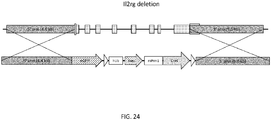
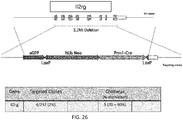
- the targeted genetic modification of the Interleukin-2 receptor gamma locus comprises: (a) a deletion of the entire rat Interleukin-2 receptor gamma coding region or a portion thereof; (b) a replacement of the entire rat Interleukin-2 receptor gamma coding region or a portion thereof with a human Interleukin-2 receptor gamma coding region or a portion thereof; (c) a replacement of an ecto-domain of the rat Interleukin-2 receptor gamma coding region with the ecto-domain of a human Interleukin-2 receptor gamma; or, (d) at least a 3 kb deletion of the Interleukin-2 receptor gamma locus.
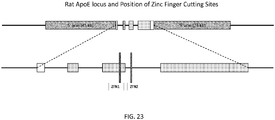
- the targeted genetic modification of the ApoE locus comprises: (a) a deletion of the entire ApoE coding region or a portion thereof; or, (b) at least a 1.8 kb deletion of the ApoE locus comprising the ApoE coding region.
- the targeted genetic modification of the Rag2 locus comprises: (a) a deletion of the entire Rag2 coding region or a portion thereof; or (b) at least a 5.7 kb deletion of the Rag2 locus comprising the Rag2 coding region.
- the targeted genetic modification of the Rag2/Rag1 locus comprises: (a) a deletion of the entire Rag2 coding region or a portion thereof and a deletion of the entire Rag1 coding region or portion thereof; or, (b) a deletion of at least 16 kb of the Rag2/Rag1 locus comprising the Rag2 coding region.
- a rat or rat cell wherein the targeted genetic modification comprises an insertion of an expression cassette comprising a selective marker at the Interleukin-2 receptor gamma locus, the ApoE locus, the Rag1 locus, the Rag2 locus, or the Rag2/Rag1 locus.
- the expression cassette comprises a lacZ gene operably linked to the endogenous promoter at the genomic locus and a human ubiquitin promoter operably linked to a selective marker.
- the targeted genetic modification in the Interleukin-2 receptor gamma locus, the ApoE locus, the Rag1 locus, the Rag2 locus or the Rag2/Rag1 locus comprises the insertion of a self-deleting selection cassette.
- the self-deleting selection cassette comprises a selective marker gene operably linked to a promoter active in the rat cell and a recombinase gene operably linked to a male germ cell-specific promoter, wherein the self-deleting cassette is flanked by recombination recognition sites recognized by the recombinase.
- the male germ cell-specific promoter is a Protamine-1 promoter; the recombinase gene encodes Cre, and the recombination recognition sites are loxP sites.
- the Protamine-1 promoter is a mouse or a rat Protamine-1 promoter.
- a rat or rat cell wherein the insertion of the exogenous nucleic acid sequence at the genomic locus comprises a reporter nucleic acid operably linked to an endogenous Interleukin-2 receptor gamma promoter, an endogenous ApoE promoter, an endogenous Rag1 promoter, or an endogenous Rag2 promoter.
- the reporter nucleic acid encodes a reporter comprising ⁇ -galactosidase, mPlum, mCherry, tdTomato, mStrawberry, J-Red, DsRed, mOrange, mKO, mCitrine, Venus, YPet, enhanced yellow fluorescent protein (EYFP), Emerald, enhanced green fluorescent protein (EGFP), CyPet, cyan fluorescent protein (CFP), Cerulean, T-Sapphire, luciferase, alkaline phosphatase, or a combination thereof.
- a reporter comprising ⁇ -galactosidase, mPlum, mCherry, tdTomato, mStrawberry, J-Red, DsRed, mOrange, mKO, mCitrine, Venus, YPet, enhanced yellow fluorescent protein (EYFP), Emerald, enhanced green fluorescent protein (EGFP), CyPet, cyan fluorescent protein (CFP),
- the rat cell is a pluripotent rat cell or a rat embryonic stem (ES) cell.
- the pluripotent rat cell or the rat embryonic stem (ES) cell (a) is derived from a DA strain or an ACI strain; (b) is characterized by expression of at least one pluripotency marker comprisingDnmt3L, Eras, Err-beta, Fbxo15, Fgf4, Gdf3, Klf4, Lef1, LIF receptor, Lin28, Nanog, Oct4, Sox15, Sox2, Utf1, or a combination thereof; or (c) is characterized by one or more of the following characteristics: (i) lack of expression of one or more pluripotency markers comprising c-Myc, Ecat1, and Rexo1; (ii) lack of expression of mesodermal markers comprising Brachyury and Bmpr2; (iii) lack of expression of one or more end
- a method for modifying a target genomic locus in an Interleukin-2 receptor gamma locus, an ApoE locus, a Rag1 locus, a Rag2 locus or a Rag2/Rag1 locus in a pluripotent rat cell comprising: (a) introducing into the pluripotent rat cell a targeting vector comprising an insert nucleic acid flanked with 5' and 3' rat homology arms homologous to the target genomic locus; and (b) identifying a genetically modified pluripotent rat cell comprising a targeted genetic modification at the target genomic locus, wherein the targeted genetic modification is capable of being transmitted through the germline of a rat propagated from the pluripotent rat cell.
- the targeting vector is a large targeting vector (LTVEC), wherein the sum total of the 5' and the 3' rat homology arms is at least about 10kb. In some embodiments, the sum total of the 5' and the 3' rat homology arms is at least 10kb but less than 150kb. In some embodiments, the sum total of the 5' and the 3' rat homology arms is at least about 10kb but less than about 100kb.
- LTVEC large targeting vector
- introducing the targeting vector into the pluripotent rat cell leads to: (i) a deletion of an endogenous rat nucleic acid sequence at the target genomic locus; (ii) an insertion of an exogenous nucleic acid sequence at the target genomic locus; or (iii) a combination thereof.
- the deletion of the endogenous rat nucleic acid at the genomic locus is at least about 10 kb; the deletion of an endogenous rat nucleic acid sequence at the genomic locus ranges from about 5kb to about 10kb, from about 10kb to about 20kb, from about 20kb to about 40kb, from about 40kb to about 60kb, from about 60kb to about 80kb, from about 80kb to about 100kb, from about 100kb to about 150kb, or from about 150kb to about 200kb, from about 200kb to about 300kb, from about 300kb to about 400kb, from about 400kb to about 500kb, from about 500kb to about 1Mb, from about 1Mb to about 1.5Mb, from about 1.5Mb to about 2Mb, from about 2Mb to about 2.5Mb, or from about 2.5Mb to about 3Mb; the insertion of an exogenous nucleic acid sequence at the genomic locus is at least about 5
- the targeted genetic modification at the Interleukin-2 receptor gamma locus results in a decrease in or absence of Interleukin-2 receptor gamma protein activity
- the targeted genetic modification at the ApoE locus results in a decrease in or absence of ApoE protein activity
- the targeted genetic modification at the Rag1 locus results in a decrease in or absence of Rag1 protein activity
- the targeted genetic modification at the Rag2 locus results in a decrease in or absence of Rag2 protein activity
- the targeted genetic modification at the Rag2/Rag1 locus results in a decrease in or absence of Rag2 protein activity and Rag1 protein activity.
- the targeted genetic modification at the Interleukin-2 receptor gamma locus comprises (a) a deletion of the entire rat Interleukin-2 receptor gamma coding region or a portion thereof; (b) a replacement of the entire rat Interleukin-2 receptor gamma coding region or a portion thereof with a human Interleukin-2 receptor gamma coding region or a portion thereof; (c) a replacement of an ecto-domain of the rat Interleukin-2 receptor gamma coding region with the ecto-domain of a human Interleukin-2 receptor gamma; or, (d) at least a 3 kb deletion of the Interleukin-2 receptor gamma locus comprising the Interleukin-2 receptor gamma coding region.
- the targeted genetic modification at the ApoE locus comprises: (a) a deletion of the entire ApoE coding region or a portion thereof; or, (b) at least a 1.8 kb deletion of the ApoE locus comprising the ApoE coding region.
- the targeted genetic modification at the Rag2 locus comprises: (a) a deletion of the entire Rag2 coding region or a portion thereof; or, (b) at least a 5.7 kb deletion of the Rag2 locus comprising the Rag2 coding region.
- the targeted genetic modification of the Rag1/Rag2 locus comprises: (a) a deletion of the entire Rag2 coding region or a portion thereof and a deletion of the entire Rag1 coding region or portion thereof; or, (b) a deletion of at least 16 kb of the Rag2/Rag1 locus comprising the Rag2 and Rag1 coding regions.
- the insert nucleic acid comprises an expression cassette comprising a polynucleotide encoding a selective marker.
- the expression cassette comprises a lacZ gene operably linked to an endogenous promoter at the genomic locus and a human ubiquitin promoter operably linked to a selective marker gene.
- the insert nucleic acid comprises a self-deleting selection cassette.
- the self-deleting selection cassette comprises a selective marker operably linked to a promoter active in the rat pluripotent cell and a polynucleotide encoding a recombinase operably linked to a male germ cell-specific promoter, wherein the self-deleting cassette is flanked by recombination recognition sites recognized by the recombinase.
- the male germ cell-specific promoter is a Protamine-1 promoter; or, the recombinase gene encodes Cre and the recombination recognition sites are loxP sites.
- the Protamine-1 promoter is a mouse or a rat Protamine-1 promoter.
- the insertion of the exogenous nucleic acid sequence at the genomic locus comprises a reporter nucleic acid sequence operably linked to the endogenous Interleukin-2 receptor gamma promoter, the endogenous ApoE promoter, the endogenous Rag1 promoter, or the endogenous Rag2 promoter.
- the reporter nucleic acid sequence encodes a reporter comprising ⁇ -galactosidase, mPlum, mCherry, tdTomato, mStrawberry, J-Red, DsRed, mOrange, mKO, mCitrine, Venus, YPet, enhanced yellow fluorescent protein (EYFP), Emerald, enhanced green fluorescent protein (EGFP), CyPet, cyan fluorescent protein (CFP), Cerulean, T-Sapphire, luciferase, alkaline phosphatase, or a combination thereof.
- a reporter comprising ⁇ -galactosidase, mPlum, mCherry, tdTomato, mStrawberry, J-Red, DsRed, mOrange, mKO, mCitrine, Venus, YPet, enhanced yellow fluorescent protein (EYFP), Emerald, enhanced green fluorescent protein (EGFP), CyPet, cyan fluorescent protein (CFP
- the pluripotent rat cell is a rat embryonic stem (ES) cell.
- the pluripotent rat cell (a) is derived from a DA strain or an ACI strain; (b) is characterized by expression of a pluripotency marker comprising Oct-4, Sox-2, alkaline phosphatase, or a combination thereof; or, (c) is characterized by one or more of the following characteristics: (i) lack of expression of one or more pluripotency markers comprising c-Myc, Ecat1, and Rexo1; (ii) lack of expression of mesodermal markers comprising Brachyury and Bmpr2; (iii) lack of expression of one or more endodermal markers comprising Gata6, Sox17 and Sox7; or (iv) lack of expression of one or more neural markers comprising Nestin and Pax6.
- the method further comprises identifying the targeted genetic modification at the target genomic locus, wherein the identification step employs a quantitative assay for assessing a modification of allele (MOA) at the target genomic locus.
- MOA modification of allele
- the introducing step further comprises introducing a second nucleic acid encoding a nuclease agent that promotes a homologous recombination between the targeting vector and the target genomic locus in the pluripotent rat cell.
- the nuclease agent comprises a chimeric protein comprising a zinc finger-based DNA binding domain fused to a FokI endonuclease.
- the introducing step of the method further comprises introducing into the pluripotent rat cell: a first expression construct comprising a first promoter operably linked to a first nucleic acid sequence encoding a Clustered Regularly Interspaced Short Palindromic Repeats (CRISPR)-associated (Cas) protein, and a second expression construct comprising a second promoter operably linked to a second nucleic acid sequence encoding a genomic target sequence operably linked to a guide RNA (gRNA), wherein the genomic target sequence is immediately flanked on the 3' end by a Protospacer Adjacent Motif (PAM) sequence.
- the genomic target sequence comprises the nucleotide sequence set forth in SEQ ID NO: 1.
- the gRNA comprises a third nucleic acid sequence encoding a Clustered Regularly Interspaced Short Palindromic Repeats (CRISPR) RNA (crRNA) and a trans-activating CRISPR RNA (tacrRNA).
- CRISPR Clustered Regularly Interspaced Short Palindromic Repeats
- tacrRNA trans-activating CRISPR RNA
- the Cas protein is Cas9.
- the gRNA is the chimeric RNA of the nucleic acid sequence set forth in SEQ ID NO: 2;
- the gRNA is the chimeric RNA of the nucleic acid sequence set forth in SEQ ID NO: 3;
- the crRNA comprises a sequence set forth in SEQ ID NO: 4,SEQ ID NO: 5, SEQ ID NO: 6; or,
- the tracrRNA comprises the sequence set forth in SEQ ID NO: 7 and/or SEQ ID NO: 8.
- embryonic stem cell or "ES cell” as used herein includes an embryo-derived totipotent or pluripotent cell that is capable of contributing to any tissue of the developing embryo upon introduction into an embryo.
- pluripotent cell as used herein includes an undifferentiated cell that possesses the ability to develop into more than one differentiated cell types.
- homologous nucleic acid as used herein includes a nucleic acid sequence that is either identical or substantially similar to a known reference sequence.
- the term “homologous nucleic acid” is used to characterize a sequence having amino acid sequence that is at least 70%, at least 75%, at least 80%, at least 85%, at least 90%, at least 95%, at least 96%, at least 97%, at least 98%, at least 99%, or even 100% identical to a known reference sequence.
- orthologous nucleic acid includes a nucleic acid sequence from one species that is functionally equivalent to a known reference sequence in another species.
- LTVEC large targeting vector
- LTVEC large targeting vectors for eukaryotic cells that are derived from fragments of cloned genomic DNA larger than those typically used by other approaches intended to perform homologous gene targeting in eukaryotic cells.
- LTVEC include, but are not limited to, bacterial homologous chromosome (BAC) and yeast artificial chromosome (YAC).
- modification of allele includes the modification of the exact DNA sequence of one allele of a gene(s) or chromosomal locus (loci) in a genome.
- modification of allele includes, but is not limited to, deletions, substitutions, or insertions of as little as a single nucleotide or deletions of many kilobases spanning a gene(s) or chromosomal locus (loci) of interest, as well as any and all possible modifications between these two extremes.
- recombination site includes a nucleotide sequence that is recognized by a site-specific recombinase and that can serve as a substrate for a recombination event.
- Serial genetic modifications include two or more modifications to, e.g., a rat ES cell, conducted independently.
- a first modification is made to a rat ES cell genome employing a suitable first nucleic acid construct.
- the first modification may be achieved by electroporation, or any other method known in the art.
- a second modification is made to the same rat ES cell genome employing a suitable second nucleic acid construct.
- the second modification may be achieved by a second electroporation, or any other method known in the art.
- serial genetic modifications following the first and the second genetic modifications of the same rat ES cell, a third, a fourth, a fifth, a sixth, and so on, serial genetic modifications (one following another) may be achieved using, e.g., serial electroporation or any other suitable method (serially) known in the art.
- site-specific recombinase includes a group of enzymes that can facilitate recombination between "recombination sites” where the two recombination sites are physically separated within a single nucleic acid molecule or on separate nucleic acid molecules.
- site-specific recombinase include, but are not limited to, Cre, Flp, and Dre recombinases.
- germline in reference to a nucleic acid sequence includes a nucleic acid sequence that can be passed to progeny.
- heavy chain or “immunoglobulin heavy chain” includes an immunoglobulin heavy chain sequence, including immunoglobulin heavy chain constant region sequence, from any organism.
- Heavy chain variable domains include three heavy chain CDRs and four FR regions, unless otherwise specified. Fragments of heavy chains include CDRs, CDRs and FRs, and combinations thereof.
- a typical heavy chain has, following the variable domain (from N-terminal to C-terminal), a C H 1 domain, a hinge, a C H 2 domain, and a C H 3 domain.
- a functional fragment of a heavy chain includes a fragment that is capable of specifically recognizing an epitope (e.g., recognizing the epitope with a K D in the micromolar, nanomolar, or picomolar range), that is capable of expressing and secreting from a cell, and that comprises at least one CDR.
- Heavy chain variable domains are encoded by variable region nucleotide sequence, which generally comprises V H , D H , and J H segments derived from a repertoire of V H , D H , and J H segments present in the germline. Sequences, locations and nomenclature for V, D, and J heavy chain segments for various organisms can be found in IMGT database, which is accessible via the internet on the world wide web (www) at the URL "imgt.org.”
- light chain includes an immunoglobulin light chain sequence from any organism, and unless otherwise specified includes human kappa ( ⁇ ) and lambda ( ⁇ ) light chains and a VpreB, as well as surrogate light chains.
- Light chain variable domains typically include three light chain CDRs and four framework (FR) regions, unless otherwise specified.
- FR framework
- a full-length light chain includes, from amino terminus to carboxyl terminus, a variable domain that includes FR1-CDR1-FR2-CDR2-FR3-CDR3-FR4, and a light chain constant region amino acid sequence.
- Light chain variable domains are encoded by the light chain variable region nucleotide sequence, which generally comprises light chain V L and light chain J L gene segments, derived from a repertoire of light chain V and J gene segments present in the germline. Sequences, locations and nomenclature for light chain V and J gene segments for various organisms can be found in IMGT database, which is accessible via the internet on the world wide web (www) at the URL "imgt.org.” Light chains include those, e.g., that do not selectively bind either a first or a second epitope selectively bound by the epitope-binding protein in which they appear. Light chains also include those that bind and recognize, or assist the heavy chain with binding and recognizing, one or more epitopes selectively bound by the epitope-binding protein in which they appear.
- operably linked comprises a relationship wherein the components operably linked function in their intended manner.
- a nucleic acid sequence encoding a protein may be operably linked to regulatory sequences (e.g., promoter, enhancer, silencer sequence, etc.) so as to retain proper transcriptional regulation.
- a nucleic acid sequence of an immunoglobulin variable region (or V(D)J segments) may be operably linked to a nucleic acid sequence of an immunoglobulin constant region so as to allow proper recombination between the sequences into an immunoglobulin heavy or light chain sequence.
- Target Locus Comprising a Rat Nucleic Acid
- genomic locus of interest comprises any segment or region of DNA within the genome that one desires to integrate an insert nucleic acid.
- genomic locus of interest and “target genomic locus of interest” can be used interchangeable.
- the genomic locus of interest can be native to the cell, or alternatively can comprise a heterologous or exogenous segment of DNA that was integrated into the genome of the cell.
- heterologous or exogenous segments of DNA can include transgenes, expression cassettes, polynucleotide encoding selection makers, or heterologous or exogenous regions of genomic DNA.
- locus is a defined herein as a segment of DNA within the genomic DNA. Genetic modifications as described herein can include one or more deletions from a locus of interest, additions to a locus of interest, replacement of a locus of interest, and/or any combination thereof.
- the locus of interest can comprise coding regions or non-coding regulatory regions.
- the genomic locus of interest can further comprise any component of a targeted integration system including, for example, a recognition site, a selection marker, a previously integrated insert nucleic acid, polynucleotides encoding nuclease agents, promoters, etc.
- the genomic locus of interest can be located within a yeast artificial chromosome (YAC), bacterial artificial chromosome (BAC), a human artificial chromosome, or any other engineered genomic region contained in an appropriate host cell.
- the targeted locus can comprise native, heterologous, or exogenous nucleic acid sequence from a prokaryote, a eukaryote, yeast, bacteria, a non-human mammal, a non-human cell, a rodent, a human, a rat, a mouse, a hamster, a rabbit, a pig, a bovine, a deer, a sheep, a goat, a chicken, a cat, a dog, a ferret, a primate (e.g., marmoset, rhesus monkey), domesticated mammal or an agricultural mammal or any other organism of interest or a combination thereof.
- the genomic locus of interest comprises a target locus of a "rat nucleic acid".
- a region comprises a nucleic acid from a rat that is integrated within the genome of a cell.
- Non-limiting examples of the target locus include a genomic locus that encodes a protein expressed in a B cell, a genomic locus that expresses a polypeptide in an immature B cell, a genomic locus that expresses a polypeptide in a mature B cell, an immunoglobulin (Ig) loci, or a T cell receptor loci, including, for example, a T cell receptor alpha locus.
- a genomic locus that encodes a protein expressed in a B cell a genomic locus that expresses a polypeptide in an immature B cell, a genomic locus that expresses a polypeptide in a mature B cell, an immunoglobulin (Ig) loci, or a T cell receptor loci, including, for example, a T cell receptor alpha locus.
- Ig immunoglobulin
- target genomic locus examples include an FcERla locus, a TLR4 locus, a PRLR locus, a Notch4 locus, an Accn2 locus, an Adamts5 locus, a TRPA1 locus, FolH1 locus, an LRP5 locus, an IL2 receptor locus, including, for example, an IL2 Receptor gamma (IL2Rg) locus, an ApoE locus, a Rag1 locus, a Rag2 locus, a Rag1/Rag2 locus, and an ERBB4 locus. Any such target locus can be from a rat.
- IL2Rg IL2 Receptor gamma
- the target locus encodes a mammalian immunoglobulin heavy chain variable region amino acid sequence. In one embodiment, the target locus encodes a rat immunoglobulin heavy chain variable region amino acid sequence. In one embodiment, the target locus comprises a genomic DNA sequence comprising an unrearranged rat, mouse, or human immunoglobulin heavy chain variable region nucleic acid sequence operably linked to an immunoglobulin heavy chain constant region nucleic acid sequence. In one embodiment, the immunoglobulin heavy chain constant region nucleic acid sequence is a rat, mouse, or human immunoglobulin heavy chain constant region nucleic acid sequence selected from a CH1, a hinge, a CH2, a CH3, and a combination thereof.
- the heavy chain constant region nucleic acid sequence comprises a CH1-hinge-CH2-CH3.
- the target locus comprises a rearranged rat, mouse, or human immunoglobulin heavy chain variable region nucleic acid sequence operably linked to an immunoglobulin heavy chain constant region nucleic acid sequence.
- the immunoglobulin heavy chain constant region nucleic acid sequence is a rat, mouse, or human immunoglobulin heavy chain constant region nucleic acid sequence selected from a CH1, a hinge, a CH2, a CH3, and a combination thereof.
- the heavy chain constant region nucleic acid sequence comprises a CH1-hinge-CH2-CH3.
- the target locus comprises a genomic DNA sequence that encodes a mammalian immunoglobulin light chain variable region amino acid sequence.
- the genomic DNA sequence comprises an unrearranged mammalian ⁇ and/or ⁇ light chain variable region nucleic acid sequence.
- the genomic DNA sequence comprises a rearranged mammalian ⁇ and/or ⁇ light chain variable region nucleic acid sequence.
- the unrearranged ⁇ or ⁇ light chain variable region nucleic acid sequence is operably linked to a mammalian immunoglobulin light chain constant region nucleic acid sequence selected from a ⁇ light chain constant region nucleic acid sequence and a ⁇ light chain constant region nucleic acid sequence.
- the mammalian immunoglobulin light chain constant region nucleic acid sequence is a rat immunoglobulin light chain constant region nucleic acid sequence.
- the mammalian immunoglobulin light chain constant region nucleic acid sequence is a mouse immunoglobulin light chain constant region nucleic acid sequence. In one embodiment, the mammalian immunoglobulin light chain constant region nucleic acid sequence is a human immunoglobulin light chain constant region nucleic acid sequence.
- a rat ApoE locus, a rat interleukin-2 receptor gamma (I1-2rg) locus, a rat Rag2 locus, a rat Rag1 locus and/or a rat Rag2/Rag1 locus comprise the respective regions of the rat genome in which each of these genes or gene combinations are located.
- Modifying any one of the rat ApoE locus, the rat interleukin-2 receptor gamma locus, the rat Rag2 locus, the rat Rag1 locus and/or the combined rat Rag2/Rag1 locus can comprise any desired alteration to the given locus. Non-limiting examples of modification to the given rat locus are discussed in further detail herein.
- one or more of the rat ApoE locus, the rat interleukin-2 receptor gamma locus, the Rag2 locus, and/or the Rag2/Rag1 locus is modified such that the activity and/or level of the encoded ApoE protein or the interleukin-2 receptor gamma protein or the Rag1 protein or the Rag2 protein or a combination of the Rag1 and Rag2 proteins are decreased.
- the activity of the ApoE protein, the interleukin-2 receptor gamma protein, the Rag1 protein, or the Rag2 protein, or a combination of the Rag1 and Rag2 proteins is absent.
- a decrease in activity can comprise either (1) a statistically significant decrease in the overall level or activity of a given protein (i.e., ApoE, interleukin-2 receptor gamma, Rag2, Rag2 or a combination of Rag1 and Rag2) including, for example, a decreased level or activity of 0.5%, 1 % , 5%, 10%, 20%, 30%, 40%, 50%, 60%, 70%, 80%, 90%, 100%, 120% or greater when compared to an appropriate control.
- a decreased level or activity including, for example, a decreased level or activity of 0.5%, 1 % , 5%, 10%, 20%, 30%, 40%, 50%, 60%, 70%, 80%, 90%, 100%, 120% or greater when compared to an appropriate control.
- one or more of the rat ApoE locus, the rat interleukin-2 receptor gamma locus, the rat Rag2 locus, the rat Rag1 locus and/or rat Rag2/Rag1 locus comprise a modification such that the activity and/or level of the encoded ApoE polypeptide, the interleukin-2 receptor gamma polypeptide, the Rag2 polypeptide, the Rag1 polypeptide, or both the Rag1 and Rag2 polypeptide is increased.
- “increased” is intended any increase in the level or activity of the gene/polypeptide encoded at the locus of interest.
- an increase in activity can comprise either (1) a statistically significant increase in the overall level or activity of a given protein (i.e., ApoE, interleukin-2 receptor gamma, Rag1, Rag2 or Rag1 and Rag2) including, for example, an increased level or activity of 0.5%, 1%, 5% , 10%, 20%, 30%, 40%, 50%, 60%, 70%, 80%, 90%, 100%, 120% or greater when compared to an appropriate control.
- a statistically significant increase in the overall level or activity of a given protein i.e., ApoE, interleukin-2 receptor gamma, Rag1, Rag2 or Rag1 and Rag2
- an increased level or activity of 0.5%, 1%, 5% , 10%, 20%, 30%, 40%, 50%, 60%, 70%, 80%, 90%, 100%, 120% or greater when compared to an appropriate control.
- the genetic modification to the rat ApoE locus, the rat interleukin-2 receptor gamma locus, the rat Rag2 locus, the rat Rag1 locus and/or rat Rag2/Rag1 locus can comprise a deletion of an endogenous rat nucleic acid sequence at the genomic locus, an insertion of an exogenous nucleic acid at the genomic locus, or a combination thereof.
- the deletion and/or insertion can occur anywhere within the given locus as discussed elsewhere herein.
- FIG. 1 For embodiments provided herein comprise the modification of one or more of the rat ApoE locus, the rat interleukin-2 receptor gamma locus, the rat Rag2 locus, the rat Rag1 locus and/or the rat Rag2/Rag1 locus through the replacement of a portion of the rat ApoE locus, the interleukin-2 receptor gamma locus, Rag2 locus, Rag1 locus and/or Rag2/Rag1 locus with the corresponding homologous or orthologous portion of an ApoE locus, an interleukin-2 receptor gamma locus, a Rag2 locus, a Rag1 locus and/or a Rag2/Rag1 locus from another organism.
- the modification of one or more of the rat ApoE locus, the rat interleukin-2 receptor gamma locus, Rag2 locus, Rag1 locus, and/or Rag2/Rag1 locus is carried out through the replacement of a portion of the rat ApoE locus, the rat interleukin-2 receptor gamma locus and/or the rat Rag2 locus, and/or the Rag1 locus and/or Rag2/Rag1 locus with an insert polynucleotide sharing across its full length least 80%, 85%, 90%, 91%, 92%, 93%, 94%, 95%, 96%, 97%, 98%, 99% to a portion of an ApoE locus, an interleukin-2 receptor gamma locus, a Rag2 locus, a Rag1 locus and/or a Rag2/Rag1 locus it is replacing.
- the given insert polynucleotide and/or the corresponding region of the rat locus being deleted can be a coding region, an intron, an exon, an untranslated region, a regulatory region, a promoter, or an enhancer or any combination thereof or any portion thereof.
- the given insert polynucleotide and/or the region of the rat locus being deleted can be of any desired length, including for example, between 10-100 nucleotides in length, 100-500 nucleotides in length, 500-1kb nucleotide in length, 1Kb to 1.5kb nucleotide in length, 1.5kb to 2kb nucleotides in length, 2kb to 2.5kb nucleotides in length, 2.5kb to 3kb nucleotides in length, 3kb to 5kb nucleotides in length, 5kb to 8kb nucleotides in length, 8kb to 10kb nucleotides in length or more.
- the size of the insertion or replacement is from about 5kb to about 10kb, from about 10kb to about 20kb, from about 20kb to about 40kb, from about 40kb to about 60kb, from about 60kb to about 80kb, from about 80kb to about 100kb, from about 100kb to about 150kb, from about 150kb to about 200kb, from about 200kb to about 250kb, from about 250kb to about 300kb, from about 300kb to about 350kb, from about 350kb to about 400kb, from about 400kb to about 800kb, from about 800kb to 1Mb, from about 300kb to about 400kb, from about 400kb to about 500kb, from about 500kb to 1Mb, from about 1Mb to about 1.5Mb, from about 1.5Mb to about 2Mb, from about 2Mb to about 2.5Mb, from about 2.5Mb to about 2.8Mb, from about 2.8Mb to about 3Mb.
- the given insert polynucleotide and/or the region of the rat locus being deleted is at least 100, 200, 300, 400, 500, 600, 700, 800, or 900 nucleotides or at least 1 kb, 2kb, 3kb, 4kb, 5kb, 6kb, 7kb, 8kb, 9kb, 10kb, 11kb, 12kb, 13kb, 14 kb, 15kb, 16kb or greater.
- the given insert polynucleotide can be from any organism, including, for example, a rodent, a rat, a mouse, a hamster, a mammal, a non-human mammal, a human, an agricultural animal or a domestic animal.
- rat locus of interest including for example, targeted modifications in the rat ApoE locus, the rat interleukin-2 receptor gamma locus, the rat Rag2 locus, the rat Rag1 locus, and/or the rat Rag2/Rag1 locus.
- genetically modified rats or genetically modified pluripotent rat cells which comprise a deletion, an insertion, a replacement and/or any combination thereof at the interleukin-2 receptor gamma locus, at the ApoE locus, at the rat Rag2 locus, at the rat Rag1 locus, and/or at the rat Rag2/Rag1 locus.
- Such genetic modifications include those that result in an absence, a decrease, an increase or a modulation in activity of the target locus) and are also capable of being transmitted through the germline.
- the genetic modifications result in a knockout of the desired target locus.
- Such rats find use in in a variety of experimental systems as discussed elsewhere herein.
- ApoE knockouts in rats offer an animal model to study endothelial function, including, but not limited to, plaque formation, transcriptional changes (Whole Transcriptome Shotgun Sequencing (RNA-Seq), and ex vivo function. Moreover, the larger size of rats facilitate all these assays and potentially improve the quality of the RNA-Seq data.
- ApoE is an important transport molecule and can transport lipids, such as cholesterol, through the bloodstream. ApoE can also function in the nervous system, for example, to clear ⁇ -amyloid from the brain. Modifications in ApoE have been implicated in various conditions, including, for example, atherosclerosis, hyperlipidemia, and Alzheimer's disease.
- ApoE knockout animals display impaired clearing of lipoproteins from the blood and develop atherosclerosis.
- ApoE knockout animals provide a model to study conditions and/or processes such as, for example, endothelia function, plaque formation, transcriptional changes (RNA-Seq), hyperlipidemia, atherosclerosis and Alzheimer's disease.
- Assays to measure ApoE activity are known in the art. For example, a decrease in ApoE activity can be measured by assaying for a decrease in the ApoE levels in a blood sample obtained from a subject by immunoassays, such as by ELISA or by Immunoblotting techniques. Moreover, the large size of rats facilitates all these assays and improves the quality of the data.
- RAG1 and RAG2 are enzymes that are part of a multi-subunit complex having VDJ recombination activity and play an important role in the rearrangement and recombination of immunoglobulin and T-cell receptor genes in lymphocytes.
- RAG1 and RAG2 induce a double stranded DNA cleavage to facilitate recombination and join of segments of the T cell receptor and B cell receptor (i.e. immunoglobulin) genes.
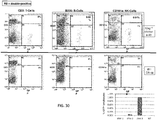
- Knockout of RAG1 and/or RAG2 causes a loss of B cells and T cells in the animal resulting in severe immunodeficiency.
- RAG1 and/or RAG2 knockout animals find use, for example, in studies of xenografts (i.e. human cell xenografts in rats), cancer, vaccine development, autoimmune disease, infectious disease and graft versus host disease (GVHD).
- xenografts i.e. human cell xenografts in rats
- cancer i.e. human cell xenografts in rats
- GVHD graft versus host disease
- assays to measure RAG1 and/or RAG2 activity include, for example, measuring recombination efficiency or assaying for the presence or absence of B cells and/or T cells in a subject.
- the large size of rats facilitates all these assays and potentially improves the quality of the data.
- the IL-2 receptor is expressed on the surface of certain immune cells and binds to the cytokine interleukin-2 (IL-2).
- the IL-2R is an integral membrane protein comprising at least three separate subunit chains, including, an alpha chain (IL-2Ra, CD25), a beta chain (IL-2Rb, CD122) and a gamma chain (IL2-Rg, CD132).
- the IL-2 receptor gamma (also referred to as IL2r-y or IL2Rg) chain is a common gamma chain that is shared by various cytokine receptors, including, for example, the receptors for IL-2, IL-4, IL-7, IL-9, IL-15 and IL-21.
- IL-2Rg comprises an ectodomain on the extracellular surface of the cell, which contributes to the binding of the ligand, a transmembrane domain, and an intracellular domain which can interact with various molecules to induce intracellular signal transduction pathways.
- the Il2rg gene is found on the X-chromosome in mammals and certain mutations in the gamma chain gene in humans can cause human X-linked severe combined immunodeficiency (XSCID) characterized by a profound T-cell defect.
- XSCID human X-linked severe combined immunodeficiency
- the gamma chain ecto-domain can be shed off of the transmembrane receptor and released as a soluble gamma chain receptor.
- the soluble gamma chain receptor can be detected in the blood of a subject and can function to regulate cytokine signaling.
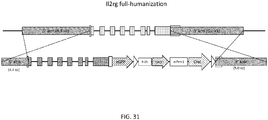
- the rat IL-2Rg chain is replaced with the human IL2-Rg chain such that the rat expresses a fully human IL-2Rg chain.
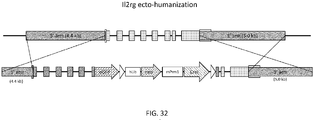
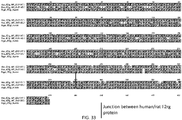
- the resulting humanized IL-2Rg chain expressed in a rat comprises a human ectodomain, with the remainder of the molecule being from the rat.
- the full-length humanization of IL-2Rg is useful because rats having this modified locus will produce human IL-2Rg. This will allow for the detection of human IL-2Rg in rats with antibodies specific to human IL-2Rg.
- the ecto-humanization i.e., replacing the rat ecto-domain of IL-2Rg with the human ecto-domain of IL-2Rg
- the ecto-humanization i.e., replacing the rat ecto-domain of IL-2Rg with the human ecto-domain of IL-2Rg
- the insert nucleic acid comprises a segment of DNA that one desires to integrate at the target locus.
- the insert nucleic acid comprises one or more polynucleotides of interest.
- the insert nucleic acid can comprise one or more expression cassettes.
- a given expression cassette can comprise a polynucleotide of interest, a polynucleotide encoding a selection marker and/or a reporter gene along with the various regulatory components that influence expression.
- Non-limiting examples of polynucleotides of interest, selection markers, and reporter genes that can be included within the insert nucleic acid are discussed in detail elsewhere herein.
- the insert nucleic acid can comprise a nucleic acid from rat, which can include a segment of genomic DNA, a cDNA, a regulatory region, or any portion or combination thereof.
- the insert nucleic acid can comprise a nucleic acid from a non-human mammal, a rodent, a human, a rat, a mouse, a hamster a rabbit, a pig, a bovine, a deer, a sheep, a goat, a chicken, a cat, a dog, a ferret, a primate (e.g., marmoset, rhesus monkey), domesticated mammal or an agricultural mammal or any other organism of interest.
- the insert nucleic acid employed in the various methods and compositions can result in the "humanization" of the a target locus comprising a rat nucleic acid.
- the insert nucleic acid comprises a knock-in allele of at least one exon of an endogenous gene. In one embodiment, the insert nucleic acid comprises a knock-in allele of the entire endogenous gene (i.e., "gene-swap knock-in").
- the insert nucleic acid comprises a regulatory element, including for example, a promoter, an enhancer, or a transcriptional repressor-binding element.
- the insert nucleic acid comprises a conditional allele.
- the conditional allele is a multifunctional allele, as described in US 2011/0104799 , which is incorporated by reference in its entirety.
- the conditional allele comprises: (a) an actuating sequence in sense orientation with respect to transcription of a target gene, and a drug selection cassette in sense or antisense orientation; (b) in antisense orientation a nucleotide sequence of interest (NSI) and a conditional by inversion module (COIN, which utilizes an exon-splitting intron and an invertible genetrap-like module; see, for example, US 2011/0104799 , which is incorporated by reference in its entirety); and (c) recombinable units that recombine upon exposure to a first recombinase to form a conditional allele that (i) lacks the actuating sequence and the DSC, and (ii) contains the NSI in sense orientation and the CO
- the insert nucleic acid ranges from about 5kb to about 10kb, from about 10kb to about 20kb, from about 20kb to about 40kb, from about 40kb to about 60kb, from about 60kb to about 80kb, from about 80kb to about 100kb, from about 100kb to about 150kb, from about 150kb to about 200kb, from about 200kb to about 250kb, from about 250kb to about 300kb, from about 300kb to about 350kb, or from about 350kb to about 400kb.
- the insert nucleic acid comprises a deletion of a rat genomic DNA sequence ranging from about 1kb to about 200kb, from about 2kb to about 20kb, or from about 0.5kb to about 3Mb. In one embodiment, the extent of the deletion of the genomic DNA sequence is greater than a total length of the 5' homology arm and the 3' homology arm.
- the extent of the deletion of the genomic DNA sequence ranges from about 5kb to about 10kb, from about 10kb to about 20kb, from about 20kb to about 40kb, from about 40kb to about 60kb, from about 60kb to about 80kb, from about 80kb to about 100kb, from about 100kb to about 150kb, from about 150kb to about 200kb, from about 20kb to about 30kb, from about 30kb to about 40kb, from about 40kb to about 50kb, from about 50kb to about 60kb, from about 60kb to about 70kb, from about 70kb to about 80kb, from about 80kb to about 90kb, from about 90kb to about 100kb, from about 100kb to about 110kb, from about 110kb to about 120kb, from about 120kb to about 130kb, from about 130kb to about 140kb, from about 140kb to about 150kb, from about 150kb to about 160
- the insert nucleic acid comprises an insertion or a replacement of a rat nucleic acid sequence with a homologous or orthologous human nucleic acid sequence. In one embodiment, the insert nucleic acid comprises an insertion or replacement of a rat DNA sequence with a homologous or orthologous human nucleic acid sequence at an endogenous rat locus that comprises the corresponding rat DNA sequence.
- the genetic modification is an addition of a nucleic acid sequence.
- the added nucleotide sequence ranges from 5kb to 200 kb.
- the insert nucleic acid comprises a genetic modification in a coding sequence.
- the genetic modification comprises a deletion mutation of a coding sequence.
- the genetic modification comprises a fusion of two endogenous coding sequences.
- the insert nucleic acid comprises an insertion or a replacement of a rat nucleic acid sequence with a homologous or orthologous human nucleic acid sequence. In one embodiment, the insert nucleic acid comprises an insertion or replacement of a rat DNA sequence with a homologous or orthologous human nucleic acid sequence at an endogenous rat locus that comprises the corresponding rat DNA sequence.
- the genetic modification comprises a deletion of a non-protein-coding sequence, but does not comprise a deletion of a protein-coding sequence. In one embodiment, the deletion of the non-protein-coding sequence comprises a deletion of a regulatory element. In one embodiment, the genetic modification comprises a deletion of a promoter. In one embodiment, the genetic modification comprises an addition of a promoter or a regulatory element. In one embodiment, the genetic modification comprises a replacement of a promoter or a regulatory element.
- the nucleic acid sequence of the targeting vector can comprise a polynucleotide that when integrated into the genome will produce a genetic modification of a region of the rat ApoE locus, wherein the genetic modification at the ApoE locus results in a decrease in ApoE activity, increase in ApoE activity, or a modulation of ApoE activity.
- an ApoE knockout (“null allele) is generated.
- the nucleic acid sequence of the targeting vector can comprise a polynucleotide that when integrated into the genome will produce a genetic modification of a region of the rat interleukin-2 receptor locus, wherein the genetic modification at the interleukin-2 receptor locus results in a decrease in interleukin-2 receptor activity.
- an interleukin-2 receptor knockout (“null allele") is generated.
- the insert nucleic acid results in the replacement of a portion of the rat ApoE locus, the interleukin-2 receptor gamma locus and/or Rag2 locus, and/or Rag1 locus and/or Rag2/Rag1 locus with the corresponding homologous or orthologous portion of an ApoE locus, an interleukin-2 receptor gamma locus, a Rag2 locus, a Rag1 locus and/or a Rag2/Rag1 locus from another organism.
- the insert nucleic acid comprises a polynucleotide sharing across its full length least 80%, 85%, 90%, 91%, 92%, 93%, 94%, 95%, 96%, 97%, 98%, 99% to a portion of an ApoE locus, an interleukin-2 receptor gamma locus, a Rag2 locus, a Rag1 locus and/or a Rag2/Rag1 locus it is replacing.
- the given insert polynucleotide and the corresponding region of the rat locus being replaced can be a coding region, an intron, an exon, an untranslated region, a regulatory region, a promoter, or an enhancer or any combination thereof.
- the given insert polynucleotide and/or the region of the rat locus being deleted can be of any desired length, including for example, between 10-100 nucleotides in length, 100-500 nucleotides in length, 500-1kb nucleotide in length, 1Kb to 1.5kb nucleotide in length, 1.5kb to 2kb nucleotides in length, 2kb to 2.5kb nucleotides in length, 2.5kb to 3kb nucleotides in length, 3kb to 5kb nucleotides in length, 5kb to 8kb nucleotides in length, 8kb to 10kb nucleotides in length or more.
- the size of the insertion or replacement is from about 5kb to about 10kb, from about 10kb to about 20kb, from about 20kb to about 40kb, from about 40kb to about 60kb, from about 60kb to about 80kb, from about 80kb to about 100kb, from about 100kb to about 150kb, from about 150kb to about 200kb, from about 200kb to about 250kb, from about 250kb to about 300kb, from about 300kb to about 350kb, from about 350kb to about 400kb, from about 400kb to about 800kb, from about 800kb to 1Mb, from about 1Mb to about 1.5Mb, from about 1.5Mb to about 2Mb, from about 2Mb, to about 2.5Mb, from about 2.5Mb to about 2.8Mb, from about 2.8Mb to about 3Mb.
- the given insert polynucleotide and/or the region of the rat locus being deleted is at least 100, 200, 300, 400, 500, 600, 700, 800, or 900 nucleotides or at least 1 kb, 2kb, 3kb, 4kb, 5kb, 6kb, 7kb, 8kb, 9kb, 10kb, 11kb, 12kb, 13kb, 14 kb, 15kb, 16kb or greater.
- the promoter is constitutively active promoter.
- the promoter is an inducible promoter. In one embodiment, the inducible promoter is a chemically-regulated promoter. In one embodiment, the chemically-regulated promoter is an alcohol-regulated promoter. In one embodiment, the alcohol-regulated promoter is an alcohol dehydrogenase (alcA) gene promoter. In one embodiment, the chemically-regulated promoter is a tetracycline-regulated promoter. In one embodiment, the tetracycline-regulated promoter is a tetracycline-responsive promoter. In one embodiment, the tetracycline-regulated promoter is a tetracycline operator sequence (tetO).
- tetO tetracycline operator sequence
- the tetracycline-regulated promoter is a tet-On promoter. In one embodiment, the tetracycline-regulated promoter a tet-Off promoter. In one embodiment, the chemically- regulated promoter is a steroid regulated promoter. In one embodiment, the steroid regulated promoter is a promoter of a rat glucocorticoid receptor. In one embodiment, the steroid regulated promoter is a promoter of an estrogen receptor. In one embodiment, the steroid-regulated promoter is a promoter of an ecdysone receptor. In one embodiment, the chemically-regulated promoter is a metal-regulated promoter.
- the metal-regulated promoter is a metalloprotein promoter.
- the inducible promoter is a physically-regulated promoter.
- the physically-regulated promoter is a temperature-regulated promoter.
- the temperature-regulated promoter is a heat shock promoter.
- the physically-regulated promoter is a light-regulated promoter.
- the light-regulated promoter is a light-inducible promoter.
- the light-regulated promoter is a light-repressible promoter.
- the promoter is a tissue-specific promoter. In one embodiment, the promoter is a neuron-specific promoter. In one embodiment, the promoter is a glia-specific promoter. In one embodiment, the promoter is a muscle cell-specific promoter. In one embodiment, the promoter is a heart cell-specific promoter. In one embodiment, the promoter is a kidney cell-specific promoter. In one embodiment, the promoter is a bone cell-specific promoter. In one embodiment, the promoter is an endothelial cell-specific promoter. In one embodiment, the promoter is an immune cell-specific promoter. In one embodiment, the immune cell promoter is a B cell promoter. In one embodiment, the immune cell promoter is a T cell promoter.
- the promoter is a developmentally-regulated promoter. In one embodiment, the developmentally-regulated promoter is active only during an embryonic stage of development. In one embodiment, the developmentally-regulated promoter is active only in an adult cell.
- the insert nucleic acid comprises a nucleic acid flanked with site-specific recombination target sequences. It is recognized the while the entire insert nucleic acid can be flanked by such site-specific recombination target sequences, any region or individual polynucleotide of interest within the insert nucleic acid can also be flanked by such sites.
- the site-specific recombinase can be introduced into the cell by any means, including by introducing the recombinase polypeptide into the cell or by introducing a polynucleotide encoding the site-specific recombinase into the host cell.
- the polynucleotide encoding the site-specific recombinase can be located within the insert nucleic acid or within a separate polynucleotide.
- the site-specific recombinase can be operably linked to a promoter active in the cell including, for example, an inducible promoter, a promoter that is endogenous to the cell, a promoter that is heterologous to the cell, a cell-specific promoter, a tissue-specific promoter, or a developmental stage-specific promoter.
- Site-specific recombination target sequences which can flank the insert nucleic acid or any polynucleotide of interest in the insert nucleic acid can include, but are not limited to, loxP, lox511, lox2272, lox66, lox71, loxM2, lox5171, FRT, FRT11, FRT71, attp, att, FRT, rox, and a combination thereof.
- the site-specific recombination sites flank a polynucleotide encoding a selection marker and/or a reporter gene contained within the insert nucleic acid. In such instances following integration of the insert nucleic acid at the targeted locus the sequences between the site-specific recombination sites can be removed.
- the insert nucleic acid comprises a polynucleotide encoding a selection marker.
- the selection marker can be contained in a selection cassette.
- selection markers include, but are not limited, to neomycin phosphotransferase (neo r ), hygromycin B phosphotransferase (hyg r ), puromycin-N-acetyltransferase (puro r ), blasticidin S deaminase (bsr r ), xanthine/guanine phosphoribosyl transferase (gpt), or herpes simplex virus thymidine kinase (HSV-k), or a combination thereof.
- the polynucleotide encoding the selection marker is operably linked to a promoter active in the cell, rat cell, pluripotent rat cell or the ES rat cell.
- the selection marker can comprise a recognition site for a nuclease agent, as outlined above.
- the polynucleotide encoding the selection marker is flanked with a site-specific recombination target sequences.
- the insert nucleic acid can further comprise a reporter gene operably linked to a promoter, wherein the reporter gene encodes a reporter protein selected from the group consisting of or comprising LacZ, mPlum, mCherry, tdTomato, mStrawberry, J-Red, DsRed, mOrange, mKO, mCitrine, Venus, YPet, enhanced yellow fluorescent protein (EYFP), Emerald, enhanced green fluorescent protein (EGFP), CyPet, cyan fluorescent protein (CFP), Cerulean, T-Sapphire, luciferase, alkaline phosphatase, and/or a combination thereof.
- a reporter gene operably linked to a promoter active in the cell.
- Such promoters can be an inducible promoter, a promoter that is endogenous to the reporter gene or the cell, a promoter that is heterologous to the reporter gene or to the cell, a cell-specific promoter, a tissue-specific promoter, or a developmental stage-specific promoter.
- nucleic acid insert can comprise a mammalian nucleic acid comprises a genomic locus that encodes a protein expressed in the nervous system, the skeletal system, the digestive system, the circulatory system, the muscular system, the respiratory system, the cardiovascular system, the lymphatic system, the endocrine system, the urinary system, the reproductive system, or a combination thereof.
- the mammalian nucleic acid comprises a genomic locus that encodes a protein expressed in a bone marrow or a bone marrow-derived cell.
- the nucleic acid comprises a genomic locus that encodes a protein expressed in a spleen cell.
- the mammalian nucleic acid comprises a genomic locus that encodes a protein expressed in the nervous system, the skeletal system, the digestive system, the circulatory system, the muscular system, the respiratory system, the cardiovascular system, the lymphatic system, the endocrine system, the urinary system, the reproductive system, or a combination thereof.
- the mammalian nucleic acid comprises a genomic locus that encodes a protein expressed in a bone marrow or a bone marrow-derived cell.
- the nucleic acid comprises a genomic locus that encodes a protein expressed in a spleen cell.
- the genomic locus comprises a mouse genomic DNA sequence, a rat genomic DNA sequence a human genomic DNA sequence, or a combination thereof. In one embodiment, the genomic locus comprises, in any order, rat and human genomic DNA sequences. In one embodiment, the genomic locus comprises, in any order, mouse and human genomic DNA sequences. In one embodiment, the genomic locus comprises, in any order, mouse and rat genomic DNA sequences. In one embodiment, the genomic locus comprises, in any order, rat, mouse, and human genomic DNA sequences.
- the genomic locus comprises a mouse genomic DNA sequence, a rat genomic DNA sequence a human genomic DNA sequence, or a combination thereof. In one embodiment, the genomic locus comprises, in any order, rat and human genomic DNA sequences. In one embodiment, the genomic locus comprises, in any order, mouse and human genomic DNA sequences. In one embodiment, the genomic locus comprises, in any order, mouse and rat genomic DNA sequences. In one embodiment, the genomic locus comprises, in any order, rat, mouse, and human genomic DNA sequences.
- the genetic modification comprises at least one human disease allele of a human gene.
- the human disease is a neurological disease.
- the human disease is a cardiovascular disease.
- the human disease is a kidney disease.
- the human disease is a muscle disease.
- the human disease is a blood disease.
- the human disease is a cancer.
- the human disease is an immune system disease.
- the human disease allele is a dominant allele. In one embodiment, the human disease allele is a recessive allele. In one embodiment, the human disease allele comprises a single nucleotide polymorphism (SNP) allele.
- SNP single nucleotide polymorphism
- the genetic modification produces a mutant form of a protein with an altered binding characteristic, altered localization, altered expression, and/or altered expression pattern.
- the insert nucleic acid comprises a selection cassette.
- the selection cassette comprises a nucleic acid sequence encoding a selective marker, wherein the nucleic acid sequence is operably linked to a promoter active in rat ES cells.
- the selective marker is selected from or comprises a hygromycin resistance gene or a neomycin resistance gene.
- the nucleic acid comprises a genomic locus that encodes a protein expressed in a B cell. In one embodiment, the nucleic acid comprises a genomic locus that encodes a protein expressed in an immature B cell. In one embodiment, the nucleic acid comprises a genomic locus that encodes a protein expressed in a mature B cell.
- the insert nucleic acid comprises a regulatory element.
- the regulatory element is a promoter.
- the regulatory element is an enhancer.
- the regulatory element is a transcriptional repressor-binding element.
- the genetic modification comprises a deletion of a non-protein-coding sequence, but does not comprise a deletion of a protein-coding sequence. In one embodiment, the deletion of the non-protein-coding sequence comprises a deletion of a regulatory element. In one embodiment, the genetic modification comprises a deletion of a regulatory element. In one embodiment, the genetic modification comprises an addition of a promoter or a regulatory element. In one embodiment, the genetic modification comprises a replacement of a promoter or a regulatory element.
- polynucleotides or nucleic acid molecules comprising the various components employed in a targeted genomic integration system provided herein (i.e. any one of or any combination of nuclease agents, recognition sites, insert nucleic acids, polynucleotides of interest, targeting vectors, selection markers, and other components).
- polynucleotide polynucleotide sequence
- nucleic acid sequence nucleic acid fragment
- a polynucleotide in the form of a polymer of DNA may be comprised of one or more segments of cDNA, genomic DNA, synthetic DNA, or mixtures thereof.
- Polynucleotides can comprise deoxyribonucleotides and ribonucleotides include both naturally occurring molecules and synthetic analogues, and any combination these.
- the polynucleotides provided herein also encompass all forms of sequences including, but not limited to, single-stranded forms, double-stranded forms, hairpins, stem-and-loop structures, and the like.
- recombinant polynucleotides comprising the various components of the targeted genomic integration system.
- the terms "recombinant polynucleotide” and “recombinant DNA construct” are used interchangeably herein.
- a recombinant construct comprises an artificial or heterologous combination of nucleic acid sequences, e.g., regulatory and coding sequences that are not found together in nature.
- a recombinant construct may comprise regulatory sequences and coding sequences that are derived from different sources, or regulatory sequences and coding sequences derived from the same source, but arranged in a manner different than that found in nature.
- Such a construct may be used by itself or may be used in conjunction with a vector.
- a vector is used, then the choice of vector is dependent upon the method that is used to transform the host cells as is well known to those skilled in the art.
- a plasmid vector can be used.
- Genetic elements required to successfully transform, select, and propagate host cells comprising any of the isolated nucleic acid fragments provided herein are also provided. Screening may be accomplished by Southern analysis of DNA, Northern analysis of mRNA expression, immunoblotting analysis of protein expression, or phenotypic analysis, among others.
- one or more of the components of the targeted genomic integration system described herein can be provided in an expression cassette for expression in a prokaryotic cell, a eukaryotic cell, a bacterial, a yeast cell, or a mammalian cell or other organism or cell type of interest.
- the cassette can include 5' and 3' regulatory sequences operably linked to a polynucleotide provided herein. "Operably linked” comprises a relationship wherein the components operably linked function in their intended manner. For example, an operable linkage between a polynucleotide of interest and a regulatory sequence (i.e., a promoter) is a functional link that allows for expression of the polynucleotide of interest.
- Operably linked elements may be contiguous or non-contiguous. When used to refer to the joining of two protein coding regions, operably linked means that the coding regions are in the same reading frame.
- a nucleic acid sequence encoding a protein may be operably linked to regulatory sequences (e.g., promoter, enhancer, silencer sequence, etc.) so as to retain proper transcriptional regulation.
- a nucleic acid sequence of an immunoglobulin variable region (or V(D)J segments) may be operably linked to a nucleic acid sequence of an immunoglobulin constant region so as to allow proper recombination between the sequences into an immunoglobulin heavy or light chain sequence.
- the cassette may additionally contain at least one additional polynucleotide of interest to be co-introduced into the organism.
- the additional polynucleotide of interest can be provided on multiple expression cassettes.
- Such an expression cassette is provided with a plurality of restriction sites and/or recombination sites for insertion of a recombinant polynucleotide to be under the transcriptional regulation of the regulatory regions.
- the expression cassette may additionally contain selection marker genes.
- the expression cassette can include in the 5'-3' direction of transcription, a transcriptional and translational initiation region (i.e., a promoter), a recombinant polynucleotide provided herein, and a transcriptional and translational termination region (i.e., termination region) functional in mammalian cell or a host cell of interest.
- the regulatory regions (i.e., promoters, transcriptional regulatory regions, and translational termination regions) and/or a polynucleotide provided herein may be native/analogous to the host cell or to each other. Alternatively, the regulatory regions and/or a polynucleotide provided herein may be heterologous to the host cell or to each other.
- a promoter operably linked to a heterologous polynucleotide is from a species different from the species from which the polynucleotide was derived, or, if from the same/analogous species, one or both are substantially modified from their original form and/or genomic locus, or the promoter is not the native promoter for the operably linked polynucleotide.
- the regulatory regions and/or a recombinant polynucleotide provided herein may be entirely synthetic.
- the termination region may be native with the transcriptional initiation region, may be native with the operably linked recombinant polynucleotide, may be native with the host cell, or may be derived from another source (i.e., foreign or heterologous) to the promoter, the recombinant polynucleotide, the host cell, or any combination thereof.
- the various DNA fragments may be manipulated, so as to provide for the DNA sequences in the proper orientation.
- adapters or linkers may be employed to join the DNA fragments or other manipulations may be involved to provide for convenient restriction sites, removal of superfluous DNA, removal of restriction sites, or the like.
- in vitro mutagenesis, primer repair, restriction, annealing, resubstitutions, e.g., transitions and transversions may be involved.
- a number of promoters can be used in the expression cassettes provided herein.
- the promoters can be selected based on the desired outcome. It is recognized that different applications can be enhanced by the use of different promoters in the expression cassettes to modulate the timing, location and/or level of expression of the polynucleotide of interest.
- Such expression constructs may also contain, if desired, a promoter regulatory region (e.g., one conferring inducible, constitutive, environmentally- or developmentally-regulated, or cell- or tissue-specific/selective expression), a transcription initiation start site, a ribosome binding site, an RNA processing signal, a transcription termination site, and/or a polyadenylation signal.
- the expression cassette containing the polynucleotides provided herein can also comprise a selection marker gene for the selection of transformed cells. Selectable marker genes are utilized for the selection of transformed cells or tissues.
- the sequences employed in the methods and compositions may be optimized for increased expression in the cell. That is, the genes can be synthesized using codons preferred in a given cell of interest including, for example, mammalian-preferred codons, human-preferred codons, rodent-preferred codon, mouse-preferred codons, rat-preferred codons, etc. for improved expression.
- selection markers can be used in the methods and compositions disclosed herein. Such selection markers can, for example, impart resistance to an antibiotic such as G418, hygromycin, blastocidin, neomycin, or puromycin. Such selection markers include neomycin phosphotransferase (neo r ), hygromycin B phosphotransferase (hyg r ), puromycin-N-acetyltransferase (puro r ), and blasticidin S deaminase (bsr r ). In still other embodiments, the selection marker is operably linked to an inducible promoter and the expression of the selection marker is toxic to the cell.
- Non-limiting examples of such selection markers include xanthine/guanine phosphoribosyl transferase (gpt), hahypoxanthine-guanine phosphoribosyltransferase (HGPRT) or herpes simplex virus thymidine kinase (HSV-TK).
- gpt xanthine/guanine phosphoribosyl transferase
- HGPRT hahypoxanthine-guanine phosphoribosyltransferase
- HSV-TK herpes simplex virus thymidine kinase
- Targeting vectors are employed to introduce the insert nucleic acid into the target locus of the rat nucleic acid.
- the targeting vector comprises the insert nucleic acid and further comprises a 5' and a 3' homology arm, which flank the insert nucleic acid.
- the homology arms, which flank the insert nucleic acid correspond to regions within the target locus of the rat nucleic acid.
- target sites the corresponding cognate genomic regions within the targeted genomic locus are referred to herein as "target sites”.
- a targeting vector can comprise a first insert nucleic acid flanked by a first and a second homology arm complementary to a first and a second target site
- the targeting vector thereby aids in the integration of the insert nucleic acid into the target locus of the rat nucleic acid through a homologous recombination event that occurs between the homology arms and the complementary target sites within the genome of the cell.
- the target locus of the rat nucleic acid comprises a first nucleic acid sequence that is complementary to the 5' homology arm and a second nucleic acid sequence that is complementary to the 3' homology arm.
- the first and the second nucleic acid sequences are separated by at least 5kb.
- the first and the second nucleic acid sequences are separated by at least 5kb but less than 200kb.
- the first and the second nucleic acid sequences are separated by at least 10kb.
- the first and the second nucleic acid sequences are separated by at least 20kb, at least 30kb, at least 40kb, at least 50kb, at least 60kb, at least 70kb, at least 80kb, at least 90kb, at least 100kb, at least 110kb, at least 120kb, at least 130kb, at least 140kb, at least 150kb, at least 160kb, at least 170kb, at least 180kb, at least 190kb, or at least 200kb.
- the first and the second nucleic acid sequence is separated by at least 5kb but less than 10kb, at least 5kb but less than 3Mb, at least 10kb but less than 20kb, at least 20kb but less than 40kb, at least 40kb but less than 60kb, at least 60kb but less than 80kb, at least about 80kb but less than 100kb, at least 100kb but less than 150kb, or at least 150kb but less than 200kb, at least about 200kb but less than about 300kb, at least about 300kb but less than about 400kb, at least about 400kb but less than about 500kb, at least about 500kb but less than about 1Mb, at least about 1.5 Mb but less than about 2Mb, at least about 1Mb but less than about 1.5Mb, at least about 2Mb but less than 2.5Mb, at least about 2.5Mb but less than 3Mb, or at least about 2Mb but less than about 3Mb.
- a homology arm of the targeting vector can be of any length that is sufficient to promote a homologous recombination event with a corresponding target site, including for example, at least 5-10kb, 5-15kb, 10-20kb, 20-30kb, 30-40kb, 40-50kb, 50-60kb, 60-70kb, 70-80kb, 80-90kb, 90-100kb, 100-110kb, 110-120kb, 120-130kb, 130-140kb, 140-150kb, 150-160kb, 160-170kb, 170-180kb, 180-190kb, 190-200kb in length or greater.
- large targeting vectors can employ targeting arms of greater length.
- the sum total of the 5' homology arm and the 3' homology arm is at least 10 kb or the sum total of the 5' homology arm and the 3' homology arm is at least about 16kb to about 100 kb or about 30kb to about 100kb.
- the size of the sum total of the total of the 5' and 3' homology arms of the LTVEC is about 10kb to about 150kb, about 10kb to about 100kb, about 10kb to about 75kb, about 20kb to about 150kb, about 20kb to about 100kb, about 20kb to about 75kb, about 30kb to about 150kb, about 30kb to about 100kb, about 30kb to about 75kb, about 40kb to about 150kb, about 40kb to about 100kb, about 40kb to about 75kb, about 50kb to about 150kb, about 50kb to about 100kb, or about 50kb to about 75kb, about 10kb to about 30kb, about 20kb to about 40kb, about 40kb to about 60kb, about 60kb to about 80kb, about 80kb to about 100kb, about 100kb to about 120kb, or from about 120kb to about 150kb. In one
- the cognate genomic regions corresponding to the 5' and 3' homology arms of a targeting vector are "located in sufficient proximity" to nuclease target sites so as to promote the occurrence of a homologous recombination event between the cognate genomic regions and the homology arms upon a nick or double-strand break at the recognition site.
- the nuclease target sites can be located anywhere between the cognate genomic regions corresponding to the 5' and 3' homology arms.
- the recognition site is immediately adjacent to at least one or both of the cognate genomic regions.
- a homology arm and a target site i.e., cognate genomic region
- a target site i.e., cognate genomic region
- a homology arm and a target site are “complementary” to one another when the two regions share a sufficient level of sequence identity to one another to act as substrates for a homologous recombination reaction.
- homology is meant DNA sequences that are either identical or share sequence identity to a corresponding or “complementary” sequence.
- the sequence identity between a given target site and the corresponding homology arm found on the targeting vector can be any degree of sequence identity that allows for homologous recombination to occur.
- the amount of sequence identity shared by the homology arm of the targeting vector (or a fragment thereof) and the target site (or a fragment thereof) can be at least 50%, 55%, 60%, 65%, 70%, 75%, 80%, 81%, 82%, 83%, 84%, 85%, 86%, 87%, 88%, 89%, 90%, 91%, 92%, 93%, 94%, 95%, 96%, 97%, 98%, 99% or 100% sequence identity, such that the sequences undergo homologous recombination.
- a complementary region of homology between the homology arm and the complementary target site can be of any length that is sufficient to promote homologous recombination at the cleaved recognition site.
- a given homology arm and/or complementary target site can comprise complementary regions of homology that are at least 5-10kb, 5-15kb, 10-20kb, 20-30kb, 30-40kb, 40-50kb, 50-60kb, 60-70kb, 70-80kb, 80-90kb, 90-100kb, 100-110kb, 110-120kb, 120-130kb, 130-140kb, 140-150kb, 150-160kb, 160-170kb, 170-180kb, 180-190kb, 190-200kb in length or greater (such as described in the LTVEC vectors described elsewhere herein) such that the homology arm has sufficient homology to undergo homologous recombination with the corresponding target sites within the genome of the cell.
- the homology arms are referred to herein as a 5' and a 3' homology arm. This terminology relates to the relative position of the homology arms to the insert nucleic acid within the targeting vector.
- the homology arms of the targeting vector are therefore designed to be complementary to a target site with the targeted locus.
- the homology arms can be complementary to a locus that is native to the cell, or alternatively they can be complementary to a region of a heterologous or exogenous segment of DNA that was integrated into the genome of the cell, including, but not limited to, transgenes, expression cassettes, or heterologous or exogenous regions of genomic DNA.
- the homology arms of the targeting vector can be complementary to a region of a human artificial chromosome or any other engineered genomic region contained in an appropriate host cell.
- the homology arms of the targeting vector can be complementary to or be derived from a region of a BAC library, a cosmid library, or a P1 phage library.
- the homology arms of the targeting vector are complementary to a rat genomic locus that is native, heterologous or exogenous to a given cell.
- the homology arms are complementary to a rat genomic locus that is not targetable using a conventional method or can be targeted only incorrectly or only with significantly low efficiency, in the absence of a nick or double-strand break induced by a nuclease agent.
- the homology arms are derived from a synthetic DNA.
- the 5' and 3' homology arms are complementary to the same genome as the targeted genome.
- the homology arms are from a related genome, e.g., the targeted genome is a rat genome of a first strain, and the targeting arms are from a rat genome of a second strain, wherein the first strain and the second strain are different.
- the homology arms are from the genome of the same animal or are from the genome of the same strain, e.g., the targeted genome is a rat genome of a first strain, and the targeting arms are from a rat genome from the same rat or from the same strain.
- the targeting vector (such as a large targeting vector) can also comprise a selection cassette or a reporter gene as discussed elsewhere herein.
- the selection cassette can comprise a nucleic acid sequence encoding a selection marker, wherein the nucleic acid sequence is operably linked to a promoter.
- the promoter can be active in a prokaryotic cell of interest and/or active in a eukaryotic cell of interest.
- Such promoters can be an inducible promoter, a promoter that is endogenous to the reporter gene or the cell, a promoter that is heterologous to the reporter gene or to the cell, a cell-specific promoter, a tissue-specific promoter or a developmental stage-specific promoter.
- the selection marker is selected from or comprises neomycin phosphotransferase (neo r ), hygromycin B phosphotransferase (hyg r ), puromycin-N-acetyltransferase (puro r ), blasticidin S deaminase (bsr r ), xanthine/guanine phosphoribosyl transferase (gpt), and herpes simplex virus thymidine kinase (HSV-k), and/or a combination thereof.
- the selection marker of the targeting vector can be flanked by the 5' and 3' homology arms or found either 5' or 3' to the homology arms.
- the targeting vector (such as a large targeting vector) comprises a reporter gene operably linked to a promoter, wherein the reporter gene encodes a reporter protein selected from the group consisting of or comprises LacZ, mPlum, mCherry, tdTomato, mStrawberry, J-Red, DsRed, mOrange, mKO, mCitrine, Venus, YPet, enhanced yellow fluorescent protein (EYFP), Emerald, enhanced green fluorescent protein (EGFP), CyPet, cyan fluorescent protein (CFP), Cerulean, T-Sapphire, luciferase, alkaline phosphatase, and/or a combination thereof.
- a reporter protein selected from the group consisting of or comprises LacZ, mPlum, mCherry, tdTomato, mStrawberry, J-Red, DsRed, mOrange, mKO, mCitrine, Venus, YPet, enhanced yellow fluorescent protein (
- Such reporter genes can be operably linked to a promoter active in the cell.
- promoters can be an inducible promoter, a promoter that is endogenous to the report gene or the cell, a promoter that is heterologous to the reporter gene or to the cell, a cell-specific promoter, a tissue-specific promoter or a developmental stage-specific promoter.
- combined use of the targeting vector (including, for example, a large targeting vector) with the nuclease agent results in an increased targeting efficiency compared to use of the targeting vector alone.
- targeting efficiency of the targeting vector is increased at least by two-fold, at least three-fold, or at least 4-fold when compared to when the targeting vector is used alone.
- the vector design can be such as to allow for the insertion of a given sequence that is from about 5kb to about 200kb as described herein.
- the insertion is from about 5kb to about 10kb, from about 10kb to about 20kb, from about 20kb to about 30kb, from about 30kb to about 40kb, from about 40kb to about 50kb, from about 50kb to about 60kb, from about 60kb to about 70kb, from about 80kb to about 90kb, from about 90kb to about 100kb, from about 100kb to about 110kb, from about 110kb to about 120kb, from about 120kb to about 130kb, from about 130kb to about 140kb, from about 140kb to about 150kb, from about 150kb to about 160kb, from about 160kb to about 170kb, from about 170kb to about 180kb, from about 180kb to about 190kb, or from about
- the vector design can be such as to allow for the replacement of a given sequence that is from about 5kb to about 200kb or from about 5kb to about 3.0Mb as described herein.
- the replacement is from about 5kb to about 10kb, from about 10kb to about 20kb, from about 20kb to about 30kb, from about 30kb to about 40kb, from about 40kb to about 50kb, from about 50kb to about 60kb, from about 60kb to about 70kb, from about 80kb to about 90kb, from about 90kb to about 100kb, from about 100kb to about 110kb, from about 110kb to about 120kb, from about 120kb to about 130kb, from about 130kb to about 140kb, from about 140kb to about 150kb, from about 150kb to about 160kb, from about 160kb to about 170kb, from about 170kb to about 180kb, from about 180kb
- the targeting vector comprises a site-specific recombinase gene.
- the site-specific recombinase gene encodes a Cre recombinase.
- the Cre recombinase gene is Crei, wherein two exons encoding the Cre recombinase are separated by an intron to prevent its expression in a prokaryotic cell.
- the Cre recombinase gene further comprises a nuclear localization signal to facilitate localization of Cre (or any recombinase or nuclease agent) to the nucleus (e.g., the gene is an NL-Cre gene).
- the Cre recombinase gene further comprises a nuclear localization signal and an intron (e.g., NL-Crei).
- a suitable promoter for expression of the nuclease agent is selected from or comprises a Prm1, Blimp1, Gata6, Gata4, Igf2, Lhx2, Lhx5, and/or Pax3.
- the promoter is the Gata6 or Gata4 promoter.
- the various promoters can be from any organism, including for example, a rodent such as a mouse or a rat.
- the promoter is a Prm1 promoter.
- the promoter is a rat Prm1 promoter.
- the promoter is a mouse Prm1 promoter.
- the promoter is a Blimp1 promoter or a fragment thereof, e.g., a 1 kb or 2 kb fragment of a Blimp1 promoter. See, for example, U.S. Patent 8,697,851 and U.S. Application Publication 2013-0312129 , both of which are herein incorporated by reference in their entirety.
- large targeting vector or "LTVEC” as used herein comprises large targeting vectors that comprise homology arms that correspond to and are derived from nucleic acid sequences larger than those typically used by other approaches intended to perform homologous targeting in cells and/or comprising insert nucleic acids comprising nucleic acid sequences larger than those typically used by other approaches intended to perform homologous recombination targeting in cells.
- the LTVEC make possible the modification of large loci that cannot be accommodated by traditional plasmid-based targeting vectors because of their size limitations.
- the homology arms and/or the insert nucleic acid of the LTVEC comprises genomic sequence of a eukaryotic cell.
- the size of the LTVEC is too large to enable screening of targeting events by conventional assays, e.g., southern blotting and long-range (e.g., 1kb-5kb) PCR.
- Examples of the LTVEC include, but are not limited to, vectors derived from a bacterial artificial chromosome (BAC), a human artificial chromosome or a yeast artificial chromosome (YAC).
- BAC bacterial artificial chromosome
- YAC yeast artificial chromosome
- Non-limiting examples of LTVECs and methods for making them are described, e.g., in US Pat. No. 6,586,251 , 6,596,541 , 7,105,348 , and WO 2002/036789 ( PCT/USO1/45375 ), and US 2013/0137101 , each of which is herein incorporated by reference.
- the LTVEC can be of any length, including, but not limited to, from about 20kb to about 400kb, from about 20kb to about 30kb, from about 30kb to 40kb, from about 40kb to about 50kb, from about 50kb to about 75kb, from about 75kb to about 100kb, from about 100kb to 125kb, from about 125kb to about 150kb, from about 150kb to about 175kb, about 175kb to about 200kb, from about 200kb to about 225kb, from about 225kb to about 250kb, from about 250kb to about 275kb or from about 275kb to about 300kb, from about 200kb to about 300kb, from about 300kb to about 350kb, from about 350kb to about 400kb, from about 350kb to about 550kb. In one embodiment, the LTVEC is about 100kb.
- the LTVEC comprises an insert nucleic acid ranging from about 5kb to about 200kb, from about 5kb to about 10kb, from about 10kb to about 20kb, from about 20kb to about 30kb, from about 0.5kb to about 30kb, from about 0.5kb to about 40kb, from about 30kb to about 150kb, from about 0.5kb to about 150kb, from about 30kb to about 40kb, from about 40kb to about 50kb, from about 60kb to about 70kb, from about 80kb to about 90kb, from about 90kb to about 100kb, from about 100kb to about 110kb, from about 120kb to about 130kb, from about 130kb to about 140kb, from about 140kb to about 150kb, from about 150kb to about 160kb, from about 160kb to about 170kb, from about 170kb to about 180kb, from about 180kb to about 190kb, or
- the vector design can be such as to allow for the replacement of a given sequence that is from about 5kb to about 200kb or from about 5kb to about 3Mb as described herein.
- the replacement is from about 5kb to about 10kb, from about 10kb to about 20kb, from about 20kb to about 30kb, from about 30kb to about 40kb, from about 40kb to about 50kb, from about 50kb to about 60kb, from about 60kb to about 70kb, from about 80kb to about 90kb, from about 90kb to about 100kb, from about 100kb to about 110kb, from about 110kb to about 120kb, from about 120kb to about 130kb, from about 130kb to about 140kb, from about 140kb to about 150kb, from about 150kb to about 160kb, from about 160kb to about 170kb, from about 170kb to about 180kb, from about 180kb
- the homology arms of the LTVEC are derived from a BAC library, a cosmid library, or a P1 phage library. In other embodiments, the homology arms are derived from the targeted genomic locus of the cell and in some instances the target genomic locus, which the LTVEC is designed to target is not targetable using a conventional method. In still other embodiments, the homology arms are derived from a synthetic DNA.
- a sum total of the 5' homology arm and the 3' homology arm in the LTVEC is at least 10kb. In other embodiments, the sum total of the 5' and the 3' homology arms of the LTVEC is from about 10kb to about 30kb, from about 20kb to about 40kb, from about 40kb to about 60kb, from about 60kb to about 80kb, from about 80kb to about 100kb, from 100kb to about 120kb, from about 120kb to about 140kb, from about 140kb to about 160kb, from about 160kb to about 180kb, from about 180kb to about 200kb.
- the sum total of the 5' and the 3' homology arms of the LTVEC is from about 30kb to about 100kb.
- the size of the sum total of the total of the 5' and 3' homology arms of the LTVEC is about 10kb to about 150kb, about 10kb to about 100kb, about 10kb to about 75kb, about 20kb to about 150kb, about 20kb to about 100kb, about 20kb to about 75kb, about 30kb to about 150kb, about 30kb to about 100kb, about 30kb to about 75kb, about 40kb to about 150kb, about 40kb to about 100kb, about 40kb to about 75kb, about 50kb to about 150kb, about 50kb to about 100kb, or about 50kb to about 75kb, about 10kb to about 30kb, about 20kb to about 40kb, about 40kb to about 60kb, about 60kb to about 80kb,
- the 5' homology arm ranges from about 5kb to about 100kb. In one embodiment, the 3' homology arm ranges from about 5kb to about 100kb. In other embodiments, the sum total of the 5' and 3' homology arms are from about 5kb to about 10kb, from about 10kb to about 20kb, from about 20kb to about 30kb, from about 30kb to about 40kb, from about 40kb to about 50kb, from about 50kb to about 60kb, from about 60kb to about 70kb, from about 70kb to about 80kb, from about 80kb to about 90kb, from about 90kb to about 100kb, from about 100kb to about 110kb, from about 110kb to about 120kb, from about 120kb to about 130kb, from about 130kb to about 140kb, from about 140kb to about 150kb, from about 150kb to about 160kb, from about 160kb to about 170kb, from
- the LTVEC comprises an insert nucleic acid that is homologous or orthologous to a rat nucleic acid sequence flanked by the LTVEC homology arms.
- the insert nucleic acid sequence is from a species other than a rat.
- the insert nucleic acid that is homologous or orthologous to the rat nucleic acid sequence is a mammalian nucleic acid.
- the mammalian nucleic acid is a mouse nucleic acid.
- the mammalian nucleic acid is a human nucleic acid.
- the insert nucleic acid is a genomic DNA.
- the insert is from 5kb to 200kb as described above.
- the LTVEC comprises a selection cassette or a reporter gene.
- selection cassette and reporter gene Various forms of the selection cassette and reporter gene that can be employed are discussed elsewhere herein.
- the LTVEC can also be used in the methods provided herein in combination with a nuclease agent that promotes a homologous recombination between the targeting vector and the target locus of a rat nucleic acid in a pluripotent rat cell.
- the large targeting vector comprises a site-specific recombinase gene.
- the site-specific recombinase gene encodes a Cre recombinase.
- the Cre recombinase gene is Crei, wherein two exons encoding the Cre recombinase are separated by an intron to prevent its expression in a prokaryotic cell.
- the Cre recombinase gene further comprises a nuclear localization signal to facilitate localization of Cre (or any recombinase or nuclease agent) to the nucleus (e.g., the gene is an NL-Cre gene).
- the Cre recombinase gene further comprises a nuclear localization signal and an intron (e.g., NL-Crei)
- a suitable promoter for expression of the nuclease agent is selected from or comprises a Prm1, Blimp1, Gata6, Gata4, Igf2, Lhx2, Lhx5, and/or Pax3.
- the promoter is the Gata6 or Gata4 promoter.
- the various promoters can be from any organism, including for example, a rodent such as a mouse or a rat.
- the promoter is a Prm1 promoter.
- the promoter is a rat Prm1 promoter.
- the promoter is a mouse Prm1 promoter.
- the promoter is a Blimp 1 promoter or a fragment thereof, e.g., a 1 kb or 2 kb fragment of a Blimp1 promoter. See, for example, U.S. Patent 8,697,851 and U.S. Application Publication 2013-0312129 , both of which are herein incorporated by reference in their entirety.
- the LTVEC comprises an insert nucleic acid that can produce a deletion, addition, replacement or a combination thereof of a region of the rat ApoE locus, the IL-2Rg locus, the Rag2 locus, the Rag1 locus and/or the Rag2/Rag1 locus as discussed in detail elsewhere herein.
- the genetic modification at the ApoE locus results in a decrease, an increase or a modulation in ApoE activity, IL-2Rg activity, Rag2 activity, Rag1 activity and/or Rag2 and Rag1 activity.
- an ApoE knockout, and IL-2Rg knockout, a Rag2 knockout, a Rag1 knockout, a Rag2/Rag1 knockout is generated.
- nuclease agents can be employed with any of the LTVEC targeting systems to target any genomic locus of interest.
- nuclease agents may be utilized in the methods and compositions disclosed herein to aid in the modification of the target locus both in a prokaryotic cell or within a pluripotent rat cell. Such a nuclease agent may promote homologous recombination between the targeting vector and the target locus.
- the nuclease agent comprises an endonuclease agent.
- the term "recognition site for a nuclease agent” comprises a DNA sequence at which a nick or double-strand break is induced by a nuclease agent.
- the recognition site for a nuclease agent can be endogenous (or native) to the cell or the recognition site can be exogenous to the cell.
- the recognition site is exogenous to the cell and thereby is not naturally occurring in the genome of the cell.
- the recognition site is exogenous to the cell and to the polynucleotides of interest that one desired to be positioned at the target genomic locus.
- the exogenous or endogenous recognition site is present only once in the genome of the host cell.
- an endogenous or native site that occurs only once within the genome is identified. Such a site can then be used to design nuclease agents that will produce a nick or double-strand break at the endogenous recognition site.
- the length of the recognition site can vary, and includes, for example, recognition sites that are at least 4, 6, 8, 10, 12, 14, 16, 18, 19, 20, 21, 22, 23, 24, 25, 26, 27, 28, 29, 30, 31, 32, 33, 34, 35, 36, 37, 38, 39, 40, 41, 42, 43, 44, 45, 46, 47, 48, 49, 50, 51, 52, 53, 54, 55, 56, 57, 58, 59, 60, 61, 62, 63, 64, 65, 66, 67, 68, 69, 70 or more nucleotides in length.
- each monomer of the nuclease agent recognizes a recognition site of at least 9 nucleotides.
- the recognition site is from about 9 to about 12 nucleotides in length, from about 12 to about 15 nucleotides in length, from about 15 to about 18 nucleotides in length, or from about 18 to about 21 nucleotides in length, and any combination of such subranges (e.g., 9-18 nucleotides).
- the recognition site could be palindromic, that is, the sequence on one strand reads the same in the opposite direction on the complementary strand. It is recognized that a given nuclease agent can bind the recognition site and cleave that binding site or alternatively, the nuclease agent can bind to a sequence that is the different from the recognition site.
- the term recognition site comprises both the nuclease agent binding site and the nick/cleavage site irrespective whether the nick/cleavage site is within or outside the nuclease agent binding site.
- the cleavage by the nuclease agent can occur at nucleotide positions immediately opposite each other to produce a blunt end cut or, in other cases, the incisions can be staggered to produce single-stranded overhangs, also called "sticky ends", which can be either 5' overhangs, or 3' overhangs.
- nuclease agent that induces a nick or double-strand break into a desired recognition site can be used in the methods and compositions disclosed herein.
- a naturally-occurring or native nuclease agent can be employed so long as the nuclease agent induces a nick or double-strand break in a desired recognition site.
- a modified or engineered nuclease agent can be employed.
- An "engineered nuclease agent” comprises a nuclease that is engineered (modified or derived) from its native form to specifically recognize and induce a nick or double-strand break in the desired recognition site.
- an engineered nuclease agent can be derived from a native, naturally-occurring nuclease agent or it can be artificially created or synthesized.
- the modification of the nuclease agent can be as little as one amino acid in a protein cleavage agent or one nucleotide in a nucleic acid cleavage agent.
- the engineered nuclease induces a nick or double-strand break in a recognition site, wherein the recognition site was not a sequence that would have been recognized by a native (non-engineered or non-modified) nuclease agent.
- Producing a nick or double-strand break in a recognition site or other DNA can be referred to herein as "cutting" or "cleaving" the recognition site or other DNA.
- Active variants and fragments of the exemplified recognition sites are also provided.
- Such active variants can comprise at least 65%, 70%, 75%, 80%, 85%, 90%, 91%, 92%, 93%, 94%, 95%, 96%, 97%, 98%, 99% or more sequence identity to the given recognition site, wherein the active variants retain biological activity and hence are capable of being recognized and cleaved by a nuclease agent in a sequence-specific manner.
- Assays to measure the double-strand break of a recognition site by a nuclease agent are known in the art and generally measure the ability of a nuclease to cut the recognition site.
- the recognition site of the nuclease agent can be positioned anywhere in or near the target locus.
- the recognition site can be located within a coding region of a gene, or within regulatory regions, which influence expression of the gene.
- a recognition site of the nuclease agent can be located in an intron, an exon, a promoter, an enhancer, a regulatory region, or any non-protein coding region.
- the nuclease agent is a Transcription Activator-Like Effector Nuclease (TALEN).
- TAL effector nucleases are a class of sequence-specific nucleases that can be used to make double-strand breaks at specific target sequences in the genome of a prokaryotic or eukaryotic organism.
- TAL effector nucleases are created by fusing a native or engineered transcription activator-like (TAL) effector, or functional part thereof, to the catalytic domain of an endonuclease, such as, for example, FokI.
- TAL effector DNA binding domain allows for the design of proteins with potentially any given DNA recognition specificity.
- the DNA binding domains of the TAL effector nucleases can be engineered to recognize specific DNA target sites and thus, used to make double-strand breaks at desired target sequences. See, WO 2010/079430 ; Morbitzer et al. (2010) PNAS 10.1073/pnas.1013133107 ; Scholze & Boch (2010) Virulence 1:428-432 ; Christian et al. Genetics (2010) 186:757-761 ; Li et al. (2010) Nuc. Acids Res. (2010) doi:10.1093/nar/gkq704 ; and Miller et al. (2011) Nature Biotechnology 29:143-148 ; all of which are herein incorporated by reference.
- TAL nucleases examples include US Patent Application No. 2011/0239315 A1 , 2011/0269234 A1 , 2011/0145940 A1 , 2003/0232410 A1 , 2005/0208489 A1 , 2005/0026157 A1 , 2005/0064474 A1 , 2006/0188987 A1 , and 2006/0063231 A1 (each hereby incorporated by reference).
- TAL effector nucleases are engineered that cut in or near a target nucleic acid sequence in, e.g., a genomic locus of interest, wherein the target nucleic acid sequence is at or near a sequence to be modified by a targeting vector.
- the TAL nucleases suitable for use with the various methods and compositions provided herein include those that are specifically designed to bind at or near target nucleic acid sequences to be modified by targeting vectors as described herein.
- each monomer of the TALEN comprises 12-25 TAL repeats, wherein each TAL repeat binds a 1bp subsite.
- the nuclease agent is a chimeric protein comprising a TAL repeat-based DNA binding domain operably linked to an independent nuclease.
- the independent nuclease is a FokI endonuclease.
- the nuclease agent comprises a first TAL-repeat-based DNA binding domain and a second TAL-repeat-based DNA binding domain, wherein each of the first and the second TAL-repeat-based DNA binding domain is operably linked to a FokI nuclease, wherein the first and the second TAL-repeat-based DNA binding domain recognize two contiguous target DNA sequences in each strand of the target DNA sequence separated by about 6bp to about 40bp cleavage site, and wherein the FokI nucleases dimerize and make a double strand break at a target sequence.
- the nuclease agent comprises a first TAL-repeat-based DNA binding domain and a second TAL-repeat-based DNA binding domain, wherein each of the first and the second TAL-repeat-based DNA binding domain is operably linked to a FokI nuclease, wherein the first and the second TAL-repeat-based DNA binding domain recognize two contiguous target DNA sequences in each strand of the target DNA sequence separated by a 5bp or 6bp cleavage site, and wherein the FokI nucleases dimerize and make a double strand break.
- the nuclease agent employed in the various methods and compositions disclosed herein can further comprise a zinc-finger nuclease (ZFN).
- ZFN zinc-finger nuclease
- each monomer of the ZFN comprises 3 or more zinc finger-based DNA binding domains, wherein each zinc finger-based DNA binding domain binds to a 3bp subsite.
- the ZFN is a chimeric protein comprising a zinc finger-based DNA binding domain operably linked to an independent nuclease.
- the independent endonuclease is a FokI endonuclease.
- the nuclease agent comprises a first ZFN and a second ZFN, wherein each of the first ZFN and the second ZFN is operably linked to a FokI nuclease, wherein the first and the second ZFN recognize two contiguous target DNA sequences in each strand of the target DNA sequence separated by about 6bp to about 40bp cleavage site or about a 5bp to about 6 bp cleavage site, and wherein the FokI nucleases dimerize and make a double strand break.
- the nuclease agent comprises (a) a chimeric protein comprising a zinc finger-based DNA binding domain fused to a FokI endonuclease; or, (b) a chimeric protein comprising a Transcription Activator-Like Effector Nuclease (TALEN) fused to a FokI endonuclease.
- TALEN Transcription Activator-Like Effector Nuclease
- the nuclease agent is a meganuclease.
- Meganucleases have been classified into four families based on conserved sequence motifs, the families are the LAGLIDADG (SEQ ID NO: 16), GIY-YIG, H-N-H, and His-Cys box families. These motifs participate in the coordination of metal ions and hydrolysis of phosphodiester bonds. HEases are notable for their long recognition sites, and for tolerating some sequence polymorphisms in their DNA substrates.
- any meganuclease can be used herein, including, but not limited to, I-SceI, I-SceII, I-SceIII, I-SceIV, I-SceV, I-SceVI, I-SceVII, I-CeuI, I-CeuAIIP, I-CreI, I-CrepsbIP, I-CrepsbIIP, I-CrepsbIIIP, I-CrepsbIVP, I-TliI, I-PpoI, PI-PspI, F-SceI, F-SceII, F-SuvI, F-TevI, F-TevII, I-AmaI, I-AniI, I-ChuI, I-CmoeI, I-CpaI, I-CpaII, I-CsmI, I-CvuI, I-CvuAIP, I-DdiI, I
- the meganuclease recognizes double-stranded DNA sequences of 12 to 40 base pairs. In one embodiment, the meganuclease recognizes one perfectly matched target sequence in the genome. In one embodiment, the meganuclease is a homing nuclease. In one embodiment, the homing nuclease is a LAGLIDADG (SEQ ID NO: 16) family of homing nuclease. In one embodiment, the LAGLIDADG (SEQ ID NO: 16) family of homing nuclease is selected from I-SceI, I-CreI, and I-Dmol.
- Nuclease agents can further comprise restriction endonucleases, which include Type I, Type II, Type III, and Type IV endonucleases.
- Type I and Type III restriction endonucleases recognize specific recognition sites, but typically cleave at a variable position from the nuclease binding site, which can be hundreds of base pairs away from the cleavage site (recognition site).
- the restriction activity is independent of any methylase activity, and cleavage typically occurs at specific sites within or near to the binding site.
- Type II enzymes cut palindromic sequences, however Type IIa enzymes recognize non-palindromic recognition sites and cleave outside of the recognition site, Type IIb enzymes cut sequences twice with both sites outside of the recognition site, and Type IIs enzymes recognize an asymmetric recognition site and cleave on one side and at a defined distance of about 1-20 nucleotides from the recognition site.
- Type IV restriction enzymes target methylated DNA.
- Restriction enzymes are further described and classified, for example in the REBASE database (webpage at rebase.neb.com; Roberts et al., (2003) Nucleic Acids Res 31:418-20 ), Roberts et al., (2003) Nucleic Acids Res 31:1805-12 , and Belfort et al., (2002) in Mobile DNA II, pp. 761-783, Eds. Craigie et al., (ASM Press, Washington, DC ).
- the nuclease agent employed in the various methods and compositions can also comprise a CRISPR/Cas system.
- CRISPR/Cas system can employ, for example, a Cas9 nuclease, which in some instances, is codon-optimized for the desired cell type in which it is to be expressed.
- the system further employs a fused crRNA-tracrRNA construct that functions with the codon-optimized Cas9. This single RNA is often referred to as a guide RNA or gRNA.
- the crRNA portion is identified as the 'target sequence' for the given recognition site and the tracrRNA is often referred to as the 'scaffold'.
- a short DNA fragment containing the target sequence is inserted into a guide RNA expression plasmid.
- the gRNA expression plasmid comprises the target sequence (in some embodiments around 20 nucleotides), a form of the tracrRNA sequence (the scaffold) as well as a suitable promoter that is active in the cell and necessary elements for proper processing in eukaryotic cells.
- Many of the systems rely on custom, complementary oligos that are annealed to form a double stranded DNA and then cloned into the gRNA expression plasmid.
- the gRNA expression cassette and the Cas9 expression cassette is then introduced into the cell. See, for example, Mali P et al.
- the method for modifying a genomic locus of interest in a pluripotent rat cell further comprises introducing into the pluripotent rat cell: (a) a first expression construct comprising a first promoter operably linked to a first nucleic acid sequence encoding a Clustered Regularly Interspaced Short Palindromic Repeats (CRISPR)-associated (Cas) protein; (b) a second expression construct comprising a second promoter operably linked to a genomic target sequence linked to a guide RNA (gRNA), wherein the genomic target sequence is flanked on the 3'end by a Protospacer Adjacent Motif (PAM) sequence.
- CRISPR Clustered Regularly Interspaced Short Palindromic Repeats
- Cas Clustered Regularly Interspaced Short Palindromic Repeats
- gRNA guide RNA
- the genomic target sequence comprises the nucleotide sequence of GNNNNNNNNNNNNNNNNNNNNNNNNGG (GN 1-20 GG; SEQ ID NO: 1). In one embodiment, the genomic target sequence comprises SEQ ID NO:23, wherein N is between 1 and 20 nucleotides in length. In another embodiment, the genomic target sequence comprises between 14 and 20 nucleotides in length of SEQ ID NO:1.
- the gRNA comprises a third nucleic acid sequence encoding a Clustered Regularly Interspaced Short Palindromic Repeats (CRISPR) RNA (crRNA) and a trans-activating CRISPR RNA (tracrRNA).
- CRISPR Clustered Regularly Interspaced Short Palindromic Repeats
- tracrRNA trans-activating CRISPR RNA
- the Cas protein is Cas9.
- the gRNA comprises (a) the chimeric RNA of the nucleic acid sequence 5'-GUUUUAGAGCUAGAAAUAGCAAGUUAAAAU AAGGCUAGUCCGUUAUCAACUUGAAAAAGUGGCACCGAGUCGGUGCUUUU -3' (SEQ ID NO: 2); or, (b) the chimeric RNA of the nucleic acid sequence 5'-GUUUUAGAGCUAGAAAUAGCAAGUUAAAAUAAGGCUAGUCCG-3' (SEQ ID NO: 3).
- the crRNA comprises 5'-GUUUUAGAGCUAGAAAUAGCAAGUUAAAAU-3' (SEQ ID NO: 4); 5'-GUUUUAGAGCUAGAAAUAGCAAGUUAAAAUAAG (SEQ ID NO: 5); or 5'-GAGUCCGAGCAGAAGAAGAAGUUUUA-3' (SEQ ID NO: 6).
- the tracrRNA comprises, 5'-AAGGCUAGUCCG-3' (SEQ ID NO: 7) or 5'-AAGGCUAGUCCGU UAUCAACUUGAAAAAGUGGCACCGAGUCGGUGCUUUU-3' (SEQ ID NO: 8).
- the Cas protein is a type I Cas protein. In one embodiment, the Cas protein is a type II Cas protein. In one embodiment, the type II Cas protein is Cas9. In one embodiment, the first nucleic acid sequence encodes a human codon-optimized Cas protein.
- the first nucleic acid comprises a mutation that disrupts at least one amino acid residue of nuclease active sites in the Cas protein, wherein the mutant Cas protein generates a break in only one strand of the target DNA region, and wherein the mutation diminishes nonhomologous recombination in the target DNA region.
- the first nucleic acid that encodes the Cas protein further comprises a nuclear localization signal (NLS).
- the nuclear localization signal is a SV40 nuclear localization signal.
- the second promoter that drives the expression of the genomic target sequence and the guide RNA is an RNA polymerase III promoter.
- the RNA polymerase III promoter is a human U6 promoter.
- the RNA polymerase III promoter is a rat U6 polymerase III promoter.
- the RNA polymerase III promoter is a mouse U6 polymerase III promoter.
- the nucleic acid sequences encoding crRNA and the tracrRNA are linked via a synthetic loop, wherein, upon expression, the crRNA and the tracrRNA forms a crRNA:tracrRNA duplex.
- the first expression construct and the second expression construct are expressed from a same plasmid.
- first and the second expression constructs are introduced together with the LTVEC. In one embodiment, the first and the second expression constructs are introduced separately from the LTVEC over a period of time.
- the method comprises introducing a plurality of the second construct and a plurality of the LTVEC for multiplex editing of distinct target loci as described herein.
- Active variants and fragments of nuclease agents are also provided.
- Such active variants can comprise at least 65%, 70%, 75%, 80%, 85%, 90%, 91%, 92%, 93%, 94%, 95%, 96%, 97%, 98%, 99% or more sequence identity to the native nuclease agent, wherein the active variants retain the ability to cut at a desired recognition site and hence retain nick or double-strand-break-inducing activity.
- any of the nuclease agents described herein can be modified from a native endonuclease sequence and designed to recognize and induce a nick or double-strand break at a recognition site that was not recognized by the native nuclease agent.
- the engineered nuclease has a specificity to induce a nick or double-strand break at a recognition site that is different from the corresponding native nuclease agent recognition site.
- Assays for nick or double-strand-break-inducing activity are known and generally measure the overall activity and specificity of the endonuclease on DNA substrates containing the recognition site.
- the nuclease agent may be introduced into the cell by any means known in the art.
- the polypeptide encoding the nuclease agent may be directly introduced into the cell.
- a polynucleotide encoding the nuclease agent can be introduced into the cell.
- the nuclease agent can be transiently, conditionally or constitutively expressed within the cell.
- the polynucleotide encoding the nuclease agent can be contained in an expression cassette and be operably linked to a conditional promoter, an inducible promoter, a constitutive promoter, or a tissue-specific promoter. Such promoters of interest are discussed in further detail elsewhere herein.
- the nuclease agent is introduced into the cell as an mRNA encoding or comprising a nuclease agent.
- the cRNA and the tracrRNA are expressed as separate RNA transcripts.
- the polynucleotide encoding the nuclease agent is stably integrated in the genome of the cell and operably linked to a promoter active in the cell.
- the polynucleotide encoding the nuclease agent is in the same targeting vector comprising the insert nucleic acid, while in other instances the polynucleotide encoding the nuclease agent is in a vector or a plasmid that is separate from the targeting vector comprising the insert nucleic acid.
- nuclease agent When the nuclease agent is provided to the cell through the introduction of a polynucleotide encoding the nuclease agent, such a polynucleotide encoding a nuclease agent can be modified to substitute codons having a higher frequency of usage in the cell of interest, as compared to the naturally occurring polynucleotide sequence encoding the nuclease agent.
- the polynucleotide encoding the nuclease agent can be modified to substitute codons having a higher frequency of usage in a given prokaryotic or eukaryotic cell of interest, including a bacterial cell, a yeast cell, a human cell, a non-human cell, a mammalian cell, a rodent cell, a mouse cell, a rat cell or any other host cell of interest, as compared to the naturally occurring polynucleotide sequence.
- the endonuclease agent is introduced together with the LTVEC. In one embodiment, the endonuclease agent is introduced separately from the LTVEC over a period of time. In one embodiment, the endonuclease agent is introduced prior to the introduction of the LTVEC. In one embodiment, the endonuclease agent is introduced into the rat ES cell following introduction of the LTVEC.
- the endonuclease agent is an expression construct comprising a nucleic acid sequence encoding an endonuclease, wherein the nucleic acid sequence is operably linked to a promoter.
- the promoter is a constitutively active promoter.
- the promoter is an inducible promoter.
- the promoter is active in the pluripotent rat cell.
- the endonuclease agent is an mRNA encoding an endonuclease.
- a target locus in a pluripotent rat cell is targeted for genetic modification.
- Such a method comprises: (a) introducing into the pluripotent rat cell a targeting vector comprising an insert nucleic acid flanked with a 5' rat homology arm and a 3' rat homology arm; and (b) identifying a genetically modified pluripotent rat cell comprising the targeted genetic modification at the target locus, wherein the targeted genetic modification is capable of being transmitted through the germline.
- the sum total of the 5' homology arm and the 3' homology arm is at least 10 kb and/or a large targeting vector is employed.
- the size of the sum total of the total of the 5' and 3' homology arms of the LTVEC is about 10kb to about 150kb, about 10kb to about 100kb, about 10kb to about 75kb, about 20kb to about 150kb, about 20kb to about 100kb, about 20kb to about 75kb, about 30kb to about 150kb, about 30kb to about 100kb, about 30kb to about 75kb, about 40kb to about 150kb, about 40kb to about 100kb, about 40kb to about 75kb, about 50kb to about 150kb, about 50kb to about 100kb, or about 50kb to about 75kb, about 10kb to about 30kb, about 20kb to about 40kb, about 40kb to about 60kb, about 60kb to about 80kb, about 80kb to about 100kb, about 100kb to about 120kb, or from about 120kb to about 150kb. In one
- the pluripotent rat cell can be a rat embryonic stem cell.
- the rat ES cell is derived from a DA strain or an ACI strain; or, (b) the rat ES cell is characterized by expression of a pluripotency marker comprising Oct-4, Sox-2, alkaline phosphatase, or a combination thereof.
- the rat embryonic stem cell employed comprises a rat ES cell as described in U.S. Patent Application No. 14/185,103, filed on February 20, 2014 , herein incorporated by reference in its entirety.
- the insert nucleic acid can be any nucleic acid sequence.
- the insert nucleic acid comprises a replacement of an endogenous rat nucleic acid sequence with a homologous or a orthologous mammalian nucleic acid sequence;
- the insert nucleic acid comprises a deletion of an endogenous rat nucleic acid sequence;
- the insert nucleic acid comprises a deletion of an endogenous rat nucleic acid sequence, wherein the deletion ranges from 5kb to 200kb or from 5kb to 3Mb (as discussed in detail elsewhere herein);
- the insert nucleic acid comprises an addition of an exogenous nucleic acid sequence (including for example an exogenous nucleic acid sequence ranging from about 5kb to about 10kb, from about 10kb to about 20kb, from about 20kb to about 40kb, from about 40kb to about 60kb, from about 60kb to about 80kb, from about 80
- the insert nucleic acid comprises one or more functional human V H gene segments comprising V H 1-2, V H 1-3, V H 1-8, V H 1-18, V H 1-24, V H 1-45, V H 1-46, V H 1-58, V H 1-69, V H 2-5, V H 2-26, V H 2-70, V H 3-7, V H 3-9, V H 3-11, V H 3-13, V H 3-15, V H 3-16, V H 3-20, V H 3-21, V H 3-23, V H 3-30, V H 3-30-3, V H 3-30-5, V H 3-33, V H 3-35, V H 3-38, V H 3-43, V H 3-48, V H 3-49, V H 3-53, V H 3-64, V H 3-66, V H 3-72, V H 3-73, V H 3-74, V H 4-4, V H 4-28, V H 4-30-1, V H 4-30-2, V H 4-30-4, V H 4-31, V H 4-34, V H 4-39, V H 4-59, V H H 1-2,
- the insert nucleic acid comprises one or more functional human D gene segments comprising D1-1, D1-7, D1-14, D1-20, D1-26, D2-2, D2-8, D2-15, D2-21, D3-3, D3-9, D3-10, D3-16, D3-22, D4-4, D4-11, D4-17, D4-23, D5-12, D5-5, D5-18, D5-24, D6-6, D6-13, D6-19, D6-25, D7-27, or a combination thereof.
- the insert nucleic acid comprises one or more functional J H gene segments comprising J H 1, J H 2, J H 3, J H 4, J H 5, J H 6, or a combination thereof.
- the insert nucleic acid comprises one or more human V ⁇ gene segments comprising V ⁇ 4-1, V ⁇ 5-2, V ⁇ 7-3, V ⁇ 2-4, V ⁇ 1-5, V ⁇ 1-6, V ⁇ 3-7, V ⁇ 1-8, V ⁇ 1-9, V ⁇ 2-10, V ⁇ 3-11, V ⁇ 1-12, V ⁇ 1-13, V ⁇ 2-14, V ⁇ 3-15, V ⁇ 1-16, V ⁇ 1-17, V ⁇ 2-18, V ⁇ 2-19, V ⁇ 3-20, V ⁇ 6-21, V ⁇ 1-22, V ⁇ 1-23, V ⁇ 2-24, V ⁇ 3-25, V ⁇ 2-26, V ⁇ 1-27, V ⁇ 2-28, V ⁇ 2-29, V ⁇ 2-30, V ⁇ 3-31, V ⁇ 1-32, V ⁇ 1-33, V ⁇ 3-34, V ⁇ 1-35, V ⁇ 2-36, V ⁇ 1-37, V ⁇ 2-38, V ⁇ 1-39, V ⁇ 2-40,
- the insert nucleic acid comprises one or more human V ⁇ gene segments comprising V ⁇ 3-1, V ⁇ 4-3, V ⁇ 2-8, V ⁇ 3-9, V ⁇ 3-10, V ⁇ 2-11, V ⁇ 3-12, V ⁇ 2-14, V ⁇ 3-16, V ⁇ 2-18, V ⁇ 3-19, V ⁇ 3-21, V ⁇ 3-22, V ⁇ 2-23, V ⁇ 3-25, V ⁇ 3-27, or a combination thereof.
- the insert nucleic acid comprises one or more human J ⁇ gene segments comprising J ⁇ 1, J ⁇ 2, J ⁇ 3, J ⁇ 4, J ⁇ 5, or a combination thereof.
- the genetic modification upon modification of the target locus in a pluripotent rat cell, is transmitted through the germline.
- the insert nucleic acid sequence comprises a polynucleotide that when integrated into the genome will produce a genetic modification of a region of the rat ApoE locus, wherein the genetic modification at the ApoE locus results in a decrease in ApoE activity, an increase in ApoE activity or a modulation of ApoE activity.
- an ApoE knockout is generated.
- the insert nucleic acid sequence comprises a polynucleotide that when integrated into the genome will produce a genetic modification of a region of the rat interleukin-2 receptor gamma locus, wherein the genetic modification at the interleukin-2 receptor gamma locus results in a decrease in interleukin-2 receptor activity, an increase in interleukin-2 receptor gamma activity, or a modulation of interleukin-2 receptor activity.
- an interleukin-2 receptor knockout is generated.
- the insert nucleic acid sequence comprises a polynucleotide that when integrated into the genome will produce a genetic modification of a region of the rat Rag1 locus, the rat Rag2 locus and/or the rat Rag2/Rag1 locus, wherein the genetic modification at the rat Rag1, Rag2 and/or Rag2/Rag1 locus results in a decrease in in Rag1, Rag2 or Rag1 and Rag2 protein activity, an increase in Rag1, Rag2 or Rag1 and Rag2 protein activity, or a modulation in Rag1, Rag2 or Rag 1 and Rag2 protein activity.
- a Rag1, Rag2 or Rag2/Rag1 knockout is generated.
- the insert nucleic acid results in the replacement of a portion of the rat ApoE locus, the interleukin-2 receptor gamma locus and/or Rag2 locus, and/or Rag1 locus and/or Rag2/Rag1 locus with the corresponding orthologous portion of an ApoE locus, an interleukin-2 receptor gamma locus, a Rag2 locus, a Rag1 locus and/or a Rag2/Rag1 locus from another organism.
- the insert nucleic acid comprises a polynucleotide sharing across its full length least 80%, 85%, 90%, 91%, 92%, 93%, 94%, 95%, 96%, 97%, 98%, 99% to a portion of an ApoE locus, an interleukin-2 receptor gamma locus, a Rag2 locus, a Rag1 locus and/or a Rag2/Rag1 locus it is replacing.
- the given insert polynucleotide and the corresponding region of the rat locus being replaced can be a coding region, an intron, an exon, an untranslated region, a regulatory region, a promoter, or an enhancer or any combination thereof.
- the given insert polynucleotide and/or the region of the rat locus being replaced can be of any desired length, including for example, between 10-100 nucleotides in length, 100-500 nucleotides in length, 500-1kb nucleotide in length, 1Kb to 1.5kb nucleotide in length, 1.5kb to 2kb nucleotides in length, 2kb to 2.5kb nucleotides in length, 2.5kb to 3kb nucleotides in length, 3kb to 5kb nucleotides in length, 5kb to 8kb nucleotides in length, 8kb to 10kb nucleotides in length or more.
- the size of the insertion or replacement is from about 5kb to about 10kb, from about 10kb to about 20kb, from about 20kb to about 40kb, from about 40kb to about 60kb, from about 60kb to about 80kb, from about 80kb to about 100kb, from about 100kb to about 150kb, from about 150kb to about 200kb, from about 200kb to about 250kb, from about 250kb to about 300kb, from about 300kb to about 350kb, from about 350kb to about 400kb, from about 400kb to about 800kb, from about 800kb to 1Mb, from about 1Mb to about 1.5Mb, from about 1.5Mb to about 2Mb, from about 2Mb, to about 2.5Mb, from about 2.5Mb to about 2.8Mb, from about 2.8Mb to about 3Mb.
- the given insert polynucleotide and/or the region of the rat locus being replaced is at least 100, 200, 300, 400, 500, 600, 700, 800, or 900 nucleotides or at least 1 kb, 2kb, 3kb, 4kb, 5kb, 6kb, 7kb, 8kb, 9kb, 10kb, 11kb, 12kb, 13kb, 14 kb, 15kb, 16kb or greater.
- Methods and compositions are provided for modifying a target locus of a rat nucleic acid via bacterial homologous recombination (BHR) in a prokaryotic cell.
- BHR bacterial homologous recombination
- Such methods find use in utilizing bacterial homologous recombination in a prokaryotic cell to genetically modify a target locus of a rat nucleic acid in order to create a targeting vector.
- a targeting vector comprising the genetically modified target locus can be introduced into a eukaryotic cell, for example, a pluripotent rat cell.
- "Homologous recombination” includes the exchange of DNA fragments between two DNA molecules at cross-over sites within regions of homology.
- bacterial homologous recombination or “BHR” includes homologous recombination that occurs in bacteria.
- Methods for modifying a target locus of a rat nucleic acid via bacterial homologous recombination comprise introducing into a prokaryotic cell a targeting vector comprising an insert nucleic acid flanked with a 5' rat homology arm and a 3' rat homology arm, wherein the prokaryotic cell comprises a rat nucleic acid and is capable of expressing a recombinase that mediates the BHR at the target locus.
- targeting vectors can include any of the large targeting vectors described herein.
- the method comprises introducing into a prokaryotic cell: (i) a first construct comprising a rat nucleic acid having a DNA sequence of interest; (ii) a second targeting construct comprising an insert nucleic acid flanked with a rat 5' homology arm and a rat 3' homology arm, and (iii) a third construct encoding a recombinase that mediates bacterial homologous recombination.
- the first, the second, and the third construct are introduced into the prokaryotic cell separately over a period of time.
- the prokaryotic cell comprises a nucleic acid that encodes the recombinase, and the method does not require introduction of the third construct.
- the recombinase is expressed under the control of an inducible promoter.
- the first construct comprising the rat nucleic acid is derived from a bacterial artificial chromosome (BAC) or yeast artificial chromosome (YAC).
- BAC bacterial artificial chromosome
- YAC yeast artificial chromosome
- a prokaryotic cell comprising the insert nucleic acid at the target genomic locus can be selected. This method can be serially repeated as disclosed herein to allow the introduction of multiple insert nucleic acids at the targeted rat locus in the prokaryotic cell.
- a targeting vector comprising the modified rat target locus can be isolated from the prokaryotic cell and introduced into a target genomic locus within a mammalian cell (i.e, a rat cell, a pluripotent rat cell, or a rat embryonic stem cell).
- Preferred rat cells for receiving targeting vectors are described in U.S. Application 14/185,703, filed February 20, 2014 , the contents of which are summarized herein. These rat cells are pluripotent rat cells capable of sustaining their pluripotency following one or more targeted genetic modifications in vitro, and are capable of transmitting the targeted genetic modifications through the germline.
- Electroporated pluripotent rat cells are plated at a high density for the selection of drug-resistant cells comprising the targeting vector.
- the drug selection process removes the majority of the plated cells (-99%), leaving behind individual colonies, each of which is a clone derived from a single cell. Of the remaining cells, most cells ( ⁇ 80-100%) contain the targeting vector (comprising a drug selection cassette) integrated at a random location in the genome. Therefore, the colonies are picked individually and genotyped to identify rat ES cells harboring the targeting vector at the correct genomic location (e.g., using the modification of allele assay described below).
- a high-throughput quantitative assay namely, modification of allele (MOA) assay
- MOA modification of allele
- the MOA assay can be carried out via various analytical techniques, including, but not limited to, a quantitative PCR, e.g., a real-time PCR (qPCR).
- a quantitative PCR e.g., a real-time PCR (qPCR).
- qPCR real-time PCR
- the real-time PCR comprises a first primer set that recognizes the target locus and a second primer set that recognizes a non-targeted reference locus.
- the primer set comprises a fluorescent probe that recognizes the amplified sequence.
- the quantitative assay is carried out via Invader Probes®.
- the quantitative assay is carried out via MMP assays®. In one embodiment, the quantitative assay is carried out via TaqMan® Molecular Beacon. In one embodiment, the quantitative assay is carried out via EclipseTM probe technology. (See, for example, US2005/0144655 , which is incorporated by reference herein in its entirety).
- the selected pluripotent rat cell or the rat ES cells comprising the targeted genetic modification can then be introduced into a host rat embryo, for example, a pre-morula stage or blastocyst stage rat embryo, and implanted in the uterus of a surrogate mother to generate a founder rat (F0 rat). Subsequently, the founder rat can be bred to a wild-type rat to create F1 progeny heterozygous for the genetic modification. Mating of the heterozygous F1 rat can produce progeny homozygous for the genetic modification. Mating of the heterozygous F1 rat can produce progeny homozygous for the genetic modification.
- LTVEC large targeting vector
- an LTVEC can be derived from Bacterial Artificial Chromosome (BAC) DNA using VELOCIGENE® genetic engineering technology (see, e.g., US Pat. No. 6,586,251 and Valenzuela, D. M. et al. (2003), High-throughput engineering of the mouse genome coupled with high-resolution expression analysis, Nature Biotechnology 21(6): 652-659 , which is incorporated herein by reference in their entireties).
- BAC Bacterial Artificial Chromosome
- LTVEC large targeting vector
- BHR bacterial homologous recombination
- LTVEC large targeting vector
- One or more targeted genetic modifications can be performed in generating a LTVEC.
- An exemplary LTVEC produced in the prokaryotic cell can comprises an insert nucleic acid that carries a rat genomic sequence with one or more genetic modifications or an exogenous nucleic acid (e.g., a homolog or ortholog of a rat nucleic acid), which is flanked by rat homologous arms complementary to specific genomic regions.
- a host prokaryotic cell comprising the various targeting vectors described herein are also provided.
- Such prokaryotic cells include, but are not limited to, bacteria such as E. coli.
- a host prokaryotic cell comprises a targeting vector comprising an insert nucleic acid flanked with a 5' rat homology arm and a 3' rat homology arm, wherein the insert nucleic acid ranges from about 5 kb to about 200 kb.
- the host prokaryotic cell can further comprise a nucleic acid that encodes a recombinase polypeptide or the nucleic acid that encodes the recombinase polypeptide is operably linked to an inducible promoter.
- compositions which employ the LTVEC as described herein in combination with a prokaryotic cell in order to produce targeted genetic modifications. Such compositions and methods are discussed elsewhere herein.
- Methods for modifying a target locus of a nucleic acid via bacterial homologous recombination comprise introducing into a prokaryotic cell a targeting vector comprising an insert nucleic acid flanked with a 5' homology arm and a 3' homology arm, wherein the prokaryotic cell comprises nucleic acids corresponding to the 5' and 3' homology arms and the prokaryotic cell is capable of expressing a recombinase that mediates the BHR at the target locus.
- targeting vectors can include any of the large targeting vectors described herein.
- Such methods can employ a LTVEC as discussed in detail herein and further employ the CRISPR/Cas system as discussed elsewhere herein.
- a method for modifying a target locus of interest in a pluripotent rat cell via targeted genetic modification comprising (a) introducing into the pluripotent rat cell a targeting vector comprising an insert nucleic acid flanked with a 5' rat homology arm and a 3' rat homology arm, wherein the sum total of the 5' homology arm and the 3' homology arm is at least 10 kb; and (b) identifying a genetically modified pluripotent rat cell comprising the targeted genetic modification at the target locus of interest.
- the sum total of the 5' homology arm and the 3' homology arm is at least about 16kb to about 30kb.
- the targeted genetic modification is capable of being transmitted through the germline.
- Such targeting vectors can include any of the large targeting vectors described herein.
- a method for modifying a genomic locus of interest in a pluripotent rat cell via targeted genetic modification comprising: (a) providing a pluripotent rat cell that is able to sustain its pluripotency following at least one targeted genetic modification of its genome and is able to transmit the targeted modification to a germline of an F1 generation; (b) introducing a large targeting vector (LTVEC) into the pluripotent rat cell, wherein the LTVEC comprises an insert nucleic acid flanked with a 5' homology arm and a 3' homology arm, wherein the 5' homology arm and the 3' homology arm comprise a rat genomic DNA fragment; and (c) identifying a genetically modified pluripotent rat cell comprising the targeted genetic modification.
- LTVEC large targeting vector
- a method for modifyinga genomic locus of interest in a pluripotent rat cell via endonuclease-mediated gene targeting comprising:(a) providing an isolated pluripotent rat cell that is able to transmit the genetically modified genome to a germline of an F1 generation; (b) introducing into the pluripotent rat cell an endonuclease agent; wherein the endonuclease agent makes a nick or a double strand break at a target DNA sequence located in the genomic locus of interest, and wherein the nick or the double strand break at the target DNA sequence in the rat ES cell induces: (i) non-homologous end joining (NHEJ)-mediated DNA repair of the nick or the double strand break, wherein the NHEJ-mediated DNA repair generates a mutant allele comprising an insertion or a deletion of a nucleic acid sequence at the target DNA sequence; or (ii) homologous recombination-
- NHEJ non-hom
- a method for modifying a genomic locus of interest in an isolated rat embryonic stem cell (ES) via a nuclease agent comprising: (a) providing an isolated rat ES cell that is able to transmit the targeted genetic modification to a germline of an F1 generation; (b) introducing into the rat ES cell: (i) a large targeting vector (LTVEC) comprising an insert nucleic acid flanked with a rat 5' homology arm and a rat 3' homology arm, wherein the insert is a nucleic acid sequence that is at least 5 kb; and (ii) an endonuclease agent, wherein the endonuclease agent makes a nick or a double strand break at a target DNA sequence located in the genomic locus of interest, and wherein the target sequence is not present in the insert nucleic acid; and (c) identifying the targeted genetic modification in the rat embryonic stem (ES) cell.
- LTVEC large targeting vector
- LTVEC large
- a method for modifying a genomic locus of interest in a pluripotent rat cell via RNA-guided genome engineering comprising: (a) providing a pluripotent rat cell that is able to transmit the genetically modified genome to a germline of an F1 generation; (b) introducing into the pluripotent rat cell: (i) a first expression construct comprising a first promoter operably linked to a first nucleic acid sequence encoding a Clustered Regularly Interspaced Short Palindromic Repeats (CRISPR)-associated (Cas) protein, (ii) a second expression construct comprising a second promoter operably linked to a genomic target sequence linked to a guide RNA (gRNA), wherein the genomic target sequence is flanked on the 3'end by a Protospacer Adjacent Motif (PAM) sequence.
- CRISPR Clustered Regularly Interspaced Short Palindromic Repeats
- gRNA guide RNA
- the genomic target sequence comprises the nucleotide sequence of GNNNNNNNNNNNNNNNNNNNNGG (GN 1-20 GG; SEQ ID NO: 1). In one embodiment, the genomic target sequence comprises SEQ ID NO:1, wherein N is between 14 and 20 nucleotides in length.
- the gRNA comprises a third nucleic acid sequence encoding a Clustered Regularly Interspaced Short Palindromic Repeats (CRISPR) RNA (crRNA) and a fourth nucleic acid sequence encoding a trans-activating CRISPR RNA (tracrRNA).
- CRISPR Clustered Regularly Interspaced Short Palindromic Repeats
- tracrRNA trans-activating CRISPR RNA
- the Cas protein upon expression, forms a CRISPR-Cas complex comprising the crRNA and the tracrRNA, and the CRISPR-Cas complex makes a nick or a double strand break at a target DNA sequence located in the genomic locus of interest, and wherein the nick or the double strand break at the target DNA sequence in the pluripotent rat cell induces: (i) non-homologous end joining (NHEJ)-mediated DNA repair of the nick or the double strand break created by the CRISPR-Cas complex, wherein the NHEJ generates a mutant allele comprising an insertion or a deletion of a nucleic acid sequence at the target DNA sequence; or (ii) homologous recombination-mediated DNA repair that results in restoration of a wild-type nucleic acid sequence; and (c) identifying the modified the genomic locus of interest.
- NHEJ non-homologous end joining
- the pluripotent rat cell is an induced rat pluripotent stem cell (iPS). In one embodiment, the pluripotent rat cell is a developmentally restricted progenitor cell.
- iPS induced rat pluripotent stem cell
- the presence of a nick or a double-strand break in the recognition site within the selection marker increases the efficiency and/or frequency of recombination between a targeting vector (such as a LTVEC) and the targeted locus of interest.
- a targeting vector such as a LTVEC
- the recombination is homologous recombination.
- the recombination is an insertion by non-homologous end joining.
- targeting efficiency of a targeting vector at the target genomic locus is at least about 2-fold higher, at least about 3-fold higher, at least about 4-fold higher than in the absence of the nick or double-strand break (using, e.g., the same targeting vector and the same homology arms and corresponding target sites at the genomic locus of interest but in the absence of an added nuclease agent that makes the nick or double strand break).
- the targeted genetic modification at the target locus is biallelic.
- biaselic is meant that both alleles of a gene comprise the targeted genetic modification.
- the combined use of a targeting vector (including, for example, an LTVEC) with a nuclease agent results in biallelic targeted genetic modification of the genomic locus of interest in a cell as compared to use of the targeting vector alone.
- biallelic targeting efficiency is increased at least by two-fold, at least three-fold, at least 4-fold or more as compared to when the targeting vector is used alone.
- the bialleic targeting efficiency is at least 0.2%, 0.3%, 0.4%, 0.5%, 0.6%, 0.7%, 0.8%, 0.9%, 1%, 2%, 3%, 4% or 5% or higher.
- compositions which comprise a genetically modified rat having a targeted genetic modification in the interleukin-2 receptor gamma locus or in the ApoE locus.
- the various methods and compositions provided herein allows for these modified loci to be transmitted through the germline.
- a genetically modified rat or a genetically modified pluripotent rat cell comprises a genomic locus having a targeted genetic modification in the interleukin-2 gamma receptor locus or having a targeted genetic modification in the ApoE locus, wherein the interleukin-2 gamma receptor genomic locus or the ApoE locus comprise: (i) a deletion of at least a portion of the interleukin-2 gamma receptor locus or at least a portion of the ApoE locus; (ii) an insertion of a heterologous nucleic acid sequence into the ApoE locus or into the interleukin-2 gamma receptor locus; or (iii) a combination thereof, wherein the genetically modified genomic locus is capable of being transmitted through the germline.
- Such methods include a method for modifying an ApoE genomic locus or a interleukin-2 gamma receptor locus in a pluripotent rat cell via targeted genetic modification.
- the method comprises (a) introducing into the pluripotent rat cell a targeting vector comprising an insert nucleic acid flanked with a 5' rat homology arm to the ApoE locus and a 3' rat homology arm to the ApoE locus, (b) identifying a genetically modified pluripotent rat cell comprising the targeted genetic modification at the ApoE genomic locus of interest, wherein the targeted genetic modification is capable of being transmitted through germline.
- Additional methods include (a) introducing into the pluripotent rat cell a targeting vector comprising an insert nucleic acid flanked with a 5' rat homology arm to the interleukin-2 receptor gamma locus and a 3' rat homology arm to the interleukin-2 receptor gamma locus, (b) identifying a genetically modified pluripotent rat cell comprising the targeted genetic modification at the interleukin-2 receptor gamma locus, wherein the targeted genetic modification is capable of being transmitted through germline.
- the various methods and compositions provided herein allow for the targeted integration of multiple polynucleotides of interest with a given target locus.
- the various methods set forth above can be sequentially repeated to allow for the targeted integration of any number of insert nucleic acids into a given targeted locus.
- the various methods provide for the insertion of at least 1, 2, 3, 4, 5, 6, 7, 8, 9, 10, 11, 12, 13, 14, 15, 16, 17, 18, 19, 20 or more insert nucleic acids into the target locus.
- such sequential stacking methods allow for the reconstruction of large genomic regions from a mammalian cell (i.e., a human, a non-human, a rodent, a mouse, a monkey, a rat, a hamster, a domesticated mammal or an agricultural animal) into a targeted locus.
- a mammalian cell i.e., a human, a non-human, a rodent, a mouse, a monkey, a rat, a hamster, a domesticated mammal or an agricultural animal
- genomic regions that include both coding and non-coding regions allow for the complexity of a given region to be preserved by retaining, at least in part, the coding regions, the non-coding regions and the copy number variations found within the native genomic region.
- the various methods provide, for example, methods to generate "heterologous” or “exogenous” genomic regions within any mammalian cell or animal of interest, particularly within a prokaryotic host cell or within a pluripotent rat cell or a rat ES cell.
- a "humanized" genomic region within a non-human animal i.e., within a rat is generated.
- humanized genomic locus is meant a region of a non-human genome comprising at least one human nucleic acid sequence.
- a “humanized rat locus” comprises a region of rat DNA that has a human DNA sequence inserted therein.
- the human DNA sequence can be a naturally occurring human DNA sequence or it can be modified from its native form. In specific embodiments, the human DNA shares at least 85%, 90%, 91%, 92%, 93%, 94%, 95%, 96%, 97%, 98%, or 99% sequence identity to a native human sequence.
- a human sequence is not a native human sequence it at least has greater sequence identity to a native human sequence than it does to an orthologous rat sequence.
- the human DNA sequence can comprise a cDNA, a region of human genomic DNA, a non-coding regulatory region, or any portion of a coding, genomic, or regulatory region of the human DNA.
- the human DNA sequence inserted into the rat locus can comprise any of the insert polynucleotides as described elsewhere herein.
- the human DNA sequence is orthologous to the rat target locus, while in other instances, the human DNA sequence is homologous to the rat target locus.
- the targeted genetic modification is an insertion or a replacement of an endogenous rat nucleic acid sequence with a homologous or orthologous human nucleic acid sequence. In one embodiment, the targeted genetic modification comprises an insertion or replacement of an endogenous rat nucleic acid sequence with a homologous or orthologous human nucleic acid sequence at an endogenous rat locus that comprises the corresponding rat nucleic acid sequence.
- Methods for making a humanized rat locus comprise introducing into the target locus comprising a rat nucleic acid a human nucleic acid sequence.
- a method of making a humanized rat comprises (a) modifying a genome of a pluripotent rat cell with a targeting vector comprising an insert nucleic acid that comprises a human nucleic acid sequence to form a donor cell; (b) introducing the donor cell into a host rat embryo; and (c) gestating the host rat embryo in a surrogate mother; wherein the surrogate mother produces a rat progeny that comprises the human nucleic acid sequence.
- the humanized rat locus is capable of being transmitted through the germline.
- the targeting vector comprises a large targeting vector (LTVEC) and the insert nucleic acid that comprises a human nucleic acid sequence is at least 5 kb.
- the humanized rat locus is made by modifying a target locus of a rat nucleic acid via bacterial homologous recombination (BHR).
- BHR bacterial homologous recombination
- the method comprises introducing into a prokaryotic cell a targeting vector comprising an insert nucleic acid flanked with a 5' rat homology arm and a 3' rat homology arm, wherein the insert nucleic acid comprises a human nucleic acid sequence, and wherein the prokaryotic cell comprises a rat nucleic acid and is capable of expressing a recombinase that mediates the BHR at the target locus.
- the humanized rat genomic locus can comprise (a) an insertion of a homologous or orthologous human nucleic acid sequence; (b) a replacement of an endogenous rat nucleic acid sequence with a homologous or orthologous human nucleic acid sequence; or (c) a combination thereof.
- the humanized rat genomic locus is capable of being transmitted through the germline.
- the human orthologous sequence replaces the corresponding sequence found in the rat.
- Any human nucleic acid sequence can be used in the methods and compositions provided herein.
- Non-limiting examples of human nucleic acid sequences that can be used in the methods and compositions are discussed in detail elsewhere herein.
- the human nucleic acid sequence for insertion into the rat locus of interest can be any size.
- the human nucleic acid sequence can be from about 500 nucleotides to about 200 kb, from about 500 nucleotides to about 5kb, from about 5kb to about 200kb, from about 5kb to about lOkb, from about 10kb to about 20kb, from about 20kb to about 30kb, from about 30kb to about 40kb, from about 40kb to about 50kb, from about 60kb to about 70kb, from about 80kb to about 90kb, from about 90kb to about 100kb, from about 100kb to about 110kb, from about 120kb to about 130kb, from about 130kb to about 140kb, from about 140kb to about 150kb, from about 150kb to about 160kb, from about 160kb to about 170kb, from about 170kb to about 180kb, from about 180kb to about 190k
- a rat genomic locus wherein the homologous or orthologous human nucleic acid sequence comprises (a) one or more unrearranged human immunoglobulin heavy chain V H gene segments, one or more unrearranged human immunoglobulin heavy chain D gene segments, and one or more unrearranged human immunoglobulin heavy chain J H gene segments, which are operably linked to a mammalian heavy chain constant region nucleic acid sequence; (b) a rearranged human immunoglobulin heavy chain variable region nucleic acid sequence operably linked to a mammalian immunoglobulin heavy chain constant region nucleic acid sequence; (c) one or more unrearranged human immunoglobulin V ⁇ or V ⁇ gene segments and one or more unrearranged human immunoglobulin J ⁇ or J ⁇ gene segments, which are operably linked to a mammalian, immunoglobulin ⁇ or ⁇ light chain light chain constant region nucleic acid sequence; or, (d) a rearranged human immunoglobulin ⁇ or ⁇ light
- a rat genomic locus wherein (a) the mammalian immunoglobulin heavy chain constant region nucleic acid sequence is a rat constant region nucleic acid sequence, a human constant region nucleic acid sequence, or a combination thereof; or, (b) the mammalian immunoglobulin ⁇ or ⁇ light chain light chain constant region nucleic acid sequence is a rat constant region nucleic acid sequence, a human constant region nucleic acid sequence, or a combination thereof.
- a rat genomic locus wherein the immunoglobulin heavy chain constant region nucleic acid sequence is selected from or comprises a CH1, a hinge, a CH2, a CH3, and/or a combination thereof.
- the rat genomic locus comprises one or more functional human V H gene segments comprising V H 1-2, V H 1-3, V H 1-8, V H 1-18, V H 1-24, V H 1-45, V H 1-46, V H 1-58, V H 1-69, V H 2-5, V H 2-26, V H 2-70, V H 3-7, V H 3-9, V H 3-11, V H 3-13, V H 3-15, V H 3-16, V H 3-20, V H 3-21, V H 3-23, V H 3-30, V H 3-30-3, V H 3-30-5, V H 3-33, V H 3-35, V H 3-38, V H 3-43, V H 3-48, V H 3-49, V H 3-53, V H 3-64, V H 3-66, V H 3-72, V H 3-73, V H 3-74, V H 4-4, V H 4-28, V H 4-30-1, V H 4-30-2, V H 4-30-4, V H 4-31, V H 4-34, V H 4-39, V H 4-59, V H H 1-2,
- the rat genomic locus comprises one or more functional human D gene segments comprisingD1-1, D1-7, D1-14, D1-20, D1-26, D2-2, D2-8, D2-15, D2-21, D3-3, D3-9, D3-10, D3-16, D3-22, D4-4, D4-11, D4-17, D4-23, D5-12, D5-5, D5-18, D5-24, D6-6, D6-13, D6-19, D6-25, D7-27, or a combination thereof.
- the rat genomic locus comprises one or more functional J H gene segments comprising J H 1, J H 2, J H 3, J H 4, J H 5, J H 6, and/or a combination thereof.
- the insert nucleic acid comprises one or more human VK gene segments comprisesV ⁇ 4-1, V ⁇ 5-2, V ⁇ 7-3, V ⁇ 2-4, V ⁇ 1-5, V ⁇ 1-6, V ⁇ 3-7, V ⁇ 1-8, V ⁇ 1-9, V ⁇ 2-10, V ⁇ 3-11, V ⁇ 1-12, V ⁇ 1-13, V ⁇ 2-14, V ⁇ 3-15, V ⁇ 1-16, V ⁇ 1-17, V ⁇ 2-18, V ⁇ 2-19, V ⁇ 3-20, V ⁇ 6-21, V ⁇ 1-22, V ⁇ 1-23, V ⁇ 2-24, V ⁇ 3-25, V ⁇ 2-26, V ⁇ 1-27, V ⁇ 2-28, V ⁇ 2-29, V ⁇ 2-30, V ⁇ 3-31, V ⁇ 1-32, V ⁇ 1-33, V ⁇ 3-34, V ⁇ 1-35, V ⁇ 2-36, V ⁇ 1-37, V ⁇ 2-38, V ⁇ 1-39, V ⁇ 2-40
- the rat genomic locus comprises one or more human V ⁇ gene segments comprising V ⁇ 3-1, V ⁇ 4-3, V ⁇ 2-8, V ⁇ 3-9, V ⁇ 3-10, V ⁇ 2-11, V ⁇ 3-12, V ⁇ 2-14, V ⁇ 3-16, V ⁇ 2-18, V ⁇ 3-19, V ⁇ 3-21, V ⁇ 3-22, V ⁇ 2-23, V ⁇ 3-25, V ⁇ 3-27, or a combination thereof.
- the rat genomic locus comprises one or more human J ⁇ gene segments comprising J ⁇ 1, J ⁇ 2, J ⁇ 3, J ⁇ 4, J ⁇ 5, or a combination thereof.
- the rat genomic locus comprises a humanized genomic locus comprising a human interleukin-2 receptor (IL2R) nucleic acid sequence or a variant or a fragment thereof is provided.
- IL2R nucleic acid sequence comprises an interleukin-2 receptor alpha, an interleukin-2 receptor beta, or an interleukin-2 receptor gamma nucleic acid sequence or variants or fragments thereof.
- a rat genomic locus comprises a humanized genomic locus comprising of a portion of the human ApoE locus, the human interleukin-2 receptor gamma locus, the human Rag2 locus, the human Rag1 locus and/or the human Rag2/Rag1 locus replacing the corresponding homologous or orthologous portion of the rat ApoE locus, the rat interleukin-2 receptor gamma locus, the rat Rag2 locus, the rat Rag1 locus and/or the rat Rag2/Rag1 locus.
- the rat ecto-domain of IL-2Rg is replaced with the ecto-domain of human IL-2Rg, with the remainder of the molecule being from the rat.
- a genetically modified rat comprising a humanized genomic locus.
- Such genetically modified rats comprise (a) an insertion of a homologous or orthologous human nucleic acid sequence; (b) a replacement of rat nucleic acid sequence with a homologous or orthologous human nucleic acid sequence at an endogenous genomic locus; or (c) a combination thereof, wherein the humanized genomic locus is capable of being transmitted through the germline.
- Any polynucleotide of interest may be contained in the various insert nucleic acids and thereby integrated at the target locus.
- the methods disclosed herein provide for at least 1, 2, 3, 4, 5, 6 or more polynucleotides of interest to be integrated into the targeted genomic locus.
- the polynucleotide of interest within the insert nucleic acid when integrated at the target genomic locus can introduce one or more genetic modifications into the cell.
- the genetic modification can comprise a deletion of an endogenous nucleic acid sequence and/or the addition of an exogenous or heterologous or orthologous polynucleotide into the target genomic locus.
- the genetic modification comprises a replacement of an endogenous nucleic acid sequence with an exogenous polynucleotide of interest at the target genomic locus.
- methods provided herein allow for the generation of a genetic modification comprising a knockout, a deletion, an insertion, a replacement ("knock-in"), a point mutation, a domain swap, an exon swap, an intron swap, a regulatory sequence swap, a gene swap, or a combination thereof.
- modifications may occur upon integration of the first, second, third, fourth, fifth, six, seventh, or any subsequent insert nucleic acids into the target genomic locus.
- the polynucleotide of interest within the insert nucleic acid and/or integrated at the target locus can comprise a sequence that is native to the cell it is introduced into; the polynucleotide of interest can be heterologous to the cell it is introduced to; the polynucleotide of interest can be exogenous to the cell it is introduced into; the polynucleotide of interest can be orthologous to the cell it is introduced into; or the polynucleotide of interest can be from a different species than the cell it is introduced into.
- native in reference to a sequence inserted at the target locus is a sequence that is native to the cell having the target locus or native to the cell from which the target locus was derived (i.e., from a rat).
- heterologous in reference to a sequence includes a sequence that originates from a foreign species, or, if from the same species, is substantially different or modified from its native form in composition and/or genomic locus by deliberate human intervention.
- exogenous in reference to a sequence is a sequence that originates from a foreign species.
- the polynucleotide of interest can be from any organism of interest including, but not limited to, non-human, a rodent, a hamster, a mouse, a rat, a human, a monkey, an agricultural mammal or a non-agricultural mammal.
- the polynucleotide of interest can further comprise a coding region, a non-coding region, a regulatory region, or a genomic DNA.
- the 1st, 2nd, 3rd, 4th, 5th, 6th, 7th, and/or any of the subsequent insert nucleic acids can comprise such sequences.
- the polynucleotide of interest within the insert nucleic acid and/or integrated at the target locus is native to a mouse nucleic acid sequence, a human nucleic acid, a non-human nucleic acid, a rodent nucleic acid, a rat nucleic acid, a hamster nucleic acid, a monkey nucleic acid, an agricultural mammal nucleic acid, or a non-agricultural mammal nucleic acid.
- the polynucleotide of interest integrated at the target locus is a fragment of a genomic nucleic acid.
- the genomic nucleic acid is a mouse genomic nucleic acid, a human genomic nucleic acid, a non-human nucleic acid, a rodent nucleic acid, a rat nucleic acid, a hamster nucleic acid, a monkey nucleic acid, an agricultural mammal nucleic acid or a non-agricultural mammal nucleic acid or a combination thereof.
- the polynucleotide of interest can range from about 500 nucleotides to about 200kb as described above.
- the polynucleotide of interest can be from about 500 nucleotides to about 5kb, from about 5kb to about 200kb, from about 5kb to about 10kb, from about 10kb to about 20kb, from about 20kb to about 30kb, from about 30kb to about 40kb, from about 40kb to about 50kb, from about 60kb to about 70kb, from about 80kb to about 90kb, from about 90kb to about 100kb, from about 100kb to about 110kb, from about 120kb to about 130kb, from about 130kb to about 140kb, from about 140kb to about 150kb, from about 150kb to about 160kb, from about 160kb to about 170kb, from about 170kb to about 180kb, from about 180kb to about 190kb, or from about 190k
- the polynucleotide of interest within the insert nucleic acid and/or inserted at the target genomic locus can encode a polypeptide, can encode an miRNA, or it can comprise any regulatory regions or non-coding regions of interest including, for example, a regulatory sequence, a promoter sequence, an enhancer sequence, a transcriptional repressor-binding sequence, or a deletion of a non-protein-coding sequence, but does not comprise a deletion of a protein-coding sequence.
- the polynucleotide of interest within the insert nucleic acid and/or inserted at the target genomic locus can encode a protein expressed in the nervous system, the skeletal system, the digestive system, the circulatory system, the muscular system, the respiratory system, the cardiovascular system, the lymphatic system, the endocrine system, the urinary system, the reproductive system, or a combination thereof.
- the polynucleotide of interest within the insert nucleic acid and/or inserted at the target genomic locus encodes a protein expressed in a bone marrow or a bone marrow-derived cell.
- the polynucleotide of interest within the insert nucleic acid and/or integrated at the target locus encodes a protein expressed in a spleen cell.
- the polynucleotide of interest within the insert nucleic acid and/or inserted at the target locus encodes a protein expressed in a B cell, encodes a protein expressed in an immature B cell or encodes a protein expressed in a mature B cell.
- the polynucleotide of interest within the insert polynucleotide can comprise a portion of an ApoE locus, an IL-2-Rg locus, a Rag1 locus, a Rag2 locus and/or a Rag2/Rag1 locus. Such portions of these given loci are discussed elsewhere herein, as are the various homologous and orthologous regions from any organism of interest that can be employed.
- polynucleotide of interest within the insert nucleic acid and/or inserted at the target locus comprises a genomic nucleic acid sequence that encodes an immunoglobulin heavy chain variable region amino acid sequence.
- the phrase "heavy chain,” or “immunoglobulin heavy chain” are described elsewhere herein.
- the polynucleotide of interest within the insert nucleic acid and/or integrated at the target locus comprises a genomic nucleic acid sequence that encodes a human immunoglobulin heavy chain variable region amino acid sequence.
- the genomic nucleic acid sequence comprises one or more unrearranged human immunoglobulin heavy chain V H gene segments, one or more unrearranged human immunoglobulin heavy chain D gene segments, and one or more unrearranged human immunoglobulin heavy chain J H gene segments, which are operably linked to a mammalian heavy chain constant region nucleic acid sequence.
- the genomic nucleic acid sequence comprises a rearranged human immunoglobulin heavy chain variable region nucleic acid sequence operably linked to a mammalian heavy chain constant region nucleic acid sequence.
- the genomic nucleic acid sequence comprises one or more unrearranged human immunoglobulin V ⁇ or V ⁇ gene segments and one or more unrearranged human immunoglobulin J ⁇ or J ⁇ gene segments, which are operably linked to a mammalian immunoglobulin ⁇ or ⁇ light chain light chain constant region nucleic acid sequence.
- the genomic nucleic acid sequence comprises a rearranged human immunoglobulin ⁇ or ⁇ light chain variable region nucleic acid sequence operably linked to a mammalian immunoglobulin ⁇ or ⁇ light chain light chain constant region nucleic acid sequence.
- the heavy chain constant region nucleic acid sequence comprises a rat constant region nucleic acid sequence, a human constant region nucleic acid sequence, or a combination thereof.
- the immunoglobulin ⁇ or ⁇ light chain constant region nucleic acid comprises a rat constant region nucleic acid sequence, a human constant region nucleic acid sequence, or a combination thereof.
- the immunoglobulin heavy chain constant region nucleic acid sequence is selected from or comprises a CH1, a hinge, a CH2, a CH3, and/or a combination thereof. In one embodiment, the heavy chain constant region nucleic acid sequence comprises a CH1-hinge-CH2-CH3.
- the polynucleotide of interest within the insert nucleic acid and/or integrated at the target locus comprises a genomic nucleic acid sequence that encodes an immunoglobulin light chain variable region amino acid sequence.
- the phrase "light chain” includes an immunoglobulin light chain sequence from any organism, and is described elsewhere herein.
- the polynucleotide of interest within the insert nucleic acid and/or integrated at the target genomic locus comprises a genomic nucleic acid sequence that encodes a human immunoglobulin light chain variable region amino acid sequence.
- the genomic nucleic acid sequence comprises one or more unrearranged human immunoglobulin V ⁇ or V ⁇ gene segments and one or more unrearranged human immunoglobulin J ⁇ or J ⁇ gene segments, which are operably linked to a rodent immunoglobulin ⁇ or ⁇ light chain light chain constant region nucleic acid sequence.
- the genomic nucleic acid sequence comprises a rearranged human immunoglobulin ⁇ or ⁇ light chain variable region nucleic acid sequence operably linked to a rodent immunoglobulin ⁇ or ⁇ light chain light chain constant region nucleic acid sequence.
- the light chain constant region nucleic acid sequence comprises a rat constant region nucleic acid sequence, a human constant region nucleic acid sequence, or a combination thereof.
- the immunoglobulin ⁇ or ⁇ light chain constant region nucleic acid comprises a rat constant region nucleic acid sequence, a human constant region nucleic acid sequence, or a combination thereof.
- the polynucleotide of interest within the insert nucleic acid and/or integrated at the target locus can encode an extracellular protein or a ligand for a receptor.
- the encoded ligand is a cytokine.
- Cytokines of interest includes a chemokine selected from or comprising CCL, CXCL, CX3CL, and/or XCL.
- the cytokine can also comprise a tumor necrosis factor (TNF).
- TNF tumor necrosis factor
- the cytokine is an interleukin (IL).
- the interleukin is selected from or comprises IL-1, IL-2, IL-3, IL-4, IL-5, IL-6, IL-7, IL-8, IL-9, IL-10, IL-11, IL-12, IL-13, IL-14, IL-15, IL-16, IL-17, IL-18, IL-19, IL-20, IL-21, IL-22, IL-23, IL-24, IL-25, IL-26, IL-27, IL-28, IL-29, IL-30, IL-31, IL-32, IL-33, IL-34, IL-35, and/or IL-36.
- the interleukin is IL-2.
- such polynucleotides of interest within the insert nucleic acid and/or integrated at the target genomic locus are from a human and, in more specific embodiments, can comprise human genomic sequence.
- the polynucleotide of interest within the insert nucleic acid and/or integrated at the target genomic locus can encode Apolipoprotein E (ApoE).
- the polynucleotide of interest within the insert nucleic acid and/or integrated at the target locus can encode a cytoplasmic protein or a membrane protein.
- the membrane protein is a receptor, such as, a cytokine receptor, an interleukin receptor, an interleukin 2 receptor-alpha, an interleukin-2 receptor beta, an interleukin-2 receptor gamma or receptor tyrosine kinase.
- the polynucleotide of interest within the insert nucleic acid and/or integrated at the target locus can comprise an orthologous or homologous region of the target locus.
- the polynucleotide of interest within the insert nucleic acid and/or integrated at the target locus can comprise a polynucleotide encoding at least a region of a T cell receptor, including the T cell receptor alpha.
- each of the insert nucleic acids comprise a genomic region of the T cell receptor locus (i.e. the T cell receptor alpha locus) such that upon completion of the serial integration, a portion or the entirety of the genomic T cell receptor locus has been integrated at the target locus.
- Such insert nucleic acids can comprise at least one or more of a variable segment or a joining segment of a T cell receptor locus (i.e. of the T cell receptor alpha locus).
- the polynucleotide of interest encoding the region of the T cell receptor can be from, for example, a mammal, a non-human mammal, rodent, mouse, rat, a human, a monkey, an agricultural mammal or a domestic mammal polynucleotide encoding a mutant protein.
- the polynucleotide of interest integrated at the target locus encodes a nuclear protein.
- the nuclear protein is a nuclear receptor.
- such polynucleotides of interest within the insert nucleic acid and/or integrated at the target locus are from a human and, in more specific embodiments, can comprise human genomic sequence.
- the polynucleotide of interest within the insert nucleic acid and/or integrated at the target genomic locus can comprise a genetic modification in a coding sequence.
- Such genetic modifications include, but are not limited to, a deletion mutation of a coding sequence or the fusion of two coding sequences.
- the polynucleotide of interest within the insert nucleic acid and/or integrated at the target locus can comprise a polynucleotide encoding a mutant protein, including, for example, a human mutant protein.
- the mutant protein is characterized by an altered binding characteristic, altered localization, altered expression, and/or altered expression pattern.
- the polynucleotide of interest within the insert nucleic acid and/or integrated at the target locus comprises at least one disease allele, including for example, an allele of a neurological disease, an allele of a cardiovascular disease, an allele of a kidney disease, an allele of a muscle disease, an allele of a blood disease, an allele of a cancer-causing gene, or an allele of an immune system disease.
- the disease allele can be a dominant allele or the disease allele is a recessive allele.
- the disease allele can comprises a single nucleotide polymorphism (SNP) allele.
- the polynucleotide of interest encoding the mutant protein can be from any organism, including, but not limited to, a mammal, a non-human mammal, rodent, mouse, rat, a human, a monkey, an agricultural mammal or a domestic mammal polynucleotide encoding a mutant protein.
- the genetic modification produces a mutant form of a protein with an altered binding characteristic, altered localization, altered expression, and/or altered expression pattern.
- the genetic modification produces a deletion, addition, replacement or a combination thereof of a region of the rat ApoE locus, wherein the genetic modification at the ApoE locus results in a decrease in ApoE activity.
- an ApoE knockout is generated.
- the genetic modification produces a deletion, addition, replacement or a combination thereof of a region of the rat Rag1 locus, wherein the genetic modification at the Rag1 locus results in a decrease in Rag1 activity.
- a Rag1 knockout is generated.
- the genetic modification produces a deletion, addition, replacement or a combination thereof of a region of the rat Rag2 locus, wherein the genetic modification at the Rag2 locus results in a decrease in Rag2 activity.
- a Rag2 knockout is generated.
- the genetic modification produces a deletion, addition, replacement or a combination thereof of a region of the rat Rag1/Rag2 locus, wherein the genetic modification at the Rag1/Rag2 locus results in a decrease in Rag1 activity and a decrease in Rag2 activity.
- a Rag1/Rag2 knockout is generated.
- the genetic modification produces a deletion, addition, replacement or a combination thereof of a region of the rat interleukin-2 receptor gamma locus, wherein the genetic modification at the interleukin-2 receptor gamma locus results in a decrease in interleukin-2 receptor gamma.
- a interleukin-2 receptor gamma knockout is generated.
- further embodiments provided herein comprises one or more of the rat ApoE locus, the rat interleukin-2 receptor gamma locus , the Rag2 locus, the Rag1 locus and/or the Rag2/Rag1 locus is modified through the replacement of a portion of the rat ApoE locus, the interleukin-2 receptor gamma locus , the Rag2 locus, the Rag1 locus and/or Rag2/Rag1 locus with the corresponding orthologous portion of an ApoE locus, an interleukin-2 receptor gamma locus, a Rag2 locus, a Rag1 locus and/or a Rag2/Rag1 locus from another organism.
- multiple genetic modifications are generated.
- a genetic modification produces a deletion, addition, replacement or a combination thereof of a region of the rat interleukin-2 receptor gamma locus, wherein the genetic modification at the interleukin-2 receptor gamma locus results in a decrease in interleukin-2 receptor gamma and a second genetic modification produces a deletion, addition, replacement or a combination thereof of a region of the rat Rag2 locus, wherein the genetic modification at the Rag2 locus results in a decrease in Rag2 activity.
- an interleukin-2 receptor gamma/Rag2 knockout is generated.
- Such a rat has a SCID phenotype.
- the mammalian nucleic acid comprises a genomic locus that encodes a protein expressed in the nervous system, the skeletal system, the digestive system, the circulatory system, the muscular system, the respiratory system, the cardiovascular system, the lymphatic system, the endocrine system, the urinary system, the reproductive system, or a combination thereof.
- the mammalian nucleic acid comprises a genomic locus that encodes a protein expressed in a bone marrow or a bone marrow-derived cell.
- the nucleic acid comprises a genomic locus that encodes a protein expressed in a spleen cell.
- the genomic locus comprises a mouse genomic DNA sequence, a rat genomic DNA sequence a human genomic DNA sequence, or a combination thereof. In one embodiment, the genomic locus comprises, in any order, rat and human genomic DNA sequences. In one embodiment, the genomic locus comprises, in any order, mouse and human genomic DNA sequences. In one embodiment, the genomic locus comprises, in any order, mouse and rat genomic DNA sequences. In one embodiment, the genomic locus comprises, in any order, rat, mouse, and human genomic DNA sequences.
- the insert nucleic acid comprises a genetic modification in a coding sequence of a gene.
- the genetic modification comprises a deletion mutation in the coding sequence.
- the genetic modification comprises a fusion of two endogenous coding sequences.
- the genetic modification comprises a deletion of a non-protein-coding sequence, but does not comprise a deletion of a protein-coding sequence.
- the deletion of the non-protein-coding sequence comprises a deletion of a regulatory element.
- the genetic modification comprises an addition of a promoter.
- the genetic modification comprises a replacement of a promoter or regulatory element.
- the regulatory element is an enhancer.
- the regulatory element is a transcriptional repressor-binding element.
- the genetic modification comprises placement of a human nucleic acid sequence encoding a mutant human protein. In one embodiment, the genetic modification comprises at least one human disease allele of a human gene. In one embodiment, the human disease is a neurological disease. In one embodiment, the human disease is a cardiovascular disease. In one embodiment, the human disease is a kidney disease. In one embodiment, the human disease is a muscle disease. In one embodiment, the human disease is a blood disease. In one embodiment, the human disease is a cancer. In one embodiment, the human disease is an immune system disease. In one embodiment, the human disease allele is a dominant allele. In one embodiment, the human disease allele is a recessive allele. In one embodiment, the human disease allele comprises a single nucleotide polymorphism (SNP) allele.
- SNP single nucleotide polymorphism
- the polynucleotide of interest within the insert nucleic acid and/or integrated at the target locus can also comprise a regulatory sequence, including for example, a promoter sequence, an enhancer sequence, or a transcriptional repressor-binding sequence.
- the polynucleotide of interest within the insert nucleic acid and/or integrated at the target genomic locus comprises a polynucleotide having a deletion of a non-protein-coding sequence, but does not comprise a deletion of a protein-coding sequence.
- the deletion of the non-protein-coding sequence comprises a deletion of a regulatory sequence.
- the deletion of the regulatory element comprises a deletion of a promoter sequence.
- the deletion of the regulatory element comprises a deletion of an enhancer sequence.
- a polynucleotide of interest can be from any organism, including, but not limited to, a mammal, a non-human mammal, rodent, mouse, rat, a human, a monkey, an agricultural mammal or a domestic mammal polynucleotide encoding a mutant protein.
- target integration system generically comprises all the components required for an integration event (i.e. in non-limiting examples, the various nuclease agents, recognition sites, insert DNA polynucleotides, targeting vectors, target genomic locus, and/or polynucleotides of interest).
- the methods provided herein comprise introducing into a cell one or more polynucleotides or polypeptide constructs comprising the various components of the targeted genomic integration system.
- "Introducing" means presenting to the cell the sequence (polypeptide or polynucleotide) in such a manner that the sequence gains access to the interior of the cell.
- the methods provided herein do not depend on a particular method for introducing any component of the targeted genomic integration system into the cell, only that the polynucleotide gains access to the interior of a least one cell.
- Methods for introducing polynucleotides into various cell types are known in the art and include, but are not limited to, stable transfection methods, transient transfection methods, and virus-mediated methods.
- the cells employed in the methods and compositions have a DNA construct stably incorporated into their genome.
- "Stably incorporated” or “stably introduced” means the introduction of a polynucleotide into the cell such that the nucleotide sequence integrates into the genome of the cell and is capable of being inherited by progeny thereof. Any protocol may be used for the stable incorporation of the DNA constructs or the various components of the targeted genomic integration system.
- Transfection protocols as well as protocols for introducing polypeptides or polynucleotide sequences into cells may vary.
- Non-limiting transfection methods include chemical-based transfection methods include the use of liposomes; nanoparticles; calcium phosphate ( Graham et al. (1973). Virology 52 (2): 456-67 , Bacchetti et al. (1977) Proc Natl Acad Sci USA 74 (4): 1590-4 and, Kriegler, M (1991). Transfer and Expression: A Laboratory Manual. New York: W. H. Freeman and Company. pp. 96-97 ); dendrimers; or cationic polymers such as DEAE-dextran or polyethylenimine.
- Non chemical methods include electroporation; Sono-poration; and optical transfection .
- Particle-based transfection include the use of a gene gun, magnet assisted transfection ( Bertram, J. (2006) Current Pharmaceutical Biotechnology 7, 277-28 ). Viral methods can also be used for transfection.
- the introducing one or more of the polynucleotides into a cell is mediated by electroporation, by intracytoplasmic injection, by a viral infection, by an adenovirus, by lentivirus, by retrovirus, by transfection, by lipid-mediated transfection or is mediated via NucleofectionTM.
- introduction one or more of the polynucleotides into a cell further comprises: introducing an expression construct comprising a nucleic acid sequence of interest operably linked to a promoter.
- the promoter is a constitutively-active promoter.
- the promoter is an inducible promoter.
- the promoter is active in the rat embryonic stem cell.
- the expression construct is introduced together with the LTVEC. In one embodiment, the expression construct is introduced separately from the LTVEC over a period of time.
- the introduction of the one or more polynucleotides into the cell can be performed multiple times over a period of time. In one embodiment, the introduction of the one or more polynucleotides into the cell are performed at least two times over a period of time, at least three times over a period of time, at least four times over a period of time, at least five times over a period of time, at least six times over a period of time, at least seven times over a period of time, at least eight times over a period of time, at least nine times over a period of times, at least ten times over a period of time, at least eleven times, at least twelve times over a period of time, at least thirteen times over a period of time, at least fourteen times over a period of time, at least fifteen times over a period of time, at least sixteen times over a period of time, at least seventeen times over a period of time, at least eighteen times over a period of time, at least nineteen times over a period of time, or at least
- the nuclease agent is introduced into the cell simultaneously with the targeting vector or the large targeting vector (LTVEC). Alternatively, the nuclease agent is introduced separately from the targeting vector or the LTVEC over a period of time. In one embodiment, the nuclease agent is introduced prior to the introduction of the targeting vector or the LTVEC, while in other embodiments, the nuclease agent is introduced following introduction of the targeting vector or the LTVEC.
- screening step comprises a quantitative assay for assessing modification of allele (MOA) of a parental chromosome.
- the quantitative assay is carried out via a quantitative PCR.
- the quantitative PCR is a real-time PCR (qPCR).
- the real-time PCR comprises a first primer set that recognizes the target locus and a second primer set that recognizes a non-targeted reference locus.
- the primer set comprises a fluorescent probe that recognizes the amplified sequence.
- the quantitative assay is carried out via fluorescence-mediated in situ hybridization (FISH).
- FISH fluorescence-mediated in situ hybridization
- the quantitative assay is carried out via comparative genomic hybridization.
- the quantitative assay is carried out via isothermic DNA amplification. In one embodiment, the quantitative assay is carried out via isothermic DNA amplification. In one embodiment, the quantitative assay is carried out via quantitative hybridization to an immobilized probe(s). In one embodiment, the quantitative assay is carried out via Invader Probes®. In one embodiment, the quantitative assay is carried out via MMP assays®. In one embodiment, the quantitative assay is carried out via TaqMan® Molecular Beacon. In one embodiment, the quantitative assay is carried out via EclipseTM probe technology. (See, for example, US2005/0144655 , which is incorporated by reference herein in its entirety).
- a method for making a humanized rat comprising: (a) modifying a genome of a pluripotent rat cell with a targeting vector comprising an insert nucleic acid that comprises a human nucleic acid sequence to form a donor cell; (b) introducing the donor cell into a host rat embryo; and (c) gestating the host rat embryo in a surrogate mother; wherein the surrogate mother produces a rat progeny that comprises the human nucleic acid sequence.
- the donor cell is introduced into a host rat embryo that is at the blastocyst stage or at a pre-morula stage (i.e., a 4 cell stage or an 8 cell stage).
- step (a) can also be performed with a large targeting vector (LTVEC) and/or a human nucleic acid sequence at least 5Kb in length.
- the genetic modification is capable of being transmitted through the germline.
- Genetically modified rats can be generated employing the various methods disclosed herein. Such methods comprise (1) integrating one or more polynucleotide of interest at the target locus of a pluripotent rat cell to generate a genetically modified pluripotent rat cell comprising the insert nucleic acid in the targeted genomic locus employing the methods disclosed herein; (2) selecting the genetically modified pluripotent rat cell having the one or more polynucleotides of interest at the target genomic locus; (3) introducing the genetically modified pluripotent rat cell into a rat host embryo; and (4) implanting the host rat embryo comprising the genetically modified pluripotent rat cell into a surrogate mother. A progeny from the genetically modified pluripotent rat cell is generated.
- the donor cell is introduced into a rat host embryo at the blastocyst stage or at the pre-morula stage (i.e., the 4 cell stage or the 8 cell stage). Progeny that are capable of transmitting the genetic modification though the germline are generated.
- the pluripotent rat cell can be a rat ES cell as discussed elsewhere herein.
- Nuclear transfer techniques can also be used to generate the genetically modified rats.
- methods for nuclear transfer include the steps of: (1) enucleating an oocyte; (2) isolating a donor cell or nucleus to be combined with the enucleated oocyte; (3) inserting the cell or nucleus into the enucleated oocyte to form a reconstituted cell; (4) implanting the reconstituted cell into the womb of an animal to form an embryo; and (5) allowing the embryo to develop.
- oocytes are generally retrieved from deceased animals, although they may be isolated also from either oviducts and/or ovaries of live animals. Oocytes can be matured in a variety of medium known to those of ordinary skill in the art prior to enucleation.
- Enucleation of the oocyte can be performed in a number of manners well known to those of ordinary skill in the art. Insertion of the donor cell or nucleus into the enucleated oocyte to form a reconstituted cell is usually by microinjection of a donor cell under the zona pellucida prior to fusion. Fusion may be induced by application of a DC electrical pulse across the contact/fusion plane (electrofusion), by exposure of the cells to fusion-promoting chemicals, such as polyethylene glycol, or by way of an inactivated virus, such as the Sendai virus. A reconstituted cell is typically activated by electrical and/or non-electrical means before, during, and/or after fusion of the nuclear donor and recipient oocyte.
- Activation methods include electric pulses, chemically induced shock, penetration by sperm, increasing levels of divalent cations in the oocyte, and reducing phosphorylation of cellular proteins (as by way of kinase inhibitors) in the oocyte.
- the activated reconstituted cells, or embryos are typically cultured in medium well known to those of ordinary skill in the art and then transferred to the womb of an animal. See, for example, US20080092249 , WO/1999/005266A2 , US20040177390 , WO/2008/017234A1 , and US Patent No. 7,612,250 , each of which is herein incorporated by reference.
- a method for making a genetically modified rat comprising modifying a genomic locus of interest in a pluripotent rat cell employing endonuclease-mediated gene targeting to introduce a modification at a rat genomic locus of interest to form a modified pluripotent rat cell, maintaining the modified pluripotent rat cell under conditions sufficient to maintain pluripotency, employing the modified pluripotent rat cell as a donor cell in a rat host embryo, and gestating the host embryo comprising the modified pluripotent rat cell in a surrogate mother, wherein the host embryo is gestated by the surrogate mother and a genetically modified rat progeny is born.
- the target sequence is located in an intron. In one embodiment, the target sequence is located in an exon. In one embodiment, the target sequence is located in a promoter. In one embodiment, the target sequence is located in a promoter regulatory region. In one embodiment, the target sequence is located in an enhancer region.
- introducing step is performed multiple times over a period of time using a plurality of endonucleases that recognize distinct target sequences.
- step is performed at least two times over a period of time using a plurality of endonucleases that recognize distinct target sequences, at least three times over a period of time using a plurality of endonucleases that recognize distinct target sequences, at least four times over a period of time using a plurality of endonucleases that recognize distinct target sequences, at least five times over a period of time using a plurality of endonucleases that recognize distinct target sequences, at least six times over a period of time using a plurality of endonucleases that recognize distinct target sequences, at least seven times over a period of time using a plurality of endonucleases that recognize distinct target sequences, at least eight times over a period of time using a plurality of endonucleases that recognize distinct target sequences, at least nine times over a period of
- introducing step is mediated by electroporation, by intracytoplasmic injection, by an adenovirus, by lentivirus, by retrovirus, by transfection, by lipid-mediated transfection or is mediated via NucleofectionTM.
- the method further comprises introducing an exogenous nucleic acid into the genetically modified pluripotent rat cell.
- the exogenous nucleic acid is a transgene.
- the exogenous nucleic acid is introduced into an endogenous locus.
- the exogenous nucleic acid is introduced ectopically (e.g., at a locus different from its endogenous locus).
- a method for making a genetically modified rat comprising modifying a genomic locus of interest in a pluripotent rat cell employing RNA-guided genome engineering to introduce a modification at a rat genomic locus of interest to form a modified pluripotent rat cell, maintaining the modified pluripotent rat cell under conditions sufficient to maintain pluripotency, employing the modified pluripotent rat cell as a donor cell in a rat host embryo, and gestating the host embryo comprising the modified pluripotent rat cell in a surrogate mother, wherein the host embryo is gestated by the surrogate mother and a genetically modified rat progeny is born.
- the method has a targeting rate ranging from about 2% to about 80%.
- the method comprises co-introducing a plurality of the second expression construct comprising distinct genomic target sequences for multiplex editing of distinct genomic loci. In on embodiment, the method comprises introducing a plurality of the second expression construct comprising distinct genomic target sequences for multiplex editing of distinct genomic loci over a period of time.
- introducing step is performed multiple times over a period of time.
- introducing step (b) is performed at least two times over a period of time, at least three times over a period of time, at least four times over a period of time, at least five times over a period of time, at least six times over a period of time, at least seven times over a period of time, at least eight times over a period of time, at least nine times over a period of time, at least ten times over a period of time, at least eleven times over a period of time, at least twelve times over a period of time, at least thirteen times over a period of time, at least fourteen times over a period of time, at least fifteen times over a period of time, at least sixteen times over a period of time, at least seventeen times over a period of time, at least eighteen times over a period of time, at least nineteen times over a period of time, at least twenty times over a period of time.
- the first expression construct and the second expression construct are expressed from a same plasmid.
- introducing step is mediated by electroporation, by intracytoplasmic injection, by an adenovirus, by lentivirus, by retrovirus, by transfection, by lipid-mediated transfection or is mediated via NucleofectionTM.
- the method further comprises introducing an exogenous nucleic acid into the pluripotent rat cell comprising the mutant allele.
- the exogenous nucleic acid is a transgene. In one embodiment, the exogenous nucleic acid is introduced into an endogenous locus. In one embodiment, the exogenous nucleic acid is placed ectopically (e.g., at a locus different from its endogenous locus).
- the method further comprises introducing an exogenous nucleic acid into the genetically modified pluripotent rat cell.
- the exogenous nucleic acid is a transgene.
- the exogenous nucleic acid is introduced into an endogenous locus.
- the exogenous nucleic acid is introduced ectopically (e.g., at a locus different from its endogenous locus).
- a method for making a humanized rat comprising modifying a genome of a pluripotent rat cell with an LTVEC comprising an insert that comprises a human sequence of at least 5 kb, and employing the pluripotent rat cell as a donor cell, introducing the donor cell into a host embryo, and gestating the host embryo in a surrogate mother, wherein the surrogate mother births a rat progeny that comprises the humanization.
- the targeting vector can comprise a large targeting vector.
- the pluripotent rat cell can be a rat ES cell.
- the isolating step (c) further comprises (c1) linearizing the genetically modified targeting vector (i.e., the genetically modified LTVEC).
- the introducing step (d) further comprises (d1) introducing a nuclease agent as described herein into the pluripotent rat cell.
- selecting steps (b) and/or (e) are carried out by applying a selectable agent as described herein to the prokaryotic cell or the pluripotent rat cell.
- selecting steps (b) and/or (e) are carried out via a modification of allele (MOA) assay as described herein.
- Further methods for modifying a target genomic locus of a mammalian cell via bacterial homologous recombination (BHR) in a prokaryotic cell comprise: (a) providing a prokaryotic cell comprising a target locus comprising a rat nucleic acid, (b) introducing into the prokaryotic cell a targeting vector comprising an insert nucleic acid flanked with a 5' rat homology arm and a 3' rat homology arm, wherein the insert nucleic acid comprises a mammalian region (including, for example, a DNA insert from a human), and (c) selecting a targeted prokaryotic cell comprising the insert nucleic acid at the target rat locus, wherein the prokaryotic cell is capable of expressing a recombinase that mediates the BHR.
- Step (a1) can comprise providing a prokaryotic cell comprising a target locus comprising a rat nucleic acid comprising a first polynucleotide comprising a first recognition site for a first nuclease agent, and step (b1) can further comprise expressing in the prokaryotic cell a nuclease agent that makes a nick or double-strand break at or near the first recognition site.
- Steps (a)-(c) can be serially repeated as disclosed herein to allow the introduction of multiple insert nucleic acids at the targeted rat locus in the prokaryotic cell.
- a targeting vector comprising the modified target rat locus can be isolated from the prokaryotic cell and introduced into a target genomic locus within a pluripotent rat cell.
- Pluripotent rat cells i.e., rat ES cells
- comprising the modified genomic locus can then be made into genetically modified rats.
- various genetic modifications of the target genomic loci described herein can be carried out by a series of homologous recombination reactions (BHR) in bacterial cells using an LTVEC derived from Bacterial Artificial Chromosome (BAC) DNA using VELOCIGENE® genetic engineering technology (see, e.g., US Pat. No. 6,586,251 and Valenzuela, D. M. et al. (2003), High-throughput engineering of the mouse genome coupled with high-resolution expression analysis, Nature Biotechnology 21(6): 652-659 , which is incorporated herein by reference in their entireties).
- BHR homologous recombination reactions
- BAC Bacterial Artificial Chromosome
- targeted rat ES cells comprising various genetic modifications as described herein are used as insert ES cells and introduced into a pre-morula stage embryo from a corresponding organism, e.g., an 8-cell stage mouse embryo, via the VELOCIMOUSE® method (see, e.g., US 7,576,259 , US 7,659,442 , US 7,294,754 , and US 2008-0078000 A1 , all of which are incorporated by reference herein in their entireties).
- the rat embryo comprising the genetically modified rat ES cells is incubated until the blastocyst stage and then implanted into a surrogate mother to produce an F0.
- Rats bearing the genetically modified genomic locus can be identified via modification of allele (MOA) assay as described herein.
- MOA allele
- the resulting F0 generation rat derived from the genetically modified ES rat cells is crossed to a wild-type rat to obtain F1 generation offspring.
- F1 rats that are heterozygous for the genetically modified genomic locus are crossed to each other to produce rats that are homozygous for the genetically modified genomic locus.
- an F0 female rat and an F0 male rat each having the genetic modification can be crossed to obtain an F1 rat homozygous for the genetic modification.
- a genetically modified rat genome comprising a targeted modification of an endogenous rat nucleic acid sequence with a homologous or orthologous non-rat nucleic acid sequence.
- the homologous or orthologous non-rat nucleic acid sequence is of a length from about 5kb to about 200kb. In one embodiment, the homologous or orthologous non-rat nucleic acid sequence ranges from about 5kb to about 10kb. In one embodiment, the homologous or orthologous non-rat nucleic acid sequence ranges from about 10kb to about 20kb. In one embodiment, the homologous or orthologous non-rat nucleic acid sequence ranges from about 20kb to about 30kb. In one embodiment, the homologous or orthologous non-rat nucleic acid sequence ranges from about 30kb to about 40kb.
- the homologous or orthologous non-rat nucleic acid sequence ranges from about 40kb to about 50kb. In one embodiment, the homologous or orthologous non-rat nucleic acid sequence ranges from about 50kb to about 60kb. In one embodiment, the homologous or orthologous non-rat nucleic acid sequence ranges from about 60kb to about 70kb. In one embodiment, the homologous or orthologous non-rat nucleic acid sequence ranges from about 70kb to about 80kb. In one embodiment, the homologous or orthologous non-rat nucleic acid sequence ranges from about 80kb to about 90kb.
- the homologous or orthologous non-rat nucleic acid sequence ranges from about 90kb to about 100kb. In one embodiment, the homologous or orthologous non-rat nucleic acid sequence ranges from about 100kb to about 110kb. In one embodiment, the homologous or orthologous non-rat nucleic acid sequence ranges from about 110kb to about 120kb. In one embodiment, the homologous or orthologous non-rat nucleic acid sequence ranges from about 120kb to about 130kb. In one embodiment, the homologous or orthologous non-rat nucleic acid sequence ranges from about 140kb to about 150kb.
- the homologous or orthologous non-rat nucleic acid sequence ranges from about 150kb to about 160kb. In one embodiment, the homologous or orthologous non-rat nucleic acid sequence ranges from about 160kb to about 170kb. In one embodiment, the homologous or orthologous non-rat nucleic acid sequence ranges from about 170kb to about 180kb. In one embodiment, the homologous or orthologous non-rat nucleic acid sequence ranges from about 180kb to about 190kb. In one embodiment, the homologous or orthologous non-rat nucleic acid sequence ranges from about 190kb to about 200kb.
- Various polynucleotides of interest that can be employed in the insert nucleic acid are described elsewhere herein.
- the cell is a pluripotent cell.
- the pluripotent cell is a non-human pluripotent cell.
- the non-human pluripotent cell is a mammalian pluripotent cell.
- the pluripotent cell is a human induced pluripotent stem (iPS) cell.
- the pluripotent cell is a pluripotent rat cell.
- the pluripotent rat cell is a rat embryonic stem (ES) cell.
- the pluripotent rat cell is an induced pluripotent stem (iPS) cell or is a developmentally restricted progenitor cell.
- the pluripotent rat cell is able to sustain its pluripotency following at least one targeted genetic modification of its genome and is able to transmit the targeted modification to a germline of an F1 generation.
- the pluripotent cell is a non-human fertilized egg at the single cell stage.
- the non-human fertilized egg is a mammalian fertilized egg.
- the mammalian fertilized egg is a rodent fertilized egg at the single cell stage.
- the mammalian fertilized egg is a rat or mouse fertilized egg at the single cell stage.
- the various cells employed in the method and compositions disclosed herein can also comprise prokaryotic cells, such as a bacterial cell, including E . coli.
- the prokaryotic cell is a recombination-competent strain of E. coli.
- the prokaryotic cell comprises a nucleic acid that encodes the recombinase, while in other instances, the prokaryotic cell does not comprise the nucleic acid that encodes the recombinase, and the nucleic acid encoding the recombinase is introduced into the prokaryotic cell.
- the nucleic acid encoding the recombinase comprises a DNA or an mRNA.
- the nucleic acid encoding the recombinase is pABG.
- the recombinase is expressed under the control of an inducible promoter. In one embodiment, expression of the recombinase is controlled by arabinose.
- the various compositions and methods provided herein can employ embryonic stem (ES) cells from rat.
- the pluripotent rat cell is a rat ES cell.
- the rat ES cell is derived from a rat strain is a Wistar rat, an LEA strain, a Sprague Dawley strain, a Fischer strain, F344, F6, and Dark Agouti or ACI.
- the rat strain is a mix of two or more of a strain selected from the group consisting of Wistar, LEA, Sprague Dawley, Fischer, F344, F6, and Dark Agouti.
- the rat ES cell is derived from an inbred strain.
- the rat ES cell is derived from a strain selected from a DA strain and an ACI strain. In a specific embodiment, the rat ES cell is derived from an ACI strain. In one embodiment, the rat ES cell is derived from a rat blastocyst.
- the rat ES cell is characterized by expression of at least one pluipotency marker.
- the rat ES cell is characterized by expression of a pluripotency marker comprising Oct-4, Sox-2, alkaline phosphatase, or a combination thereof.
- the rat ES cell is a male (XY) rat ES cell or a female (XX) rat ES cell.
- the genetically modified rat ES cells upon exposure to differentiation medium are capable of differentiation into a plurality of cell types.
- the genetically modified rat ES cells are capable of being maintained in an undifferentiated state in culture.
- the genetically modified and cultured rat ES cells in the undifferentiated state when employed as donor cells in a rat host embryo, populate the embryo and form a blastocyst comprising the one to fifteen genetic modifications.
- the blastocyst when implanted into a surrogate mother under conditions suitable for gestation, develops into an F0 rat progeny that comprises the one to 15 genetic modifications.
- an isolated rat ES cell is provided that is capable of sustaining pluripotency following one or more genetic modifications in vitro, and that is capable of transmitting a genetically modified genome to a germline of an F1 generation.
- the rat ES cell maintains its pluripotency to develop into a plurality of cell types following the one or more serial genetic modifications in vitro (e.g., two, three, four, five, or six or more serial genetic modifications).
- the genetic modification is mediated by an electroporation, by intracytoplasmic injection, by a viral infection, by an adenovirus, by lentivirus, by retrovirus, by transfection, by lipid-mediated transfection, or by NucleofactionTM.
- the rat ES cell maintains its pluripotency to develop into a plurality of cell types following a single round of electroporation with an exogenous nucleic acid. In one embodiment, the rat ES cell maintains its pluripotency to develop into a plurality of cell types following a 2 nd , 3 rd , 4 th , 5 th , 6 th , 7 th , 8 th , 9 th , 10 th , 11 th , 12 th , 13 th , 14 th , or 15 th round of electroporation with an exogenous nucleic acid.
- the rat ES cells employed are those described in U.S. Application No. 14/185,703, filed February 20, 2014 and herein incorporated by reference in its entirety.
- the pluripotent rat cell employed in the various methods and compositions disclosed herein can be characterized by expression of at least one pluripotency marker comprising Dnmt3L, Eras, Err-beta, Fbxo15, Fgf4, Gdf3, Klf4, Lef1, LIF receptor, Lin28, Nanog, Oct4, Sox15, Sox2, Utf1, and/or a combination thereof.
- the pluripotent rat cell employed in the various methods and compositions disclosed herein is characterized by one or more of the following features: (a) lack of expression of one or more pluripotency markers comprising c-Myc, Ecat1, and/or Rexo1; (b) lack of expression of one or more mesodermal markers comprising Brachyury and/or Bmpr2; (c) lack of expression of one or more endodermal markers comprising Gata6, Sox17, and/or Sox7; or (d) lack of expression of one or more neural markers comprising Nestin and/or Pax6.
- "lack of expression" as it relates to expression of a pluripotency marker means that the expression of the pluripotency marker is at or below the experimental background as determined for each individual experiment.
- the rat ES cells provided herein have one or more of any of the following properties:
- One or more of the characteristics outlined in (a)-(s) can be present in a rat ES cell, a rat ES cell population or a rat ES cell line employed in the methods and compositions provided herein, wherein the rat ES cells have not undergone a targeted genetic modification. Moreover, following the one or more genetic modification to the rat target locus as described in detail above, the one or more of the characteristics outlined in (a)-(s) can be retained in the rat ES cell following the genetic modification of the target locus.
- the rat ES cell exhibits a homologous recombination efficiency of at least 2%, at least 3%, at least 4%, at least 5%, at least 6%, at least 7%, at least 8%, at least 9%, at least 10%, at least 11%, at least 12%, at least 13%, at least 14%, at least 15%, at least 20%, at least 25%, at least 30%, at least 35%, at least 40%, at least 45%, at least 50%, at least 55%, at least 60%, at least 65%, at least 70%, at least 75%, or at least 80%.
- the homologous recombination efficiency employing the rat ES cell is greater than 4%.
- the rat ES cell has a doubling time ranging from 24 hours to 36 hours. In one embodiment, the rat ES cell has a doubling time of 25 hours.
- the rat ES cell can be passaged up to at least 15 times in 2i medium (Millipore Cat. SF016-200). In one embodiment, the rat ES cell can be passaged at least 14 times in 2i medium (Millipore Cat. No. SF016-200). In one embodiment, the rat ES cell can be passaged at least 13, 12, 11, 10, 9, 8, 7, 6, or 5 times in 2i medium.
- the rat ES cell when transplanted into a pre-morula stage rat embryo, can contribute to at least 90% of the cells in an F0 generation. In one embodiment, when transplanted into a pre-morula stage rat embryo, the rat ES cell can contribute to at least 95%, 96%, 97%, 98%, or 99% of the cells in an F0 generation.
- the various rat ES cells and cell lines employed in the various methods and compositions provided herein are used to generate a targeted modification at a target locus.
- the rat ES cell having these targeted genetic modifications can be germ-line competent, meaning when the rat ES cell having the targeted genetic modification is implanted into a rat host embryo, the targeted genetic modification of the rat ES cell is transmitted to the offspring (i.e., the F1 population).
- the rat ES cells in the various methods and compositions are employed to obtain a high frequency, or high efficiency, of germline transmission of a rat cell genome from rat ES cells that have undergone a targeted genetic modification.
- the frequency of germline transmission is greater than 1:600, greater than 1:500, greater than 1:400, greater than 1:300, greater than 1:200, and greater than 1:100. In various embodiments, the frequency of germline transmission is greater than 1%, greater than 2%, greater than 3%, greater than 4%, greater than 5%, greater than 6%, greater than 7%, greater than 8%, greater than 9%, greater than 10%, up to about 16%, greater than 25%, greater than 50%, greater than 60%, greater than 65%, greater than 70%, greater than 75% or greater. In various embodiments, the frequency of germline transmission ranges from 9% to 16%.
- percent of donor rESC-derived progeny in the F1 generation is 1% or more, 2% or more, 3% or more, 10% or more, 20% or more, 30% or more, 40% or more, 50% or more, 60% or more, from 3% to about 10% or more; from 3% or more to about 63%, from about 10% to about 30%, from about 10% to about 50%, from about 30% to about 70%, from about 30% to about 60%, from about 20% to about 40%, from about 20% to 65%, or from about 40% to 70%.
- a rat ES cell that has a targeted genetic modification have the ability to transmit their genome into the F1 population.
- a rat ES cell that has a targeted genetic modification can be pluripotent and/or totipotent.
- Various methods can be used to determine if a rat ES cell is pluripotent.
- the ES cell can be assayed for the expression of various pluripotent markers including, but not limited to, Oct-4, Sox2, alkaline phosphatase, or a combination thereof. See, for example, Okamoto, K. et al., Cell, 60: 461-472 (1990 ), Scholer, H. R. et al., EMBO J. 9: 2185-2195 (1990 )) and Nanog ( Mitsui, K. et al., Cell, 113: 631-642 (2003 ), Chambers, I.
- pluripotency markers include, for example, the presence of at least 1, 2, 3, 4, or 5 pluripotency marker comprising Nanog, Klf4, Dppa2, Fgf4, Rex1, Eras, Err-beta and/or Sall3.
- pluripotency markers include, for example, the absence of at least 1, 2, 3, 4, 5, 6, 7, 8, 9 or 10 pluripotency marker comprising T/Brachyury, F1k1, Nodal, Bmp4, Bmp2, Gata6, Sox17, Hhex1, Sox7, and/or Pax6.
- the expression and/or the level of expression of these markers can be determined using RT-PCR.
- kits are available to determine the level and/or presence of alkaline phosphatase, including, for example, an ALP tissue staining kit (Sigma) and Vector Red Alkaline Phosphatase Substrate Kit I (Funakoshi) and the like. Additional assays include in situ hybridization, immunohistochemistry, immunofluorescence.
- the rat ES cell is characterized by expression of at least one pluripotency marker, including for example expression of Oct-4, Sox2, alkaline phosphatase, or a combination thereof, and preferably all three of these markers.
- the various rat ES cells employed in the method and compositions provided herein are capable of maintaining pluripotency and/or totipotency while being maintained in in vitro culturing conditions.
- the various rat ES cells provided herein can, in some embodiments, be subcultured while still maintaining the undifferentiated state.
- Various methods of culturing the rat ES cells are discussed in further detail elsewhere herein and in U.S. Patent Application No. 14/185,103, filed on February 20, 2014 , herein incorporated by reference in its entirety.
- the rat embryonic stem cells employed herein have been isolated from the rat embryo employing various isolation, purification, and culture expansion techniques which are discussed in detail in U.S. Application in U.S. Patent Application No. 14/185,103, filed on February 20, 2014 , herein incorporated by reference in its entirety.
- rat ES cell line comprises a population of isolated rat cells that were developed from a single rat ES cell and therefore the population of cells within a given cell line have a uniform genetic makeup other than for mutations or karyotypic changes occurring during propagation or during targeted genetic modifications.
- rat ES cells can be characterized by a high level of euploidy.
- a given population of rat ES cells can comprise at least 1x10 3 , 1x10 4 , 1x10 5 , 1x10 6 , 1x10 7 , 1x10 8 , 1x10 9 , or 1x10 10 cells or greater.
- Some cell populations have sufficient cells to permit selection of a desired modified cell but not an excessively greater number so as to reduce the possibility of mutations or karyotypic changes developing in the cell line. For example, some cell populations have 1x10 3 to 1x10 6 cells.
- rat ES cell lines having one or more desired targeted genetic modifications are produced.
- a rat ES cell, a population of rat ES cell or a rat ES cell line are euploid, and thus have a chromosome number that is an exact multiple of the haploid number.
- a rat ES cell, a population of rat ES cells or a rat ES cell line are diploid, and thus have two haploid sets of homologous chromosomes.
- a rat ES cell population or a population of cells from a given population of rat ES cells or a rat ES cell line that have not undergone a targeted genetic modification and/or have a targeted genetic modification
- at least about 50%, 60%, 65%, 70%, 75%, 80%, 85%, 86%, 87%, 88%, 89%, 90%, 91%, 92%, 93%, 94%, 95%, 96%, 97%, 98%, 99% or 100% of the cells with the given population are euploid and/or diploid.
- a rat ES cell population or a population of cells from a given rat ES cell line that have not undergone a targeted genetic modification and/or have a targeted genetic modification
- a rat ES cell, a population of rat ES cells or a rat ES cell line have 42 chromosomes.
- a rat ES cell population or a population of cells from a given rat ES cell line at least about 50%, 60%, 65%, 70%, 75%, 80%, 85%, 86%, 87%, 88%, 89%, 90%, 91%, 92%, 93%, 94%, 95%, 96%, 97%, 98%, 99% or 100% of the cells with the given population have 42 chromosomes.
- a rat ES cell population or a population of cells from a given rat ES cell line that have not undergone a targeted genetic modification and/or have a targeted genetic modification
- a rat ES cell, a population of rat ES cells or a rat ES cell line (that have not undergone a targeted genetic modification and/or have a targeted genetic modification) provided herein form sphere-like colonies when plated on a feeder cell layer in vitro.
- the "sphere-like" morphology refers to the shape of rat ES cell colonies in culture, rather than the shape of individual ES cells.
- the rat ES cell colonies are spherical-like. Colonies, which are loosely attached to the feeder cells appear circular (have a circular-like morphology). Free-floating colonies are spherical-like.
- the rat ES cell colonies are spherical-like and very compact, meaning: the boundaries between cells are very hard to see. The edge of the colony appears bright and sharp. Individual nuclei are difficult to distinguish because the cells are very small (so that the nucleus takes up most of the volume of the cell).
- Mouse ES Cells form elongated colonies and attach strongly to feeder cells. mESC morphology can vary with strain; e.g. B6 colonies are rounder and more domed than F1H4 colonies but are still more elongated than rESC. Human ES cell colonies are flatter and more spread out than mESC colonies. The instant rat ES colonies are not flat and do not resemble human ES cell colonies.
- a rat ES cell, a population of rat ES cells or a rat ES cell line (that have not undergone a targeted genetic modification and/or have a targeted genetic modification) have a circular morphology.
- a morphology scale for a circle is provided below, where a score of a 10 represents a perfect circle and a score of a 1 represents an ellipse.
- the rat ES cell population or a population of cells from a given rat ES cell line (that have not undergone a targeted genetic modification and/or have a targeted genetic modification) have at least about 50%, 60%, 65%, 70%, 75%, 80%, 85%, 86%, 87%, 88%, 89%, 90%, 91%, 92%, 93%, 94%, 95%, 96%, 97%, 98%, 99% or 100% of the cells with the given population have a circular morphology score of a 10, 9 or 8.
- the rat ES cell population or a population of cells from a given rat ES cell line (that have not undergone a targeted genetic modification and/or have a targeted genetic modification) have at least about 50% to 95%, about 60% to 90%, about 60% to 95%, about 60% to 85%, about 60% to 80%, about 70% to 80%, about 70% to 85%, about 70% to about 90%, about 70% to about 95%, about 70% to about 100%, about 80% to about 100%, about 80% to about 95%, about 80% to about 90%, about 90% to about 100%, about 90% to about 99%, about 90% to about 98%, about 90% to about 97%, about 90% to about 95% of the cells within the given population have a circular morphology score of a 10, 9, or 8.
- the rat ES cell population or a population of cells from a given rat ES cell line (that have not undergone a targeted genetic modification and/or have a targeted genetic modification) have at least about 50%, 60%, 65%, 70%, 75%, 80%, 85%, 86%, 87%, 88%, 89%, 90%, 91%, 92%, 93%, 94%, 95%, 96%, 97%, 98%, 99% or 100% of the cells with the given population have a circular morphology score of a 7, 6, 5, 4 or 3.
- the rat ES cell population or a population of cells from a given rat ES cell line (that have not undergone a targeted genetic modification and/or have a targeted genetic modification) have at least about 50% to 95%, about 60% to 90%, about 60% to 95%, about 60% to 85%, about 60% to 80%, about 70% to 80%, about 70% to 85%, about 70% to about 90%, about 70% to about 95%, about 70% to about 100%, about 80% to about 100%, about 80% to about 95%, about 80% to about 90%, about 90% to about 100%, about 90% to about 99%, about 90% to about 98%, about 90% to about 97%, about 90% to about 95% of the cells within the given population have a circular morphology score of a 7, 6, 5, 4, or 3.
- sphere-like colonies form when the rat ES cells (that have not undergone a targeted genetic modification and/or have a targeted genetic modification) are plated on a feeder cell layer in vitro.
- a morphology scale for a sphere is provided below, where a score of a 10 represents a perfect sphere and a score of a 1 represents a three dimensional elliptical structure.
- Morphology scale of a sphere-like structure
- the rat ES cell population or a population of cells from a given rat ES cell line (that have not undergone a targeted genetic modification and/or have a targeted genetic modification) have at least about 50%, 60%, 65%, 70%, 75%, 80%, 85%, 86%, 87%, 88%, 89%, 90%, 91%, 92%, 93%, 94%, 95%, 96%, 97%, 98%, 99% or 100% of the colonies that form when the cells are plated on a feeder cell layer in vitro have a sphere-like morphology of a 10, 9 or 8.
- the rat ES cell population or a population of cells from a given rat ES cell line (that have not undergone a targeted genetic modification and/or have a targeted genetic modification) have at least about 50% to 95%, about 60% to 90%, about 60% to 95%, about 60% to 85%, about 60% to 80%, about 70% to 80%, about 70% to 85%, about 70% to about 90%, about 70% to about 95%, about 70% to about 100%, about 80% to about 100%, about 80% to about 95%, about 80% to about 90%, about 90% to about 100%, about 90% to about 99%, about 90% to about 98%, about 90% to about 97%, about 90% to about 95% of the colonies that form when the cells are plated on a feeder cell layer in vitro have a sphere-like morphology of a 10, 9 or 8.
- the rat ES cell population or a population of cells from a given rat ES cell line have at least about 50%, 60%, 65%, 70%, 75%, 80%, 85%, 86%, 87%, 88%, 89%, 90%, 91%, 92%, 93%, 94%, 95%, 96%, 97%, 98%, 99% or 100% of the colonies that form when the cells are plated on a feeder cell layer in vitro have a sphere-like morphology of a 7, 6, 5, 4, or 3.
- the rat ES cell population or a population of cells from a given rat ES cell line (that have not undergone a targeted genetic modification and/or have a targeted genetic modification) have at least about 50% to 95%, about 60% to 90%, about 60% to 95%, about 60% to 85%, about 60% to 80%, about 70% to 80%, about 70% to 85%, about 70% to about 90%, about 70% to about 95%, about 70% to about 100%, about 80% to about 100%, about 80% to about 95%, about 80% to about 90%, about 90% to about 100%, about 90% to about 99%, about 90% to about 98%, about 90% to about 97%, about 90% to about 95% of the colonies that form when the cells are plated on a feeder cell layer in vitro have a sphere-like morphology of a 7, 6, 5, 4, or 3.
- a given rat ES cell employed in the various methods and compositions provided herein can be a male (XY) rat ES cell, a male (XY) population of rat ES cells, or a male (XY) rat ES cell line.
- a population of rat ES cells or a rat ES cell line employed herein can be a female (XX) rat ES cell, a female (XX) population of rat ES cells, or a female (XX) rat ES cell line. Any such rat ES cell, population of rat ES cells or rat ES cell line can comprise the euploidy and/or diploidy as described above.
- the various rat ES cells employed in the methods and compositions can be from any rat strain, including but not limited to, an ACI rat strain, a Dark Agouti (DA) rat strain, a Wistar rat strain, a LEA rat strain, a Sprague Dawley (SD) rat strain, or a Fischer rat strain such as Fisher F344 or Fisher F6.
- the various rat ES cells can also be obtained from a strain derived from a mix of two or more strains recited above.
- the rat ES cell is derived from a strain selected from a DA strain and an ACI strain.
- the rat ES cell is derived from an ACI strain.
- the ACI rat strain is are characterized as having black agouti, with white belly and feet and an RT1av1 haplotype. Such strains are available from a variety of sources including Harlan Laboratories.
- the various rat ES cells are from a Dark Agouti (DA) rat strain, which is characterized as having an agouti coat and an RT1av1 haplotype. Such rats are available from a variety of source including Charles River and Harlan Laboratories.
- the various rat ES cells employed herein are from an inbred rat strain.
- the rat ES cell line is from an ACI rat and comprises the ACI.G1 rat ES cell as described in detail in U.S. Patent Application No. 14/185,103, filed on February 20, 2014 , herein incorporated by reference in its entirety.
- the rat ES cell line is from a DA rat and comprises the DA.2B rat ES cell line or the DA.2C rat ES cell line as described in detail in U.S. Patent Application No. 14/185,103, filed on February 20, 2014 , herein incorporated by reference in its entirety.
- a given rat ES cell provided herein can be obtained from a rat embryo at various stages of rat embryo development.
- the rat embryos employed to derive the rat ES cells can be a morula-stage embryo, a blastocyst-stage embryo, or a rat embryo at a developmental stage between a morula-stage embryo and a blastocyst-stage embryo.
- the rat embryo employed is at or between the Witschi stages of 5 and 7. In other embodiments, the rat embryo employed is at the Witschi stage 5, 6, or 7.
- the rat ES cell is obtained from a rat blastocyst. In other embodiments, the rat ES cell is obtained from a blastocyst from a superovulated rat. In other embodiments, the rat ES cells are obtained from an 8-cell stage embryo, which is then cultured in vitro until it develops into a morula-stage, blastocyst stage, an embryo between the Witschi stages 5 and 7, or into an embryo at the Witschi stage 5, 6, or 7. At which time the embryos are then plated. Morula-stage embryos comprise a compact ball of cells with no internal cavity. Blastocyst-stage embryos have a visible internal cavity (the blastocoel) and contain an inner cell mass (ICM). The ICM cells form ES cells.
- Such methods comprise (a) providing an in vitro culture comprising a feeder cell layer and a population of isolated rat embryonic stem (ES) cells; (b) culturing in vitro under conditions which are sufficient to maintain pluipotency and/or totipotency of the isolated rat ES cell. Such methods thereby allow for the propagation of a rat ES cell population and/or a rat ES cell line.
- ES rat embryonic stem
- Methods for culturing a rat embryonic stem cell line comprise culturing in vitro a feeder cell layer and a rat ES cell line, wherein the culture conditions maintain pluripotency of the rat ES cells and comprise a media having mouse leukemia inhibitor factor (LIF) or an active variant or fragment thereof.
- the methods can further comprise passaging and culturing in vitro the cells of the rat ES cell line, wherein each subsequent in vitro culturing comprises culturing the rat ES cells on the feeder cell layer under conditions that maintain pluripotency of the rat ES cells and comprises a media having mouse LIF or an active variant or fragment thereof.
- LIF mouse leukemia inhibitor factor
- the culture media employed in the various methods and compositions can maintain the rat ES cells.
- the terms “maintaining” and “maintenance” refer to the stable preservation of at least one or more of the characteristics or phenotypes of the rat ES cells outline herein. Such phenotypes can include maintaining pluripotency and/or totipotency, cell morphology, gene expression profiles and the other functional characteristics of the rat stem cells described herein.
- the term “maintain” can also encompass the propagation of stem cells, or an increase in the number of stem cells being cultured. The term further contemplates culture conditions that permit the stem cells to remain pluripotent, while the stem cells may or may not continue to divide and increase in number.
- feeder cell or “feeder cell layer” comprises a culture of cells that grow in vitro and secrete at least one factor into the culture medium that is used to support the growth of another cell of interest in the culture.
- the feeder cells employed herein aid in maintaining the pluripotency of the rat ES cells, and in specific embodiments, one or more of the other characteristics or phenotypes described herein.
- Various feeder cells can be used including, for example, mouse embryonic fibroblasts, including mouse embryonic fibroblasts obtained between the 12 th and 16 th day of pregnancy.
- feeder cell layer comprises a monolayer of mitotically inactivated mouse embryonic fibroblasts (MEFs).
- the in vitro cultures of the rat ES cells further comprise an effective amount of Leukemia Inhibitor Factor (LIF) or an active variant or fragment thereof.
- Leukemia inhibitory factor (LIF) belongs to the IL-6 receptor family. LIF binds to a heterodimeric membrane receptor made up of a LIF-specific subunit, gp190 or LIFR, and the subunit gp130, which is shared with the other members of the IL-6 family. LIF inhibits the differentiation of embryonic stem cells in mice and contribute to stem cell self-renewal. Human and mouse LIF share 79% sequence homology and exhibit cross-species activity.
- Rat LIF is a 22.1 kDa protein containing 202 amino acid residues that exhibits 91% amino acid sequence identity with murine LIF (Takahama et al. 1998).
- the tertiary structure of the mouse LIF and its function is described in further detail in Aikawa et al. (1998) Biosci. Biotechnol. Biochem. 62 1318-1325 and Senturk et al. (2005) Immunology of Pregnancy, editor Gil M or., US Patent No. 5,750,654 and D P Gearing (1987) EMBO Journal 1987-12-20 , each of which is herein incorporated by reference in their entirety.
- a partial mouse LIF sequence is reported on the SwissProt website under the accession number P09056.
- Mouse LIF activity is assessed by its ability to induce differentiation of M1 myeloid leukemia cells.
- the specific activity is 1 x 10 6 units/ml (Cat. No. 03-0011 from Stemgent) and 1 x 10 7 units/ml (Cat. No. 03-0011-100 from Stemgent), where 50 units is defined as the amount of mouse LIF required to induce differentiation in 50% of the M1 colonies in 1 ml of medium.
- 50 units is defined as the amount of mouse LIF required to induce differentiation in 50% of the M1 colonies in 1 ml of medium.
- an "effective amount of LIF” comprises a concentration of LIF that allows the rat ES cells of an in vitro culture to remain in an undifferentiated pluripotent state.
- Various markers that can be used to assay for the cells remaining in a pluripotent state are discussed elsewhere herein.
- the LIF polypeptide employed in the various methods and compositions provided herein can be from any organism, including from a mammal, a rodent, a human, a rat or a mouse.
- the LIF polypeptide is from a mouse.
- the mouse LIF polypeptide comprises the amino acid sequence set forth in SwissProt Accesion number: P09056, which is herein incorporated by reference in its entirety and is also set forth in SEQ ID NO: 9.
- an active variant or fragment of the mouse LIF polypeptide as set forth in SEQ ID NO: 9 or in SwissProt Accesion number: P09056 can be used.
- Such active variants and fragments including active variants having at least 75%, 80%, 85% 90%, 91%, 92%, 93%, 94%, 95%, 96%, 97%, 98%, or 99% sequence identity to SEQ ID NO: 9 are discussed in further detail elsewhere herein.
- LIF polypeptide or the active variant or fragment thereof can be provided to the in vitro culture in a variety of ways.
- the effective amount of the LIF polypeptide or the active variant or fragment thereof is added to the culture media.
- the feeder cells have been genetically modified to overexpress the LIF polypeptide or the active variant or fragment thereof.
- Such feeder cells include feeder cells prepared from gamma-irradiated or mitomycin-C treated DIA-M mouse fibroblasts that express matrix-associated LIF. Method of generating and using such genetically modified feeder cells can be found, for example, in See, Buehr et al. (2003) Biol Reprod 68:222-229 , Rathjen et al.
- the heterologous LIF expressed in the feeder cells can be from the same organism as the feeder cells or from an organism that is different from that of the feeder cell.
- the heterologous LIF expressed in the feeder cells can be from the same or from a different organism than the ES cells the feeder layer is supporting.
- the feeder cells employed in the various methods disclosed herein are not genetically modified to express a heterologous LIF polypeptide or an active variant or fragment thereof.
- the monolayer of mitotically inactivated mouse embryonic fibroblast employed in the methods has not been genetically modified to express a heterologous LIF polypeptide.
- the LIF polypeptide or the active variant or fragment thereof is added to the culture media.
- the LIF can be from any organism, including from a mammal, a rodent, a human, a rat or a mouse.
- the LIF present in the culture media is from a mouse.
- the mouse LIF polypeptide comprises the amino acid sequence set forth in SEQ ID NO:9.
- an active variant or fragment of the mouse LIF polypeptide as set forth in SEQ ID NO:9 can be used.
- active variants and fragments including active variants having at least 75%, 80%, 85% 90%, 91%, 92%, 93%, 94%, 95%, 96%, 97%, 98%, or 99% sequence identity to SEQ ID NO: 9) are discussed in further detail elsewhere herein.
- the rat ES cells and rat ES cell lines provided herein maintain pluripotency in vitro without requiring paracrine LIF signaling.
- LIF or an active variant or fragment thereof is present in the culture media at any concentration that maintains the rat ES cells.
- LIF polypeptide or active variant or fragment thereof is present in the culture media at about 25U/ml to about 50U/ml, at about 50U/ml to about 100U/ml, at about 100U/ml to about 125U/ml, at about 125U/ml to about 150U/ml, at about 150U/ml to about 175U/ml, at about 175U/ml to about 200U/ml, at about 200U/ml to about 225U/ml, at about 225U/ml to about 250U/ml, at about 250U/ml to about 300U/ml, to about 300U/ml to about 325U/ml, at about 325U/ml to about 350U/ml, at about 350U/ml to about 400U/ml, at about 400U/ml to about 425U/ml, at about 25
- LIF polypeptide or active variant or fragment thereof is present in the culture media at about 25U/ml to about 50U/ml, at about 25U/ml to about 100U/ml, at about 75U/ml to about 125U/ml, at about 50U/ml to about 150U/ml, at about 90U/ml to about 125U/ml, at about 90U/ml to about 110U/ml, at about 80U/ml to about 150U/ml, or at about 80U/ml to about 125U/ml.
- LIF polypeptide or active variant or fragment thereof is present in the culture media at about 100U/ml.
- mouse LIF polypeptide or active variant or fragment thereof is present in the culture media at any concentration that maintains the rat ES cells.
- Mouse LIF polypeptide or active variant or fragment thereof is present at about 25U/ml to about 50U/ml, at about 50U/ml to about 100U/ml, at about 100U/ml to about 125U/ml, at about 125U/ml to about 150U/ml, at about 150U/ml to about 175U/ml, at about 175U/ml to about 200U/ml, at about 200U/ml to about 225U/ml, at about 225U/ml to about 250U/ml, at about 250U/ml to about 300U/ml, to about 300U/ml to about 325U/ml, at about 325U/ml to about 350U/ml, at about 350U/ml to about 400U/ml, at about 400U/ml to about 425U/m
- mouse LIF polypeptide or active variant or fragment thereof is present at about 25U/ml to about 50U/ml, at about 25U/ml to about 100U/ml, at about 75U/ml to about 125U/ml, at about 50U/ml to about 150U/ml, at about 90U/ml to about 125U/ml, at about 90U/ml to about 110U/ml, at about 80U/ml to about 150U/ml, or at about 80U/ml to about 125U/ml.
- mouse LIF polypeptide or active variant or fragment thereof is present in the culture media at about 100U/ml.
- the culture media employed maintains rat ES cells.
- the culture media employed in the various method and compositions will maintain the pluripotency of all or most of (i.e., over 50%) of the rat ES cells in a cell line for a period of a at least 5, 10 or 15 passages.
- the culture media comprises one or more compounds that assist in maintaining pluripotency.
- the culture media comprises a MEK pathway inhibitor and a glycogen synthase kinase-3 (GSK-3) inhibitor.
- the media can further comprise additional components that aid in maintaining the ES cells, including for example, FGF receptor inhibitors, ROCK inhibitors, and/or ALK (TGFb receptor) inhibitors.
- a non-limiting example of an FGF receptor inhibitors includes PD184352.
- a non-limiting example of a ROCK inhibitor includes Y-27632, and non-limiting example of an ALK (TGFb receptor) inhibitor includes A-83-01.
- 2i media is used with 10 uM ROCKi when thawing cryopreserved rESC or when re-plating rESC after dissociation with trypsin.
- the media comprises a combination of inhibitors consisting of a MEK pathway inhibitor and a glycogen synthase kinase-3 (GSK-3) inhibitor.
- GSK-3 glycogen synthase kinase-3
- the culture media comprises a GSK-3 inhibitor comprising CHIR99021 and/or comprises a MEK inhibitor comprising PD0325901.
- the media comprises a combination of inhibitors consisting of CHIR99021 and PD0325901. Either of these compounds can be obtained, for example, from Stemgent.
- CHIR99021 is present in the culture media at a concentration of about 0.5 ⁇ to about 3 ⁇ M, about 0.5 ⁇ to about 3.5 ⁇ M, about 0.5 ⁇ M to about 4 ⁇ M, about 0.5 ⁇ M to about 1 ⁇ M, about 1 ⁇ M to about 1.5 ⁇ M, about 1.5 ⁇ M to about 2 ⁇ M, about 2 ⁇ M to about 2.5 ⁇ M , about 2.5 to about 3 ⁇ M, 3 ⁇ M to about 3.5 ⁇ M. In further embodiments, CHIR99021 is present in the culture media at a concentration of about 3 ⁇ M.
- PD0325901 is present in the culture media at a concentration of about 0.4 ⁇ M to about 1 ⁇ M, about 0.4 ⁇ M to about 1.5 uM, about 0.4 ⁇ M to about 2 ⁇ M, about 0.4 ⁇ M to about 0.8 ⁇ M, 0.8 ⁇ M to about 1.2 ⁇ M, about 1.2 to about 1.5 ⁇ M. In further embodiments, PD0325901 is present in the culture media at a concentration of about 1 ⁇ M. In specific embodiments, CHIR99021 is present in the culture media at a concentration of about 3 ⁇ M and PD0325901 is present at a concentration of about 1 ⁇ M.
- the culture media employed in the various methods and compositions disclosed herein is a 2i media which comprises: DMEM/F12 basal media (at a concentration of 1x (50%)); Neurobasal media (at a concentration of 1x (50%)); Penicillin/streptomycin (at a concentration of 1%); L-Glutamine (at a concentration of 4mM); 2-Mercaptoethanol (at a concentration of 0.1 mM); N2 supplement (at a concentration of 1x); B27 supplement (at a concentration 1x); LIF (at a concentration of 100U/ml); PD0325901 (MEK inhibitor) (at a concentration of 1 ⁇ M) and CHIR99021 (GSK inhibitor) (at a concentration of 3 ⁇ M).
- DMEM/F12 basal media at a concentration of 1x (50%)
- Neurobasal media at a concentration of 1x (50%)
- Penicillin/streptomycin at a concentration of 1%
- L-Glutamine at a concentration of
- Additional media that can be employed include those disclosed in Li et al. (2008) Cell 135:1299-1310 , Yamamoto et al. (2012) Transgenic Rats 21:743-755 , Ueda et al. (2008) PLoS ONE 3(6):e2800 , Meek et al. (2010) PLoS ONE 4 (12): e14225 ; Tong et al. (2010) Nature 467:211-213 ; US Patent Publication 2012/0142092 , Buehr et al. (2008) Cell 135:1287-1298 , Li et al. (135) Cell 1299-1310 , each of which is herein incorporated by reference in their entirety.
- the concentration and the source of LIF can be modified as outlined herein.
- the various culture medias are used in combination with mouse LIF or an active variant or fragment thereof, and in even further embodiments, the various culture medias comprise a mouse LIF or an active variant or fragment thereof at a concentration of about 50U/ml to about 100U/ml, about 50U/ml to about 150U/ml, or about 100U/ml.
- the temperature of the cultures of rat ES cells both for the production of the ES cell line and for the culturing and maintaining of the ES line it typically carried out at about 35°C to about 37.5° C. In specific embodiment, the temperature is 37.0°C.
- the culture is typically carried out at 7.5% CO 2 .
- the methods and compositions provided herein employ a variety of different components of the targeted genomic integration system (i.e. nuclease agents, recognition sites, insert nucleic acids, polynucleotides of interest, targeting vectors, selection markers and other components). It is recognized throughout the description that some components of the targeted genomic integration system can have active variants and fragments. Such components include, for example, nuclease agents (i.e. engineered nuclease agents), nuclease agent recognition sites, polynucleotides of interest, target sites and corresponding homology arms of the targeting vector. Biological activity for each of these components is described elsewhere herein.
- sequence identity or “identity” in the context of two polynucleotides or polypeptide sequences makes reference to the residues in the two sequences that are the same when aligned for maximum correspondence over a specified comparison window.
- sequence identity or “identity” in the context of two polynucleotides or polypeptide sequences makes reference to the residues in the two sequences that are the same when aligned for maximum correspondence over a specified comparison window.
- percentage of sequence identity is used in reference to proteins it is recognized that residue positions which are not identical often differ by conservative amino acid substitutions, where amino acid residues are substituted for other amino acid residues with similar chemical properties (e.g., charge or hydrophobicity) and therefore do not change the functional properties of the molecule.
- sequences differ in conservative substitutions the percent sequence identity may be adjusted upwards to correct for the conservative nature of the substitution.
- Sequences that differ by such conservative substitutions are said to have "sequence similarity" or "similarity”. Means for making this adjustment are well known to those of skill in the art. Typically this involves scoring a conservative substitution as a partial rather than a full mismatch, thereby increasing the percentage sequence identity. Thus, for example, where an identical amino acid is given a score of 1 and a non-conservative substitution is given a score of zero, a conservative substitution is given a score between zero and 1. The scoring of conservative substitutions is calculated, e.g., as implemented in the program PC/GENE (Intelligenetics, Mountain View, California).
- percentage of sequence identity means the value determined by comparing two optimally aligned sequences over a comparison window, wherein the portion of the polynucleotide sequence in the comparison window may comprise additions or deletions (i.e., gaps) as compared to the reference sequence (which does not comprise additions or deletions) for optimal alignment of the two sequences. The percentage is calculated by determining the number of positions at which the identical nucleic acid base or amino acid residue occurs in both sequences to yield the number of matched positions, dividing the number of matched positions by the total number of positions in the window of comparison, and multiplying the result by 100 to yield the percentage of sequence identity.
- sequence identity/similarity values provided herein refer to the value obtained using GAP Version 10 using the following parameters: % identity and % similarity for a nucleotide sequence using GAP Weight of 50 and Length Weight of 3, and the nwsgapdna.cmp scoring matrix; % identity and % similarity for an amino acid sequence using GAP Weight of 8 and Length Weight of 2, and the BLOSUM62 scoring matrix; or any equivalent program thereof.
- Equivalent program means any sequence comparison program that, for any two sequences in question, generates an alignment having identical nucleotide or amino acid residue matches and an identical percent sequence identity when compared to the corresponding alignment generated by GAP Version 10.
- Rat ESCs grow as compact spherical colonies, which routinely detach and float in the dish (close-up, figure 7 ).
- Rat ESCs express pluripotency markers including Oct-4 ( figure 2A ) and Sox2 ( figure 2B ), and express high levels of alkaline phosphatase ( figure 3 , left panel).
- Karyotype for line DA.2B is 42X,Y ( figure 3 , right panel).
- Rat ESCs often become tetraploid; thus, lines were pre-screened by counting metaphase chromosome spreads; lines with mostly normal counts were then formally karyotyped.
- ACI blastocysts were collected from super-ovulated females obtained commercially.
- DA blastocysts were cultured from frozen 8-cell embryos obtained commercially.
- Zona pellucidae were removed with Acid Tyrodes; and blastocysts were plated onto mitotically inactivated MEFs. Outgrowths were picked and expanded using standard methods. All blastocysts were plated, cultured and expanded using 2i media ( Li et al. (2008) Germline competent embryonic stem cells derived from rat blastocysts, Cell 135:1299-1310 ; incorporated herein by reference in its entirety). Table 1.
- Chimeric rats were produced by blastocyst injection and transmission of the rat ESC genome. Chimeras produced by blastocyst microinjection using parental ACI.G1 rat ESCs are shown in figure 8 . F1 agouti pups with albino littermates, sired by the ACI/SD chimera labeled with an asterisk (*) in figure 8 are shown in figure 9 .
- rat ESC lines Three euploid rat ESC lines were evaluated for pluripotency by microinjection into albino SD blastocysts. Chimeras were identified by agouti coat color, which indicates rat ESC contribution. For each line, a majority of chimeras transmitted the rESC genome to F1 offspring (Table 2). Table 2. Germline Transmission of Parental rESC Line Chimeras bred Germline transmitters Total pups from GLT chimeras rESC-derived pups GLT efficiency (%) ACI.G1 5 3 (60%) 103 11 11 DA.2B 5 4 (80%) 129 11 9 DA.2C (XX) 3 2 (66%) 45 7 16
- the 2i media was prepared as follows in Table 3. Reagent Vendor Concentration DMEM/F12 basal media Invitrogen/Life Technologies 1x Neurobasal media Invitrogen/Life Technologies 1x Penicillin/ streptomycin Invitrogen/Life Technologies 1% L-Glutamine Invitrogen/Life Technologies 4 mM 2-Mercaptoethanol Invitrogen/Life Technologies 0.1 mM N2 supplement Invitrogen/Life Technologies 1x B27 supplement Invitrogen/Life Technologies 1x LIF Millipore 100 U/ml PD0325901 (MEK inhibitor). Stemgent 1 uM CHIR99021 (GSK inhibitor). Stemgent 3 uM
- Table 4 ACI.G1 Karyotyping Results Number of cells Number of cells karyotyped 7 Number of cells analyzed 20 Number of 42, XY cells 18 Number of abnormal cells 2 40, XY, -5, -9 1 41, XY, -14 1 42, XY 18 Other notes: Two analyzed cells were missing different autosomes, which may be a sporadic occurrence due to technical artifact. 90% of analyzed cells had a normal male 42, XY karyotype.
- Figure 4 provides a photograph showing the analysis of the chromosome number of the ACI.G1 rat ES cell line.
- DA.2B Karyotyping Results Number of cells Number of cells karyotyped 6 Number of cells analyzed 20 Number of 42, XY cells 20 Number of abnormal cells 0 42, XY 20 Other notes: All analyzed cells had a normal diploid 42, XY karyotype.
- Figure 5 provides a photograph showing the analysis of the chromosome number of the DA.2B rat ES cell line.
- Table 6 DA.C2 Karyotyping Results Number of cells Number of cells karyotyped 5 Number of cells analyzed 20 Number of 42, XY cells 20 Number of abnormal cells 0 42, XX Other notes: 100% of analyzed cells had normal female XX rat karyotype.
- Figure 6 provides a photograph showing the analysis of the chromosome number of the DA.C2 rat ES cell line.
- Table 7 strain Blastocysts plated Lines established Lines Karyotyped Karyotypes BN x SD F1 41 8 (20%) 5 all lines were high % complex polyploid ACI 27 16 (60%) 3 G1: 90% 42 XY; others were 70-85% euploid DA 20 9 (45%) 6 2B: 100% 42 XY; 2C: 100% 42 XX; others were 95-100% euploid F344 4 1 (25%) 0 Totals 92 34 (37%)
- ROCK inhibitor used was Y-27632.
- the genes listed in Table 8 were expressed at 20-fold lower in rat ES cells than the corresponding genes in mouse ES cells.
- the genes listed in Table 9 were expressed at levels 20-fold higher in rat ES cells than the corresponding genes in mouse ES cells.
- mice ES cells were cultured in 2i media for 3 passages until confluent. F1H4 cells were cultured on gelatin-coated plates in the absence of feeders. F1H4 mouse ES cells were derived from 129S6/SvEvTac and C57BL/6NTac heterozygous embryos (see, e.g., US Pat. No.
- the 1.5mL Eppendorf tubes were labeled with the Sample ID.
- Cells grown on a plate were rinsed in 37°C Phosphate-Buffered Saline (PBS). PBS was removed and 300 ⁇ l of Trizol® was added. A scraper was used to break the cells in Trizol® (Life Technology).
- the lysed cells were collected in Trizol® in a 1.5mL Epperdorf tube.
- the cells were rinsed in 37°C PBS and collected in a 1.5mL tube. The cells were spun down; PBS was removed; and 300 ul of Trizol® was added to the cells. The cell membranes were broken by pipetting.
- RNA Lysis buffer 320uL RNA Lysis buffer was added to 80uL sample. Samples were stored at -20°C.
- RNA-Seq was used to measure the expression level of mouse and rat genes. Sequencing reads were mapped to mouse and rat reference genome by Tophat, and RPKM (fragments per kilobase of exon per million fragments mapped) were calculated for mouse and rat genes. Homology genes based on gene symbol were selected, and then used t -test to compare the expression level of each gene between mouse and rat. miR-632 was in the top 10 highest expressed in rat ESCs but was not expressed in mouse ES cells. Although no comparative data exist from miR-632, based on the level of its expression compared to other genes expressed in rat ESCs and their known function in embryonic development, miR-632 was selected as a marker for rat ES cells. Table 8.
- Table 11 provides a gene list and their expression ranks from the RNA profiling data. mRNA was isolated from rat ES cells and the expression level of various markers were compared relative to each other. The term “rank” means the comparative expression levels of individual genes: the higher the rank (1 is highest), the higher the expression. For example, Oct4's rank of 13 means that, of all the genes assayed, it was expressed higher than all but 12 genes. Background in this experiment was any expression value below 30; 6107 genes had expression values of 30 or higher. Table 11.
- Rat ES cell molecular signature employing various pluripotency, mesodermal, endodermal, neural and trophectoderm markers/genes.
- Pluripoten cy Pluripotency Rank Mesoder mal Mesodermal Rank Endoder mal Endoderm al Rank Neur al Neur al Rank Trophectoderm Trophectoder m Rank c-Myc 8248 Brachyury 7542 Gata6 11195 Nestin 7761 Cdx2 739 Dnmt3L 127 Flk1 Not tested Sox17 11418 Pax6 13570 Dppa2 Not tested Nodal 3050 Hhex1 4571 Sox2 681 Dppa5 Not tested Bmp4 3072 Nodal 3050 Ecat1 9714 Bmpr2 6382 Ext1 6091 Eras 2541 Sox7 10284 Err-beta 1368 Fbxo15 1369 Fgf4 3440 Fthl17 Not tested Gdf3 2771 Rank > 6107
- the rat ES cells described herein are electroporated with expression vectors (or mRNA) that express ZFNs 1 and 2 (or TALENs 1 and 2). These proteins bind their target sequences on opposite strands, separated by about 6bp to about 40bp. A double-stranded break is formed within the target locus, which the cell attempts to repair by Non-Homologous End-Joining (NHEJ). In many cases, NHEJ results in creation of a deletion, which often disrupts the function of the gene (most often by producing a frameshift mutation).
- NHEJ Non-Homologous End-Joining
- the electroporated cells are plated at low density, because no drug selection is done. Colonies are picked and assayed at the target site to see if a mutation was produced (e.g., using a modification of allele (MOA) assay described above).
- MOA modification of allele
- the selected ES cells comprising the mutant allele are then introduced into a host rat embryo, for example, a pre-morula stage or blastocyst stage rat embryo, and implanted in the uterus of a surrogate mother to generate a founder rat (F0 rat).
- the founder rat is bred to a wild-type rat to create F1 progeny heterozygous for the mutant allele. Mating of the heterozygous F1 rat can produce progeny homozygous for the mutant allele.
- Zinc finger nucleases use sequence specific modular DNA binding domains to direct endonuclease activity to unique target sequence in the genome.
- ZFNs are engineered as a pair of monomers. Each monomer contains nonspecific cleavage domain from FokI endonuclease fused to 3 or more zinc finger DNA-binding domains. Each zinc finger binds a 3 bp subsite and specificity is achieved by the combined target sites of both monomers.
- ZFNs produce double-stranded breaks (DSB'S) in DNA, and mutations (indertions or deletions) frequently occur during non-homologous end joining (NHEJ). DSBs also stimulate homology-directed repair (HDR) by homologous recombination if a donor sequence is provided with ZFN.
- HDR homology-directed repair
- Such ZFNs were employed in combination with the various methods and compositions described herein to improve targeting efficiency.
- the rat Apolipoprotein E (ApoE) locus was targeted as described in Example 3.2(a)(i), except expression vectors that express ZFNs 1 and 2 were also introduced into the rat ES cells. See Figure 10 which provides a schematic of the ApoE targeting event in combination with rTZFNIP and rTZFN2P.
- the targeting efficiency was determined as discussed below in Example 6 and results are shown in Figure 11 . Surprisingly, the targeting efficiency went up 8-10 fold.
- a plasmid targeting vector was built with a self-deleting drug selection cassette cassette and a lacZ gene as a reporter gene. Good targeting efficiency was achieved and a high % chimeras were produced.
- Zinc finger nucleases (ZFNs) were also tested in combination with targeting vectors to examine its effect on improving targeting efficiency.
- the targeting vector was co-expressed with the expression vectors for 2 ZFN pairs that cut the ApoE locus.
- the rat ESC clones electroporated with both the targeting vector and a set of the ZFNs showed a targeting efficiency of 8-10 fold higher than that of rat ESC clones electroporated with a targeting vector alone.
- bi-allelic homozygous targeting in about 2% of our clones was detected. High % chimeras from two of these targeted clones were obtained.
- the ApoE-targeted (with ZFN assistance) rat ESC clones were microinjected into SD blastocysts, which were then transferred to pseudopregnant SD recipient females, using standard techniques. Chimeras were identified by coat color; male F0 chimeras were bred to SD females. Germline F1 pups were genotyped for the presence of the targeted ApoE allele ( Figure 17 ). There was a high % chimeras from two of these targeted clones.
- An ApoE knockout rat provides a means to study various types of disorders and diseases.
- Apolipoprotein is found in chylomicron, HDL, LDL and VLDL.
- ApoE is essential for the normal catabolism of triglyceride-rich lipoprotein constituents. Defects in APOE result in numerous disease states including, for example, familial hypercholesterolemia, hyperlipemia, betalipoproteinemia, familial dysbetalipoproteinemia, type III hyperlipoproteinemia (HLP III), risk of coronary artery disease.
- One isoform (ApoE4) is associated with late-onset familial and sporadic Alzheimer's disease, possibly with MS as well.
- mice ApoE is primarily found in HDL; transports cholesterol, as in humans. ApoE-deficient mice (2 independent KOs) have 5 times normal plasma cholesterol; developed foam cell-rich depositions in their proximal aortas by age 3 months (comparable to human syndrome).
- RNA-Seq transcriptional changes
- the rat Interleukin-2 receptor gamma (IL2r- ⁇ ) locus was targeted as described in Example 3.3(a), except that expression vectors that express ZFN U (ZFN upstream) and ZFN D (ZFN downstream) were also introduced into the rat ES cells.
- Figure 18 provides a schematic of the IL2r- ⁇ targeting event in combination with ZFN U and ZFN D.
- the sequence of the IL2r- ⁇ locus which these zinc fingers bind is denoted in Figure 18 .
- the targeting efficiency was determined as discussed below in Example 3.3(a) and the results are shown in Figure 18 . Briefly, homozygously targeted clones were confirmed by PCR. For the ZFN1 pair: 173 mutant clones out of 192 screened (90%) and for the ZFN2 pair: 162 clones out of 192 (84%) screened.
- the IL2r- ⁇ -targeted (with ZFN assistance) rat ESC clones were microinjected into SD blastocysts, which were then transferred to pseudopregnant SD recipient females, using standard techniques. Chimeras were identified by coat color; male F0 chimeras were bred to SD females. Germline F1 pups were genotyped for the presence of the targeted IL2r- ⁇ allele.
- the rat IL2r- ⁇ locus was targeted as described in Example 3.3(a), except that the CRISPR/Cas9 system was also introduced into the rat ES cells to aid in targeting efficiency.
- SBI System Biosciences Cas9 "SmartNuclease" all-in-one vectors were employed and Cas9 expression was driven by CAG, EF1a, PGK, or CMV promoter .
- Custom gRNA was ligated into a vector and expressed by H1 promoter. 4 gRNAs against Il2rg were designed. The targeting efficiency when employing the various guide RNAs is shown in Figure 19 .
- Rat ESC Targeting The Rat Rosa 26 Locus.
- the rat Rosa26 locus lies between the Setd5 and Thumpd3 genes as in mouse, with the same spacing.
- the rat Rosa 26 locus ( Figure 12 , Panel B) differs from the mouse Rosa 26 locus ( Figure 12 , Panel A).
- the mouse Rosa26 transcripts consist of 2 or 3 exons.
- the rat locus contains a 2nd exon 1 (Exlb) in addition to the homologous exon to mouse exon1 (Exla). No 3rd exon has been identified in rat.
- Targeting of a rat Rosa26 allele is depicted in Figure 12 (bottom), where homology arms of 5kb each were cloned by PCR using genomic DNA from DA rat ESC.
- the targeted allele contains a SA (splicing acceptor)-lacZ-hUb-neo cassette replacing a 117bp deletion in the rat Rosa26 intron.
- Targeting efficiency at the rat Rosa 26 locus was determined (Table 12). Linearized vector was electroporated into DA or ACI rat ESCs, and transfected colonies were cultured in 2i media + G418, using standard techniques. Individual colonies were picked and screened using a Loss of Allele (LOA) assay ( Valenzuela, D. et al. (2003) High-throughput engineering of the mouse genome coupled with high-resolution expression analysis, Nature Biotech. 21:652-660 , incorporated herein by reference). Table 12. rat Rosa26 Targeting Efficiency Cell line Colonies picked Reconfirmed positives Targeting efficiency (%) DA.2B 192 4 2.1 ACI.G1 96 4 4.2
- LOA Loss of Allele
- the rat Apolipoprotein E (ApoE) locus was targeted to disrupt ApoE function. Targeting of the ApoE locus was done using a targeting vector comprising a lacZ-hUb-neo cassette flanked with a 5' and 3' homology arms homologus to the ApoE locus.
- Figure 20 depicts a genetically modified rat ApoE locus that has been disrupted by a 1.8 kb deletion and the insertion of a lacZ-hUb-neo cassette, which further includes a self-deleting Cre cassette comprising a Crei gene driven by a protamine promoter.
- the electroporation conditions were as follows: 6 ug DNA; 2.05 x 10 6 cells; 400V; 200 uF: 342 V, 593 usec; plate on 15 cm 2x dense neoR MEFs in 2i + 10 uM ROCKi.
- Targeting efficiency at the ApoE locus was determined and is shown in Table 14.
- Linearized vector was electroporated into DA.2B rat ESCs derived from the DA strain, and transfected colonies were cultured using standard techniques. Individual colonies were picked and screened using a Loss of Allele (LOA) assay.
- LOA Loss of Allele
- Table 14 rat ApoE Targeting Efficiency Cell line Vector Colonies picked Targeted Targeting efficiency (%) DA.2B ApoE-mSDC 192 7 3.7 DA.2B ApoE-mSDC 192 15 7.8
- Figure 20 provides a schematic of the rat ApoE locus and a targeting plasmid.
- the upper schematic of Figure 20 shows the genomic structure of the rat ApoE locus and the genomic regions corresponding to 5' and 3' homology arms (5 kb and 5.4 kb, respectively; dark grey boxes).
- Exon 1 of ApoE is non-coding and is shown as an open box closest to the 5' homology arm.
- the 3 introns of ApoE are denoted as lines and exons 2 and 3 comprise coding regions and are shown as stippled grey boxes.
- Exon 4 contains both coding and non-coding sequences as denoted by the stippled grey shading and the open box.
- the lower schematic in Figure 20 is the targeting vector.
- the 5' and 3' homology arms (5 kb and 5.4 kb respectively) are denoted by the dark grey boxes.
- the targeting vector comprises a reporter gene (lacZ) and a self-deleting cassette flanked by loxP sites (open arrows).
- the self-deleting cassette comprises the Crei gene operably linked to a mouse Prm1 promoter and a selection cassette comprising a neomycin resistance gene operably linked to a human ubiquitin promoter.
- the Crei gene comprises two exons encoding a Cre recombinase, which are separated by an intron (Crei) to prevent its expression in a prokaryotic cell.
- Crei intron
- the targeting vector was electroporated into the rat ES cells obtained in Example 1 and the cells were plated on 15 cm 2x dense neomycin-resistant MEFs in 2i + 10 uM ROCKi.
- the transformed rat ES cells were cultured, selected, and maintained as described in Example 1.
- Example 3.2(a)(ii) The targeting vector employed in Example 3.2(a)(ii) was used in combination with zinc finger nucleases to target the rat ApoE locus.
- Table 16 provides a summary of the genomic organization of the rat ApoE locus. The positions shown in the Table 16 were taken from build 5.0 of the Reference Sequence of the rat genome (ENSMBL). ApoE is on chromosome 1 on the (-) strand. Table 16. Summary of the rat ApoE locus and the positions of the zinc finger nuclease binding sites and cutting sites.
- Exon 1 81881110 81881182 73 5' non-coding Exon2 81880269 81880332 64 contains ATG ATG 81880309 81880311 3 start codon Exon3 81879607 81879775 169 ZFNla binding site 81879707 81879693 15 CAGGCCCTGAACCGC (SEQ ID NO: 10) ZFN1 cutting site 81879692 81879687 6 TTCTGG (SEQ ID NO: 11) ZFN1b binding site 81879686 81879671 16 GATTACCTGCGCTGGG (SEQ ID NO: 12) Intron 3-4 81879776 81879207 400 ZF21a binding site 81879591 81879577 15 TTCACCCTCCGCACC (SEQ ID NO: 13) ZFN2 cutting site 81879576 81879570 7 TGCTGAG (SEQ ID NO: 14) ZF21b binding site 81879569 81879552 18 TATCCAGATCCAGGGGTT(SEQ ID NO: 15)
- Figure 10 provides a schematic of the rat ApoE locus and denotes with grey bars the cutting site for ZFN1 and ZFN2.
- the cutting site for ZFN1 is in exon 3 and the cutting site for ZNF2 is in intron 3.
- the exact position of the both ZFN sites is set forth in Table 16.
- the genomic regions corresponding to the 5' and 3' homology arms (5 kb and 5.4 kb, respectively) are denoted by the dark grey boxes.
- Exon 1 of ApoE is non-coding and is shown as an open box closest to the 5' homology arm.
- the three introns of the ApoE gene are denoted as lines and exons 2 and 3 comprise coding regions and are shown as stippled grey boxes.
- Exon 4 contains both coding and non-coding sequences as denoted by the stippled grey shading and the open box.
- the employed targeting vector was the same as that in Example 3.2(a)(ii) and shown in Figure 20 .
- the ZFNs were introduced as two expression plasmids, one for each half of the ZFN pair. 20 ug of the plasmid for ZFN1 and 20 ug of the plasmid for ZFN2 was used. ZFNs were purchased from Sigma. The expression of each ZFN was driven by the CMV promoter.
- the targeting vector were electroporated into the rat ES cells obtained in Example 1 and the cells were plated on 15 cm 2x dense neoR MEFs in 2i + 10 uM ROCKi.
- the transformed rat ES cells were cultured, selected and maintained as described in Example 1.
- Targeting of the ApoE locus is done using a large targeting vector (LTVEC) comprising a lacZ-mouse Prm1-Crei cassette flanked with a 5' homology arm to the ApoE locus of about 45 kb and a 3' homology arm to the ApoE locus of about 23 Kb.
- Figure 22 depicts the rat ApoE locus in which the ApoE locus has been disrupted by a 1.83 kb deletion and the insertion of the lacZ gene and a self-deleting cassette comprising mPrm1-Crei cassette and a hUb-neo selection cassette. Methods employed in example 3.2(a)(i) can be used to introduce this vector into rat ES cells.
- Figure 22 provides a schematic of the rat ApoE locus and a large targeting vector (LTEVC).
- the upper schematic of Figure 22 shows the genomic organization of the rat ApoE locus and the genomic regions corresponding to the 5' and 3' homology arms (45 kb and 23 kb, respectively; dark grey boxes).
- Exon 1 of ApoE is non-coding and is shown as an open box closest to the 5' homology arm.
- the 3 introns of ApoE are denoted as lines and exons 2 and 3 comprise coding regions and are shown as stippled grey boxes.
- Exon 4 contains both coding and non-coding sequences as denoted by the stippled grey shading and the open box.
- the lower schematic in Figure 22 is the LTVEC.
- the 5' and 3' homology arms (45 kb and 23 kb, respectively) are denoted by the dark grey boxes.
- the targeting vector comprises a reporter gene (lacZ) and a self-deleting cassette flanked by loxP sites (open arrows), which comprises the Crei gene operably linked to a mouse Prm1 promoter and a drug selection cassette comprising a neomycin resistance gene operably linked to a human ubiquitin promoter.
- the Crei comprises two exons encoding the Cre recombinase which are separated by an intron (Crei) to prevent its expression in a prokaryotic cell. See, for example, U.S. Patent 8,697,851 and U.S. Application Publication 2013-0312129 , which describes the self-deleting cassette in detail and is hereby incorporated by reference in their entirety.
- the self-deleting cassette can be deleted specifically in male germ cells of F0 rat.
- the LTVEC was electroporated into the rat ES cells obtained in Example 1 and the cells were plated on 15 cm 2x dense neoR MEFs in 2i + 10 uM ROCKi.
- the transformed rat ES cells were cultured, selected, and maintained as described in Example 1.
- Example 3.2.(b)(ii) was used in combination with zinc finger nucleases to target the rat ApoE locus.
- Table 16 provides a summary of the genomic organization of the rat ApoE locus and the positions shown were taken from build 5.0 of the Reference Sequence of the rat genome (ENSMBL).
- Figure 23 provides a schematic of the rat ApoE locus and denotes with grey bars the cutting site for ZFN1 and ZFN2.
- the cutting site for ZFN1 is in t exon 3 and the cutting site for ZNF2 is in intron 3.
- the exact position of the both ZFN sites is set forth in Table 16.
- the 5' and 3' homology arms (45 kb and 23 kb, respectively) are denoted by the dark grey boxes.
- Exon 1 of the ApoE gene is non-coding and is shown as an open box closest to the 5' homology arm.
- the three introns of the ApoE gene are denoted as lines.
- Exons 2 and 3 comprise coding regions and are shown as stippled grey boxes.
- Exon 4 contains both coding and non-coding sequences as denoted by the stippled grey shading and the open box.
- the LTVEC employed was the same as that in Example 3.2(b)(ii) and shown in Figure 22 .
- the ZFNs were introduced as two expression plasmids, one for each half of the ZFN pair. 20 ug of the plasmid for ZFN 1 and 20 ug of the plasmid for ZFN2 was used. ZFNs were purchased from Sigma. The expression of each ZFN was driven by the CMV promoter.
- the targeting vector was electroporated into the rat ES cells obtained in Example 1 and the cells were plated on 15 cm 2x dense neoR MEFs in 2i + 10 uM ROCKi.
- the transformed rat ES cells were cultured, selected, and maintained as described in Example 1.
- IL2r- ⁇ The rat Interleukin-2 receptor gamma (IL2r- ⁇ ) locus was targeted to disrupt IL2r- ⁇ function.
- IL2r- ⁇ plays an important role for signaling by IL-2, IL-4, IL-7, IL-9, IL-15, IL-21 and mutations in IL2r- ⁇ are associated with severe defects in T, B and NK cell development.
- Targeting of the IL2r- ⁇ locus was done using a targeting vector comprising an eGFP-hUb-neo cassette flanked with a 5' and 3' homology arms homologous to the IL2r- ⁇ locus.
- Figure 26 depicts the genomic structure of the rat IL2r- ⁇ locus in which the IL2r- ⁇ locus has been disrupted by a 3.2 kb deletion.
- the targeted IL2r- ⁇ locus also comprised an eGFP gene and a self-deleting cassette containing Crei operably linked to a mouse Protamine1 promoter and a drug selection cassette comprising a hUb promoter operably linked to a neomycin resistance gene.
- Targeting efficiency at the IL2r- ⁇ locus was determined and shown in Table 17.
- Linearized vector was electroporated into DA.2B rat ESCs, and transfected colonies were cultured using standard techniques. Individual colonies were picked and screened using a Loss of Allele (LOA) assay.
- LOA Loss of Allele
- Table 17 rat IL2r- ⁇ Targeting Efficiency Cell line Vector Colonies picked Targeted Targeting efficiency (%) DA.2B II2rg-floxed neo 136 1 0.7 DA.2B II2rg-mSDC 96 4 4.2
- IL2r- ⁇ -targeted rat ESC clones Chimera production and germline transmission using IL2r- ⁇ -targeted rat ESC clones was performed.
- IL2r- ⁇ -targeted rat ESC clones were microinjected into SD blastocysts, which were then transferred to pseudopregnant SD recipient females, using standard techniques. Chimeras were identified by coat color; male F0 chimeras were bred to SD females.
- Germline F1 pups were genotyped for the presence of the targeted IL2r- ⁇ allele (Table 18). Table 18 Microinjection Results Exp Clone pups Chimeras 1 Il2rg-AA1 5 2 (90, 70) 2 Il2rg-AA1 10 3 (90, 90, 80)
- the phenotype of Il2rg -/Y chimera #3 was further studied.
- the peripheral blood mononuclear cells (PBMCs) were stained with antibodies that recognize antigens in several lymphoid lineages.
- GFP-positive PBMCs were detected from 2 of the chimeras.
- the GFP+ cells were negative for the T-cell marker CD3, and were mostly negative for the B-cell marker B220 and the NK cell marker CD161a. See, Figure 30 .
- the small double-positive populations are consistent with the published Il2rg knockout phenotype in mice. These data were obtained from a chimeric rat, which contains IL2 receptor gamma- positive cells, and this may complicate the analysis of the phenotype.
- the rat Interleukin-2 receptor gamma (IL2r- ⁇ ) locus was targeted to disrupt the IL2r- ⁇ function in rats.
- Figure 26 shows the genomic structure of the rat Il2rg locus and the targeting vector introduced into the locus.
- eGFP was chosen as a reporter so that the immunophenotype of the genetically modified rats could be examined using FACS.
- the self-deleting cassette (hUb-Neo; Prm1-Cre) was used to delete the drug section cassette and the Cre gene specifically in male germ cells of the F0 rat.
- the targeting vector was designed to delete the entire coding region (about 3.2kb) of the rat Il2rg gene.
- the size of the deletion in rat ESCs was confirmed by PCR using primers specific to the rat Il2rg locus. Upon microinjection of the targeted clones into host embryos at a blastocyst stage, high percentage of chimeras were obtained. Those chimeras have been set up for breeding. To determine if the targeting worked as expected, the peripheral blood from the chimeras were collected prior to breeding , and the phenotype of the immune cells in the peripheral blood was analyzed via FACS.
- GFP-positive cells were detected in the peripheral blood in 2 of the 3 chimeras examined (upper right panel), and the chimeric rats contained less than 1% of T cells, less than 1% of B cells, and less than 1% of NK-cells, which are positive for GFP (i.e., Il2rg KO cells).
- Table 19 provides a summary of the genomic organization of the rat Rag2 locus and the positions shown were taken from build 5.0 of the Reference Sequence of the rat genome (ENSMBL).
- Rag2 is on chromosome 3 on the (+) strand.
- Table 19 Genomic organization summary of the rat Rag2 locus.
- Exon 1 97,851,317 97,851,448 132
- Exon 2 97,854,635 97,854,693 59
- Exon 3 97,858,260 97,859,615 1,356 contains entire coding sequence ATG 97,856,286 97,856,288 3 start codon TGA 97,857,867 97,857,869 3 stop codon Rag2 deletion 97,856,289 97,859,784 3,496
- Figure 27 provides a schematic of the rat Rag2 locus and a large targeting vector (LTVEC).
- the upper schematic of Figure 27 shows the genomic organization of the rat ApoE locus and the genomic regions corresponding to the 5' and 3' homology arms (48 Kb and 15 Kb, respectively; dark grey boxes).
- Rag2 comprises a single exon denoted by the stippled grey shading.
- the lower schematic in Figure 27 is the LTVEC.
- the 5' and 3' homology arms (48 kb and 15 kb, respectively) are denoted by the dark grey boxes.
- the LTVEC comprises a reporter gene (lacZ) and a self-deleting cassette flanked by loxP sites (open arrows).
- the self-deleting cassette comprises a mouse Prm1 promoter operably linked to the Crei gene and a drug selection cassette comprising a human ubiquitin promoter operably linked to a neomycin resistance gene.
- the Crei comprises two exons encoding the Cre recombinase are separated by an intron (Crei) to prevent its expression in a prokaryotic cell. See, for example, U.S.
- Patent 8,697,851 and U.S. Application Publication 2013-0312129 which describe the self-deleting cassette in detail and are hereby incorporated by reference in their entirety.
- the self-deleting cassette can be deleted specifically in male germ cells of F0 rats.
- the LTVEC was electroporated into the rat ES cells obtained in Example 1 and the cells were plated on 15 cm 2x dense neoR MEFs in 2i + 10 uM ROCKi.
- the transformed rat ES cells were cultured and maintained as described in Example 1. Colonies are screened as described elsewhere herein and targeted clones are obtained. The targeted clones are then injected into a host embryo as described elsewhere herein to produce an F0 rat.
- Figure 28 provides the genomic structure of the rat Rag1/Rag2 locus.
- CDS denotes the coding sequence and grey boxes represent exons.
- Rag2 is on the "plus” strand with transcription to the right.
- Rag1 is on the "minus” strand with transcription to the left.
- Mbp million base pairs.
- Table 20 provides a summary of the genomic organization of the rat Rag2 and Rag1 locus and the positions shown were taken from build 5.0 of the Reference Sequence of the rat genome (ENSMBL).
- Rag1 is on chromosome 3 on the (-) strand.
- Table 20 Genomic organization summary of the rat Rag1 locus. Feature Start End length Notes Exon 1 97,877,145 97,877,066 80 Exon 2 97,872,503 97,866,047 6,457 contains entire coding sequence ATG 97,872,489 97,872,487 3 start codon TAA 97,869,369 97,869,367 3 stop codon Rag1-2 deletion 97,856,289 97,872,486 16,198
- Figure 29 provides a schematic of the rat Rag2 and Rag1 locus and a large targeting vector (LTVEC).
- the upper schematic of Figure 29 shows the genomic organization of the Rag1 and Rag2 loci and the genomic regions corresponding to the 5' and 3' homology arms (48 kb and 84 kb, respectively; dark grey boxes).
- Rag2 and Rag 1 each comprises a single exon denoted by the stippled grey shading.
- the lower schematic in Figure 29 is the LTVEC.
- the 5' and 3' homology arms (48 kb and 84 kb, respectively) are denoted by the dark grey boxes.
- the LTVEC comprises a reporter gene (lacZ) and a self-deleting cassette flanked by loxP sites (open arrows).
- the self-deleting cassette comprises a rat Prm1 promoter operably linked to the Crei gene and a drug selection cassette comprising a human ubiquitin promoter operably linked to a neomycin resistance gene.
- the Crei comprises two exons encoding the Cre recombinase are separated by an intron (Crei) to prevent its expression in a prokaryotic cell. See, for example, U.S. Patent 8,697,851 and U.S. Application Publication 2013-0312129 , which describes the self-deleting cassette in detail and is hereby incorporated by reference in their entirety.
- the self-deleting cassette can be deleted from the male germ cells of F0 rats.
- the LTVEC was electroporated into the rat ES cells obtained in Example 1 and the cells were plated on 15 cm 2x dense neoR MEFs in 2i + 10 uM ROCKi.
- the transformed rat ES cells were cultured and maintained as described in Example 1.
- Colonies are screened as described elsewhere herein and targeted clones are obtained. The targeted clones are then injected into a host embryo as described elsewhere herein to produce an F0 rat.
- rat genomic loci Humanization of rat genomic loci is carried out employing the rat ES cells described herein, which are capable of sustaining their pluripotency following one or more electroporations in vitro, and are capable of transmitting the targeted genetic modifications to subsequent generations.
- one or more targeted genetic modifications are carried out in bacteria, e.g., E. coli, by utilizing bacterial homologous recombination (BHR) and employing a large targeting vector (LTVEC).
- the LTVEC described herein includes a large fragment of an endogenous rat genomic sequence with one or more modifications or comprises an exogenous nucleic acid (e.g., a homologous or orthologous human nucleic acid) flanked with rat homology arms complementary to specific genomic regions.
- exogenous nucleic acid e.g., a homologous or orthologous human nucleic acid
- Humanization of an endogenous rat immunoglobulin heavy chain locus is carried out by removing one or more endogenous rat immunoglobulin heavy chain nucleic acid sequences (e.g., one or more endogenous V H gene segments, one or more human D gene segments, and one or more human J H gene segments); and introducing into the modified immunoglobulin locus a targeting vector, e.g., a large targeting vector (LTVEC) comprising: (i) one or more unrearranged human variable region nucleic acid sequences (e.g., one or more human V H gene segments, one or more human D gene segments, and one or more human J H gene segments), or one or more rearranged human variable region nucleic acid sequences (e.g., one or more human rearranged V-D-J gene segments); (ii) a selection cassette (e.g., neomycin resistance gene flanked with loxP sites); and (iii) 5' and 3' rat homology arms.
- one or more endogenous rat immunoglobulin heavy chain variable region gene segments i.e., one or more V H gene segments, one or more human D gene segments, and one or more human J H gene segments
- one or more endogenous rat immunoglobulin heavy chain variable region gene segments i.e., one or more V H gene segments, one or more human D gene segments, and one or more human J H gene segments
- V H gene segments i.e., one or more V H gene segments, one or more human D gene segments, and one or more human J H gene segments
- a targeting vector is constructed to contain a selection cassette (e.g., a neomycin resistance gene flanked with loxP sites) flanked with 5' and 3' rat homology arms that are complementary to target rat genomic sequences (e.g., upstream and downstream rat genomic DNA sequences encompassing one or more rat V H gene segments, one or more human D gene segments, and one or more human J H gene segments).
- a selection cassette e.g., a neomycin resistance gene flanked with loxP sites
- 5' and 3' rat homology arms that are complementary to target rat genomic sequences (e.g., upstream and downstream rat genomic DNA sequences encompassing one or more rat V H gene segments, one or more human D gene segments, and one or more human J H gene segments).
- bacterial cells containing a large rat genomic DNA fragment encompassing a rat immunoglobulin heavy chain locus are selected and introduced with a plasmid (e.g., pABG) encoding a recombinase operably linked to a transiently inducible promoter.
- the targeting vector constructed above is then introduced into the recombination-competent bacterial cells.
- the bacterial cells are treated with an inducer (e.g., arabinoside) to initiate homologous recombination between the targeting vector and the target rat genomic sequence in the BAC clone.
- Transformed cells are plated at a high density and subjected to drug selection to find colonies that are drug-resistant. Drug-resistant colonies are picked and screened for the targeted modification.
- a high-throughput quantitative assay namely, modification of allele (MOA) assay
- MOA modification of allele
- the MOA assay can be carried out via various analytical techniques, including, but not limited to, a quantitative PCR, e.g., a real-time PCR (qPCR).
- qPCR real-time PCR
- the real-time PCR comprises a first primer set that recognizes the target locus and a second primer set that recognizes a non-targeted reference locus.
- the primer set can comprise a fluorescent probe that recognizes the amplified sequence.
- the quantitative assay can be carried out via a variety of analytical techniques, including, but not limited to, fluorescence-mediated in situ hybridization (FISH), comparative genomic hybridization, isothermic DNA amplification, quantitative hybridization to an immobilized probe(s), Invader Probes®, MMP assays®, TaqMan® Molecular Beacon, and EclipseTM probe technology.
- FISH fluorescence-mediated in situ hybridization
- MMP assays® MMP assays®
- TaqMan® Molecular Beacon and EclipseTM probe technology.
- the bacterial cells comprising the modified rat BAC clone i.e., a BAC clone containing a rat genomic DNA sequence wherein one or more endogenous heavy chain variable region gene segments (V H , D, and/or J H gene segments) have been deleted or inactivated, are then electroporated with a large targeting vector (LTVEC) comprising: (i) one or more unrearranged human variable region nucleic acid sequences (e.g., one or more unrearranged human V H gene segments, one or more human D gene segments, and one or more human J H gene segments), or one or more rearranged human variable region nucleic acid sequences (e.g., one or more rearranged human V-D-J gene segments).
- LTVEC large targeting vector
- endogenous rat heavy chain constant region locus can be inactivated, for example, by deleting one or more rat heavy chain constant region gene segments (CH) from the endogenous heavy chain constant region locus, and can be replaced with a human heavy chain constant region nucleic acid sequence.
- CH rat heavy chain constant region gene segments
- humanization of an endogenous rat immunoglobulin ⁇ or ⁇ light chain locus is carried out by removing one or more endogenous rat immunoglobulin ⁇ and/or ⁇ light chain variable region nucleic acid sequences (e.g., one or more endogenous rat V ⁇ gene segments and one or more endogenous rat J ⁇ gene segments); and targeting the modified immunoglobulin light chain locus with a targeting vector, e.g., a large targeting vector (LTVEC), comprising: (i) one or more unrearranged human immunoglobulin light chain variable region nucleic acid sequences (e.g., one or more human V ⁇ gene segments and one or more human J ⁇ gene segments), or one or more rearranged human variable region nucleic acid sequences ( e.g., one or more human rearranged V ⁇ -J ⁇ gene segments); (ii) a selection cassette (e.g., neomycin resistance gene flanked with loxP sites);
- the unrearranged or rearranged human immunoglobulin light chain variable region nucleic acid sequences when targeted into the endogenous immunoglobulin light chain locus, become operably linked to the endogenous rat immunoglobulin light chain constant region nucleic acid sequence.
- the LTVEC so produced in the bacterial cells comprises, for example, an insert nucleic acid that contains a humanized rat immunoglobulin heavy chain or light chain locus in which one or more endogenous rat heavy or light chain variable region gene segments have been replaced with one or more human heavy or light chain variable region gene segments; and rat homologous arms ( e.g., ranging from 5kb to 150kb) complementary to specific genomic target sequences.
- the LTVEC comprising the genetic modification described above is then linearized and electroporated into the rat ES cells. Electroporated rat ES cells are plated at a high density to select drug-resistant ES cells comprising the targeting vector.
- the drug selection process removes the majority of the plated cells ( ⁇ 99%), leaving behind individual colonies, each of which is a clone derived from a single cell. Of the remaining cells, most cells ( ⁇ 80-100%) contain the targeting vector integrated at a random location in the genome. Therefore, the colonies are picked and genotyped individually in order to identify rat ES cells comprising the targeting vector at the correct genomic location (e.g., using the modification of allele (MOA) assay described above).
- MOA modification of allele
- the rat ES cells are electroporated with expression vectors (or mRNA) that express ZFNs 1 and 2 (or TALENs 1 and 2) together with the LTVEC.
- the targeting vector's homology arms lie outside the ZFN target site, therefore, the targeting vector is not cleaved by the ZFNs.
- the double strand break produced by the ZFNs stimulates homology-directed repair (HDR), which otherwise accounts for a very small percentage of repairs occurred normally in mammalian cells (compared to non-homologous end-joining; NHEJ).
- HDR homology-directed repair
- expression vectors containing a type II CRISPR-associated nuclease e.g., Cas9, a guide RNA (including CRISPR-RNA (cr-RNA) and trans-activating CRISPR RNA (tracrRNA)), as described herein, can be introduced into the bacterial cells together with the LTVEC to increase the efficiency of homologous recombination at the target genomic locus. Electroporated cells are plated at a high density and subjected to drug selection to find colonies that are drug-resistant. Drug-resistant colonies are picked and screened for the targeted modification using the modification of allele (MOA) assay as described herein. Following these procedures, improvement in the targeting efficiency can be achieved. For example, the amount of improvement can be small (e.g., improve from 10% to 15%) or large (e.g., improve from 10% to 80%).
- MOA modification of allele
- the selected rat ES cells comprising the targeted genetic modification are then introduced into a host rat embryo, for example, a pre-morula stage or blastocyst stage rat embryo, and implanted in the uterus of a surrogate mother to generate a founder rat (F0 rat). Subsequently, the founder rat is bred to a wild-type rat to create F1 progeny heterozygous for the genetic modification. Mating of the heterozygous F1 rat can produce progeny homozygous for the genetic modification.
- Table 21 provides a summary of the genomic organization of the rat Interleukin 2 receptor gamma locus and the positions shown were taken from build 5.0 of the Reference Sequence of the rat genome (ENSMBL). IL2rg is on chromosome X on the (-) strand. Table 21.
- Exon 1 72,021,388 72,021,516 129 contains ATG ATG 72,017,500 72,017,502 3 start codon Exon2 72,021,007 72,021,160 154 ZFN1a binding site 72,021,014 72,021,028 15 CAGGCCCTGAACCGC (SEQ ID NO: 17) ZFN1 cutting site 72,021,008 72,021,013 6 TTCTGG (SEQ ID NO: 18) ZFN1b binding site 72,020,993 72,021,007 15 GATTACCTGCGCTGGG (SEQ ID NO: 20) Exon3 72,020,606 72,020,790 185 Exon4 72,020,274 72,020,413 140 Exon5 72,019,662 72,019,824 163 Exon6 72,019,101 72,019,197 97 Exon7 72,
- the lower schematic in Figure 26 is the targeting vector for the IL2rg 3.2kb deletion.
- the targeting vector comprises a reporter gene (eGFP) operably linked to the endogenous promoter and a self-deleting cassette flanked by loxP sites (open arrows).
- the self-deleting cassette comprises the Crei gene operably linked to a mouse Prm1 promoter and a selection cassette comprising a neomycin resistance gene operably linked to a human ubiquitin promoter.
- the Crei gene comprises two exons encoding a Cre recombinase, which are separated by an intron (Crei) to prevent its expression in a prokaryotic cell.
- Crei intron
- the targeting vector was electroporated into the rat ES cells obtained in Example 1 and the cells were plated on 15 cm 2x dense neomycin-resistant MEFs in 2i + 10 uM ROCKi. The transformed rat ES cells were cultured, selected, and maintained as described in Example 1.
- Clones are injected into blastocysts as described herein in Example 1. Clones producing F0 rats are obtained and F0 rats that transmit the targeted modification through the germline are obtained.
- the full-length humanization of IL 2 receptor gamma is useful because rats having this modified locus will produce human Il2rg; and this would allow for the detection of human Il2rg in rats with antibodies specific to human Il2rg.
- the ecto-humanization i.e., replacing the rat ecto-domain of Il2rg with the human ecto-domain of Il2rg
- an Il2rg polypeptide that will bind the human ligands for Il2rg, but because the cytoplasmic domain is still rat, it ecto-humanized form of Il2rg will also interact with the rat signaling machinery.
- Figure 33 provides a sequence alignemt of the human IL-2rg protein (SEQ ID NO: 20; NP_000197.1); the rat IL-2rg protein (SEQ ID NO: 21; NP_543165.1); and the chimeric IL-2rg protein (SEQ ID NO: 22) comprising the human ecto-domain of IL-2rg fused to the remainder of the rat IL-2rg protein.
- the junction between the human and rat IL-2rg is noted by the vertical line.
- Table 22 provides a summary of the genomic organization of the rat Interleukin 2 receptor gamma locus and the positions shown were taken from build 5.0 of the Reference Sequence of the rat genome (ENSMBL).
- IL2rg is on chromosome X on the (-) strand. Further noted is the position of the ecto-domain of IL2rg. Table 22.
- Exon 1 71,111,444 71,111,543 100 contains ATG ATG 71,111,537 71,111,539 3 start codon Exon2 71,110,897 71,111,050 154 Exon3 71,110,504 71,110,688 185 Exon4 71,110,156 71,110,295 140 Exon5 71,109,228 71,109,390 163 Exon6 71,108,599 71,108,645 47 contains transmembrane domain Exon7 71,108,277 71,108,346 70 Exon8 71,107,404 71,107,921 518 contains TGA TGA 71,108,736 71,108,738 3 stop codon full-length humanization: 71,107,404 71,111,539 4,136 (ATG to TGA plus 3' poly-A)
- a plasmid targeting vectors were constructed to replace the rat ecto-domain of the interleukin 2 receptor gamma coding region with the human ecto domain as shown in Figure 31 .
- the targeting vector was electroporated into the rat ES cells obtained in Example 1 and the cells were plated on 15 cm 2x dense neomycin-resistant MEFs in 2i + 10 uM ROCKi.
- the transformed rat ES cells were cultured, selected, and maintained as described in Example 1.
- Clones are injected into blastocysts as described herein in Example 1. Clones producing F0 rats are obtained and F0 rats that transmit the targeted modification through the germline are obtained.
- Table 23 Summary of rat targeting with various vector types and nuclease agents discussed in Examples 3 and 4. Table 23 Targeting Summary Example # Locus Vector Colonies screened Targeted Clones Targeting efficiency Biallelic targeted Biallelic efficiency Clones Injected Clones producing chimeras Clones transmitting through germline Notes 3.2(a)(ii) ApoE plasmid 384 23 5.99% 3 3 2 3.2(a)(iii) ApoE + ZFN plasmid 384 290 75.52% 8 2.08% 2 2 1 These 2 clones are biallelic targeted 3.3(a) Il2rg plasmid 232 5 2.16% 6 5 3.2(b)(ii) ApoE LTVEC LTVEC 288 8 2.78% 1 0.35% 3 1 3.2(b)(iii) ApoE LTVEC + ZFN LTVEC 288 16 5.56% 1 0.35% 1 N/A This clone is biallelic targeted 4.3(a) Il2rg Humanization 1
Landscapes
- Life Sciences & Earth Sciences (AREA)
- Health & Medical Sciences (AREA)
- Genetics & Genomics (AREA)
- Engineering & Computer Science (AREA)
- Zoology (AREA)
- Chemical & Material Sciences (AREA)
- Organic Chemistry (AREA)
- Biotechnology (AREA)
- General Health & Medical Sciences (AREA)
- Environmental Sciences (AREA)
- Veterinary Medicine (AREA)
- Wood Science & Technology (AREA)
- Molecular Biology (AREA)
- Bioinformatics & Cheminformatics (AREA)
- General Engineering & Computer Science (AREA)
- Biomedical Technology (AREA)
- Biochemistry (AREA)
- Biophysics (AREA)
- Animal Behavior & Ethology (AREA)
- Animal Husbandry (AREA)
- Biodiversity & Conservation Biology (AREA)
- Plant Pathology (AREA)
- Physics & Mathematics (AREA)
- Microbiology (AREA)
- Cell Biology (AREA)
- Gastroenterology & Hepatology (AREA)
- Toxicology (AREA)
- Medicinal Chemistry (AREA)
- Proteomics, Peptides & Aminoacids (AREA)
- Mycology (AREA)
- Immunology (AREA)
- Reproductive Health (AREA)
- Transplantation (AREA)
- Public Health (AREA)
- Micro-Organisms Or Cultivation Processes Thereof (AREA)
- Medicines Containing Material From Animals Or Micro-Organisms (AREA)
- Medicines Containing Antibodies Or Antigens For Use As Internal Diagnostic Agents (AREA)
- Preparation Of Compounds By Using Micro-Organisms (AREA)
- Peptides Or Proteins (AREA)
Priority Applications (5)
| Application Number | Priority Date | Filing Date | Title |
|---|---|---|---|
| PL18187581T PL3456831T3 (pl) | 2013-04-16 | 2014-04-16 | Ukierunkowana modyfikacja genomu szczura |
| RS20211065A RS62263B1 (sr) | 2013-04-16 | 2014-04-16 | Ciljana modifikacija genoma pacova |
| SM20210516T SMT202100516T1 (it) | 2013-04-16 | 2014-04-16 | Modificazione mirata del genoma di ratto |
| SI201431864T SI3456831T1 (sl) | 2013-04-16 | 2014-04-16 | Ciljna modifikacija podganjega genoma |
| HRP20211385TT HRP20211385T8 (hr) | 2013-04-16 | 2021-08-31 | Ciljana modifikacija genoma štakora |
Applications Claiming Priority (4)
| Application Number | Priority Date | Filing Date | Title |
|---|---|---|---|
| US201361812319P | 2013-04-16 | 2013-04-16 | |
| US201361914768P | 2013-12-11 | 2013-12-11 | |
| EP14784879.0A EP2986729B1 (fr) | 2013-04-16 | 2014-04-16 | Modification ciblée du génome d'un rat |
| PCT/US2014/034412 WO2014172489A2 (fr) | 2013-04-16 | 2014-04-16 | Modification ciblée du génome d'un rat |
Related Parent Applications (2)
| Application Number | Title | Priority Date | Filing Date |
|---|---|---|---|
| EP14784879.0A Division-Into EP2986729B1 (fr) | 2013-04-16 | 2014-04-16 | Modification ciblée du génome d'un rat |
| EP14784879.0A Division EP2986729B1 (fr) | 2013-04-16 | 2014-04-16 | Modification ciblée du génome d'un rat |
Publications (2)
| Publication Number | Publication Date |
|---|---|
| EP3456831A1 true EP3456831A1 (fr) | 2019-03-20 |
| EP3456831B1 EP3456831B1 (fr) | 2021-07-14 |
Family
ID=51687240
Family Applications (2)
| Application Number | Title | Priority Date | Filing Date |
|---|---|---|---|
| EP14784879.0A Active EP2986729B1 (fr) | 2013-04-16 | 2014-04-16 | Modification ciblée du génome d'un rat |
| EP18187581.6A Active EP3456831B1 (fr) | 2013-04-16 | 2014-04-16 | Modification ciblée du génome d'un rat |
Family Applications Before (1)
| Application Number | Title | Priority Date | Filing Date |
|---|---|---|---|
| EP14784879.0A Active EP2986729B1 (fr) | 2013-04-16 | 2014-04-16 | Modification ciblée du génome d'un rat |
Country Status (25)
| Country | Link |
|---|---|
| US (5) | US20140310828A1 (fr) |
| EP (2) | EP2986729B1 (fr) |
| JP (1) | JP6411463B2 (fr) |
| KR (2) | KR20200136508A (fr) |
| CN (2) | CN111500630A (fr) |
| AU (2) | AU2014253942B9 (fr) |
| BR (1) | BR112015026197B1 (fr) |
| CA (1) | CA2908697C (fr) |
| CY (2) | CY1120845T1 (fr) |
| DK (2) | DK3456831T3 (fr) |
| ES (2) | ES2699578T3 (fr) |
| HR (2) | HRP20181648T1 (fr) |
| HU (2) | HUE056903T2 (fr) |
| IL (2) | IL241856B (fr) |
| LT (2) | LT3456831T (fr) |
| MX (1) | MX369747B (fr) |
| MY (1) | MY177850A (fr) |
| PL (2) | PL3456831T3 (fr) |
| PT (2) | PT2986729T (fr) |
| RS (2) | RS58255B1 (fr) |
| RU (1) | RU2676708C2 (fr) |
| SG (2) | SG10201808935WA (fr) |
| SI (2) | SI2986729T1 (fr) |
| SM (2) | SMT201800671T1 (fr) |
| WO (1) | WO2014172489A2 (fr) |
Families Citing this family (196)
| Publication number | Priority date | Publication date | Assignee | Title |
|---|---|---|---|---|
| EP2601298B1 (fr) | 2010-08-02 | 2016-11-30 | Regeneron Pharmaceuticals, Inc. | Souris produisant des protéines d'attachement comprenant des domains vl |
| WO2013066438A2 (fr) | 2011-07-22 | 2013-05-10 | President And Fellows Of Harvard College | Évaluation et amélioration de la spécificité de clivage des nucléases |
| ES2683071T3 (es) | 2012-04-25 | 2018-09-24 | Regeneron Pharmaceuticals, Inc. | Direccionamiento mediado por nucleasas con grandes vectores de direccionamiento |
| ES2728782T3 (es) | 2012-05-25 | 2019-10-28 | Univ California | Métodos y composiciones para la modificación de ADN objetivo dirigida por ARN y para la modulación de la transcripción dirigida por ARN |
| DK3363902T3 (da) | 2012-12-06 | 2020-01-02 | Sigma Aldrich Co Llc | Crispr-baseret genommodifikation og -regulering |
| MX2015010841A (es) | 2013-02-20 | 2016-05-09 | Regeneron Pharma | Modificacion genetica de ratas. |
| US10760064B2 (en) | 2013-03-15 | 2020-09-01 | The General Hospital Corporation | RNA-guided targeting of genetic and epigenomic regulatory proteins to specific genomic loci |
| CN105408483A (zh) | 2013-03-15 | 2016-03-16 | 通用医疗公司 | 遗传和表观遗传调节蛋白至特定基因组基因座的rna引导的靶向 |
| DK3456831T3 (da) | 2013-04-16 | 2021-09-06 | Regeneron Pharma | Målrettet modifikation af rottegenom |
| US10011850B2 (en) | 2013-06-21 | 2018-07-03 | The General Hospital Corporation | Using RNA-guided FokI Nucleases (RFNs) to increase specificity for RNA-Guided Genome Editing |
| EP3022304B1 (fr) * | 2013-07-19 | 2018-12-26 | Larix Biosciences LLC | Procédés et compositions permettant de produire des doubles knock outs d'allèles |
| HK1220990A1 (zh) | 2013-08-07 | 2017-05-19 | 瑞泽恩制药公司 | 缺乏lincrna的非人类动物 |
| US9163284B2 (en) | 2013-08-09 | 2015-10-20 | President And Fellows Of Harvard College | Methods for identifying a target site of a Cas9 nuclease |
| US9359599B2 (en) | 2013-08-22 | 2016-06-07 | President And Fellows Of Harvard College | Engineered transcription activator-like effector (TALE) domains and uses thereof |
| US9340799B2 (en) | 2013-09-06 | 2016-05-17 | President And Fellows Of Harvard College | MRNA-sensing switchable gRNAs |
| US9322037B2 (en) | 2013-09-06 | 2016-04-26 | President And Fellows Of Harvard College | Cas9-FokI fusion proteins and uses thereof |
| US9526784B2 (en) | 2013-09-06 | 2016-12-27 | President And Fellows Of Harvard College | Delivery system for functional nucleases |
| ES2681622T3 (es) * | 2013-09-18 | 2018-09-14 | Kymab Limited | Métodos, células y organismos |
| CN111218447B (zh) | 2013-11-07 | 2024-10-11 | 爱迪塔斯医药有限公司 | 使用统治型gRNA的CRISPR相关方法和组合物 |
| EP3460063B1 (fr) * | 2013-12-11 | 2024-03-13 | Regeneron Pharmaceuticals, Inc. | Procédés et compositions pour la modification ciblée d'un génome |
| MX388127B (es) * | 2013-12-11 | 2025-03-19 | Regeneron Pharma | Metodos y composiciones para la modificacion dirigida de un genoma. |
| US20150166984A1 (en) | 2013-12-12 | 2015-06-18 | President And Fellows Of Harvard College | Methods for correcting alpha-antitrypsin point mutations |
| AU2015230938C1 (en) | 2014-03-21 | 2021-10-14 | Regeneron Pharmaceuticals, Inc. | Non-human animals that make single domain binding proteins |
| SG10201808083VA (en) | 2014-03-21 | 2018-10-30 | Regeneron Pharma | Vl antigen binding proteins exhibiting distinct binding characteristics |
| ES2691529T3 (es) | 2014-05-30 | 2018-11-27 | Regeneron Pharmaceuticals, Inc. | Animales con dipeptidil peptidasa iv (dpp4) humanizada |
| DK3152312T3 (da) | 2014-06-06 | 2020-04-06 | Regeneron Pharma | Fremgangsmåder og sammensætninger til modifikation af et mållocus |
| AU2015280069B2 (en) | 2014-06-23 | 2021-08-12 | The General Hospital Corporation | Genomewide unbiased identification of dsbs evaluated by sequencing (guide-seq) |
| DK3161128T3 (en) | 2014-06-26 | 2018-11-05 | Regeneron Pharma | METHODS AND COMPOSITIONS FOR TARGETED GENTICAL MODIFICATIONS AND PROCEDURES FOR USE THEREOF |
| AU2015298571B2 (en) | 2014-07-30 | 2020-09-03 | President And Fellows Of Harvard College | Cas9 proteins including ligand-dependent inteins |
| BR112017007770A2 (pt) | 2014-10-15 | 2018-01-16 | Regeneron Pharma | cultura in vitro, população de hipscs, método para modificar um locus-alvo genômico, e, hipsc. |
| EP3221457B1 (fr) * | 2014-11-21 | 2019-03-20 | Regeneron Pharmaceuticals, Inc. | Methodes et compositions pour la modification génétique ciblée en utilisant des arn de guidage assemblés par paires |
| CA2969619A1 (fr) | 2014-12-03 | 2016-06-09 | Agilent Technologies, Inc. | Arn guide comportant des modifications chimiques |
| ES2841353T3 (es) * | 2014-12-09 | 2021-07-08 | Regeneron Pharma | Animales no humanos que tienen un gen del grupo de diferenciación 274 humanizado |
| MX388784B (es) * | 2014-12-19 | 2025-03-20 | Regeneron Pharma | Métodos y composiciones para la modificación genética dirigida a través de direccionamiento múltiple de una sola etapa. |
| US11208638B2 (en) | 2015-01-12 | 2021-12-28 | The Regents Of The University Of California | Heterodimeric Cas9 and methods of use thereof |
| EP3250689B1 (fr) | 2015-01-28 | 2020-11-04 | The Regents of The University of California | Procédés et compositions pour le marquage d'un acide nucléique cible monocaténaire |
| AU2016226077B2 (en) | 2015-03-03 | 2021-12-23 | The General Hospital Corporation | Engineered CRISPR-Cas9 nucleases with altered PAM specificity |
| US10285387B2 (en) | 2015-03-16 | 2019-05-14 | Regeneron Pharmaceuticals, Inc. | Non-human animal exhibiting diminished upper and lower motor neuron function and sensory perception |
| CN107438622A (zh) | 2015-03-19 | 2017-12-05 | 瑞泽恩制药公司 | 选择结合抗原的轻链可变区的非人动物 |
| CN107787367B (zh) | 2015-04-06 | 2021-10-26 | 里兰斯坦福初级大学理事会 | 用于crispr/cas介导的基因调控的化学修饰的引导rna |
| AU2016270587B2 (en) | 2015-05-29 | 2020-12-24 | Regeneron Pharmaceuticals, Inc. | Non-human animals having a disruption in a C9ORF72 locus |
| US10392607B2 (en) | 2015-06-03 | 2019-08-27 | The Regents Of The University Of California | Cas9 variants and methods of use thereof |
| US9512446B1 (en) | 2015-08-28 | 2016-12-06 | The General Hospital Corporation | Engineered CRISPR-Cas9 nucleases |
| WO2017040348A1 (fr) | 2015-08-28 | 2017-03-09 | The General Hospital Corporation | Nucléases crispr-cas9 modifiées |
| US9926546B2 (en) | 2015-08-28 | 2018-03-27 | The General Hospital Corporation | Engineered CRISPR-Cas9 nucleases |
| JP2018526005A (ja) | 2015-09-02 | 2018-09-13 | リジェネロン・ファーマシューティカルズ・インコーポレイテッドRegeneron Pharmaceuticals, Inc. | 前立腺がんのげっ歯類モデル |
| CA3000816A1 (fr) | 2015-09-11 | 2017-03-16 | The General Hospital Corporation | Interrogation complete de dsb nucleasiques et sequencage (find-seq) |
| CN105177110A (zh) * | 2015-09-11 | 2015-12-23 | 中国科学院微生物研究所 | 核酸的检测方法 |
| WO2017053729A1 (fr) | 2015-09-25 | 2017-03-30 | The Board Of Trustees Of The Leland Stanford Junior University | Édition du génome à médiation par une nucléase de cellules primaires et leur enrichissement |
| CA3000762A1 (fr) | 2015-09-30 | 2017-04-06 | The General Hospital Corporation | Rapport in vitro complet d'evenements de clivage par sequencage (circle-seq) |
| WO2017070632A2 (fr) | 2015-10-23 | 2017-04-27 | President And Fellows Of Harvard College | Éditeurs de nucléobases et leurs utilisations |
| CN108366548B (zh) | 2015-11-20 | 2021-10-08 | 瑞泽恩制药公司 | 具有人源化淋巴细胞活化基因3的非人动物 |
| WO2017143071A1 (fr) | 2016-02-18 | 2017-08-24 | The Regents Of The University Of California | Méthodes et compositions pour l'édition de gènes dans des cellules souches |
| CN109068621B (zh) | 2016-02-29 | 2021-07-20 | 再生元制药公司 | 具有人源化的tmprss基因的啮齿类动物 |
| JP2019515654A (ja) | 2016-03-16 | 2019-06-13 | ザ ジェイ. デヴィッド グラッドストーン インスティテューツ | 肥満及び/又は糖尿病を処置するための方法及び組成物、並びに候補処置薬剤を識別するための方法及び組成物 |
| SG10202102885UA (en) * | 2016-05-20 | 2021-05-28 | Regeneron Pharma | Methods for breaking immunological tolerance using multiple guide rnas |
| WO2017203275A1 (fr) * | 2016-05-27 | 2017-11-30 | Cambridge Enterprise Limited | Nouvelle construction d'acide nucléique |
| CN109640644B (zh) | 2016-06-03 | 2021-10-26 | 瑞泽恩制药公司 | 表达外源末端脱氧核苷酸转移酶的非人动物 |
| US10767175B2 (en) | 2016-06-08 | 2020-09-08 | Agilent Technologies, Inc. | High specificity genome editing using chemically modified guide RNAs |
| US10221395B2 (en) | 2016-06-16 | 2019-03-05 | Cedars-Sinai Medical Center | Efficient method for reprogramming blood to induced pluripotent stem cells |
| US11572545B2 (en) | 2016-06-16 | 2023-02-07 | Cedars-Sinai Medical Center | Efficient method for reprogramming blood to induced pluripotent stem cells |
| CN109803530A (zh) | 2016-07-29 | 2019-05-24 | 瑞泽恩制药公司 | 包含引起c-截短的原纤维蛋白-1表达的突变的小鼠 |
| WO2018027078A1 (fr) | 2016-08-03 | 2018-02-08 | President And Fellows Of Harard College | Éditeurs de nucléobases d'adénosine et utilisations associées |
| AU2017308889B2 (en) | 2016-08-09 | 2023-11-09 | President And Fellows Of Harvard College | Programmable Cas9-recombinase fusion proteins and uses thereof |
| WO2018039438A1 (fr) | 2016-08-24 | 2018-03-01 | President And Fellows Of Harvard College | Incorporation d'acides aminés non naturels dans des protéines au moyen de l'édition de bases |
| WO2018041119A1 (fr) * | 2016-08-31 | 2018-03-08 | Beijing Biocytogen Co., Ltd | Animal non humain génétiquement modifié à ox40 humain ou chimérique |
| CN107815465B (zh) | 2016-08-31 | 2021-03-16 | 百奥赛图(北京)医药科技股份有限公司 | 人源化基因改造动物模型的制备方法及应用 |
| MX381216B (es) * | 2016-09-30 | 2025-03-12 | Regeneron Pharma | Animales no humanos que tienen una expansion de repeticiones de hexanucleotidos en un locus c9orf72. |
| JP2019532644A (ja) | 2016-09-30 | 2019-11-14 | ザ リージェンツ オブ ザ ユニバーシティ オブ カリフォルニア | Rna誘導型核酸修飾酵素及びその使用方法 |
| US10669539B2 (en) | 2016-10-06 | 2020-06-02 | Pioneer Biolabs, Llc | Methods and compositions for generating CRISPR guide RNA libraries |
| KR20240007715A (ko) | 2016-10-14 | 2024-01-16 | 프레지던트 앤드 펠로우즈 오브 하바드 칼리지 | 핵염기 에디터의 aav 전달 |
| RU2019121801A (ru) | 2016-12-14 | 2021-01-15 | Лигандал, Инк. | Композиции и способы для доставки полезной нагрузки в виде нуклеиновой кислоты и/или белка |
| WO2018119359A1 (fr) | 2016-12-23 | 2018-06-28 | President And Fellows Of Harvard College | Édition du gène récepteur ccr5 pour protéger contre l'infection par le vih |
| CA3050715A1 (fr) | 2017-01-19 | 2018-07-26 | Open Monoclonal Technology, Inc. | Anticorps humains provenant de rongeurs transgeniques ayant de multiples loci d'immunoglobuline a chaine lourde |
| AU2018220843B2 (en) | 2017-02-14 | 2023-09-21 | University Of Pittsburgh - Of The Commonwealth System Of Higher Education | Methods of engineering human induced pluripotent stem cells to produce liver tissue |
| SG11201907490XA (en) | 2017-02-27 | 2019-09-27 | Regeneron Pharma | Non-human animal models of retinoschisis |
| WO2018165504A1 (fr) | 2017-03-09 | 2018-09-13 | President And Fellows Of Harvard College | Suppression de la douleur par édition de gène |
| KR20190123328A (ko) | 2017-03-09 | 2019-10-31 | 프레지던트 앤드 펠로우즈 오브 하바드 칼리지 | 암 백신 |
| CN110914310A (zh) | 2017-03-10 | 2020-03-24 | 哈佛大学的校长及成员们 | 胞嘧啶至鸟嘌呤碱基编辑器 |
| CN108467873B (zh) * | 2017-03-17 | 2020-03-13 | 百奥赛图江苏基因生物技术有限公司 | 一种cd132基因缺失的免疫缺陷动物模型的制备方法及应用 |
| IL306092A (en) | 2017-03-23 | 2023-11-01 | Harvard College | Nucleic base editors that include nucleic acid programmable DNA binding proteins |
| CN106987604B (zh) * | 2017-03-29 | 2021-05-28 | 北京希诺谷生物科技有限公司 | 一种制备动脉粥样硬化疾病模型犬的方法 |
| US12060572B2 (en) | 2017-04-20 | 2024-08-13 | Ramot At Tel-Aviv University Ltd. | Recombination activating gene (RAG) induced V(D)J gene targeting |
| WO2018195545A2 (fr) | 2017-04-21 | 2018-10-25 | The General Hospital Corporation | Variantes de cpf1 (cas12a) à spécificité pam modifiée |
| US11560566B2 (en) | 2017-05-12 | 2023-01-24 | President And Fellows Of Harvard College | Aptazyme-embedded guide RNAs for use with CRISPR-Cas9 in genome editing and transcriptional activation |
| CA3063733A1 (fr) | 2017-05-25 | 2018-11-29 | The General Hospital Corporation | Editeurs de base ayant une precision et une specificite ameliorees |
| WO2018228534A1 (fr) * | 2017-06-16 | 2018-12-20 | 中国科学院上海生命科学研究院 | Procédé de préparation de rats immunodéficients et utilisation associée |
| EP3658573A1 (fr) | 2017-07-28 | 2020-06-03 | President and Fellows of Harvard College | Procédés et compositions pour l'évolution d'éditeurs de bases à l'aide d'une évolution continue assistée par phage (pace) |
| CN111182790A (zh) | 2017-07-31 | 2020-05-19 | 瑞泽恩制药公司 | Crispr报告体非人类动物及其用途 |
| KR102712142B1 (ko) | 2017-07-31 | 2024-10-07 | 리제너론 파마슈티칼스 인코포레이티드 | Cas-형질전환 마우스 배아 줄기 세포 및 마우스 및 이것의 용도 |
| WO2019040650A1 (fr) | 2017-08-23 | 2019-02-28 | The General Hospital Corporation | Nucléases crispr-cas9 génétiquement modifiées présentant une spécificité pam modifiée |
| EP3676376B1 (fr) | 2017-08-30 | 2025-01-15 | President and Fellows of Harvard College | Éditeurs de bases à haut rendement comprenant une gam |
| CN111315889A (zh) * | 2017-09-08 | 2020-06-19 | 生命技术公司 | 提高同源重组的方法和其组合物 |
| US11572574B2 (en) | 2017-09-28 | 2023-02-07 | Toolgen Incorporated | Artificial genome manipulation for gene expression regulation |
| WO2019066490A2 (fr) * | 2017-09-28 | 2019-04-04 | 주식회사 툴젠 | Manipulation artificielle de génome pour la régulation d'expression génique |
| TWI904069B (zh) | 2017-09-29 | 2025-11-11 | 美商英特利亞醫療公司 | 用於ttr基因編輯及治療attr澱粉樣變性之組合物及方法 |
| DK3687287T5 (da) | 2017-09-29 | 2024-08-26 | Regeneron Pharma | Gnavere, udtrykkende humaniseret c1q-kompleks |
| WO2019067875A1 (fr) | 2017-09-29 | 2019-04-04 | Regeneron Pharmaceuticals, Inc. | Animaux non humains comprenant un locus ttr humanisé et procédés d'utilisation |
| WO2019075197A1 (fr) | 2017-10-11 | 2019-04-18 | The General Hospital Corporation | Procédés de détection de désamination génomique parasite et spécifique de site induite par des technologies d'édition de base |
| CA3082251A1 (fr) | 2017-10-16 | 2019-04-25 | The Broad Institute, Inc. | Utilisations d'editeurs de bases adenosine |
| JP7361031B2 (ja) | 2017-11-30 | 2023-10-13 | リジェネロン・ファーマシューティカルズ・インコーポレイテッド | ヒト化trkb遺伝子座を含む非ヒト動物 |
| WO2019113065A1 (fr) | 2017-12-05 | 2019-06-13 | Regeneron Pharmaceuticals, Inc. | Animaux non humains présentant une chaîne légère d'immunoglobuline lambda modifiée et leurs utilisations |
| US12406749B2 (en) | 2017-12-15 | 2025-09-02 | The Broad Institute, Inc. | Systems and methods for predicting repair outcomes in genetic engineering |
| WO2020172587A1 (fr) * | 2019-02-21 | 2020-08-27 | Nemametrix Inc | Organismes modèles de maladie monogénique ou polygénique humanisés à l'aide de deux gènes ou plus |
| EP3592140A1 (fr) | 2018-03-19 | 2020-01-15 | Regeneron Pharmaceuticals, Inc. | Modulation de la transcription chez des animaux à l'aide de systèmes crispr/cas |
| EP4534560A3 (fr) | 2018-03-24 | 2025-06-11 | Regeneron Pharmaceuticals, Inc. | Animaux non humains génétiquement modifiés pour générer des anticorps thérapeutiques contre des complexes peptide-mhc, leurs procédés de fabrication et utilisations |
| IL277355B2 (en) | 2018-03-26 | 2025-01-01 | Regeneron Pharma | Humanized rodents for testing therapeutic agents |
| US11447769B2 (en) | 2018-03-27 | 2022-09-20 | The Trustees Of The University Of Pennsylvania | Modified immune cells having enhanced function and methods for screening for same |
| AU2019256287B2 (en) | 2018-04-17 | 2026-02-05 | The General Hospital Corporation | Sensitive in vitro assays for substrate preferences and sites of nucleic acid binding, modifying, and cleaving agents |
| CN108624622A (zh) * | 2018-05-16 | 2018-10-09 | 湖南艾佳生物科技股份有限公司 | 一种基于CRISPR-Cas9系统构建的能分泌小鼠白细胞介素-6的基因工程细胞株 |
| WO2019226953A1 (fr) | 2018-05-23 | 2019-11-28 | The Broad Institute, Inc. | Éditeurs de bases et leurs utilisations |
| CN109868285A (zh) * | 2018-05-29 | 2019-06-11 | 江苏艾尔康生物医药科技有限公司 | 一种免疫缺陷大鼠动物模型的构建方法及应用 |
| US10463029B1 (en) | 2018-06-07 | 2019-11-05 | Regeneron Pharmaceuticals, Inc. | Rodent model of steel syndrome |
| SG11202010891SA (en) | 2018-06-13 | 2020-11-27 | Regeneron Pharma | A rodent model of fibrodysplasia ossificans progressiva |
| IL318469A (en) | 2018-06-14 | 2025-03-01 | Regeneron Pharma | Non-human animals capable of reorganizing transgenic DH-DH, and their uses |
| EP3820495A4 (fr) | 2018-07-09 | 2022-07-20 | The Broad Institute Inc. | Modificateurs d'arn épigénétiques programmables par arn et leurs utilisations |
| JP2021530212A (ja) | 2018-07-13 | 2021-11-11 | ザ リージェンツ オブ ザ ユニバーシティ オブ カリフォルニアThe Regents Of The University Of California | レトロトランスポゾンベースの送達媒体及びその使用方法 |
| CA3098040A1 (fr) | 2018-07-16 | 2020-01-23 | Regeneron Pharmaceuticals, Inc. | Modeles animaux non humains de maladie ditra et leurs utilisations |
| EP3841205A4 (fr) | 2018-08-22 | 2022-08-17 | The Regents of The University of California | Polypeptides effecteurs crispr/cas v de type variant et méthodes d'utilisations associés |
| AU2019327449B2 (en) | 2018-08-28 | 2026-04-09 | Flagship Pioneering Innovations Vi, Llc | Methods and compositions for modulating a genome |
| US12653168B2 (en) | 2018-09-13 | 2026-06-16 | Regeneron Pharmaceuticals, Inc. | Complement factor H gene knockout rat as a model of C3 glomerulopathy |
| US11407995B1 (en) | 2018-10-26 | 2022-08-09 | Inari Agriculture Technology, Inc. | RNA-guided nucleases and DNA binding proteins |
| WO2020092453A1 (fr) | 2018-10-29 | 2020-05-07 | The Broad Institute, Inc. | Éditeurs de nucléobases comprenant geocas9 et utilisations associées |
| US11434477B1 (en) | 2018-11-02 | 2022-09-06 | Inari Agriculture Technology, Inc. | RNA-guided nucleases and DNA binding proteins |
| WO2020097445A1 (fr) | 2018-11-09 | 2020-05-14 | Inari Agriculture, Inc. | Nucléases guidées par arn et protéines de liaison à l'adn |
| CN109504708A (zh) * | 2018-12-03 | 2019-03-22 | 江苏集萃药康生物科技有限公司 | 一种筛选标记自我删除的基因打靶载体及方法 |
| WO2020131632A1 (fr) | 2018-12-20 | 2020-06-25 | Regeneron Pharmaceuticals, Inc. | Expansion de répétition à médiation par nucléase |
| SG11202106423PA (en) | 2019-01-17 | 2021-07-29 | Regeneron Pharma | A rodent model of mood disorders |
| US12351837B2 (en) | 2019-01-23 | 2025-07-08 | The Broad Institute, Inc. | Supernegatively charged proteins and uses thereof |
| WO2020163396A1 (fr) | 2019-02-04 | 2020-08-13 | The General Hospital Corporation | Variants d'éditeur de base d'adn adénine avec édition d'arn hors cible réduite |
| US12460230B2 (en) | 2019-02-10 | 2025-11-04 | The J. David Gladstone Institutes | Modified mitochondrion and methods of use thereof |
| WO2020169022A1 (fr) * | 2019-02-18 | 2020-08-27 | Beijing Biocytogen Co., Ltd | Animaux non humains génétiquement modifiés ayant un locus d'immunoglobuline humanisée |
| BR112021016173A2 (pt) | 2019-02-22 | 2021-11-03 | Regeneron Pharma | Roedor geneticamente modificado, métodos de produção de um roedor geneticamente modificado e de produção de um anticorpo anti-nav1.7, célula ou tecido isolado de roedor, linhagem celular imortalizada, embrião de roedor, construto de ácido nucleico de direcionamento, e, hibridoma |
| EP4219700A1 (fr) | 2019-03-07 | 2023-08-02 | The Regents of the University of California | Polypeptides effecteurs crispr-cas et leurs procédés d'utilisation |
| CA3131945A1 (fr) | 2019-03-15 | 2020-09-24 | Regeneron Pharmaceuticals, Inc. | Modele de rongeur a perte de fonction de l'element 5 des transporteurs de solutes 39 |
| WO2020191241A1 (fr) | 2019-03-19 | 2020-09-24 | The Broad Institute, Inc. | Procédés et compositions pour l'édition de séquences nucléotidiques |
| KR20220004648A (ko) | 2019-03-28 | 2022-01-11 | 인텔리아 테라퓨틱스, 인크. | Ttr 가이드 rna, 및 rna-가이드 dna 결합제를 암호화하는 폴리뉴클레오티드를 포함하는 조성물 및 방법 |
| JP7506686B2 (ja) | 2019-04-04 | 2024-06-26 | リジェネロン・ファーマシューティカルズ・インコーポレイテッド | ヒト化凝固因子12遺伝子座を含む非ヒト動物 |
| WO2020214842A1 (fr) | 2019-04-17 | 2020-10-22 | The Broad Institute, Inc. | Éditeurs de base d'adénine présentant des effets hors cible réduits |
| EP3978607B1 (fr) | 2019-05-27 | 2025-08-20 | Transgenic Inc. | Souris à exons humanisés |
| WO2020247452A1 (fr) | 2019-06-04 | 2020-12-10 | Regeneron Pharmaceuticals, Inc. | Animaux non humains comprenant un locus ttr humanisé ayant une mutation bêta-slip et procédés d'utilisation |
| PT3979790T (pt) | 2019-06-05 | 2026-05-05 | Regeneron Pharma | Roedores possuindo um reportrio limitado de cadeias leves lambda expressadas a partir do lcus kappa e suas utilizaes |
| CN113939595A (zh) | 2019-06-07 | 2022-01-14 | 瑞泽恩制药公司 | 包括人源化白蛋白基因座的非人动物 |
| CA3139469A1 (fr) | 2019-06-27 | 2020-12-30 | Aarti Sharma-Kanning | Modelisation de la proteinopathie a tdp-43 |
| CA3153141A1 (fr) | 2019-10-03 | 2021-04-08 | Regeneron Pharmaceuticals, Inc. | Modele de rongeur a perte de fonction crnn |
| US12435330B2 (en) | 2019-10-10 | 2025-10-07 | The Broad Institute, Inc. | Methods and compositions for prime editing RNA |
| WO2021108363A1 (fr) | 2019-11-25 | 2021-06-03 | Regeneron Pharmaceuticals, Inc. | Régulation à la hausse médiée par crispr/cas d'un allèle ttr humanisé |
| WO2021129766A1 (fr) * | 2019-12-25 | 2021-07-01 | 江苏集萃药康生物科技股份有限公司 | Modèle de souris humanisé il-15 et ses utilisations |
| WO2021151085A2 (fr) | 2020-01-24 | 2021-07-29 | The General Hospital Corporation | Enzymes crispr-cas ayant une activité sur cible améliorée |
| EP4093864A4 (fr) | 2020-01-24 | 2024-04-10 | The General Hospital Corporation | Ciblage de génome non contraint avec des variants de crispr-cas9 génétiquement modifiés presque sans pam |
| WO2021154791A1 (fr) | 2020-01-28 | 2021-08-05 | Regeneron Pharmaceuticals, Inc. | Animaux non humains comprenant un locus pnpla3 humanisé et procédés d'utilisation |
| EP4099821A1 (fr) | 2020-02-07 | 2022-12-14 | Regeneron Pharmaceuticals, Inc. | <smallcaps/>? ? ?klkb1? ? ? ? ?animaux non humains comprenant un locushumanisé et procédés d'utilisation |
| WO2021178474A1 (fr) | 2020-03-04 | 2021-09-10 | Regeneron Pharmaceuticals, Inc. | Modèle murin de fonctions à médiation par b4galt1 |
| CN113355325B (zh) * | 2020-03-06 | 2023-07-14 | 中国科学院广州生物医药与健康研究院 | 人源化ace2基因改造小鼠胚胎干细胞模型制备方法及应用 |
| CN113355323B (zh) * | 2020-03-06 | 2023-07-11 | 生物岛实验室 | 人源化ace2基因改造小鼠模型的制备方法及应用 |
| US20230102342A1 (en) | 2020-03-23 | 2023-03-30 | Regeneron Pharmaceuticals, Inc. | Non-human animals comprising a humanized ttr locus comprising a v30m mutation and methods of use |
| KR20230004472A (ko) | 2020-04-21 | 2023-01-06 | 리제너론 파마슈티칼스 인코포레이티드 | 인간화 cxcl13 유전자를 갖는 비인간 동물 |
| CA3177481A1 (fr) | 2020-05-08 | 2021-11-11 | David R. Liu | Methodes et compositions d'edition simultanee des deux brins d'une sequence nucleotidique double brin cible |
| CN115667532A (zh) | 2020-06-02 | 2023-01-31 | 百奥赛图(北京)医药科技股份有限公司 | 具有共有轻链免疫球蛋白基因座的经遗传修饰的非人动物 |
| US12630846B2 (en) | 2020-06-05 | 2026-05-19 | The Regents Of The University Of Michigan | Type I-C CRISPR system from Neisseria lactamica and methods of use |
| KR20230078677A (ko) | 2020-10-01 | 2023-06-02 | 리제너론 파마슈티칼스 인코포레이티드 | 인간 cr1을 발현하는 설치류 동물 |
| EP4262373A1 (fr) | 2020-12-16 | 2023-10-25 | Regeneron Pharmaceuticals, Inc. | Souris exprimant des récepteurs humanisés fc alpha |
| JP2024500153A (ja) | 2020-12-21 | 2024-01-04 | リジェネロン・ファーマシューティカルズ・インコーポレイテッド | ヒト化tslp遺伝子、ヒト化tslp受容体遺伝子、及び/又はヒト化il7ra遺伝子を有する非ヒト動物 |
| CN112852875B (zh) * | 2021-02-26 | 2022-10-21 | 福建省立医院 | 示踪肿瘤T淋巴细胞浸润的CD3e转基因小鼠模型的构建方法 |
| CN113229213B (zh) * | 2021-05-14 | 2022-06-14 | 福州大学 | 通过近红外荧光探针标记血栓实现肺栓塞造模及无创定量检测的方法 |
| US20240327794A1 (en) * | 2021-07-09 | 2024-10-03 | Suprême | Foodstuffs comprising cells differentiated from engineered oligopotent stem cells |
| WO2023039586A1 (fr) | 2021-09-10 | 2023-03-16 | Agilent Technologies, Inc. | Arn guides avec modification chimique pour l'édition primaire |
| EP4596696A3 (fr) | 2021-09-28 | 2025-08-27 | Acrigen Biosciences | Compositions et procédés pour modifications d'acide nucléique |
| US20250043269A1 (en) | 2021-11-03 | 2025-02-06 | The J. David Gladstone Institutes, a testamentary trust established under the Will of J. David Glad | Precise Genome Editing Using Retrons |
| AU2022408167A1 (en) | 2021-12-08 | 2024-06-06 | Regeneron Pharmaceuticals, Inc. | Mutant myocilin disease model and uses thereof |
| US20230279442A1 (en) | 2021-12-15 | 2023-09-07 | Versitech Limited | Engineered cas9-nucleases and method of use thereof |
| WO2023141602A2 (fr) | 2022-01-21 | 2023-07-27 | Renagade Therapeutics Management Inc. | Rétrons modifiés et méthodes d'utilisation |
| WO2023150798A1 (fr) | 2022-02-07 | 2023-08-10 | Regeneron Pharmaceuticals, Inc. | Compositions et procédés permettant de définir des délais de traitement optimaux dans le cadre d'une maladie lysosomale |
| CN118613498A (zh) | 2022-02-11 | 2024-09-06 | 瑞泽恩制药公司 | 用于筛选4R Tau靶向剂的组合物和方法 |
| US20250295096A1 (en) | 2022-04-26 | 2025-09-25 | Regeneron Pharmaceuticals, Inc. | A rodent model of fibrodysplasia ossificans progressiva |
| US20250344681A1 (en) | 2022-05-31 | 2025-11-13 | Regeneron Pharmaceuticals, Inc. | Animal model of tdp-43 proteinopathy |
| US20230417899A1 (en) | 2022-06-27 | 2023-12-28 | Oshkosh Corporation | Position tracking for a lift device |
| JP2025525569A (ja) | 2022-07-18 | 2025-08-05 | レナゲード セラピューティクス マネージメント インコーポレイテッド | 遺伝子編集成分、システム、及び使用方法 |
| US20240102045A1 (en) | 2022-07-19 | 2024-03-28 | Regeneron Pharmaceuticals, Inc. | Vectors, genetically modified cells, and genetically modified non-human animals comprising the same |
| AU2023329392A1 (en) | 2022-08-25 | 2025-02-27 | Renagade Therapeutics Management Inc. | Engineered retrons and methods of use |
| EP4593590A1 (fr) | 2022-09-29 | 2025-08-06 | Regeneron Pharmaceuticals, Inc. | Correction de la stéatose hépatique chez des animaux hépatiques humanisés par restauration de la signalisation il6/il6r/gp130 dans des hépatocytes humains |
| CN116326540A (zh) * | 2022-12-22 | 2023-06-27 | 新疆农业大学 | 一种调控哺乳期马驹肠道健康并促进生长发育的补饲方法 |
| JP2026522329A (ja) | 2023-06-16 | 2026-07-07 | リジェネロン・ファーマシューティカルズ・インコーポレイテッド | ベクター、遺伝子改変細胞、およびそれらを含む遺伝子改変非ヒト動物 |
| EP4771154A2 (fr) | 2023-09-01 | 2026-07-08 | Renagade Therapeutics Management Inc. | Systèmes et compositions d'édition génique, et méthodes de traitement du syndrome vexas |
| WO2025081042A1 (fr) | 2023-10-12 | 2025-04-17 | Renagade Therapeutics Management Inc. | Système d'édition de précision basé sur un modèle de nickase-rétron et méthodes d'utilisation |
| WO2025122669A1 (fr) | 2023-12-05 | 2025-06-12 | Regeneron Pharmaceuticals, Inc. | Animaux non humains ayant un gène du facteur b du complément humanisé |
| WO2025155753A2 (fr) | 2024-01-17 | 2025-07-24 | Renagade Therapeutics Management Inc. | Système, guides et procédés d'édition de gènes améliorés |
| WO2025171307A1 (fr) | 2024-02-08 | 2025-08-14 | Regeneron Pharmaceuticals, Inc. | Vecteurs, cellules génétiquement modifiées et animaux non humains génétiquement modifiés comprenant lesdites cellules |
| WO2025174765A1 (fr) | 2024-02-12 | 2025-08-21 | Renagade Therapeutics Management Inc. | Nanoparticules lipidiques comprenant des molécules d'arn codant destinées à être utilisées dans l'édition génique et comme vaccins et agents thérapeutiques |
| WO2025250495A1 (fr) | 2024-05-28 | 2025-12-04 | Regeneron Pharmaceuticals, Inc. | Accélération de la prise de greffe d'hépatocytes humains chez des animaux hépatiques humanisés par ajout d'agonistes ou de ligands de paracrine qui activent des signaux de régénération hépatique humaine |
| WO2026006542A2 (fr) | 2024-06-26 | 2026-01-02 | Yale University | Compositions et méthodes de réactivation basée sur crispr/cas9 du syndrome d'angelman humain |
| US20260123608A1 (en) | 2024-08-06 | 2026-05-07 | Regeneron Pharmaceuticals, Inc. | Non-human animals having modified immunoglobulin heavy chain constant region locus and uses thereof |
| WO2026039661A1 (fr) | 2024-08-15 | 2026-02-19 | Regeneron Pharmaceuticals, Inc. | Animaux non humains ayant des récepteurs fc epsilon humanisés qui manquent d'alpha-1, 3-galactosyltransférase (ggta1) fonctionnelle |
| WO2026096736A1 (fr) | 2024-10-31 | 2026-05-07 | Regeneron Pharmaceuticals, Inc. | Rongeurs exprimant un récepteur d'immunoglobuline polymère humanisé |
| WO2026102284A1 (fr) | 2024-11-08 | 2026-05-15 | Regeneron Pharmaceuticals, Inc. | Allèle stathmin2 humanisé pour suivre les changements d'épissage dépendant de tdp-43 humains provoqués par une pathologie tdp-43 |
| CN119856706B (zh) * | 2025-02-11 | 2026-06-12 | 中国人民解放军海军军医大学第一附属医院 | 选择性敲除成纤维细胞内整合素α5分子小鼠模型构建方法 |
Citations (39)
| Publication number | Priority date | Publication date | Assignee | Title |
|---|---|---|---|---|
| US5750654A (en) | 1987-04-02 | 1998-05-12 | Amrad Corporation Limited | Leukaemia inhibitory factor |
| WO1999005266A2 (fr) | 1997-07-26 | 1999-02-04 | Wisconsin Alumni Research Foundation | Transfert de noyau entre des especes differentes |
| WO2002036789A2 (fr) | 2000-10-31 | 2002-05-10 | Regeneron Pharmaceuticals, Inc. | Procedes de modification de cellules eucaryotes |
| US20020081614A1 (en) | 1999-09-14 | 2002-06-27 | Sangamo Biosciences, Inc. | Functional genomics using zinc finger proteins |
| WO2002057308A2 (fr) | 2001-01-22 | 2002-07-25 | Sangamo Biosciences, Inc. | Polypeptides se liant a un acide nucleique |
| US20030021776A1 (en) | 2000-12-07 | 2003-01-30 | Sangamo Biosciences, Inc. | Regulation of angiogenesis with zinc finger proteins |
| US6596541B2 (en) | 2000-10-31 | 2003-07-22 | Regeneron Pharmaceuticals, Inc. | Methods of modifying eukaryotic cells |
| WO2003078619A1 (fr) | 2002-03-15 | 2003-09-25 | Cellectis | Meganucleases hybrides et monocatenaires et leur utilisation |
| US20030232410A1 (en) | 2002-03-21 | 2003-12-18 | Monika Liljedahl | Methods and compositions for using zinc finger endonucleases to enhance homologous recombination |
| WO2004031346A2 (fr) | 2002-09-06 | 2004-04-15 | Fred Hutchinson Cancer Research Center | Procedes et compositions bases sur des proteines de liaison d'acide nucleique hautement specifiques modifiees |
| US20040177390A1 (en) | 2001-04-20 | 2004-09-09 | Ian Lewis | Method of nuclear transfer |
| US20050026157A1 (en) | 2002-09-05 | 2005-02-03 | David Baltimore | Use of chimeric nucleases to stimulate gene targeting |
| US20050064474A1 (en) | 2003-08-08 | 2005-03-24 | Sangamo Biosciences, Inc. | Methods and compositions for targeted cleavage and recombination |
| US20050144655A1 (en) | 2000-10-31 | 2005-06-30 | Economides Aris N. | Methods of modifying eukaryotic cells |
| US20050208489A1 (en) | 2002-01-23 | 2005-09-22 | Dana Carroll | Targeted chromosomal mutagenasis using zinc finger nucleases |
| WO2005105989A1 (fr) | 2004-04-30 | 2005-11-10 | Cellectis | Derives de i-dmoi a activite amelioree a 37°c et leur utilisation |
| US20060063231A1 (en) | 2004-09-16 | 2006-03-23 | Sangamo Biosciences, Inc. | Compositions and methods for protein production |
| WO2006044962A1 (fr) * | 2004-10-19 | 2006-04-27 | Regeneron Pharmaceuticals, Inc. | Methode de production d'un animal homozygote pour une modification genetique |
| US20060188987A1 (en) | 2003-08-08 | 2006-08-24 | Dmitry Guschin | Targeted deletion of cellular DNA sequences |
| US7105348B2 (en) | 2000-10-31 | 2006-09-12 | Regeneron Pharmaceuticals, Inc. | Methods of modifying eukaryotic cells |
| WO2006097853A1 (fr) | 2005-03-15 | 2006-09-21 | Cellectis | Variantes des meganucleases i-crei a specificite modifiee: procede de preparation et d'utilisation correspondants |
| WO2006097784A1 (fr) | 2005-03-15 | 2006-09-21 | Cellectis | Variants de meganuclease i-crei presentant une specificite modifiee, leur procede de preparation, et leurs utilisations |
| US20060246567A1 (en) | 2001-01-22 | 2006-11-02 | Sangamo Biosciences, Inc. | Modified zinc finger binding proteins |
| US7205148B2 (en) | 2003-06-11 | 2007-04-17 | Regeneron Pharmaceuticals, Inc. | Genome mutation by intron insertion into an embryonic stem cell genome |
| WO2007117410A2 (fr) * | 2006-03-31 | 2007-10-18 | Medarex, Inc. | Animaux transgéniques exprimant des anticorps chimériques destinés à être utilisés pour la préparation d'anticorps humains |
| WO2008017234A1 (fr) | 2006-08-03 | 2008-02-14 | Shanghai Jiao Tong University Affiliated Children's Hospital | Procédé de transfert nucléaire de cellules |
| US20080182332A1 (en) | 2006-12-14 | 2008-07-31 | Cai Qihua C | Optimized non-canonical zinc finger proteins |
| US7612250B2 (en) | 2002-07-29 | 2009-11-03 | Trustees Of Tufts College | Nuclear transfer embryo formation method |
| WO2010079430A1 (fr) | 2009-01-12 | 2010-07-15 | Ulla Bonas | Domaines modulaires de liaison à l'adn et procédés d'utilisation |
| US20100291048A1 (en) | 2009-03-20 | 2010-11-18 | Sangamo Biosciences, Inc. | Modification of CXCR4 using engineered zinc finger proteins |
| WO2011017293A2 (fr) | 2009-08-03 | 2011-02-10 | The General Hospital Corporation | Transformation de matrices à doigts de zinc par un assemblage dépendant du contexte |
| US20110104799A1 (en) | 2009-10-29 | 2011-05-05 | Regeneron Pharmaceuticals, Inc. | Multifunctional Alleles |
| US20110145940A1 (en) | 2009-12-10 | 2011-06-16 | Voytas Daniel F | Tal effector-mediated dna modification |
| US20110239315A1 (en) | 2009-01-12 | 2011-09-29 | Ulla Bonas | Modular dna-binding domains and methods of use |
| US20110269234A1 (en) | 2009-05-18 | 2011-11-03 | Sangamo Biosciences, Inc. | Methods and compositions for increasing nuclease activity |
| US20120142092A1 (en) | 2004-03-04 | 2012-06-07 | National Cancer Center | Rat embryonic stem cell |
| US20120272349A1 (en) * | 2009-12-01 | 2012-10-25 | Ds Pharma Biomedical Co., Ltd. | Method for constructing chimeric rat using rat embryonic stem cells |
| US20130123484A1 (en) | 1999-03-24 | 2013-05-16 | Sangamo Biosciences, Inc. | Position dependent recognition of gnn nucleotide triplets by zinc fingers |
| US20130312129A1 (en) | 2009-08-14 | 2013-11-21 | Regeneron Pharmaceuticals, Inc. | Promoter-regulated differentiation-dependent self-deleting cassette |
Family Cites Families (189)
| Publication number | Priority date | Publication date | Assignee | Title |
|---|---|---|---|---|
| EP0716690A1 (fr) | 1993-08-30 | 1996-06-19 | Northwestern University | Cellules souches pluripotentes d'embryons de rats et leur procede d'obtention et d'utilisation |
| AU1802797A (en) | 1996-02-16 | 1997-09-02 | University Of Edinburgh, The | Cytokine expressed by dia/lif-deficient embryonic stem cells for the inhibition of differentiation |
| US5830729A (en) | 1996-04-18 | 1998-11-03 | Institut Pasteur | I Sce I-induced gene replacement and gene conversion in embryonic stem cells |
| US6136566A (en) | 1996-10-04 | 2000-10-24 | Lexicon Graphics Incorporated | Indexed library of cells containing genomic modifications and methods of making and utilizing the same |
| CA2354542A1 (fr) * | 1998-12-31 | 2000-07-06 | The J. David Gladstone Institutes | Rongeurs transgeniques et lignees cellulaires de rongeur exprimant des co-recepteurs du vih |
| US6503717B2 (en) | 1999-12-06 | 2003-01-07 | Sangamo Biosciences, Inc. | Methods of using randomized libraries of zinc finger proteins for the identification of gene function |
| AU2982900A (en) | 1999-02-03 | 2000-08-25 | Children's Medical Center Corporation | Gene repair involving the induction of double-stranded dna cleavage at a chromosomal target site |
| DK1409646T3 (da) | 2000-12-19 | 2012-08-06 | Altor Bioscience Corp | Transgene dyr omfattende et humaniseret immunsystem |
| ES2432118T3 (es) | 2001-02-14 | 2013-11-29 | Abt Holding Company | Células madre adultas multipotentes, fuentes de estas, métodos para obtenerlas y mantenerlas, métodos de diferenciación de estas, métodos de uso de estas y células derivadas de estas |
| US20030175968A1 (en) | 2002-10-30 | 2003-09-18 | Golic Kent G. | Gene targeting method |
| US7344886B2 (en) | 2002-11-29 | 2008-03-18 | Boehringer Ingelheim Pharma Gmbh & Co., Kg | Neomycin-phosphotransferase-genes and methods for the selection of recombinant cells producing high levels of a desired gene product |
| CA2513226A1 (fr) | 2003-01-13 | 2004-07-29 | Mahendra S. Rao | Molecule candidate a expression persistante dans des cellules souches et progenitrices destinee a l'apport de produits therapeutiques |
| GB2398784B (en) | 2003-02-26 | 2005-07-27 | Babraham Inst | Removal and modification of the immunoglobulin constant region gene cluster of a non-human mammal |
| EP1789540B9 (fr) | 2004-09-03 | 2012-02-22 | Moraga Biotechnology Inc. | Cellules souches de type blastomeres totipotentes non embryonnaires et procedes associes |
| FR2879622B1 (fr) | 2004-12-17 | 2008-02-01 | Agronomique Inst Nat Rech | Procede in vitro de production d'ovocytes ou d'oeufs presentant une modification genomique ciblee |
| US10022457B2 (en) | 2005-08-05 | 2018-07-17 | Gholam A. Peyman | Methods to regulate polarization and enhance function of cells |
| WO2007113505A2 (fr) * | 2006-03-30 | 2007-10-11 | The University Court Of The University Of Edinburgh | Milieu de culture contenant des inhibiteurs de kinase et utilisation de celui-ci |
| GB0615327D0 (en) | 2006-03-30 | 2006-09-13 | Univ Edinburgh | Culture medium containing kinase inhibitors and uses thereof |
| US7771967B2 (en) * | 2006-12-22 | 2010-08-10 | The J. David Gladstone Institutes | Nucleic acid encoding apolipoprotein E-I3 |
| US10155038B2 (en) | 2007-02-02 | 2018-12-18 | Yale University | Cells prepared by transient transfection and methods of use thereof |
| US8110379B2 (en) | 2007-04-26 | 2012-02-07 | Sangamo Biosciences, Inc. | Targeted integration into the PPP1R12C locus |
| KR101703299B1 (ko) | 2007-06-01 | 2017-02-06 | 오픈 모노클로날 테크놀로지, 인코포레이티드 | 내생적 면역글로불린 유전자를 억제하고 트랜스제닉 인간 이디오타입 항체를 생산하기 위한 방법 및 조성물 |
| JP5908725B2 (ja) | 2008-08-22 | 2016-04-26 | サンガモ バイオサイエンシーズ, インコーポレイテッド | 標的一本鎖開裂および標的組込みのための方法、並びに組成物 |
| US20100076057A1 (en) | 2008-09-23 | 2010-03-25 | Northwestern University | TARGET DNA INTERFERENCE WITH crRNA |
| EP2180058A1 (fr) | 2008-10-23 | 2010-04-28 | Cellectis | Système de recombinaison de méganucléase |
| EP3156494B8 (fr) * | 2008-12-04 | 2018-09-19 | Sangamo Therapeutics, Inc. | Édition de génome chez des rats au moyen de nucléases en doigt de zinc |
| US20110030072A1 (en) | 2008-12-04 | 2011-02-03 | Sigma-Aldrich Co. | Genome editing of immunodeficiency genes in animals |
| SG172160A1 (en) | 2008-12-17 | 2011-07-28 | Scripps Research Inst | Generation and maintenance of stem cells |
| US8722964B2 (en) | 2009-04-23 | 2014-05-13 | Transposagen Biopharmaceuticals, Inc. | Genetically engineered or transgenic rats exhibiting a cancer phenotype due to a disruption of germline tumor suppressor genes |
| EP2449112A1 (fr) | 2009-07-01 | 2012-05-09 | Transposagen Biopharmaceuticals, Inc. | Modèles de rats génétiquement modifiés pour l'immunodéficience combinée sévère |
| US8558055B2 (en) | 2009-07-24 | 2013-10-15 | Transposagen Biopharmaceuticals, Inc. | Genetically modified rat comprising a cytokine gene disruption and exhibiting a greater susceptibility to a cytokine-mediated autoimmune and/or inflammatory disease |
| CN102858985A (zh) * | 2009-07-24 | 2013-01-02 | 西格马-奥尔德里奇有限责任公司 | 基因组编辑方法 |
| KR20120097483A (ko) | 2009-07-24 | 2012-09-04 | 시그마-알드리치 컴퍼니., 엘엘씨 | 게놈 편집을 위한 방법 |
| CA2779337A1 (fr) | 2009-10-28 | 2011-05-05 | Helmholtz Zentrum Muenchen Deutsches Forschungszentrum Fuer Gesundheit U Nd Umwelt (Gmbh) | Recombinaison homologue dans l'ovocyte |
| WO2011053957A2 (fr) | 2009-11-02 | 2011-05-05 | Gen9, Inc. | Compositions et procédés de régulation de multiples gènes d'intérêt dans une cellule |
| US20130023051A1 (en) | 2009-12-21 | 2013-01-24 | Keygene N.V. | Techniques for transfecting protoplasts |
| CA2787674C (fr) | 2010-01-22 | 2022-09-06 | Dow Agrosciences Llc | Excision de transgenes dans organismes genetiquement modifies |
| US9255259B2 (en) | 2010-02-09 | 2016-02-09 | Sangamo Biosciences, Inc. | Targeted genomic modification with partially single-stranded donor molecules |
| AU2011256838B2 (en) | 2010-05-17 | 2014-10-09 | Sangamo Therapeutics, Inc. | Novel DNA-binding proteins and uses thereof |
| GB201009732D0 (en) | 2010-06-10 | 2010-07-21 | Gene Bridges Gmbh | Direct cloning |
| JP2013528062A (ja) | 2010-06-11 | 2013-07-08 | リジェネロン・ファーマシューティカルズ・インコーポレイテッド | Xyes細胞からの繁殖可能なxy雌動物の生成 |
| CA2805442C (fr) | 2010-07-21 | 2020-05-12 | Sangamo Biosciences, Inc. | Methodes et compositions pour modifier un locus hla |
| WO2012018726A1 (fr) | 2010-08-02 | 2012-02-09 | Cellectis Sa | Procédé d'augmentation du ciblage de gènes à cassure double-brin induite |
| WO2012040207A2 (fr) | 2010-09-20 | 2012-03-29 | Yale University | Animaux transgéniques à sirpaα humain et leurs procédés d'utilisation |
| PT4233537T (pt) | 2011-02-15 | 2025-09-08 | Regeneron Pharma | Ratinhos humanizados para m-csf e utilizações dos mesmos |
| WO2012129198A1 (fr) * | 2011-03-23 | 2012-09-27 | Transposagen Biopharmaceuticals, Inc. | Modèles de rat génétiquement modifiés pour l'étude de l'obésité et du diabète |
| WO2012168307A2 (fr) | 2011-06-07 | 2012-12-13 | Helmholtz Zentrum München - Deutsches Forschungszentrum für Gesundheit und Umwelt (GmbH) | Efficacité améliorée de recombinaison par inhibition d'une réparation de l'adn par nhej |
| EP3578042A1 (fr) * | 2011-08-26 | 2019-12-11 | Yecuris Corporation | Rats carencés en fumarylacétoacétate hydrolase (fah) et immunodéficients et leurs utilisations |
| RS61455B1 (sr) | 2011-10-28 | 2021-03-31 | Regeneron Pharma | Genetski modifikovani miševi t ćelijskog receptora |
| US9637739B2 (en) | 2012-03-20 | 2017-05-02 | Vilnius University | RNA-directed DNA cleavage by the Cas9-crRNA complex |
| WO2013141680A1 (fr) | 2012-03-20 | 2013-09-26 | Vilnius University | Clivage d'adn dirigé par arn par le complexe cas9-arncr |
| ES2683071T3 (es) | 2012-04-25 | 2018-09-24 | Regeneron Pharmaceuticals, Inc. | Direccionamiento mediado por nucleasas con grandes vectores de direccionamiento |
| DE102012103797A1 (de) * | 2012-04-30 | 2013-10-31 | KRAH Elektronische Bauelemente GmbH | Flüssigkeitsgekühlter Widerstand |
| CA2871524C (fr) | 2012-05-07 | 2021-07-27 | Sangamo Biosciences, Inc. | Procedes et compositions pour l'integration mediee par nuclease de transgenes |
| ES2728782T3 (es) | 2012-05-25 | 2019-10-28 | Univ California | Métodos y composiciones para la modificación de ADN objetivo dirigida por ARN y para la modulación de la transcripción dirigida por ARN |
| KR20150023670A (ko) | 2012-06-12 | 2015-03-05 | 제넨테크, 인크. | 조건적 녹아웃 대립유전자의 생성 방법 및 이를 위한 조성물 |
| CN116622704A (zh) | 2012-07-25 | 2023-08-22 | 布罗德研究所有限公司 | 可诱导的dna结合蛋白和基因组干扰工具及其应用 |
| EP4397759A3 (fr) | 2012-10-23 | 2024-10-09 | Toolgen Incorporated | Composition pour le clivage d'un adn cible comprenant un arn guide spécifique de l'adn cible et un acide nucléique codant pour la protéine cas ou la protéine cas, et leur utilisation |
| DK3363902T3 (da) | 2012-12-06 | 2020-01-02 | Sigma Aldrich Co Llc | Crispr-baseret genommodifikation og -regulering |
| WO2014093479A1 (fr) | 2012-12-11 | 2014-06-19 | Montana State University | Contrôle de la régulation génétique guidé par arn crispr (répétitions palindromiques groupées, courtes régulièrement espacées ) |
| US8697359B1 (en) | 2012-12-12 | 2014-04-15 | The Broad Institute, Inc. | CRISPR-Cas systems and methods for altering expression of gene products |
| CN105209621B (zh) | 2012-12-12 | 2021-05-25 | 布罗德研究所有限公司 | 对用于序列操纵的改进的系统、方法和酶组合物进行的工程化和优化 |
| WO2014093709A1 (fr) | 2012-12-12 | 2014-06-19 | The Broad Institute, Inc. | Procédés, modèles, systèmes et appareil pour identifier des séquences cibles pour les enzymes cas ou des systèmes crispr-cas pour des séquences cibles et transmettre les résultats associés |
| EP3064585B1 (fr) | 2012-12-12 | 2020-02-05 | The Broad Institute, Inc. | Fabrication et optimisation de systèmes, procédés et compositions d'enzyme améliorés pour la manipulation de séquences |
| SG10201707569YA (en) | 2012-12-12 | 2017-10-30 | Broad Inst Inc | Delivery, Engineering and Optimization of Systems, Methods and Compositions for Sequence Manipulation and Therapeutic Applications |
| KR102955556B1 (ko) | 2012-12-12 | 2026-04-22 | 더 브로드 인스티튜트, 인코퍼레이티드 | 서열 조작을 위한 crispr-cas 성분 시스템, 방법 및 조성물 |
| WO2014093694A1 (fr) | 2012-12-12 | 2014-06-19 | The Broad Institute, Inc. | Systèmes, procédés et compositions de crispr-nickase cas pour la manipulation de séquences dans les eucaryotes |
| PT2931898E (pt) | 2012-12-12 | 2016-06-16 | Harvard College | Manipulação e otimização de sistemas, métodos e composições para manipulação de sequências com domínios funcionais |
| EP2931899A1 (fr) | 2012-12-12 | 2015-10-21 | The Broad Institute, Inc. | Génomique fonctionnelle employant des systèmes crispr-cas, des compositions, des procédés, des banques d'inactivation et leurs applications |
| MX380562B (es) | 2012-12-12 | 2025-03-12 | Broad Inst Inc | Modificaciones de sistemas, métodos y composiciones guía optimizadas para la manipulación de secuencias. |
| IL308158A (en) | 2012-12-17 | 2023-12-01 | Harvard College | Rna-guided human genome engineering |
| EP3491915B1 (fr) | 2012-12-27 | 2023-05-31 | Keygene N.V. | Procédé d'induction d'une translocation ciblee dans une plante |
| WO2014127287A1 (fr) | 2013-02-14 | 2014-08-21 | Massachusetts Institute Of Technology | Procédé pour la mutagenèse ciblée in vivo |
| MX2015010841A (es) | 2013-02-20 | 2016-05-09 | Regeneron Pharma | Modificacion genetica de ratas. |
| US10227610B2 (en) | 2013-02-25 | 2019-03-12 | Sangamo Therapeutics, Inc. | Methods and compositions for enhancing nuclease-mediated gene disruption |
| WO2014131833A1 (fr) | 2013-02-27 | 2014-09-04 | Helmholtz Zentrum München Deutsches Forschungszentrum Für Gesundheit Und Umwelt (Gmbh) | Édition de gène dans l'ovocyte au moyen de cas9 nucléases |
| WO2014143381A1 (fr) | 2013-03-09 | 2014-09-18 | Agilent Technologies, Inc. | Procédé de modification in vivo de grande séquences utilisant plusieurs sélections crispr/cas d'événements de recombinaison |
| ES2749624T3 (es) | 2013-03-14 | 2020-03-23 | Caribou Biosciences Inc | Composiciones y métodos de ácidos nucleicos dirigidos a ácido nucleico |
| US9234213B2 (en) | 2013-03-15 | 2016-01-12 | System Biosciences, Llc | Compositions and methods directed to CRISPR/Cas genomic engineering systems |
| US20140349400A1 (en) | 2013-03-15 | 2014-11-27 | Massachusetts Institute Of Technology | Programmable Modification of DNA |
| US20140273230A1 (en) | 2013-03-15 | 2014-09-18 | Sigma-Aldrich Co., Llc | Crispr-based genome modification and regulation |
| AU2014235968B2 (en) | 2013-03-21 | 2018-05-24 | Ospedale San Raffaele Srl | Targeted disruption of T cell receptor genes using engineered zinc finger protein nucleases |
| EP4286517A3 (fr) | 2013-04-04 | 2024-03-13 | President and Fellows of Harvard College | Utilisations thérapeutiques de l'édition de génome au moyen de systèmes crispr/cas |
| WO2014172470A2 (fr) | 2013-04-16 | 2014-10-23 | Whitehead Institute For Biomedical Research | Procedes de mutation, de modification ou de modulation d'acide nucleique dans une cellule ou chez un mammifere non-humain |
| EP2986709A4 (fr) | 2013-04-16 | 2017-03-15 | University Of Washington Through Its Center For Commercialization | Activation d'une autre voie pour la réparation dirigée par homologie afin de stimuler la correction génétique et le génie génomique |
| DK3456831T3 (da) | 2013-04-16 | 2021-09-06 | Regeneron Pharma | Målrettet modifikation af rottegenom |
| EP2796558A1 (fr) | 2013-04-23 | 2014-10-29 | Rheinische Friedrich-Wilhelms-Universität Bonn | Ciblage génique amélioré et molécule porteuse d'acide nucléique, en particulier pour utilisation dans des plantes |
| US10604771B2 (en) | 2013-05-10 | 2020-03-31 | Sangamo Therapeutics, Inc. | Delivery methods and compositions for nuclease-mediated genome engineering |
| EP2997146A4 (fr) | 2013-05-15 | 2017-04-26 | Sangamo BioSciences, Inc. | Procédés et compositions pour le traitement d'une maladie génétique |
| JP6608807B2 (ja) | 2013-05-29 | 2019-11-20 | セレクティス | Rnaガイドcasヌクレアーゼ系を用いることによって免疫療法のためにt細胞を操作するための方法 |
| DK3004349T3 (en) | 2013-05-29 | 2018-06-06 | Cellectis Sa | A method for producing precise DNA cleavage using CAS9 nickase activity |
| US20140359795A1 (en) | 2013-05-31 | 2014-12-04 | Recombinetics, Inc. | Genetic techniques for making animals with sortable sperm |
| EP3008181B1 (fr) | 2013-06-11 | 2019-11-06 | The Regents of The University of California | Méthodes et compositions pour la modification d'adn cible |
| WO2014204723A1 (fr) | 2013-06-17 | 2014-12-24 | The Broad Institute Inc. | Modèles oncogènes basés sur la distribution et l'utilisation de systèmes crispr-cas, vecteurs et compositions |
| ES2777217T3 (es) | 2013-06-17 | 2020-08-04 | Broad Inst Inc | Suministro, modificación y optimización de sistemas de guía en tándem, métodos y composiciones para la manipulación de secuencias |
| WO2014204725A1 (fr) | 2013-06-17 | 2014-12-24 | The Broad Institute Inc. | Systèmes, procédés et compositions à double nickase crispr-cas optimisés, pour la manipulation de séquences |
| KR20250012194A (ko) | 2013-06-17 | 2025-01-23 | 더 브로드 인스티튜트, 인코퍼레이티드 | 바이러스 구성성분을 사용하여 장애 및 질환을 표적화하기 위한 crispr-cas 시스템 및 조성물의 전달, 용도 및 치료 적용 |
| SG11201510327TA (en) | 2013-06-17 | 2016-01-28 | Broad Inst Inc | Delivery, engineering and optimization of systems, methods and compositions for targeting and modeling diseases and disorders of post mitotic cells |
| JP6738728B2 (ja) | 2013-06-17 | 2020-08-19 | ザ・ブロード・インスティテュート・インコーポレイテッド | 肝臓ターゲティングおよび治療のためのCRISPR−Cas系、ベクターおよび組成物の送達および使用 |
| BR112015031639A2 (pt) | 2013-06-19 | 2019-09-03 | Sigma Aldrich Co Llc | integração alvo |
| US10011850B2 (en) | 2013-06-21 | 2018-07-03 | The General Hospital Corporation | Using RNA-guided FokI Nucleases (RFNs) to increase specificity for RNA-Guided Genome Editing |
| KR20260047646A (ko) | 2013-07-09 | 2026-04-08 | 프레지던트 앤드 펠로우즈 오브 하바드 칼리지 | 멀티플렉스 rna-가이드된 게놈 조작 |
| JP2016528890A (ja) | 2013-07-09 | 2016-09-23 | プレジデント アンド フェローズ オブ ハーバード カレッジ | CRISPR/Cas系を用いるゲノム編集の治療用の使用 |
| CN105517579B (zh) | 2013-07-10 | 2019-11-15 | 哈佛大学校长及研究员协会 | 用于RNA向导的基因调节和编辑的正交Cas9蛋白 |
| EP3022304B1 (fr) | 2013-07-19 | 2018-12-26 | Larix Biosciences LLC | Procédés et compositions permettant de produire des doubles knock outs d'allèles |
| US11306328B2 (en) | 2013-07-26 | 2022-04-19 | President And Fellows Of Harvard College | Genome engineering |
| CN106133138A (zh) | 2013-08-22 | 2016-11-16 | 先锋国际良种公司 | 使用引导多核苷酸/cas内切核酸酶系统的基因组修饰及其使用方法 |
| AU2014312123A1 (en) | 2013-08-29 | 2016-03-17 | Temple University Of The Commonwealth System Of Higher Education | Methods and compositions for RNA-guided treatment of HIV infection |
| US9340799B2 (en) | 2013-09-06 | 2016-05-17 | President And Fellows Of Harvard College | MRNA-sensing switchable gRNAs |
| US9322037B2 (en) | 2013-09-06 | 2016-04-26 | President And Fellows Of Harvard College | Cas9-FokI fusion proteins and uses thereof |
| ES2681622T3 (es) | 2013-09-18 | 2018-09-14 | Kymab Limited | Métodos, células y organismos |
| WO2015048690A1 (fr) | 2013-09-27 | 2015-04-02 | The Regents Of The University Of California | Petits arn guides optimisés et méthodes d'utilisation |
| WO2015052231A2 (fr) | 2013-10-08 | 2015-04-16 | Technical University Of Denmark | Système d'édition multiplex |
| EP3058072B1 (fr) | 2013-10-17 | 2021-05-19 | Sangamo Therapeutics, Inc. | Procédés d'administration et compositions pour génie génomique médié par nucléase |
| US20160264995A1 (en) | 2013-11-06 | 2016-09-15 | Hiroshima University | Vector for Nucleic Acid Insertion |
| CN111218447B (zh) | 2013-11-07 | 2024-10-11 | 爱迪塔斯医药有限公司 | 使用统治型gRNA的CRISPR相关方法和组合物 |
| US10787684B2 (en) | 2013-11-19 | 2020-09-29 | President And Fellows Of Harvard College | Large gene excision and insertion |
| US10450586B2 (en) | 2013-11-28 | 2019-10-22 | Horizon Discovery Limited | Somatic haploid human cell line |
| MX388127B (es) | 2013-12-11 | 2025-03-19 | Regeneron Pharma | Metodos y composiciones para la modificacion dirigida de un genoma. |
| CA2932439A1 (fr) | 2013-12-12 | 2015-06-18 | The Broad Institute, Inc. | Systemes crispr-cas et methodes de modification de l'expression de produits geniques, informations structurales et enzymes cas modulaires inductibles |
| WO2015089473A1 (fr) | 2013-12-12 | 2015-06-18 | The Broad Institute Inc. | Ingénierie de systèmes, procédés et compositions guides optimisées avec de nouvelles architectures pour la manipulation de séquences |
| CN105899658B (zh) | 2013-12-12 | 2020-02-18 | 布罗德研究所有限公司 | 针对hbv和病毒性疾病以及障碍的crispr-cas系统和组合物的递送、用途和治疗应用 |
| CN111206032B (zh) | 2013-12-12 | 2024-07-19 | 布罗德研究所有限公司 | 用于基因组编辑的crispr-cas系统和组合物的递送、用途和治疗应用 |
| KR20160097338A (ko) | 2013-12-12 | 2016-08-17 | 더 브로드 인스티튜트, 인코퍼레이티드 | 뉴클레오티드 반복 장애에서의 crispr-cas 시스템의 조성물 및 방법 및 용도 |
| WO2015089419A2 (fr) | 2013-12-12 | 2015-06-18 | The Broad Institute Inc. | Délivrance, utilisation et applications thérapeutiques des systèmes crispr-cas et compositions permettant de cibler des troubles et maladies au moyen de constituants de délivrance sous forme de particules |
| CA2932948A1 (fr) | 2013-12-13 | 2015-06-18 | Cellectis | Nouveau procede de selection de cellules algales transformees faisant appel a une nuclease |
| US9476065B2 (en) | 2013-12-19 | 2016-10-25 | Amyris, Inc. | Methods for genomic integration |
| JP6747974B2 (ja) | 2014-01-08 | 2020-08-26 | プレジデント アンド フェローズ オブ ハーバード カレッジ | Rna誘導型遺伝子ドライブ |
| US10034463B2 (en) | 2014-01-24 | 2018-07-31 | Children's Medical Center Corporation | High-throughput mouse model for optimizing antibody affinities |
| US20150291969A1 (en) | 2014-01-30 | 2015-10-15 | Chromatin, Inc. | Compositions for reduced lignin content in sorghum and improving cell wall digestibility, and methods of making the same |
| US10233456B2 (en) | 2014-01-30 | 2019-03-19 | The Board Of Trustees Of The University Of Arkansas | Method, vectors, cells, seeds and kits for stacking genes into a single genomic site |
| LT3105328T (lt) | 2014-02-11 | 2020-07-10 | The Regents Of The University Of Colorado, A Body Corporate | Daugiakomponentis genomo konstravimas, sudarantis sąlygas crispr |
| EP3110454B1 (fr) | 2014-02-24 | 2020-11-18 | Sangamo Therapeutics, Inc. | Méthodes et compositions pour l'intégration ciblée médiée par les nucléases |
| US11028388B2 (en) | 2014-03-05 | 2021-06-08 | Editas Medicine, Inc. | CRISPR/Cas-related methods and compositions for treating Usher syndrome and retinitis pigmentosa |
| US9938521B2 (en) | 2014-03-10 | 2018-04-10 | Editas Medicine, Inc. | CRISPR/CAS-related methods and compositions for treating leber's congenital amaurosis 10 (LCA10) |
| AU2015229299A1 (en) | 2014-03-12 | 2016-09-22 | Precision Biosciences, Inc. | Dystrophin gene exon deletion using engineered nucleases |
| CA3208184A1 (fr) | 2014-03-14 | 2015-09-17 | Cibus Us Llc | Procedes et compositions permettant d'ameliorer l'efficacite de modifications genetiques ciblees en utilisant la reparation de gene mediee par des oligonucleotides |
| EP3929279A1 (fr) | 2014-03-18 | 2021-12-29 | Sangamo Therapeutics, Inc. | Procédés et compositions de régulation de l'expression de protéines en doigt de zinc |
| AU2015236033B2 (en) | 2014-03-26 | 2018-06-07 | University Of Maryland, College Park | Targeted genome editing in zygotes of domestic large animals |
| GB201406968D0 (en) | 2014-04-17 | 2014-06-04 | Green Biologics Ltd | Deletion mutants |
| US20170076039A1 (en) | 2014-04-24 | 2017-03-16 | Institute For Basic Science | A Method of Selecting a Nuclease Target Sequence for Gene Knockout Based on Microhomology |
| GB201407852D0 (en) | 2014-05-02 | 2014-06-18 | Iontas Ltd | Preparation of libraries od protein variants expressed in eukaryotic cells and use for selecting binding molecules |
| EP3142706A1 (fr) | 2014-05-16 | 2017-03-22 | Vrije Universiteit Brussel | Correction génétique d'une dystrophie myotonique de type 1 |
| WO2015184262A1 (fr) | 2014-05-30 | 2015-12-03 | The Board Of Trustees Of The Leland Stanford Junior University | Compositions et procedes pour l'administration de traitements pour infections virales latentes |
| DK3152312T3 (da) | 2014-06-06 | 2020-04-06 | Regeneron Pharma | Fremgangsmåder og sammensætninger til modifikation af et mållocus |
| AU2015277369B2 (en) | 2014-06-16 | 2021-08-19 | The Johns Hopkins University | Compositions and methods for the expression of CRISPR guide RNAs using the H1 promoter |
| DK3161128T3 (en) | 2014-06-26 | 2018-11-05 | Regeneron Pharma | METHODS AND COMPOSITIONS FOR TARGETED GENTICAL MODIFICATIONS AND PROCEDURES FOR USE THEREOF |
| US10738278B2 (en) | 2014-07-15 | 2020-08-11 | Juno Therapeutics, Inc. | Engineered cells for adoptive cell therapy |
| US9944933B2 (en) | 2014-07-17 | 2018-04-17 | Georgia Tech Research Corporation | Aptamer-guided gene targeting |
| WO2016011428A1 (fr) | 2014-07-17 | 2016-01-21 | University Of Pittsburgh - Of The Commonwealth System Of Higher Education | Méthodes de traitement de cellules contenant des gènes de fusion |
| JP6594955B2 (ja) | 2014-08-27 | 2019-10-23 | ニユー・イングランド・バイオレイブス・インコーポレイテツド | シントン形成 |
| ES2730378T3 (es) | 2014-08-27 | 2019-11-11 | Caribou Biosciences Inc | Procedimientos para incrementar la eficiencia de la modificación mediada por Cas9 |
| WO2016036754A1 (fr) | 2014-09-02 | 2016-03-10 | The Regents Of The University Of California | Procédés et compositions pour assurer la modification de l'adn cible arn dépendante |
| EA201790551A1 (ru) | 2014-09-07 | 2017-07-31 | Селекта Байосайенсиз, Инк. | Способы и композиции для ослабления иммунных ответов к пропускающему экзон вирусному трансферному вектору |
| WO2016049163A2 (fr) | 2014-09-24 | 2016-03-31 | The Broad Institute Inc. | Utilisation et production d'animaux transgéniques chd8 +/- possédant des phénotypes de comportement caractéristiques d'un trouble du spectre autistique |
| WO2016049024A2 (fr) | 2014-09-24 | 2016-03-31 | The Broad Institute Inc. | Administration, utilisation et applications thérapeutiques des systèmes crispr-cas et compositions permettant de modéliser la concurrence de multiples mutations cancéreuses in vivo |
| WO2016049258A2 (fr) | 2014-09-25 | 2016-03-31 | The Broad Institute Inc. | Criblage fonctionnel avec systèmes crisp-cas fonctionnels optimisés |
| CN107002098A (zh) | 2014-09-29 | 2017-08-01 | 杰克逊实验室 | 通过电穿孔高效率、高通量产生遗传修饰哺乳动物 |
| EP3845655B1 (fr) | 2014-10-01 | 2025-01-01 | The General Hospital Corporation | Procédés destinés à augmenter l'efficacité de la réparation par homologie induite par nucléase |
| EP3204496A1 (fr) | 2014-10-10 | 2017-08-16 | Editas Medicine, Inc. | Compositions et procédés pour activer une réparation dirigée par homologie |
| WO2016061073A1 (fr) | 2014-10-14 | 2016-04-21 | Memorial Sloan-Kettering Cancer Center | Composition et technique d'ingénierie in vivo pour réarrangements chromosomiques |
| BR112017007770A2 (pt) | 2014-10-15 | 2018-01-16 | Regeneron Pharma | cultura in vitro, população de hipscs, método para modificar um locus-alvo genômico, e, hipsc. |
| BR112017007923B1 (pt) | 2014-10-17 | 2023-12-12 | The Penn State Research Foundation | Método para produzir manipulação genética mediada por reações multiplex com rna em uma célula receptora, construção de ácido nucleico,cassete de expressão, vetor, célula receptora e célula geneticamente modificada |
| US11174506B2 (en) | 2014-10-17 | 2021-11-16 | Howard Hughes Medical Institute | Genomic probes |
| WO2016065364A1 (fr) | 2014-10-24 | 2016-04-28 | Life Technologies Corporation | Compositions et méthodes pour améliorer la recombinaison homologue |
| WO2016073955A2 (fr) | 2014-11-06 | 2016-05-12 | President And Fellows Of Harvard College | Cellules ne présentant pas d'expression en surface de b2m et procédés pour l'administration allogène de ces cellules |
| WO2016073990A2 (fr) | 2014-11-07 | 2016-05-12 | Editas Medicine, Inc. | Procédés pour améliorer l'édition génomique médiée par crispr/cas |
| EP3221457B1 (fr) | 2014-11-21 | 2019-03-20 | Regeneron Pharmaceuticals, Inc. | Methodes et compositions pour la modification génétique ciblée en utilisant des arn de guidage assemblés par paires |
| CA2968808A1 (fr) | 2014-11-27 | 2016-06-02 | Danziger Innovations Ltd. | Construction d'acide nucleique pour l'edition de genome |
| WO2016089866A1 (fr) | 2014-12-01 | 2016-06-09 | President And Fellows Of Harvard College | Systèmes guidés par arn pour l'édition de gène in vivo |
| WO2016094874A1 (fr) | 2014-12-12 | 2016-06-16 | The Broad Institute Inc. | Guides escortés et fonctionnalisés pour systèmes crispr-cas |
| EP3230452B1 (fr) | 2014-12-12 | 2025-06-11 | The Broad Institute, Inc. | Guides désactivés pour facteurs de transcription crispr |
| WO2016094880A1 (fr) | 2014-12-12 | 2016-06-16 | The Broad Institute Inc. | Administration, utilisation et applications thérapeutiques de systèmes crispr et compositions pour l'édition de génome de cellules souches hématopoïétiques (hsc) |
| WO2016097751A1 (fr) | 2014-12-18 | 2016-06-23 | The University Of Bath | Procédé de manipulation de génome médiée par cas9 |
| MX388784B (es) | 2014-12-19 | 2025-03-20 | Regeneron Pharma | Métodos y composiciones para la modificación genética dirigida a través de direccionamiento múltiple de una sola etapa. |
| US10190106B2 (en) | 2014-12-22 | 2019-01-29 | Univesity Of Massachusetts | Cas9-DNA targeting unit chimeras |
| WO2016108926A1 (fr) | 2014-12-30 | 2016-07-07 | The Broad Institute Inc. | Modélisation et dépistage génétique in vivo, médiés par crispr, de la croissance tumorale et de métastases |
| WO2016112242A1 (fr) | 2015-01-08 | 2016-07-14 | President And Fellows Of Harvard College | Protéines cas9 clivées |
| CN113388670B (zh) | 2015-01-09 | 2024-02-02 | 生物辐射实验室股份有限公司 | 检测基因组编辑 |
| US11208638B2 (en) | 2015-01-12 | 2021-12-28 | The Regents Of The University Of California | Heterodimeric Cas9 and methods of use thereof |
| WO2016115326A1 (fr) | 2015-01-15 | 2016-07-21 | The Board Of Trustees Of The Leland Stanford Junior University | Méthodes pour moduler l'édition génomique |
| AU2016211517B2 (en) | 2015-01-28 | 2021-05-13 | Caribou Biosciences, Inc. | CRISPR hybrid DNA/RNA polynucleotides and methods of use |
| WO2016130697A1 (fr) | 2015-02-11 | 2016-08-18 | Memorial Sloan Kettering Cancer Center | Méthodes et kits pour générer des vecteurs qui coexpriment de multiples molécules cibles |
| US12129471B2 (en) | 2015-02-23 | 2024-10-29 | Vertex Pharmaceuticals Incorporated | Materials and methods for treatment of human genetic diseases including hemoglobinopathies |
| WO2016135558A2 (fr) | 2015-02-23 | 2016-09-01 | Crispr Therapeutics Ag | Matériels et méthodes pour le traitement des hémoglobinopathies |
| EP3265560B1 (fr) | 2015-03-02 | 2021-12-08 | Sinai Health System | Facteurs de recombinaison homologue |
| GB201504223D0 (en) | 2015-03-12 | 2015-04-29 | Genome Res Ltd | Biallelic genetic modification |
| EP3274453B1 (fr) | 2015-03-26 | 2021-01-27 | Editas Medicine, Inc. | Conversion génique via crispr/cas |
| US9790490B2 (en) | 2015-06-18 | 2017-10-17 | The Broad Institute Inc. | CRISPR enzymes and systems |
-
2014
- 2014-04-16 DK DK18187581.6T patent/DK3456831T3/da active
- 2014-04-16 ES ES14784879T patent/ES2699578T3/es active Active
- 2014-04-16 SI SI201430914T patent/SI2986729T1/sl unknown
- 2014-04-16 MY MYPI2015703445A patent/MY177850A/en unknown
- 2014-04-16 PL PL18187581T patent/PL3456831T3/pl unknown
- 2014-04-16 BR BR112015026197-3A patent/BR112015026197B1/pt not_active IP Right Cessation
- 2014-04-16 SI SI201431864T patent/SI3456831T1/sl unknown
- 2014-04-16 SG SG10201808935WA patent/SG10201808935WA/en unknown
- 2014-04-16 RS RS20181446A patent/RS58255B1/sr unknown
- 2014-04-16 KR KR1020207034258A patent/KR20200136508A/ko not_active Ceased
- 2014-04-16 KR KR1020157031609A patent/KR102186281B1/ko active Active
- 2014-04-16 PT PT14784879T patent/PT2986729T/pt unknown
- 2014-04-16 DK DK14784879.0T patent/DK2986729T3/en active
- 2014-04-16 LT LTEP18187581.6T patent/LT3456831T/lt unknown
- 2014-04-16 ES ES18187581T patent/ES2888250T3/es active Active
- 2014-04-16 CN CN202010354904.XA patent/CN111500630A/zh active Pending
- 2014-04-16 RS RS20211065A patent/RS62263B1/sr unknown
- 2014-04-16 HU HUE18187581A patent/HUE056903T2/hu unknown
- 2014-04-16 MX MX2015014487A patent/MX369747B/es active IP Right Grant
- 2014-04-16 WO PCT/US2014/034412 patent/WO2014172489A2/fr not_active Ceased
- 2014-04-16 HR HRP20181648TT patent/HRP20181648T1/hr unknown
- 2014-04-16 SG SG11201508028QA patent/SG11201508028QA/en unknown
- 2014-04-16 PT PT181875816T patent/PT3456831T/pt unknown
- 2014-04-16 SM SM20180671T patent/SMT201800671T1/it unknown
- 2014-04-16 PL PL14784879T patent/PL2986729T3/pl unknown
- 2014-04-16 CN CN201480033094.0A patent/CN105308184B/zh active Active
- 2014-04-16 CA CA2908697A patent/CA2908697C/fr active Active
- 2014-04-16 EP EP14784879.0A patent/EP2986729B1/fr active Active
- 2014-04-16 US US14/254,715 patent/US20140310828A1/en not_active Abandoned
- 2014-04-16 AU AU2014253942A patent/AU2014253942B9/en active Active
- 2014-04-16 RU RU2015148637A patent/RU2676708C2/ru active
- 2014-04-16 EP EP18187581.6A patent/EP3456831B1/fr active Active
- 2014-04-16 SM SM20210516T patent/SMT202100516T1/it unknown
- 2014-04-16 HU HUE14784879A patent/HUE040575T2/hu unknown
- 2014-04-16 LT LTEP14784879.0T patent/LT2986729T/lt unknown
- 2014-04-16 JP JP2016509078A patent/JP6411463B2/ja active Active
- 2014-06-25 US US14/314,866 patent/US20140309487A1/en not_active Abandoned
-
2015
- 2015-10-06 IL IL241856A patent/IL241856B/en active IP Right Grant
-
2017
- 2017-01-19 US US15/410,252 patent/US10385359B2/en active Active
-
2018
- 2018-11-14 CY CY181101202T patent/CY1120845T1/el unknown
-
2019
- 2019-06-25 US US16/451,859 patent/US10975390B2/en active Active
-
2020
- 2020-08-18 IL IL276772A patent/IL276772A/en unknown
- 2020-09-16 AU AU2020233694A patent/AU2020233694A1/en not_active Abandoned
-
2021
- 2021-03-09 US US17/196,408 patent/US12037596B2/en active Active
- 2021-08-31 HR HRP20211385TT patent/HRP20211385T8/hr unknown
- 2021-09-07 CY CY20211100789T patent/CY1124627T1/el unknown
Patent Citations (49)
| Publication number | Priority date | Publication date | Assignee | Title |
|---|---|---|---|---|
| US5750654A (en) | 1987-04-02 | 1998-05-12 | Amrad Corporation Limited | Leukaemia inhibitory factor |
| WO1999005266A2 (fr) | 1997-07-26 | 1999-02-04 | Wisconsin Alumni Research Foundation | Transfert de noyau entre des especes differentes |
| US20130123484A1 (en) | 1999-03-24 | 2013-05-16 | Sangamo Biosciences, Inc. | Position dependent recognition of gnn nucleotide triplets by zinc fingers |
| US20020081614A1 (en) | 1999-09-14 | 2002-06-27 | Sangamo Biosciences, Inc. | Functional genomics using zinc finger proteins |
| US6586251B2 (en) | 2000-10-31 | 2003-07-01 | Regeneron Pharmaceuticals, Inc. | Methods of modifying eukaryotic cells |
| US20130137101A1 (en) | 2000-10-31 | 2013-05-30 | Regeneron Pharmaceuticals, Inc. | Methods of Modifying Eukaryotic Cells |
| US6596541B2 (en) | 2000-10-31 | 2003-07-22 | Regeneron Pharmaceuticals, Inc. | Methods of modifying eukaryotic cells |
| US7105348B2 (en) | 2000-10-31 | 2006-09-12 | Regeneron Pharmaceuticals, Inc. | Methods of modifying eukaryotic cells |
| US20040018626A1 (en) * | 2000-10-31 | 2004-01-29 | Murphy Andrew J. | Methods of modifying eukaryotic cells |
| US20050144655A1 (en) | 2000-10-31 | 2005-06-30 | Economides Aris N. | Methods of modifying eukaryotic cells |
| WO2002036789A2 (fr) | 2000-10-31 | 2002-05-10 | Regeneron Pharmaceuticals, Inc. | Procedes de modification de cellules eucaryotes |
| US20030021776A1 (en) | 2000-12-07 | 2003-01-30 | Sangamo Biosciences, Inc. | Regulation of angiogenesis with zinc finger proteins |
| US20060246567A1 (en) | 2001-01-22 | 2006-11-02 | Sangamo Biosciences, Inc. | Modified zinc finger binding proteins |
| WO2002057308A2 (fr) | 2001-01-22 | 2002-07-25 | Sangamo Biosciences, Inc. | Polypeptides se liant a un acide nucleique |
| US20080092249A1 (en) | 2001-04-20 | 2008-04-17 | Monash University | Method of nuclear transfer |
| US20040177390A1 (en) | 2001-04-20 | 2004-09-09 | Ian Lewis | Method of nuclear transfer |
| US20050208489A1 (en) | 2002-01-23 | 2005-09-22 | Dana Carroll | Targeted chromosomal mutagenasis using zinc finger nucleases |
| WO2003078619A1 (fr) | 2002-03-15 | 2003-09-25 | Cellectis | Meganucleases hybrides et monocatenaires et leur utilisation |
| US20030232410A1 (en) | 2002-03-21 | 2003-12-18 | Monika Liljedahl | Methods and compositions for using zinc finger endonucleases to enhance homologous recombination |
| US7612250B2 (en) | 2002-07-29 | 2009-11-03 | Trustees Of Tufts College | Nuclear transfer embryo formation method |
| US20050026157A1 (en) | 2002-09-05 | 2005-02-03 | David Baltimore | Use of chimeric nucleases to stimulate gene targeting |
| WO2004031346A2 (fr) | 2002-09-06 | 2004-04-15 | Fred Hutchinson Cancer Research Center | Procedes et compositions bases sur des proteines de liaison d'acide nucleique hautement specifiques modifiees |
| US7205148B2 (en) | 2003-06-11 | 2007-04-17 | Regeneron Pharmaceuticals, Inc. | Genome mutation by intron insertion into an embryonic stem cell genome |
| US20060188987A1 (en) | 2003-08-08 | 2006-08-24 | Dmitry Guschin | Targeted deletion of cellular DNA sequences |
| US20050064474A1 (en) | 2003-08-08 | 2005-03-24 | Sangamo Biosciences, Inc. | Methods and compositions for targeted cleavage and recombination |
| US20120142092A1 (en) | 2004-03-04 | 2012-06-07 | National Cancer Center | Rat embryonic stem cell |
| WO2005105989A1 (fr) | 2004-04-30 | 2005-11-10 | Cellectis | Derives de i-dmoi a activite amelioree a 37°c et leur utilisation |
| US20060063231A1 (en) | 2004-09-16 | 2006-03-23 | Sangamo Biosciences, Inc. | Compositions and methods for protein production |
| US7576259B2 (en) | 2004-10-19 | 2009-08-18 | Regeneron Pharmaceuticals, Inc. | Method for making genetic modifications |
| US7659442B2 (en) | 2004-10-19 | 2010-02-09 | Regeneron Pharmaceuticals, Inc. | Method for making homozygous genetic modifications |
| US20080078000A1 (en) | 2004-10-19 | 2008-03-27 | Regeneron Pharmaceuticals, Inc. | Conditioned culture media |
| US7294754B2 (en) | 2004-10-19 | 2007-11-13 | Regeneron Pharmaceuticals, Inc. | Method for generating an animal homozygous for a genetic modification |
| WO2006044962A1 (fr) * | 2004-10-19 | 2006-04-27 | Regeneron Pharmaceuticals, Inc. | Methode de production d'un animal homozygote pour une modification genetique |
| WO2006097784A1 (fr) | 2005-03-15 | 2006-09-21 | Cellectis | Variants de meganuclease i-crei presentant une specificite modifiee, leur procede de preparation, et leurs utilisations |
| WO2006097853A1 (fr) | 2005-03-15 | 2006-09-21 | Cellectis | Variantes des meganucleases i-crei a specificite modifiee: procede de preparation et d'utilisation correspondants |
| WO2006097854A1 (fr) | 2005-03-15 | 2006-09-21 | Cellectis | Meganucleases heterodimeriques et utilisation de ces dernieres |
| WO2007117410A2 (fr) * | 2006-03-31 | 2007-10-18 | Medarex, Inc. | Animaux transgéniques exprimant des anticorps chimériques destinés à être utilisés pour la préparation d'anticorps humains |
| WO2008017234A1 (fr) | 2006-08-03 | 2008-02-14 | Shanghai Jiao Tong University Affiliated Children's Hospital | Procédé de transfert nucléaire de cellules |
| US20080182332A1 (en) | 2006-12-14 | 2008-07-31 | Cai Qihua C | Optimized non-canonical zinc finger proteins |
| US20110239315A1 (en) | 2009-01-12 | 2011-09-29 | Ulla Bonas | Modular dna-binding domains and methods of use |
| WO2010079430A1 (fr) | 2009-01-12 | 2010-07-15 | Ulla Bonas | Domaines modulaires de liaison à l'adn et procédés d'utilisation |
| US20100291048A1 (en) | 2009-03-20 | 2010-11-18 | Sangamo Biosciences, Inc. | Modification of CXCR4 using engineered zinc finger proteins |
| US20110269234A1 (en) | 2009-05-18 | 2011-11-03 | Sangamo Biosciences, Inc. | Methods and compositions for increasing nuclease activity |
| WO2011017293A2 (fr) | 2009-08-03 | 2011-02-10 | The General Hospital Corporation | Transformation de matrices à doigts de zinc par un assemblage dépendant du contexte |
| US20130312129A1 (en) | 2009-08-14 | 2013-11-21 | Regeneron Pharmaceuticals, Inc. | Promoter-regulated differentiation-dependent self-deleting cassette |
| US8697851B2 (en) | 2009-08-14 | 2014-04-15 | Regeneron Pharmaceuticals, Inc. | MiRNA-regulated differentiation-dependent self-deleting cassette |
| US20110104799A1 (en) | 2009-10-29 | 2011-05-05 | Regeneron Pharmaceuticals, Inc. | Multifunctional Alleles |
| US20120272349A1 (en) * | 2009-12-01 | 2012-10-25 | Ds Pharma Biomedical Co., Ltd. | Method for constructing chimeric rat using rat embryonic stem cells |
| US20110145940A1 (en) | 2009-12-10 | 2011-06-16 | Voytas Daniel F | Tal effector-mediated dna modification |
Non-Patent Citations (64)
| Title |
|---|
| "SwissProt", Database accession no. P09056 |
| AIKAWA ET AL., BIOSCI. BIOTECHNOL. BIOCHEM., vol. 62, 1998, pages 1318 - 1325 |
| BACCHETTI ET AL., PROC NATL ACAD SCI USA, vol. 74, no. 4, 1977, pages 1590 - 4 |
| BECK ET AL., GENE, vol. 19, 1982, pages 327 - 36 |
| BELFORT ET AL.: "Mobile DNA", vol. II, 2002, ASM PRESS, pages: 761 - 783 |
| BERTRAM, J., CURRENT PHARMACEUTICAL BIOTECHNOLOGY, vol. 7, 2006, pages 277 - 28 |
| BUEHR ET AL., BIOL REPROD, vol. 68, 2003, pages 222 - 229 |
| BUEHR ET AL., CELL, vol. 135, 2008, pages 1287 - 1298 |
| CHAMBERS, I. ET AL., CELL, vol. 113, 2003, pages 643 - 655 |
| CHAMES ET AL., NUCLEIC ACIDS RES, vol. 33, 2005, pages e178 |
| CHEN; ZHAO, NUCLEIC ACIDS RES, vol. 33, 2005, pages e154 |
| CHEVALIER ET AL., MOL CELL, vol. 10, 2002, pages 895 - 905 |
| CHRISTIAN ET AL., GENETICS, vol. 186, 2010, pages 757 - 761 |
| CONG L ET AL., SCIENCE, vol. 339, no. 6121, 15 February 2013 (2013-02-15), pages 819 - 23 |
| D P GEARING, EMBO JOURNAL, 1987 |
| EPINAT ET AL., NUCLEIC ACIDS RES, vol. 31, 2003, pages 2952 - 62 |
| FUKUNAGA, N. ET AL., CELL REPROGRAM., vol. 12, 2010, pages 369 - 376 |
| GIMBLE ET AL., MOL BIOL, vol. 334, 2003, pages 993 - 1008 |
| GRAHAM ET AL., VIROLOGY, vol. 52, no. 2, 1973, pages 456 - 67 |
| GRUEN ET AL., NUCLEIC ACIDS RES, vol. 30, 2002, pages e29 |
| GUHAN; MUNIYAPPA, CRIT REV BIOCHEM MOL BIOL, vol. 38, 2003, pages 199 - 248 |
| HWANG WY ET AL., NAT BIOTECHNOL, vol. 31, no. 3, March 2013 (2013-03-01), pages 227 - 9 |
| J. A. DOUDNA ET AL: "The new frontier of genome engineering with CRISPR-Cas9", SCIENCE, vol. 346, no. 6213, 28 November 2014 (2014-11-28), pages 1258096 - 1258096, XP055162699, ISSN: 0036-8075, DOI: 10.1126/science.1258096 * |
| JIANG W ET AL., NAT BIOTECHNOL, vol. 31, no. 3, March 2013 (2013-03-01), pages 233 - 9 |
| JINEK M ET AL., SCIENCE, vol. 337, no. 6096, 17 August 2012 (2012-08-17), pages 816 - 21 |
| JURICA; STODDARD, CELL MOL LIFE SCI, vol. 55, 1999, pages 1304 - 26 |
| KRIEGLER, M: "Transfer and Expression: A Laboratory Manual", 1991, W. H. FREEMAN AND COMPANY, pages: 96 - 97 |
| L. CONG ET AL: "Multiplex Genome Engineering Using CRISPR/Cas Systems", SCIENCE, vol. 339, no. 6121, 15 February 2013 (2013-02-15), pages 819 - 823, XP055067741, ISSN: 0036-8075, DOI: 10.1126/science.1231143 * |
| L. CONG ET AL: "Supplementary Material to : Multiplex Genome Engineering Using CRISPR/Cas Systems", SCIENCE, vol. 339, no. 6121, 3 January 2013 (2013-01-03), pages 819 - 823, XP055067744, ISSN: 0036-8075, DOI: 10.1126/science.1231143 * |
| LI ET AL., CELL, vol. 135, 2008, pages 1299 - 1310 |
| LI ET AL., CELL, vol. 135, pages 1299 - 1310 |
| LI ET AL., NUC. ACIDS RES., 2010 |
| LI ET AL.: "Germline competent embryonic stem cells derived from rat blastocysts", CELL, vol. 135, 2008, pages 1299 - 1310, XP008153339, DOI: doi:10.1016/j.cell.2008.12.006 |
| LUCAS ET AL., NUCLEIC ACIDS RES, vol. 29, 2001, pages 960 - 9 |
| MALI P ET AL., SCIENCE, vol. 339, no. 6121, 15 February 2013 (2013-02-15), pages 823 - 6 |
| MEEK ET AL., PLOS ONE, vol. 4, no. 12, 2010, pages e14225 |
| METCALF D., STEM CELLS, vol. 21, 2003, pages 5 - 14 |
| METCALF, D. ET AL., LEUKEMIA, vol. 2, 1988, pages 216 - 221 |
| MILLER ET AL., NATURE BIOTECHNOLOGY, vol. 29, 2011, pages 143 - 148 |
| MITSUI, K. ET AL., CELL, vol. 113, 2003, pages 631 - 642 |
| MORBITZER ET AL., PNAS, 2010 |
| MOURE ET AL., NAT STRUCT BIOL, vol. 9, 2002, pages 764 |
| NIWA, H. ET AL., NATURE, vol. 460, 2009, pages 118 - 122 |
| OKAMOTO, K. ET AL., CELL, vol. 60, 1990, pages 461 - 472 |
| P. MALI ET AL: "RNA-Guided Human Genome Engineering via Cas9", SCIENCE, vol. 339, no. 6121, 15 February 2013 (2013-02-15), pages 823 - 826, XP055159412, ISSN: 0036-8075, DOI: 10.1126/science.1232033 * |
| RATHJEN ET AL., CELL, vol. 62, 1990, pages 1105 - 1115 |
| ROBERTS ET AL., NUCLEIC ACIDS RES, vol. 31, 2003, pages 1805 - 12 |
| ROBERTS ET AL., NUCLEIC ACIDS RES, vol. 31, 2003, pages 418 - 20 |
| ROSEN ET AL., NUCLEIC ACIDS RES, vol. 34, 2006, pages 4791 - 800 |
| SCHOLER, H. R. ET AL., EMBO J., vol. 9, 1990, pages 2185 - 2195 |
| SCHOLZE; BOCH, VIRULENCE, vol. 1, 2010, pages 428 - 432 |
| SELIGMAN ET AL., NUCLEIC ACIDS RES, vol. 30, 2002, pages 3870 - 9 |
| SENTURK ET AL.: "Immunology of Pregnancy", 2005 |
| SMITH ET AL., NUCLEIC ACIDS RES, vol. 34, 2006, pages e149 |
| STODDARD, Q REV BIOPHYS, vol. 38, 2006, pages 49 - 95 |
| SUSSMAN ET AL., J MOL BIOL, vol. 342, 2004, pages 31 - 41 |
| TONG ET AL., NATURE, vol. 467, 2010, pages 211 - 213 |
| UEDA ET AL., PLOS ONE, vol. 3, no. 6, 2008, pages e2800 |
| VALENZUELA ET AL., NATURE BIOTECHNOLOGY, vol. 21, 2003, pages 652 - 659 |
| VALENZUELA, D. ET AL.: "High-throughput engineering of the mouse genome coupled with high-resolution expression analysis", NATURE BIOTECH., vol. 21, 2003, pages 652 - 660 |
| VALENZUELA, D. M. ET AL.: "High-throughput engineering of the mouse genome coupled with high-resolution expression analysis", NATURE BIOTECHNOLOGY, vol. 21, no. 6, 2003, pages 652 - 659 |
| WILLIAMS, R.L. ET AL., NATURE, vol. 336, 1988, pages 684 - 687 |
| XU, J. ET AL., CELL BIOL INT., vol. 34, 2010, pages 791 - 797 |
| YAMAMOTO ET AL., TRANSGENIC RATS, vol. 21, 2012, pages 743 - 755 |
Also Published As
Similar Documents
| Publication | Publication Date | Title |
|---|---|---|
| US12037596B2 (en) | Targeted modification of rat genome | |
| US11820997B2 (en) | Methods and compositions for the targeted modification of a genome | |
| EP3080279B1 (fr) | Procédés et compositions pour la modification ciblée d'un génome | |
| HK40004585A (en) | Targeted modification of rat genome | |
| HK40004585B (en) | Targeted modification of rat genome | |
| HK40107151A (en) | Methods and compositions for the targeted modification of a genome | |
| HK1214625B (en) | Targeted modification of rat genome | |
| NZ713343B2 (en) | Targeted modification of rat genome | |
| HK40004584A (en) | Methods and compositions for the targeted modification of a genome | |
| HK1230234A1 (en) | Methods and compositions for the targeted modification of a genome | |
| HK1230234B (en) | Methods and compositions for the targeted modification of a genome |
Legal Events
| Date | Code | Title | Description |
|---|---|---|---|
| PUAI | Public reference made under article 153(3) epc to a published international application that has entered the european phase |
Free format text: ORIGINAL CODE: 0009012 |
|
| STAA | Information on the status of an ep patent application or granted ep patent |
Free format text: STATUS: THE APPLICATION HAS BEEN PUBLISHED |
|
| AC | Divisional application: reference to earlier application |
Ref document number: 2986729 Country of ref document: EP Kind code of ref document: P |
|
| AK | Designated contracting states |
Kind code of ref document: A1 Designated state(s): AL AT BE BG CH CY CZ DE DK EE ES FI FR GB GR HR HU IE IS IT LI LT LU LV MC MK MT NL NO PL PT RO RS SE SI SK SM TR |
|
| STAA | Information on the status of an ep patent application or granted ep patent |
Free format text: STATUS: REQUEST FOR EXAMINATION WAS MADE |
|
| 17P | Request for examination filed |
Effective date: 20190919 |
|
| RBV | Designated contracting states (corrected) |
Designated state(s): AL AT BE BG CH CY CZ DE DK EE ES FI FR GB GR HR HU IE IS IT LI LT LU LV MC MK MT NL NO PL PT RO RS SE SI SK SM TR |
|
| STAA | Information on the status of an ep patent application or granted ep patent |
Free format text: STATUS: EXAMINATION IS IN PROGRESS |
|
| 17Q | First examination report despatched |
Effective date: 20191206 |
|
| REG | Reference to a national code |
Ref country code: HK Ref legal event code: DE Ref document number: 40004585 Country of ref document: HK |
|
| GRAP | Despatch of communication of intention to grant a patent |
Free format text: ORIGINAL CODE: EPIDOSNIGR1 |
|
| STAA | Information on the status of an ep patent application or granted ep patent |
Free format text: STATUS: GRANT OF PATENT IS INTENDED |
|
| INTG | Intention to grant announced |
Effective date: 20210122 |
|
| GRAS | Grant fee paid |
Free format text: ORIGINAL CODE: EPIDOSNIGR3 |
|
| GRAA | (expected) grant |
Free format text: ORIGINAL CODE: 0009210 |
|
| STAA | Information on the status of an ep patent application or granted ep patent |
Free format text: STATUS: THE PATENT HAS BEEN GRANTED |
|
| AC | Divisional application: reference to earlier application |
Ref document number: 2986729 Country of ref document: EP Kind code of ref document: P |
|
| AK | Designated contracting states |
Kind code of ref document: B1 Designated state(s): AL AT BE BG CH CY CZ DE DK EE ES FI FR GB GR HR HU IE IS IT LI LT LU LV MC MK MT NL NO PL PT RO RS SE SI SK SM TR |
|
| REG | Reference to a national code |
Ref country code: GB Ref legal event code: FG4D |
|
| REG | Reference to a national code |
Ref country code: IE Ref legal event code: FG4D |
|
| REG | Reference to a national code |
Ref country code: DE Ref legal event code: R096 Ref document number: 602014078838 Country of ref document: DE |
|
| REG | Reference to a national code |
Ref country code: AT Ref legal event code: REF Ref document number: 1410689 Country of ref document: AT Kind code of ref document: T Effective date: 20210815 |
|
| REG | Reference to a national code |
Ref country code: HR Ref legal event code: TUEP Ref document number: P20211385T Country of ref document: HR |
|
| REG | Reference to a national code |
Ref country code: DK Ref legal event code: T3 Effective date: 20210901 |
|
| REG | Reference to a national code |
Ref country code: FI Ref legal event code: FGE |
|
| REG | Reference to a national code |
Ref country code: RO Ref legal event code: EPE |
|
| REG | Reference to a national code |
Ref country code: PT Ref legal event code: SC4A Ref document number: 3456831 Country of ref document: PT Date of ref document: 20210910 Kind code of ref document: T Free format text: AVAILABILITY OF NATIONAL TRANSLATION Effective date: 20210906 |
|
| REG | Reference to a national code |
Ref country code: NO Ref legal event code: T2 Effective date: 20210714 |
|
| REG | Reference to a national code |
Ref country code: NL Ref legal event code: FP |
|
| REG | Reference to a national code |
Ref country code: SE Ref legal event code: TRGR |
|
| REG | Reference to a national code |
Ref country code: SK Ref legal event code: T3 Ref document number: E 38128 Country of ref document: SK |
|
| REG | Reference to a national code |
Ref country code: GR Ref legal event code: EP Ref document number: 20210402358 Country of ref document: GR Effective date: 20211013 |
|
| REG | Reference to a national code |
Ref country code: EE Ref legal event code: FG4A Ref document number: E021411 Country of ref document: EE Effective date: 20210907 |
|
| REG | Reference to a national code |
Ref country code: HR Ref legal event code: T1PR Ref document number: P20211385 Country of ref document: HR |
|
| REG | Reference to a national code |
Ref country code: ES Ref legal event code: FG2A Ref document number: 2888250 Country of ref document: ES Kind code of ref document: T3 Effective date: 20220103 |
|
| REG | Reference to a national code |
Ref country code: HR Ref legal event code: T8IS Ref document number: P20211385 Country of ref document: HR |
|
| REG | Reference to a national code |
Ref country code: DE Ref legal event code: R097 Ref document number: 602014078838 Country of ref document: DE |
|
| REG | Reference to a national code |
Ref country code: HU Ref legal event code: AG4A Ref document number: E056903 Country of ref document: HU |
|
| PLBE | No opposition filed within time limit |
Free format text: ORIGINAL CODE: 0009261 |
|
| STAA | Information on the status of an ep patent application or granted ep patent |
Free format text: STATUS: NO OPPOSITION FILED WITHIN TIME LIMIT |
|
| REG | Reference to a national code |
Ref country code: HR Ref legal event code: ODRP Ref document number: P20211385 Country of ref document: HR Payment date: 20220414 Year of fee payment: 9 |
|
| 26N | No opposition filed |
Effective date: 20220419 |
|
| REG | Reference to a national code |
Ref country code: AT Ref legal event code: UEP Ref document number: 1410689 Country of ref document: AT Kind code of ref document: T Effective date: 20210714 |
|
| PGFP | Annual fee paid to national office [announced via postgrant information from national office to epo] |
Ref country code: SM Payment date: 20230321 Year of fee payment: 10 Ref country code: NO Payment date: 20230322 Year of fee payment: 10 Ref country code: MC Payment date: 20230323 Year of fee payment: 10 Ref country code: LU Payment date: 20230321 Year of fee payment: 10 Ref country code: LT Payment date: 20230321 Year of fee payment: 10 Ref country code: FI Payment date: 20230321 Year of fee payment: 10 Ref country code: DK Payment date: 20230321 Year of fee payment: 10 Ref country code: CZ Payment date: 20230323 Year of fee payment: 10 |
|
| REG | Reference to a national code |
Ref country code: HR Ref legal event code: ODRP Ref document number: P20211385 Country of ref document: HR Payment date: 20230406 Year of fee payment: 10 |
|
| PGFP | Annual fee paid to national office [announced via postgrant information from national office to epo] |
Ref country code: TR Payment date: 20230321 Year of fee payment: 10 Ref country code: SK Payment date: 20230323 Year of fee payment: 10 Ref country code: SE Payment date: 20230327 Year of fee payment: 10 Ref country code: PL Payment date: 20230323 Year of fee payment: 10 Ref country code: LV Payment date: 20230321 Year of fee payment: 10 Ref country code: IS Payment date: 20230325 Year of fee payment: 10 Ref country code: GR Payment date: 20230322 Year of fee payment: 10 Ref country code: EE Payment date: 20230322 Year of fee payment: 10 Ref country code: BE Payment date: 20230321 Year of fee payment: 10 Ref country code: PT Payment date: 20230322 Year of fee payment: 10 |
|
| P01 | Opt-out of the competence of the unified patent court (upc) registered |
Effective date: 20230427 |
|
| PGFP | Annual fee paid to national office [announced via postgrant information from national office to epo] |
Ref country code: MT Payment date: 20230328 Year of fee payment: 10 |
|
| PGFP | Annual fee paid to national office [announced via postgrant information from national office to epo] |
Ref country code: RS Payment date: 20230509 Year of fee payment: 10 Ref country code: RO Payment date: 20230418 Year of fee payment: 10 Ref country code: CY Payment date: 20230322 Year of fee payment: 10 Ref country code: BG Payment date: 20230405 Year of fee payment: 10 |
|
| PGFP | Annual fee paid to national office [announced via postgrant information from national office to epo] |
Ref country code: SI Payment date: 20230405 Year of fee payment: 10 Ref country code: HU Payment date: 20230329 Year of fee payment: 10 Ref country code: HR Payment date: 20230406 Year of fee payment: 10 Ref country code: AT Payment date: 20230322 Year of fee payment: 10 |
|
| PGFP | Annual fee paid to national office [announced via postgrant information from national office to epo] |
Ref country code: AL Payment date: 20230425 Year of fee payment: 10 |
|
| PGFP | Annual fee paid to national office [announced via postgrant information from national office to epo] |
Ref country code: MK Payment date: 20230324 Year of fee payment: 10 |
|
| REG | Reference to a national code |
Ref country code: HR Ref legal event code: PBON Ref document number: P20211385 Country of ref document: HR Effective date: 20240416 |
|
| REG | Reference to a national code |
Ref country code: LT Ref legal event code: MM4D Effective date: 20240416 |
|
| REG | Reference to a national code |
Ref country code: EE Ref legal event code: MM4A Ref document number: E021411 Country of ref document: EE Effective date: 20240430 |
|
| PG25 | Lapsed in a contracting state [announced via postgrant information from national office to epo] |
Ref country code: MC Free format text: LAPSE BECAUSE OF NON-PAYMENT OF DUE FEES Effective date: 20240430 |
|
| REG | Reference to a national code |
Ref country code: DK Ref legal event code: EBP Effective date: 20240430 |
|
| PG25 | Lapsed in a contracting state [announced via postgrant information from national office to epo] |
Ref country code: MC Free format text: LAPSE BECAUSE OF NON-PAYMENT OF DUE FEES Effective date: 20240430 |
|
| REG | Reference to a national code |
Ref country code: SE Ref legal event code: EUG |
|
| REG | Reference to a national code |
Ref country code: SK Ref legal event code: MM4A Ref document number: E 38128 Country of ref document: SK Effective date: 20240416 |
|
| PG25 | Lapsed in a contracting state [announced via postgrant information from national office to epo] |
Ref country code: PT Free format text: LAPSE BECAUSE OF NON-PAYMENT OF DUE FEES Effective date: 20241016 |
|
| REG | Reference to a national code |
Ref country code: AT Ref legal event code: MM01 Ref document number: 1410689 Country of ref document: AT Kind code of ref document: T Effective date: 20240416 |
|
| PG25 | Lapsed in a contracting state [announced via postgrant information from national office to epo] |
Ref country code: LU Free format text: LAPSE BECAUSE OF NON-PAYMENT OF DUE FEES Effective date: 20240416 |
|
| REG | Reference to a national code |
Ref country code: BE Ref legal event code: MM Effective date: 20240430 |
|
| PG25 | Lapsed in a contracting state [announced via postgrant information from national office to epo] |
Ref country code: PT Free format text: LAPSE BECAUSE OF NON-PAYMENT OF DUE FEES Effective date: 20241016 Ref country code: LU Free format text: LAPSE BECAUSE OF NON-PAYMENT OF DUE FEES Effective date: 20240416 |
|
| PG25 | Lapsed in a contracting state [announced via postgrant information from national office to epo] |
Ref country code: LT Free format text: LAPSE BECAUSE OF NON-PAYMENT OF DUE FEES Effective date: 20240416 |
|
| PG25 | Lapsed in a contracting state [announced via postgrant information from national office to epo] |
Ref country code: NO Free format text: LAPSE BECAUSE OF NON-PAYMENT OF DUE FEES Effective date: 20240430 |
|
| PG25 | Lapsed in a contracting state [announced via postgrant information from national office to epo] |
Ref country code: FI Free format text: LAPSE BECAUSE OF NON-PAYMENT OF DUE FEES Effective date: 20240416 Ref country code: BE Free format text: LAPSE BECAUSE OF NON-PAYMENT OF DUE FEES Effective date: 20240430 Ref country code: GR Free format text: LAPSE BECAUSE OF NON-PAYMENT OF DUE FEES Effective date: 20241104 |
|
| PG25 | Lapsed in a contracting state [announced via postgrant information from national office to epo] |
Ref country code: BG Free format text: LAPSE BECAUSE OF NON-PAYMENT OF DUE FEES Effective date: 20240416 |
|
| PG25 | Lapsed in a contracting state [announced via postgrant information from national office to epo] |
Ref country code: LV Free format text: LAPSE BECAUSE OF NON-PAYMENT OF DUE FEES Effective date: 20240416 Ref country code: EE Free format text: LAPSE BECAUSE OF NON-PAYMENT OF DUE FEES Effective date: 20240430 |
|
| PG25 | Lapsed in a contracting state [announced via postgrant information from national office to epo] |
Ref country code: AT Free format text: LAPSE BECAUSE OF NON-PAYMENT OF DUE FEES Effective date: 20240416 |
|
| PG25 | Lapsed in a contracting state [announced via postgrant information from national office to epo] |
Ref country code: HR Free format text: LAPSE BECAUSE OF NON-PAYMENT OF DUE FEES Effective date: 20240416 Ref country code: CZ Free format text: LAPSE BECAUSE OF NON-PAYMENT OF DUE FEES Effective date: 20240416 |
|
| PG25 | Lapsed in a contracting state [announced via postgrant information from national office to epo] |
Ref country code: RO Free format text: LAPSE BECAUSE OF NON-PAYMENT OF DUE FEES Effective date: 20240416 Ref country code: SK Free format text: LAPSE BECAUSE OF NON-PAYMENT OF DUE FEES Effective date: 20240416 |
|
| PG25 | Lapsed in a contracting state [announced via postgrant information from national office to epo] |
Ref country code: SM Free format text: LAPSE BECAUSE OF NON-PAYMENT OF DUE FEES Effective date: 20241106 Ref country code: RS Free format text: LAPSE BECAUSE OF NON-PAYMENT OF DUE FEES Effective date: 20240416 |
|
| PG25 | Lapsed in a contracting state [announced via postgrant information from national office to epo] |
Ref country code: CY Free format text: LAPSE BECAUSE OF NON-PAYMENT OF DUE FEES Effective date: 20240416 |
|
| PG25 | Lapsed in a contracting state [announced via postgrant information from national office to epo] |
Ref country code: SM Free format text: LAPSE BECAUSE OF NON-PAYMENT OF DUE FEES Effective date: 20241106 Ref country code: SK Free format text: LAPSE BECAUSE OF NON-PAYMENT OF DUE FEES Effective date: 20240416 Ref country code: RS Free format text: LAPSE BECAUSE OF NON-PAYMENT OF DUE FEES Effective date: 20240416 Ref country code: RO Free format text: LAPSE BECAUSE OF NON-PAYMENT OF DUE FEES Effective date: 20240416 Ref country code: NO Free format text: LAPSE BECAUSE OF NON-PAYMENT OF DUE FEES Effective date: 20240430 Ref country code: LV Free format text: LAPSE BECAUSE OF NON-PAYMENT OF DUE FEES Effective date: 20240416 Ref country code: LT Free format text: LAPSE BECAUSE OF NON-PAYMENT OF DUE FEES Effective date: 20240416 Ref country code: HR Free format text: LAPSE BECAUSE OF NON-PAYMENT OF DUE FEES Effective date: 20240416 Ref country code: GR Free format text: LAPSE BECAUSE OF NON-PAYMENT OF DUE FEES Effective date: 20241104 Ref country code: FI Free format text: LAPSE BECAUSE OF NON-PAYMENT OF DUE FEES Effective date: 20240416 Ref country code: EE Free format text: LAPSE BECAUSE OF NON-PAYMENT OF DUE FEES Effective date: 20240430 Ref country code: CZ Free format text: LAPSE BECAUSE OF NON-PAYMENT OF DUE FEES Effective date: 20240416 Ref country code: CY Free format text: LAPSE BECAUSE OF NON-PAYMENT OF DUE FEES Effective date: 20240416 Ref country code: BG Free format text: LAPSE BECAUSE OF NON-PAYMENT OF DUE FEES Effective date: 20240416 Ref country code: BE Free format text: LAPSE BECAUSE OF NON-PAYMENT OF DUE FEES Effective date: 20240430 Ref country code: AT Free format text: LAPSE BECAUSE OF NON-PAYMENT OF DUE FEES Effective date: 20240416 |
|
| PG25 | Lapsed in a contracting state [announced via postgrant information from national office to epo] |
Ref country code: HU Free format text: LAPSE BECAUSE OF NON-PAYMENT OF DUE FEES Effective date: 20240417 |
|
| PG25 | Lapsed in a contracting state [announced via postgrant information from national office to epo] |
Ref country code: DK Free format text: LAPSE BECAUSE OF NON-PAYMENT OF DUE FEES Effective date: 20240430 |
|
| PG25 | Lapsed in a contracting state [announced via postgrant information from national office to epo] |
Ref country code: PL Free format text: LAPSE BECAUSE OF FAILURE TO SUBMIT A TRANSLATION OF THE DESCRIPTION OR TO PAY THE FEE WITHIN THE PRESCRIBED TIME-LIMIT Effective date: 20240416 |
|
| REG | Reference to a national code |
Ref country code: SI Ref legal event code: KO00 Effective date: 20240417 |
|
| PG25 | Lapsed in a contracting state [announced via postgrant information from national office to epo] |
Ref country code: SE Free format text: LAPSE BECAUSE OF NON-PAYMENT OF DUE FEES Effective date: 20240417 |
|
| PG25 | Lapsed in a contracting state [announced via postgrant information from national office to epo] |
Ref country code: PL Free format text: LAPSE BECAUSE OF NON-PAYMENT OF DUE FEES Effective date: 20240416 |
|
| REG | Reference to a national code |
Ref country code: CH Ref legal event code: R17 Free format text: ST27 STATUS EVENT CODE: U-0-0-R10-R17 (AS PROVIDED BY THE NATIONAL OFFICE) Effective date: 20251027 |
|
| PGFP | Annual fee paid to national office [announced via postgrant information from national office to epo] |
Ref country code: GB Payment date: 20260319 Year of fee payment: 13 |
|
| PGFP | Annual fee paid to national office [announced via postgrant information from national office to epo] |
Ref country code: IE Payment date: 20260320 Year of fee payment: 13 |
|
| PGFP | Annual fee paid to national office [announced via postgrant information from national office to epo] |
Ref country code: IT Payment date: 20260319 Year of fee payment: 13 |
|
| PGFP | Annual fee paid to national office [announced via postgrant information from national office to epo] |
Ref country code: NL Payment date: 20260319 Year of fee payment: 13 |
|
| PGFP | Annual fee paid to national office [announced via postgrant information from national office to epo] |
Ref country code: FR Payment date: 20260320 Year of fee payment: 13 |
|
| REG | Reference to a national code |
Ref country code: CH Ref legal event code: U11 Free format text: ST27 STATUS EVENT CODE: U-0-0-U10-U11 (AS PROVIDED BY THE NATIONAL OFFICE) Effective date: 20260501 |
|
| PG25 | Lapsed in a contracting state [announced via postgrant information from national office to epo] |
Ref country code: SI Free format text: LAPSE BECAUSE OF NON-PAYMENT OF DUE FEES Effective date: 20240417 |
|
| PG25 | Lapsed in a contracting state [announced via postgrant information from national office to epo] |
Ref country code: TR Free format text: LAPSE BECAUSE OF NON-PAYMENT OF DUE FEES Effective date: 20240416 |
|
| PGFP | Annual fee paid to national office [announced via postgrant information from national office to epo] |
Ref country code: ES Payment date: 20260504 Year of fee payment: 13 |
|
| PGFP | Annual fee paid to national office [announced via postgrant information from national office to epo] |
Ref country code: DE Payment date: 20260319 Year of fee payment: 13 |
|
| PGFP | Annual fee paid to national office [announced via postgrant information from national office to epo] |
Ref country code: CH Payment date: 20260501 Year of fee payment: 13 |
|
| PG25 | Lapsed in a contracting state [announced via postgrant information from national office to epo] |
Ref country code: IS Free format text: LAPSE BECAUSE OF NON-PAYMENT OF DUE FEES Effective date: 20241105 |