EP3481973B1 - Hydrogénation électrochimique sélective d'alkynes en alcènes - Google Patents
Hydrogénation électrochimique sélective d'alkynes en alcènes Download PDFInfo
- Publication number
- EP3481973B1 EP3481973B1 EP17758461.2A EP17758461A EP3481973B1 EP 3481973 B1 EP3481973 B1 EP 3481973B1 EP 17758461 A EP17758461 A EP 17758461A EP 3481973 B1 EP3481973 B1 EP 3481973B1
- Authority
- EP
- European Patent Office
- Prior art keywords
- copper
- chemical formula
- alkyne
- electrode
- layer
- Prior art date
- Legal status (The legal status is an assumption and is not a legal conclusion. Google has not performed a legal analysis and makes no representation as to the accuracy of the status listed.)
- Not-in-force
Links
- 150000001345 alkine derivatives Chemical class 0.000 title claims description 78
- 150000001336 alkenes Chemical class 0.000 title claims description 24
- 238000005984 hydrogenation reaction Methods 0.000 title claims description 24
- 239000010949 copper Substances 0.000 claims description 164
- 229910052802 copper Inorganic materials 0.000 claims description 97
- RYGMFSIKBFXOCR-UHFFFAOYSA-N Copper Chemical compound [Cu] RYGMFSIKBFXOCR-UHFFFAOYSA-N 0.000 claims description 95
- 239000000126 substance Substances 0.000 claims description 65
- 238000009792 diffusion process Methods 0.000 claims description 45
- 238000000034 method Methods 0.000 claims description 33
- 150000003254 radicals Chemical class 0.000 claims description 31
- 125000004432 carbon atom Chemical group C* 0.000 claims description 22
- 238000005868 electrolysis reaction Methods 0.000 claims description 18
- 230000036961 partial effect Effects 0.000 claims description 15
- 150000001875 compounds Chemical class 0.000 claims description 13
- 125000000217 alkyl group Chemical group 0.000 claims description 12
- 125000003178 carboxy group Chemical group [H]OC(*)=O 0.000 claims description 9
- XLYOFNOQVPJJNP-UHFFFAOYSA-N water Substances O XLYOFNOQVPJJNP-UHFFFAOYSA-N 0.000 claims description 9
- 150000005840 aryl radicals Chemical class 0.000 claims description 7
- 125000003342 alkenyl group Chemical group 0.000 claims description 6
- 125000000304 alkynyl group Chemical group 0.000 claims description 6
- 150000001298 alcohols Chemical class 0.000 claims description 4
- 239000007789 gas Substances 0.000 description 55
- 239000003054 catalyst Substances 0.000 description 47
- 239000000758 substrate Substances 0.000 description 38
- HSFWRNGVRCDJHI-UHFFFAOYSA-N Acetylene Chemical compound C#C HSFWRNGVRCDJHI-UHFFFAOYSA-N 0.000 description 26
- 239000011230 binding agent Substances 0.000 description 25
- 210000004027 cell Anatomy 0.000 description 24
- 239000003792 electrolyte Substances 0.000 description 23
- 239000002245 particle Substances 0.000 description 23
- 239000012528 membrane Substances 0.000 description 18
- 230000008569 process Effects 0.000 description 18
- 230000002209 hydrophobic effect Effects 0.000 description 16
- 238000004519 manufacturing process Methods 0.000 description 16
- 239000011148 porous material Substances 0.000 description 15
- 239000011248 coating agent Substances 0.000 description 14
- 238000000576 coating method Methods 0.000 description 14
- 239000000463 material Substances 0.000 description 13
- XKRFYHLGVUSROY-UHFFFAOYSA-N Argon Chemical compound [Ar] XKRFYHLGVUSROY-UHFFFAOYSA-N 0.000 description 12
- 238000006243 chemical reaction Methods 0.000 description 12
- 239000004810 polytetrafluoroethylene Substances 0.000 description 12
- 229920001343 polytetrafluoroethylene Polymers 0.000 description 12
- 230000009467 reduction Effects 0.000 description 12
- 229910052751 metal Inorganic materials 0.000 description 9
- 239000002184 metal Substances 0.000 description 9
- 229910044991 metal oxide Inorganic materials 0.000 description 9
- 150000004706 metal oxides Chemical class 0.000 description 9
- QPLDLSVMHZLSFG-UHFFFAOYSA-N Copper oxide Chemical compound [Cu]=O QPLDLSVMHZLSFG-UHFFFAOYSA-N 0.000 description 8
- PXHVJJICTQNCMI-UHFFFAOYSA-N Nickel Chemical compound [Ni] PXHVJJICTQNCMI-UHFFFAOYSA-N 0.000 description 8
- KDLHZDBZIXYQEI-UHFFFAOYSA-N Palladium Chemical compound [Pd] KDLHZDBZIXYQEI-UHFFFAOYSA-N 0.000 description 8
- XXROGKLTLUQVRX-UHFFFAOYSA-N allyl alcohol Chemical compound OCC=C XXROGKLTLUQVRX-UHFFFAOYSA-N 0.000 description 8
- 230000004913 activation Effects 0.000 description 7
- 230000000694 effects Effects 0.000 description 7
- 239000000203 mixture Substances 0.000 description 7
- 229920000642 polymer Polymers 0.000 description 7
- TVDSBUOJIPERQY-UHFFFAOYSA-N prop-2-yn-1-ol Chemical compound OCC#C TVDSBUOJIPERQY-UHFFFAOYSA-N 0.000 description 7
- -1 Polyethoxythiophene Polymers 0.000 description 6
- 229910052786 argon Inorganic materials 0.000 description 6
- 229910052799 carbon Inorganic materials 0.000 description 6
- 239000011133 lead Substances 0.000 description 6
- BASFCYQUMIYNBI-UHFFFAOYSA-N platinum Chemical compound [Pt] BASFCYQUMIYNBI-UHFFFAOYSA-N 0.000 description 6
- 239000000243 solution Substances 0.000 description 6
- 239000010936 titanium Substances 0.000 description 6
- 125000003118 aryl group Chemical group 0.000 description 5
- 230000000052 comparative effect Effects 0.000 description 5
- JAONJTDQXUSBGG-UHFFFAOYSA-N dialuminum;dizinc;oxygen(2-) Chemical compound [O-2].[O-2].[O-2].[O-2].[O-2].[Al+3].[Al+3].[Zn+2].[Zn+2] JAONJTDQXUSBGG-UHFFFAOYSA-N 0.000 description 5
- 238000002474 experimental method Methods 0.000 description 5
- 230000003647 oxidation Effects 0.000 description 5
- 238000007254 oxidation reaction Methods 0.000 description 5
- 239000002243 precursor Substances 0.000 description 5
- 230000002829 reductive effect Effects 0.000 description 5
- 239000007787 solid Substances 0.000 description 5
- WCASXYBKJHWFMY-NSCUHMNNSA-N 2-Buten-1-ol Chemical compound C\C=C\CO WCASXYBKJHWFMY-NSCUHMNNSA-N 0.000 description 4
- XNMQEEKYCVKGBD-UHFFFAOYSA-N 2-butyne Chemical compound CC#CC XNMQEEKYCVKGBD-UHFFFAOYSA-N 0.000 description 4
- 229910017767 Cu—Al Inorganic materials 0.000 description 4
- VGGSQFUCUMXWEO-UHFFFAOYSA-N Ethene Chemical compound C=C VGGSQFUCUMXWEO-UHFFFAOYSA-N 0.000 description 4
- XEEYBQQBJWHFJM-UHFFFAOYSA-N Iron Chemical compound [Fe] XEEYBQQBJWHFJM-UHFFFAOYSA-N 0.000 description 4
- XLOMVQKBTHCTTD-UHFFFAOYSA-N Zinc monoxide Chemical compound [Zn]=O XLOMVQKBTHCTTD-UHFFFAOYSA-N 0.000 description 4
- 229910052782 aluminium Inorganic materials 0.000 description 4
- KDKYADYSIPSCCQ-UHFFFAOYSA-N but-1-yne Chemical compound CCC#C KDKYADYSIPSCCQ-UHFFFAOYSA-N 0.000 description 4
- NEEDEQSZOUAJMU-UHFFFAOYSA-N but-2-yn-1-ol Chemical compound CC#CCO NEEDEQSZOUAJMU-UHFFFAOYSA-N 0.000 description 4
- 239000010411 electrocatalyst Substances 0.000 description 4
- WCASXYBKJHWFMY-UHFFFAOYSA-N gamma-methylallyl alcohol Natural products CC=CCO WCASXYBKJHWFMY-UHFFFAOYSA-N 0.000 description 4
- 229910052759 nickel Inorganic materials 0.000 description 4
- 229910052763 palladium Inorganic materials 0.000 description 4
- 229910052719 titanium Inorganic materials 0.000 description 4
- OKTJSMMVPCPJKN-UHFFFAOYSA-N Carbon Chemical compound [C] OKTJSMMVPCPJKN-UHFFFAOYSA-N 0.000 description 3
- 239000005751 Copper oxide Substances 0.000 description 3
- 229910017985 Cu—Zr Inorganic materials 0.000 description 3
- UFHFLCQGNIYNRP-UHFFFAOYSA-N Hydrogen Chemical compound [H][H] UFHFLCQGNIYNRP-UHFFFAOYSA-N 0.000 description 3
- RTAQQCXQSZGOHL-UHFFFAOYSA-N Titanium Chemical compound [Ti] RTAQQCXQSZGOHL-UHFFFAOYSA-N 0.000 description 3
- 239000000956 alloy Substances 0.000 description 3
- 229910045601 alloy Inorganic materials 0.000 description 3
- 238000013459 approach Methods 0.000 description 3
- 238000001354 calcination Methods 0.000 description 3
- 206010061592 cardiac fibrillation Diseases 0.000 description 3
- 230000003197 catalytic effect Effects 0.000 description 3
- 229910000431 copper oxide Inorganic materials 0.000 description 3
- 230000001419 dependent effect Effects 0.000 description 3
- 238000000151 deposition Methods 0.000 description 3
- 230000002600 fibrillogenic effect Effects 0.000 description 3
- 125000000524 functional group Chemical group 0.000 description 3
- 229910052739 hydrogen Inorganic materials 0.000 description 3
- 239000001257 hydrogen Substances 0.000 description 3
- AMGQUBHHOARCQH-UHFFFAOYSA-N indium;oxotin Chemical compound [In].[Sn]=O AMGQUBHHOARCQH-UHFFFAOYSA-N 0.000 description 3
- 239000007788 liquid Substances 0.000 description 3
- 230000007774 longterm Effects 0.000 description 3
- 150000002739 metals Chemical class 0.000 description 3
- 229910000510 noble metal Inorganic materials 0.000 description 3
- 229910052755 nonmetal Inorganic materials 0.000 description 3
- 230000035515 penetration Effects 0.000 description 3
- 229910052697 platinum Inorganic materials 0.000 description 3
- 239000000843 powder Substances 0.000 description 3
- 229910018072 Al 2 O 3 Inorganic materials 0.000 description 2
- IJGRMHOSHXDMSA-UHFFFAOYSA-N Atomic nitrogen Chemical compound N#N IJGRMHOSHXDMSA-UHFFFAOYSA-N 0.000 description 2
- PZNSFCLAULLKQX-UHFFFAOYSA-N Boron nitride Chemical compound N#B PZNSFCLAULLKQX-UHFFFAOYSA-N 0.000 description 2
- 229910001369 Brass Inorganic materials 0.000 description 2
- DBAMUTGXJAWDEA-UHFFFAOYSA-N Butynol Chemical compound CCC#CO DBAMUTGXJAWDEA-UHFFFAOYSA-N 0.000 description 2
- 229910004247 CaCu Inorganic materials 0.000 description 2
- CURLTUGMZLYLDI-UHFFFAOYSA-N Carbon dioxide Chemical compound O=C=O CURLTUGMZLYLDI-UHFFFAOYSA-N 0.000 description 2
- BVKZGUZCCUSVTD-UHFFFAOYSA-L Carbonate Chemical compound [O-]C([O-])=O BVKZGUZCCUSVTD-UHFFFAOYSA-L 0.000 description 2
- VYZAMTAEIAYCRO-UHFFFAOYSA-N Chromium Chemical compound [Cr] VYZAMTAEIAYCRO-UHFFFAOYSA-N 0.000 description 2
- 229910002530 Cu-Y Inorganic materials 0.000 description 2
- JPVYNHNXODAKFH-UHFFFAOYSA-N Cu2+ Chemical compound [Cu+2] JPVYNHNXODAKFH-UHFFFAOYSA-N 0.000 description 2
- 229910018565 CuAl Inorganic materials 0.000 description 2
- 229910017818 Cu—Mg Inorganic materials 0.000 description 2
- LFQSCWFLJHTTHZ-UHFFFAOYSA-N Ethanol Chemical compound CCO LFQSCWFLJHTTHZ-UHFFFAOYSA-N 0.000 description 2
- VZCYOOQTPOCHFL-OWOJBTEDSA-N Fumaric acid Chemical compound OC(=O)\C=C\C(O)=O VZCYOOQTPOCHFL-OWOJBTEDSA-N 0.000 description 2
- LRHPLDYGYMQRHN-UHFFFAOYSA-N N-Butanol Chemical compound CCCCO LRHPLDYGYMQRHN-UHFFFAOYSA-N 0.000 description 2
- QQONPFPTGQHPMA-UHFFFAOYSA-N Propene Chemical compound CC=C QQONPFPTGQHPMA-UHFFFAOYSA-N 0.000 description 2
- SMWDFEZZVXVKRB-UHFFFAOYSA-N Quinoline Chemical compound N1=CC=CC2=CC=CC=C21 SMWDFEZZVXVKRB-UHFFFAOYSA-N 0.000 description 2
- BQCADISMDOOEFD-UHFFFAOYSA-N Silver Chemical compound [Ag] BQCADISMDOOEFD-UHFFFAOYSA-N 0.000 description 2
- 238000007792 addition Methods 0.000 description 2
- 239000000654 additive Substances 0.000 description 2
- 150000001299 aldehydes Chemical class 0.000 description 2
- 150000001450 anions Chemical class 0.000 description 2
- 239000010405 anode material Substances 0.000 description 2
- 239000002585 base Substances 0.000 description 2
- 229910002056 binary alloy Inorganic materials 0.000 description 2
- 239000010951 brass Substances 0.000 description 2
- 150000001768 cations Chemical class 0.000 description 2
- 239000000919 ceramic Substances 0.000 description 2
- 229910052804 chromium Inorganic materials 0.000 description 2
- 239000011651 chromium Substances 0.000 description 2
- 239000003245 coal Substances 0.000 description 2
- 229910001431 copper ion Inorganic materials 0.000 description 2
- 239000010779 crude oil Substances 0.000 description 2
- 230000007547 defect Effects 0.000 description 2
- 210000001787 dendrite Anatomy 0.000 description 2
- 238000013461 design Methods 0.000 description 2
- 238000011161 development Methods 0.000 description 2
- 230000018109 developmental process Effects 0.000 description 2
- 229910003460 diamond Inorganic materials 0.000 description 2
- 239000010432 diamond Substances 0.000 description 2
- 238000005516 engineering process Methods 0.000 description 2
- 229920001600 hydrophobic polymer Polymers 0.000 description 2
- 239000003014 ion exchange membrane Substances 0.000 description 2
- 150000002500 ions Chemical class 0.000 description 2
- 229910052742 iron Inorganic materials 0.000 description 2
- 150000002576 ketones Chemical class 0.000 description 2
- 229910052746 lanthanum Inorganic materials 0.000 description 2
- 239000002086 nanomaterial Substances 0.000 description 2
- 150000002828 nitro derivatives Chemical class 0.000 description 2
- 238000010587 phase diagram Methods 0.000 description 2
- 229920001197 polyacetylene Polymers 0.000 description 2
- 229920000767 polyaniline Polymers 0.000 description 2
- 229920000128 polypyrrole Polymers 0.000 description 2
- 238000001556 precipitation Methods 0.000 description 2
- 125000003186 propargylic group Chemical group 0.000 description 2
- MWWATHDPGQKSAR-UHFFFAOYSA-N propyne Chemical compound CC#C MWWATHDPGQKSAR-UHFFFAOYSA-N 0.000 description 2
- 230000009257 reactivity Effects 0.000 description 2
- 238000005096 rolling process Methods 0.000 description 2
- 150000003839 salts Chemical class 0.000 description 2
- 238000000926 separation method Methods 0.000 description 2
- 229910052709 silver Inorganic materials 0.000 description 2
- 239000004332 silver Substances 0.000 description 2
- JHJLBTNAGRQEKS-UHFFFAOYSA-M sodium bromide Chemical compound [Na+].[Br-] JHJLBTNAGRQEKS-UHFFFAOYSA-M 0.000 description 2
- 230000000087 stabilizing effect Effects 0.000 description 2
- 229910001220 stainless steel Inorganic materials 0.000 description 2
- 125000001424 substituent group Chemical group 0.000 description 2
- QHGNHLZPVBIIPX-UHFFFAOYSA-N tin(ii) oxide Chemical class [Sn]=O QHGNHLZPVBIIPX-UHFFFAOYSA-N 0.000 description 2
- 239000011787 zinc oxide Substances 0.000 description 2
- RYHBNJHYFVUHQT-UHFFFAOYSA-N 1,4-Dioxane Chemical compound C1COCCO1 RYHBNJHYFVUHQT-UHFFFAOYSA-N 0.000 description 1
- 229910018134 Al-Mg Inorganic materials 0.000 description 1
- 229910018467 Al—Mg Inorganic materials 0.000 description 1
- QGZKDVFQNNGYKY-UHFFFAOYSA-N Ammonia Chemical compound N QGZKDVFQNNGYKY-UHFFFAOYSA-N 0.000 description 1
- CPELXLSAUQHCOX-UHFFFAOYSA-M Bromide Chemical compound [Br-] CPELXLSAUQHCOX-UHFFFAOYSA-M 0.000 description 1
- UGFAIRIUMAVXCW-UHFFFAOYSA-N Carbon monoxide Chemical compound [O+]#[C-] UGFAIRIUMAVXCW-UHFFFAOYSA-N 0.000 description 1
- VEXZGXHMUGYJMC-UHFFFAOYSA-M Chloride anion Chemical compound [Cl-] VEXZGXHMUGYJMC-UHFFFAOYSA-M 0.000 description 1
- 229910000881 Cu alloy Inorganic materials 0.000 description 1
- OTMSDBZUPAUEDD-UHFFFAOYSA-N Ethane Chemical compound CC OTMSDBZUPAUEDD-UHFFFAOYSA-N 0.000 description 1
- 239000005977 Ethylene Substances 0.000 description 1
- 206010016803 Fluid overload Diseases 0.000 description 1
- KRHYYFGTRYWZRS-UHFFFAOYSA-M Fluoride anion Chemical compound [F-] KRHYYFGTRYWZRS-UHFFFAOYSA-M 0.000 description 1
- PWHULOQIROXLJO-UHFFFAOYSA-N Manganese Chemical compound [Mn] PWHULOQIROXLJO-UHFFFAOYSA-N 0.000 description 1
- VCUFZILGIRCDQQ-KRWDZBQOSA-N N-[[(5S)-2-oxo-3-(2-oxo-3H-1,3-benzoxazol-6-yl)-1,3-oxazolidin-5-yl]methyl]-2-[[3-(trifluoromethoxy)phenyl]methylamino]pyrimidine-5-carboxamide Chemical compound O=C1O[C@H](CN1C1=CC2=C(NC(O2)=O)C=C1)CNC(=O)C=1C=NC(=NC=1)NCC1=CC(=CC=C1)OC(F)(F)F VCUFZILGIRCDQQ-KRWDZBQOSA-N 0.000 description 1
- 229920000557 Nafion® Polymers 0.000 description 1
- 229910019142 PO4 Inorganic materials 0.000 description 1
- 229910001252 Pd alloy Inorganic materials 0.000 description 1
- OAICVXFJPJFONN-UHFFFAOYSA-N Phosphorus Chemical compound [P] OAICVXFJPJFONN-UHFFFAOYSA-N 0.000 description 1
- 239000001747 Potassium fumarate Substances 0.000 description 1
- 229910001260 Pt alloy Inorganic materials 0.000 description 1
- BUGBHKTXTAQXES-UHFFFAOYSA-N Selenium Chemical compound [Se] BUGBHKTXTAQXES-UHFFFAOYSA-N 0.000 description 1
- 241000907663 Siproeta stelenes Species 0.000 description 1
- NINIDFKCEFEMDL-UHFFFAOYSA-N Sulfur Chemical compound [S] NINIDFKCEFEMDL-UHFFFAOYSA-N 0.000 description 1
- 229910010413 TiO 2 Inorganic materials 0.000 description 1
- YZCKVEUIGOORGS-NJFSPNSNSA-N Tritium Chemical compound [3H] YZCKVEUIGOORGS-NJFSPNSNSA-N 0.000 description 1
- 239000004480 active ingredient Substances 0.000 description 1
- 239000013543 active substance Substances 0.000 description 1
- 150000001335 aliphatic alkanes Chemical class 0.000 description 1
- 229910052783 alkali metal Inorganic materials 0.000 description 1
- 150000001340 alkali metals Chemical class 0.000 description 1
- 229910000905 alloy phase Inorganic materials 0.000 description 1
- JRBRVDCKNXZZGH-UHFFFAOYSA-N alumane;copper Chemical compound [AlH3].[Cu] JRBRVDCKNXZZGH-UHFFFAOYSA-N 0.000 description 1
- 150000001412 amines Chemical class 0.000 description 1
- 239000003674 animal food additive Substances 0.000 description 1
- QVGXLLKOCUKJST-UHFFFAOYSA-N atomic oxygen Chemical compound [O] QVGXLLKOCUKJST-UHFFFAOYSA-N 0.000 description 1
- 230000015572 biosynthetic process Effects 0.000 description 1
- 239000013590 bulk material Substances 0.000 description 1
- 238000003490 calendering Methods 0.000 description 1
- 235000019241 carbon black Nutrition 0.000 description 1
- 239000006229 carbon black Substances 0.000 description 1
- 229910002092 carbon dioxide Inorganic materials 0.000 description 1
- 239000001569 carbon dioxide Substances 0.000 description 1
- 229910002091 carbon monoxide Inorganic materials 0.000 description 1
- JYYOBHFYCIDXHH-UHFFFAOYSA-N carbonic acid;hydrate Chemical class O.OC(O)=O JYYOBHFYCIDXHH-UHFFFAOYSA-N 0.000 description 1
- 239000000969 carrier Substances 0.000 description 1
- 238000009903 catalytic hydrogenation reaction Methods 0.000 description 1
- 230000008859 change Effects 0.000 description 1
- 238000003776 cleavage reaction Methods 0.000 description 1
- 239000004020 conductor Substances 0.000 description 1
- 238000001816 cooling Methods 0.000 description 1
- XTYUEDCPRIMJNG-UHFFFAOYSA-N copper zirconium Chemical compound [Cu].[Zr] XTYUEDCPRIMJNG-UHFFFAOYSA-N 0.000 description 1
- 230000008021 deposition Effects 0.000 description 1
- HTXDPTMKBJXEOW-UHFFFAOYSA-N dioxoiridium Chemical compound O=[Ir]=O HTXDPTMKBJXEOW-UHFFFAOYSA-N 0.000 description 1
- CVOQYKPWIVSMDC-UHFFFAOYSA-L dipotassium;butanedioate Chemical compound [K+].[K+].[O-]C(=O)CCC([O-])=O CVOQYKPWIVSMDC-UHFFFAOYSA-L 0.000 description 1
- 238000009826 distribution Methods 0.000 description 1
- 238000001035 drying Methods 0.000 description 1
- 230000005611 electricity Effects 0.000 description 1
- 238000002848 electrochemical method Methods 0.000 description 1
- 238000003487 electrochemical reaction Methods 0.000 description 1
- 238000007720 emulsion polymerization reaction Methods 0.000 description 1
- 238000011066 ex-situ storage Methods 0.000 description 1
- 238000001125 extrusion Methods 0.000 description 1
- 239000011552 falling film Substances 0.000 description 1
- 239000000945 filler Substances 0.000 description 1
- 239000010408 film Substances 0.000 description 1
- 239000012530 fluid Substances 0.000 description 1
- 239000011888 foil Substances 0.000 description 1
- 239000001530 fumaric acid Substances 0.000 description 1
- 229910052733 gallium Inorganic materials 0.000 description 1
- 238000002309 gasification Methods 0.000 description 1
- 229910021397 glassy carbon Inorganic materials 0.000 description 1
- PCHJSUWPFVWCPO-UHFFFAOYSA-N gold Chemical compound [Au] PCHJSUWPFVWCPO-UHFFFAOYSA-N 0.000 description 1
- 229910052737 gold Inorganic materials 0.000 description 1
- 239000010931 gold Substances 0.000 description 1
- 229910052735 hafnium Inorganic materials 0.000 description 1
- 229910052736 halogen Inorganic materials 0.000 description 1
- 150000002367 halogens Chemical class 0.000 description 1
- 238000010438 heat treatment Methods 0.000 description 1
- 238000007210 heterogeneous catalysis Methods 0.000 description 1
- 229930195733 hydrocarbon Natural products 0.000 description 1
- 150000002430 hydrocarbons Chemical class 0.000 description 1
- XMBWDFGMSWQBCA-UHFFFAOYSA-N hydrogen iodide Chemical compound I XMBWDFGMSWQBCA-UHFFFAOYSA-N 0.000 description 1
- QAOWNCQODCNURD-UHFFFAOYSA-M hydrogensulfate Chemical compound OS([O-])(=O)=O QAOWNCQODCNURD-UHFFFAOYSA-M 0.000 description 1
- 229920001477 hydrophilic polymer Polymers 0.000 description 1
- 230000002706 hydrostatic effect Effects 0.000 description 1
- 150000004679 hydroxides Chemical class 0.000 description 1
- 238000011065 in-situ storage Methods 0.000 description 1
- 239000002608 ionic liquid Substances 0.000 description 1
- 229910000457 iridium oxide Inorganic materials 0.000 description 1
- 230000002427 irreversible effect Effects 0.000 description 1
- 239000011981 lindlar catalyst Substances 0.000 description 1
- 239000011244 liquid electrolyte Substances 0.000 description 1
- 229910052748 manganese Inorganic materials 0.000 description 1
- 239000011572 manganese Substances 0.000 description 1
- WPBNNNQJVZRUHP-UHFFFAOYSA-L manganese(2+);methyl n-[[2-(methoxycarbonylcarbamothioylamino)phenyl]carbamothioyl]carbamate;n-[2-(sulfidocarbothioylamino)ethyl]carbamodithioate Chemical compound [Mn+2].[S-]C(=S)NCCNC([S-])=S.COC(=O)NC(=S)NC1=CC=CC=C1NC(=S)NC(=O)OC WPBNNNQJVZRUHP-UHFFFAOYSA-L 0.000 description 1
- 239000000155 melt Substances 0.000 description 1
- 150000001247 metal acetylides Chemical class 0.000 description 1
- 239000002923 metal particle Substances 0.000 description 1
- 238000002156 mixing Methods 0.000 description 1
- 229910052757 nitrogen Inorganic materials 0.000 description 1
- 239000003921 oil Substances 0.000 description 1
- 239000003960 organic solvent Substances 0.000 description 1
- 229910052760 oxygen Inorganic materials 0.000 description 1
- 239000001301 oxygen Substances 0.000 description 1
- 230000000149 penetrating effect Effects 0.000 description 1
- 235000021317 phosphate Nutrition 0.000 description 1
- 150000003013 phosphoric acid derivatives Chemical class 0.000 description 1
- 229910052698 phosphorus Inorganic materials 0.000 description 1
- 239000011574 phosphorus Substances 0.000 description 1
- 229920005597 polymer membrane Polymers 0.000 description 1
- SHPKCSFVQGSAJU-SEPHDYHBSA-L potassium fumarate Chemical compound [K+].[K+].[O-]C(=O)\C=C\C([O-])=O SHPKCSFVQGSAJU-SEPHDYHBSA-L 0.000 description 1
- 235000019295 potassium fumarate Nutrition 0.000 description 1
- 238000002360 preparation method Methods 0.000 description 1
- BDERNNFJNOPAEC-UHFFFAOYSA-N propan-1-ol Chemical compound CCCO BDERNNFJNOPAEC-UHFFFAOYSA-N 0.000 description 1
- 230000002285 radioactive effect Effects 0.000 description 1
- 239000012495 reaction gas Substances 0.000 description 1
- 239000005871 repellent Substances 0.000 description 1
- 230000000717 retained effect Effects 0.000 description 1
- 230000002441 reversible effect Effects 0.000 description 1
- 239000012266 salt solution Substances 0.000 description 1
- 238000004626 scanning electron microscopy Methods 0.000 description 1
- 230000007017 scission Effects 0.000 description 1
- 229910052711 selenium Inorganic materials 0.000 description 1
- 239000011669 selenium Substances 0.000 description 1
- 150000003346 selenoethers Chemical class 0.000 description 1
- 239000007858 starting material Substances 0.000 description 1
- 238000000629 steam reforming Methods 0.000 description 1
- 238000003860 storage Methods 0.000 description 1
- 239000011593 sulfur Substances 0.000 description 1
- 229910052717 sulfur Inorganic materials 0.000 description 1
- 239000004094 surface-active agent Substances 0.000 description 1
- 238000003786 synthesis reaction Methods 0.000 description 1
- 230000002194 synthesizing effect Effects 0.000 description 1
- 238000007669 thermal treatment Methods 0.000 description 1
- 239000010409 thin film Substances 0.000 description 1
- 150000003568 thioethers Chemical class 0.000 description 1
- XOLBLPGZBRYERU-UHFFFAOYSA-N tin dioxide Chemical compound O=[Sn]=O XOLBLPGZBRYERU-UHFFFAOYSA-N 0.000 description 1
- 229910001887 tin oxide Inorganic materials 0.000 description 1
- VZCYOOQTPOCHFL-UHFFFAOYSA-N trans-butenedioic acid Natural products OC(=O)C=CC(O)=O VZCYOOQTPOCHFL-UHFFFAOYSA-N 0.000 description 1
- 230000007704 transition Effects 0.000 description 1
- 238000004627 transmission electron microscopy Methods 0.000 description 1
- GWBUNZLLLLDXMD-UHFFFAOYSA-H tricopper;dicarbonate;dihydroxide Chemical compound [OH-].[OH-].[Cu+2].[Cu+2].[Cu+2].[O-]C([O-])=O.[O-]C([O-])=O GWBUNZLLLLDXMD-UHFFFAOYSA-H 0.000 description 1
- 229910052722 tritium Inorganic materials 0.000 description 1
- 229910052727 yttrium Inorganic materials 0.000 description 1
- 229910052725 zinc Inorganic materials 0.000 description 1
- 239000011701 zinc Substances 0.000 description 1
- 229910052726 zirconium Inorganic materials 0.000 description 1
Images
Classifications
-
- C—CHEMISTRY; METALLURGY
- C25—ELECTROLYTIC OR ELECTROPHORETIC PROCESSES; APPARATUS THEREFOR
- C25B—ELECTROLYTIC OR ELECTROPHORETIC PROCESSES FOR THE PRODUCTION OF COMPOUNDS OR NON-METALS; APPARATUS THEREFOR
- C25B3/00—Electrolytic production of organic compounds
- C25B3/20—Processes
- C25B3/25—Reduction
-
- C—CHEMISTRY; METALLURGY
- C25—ELECTROLYTIC OR ELECTROPHORETIC PROCESSES; APPARATUS THEREFOR
- C25B—ELECTROLYTIC OR ELECTROPHORETIC PROCESSES FOR THE PRODUCTION OF COMPOUNDS OR NON-METALS; APPARATUS THEREFOR
- C25B11/00—Electrodes; Manufacture thereof not otherwise provided for
- C25B11/02—Electrodes; Manufacture thereof not otherwise provided for characterised by shape or form
- C25B11/03—Electrodes; Manufacture thereof not otherwise provided for characterised by shape or form perforated or foraminous
- C25B11/031—Porous electrodes
Definitions
- the present invention relates to a process for the partial electrochemical hydrogenation of alkynes of the chemical formula (I) to alkenes, where R and R 'are selected from inorganic and / or organic radicals, wherein the compound of chemical formula (I) is hydrogenated on a copper-containing electrode, the use of a copper-containing electrode for such a partial electrochemical hydrogenation, and a device for carrying out the process.
- alkenes such as ethene or propene are mainly produced through the catalytic cleavage of crude oil (naphtha).
- An alternative approach is the partial hydrogenation of alkynes (e.g. ethyne). These can also be prepared from coal or carbides and are therefore not dependent on crude oil.
- selectivity problems arise in the classic hydrogenation. Often there is an over-reduction to the alkane.
- the hydrogen required for hydrogenation is currently also obtained from coal gasification or steam reforming and is therefore also closely linked to oil production.
- the catalytic hydrogenation of alkynes has previously been achieved using special poisoned noble metal catalysts.
- An example of this is the Lindlar catalyst, which is a palladium catalyst poisoned with lead and quinoline.
- Another possibility is the "Birch-analogue reduction", in which a solution of alkali metals in liquid ammonia is used. The latter process is very expensive but selective for E-alkenes.
- electrification of the chemical industry means electrochemically carrying out processes that were previously carried out using traditional thermal processes or that were previously not possible.
- electrochemical hydrogenation of ethyne to ethene is also known from X. Song, H. Du, Z. Liang, Z. Zhu, D. Duan, S. Liu, Int. J. Electrochem. Sci., 2013, 8, 6566-6573 .
- the authors only use electrodes made of the noble metal palladium, and the substrate selection is also limited to ethyne.
- the JP H 04 290989 A describes a method for synthesizing a hydrogenation product by a diaphragm hydrogenation reaction.
- the inventors have found that partial reduction of alkynes can be carried out by an electrochemical method using a Cu electrode in water-based electrolytes.
- the electrode can be designed both as a solid electrode and as a gas diffusion electrode.
- the better substrate availability for alkynes makes the latter particularly suitable.
- the process according to the invention shows high selectivity and activity, even in the case of non-activated alkynes and difficult substrates with electron-donating groups and / or steric hindrance.
- the present invention relates to a process for the partial electrochemical hydrogenation of alkynes of the chemical formula (I) to alkenes, where R and R 'are selected from inorganic and / or organic radicals, wherein the compound of the chemical formula (I) is hydrogenated on a copper-containing electrode, the copper-containing electrode being designed as a gas diffusion electrode.
- a copper-containing electrode for the partial electrochemical hydrogenation of alkynes of the chemical formula (I) to alkenes is disclosed, where R and R 'are selected from inorganic and / or organic residues, the copper-containing electrode being designed as a gas diffusion electrode.
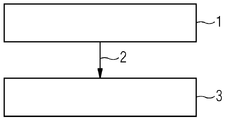
- Figure 1 shows a schematic representation of the device according to the invention.
- a process for the partial electrochemical hydrogenation of alkynes of the chemical formula (I) to alkenes where R and R 'are selected from inorganic and / or organic radicals, wherein the compound of the chemical formula (I) is hydrogenated on a copper-containing electrode, the copper-containing electrode being designed as a gas diffusion electrode.
- Alkynes are all chemical compounds that have a triple bond between 2 carbon atoms. The process is not limited to ethyne, but can be applied to other alkynes.
- a general scheme for the electrochemical conversion of alkynes of the chemical formula I is as follows: instead of the H + ions shown, these can also be D + ions, for example.
- the good selectivity is due to the low reactivity of the resulting alkenes towards electrohydration with Cu electrodes.
- electronically deactivated internal alkenes such as crotyl alcohol (trans-2-butenol) were found to be inert to overreduction.
- the copper-containing electrode which is formed as a gas diffusion electrode, is not particularly limited and can include copper among other components, e.g. include other metals and / or ceramics as a substrate, but also consist of copper. It can also be chemically treated, for example to form oxide. It is designed as a gas diffusion electrode. Due to the better substrate availability for alkynes, the gas diffusion electrode is particularly suitable, especially for gaseous alkynes such as ethyne, propyne, 1-butyne or 2-butyne. In contrast to palladium electrodes, the present copper-containing electrodes are much cheaper.
- a copper-containing electrode can be obtained by depositing a layer comprising a Cu + / Cu-containing catalyst on a non-copper substrate, as in FIG DE 10 2015 203 245 or by depositing the layer on a copper substrate.
- the Cu + / Cu-containing catalyst is hereinafter also referred to as a copper / copper ion catalyst, copper catalyst or the like or simply as a catalyst, unless the text indicates otherwise, so that these terms are synonymous in the context of the present invention understand are.
- the non-copper substrate is also simply referred to as the substrate, unless the text indicates otherwise.
- the non-copper substrate contains copper as long as it does not essentially consist of copper.
- the substrate can also consist of brass or comprise brass.
- the non-copper substrate comprises less than 60% by weight of copper, based on the total weight of the substrate, preferably less than 50% by weight, more preferably less than 40% by weight and particularly preferably less than 20% by weight of copper, for example no copper.
- the substrate comprises at least one metal such as silver, gold, platinum, nickel, lead, titanium, nickel, iron, manganese, or chromium or their alloys such as stainless steels, and / or at least one non-metal such as carbon, Si, boron nitride (BN ), Boron-doped diamond, etc., and / or at least one conductive oxide such as indium tin oxide (ITO), aluminum zinc oxide (AZO) or fluorinated tin oxide (FTO), for example for the production of photoelectrodes, and / or at least one polymer based on polyacetylene, Polyethoxythiophene, polyaniline or polypyrrole for the production of polymer-based electrodes.
- the substrate comprises at least one metal such as silver, gold, platinum, nickel, lead, titanium, nickel, iron, manganese, or chromium or their alloys such as stainless steels, and / or at least one non-metal such as carbon, Si, boron nit
- the production of the Cu + / Cu-containing catalyst can take place in various ways and is not particularly restricted, the various production methods of the Cu + / Cu-containing catalyst also being able to take place on copper substrates.
- electro-reduction catalysts can be obtained if the catalyst is deposited in situ on the electrode substrate.
- An ex-situ deposition is not excluded according to the invention.
- the substrate does not necessarily have to comprise copper or be copper, but can contain any conductive material, in particular also conductive oxides.
- the porous configurations of such an electrode are particularly preferred in order to obtain gas diffusion electrodes.
- Charge compensation in the Cu + / Cu-containing catalyst can be carried out by incorporating anions in solution during production, for example hydroxide ions (OH - ), O 2 - , halide ions (halogen - ), for example fluoride, chloride, Bromide, iodide, sulfate, hydrogen carbonate, carbonate or phosphates etc.
- anions in solution during production for example hydroxide ions (OH - ), O 2 - , halide ions (halogen - ), for example fluoride, chloride, Bromide, iodide, sulfate, hydrogen carbonate, carbonate or phosphates etc.
- the layer comprising copper can also be deposited on the surface of the electrode from a solution comprising copper ions.
- dendritic structures can be applied from solution, in which case it is not necessary to achieve a complete coating of the substrate, i.e. parts of the substrate can also still be visible.
- the coating of the substrate, as well as the structures of the catalyst, can be analyzed, for example, by means of scanning electron microscopy (SEM) or transmission electron microscopy (TEM).
- the substrate is not necessarily completely covered by the coating.
- the area covered by the coating can be, for example, 10 to 99.9%, based on the area of the substrate, preferably 50 to 95%, more preferably 70 to 90%.
- the substrate is only covered in such a way that the catalyst grows dendritically.
- the Cu + / Cu-containing catalyst can have pores in a size from 10 nm to 100 ⁇ m, preferably from 50 nm to 50 ⁇ m, more preferably from 100 nm to 10 ⁇ m.
- the Cu + / Cu-containing catalyst can also have dendritic structures with a fine structure, for example the distance between two dendrites, with a size of 1 to 100 nm, preferably 2 to 20 nm, more preferably 3 to 10 nm porous.
- the Cu + / Cu-containing catalyst can be at least 40% by weight crystalline, based on the catalyst, more preferably at least 70% by weight, particularly preferably at least 80% by weight, it being possible for the Cu + / Cu-containing catalyst and / or the coating to be crystalline.
- the substrate can be porous in order to be able to produce gas diffusion electrodes.
- the substrate can have pores in a size from 10 nm to 100 ⁇ m, preferably from 50 nm to 50 ⁇ m, more preferably from 100 nm to 10 ⁇ m.
- the porous design of the non-copper substrate or a copper substrate, such as a gas diffusion electrode ensures good transport of a gaseous alkyne to the Cu + / Cu-containing catalyst and further improves the efficiency of the electrolysis.
- a suitable pore size can be used to ensure targeted feeding to specific sections of the catalyst.
- the concentration of Cu + in the porous copper catalyst layer / the coating comprising the Cu + / Cu-containing catalyst is, for example, greater than 1 mol%, preferably greater than 5 mol%, more preferably more than 10 mol%, particularly preferably greater than 20 mol %, and for example up to 99.9 mol%, based on the coating.
- the substrate can be porous.
- the substrate can have pores in a size from 10 nm to 100 ⁇ m, preferably from 50 nm to 50 ⁇ m, more preferably from 100 nm to 10 ⁇ m. This is the case, for example, for preferred embodiments.
- the substrate in the copper-containing electrode includes, for example, at least one metal such as silver, platinum, nickel, lead, titanium, nickel, iron, manganese or chromium or their alloys such as stainless steels, and / or at least one non-metal such as carbon, Si, boron nitride ( BN), boron-doped diamond, etc., and / or at least one conductive oxide such as indium tin oxide (ITO), aluminum zinc oxide (AZO) or fluorinated tin oxide (FTO) - for example for the production of photoelectrodes, and / or at least one polymer based on polyacetylene, polyethoxythiophene, polyaniline or polypyrrole, such as in polymer-based electrodes. Copper alloys or mixtures of the materials mentioned with copper as well as substrates made of copper or copper oxide are also possible.
- metal such as silver, platinum, nickel, lead, titanium, nickel, iron, manganese or chromium or their alloys such
- the coating is at least partially crystalline.
- the Cu + / Cu-containing catalyst is at least 40% by weight crystalline, based on the catalyst, more preferably at least 70% by weight, particularly preferably at least 80% by weight.
- the Cu + / Cu-containing catalyst and / or the coating is crystalline.
- the coating of the copper-containing electrode is micro- to nanoporous and / or has a particularly high surface area of, for example, more than 500 m 2 / g, preferably equal to or more than 800 m 2 / g, more preferably equal to or more than 1000 m 2 / g.
- the coating is thus porous.
- the Cu + / Cu-containing catalyst can have pores in a size from 10 nm to 100 ⁇ m, preferably from 50 nm to 50 ⁇ m, more preferably from 100 nm to 10 ⁇ m.
- the Cu + / Cu-containing catalyst can also have dendritic structures with a fine structure, for example the distance between two dendrites, with a size of 1 to 100 nm, preferably 2 to 20 nm, more preferably 3 to 10 nm.
- the concentration of Cu + in the porous copper catalyst layer is, for example, greater than 1 mol%, preferably greater than 5 mol%, more preferably more than 10 mol%, particularly preferably greater than 20 mol%, and up to 99.9 mol%, based on on the coating.
- the coverage of the coating as an area in the copper-containing electrode can be, for example, 10 to 99.9%, based on on the area of the substrate, preferably 50 to 95%, more preferably 70 to 90%.
- the substrate is covered in such a way that the catalyst grows dendritically.
- the copper-containing electrode is designed as a gas diffusion electrode (GDE)
- GDE gas diffusion electrode
- a gas diffusion electrode as a copper-containing electrode comprises, for example, a, preferably copper-containing, carrier, preferably in the form of a flat structure, and a first layer comprising at least copper and at least one binder, the (first) layer comprising hydrophilic and hydrophobic pores and / or channels, further comprising a second layer comprising copper and at least one binder, the second layer being on the carrier and the first layer being on the second layer, the content of binder in the first layer being smaller than in the second layer.
- hydrophobic is understood to be water-repellent. Hydrophobic pores and / or channels are therefore those which repel water.
- hydrophobic properties are associated with substances or molecules with non-polar groups.
- hydrophilic is understood to mean the ability to interact with water and other polar substances.
- the second layer can comprise hydrophilic and / or hydrophobic pores and / or channels.
- a gas diffusion electrode comprising a carrier, preferably containing copper, preferably in the form of a sheet-like structure, and a first layer comprising at least copper and at least one binder, the layer comprising hydrophilic and hydrophobic pores and / or channels.
- the hydrophilic and hydrophobic areas of the GDE can achieve a good three-phase relationship liquid, solid, gaseous.
- Particularly active catalyst centers in the three-phase region are liquid, solid, gaseous.
- An ideal GDE thus has a maximum penetration of the bulk material with hydrophilic and hydrophobic channels in order to obtain as many three-phase regions as possible for active catalyst centers.
- the first layer comprises hydrophilic and hydrophobic pores and / or channels. By suitably setting the first layer, it can be achieved that as many active catalyst centers as possible are present in the gas diffusion electrode.
- the carrier is not particularly limited insofar as it is suitable for a gas diffusion electrode and preferably contains copper.
- parallel wires can also form a carrier in extreme cases.
- the carrier is a flat structure, more preferably a mesh, very preferably a copper mesh. This makes it possible to ensure both sufficient mechanical stability and functionality as a gas diffusion electrode, for example with regard to high electrical conductivity.
- the use of copper in the carrier can provide suitable conductivity and reduce the risk of the introduction of undesired foreign metals. According to preferred embodiments, the carrier is therefore made of copper.
- a preferred copper-containing carrier is a copper mesh with a mesh size w of 0.3 mm ⁇ w ⁇ 2.0 mm, preferably 0.5 mm ⁇ w ⁇ 1.4 mm and one Wire diameter x of 0.05 mm ⁇ x ⁇ 0.5 mm, preferably 0.1 mm x 0.25 mm.
- the first layer comprises copper
- a high electrical conductivity of the catalyst and, in particular in connection with a copper mesh a homogeneous potential distribution over the entire electrode surface (potential-dependent product selectivity) can be ensured.
- the binder comprises a polymer, for example a hydrophilic and / or hydrophobic polymer, for example a hydrophobic polymer, in particular PTFE.
- a suitable setting of the hydrophobic pores or channels can hereby be achieved.
- PTFE particles with a particle diameter between 5 and 95 ⁇ m, preferably between 8 and 70 ⁇ m, are used to produce the first layer.
- Suitable PTFE powders include, for example, Dyneon® TF 9205 and Dyneon TF 1750.
- Suitable binder particles, for example PTFE particles can for example be approximately spherical, for example spherical, and can for example be produced by emulsion polymerization.
- the binder particles are free of surfactants.
- the particle size can for example be determined according to ISO 13321 or D4894-98a and can for example correspond to the manufacturer's instructions (e.g. TF 9205: mean particle size 8 ⁇ m according to ISO 13321; TF 1750: mean particle size 25 ⁇ m according to ASTM D4894-98a).
- the first layer comprises at least copper, which can be in the form of metallic copper and / or copper oxide, for example, and which functions as a catalyst center.
- the first layer here preferably contains metallic copper in the 0 oxidation state.
- the first layer can also contain, for example, copper oxide, in particular Cu 2 O.
- the oxide can contribute to to stabilize the oxidation states +1 of the copper and thus to maintain the selectivity for ethylene with long-term stability. Under electrolysis conditions it can be reduced to copper.
- the first layer comprises at least 40 at.% (Atomic percent), preferably at least 50 at.%, More preferably at least 60 at.% Copper, based on the layer.
- the first layer can also contain further promoters which, in cooperation with the copper, improve the catalytic activity of the GDE.
- the first layer contains at least one metal oxide, preferably ZrO 2 , Al 2 O 3 , CeO 2 , Ce 2 O 3 , ZnO 2 , MgO; and / or at least one copper-rich intermetallic phase, preferably at least one Cu-rich phase, which is selected from the group of binary systems Cu-Al, Cu-Zr, Cu-Y, Cu-Hf, CuCe, Cu-Mg and the ternary Systems Cu-Y-Al, Cu-Hf-Al, Cu-Zr-Al, Cu-Al-Mg, Cu-Al-Ce with Cu contents> 60 at .-%; and / or copper-containing perovskites and / or defect perovskites and / or perovskite-related compounds, preferably YBa 2 Cu 3 O 7- ⁇ , where 0 1 (corresponding to YBa
- the metal oxide used is preferably water-insoluble so that aqueous electrolytes can be used in an electrolysis using the gas diffusion electrode according to the invention.
- the metal oxides are preferably not inert, but rather should represent hydrophilic reaction centers which can serve to provide protons.
- the promoters in particular the metal oxide, can promote the function and production of electrocatalysts with long-term stability by stabilizing catalytically active Cu nanostructures.
- the structural promoters can reduce the high surface mobility of the Cu nanostructures and thus their tendency to sinter.
- the concept comes from heterogeneous catalysis and is used successfully within high temperature processes.
- Metal oxide-copper catalyst structures which are produced as follows are particularly preferred for such gas diffusion electrodes.
- Similar hydroxide carbonates are formed, but hydrotalcites (Cu 6 Al 2 CO 3 (OH) 16 ⁇ 4 (H 2 O)), which can be obtained in greater yield.
- the corresponding precursors can be added by co-metering a metal salt solution and a basic carbonate solution pH controlled precipitated.
- a special feature of these materials is the presence of particularly fine copper crystallites with a size of 4-10 nm, which are structurally stabilized by the oxide present.
- oxide precursors generated can then also be poured directly into an H 2 / Ar Gas flow are reduced, only the Cu 2 O or CuO is reduced to Cu and the oxide promoter is retained.
- the activation step can also be carried out electrochemically afterwards.
- oxide precursors and activated precursors can also be mixed in some cases.
- 0-10% by weight of copper powder with a similar particle size can also be added.
- the finished calendered gas diffusion electrode is subjected to a subsequent calcination / thermal treatment before the electrochemical activation is carried out.
- Cu-rich intermetallic phases such as Cu 5 Zr, Cu 10 Zr 7 , Cu 51 Zr 14 , which can be produced from the melt.
- Corresponding ingots can subsequently be ground and completely or partially calcined in an O 2 / argon gas stream and converted into the oxide form.
- Cu-rich phases of the binary systems Cu-Al, Cu-Zr, Cu-Y, Cu-Hf, CuCe, Cu-Mg as well as the corresponding ternary systems with Cu contents> 60at%: CuYAl, CuHfAl, CuZrAl, CuAlMg, CuAlCe.
- the proportion of copper is preferably greater than 40 at.%, More preferably greater than 50 at.%, Particularly preferably greater than 60 at.%.
- the intermetallic phases also contain non-metal elements such as oxygen, nitrogen, sulfur, selenium and / or phosphorus, that is to say, for example, oxides, sulfides, selenides, nirides and / or phosphides are contained.
- the intermetallic phases are partially oxidized.
- the following copper-containing perovskite structures and / or defect perovskites and / or perovskite-related compounds can be used for electrocatalysts: YBa 2 Cu 3 O 7- ⁇ , where 0 ⁇ 1, CaCu 3 Ti 4 O 12 , La 1, 85 Sr 0.15 , CuO 3.930 Cl 0.053 , (La, Sr) 2 CuO 4 . Furthermore, it is not ruled out that mixtures of these materials can be used for electrode preparation or as required subsequent calcination or activation steps can be carried out.
- the catalyst particles comprising or consisting of copper, for example copper particles, which are used to produce the GDE, have a uniform particle size between 5 and 80 ⁇ m, preferably 10 to 50 ⁇ m, more preferably between 30 and 50 ⁇ m. Furthermore, the catalyst particles preferably have a high purity without traces of foreign metal. A high level of selectivity and long-term stability can be achieved through suitable structuring, if necessary with the aid of the promoters.
- the promoters for example the metal oxides, can also have a corresponding particle size during production.
- Cu powder aggregates with a particle diameter of 50 to 600 ⁇ m, preferably 100 to 450 ⁇ m, preferably 100-200 ⁇ m, can be added.
- the particle diameter of these additives is, for example, 1 / 3-1 / 10 of the total thickness of the layer.
- the aggregate can also be an inert material such as a metal oxide. In this way, an improved formation of pores or channels can be achieved.
- the first layer comprises less than 5% by weight, more preferably less than 1% by weight and even more preferably no carbon- and / or carbon-black-based or -like, for example conductive, filler, based on the layer.
- the first layer does not contain any surface-active substances.
- the first and / or second layer also contain no sacrificial material, for example a sacrificial material with a release temperature of approximately below 275 ° C, for example below 300 ° C or below 350 ° C, in particular no pore former, which or which is usually at Manufacture of electrodes using a such material can remain at least partially in the electrode.
- the content or proportion of binder for example PTFE, for example 3-30% by weight, preferably 3-20% by weight, more preferably 3-10% by weight, even more preferably 3 to 7% by weight, based on the one (first) layer.
- the GDE described above further comprises a second layer comprising copper and at least one binder, the second layer being on the carrier and the first layer on the second layer, the content of binder in the first layer being smaller than in the second layer .
- the second layer can comprise coarser copper or inert material particles, for example with particle diameters of 50 to 700 ⁇ m, preferably 100-450 ⁇ m, in order to provide a suitable channel or pore structure.
- the second layer here has 3 to 30% by weight of binder, preferably 10 to 30% by weight of binder, more preferably 10 to 20% by weight of binder, preferably> 10% by weight of binder, more preferably> 10% by weight and up to 20% by weight of binder, based on the second layer, and 0-10% by weight of binder for the first layer, for example 0.1-10% by weight of binder, preferably 1-10% by weight of binder, more preferably 1 - 7% by weight, even more preferably 3 - 7% by weight of binder, based on the first layer.
- the binder can be the same as in the first layer, for example PTFE.
- the particles for producing the second layer can correspond to those of the first, but can also be different from them.
- the second layer is a metal particle layer (MPL), which is below the catalyst layer (CL).
- MPL metal particle layer
- CL catalyst layer
- Such a layering can specifically create strongly hydrophobic areas in the MPL and generate a catalyst layer with hydrophilic properties. Due to the strongly hydrophobic character of the MPL, an undesirable Penetration of the electrolyte into the gas transport channels, i.e. flooding thereof, can be prevented.
- the second layer partially penetrates the first layer. This enables a good transition between the layers in terms of diffusion.
- the GDE according to the invention can also have further layers, for example on the first layer and / or on the other side of the carrier.
- a mixture for an MPL based on a highly conductive Cu mixture of dendritic Cu with particle sizes between 5-100 ⁇ m, preferably smaller than 50 ⁇ m and coarser copper or inert material particles with particle sizes of 100-450 ⁇ m can be used , preferably 100-200 ⁇ m, with a PTFE content of 3-30% by weight, preferably 20% by weight, in a layer thickness of, for example, 0.5 mm on a Cu mesh with a mesh size of, for example, 1 mm (thickness, for example, 0.2- 0.6mm, e.g. 0.4 mm) and pulled off using a frame or squeegee.
- Corresponding dendritic copper can also be present in the first layer.
- the catalyst / PTFE mixture (CL) can then be sieved again, for example with a PTFE content of 0.1-10% by weight, and smoothed or peeled off, for example over a 1 mm thick frame, so that a total layer thickness (Hf) of 1 mm can be obtained.
- the MPL can achieve better mechanical stability, a further reduction in the penetration of electrolyte and better conductivity, in particular when nets are used as carriers.
- a step-by-step production of the GDE by sifting and rolling each individual layer can lead to less adhesion between the layers and is therefore less preferred.
- the degree of fibrillation of the binder correlates directly with the applied shear rate, since the binder, for example a polymer, behaves as a shear-thinning (pseudoplastic) fluid when it is rolled out. After extrusion, the layer obtained has an elastic character due to the fibrillation. This structural change is irreversible, so that this effect can no longer be subsequently increased by further rolling, but the layer is damaged by the elastic behavior when further shear forces are applied. Particularly strong fibrillation can disadvantageously lead to the electrode curling up on the layer side, so that excessively high binder contents should be avoided.
- the base layer can be characterized by a very high conductivity, for example 7 mOhm / cm or more, and preferably has a high porosity, for example of 50-70%, and a hydrophobic character.
- the binder content, for example PTFE can for example be selected between 3-30% by weight, for example 10-30% by weight.
- the intermediate copper layer as the second layer can itself be catalytically active as the first layer in the area of the overlap zone with the catalyst layer, and is used in particular to improve the electrical connection of the electrocatalyst over a large area. With the help of this method, the required amount of catalyst can be reduced by a factor of 20-30.
- the method of the two-layer structure also offers the possibility of dispensing with binder materials as the first layer within the catalyst layer, as a result of which better electrical conductivity can be achieved. Very ductile or brittle powder particles can also be processed.
- a subsequent electrochemical activation of the electrode obtained can optionally be carried out, for example by chemical or electrochemical activation, and is not particularly restricted.
- An electrochemical activation procedure can lead to cations of the conductive salt of the electrolyte (eg KHCO 3 , K 2 SO 4 NaHCO 3 , KBr, NaBr) penetrating the hydrophobic GDE channels and thereby creating hydrophilic areas.
- the conductive salt of the electrolyte eg KHCO 3 , K 2 SO 4 NaHCO 3 , KBr, NaBr
- the process according to the invention is suitable for the partial electrochemical hydrogenation of alkynes of the chemical formula (I) to alkenes, where R and R 'are selected from inorganic and / or organic radicals.
- the inorganic and / or organic radicals are not particularly restricted here, and the inorganic radicals can also include organic substructures, for example in adducts or complexes.
- organic radicals comprise 1 to 100 C atoms, for example 1 to 40 C atoms, preferably 1 to 20 C atoms, for example 1 to 10, 1 to 6, 1 to 4, 1 to 2 C atoms or else also only 1 carbon atom. All inorganic radicals are suitable as inorganic radicals. Derivatives of inorganic radicals and / or substituted organic radicals are also suitable.
- inorganic and / or organic radicals are -H, -D, -OH, -OR *, -SH, -SR *, -NH 2 , -NR * R ⁇ , -COOH, -COOR *, -CHO, -COR *, -PH 2 , -PR * R ⁇ , -F, -Cl, -Br, -I, -NO, -NO 2 , as well as substituted or unsubstituted alkyl, alkenyl, alkynyl and aryl groups are conceivable, where R * and R ⁇ are also any organic, for example with 1 to 100 carbon atoms, for example 1 to 40 carbon atoms, preferably 1 to 20 carbon atoms, for example 1 to 10, 1 to 6, 1 to 4, 1 to 2 carbon atoms or even just 1 carbon atoms -Atom, or inorganic side chains, such as -H, -D, -OH, -SH,
- Partial hydrogenation is understood here to mean the hydrogenation of alkyne, that is to say triple bond, to alkene, that is to say double bond. Electrochemically, the reaction takes place using electricity, for example in an electrolysis cell.
- the inorganic and / or organic radicals R and R ' are selected from substituted or unsubstituted alkyl, alkenyl, alkynyl and / or aryl radicals, preferably alkyl and / or aryl radicals, preferably with 1 to 40 carbon atoms, preferably 1 to 20 carbon atoms, for example 1 - 10, 1 to 6, 1 to 4, 1 to 2 carbon atoms or only 1 carbon atom, -H, -D, -OH, -OR *, - SH, -SR *, -NH 2 , -NR * R ⁇ , -COOH, -COOR *, -CHO, -COR *, -PH 2 , -PR * R ⁇ , -F, -Cl, -Br, - I, - NO, and -NO 2 , where R * and R ⁇ represent organic and / or inorganic radicals, which are preferably selected from - H,
- Substituents for the substituted or unsubstituted alkyl, alkenyl, alkynyl and aryl groups or radicals are, for example, -D, -OH, -SH, -NH 2 , -COOH, -CHO, -PH 2 , -F, - Cl, -Br, -I, -NO, -NO 2 are possible.
- Functionalized side chains such as —CH 2 —OH or fluorinated alkyl and / or aryl radicals such as —CF 3 can thus result.
- R and R 'are each -H or -D the special case ethyne results as a compound of the chemical formula (I). If either R or R ', but not both, is -H or -D, the alkyne is referred to as the terminal alkyne. For internal alkynes, neither R nor R 'is -H or -D. In the case of terminal alkenes, the amount of charge used is preferably precisely controlled, since overhydration, albeit with poor efficiency, is possible. According to certain embodiments, because of this necessary control, neither R nor R 'are -H or -D, so internal alkynes are hydrogenated.
- alkynes which do not carry any electron-withdrawing radicals such as, for example, -COOH, -COOR *, -CF 3 (where R * is as defined above), are preferred according to the invention.
- the alkyne of the chemical formula (I) thus has no electron-withdrawing radicals.
- the electron-withdrawing radicals are selected from -COOH, -COOR *, and fluorinated alkyl and / or aryl radicals, preferably perfluorinated alkyl and / or aryl radicals such as -CF 3 .
- alkynes which do not carry any functional groups which in turn can be converted by electro-reduction are alkynes which do not carry any functional groups which in turn can be converted by electro-reduction.
- Simultaneous electroreduction of a reducible side chain or a reducible radical is possible, however.
- alkynes with a reducible side chain or a reducible radical are alkynes which carry functional groups such as -CHO, -COR *, -NO, or -NO 2 or whose side chains contain these radicals.
- the reduction of aldehydes (-CHO), ketones (-COR *) and nitro compounds (-NO 2 ) could be confirmed experimentally.
- Aldehydes (-CHO) and ketones (-COR *) gave alcohols (-CH 2 -OH) or (-CHR * -OH) and nitro compounds (-NO 2 ) amines (-NH 2 ).
- the alkyne of the chemical formula (I) thus has no further reducible functional groups apart from the triple bond.
- gaseous or water-soluble / water-miscible alkynes for example gaseous alkynes, as alkyne of the chemical formula (I).
- Examples of such suitable compounds are ethyne, propyne, 1-butyne or 2-butyne, propargyl alcohol (2-propyn-1-ol) and 2-butyn-1-ol.
- the copper-containing electrode is therefore designed as a gas diffusion electrode, the alkyne of the chemical formula (I) being in gaseous form.
- the hydrogenation is carried out with a proton donor selected from water and alcohols having 1 to 20 carbon atoms, preferably water and alcohols having 1 to 12, for example 1 to 6 or 1 to 4 carbon atoms, particularly preferred Water.
- a proton donor selected from water and alcohols having 1 to 20 carbon atoms, preferably water and alcohols having 1 to 12, for example 1 to 6 or 1 to 4 carbon atoms, particularly preferred Water.
- the water can do this too be partially or completely deuterated, that is to say include HDO or D 2 O, or also tritium, for example in the production of radioactive markers.
- an electrolyte that can be used in the method of the present invention is not particularly limited, an aqueous electrolyte is advantageously used.
- any conductive salts and / or ionic liquids can be used.
- Mixtures of water with inert organic solvents such as e.g. 1,4-Dioxane can be used to improve substrate solubility.
- the present invention relates to the use of a copper-containing electrode for the partial electrochemical hydrogenation of alkynes of the chemical formula (I) to alkenes, where R and R 'are selected from inorganic and / or organic residues, the copper-containing electrode being designed as a gas diffusion electrode.
- the copper-containing electrode corresponds to that which was described in connection with the method according to the invention.
- the electrolysis cell is not particularly restricted here, provided it has the copper-containing electrode, which is designed as a gas diffusion electrode and which can correspond to that in the method according to the invention.
- the method according to the invention can be carried out with the device according to the invention.
- the copper-containing electrode can function as a cathode.
- the other components of the electrolysis cell such as anode, possibly membrane, power source, etc. are not particularly restricted, nor are their arrangement.
- a cathode compartment II can be designed in such a way that a catholyte is supplied from below and then exits the cathode compartment II upwards.
- the catholyte can also be fed in from above, as is the case with falling film electrodes, for example.
- the anode A which is electrically connected to the cathode K by means of a current source to provide the voltage for the electrolysis, the oxidation of a substance takes place in an anode compartment I, which is supplied from below, for example with an anolyte, the anolyte then leaves the anode compartment with the product of the oxidation.
- Anode compartment and cathode compartment can be through a membrane M be separated.
- a reaction gas such as an alkyne of the chemical formula (I) can be conveyed through a gas diffusion electrode as cathode into the cathode space II for reduction.
- a porous anode are also conceivable. Rooms I and II can be separated by a membrane M as described.
- cathode K e.g. a gas diffusion electrode
- an anode A directly on the membrane M, whereby the anode compartment I is separated from the cathode compartment II.
- a structure with a gas diffusion electrode can be provided on the catholyte side, which is not on the membrane, whereas on the anolyte side the anode can be on the membrane.
- a structure with a gas diffusion electrode can be provided on the catholyte side, which is not on the membrane, whereas on the anolyte side the anode can be on the membrane.
- other mixed forms or other configurations of the electrode spaces shown by way of example are also conceivable.
- the cathode-side electrolyte and the anode-side electrolyte can thus be identical, and the electrolysis cell / electrolysis unit can do without a membrane.
- the electrolysis cell has a membrane in such embodiments, but this is associated with additional expenditure with regard to the membrane and the applied voltage.
- the catholyte and anolyte can optionally be mixed again outside of the electrolysis cell.
- the membrane if present, can also have a multilayer design so that separate feeds of anolyte and catholyte are made possible. With aqueous electrolytes, separation effects are achieved, for example, through the hydrophobicity of intermediate layers. Conductivity can still be guaranteed if conductive groups are in such separating layers are integrated.
- the membrane can be an ion-conducting membrane or a separator which only effects mechanical separation and is permeable to cations and anions.
- a gas diffusion electrode By using a gas diffusion electrode, it is possible to build a three-phase electrode.
- a gas can be fed from behind to the electrically active front side of the electrode in order to carry out an electro-chemical reaction there.
- the gas diffusion electrode can only flow behind, i.e. a gas such as the alkyne of the chemical formula (I) is led past the rear of the gas diffusion electrode in relation to the electrolyte, the gas then being able to penetrate through the pores of the gas diffusion electrode and the product being discharged at the rear.
- the gas flow is the reverse of the flow of the electrolyte when flowing behind, so that any liquid that may have been forced through can be transported away.
- a cell variant enables a gas to flow directly through the GDE.
- the resulting products are removed from the electrolysis cell through the catholyte outlet and can be separated from the liquid electrolyte in a subsequent phase separator.
- the second cell variant describes a mode of operation in which the gas flows through an adapted gas pressure in the rear area of the GDE.
- the gas pressure should be chosen so that it is equal to the hydrostatic pressure of the electrolyte in the cell so that no electrolyte is pushed through.
- a foil can be applied to the side of the gas diffusion electrode facing away from the electrolyte in order to prevent the electrolyte from passing over to the gas.
- the film can be provided in a suitable manner and is, for example, hydrophobic.
- the electrolytic cell has a membrane which separates the cathode compartment and the anode compartment of the electrolytic cell in order to prevent the electrolytes from mixing.
- the membrane is not particularly limited here, provided it separates the cathode compartment and the anode compartment. In particular, it essentially prevents the gases generated at the cathode and / or anode from passing to the anode or cathode compartment.
- a preferred membrane is an ion exchange membrane, for example based on polymers. In addition to polymer membranes, ceramic membranes can also be used.
- the material of the anode is not particularly limited and depends primarily on the desired reaction.
- exemplary anode materials include platinum or platinum alloys, palladium or palladium alloys, and vitreous carbon.
- Other anode materials are also conductive oxides such as doped or undoped TiO 2 , indium tin oxide (ITO), fluorine-doped tin oxide (FTO), aluminum-doped zinc oxide (AZO), iridium oxide, etc.
- ITO indium tin oxide
- FTO fluorine-doped tin oxide
- AZO aluminum-doped zinc oxide
- iridium oxide etc.
- the source of the alkyne of the chemical formula (I) and a first feed device (2) for the alkyne of the chemical formula (I) are not particularly limited.
- the alkyne of the chemical formula (I) can originate, for example, from a storage container or other container as well as from a separate reactor, etc. as a source.
- pipes, hoses, etc. can serve as the first feed device.
- the source for the alkyne of the chemical formula (I) and the first feed device (2) for the alkyne of the chemical formula (I) are adapted to the respective alkyne with regard to the materials used, so that they are not affected by the alkyne of the chemical formula ( I) be attacked.
- the first supply device (2) for the alkyne of the chemical formula (I) supplies the alkyne of the chemical formula (I) to the gas diffusion electrode.
- Example 1 Reduction of ethyne:
- the cell was flushed with argon throughout the experiment. After a 10 minute break-in period of fumaric acid was (58.7 mg, 0:51 m mol) and KOH (200 ⁇ l 5M, 1 m mol) was added. The conversion to potassium succinate after an equivalent charge of 4.1 F / mol was complete. The initial current efficiency was over 90%.
- the good selectivity comes from the low reactivity towards electrohydration with Cu electrodes conditions.
- Electronically deactivated internal alkenes such as crotyl alcohol were found to be inert to overreduction.
- Ethyne, propargyl alcohol and 2-butyn-1-ol were evaluated as substrates. None of the 3 substrates can be regarded as activated, which underlines the high activity of the catalytic process. Propargyl alcohol and 2-butyn-1-ol are difficult substrates to consider, since both have electron-donating substituents. 2-Butyn-1-ol is also an internal alkyne that is sterically hindered.
- alkyne hydrogenation described here can, in addition to the high-volume compounds, also be used for the electro-organic synthesis of specialty chemicals such as active ingredients or feed additives.
Landscapes
- Chemical & Material Sciences (AREA)
- Organic Chemistry (AREA)
- Engineering & Computer Science (AREA)
- Chemical Kinetics & Catalysis (AREA)
- Electrochemistry (AREA)
- Materials Engineering (AREA)
- Metallurgy (AREA)
- Catalysts (AREA)
- Electrolytic Production Of Non-Metals, Compounds, Apparatuses Therefor (AREA)
- Organic Low-Molecular-Weight Compounds And Preparation Thereof (AREA)
Claims (9)
- Procédé d'hydrogénation électrochimique partielle d'alcynes de formule chimique (I) en alcène,

dans lequel on hydrogène le composé de la formule chimique (I) à une électrode contenant du cuivre, l'électrode contenant du cuivre étant constituée sous la forme d'une électrode à diffusion de gaz. - Procédé suivant la revendication 1, dans lequel le radical minéral et/ou organique est choisi parmi -H, -D, des radicaux alcoyle, alcényle, alcinyle et/ou aryle, substitués ou non substitués, -OH, -OR*, -SH, -SR*, -NH2, -NR*R‡, -COOH, -COOR*, -CHO, -COR*, -PH2, -PR*R‡, -F, -Cl, -Br, -I, -NO, et -NO2, R* et R‡ représentant des radicaux organiques et/ou minéraux.
- Procédé suivant la revendication 1 ou 2, dans lequel, ni R, ni R' ne sont -H ou -D.
- Procédé suivant l'une des revendications précédentes, dans lequel l'alcyne de formule chimique (I) n'a pas de radicaux attirant les électrons,
dans lequel les radicaux attirant les électrons sont choisis parmi -COOH, -COOR*, et des radicaux alcoyle et/ou aryle fluorés, R* représentant un radical organique et/ou minéral. - Procédé suivant l'une des revendications précédentes, dans lequel on effectue l'hydrogénation par un donneur de protons, choisi parmi l'eau et les alcools ayant de 1 à 20 atomes de carbone.
- Procédé suivant l'une des revendications précédentes, dans lequel l'alcyne de formule chimique (I) se présente sous forme gazeuse.
- Utilisation d'une électrode contenant du cuivre pour l'hydrogénation électrochimique partielle d'alcynes de formule chimique (I) en alcène,

- Installation d'hydrogénation électrochimique partielle d'alcynes de formule chimique (I) en alcènes
 une cellule (1) d'électrolyse, comprenant une électrode contenant du cuivre, qui est constituée pour réduire l'alcyne de formule chimique (I) en alcène ;une source de l'alcyne de formule chimique (I) (3), qui est constituée pour mettre à disposition l'alcyne de formule chimique (I) ; etun premier dispositif (2) d'envoi de l'alcyne de formule chimique (I), qui est constitué pour envoyer l'alcyne de formule chimique (I) de la source d'alcyne de formule chimique (I) à la cellule d'électrolyse, l'électrode contenant du cuivre étant constituée sous la forme d'une électrode à diffusion de gaz.
 - Installation suivant la revendication 8, dans laquelle le premier dispositif (2) d'envoi de l'alcyne de formule chimique (I) envoie l'alcyne de formule chimique (I) à l'électrode à diffusion de gaz.
Applications Claiming Priority (2)
| Application Number | Priority Date | Filing Date | Title |
|---|---|---|---|
| DE102016218230.7A DE102016218230A1 (de) | 2016-09-22 | 2016-09-22 | Selektive elektrochemische Hydrierung von Alkinen zu Alkenen |
| PCT/EP2017/070699 WO2018054612A1 (fr) | 2016-09-22 | 2017-08-16 | Hydrogénation électrochimique sélective d'alkynes en alcènes |
Publications (2)
| Publication Number | Publication Date |
|---|---|
| EP3481973A1 EP3481973A1 (fr) | 2019-05-15 |
| EP3481973B1 true EP3481973B1 (fr) | 2020-10-14 |
Family
ID=59738305
Family Applications (1)
| Application Number | Title | Priority Date | Filing Date |
|---|---|---|---|
| EP17758461.2A Not-in-force EP3481973B1 (fr) | 2016-09-22 | 2017-08-16 | Hydrogénation électrochimique sélective d'alkynes en alcènes |
Country Status (6)
| Country | Link |
|---|---|
| US (1) | US20190276941A1 (fr) |
| EP (1) | EP3481973B1 (fr) |
| CN (1) | CN109790631A (fr) |
| AU (1) | AU2017329370B2 (fr) |
| DE (1) | DE102016218230A1 (fr) |
| WO (1) | WO2018054612A1 (fr) |
Families Citing this family (15)
| Publication number | Priority date | Publication date | Assignee | Title |
|---|---|---|---|---|
| US11824206B2 (en) | 2018-03-26 | 2023-11-21 | Total Se | Composite multilayered electrocatalysts for CO2 reduction and associated methods |
| US11746426B2 (en) | 2019-07-10 | 2023-09-05 | California Institute Of Technology | Stabilization of a co-bound intermediate via molecular tuning promotes CO2-to-ethylene conversion |
| CN110438523B (zh) * | 2019-09-05 | 2021-12-03 | 南京大学 | 一种以重水为氘源的无催化剂电化学氘代方法 |
| CN112342562B (zh) * | 2020-10-24 | 2023-03-07 | 西北工业大学 | 一种电催化乙炔偶联制1,3-丁二烯的方法 |
| CN112301373A (zh) * | 2020-10-24 | 2021-02-02 | 西北工业大学 | 一种电催化选择性还原烯烃中炔烃杂质的方法 |
| CN112301369A (zh) * | 2020-10-24 | 2021-02-02 | 西北工业大学 | 一种电催化半氢化气相炔烃合成烯烃的方法 |
| CN113388853B (zh) * | 2021-05-27 | 2022-05-17 | 杭州师范大学 | 一种对碳碳叁键高选择性加氢的电化学催化方法 |
| DE102021119761A1 (de) | 2021-07-29 | 2023-02-02 | Fraunhofer-Gesellschaft zur Förderung der angewandten Forschung eingetragener Verein | Verfahren zur selektiven katalytischen Hydrierung organischer Verbindungen sowie Elektrode und elektrochemische Zelle für dieses Verfahren |
| CN114411179B (zh) * | 2021-12-31 | 2024-09-06 | 西北工业大学 | 一种电催化1,4-丁炔二醇加氢制备1,4-丁二醇的方法 |
| CN114411177A (zh) * | 2021-12-31 | 2022-04-29 | 西北工业大学 | 一种用于合成氘代烯烃的电催化方法 |
| CN114196984B (zh) * | 2022-01-20 | 2023-12-08 | 辽宁大学 | 一种碳纸上恒电流电沉积铜基催化剂及其制备方法和在电催化4-乙炔基苯胺中的应用 |
| CN114606518B (zh) * | 2022-03-11 | 2023-09-22 | 湖南大学 | 一种电化学乙炔选择性加氢生成乙烯的方法 |
| CN115710720B (zh) * | 2022-10-08 | 2025-08-19 | 西北工业大学 | 一种无金属杂环分子催化剂实现高效电催化加氢的方法 |
| DE102022133773A1 (de) | 2022-12-16 | 2024-06-27 | Fraunhofer-Gesellschaft zur Förderung der angewandten Forschung eingetragener Verein | Verfahren zur elektrokatalytischen Hydrierung von Alkinen und elektrochemische Zelle für dieses Verfahren |
| CN116426955B (zh) * | 2023-03-07 | 2025-10-31 | 西北工业大学 | 一种钯团簇修饰的泡沫铜电极催化还原苯乙炔制备苯乙烯的方法 |
Family Cites Families (10)
| Publication number | Priority date | Publication date | Assignee | Title |
|---|---|---|---|---|
| JPS62164887A (ja) * | 1986-01-17 | 1987-07-21 | Idemitsu Kosan Co Ltd | 反応方法 |
| JPH04280989A (ja) * | 1991-03-11 | 1992-10-06 | Mitsubishi Petrochem Co Ltd | 隔膜法による水素化生成物の合成方法 |
| US5453169A (en) | 1991-08-21 | 1995-09-26 | The Ohio State University | Glassy carbon containing metal particles and its use on an electrode in an electrochemical cell where the particles are less than 10 nm |
| DE19911746A1 (de) | 1999-03-16 | 2000-09-21 | Basf Ag | Diamantelektroden |
| DE19944990A1 (de) | 1999-09-20 | 2001-03-22 | Basf Ag | Verfahren zur elektrolytischen Umwandlung von organischen Verbindungen |
| US20040260131A1 (en) * | 2003-06-23 | 2004-12-23 | Chevron Phillips Chemical Company ("Cpchem") | Selective hydrocarbon hydrogenation catalyst and process |
| CN102408293B (zh) * | 2010-09-21 | 2014-07-09 | 中国石油化工股份有限公司 | 二烯烃和炔烃选择加氢的方法 |
| CN102358943B (zh) * | 2011-08-09 | 2013-07-31 | 太原理工大学 | 一种乙炔双极电化学合成乙烯和草酸的方法 |
| CN105420751A (zh) * | 2014-09-23 | 2016-03-23 | 中国科学院大连化学物理研究所 | 一种电化学还原二氧化碳制备碳氢化合物的方法 |
| DE102015203245A1 (de) | 2015-02-24 | 2016-08-25 | Siemens Aktiengesellschaft | Abscheidung eines kupferhaltigen, Kohlenwasserstoffe entwickelnden Elektrokatalysators auf Nicht-Kupfer-Substraten |
-
2016
- 2016-09-22 DE DE102016218230.7A patent/DE102016218230A1/de not_active Withdrawn
-
2017
- 2017-08-16 CN CN201780057594.1A patent/CN109790631A/zh active Pending
- 2017-08-16 WO PCT/EP2017/070699 patent/WO2018054612A1/fr not_active Ceased
- 2017-08-16 EP EP17758461.2A patent/EP3481973B1/fr not_active Not-in-force
- 2017-08-16 AU AU2017329370A patent/AU2017329370B2/en not_active Ceased
- 2017-08-16 US US16/334,132 patent/US20190276941A1/en not_active Abandoned
Non-Patent Citations (1)
| Title |
|---|
| None * |
Also Published As
| Publication number | Publication date |
|---|---|
| CN109790631A (zh) | 2019-05-21 |
| DE102016218230A1 (de) | 2018-03-22 |
| AU2017329370B2 (en) | 2019-10-31 |
| EP3481973A1 (fr) | 2019-05-15 |
| WO2018054612A1 (fr) | 2018-03-29 |
| AU2017329370A1 (en) | 2019-03-21 |
| US20190276941A1 (en) | 2019-09-12 |
Similar Documents
| Publication | Publication Date | Title |
|---|---|---|
| EP3481973B1 (fr) | Hydrogénation électrochimique sélective d'alkynes en alcènes | |
| EP3307924B1 (fr) | Technique de préparation d'électrodes de diffusion de gaz sélectives d'hydrocarbure à base de catalyseurs contenant du cu | |
| EP3568507B1 (fr) | Fabrication d'électrocatalyseurs dendritiques pour la réduction de co2 et/ou co | |
| EP3583245B1 (fr) | Fabrication d'électrodes à diffusion gazeuse munies de résines de transport d'ions pour la réduction électrochimique de co2 en matières chimiques | |
| DE102015203245A1 (de) | Abscheidung eines kupferhaltigen, Kohlenwasserstoffe entwickelnden Elektrokatalysators auf Nicht-Kupfer-Substraten | |
| DE102018212409A1 (de) | Kohlenwasserstoff-selektive Elektrode | |
| EP2573211B1 (fr) | Procédé de fabrication des électrodes de diffusion gazeuse | |
| WO2010078952A2 (fr) | Électrode de diffusion de gaz structurée pour cellules électrolytiques | |
| DE2905366A1 (de) | Verfahren zum elektrolysieren eines waessrigen elektrolyten | |
| WO2018162156A1 (fr) | Électodes comprenant un métal incorporé dans des électrolytes solides | |
| EP4377497A2 (fr) | Procédé d'hydrogénation catalytique sélective de composés organiques, électrode et cellule électrochimique pour la mise en oeuvre de ce procédé | |
| EP3788184A1 (fr) | Électrode de diffusion gazeuse destinée au recyclage de dioxyde de carbone, son procédé de fabrication et cellule électrolytique dotée d'une électrode de diffusion gazeuse | |
| WO2024126802A1 (fr) | Procédé d'hydrogénation électrocatalytique d'alcynes et cellule électrochimique pour la mise en œuvre de ce procédé | |
| EP3117026A1 (fr) | Procédé de production de poudres catalytiquement actives constituées d'argent métal ou de mélanges d'argent métal et d'oxyde d'argent destinées à fabriquer des électrodes à diffusion de gaz | |
| DE102020205393A1 (de) | Bimetallische und multimetallische Katalysatoren zur selektiven Elektroreduzierung von CO2 und/oder CO zu Kohlenwasserstoffen und Oxygenaten | |
| DE102023115632A1 (de) | Elektroden für eine elektrochemische Zelle zur alkalischen Aufspaltung von Wasser in Wasserstoff und Sauerstoff sowie Verfahren zu deren Herstellung | |
| EP2439314A2 (fr) | Procédé de fabrication d'électrodes d'alimentation en oxygène stables en transport et en stockage | |
| EP2824218A1 (fr) | Procédé de fabrication d'électrodes d'alimentation en oxygène stables en transport et en stockage | |
| DE102023206151A1 (de) | Verfahren zum Ausbilden eines Katalysators zur Elektrokatalyse, Katalysator und Vorrichtung zur Elektrokatalyse | |
| DE102024111048A1 (de) | Verfahren zur elektrokatalytischen Reduktion oder Oxidation organischer Substrate in einer elektrochemischen Zelle und elektrochemische Zelle für dieses Verfahren | |
| WO2024126377A1 (fr) | Procédé d'électrolyse de dioxyde de carbone avec pré-réduction d'une électrode de diffusion gazeuse contenant de l'oxyde d'argent | |
| DE10301521A1 (de) | Verfahren zur Herstellung einer Gasdiffusionselektrode |
Legal Events
| Date | Code | Title | Description |
|---|---|---|---|
| STAA | Information on the status of an ep patent application or granted ep patent |
Free format text: STATUS: UNKNOWN |
|
| STAA | Information on the status of an ep patent application or granted ep patent |
Free format text: STATUS: THE INTERNATIONAL PUBLICATION HAS BEEN MADE |
|
| PUAI | Public reference made under article 153(3) epc to a published international application that has entered the european phase |
Free format text: ORIGINAL CODE: 0009012 |
|
| STAA | Information on the status of an ep patent application or granted ep patent |
Free format text: STATUS: REQUEST FOR EXAMINATION WAS MADE |
|
| 17P | Request for examination filed |
Effective date: 20190208 |
|
| AK | Designated contracting states |
Kind code of ref document: A1 Designated state(s): AL AT BE BG CH CY CZ DE DK EE ES FI FR GB GR HR HU IE IS IT LI LT LU LV MC MK MT NL NO PL PT RO RS SE SI SK SM TR |
|
| AX | Request for extension of the european patent |
Extension state: BA ME |
|
| DAV | Request for validation of the european patent (deleted) | ||
| DAX | Request for extension of the european patent (deleted) | ||
| GRAP | Despatch of communication of intention to grant a patent |
Free format text: ORIGINAL CODE: EPIDOSNIGR1 |
|
| STAA | Information on the status of an ep patent application or granted ep patent |
Free format text: STATUS: GRANT OF PATENT IS INTENDED |
|
| INTG | Intention to grant announced |
Effective date: 20200619 |
|
| RIN1 | Information on inventor provided before grant (corrected) |
Inventor name: RELLER, CHRISTIAN Inventor name: SCHMID, GUENTER Inventor name: SCHMID, BERNHARD |
|
| GRAS | Grant fee paid |
Free format text: ORIGINAL CODE: EPIDOSNIGR3 |
|
| GRAA | (expected) grant |
Free format text: ORIGINAL CODE: 0009210 |
|
| STAA | Information on the status of an ep patent application or granted ep patent |
Free format text: STATUS: THE PATENT HAS BEEN GRANTED |
|
| AK | Designated contracting states |
Kind code of ref document: B1 Designated state(s): AL AT BE BG CH CY CZ DE DK EE ES FI FR GB GR HR HU IE IS IT LI LT LU LV MC MK MT NL NO PL PT RO RS SE SI SK SM TR |
|
| REG | Reference to a national code |
Ref country code: GB Ref legal event code: FG4D Free format text: NOT ENGLISH |
|
| REG | Reference to a national code |
Ref country code: AT Ref legal event code: REF Ref document number: 1323646 Country of ref document: AT Kind code of ref document: T Effective date: 20201015 Ref country code: CH Ref legal event code: EP |
|
| REG | Reference to a national code |
Ref country code: DE Ref legal event code: R096 Ref document number: 502017007773 Country of ref document: DE |
|
| REG | Reference to a national code |
Ref country code: IE Ref legal event code: FG4D Free format text: LANGUAGE OF EP DOCUMENT: GERMAN |
|
| REG | Reference to a national code |
Ref country code: DE Ref legal event code: R079 Ref document number: 502017007773 Country of ref document: DE Free format text: PREVIOUS MAIN CLASS: C25B0003040000 Ipc: C25B0003250000 |
|
| REG | Reference to a national code |
Ref country code: NL Ref legal event code: MP Effective date: 20201014 |
|
| PG25 | Lapsed in a contracting state [announced via postgrant information from national office to epo] |
Ref country code: GR Free format text: LAPSE BECAUSE OF FAILURE TO SUBMIT A TRANSLATION OF THE DESCRIPTION OR TO PAY THE FEE WITHIN THE PRESCRIBED TIME-LIMIT Effective date: 20210115 Ref country code: FI Free format text: LAPSE BECAUSE OF FAILURE TO SUBMIT A TRANSLATION OF THE DESCRIPTION OR TO PAY THE FEE WITHIN THE PRESCRIBED TIME-LIMIT Effective date: 20201014 Ref country code: RS Free format text: LAPSE BECAUSE OF FAILURE TO SUBMIT A TRANSLATION OF THE DESCRIPTION OR TO PAY THE FEE WITHIN THE PRESCRIBED TIME-LIMIT Effective date: 20201014 Ref country code: PT Free format text: LAPSE BECAUSE OF FAILURE TO SUBMIT A TRANSLATION OF THE DESCRIPTION OR TO PAY THE FEE WITHIN THE PRESCRIBED TIME-LIMIT Effective date: 20210215 Ref country code: NO Free format text: LAPSE BECAUSE OF FAILURE TO SUBMIT A TRANSLATION OF THE DESCRIPTION OR TO PAY THE FEE WITHIN THE PRESCRIBED TIME-LIMIT Effective date: 20210114 |
|
| REG | Reference to a national code |
Ref country code: LT Ref legal event code: MG4D |
|
| PG25 | Lapsed in a contracting state [announced via postgrant information from national office to epo] |
Ref country code: ES Free format text: LAPSE BECAUSE OF FAILURE TO SUBMIT A TRANSLATION OF THE DESCRIPTION OR TO PAY THE FEE WITHIN THE PRESCRIBED TIME-LIMIT Effective date: 20201014 Ref country code: BG Free format text: LAPSE BECAUSE OF FAILURE TO SUBMIT A TRANSLATION OF THE DESCRIPTION OR TO PAY THE FEE WITHIN THE PRESCRIBED TIME-LIMIT Effective date: 20210114 Ref country code: SE Free format text: LAPSE BECAUSE OF FAILURE TO SUBMIT A TRANSLATION OF THE DESCRIPTION OR TO PAY THE FEE WITHIN THE PRESCRIBED TIME-LIMIT Effective date: 20201014 Ref country code: PL Free format text: LAPSE BECAUSE OF FAILURE TO SUBMIT A TRANSLATION OF THE DESCRIPTION OR TO PAY THE FEE WITHIN THE PRESCRIBED TIME-LIMIT Effective date: 20201014 Ref country code: IS Free format text: LAPSE BECAUSE OF FAILURE TO SUBMIT A TRANSLATION OF THE DESCRIPTION OR TO PAY THE FEE WITHIN THE PRESCRIBED TIME-LIMIT Effective date: 20210214 Ref country code: LV Free format text: LAPSE BECAUSE OF FAILURE TO SUBMIT A TRANSLATION OF THE DESCRIPTION OR TO PAY THE FEE WITHIN THE PRESCRIBED TIME-LIMIT Effective date: 20201014 |
|
| PG25 | Lapsed in a contracting state [announced via postgrant information from national office to epo] |
Ref country code: HR Free format text: LAPSE BECAUSE OF FAILURE TO SUBMIT A TRANSLATION OF THE DESCRIPTION OR TO PAY THE FEE WITHIN THE PRESCRIBED TIME-LIMIT Effective date: 20201014 Ref country code: NL Free format text: LAPSE BECAUSE OF FAILURE TO SUBMIT A TRANSLATION OF THE DESCRIPTION OR TO PAY THE FEE WITHIN THE PRESCRIBED TIME-LIMIT Effective date: 20201014 |
|
| REG | Reference to a national code |
Ref country code: DE Ref legal event code: R097 Ref document number: 502017007773 Country of ref document: DE |
|
| PG25 | Lapsed in a contracting state [announced via postgrant information from national office to epo] |
Ref country code: SM Free format text: LAPSE BECAUSE OF FAILURE TO SUBMIT A TRANSLATION OF THE DESCRIPTION OR TO PAY THE FEE WITHIN THE PRESCRIBED TIME-LIMIT Effective date: 20201014 Ref country code: LT Free format text: LAPSE BECAUSE OF FAILURE TO SUBMIT A TRANSLATION OF THE DESCRIPTION OR TO PAY THE FEE WITHIN THE PRESCRIBED TIME-LIMIT Effective date: 20201014 Ref country code: CZ Free format text: LAPSE BECAUSE OF FAILURE TO SUBMIT A TRANSLATION OF THE DESCRIPTION OR TO PAY THE FEE WITHIN THE PRESCRIBED TIME-LIMIT Effective date: 20201014 Ref country code: EE Free format text: LAPSE BECAUSE OF FAILURE TO SUBMIT A TRANSLATION OF THE DESCRIPTION OR TO PAY THE FEE WITHIN THE PRESCRIBED TIME-LIMIT Effective date: 20201014 Ref country code: RO Free format text: LAPSE BECAUSE OF FAILURE TO SUBMIT A TRANSLATION OF THE DESCRIPTION OR TO PAY THE FEE WITHIN THE PRESCRIBED TIME-LIMIT Effective date: 20201014 Ref country code: SK Free format text: LAPSE BECAUSE OF FAILURE TO SUBMIT A TRANSLATION OF THE DESCRIPTION OR TO PAY THE FEE WITHIN THE PRESCRIBED TIME-LIMIT Effective date: 20201014 |
|
| PLBE | No opposition filed within time limit |
Free format text: ORIGINAL CODE: 0009261 |
|
| STAA | Information on the status of an ep patent application or granted ep patent |
Free format text: STATUS: NO OPPOSITION FILED WITHIN TIME LIMIT |
|
| PG25 | Lapsed in a contracting state [announced via postgrant information from national office to epo] |
Ref country code: DK Free format text: LAPSE BECAUSE OF FAILURE TO SUBMIT A TRANSLATION OF THE DESCRIPTION OR TO PAY THE FEE WITHIN THE PRESCRIBED TIME-LIMIT Effective date: 20201014 |
|
| 26N | No opposition filed |
Effective date: 20210715 |
|
| PG25 | Lapsed in a contracting state [announced via postgrant information from national office to epo] |
Ref country code: AL Free format text: LAPSE BECAUSE OF FAILURE TO SUBMIT A TRANSLATION OF THE DESCRIPTION OR TO PAY THE FEE WITHIN THE PRESCRIBED TIME-LIMIT Effective date: 20201014 Ref country code: IT Free format text: LAPSE BECAUSE OF FAILURE TO SUBMIT A TRANSLATION OF THE DESCRIPTION OR TO PAY THE FEE WITHIN THE PRESCRIBED TIME-LIMIT Effective date: 20201014 |
|
| PG25 | Lapsed in a contracting state [announced via postgrant information from national office to epo] |
Ref country code: SI Free format text: LAPSE BECAUSE OF FAILURE TO SUBMIT A TRANSLATION OF THE DESCRIPTION OR TO PAY THE FEE WITHIN THE PRESCRIBED TIME-LIMIT Effective date: 20201014 |
|
| REG | Reference to a national code |
Ref country code: DE Ref legal event code: R119 Ref document number: 502017007773 Country of ref document: DE |
|
| REG | Reference to a national code |
Ref country code: CH Ref legal event code: PL |
|
| PG25 | Lapsed in a contracting state [announced via postgrant information from national office to epo] |
Ref country code: MC Free format text: LAPSE BECAUSE OF FAILURE TO SUBMIT A TRANSLATION OF THE DESCRIPTION OR TO PAY THE FEE WITHIN THE PRESCRIBED TIME-LIMIT Effective date: 20201014 |
|
| REG | Reference to a national code |
Ref country code: BE Ref legal event code: MM Effective date: 20210831 |
|
| GBPC | Gb: european patent ceased through non-payment of renewal fee |
Effective date: 20210816 |
|
| PG25 | Lapsed in a contracting state [announced via postgrant information from national office to epo] |
Ref country code: LI Free format text: LAPSE BECAUSE OF NON-PAYMENT OF DUE FEES Effective date: 20210831 Ref country code: CH Free format text: LAPSE BECAUSE OF NON-PAYMENT OF DUE FEES Effective date: 20210831 |
|
| PG25 | Lapsed in a contracting state [announced via postgrant information from national office to epo] |
Ref country code: IS Free format text: LAPSE BECAUSE OF FAILURE TO SUBMIT A TRANSLATION OF THE DESCRIPTION OR TO PAY THE FEE WITHIN THE PRESCRIBED TIME-LIMIT Effective date: 20210214 Ref country code: LU Free format text: LAPSE BECAUSE OF NON-PAYMENT OF DUE FEES Effective date: 20210816 |
|
| PG25 | Lapsed in a contracting state [announced via postgrant information from national office to epo] |
Ref country code: IE Free format text: LAPSE BECAUSE OF NON-PAYMENT OF DUE FEES Effective date: 20210816 Ref country code: GB Free format text: LAPSE BECAUSE OF NON-PAYMENT OF DUE FEES Effective date: 20210816 Ref country code: FR Free format text: LAPSE BECAUSE OF NON-PAYMENT OF DUE FEES Effective date: 20210831 Ref country code: DE Free format text: LAPSE BECAUSE OF NON-PAYMENT OF DUE FEES Effective date: 20220301 Ref country code: BE Free format text: LAPSE BECAUSE OF NON-PAYMENT OF DUE FEES Effective date: 20210831 |
|
| PG25 | Lapsed in a contracting state [announced via postgrant information from national office to epo] |
Ref country code: CY Free format text: LAPSE BECAUSE OF FAILURE TO SUBMIT A TRANSLATION OF THE DESCRIPTION OR TO PAY THE FEE WITHIN THE PRESCRIBED TIME-LIMIT Effective date: 20201014 |
|
| PG25 | Lapsed in a contracting state [announced via postgrant information from national office to epo] |
Ref country code: HU Free format text: LAPSE BECAUSE OF FAILURE TO SUBMIT A TRANSLATION OF THE DESCRIPTION OR TO PAY THE FEE WITHIN THE PRESCRIBED TIME-LIMIT; INVALID AB INITIO Effective date: 20170816 |
|
| REG | Reference to a national code |
Ref country code: AT Ref legal event code: MM01 Ref document number: 1323646 Country of ref document: AT Kind code of ref document: T Effective date: 20220816 |
|
| PG25 | Lapsed in a contracting state [announced via postgrant information from national office to epo] |
Ref country code: AT Free format text: LAPSE BECAUSE OF NON-PAYMENT OF DUE FEES Effective date: 20220816 |
|
| PG25 | Lapsed in a contracting state [announced via postgrant information from national office to epo] |
Ref country code: MK Free format text: LAPSE BECAUSE OF FAILURE TO SUBMIT A TRANSLATION OF THE DESCRIPTION OR TO PAY THE FEE WITHIN THE PRESCRIBED TIME-LIMIT Effective date: 20201014 |
|
| PG25 | Lapsed in a contracting state [announced via postgrant information from national office to epo] |
Ref country code: TR Free format text: LAPSE BECAUSE OF FAILURE TO SUBMIT A TRANSLATION OF THE DESCRIPTION OR TO PAY THE FEE WITHIN THE PRESCRIBED TIME-LIMIT Effective date: 20201014 |
|
| PG25 | Lapsed in a contracting state [announced via postgrant information from national office to epo] |
Ref country code: MT Free format text: LAPSE BECAUSE OF FAILURE TO SUBMIT A TRANSLATION OF THE DESCRIPTION OR TO PAY THE FEE WITHIN THE PRESCRIBED TIME-LIMIT Effective date: 20201014 |