EP3484155B1 - Procédé et dispositif de traitement de données vidéo - Google Patents
Procédé et dispositif de traitement de données vidéo Download PDFInfo
- Publication number
- EP3484155B1 EP3484155B1 EP17823673.3A EP17823673A EP3484155B1 EP 3484155 B1 EP3484155 B1 EP 3484155B1 EP 17823673 A EP17823673 A EP 17823673A EP 3484155 B1 EP3484155 B1 EP 3484155B1
- Authority
- EP
- European Patent Office
- Prior art keywords
- frame
- current frame
- decoded
- current
- hpp
- Prior art date
- Legal status (The legal status is an assumption and is not a legal conclusion. Google has not performed a legal analysis and makes no representation as to the accuracy of the status listed.)
- Active
Links
Images




Classifications
-
- H—ELECTRICITY
- H04—ELECTRIC COMMUNICATION TECHNIQUE
- H04N—PICTORIAL COMMUNICATION, e.g. TELEVISION
- H04N19/00—Methods or arrangements for coding, decoding, compressing or decompressing digital video signals
- H04N19/65—Methods or arrangements for coding, decoding, compressing or decompressing digital video signals using error resilience
-
- H—ELECTRICITY
- H04—ELECTRIC COMMUNICATION TECHNIQUE
- H04N—PICTORIAL COMMUNICATION, e.g. TELEVISION
- H04N19/00—Methods or arrangements for coding, decoding, compressing or decompressing digital video signals
- H04N19/30—Methods or arrangements for coding, decoding, compressing or decompressing digital video signals using hierarchical techniques, e.g. scalability
- H04N19/31—Methods or arrangements for coding, decoding, compressing or decompressing digital video signals using hierarchical techniques, e.g. scalability in the temporal domain
-
- H—ELECTRICITY
- H04—ELECTRIC COMMUNICATION TECHNIQUE
- H04N—PICTORIAL COMMUNICATION, e.g. TELEVISION
- H04N19/00—Methods or arrangements for coding, decoding, compressing or decompressing digital video signals
- H04N19/10—Methods or arrangements for coding, decoding, compressing or decompressing digital video signals using adaptive coding
- H04N19/102—Methods or arrangements for coding, decoding, compressing or decompressing digital video signals using adaptive coding characterised by the element, parameter or selection affected or controlled by the adaptive coding
-
- H—ELECTRICITY
- H04—ELECTRIC COMMUNICATION TECHNIQUE
- H04N—PICTORIAL COMMUNICATION, e.g. TELEVISION
- H04N19/00—Methods or arrangements for coding, decoding, compressing or decompressing digital video signals
- H04N19/10—Methods or arrangements for coding, decoding, compressing or decompressing digital video signals using adaptive coding
- H04N19/102—Methods or arrangements for coding, decoding, compressing or decompressing digital video signals using adaptive coding characterised by the element, parameter or selection affected or controlled by the adaptive coding
- H04N19/132—Sampling, masking or truncation of coding units, e.g. adaptive resampling, frame skipping, frame interpolation or high-frequency transform coefficient masking
-
- H—ELECTRICITY
- H04—ELECTRIC COMMUNICATION TECHNIQUE
- H04N—PICTORIAL COMMUNICATION, e.g. TELEVISION
- H04N19/00—Methods or arrangements for coding, decoding, compressing or decompressing digital video signals
- H04N19/10—Methods or arrangements for coding, decoding, compressing or decompressing digital video signals using adaptive coding
- H04N19/134—Methods or arrangements for coding, decoding, compressing or decompressing digital video signals using adaptive coding characterised by the element, parameter or criterion affecting or controlling the adaptive coding
- H04N19/157—Assigned coding mode, i.e. the coding mode being predefined or preselected to be further used for selection of another element or parameter
- H04N19/159—Prediction type, e.g. intra-frame, inter-frame or bidirectional frame prediction
-
- H—ELECTRICITY
- H04—ELECTRIC COMMUNICATION TECHNIQUE
- H04N—PICTORIAL COMMUNICATION, e.g. TELEVISION
- H04N19/00—Methods or arrangements for coding, decoding, compressing or decompressing digital video signals
- H04N19/10—Methods or arrangements for coding, decoding, compressing or decompressing digital video signals using adaptive coding
- H04N19/134—Methods or arrangements for coding, decoding, compressing or decompressing digital video signals using adaptive coding characterised by the element, parameter or criterion affecting or controlling the adaptive coding
- H04N19/164—Feedback from the receiver or from the transmission channel
-
- H—ELECTRICITY
- H04—ELECTRIC COMMUNICATION TECHNIQUE
- H04N—PICTORIAL COMMUNICATION, e.g. TELEVISION
- H04N19/00—Methods or arrangements for coding, decoding, compressing or decompressing digital video signals
- H04N19/10—Methods or arrangements for coding, decoding, compressing or decompressing digital video signals using adaptive coding
- H04N19/169—Methods or arrangements for coding, decoding, compressing or decompressing digital video signals using adaptive coding characterised by the coding unit, i.e. the structural portion or semantic portion of the video signal being the object or the subject of the adaptive coding
- H04N19/17—Methods or arrangements for coding, decoding, compressing or decompressing digital video signals using adaptive coding characterised by the coding unit, i.e. the structural portion or semantic portion of the video signal being the object or the subject of the adaptive coding the unit being an image region, e.g. an object
- H04N19/172—Methods or arrangements for coding, decoding, compressing or decompressing digital video signals using adaptive coding characterised by the coding unit, i.e. the structural portion or semantic portion of the video signal being the object or the subject of the adaptive coding the unit being an image region, e.g. an object the region being a picture, frame or field
-
- H—ELECTRICITY
- H04—ELECTRIC COMMUNICATION TECHNIQUE
- H04N—PICTORIAL COMMUNICATION, e.g. TELEVISION
- H04N19/00—Methods or arrangements for coding, decoding, compressing or decompressing digital video signals
- H04N19/10—Methods or arrangements for coding, decoding, compressing or decompressing digital video signals using adaptive coding
- H04N19/169—Methods or arrangements for coding, decoding, compressing or decompressing digital video signals using adaptive coding characterised by the coding unit, i.e. the structural portion or semantic portion of the video signal being the object or the subject of the adaptive coding
- H04N19/187—Methods or arrangements for coding, decoding, compressing or decompressing digital video signals using adaptive coding characterised by the coding unit, i.e. the structural portion or semantic portion of the video signal being the object or the subject of the adaptive coding the unit being a scalable video layer
-
- H—ELECTRICITY
- H04—ELECTRIC COMMUNICATION TECHNIQUE
- H04N—PICTORIAL COMMUNICATION, e.g. TELEVISION
- H04N19/00—Methods or arrangements for coding, decoding, compressing or decompressing digital video signals
- H04N19/65—Methods or arrangements for coding, decoding, compressing or decompressing digital video signals using error resilience
- H04N19/67—Methods or arrangements for coding, decoding, compressing or decompressing digital video signals using error resilience involving unequal error protection [UEP], i.e. providing protection according to the importance of the data
Definitions
- the present disclosure relates to the field of video data processing technologies, and particularly, relates to a method and an apparatus for processing video data.
- VoIP Video/voice over Internet Protocol, an application of transmitting audio and video data in real time based on an IP network
- video call application provides brand new communication experience to people.
- video lag and jitter may occur due to signal fading and burst packet loss, affecting video quality.
- FIG. 1 is a schematic diagram of an IPPP coding architecture.
- the IPPP coding architecture is a chain reference structure. Whether a frame of video data can be successfully decoded depends on not only integrity of data of the frame but also whether a reference frame is decoded.
- the I frame can be independently decoded without referring to any frame, and the P frame can be successfully decoded with reference to a reference frame thereof.
- GOPs Group of Picture, a smallest repeating unit of video encoding
- failure of decoding of any frame in the GOP leads to that no frames after the frame in the GOP can successfully decoded, causing a video lag situation.
- an HPP (Hierarchical P-frame Prediction) coding method is proposed in the conventional technology.
- frames in different TL Temporal Layer
- TL Temporal Layer
- a frame in a higher TL refers to a frame in a lower TL
- adjacent frames are in different TLs. Therefore, all frames following a lost frame can be successfully decoded, unless the lost frame is in a lowest TL.
- the loss of the frame P5 does not affect successful decoding of the following frames P6, P7, and P8.
- a method and an apparatus for processing video data are provided in the present disclosure, so as to resolve a problem in an existing HPP coding method that a decoder side cannot decode some frames when packet loss occurs in data transmission.
- a method for processing video data is applied to a decoder side, according to claim 1.
- An apparatus for processing video data is applied to a decoder according to claim 4.
- a decoder side receives a video packet sent by an encoder side, to process video data.
- the video encoder side uses an HPP coding structure.
- the video encoder side collects an original video data stream, performs source compression and coding in a form of an image sequence, and at last, generates an HPP bitstream.
- a frame in a higher temporal layer TL refers to a frame in a lower temporal layer TL.
- L 4
- the maximum reference distance corresponds to that P refers to P0
- P8 refers to P4.
- the video encoder side redundancy-codes the HPP bitstream by using a forward error correction FEC coding method and sequentially sends frames in the redundancy-coded HPP bitstream to the decoder side.
- a method for adding a redundancy packet to the HPP bitstream may be as follows. First, each frame of the HPP bitstream are divided p video packets. Then q redundancy packets are added to the frame by using a forward error correction (FEC) coding method. At least, the video packets and the redundancy packets in the frame are transmitted to the decoder side. The method can resist packet loss of the q video packets. When a packet is lost, a redundancy packet may be used to recover the lost video packet. q and p are both positive integers. It should be noted that the quantity of added redundancy packets decides a loss resistance capability. More redundancy packets may be added to more important packets that need to be especially protected.
- FEC forward error correction
- redundancy packets in frames in lower temporal layers may be set to be more than those in higher temporal layers. For example, 100% redundancy packets are set for frames in a TL0 layer, that is, the quantity of video packets is equal to that of redundancy packets; 50% redundancy packets are set for frames in a TL1 layer ..., no redundancy packet is set for frames in the highest TL layer.
- FIG. 3 is a flowchart of a method for processing video data applied to an encoder side according to an example of the present disclosure.
- the method includes steps S100 to S130.
- step S100 original video data is obtained.
- step S 110 the original video data is encoded according to a hierarchical P-frame prediction HPP structure to obtain an HPP bitstream.
- step S120 the HPP bitstream is redundancy-coded by a forward error correction FEC coding method.
- step S130 the frames in the redundancy-coded HPP bitstream are sequentially sent to a decoder side.
- the encoder side sequentially sends the frames to the decoder side according to time sequences of the frames in the HPP bitstream.
- the encoder side encodes obtained original video data according to a hierarchical P-frame prediction HPP structure to obtain an HPP bitstream, redundancy-codes the HPP bitstream by a forward error correction FEC coding method, where a quantity of redundancy packets of a frame in a higher temporal layer is less than a quantity of redundancy packets of a frame in a lower temporal layer, and at last, sequentially sends the frames in the redundancy-coded HPP bitstream to a decoder side.
- the HPP coding structure is combined with FEC redundancy coding, and a redundancy packet is added to the HPP bitstream encoded according to the HPP coding structure.
- a redundancy packet is added to the HPP bitstream encoded according to the HPP coding structure.
- more redundancy packets are added to frames in lower temporal layers in the HPP structure, so as to especially protect frames in lower temporal layers which are of high importance.
- the decoder side can perform packet loss recovery by using the redundancy packet, thereby greatly improving a decoding success rate and reducing a video lag time.
- FIG. 4 is a flowchart of another method for processing video data applied to an encoder side according to an example of the present disclosure.
- step S200 original video data is obtained.
- step S210 the original video data is encoded according to a hierarchical P-frame prediction HPP structure to obtain an HPP bitstream.
- step S220 the HPP bitstream is redundancy-coded by a forward error correction FEC coding method.
- a quantity of redundancy packets of a frame in a higher temporal layer is less than a quantity of redundancy packets of a frame in a lower temporal layer in the HPP bitstream.
- step S230 the frames in the redundancy-coded HPP bitstream are sequentially sent to a decoder side.
- step S240 the quantity of redundancy packets in each subsequent to-be-sent frame in the HPP bitstream is dynamically adjusted according to a specified adjustment policy when a redundancy level adjustment request sent by the decoder side is received.
- the redundancy level adjustment request is a request generated by the decoder side when the decoder side performs an integrity check on received video packets in a current frame and determines according to a check result that the current frame is unable to be decoded.
- the decoder side may send the redundancy level adjustment request to the encoder side, and the encoder side increases the quantity of redundancy packets in each subsequent to-be-sent frame in the HPP bitstream.
- the process of dynamically adjusting the quantity of redundancy packets in each subsequent to-be-sent frame in the HPP bitstream according to a specified adjustment policy may specifically include adjusting the quantity of redundancy packets in each frame in a specified temporal layer in the HPP bitstream; or adjusting the quantity of redundancy packets in each frame in each temporal layer in the HPP bitstream according to a redundancy packet adjustment ratio corresponding to the temporal layer.
- the encoder side may only increase the quantity of redundancy packets in each frame in the specified temporal layer. For example, a quantity of redundancy packets in a frame in a temporal layer numbered less than a threshold may be increased. In addition, redundancy packet quantities in frames in temporal layers may be increased according to the same or different adjustment ratios.
- the video encoder side sets 50% redundancy packets for frames in a TL0 layer, sets 20% redundancy packets for frames in a TL1 layer, and sets 5% redundancy packets for frames in a TL3 layer.
- the video encoder side receives the redundancy level adjustment request at a moment, and increase quantities of redundancy packets, by setting 70% redundancy packets for the frames in the TL0 layer, 40% redundancy packets for the frames in the TL1 layer, and 20% redundancy packets for the frames in the TL3 layer.
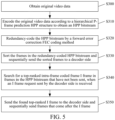
- FIG. 5 is a flowchart of still another method for processing video data applied to an encoder side according to an example of the present disclosure.
- the method includes steps S300 to S350.
- step S300 original video data is obtained.
- step S310 the original video data is encoded according to a hierarchical P-frame prediction HPP structure to obtain an HPP bitstream.
- step S320 the HPP bitstream is redundancy-coded by a forward error correction FEC coding method.
- a quantity of redundancy packets of a frame in a higher temporal layer is less than a quantity of redundancy packets of a frame in a lower temporal layer in the HPP bitstream.
- step S330 the frames in the redundancy-coded HPP bitstream are sorted and sequentially sent to a decoder side.
- step S340 the top-ranked intra-frame coded frame, I frame, is searched for among unsent frames in the HPP bitstream, when an I frame request sent by the decoder side is received.
- the encoder side determines that a current frame is in the lowest temporal layer and is incomplete, it indicates that a reference structure is broken. Frames that come after the current frame between the current I frame and a next I frame cannot be decoded because the reference frame is lost. Video lag cannot be avoided in this extreme situation.
- the I frame request may be directly sent to the video encoder side, to request the video encoder side to immediately send the next I frame.
- the encoder side searches for the top-ranked I frame among unsent frames in the HPP bitstream.
- step S350 the found top-ranked I frame is sent to the decoder side and frames that come after the top-ranked I frame are sequentially sent.
- the encoder side After finding the top-ranked I frame, the encoder side cancels sending of frames that come before the top-ranked I frame, directly jumps to sending of the top-ranked I frame, and then sequentially sends the frames that come after the top-ranked I frame.
- the encoder side when receiving the I frame request, the encoder side immediately searches for the top-ranked I frame among unsent frames in the HPP bitstream and jumps to sending of the top-ranked I frame and subsequent frames, shortening a video lag time at the decoder side to the largest extent.
- FIG. 6 is a flowchart of a method for processing video data applied to a decoder side according to an embodiment of the present disclosure.
- the method includes steps S400 to S440.
- step S400 a current frame sent by an encoder side is received.
- the current frame is a frame in a hierarchical P-frame prediction, HPP, bitstream obtained through coding by the encoder side according to an HPP structure.
- a frame includes several video packets, and header information of each video packet can record a frame to which the video packet belongs and record that the video packet is an i th packet of total n video packets in the frame.
- determining that the current frame is received may include determining that a first video packet in the current frame is received or determining that the last video packet in the current frame is received.
- determining that the last video packet in the current frame is received may include: when an n-th video packet in a current frame is received, determining, according to a total quantity n of video packets in the current frame recorded in headers of the received video packets in the current frame, that the video packet is the last video packet in the current frame; or when a video packet in a next frame is received, determining that a previously received video packet is the last video packet in the current frame.
- step S410 it is determined whether a reference frame of the current frame is complete, when it is determined that the current frame is an inter-frame coded frame P frame. If the current frame is not a P frame, steps S420 to S440 is performed.
- the reference frame of the current frame cannot be completely formed by packets or cannot be decoded, or a reference frame of the reference frame is incomplete, it means that the current frame cannot be successfully decoded either.
- step S420 the current frame is discarded to cancel decoding of the current frame.
- step S430 it is determined, according to a location of the current frame in a hierarchical P-frame prediction HPP structure, a target frame using the current frame as the reference frame.
- step S440 a reference status of the target frame is marked as having an incomplete reference frame.
- the target frame using the current frame for reference cannot be successfully decoded, and the reference status of the target frame is set as having an incomplete reference frame.
- different identifiers may be set to represent different reference statuses. For example, “1" represents having an incomplete reference frame, and "0" represents having a complete reference frame. Certainly, other identifiers may be used to represent different reference statuses.
- steps S420 and S430 may be performed reversely or in parallel.
- FIG. 6 merely shows an optional manner.
- the decoder side determines that the received current frame is a P frame, it can be known according to the HPP coding structure that the P frame needs to refer to a previous frame. Therefore, in the present disclosure, it is determined whether the reference frame of the current frame is complete. When the reference frame thereof is incomplete, it indicates that the current frame cannot be successfully decoded. Therefore, the current frame is directly discarded without being decoded, thereby saving a decoding time and shortening a video lag time. Further, in the present disclosure, when the reference frame of the current frame is incomplete, the reference status of the target frame using the current frame as the reference frame is marked as having an incomplete reference frame. When the target frame is subsequently received, whether the reference frame thereof is incomplete may be determined directly by using the reference status of the target frame, which is more convenient.
- step 1 a reference status of the current frame is obtained, the reference status being used for indicating whether the reference frame of the current frame is complete.
- the reference status of the current frame is previously determined when the reference frame thereof is checked. If the reference frame is successfully decoded, the reference status of the current frame may be set as having a complete reference frame; otherwise, the reference status is set as having an incomplete reference frame.
- step 2 it is determined according to the reference status of the current frame whether the reference frame of the current frame is complete.
- FIG. 7 is a flowchart of another method for processing video data applied to a decoder side according to an embodiment of the present disclosure.
- the method includes steps S500 to S570.
- step S500 When it is determined that the last video packet in a current frame is received, and the current frame is an inter-frame coded frame P frame, a reference status of the current frame is obtained.
- the reference status is used for indicating whether a reference frame of the current frame is incomplete.
- step S510 it is determined whether a reference status of the current frame indicates an incomplete reference frame. If the reference status of the current frame indicates an incomplete reference frame, steps S520 to S540 are performed; otherwise, steps S550 to S570 are performed.
- step S520 the current frame is discarded to cancel decoding of the current frame.
- step S530 it is determined, according to a location of the current frame in a hierarchical P-frame prediction HPP structure, a target frame using the current frame as the reference frame.
- step S540 a reference status of the target frame is marked as having an incomplete reference frame.
- step S550 it is determined whether the current frame can be decoded. If the current frame cannot be decoded, step S520 is performed; otherwise, step S560 is performed.
- an integrity check may be performed on video packets in the current frame that have been cached and it may be determined according to a check result whether the current frame can be decoded, when it is determined that the reference status of the current frame indicates that the reference frame is complete.
- step S520 to S540 are performed.
- step S560 the current frame is decoded and it is determined whether the current frame is successfully decoded; if the current frame is successfully decoded, step S570 is performed; otherwise, step S520 is performed.
- step S570 the decoded current frame is displayed.
- the current frame is decoded. Whether the current frame is successfully decoded is determined according to a decoding result. If the current frame is successfully decoded, the decoded current frame may be displayed. If the current frame is unsuccessfully decoded, step S520 to S540 are performed.
- a process to be performed when it is determined that the reference status of the current frame indicates a complete reference frame is added.
- whether the current frame can be decoded is further determined, and the current frame is decoded only when it is determined that the current frame can be decoded, further decreasing decoding processing on frames that cannot be decoded and shortening a video lag time.
- step S550 the process of performing an integrity check on video packets in the current frame that have been cached and determining according to a check result whether the current frame can be decoded may include:
- a frame includes several video packets
- header information of each video packet can record a frame to which the video packet belongs and that the video packet is an i th video packet of total n video packets in the frame.
- the header information may also record a quantity of redundancy packets in the frame.
- whether the video packets that have been cached can form a complete frame may be determined according to the video packets in the current frame that have been cached and the header information when receiving of packets in the current frame ends. For example, the header information records that the current frame includes totally n video packets. If a quantity of the video packets that have been cached is less than n, it indicates that a data packet in the current frame is lost, and it is determined that a complete frame cannot be formed.
- whether packet loss can be recovered may be further determined. Specifically, if it is determined that a quantity of lost packets in the current frame is less than or equal to a quantity of redundancy packets in the frame recorded in the header information, it may be determined that packet loss can be recovered; otherwise, it is determined that packet loss cannot be recovered.
- the step S580 of sending a redundancy level adjustment request to a video encoder side may be further added.
- the redundancy level adjustment request is sent to request the video encoder side to increase a quantity of redundancy packets to be sent.
- the redundancy level adjustment request may be sent to the video encoder side, to request to increase the quantity of the redundancy packets to be sent.
- FIG. 9 is a flowchart of still another method for processing video data applied to a decoder side according to an embodiment of the present disclosure.
- the method includes steps S600 to S680.
- the reference status is used for indicating whether a reference frame of the current frame is incomplete.
- the current frame is a P frame and is in the lowest temporal layer in an HPP coding structure.
- P4 and P8 are both P frames in the lowest temporal layer.
- step S610 it is determined whether a reference status of the current frame indicates an incomplete reference frame. If the reference status of the current frame indicates an incomplete reference frame, steps S620 to S640 are performed; otherwise, steps S650 to S680 are performed.
- step S620 the current frame is discarded to cancel decoding of the current frame.
- step S630 according to a location of the current frame in the hierarchical P-frame prediction HPP structure, a target frame using the current frame as a reference frame is determined.
- step S640 a reference status of the target frame is marked as having an incomplete reference frame.
- step S650 an I frame request is sent to a video encoder side to request the video encoder side to immediately send a next I frame.
- the I frame request may be directly sent to the video encoder side, to request the video encoder side to immediately send the next I frame.
- step S660 it is determined whether the current frame can be decoded; if the current frame cannot be decoded, step S620 is performed; otherwise, step S670 is performed.
- an integrity check may be performed on video packets in the current frame that have been cached and it may be determined according to a check result whether the current frame can be decoded, when it is determined that the reference status of the current frame indicates that the reference frame is complete.
- steps S620 to S650 are performed.
- step S670 the current frame is decoded and it is determined whether the current frame is successfully decoded. If the current frame is successfully decoded, step S680 is performed; otherwise, step S620 is performed.
- steps S620 to S640 may be performed.
- step S680 the decoded current frame is displayed.
- a video data processing performed when the current frame is a P frame in the lowest temporal layer in the HPP structure is described.
- the operation of sending an I frame request to a video encoder side to request the video encoder side to immediately send a next I frame is added. In this manner, a video lag time is shortened to the largest extent.
- FIG. 10 is a flowchart of still another method for processing video data applied to a decoder side according to an embodiment of the present disclosure.
- the method includes steps S700 to S800.
- step S700 when it is determined that the last video packet in a current frame is received, it is determined whether the current frame is an I frame. If the current frame is an I frame, steps S710 to S760 are performed; otherwise, steps S770 to S800 are performed.
- Step S710 may be performed to determine whether the current frame can be decoded. If the current frame is not an I frame, the current frame is a P frame, and step S770 may be performed to obtain a reference status of the current frame.
- step S710 it is determined whether the current frame can be decoded. If the current frame cannot be decoded, steps S720 to S740 are performed; otherwise, step S750 is performed.
- an integrity check may be performed on video packets in the current frame that have been cached and it may be determined according to a check result whether the current frame can be decoded.
- step S720 a reference status of each frame between the current frame and a next I frame is marked as having an incomplete reference frame.
- step S730 the current frame is discarded to cancel decoding of the current frame.
- the I frame cannot be decoded. As a result, a reference structure is broken. Frames between the current I frame and the next I frame cannot be decoded because reference frames are lost. Video lag cannot be avoided in this extreme situation. To shorten a lag time, the I frame request may be directly sent to the video encoder side, to request the video encoder side to immediately send the next I frame.
- step S750 the current frame is decoded and it is determined whether the current frame is successfully decoded. If the current frame is successfully decoded, step S760 is performed; otherwise, steps S720 to S740 are performed.
- step S710 when it is determined that the current frame can be decoded in step S710, the current frame is decoded, and whether the current frame is successfully decoded is determined according to a decoding result.
- step S760 the decoded current frame is displayed.
- step S770 a reference status of the current frame is obtained and it is determined whether the reference status indicates an incomplete reference frame. If the reference status indicates an incomplete reference frame, step S780 is performed.
- step S700 when it is determined that the current frame is not an I frame in step S700, it indicates that the current frame has a reference frame.
- the reference status of the current frame is obtained. The reference status is used for indicating whether the reference frame of the current frame is complete.
- step S780 the current frame is discarded to cancel decoding of the current frame.
- step S790 according to a location of the current frame in a hierarchical P-frame prediction HPP structure, a target frame using the current frame as a reference frame is determined.
- step S800 a reference status of the target frame is marked as having an incomplete reference frame.
- determining of whether the current frame is an I frame or P frame and a process performed when it is determined that the current frame is an I frame are added in this embodiment. That is, whether the current frame can be decoded and whether the current frame is successfully decoded are directly determined.
- the reference status of each frame between the current frame and the next I frame is marked as having an incomplete reference frame. The current frame is discarded, and the I frame request is sent to the video encoder side, to request to immediately send the next I frame, thereby shortening a video lag time to the largest extent.
- the apparatus for processing video data described below may mutually correspondingly refer to the method for processing video data described above.
- FIG. 11 is a schematic structural diagram of an apparatus for processing video data applied to an encoder side according to an example of the present disclosure.
- the apparatus includes the following units 11 to 14,
- An original video data obtaining unit 11 is configured to obtain original video data.
- An HPP coding unit 12 is configured to encode the original video data according to a hierarchical P-frame prediction HPP structure to obtain an HPP bitstream.
- a redundancy coding unit 13 is configured to redundancy-code the HPP bitstream by a forward error correction FEC coding method, where a quantity of redundancy packets of a frame in a higher temporal layer is less than a quantity of redundancy packets of a frame in a lower temporal layer.
- a frame sending unit 14 is configured to sort the frames in the redundancy-coded HPP bitstream and sequentially send the sorted frames to a decoder side.
- the encoder side encodes obtained original video data according to a hierarchical P-frame prediction HPP structure to obtain an HPP bitstream, redundancy-codes the HPP bitstream by a forward error correction FEC coding method, where a quantity of redundancy packets of a frame in a higher temporal layer is less than a quantity of redundancy packets of a frame in a lower temporal layer, and at last, sequentially sends the frames in the redundancy-coded HPP bitstream to a decoder side.
- the HPP coding structure is combined with FEC redundancy coding, and a redundancy packet is added to the HPP bitstream encoded according to the HPP coding structure.
- a redundancy packet is added to the HPP bitstream encoded according to the HPP coding structure.
- more redundancy packets are added to frames in lower temporal layers in the HPP structure, so as to especially protect frames in lower temporal layers, which are of high importance.
- the decoder side can perform packet loss recovery by using the redundancy packet, thereby greatly improving a decoding success rate and reducing a video lag time.
- the apparatus in the present disclosure may further include a redundancy adjustment unit, configured to dynamically adjust the quantity of redundancy packets in each subsequent to-be-sent frame in the HPP bitstream according to a specified adjustment policy when a redundancy level adjustment request sent by the decoder side is received.
- a redundancy adjustment unit configured to dynamically adjust the quantity of redundancy packets in each subsequent to-be-sent frame in the HPP bitstream according to a specified adjustment policy when a redundancy level adjustment request sent by the decoder side is received.
- the redundancy level adjustment request is a request generated by the decoder side when the decoder side performs an integrity check on received video packets in a current frame and determines according to the check result that the current frame cannot be decoded.
- the redundancy adjustment unit may include a redundancy adjustment subunit, configured to adjust the quantity of redundancy packets in each frame in a specified temporal layer in the HPP bitstream; or, adjust the quantity of redundancy packets in each frame in each temporal layer in the HPP bitstream according to a redundancy packet adjustment ratio corresponding to the temporal layer.
- a redundancy adjustment subunit configured to adjust the quantity of redundancy packets in each frame in a specified temporal layer in the HPP bitstream; or, adjust the quantity of redundancy packets in each frame in each temporal layer in the HPP bitstream according to a redundancy packet adjustment ratio corresponding to the temporal layer.
- the apparatus in the present disclosure may further include an I frame search unit and an I frame sending unit.
- the I frame search unit is configured to search for the top-ranked intra-frame coded frame, I frame, among unsent frames in the HPP bitstream, when an I frame request sent by the decoder side is received.
- the I frame sending unit is configured to send the found top-ranked I frame to the decoder side and sequentially send frames that come after the top-ranked I frame.
- FIG. 12 is a schematic structural diagram of an apparatus for processing video data applied to a decoder side according to an embodiment of the present disclosure.
- the apparatus includes the following units 21 to 25.
- a current frame receiving unit 21 is configured to receive a current frame sent by an encoder side, the current frame being a frame in a hierarchical P-frame prediction HPP bitstream obtained through coding by the encoder side according to an HPP structure.
- a reference frame determining unit 22 is configured to determine whether a reference frame of the current frame is complete, when it is determined that the current frame is an inter-frame coded frame P frame.
- a first frame discarding unit 23 is configured to discard the current frame to cancel decoding of the current frame, when the reference frame determining unit determines that the reference frame of the current frame is incomplete.
- a target frame determining unit 24 is configured to determine, according to a location of the current frame in the HPP structure, a target frame using the current frame as a reference frame.
- a first reference status marking unit 25 is configured to mark a reference status of the target frame as having an incomplete reference frame.
- the encoder side encodes obtained original video data according to a hierarchical P-frame prediction HPP structure to obtain an HPP bitstream, redundancy-codes the HPP bitstream by a forward error correction FEC coding method, where a quantity of redundancy packets of a frame in a higher temporal layer is less than a quantity of redundancy packets of a frame in a lower temporal layer, and at last, sequentially sends the frames in the redundancy-coded HPP bitstream to a decoder side.
- the HPP coding structure is combined with FEC redundancy coding, and a redundancy packet is added to the HPP bitstream encoded according to the HPP coding structure.
- a redundancy packet is added to the HPP bitstream encoded according to the HPP coding structure.
- more redundancy packets are added to frames in lower temporal layers in the HPP structure, so as to especially protect frames in lower temporal layers which are of high importance.
- the decoder side can perform packet loss recovery by using the redundancy packet, thereby greatly improving a decoding success rate and reducing a video lag time.
- the reference frame determining unit may include a reference status obtaining unit and a reference status determining unit.
- the reference status obtaining unit is configured to obtain a reference status of the current frame, the reference status being used for indicating whether the reference frame of the current frame is complete.
- the reference status determining unit is configured to determine according to the reference status of the current frame whether the reference frame of the current frame is complete.
- the current frame receiving unit may be configured to determine that the last video packet in the current frame is received.
- the apparatus may further include a first video packet check unit, configured to perform an integrity check on video packets in the current frame that have been cached and determine according to a check result whether the current frame can be decoded, if the reference status of the current frame indicates that the reference frame is complete; and trigger the first frame discarding unit if it is determined that the current frame cannot be decoded.
- a first video packet check unit configured to perform an integrity check on video packets in the current frame that have been cached and determine according to a check result whether the current frame can be decoded, if the reference status of the current frame indicates that the reference frame is complete; and trigger the first frame discarding unit if it is determined that the current frame cannot be decoded.
- the apparatus in the present disclosure may further include a first decoding unit and a first display unit.
- the first decoding unit is configured to decode the current frame if it is determined that the current frame can be decoded, trigger the first display unit if the decoding is successful, and trigger the first frame discarding unit if the decoding is unsuccessful.
- the first display unit is configured to display the decoded current frame.
- the current frame is in the lowest temporal layer in the HPP structure
- the apparatus may further include a first I frame request unit, configured to send an I frame request to a video encoder side to request the video encoder side to immediately send a next I frame, when it is determined that the reference status of the current frame indicates that the reference frame is incomplete, or that the current frame cannot be decoded, or that decoding of the current frame is unsuccessful.
- a first I frame request unit configured to send an I frame request to a video encoder side to request the video encoder side to immediately send a next I frame, when it is determined that the reference status of the current frame indicates that the reference frame is incomplete, or that the current frame cannot be decoded, or that decoding of the current frame is unsuccessful.
- the apparatus in the present disclosure may further include a redundancy level adjustment sending unit, configured to send a redundancy level adjustment request to a video encoder side to request the video encoder side to increase a quantity of redundancy packets to be sent, when it is determined according to the check result that the current frame cannot be decoded.
- a redundancy level adjustment sending unit configured to send a redundancy level adjustment request to a video encoder side to request the video encoder side to increase a quantity of redundancy packets to be sent, when it is determined according to the check result that the current frame cannot be decoded.
- the apparatus in the present disclosure may further include a second video packet check unit, a second reference status marking unit, a second frame discarding unit and a second I frame request unit.
- the second video packet check unit is configured to perform an integrity check on video packets in the current frame that have been cached and determine according to a check result whether the current frame can be decoded, when it is determined that the last video packet in the current frame is received and the current frame is an intra-frame coded frame I frame.
- the second reference status marking unit is configured to mark a reference status of each frame between the current frame and a next I frame as having an incomplete reference frame, if it is determined that the current frame cannot be decoded.
- the second frame discarding unit is configured to discard the current frame to cancel decoding of the current frame.
- the second I frame request unit is configured to send an I frame request to a video encoder side to request the video encoder side to immediately send the next I frame.
- the apparatus in the present disclosure may further include a second decoding unit and a second display unit.
- the second decoding unit is configured to decode the current frame if the current frame is an I frame and it is determined that the current frame can be decoded, trigger the second display unit if the decoding is successful, and mark a reference status of each frame between the current frame and a next I frame as having an incomplete reference frame if the decoding is unsuccessful.
- the second display unit is configured to display the decoded current frame.
- the first video packet check unit may include a framing and recovery determining unit and a decoding determining unit.
- the framing and recovery determining unit is configured to, if the reference status of the current frame indicates that the reference frame is complete, determine according to header information of the video packets in the current frame whether the video packets in the current frame that have been cached can form a complete frame, and determine whether packet loss can be recovered when determining that the video packets in the current frame that have been cached cannot form a complete frame.
- the decoding determining unit is configured to determine that the current frame can be decoded, if it is determined that the video packets in the current frame that have been cached can form a complete frame or if it is determined that packet loss can be recovered when determining that the video packets in the current frame that have been cached cannot form a complete frame.
- FIG. 13 is a schematic diagram of hardware structure of a terminal according to an embodiment of the present disclosure.
- the terminal may include a processor 1, a communications interface 2, a memory 3, a communications bus 4 and a display screen 5.
- the processor 1, communications interface 2, memory 3 and display screen 5 communicate with each other through the communications bus 4.
- the communication interface 2 may be an interface of a communications module, such as an interface of a GSM module.
- the processor 1 is configured to execute a program.
- the memory 3 is configured to store a program.
- the program may include program code, and the program code includes an operation instruction of the processor.
- the processor 1 may be a central processing unit (CPU) or an application specific integrated circuit (ASIC) or may be configured as one or more integrated circuits for implementing the embodiments of the present disclosure.
- CPU central processing unit
- ASIC application specific integrated circuit
- the memory 3 may include a high-speed RAM memory, and may also include a non-volatile memory, for example, at least one magnetic disk memory.
- the program may be specifically used for:
Landscapes
- Engineering & Computer Science (AREA)
- Multimedia (AREA)
- Signal Processing (AREA)
- Compression Or Coding Systems Of Tv Signals (AREA)
Claims (4)
- Procédé de traitement des données vidéo, appliquée à un côté décodeur, la méthode comprenant les étapes consistant à :recevoir une trame courante envoyée par un côté encodeur, la trame courante étant une trame dans un flux binaire de prédiction de trame P hiérarchique, HPP, obtenu par codage par le côté encodeur selon une structure HPP, dans laquelle le flux binaire HPP correspond à différentes couches temporelles, une trame dans une couche temporelle supérieure doit être décodée en référence à une trame dans une couche temporelle inférieure, et les trames voisines sont dans des couches temporelles différentes ;obtenir un état de référence de la trame actuelle, lorsqu'il est déterminé que le dernier paquet vidéo d'une trame actuelle est reçu et que la trame actuelle est une trame codée inter-trames, trame P, dans la couche temporelle la plus basse de la structure HPP ;déterminer si l'état de référence de la trame actuelle indique une trame de référence incomplète ;si l'état de référence de la trame actuelle indique une trame de référence incomplète, exécuter les étapes suivantes dans l'ordre indiqué :rejeter la trame courante pour annuler le décodage de la trame courante, déterminer, en fonction d'un emplacement de la trame courante dans la structure HPP, une trame cible utilisant la trame courante comme trame de référence ;et en marquant un état de référence de la trame cible comme ayant une trame de référence incomplète, en envoyant une demande de trame I au côté codeur pour demander au côté codeur d'envoyer immédiatement une trame I suivante, si l'état de référence de la trame actuelle indique une trame de référence complète :déterminer si la trame actuelle peut être décodée sur la base du résultat d'un contrôle d'intégrité effectué sur les paquets vidéo de la trame actuelle qui ont été mis en cache ;décoder la trame en cours après avoir déterminé que la trame en cours peut être décodée, et déterminer si la trame en cours est décodée avec succès ;ou, exécution de l'opération susmentionnée d'élimination de la trame courante pour annuler le décodage de la trame courante, s'il est déterminé que la trame courante ne peut pas être décodée ;afficher la trame courante décodée après avoir déterminé que la trame courante est décodée avec succès ; ou, exécuter l'opération ci-dessus d'écarter la trame courante pour annuler le décodage de la trame courante, si le décodage est sans succès, dans lequel le procédé comprend en outre les étapes consistant à :
envoyer une demande de trame I au côté codeur pour lui demander d'envoyer immédiatement une trame I suivante, lorsqu'il est déterminé que la trame actuelle se trouve dans la couche temporelle la plus basse de la structure HPP et que l'état de référence de la trame actuelle indique que la trame de référence est incomplète, ou que la trame actuelle est incapable d'être décodée, ou que le décodage de la trame actuelle est sans succès. - Procédé selon la revendication 1, comprenant en outre les étapes consistant à :
exécuter l'opération consistant à marquer un état de référence de chaque trame entre la trame courante et une trame I suivante comme ayant une trame de référence incomplète, si le décodage est sans succès. - Procédé selon la revendication 1, dans lequel l'exécution d'un contrôle d'intégrité sur les paquets vidéo de la trame courante qui ont été mis en cache et la détermination en fonction d'un résultat de contrôle si la trame courante peut être décodée comprennent :déterminer en fonction des informations d'en-tête des paquets vidéo dans la trame actuelle si les paquets vidéo dans la trame actuelle qui ont été mis en cache sont capables de former une trame complète, et déterminer si la perte de paquets est capable d'être récupérée lorsqu'il est déterminé que les paquets vidéo dans la trame actuelle qui ont été mis en cache sont incapables de former une trame complète ; et.déterminer que la trame actuelle peut être décodée s'il est établi que les paquets vidéo de la trame actuelle qui ont été mis en cache peuvent former une trame complète ou s'il est établi que la perte de paquets peut être récupérée lorsqu'il est établi que les paquets vidéo de la trame actuelle qui ont été mis en cache sont incapables de former une trame complète.
- Appareil de traitement de données vidéo, appliqué à un côté décodeur, l'appareil comprenant :une unité de réception de trame courante, configurée pour recevoir une trame courante envoyée par un côté encodeur, la trame courante étant une trame dans un flux binaire de prédiction de trame P hiérarchique, HPP, obtenu par codage par le côté encodeur selon une structure HPP, où le flux binaire HPP correspond à différentes couches temporelles, une trame dans une couche temporelle supérieure doit être décodée en référence à une trame dans une couche temporelle inférieure, et les trames voisines sont dans des couches temporelles différentes ;une unité configurée pour obtenir un état de référence de la trame courante, lorsqu'il est déterminé que le dernier paquet vidéo d'une trame courante est reçu et que la trame courante est une trame codée inter-trames, trame P ;une unité de détermination de l'état de référence, configurée pour déterminer si l'état de référence de la trame en cours indique une trame de référence incomplète ;une unité de rejet de la première trame, configurée pour, si l'unité de détermination de l'état de référence détermine que l'état de référence de la trame courante indique une trame incomplète, rejeter la trame courante pour annuler le décodage de la trame courante ;une unité de détermination de la trame cible, configurée pour, si l'unité de détermination de l'état de référence détermine que l'état de référence de la trame courante indique une trame incomplète, déterminer, en fonction d'un emplacement de la trame courante dans la structure HPP, une trame cible utilisant la trame courante comme trame de référence ;une première unité de marquage de l'état de référence, configurée pour, si l'unité de détermination de l'état de référence détermine que l'état de référence de la trame actuelle indique une trame incomplète, marquer un état de référence de la trame cible comme ayant une trame de référence incomplète ;l'appareil est en outre configuré pour envoyer une demande de trame I au côté codeur pour lui demander d'envoyer immédiatement une trame I suivante ;l'appareil est en outre configuré pour effectuer les étapes suivantes, si l'état de référence de la trame actuelle indique une trame de référence complète, consistant à :déterminer si la trame actuelle peut être décodée sur la base du résultat d'un contrôle d'intégrité effectué sur les paquets vidéo de la trame actuelle qui ont été mis en cache ;décoder la trame en cours après avoir déterminé que la trame en cours peut être décodée, et déterminer si la trame en cours est décodée avec succès ;ou, exécuter l'opération ci-dessus d'élimination de la trame courante pour annuler le décodage de la trame courante, s'il est déterminé que la trame courante est incapable d'être décodée ;afficher la trame courante décodée après avoir déterminé que la trame courante a été décodée avec succès ;ou, exécuter l'opération ci-dessus d'élimination de la trame courante pour annuler le décodage de la trame courante, si le décodage est sans succès ;dans lequel l'appareil comprend en outreune première unité de demande de trame I, configurée pour envoyer une demande de trame I à un côté encodeur vidéo pour demander au côté encodeur vidéo d'envoyer immédiatement une trame I suivante, lorsqu'il est déterminé que la trame actuelle se trouve dans la couche temporelle la plus basse de la structure HPP et que l'état de référence de la trame actuelle indique que la trame de référence est incomplète, ou que la trame actuelle ne peut pas être décodée, ou que le décodage de la trame actuelle est sans succès.
Applications Claiming Priority (2)
| Application Number | Priority Date | Filing Date | Title |
|---|---|---|---|
| CN201610531620.7A CN107592540B (zh) | 2016-07-07 | 2016-07-07 | 一种视频数据处理方法及装置 |
| PCT/CN2017/092178 WO2018006861A1 (fr) | 2016-07-07 | 2017-07-07 | Procédé et dispositif de traitement de données vidéo |
Publications (3)
| Publication Number | Publication Date |
|---|---|
| EP3484155A1 EP3484155A1 (fr) | 2019-05-15 |
| EP3484155A4 EP3484155A4 (fr) | 2020-04-15 |
| EP3484155B1 true EP3484155B1 (fr) | 2023-10-18 |
Family
ID=60912363
Family Applications (1)
| Application Number | Title | Priority Date | Filing Date |
|---|---|---|---|
| EP17823673.3A Active EP3484155B1 (fr) | 2016-07-07 | 2017-07-07 | Procédé et dispositif de traitement de données vidéo |
Country Status (4)
| Country | Link |
|---|---|
| US (1) | US10652580B2 (fr) |
| EP (1) | EP3484155B1 (fr) |
| CN (1) | CN107592540B (fr) |
| WO (1) | WO2018006861A1 (fr) |
Families Citing this family (15)
| Publication number | Priority date | Publication date | Assignee | Title |
|---|---|---|---|---|
| CN110149491B (zh) * | 2018-02-11 | 2021-09-28 | 腾讯科技(深圳)有限公司 | 视频编码方法、视频解码方法、终端及存储介质 |
| CN109862440A (zh) * | 2019-02-22 | 2019-06-07 | 深圳市凯迪仕智能科技有限公司 | 音视频传输前向纠错方法、装置、计算机设备及存储介质 |
| JP7269112B2 (ja) * | 2019-06-26 | 2023-05-08 | 日本放送協会 | 受信装置及びプログラム |
| CN112583524B (zh) * | 2019-09-30 | 2022-08-05 | 杭州海康威视数字技术股份有限公司 | 数据包恢复方法及装置 |
| CN111277864B (zh) * | 2020-02-18 | 2021-09-10 | 北京达佳互联信息技术有限公司 | 直播数据的编码方法、装置、流转系统及电子设备 |
| CN111428560B (zh) * | 2020-02-20 | 2023-09-12 | 重庆创通联达智能技术有限公司 | 视频图像处理方法、装置、电子设备及存储介质 |
| CN112820306B (zh) * | 2020-02-20 | 2023-08-15 | 腾讯科技(深圳)有限公司 | 语音传输方法、系统、装置、计算机可读存储介质和设备 |
| CN114079534B (zh) | 2020-08-20 | 2023-03-28 | 腾讯科技(深圳)有限公司 | 编码、解码方法、装置、介质和电子设备 |
| CN114079535B (zh) * | 2020-08-20 | 2023-02-17 | 腾讯科技(深圳)有限公司 | 转码方法、装置、介质和电子设备 |
| CN111741276B (zh) * | 2020-08-28 | 2020-12-04 | 浙江大华技术股份有限公司 | 一种视频设备发送关键帧的方法、视频设备和存储装置 |
| CN115250383B (zh) | 2021-04-27 | 2025-07-04 | 华为技术有限公司 | 一种流媒体数据传输的方法及相关设备 |
| CN113259673B (zh) * | 2021-07-05 | 2021-10-15 | 腾讯科技(深圳)有限公司 | 伸缩性视频编码方法、装置、设备及存储介质 |
| CN115623155A (zh) * | 2021-07-12 | 2023-01-17 | 腾讯科技(深圳)有限公司 | 视频数据处理方法、视频数据处理装置、存储介质 |
| CN114554198B (zh) * | 2022-04-27 | 2022-08-26 | 广州番禺职业技术学院 | 基于纠删码的视频关键帧冗余传输方法和系统 |
| CN114900716B (zh) * | 2022-05-11 | 2023-09-26 | 中国电信股份有限公司 | 云视频数据的传输方法、云平台、云终端及介质 |
Citations (1)
| Publication number | Priority date | Publication date | Assignee | Title |
|---|---|---|---|---|
| EP1447988A1 (fr) * | 2000-03-02 | 2004-08-18 | Matsushita Electric Industrial Co., Ltd. | Transmission de données en environnement non fiable |
Family Cites Families (22)
| Publication number | Priority date | Publication date | Assignee | Title |
|---|---|---|---|---|
| CN101371312B (zh) * | 2005-12-08 | 2015-12-02 | 维德约股份有限公司 | 用于视频通信系统中的差错弹性和随机接入的系统和方法 |
| US7957307B2 (en) * | 2007-03-14 | 2011-06-07 | Microsoft Corporation | Reducing effects of packet loss in video transmissions |
| US9143731B2 (en) * | 2008-01-02 | 2015-09-22 | Broadcom Corporation | Mobile video device for use with layered video coding and methods for use therewith |
| CN101668158B (zh) * | 2008-09-05 | 2011-10-26 | 中兴通讯股份有限公司 | 视频切换处理方法和多点控制单元 |
| CN101729910B (zh) * | 2008-10-15 | 2011-11-23 | 国家广播电影电视总局广播科学研究院 | 一种基于可分级比特流的数据传输方法和装置 |
| US8745677B2 (en) * | 2009-06-12 | 2014-06-03 | Cygnus Broadband, Inc. | Systems and methods for prioritization of data for intelligent discard in a communication network |
| US20110299591A1 (en) * | 2009-09-21 | 2011-12-08 | Mediatek Inc. | Video processing apparatus and method |
| US8621313B2 (en) * | 2010-04-06 | 2013-12-31 | Canon Kabushiki Kaisha | Method and a device for adapting error protection in a communication network, and a method and device for detecting between two states of a communication network corresponding to different losses of data |
| AU2012205813B2 (en) * | 2011-01-14 | 2016-07-07 | Vidyo, Inc. | High layer syntax for temporal scalability |
| US9591318B2 (en) * | 2011-09-16 | 2017-03-07 | Microsoft Technology Licensing, Llc | Multi-layer encoding and decoding |
| CN103139559B (zh) * | 2011-11-30 | 2016-01-27 | 中国电信股份有限公司 | 多媒体信号传输方法和装置 |
| KR101343877B1 (ko) * | 2012-06-21 | 2013-12-20 | 한라대학교산학협력단 | 순방향 오류 정정 패킷 생성방법과 이를 이용한 서버와 클라이언트 장치 |
| KR102077556B1 (ko) * | 2012-06-28 | 2020-02-14 | 엑시스 에이비 | 가상 인트라-프레임을 사용하여 비디오 콘텐츠를 인코딩하기 위한 시스템 및 방법 |
| US20140036999A1 (en) * | 2012-06-29 | 2014-02-06 | Vid Scale Inc. | Frame prioritization based on prediction information |
| CN104620525B (zh) * | 2012-07-09 | 2018-07-27 | 瑞典爱立信有限公司 | 用于在广播递送期间分发信息的方法和装置 |
| KR102259794B1 (ko) * | 2012-09-13 | 2021-06-02 | 엘지전자 주식회사 | 영상 부호화/복호화 방법 및 장치 |
| CN109089122B (zh) * | 2013-01-18 | 2022-08-05 | 弗劳恩霍夫应用研究促进协会 | 一种前向纠错数据生成器和前向纠错解码器 |
| CN103260033B (zh) * | 2013-04-26 | 2017-02-08 | 西安交通大学 | 一种联合端系统和中继节点网络编码的鲁棒视频传输方法 |
| US9628411B2 (en) * | 2014-02-21 | 2017-04-18 | Dialogic Corporation | Efficient packet processing at video receiver in multimedia communications over packet networks |
| JP6463041B2 (ja) * | 2014-08-28 | 2019-01-30 | キヤノン株式会社 | 画像処理装置、画像処理方法、及びプログラム |
| US20160142746A1 (en) * | 2014-11-14 | 2016-05-19 | Thales Avionics, Inc. | Method of encrypting, streaming, and displaying video content using selective encryption |
| US10506245B2 (en) * | 2015-11-18 | 2019-12-10 | Cybrook Inc. | Video data processing using a ring buffer |
-
2016
- 2016-07-07 CN CN201610531620.7A patent/CN107592540B/zh active Active
-
2017
- 2017-07-07 WO PCT/CN2017/092178 patent/WO2018006861A1/fr not_active Ceased
- 2017-07-07 EP EP17823673.3A patent/EP3484155B1/fr active Active
-
2018
- 2018-11-29 US US16/204,546 patent/US10652580B2/en active Active
Patent Citations (1)
| Publication number | Priority date | Publication date | Assignee | Title |
|---|---|---|---|---|
| EP1447988A1 (fr) * | 2000-03-02 | 2004-08-18 | Matsushita Electric Industrial Co., Ltd. | Transmission de données en environnement non fiable |
Also Published As
| Publication number | Publication date |
|---|---|
| US20190098339A1 (en) | 2019-03-28 |
| CN107592540B (zh) | 2020-02-11 |
| EP3484155A1 (fr) | 2019-05-15 |
| US10652580B2 (en) | 2020-05-12 |
| WO2018006861A1 (fr) | 2018-01-11 |
| CN107592540A (zh) | 2018-01-16 |
| EP3484155A4 (fr) | 2020-04-15 |
Similar Documents
| Publication | Publication Date | Title |
|---|---|---|
| EP3484155B1 (fr) | Procédé et dispositif de traitement de données vidéo | |
| CN107196746B (zh) | 实时通信中的抗丢包方法、装置和系统 | |
| US8971415B2 (en) | Video communication system, device and method based on feedback reference frames | |
| CN107231328B (zh) | 实时视频传输方法、装置、设备及系统 | |
| CN101719809B (zh) | 一种媒体数据包丢包恢复的方法及系统 | |
| CN103945281B (zh) | 视频传输处理方法、装置和系统 | |
| WO2018058803A1 (fr) | Procédé et dispositif de transmission vidéo en temps réel par réseau | |
| CN102547376B (zh) | 一种视频数据传输方法、装置和系统 | |
| CN112532908A (zh) | 视频图像的传输方法、发送设备、视频通话方法和设备 | |
| CN106330713B (zh) | 一种报文传输方法及装置 | |
| CN102404572B (zh) | 延迟约束条件下基于系统rs码的视频编解码系统及其方法 | |
| CN114567799B (zh) | 视频流数据的传输方法、装置、存储介质及电子设备 | |
| CN100493188C (zh) | 保障低码率无线信道传输高质量视频信号的方法 | |
| CN110572721B (zh) | 视频传输方法和装置 | |
| WO2023213202A1 (fr) | Procédé et appareil de communication | |
| KR102104495B1 (ko) | 수신장치 및 수신장치용 프로그램 | |
| CN115623154A (zh) | 校正网络数据丢包的系统和方法 | |
| KR100363550B1 (ko) | 동영상 인코딩 장치 및 무선 단말기의 동영상 디코딩 장치 | |
| CN110839164A (zh) | 视频传输方法和装置 | |
| CN116506658B (zh) | 视频流的发送方法以及接收方法 | |
| CN116112127B (zh) | 一种数据传输方法、相关设备及存储介质 | |
| WO2010133158A1 (fr) | Procédé et dispositif de détermination de priorités de paquets planifiés | |
| JPH0865278A (ja) | マルチメディア通信装置 | |
| CN121078251A (zh) | 视频传输方法、视频传输系统、计算设备、计算机可读存储介质以及计算机程序产品 | |
| JPH0799662A (ja) | 動画像信号伝送方法 |
Legal Events
| Date | Code | Title | Description |
|---|---|---|---|
| STAA | Information on the status of an ep patent application or granted ep patent |
Free format text: STATUS: THE INTERNATIONAL PUBLICATION HAS BEEN MADE |
|
| PUAI | Public reference made under article 153(3) epc to a published international application that has entered the european phase |
Free format text: ORIGINAL CODE: 0009012 |
|
| STAA | Information on the status of an ep patent application or granted ep patent |
Free format text: STATUS: REQUEST FOR EXAMINATION WAS MADE |
|
| 17P | Request for examination filed |
Effective date: 20181204 |
|
| AK | Designated contracting states |
Kind code of ref document: A1 Designated state(s): AL AT BE BG CH CY CZ DE DK EE ES FI FR GB GR HR HU IE IS IT LI LT LU LV MC MK MT NL NO PL PT RO RS SE SI SK SM TR |
|
| AX | Request for extension of the european patent |
Extension state: BA ME |
|
| DAV | Request for validation of the european patent (deleted) | ||
| DAX | Request for extension of the european patent (deleted) | ||
| RIC1 | Information provided on ipc code assigned before grant |
Ipc: H04N 19/67 20140101ALI20200110BHEP Ipc: H04N 19/31 20140101AFI20200110BHEP |
|
| A4 | Supplementary search report drawn up and despatched |
Effective date: 20200313 |
|
| RIC1 | Information provided on ipc code assigned before grant |
Ipc: H04N 19/31 20140101AFI20200309BHEP Ipc: H04N 19/102 20140101ALI20200309BHEP Ipc: H04N 19/164 20140101ALI20200309BHEP Ipc: H04N 19/159 20140101ALI20200309BHEP Ipc: H04N 19/67 20140101ALI20200309BHEP Ipc: H04N 19/132 20140101ALI20200309BHEP |
|
| STAA | Information on the status of an ep patent application or granted ep patent |
Free format text: STATUS: EXAMINATION IS IN PROGRESS |
|
| 17Q | First examination report despatched |
Effective date: 20210223 |
|
| RAP3 | Party data changed (applicant data changed or rights of an application transferred) |
Owner name: TENCENT TECHNOLOGY (SHENZHEN) COMPANY LIMITED |
|
| GRAP | Despatch of communication of intention to grant a patent |
Free format text: ORIGINAL CODE: EPIDOSNIGR1 |
|
| STAA | Information on the status of an ep patent application or granted ep patent |
Free format text: STATUS: GRANT OF PATENT IS INTENDED |
|
| INTG | Intention to grant announced |
Effective date: 20230517 |
|
| RIN1 | Information on inventor provided before grant (corrected) |
Inventor name: LV, JING Inventor name: DAI, CHAO Inventor name: GAO, ANLIN Inventor name: SHI, YONGFANG |
|
| GRAS | Grant fee paid |
Free format text: ORIGINAL CODE: EPIDOSNIGR3 |
|
| GRAA | (expected) grant |
Free format text: ORIGINAL CODE: 0009210 |
|
| STAA | Information on the status of an ep patent application or granted ep patent |
Free format text: STATUS: THE PATENT HAS BEEN GRANTED |
|
| AK | Designated contracting states |
Kind code of ref document: B1 Designated state(s): AL AT BE BG CH CY CZ DE DK EE ES FI FR GB GR HR HU IE IS IT LI LT LU LV MC MK MT NL NO PL PT RO RS SE SI SK SM TR |
|
| REG | Reference to a national code |
Ref country code: GB Ref legal event code: FG4D |
|
| REG | Reference to a national code |
Ref country code: CH Ref legal event code: EP |
|
| REG | Reference to a national code |
Ref country code: IE Ref legal event code: FG4D |
|
| REG | Reference to a national code |
Ref country code: DE Ref legal event code: R096 Ref document number: 602017075510 Country of ref document: DE |
|
| REG | Reference to a national code |
Ref country code: LT Ref legal event code: MG9D |
|
| REG | Reference to a national code |
Ref country code: NL Ref legal event code: MP Effective date: 20231018 |
|
| REG | Reference to a national code |
Ref country code: AT Ref legal event code: MK05 Ref document number: 1623526 Country of ref document: AT Kind code of ref document: T Effective date: 20231018 |
|
| PG25 | Lapsed in a contracting state [announced via postgrant information from national office to epo] |
Ref country code: NL Free format text: LAPSE BECAUSE OF FAILURE TO SUBMIT A TRANSLATION OF THE DESCRIPTION OR TO PAY THE FEE WITHIN THE PRESCRIBED TIME-LIMIT Effective date: 20231018 |
|
| PG25 | Lapsed in a contracting state [announced via postgrant information from national office to epo] |
Ref country code: GR Free format text: LAPSE BECAUSE OF FAILURE TO SUBMIT A TRANSLATION OF THE DESCRIPTION OR TO PAY THE FEE WITHIN THE PRESCRIBED TIME-LIMIT Effective date: 20240119 |
|
| PG25 | Lapsed in a contracting state [announced via postgrant information from national office to epo] |
Ref country code: IS Free format text: LAPSE BECAUSE OF FAILURE TO SUBMIT A TRANSLATION OF THE DESCRIPTION OR TO PAY THE FEE WITHIN THE PRESCRIBED TIME-LIMIT Effective date: 20240218 |
|
| PG25 | Lapsed in a contracting state [announced via postgrant information from national office to epo] |
Ref country code: LT Free format text: LAPSE BECAUSE OF FAILURE TO SUBMIT A TRANSLATION OF THE DESCRIPTION OR TO PAY THE FEE WITHIN THE PRESCRIBED TIME-LIMIT Effective date: 20231018 |
|
| PG25 | Lapsed in a contracting state [announced via postgrant information from national office to epo] |
Ref country code: AT Free format text: LAPSE BECAUSE OF FAILURE TO SUBMIT A TRANSLATION OF THE DESCRIPTION OR TO PAY THE FEE WITHIN THE PRESCRIBED TIME-LIMIT Effective date: 20231018 |
|
| PG25 | Lapsed in a contracting state [announced via postgrant information from national office to epo] |
Ref country code: ES Free format text: LAPSE BECAUSE OF FAILURE TO SUBMIT A TRANSLATION OF THE DESCRIPTION OR TO PAY THE FEE WITHIN THE PRESCRIBED TIME-LIMIT Effective date: 20231018 |
|
| PG25 | Lapsed in a contracting state [announced via postgrant information from national office to epo] |
Ref country code: LT Free format text: LAPSE BECAUSE OF FAILURE TO SUBMIT A TRANSLATION OF THE DESCRIPTION OR TO PAY THE FEE WITHIN THE PRESCRIBED TIME-LIMIT Effective date: 20231018 Ref country code: IS Free format text: LAPSE BECAUSE OF FAILURE TO SUBMIT A TRANSLATION OF THE DESCRIPTION OR TO PAY THE FEE WITHIN THE PRESCRIBED TIME-LIMIT Effective date: 20240218 Ref country code: GR Free format text: LAPSE BECAUSE OF FAILURE TO SUBMIT A TRANSLATION OF THE DESCRIPTION OR TO PAY THE FEE WITHIN THE PRESCRIBED TIME-LIMIT Effective date: 20240119 Ref country code: ES Free format text: LAPSE BECAUSE OF FAILURE TO SUBMIT A TRANSLATION OF THE DESCRIPTION OR TO PAY THE FEE WITHIN THE PRESCRIBED TIME-LIMIT Effective date: 20231018 Ref country code: BG Free format text: LAPSE BECAUSE OF FAILURE TO SUBMIT A TRANSLATION OF THE DESCRIPTION OR TO PAY THE FEE WITHIN THE PRESCRIBED TIME-LIMIT Effective date: 20240118 Ref country code: AT Free format text: LAPSE BECAUSE OF FAILURE TO SUBMIT A TRANSLATION OF THE DESCRIPTION OR TO PAY THE FEE WITHIN THE PRESCRIBED TIME-LIMIT Effective date: 20231018 Ref country code: PT Free format text: LAPSE BECAUSE OF FAILURE TO SUBMIT A TRANSLATION OF THE DESCRIPTION OR TO PAY THE FEE WITHIN THE PRESCRIBED TIME-LIMIT Effective date: 20240219 |
|
| PG25 | Lapsed in a contracting state [announced via postgrant information from national office to epo] |
Ref country code: SE Free format text: LAPSE BECAUSE OF FAILURE TO SUBMIT A TRANSLATION OF THE DESCRIPTION OR TO PAY THE FEE WITHIN THE PRESCRIBED TIME-LIMIT Effective date: 20231018 Ref country code: RS Free format text: LAPSE BECAUSE OF FAILURE TO SUBMIT A TRANSLATION OF THE DESCRIPTION OR TO PAY THE FEE WITHIN THE PRESCRIBED TIME-LIMIT Effective date: 20231018 Ref country code: PL Free format text: LAPSE BECAUSE OF FAILURE TO SUBMIT A TRANSLATION OF THE DESCRIPTION OR TO PAY THE FEE WITHIN THE PRESCRIBED TIME-LIMIT Effective date: 20231018 Ref country code: NO Free format text: LAPSE BECAUSE OF FAILURE TO SUBMIT A TRANSLATION OF THE DESCRIPTION OR TO PAY THE FEE WITHIN THE PRESCRIBED TIME-LIMIT Effective date: 20240118 Ref country code: LV Free format text: LAPSE BECAUSE OF FAILURE TO SUBMIT A TRANSLATION OF THE DESCRIPTION OR TO PAY THE FEE WITHIN THE PRESCRIBED TIME-LIMIT Effective date: 20231018 Ref country code: HR Free format text: LAPSE BECAUSE OF FAILURE TO SUBMIT A TRANSLATION OF THE DESCRIPTION OR TO PAY THE FEE WITHIN THE PRESCRIBED TIME-LIMIT Effective date: 20231018 |
|
| PG25 | Lapsed in a contracting state [announced via postgrant information from national office to epo] |
Ref country code: DK Free format text: LAPSE BECAUSE OF FAILURE TO SUBMIT A TRANSLATION OF THE DESCRIPTION OR TO PAY THE FEE WITHIN THE PRESCRIBED TIME-LIMIT Effective date: 20231018 |
|
| REG | Reference to a national code |
Ref country code: DE Ref legal event code: R097 Ref document number: 602017075510 Country of ref document: DE |
|
| PG25 | Lapsed in a contracting state [announced via postgrant information from national office to epo] |
Ref country code: CZ Free format text: LAPSE BECAUSE OF FAILURE TO SUBMIT A TRANSLATION OF THE DESCRIPTION OR TO PAY THE FEE WITHIN THE PRESCRIBED TIME-LIMIT Effective date: 20231018 |
|
| PG25 | Lapsed in a contracting state [announced via postgrant information from national office to epo] |
Ref country code: SK Free format text: LAPSE BECAUSE OF FAILURE TO SUBMIT A TRANSLATION OF THE DESCRIPTION OR TO PAY THE FEE WITHIN THE PRESCRIBED TIME-LIMIT Effective date: 20231018 |
|
| PG25 | Lapsed in a contracting state [announced via postgrant information from national office to epo] |
Ref country code: SM Free format text: LAPSE BECAUSE OF FAILURE TO SUBMIT A TRANSLATION OF THE DESCRIPTION OR TO PAY THE FEE WITHIN THE PRESCRIBED TIME-LIMIT Effective date: 20231018 Ref country code: SK Free format text: LAPSE BECAUSE OF FAILURE TO SUBMIT A TRANSLATION OF THE DESCRIPTION OR TO PAY THE FEE WITHIN THE PRESCRIBED TIME-LIMIT Effective date: 20231018 Ref country code: RO Free format text: LAPSE BECAUSE OF FAILURE TO SUBMIT A TRANSLATION OF THE DESCRIPTION OR TO PAY THE FEE WITHIN THE PRESCRIBED TIME-LIMIT Effective date: 20231018 Ref country code: IT Free format text: LAPSE BECAUSE OF FAILURE TO SUBMIT A TRANSLATION OF THE DESCRIPTION OR TO PAY THE FEE WITHIN THE PRESCRIBED TIME-LIMIT Effective date: 20231018 Ref country code: EE Free format text: LAPSE BECAUSE OF FAILURE TO SUBMIT A TRANSLATION OF THE DESCRIPTION OR TO PAY THE FEE WITHIN THE PRESCRIBED TIME-LIMIT Effective date: 20231018 Ref country code: DK Free format text: LAPSE BECAUSE OF FAILURE TO SUBMIT A TRANSLATION OF THE DESCRIPTION OR TO PAY THE FEE WITHIN THE PRESCRIBED TIME-LIMIT Effective date: 20231018 Ref country code: CZ Free format text: LAPSE BECAUSE OF FAILURE TO SUBMIT A TRANSLATION OF THE DESCRIPTION OR TO PAY THE FEE WITHIN THE PRESCRIBED TIME-LIMIT Effective date: 20231018 |
|
| PLBE | No opposition filed within time limit |
Free format text: ORIGINAL CODE: 0009261 |
|
| STAA | Information on the status of an ep patent application or granted ep patent |
Free format text: STATUS: NO OPPOSITION FILED WITHIN TIME LIMIT |
|
| 26N | No opposition filed |
Effective date: 20240719 |
|
| PG25 | Lapsed in a contracting state [announced via postgrant information from national office to epo] |
Ref country code: SI Free format text: LAPSE BECAUSE OF FAILURE TO SUBMIT A TRANSLATION OF THE DESCRIPTION OR TO PAY THE FEE WITHIN THE PRESCRIBED TIME-LIMIT Effective date: 20231018 |
|
| PG25 | Lapsed in a contracting state [announced via postgrant information from national office to epo] |
Ref country code: SI Free format text: LAPSE BECAUSE OF FAILURE TO SUBMIT A TRANSLATION OF THE DESCRIPTION OR TO PAY THE FEE WITHIN THE PRESCRIBED TIME-LIMIT Effective date: 20231018 |
|
| PG25 | Lapsed in a contracting state [announced via postgrant information from national office to epo] |
Ref country code: MC Free format text: LAPSE BECAUSE OF FAILURE TO SUBMIT A TRANSLATION OF THE DESCRIPTION OR TO PAY THE FEE WITHIN THE PRESCRIBED TIME-LIMIT Effective date: 20231018 |
|
| REG | Reference to a national code |
Ref country code: CH Ref legal event code: PL |
|
| PG25 | Lapsed in a contracting state [announced via postgrant information from national office to epo] |
Ref country code: LU Free format text: LAPSE BECAUSE OF NON-PAYMENT OF DUE FEES Effective date: 20240707 |
|
| PG25 | Lapsed in a contracting state [announced via postgrant information from national office to epo] |
Ref country code: LU Free format text: LAPSE BECAUSE OF NON-PAYMENT OF DUE FEES Effective date: 20240707 |
|
| PG25 | Lapsed in a contracting state [announced via postgrant information from national office to epo] |
Ref country code: CH Free format text: LAPSE BECAUSE OF NON-PAYMENT OF DUE FEES Effective date: 20240731 Ref country code: BE Free format text: LAPSE BECAUSE OF NON-PAYMENT OF DUE FEES Effective date: 20240731 |
|
| REG | Reference to a national code |
Ref country code: BE Ref legal event code: MM Effective date: 20240731 |
|
| PG25 | Lapsed in a contracting state [announced via postgrant information from national office to epo] |
Ref country code: IE Free format text: LAPSE BECAUSE OF NON-PAYMENT OF DUE FEES Effective date: 20240707 |
|
| PG25 | Lapsed in a contracting state [announced via postgrant information from national office to epo] |
Ref country code: FI Free format text: LAPSE BECAUSE OF FAILURE TO SUBMIT A TRANSLATION OF THE DESCRIPTION OR TO PAY THE FEE WITHIN THE PRESCRIBED TIME-LIMIT Effective date: 20231019 |
|
| PGFP | Annual fee paid to national office [announced via postgrant information from national office to epo] |
Ref country code: DE Payment date: 20250722 Year of fee payment: 9 |
|
| PGFP | Annual fee paid to national office [announced via postgrant information from national office to epo] |
Ref country code: GB Payment date: 20250724 Year of fee payment: 9 |
|
| PGFP | Annual fee paid to national office [announced via postgrant information from national office to epo] |
Ref country code: FR Payment date: 20250722 Year of fee payment: 9 |
|
| PG25 | Lapsed in a contracting state [announced via postgrant information from national office to epo] |
Ref country code: CY Free format text: LAPSE BECAUSE OF FAILURE TO SUBMIT A TRANSLATION OF THE DESCRIPTION OR TO PAY THE FEE WITHIN THE PRESCRIBED TIME-LIMIT; INVALID AB INITIO Effective date: 20170707 |
|
| PG25 | Lapsed in a contracting state [announced via postgrant information from national office to epo] |
Ref country code: HU Free format text: LAPSE BECAUSE OF FAILURE TO SUBMIT A TRANSLATION OF THE DESCRIPTION OR TO PAY THE FEE WITHIN THE PRESCRIBED TIME-LIMIT; INVALID AB INITIO Effective date: 20170707 |