EP3498220A1 - Implant dentaire - Google Patents
Implant dentaire Download PDFInfo
- Publication number
- EP3498220A1 EP3498220A1 EP18000966.4A EP18000966A EP3498220A1 EP 3498220 A1 EP3498220 A1 EP 3498220A1 EP 18000966 A EP18000966 A EP 18000966A EP 3498220 A1 EP3498220 A1 EP 3498220A1
- Authority
- EP
- European Patent Office
- Prior art keywords
- sleeve
- core
- gap
- dental implant
- wall
- Prior art date
- Legal status (The legal status is an assumption and is not a legal conclusion. Google has not performed a legal analysis and makes no representation as to the accuracy of the status listed.)
- Granted
Links
Images
Classifications
-
- A—HUMAN NECESSITIES
- A61—MEDICAL OR VETERINARY SCIENCE; HYGIENE
- A61C—DENTISTRY; APPARATUS OR METHODS FOR ORAL OR DENTAL HYGIENE
- A61C8/00—Means to be fixed to the jaw-bone for consolidating natural teeth or for fixing dental prostheses thereon; Dental implants; Implanting tools
- A61C8/0018—Means to be fixed to the jaw-bone for consolidating natural teeth or for fixing dental prostheses thereon; Dental implants; Implanting tools characterised by the shape
- A61C8/0022—Self-screwing
- A61C8/0024—Self-screwing with self-boring cutting edge
-
- A—HUMAN NECESSITIES
- A61—MEDICAL OR VETERINARY SCIENCE; HYGIENE
- A61C—DENTISTRY; APPARATUS OR METHODS FOR ORAL OR DENTAL HYGIENE
- A61C8/00—Means to be fixed to the jaw-bone for consolidating natural teeth or for fixing dental prostheses thereon; Dental implants; Implanting tools
- A61C8/0012—Means to be fixed to the jaw-bone for consolidating natural teeth or for fixing dental prostheses thereon; Dental implants; Implanting tools characterised by the material or composition, e.g. ceramics, surface layer, metal alloy
- A61C8/0013—Means to be fixed to the jaw-bone for consolidating natural teeth or for fixing dental prostheses thereon; Dental implants; Implanting tools characterised by the material or composition, e.g. ceramics, surface layer, metal alloy with a surface layer, coating
-
- A—HUMAN NECESSITIES
- A61—MEDICAL OR VETERINARY SCIENCE; HYGIENE
- A61C—DENTISTRY; APPARATUS OR METHODS FOR ORAL OR DENTAL HYGIENE
- A61C8/00—Means to be fixed to the jaw-bone for consolidating natural teeth or for fixing dental prostheses thereon; Dental implants; Implanting tools
- A61C8/0012—Means to be fixed to the jaw-bone for consolidating natural teeth or for fixing dental prostheses thereon; Dental implants; Implanting tools characterised by the material or composition, e.g. ceramics, surface layer, metal alloy
-
- A—HUMAN NECESSITIES
- A61—MEDICAL OR VETERINARY SCIENCE; HYGIENE
- A61C—DENTISTRY; APPARATUS OR METHODS FOR ORAL OR DENTAL HYGIENE
- A61C8/00—Means to be fixed to the jaw-bone for consolidating natural teeth or for fixing dental prostheses thereon; Dental implants; Implanting tools
- A61C8/0018—Means to be fixed to the jaw-bone for consolidating natural teeth or for fixing dental prostheses thereon; Dental implants; Implanting tools characterised by the shape
- A61C8/0022—Self-screwing
-
- A—HUMAN NECESSITIES
- A61—MEDICAL OR VETERINARY SCIENCE; HYGIENE
- A61C—DENTISTRY; APPARATUS OR METHODS FOR ORAL OR DENTAL HYGIENE
- A61C8/00—Means to be fixed to the jaw-bone for consolidating natural teeth or for fixing dental prostheses thereon; Dental implants; Implanting tools
- A61C8/0018—Means to be fixed to the jaw-bone for consolidating natural teeth or for fixing dental prostheses thereon; Dental implants; Implanting tools characterised by the shape
- A61C8/0037—Details of the shape
-
- A—HUMAN NECESSITIES
- A61—MEDICAL OR VETERINARY SCIENCE; HYGIENE
- A61C—DENTISTRY; APPARATUS OR METHODS FOR ORAL OR DENTAL HYGIENE
- A61C8/00—Means to be fixed to the jaw-bone for consolidating natural teeth or for fixing dental prostheses thereon; Dental implants; Implanting tools
- A61C8/0083—Intra-gingival inserts
-
- A—HUMAN NECESSITIES
- A61—MEDICAL OR VETERINARY SCIENCE; HYGIENE
- A61C—DENTISTRY; APPARATUS OR METHODS FOR ORAL OR DENTAL HYGIENE
- A61C8/00—Means to be fixed to the jaw-bone for consolidating natural teeth or for fixing dental prostheses thereon; Dental implants; Implanting tools
- A61C8/0093—Features of implants not otherwise provided for
-
- A—HUMAN NECESSITIES
- A61—MEDICAL OR VETERINARY SCIENCE; HYGIENE
- A61K—PREPARATIONS FOR MEDICAL, DENTAL OR TOILETRY PURPOSES
- A61K6/00—Preparations for dentistry
- A61K6/30—Compositions for temporarily or permanently fixing teeth or palates, e.g. primers for dental adhesives
-
- C—CHEMISTRY; METALLURGY
- C09—DYES; PAINTS; POLISHES; NATURAL RESINS; ADHESIVES; COMPOSITIONS NOT OTHERWISE PROVIDED FOR; APPLICATIONS OF MATERIALS NOT OTHERWISE PROVIDED FOR
- C09J—ADHESIVES; NON-MECHANICAL ASPECTS OF ADHESIVE PROCESSES IN GENERAL; ADHESIVE PROCESSES NOT PROVIDED FOR ELSEWHERE; USE OF MATERIALS AS ADHESIVES
- C09J163/00—Adhesives based on epoxy resins; Adhesives based on derivatives of epoxy resins
Definitions
- the present invention relates to a dental implant comprising a core made of metal and a sleeve having an inner wall and snap-fitting on an upper part of the core such that the inner wall is located opposite that upper part of the core, which sleeve is made of ceramic or Peek, a gap being left between the core and the inner wall of the sleeve so that a layer of glue can be housed in a space formed by the presence of the gap.
- Such a dental implant is known from the patent EP 1 418 858 .
- the sleeve is glued to the core.
- a gap between 80 and 150 microns is left between the inner wall of the sleeve and the upper part of the core. This gap makes it possible to form a sufficient space to allow a good elasticity between the sleeve and the core.
- a disadvantage of the known implant is that there is a risk of delamination. Indeed, it has been found that when or after the insertion of these implants into the dense or irregular maxillary bones, the latter can sometimes push the sleeve and thus cause loose bonding, thus causing the sleeve to detach from the core. These implants were therefore not indicated to be buried entirely in the maxillary bone, and the sleeve could not be in contact with the bone.
- the invention aims to achieve a dental implant where the risk of separation and fracture is greatly reduced.
- an implant according to the invention is characterized in that the said gap has a distance of between 5 and 30 ⁇ m, in particular between 10 and 20 ⁇ m.
- This value of the gap unexpectedly makes it possible to combine both a good resistance to insertion and contact with the bone on the one hand and on the other hand to keep sufficient space between the core and the sleeve to allow some elasticity between the sleeve and the core.
- This gap value also allows for a better test result core.
- This value of the gap also allows a better result in the sleeve peel test and fixes the probability of fracture in this test.
- This sleeve can then be partially or completely buried in the bone, and this implant can also be completely buried in the jaw bone, even irregular,
- a first preferred embodiment of a dental implant according to the invention is characterized in that the ceramic of which the sleeve is manufactured is zirconia. Zirconia is a material that has excellent biocompatibility properties, especially in soft tissue contact.
- a second preferred embodiment of a dental implant according to the invention is characterized in that the adhesive layer is a biocompatible bi-component epoxy adhesive layer. This glue is well suited for dental implantable use.
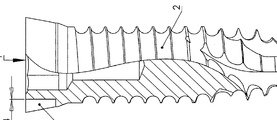
- the drawing illustrates a sectional view of a dental implant 1 according to the invention.
- the dental implant comprises a core 2 made of metal, in particular titanium. Titanium has the advantage of being resistant, flexible and biocompatible for use of dental implants in the mouth of a patient.
- the core preferably has an external screw thread enabling the core to be screwed into the maxillary bone.
- a sleeve 3 is placed on an upper part of the core and extends around the entire periphery of the core.
- the sleeve has an inner wall and is snap-fitted on an upper part of the core, so that the inner wall is located facing this upper part of the core when the implant is implanted in the maxillary or mandibular arch of the patient, the sleeve is positioned in the gum, between the bone and the oral cavity.
- the sleeve is preferably made of ceramic, more particularly of zirconia.
- the sleeve can also be manufactured in Peek.
- a gap 4 is left between the core and the inner wall of the sleeve so that a layer of glue can be housed in a space formed by the presence of the gap.
- the gap has a distance of between 5 and 30 ⁇ m, in particular between 10 and 20 ⁇ m. This gap extends over the entire height of the sleeve in such a way as, on the one hand, to facilitate the engagement of the sleeve on the upper part of the core, and on the other hand to allow the layer of glue to extend over any this height and thus allow good adhesion and good assembly between the sleeve and the core.
- the adhesive used to bond the sleeve to the core is preferably a two-component epoxy adhesive. This glue is well tolerated for oral use of dental implants because it is biocompatible.
- the advantage of leaving a gap having a distance of between 5 and 30 ⁇ m, in particular between 10 and 20 ⁇ m, is that it allows unexpectedly to combine both a good resistance of this sleeve in contact with the bone of maxillary on the one hand, and on the other hand to keep enough space between the core and the sleeve to allow some elasticity between the sleeve and the core due to masticatory forces applied.
- a problem of detachment of the sleeve of the core has been found on dental implants known from the prior art. A thorough analysis of this problem has shown that the jawbone can sometimes push back the sleeve of the implant. when implanted in the patient's mouth.
- These tests are performed at the factory during the manufacture of the implant to check the resistance to tearing of the sleeve attached to the core. These tests have shown that even with such a thin layer of glue sufficient elasticity was obtained between the sleeve and the core to prevent fracture of the sleeve.
- Another advantage of this difference according to the invention is that the risk of infiltration of bacteria into the space left by the gap is minimal. Indeed, in view of this very small distance distance and due to the fact that the space formed by the gap is filled with this biocompatible glue, there remains virtually no room for bacteria.
Landscapes
- Health & Medical Sciences (AREA)
- Epidemiology (AREA)
- Veterinary Medicine (AREA)
- Oral & Maxillofacial Surgery (AREA)
- Public Health (AREA)
- General Health & Medical Sciences (AREA)
- Animal Behavior & Ethology (AREA)
- Life Sciences & Earth Sciences (AREA)
- Dentistry (AREA)
- Orthopedic Medicine & Surgery (AREA)
- Engineering & Computer Science (AREA)
- Ceramic Engineering (AREA)
- Chemical & Material Sciences (AREA)
- Organic Chemistry (AREA)
- Dental Prosthetics (AREA)
Abstract
Description
- La présente invention concerne un implant dentaire comprenant un noyau fabriqué en métal et un manchon ayant une paroi intérieure et monté par emboîtement sur une partie supérieure du noyau de telle façon que la paroi intérieure est située face à cette partie supérieure du noyau, lequel manchon est fabriqué en céramique ou en Peek, un écart étant laissé entre le noyau et la paroi intérieure du manchon de telle façon à ce qu'une couche de colle puisse être logée dans un espace formé par la présence de l'écart.
- Un tel implant dentaire est connu du brevet
EP 1 418 858 . Dans l'implant dentaire connu le manchon est collé sur le noyau. A cette fin un écart situé entre 80 et 150 µm est laissé entre la paroi intérieure du manchon et la partie supérieure du noyau. Cet écart permet de former un espace suffisant pour permettre une bonne élasticité entre le manchon et le noyau. - Un désavantage de l'implant connu est qu'il y a un risque de décollement. En effet, il a été constaté que lors ou après l'insertion de ces implants dans les os maxillaires denses ou irréguliers, ces derniers peuvent parfois repousser le manchon et ainsi provoquer que le collage lâche, causant ainsi que le manchon se détache du noyau. Ces implants n'étaient dès lors pas indiqués pour être enfouis totalement dans l'os des maxillaires, et le manchon ne pouvait pas être en contact de l'os.
- L'invention a pour bût de réaliser un implant dentaire où le risque de décollement et de fracture est considérablement réduit.
- A cette fin un implant suivant l'invention est caractérisé en ce que ledit écart a une distance située entre 5 et 30 µm, en particulier entre 10 et 20 µm. Cette valeur de l'écart permet de façon inattendue de combiner à la fois une bonne résistance à l'insertion et au contact de l'os d'une part et d'autre part de garder suffisamment d'espace entre le noyau et le manchon pour permettre une certaine élasticité entre le manchon et le noyau. Cette valeur de l'écart permet aussi un meilleur résultat au test noyau. Cette valeur de l'écart permet aussi un meilleur résultat au test d'arrachement du manchon fixé sur le noyau et réduit la probabilité de fracture lors de ce test. Ce manchon peut alors être partiellement ou intégralement enfoui dans l'os, et cet implant peut également être totalement enfoui dans l'os des maxillaires, même irrégulier,
- Une première forme de réalisation préférentielle d'un implant dentaire suivant l'invention est caractérisée en ce que la céramique dont est fabriqué le manchon est de la zircone. La zircone est une matière qui possède d'excellentes propriétés de biocompatibilité, en particulier au contact des tissus mous.
- Une deuxième forme de réalisation préférentielle d'un implant dentaire suivant l'invention est caractérisée en ce que la couche de colle est une couche de colle époxy bi-composant biocompatible. Cette colle est bien appropriée pour un usage implantable dentaire.
- L'invention sera maintenant décrite plus en détails à l'aide de l'unique dessin joint en annexe et qui décrit une forme de réalisation d'un implant dentaire selon l'invention.
- Le dessin illustre une vue en coupe d'un implant dentaire 1 suivant l'invention. L'implant dentaire comporte un noyau 2 fabriqué en métal, en particulier du titane. Le titane a l'avantage d'être résistant, flexible et biocompatible pour un usage d'implants dentaire dans la bouche d'un patient. Le noyau possède de préférence un pas de vis externe permettant de visser le noyau dans l'os des maxillaires.
- Un manchon 3 est placé sur une partie supérieure du noyau et s'étend sur tout le pourtour du noyau. Le manchon possède une paroi intérieure et est monté par emboîtement sur une partie supérieure du noyau, de telle façon que la paroi intérieure est située face à cette partie supérieure du noyau lorsque l'implant est implanté dans l'arcade maxillaire ou mandibulaire du patient, le manchon se positionne dans la gencive, entre l'os et la cavité buccale.
- Le manchon est de préférence fabriqué en céramique, plus particulièrement en zircone. Le manchon peut également être fabriqué en Peek.
- Un écart 4 est laissé entres le noyau et la paroi intérieure du manchon de telle façon à ce qu'une couche de colle puisse être logée dans un espace formé par la présence de l'écart. L'écart a une distance située entre 5 et 30 µm, en particulier entre 10 et 20 µm. Cet écart s'étend sur toute la hauteur du manchon de telle façon à d'une part faciliter l'emboîtement du manchon sur la partie supérieure du noyau, et d'autre part de permettre à la couche de colle de s'étendre sur toute cette hauteur et ainsi permettre une bonne adhérence et un bon assemblage entre le manchon et le noyau.
- La colle utilisée pour coller le manchon au noyau est de préférence une colle époxy bi-composant. Cette colle est bien tolérée pour un usage buccal d'implants dentaire, car elle est biocompatible.
- L'avantage de laisser un écart ayant une distance située entre 5 et 30 µm, en particulier entre 10 et 20 µm, est que cela permet de façon inattendue de combiner à la fois une bonne résistance de ce manchon au contact de l'os des maxillaires d'une part, et d'autre part de garder suffisamment d'espace entre le noyau et le manchon pour permettre une certaine élasticité entre le manchon et le noyau en raison des forces masticatoires appliquées. En effet, un problème de détachement du manchon du noyau a été constaté sur les implants dentaire connus de l'art antérieur, Une analyse approfondie de ce problème a permis de constater que l'os des maxillaires peut parfois repousser le manchon de l'implant lorsqu'il est implanté dans la bouche du patient. Ceci est notamment dû au fait que l'os n'est pratiquement jamais parfaitement plat et que même de petites irrégularités de la crête osseuse, de l'ordre de moins d'un millimètre, provoquent déjà une pression sur le manchon. Ainsi cette pression exercée par l'os des maxillaires sur le manchon peut provoquer que le collage et l'assemblage lâchent lors de la pose de l'implant, causant ainsi que le manchon se détache du noyau.
- Cette valeur de l'écart ayant une distance située entre 5 et 30 µm, en particulier entre 10 et 20 µm, permet aussi un meilleur résultat au test d'arrachement du manchon fixé sur le noyau et réduit la probabilité de fracture lors de ce test. Ces tests sont effectués en usine lors de la fabrication de l'implant afin de vérifier la résistance à l'arrachement du manchon fixé sur le noyau. Ces tests ont permis de constater que même avec une aussi fine couche de colle on obtenait suffisamment d'élasticité entre le manchon et le noyau pour éviter une fracture du manchon.
- Un autre avantage de cet écart selon l'invention est que le risque d'infiltration de bactéries dans l'espace laissé par l'écart est minimal. En effet eu égard à cette distance très petite de l'écart et dû au fait que l'espace formé par l'écart est rempli de cette colle biocompatible, il ne reste pour ainsi dire plus de place pour les bactéries.
Claims (3)
- Implant dentaire comprenant un noyau fabriqué en métal et un manchon ayant une paroi intérieure et monté par emboîtement sur une partie supérieure du noyau de telle façon que la paroi intérieure est située face à cette partie supérieure du noyau, lequel manchon est fabriqué en céramique ou en Peek, un écart étant laissé entre le noyau et la paroi intérieure du manchon de telle façon à ce qu'une couche de colle puisse être logée dans un espace formé par la présence de l'écart, caractérisé en ce que ledit écart a une distance située entre 5 et 30 µm, en particulier entre 10 et 20 µm.
- Implant dentaire suivant la revendication 1, caractérisé en ce que la céramique dont est fabriqué le manchon est de la zircone.
- Implant dentaire suivant la revendication 1 ou 2, caractérisé en ce que la couche de colle est une couche de colle époxy bi-composant biocompatible.
Applications Claiming Priority (1)
| Application Number | Priority Date | Filing Date | Title |
|---|---|---|---|
| BE2017/0171A BE1025778B1 (fr) | 2017-12-13 | 2017-12-13 | Implant dentaire |
Publications (2)
| Publication Number | Publication Date |
|---|---|
| EP3498220A1 true EP3498220A1 (fr) | 2019-06-19 |
| EP3498220B1 EP3498220B1 (fr) | 2020-03-25 |
Family
ID=61054067
Family Applications (1)
| Application Number | Title | Priority Date | Filing Date |
|---|---|---|---|
| EP18000966.4A Active EP3498220B1 (fr) | 2017-12-13 | 2018-12-13 | Implant dentaire |
Country Status (11)
| Country | Link |
|---|---|
| US (2) | US20190175308A1 (fr) |
| EP (1) | EP3498220B1 (fr) |
| KR (2) | KR20190070871A (fr) |
| CN (1) | CN109907846B (fr) |
| BE (1) | BE1025778B1 (fr) |
| BR (1) | BR102018075326B1 (fr) |
| CA (1) | CA3027067A1 (fr) |
| ES (1) | ES2785151T3 (fr) |
| IL (1) | IL263615B2 (fr) |
| RU (1) | RU2018143477A (fr) |
| TW (1) | TWI770323B (fr) |
Citations (5)
| Publication number | Priority date | Publication date | Assignee | Title |
|---|---|---|---|---|
| JPH0449958A (ja) * | 1990-06-13 | 1992-02-19 | Bunkichi Azuma | 人工歯根 |
| EP1418858A1 (fr) | 2001-08-03 | 2004-05-19 | BENHAMOU, Andre | Implant a usage dentaire ou analogue, comprenant un noyau et un manchon en ceramique relies l'un a l'autre par collage |
| CH702586A2 (de) * | 2010-01-22 | 2011-07-29 | Franz Sutter | Zahnersatz und Vorrichtung zum Bilden eines Zahnersatzes. |
| EP2586398A1 (fr) * | 2011-10-25 | 2013-05-01 | Sudimplant | Implant dentaire |
| EP2845562A1 (fr) * | 2013-09-05 | 2015-03-11 | Wolfgang Schmüdderich | Implant et système de prothèse dentaire |
Family Cites Families (10)
| Publication number | Priority date | Publication date | Assignee | Title |
|---|---|---|---|---|
| US5510066A (en) * | 1992-08-14 | 1996-04-23 | Guild Associates, Inc. | Method for free-formation of a free-standing, three-dimensional body |
| JP2000506080A (ja) * | 1996-03-06 | 2000-05-23 | ギルド・アソシエイツ・インコーポレーテツド | 三次元構造体の製造法 |
| EP1100395B1 (fr) * | 1998-07-29 | 2005-04-06 | Franz Sutter | Dispositif pour maintenir et/ou former une prothese dentaire |
| DE10304802A1 (de) * | 2002-12-13 | 2004-07-08 | Neumeyer, Stefan, Dr. | Zahnimplantat sowie Verfahren zum Herstellen von Zahnersatz unter Verwendung eines Zahnimplantats |
| CN101304703B (zh) * | 2005-09-16 | 2011-11-09 | 于尔根·梅尔霍夫 | 由两部分组成的牙植入物 |
| JP4321637B2 (ja) * | 2007-07-27 | 2009-08-26 | セイコーエプソン株式会社 | 歯科用インプラントの製造方法 |
| GR1006227B (el) * | 2007-11-16 | 2009-01-13 | - | Ενιαιο ενδοστικο οδοντικο εμφυτευμα τιτανιου ή ζιρκονιας σε συνδυασμο με κεραμικο ή υαλοκεραμικο διαβλενογονιο προσαρτημα |
| US8246870B2 (en) * | 2009-06-01 | 2012-08-21 | Layton Grant H | Dental implant system and method of use |
| CN104352284B (zh) * | 2014-10-09 | 2018-06-05 | 儒伽医疗有限公司 | 一种牙科修复方法 |
| CN105147403A (zh) * | 2015-09-09 | 2015-12-16 | 周建明 | 一种人工种植牙体 |
-
2017
- 2017-12-13 BE BE2017/0171A patent/BE1025778B1/fr not_active IP Right Cessation
-
2018
- 2018-12-06 BR BR102018075326-6A patent/BR102018075326B1/pt active IP Right Grant
- 2018-12-07 RU RU2018143477A patent/RU2018143477A/ru unknown
- 2018-12-10 TW TW107144352A patent/TWI770323B/zh active
- 2018-12-10 IL IL263615A patent/IL263615B2/en unknown
- 2018-12-10 CN CN201811503479.5A patent/CN109907846B/zh active Active
- 2018-12-11 CA CA3027067A patent/CA3027067A1/fr active Pending
- 2018-12-11 KR KR1020180158899A patent/KR20190070871A/ko not_active Ceased
- 2018-12-13 US US16/219,003 patent/US20190175308A1/en not_active Abandoned
- 2018-12-13 ES ES18000966T patent/ES2785151T3/es active Active
- 2018-12-13 EP EP18000966.4A patent/EP3498220B1/fr active Active
-
2022
- 2022-08-09 US US17/883,845 patent/US20230048417A1/en active Pending
-
2024
- 2024-04-24 KR KR1020240054844A patent/KR20240056482A/ko active Pending
Patent Citations (5)
| Publication number | Priority date | Publication date | Assignee | Title |
|---|---|---|---|---|
| JPH0449958A (ja) * | 1990-06-13 | 1992-02-19 | Bunkichi Azuma | 人工歯根 |
| EP1418858A1 (fr) | 2001-08-03 | 2004-05-19 | BENHAMOU, Andre | Implant a usage dentaire ou analogue, comprenant un noyau et un manchon en ceramique relies l'un a l'autre par collage |
| CH702586A2 (de) * | 2010-01-22 | 2011-07-29 | Franz Sutter | Zahnersatz und Vorrichtung zum Bilden eines Zahnersatzes. |
| EP2586398A1 (fr) * | 2011-10-25 | 2013-05-01 | Sudimplant | Implant dentaire |
| EP2845562A1 (fr) * | 2013-09-05 | 2015-03-11 | Wolfgang Schmüdderich | Implant et système de prothèse dentaire |
Also Published As
| Publication number | Publication date |
|---|---|
| CN109907846B (zh) | 2022-05-17 |
| US20230048417A1 (en) | 2023-02-16 |
| EP3498220B1 (fr) | 2020-03-25 |
| BE1025778B1 (fr) | 2019-07-10 |
| CA3027067A1 (fr) | 2019-06-13 |
| TWI770323B (zh) | 2022-07-11 |
| RU2018143477A3 (fr) | 2022-03-15 |
| TW201940133A (zh) | 2019-10-16 |
| IL263615B2 (en) | 2024-04-01 |
| BR102018075326B1 (pt) | 2023-03-28 |
| RU2018143477A (ru) | 2020-06-08 |
| BE1025778A1 (fr) | 2019-07-05 |
| ES2785151T3 (es) | 2020-10-06 |
| KR20190070871A (ko) | 2019-06-21 |
| KR20240056482A (ko) | 2024-04-30 |
| IL263615B1 (en) | 2023-12-01 |
| BR102018075326A2 (pt) | 2019-06-25 |
| CN109907846A (zh) | 2019-06-21 |
| US20190175308A1 (en) | 2019-06-13 |
| IL263615A (en) | 2019-03-31 |
Similar Documents
| Publication | Publication Date | Title |
|---|---|---|
| EP2544621B1 (fr) | Ensemble d'un implant dentaire et d'un element prothetique | |
| CN104349743A (zh) | 牙植入体 | |
| EP2685929B2 (fr) | Implant dentaire | |
| KR20200031561A (ko) | 잉여 치과용 시멘트에 의한 염증 방지 시트의 사용 방법 및 염증 방지 시트 | |
| JP2019524384A (ja) | 歯科用インプラント構造物 | |
| EP3498220B1 (fr) | Implant dentaire | |
| FR3083439A1 (fr) | Pilier et dispositif de cicatrisation pour implant dentaire | |
| EP3700459B1 (fr) | Ensemble d'implantation dentaire endo-osseux | |
| EP2586398A1 (fr) | Implant dentaire | |
| EP0228399B1 (fr) | Implant dentaire mixte | |
| EP3478216A1 (fr) | Embase de pilier pour une restauration dentaire | |
| KR200392305Y1 (ko) | 일체형 임플란트 | |
| CN104159538A (zh) | 牙种植体 | |
| JP6173633B1 (ja) | 余剰歯科用セメントによる炎症の防止方法及びこれに用いられる炎症防止シート | |
| FR2931056A1 (fr) | Implant dentaire pour la realisation d'une implantation en un temps chirurgical | |
| US11259900B2 (en) | Cemented dental crown removal system | |
| KR101191619B1 (ko) | 치과용 임플란트 조립체 | |
| US20140227662A1 (en) | Ceramic implant system | |
| FR3072562A1 (fr) | Implant dentaire osteo-integrable | |
| KR102464622B1 (ko) | 나사-시멘트 유지형 보철물의 장착 보조기구 | |
| KR200338093Y1 (ko) | 세라믹층을 가진 티타늄 어버트먼트 | |
| TWI351268B (fr) | ||
| FR2969484A3 (fr) | Systeme d'implantation intra-osseux en ceramique | |
| WO2024245819A1 (fr) | Systeme prothetique comportant un implant dentaire transgingival | |
| FR3148903A1 (fr) | Implant dentaire transgingival et systeme prothetique mettant en œuvre un tel implant |
Legal Events
| Date | Code | Title | Description |
|---|---|---|---|
| PUAI | Public reference made under article 153(3) epc to a published international application that has entered the european phase |
Free format text: ORIGINAL CODE: 0009012 |
|
| STAA | Information on the status of an ep patent application or granted ep patent |
Free format text: STATUS: THE APPLICATION HAS BEEN PUBLISHED |
|
| AK | Designated contracting states |
Kind code of ref document: A1 Designated state(s): AL AT BE BG CH CY CZ DE DK EE ES FI FR GB GR HR HU IE IS IT LI LT LU LV MC MK MT NL NO PL PT RO RS SE SI SK SM TR |
|
| AX | Request for extension of the european patent |
Extension state: BA ME |
|
| STAA | Information on the status of an ep patent application or granted ep patent |
Free format text: STATUS: REQUEST FOR EXAMINATION WAS MADE |
|
| 17P | Request for examination filed |
Effective date: 20190801 |
|
| RBV | Designated contracting states (corrected) |
Designated state(s): AL AT BE BG CH CY CZ DE DK EE ES FI FR GB GR HR HU IE IS IT LI LT LU LV MC MK MT NL NO PL PT RO RS SE SI SK SM TR |
|
| GRAP | Despatch of communication of intention to grant a patent |
Free format text: ORIGINAL CODE: EPIDOSNIGR1 |
|
| STAA | Information on the status of an ep patent application or granted ep patent |
Free format text: STATUS: GRANT OF PATENT IS INTENDED |
|
| INTG | Intention to grant announced |
Effective date: 20191209 |
|
| GRAS | Grant fee paid |
Free format text: ORIGINAL CODE: EPIDOSNIGR3 |
|
| GRAA | (expected) grant |
Free format text: ORIGINAL CODE: 0009210 |
|
| STAA | Information on the status of an ep patent application or granted ep patent |
Free format text: STATUS: THE PATENT HAS BEEN GRANTED |
|
| AK | Designated contracting states |
Kind code of ref document: B1 Designated state(s): AL AT BE BG CH CY CZ DE DK EE ES FI FR GB GR HR HU IE IS IT LI LT LU LV MC MK MT NL NO PL PT RO RS SE SI SK SM TR |
|
| REG | Reference to a national code |
Ref country code: GB Ref legal event code: FG4D Free format text: NOT ENGLISH |
|
| REG | Reference to a national code |
Ref country code: AT Ref legal event code: REF Ref document number: 1247686 Country of ref document: AT Kind code of ref document: T Effective date: 20200415 Ref country code: IE Ref legal event code: FG4D Free format text: LANGUAGE OF EP DOCUMENT: FRENCH |
|
| REG | Reference to a national code |
Ref country code: DE Ref legal event code: R096 Ref document number: 602018003167 Country of ref document: DE |
|
| REG | Reference to a national code |
Ref country code: SE Ref legal event code: TRGR |
|
| PG25 | Lapsed in a contracting state [announced via postgrant information from national office to epo] |
Ref country code: RS Free format text: LAPSE BECAUSE OF FAILURE TO SUBMIT A TRANSLATION OF THE DESCRIPTION OR TO PAY THE FEE WITHIN THE PRESCRIBED TIME-LIMIT Effective date: 20200325 Ref country code: FI Free format text: LAPSE BECAUSE OF FAILURE TO SUBMIT A TRANSLATION OF THE DESCRIPTION OR TO PAY THE FEE WITHIN THE PRESCRIBED TIME-LIMIT Effective date: 20200325 Ref country code: NO Free format text: LAPSE BECAUSE OF FAILURE TO SUBMIT A TRANSLATION OF THE DESCRIPTION OR TO PAY THE FEE WITHIN THE PRESCRIBED TIME-LIMIT Effective date: 20200625 |
|
| PG25 | Lapsed in a contracting state [announced via postgrant information from national office to epo] |
Ref country code: HR Free format text: LAPSE BECAUSE OF FAILURE TO SUBMIT A TRANSLATION OF THE DESCRIPTION OR TO PAY THE FEE WITHIN THE PRESCRIBED TIME-LIMIT Effective date: 20200325 Ref country code: LV Free format text: LAPSE BECAUSE OF FAILURE TO SUBMIT A TRANSLATION OF THE DESCRIPTION OR TO PAY THE FEE WITHIN THE PRESCRIBED TIME-LIMIT Effective date: 20200325 Ref country code: GR Free format text: LAPSE BECAUSE OF FAILURE TO SUBMIT A TRANSLATION OF THE DESCRIPTION OR TO PAY THE FEE WITHIN THE PRESCRIBED TIME-LIMIT Effective date: 20200626 Ref country code: BG Free format text: LAPSE BECAUSE OF FAILURE TO SUBMIT A TRANSLATION OF THE DESCRIPTION OR TO PAY THE FEE WITHIN THE PRESCRIBED TIME-LIMIT Effective date: 20200625 |
|
| REG | Reference to a national code |
Ref country code: NL Ref legal event code: MP Effective date: 20200325 |
|
| REG | Reference to a national code |
Ref country code: LT Ref legal event code: MG4D |
|
| PG25 | Lapsed in a contracting state [announced via postgrant information from national office to epo] |
Ref country code: NL Free format text: LAPSE BECAUSE OF FAILURE TO SUBMIT A TRANSLATION OF THE DESCRIPTION OR TO PAY THE FEE WITHIN THE PRESCRIBED TIME-LIMIT Effective date: 20200325 |
|
| REG | Reference to a national code |
Ref country code: ES Ref legal event code: FG2A Ref document number: 2785151 Country of ref document: ES Kind code of ref document: T3 Effective date: 20201006 |
|
| PG25 | Lapsed in a contracting state [announced via postgrant information from national office to epo] |
Ref country code: EE Free format text: LAPSE BECAUSE OF FAILURE TO SUBMIT A TRANSLATION OF THE DESCRIPTION OR TO PAY THE FEE WITHIN THE PRESCRIBED TIME-LIMIT Effective date: 20200325 Ref country code: SM Free format text: LAPSE BECAUSE OF FAILURE TO SUBMIT A TRANSLATION OF THE DESCRIPTION OR TO PAY THE FEE WITHIN THE PRESCRIBED TIME-LIMIT Effective date: 20200325 Ref country code: IS Free format text: LAPSE BECAUSE OF FAILURE TO SUBMIT A TRANSLATION OF THE DESCRIPTION OR TO PAY THE FEE WITHIN THE PRESCRIBED TIME-LIMIT Effective date: 20200725 Ref country code: RO Free format text: LAPSE BECAUSE OF FAILURE TO SUBMIT A TRANSLATION OF THE DESCRIPTION OR TO PAY THE FEE WITHIN THE PRESCRIBED TIME-LIMIT Effective date: 20200325 Ref country code: SK Free format text: LAPSE BECAUSE OF FAILURE TO SUBMIT A TRANSLATION OF THE DESCRIPTION OR TO PAY THE FEE WITHIN THE PRESCRIBED TIME-LIMIT Effective date: 20200325 Ref country code: CZ Free format text: LAPSE BECAUSE OF FAILURE TO SUBMIT A TRANSLATION OF THE DESCRIPTION OR TO PAY THE FEE WITHIN THE PRESCRIBED TIME-LIMIT Effective date: 20200325 Ref country code: PT Free format text: LAPSE BECAUSE OF FAILURE TO SUBMIT A TRANSLATION OF THE DESCRIPTION OR TO PAY THE FEE WITHIN THE PRESCRIBED TIME-LIMIT Effective date: 20200818 Ref country code: LT Free format text: LAPSE BECAUSE OF FAILURE TO SUBMIT A TRANSLATION OF THE DESCRIPTION OR TO PAY THE FEE WITHIN THE PRESCRIBED TIME-LIMIT Effective date: 20200325 |
|
| REG | Reference to a national code |
Ref country code: AT Ref legal event code: MK05 Ref document number: 1247686 Country of ref document: AT Kind code of ref document: T Effective date: 20200325 |
|
| REG | Reference to a national code |
Ref country code: DE Ref legal event code: R097 Ref document number: 602018003167 Country of ref document: DE |
|
| PG25 | Lapsed in a contracting state [announced via postgrant information from national office to epo] |
Ref country code: DK Free format text: LAPSE BECAUSE OF FAILURE TO SUBMIT A TRANSLATION OF THE DESCRIPTION OR TO PAY THE FEE WITHIN THE PRESCRIBED TIME-LIMIT Effective date: 20200325 Ref country code: AT Free format text: LAPSE BECAUSE OF FAILURE TO SUBMIT A TRANSLATION OF THE DESCRIPTION OR TO PAY THE FEE WITHIN THE PRESCRIBED TIME-LIMIT Effective date: 20200325 |
|
| PLBE | No opposition filed within time limit |
Free format text: ORIGINAL CODE: 0009261 |
|
| STAA | Information on the status of an ep patent application or granted ep patent |
Free format text: STATUS: NO OPPOSITION FILED WITHIN TIME LIMIT |
|
| PG25 | Lapsed in a contracting state [announced via postgrant information from national office to epo] |
Ref country code: PL Free format text: LAPSE BECAUSE OF FAILURE TO SUBMIT A TRANSLATION OF THE DESCRIPTION OR TO PAY THE FEE WITHIN THE PRESCRIBED TIME-LIMIT Effective date: 20200325 |
|
| 26N | No opposition filed |
Effective date: 20210112 |
|
| PG25 | Lapsed in a contracting state [announced via postgrant information from national office to epo] |
Ref country code: SI Free format text: LAPSE BECAUSE OF FAILURE TO SUBMIT A TRANSLATION OF THE DESCRIPTION OR TO PAY THE FEE WITHIN THE PRESCRIBED TIME-LIMIT Effective date: 20200325 |
|
| PG25 | Lapsed in a contracting state [announced via postgrant information from national office to epo] |
Ref country code: MC Free format text: LAPSE BECAUSE OF FAILURE TO SUBMIT A TRANSLATION OF THE DESCRIPTION OR TO PAY THE FEE WITHIN THE PRESCRIBED TIME-LIMIT Effective date: 20200325 |
|
| REG | Reference to a national code |
Ref country code: BE Ref legal event code: MM Effective date: 20201231 |
|
| PG25 | Lapsed in a contracting state [announced via postgrant information from national office to epo] |
Ref country code: IE Free format text: LAPSE BECAUSE OF NON-PAYMENT OF DUE FEES Effective date: 20201213 Ref country code: LU Free format text: LAPSE BECAUSE OF NON-PAYMENT OF DUE FEES Effective date: 20201213 |
|
| PG25 | Lapsed in a contracting state [announced via postgrant information from national office to epo] |
Ref country code: MT Free format text: LAPSE BECAUSE OF FAILURE TO SUBMIT A TRANSLATION OF THE DESCRIPTION OR TO PAY THE FEE WITHIN THE PRESCRIBED TIME-LIMIT Effective date: 20200325 Ref country code: CY Free format text: LAPSE BECAUSE OF FAILURE TO SUBMIT A TRANSLATION OF THE DESCRIPTION OR TO PAY THE FEE WITHIN THE PRESCRIBED TIME-LIMIT Effective date: 20200325 |
|
| PG25 | Lapsed in a contracting state [announced via postgrant information from national office to epo] |
Ref country code: MK Free format text: LAPSE BECAUSE OF FAILURE TO SUBMIT A TRANSLATION OF THE DESCRIPTION OR TO PAY THE FEE WITHIN THE PRESCRIBED TIME-LIMIT Effective date: 20200325 Ref country code: AL Free format text: LAPSE BECAUSE OF FAILURE TO SUBMIT A TRANSLATION OF THE DESCRIPTION OR TO PAY THE FEE WITHIN THE PRESCRIBED TIME-LIMIT Effective date: 20200325 |
|
| PG25 | Lapsed in a contracting state [announced via postgrant information from national office to epo] |
Ref country code: BE Free format text: LAPSE BECAUSE OF NON-PAYMENT OF DUE FEES Effective date: 20201231 |
|
| P01 | Opt-out of the competence of the unified patent court (upc) registered |
Effective date: 20230519 |
|
| PGFP | Annual fee paid to national office [announced via postgrant information from national office to epo] |
Ref country code: TR Payment date: 20231208 Year of fee payment: 6 |
|
| REG | Reference to a national code |
Ref country code: CH Ref legal event code: U11 Free format text: ST27 STATUS EVENT CODE: U-0-0-U10-U11 (AS PROVIDED BY THE NATIONAL OFFICE) Effective date: 20260101 |
|
| PGFP | Annual fee paid to national office [announced via postgrant information from national office to epo] |
Ref country code: DE Payment date: 20251128 Year of fee payment: 8 |
|
| PGFP | Annual fee paid to national office [announced via postgrant information from national office to epo] |
Ref country code: GB Payment date: 20251208 Year of fee payment: 8 |
|
| PGFP | Annual fee paid to national office [announced via postgrant information from national office to epo] |
Ref country code: IT Payment date: 20251128 Year of fee payment: 8 |
|
| PGFP | Annual fee paid to national office [announced via postgrant information from national office to epo] |
Ref country code: FR Payment date: 20251128 Year of fee payment: 8 |
|
| PGFP | Annual fee paid to national office [announced via postgrant information from national office to epo] |
Ref country code: SE Payment date: 20251127 Year of fee payment: 8 |
|
| PGFP | Annual fee paid to national office [announced via postgrant information from national office to epo] |
Ref country code: ES Payment date: 20260319 Year of fee payment: 8 |
|
| PGFP | Annual fee paid to national office [announced via postgrant information from national office to epo] |
Ref country code: CH Payment date: 20260101 Year of fee payment: 8 |