EP3499603A1 - Querleiste, die als klemmenleiste für elektrochemischen metallionen-akku dient, und entsprechender akku - Google Patents
Querleiste, die als klemmenleiste für elektrochemischen metallionen-akku dient, und entsprechender akku Download PDFInfo
- Publication number
- EP3499603A1 EP3499603A1 EP18212072.5A EP18212072A EP3499603A1 EP 3499603 A1 EP3499603 A1 EP 3499603A1 EP 18212072 A EP18212072 A EP 18212072A EP 3499603 A1 EP3499603 A1 EP 3499603A1
- Authority
- EP
- European Patent Office
- Prior art keywords
- accumulator
- accumulators
- une
- battery
- module
- Prior art date
- Legal status (The legal status is an assumption and is not a legal conclusion. Google has not performed a legal analysis and makes no representation as to the accuracy of the status listed.)
- Granted
Links
Images






Classifications
-
- H—ELECTRICITY
- H01—ELECTRIC ELEMENTS
- H01M—PROCESSES OR MEANS, e.g. BATTERIES, FOR THE DIRECT CONVERSION OF CHEMICAL ENERGY INTO ELECTRICAL ENERGY
- H01M10/00—Secondary cells; Manufacture thereof
- H01M10/60—Heating or cooling; Temperature control
- H01M10/65—Means for temperature control structurally associated with the cells
- H01M10/655—Solid structures for heat exchange or heat conduction
- H01M10/6553—Terminals or leads
-
- H—ELECTRICITY
- H01—ELECTRIC ELEMENTS
- H01M—PROCESSES OR MEANS, e.g. BATTERIES, FOR THE DIRECT CONVERSION OF CHEMICAL ENERGY INTO ELECTRICAL ENERGY
- H01M10/00—Secondary cells; Manufacture thereof
- H01M10/60—Heating or cooling; Temperature control
- H01M10/65—Means for temperature control structurally associated with the cells
- H01M10/654—Means for temperature control structurally associated with the cells located inside the innermost case of the cells, e.g. mandrels, electrodes or electrolytes
-
- H—ELECTRICITY
- H01—ELECTRIC ELEMENTS
- H01M—PROCESSES OR MEANS, e.g. BATTERIES, FOR THE DIRECT CONVERSION OF CHEMICAL ENERGY INTO ELECTRICAL ENERGY
- H01M50/00—Constructional details or processes of manufacture of the non-active parts of electrochemical cells other than fuel cells, e.g. hybrid cells
- H01M50/50—Current conducting connections for cells or batteries
- H01M50/543—Terminals
- H01M50/552—Terminals characterised by their shape
- H01M50/559—Terminals adapted for cells having curved cross-section, e.g. round, elliptic or button cells
-
- H—ELECTRICITY
- H01—ELECTRIC ELEMENTS
- H01M—PROCESSES OR MEANS, e.g. BATTERIES, FOR THE DIRECT CONVERSION OF CHEMICAL ENERGY INTO ELECTRICAL ENERGY
- H01M10/00—Secondary cells; Manufacture thereof
- H01M10/05—Accumulators with non-aqueous electrolyte
- H01M10/052—Li-accumulators
-
- H—ELECTRICITY
- H01—ELECTRIC ELEMENTS
- H01M—PROCESSES OR MEANS, e.g. BATTERIES, FOR THE DIRECT CONVERSION OF CHEMICAL ENERGY INTO ELECTRICAL ENERGY
- H01M10/00—Secondary cells; Manufacture thereof
- H01M10/05—Accumulators with non-aqueous electrolyte
- H01M10/054—Accumulators with insertion or intercalation of metals other than lithium, e.g. with magnesium or aluminium
-
- H—ELECTRICITY
- H01—ELECTRIC ELEMENTS
- H01M—PROCESSES OR MEANS, e.g. BATTERIES, FOR THE DIRECT CONVERSION OF CHEMICAL ENERGY INTO ELECTRICAL ENERGY
- H01M10/00—Secondary cells; Manufacture thereof
- H01M10/60—Heating or cooling; Temperature control
- H01M10/61—Types of temperature control
- H01M10/613—Cooling or keeping cold
-
- H—ELECTRICITY
- H01—ELECTRIC ELEMENTS
- H01M—PROCESSES OR MEANS, e.g. BATTERIES, FOR THE DIRECT CONVERSION OF CHEMICAL ENERGY INTO ELECTRICAL ENERGY
- H01M10/00—Secondary cells; Manufacture thereof
- H01M10/60—Heating or cooling; Temperature control
- H01M10/65—Means for temperature control structurally associated with the cells
- H01M10/653—Means for temperature control structurally associated with the cells characterised by electrically insulating or thermally conductive materials
-
- H—ELECTRICITY
- H01—ELECTRIC ELEMENTS
- H01M—PROCESSES OR MEANS, e.g. BATTERIES, FOR THE DIRECT CONVERSION OF CHEMICAL ENERGY INTO ELECTRICAL ENERGY
- H01M10/00—Secondary cells; Manufacture thereof
- H01M10/60—Heating or cooling; Temperature control
- H01M10/65—Means for temperature control structurally associated with the cells
- H01M10/655—Solid structures for heat exchange or heat conduction
- H01M10/6556—Solid parts with flow channel passages or pipes for heat exchange
-
- H—ELECTRICITY
- H01—ELECTRIC ELEMENTS
- H01M—PROCESSES OR MEANS, e.g. BATTERIES, FOR THE DIRECT CONVERSION OF CHEMICAL ENERGY INTO ELECTRICAL ENERGY
- H01M10/00—Secondary cells; Manufacture thereof
- H01M10/60—Heating or cooling; Temperature control
- H01M10/65—Means for temperature control structurally associated with the cells
- H01M10/656—Means for temperature control structurally associated with the cells characterised by the type of heat-exchange fluid
- H01M10/6567—Liquids
- H01M10/6568—Liquids characterised by flow circuits, e.g. loops, located externally to the cells or cell casings
-
- H—ELECTRICITY
- H01—ELECTRIC ELEMENTS
- H01M—PROCESSES OR MEANS, e.g. BATTERIES, FOR THE DIRECT CONVERSION OF CHEMICAL ENERGY INTO ELECTRICAL ENERGY
- H01M50/00—Constructional details or processes of manufacture of the non-active parts of electrochemical cells other than fuel cells, e.g. hybrid cells
- H01M50/10—Primary casings; Jackets or wrappings
- H01M50/116—Primary casings; Jackets or wrappings characterised by the material
- H01M50/117—Inorganic material
- H01M50/119—Metals
-
- H—ELECTRICITY
- H01—ELECTRIC ELEMENTS
- H01M—PROCESSES OR MEANS, e.g. BATTERIES, FOR THE DIRECT CONVERSION OF CHEMICAL ENERGY INTO ELECTRICAL ENERGY
- H01M50/00—Constructional details or processes of manufacture of the non-active parts of electrochemical cells other than fuel cells, e.g. hybrid cells
- H01M50/10—Primary casings; Jackets or wrappings
- H01M50/147—Lids or covers
- H01M50/166—Lids or covers characterised by the methods of assembling casings with lids
- H01M50/169—Lids or covers characterised by the methods of assembling casings with lids by welding, brazing or soldering
-
- H—ELECTRICITY
- H01—ELECTRIC ELEMENTS
- H01M—PROCESSES OR MEANS, e.g. BATTERIES, FOR THE DIRECT CONVERSION OF CHEMICAL ENERGY INTO ELECTRICAL ENERGY
- H01M50/00—Constructional details or processes of manufacture of the non-active parts of electrochemical cells other than fuel cells, e.g. hybrid cells
- H01M50/10—Primary casings; Jackets or wrappings
- H01M50/172—Arrangements of electric connectors penetrating the casing
-
- H—ELECTRICITY
- H01—ELECTRIC ELEMENTS
- H01M—PROCESSES OR MEANS, e.g. BATTERIES, FOR THE DIRECT CONVERSION OF CHEMICAL ENERGY INTO ELECTRICAL ENERGY
- H01M50/00—Constructional details or processes of manufacture of the non-active parts of electrochemical cells other than fuel cells, e.g. hybrid cells
- H01M50/10—Primary casings; Jackets or wrappings
- H01M50/172—Arrangements of electric connectors penetrating the casing
- H01M50/174—Arrangements of electric connectors penetrating the casing adapted for the shape of the cells
-
- H—ELECTRICITY
- H01—ELECTRIC ELEMENTS
- H01M—PROCESSES OR MEANS, e.g. BATTERIES, FOR THE DIRECT CONVERSION OF CHEMICAL ENERGY INTO ELECTRICAL ENERGY
- H01M50/00—Constructional details or processes of manufacture of the non-active parts of electrochemical cells other than fuel cells, e.g. hybrid cells
- H01M50/10—Primary casings; Jackets or wrappings
- H01M50/172—Arrangements of electric connectors penetrating the casing
- H01M50/174—Arrangements of electric connectors penetrating the casing adapted for the shape of the cells
- H01M50/179—Arrangements of electric connectors penetrating the casing adapted for the shape of the cells for cells having curved cross-section, e.g. round or elliptic
-
- H—ELECTRICITY
- H01—ELECTRIC ELEMENTS
- H01M—PROCESSES OR MEANS, e.g. BATTERIES, FOR THE DIRECT CONVERSION OF CHEMICAL ENERGY INTO ELECTRICAL ENERGY
- H01M50/00—Constructional details or processes of manufacture of the non-active parts of electrochemical cells other than fuel cells, e.g. hybrid cells
- H01M50/20—Mountings; Secondary casings or frames; Racks, modules or packs; Suspension devices; Shock absorbers; Transport or carrying devices; Holders
-
- H—ELECTRICITY
- H01—ELECTRIC ELEMENTS
- H01M—PROCESSES OR MEANS, e.g. BATTERIES, FOR THE DIRECT CONVERSION OF CHEMICAL ENERGY INTO ELECTRICAL ENERGY
- H01M50/00—Constructional details or processes of manufacture of the non-active parts of electrochemical cells other than fuel cells, e.g. hybrid cells
- H01M50/20—Mountings; Secondary casings or frames; Racks, modules or packs; Suspension devices; Shock absorbers; Transport or carrying devices; Holders
- H01M50/204—Racks, modules or packs for multiple batteries or multiple cells
- H01M50/207—Racks, modules or packs for multiple batteries or multiple cells characterised by their shape
- H01M50/213—Racks, modules or packs for multiple batteries or multiple cells characterised by their shape adapted for cells having curved cross-section, e.g. round or elliptic
-
- H—ELECTRICITY
- H01—ELECTRIC ELEMENTS
- H01M—PROCESSES OR MEANS, e.g. BATTERIES, FOR THE DIRECT CONVERSION OF CHEMICAL ENERGY INTO ELECTRICAL ENERGY
- H01M50/00—Constructional details or processes of manufacture of the non-active parts of electrochemical cells other than fuel cells, e.g. hybrid cells
- H01M50/50—Current conducting connections for cells or batteries
- H01M50/502—Interconnectors for connecting terminals of adjacent batteries; Interconnectors for connecting cells outside a battery casing
- H01M50/503—Interconnectors for connecting terminals of adjacent batteries; Interconnectors for connecting cells outside a battery casing characterised by the shape of the interconnectors
-
- H—ELECTRICITY
- H01—ELECTRIC ELEMENTS
- H01M—PROCESSES OR MEANS, e.g. BATTERIES, FOR THE DIRECT CONVERSION OF CHEMICAL ENERGY INTO ELECTRICAL ENERGY
- H01M50/00—Constructional details or processes of manufacture of the non-active parts of electrochemical cells other than fuel cells, e.g. hybrid cells
- H01M50/50—Current conducting connections for cells or batteries
- H01M50/528—Fixed electrical connections, i.e. not intended for disconnection
-
- H—ELECTRICITY
- H01—ELECTRIC ELEMENTS
- H01M—PROCESSES OR MEANS, e.g. BATTERIES, FOR THE DIRECT CONVERSION OF CHEMICAL ENERGY INTO ELECTRICAL ENERGY
- H01M50/00—Constructional details or processes of manufacture of the non-active parts of electrochemical cells other than fuel cells, e.g. hybrid cells
- H01M50/50—Current conducting connections for cells or batteries
- H01M50/543—Terminals
- H01M50/547—Terminals characterised by the disposition of the terminals on the cells
- H01M50/548—Terminals characterised by the disposition of the terminals on the cells on opposite sides of the cell
-
- H—ELECTRICITY
- H01—ELECTRIC ELEMENTS
- H01M—PROCESSES OR MEANS, e.g. BATTERIES, FOR THE DIRECT CONVERSION OF CHEMICAL ENERGY INTO ELECTRICAL ENERGY
- H01M50/00—Constructional details or processes of manufacture of the non-active parts of electrochemical cells other than fuel cells, e.g. hybrid cells
- H01M50/50—Current conducting connections for cells or batteries
- H01M50/543—Terminals
- H01M50/552—Terminals characterised by their shape
- H01M50/561—Hollow metallic terminals, e.g. terminal bushings
-
- H—ELECTRICITY
- H01—ELECTRIC ELEMENTS
- H01M—PROCESSES OR MEANS, e.g. BATTERIES, FOR THE DIRECT CONVERSION OF CHEMICAL ENERGY INTO ELECTRICAL ENERGY
- H01M50/00—Constructional details or processes of manufacture of the non-active parts of electrochemical cells other than fuel cells, e.g. hybrid cells
- H01M50/50—Current conducting connections for cells or batteries
- H01M50/543—Terminals
- H01M50/562—Terminals characterised by the material
-
- H—ELECTRICITY
- H01—ELECTRIC ELEMENTS
- H01M—PROCESSES OR MEANS, e.g. BATTERIES, FOR THE DIRECT CONVERSION OF CHEMICAL ENERGY INTO ELECTRICAL ENERGY
- H01M10/00—Secondary cells; Manufacture thereof
- H01M10/05—Accumulators with non-aqueous electrolyte
- H01M10/052—Li-accumulators
- H01M10/0525—Rocking-chair batteries, i.e. batteries with lithium insertion or intercalation in both electrodes; Lithium-ion batteries
-
- H—ELECTRICITY
- H01—ELECTRIC ELEMENTS
- H01M—PROCESSES OR MEANS, e.g. BATTERIES, FOR THE DIRECT CONVERSION OF CHEMICAL ENERGY INTO ELECTRICAL ENERGY
- H01M10/00—Secondary cells; Manufacture thereof
- H01M10/05—Accumulators with non-aqueous electrolyte
- H01M10/058—Construction or manufacture
- H01M10/0587—Construction or manufacture of accumulators having only wound construction elements, i.e. wound positive electrodes, wound negative electrodes and wound separators
-
- H—ELECTRICITY
- H01—ELECTRIC ELEMENTS
- H01M—PROCESSES OR MEANS, e.g. BATTERIES, FOR THE DIRECT CONVERSION OF CHEMICAL ENERGY INTO ELECTRICAL ENERGY
- H01M10/00—Secondary cells; Manufacture thereof
- H01M10/42—Methods or arrangements for servicing or maintenance of secondary cells or secondary half-cells
- H01M10/425—Structural combination with electronic components, e.g. electronic circuits integrated to the outside of the casing
-
- H—ELECTRICITY
- H01—ELECTRIC ELEMENTS
- H01M—PROCESSES OR MEANS, e.g. BATTERIES, FOR THE DIRECT CONVERSION OF CHEMICAL ENERGY INTO ELECTRICAL ENERGY
- H01M10/00—Secondary cells; Manufacture thereof
- H01M10/60—Heating or cooling; Temperature control
- H01M10/61—Types of temperature control
- H01M10/617—Types of temperature control for achieving uniformity or desired distribution of temperature
-
- H—ELECTRICITY
- H01—ELECTRIC ELEMENTS
- H01M—PROCESSES OR MEANS, e.g. BATTERIES, FOR THE DIRECT CONVERSION OF CHEMICAL ENERGY INTO ELECTRICAL ENERGY
- H01M10/00—Secondary cells; Manufacture thereof
- H01M10/60—Heating or cooling; Temperature control
- H01M10/64—Heating or cooling; Temperature control characterised by the shape of the cells
- H01M10/643—Cylindrical cells
-
- H—ELECTRICITY
- H01—ELECTRIC ELEMENTS
- H01M—PROCESSES OR MEANS, e.g. BATTERIES, FOR THE DIRECT CONVERSION OF CHEMICAL ENERGY INTO ELECTRICAL ENERGY
- H01M10/00—Secondary cells; Manufacture thereof
- H01M10/42—Methods or arrangements for servicing or maintenance of secondary cells or secondary half-cells
- H01M10/425—Structural combination with electronic components, e.g. electronic circuits integrated to the outside of the casing
- H01M2010/4271—Battery management systems including electronic circuits, e.g. control of current or voltage to keep battery in healthy state, cell balancing
-
- H—ELECTRICITY
- H01—ELECTRIC ELEMENTS
- H01M—PROCESSES OR MEANS, e.g. BATTERIES, FOR THE DIRECT CONVERSION OF CHEMICAL ENERGY INTO ELECTRICAL ENERGY
- H01M50/00—Constructional details or processes of manufacture of the non-active parts of electrochemical cells other than fuel cells, e.g. hybrid cells
- H01M50/30—Arrangements for facilitating escape of gases
- H01M50/342—Non-re-sealable arrangements
- H01M50/3425—Non-re-sealable arrangements in the form of rupturable membranes or weakened parts, e.g. pierced with the aid of a sharp member
-
- H—ELECTRICITY
- H01—ELECTRIC ELEMENTS
- H01M—PROCESSES OR MEANS, e.g. BATTERIES, FOR THE DIRECT CONVERSION OF CHEMICAL ENERGY INTO ELECTRICAL ENERGY
- H01M50/00—Constructional details or processes of manufacture of the non-active parts of electrochemical cells other than fuel cells, e.g. hybrid cells
- H01M50/30—Arrangements for facilitating escape of gases
- H01M50/394—Gas-pervious parts or elements
-
- Y—GENERAL TAGGING OF NEW TECHNOLOGICAL DEVELOPMENTS; GENERAL TAGGING OF CROSS-SECTIONAL TECHNOLOGIES SPANNING OVER SEVERAL SECTIONS OF THE IPC; TECHNICAL SUBJECTS COVERED BY FORMER USPC CROSS-REFERENCE ART COLLECTIONS [XRACs] AND DIGESTS
- Y02—TECHNOLOGIES OR APPLICATIONS FOR MITIGATION OR ADAPTATION AGAINST CLIMATE CHANGE
- Y02E—REDUCTION OF GREENHOUSE GAS [GHG] EMISSIONS, RELATED TO ENERGY GENERATION, TRANSMISSION OR DISTRIBUTION
- Y02E60/00—Enabling technologies; Technologies with a potential or indirect contribution to GHG emissions mitigation
- Y02E60/10—Energy storage using batteries
-
- Y—GENERAL TAGGING OF NEW TECHNOLOGICAL DEVELOPMENTS; GENERAL TAGGING OF CROSS-SECTIONAL TECHNOLOGIES SPANNING OVER SEVERAL SECTIONS OF THE IPC; TECHNICAL SUBJECTS COVERED BY FORMER USPC CROSS-REFERENCE ART COLLECTIONS [XRACs] AND DIGESTS
- Y02—TECHNOLOGIES OR APPLICATIONS FOR MITIGATION OR ADAPTATION AGAINST CLIMATE CHANGE
- Y02P—CLIMATE CHANGE MITIGATION TECHNOLOGIES IN THE PRODUCTION OR PROCESSING OF GOODS
- Y02P70/00—Climate change mitigation technologies in the production process for final industrial or consumer products
- Y02P70/50—Manufacturing or production processes characterised by the final manufactured product
Definitions
- the present invention relates to the field of metal-ion accumulators.
- the invention relates to a metal-ion accumulator module aligned in a tube and in electrical series.
- the invention aims first and foremost to improve the electrical and thermal homogeneity of accumulators within a battery pack.
- the invention proposes a modular electrical and thermal management of the pack from the same unitary accumulator.
- the invention applies to any electrochemical metal-ion battery, that is to say also sodium-ion, magnesium-ion, aluminum-ion ...
- a lithium-ion battery or accumulator usually comprises at least one electrochemical cell C consisting of an electrolyte constituent 1 between a positive electrode or cathode 2 and a negative electrode or anode 3, a current collector 4 connected to the cathode 2 , a current collector 5 connected to the anode 3 and finally a package 6 arranged to contain the electrochemical cell with sealing while being traversed by a portion of the current collectors 4, 5.
- the electrolyte component 1 may be of solid, liquid or gel form.
- the constituent may comprise a polymer separator, ceramic or microporous composite impregnated with organic electrolyte (s) or ionic liquid type that allows the displacement of the lithium ion from the cathode to the anode for a charge and vice versa for a discharge, which generates the current.
- the electrolyte is generally a mixture of organic solvents, for example carbonates in which is added a lithium salt typically LiPF6.
- the positive electrode or cathode 2 consists of Lithium cation insertion materials which are generally composite, such as LiFePO 4 , LiCoO 2 , LiNi 0.33 Mn 0.33 Co 0.33 O 2 .
- the negative electrode or anode 3 is very often made of graphite carbon or Li 4 TiO 5 O 12 (titanate material), possibly also based on silicon or silicon-based composite.
- the current collector 4 connected to the positive electrode is generally made of aluminum.
- the current collector 5 connected to the negative electrode is generally copper, nickel-plated copper or aluminum.
- a lithium-ion battery or accumulator may of course include a plurality of electrochemical cells which are stacked on each other.
- a Li-ion battery or accumulator uses a couple of materials at the anode and the cathode allowing it to operate at a high voltage level, typically equal to 3.6 volts.
- the package is then either flexible or rigid and is in this case a kind of case.
- Flexible packages are usually made from a multilayer composite material consisting of a stack of aluminum layers covered by one or more adhesive-laminated polymer film (s).
- Rigid packaging is used when the targeted applications are binding where a long life is sought, with for example much higher pressures to be withstood and a stricter required sealing level, typically less than 10 -8. mbar.l / s, or in high-stress environments such as aeronautics or space.
- a rigid packaging used consists of a metal case, generally metal, typically stainless steel (316L stainless steel or 304 stainless steel) or aluminum (Al 1050 or Al 3003), or titanium.
- metal typically stainless steel (316L stainless steel or 304 stainless steel) or aluminum (Al 1050 or Al 3003), or titanium.
- aluminum is generally preferred for its high thermal conductivity coefficient as explained hereinafter.
- the patent application FR3004292 describes the use of the interior of the mandrel as an air knife to cool a wound cell of a metal-ion accumulator to the core.
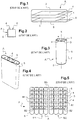
- FIG. figure 3 One of the types of cylindrical rigid case, usually manufactured for a high capacity Li-ion accumulator, is illustrated in FIG. figure 3 .
- a rigid box of prismatic shape is also shown in figure 4 .
- the housing 6 comprises a cylindrical lateral envelope 7, a bottom 8 at one end, a cover 9 at the other end, the bottom 8 and the cover 9 being joined to the casing 7.
- the cover 9 supports the poles or terminals of output of the current 4, 5.
- One of the output terminals (poles), for example the positive terminal 4 is soldered to the cover 9 while the other output terminal, for example the negative terminal 5, passes through the cover 9 with interposition of a not shown joint which electrically isolates the negative terminal 5 of the cover.
- the type of rigid case largely manufactured also consists of a stamped cup and a cover welded together on their periphery by laser.
- the current collectors comprise a bushing with a portion projecting from the top of the case and which forms a terminal also known as the apparent pole of the battery.
- the difficulty of producing such a terminal lies mainly in the assembly of the various components of the battery to have a robust design.
- the nature of the materials used is also important in order to be compatible with certain electrochemical couples.
- the Li-ion technology preferably requires the selection of the purest possible grade of aluminum inside the accumulator to avoid the presence of pollution and galvanic torque generation in the presence of the electrolyte may lead to corrosion.
- a battery pack P consists of a variable number of accumulators of up to several thousand which are electrically connected in series or in parallel with each other and generally by connection bars, usually called busbars.
- FIG. 5 An example of battery pack P is shown in figure 5 .
- This pack consists of two modules M1, M2 of identical Li-ion accumulators A and connected together in series, each module M1, M2 consisting of four rows of accumulators connected in parallel, each row consisting of a number equal to six Li-ion batteries.
- busbars B1 advantageously copper, each connecting a positive terminal 4 to a negative terminal 5.
- B2 busbar also advantageously copper.
- the connection between the two modules M1, M2 is provided by a busbar B3, also advantageously copper.
- a lithium electrochemical system whether at the cell, module or pack scale, produces exothermic reactions regardless of the given cycling profile.
- the optimal operation of the lithium ion accumulators is limited in a certain temperature range.
- An accumulator must control its temperature, typically generally less than 70 ° C to its outer surface of housing, to avoid starting thermal runaway which can be followed by gas generation and explosion and / or fire.
- maintaining a temperature of less than 70 ° C makes it possible to increase its service life, because the higher the operating temperature of a battery, the longer its service life will be reduced.
- the aging dispersions can be elevated as a function, for example, of the position of the accumulators, following aging dissymmetries between the accumulators or differences in uses ( thermal variations between the core and the edges of the pack, gradient of current ).
- SOH health condition deviations of the order of 20% between accumulators of the same pack can be observed.
- An accumulator (or accumulators) that ages (ages) faster than others can (may) have a direct impact on the electrical performance of the complete battery pack.
- the BMS (acronym for " Battery Management System ”) is used to monitor the status of different accumulators (state of charge, health status .9) and control the various elements of security, such currents must not be too high, unsuitable potentials (too high or too low), limiting temperatures and therefore has the particular function of stopping current applications as soon as threshold voltage values are reached, ie a potential difference between the two active insertion materials.
- the BMS therefore stops the current applications (charge, discharge) as soon as threshold voltages are reached.
- a battery pack usually requires a high-performance BMS to generate voltage balances.
- thermally balanced battery pack is also a necessity.
- the difficulty comes in ensuring the uniformity of temperature within a battery pack.
- the first category concerns solutions where a heat transfer fluid (gaseous or liquid) is circulated within a battery pack.
- the patent US5320190 proposes a circulation of air to cool a vehicle battery pack, either by directly using the air impacting the vehicle during taxiing, or by using a fan for the phases in parking or just after driving.
- the patent CN202259596U offers a battery pack that integrates air distributors.
- Coolant can be used instead of air. But the concepts of cost, bulk and additional mass can be predominant factors depending on the application considered.
- an air cooling is the least expensive solution since as indicated, it consists of forced air ventilation between the accumulators.
- the thermal performance of air cooling is of low quality because of the low exchange coefficient and its low thermal inertia.
- the first accumulator will heat up despite everything in contact with the air and the air temperature will increase.
- the second accumulator passes, the air is warmer and the accumulator is hotter than the first one. In the end, we thus obtain accumulators whose temperature is inhomogeneous.
- Liquid cooling solutions are significantly more efficient.
- patent applications WO2008 / 156737 and US2013 / 196184 propose a system of channels that each adhere to a part of the periphery of several cylindrical accumulators parallel to each other A heat transfer liquid flows inside these channels to drain the heat.
- the patent US8877366 relates to a liquid cooling solution flowing in external pipes which heat-cooled fins inserted between accumulators.
- the second category concerns the use of cold plates.
- the patent US8609268 thus discloses a cold plate system within which a refrigerant fluid flows, for draining the heat of accumulators in contact with the cold plate.
- the patent application WO2011 / 013997 proposes cooling fins arranged inside a stack of flat cells to drain the heat of the cells to a fluid flowing down the stack.
- the third category concerns cooling by phase change material.
- the patent application US2006 / 0073377 proposes to regulate the temperature of the cells which are embedded in the phase change material.
- the material is disposed within a rigid envelope that contains the electrochemical cells and fills the gaps between the adjacent cells.
- the improvement must not be at the expense of the need to control the operational safety of each accumulator, particularly due to a generation of gas and / or thermal runaway.
- the object of the invention is to meet at least part of these needs.
- the invention consists in defining a completely independent module with a tube which serves as a housing for a plurality of accumulators aligned one after the other, the accumulators being electrically connected to each other in series and fluidically by a common circuit. coolant that will flow continuously in the heart of the electrochemical bundles of all accumulators and / or in an outer casing defined by the housing tube, in contact with the battery boxes.
- the thermal of a complete battery pack can be managed in a modular manner by connecting in series or in fluidic parallel between them several battery modules which are further connected in series or in parallel electrical.
- the N accumulators can be divided into several modules M. If the N accumulators operate in the same way, it is advantageous to have the same flow within each of the M modules. If certain accumulators N operate differently and thus heat up more, it is also possible to regulate the flow rate of each of the M modules.
- the tank may be a closed double-walled tank, whose inner or outer wall is defined by the tube, the closed double wall being filled with a phase change material (PCM).
- PCM phase change material
- the circuit may comprise a double-walled conduit, whose inner or outer wall is defined by the tube, the double-wall being open at one of its ends by a fluid supply orifice and to the other of his ends by a fluid outlet, for circulating the coolant over the entire periphery of the battery packs, from the supply port to the outlet port.
- the module may comprise two sealed fluid connections each passing longitudinally inside one end of the double wall.
- each of the closure elements comprises an electrically conductive central part forming an electrical output terminal of the module and a peripheral part around its central part, electrically insulating.
- the double-walled duct may consist of two concentric tubes separate from the battery boxes, the inner tube being in direct contact with the side casings of the battery boxes.
- the inner wall of the double-walled conduit is delimited by the lateral envelopes of the battery packs, the outer wall being constituted by the tube.
- the module comprises centering means either between the inner tube and the outer tube, or between the lateral casings of the housings and the outer tube.
- the centering means may be constituted either by a plurality of fins or inserts distributed uniformly around the periphery of the inner tube or the lateral casings of the boxes, or by a helically shaped fin wrapped around the inner tube or around casings lateral casings, either by a foam filling homogeneously the volume between the inner tube and the outer tube or between the lateral casings of the boxes and the outer tube.
- electrical insulation means are provided between fins or foam and the inner tube.
- the invention also relates to a module (M) of accumulators according to the first alternative in combination with the second alternative.
- the invention also relates to a battery pack comprising a plurality of battery modules (M) described above, electrically connected in series or in parallel, with the plurality of coolant circuits fluidly connected in series or in parallel.
- M battery modules
- the system comprises a safety member for protecting the expansion tank from an overpressure caused by the gases of the accumulators.
- the safety member is preferably a valve, and / or a regulating member controllable by the Battery Pack Accumulator Control System (BMS).
- BMS Battery Pack Accumulator Control System
- the invention also relates to a battery or electrochemical accumulator metal-ion, for a tracking system as described above, comprising a gas permeable rupture membrane and impermeable to the coolant, the membrane being arranged and fixed in the accumulator for let the gases released by the accumulator outside the latter.
- the membrane is in the form of a disc sandwiched on the through hole by means of a metal crown welded to the electrically conductive part.
- the electrically conductive part is preferably a male piece protruding from the battery box.
- the male part may comprise, in its lower part, below the second diameter enlargement, a diameter reduction integrating the through hole on which the rupture membrane is fixed.
- the crossing can be achieved through the cover of the housing, which is preferably aluminum, such as aluminum 1050 or 3003.
- the rupture membrane is arranged in the void volume delimited between the cover and the current collector of the electrical connection between the terminal and the electrochemical cell of the accumulator.
- the annular groove is advantageously sized to achieve a fit with tight fit on the top of the battery box.
- the flange further comprises a plurality of spacer tabs distributed around the periphery of the annular wall, the tabs being adapted to ensure a fixed spacing with an outer tube in which the aligned accumulators are coaxially housed.
- the spacer tabs are uniformly distributed at a spacing pitch e5.
- the flange is shaped so as to leave an empty volume between the plane base which is applied against the housing cover of one of the two accumulators and the bottom of the case of the other accumulators.
- the part is made by injection of a plastic material, in particular a PA6-6 or a polyoxymethylene (POM).
- a plastic material in particular a PA6-6 or a polyoxymethylene (POM).
- the two accumulators are furthermore advantageously assembled together by means of the output terminal of one of the accumulators screwed to the hollow mandrel of the other of the accumulators, through the bottom of the latter.
- an electronic module supported by the base plane in the empty volume or integrated in the thickness of the base plate, the electronic module being adapted to monitor the electrical characteristics of one or the other of the accumulators.
- the electronic module is electrically powered on the one hand by a wire of a polarity, through the collar to electrically connect it to the battery cover on which the base plate of the flange rests and other by another power supply wire, of opposite polarity, for connecting electrically to a part of the output terminal of the accumulator.
- the invention also relates to a battery pack comprising one or a plurality of battery modules previously described and a battery pack monitoring system (BMS) to which all the accumulators are electrically connected by a configured electrical power circuit. such that the voltage increases of the electronic modules to the BMS are made by line carrier currents (CPL) on said circuit.
- BMS battery pack monitoring system
- CPL line carrier currents
- Each of the electronic modules can be electrically connected to another of the electronic modules through one or more electrical wires called redundancy.
- Each flange can advantageously integrate in its side wall a connection connection between two redundancy son, one being directly connected to an electronic module, the other being connected to another electronic module.
- the wire connected between the connector and the other electronic module is fixed, in particular by gluing, along the wall of the accumulator adjacent to that supporting the electronic module.
- the male part comprises an annular groove adapted to house an O-ring seal.
- the invention also relates to an accumulator module, comprising at least two accumulators described above, the accumulators being assembled together through the bushing forming an output terminal of one of the accumulators screwed to a hollow mandrel of the other of the accumulators, through the bottom of the latter.
- the bushing is preferably screwed into the hollow mandrel in a tightening torque of at least 3 N.m.
- the invention also relates to a battery pack comprising one or more battery modules as previously described.
- the terminal piece, the mandrel and the electrical insulating element are assembled together by a magnetic pulse welding process, or by gluing, or by shrinking, or brazing.
- the terminal piece comprises a thread intended to cooperate by screwing with another thread for fixing and the electrical output of the accumulator.
- the mandrel comprises a thread intended to cooperate by screwing with another thread for fixing and the electrical output of the accumulator.
- the mandrel is preferably aluminum, preferably 99.5% pure aluminum (1050A).
- the invention also relates to a metal-ion battery or accumulator comprising a sub-assembly which has just been described, the terminal piece of which constitutes a passage portion of the battery case cover, and whose mandrel passes through the bottom. of the case by being welded therein.
- the invention finally relates to an accumulator module, comprising at least two accumulators as above, the accumulators being assembled together through the bushing forming the output terminal of one of the accumulators screwed to the hollow mandrel of the other accumulators, through the bottom of the latter.
- the bushing is advantageously screwed into the hollow mandrel in a tightening torque of at least 3 N.m.
- the Figures 1 to 5 relate to different examples of Li-ion accumulator, boxes and bushings forming terminals and a battery pack according to the state of the art. These Figures 1 to 5 have already been commented on in the preamble and are therefore not more so below.
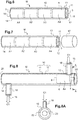
- the stack of accumulators A1-A4 aligned one after the other and interconnected in electrical series is housed in a double wall envelope 10.
- the illustrated A1-A4 accumulators are cylindrical.
- the double wall envelope 10 consists of two concentric tubes 11, 12, arranged coaxially around the accumulators.
- the space between the inner tube 11 and the outer tube 12 defines a volume of coolant over the entire periphery of the battery boxes.
- the envelope 10 may constitute a closed double-walled reservoir 11, 12 filled with a solid-liquid phase change material (PCM). It is thus possible to generate a constant liquid temperature over the entire length of the envelope 10, and therefore on all the heights of the accumulators A1-A4.
- PCM solid-liquid phase change material
- the casing 10 may be a double-walled duct opening at one of its ends 13 via a heat transfer fluid supply port 15 and at the other of its ends 14 by an outlet port 16 of the fluid.
- a coolant C1 over the entire periphery of the battery packs, from the supply port 15 to the outlet port 16.
- One or more compression elements such as springs or blades, can be arranged inside the inner tube 11 and at one or both ends 13, 14 of the tube 11 to ensure the longitudinal positioning of the assembly inside the tube while ensuring the electrical insulation vis-à-vis the tube must remain at a neutral potential, that is to say different from the positive pole of the housing or the negative pole of the terminal crossing the cover.
- the inner tube can be either a separate tube 11 of the battery packs 6 or be delimited by the side casings of the boxes 6. In other words, when it is a separate tube 11, the accumulators A1-A4 are fitted inside it, preferably with direct contact.
- the lateral casings of aligned battery packs A1-A4 may delimit the inner tube 11.
- This variant of embodiment makes it possible to eliminate an inner tube and thus to reduce the thermal resistance between the coolant and the accumulators A1-A4. which consequently generates better heat exchanges.
- the series electrical connection is advantageously made by an output terminal 5 which protrudes from the housing 6 of an accumulator, with the bottom 8 of the housing 6 of an adjacent accumulator and the electrical output of the module M is made of a part through the output terminal 5 of the accumulator A4 at one end 13 and the bottom of the accumulator A1 at the other end 14.
- An advantageous embodiment of the output terminal 5 according to the invention is described more far.
- the coolant supply which is a refrigerant (liquid or gas or refrigerant) when it is desired to cool the accumulators A1-A4 in operation, can be done directly with hoses or other that we handle and that the fixed at the ends 13, 14 of the module. Fixing can be ensured by screwing, welding or brazing.
- FIG. figure 7 An example of a sleeve 17 sealing connection for a dielectric fluid is shown in FIG. figure 7 .
- This sealing connection sleeve 17 extends longitudinally through the inside of one end 13 of the double wall 11, 12.
- sleeves which each relate to a fluid manifold 18, 19 laterally through one end 13, 14 of the double-wall.
- two sealing elements 20, 21 seal each closing longitudinally one end 13, 14 of the double wall.
- the closure element 20 may also directly constitute one of the two output terminals of the module M. In this case, it should be electrically insulated tubes 11, 12. To do this, as shown in Figs 8 and 8A, a block of insulating material 22 is arranged around the terminal 5 and the closure element 20. A similar insulating block, not shown, is arranged at the other end of the module.
- a second alternative according to the invention for managing the thermal of a module M consists in circulating a coolant in all of the accumulator cores A1-A4.
- the two heat transfer fluid circuits are independent within the same module M, one can therefore use one or the other or combine them, that is to say have a circulation of coolant over the entire periphery of the battery boxes 6 and a complementary circulation of coolant in the heart of the accumulators.
- the invention therefore allows to have a combined circulation of a coolant C1 at the periphery of the A1-A4 accumulators with a heat transfer fluid C2 in the heart of A1-A4 accumulators.
- the heat transfer fluids C1 and C2 may be the same fluid or be distinct. Depending on the geometry and / or the chemistry of the electrochemical cells, one can thus choose a fluid C1 with thermal or dielectric characteristics, different from those of the fluid C2.
- the circulation of the fluid C1 may be co-current with that of C2 or in the opposite direction of flow, that is to say against the flow of C2.
- This counter-current circulation can make the temperature of the A1-A4 accumulators of the same module even more homogeneous.
- a double-walled duct 10 therefore consists of an inner tube 11 filled with A1-A4 accumulators in contact with its inner wall, or delimited by the lateral casings of the housings 6 and a tube 12 outer concentric to the inner tube 11, 6.
- the annular space E between inner tube 11 and outer tube 12 thus defines the passage section of the heat transfer fluid C1.
- the annular space E may advantageously vary between 1 mm and 20 mm, depending on the size and power of the accumulators.
- the centering means may consist of fins or inserts 23 of straight shape, fixed on at least one of the two tubes 11, 12 which extend along the axis of the tubes being distributed uniformly angularly as shown in FIG. figure 11 .
- These fins or inserts 23 also have the advantage of being able to increase the exchange surface with the coolant C1 which will circulate in the annular space E.
- a constituent material of the fins 23 which is a good thermal conductor (Aluminum, copper, ...), it may be possible to multiply the exchange surface between the fluid C1 and the inner tube 11 by a factor of about 1 to 5, and thus reduce the temperature difference between the fluid C and the accumulators A1-A4 of the same factor.
- the figure 12 shows an alternative embodiment in which a single helical fin 24 is crimped around the inner tube 6, 11.
- This helical fin 24 allows also to increase the exchange surface and intensify the heat exchange, because of the propeller 24 which further allows a rotation of the heat transfer fluid.
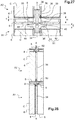
- this exchanger 25 a bundle of modules (M1, M2, M3, M4 ...) of accumulators is housed in a sealed hollow body forming a shell 26 which will act as an external wall for guiding the heat transfer fluid while the inner wall is provided for each module (M) by a single tube 11 within which are housed the accumulators aligned and electrically connected in series. With such an exchanger 25, there is no longer any peripheral flow in a double wall 10 and the heat transfer fluid travels outside the tubes 11.
- the exchanger 25 comprises two retaining tubular plates 27 each pierced with a plurality of orifices 28 parallel to each other.
- the number of orifices is equal to that of the plurality of tubes 11 of the modules (M) of accumulators.
- each tube 11 is engaged in a holding hole 28 of a tubular plate 27 being sealed to the latter.
- the calender 26 is sealingly secured around the tube plates 27 to delimit the coolant circuit.
- the calender 26 comprises at one of its ends a supply port 30 of heat transfer fluid and at the other of its ends an outlet 31 of fluid.
- baffles 32 are arranged inside the calender 26 for guiding the flow of the heat transfer fluid C1.
- the baffles 32 consist of plates extending transversely to the tubes 11 and parallel to the end tube plates 27, being regularly spaced along the tubes and closing a portion of the cross section of the shell, to guide the coolant around the tubes 11 of the accumulator modules (M1, ... M4).
- the baffles then also make it possible to support the mass of the tubes 11 filled with accumulators (A1-A4) and thus avoid the bending of the tubes 11 under the weight of the accumulators.
- two electrical collectors 29 make it possible to house a plurality of electrical connections connected to the plurality of battery modules M1-M4 for electrically connecting all these modules together.
- the exchanger 25 with a circulation in the heart of each of the A1-A4 accumulators of the M1-M4 modules, the electrical collectors 29 also playing the role of fluidic collector.
- the exchanger 25 cooled by the coolant C around the accumulators A1-A4 of each module and possibly in the heart of each of them, constitutes in itself, once the electrical connections in series or in parallel between the different modules M1 to M4, a battery pack.
- An accumulator module M formed according to the invention constitutes an autonomous assembly with a number of accumulators X in series which can be easily manipulated, set up where it is desired to connect fluidically and electrically with other modules. accumulators according to the invention.
- the M modules are combined in series or in fluidic parallel.
- the fluid heats up as and when and can then have temperature differences between the first and the last accumulator of the same module.
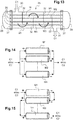
- the figure 14 illustrates a battery pack configuration P according to which the circulation of the heat transfer fluid C1 and / or C2 is ensured in parallel between all the modules M1, M2 ... Mn while they are connected in electrical series with each other.
- the figure 15 illustrates a battery pack configuration P according to which the circulation of the heat transfer fluid C1 and / or C2 is ensured in series between all the modules M1, M2 ... Mn while they are connected in electrical parallel with each other.
- a circulation of heat transfer fluid only in series has the advantage of not causing a problem in the fluid distribution since all the accumulators are in contact with the same flow of fluid, unless the fluid is heated along the flow.
- one solution is to connect them by connecting a terminal 5 in the center of the cover 9 of a battery box to the terminal opposite 4 located on the bottom 8 of the housing of an adjacent battery.
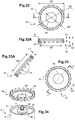
- a subassembly 33 is shown with its components 5, 34, 43 in Figures 16 to 23 .
- FIGS. 16 and 17 show the inside of an accumulator A which integrates within it such a subset 33.
- the hollow mandrel 34 retains its primary function and supports the electrochemical cell C which is wound around during its winding.
- the diameter of the mandrel 34 thus respects the winding conditions of a cell C in order to generate the desired electrochemical performances of the accumulator.
- the end 35 of the mandrel 34 opposite that in connection with the terminal 5, comprises a thread 35.
- the threaded mandrel 34 and the bottom 8 of the housing 6 therefore constitute the Another terminal 4 of the accumulator, typically the positive terminal in the case of a Li-ion accumulator.
- Part 5 hollow at its center, which forms a male part of the output terminal is shown alone in figure 18 . It first comprises in its upper part a thread 36 adapted to cooperate with the thread 35 of the mandrel 34 of an adjacent accumulator to achieve the electrical and mechanical connection between two accumulators.
- a groove 37 is formed below the thread 36, in order to accommodate a seal 38, for example PTFE.
- the part 5 comprises a first enlargement of diameter 39 which serves as a crimping diameter of a female part 50 of the output terminal as described below, and a second enlargement of diameter 40 in the continuity of the first which serves as a surface both of support with an electric insulation washer and connection surface to a current collector which makes the electrical connection with the cell as described below.
- the part 5 comprises two diameter reductions 41, 42 whose end of which is adapted to be fitted inside the mandrel 34.
- the terminal 4 constituted by the hollow mandrel 34 , typically the positive terminal, of the hollow terminal piece 5, typically the negative terminal.
- the hollow subassembly 33 comprises a mechanical connection and electrical insulation piece 43 shown in detail in FIG. figure 19 .
- flange 44 In its upper part a flange 44 and in its lower part a cylinder 45.
- the dimensioning of the parts and their positioning are chosen so that the flange 44 extends above the base 52 of current collector 51 described by the after.
- this connecting piece 43 is made of electrically insulating material, it is necessary to guarantee a mechanically robust and perfectly sealed assembly of this piece 43 with the terminal piece 5 and the mandrel 34 both made of electrically conductive material.
- Magnetic Pulse Welding is a method based on the use of electromagnetic forces for welding parts together.
- Such a method consists in arranging the various parts to be welded in an induction coil but without contact therewith.
- a very large amount of electrical energy is released in a very short period of time.
- the high energy flow passes through the coil and this current discharge induces eddy currents in the external part to be welded.
- These two currents create a magnetic field.
- the repulsion between the two magnetic fields develops a force which gives a very great acceleration to the external part to be welded towards the inner part.
- Such a force pushes the atoms of materials against each other so that a metal assembly is obtained between inner and outer parts.
- the magnetic pulse welding process is a cold welding process, in which the materials to be welded do not reach more than 30 ° C, no area of the parts is affected thermally and the material does not lose its properties . This means that after welding, the parts can be immediately unblocked and implemented. The absence of heat during the welding cycle makes it possible to assemble materials having a very different melting point. In addition, during the magnetic pulse welding cycle, the metal of a workpiece is not melted. Finally, a magnetic pulse weld is stronger than the weakest base metal.
- a hollow subassembly 33 produced by a magnetic pulse welding process, guarantees on the one hand the perfect seal between the electrolyte present in the accumulator and the coolant that will circulate inside the subassembly and on the other hand the perfect electrical insulation between the polarities of the battery between the cover and the bottom.
- the male part 5, preferably made by one-piece machining may be aluminum or copper. More preferably, the material is pure copper (CuA1.) For corrosion reasons, a nickel-based surface treatment can be deposited on the surface, the enlargements of diameter 39, 40 can be reported on the machined part 5. Laser welding or shrinking in order to reduce the cost of machining / material Finally, the height of the part 5 is optimized, so as not to machine great length but also in order to reduce material costs.
- the hollow mandrel 34 is preferably aluminum. More preferably, the material is 99.5% pure aluminum (1050A) which is usually the material of the bucket 7 and the bottom 8 of a battery box 6. This makes it possible to have the best chemical compatibility for the welding, in particular by laser, between the mandrel 34 and the bottom 8.
- the electrical insulation part and mechanical connection 43 is preferably rigid plastic with very good chemical inertia, and preferably made by machining or injection.
- the part 43 is preferably polypropylene (PP) or polyetherimide (PEI), which have the advantage of being resistant with the usual electrolytes of accumulators and an oil as heat transfer fluid while having good mechanical characteristics at the deformation.
- the piece 43 may undergo a coating treatment, for example with a mixture of ferrite and insulating resin, in order to make it ferromagnetic to apply the solder while remaining insulating from a current flow point of view.
- a male copper terminal piece 5 can be sized with a g6-type fit on its 41 mm diameter reduction 41 and an aluminum 5 mm ID mandrel 34 with an H7-type fit to allow a tight fitting between the three parts 5, 34, 43 which is possible to perform by hand.
- the hollow subassembly 33 internally defines a continuous and sealed passage of the coolant C2 over the entire height of the accumulator.
- the interior of the diameter reduction portion 41 at the end thereof is provided with a chamfer 46.
- the chamfer 46 is 1 mm in height. , with an inclination of 45 °.
- the crossing is made through an opening 47 opening on either side of a cover 9 of a battery box A.
- the crossing first comprises two washers 48, 49 identical electrically insulating. These two insulating washers 48, 49 have the function of ensuring the tightness with respect to the electrolyte within the accumulator on which the crossing is made, vis-à-vis the outside of the cover 9. In addition, they ensure the electrical insulation between the room male 5 of the terminal and the cover 9.
- each washer has a bearing portion and a guide portion projecting from the bearing portion.
- the bearing portion of the upper washer is in surface abutment with pressure against the upper face of the lid 9 and its guide portion is in contact with the edge of the orifice 47 of the lid 7.
- the portion of support of the lower washer 49 is in surface bearing with pressure against the underside of the lid 7 and its guide portion is in contact against the edge of the orifice 47 of the lid 7.
- the electrically conductive male piece 5 is fitted tight by its diameter enlargement 39 in a female annular piece 50, opening at its center, which is also conductive.
- the female annular piece 50 is thus crimped around the enlarged diameter 39 of the male part 5 and pressed against the upper insulating washer 48.
- the various dimensions of the terminal components are such that, in this assembled configuration, the thread 36 in the upper part of the male part 5 protrudes beyond the female part 50 and the O-ring seal 38 is interposed between them.
- this female part 50 by its annular surface makes it possible to ensure the electrical connection between the terminal 5, 50, typically at the negative pole, of an accumulator A2 and the bottom 8 of the housing 6 of the adjacent accumulator A1 to the positive pole by a dish ensuring the section of passage to strong currents.
- the threading 36 serves for its connection between the output terminal of a battery A2 with the bottom 8 of housing 6 of an adjacent battery A2. More specifically, the thread 36 which cooperates by screwing with the thread 35 of a hollow mandrel 34 makes it possible to guarantee a high level of tightening, typically of the order of 3N / m between two adjacent accumulators A1, A2, and therefore a resistance less contact, of the order of 12 to 15 mohm.
- the O-ring 38 thus seals the heat transfer fluid C2 at this threaded junction 35, 36, the tightening of the seal being controlled by the adjustment between the bottom of the groove 37 and the inside diameter of the hollow mandrel 34.
- the crimping pressure generates a compression along the axis X of the crossing which is the central axis of the accumulator.
- the inventors have carried out various crimping tests by increasing the thickness E of the base of the male part 5 of the terminal according to the invention.
- This base is formed by the enlargement of diameter 40.
- the value of the thickness E of the base 40 is all the more important that the bore diameter 39 is high because the larger the diameter and the greater the crimping force must be important.
- the term "robust mechanical connection” means a link which makes it possible to satisfy the required specifications, in terms of the mechanical strength of this type of terminal which constitutes a terminal or output terminal of an accumulator, that is to say a tensile strength, a resistance to a tightening torque, a vibration resistance, a resistance to mechanical shocks, resistance to temperature variations (-40 ° C / + 75 ° C), ...
- this weld bead S protects against the heating of the threading 36 of the male part, under the passage of strong currents which could lead to a degradation of the axial clamping of the washers 48, 49, because of a beginning of sliding of the female part 50 on the axis of the male part 5.
- the female part 50 may be in a grade of aluminum 5754 or copper or nickel-plated copper.
- Aluminum 5754 has the advantages of having very good mechanical characteristics and remains intact when pressure is applied to its surface, especially during crimping according to the invention.
- the nickel-plated copper is advantageously of the same nature as that defined for a conventional copper negative terminal, which makes it possible to maintain an identical interface for a user.
- the male part 5 is preferably made of nickel-plated copper because it is compatible with the materials constituting the electrochemical core of a Li-ion accumulator (chemistry of the electrode materials, LiPF6-based electrolyte, etc.). But, as already mentioned, the male piece can just as well be aluminum.
- the insulating washers 48, 49 are advantageously made of polyetherimide (PEI).
- the sizing of the different parts of the output terminal, and in particular the height H1 of the female part 50 ensures a minimum separation distance d between two adjacent battery packs A1, A2.
- this distance d is at least 1 mm, preferably between 1 and 5 mm.
- a metal current collector 51 is provided illustrated as such in figure 29 .
- This current collector 51 comprises a flat base 52 which is welded to the top of the electrochemical bundle C to the metal strip supporting the active material of the electrode and a tongue 53 folded on itself and welded to the enlargement of diameter 40 of the male part 5 of the terminal.
- This base 52 and tongue 53 thus ensure the electrical continuity between the electrode and the output terminal of given polarity.
- a cooling / heating circulation mode consists of coming to make a circulation of the coolant on the periphery of the A1-A4 accumulators within the same module, with a direct contact on the side casings of their housings, that is to say, by dispensing with an additional inner tube 11.
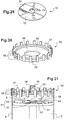
- This interface piece 54 forming a flange is shown as such in figure 30 . It comprises firstly a flat base 55 pierced with a through opening 56 whose diameter is adapted to that of the female part 50 which is housed therein.
- the planar base 55 is surrounded by an annular wall 57 which comprises a plurality of spacer tabs 58 distributed uniformly around the periphery of the annular wall 57 at a spacing pitch e5.
- These tabs 58 have the function of ensuring a spacer, that is to say to ensure a fixed spacing with an outer tube 12 in which are housed accumulators A1-A4 assembled together of a single module M.
- the lateral wall 57 is further shaped to delimit an annular groove 59 of shape complementary to that of the top of a battery box 6, that is to say complementary to the upper shape of the lateral envelope 7 and the lid 9 which is welded to it.
- an interface piece or flange 54 is adapted to come and go by its annular groove 59 on the inside rim of the cover 9 of the housing 6 and the top of its lateral envelope 7.
- This fitting can be done manually and the dimensions of the flange 54 advantageously allow a clamping assembly.
- the clamping obtained with the flange 54 according to the dimensions indicated in the table is 0.2 to 0.25 mm for the minimum dimension of cover , or from 0 to 0.05 mm for the maximum side of the lid.
- the flange 54 can advantageously be made by injection of a plastic, in particular a PA6-6 or a polyoxymethylene (POM) such as that marketed under the brand Delrin. .
- a plastic in particular a PA6-6 or a polyoxymethylene (POM) such as that marketed under the brand Delrin.
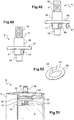
- the figures 34 and 35 show the collar 54 respectively before and once its implementation with clamping performed on a battery box 6.
- the flange 54 guides the adjacent battery A2, during the electrical connection between terminal 5 and hollow mandrel 34. The guidance is therefore via this flange 54 and the outer periphery bottom 8 of the battery box.
- the figures 36 and 37 show the outside of a part of a module M with the accumulators A1-A4 electrically connected together, assembled by their terminals 5 and hollow mandrel 34, and guided and spaced from each other by the collars 54 arranged individually between them .
- this assembly is in turn inserted into a tube 12 which will constitute the outer tube of the double-walled conduit 10 for the circulation of the coolant C1 at the periphery of the accumulators, the double-wall being delimited internally by the lateral envelopes of the housings 6 accumulators.
- the guiding of the accumulators A1-A4 is ensured by the outer diameter of the flange 54, that is to say by the external diameter ⁇ 1 of the spacer tabs 58.
- this inner diameter is also dimensioned as a function of the outside diameter of the flange 54 and the thicknesses of the legs spacer 58, so as to control the pressure drop of the heat transfer fluid while ensuring to block the accumulators and in particular withstand vibration stresses.
- the additional function of the flange 54 which has just been described is to electrically isolate the accumulators A1-A2 from each other during and, once the connection is made via the output terminal 5.
- the figure 39 illustrates well this function where it is clearly seen that by the shape of the flange 54, any contact between two adjacent battery packs 6, and more particularly between the cover 9 of one and the bottom 8 of the other is proscribed.
- each electronic module 60 or microcontroller may comprise at least one memory, a communication module adapted to receive and / or transmit data from and / or to the outside of each accumulator and a processor adapted to receive and / or transmit at least data from and / or to the communication module.
- the inventors have therefore thought to use the base 55 of the flange 54 as a support for an electronic module 60, as shown in FIG. Figures 41A and 41B .
- the electronic module 60 can be fixed by gluing or other means on the base 55.
- the power supply of an electronic module 60 is advantageously provided by the terminals of an accumulator. As shown in Figures 41B it is thus possible to pass a power supply wire 61 of a polarity through the flange 54 to electrically connect it to the cover and another power supply wire 62, of opposite polarity to electrically connect it to the female part 50 from the terminal.
- the power supply son 61, 62 autonomously power the electronic module 60 by the current delivered by the accumulator.
- the figure 42 shows a variant according to which the electronic module 60 is embedded by thermoforming in the thickness of the base 55 of the flange 54.
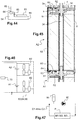
- the figure 43 shows the equivalent circuit diagram of a module M of A1-A2 accumulators connected to a BMS 70, and each supplying an electronic module 60.
- the voltage increases of the electronic modules 60 to the BMS are by CPL power line on the circuit A1-A2 accumulators.
- a variant of this embodiment consists in connecting all the electronic modules 60 to each other so that the BMS 70 can communicate directly with these electronics, in order to have a physical redundancy on the rise of the voltages.
- connection wires 64, 65 between modules 60.
- a first connecting wire 64 is connected from the module 60 to a connector 64 arranged in the thickness of the outer edge 57 of the flange 54 and then a second connecting wire 65 is preferably fixed by gluing to the lateral envelope 7 of the housing 6 of the accumulator, in order to connect each of the connections on the flanges 54.
- connection son 64, 65 is introduced that very little or no additional pressure drop in the heat transfer fluid C1.
- the figure 46 shows the equivalent electrical diagram with the redundancy by wires 63, 65 and connectors 64.
- a permanently operating pump 80 continuously supplies the coolant circuit C1 and / or C2 during the operation of a module M1 or a battery pack P consisting of a plurality of modules M1, M2, M3.
- An expansion tank 90 is implanted on this circuit.
- the gases generated in the coolant circuit are recovered from the sky of the expansion tank 90.
- a safety member may be provided to protect the expansion vessel from an overpressure in the gas head, in particular a valve, and / or a control element controllable by the BMS.
- the male part 5 is pierced at its diameter reduction 41 of a through hole 66 which meets the interior of the room.
- This rupture membrane 67 is gas permeable and impermeable and compatible with a coolant.
- An advantageous type of membrane is described in the patent application WO 1996/016288 A1 .
- the vent may consist of a membrane in the form of a disc 67 of gas-permeable material and impermeable to the cooling fluid, typically according to the application WO 1996/016288 A1 and a metal ring 68 welded to the workpiece 5 and sandwiching the membrane 67 on the through hole 66.
- the membrane 67 is arranged on the male part 5 of the terminal of the accumulator, so that it is in the empty volume of the latter, that is to say above the base 52 of the collector 51 , where gases form during electrochemical operation.
- this membrane 67 is also a safety vent, in case of overpressure of gas. Indeed, in this case, the rupture lines 69 made in the membrane 67 break and the latter tears.
- the breaking value can be set at a maximum gas pressure value of the order of 12 bar.
- the overpressure gases arrive in the sky of the expansion vessel and the tripping threshold is exceeded, which leads to the opening of the electrical circuit in series, either of the module concerned, or of the entire battery pack.
- the inventors have carried out calculations with thermal simulation to highlight the relevance of the various types of cooling / reheating according to the invention.
- the format chosen for the accumulators is the format 50125, that is to say a diameter of 50 mm and a height of 125 mm.
- the simulated accumulator according to the invention has a hollow mandrel, that is to say a perforated accumulator over the entire height of its central axis, with an outside diameter of 9 mm and an internal diameter of 7 mm.
- the accumulator has a hollow mandrel in which the air is trapped without real cooling effect given the small volume.
- the illustrated A1-A4 accumulators are of cylindrical format, it is conceivable to achieve all the features of the invention with prismatic format accumulators.
- coolant fluid can also be a heating fluid for preheating the accumulators or for a permanent temperature maintenance of the accumulators. This may be of interest for certain cell chemistries that typically require an operating temperature well above ambient temperature.
- the magnetic pulse welding process has been described for welding between the electrical insulating part 43 and the male part 5 of a terminal and on the other hand the mandrel 34 which forms the terminal of opposite polarity. It is quite possible to envisage other joining techniques between these different parts 5, 34, 43 such as hooping and / or gluing.
Landscapes
- Chemical & Material Sciences (AREA)
- Chemical Kinetics & Catalysis (AREA)
- Electrochemistry (AREA)
- General Chemical & Material Sciences (AREA)
- Engineering & Computer Science (AREA)
- Manufacturing & Machinery (AREA)
- Materials Engineering (AREA)
- Inorganic Chemistry (AREA)
- Sealing Battery Cases Or Jackets (AREA)
- Battery Mounting, Suspending (AREA)
- Connection Of Batteries Or Terminals (AREA)
- Secondary Cells (AREA)
- Battery Electrode And Active Subsutance (AREA)
Applications Claiming Priority (1)
| Application Number | Priority Date | Filing Date | Title |
|---|---|---|---|
| FR1762152A FR3075477B1 (fr) | 2017-12-14 | 2017-12-14 | Traversee formant borne pour accumulateur electrochimique metal-ion, accumulateur associe |
Publications (2)
| Publication Number | Publication Date |
|---|---|
| EP3499603A1 true EP3499603A1 (de) | 2019-06-19 |
| EP3499603B1 EP3499603B1 (de) | 2020-02-12 |
Family
ID=62143263
Family Applications (1)
| Application Number | Title | Priority Date | Filing Date |
|---|---|---|---|
| EP18212072.5A Active EP3499603B1 (de) | 2017-12-14 | 2018-12-12 | Querleiste, die als klemmenleiste für elektrochemischen metallionen-akku dient, und entsprechender akku |
Country Status (4)
| Country | Link |
|---|---|
| EP (1) | EP3499603B1 (de) |
| JP (1) | JP2019110122A (de) |
| KR (1) | KR20190072482A (de) |
| FR (1) | FR3075477B1 (de) |
Cited By (7)
| Publication number | Priority date | Publication date | Assignee | Title |
|---|---|---|---|---|
| DE102019118160A1 (de) * | 2019-07-04 | 2021-01-07 | F.E.R. Fischer Edelstahlrohre Gmbh | Zelle mit elektrischem Energiespeicher und Gehäuse |
| DE102019118162A1 (de) * | 2019-07-04 | 2021-01-07 | F.E.R. Fischer Edelstahlrohre Gmbh | Zellverbinder für Zellen und Zellmodule und Batteriemodule mit Zellen |
| CN112582731A (zh) * | 2019-09-30 | 2021-03-30 | 比亚迪股份有限公司 | 电池模组 |
| CN112803087A (zh) * | 2020-12-17 | 2021-05-14 | 上海第二工业大学 | 一种锂电池回收储存装置 |
| CN115663342A (zh) * | 2022-11-03 | 2023-01-31 | 星恒电源(滁州)有限公司 | 一种圆环型锂离子电池 |
| CN116315473A (zh) * | 2022-12-30 | 2023-06-23 | 广汽埃安新能源汽车股份有限公司 | 电池单体、动力电池及用电设备 |
| US20240421406A1 (en) * | 2023-06-14 | 2024-12-19 | Volkswagen Aktiengesellschaft | Devices systems and methods for vehicle power storage |
Families Citing this family (3)
| Publication number | Priority date | Publication date | Assignee | Title |
|---|---|---|---|---|
| CN112054269B (zh) * | 2020-09-28 | 2025-02-07 | 广东广特新能源有限公司 | 一种电池单体及电池组 |
| DE212020000648U1 (de) * | 2020-09-28 | 2022-01-24 | Zhongshan Wan Energy Technology Co., Ltd | Batterieelement und Batteriepack |
| EP4572000A4 (de) * | 2022-11-08 | 2025-12-31 | Lg Energy Solution Ltd | Batterie und batteriepack sowie fahrzeug damit |
Citations (4)
| Publication number | Priority date | Publication date | Assignee | Title |
|---|---|---|---|---|
| JP2002231298A (ja) * | 2001-02-02 | 2002-08-16 | Mitsubishi Materials Corp | 電池及びこれを用いた組電池 |
| EP2101336A1 (de) * | 2008-03-14 | 2009-09-16 | Peugeot Citroën Automobiles Société Anonyme | Vorrichtung zur Speicherung elektrischer Energie und eine Zusammenschaltung solcher Vorrichtungen |
| WO2012115131A1 (ja) * | 2011-02-24 | 2012-08-30 | 新神戸電機株式会社 | 二次電池及びリチウムイオン電池 |
| US20150118547A1 (en) * | 2012-04-24 | 2015-04-30 | Commissariat A L'energie Atomique Et Aux Energies Alternatives | Bushing Forming a Terminal for a Lithium Storage Battery and Related Storage Battery |
Family Cites Families (3)
| Publication number | Priority date | Publication date | Assignee | Title |
|---|---|---|---|---|
| JP3759564B2 (ja) * | 1998-09-02 | 2006-03-29 | 三洋電機株式会社 | リチウム二次電池 |
| JP4356314B2 (ja) * | 2002-12-20 | 2009-11-04 | パナソニック株式会社 | 電池及び組電池 |
| DE102011105040A1 (de) * | 2011-05-06 | 2012-11-08 | Klaus Ebert | Lithiumsenkundärzellenanordnung |
-
2017
- 2017-12-14 FR FR1762152A patent/FR3075477B1/fr active Active
-
2018
- 2018-12-12 EP EP18212072.5A patent/EP3499603B1/de active Active
- 2018-12-13 JP JP2018233406A patent/JP2019110122A/ja active Pending
- 2018-12-14 KR KR1020180162485A patent/KR20190072482A/ko not_active Abandoned
Patent Citations (4)
| Publication number | Priority date | Publication date | Assignee | Title |
|---|---|---|---|---|
| JP2002231298A (ja) * | 2001-02-02 | 2002-08-16 | Mitsubishi Materials Corp | 電池及びこれを用いた組電池 |
| EP2101336A1 (de) * | 2008-03-14 | 2009-09-16 | Peugeot Citroën Automobiles Société Anonyme | Vorrichtung zur Speicherung elektrischer Energie und eine Zusammenschaltung solcher Vorrichtungen |
| WO2012115131A1 (ja) * | 2011-02-24 | 2012-08-30 | 新神戸電機株式会社 | 二次電池及びリチウムイオン電池 |
| US20150118547A1 (en) * | 2012-04-24 | 2015-04-30 | Commissariat A L'energie Atomique Et Aux Energies Alternatives | Bushing Forming a Terminal for a Lithium Storage Battery and Related Storage Battery |
Cited By (10)
| Publication number | Priority date | Publication date | Assignee | Title |
|---|---|---|---|---|
| DE102019118160A1 (de) * | 2019-07-04 | 2021-01-07 | F.E.R. Fischer Edelstahlrohre Gmbh | Zelle mit elektrischem Energiespeicher und Gehäuse |
| DE102019118162A1 (de) * | 2019-07-04 | 2021-01-07 | F.E.R. Fischer Edelstahlrohre Gmbh | Zellverbinder für Zellen und Zellmodule und Batteriemodule mit Zellen |
| EP3994758A1 (de) * | 2019-07-04 | 2022-05-11 | F.E.R. Fischer Edelstahlrohre GmbH | Zelle mit elektrischem energiespeicher und gehäuse |
| CN112582731A (zh) * | 2019-09-30 | 2021-03-30 | 比亚迪股份有限公司 | 电池模组 |
| CN112582731B (zh) * | 2019-09-30 | 2022-09-09 | 比亚迪股份有限公司 | 电池模组 |
| CN112803087A (zh) * | 2020-12-17 | 2021-05-14 | 上海第二工业大学 | 一种锂电池回收储存装置 |
| CN112803087B (zh) * | 2020-12-17 | 2022-11-15 | 上海第二工业大学 | 一种锂电池回收储存装置 |
| CN115663342A (zh) * | 2022-11-03 | 2023-01-31 | 星恒电源(滁州)有限公司 | 一种圆环型锂离子电池 |
| CN116315473A (zh) * | 2022-12-30 | 2023-06-23 | 广汽埃安新能源汽车股份有限公司 | 电池单体、动力电池及用电设备 |
| US20240421406A1 (en) * | 2023-06-14 | 2024-12-19 | Volkswagen Aktiengesellschaft | Devices systems and methods for vehicle power storage |
Also Published As
| Publication number | Publication date |
|---|---|
| FR3075477B1 (fr) | 2021-07-30 |
| JP2019110122A (ja) | 2019-07-04 |
| EP3499603B1 (de) | 2020-02-12 |
| FR3075477A1 (fr) | 2019-06-21 |
| KR20190072482A (ko) | 2019-06-25 |
Similar Documents
| Publication | Publication Date | Title |
|---|---|---|
| EP3499602B1 (de) | System zur nachverfolgung von gasen in einem batteriepaket, entsprechender elektrochemischer metallionen-akku, der eine klemmenbildende querleiste zur integration einer sicherheitsentlüftung für das nachverfolgungssystem umfasst | |
| EP3499603B1 (de) | Querleiste, die als klemmenleiste für elektrochemischen metallionen-akku dient, und entsprechender akku | |
| EP3499606B1 (de) | Mechanisches schnittstellenelement, das auch zur elektrischen isolierung zwischen zwei elektrochemischen metallionen-akkus dient, die auf ihrer längsachse in reihe geschaltet sind, und entsprechendes akku-modul | |
| EP3499608B1 (de) | Untereinheit, die einen hohldorn und einen teil einer hohlen querleiste umfasst, die als klemmenleiste für einen elektrochemischen metallionen-akku dient, und entsprechender akku | |
| FR3085803A1 (fr) | Pack-batterie d'accumulateurs, comprenant des shunts magnetiques actionnables sur demande pour la commutation electrique d'un ou plusieurs des accumulateurs | |
| EP3764423A1 (de) | Busbar für batteriepaket, der zur elektrischen verbindung mindestens eines akkus des pakets bestimmt ist sowie zur zirkulation einer wärmeübertragungsflüssigkeit in seinem innern für die optimale kühlung des akkus und des batteriepakets, insbesondere im falle von thermischem durchgehen | |
| EP4002572A1 (de) | Metall-ionen-akku mit entgasungsleitung, batteriemodul oder entsprechender batteriepack mit flüssigkeitskühlung | |
| WO2014167504A1 (fr) | Accumulateur électrochimique au lithium avec boîtier a dissipation thermique améliorée, pack-batterie et procédés de réalisation associés | |
| FR3085794A1 (fr) | Pack-batterie d'accumulateurs electrochimiques comprenant des dispositifs de deconnexion magnetique passive entre les accumulateurs et des busbars, et le cas echeant de shunt passif d'un ou plusieurs accumulateurs en cas de defaillance d'un de ceux-ci | |
| EP3179532B1 (de) | Dichter querträger vom typ glas-metall, seine verwendung für elektrochemischen lithiumakkumulator und entsprechendes herstellungsverfahren | |
| FR3091789A1 (fr) | Pack-batterie comprenant une pluralite d’accumulateurs relies electriquement entre eux et un systeme de circulation de fluide dielectrique assurant a la fois le refroidissement des accumulateurs et leur serrage | |
| FR3085793A1 (fr) | Procede d'assemblage d'un pack-batterie d'accumulateurs electrochimiques a des busbars par verrouillage magnetique | |
| FR3085804A1 (fr) | Adaptateur d'interface a fixer autour d'une borne d'accumulateur electrochimique, integrant au moins un verrou magnetique pour fixation magnetique avec conduction electrique de la borne a un busbar | |
| EP4199190A2 (de) | Gehäuse für ein batteriemodul oder ein batteriepack mit einer wasserdichten membran zur ermöglichung eines zirkulierenden wärmeträgermediums zur optimalen kühlung von modul- oder paketakkumulatoren. | |
| EP3624231A1 (de) | Vorrichtung zum magnetischen verbinden/trennen von einem elektrochemischen akku und sammelschienen, und vorrichtung eines passiven magnetischen nebenschlusses des akkus nach seinem schwerkraftabfall | |
| EP3624229B1 (de) | Ausgangsklemme eines elektrochemischen akkus, die einen magnetverschluss zur magnetischen befestigung mit elektrischer leitung mit einer sammelschiene umfasst | |
| EP3840103B1 (de) | Elektrochemischer akku, insbesondere metall-ionen-akku, mit weicher verpackung, die kühlkanäle umfasst, entsprechendes modul und entsprechendes herstellungsverfahren | |
| EP3879050B1 (de) | Schnittstellenadapter mit integrierter magnetischer verriegelung, der mindestens einen akkumulator aufnimmt oder durch diesen gebildet wird und dessen magnetische befestigung mit elektrischer leitung an einer stromschiene (b1) gewährleistet | |
| EP4174996A1 (de) | Elektrochemischer metall-ionen-akkumulator mit einem stromkollektor, der aus einer scheibe aus thermoplastischem polymer besteht, die mit elektrisch leitenden partikeln und/oder fasern gefüllt ist. | |
| EP3840099A1 (de) | Elektrochemischer akku, insbesondere metall-ionen-akku, mit weicher verpackung, die eine oder mehrere kühlflüssigkeitsdurchlassöffnungen umfasst, entsprechendes modul und herstellungsverfahren | |
| EP4287377A1 (de) | Batteriepack mit in dichten gehäusen einzeln unter überdruck und übereinander gestapelten übereinander angeordneten, elektrisch miteinander verbundenen modulen aufgenommenen batteriemodulen. | |
| EP3624230B1 (de) | Schnittstellenadapter, der mindestens einen magnetverschluss zur magnetischen befestigung mit elektrischer leitung von einem elektrochemischem akku zu einer sammelschiene umfasst | |
| EP3846269A1 (de) | Vorrichtung zum auslösen des thermischen durchgehens eines elektrochemischen akkus, insbesondere eines metall-ionen-akkus, und entsprechendes verfahren | |
| FR3085790A1 (fr) | Dispositif d'extinction magnetique d'arc electrique lors d'une connexion/deconnexion entre une borne de sortie d'accumulateur electrochimique et un busbar | |
| FR3097376A1 (fr) | Entretoise pour pack-batterie, destinée à séparer deux accumulateurs adjacents du pack et à permettre une circulation d’un fluide caloporteur avec contact direct avec les accumulateurs pour leur refroidissement optimal |
Legal Events
| Date | Code | Title | Description |
|---|---|---|---|
| PUAI | Public reference made under article 153(3) epc to a published international application that has entered the european phase |
Free format text: ORIGINAL CODE: 0009012 |
|
| STAA | Information on the status of an ep patent application or granted ep patent |
Free format text: STATUS: REQUEST FOR EXAMINATION WAS MADE |
|
| 17P | Request for examination filed |
Effective date: 20181212 |
|
| AK | Designated contracting states |
Kind code of ref document: A1 Designated state(s): AL AT BE BG CH CY CZ DE DK EE ES FI FR GB GR HR HU IE IS IT LI LT LU LV MC MK MT NL NO PL PT RO RS SE SI SK SM TR |
|
| AX | Request for extension of the european patent |
Extension state: BA ME |
|
| RIC1 | Information provided on ipc code assigned before grant |
Ipc: H01M 10/6556 20140101ALI20190731BHEP Ipc: H01M 2/30 20060101ALI20190731BHEP Ipc: H01M 10/654 20140101ALI20190731BHEP Ipc: H01M 2/06 20060101ALI20190731BHEP Ipc: H01M 2/20 20060101ALI20190731BHEP Ipc: H01R 11/28 20060101ALI20190731BHEP Ipc: H01M 2/10 20060101ALI20190731BHEP Ipc: H01M 10/0587 20100101ALI20190731BHEP Ipc: H01M 10/42 20060101ALI20190731BHEP Ipc: H01M 2/04 20060101ALI20190731BHEP Ipc: H01M 2/02 20060101AFI20190731BHEP Ipc: H01M 10/0525 20100101ALI20190731BHEP Ipc: H01M 2/12 20060101ALI20190731BHEP Ipc: H01M 2/22 20060101ALI20190731BHEP Ipc: H01M 10/6568 20140101ALI20190731BHEP |
|
| GRAP | Despatch of communication of intention to grant a patent |
Free format text: ORIGINAL CODE: EPIDOSNIGR1 |
|
| STAA | Information on the status of an ep patent application or granted ep patent |
Free format text: STATUS: GRANT OF PATENT IS INTENDED |
|
| INTG | Intention to grant announced |
Effective date: 20190925 |
|
| GRAS | Grant fee paid |
Free format text: ORIGINAL CODE: EPIDOSNIGR3 |
|
| GRAA | (expected) grant |
Free format text: ORIGINAL CODE: 0009210 |
|
| STAA | Information on the status of an ep patent application or granted ep patent |
Free format text: STATUS: THE PATENT HAS BEEN GRANTED |
|
| AK | Designated contracting states |
Kind code of ref document: B1 Designated state(s): AL AT BE BG CH CY CZ DE DK EE ES FI FR GB GR HR HU IE IS IT LI LT LU LV MC MK MT NL NO PL PT RO RS SE SI SK SM TR |
|
| REG | Reference to a national code |
Ref country code: GB Ref legal event code: FG4D Free format text: NOT ENGLISH |
|
| REG | Reference to a national code |
Ref country code: CH Ref legal event code: EP |
|
| REG | Reference to a national code |
Ref country code: AT Ref legal event code: REF Ref document number: 1233276 Country of ref document: AT Kind code of ref document: T Effective date: 20200215 |
|
| REG | Reference to a national code |
Ref country code: DE Ref legal event code: R096 Ref document number: 602018002426 Country of ref document: DE |
|
| REG | Reference to a national code |
Ref country code: IE Ref legal event code: FG4D Free format text: LANGUAGE OF EP DOCUMENT: FRENCH |
|
| PG25 | Lapsed in a contracting state [announced via postgrant information from national office to epo] |
Ref country code: NO Free format text: LAPSE BECAUSE OF FAILURE TO SUBMIT A TRANSLATION OF THE DESCRIPTION OR TO PAY THE FEE WITHIN THE PRESCRIBED TIME-LIMIT Effective date: 20200512 Ref country code: RS Free format text: LAPSE BECAUSE OF FAILURE TO SUBMIT A TRANSLATION OF THE DESCRIPTION OR TO PAY THE FEE WITHIN THE PRESCRIBED TIME-LIMIT Effective date: 20200212 Ref country code: FI Free format text: LAPSE BECAUSE OF FAILURE TO SUBMIT A TRANSLATION OF THE DESCRIPTION OR TO PAY THE FEE WITHIN THE PRESCRIBED TIME-LIMIT Effective date: 20200212 |
|
| REG | Reference to a national code |
Ref country code: LT Ref legal event code: MG4D |
|
| REG | Reference to a national code |
Ref country code: NL Ref legal event code: MP Effective date: 20200212 |
|
| PG25 | Lapsed in a contracting state [announced via postgrant information from national office to epo] |
Ref country code: LV Free format text: LAPSE BECAUSE OF FAILURE TO SUBMIT A TRANSLATION OF THE DESCRIPTION OR TO PAY THE FEE WITHIN THE PRESCRIBED TIME-LIMIT Effective date: 20200212 Ref country code: BG Free format text: LAPSE BECAUSE OF FAILURE TO SUBMIT A TRANSLATION OF THE DESCRIPTION OR TO PAY THE FEE WITHIN THE PRESCRIBED TIME-LIMIT Effective date: 20200512 Ref country code: SE Free format text: LAPSE BECAUSE OF FAILURE TO SUBMIT A TRANSLATION OF THE DESCRIPTION OR TO PAY THE FEE WITHIN THE PRESCRIBED TIME-LIMIT Effective date: 20200212 Ref country code: IS Free format text: LAPSE BECAUSE OF FAILURE TO SUBMIT A TRANSLATION OF THE DESCRIPTION OR TO PAY THE FEE WITHIN THE PRESCRIBED TIME-LIMIT Effective date: 20200612 Ref country code: HR Free format text: LAPSE BECAUSE OF FAILURE TO SUBMIT A TRANSLATION OF THE DESCRIPTION OR TO PAY THE FEE WITHIN THE PRESCRIBED TIME-LIMIT Effective date: 20200212 Ref country code: GR Free format text: LAPSE BECAUSE OF FAILURE TO SUBMIT A TRANSLATION OF THE DESCRIPTION OR TO PAY THE FEE WITHIN THE PRESCRIBED TIME-LIMIT Effective date: 20200513 |
|
| PG25 | Lapsed in a contracting state [announced via postgrant information from national office to epo] |
Ref country code: NL Free format text: LAPSE BECAUSE OF FAILURE TO SUBMIT A TRANSLATION OF THE DESCRIPTION OR TO PAY THE FEE WITHIN THE PRESCRIBED TIME-LIMIT Effective date: 20200212 |
|
| PG25 | Lapsed in a contracting state [announced via postgrant information from national office to epo] |
Ref country code: SK Free format text: LAPSE BECAUSE OF FAILURE TO SUBMIT A TRANSLATION OF THE DESCRIPTION OR TO PAY THE FEE WITHIN THE PRESCRIBED TIME-LIMIT Effective date: 20200212 Ref country code: DK Free format text: LAPSE BECAUSE OF FAILURE TO SUBMIT A TRANSLATION OF THE DESCRIPTION OR TO PAY THE FEE WITHIN THE PRESCRIBED TIME-LIMIT Effective date: 20200212 Ref country code: PT Free format text: LAPSE BECAUSE OF FAILURE TO SUBMIT A TRANSLATION OF THE DESCRIPTION OR TO PAY THE FEE WITHIN THE PRESCRIBED TIME-LIMIT Effective date: 20200705 Ref country code: ES Free format text: LAPSE BECAUSE OF FAILURE TO SUBMIT A TRANSLATION OF THE DESCRIPTION OR TO PAY THE FEE WITHIN THE PRESCRIBED TIME-LIMIT Effective date: 20200212 Ref country code: RO Free format text: LAPSE BECAUSE OF FAILURE TO SUBMIT A TRANSLATION OF THE DESCRIPTION OR TO PAY THE FEE WITHIN THE PRESCRIBED TIME-LIMIT Effective date: 20200212 Ref country code: LT Free format text: LAPSE BECAUSE OF FAILURE TO SUBMIT A TRANSLATION OF THE DESCRIPTION OR TO PAY THE FEE WITHIN THE PRESCRIBED TIME-LIMIT Effective date: 20200212 Ref country code: CZ Free format text: LAPSE BECAUSE OF FAILURE TO SUBMIT A TRANSLATION OF THE DESCRIPTION OR TO PAY THE FEE WITHIN THE PRESCRIBED TIME-LIMIT Effective date: 20200212 Ref country code: EE Free format text: LAPSE BECAUSE OF FAILURE TO SUBMIT A TRANSLATION OF THE DESCRIPTION OR TO PAY THE FEE WITHIN THE PRESCRIBED TIME-LIMIT Effective date: 20200212 Ref country code: SM Free format text: LAPSE BECAUSE OF FAILURE TO SUBMIT A TRANSLATION OF THE DESCRIPTION OR TO PAY THE FEE WITHIN THE PRESCRIBED TIME-LIMIT Effective date: 20200212 |
|
| REG | Reference to a national code |
Ref country code: DE Ref legal event code: R097 Ref document number: 602018002426 Country of ref document: DE |
|
| REG | Reference to a national code |
Ref country code: AT Ref legal event code: MK05 Ref document number: 1233276 Country of ref document: AT Kind code of ref document: T Effective date: 20200212 |
|
| REG | Reference to a national code |
Ref country code: DE Ref legal event code: R079 Ref document number: 602018002426 Country of ref document: DE Free format text: PREVIOUS MAIN CLASS: H01M0002020000 Ipc: H01M0050100000 |
|
| PLBE | No opposition filed within time limit |
Free format text: ORIGINAL CODE: 0009261 |
|
| STAA | Information on the status of an ep patent application or granted ep patent |
Free format text: STATUS: NO OPPOSITION FILED WITHIN TIME LIMIT |
|
| 26N | No opposition filed |
Effective date: 20201113 |
|
| PG25 | Lapsed in a contracting state [announced via postgrant information from national office to epo] |
Ref country code: IT Free format text: LAPSE BECAUSE OF FAILURE TO SUBMIT A TRANSLATION OF THE DESCRIPTION OR TO PAY THE FEE WITHIN THE PRESCRIBED TIME-LIMIT Effective date: 20200212 Ref country code: AT Free format text: LAPSE BECAUSE OF FAILURE TO SUBMIT A TRANSLATION OF THE DESCRIPTION OR TO PAY THE FEE WITHIN THE PRESCRIBED TIME-LIMIT Effective date: 20200212 |
|
| PG25 | Lapsed in a contracting state [announced via postgrant information from national office to epo] |
Ref country code: PL Free format text: LAPSE BECAUSE OF FAILURE TO SUBMIT A TRANSLATION OF THE DESCRIPTION OR TO PAY THE FEE WITHIN THE PRESCRIBED TIME-LIMIT Effective date: 20200212 |
|
| PG25 | Lapsed in a contracting state [announced via postgrant information from national office to epo] |
Ref country code: MC Free format text: LAPSE BECAUSE OF FAILURE TO SUBMIT A TRANSLATION OF THE DESCRIPTION OR TO PAY THE FEE WITHIN THE PRESCRIBED TIME-LIMIT Effective date: 20200212 |
|
| REG | Reference to a national code |
Ref country code: BE Ref legal event code: MM Effective date: 20201231 |
|
| PG25 | Lapsed in a contracting state [announced via postgrant information from national office to epo] |
Ref country code: LU Free format text: LAPSE BECAUSE OF NON-PAYMENT OF DUE FEES Effective date: 20201212 Ref country code: IE Free format text: LAPSE BECAUSE OF NON-PAYMENT OF DUE FEES Effective date: 20201212 |
|
| PG25 | Lapsed in a contracting state [announced via postgrant information from national office to epo] |
Ref country code: TR Free format text: LAPSE BECAUSE OF FAILURE TO SUBMIT A TRANSLATION OF THE DESCRIPTION OR TO PAY THE FEE WITHIN THE PRESCRIBED TIME-LIMIT Effective date: 20200212 Ref country code: MT Free format text: LAPSE BECAUSE OF FAILURE TO SUBMIT A TRANSLATION OF THE DESCRIPTION OR TO PAY THE FEE WITHIN THE PRESCRIBED TIME-LIMIT Effective date: 20200212 Ref country code: CY Free format text: LAPSE BECAUSE OF FAILURE TO SUBMIT A TRANSLATION OF THE DESCRIPTION OR TO PAY THE FEE WITHIN THE PRESCRIBED TIME-LIMIT Effective date: 20200212 |
|
| PG25 | Lapsed in a contracting state [announced via postgrant information from national office to epo] |
Ref country code: MK Free format text: LAPSE BECAUSE OF FAILURE TO SUBMIT A TRANSLATION OF THE DESCRIPTION OR TO PAY THE FEE WITHIN THE PRESCRIBED TIME-LIMIT Effective date: 20200212 Ref country code: AL Free format text: LAPSE BECAUSE OF FAILURE TO SUBMIT A TRANSLATION OF THE DESCRIPTION OR TO PAY THE FEE WITHIN THE PRESCRIBED TIME-LIMIT Effective date: 20200212 |
|
| PG25 | Lapsed in a contracting state [announced via postgrant information from national office to epo] |
Ref country code: BE Free format text: LAPSE BECAUSE OF NON-PAYMENT OF DUE FEES Effective date: 20201231 |
|
| REG | Reference to a national code |
Ref country code: CH Ref legal event code: PL |
|
| PG25 | Lapsed in a contracting state [announced via postgrant information from national office to epo] |
Ref country code: LI Free format text: LAPSE BECAUSE OF NON-PAYMENT OF DUE FEES Effective date: 20211231 Ref country code: CH Free format text: LAPSE BECAUSE OF NON-PAYMENT OF DUE FEES Effective date: 20211231 |
|
| GBPC | Gb: european patent ceased through non-payment of renewal fee |
Effective date: 20221212 |
|
| PG25 | Lapsed in a contracting state [announced via postgrant information from national office to epo] |
Ref country code: SI Free format text: LAPSE BECAUSE OF FAILURE TO SUBMIT A TRANSLATION OF THE DESCRIPTION OR TO PAY THE FEE WITHIN THE PRESCRIBED TIME-LIMIT Effective date: 20200212 |
|
| PG25 | Lapsed in a contracting state [announced via postgrant information from national office to epo] |
Ref country code: GB Free format text: LAPSE BECAUSE OF NON-PAYMENT OF DUE FEES Effective date: 20221212 |
|
| PGFP | Annual fee paid to national office [announced via postgrant information from national office to epo] |
Ref country code: FR Payment date: 20251222 Year of fee payment: 8 |
|
| PGFP | Annual fee paid to national office [announced via postgrant information from national office to epo] |
Ref country code: DE Payment date: 20251222 Year of fee payment: 8 |