EP3512841B1 - Composés à structures spirobifluorène - Google Patents
Composés à structures spirobifluorène Download PDFInfo
- Publication number
- EP3512841B1 EP3512841B1 EP17761905.3A EP17761905A EP3512841B1 EP 3512841 B1 EP3512841 B1 EP 3512841B1 EP 17761905 A EP17761905 A EP 17761905A EP 3512841 B1 EP3512841 B1 EP 3512841B1
- Authority
- EP
- European Patent Office
- Prior art keywords
- formula
- group
- symbols
- groups
- aromatic
- Prior art date
- Legal status (The legal status is an assumption and is not a legal conclusion. Google has not performed a legal analysis and makes no representation as to the accuracy of the status listed.)
- Active
Links
Classifications
-
- C—CHEMISTRY; METALLURGY
- C07—ORGANIC CHEMISTRY
- C07D—HETEROCYCLIC COMPOUNDS
- C07D403/00—Heterocyclic compounds containing two or more hetero rings, having nitrogen atoms as the only ring hetero atoms, not provided for by group C07D401/00
- C07D403/02—Heterocyclic compounds containing two or more hetero rings, having nitrogen atoms as the only ring hetero atoms, not provided for by group C07D401/00 containing two hetero rings
- C07D403/04—Heterocyclic compounds containing two or more hetero rings, having nitrogen atoms as the only ring hetero atoms, not provided for by group C07D401/00 containing two hetero rings directly linked by a ring-member-to-ring-member bond
-
- C—CHEMISTRY; METALLURGY
- C07—ORGANIC CHEMISTRY
- C07D—HETEROCYCLIC COMPOUNDS
- C07D401/00—Heterocyclic compounds containing two or more hetero rings, having nitrogen atoms as the only ring hetero atoms, at least one ring being a six-membered ring with only one nitrogen atom
- C07D401/02—Heterocyclic compounds containing two or more hetero rings, having nitrogen atoms as the only ring hetero atoms, at least one ring being a six-membered ring with only one nitrogen atom containing two hetero rings
- C07D401/10—Heterocyclic compounds containing two or more hetero rings, having nitrogen atoms as the only ring hetero atoms, at least one ring being a six-membered ring with only one nitrogen atom containing two hetero rings linked by a carbon chain containing aromatic rings
-
- C—CHEMISTRY; METALLURGY
- C07—ORGANIC CHEMISTRY
- C07D—HETEROCYCLIC COMPOUNDS
- C07D401/00—Heterocyclic compounds containing two or more hetero rings, having nitrogen atoms as the only ring hetero atoms, at least one ring being a six-membered ring with only one nitrogen atom
- C07D401/02—Heterocyclic compounds containing two or more hetero rings, having nitrogen atoms as the only ring hetero atoms, at least one ring being a six-membered ring with only one nitrogen atom containing two hetero rings
- C07D401/04—Heterocyclic compounds containing two or more hetero rings, having nitrogen atoms as the only ring hetero atoms, at least one ring being a six-membered ring with only one nitrogen atom containing two hetero rings directly linked by a ring-member-to-ring-member bond
-
- C—CHEMISTRY; METALLURGY
- C07—ORGANIC CHEMISTRY
- C07D—HETEROCYCLIC COMPOUNDS
- C07D401/00—Heterocyclic compounds containing two or more hetero rings, having nitrogen atoms as the only ring hetero atoms, at least one ring being a six-membered ring with only one nitrogen atom
- C07D401/14—Heterocyclic compounds containing two or more hetero rings, having nitrogen atoms as the only ring hetero atoms, at least one ring being a six-membered ring with only one nitrogen atom containing three or more hetero rings
-
- C—CHEMISTRY; METALLURGY
- C07—ORGANIC CHEMISTRY
- C07D—HETEROCYCLIC COMPOUNDS
- C07D403/00—Heterocyclic compounds containing two or more hetero rings, having nitrogen atoms as the only ring hetero atoms, not provided for by group C07D401/00
- C07D403/02—Heterocyclic compounds containing two or more hetero rings, having nitrogen atoms as the only ring hetero atoms, not provided for by group C07D401/00 containing two hetero rings
- C07D403/10—Heterocyclic compounds containing two or more hetero rings, having nitrogen atoms as the only ring hetero atoms, not provided for by group C07D401/00 containing two hetero rings linked by a carbon chain containing aromatic rings
-
- C—CHEMISTRY; METALLURGY
- C07—ORGANIC CHEMISTRY
- C07D—HETEROCYCLIC COMPOUNDS
- C07D403/00—Heterocyclic compounds containing two or more hetero rings, having nitrogen atoms as the only ring hetero atoms, not provided for by group C07D401/00
- C07D403/14—Heterocyclic compounds containing two or more hetero rings, having nitrogen atoms as the only ring hetero atoms, not provided for by group C07D401/00 containing three or more hetero rings
-
- C—CHEMISTRY; METALLURGY
- C07—ORGANIC CHEMISTRY
- C07D—HETEROCYCLIC COMPOUNDS
- C07D405/00—Heterocyclic compounds containing both one or more hetero rings having oxygen atoms as the only ring hetero atoms, and one or more rings having nitrogen as the only ring hetero atom
- C07D405/14—Heterocyclic compounds containing both one or more hetero rings having oxygen atoms as the only ring hetero atoms, and one or more rings having nitrogen as the only ring hetero atom containing three or more hetero rings
-
- C—CHEMISTRY; METALLURGY
- C07—ORGANIC CHEMISTRY
- C07D—HETEROCYCLIC COMPOUNDS
- C07D471/00—Heterocyclic compounds containing nitrogen atoms as the only ring hetero atoms in the condensed system, at least one ring being a six-membered ring with one nitrogen atom, not provided for by groups C07D451/00 - C07D463/00
- C07D471/02—Heterocyclic compounds containing nitrogen atoms as the only ring hetero atoms in the condensed system, at least one ring being a six-membered ring with one nitrogen atom, not provided for by groups C07D451/00 - C07D463/00 in which the condensed system contains two hetero rings
- C07D471/04—Ortho-condensed systems
-
- C—CHEMISTRY; METALLURGY
- C07—ORGANIC CHEMISTRY
- C07D—HETEROCYCLIC COMPOUNDS
- C07D471/00—Heterocyclic compounds containing nitrogen atoms as the only ring hetero atoms in the condensed system, at least one ring being a six-membered ring with one nitrogen atom, not provided for by groups C07D451/00 - C07D463/00
- C07D471/02—Heterocyclic compounds containing nitrogen atoms as the only ring hetero atoms in the condensed system, at least one ring being a six-membered ring with one nitrogen atom, not provided for by groups C07D451/00 - C07D463/00 in which the condensed system contains two hetero rings
- C07D471/10—Spiro-condensed systems
-
- C—CHEMISTRY; METALLURGY
- C07—ORGANIC CHEMISTRY
- C07D—HETEROCYCLIC COMPOUNDS
- C07D471/00—Heterocyclic compounds containing nitrogen atoms as the only ring hetero atoms in the condensed system, at least one ring being a six-membered ring with one nitrogen atom, not provided for by groups C07D451/00 - C07D463/00
- C07D471/12—Heterocyclic compounds containing nitrogen atoms as the only ring hetero atoms in the condensed system, at least one ring being a six-membered ring with one nitrogen atom, not provided for by groups C07D451/00 - C07D463/00 in which the condensed system contains three hetero rings
- C07D471/14—Ortho-condensed systems
-
- C—CHEMISTRY; METALLURGY
- C07—ORGANIC CHEMISTRY
- C07D—HETEROCYCLIC COMPOUNDS
- C07D471/00—Heterocyclic compounds containing nitrogen atoms as the only ring hetero atoms in the condensed system, at least one ring being a six-membered ring with one nitrogen atom, not provided for by groups C07D451/00 - C07D463/00
- C07D471/12—Heterocyclic compounds containing nitrogen atoms as the only ring hetero atoms in the condensed system, at least one ring being a six-membered ring with one nitrogen atom, not provided for by groups C07D451/00 - C07D463/00 in which the condensed system contains three hetero rings
- C07D471/20—Spiro-condensed systems
-
- C—CHEMISTRY; METALLURGY
- C07—ORGANIC CHEMISTRY
- C07D—HETEROCYCLIC COMPOUNDS
- C07D487/00—Heterocyclic compounds containing nitrogen atoms as the only ring hetero atoms in the condensed system, not provided for by groups C07D451/00 - C07D477/00
- C07D487/02—Heterocyclic compounds containing nitrogen atoms as the only ring hetero atoms in the condensed system, not provided for by groups C07D451/00 - C07D477/00 in which the condensed system contains two hetero rings
- C07D487/04—Ortho-condensed systems
-
- C—CHEMISTRY; METALLURGY
- C07—ORGANIC CHEMISTRY
- C07D—HETEROCYCLIC COMPOUNDS
- C07D487/00—Heterocyclic compounds containing nitrogen atoms as the only ring hetero atoms in the condensed system, not provided for by groups C07D451/00 - C07D477/00
- C07D487/02—Heterocyclic compounds containing nitrogen atoms as the only ring hetero atoms in the condensed system, not provided for by groups C07D451/00 - C07D477/00 in which the condensed system contains two hetero rings
- C07D487/10—Spiro-condensed systems
-
- C—CHEMISTRY; METALLURGY
- C07—ORGANIC CHEMISTRY
- C07D—HETEROCYCLIC COMPOUNDS
- C07D491/00—Heterocyclic compounds containing in the condensed ring system both one or more rings having oxygen atoms as the only ring hetero atoms and one or more rings having nitrogen atoms as the only ring hetero atoms, not provided for by groups C07D451/00 - C07D459/00, C07D463/00, C07D477/00 or C07D489/00
- C07D491/02—Heterocyclic compounds containing in the condensed ring system both one or more rings having oxygen atoms as the only ring hetero atoms and one or more rings having nitrogen atoms as the only ring hetero atoms, not provided for by groups C07D451/00 - C07D459/00, C07D463/00, C07D477/00 or C07D489/00 in which the condensed system contains two hetero rings
- C07D491/10—Spiro-condensed systems
-
- C—CHEMISTRY; METALLURGY
- C07—ORGANIC CHEMISTRY
- C07D—HETEROCYCLIC COMPOUNDS
- C07D491/00—Heterocyclic compounds containing in the condensed ring system both one or more rings having oxygen atoms as the only ring hetero atoms and one or more rings having nitrogen atoms as the only ring hetero atoms, not provided for by groups C07D451/00 - C07D459/00, C07D463/00, C07D477/00 or C07D489/00
- C07D491/12—Heterocyclic compounds containing in the condensed ring system both one or more rings having oxygen atoms as the only ring hetero atoms and one or more rings having nitrogen atoms as the only ring hetero atoms, not provided for by groups C07D451/00 - C07D459/00, C07D463/00, C07D477/00 or C07D489/00 in which the condensed system contains three hetero rings
- C07D491/14—Ortho-condensed systems
- C07D491/147—Ortho-condensed systems the condensed system containing one ring with oxygen as ring hetero atom and two rings with nitrogen as ring hetero atom
-
- C—CHEMISTRY; METALLURGY
- C07—ORGANIC CHEMISTRY
- C07D—HETEROCYCLIC COMPOUNDS
- C07D491/00—Heterocyclic compounds containing in the condensed ring system both one or more rings having oxygen atoms as the only ring hetero atoms and one or more rings having nitrogen atoms as the only ring hetero atoms, not provided for by groups C07D451/00 - C07D459/00, C07D463/00, C07D477/00 or C07D489/00
- C07D491/12—Heterocyclic compounds containing in the condensed ring system both one or more rings having oxygen atoms as the only ring hetero atoms and one or more rings having nitrogen atoms as the only ring hetero atoms, not provided for by groups C07D451/00 - C07D459/00, C07D463/00, C07D477/00 or C07D489/00 in which the condensed system contains three hetero rings
- C07D491/20—Spiro-condensed systems
-
- C—CHEMISTRY; METALLURGY
- C07—ORGANIC CHEMISTRY
- C07D—HETEROCYCLIC COMPOUNDS
- C07D495/00—Heterocyclic compounds containing in the condensed system at least one hetero ring having sulfur atoms as the only ring hetero atoms
- C07D495/02—Heterocyclic compounds containing in the condensed system at least one hetero ring having sulfur atoms as the only ring hetero atoms in which the condensed system contains two hetero rings
- C07D495/04—Ortho-condensed systems
-
- C—CHEMISTRY; METALLURGY
- C07—ORGANIC CHEMISTRY
- C07D—HETEROCYCLIC COMPOUNDS
- C07D495/00—Heterocyclic compounds containing in the condensed system at least one hetero ring having sulfur atoms as the only ring hetero atoms
- C07D495/02—Heterocyclic compounds containing in the condensed system at least one hetero ring having sulfur atoms as the only ring hetero atoms in which the condensed system contains two hetero rings
- C07D495/10—Spiro-condensed systems
-
- C—CHEMISTRY; METALLURGY
- C07—ORGANIC CHEMISTRY
- C07D—HETEROCYCLIC COMPOUNDS
- C07D495/00—Heterocyclic compounds containing in the condensed system at least one hetero ring having sulfur atoms as the only ring hetero atoms
- C07D495/12—Heterocyclic compounds containing in the condensed system at least one hetero ring having sulfur atoms as the only ring hetero atoms in which the condensed system contains three hetero rings
- C07D495/14—Ortho-condensed systems
-
- C—CHEMISTRY; METALLURGY
- C07—ORGANIC CHEMISTRY
- C07D—HETEROCYCLIC COMPOUNDS
- C07D495/00—Heterocyclic compounds containing in the condensed system at least one hetero ring having sulfur atoms as the only ring hetero atoms
- C07D495/12—Heterocyclic compounds containing in the condensed system at least one hetero ring having sulfur atoms as the only ring hetero atoms in which the condensed system contains three hetero rings
- C07D495/20—Spiro-condensed systems
-
- C—CHEMISTRY; METALLURGY
- C07—ORGANIC CHEMISTRY
- C07D—HETEROCYCLIC COMPOUNDS
- C07D498/00—Heterocyclic compounds containing in the condensed system at least one hetero ring having nitrogen and oxygen atoms as the only ring hetero atoms
- C07D498/02—Heterocyclic compounds containing in the condensed system at least one hetero ring having nitrogen and oxygen atoms as the only ring hetero atoms in which the condensed system contains two hetero rings
- C07D498/04—Ortho-condensed systems
-
- C—CHEMISTRY; METALLURGY
- C07—ORGANIC CHEMISTRY
- C07D—HETEROCYCLIC COMPOUNDS
- C07D498/00—Heterocyclic compounds containing in the condensed system at least one hetero ring having nitrogen and oxygen atoms as the only ring hetero atoms
- C07D498/12—Heterocyclic compounds containing in the condensed system at least one hetero ring having nitrogen and oxygen atoms as the only ring hetero atoms in which the condensed system contains three hetero rings
- C07D498/14—Ortho-condensed systems
-
- C—CHEMISTRY; METALLURGY
- C07—ORGANIC CHEMISTRY
- C07D—HETEROCYCLIC COMPOUNDS
- C07D498/00—Heterocyclic compounds containing in the condensed system at least one hetero ring having nitrogen and oxygen atoms as the only ring hetero atoms
- C07D498/12—Heterocyclic compounds containing in the condensed system at least one hetero ring having nitrogen and oxygen atoms as the only ring hetero atoms in which the condensed system contains three hetero rings
- C07D498/20—Spiro-condensed systems
-
- C—CHEMISTRY; METALLURGY
- C07—ORGANIC CHEMISTRY
- C07D—HETEROCYCLIC COMPOUNDS
- C07D513/00—Heterocyclic compounds containing in the condensed system at least one hetero ring having nitrogen and sulfur atoms as the only ring hetero atoms, not provided for in groups C07D463/00, C07D477/00 or C07D499/00 - C07D507/00
- C07D513/02—Heterocyclic compounds containing in the condensed system at least one hetero ring having nitrogen and sulfur atoms as the only ring hetero atoms, not provided for in groups C07D463/00, C07D477/00 or C07D499/00 - C07D507/00 in which the condensed system contains two hetero rings
- C07D513/04—Ortho-condensed systems
-
- C—CHEMISTRY; METALLURGY
- C07—ORGANIC CHEMISTRY
- C07D—HETEROCYCLIC COMPOUNDS
- C07D513/00—Heterocyclic compounds containing in the condensed system at least one hetero ring having nitrogen and sulfur atoms as the only ring hetero atoms, not provided for in groups C07D463/00, C07D477/00 or C07D499/00 - C07D507/00
- C07D513/02—Heterocyclic compounds containing in the condensed system at least one hetero ring having nitrogen and sulfur atoms as the only ring hetero atoms, not provided for in groups C07D463/00, C07D477/00 or C07D499/00 - C07D507/00 in which the condensed system contains two hetero rings
- C07D513/10—Spiro-condensed systems
-
- C—CHEMISTRY; METALLURGY
- C07—ORGANIC CHEMISTRY
- C07D—HETEROCYCLIC COMPOUNDS
- C07D513/00—Heterocyclic compounds containing in the condensed system at least one hetero ring having nitrogen and sulfur atoms as the only ring hetero atoms, not provided for in groups C07D463/00, C07D477/00 or C07D499/00 - C07D507/00
- C07D513/12—Heterocyclic compounds containing in the condensed system at least one hetero ring having nitrogen and sulfur atoms as the only ring hetero atoms, not provided for in groups C07D463/00, C07D477/00 or C07D499/00 - C07D507/00 in which the condensed system contains three hetero rings
- C07D513/14—Ortho-condensed systems
-
- C—CHEMISTRY; METALLURGY
- C09—DYES; PAINTS; POLISHES; NATURAL RESINS; ADHESIVES; COMPOSITIONS NOT OTHERWISE PROVIDED FOR; APPLICATIONS OF MATERIALS NOT OTHERWISE PROVIDED FOR
- C09K—MATERIALS FOR MISCELLANEOUS APPLICATIONS, NOT PROVIDED FOR ELSEWHERE
- C09K11/00—Luminescent materials, e.g. electroluminescent or chemiluminescent
- C09K11/06—Luminescent materials, e.g. electroluminescent or chemiluminescent containing organic luminescent materials
-
- H—ELECTRICITY
- H10—SEMICONDUCTOR DEVICES; ELECTRIC SOLID-STATE DEVICES NOT OTHERWISE PROVIDED FOR
- H10K—ORGANIC ELECTRIC SOLID-STATE DEVICES
- H10K50/00—Organic light-emitting devices
- H10K50/10—OLEDs or polymer light-emitting diodes [PLED]
- H10K50/11—OLEDs or polymer light-emitting diodes [PLED] characterised by the electroluminescent [EL] layers
-
- H—ELECTRICITY
- H10—SEMICONDUCTOR DEVICES; ELECTRIC SOLID-STATE DEVICES NOT OTHERWISE PROVIDED FOR
- H10K—ORGANIC ELECTRIC SOLID-STATE DEVICES
- H10K50/00—Organic light-emitting devices
- H10K50/10—OLEDs or polymer light-emitting diodes [PLED]
- H10K50/14—Carrier transporting layers
- H10K50/16—Electron transporting layers
-
- H—ELECTRICITY
- H10—SEMICONDUCTOR DEVICES; ELECTRIC SOLID-STATE DEVICES NOT OTHERWISE PROVIDED FOR
- H10K—ORGANIC ELECTRIC SOLID-STATE DEVICES
- H10K50/00—Organic light-emitting devices
- H10K50/10—OLEDs or polymer light-emitting diodes [PLED]
- H10K50/18—Carrier blocking layers
-
- H—ELECTRICITY
- H10—SEMICONDUCTOR DEVICES; ELECTRIC SOLID-STATE DEVICES NOT OTHERWISE PROVIDED FOR
- H10K—ORGANIC ELECTRIC SOLID-STATE DEVICES
- H10K85/00—Organic materials used in the body or electrodes of devices covered by this subclass
- H10K85/60—Organic compounds having low molecular weight
- H10K85/615—Polycyclic condensed aromatic hydrocarbons, e.g. anthracene
-
- H—ELECTRICITY
- H10—SEMICONDUCTOR DEVICES; ELECTRIC SOLID-STATE DEVICES NOT OTHERWISE PROVIDED FOR
- H10K—ORGANIC ELECTRIC SOLID-STATE DEVICES
- H10K85/00—Organic materials used in the body or electrodes of devices covered by this subclass
- H10K85/60—Organic compounds having low molecular weight
- H10K85/649—Aromatic compounds comprising a hetero atom
- H10K85/654—Aromatic compounds comprising a hetero atom comprising only nitrogen as heteroatom
-
- H—ELECTRICITY
- H10—SEMICONDUCTOR DEVICES; ELECTRIC SOLID-STATE DEVICES NOT OTHERWISE PROVIDED FOR
- H10K—ORGANIC ELECTRIC SOLID-STATE DEVICES
- H10K85/00—Organic materials used in the body or electrodes of devices covered by this subclass
- H10K85/60—Organic compounds having low molecular weight
- H10K85/649—Aromatic compounds comprising a hetero atom
- H10K85/657—Polycyclic condensed heteroaromatic hydrocarbons
- H10K85/6572—Polycyclic condensed heteroaromatic hydrocarbons comprising only nitrogen in the heteroaromatic polycondensed ring system, e.g. phenanthroline or carbazole
-
- H—ELECTRICITY
- H10—SEMICONDUCTOR DEVICES; ELECTRIC SOLID-STATE DEVICES NOT OTHERWISE PROVIDED FOR
- H10K—ORGANIC ELECTRIC SOLID-STATE DEVICES
- H10K85/00—Organic materials used in the body or electrodes of devices covered by this subclass
- H10K85/60—Organic compounds having low molecular weight
- H10K85/649—Aromatic compounds comprising a hetero atom
- H10K85/657—Polycyclic condensed heteroaromatic hydrocarbons
- H10K85/6574—Polycyclic condensed heteroaromatic hydrocarbons comprising only oxygen in the heteroaromatic polycondensed ring system, e.g. cumarine dyes
-
- H—ELECTRICITY
- H10—SEMICONDUCTOR DEVICES; ELECTRIC SOLID-STATE DEVICES NOT OTHERWISE PROVIDED FOR
- H10K—ORGANIC ELECTRIC SOLID-STATE DEVICES
- H10K85/00—Organic materials used in the body or electrodes of devices covered by this subclass
- H10K85/60—Organic compounds having low molecular weight
- H10K85/649—Aromatic compounds comprising a hetero atom
- H10K85/657—Polycyclic condensed heteroaromatic hydrocarbons
- H10K85/6576—Polycyclic condensed heteroaromatic hydrocarbons comprising only sulfur in the heteroaromatic polycondensed ring system, e.g. benzothiophene
-
- H—ELECTRICITY
- H10—SEMICONDUCTOR DEVICES; ELECTRIC SOLID-STATE DEVICES NOT OTHERWISE PROVIDED FOR
- H10K—ORGANIC ELECTRIC SOLID-STATE DEVICES
- H10K2101/00—Properties of the organic materials covered by group H10K85/00
- H10K2101/90—Multiple hosts in the emissive layer
-
- H—ELECTRICITY
- H10—SEMICONDUCTOR DEVICES; ELECTRIC SOLID-STATE DEVICES NOT OTHERWISE PROVIDED FOR
- H10K—ORGANIC ELECTRIC SOLID-STATE DEVICES
- H10K85/00—Organic materials used in the body or electrodes of devices covered by this subclass
- H10K85/30—Coordination compounds
- H10K85/341—Transition metal complexes, e.g. Ru(II)polypyridine complexes
- H10K85/342—Transition metal complexes, e.g. Ru(II)polypyridine complexes comprising iridium
-
- Y—GENERAL TAGGING OF NEW TECHNOLOGICAL DEVELOPMENTS; GENERAL TAGGING OF CROSS-SECTIONAL TECHNOLOGIES SPANNING OVER SEVERAL SECTIONS OF THE IPC; TECHNICAL SUBJECTS COVERED BY FORMER USPC CROSS-REFERENCE ART COLLECTIONS [XRACs] AND DIGESTS
- Y02—TECHNOLOGIES OR APPLICATIONS FOR MITIGATION OR ADAPTATION AGAINST CLIMATE CHANGE
- Y02E—REDUCTION OF GREENHOUSE GAS [GHG] EMISSIONS, RELATED TO ENERGY GENERATION, TRANSMISSION OR DISTRIBUTION
- Y02E10/00—Energy generation through renewable energy sources
- Y02E10/50—Photovoltaic [PV] energy
- Y02E10/549—Organic PV cells
Definitions
- the present invention describes spirobifluorene derivatives substituted with electron transport groups, particularly for use in electronic devices.
- the invention also relates to a method for producing the compounds according to the invention and electronic devices containing these compounds.
- organometallic complexes which exhibit phosphorescence are frequently used as emitting materials. For quantum mechanical reasons, up to four times the energy and power efficiency is possible when using organometallic compounds as phosphorescence emitters. In general, there is still room for improvement in OLEDs, in particular also in OLEDs that exhibit phosphorescence, for example with regard to efficiency, operating voltage and service life.
- organic electroluminescent devices are not only determined by the emitters used.
- the other materials used such as host and matrix materials, hole-blocking materials, electron-transport materials, hole-transport materials and electron or exciton-blocking materials are also of particular importance here. Improvements in these materials can lead to significant improvements in electroluminescent devices.
- heteroaromatic compounds such as, for example, triazine derivatives or pyrimidine derivatives
- carbazole derivatives are also used as matrix materials, with compounds also being known which have both carbazole structures and structures which are derived from triazines or pyrimidines.
- WO 2015/156587 A1 U.S. 2015/001511 A1 and KR 2015/0065383 A corresponding connections are described.
- these compounds do not have a spirobifluorene group.
- the object of the present invention is therefore to provide compounds which are suitable for use in an organic electronic device, in particular in an organic electroluminescent device, and which lead to good device properties when used in this device, and to provide the corresponding electronic device.
- the object of the present invention to provide connections that lead to a long service life, good efficiency and low operating voltage.
- the properties of the matrix materials in particular also have a significant influence on the service life and the efficiency of the organic electroluminescent device.
- a further object of the present invention can be seen as providing compounds which are suitable for use in a phosphorescent or fluorescent OLED, in particular as a matrix material.
- the compounds should be as easy as possible to process and, in particular, exhibit good solubility and film formation.
- the compounds should show increased oxidation stability and an improved glass transition temperature.
- a further object can be seen in providing electronic devices with excellent performance as cost-effectively as possible and with constant quality.
- the electronic devices should be able to be used or adapted for many purposes.
- the performance of the electronic devices should be maintained over a wide temperature range.
- index o or p 0
- Neighboring carbon atoms within the meaning of the present invention are carbon atoms which are linked directly to one another. Furthermore, in the definition of groups, “adjacent groups” means that these groups are attached to the same carbon atom or to adjacent carbon atoms are. These definitions apply accordingly, inter alia, to the terms “adjacent groups” and “adjacent substituents”.
- the above formulation should also be understood to mean that if one of the two radicals is hydrogen, the second radical binds to the position to which the hydrogen atom was bonded, forming a ring. This should be illustrated by the following scheme:
- a fused aryl group, a fused aromatic ring system or a fused heteroaromatic ring system in the context of the present invention is a group in which two or more aromatic groups are fused to one another via a common edge, ie fused, so that, for example, two carbon atoms form the belong to at least two aromatic or heteroaromatic rings, such as in naphthalene.
- fluorene for example, is not a fused aryl group in the context of the present invention, since the two aromatic groups in fluorene do not have a common edge.
- Corresponding definitions apply to heteroaryl groups and to fused ring systems, which can also contain heteroatoms, but do not have to.
- An aryl group within the meaning of this invention contains 6 to 40 carbon atoms; a heteroaryl group within the meaning of this invention contains 2 to 40 carbon atoms and at least one heteroatom, with the proviso that the sum of carbon atoms and heteroatoms is at least 5.
- the heteroatoms are preferably selected from N, O and/or S.
- An aryl group or heteroaryl group is either a simple aromatic cycle, ie benzene, or a simple heteroaromatic cycle, for example pyridine, pyrimidine, thiophene, etc., or one fused aryl or heteroaryl group, for example naphthalene, anthracene, phenanthrene, quinoline, isoquinoline, etc. understood.
- An aromatic ring system within the meaning of this invention contains 6 to 40 carbon atoms in the ring system.
- a heteroaromatic ring system within the meaning of this invention contains 1 to 40 carbon atoms and at least one heteroatom in the ring system, with the proviso that the sum of carbon atoms and heteroatoms is at least 5.
- the heteroatoms are preferably selected from N, O and/or S.
- An aromatic or heteroaromatic ring system in the context of this invention is to be understood as meaning a system which does not necessarily only contain aryl or heteroaryl groups, but also in which several aryl or heteroaryl groups a non-aromatic moiety (preferably less than 10% of the non-H atoms), such as e.g. B.
- a C, N or O atom or a carbonyl group can be interrupted.
- systems such as 9,9'-spirobifluorene, 9,9-diarylfluorene, triarylamine, diaryl ether, stilbene, etc. are to be understood as aromatic ring systems in the context of this invention, and also systems in which two or more aryl groups are replaced, for example by one linear or cyclic alkyl group or interrupted by a silyl group.
- systems in which two or more aryl or heteroaryl groups are bonded directly to each other, such as.
- biphenyl, terphenyl, quaterphenyl or bipyridine also be understood as an aromatic or heteroaromatic ring system.
- a cyclic alkyl, alkoxy or thioalkoxy group in the context of this invention is understood as meaning a monocyclic, a bicyclic or a polycyclic group.
- a C 1 - to C 20 -alkyl group in which individual H atoms or CH 2 groups can also be substituted by the groups mentioned above, for example the radicals methyl, ethyl, n-propyl, i -propyl, cyclopropyl, n-butyl, i-butyl, s-butyl, t-butyl, cyclobutyl, 2-methylbutyl, n-pentyl, s-pentyl, t-pentyl, 2-pentyl, neo-pentyl, cyclopentyl, n -Hexyl, s-hexyl, t-hexyl, 2-hexyl, 3-hexyl, neo-hexyl, cyclohexyl, 1-methylcyclopentyl, 2-methylpentyl, n-heptyl, 2-heptyl, 3-h
- alkenyl group is understood to mean, for example, ethenyl, propenyl, butenyl, pentenyl, cyclopentenyl, hexenyl, cyclohexenyl, heptenyl, cycloheptenyl, octenyl, cyclooctenyl or cyclooctadienyl.
- An alkynyl group is understood to mean, for example, ethynyl, propynyl, butynyl, pentynyl, hexynyl, heptynyl or octynyl.
- a C 1 - to C 40 -alkoxy group is understood as meaning, for example, methoxy, trifluoromethoxy, ethoxy, n-propoxy, i-propoxy, n-butoxy, i-butoxy, s-butoxy, t-butoxy or 2-methylbutoxy.
- An aromatic or heteroaromatic ring system with 5-40 aromatic ring atoms, which can be substituted with the abovementioned radicals and which can be linked via any position on the aromatic or heteroaromatic is understood to mean, for example, groups derived from benzene, naphthalene , anthracene, benzanthracene, phenanthrene, benzophenanthrene, pyrene, chrysene, perylene, fluoranthene, benzfluoranthene, naphthacene, pentacene, benzopyrene, biphenyl, biphenylene, terphenyl, terphenylene, fluorene, spirobifluorene, Dihydrophenanthrene, dihydropyrene, tetrahydropyrene, cis or trans indenofluorene, cis or trans monobenzoindenofluorene, cis or trans dibenzoindenofluor
- the compound comprising at least one structure represented by the following formula (I) is a compound represented by formula (I).
- the compounds according to the invention can have a structure according to one of the formulas (IIa), (IIb), (IIc) or (IId), where the symbols L, Q, Y and X used have the meanings given above, in particular for formula (I), and X 1 , X 2 , X 3 , X 4 , X 5 , X 6 , X 7 , X 8 are identical or different each occurrence is N or CR 1 , preferably CR 1 , with preferably a maximum of two groups X, X 1 , X 2 , X 3 , X 4 , X 5 , X 6 , X 7 , X 8 per ring representing N.
- the compounds according to the invention can preferably comprise structures of the formulas (IIIa), (IIIb), (IIIc) or (IIId), where the symbols L, Q and X used have the meanings mentioned above, in particular for formula (I), and X 1 , X 2 , X 3 , X 4 , X 5 , X 6 , X 7 , X 8 , X 9 , X 10 , X 11 , X 12 are identical or different N or CR 1 , preferably CR 1 , with preferably a maximum of two groups X, X 1 , X 2, X 3 , X 4 , X 5 , X 6 , X 7 , X 8 , X 9 , X 10 , X 11 , X 12 are N per ring.
- compounds with structures according to formulas (IIIa), (IIIb), (IIIc) or (IIId) are preferred in which at least nine, preferably at least eleven, of the symbols X 1 , X 2 , X 3 , X 4 , X 5 , X 6 , X 7 , X 8 , X 9 , X 10 , X 11 , X 12 are CR 1 , particularly preferably at least six of the symbols X 1 , X 2 , X 3 , X 4 , X 5 , X 6 , X 7 , X 8 , X 9 , X 10 , X 11 , X 12 are selected from CH and CD.
- the compounds according to the invention can preferably comprise structures of the formulas (IIIa-1), (IIIb-1), (IIIc-1) or (IIId-1), where the symbols L, R 1 , Q and X used have the meaning set out above, in particular for formula (I), X 1 , X 2 , X 3 , X 4 , X 5 , X 6 , X 7 , X 8 are the same or different on each occurrence is N or CR 1 , preferably CR 1 , and m is 0, 1, 2, 3 or 4, preferably 0, 1 or 2, with preferably a maximum of two groups X, X 1 , X 2 , X 3 , X 4 , X 5 , X 6 , X 7 , X 8 are N per ring.
- compounds with structures according to formulas (IIIa-1), (IIIb-1), (IIIc-1) or (IIId-1) are preferred, in which at least five, preferably at least seven of the symbols X 1 , X 2 , X 3 , X 4 , X 5 , X 6 , X 7 , X 8 are CR 1 , more preferably at least six of the symbols X 1 , X 2 , X 3 , X 4 , X 5 , X 6 , X 7 , X 8 are selected are from CH and CD.
- all symbols X 1 , X 2 , X 3 , X 4 , X 5 , X 6 , X 7 , X 8 are CR 1 , particular preference being given to this at least six of the symbols X 1 , X 2 , X 3 , X 4 , X 5 , X 6 , X 7 , X 8 are selected from CH and CD.
- the compounds according to the invention can preferably comprise structures of the formulas (IIIa-2), (IIIb-2), (IIIc-2) or (IIId-2), where the symbols L, R 1 , Q and X used are as defined above, in particular for formula (I), X 1 , X 2 , X 3 , X 4 , X 9 , X 10 , X 11 , X 12 are or different on each occurrence is N or CR 1 , preferably CR 1 , and m is 0, 1, 2, 3 or 4, preferably 0, 1 or 2, with preferably a maximum of two groups X, X 1 , X 2 , X 3 , X 4 , X 9 , X 10 , X 11 , X 12 are N per ring.
- compounds with structures according to formulas (IIIa-2), (IIIb-2), (IIIc-2) or (IIId-2) are preferred, in which at least five, preferably at least seven, of the symbols X 1 , X 2 , X 3 , X 4 , X 9 , X 10 , X 11 , X 12 are CR 1 , more preferably at least six of the symbols X 1 , X 2 , X 3 , X 4 , X 9 , X 10 , X 11 , X 12 are selected from CH and CD.
- All symbols X 1 , X 2 , X 3 , X 4 , X 9 , X 10 , X 11 , X 12 particularly preferably stand for CR 1 , with particularly preferably at least six of the symbols X 1 , X 2 , X 3 , X 4 , X 9 , X 10 , X 11 , X 12 are selected from CH and CD.
- the compounds according to the invention can have at least one structure according to at least one of the formulas (IIIa-3), (IIIb-3), (IIIc-3) or (IIId-3), where the symbols L, R 1 , Q and X used have the meanings given above, in particular for formula (I), X 5 , X 6 , X 7 , X 8 , X 9 , X 10 , X 11 , X 12 are the same or different on each occurrence is N or CR 1 , preferably CR 1 , and m is 0, 1, 2, 3 or 4, preferably 0, 1 or 2, with preferably a maximum of two groups X, X 5 , X 6 , X 7 , X 8 , X 9 , X 10 , X 11 , X 12 are N per ring.
- compounds with structures according to formulas (IIIa-3), (IIIb-3), (IIIc-3) or (IIId-3) are preferred, in which at least five, preferably at least seven, of the symbols X 5 , X 6 , X 7 , X 8 , X 9 , X 10 , X 11 , X 12 are CR 1 , more preferably at least six of the symbols X 5 , X 6 , X 7 , X 8 , X 9 , X 10 , X 11 , X 12 are selected are from CH and CD.
- All symbols X 5 , X 6 , X 7 , X 8 , X 9 , X 10 , X 11 , X 12 particularly preferably stand for CR 1 , with particularly preferably at least six of the symbols X 5 , X 6 , X 7 , X 8 , X 9 , X 10 , X 11 , X 12 are selected from CH and CD.
- the compounds according to the invention can have at least one structure according to at least one of the formulas (IIIa-4), (IIIb-4), (IIIc-4) or (IIId-4), where the symbols L, R 1 and Q used have the meanings given above, in particular for formula (I), X 1 , X 2 , X 3 , X 4 , X 5 , X 6 , X 7 , X 8 , X 9 , X 10 , X 11 , X 12 , the same or different on each occurrence, is N or CR 1 , preferably CR 1 , and m is 0, 1, 2, 3 or 4, preferably 0, 1 or 2, with preferably a maximum of two groups X 1 , X 2 , X 3 , X 4 , X 5 , X 6 , X 7 , X 8 , X 9 , X 10 , X 11 , X 12 per ring are N.
- compounds with structures according to formulas (IIIa-4), (IIIb-4), (IIIc-4) or (IIId-4) are preferred, in which at least nine, preferably at least eleven, of the symbols X 1 , X 2 , X 3 , X 4 , X 5 , X 6 , X 7 , X 8 , X 9 , X 10 , X 11 , X 12 are CR 1 , particularly preferably at least six of the symbols X 1 , X 2 , X 3 , X 4 , X 5 , X 6 , X 7 , X 8 , X 9 , X 10 , X 11 , X 12 are selected from CH and CD.
- All symbols X 1 , X 2 , X 3 , X 4 , X 5 , X 6 , X 7 , X 8 , X 9 , X 10 , X 11 , X 12 particularly preferably represent CR 1 , with at least eight of Symbols X 1 , X 2 , X 3 , X 4 , X 5 , X 6 , X 7 , X 8 , X 9 , X 10 , X 11 , X 12 are selected from CH and CD.
- compounds according to the invention comprise structures of the formulas (IVa), (IVb) or (IVc), where the symbols L, Q, X and Y used have the meaning set out above, in particular for formula (I), and W 1 , W 2 and W 3 for each Occurrence is identical or different N, CR 1 , O, S or NR 1 , where exactly one of the groups W 1 , W 2 and W 3 is O, S or NR 1 and at least one of the groups W 1 , W 2 and W 3 is N or CR 1 , where R 1 has the meaning given for formula (I), with preferably not two of the groups W 1 , W 2 and W 3 being N and one of the groups W 1 , W 2 and W 3 being NO 1 stands.
- W 2 in formula (IVa) preferably does not represent O, S or NR 1 .
- W 1 in formula (IVb) and W 2 in formula (IVc) are CR 1 or N.
- the compounds according to the invention can comprise structures of the formula (Va-1), (Vb-1) and/or (Vc-1), where the symbols used L, R 1 , Q and X have the meaning set out above, in particular for formula (I), the symbols X 1 , X 2 , X 3 , X 4 have the meaning set out above, in particular for formula (II) and the Symbols W 1 , W 2 and W 3 have the meaning set out above, in particular for formula (IV), and m is 0, 1, 2, 3 or 4, preferably 0, 1 or 2.
- W 2 in formula (Va-1) preferably does not represent O, S or NR 1 .
- W 1 in formula (Vb-1) and W 2 in formula (Vc-1) are CR 1 or N.
- the compounds according to the invention can include structures of the formula (Va-2), (Vb-2) and/or (Vc-2), where the symbols used L, R 1 , Q and X have the meaning set out above, in particular for formula (I), the symbols X 5 , X 6 , X 7 , X 8 have the meaning set out above, in particular for formula (II) and the Symbols W 1 , W 2 and W 3 have the meaning set out above, in particular for formula (IV), and m is 0, 1, 2, 3 or 4, preferably 0, 1 or 2.
- W 2 in formula (Va-2) preferably does not represent O, S or NR 1 .
- W 1 in formula (Vb-2) and W 2 in formula (Vc-2) are CR 1 or N.
- a group W 1 , W 2 and W 3 for N and a group W 1 , W 2 and W 3 is CR 1 , preferably CH.
- all symbols X 1 , X 2 , X 3 , X 4 , X 5 , X 6 , X 7 , X 8 are CR 1 , with particularly preferably at least six of the symbols X 1 , X 2 , X 3 , X 4 , X 5 , X 6 , X 7 , X 8 are selected from CH and CD.
- compounds comprising structures of the formula (I), (IIa), (IIb), (IIc), (IId), (IIIa), (IIIb), (IIIe), (IIId), (IIIa-1), (IIIb-1), (IIIc-1), (IIId-1), (IIIa-2), (IIIb-2), (IIIc-2), (IIId-2), (IIIa-3), (IIIb -3), (IIIc-3), (IIId-3), (IIIa-4), (IIIb-4), (IIIc-4), (IIId-4), (IVa), (IVb), (IVc ), (Va), (Vb), (Vc), (Va-1), (Vb-1), (Vc-1), (Va-2), (Vb-2), (Vc-2), (Va-3), (Vb-3) and/or (Vc-3), a molecular weight of less than or equal to 5000 g/mol, preferably less than or equal to 4000 g/mol, particularly preferably less than or equal to 3000 g/mol, specifically preferably
- preferred compounds according to the invention are characterized in that they can be sublimed. These compounds generally have a molecular weight of less than about 1200 g/mol.
- the group Q represents an electron transport group. Electron transport groups are well known in the art and promote the ability of compounds to transport and/or conduct electrons.
- An electron transport group for the purposes of the present invention is a five-membered heteroaryl group containing at least two heteroatoms, or a six-membered heteroaryl group, where these groups can also be part of a heteroaromatic ring system or where other aryl or heteroaryl groups can also be fused to these groups .
- the electron transport group can be optionally substituted.
- compounds comprising at least one structure according to formula (I) or preferred embodiments thereof show surprising advantages in which, in formulas (I), (IIa), (IIb), (IIc), (IId), (IIIa), (IIIb ), (IIIc), (IIId), (IIIa-1), (IIIb-1), (IIIc-1), (IIId-1), (IIIa-2), (IIIb-2), (IIIc-2 ), (IIId-2), (IIIa-3), (IIIb-3), (IIIc-3), (IIId-3), (IIIa-4), (IIIb-4), (IIIc-4), (IIId -4), (IVa), (IVb), (IVc), (Va), (Vb), (Vc), (Va-1), (Vb-1), (Vc-1), (Va-2 ), (Vb-2), (Vc-2), (Va-3), (Vb-3) and/or (Vc-3) the group Q comprises at least one structure selected from the group of pyridines, pyrimidines, pyrazines,
- the formulas (I), (IIa), (IIb), (IIc), (IId), (IIIa), (IIIb), (IIIc), (IIId), (IIIa-1), (IIIb-1), (IIIc-1), (IIId-1), (IIIa-2), (IIIb-2), (IIIc-2), (IIId-2), (IIIa-3), (IIIb -3), (IIIc-3), (IIId-3), (IIIa-4), (IIIb-4), (IIIc-4), (IIId-4), (IVa), (IVb), (IVc ), (Va), (Vb), (Vc), (Va-1), (Vb-1), (Vc-1), (Va-2), (Vb-2), (Vc-2), (Va-3), (Vb-3) and/or (Vc-3) group Q can be selected from structures of the formulas (Q-1), (Q-2), (Q-3), (Q-4 ) and/or (Q-5), where the symbol R 1 has the meaning given above, inter alia, for formula (I),
- group Q can be selected from structures of the formulas (Q-6), (Q-7), (Q-8), (Q -9), (Q-10), (Q 11) and/or (Q-12) wherein the symbol R 1 is as defined
- the formulas (I), (IIa), (IIb), (IIc), (IId), (IIIa), (IIIb), (IIIc), (IIId), (IIIa-1), (IIIb-1), (IIIc-1), (IIId-1), (IIIa-2), (IIIb-2), (IIIc-2), (IIId-2), (IIIa-3), (IIIb -3), (IIIc-3), (IIId-3), (IIIa-4), (IIIb-4), (IIIc-4), (IIId-4), (IVa), (IVb), (IVc ), (Va), (Vb), (Vc), (Va-1), (Vb-1), (Vc-1), (Va-2), (Vb-2), (Vc-2), (Va-3), (Vb-3) and/or (Vc-3) group Q can be selected from structures of the formulas (Q-19), (Q-20), (Q-21), (Q-22), (Q-23), (Q-24), (Q-25), (Q-26), (Q-27), (Q-28),
- Ar 1 is identical or different on each occurrence for an aromatic or heteroaromatic ring system having 6 to 24 aromatic ring atoms, preferably having 6 to 18 aromatic ring atoms, particularly preferably an aromatic ring system having 6 to 12 aromatic ring atoms or A heteroaromatic ring system having 6 to 13 aromatic ring atoms which may be substituted by one or more R 1 radicals, but is preferably unsubstituted, where R 1 can have the meaning shown above, in particular in formula (I).
- Suitable groups Ar 1 are selected from the group consisting of phenyl, ortho-, meta- or para-biphenyl, terphenyl, especially branched terphenyl, quaterphenyl, especially branched quaterphenyl, 1-, 2-, 3- or 4-fluorenyl, 1-, 2-, 3- or 4-spirobifluorenyl, pyridyl, pyrimidinyl, 1-, 2-, 3- or 4-dibenzofuranyl, 1-, 2-, 3- or 4-dibenzothienyl and 1-, 2-, 3- or 4-carbazolyl, each of which is substituted by one or more radicals R 2 may be substituted, but are preferably unsubstituted.
- Ar 1 in the formulas (Q-16) to (Q-30) represents an aromatic ring system having 6 to 12 aromatic ring atoms, which can be substituted by one or more radicals R 1 , but is preferably unsubstituted, where R 1 can have the meaning shown above, in particular for formula (I).
- the formulas (I), (IIa), (IIb), (IIc), (IId), (IIIa), (IIIb), (IIIc), (IIId), ( IIIa-1), (IIIb-1), (IIIc-1), (IIId-1), (IIIa-2), (IIIb-2), (IIIc-2), (IIId-2), (IIIa- 3), (IIIb-3), (IIIc-3), (IIId-3), (IIIa-4), (IIIb-4), (IIIc-4), (IIId-4), (IVa), ( IVb), (IVc), (Va), (Vb), (Vc), (Va-1), (Vb-1), (Vc-1), (Va-2), (Vb-2), ( Vc-2), (Va-3), (Vb-3) and/or (Vc-3) group Q can be selected from structures of the formulas (Q-31) or (Q-32), where the symbol R 1 has the meaning given above, in particular for formula (I), and the dashed bond marks the attachment position to which
- the radicals R 1 in the formulas (Q-1) to (Q-30) preferably do not form a fused ring system with the ring atoms of the heteroaryl group to which the radicals R 1 are attached. This precludes the formation of a condensed Ring system with possible substituents R 2 , R 3 , which can be attached to the radicals R 1 .
- the radicals R 2 preferably do not form a fused ring system with the ring atoms of the aryl group or heteroaryl group Ar 1 to which the radicals R 2 in the formulas (Q-16) to (Q-30) can be attached. This includes the formation of a fused ring system with possible substituents R 3 which can be attached to the groups R 2 .
- Ar 1 preferably represents, identically or differently on each occurrence, an aryl or heteroaryl group having 5 to 24, preferably 5 to 12, aromatic ring atoms, which can each be substituted by one or more radicals R 2 , but is preferably unsubstituted.
- Suitable groups Ar 1 are selected from the group consisting of phenyl, ortho-, meta- or para-biphenyl, terphenyl, in particular branched terphenyl, quaterphenyl, in particular branched quaterphenyl, 1-, 2-, 3- or 4-fluorenyl, 1-, 2-, 3- or 4-spirobifluorenyl, pyridyl, pyrimidinyl, 1-, 2-, 3- or 4-dibenzofuranyl, 1-, 2-, 3- or 4-dibenzothienyl and 1-, 2-, 3 - or 4-carbazolyl, each of which may be substituted by one or more radicals R 2 , but are preferably unsubstituted.
- substituents R 1 are particularly preferably selected from the group consisting of H, D, F, CN, a straight-chain alkyl group having 1 to 8 carbon atoms, preferably having 1, 2, 3 or 4 carbon atoms, or a branched or cyclic one Alkyl group with 3 to 8 carbon atoms, preferably with 3 or 4 carbon atoms, or an alkenyl group with 2 to 8 carbon atoms, preferably with 2, 3 or 4 carbon atoms, or an aromatic or heteroaromatic ring system with 6 to 24 aromatic ring atoms, preferably having 6 to 18 aromatic ring atoms, particularly preferably having 6 to 13 aromatic ring atoms, each of which may be substituted by one or more non-aromatic radicals R 1 , but is preferably unsubstituted; optionally, two substituents R 1 which are bonded to the same carbon atom or to adjacent carbon atoms form a monocyclic or polycyclic aliphatic ring system which can be substituted by one or more radical
- the substituents R 1 are very particularly preferably selected from the group consisting of H or an aromatic or heteroaromatic ring system having 6 to 18 aromatic ring atoms, preferably having 6 to 13 aromatic ring atoms, each of which is substituted by one or more non-aromatic radicals R 2 can, but preferably unsubstituted is.
- substituents R 1 are selected from the group consisting of phenyl, ortho-, meta- or para-biphenyl, terphenyl, in particular branched terphenyl, quaterphenyl, in particular branched quaterphenyl, 1-, 2-, 3- or 4-fluorenyl, 1-, 2-, 3- or 4-spirobifluorenyl, pyridyl, pyrimidinyl, 1-, 2-, 3- or 4-dibenzofuranyl, 1-, 2-, 3- or 4-dibenzothienyl and 1-, 2-, 3 - or 4-carbazolyl, each of which may be substituted by one or more radicals R 2 , but are preferably unsubstituted.
- R 1 -1, R 1 -3, R'-5, R'-6, R'-15, R 1 -29, R 1 -31, R 1 -32, R 1 -42 , R 1 -43, R 1 -44 and/or R 1 -45 are particularly preferred.
- the radicals R 2 in the formulas (R 1 -1) to (R 1 -80) preferably do not form a fused aromatic or heteroaromatic ring system with the ring atoms of the aryl group or heteroaryl group to which the radicals R 2 are bonded, preferably not a fused ring system .
- L is a bond or an aromatic or heteroaromatic ring system having 5 to 14 aromatic or heteroaromatic ring atoms, preferably an aromatic ring system having 6 to 12 carbon atoms or a heteroaromatic ring system having 5 to 13 aromatic ring atoms, which is one or more radicals R 1 can be substituted, but is preferably unsubstituted, where R 1 can have the meaning given above, in particular for formula (I).
- L is particularly preferably an aromatic ring system having 6 to 10 aromatic ring atoms or a heteroaromatic ring system having 6 to 13 heteroaromatic ring atoms, each of which may be substituted by one or more R 2 radicals, but is preferably unsubstituted, where R 2 is the previously, in particular can have the meaning mentioned for formula (I).
- the structures of the formula (I), (IIa), (IIb), (IIc), (IId), (IIIa), (IIIb), (IIIc), (IIId), (IIIa-1), (IIIb-1), (IIIc-1), (IIId-1), (IIIa-2), (IIIb-2), (IIIc-2), (IIId-2), (IIIa -3), (IIIb-3), (IIIc-3), (IIId-3), (IIIa-4), (IIIb-4), (IIIc-4), (IIId-4), (IVa), (IVb), (IVc), (Va), (Vb), (Vc), (Va-1), (Vb-1), (Vc-1), (Va-2), (Vb-2), (Vc-2), (Va-3), (Vb-3) and/or (Vc-3) group L comprises an aromatic ring system with at most two fused aromatic and/or heteroaromatic 6-rings, preferably no fused aromatic or heteroaromatic ring system.
- naphthyl structures are preferred over anthracene structures.
- fluorenyl, spirobifluorenyl, dibenzofuranyl and/or dibenzothienyl structures are preferred over naphthyl structures.
- Particularly preferred are structures that do not exhibit condensation, such as phenyl, biphenyl, terphenyl, and/or quaterphenyl structures.
- Suitable aromatic or heteroaromatic ring systems L are selected from the group consisting of ortho-, meta- or para-phenylene, ortho-, meta- or para-biphenylene, terphenylene, in particular branched terphenylene, quaterphenylene, in particular branched quaterphenylene, fluorenylene, spirobifluorenylene , Dibenzofuranylene, dibenzothienylene and carbazolylene, each of which may be substituted by one or more radicals R 2 , but are preferably unsubstituted.
- the structures of the formula (I), (IIa), (IIb), (IIc), (IId), (IIIa), (IIIb), (IIIc), (IIId), (IIIa-1), (IIIb-1), (IIIc-1), (IIId-1), (IIIa-2), (IIIb-2), (IIIc-2), (IIId-2), (IIIa -3), (IIIb-3), (IIIc-3), (IIId-3), (IIIa-4), (IIIb-4), (IIIc-4), (IIId-4), (IVa), (IVb), (IVc), (Va), (Vb), (Vc), (Va-1), (Vb-1), (Vc-1), (Va-2), (Vb-2), (Vc-2), (Va-3), (Vb-3) and/or (Vc-3) group L has at most one nitrogen atom, preferably at most two heteroatoms, particularly preferably at most one heteroatom and particularly preferably no heteroatom.
- Preferred compounds according to the invention comprise a group L which represents a bond or which is selected from one of the formulas (L 1 -1) to (L 1 -78) and/or (L 1 -92) to (L 1 -108), preferably of the formula (L 1 -1) to (L 1 -54) and/or (L 1 -92) to (L 1 -108), especially preferably of the formula (L 1 -1) to (L 1 -29) and/or (L 1 -92) to (L 1 -103).
- the sum of the indices k, l, g, h and j in the structures of the formulas (L 1 -1) to (L 1 -78) and/or (L 1 -92) to (L 1 -108) , preferably of the formula (L 1 -1) to (L 1 -54) and/or (L 1 -92) to (L 1 -108), especially preferably of the formula (L 1 -1) to (L 1 -29). ) and/or (L 1 -92) to (L 1 -103) are each at most 3, preferably at most 2 and particularly preferably at most 1.
- the radicals R 2 in the formulas (L 1 -1) to (L 1 -108) preferably do not form a fused aromatic or heteroaromatic ring system with the ring atoms of the aryl group or heteroaryl group to which the radicals R 2 are bonded, preferably not a fused ring system .
- a compound according to the invention comprising at least one structure of the formula (I), (IIa), (IIb), (IIc), (IId), (IIIa), (IIIb), (IIIc) , (IIId), (IIIa-1), (IIIb-1), (IIIc-1), (IIId-1), (IIIa-2), (IIIb-2), (IIIc-2), (IIId- 2), (IIIa-3), (IIIb-3), (IIIc-3), (IIId-3), (IIIa-4), (IIIb-4), (IIIc-4), (IIId-4) , (IVa), (IVb), (IVc), (Va), (Vb), (Vc), (Va-1), (Vb-1), (Vc-1), (Va-2), ( Vb-2), (Vc-2), (Va-3), (Vb-3) and/or (Vc-3) comprises at least one hole-transporting group, preferably a carbazole group.
- an indenocarbazole or indoloc comprises at least one hole-transporting group
- the compound according to the invention is substituted with aromatic or heteroaromatic groups R.sup.1 or R.sup.2 , it is preferred if these have no aryl or heteroaryl groups with more than two aromatic six-membered rings directly fused to one another.
- the substituents particularly preferably have no aryl or heteroaryl groups with six-membered rings directly fused to one another. This preference is due to the low triplet energy of such structures.
- Phenanthrene and triphenylene are fused aryl groups with more than two aromatic six-membered rings directly fused to one another, which are nevertheless also suitable according to the invention, since these also have a high triplet level.
- R 2 for example in a structure according to formula (I) and preferred embodiments of this structure or the structures in which reference is made to these formulas, is the same or different on each occurrence selected from the group consisting of H, D, an aliphatic hydrocarbon radical having 1 to 10 carbon atoms, preferably having 1, 2, 3 or 4 carbon atoms, or an aromatic or heteroaromatic ring system having 5 to 30 aromatic ring atoms, preferably having 5 to 24 aromatic ring atoms, particularly preferably having 5 to 13 aromatic ring atoms, which may be substituted by one or more alkyl groups each having 1 to 4 carbon atoms, but is preferably unsubstituted.
- R 3 for example in a structure according to formula (I) and preferred embodiments of this structure or the structures in which reference is made to these formulas, is selected identically or differently on each occurrence from the group consisting of H, D, F, CN, an aliphatic hydrocarbon radical with 1 to 10 carbon atoms, preferably with 1, 2, 3 or 4 carbon atoms, or an aromatic or heteroaromatic ring system with 5 to 30 aromatic ring atoms, preferably with 5 to 24 aromatic ring atoms, particularly preferably having 5 to 13 aromatic ring atoms, which may be substituted by one or more alkyl groups each having 1 to 4 carbon atoms, but is preferably unsubstituted.
- the compounds according to the invention can be prepared by various methods. However, the methods described below have proven to be particularly suitable.
- a further object of the present invention is a process for preparing the compounds comprising structures according to formula (I), in which a compound comprising at least one nitrogen-containing heterocyclic group is connected to a compound comprising at least one electron transport group in a coupling reaction.
- the group Q-L is attached by a coupling reaction to the backbone of formula (I) which does not contain a group Q-L.
- Suitable compounds with a carbazole group can often be obtained commercially, the starting compounds set out in the examples being obtainable by known processes, so that reference is made thereto.
- a conversion results for example, according to the following schemes, without any restriction being intended as a result.
- the sub-steps of the individual schemes can be combined in any way.
- the compounds according to the invention can also have suitable substituents, for example longer alkyl groups (about 4 to 20 carbon atoms), in particular branched alkyl groups, or optionally substituted aryl groups, for example xylyl, mesityl or branched terphenyl or quaterphenyl groups, which enable solubility in Common organic solvents such as toluene or xylene are soluble at room temperature in a sufficient concentration to be able to process the compounds from solution. These soluble compounds lend themselves particularly well to processing from solution, for example by printing processes. Furthermore, it should be noted that the compounds according to the invention, comprising at least one structure of the formula (I), already have increased solubility in these solvents.
- the compounds according to the invention can also be mixed with a polymer. It is also possible to covalently incorporate these compounds into a polymer. This is possible in particular with compounds which are substituted with reactive leaving groups such as bromine, iodine, chlorine, boronic acid or boronic esters, or with reactive, polymerizable groups such as olefins or oxetanes. These can be used as monomers to produce corresponding oligomers, dendrimers or polymers. The oligomerization or polymerization preferably takes place via the halogen functionality or the boronic acid functionality or via the polymerizable group. It is also possible to crosslink the polymers via such groups.
- the compounds and polymers according to the invention can be used as a crosslinked or uncrosslinked layer.
- oligomers, polymers or dendrimers containing one or more of the structures of the formula (I) listed above or compounds according to the invention, one or more bonds of the compounds according to the invention or the structures of the formula (I) to the polymer, oligomer or dendrimer available are. Depending on how the structures of the formula (I) or the compounds are linked, these therefore form a side chain of the oligomer or polymer or are linked in the main chain.
- the polymers, oligomers or dendrimers can be conjugated, partially conjugated or non-conjugated.
- the oligomers or polymers can be linear, branched or dendritic. The same preferences as described above apply to the repeating units of the compounds according to the invention in oligomers, dendrimers and polymers.
- the monomers according to the invention are homopolymerized or copolymerized with other monomers.
- Copolymers are preferred in which the units of the formula (I) or the preferred embodiments described above and below are present in an amount of 0.01 to 99.9 mol %, preferably 5 to 90 mol %, particularly preferably 20 to 80 mol %.
- Suitable and preferred comonomers forming the polymer backbone are selected from fluorenes (e.g. according to EP842208 or WO 2000/022026 ), spirobifluorenes (e.g. according to EP 707020 , EP 894107 or WO 2006/061181 ), para-phenylenes (e.g.
- WO 92/18552 carbazoles (e.g. according to WO 2004/070772 or WO 2004/113468 ), thiophenes (e.g. according to EP1028136 ), dihydrophenanthrenes (e.g. according to WO 2005/014689 ), cis- and trans-indenofluorenes (e.g. according to WO 2004/041901 or WO 2004/113412 ), ketones (e.g. according to WO 2005/040302 ), phenanthrenes (e.g. according to WO 2005/104264 or WO 2007/017066 ) or several of these units.
- the polymers, oligomers and dendrimers can also contain other units, for example hole transport units, in particular those based on triarylamines, and/or electron transport units.
- compounds according to the invention which are distinguished by a high glass transition temperature are of particular interest.
- compounds according to the invention comprising structures of the general formula (I) or the preferred embodiments described above and below which have a glass transition temperature of at least 70° C., particularly preferably of at least 110° C., very particularly preferably at least 125° C. and particularly preferably at least 150° C., determined according to DIN 51005 (version 2005-08).
- Formulations of the compounds according to the invention are required for the processing of the compounds according to the invention from the liquid phase, for example by spin coating or by printing processes. These formulations can be, for example, solutions, dispersions or emulsions. It may be preferable to use mixtures of two or more solvents for this.
- Suitable and preferred solvents are, for example, toluene, anisole, o-, m- or p-xylene, methyl benzoate, mesitylene, tetralin, veratrol, THF, methyl-THF, THP, chlorobenzene, dioxane, phenoxytoluene, in particular 3-phenoxytoluene, (-) -fenchone, 1,2,3,5-tetramethylbenzene, 1,2,4,5-tetramethylbenzene, 1-methylnaphthalene, 2-methylbenzothiazole, 2-phenoxyethanol, 2-pyrrolidinone, 3-methylanisole, 4-methylanisole, 3,4 -dimethylanisole, 3,5-dimethylanisole, acetophenone, ⁇ -terpineol, benzothiazole, butyl benzoate, cumene, cyclohexanol, cyclohexanone, cyclohexylbenzene, decalin
- a further object of the present invention is therefore a formulation containing a compound according to the invention and at least one further compound.
- the further compound can be a solvent, for example, in particular one of the abovementioned solvents or a mixture of these solvents.
- the further compound can also be at least one further organic or inorganic compound which is also used in the electronic device, for example an emitting compound, in particular a phosphorescent one dopant, and/or another matrix material.
- This further connection can also be polymeric.
- compositions containing a compound according to the invention and at least one further organically functional material.
- Functional materials are generally the organic or inorganic materials that are placed between the anode and the cathode.
- the organic functional material is preferably selected from the group consisting of fluorescent emitters, phosphorescent emitters, host materials, electron transport materials, electron injection materials, hole transport materials, hole injection materials, electron blocking materials, hole blocking materials, wide bandgap materials and n-dopants.
- the present invention therefore also relates to a composition containing at least one compound comprising structures according to formula (I) or the preferred embodiments described above and below, and at least one further matrix material.
- the further matrix material has hole-transporting properties.
- These systems show particularly advantageous performance data in electroluminescent devices.
- the additional compound can preferably have a bandgap of 2.5 eV or more, preferably 3.0 eV or more, very preferably 3.5 eV or more.
- the band gap can be calculated using the energy levels of the highest occupied molecular orbital (HOMO) and the lowest unoccupied molecular orbital (LUMO).
- Molecular orbitals in particular the highest occupied molecular orbital (HOMO) and the lowest unoccupied molecular orbital (LUMO), their energy levels and the energy of the lowest triplet state T 1 or the lowest excited singlet state S 1 of the materials are determined using quantum chemical calculations.
- HOMO highest occupied molecular orbital
- LUMO lowest unoccupied molecular orbital
- the geometry is optimized using the "Ground State/Hartree-Fock/Default Spin/LanL2MB/Charge 0/Spin Singlet" method.
- the energy calculation is analogous to the method described above for the organic substances, with the difference that the basis set "LanL2DZ” is used for the metal atom and the basis set "6-31G(d)" is used for the ligands.
- the HOMO energy level HEh or LUMO energy level LEh in Hartree units is obtained from the energy calculation.
- these values are to be regarded as the HOMO or LUMO energy levels of the materials.
- the lowest triplet state T 1 is defined as the energy of the triplet state with the lowest energy, which results from the described quantum chemical calculation.
- the lowest singlet excited state S 1 is defined as the energy of the lowest energy singlet excited state that results from the described quantum chemical calculation.
- the present invention also relates to a composition
- a composition comprising at least one compound comprising structures according to formula (I) or the preferred embodiments described above and below and at least one phosphorescent emitter, the term phosphorescent emitter also meaning phosphorescent dopants.
- a dopant is understood to mean that component whose proportion in the mixture is the smaller.
- a matrix material in a system containing a matrix material and a dopant is understood to mean that component whose proportion in the mixture is the greater.
- Preferred phosphorescent dopants for use in matrix systems are the preferred phosphorescent dopants specified below.
- phosphorescent dopants typically includes compounds in which the light emission occurs through a spin-forbidden transition, for example a transition from an excited triplet state or a state with a higher spin quantum number, for example a quintet state.
- Particularly suitable phosphorescent compounds are compounds which, when suitably excited, emit light, preferably in the visible range, and also contain at least one atom with an atomic number greater than 20, preferably greater than 38 and less than 84, particularly preferably greater than 56 and less than 80. in particular a metal with this atomic number.
- phosphorescence emitter compounds that copper, molybdenum, tungsten, rhenium, ruthenium, osmium, rhodium, iridium, palladium, platinum, silver, gold or Contain europium, used in particular compounds containing iridium or platinum.
- all luminescent compounds that contain the metals mentioned above are regarded as phosphorescent compounds.
- Examples of the emitters described above can be found in the applications WO 00/70655 , WO 2001/41512 , WO 2002/02714 , WO 2002/15645 , EP1191613 , EP1191612 , EP1191614 , WO 05/033244 , WO 05/019373 , US2005/0258742 , WO 2009/146770 , WO 2010/015307 , WO 2010/031485 , WO 2010/054731 , WO 2010/054728 , WO 2010/086089 , WO 2010/099852 , WO 2010/102709 , WO 2011/032626 , WO 2011/066898 , WO 2011/157339 , WO 2012/007086 , WO 2014/008982 , WO 2014/023377 , WO 2014/094961 , WO 2014/094960 , WO 2015/036074 , WO 2015/104045 , WO
- the compound described above, comprising structures of the formula (I) or the preferred embodiments listed above, can preferably be used as the active component in an electronic device.
- An electronic device is understood as meaning a device which contains an anode, cathode and at least one layer lying between anode and cathode, this layer containing at least one organic or organometallic compound.
- the electronic device according to the invention thus contains anode, cathode and at least one intermediate layer which contains at least one compound comprising structures of the formula (I).
- Preferred electronic devices are selected from the group consisting of organic electroluminescent devices (OLEDs, PLEDs), organic integrated circuits (O-ICs), organic field-effect transistors (O-FETs), organic thin-film transistors (O-TFTs), organic light-emitting Transistors (O-LETs), organic solar cells (O-SCs), organic optical detectors, organic photoreceptors, organic field quench devices (O-FQDs), organic electrical sensors, light-emitting electrochemical cells (LECs), organic laser diodes (O- Laser) and "organic plasmon emitting devices", preferably organic electroluminescent devices (OLEDs, PLEDs), in particular phosphorescent OLEDs containing at least one compound comprising structures of the formula (I) in at least one layer.
- OLEDs organic electroluminescent devices
- O-ICs organic integrated circuits
- O-FETs organic field-effect transistors
- OF-TFTs organic thin-film transistors
- O-LETs organic light-e
- Active components are generally the organic or inorganic materials which are introduced between the anode and the cathode, for example charge-injecting, charge-transporting or charge-blocking materials, but in particular emission materials and matrix materials.
- a preferred embodiment of the invention are organic electroluminescent devices.
- the organic electroluminescent device contains cathode, anode and at least one emitting layer. In addition to these layers, it can also contain further layers, for example one or more hole injection layers, hole transport layers, hole blocking layers, electron transport layers, electron injection layers, exciton blocking layers, electron blocking layers, charge generation layers and/or organic or inorganic p/n junctions. It is possible that one or more hole transport layers are p-doped, for example with metal oxides such as MoOs or WOs or with (per)fluorinated electron-poor aromatics, and/or that one or more electron transport layers are n-doped.
- interlayers can be introduced between two emitting layers, which interlayers have, for example, an exciton-blocking function and/or control the charge balance in the electroluminescent device.
- interlayers have, for example, an exciton-blocking function and/or control the charge balance in the electroluminescent device.
- each of these layers does not necessarily have to be present.
- the organic electroluminescence device can contain an emitting layer, or it can contain a plurality of emitting layers. If a plurality of emission layers are present, these preferably have a total of a plurality of emission maxima between 380 nm and 750 nm, resulting in white emission overall, ie different emitting compounds which can fluoresce or phosphorescence are used in the emitting layers. Three-layer systems are particularly preferred, with the three layers exhibiting blue, green and orange or red emission, or systems which have more than three emitting layers. Tandem OLEDs are also preferred. It can also be a hybrid system, with one or more layers being fluorescent and one or more other layers being phosphorescent.
- the organic electroluminescent device contains the compound according to the invention comprising structures of the formula (I) or the preferred embodiments listed above as matrix material, preferably as electron-conducting matrix material in one or more emitting layers, preferably in combination with another matrix material, preferably a hole-conducting matrix material.
- the further matrix material is an electron-transporting compound.
- the further matrix material is a compound with a large band gap which is not involved, or not to a significant extent, in the hole and electron transport in the layer.
- An emitting layer comprises at least one emitting compound that can fluoresce or phosphorescence or that exhibits TADF (thermally activated delayed fluorescence).
- Suitable matrix materials which can be used in combination with the compounds of the formula (I) or according to the preferred embodiments are aromatic ketones, aromatic phosphine oxides or aromatic sulfoxides or sulfones, e.g. B. according to WO 2004/013080 , WO 2004/093207 , WO 2006/005627 or WO 2010/006680 , triarylamines, especially monoamines, e.g. B. according to WO 2014/015935 , carbazole derivatives, e.g. B.
- CBP N,N-biscarbazolylbiphenyl
- CBP CBP (N,N-biscarbazolylbiphenyl) or in WO 2005/039246 , US2005/0069729 , JP 2004/288381 , EP1205527 or WO 2008/086851 disclosed carbazole derivatives, indolocarbazole derivatives, e.g. B. according to WO 2007/063754 or WO 2008/056746 , indenocarbazole derivatives, e.g. B. according to WO 2010/136109 and WO 2011/000455 , azacarbazole derivatives, e.g. B. according to EP1617710 , EP1617711 , EP1731584 , JP 2005/347160 , bipolar matrix materials, e.g.
- silanes e.g. B. according to WO 005/111172
- azaboroles or boron esters e.g. B. according to WO 2006/117052
- triazine derivatives e.g. B. according to WO 2010/015306 , WO 2007/063754 or WO 2008/056746
- zinc complexes e.g. B. according to EP652273 or WO 2009/062578
- diazasilol or tetraazasilol derivatives e.g. B. according to WO 2010/054729
- diazaphosphole derivatives e.g. B.
- bridged carbazole derivatives e.g. B. according to US2009/0136779 , WO 2010/050778 , WO 2011/042107 , WO 2011/088877 or WO 2012/143080 , triphenylene derivatives, e.g. B. according to WO 2012/048781 , lactams, e.g. B. according to WO 2011/116865 , WO 2011/137951 or WO 2013/064206 , 4-spirocarbazole derivatives, e.g. B. according to WO 2014/094963 or WO 2015/192939 , or dibenzofuran derivatives, e.g. B.
- a further phosphorescent emitter which emits at a shorter wavelength than the actual emitter, can also be present in the mixture as a co-host.
- Preferred co-host materials are triarylamine derivatives, especially monoamines, indenocarbazole derivatives, 4-spirocarbazole derivatives, lactams, carbazole derivatives and biscarbazole derivatives.
- Preferred triarylamine derivatives used as co-host materials together with the compounds of the present invention are selected from the compounds of the following formula (TA-1), where Ar 1 is identical or different on each occurrence, is an aromatic or heteroaromatic ring system having 6 to 40 carbon atoms, which can each be substituted by one or more radicals R 2 , where optionally two or more adjacent substituents R 2 are mono- or polycyclic , Aliphatic, heteroaliphatic, aromatic or heteroaromatic ring system, preferably a mono- or polycyclic, aliphatic ring system which can be substituted with one or more radicals R 3 , where the symbol R 2 is the above, in particular for formula (I) has the meaning mentioned.
- TA-1 Ar 1 is identical or different on each occurrence, is an aromatic or heteroaromatic ring system having 6 to 40 carbon atoms, which can each be substituted by one or more radicals R 2 , where optionally two or more adjacent substituents R 2 are mono- or polycyclic , Aliphatic,
- Ar 1 preferably represents, identically or differently on each occurrence, an aryl or heteroaryl group having 5 to 24, preferably 5 to 12, aromatic ring atoms, which can each be substituted by one or more radicals R 2 , but is preferably unsubstituted.
- Suitable groups Ar 1 are selected from the group consisting of phenyl, ortho-, meta- or para-biphenyl, terphenyl, in particular branched terphenyl, quaterphenyl, in particular branched quaterphenyl, 1-, 2-, 3- or 4-fluorenyl, 1-, 2-, 3- or 4-spirobifluorenyl, pyridyl, pyrimidinyl, 1-, 2-, 3- or 4-dibenzofuranyl, 1-, 2-, 3- or 4-dibenzothienyl and 1-, 2-, 3 - or 4-carbazolyl, each of which may be substituted by one or more radicals R 2 , but are preferably unsubstituted.
- the groups Ar 1 are preferably identical or different on each occurrence and are selected from the abovementioned groups R 1 -1 to R 1 -80, particularly preferably R 1 -1 to R 1 -51.
- At least one group Ar 1 is selected from a biphenyl group, which can be an ortho-, meta- or para-biphenyl group.
- at least one group Ar 1 is selected from a fluorene group or spirobifluorene group, it being possible for these groups to be bonded to the nitrogen atom in the 1, 2, 3 or 4 position .
- At least one group Ar 1 is selected from a phenylene or biphenyl group, which is an ortho, meta or para linked group linked to a dibenzofuran group ,
- a dibenzothiophene group or a carbazole group, in particular a dibenzofuran group, is substituted, the dibenzofuran or dibenzothiophene group being linked via the 1-, 2-, 3- or 4-position to the phenylene or biphenyl group and the carbazole group being linked via the 1-, 2-, 3- or 4-position or is linked to the phenylene or biphenyl group via the nitrogen atom.
- a group Ar 1 is selected from a fluorene or spirobifluorene group, in particular a 4-fluorene or 4-spirobifluorene group
- a group Ar 1 is selected from a biphenyl group, in particular a para-biphenyl group, or a fluorene group, in particular a 2-fluorene group
- the third group Ar 1 is selected from a para-phenylene group or a para-biphenyl group linked to a dibenzofuran group, in particular a 4-dibenzofuran group, or a carbazole group, in particular an N-carbazole group or a 3-carbazole group.
- Preferred indenocarbazole derivatives used as co-host materials together with the compounds of the present invention are selected from the compounds of the following formula (TA-2), where Ar 1 and R 1 have the meanings given above in particular for formulas (I) and/or (TA-1).
- Preferred embodiments of the group Ar 1 are the structures R 1 -1 to R 1 -80 listed above, particularly preferably R 1 -1 to R 1 -51.
- a preferred embodiment of the compounds of formula (TA-2) are the compounds of the following formula (TA-2a), where Ar 1 and R 1 have the meanings listed above, in particular for formulas (I) and/or (TA-1).
- the two groups R 1 which are bonded to the indene carbon atom are preferably identical or different and are an alkyl group having 1 to 4 carbon atoms, in particular methyl groups, or an aromatic ring system having 6 to 12 carbon atoms, in particular phenyl groups .
- the two groups R 1 which are bonded to the indene carbon atom are particularly preferably methyl groups.
- the substituent R 1 which is bonded to the indenocarbazole skeleton in formula (TA-2a) is also preferably H or a carbazole group which is in the 1-, 2-, 3- or 4-position or via the N atom can be attached to the indenocarbazole skeleton, in particular via the 3-position.
- Preferred 4-spirocarbazole derivatives used as co-host materials together with the compounds of the present invention are selected from the compounds of the following formula (TA-3), where Ar 1 and R 1 have the meanings listed above, in particular for formulas (I), (II) and/or (Q-1).
- Ar 1 and R 1 have the meanings listed above, in particular for formulas (I), (II) and/or (Q-1).
- Ar 1 group have the structures R 1 -1 to R 1 -80 listed above, particularly preferably R 1 -1 to R 1 -51.
- a preferred embodiment of the compounds of formula (TA-3) are the compounds of the following formula (TA-3a), where Ar 1 and R 1 have the meanings listed above, in particular for formulas (I), (II) and/or (Q-1).
- Preferred embodiments of the group Ar 1 are the structures R 1 -1 to R 1 -80 listed above, particularly preferably R 1 -1 to R 1 -51.
- Preferred biscarbazole derivatives used as co-host materials together with the compounds of the invention are selected from the compounds of the following formula (TA-4), where Ar 1 and R 1 have the meanings listed above, in particular for formulas (I) and/or (TA-1).
- Preferred embodiments of the group Ar 1 are the structures R 1 -1 to R 1 -80 listed above, particularly preferably R 1 -1 to R 1 -51.
- a preferred embodiment of the compounds of formula (TA-4) are the compounds of the following formula (TA-4a), where Ar 1 has the meanings given above, in particular for formula (TA-1).
- Preferred embodiments of the group Ar 1 are the structures R 1 -1 to R 1 -80 listed above, particularly preferably R 1 -1 to R 1 -51.
- Preferred lactams that are used as co-host materials together with the compounds of the invention are selected from the compounds of the following formula (LAC-1), where R 1 has the meaning given above, in particular for formulas (I).
- a preferred embodiment of the compounds of formula (LAC-1) are the compounds of the following formula (LAC-1a), where R 1 has the meaning given above, in particular for formula (I).
- R 1 is preferably identical or different on each occurrence for H or an aromatic or heteroaromatic ring system having 5 to 40 aromatic ring atoms, which can be substituted by one or more radicals R 2 , where R 2 is the above, in particular for formula (I) mentioned meaning can have.
- the substituents R 1 are very particularly preferably selected from the group consisting of H or an aromatic or heteroaromatic ring system having 6 to 18 aromatic ring atoms, preferably having 6 to 13 aromatic ring atoms, each of which is substituted by one or more non-aromatic radicals R 2 can, but is preferably unsubstituted.
- Suitable substituents R 1 are selected from the group consisting of phenyl, ortho-, meta- or para-biphenyl, terphenyl, especially branched terphenyl, quaterphenyl, especially branched quaterphenyl, 1-, 2-, 3- or 4-fluorenyl, 1-, 2-, 3- or 4-spirobifluorenyl, pyridyl, pyrimidinyl, 1-, 2-, 3- or 4-dibenzofuranyl, 1-, 2-, 3- or 4-dibenzothienyl and 1-, 2-, 3- or 4-carbazolyl, each of which can be substituted by one or more radicals R 2 , but are preferably unsubstituted.
- Suitable structures R 1 are the same structures as are shown above for R-1 to R-79, particularly preferably R 1 -1 to R 1 -51.
- matrix materials can also be preferred to use several different matrix materials as a mixture, in particular at least one electron-conducting matrix material and at least one hole-conducting matrix material. Also preferred is the use of a mixture of a charge-transporting matrix material and an electrically inert matrix material which is not or not significantly involved in the charge transport, such as. Am WO 2010/108579 described.
- triplet emitter with the shorter-wave emission spectrum serves as a co-matrix for the triplet emitter with the longer-wave emission spectrum.
- a compound according to the invention comprising structures according to formula (I) can particularly preferably be used in a preferred embodiment as a matrix material in an emission layer of an organic electronic device, in particular in an organic electroluminescent device, for example in an OLED or OLEC.
- dopants preferably phosphorescent dopants, but also dopants that have TADF (thermally activated delayed fluorescence) show present.
- the proportion of the matrix material in the emitting layer is between 50.0 and 99.9% by volume, preferably between 80.0 and 99.5% by volume and particularly preferably between 92.0 and 99.5% by volume for fluorescent emitting layers and between 85.0 and 97.0% by volume for phosphorescent emitting layers.
- the proportion of the dopant is between 0.1 and 50.0% by volume, preferably between 0.5 and 20.0% by volume and particularly preferably between 0.5 and 8.0% by volume for fluorescent emitting layers and between 3.0 and 15.0% by volume for phosphorescent emitting layers. -%.
- An emitting layer of an organic electroluminescent device can also contain systems comprising a plurality of matrix materials (mixed matrix systems) and/or a plurality of dopants.
- the dopants are generally those materials whose proportion in the system is the smaller and the matrix materials are those materials whose proportion in the system is the greater. In individual cases, however, the proportion of a single matrix material in the system can be smaller than the proportion of a single dopant.
- the compound comprising structures according to formula (I) or the preferred embodiments explained above and below are used as a component of mixed matrix systems.
- the mixed matrix systems preferably comprise two or three different matrix materials, particularly preferably two different matrix materials.
- One of the two materials is preferably a material with hole-transporting properties and the other material is a material with electron-transporting properties.
- the desired electron-transporting and hole-transporting properties of the mixed matrix components can also be mainly or completely combined in a single mixed matrix component be, wherein the other or the other mixed matrix components perform other functions.
- the two different matrix materials can be present in a ratio of 1:50 to 1:1, preferably 1:20 to 1:1, particularly preferably 1:10 to 1:1 and very particularly preferably 1:4 to 1:1.
- Mixed matrix systems in phosphorescent are preferred organic electroluminescent devices used. More precise information on mixed-matrix systems can be found, among other things, in the application WO 2010/108579 contain.
- the present invention also relates to an electronic device, preferably an organic electroluminescent device, which comprises one or more inventive compounds and/or at least one inventive oligomer, polymer or dendrimer in one or more electron-conducting layers as the electron-conducting compound.
- an electronic device preferably an organic electroluminescent device, which comprises one or more inventive compounds and/or at least one inventive oligomer, polymer or dendrimer in one or more electron-conducting layers as the electron-conducting compound.
- metal alloys or multilayer structures made of different metals are preferred as cathodes, such as alkaline earth metals, alkali metals, main group metals or lanthanides (e.g. Ca, Ba, Mg, Al, In, Mg, Yb, Sm, etc.) .
- alloys of an alkali metal or alkaline earth metal and silver for example an alloy of magnesium and silver.
- other metals can also be used which have a relatively high work function, such as e.g. B. Ag, in which case combinations of the metals, such as Mg/Ag, Ca/Ag or Ba/Ag, are then generally used.
- a thin intermediate layer of a material with a high dielectric constant between a metallic cathode and the organic semiconductor may also be preferred.
- Alkali metal or alkaline earth metal fluorides for example, but also the corresponding oxides or carbonates (eg LiF, Li 2 O, BaF 2 , MgO, NaF, CsF, Cs 2 CO 3 , etc.) are suitable for this purpose.
- Organic alkali metal complexes are also suitable for this purpose, e.g. B. Liq (lithium quinolinate).
- the layer thickness of this layer is preferably between 0.5 and 5 nm.
- the anode preferably has a work function of greater than 4.5 eV vs. vacuum.
- metals with a high redox potential such as Ag, Pt or Au, are suitable for this.
- metal/metal oxide electrodes eg Al/Ni/NiOx, Al/PtOx
- at least one of the electrodes must be transparent or partially transparent to enable either the irradiation of the organic material (O-SC) or the extraction of light (OLED/PLED, O-LASER).
- Preferred anode materials here are conductive mixed metal oxides.
- ITO Indium tin oxide
- IZO indium zinc oxide
- conductive, doped organic materials Preference is also given to conductive, doped organic materials, in particular conductive, doped polymers, e.g. B. PEDOT, PANI or derivatives of these polymers.
- a p-doped hole-transport material is applied to the anode as a hole-injection layer, metal oxides, for example MoOs or WO 3 , or (per)fluorinated electron-poor aromatics being suitable as p-dopants.
- metal oxides for example MoOs or WO 3
- (per)fluorinated electron-poor aromatics being suitable as p-dopants.
- Other suitable p-dopants are HAT-CN (hexacyanohexaazatriphenylene) or the compound NPD9 from Novaled.
- the device is structured accordingly (depending on the application), contacted and finally hermetically sealed, since the service life of such devices is drastically reduced in the presence of water and/or air.
- an electronic device in particular an organic electroluminescent device, which is characterized in that one or more layers are coated using a sublimation process.
- the materials are vapour-deposited in vacuum sublimation systems at an initial pressure of usually less than 10 -5 mbar, preferably less than 10 -6 mbar. It is also possible for the initial pressure to be even lower or even higher, for example less than 10 -7 mbar.
- An electronic device is also preferred, in particular an organic electroluminescent device, which is characterized in that one or more layers are coated using the OVPD (organic vapor phase deposition) method or with the aid of carrier gas sublimation.
- the materials are applied at a pressure between 10 -5 mbar and 1 bar.
- OVPD organic vapor phase deposition
- a special case of this process is the OVJP (Organic Vapor Jet Printing) process, in which the materials are applied directly through a nozzle and thus structured.
- an electronic device in particular an organic electroluminescent device, which is characterized in that one or more layers of solution, such as. B. by spin coating, or with any printing method, such as. B. screen printing, flexographic printing, offset printing or nozzle printing, but particularly preferably LITI (light induced thermal imaging, thermal transfer printing) or ink-jet printing (ink jet printing).
- LITI light induced thermal imaging, thermal transfer printing
- ink-jet printing ink jet printing
- the electronic device in particular the organic electroluminescent device, can also be produced as a hybrid system in that one or more layers are applied from solution and one or more other layers are vapor-deposited. It is thus possible, for example, to apply an emitting layer containing a compound according to the invention comprising structures of the formula (I) and a matrix material from solution and to vapor-deposit a hole-blocking layer and/or an electron transport layer thereon in a vacuum.
- the compounds and mixtures according to the invention are suitable for use in an electronic device.
- An electronic device is understood to mean a device which contains at least one layer containing at least one organic compound.
- the component can also contain inorganic materials or layers that are made up entirely of inorganic materials.
- a further object of the present invention is therefore the use of the compounds or mixtures according to the invention in an electronic device, in particular in an organic electroluminescent device.
- Yet another object of the present invention is the use of a compound according to the invention and/or an oligomer, polymer or dendrimer according to the invention in an electronic device as a host material, hole blocking material, electron injecting material and/or electron transport material, preferably as a host material and/or electron transport material.
- OLEDs organic electroluminescent devices
- O-ICs organic integrated circuits
- O-FETs organic field effect transistors
- O-TFTs organic thin-film transistors
- organic light-emitting devices is particularly preferred Transistors (O-LETs), organic solar cells (O-SCs), organic optical detectors, organic photoreceptors, organic field quench devices (O-FQDs), organic electrical sensors, light-emitting electrochemical cells (LECs), organic laser diodes (O- Laser) and "organic plasmon emitting devices", preferably organic electroluminescence devices (OLEDs, PLEDs), in particular phosphorescent OLEDs.
- the organic electroluminescent device according to the invention does not contain a separate hole injection layer and/or hole-transport layer and/or hole-blocking layer and/or electron-transport layer, ie the emitting layer is directly adjacent to the hole-injecting layer or the anode, and/or the emitting layer is directly adjacent to the electron-transporting layer or the electron-injecting layer or the cathode, such as in WO 2005/053051 described.
- a metal complex which is the same or similar to the metal complex in the emitting layer, directly adjacent to the emitting layer as hole transport or hole injection material, such as e.g. Am WO 2009/030981 described.
- the compounds according to the invention in a hole blocking or electron transport layer.
- These can preferably also be substituted with one or more further electron-transporting groups, for example benzimidazole groups.
- the compounds according to the invention When used in organic electroluminescent devices, the compounds according to the invention generally have very good properties. In particular, when the compounds according to the invention are used in organic electroluminescent devices, the service life is significantly better compared to similar compounds according to the prior art. The other properties of the organic electroluminescent device, in particular the efficiency and the voltage, are also better or at least comparable.
- Educt 1 Educt 2 product yield 1e 76% 2e 81% 3e 79% 4e 77% 5e 68% 6e 83% 7e 82% 8e 77% 9e 76% 10e 81% 11e 77% 12e 76%
- Educt 1 Educt 2 product yield 1k 70% 2k 75% 3k 76% 4k 75% 5k 78% 6k 74% 7k 70% 8k 74% 9k 63% 10k 60% 11k 70%
- Pretreatment for Examples C1-E8 Glass flakes coated with structured ITO (indium tin oxide) with a thickness of 50 nm are treated with an oxygen plasma, followed by an argon plasma, before the coating. These plasma-treated glass flakes form the substrates on which the OLEDs are applied.
- structured ITO indium tin oxide
- the OLEDs have the following layer structure: substrate / hole injection layer (HIL) / hole transport layer (HTL) / electron blocking layer (EBL) / emission layer (EML) / optional hole blocking layer (HBL) / electron transport layer (ETL) / optional electron injection layer (EIL) and finally a cathode.
- the cathode is formed by a 100 nm thick aluminum layer.
- Table 1 The precise structure of the OLEDs can be found in Table 1. The materials required to produce the OLEDs are shown in Table 3.
- the emission layer always consists of at least one matrix material (host material, host material) and an emitting dopant (dopant, emitter), which is added to the matrix material or matrix materials by co-evaporation in a certain proportion by volume.
- a specification such as IC5:IC3:TEG2 (55%:35%:10%) means that the material IC5 is present in a volume proportion of 55%, IC3 in a proportion of 35% and TEG2 in a proportion of 10% in the layer .
- the electron transport layer can also consist of a mixture of two materials.
- the OLEDs are characterized by default.
- the electroluminescence spectra, the current efficiency (measured in cd/A), the power efficiency (measured in lm/W) and the external quantum efficiency (EQE, measured in percent) as a function of the luminance, calculated from current-voltage-luminance curves ( IUL characteristics) below Assumption of a Lambertian radiation characteristic and the service life determined.
- the electroluminescence spectra are determined at a luminance of 1000 cd/m 2 and the CIE 1931 x and y color coordinates are calculated therefrom.
- the specification U1000 in Table 2 describes the voltage required for a luminance of 1000 cd/m 2 .
- EQE1000 designates the external quantum efficiency at an operating luminance of 1000 cd/m 2 .
- the service life LD is defined as the time after which the luminance falls from the starting luminance to a certain proportion L1 when operated with a constant current.
- L0;j0 20mA/cm 2
- Examples C1-C2 are comparative examples according to the prior art, and examples E1-E8 show data from OLEDs according to the invention.
- the materials according to the invention result in significant improvements over the prior art, especially with regard to service life.
- the service life can be increased by about 10-15% compared to the prior art (comparison of example E1 with C1; comparison of example E2 with C2).
- Table 1 Structure of the OLEDs E.g HIL thickness HTL thickness EBL thickness EML thickness HBL thickness ETL thickness EIL thickness V1 HATCN SpMA1 SpMA3 IC6:IC3:TEG2 SdT1 ST2:LiQ --- 5nm 230nm 20nm (60%:30%:10%) 30nm 10nm (50%:50%) 30nm v2 HATCN SpMA1 SpMA3 IC6:IC3:TEG2 SdT2 ST2:LiQ --- 5nm 230nm 20nm (60%:30%:10%) 30nm 10nm (50%:50%) 30nm E1 HATCN SpMA1 SpMA3 IC6:IC3:TEG2 13e ST2:LiQ --- 5nm 230nm 20nm (60%:30%:10%) 30nm 10nm (50%:50%) 30nm E2 HATCN SpMA1 SpMA3 IC6:IC3:TEG2 13e ST2:Li
Landscapes
- Chemical & Material Sciences (AREA)
- Organic Chemistry (AREA)
- Engineering & Computer Science (AREA)
- Materials Engineering (AREA)
- Physics & Mathematics (AREA)
- Spectroscopy & Molecular Physics (AREA)
- Optics & Photonics (AREA)
- Electroluminescent Light Sources (AREA)
- Heterocyclic Carbon Compounds Containing A Hetero Ring Having Oxygen Or Sulfur (AREA)
- Nitrogen Condensed Heterocyclic Rings (AREA)
Claims (15)
- Composé comprenant les structures de formule (I) :
 dans laquelle ce qui suit s'applique aux symboles utilisés :Z1, Z2, Z3, Z4, Z5, Z6, Z7, Z8 sont, de manière identique ou différente, Y ou C ;Y est à chaque occurrence, de manière identique ou différente, N, CR1, ou deux groupements adjacents Y représentent ensemble O, S, NR1, à condition qu'un cycle de 5 ou 6 chaînons soit formé ;X est à chaque occurrence, de manière identique ou différente, N ou CR1 ;o, p, q, r valent 0 ou 1 ;L est une liaison ou un noyau aromatique ou hétéroaromatique ayant de 5 à 24 atomes de cycle aromatique, qui peut être substitué par un ou plusieurs radicaux R1 ;Q est un groupement de transport d'électrons, choisi parmi un groupement de cycle hétéroaryle de cinq chaînons éventuellement substitué qui contient au moins deux hétéroatomes, ou un groupement de cycle hétéroaryle de six chaînons éventuellement substitué, où les groupements peuvent également faire partie d'un noyau aromatique et où d'autres groupements aryle ou hétéroaryle peuvent également être condensés sur ces groupements ;R1 est à chaque occurrence, de manière identique ou différente, H, D, F, Cl, Br, I, B(OR2)2, CHO, C(=O)R2, CR2=C(R2)2, CN, C(=O)OR2, C(=O)N(R2)2, Si(R2)3, NO2, P(=O)(R2)2, OSO2R2, OR2, S(=O)R2, S(=O)2R2, un groupement alkyle, alcoxy ou thioalcoxy à chaîne linéaire ayant de 1 à 40 atomes de C ou un groupement alkyle, alcoxy ou thioalcoxy ramifié ou cyclique ayant de 3 à 40 atomes de C, où un ou plusieurs groupements CH2 non adjacents peuvent être remplacés par -R2C=CR2-, -C≡C-, Si(R2)2, Ge(R2)2, Sn(R2)2, C=O, C=S, C=Se, C=NR2, NR2, P(=O)(R2), -C(=O)O-, -C(=O)NR2-, -O-, -S-, SO ou SO2 et où un ou plusieurs atomes de H peuvent être remplacés par D, F, Cl, Br, I, CN ou NO2, ou un noyau aromatique ou hétéroaromatique ayant de 5 à 40 atomes de cycle aromatique, qui peut dans chaque cas être substitué par un ou plusieurs radicaux R2, ou un groupement aryloxy ou hétéroaryloxy ayant de 5 à 40 atomes de cycle aromatique, qui peut être substitué par un ou plusieurs radicaux R2, ou un groupement aralkyle ou hétéroaralkyle ayant de 5 à 40 atomes de cycle aromatique, qui peut être substitué par un ou plusieurs radicaux R2, ou une combinaison de ces systèmes ; deux, ou plus, radicaux R1 peuvent former un noyau les uns avec les autres ;R2 est à chaque occurrence, de manière identique ou différente, H, D, F, Cl, Br, I, B(OR3)2, CHO, C(=O)R3, CR3=C(R3)2, CN, C(=O)OR3, C(=O)N(R3)2, Si(R3)3, NO2, P(=O)(R3)2, OSO2R3, OR3, S(=O)R3, S(=O)2R3, un groupement alkyle, alcoxy ou thioalcoxy à chaîne linéaire ayant de 1 à 40 atomes de C ou un groupement alkyle, alcoxy ou thioalcoxy ramifié ou cyclique ayant de 3 à 40 atomes de C, qui peut dans chaque cas être substitué par un ou plusieurs radicaux R3, où un ou plusieurs groupements CH2 non adjacents peuvent être remplacés par -R3C=CR3-, -C≡C-, Si(R3)2, Si(R3)2, Ge(R3)2, Sn(R3)2, C=O, C=S, C=Se, C=NR3, NR3, P(=O)(R3), -C(=O)O-, -C(=O)NR3-, -O-, -S-, SO ou SO2 et où un ou plusieurs atomes de H peuvent être remplacés par D, F, Cl, Br, I, CN ou NO2, ou un noyau aromatique ou hétéroaromatique ayant de 5 à 40 atomes de cycle aromatique, qui peut dans chaque cas être substitué par un ou plusieurs radicaux R3, ou un groupement aryloxy ou hétéroaryloxy ayant de 5 à 40 atomes de cycle aromatique, qui peut être substitué par un ou plusieurs radicaux R3, ou un groupement aralkyle ou hétéroaralkyle ayant de 5 à 40 atomes de cycle aromatique, qui peut être substitué par un ou plusieurs radicaux R3, ou une combinaison de ces systèmes ; deux, ou plus, substituants R2 peuvent également former un noyau aliphatique, hétéroaliphatique, aromatique ou hétéroaromatique, mono- ou polycyclique, les uns avec les autres ;R3 est à chaque occurrence, de manière identique ou différente, H, D, F ou un radical organique aliphatique, aromatique et/ou hétéroaromatique ayant de 1 à 20 atomes de C, dans lequel, de plus, des atomes de H peuvent être remplacés par F ; deux, ou plus, substituants R3 peuvent également former un noyau aliphatique, hétéroaliphatique, aromatique ou hétéroaromatique, mono- ou polycyclique, les uns avec les autres ;à condition que o + p = 1, où, dans le cas où o = 1, Z1, Z2 représentent C et Z3, Z4 représentent Y, et, dans le cas où p = 1, Z1, Z2 représentent Y et Z3, Z4 représentent C ; età condition que q + r = 1, où, dans le cas où q = 1, Z5, Z6 représentent C et Z7, Z8 représentent Y, et, dans le cas où r = 1, Z5, Z6 représentent Y et Z7, Z8 représentent C ;en outre, pour o ou p = 0, l'atome d'azote correspondant et les groupements y étant liés ne sont pas présents, et pour q ou r = 0, l'atome de carbone correspondant et les groupements y étant liés ne sont pas présents.
 - Composé selon la revendication 1, comprenant les structures de formules (IIa), (IIb), (IIc) ou (IId),

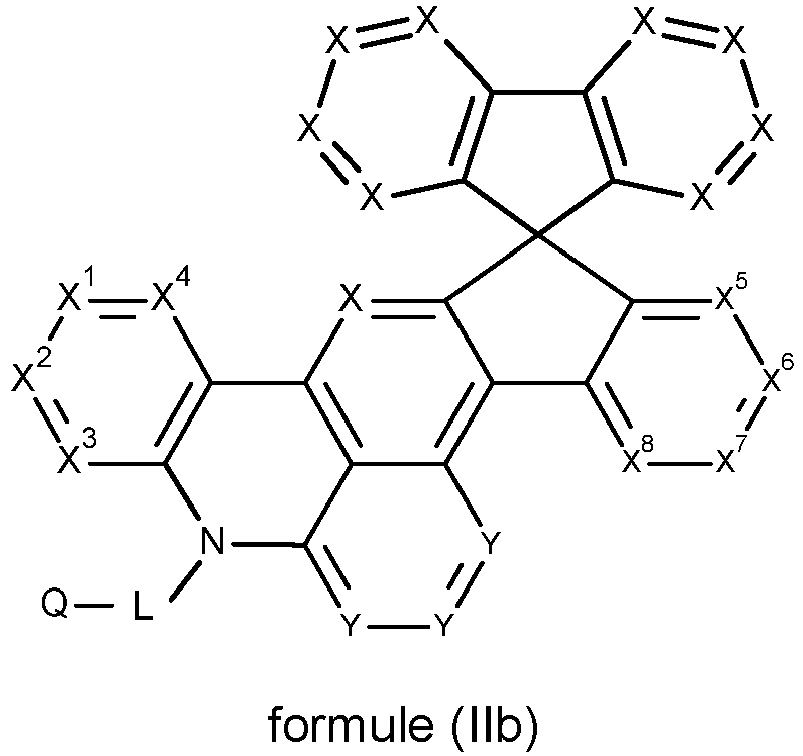


- Composé selon la revendication 2, comprenant les structures de formules (IIIa), (IIIb), (IIIc) ou (IIId),
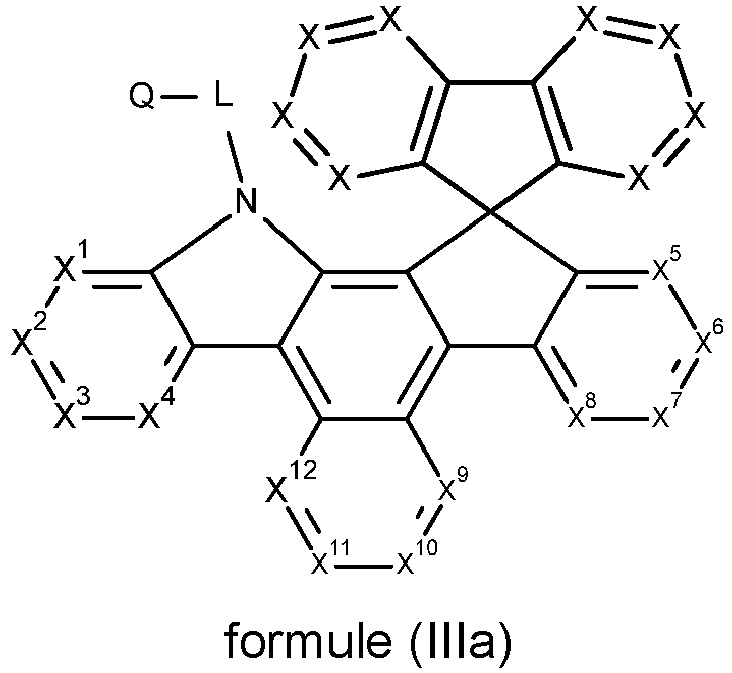


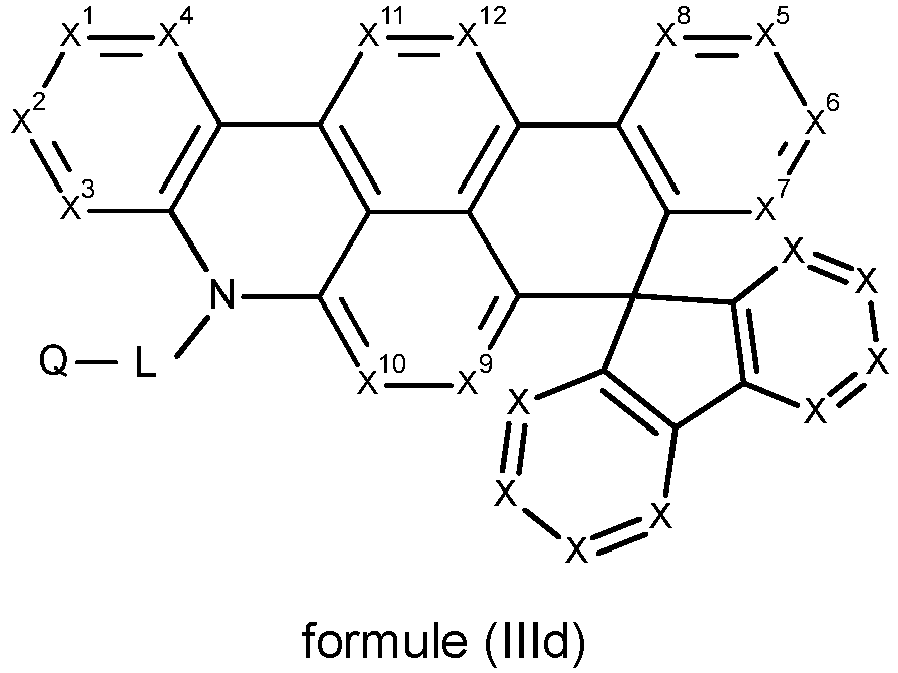
- Composé selon la revendication 3, comprenant les structures de formules (IIIa-1), (IIIb-1), (IIIc-1), (IIId-1), (IIIa-2), (IIIb-2), (IIIc-2), (IIId-2), (IIIa-3), (IIIb-3), (IIIc-3), (IIId-3), (IIIa-4), (IIIb-4), (IIIc-4) ou (IIId-4),


 dans lesquelles les symboles L, R1, Q et X utilisés revêtent la signification donnée selon la revendication 1, X1, X2, X3, X4, X5, X6, X7, X8 sont, de manière identique ou différente, N ou CR1, et m vaut 0, 1, 2, 3 ou 4, où un maximum de deux groupements X, X1, X2, X3, X4, X5, X6, X7, X8 par cycle représentent N ;


 dans lesquelles les symboles L, R1, Q et X utilisés revêtent la signification donnée selon la revendication 1, X1, X2, X3, X4, X9, X10, X11, X12 sont, de manière identique ou différente, N ou CR1, et m vaut 0, 1, 2, 3 ou 4, où un maximum de deux groupements X, X1, X2, X3, X4, X9, X10, X11, X12 par cycle représentent N ;


 dans lesquelles les symboles L, R1, Q et X utilisés revêtent la signification donnée selon la revendication 1, X5, X6, X7, X8, X9, X10, X11, X12 sont, de manière identique ou différente, N ou CR1, et m vaut 0, 1, 2, 3 ou 4, où un maximum de deux groupements X, X5, X6, X7, X8, X9, X10, X11, X12 par cycle représentent N ;


 dans lesquelles les symboles L, R1 et Q utilisés revêtent la signification donnée selon la revendication 1, X1, X2, X3, X4, X5, X6, X7, X8, X9, X10, X11, X12 sont, de manière identique ou différente, N ou CR1, et m vaut 0, 1, 2, 3 ou 4, où un maximum de deux groupements X1, X2, X3, X4, X5, X6, X7, X8, X9, X10, X11, X12 par cycle représentent N.
 - Composé selon la revendication 1, comprenant les structures de formules (IVa), (IVb) ou (IVc),


- Composé selon la revendication 5, comprenant les structures de formules (Va), (Vb) ou (Vc),


- Composé selon la revendication 6, comprenant les structures de formules (Va-1), (Vb-1), (Vc-1), (Va-2), (Vb-2), (Vc-2), (Va-3), (Vb-3) ou (Vc-3),


 dans lesquelles les symboles L, R1, Q et X utilisés revêtent la signification donnée selon la revendication 1, les symboles X1, X2, X3, X4 revêtent la signification donnée selon la revendication 2 et les symboles W1, W2 et W3 revêtent la signification donnée selon la revendication 5 et m vaut 0, 1, 2, 3 ou 4 ;

 dans lesquelles les symboles L, R1, Q et X utilisés revêtent la signification donnée selon la revendication 1, les symboles X5, X6, X7, X8 revêtent la signification donnée selon la revendication 2 et les symboles W1, W2 et W3 revêtent la signification donnée selon la revendication 5 et m vaut 0, 1, 2, 3 ou 4 ;

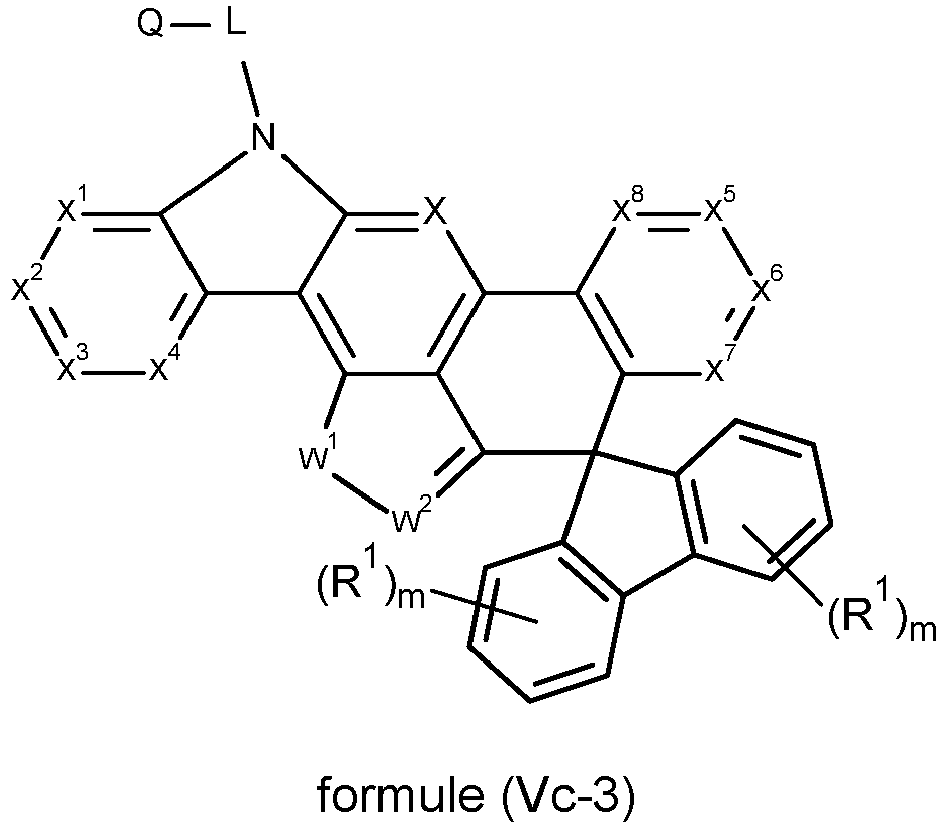 dans lesquelles les symboles L, R1, Q et X utilisés revêtent la signification donnée selon la revendication 1, les symboles X1, X2, X3, X4, X5, X6, X7, X8 revêtent la signification donnée selon la revendication 2 et les symboles W1, W2 et W3 revêtent la signification donnée selon la revendication 5 et m vaut 0, 1, 2, 3 ou 4.
 - Composé selon au moins l'une des revendications précédentes, caractérisé en ce que le groupement Q est choisi parmi les structures de formules (Q-1), (Q-2), (Q-3), (Q-4) ou (Q-5),

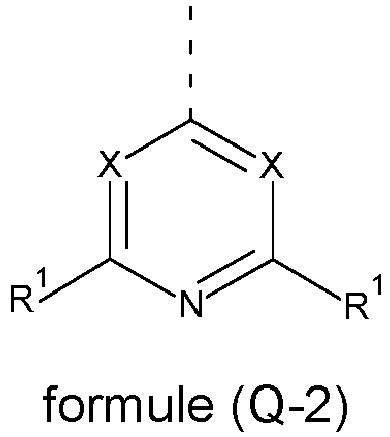

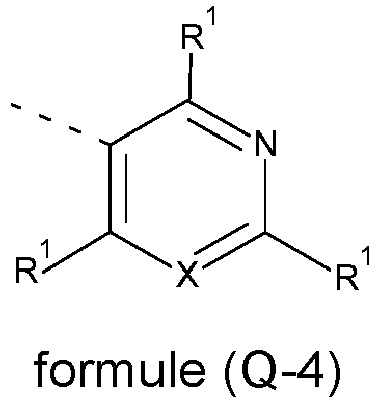

- Composé selon au moins l'une des revendications précédentes, caractérisé en ce que le groupement Q est choisi parmi les structures de formules (Q-6), (Q-7), (Q-8), (Q-9), (Q-10), (Q-11) ou (Q-12),


- Composé selon au moins l'une des revendications précédentes, caractérisé en ce que le groupement Q est choisi parmi les structures de formules (Q-16), (Q-17) ou (Q-18),


- Oligomère, polymère ou dendrimère comprenant un ou plusieurs composés selon l'une des revendications 1 à 10, où, au lieu d'un atome d'hydrogène ou d'un substituant, une ou plusieurs liaisons sont présentes entre les composés et le polymère, l'oligomère ou le dendrimère.
- Composition comprenant au moins un composé selon l'une ou plusieurs parmi les revendications 1 à 10 ou un oligomère, polymère ou dendrimère selon la revendication 11 et au moins un autre composé choisi dans le groupe constitué par les émetteurs fluorescents, les émetteurs phosphorescents, les matériaux hôtes, les matériaux de transport d'électrons, les matériaux d'injection d'électrons, les matériaux conducteurs de trous, les matériaux d'injection de trous, les matériaux de blocage d'électrons et les matériaux de blocage de trous.
- Formulation comprenant au moins un composé selon l'une ou plusieurs parmi les revendications 1 à 10 ou un oligomère, polymère ou dendrimère selon la revendication 11, ou une composition selon la revendication 12, et au moins un solvant.
- Utilisation d'un composé selon l'une ou plusieurs parmi les revendications 1 à 10, d'un oligomère, polymère ou dendrimère selon la revendication 11, ou d'une composition selon la revendication 12, dans un dispositif électronique, en particulier comme matériau hôte ou matériau de transport d'électrons.
- Dispositif électronique contenant au moins un composé selon l'une ou plusieurs parmi les revendications 1 à 10, un oligomère, polymère ou dendrimère selon la revendication 11, ou une composition selon la revendication 12, le dispositif électronique étant préférablement choisi dans le groupe constitué par les dispositifs électroluminescents organiques, les circuits intégrés organiques, les transistors organiques à effet de champ, les transistors organiques en couche mince, les transistors organiques émetteurs de lumière, les cellules solaires organiques, les détecteurs optiques organiques, les photorécepteurs organiques, les dispositifs organiques à extinction de champ, les cellules électrochimiques émettrices de lumière ou les diodes laser organiques.
Applications Claiming Priority (2)
| Application Number | Priority Date | Filing Date | Title |
|---|---|---|---|
| EP16188675 | 2016-09-14 | ||
| PCT/EP2017/072701 WO2018050584A1 (fr) | 2016-09-14 | 2017-09-11 | Composés à structures spirobifluorène |
Publications (2)
| Publication Number | Publication Date |
|---|---|
| EP3512841A1 EP3512841A1 (fr) | 2019-07-24 |
| EP3512841B1 true EP3512841B1 (fr) | 2023-04-26 |
Family
ID=56926080
Family Applications (1)
| Application Number | Title | Priority Date | Filing Date |
|---|---|---|---|
| EP17761905.3A Active EP3512841B1 (fr) | 2016-09-14 | 2017-09-11 | Composés à structures spirobifluorène |
Country Status (4)
| Country | Link |
|---|---|
| US (1) | US11447464B2 (fr) |
| EP (1) | EP3512841B1 (fr) |
| KR (1) | KR102468446B1 (fr) |
| WO (1) | WO2018050584A1 (fr) |
Families Citing this family (3)
| Publication number | Priority date | Publication date | Assignee | Title |
|---|---|---|---|---|
| EP3533784B1 (fr) * | 2018-02-28 | 2021-10-06 | Novaled GmbH | Derives spiro benzoanthracene-fluorene et leur utilisation dans les dispositifs électroniques organiques, écrans et dispositifs d'éclairage |
| KR20250114155A (ko) * | 2018-11-29 | 2025-07-28 | 메르크 파텐트 게엠베하 | 전자 디바이스 |
| CN111518018B (zh) * | 2020-05-28 | 2022-02-25 | 宁波卢米蓝新材料有限公司 | 新型有机化合物和包括该新型有机化合物的有机发光二极管 |
Family Cites Families (94)
| Publication number | Priority date | Publication date | Assignee | Title |
|---|---|---|---|---|
| DE4111878A1 (de) | 1991-04-11 | 1992-10-15 | Wacker Chemie Gmbh | Leiterpolymere mit konjugierten doppelbindungen |
| JPH07133483A (ja) | 1993-11-09 | 1995-05-23 | Shinko Electric Ind Co Ltd | El素子用有機発光材料及びel素子 |
| DE4436773A1 (de) | 1994-10-14 | 1996-04-18 | Hoechst Ag | Konjugierte Polymere mit Spirozentren und ihre Verwendung als Elektrolumineszenzmaterialien |
| JP3865406B2 (ja) | 1995-07-28 | 2007-01-10 | 住友化学株式会社 | 2,7−アリール−9−置換フルオレン及び9−置換フルオレンオリゴマー及びポリマー |
| DE19614971A1 (de) | 1996-04-17 | 1997-10-23 | Hoechst Ag | Polymere mit Spiroatomen und ihre Verwendung als Elektrolumineszenzmaterialien |
| DE19846766A1 (de) | 1998-10-10 | 2000-04-20 | Aventis Res & Tech Gmbh & Co | Konjugierte Polymere, enthaltend spezielle Fluorenbausteine mit verbesserten Eigenschaften |
| US6166172A (en) | 1999-02-10 | 2000-12-26 | Carnegie Mellon University | Method of forming poly-(3-substituted) thiophenes |
| KR100913568B1 (ko) | 1999-05-13 | 2009-08-26 | 더 트러스티즈 오브 프린스턴 유니버시티 | 전계인광에 기초한 고 효율의 유기 발광장치 |
| WO2001041512A1 (fr) | 1999-12-01 | 2001-06-07 | The Trustees Of Princeton University | Complexes de forme l2mx en tant que dopants phosphorescents pour del organiques |
| TW532048B (en) | 2000-03-27 | 2003-05-11 | Idemitsu Kosan Co | Organic electroluminescence element |
| US20020121638A1 (en) | 2000-06-30 | 2002-09-05 | Vladimir Grushin | Electroluminescent iridium compounds with fluorinated phenylpyridines, phenylpyrimidines, and phenylquinolines and devices made with such compounds |
| CN101924190B (zh) | 2000-08-11 | 2012-07-04 | 普林斯顿大学理事会 | 有机金属化合物和发射转换有机电致磷光 |
| JP4154138B2 (ja) | 2000-09-26 | 2008-09-24 | キヤノン株式会社 | 発光素子、表示装置及び金属配位化合物 |
| JP4154140B2 (ja) | 2000-09-26 | 2008-09-24 | キヤノン株式会社 | 金属配位化合物 |
| JP4154139B2 (ja) | 2000-09-26 | 2008-09-24 | キヤノン株式会社 | 発光素子 |
| AU2002306698A1 (en) | 2001-03-14 | 2002-09-24 | The Trustees Of Princeton University | Materials and devices for blue phosphorescence based organic light emitting diodes |
| ITRM20020411A1 (it) | 2002-08-01 | 2004-02-02 | Univ Roma La Sapienza | Derivati dello spirobifluorene, loro preparazione e loro uso. |
| GB0226010D0 (en) | 2002-11-08 | 2002-12-18 | Cambridge Display Tech Ltd | Polymers for use in organic electroluminescent devices |
| DE10304819A1 (de) | 2003-02-06 | 2004-08-19 | Covion Organic Semiconductors Gmbh | Carbazol-enthaltende konjugierte Polymere und Blends, deren Darstellung und Verwendung |
| JP4411851B2 (ja) | 2003-03-19 | 2010-02-10 | コニカミノルタホールディングス株式会社 | 有機エレクトロルミネッセンス素子 |
| US7345301B2 (en) | 2003-04-15 | 2008-03-18 | Merck Patent Gmbh | Mixtures of matrix materials and organic semiconductors capable of emission, use of the same and electronic components containing said mixtures |
| JP4635870B2 (ja) | 2003-04-23 | 2011-02-23 | コニカミノルタホールディングス株式会社 | 有機エレクトロルミネッセンス素子、照明装置及び表示装置 |
| EP1491568A1 (fr) | 2003-06-23 | 2004-12-29 | Covion Organic Semiconductors GmbH | Polymères semi-conducteurs |
| DE10328627A1 (de) | 2003-06-26 | 2005-02-17 | Covion Organic Semiconductors Gmbh | Neue Materialien für die Elektrolumineszenz |
| DE10337346A1 (de) | 2003-08-12 | 2005-03-31 | Covion Organic Semiconductors Gmbh | Konjugierte Polymere enthaltend Dihydrophenanthren-Einheiten und deren Verwendung |
| DE10338550A1 (de) | 2003-08-19 | 2005-03-31 | Basf Ag | Übergangsmetallkomplexe mit Carbenliganden als Emitter für organische Licht-emittierende Dioden (OLEDs) |
| DE10345572A1 (de) | 2003-09-29 | 2005-05-19 | Covion Organic Semiconductors Gmbh | Metallkomplexe |
| US7795801B2 (en) | 2003-09-30 | 2010-09-14 | Konica Minolta Holdings, Inc. | Organic electroluminescent element, illuminator, display and compound |
| EP2366752B1 (fr) | 2003-10-22 | 2016-07-20 | Merck Patent GmbH | Nouveaux matériaux pour l'électroluminescence et leur utilisation |
| WO2005053051A1 (fr) | 2003-11-25 | 2005-06-09 | Merck Patent Gmbh | Element organique electroluminescent |
| US7790890B2 (en) | 2004-03-31 | 2010-09-07 | Konica Minolta Holdings, Inc. | Organic electroluminescence element material, organic electroluminescence element, display device and illumination device |
| DE102004020298A1 (de) | 2004-04-26 | 2005-11-10 | Covion Organic Semiconductors Gmbh | Elektrolumineszierende Polymere und deren Verwendung |
| DE102004023277A1 (de) | 2004-05-11 | 2005-12-01 | Covion Organic Semiconductors Gmbh | Neue Materialmischungen für die Elektrolumineszenz |
| US7598388B2 (en) | 2004-05-18 | 2009-10-06 | The University Of Southern California | Carbene containing metal complexes as OLEDs |
| JP4862248B2 (ja) | 2004-06-04 | 2012-01-25 | コニカミノルタホールディングス株式会社 | 有機エレクトロルミネッセンス素子、照明装置及び表示装置 |
| ITRM20040352A1 (it) | 2004-07-15 | 2004-10-15 | Univ Roma La Sapienza | Derivati oligomerici dello spirobifluorene, loro preparazione e loro uso. |
| EP1669386A1 (fr) | 2004-12-06 | 2006-06-14 | Covion Organic Semiconductors GmbH | Polymères conjugués, leur représentation et utilisation |
| WO2006117052A1 (fr) | 2005-05-03 | 2006-11-09 | Merck Patent Gmbh | Dispositif electroluminescent organique, et derives d'acide boronique et d'acide borinique utilises pour produire ce dispositif electroluminescent organique |
| DE102005037734B4 (de) | 2005-08-10 | 2018-02-08 | Merck Patent Gmbh | Elektrolumineszierende Polymere, ihre Verwendung und bifunktionelle monomere Verbindungen |
| EP1956022B1 (fr) | 2005-12-01 | 2012-07-25 | Nippon Steel Chemical Co., Ltd. | Compose pour element electroluminescent organique et element electroluminescent organique |
| DE102006025777A1 (de) | 2006-05-31 | 2007-12-06 | Merck Patent Gmbh | Neue Materialien für organische Elektrolumineszenzvorrichtungen |
| EP2080762B1 (fr) | 2006-11-09 | 2016-09-14 | Nippon Steel & Sumikin Chemical Co., Ltd. | Composé pour un dispositif électroluminescent organique et dispositif électroluminescent organique |
| JP2010515255A (ja) | 2006-12-28 | 2010-05-06 | ユニバーサル ディスプレイ コーポレイション | 長寿命リン光発光有機発光デバイス(oled)構造 |
| DE102007002714A1 (de) | 2007-01-18 | 2008-07-31 | Merck Patent Gmbh | Neue Materialien für organische Elektrolumineszenzvorrichtungen |
| DE102007053771A1 (de) | 2007-11-12 | 2009-05-14 | Merck Patent Gmbh | Organische Elektrolumineszenzvorrichtungen |
| US7862908B2 (en) | 2007-11-26 | 2011-01-04 | National Tsing Hua University | Conjugated compounds containing hydroindoloacridine structural elements, and their use |
| DE102008027005A1 (de) | 2008-06-05 | 2009-12-10 | Merck Patent Gmbh | Organische elektronische Vorrichtung enthaltend Metallkomplexe |
| DE102008033943A1 (de) | 2008-07-18 | 2010-01-21 | Merck Patent Gmbh | Neue Materialien für organische Elektrolumineszenzvorrichtungen |
| DE102008036247A1 (de) | 2008-08-04 | 2010-02-11 | Merck Patent Gmbh | Elektronische Vorrichtungen enthaltend Metallkomplexe |
| DE102008036982A1 (de) | 2008-08-08 | 2010-02-11 | Merck Patent Gmbh | Organische Elektrolumineszenzvorrichtung |
| DE102008048336A1 (de) | 2008-09-22 | 2010-03-25 | Merck Patent Gmbh | Einkernige neutrale Kupfer(I)-Komplexe und deren Verwendung zur Herstellung von optoelektronischen Bauelementen |
| KR101506919B1 (ko) | 2008-10-31 | 2015-03-30 | 롬엔드하스전자재료코리아유한회사 | 신규한 유기 전자재료용 화합물 및 이를 포함하는 유기 전자 소자 |
| JP5701766B2 (ja) | 2008-11-11 | 2015-04-15 | メルク パテント ゲーエムベーハー | 有機エレクトロルミネセント素子 |
| DE102008056688A1 (de) | 2008-11-11 | 2010-05-12 | Merck Patent Gmbh | Materialien für organische Elektrolumineszenzvorrichtungen |
| DE102008057051B4 (de) | 2008-11-13 | 2021-06-17 | Merck Patent Gmbh | Materialien für organische Elektrolumineszenzvorrichtungen |
| DE102008057050B4 (de) | 2008-11-13 | 2021-06-02 | Merck Patent Gmbh | Materialien für organische Elektrolumineszenzvorrichtungen |
| DE102009007038A1 (de) | 2009-02-02 | 2010-08-05 | Merck Patent Gmbh | Metallkomplexe |
| DE102009011223A1 (de) | 2009-03-02 | 2010-09-23 | Merck Patent Gmbh | Metallkomplexe |
| DE102009013041A1 (de) | 2009-03-13 | 2010-09-16 | Merck Patent Gmbh | Materialien für organische Elektrolumineszenzvorrichtungen |
| DE102009014513A1 (de) | 2009-03-23 | 2010-09-30 | Merck Patent Gmbh | Organische Elektrolumineszenzvorrichtung |
| DE102009023155A1 (de) | 2009-05-29 | 2010-12-02 | Merck Patent Gmbh | Materialien für organische Elektrolumineszenzvorrichtungen |
| DE102009031021A1 (de) | 2009-06-30 | 2011-01-05 | Merck Patent Gmbh | Materialien für organische Elektrolumineszenzvorrichtungen |
| DE102009041414A1 (de) | 2009-09-16 | 2011-03-17 | Merck Patent Gmbh | Metallkomplexe |
| DE102009048791A1 (de) | 2009-10-08 | 2011-04-14 | Merck Patent Gmbh | Materialien für organische Elektrolumineszenzvorrichtungen |
| DE102009057167A1 (de) | 2009-12-05 | 2011-06-09 | Merck Patent Gmbh | Elektronische Vorrichtung enthaltend Metallkomplexe |
| DE102010005697A1 (de) | 2010-01-25 | 2011-07-28 | Merck Patent GmbH, 64293 | Verbindungen für elektronische Vorrichtungen |
| DE102010012738A1 (de) | 2010-03-25 | 2011-09-29 | Merck Patent Gmbh | Materialien für organische Elektrolumineszenzvorrichtungen |
| DE102010019306B4 (de) | 2010-05-04 | 2021-05-20 | Merck Patent Gmbh | Organische Elektrolumineszenzvorrichtungen |
| DE112011102008B4 (de) | 2010-06-15 | 2022-04-21 | Merck Patent Gmbh | Metallkomplexe |
| DE102010027317A1 (de) | 2010-07-16 | 2012-01-19 | Merck Patent Gmbh | Metallkomplexe |
| DE102010048608A1 (de) | 2010-10-15 | 2012-04-19 | Merck Patent Gmbh | Materialien für organische Elektrolumineszenzvorrichtungen |
| KR101979469B1 (ko) | 2011-04-18 | 2019-05-16 | 메르크 파텐트 게엠베하 | 유기 전계발광 소자용 재료 |
| WO2013064206A1 (fr) | 2011-11-01 | 2013-05-10 | Merck Patent Gmbh | Dispositif électroluminescent organique |
| WO2014008982A1 (fr) | 2012-07-13 | 2014-01-16 | Merck Patent Gmbh | Complexes metalliques |
| CN104603111A (zh) | 2012-07-23 | 2015-05-06 | 默克专利有限公司 | 芴和含有所述芴的电子器件 |
| US11917901B2 (en) | 2012-08-07 | 2024-02-27 | Udc Ireland Limited | Metal complexes |
| EP2935276B1 (fr) | 2012-12-21 | 2017-11-01 | Merck Patent GmbH | Matériaux pour dispositifs organiques électroluminescents |
| KR102188214B1 (ko) | 2012-12-21 | 2020-12-08 | 메르크 파텐트 게엠베하 | 금속 착물 |
| KR102188212B1 (ko) | 2012-12-21 | 2020-12-08 | 메르크 파텐트 게엠베하 | 금속 착물 |
| KR20140099759A (ko) * | 2013-02-04 | 2014-08-13 | 덕산하이메탈(주) | 유기전기 소자용 화합물, 이를 이용한 유기전기소자 및 그 전자 장치 |
| KR101718887B1 (ko) | 2013-07-01 | 2017-04-05 | 삼성디스플레이 주식회사 | 유기 발광 소자 |
| CN105531347B (zh) | 2013-09-11 | 2018-09-11 | 默克专利有限公司 | 金属络合物 |
| KR101603389B1 (ko) | 2013-12-05 | 2016-03-14 | 주식회사 두산 | 유기 발광 화합물 및 이를 이용한 유기 전계 발광 소자 |
| US11005050B2 (en) | 2014-01-13 | 2021-05-11 | Merck Patent Gmbh | Metal complexes |
| CN105980519B (zh) | 2014-02-05 | 2019-06-14 | 默克专利有限公司 | 金属络合物 |
| WO2015156587A1 (fr) | 2014-04-08 | 2015-10-15 | Rohm And Haas Electronic Materials Korea Ltd. | Matériau hôte à plusieurs composants et dispositif électroluminescent organique le comprenant |
| EP3140302B1 (fr) | 2014-05-05 | 2019-08-21 | Merck Patent GmbH | Matières pour des dispositifs organiques électroluminescents |
| CN106488917B (zh) | 2014-06-18 | 2020-05-05 | 默克专利有限公司 | 用于有机电致发光器件的材料 |
| JP6707517B2 (ja) | 2014-07-28 | 2020-06-10 | メルク、パテント、ゲゼルシャフト、ミット、ベシュレンクテル、ハフツングMerck Patent GmbH | 金属錯体 |
| WO2016015810A1 (fr) | 2014-07-29 | 2016-02-04 | Merck Patent Gmbh | Matériaux pour dispositifs électroluminescents organiques |
| CN106661007B (zh) | 2014-08-13 | 2019-08-13 | 默克专利有限公司 | 用于有机电致发光器件的材料 |
| WO2016124304A1 (fr) | 2015-02-03 | 2016-08-11 | Merck Patent Gmbh | Complexes métalliques |
| US10680183B2 (en) * | 2015-02-15 | 2020-06-09 | Universal Display Corporation | Organic electroluminescent materials and devices |
| JP6946269B2 (ja) | 2015-08-25 | 2021-10-06 | メルク、パテント、ゲゼルシャフト、ミット、ベシュレンクテル、ハフツングMerck Patent GmbH | 金属錯体 |
-
2017
- 2017-09-11 WO PCT/EP2017/072701 patent/WO2018050584A1/fr not_active Ceased
- 2017-09-11 KR KR1020197010460A patent/KR102468446B1/ko active Active
- 2017-09-11 US US16/330,254 patent/US11447464B2/en active Active
- 2017-09-11 EP EP17761905.3A patent/EP3512841B1/fr active Active
Also Published As
| Publication number | Publication date |
|---|---|
| WO2018050584A1 (fr) | 2018-03-22 |
| US11447464B2 (en) | 2022-09-20 |
| EP3512841A1 (fr) | 2019-07-24 |
| US20190194164A1 (en) | 2019-06-27 |
| KR102468446B1 (ko) | 2022-11-18 |
| KR20190047720A (ko) | 2019-05-08 |
Similar Documents
| Publication | Publication Date | Title |
|---|---|---|
| EP3728263B1 (fr) | Composés hétérocycliques pour utilisations dans les appareils électroniques | |
| EP3519415B1 (fr) | Carbazoles comprenant des structures diazadibenzofurane ou diazadibenzothiophène | |
| EP3519417B1 (fr) | Composés comprenant des structures diazadibenzofurane ou diazadibenzothiophène | |
| EP3083880B1 (fr) | Composés spiraniques hétérocycliques | |
| EP3237387B1 (fr) | Composés hétérocycliques à structures de dibenzazépine | |
| EP3016952B1 (fr) | Composés de lactame spirocondensés pour des dispositifs électroluminescents organiques | |
| EP3573973B1 (fr) | Dérivés de carbazole | |
| EP3442968A1 (fr) | Composés hétérocycliques à structures dibenzofuranes et/ou dibenzothiophènes | |
| EP3548467B1 (fr) | Composés à structures valérolactame | |
| EP3596065B1 (fr) | Composés ayant de structures arylamine | |
| EP3328850B1 (fr) | Composés à structures fluorène | |
| EP4190880B1 (fr) | Composés utilisables dans un dispositif électronique organique comme composés actifs | |
| EP3430006A1 (fr) | Composés à structures spirobifluorène | |
| EP3512848B1 (fr) | Composés à structures carbazole | |
| WO2020064662A2 (fr) | Procédé de préparation de composés hétéroaromatiques azotés à encombrement stérique | |
| EP3978491B1 (fr) | Hétérocycles azotés utilisé dans les oleds | |
| EP3197887B1 (fr) | Composés hétérocycliques à structures benzo [c]coumarine | |
| EP3512841A1 (fr) | Composés à structures spirobifluorène | |
| EP4168397B1 (fr) | Indénoazanaphtalènes | |
| EP4048675B1 (fr) | Composés pouvant être utilisés dans un dispositif électronique organique | |
| EP3630764B1 (fr) | Composes hexacyquliques et heteroaromatiques pour des dispositifs electroniques |
Legal Events
| Date | Code | Title | Description |
|---|---|---|---|
| STAA | Information on the status of an ep patent application or granted ep patent |
Free format text: STATUS: UNKNOWN |
|
| STAA | Information on the status of an ep patent application or granted ep patent |
Free format text: STATUS: THE INTERNATIONAL PUBLICATION HAS BEEN MADE |
|
| PUAI | Public reference made under article 153(3) epc to a published international application that has entered the european phase |
Free format text: ORIGINAL CODE: 0009012 |
|
| STAA | Information on the status of an ep patent application or granted ep patent |
Free format text: STATUS: REQUEST FOR EXAMINATION WAS MADE |
|
| 17P | Request for examination filed |
Effective date: 20190311 |
|
| AK | Designated contracting states |
Kind code of ref document: A1 Designated state(s): AL AT BE BG CH CY CZ DE DK EE ES FI FR GB GR HR HU IE IS IT LI LT LU LV MC MK MT NL NO PL PT RO RS SE SI SK SM TR |
|
| AX | Request for extension of the european patent |
Extension state: BA ME |
|
| DAV | Request for validation of the european patent (deleted) | ||
| DAX | Request for extension of the european patent (deleted) | ||
| STAA | Information on the status of an ep patent application or granted ep patent |
Free format text: STATUS: EXAMINATION IS IN PROGRESS |
|
| 17Q | First examination report despatched |
Effective date: 20210325 |
|
| RAP3 | Party data changed (applicant data changed or rights of an application transferred) |
Owner name: MERCK PATENT GMBH |
|
| GRAP | Despatch of communication of intention to grant a patent |
Free format text: ORIGINAL CODE: EPIDOSNIGR1 |
|
| STAA | Information on the status of an ep patent application or granted ep patent |
Free format text: STATUS: GRANT OF PATENT IS INTENDED |
|
| INTG | Intention to grant announced |
Effective date: 20221111 |
|
| GRAS | Grant fee paid |
Free format text: ORIGINAL CODE: EPIDOSNIGR3 |
|
| GRAA | (expected) grant |
Free format text: ORIGINAL CODE: 0009210 |
|
| STAA | Information on the status of an ep patent application or granted ep patent |
Free format text: STATUS: THE PATENT HAS BEEN GRANTED |
|
| AK | Designated contracting states |
Kind code of ref document: B1 Designated state(s): AL AT BE BG CH CY CZ DE DK EE ES FI FR GB GR HR HU IE IS IT LI LT LU LV MC MK MT NL NO PL PT RO RS SE SI SK SM TR |
|
| REG | Reference to a national code |
Ref country code: GB Ref legal event code: FG4D Free format text: NOT ENGLISH |
|
| REG | Reference to a national code |
Ref country code: CH Ref legal event code: EP |
|
| REG | Reference to a national code |
Ref country code: DE Ref legal event code: R096 Ref document number: 502017014660 Country of ref document: DE |
|
| REG | Reference to a national code |
Ref country code: AT Ref legal event code: REF Ref document number: 1562757 Country of ref document: AT Kind code of ref document: T Effective date: 20230515 |
|
| REG | Reference to a national code |
Ref country code: IE Ref legal event code: FG4D Free format text: LANGUAGE OF EP DOCUMENT: GERMAN |
|
| P01 | Opt-out of the competence of the unified patent court (upc) registered |
Effective date: 20230519 |
|
| REG | Reference to a national code |
Ref country code: LT Ref legal event code: MG9D |
|
| REG | Reference to a national code |
Ref country code: NL Ref legal event code: MP Effective date: 20230426 |
|
| PG25 | Lapsed in a contracting state [announced via postgrant information from national office to epo] |
Ref country code: NL Free format text: LAPSE BECAUSE OF FAILURE TO SUBMIT A TRANSLATION OF THE DESCRIPTION OR TO PAY THE FEE WITHIN THE PRESCRIBED TIME-LIMIT Effective date: 20230426 |
|
| PG25 | Lapsed in a contracting state [announced via postgrant information from national office to epo] |
Ref country code: SE Free format text: LAPSE BECAUSE OF FAILURE TO SUBMIT A TRANSLATION OF THE DESCRIPTION OR TO PAY THE FEE WITHIN THE PRESCRIBED TIME-LIMIT Effective date: 20230426 Ref country code: PT Free format text: LAPSE BECAUSE OF FAILURE TO SUBMIT A TRANSLATION OF THE DESCRIPTION OR TO PAY THE FEE WITHIN THE PRESCRIBED TIME-LIMIT Effective date: 20230828 Ref country code: NO Free format text: LAPSE BECAUSE OF FAILURE TO SUBMIT A TRANSLATION OF THE DESCRIPTION OR TO PAY THE FEE WITHIN THE PRESCRIBED TIME-LIMIT Effective date: 20230726 Ref country code: ES Free format text: LAPSE BECAUSE OF FAILURE TO SUBMIT A TRANSLATION OF THE DESCRIPTION OR TO PAY THE FEE WITHIN THE PRESCRIBED TIME-LIMIT Effective date: 20230426 |
|
| PG25 | Lapsed in a contracting state [announced via postgrant information from national office to epo] |
Ref country code: RS Free format text: LAPSE BECAUSE OF FAILURE TO SUBMIT A TRANSLATION OF THE DESCRIPTION OR TO PAY THE FEE WITHIN THE PRESCRIBED TIME-LIMIT Effective date: 20230426 Ref country code: PL Free format text: LAPSE BECAUSE OF FAILURE TO SUBMIT A TRANSLATION OF THE DESCRIPTION OR TO PAY THE FEE WITHIN THE PRESCRIBED TIME-LIMIT Effective date: 20230426 Ref country code: LV Free format text: LAPSE BECAUSE OF FAILURE TO SUBMIT A TRANSLATION OF THE DESCRIPTION OR TO PAY THE FEE WITHIN THE PRESCRIBED TIME-LIMIT Effective date: 20230426 Ref country code: LT Free format text: LAPSE BECAUSE OF FAILURE TO SUBMIT A TRANSLATION OF THE DESCRIPTION OR TO PAY THE FEE WITHIN THE PRESCRIBED TIME-LIMIT Effective date: 20230426 Ref country code: IS Free format text: LAPSE BECAUSE OF FAILURE TO SUBMIT A TRANSLATION OF THE DESCRIPTION OR TO PAY THE FEE WITHIN THE PRESCRIBED TIME-LIMIT Effective date: 20230826 Ref country code: HR Free format text: LAPSE BECAUSE OF FAILURE TO SUBMIT A TRANSLATION OF THE DESCRIPTION OR TO PAY THE FEE WITHIN THE PRESCRIBED TIME-LIMIT Effective date: 20230426 Ref country code: GR Free format text: LAPSE BECAUSE OF FAILURE TO SUBMIT A TRANSLATION OF THE DESCRIPTION OR TO PAY THE FEE WITHIN THE PRESCRIBED TIME-LIMIT Effective date: 20230727 |
|
| PG25 | Lapsed in a contracting state [announced via postgrant information from national office to epo] |
Ref country code: FI Free format text: LAPSE BECAUSE OF FAILURE TO SUBMIT A TRANSLATION OF THE DESCRIPTION OR TO PAY THE FEE WITHIN THE PRESCRIBED TIME-LIMIT Effective date: 20230426 |
|
| PG25 | Lapsed in a contracting state [announced via postgrant information from national office to epo] |
Ref country code: SK Free format text: LAPSE BECAUSE OF FAILURE TO SUBMIT A TRANSLATION OF THE DESCRIPTION OR TO PAY THE FEE WITHIN THE PRESCRIBED TIME-LIMIT Effective date: 20230426 |
|
| REG | Reference to a national code |
Ref country code: DE Ref legal event code: R097 Ref document number: 502017014660 Country of ref document: DE |
|
| PG25 | Lapsed in a contracting state [announced via postgrant information from national office to epo] |
Ref country code: SM Free format text: LAPSE BECAUSE OF FAILURE TO SUBMIT A TRANSLATION OF THE DESCRIPTION OR TO PAY THE FEE WITHIN THE PRESCRIBED TIME-LIMIT Effective date: 20230426 Ref country code: SK Free format text: LAPSE BECAUSE OF FAILURE TO SUBMIT A TRANSLATION OF THE DESCRIPTION OR TO PAY THE FEE WITHIN THE PRESCRIBED TIME-LIMIT Effective date: 20230426 Ref country code: RO Free format text: LAPSE BECAUSE OF FAILURE TO SUBMIT A TRANSLATION OF THE DESCRIPTION OR TO PAY THE FEE WITHIN THE PRESCRIBED TIME-LIMIT Effective date: 20230426 Ref country code: EE Free format text: LAPSE BECAUSE OF FAILURE TO SUBMIT A TRANSLATION OF THE DESCRIPTION OR TO PAY THE FEE WITHIN THE PRESCRIBED TIME-LIMIT Effective date: 20230426 Ref country code: DK Free format text: LAPSE BECAUSE OF FAILURE TO SUBMIT A TRANSLATION OF THE DESCRIPTION OR TO PAY THE FEE WITHIN THE PRESCRIBED TIME-LIMIT Effective date: 20230426 Ref country code: CZ Free format text: LAPSE BECAUSE OF FAILURE TO SUBMIT A TRANSLATION OF THE DESCRIPTION OR TO PAY THE FEE WITHIN THE PRESCRIBED TIME-LIMIT Effective date: 20230426 |
|
| PLBE | No opposition filed within time limit |
Free format text: ORIGINAL CODE: 0009261 |
|
| STAA | Information on the status of an ep patent application or granted ep patent |
Free format text: STATUS: NO OPPOSITION FILED WITHIN TIME LIMIT |
|
| 26N | No opposition filed |
Effective date: 20240129 |
|
| REG | Reference to a national code |
Ref country code: CH Ref legal event code: PL |
|
| PG25 | Lapsed in a contracting state [announced via postgrant information from national office to epo] |
Ref country code: SI Free format text: LAPSE BECAUSE OF FAILURE TO SUBMIT A TRANSLATION OF THE DESCRIPTION OR TO PAY THE FEE WITHIN THE PRESCRIBED TIME-LIMIT Effective date: 20230426 |
|
| PG25 | Lapsed in a contracting state [announced via postgrant information from national office to epo] |
Ref country code: LU Free format text: LAPSE BECAUSE OF NON-PAYMENT OF DUE FEES Effective date: 20230911 |
|
| REG | Reference to a national code |
Ref country code: BE Ref legal event code: MM Effective date: 20230930 |
|
| GBPC | Gb: european patent ceased through non-payment of renewal fee |
Effective date: 20230911 |
|
| PG25 | Lapsed in a contracting state [announced via postgrant information from national office to epo] |
Ref country code: SI Free format text: LAPSE BECAUSE OF FAILURE TO SUBMIT A TRANSLATION OF THE DESCRIPTION OR TO PAY THE FEE WITHIN THE PRESCRIBED TIME-LIMIT Effective date: 20230426 Ref country code: LU Free format text: LAPSE BECAUSE OF NON-PAYMENT OF DUE FEES Effective date: 20230911 Ref country code: IT Free format text: LAPSE BECAUSE OF FAILURE TO SUBMIT A TRANSLATION OF THE DESCRIPTION OR TO PAY THE FEE WITHIN THE PRESCRIBED TIME-LIMIT Effective date: 20230426 Ref country code: MC Free format text: LAPSE BECAUSE OF FAILURE TO SUBMIT A TRANSLATION OF THE DESCRIPTION OR TO PAY THE FEE WITHIN THE PRESCRIBED TIME-LIMIT Effective date: 20230426 |
|
| REG | Reference to a national code |
Ref country code: IE Ref legal event code: MM4A |
|
| PG25 | Lapsed in a contracting state [announced via postgrant information from national office to epo] |
Ref country code: IE Free format text: LAPSE BECAUSE OF NON-PAYMENT OF DUE FEES Effective date: 20230911 |
|
| PG25 | Lapsed in a contracting state [announced via postgrant information from national office to epo] |
Ref country code: GB Free format text: LAPSE BECAUSE OF NON-PAYMENT OF DUE FEES Effective date: 20230911 |
|
| PG25 | Lapsed in a contracting state [announced via postgrant information from national office to epo] |
Ref country code: CH Free format text: LAPSE BECAUSE OF NON-PAYMENT OF DUE FEES Effective date: 20230930 |
|
| PG25 | Lapsed in a contracting state [announced via postgrant information from national office to epo] |
Ref country code: IE Free format text: LAPSE BECAUSE OF NON-PAYMENT OF DUE FEES Effective date: 20230911 Ref country code: GB Free format text: LAPSE BECAUSE OF NON-PAYMENT OF DUE FEES Effective date: 20230911 Ref country code: FR Free format text: LAPSE BECAUSE OF NON-PAYMENT OF DUE FEES Effective date: 20230930 Ref country code: CH Free format text: LAPSE BECAUSE OF NON-PAYMENT OF DUE FEES Effective date: 20230930 |
|
| PG25 | Lapsed in a contracting state [announced via postgrant information from national office to epo] |
Ref country code: BE Free format text: LAPSE BECAUSE OF NON-PAYMENT OF DUE FEES Effective date: 20230930 |
|
| PG25 | Lapsed in a contracting state [announced via postgrant information from national office to epo] |
Ref country code: BG Free format text: LAPSE BECAUSE OF FAILURE TO SUBMIT A TRANSLATION OF THE DESCRIPTION OR TO PAY THE FEE WITHIN THE PRESCRIBED TIME-LIMIT Effective date: 20230426 |
|
| REG | Reference to a national code |
Ref country code: AT Ref legal event code: MM01 Ref document number: 1562757 Country of ref document: AT Kind code of ref document: T Effective date: 20230911 |
|
| PG25 | Lapsed in a contracting state [announced via postgrant information from national office to epo] |
Ref country code: BG Free format text: LAPSE BECAUSE OF FAILURE TO SUBMIT A TRANSLATION OF THE DESCRIPTION OR TO PAY THE FEE WITHIN THE PRESCRIBED TIME-LIMIT Effective date: 20230426 |
|
| PG25 | Lapsed in a contracting state [announced via postgrant information from national office to epo] |
Ref country code: AT Free format text: LAPSE BECAUSE OF NON-PAYMENT OF DUE FEES Effective date: 20230911 |
|
| PG25 | Lapsed in a contracting state [announced via postgrant information from national office to epo] |
Ref country code: AT Free format text: LAPSE BECAUSE OF NON-PAYMENT OF DUE FEES Effective date: 20230911 |
|
| PG25 | Lapsed in a contracting state [announced via postgrant information from national office to epo] |
Ref country code: CY Free format text: LAPSE BECAUSE OF FAILURE TO SUBMIT A TRANSLATION OF THE DESCRIPTION OR TO PAY THE FEE WITHIN THE PRESCRIBED TIME-LIMIT; INVALID AB INITIO Effective date: 20170911 |
|
| PG25 | Lapsed in a contracting state [announced via postgrant information from national office to epo] |
Ref country code: HU Free format text: LAPSE BECAUSE OF FAILURE TO SUBMIT A TRANSLATION OF THE DESCRIPTION OR TO PAY THE FEE WITHIN THE PRESCRIBED TIME-LIMIT; INVALID AB INITIO Effective date: 20170911 |
|
| PGFP | Annual fee paid to national office [announced via postgrant information from national office to epo] |
Ref country code: DE Payment date: 20250820 Year of fee payment: 9 |
|
| PG25 | Lapsed in a contracting state [announced via postgrant information from national office to epo] |
Ref country code: TR Free format text: LAPSE BECAUSE OF FAILURE TO SUBMIT A TRANSLATION OF THE DESCRIPTION OR TO PAY THE FEE WITHIN THE PRESCRIBED TIME-LIMIT Effective date: 20230426 |