EP3526209B1 - Agonistes du récepteur de l'apéline (apj) hétérocyclique et leurs utilisations - Google Patents
Agonistes du récepteur de l'apéline (apj) hétérocyclique et leurs utilisations Download PDFInfo
- Publication number
- EP3526209B1 EP3526209B1 EP17860899.8A EP17860899A EP3526209B1 EP 3526209 B1 EP3526209 B1 EP 3526209B1 EP 17860899 A EP17860899 A EP 17860899A EP 3526209 B1 EP3526209 B1 EP 3526209B1
- Authority
- EP
- European Patent Office
- Prior art keywords
- alkyl
- trifluoromethyl
- cyclopentyl
- compound
- difluoropiperidin
- Prior art date
- Legal status (The legal status is an assumption and is not a legal conclusion. Google has not performed a legal analysis and makes no representation as to the accuracy of the status listed.)
- Active
Links
Classifications
-
- A—HUMAN NECESSITIES
- A61—MEDICAL OR VETERINARY SCIENCE; HYGIENE
- A61K—PREPARATIONS FOR MEDICAL, DENTAL OR TOILETRY PURPOSES
- A61K31/00—Medicinal preparations containing organic active ingredients
- A61K31/33—Heterocyclic compounds
- A61K31/395—Heterocyclic compounds having nitrogen as a ring hetero atom, e.g. guanethidine or rifamycins
- A61K31/41—Heterocyclic compounds having nitrogen as a ring hetero atom, e.g. guanethidine or rifamycins having five-membered rings with two or more ring hetero atoms, at least one of which being nitrogen, e.g. tetrazole
- A61K31/4196—1,2,4-Triazoles
-
- A—HUMAN NECESSITIES
- A61—MEDICAL OR VETERINARY SCIENCE; HYGIENE
- A61K—PREPARATIONS FOR MEDICAL, DENTAL OR TOILETRY PURPOSES
- A61K31/00—Medicinal preparations containing organic active ingredients
- A61K31/33—Heterocyclic compounds
- A61K31/395—Heterocyclic compounds having nitrogen as a ring hetero atom, e.g. guanethidine or rifamycins
- A61K31/435—Heterocyclic compounds having nitrogen as a ring hetero atom, e.g. guanethidine or rifamycins having six-membered rings with one nitrogen as the only ring hetero atom
- A61K31/44—Non condensed pyridines; Hydrogenated derivatives thereof
- A61K31/445—Non condensed piperidines, e.g. piperocaine
- A61K31/4523—Non condensed piperidines, e.g. piperocaine containing further heterocyclic ring systems
- A61K31/454—Non condensed piperidines, e.g. piperocaine containing further heterocyclic ring systems containing a five-membered ring with nitrogen as a ring hetero atom, e.g. pimozide, domperidone
-
- A—HUMAN NECESSITIES
- A61—MEDICAL OR VETERINARY SCIENCE; HYGIENE
- A61P—SPECIFIC THERAPEUTIC ACTIVITY OF CHEMICAL COMPOUNDS OR MEDICINAL PREPARATIONS
- A61P1/00—Drugs for disorders of the alimentary tract or the digestive system
- A61P1/16—Drugs for disorders of the alimentary tract or the digestive system for liver or gallbladder disorders, e.g. hepatoprotective agents, cholagogues, litholytics
-
- A—HUMAN NECESSITIES
- A61—MEDICAL OR VETERINARY SCIENCE; HYGIENE
- A61P—SPECIFIC THERAPEUTIC ACTIVITY OF CHEMICAL COMPOUNDS OR MEDICINAL PREPARATIONS
- A61P11/00—Drugs for disorders of the respiratory system
-
- A—HUMAN NECESSITIES
- A61—MEDICAL OR VETERINARY SCIENCE; HYGIENE
- A61P—SPECIFIC THERAPEUTIC ACTIVITY OF CHEMICAL COMPOUNDS OR MEDICINAL PREPARATIONS
- A61P11/00—Drugs for disorders of the respiratory system
- A61P11/06—Antiasthmatics
-
- A—HUMAN NECESSITIES
- A61—MEDICAL OR VETERINARY SCIENCE; HYGIENE
- A61P—SPECIFIC THERAPEUTIC ACTIVITY OF CHEMICAL COMPOUNDS OR MEDICINAL PREPARATIONS
- A61P13/00—Drugs for disorders of the urinary system
- A61P13/12—Drugs for disorders of the urinary system of the kidneys
-
- A—HUMAN NECESSITIES
- A61—MEDICAL OR VETERINARY SCIENCE; HYGIENE
- A61P—SPECIFIC THERAPEUTIC ACTIVITY OF CHEMICAL COMPOUNDS OR MEDICINAL PREPARATIONS
- A61P25/00—Drugs for disorders of the nervous system
-
- A—HUMAN NECESSITIES
- A61—MEDICAL OR VETERINARY SCIENCE; HYGIENE
- A61P—SPECIFIC THERAPEUTIC ACTIVITY OF CHEMICAL COMPOUNDS OR MEDICINAL PREPARATIONS
- A61P25/00—Drugs for disorders of the nervous system
- A61P25/08—Antiepileptics; Anticonvulsants
-
- A—HUMAN NECESSITIES
- A61—MEDICAL OR VETERINARY SCIENCE; HYGIENE
- A61P—SPECIFIC THERAPEUTIC ACTIVITY OF CHEMICAL COMPOUNDS OR MEDICINAL PREPARATIONS
- A61P29/00—Non-central analgesic, antipyretic or antiinflammatory agents, e.g. antirheumatic agents; Non-steroidal antiinflammatory drugs [NSAID]
-
- A—HUMAN NECESSITIES
- A61—MEDICAL OR VETERINARY SCIENCE; HYGIENE
- A61P—SPECIFIC THERAPEUTIC ACTIVITY OF CHEMICAL COMPOUNDS OR MEDICINAL PREPARATIONS
- A61P3/00—Drugs for disorders of the metabolism
-
- A—HUMAN NECESSITIES
- A61—MEDICAL OR VETERINARY SCIENCE; HYGIENE
- A61P—SPECIFIC THERAPEUTIC ACTIVITY OF CHEMICAL COMPOUNDS OR MEDICINAL PREPARATIONS
- A61P3/00—Drugs for disorders of the metabolism
- A61P3/04—Anorexiants; Antiobesity agents
-
- A—HUMAN NECESSITIES
- A61—MEDICAL OR VETERINARY SCIENCE; HYGIENE
- A61P—SPECIFIC THERAPEUTIC ACTIVITY OF CHEMICAL COMPOUNDS OR MEDICINAL PREPARATIONS
- A61P3/00—Drugs for disorders of the metabolism
- A61P3/06—Antihyperlipidemics
-
- A—HUMAN NECESSITIES
- A61—MEDICAL OR VETERINARY SCIENCE; HYGIENE
- A61P—SPECIFIC THERAPEUTIC ACTIVITY OF CHEMICAL COMPOUNDS OR MEDICINAL PREPARATIONS
- A61P3/00—Drugs for disorders of the metabolism
- A61P3/08—Drugs for disorders of the metabolism for glucose homeostasis
- A61P3/10—Drugs for disorders of the metabolism for glucose homeostasis for hyperglycaemia, e.g. antidiabetics
-
- A—HUMAN NECESSITIES
- A61—MEDICAL OR VETERINARY SCIENCE; HYGIENE
- A61P—SPECIFIC THERAPEUTIC ACTIVITY OF CHEMICAL COMPOUNDS OR MEDICINAL PREPARATIONS
- A61P35/00—Antineoplastic agents
-
- A—HUMAN NECESSITIES
- A61—MEDICAL OR VETERINARY SCIENCE; HYGIENE
- A61P—SPECIFIC THERAPEUTIC ACTIVITY OF CHEMICAL COMPOUNDS OR MEDICINAL PREPARATIONS
- A61P43/00—Drugs for specific purposes, not provided for in groups A61P1/00-A61P41/00
-
- A—HUMAN NECESSITIES
- A61—MEDICAL OR VETERINARY SCIENCE; HYGIENE
- A61P—SPECIFIC THERAPEUTIC ACTIVITY OF CHEMICAL COMPOUNDS OR MEDICINAL PREPARATIONS
- A61P7/00—Drugs for disorders of the blood or the extracellular fluid
- A61P7/02—Antithrombotic agents; Anticoagulants; Platelet aggregation inhibitors
-
- A—HUMAN NECESSITIES
- A61—MEDICAL OR VETERINARY SCIENCE; HYGIENE
- A61P—SPECIFIC THERAPEUTIC ACTIVITY OF CHEMICAL COMPOUNDS OR MEDICINAL PREPARATIONS
- A61P7/00—Drugs for disorders of the blood or the extracellular fluid
- A61P7/04—Antihaemorrhagics; Procoagulants; Haemostatic agents; Antifibrinolytic agents
-
- A—HUMAN NECESSITIES
- A61—MEDICAL OR VETERINARY SCIENCE; HYGIENE
- A61P—SPECIFIC THERAPEUTIC ACTIVITY OF CHEMICAL COMPOUNDS OR MEDICINAL PREPARATIONS
- A61P9/00—Drugs for disorders of the cardiovascular system
-
- A—HUMAN NECESSITIES
- A61—MEDICAL OR VETERINARY SCIENCE; HYGIENE
- A61P—SPECIFIC THERAPEUTIC ACTIVITY OF CHEMICAL COMPOUNDS OR MEDICINAL PREPARATIONS
- A61P9/00—Drugs for disorders of the cardiovascular system
- A61P9/12—Antihypertensives
-
- C—CHEMISTRY; METALLURGY
- C07—ORGANIC CHEMISTRY
- C07D—HETEROCYCLIC COMPOUNDS
- C07D233/00—Heterocyclic compounds containing 1,3-diazole or hydrogenated 1,3-diazole rings, not condensed with other rings
- C07D233/54—Heterocyclic compounds containing 1,3-diazole or hydrogenated 1,3-diazole rings, not condensed with other rings having two double bonds between ring members or between ring members and non-ring members
- C07D233/66—Heterocyclic compounds containing 1,3-diazole or hydrogenated 1,3-diazole rings, not condensed with other rings having two double bonds between ring members or between ring members and non-ring members with hetero atoms or with carbon atoms having three bonds to hetero atoms with at the most one bond to halogen, e.g. ester or nitrile radicals, directly attached to ring carbon atoms
- C07D233/90—Carbon atoms having three bonds to hetero atoms with at the most one bond to halogen, e.g. ester or nitrile radicals
-
- C—CHEMISTRY; METALLURGY
- C07—ORGANIC CHEMISTRY
- C07D—HETEROCYCLIC COMPOUNDS
- C07D249/00—Heterocyclic compounds containing five-membered rings having three nitrogen atoms as the only ring hetero atoms
- C07D249/02—Heterocyclic compounds containing five-membered rings having three nitrogen atoms as the only ring hetero atoms not condensed with other rings
- C07D249/08—1,2,4-Triazoles; Hydrogenated 1,2,4-triazoles
- C07D249/10—1,2,4-Triazoles; Hydrogenated 1,2,4-triazoles with hetero atoms or with carbon atoms having three bonds to hetero atoms with at the most one bond to halogen, e.g. ester or nitrile radicals, directly attached to ring carbon atoms
-
- C—CHEMISTRY; METALLURGY
- C07—ORGANIC CHEMISTRY
- C07D—HETEROCYCLIC COMPOUNDS
- C07D401/00—Heterocyclic compounds containing two or more hetero rings, having nitrogen atoms as the only ring hetero atoms, at least one ring being a six-membered ring with only one nitrogen atom
- C07D401/02—Heterocyclic compounds containing two or more hetero rings, having nitrogen atoms as the only ring hetero atoms, at least one ring being a six-membered ring with only one nitrogen atom containing two hetero rings
- C07D401/04—Heterocyclic compounds containing two or more hetero rings, having nitrogen atoms as the only ring hetero atoms, at least one ring being a six-membered ring with only one nitrogen atom containing two hetero rings directly linked by a ring-member-to-ring-member bond
-
- C—CHEMISTRY; METALLURGY
- C07—ORGANIC CHEMISTRY
- C07D—HETEROCYCLIC COMPOUNDS
- C07D401/00—Heterocyclic compounds containing two or more hetero rings, having nitrogen atoms as the only ring hetero atoms, at least one ring being a six-membered ring with only one nitrogen atom
- C07D401/02—Heterocyclic compounds containing two or more hetero rings, having nitrogen atoms as the only ring hetero atoms, at least one ring being a six-membered ring with only one nitrogen atom containing two hetero rings
- C07D401/12—Heterocyclic compounds containing two or more hetero rings, having nitrogen atoms as the only ring hetero atoms, at least one ring being a six-membered ring with only one nitrogen atom containing two hetero rings linked by a chain containing hetero atoms as chain links
-
- C—CHEMISTRY; METALLURGY
- C07—ORGANIC CHEMISTRY
- C07D—HETEROCYCLIC COMPOUNDS
- C07D401/00—Heterocyclic compounds containing two or more hetero rings, having nitrogen atoms as the only ring hetero atoms, at least one ring being a six-membered ring with only one nitrogen atom
- C07D401/14—Heterocyclic compounds containing two or more hetero rings, having nitrogen atoms as the only ring hetero atoms, at least one ring being a six-membered ring with only one nitrogen atom containing three or more hetero rings
-
- C—CHEMISTRY; METALLURGY
- C07—ORGANIC CHEMISTRY
- C07D—HETEROCYCLIC COMPOUNDS
- C07D403/00—Heterocyclic compounds containing two or more hetero rings, having nitrogen atoms as the only ring hetero atoms, not provided for by group C07D401/00
- C07D403/02—Heterocyclic compounds containing two or more hetero rings, having nitrogen atoms as the only ring hetero atoms, not provided for by group C07D401/00 containing two hetero rings
- C07D403/12—Heterocyclic compounds containing two or more hetero rings, having nitrogen atoms as the only ring hetero atoms, not provided for by group C07D401/00 containing two hetero rings linked by a chain containing hetero atoms as chain links
-
- C—CHEMISTRY; METALLURGY
- C07—ORGANIC CHEMISTRY
- C07D—HETEROCYCLIC COMPOUNDS
- C07D403/00—Heterocyclic compounds containing two or more hetero rings, having nitrogen atoms as the only ring hetero atoms, not provided for by group C07D401/00
- C07D403/14—Heterocyclic compounds containing two or more hetero rings, having nitrogen atoms as the only ring hetero atoms, not provided for by group C07D401/00 containing three or more hetero rings
-
- C—CHEMISTRY; METALLURGY
- C07—ORGANIC CHEMISTRY
- C07D—HETEROCYCLIC COMPOUNDS
- C07D417/00—Heterocyclic compounds containing two or more hetero rings, at least one ring having nitrogen and sulfur atoms as the only ring hetero atoms, not provided for by group C07D415/00
- C07D417/14—Heterocyclic compounds containing two or more hetero rings, at least one ring having nitrogen and sulfur atoms as the only ring hetero atoms, not provided for by group C07D415/00 containing three or more hetero rings
Definitions
- This disclosure relates generally to the discovery of agonists of the apelin receptor (APJ) and uses of such agonists.
- APJ apelin receptor
- the apelin receptor was cloned in 1993 as an orphan G-protein coupled receptor (GPCR).
- GPCR G-protein coupled receptor
- the human APJ gene is located on the long arm of chromosome 11 and encodes a 377 amino acid G protein-coupled receptor.
- the gene for APJ was designated angiotensin-receptor like 1 (AGTRL1) due to sequence similarities between the two receptors.
- AGTRL1 angiotensin-receptor like 1
- APJ remained an orphan GPCR until 1998 when the peptide apelin was identified as its endogenous ligand.
- apelin and APJ have emerged as an important regulator of various physiological processes. Both apelin and APJ are expressed in the central nervous system (CNS) and peripherally in a number of tissues. Expression of APJ has been noted within the vasculature of some organs and is a potent regulator of related processes including angiogenesis and vasoconstriction. Cobellis et al. report increased of expression levels of both apelin and APJ receptor in preeclampsia-complicated pregnancies. Cobellis et al., Histol Histopathol. 2007; 22(1):1-8 . APJ is also expressed in nonvascular cell types in heart, liver, and CNS where its primary role is currently under investigation. Medhurst et al., J Neurochem.
- Apelin and APJ are often co-localized within the same organ suggesting an autocrine regulation of the receptor by its ligand.
- apelin has since been detected in blood suggesting that concomitant paracrine regulation of the receptor is also possible.
- the apelin-APJ system has been implicated as a regulator of various physiological functions and is believed to play an important role in thermoregulation, immunity, glucose metabolism, angiogenesis, fluid homeostasis, cardiac function, hepatic function and renal function. Ladeiras-Lopes et al., Arq Bras Cardiol. 2008; 90(5):343-349 .
- APJ also acts as a co-receptor during HIV infection. O'Donnell et al., J Neurochem. 2007; 102(6):1905-1917 ; Zou et al., FEBS Lett. 2000; 473(1):15-18 .
- apelin and APJ are either up- or down-regulated in various pathophysiological conditions.
- the APJ appears to be an emerging target for the treatment of cardiovascular failure, liver fibrosis, cancer, angiopathies, pancreatitis, and as a prophylactic against HIV infection.
- apelin and APJ reviewed apelin and APJ as an opportunity for therapeutic uses for pulmonary hypertension and pulmonary arterial hypertension (PAH). Andersen et al. Pulm. Circ. 2011; 1(3) 334-346 .
- WO2015188073A1 and WO2017100558A1 both relate to agonists of the apelin receptor (APJ) and uses of such agonists.
- WO2015184011A2 describes small molecule agonists of the apelin receptor for the treatment of disease. The compounds disclosed are for the treatment of a range of cardiovascular, renal and metabolic conditions.
- ring A is a 5-member heteroaryl ring
- each G 1 is independently selected from C or N
- each G 2 or G 3 is independently selected from CH, N, O or S; wherein at least one G 2 or G 3 is O or S; if G 2 is O or S then, G 3 is CH or N; if G 3 is O or S then, G 2 is CH or N; the bond between each two instances of G 1 , G 2 or G 3 is either a single or a double bond so as to make the ring A an aromatic heterocycle, and a maximum number of two instances of either G 1 G 2 or G 3 in the ring are simultaneously N;
- R 1 is represented by the formula: wherein is a monocyclic aryl or heteroaryl group; each A is independently C 1-8 alkyl, C 1-8 alkyl(aryl), C 1-8 alkoxy, C 1-8 al
- the compound of par. [0008] may be represented by the Formula III:
- n is 1 or 2; each A is independently C 1 alkoxy, C 1 alkoxy aryl, or halogen; R 2 is substituted aryl, unsubstituted heteraoryl, substituted heteroaryl, C 4 alkyl or C 6 cycloalkyl; R 4 is C 1-8 alkyl, C 2-8 alkyl(aryl), C 1-8 alkyl (C 3-8 cycloalkyl) or -CO 2 R 9 ; R 5 is -(CH 2 ) x CNHCOR 7 , -(CH 2 ) x CNHCO 2 R 7 , -(CH 2 ) x CONR 7 R 8 , -(CH 2 ) x CONR 7 (CH 2 ) y CO 2 R 9 , -(CH 2 ) x CONR 7 (CH 2 ) y CONR 7 R 8 , -(CH 2 ) x CONR 7 (CH 2 ) y CONR 7 R 8 , -(CH 2
- each A is independently fluoro substituted C 1 -C 3 alkoxy or fluoro substituted C 1 -C 3 alkyl.
- R 2 is an optionally substituted 5 or 6 membered heteroaryl ring, -C 4 H 9 , -C 5 H 11 , -cC 4 H 8 or -cC 5 H 10 .
- R 4 is C 1-8 alkyl(aryl), C 1-8 alkyl heteroaryl, C 2-8 alkenyl(aryl), or C 2-8 alkenyl(heteroaryl).
- Further embodiments include ,the compound of par. [0008], wherein the compound is (3S)-N-cyclobutyl-3-( ⁇ 5-cyclopentyl-1-[2-(trifluoromethyl)phenyl]-1H-1,2,4-triazol-3-yl ⁇ formamido)-5-(piperidin-1-yl)pentanamide, (3S)-N-cyclobutyl-3-( ⁇ 1-cyclopentyl-5-[2-(trifluoromethyl)phenyl]-1H-1,24-triazol-3-yl ⁇ formamido)-5-(piperidin-1-yl)pentanamide, (3S)-N-cyclobutyl-3-( ⁇ 1-cyclopentyl-5-[2-(trifluoromethyl)phenyl]-1H-1,2,4-triazol-3-yl ⁇ formamido)-5-(3,3-difluoropiperidin-1-yl)pentanamide, (3S)-N-cyclobuty
- Additional embodiments include a pharmaceutical composition comprising at least one pharmaceutically acceptable excipient and a therapeutically effective amount of the compound of any of par. [0008], [0010], [0011] and[0022].
- apelin receptor (APJ) related disorder is asthma, cardiomyopathy, diabetes, dyslipidemia, hypertension, inflammation, liver disease, metabolic disorder, neurodegenerative disease, obesity, preeclampsia, or renal dysfunction.
- ACE angiotensin converting enzyme
- ARB angiotensin-receptor blocker
- ARB angiotensin-receptor blocker
- APJ apelin receptor
- Alkynyl refers to an unsaturated branched or straight-chain having at least one carbon-carbon triple bond derived by the removal of one hydrogen atom from a single carbon atom of a parent alkyne.
- Typical alkynyl groups include, but are not limited to, ethynyl, propynyl, butenyl, 2-pentynyl, 3-pentynyl, 2-hexynyl, 3-hexynyl and the like.
- the alkynyl group may be substituted or unsubstituted.
- an alkynyl group has from 3 to 20 carbon atoms and in other embodiments from 3 to 8 carbon atoms.
- Aryl refers to a monovalent aromatic hydrocarbon group derived by the removal of one hydrogen atom from a single carbon atom of a parent aromatic ring system.
- Aryl encompasses 5- and 6-membered carbocyclic aromatic rings, for example, benzene or cyclopentadiene; bicyclic ring systems wherein at least one ring is carbocyclic and aromatic, for example, naphthalene, indane.
- the aryl group may be substituted or unsubstituted, for example with a halogen, such as fluorine.
- the cycloalkyl group may also be a bridged bicyclic cycloalkyl group, a fused cycloalkyl group or a spiro cycloalkyl group.
- bridged bicyclic cycloalkyl groups are bicyclo[2.2.1]heptane, bicyclo[2.2.1]hexane, bicycle[2.2.2]octane.
- An example of a fused cycloalkyl group is bicyclo[4.4.0]decane or decalin.
- Non-limiting examples of spiro cycloalkyl groups are spiro [3.3] heptane, spiro [4.3] octane, or spiro [5.4] decane.
- Disease refers to any disease, disorder, condition, symptom, or indication.
- the heteroaryl group can be between 5 to 20 membered heteroaryl, such as, for example, a 5 to 10 membered heteroaryl.
- heteroaryl groups can be those derived from thiophene, pyrrole, benzothiophene, benzofuran, indole, pyridine, quinoline, imidazole, oxazole, and pyrazine.
- Heterocycloalkyl refers to a non-aromatic monocyclic ring or fused non-aromatic polycyclic rings with one or more heteroatom(s) independently selected from N, S and O, with the remaining ring atoms being carbon and wherein at least one heteroatom is present in each non-aromatic ring.
- the heterocycle group may be a three-member ring, a four member ring, a five member ring, a six member ring or a seven member ring.
- heterocycloalkyl group encompasses heterocycloalkyl groups substituted with one or more halogens, such as 3,3-difluoropiperidine, or 4,4-difluoropiperidine.
- the heterocycloalkyl group may be substituted with a C 1 -C 4 alkyl or C 1 -C 4 halo alkyl group such as a -CF 3 group.
- Free hydroxy groups may be derivatized using groups including but not limited to carbonates, dimethylaminoacetates, ethers, hemisuccinates, phosphate esters, and phosphoryloxymethyloxycarbonyls, as outlined in Fleisher et al., 1996 Advanced Drug Delivery Reviews 19, 115-130 .
- Carbamate prodrugs of hydroxy and amino groups are also included, as are carbonate prodrugs, sulfonate esters and sulfate esters of hydroxy groups.
- Thiols may be derivatized as esters or ethers.
- Prodrugs may also include compounds wherein an amino acid residue, or a polypeptide chain of two or more (e.g., two, three or four) amino acid residues is covalently joined through an amide or ester bond to a free amino, hydroxy or carboxylic acid group of compounds of the invention.
- amino acid residues include but are not limited to the 20 naturally occurring amino acids commonly designated by three letter symbols and also includes beta-alanine, citrulline, demosine, gamma-aminobutyric acid, homocysteine, homoserine, 4-hydroxyproline, hydroxylysine, isodemosine, 3-methylhistidine, norvalin, methionine sulfone, and ornithine.
- Stepoisomer refers to an isomer that differs in the arrangement of the constituent atoms in space.
- Stereoisomers that are mirror images of each other and optically active are termed “enantiomers,” and stereoisomers that are not mirror images of one another and are optically active are termed “diastereoisomers.”
- Subject includes mammals and humans.
- the terms “human” and “subject” are used interchangeably herein.
- Substituted refers to a group in which one or more hydrogen atoms are each independently replaced with the same or different substituent(s). Typical substituents include, but are not limited to, CO 2 H, cyano, difluoro, halogen, hydroxyl, -N 3 , -NH 2 , -SO (1-3) H, -SH, or trifluoro.
- “Therapeutically effective amount” refers to the amount of a compound that, when administered to a subject for treating a disease, or at least one of the clinical symptoms of a disease or disorder, is sufficient to affect such treatment for the disease, disorder, or symptom.
- the "therapeutically effective amount” can vary depending on the compound, the disease, disorder, and/or symptoms of the disease or disorder, severity of the disease, disorder, and/or symptoms of the disease or disorder, the age of the subject to be treated, and/or the weight of the subject to be treated. An appropriate amount in any given instance can be readily apparent to those skilled in the art or capable of determination by routine experimentation.
- Treating” or “treatment” of any disease or disorder refers to arresting or ameliorating a disease, disorder, or at least one of the clinical symptoms of a disease or disorder, reducing the risk of acquiring a disease, disorder, or at least one of the clinical symptoms of a disease or disorder, reducing the development of a disease, disorder or at least one of the clinical symptoms of the disease or disorder, or reducing the risk of developing a disease or disorder or at least one of the clinical symptoms of a disease or disorder.
- C 1 -C 8 alkoxy aryl means the functional group C 1 -C 8 alkoxy, e.g., -CH 2 CH 2 OCH 2 CH 3 or -OCH 2 CH 3 combined with an aryl group, e.g., -C 6 H 5 F to form -CH 2 CH 2 OCH 2 CH 2 -C 6 H 5 F or -OCH 2 CH 3 -C 6 H 5 F, respectively.
- the individual amino acids may of either the R or the S chirality.
- R 4 , R 5 , R 6 , R 7 , or R 8 independently may be two or three amino acids linked by a peptide bond.
- R 4 , R 5 , R 6 , R 7 , or R 8 independently may be dipeptides or tripeptides ( Hobbs et al., Proc Nat Acad Sci USA. 1993, 90, 6909-6913 ); US Pat. Nos. 6,075,121 (Bartlett et al .) peptoids; or vinylogous polypeptides ( Hagihara et al., J Amer Chem Soc. 1992, 114, 6568 ).
- R 4 , R 5 , R 6 , R 7 , or R 8 independently may be part of the extended unnatural amino acids, e.g., Xie and Schultz, Nat Rev Mol Cell Biol. 2006, 7(10):775-82 or Wang et al., Chem Biol. 2009, 16(3):323-36 .
- Tritiated and carbon-14, i.e., 14 C, isotopes are particularly preferred for their ease of preparation and detectability.
- Substitution with positron emitting isotopes, such as 11 C, 18 F, 15 O and 13 N, can be useful in Positron Emission Topography (PET) studies.
- PET Positron Emission Topography
- compositions comprising an effective amount of a compound Formula I (e.g., any of the formulae and/or structures disclosed herein), or a pharmaceutically acceptable salt of said compound; and a pharmaceutically acceptable carrier.
- a compound Formula I e.g., any of the formulae and/or structures disclosed herein
- a pharmaceutically acceptable carrier e.g., any of the formulae and/or structures disclosed herein
- Pharmaceutically acceptable carriers, adjuvants and vehicles that may be used in the pharmaceutical compositions of this disclosure include, but are not limited to, ion exchangers, alumina, aluminum stearate, lecithin, serum proteins, such as human serum albumin, buffer substances such as phosphates, glycine, sorbic acid, potassium sorbate, partial glyceride mixtures of saturated vegetable fatty acids, water, salts or electrolytes, such as protamine sulfate, disodium hydrogen phosphate, potassium hydrogen phosphate, sodium chloride, zinc salts, colloidal silica, magnesium trisilicate, polyvinyl pyrrolidone, cellulose-based substances, polyethylene glycol, sodium carboxymethylcellulose, polyacrylates, waxes, polyethylene-polyoxypropylene-block polymers, polyethylene glycol and wool fat.
- ion exchangers alumina, aluminum stearate, lecithin
- serum proteins such as human serum albumin
- buffer substances such as phosphat
- solubility and bioavailability of the compounds of the present disclosure in pharmaceutical compositions may be enhanced by methods well-known in the art.
- One method includes the use of lipid excipients in the formulation. See “ Oral Lipid-Based Formulations: Enhancing the Bioavailability of Poorly Water-Soluble Drugs (Drugs and the Pharmaceutical Sciences),” David J. Hauss, ed. Informa Healthcare, 2007 ; and “ Role of Lipid Excipients in Modifying Oral and Parenteral Drug Delivery: Basic Principles and Biological Examples," Kishor M. Wasan, ed. Wiley-Interscience, 2006 .
- Another known method of enhancing bioavailability is the use of an amorphous form of a compound of this disclosure optionally formulated with a poloxamer, such as LUTROL TM and PLURONIC TM (BASF Corporation), or block copolymers of ethylene oxide and propylene oxide.
- a poloxamer such as LUTROL TM and PLURONIC TM (BASF Corporation)
- block copolymers of ethylene oxide and propylene oxide such as LUTROL TM and PLURONIC TM (BASF Corporation
- compositions of the disclosure include those suitable for oral, rectal, nasal, topical (including buccal and sublingual), pulmonary, vaginal or parenteral (including subcutaneous, intramuscular, intravenous and intradermal) administration.
- the compound of the formulae herein is administered transdermally (e.g., using a transdermal patch or iontophoretic techniques).
- Other formulations may conveniently be presented in unit dosage form, e.g., tablets, sustained release capsules, and in liposomes, and may be prepared by any methods well known in the art of pharmacy. See, for example, Remington's Pharmaceutical Sciences, Mack Publishing Company, Philadelphia, PA (17th ed. 1985 ).
- Such preparative methods include the step of bringing into association with the molecule to be administered ingredients such as the carrier that constitutes one or more accessory ingredients.
- ingredients such as the carrier that constitutes one or more accessory ingredients.
- the compositions are prepared by uniformly and intimately bringing into association the active ingredients with liquid carriers, liposomes or finely divided solid carriers, or both, and then, if necessary, shaping the product.
- the compound is administered orally.
- compositions of the present disclosure suitable for oral administration may be presented as discrete units such as capsules, sachets, or tablets each containing a predetermined amount of the active ingredient; a powder or granules; a solution or a suspension in an aqueous liquid or a non-aqueous liquid; an oil-in-water liquid emulsion; a water-in-oil liquid emulsion; packed in liposomes; or as a bolus, etc.
- Soft gelatin capsules can be useful for containing such suspensions, which may beneficially increase the rate of compound absorption.
- carriers that are commonly used include lactose and corn starch.
- Lubricating agents such as magnesium stearate, are also typically added.
- useful diluents include lactose and dried cornstarch.
- aqueous suspensions are administered orally, the active ingredient is combined with emulsifying and suspending agents. If desired, certain sweetening and/or flavoring and/or coloring agents may be added.
- compositions suitable for parenteral administration include aqueous and non-aqueous sterile injection solutions which may contain anti-oxidants, buffers, bacteriostats and solutes which render the formulation isotonic with the blood of the intended recipient; and aqueous and non-aqueous sterile suspensions which may include suspending agents and thickening agents.
- the formulations may be presented in unit-dose or multi-dose containers, for example, sealed ampules and vials, and may be stored in a freeze dried (lyophilized) condition requiring only the addition of the sterile liquid carrier, for example water for injections, immediately prior to use.
- Extemporaneous injection solutions and suspensions may be prepared from sterile powders, granules and tablets.
- Such injection solutions may be in the form, for example, of a sterile injectable aqueous or oleaginous suspension.
- This suspension may be formulated according to techniques known in the art using suitable dispersing or wetting agents (such as, for example, Tween 80) and suspending agents.
- the sterile injectable preparation may also be a sterile injectable solution or suspension in a non-toxic parenterally-acceptable diluent or solvent, for example, as a solution in 1,3-butanediol.
- the acceptable vehicles and solvents that may be employed are mannitol, water, Ringer's solution and isotonic sodium chloride solution.
- sterile, fixed oils are conventionally employed as a solvent or suspending medium.
- any bland fixed oil may be employed including synthetic mono- or diglycerides.
- Fatty acids, such as oleic acid and its glyceride derivatives are useful in the preparation of injectables, as are natural pharmaceutically-acceptable oils, such as olive oil or castor oil, especially in their polyoxyethylated versions.
- These oil solutions or suspensions may also contain a long-chain alcohol diluent or dispersant.
- compositions of this disclosure may be administered in the form of suppositories for rectal administration.
- These compositions can be prepared by mixing a compound of this disclosure with a suitable non-irritating excipient which is solid at room temperature but liquid at the rectal temperature and therefore will melt in the rectum to release the active components.
- suitable non-irritating excipient include, but are not limited to, cocoa butter, beeswax and polyethylene glycols.
- compositions of this disclosure may be administered by nasal aerosol or inhalation.
- Such compositions are prepared according to techniques well-known in the art of pharmaceutical formulation and may be prepared as solutions in saline, employing benzyl alcohol or other suitable preservatives, absorption promoters to enhance bioavailability, fluorocarbons, and/or other solubilizing or dispersing agents known in the art. See, e.g., US Pat. No. 6,803,031 (Rabinowitz & Zaffaroni ).
- Topical administration of the pharmaceutical compositions of this disclosure is especially useful when the desired treatment involves areas or organs readily accessible by topical application.
- the pharmaceutical composition should be formulated with a suitable ointment containing the active components suspended or dissolved in a carrier.
- Carriers for topical administration of the compounds of this disclosure include, but are not limited to, mineral oil, liquid petroleum, white petroleum, propylene glycol, polyoxyethylene or polyoxypropylene compounds, emulsifying wax, and water.
- the pharmaceutical composition can be formulated with a suitable lotion or cream containing the active compound suspended or dissolved in a carrier.
- Suitable carriers include, but are not limited to, mineral oil, sorbitan monostearate, polysorbate 60, cetyl esters wax, cetearyl alcohol, 2-octyldodecanol, benzyl alcohol, and water.
- the pharmaceutical compositions of this disclosure may also be topically applied to the lower intestinal tract by rectal suppository formulation or in a suitable enema formulation. Topically-transdermal patches and iontophoretic administration are also included in this disclosure.
- compositions at the site of interest may be incorporated into compositions for coating an implantable medical device, such as prostheses, artificial valves, vascular grafts, stents, or catheters. Suitable coatings and the general preparation of coated implantable devices are known in the art and are exemplified in US Pat. Nos.
- the disclosure provides a method of impregnating an implantable drug release device comprising the step of contacting said drug release device with a compound or composition of this disclosure.
- Implantable drug release devices include, but are not limited to, biodegradable polymer capsules or bullets, non-degradable, diffusible polymer capsules and biodegradable polymer wafers.
- the disclosure provides an implantable medical device coated with a compound or a composition comprising a compound of this disclosure, such that said compound is therapeutically active.
- this disclosure provides a composition comprising a compound of Formula I, or more specific compounds disclosed herein, to treat or prevent asthma, atherosclerosis, cancer, cardiomyopathy, diabetes, dyslipidemia, HIV neurodegeneration, hypertension, inflammation, liver disease, metabolic disorder, neurodegenerative disease, obesity, or preeclampsia.
- the disclosure provides a composition comprising a compound of Formula I, or more specific compounds disclosed herein, to treat or prevent cancer, cell proliferation, diabetes, fluid homeostasis, heart diseases (e.g., hypertension and heart failure, such as congestive heart failure), HIV infection, immune function, obesity, stem cell trafficking, metastatic cancer or a vein-related disorder such as an angioma, a venous insufficiency, a stasis, or a thrombosis.
- heart diseases e.g., hypertension and heart failure, such as congestive heart failure
- HIV infection immune function
- obesity stem cell trafficking
- metastatic cancer or a vein-related disorder such as an angioma, a venous insufficiency, a stasis, or a thrombosis.
- a composition of this disclosure further comprises a second therapeutic agent.
- the second therapeutic agent is one or more additional compounds of the disclosure.
- the second therapeutic agent may be selected from any compound or therapeutic agent known to have or that demonstrates advantageous properties when administered with a compound having the same mechanism of action as the APJ receptor compound of Formula I.
- the second therapeutic is an agent useful in the treatment or prevention of a disease or condition selected from acute decompensated heart failure (ADHF), amyotrophic lateral sclerosis, arrhythmia, asthma, atherosclerosis, atherosclerosis, atrial fibrillation, Brugada syndrome, burn injuries (including sunburn), cancer, cardiac fibrosis, cardiomyopathy, cerebrovascular accidents, chronic heart failure, diabetes (including gestational diabetes), dyslipidemia, HIV neurodegeneration, hypertension, inflammation, ischemic cardiovascular diseases, liver disease, metabolic disorder, neurodegenerative disease, obesity, peripheral arterial disease, preeclampsia, pulmonary hypertension, restenosis, transient ischemic attacks, traumatic brain injuries, ventricular tachycardia, or water retention.
- ADHF acute decompensated heart failure
- amyotrophic lateral sclerosis arrhythmia
- asthma atherosclerosis
- atherosclerosis atherosclerosis
- atrial fibrillation Brugada syndrome
- burn injuries including sunburn
- cancer cardiac
- the second therapeutic is an agent useful in the treatment or prevention of a disease or condition selected from cancer, cell proliferation, diabetes, fluid homeostasis, heart diseases (e.g., hypertension and heart failure, such as congestive heart failure), HIV infection, immune function, obesity, stem cell trafficking, or metastatic cancer.
- a disease or condition selected from cancer, cell proliferation, diabetes, fluid homeostasis, heart diseases (e.g., hypertension and heart failure, such as congestive heart failure), HIV infection, immune function, obesity, stem cell trafficking, or metastatic cancer.
- the second therapeutic agent can be selected from: ACE inhibitors, beta blockers, vasodilator, calcium channel blockers, loop diuretics, aldosterone antagonists, and angiotensin receptor blockers.
- the second therapeutic agent can be selected from: ⁇ -blockers, ⁇ -blockers, calcium channel blockers, diuretics, natriuretics, saluretics, centrally acting antihypertensives, angiotensin converting enzyme (ACE) inhibitors, dual ACE and neutral endopeptidase (NEP) inhibitors, angiotensin-receptor blockers (ARBs), aldosterone synthase inhibitors, aldosterone-receptor antagonists, or endothelin receptor antagonists.
- ACE angiotensin converting enzyme
- NEP dual ACE and neutral endopeptidase
- ARBs angiotensin-receptor blockers
- aldosterone synthase inhibitors aldosterone-receptor antagonists
- endothelin receptor antagonists or endothelin receptor antagonists.
- Non-limiting examples of ⁇ -Blockers include doxazosin, prazosin, tamsulosin, and terazosin.
- Non-limiting examples of calcium channel blockers include dihydropyridines (DHPs) and non-DHPs.
- the preferred DHPs are selected from the group consisting of amlodipine, felodipine, isradipine, lacidipine, nicardipine, nifedipine, nigulpidine, niludipine, nimodiphine, nisoldipine, nitrendipine, nivaldipine, ryosidine, and their pharmaceutically acceptable salts.
- Non-DHPs are selected from anipamil, diltiazem, fendiline, flunarizine, gallopamil, mibefradil, prenylamine, tiapamil, and verampimil and their pharmaceutically acceptable salts.
- a diuretic is, for example, a thiazide derivative selected from amiloride, chlorothalidon, chlorothiazide, hydrochlorothiazide, and methylchlorothiazide.
- Non-limiting examples of centrally acting antiphypertensives include clonidine, guanabenz, guanfacine and methyldopa.
- Non-limiting examples of ACE inhibitors include alacepril, benazepril, benazaprilat, captopril, ceronapril, cilazapril, delapril, enalapril, enalaprilat, fosinopril, lisinopril, moexipiril, moveltopril, perindopril, quinapril, quinaprilat, ramipril, ramiprilat, spirapril, temocapril, trandolapril, and zofenopril.
- Preferred ACE inhibitors are benazepril, enalpril, lisinopril, and ramipril.
- Non-limiting examples of dual ACE/NEP inhibitors are, for example, omapatrilat, fasidotril, and fasidotrilat.
- Non-limiting examples of preferred ARBs include candesartan, eprosartan, irbesartan, losartan, olmesartan, tasosartan, telmisartan, and valsartan.
- Non-limiting examples of preferred aldosterone synthase inhibitors are anastrozole, fadrozole, and exemestane.
- Non-limiting examples of preferred aldosterone-receptor antagonists are spironolactone and eplerenone.
- Non-limiting examples of preferred endothelin antagonist is, for example, bosentan, enrasentan, atrasentan, darusentan, sitaxentan, and tezosentan and their pharmaceutically acceptable salts.
- the disclosure provides separate dosage forms of a compound of this disclosure and one or more of any of the above-described second therapeutic agents, wherein the compound and second therapeutic agent are associated with one another.
- association with one another means that the separate dosage forms are packaged together or otherwise attached to one another such that it is readily apparent that the separate dosage forms are intended to be sold and administered together (within less than 24 hours of one another, consecutively or simultaneously).
- the compound of the present disclosure is present in an effective amount.
- the term "effective amount” refers to an amount which, when administered in a proper dosing regimen, is sufficient to treat (therapeutically or prophylactically) the target disorder.
- effective amount is sufficient to reduce or ameliorate the severity, duration or progression of the disorder being treated, prevent the advancement of the disorder being treated, cause the regression of the disorder being treated, or enhance or improve the prophylactic or therapeutic effect(s) of another therapy.
- the compound is present in the composition in an amount of from 0.1 to 50 wt.%, more preferably from 1 to 30 wt.%, most preferably from 5 to 20 wt.%.
- Body surface area may be approximately determined from height and weight of the subject. See, e.g., Scientific Tables, Geigy Pharmaceuticals, Ardsley, N.Y., 1970,537 .
- an effective amount of the second therapeutic agent is between about 20% and 100% of the dosage normally utilized in a monotherapy regime using just that agent.
- an effective amount is between about 70% and 100% of the normal monotherapeutic dose.
- the normal monotherapeutic dosages of these second therapeutic agents are well known in the art. See, e.g., Wells et al., eds., Pharmacotherapy Handbook, 2nd Edition, Appleton and Lange, Stamford, Conn. (2000 ); PDR Pharmacopoeia, Tarascon Pocket Pharmacopoeia 2000, Deluxe Edition, Tarascon Publishing, Loma Linda, Calif. (2000 ).
- the compounds for use in the method of the disclosure can be formulated in unit dosage form.
- unit dosage form refers to physically discrete units suitable as unitary dosage for subjects undergoing treatment, with each unit containing a predetermined quantity of active material calculated to produce the desired therapeutic effect, optionally in association with a suitable pharmaceutical carrier.
- the unit dosage form can be for a single daily treatment dose or one of multiple daily treatment doses (e.g., about 1 to 4 or more times per day). When multiple daily treatment doses are used, the unit dosage form can be the same or different for each dose.
- the disclosure also includes methods of treating diseases, disorders or pathological conditions which benefit from modulation of the APJ receptor comprising administering an effective amount of an APJ receptor compound of the disclosure to a subject in need thereof.
- Diseases and conditions which can benefit from modulation (inhibition or activation) of the APJ receptor include, but are not limited to, acute decompensated heart failure (ADHF), amyotrophic lateral sclerosis, arrhythmia, asthma, atherosclerosis, atherosclerosis, atrial fibrillation, Brugada syndrome, burn injuries (including sunburn), cancer, cardiac fibrosis, cardiomyopathy, cerebrovascular accidents, chronic heart failure, diabetes (including gestational diabetes), dyslipidemia, HIV neurodegeneration, hypertension, inflammation, ischemic cardiovascular diseases, liver disease, metabolic disorder, neurodegenerative disease, obesity, peripheral arterial disease, preeclampsia, pulmonary hypertension, restenosis, transient ischemic attacks, traumatic brain injuries, ventricular tachycardia, or water retention.
- ADHF acute decom
- the hypertension may be pulmonary arterial hypertension.
- the liver disease may be alcoholic liver disease, toxicant-induced liver disease or viral-induced liver disease and the renal dysfunction may be polycystic kidney disease.
- the apelin receptor system is involved in vein-related disorders. See, e.g., Lathen et al., "ERG-APLNR Axis Controls Pulmonary Venule Endothelial Proliferation in Pulmonary Veno-Occlusive Disease” 2014 Circulation 130: 1179-1191 . Apelin receptor system has also been implicated in heart failure.
- the disclosure provides a method of treating an apelin receptor (APJ) related disorder in a subject which comprises administering to the subject the compound of mbodiment 1.
- the apelin receptor (APJ) related disorder may be asthma, atherosclerosis, cancer, cardiomyopathy, diabetes, dyslipidemia, hypertension, inflammation, liver disease, metabolic disorder, neurodegenerative disease, obesity, or preeclampsia.
- the disclosure provides methods further comprising treating the subject with an ⁇ -blocker, an angiotensin converting enzyme (ACE) inhibitor, an angiotensin-receptor blocker (ARB), a ⁇ -blocker, a calcium channel blocker, or a diuretic.
- the disclosure provides a method to treat or prevent a vein-related disorder such as an angioma, a venous insufficiency, a stasis or a thrombosis.
- the disclosure provides a method of preventing HIV neurodegeneration in a subject which comprises administering to the subject the compound of embodiment 1.
- an effective amount of a compound of this disclosure can range from about .005 mg to about 5000 mg per treatment. In more specific embodiments, the range is from about .05 mg to about 1000 mg, or from about 0.5 mg to about 500 mg, or from about 5 mg to about 50 mg.
- Treatment can be administered one or more times per day (for example, once per day, twice per day, three times per day, four times per day, five times per day, etc.). When multiple treatments are used, the amount can be the same or different. It is understood that a treatment can be administered every day, every other day, every 2 days, every 3 days, every 4 days, every 5 days, etc.
- a treatment dose can be initiated on Monday with a first subsequent treatment administered on Wednesday, a second subsequent treatment administered on Friday, etc.
- Treatment is typically administered from one to two times daily.
- Effective doses will also vary, as recognized by those skilled in the art, depending on the diseases treated, the severity of the disease, the route of administration, the sex, age and general health condition of the subject, excipient usage, the possibility of co-usage with other therapeutic treatments such as use of other agents and the judgment of the treating physician.
- the effective amount of a compound of the disclosure is from about 0.01 mg/kg/day to about 1000 mg/kg/day, from about 0.1 mg/kg/day to about 100 mg/kg/day, from about 0.5 mg/kg/day to about 50 mg/kg/day, or from about 1 mg/kg/day to 10 mg/kg/day.
- any of the above methods of treatment comprises the further step of co-administering to said subject one or more second therapeutic agents.
- the choice of second therapeutic agent may be made from any second therapeutic agent known to be useful for co-administration with a compound that modulates the APJ receptor.
- the choice of second therapeutic agent is also dependent upon the particular disease or condition to be treated. Examples of second therapeutic agents that may be employed in the methods of this disclosure are those set forth above for use in combination compositions comprising a compound of this disclosure and a second therapeutic agent.
- composition of this disclosure comprising both a compound of the disclosure and a second therapeutic agent, to a subject does not preclude the separate administration of that same therapeutic agent, any other second therapeutic agent or any compound of this disclosure to said subject at another time during a course of treatment.
- the effective amount of the compound of this disclosure is less than its effective amount would be where the second therapeutic agent is not administered. In another embodiment, the effective amount of the second therapeutic agent is less than its effective amount would be where the compound of this disclosure is not administered. In this way, undesired side effects associated with high doses of either agent may be minimized. Other potential advantages (including without limitation improved dosing regimens and/or reduced drug cost) will be apparent to those of skill in the art.
- kits for use to treat the target disease, disorder or condition comprise (a) a pharmaceutical composition comprising a compound of Formula I, or a salt thereof, wherein said pharmaceutical composition is in a container; and (b) instructions describing a method of using the pharmaceutical composition to treat the target disease, disorder or condition.
- the container may be any vessel or other sealed or sealable apparatus that can hold said pharmaceutical composition.
- Examples include bottles, ampules, divided or multi-chambered holders bottles, wherein each division or chamber comprises a single dose of said composition, a divided foil packet wherein each division comprises a single dose of said composition, or a dispenser that dispenses single doses of said composition.
- the container can be in any conventional shape or form as known in the art which is made of a pharmaceutically acceptable material, for example a paper or cardboard box, a glass or plastic bottle or jar, a re-sealable bag (for example, to hold a "refill" of tablets for placement into a different container), or a blister pack with individual doses for pressing out of the pack according to a therapeutic schedule.
- the container employed can depend on the exact dosage form involved, for example a conventional cardboard box would not generally be used to hold a liquid suspension. It is feasible that more than one container can be used together in a single package to market a single dosage form. For example, tablets may be contained in a bottle, which is in turn contained within a box. In one embodiment, the container is a blister pack.
- kits of this disclosure may comprise in a separate vessel of container a pharmaceutical composition comprising a second therapeutic agent, such as one of those listed above for use for co-administration with a compound of this disclosure.
- the reaction mixture was stirred at rt for 18 h. Water was added followed by ethyl acetate. The phases were separated and the organic layer was washed with an aqueous saturated solution of sodium bicarbonate (3x), dried with sodium sulfate, filtered and evaporated.
- the crude product was purified by flash chromatography on silica gel using a solution of MeOH in DCM (0 to 5%) to provide 48.7 mg (88%) of the title compound as a pale orange oil.
- Reagents and conditions (a) 3-(trifluoromethyl)picolinic acid, HATU, i-PrNEt2, DMF, 0 °C to rt, 18 h; (b) 4M HCl in dioxane, rt, 18 h; (c) Ethyl 2-amino-2-thioxoacetate, toluene, CH 3 COOH, 110 °C, 3 days; (d) NaOH, THF:MeOH (1:1), rt, 18 h; (e) (S)-tert-butyl 3-amino-5-(3,3-difluoropiperidin-1-yl)pentanoate, HATU, HOAt, i-PrNEt2, DMF, 0 °C to rt, 18 h; (f) 4M HCl in dioxane, rt, 18 h
- Ethyl 1-cyclopentyl-5-(3-(trifluoromethyl)pyridin-2-yl)-1H-1,2,4-triazole-3-carboxylate Ethyl 2-amino-2-thioxoacetate (586 mg, 4.39 mmol, 3.00 equiv.) was added to a solution of N-cyclopentyl-3-(trifluoromethyl)picolinohydrazide (400 mg, 1.46 mmol, 1.00 equiv.) in toluene (2.4 mL). Acetic acid (0.24 mL) was added and the reaction mixture was heated at 110 °C for 3 days.
- Reagents and conditions (a)1-fluoro-2-(trifluoromethyl)benzene, K 2 CO 3 , DMSO, microwave, 150 °C; (b) cyclopentane carboxylic acid, AgNO 3 , 10% aq.
- Ethyl 1-(2-(trifluoromethyl)phenyl)-1 H -imidazole-4-carboxylate In a microwave vial was added ethyl 1H-imidazole-4-carboxylate (500 mg, 3.57 mmol, 1 equiv.), 2-fluorobenzonitrile (1.17 g, 906 ⁇ L, 7.14 mmol, 2 equiv.), K 2 CO 3 (987 mg, 7.14 mmol, 2 equiv.) and DMSO (10 mL). Vial was sealed and mixture irradiated for 30 min. at 150 °C, allowed to cool to RT, poured in 250 mL of water.
- Compound 472 is not part of the invention.
Landscapes
- Health & Medical Sciences (AREA)
- Chemical & Material Sciences (AREA)
- Organic Chemistry (AREA)
- Medicinal Chemistry (AREA)
- Veterinary Medicine (AREA)
- Public Health (AREA)
- General Health & Medical Sciences (AREA)
- Animal Behavior & Ethology (AREA)
- Life Sciences & Earth Sciences (AREA)
- Pharmacology & Pharmacy (AREA)
- Chemical Kinetics & Catalysis (AREA)
- General Chemical & Material Sciences (AREA)
- Nuclear Medicine, Radiotherapy & Molecular Imaging (AREA)
- Bioinformatics & Cheminformatics (AREA)
- Engineering & Computer Science (AREA)
- Diabetes (AREA)
- Hematology (AREA)
- Obesity (AREA)
- Pulmonology (AREA)
- Cardiology (AREA)
- Heart & Thoracic Surgery (AREA)
- Epidemiology (AREA)
- Pain & Pain Management (AREA)
- Biomedical Technology (AREA)
- Neurology (AREA)
- Neurosurgery (AREA)
- Gastroenterology & Hepatology (AREA)
- Rheumatology (AREA)
- Urology & Nephrology (AREA)
- Emergency Medicine (AREA)
- Child & Adolescent Psychology (AREA)
- Endocrinology (AREA)
- Pharmaceuticals Containing Other Organic And Inorganic Compounds (AREA)
- Medicines That Contain Protein Lipid Enzymes And Other Medicines (AREA)
- Plural Heterocyclic Compounds (AREA)
- Peptides Or Proteins (AREA)
Claims (7)
- Composé représenté par la formule I :
 ou un sel pharmaceutiquement acceptable,dans lequel le cycle A est un cycle hétéroaryle à 5 chaînons ; chaque G1 est indépendamment choisi parmi C ou N ; chaque G2 est indépendamment choisi parmi CH ou N ; la liaison entre chaque deux instances de G1 ou G2 est soit une liaison simple soit une liaison double de manière à faire du cycle A un hétérocycle aromatique, dans lequel trois de G1 ou G2 sont N ;R1 est représenté par la formule :
 dans laquelle
 chaque substituant A est indépendamment un alcoxy en C1-C3 substitué par un fluor ou un alkyle en C1-C3 substitué par un fluor ;R7 et R8 sont indépendamment alcoxy en C1-8, aryle, alkyle en C1-8, alcool alkylique en C1-8, alkyl amino en C1-8, alkyl amido en C1-8, alkyle (aryle) en C1-8, alkyle en C1-8 (cycloalkyle en C3-8), alkyl guanidinyle en C1-8, alkyl hétéroaryle en C1-8, thioéther d'alkyle en C1-8, alkyl thiol en C1-8, alcényle en C 2-8, alcynyle en C3-8, cycloalkyle en C3-8, - (CH2)xCONHR9, - (CH2)xCOR9, - (CH2)xCO2R9, H ou hétéroaryle ; ou R7 et R8 forment ensemble un cycle de 3 à 9 chaînons qui peut contenir un ou plusieurs hétéroatomes ; ou R7 et R8 forment ensemble un cycle de 5 à 8 chaînons contenant de l'azote avec un ou plusieurs groupes carbonyle ;n est 1, 2, 3, 4, ou 5 ;R2 est un cycle hétéroaryle à 5 ou 6 chaînons éventuellement substitué, -C4H9, -C5H11, -cC4H8 ou -cC5H10 ;R3 est H ;R4 est un alkyle en C2-4 hétérocycloalkyle, dans lequel l'hétérocycloalkyle est un cycle monocyclique non aromatique ou des cycles polycycliques non aromatiques fusionnés avec un ou plusieurs hétéroatomes choisis parmi N, S et O, les atomes de cycle restants étant du carbone et dans lequel au moins un hétéroatome est présent dans chaque cycle non aromatique, dans lequel le groupe hétérocyclique est de préférence un cycle à trois chaînons, un cycle à quatre chaînons, un cycle à cinq chaînons, un cycle à six chaînons ou un cycle à sept chaînons, plus préférablement le groupe hétérocycloalkyle est 1,4-dioxane, 1,3-dioxolane, 1,4-dithiane, imidazolidine, morpholine, pipéridine, pipéridone, pipérazine, pyrolidone, pyrrolidine ou 1,3,5-trithiane, le plus préférablement il contient un imide, dans lequel le groupe hétérocycloalkyle est de préférence bicyclique, plus préférablement un composé hétérospiro, le plus préférablement hétérospiro [3.3] heptanyle, hétérospiro [3.4] octanyle ou hétérospiro [5.5] undécanyles, dans lequel le groupe hétérocycloalkyle est substitué ou non substitué, de préférence le groupe hétérocycloalkyle englobe des groupes hétérocycloalkyle substitués par un ou plusieurs halogènes, plus préférablement la 3,3-difluoropipéridine ou la 4,4-difluoropipéridine, dans lequel le groupe hétérocycloalkyle est de préférence substitué par un groupe alkyle en C1-C4 ou haloalkyle en C1-C4 tel qu'un groupe -CF3 ;R5 est adamantanyle, aryle, alkyle en C1-8, alcool alkylique en C1-8, alkylamino en C1-8, alkylamido en C1-8, alkyle en C2-8 (aryle), alkyle en C1-8 (cycloalkyle en C3-8), alkyle en C1-8 (cycloalkyle en C3-8) -CO2R7, alkyle guanidinyle en C1-8, alkyle hétéroaryle en C1-8, alkyle hétérocycloalkyle en C2-4, alkyle thioéther en C1-8, alkyle thiol en C1-8, alcényle en C2-8, alcényle en C2-8 (aryle), alcényle en C2-8 (hétéroaryle), alcynyle en C3-8, cycloalkyle en C3-8, cycloalkyle en C3-8 CO2R7, (CH2)xNR7R8, - (CH2)xOR7, - (CH2)xNR9COR7, - (CH2)xNR9SO2R7, - (CH2)xN R9CO2R7, - (CH2)xNHCOR7, - (CH2)xNHSO2R7, - (CH2)xNHCO2R7, - (CH2)xCONR7R8, - (CH2)xCONR7(CH2)yCO2R9, - (CH2)xCONR7(CH2)yCONR7R8, - (CH2)xCONR7(CH2)yR9, - (CH2)xCOR7, - (CH2)xCO2R7, - (CH2)xSO2NR7 (CH2)yR9, -CHR7COR9, -CHR7CONHCHR8COR9, -CONR7R8, - CONR7(CH2)xCO2R8, -CONR7CHR8CO2R9, -CO2R9, ou -NHCO2R7 ; - (CH2)x SO2NR7R8 ; ou R 4 et R5 forment ensemble un cycle de 5 à 8 chaînons contenant de l'azote avec un ou plusieurs groupes carbonyle ;R9 est aryle, alcoxy en C1-8, alkyle en C1-8, alkyle en C1-8 (aryle), cycloalkyle en C3-8, H, hétéroaryle ou hydroxyle ; chaque x est indépendamment 0-8 ; etchaque y est indépendamment 1-8.
 - Composé selon la revendication 1, dans lequel le composé de formule I est(a) un composé de formule III :
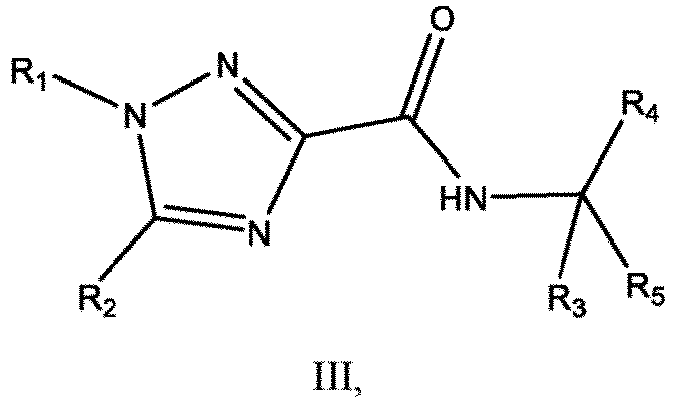 (b) un composé de formule IV :
- Composé selon la revendication 1, dans lequel le composé est le (3S)-N-cyclobutyl-3-({5-cyclopentyl-1-[2-(trifluorométhyl)phényl]-1H-1,2,4-triazol-3-yl}formamido)-5-(pipéridin-1-yl)pentanamide, le (3S)-N-cyclobutyl-3-({1-cyclopentyl-5-[2-(trifluorométhyl)phényl]-1H-1,2,4-triazol-3-yl}formamido)-5-(pipéridin-1-yl)pentanamide, le (3S)-N-cyclobutyl-3- ({1-cyclopentyl-5-[2-(trifluorométhyl)phényl]-1H-1,2,4-triazol-3-yl}formamido)-5-(3,3-difluoropipéridin-1-yl)pentanamide, le (3S)-N-cyclobutyl-3-({5-cyclopentyl-1-[2-(trifluorométhyl)phényl]-1H-1,2,4-triazol-3-yl}formamido)-5-(3,3-difluoropipéridin-1-yl)pentanamide, le (3S)-3-({5-cyclopentyl-1-[2-(trifluorométhyl)phényl]-1H-1,2,4-triazol-3-yl}formamido)-5-(3,3-difluoropipéridin-1-yl)-N-méthyl-N-(1,3-thiazol-2-yl)pentanamide,le (3S)-3-({1-cyclopentyl-5-[2-(trifluorométhyl)phényl]-1H-1,2,4-triazol-3-yl}formamido)-5-(3,3-difluoropipéridin-1-yl)-N-méthyl-N-(1,3-thiazol-2-yl)pentanamide, l'acide (3S)-3-({5-cyclopentyl-1-[2-(trifluorométhyl)phényl]-1H-1,2,4-triazol-3-yl}formamido)-5-(3,3-difluoropipéridin-1-yl)pentanoic, l'acide (3S)-3-({1-cyclopentyl-5-[2-(trifluorométhyl)phényl]-1H-1,2,4-triazol-3-yl}formamido)-5-(3,3-difluoropipéridin-1-yl)pentanoïque, le (3S)-3-(1-{5-cyclopentyl-1-[2-(trifluorométhyl)phényl]-1H-1,2,4-triazol-3-yl}-N-méthylformamido)-5-(3,3-difluoropipéridin-1-yl)-N-méthyl-N-(1,3-thiazol-2-yl)pentanamide, l'acide (3S)-3-({1-cyclopentyl-5-[3-(trifluorométhyl)pyridin-2-yl]-1H-1,2,4-triazol-3-yl}formamido)-5-(3,3-difluoropipéridin-1-yl)pentanoïque, l'acide (3S)-3-({5-cyclopentyl-1-[2-(trifluorométhyl)pyridin-3-yl]-1H-1,2,4-triazol-3-yl}formamido)-5-(3,3-difluoropipéridin-1-yl)pentanoïque, le (3S)-N-cyclobutyl-3-({1-cyclopentyl-5-[3-(trifluorométhyl)pyridin-2-yl]-1H-1,2,4-triazol-3-yl}formamido)-5-(3,3-difluoropipéridin-1-yl)pentanamide, le (3S)-N-cyclobutyl-3-({5-cyclopentyl-1-[2-(trifluorométhyl)pyridin-3-yl]-1H-1,2,4-triazol-3-yl}formamido)-5-(3,3-difluoropipéridin-1-yl)pentanamide, le (3S)-N-cyclobutyl-3-({1-cyclopentyl-5-[2-(trifluorométhyl)pyridin-3-yl]-1H-1,2,4-triazol-3-yl}formamido)-5-(3,3-difluoropipéridin-1-yl)pentanamide, l'acide (3S)-3-({5-cyclopentyl-1-[2-(trifluorométhyl)phényl]-1H-1,2,4-triazol-3-yl}formamido)-5-(3,3-difluoropyrrolidin-1-yl)pentanoïque, ou le 5-cyclopentyl-N-[(2S)-4-(3,3-difluoropipéridin-1-yl)-1-(1H-1,2,3,4-tetrazol-5-yl)butan-2-yl]-1-[2-(trifluorométhyl)phényl]-1H-1,2,4-triazole-3-carboxamide, ou un sel pharmaceutiquement acceptable de celui-ci.
- Composition pharmaceutique comprenant au moins un excipient pharmaceutiquement acceptable et une quantité thérapeutiquement efficace du composé selon l'une quelconque des revendications 1 à 3.
- Composition pharmaceutique selon la revendication 4, dans laquelle la quantité thérapeutiquement efficace est une quantité efficace pour abaisser la pression artérielle, ou pour traiter l'asthme, la cardiomyopathie, le diabète, la dyslipidémie, l'hypertension, l'hypertension artérielle pulmonaire, l'inflammation, la maladie du foie, la maladie du foie alcoolique, l'hépatite toxique, la maladie du foie induite par des virus, les troubles métaboliques, les maladies neurodégénératives, l'obésité, la prééclampsie, le dysfonctionnement rénal, les maladies rénales polykystiques, un trouble lié aux veines, un angiome, une insuffisance veineuse, une stase, une thrombose, ou pour réduire la probabilité de neurodégénérescence liée au VIH.
- Composé selon l'une quelconque des revendications 1 à 3, ou un sel pharmaceutiquement acceptable de celui-ci, destiné à être utilisé dans un traitement d'un trouble lié au récepteur de l'apéline (APJ) choisi dans le groupe constitué par l'hypertension artérielle, l'asthme, la cardiomyopathie, le diabète, la dyslipidémie, l'hypertension, l'inflammation, une maladie du foie, une maladie du foie alcoolique, une hépatite toxique, une maladie du foie induite par un virus, un trouble métabolique, une maladie neurodégénérative, l'obésité, la prééclampsie, un dysfonctionnement rénal, une maladie rénale polykystique, un trouble lié à une veine, un angiome, une insuffisance veineuse, une stase, une thrombose et une neurodégénération liée au VIH.
- Composé destiné à être utilisé selon la revendication 6, comprenant en outre un α-bloquant, un inhibiteur de l'enzyme de conversion de l'angiotensine (ECA), un bloqueur des récepteurs de l'angiotensine (BRA), un β-bloquant, un inhibiteur calcique ou un diurétique.
Applications Claiming Priority (2)
| Application Number | Priority Date | Filing Date | Title |
|---|---|---|---|
| US201662407206P | 2016-10-12 | 2016-10-12 | |
| PCT/US2017/056117 WO2018071526A1 (fr) | 2016-10-12 | 2017-10-11 | Agonistes du récepteur de l'apéline (apj) hétérocyclique et leurs utilisations |
Publications (3)
| Publication Number | Publication Date |
|---|---|
| EP3526209A1 EP3526209A1 (fr) | 2019-08-21 |
| EP3526209A4 EP3526209A4 (fr) | 2020-08-19 |
| EP3526209B1 true EP3526209B1 (fr) | 2025-04-16 |
Family
ID=61905967
Family Applications (1)
| Application Number | Title | Priority Date | Filing Date |
|---|---|---|---|
| EP17860899.8A Active EP3526209B1 (fr) | 2016-10-12 | 2017-10-11 | Agonistes du récepteur de l'apéline (apj) hétérocyclique et leurs utilisations |
Country Status (16)
| Country | Link |
|---|---|
| US (1) | US11926612B2 (fr) |
| EP (1) | EP3526209B1 (fr) |
| JP (1) | JP7104690B2 (fr) |
| KR (1) | KR102541080B1 (fr) |
| CN (2) | CN109790151B (fr) |
| AU (1) | AU2017343638B2 (fr) |
| BR (1) | BR112019003420A2 (fr) |
| CA (1) | CA3033913A1 (fr) |
| CO (1) | CO2019003590A2 (fr) |
| ES (1) | ES3032633T3 (fr) |
| IL (1) | IL265414A (fr) |
| MA (1) | MA46540A (fr) |
| MX (1) | MX394907B (fr) |
| PE (1) | PE20190806A1 (fr) |
| RU (1) | RU2764039C2 (fr) |
| WO (1) | WO2018071526A1 (fr) |
Families Citing this family (13)
| Publication number | Priority date | Publication date | Assignee | Title |
|---|---|---|---|---|
| MX387055B (es) | 2014-06-06 | 2025-03-19 | Res Triangle Inst | Agonistas del receptor de apelina (apj) y usos de los mismos. |
| WO2017100558A1 (fr) | 2015-12-09 | 2017-06-15 | Research Triangle Institute | Agonistes améliorés du récepteur de l'apéline (apj) et leurs utilisations |
| MX394907B (es) | 2016-10-12 | 2025-03-24 | Res Triangle Inst | Agonistas heterociclicos del receptor de apelina (apj) y usos de los mismos |
| US11046680B1 (en) | 2016-11-16 | 2021-06-29 | Amgen Inc. | Heteroaryl-substituted triazoles as APJ receptor agonists |
| US10736883B2 (en) | 2016-11-16 | 2020-08-11 | Amgen Inc. | Triazole furan compounds as agonists of the APJ receptor |
| WO2018093579A1 (fr) | 2016-11-16 | 2018-05-24 | Amgen Inc. | Composés phényle triazole en tant qu'agonistes du récepteur apj |
| WO2018093577A1 (fr) | 2016-11-16 | 2018-05-24 | Amgen Inc. | Composés de triazole à substitution cycloalkyle en tant qu'agonistes du récepteur apj |
| WO2018093576A1 (fr) | 2016-11-16 | 2018-05-24 | Amgen Inc. | Composés de triazole substitués par alkyle en tant qu'agonistes du récepteur apj |
| MA50509A (fr) | 2017-11-03 | 2021-06-02 | Amgen Inc | Agonistes de triazole fusionnés du récepteur apj |
| US11807624B2 (en) | 2018-05-01 | 2023-11-07 | Amgen Inc. | Substituted pyrimidinones as agonists of the APJ receptor |
| KR20220054391A (ko) * | 2019-08-29 | 2022-05-02 | 리서치 트라이앵글 인스티튜트 | 아펠린 수용체 작용제에 대한 방법 및 용도 |
| WO2022182547A1 (fr) | 2021-02-25 | 2022-09-01 | Research Triangle Institute | Dérivés hétéroaryles utilisés en tant qu'agonistes du récepteur de l'apéline |
| WO2026077457A1 (fr) * | 2024-10-12 | 2026-04-16 | 珠海联邦制药股份有限公司 | Préparation et utilisation d'un composé agoniste du récepteur apj |
Citations (1)
| Publication number | Priority date | Publication date | Assignee | Title |
|---|---|---|---|---|
| WO2013014204A2 (fr) * | 2011-07-26 | 2013-01-31 | Sanofi | Dérivés d'acide 3-hétéroaroylaminopropionique et leur utilisation comme produits pharmaceutiques |
Family Cites Families (36)
| Publication number | Priority date | Publication date | Assignee | Title |
|---|---|---|---|---|
| DE3316300A1 (de) * | 1982-05-07 | 1983-11-24 | Kureha Kagaku Kogyo K.K., Tokyo | Heribizide zusammensetzung mit einem gehalt an einem derivat des 1,2,4-triazols als wirkstoff |
| JPS58194866A (ja) | 1982-05-07 | 1983-11-12 | Kureha Chem Ind Co Ltd | トリアゾ−ル誘導体及び該誘導体を含有する除草剤 |
| JPS5998004A (ja) | 1982-11-25 | 1984-06-06 | Kureha Chem Ind Co Ltd | 1,2,4―トリアゾール誘導体及び除草剤 |
| JP3003148B2 (ja) * | 1989-01-05 | 2000-01-24 | 藤沢薬品工業株式会社 | チアゾール化合物、その製造法およびそれを含有する医薬組成物 |
| US5571810A (en) * | 1990-06-11 | 1996-11-05 | Fujisawa Pharmaceutical Co., Ltd. | Thiophene derivatives |
| FR2692575B1 (fr) | 1992-06-23 | 1995-06-30 | Sanofi Elf | Nouveaux derives du pyrazole, procede pour leur preparation et compositions pharmaceutiques les contenant. |
| US7109216B2 (en) * | 2001-09-21 | 2006-09-19 | Solvay Pharmaceuticals B.V. | 1H-imidazole derivatives having CB1 agonistic, CB1 partial agonistic or CB1-antagonistic activity |
| TWI231757B (en) * | 2001-09-21 | 2005-05-01 | Solvay Pharm Bv | 1H-Imidazole derivatives having CB1 agonistic, CB1 partial agonistic or CB1-antagonistic activity |
| UY27450A1 (es) | 2001-09-24 | 2003-04-30 | Bayer Corp | Preparación y uso de derivados de imidazol para el tratamiento de la obesidad |
| HRP20050053A2 (en) * | 2002-09-19 | 2005-04-30 | Solvay Pharmaceuticals B.V. | 1 h-1,2,4-triazole-3-carboxamide derivatives as cannabinoid-cb1 receptor ligands |
| FR2860792B1 (fr) * | 2003-10-10 | 2006-02-24 | Sanofi Synthelabo | Derives de thiophene-2-carboxamide, leur preparation et leur application en therapeutique |
| WO2005099705A2 (fr) * | 2004-03-24 | 2005-10-27 | Bayer Pharmaceuticals Corporation | Preparation de derives imidazoles et leurs procedes d'utilisation |
| ZA200703562B (en) | 2004-10-19 | 2008-08-27 | Daiichi Seiyaku Co | 1,5-diheterocycle-1H-triazole derivative |
| WO2007106721A2 (fr) | 2006-03-10 | 2007-09-20 | Jenrin Discovery | Antagonistes de recepteur cannabinoide/agonistes inverses utiles dans le traitement de l'obesite |
| EP1903052A3 (fr) | 2006-07-28 | 2008-04-02 | Faust Pharmaceuticals SA | Ligands pour le recepteur APJ et leurs utilisations |
| EP2051966A2 (fr) | 2006-08-09 | 2009-04-29 | Pfizer Products Inc. | Hétérocycles utiles en tant qu'inhibiteurs d'anhydrase carbonique |
| UY30892A1 (es) * | 2007-02-07 | 2008-09-02 | Smithkline Beckman Corp | Inhibidores de la actividad akt |
| JP5464395B2 (ja) | 2008-02-01 | 2014-04-09 | 大陽日酸株式会社 | 重水素化された芳香環又は複素環を有する化合物の製造方法 |
| US8354557B2 (en) | 2008-06-17 | 2013-01-15 | Concert Pharmaceuticals, Inc. | Synthesis of deuterated morpholine derivatives |
| US8704001B2 (en) | 2008-09-16 | 2014-04-22 | Concert Pharmaceuticals, Inc. | Deuterated 2-amino-3-hydroxypropanoic acid derivatives |
| CN101519430A (zh) | 2009-03-20 | 2009-09-02 | 中国农业大学 | 一类新型保幼激素合成抑制剂-苯丙-甘-亮三肽酰胺类似物 |
| US8835436B2 (en) * | 2009-07-10 | 2014-09-16 | Green Cross Corporation | Arylpiperazine-containing imidazole 4-carboxamide derivatives and pharmaceutical composition comprising same |
| WO2011156557A2 (fr) * | 2010-06-11 | 2011-12-15 | Thomas James B | Composés actifs au niveau du récepteur de la neurotensine |
| SG194625A1 (en) | 2011-05-23 | 2013-12-30 | Sanofi Sa | Process for the preparation of deuterated compounds containing n-alkyl groups |
| SG11201407919WA (en) | 2012-05-31 | 2014-12-30 | Phenex Pharmaceuticals Ag | Carboxamide or sulfonamide substituted thiazoles and related derivatives as modulators for the orphan nuclear receptor ror[gamma] |
| JO3215B1 (ar) | 2012-08-09 | 2018-03-08 | Phenex Pharmaceuticals Ag | حلقات غير متجانسة بها 5 ذرات تحتوي على النيتروجين بها استبدال بكربوكساميد أو سلفوناميد كمعدلات لمستقبل نووي غير محمي RORy |
| EP4345100A3 (fr) | 2012-09-18 | 2024-04-10 | Auspex Pharmaceuticals, Inc. | Formulations pharmacocinétiques d'inhibiteurs de benzoquinoline deutérés du transporteur vésiculaire de monoamine 2 |
| WO2014044738A1 (fr) | 2012-09-21 | 2014-03-27 | Sanofi | Dérivés d'amide d'acide benzimidazole-carboxylique utilisés comme modulateurs du récepteur apj |
| WO2014053533A1 (fr) | 2012-10-05 | 2014-04-10 | Sanofi | Utilisation de dérivés substitués de l'acide 3-hétéroaroylamino-propionique en tant que produits pharmaceutiques destinés à la prévention/au traitement de la fibrillation auriculaire |
| CA2895846A1 (fr) | 2012-12-20 | 2014-06-26 | Concert Pharmaceuticals, Inc. | Inhibiteurs alk deuteres |
| US9447132B2 (en) | 2013-04-12 | 2016-09-20 | Achillion Pharmaceuticals, Inc. | Highly active nucleoside derivative for the treatment of HCV |
| JP6408569B2 (ja) | 2013-10-17 | 2018-10-17 | バーテックス ファーマシューティカルズ インコーポレイテッドVertex Pharmaceuticals Incorporated | Dna−pk阻害剤としての(s)−n−メチル−8−(1−((2’−メチル−[4,5’−ビピリミジン]−6−イル)アミノ)プロパン−2−イル)キノリン−4−カルボキサミドおよびその重水素化誘導体の共結晶 |
| US10570128B2 (en) | 2014-05-28 | 2020-02-25 | Sanford Burnham Prebys Medical Discovery Institute | Agonists of the apelin receptor and methods of use thereof |
| MX387055B (es) | 2014-06-06 | 2025-03-19 | Res Triangle Inst | Agonistas del receptor de apelina (apj) y usos de los mismos. |
| WO2017100558A1 (fr) | 2015-12-09 | 2017-06-15 | Research Triangle Institute | Agonistes améliorés du récepteur de l'apéline (apj) et leurs utilisations |
| MX394907B (es) | 2016-10-12 | 2025-03-24 | Res Triangle Inst | Agonistas heterociclicos del receptor de apelina (apj) y usos de los mismos |
-
2017
- 2017-10-11 MX MX2019004214A patent/MX394907B/es unknown
- 2017-10-11 ES ES17860899T patent/ES3032633T3/es active Active
- 2017-10-11 JP JP2019508240A patent/JP7104690B2/ja active Active
- 2017-10-11 PE PE2019000806A patent/PE20190806A1/es unknown
- 2017-10-11 BR BR112019003420-0A patent/BR112019003420A2/pt not_active IP Right Cessation
- 2017-10-11 CA CA3033913A patent/CA3033913A1/fr active Pending
- 2017-10-11 EP EP17860899.8A patent/EP3526209B1/fr active Active
- 2017-10-11 WO PCT/US2017/056117 patent/WO2018071526A1/fr not_active Ceased
- 2017-10-11 AU AU2017343638A patent/AU2017343638B2/en active Active
- 2017-10-11 CN CN201780061192.9A patent/CN109790151B/zh not_active Expired - Fee Related
- 2017-10-11 CN CN202210236504.8A patent/CN114507217A/zh active Pending
- 2017-10-11 KR KR1020197013143A patent/KR102541080B1/ko active Active
- 2017-10-11 MA MA046540A patent/MA46540A/fr unknown
- 2017-10-11 US US16/341,597 patent/US11926612B2/en active Active
- 2017-10-11 RU RU2019103873A patent/RU2764039C2/ru active
-
2019
- 2019-03-17 IL IL265414A patent/IL265414A/en unknown
- 2019-04-11 CO CONC2019/0003590A patent/CO2019003590A2/es unknown
Patent Citations (1)
| Publication number | Priority date | Publication date | Assignee | Title |
|---|---|---|---|---|
| WO2013014204A2 (fr) * | 2011-07-26 | 2013-01-31 | Sanofi | Dérivés d'acide 3-hétéroaroylaminopropionique et leur utilisation comme produits pharmaceutiques |
Also Published As
| Publication number | Publication date |
|---|---|
| RU2019103873A (ru) | 2020-11-17 |
| CA3033913A1 (fr) | 2018-04-19 |
| IL265414A (en) | 2019-05-30 |
| MX2019004214A (es) | 2019-06-10 |
| EP3526209A1 (fr) | 2019-08-21 |
| US20190322644A1 (en) | 2019-10-24 |
| MA46540A (fr) | 2019-08-21 |
| AU2017343638B2 (en) | 2021-12-09 |
| KR102541080B1 (ko) | 2023-06-08 |
| JP2019534848A (ja) | 2019-12-05 |
| JP7104690B2 (ja) | 2022-07-21 |
| CN109790151B (zh) | 2022-03-29 |
| WO2018071526A1 (fr) | 2018-04-19 |
| CO2019003590A2 (es) | 2019-04-30 |
| BR112019003420A2 (pt) | 2019-05-21 |
| EP3526209A4 (fr) | 2020-08-19 |
| CN109790151A (zh) | 2019-05-21 |
| ES3032633T3 (en) | 2025-07-22 |
| MX394907B (es) | 2025-03-24 |
| RU2019103873A3 (fr) | 2021-02-04 |
| US11926612B2 (en) | 2024-03-12 |
| CN114507217A (zh) | 2022-05-17 |
| PE20190806A1 (es) | 2019-06-10 |
| AU2017343638A1 (en) | 2019-02-28 |
| RU2764039C2 (ru) | 2022-01-14 |
| KR20190055251A (ko) | 2019-05-22 |
Similar Documents
| Publication | Publication Date | Title |
|---|---|---|
| EP3526209B1 (fr) | Agonistes du récepteur de l'apéline (apj) hétérocyclique et leurs utilisations | |
| USRE49594E1 (en) | Apelin receptor (APJ) agonists and uses thereof | |
| US11401244B2 (en) | Apelin receptor (APJ) agonists and uses thereof | |
| US20240174638A1 (en) | Heteroaryl derivatives as apelin receptor agonists | |
| CA3006205C (fr) | Composes de carbamoyl pyrazole substitues et utilisation comme agonistes ameliores du recepteur de l'apeline |
Legal Events
| Date | Code | Title | Description |
|---|---|---|---|
| STAA | Information on the status of an ep patent application or granted ep patent |
Free format text: STATUS: THE INTERNATIONAL PUBLICATION HAS BEEN MADE |
|
| PUAI | Public reference made under article 153(3) epc to a published international application that has entered the european phase |
Free format text: ORIGINAL CODE: 0009012 |
|
| STAA | Information on the status of an ep patent application or granted ep patent |
Free format text: STATUS: REQUEST FOR EXAMINATION WAS MADE |
|
| 17P | Request for examination filed |
Effective date: 20190206 |
|
| AK | Designated contracting states |
Kind code of ref document: A1 Designated state(s): AL AT BE BG CH CY CZ DE DK EE ES FI FR GB GR HR HU IE IS IT LI LT LU LV MC MK MT NL NO PL PT RO RS SE SI SK SM TR |
|
| AX | Request for extension of the european patent |
Extension state: BA ME |
|
| DAX | Request for extension of the european patent (deleted) | ||
| RAV | Requested validation state of the european patent: fee paid |
Extension state: MA Effective date: 20190409 |
|
| RIC1 | Information provided on ipc code assigned before grant |
Ipc: C07D 403/14 20060101ALI20200406BHEP Ipc: C07D 401/14 20060101AFI20200406BHEP Ipc: A61P 11/06 20060101ALI20200406BHEP Ipc: C07D 417/14 20060101ALI20200406BHEP Ipc: A61K 31/454 20060101ALI20200406BHEP Ipc: C07D 249/10 20060101ALI20200406BHEP Ipc: A61P 1/16 20060101ALI20200406BHEP Ipc: C07D 401/12 20060101ALI20200406BHEP Ipc: C07D 403/12 20060101ALI20200406BHEP Ipc: A61K 31/4196 20060101ALI20200406BHEP |
|
| REG | Reference to a national code |
Ref country code: HK Ref legal event code: DE Ref document number: 40011191 Country of ref document: HK |
|
| A4 | Supplementary search report drawn up and despatched |
Effective date: 20200721 |
|
| RIC1 | Information provided on ipc code assigned before grant |
Ipc: A61K 31/4196 20060101ALI20200715BHEP Ipc: A61K 31/454 20060101ALI20200715BHEP Ipc: C07D 401/14 20060101AFI20200715BHEP Ipc: C07D 403/12 20060101ALI20200715BHEP Ipc: C07D 249/10 20060101ALI20200715BHEP Ipc: A61P 11/06 20060101ALI20200715BHEP Ipc: C07D 401/12 20060101ALI20200715BHEP Ipc: C07D 403/14 20060101ALI20200715BHEP Ipc: A61P 1/16 20060101ALI20200715BHEP Ipc: C07D 417/14 20060101ALI20200715BHEP |
|
| STAA | Information on the status of an ep patent application or granted ep patent |
Free format text: STATUS: EXAMINATION IS IN PROGRESS |
|
| 17Q | First examination report despatched |
Effective date: 20221027 |
|
| GRAP | Despatch of communication of intention to grant a patent |
Free format text: ORIGINAL CODE: EPIDOSNIGR1 |
|
| STAA | Information on the status of an ep patent application or granted ep patent |
Free format text: STATUS: GRANT OF PATENT IS INTENDED |
|
| INTG | Intention to grant announced |
Effective date: 20241113 |
|
| GRAS | Grant fee paid |
Free format text: ORIGINAL CODE: EPIDOSNIGR3 |
|
| GRAA | (expected) grant |
Free format text: ORIGINAL CODE: 0009210 |
|
| STAA | Information on the status of an ep patent application or granted ep patent |
Free format text: STATUS: THE PATENT HAS BEEN GRANTED |
|
| AK | Designated contracting states |
Kind code of ref document: B1 Designated state(s): AL AT BE BG CH CY CZ DE DK EE ES FI FR GB GR HR HU IE IS IT LI LT LU LV MC MK MT NL NO PL PT RO RS SE SI SK SM TR |
|
| REG | Reference to a national code |
Ref country code: GB Ref legal event code: FG4D |
|
| REG | Reference to a national code |
Ref country code: CH Ref legal event code: EP |
|
| P01 | Opt-out of the competence of the unified patent court (upc) registered |
Free format text: CASE NUMBER: APP_15275/2025 Effective date: 20250328 |
|
| REG | Reference to a national code |
Ref country code: IE Ref legal event code: FG4D |
|
| REG | Reference to a national code |
Ref country code: DE Ref legal event code: R096 Ref document number: 602017088985 Country of ref document: DE |
|
| REG | Reference to a national code |
Ref country code: ES Ref legal event code: FG2A Ref document number: 3032633 Country of ref document: ES Kind code of ref document: T3 Effective date: 20250722 |
|
| REG | Reference to a national code |
Ref country code: NL Ref legal event code: MP Effective date: 20250416 |
|
| PG25 | Lapsed in a contracting state [announced via postgrant information from national office to epo] |
Ref country code: NL Free format text: LAPSE BECAUSE OF FAILURE TO SUBMIT A TRANSLATION OF THE DESCRIPTION OR TO PAY THE FEE WITHIN THE PRESCRIBED TIME-LIMIT Effective date: 20250416 |
|
| REG | Reference to a national code |
Ref country code: AT Ref legal event code: MK05 Ref document number: 1785606 Country of ref document: AT Kind code of ref document: T Effective date: 20250416 |
|
| PG25 | Lapsed in a contracting state [announced via postgrant information from national office to epo] |
Ref country code: FI Free format text: LAPSE BECAUSE OF FAILURE TO SUBMIT A TRANSLATION OF THE DESCRIPTION OR TO PAY THE FEE WITHIN THE PRESCRIBED TIME-LIMIT Effective date: 20250416 Ref country code: PT Free format text: LAPSE BECAUSE OF FAILURE TO SUBMIT A TRANSLATION OF THE DESCRIPTION OR TO PAY THE FEE WITHIN THE PRESCRIBED TIME-LIMIT Effective date: 20250818 |
|
| REG | Reference to a national code |
Ref country code: LT Ref legal event code: MG9D |
|
| PG25 | Lapsed in a contracting state [announced via postgrant information from national office to epo] |
Ref country code: NO Free format text: LAPSE BECAUSE OF FAILURE TO SUBMIT A TRANSLATION OF THE DESCRIPTION OR TO PAY THE FEE WITHIN THE PRESCRIBED TIME-LIMIT Effective date: 20250716 Ref country code: GR Free format text: LAPSE BECAUSE OF FAILURE TO SUBMIT A TRANSLATION OF THE DESCRIPTION OR TO PAY THE FEE WITHIN THE PRESCRIBED TIME-LIMIT Effective date: 20250717 |
|
| PG25 | Lapsed in a contracting state [announced via postgrant information from national office to epo] |
Ref country code: PL Free format text: LAPSE BECAUSE OF FAILURE TO SUBMIT A TRANSLATION OF THE DESCRIPTION OR TO PAY THE FEE WITHIN THE PRESCRIBED TIME-LIMIT Effective date: 20250416 |
|
| PG25 | Lapsed in a contracting state [announced via postgrant information from national office to epo] |
Ref country code: BG Free format text: LAPSE BECAUSE OF FAILURE TO SUBMIT A TRANSLATION OF THE DESCRIPTION OR TO PAY THE FEE WITHIN THE PRESCRIBED TIME-LIMIT Effective date: 20250416 |
|
| PG25 | Lapsed in a contracting state [announced via postgrant information from national office to epo] |
Ref country code: HR Free format text: LAPSE BECAUSE OF FAILURE TO SUBMIT A TRANSLATION OF THE DESCRIPTION OR TO PAY THE FEE WITHIN THE PRESCRIBED TIME-LIMIT Effective date: 20250416 |
|
| PG25 | Lapsed in a contracting state [announced via postgrant information from national office to epo] |
Ref country code: AT Free format text: LAPSE BECAUSE OF FAILURE TO SUBMIT A TRANSLATION OF THE DESCRIPTION OR TO PAY THE FEE WITHIN THE PRESCRIBED TIME-LIMIT Effective date: 20250416 |
|
| PG25 | Lapsed in a contracting state [announced via postgrant information from national office to epo] |
Ref country code: RS Free format text: LAPSE BECAUSE OF FAILURE TO SUBMIT A TRANSLATION OF THE DESCRIPTION OR TO PAY THE FEE WITHIN THE PRESCRIBED TIME-LIMIT Effective date: 20250716 |
|
| PG25 | Lapsed in a contracting state [announced via postgrant information from national office to epo] |
Ref country code: IS Free format text: LAPSE BECAUSE OF FAILURE TO SUBMIT A TRANSLATION OF THE DESCRIPTION OR TO PAY THE FEE WITHIN THE PRESCRIBED TIME-LIMIT Effective date: 20250816 |
|
| PG25 | Lapsed in a contracting state [announced via postgrant information from national office to epo] |
Ref country code: LV Free format text: LAPSE BECAUSE OF FAILURE TO SUBMIT A TRANSLATION OF THE DESCRIPTION OR TO PAY THE FEE WITHIN THE PRESCRIBED TIME-LIMIT Effective date: 20250416 |
|
| PGFP | Annual fee paid to national office [announced via postgrant information from national office to epo] |
Ref country code: DE Payment date: 20251024 Year of fee payment: 9 |
|
| PGFP | Annual fee paid to national office [announced via postgrant information from national office to epo] |
Ref country code: GB Payment date: 20251002 Year of fee payment: 9 |
|
| PG25 | Lapsed in a contracting state [announced via postgrant information from national office to epo] |
Ref country code: SM Free format text: LAPSE BECAUSE OF FAILURE TO SUBMIT A TRANSLATION OF THE DESCRIPTION OR TO PAY THE FEE WITHIN THE PRESCRIBED TIME-LIMIT Effective date: 20250416 Ref country code: DK Free format text: LAPSE BECAUSE OF FAILURE TO SUBMIT A TRANSLATION OF THE DESCRIPTION OR TO PAY THE FEE WITHIN THE PRESCRIBED TIME-LIMIT Effective date: 20250416 |
|
| PGFP | Annual fee paid to national office [announced via postgrant information from national office to epo] |
Ref country code: IT Payment date: 20251014 Year of fee payment: 9 |
|
| PGFP | Annual fee paid to national office [announced via postgrant information from national office to epo] |
Ref country code: FR Payment date: 20251001 Year of fee payment: 9 |
|
| REG | Reference to a national code |
Ref country code: DE Ref legal event code: R097 Ref document number: 602017088985 Country of ref document: DE |
|
| PG25 | Lapsed in a contracting state [announced via postgrant information from national office to epo] |
Ref country code: CZ Free format text: LAPSE BECAUSE OF FAILURE TO SUBMIT A TRANSLATION OF THE DESCRIPTION OR TO PAY THE FEE WITHIN THE PRESCRIBED TIME-LIMIT Effective date: 20250416 |
|
| PG25 | Lapsed in a contracting state [announced via postgrant information from national office to epo] |
Ref country code: EE Free format text: LAPSE BECAUSE OF FAILURE TO SUBMIT A TRANSLATION OF THE DESCRIPTION OR TO PAY THE FEE WITHIN THE PRESCRIBED TIME-LIMIT Effective date: 20250416 |
|
| PG25 | Lapsed in a contracting state [announced via postgrant information from national office to epo] |
Ref country code: SK Free format text: LAPSE BECAUSE OF FAILURE TO SUBMIT A TRANSLATION OF THE DESCRIPTION OR TO PAY THE FEE WITHIN THE PRESCRIBED TIME-LIMIT Effective date: 20250416 Ref country code: RO Free format text: LAPSE BECAUSE OF FAILURE TO SUBMIT A TRANSLATION OF THE DESCRIPTION OR TO PAY THE FEE WITHIN THE PRESCRIBED TIME-LIMIT Effective date: 20250416 |
|
| PGFP | Annual fee paid to national office [announced via postgrant information from national office to epo] |
Ref country code: ES Payment date: 20251104 Year of fee payment: 9 |
|
| VS25 | Lapsed in a validation state [announced via postgrant information from nat. office to epo] |
Ref country code: MA Free format text: FAILURE TO ELECT DOMICILE IN THE NATIONAL COUNTRY Effective date: 20250717 |
|
| PLBE | No opposition filed within time limit |
Free format text: ORIGINAL CODE: 0009261 |
|
| STAA | Information on the status of an ep patent application or granted ep patent |
Free format text: STATUS: NO OPPOSITION FILED WITHIN TIME LIMIT |
|
| REG | Reference to a national code |
Ref country code: CH Ref legal event code: L10 Free format text: ST27 STATUS EVENT CODE: U-0-0-L10-L00 (AS PROVIDED BY THE NATIONAL OFFICE) Effective date: 20260225 |
|
| 26N | No opposition filed |
Effective date: 20260119 |
|
| VS25 | Lapsed in a validation state [announced via postgrant information from nat. office to epo] |
Ref country code: MA Free format text: LAPSE BECAUSE OF FAILURE TO SUBMIT A TRANSLATION OF THE DESCRIPTION OR TO PAY THE FEE WITHIN THE PRESCRIBED TIME-LIMIT Effective date: 20250416 |