EP3526227B1 - Complexes métalliques binucléaires, ainsi que dispositifs électroniques, en particulier dispositifs électroluminescents organiques, contenant lesdits complexes métalliques - Google Patents
Complexes métalliques binucléaires, ainsi que dispositifs électroniques, en particulier dispositifs électroluminescents organiques, contenant lesdits complexes métalliques Download PDFInfo
- Publication number
- EP3526227B1 EP3526227B1 EP17791589.9A EP17791589A EP3526227B1 EP 3526227 B1 EP3526227 B1 EP 3526227B1 EP 17791589 A EP17791589 A EP 17791589A EP 3526227 B1 EP3526227 B1 EP 3526227B1
- Authority
- EP
- European Patent Office
- Prior art keywords
- group
- formula
- same
- instance
- different
- Prior art date
- Legal status (The legal status is an assumption and is not a legal conclusion. Google has not performed a legal analysis and makes no representation as to the accuracy of the status listed.)
- Active
Links
- 0 C*c1c(*)c(*C)c(*)c(*C)c1* Chemical compound C*c1c(*)c(*C)c(*)c(*C)c1* 0.000 description 43
- FUQDFPJWZZMQON-UHFFFAOYSA-N Bc(cc1)cc2c1-c1ccccc1C2(C)C Chemical compound Bc(cc1)cc2c1-c1ccccc1C2(C)C FUQDFPJWZZMQON-UHFFFAOYSA-N 0.000 description 1
- PTRRNEXLWHCBFO-UHFFFAOYSA-N Brc(c(-c1ccccc1)c1)cnc1-c1ccccc1 Chemical compound Brc(c(-c1ccccc1)c1)cnc1-c1ccccc1 PTRRNEXLWHCBFO-UHFFFAOYSA-N 0.000 description 1
- IIUGQYGMIZTXCD-UHFFFAOYSA-N Brc(cc1)cnc1-c(cc1)cc2c1[o]c1c2cccc1 Chemical compound Brc(cc1)cnc1-c(cc1)cc2c1[o]c1c2cccc1 IIUGQYGMIZTXCD-UHFFFAOYSA-N 0.000 description 1
- GNKNJCQCDFITSD-UHFFFAOYSA-N Brc(cccc1)c1-c1ccc(-c(cc2)cc3c2[o]c2ccccc32)nc1 Chemical compound Brc(cccc1)c1-c1ccc(-c(cc2)cc3c2[o]c2ccccc32)nc1 GNKNJCQCDFITSD-UHFFFAOYSA-N 0.000 description 1
- KHORLGXWPDEHAX-UHFFFAOYSA-N Brc(cccc1)c1-c1ccc(-c2c(cccc3)c3ccc2)nc1 Chemical compound Brc(cccc1)c1-c1ccc(-c2c(cccc3)c3ccc2)nc1 KHORLGXWPDEHAX-UHFFFAOYSA-N 0.000 description 1
- VWCXYCBNRKQEAI-UHFFFAOYSA-N Brc(cccc1)c1-c1ccc2c3ncccc3cnc2c1 Chemical compound Brc(cccc1)c1-c1ccc2c3ncccc3cnc2c1 VWCXYCBNRKQEAI-UHFFFAOYSA-N 0.000 description 1
- NYCGGAQICCWUCI-UHFFFAOYSA-N Brc1cccnc1I Chemical compound Brc1cccnc1I NYCGGAQICCWUCI-UHFFFAOYSA-N 0.000 description 1
- DNPMWAPFUQDFPG-UHFFFAOYSA-N CC(C)(C)c(nc1)ccc1-c1ccc(B2OC(C)(C)C(C)(C)O2)cn1 Chemical compound CC(C)(C)c(nc1)ccc1-c1ccc(B2OC(C)(C)C(C)(C)O2)cn1 DNPMWAPFUQDFPG-UHFFFAOYSA-N 0.000 description 1
- FGWGKHBZYTXKBM-UHFFFAOYSA-N CC(C)(C)c1cc(-c2ccc(B3OC(C)(C)C(C)(C)O3)cc2)ncc1 Chemical compound CC(C)(C)c1cc(-c2ccc(B3OC(C)(C)C(C)(C)O3)cc2)ncc1 FGWGKHBZYTXKBM-UHFFFAOYSA-N 0.000 description 1
- BFRRJCUITCEHSO-UHFFFAOYSA-N CC(C)(C)c1ncnc(-c2ccc(B3OC(C)(C)C(C)(C)O3)cc2)c1 Chemical compound CC(C)(C)c1ncnc(-c2ccc(B3OC(C)(C)C(C)(C)O3)cc2)c1 BFRRJCUITCEHSO-UHFFFAOYSA-N 0.000 description 1
- UZZQIQNHNPCFKS-UHFFFAOYSA-N CC(C)(c1ccccc1-c1c2)c1cc(c1ccc(-c3ccccc3)c(-c3ccccc33)c11)c2[n]1C3=O Chemical compound CC(C)(c1ccccc1-c1c2)c1cc(c1ccc(-c3ccccc3)c(-c3ccccc33)c11)c2[n]1C3=O UZZQIQNHNPCFKS-UHFFFAOYSA-N 0.000 description 1
- WPJTXMWFTDSRRD-UHFFFAOYSA-N CC(C)(c1ccccc1-c1c2)c1cc1c2c2cc(-c3ccccc3)cc(-c3ccccc33)c2[n]1C3=O Chemical compound CC(C)(c1ccccc1-c1c2)c1cc1c2c2cc(-c3ccccc3)cc(-c3ccccc33)c2[n]1C3=O WPJTXMWFTDSRRD-UHFFFAOYSA-N 0.000 description 1
- OUPOLPBPAJRVLW-UHFFFAOYSA-N CC(C)C1=CC=CC(C2(C)c3c([B+]OC(C)(C)C(C)(C)O)ccc-4c3)C12[n]1c-4ncc1 Chemical compound CC(C)C1=CC=CC(C2(C)c3c([B+]OC(C)(C)C(C)(C)O)ccc-4c3)C12[n]1c-4ncc1 OUPOLPBPAJRVLW-UHFFFAOYSA-N 0.000 description 1
- CATMDDCVEPLNQJ-UHFFFAOYSA-N CC1(C)OB(c(c(-c2ccccc2)c2)cnc2-c2ccccc2)OC1(C)C Chemical compound CC1(C)OB(c(c(-c2ccccc2)c2)cnc2-c2ccccc2)OC1(C)C CATMDDCVEPLNQJ-UHFFFAOYSA-N 0.000 description 1
- AENYFLSFGATXJM-UHFFFAOYSA-N CC1(C)OB(c(cc2)cc3c2c2nc(C)c[n]2cc3)OC1(C)C Chemical compound CC1(C)OB(c(cc2)cc3c2c2nc(C)c[n]2cc3)OC1(C)C AENYFLSFGATXJM-UHFFFAOYSA-N 0.000 description 1
- NGVGLLWAZHYOIN-UHFFFAOYSA-N CC1(C)OB(c(cc2)ccc2-c(cc2C)ncc2-c(cc2)ccc2F)OC1(C)C Chemical compound CC1(C)OB(c(cc2)ccc2-c(cc2C)ncc2-c(cc2)ccc2F)OC1(C)C NGVGLLWAZHYOIN-UHFFFAOYSA-N 0.000 description 1
- CDMHQFCZCKDJHS-UHFFFAOYSA-N CC1(C)OB(c(cc2)ccc2-c(nc2)cc(C)c2-c2cc(C(F)(F)F)ccc2)OC1(C)C Chemical compound CC1(C)OB(c(cc2)ccc2-c(nc2)cc(C)c2-c2cc(C(F)(F)F)ccc2)OC1(C)C CDMHQFCZCKDJHS-UHFFFAOYSA-N 0.000 description 1
- NMJBZZQWITXGSR-UHFFFAOYSA-N CC1(C)OB(c(cc2)cnc2-c(cc2)cc3c2[o]c2c3cccc2)OC1(C)C Chemical compound CC1(C)OB(c(cc2)cnc2-c(cc2)cc3c2[o]c2c3cccc2)OC1(C)C NMJBZZQWITXGSR-UHFFFAOYSA-N 0.000 description 1
- AGGMRKYGZUQUMA-UHFFFAOYSA-N CC1(C)OB(c(cc2)cnc2-c2cccc3c2[o]c2nc(C)ccc32)OC1(C)C Chemical compound CC1(C)OB(c(cc2)cnc2-c2cccc3c2[o]c2nc(C)ccc32)OC1(C)C AGGMRKYGZUQUMA-UHFFFAOYSA-N 0.000 description 1
- HJQIBXCCKMDKBT-UHFFFAOYSA-N CC1(C)OB(c2cc(-c3ccccc3C(C=CN34)=CC3=Nc(cccc3)c3C4=O)cc(-c3ccccc3C(C=CN34)=CC3=Nc3ccccc3C4=O)c2)OC1(C)C Chemical compound CC1(C)OB(c2cc(-c3ccccc3C(C=CN34)=CC3=Nc(cccc3)c3C4=O)cc(-c3ccccc3C(C=CN34)=CC3=Nc3ccccc3C4=O)c2)OC1(C)C HJQIBXCCKMDKBT-UHFFFAOYSA-N 0.000 description 1
- IVEAUNCYPNFYRP-UHFFFAOYSA-N CCN(C)NC(C)(C)C Chemical compound CCN(C)NC(C)(C)C IVEAUNCYPNFYRP-UHFFFAOYSA-N 0.000 description 1
- JPFJUMMAPUPJRS-UHFFFAOYSA-N CN(C(c1ccc(-c2ccccc2)nc1)=O)c1cc(Cl)cc(N(C)C(c2ccc(-c3ccccc3)nc2)=O)c1 Chemical compound CN(C(c1ccc(-c2ccccc2)nc1)=O)c1cc(Cl)cc(N(C)C(c2ccc(-c3ccccc3)nc2)=O)c1 JPFJUMMAPUPJRS-UHFFFAOYSA-N 0.000 description 1
- XZWPBOBJYQDWRH-UHFFFAOYSA-N Cc1c[n](ccc2c3ccc(Cl)c2)c3n1 Chemical compound Cc1c[n](ccc2c3ccc(Cl)c2)c3n1 XZWPBOBJYQDWRH-UHFFFAOYSA-N 0.000 description 1
- XDTGGTCPPCHZPP-UHFFFAOYSA-N Cc1cc(-c(cc2)ccc2-c(cccc2)c2-c2cc(-c(cccc3)c3-c(cc3)ccc3-c(nc3)ncc3-c(cccc3)c3-c3cc(-c(cccc4)c4-c(cc4)ccc4-c(cc4C)ncc4-c(cc4)ccc4F)cc(-c4ccccc4-c(cc4)ccc4-c(cc4C)ncc4-c(cc4)ccc4F)c3)cc(-c3ccccc3-c(cc3)ccc3-c(nc3)cc(C)c3-c(cc3)ccc3F)c2)ncc1-c(cc1)ccc1F Chemical compound Cc1cc(-c(cc2)ccc2-c(cccc2)c2-c2cc(-c(cccc3)c3-c(cc3)ccc3-c(nc3)ncc3-c(cccc3)c3-c3cc(-c(cccc4)c4-c(cc4)ccc4-c(cc4C)ncc4-c(cc4)ccc4F)cc(-c4ccccc4-c(cc4)ccc4-c(cc4C)ncc4-c(cc4)ccc4F)c3)cc(-c3ccccc3-c(cc3)ccc3-c(nc3)cc(C)c3-c(cc3)ccc3F)c2)ncc1-c(cc1)ccc1F XDTGGTCPPCHZPP-UHFFFAOYSA-N 0.000 description 1
- WLYMXMQSQFATAQ-UHFFFAOYSA-N Cc1ccc(c(c(-c(cccc2)c2-c2cc(-c3ccccc3-c(cc3)cnc3-c(nc3)ccc3-c(cccc3)c3-c3cc(-c4ccccc4-c(cc4)c(c(ccc(C)n5)c5[o]5)c5c4-c4ncccc4)cc(-c(cccc4)c4-c(c4c5[o]c6nc(C)ccc46)ccc5-c4ncccc4)c3)cc(-c(cccc3)c3-c(c3c4[o]c5c3ccc(C)n5)ccc4-c3ncccc3)c2)ccc2-c3ncccc3)c2[o]2)c2n1 Chemical compound Cc1ccc(c(c(-c(cccc2)c2-c2cc(-c3ccccc3-c(cc3)cnc3-c(nc3)ccc3-c(cccc3)c3-c3cc(-c4ccccc4-c(cc4)c(c(ccc(C)n5)c5[o]5)c5c4-c4ncccc4)cc(-c(cccc4)c4-c(c4c5[o]c6nc(C)ccc46)ccc5-c4ncccc4)c3)cc(-c(cccc3)c3-c(c3c4[o]c5c3ccc(C)n5)ccc4-c3ncccc3)c2)ccc2-c3ncccc3)c2[o]2)c2n1 WLYMXMQSQFATAQ-UHFFFAOYSA-N 0.000 description 1
- YDDHUMHTPCJPJA-UHFFFAOYSA-N Clc(cc1)cc(CC2)c1-c1c2cccn1 Chemical compound Clc(cc1)cc(CC2)c1-c1c2cccn1 YDDHUMHTPCJPJA-UHFFFAOYSA-N 0.000 description 1
- WZUYVELETCZMMG-UHFFFAOYSA-N Clc(cccc1)c1C(C=C(C1)c(cccc2)c2Br)=CC1c1ccccc1Br Chemical compound Clc(cccc1)c1C(C=C(C1)c(cccc2)c2Br)=CC1c1ccccc1Br WZUYVELETCZMMG-UHFFFAOYSA-N 0.000 description 1
- GOXFMUIVURTWLI-UHFFFAOYSA-N Clc1c(C(CC(c2ccccc2Br)=C2)C=C2c2ccccc2Br)cccc1 Chemical compound Clc1c(C(CC(c2ccccc2Br)=C2)C=C2c2ccccc2Br)cccc1 GOXFMUIVURTWLI-UHFFFAOYSA-N 0.000 description 1
- ZCLYXPGZVQEYOF-UHFFFAOYSA-N Clc1cc(-c(cccc2)c2-c(cc2)cnc2-c2ccc3[o]c(cccc4)c4c3c2)cc(-c(cccc2)c2-c(cc2)cnc2-c(cc2)cc3c2[o]c2c3cccc2)c1 Chemical compound Clc1cc(-c(cccc2)c2-c(cc2)cnc2-c2ccc3[o]c(cccc4)c4c3c2)cc(-c(cccc2)c2-c(cc2)cnc2-c(cc2)cc3c2[o]c2c3cccc2)c1 ZCLYXPGZVQEYOF-UHFFFAOYSA-N 0.000 description 1
- ZMTURCKWMWWFDG-UHFFFAOYSA-N Clc1cc(-c(cccc2)c2-c2ccc3c(nccc4)c4cnc3c2)cc(-c(cccc2)c2-c2cc3ncc(cccn4)c4c3cc2)c1 Chemical compound Clc1cc(-c(cccc2)c2-c2ccc3c(nccc4)c4cnc3c2)cc(-c(cccc2)c2-c2cc3ncc(cccn4)c4c3cc2)c1 ZMTURCKWMWWFDG-UHFFFAOYSA-N 0.000 description 1
- SSIHGRXSWBRPHI-UHFFFAOYSA-N Clc1ccccc1C(CC(C1)c2ccccc2Br)CC1c(cccc1)c1Br Chemical compound Clc1ccccc1C(CC(C1)c2ccccc2Br)CC1c(cccc1)c1Br SSIHGRXSWBRPHI-UHFFFAOYSA-N 0.000 description 1
- DNKRHWDRVGJFDL-UHFFFAOYSA-N O=C(c(cc1)ccc1-c1ccccn1)Cl Chemical compound O=C(c(cc1)ccc1-c1ccccn1)Cl DNKRHWDRVGJFDL-UHFFFAOYSA-N 0.000 description 1
- BSSWQBUHXBMIHZ-UHFFFAOYSA-N O=C(c(cc1)ccc1-c1ccccn1)Nc1cc(Cl)cc(NC(c(cc2)ccc2-c2ncccc2)=O)c1 Chemical compound O=C(c(cc1)ccc1-c1ccccn1)Nc1cc(Cl)cc(NC(c(cc2)ccc2-c2ncccc2)=O)c1 BSSWQBUHXBMIHZ-UHFFFAOYSA-N 0.000 description 1
- IRTYNWXLGVXYTJ-UHFFFAOYSA-N O=C(c1c-2cccc1)c1cccc3c1c-2ncc3Br Chemical compound O=C(c1c-2cccc1)c1cccc3c1c-2ncc3Br IRTYNWXLGVXYTJ-UHFFFAOYSA-N 0.000 description 1
- KZIMGUQPSLWCGH-UHFFFAOYSA-N O=C(c1ccccc1-c1c(cc2)-c(cc3)cc4c3[s]c3c4cccc3)[n]3c1c2c(cc1)c3cc1-c1ccc2[s]c(cccc3)c3c2c1 Chemical compound O=C(c1ccccc1-c1c(cc2)-c(cc3)cc4c3[s]c3c4cccc3)[n]3c1c2c(cc1)c3cc1-c1ccc2[s]c(cccc3)c3c2c1 KZIMGUQPSLWCGH-UHFFFAOYSA-N 0.000 description 1
- ORIMAQRRBNJWCZ-UHFFFAOYSA-N O=C(c1ccccc1-c1c(cc2)-c3cc(-c4ccccc4)nc(-c4ccccc4)c3)[n]3c1c2c(cc1)c3cc1-c1cc(-c2ccccc2)nc(-c2ccccc2)c1 Chemical compound O=C(c1ccccc1-c1c(cc2)-c3cc(-c4ccccc4)nc(-c4ccccc4)c3)[n]3c1c2c(cc1)c3cc1-c1cc(-c2ccccc2)nc(-c2ccccc2)c1 ORIMAQRRBNJWCZ-UHFFFAOYSA-N 0.000 description 1
- UUKPLPYJKYWLBA-UHFFFAOYSA-N O=C(c1ccccc1-c1c(cc2)-c3cccc4c3[o]c3ccccc43)[n]3c1c2c(cc1)c3cc1-c1cccc2c1[o]c1c2cccc1 Chemical compound O=C(c1ccccc1-c1c(cc2)-c3cccc4c3[o]c3ccccc43)[n]3c1c2c(cc1)c3cc1-c1cccc2c1[o]c1c2cccc1 UUKPLPYJKYWLBA-UHFFFAOYSA-N 0.000 description 1
- BSGFKIOGNSOJAN-UHFFFAOYSA-N O=C1[n](c(ccc(-c(cc2)cnc2-c2ccccn2)c2)c2c2cc(-c(cc3)ncc3-c3ccccn3)c3)c2c3-c2ccccc12 Chemical compound O=C1[n](c(ccc(-c(cc2)cnc2-c2ccccn2)c2)c2c2cc(-c(cc3)ncc3-c3ccccn3)c3)c2c3-c2ccccc12 BSGFKIOGNSOJAN-UHFFFAOYSA-N 0.000 description 1
- SPWKLOITKIAAKD-UHFFFAOYSA-N O=C1[n](c(ccc(-c2cc(-c3ccccc3)cc(-c3ccccc3)c2)c2)c2c2cc(-c3cc(-c4ccccc4)cc(-c4ccccc4)c3)c3)c2c3-c2ccccc12 Chemical compound O=C1[n](c(ccc(-c2cc(-c3ccccc3)cc(-c3ccccc3)c2)c2)c2c2cc(-c3cc(-c4ccccc4)cc(-c4ccccc4)c3)c3)c2c3-c2ccccc12 SPWKLOITKIAAKD-UHFFFAOYSA-N 0.000 description 1
- SHKINCUZQGICNQ-UHFFFAOYSA-N O=C1[n](c(ccc(-c2cc(-c3ccccc3)nc(-c3ccccc3)c2)c2)c2c2cc(-c3cc(-c4ccccc4)nc(-c4ccccc4)c3)c3)c2c3-c2ccccc12 Chemical compound O=C1[n](c(ccc(-c2cc(-c3ccccc3)nc(-c3ccccc3)c2)c2)c2c2cc(-c3cc(-c4ccccc4)nc(-c4ccccc4)c3)c3)c2c3-c2ccccc12 SHKINCUZQGICNQ-UHFFFAOYSA-N 0.000 description 1
- WWRSLXYITBPKOL-UHFFFAOYSA-N O=C1[n](c(ccc(-c2ccccc2)c2)c2c2cc(-c3ccccc3)c3)c2c3-c2ccccc12 Chemical compound O=C1[n](c(ccc(-c2ccccc2)c2)c2c2cc(-c3ccccc3)c3)c2c3-c2ccccc12 WWRSLXYITBPKOL-UHFFFAOYSA-N 0.000 description 1
- DWYQFSFQCSIMDD-UHFFFAOYSA-N O=C1[n](c(ccc(-c2ncccc2)c2)c2c2cc(-c3ncccc3)c3)c2c3-c2ccccc12 Chemical compound O=C1[n](c(ccc(-c2ncccc2)c2)c2c2cc(-c3ncccc3)c3)c2c3-c2ccccc12 DWYQFSFQCSIMDD-UHFFFAOYSA-N 0.000 description 1
- KGYZHBXTKLYLQU-UHFFFAOYSA-N O=C1[n](c(ccc(-c2nccnc2)c2)c2c2cc(-c3nccnc3)c3)c2c3-c2ccccc12 Chemical compound O=C1[n](c(ccc(-c2nccnc2)c2)c2c2cc(-c3nccnc3)c3)c2c3-c2ccccc12 KGYZHBXTKLYLQU-UHFFFAOYSA-N 0.000 description 1
- DSSBJZCMMKRJTF-UHFFFAOYSA-N OB(c(cc1)cc2c1[o]c1ccccc21)O Chemical compound OB(c(cc1)cc2c1[o]c1ccccc21)O DSSBJZCMMKRJTF-UHFFFAOYSA-N 0.000 description 1
- FQVLOBQILLZLJA-UHFFFAOYSA-N Oc1cc(Cl)cc(O)c1 Chemical compound Oc1cc(Cl)cc(O)c1 FQVLOBQILLZLJA-UHFFFAOYSA-N 0.000 description 1
- DAIYPHZRICSJTD-UHFFFAOYSA-N [Br-]c(cccc1)c1-c(cc1)ccc1-c(nc1)ncc1-c(cccc1)c1Br Chemical compound [Br-]c(cccc1)c1-c(cc1)ccc1-c(nc1)ncc1-c(cccc1)c1Br DAIYPHZRICSJTD-UHFFFAOYSA-N 0.000 description 1
Classifications
-
- C—CHEMISTRY; METALLURGY
- C07—ORGANIC CHEMISTRY
- C07F—ACYCLIC, CARBOCYCLIC OR HETEROCYCLIC COMPOUNDS CONTAINING ELEMENTS OTHER THAN CARBON, HYDROGEN, HALOGEN, OXYGEN, NITROGEN, SULFUR, SELENIUM OR TELLURIUM
- C07F15/00—Compounds containing elements of Groups 8, 9, 10 or 18 of the Periodic Table
- C07F15/0006—Compounds containing elements of Groups 8, 9, 10 or 18 of the Periodic Table compounds of the platinum group
- C07F15/0033—Iridium compounds
-
- C—CHEMISTRY; METALLURGY
- C07—ORGANIC CHEMISTRY
- C07F—ACYCLIC, CARBOCYCLIC OR HETEROCYCLIC COMPOUNDS CONTAINING ELEMENTS OTHER THAN CARBON, HYDROGEN, HALOGEN, OXYGEN, NITROGEN, SULFUR, SELENIUM OR TELLURIUM
- C07F15/00—Compounds containing elements of Groups 8, 9, 10 or 18 of the Periodic Table
- C07F15/0006—Compounds containing elements of Groups 8, 9, 10 or 18 of the Periodic Table compounds of the platinum group
- C07F15/0073—Rhodium compounds
-
- C—CHEMISTRY; METALLURGY
- C09—DYES; PAINTS; POLISHES; NATURAL RESINS; ADHESIVES; COMPOSITIONS NOT OTHERWISE PROVIDED FOR; APPLICATIONS OF MATERIALS NOT OTHERWISE PROVIDED FOR
- C09K—MATERIALS FOR MISCELLANEOUS APPLICATIONS, NOT PROVIDED FOR ELSEWHERE
- C09K11/00—Luminescent materials, e.g. electroluminescent or chemiluminescent
- C09K11/06—Luminescent materials, e.g. electroluminescent or chemiluminescent containing organic luminescent materials
-
- H—ELECTRICITY
- H10—SEMICONDUCTOR DEVICES; ELECTRIC SOLID-STATE DEVICES NOT OTHERWISE PROVIDED FOR
- H10K—ORGANIC ELECTRIC SOLID-STATE DEVICES
- H10K85/00—Organic materials used in the body or electrodes of devices covered by this subclass
- H10K85/30—Coordination compounds
- H10K85/341—Transition metal complexes, e.g. Ru(II)polypyridine complexes
- H10K85/342—Transition metal complexes, e.g. Ru(II)polypyridine complexes comprising iridium
-
- H—ELECTRICITY
- H10—SEMICONDUCTOR DEVICES; ELECTRIC SOLID-STATE DEVICES NOT OTHERWISE PROVIDED FOR
- H10K—ORGANIC ELECTRIC SOLID-STATE DEVICES
- H10K85/00—Organic materials used in the body or electrodes of devices covered by this subclass
- H10K85/30—Coordination compounds
- H10K85/361—Polynuclear complexes, i.e. complexes comprising two or more metal centers
-
- C—CHEMISTRY; METALLURGY
- C09—DYES; PAINTS; POLISHES; NATURAL RESINS; ADHESIVES; COMPOSITIONS NOT OTHERWISE PROVIDED FOR; APPLICATIONS OF MATERIALS NOT OTHERWISE PROVIDED FOR
- C09K—MATERIALS FOR MISCELLANEOUS APPLICATIONS, NOT PROVIDED FOR ELSEWHERE
- C09K2211/00—Chemical nature of organic luminescent or tenebrescent compounds
- C09K2211/18—Metal complexes
- C09K2211/185—Metal complexes of the platinum group, i.e. Os, Ir, Pt, Ru, Rh or Pd
-
- H—ELECTRICITY
- H10—SEMICONDUCTOR DEVICES; ELECTRIC SOLID-STATE DEVICES NOT OTHERWISE PROVIDED FOR
- H10K—ORGANIC ELECTRIC SOLID-STATE DEVICES
- H10K2101/00—Properties of the organic materials covered by group H10K85/00
- H10K2101/10—Triplet emission
-
- H—ELECTRICITY
- H10—SEMICONDUCTOR DEVICES; ELECTRIC SOLID-STATE DEVICES NOT OTHERWISE PROVIDED FOR
- H10K—ORGANIC ELECTRIC SOLID-STATE DEVICES
- H10K50/00—Organic light-emitting devices
- H10K50/10—OLEDs or polymer light-emitting diodes [PLED]
- H10K50/11—OLEDs or polymer light-emitting diodes [PLED] characterised by the electroluminescent [EL] layers
-
- H—ELECTRICITY
- H10—SEMICONDUCTOR DEVICES; ELECTRIC SOLID-STATE DEVICES NOT OTHERWISE PROVIDED FOR
- H10K—ORGANIC ELECTRIC SOLID-STATE DEVICES
- H10K71/00—Manufacture or treatment specially adapted for the organic devices covered by this subclass
- H10K71/10—Deposition of organic active material
- H10K71/12—Deposition of organic active material using liquid deposition, e.g. spin coating
- H10K71/15—Deposition of organic active material using liquid deposition, e.g. spin coating characterised by the solvent used
Definitions
- the present invention relates to binuclear metal complexes which are suitable for use as emitters in organic electroluminescent devices.
- bis- and tris-ortho-metallated iridium complexes with aromatic ligands are used in particular as triplet emitters in phosphorescent organic electroluminescent devices (OLEDs), the ligands via a negatively charged carbon atom and a neutral nitrogen atom or via a negatively charged carbon atom and bind a neutral carbene carbon atom to the metal.
- OLEDs organic electroluminescent devices
- Examples of such complexes are tris (phenylpyridyl) iridium (III) and derivatives thereof, 1- or 3-phenylisoquinolines, 2-phenylquinolines or phenylcarbenes being used as ligands, for example.
- iridium complexes generally have a very long luminescence lifetime on the order of significantly more than 1 ⁇ s.
- short luminescence lifetimes are desired for use in OLEDs in order to be able to operate the OLED at high brightness with a low roll-off behavior.
- red phosphorescent emitters Due to the low triplet level T 1 in conventional red phosphorescent emitters, the photoluminescence quantum yield is often significantly below the theoretically possible value, since with small T 1 non-radiative channels also play a greater role, especially if the complex has a long luminescence lifetime.
- An improvement by increasing the radiative rates is desirable here, which in turn can be achieved by reducing the photoluminescence lifetime.
- the object of the present invention is therefore to provide new metal complexes which are suitable as emitters for use in OLEDs.
- the task is to provide emitters which show improved properties with regard to efficiency, operating voltage and / or service life.
- the binuclear rhodium and iridium complexes described below show significant improvements in the photophysical properties compared to corresponding mononuclear complexes and thus also lead to improved properties when used in an organic electroluminescent device.
- the compounds according to the invention have an improved photoluminescence quantum yield and a significantly reduced luminescence lifetime. A shorter luminescence lifetime leads to an improved roll-off behavior of the organic electroluminescence device.
- the above-mentioned formulation should also be understood to mean that in the event that one of the two radicals is hydrogen, the second radical binds to the position to which the hydrogen atom was bonded, forming a ring. This is illustrated by the following scheme:
- the ring formation can take place on radicals which are bonded to carbon atoms which are bonded directly to one another, or to radicals which are bonded to carbon atoms located further away. Is preferred such ring formation in the case of residues which are bonded to carbon atoms bonded directly to one another or to the same carbon atom.
- An aryl group in the sense of this invention contains 6 to 40 C atoms;
- a heteroaryl group in the sense of this invention contains 2 to 40 carbon atoms and at least one heteroatom, with the proviso that the sum of carbon atoms and heteroatoms results in at least 5.
- the heteroatoms are preferably selected from N, O and / or S.
- an aryl group or heteroaryl group is either a simple aromatic cycle, i.e.
- benzene or a simple heteroaromatic cycle, for example pyridine, pyrimidine, thiophene, etc., or one condensed aryl or heteroaryl group, for example naphthalene, anthracene, phenanthrene, quinoline, isoquinoline, etc., understood.
- An aromatic ring system in the sense of this invention contains 6 to 40 carbon atoms in the ring system.
- a heteroaromatic ring system in the sense of this invention contains 1 to 40 carbon atoms and at least one heteroatom in the ring system, with the proviso that the sum of carbon atoms and heteroatoms results in at least 5.
- the heteroatoms are preferably selected from N, O and / or S.
- An aromatic or heteroaromatic ring system in the sense of this invention is to be understood as a system which does not necessarily only contain aryl or heteroaryl groups, but also in which a plurality of aryl or heteroaryl groups a non-aromatic unit (preferably less than 10% of the atoms other than H), such as. B.
- a C, N or O atom or a carbonyl group may be interrupted.
- systems such as 9,9'-spirobifluorene, 9,9-diarylfluorene, triarylamine, diaryl ether, stilbene, etc. are also to be understood as aromatic ring systems in the sense of this invention, and also systems in which two or more aryl groups, for example, by one linear or cyclic alkyl group or interrupted by a silyl group.
- systems in which two or more aryl or heteroaryl groups are bonded directly to one another such as, for. B. biphenyl, terphenyl, quaterphenyl or bipyridine, are also to be understood as an aromatic or heteroaromatic ring system.
- a cyclic alkyl group in the sense of this invention is understood to mean a monocyclic, a bicyclic or a polycyclic group.
- a C 1 - to C 20 -alkyl group in which individual H atoms or CH 2 groups can also be substituted by the abovementioned groups, for example the radicals methyl, ethyl, n-propyl, i Propyl, cyclopropyl, n-butyl, i-butyl, s-butyl, t-butyl, cyclobutyl, 2-methylbutyl, n-pentyl, s-pentyl, t-pentyl, 2-pentyl, neo-pentyl, cyclopentyl, n -Hexyl, s-hexyl, t-hexyl, 2-hexyl, 3-hexyl, neo-hexyl, cyclohexyl, 1-methylcyclopentyl, 2-methylpentyl, n-heptyl, 2-heptyl, 3-
- An alkenyl group means, for example, ethenyl, propenyl, butenyl, pentenyl, cyclopentenyl, hexenyl, cyclohexenyl, heptenyl, cycloheptenyl, octenyl, cyclooctenyl or cyclooctadienyl.
- An alkynyl group means, for example, ethynyl, propynyl, butynyl, pentynyl, hexynyl, heptynyl or octynyl.
- a C 1 to C 20 alkoxy group such as that for OR 1 or OR 2 , includes, for example, methoxy, trifluoromethoxy, ethoxy, n-propoxy, i-propoxy, n-butoxy, i-butoxy, s-butoxy, understood t-butoxy or 2-methylbutoxy.
- Aromatics or heteroaromatics can be linked, for example groups which are derived from benzene, naphthalene, anthracene, benzanthracene, phenanthrene, benzophenanthrene, pyrene, chrysene, perylene, fluoranthene, benzfluoranthene, naphthacene, pentacene, benzopyrene, biphenyl, biphenylene, terphen , Terphenylene, fluorene, spirobifluorene, dihydrophenanthrene, dihydropyrene, tetrahydropyrene, cis- or trans-indenofluorene, cis- or trans-monobenzoindenofluorene, cis- or trans-dibenzoinden
- the partial ligand which is coordinated to both metals M, in the present case iridium, represents a 2-phenylpyrimidine group.
- a group of the formula (2) is bonded to the phenyl group and to the pyrimidine group, i. H.
- V in this structure represents a group of the formula (2).
- Two partial ligands L are also bound to this group of the formula (2), which in the structure shown above each represent phenylpyridine.
- Each of the two metals M is thus coordinated in the structure shown above with two phenylpyridine ligands and one phenylpyrimidine ligand, the phenyl group and the pyrimidine group of phenylpyrimidine each coordinating to both metals M.
- the partial ligands are each linked to a polypodal system by the group of formula (2).
- the term “bidentate partial ligand” for L means that this unit would be a bidentate ligand if the group of the formula (2) or (3) were not present. Due to the formal abstraction of a hydrogen atom on this bidentate ligand and the linkage within the bridge of formula (2) or (3), this is not a separate ligand, but part of the resulting dodecadentate ligand, i.e. a ligand with a total of 12 coordination sites, so that the term "partial ligand” is used for this.
- the binding of the ligand to the metal M can be both a coordination bond and a covalent bond, or the covalent portion of the bond can vary depending on the ligand. If in the present application it is mentioned that the ligand or the partial ligand coordinates or binds to M, this means in the sense of the present application any type of binding of the ligand or partial ligand to M, regardless of the covalent portion of the bond.
- the compounds according to the invention are preferably not charged, i. H. they are electrically neutral. This is achieved by the fact that Rh and Ir are each in the oxidation state + III.
- Each of the metals is then coordinated by two monoanionic bidentate partial ligands and a dianionic tetradentate partial ligand, which binds to both metals, so that the partial ligands compensate for the charge of the complexed metal atom.
- the two metals M in the compound according to the invention can be the same or different and are preferably in the + III oxidation state.
- the combinations Ir / Ir, Ir / Rh and Rh / Rh are therefore suitable.
- both metals M represent Ir (III).
- the compounds of the formula (1) are selected from the compounds of the following formula (1 '), where the explicitly drawn radicals R in the ortho position to D are selected identically or differently in each occurrence from the group consisting of H, D, F, CH 3 and CD 3 and preferably stand for H and the other symbols used are those listed above Have meanings.
- each of the metals is coordinated by a carbon atom and a nitrogen atom of the central partial ligand and is furthermore coordinated by two partial ligands L.
- the compound of the formula (1) thus has a structure according to one of the following formulas (1a) or (1b) and preferably a structure according to one of the following formulas (1a ') or (1b'), where the explicitly drawn radicals R are selected the same or different for each occurrence from the group consisting of H, D, F, CH 3 and CD 3 and the other symbols used have the meanings given above.
- the radicals R explicitly represented in formulas (1a ') and (1b') are particularly preferably H.
- the structures (1b) and (1b ') are particularly preferred.
- a 2 stands for CR, in particular if all A 2 stand for CR, very particularly if additionally 0, 1, 2 or 3, in particular 3, the A 1 stand for CR 2 , so if it is a Cyclohexane group, the radicals R on A 2 can assume different positions depending on the configuration. Small radicals R such as H or D are preferred. It is preferred that they are all directed away from the metal (apical) or all are directed inwards towards the metal (endohedral). This is illustrated below using an example in which groups A each represent an ortho-phenylene group.
- the third partial ligand which coordinates to both metals M, is not shown for the sake of clarity, but is only indicated by the broken line. Complexes which can take up at least one of the two configurations are therefore preferred. These are complexes in which all three partial ligands are arranged equatorially on the central ring.
- Suitable embodiments of the group of formula (2) are the structures of the following formulas (5) to (8), and suitable embodiments of the group of formula (3) are the structures of the following formulas (9) to (13), where the symbols have the meanings given above.
- all groups X 1 in the group of the formula (2) are CR, so that the central trivalent cycle of the formula (2) is a benzene.
- All groups X 1 are particularly preferably CH or CD, in particular CH.
- all groups X 1 represent a nitrogen atom, so that the central trivalent cycle of the formula (2) represents a triazine.
- Preferred embodiments of the formula (2) are thus the structures of the formulas (5) and (6) shown above.
- the structure of the formula (5) is particularly preferably a structure of the following formula (5 '), where the symbols have the meanings given above.
- all groups A 2 in the group of the formula (3) are CR. All groups A 2 are particularly preferably CH.
- Preferred embodiments of the formula (3) are thus the structures of the formula (9) shown above.
- the structure of the formula (9) is particularly preferably a structure according to one of the following formulas (9 ') or (9 "), where the symbols have the meanings given above and R preferably represents H.
- two groups A are preferably identical and also substituted in the same way, and the third group A is different from the first two groups A, or all three groups A are identical and also substituted equally.
- R ' is preferably the same or different on each occurrence for a straight-chain alkyl group with 1 to 10 C atoms or a branched or cyclic alkyl group with 3 to 10 C atoms or an aromatic or heteroaromatic ring system with 6 to 24 aromatic ring atoms, each of which can be substituted by one or more radicals R 1 .
- R ' is particularly preferably the same or different at each occurrence for a straight-chain alkyl group with 1 to 5 C atoms or a branched or cyclic alkyl group with 3 to 6 C atoms or an aromatic or heteroaromatic ring system with 6 to 12 aromatic ring atoms, each can be substituted by one or more radicals R 1 , but is preferably unsubstituted.
- the group of formula (4) can represent a heteroaromatic five-membered ring or an aromatic or heteroaromatic six-membered ring.
- the group of the formula (4) contains at most two heteroatoms in the aromatic or heteroaromatic unit, particularly preferably at most one heteroatom. This does not rule out that substituents which may be attached to this group may also contain heteroatoms. Furthermore, this definition does not preclude the formation of condensed aromatic or heteroaromatic structures, such as naphthalene, benzimidazole, etc., from the ring formation of substituents.
- preferred embodiments of the group of formula (4) are the structures of the following formulas (14) to (30), and when one group X 3 represents a carbon atom and the other group X 3 in the same cycle represents a nitrogen atom, preferred embodiments of the group of the formula (4) are the structures of the following formulas (31) to (38), where the symbols have the meanings given above.
- adjacent substituents R can also form a ring system with one another, so that fused structures, including fused aryl and heteroaryl groups, such as naphthalene, quinoline, benzimidazole, carbazole, dibenzofuran or dibenzothiophene, can be formed.
- fused structures including fused aryl and heteroaryl groups, such as naphthalene, quinoline, benzimidazole, carbazole, dibenzofuran or dibenzothiophene.
- the condensed groups can be condensed at any position of the unit according to formula (4), as represented by the condensed benzo group in formulas (14a) to (14c).
- the groups as they are fused in the formulas (14d) to (14j) to the unit of the formula (4) can therefore also be fused to other positions in the unit of the formula (4).
- the group of the formula (2) can particularly preferably be represented by the following formulas (2a) to (2m), and the group of the formula (3) can particularly preferably be represented by the following formulas (3a) to (3m), where the symbols have the meanings given above.
- X 2 is preferably the same or different for each occurrence of CR.
- the group of formulas (2a) to (2m) is selected from the groups of formulas (5a ') to (5m') and the group of formulas (3a) to (3m) is selected from the groups of formulas (9a ') to (9m'), where the symbols have the meanings given above.
- X 2 is preferably the same or different for each occurrence of CR.
- a particularly preferred embodiment of the group of the formula (2) is the group of the following formula (5a "), where the symbols have the meanings given above.
- R in the above formulas are particularly preferably identical or different H, D or an alkyl group having 1 to 4 carbon atoms.
- R H is very particularly preferred.
- the structure of the following formulas (5a '") is very particularly preferred, where the symbols have the meanings given above.
- the bidentate, monoanionic partial ligands L are described below.
- the partial ligands L can be the same or different. It is preferred if the two partial ligands L which coordinate to the same metal M are the same and are also substituted in the same way. This preference is due to the simpler synthesis of the corresponding ligands.
- all four bidentate partial ligands L are the same and are also substituted in the same way.
- the coordinating atoms of the bidentate partial ligands L are identical or different in each occurrence selected from C, N, P, O, S and / or B, particularly preferably C, N and / or O and very particularly preferably C and / or N.
- the bidentate partial ligands L preferably have one carbon atom and one nitrogen atom or two carbon atoms or two nitrogen atoms or two oxygen atoms or one oxygen atom and one nitrogen atom as coordinating atoms.
- the coordinating atoms of each of the partial ligands L can be the same or they can be different.
- At least one of the two bidentate partial ligands L which coordinate to the same metal M, preferably has a carbon atom and a nitrogen atom or two carbon atoms as coordinating atoms, in particular a carbon atom and a nitrogen atom.
- At least all bidentates are particularly preferred Partial ligands have a carbon atom and a nitrogen atom or two carbon atoms as coordinating atoms, in particular a carbon atom and a nitrogen atom. It is therefore particularly preferably a metal complex in which all the partial ligands are ortho-metallated, ie form a metal cycle with the metal M in which there is at least one metal-carbon bond.
- the metallacycle which is spanned from the metal M and the bidentate partial ligand L, is a five-membered ring, which is particularly preferred when the coordinating atoms C and N, N and N or N and O are. If the coordinating atoms are O, a metal six-membered ring can also be preferred. This is shown schematically below: where N represents a coordinating nitrogen atom, C represents a coordinating carbon atom and O represents coordinating oxygen atoms and the carbon atoms shown represent atoms of the bidentate partial ligand L.
- the optional substituents can form a ring system with one another; furthermore, the optional radicals are preferably selected from the radicals R.
- CyD coordinates in the partial ligands of the formulas (L-1) and (L-2) preferably via a neutral nitrogen atom or via a carbene carbon atom, in particular via a neutral nitrogen atom.
- one of the two groups CyD in the ligand of the formula (L-3) preferably coordinates via a neutral nitrogen atom and the other of the two groups CyD via an anionic nitrogen atom.
- CyC also preferably coordinates in the partial ligands of the formulas (L-1) and (L-2) via anionic carbon atoms.
- substituents on CyC and CyD in the formulas (L-1) and (L-2) or the substituents on the two groups CyD in formula (L-3) it is possible to form a ring system from substituents which are bonded to directly adjacent carbon atoms.
- substituents on CyC and CyD in the formulas (L-1) and (L-2) or the substituents on the two groups CyD in formula (L-3) it is also possible for the substituents on CyC and CyD in the formulas (L-1) and (L-2) or the substituents on the two groups CyD in formula (L-3) to form a ring with one another, as a result of which CyC and CyD or the two groups CyD also together can form a single condensed aryl or heteroaryl group as bidentate ligands.
- CyC is an aryl or heteroaryl group with 6 to 13 aromatic ring atoms, particularly preferably with 6 to 10 aromatic ring atoms, very particularly preferably with 6 aromatic ring atoms, in particular a phenyl group, which coordinates to the metal via a carbon atom which can be substituted by one or more radicals R and which is linked to CyD via a covalent bond.
- a maximum of two symbols X in CyC preferably stand for N, particularly preferably a maximum of one symbol X in CyC stands for N, very particularly preferably all symbols X stand for CR, with the proviso that if CyC is directly within the group of the formula (2 ) or (3) is bound, a symbol X stands for C and the bridge of formula (2) or (3) or the preferred embodiments is bound to this carbon atom.
- CyC are the groups of the following formulas (CyC-1a) to (CyC-20a), where the symbols have the meanings given above and, if CyC is bonded directly within the group of the formula (2) or (3), a radical R is not present and the group of the formula (2) or (3) or the preferred embodiments are bound to the corresponding carbon atom. If the group CyC is bonded directly to the group of the formula (2) or (3), the bond is preferably carried out via the position marked with "o" in the formulas shown above, so that the radical R is then preferably not in this position is available.
- the structures shown above, which do not contain a carbon atom marked with “o”, are preferably not directly linked to the group of the formula (2) or (3).
- Preferred groups among the groups (CyC-1) to (CyC-20) are the groups (CyC-1), (CyC-3), (CyC-8), (CyC-10), (CyC-12), ( CyC-13) and (CyC-16), and particularly preferred are the groups (CyC-1a), (CyC-3a), (CyC-8a), (CyC-10a), (CyC-12a), (CyC-13a) and (CyC -16a).
- CyD is a heteroaryl group having 5 to 13 aromatic ring atoms, particularly preferably having 6 to 10 aromatic ring atoms, which coordinates to the metal via a neutral nitrogen atom or via a carbene carbon atom and which is substituted by one or more R groups and which is connected to CyC via a covalent bond.
- Preferred embodiments of the group CyD are the structures of the following formulas (CyD-1) to (CyD-14), wherein the group CyD binds to CyC at the position indicated by # and coordinates to the metal at the position indicated by * and wherein X, W and R have the meanings given above, with the proviso that when CyD is directly within the group of the formula (2) or (3) is bound, a symbol X represents C and the bridge of the formulas (2) or (3) or the preferred embodiments is bound to this carbon atom. If the group CyD is bonded directly to the group of the formula (2) or (3), the bond is preferably carried out via the position marked with "o" in the formulas shown above, so that the symbol marked with "o” is then preferred X stands for C.
- the structures depicted above, which do not contain any symbol X marked with “o”, are preferably not bound directly to the group of the formula (2) or (3), since such a bond to the bridge is not advantageous for steric reasons.
- the groups (CyD-1) to (CyD-4), (CyD-7) to (CyD-10), (CyD-13) and (CyD-14) coordinate via a neutral nitrogen atom, (CyD-5) and (CyD-6) via a carbene carbon atom and (CyD-11) and (CyD-12) via an anionic nitrogen atom to the metal.
- a maximum of two symbols X in CyD preferably stand for N, particularly preferably a maximum of one symbol X in CyD stands for N, particularly preferably all symbols X stand for CR, with the proviso that if CyD is directly within the group of the formula (2) or (3) is bound, a symbol X stands for C and the bridge of the formulas (2) or (3) or the preferred embodiments is bound to this carbon atom.
- CyD are the groups of the following formulas (CyD-1a) to (CyD-14b), where the symbols used have the meanings given above and, if CyD is bonded directly within the group of the formula (2) or (3), a radical R is not present and the bridge of the formula (2) or (3) or the preferred embodiments are bound to the corresponding carbon atom. If CyD is bound directly to the group of the formula (2) or (3), the binding is preferably carried out via the position marked with "o" in the formulas shown above, so that the radical R is then preferably not present in this position .
- the structures shown above, which do not contain a carbon atom marked with “o”, are preferably not directly linked to the group of the formula (2) or (3).
- Preferred groups among the groups (CyD-1) to (CyD-14) are the groups (CyD-1), (CyD-2), (CyD-3), (CyD-4), (CyD-5) and ( CyD-6), in particular (CyD-1), (CyD-2) and (CyD-3), and particularly preferred are the groups (CyD-1a), (CyD-2a), (CyD-3a), (CyD -4a), (CyD-5a) and (CyD-6a), in particular (CyD-1a), (CyD-2a) and (CyD-3a).
- CyC is an aryl or heteroaryl group with 6 to 13 aromatic ring atoms, and at the same time CyD is a heteroaryl group with 5 to 13 aromatic ring atoms.
- CyC is particularly preferably an aryl or heteroaryl group with 6 to 10 aromatic ring atoms, and at the same time CyD is a heteroaryl group with 5 to 10 aromatic ring atoms.
- CyC is very particularly preferably an aryl or heteroaryl group with 6 aromatic ring atoms, in particular phenyl, and CyD is a heteroaryl group with 6 to 10 aromatic ring atoms. CyC and CyD can be substituted with one or more R groups.
- Preferred partial ligands (L-1) are the structures of the following formulas (L-1-1) and (L-1-2), and preferred partial ligands (L-2) are the structures of the following formulas (L-2-1) to (L-2-3), where the symbols used have the meanings given above, * indicates the position of the coordination to the iridium and "o" represents the position of the bond to the group of the formula (2) or (3).
- Particularly preferred partial ligands (L-1) are the structures of the following formulas (L-1-1a) and (L-1-2b), and particularly preferred partial ligands (L-2) are the structures of the following formulas (L-2- 1a) to (L-2-3a), where the symbols used have the meanings given above and "o" represents the position of the bond to the group of the formula (2) or (3).
- the above-mentioned preferred groups CyD in the partial ligands of the formula (L-3) can be combined with one another as desired, a neutral group CyD, that is to say a group (CyD-1) to (CyD-10), (CyD-13) or (CyD-14), is combined with an anionic group CyD, i.e. a group (CyD-11) or CyD-12), provided that at least one of the preferred groups CyD has a suitable attachment point to the group of the formula (2) or (3 ), where suitable connection points in the above formulas are marked with "o".
- a neutral group CyD that is to say a group (CyD-1) to (CyD-10), (CyD-13) or (CyD-14) is combined with an anionic group CyD, i.e. a group (CyD-11) or CyD-12), provided that at least one of the preferred groups CyD has a suitable attachment point to the group of the formula (2) or (3 ), where suitable connection points in the above formulas are
- the ring formation between the substituents on CyC and CyD in the formulas (L-1) and (L-2) or between the substituents on the two groups CyD in formula (L-3) is preferably carried out by a group according to one of the following formulas (39) to (48 ), where R 1 has the meanings given above and the dashed bonds indicate the bonds to CyC or CyD.
- R 1 has the meanings given above and the dashed bonds indicate the bonds to CyC or CyD.
- the unsymmetrical of the above-mentioned groups can be incorporated in either of the two orientations, for example in the group of the formula (48) the oxygen atom can bind to the CyC group and the carbonyl group to the CyD group, or the oxygen atom can bind to the CyD and group bind the carbonyl group to the CyC group.
- the group of the formula (45) is particularly preferred if this results in the formation of a ring to form a six-membered ring, as represented, for example, by the formulas (L-22) and (L-23) below.
- Preferred ligands which are formed by ring formation of two radicals R on the different cycles are the structures of the formulas (L-4) to (L-31) listed below, where the symbols used have the meanings given above and "o" indicates the position at which this partial ligand is linked to the group of the formula (2) or (3).
- one symbol X stands for N and the other symbols X stand for CR, or all symbols X stand for CR.
- This substituent R is preferably a group selected from CF 3 , OR 1 where R 1 is an alkyl group with 1 to 10 C atoms, alkyl groups with 1 to 10 C atoms, in particular branched or cyclic alkyl groups with 3 to 10 C -Atoms, a dialkylamino group with 2 to 10 carbon atoms, aromatic or heteroaromatic ring systems or aralkyl or heteroaralkyl groups. These groups are sterically demanding groups. With further preference this radical R can also form a cycle with an adjacent radical R.
- a total of 0, 1 or 2 of the symbols X and, if present, Y are N.
- a total of 0 or 1 of the symbols X are and, if available, Y for N.
- Suitable bidentate partial ligands are the structures of the following formulas (L-34) to (L-38), preferably at most one of the two bidentate partial ligands L per metal for one of these structures, where the partial ligands (L-34) to (L-36) coordinate via the explicitly drawn nitrogen atom and the negatively charged oxygen atom and the partial ligands (L-37) and (L-38) via the two oxygen atoms to the metal, X the has the meanings given above and "o" indicates the position via which the partial ligand L is linked to the group of the formula (2) or (3).
- Preferred partial ligands of the formulas (L-34) to (L-36) are therefore the partial ligands of the following formulas (L-34a) to (L-36a), where the symbols used have the meanings given above and "o" indicates the position via which the partial ligand L is linked to the group of the formula (2) or (3).
- R particularly preferably represents hydrogen, where “o” indicates the position via which the partial ligand L links within the group of the formula (2) or (3) or the preferred embodiments so that the structures of the following formulas (L-34b) to (L-36b) are involved, where the symbols used have the meanings given above.
- R 3 is not equal to H.
- a double bond between the two carbon atoms is formally represented in the structures of the formulas (50) to (56) shown above and in the further embodiments of these structures which are mentioned as preferred. This represents a simplification of the chemical structure if these two carbon atoms are integrated in an aromatic or heteroaromatic system and the bond between these two carbon atoms is therefore formally between the degree of bond of a single bond and that of a double bond.
- the drawing in of the formal double bond is thus not to be interpreted as limiting the structure, but it is obvious to the person skilled in the art that this is an aromatic bond.
- Benzylic protons are taken to mean protons that bind to a carbon atom that are bonded directly to the ligand. This can be achieved in that the carbon atoms of the aliphatic ring system which bind directly to an aryl or heteroaryl group are completely substituted and contain no hydrogen atoms bonded.
- the absence of acidic benzylic protons in formulas (50) to (52) is achieved in that Z 1 and Z 3 , when they represent C (R 3 ) 2, are defined such that R 3 is not hydrogen.
- the carbon atoms of the aliphatic ring system that bind directly to an aryl or heteroaryl group are the bridgeheads of a bi- or polycyclic structure. Because of the spatial structure of the bi- or polycycle, the protons bound to bridgehead carbon atoms are substantially less acidic than benzylic protons on carbon atoms that are not bound in a bi- or polycyclic structure and are considered non-acidic protons for the purposes of the present invention.
- At most one of the groups Z 1 , Z 2 and Z 3 represents a heteroatom, in particular O or NR 3 , and the other groups represent C (R 3 ) 2 or C (R 1 ) 2 or Z 1 and Z 3 stand for the same or different in each occurrence for O or NR 3 and Z 2 stands for C (R 1 ) 2 .
- Z 1 and Z 3 are identical or different in each occurrence for C (R 3 ) 2 and Z 2 stands for C (R 1 ) 2 and particularly preferably for C (R 3 ) 2 or CH 2 .
- Preferred embodiments of formula (50) are thus the structures of formula (50-A), (50-B), (50-C) and (50-D), and are a particularly preferred embodiment of formula (50-A) the structures of the formula (50-E) and (50-F), wherein R 1 and R 3 have the meanings given above and Z 1 , Z 2 and Z 3 are identical or different in each occurrence for O or NR 3 .
- Preferred embodiments of the formula (51) are the structures of the following formulas (51-A) to (51-F), wherein R 1 and R 3 have the meanings given above and Z 1 , Z 2 and Z 3 are identical or different in each occurrence for O or NR 3 .
- Preferred embodiments of the formula (52) are the structures of the following formulas (52-A) to (52-E), wherein R 1 and R 3 have the meanings given above and Z 1 , Z 2 and Z 3 are identical or different in each occurrence for O or NR 3 .
- the radicals R 1 which are bonded to the bridgehead are H, D, F or CH 3 .
- Z 2 further preferably represents C (R 1 ) 2 or O, and particularly preferably C (R 3 ) 2 .
- Preferred embodiments of the formula (53) are thus a structure of the formula (53-A) and (53-B), and one in particular preferred embodiment of the formula (53-A) is a structure of the formula (53-C), where the symbols used have the meanings given above.
- the radicals R 1 which are bonded to the bridgehead are H, D, F or CH 3 .
- Z 2 further preferably represents C (R 1 ) 2 .
- Preferred embodiments of the formulas (54), (55) and (56) are thus the structures of the formulas (54-A), (55-A) and (56-A), where the symbols used have the meanings given above.
- the group G is furthermore preferably in the formulas (53), (53-A), (53-B), (53-C), (54), (54-A), (55), (55-A) , (56) and (56-A) for a 1,2-ethylene group which can be substituted by one or more radicals R 2 , where R 2 is preferably the same or different on each occurrence for H or an alkyl group with 1 to 4 C. -Atoms, or an ortho-arylene group having 6 to 10 carbon atoms, which can be substituted with one or more radicals R 2 , but is preferably unsubstituted, in particular an ortho-phenylene group, which can be substituted with one or more radicals R 2 can, but is preferably unsubstituted.
- R 3 in the groups of the formulas (50) to (56) and in the preferred embodiments, identically or differently, represents F, a straight-chain alkyl group having 1 to 10 C atoms or a branched or Cyclic alkyl group with 3 to 20 carbon atoms, where one or more non-adjacent CH 2 groups can be replaced by R 2 C CR 2 and one or more H atoms can be replaced by D or F, or an aromatic or heteroaromatic ring system with 5 to 14 aromatic ring atoms, each of which can be substituted by one or more radicals R 2 ; two radicals R 3 , which are bonded to the same carbon atom, can form an aliphatic or aromatic ring system with one another and thus span a spiro system; furthermore, R 3 can form an aliphatic ring system with an adjacent radical R or R 1 .
- radicals R are particularly preferably selected identically or differently from the group consisting of H, D, F, N (R 1 ) 2 , a straight-chain alkyl group having 1 to 6 C atoms or a branched or cyclic alkyl group having 3 to 10 carbon atoms, where one or more H atoms can be replaced by D or F, or an aromatic or heteroaromatic ring system with 5 to 24 aromatic ring atoms, each of which can be substituted by one or more radicals R 1 ; two adjacent radicals R or R with R 1 here may also form a mono- or polycyclic, aliphatic or aromatic ring system with one another.
- Preferred radicals R 1 which are bonded to R are the same or different H, D, F, N (R 2 ) 2 , CN, a straight-chain alkyl group having 1 to 10 C atoms or an alkenyl group having 2 to 10 with each occurrence C atoms or a branched or cyclic alkyl group with 3 to 10 C atoms, where the alkyl group can be substituted in each case with one or more radicals R 2 , or an aromatic or heteroaromatic ring system with 5 to 24 aromatic ring atoms, each represented by one or several R 2 radicals can be substituted; two or more adjacent radicals R 1 can form a mono- or polycyclic, aliphatic ring system with one another.
- radicals R 1 which are bonded to R are H, F, CN, a straight-chain alkyl group having 1 to 5 C atoms or a branched or cyclic alkyl group having 3 to 5 C atoms, the same or different on each occurrence can each be substituted by one or more radicals R 2 , or an aromatic or heteroaromatic ring system having 5 to 13 aromatic ring atoms, which can in each case be substituted by one or more radicals R 2 ; two or more adjacent radicals R 1 can form a mono- or polycyclic, aliphatic ring system with one another.
- Preferred radicals R 2 are, in each occurrence, the same or different H, F or an aliphatic hydrocarbon radical with 1 to 5 C atoms or an aromatic hydrocarbon radical with 6 to 12 C atoms; two or more substituents R 2 here may also form a mono- or polycyclic, aliphatic ring system with one another.
- the compounds according to the invention are chiral structures. Depending on the exact structure of the complexes and ligands, the formation of diastereomers and several enantiomer pairs is possible.
- the complexes according to the invention then comprise both the mixtures of the various diastereomers or the corresponding racemates and the individual isolated diastereomers or enantiomers.
- the associated bimetallic complexes are typically obtained as a mixture of ⁇ and ⁇ isomers and ⁇ and ⁇ isomers.
- ⁇ and ⁇ isomer form Enantiomeric pair as well as the ⁇ and ⁇ isomer.
- the diastereomeric pairs can be prepared using conventional methods, e.g. B. chromatographically or by fractional crystallization. Depending on the symmetry of the ligands, stereo centers can coincide, so that mesoforms are also possible. So fall z. B.
- the racemate separation of the ⁇ and ⁇ isomers can be carried out via fractional crystallization of diastereomeric salt pairs or on chiral columns by customary methods.
- it is advisable to oxidize the neutral Ir (III) complexes e.g. with peroxides, H 2 O 2 or electrochemically
- the cationic Ir (III) / Ir (IV) thus generated - or the double cationic ones
- a reducing agent e.g. zinc, Hydrazine hydrate, ascorbic acid, etc.
- Enantiomerically pure complexes can also be synthesized in a targeted manner, as shown in the following scheme.
- the diastereomer pairs formed in the ortho-metalation are separated, brominated and then reacted with a boronic acid R * AB (OH) 2 containing a chiral radical R * (preferably> 99% enantiomeric excess) via a cross-coupling reaction.
- the resulting diastereomer pairs can be separated chromatographically on silica gel or by fractional crystallization using customary methods. In this way, the enantiomerically enriched or enantiomerically pure complexes are obtained.
- the chiral group can then optionally be split off or also remain in the molecule.
- the complexes are usually obtained in ortho-metalation as a mixture of diastereomer pairs.
- the meso compound does not form or only to a small extent.
- the racemate is preferably or exclusively formed.
- the complexes according to the invention can be represented in particular by the route described below.
- the 12-toothed ligand is represented and then coordinated to the metals M by an ortho-metalation reaction.
- an iridium or rhodium salt is generally reacted with the corresponding free ligand.
- R is preferably an alkyl group having 1 to 4 carbon atoms.
- Iridium or rhodium compounds which carry both alcoholate and / or halide and / or hydroxy as well as ketoketonate residues can also be used. These connections can also be loaded.
- Corresponding iridium compounds which are particularly suitable as educts are in WO 2004/085449 disclosed.
- the synthesis of the complexes is preferably carried out as in WO 2002/060910 and in WO 2004/085449 described.
- the synthesis can also be activated, for example, thermally, photochemically and / or by microwave radiation.
- the synthesis can also be carried out in an autoclave at elevated pressure and / or elevated temperature.
- solvents or melting aids can be added.
- Suitable solvents are protic or aprotic solvents, such as aliphatic and / or aromatic alcohols (methanol, ethanol, isopropanol, t-butanol, etc.), oligo- and polyalcohols (ethylene glycol, 1,2-propanediol, glycerin, etc.) , Alcohol ethers (ethoxyethanol, diethylene glycol, triethylene glycol, polyethylene glycol, etc.), ethers (di- and triethylene glycol dimethyl ether, diphenyl ether, etc.), aromatic, heteroaromatic and or aliphatic hydrocarbons (toluene, xylene, mesitylene, chlorobenzene, pyridine, lutidine, quinoline, quinoline, quinoline iso-quinoline,
- Suitable melting aids are compounds which are solid at room temperature, but which melt when the reaction mixture is heated and dissolve the reactants, so that a homogeneous melt is formed.
- Biphenyl, m-terphenyl, triphenylene, R- or S-binaphthol or the corresponding racemate, 1,2-, 1,3-, 1,4-bis-phenoxybenzene, triphenylphosphine oxide, 18-crown-6, phenol are particularly suitable , 1-naphthol, hydroquinone, etc. The use of hydroquinone is particularly preferred.
- the compounds of formula (1) according to the invention can be obtained in high purity, preferably more than 99% (determined by means of 1 H-NMR and / or HPLC).
- the compounds according to the invention can also be solubilized by suitable substitution, for example by longer alkyl groups (approx. 4 to 20 C atoms), in particular branched alkyl groups, or optionally substituted aryl groups, for example xylyl, mesityl or branched terphenyl or quaterphenyl groups.
- suitable substitution for example by longer alkyl groups (approx. 4 to 20 C atoms), in particular branched alkyl groups, or optionally substituted aryl groups, for example xylyl, mesityl or branched terphenyl or quaterphenyl groups.
- fused-on aliphatic groups as represented, for example, by the formulas (50) to (56) disclosed above, leads to a significant improvement in the solubility the metal complexes.
- Such compounds are then soluble in common organic solvents, such as toluene or xylene, at room temperature in sufficient concentration to be able to process the complexes from solution.
- Formulations of the metal complexes according to the invention are required for processing the metal complexes according to the invention from the liquid phase, for example by spin coating or by printing processes. These formulations can be, for example, solutions, dispersions or emulsions. It may be preferred to use mixtures of two or more solvents for this.
- Suitable and preferred solvents are, for example, toluene, anisole, o-, m- or p-xylene, methylbenzoate, mesitylene, tetralin, veratrol, THF, methyl-THF, THP, chlorobenzene, dioxane, phenoxytoluene, in particular 3-phenoxytoluene, (-) -Fenchone, 1,2,3,5-tetramethylbenzene, 1,2,4,5-tetramethylbenzene, 1-methylnaphthalene, 2-methylbenzothiazole, 2-phenoxyethanol, 2-pyrrolidinone, 3-methylanisole, 4-methylanisole, 3,4 -Dimethylanisole, 3,5-dimethylanisole, acetophenone, ⁇ -terpineol, benzothiazole, butylbenzoate, cumene, cyclohexanol, cyclohexanone, cyclohexylbenzene, decalin
- the present invention therefore furthermore relates to a formulation comprising at least one compound according to the invention and at least one further compound.
- the further compound can be, for example, a solvent, in particular one of the solvents mentioned above, or a mixture of these solvents.
- the further connection can also be another organic or inorganic compound that is also used in the electronic device, for example a matrix material. This further connection can also be polymeric.
- An electronic device is understood to mean a device which contains the anode, cathode and at least one layer, this layer containing at least one organic or organometallic compound.
- the electronic device according to the invention thus contains anode, cathode and at least one layer which contains at least one metal complex according to the invention.
- Preferred electronic devices are selected from the group consisting of organic electroluminescent devices (OLEDs, PLEDs), organic integrated circuits (O-ICs), organic field-effect transistors (O-FETs), organic thin-film transistors (O-TFTs), organic light-emitting devices Transistors (O-LETs), organic solar cells (O-SCs), which include both purely organic solar cells and dye-sensitized solar cells (Grätzel cells), organic optical detectors, organic photoreceptors, organic field quench devices (O-FQDs ), light-emitting electrochemical cells (LECs), oxygen sensors or organic laser diodes (O-lasers), containing at least one metal complex according to the invention in at least one layer.
- OLEDs organic electroluminescent devices
- O-ICs organic integrated circuits
- O-FETs organic field-effect transistors
- OF-TFTs organic thin-film transistors
- O-LETs organic light-emitting devices Transistors
- O-SCs organic solar
- Organic electroluminescent devices are particularly preferred. Active components are generally the organic or inorganic materials that exist between the anode and Are introduced cathode, for example charge injection, charge transport or charge blocking materials, but especially emission materials and matrix materials.
- the compounds according to the invention show particularly good properties as emission material in organic electroluminescent devices.
- a preferred embodiment of the invention is therefore organic electroluminescent devices.
- the compounds according to the invention can be used to generate singlet oxygen or in photocatalysis.
- the organic electroluminescent device contains cathode, anode and at least one emitting layer. In addition to these layers, it can also contain further layers, for example one or more hole injection layers, hole transport layers, hole blocking layers, electron transport layers, electron injection layers, exciton blocking layers, electron blocking layers, charge generation layers and / or organic or inorganic p / n junctions. It is possible for one or more hole transport layers to be p-doped, for example with metal oxides such as MoO 3 or WO 3 or with (per) fluorinated electron-poor aromatics, and / or for one or more electron transport layers to be n-doped. Likewise, interlayers can be introduced between two emitting layers, which for example have an exciton-blocking function and / or control the charge balance in the electroluminescent device. However, it should be pointed out that each of these layers does not necessarily have to be present.
- the organic electroluminescent device can contain one emitting layer, or it can contain several emitting layers. If a plurality of emission layers are present, these preferably have a total of a plurality of emission maxima between 380 nm and 750 nm, so that overall white emission results, ie different emitting compounds are used in the emitting layers which can fluoresce or phosphoresce. Three-layer systems are particularly preferred, the three layers showing blue, green and orange or red emission or systems which have more than have three emitting layers. Tandem OLEDs are also preferred. It can also be a hybrid system, where one or more layers fluoresce and one or more other layers phosphoresce. White-emitting organic electroluminescent devices can be used for lighting applications or, with a color filter, also for full-color displays.
- the organic electroluminescent device contains the metal complex according to the invention as an emissive compound in one or more emissive layers.
- the metal complex according to the invention is used as an emitting compound in an emitting layer, it is preferably used in combination with one or more matrix materials.
- the mixture of the metal complex according to the invention and the matrix material contains between 0.1 and 99% by weight, preferably between 1 and 90% by weight, particularly preferably between 3 and 40% by weight, in particular between 5 and 25% by weight of the metal complex according to the invention based on the total mixture of emitter and matrix material.
- the mixture contains between 99.9 and 1% by weight, preferably between 99 and 10% by weight, particularly preferably between 97 and 60% by weight, in particular between 95 and 75% by weight, of the matrix material, based on the total mixture Emitter and matrix material.
- the triplet level of the matrix material is preferably higher than the triplet level of the emitter.
- Suitable matrix materials for the compounds according to the invention are ketones, phosphine oxides, sulfoxides and sulfones, e.g. B. according WO 2004/013080 , WO 2004/093207 , WO 2006/005627 or WO 2010/006680 , Triarylamines, carbazole derivatives, e.g. B.
- CBP N, N-bis-carbazolylbiphenyl
- m-CBP in WO 2005/039246 , US 2005/0069729 , JP 2004/288381 , EP 1205527 , WO 2008/086851 or US 2009/0134784 disclosed carbazole derivatives, indolocarbazole derivatives, e.g. B. according WO 2007/063754 or WO 2008/056746 , Indenocarbazole derivatives, e.g. B. according WO 2010/136109 or WO 2011/000455 , Azacarbazoles, e.g. B.
- Zinc complexes e.g. B. according EP 652273 or WO 2009/062578
- Dibenzofuran derivatives e.g. B. according WO 2009/148015 or WO 2015/169412
- bridged carbazole derivatives e.g. B. according US 2009/0136779 , WO 2010/050778 , WO 2011/042107 or WO 2011/088877 .
- triazines and pyrimidines which can be used as electron-transporting matrix materials are the following compounds:
- lactams which can be used as electron-transporting matrix materials are the following compounds:
- ketones which can be used as electron-transporting matrix materials are the following compounds:
- metal complexes which can be used as electron-transporting matrix materials are the following compounds:
- phosphine oxides which can be used as electron-transporting matrix materials are the following compounds:
- indolo and indenocarbazole derivatives in the broadest sense which, depending on the substitution pattern, can be used as hole- or electron-transporting matrix materials:
- carbazole derivatives which, depending on the substitution pattern, can be used as hole- or electron-transporting matrix materials are the following compounds:
- bridged carbazole derivatives which can be used as hole-transporting matrix materials are the following compounds:
- biscarbazoles which can be used as hole-transporting matrix materials are the following compounds:
- amines which can be used as hole-transporting matrix materials are the following compounds:
- Examples of materials that can be used as wide band gap matrix materials are the following compounds:
- the triplet emitter with the shorter-wave emission spectrum serves as a co-matrix for the triplet emitter with the longer-wave emission spectrum.
- the metal complexes according to the invention can be used as a co-matrix for triplet emitters emitting at longer wavelengths, for example for triplet emitters emitting green or red. It may also be preferred if both the shorter-wave and the longer-wave emitting metal complex is a compound according to the invention.
- the compounds that are particularly suitable for this purpose WO 2016/124304 and WO 2017/032439 are disclosed.
- a preferred combination is, for example, the use of an aromatic ketone, a triazine derivative or a phosphine oxide derivative with a triarylamine derivative or a carbazole derivative as a mixed matrix for the metal complex according to the invention.
- a mixture of a charge-transporting matrix material and an electrically inert matrix material which is not or not significantly involved in the charge transport, such as. B. in WO 2010/108579 described.
- two electron-transporting matrix materials for example triazine derivatives and lactam derivatives, such as. B. in WO 2014/094964 described.
- the triplet emitter with the shorter-wave emission spectrum serves as a co-matrix for the triplet emitter with the longer-wave emission spectrum.
- the metal complexes according to the invention can be used as a co-matrix for triplet emitters emitting at longer wavelengths, for example for triplet emitters emitting green or red. It may also be preferred if both the shorter-wave and the longer-wave emitting metal complex is a compound according to the invention. Examples of metal complexes which can be used as co-matrix are those in WO 2016/124304 and WO 2017/032439 disclosed metal complexes.
- the metal complexes according to the invention can also be used in other functions in the electronic device, for example as a hole transport material in a hole injection or transport layer, as a charge generation material, as an electron blocking material, as a hole blocking material or as an electron transport material, for example in an electron transport layer, depending on the precise structure of the ligand.
- the metal complexes according to the invention can also be used as matrix material for other phosphorescent metal complexes in an emitting layer.
- Metals with a low work function, metal alloys or multilayer structures made of different metals are preferred as the cathode, such as, for example, alkaline earth metals, alkali metals, main group metals or lanthanides (e.g. Ca, Ba, Mg, Al, In, Mg, Yb, Sm, etc.) . Alloys made of an alkali or alkaline earth metal and silver are also suitable, for example an alloy of magnesium and silver.
- other metals can also be used in addition to the metals mentioned, which have a relatively high work function, such as B. Ag, in which case combinations of the metals such as Mg / Ag, Ca / Ag or Ba / Ag are generally used.
- a thin intermediate layer of a material with a high dielectric constant between a metallic cathode and the organic semiconductor can also be preferred.
- a material with a high dielectric constant between a metallic cathode and the organic semiconductor come for this for example alkali metal or alkaline earth metal fluorides, but also the corresponding oxides or carbonates in question (e.g. LiF, Li 2 O, BaF 2 , MgO, NaF, CsF, Cs 2 CO 3 , etc.).
- Organic alkali metal complexes are also suitable for this purpose, e.g. B. Liq (lithium quinolinate).
- the layer thickness of this layer is preferably between 0.5 and 5 nm.
- the anode preferably has a work function greater than 4.5 eV vs. Vacuum on. Metals with a high redox potential, such as Ag, Pt or Au, are suitable for this.
- metal / metal oxide electrodes e.g. Al / Ni / NiO x , Al / PtO x
- at least one of the electrodes must be transparent or partially transparent in order to enable either the irradiation of the organic material (O-SC) or the coupling out of light (OLED / PLED, O-LASER).
- Preferred anode materials here are conductive mixed metal oxides.
- ITO Indium tin oxide
- IZO indium zinc oxide
- conductive, doped organic materials in particular conductive doped polymers, e.g. B. PEDOT, PANI or derivatives of these polymers.
- a p-doped hole transport material is applied to the anode as a hole injection layer, metal oxides, for example MoO 3 or WO 3 , or (per) fluorinated electron-deficient aromatics being suitable as p-dopants.
- Other suitable p-dopants are HAT-CN (hexacyanohexaazatriphenylene) or the compound NPD9 from Novaled. Such a layer simplifies hole injection in materials with a deep HOMO, i.e. a large HOMO.
- the device is structured accordingly (depending on the application), contacted and finally hermetically sealed, since the service life such devices drastically shortened in the presence of water and / or air.
- an organic electroluminescent device characterized in that one or more layers are coated using a sublimation process.
- the materials are evaporated in vacuum sublimation systems at an initial pressure of typically less than 10 -5 mbar, preferably less than 10 -6 mbar. It is also possible that the initial pressure is still lower or even higher, for example less than 10 -7 mbar.
- An organic electroluminescent device is also preferred, characterized in that one or more layers are coated with the OVPD (Organic Vapor Phase Deposition) process or with the aid of a carrier gas sublimation.
- the materials are applied at a pressure between 10 -5 mbar and 1 bar.
- OVPD Organic Vapor Phase Deposition
- OVJP Organic Vapor Jet Printing
- an organic electroluminescent device characterized in that one or more layers of solution, such as. B. by spin coating, or with any printing method, such as. B. screen printing, flexographic printing, offset printing or nozzle printing, but particularly preferably LITI (Light Induced Thermal Imaging, thermal transfer printing) or ink-jet printing (ink jet printing). Soluble compounds are required for this, which are obtained, for example, by suitable substitution.
- the layer which contains the compound according to the invention is applied from solution.
- the organic electroluminescent device can also be produced as a hybrid system by applying one or more layers from solution and evaporating one or more other layers.
- a hybrid system by applying one or more layers from solution and evaporating one or more other layers.
- an emitting layer containing a metal complex according to the invention and a Applying matrix material from solution and then evaporating a hole blocking layer and / or an electron transport layer in vacuo.
- the following syntheses are carried out in a protective gas atmosphere in dried solvents.
- the metal complexes are also handled under exclusion of light or under yellow light.
- the solvents and reagents can e.g. B. from Sigma-ALDRICH or ABCR.
- the respective information in square brackets or the numbers given for individual compounds relate to the CAS numbers of the compounds known from the literature.
- the dioxane is spun off on a rotary evaporator, and the black residue is worked up extractively in a separating funnel with 1000 ml of ethyl acetate and 500 ml of water.
- the organic phase is washed once with 300 ml of water and once with 150 ml of saturated sodium chloride solution and filtered through a bed of silica gel.
- the silica gel is washed with 2 x 250 mL ethyl acetate.
- the filtrate is dried over sodium sulfate and concentrated. 400 ml of n-heptane are added to the residue and the suspension is heated to reflux for 1 h. After cooling, the solid is filtered off and washed twice with 30 ml each of n-heptane. Yield: 33.1 g (81 mmol), 81%. Purity: approx. 98% according to 1 H-NMR.
- Compound B2 can be prepared analogously to carrying out B1, using 5-bromo-2- (4-bromophenyl) pyrimidine [1263061-48-8] instead of 5,5'-dibromo-2,2'-bipyridine.
- the silica gel is washed three times with 100 mL ethyl acetate each.
- the dichloromethane is spun off on a rotary evaporator up to 500 mbar at 50 ° C bath temperature.
- the solid which has precipitated from the remaining ethyl acetate is filtered off and washed twice with 20 ml of ethyl acetate.
- the solid obtained is recrystallized again from ethyl acetate at the boiling point. Yield 25.6 g (55 mmol), 55%, 95% according to 1 H-NMR.
- connection B4 can be represented, module B2 being used instead of B1. Yield: 52%.
- Compound B5 can be prepared analogously to carrying out B3, 1-bromo-2-chlorobenzene [694-80-4] being used instead of 1-bromo-2-iodobenzene.
- the purification is carried out chromatographically on a flash column automated torrent from the company Axel-Semrau. Yield: 67%.
- compound B6 can be prepared, 1-bromo-2-chlorobenzene being used instead of 1-bromo-2-iodobenzene.
- the purification is carried out chromatographically on a flash column automated torrent from the company Axel-Semrau. Yield: 70%
- B10 can be represented.
- 4-bromo-6-tert-butyl-pyrimidine [19136-36-8] is used instead of 2,5-dibromo-4-methylpyridine. Yield: 70%.
- the pyridine derivative used is generally 5-bromo-2-iodopyridine ([223463-13-6]), which is not listed separately in the table below; only different pyridine derivatives are explicitly listed in the table.
- Solvents such as ethyl acetate, cyclohexane, toluene, acetonitrile, n-heptane, ethanol or methanol can be used for recrystallization. It can also be hot extracted with this solvent, or it can be purified chromatographically on silica gel on an automatic column (torrent from Axel Semrau).
- Boronic acid / ester pyridine product yield B16 69% B17 71% B18 78% B19 78% B20 81% B21 73% B22 68% B23 63%
- the black residue is digested with 1000 ml of hot n-heptane, cyclohexane or toluene, it is filtered while still hot over a Celite bed, then concentrated to about 200 ml, whereupon the product begins to crystallize. Alternatively, it can be hot extracted with ethyl acetate. The crystallization is completed overnight in the refrigerator, the crystals are filtered off and washed with a little n-heptane. A second product fraction can be obtained from the mother liquor. Yield: 31.6 g (78 mmol), 78%. Purity: approx. 95% by 1 H-NMR.
- the following compounds can be prepared, with solvents such as. B. ethyl acetate, cyclohexane, toluene, acetonitrile, n-heptane, ethanol or methanol can be used. It can also be hot extracted with this solvent, or it can be purified chromatographically on silica gel on a column machine (Torrent from Axel Semrau).
- solvents such as. B. ethyl acetate, cyclohexane, toluene, acetonitrile, n-heptane, ethanol or methanol
- It can also be hot extracted with this solvent, or it can be purified chromatographically on silica gel on a column machine (Torrent from Axel Semrau).
- B.g. Boronester product yield B57 56% B58 72% B59 71% B60 70% B61 69% B62 67% B63 63% B64 70% B65 73% B66 72% B67 48% B
- the following compounds can be prepared analogously, with solvents such as, for. B. ethyl acetate, cyclohexane, toluene, acetonitrile, n-heptane, ethanol or methanol can be used. It can also be hot extracted with this solvent, or it can be purified chromatographically on silica gel on an automatic column (torrent from Axel Semrau).
- solvents such as, for. B. ethyl acetate, cyclohexane, toluene, acetonitrile, n-heptane, ethanol or methanol
- It can also be hot extracted with this solvent, or it can be purified chromatographically on silica gel on an automatic column (torrent from Axel Semrau).
- bromide product yield B82 67% B83 62% B84 55% B85 63% B86 60% B87 61% B88 58% B89 56% B90 60% B91 64% B
- the following compounds can be prepared analogously, with solvents such as, for. B. ethyl acetate, cyclohexane, toluene, acetonitrile, n-heptane, ethanol or methanol can be used. It can also be hot extracted with this solvent, or it can be purified chromatographically on silica gel on an automatic column machine (Torrent from Axel Semrau). B106 64% B107 54% B108 75% B109 71% B110 58% B111 60% B112 66% B113 70% B114 70% B115 63% B116 60% B117 61%
- the black residue is digested with 1000 ml of hot ethyl acetate, it is filtered while hot over a Celite bed and then concentrated to about 200 ml, whereupon the product begins to crystallize. The crystallization is completed overnight in the refrigerator, the crystals are filtered off and washed with a little ethyl acetate. A second product fraction can be obtained from the mother liquor. Yield: 31.6 g (78 mmol) 78%. Purity: approx. 95% according to 1 H-NMR.
- bromide product yield B120 80% B121 84% B122 71% B123 80% B124 85% B125 82% B126 77% B127 72% B128 77% B129 80% B130 81% B131 88% B132 79% B133 76% B134 89% B135 84% B136 79% B137 75% B138 77% B139 80% B140 82% B141 88% B142 90% B143 76% B144 80% B145 81% B146 84% B147 74% B148 73% B149 76% B150 72% B151 75% B166 67%
- the silica gel bed is washed three times with 200 mL dichloromethane / ethyl acetate 1: 1.
- the filtrate is washed twice with water and once with saturated sodium chloride solution and dried over sodium sulfate.
- the filtrate is evaporated to dryness.
- the residue is chromatographed on silica gel using an ethyl acetate / heptane eluent mixture (flash column automat from Firam Axel-Semrau). Yield: 10.7 g (7.8 mmol), 52%. Purity: approx. 98% according to 1 H-NMR.
- Variant A complexes with CN or CO donor sets of type I1-Ir 2 (L1) and I2-Ir 2 (L1)
- the reaction mixture is allowed to cool to 190 ° C., then 100 ml of ethylene glycol are added dropwise.
- the mixture is allowed to cool further to 80 ° C. and 500 ml of methanol are then added dropwise, and the mixture is heated to reflux for 1 h.
- the suspension thus obtained is filtered through a reverse frit, the solid is washed twice with 50 ml of methanol and then dried in vacuo.
- the solid thus obtained is in 200 mL
- the complexes shown below usually show only one isomer.
- the mixture of isomers can be separated, but can equally well be used as a mixture of isomers in the OLED device.
- the metal complexes shown below can principally cleaned by chromatography (typically using an automatic column (torrent from Axel Semrau), recrystallization or hot extraction. Residual solvent can be removed by annealing in a high vacuum at typically 250 - 330 ° C.
- the following compounds can be synthesized analogously.
- the reaction conditions are exemplary for isomer 1 (I1)
- the chromatographic separation of the diastereomer mixture usually obtained is carried out on flash silica gel on an automatic column (torrent from Axel Semrau).
- Variant B complexes with C-C donor set, carbene complexes
- the product is further cleaned by five times continuous hot extraction with acetonitrile and twice hot extraction with ethyl acetate / acetonitrile (initial amount approx. 200 ml each, extraction thimble: standard Soxhlett thimbles made from Whatman cellulose) with careful exclusion of air and light. Finally, the product is sublimed or annealed in a high vacuum. Purity:> 99.8% according to HPLC. E.g.
- a suspension of 10 mmol of a brominated complex, 12-20 mmol of boronic acid or boronic ester per Br function and 60-100 mmol of tripotassium phosphate in a mixture of 300 ml of toluene, 100 ml of dioxane and 300 ml of water is mixed with 0.6 mmol of tri-o- tolylphosphine and then 0.1 mmol palladium (II) acetate and heated under reflux for 16 h.
- the complex is then further purified by hot extraction in solvents such as ethyl acetate, toluene, dioxane, acetonitrile, cyclohexane, ortho- or para-xylene, n-butyl acetate, etc.
- solvents such as ethyl acetate, toluene, dioxane, acetonitrile, cyclohexane, ortho- or para-xylene, n-butyl acetate, etc.
- solvents such as ethyl acetate, toluene, dioxane, acetonitrile, cyclohexane, ortho- or para-xylene, n-butyl acetate, etc.
- high boilers such as dimethylformamide, Dimethyl sulfoxide or mesitylene are recrystallized.
- the metal complex is then annealed. Annealing takes place in a high vacuum (p approx
- phosphines such as triphenylphosphine, tri-tert-butylphosphine, SPhos, XPhos, RuPhos, XanthPhos, etc. can be used in combination with Pd (OAc) 2 , the preferred phosphine: palladium ratio 3: 1 to 1.2: 1 is.
- the solvent is removed in vacuo, the product is taken up in a suitable solvent (toluene, dichloromethane, ethyl acetate, etc.) and the mixture is cleaned as described under variant A.
- the general structure is as follows: substrate / ITO (50 nm) / hole injection layer (HIL) / hole transport layer (HTL) / emission layer (EML) / hole blocking layer (HBL) / electron transport layer (ETL) / cathode (aluminum, 100nm).
- HIL hole injection layer
- HTL hole transport layer
- EML emission layer
- HBL hole blocking layer
- ETL electron transport layer
- cathode aluminum, 100nm.
- Glass platelets which are coated with structured ITO (indium tin oxide) with a thickness of 50 nm, serve as the substrate.
- PEDOT PSS (poly (3,4-ethylenedioxy-2,5-thiophene): polystyrene sulfonate, obtained from Heraeus Precious Metals GmbH & Co. KG, Germany).
- PEDOT PSS is spun in air from water and then heated in air at 180 ° C for 10 minutes to remove residual water.
- the hole transport layer and the emission layer are applied to these coated glass plates.
- the hole transport layer used can be cross-linked.
- a polymer according to the structure shown below is used, which according to WO 2010/097155 respectively.
- WO 2013/156130 can be synthesized:
- the emission layer is always composed of at least one matrix material (host material, host material) and an emitting dopant (dopant, emitter). Mixtures of several matrix materials and co-dopants can also occur.
- the mixture for the emission layer is dissolved in toluene or possibly chlorobenzene.
- the typical solids content of such solutions is approx. 17 g / l if, as here, the typical layer thickness of 60 nm for a device is to be achieved by means of spin coating.
- the materials for the hole blocking layer and electron transport layer are thermally evaporated in a vacuum chamber.
- the electron transport layer consist of more than one material, which are mixed together by co-evaporation in a certain volume fraction.
- An indication like ETM1: ETM2 (50%: 50%) means that the materials ETM1 and ETM2 are present in the layer in a volume proportion of 50% each.
- the materials used in the present case are shown in Table 2. ⁇ b> Table 2: HBL and ETL materials used ⁇ /b> ETM1 [1233200-52-61 ETM2 [25387-93-31
- OLED devices can also be produced with the compounds according to the invention listed below: I1-Rh 2 (L1), I2-Rh 2 (L1), I1-Ir 2 (L2), I2-Ir 2 (L2), I1-Ir 2 (L3), I2-Ir 2 (L3), I1- Ir 2 (L4), I2-Ir 2 (L4), I1-Ir 2 (L5), I2-Ir 2 (L5), I1-Ir 2 (L6), I2-Ir 2 (L6), I1-Ir 2 (L7), I2-Ir 2 (L7), I1-Ir 2 (L8), I2-Ir 2 (L8), I1-Ir 2 (L9), I2-Ir 2 (L9), I1-Ir 2 (L10 ), I2-Ir 2 (L10), Ir 2 (L11), Ir 2 (L12), I1-Ir 2 (L13), I2-Ir 2 (L13), I1-Ir 2 (L10), I1-
Landscapes
- Chemical & Material Sciences (AREA)
- Organic Chemistry (AREA)
- Engineering & Computer Science (AREA)
- Materials Engineering (AREA)
- Inorganic Chemistry (AREA)
- Physics & Mathematics (AREA)
- High Energy & Nuclear Physics (AREA)
- Crystallography & Structural Chemistry (AREA)
- Electroluminescent Light Sources (AREA)
- Optics & Photonics (AREA)
Claims (14)
- Composé selon la formule (1),
 M, identique ou différent en chaque occurrence, étant iridium ou rhodium ;D, identique ou différent en chaque occurrence, étant C ou N, étant entendu qu'à chaque fois un C et un N coordinent au niveau de chacun des deux M ;X, identique ou différent en chaque occurrence, étant CR ou N ;V, identique ou différent en chaque occurrence, étant un groupe de formule (2) ou (3),
 L, identique ou différent en chaque occurrence, étant un ligand partiel bidentate, monoanionique ;X1, identique ou différent en chaque occurrence, étant CR ou N ;A1, identique ou différent en chaque occurrence, étant C(R)2 ou O ;A2, identique ou différent en chaque occurrence, étant CR, P(=O), B ou SiR, étant entendu que pour A2 = P(=O), B ou SiR, le symbole A1 représente O et le symbole A, qui est lié à ce A2, ne représente pas -C(=O)-NR'- ou -C(=O)-O- ;A, identique ou différent en chaque occurrence, étant -CR=CR-, -C(=O)-NR'-, -C(=O)-O-, -CR2-CR2-, -CR2-O- ou un groupe de formule (4),
 X2, identique ou différent en chaque occurrence, étant CR ou N ou deux groupes X2 voisins représentant ensemble NR, O ou S, de sorte qu'un cycle à cinq chaînons est formé, et les X2 restants, identiques ou différents en chaque occurrence, représentent CR ou N ; ou deux groupes voisins X2 représentant ensemble CR ou N, lorsque dans le cycle un des groupes X3 représente N, de sorte qu'un cycle à cinq chaînons est formé ; étant entendu qu'au maximum deux groupes X2 voisins représentent N ;X3, en chaque occurrence, étant C ou un groupe X3 représentant N et l'autre groupe X3 dans le même cycle représentant C ; étant entendu que deux groupes X2 voisins représentent ensemble CR ou N, lorsque dans le cycle un des groupes X3 représente N ;R, identique ou différent en chaque occurrence, étant H, D, F, Cl, Br, I, N(R1)2, CN, NO2, OR1, SR1, COOH, C(=O)N(R1)2, Si(R1)3, B(OR1)2, C(=O)R1, P(=O)(R1)2, S(=O)R1, S(=O)2R1, OSO2R1, COO(cation), SO3(cation), OSO3(cation), OPO3(cation)2, O (cation), N(R1)3(anion), P(R1)3(anion), un groupe alkyle linéaire comportant 1 à 20 atome(s) de C ou un groupe alcényle ou alcynyle comportant 2 à 20 atomes de C ou un groupe alkyle ramifié ou cyclique comportant 3 à 20 atomes de C, le groupe alkyle, alcényle ou alcynyle pouvant à chaque fois être substitué par un ou plusieurs radicaux R1, un ou plusieurs groupes CH2 non voisins pouvant être remplacés par Si(R1)2, C=O, NR1, O, S ou CONR1, ou un système cyclique aromatique ou hétéroaromatique comportant 5 à 40 atomes de cycle aromatiques, qui peut à chaque fois être substitué par un ou plusieurs radicaux R1 ; à cet égard, deux radicaux R pouvant former également ensemble un système cyclique ;R', identique ou différent en chaque occurrence, étant H, D, un groupe alkyle linéaire comportant 1 à 20 atome(s) de C ou un groupe alkyle ramifié ou cyclique comportant 3 à 20 atomes de C, le groupe alkyle pouvant à chaque fois être substitué par un ou plusieurs radicaux R1 et un ou plusieurs groupes CH2 non voisins pouvant être remplacés par Si(R1)2, ou un système cyclique aromatique ou hétéroaromatique comportant 5 à 40 atomes de cycle aromatiques, qui peut à chaque fois être substitué par un ou plusieurs radicaux R1 ;R1, identique ou différent en chaque occurrence, étant H, D, F, Cl, Br, I, N(R2)2, CN, NO2, OR2, SR2, Si(R2)3, B(OR2)2, C(=O)R2, P(=O)(R2)2, S(=O)2R2, OSO2R2, COO (cation), SO3(cation), OSO3(cation), OPO3(cation)2, O(cation), N(R2)3(anion), P(R2)3(anion), un groupe alkyle linéaire comportant 1 à 20 atome(s) de C ou un groupe alcényle ou alcynyle comportant 2 à 20 atomes de C ou un groupe alkyle ramifié ou cyclique comportant 3 à 20 atomes de C, le groupe alkyle, alcényle ou alcynyle pouvant à chaque fois être substitué par un ou plusieurs radicaux R2, un ou plusieurs groupes CH2 non voisins pouvant être remplacés par Si(R2)2, C=O, NR2, O, S ou CONR2, ou un système cyclique aromatique ou hétéroaromatique comportant 5 à 40 atomes de cycle aromatiques, qui peut à chaque fois être substitué par un ou plusieurs radicaux R2 ; à cet égard, deux radicaux R1 ou plus pouvant former également ensemble un système cyclique ;R2, identique ou différent en chaque occurrence, étant H, D, F ou un radical organique aliphatique, aromatique ou hétéroaromatique comportant 1 à 20 à atome (s) de carbone, dans lequel également un ou plusieurs atomes de H peuvent être remplacés par F ;
cation, identique ou différent en chaque occurrence, étant choisi dans le groupe constitué par proton, deutéron, des ions alcalins, des ions alcalinoterreux, un ammonium, tétraalkylammonium et tétraalkylphosphonium ;
anion, identique ou différent en chaque occurrence, étant choisi dans le groupe constitué par les halogénures, les carboxylates R2-COO-, cyanure, cyanate, isocyanate, thiocyanate, thioisocyanate, hydroxyde, BF4 -, PF6 -, B(C6F5)4 -, carbonate et sulfonates. - Composé selon la revendication 1, caractérisé en ce que les deux métaux M représentent Ir(III) et que le composé est non chargé.
- Composé selon la revendication 1 ou 2, choisi parmi les structures des formules (1a') et (1b'),
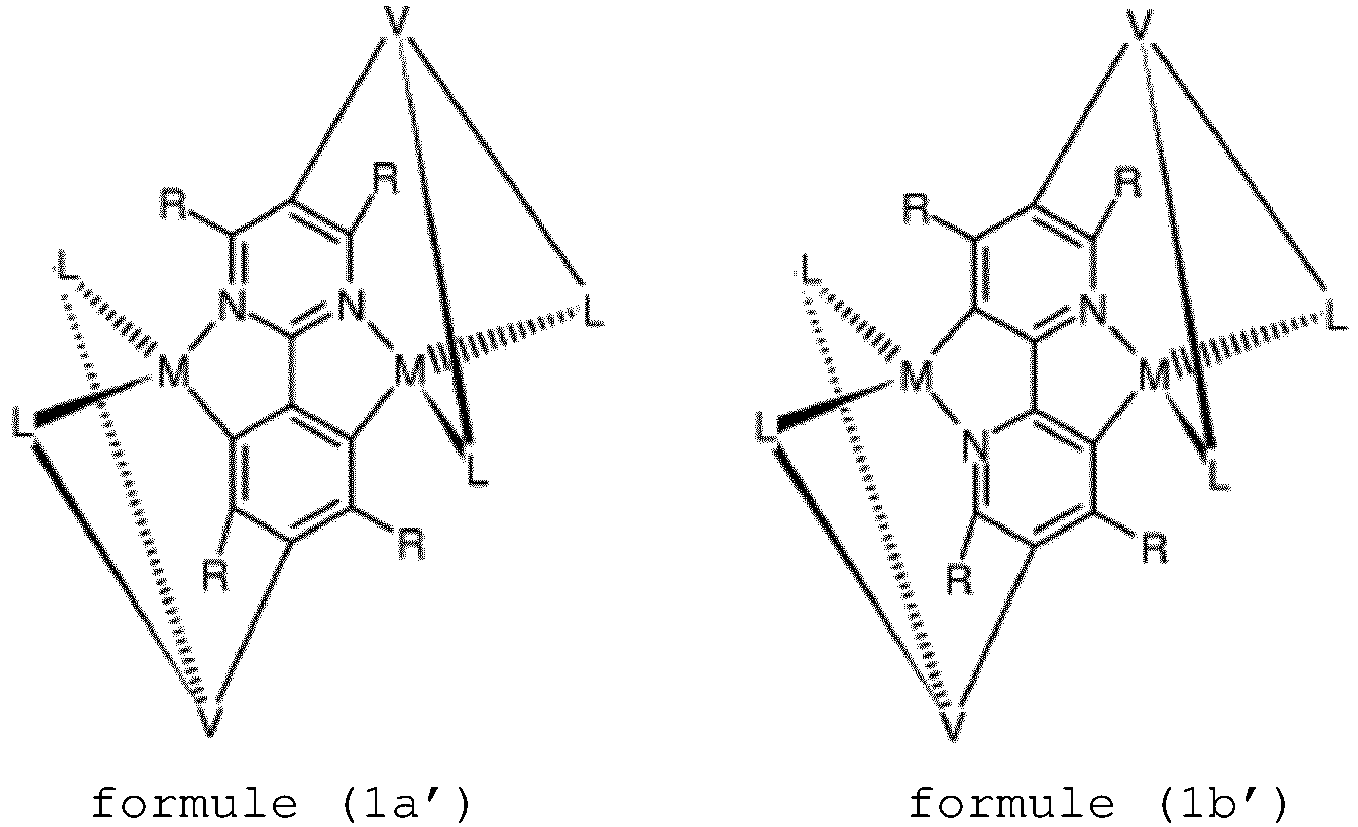
- Composé selon l'une ou plusieurs des revendications 1 à 3, caractérisé en ce que le groupe de formule (2), identique ou différent en chaque occurrence, est choisi parmi les structures des formules (5) à (8) et le groupe de formule (3), identique ou différent en chaque occurrence, est choisi parmi les structures des formules (9) à (13),


- Composé selon l'une ou plusieurs des revendications 1 à 4, caractérisé en ce que le groupe de formule (2), identique ou différent en chaque occurrence, est choisi parmi les structures de formule (5') et le groupe de formule (3), identique ou différent en chaque occurrence, est choisi parmi les structures des formules (9') et (9"),
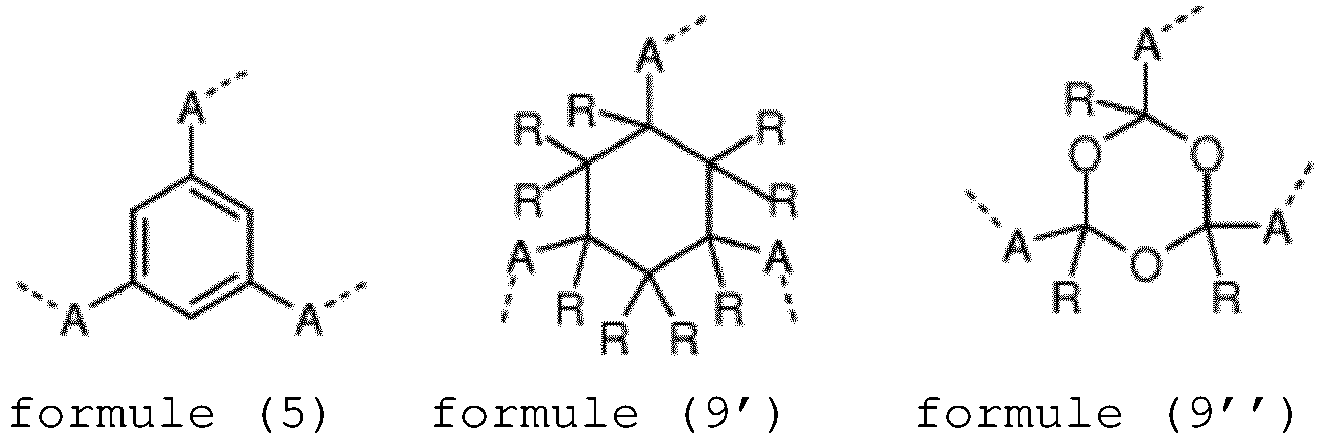
- Composé selon l'une ou plusieurs des revendications 1 à 5, caractérisé en ce que A, identique ou différent en chaque occurrence, est choisi dans le groupe constitué par -C(=O)-O-, -C(=O)-NR'- ou un groupe de formule (4), le groupe de formule (4) étant choisi parmi les structures des formules (14) à (38),


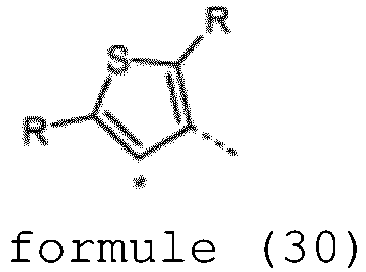


- Composé selon l'une ou plusieurs des revendications 1 à 6, caractérisé en ce que le groupe de formule (2), identique ou différent en chaque occurrence, est choisi parmi les structures des formules (2a) à (2m) et le groupe de formule (3), identique ou différent en chaque occurrence, est choisi parmi les structures des formules (3a) à (3m),


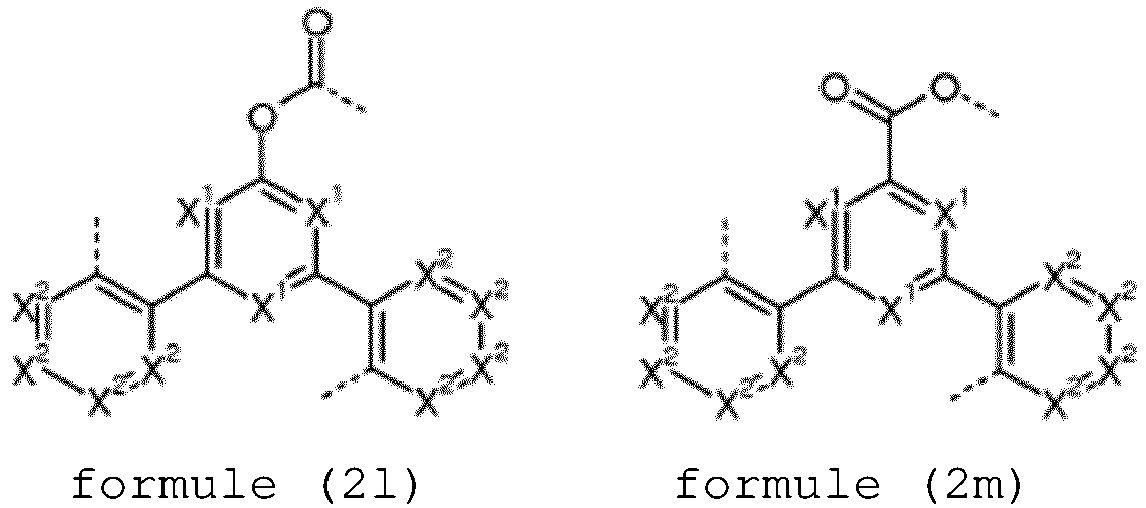
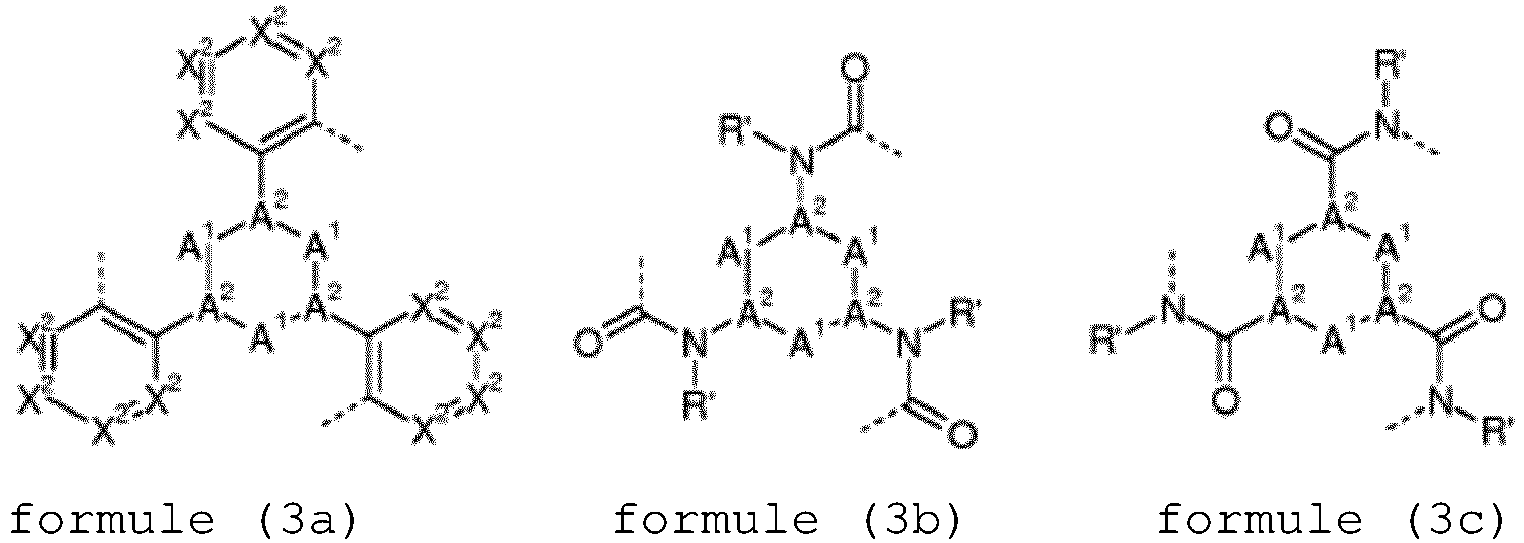


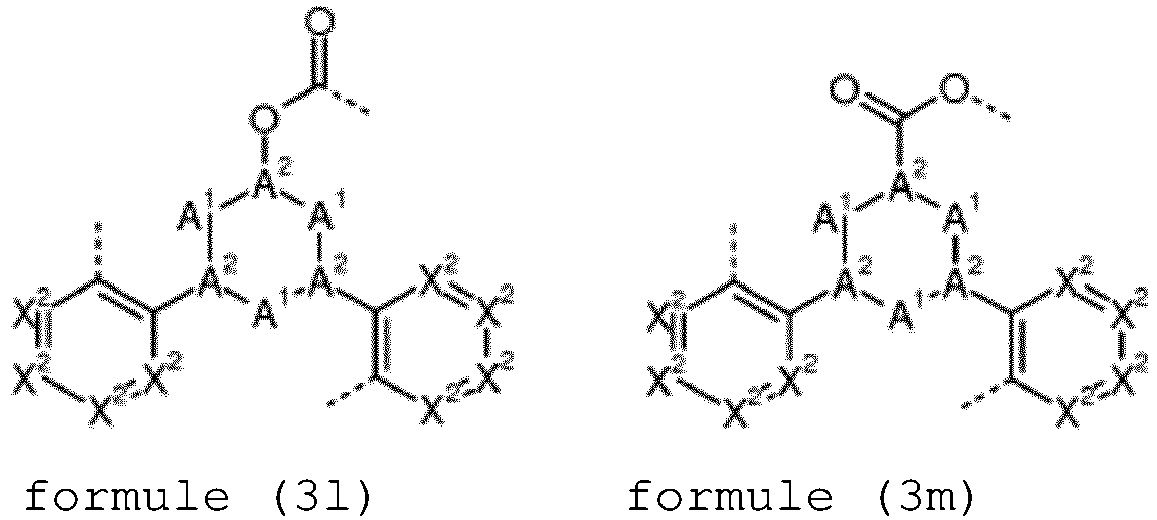
- Composé selon l'une ou plusieurs des revendications 1 à 7, caractérisé en ce que V, identique ou différent en chaque occurrence, est choisi parmi les structures des formules (5a") et (5a'''),

- Composé selon l'une ou plusieurs des revendications 1 à 8, caractérisé en ce que les ligands partiels bidentates L, identiques ou différents en chaque occurrence, sont choisis parmi les structures des formules (L-1), (L-2) et (L-3),
 CyC, identique ou différent en chaque occurrence, est un groupe aryle ou hétéroaryle substitué ou non substitué comportant 5 à 14 atomes de cycle aromatiques, qui coordine à M par l'intermédiaire d'un atome de carbone et qui est lié à CyD par l'intermédiaire d'une liaison covalente ;CyD, identique ou différent en chaque occurrence, est un groupe hétéroaryle substitué ou non substitué comportant 5 à 14 atomes de cycle aromatiques, qui coordine à M par l'intermédiaire d'un atome d'azote ou par l'intermédiaire d'un atome de carbone de carbène et qui est lié à CyC par l'intermédiaire d'une liaison covalente ;à cet égard, plusieurs des substituants peuvent former ensemble un système cyclique.
 - Procédé pour la préparation d'un composé selon l'une ou plusieurs des revendications 1 à 9 par la transformation du ligand avec des alcoolates métalliques de formule (57), avec des cétocétonates métalliques de formule (58), avec des halogénures métalliques de formule (59), avec des carboxylates métalliques de formule (60) ou avec des composés de l'iridium ou du rhodium, qui portent aussi bien des radicaux alcoolate et/ou halogénure et/ou hydroxy qu'également cétocétonate,

- Formulation, contenant au moins un composé selon l'une ou plusieurs des revendications 1 à 9 et au moins un solvant.
- Utilisation d'un composé selon l'une ou plusieurs des revendications 1 à 9 dans un dispositif électronique ou en tant que sensibilisateur d'oxygène.
- Dispositif électronique contenant au moins un composé selon l'une ou plusieurs des revendications 1 à 9.
- Dispositif électronique selon la revendication 13, qui est un dispositif organique d'électroluminescence et le composé selon l'une ou plusieurs des revendications 1 à 9 étant présent en tant que composé émetteur dans une ou plusieurs couches émettrices.
Applications Claiming Priority (2)
| Application Number | Priority Date | Filing Date | Title |
|---|---|---|---|
| EP16193521 | 2016-10-12 | ||
| PCT/EP2017/075580 WO2018069196A1 (fr) | 2016-10-12 | 2017-10-09 | Complexes métalliques binucléaires, ainsi que dispositifs électroniques, en particulier dispositifs électroluminescents organiques, contenant lesdits complexes métalliques |
Publications (2)
| Publication Number | Publication Date |
|---|---|
| EP3526227A1 EP3526227A1 (fr) | 2019-08-21 |
| EP3526227B1 true EP3526227B1 (fr) | 2020-06-03 |
Family
ID=57130284
Family Applications (1)
| Application Number | Title | Priority Date | Filing Date |
|---|---|---|---|
| EP17791589.9A Active EP3526227B1 (fr) | 2016-10-12 | 2017-10-09 | Complexes métalliques binucléaires, ainsi que dispositifs électroniques, en particulier dispositifs électroluminescents organiques, contenant lesdits complexes métalliques |
Country Status (6)
| Country | Link |
|---|---|
| US (1) | US11430962B2 (fr) |
| EP (1) | EP3526227B1 (fr) |
| JP (1) | JP7064488B2 (fr) |
| KR (1) | KR102522745B1 (fr) |
| CN (1) | CN109803975A (fr) |
| WO (1) | WO2018069196A1 (fr) |
Families Citing this family (48)
| Publication number | Priority date | Publication date | Assignee | Title |
|---|---|---|---|---|
| TWI776926B (zh) | 2017-07-25 | 2022-09-11 | 德商麥克專利有限公司 | 金屬錯合物 |
| KR102769406B1 (ko) | 2018-09-12 | 2025-02-17 | 메르크 파텐트 게엠베하 | 유기 전계발광 디바이스용 재료 |
| TW202030902A (zh) | 2018-09-12 | 2020-08-16 | 德商麥克專利有限公司 | 電致發光裝置 |
| TWI826522B (zh) | 2018-09-12 | 2023-12-21 | 德商麥克專利有限公司 | 電致發光裝置 |
| CN112771024A (zh) | 2018-09-27 | 2021-05-07 | 默克专利有限公司 | 用于制备空间位阻型含氮杂芳族化合物的方法 |
| CN120025253A (zh) | 2018-09-27 | 2025-05-23 | 默克专利有限公司 | 可用作有机电子器件中的活性化合物的化合物 |
| CN112955437A (zh) | 2018-11-05 | 2021-06-11 | 默克专利有限公司 | 可用于有机电子器件中的化合物 |
| KR20210091769A (ko) | 2018-11-14 | 2021-07-22 | 메르크 파텐트 게엠베하 | 유기 전자 디바이스의 제조에 사용될 수 있는 화합물 |
| US20220127286A1 (en) | 2019-03-04 | 2022-04-28 | Merck Patent Gmbh | Ligands for nano-sized materials |
| JP7598873B2 (ja) | 2019-04-11 | 2024-12-12 | メルク パテント ゲゼルシャフト ミット ベシュレンクテル ハフツング | 有機エレクトロルミネッセンス素子のための材料 |
| JP7625573B2 (ja) | 2019-07-22 | 2025-02-03 | ユー・ディー・シー アイルランド リミテッド | オルトメタル化金属化合物の調製方法 |
| KR20220090539A (ko) | 2019-10-25 | 2022-06-29 | 메르크 파텐트 게엠베하 | 유기 전자 디바이스에서 사용될 수 있는 화합물 |
| US12593607B2 (en) | 2019-11-04 | 2026-03-31 | Udc Ireland Limited | Materials for organic electroluminescent devices |
| TW202134252A (zh) | 2019-11-12 | 2021-09-16 | 德商麥克專利有限公司 | 有機電致發光裝置用材料 |
| TW202136181A (zh) | 2019-12-04 | 2021-10-01 | 德商麥克專利有限公司 | 有機電致發光裝置用的材料 |
| JP7620631B2 (ja) | 2019-12-18 | 2025-01-23 | メルク パテント ゲゼルシャフト ミット ベシュレンクテル ハフツング | 有機エレクトロルミネッセンス素子のための芳香族化合物 |
| CN114867729A (zh) | 2019-12-19 | 2022-08-05 | 默克专利有限公司 | 用于有机电致发光器件的多环化合物 |
| US20230139809A1 (en) | 2020-01-29 | 2023-05-04 | Merck Patent Gmbh | Benzimidazole derivatives |
| CN115135741A (zh) | 2020-02-25 | 2022-09-30 | 默克专利有限公司 | 杂环化合物在有机电子器件中的用途 |
| WO2021175706A1 (fr) | 2020-03-02 | 2021-09-10 | Merck Patent Gmbh | Utilisation de composés sulfone dans un dispositif électronique organique |
| EP4122028B1 (fr) | 2020-03-17 | 2024-10-16 | Merck Patent GmbH | Composés hétérocycliques pour dispositifs électroluminescents organiques |
| CN115298187A (zh) | 2020-03-17 | 2022-11-04 | 默克专利有限公司 | 用于有机电致发光器件的杂芳族化合物 |
| KR20220157456A (ko) | 2020-03-23 | 2022-11-29 | 메르크 파텐트 게엠베하 | 유기 전계 발광 디바이스용 재료 |
| EP4126880A1 (fr) | 2020-03-26 | 2023-02-08 | Merck Patent GmbH | Composés cycliques pour dispositifs électroluminescents organiques |
| EP4132939B1 (fr) | 2020-04-06 | 2024-01-31 | Merck Patent GmbH | Composés polycycliques pour dispositifs électroluminescents organiques |
| CN115669281A (zh) | 2020-05-29 | 2023-01-31 | 默克专利有限公司 | 有机电致发光器件 |
| EP4168397B1 (fr) | 2020-06-18 | 2025-08-20 | Merck Patent GmbH | Indénoazanaphtalènes |
| CN115867426A (zh) | 2020-06-23 | 2023-03-28 | 默克专利有限公司 | 生产混合物的方法 |
| JP2023531470A (ja) | 2020-06-29 | 2023-07-24 | メルク パテント ゲゼルシャフト ミット ベシュレンクテル ハフツング | 有機エレクトロルミネッセンス素子のためのヘテロ芳香族化合物 |
| WO2022002771A1 (fr) | 2020-06-29 | 2022-01-06 | Merck Patent Gmbh | Composés hétérocycliques pour dispositifs électroluminescents organiques |
| TW202229215A (zh) | 2020-09-30 | 2022-08-01 | 德商麥克專利有限公司 | 用於有機電致發光裝置功能層之結構化的化合物 |
| TW202222748A (zh) | 2020-09-30 | 2022-06-16 | 德商麥克專利有限公司 | 用於結構化有機電致發光裝置的功能層之化合物 |
| WO2022079067A1 (fr) | 2020-10-16 | 2022-04-21 | Merck Patent Gmbh | Composés comprenant des hétéroatomes pour dispositifs électroluminescents organiques |
| EP4229064A1 (fr) | 2020-10-16 | 2023-08-23 | Merck Patent GmbH | Composés hétérocycliques pour dispositifs électroluminescents organiques |
| TW202241905A (zh) | 2020-12-18 | 2022-11-01 | 德商麥克專利有限公司 | 用於有機電致發光裝置的氮化合物 |
| US20240101560A1 (en) | 2020-12-18 | 2024-03-28 | Merck Patent Gmbh | Nitrogenous heteroaromatic compounds for organic electroluminescent devices |
| WO2022129116A1 (fr) | 2020-12-18 | 2022-06-23 | Merck Patent Gmbh | Dérivés d'indolo[3.2.1-jk]carbazole-6-carbonitrile utilisés en tant qu'émetteurs fluorescents bleus destinés à être utilisés dans des oled |
| KR20220129145A (ko) | 2021-03-15 | 2022-09-23 | 삼성디스플레이 주식회사 | 유기금속 화합물 및 이를 포함한 발광 소자 |
| WO2022229234A1 (fr) | 2021-04-30 | 2022-11-03 | Merck Patent Gmbh | Composés hétérocycliques azotés pour dispositifs électroluminescents organiques |
| EP4340969A1 (fr) | 2021-05-21 | 2024-03-27 | Merck Patent GmbH | Procédé de purification continue d'au moins un matériau fonctionnel et dispositif de purification continue d'au moins un matériau fonctionnel |
| KR20240064697A (ko) | 2021-09-14 | 2024-05-13 | 메르크 파텐트 게엠베하 | 유기 전계 발광 디바이스용 붕소 복소환 화합물 |
| EP4423209B1 (fr) | 2021-10-27 | 2025-05-07 | Merck Patent GmbH | Composés hétérocycliques contenant du bore et de l'azote pour dispositifs électroluminescents organiques |
| WO2023161167A1 (fr) | 2022-02-23 | 2023-08-31 | Merck Patent Gmbh | Hétérocycles azotés pour dispositifs électroluminescents organiques |
| WO2023161168A1 (fr) | 2022-02-23 | 2023-08-31 | Merck Patent Gmbh | Hétérocycles aromatiques pour dispositifs électroluminescents organiques |
| WO2023247663A1 (fr) | 2022-06-24 | 2023-12-28 | Merck Patent Gmbh | Composition pour dispositifs électroniques organiques |
| KR20250027272A (ko) | 2022-06-24 | 2025-02-25 | 메르크 파텐트 게엠베하 | 유기 전자 디바이스용 조성물 |
| EP4619484A1 (fr) | 2022-11-17 | 2025-09-24 | Merck Patent GmbH | Matériaux pour dispositifs électroluminescents organiques |
| EP4486099B1 (fr) | 2023-06-30 | 2026-04-29 | UDC Ireland Limited | Composés pour dispositifs électroluminescents organiques |
Family Cites Families (51)
| Publication number | Priority date | Publication date | Assignee | Title |
|---|---|---|---|---|
| JPH07133483A (ja) | 1993-11-09 | 1995-05-23 | Shinko Electric Ind Co Ltd | El素子用有機発光材料及びel素子 |
| JP2000169400A (ja) | 1998-12-09 | 2000-06-20 | Sumika Chemical Analysis Service Ltd | スチレントリマ―の製造方法 |
| US6660410B2 (en) | 2000-03-27 | 2003-12-09 | Idemitsu Kosan Co., Ltd. | Organic electroluminescence element |
| DE10104426A1 (de) | 2001-02-01 | 2002-08-08 | Covion Organic Semiconductors | Verfahren zur Herstellung von hochreinen, tris-ortho-metallierten Organo-Iridium-Verbindungen |
| JP4310077B2 (ja) | 2001-06-19 | 2009-08-05 | キヤノン株式会社 | 金属配位化合物及び有機発光素子 |
| ITRM20020411A1 (it) | 2002-08-01 | 2004-02-02 | Univ Roma La Sapienza | Derivati dello spirobifluorene, loro preparazione e loro uso. |
| DE10249723A1 (de) | 2002-10-25 | 2004-05-06 | Covion Organic Semiconductors Gmbh | Arylamin-Einheiten enthaltende konjugierte Polymere, deren Darstellung und Verwendung |
| US20060063027A1 (en) | 2002-12-23 | 2006-03-23 | Covion Organic Semiconductors Gmbh | Organic electroluminescent element |
| DE10310887A1 (de) | 2003-03-11 | 2004-09-30 | Covion Organic Semiconductors Gmbh | Matallkomplexe |
| JP4411851B2 (ja) | 2003-03-19 | 2010-02-10 | コニカミノルタホールディングス株式会社 | 有機エレクトロルミネッセンス素子 |
| DE10314102A1 (de) | 2003-03-27 | 2004-10-14 | Covion Organic Semiconductors Gmbh | Verfahren zur Herstellung von hochreinen Organo-Iridium-Verbindungen |
| EP1618170A2 (fr) | 2003-04-15 | 2006-01-25 | Covion Organic Semiconductors GmbH | Melanges de semi-conducteurs organiques aptes a l'emission et de matieres matricielles, leur utilisation et composants electroniques contenant ces melanges |
| JP4635870B2 (ja) | 2003-04-23 | 2011-02-23 | コニカミノルタホールディングス株式会社 | 有機エレクトロルミネッセンス素子、照明装置及び表示装置 |
| US20050171207A1 (en) | 2003-09-26 | 2005-08-04 | Myriad Genetics, Incorporated | Method and composition for combination treatment of neurodegenerative disorders |
| US7795801B2 (en) | 2003-09-30 | 2010-09-14 | Konica Minolta Holdings, Inc. | Organic electroluminescent element, illuminator, display and compound |
| US7332232B2 (en) | 2004-02-03 | 2008-02-19 | Universal Display Corporation | OLEDs utilizing multidentate ligand systems |
| US7790890B2 (en) | 2004-03-31 | 2010-09-07 | Konica Minolta Holdings, Inc. | Organic electroluminescence element material, organic electroluminescence element, display device and illumination device |
| DE102004023277A1 (de) | 2004-05-11 | 2005-12-01 | Covion Organic Semiconductors Gmbh | Neue Materialmischungen für die Elektrolumineszenz |
| JP4862248B2 (ja) | 2004-06-04 | 2012-01-25 | コニカミノルタホールディングス株式会社 | 有機エレクトロルミネッセンス素子、照明装置及び表示装置 |
| ITRM20040352A1 (it) | 2004-07-15 | 2004-10-15 | Univ Roma La Sapienza | Derivati oligomerici dello spirobifluorene, loro preparazione e loro uso. |
| DE102004034517A1 (de) * | 2004-07-16 | 2006-02-16 | Covion Organic Semiconductors Gmbh | Metallkomplexe |
| EP1888706B1 (fr) | 2005-05-03 | 2017-03-01 | Merck Patent GmbH | Dispositif electroluminescent organique, et derives d'acide boronique et d'acide borinique utilises pour produire ce dispositif electroluminescent organique |
| WO2007063754A1 (fr) | 2005-12-01 | 2007-06-07 | Nippon Steel Chemical Co., Ltd. | Compose pour element electroluminescent organique et element electroluminescent organique |
| KR100783711B1 (ko) * | 2006-01-06 | 2007-12-07 | 삼성전자주식회사 | 금속 화합물 및 이를 포함하는 유기 전계 발광 소자 |
| DE102006025777A1 (de) | 2006-05-31 | 2007-12-06 | Merck Patent Gmbh | Neue Materialien für organische Elektrolumineszenzvorrichtungen |
| US8062769B2 (en) | 2006-11-09 | 2011-11-22 | Nippon Steel Chemical Co., Ltd. | Indolocarbazole compound for use in organic electroluminescent device and organic electroluminescent device |
| DE102007002714A1 (de) | 2007-01-18 | 2008-07-31 | Merck Patent Gmbh | Neue Materialien für organische Elektrolumineszenzvorrichtungen |
| DE102007053771A1 (de) | 2007-11-12 | 2009-05-14 | Merck Patent Gmbh | Organische Elektrolumineszenzvorrichtungen |
| US7862908B2 (en) | 2007-11-26 | 2011-01-04 | National Tsing Hua University | Conjugated compounds containing hydroindoloacridine structural elements, and their use |
| US8221905B2 (en) | 2007-12-28 | 2012-07-17 | Universal Display Corporation | Carbazole-containing materials in phosphorescent light emitting diodes |
| CN102056911B (zh) | 2008-06-05 | 2015-07-22 | 出光兴产株式会社 | 卤素化合物、多环系化合物及使用其的有机电致发光元件 |
| DE102008033943A1 (de) | 2008-07-18 | 2010-01-21 | Merck Patent Gmbh | Neue Materialien für organische Elektrolumineszenzvorrichtungen |
| DE102008036982A1 (de) | 2008-08-08 | 2010-02-11 | Merck Patent Gmbh | Organische Elektrolumineszenzvorrichtung |
| KR101506919B1 (ko) | 2008-10-31 | 2015-03-30 | 롬엔드하스전자재료코리아유한회사 | 신규한 유기 전자재료용 화합물 및 이를 포함하는 유기 전자 소자 |
| DE102008056688A1 (de) | 2008-11-11 | 2010-05-12 | Merck Patent Gmbh | Materialien für organische Elektrolumineszenzvorrichtungen |
| JP5701766B2 (ja) | 2008-11-11 | 2015-04-15 | メルク パテント ゲーエムベーハー | 有機エレクトロルミネセント素子 |
| JP5556017B2 (ja) | 2009-01-14 | 2014-07-23 | コニカミノルタ株式会社 | 有機エレクトロルミネッセンス素子、表示装置、照明装置及び有機エレクトロルミネッセンス素子材料 |
| KR101732199B1 (ko) | 2009-02-27 | 2017-05-02 | 메르크 파텐트 게엠베하 | 알데히드기를 포함하는 중합체, 상기 중합체의 변환 및 가교, 가교된 중합체, 및 상기 중합체를 함유하는 전계발광 소자 |
| DE102009014513A1 (de) | 2009-03-23 | 2010-09-30 | Merck Patent Gmbh | Organische Elektrolumineszenzvorrichtung |
| DE102009023155A1 (de) | 2009-05-29 | 2010-12-02 | Merck Patent Gmbh | Materialien für organische Elektrolumineszenzvorrichtungen |
| DE102009031021A1 (de) | 2009-06-30 | 2011-01-05 | Merck Patent Gmbh | Materialien für organische Elektrolumineszenzvorrichtungen |
| DE102009048791A1 (de) | 2009-10-08 | 2011-04-14 | Merck Patent Gmbh | Materialien für organische Elektrolumineszenzvorrichtungen |
| DE102010005697A1 (de) | 2010-01-25 | 2011-07-28 | Merck Patent GmbH, 64293 | Verbindungen für elektronische Vorrichtungen |
| US9644070B2 (en) | 2012-04-17 | 2017-05-09 | Merck Patent Gmbh | Cross-linkable and cross-linked polymers, process for the preparation thereof, and the use thereof |
| KR102179608B1 (ko) | 2012-12-18 | 2020-11-17 | 메르크 파텐트 게엠베하 | 유기 전계발광 소자 |
| KR102048555B1 (ko) * | 2013-04-17 | 2019-11-26 | 덕산네오룩스 주식회사 | 유기전기 소자용 화합물, 이를 이용한 유기전기소자 및 그 전자 장치 |
| KR102048035B1 (ko) * | 2013-06-03 | 2019-11-25 | 덕산네오룩스 주식회사 | 유기전기 소자용 화합물을 이용한 유기전기소자 및 그 전자 장치 |
| JP6640098B2 (ja) | 2014-02-05 | 2020-02-05 | メルク、パテント、ゲゼルシャフト、ミット、ベシュレンクテル、ハフツングMerck Patent GmbH | 金属錯体 |
| CN106459018B (zh) | 2014-05-05 | 2022-01-25 | 默克专利有限公司 | 用于有机发光器件的材料 |
| WO2016124304A1 (fr) | 2015-02-03 | 2016-08-11 | Merck Patent Gmbh | Complexes métalliques |
| JP6946269B2 (ja) | 2015-08-25 | 2021-10-06 | メルク、パテント、ゲゼルシャフト、ミット、ベシュレンクテル、ハフツングMerck Patent GmbH | 金属錯体 |
-
2017
- 2017-10-09 US US16/341,757 patent/US11430962B2/en active Active
- 2017-10-09 CN CN201780059562.5A patent/CN109803975A/zh active Pending
- 2017-10-09 KR KR1020197013248A patent/KR102522745B1/ko active Active
- 2017-10-09 WO PCT/EP2017/075580 patent/WO2018069196A1/fr not_active Ceased
- 2017-10-09 JP JP2019519684A patent/JP7064488B2/ja active Active
- 2017-10-09 EP EP17791589.9A patent/EP3526227B1/fr active Active
Non-Patent Citations (1)
| Title |
|---|
| None * |
Also Published As
| Publication number | Publication date |
|---|---|
| US20200052213A1 (en) | 2020-02-13 |
| KR20190058638A (ko) | 2019-05-29 |
| US11430962B2 (en) | 2022-08-30 |
| EP3526227A1 (fr) | 2019-08-21 |
| KR102522745B1 (ko) | 2023-04-17 |
| CN109803975A (zh) | 2019-05-24 |
| WO2018069196A1 (fr) | 2018-04-19 |
| JP7064488B2 (ja) | 2022-05-10 |
| JP2019536752A (ja) | 2019-12-19 |
Similar Documents
| Publication | Publication Date | Title |
|---|---|---|
| EP3526227B1 (fr) | Complexes métalliques binucléaires, ainsi que dispositifs électroniques, en particulier dispositifs électroluminescents organiques, contenant lesdits complexes métalliques | |
| EP3515925B1 (fr) | Complexes métalliques trouvant application comme émetteurs dans des dispositifs électroluminescents organiques | |
| EP3526228B1 (fr) | Complexes métalliques | |
| EP3526226B1 (fr) | Complexes métalliques | |
| EP3768692B1 (fr) | Complexes métalliques | |
| EP3724202B1 (fr) | Complexes métalliques | |
| EP3487865B1 (fr) | Complexes métalliques dinucléaires et oligonucléaires comprenant des sous-unités de ligands tripodes bidentées ainsi que leur utilisation dans des dispositifs électroniques | |
| EP3658564B1 (fr) | Complexes métalliques | |
| EP3507294B1 (fr) | Complexes métalliques binucléaires et trinucléaires obtenus à partir de deux ligands hexadentés tripodaux liés entre eux, destinés à être utilisés dans des dispositifs électroluminescents | |
| EP3484868B1 (fr) | Complexes métalliques | |
| EP3254317B1 (fr) | Complexes métalliques | |
| EP3424936B1 (fr) | Complexe métallique | |
| WO2018041769A1 (fr) | Complexes métalliques binucléaires et trinucléaires obtenus à partir de deux ligands hexadentés tripodaux liés entre eux, destinés à être utilisés dans des dispositifs électroluminescents | |
| EP3160976B1 (fr) | Complexes métalliques | |
| EP3752512A1 (fr) | Complexes métalliques | |
| EP2906661B1 (fr) | Matériaux destinés à des dispositifs électroluminescents organiques | |
| WO2017032439A1 (fr) | Complexes métalliques | |
| EP3174890A1 (fr) | Complexes métalliques | |
| EP3094703B1 (fr) | Materiaux pour dispositifs électroluminescents organiques | |
| EP3110796B1 (fr) | Matières pour dispositifs électroluminescents organiques | |
| EP3532480B1 (fr) | Complexes métalliques |
Legal Events
| Date | Code | Title | Description |
|---|---|---|---|
| STAA | Information on the status of an ep patent application or granted ep patent |
Free format text: STATUS: UNKNOWN |
|
| STAA | Information on the status of an ep patent application or granted ep patent |
Free format text: STATUS: THE INTERNATIONAL PUBLICATION HAS BEEN MADE |
|
| PUAI | Public reference made under article 153(3) epc to a published international application that has entered the european phase |
Free format text: ORIGINAL CODE: 0009012 |
|
| STAA | Information on the status of an ep patent application or granted ep patent |
Free format text: STATUS: REQUEST FOR EXAMINATION WAS MADE |
|
| 17P | Request for examination filed |
Effective date: 20190409 |
|
| AK | Designated contracting states |
Kind code of ref document: A1 Designated state(s): AL AT BE BG CH CY CZ DE DK EE ES FI FR GB GR HR HU IE IS IT LI LT LU LV MC MK MT NL NO PL PT RO RS SE SI SK SM TR |
|
| AX | Request for extension of the european patent |
Extension state: BA ME |
|
| DAV | Request for validation of the european patent (deleted) | ||
| DAX | Request for extension of the european patent (deleted) | ||
| GRAP | Despatch of communication of intention to grant a patent |
Free format text: ORIGINAL CODE: EPIDOSNIGR1 |
|
| STAA | Information on the status of an ep patent application or granted ep patent |
Free format text: STATUS: GRANT OF PATENT IS INTENDED |
|
| INTG | Intention to grant announced |
Effective date: 20200203 |
|
| GRAS | Grant fee paid |
Free format text: ORIGINAL CODE: EPIDOSNIGR3 |
|
| GRAA | (expected) grant |
Free format text: ORIGINAL CODE: 0009210 |
|
| STAA | Information on the status of an ep patent application or granted ep patent |
Free format text: STATUS: THE PATENT HAS BEEN GRANTED |
|
| AK | Designated contracting states |
Kind code of ref document: B1 Designated state(s): AL AT BE BG CH CY CZ DE DK EE ES FI FR GB GR HR HU IE IS IT LI LT LU LV MC MK MT NL NO PL PT RO RS SE SI SK SM TR |
|
| REG | Reference to a national code |
Ref country code: GB Ref legal event code: FG4D Free format text: NOT ENGLISH |
|
| REG | Reference to a national code |
Ref country code: CH Ref legal event code: EP Ref country code: AT Ref legal event code: REF Ref document number: 1276918 Country of ref document: AT Kind code of ref document: T Effective date: 20200615 |
|
| REG | Reference to a national code |
Ref country code: DE Ref legal event code: R096 Ref document number: 502017005602 Country of ref document: DE |
|
| REG | Reference to a national code |
Ref country code: LT Ref legal event code: MG4D |
|
| PG25 | Lapsed in a contracting state [announced via postgrant information from national office to epo] |
Ref country code: LT Free format text: LAPSE BECAUSE OF FAILURE TO SUBMIT A TRANSLATION OF THE DESCRIPTION OR TO PAY THE FEE WITHIN THE PRESCRIBED TIME-LIMIT Effective date: 20200603 Ref country code: NO Free format text: LAPSE BECAUSE OF FAILURE TO SUBMIT A TRANSLATION OF THE DESCRIPTION OR TO PAY THE FEE WITHIN THE PRESCRIBED TIME-LIMIT Effective date: 20200903 Ref country code: FI Free format text: LAPSE BECAUSE OF FAILURE TO SUBMIT A TRANSLATION OF THE DESCRIPTION OR TO PAY THE FEE WITHIN THE PRESCRIBED TIME-LIMIT Effective date: 20200603 Ref country code: SE Free format text: LAPSE BECAUSE OF FAILURE TO SUBMIT A TRANSLATION OF THE DESCRIPTION OR TO PAY THE FEE WITHIN THE PRESCRIBED TIME-LIMIT Effective date: 20200603 Ref country code: GR Free format text: LAPSE BECAUSE OF FAILURE TO SUBMIT A TRANSLATION OF THE DESCRIPTION OR TO PAY THE FEE WITHIN THE PRESCRIBED TIME-LIMIT Effective date: 20200904 |
|
| REG | Reference to a national code |
Ref country code: NL Ref legal event code: MP Effective date: 20200603 |
|
| PG25 | Lapsed in a contracting state [announced via postgrant information from national office to epo] |
Ref country code: RS Free format text: LAPSE BECAUSE OF FAILURE TO SUBMIT A TRANSLATION OF THE DESCRIPTION OR TO PAY THE FEE WITHIN THE PRESCRIBED TIME-LIMIT Effective date: 20200603 Ref country code: HR Free format text: LAPSE BECAUSE OF FAILURE TO SUBMIT A TRANSLATION OF THE DESCRIPTION OR TO PAY THE FEE WITHIN THE PRESCRIBED TIME-LIMIT Effective date: 20200603 Ref country code: LV Free format text: LAPSE BECAUSE OF FAILURE TO SUBMIT A TRANSLATION OF THE DESCRIPTION OR TO PAY THE FEE WITHIN THE PRESCRIBED TIME-LIMIT Effective date: 20200603 Ref country code: BG Free format text: LAPSE BECAUSE OF FAILURE TO SUBMIT A TRANSLATION OF THE DESCRIPTION OR TO PAY THE FEE WITHIN THE PRESCRIBED TIME-LIMIT Effective date: 20200903 |
|
| PG25 | Lapsed in a contracting state [announced via postgrant information from national office to epo] |
Ref country code: AL Free format text: LAPSE BECAUSE OF FAILURE TO SUBMIT A TRANSLATION OF THE DESCRIPTION OR TO PAY THE FEE WITHIN THE PRESCRIBED TIME-LIMIT Effective date: 20200603 Ref country code: NL Free format text: LAPSE BECAUSE OF FAILURE TO SUBMIT A TRANSLATION OF THE DESCRIPTION OR TO PAY THE FEE WITHIN THE PRESCRIBED TIME-LIMIT Effective date: 20200603 |
|
| PG25 | Lapsed in a contracting state [announced via postgrant information from national office to epo] |
Ref country code: CZ Free format text: LAPSE BECAUSE OF FAILURE TO SUBMIT A TRANSLATION OF THE DESCRIPTION OR TO PAY THE FEE WITHIN THE PRESCRIBED TIME-LIMIT Effective date: 20200603 Ref country code: ES Free format text: LAPSE BECAUSE OF FAILURE TO SUBMIT A TRANSLATION OF THE DESCRIPTION OR TO PAY THE FEE WITHIN THE PRESCRIBED TIME-LIMIT Effective date: 20200603 Ref country code: PT Free format text: LAPSE BECAUSE OF FAILURE TO SUBMIT A TRANSLATION OF THE DESCRIPTION OR TO PAY THE FEE WITHIN THE PRESCRIBED TIME-LIMIT Effective date: 20201006 Ref country code: SM Free format text: LAPSE BECAUSE OF FAILURE TO SUBMIT A TRANSLATION OF THE DESCRIPTION OR TO PAY THE FEE WITHIN THE PRESCRIBED TIME-LIMIT Effective date: 20200603 Ref country code: IT Free format text: LAPSE BECAUSE OF FAILURE TO SUBMIT A TRANSLATION OF THE DESCRIPTION OR TO PAY THE FEE WITHIN THE PRESCRIBED TIME-LIMIT Effective date: 20200603 Ref country code: RO Free format text: LAPSE BECAUSE OF FAILURE TO SUBMIT A TRANSLATION OF THE DESCRIPTION OR TO PAY THE FEE WITHIN THE PRESCRIBED TIME-LIMIT Effective date: 20200603 Ref country code: EE Free format text: LAPSE BECAUSE OF FAILURE TO SUBMIT A TRANSLATION OF THE DESCRIPTION OR TO PAY THE FEE WITHIN THE PRESCRIBED TIME-LIMIT Effective date: 20200603 |
|
| PG25 | Lapsed in a contracting state [announced via postgrant information from national office to epo] |
Ref country code: PL Free format text: LAPSE BECAUSE OF FAILURE TO SUBMIT A TRANSLATION OF THE DESCRIPTION OR TO PAY THE FEE WITHIN THE PRESCRIBED TIME-LIMIT Effective date: 20200603 Ref country code: SK Free format text: LAPSE BECAUSE OF FAILURE TO SUBMIT A TRANSLATION OF THE DESCRIPTION OR TO PAY THE FEE WITHIN THE PRESCRIBED TIME-LIMIT Effective date: 20200603 Ref country code: IS Free format text: LAPSE BECAUSE OF FAILURE TO SUBMIT A TRANSLATION OF THE DESCRIPTION OR TO PAY THE FEE WITHIN THE PRESCRIBED TIME-LIMIT Effective date: 20201003 |
|
| REG | Reference to a national code |
Ref country code: DE Ref legal event code: R097 Ref document number: 502017005602 Country of ref document: DE |
|
| PLBE | No opposition filed within time limit |
Free format text: ORIGINAL CODE: 0009261 |
|
| STAA | Information on the status of an ep patent application or granted ep patent |
Free format text: STATUS: NO OPPOSITION FILED WITHIN TIME LIMIT |
|
| PG25 | Lapsed in a contracting state [announced via postgrant information from national office to epo] |
Ref country code: DK Free format text: LAPSE BECAUSE OF FAILURE TO SUBMIT A TRANSLATION OF THE DESCRIPTION OR TO PAY THE FEE WITHIN THE PRESCRIBED TIME-LIMIT Effective date: 20200603 |
|
| 26N | No opposition filed |
Effective date: 20210304 |
|
| REG | Reference to a national code |
Ref country code: CH Ref legal event code: PL |
|
| PG25 | Lapsed in a contracting state [announced via postgrant information from national office to epo] |
Ref country code: LU Free format text: LAPSE BECAUSE OF NON-PAYMENT OF DUE FEES Effective date: 20201009 Ref country code: MC Free format text: LAPSE BECAUSE OF FAILURE TO SUBMIT A TRANSLATION OF THE DESCRIPTION OR TO PAY THE FEE WITHIN THE PRESCRIBED TIME-LIMIT Effective date: 20200603 |
|
| REG | Reference to a national code |
Ref country code: BE Ref legal event code: MM Effective date: 20201031 |
|
| PG25 | Lapsed in a contracting state [announced via postgrant information from national office to epo] |
Ref country code: FR Free format text: LAPSE BECAUSE OF NON-PAYMENT OF DUE FEES Effective date: 20201031 |
|
| PG25 | Lapsed in a contracting state [announced via postgrant information from national office to epo] |
Ref country code: LI Free format text: LAPSE BECAUSE OF NON-PAYMENT OF DUE FEES Effective date: 20201031 Ref country code: CH Free format text: LAPSE BECAUSE OF NON-PAYMENT OF DUE FEES Effective date: 20201031 Ref country code: BE Free format text: LAPSE BECAUSE OF NON-PAYMENT OF DUE FEES Effective date: 20201031 |
|
| PG25 | Lapsed in a contracting state [announced via postgrant information from national office to epo] |
Ref country code: IE Free format text: LAPSE BECAUSE OF NON-PAYMENT OF DUE FEES Effective date: 20201009 |
|
| PG25 | Lapsed in a contracting state [announced via postgrant information from national office to epo] |
Ref country code: TR Free format text: LAPSE BECAUSE OF FAILURE TO SUBMIT A TRANSLATION OF THE DESCRIPTION OR TO PAY THE FEE WITHIN THE PRESCRIBED TIME-LIMIT Effective date: 20200603 Ref country code: MT Free format text: LAPSE BECAUSE OF FAILURE TO SUBMIT A TRANSLATION OF THE DESCRIPTION OR TO PAY THE FEE WITHIN THE PRESCRIBED TIME-LIMIT Effective date: 20200603 Ref country code: CY Free format text: LAPSE BECAUSE OF FAILURE TO SUBMIT A TRANSLATION OF THE DESCRIPTION OR TO PAY THE FEE WITHIN THE PRESCRIBED TIME-LIMIT Effective date: 20200603 |
|
| GBPC | Gb: european patent ceased through non-payment of renewal fee |
Effective date: 20211009 |
|
| PG25 | Lapsed in a contracting state [announced via postgrant information from national office to epo] |
Ref country code: MK Free format text: LAPSE BECAUSE OF FAILURE TO SUBMIT A TRANSLATION OF THE DESCRIPTION OR TO PAY THE FEE WITHIN THE PRESCRIBED TIME-LIMIT Effective date: 20200603 |
|
| PG25 | Lapsed in a contracting state [announced via postgrant information from national office to epo] |
Ref country code: GB Free format text: LAPSE BECAUSE OF NON-PAYMENT OF DUE FEES Effective date: 20211009 |
|
| P01 | Opt-out of the competence of the unified patent court (upc) registered |
Effective date: 20230519 |
|
| REG | Reference to a national code |
Ref country code: DE Ref legal event code: R081 Ref document number: 502017005602 Country of ref document: DE Owner name: UDC IRELAND LTD., IE Free format text: FORMER OWNER: MERCK PATENT GMBH, 64293 DARMSTADT, DE |
|
| PG25 | Lapsed in a contracting state [announced via postgrant information from national office to epo] |
Ref country code: SI Free format text: LAPSE BECAUSE OF FAILURE TO SUBMIT A TRANSLATION OF THE DESCRIPTION OR TO PAY THE FEE WITHIN THE PRESCRIBED TIME-LIMIT Effective date: 20200603 |
|
| P03 | Opt-out of the competence of the unified patent court (upc) deleted | ||
| REG | Reference to a national code |
Ref country code: AT Ref legal event code: MM01 Ref document number: 1276918 Country of ref document: AT Kind code of ref document: T Effective date: 20221009 |
|
| PG25 | Lapsed in a contracting state [announced via postgrant information from national office to epo] |
Ref country code: AT Free format text: LAPSE BECAUSE OF NON-PAYMENT OF DUE FEES Effective date: 20221009 |
|
| P01 | Opt-out of the competence of the unified patent court (upc) registered |
Effective date: 20240207 |
|
| PGFP | Annual fee paid to national office [announced via postgrant information from national office to epo] |
Ref country code: DE Payment date: 20251029 Year of fee payment: 9 |