EP3527563B1 - Inhibiteurs d'adn-pk - Google Patents
Inhibiteurs d'adn-pk Download PDFInfo
- Publication number
- EP3527563B1 EP3527563B1 EP18207382.5A EP18207382A EP3527563B1 EP 3527563 B1 EP3527563 B1 EP 3527563B1 EP 18207382 A EP18207382 A EP 18207382A EP 3527563 B1 EP3527563 B1 EP 3527563B1
- Authority
- EP
- European Patent Office
- Prior art keywords
- alkyl
- cycloalkyl
- groups
- ring
- cdcl
- Prior art date
- Legal status (The legal status is an assumption and is not a legal conclusion. Google has not performed a legal analysis and makes no representation as to the accuracy of the status listed.)
- Active
Links
- 0 Cc([s]c(*)n1)c1IC Chemical compound Cc([s]c(*)n1)c1IC 0.000 description 7
- WXNCFTXJFZSHAM-DKXQDJALSA-N C(C[C@H](CC1)Oc2cc(N3CCOCC3)cc3c2nccn3)[C@@H]1Nc1ncc(C2CCOCC2)cn1 Chemical compound C(C[C@H](CC1)Oc2cc(N3CCOCC3)cc3c2nccn3)[C@@H]1Nc1ncc(C2CCOCC2)cn1 WXNCFTXJFZSHAM-DKXQDJALSA-N 0.000 description 2
- OXQOBQJCDNLAPO-UHFFFAOYSA-N Cc1c(C)nccn1 Chemical compound Cc1c(C)nccn1 OXQOBQJCDNLAPO-UHFFFAOYSA-N 0.000 description 2
- CBQYXYQROBXDBJ-UHFFFAOYSA-N Brc(cc1)cnc1N[C@H](CC1)CC/C1=[O]/c1cc(N2CCOCC2)cc2c1nccn2 Chemical compound Brc(cc1)cnc1N[C@H](CC1)CC/C1=[O]/c1cc(N2CCOCC2)cc2c1nccn2 CBQYXYQROBXDBJ-UHFFFAOYSA-N 0.000 description 1
- XKOUVDGSFRWQIZ-TYKWCNGQSA-N C(C1COC1)Oc1cnc(N[C@H](CC2)CC[C@H]2Oc2cc(N3CCOCC3)cc3c2nccn3)nc1 Chemical compound C(C1COC1)Oc1cnc(N[C@H](CC2)CC[C@H]2Oc2cc(N3CCOCC3)cc3c2nccn3)nc1 XKOUVDGSFRWQIZ-TYKWCNGQSA-N 0.000 description 1
- VFUYELIBVRIGHL-TYKWCNGQSA-N C(C[C@H](CC1)Oc2c3nccnc3cc(N3CCOCC3)c2)[C@@H]1Nc(cc1)ncc1-c1ccn[nH]1 Chemical compound C(C[C@H](CC1)Oc2c3nccnc3cc(N3CCOCC3)c2)[C@@H]1Nc(cc1)ncc1-c1ccn[nH]1 VFUYELIBVRIGHL-TYKWCNGQSA-N 0.000 description 1
- YNIQYGUBOQJUMA-IZAXUBKRSA-N C(C[C@H](CC1)Oc2cc(N3CCOCC3)cc3c2nccn3)[C@@H]1Nc1ccccn1 Chemical compound C(C[C@H](CC1)Oc2cc(N3CCOCC3)cc3c2nccn3)[C@@H]1Nc1ccccn1 YNIQYGUBOQJUMA-IZAXUBKRSA-N 0.000 description 1
- RDXSZIZCLAWDNW-UHFFFAOYSA-N C([C@H](CC1)CC/C1=[O]/c1cc(N2CCOCC2)cc2c1nccn2)Nc1ncccn1 Chemical compound C([C@H](CC1)CC/C1=[O]/c1cc(N2CCOCC2)cc2c1nccn2)Nc1ncccn1 RDXSZIZCLAWDNW-UHFFFAOYSA-N 0.000 description 1
- QULJQDQTOQHRCB-BGYRXZFFSA-N C=C(CC=C1)C=CC=C1c1cc2nccnc2c(O[C@H](CC2)CC[C@H]2I)c1 Chemical compound C=C(CC=C1)C=CC=C1c1cc2nccnc2c(O[C@H](CC2)CC[C@H]2I)c1 QULJQDQTOQHRCB-BGYRXZFFSA-N 0.000 description 1
- JCZHHCBVIRLTEG-TYKWCNGQSA-N CC(C)(c1ccc(N[C@H](CC2)CC[C@H]2Oc2cc(N3CCOCC3)cc3c2nccn3)nc1)O Chemical compound CC(C)(c1ccc(N[C@H](CC2)CC[C@H]2Oc2cc(N3CCOCC3)cc3c2nccn3)nc1)O JCZHHCBVIRLTEG-TYKWCNGQSA-N 0.000 description 1
- VSGBAAXSYGJKBG-IZAXUBKRSA-N CC(C)CC(N[C@H](CC1)CC[C@H]1Oc1cc(N2CCOCC2)cc2c1nccn2)=O Chemical compound CC(C)CC(N[C@H](CC1)CC[C@H]1Oc1cc(N2CCOCC2)cc2c1nccn2)=O VSGBAAXSYGJKBG-IZAXUBKRSA-N 0.000 description 1
- DHIVWBYAUCGBCL-UHFFFAOYSA-N CC1OCCC1NC(c1cnc(NC[C@H](CC2)CC/C2=[O]/c2cc(N3CCOCC3)cc3c2nccn3)nc1)=O Chemical compound CC1OCCC1NC(c1cnc(NC[C@H](CC2)CC/C2=[O]/c2cc(N3CCOCC3)cc3c2nccn3)nc1)=O DHIVWBYAUCGBCL-UHFFFAOYSA-N 0.000 description 1
- ZSPGHOIHABNPIP-GTSDVGPQSA-N CC1OCCC1NC(c1cnc(N[C@H](CC2)CC[C@H]2Oc2cc(N3CCOCC3)cc3c2nccn3)nc1)=O Chemical compound CC1OCCC1NC(c1cnc(N[C@H](CC2)CC[C@H]2Oc2cc(N3CCOCC3)cc3c2nccn3)nc1)=O ZSPGHOIHABNPIP-GTSDVGPQSA-N 0.000 description 1
- MEQFVZHXHFJCAJ-IQGASKDCSA-N CCCCc1nc(c(O[C@H](CC2)CC[C@H]2Nc2ncccn2)cc(N2CCOCC2)c2)c2nc1 Chemical compound CCCCc1nc(c(O[C@H](CC2)CC[C@H]2Nc2ncccn2)cc(N2CCOCC2)c2)c2nc1 MEQFVZHXHFJCAJ-IQGASKDCSA-N 0.000 description 1
- WNWSAFGXLPTTQR-CALCHBBNSA-N CCCOC(N[C@H](CC1)CC[C@H]1Nc1cc(N2CCOCC2)cc2nccnc12)=O Chemical compound CCCOC(N[C@H](CC1)CC[C@H]1Nc1cc(N2CCOCC2)cc2nccnc12)=O WNWSAFGXLPTTQR-CALCHBBNSA-N 0.000 description 1
- YMLFZVXUGYQVFW-CCZBSFLLSA-N CCNC(N[C@H](CC1)CC[C@H]1Nc1cc(N2CC(CC3)OC3C2)cc2nccnc12)=O Chemical compound CCNC(N[C@H](CC1)CC[C@H]1Nc1cc(N2CC(CC3)OC3C2)cc2nccnc12)=O YMLFZVXUGYQVFW-CCZBSFLLSA-N 0.000 description 1
- QESPTUDNTFTOBX-WOVMCDHWSA-N CN(C(C=C(N[C@H](CC1)CC[C@H]1Oc1cc(N2CCOCC2)cc2c1nccn2)N1)=O)C1=O Chemical compound CN(C(C=C(N[C@H](CC1)CC[C@H]1Oc1cc(N2CCOCC2)cc2c1nccn2)N1)=O)C1=O QESPTUDNTFTOBX-WOVMCDHWSA-N 0.000 description 1
- WJDRXKIDRFIWCQ-TYKWCNGQSA-N CN(C)C(c(cc1)cnc1N[C@H](CC1)CC[C@H]1Oc1cc(N2CCOCC2)cc2c1nccn2)=O Chemical compound CN(C)C(c(cc1)cnc1N[C@H](CC1)CC[C@H]1Oc1cc(N2CCOCC2)cc2c1nccn2)=O WJDRXKIDRFIWCQ-TYKWCNGQSA-N 0.000 description 1
- DINRDTGDKOGKNV-CXGRPWHSSA-N CN(C1COC1)c1cnc(N[C@H](CC2)CC[C@H]2Oc2cc(N3CCOCC3)cc3c2nccn3)nc1 Chemical compound CN(C1COC1)c1cnc(N[C@H](CC2)CC[C@H]2Oc2cc(N3CCOCC3)cc3c2nccn3)nc1 DINRDTGDKOGKNV-CXGRPWHSSA-N 0.000 description 1
- UCKHXQCUCYKCNQ-PEPAQOBHSA-N CN(CC1)CCN1c(cc1)cc(F)c1C(N[C@H](CC1)CC[C@H]1Oc1cc(N2CCOCC2)cc2c1nccn2)=O Chemical compound CN(CC1)CCN1c(cc1)cc(F)c1C(N[C@H](CC1)CC[C@H]1Oc1cc(N2CCOCC2)cc2c1nccn2)=O UCKHXQCUCYKCNQ-PEPAQOBHSA-N 0.000 description 1
- SJRJJKPEHAURKC-UHFFFAOYSA-N CN1CCOCC1 Chemical compound CN1CCOCC1 SJRJJKPEHAURKC-UHFFFAOYSA-N 0.000 description 1
- IDDYFXUGPAKURX-MAEOIBBWSA-N COc(cc1)nnc1N[C@H](CC1)CC[C@H]1Oc1cc(N2CCOCC2)cc2c1nccn2 Chemical compound COc(cc1)nnc1N[C@H](CC1)CC[C@H]1Oc1cc(N2CCOCC2)cc2c1nccn2 IDDYFXUGPAKURX-MAEOIBBWSA-N 0.000 description 1
- VMWHJRRGIPHOJW-MAEOIBBWSA-N COc(nc1)cnc1N[C@H](CC1)CC[C@H]1Oc1cc(N2CCOCC2)cc2c1nccn2 Chemical compound COc(nc1)cnc1N[C@H](CC1)CC[C@H]1Oc1cc(N2CCOCC2)cc2c1nccn2 VMWHJRRGIPHOJW-MAEOIBBWSA-N 0.000 description 1
- OPXRWKFLZHUHQF-UHFFFAOYSA-N COc1ccnc(N[C@H](CC2)CC/C2=[O]/c2cc(N3CCOCC3)cc3c2nccn3)n1 Chemical compound COc1ccnc(N[C@H](CC2)CC/C2=[O]/c2cc(N3CCOCC3)cc3c2nccn3)n1 OPXRWKFLZHUHQF-UHFFFAOYSA-N 0.000 description 1
- LJPCNSSTRWGCMZ-RXMQYKEDSA-N C[C@H]1COCC1 Chemical compound C[C@H]1COCC1 LJPCNSSTRWGCMZ-RXMQYKEDSA-N 0.000 description 1
- ZHUDUFUXVGWEBB-MAEOIBBWSA-N C[n]1c(NC([C@H](CC2)CC[C@H]2Oc2cc(N3CCOCC3)cc3c2nccn3)=O)ncc1 Chemical compound C[n]1c(NC([C@H](CC2)CC[C@H]2Oc2cc(N3CCOCC3)cc3c2nccn3)=O)ncc1 ZHUDUFUXVGWEBB-MAEOIBBWSA-N 0.000 description 1
- VTGOPRYYPRHZQB-CXGRPWHSSA-N C[n]1ncc(Nc2cnc(N[C@H](CC3)CC[C@H]3Oc3cc(N4CCOCC4)cc4c3nccn4)nc2)c1 Chemical compound C[n]1ncc(Nc2cnc(N[C@H](CC3)CC[C@H]3Oc3cc(N4CCOCC4)cc4c3nccn4)nc2)c1 VTGOPRYYPRHZQB-CXGRPWHSSA-N 0.000 description 1
- RREUWARFEBDKAB-GRGXKFILSA-N C[n]1nccc1-c(cc1)cnc1N[C@H](CC1)CC[C@H]1Oc1cc(N2CCOCC2)cc2c1nccn2 Chemical compound C[n]1nccc1-c(cc1)cnc1N[C@H](CC1)CC[C@H]1Oc1cc(N2CCOCC2)cc2c1nccn2 RREUWARFEBDKAB-GRGXKFILSA-N 0.000 description 1
- LVBATVJHDJIRAN-PUZFROQSSA-N Cc(cc1)cnc1N[C@H](CC1)CC[C@H]1Oc1c2nccnc2cc(N2CCOCC2)c1 Chemical compound Cc(cc1)cnc1N[C@H](CC1)CC[C@H]1Oc1c2nccnc2cc(N2CCOCC2)c1 LVBATVJHDJIRAN-PUZFROQSSA-N 0.000 description 1
- PBFHRTITZDJHHU-PUZFROQSSA-N Cc(nc(cc1)N[C@H](CC2)CC[C@H]2Oc2cc(N3CCOCC3)cc3c2nccn3)c1-c1nnc[o]1 Chemical compound Cc(nc(cc1)N[C@H](CC2)CC[C@H]2Oc2cc(N3CCOCC3)cc3c2nccn3)c1-c1nnc[o]1 PBFHRTITZDJHHU-PUZFROQSSA-N 0.000 description 1
- HPYNZHMRTTWQTB-UHFFFAOYSA-N Cc1c(C)nccc1 Chemical compound Cc1c(C)nccc1 HPYNZHMRTTWQTB-UHFFFAOYSA-N 0.000 description 1
- JFYCWGPWURZHSM-TYKWCNGQSA-N Cc1cc(-c2nnc[o]2)cnc1N[C@H](CC1)CC[C@H]1Oc1cc(N2CCOCC2)cc2c1nccn2 Chemical compound Cc1cc(-c2nnc[o]2)cnc1N[C@H](CC1)CC[C@H]1Oc1cc(N2CCOCC2)cc2c1nccn2 JFYCWGPWURZHSM-TYKWCNGQSA-N 0.000 description 1
- JKJSZGJVBAWEFB-UHFFFAOYSA-N Cc1n[o]nc1C Chemical compound Cc1n[o]nc1C JKJSZGJVBAWEFB-UHFFFAOYSA-N 0.000 description 1
- XXUWFOVUFBPHJM-MAEOIBBWSA-N Cc1nc(C(N[C@H](CC2)CC[C@H]2Oc2cc(N3CCOCC3)cc3c2nccn3)=O)c[o]1 Chemical compound Cc1nc(C(N[C@H](CC2)CC[C@H]2Oc2cc(N3CCOCC3)cc3c2nccn3)=O)c[o]1 XXUWFOVUFBPHJM-MAEOIBBWSA-N 0.000 description 1
- KVFSLEBEBFPTLB-IZAXUBKRSA-N Cc1nc(N[C@H](CC2)CC[C@H]2Oc2cc(N3CCOCC3)cc3c2nccn3)nc(OC)c1 Chemical compound Cc1nc(N[C@H](CC2)CC[C@H]2Oc2cc(N3CCOCC3)cc3c2nccn3)nc(OC)c1 KVFSLEBEBFPTLB-IZAXUBKRSA-N 0.000 description 1
- FTFNZVIEMNMEHY-IZAXUBKRSA-N Cc1nccc(N[C@H](CC2)CC[C@H]2Oc2cc(N3CCOCC3)cc3c2nccn3)n1 Chemical compound Cc1nccc(N[C@H](CC2)CC[C@H]2Oc2cc(N3CCOCC3)cc3c2nccn3)n1 FTFNZVIEMNMEHY-IZAXUBKRSA-N 0.000 description 1
- KMYSPQJYFGAZTQ-IZAXUBKRSA-N Cc1ncnc(N[C@H](CC2)CC[C@H]2Oc2cc(N3CCOCC3)cc3nccnc23)c1 Chemical compound Cc1ncnc(N[C@H](CC2)CC[C@H]2Oc2cc(N3CCOCC3)cc3nccnc23)c1 KMYSPQJYFGAZTQ-IZAXUBKRSA-N 0.000 description 1
- AOAOKDCWGJFJDN-UHFFFAOYSA-N Cc1nnc(-c(cc2)cnc2NC2CCC(COc3cc(N4CCOCC4)cc4c3nccn4)CC2)[o]1 Chemical compound Cc1nnc(-c(cc2)cnc2NC2CCC(COc3cc(N4CCOCC4)cc4c3nccn4)CC2)[o]1 AOAOKDCWGJFJDN-UHFFFAOYSA-N 0.000 description 1
- VCFPPNWVPFMHKF-WOVMCDHWSA-N Clc1ccc(N[C@H](CC2)CC[C@H]2Oc2cc(N3CCOCC3)cc3c2nccn3)nn1 Chemical compound Clc1ccc(N[C@H](CC2)CC[C@H]2Oc2cc(N3CCOCC3)cc3c2nccn3)nn1 VCFPPNWVPFMHKF-WOVMCDHWSA-N 0.000 description 1
- BCTMFLJMPJHBTM-WOVMCDHWSA-N Fc1nccc(N[C@H](CC2)CC[C@H]2Oc2cc(N3CCOCC3)cc3c2nccn3)n1 Chemical compound Fc1nccc(N[C@H](CC2)CC[C@H]2Oc2cc(N3CCOCC3)cc3c2nccn3)n1 BCTMFLJMPJHBTM-WOVMCDHWSA-N 0.000 description 1
- JKICKJQRVXWUGQ-LPUMYQQOSA-N I[C@H](CC1)CC[C@H]1Oc1cc(/C2=C/C=C\C=C/C/C=C2)cc2n[o]nc12 Chemical compound I[C@H](CC1)CC[C@H]1Oc1cc(/C2=C/C=C\C=C/C/C=C2)cc2n[o]nc12 JKICKJQRVXWUGQ-LPUMYQQOSA-N 0.000 description 1
- PNTSJDHQWLZHJT-JFUVUZPESA-N O/C=C(\C1)/OCCN1c(cc1O[C@H](CC2)CC[C@H]2Nc2ncccn2)cc2c1nccn2 Chemical compound O/C=C(\C1)/OCCN1c(cc1O[C@H](CC2)CC[C@H]2Nc2ncccn2)cc2c1nccn2 PNTSJDHQWLZHJT-JFUVUZPESA-N 0.000 description 1
- AKYDUUSUENSGDL-UHFFFAOYSA-N O=C(C1COC1)NC(CC1)CCC1Oc1cc(N2CCOCC2)cc2nccnc12 Chemical compound O=C(C1COC1)NC(CC1)CCC1Oc1cc(N2CCOCC2)cc2nccnc12 AKYDUUSUENSGDL-UHFFFAOYSA-N 0.000 description 1
- JVYXANBZRRNETP-IZAXUBKRSA-N O=C(c(ccc(Cl)c1)c1F)N[C@H](CC1)CC[C@H]1Oc1cc(N2CCOCC2)cc2c1nccn2 Chemical compound O=C(c(ccc(Cl)c1)c1F)N[C@H](CC1)CC[C@H]1Oc1cc(N2CCOCC2)cc2c1nccn2 JVYXANBZRRNETP-IZAXUBKRSA-N 0.000 description 1
- ZRXUSNPFGBQDQH-RIVXKPNJSA-N O=C(c1cccc(Cl)n1)/N=C1/CC[C@@H](COc2cc(N3CCOCC3)cc3c2nccn3)CC1 Chemical compound O=C(c1cccc(Cl)n1)/N=C1/CC[C@@H](COc2cc(N3CCOCC3)cc3c2nccn3)CC1 ZRXUSNPFGBQDQH-RIVXKPNJSA-N 0.000 description 1
- WZHKLIDSNASVMK-GRGXKFILSA-N O=C(c1cccc(N2CCCC2)n1)N[C@H](CC1)CC[C@H]1Oc1cc(N2CCOCC2)cc2c1nccn2 Chemical compound O=C(c1cccc(N2CCCC2)n1)N[C@H](CC1)CC[C@H]1Oc1cc(N2CCOCC2)cc2c1nccn2 WZHKLIDSNASVMK-GRGXKFILSA-N 0.000 description 1
- SCNNHOBSYKPGSH-PUZFROQSSA-N OCc(cc1)cnc1N[C@H](CC1)CC[C@H]1Oc1cc(N2CCOCC2)cc2c1nccn2 Chemical compound OCc(cc1)cnc1N[C@H](CC1)CC[C@H]1Oc1cc(N2CCOCC2)cc2c1nccn2 SCNNHOBSYKPGSH-PUZFROQSSA-N 0.000 description 1
- AQGCRIFMEZMJGC-RHNCMZPLSA-N [O-][N+](c1cnc(N[C@H](CC2)CC[C@H]2Oc2cc(N3CCOCC3)cc3c2nccn3)nc1)=O Chemical compound [O-][N+](c1cnc(N[C@H](CC2)CC[C@H]2Oc2cc(N3CCOCC3)cc3c2nccn3)nc1)=O AQGCRIFMEZMJGC-RHNCMZPLSA-N 0.000 description 1
Classifications
-
- A—HUMAN NECESSITIES
- A61—MEDICAL OR VETERINARY SCIENCE; HYGIENE
- A61K—PREPARATIONS FOR MEDICAL, DENTAL OR TOILETRY PURPOSES
- A61K31/00—Medicinal preparations containing organic active ingredients
- A61K31/33—Heterocyclic compounds
- A61K31/395—Heterocyclic compounds having nitrogen as a ring hetero atom, e.g. guanethidine or rifamycins
- A61K31/495—Heterocyclic compounds having nitrogen as a ring hetero atom, e.g. guanethidine or rifamycins having six-membered rings with two or more nitrogen atoms as the only ring heteroatoms, e.g. piperazine or tetrazines
- A61K31/505—Pyrimidines; Hydrogenated pyrimidines, e.g. trimethoprim
- A61K31/506—Pyrimidines; Hydrogenated pyrimidines, e.g. trimethoprim not condensed and containing further heterocyclic rings
-
- A—HUMAN NECESSITIES
- A61—MEDICAL OR VETERINARY SCIENCE; HYGIENE
- A61K—PREPARATIONS FOR MEDICAL, DENTAL OR TOILETRY PURPOSES
- A61K31/00—Medicinal preparations containing organic active ingredients
- A61K31/33—Heterocyclic compounds
- A61K31/395—Heterocyclic compounds having nitrogen as a ring hetero atom, e.g. guanethidine or rifamycins
- A61K31/495—Heterocyclic compounds having nitrogen as a ring hetero atom, e.g. guanethidine or rifamycins having six-membered rings with two or more nitrogen atoms as the only ring heteroatoms, e.g. piperazine or tetrazines
- A61K31/505—Pyrimidines; Hydrogenated pyrimidines, e.g. trimethoprim
- A61K31/517—Pyrimidines; Hydrogenated pyrimidines, e.g. trimethoprim ortho- or peri-condensed with carbocyclic ring systems, e.g. quinazoline, perimidine
-
- A—HUMAN NECESSITIES
- A61—MEDICAL OR VETERINARY SCIENCE; HYGIENE
- A61K—PREPARATIONS FOR MEDICAL, DENTAL OR TOILETRY PURPOSES
- A61K31/00—Medicinal preparations containing organic active ingredients
- A61K31/33—Heterocyclic compounds
- A61K31/395—Heterocyclic compounds having nitrogen as a ring hetero atom, e.g. guanethidine or rifamycins
- A61K31/535—Heterocyclic compounds having nitrogen as a ring hetero atom, e.g. guanethidine or rifamycins having six-membered rings with at least one nitrogen and one oxygen as the ring hetero atoms, e.g. 1,2-oxazines
- A61K31/5375—1,4-Oxazines, e.g. morpholine
- A61K31/5377—1,4-Oxazines, e.g. morpholine not condensed and containing further heterocyclic rings, e.g. timolol
-
- A—HUMAN NECESSITIES
- A61—MEDICAL OR VETERINARY SCIENCE; HYGIENE
- A61K—PREPARATIONS FOR MEDICAL, DENTAL OR TOILETRY PURPOSES
- A61K31/00—Medicinal preparations containing organic active ingredients
- A61K31/33—Heterocyclic compounds
- A61K31/395—Heterocyclic compounds having nitrogen as a ring hetero atom, e.g. guanethidine or rifamycins
- A61K31/535—Heterocyclic compounds having nitrogen as a ring hetero atom, e.g. guanethidine or rifamycins having six-membered rings with at least one nitrogen and one oxygen as the ring hetero atoms, e.g. 1,2-oxazines
- A61K31/5375—1,4-Oxazines, e.g. morpholine
- A61K31/5386—1,4-Oxazines, e.g. morpholine spiro-condensed or forming part of bridged ring systems
-
- A—HUMAN NECESSITIES
- A61—MEDICAL OR VETERINARY SCIENCE; HYGIENE
- A61P—SPECIFIC THERAPEUTIC ACTIVITY OF CHEMICAL COMPOUNDS OR MEDICINAL PREPARATIONS
- A61P35/00—Antineoplastic agents
-
- A—HUMAN NECESSITIES
- A61—MEDICAL OR VETERINARY SCIENCE; HYGIENE
- A61P—SPECIFIC THERAPEUTIC ACTIVITY OF CHEMICAL COMPOUNDS OR MEDICINAL PREPARATIONS
- A61P35/00—Antineoplastic agents
- A61P35/02—Antineoplastic agents specific for leukemia
-
- A—HUMAN NECESSITIES
- A61—MEDICAL OR VETERINARY SCIENCE; HYGIENE
- A61P—SPECIFIC THERAPEUTIC ACTIVITY OF CHEMICAL COMPOUNDS OR MEDICINAL PREPARATIONS
- A61P43/00—Drugs for specific purposes, not provided for in groups A61P1/00-A61P41/00
-
- C—CHEMISTRY; METALLURGY
- C07—ORGANIC CHEMISTRY
- C07D—HETEROCYCLIC COMPOUNDS
- C07D241/00—Heterocyclic compounds containing 1,4-diazine or hydrogenated 1,4-diazine rings
- C07D241/36—Heterocyclic compounds containing 1,4-diazine or hydrogenated 1,4-diazine rings condensed with carbocyclic rings or ring systems
- C07D241/38—Heterocyclic compounds containing 1,4-diazine or hydrogenated 1,4-diazine rings condensed with carbocyclic rings or ring systems with only hydrogen or carbon atoms directly attached to the ring nitrogen atoms
- C07D241/40—Benzopyrazines
-
- C—CHEMISTRY; METALLURGY
- C07—ORGANIC CHEMISTRY
- C07D—HETEROCYCLIC COMPOUNDS
- C07D241/00—Heterocyclic compounds containing 1,4-diazine or hydrogenated 1,4-diazine rings
- C07D241/36—Heterocyclic compounds containing 1,4-diazine or hydrogenated 1,4-diazine rings condensed with carbocyclic rings or ring systems
- C07D241/38—Heterocyclic compounds containing 1,4-diazine or hydrogenated 1,4-diazine rings condensed with carbocyclic rings or ring systems with only hydrogen or carbon atoms directly attached to the ring nitrogen atoms
- C07D241/40—Benzopyrazines
- C07D241/42—Benzopyrazines with only hydrogen atoms, hydrocarbon or substituted hydrocarbon radicals, directly attached to carbon atoms of the hetero ring
-
- C—CHEMISTRY; METALLURGY
- C07—ORGANIC CHEMISTRY
- C07D—HETEROCYCLIC COMPOUNDS
- C07D241/00—Heterocyclic compounds containing 1,4-diazine or hydrogenated 1,4-diazine rings
- C07D241/36—Heterocyclic compounds containing 1,4-diazine or hydrogenated 1,4-diazine rings condensed with carbocyclic rings or ring systems
- C07D241/38—Heterocyclic compounds containing 1,4-diazine or hydrogenated 1,4-diazine rings condensed with carbocyclic rings or ring systems with only hydrogen or carbon atoms directly attached to the ring nitrogen atoms
- C07D241/40—Benzopyrazines
- C07D241/44—Benzopyrazines with hetero atoms or with carbon atoms having three bonds to hetero atoms with at the most one bond to halogen, e.g. ester or nitrile radicals, directly attached to carbon atoms of the hetero ring
-
- C—CHEMISTRY; METALLURGY
- C07—ORGANIC CHEMISTRY
- C07D—HETEROCYCLIC COMPOUNDS
- C07D271/00—Heterocyclic compounds containing five-membered rings having two nitrogen atoms and one oxygen atom as the only ring hetero atoms
- C07D271/12—Heterocyclic compounds containing five-membered rings having two nitrogen atoms and one oxygen atom as the only ring hetero atoms condensed with carbocyclic rings or ring systems
-
- C—CHEMISTRY; METALLURGY
- C07—ORGANIC CHEMISTRY
- C07D—HETEROCYCLIC COMPOUNDS
- C07D401/00—Heterocyclic compounds containing two or more hetero rings, having nitrogen atoms as the only ring hetero atoms, at least one ring being a six-membered ring with only one nitrogen atom
- C07D401/02—Heterocyclic compounds containing two or more hetero rings, having nitrogen atoms as the only ring hetero atoms, at least one ring being a six-membered ring with only one nitrogen atom containing two hetero rings
- C07D401/12—Heterocyclic compounds containing two or more hetero rings, having nitrogen atoms as the only ring hetero atoms, at least one ring being a six-membered ring with only one nitrogen atom containing two hetero rings linked by a chain containing hetero atoms as chain links
-
- C—CHEMISTRY; METALLURGY
- C07—ORGANIC CHEMISTRY
- C07D—HETEROCYCLIC COMPOUNDS
- C07D401/00—Heterocyclic compounds containing two or more hetero rings, having nitrogen atoms as the only ring hetero atoms, at least one ring being a six-membered ring with only one nitrogen atom
- C07D401/14—Heterocyclic compounds containing two or more hetero rings, having nitrogen atoms as the only ring hetero atoms, at least one ring being a six-membered ring with only one nitrogen atom containing three or more hetero rings
-
- C—CHEMISTRY; METALLURGY
- C07—ORGANIC CHEMISTRY
- C07D—HETEROCYCLIC COMPOUNDS
- C07D403/00—Heterocyclic compounds containing two or more hetero rings, having nitrogen atoms as the only ring hetero atoms, not provided for by group C07D401/00
- C07D403/02—Heterocyclic compounds containing two or more hetero rings, having nitrogen atoms as the only ring hetero atoms, not provided for by group C07D401/00 containing two hetero rings
- C07D403/12—Heterocyclic compounds containing two or more hetero rings, having nitrogen atoms as the only ring hetero atoms, not provided for by group C07D401/00 containing two hetero rings linked by a chain containing hetero atoms as chain links
-
- C—CHEMISTRY; METALLURGY
- C07—ORGANIC CHEMISTRY
- C07D—HETEROCYCLIC COMPOUNDS
- C07D403/00—Heterocyclic compounds containing two or more hetero rings, having nitrogen atoms as the only ring hetero atoms, not provided for by group C07D401/00
- C07D403/14—Heterocyclic compounds containing two or more hetero rings, having nitrogen atoms as the only ring hetero atoms, not provided for by group C07D401/00 containing three or more hetero rings
-
- C—CHEMISTRY; METALLURGY
- C07—ORGANIC CHEMISTRY
- C07D—HETEROCYCLIC COMPOUNDS
- C07D405/00—Heterocyclic compounds containing both one or more hetero rings having oxygen atoms as the only ring hetero atoms, and one or more rings having nitrogen as the only ring hetero atom
- C07D405/02—Heterocyclic compounds containing both one or more hetero rings having oxygen atoms as the only ring hetero atoms, and one or more rings having nitrogen as the only ring hetero atom containing two hetero rings
- C07D405/12—Heterocyclic compounds containing both one or more hetero rings having oxygen atoms as the only ring hetero atoms, and one or more rings having nitrogen as the only ring hetero atom containing two hetero rings linked by a chain containing hetero atoms as chain links
-
- C—CHEMISTRY; METALLURGY
- C07—ORGANIC CHEMISTRY
- C07D—HETEROCYCLIC COMPOUNDS
- C07D405/00—Heterocyclic compounds containing both one or more hetero rings having oxygen atoms as the only ring hetero atoms, and one or more rings having nitrogen as the only ring hetero atom
- C07D405/14—Heterocyclic compounds containing both one or more hetero rings having oxygen atoms as the only ring hetero atoms, and one or more rings having nitrogen as the only ring hetero atom containing three or more hetero rings
-
- C—CHEMISTRY; METALLURGY
- C07—ORGANIC CHEMISTRY
- C07D—HETEROCYCLIC COMPOUNDS
- C07D413/00—Heterocyclic compounds containing two or more hetero rings, at least one ring having nitrogen and oxygen atoms as the only ring hetero atoms
- C07D413/02—Heterocyclic compounds containing two or more hetero rings, at least one ring having nitrogen and oxygen atoms as the only ring hetero atoms containing two hetero rings
-
- C—CHEMISTRY; METALLURGY
- C07—ORGANIC CHEMISTRY
- C07D—HETEROCYCLIC COMPOUNDS
- C07D413/00—Heterocyclic compounds containing two or more hetero rings, at least one ring having nitrogen and oxygen atoms as the only ring hetero atoms
- C07D413/02—Heterocyclic compounds containing two or more hetero rings, at least one ring having nitrogen and oxygen atoms as the only ring hetero atoms containing two hetero rings
- C07D413/04—Heterocyclic compounds containing two or more hetero rings, at least one ring having nitrogen and oxygen atoms as the only ring hetero atoms containing two hetero rings directly linked by a ring-member-to-ring-member bond
-
- C—CHEMISTRY; METALLURGY
- C07—ORGANIC CHEMISTRY
- C07D—HETEROCYCLIC COMPOUNDS
- C07D413/00—Heterocyclic compounds containing two or more hetero rings, at least one ring having nitrogen and oxygen atoms as the only ring hetero atoms
- C07D413/02—Heterocyclic compounds containing two or more hetero rings, at least one ring having nitrogen and oxygen atoms as the only ring hetero atoms containing two hetero rings
- C07D413/12—Heterocyclic compounds containing two or more hetero rings, at least one ring having nitrogen and oxygen atoms as the only ring hetero atoms containing two hetero rings linked by a chain containing hetero atoms as chain links
-
- C—CHEMISTRY; METALLURGY
- C07—ORGANIC CHEMISTRY
- C07D—HETEROCYCLIC COMPOUNDS
- C07D413/00—Heterocyclic compounds containing two or more hetero rings, at least one ring having nitrogen and oxygen atoms as the only ring hetero atoms
- C07D413/14—Heterocyclic compounds containing two or more hetero rings, at least one ring having nitrogen and oxygen atoms as the only ring hetero atoms containing three or more hetero rings
-
- C—CHEMISTRY; METALLURGY
- C07—ORGANIC CHEMISTRY
- C07D—HETEROCYCLIC COMPOUNDS
- C07D417/00—Heterocyclic compounds containing two or more hetero rings, at least one ring having nitrogen and sulfur atoms as the only ring hetero atoms, not provided for by group C07D415/00
- C07D417/02—Heterocyclic compounds containing two or more hetero rings, at least one ring having nitrogen and sulfur atoms as the only ring hetero atoms, not provided for by group C07D415/00 containing two hetero rings
- C07D417/12—Heterocyclic compounds containing two or more hetero rings, at least one ring having nitrogen and sulfur atoms as the only ring hetero atoms, not provided for by group C07D415/00 containing two hetero rings linked by a chain containing hetero atoms as chain links
-
- C—CHEMISTRY; METALLURGY
- C07—ORGANIC CHEMISTRY
- C07D—HETEROCYCLIC COMPOUNDS
- C07D471/00—Heterocyclic compounds containing nitrogen atoms as the only ring hetero atoms in the condensed system, at least one ring being a six-membered ring with one nitrogen atom, not provided for by groups C07D451/00 - C07D463/00
- C07D471/02—Heterocyclic compounds containing nitrogen atoms as the only ring hetero atoms in the condensed system, at least one ring being a six-membered ring with one nitrogen atom, not provided for by groups C07D451/00 - C07D463/00 in which the condensed system contains two hetero rings
- C07D471/04—Ortho-condensed systems
-
- C—CHEMISTRY; METALLURGY
- C07—ORGANIC CHEMISTRY
- C07D—HETEROCYCLIC COMPOUNDS
- C07D473/00—Heterocyclic compounds containing purine ring systems
- C07D473/40—Heterocyclic compounds containing purine ring systems with halogen atoms or perhalogeno-alkyl radicals directly attached in position 2 or 6
-
- C—CHEMISTRY; METALLURGY
- C07—ORGANIC CHEMISTRY
- C07D—HETEROCYCLIC COMPOUNDS
- C07D475/00—Heterocyclic compounds containing pteridine ring systems
-
- C—CHEMISTRY; METALLURGY
- C07—ORGANIC CHEMISTRY
- C07D—HETEROCYCLIC COMPOUNDS
- C07D487/00—Heterocyclic compounds containing nitrogen atoms as the only ring hetero atoms in the condensed system, not provided for by groups C07D451/00 - C07D477/00
- C07D487/02—Heterocyclic compounds containing nitrogen atoms as the only ring hetero atoms in the condensed system, not provided for by groups C07D451/00 - C07D477/00 in which the condensed system contains two hetero rings
- C07D487/04—Ortho-condensed systems
-
- C—CHEMISTRY; METALLURGY
- C07—ORGANIC CHEMISTRY
- C07D—HETEROCYCLIC COMPOUNDS
- C07D491/00—Heterocyclic compounds containing in the condensed ring system both one or more rings having oxygen atoms as the only ring hetero atoms and one or more rings having nitrogen atoms as the only ring hetero atoms, not provided for by groups C07D451/00 - C07D459/00, C07D463/00, C07D477/00 or C07D489/00
- C07D491/02—Heterocyclic compounds containing in the condensed ring system both one or more rings having oxygen atoms as the only ring hetero atoms and one or more rings having nitrogen atoms as the only ring hetero atoms, not provided for by groups C07D451/00 - C07D459/00, C07D463/00, C07D477/00 or C07D489/00 in which the condensed system contains two hetero rings
- C07D491/04—Ortho-condensed systems
- C07D491/044—Ortho-condensed systems with only one oxygen atom as ring hetero atom in the oxygen-containing ring
- C07D491/048—Ortho-condensed systems with only one oxygen atom as ring hetero atom in the oxygen-containing ring the oxygen-containing ring being five-membered
-
- C—CHEMISTRY; METALLURGY
- C07—ORGANIC CHEMISTRY
- C07D—HETEROCYCLIC COMPOUNDS
- C07D491/00—Heterocyclic compounds containing in the condensed ring system both one or more rings having oxygen atoms as the only ring hetero atoms and one or more rings having nitrogen atoms as the only ring hetero atoms, not provided for by groups C07D451/00 - C07D459/00, C07D463/00, C07D477/00 or C07D489/00
- C07D491/02—Heterocyclic compounds containing in the condensed ring system both one or more rings having oxygen atoms as the only ring hetero atoms and one or more rings having nitrogen atoms as the only ring hetero atoms, not provided for by groups C07D451/00 - C07D459/00, C07D463/00, C07D477/00 or C07D489/00 in which the condensed system contains two hetero rings
- C07D491/04—Ortho-condensed systems
- C07D491/044—Ortho-condensed systems with only one oxygen atom as ring hetero atom in the oxygen-containing ring
- C07D491/052—Ortho-condensed systems with only one oxygen atom as ring hetero atom in the oxygen-containing ring the oxygen-containing ring being six-membered
-
- C—CHEMISTRY; METALLURGY
- C07—ORGANIC CHEMISTRY
- C07D—HETEROCYCLIC COMPOUNDS
- C07D491/00—Heterocyclic compounds containing in the condensed ring system both one or more rings having oxygen atoms as the only ring hetero atoms and one or more rings having nitrogen atoms as the only ring hetero atoms, not provided for by groups C07D451/00 - C07D459/00, C07D463/00, C07D477/00 or C07D489/00
- C07D491/02—Heterocyclic compounds containing in the condensed ring system both one or more rings having oxygen atoms as the only ring hetero atoms and one or more rings having nitrogen atoms as the only ring hetero atoms, not provided for by groups C07D451/00 - C07D459/00, C07D463/00, C07D477/00 or C07D489/00 in which the condensed system contains two hetero rings
- C07D491/04—Ortho-condensed systems
- C07D491/056—Ortho-condensed systems with two or more oxygen atoms as ring hetero atoms in the oxygen-containing ring
-
- C—CHEMISTRY; METALLURGY
- C07—ORGANIC CHEMISTRY
- C07D—HETEROCYCLIC COMPOUNDS
- C07D491/00—Heterocyclic compounds containing in the condensed ring system both one or more rings having oxygen atoms as the only ring hetero atoms and one or more rings having nitrogen atoms as the only ring hetero atoms, not provided for by groups C07D451/00 - C07D459/00, C07D463/00, C07D477/00 or C07D489/00
- C07D491/02—Heterocyclic compounds containing in the condensed ring system both one or more rings having oxygen atoms as the only ring hetero atoms and one or more rings having nitrogen atoms as the only ring hetero atoms, not provided for by groups C07D451/00 - C07D459/00, C07D463/00, C07D477/00 or C07D489/00 in which the condensed system contains two hetero rings
- C07D491/08—Bridged systems
-
- C—CHEMISTRY; METALLURGY
- C07—ORGANIC CHEMISTRY
- C07D—HETEROCYCLIC COMPOUNDS
- C07D498/00—Heterocyclic compounds containing in the condensed system at least one hetero ring having nitrogen and oxygen atoms as the only ring hetero atoms
- C07D498/02—Heterocyclic compounds containing in the condensed system at least one hetero ring having nitrogen and oxygen atoms as the only ring hetero atoms in which the condensed system contains two hetero rings
- C07D498/08—Bridged systems
-
- C—CHEMISTRY; METALLURGY
- C07—ORGANIC CHEMISTRY
- C07D—HETEROCYCLIC COMPOUNDS
- C07D513/00—Heterocyclic compounds containing in the condensed system at least one hetero ring having nitrogen and sulfur atoms as the only ring hetero atoms, not provided for in groups C07D463/00, C07D477/00 or C07D499/00 - C07D507/00
- C07D513/02—Heterocyclic compounds containing in the condensed system at least one hetero ring having nitrogen and sulfur atoms as the only ring hetero atoms, not provided for in groups C07D463/00, C07D477/00 or C07D499/00 - C07D507/00 in which the condensed system contains two hetero rings
- C07D513/04—Ortho-condensed systems
Definitions
- the present invention relates to compounds useful as inhibitors of DNA-dependent protein kinase (DNA-PK).
- the invention also provides pharmaceutically acceptable compositions comprising the compounds of the invention and uses of the compositions in the treatment of cancer.
- Ionizing radiation induces a variety of DNA damage of which double strand breaks (DSBs) are the most cytotoxic. These DSBs can lead to cell death via apoptosis and/or mitotic catastrophe if not rapidly and completely repaired.
- certain chemotherapeutic agents including topoisomerase II inhibitors, bleomycin, and doxorubicin also cause DSBs. These DNA lesions trigger a complex set of signals through the DNA damage response network that function to repair the damaged DNA and maintain cell viability and genomic stability.
- NHEJ Non-Homologous End Joining Pathway
- NHEJ requires coordination of many proteins and signaling pathways.
- the core NHEJ machinery consists of the Ku70/80 heterodimer and the catalytic subunit of DNA-dependent protein kinase (DNA-PKcs), which together comprise the active DNA-PK enzyme complex.
- DNA-PKcs DNA-dependent protein kinase
- DNA-PKcs is a member of the phosphatidylinositol 3-kinase-related kinase (PIKK) family of serine/threonine protein kinases that also includes ataxia telangiectasia mutated (ATM), ataxia telangiectasia and Rad3-related (ATR), mTOR, and four PI3K isoforms.
- PIKK phosphatidylinositol 3-kinase-related kinase
- ATM telangiectasia mutated
- ATR ataxia telangiectasia and Rad3-related
- mTOR mTOR
- DNA-PKcs is in the same protein kinase family as ATM and ATR, these latter kinases function to repair DNA damage through the Homologous Recombination (HR) pathway and are restricted to the S and G 2 phases of the cell cycle.
- HR Homologous Recombination
- ATM
- NHEJ is thought to proceed through three key steps: recognition of the DSBs, DNA processing to remove non-ligatable ends or other forms of damage at the termini, and finally ligation of the DNA ends.
- Recognition of the DSB is carried out by binding of the Ku heterodimer to the ragged DNA ends followed by recruitment of two molecules of DNA-PKcs to adjacent sides of the DSB; this serves to protect the broken termini until additional processing enzymes are recruited.
- Recent data supports the hypothesis that DNA-PKcs phosphorylates the processing enzyme, Artemis, as well as itself to prepare the DNA ends for additional processing. In some cases DNA polymerase may be required to synthesize new ends prior to the ligation step. The auto-phosphorylation of DNA-PKcs is believed to induce a conformational change that opens the central DNA binding cavity, releases DNA-PKcs from DNA, and facilitates the ultimate religation of the DNA ends.
- DNA-PK -/- mice are hypersensitive to the effects of IR and that some non-selective small molecule inhibitors of DNA-PKcs can radiosensitize a variety of tumor cell types across a broad set of genetic backgrounds. While it is expected that inhibition of DNA-PK will radiosensitize normal cells to some extent, this has been observed to a lesser degree than with tumor cells likely due to the fact that tumor cells possess higher basal levels of endogenous replication stress and DNA damage (oncogene-induced replication stress) and DNA repair mechanisms are less efficient in tumor cells. Most importantly, an improved therapeutic window with greater sparing of normal tissue will be imparted from the combination of a DNA-PK inhibitor with recent advances in precision delivery of focused IR, including image-guide RT (IGRT) and intensity-modulated RT (IMRT).
- IGRT image-guide RT
- IMRT intensity-modulated RT
- DNA-PK activity induces effects in both cycling and non-cycling cells. This is highly significant since the majority of cells in a solid tumor are not actively replicating at any given moment, which limits the efficacy of many agents targeting the cell cycle. Equally interesting are recent reports that suggest a strong connection between inhibition of the NHEJ pathway and the ability to kill traditionally radioresistant cancer stem cells (CSCs). It has been shown in some tumor cells that DSBs in dormant CSCs predominantly activate DNA repair through the NHEJ pathway; it is believed that CSCs are usually in the quiescent phase of the cell cycle. This may explain why half of cancer patients may experience local or distant tumor relapse despite treatment as current strategies are not able to effectively target CSCs. A DNA-PK inhibitor may have the ability to sensitize these potential metastatic progenitor cells to the effects of IR and select DSB-inducing chemotherapeutic agents.
- DNA-PK inhibitory drugs Given the involvement of DNA-PK in DNA repair processes, an application of specific DNA-PK inhibitory drugs would be to act as agents that will enhance the efficacy of both cancer chemotherapy and radiotherapy. Accordingly, it would be desirable to develop compounds useful as inhibitors of DNA-PK.
- the invention features compounds having the general formula: or a pharmaceutically acceptable salt thereof, where each of R 1 , R 2 , X, Ring A, Ring B and Ring C is as defined in the claims.
- the invention also provides pharmaceutical compositions that include a compound of formula I and a pharmaceutically acceptable carrier, adjuvant, or vehicle. These compounds and pharmaceutical compositions are useful for treating or lessening the severity of cancer.
- the compounds and compositions provided by this invention are also useful for the study of DNA-PK in biological and pathological phenomena; the study of intracellular signal transduction pathways mediated by such kinases; and the comparative evaluation of new kinase inhibitors. Books, Sausalito: 1999, and " March's Advanced Organic Chemistry," 5th Ed., Smith, M.B. and March, J., eds. John Wiley & Sons, New York: 2001 .
- compounds of the invention may optionally be substituted with one or more substituents, or as exemplified by particular classes, subclasses, and species of the invention.
- substituents or as exemplified by particular classes, subclasses, and species of the invention.
- phrase “optionally substituted” is used interchangeably with the phrase “substituted or unsubstituted.”
- substituted refers to the replacement of one or more hydrogen radicals in a given structure with the radical of a specified substituent.
- an optionally substituted group may have a substituent at each substitutable position of the group. When more than one position in a given structure can be substituted with more than one substituent selected from a specified group, the substituent may be either the same or different at each position.
- Combinations of substituents envisioned by this invention are preferably those that result in the formation of stable or chemically feasible compounds.
- stable refers to compounds that are not substantially altered when subjected to conditions to allow for their production, detection, and, preferably, their recovery, purification, and use for one or more of the purposes disclosed herein.
- a stable compound or chemically feasible compound is one that is not substantially altered when kept at a temperature of 40°C or less, in the absence of moisture or other chemically reactive conditions, for at least a week.
- alkyl or "alkyl group,” as used herein, means a straight-chain (i.e., unbranched) or branched, substituted or unsubstituted hydrocarbon chain that is completely saturated. Unless otherwise specified, alkyl groups contain 1-8 carbon atoms. In some embodiments, alkyl groups contain 1-6 carbon atoms, and in yet other embodiments, alkyl groups contain 1-4 carbon atoms (represented as “C 1-4 alkyl”). In other embodiments, alkyl groups are characterized as "C 0-4 alkyl" representing either a covalent bond or a C 1-4 alkyl chain.
- alkyl groups include methyl, ethyl, propyl, butyl, isopropyl, isobutyl, sec- butyl, and tert-butyl.
- alkylene represents a saturated divalent straight or branched chain hydrocarbon group and is exemplified by methylene, ethylene, isopropylene and the like.
- alkylidene represents a divalent straight chain alkyl linking group.
- alkenyl represents monovalent straight or branched chain hydrocarbon group containing one or more carbon-carbon double bonds.
- alkynyl represents a monovalent straight or branched chain hydrocarbon group containing one or more carbon-carbon triple bonds.
- cycloalkyl refers to a monocyclic C 3 -C 8 hydrocarbon or bicyclic C 8 -C 12 hydrocarbon that is completely saturated and has a single point of attachment to the rest of the molecule, and wherein any individual ring in said bicyclic ring system has 3-7 members.
- Suitable cycloalkyl groups include, but are not limited to, cyclopropyl, cyclobutyl, cyclopentyl, cyclohexyl, and cycloheptyl.
- heterocycle refers to a monocyclic, bicyclic, or tricyclic ring system in which at least one ring in the system contains one or more heteroatoms, which is the same or different, and that is completely saturated or that contains one or more units of unsaturation, but which is not aromatic, and that has a single point of attachment to the rest of the molecule.
- the "heterocycle,” “heterocyclyl,” “heterocycloalkyl,” or “heterocyclic” group has three to fourteen ring members in which one or more ring members is a heteroatom independently selected from oxygen, sulfur, nitrogen, or phosphorus, and each ring in the system contains 3 to 8 ring members.
- heterocyclic rings include, but are not limited to, the following monocycles: 2-tetrahydrofuranyl, 3-tetrahydrofuranyl, 2-tetrahydrothiophenyl, 3-tetrahydrothiophenyl, 2-morpholino, 3-morpholino, 4-morpholino, 2-thiomorpholino, 3-thiomorpholino, 4-thiomorpholino, 1-pyrrolidinyl, 2-pyrrolidinyl, 3-pyrrolidinyl, 1-tetrahydropiperazinyl, 2-tetrahydropiperazinyl, 3-tetrahydropiperazinyl, 1-piperidinyl, 2-piperidinyl, 3-piperidinyl, 1-pyrazolinyl, 3-pyrazolinyl, 4-pyrazolinyl, 5-pyrazolinyl, 1-piperidinyl, 2-piperidinyl, 3-piperidinyl, 4-piperidinyl, 2-thiazolidinyl, 3-thiazolidinyl
- heteroatom means one or more of oxygen, sulfur, nitrogen, or phosphorus, including any oxidized form of nitrogen, sulfur, or phosphorus; the quaternized form of any basic nitrogen; or a substitutable nitrogen of a heterocyclic ring, for example N (as in 3,4-dihydro-2 H -pyrrolyl), NH (as in pyrrolidinyl) or NR + (as in N-substituted pyrrolidinyl).
- unsaturated means that a moiety has one or more units of unsaturation.
- alkoxy refers to an alkyl group, as previously defined, attached to the principal carbon chain through an oxygen (“alkoxy”) or sulfur (“thioalkyl”) atom.
- haloalkyl means alkyl, alkenyl, or alkoxy, as the case may be, substituted with one or more halogen atoms.
- halogen means F, Cl, Br, or I.
- aryl used alone or as part of a larger moiety as in “aralkyl,” “aralkoxy,” or “aryloxyalkyl,” refers to a monocyclic, bicyclic, or tricyclic carbocyclic ring system having a total of six to fourteen ring members, wherein said ring system has a single point of attachment to the rest of the molecule, at least one ring in the system is aromatic and wherein each ring in the system contains 4 to 7 ring members.
- aryl may be used interchangeably with the term “aryl ring.” Examples of aryl rings include phenyl, naphthyl, and anthracene.
- heteroaryl used alone or as part of a larger moiety as in “heteroaralkyl,” or “heteroarylalkoxy,” refers to a monocyclic, bicyclic, and tricyclic ring system having a total of five to fourteen ring members, wherein said ring system has a single point of attachment to the rest of the molecule, at least one ring in the system is aromatic, at least one ring in the system contains one or more heteroatoms independently selected from nitrogen, oxygen, sulfur or phosphorus, and wherein each ring in the system contains 4 to 7 ring members.
- heteroaryl may be used interchangeably with the term “heteroaryl ring” or the term “heteroaromatic.”
- heteroaryl rings include the following monocycles: 2-furanyl, 3-furanyl, N-imidazolyl, 2-imidazolyl, 4-imidazolyl, 5-imidazolyl, 3-isoxazolyl, 4-isoxazolyl, 5-isoxazolyl, 2-oxazolyl, 4-oxazolyl, 5-oxazolyl, N-pyrrolyl, 2-pyrrolyl, 3-pyrrolyl, 2-pyridyl, 3-pyridyl, 4-pyridyl, 2-pyrimidinyl, 4-pyrimidinyl, 5-pyrimidinyl, pyridazinyl (e.g., 3-pyridazinyl), 2-thiazolyl, 4-thiazolyl, 5-thiazolyl, tetrazolyl (e.g., 5-tetrazolyl), triazolyl (e.g., 2-triazolyl and 5-triazolyl), 2-thienyl, 3-thienyl,
- a bond drawn from a substituent to the center of one ring within a multiple-ring system represents substitution of the substituent at any substitutable position in any of the rings within the multiple ring system.
- Structure a represents possible substitution in any of the positions shown in Structure b.
- each substituent only represents substitution on the ring to which it is attached.
- Y is an optionally substituent for ring A only
- X is an optional substituent for ring B only.
- protecting group represent those groups intended to protect a functional group, such as, for example, an alcohol, amine, carboxyl, carbonyl, etc., against undesirable reactions during synthetic procedures. Commonly used protecting groups are disclosed in Greene and Wuts, Protective Groups In Organic Synthesis, 3rd Edition (John Wiley & Sons, New York, 1999 ).
- nitrogen protecting groups include acyl, aroyl, or carbamyl groups such as formyl, acetyl, propionyl, pivaloyl, t-butylacetyl, 2-chloroacetyl, 2-bromoacetyl, trifluoroacetyl, trichloroacetyl, phthalyl, o-nitrophenoxyacetyl, ⁇ -chlorobutyryl, benzoyl, 4-chlorobenzoyl, 4-bromobenzoyl, 4-nitrobenzoyl and chiral auxiliaries such as protected or unprotected D, L or D, L-amino acids such as alanine, leucine, phenylalanine and the like; sulfonyl groups such as benzenesulfonyl, p-toluenesulfonyl and the like; carbamate groups such as benzyloxycarbonyl, p-chlorobenz
- N-protecting groups are formyl, acetyl, benzoyl, pivaloyl, t-butylacetyl, alanyl, phenylsulfonyl, benzyl, t-butyloxycarbonyl (Boc) and benzyloxycarbonyl (Cbz).
- hydroxyl protecting groups include ethers, such as tetrahydropyranyl, tert butyl, benzyl, allyl, and the like; silyl ethers such as trimethyl silyl, triethyl silyl, triisopropylsilyl, tert-butyl diphenyl silyl, and the like; esters such as acetyl, trifluoroacetyl, and the like; and carbonates. Hydroxyl protecting groups also include those appropriate for the protection of phenols.
- structures recited herein are meant to include all isomeric (e.g., enantiomeric, diastereomeric, and geometric (or conformational)) forms of the structure; for example, the R and S configurations for each asymmetric center, (Z) and (E) double bond isomers, and (Z) and (E) conformational isomers. Therefore, single stereochemical isomers as well as enantiomeric, diastereomeric, and geometric (or conformational) mixtures of the present compounds are within the scope of the invention.
- the invention features compounds having the formula: wherein Ring A is a ring system selected from Ring B is a ring system selected from wherein Ring B is optionally substituted with up to 4 fluorine atoms, up to two OH or up to two C 1-4 alkyl which is optionally substituted with up to 3 fluorine atoms, up to two OH, or up to two OC 1-2 alkyl groups; Ring C is a cyclohexane ring; X is -NH-, -O-, or -OC 1-4 alkyl-; each of R 1 and R 2 is, independently, hydrogen, -C(O)NHR 4 , -C(O)OR 4 , -NHC(O)R 4 , -NHC(O)OR 4 , -NHC(O)NHR 4 , -NHS(O) 2 R 4 , -C 0-4 alkyl-NHR 4 , or -OR 4 , wherein R 1 and R 2 cannot simultaneously
- the invention features compounds having the formula: wherein R 1 is as defined for compounds of formula I.
- X is -NH-.
- the invention features compounds having the formula: wherein R 2 is as defined for compounds of formula I.
- the invention features compounds having the formula: wherein R 2 is as defined for compounds of formula I.
- R 2 is -C 0-4 alkyl-NHR 4 or -OR 4 .
- R 2 is -NHR 4 or -OR 4 .
- the invention features compounds having the formula: wherein R 1 is as defined for compounds of formula I.
- the invention features compounds having the formula: 2), wherein R 1 is as defined for compounds of formula I.
- R 1 is -C 0-4 alkyl-NHR 4 or -OR 4 .
- R 1 is -NHR 4 or -OR 4 .
- X is -O-.
- the invention features compounds having the formula: wherein R 2 is as defined for compounds of formula I.
- the invention features compounds having the formula: wherein R 2 is as defined for compounds of formula I.
- the invention features compounds having the formula: wherein R 1 is as defined for compounds of formula I.
- the invention features compounds having the formula: wherein R 1 is as defined for compounds of formula I.
- R 1 is -C 0-4 alkyl-NHR 4 or -OR 4 .
- R 1 is -NHR 4 or -OR 4 .
- the invention features compounds having the formula: wherein Y is -O- or -NH-.
- R 3 is hydrogen
- R 4 is hydrogen, C 1-4 alkyl, C 2-4 alkenyl, C 2-4 alkynyl, C 3-5 cycloalkyl, phenyl, wherein each of said R 4 groups is optionally substituted with up to four Br, Cl, F, or C 1-4 alkyl, up to three CN, NO 2 , C 2-4 alkenyl, C 2-4 alkynyl, C 3-6 cycloalkyl, C 0-4 alkyl-C 3-5 cycloalkyl, C 0-4 alkyl-O-C 1-4 alkyl, C 0-4 alkyl-O-C 0-4 alkyl-C 3-5 cycloalkyl, C(O)OC 1-4 alkyl, C(O)OC 0-4 alkyl-C 3-5 cycloalkyl, C 0-4 alkyl-C(O)NH 2 , C(O)NHC 1-4 alkyl, C(O)N(C 1-4 alkyl) 2
- R 4 is a 5-10-membered monocyclic or bicyclic heteroaryl ring selected from pyrrole, imidazole, pyrazole, triazole, thiazole, isothiazole, oxazole, pyridine, pyrimidine, pyrimidinone, pyrazine, pyridazine, or quinoline, wherein each of said R 4 groups is optionally substituted with up to four Br, Cl, F, or C 1-4 alkyl, up to three CN, NO 2 , C 2-4 alkenyl, C 2-4 alkynyl, C 3-6 cycloalkyl, C 0-4 alkyl-C 3-5 cycloalkyl, C 0-4 alkyl-O-C 1-4 alkyl, C 0-4 alkyl-O-C 0-4 alkyl-C 3-5 cycloalkyl, C(O)OC 1-4 alkyl, C(O)OC 0-4 alkyl-C 3-5 cycl
- R 4 is pyridine or pyrimidine, which is optionally substituted with up to four Br, Cl, F, or C 1-4 alkyl, up to three CN, NO 2 , C 2-4 alkenyl, C 2-4 alkynyl, C 3-6 cycloalkyl, C 0-4 alkyl-C 3-5 cycloalkyl, C 0-4 alkyl-O-C 1-4 alkyl, C 0-4 alkyl-O-C 0-4 alkyl-C 3-5 cycloalkyl, C(O)OC 1-4 alkyl, C(O)OC 0-4 alkyl-C 3-5 cycloalkyl, C 0-4 alkyl-C(O)NH 2 , C(O)NHC 1-4 alkyl, C(O)N(C 1-4 alkyl) 2 , C(O)NH(C 0-4 alkyl-C 3-5 cycloalkyl), CH 2 OR 5 , C 0-4 alkyl
- R 4 is a 4-10-membered monocyclic or bicyclic heterocyclyl ring selected from oxetane, tetrahydrofuran, tetrahydropyran, dihydroisoxazole, pyrimidine-2,4(1H,3H)-dione, dihydrofuropyrimidine, dihydropyranopyrimidine, dihydropyrrolopyrimidine, tetrahydropteridine, or tetrahydropyridopyrimidine, wherein each of said R 4 groups is optionally substituted with up to four Br, Cl, F, or C 1-4 alkyl, up to three CN, NO 2 , C 2-4 alkenyl, C 2-4 alkynyl, C 3-6 cycloalkyl, C 0-4 alkyl-C 3-5 cycloalkyl, C 0-4 alkyl-O-C 1-4 alkyl, C 0-4 alkyl-O-C 0-4 alkyl, C
- the invention features compounds having the formula: wherein R 3 is hydrogen, C 1-4 alkyl, fluoro, chloro, -OC 1-2 alkyl, or -C(O)NH 2 , - C(O)H, or -CN, wherein each of said R 3 alkyl is optionally substituted with OH or up to 3 fluorine atoms; R 4 is X 1 is N, CH, CF, CCl, or CC 1-2 alkyl optionally substituted with up to 3 fluorine atoms; X 2 is N or CR 4c ; wherein X 1 and X 2 cannot simultaneously be N, each of R 4a , R 4b , and R 4c is, independently, hydrogen, F, Cl, Br, CN, NO 2 , C 1-4 alkyl, C 0-4 alkyl-C 3-5 cycloalkyl, C 0-4 alkyl-O-C 1-4 alkyl, C 0-4 alkyl-O-C 0-4 alkyl, C
- R 3 is hydrogen
- each of X 1 and X 2 is, independently, CH or N.
- each of R 4a and R 4b is, independently, a heterocyclic ring system selected from oxetane, azetidine, tetrahydrofuran, dihydropyran, tetrahydropyran, morpholine, piperidine, or piperazine, wherein each of said R 4a or R 4b heterocyclic or heteroaryl ring systems is optionally substituted with up to four fluorine atoms, up to two C 1-4 alkyl, up to two OH groups, a C(O)C 1-4 alkyl, a C(O)OC 1-4 alkyl, or a C(O)OC 0-4 alkyl-C 3-5 cycloalkyl; and wherein each of said R 4a or R 4b alkyl or cycloalkyl is optionally substituted with up to 2 non-geminal OH groups or up to 3 fluorine atoms.
- each of R 4a and R 4b is, independently, a heteroaryl ring system selected from furan, oxazole, oxadiazole, pyrrole, pyrazole, triazole, or tetrazole, wherein each of said R 4a or R 4b heterocyclic or heteroaryl ring systems is optionally substituted with up to four fluorine atoms, up to two C 1-4 alkyl, up to two OH groups, a C(O)C 1-4 alkyl, a C(O)OC 1-4 alkyl, or a C(O)OC 0-4 alkyl-C 3-5 cycloalkyl; and wherein each of said R 4a or R 4b alkyl or cycloalkyl is optionally substituted with up to 2 non-geminal OH groups or up to 3 fluorine atoms.
- each of R 4a and R 4b is, independently, hydrogen, F, Cl, Br, CN, NO 2 , C 1-4 alkyl, C 0-4 alkyl-C 3-5 cycloalkyl, C 0-4 alkyl-O-C 1-4 alkyl, C 0-4 alkyl-O-C 0-4 alkyl-C 3-5 cycloalkyl, C 2-4 alkenyl, C 2-4 alkynyl, C(O)OC 1-4 alkyl, C(O)OC 0-4 alkyl-C 3-5 cycloalkyl, C(O)NH 2 , C(O)NHC 1-4 alkyl, C(O)N(C 1-4 alkyl) 2 , or C(O)NH(C 0-4 alkyl-C 3-5 cycloalkyl), wherein each of said R 4a or R 4b heterocyclic or heteroaryl ring systems is optionally substituted with up to four fluorine atoms, up to two C
- the invention features a compound selected from the group of compounds listed in Table 1.
- the invention features a compound selected from the group of compounds listed in Table 2, with the exception of compounds 300, 301, 302, 303, 304, 305, 306, 307, 355, 356, 357, 524 and 525.
- the invention provides a pharmaceutical composition comprising a compound of any of the formulae described herein and a pharmaceutically acceptable excipient.
- the invention provides a pharmaceutical composition comprising a compound of Table 1.
- the composition additionally comprises an additional therapeutic agent.
- the invention provides a composition comprising a compound of this invention or a pharmaceutically acceptable salt thereof and a pharmaceutically acceptable carrier, adjuvant, or vehicle.
- the amount of compound in a composition of this invention is such that is effective to measurably inhibit a DNA-PK in a biological sample or in a patient.
- the amount of compound in the compositions of this invention is such that is effective to measurably inhibit DNA-PK.
- the composition of this invention is formulated for administration to a patient in need of such composition.
- the composition of this invention is formulated for oral administration to a patient.
- patient means an animal, preferably a mammal, and most preferably a human.
- a pharmaceutically acceptable derivative includes, pharmaceutically acceptable salts, esters, salts of such esters, which upon administration to a patient in need is capable of providing, directly or indirectly, a compound as otherwise described herein, or a metabolite or residue thereof.
- inhibitory active metabolite or residue thereof means that a metabolite or residue thereof is also an inhibitor of DNA-PK.
- pharmaceutically acceptable salt refers to those salts which are, within the scope of sound medical judgment, suitable for use in contact with the tissues of humans and lower animals without undue toxicity, irritation, allergic response and the like.
- Pharmaceutically acceptable salts are well known in the art. For example, S. M. Berge et al., describe pharmaceutically acceptable salts in detail in J. Pharmaceutical Sciences, 66:1-19, 1977 .
- Pharmaceutically acceptable salts of the compounds of this invention include those derived from suitable inorganic and organic acids and bases.
- Examples of pharmaceutically acceptable, nontoxic acid addition salts are salts of an amino group formed with inorganic acids such as hydrochloric acid, hydrobromic acid, phosphoric acid, sulfuric acid and perchloric acid or with organic acids such as acetic acid, oxalic acid, maleic acid, tartaric acid, citric acid, succinic acid or malonic acid or by using other methods used in the art such as ion exchange.
- salts include adipate, alginate, ascorbate, aspartate, benzenesulfonate, benzoate, bisulfate, borate, butyrate, camphorate, camphorsulfonate, citrate, cyclopentanepropionate, digluconate, dodecylsulfate, ethanesulfonate, formate, fumarate, glucoheptonate, glycerophosphate, gluconate, hemisulfate, heptanoate, hexanoate, hydroiodide, 2-hydroxyethanesulfonate, lactobionate, lactate, laurate, lauryl sulfate, malate, maleate, malonate, methanesulfonate, 2-naphthalenesulfonate, nicotinate, nitrate, oleate, oxalate, palmitate, pamoate, pectinate, per
- Salts derived from appropriate bases include alkali metal, alkaline earth metal, ammonium and N + (C 1-4 alkyl) 4 salts.
- This invention also envisions the quaternization of any basic nitrogen-containing groups of the compounds disclosed herein. Water or oil-soluble or dispersable products may be obtained by such quaternization.
- Representative alkali or alkaline earth metal salts include sodium, lithium, potassium, calcium, magnesium, and the like.
- Further pharmaceutically acceptable salts include, when appropriate, nontoxic ammonium, quaternary ammonium, and amine cations formed using counterions such as halide, hydroxide, carboxylate, sulfate, phosphate, nitrate, C 1-8 sulfonate and aryl sulfonate.
- compositions of the present invention additionally comprise a pharmaceutically acceptable carrier, adjuvant, or vehicle, which, as used herein, includes any and all solvents, diluents, or other liquid vehicle, dispersion or suspension aids, surface active agents, isotonic agents, thickening or emulsifying agents, preservatives, solid binders, lubricants and the like, as suited to the particular dosage form desired.
- a pharmaceutically acceptable carrier includes any and all solvents, diluents, or other liquid vehicle, dispersion or suspension aids, surface active agents, isotonic agents, thickening or emulsifying agents, preservatives, solid binders, lubricants and the like, as suited to the particular dosage form desired.
- materials which can serve as pharmaceutically acceptable carriers include, but are not limited to, ion exchangers, alumina, aluminum stearate, lecithin, serum proteins, such as human serum albumin, buffer substances such as phosphates, glycine, sorbic acid, or potassium sorbate, partial glyceride mixtures of saturated vegetable fatty acids, water, salts or electrolytes, such as protamine sulfate, disodium hydrogen phosphate, potassium hydrogen phosphate, sodium chloride, zinc salts, colloidal silica, magnesium trisilicate, polyvinyl pyrrolidone, polyacrylates, waxes, polyethylene-polyoxypropylene-block polymers, wool fat, sugars such as lactose, glucose and sucrose; starches such as corn starch and potato starch; cellulose and its derivatives such as sodium carboxymethyl cellulose, ethyl cellulose and cellulose acetate; powdered tragacanth; malt; gelatin; talc
- compositions of the present invention may be administered orally, parenterally, by inhalation spray, topically, rectally, nasally, buccally, vaginally or via an implanted reservoir.
- parenteral as used herein includes subcutaneous, intravenous, intramuscular, intra-articular, intra-synovial, intrasternal, intrathecal, intraocular, intrahepatic, intralesional, epidural, intraspinal, and intracranial injection or infusion techniques.
- the compositions are administered orally, intraperitoneally or intravenously.
- Sterile injectable forms of the compositions of this invention may be aqueous or oleaginous suspension.
- suspensions may be formulated according to techniques known in the art using suitable dispersing or wetting agents and suspending agents.
- the sterile injectable preparation may also be a sterile injectable solution or suspension in a non-toxic parenterally acceptable diluent or solvent, for example as a solution in 1,3-butanediol.
- acceptable vehicles and solvents that may be employed are water, Ringer's solution and isotonic sodium chloride solution.
- sterile, fixed oils are conventionally employed as a solvent or suspending medium.
- any bland fixed oil may be employed including synthetic mono- or diglycerides.
- Fatty acids such as oleic acid and its glyceride derivatives are useful in the preparation of injectables, as are natural pharmaceutically-acceptable oils, such as olive oil or castor oil, especially in their polyoxyethylated versions.
- These oil solutions or suspensions may also contain a long-chain alcohol diluent or dispersant, such as carboxymethyl cellulose or similar dispersing agents that are commonly used in the formulation of pharmaceutically acceptable dosage forms including emulsions and suspensions.
- Other commonly used surfactants such as Tweens, Spans and other emulsifying agents or bioavailability enhancers which are commonly used in the manufacture of pharmaceutically acceptable solid, liquid, or other dosage forms may also be used for the purposes of formulation.
- compositions of this invention may be orally administered in any orally acceptable dosage form including, but not limited to, capsules, tablets, aqueous suspensions or solutions.
- carriers commonly used include lactose and corn starch.
- Lubricating agents such as magnesium stearate, are also typically added.
- useful diluents include lactose and dried cornstarch.
- aqueous suspensions are required for oral use, the active ingredient is combined with emulsifying and suspending agents. If desired, certain sweetening, flavoring or coloring agents may also be added.
- compositions of this invention may be administered in the form of suppositories for rectal administration.
- suppositories for rectal administration.
- suppositories can be prepared by mixing the agent with a suitable non-irritating excipient that is solid at room temperature but liquid at rectal temperature and therefore will melt in the rectum to release the drug.
- suitable non-irritating excipient include cocoa butter, beeswax and polyethylene glycols.
- compositions of this invention may also be administered topically, especially when the target of treatment includes areas or organs readily accessible by topical application, including diseases of the eye, the skin, or the lower intestinal tract. Suitable topical formulations are readily prepared for each of these areas or organs.
- Topical application for the lower intestinal tract can be effected in a rectal suppository formulation (see above) or in a suitable enema formulation. Topically-transdermal patches may also be used.
- the pharmaceutically acceptable compositions may be formulated in a suitable ointment containing the active component suspended or dissolved in one or more carriers.
- Carriers for topical administration of the compounds of this invention include, but are not limited to, mineral oil, liquid petrolatum, white petrolatum, propylene glycol, polyoxyethylene, polyoxypropylene compound, emulsifying wax and water.
- the pharmaceutically acceptable compositions can be formulated in a suitable lotion or cream containing the active components suspended or dissolved in one or more pharmaceutically acceptable carriers.
- Suitable carriers include, but are not limited to, mineral oil, sorbitan monostearate, polysorbate 60, cetyl esters wax, cetearyl alcohol, 2-octyldodecanol, benzyl alcohol and water.
- the pharmaceutically acceptable compositions may be formulated, e.g., as micronized suspensions in isotonic, pH adjusted sterile saline or other aqueous solution, or, preferably, as solutions in isotonic, pH adjusted sterile saline or other aqueous solution, either with or without a preservative such as benzylalkonium chloride.
- the pharmaceutically acceptable compositions may be formulated in an ointment such as petrolatum.
- the pharmaceutically acceptable compositions of this invention may also be administered by nasal aerosol or inhalation.
- compositions are prepared according to techniques well-known in the art of pharmaceutical formulation and may be prepared as solutions in saline, employing benzyl alcohol or other suitable preservatives, absorption promoters to enhance bioavailability, fluorocarbons, and/or other conventional solubilizing or dispersing agents.
- compositions of this invention are formulated for oral administration.
- Liquid dosage forms for oral administration include, but are not limited to, pharmaceutically acceptable emulsions, microemulsions, solutions, suspensions, syrups and elixirs.
- the liquid dosage forms may contain inert diluents commonly used in the art such as, for example, water or other solvents, solubilizing agents and emulsifiers such as ethyl alcohol, isopropyl alcohol, ethyl carbonate, ethyl acetate, benzyl alcohol, benzyl benzoate, propylene glycol, 1,3-butylene glycol, dimethylformamide, oils (in particular, cottonseed, groundnut, corn, germ, olive, castor, and sesame oils), glycerol, tetrahydrofurfuryl alcohol, polyethylene glycols and fatty acid esters of sorbitan, and mixtures thereof.
- the oral compositions can also include adjuvants such as, for example, water or other solvents, solubil
- sterile injectable aqueous or oleaginous suspensions may be formulated according to the known art using suitable dispersing or wetting agents and suspending agents.
- the sterile injectable preparation may also be a sterile injectable solution, suspension or emulsion in a nontoxic parenterally acceptable diluent or solvent, for example, as a solution in 1,3-butanediol.
- acceptable vehicles and solvents that may be employed are water, Ringer's solution, U.S.P. and isotonic sodium chloride solution.
- sterile, fixed oils are conventionally employed as a solvent or suspending medium.
- any bland fixed oil can be employed including synthetic mono- or diglycerides.
- fatty acids such as oleic acid are used in the preparation of injectables.
- the injectable formulations can be sterilized, for example, by filtration through a bacterial-retaining filter, or by incorporating sterilizing agents in the form of sterile solid compositions which can be dissolved or dispersed in sterile water or other sterile injectable medium prior to use.
- the rate of compound release can be controlled.
- biodegradable polymers include poly(orthoesters) and poly(anhydrides).
- Depot injectable formulations are also prepared by entrapping the compound in liposomes or microemulsions that are compatible with body tissues.
- compositions for rectal or vaginal administration are preferably suppositories which can be prepared by mixing the compounds of this invention with suitable non-irritating excipients or carriers such as cocoa butter, polyethylene glycol or a suppository wax which are solid at ambient temperature but liquid at body temperature and therefore melt in the rectum or vaginal cavity and release the active compound.
- suitable non-irritating excipients or carriers such as cocoa butter, polyethylene glycol or a suppository wax which are solid at ambient temperature but liquid at body temperature and therefore melt in the rectum or vaginal cavity and release the active compound.
- Solid dosage forms for oral administration include capsules, tablets, pills, powders, and granules.
- the active compound is mixed with at least one inert, pharmaceutically acceptable excipient or carrier such as sodium citrate or dicalcium phosphate and/or a) fillers or extenders such as starches, lactose, sucrose, glucose, mannitol, and silicic acid, b) binders such as, for example, carboxymethylcellulose, alginates, gelatin, polyvinylpyrrolidinone, sucrose, and acacia, c) humectants such as glycerol, d) disintegrating agents such as agar-agar, calcium carbonate, potato or tapioca starch, alginic acid, certain silicates, and sodium carbonate, e) solution retarding agents such as paraffin, f) absorption accelerators such as quaternary ammonium compounds, g) wetting agents such as, for example, cetyl alcohol and gly
- Solid compositions of a similar type may also be employed as fillers in soft and hard-filled gelatin capsules using such excipients as lactose or milk sugar as well as high molecular weight polyethylene glycols and the like.
- the solid dosage forms of tablets, dragees, capsules, pills, and granules can be prepared with coatings and shells such as enteric coatings and other coatings well known in the pharmaceutical formulating art. They may optionally contain opacifying agents and can also be of a composition that they release the active ingredient(s) only, or preferentially, in a certain part of the intestinal tract, optionally, in a delayed manner. Examples of embedding compositions that can be used include polymeric substances and waxes. Solid compositions of a similar type may also be employed as fillers in soft and hard-filled gelatin capsules using such excipients as lactose or milk sugar as well as high molecular weight polethylene glycols and the like.
- the active compounds can also be in micro-encapsulated form with one or more excipients as noted above.
- the solid dosage forms of tablets, dragees, capsules, pills, and granules can be prepared with coatings and shells such as enteric coatings, release controlling coatings and other coatings well known in the pharmaceutical formulating art.
- the active compound may be admixed with at least one inert diluent such as sucrose, lactose or starch.
- Such dosage forms may also comprise, as is normal practice, additional substances other than inert diluents, e.g., tableting lubricants and other tableting aids such a magnesium stearate and microcrystalline cellulose.
- the dosage forms may also comprise buffering agents. They may optionally contain opacifying agents and can also be of a composition that they release the active ingredient(s) only, or preferentially, in a certain part of the intestinal tract, optionally, in a delayed manner.
- buffering agents include polymeric substances and waxes.
- Dosage forms for topical or transdermal administration of a compound of this invention include ointments, pastes, creams, lotions, gels, powders, solutions, sprays, inhalants or patches.
- the active component is admixed under sterile conditions with a pharmaceutically acceptable carrier and any needed preservatives or buffers as may be required.
- Ophthalmic formulation, eardrops, and eye drops are also contemplated as being within the scope of this invention.
- the present invention contemplates the use of transdermal patches, which have the added advantage of providing controlled delivery of a compound to the body.
- Such dosage forms can be made by dissolving or dispensing the compound in the proper medium.
- Absorption enhancers can also be used to increase the flux of the compound across the skin. The rate can be controlled by either providing a rate controlling membrane or by dispersing the compound in a polymer matrix or gel.
- the compounds of the invention are preferably formulated in dosage unit form for ease of administration and uniformity of dosage.
- dosage unit form refers to a physically discrete unit of agent appropriate for the patient to be treated. It will be understood, however, that the total daily usage of the compounds and compositions of the present invention will be decided by the attending physician within the scope of sound medical judgment.
- the specific effective dose level for any particular patient or organism will depend upon a variety of factors including the disorder being treated and the severity of the disorder; the activity of the specific compound employed; the specific composition employed; the age, body weight, general health, sex and diet of the patient; the time of administration, route of administration, and rate of excretion of the specific compound employed; the duration of the treatment; drugs used in combination or coincidental with the specific compound employed, and like factors well known in the medical arts.
- compositions should be formulated so that a dosage of between 0.01 - 100 mg/kg body weight/day of the inhibitor can be administered to a patient receiving these compositions.
- additional therapeutic agents which are normally administered to treat or prevent that condition, may also be present in the compositions of this invention.
- additional therapeutic agents which are normally administered to treat or prevent a particular proliferative condition or cancer are known as "appropriate for the disease, or condition, being treated.” Examples of additional therapeutic agents are provided infra .
- the amount of additional therapeutic agent present in the compositions of this invention will be no more than the amount that would normally be administered in a composition comprising that therapeutic agent as the only active agent.
- the amount of additional therapeutic agent in the presently disclosed compositions will range from about 50% to 100% of the amount normally present in a composition comprising that agent as the only therapeutically active agent.
- the invention provides DNA-PK inhibitors of formulae I, or III, or subformula thereof (e.g., formulae I-A, I-A-1, I-A-2, I-B, I-B-1, I-B-2, I-C, I-C-1, I-C-2, I-C-3, I-C-4, I-D, I-D-1, I-D-2, I-D-3, I-D-4, or I-D-5), for use in a method of sensitizing a cell to a theraputic agent or a disease state that induces a DNA lesion comprising the step of contacting the cell with one or more DNA-PK inhibitors of formulae I, or III, or subformula thereof (e.g., formulae I-A, I-A-1, I-A-2, I-B, I-B-1, I-B-2, I-C, I-C-1, I-C-2, I-C-3, I-C-4, I-D, I-D-1, I-D-2
- the invention further provides a DNA-PK inhibitor of formula I, or III, or a subformula thereof, for use in potentiating a therapeutic regimen for treatment of cancer comprising the step of administering to an individual in need thereof an effective amount of a DNA-PK inhibitor of formula I, III, or a subformula thereof.
- the therapeutic regimen for treatment of cancer includes radiation therapy.
- Compounds of the invention are useful in instances where radiation therapy is indicated to enhance the therapeutic benefit of such treatment.
- radiation therapy frequently is indicated as an adjuvent to surgery in the treatment of cancer.
- the goal of radiation therapy in the adjuvant setting is to reduce the risk of recurrence and enhance disease-free survival when the primary tumor has been controlled.
- Adjuvant radiation therapy is indicated in several diseases including colon, rectal, lung, gastroesophageal, and breast cancers as described below.
- the invention also can be practiced by including another anti-cancer chemotherapeutic agent with a compound of the invention in a therapeutic regimen for the treatment of cancer, with or without radiation therapy.
- a DNA-PK inhibitor compound of the invention with such other agents can potentiate the chemotherapeutic protocol.
- the inhibitor compound of the invention can be administered with etoposide or bleomycin, agents known to cause DNA strand breakage.
- the invention further relates to radiosensitizing tumor cells utilizing a compound of formula I, III, or a subformula thereof.
- the preferred compounds are those as described for the pharmaceutical compositions of the invention.
- a compound that can "radiosensitize" a cell, as used herein, is defined as a molecule, preferably a low molecular weight molecule, administered to animals in therapeutically effective amount to increase the sensitivity of cells to electromagnetic radiation and/or to promote the treatment of diseases that are treatable with electromagnetic radiation (e.g., X-rays).
- Diseases that are treatable with electromagnetic radiation include neoplastic diseases, benign and malignant tumors, and cancerous cells.
- the present invention also provides a DNA-PK inhibitor such as, for example, a compound of the invention, for use in treating cancer in an animal .
- the disclosure further is directed to methods of inhibiting cancer cell growth, including processes of cellular proliferation, invasiveness, and metastasis in biological systems, including use of a compound of the invention as an inhibitor of cancer cell growth.
- the compounds of the invention are employed for use in inhibiting or reducing cancer cell growth, invasiveness, metastasis, or tumor incidence in living animals, such as mammals.
- the compounds of the invention can be used, either alone or in combination with the use of IR or one or more chemotherapeutic agents, in treating cancer or inhibiting cancer cell growth.
- Methods of the disclosure also are readily adaptable for use in assay systems, e.g., assaying cancer cell growth and properties thereof, as well as identifying compounds that affect cancer cell growth.
- Tumors or neoplasms include growths of tissue cells in which the multiplication of the cells is uncontrolled and progressive. Some such growths are benign, but others are termed “malignant” and can lead to death of the organism. Malignant neoplasms or “cancers” are distinguished from benign growths in that, in addition to exhibiting aggressive cellular proliferation, they can invade surrounding tissues and metastasize. Moreover, malignant neoplasms are characterized in that they show a greater loss of differentiation (greater "dedifferentiation") and their organization relative to one another and their surrounding tissues. This property is also called “anaplasia.”
- Neoplasms treatable by the present invention also include solid tumors, i.e., carcinomas and sarcomas.
- Carcinomas include those malignant neoplasms derived from epithelial cells which infiltrate (invade) the surrounding tissues and give rise to metastases.
- Adenocarcinomas are carcinomas derived from glandular tissue, or from tissues which form recognizable glandular structures.
- Another broad category of cancers includes sarcomas, which are tumors whose cells are embedded in a fibrillar or homogeneous substance like embryonic connective tissue.
- the invention also enables treatment of cancers of the myeloid or lymphoid systems, including leukemias, lymphomas, and other cancers that typically do not present as a tumor mass, but are distributed in the vascular or lymphoreticular systems.
- DNA-PK activity can be associated with various forms of cancer in, for example, adult and pediatric oncology, growth of solid tumors/malignancies, myxoid and round cell carcinoma, locally advanced tumors, metastatic cancer, human soft tissue sarcomas, including Ewing's sarcoma, cancer metastases, including lymphatic metastases, squamous cell carcinoma, particularly of the head and neck, esophageal squamous cell carcinoma, oral carcinoma, blood cell malignancies, including multiple myeloma, leukemias, including acute lymphocytic leukemia, acute nonlymphocytic leukemia, chronic lymphocytic leukemia, chronic myelocytic leukemia, and hairy cell leukemia, effusion lymphomas (body cavity based lymphomas), thymic lymphoma lung cancer, including small cell lung carcinoma, cutaneous T cell lymphoma, Hodgkin's lymphoma, non-Hodgkin's lymphoma, cancer of
- the invention provides a compound or composition of the invention for use in a method of inhibiting DNA-PK activity in a biological sample that includes contacting the biological sample with a compound or composition of the invention.
- biological sample means a sample outside a living organism and includes, without limitation, cell cultures or extracts thereof; biopsied material obtained from a mammal or extracts thereof; and blood, saliva, urine, feces, semen, tears, or other body fluids or extracts thereof.
- Inhibition of kinase activity, particularly DNA-PK activity, in a biological sample is useful for a variety of purposes known to one of skill in the art. Examples of such purposes include, but are not limited to, biological specimen storage and biological assays.
- the method of inhibiting DNA-PK activity in a biological sample is limited to non-therapeutic methods.
- the compounds of this invention may be prepared by methods described herein or by other methods known to those skilled in the art.
- step 1-iii of Scheme 1 when monoprotected meso cyclohexane-1,4-diamines of formula E are prepared, removal of the protecting group forms compounds of formula F, as shown in step 1-iii of Scheme 1.
- the resulting free amine can then be reacted with various moieties having groups reactive towards amines (e.g., R 1a -L, where L is a leaving group such as chloro, bromo, iodo, toluenesulfonate, methanesulfonate, or trifluoromethanesulfonate; or where L is a reactive carbonyl-containing moiety such as an active ester or an isocyanato group) to produce a compound of formula G, as shown in step 1-iv of Scheme 1.
- R 1a -L where L is a leaving group such as chloro, bromo, iodo, toluenesulfonate, methanesulfonate, or triflu
- a compound of formula K can be reacted with a compound of formula L under conditions sufficient to affect the SN2 displacement of its leaving group (e.g., where L is a leaving group such as chloro, bromo, iodo, toluenesulfonate, methanesulfonate, or trifluoromethanesulfonate) to produce a compound of formula M or formula M, depending on whether R 1 or R 2 is hydrogen.
- L is a leaving group such as chloro, bromo, iodo, toluenesulfonate, methanesulfonate, or trifluoromethanesulfonate
- R 1 or R 2 are protected nitrogen or oxygen moieties
- compounds of the invention can be produced by removal of the protecting group and subsequent synthetic manipulation of the resulting free amine/alcohol.
- the hydroxyl group of a compound of formula O can be reacted with a compound of formula L to produce a fused bicycloheteroaryl bromide of formula P, which can subsequently be reacted with morpholine or a morpholine analog to produce a compound of formula M or formula N.
- rings B is a dihydropyran ring
- compounds of the invention in which Ring B is a dihydropyran ring can be prepared by reacting compounds of formula Q with dialkyl (3,6-dihydro-2 H -pyran-4-yl)boronates to produce compounds of formula R.
- Compounds of formula R can then be subsequently reduced to form compounds of formula S.
- step 3-i of Scheme 3 to a solution of 3-bromo-5-fluoro-benzene-1,2-diamine (compound 1001, 1.11 g, 5.41 mmol) in methanol (11 mL) was added oxaldehyde (1.57 mL of 40 % w/v, 10.8 mmol). The reaction mixture was stirred at room temperature under nitrogen. After 2 hours a yellow solid precipitated.
- step 3-ii of Scheme 3 to a solution of 5-bromo-7-fluoroquinoxaline (4.5 g, 19.8 mmol) in NMP (67.5 mL) was added morpholine (3.1 mL, 35.6 mmol). The reaction mixture was heated to 140°C and stirred for 15 hours.
- step 3-iii of Scheme 3 a mixture of 4-(8-bromoquinoxalin-6-yl)morpholine (1.57 g, 5.34 mmol), tert -butyl- N -(4-aminocyclohexyl)carbamate (1.37 g, 6.40 mmol), (rac)-BINAP (664 mg, 1.07 mmol), cesium carbonate (5.22 g, 16.0 mmol), and Pd 2 (dba) 3 (489 mg, 0.534 mmol) in toluene (50 mL) was heated at 100°C for 12 hours.
- step 3-iv of Scheme 3 to a solution of tert-butyl (-4-((7-morpholinoquinoxalin-5-yl)amino)cyclohexyl)carbamate (900 mg, 2.00 mmol) in dichloromethane (16 mL) was added trifluoroacetic acid (3 mL, 38.9 mmol). The resulting black reaction mixture was stirred under an atmosphere of nitrogen at room temperature for 2 hours. Saturated aqueous sodium bicarbonate (150 mL) was added slowly until the color turned from black to orange.
- step 3-v of Scheme 3 to solution of N 1 -(7-morpholinoquinoxalin-5-yl)cyclohexane-1,4-diamine (25 mg, 0.07 mmol) and diisopropylethylamine (18.0 mg, 24.3 ⁇ L, 0.14 mmol) in dichloromethane (750 ⁇ L) was added ethyl chloroformate (11.4 mg, 10.0 ⁇ L, 0.105 mmol). The reaction mixture was stirred for 12 hours, diluted with dichloromethane (10mL), washed with saturated aqueous sodium bicarbonate (5mL), dried over sodium sulfate, and concentrated under reduced pressure.
- step 3-vi of Scheme 3 A mixture of N 1 -(7-morpholinoquinoxalin-5-yl)cyclohexane-1,4-diamine (185 mg, 0.56 mmol), 2-bromopyrimidine (93 mg, 0.58 mmol), and triethylamine (143 mg, 197 ⁇ L, 1.41 mmol) in 1-methylpyrrolidin-2-one (3 mL) was heated to 130°C and stirred for 15 hours.
- step 4-i of Scheme 4 to a solution of 5-bromo-7-fluoroquinoxaline (compound 1002, 150 mg, 0.66 mmol) in NMP (2.3 mL) was added 8-oxa-3-azabicyclo[3.2.1]octane (178 mg, 1.2 mmol) at RT.
- the reaction mixture was sealed in a microwave vial and heated at 180°C for 20 minutes. Afte cooling to RT and pouring into water, the aqueous phase was extracted with EtOAc (3x).
- step 4-ii of Scheme 4 a degassed solution of 3-(8-bromoquinoxalin-6-yl)-8-oxa-3-azabicyclo[3.2.1]octane (261 mg, 0.815 mmol), tert-butyl N -(4-aminocyclohexyl)carbamate (210 mg, 0.98 mmol), rac-BINAP (102 mg, 0.163 mmol), Cs 2 CO 3 (797 mg, 2.45mmol), and Pd 2 (dba) 3 (75 mg, 0.0815 mmol) in toluene (10.5 mL) was heated at 100°C (oil bath temp) in a sealed microwave tube for 15 hours.
- step 4-iii of Scheme 4 to a solution of compound 1007 (141 mg, 0.295 mmol) in CH 2 Cl 2 (2.5 mL) was added TFA (656 mg, 443 ⁇ L, 5.75 mmol) at RT. The resulting black solution was stirred for 2 hours and then the reaction was quenched by the addition of saturated NaHCO 3 until the black color gradually turned into an orange color.
- step 4-iv of Scheme 4 to a solution of compound 1008 (45 mg, 0.071 mmol) and DIEA (36.5 mg, 49.0 ⁇ L, 0.28 mmol) in CH 2 Cl 2 (1.4 mL) was added ethyl isocyanate (20 mg, 0.28 mmol) at RT.
- step 5-i of Scheme 5 a mixture of tert -butyl (( cis )-4-aminocyclohexyl)carbamate (compound 1009, 490 mg, 2.3 mmol), 2-chloropyrimidine (262 mg, 2.3 mmol) and TEA (463 mg, 637 ⁇ L, 4.6 mmol) in DMF (10 mL) was subjected to microwave irradiation for 20 minutes at 150°C.
- step 5-ii of Scheme 5 HCl (3 mL, 4M in THF, 12 mmol) was added to compound 1010. The mixture was stirred for 30 min and concentrated under reduced pressure to produce ( cis )- N 1 -(pyrimidin-2-yl)cyclohexane-1,4-diamine hydrochloride (compound 1011 ). This material was used in subsequent reactions as is without further purification.
- step 5-iii of Scheme 5 a mixture of 4-bromo-6-morpholinobenzo[ c ][1,2,5]oxadiazole (compound 1012, 147 mg, 0.5 mmol), ( cis )- N 1 -(pyrimidin-2-yl)cyclohexane-1,4-diamine hydrochloride (120 mg, 0.6 mmol), ( rac )-BINAP (32 mg, 0.05 mmol), Pd 2 (dba) 3 (24 mg, 0.026 mmol), and cesium carbonate (506 mg, 1.55 mmol) in toluene (5 mL) was flushed with nitrogen gas and stirred overnight at 90°C under an atmosphere of nitrogen.
- step 6-i of Scheme 6 to a mixture of 5-bromo-2-fluoro-pyrimidine (1 g, 5.651 mmol) in iPrOH (10 mL) was added TEA (1.143 g, 1.574 mL, 11.30 mmol) and trans -4-aminocyclohexan-1-ol (650.8 mg, 5.651 mmol). The mixture was microwaved for 20min at 150°C, concentrated under reduced pressure, diluted with EtOAc , washed with water, and dried over Na 2 SO 4 .
- step 6-ii of Scheme 6 to compound 1013 (1.2 g, 4.41 mmol) in DCM (20 mL) was added TEA (1.134 g, 1.84 mL, 13.2 mmol) and MsCl (505 mg, 341 ⁇ L, 4.41 mmol).
- step 6-iii of Scheme 6 to a solution of 2-amino-3-nitrophenol (5.00 g, 32.4 mmol) in dioxane (50 mL) was added bromine (6.22 g, 2.01 mL, 38.9 mmol). The mixture was stirred for 2 hours and a precipitate formed, which was collected and washed with dioxane and ether. The resulting yellow solid treated with a saturated NaHCO 3 solution, which was extracted with EtOAc (3x). The combined organics were dried over Na 2 SO 4 , filtered, and concentrated under reduced pressure to yield 2-amino-5-bromo-3-nitrophenol (compound 1015) as a brown solid. This material was carried on as is in subsequent reactions without futher purification.
- step 6-iv of Scheme 6 to a solution of 2-amino-5-bromo-3-nitrophenol (7.5 g, 31.8 mmol) in ethyl acetate (60 mL) was added Raney nickelTM (1.90 g, 214 ⁇ L, 32.4 mmol) and the reaction mixture was shaken for 2 hours under an atmosphere of H 2 at 30 p.s.i. After filtering and drying over Na 2 SO 4 , the mixture was concentrated under reduced pressure to provide 2,3-diamino-5-bromophenol (compound 1016), which was used as is in subsequent reactions without futher purification.
- step 6-v of Scheme 6 2,3-diamino-5-bromophenol (6.0 g, 29.5 mmol) was dissolved in methanol and to this solution was added glyoxal (3.77 g, 2.98 mL, 64.9 mmol) and stirred overnight. The reaction mixture was concentrated under reduced pressure to a minimum volume and the resulting tan solid collected by filtration and dried under high vacuum to produce 7-bromoquinoxalin-5-ol (compound 1017), which was used as is in subsequent reactions without futher purification.
- step 6-vi of Scheme 6 a solution of 7-bromoquinoxalin-5-ol (2.0 g, 8.89 mmol) in DCM (20 mL) was added imidazole (1.82 g, 26.7 mmol) and tert butyldimethylsilyl chloride (1.34 g, 1.65 mL, 8.89 mmol).
- step 6-vii of Scheme 6 a mixture of 7-bromo-5-(( tert butyldimethylsilyl)oxy)quinoxaline (700 mg, 2.06 mmol), morpholine (270 mg, 270 ⁇ L, 3.09 mmol), Pd 2 (dba) 3 (94.50 mg, 0.1032 mmol), (rac)-BINAP (129 mg, 0.206 mmol), cesium carbonate (2.02 g, 6.19 mmol) in toluene (7 mL) was flushed with nitrogen for 10 minutes. The mixture was then heated overnight at 100°C.
- step 6-viii of Scheme 6 a solution of 7-morpholinoquinoxalin-5-ol (100 mg, 0.432 mmol), ( trans )-4-((5-bromopyrimidin-2-yl)amino)cyclohexyl methanesulfonate (compound 1014, 303 mg, 0.865 mmol), and CsCO 3 (282 mg, 0.865 mmol) in dioxane (1.0 mL was stirred for 16 hours at 105°C.
- step 6-ix of Scheme 6 to a mixture 5-bromo- N -((cis)-4-((7-morpholinoquinoxalin-5-yl)oxy)cyclohexyl)pyrimidin-2-amine (75 mg, 0.155 mmol), cesium carbonate (101 mg, 0.309 mmol), allylpalladium(II) chloride dimer (0.28 mg, 0.0015 mmol), RockPhos (2.17 mg, 0.0046 mmol) and MeOH (9.9 mg, 12.5 ⁇ L, 0.31 mmol) in toluene (2 mL) was flushed with nitrogen gas and heated to 100°C for 18 hours.
- Example 7 Preparation of 4-(8-((( trans )-4-(pyrimidin-2-yloxy)cyclohexyl)oxy)quinoxalin-6-yl)morpholine (Compound 34) and 4-(8-((( cis )-4-(pyrimidin-2-yloxy)cyclohexyl)oxy)-quinoxalin-6-yl)morpholine (Compound 42)
- step 7-i of Scheme 7 to a solution of 1,4-dioxaspiro[4.5]decan-8-ol (compound 1021, 1.0 g, 6.32 mmol) in DMF (10 mL) was added NaH (370 mg, 9.25 mmol). The reaction mixture was stirred for 20 minutes before the addition of 2-chloropyrimidine (869 mg, 7.59 mmol). The mixture was stirred for 30 minute at RT and then heated to 100°C for 9 hours.
- step 7-ii of Scheme 7 to 2-(1,4-dioxaspiro[4.5]decan-8-yloxy)pyrimidine (620 mg, 2.624 mmol) was added HCl (4.0 mL of 6 M, 8.86 mmol) and the reaction mixture was stirred for 2 hours. The pH of the mixture was neutralized with with sat. NaHCO 3 (aq) and the mixture was concentrated under reduced pressure as a methanol azeotrope. To the residue was added DCM (30mL) to produce a precipitate, followed by stirring for an additional 20 minutes. The solids were filtered off and the mother liquor was concentrated under reduced pressure.
- step 7-iii of Scheme 7 to a solution of a cis / trans mixture of 4-pyrimidin-2-yloxycyclohexanol (244 mg, 1.256 mmol) and triethylamine (350 ⁇ L, 2.51 mmol) in dichloromethane (5 mL) was added methane sulfonyl chloride (145 ⁇ L, 1.87 mmol).
- step 7-iv of Scheme 7 a mixture of (4-pyrimidin-2-yloxycyclohexyl) methanesulfonate (105 mg, 0.386 mmol), 7-morpholinoquinoxalin-5-ol (178.3 mg, 0.7712 mmol), and Cs 2 CO 3 (125.6 mg, 0.3856 mmol) in dioxane (1.5 mL) was sealed in a 5 mL microwave tube and heated to 110°C for 14 hours using an oil bath. The reaction mixture was cooled to room temperature, diluted with EtOAc, and filtered through diatomaceous earth which was subsequently washed with ethyl acetate.
- step 8-i of Scheme 8 to a mixture of 7-bromoquinoxalin-5-ol (compound 1018, 200 mg, 0.89 mmol) and cesium carbonate (579 mg, 1.78 mmol) in NMP (4.0 mL) was added ( trans )-4-(pyrimidin-2-ylamino)cyclohexyl methanesulfonate (compound 1014, 241.1 mg, 0.8887 mmol). The mixture was stirred for 18 hours at 90°C, at which time an additional 0.5 eq of compound 1014 (241 mg, 0.89 mmol) was added.
- step 8-ii of Scheme 8 a mixture of N- (( cis ) -4- (( 7- bromoquinoxalin-5-yl)oxy)cyclohexyl)pyrimidin-2-amine (compound 1025, 52 mg, 0.1299 mmol), Pd(dppf)Cl 2 (10.61 mg, 0.01299 mmol), 2-(3,6-dihydro-2 H -pyran-4-yl)-4,4,5,5-tetramethyl-1,3,2-dioxaborolane (compound 1026, 27.3 mg, 0.13 mmol), Na 2 CO 3 (195 ⁇ L of 2M (aq) solution, 0.39 mmol) in DMF (1 mL) was flushed with nitrogen gas for 10 minutes.
- N- (( cis ) -4- (( 7- bromoquinoxalin-5-yl)oxy)cyclohexyl)pyrimidin-2-amine compound 1025, 52 mg, 0.1299 mmol
- step 9-i of Scheme 9 7-bromoquinoxalin-5-ol (compound 1017, 5.4 g, 24.0 mmol), 2-(( trans )-4-hydroxycyclohexyl)isoindoline-1,3-dione (5.607 g, 22.86 mmol), and triphenylphosphine (8.994 g, 7.945 mL, 34.29 mmol) were dissolved in anhydrous THF and the flask was cooled in an ice bath. DIAD (6.93 g, 6.64 mL, 34.3 mmol) was added dropwise and the reaction was stirred at 0°C for 5 minutes, then warmed to room temperature and stirred for 18 hours.
- DIAD 6.93 g, 6.64 mL, 34.3 mmol
- step 9-ii of Scheme 9 In a round bottom flask fitted with a condenser, a mixture of 2-[4-(7-bromoquinoxalin-5-yl)oxycyclohexyl]isoindoline-1,3-dione (6.2 g, 12.34 mmol), morpholine (1.61 g, 1.62 mL, 18.5 mmol), and Cs 2 CO 3 (12.06 g, 37.0 mmol) in anhydrous toluene (73 mL) was treated with rac-BINAP (768.4 mg, 1.234 mmol) and Pd 2 (dba) 3 (565 mg, 0.617 mmol).
- step 9-iii of Scheme 9 to a suspension of 2-[( cis )-4-(7-morpholinoquinoxalin-5-yl)oxycyclohexyl]isoindoline-1,3-dione (2.3 g, 5.02 mmol) in MeOH (25 mL) was added hydrazine (321 mg, 315 ⁇ L, 10.0 mmol) and the reaction mixture stirred for 18 hours at RT, over which time the initial suspension became homogenenous followed by the appearance of a precipitate. Et 2 O (30 mL) was added and the reaction mixture stirred an additional 30 minutes.
- step 9-iv of Scheme 9 to a solution so ( cis ) 4-(7-morpholinoquinoxalin-5-yl)oxycyclohexanamine (415 mg, 1.264 mmol) and 2-methylsulfonylpyrimidine (400 mg, 2.53 mmol) was added DIEA (490 mg, 661 ⁇ L, 3.79 mmol) and the reaction mixture was sealed in a vessel and heated to 100°C for 16 hours. After this time, the volatiles were removed under a stream of nitrogen gas and the crude residue dissolved in minimal amount of DCM.
- the reaction was evaporated in vacuo.
- the residual reddish-brown viscous oil was dissolved in CH2Cl2 and filtered through a plug of silica in a glass column using applied air pressure (plug was made with 1L of dry silica suspended in CH2Cl2).
- the plug was eluted with CH2Cl2, the fractions were combined and evaporated in vacuo to afford a red-brown viscous oil/foam, that was then dissolved in 700 mL of MeOH before precipitating.
- reaction mixture was concentrated, and then purified from 12 g silica gel cartridge with 0-6% MeOH/DCM to yield N-[4-[7-(6-oxa-3-azabicyclo[3.1.1]heptan-3-yl)quinoxalin-5-yl]oxycyclohexyl]pyrimidin-2-amine (120.2 mg, 48.9%) as a yellow solid.
- Tables 1 and 2 provides analytical characterization data for certain compounds of formula I (blank cells indicate that the test was not performed; compounds 300, 301, 302, 303, 304, 305, 306, 307, 355, 356, 357, 524 and 525 in Table 2 are reference compounds). Table 1. Cmpd. No.
- the assay was carried out in 384-well plates to a final volume of 50 ⁇ L per well containing approximately 6 nM DNA-PK, 50 mM HEPES (pH 7.5), 10 mM MgCl 2 , 25 mM NaCl, 0.01% BSA, 1 mM DTT, 10 ⁇ g/mL sheared double-stranded DNA (obtained from Sigma), 0.8 mg/mL DNA-PK peptide (Glu-Pro-Pro-Leu-Ser-Gln-Glu-Ala-Phe-Ala-Asp-Leu-Trp-Lys-Lys- Lys, obtained from American Peptide), and 100 ⁇ M ATP.
- compounds of the invention were dissolved in DMSO to make 10 mM initial stock solutions. Serial dilutions in DMSO were then made to obtain the final solutions for the assay. A 0.75 ⁇ L aliquot of DMSO or inhibitor in DMSO was added to each well, followed by the addition of ATP substrate solution containing 33 P-ATP (obtained from Perkin Elmer). The reaction was started by the addition of DNA-PK, peptide and ds-DNA. After 45 min, the reaction was quenched with 25 ⁇ L of 5% phosphoric acid. The reaction mixture was transferred to MultiScreen HTS 384-well PH plates (obtained from Millipore), allowed to bind for one hour, and washed three times with 1% phosphoric acid.
- MultiScreen HTS 384-well PH plates obtained from Millipore
- Each of compounds 1-291 , 295-331, 333-367, 369-523, 525-640, 642-644 , 646 , and 648-659 has a K i of less than 1.0 micromolar for the inhibition of DNA-PK.
Landscapes
- Chemical & Material Sciences (AREA)
- Organic Chemistry (AREA)
- Health & Medical Sciences (AREA)
- General Health & Medical Sciences (AREA)
- Veterinary Medicine (AREA)
- Public Health (AREA)
- Medicinal Chemistry (AREA)
- Animal Behavior & Ethology (AREA)
- Life Sciences & Earth Sciences (AREA)
- Pharmacology & Pharmacy (AREA)
- Epidemiology (AREA)
- Chemical Kinetics & Catalysis (AREA)
- Nuclear Medicine, Radiotherapy & Molecular Imaging (AREA)
- General Chemical & Material Sciences (AREA)
- Bioinformatics & Cheminformatics (AREA)
- Engineering & Computer Science (AREA)
- Oncology (AREA)
- Hematology (AREA)
- Pharmaceuticals Containing Other Organic And Inorganic Compounds (AREA)
- Plural Heterocyclic Compounds (AREA)
- Nitrogen Condensed Heterocyclic Rings (AREA)
- Nitrogen And Oxygen Or Sulfur-Condensed Heterocyclic Ring Systems (AREA)
- Heterocyclic Carbon Compounds Containing A Hetero Ring Having Nitrogen And Oxygen As The Only Ring Hetero Atoms (AREA)
- Heterocyclic Carbon Compounds Containing A Hetero Ring Having Oxygen Or Sulfur (AREA)
Claims (16)
- Composé ayant la formule :


le cycle C est un cycle cyclohexane ; X est -NH-, -O-, ou -O(alkyle en C1-4)- ;
chacun de R1 et R2 est, indépendamment, hydrogène, -C(O)NHR4, -C(O)OR4, -NHC(O)R4, -NHC(O)OR4, -NHC(O)NHR4, -NHS(O)2R4, -(alkyle en C0-4)-NHR4, ou -OR4, dans lequel R1 et R2 ne peuvent pas être simultanément hydrogène, et dans lequel R1 et R2 et l'atome de carbone intermédiaire peuvent former un cycle dioxane ou dioxolane ;
R3 est hydrogène, -(alkyle en C1-4), fluoro, chloro, -O(alkyle en C1-2) , -C(O)H, -C(O)OH, -C(O)O(alkyle en C1-2), -CN, -C(O)NH(alkyle en C1-2) , ou -C(O)NH2, dans lequel chacun desdits groupes alkyle de R3 est facultativement substitué par jusqu'à 3 atomes de fluor, jusqu'à deux OH, ou jusqu'à deux groupes O(alkyle en C1-2) ;
R4 est hydrogène, alkyle en C1-4, alcényle en C2-4, alcynyle en C2-4, cycloalkyle en C3-5, phényle, pyrrole, imidazole, pyrazole, triazole, thiazole, isothiazole, oxazole, pyridine, pyrimidine, pyrimidinone, pyrazine, pyridazine, quinoléine, oxétane, tétrahydrofurane, tétrahydropyrane, dihydroisoxazole, pyrimidine-2,4(1H,3H)-dione, dihydrofuropyrimidine, dihydropyranopyrimidine, dihydropyrrolopyrimidine, tétrahydroptéridine ou tétrahydropyridopyrimidine, dans lequel chacun desdits groupes R4 est facultativement substitué par jusqu'à quatre groupes Br, Cl, F ou alkyle en C1-4, jusqu'à trois groupes CN, NO2, alcényle en C2-4, alcynyle en C2-4, cycloalkyle en C3-6, (alkyle en C0-4)-(cycloalkyle en C3-5), (alkyle en C0-4)-O-(alkyle en C1-4), (alkyle en C0-4)-O-(alkyle en C0-4)-(cycloalkyle en C3-5), C (O)O(alkyle en C1-4), C (O)O(alkyle en C0-4)-(cycloalkyle en C3-5), (alkyle en C0-4)-C(O)NH2, C(O)NH(alkyle en C1-4), C(O)N(alkyle en C1-4)2, C(O)NH((alkyle en C0-4)-(cycloalkyle en C3-5)), CH2OR5, (alkyle en C0-4)-C(O)R5, (alkyle en C0-4)-C(O)N(R5)2, (alkyle en C0-4)-C(O)OR5, (alkyle en C0-4)-NHC(O)R5, (alkyle en C0-4)-N(R5)2, oxétane, azétidine, tétrahydrofurane, dihydropyrane, tétrahydropyrane, morpholine, pipéridine, pyrrolidine, pipérazine, furane, oxazole, oxadiazole, pyrrole, pyrazole, triazole, oxadiazole, tétrazole ou jusqu'à deux OR5, dans lequel chacun desdits substituants R4 facultatifs est facultativement substitué par jusqu'à quatre atomes de fluor, jusqu'à deux groupes alkyle en C1-4, jusqu'à deux groupes OH, jusqu'à deux groupes O(alkyle en C1-4), jusqu'à deux groupes S(alkyle en C1-4), un C(O)-(alkyle en C1-4), un C(O)O(alkyle en C1-4), ou un C(O)O(alkyle en C0-4)-(cycloalkyle en C3-5); et chaque R5 est, indépendamment, hydrogène, alkyle en C1-4, imidazole, triazole, thiazole, pyridine, pyrimidine, oxétane, tétrahydrofurane ou tétrahydropyrane, et chaque groupe R5 est facultativement substitué par chloro, jusqu'à trois atomes de fluor, jusqu'à deux groupes alkyle en C1-2, CH2OH, CN, jusqu'à deux OH, jusqu'à deux groupes O(alkyle en C1-2), un spirooxétane, une pyrrolidine ou un triazole, ou deux groupes R5, conjointement avec l'atome d'azote intermédiaire, forment un cycle morpholine, un cycle azétidine, un cycle pyrrolidine, un cycle pipéridine ou un cycle pipérazine. - Composé selon la revendication 1, ayant la formule suivante :
 a) le composé dans lequel X est -NH- ; par exemple, le composé ayant la formule suivante :
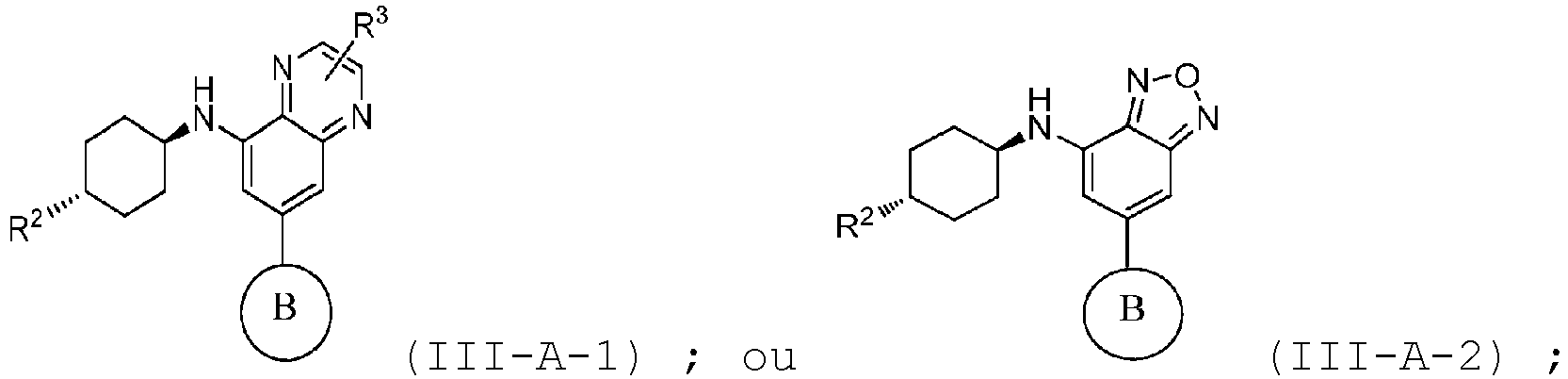
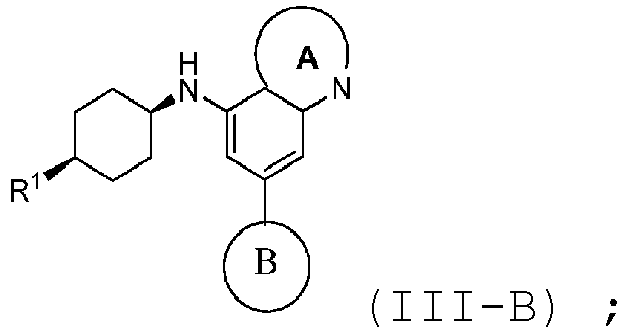
 b) le composé dans lequel X est -O- ; par exemple, le composé ayant la formule suivante :
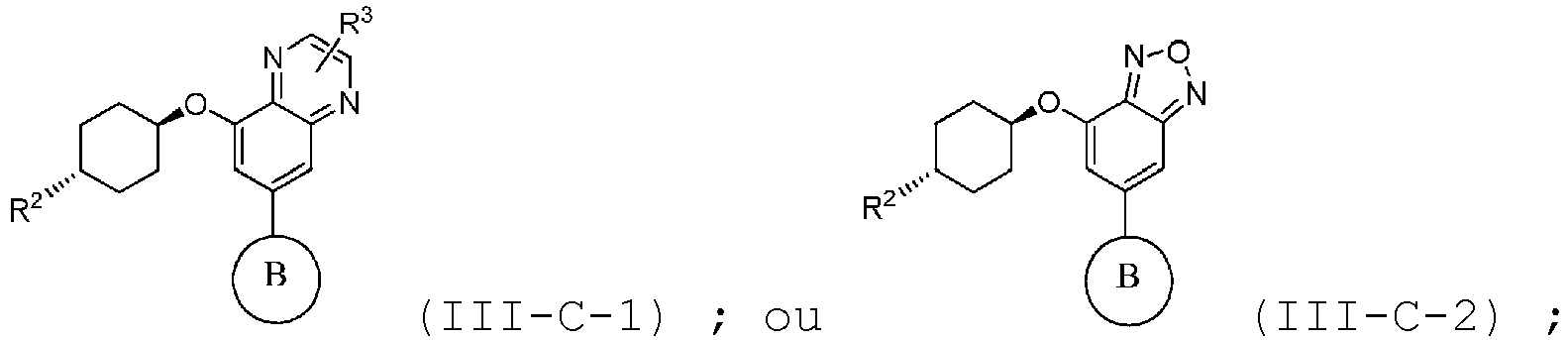


- Composé selon la revendication 2, ayant la formule III-A, III-A-1, III-A-2, III-C, III-C-1 ou III-C-2, dans lequel R2 est -(alkyle en C0-4)-NHR4, -OR4, ou -NHR4; ou le composé selon la revendication 2, ayant la formule III-B, III-B-1, III-B-2, III-D, III-D-1, ou III-D-2, dans lequel R1 est -(alkyle en C0-4)-NHR4, -OR4 ou -NHR4.
- Composé selon la revendication 2 ayant la formule III-D ou III-D-1, ayant la formule suivante :

- Composé selon l'une quelconque des revendications 2 à 4, dans lequel


- Composé selon l'une quelconque des revendications 2 à 5, dans lequela) R4 est hydrogène, alkyle en C1-4, alcényle en C2-4, alcynyle en C2-4, cycloalkyle en C3-5 ou phényle, dans lequel chacun desdits groupes R4 est facultativement substitué par jusqu'à quatre groupes Br, Cl, F ou alkyle en C1-4, jusqu'à trois groupes CN, NO2, alcényle en C2-4, alcynyle en C2-4, cycloalkyle en C3-6, (alkyle en C0-4)-(cycloalkyle en C3-5), (alkyle en C0-4)-O-(alkyle en C1-4), (alkyle en C0-4)-O-(alkyle en C0-4)-(cycloalkyle en C3-5), C(O)O(alkyle en C1-4), C(O)O(alkyle en C0-4)-cycloalkyle en C3-5, (alkyle en C0-4)-C(O)NH2, C(O)NH(alkyle en C1-4), C(O)N(alkyle en C1-4)2, C(O)NH((alkyle en C0-4)-(cycloalkyle en C3-5), CH2OR5, (alkyle en C0-4)-C(O)R5, (alkyle en C0-4)-C(O)N(R5)2, (alkyle en C0-4)-C(O)OR5, (alkyle en C0-4)-NHC(O)R5, (alkyle en C0-4)-N(R5)2, oxétane, azétidine, tétrahydrofurane, dihydropyrane, tétrahydropyrane, morpholine, pipéridine, pyrrolidine, pipérazine, furane, oxazole, oxadiazole, pyrrole, pyrazole, triazole, oxadiazole, tétrazole, ou jusqu'à deux OR5, dans lequel chacun desdits substituants R4 facultatifs est facultativement substitué par jusqu'à quatre atomes de fluor, jusqu'à deux groupes alkyle en C1-4, jusqu'à deux groupes OH, jusqu'à deux groupes O(alkyle en C1-4), jusqu'à deux groupes S(alkyle en C1-4), un C(O)-(alkyle en C1-4), un C(O)O(alkyle en C1-4), ou un C(O)O(alkyle en C0-4)-(cycloalkyle en C3-5); et
chaque R5 est, indépendamment, hydrogène, alkyle en C1-4, imidazole, triazole, thiazole, pyridine, pyrimidine, oxétane, tétrahydrofurane ou tétrahydropyrane, et chaque groupe R5 est facultativement substitué par chloro, jusqu'à trois atomes de fluor, jusqu'à deux groupes alkyle en C1-2, CH2OH, CN, jusqu'à deux OH, jusqu'à deux O(alkyle en C1-2), un spirooxétane, une pyrrolidine ou un triazole, ou deux groupes R5, conjointement avec l'atome d'azote intermédiaire, forment un cycle morpholine, un cycle azétidine, un cycle pyrrolidine, un cycle pipéridine ou un cycle pipérazine ;b) R4 est pyrrole, imidazole, pyrazole, triazole, thiazole, isothiazole, oxazole, pyridine, pyrimidine, pyrimidinone, pyrazine, pyridazine ou quinoléine, dans lequel chacun desdits groupes R4 est facultativement substitué par jusqu'à quatre groupes Br, Cl, F ou alkyle en C1-4, jusqu'à trois groupes CN, NO2, alcényle en C2-4, alcynyle en C2-4, cycloalkyle en C3-6, (alkyle en C0-4)-(cycloalkyle en C3-5), (alkyle en C0-4)-O-(alkyle en C1-4), (alkyle en C0-4)-O-(alkyle en C0-4)-(cycloalkyle en C3-5), C(O)O(alkyle en C1-4), C(O)O(alkyle en C0-4)-(cycloalkyle en C3-5), (alkyle en C0-4)-C(O)NH2, C(O)NH(alkyle en C1-4), C(O)N(alkyle en C1-4)2,
C(O)NH((alkyle en C0-4)-(cycloalkyle en C3-5)), CH2OR5, (alkyle en C0-4)-C(O)R5, (alkyle en C0-4)-C(O)N(R5)2, (alkyle en C0-4)-C(O)OR5, (alkyle en C0-4)-NHC(O)R5, (alkyle en C0-4)-N(R5)2, oxétane, azétidine, tétrahydrofurane, dihydropyrane, tétrahydropyrane, morpholine, pipéridine, pyrrolidine, pipérazine, furane, oxazole, oxadiazole, pyrrole, pyrazole, triazole, oxadiazole, tétrazole, ou jusqu'à deux OR5, dans lequel chacun desdits substituants R4 facultatifs est facultativement substitué par jusqu'à quatre atomes de fluor, jusqu'à deux groupes alkyle en C1-4, jusqu'à deux groupes OH, jusqu'à deux groupes O(alkyle en C1-4), jusqu'à deux groupes S(alkyle en C1-4), un C(O)-(alkyle en C1-4), un C(O)O(alkyle en C1-4), ou un C(O)O(alkyle en C0-4)-(cycloalkyle en C3-5); et
chaque R5 est, indépendamment, hydrogène, alkyle en C1-4, imidazole, triazole, thiazole, pyridine, pyrimidine, oxétane, tétrahydrofurane ou tétrahydropyrane, et chaque groupe R5 est facultativement substitué par chloro, jusqu'à trois atomes de fluor, jusqu'à deux groupes alkyle en C1-2, CH2OH, CN, jusqu'à deux OH, jusqu'à deux O(alkyle en C1-2), un spirooxétane, une pyrrolidine ou un triazole, ou deux groupes R5, conjointement avec l'atome d'azote intermédiaire, forment un cycle morpholine, un cycle azétidine, un cycle pyrrolidine, un cycle pipéridine ou un cycle pipérazine ;c) R4 est pyridine ou pyrimidine, qui est facultativement substitué par jusqu'à quatre groupes Br, Cl, F ou alkyle en C1-4, jusqu'à trois groupes CN, NO2, alcényle en C2-4, alcynyle en C2-4, cycloalkyle en C3-6, (alkyle en C0-4)-(cycloalkyle en C3-5), (alkyle en C0-4)-O-(alkyle en C1-4), (alkyle en C0-4)-O-(alkyle en C0-4)-(cycloalkyle en C3-5), C(O)O(alkyle en C1-4), C(O)O(alkyle en C0-4)-(cycloalkyle en C3-5), (alkyle en C0-4)-C(O)NH2, C(O)NH (alkyle en C1-4), C(O)N(alkyle en C1-4)2, C(O)NH((alkyle en C0-4)-(cycloalkyle en C3-5)), CH2OR5, (alkyle en C0-4)-C(O)R5, (alkyle en C0-4)-C(O)N(R5)2, (alkyle en C0-4)-C(O)OR5, (alkyle en C0-4)-NHC(O)R5, (alkyle en C0-4)-N(R5)2, oxétane, azétidine, tétrahydrofurane, dihydropyrane, tétrahydropyrane, morpholine, pipéridine, pyrrolidine, pipérazine, furane, oxazole, oxadiazole, pyrrole, pyrazole, triazole, oxadiazole, tétrazole, ou jusqu'à deux OR5, dans lequel chacun desdits substituants R4 facultatifs est facultativement substitué par jusqu'à quatre atomes de fluor, jusqu'à deux groupes alkyle en C1-4, jusqu'à deux groupes OH, jusqu'à deux groupes O(alkyle en C1-4), jusqu'à deux groupes S(alkyle en C1-4), un C(O)-(alkyle en C1-4), un C(O)O(alkyle en C1-4), ou un C(O)O(alkyle en C0-4)-(cycloalkyle en C3-5); et
chaque R5 est, indépendamment, hydrogène, alkyle en C1-4, imidazole, triazole, thiazole, pyridine, pyrimidine, oxétane, tétrahydrofurane ou tétrahydropyrane, et chaque groupe R5 est facultativement substitué par chloro, jusqu'à trois atomes de fluor, jusqu'à deux groupes alkyle en C1-2, CH2OH, CN, jusqu'à deux OH, jusqu'à deux groupes O(alkyle en C1-2), un spirooxétane, une pyrrolidine ou un triazole, ou deux groupes R5, conjointement avec l'atome d'azote intermédiaire, forment un cycle morpholine, un cycle azétidine, un cycle pyrrolidine, un cycle pipéridine ou un cycle pipérazine ; oud) R4 est oxétane, tétrahydrofurane, tétrahydropyrane, dihydroisoxazole, pyrimidine-2,4(1H,3H)-dione, dihydrofuropyrimidine, dihydropyranopyrimidine, dihydropyrrolopyrimidine, tétrahydroptéridine ou tétrahydropyridopyrimidine, dans lequel chacun desdits groupes R4 est facultativement substitué par jusqu'à quatre groupes Br, Cl, F ou alkyle en C1-4, jusqu'à trois groupes CN, NO2, alcényle en C2-4, alcynyle en C2-4, cycloalkyle en C3-6, (alkyle en C0-4)-(cycloalkyle en C3-5), (alkyle en C0-4)-O-(alkyle en C1-4), (alkyle en C0-4)-O-(alkyle en C0-4)-(cycloalkyle en C3-5), C(O)O(alkyle en C1-4), C(O)O(alkyle en C0-4)-(cycloalkyle en C3-5), (alkyle en C0-4)-C(O)NH2, C(O)NH(alkyle en C1-4), C(O)N(alkyle en C1-4)2, C(O)NH((alkyle en C0-4)-(cycloalkyle en C3-5)), CH2OR5, (alkyle en C0-4)-C(O)R5, (alkyle en C0-4)-C(O)N(R5)2, (alkyle en C0-4)-C(O)OR5, (alkyle en C0-4)-NHC(O)R5, (alkyle en C0-4)-N(R5)2, oxétane, azétidine, tétrahydrofurane, dihydropyrane, tétrahydropyrane, morpholine, pipéridine, pyrrolidine, pipérazine, furane, oxazole, oxadiazole, pyrrole, pyrazole, triazole, oxadiazole, tétrazole, ou jusqu'à deux OR5, dans lequel chacun desdits substituants R4 facultatifs est facultativement substitué par jusqu'à quatre atomes de fluor, jusqu'à deux groupes alkyle en C1-4, jusqu'à deux groupes OH, jusqu'à deux groupes O(alkyle en C1-4), jusqu'à deux groupes S(alkyle en C1-4), un C(O)-(alkyle en C1-4), un C(O)O(alkyle en C1-4), ou un C(O)O(alkyle en C0-4)-(cycloalkyle en C3-5); et
chaque R5 est, indépendamment, hydrogène, alkyle en C1-4, imidazole, triazole, thiazole, pyridine, pyrimidine, oxétane, tétrahydrofurane ou tétrahydropyrane, et chaque groupe R5 est facultativement substitué par chloro, jusqu'à trois atomes de fluor, jusqu'à deux groupes alkyle en C1-2, CH2OH, CN, jusqu'à deux OH, jusqu'à deux O(alkyle en C1-2), un spirooxétane, une pyrrolidine ou un triazole, ou deux groupes R5, conjointement avec l'atome d'azote intermédiaire, forment un cycle morpholine, un cycle azétidine, un cycle pyrrolidine, un cycle pipéridine ou un cycle pipérazine. - Composé selon la revendication 2 partie b), ayant la formule :

R3 est hydrogène, -(alkyle en C1-4), fluoro, chloro, -O(alkyle en C1-2), -C(O)NH2, -C(O)H ou -CN, dans lequel chacun desdits groupes alkyle de R3 est facultativement substitué par OH ou jusqu'à 3 atomes de fluor ;
R4 est
X2 est N ou CR4c, où X1 et X2 ne peuvent pas être simultanément N ;
chacun de R4a, R4b et R4c est, indépendamment, hydrogène, F, Cl, Br, CN, NO2, alkyle en C1-4, (alkyle en C0-4)-(cycloalkyle en C3-5), (alkyle en C0-4)-O-(alkyle en C1-4), (alkyle en C0-4)-O-(alkyle en C0-4)-(cycloalkyle en C3-5), alcényle en C2-4, alcynyle en C2-4, C (O)O(alkyle en C1-4), C (O)O(alkyle en C0-4)-(cycloalkyle en C3-5), C(O)NH2, C(O)NH(alkyle en C1-4), C(O)N(alkyle en C1-4)2, C(O)NH((alkyle en C0-4)-(cycloalkyle en C3-5)), oxétane, azétidine, tétrahydrofurane, dihydropyrane, tétrahydropyrane, morpholine, pipéridine, pipérazine, furane, oxazole, oxadiazole, pyrrole, pyrazole, triazole, ou tétrazole, ou R4c, R4a, et les atomes intermédiaires forment un dihydrofurane, un dihydropyrane, ou un système cyclique hétérocyclique tétrahydropyridine ;
dans lequel chacun desdits systèmes cycliques hétérocycliques et hétéroaryle de R4a, R4b et R4c est facultativement substitué par jusqu'à quatre atomes de fluor, jusqu'à deux groupes alkyle en C1-4, jusqu'à deux groupes OH, un C(O)-(alkyle en C1-4), un C(O)O(alkyle en C1-4), ou un C(O)O(alkyle en C0-4)-(cycloalkyle en C3-5); et
dans lequel chacun desdits groupes alkyle et cycloalkyle de R4a, R4b et R4c est facultativement substitué par jusqu'à 2 groupes OH non géminaux ou jusqu'à 3 atomes de fluor. - Composé selon l'une quelconque des revendications 2 à 5, ou 7, dans lequel R3 est hydrogène, -(alkyle en C1-4), -O(alkyle en C1-2), -C(O)NH2, ou -C(O)H, dans lequel chacun desdits groupes alkyle de R3 est facultativement substitué par OH ; par exemple, dans lequel R3 est hydrogène.
- Composé selon la revendication 7 ou la revendication 8 lorsqu'elle est dépendante de la revendication 7, dans lequel chacun de X1 et X2 est, indépendamment, CH ou N, où X1 et X2 ne peuvent pas être simultanément N.
- Composé selon l'une quelconque des revendications 7 à 9, dans lequela) chacun de R4a et R4b est, indépendamment, oxétane, azétidine, tétrahydrofurane, dihydropyrane, tétrahydropyrane, morpholine, pipéridine ou pipérazine, dans lequel chacun desdits R4a et R4b est facultativement substitué par jusqu'à quatre atomes de fluor, jusqu'à deux groupes alkyle en C1-4, jusqu'à deux groupes OH, un C(O)-(alkyle en C1-4), un C(O)O(alkyle en C1-4), ou un C(O)O(alkyle en C0-4)-(cycloalkyle en C3-5); et
dans lequel chacun desdits groupes alkyle et cycloalkyle de R4a et R4b est facultativement substitué par jusqu'à 2 groupes OH non géminaux ou jusqu'à 3 atomes de fluor ;b) chacun de R4a et R4b est, indépendamment, furane, oxazole, oxadiazole, pyrrole, pyrazole, triazole, ou tétrazole,
dans lequel chacun desdits systèmes cycliques hétéroaryle de R4a et R4b est facultativement substitué par jusqu'à quatre atomes de fluor, jusqu'à deux groupes alkyle en C1-4, jusqu'à deux groupes OH, un C(O)-(alkyle en C1-4), un C(O)O(alkyle en C1-4), ou un C(O)O(alkyle en C0-4)-(cycloalkyle en C3-5); et
dans lequel chacun desdits groupes alkyle et cycloalkyle de R4a et R4b est facultativement substitué par jusqu'à 2 groupes OH non géminaux ou jusqu'à 3 atomes de fluor ; ouc) chacun de R4a et R4b est, indépendamment, hydrogène, F, Cl, Br, CN, NO2, alkyle en C1-4, (alkyle en C0-4)-(cycloalkyle en C3-5), (alkyle en C0-4)-O-(alkyle en C1-4), (alkyle en C0-4)-O-(alkyle en C0-4)-(cycloalkyle en C3-5), alcényle en C2-4, alcynyle en C2-4, C (O)O(alkyle en C1-4), C (O)O(alkyle en C0-4)-(cycloalkyle en C3-5), C(O)NH2, C(O)NH(alkyle en C1-4), C(O)N(alkyle en C1-4)2, ou C(O)NH((alkyle en C0-4)-(cycloalkyle en C3-5)),
dans lequel chacun desdits groupes alkyle et cycloalkyle de R4a et R4b est facultativement substitué par jusqu'à 2 groupes OH non géminaux ou jusqu'à 3 atomes de fluor. - Composé selon la revendication 1, choisi parmi les composés suivants, ou un sel pharmaceutiquement acceptable de ceux-ci :
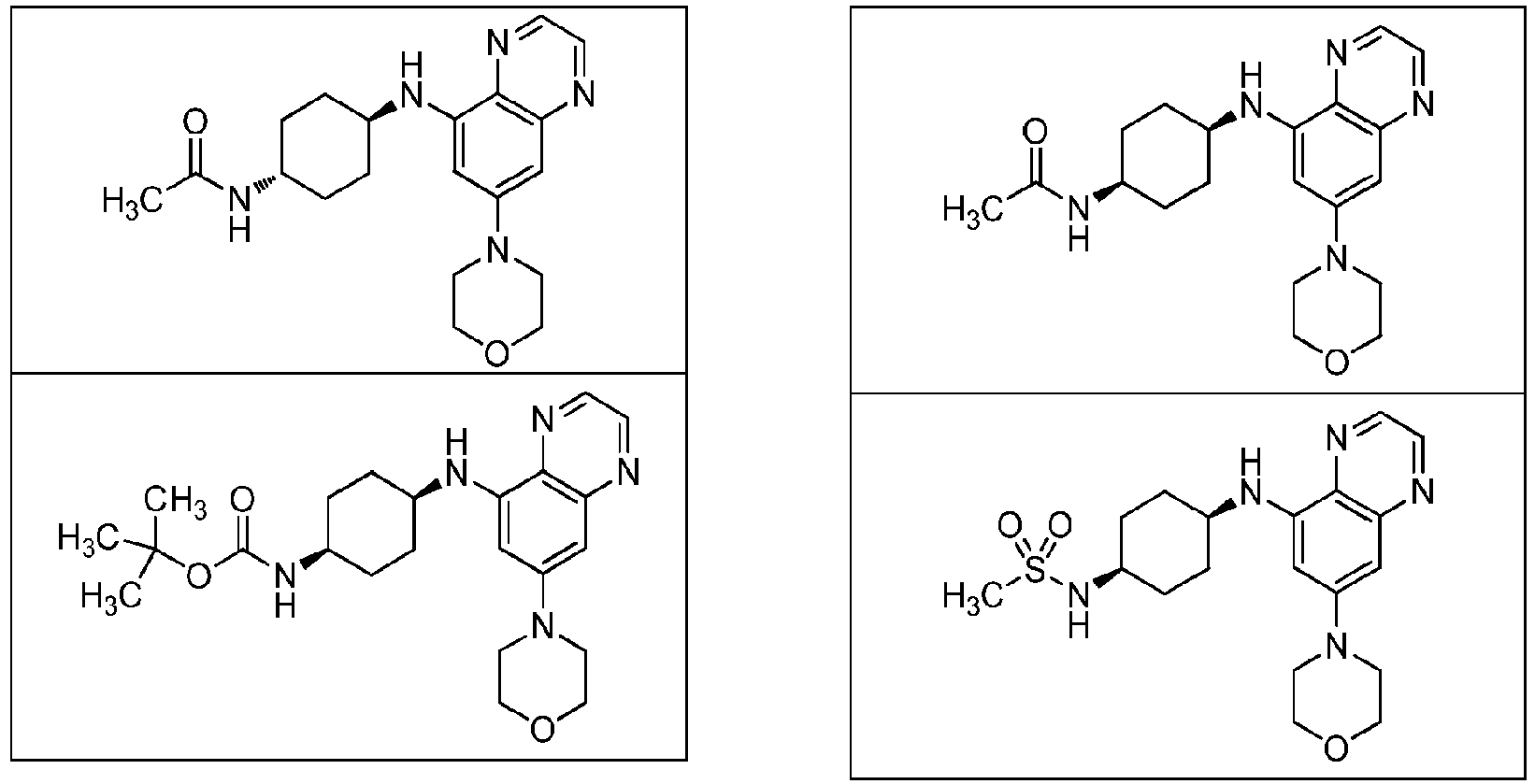


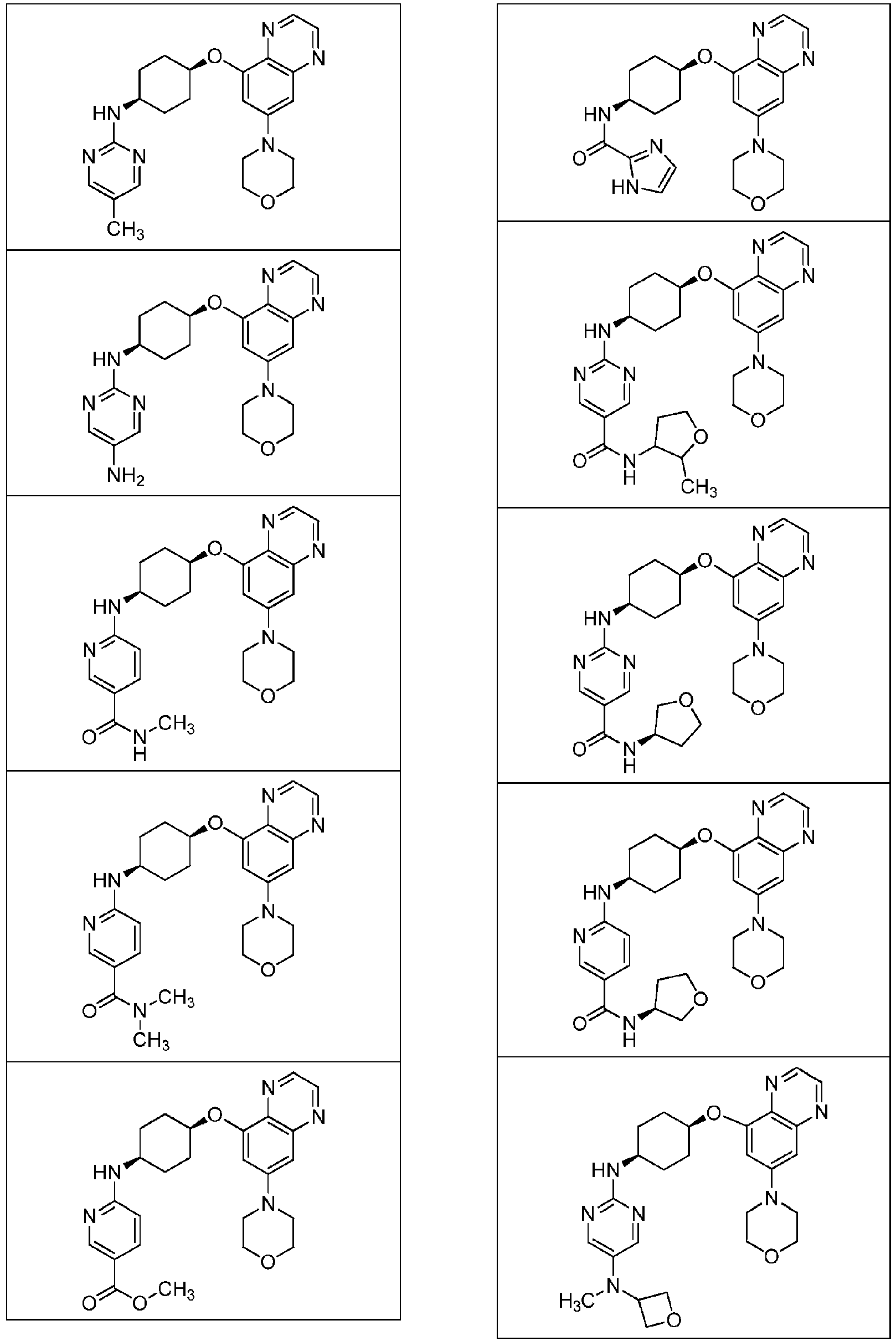
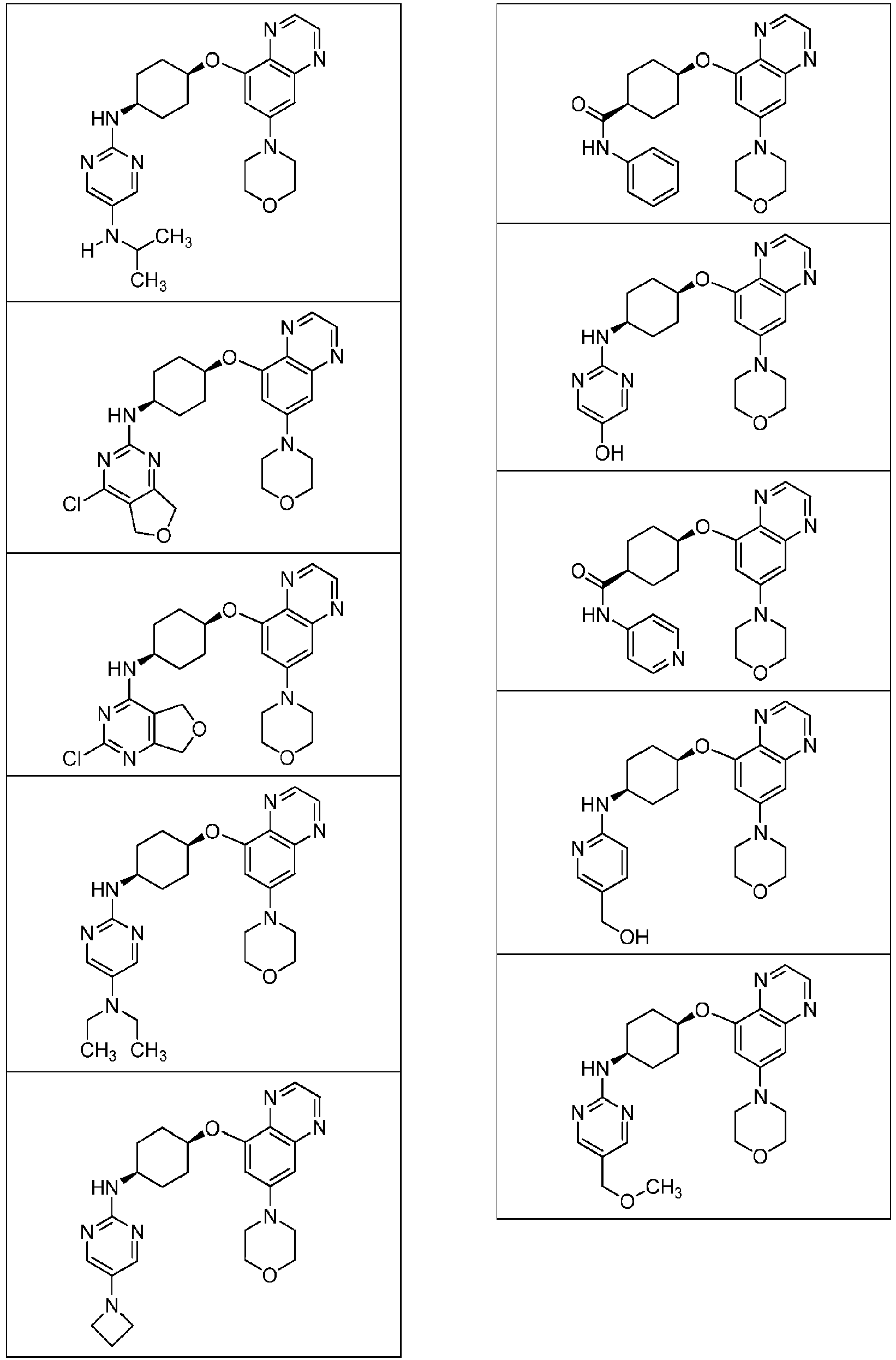


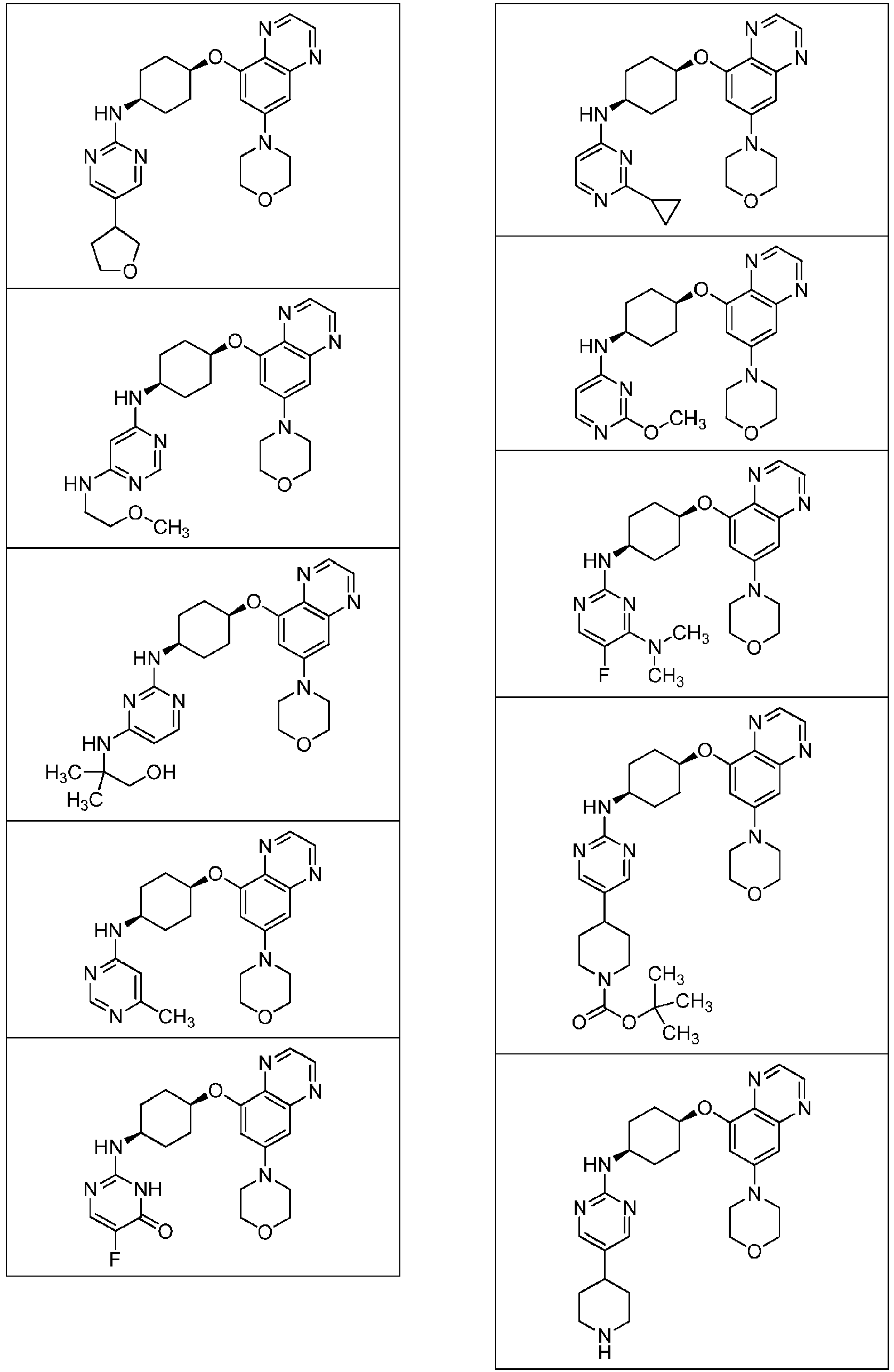


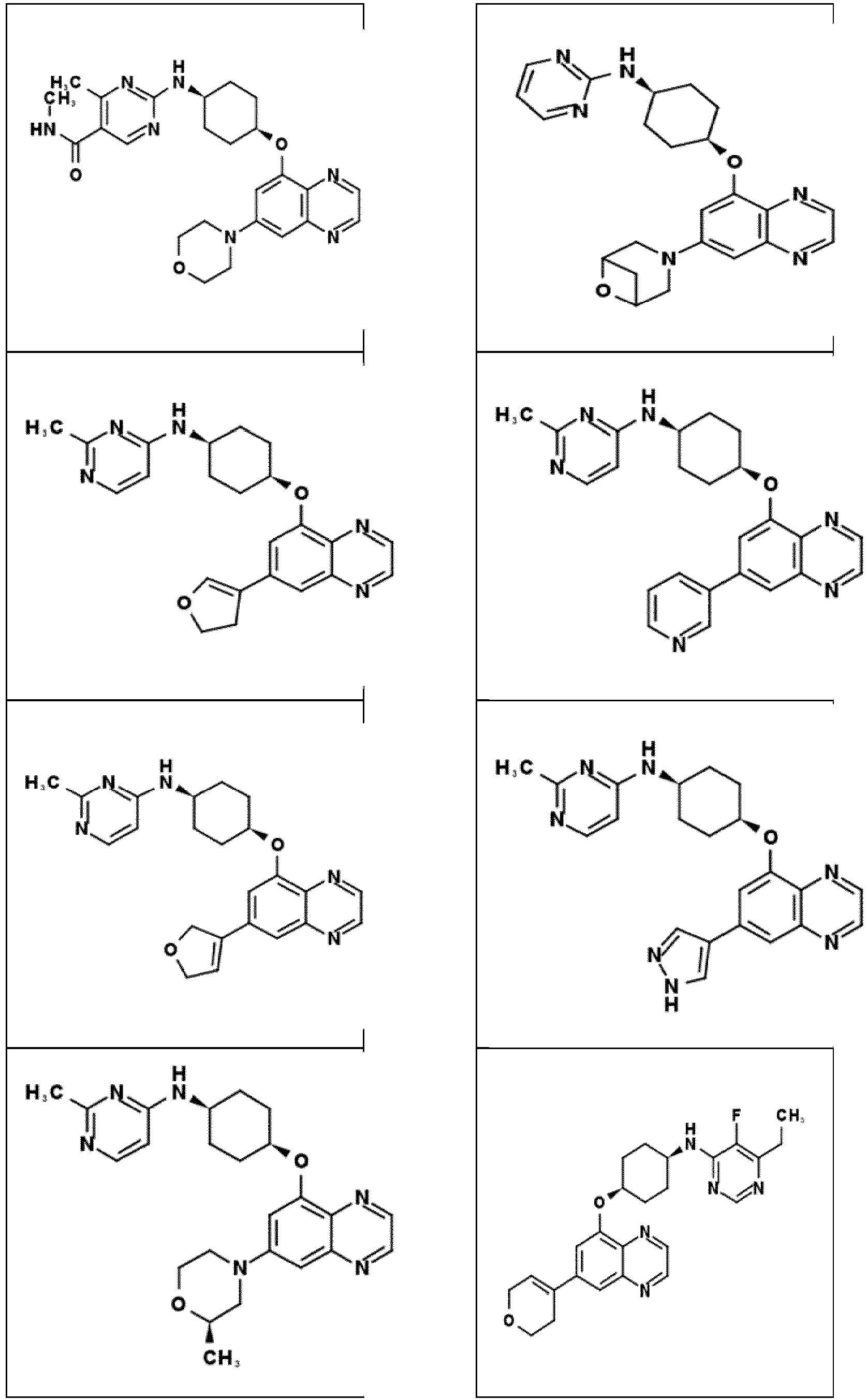


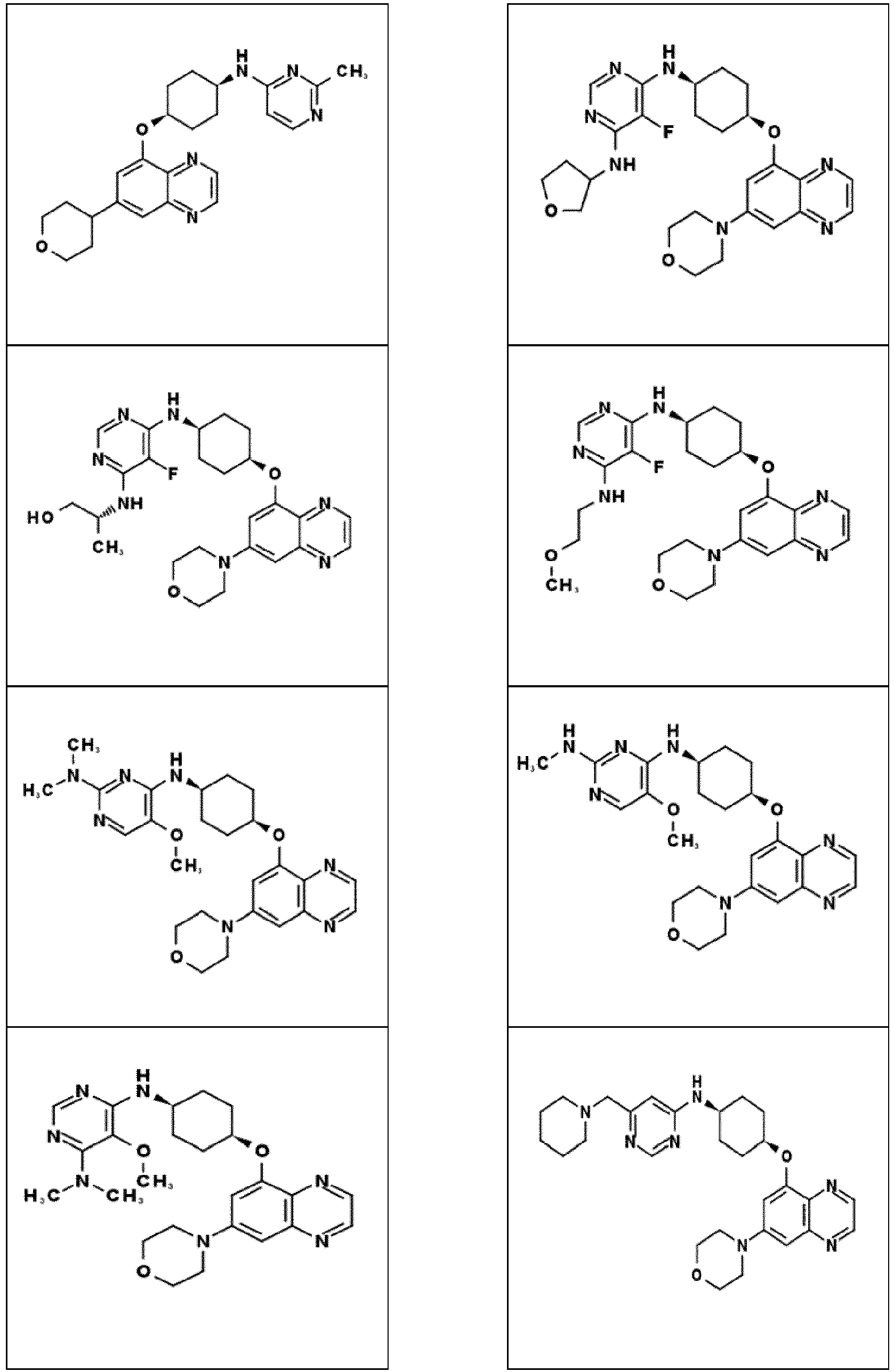


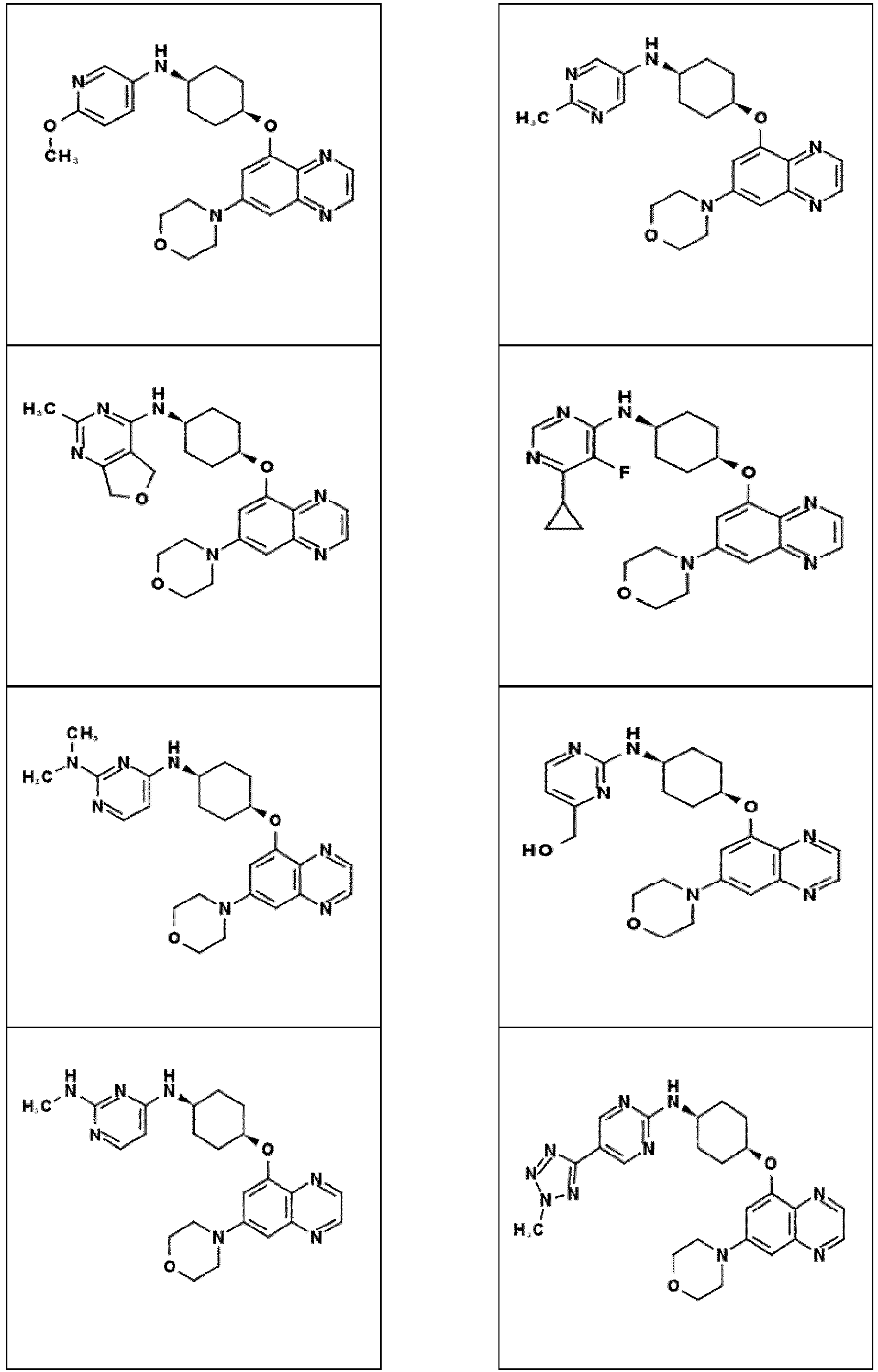

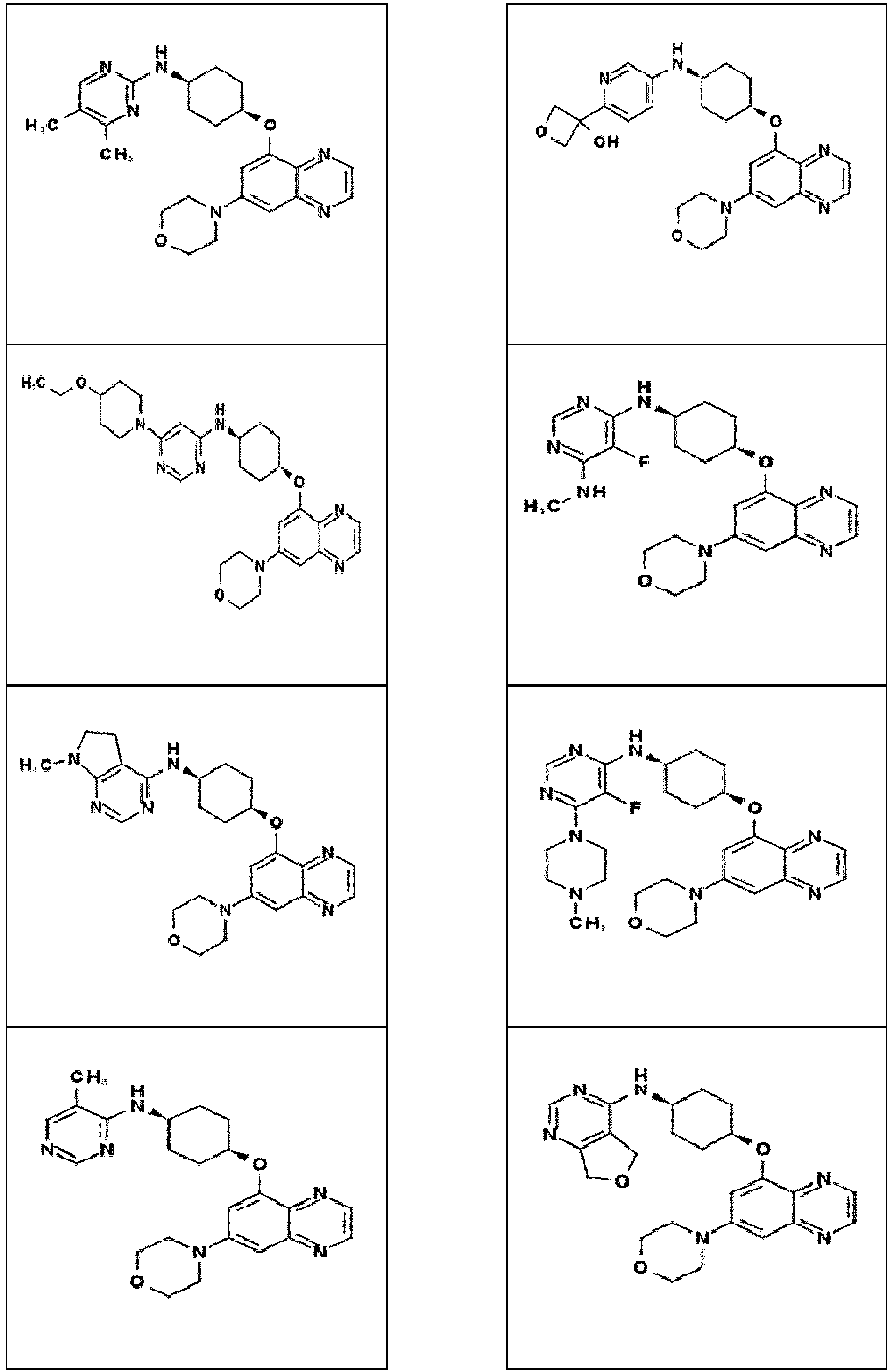


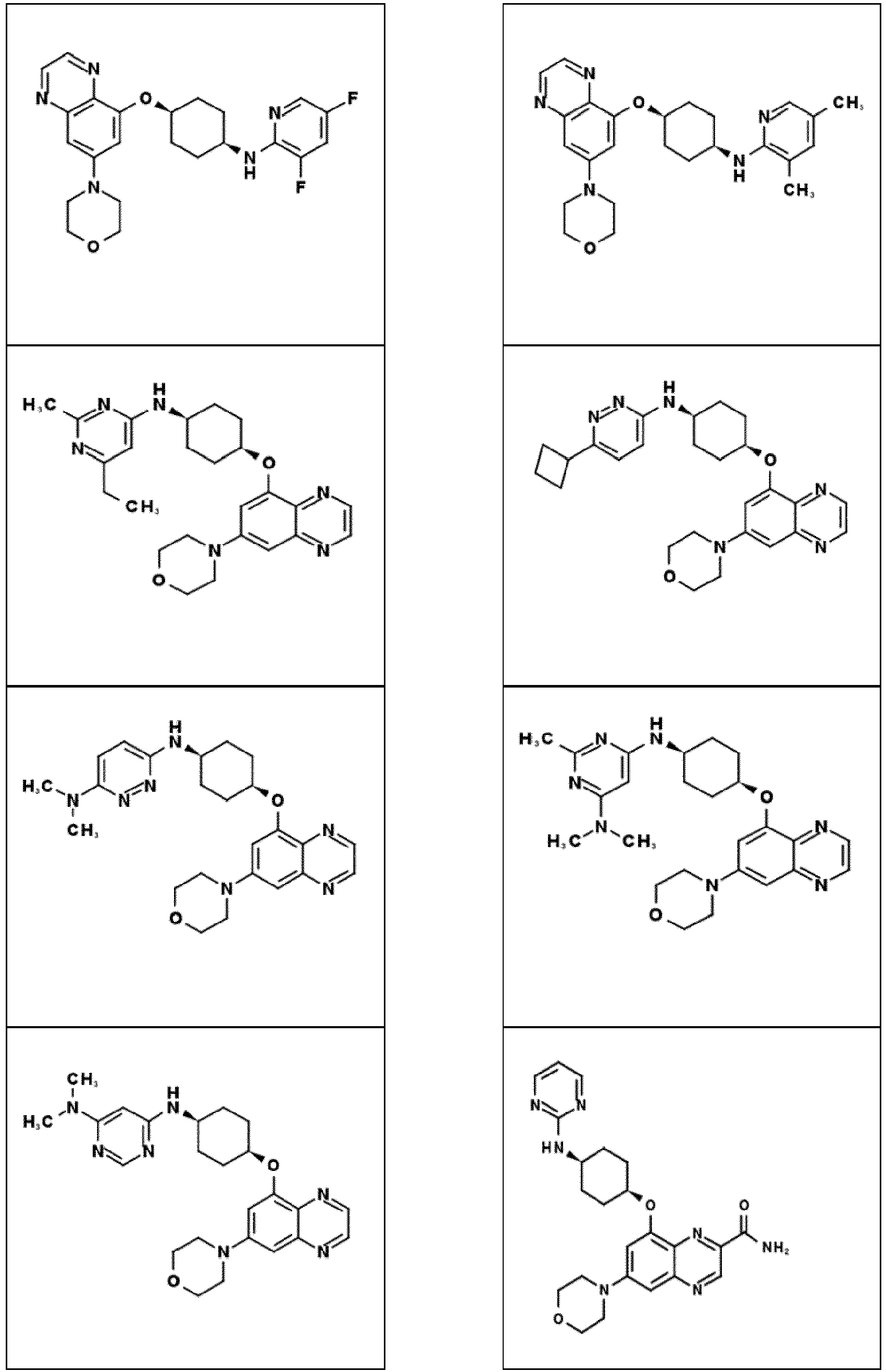


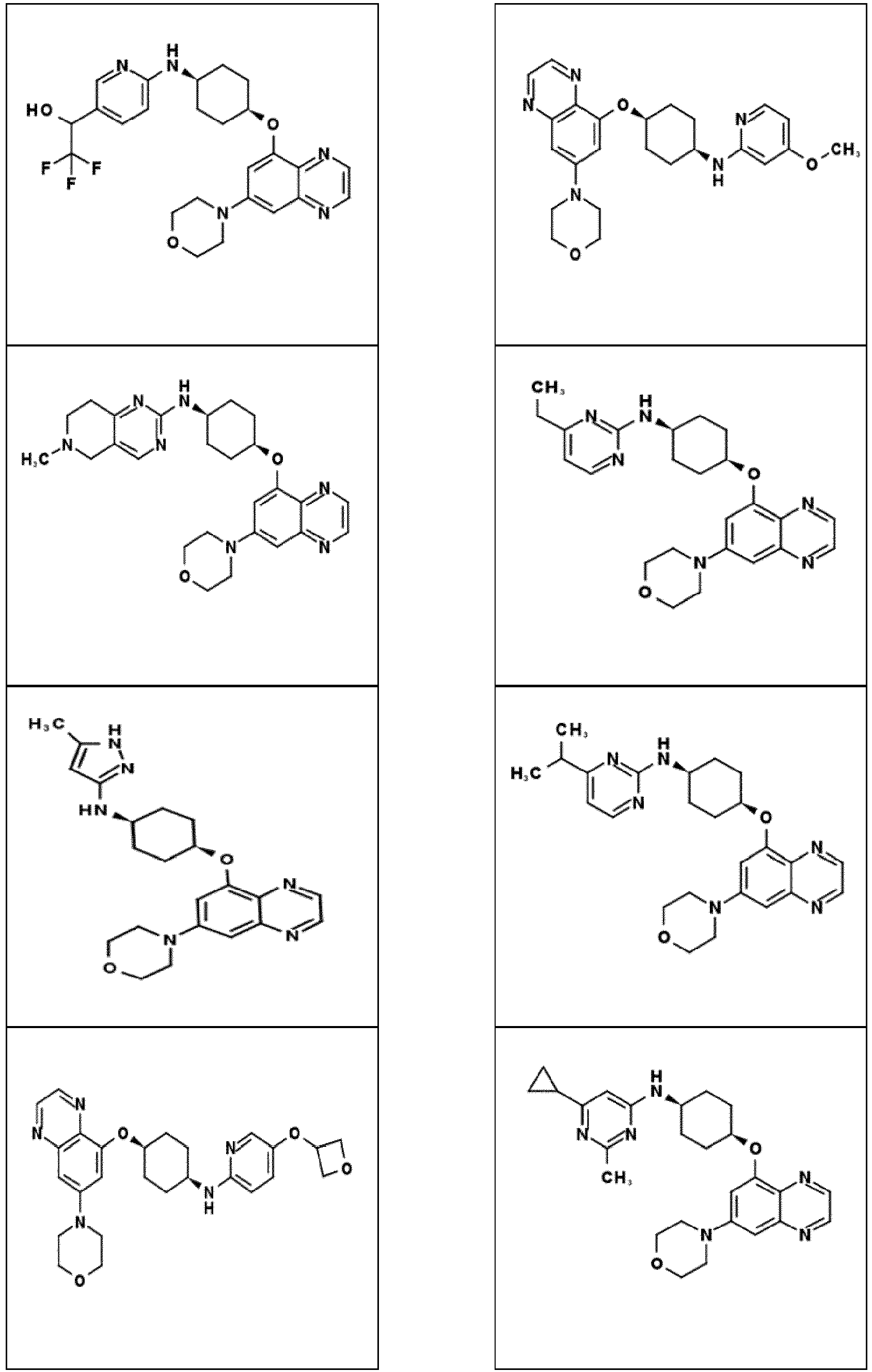


- Composé selon la revendication 1, choisi parmi les suivants :
 ou un sel pharmaceutiquement acceptable de ceux-ci.
- Composé selon la revendication 1, choisi parmi les suivants :


- Composition pharmaceutique comprenant un composé selon l'une quelconque des revendications 1 à 13 et un excipient pharmaceutiquement acceptable.
- Composé selon l'une quelconque des revendications 1 à 13, ou composition pharmaceutique selon la revendication 14, pour utilisation dansa) la sensibilisation d'une cellule à un agent thérapeutique ou un état pathologique qui induit une lésion d'ADN, comprenant l'étape de mise en contact de la cellule avec ledit composé ou ladite composition pharmaceutique ; oub) la potentialisation d'un protocole thérapeutique pour le traitement du cancer chez un patient.
- Composé selon l'une quelconque des revendications 1 à 13, ou composition pharmaceutique selon la revendication 14, seul ou en combinaison avec un ou plusieurs agents thérapeutiques supplémentaires, pour utilisation dans le traitement du cancer ou l'inhibition de la croissance de cellules cancéreuses chez un patient.
Priority Applications (6)
| Application Number | Priority Date | Filing Date | Title |
|---|---|---|---|
| RS20211467A RS62649B1 (sr) | 2013-03-12 | 2014-03-12 | Inhibitori dnk-pk |
| PL18207382T PL3527563T3 (pl) | 2013-03-12 | 2014-03-12 | Inhibitory DNA-PK |
| EP21192836.1A EP3985003B1 (fr) | 2013-03-12 | 2014-03-12 | Inhibiteurs d'adn-pk |
| SM20210687T SMT202100687T1 (it) | 2013-03-12 | 2014-03-12 | Inibitori della dna-pk |
| SI201431922T SI3527563T1 (sl) | 2013-03-12 | 2014-03-12 | Inhibitorji DNA-PK |
| HRP20211855TT HRP20211855T1 (hr) | 2013-03-12 | 2014-03-12 | Inhibitori dnk-pk |
Applications Claiming Priority (3)
| Application Number | Priority Date | Filing Date | Title |
|---|---|---|---|
| US201361777816P | 2013-03-12 | 2013-03-12 | |
| PCT/US2014/024767 WO2014159690A1 (fr) | 2013-03-12 | 2014-03-12 | Inhibiteurs d'adn-pk |
| EP14719434.4A EP2970218B8 (fr) | 2013-03-12 | 2014-03-12 | Inhibiteurs d'adn-pk |
Related Parent Applications (2)
| Application Number | Title | Priority Date | Filing Date |
|---|---|---|---|
| EP14719434.4A Division EP2970218B8 (fr) | 2013-03-12 | 2014-03-12 | Inhibiteurs d'adn-pk |
| EP14719434.4A Division-Into EP2970218B8 (fr) | 2013-03-12 | 2014-03-12 | Inhibiteurs d'adn-pk |
Related Child Applications (1)
| Application Number | Title | Priority Date | Filing Date |
|---|---|---|---|
| EP21192836.1A Division EP3985003B1 (fr) | 2013-03-12 | 2014-03-12 | Inhibiteurs d'adn-pk |
Publications (2)
| Publication Number | Publication Date |
|---|---|
| EP3527563A1 EP3527563A1 (fr) | 2019-08-21 |
| EP3527563B1 true EP3527563B1 (fr) | 2021-09-01 |
Family
ID=50549437
Family Applications (3)
| Application Number | Title | Priority Date | Filing Date |
|---|---|---|---|
| EP14719434.4A Active EP2970218B8 (fr) | 2013-03-12 | 2014-03-12 | Inhibiteurs d'adn-pk |
| EP21192836.1A Active EP3985003B1 (fr) | 2013-03-12 | 2014-03-12 | Inhibiteurs d'adn-pk |
| EP18207382.5A Active EP3527563B1 (fr) | 2013-03-12 | 2014-03-12 | Inhibiteurs d'adn-pk |
Family Applications Before (2)
| Application Number | Title | Priority Date | Filing Date |
|---|---|---|---|
| EP14719434.4A Active EP2970218B8 (fr) | 2013-03-12 | 2014-03-12 | Inhibiteurs d'adn-pk |
| EP21192836.1A Active EP3985003B1 (fr) | 2013-03-12 | 2014-03-12 | Inhibiteurs d'adn-pk |
Country Status (26)
| Country | Link |
|---|---|
| US (11) | US9340557B2 (fr) |
| EP (3) | EP2970218B8 (fr) |
| JP (2) | JP6360878B2 (fr) |
| KR (1) | KR102216284B1 (fr) |
| CN (2) | CN107200749B (fr) |
| AU (2) | AU2014244555B2 (fr) |
| BR (1) | BR112015021888B1 (fr) |
| CA (1) | CA2904641C (fr) |
| CY (2) | CY1121360T1 (fr) |
| DK (2) | DK2970218T3 (fr) |
| ES (2) | ES2711839T3 (fr) |
| HR (2) | HRP20190373T1 (fr) |
| HU (2) | HUE057527T2 (fr) |
| IL (1) | IL241330B (fr) |
| LT (2) | LT2970218T (fr) |
| ME (1) | ME03336B (fr) |
| MX (1) | MX365294B (fr) |
| PL (2) | PL2970218T3 (fr) |
| PT (2) | PT3527563T (fr) |
| RS (2) | RS62649B1 (fr) |
| RU (1) | RU2676259C2 (fr) |
| SG (1) | SG11201507203RA (fr) |
| SI (2) | SI3527563T1 (fr) |
| SM (2) | SMT202100687T1 (fr) |
| TR (1) | TR201901886T4 (fr) |
| WO (1) | WO2014159690A1 (fr) |
Families Citing this family (50)
| Publication number | Priority date | Publication date | Assignee | Title |
|---|---|---|---|---|
| MX371331B (es) | 2012-04-24 | 2020-01-27 | Vertex Pharma | Inhibidores de la proteina cinasa dependiente de acido desoxirribonucleico(adn-pk). |
| ME03336B (fr) | 2013-03-12 | 2019-10-20 | Vertex Pharma | Inhibiteurs d'adn-pk |
| JP6408569B2 (ja) | 2013-10-17 | 2018-10-17 | バーテックス ファーマシューティカルズ インコーポレイテッドVertex Pharmaceuticals Incorporated | Dna−pk阻害剤としての(s)−n−メチル−8−(1−((2’−メチル−[4,5’−ビピリミジン]−6−イル)アミノ)プロパン−2−イル)キノリン−4−カルボキサミドおよびその重水素化誘導体の共結晶 |
| NZ734082A (en) * | 2015-01-20 | 2019-01-25 | Boehringer Ingelheim Animal Health Usa Inc | Anthelmintic compounds, compositions and method of using thereof |
| TWI726861B (zh) * | 2015-01-23 | 2021-05-11 | 英商葛蘭素史克智慧財產發展有限公司 | 吡唑并-嘧啶化合物、其鹽及其用途 |
| CA3026149A1 (fr) | 2016-06-02 | 2017-12-07 | Cadent Therapeutics, Inc. | Modulateurs des canaux potassiques |
| EP3518931A4 (fr) | 2016-09-27 | 2020-05-13 | Vertex Pharmaceuticals Incorporated | Méthode de traitement du cancer utilisant une combinaison d'agents endommageant l'adn et d'inhibiteurs de la dna-pk |
| SI3571193T1 (sl) | 2017-01-23 | 2022-04-29 | Cadent Therapeutics, Inc. | Modulatorji kalijevega kanalčka |
| CN107158001A (zh) * | 2017-03-29 | 2017-09-15 | 解益新 | 一种治疗哮喘的药物组合物 |
| MA51619A (fr) * | 2018-01-17 | 2021-04-14 | Vertex Pharma | Inhibiteurs de la protéine kinase dépendante de l'adn |
| JP7466448B2 (ja) * | 2018-01-17 | 2024-04-12 | バーテックス ファーマシューティカルズ インコーポレイテッド | Dna-pk阻害剤 |
| BR112020013626A2 (pt) | 2018-01-17 | 2020-12-01 | Vertex Pharmaceuticals Incorporated | compostos de quinoxalinona, composições, métodos e kits para aumentar a eficiência de edição de genoma |
| CA3116339A1 (fr) | 2018-10-22 | 2020-04-30 | Cadent Therapeutics, Inc. | Formes cristallines de modulateurs des canaux potassiques |
| BR112021013807A2 (pt) * | 2019-01-18 | 2021-11-30 | Astrazeneca Ab | Inibidores de pcsk9 e seus métodos de uso |
| MX2021008661A (es) | 2019-01-18 | 2021-08-19 | Astrazeneca Ab | Inhibidores de la pcsk9 y metodos de uso de los mismos. |
| CN111909147B (zh) * | 2019-05-10 | 2021-07-20 | 山东轩竹医药科技有限公司 | Dna-pk抑制剂 |
| TWI899080B (zh) * | 2019-05-27 | 2025-10-01 | 大陸商迪哲(江蘇)醫藥股份有限公司 | Dna依賴性蛋白激酶抑制劑 |
| EP4022057A1 (fr) | 2019-08-27 | 2022-07-06 | Vertex Pharmaceuticals Incorporated | Compositions et procédés pour le traitement de troubles associés à l'adn répétitif |
| US20230063457A1 (en) * | 2019-09-11 | 2023-03-02 | Andrew Ivor MINCHINTON | Dna-pk inhibiting compounds |
| AU2020367204A1 (en) * | 2019-10-15 | 2022-04-14 | Aucentra Therapeutics Pty Ltd | Derivatives of 4-(imidazo[1,2-a]pyridin-3-yl)-N-(pyridin-3-yl) pyrimidin-2- amine for treating proliferative diseases and conditions |
| TW202128690A (zh) * | 2019-11-21 | 2021-08-01 | 大陸商江蘇恆瑞醫藥股份有限公司 | 吡唑并雜芳基類衍生物、其製備方法及其在醫藥上的應用 |
| WO2021136461A1 (fr) * | 2019-12-31 | 2021-07-08 | 成都百裕制药股份有限公司 | Dérivé de purine et son utilisation médicale |
| CN113121538B (zh) * | 2019-12-31 | 2023-04-21 | 成都百裕制药股份有限公司 | 呋喃衍生物及其在医药上的应用 |
| CN115697985B (zh) * | 2020-04-07 | 2025-01-21 | 米托布里奇公司 | Cd38抑制剂 |
| CA3181340A1 (fr) | 2020-04-28 | 2021-11-04 | Intellia Therapeutics, Inc. | Procedes d'administration de cellules in vitro |
| AU2021346954A1 (en) * | 2020-09-24 | 2023-05-25 | Auckland Uniservices Limited | Novel aminopyridines and their use in treating cancer |
| EP4294798A1 (fr) * | 2021-02-19 | 2023-12-27 | Kalvista Pharmaceuticals Limited | Inhibiteurs du facteur xiia |
| TW202302848A (zh) | 2021-02-26 | 2023-01-16 | 美商維泰克斯製藥公司 | 以crispr/sacas9治療第1型肌強直性營養不良之組合物及方法 |
| EP4298221A1 (fr) | 2021-02-26 | 2024-01-03 | Vertex Pharmaceuticals Incorporated | Compositions et méthodes pour le traitement de la dystrophie myotonique de type 1 avec crispr/slucas9 |
| CA3213120A1 (fr) * | 2021-03-10 | 2022-09-15 | adMare Therapeutics Society | Derives 7-morpholino-1,6-naphtyridin-5-yle et leurs compositions pharmaceutiques utiles en tant qu'inhibiteur de l'adn-pk |
| IL307740A (en) | 2021-04-17 | 2023-12-01 | Intellia Therapeutics Inc | DNA-dependent protein kinase inhibitors and their compositions and uses |
| WO2023018637A1 (fr) | 2021-08-09 | 2023-02-16 | Vertex Pharmaceuticals Incorporated | Édition génique d'éléments régulateurs |
| US12084453B2 (en) | 2021-12-10 | 2024-09-10 | Incyte Corporation | Bicyclic amines as CDK12 inhibitors |
| TW202508595A (zh) | 2023-05-04 | 2025-03-01 | 美商銳新醫藥公司 | 用於ras相關疾病或病症之組合療法 |
| US20250049810A1 (en) | 2023-08-07 | 2025-02-13 | Revolution Medicines, Inc. | Methods of treating a ras protein-related disease or disorder |
| WO2025049254A1 (fr) * | 2023-08-25 | 2025-03-06 | Juno Therapeutics, Inc. | Inhibiteurs à base de pyrazolopyridine de protéine kinase dépendante de l'adn et compositions et application dans l'édition génique |
| WO2025049481A1 (fr) | 2023-08-28 | 2025-03-06 | Intellia Therapeutics, Inc. | Procédés d'édition in vitro d'un gène hla-a |
| AU2024360465A1 (en) | 2023-10-12 | 2026-04-09 | Revolution Medicines, Inc. | Macrocyclic ras inhibitors |
| WO2025171296A1 (fr) | 2024-02-09 | 2025-08-14 | Revolution Medicines, Inc. | Inhibiteurs de ras |
| WO2025217307A1 (fr) | 2024-04-09 | 2025-10-16 | Revolution Medicines, Inc. | Procédés de prédiction de la réponse à un inhibiteur de ras(on) et polythérapies |
| TW202547461A (zh) | 2024-05-17 | 2025-12-16 | 美商銳新醫藥公司 | Ras抑制劑 |
| WO2025255438A1 (fr) | 2024-06-07 | 2025-12-11 | Revolution Medicines, Inc. | Procédés de traitement d'une maladie ou d'un trouble lié à la protéine ras |
| WO2025265060A1 (fr) | 2024-06-21 | 2025-12-26 | Revolution Medicines, Inc. | Compositions thérapeutiques et procédés de gestion d'effets liés au traitement |
| WO2026006747A1 (fr) | 2024-06-28 | 2026-01-02 | Revolution Medicines, Inc. | Inhibiteurs de ras |
| WO2026015801A1 (fr) | 2024-07-12 | 2026-01-15 | Revolution Medicines, Inc. | Méthodes de traitement d'une maladie ou d'un trouble liés à ras |
| WO2026015790A1 (fr) | 2024-07-12 | 2026-01-15 | Revolution Medicines, Inc. | Méthodes de traitement d'une maladie ou d'un trouble lié à ras |
| WO2026015825A1 (fr) | 2024-07-12 | 2026-01-15 | Revolution Medicines, Inc. | Utilisation d'un inhibiteur de ras pour traiter le cancer du pancréas |
| WO2026015796A1 (fr) | 2024-07-12 | 2026-01-15 | Revolution Medicines, Inc. | Méthodes de traitement d'une maladie ou d'un trouble lié à ras |
| WO2026050446A1 (fr) | 2024-08-29 | 2026-03-05 | Revolution Medicines, Inc. | Inhibiteurs de ras |
| WO2026072904A2 (fr) | 2024-09-26 | 2026-04-02 | Revolution Medicines, Inc. | Compositions et méthodes de traitement du cancer du poumon |
Family Cites Families (175)
| Publication number | Priority date | Publication date | Assignee | Title |
|---|---|---|---|---|
| US5571506A (en) | 1989-08-14 | 1996-11-05 | Rhone-Poulenc Rorer Pharmaceuticals Inc. | Aromatic oligomeric compounds useful as mimics of bioactive macromolecules |
| CA2071897A1 (fr) | 1989-12-28 | 1991-06-29 | Richard A. Glennon | Ligands du recepteur sigma et leur utilisation |
| US6004979A (en) | 1991-02-07 | 1999-12-21 | Hoechst Marion Roussel | Nitrogenous bicycles |
| ES2104862T3 (es) | 1991-02-07 | 1997-10-16 | Roussel Uclaf | Derivados biciclicos nitrogenados, su procedimiento de preparacion, sus productos intermedios obtenidos, su aplicacion como medicamentos y composiciones farmaceuticas que los contienen. |
| EP0519211A1 (fr) | 1991-05-17 | 1992-12-23 | Hoechst Schering AgrEvo GmbH | 4-Aminopyrimidines substituées, procédé pour leur préparation et leur utilisation comme parasiticide |
| DE4208254A1 (de) | 1992-03-14 | 1993-09-16 | Hoechst Ag | Substituierte pyrimidine, verfahren zu ihrer herstellung und ihre verwendung als schaedlingsbekaempfungsmittel und fungizid |
| WO1993022291A1 (fr) | 1992-04-24 | 1993-11-11 | E.I. Du Pont De Nemours And Company | Aminopyrimidines arthropidicides et fongicides |
| US5595756A (en) | 1993-12-22 | 1997-01-21 | Inex Pharmaceuticals Corporation | Liposomal compositions for enhanced retention of bioactive agents |
| DE4437406A1 (de) | 1994-10-19 | 1996-04-25 | Hoechst Ag | Chinoxaline, Verfahren zu ihrer Herstellung und ihre Verwendung |
| US5977117A (en) | 1996-01-05 | 1999-11-02 | Texas Biotechnology Corporation | Substituted phenyl compounds and derivatives thereof that modulate the activity of endothelin |
| GB2338957B (en) | 1997-02-19 | 2001-08-01 | Berlex Lab | N-heterocyclic derivatives as nos inhibitors |
| JPH10251255A (ja) | 1997-03-14 | 1998-09-22 | Nissan Chem Ind Ltd | アジン誘導体 |
| SI0991628T1 (en) * | 1997-05-28 | 2005-06-30 | Aventis Pharmaceuticals Inc | QUINOLINE AND QUINOXALINE COMPOUNDS WHICH INHIBIT PLATELET-DERIVED GROWTH FACTOR AND/OR P56lck TYROSINE KINASES |
| DE19801598C2 (de) | 1998-01-17 | 2000-05-11 | Aventis Res & Tech Gmbh & Co | Katalytische Synthese von N-alkylierten Anilinen aus Olefinen und Anilinen |
| DE19836697A1 (de) | 1998-08-13 | 2000-02-17 | Hoechst Marion Roussel De Gmbh | Substituierte 4-Amino-2-aryl-pyrimidine, ihre Herstellung, ihre Verwendung und sie enthaltende pharmazeutische Präparate |
| WO2000042026A1 (fr) | 1999-01-15 | 2000-07-20 | Novo Nordisk A/S | Agonistes non peptidiques de glp-1 |
| MXPA02003436A (es) | 1999-10-07 | 2002-08-20 | Amgen Inc | Inhibidores de triazina cinasa. |
| GB9924092D0 (en) | 1999-10-13 | 1999-12-15 | Zeneca Ltd | Pyrimidine derivatives |
| US6552016B1 (en) | 1999-10-14 | 2003-04-22 | Curis, Inc. | Mediators of hedgehog signaling pathways, compositions and uses related thereto |
| WO2001057021A2 (fr) | 2000-02-01 | 2001-08-09 | Cor Therapeutics, Inc. | 2-[1H]-QUINOLONE ET 2-[1H]-QUINOXALONE INHIBITEURS DU FACTEUR Xa |
| WO2001064642A2 (fr) | 2000-02-29 | 2001-09-07 | Cor Therapeutics, Inc. | Benzamides et inhibiteurs connexes du facteur xa |
| US6605615B2 (en) | 2000-03-01 | 2003-08-12 | Tularik Inc. | Hydrazones and analogs as cholesterol lowering agents |
| DE10013318A1 (de) | 2000-03-17 | 2001-09-20 | Merck Patent Gmbh | Formulierung enthaltend Chinoxalinderivate |
| US7498304B2 (en) | 2000-06-16 | 2009-03-03 | Curis, Inc. | Angiogenesis-modulating compositions and uses |
| WO2002020500A2 (fr) * | 2000-09-01 | 2002-03-14 | Icos Corporation | Substances potentialisant un traitement anticancereux et methodes a cet effet |
| US6610677B2 (en) | 2000-09-15 | 2003-08-26 | Vertex Pharmaceuticals Incorporated | Pyrazole compounds useful as protein kinase inhibitors |
| US6613776B2 (en) | 2000-09-15 | 2003-09-02 | Vertex Pharmaceuticals Incorporated | Pyrazole compounds useful as protein kinase inhibitors |
| WO2002022605A1 (fr) | 2000-09-15 | 2002-03-21 | Vertex Pharmaceuticals Incorporated | Composes de pyrazole utiles comme inhibiteurs de proteine kinase |
| US6660731B2 (en) | 2000-09-15 | 2003-12-09 | Vertex Pharmaceuticals Incorporated | Pyrazole compounds useful as protein kinase inhibitors |
| US7473691B2 (en) | 2000-09-15 | 2009-01-06 | Vertex Pharmaceuticals Incorporated | Pyrazole compounds useful as protein kinase inhibitors |
| ATE407132T1 (de) | 2000-12-05 | 2008-09-15 | Vertex Pharma | Inhibitoren von c-jun n-terminalen kinasen (jnk) und anderen proteinkinasen |
| US6989385B2 (en) | 2000-12-21 | 2006-01-24 | Vertex Pharmaceuticals Incorporated | Pyrazole compounds useful as protein kinase inhibitors |
| JP2004521901A (ja) | 2001-02-02 | 2004-07-22 | グラクソ グループ リミテッド | Tgf阻害剤としてのピラゾール |
| MY130778A (en) | 2001-02-09 | 2007-07-31 | Vertex Pharma | Heterocyclic inhibitiors of erk2 and uses thereof |
| CA2441733A1 (fr) | 2001-03-29 | 2002-10-10 | Vertex Pharmaceuticals Incorporated | Inhibiteurs de kinases n-terminales c-jun (jnk) et autres proteineskinases |
| AU2002338642A1 (en) | 2001-04-13 | 2002-10-28 | Vertex Pharmaceuticals Incorporated | Inhibitors of c-jun n-terminal kinases (jnk) and other protein kinases |
| EP1383771A1 (fr) | 2001-04-20 | 2004-01-28 | Vertex Pharmaceuticals Incorporated | Derives de 9-deazaguanine utilises comme inhibiteurs de la gsk-3 |
| WO2002092573A2 (fr) | 2001-05-16 | 2002-11-21 | Vertex Pharmaceuticals Incorporated | Inhibiteurs de src et autres proteine kinases |
| MXPA03010961A (es) | 2001-05-31 | 2004-02-27 | Vertex Pharma | Compuestos de tiazol utiles como inhibidores de proteinas cinasas. |
| ES2274035T3 (es) | 2001-06-01 | 2007-05-16 | Vertex Pharmaceuticals Incorporated | Compuestos de tiazol utiles como inhibidores de proteina quinasas. |
| CA2450769A1 (fr) | 2001-06-15 | 2002-12-27 | Vertex Pharmaceuticals Incorporated | 5-(2-aminopyrimidine-4-yl) benzisoxazoles en tant qu'inhibiteurs de proteine kinases |
| ATE337312T1 (de) | 2001-07-03 | 2006-09-15 | Vertex Pharma | Isoxazolyl-pyrimidines als inhibitoren von src- und lck-protein-kinasen |
| GB0119865D0 (en) * | 2001-08-14 | 2001-10-10 | Cancer Res Campaign Tech | DNA-PK inhibitors |
| ATE466581T1 (de) | 2001-12-07 | 2010-05-15 | Vertex Pharma | Verbindungen auf pyrimidin-basis als gsk-3-hemmer |
| WO2003066629A2 (fr) | 2002-02-06 | 2003-08-14 | Vertex Pharmaceuticals Incorporated | Composes heteroaryles utiles en tant qu'inhibiteurs de gsk-3 |
| US20030199525A1 (en) | 2002-03-21 | 2003-10-23 | Hirst Gavin C. | Kinase inhibitors |
| US20030207873A1 (en) | 2002-04-10 | 2003-11-06 | Edmund Harrington | Inhibitors of Src and other protein kinases |
| US7304061B2 (en) | 2002-04-26 | 2007-12-04 | Vertex Pharmaceuticals Incorporated | Heterocyclic inhibitors of ERK2 and uses thereof |
| RU2004135386A (ru) | 2002-05-06 | 2005-07-20 | Вертекс Фармасьютикалз Инкорпорейтед (Us) | Тиадиазолы или оксадиазолы и их применение в качестве ингибиторов протеинкиназы jak |
| JP2005528443A (ja) | 2002-05-30 | 2005-09-22 | バーテックス ファーマシューティカルズ インコーポレイテッド | Jakキナーゼおよびcdk2プロテインキナーゼのインヒビター |
| MY141867A (en) | 2002-06-20 | 2010-07-16 | Vertex Pharma | Substituted pyrimidines useful as protein kinase inhibitors |
| US7361665B2 (en) | 2002-07-09 | 2008-04-22 | Vertex Pharmaceuticals Incorporated | Inhibitors of c-Jun N-terminal kinases (JNK) and other protein kinases |
| AU2003262642B2 (en) | 2002-08-14 | 2010-06-17 | Vertex Pharmaceuticals Incorporated | Protein kinase inhibitors and uses thereof |
| US7419984B2 (en) | 2002-10-17 | 2008-09-02 | Cell Therapeutics, Inc. | Pyrimidines and uses thereof |
| AU2003286876A1 (en) | 2002-11-01 | 2004-06-07 | Vertex Pharmaceuticals Incorporated | Compositions useful as inhibitors of jak and other protein kinases |
| US7259161B2 (en) | 2002-11-04 | 2007-08-21 | Vertex Pharmaceuticals Incorporated | Compositions useful as inhibitors of JAK and other protein kinases |
| DE60326646D1 (de) | 2002-12-18 | 2009-04-23 | Vertex Pharma | Benzisoxazolderivate, die sich als inhibitoren von proteinkinasen eigen |
| US7144911B2 (en) | 2002-12-31 | 2006-12-05 | Deciphera Pharmaceuticals Llc | Anti-inflammatory medicaments |
| JP2006518381A (ja) | 2003-02-07 | 2006-08-10 | バーテックス ファーマシューティカルズ インコーポレイテッド | プロテインキナーゼのインヒビターとして有用なヘテロアリール置換ピロール |
| US7456190B2 (en) | 2003-03-13 | 2008-11-25 | Vertex Pharmaceuticals Incorporated | Compositions useful as protein kinase inhibitors |
| WO2004085418A2 (fr) | 2003-03-24 | 2004-10-07 | Luitpold Pharmaceuticals, Inc. | Materiaux et procedes de potentialisation d'un traitement anticancereux |
| CA2523125A1 (fr) | 2003-03-25 | 2004-10-14 | Vertex Pharmaceuticals Incorporated | Thiazoles utiles en tant qu'inhibiteurs de proteines kinases |
| US6875781B2 (en) | 2003-04-04 | 2005-04-05 | Cell Therapeutics, Inc. | Pyridines and uses thereof |
| US7189724B2 (en) | 2003-04-15 | 2007-03-13 | Valeant Research And Development | Quinoxaline derivatives having antiviral activity |
| US8084457B2 (en) | 2003-09-15 | 2011-12-27 | Lead Discovery Center Gmbh | Pharmaceutically active 4,6-disubstituted aminopyrimidine derivatives as modulators of protein kinases |
| CA2547080A1 (fr) | 2003-12-02 | 2005-07-28 | Vertex Pharmaceuticals, Inc. | Inhibiteurs heterocycliques de proteine kinase et leurs utilisations |
| US7592340B2 (en) | 2003-12-04 | 2009-09-22 | Vertex Pharmaceuticals Incorporated | Quinoxalines useful as inhibitors of protein kinases |
| TW200533357A (en) | 2004-01-08 | 2005-10-16 | Millennium Pharm Inc | 2-(amino-substituted)-4-aryl pyrimidines and related compounds useful for treating inflammatory diseases |
| CA2559652C (fr) | 2004-03-15 | 2017-02-14 | Sunesis Pharmaceuticals, Inc. | Moyens d'utiliser sns-595 dans le traitement du cancer |
| GB0405985D0 (en) | 2004-03-17 | 2004-04-21 | Novartis Forschungsstiftung | Kinase |
| AU2005245877B2 (en) | 2004-05-14 | 2010-06-03 | Vertex Pharmaceuticals, Incorporated | Prodrugs of pyrrolylpyrimidine ERK protein kinase inhibitors |
| JP4449580B2 (ja) | 2004-05-31 | 2010-04-14 | 宇部興産株式会社 | 4−アラルキルアミノピリミジン誘導体及び抗菌剤 |
| PL1756084T3 (pl) | 2004-06-04 | 2009-06-30 | Arena Pharm Inc | Podstawione pochodne arylowe i heteroarylowe jako modulatory metabolizmu oraz profilaktyka i leczenie zaburzeń z metabolizmem związanych |
| CN101039933B (zh) | 2004-09-17 | 2012-06-06 | 沃泰克斯药物股份有限公司 | 可用作蛋白激酶抑制剂的二氨基三唑化合物 |
| EP2402323A3 (fr) | 2004-10-13 | 2012-05-30 | PTC Therapeutics, Inc. | Composes pour la suppression de mutations non-sens et procedes d'utilisation associes |
| MX2007004480A (es) | 2004-10-15 | 2007-05-08 | Astrazeneca Ab | Quinoxalinas como inhibidores b raf. |
| GT200500284A (es) | 2004-10-15 | 2006-03-27 | Aventis Pharma Inc | Pirimidinas como antagonistas del receptor de prostaglandina d2 |
| WO2006050249A1 (fr) | 2004-10-29 | 2006-05-11 | Vertex Pharmaceuticals Incorporated | Derives de diaminotriazole utilises comme inhibiteurs de proteine kinases |
| US7517870B2 (en) | 2004-12-03 | 2009-04-14 | Fondazione Telethon | Use of compounds that interfere with the hedgehog signaling pathway for the manufacture of a medicament for preventing, inhibiting, and/or reversing ocular diseases related with ocular neovascularization |
| JP2008523103A (ja) | 2004-12-14 | 2008-07-03 | バーテックス ファーマシューティカルズ インコーポレイテッド | Erkプロテインキナーゼのピリミジンインヒビターおよびその使用 |
| WO2006071644A1 (fr) | 2004-12-23 | 2006-07-06 | Vertex Pharmaceuticals Incorporated | Inhibiteurs selectifs de la proteine kinase erk et leurs utilisations |
| JP4734346B2 (ja) | 2005-02-04 | 2011-07-27 | セノミックス インコーポレイテッド | 連結ヘテロアリール部分を含む化合物、ならびに食用組成物のための新規なうまみフレーバー改変剤、味物質および味覚増強剤としての使用 |
| RU2007140733A (ru) | 2005-04-06 | 2009-05-20 | Айрм Ллк (Bm) | Диариламинсодержащие соединения и композиции, и их применение в качестве модуляторов ядерных рецепторов стероидного гормона |
| AR053358A1 (es) | 2005-04-15 | 2007-05-02 | Cancer Rec Tech Ltd | Inhibidores de adn - pk |
| WO2006125616A2 (fr) | 2005-05-25 | 2006-11-30 | Ingenium Pharmaceuticals Ag | Methodes de traitement de la douleur |
| WO2006138418A2 (fr) | 2005-06-14 | 2006-12-28 | President And Fellows Of Harvard College | Amelioration de la performance cognitive avec des activateurs de sirtuine |
| JP2007008045A (ja) | 2005-06-30 | 2007-01-18 | Mitsui Chemicals Inc | 光記録媒体および1h−キノキサリン−2−オン誘導体 |
| CA2616517A1 (fr) | 2005-07-26 | 2007-02-01 | Vertex Pharmaceuticals Incorporated | Inhibition de kinase d'abl |
| GB0520657D0 (en) | 2005-10-11 | 2005-11-16 | Ludwig Inst Cancer Res | Pharmaceutical compounds |
| JP2009514875A (ja) | 2005-11-02 | 2009-04-09 | サイトキネティクス・インコーポレーテッド | 化学物質、組成物、および方法 |
| MX2008005814A (es) | 2005-11-03 | 2008-10-15 | Vertex Pharma | Aminopirimidinas utiles como inhibidores de cinasa. |
| US20070179125A1 (en) | 2005-11-16 | 2007-08-02 | Damien Fraysse | Aminopyrimidines useful as kinase inhibitors |
| WO2007082899A1 (fr) | 2006-01-17 | 2007-07-26 | Vib Vzw | Inhibiteurs de la prolyl-hydroxylase 1 pour le traitement de la degenerescence des muscles du squelette |
| JO2660B1 (en) | 2006-01-20 | 2012-06-17 | نوفارتيس ايه جي | Pi-3 inhibitors and methods of use |
| UY30118A1 (es) | 2006-01-31 | 2007-06-29 | Tanabe Seiyaku Co | Compueto amina trisustituido |
| US8013153B2 (en) | 2006-03-23 | 2011-09-06 | Janssen Pharmaceutica, N.V. | Substituted pyrimidine kinase inhibitors |
| US20080280891A1 (en) | 2006-06-27 | 2008-11-13 | Locus Pharmaceuticals, Inc. | Anti-cancer agents and uses thereof |
| WO2008008852A2 (fr) | 2006-07-11 | 2008-01-17 | Emory University | Antagonistes de cxcr4 comprenant des hétéroatomes pour le traitement de troubles médicaux |
| TW200811134A (en) | 2006-07-12 | 2008-03-01 | Irm Llc | Compounds and compositions as protein kinase inhibitors |
| PL2044056T3 (pl) | 2006-07-14 | 2013-01-31 | Novartis Ag | Pochodne pirymidyny jako inhibitory ALK-5 |
| PE20080403A1 (es) | 2006-07-14 | 2008-04-25 | Amgen Inc | Derivados heterociclicos fusionados y metodos de uso |
| US7635683B2 (en) | 2006-08-04 | 2009-12-22 | Enanta Pharmaceuticals, Inc. | Quinoxalinyl tripeptide hepatitis C virus inhibitors |
| WO2008023357A1 (fr) | 2006-08-22 | 2008-02-28 | Technion Research And Development Foundation Ltd. | Dérivés hétérocycliques se liant au récepteur des benzodiazépines de type périphérique (pbr) |
| EP1903038A1 (fr) | 2006-09-07 | 2008-03-26 | Bayer Schering Pharma Aktiengesellschaft | Dérivés N-(1-hetaryl-piperidine-4-yl)-(het)arylamide utilisées comme modulateurs du recepteur EP2 |
| US7875603B2 (en) | 2006-09-21 | 2011-01-25 | Nova Southeastern University | Specific inhibitors for vascular endothelial growth factor receptors |
| CN103739595A (zh) | 2006-10-02 | 2014-04-23 | Irm责任有限公司 | 作为蛋白激酶抑制剂的化合物和组合物 |
| DE102006050512A1 (de) | 2006-10-26 | 2008-04-30 | Bayer Healthcare Ag | Substituierte heterocyclische Verbindungen und ihre Verwendung |
| CA2668429A1 (fr) | 2006-11-02 | 2008-05-15 | Vertex Pharmaceuticals Incorporated | Aminopyridines et aminopyrimidines utiles en tant qu'inhibiteurs de proteines kinases |
| JP2010511727A (ja) | 2006-12-04 | 2010-04-15 | ニューロクライン バイオサイエンシーズ,インコーポレイテッド | アデノシン受容体アンタゴニストとしての置換ピリミジン |
| ES2347721T3 (es) | 2006-12-19 | 2010-11-03 | Vertex Pharmaceuticals, Inc. | Aminopirimidinas utiles como inhibidores de proteina quinasas. |
| US20100098630A1 (en) | 2006-12-28 | 2010-04-22 | Ambrx, Inc. | Phenazine and Quinoxaline Substituted Amino Acids and Polypeptides |
| PT2114900T (pt) | 2007-01-31 | 2019-01-17 | Ym Biosciences Australia Pty | Compostos à base de tiopirimidina e as suas utilizações |
| WO2008106202A1 (fr) | 2007-02-27 | 2008-09-04 | Housey Gerard M | Modulateurs de théramutéine |
| AU2008226457B2 (en) | 2007-03-09 | 2014-03-20 | Vertex Pharmaceuticals Incorporated | Aminopyrimidines useful as inhibitors of protein kinases |
| EP2137183B1 (fr) | 2007-03-09 | 2011-09-28 | Vertex Pharmaceuticals Incorporated | Aminopyrimidines utiles en tant qu'inhibiteurs des protéines kinases |
| EP2134709A1 (fr) | 2007-03-09 | 2009-12-23 | Vertex Pharmaceuticals, Inc. | Utilisation des aminopyridines comme inhibiteurs de protéines kinases |
| WO2008115973A2 (fr) | 2007-03-20 | 2008-09-25 | Vertex Pharmaceuticals Incorporated | Aminopyrimidines utiles en tant qu'inhibiteurs de kinase |
| DE102007015169A1 (de) | 2007-03-27 | 2008-10-02 | Universität des Saarlandes Campus Saarbrücken | 17Beta-Hydroxysteroid-Dehydrogenase-Typ1-Inhibitoren zur Behandlung hormonabhängiger Erkrankungen |
| NZ580343A (en) | 2007-04-13 | 2012-03-30 | Vertex Pharma | Aminopyrimidines useful as kinase inhibitors |
| US7910587B2 (en) | 2007-04-26 | 2011-03-22 | Enanta Pharmaceuticals, Inc. | Quinoxalinyl dipeptide hepatitis C virus inhibitors |
| JP5389785B2 (ja) | 2007-05-02 | 2014-01-15 | バーテックス ファーマシューティカルズ インコーポレイテッド | キナーゼ阻害剤として有用なチアゾールおよびピラゾール |
| MX2009011811A (es) | 2007-05-02 | 2010-01-14 | Vertex Pharma | Aminopirimidinas utiles como inhibidores de cinasa. |
| CA2694381A1 (fr) | 2007-05-02 | 2008-11-13 | Vertex Pharmaceuticals Incorporated | Aminopyrimidines servant d'inhibiteurs de kinases |
| PE20090288A1 (es) | 2007-05-10 | 2009-04-03 | Smithkline Beecham Corp | Derivados de quinoxalina como inhibidores de la pi3 quinasa |
| WO2008144253A1 (fr) | 2007-05-14 | 2008-11-27 | Irm Llc | Inhibiteurs de la protéine kinase et procédé d'utilisation de ceux-ci |
| EP2164842A2 (fr) | 2007-05-24 | 2010-03-24 | Vertex Pharmaceuticals Incorporated | Thiazoles et pyrazoles utiles en tant qu'inhibiteurs de kinase |
| EP2167464B1 (fr) | 2007-05-25 | 2014-12-03 | AbbVie Deutschland GmbH & Co KG | Composés hétérocycliques comme modulateurs positifs du récepteur métabotropique du glutamate 2 (récepteur mglu2) |
| EP2170274A1 (fr) | 2007-07-02 | 2010-04-07 | Technion Research and Development Foundation, Ltd. | Compositions, articles et procédés comprenant des ligands de tspo destinés à prévenir ou réduire un dommage lié au tabac |
| US20100130597A1 (en) | 2007-07-06 | 2010-05-27 | The United State Of America, As Represented By The Secretary Of The Dept Of Health And Human Service | Dna-pkcs modulates energy regulation and brain function |
| UY31232A1 (es) | 2007-07-19 | 2009-03-02 | Compuestos derivados de dibenzotifenilamino-cromen-4-onas activas sustituidas y sus isomeros y aplicaciones | |
| MX2010001240A (es) | 2007-08-01 | 2010-04-30 | Kumiai Chemical Industry Co | Derivado de oxopirazina y herbicida. |
| WO2009042294A2 (fr) | 2007-08-10 | 2009-04-02 | Burnham Institute For Medical Research | Activateurs de la phosphatase alcaline non spécifique des tissus (tnap) et leurs utilisations |
| DE102007044032A1 (de) | 2007-09-14 | 2009-03-19 | Bayer Healthcare Ag | Substituierte heterocyclische Verbindungen und ihre Verwendung |
| ATE510827T1 (de) | 2007-10-12 | 2011-06-15 | Ingenium Pharmaceuticals Gmbh | Inhibitoren von proteinkinasen |
| AU2008324833A1 (en) | 2007-11-06 | 2009-05-14 | E. I. Du Pont De Nemours And Company | Fungicidal heterocyclic amines |
| WO2009091388A2 (fr) | 2007-12-21 | 2009-07-23 | Progenics Pharmaceuticals, Inc. | Triazines et composés associés présentant une activité antivirale, compositions et procédés associés |
| US8562945B2 (en) | 2008-01-09 | 2013-10-22 | Molecular Insight Pharmaceuticals, Inc. | Technetium- and rhenium-bis(heteroaryl) complexes and methods of use thereof |
| EP2254415B1 (fr) | 2008-02-19 | 2013-01-23 | Janssen Pharmaceutica, N.V. | Aryl-hydroxyéthylamino-pyrimidines et triazines en tant que modulateurs d'amide d'acide gras hydrolase |
| WO2009107391A1 (fr) | 2008-02-27 | 2009-09-03 | 武田薬品工業株式会社 | Composé contenant un cycle aromatique à 6 chaînons |
| EP2247580B1 (fr) | 2008-03-05 | 2015-07-08 | Merck Patent GmbH | Dérivés de quinoxalinone comme stimulateurs de la sécrétion d insuline, leurs procédés d obtention et leur utilisation pour le traitement du diabète |
| US8268834B2 (en) | 2008-03-19 | 2012-09-18 | Novartis Ag | Pyrazine derivatives that inhibit phosphatidylinositol 3-kinase enzyme |
| CA2725316A1 (fr) | 2008-06-02 | 2009-12-10 | Banyu Pharmaceutical Co., Ltd. | Nouveau derive d'isoxazole |
| HRP20131069T1 (hr) | 2008-06-16 | 2013-12-20 | Merck Patent Gmbh | Derivati kinoksalindiona |
| EP2138488A1 (fr) | 2008-06-26 | 2009-12-30 | sanofi-aventis | Dérivés de 4-(pyridin-4-yl)-1H-[1,3,5]triazin-2-ones comme inhibiteurs de GSK3-beta utiles pour le traitement de maladies neurodégénératives |
| ES2402087T3 (es) | 2008-07-23 | 2013-04-26 | Vertex Pharmaceuticals Incorporated | Inhibidores de la pirazolopiridina quinasa |
| WO2010048149A2 (fr) | 2008-10-20 | 2010-04-29 | Kalypsys, Inc. | Modulateurs hétérocycliques de gpr119 pour le traitement d'une maladie |
| AR074199A1 (es) | 2008-11-20 | 2010-12-29 | Glaxosmithkline Llc | Compuesto de 6-(4-pirimidinil)-1h-indazol, composiciones farmaceuticas que lo comprenden y su uso para preparar un medicamento util para el tratamiento o disminucion de la gravedad del cancer. |
| ES2921576T3 (es) | 2008-12-19 | 2022-08-29 | Vertex Pharma | Compuestos útiles como inhibidores de la quinasa ATR |
| WO2010093808A1 (fr) | 2009-02-11 | 2010-08-19 | Reaction Biology Corp. | Inhibiteurs de kinase sélectifs |
| JP2010111702A (ja) | 2009-02-16 | 2010-05-20 | Tetsuya Nishio | 複素環化合物、その製造法および用途 |
| US8906914B2 (en) | 2009-08-18 | 2014-12-09 | Janssen Pharmaceutica Nv | Ethylene diamine modulators of fatty acid hydrolase |
| AR077999A1 (es) | 2009-09-02 | 2011-10-05 | Vifor Int Ag | Antagonistas de pirimidin y triazin-hepcidina |
| CN102574843B (zh) | 2009-10-22 | 2015-06-17 | 法博太科制药有限公司 | 抗纤维化剂的稠环类似物 |
| ES2360333B1 (es) | 2009-10-29 | 2012-05-04 | Consejo Superior De Investigaciones Cientificas (Csic) (70%) | Derivados de bis (aralquil) amino y sistemas (hetero) aromaticos de seis miembros y su uso en el tratamiento de patologias neurodegenerativas, incluida la enfermedad de alzheimer |
| AU2010312365A1 (en) | 2009-10-30 | 2012-06-07 | Mochida Pharmaceutical Co.,Ltd. | Novel 3-hydroxy-5-arylisoxazole derivative |
| CN104710381A (zh) | 2009-12-25 | 2015-06-17 | 持田制药株式会社 | 新的3-羟基-5-芳基异噻唑衍生物 |
| UY33213A (es) | 2010-02-18 | 2011-09-30 | Almirall Sa | Derivados de pirazol como inhibidores de jak |
| BR112012022868A2 (pt) | 2010-03-16 | 2018-06-05 | Merck Patent Gmbh | morfolinilquinazolinas |
| TWI516264B (zh) | 2010-05-06 | 2016-01-11 | 臺北醫學大學 | 芳香醯喹啉化合物 |
| JP2011246389A (ja) * | 2010-05-26 | 2011-12-08 | Oncotherapy Science Ltd | Ttk阻害作用を有する縮環ピラゾール誘導体 |
| DE102010025786A1 (de) | 2010-07-01 | 2012-01-05 | Merck Patent Gmbh | Pyrazolochinoline |
| DE102010035744A1 (de) | 2010-08-28 | 2012-03-01 | Merck Patent Gmbh | Imidazolonylchinoline |
| US9464065B2 (en) | 2011-03-24 | 2016-10-11 | The Scripps Research Institute | Compounds and methods for inducing chondrogenesis |
| GB201114051D0 (en) | 2011-08-15 | 2011-09-28 | Domainex Ltd | Compounds and their uses |
| ES2725790T3 (es) | 2011-08-26 | 2019-09-27 | Neupharma Inc | Algunas entidades químicas, composiciones, y métodos |
| CN115403531A (zh) | 2011-09-14 | 2022-11-29 | 润新生物公司 | 作为激酶抑制剂的化学实体、组合物及方法 |
| US9249110B2 (en) | 2011-09-21 | 2016-02-02 | Neupharma, Inc. | Substituted quinoxalines as B-raf kinase inhibitors |
| US9249111B2 (en) | 2011-09-30 | 2016-02-02 | Neupharma, Inc. | Substituted quinoxalines as B-RAF kinase inhibitors |
| DE102011118830A1 (de) | 2011-11-18 | 2013-05-23 | Merck Patent Gmbh | Morpholinylbenzotriazine |
| GB201120993D0 (en) | 2011-12-06 | 2012-01-18 | Imp Innovations Ltd | Novel compounds and their use in therapy |
| EP2806874B1 (fr) | 2012-01-25 | 2017-11-15 | Neupharma, Inc. | Dérivés de quinoxaline-oxy-phenyl comme inhibiteurs de kinases |
| MX371331B (es) | 2012-04-24 | 2020-01-27 | Vertex Pharma | Inhibidores de la proteina cinasa dependiente de acido desoxirribonucleico(adn-pk). |
| WO2014075077A1 (fr) | 2012-11-12 | 2014-05-15 | Neupharma, Inc. | Certaines entités chimiques, compositions et certains procédés |
| ME03336B (fr) | 2013-03-12 | 2019-10-20 | Vertex Pharma | Inhibiteurs d'adn-pk |
| JP6408569B2 (ja) | 2013-10-17 | 2018-10-17 | バーテックス ファーマシューティカルズ インコーポレイテッドVertex Pharmaceuticals Incorporated | Dna−pk阻害剤としての(s)−n−メチル−8−(1−((2’−メチル−[4,5’−ビピリミジン]−6−イル)アミノ)プロパン−2−イル)キノリン−4−カルボキサミドおよびその重水素化誘導体の共結晶 |
-
2014
- 2014-03-12 ME MEP-2019-55A patent/ME03336B/fr unknown
- 2014-03-12 RS RS20211467A patent/RS62649B1/sr unknown
- 2014-03-12 HU HUE18207382A patent/HUE057527T2/hu unknown
- 2014-03-12 JP JP2016501636A patent/JP6360878B2/ja not_active Expired - Fee Related
- 2014-03-12 PL PL14719434T patent/PL2970218T3/pl unknown
- 2014-03-12 PT PT182073825T patent/PT3527563T/pt unknown
- 2014-03-12 WO PCT/US2014/024767 patent/WO2014159690A1/fr not_active Ceased
- 2014-03-12 AU AU2014244555A patent/AU2014244555B2/en not_active Ceased
- 2014-03-12 ES ES14719434T patent/ES2711839T3/es active Active
- 2014-03-12 RS RS20190243A patent/RS58374B1/sr unknown
- 2014-03-12 EP EP14719434.4A patent/EP2970218B8/fr active Active
- 2014-03-12 MX MX2015012502A patent/MX365294B/es active IP Right Grant
- 2014-03-12 HR HRP20190373TT patent/HRP20190373T1/hr unknown
- 2014-03-12 CN CN201710472183.0A patent/CN107200749B/zh not_active Expired - Fee Related
- 2014-03-12 SM SM20210687T patent/SMT202100687T1/it unknown
- 2014-03-12 TR TR2019/01886T patent/TR201901886T4/tr unknown
- 2014-03-12 US US14/205,657 patent/US9340557B2/en active Active
- 2014-03-12 DK DK14719434.4T patent/DK2970218T3/en active
- 2014-03-12 PL PL18207382T patent/PL3527563T3/pl unknown
- 2014-03-12 RU RU2015143211A patent/RU2676259C2/ru active
- 2014-03-12 SI SI201431922T patent/SI3527563T1/sl unknown
- 2014-03-12 CN CN201480025199.1A patent/CN105246883B/zh not_active Expired - Fee Related
- 2014-03-12 BR BR112015021888-1A patent/BR112015021888B1/pt not_active IP Right Cessation
- 2014-03-12 HR HRP20211855TT patent/HRP20211855T1/hr unknown
- 2014-03-12 KR KR1020157028350A patent/KR102216284B1/ko not_active Expired - Fee Related
- 2014-03-12 CA CA2904641A patent/CA2904641C/fr active Active
- 2014-03-12 DK DK18207382.5T patent/DK3527563T3/da active
- 2014-03-12 ES ES18207382T patent/ES2900061T3/es active Active
- 2014-03-12 EP EP21192836.1A patent/EP3985003B1/fr active Active
- 2014-03-12 SI SI201431104T patent/SI2970218T1/sl unknown
- 2014-03-12 LT LTEP14719434.4T patent/LT2970218T/lt unknown
- 2014-03-12 EP EP18207382.5A patent/EP3527563B1/fr active Active
- 2014-03-12 PT PT14719434T patent/PT2970218T/pt unknown
- 2014-03-12 LT LTEP18207382.5T patent/LT3527563T/lt unknown
- 2014-03-12 HU HUE14719434A patent/HUE041544T2/hu unknown
- 2014-03-12 SG SG11201507203RA patent/SG11201507203RA/en unknown
- 2014-03-12 SM SM20190107T patent/SMT201900107T1/it unknown
- 2014-03-12 US US14/205,508 patent/US9359380B2/en active Active
-
2015
- 2015-09-08 IL IL241330A patent/IL241330B/en active IP Right Grant
-
2016
- 2016-04-20 US US15/133,378 patent/US9987284B2/en active Active
- 2016-05-06 US US15/148,229 patent/US20160354381A1/en not_active Abandoned
-
2017
- 2017-07-25 US US15/659,306 patent/US10258627B2/en active Active
-
2018
- 2018-04-27 US US15/965,489 patent/US20180311254A1/en not_active Abandoned
- 2018-05-14 JP JP2018092924A patent/JP2018135389A/ja not_active Withdrawn
- 2018-09-27 AU AU2018236800A patent/AU2018236800B2/en not_active Ceased
-
2019
- 2019-02-20 CY CY20191100217T patent/CY1121360T1/el unknown
- 2019-02-21 US US16/282,083 patent/US10786512B2/en active Active
- 2019-04-01 US US16/372,080 patent/US10973830B2/en active Active
-
2020
- 2020-09-17 US US17/023,597 patent/US11813267B2/en active Active
-
2021
- 2021-02-09 US US17/171,061 patent/US20210236505A1/en not_active Abandoned
- 2021-12-01 CY CY20211101051T patent/CY1125436T1/el unknown
-
2023
- 2023-02-27 US US18/175,515 patent/US12251387B2/en active Active
Also Published As
Similar Documents
| Publication | Publication Date | Title |
|---|---|---|
| US11813267B2 (en) | DNA-PK inhibitors | |
| EP3459942A1 (fr) | Inhibiteurs d'adn-pk | |
| HK40013013B (en) | Dna-pk inhibitors | |
| HK40013013A (en) | Dna-pk inhibitors | |
| HK1220190B (en) | Dna-pk inhibitors | |
| HK40003569A (en) | Dna-pk inhibitors | |
| HK40003569B (en) | Dna-pk inhibitors | |
| NZ712576B2 (en) | Dna-pk inhibitors | |
| HK1208022B (en) | Dna-pk inhibitors |
Legal Events
| Date | Code | Title | Description |
|---|---|---|---|
| REG | Reference to a national code |
Ref country code: HR Ref legal event code: TUEP Ref document number: P20211855 Country of ref document: HR |
|
| PUAI | Public reference made under article 153(3) epc to a published international application that has entered the european phase |
Free format text: ORIGINAL CODE: 0009012 |
|
| STAA | Information on the status of an ep patent application or granted ep patent |
Free format text: STATUS: THE APPLICATION HAS BEEN PUBLISHED |
|
| AC | Divisional application: reference to earlier application |
Ref document number: 2970218 Country of ref document: EP Kind code of ref document: P |
|
| AK | Designated contracting states |
Kind code of ref document: A1 Designated state(s): AL AT BE BG CH CY CZ DE DK EE ES FI FR GB GR HR HU IE IS IT LI LT LU LV MC MK MT NL NO PL PT RO RS SE SI SK SM TR |
|
| AX | Request for extension of the european patent |
Extension state: BA ME |
|
| STAA | Information on the status of an ep patent application or granted ep patent |
Free format text: STATUS: REQUEST FOR EXAMINATION WAS MADE |
|
| 17P | Request for examination filed |
Effective date: 20200218 |
|
| RBV | Designated contracting states (corrected) |
Designated state(s): AL AT BE BG CH CY CZ DE DK EE ES FI FR GB GR HR HU IE IS IT LI LT LU LV MC MK MT NL NO PL PT RO RS SE SI SK SM TR |
|
| STAA | Information on the status of an ep patent application or granted ep patent |
Free format text: STATUS: EXAMINATION IS IN PROGRESS |
|
| 17Q | First examination report despatched |
Effective date: 20200527 |
|
| REG | Reference to a national code |
Ref country code: HK Ref legal event code: DE Ref document number: 40013013 Country of ref document: HK |
|
| GRAP | Despatch of communication of intention to grant a patent |
Free format text: ORIGINAL CODE: EPIDOSNIGR1 |
|
| STAA | Information on the status of an ep patent application or granted ep patent |
Free format text: STATUS: GRANT OF PATENT IS INTENDED |
|
| INTG | Intention to grant announced |
Effective date: 20210326 |
|
| GRAS | Grant fee paid |
Free format text: ORIGINAL CODE: EPIDOSNIGR3 |
|
| GRAA | (expected) grant |
Free format text: ORIGINAL CODE: 0009210 |
|
| STAA | Information on the status of an ep patent application or granted ep patent |
Free format text: STATUS: THE PATENT HAS BEEN GRANTED |
|
| AC | Divisional application: reference to earlier application |
Ref document number: 2970218 Country of ref document: EP Kind code of ref document: P |
|
| AK | Designated contracting states |
Kind code of ref document: B1 Designated state(s): AL AT BE BG CH CY CZ DE DK EE ES FI FR GB GR HR HU IE IS IT LI LT LU LV MC MK MT NL NO PL PT RO RS SE SI SK SM TR |
|
| REG | Reference to a national code |
Ref country code: GB Ref legal event code: FG4D |
|
| REG | Reference to a national code |
Ref country code: CH Ref legal event code: EP Ref country code: AT Ref legal event code: REF Ref document number: 1426149 Country of ref document: AT Kind code of ref document: T Effective date: 20210915 |
|
| REG | Reference to a national code |
Ref country code: DE Ref legal event code: R096 Ref document number: 602014079931 Country of ref document: DE |
|
| REG | Reference to a national code |
Ref country code: IE Ref legal event code: FG4D |
|
| REG | Reference to a national code |
Ref country code: FI Ref legal event code: FGE |
|
| REG | Reference to a national code |
Ref country code: DK Ref legal event code: T3 Effective date: 20211130 Ref country code: NO Ref legal event code: T2 Effective date: 20210901 |
|
| REG | Reference to a national code |
Ref country code: PT Ref legal event code: SC4A Ref document number: 3527563 Country of ref document: PT Date of ref document: 20211209 Kind code of ref document: T Free format text: AVAILABILITY OF NATIONAL TRANSLATION Effective date: 20211202 |
|
| REG | Reference to a national code |
Ref country code: SE Ref legal event code: TRGR |
|
| REG | Reference to a national code |
Ref country code: NL Ref legal event code: FP |
|
| REG | Reference to a national code |
Ref country code: EE Ref legal event code: FG4A Ref document number: E021655 Country of ref document: EE Effective date: 20211126 |
|
| REG | Reference to a national code |
Ref country code: RO Ref legal event code: EPE |
|
| REG | Reference to a national code |
Ref country code: GR Ref legal event code: EP Ref document number: 20210403167 Country of ref document: GR Effective date: 20220113 |
|
| REG | Reference to a national code |
Ref country code: NO Ref legal event code: T2 Effective date: 20210901 |
|
| REG | Reference to a national code |
Ref country code: HR Ref legal event code: T1PR Ref document number: P20211855 Country of ref document: HR |
|
| REG | Reference to a national code |
Ref country code: ES Ref legal event code: FG2A Ref document number: 2900061 Country of ref document: ES Kind code of ref document: T3 Effective date: 20220315 |
|
| REG | Reference to a national code |
Ref country code: HR Ref legal event code: ODRP Ref document number: P20211855 Country of ref document: HR Payment date: 20220221 Year of fee payment: 9 |
|
| REG | Reference to a national code |
Ref country code: HU Ref legal event code: AG4A Ref document number: E057527 Country of ref document: HU |
|
| REG | Reference to a national code |
Ref country code: DE Ref legal event code: R097 Ref document number: 602014079931 Country of ref document: DE |
|
| PLBE | No opposition filed within time limit |
Free format text: ORIGINAL CODE: 0009261 |
|
| STAA | Information on the status of an ep patent application or granted ep patent |
Free format text: STATUS: NO OPPOSITION FILED WITHIN TIME LIMIT |
|
| 26N | No opposition filed |
Effective date: 20220602 |
|
| REG | Reference to a national code |
Ref country code: AT Ref legal event code: UEP Ref document number: 1426149 Country of ref document: AT Kind code of ref document: T Effective date: 20210901 |
|
| REG | Reference to a national code |
Ref country code: HR Ref legal event code: ODRP Ref document number: P20211855 Country of ref document: HR Payment date: 20230221 Year of fee payment: 10 |
|
| P01 | Opt-out of the competence of the unified patent court (upc) registered |
Effective date: 20230528 |
|
| REG | Reference to a national code |
Ref country code: HR Ref legal event code: ODRP Ref document number: P20211855 Country of ref document: HR Payment date: 20240221 Year of fee payment: 11 |
|
| PGFP | Annual fee paid to national office [announced via postgrant information from national office to epo] |
Ref country code: GR Payment date: 20240327 Year of fee payment: 11 |
|
| PGFP | Annual fee paid to national office [announced via postgrant information from national office to epo] |
Ref country code: IS Payment date: 20240228 Year of fee payment: 11 |
|
| PGFP | Annual fee paid to national office [announced via postgrant information from national office to epo] |
Ref country code: LT Payment date: 20240220 Year of fee payment: 11 |
|
| PGFP | Annual fee paid to national office [announced via postgrant information from national office to epo] |
Ref country code: LU Payment date: 20240327 Year of fee payment: 11 |
|
| PGFP | Annual fee paid to national office [announced via postgrant information from national office to epo] |
Ref country code: AT Payment date: 20240221 Year of fee payment: 11 |
|
| PGFP | Annual fee paid to national office [announced via postgrant information from national office to epo] |
Ref country code: MC Payment date: 20240226 Year of fee payment: 11 |
|
| PGFP | Annual fee paid to national office [announced via postgrant information from national office to epo] |
Ref country code: SM Payment date: 20240223 Year of fee payment: 11 Ref country code: RO Payment date: 20240223 Year of fee payment: 11 Ref country code: HU Payment date: 20240222 Year of fee payment: 11 Ref country code: FI Payment date: 20240325 Year of fee payment: 11 Ref country code: EE Payment date: 20240221 Year of fee payment: 11 Ref country code: CZ Payment date: 20240227 Year of fee payment: 11 Ref country code: BG Payment date: 20240305 Year of fee payment: 11 Ref country code: PT Payment date: 20240226 Year of fee payment: 11 Ref country code: SK Payment date: 20240220 Year of fee payment: 11 |
|
| PGFP | Annual fee paid to national office [announced via postgrant information from national office to epo] |
Ref country code: SI Payment date: 20240221 Year of fee payment: 11 |
|
| PGFP | Annual fee paid to national office [announced via postgrant information from national office to epo] |
Ref country code: RS Payment date: 20240222 Year of fee payment: 11 Ref country code: PL Payment date: 20240220 Year of fee payment: 11 Ref country code: NO Payment date: 20240228 Year of fee payment: 11 Ref country code: MT Payment date: 20240220 Year of fee payment: 11 Ref country code: LV Payment date: 20240220 Year of fee payment: 11 Ref country code: IT Payment date: 20240321 Year of fee payment: 11 Ref country code: HR Payment date: 20240221 Year of fee payment: 11 Ref country code: BE Payment date: 20240327 Year of fee payment: 11 Ref country code: TR Payment date: 20240227 Year of fee payment: 11 Ref country code: SE Payment date: 20240327 Year of fee payment: 11 |
|
| PGFP | Annual fee paid to national office [announced via postgrant information from national office to epo] |
Ref country code: ES Payment date: 20240401 Year of fee payment: 11 |
|
| PGFP | Annual fee paid to national office [announced via postgrant information from national office to epo] |
Ref country code: CY Payment date: 20240228 Year of fee payment: 11 |
|
| PGFP | Annual fee paid to national office [announced via postgrant information from national office to epo] |
Ref country code: AL Payment date: 20240318 Year of fee payment: 11 |
|
| PGFP | Annual fee paid to national office [announced via postgrant information from national office to epo] |
Ref country code: CH Payment date: 20250401 Year of fee payment: 12 |
|
| REG | Reference to a national code |
Ref country code: HR Ref legal event code: PBON Ref document number: P20211855 Country of ref document: HR Effective date: 20250312 |
|
| PG25 | Lapsed in a contracting state [announced via postgrant information from national office to epo] |
Ref country code: PT Free format text: LAPSE BECAUSE OF NON-PAYMENT OF DUE FEES Effective date: 20250912 |
|
| PG25 | Lapsed in a contracting state [announced via postgrant information from national office to epo] |
Ref country code: FI Free format text: LAPSE BECAUSE OF NON-PAYMENT OF DUE FEES Effective date: 20250312 |
|
| REG | Reference to a national code |
Ref country code: LT Ref legal event code: MM4D Effective date: 20250312 |
|
| PG25 | Lapsed in a contracting state [announced via postgrant information from national office to epo] |
Ref country code: MC Free format text: LAPSE BECAUSE OF NON-PAYMENT OF DUE FEES Effective date: 20250331 |
|
| PG25 | Lapsed in a contracting state [announced via postgrant information from national office to epo] |
Ref country code: BG Free format text: LAPSE BECAUSE OF NON-PAYMENT OF DUE FEES Effective date: 20250312 |
|
| PG25 | Lapsed in a contracting state [announced via postgrant information from national office to epo] |
Ref country code: CY Free format text: LAPSE BECAUSE OF NON-PAYMENT OF DUE FEES Effective date: 20250312 |
|
| PG25 | Lapsed in a contracting state [announced via postgrant information from national office to epo] |
Ref country code: RS Free format text: LAPSE BECAUSE OF NON-PAYMENT OF DUE FEES Effective date: 20250312 Ref country code: CZ Free format text: LAPSE BECAUSE OF NON-PAYMENT OF DUE FEES Effective date: 20250312 |
|
| PG25 | Lapsed in a contracting state [announced via postgrant information from national office to epo] |
Ref country code: RO Free format text: LAPSE BECAUSE OF NON-PAYMENT OF DUE FEES Effective date: 20250312 |
|
| REG | Reference to a national code |
Ref country code: SE Ref legal event code: EUG |
|
| PG25 | Lapsed in a contracting state [announced via postgrant information from national office to epo] |
Ref country code: LV Free format text: LAPSE BECAUSE OF NON-PAYMENT OF DUE FEES Effective date: 20250312 |
|
| REG | Reference to a national code |
Ref country code: SK Ref legal event code: MM4A Ref document number: E 39551 Country of ref document: SK Effective date: 20250312 |
|
| PGFP | Annual fee paid to national office [announced via postgrant information from national office to epo] |
Ref country code: MK Payment date: 20240221 Year of fee payment: 11 |
|
| PG25 | Lapsed in a contracting state [announced via postgrant information from national office to epo] |
Ref country code: HU Free format text: LAPSE BECAUSE OF NON-PAYMENT OF DUE FEES Effective date: 20250313 |
|
| REG | Reference to a national code |
Ref country code: AT Ref legal event code: MM01 Ref document number: 1426149 Country of ref document: AT Kind code of ref document: T Effective date: 20250312 |
|
| PG25 | Lapsed in a contracting state [announced via postgrant information from national office to epo] |
Ref country code: LU Free format text: LAPSE BECAUSE OF NON-PAYMENT OF DUE FEES Effective date: 20250312 |
|
| REG | Reference to a national code |
Ref country code: BE Ref legal event code: MM Effective date: 20250331 |
|
| PG25 | Lapsed in a contracting state [announced via postgrant information from national office to epo] |
Ref country code: LT Free format text: LAPSE BECAUSE OF NON-PAYMENT OF DUE FEES Effective date: 20250312 |
|
| PG25 | Lapsed in a contracting state [announced via postgrant information from national office to epo] |
Ref country code: NO Free format text: LAPSE BECAUSE OF NON-PAYMENT OF DUE FEES Effective date: 20250331 |
|
| PG25 | Lapsed in a contracting state [announced via postgrant information from national office to epo] |
Ref country code: SM Free format text: LAPSE BECAUSE OF NON-PAYMENT OF DUE FEES Effective date: 20251017 Ref country code: AT Free format text: LAPSE BECAUSE OF NON-PAYMENT OF DUE FEES Effective date: 20250312 |
|
| PG25 | Lapsed in a contracting state [announced via postgrant information from national office to epo] |
Ref country code: IT Free format text: LAPSE BECAUSE OF NON-PAYMENT OF DUE FEES Effective date: 20250312 Ref country code: HR Free format text: LAPSE BECAUSE OF NON-PAYMENT OF DUE FEES Effective date: 20250312 |
|
| PG25 | Lapsed in a contracting state [announced via postgrant information from national office to epo] |
Ref country code: BE Free format text: LAPSE BECAUSE OF NON-PAYMENT OF DUE FEES Effective date: 20250331 Ref country code: GR Free format text: LAPSE BECAUSE OF NON-PAYMENT OF DUE FEES Effective date: 20251003 |
|
| PG25 | Lapsed in a contracting state [announced via postgrant information from national office to epo] |
Ref country code: SE Free format text: LAPSE BECAUSE OF NON-PAYMENT OF DUE FEES Effective date: 20250313 |
|
| PG25 | Lapsed in a contracting state [announced via postgrant information from national office to epo] |
Ref country code: EE Free format text: LAPSE BECAUSE OF NON-PAYMENT OF DUE FEES Effective date: 20250331 |
|
| PG25 | Lapsed in a contracting state [announced via postgrant information from national office to epo] |
Ref country code: SK Free format text: LAPSE BECAUSE OF NON-PAYMENT OF DUE FEES Effective date: 20250312 |
|
| REG | Reference to a national code |
Ref country code: CH Ref legal event code: U11 Free format text: ST27 STATUS EVENT CODE: U-0-0-U10-U11 (AS PROVIDED BY THE NATIONAL OFFICE) Effective date: 20260401 |
|
| PGFP | Annual fee paid to national office [announced via postgrant information from national office to epo] |
Ref country code: GB Payment date: 20260327 Year of fee payment: 13 |
|
| PGFP | Annual fee paid to national office [announced via postgrant information from national office to epo] |
Ref country code: DE Payment date: 20260327 Year of fee payment: 13 Ref country code: DK Payment date: 20260325 Year of fee payment: 13 Ref country code: IE Payment date: 20260327 Year of fee payment: 13 |
|
| PGFP | Annual fee paid to national office [announced via postgrant information from national office to epo] |
Ref country code: NL Payment date: 20260326 Year of fee payment: 13 |
|
| PGFP | Annual fee paid to national office [announced via postgrant information from national office to epo] |
Ref country code: FR Payment date: 20260325 Year of fee payment: 13 |
|
| PG25 | Lapsed in a contracting state [announced via postgrant information from national office to epo] |
Ref country code: PL Free format text: LAPSE BECAUSE OF NON-PAYMENT OF DUE FEES Effective date: 20250312 |