EP3552490A1 - Appareil et procédé pour la fabrication industrielle de produits de boulangerie - Google Patents
Appareil et procédé pour la fabrication industrielle de produits de boulangerie Download PDFInfo
- Publication number
- EP3552490A1 EP3552490A1 EP19168874.6A EP19168874A EP3552490A1 EP 3552490 A1 EP3552490 A1 EP 3552490A1 EP 19168874 A EP19168874 A EP 19168874A EP 3552490 A1 EP3552490 A1 EP 3552490A1
- Authority
- EP
- European Patent Office
- Prior art keywords
- dough
- piece
- contact surface
- conveying surface
- conveying
- Prior art date
- Legal status (The legal status is an assumption and is not a legal conclusion. Google has not performed a legal analysis and makes no representation as to the accuracy of the status listed.)
- Pending
Links
Images


Classifications
-
- A—HUMAN NECESSITIES
- A21—BAKING; EDIBLE DOUGHS
- A21C—MACHINES OR EQUIPMENT FOR MAKING OR PROCESSING DOUGHS; HANDLING BAKED ARTICLES MADE FROM DOUGH
- A21C7/00—Machines which homogenise the subdivided dough by working other than by kneading
- A21C7/01—Machines which homogenise the subdivided dough by working other than by kneading with endless bands
-
- A—HUMAN NECESSITIES
- A21—BAKING; EDIBLE DOUGHS
- A21B—BAKERS' OVENS; MACHINES OR EQUIPMENT FOR BAKING
- A21B1/00—Bakers' ovens
- A21B1/42—Bakers' ovens characterised by the baking surfaces moving during the baking
- A21B1/48—Bakers' ovens characterised by the baking surfaces moving during the baking with surfaces in the form of an endless band
-
- A—HUMAN NECESSITIES
- A21—BAKING; EDIBLE DOUGHS
- A21B—BAKERS' OVENS; MACHINES OR EQUIPMENT FOR BAKING
- A21B1/00—Bakers' ovens
- A21B1/02—Bakers' ovens characterised by the heating arrangements
-
- A—HUMAN NECESSITIES
- A21—BAKING; EDIBLE DOUGHS
- A21B—BAKERS' OVENS; MACHINES OR EQUIPMENT FOR BAKING
- A21B7/00—Baking plants
- A21B7/005—Baking plants in combination with mixing or kneading devices
-
- A—HUMAN NECESSITIES
- A21—BAKING; EDIBLE DOUGHS
- A21C—MACHINES OR EQUIPMENT FOR MAKING OR PROCESSING DOUGHS; HANDLING BAKED ARTICLES MADE FROM DOUGH
- A21C9/00—Other apparatus for handling dough or dough pieces
- A21C9/08—Depositing, arranging and conveying apparatus for handling pieces, e.g. sheets of dough
-
- A—HUMAN NECESSITIES
- A21—BAKING; EDIBLE DOUGHS
- A21D—TREATMENT OF FLOUR OR DOUGH FOR BAKING, e.g. BY ADDITION OF MATERIALS; BAKING; BAKERY PRODUCTS
- A21D6/00—Other treatment of flour or dough before baking, e.g. cooling, irradiating or heating
- A21D6/003—Heat treatment
-
- A—HUMAN NECESSITIES
- A21—BAKING; EDIBLE DOUGHS
- A21D—TREATMENT OF FLOUR OR DOUGH FOR BAKING, e.g. BY ADDITION OF MATERIALS; BAKING; BAKERY PRODUCTS
- A21D8/00—Methods for preparing or baking dough
- A21D8/08—Prevention of sticking, e.g. to baking plates
-
- B—PERFORMING OPERATIONS; TRANSPORTING
- B65—CONVEYING; PACKING; STORING; HANDLING THIN OR FILAMENTARY MATERIAL
- B65G—TRANSPORT OR STORAGE DEVICES, e.g. CONVEYORS FOR LOADING OR TIPPING, SHOP CONVEYOR SYSTEMS OR PNEUMATIC TUBE CONVEYORS
- B65G19/00—Conveyors comprising an impeller or a series of impellers carried by an endless traction element and arranged to move articles or materials over a supporting surface or underlying material, e.g. endless scraper conveyors
- B65G19/18—Details
- B65G19/22—Impellers, e.g. push-plates, scrapers; Guiding means therefor
-
- B—PERFORMING OPERATIONS; TRANSPORTING
- B65—CONVEYING; PACKING; STORING; HANDLING THIN OR FILAMENTARY MATERIAL
- B65G—TRANSPORT OR STORAGE DEVICES, e.g. CONVEYORS FOR LOADING OR TIPPING, SHOP CONVEYOR SYSTEMS OR PNEUMATIC TUBE CONVEYORS
- B65G25/00—Conveyors comprising a cyclically-moving, e.g. reciprocating, carrier or impeller which is disengaged from the load during the return part of its movement
- B65G25/04—Conveyors comprising a cyclically-moving, e.g. reciprocating, carrier or impeller which is disengaged from the load during the return part of its movement the carrier or impeller having identical forward and return paths of movement, e.g. reciprocating conveyors
- B65G25/08—Conveyors comprising a cyclically-moving, e.g. reciprocating, carrier or impeller which is disengaged from the load during the return part of its movement the carrier or impeller having identical forward and return paths of movement, e.g. reciprocating conveyors having impellers, e.g. pushers
Definitions
- the invention relates to an apparatus and method for the industrial manufacture of bakery products, including long or elongated breads, rolls, baguettes, Parisian breads, round loaves.
- a dough is prepared which dough undergoes a large number of process steps until the final bakery product is obtained.
- process steps are, dough sheeting, dividing of the dough in individual dough pieces, forming the dough pieces into a desired shape, proofing, molding, final proofing, baking, cooling, packing, etc...
- the production of bakery products usually requires an assembly of different production apparatuses and many transfers of the dough or of the dough pieces between said apparatuses.
- each of said apparatuses comprises dedicated carriers for conveying the dough or dough pieces through said apparatus, and the dough or dough pieces need to be transferred between different carriers in the assembly.
- Such transfers are restrictive because they require handling of the products themselves, either in the form of the dough or of the dough pieces before baking, or in the form of baked or prebaked bakery products after baking, at different stages of the manufacturing process.
- the handling is difficult, especially upstream of the oven.
- these transfers and the handling of the dough or dough pieces generate product degradation.
- such components and/or carriers can be provided with a non-stick coating.
- Modern coatings provide a high resistance to abrasion, chemicals and corrosion, and ensure a long lifespan of the components and/or carriers.
- used components and/or carriers need to be replaced for new ones or need to be re-coated.
- the dough or dough pieces and/or the components and/or carriers in the assembly for the industrial manufacture of bakery products are floured abundantly. There are at least three major disadvantages to the flouring, especially in the field of industrial production of bakery products:
- the present invention provides an apparatus for the industrial manufacture of bakery products, such as long or elongated breads, rolls, baguettes, Parisian breads, round loaves, etc., wherein said apparatus comprising:
- the at least one piece of dough arranged in between said contact surface and said conveying surface is rotated or rolled.
- the part of the circumference of the at least one piece of dough which comes into contact with the contact surface of the substrate for forming a film on said part of the circumference can be controlled.
- the speed of rolling the at least one piece of dough can be controlled, and with that the timing and amount of heating of the part of a circumference of the at least one piece of dough.
- the relative movement between the contact surface and the conveying surface is relatively slow and/or reciprocating.
- the apparatus of the invention is configured for creating a film on a part of the circumference of the at least one piece of dough.
- a film or skin is established at the part of the circumference of the at least one piece of dough which is subjected to the heating.
- the stickiness of the dough is reduced.
- the part of the circumference of the at least one piece of dough where the film or skin is created for arranging the piece of dough onto a carrier or support for conveying the piece of dough further through the assembly for the industrial manufacture of bakery products, it is at least substantially prevent that pieces of dough stick to the carriers or supports, and the carriers or support can be used substantially without needing flouring either the dough pieces itself or the carriers or supports.
- the heating device is configured for heating at least a part of the contact surface of the substrate. Accordingly, the part of the circumference of the at least one piece of dough is heated to generate a film or skin on said part of the circumference through contact with the heated contact surface of the substrate. In an embodiment, the heating device is configured for heating the contact surface of the substrate to a temperature of between 80°C and 180°C, preferably to a temperature of between 90°C and 150°C.
- the apparatus comprises a driving unit for subjecting the contact surface to the rectilinear alternating movement in the direction substantially parallel to the conveying surface and preferably substantially perpendicular to the transport direction.
- a driving unit for subjecting the contact surface to the rectilinear alternating movement in the direction substantially parallel to the conveying surface and preferably substantially perpendicular to the transport direction.
- the apparatus is configured for moving the contact surface in a direction substantially transverse to the conveying surface.
- the apparatus comprises an actuator for raising and lowering the contact surface with respect to the conveying surface. By moving the contact surface in the direction substantially transverse to the conveying surface, the contact surface can be raised and lowered. By raising the contact surface to a position such that the distance between the contact surface and the conveying surface is larger than the thickness of the pieces of dough, the pieces of dough can be conveyed by the conveyor to pass underneath the substrate, in particular so that the substrate does not touch the pieces of dough.
- the pieces of dough which are in contact with the contact surface can be rolled to and fro over conveying surface. Accordingly, the distance between the contact surface and the conveying surface can be controlled by this relative movement in a direction substantially transverse to the conveying surface. Alternatively or in addition, by carefully controlling the distance between the contact surface and the conveying surface, the amount of force and/or pressure applied on the at least one piece of dough which is arranged in between the contact surface and conveying surface, can be controlled.
- the substrate comprises a plate, preferably wherein said plate extends substantially perpendicular to said conveying direction.
- the heating device is arranged for heating at least part of the plate, which heated plate allows to heat at least the part of the circumference of the at least one piece of dough which is in contact with the heated part of the plate.
- the apparatus is configured for handling dough pieces having a central axis and which are substantially cylindrical around said central axis, wherein apparatus is configured for arranging the dough pieces in a substantially parallel arrangement onto the conveying surface with their central axis substantially parallel to the conveying surface, wherein the apparatus is configured for providing a relative movement between the contact surface and the conveying surface in a direction substantially transverse to the central axis and parallel to the conveying surface.
- the apparatus of the present invention is configured for forming a film or skin on a part of the circumference of the at least one piece of dough is facing the contact surface and thus facing away from the conveying surface.
- the at least one piece of dough is preferably turned in order to arranged the film or skin at the bottom side of the at least one piece of dough.
- the at least one piece of dough in a direction downstream of the heating device, is transferred from the conveying surface of the conveyor to a further carrier or support.
- the placement of the at least one piece of dough onto the further carrier or support is preferably made by rotating the piece of dough, and is preferably configured to arrange the piece of dough onto said further carrier or support so that the part of the piece of dough provided with the film contacts or abuts the carrier or support. Accordingly, the apparatus itself does not necessarily require a special turning device for arranging the film or skin at the bottom side of the at least one piece of dough.
- the apparatus comprises a turning device which is configured for turning the at least one piece of dough for arranging the film or skin at the bottom side of the at least one piece of dough.
- the turning device configured for turning the at least one dough piece substantially upside down.
- the turning device is arranged downstream of the heating device.
- the turning device is arranged for turning the at least one piece of dough for arranging the film or skin onto the conveying surface of the conveyor. Accordingly, the at least one piece of dough is turned in order to arranged the film or skin at the bottom side of the at least one piece of dough before it leaves the apparatus.
- the turning device comprises a turning plate or a turning conveyor extending perpendicularly to said conveyor belt above said at least one piece of dough, wherein said turning plate or the belt of the turning conveyor is configure for proving a transverse rectilinear movement for rolling the at least one piece of dough in a direction substantially perpendicular to the conveying direction.
- the substrate is configured for turning the at least one piece of dough for arranging the film or skin at the bottom side of the at least one piece of dough.
- the substrate is configured for turning the at least one piece of dough substantially upside down.
- the relative movement between the contact surface and the conveying surface can also be used for turning the at least one piece of dough for arranging the film or skin at the bottom side of the at least one piece of dough.
- the relative movement between the contact surface and the conveying surface is relatively high in order to substantially prevent the formation of a film or skin on other parts of the circumference of the at least one dough piece.
- At least the contact surface is configured for substantially preventing a slip between the at least one piece of dough and the contact surface.
- at least the contact surface is provided with rough and/or abrasive surface texture.
- the amount of slip is usually arbitrary and/or ill-defined, and the position and/or rotation of the at least one piece of dough on the conveying surface becomes uncertain and/or undefined. This may cause problems when handling the at least one piece of dough downstream the apparatus.
- conveyor comprises a conveyor belt, wherein the conveyor belt provides the conveying surface.
- the present invention provides a method for the industrial manufacture of bakery products, such as long or elongated breads, rolls, baguettes, Parisian breads, round loaves, etc..., is provided.
- the method comprises the steps of:
- a method for heating at least one piece of dough via contact of a part of the upper side of the at least one piece of dough with the substrate, in order to form a film or skin on said part of the upper side of the at least one piece of dough.
- the dough pieces are commonly conveyed through the assembly for manufacture of bakery products by means of conveyors.
- the conveyed dough pieces lie directly on said conveyors or on dough carriers, such as proofing or baking trays.
- the upper side of the dough pieces is usually readily accessible for a contact surface of a substrate to abut against the upper side of at least one of said dough pieces for heating the upper side of said at least one of said dough pieces for forming a skin or film on said upper side of the at least one of said dough pieces.
- the part of the circumference of the at least one of said dough pieces at which the skin or film has been formed, the at least one of said dough pieces is much less sticky, and said part of the circumference of the at least one of said dough pieces comprising the skin or film can readily be used for positioning the dough pieces onto a conveyor or dough carrier downstream of the substrate. Due to the skin or film it is at least substantially prevent that pieces of dough stick to the conveyors or dough carriers, and the conveyors or dough carriers can be used substantially without needing flouring either the dough pieces itself or the conveyor or dough carriers. Not just preventing sticking also to create the possibility to proof and bake the dough pieces in or on a so called fluted tray (corrugated plate) or flat tray without (small)holes.
- the method further comprising the steps of: conveying the at least one piece of dough under said substrate which is held perpendicularly above the conveying surface at a distance greater than the thickness of said at least one piece of dough;
- the rectilinear alternating movement between the contact surface and the conveying surface is over a distance smaller than half the length of the circumference of the at least one dough piece. Accordingly, the film forming is limited in circumferential direction to said distance smaller than half the length of the circumference.
- This part of the circumference on which the film is formed will constitute to bottom surface of the baked product.
- the part of the circumference on which the film is not formed will comprise the top surface of the baked product. Since this part is preferably not provided with a film the top surface of the at least one dough piece can easily be provided with incision and/or decorations.
- the method comprises the step of: turning the at least one piece of dough for arranging the film or skin to contact or lie on the conveying surface.
- the part of the at least one piece of dough comprising the film or skin to abut the conveying surface, adhesion or sticking of the pieces of dough to carriers or supports can at least substantially be prevented.
- the perforations and/or surface profiles provide an imprint in the bottom surface of the at least one piece of dough. Accordingly, there is substantially no indications or marks on the bottom side of the baked product which would suggest that during the manufacturing of the dough product a carrier or support with perforations and/or surface profiles has been used.
- the baked product has the appearance of a artisanal baked product.
- the contact surface of the substrate is heated to a temperature of between 80°C and 180°C, preferably to a temperature of between 90°C and 150°C.
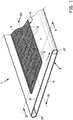
- FIG 1 shows a first example of an apparatus 1 for the industrial manufacture of bakery products, such as long or elongated breads, rolls, baguettes, Parisian breads, round loaves, etc...
- the apparatus 1 comprises a conveyor 2 for conveying at least one piece of dough 3 on a conveying surface 4 in a conveying direction T.
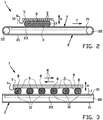
- the conveyor 2 comprises a conveyor belt 21 which is arranged around return rollers 22, wherein the conveyor belt 21 provides the conveying surface 4.
- the conveyor belt 21 is sufficiently rigid for carrying the pieces of dough 3, substantially without sagging between the return rollers 22.
- a carrying member 23 may be arranged to provide a rigid support for the upper branch of the conveyor 21, as schematically indicated with the dotted line in figures 2 and 3 .
- a substrate 5 Above and spaced apart from the conveying surface 4, a substrate 5 is arranged.
- the substrate 5 comprises a contact surface 6 at a side of said substrate 5 facing the conveying surface 4.
- a passage 7 for at least one piece of dough 3 is defined.
- the apparatus 1 is configured for providing a relative movement between the contact surface 6 and the conveying surface 4, in particular between the substrate 5 and the conveying surface 4.
- the contact surface 6 is configured for touching an upper side 8 of said at least one piece of dough 3 on said conveying surface 4.
- the apparatus 1 further comprises a heating device 9, which in this example is arranged inside the substrate 5 for heating at least the contact surface 6 of the substrate 5.
- the heating device 9 comprises for example an electrical heating device which is configured for heating the contact surface 6 of the substrate 5 to a temperature of between 80°C and 180°C, preferably to a temperature of between 90°C and 150°C.
- the part of the contact surface 6 that touches the upper side 8 of the at least one piece of dough 3 will heat the upper side 8 of the at least one piece of dough 3.
- the apparatus 1 is configured for handling dough pieces 3 having a central axis 10 and which are substantially cylindrical around said central axis 10.
- the apparatus 1 is configured for arranging the dough pieces 3 in a substantially parallel arrangement onto the conveying surface 4 with their central axis 10 substantially parallel to the conveying surface 4.
- the dough pieces 3 are arranged such that their central axis 10 extends in a direction substantially parallel to the conveying direction T.
- the substrate is configured for providing a relative movement between the contact surface 6 and the conveying surface 4 in a direction substantially parallel to the conveying surface 4 and substantially transverse to the central axis 10.
- the substrate 5 is configured for providing a reciprocal motion R in a direction transverse to the conveyance direction T.
- the substrate 5 may be moved away from the pieces of dough 3, in particular in a direction H substantially transverse to the conveying surface 4.
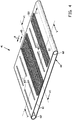
- FIG 4 shows a second example of an apparatus 41 for the industrial manufacture of bakery products, such as long or elongated breads, rolls, baguettes, Parisian breads, round loaves, etc...
- the apparatus 41 comprises a conveyor 42 for conveying at least one piece of dough 43 on a conveying surface 44 in a conveying direction T.
- the conveyor 42 comprises a conveyor belt 61 which is arranged around return rollers 62, wherein the conveyor belt 41 provides the conveying surface 44.
- a carrying member 63 is arranged to provide a rigid support of the upper branch of the conveyor 61, as schematically indicated in figures 5 and 6 .
- a substrate 45 is arranged above and spaced apart from the conveying surface 44.
- the substrate 45 comprises a contact surface 46 at a side of said substrate 45 facing the conveying surface 44.
- a passage 47 for at least one piece of dough 43 is defined.
- the apparatus 41 is configured for providing a relative movement between the contact surface 46 and the conveying surface 44, in particular between the substrate 45 and the conveying surface 44.
- the contact surface 46 is configured for touching an upper side 48 of said at least one piece of dough 43 on said conveying surface 4.
- the apparatus 41 further comprises a heating device 49, which in this example is arranged inside the substrate 45 for heating at least the contact surface 46 of the substrate 45.
- the heating device 49 comprises for example an induction heating, wherein the substrate 45 at or near the contact surface 46 comprises one or more electrically conducting objects 50 in which heat is generated by the induction heating.
- An advantage of such induction heating is, that the one or more electrically conducting objects 50 can be heated very rapidly.
- the induction heating device 49 which is configured for heating the contact surface 46 of the substrate 45 to a temperature of between 80°C and 180°C, preferably to a temperature of between 90°C and 150°C.
- the part of the contact surface 46 that touches the upper side 48 of the at least one piece of dough 43 will heat the upper side 48 of the at least one piece of dough 43. Due to the heating of the upper side 48 by the heated contact surface 46 during a certain amount of time, a film or skin is formed at the upper side 48 of the circumference of the at least one dough piece 43, as described later in more detail with reference to figures 7A, 7B and 7C .
- the apparatus 41 is configured for handling dough pieces 43 having a central axis 51 and which are substantially cylindrical around said central axis 51.
- the apparatus 41 is configured for arranging the dough pieces 43 in a substantially parallel arrangement onto the conveying surface 44 with their central axis 51 substantially parallel to the conveying surface 44.
- the dough pieces 43 are arranged such that their central axis 51 extends in a direction substantially perpendicular to the conveying direction T.
- the substrate is configured for providing a relative movement between the contact surface 46 and the conveying surface 44 in a direction substantially parallel to the conveying surface 44 and substantially transverse to the central axis 51.
- the substrate 45 is configured for providing a reciprocal motion R in a direction parallel to the conveyance direction T.
- the substrate 45 may be moved away from the pieces of dough 43, in particular in a direction H substantially transverse to the conveying surface 44.
- the apparatus 41 according to this second example is provided with a turning device 52 is arranged downstream of the substrate 45 with the heating device 49.
- the turning device 52 is configured for turning the at least one piece of dough 43 for moving the upper side 48 with the film or skin to the bottom side of the at least one piece of dough 43.
- the turning device 52 comprises a plate which is arranged at a substantially stationary position above the conveying surface 44. Due to the relative movement of the support surface 46 in the conveyance direction T and the stationary plate of the turning device 52, the pieces of dough 43 between the plate and the conveying surface 46 are being rotated.
- the plate of the turning device 52 is movable in a vertical direction H' in order to move the plate away from the pieces of dough 43 after the rotation of the pieces of dough 43 has been completed and the circumferential part of the pieces of dough 43 with the film or skin is arranged abutting the conveying surface 44.
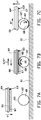
- Figures 7A, 7B and 7C schematically show different steps in a method for forming a film or a skin on a part of the circumferential surface of dough pieces.
- the method comprises the steps of:
- figure 7A shows a piece of dough 60 arranged on top of a conveying surface 61, which may be part of a conveyor belt or a dough carrier or tray.
- a substrate 64 is arranged above the conveying surface 61.
- the substrate 64 comprises a contact surface 63 at a side of said substrate 64 which faces the conveying surface 61.
- the substrate 64 is provided with a heating device, an induction heating device 66, wherein at least the part of the substrate 64 at or near the contact surface 63 is made from an electrically conducting material in which heat is generated by the induction heating 66.
- the induction heating device 66 is configured for heating the contact surface 63 of the substrate 64 to a temperature of between 80°C and 180°C, preferably to a temperature of between 90°C and 150°C.
- the substrate 64 is provided with a slip preventing layer 67 or slip preventing surface texture at the side facing the conveying surface 61.
- the slip preventing layer 67 or slip preventing surface texture is configured for substantially preventing a slip between the at least one piece of dough 65 and the contact surface 63.
- An example of such a slip preventing layer 67 is a rough and/or coarse Teflon coating.
- Such a coating comprises for example an amount of particles, such as sand, silicon or silicon carbide particles. Accordingly, the contact surface 63 is provided with rough and/or abrasive surface texture.
- the substrate 64 is configured for providing a relative movement between the substrate 64 and the conveying surface 61 in a direction towards V the conveying surface 61. Accordingly, the substrate 64 is moved towards the conveying surface 61 until the contact surface 63 of the substrate 64 abuts the upper side 65 of said at least one piece of dough 60 on said conveying surface 61.
- the substrate 64 with its heating device 66 is lowered onto the upper side 65 of said at least one piece of dough 60.
- At least the part of the contact surface 63 which touches the upper side 65 of the at least one piece of dough 60 heats said part.
- a relative movement R, R' between the substrate 64 and the conveying surface 61 is provided.
- the substrate 64 is configured for providing a motion R, R' in a direction substantially parallel to the conveying surface 61 and substantially perpendicular to a center line of said cylindrical piece of dough.
- the at least one piece of dough 60 in between said contact surface 63 and said conveying surface 61 performs a rolling movement over the conveying surface 61.
- the amplitude of said motion R is selected so that the desired part of the upper side 65 receives the required heat treatment in order to form a skin or film 68 at the upper part of the circumference of the piece of dough 60.
- the upper side 65 of said at least one piece of dough 60 needs to be heated for a certain time period.
- This time period can be established by slowly moving the substrate 64 with respect to the conveying surface 61, and/or by using a reciprocal movement of the substrate 64 with respect to the conveying surface 61.
- the piece of dough 60 can be turned over so that the skin or film 68 is positioned at the bottom side of the piece of dough 60. As described above, this turning can be done when the piece of dough 60 is transferred from the conveying surface 61 onto a further conveyor or dough carrier or tray.
- a dedicated turning device can be used as shown for example in figures 4 and 5 .
- the substrate 64 can be used to provide one stroke in the direction R" substantially parallel to the conveying surface. The amplitude of said stroke in the direction R" is selected such that the at least one piece of dough 60 is rotated S over an angle of substantially 180 degrees, so that the skin or film 68 is arranged at the bottom side of the piece of dough 60.
- the substrate 64 can be moved in a direction V' away from the conveying surface 61, in particular in an upward direction. Accordingly the substrate 64 releases the at least one dough piece 60, which at least one dough piece 60 is then conveyed further to the different stages of the assembly for the industrial manufacture of bakery products, such as proofing in a proofing cabinet and baking in an oven.
- the skin or film 68 is preferably established only on a part of the circumference of the piece of dough, which part is arranged at the bottom side of the piece of dough, the other parts of the circumference of the piece of dough is substantially untreated which allows the piece of dough to expand substantially in a normal manner during the proofing of the piece of dough.
- the contact surface 6, 46, 63 of the substrate 5, 45, 64 is substantially flat, except for an optional rough and/or abrasive surface texture.
- the contact surface 63 is not limited to substantially flat surfaces.
- the contact surface 84 may also be provided with one or more cells or indentations 85, preferably adapted to the shape of at least the upper side of the pieces of dough 83. Such a shaped contact surface 84 may provide a larger area of contact between the contact surface 63 and the upper side of the pieces of dough 83.
- the contact surface 6, 46, 63 and the conveying surface 4, 44, 61 are configured for moving with respect to each other in a substantially straight movement R, R', R".
- the contact surface 84 and the conveying surface 81 can also be arranged for moving with respect to each other in a substantially circular motion W, for example for rolling bolls of dough 83 between the substrate 82 and the conveying surface 81, as schematically shown in figure 8 .
- the contact surface 6, 46, 63 and the conveying surface 4, 44, 61 are configured to extend in substantially parallel planes.
- the contact surface may also be arranged at a sharp angle with respect to the conveying surface, for example for handling cone shaped pieces of dough.
Landscapes
- Engineering & Computer Science (AREA)
- Life Sciences & Earth Sciences (AREA)
- Food Science & Technology (AREA)
- Mechanical Engineering (AREA)
- Physics & Mathematics (AREA)
- Thermal Sciences (AREA)
- Manufacturing And Processing Devices For Dough (AREA)
- Bakery Products And Manufacturing Methods Therefor (AREA)
Applications Claiming Priority (1)
| Application Number | Priority Date | Filing Date | Title |
|---|---|---|---|
| NL2020763A NL2020763B1 (en) | 2018-04-13 | 2018-04-13 | Apparatus and method for the Industrial Manufacture of Bakery products. |
Publications (1)
| Publication Number | Publication Date |
|---|---|
| EP3552490A1 true EP3552490A1 (fr) | 2019-10-16 |
Family
ID=62685039
Family Applications (1)
| Application Number | Title | Priority Date | Filing Date |
|---|---|---|---|
| EP19168874.6A Pending EP3552490A1 (fr) | 2018-04-13 | 2019-04-12 | Appareil et procédé pour la fabrication industrielle de produits de boulangerie |
Country Status (6)
| Country | Link |
|---|---|
| US (1) | US11452296B2 (fr) |
| EP (1) | EP3552490A1 (fr) |
| JP (1) | JP2019195326A (fr) |
| AU (1) | AU2019202558A1 (fr) |
| CA (1) | CA3040077A1 (fr) |
| NL (1) | NL2020763B1 (fr) |
Cited By (1)
| Publication number | Priority date | Publication date | Assignee | Title |
|---|---|---|---|---|
| CN111285027A (zh) * | 2020-03-02 | 2020-06-16 | 梅国健 | 一种面包生产用具有防粘接功能的传送装置 |
Families Citing this family (1)
| Publication number | Priority date | Publication date | Assignee | Title |
|---|---|---|---|---|
| CN111332795A (zh) * | 2020-03-26 | 2020-06-26 | Tcl华星光电技术有限公司 | 一种基板传送机构 |
Citations (4)
| Publication number | Priority date | Publication date | Assignee | Title |
|---|---|---|---|---|
| US4025273A (en) * | 1975-12-11 | 1977-05-24 | Zartic Frozen Meats, Inc. | Machine for forming discrete quantities of material into a predetermined shape |
| US4440701A (en) * | 1980-04-05 | 1984-04-03 | Morinaga & Co., Ltd. | Method for forming viscous and plastically deformable food material into a globulin shape |
| US6080438A (en) * | 1998-04-03 | 2000-06-27 | Frigoscandia Equipment Ab | Method for preparing food products for further processing |
| WO2017157628A1 (fr) * | 2016-03-16 | 2017-09-21 | Flatev Ag | Système de confection d'un pain plat et procédé de prépration |
Family Cites Families (9)
| Publication number | Priority date | Publication date | Assignee | Title |
|---|---|---|---|---|
| US1534617A (en) * | 1922-10-02 | 1925-04-21 | Union Machinery Company | Dough-molding machine |
| US2035188A (en) * | 1934-09-20 | 1936-03-24 | Western Bakeries Corp Ltd | Dough treating machine |
| FR2590768B1 (fr) * | 1985-12-02 | 1991-02-08 | Voegtlin Rene | Dispositif pour le centrage et le formage de pieces de pate boulangere ou similaire |
| JP3077903B2 (ja) * | 1997-11-06 | 2000-08-21 | レオン自動機株式会社 | 食品生地搬送方法及び装置 |
| US7306444B2 (en) * | 2003-04-22 | 2007-12-11 | General Mills Cereals, Llc | Apparatus and method for forming food products by gradual compression |
| AT500219B1 (de) * | 2003-05-22 | 2007-11-15 | Masterfoods Austria Ohg | Verfahren und vorrichtung zur wärmebehandlung von nahrungsmitteln bzw. futtermitteln, insbesondere zur herstellung von backwaren, wie waffelprodukten |
| EP1814395A2 (fr) * | 2004-07-01 | 2007-08-08 | General Mills Marketing, Inc. | Appareil et procédé pour former un produit alimentaire cuit pressé |
| US8507026B2 (en) * | 2011-02-28 | 2013-08-13 | Del Monte Corporation | Apparatus, systems and methods for manufacturing food products |
| US9826762B2 (en) * | 2013-08-09 | 2017-11-28 | General Mills, Inc. | System and method for bottom coating food products |
-
2018
- 2018-04-13 NL NL2020763A patent/NL2020763B1/en active
-
2019
- 2019-04-12 AU AU2019202558A patent/AU2019202558A1/en not_active Abandoned
- 2019-04-12 US US16/382,969 patent/US11452296B2/en active Active
- 2019-04-12 EP EP19168874.6A patent/EP3552490A1/fr active Pending
- 2019-04-12 CA CA3040077A patent/CA3040077A1/fr active Pending
- 2019-04-15 JP JP2019077313A patent/JP2019195326A/ja active Pending
Patent Citations (4)
| Publication number | Priority date | Publication date | Assignee | Title |
|---|---|---|---|---|
| US4025273A (en) * | 1975-12-11 | 1977-05-24 | Zartic Frozen Meats, Inc. | Machine for forming discrete quantities of material into a predetermined shape |
| US4440701A (en) * | 1980-04-05 | 1984-04-03 | Morinaga & Co., Ltd. | Method for forming viscous and plastically deformable food material into a globulin shape |
| US6080438A (en) * | 1998-04-03 | 2000-06-27 | Frigoscandia Equipment Ab | Method for preparing food products for further processing |
| WO2017157628A1 (fr) * | 2016-03-16 | 2017-09-21 | Flatev Ag | Système de confection d'un pain plat et procédé de prépration |
Cited By (2)
| Publication number | Priority date | Publication date | Assignee | Title |
|---|---|---|---|---|
| CN111285027A (zh) * | 2020-03-02 | 2020-06-16 | 梅国健 | 一种面包生产用具有防粘接功能的传送装置 |
| CN111285027B (zh) * | 2020-03-02 | 2020-11-24 | 福建省慕兰卡食品有限公司 | 一种面包生产用具有防粘接功能的传送装置 |
Also Published As
| Publication number | Publication date |
|---|---|
| AU2019202558A1 (en) | 2019-10-31 |
| US11452296B2 (en) | 2022-09-27 |
| US20190313650A1 (en) | 2019-10-17 |
| CA3040077A1 (fr) | 2019-10-13 |
| JP2019195326A (ja) | 2019-11-14 |
| NL2020763B1 (en) | 2019-10-23 |
Similar Documents
| Publication | Publication Date | Title |
|---|---|---|
| CN104023541B (zh) | 用于烤炉的烤盘 | |
| US4938126A (en) | Tortilla press apparatus | |
| US5006358A (en) | Method of making tortillas | |
| US11452296B2 (en) | Apparatus and method for the industrial manufacture of bakery products | |
| EP3613291A1 (fr) | Machine de fabrication de rouleaux de pâte de haricot et procédé de fabrication de rouleaux de pâte de haricot | |
| US20090320694A1 (en) | Induction wafer baking system | |
| US20200390281A1 (en) | Food imprinting device | |
| AU741510B2 (en) | Method and apparatus for preparing food products for further processing | |
| ATE472254T1 (de) | Vorrichtung und verfahren zur kontinuierlichen herstellung flacher backwaren | |
| EP3595452B1 (fr) | Procédé et installation pour la fabrication industrielle de produits de boulangerie | |
| EP3516961A1 (fr) | Dispositif, ligne de pâte et procédé de laminage de pâte | |
| JP3967634B2 (ja) | 焼成物の製造方法及び焼成装置 | |
| EP0879555B1 (fr) | Dispositif de façonnage de produits de boulangerie | |
| US12484591B2 (en) | Cooking fixture with modified cooking surface for selective browning effect | |
| JP7709248B2 (ja) | 連続焼成装置 | |
| GB2533761A (en) | Oven apparatus and method of baking | |
| EP3820338B1 (fr) | Système d'impression pour aliments | |
| US20190191720A1 (en) | Dough processing machine | |
| CA2542665A1 (fr) | Methode de stabilisation de la pate de cuisson | |
| MX2017013165A (es) | Productos aperitivos horneados y glaseados, y glaseado para los mismos. | |
| WO2004016089A3 (fr) | Procede de traitement de surface d'un support, notamment prevu pour la cuisson, lui assurant une meilleure anti-adherence ainsi qu'une meilleure resistance a l'abrasion et a la temperature du four | |
| ES2143954A1 (es) | Metodo para obtener un pan con corteza totalmente cocida, instalacion para llevar a la practica este metodo y pan con corteza totalmente cocida obtenido con dicho metodo. | |
| JPS5932131B2 (ja) | 厚焼玉子等の連続製造装置 | |
| RS20070084A (sr) | Aparat za pravljenje tankih pečenih testa | |
| MXPA00009688A (en) | Method and apparatus for preparing food products for further processing |
Legal Events
| Date | Code | Title | Description |
|---|---|---|---|
| PUAI | Public reference made under article 153(3) epc to a published international application that has entered the european phase |
Free format text: ORIGINAL CODE: 0009012 |
|
| STAA | Information on the status of an ep patent application or granted ep patent |
Free format text: STATUS: THE APPLICATION HAS BEEN PUBLISHED |
|
| AK | Designated contracting states |
Kind code of ref document: A1 Designated state(s): AL AT BE BG CH CY CZ DE DK EE ES FI FR GB GR HR HU IE IS IT LI LT LU LV MC MK MT NL NO PL PT RO RS SE SI SK SM TR |
|
| AX | Request for extension of the european patent |
Extension state: BA ME |
|
| STAA | Information on the status of an ep patent application or granted ep patent |
Free format text: STATUS: REQUEST FOR EXAMINATION WAS MADE |
|
| 17P | Request for examination filed |
Effective date: 20200416 |
|
| RBV | Designated contracting states (corrected) |
Designated state(s): AL AT BE BG CH CY CZ DE DK EE ES FI FR GB GR HR HU IE IS IT LI LT LU LV MC MK MT NL NO PL PT RO RS SE SI SK SM TR |
|
| STAA | Information on the status of an ep patent application or granted ep patent |
Free format text: STATUS: EXAMINATION IS IN PROGRESS |
|
| 17Q | First examination report despatched |
Effective date: 20200914 |
|
| GRAP | Despatch of communication of intention to grant a patent |
Free format text: ORIGINAL CODE: EPIDOSNIGR1 |
|
| STAA | Information on the status of an ep patent application or granted ep patent |
Free format text: STATUS: GRANT OF PATENT IS INTENDED |
|
| INTG | Intention to grant announced |
Effective date: 20251208 |
|
| RIN1 | Information on inventor provided before grant (corrected) |
Inventor name: VERMEULEN, JAN Inventor name: MORRIS, NIGEL JUSTIN |
|
| GRAJ | Information related to disapproval of communication of intention to grant by the applicant or resumption of examination proceedings by the epo deleted |
Free format text: ORIGINAL CODE: EPIDOSDIGR1 |
|
| STAA | Information on the status of an ep patent application or granted ep patent |
Free format text: STATUS: EXAMINATION IS IN PROGRESS |