EP3584833B1 - Module de puissance à alignement amélioré - Google Patents
Module de puissance à alignement amélioré Download PDFInfo
- Publication number
- EP3584833B1 EP3584833B1 EP18305763.7A EP18305763A EP3584833B1 EP 3584833 B1 EP3584833 B1 EP 3584833B1 EP 18305763 A EP18305763 A EP 18305763A EP 3584833 B1 EP3584833 B1 EP 3584833B1
- Authority
- EP
- European Patent Office
- Prior art keywords
- power
- conductive material
- electrical
- electrically conductive
- layer
- Prior art date
- Legal status (The legal status is an assumption and is not a legal conclusion. Google has not performed a legal analysis and makes no representation as to the accuracy of the status listed.)
- Not-in-force
Links
Images




Classifications
-
- H—ELECTRICITY
- H10—SEMICONDUCTOR DEVICES; ELECTRIC SOLID-STATE DEVICES NOT OTHERWISE PROVIDED FOR
- H10W—GENERIC PACKAGES, INTERCONNECTIONS, CONNECTORS OR OTHER CONSTRUCTIONAL DETAILS OF DEVICES COVERED BY CLASS H10
- H10W70/00—Package substrates; Interposers; Redistribution layers [RDL]
- H10W70/60—Insulating or insulated package substrates; Interposers; Redistribution layers
- H10W70/611—Insulating or insulated package substrates; Interposers; Redistribution layers for connecting multiple chips together
- H10W70/614—Insulating or insulated package substrates; Interposers; Redistribution layers for connecting multiple chips together the multiple chips being integrally enclosed
-
- H—ELECTRICITY
- H10—SEMICONDUCTOR DEVICES; ELECTRIC SOLID-STATE DEVICES NOT OTHERWISE PROVIDED FOR
- H10W—GENERIC PACKAGES, INTERCONNECTIONS, CONNECTORS OR OTHER CONSTRUCTIONAL DETAILS OF DEVICES COVERED BY CLASS H10
- H10W70/00—Package substrates; Interposers; Redistribution layers [RDL]
- H10W70/01—Manufacture or treatment
- H10W70/05—Manufacture or treatment of insulating or insulated package substrates, or of interposers, or of redistribution layers
-
- H—ELECTRICITY
- H10—SEMICONDUCTOR DEVICES; ELECTRIC SOLID-STATE DEVICES NOT OTHERWISE PROVIDED FOR
- H10W—GENERIC PACKAGES, INTERCONNECTIONS, CONNECTORS OR OTHER CONSTRUCTIONAL DETAILS OF DEVICES COVERED BY CLASS H10
- H10W70/00—Package substrates; Interposers; Redistribution layers [RDL]
- H10W70/01—Manufacture or treatment
- H10W70/05—Manufacture or treatment of insulating or insulated package substrates, or of interposers, or of redistribution layers
- H10W70/08—Manufacture or treatment of insulating or insulated package substrates, or of interposers, or of redistribution layers by depositing layers on the chip or wafer, e.g. "chip-first" RDLs
- H10W70/09—Manufacture or treatment of insulating or insulated package substrates, or of interposers, or of redistribution layers by depositing layers on the chip or wafer, e.g. "chip-first" RDLs extending onto an encapsulation that laterally surrounds the chip or wafer, e.g. fan-out wafer level package [FOWLP] RDLs
-
- H—ELECTRICITY
- H10—SEMICONDUCTOR DEVICES; ELECTRIC SOLID-STATE DEVICES NOT OTHERWISE PROVIDED FOR
- H10W—GENERIC PACKAGES, INTERCONNECTIONS, CONNECTORS OR OTHER CONSTRUCTIONAL DETAILS OF DEVICES COVERED BY CLASS H10
- H10W70/00—Package substrates; Interposers; Redistribution layers [RDL]
- H10W70/60—Insulating or insulated package substrates; Interposers; Redistribution layers
-
- H—ELECTRICITY
- H10—SEMICONDUCTOR DEVICES; ELECTRIC SOLID-STATE DEVICES NOT OTHERWISE PROVIDED FOR
- H10W—GENERIC PACKAGES, INTERCONNECTIONS, CONNECTORS OR OTHER CONSTRUCTIONAL DETAILS OF DEVICES COVERED BY CLASS H10
- H10W90/00—Package configurations
-
- H—ELECTRICITY
- H10—SEMICONDUCTOR DEVICES; ELECTRIC SOLID-STATE DEVICES NOT OTHERWISE PROVIDED FOR
- H10W—GENERIC PACKAGES, INTERCONNECTIONS, CONNECTORS OR OTHER CONSTRUCTIONAL DETAILS OF DEVICES COVERED BY CLASS H10
- H10W90/00—Package configurations
- H10W90/401—Package configurations characterised by multiple insulating or insulated package substrates, interposers or RDLs
-
- H—ELECTRICITY
- H10—SEMICONDUCTOR DEVICES; ELECTRIC SOLID-STATE DEVICES NOT OTHERWISE PROVIDED FOR
- H10W—GENERIC PACKAGES, INTERCONNECTIONS, CONNECTORS OR OTHER CONSTRUCTIONAL DETAILS OF DEVICES COVERED BY CLASS H10
- H10W70/00—Package substrates; Interposers; Redistribution layers [RDL]
- H10W70/60—Insulating or insulated package substrates; Interposers; Redistribution layers
- H10W70/67—Insulating or insulated package substrates; Interposers; Redistribution layers characterised by their insulating layers or insulating parts
- H10W70/68—Shapes or dispositions thereof
- H10W70/682—Shapes or dispositions thereof comprising holes having chips therein
-
- H—ELECTRICITY
- H10—SEMICONDUCTOR DEVICES; ELECTRIC SOLID-STATE DEVICES NOT OTHERWISE PROVIDED FOR
- H10W—GENERIC PACKAGES, INTERCONNECTIONS, CONNECTORS OR OTHER CONSTRUCTIONAL DETAILS OF DEVICES COVERED BY CLASS H10
- H10W72/00—Interconnections or connectors in packages
-
- H—ELECTRICITY
- H10—SEMICONDUCTOR DEVICES; ELECTRIC SOLID-STATE DEVICES NOT OTHERWISE PROVIDED FOR
- H10W—GENERIC PACKAGES, INTERCONNECTIONS, CONNECTORS OR OTHER CONSTRUCTIONAL DETAILS OF DEVICES COVERED BY CLASS H10
- H10W72/00—Interconnections or connectors in packages
- H10W72/01—Manufacture or treatment
- H10W72/0198—Manufacture or treatment batch processes
-
- H—ELECTRICITY
- H10—SEMICONDUCTOR DEVICES; ELECTRIC SOLID-STATE DEVICES NOT OTHERWISE PROVIDED FOR
- H10W—GENERIC PACKAGES, INTERCONNECTIONS, CONNECTORS OR OTHER CONSTRUCTIONAL DETAILS OF DEVICES COVERED BY CLASS H10
- H10W72/00—Interconnections or connectors in packages
- H10W72/50—Bond wires
- H10W72/531—Shapes of wire connectors
- H10W72/5363—Shapes of wire connectors the connected ends being wedge-shaped
-
- H—ELECTRICITY
- H10—SEMICONDUCTOR DEVICES; ELECTRIC SOLID-STATE DEVICES NOT OTHERWISE PROVIDED FOR
- H10W—GENERIC PACKAGES, INTERCONNECTIONS, CONNECTORS OR OTHER CONSTRUCTIONAL DETAILS OF DEVICES COVERED BY CLASS H10
- H10W72/00—Interconnections or connectors in packages
- H10W72/90—Bond pads, in general
- H10W72/921—Structures or relative sizes of bond pads
- H10W72/926—Multiple bond pads having different sizes
-
- H—ELECTRICITY
- H10—SEMICONDUCTOR DEVICES; ELECTRIC SOLID-STATE DEVICES NOT OTHERWISE PROVIDED FOR
- H10W—GENERIC PACKAGES, INTERCONNECTIONS, CONNECTORS OR OTHER CONSTRUCTIONAL DETAILS OF DEVICES COVERED BY CLASS H10
- H10W72/00—Interconnections or connectors in packages
- H10W72/90—Bond pads, in general
- H10W72/931—Shapes of bond pads
-
- H—ELECTRICITY
- H10—SEMICONDUCTOR DEVICES; ELECTRIC SOLID-STATE DEVICES NOT OTHERWISE PROVIDED FOR
- H10W—GENERIC PACKAGES, INTERCONNECTIONS, CONNECTORS OR OTHER CONSTRUCTIONAL DETAILS OF DEVICES COVERED BY CLASS H10
- H10W72/00—Interconnections or connectors in packages
- H10W72/90—Bond pads, in general
- H10W72/941—Dispositions of bond pads
- H10W72/9413—Dispositions of bond pads on encapsulations
-
- H—ELECTRICITY
- H10—SEMICONDUCTOR DEVICES; ELECTRIC SOLID-STATE DEVICES NOT OTHERWISE PROVIDED FOR
- H10W—GENERIC PACKAGES, INTERCONNECTIONS, CONNECTORS OR OTHER CONSTRUCTIONAL DETAILS OF DEVICES COVERED BY CLASS H10
- H10W72/00—Interconnections or connectors in packages
- H10W72/90—Bond pads, in general
- H10W72/941—Dispositions of bond pads
- H10W72/944—Dispositions of multiple bond pads
-
- H—ELECTRICITY
- H10—SEMICONDUCTOR DEVICES; ELECTRIC SOLID-STATE DEVICES NOT OTHERWISE PROVIDED FOR
- H10W—GENERIC PACKAGES, INTERCONNECTIONS, CONNECTORS OR OTHER CONSTRUCTIONAL DETAILS OF DEVICES COVERED BY CLASS H10
- H10W74/00—Encapsulations, e.g. protective coatings
- H10W74/10—Encapsulations, e.g. protective coatings characterised by their shape or disposition
- H10W74/131—Encapsulations, e.g. protective coatings characterised by their shape or disposition the semiconductor body being only partially enclosed
- H10W74/142—Encapsulations, e.g. protective coatings characterised by their shape or disposition the semiconductor body being only partially enclosed the encapsulations exposing the passive side of the semiconductor body
-
- H—ELECTRICITY
- H10—SEMICONDUCTOR DEVICES; ELECTRIC SOLID-STATE DEVICES NOT OTHERWISE PROVIDED FOR
- H10W—GENERIC PACKAGES, INTERCONNECTIONS, CONNECTORS OR OTHER CONSTRUCTIONAL DETAILS OF DEVICES COVERED BY CLASS H10
- H10W90/00—Package configurations
- H10W90/10—Configurations of laterally-adjacent chips
-
- H—ELECTRICITY
- H10—SEMICONDUCTOR DEVICES; ELECTRIC SOLID-STATE DEVICES NOT OTHERWISE PROVIDED FOR
- H10W—GENERIC PACKAGES, INTERCONNECTIONS, CONNECTORS OR OTHER CONSTRUCTIONAL DETAILS OF DEVICES COVERED BY CLASS H10
- H10W90/00—Package configurations
- H10W90/701—Package configurations characterised by the relative positions of pads or connectors relative to package parts
Definitions
- the invention relates to an electrical power assembly comprising a power die embedded in an insulating core, the power assembly providing a better connection and alignment of the power die to a substrate.
- the invention also relates to a manufacturing method of the power assembly, and to a power module comprising one or two substrates assembled to said electrical power assembly.
- WO2015077808 discloses a circuit board structure for mounting a power component.
- Power dies such as diodes or various types of transistors (MOSFET, JFT, IGBT9) are elementary components of power modules which are used for the control and conversion of electric power, for instance in applications such as the automotive or aeronautic industries.
- DBC Direct Bonded Commer
- the traditional connection by wire bonding of a power die on a substrate has a number limitations and drawbacks, among which the serial and long manufacturing process due to the small size of some dies electrical contacts (in particular gate pads), and the high parasitic level and low reliability of the wire bonds.
- document US6442033 discloses a power module comprising two insulated metal substrates, between which are interposed a plurality of power devices.
- document US8432030 discloses a power electronic package comprising two substrates between which are mounted multiple power dies.
- the substrates comprise raised regions or posts providing electrical and mechanical connections between the substrates, and/or between the substrates and the power dies.
- the modules proposed in these documents eliminate the need for wire bonds, thereby exhibiting higher reliability, and provide double sided cooling.
- Another emerging technology is to manufacture pre-packed power cells, comprising at least one power die embedded in a PCB laminate. It is for example known from document US 9425131 a packaged structure comprising at least one power die embedded in a PCB substrate and connected to conductive layers through vias.
- This type of package allows easier connection of the power die's electrical contact on a substrate.
- the embedding of the die inside a substrate reduces the mechanical stresses on the die during assembly stage and increases the reliability and lifetime of the die.
- the power devices are connected by vias on the device pads through insulated layers.
- the connection layer made of copper vias and insulation material presents a high thermal resistance compared to the direct contact by soldering and silver sintering in traditional power modules.
- the invention aims at solving at least part of the problems listed above.
- the invention aims at providing a package for a power die allowing easy connection to the power die for power application.
- Another aim of the invention is to propose an electrical power assembly providing easy alignment relative to a substrate.
- Another aim of the invention is to propose a power module which is easier and less expensive to manufacture.
- the power module comprises two substrates each comprising a layer of thermally conductive and electrically insulating material and a layer of electrically conductive material having a post protruding thereof, and wherein the electrical power assembly comprises open cavities on opposite sides thereof, the power assembly being mounted between the two substrates with each post of a substrate being inserted in a respective cavity of the power cell, and the power module further comprises electrically isolating material filling the spaces remaining between the substrates.
- the electrical power assembly according to the invention provides a number of advantages. Indeed, the electrical power assembly according to the invention comprises at least an open cavity which simultaneously plays two roles. The first role of the open cavity is to expose an electrical contact of the power die, thereby allowing its direct connection to a substrate. This direct connection allows transmission of high power with a low manufacturing cost.
- the bottom and walls of the cavity may also be plated to connect the power die electrical contact with the surface layer of electrically conductive material of the power assembly. This can allow easy connection, for instance between several components embedded in the assembly.
- the other role of the open cavity is to facilitate the subsequent alignment of the power assembly with a substrate, because the substrate can comprise a corresponding post adapted to be inserted in the open cavity to provide electrical connection between the substrate and the power die.
- a power module comprising at least one substrate and such an electrical power assembly is thus easier to align and assemble.
- a double sided cooling power module can be obtained by positioning a power assembly having cavities formed on opposite sides of the power die between two substrates, each substrate having posts shaped to be inserted into the corresponding cavities.
- the electrical power assembly 1 is used as an elementary component for integration in a power module and/or a power converter as will be explained in more details below.
- the electrical power assembly 1 comprises a power die 10.
- the power die may be a diode or a transistor such as a MOSFET, JFET or IGBT.
- the power die 10 is made from silicon semiconductor or a wide bandgap semiconductor, i.e. a semiconductor having a bandgap in the range of 2-4 eV.
- the power die may be made in Silicon Carbide SiC or in Gallium Nitride GaN.
- the power die has at least two electrical contacts 11.
- the electrical contacts are metallic pads made of any suitable metal such as aluminum, gold, copper, silver, etc.
- the power die may be a lateral component in which the electrical contacts 11 are arranged on a same side of the die. Else, the power die may be a vertical component in which the electrical contacts 11 are arranged on opposite sides of the die.
- the power die 10 can be a diode having two opposite electrical contacts 11.
- the power die 10 can be a transistor having three electrical contacts comprising a gate, a source, and a drain, or a gate, an emitter and a collector, according to the type of transistor.
- the electrical power assembly may comprise at least one additional power die or a sensor such as a temperature sensor, a field sensor, a current sensor, or other, or at least one passive component such as a resistor, a capacitor, or other, connected to the first power die 10.
- a sensor such as a temperature sensor, a field sensor, a current sensor, or other
- at least one passive component such as a resistor, a capacitor, or other, connected to the first power die 10.
- the power dies can be of different types and references, have different orientations and different thicknesses.
- the electrical power assembly 1 comprises an IGBT 10' having on a top side a gate and an emitter and on a bottom side a collector, and a diode 10 having a top pad as an anode, connected to the emitter, and a bottom pad as a cathode, connected to the collector. Due to this arrangement the electrical power assembly 1 forms a switch to be used in a power module, corresponding to the electrical diagram shown in figure 5 .
- the electrical power assembly 1 comprises an electrically insulating core 20, in which the, or each power die 10, is embedded.
- the power die 10 is embedded in the insulating core 20 such that each electrical contact of the power die extends along a plane which is substantially parallel to a main plane along which extends the core.
- the power die 10 comprises opposite electrical contacts 11 extending parallel to one another, the direction extending between the contacts and being orthogonal to each contact is also orthogonal to the main plane along which extends the electrically insulating core. This is the case in the figures in which the power dies are shown having a vertical arrangement, while the insulating core extends along a horizontal plane.
- the material of the electrically insulating core is preferably chosen as having low thermal resistance to provide better heat dissipation.
- the electrically insulating core 20 may be made of of epoxy resin such as FR-4 glass epoxy, of polyimide, or in ceramic such as HTCC (High-Temperature Co-fired Ceramic) or LTCC (Low Temperature Co-fired Ceramic).
- the electrically insulating core 20 comprising the power die 10 extends sensibly along a plane and defines two opposite main surfaces 21 which extend substantially along said plane.
- the electrical power assembly 1 further comprises two surface layers 30 of electrically conductive material on opposite main surfaces of the insulating core 20.
- the material of these layers is a metal, preferably copper.
- Each electrical contact 11 of the power die 10 is connected to one of the surface layers 30. If two electrical contacts 11 are located on the same side of the die 10, they can be connected to the same surface layer and, if required electrically, the latter is preferably patterned to disconnect the two electrical contacts.
- the electrical power assembly 1 also comprises at least one open cavity 40 extending from an electrical contact 11 of the power die 10, through the electrically insulating core 20 and the surface layer of electrically conductive material 30 covering the insulating core 20.
- open cavity 40 it is understood that the cavity has a bottom 41 and an open end 42 opposite its bottom.
- the bottom 41 of the open cavity is formed by a portion of the electrical contact 11 of the power die, which is therefore exposed by the open cavity.
- the cavity has walls 43 extending from the bottom 41 to its open end 42, wherein each wall is formed 42 in part by a thickness 22 of the electrically insulating core 20 extending between the power die 10 and the main surface 21 of the electrically insulating core located on the same side of the power die 10 as the open cavity 40, and in part by the surface layer 30 of electrically conductive material covering said side of the insulating core 20.
- the shape of the open cavity 40 is indifferent, i.e. it can be a square, a rectangle, a U-shape, a L-shape, or it can be round, etc., but as will be explained in more detailed below, is preferably chosen to make the alignment of the power assembly on a substrate easier.
- the shape and profile of the cavity are advantageously configured to optimize electrical and thermal transports between the electrical power assembly and a substrate later assembled with the assembly.
- the portion of the electrical contact 11 of the power die 10 that is exposed by the open cavity has a surface comprised between 1 and 100% of the surface of the electrical contact. If there is only one open cavity exposing a portion of the electrical contact, the surface of the portion exposed by said cavity is preferably comprised between 10 and 100% of the surface of the electrical contact 11, and preferably between 50 and 100% of the surface of the electrical contact 11.
- the surface of the electrical contact exposed by each cavity is at least 1% of the surface of the electrical contact, and the cumulative surface of the electrical contact exposed by the cavities is comprised between 10 and 100% of the surface of the electrical contact, and preferably between 50 and 100% of the surface of the electrical contact.
- the open cavity 40 is shaped such that the power die 10 extends further than at least two opposite walls 43 of the cavity 40, and, in an embodiment, such that a peripheral edge of the power die is not exposed by the cavity.
- the electrically insulating core 20 comprises a rim 23 covering at least two opposite edges 12 of the power die, and preferably covering a peripheral edge of the power die, thereby maintaining the power die in its position in the electrically insulating core 10.
- the open cavity 40 is further at least partially plated with electrically conductive material (preferably copper) in order to connect the power die electrical contact 11 which is exposed by the open cavity to the surface layer 30 of electrically conductive material of the assembly 1.
- electrically conductive material preferably copper
- the power assembly 1 exhibits a contact pad for its connection to a substrate, which comprises at least the bottom of the cavity, the portion of the surface layer of electrically conductive material 30 to which it is connected and the plated part of the side walls 43 of the cavity.
- the open cavity 40 may be fully plated, i.e. the bottom of the cavity formed by the exposed area of the power die electrical contact, and the side walls of the cavity, may be fully plated, in order to increase a connection surface of the open cavity.
- the size of the gate pad may be too small to form an open cavity exposing the gate pad.
- the latter may be connected to the surface layer 30 of electrically conductive material by at least one via, obtained for instance by laser drilling. In that case the plating of the assembly 1 is also performed in order to plate the via and achieve the connection of the gate pad to the surface layer 30.
- the layer of electrically conductive material resulting from the plating of the bottom and side walls of the cavity is shown in the figures with reference 44.
- the metal of the electrical power assembly 1, i.e. the metal of the surface layer 30 and the metal used for the plating step is preferably copper, but it can be other material like silver.
- the assembly pads can also be finished by other metals in order to create a protection against oxidation, humidity, migration or other. These metals can be nickel, silver, tin or gold which can be deposited by any method like chemical, vaporization or other.
- the surface layer 30 of electrically conductive material located on the side of the power assembly in which the open cavity is located can comprise a superficial thickness 31 resulting from the plating of the whole side of the cell 1 in which the open cavity 40 is arranged.
- the assembly 1 has a contact pad comprising the plated surface layer 30, and the plated bottom 41 and walls 43 of the cavity 40.
- the thickness of the plating layer is preferably comprised between 2 and 100 ⁇ m, for instance about 10 ⁇ m.
- Open cavities 40 may be formed in the electrical power assembly 1 on opposite sides of the assembly in order to expose respective portions of opposite electrical contacts 11 of the power die 10 embedded in the insulating core 20. Alternatively, one electrical contact may be exposed thanks to an open cavity 40, and an opposite electrical contact 11 of the power die may be connected to an opposite surface layer 30 thanks to through vias 50 arranged in the electrically insulating core 20, as in the example shown in figure 1b .
- the assembly comprises at least one additional power die 10 or one or more passive components
- several open cavities 40 can be arranged on a same side of the cell to expose respective portions of the electrical contacts of the components embedded in the insulating core.
- the surface layer 30 of electrically conductive material which is connected to the electrical contacts of the components is preferably patterned to isolate electrical contacts of different components where applicable.
- the plating layer provides said connection.
- the electrical power assembly 1 may also comprise at least one open cavity extending from the side of the power die devoid of electrical contacts, through the insulating core and corresponding surface layer. Said open cavity can then be used for cooling of the power die as explained below.
- the electrical power assembly 1 comprises, on a top surface, a first open cavity 40 exposing the anode of the diode 10, a second open cavity 40 exposing the emitter of the IGBT 10', and a via exposing the gate of the IGBT 10'.
- the top surface of the assembly is fully plated, such that the bottom 41 and side walls 43 of each cavity 40 are plated, and the assembly 1 comprises a surface layer 30 of electrically conductive material resulting from the platting. Further, this surface layer is patterned to isolate on the one hand the anode of the diode and emitter of the IGBT (which are connected together) and on the other hand the gate of the IGBT.
- the bottom side of the assembly also comprises an open cavity 40 exposing the cathode of the diode 10, and an open cavity exposing the collector of the IGBT 10'.
- the bottom side is plated such that bottom 41 and side walls 43 of each cavity are plated, and the assembly comprises a surface 30 layer of electrically conductive material resulting from the platting. This layer needs not be patterned because it connects together the cathode and the collector.
- the electrical power assembly 1 comprises a single power die, for instance a diode, having two opposite electrical contacts 11, and the assembly comprises two opposite open cavities 40 exposing respective portions of the opposite electrical contacts 11.
- the electrical power assembly 1 comprises a single power die 10 having two opposite electrical contacts 11, and the assembly comprises one open cavity 40 exposing a portion of one electrical contact 11.
- a surface layer 30 of electrically conductive material is connected to the other electrical contact 11 of the power die by through vias 50.
- any of the described elementary assemblies can have at least one through hole via that connects at least part of the top conductive layer 30 to at least part of the bottom conductor layer 30 in order to transport at least one electric contact from one side of the assembly to the other side of the assembly (top to bottom or vice versa), or in order to duplicate on the conductor layers 30 located on both sides of the assembly at least one electric contact which originally exist on one side of the at least one power device.
- the size and number of the through hole vias of the at least one electric contact to be transported or duplicated is chosen according the current level to be conducted on these vias.
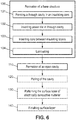
- the method comprises a first step 100 of forming a base structure 80 comprising at least an electrically insulating core 20, and layers 60 of electrically conductive material covering opposite main surfaces of the electrically insulating core 20, the insulating core 20 embedding at least one power die 10.
- the material of the electrically insulating core is preferably chosen has having low thermal resistance to provide better heat dissipation.
- the electrically insulating core 20 may be made of of epoxy resin such as FR-4 glass epoxy, of polyimide, or in ceramic such as HTCC (High-Temperature Co-fired Ceramic) or LTCC (Low Temperature Co-fired Ceramic).
- the power die 10 may be a diode or a transistor such as a MOSFET, JFET or IGBT, and can have the various configurations of electrical contacts 11 already detailed above.
- the electrical power assembly may comprise at least one additional power die, or a sensor such as a temperature sensor, field sensor, current sensor, or other, or at least one passive component such as a resistor, a capacitor, or other, connected to the first power die 10.
- a sensor such as a temperature sensor, field sensor, current sensor, or other
- at least one passive component such as a resistor, a capacitor, or other, connected to the first power die 10.
- the power dies can be of different types and references, have different orientations and different thicknesses.
- the base structure 80 comprises an IGBT 10' and a diode 10, embedded in respective cavities of the electrically insulating core 20.
- the diode has two electrical contacts 11, namely an anode and a cathode, and the IGBT has three electrical contacts 11', an emitter, a gate and a collector.
- the diode is inserted in the cavity of the insulating core 20 such that the anode is oriented towards the same main side of the insulating core 20 than the gate and emitter of the IGBT, i.e. towards the top side in the figures.
- the base structure 80 may be a PCB where the layer of electrically conductive material is made of copper and the electrically insulating core 20 is made of FR4, in which each power die is embedded.
- the base structure 80 can be obtained during step 100 by implementing a first sub-step 101 of forming at least one through-cavity 250 in a base layer 25 of electrically insulating material, the through-cavity 250 having the shape and dimensions of a power die to be embedded in the assembly.
- the through-cavity may be obtained for instance by mechanical drilling, milling, stamping or even laser cutting.
- the step 100 then comprises a sub-step 102 of inserting the power die 10 in the through-cavity 250, or as the case may be each power die 10, 10' in a respective cavity.
- Each power die inserted in a respective cavity is oriented such that each electrical contact 11 of the die extends parallel to the plane of the base layer 25 of electrically insulating material.
- the electrical contacts 11 also extend horizontally, each contact facing upwardly or downwardly.
- the electrical contacts of the die are exposed and are not facing a side wall of the through-cavity 250.
- the step 100 then comprises a sub-step 103 of inserting the base layer 25 comprising each power die 10 between two additional layers 26 of electrically insulating material of the same material than the first one, to obtain a stack 27 of electrically insulating material that will then become the electrically insulating core 20.
- a sub-step 103 two layers 60 of electrically conductive material such as copper are also provided, and the stack 27 of electrically insulating material is inserted between the two layers 60 of electrically conductive material.
- the stack 27 of electrically insulating material and the conductive layers 60 are laminated in order to form the base structure 80, in which the layers of the stack 27 are fused together to form the electrically insulating core 20.
- the electrical contacts of the power die are thus covered successively with a layer a layer 26 of electrically insulating material, and a layer 60 of electrically conductive material.
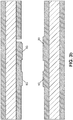
- the method then comprises a step 110 of forming at least one open cavity 40 in the base structure 80, the open cavity 40 exposing a portion of an electrical contact 11 of the power die 10 embedded in the insulating core 20.
- This step thus comprises the removal, from the base structure 80, of a stack comprising a portion of the electrically insulating core 20 adjacent the electrical contact 11 of the power die, and a corresponding portion of the layer 60 of electrically conductive material covering said portion of the core 20.
- the portion of the electrical contact 11 of the power die 10 exposed by the open cavity 40 after removal of this stack has a surface comprised between 10 and 100% of the surface of the electrical contact, and even more preferably between 50 and 100% of the surface of the electrical contact.
- exposed portion is preferably as large as possible in order to maximize the electrical and thermal contact surface of the assembly 1.
- a plurality of open cavities 40 can be made in the base structure to expose respective portions of a same electrical contact 11. This can be easier to implement than forming a single open cavity 40 exposing a large surface of the electrical contact.
- the surface of the electrical contact exposed by each cavity is comprised between 1 and 100% of the surface of the electrical contact, and the cumulative surface of the electrical contact exposed by the cavities is preferably comprised between 10 and 100% of the surface of the electrical contact, and even more preferably between 50 and 100% of said surface.
- the power die 10 has to remain maintained in position by the electrically insulating core 20 after formation of the open cavity 40. Therefore the open cavity 40 is dimensioned so as not to expose more than the electrical contact 11 of the power, and in particular the bottom 41 of the open cavity 40 cannot extend over the whole surface of the side of the power die on which the electrical contact is arranged.
- the open cavity 40 is shaped such that the power die 10 extends further than at least two opposite walls 43 of the cavity 40, and, in an embodiment, such that a peripheral edge of the power die is not exposed by the cavity.
- the electrically insulating core thus comprises, as shown in the example of figure 2 d , after formation of the cavity, at least two opposite edges 23 and optionally a peripheral edge adjacent the power die 10 and forming the base of the side walls 43 of the open cavity 40.
- the method then preferably comprises a step 120 of plating at least partially the open cavity 40 with electrically conductive material, which can be a metal and is preferably copper, in order to connect the exposed electrical contact 11 of the power die 10 to the layer 60 of electrically conductive material of the base structure.
- electrically conductive material which can be a metal and is preferably copper
- the plating may be performed by electro less or/and electro plating.
- At least part of the side walls 43 of the open cavity 40 extending from the bottom 41 of the cavity formed by the electrical contact 11 to the layer 60 of electrically conductive material, may be plated.
- the surface layer of the obtained electrical power assembly is formed by the layer 60 of electrically conductive material of the base structure.
- the open cavity 40 as well as the layer 60 of electrically conductive material of the base structure may be fully plated by deposition of an electrically conductive material such as copper.
- an electrically conductive material such as copper.
- the power die 10 comprises a gate pad, and a through via is formed in the electrically insulating core to access the gate pad. In that case the plating also allows electrically connecting the gate pad to the layer 60 of electrically conductive material thanks to the via.
- the surface layer 30 of the obtained electrical power assembly 1 is formed by the layer 60 of conductive material of the base structure on top of which is an additional thickness 31 of electrically conductive material which results from the plating.
- connection surface for enabling connection to the electrical contact of the power die is enlarged because it comprises:
- the method can then comprise an optional step 130 of patterning the surface layer 30 of electrically conductive material by etching, in order to isolate the electrical contacts that should not be connected together.
- the etching also may include etching the outer edges of layer 30 in order to increase the isolation distance between the opposite layers 30 of conductive material.
- This method can also comprise an optional step 140 of finishing the surface layer 30 by a different metal. This helps protecting the metal of layer 30 from different phenomena like oxidation or migration.
- the finish metal can be silver, gold, tin, titanium, nickel, chrome or other.
- the finish layer can be made of different metals or different layer of metals.
- the electrical power assembly comprises a diode and an IGBT
- the assembly comprises open cavities exposing respectively the anode, emitter and gate of the diode and IGBT
- the anode and emitter of the IGBT are connected together but the gate has to be isolated from the other electrical contacts. Therefore the patterning step is performed to remove a portion of the external layer of electrically conductive material connecting together the gate and other electrodes.
- a electrical power assembly 1 may be integrated into a power module 9 in order to be connected to other components.
- the power module 9 may comprise at least one substrate 90 comprising at least a layer 91 of electrically conductive material, and a layer 92 of thermally conductive material, which is also electrically insulating.
- the substrate may for instance be a Direct Bonded Copper (DBC) substrate, in which a patterned layer of copper is arranged on a ceramic plate (for instance made of alumina), forming the thermally conductive and electrically insulating layer.
- DBC Direct Bonded Copper
- the substrate may be an Insulated Metal Substrate (IMS) or an Active Metal Brazed (AMS) Substrate.
- the layer 91 of electrically conductive material may be patterned to provide proper electrical connection between various elementary components, and for instance between various power assemblies 1.
- the substrate comprises at least one post 93 of electrically conductive material protruding from the layer 91 of electrically conductive material, the post having a shape and dimensions corresponding to the shape and dimensions of a cavity of the elementary power assembly in order to allow insertion of the post inside the cavity of the elementary power assembly, such that insertion of the post inside the cavity allows electrical and thermal connection between the post and the electrical contact 11 of the power die exposed by the cavity.
- the open cavity 40 is at least partially plated, insertion of the post inside the open cavity may further allow electrical connection between the post and the plated walls (either bottom wall corresponding to the plated electrical contact of the power die or side walls) of the cavity.
- a power assembly 1 to be connected to the substrate 90 comprises several open cavities 40
- the substrate 90 comprises corresponding posts 93 of same sizes and dimensions that the respective cavities.
- the shape of a cavity is indifferent, however the shapes and orientations of various cavities of the power assembly are preferably chosen in order to allow unique orientation of the mating substrate relative to the assembly, and easy fitting to that substrate.
- the shape of the cavity is preferably chosen to permit a unique orientation of the substrate relative to the assembly, i.e. the shape may be a U-shape, a L-shape, a triangle, etc.
- an assembly comprises a plurality of cavities
- the shapes and orientations of the cavities are chosen to allow unique orientation of the mating substrate.
- a power module may comprise one such substrate 90 assembled to one side of an electrical power assembly where an open cavity 40 is arranged. If the power die has opposite electrical contacts 11, the opposite contact of the power die which is not exposed by the cavity 40 may be connected to an electrical pad of the assembly arranged on a side of the assembly opposite the cavity, for example by through vias, and the electrical pad may be connected to the substrate by wire bonding, as shown schematically on the example of figure 4 .
- the wire bonds 55 are preferably also made of copper, since it provides better thermal and electrical conductivities.
- the power module 9 comprises two substrates 90 between which is inserted the electrical power assembly 1, to provide double-sided cooling.
- the electrical power assembly preferably has at least two opposite open cavities 40 exposing respective portions of opposite electrical contacts 11 of the power die 10, and each substrate 90 comprises at least one post 93 shaped to be inserted in a respective cavity of the power die.
- the power module may also comprise two substrates 90 having posts 93 adapted to be inserted in corresponding open cavities, the post inserted in the open cavity on the side of the power die devoid of electrical contact allowing for dissipation of heat generated by the power die.
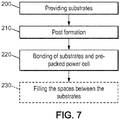
- a manufacturing method of such a power module comprises a step 200 of providing two substrates 90 comprising each a layer 91 of electrically conductive material and a layer 92 of thermally conductive and electrically insulating material ( fig. 3a ).
- the method then comprises a step 210 of forming at least one post 93 on at least one of the substrates 90 ( fig. 3b ).
- Each post 93 may be formed on a respective layer 91 of electrically conductive material either by additive manufacturing, for example by Chemical Vapor Deposition 3D or screen printing or any suitable method, or by subtractive manufacturing, for instance by chemically or mechanically etching a thicker layer of electrically conductive material to obtain the desired posts.
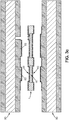
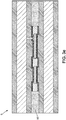
- the method then comprises a step 220 of positioning an elementary power assembly between the substrates ( fig. 3c ), such that each post of a substrate is inserted in a corresponding cavity of the power assembly, and bonding together ( fig. 3d ) the substrates and power assembly.
- the bonding may be performed by soldering, sintering, gluing, or the assembly may be pressed to the substrates directly or using a conductive material preform such as molybdenum preform.
- Any suitable bonding layer 94 may be deposited in order to perform the bonding, such as conductive glue for gluing, soldering material, or sintering paste such as silver or copper sintering paste.
- the bonding layer may in that case be deposited on at least a portion of each layer of electrically conductive material of the substrates.
- the bonding layer 94 may in particular be deposited at least on each post 93 of each layer of electrically conductive material.
- the bonding layer 94 is deposited on all a surface of the electrically conductive material that will then be adhered to an outer surface of the elementary power assembly.
- the adhesive material may be sintering paste, such as silver sintering paste.
- the method also comprises a step 230 of filling the empty spaces between the substrates by an injectable electrically isolating material 95.
- Said material can be silicone gel, epoxy, or plastic, etc...
- the filling material 95 may also be adhesive in order to hold together both substrates 90.
- the power module 9 thus obtained has improved thermal performances compared to traditional PCB embedding as the metal posts not only provide electrical connection to the power die, but they also allow thermal dissipation of the heat generated by the power die.
- the use of cavities and corresponding metal posts implies that no thick metal deposition is needed on the elementary power assembly 1, which reduces the time and cost of the manufacturing operation.
- the cavities and metal posts improve the alignment of the power dies relative to the substrates that they have to be connected to, because the configuration of the cavities and posts are made in order to easily imbricate the assembly with the substrate.
Landscapes
- Cooling Or The Like Of Semiconductors Or Solid State Devices (AREA)
- Engineering & Computer Science (AREA)
- Production Of Multi-Layered Print Wiring Board (AREA)
- Manufacturing & Machinery (AREA)
- Ceramic Engineering (AREA)
Claims (13)
- Module de puissance (9), comprenant un ensemble de puissance électrique (1), l'ensemble de puissance électrique (1) comprenant :- une puce de puissance (10), ayant au moins deux contacts électriques (11),- un cœur électriquement isolant (20), dans lequel la puce de puissance (10) est incorporée dans le cœur électriquement isolant (20), et- deux couches (60, 30) de matériau électriquement conducteur sur des surfaces principales opposées du cœur électriquement isolant (20),- au moins une cavité ouverte (40) s'étendant à partir d'un contact électrique (11) de la puce de puissance, à travers le cœur électriquement isolant (20) et la couche (60, 30) de matériau électriquement conducteur située sur le même côté de la puce de puissance que le contact électrique, de sorte que la cavité ouverte (40) possède un fond (41) formé par une zone du contact électrique (11) de la puce de puissance, dans lequel le fond (41) et les parois latérales (43) de la cavité ouverte (40) sont au moins partiellement plaqués avec un matériau électriquement conducteur pour connecter ladite zone du contact électrique (11) de la puce de puissance (10) à la couche (60, 30) de matériau électriquement conducteur,caractérisé en ce que
le module de puissance (9) comprend également au moins un substrat (90) comprenant une couche de matériau thermiquement conducteur et électriquement isolant (92) et une couche (91) de matériau électriquement conducteur,
le substrat (90) comprenant en outre au moins un plot (93) de matériau électriquement conducteur faisant saillie à partir de la couche de matériau électriquement conducteur (91), et l'ensemble de puissance électrique (1) étant monté sur le substrat (90) de sorte que le plot (93) soit inséré dans la cavité ouverte (40) de l'ensemble de puissance électrique (1),
ledit plot (93) ayant une géométrie et des dimensions adaptées à la géométrie et aux dimensions de la cavité ouverte (40) de l'ensemble de puissance électrique (1), de sorte que l'insertion du plot dans ladite cavité ouverte (40) fournisse un contact électrique et thermique entre le plot (93) et le contact électrique (11) de la puce de puissance (10) à partir duquel la cavité ouverte (40) s'étend. - Module de puissance (9) selon la revendication 1, dans lequel, dans l'ensemble de puissance électrique (1), la couche (60) de matériau électriquement conducteur, et le fond (41) et les parois latérales (43) de la cavité sont intégralement plaqués avec un matériau électriquement conducteur.
- Module de puissance (9) selon l'une quelconque des revendications précédentes, dans lequel l'ensemble de puissance électrique (1) comprend au moins deux cavités ouvertes (40), chaque cavité s'étendant à partir d'un contact respectif parmi les contacts électriques (11) de la puce de puissance (10).
- Module de puissance (9) selon l'une quelconque des revendications précédentes, dans lequel, dans l'ensemble de puissance électrique (1), la surface de la zone du contact électrique (11) de puce de puissance formant le fond de la cavité ouverte (40) est comprise entre 10 et 100 % de la surface du contact électrique (11) de puce de puissance, et est strictement inférieure à la surface du côté de la puce de puissance (10) sur lequel le contact électrique (11) est situé.
- Module de puissance (9) selon l'une quelconque des revendications précédentes, dans lequel l'ensemble de puissance électrique (1) comprend au moins deux cavités ouvertes (40) s'étendant à partir d'un même contact électrique (11) de la puce de puissance, chaque cavité ayant un fond formé par une zone respective du contact électrique (11) de puce de puissance, la surface de la zone du contact électrique formée par le fond de chaque cavité ouverte est comprise entre 1 et 100 % de la surface du contact électrique, et la surface cumulée des zones du contact électrique formant les fonds des cavités est comprise entre 10 et 100 % de la surface du contact électrique (11), et est inférieure à la surface du côté de la puce de puissance (10) sur lequel le contact électrique (11) est situé.
- Module de puissance (9) selon l'une quelconque des revendications précédentes, dans lequel le plot (93) possède des géométries et des dimensions adaptées à la géométrie et aux dimensions de la cavité ouverte (40) de l'ensemble de puissance électrique (1), de sorte que l'insertion du plot dans ladite cavité ouverte (40) fournisse en outre un contact électrique entre le plot (93) et les parois plaquées (43) de la cavité et entre la couche de matériau électriquement conducteur (91) du substrat et une couche de surface (30) de matériau électriquement conducteur de l'ensemble de puissance électrique (1) adjacente à ladite cavité ouverte (40).
- Module de puissance (9) selon l'une quelconque des revendications précédentes, comprenant deux substrats (90) comprenant chacun une couche (92) de matériau thermiquement conducteur et électriquement isolant et une couche (91) de matériau électriquement conducteur ayant un plot (93) faisant saillie à partir de celle-ci, et dans lequel l'ensemble de puissance électrique (1) comprend des cavités ouvertes (40) sur des côtés opposés de celui-ci,
l'ensemble de puissance électrique étant monté entre les deux substrats (90) avec chaque plot (93) d'un substrat (90) inséré dans une cavité respective (40) de l'ensemble de puissance (1), et le module de puissance comprend en outre un matériau électriquement isolant remplissant les espaces qui subsistent entre les substrats. - Procédé pour la fabrication d'un module de puissance (9) selon l'une quelconque des revendications précédentes, comprenant :- la fourniture (200) de deux substrats (90), chaque substrat (90) comprenant une couche (92) de matériau thermiquement conducteur et électriquement isolant et une couche (91) de matériau électriquement conducteur, et un ensemble de puissance élémentaire (1) ayant au moins une cavité ouverte (40) sur des côtés principaux opposés de celui-ci,- sur chaque substrat (90), la formation (210) d'au moins un plot (93) de matériau électriquement conducteur faisant saillie à partir de la couche de matériau électriquement conducteur (91), chaque plot (93) ayant une géométrie et des dimensions adaptées à la géométrie et aux dimensions d'une cavité ouverte (40) respective de l'ensemble de puissance élémentaire (1),- le montage de l'ensemble de puissance élémentaire (1) entre les substrats (90) avec le plot (93) de chaque substrat inséré dans une cavité ouverte (40) correspondante de l'ensemble de puissance élémentaire (1), et la liaison (220) des substrats (90) et de l'ensemble de puissance élémentaire (1) entre eux, et- le remplissage (230) de tout espace subsistant entre les substrats avec un matériau électriquement isolant (95).
- Procédé pour la fabrication d'un module de puissance (9) selon la revendication 8, dans lequel le matériau électriquement isolant (95) utilisé lors de l'étape de remplissage (230) est adhésif afin de maintenir ensemble les substrats (90).
- Procédé pour la fabrication d'un module de puissance (9) selon l'une quelconque des revendications 8 ou 9, dans lequel l'ensemble de puissance élémentaire est obtenu par :- la formation (100) d'une structure de base (80) comprenant :o un cœur électriquement isolant (20),o une puce de puissance (10), ayant au moins deux contacts électriques (11), la puce de puissance étant incorporée dans le cœur électriquement isolant (20) et,o deux couches externes (60) de matériau électriquement conducteur sur des surfaces principales opposées du cœur électriquement isolant (20), et- la formation (110), dans la structure de base (80), d'une cavité ouverte (40) exposant une zone d'un contact électrique (11) de la puce de puissance (10), par le retrait, à partir de la structure de base (80), d'un empilement comprenant une portion du cœur électriquement isolant (20) adjacent audit contact électrique (11), et une portion de la couche externe (60) de matériau électriquement conducteur recouvrant ladite portion du cœur électriquement isolant, et- le placage (120), au moins partiellement, de la cavité ouverte (40) afin de connecter ladite zone du contact électrique (11) de la puce de puissance (10) à la couche externe (60) de matériau électriquement conducteur.
- Procédé selon la revendication 10, dans lequel l'étape de placage (200) est réalisée par le dépôt d'une couche supplémentaire de matériau électriquement conducteur (31) sur le côté de la structure de base dans lequel la cavité ouverte (40) est formée, ladite couche supplémentaire (31) de matériau électriquement conducteur recouvrant la couche externe (60) de matériau électriquement conducteur, un fond (41) de la cavité ouverte formé par la zone exposée du contact électrique (11) de puce de puissance, et les parois latérales (43) de la cavité ouverte (40).
- Procédé selon l'une quelconque des revendications 10 ou 11, dans lequel la puce de puissance (10) possède deux contacts électriques (11) sur un même côté de celle-ci, et le procédé comprend la formation de cavités ouvertes (40) pour exposer respectivement une zone de chaque contact électrique (11) du même côté de la puce de puissance,
et le procédé comprend en outre, après l'étape de placage (120), une étape (130) de formation de motifs sur la couche supplémentaire (31) de matériau électriquement conducteur afin de déconnecter les deux contacts électriques (11) du même côté de la puce de puissance (10). - Procédé selon l'une quelconque des revendications 10 à 12, dans lequel l'étape (100) de formation de la structure de base (80) comprend :- la formation (101) d'au moins une cavité traversante (250) de la taille de la puce de puissance (10) dans une couche de base (25) de matériau électriquement isolant,- l'insertion (102) de la puce de puissance (10) dans la cavité traversante (250),- le positionnement (102) de la couche de base (25) comprenant la puce de puissance (10) entre deux couches supplémentaires (26) de matériau électriquement isolant, pour obtenir un empilement (27) de couches électriquement isolantes, et le positionnement dudit empilement (27) de couches électriquement isolantes entre deux couches externes (60) de matériau électriquement conducteur, et- la stratification (104) de l'empilement (27) de couches électriquement isolantes et des couches externes (60) de matériau électriquement conducteur.
Priority Applications (5)
| Application Number | Priority Date | Filing Date | Title |
|---|---|---|---|
| EP18305763.7A EP3584833B1 (fr) | 2018-06-19 | 2018-06-19 | Module de puissance à alignement amélioré |
| CN201980039809.6A CN112368830A (zh) | 2018-06-19 | 2019-05-29 | 电力组件、功率模块、用于制造功率模块和电力组件的方法 |
| PCT/JP2019/022245 WO2019244623A1 (fr) | 2018-06-19 | 2019-05-29 | Bloc d'alimentation électrique, module de puissance, procédé de fabrication de module de puissance et de bloc d'alimentation électrique |
| US17/048,348 US20210143103A1 (en) | 2018-06-19 | 2019-05-29 | Power module and method for manufacturing power module |
| JP2020554311A JP2021521628A (ja) | 2018-06-19 | 2019-05-29 | パワーモジュール、及びパワーモジュールを製造する方法 |
Applications Claiming Priority (1)
| Application Number | Priority Date | Filing Date | Title |
|---|---|---|---|
| EP18305763.7A EP3584833B1 (fr) | 2018-06-19 | 2018-06-19 | Module de puissance à alignement amélioré |
Publications (2)
| Publication Number | Publication Date |
|---|---|
| EP3584833A1 EP3584833A1 (fr) | 2019-12-25 |
| EP3584833B1 true EP3584833B1 (fr) | 2021-09-01 |
Family
ID=62791696
Family Applications (1)
| Application Number | Title | Priority Date | Filing Date |
|---|---|---|---|
| EP18305763.7A Not-in-force EP3584833B1 (fr) | 2018-06-19 | 2018-06-19 | Module de puissance à alignement amélioré |
Country Status (5)
| Country | Link |
|---|---|
| US (1) | US20210143103A1 (fr) |
| EP (1) | EP3584833B1 (fr) |
| JP (1) | JP2021521628A (fr) |
| CN (1) | CN112368830A (fr) |
| WO (1) | WO2019244623A1 (fr) |
Families Citing this family (6)
| Publication number | Priority date | Publication date | Assignee | Title |
|---|---|---|---|---|
| EP3547367A1 (fr) * | 2018-03-30 | 2019-10-02 | Mitsubishi Electric R&D Centre Europe B.V. | Module de puissance comprenant des cellules de puissance pré-emballées |
| FR3108822B1 (fr) * | 2020-03-30 | 2023-11-03 | Valeo Equip Electr Moteur | Module de puissance avec surmoulage, dispositifs comportant un tel module de puissance et procede de fabrication d’un module de puissance avec surmoulage |
| CN113341199B (zh) * | 2021-06-04 | 2022-05-17 | 华北电力大学 | 基于低温共烧陶瓷技术的高温电流传感器及其应用和方法 |
| US11978699B2 (en) * | 2021-08-19 | 2024-05-07 | Texas Instruments Incorporated | Electronic device multilevel package substrate for improved electromigration preformance |
| US12538428B2 (en) | 2023-01-24 | 2026-01-27 | Simmonds Precision Products, Inc. | Electrical circuit board assemblies |
| CN117440601B (zh) * | 2023-10-23 | 2024-08-02 | 无锡芯动半导体科技有限公司 | 一种功率模块 |
Family Cites Families (8)
| Publication number | Priority date | Publication date | Assignee | Title |
|---|---|---|---|---|
| US6442033B1 (en) | 1999-09-24 | 2002-08-27 | Virginia Tech Intellectual Properties, Inc. | Low-cost 3D flip-chip packaging technology for integrated power electronics modules |
| US7999369B2 (en) | 2006-08-29 | 2011-08-16 | Denso Corporation | Power electronic package having two substrates with multiple semiconductor chips and electronic components |
| DE102007041926B4 (de) * | 2007-09-04 | 2012-03-29 | Siemens Ag | Verfahren zur elektrischen Isolierung beziehungsweise elektrischen Kontaktierung von ungehäusten elektronischen Bauelementen bei strukturierter Verkapselung |
| DE102008040906A1 (de) * | 2008-07-31 | 2010-02-04 | Robert Bosch Gmbh | Leiterplatine mit elektronischem Bauelement |
| US8884343B2 (en) * | 2012-02-24 | 2014-11-11 | Texas Instruments Incorporated | System in package and method for manufacturing the same |
| EP2804209A1 (fr) * | 2013-05-17 | 2014-11-19 | ABB Technology AG | Module électronique moulé |
| WO2015077808A1 (fr) * | 2013-11-27 | 2015-06-04 | At&S Austria Technologie & Systemtechnik Aktiengesellschaft | Structure de carte de circuits imprimés |
| SG10201400390YA (en) | 2014-03-05 | 2015-10-29 | Delta Electronics Int L Singapore Pte Ltd | Package structure |
-
2018
- 2018-06-19 EP EP18305763.7A patent/EP3584833B1/fr not_active Not-in-force
-
2019
- 2019-05-29 WO PCT/JP2019/022245 patent/WO2019244623A1/fr not_active Ceased
- 2019-05-29 CN CN201980039809.6A patent/CN112368830A/zh not_active Withdrawn
- 2019-05-29 JP JP2020554311A patent/JP2021521628A/ja not_active Withdrawn
- 2019-05-29 US US17/048,348 patent/US20210143103A1/en not_active Abandoned
Also Published As
| Publication number | Publication date |
|---|---|
| WO2019244623A1 (fr) | 2019-12-26 |
| EP3584833A1 (fr) | 2019-12-25 |
| CN112368830A (zh) | 2021-02-12 |
| US20210143103A1 (en) | 2021-05-13 |
| JP2021521628A (ja) | 2021-08-26 |
Similar Documents
| Publication | Publication Date | Title |
|---|---|---|
| EP3584833A1 (fr) | Ensemble d'alimentation électrique et module de puissance à alignement amélioré | |
| US9035453B2 (en) | Semiconductor device | |
| CN104051408B (zh) | 模块及其制造方法 | |
| CN102017135B (zh) | 带有在多个接触平面中的元器件的基板电路模块 | |
| US12035477B2 (en) | Electronic module and method for producing an electronic module | |
| CN104425473B (zh) | 半导体装置及制造和运行方法和制造多个芯片组件的方法 | |
| CN107204300A (zh) | 用于制造芯片复合结构的方法 | |
| EP3547359A1 (fr) | Cellule de puissance pré-emballée améliorée | |
| JP7233621B1 (ja) | 熱性能が向上したパワーモジュールデバイス | |
| US20240222208A1 (en) | Power electronic module, power electronic module block, printed circuit board with power electronic module or printed circuit board component,and method for producing a power electronic module | |
| US20180040562A1 (en) | Elektronisches modul und verfahren zu seiner herstellung | |
| KR20100014769A (ko) | 전자 부품 모듈 및 이의 생산 방법 | |
| CN108292638B (zh) | 电子功率模块 | |
| CN114975341A (zh) | 功率电子载体 | |
| EP3547367A1 (fr) | Module de puissance comprenant des cellules de puissance pré-emballées | |
| JP6697547B2 (ja) | 追加的トラックを備えた半導体パワーデバイスおよび半導体パワーデバイスを製造する方法 | |
| US12557673B2 (en) | Electronic circuit module | |
| US11791254B2 (en) | Electrically power assembly with thick electrically conductive layers | |
| US20220377901A1 (en) | Electronic device with castellated board | |
| KR20230136459A (ko) | 전력 반도체 모듈 및 전력 반도체 모듈의 제조 방법 | |
| JP5485833B2 (ja) | 半導体装置、電極用部材および電極用部材の製造方法 | |
| CN112567510A (zh) | 具有形成用于直接冷却的箔作为衬底底部的金属-陶瓷衬底 | |
| US7601560B2 (en) | Method for producing an electronic circuit | |
| KR20250057203A (ko) | 전력 반도체 모듈 및 그 제조방법 | |
| CN119816942A (zh) | 具有至少一个无源部件的组件 |
Legal Events
| Date | Code | Title | Description |
|---|---|---|---|
| PUAI | Public reference made under article 153(3) epc to a published international application that has entered the european phase |
Free format text: ORIGINAL CODE: 0009012 |
|
| STAA | Information on the status of an ep patent application or granted ep patent |
Free format text: STATUS: THE APPLICATION HAS BEEN PUBLISHED |
|
| AK | Designated contracting states |
Kind code of ref document: A1 Designated state(s): AL AT BE BG CH CY CZ DE DK EE ES FI FR GB GR HR HU IE IS IT LI LT LU LV MC MK MT NL NO PL PT RO RS SE SI SK SM TR |
|
| AX | Request for extension of the european patent |
Extension state: BA ME |
|
| STAA | Information on the status of an ep patent application or granted ep patent |
Free format text: STATUS: REQUEST FOR EXAMINATION WAS MADE |
|
| 17P | Request for examination filed |
Effective date: 20200305 |
|
| RBV | Designated contracting states (corrected) |
Designated state(s): AL AT BE BG CH CY CZ DE DK EE ES FI FR GB GR HR HU IE IS IT LI LT LU LV MC MK MT NL NO PL PT RO RS SE SI SK SM TR |
|
| GRAP | Despatch of communication of intention to grant a patent |
Free format text: ORIGINAL CODE: EPIDOSNIGR1 |
|
| STAA | Information on the status of an ep patent application or granted ep patent |
Free format text: STATUS: GRANT OF PATENT IS INTENDED |
|
| INTG | Intention to grant announced |
Effective date: 20210413 |
|
| GRAS | Grant fee paid |
Free format text: ORIGINAL CODE: EPIDOSNIGR3 |
|
| GRAA | (expected) grant |
Free format text: ORIGINAL CODE: 0009210 |
|
| STAA | Information on the status of an ep patent application or granted ep patent |
Free format text: STATUS: THE PATENT HAS BEEN GRANTED |
|
| AK | Designated contracting states |
Kind code of ref document: B1 Designated state(s): AL AT BE BG CH CY CZ DE DK EE ES FI FR GB GR HR HU IE IS IT LI LT LU LV MC MK MT NL NO PL PT RO RS SE SI SK SM TR |
|
| REG | Reference to a national code |
Ref country code: GB Ref legal event code: FG4D |
|
| REG | Reference to a national code |
Ref country code: CH Ref legal event code: EP Ref country code: AT Ref legal event code: REF Ref document number: 1427116 Country of ref document: AT Kind code of ref document: T Effective date: 20210915 |
|
| REG | Reference to a national code |
Ref country code: DE Ref legal event code: R096 Ref document number: 602018022764 Country of ref document: DE |
|
| REG | Reference to a national code |
Ref country code: IE Ref legal event code: FG4D |
|
| REG | Reference to a national code |
Ref country code: LT Ref legal event code: MG9D |
|
| REG | Reference to a national code |
Ref country code: NL Ref legal event code: MP Effective date: 20210901 |
|
| PG25 | Lapsed in a contracting state [announced via postgrant information from national office to epo] |
Ref country code: NO Free format text: LAPSE BECAUSE OF FAILURE TO SUBMIT A TRANSLATION OF THE DESCRIPTION OR TO PAY THE FEE WITHIN THE PRESCRIBED TIME-LIMIT Effective date: 20211201 Ref country code: LT Free format text: LAPSE BECAUSE OF FAILURE TO SUBMIT A TRANSLATION OF THE DESCRIPTION OR TO PAY THE FEE WITHIN THE PRESCRIBED TIME-LIMIT Effective date: 20210901 Ref country code: BG Free format text: LAPSE BECAUSE OF FAILURE TO SUBMIT A TRANSLATION OF THE DESCRIPTION OR TO PAY THE FEE WITHIN THE PRESCRIBED TIME-LIMIT Effective date: 20211201 Ref country code: RS Free format text: LAPSE BECAUSE OF FAILURE TO SUBMIT A TRANSLATION OF THE DESCRIPTION OR TO PAY THE FEE WITHIN THE PRESCRIBED TIME-LIMIT Effective date: 20210901 Ref country code: SE Free format text: LAPSE BECAUSE OF FAILURE TO SUBMIT A TRANSLATION OF THE DESCRIPTION OR TO PAY THE FEE WITHIN THE PRESCRIBED TIME-LIMIT Effective date: 20210901 Ref country code: HR Free format text: LAPSE BECAUSE OF FAILURE TO SUBMIT A TRANSLATION OF THE DESCRIPTION OR TO PAY THE FEE WITHIN THE PRESCRIBED TIME-LIMIT Effective date: 20210901 Ref country code: ES Free format text: LAPSE BECAUSE OF FAILURE TO SUBMIT A TRANSLATION OF THE DESCRIPTION OR TO PAY THE FEE WITHIN THE PRESCRIBED TIME-LIMIT Effective date: 20210901 Ref country code: FI Free format text: LAPSE BECAUSE OF FAILURE TO SUBMIT A TRANSLATION OF THE DESCRIPTION OR TO PAY THE FEE WITHIN THE PRESCRIBED TIME-LIMIT Effective date: 20210901 |
|
| REG | Reference to a national code |
Ref country code: AT Ref legal event code: MK05 Ref document number: 1427116 Country of ref document: AT Kind code of ref document: T Effective date: 20210901 |
|
| PG25 | Lapsed in a contracting state [announced via postgrant information from national office to epo] |
Ref country code: PL Free format text: LAPSE BECAUSE OF FAILURE TO SUBMIT A TRANSLATION OF THE DESCRIPTION OR TO PAY THE FEE WITHIN THE PRESCRIBED TIME-LIMIT Effective date: 20210901 Ref country code: LV Free format text: LAPSE BECAUSE OF FAILURE TO SUBMIT A TRANSLATION OF THE DESCRIPTION OR TO PAY THE FEE WITHIN THE PRESCRIBED TIME-LIMIT Effective date: 20210901 Ref country code: GR Free format text: LAPSE BECAUSE OF FAILURE TO SUBMIT A TRANSLATION OF THE DESCRIPTION OR TO PAY THE FEE WITHIN THE PRESCRIBED TIME-LIMIT Effective date: 20211202 |
|
| PG25 | Lapsed in a contracting state [announced via postgrant information from national office to epo] |
Ref country code: AT Free format text: LAPSE BECAUSE OF FAILURE TO SUBMIT A TRANSLATION OF THE DESCRIPTION OR TO PAY THE FEE WITHIN THE PRESCRIBED TIME-LIMIT Effective date: 20210901 |
|
| PG25 | Lapsed in a contracting state [announced via postgrant information from national office to epo] |
Ref country code: IS Free format text: LAPSE BECAUSE OF FAILURE TO SUBMIT A TRANSLATION OF THE DESCRIPTION OR TO PAY THE FEE WITHIN THE PRESCRIBED TIME-LIMIT Effective date: 20220101 Ref country code: SM Free format text: LAPSE BECAUSE OF FAILURE TO SUBMIT A TRANSLATION OF THE DESCRIPTION OR TO PAY THE FEE WITHIN THE PRESCRIBED TIME-LIMIT Effective date: 20210901 Ref country code: SK Free format text: LAPSE BECAUSE OF FAILURE TO SUBMIT A TRANSLATION OF THE DESCRIPTION OR TO PAY THE FEE WITHIN THE PRESCRIBED TIME-LIMIT Effective date: 20210901 Ref country code: RO Free format text: LAPSE BECAUSE OF FAILURE TO SUBMIT A TRANSLATION OF THE DESCRIPTION OR TO PAY THE FEE WITHIN THE PRESCRIBED TIME-LIMIT Effective date: 20210901 Ref country code: PT Free format text: LAPSE BECAUSE OF FAILURE TO SUBMIT A TRANSLATION OF THE DESCRIPTION OR TO PAY THE FEE WITHIN THE PRESCRIBED TIME-LIMIT Effective date: 20220103 Ref country code: NL Free format text: LAPSE BECAUSE OF FAILURE TO SUBMIT A TRANSLATION OF THE DESCRIPTION OR TO PAY THE FEE WITHIN THE PRESCRIBED TIME-LIMIT Effective date: 20210901 Ref country code: EE Free format text: LAPSE BECAUSE OF FAILURE TO SUBMIT A TRANSLATION OF THE DESCRIPTION OR TO PAY THE FEE WITHIN THE PRESCRIBED TIME-LIMIT Effective date: 20210901 Ref country code: CZ Free format text: LAPSE BECAUSE OF FAILURE TO SUBMIT A TRANSLATION OF THE DESCRIPTION OR TO PAY THE FEE WITHIN THE PRESCRIBED TIME-LIMIT Effective date: 20210901 Ref country code: AL Free format text: LAPSE BECAUSE OF FAILURE TO SUBMIT A TRANSLATION OF THE DESCRIPTION OR TO PAY THE FEE WITHIN THE PRESCRIBED TIME-LIMIT Effective date: 20210901 |
|
| REG | Reference to a national code |
Ref country code: DE Ref legal event code: R097 Ref document number: 602018022764 Country of ref document: DE |
|
| PLBE | No opposition filed within time limit |
Free format text: ORIGINAL CODE: 0009261 |
|
| STAA | Information on the status of an ep patent application or granted ep patent |
Free format text: STATUS: NO OPPOSITION FILED WITHIN TIME LIMIT |
|
| PG25 | Lapsed in a contracting state [announced via postgrant information from national office to epo] |
Ref country code: IT Free format text: LAPSE BECAUSE OF FAILURE TO SUBMIT A TRANSLATION OF THE DESCRIPTION OR TO PAY THE FEE WITHIN THE PRESCRIBED TIME-LIMIT Effective date: 20210901 Ref country code: DK Free format text: LAPSE BECAUSE OF FAILURE TO SUBMIT A TRANSLATION OF THE DESCRIPTION OR TO PAY THE FEE WITHIN THE PRESCRIBED TIME-LIMIT Effective date: 20210901 |
|
| 26N | No opposition filed |
Effective date: 20220602 |
|
| PG25 | Lapsed in a contracting state [announced via postgrant information from national office to epo] |
Ref country code: SI Free format text: LAPSE BECAUSE OF FAILURE TO SUBMIT A TRANSLATION OF THE DESCRIPTION OR TO PAY THE FEE WITHIN THE PRESCRIBED TIME-LIMIT Effective date: 20210901 |
|
| REG | Reference to a national code |
Ref country code: DE Ref legal event code: R119 Ref document number: 602018022764 Country of ref document: DE |
|
| PG25 | Lapsed in a contracting state [announced via postgrant information from national office to epo] |
Ref country code: MC Free format text: LAPSE BECAUSE OF FAILURE TO SUBMIT A TRANSLATION OF THE DESCRIPTION OR TO PAY THE FEE WITHIN THE PRESCRIBED TIME-LIMIT Effective date: 20210901 |
|
| REG | Reference to a national code |
Ref country code: CH Ref legal event code: PL |
|
| REG | Reference to a national code |
Ref country code: BE Ref legal event code: MM Effective date: 20220630 |
|
| GBPC | Gb: european patent ceased through non-payment of renewal fee |
Effective date: 20220619 |
|
| PG25 | Lapsed in a contracting state [announced via postgrant information from national office to epo] |
Ref country code: LU Free format text: LAPSE BECAUSE OF NON-PAYMENT OF DUE FEES Effective date: 20220619 Ref country code: LI Free format text: LAPSE BECAUSE OF NON-PAYMENT OF DUE FEES Effective date: 20220630 Ref country code: IE Free format text: LAPSE BECAUSE OF NON-PAYMENT OF DUE FEES Effective date: 20220619 Ref country code: FR Free format text: LAPSE BECAUSE OF NON-PAYMENT OF DUE FEES Effective date: 20220630 Ref country code: CH Free format text: LAPSE BECAUSE OF NON-PAYMENT OF DUE FEES Effective date: 20220630 |
|
| PG25 | Lapsed in a contracting state [announced via postgrant information from national office to epo] |
Ref country code: GB Free format text: LAPSE BECAUSE OF NON-PAYMENT OF DUE FEES Effective date: 20220619 Ref country code: DE Free format text: LAPSE BECAUSE OF NON-PAYMENT OF DUE FEES Effective date: 20230103 Ref country code: BE Free format text: LAPSE BECAUSE OF NON-PAYMENT OF DUE FEES Effective date: 20220630 |
|
| PG25 | Lapsed in a contracting state [announced via postgrant information from national office to epo] |
Ref country code: MK Free format text: LAPSE BECAUSE OF FAILURE TO SUBMIT A TRANSLATION OF THE DESCRIPTION OR TO PAY THE FEE WITHIN THE PRESCRIBED TIME-LIMIT Effective date: 20210901 Ref country code: CY Free format text: LAPSE BECAUSE OF FAILURE TO SUBMIT A TRANSLATION OF THE DESCRIPTION OR TO PAY THE FEE WITHIN THE PRESCRIBED TIME-LIMIT Effective date: 20210901 |
|
| PG25 | Lapsed in a contracting state [announced via postgrant information from national office to epo] |
Ref country code: HU Free format text: LAPSE BECAUSE OF FAILURE TO SUBMIT A TRANSLATION OF THE DESCRIPTION OR TO PAY THE FEE WITHIN THE PRESCRIBED TIME-LIMIT; INVALID AB INITIO Effective date: 20180619 |
|
| PG25 | Lapsed in a contracting state [announced via postgrant information from national office to epo] |
Ref country code: TR Free format text: LAPSE BECAUSE OF FAILURE TO SUBMIT A TRANSLATION OF THE DESCRIPTION OR TO PAY THE FEE WITHIN THE PRESCRIBED TIME-LIMIT Effective date: 20210901 |
|
| PG25 | Lapsed in a contracting state [announced via postgrant information from national office to epo] |
Ref country code: MT Free format text: LAPSE BECAUSE OF FAILURE TO SUBMIT A TRANSLATION OF THE DESCRIPTION OR TO PAY THE FEE WITHIN THE PRESCRIBED TIME-LIMIT Effective date: 20210901 |