EP3601164B1 - Verbundstoffmaterial - Google Patents
Verbundstoffmaterial Download PDFInfo
- Publication number
- EP3601164B1 EP3601164B1 EP18715939.7A EP18715939A EP3601164B1 EP 3601164 B1 EP3601164 B1 EP 3601164B1 EP 18715939 A EP18715939 A EP 18715939A EP 3601164 B1 EP3601164 B1 EP 3601164B1
- Authority
- EP
- European Patent Office
- Prior art keywords
- zeolite
- composite material
- silicate
- macroporous
- copper
- Prior art date
- Legal status (The legal status is an assumption and is not a legal conclusion. Google has not performed a legal analysis and makes no representation as to the accuracy of the status listed.)
- Active
Links
Images



Classifications
-
- C—CHEMISTRY; METALLURGY
- C01—INORGANIC CHEMISTRY
- C01B—NON-METALLIC ELEMENTS; COMPOUNDS THEREOF; METALLOIDS OR COMPOUNDS THEREOF NOT COVERED BY SUBCLASS C01C
- C01B39/00—Compounds having molecular sieve and base-exchange properties, e.g. crystalline zeolites; Their preparation; After-treatment, e.g. ion-exchange or dealumination
-
- C—CHEMISTRY; METALLURGY
- C01—INORGANIC CHEMISTRY
- C01B—NON-METALLIC ELEMENTS; COMPOUNDS THEREOF; METALLOIDS OR COMPOUNDS THEREOF NOT COVERED BY SUBCLASS C01C
- C01B39/00—Compounds having molecular sieve and base-exchange properties, e.g. crystalline zeolites; Their preparation; After-treatment, e.g. ion-exchange or dealumination
- C01B39/02—Crystalline aluminosilicate zeolites; Isomorphous compounds thereof; Direct preparation thereof; Preparation thereof starting from a reaction mixture containing a crystalline zeolite of another type, or from preformed reactants; After-treatment thereof
- C01B39/023—Preparation of physical mixtures or intergrowth products of zeolites chosen from group C01B39/04 or two or more of groups C01B39/14 - C01B39/48
-
- B—PERFORMING OPERATIONS; TRANSPORTING
- B01—PHYSICAL OR CHEMICAL PROCESSES OR APPARATUS IN GENERAL
- B01D—SEPARATION
- B01D53/00—Separation of gases or vapours; Recovering vapours of volatile solvents from gases; Chemical or biological purification of waste gases, e.g. engine exhaust gases, smoke, fumes, flue gases, aerosols
- B01D53/34—Chemical or biological purification of waste gases
- B01D53/92—Chemical or biological purification of waste gases of engine exhaust gases
- B01D53/94—Chemical or biological purification of waste gases of engine exhaust gases by catalytic processes
- B01D53/9404—Removing only nitrogen compounds
- B01D53/9409—Nitrogen oxides
- B01D53/9413—Processes characterised by a specific catalyst
- B01D53/9418—Processes characterised by a specific catalyst for removing nitrogen oxides by selective catalytic reduction [SCR] using a reducing agent in a lean exhaust gas
-
- B—PERFORMING OPERATIONS; TRANSPORTING
- B01—PHYSICAL OR CHEMICAL PROCESSES OR APPARATUS IN GENERAL
- B01J—CHEMICAL OR PHYSICAL PROCESSES, e.g. CATALYSIS OR COLLOID CHEMISTRY; THEIR RELEVANT APPARATUS
- B01J29/00—Catalysts comprising molecular sieves
- B01J29/005—Mixtures of molecular sieves comprising at least one molecular sieve which is not an aluminosilicate zeolite, e.g. from groups B01J29/03 - B01J29/049 or B01J29/82 - B01J29/89
-
- B—PERFORMING OPERATIONS; TRANSPORTING
- B01—PHYSICAL OR CHEMICAL PROCESSES OR APPARATUS IN GENERAL
- B01J—CHEMICAL OR PHYSICAL PROCESSES, e.g. CATALYSIS OR COLLOID CHEMISTRY; THEIR RELEVANT APPARATUS
- B01J29/00—Catalysts comprising molecular sieves
- B01J29/04—Catalysts comprising molecular sieves having base-exchange properties, e.g. crystalline zeolites
- B01J29/06—Crystalline aluminosilicate zeolites; Isomorphous compounds thereof
- B01J29/70—Crystalline aluminosilicate zeolites; Isomorphous compounds thereof of types characterised by their specific structure not provided for in groups B01J29/08 - B01J29/65
- B01J29/72—Crystalline aluminosilicate zeolites; Isomorphous compounds thereof of types characterised by their specific structure not provided for in groups B01J29/08 - B01J29/65 containing iron group metals, noble metals or copper
-
- B—PERFORMING OPERATIONS; TRANSPORTING
- B01—PHYSICAL OR CHEMICAL PROCESSES OR APPARATUS IN GENERAL
- B01J—CHEMICAL OR PHYSICAL PROCESSES, e.g. CATALYSIS OR COLLOID CHEMISTRY; THEIR RELEVANT APPARATUS
- B01J29/00—Catalysts comprising molecular sieves
- B01J29/04—Catalysts comprising molecular sieves having base-exchange properties, e.g. crystalline zeolites
- B01J29/06—Crystalline aluminosilicate zeolites; Isomorphous compounds thereof
- B01J29/70—Crystalline aluminosilicate zeolites; Isomorphous compounds thereof of types characterised by their specific structure not provided for in groups B01J29/08 - B01J29/65
- B01J29/72—Crystalline aluminosilicate zeolites; Isomorphous compounds thereof of types characterised by their specific structure not provided for in groups B01J29/08 - B01J29/65 containing iron group metals, noble metals or copper
- B01J29/723—CHA-type, e.g. Chabazite, LZ-218
-
- B—PERFORMING OPERATIONS; TRANSPORTING
- B01—PHYSICAL OR CHEMICAL PROCESSES OR APPARATUS IN GENERAL
- B01J—CHEMICAL OR PHYSICAL PROCESSES, e.g. CATALYSIS OR COLLOID CHEMISTRY; THEIR RELEVANT APPARATUS
- B01J29/00—Catalysts comprising molecular sieves
- B01J29/04—Catalysts comprising molecular sieves having base-exchange properties, e.g. crystalline zeolites
- B01J29/06—Crystalline aluminosilicate zeolites; Isomorphous compounds thereof
- B01J29/70—Crystalline aluminosilicate zeolites; Isomorphous compounds thereof of types characterised by their specific structure not provided for in groups B01J29/08 - B01J29/65
- B01J29/72—Crystalline aluminosilicate zeolites; Isomorphous compounds thereof of types characterised by their specific structure not provided for in groups B01J29/08 - B01J29/65 containing iron group metals, noble metals or copper
- B01J29/76—Iron group metals or copper
-
- B—PERFORMING OPERATIONS; TRANSPORTING
- B01—PHYSICAL OR CHEMICAL PROCESSES OR APPARATUS IN GENERAL
- B01J—CHEMICAL OR PHYSICAL PROCESSES, e.g. CATALYSIS OR COLLOID CHEMISTRY; THEIR RELEVANT APPARATUS
- B01J29/00—Catalysts comprising molecular sieves
- B01J29/04—Catalysts comprising molecular sieves having base-exchange properties, e.g. crystalline zeolites
- B01J29/06—Crystalline aluminosilicate zeolites; Isomorphous compounds thereof
- B01J29/70—Crystalline aluminosilicate zeolites; Isomorphous compounds thereof of types characterised by their specific structure not provided for in groups B01J29/08 - B01J29/65
- B01J29/72—Crystalline aluminosilicate zeolites; Isomorphous compounds thereof of types characterised by their specific structure not provided for in groups B01J29/08 - B01J29/65 containing iron group metals, noble metals or copper
- B01J29/76—Iron group metals or copper
- B01J29/763—CHA-type, e.g. Chabazite, LZ-218
-
- B—PERFORMING OPERATIONS; TRANSPORTING
- B01—PHYSICAL OR CHEMICAL PROCESSES OR APPARATUS IN GENERAL
- B01J—CHEMICAL OR PHYSICAL PROCESSES, e.g. CATALYSIS OR COLLOID CHEMISTRY; THEIR RELEVANT APPARATUS
- B01J37/00—Processes, in general, for preparing catalysts; Processes, in general, for activation of catalysts
- B01J37/0009—Use of binding agents; Moulding; Pressing; Powdering; Granulating; Addition of materials ameliorating the mechanical properties of the product catalyst
- B01J37/0018—Addition of a binding agent or of material, later completely removed among others as result of heat treatment, leaching or washing,(e.g. forming of pores; protective layer, desintegrating by heat)
-
- B—PERFORMING OPERATIONS; TRANSPORTING
- B01—PHYSICAL OR CHEMICAL PROCESSES OR APPARATUS IN GENERAL
- B01J—CHEMICAL OR PHYSICAL PROCESSES, e.g. CATALYSIS OR COLLOID CHEMISTRY; THEIR RELEVANT APPARATUS
- B01J37/00—Processes, in general, for preparing catalysts; Processes, in general, for activation of catalysts
- B01J37/08—Heat treatment
- B01J37/10—Heat treatment in the presence of water, e.g. steam
-
- B—PERFORMING OPERATIONS; TRANSPORTING
- B01—PHYSICAL OR CHEMICAL PROCESSES OR APPARATUS IN GENERAL
- B01J—CHEMICAL OR PHYSICAL PROCESSES, e.g. CATALYSIS OR COLLOID CHEMISTRY; THEIR RELEVANT APPARATUS
- B01J37/00—Processes, in general, for preparing catalysts; Processes, in general, for activation of catalysts
- B01J37/30—Ion-exchange
-
- C—CHEMISTRY; METALLURGY
- C01—INORGANIC CHEMISTRY
- C01B—NON-METALLIC ELEMENTS; COMPOUNDS THEREOF; METALLOIDS OR COMPOUNDS THEREOF NOT COVERED BY SUBCLASS C01C
- C01B39/00—Compounds having molecular sieve and base-exchange properties, e.g. crystalline zeolites; Their preparation; After-treatment, e.g. ion-exchange or dealumination
- C01B39/02—Crystalline aluminosilicate zeolites; Isomorphous compounds thereof; Direct preparation thereof; Preparation thereof starting from a reaction mixture containing a crystalline zeolite of another type, or from preformed reactants; After-treatment thereof
- C01B39/04—Crystalline aluminosilicate zeolites; Isomorphous compounds thereof; Direct preparation thereof; Preparation thereof starting from a reaction mixture containing a crystalline zeolite of another type, or from preformed reactants; After-treatment thereof using at least one organic template directing agent, e.g. an ionic quaternary ammonium compound or an aminated compound
-
- F—MECHANICAL ENGINEERING; LIGHTING; HEATING; WEAPONS; BLASTING
- F01—MACHINES OR ENGINES IN GENERAL; ENGINE PLANTS IN GENERAL; STEAM ENGINES
- F01N—GAS-FLOW SILENCERS OR EXHAUST APPARATUS FOR MACHINES OR ENGINES IN GENERAL; GAS-FLOW SILENCERS OR EXHAUST APPARATUS FOR INTERNAL-COMBUSTION ENGINES
- F01N3/00—Exhaust or silencing apparatus having means for purifying, rendering innocuous, or otherwise treating exhaust
- F01N3/02—Exhaust or silencing apparatus having means for purifying, rendering innocuous, or otherwise treating exhaust for cooling, or for removing solid constituents of, exhaust
- F01N3/021—Exhaust or silencing apparatus having means for purifying, rendering innocuous, or otherwise treating exhaust for cooling, or for removing solid constituents of, exhaust by means of filters
- F01N3/022—Exhaust or silencing apparatus having means for purifying, rendering innocuous, or otherwise treating exhaust for cooling, or for removing solid constituents of, exhaust by means of filters characterised by specially adapted filtering structure, e.g. honeycomb, mesh or fibrous
- F01N3/0224—Exhaust or silencing apparatus having means for purifying, rendering innocuous, or otherwise treating exhaust for cooling, or for removing solid constituents of, exhaust by means of filters characterised by specially adapted filtering structure, e.g. honeycomb, mesh or fibrous the structure being granular
-
- F—MECHANICAL ENGINEERING; LIGHTING; HEATING; WEAPONS; BLASTING
- F01—MACHINES OR ENGINES IN GENERAL; ENGINE PLANTS IN GENERAL; STEAM ENGINES
- F01N—GAS-FLOW SILENCERS OR EXHAUST APPARATUS FOR MACHINES OR ENGINES IN GENERAL; GAS-FLOW SILENCERS OR EXHAUST APPARATUS FOR INTERNAL-COMBUSTION ENGINES
- F01N3/00—Exhaust or silencing apparatus having means for purifying, rendering innocuous, or otherwise treating exhaust
- F01N3/02—Exhaust or silencing apparatus having means for purifying, rendering innocuous, or otherwise treating exhaust for cooling, or for removing solid constituents of, exhaust
- F01N3/021—Exhaust or silencing apparatus having means for purifying, rendering innocuous, or otherwise treating exhaust for cooling, or for removing solid constituents of, exhaust by means of filters
- F01N3/033—Exhaust or silencing apparatus having means for purifying, rendering innocuous, or otherwise treating exhaust for cooling, or for removing solid constituents of, exhaust by means of filters in combination with other devices
- F01N3/035—Exhaust or silencing apparatus having means for purifying, rendering innocuous, or otherwise treating exhaust for cooling, or for removing solid constituents of, exhaust by means of filters in combination with other devices with catalytic reactors
-
- F—MECHANICAL ENGINEERING; LIGHTING; HEATING; WEAPONS; BLASTING
- F01—MACHINES OR ENGINES IN GENERAL; ENGINE PLANTS IN GENERAL; STEAM ENGINES
- F01N—GAS-FLOW SILENCERS OR EXHAUST APPARATUS FOR MACHINES OR ENGINES IN GENERAL; GAS-FLOW SILENCERS OR EXHAUST APPARATUS FOR INTERNAL-COMBUSTION ENGINES
- F01N3/00—Exhaust or silencing apparatus having means for purifying, rendering innocuous, or otherwise treating exhaust
- F01N3/08—Exhaust or silencing apparatus having means for purifying, rendering innocuous, or otherwise treating exhaust for rendering innocuous
- F01N3/10—Exhaust or silencing apparatus having means for purifying, rendering innocuous, or otherwise treating exhaust for rendering innocuous by thermal or catalytic conversion of noxious components of exhaust
- F01N3/18—Exhaust or silencing apparatus having means for purifying, rendering innocuous, or otherwise treating exhaust for rendering innocuous by thermal or catalytic conversion of noxious components of exhaust characterised by methods of operation; Control
- F01N3/20—Exhaust or silencing apparatus having means for purifying, rendering innocuous, or otherwise treating exhaust for rendering innocuous by thermal or catalytic conversion of noxious components of exhaust characterised by methods of operation; Control specially adapted for catalytic conversion
- F01N3/206—Adding periodically or continuously substances to exhaust gases for promoting purification, e.g. catalytic material in liquid form, NOx reducing agents
- F01N3/2066—Selective catalytic reduction [SCR]
-
- F—MECHANICAL ENGINEERING; LIGHTING; HEATING; WEAPONS; BLASTING
- F01—MACHINES OR ENGINES IN GENERAL; ENGINE PLANTS IN GENERAL; STEAM ENGINES
- F01N—GAS-FLOW SILENCERS OR EXHAUST APPARATUS FOR MACHINES OR ENGINES IN GENERAL; GAS-FLOW SILENCERS OR EXHAUST APPARATUS FOR INTERNAL-COMBUSTION ENGINES
- F01N3/00—Exhaust or silencing apparatus having means for purifying, rendering innocuous, or otherwise treating exhaust
- F01N3/08—Exhaust or silencing apparatus having means for purifying, rendering innocuous, or otherwise treating exhaust for rendering innocuous
- F01N3/10—Exhaust or silencing apparatus having means for purifying, rendering innocuous, or otherwise treating exhaust for rendering innocuous by thermal or catalytic conversion of noxious components of exhaust
- F01N3/24—Exhaust or silencing apparatus having means for purifying, rendering innocuous, or otherwise treating exhaust for rendering innocuous by thermal or catalytic conversion of noxious components of exhaust characterised by constructional aspects of converting apparatus
- F01N3/28—Construction of catalytic reactors
- F01N3/2803—Construction of catalytic reactors characterised by structure, by material or by manufacturing of catalyst support
- F01N3/2825—Ceramics
- F01N3/2828—Ceramic multi-channel monoliths, e.g. honeycombs
-
- B—PERFORMING OPERATIONS; TRANSPORTING
- B01—PHYSICAL OR CHEMICAL PROCESSES OR APPARATUS IN GENERAL
- B01D—SEPARATION
- B01D2255/00—Catalysts
- B01D2255/20—Metals or compounds thereof
- B01D2255/207—Transition metals
- B01D2255/20738—Iron
-
- B—PERFORMING OPERATIONS; TRANSPORTING
- B01—PHYSICAL OR CHEMICAL PROCESSES OR APPARATUS IN GENERAL
- B01D—SEPARATION
- B01D2255/00—Catalysts
- B01D2255/20—Metals or compounds thereof
- B01D2255/207—Transition metals
- B01D2255/20761—Copper
-
- B—PERFORMING OPERATIONS; TRANSPORTING
- B01—PHYSICAL OR CHEMICAL PROCESSES OR APPARATUS IN GENERAL
- B01D—SEPARATION
- B01D2255/00—Catalysts
- B01D2255/50—Zeolites
-
- B—PERFORMING OPERATIONS; TRANSPORTING
- B01—PHYSICAL OR CHEMICAL PROCESSES OR APPARATUS IN GENERAL
- B01D—SEPARATION
- B01D2255/00—Catalysts
- B01D2255/90—Physical characteristics of catalysts
- B01D2255/915—Catalyst supported on particulate filters
- B01D2255/9155—Wall flow filters
-
- B—PERFORMING OPERATIONS; TRANSPORTING
- B01—PHYSICAL OR CHEMICAL PROCESSES OR APPARATUS IN GENERAL
- B01D—SEPARATION
- B01D2255/00—Catalysts
- B01D2255/90—Physical characteristics of catalysts
- B01D2255/92—Dimensions
- B01D2255/9202—Linear dimensions
-
- B—PERFORMING OPERATIONS; TRANSPORTING
- B01—PHYSICAL OR CHEMICAL PROCESSES OR APPARATUS IN GENERAL
- B01D—SEPARATION
- B01D2255/00—Catalysts
- B01D2255/90—Physical characteristics of catalysts
- B01D2255/92—Dimensions
- B01D2255/9205—Porosity
-
- B—PERFORMING OPERATIONS; TRANSPORTING
- B01—PHYSICAL OR CHEMICAL PROCESSES OR APPARATUS IN GENERAL
- B01J—CHEMICAL OR PHYSICAL PROCESSES, e.g. CATALYSIS OR COLLOID CHEMISTRY; THEIR RELEVANT APPARATUS
- B01J2229/00—Aspects of molecular sieve catalysts not covered by B01J29/00
- B01J2229/10—After treatment, characterised by the effect to be obtained
- B01J2229/18—After treatment, characterised by the effect to be obtained to introduce other elements into or onto the molecular sieve itself
- B01J2229/186—After treatment, characterised by the effect to be obtained to introduce other elements into or onto the molecular sieve itself not in framework positions
-
- B—PERFORMING OPERATIONS; TRANSPORTING
- B01—PHYSICAL OR CHEMICAL PROCESSES OR APPARATUS IN GENERAL
- B01J—CHEMICAL OR PHYSICAL PROCESSES, e.g. CATALYSIS OR COLLOID CHEMISTRY; THEIR RELEVANT APPARATUS
- B01J2229/00—Aspects of molecular sieve catalysts not covered by B01J29/00
- B01J2229/30—After treatment, characterised by the means used
- B01J2229/38—Base treatment
-
- B—PERFORMING OPERATIONS; TRANSPORTING
- B01—PHYSICAL OR CHEMICAL PROCESSES OR APPARATUS IN GENERAL
- B01J—CHEMICAL OR PHYSICAL PROCESSES, e.g. CATALYSIS OR COLLOID CHEMISTRY; THEIR RELEVANT APPARATUS
- B01J35/00—Catalysts, in general, characterised by their form or physical properties
- B01J35/50—Catalysts, in general, characterised by their form or physical properties characterised by their shape or configuration
- B01J35/56—Foraminous structures having flow-through passages or channels, e.g. grids or three-dimensional [3D] monoliths
-
- F—MECHANICAL ENGINEERING; LIGHTING; HEATING; WEAPONS; BLASTING
- F01—MACHINES OR ENGINES IN GENERAL; ENGINE PLANTS IN GENERAL; STEAM ENGINES
- F01N—GAS-FLOW SILENCERS OR EXHAUST APPARATUS FOR MACHINES OR ENGINES IN GENERAL; GAS-FLOW SILENCERS OR EXHAUST APPARATUS FOR INTERNAL-COMBUSTION ENGINES
- F01N2370/00—Selection of materials for exhaust purification
- F01N2370/02—Selection of materials for exhaust purification used in catalytic reactors
- F01N2370/04—Zeolitic material
-
- F—MECHANICAL ENGINEERING; LIGHTING; HEATING; WEAPONS; BLASTING
- F01—MACHINES OR ENGINES IN GENERAL; ENGINE PLANTS IN GENERAL; STEAM ENGINES
- F01N—GAS-FLOW SILENCERS OR EXHAUST APPARATUS FOR MACHINES OR ENGINES IN GENERAL; GAS-FLOW SILENCERS OR EXHAUST APPARATUS FOR INTERNAL-COMBUSTION ENGINES
- F01N2510/00—Surface coverings
- F01N2510/06—Surface coverings for exhaust purification, e.g. catalytic reaction
- F01N2510/063—Surface coverings for exhaust purification, e.g. catalytic reaction zeolites
Definitions
- the present invention relates to a composite material.
- the present invention relates to a composite material for use as an SCR catalyst.
- NO x nitrogen oxides
- NO x comprises NO (nitric oxide), NOz (nitrogen dioxide) and N 2 O (nitrous oxide)
- NO x is known to cause a number of health issues in people as well as causing a number of detrimental environmental effects including the formation of smog and acid rain.
- Exhaust gas generated in lean-burn and diesel engines is generally oxidative.
- NO x needs to be reduced selectively with a catalyst and a reductant in a process known as selective catalytic reduction (SCR) that converts NO x into elemental nitrogen (N 2 ) and water.
- SCR selective catalytic reduction
- a gaseous reductant typically anhydrous ammonia, aqueous ammonia, or urea
- the reductant is absorbed onto the catalyst and the NO x is reduced as the gases pass through or over the catalysed substrate.
- Suitable catalysts for SCR known in the art include, for example, V 2 O 5 /WO 3 supported on TiOz (see WO 99/39809 ) and transition metal exchanged zeolites (see US 4,961,917 and WO 2008/106519 ) or a mixture of the two (see WO 2014/027207 ).
- V 2 O 5 /WO 3 supported on TiOz see WO 99/39809
- transition metal exchanged zeolites see US 4,961,917 and WO 2008/106519
- a mixture of the two see WO 2014/027207 .
- WO 2016/016622 discloses a catalyst article and a process for producing the catalyst article.
- the catalyst can be a catalyst for the selective catalytic reduction of NOx.
- the process comprises the steps of a) providing functional particles having a catalytically inactive pore former as support surrounded by a layer of a catalytically active material, b) processing the functional particles with further inorganic particles to give a catalytic material, c) thermally treating the catalytic material to form ceramic catalyst, wherein the catalyst comprises at least porous catalytically inactive cells which are formed by the pore formers in the functional particles, which are embedded in a matrix comprising the further inorganic particles which form a porous structure and which are at least partly surrounded by an active interface layer comprising the catalytically active material of the layer of the functional particles.
- WO 2015/145181 also discloses a catalyst and a process for producing the catalyst.
- an inorganic binder fraction which is catalytically inactive in the starting state and has been treated to develop catalytic activity is mixed into a catalyst composition.
- the inorganic binder component for the binder fraction can be, in the starting state, a diatomaceous earth.
- the individual particles are either coated with a catalytically active layer or transformed into a catalytically active zeolite with maintenance of mesoporosity.
- WO 2015/145178 discloses a method of reducing nitrogen oxides in exhaust gas of an internal combustion engine by selective catalytic reduction (SCR) comprising contacting the exhaust gas also containing ammonia and oxygen with a catalytic converter comprising a catalyst comprising at least one crystalline small pore molecular sieve catalytically active component having a maximum ring opening of eight tetrahedral basic building blocks, which crystalline small pore molecular sieve catalytically active component comprises mesopores.
- SCR selective catalytic reduction
- WO2016/016622 describes a catalyst which has a composite structure having a porous structure embedded into an inorganic matrix, wherein the porous structure is formed from catalytically inactive, at least porous cells at least partly surrounded by an active interface layer comprising a catalytically active material.
- CN106145139 describes a preparation of aluminosilicate chabazite that employs a diatomaceous earth.
- the composite material may exhibit a high level of SCR catalytic activity, and may be suitable for use as an SCR catalyst.
- the composite material exhibits a favourable combination of the properties of both the macroporous silicate-based material (i.e. large pores allowing easy access of gaseous species) and the functionalised zeolite (i.e. SCR catalytic activity).
- the composite material as an SCR catalyst in an exhaust treatment system results in a high level of mass transfer of gaseous species to catalytic sites. Accordingly, a high level of NO x conversion is achieved.
- the composite material may exhibit improved selectivity for NzO. Such an effect may be particularly pronounced when the at least one zeolite is functionalised with both copper and iron.
- the composite material comprises a macroporous silicate-based material.
- macroporous it is meant that the material contains pores having a diameter greater than 50 nm. The macropore diameters may be measured, for example, but the use of scanning electron microscopy (SEM) or mercury porosimetry.
- silicate-based it is meant that the material comprises at least 50 wt.% silicate, typically at least 80 wt.%, more typically at least 90 wt.%.
- the macroporous silicate-based material may contain species other than silicate such as, for example, metals (e.g. iron) and alumina.
- the macroporous silicate-based material is partially substituted with at least one microporous zeolite. At least 30 wt.% of the macroporous silicate-based material is substituted with the at least one microporous zeolite. Lower levels of substitution may result in the composite material exhibiting lower levels of SCR catalytic activity. Up to 70 wt.% of the macroporous silicate-based material is substituted with the at least one microporous zeolite. Higher levels of substitution may not provide any significant increase in SCR catalytic activity, but may result in the composite material exhibiting unfavourable mechanical properties, for example low strength. The level of substitution may be measured using, for example, powder X-ray diffraction or N 2 sorption.
- the macroporous silicate based material and the microporous zeolite are intimately formed, and are not merely “stuck” together.
- the composite material is not merely a mixture of the macroporous silicate based material and the microporous zeolite. Accordingly, there may not be a well-defined boundary between phases of the macroporous silicate-based material and the microporous zeolite, or any such boundary may exhibit a composition gradient between the two phases.
- the macroporous silicate based material being "substituted" with the at least one zeolite, it may be considered that the microporous zeolites have undergone a so-called “pseudomorphic crystallisation” (see, for example, Anderson et al, Journal of Nanoscience and Nanotechnology, Vol. 5, 92-95, 2005 ).
- the macroporous silicate-based material is partially substituted with just one type of microporous zeolite, but may be substituted with two, three, four or more types of microporous zeolite.
- the use of two or more types of zeolite may be by design, or may be an inevitable result of reaction conditions employed to carry out the substitution. For example, it is possible that minor fluctuations in the reaction conditions during substitution will result in the formation of a minority "impurity" phase of a zeolite different from the main microporous zeolite phase.
- an outer surface portion of the macroporous silicate-based material is substituted with the microporous zeolite. Substitution may also occur, for example, at surface portions within the macropores of the macroporous silicate-based material.
- microporous it is meant that the zeolite contains pores having a diameter of up to 20 nm.
- the micropore diameters may be measured, for example, but the use of scanning electron microscopy (SEM).
- the microporous zeolite is functionalised with copper, iron, or both copper an iron.
- functionalised it is meant that copper, iron, or both copper and iron has been added to the zeolite structure, for example via ion exchange, impregnation or isomorphous substitution.
- the microporous zeolite may contain transition metals other than copper and iron such as, for example, one or more of chromium, manganese cobalt, cerium, nickel, zinc, molybdenum, ruthenium, rhodium, palladium, silver, rhenium, iridium and platinum.
- the composite material is in the form of particles.
- each "particle” will comprise macroporous silicate-based material partially substituted with at least one microporous zeolite.
- the particles (e.g. at least 95 % of the particles) may have a longest dimension of, for example, from 3 ⁇ m to 1 mm. The longest dimension may be measured, for example, using scanning electron microscopy (SEM). When the particles are in the shape of a sphere, the longest dimension is the diameter of the sphere.
- the composite material may be in the form of a powder or particulate.
- the microporous zeolite is a small pore zeolite containing a maximum ring size of eight tetrahedral atoms.
- the use of a small pore zeolite may provide an increase is SCR activity in comparison to larger pore zeolites, in particular at low temperatures.
- small pore zeolites functionalised with either copper, iron or both copper and iron are more resistant to hydrocarbon inhibition than larger pore zeolites, e.g. a medium pore zeolite (a zeolite containing a maximum ring size of 10), such as ZSM-5 or a larger pore zeolite (a zeolite having a maximum ring size of 12), such as Beta.
- small pore zeolites may minimise the detrimental effect of hydrocarbons by means of a molecular sieving effect, whereby small pore zeolites allow NO and NH 3 to diffuse to the active sites inside the pores but that the diffusion of hydrocarbon molecules is restricted.
- the kinetic diameter of both NO (3.16 ⁇ ) and NH 3 (2.6 ⁇ ) is smaller than those of the typical hydrocarbons (C 3 H 6 ⁇ 4.5 ⁇ , n-C 8 H 18 ⁇ 4.30 ⁇ and C 7 H 8 ⁇ 6.0 ⁇ ) present in, for example, diesel engine exhaust.
- the small pore zeolite has a pore size in at least one dimension of less than 4.3 ⁇ .
- microporous zeolite is preferably selected from the Framework Type Codes AEI, AFX, CHA, ERI and LEV. Such zeolites may provide the composite material with high levels of SCR catalytic activity.
- the microporous zeolite is preferably an aluminosilicate zeolite.
- Aluminosilicate zeolites are capable of undergoing favourable levels of copper and iron exchange at the alumina sites. Accordingly, following exchange such zeolites may provide the composite material with high levels of SCR catalytic activity.
- the term "aluminosilicate” as used herein may encompass zeolite structures containing only alumina and silica.
- the term "aluminosilicate” as used herein may encompass zeolite structures containing species other than alumina and silica, for example metals (e.g. iron).
- the microporous zeolite comprises chabazite.
- the composite material preferably has a pore volume of from 0.05 to 0.25 cm 3 /g, more preferably from 0.1 to 0.2 cm 3 /g.
- Such volumes broadly correspond to the favourable zeolite substitution levels of from 20 to 80 wt.% and 30 to 70 wt.%, respectively.
- lower pore volumes may result in limited mass transfer of nitrogenous reductant and/or exhaust gases to catalytic sites within the composite material.
- Higher pore volumes may result in the composite material exhibiting unfavourable mechanical properties such as, for example, low strength.
- the particles preferably have a longest dimension of from 1 ⁇ m to 80 ⁇ m, preferably from 5 ⁇ m to 40 ⁇ m.
- the longest dimension may be measured, for example, by the use of scanning electron microscopy (SEM).
- SEM scanning electron microscopy
- the longest dimension is the diameter of the sphere.
- the majority of macropores of the macroporous silicate-based material preferably have a diameter of from 100 nm to 10 ⁇ m, preferably from 1 to 10 ⁇ m. The diameters may be measured, for example, by the use of scanning electron microscopy (SEM).
- the macroporous silicate-based material comprises diatomaceous earth.
- Diatomaceous earth also known as diatomite or kieselguhr
- the skeletons are essentially amorphous hydrated or opaline silica, but occasionally they are partly composed of alumina and may have a small content of the clay minerals such as illite, kaolite, minerals from the micas group (e.g. muscovite) and organic matter.
- the typical chemical composition of oven-dried diatomaceous earth is from 80 to 98% silica (preferably 90 to 94% silica), with from 2 to 4 % alumina (attributed mostly to clay minerals) and from 0.5 to 2 % iron oxide.
- the shape, porosity and pore sizes of diatomaceous earth result in the composite material exhibiting a combination of favourable mechanical properties and favourable levels of mass transfer of nitrogenous reductant and/or exhaust gases to catalytic sites within the composite material.
- the particles may exhibit any shape, for example, spherical, plate-like, cylindrical or rod-like shape.
- the particles making up the composite material may exhibit the same shape as the underlying macroporous silicate-based material or a different shape therefrom.
- at least some of the particles have cylindrical shape.
- at least 50 vol.% of the particles making up the composite material exhibit cylindrical shape, more typically at least 80 vol.%, even more typically at least 95 vol. %.
- the present invention provides a particulate in which at least some of the particles making up the particulate comprise a macroporous silicate-based material at least partially substituted with at least one microporous zeolite, wherein the microporous zeolite is functionalised with either copper, iron or both copper and iron.
- the present invention provides a method for the manufacture of a zeolite-containing structure as defined in claims 7 and 8, the method comprising:
- the preferable features of the first aspect apply equally to this third aspect.
- the zeolite-containing structure is the composite material of the first aspect.
- the mixture typically takes the form of an aqueous suspension, for example a slurry.
- the mixture is typically agitated prior to step (ii) to ensure homogeneity of the mixture. This may result in a more complete hydrothermal reaction during step (ii).
- the agitation may comprise stirring, for example mechanical stirring.
- the mixture may be aged prior to step (ii).
- Particles of a silicate-containing scaffold having a macroporous structure are typically used, e.g. a powder.
- Step (ii) is typically carried out using an autoclave, more typically a Teflon ® -line autoclave. Hydrothermal treatments for the preparation of porous materials are known in the art.
- Step (iii) may be carried out using techniques known in the art, for example, via the use of via ion exchange, impregnation or isomorphous substitution.
- step (iii) is carried out using ion exchange.
- the zeolite preferably has a ratio of silica to alumina of 10:1 to 50:1, and the silicate-containing scaffold is essentially the sole source of silicon atoms for the zeolite structure.
- "Essentially the sole source of silicon atoms for the zeolite structure” means that no source of silicon atoms is intentionally added to the mixture other than the silicate-containing scaffold. Typically, at least 95 %, more typically at least 98 %, even more typically substantially all of the silicon atoms for the zeolite structure are derived from the silicate-containing scaffold. Addition to the mixture of a source of silicon atoms other than the silicate-containing scaffold may result in the zeolite exhibiting a silica to alumina ratio higher than that specified above. In addition, the resulting material may result in a simple mixture of the silicate-containing scaffold and zeolite, rather than the silicate-containing scaffold being substituted with the zeolite.
- a range of silicate-containing scaffolds may be suitable for use in the method, provided that they exhibit a macroporous structure.
- the silicate-containing scaffold comprises a diatomaceous earth.
- the silicate-containing scaffold preferably comprises a cylindrical structure.
- the aluminium source employed will typically depend on the desired zeolite, and will typically be the same as an aluminium source used to prepare the zeolite on its own, i.e. not substituting a silicate-based scaffold. Aluminium sources suitable for a particular zeolite will be known to the skilled person.
- the aluminium source is typically chosen to be reactive with the silicate-containing scaffold under the reaction conditions of the hydrothermal treatment.
- the aluminium source preferably comprises sodium aluminate. Sodium aluminate has been found to be particularly effective at substituting the silicate-containing scaffold with zeolite.
- the organic template employed will typically depend on the desired zeolite, and will typically be the same as an organic template used to prepare the zeolite on its own, i.e. not substituting a silicate-based scaffold.
- Organic templates suitable for a particular zeolite will be known to the skilled person.
- the organic template preferably comprises a cage structure and/or a ring structure, preferably a tricyclo ring structure. Such templates have been found to be particularly effective at substituting the silicate-containing scaffold with zeolite.
- step (i) the molar ratio of silicon to aluminium in the mixture is preferably from 5:1 to 25:1.
- step (i) the mixture preferably has a pH greater than 7, preferably 11 to 13,5.
- the present invention provides an SCR catalyst composition as defined in claim 9, the composition comprising the composite material as described herein.
- the SCR catalyst composition further comprises a first component comprising the composite material and a second component comprising a vanadium oxide supported on a metal oxide support selected from alumina, titania, zirconia, ceria, silica and mixed oxides or combinations of any two or more thereof, with titania or titania-containing mixed oxides preferred.
- a metal oxide support selected from alumina, titania, zirconia, ceria, silica and mixed oxides or combinations of any two or more thereof, with titania or titania-containing mixed oxides preferred.
- Such an SCR catalyst composition may exhibit a particularly high SCR catalytic activity.
- the SCR catalyst composition may take the form of, for example, a blend.
- the second component preferably further comprise tungsten oxide and/or iron vanadate.
- the weight ratio of the first component to the second component in the SCR catalyst composition is preferably from about 5:95 to about 40:60.
- the SCR catalyst composition preferably comprises about 0.5 to about 5 wt.% of the vanadium calculated as V 2 O 5 based on the total weight of the first component and the second component.
- the SCR catalyst composition may take the form of, for example, a washcoat.
- the SCR catalyst composition takes the form of an extruded, solid, self-supporting substrate, preferably a honeycomb monolith.
- the washcoat or the extruded substrate may comprise one or more fillers, and/or one or more binders, and/or one or more processing aids, and/or water, and/or one or more dopants.
- the present invention provides a catalytic article as defined in claim 10, the catalytic article comprising a substrate (wash)coated with or incorporating (i.e. the abovementioned extruded substrate) the SCR catalyst composition described herein, wherein the substrate is selected from a metal flow-through substrate, a ceramic flow-through substrate, a wall-flow filter, a sintered metal filter, a partial filter and an extruded catalyst honeycomb.
- the catalyst article may further comprise a washcoat having a second catalyst composition for selectively reducing NO x and/or for oxidising NH 3 .
- the present invention provides use of the composite material described herein, the SCR catalyst composition described herein, or the catalytic article described herein in a selective catalytic reduction (SCR) process, as defined in claim 11.
- SCR selective catalytic reduction
- the present invention provides an emission treatment system, as defined in claim 12, for treating a flow of a combustion exhaust gas, the system comprising a source of combustion exhaust gas in fluid communication with the SCR catalyst composition described herein, or the catalytic article described herein, and a source of nitrogenous reductant arranged upstream of said SCR catalyst composition or catalytic article.
- the emission treatment system is preferably the exhaust system of an automotive lean-burn internal combustion engine or a stationary source of NO x , such as a power station or the like.
- a method for the manufacture of a zeolite-containing structure comprising: (i) providing a mixture comprising a silicate-containing scaffold having a macroporous structure, an aluminium source and an organic template; (ii) hydrothermally treating the mixture to form a microporous zeolite-containing structure substantially retaining the macroporous structure of the silicate-containing scaffold; (iii) incorporating copper, iron or both copper and iron into the zeolite.
- the synthesis mixture was introduced into a stainless steel autoclaves with a Teflon ® container (45 ml). The autoclave was then sealed and maintained for 4 days in a preheated oven at 160 °C. The synthesis product was filtered off from the mother liquor, washed with distilled water and then dried at 75 °C.
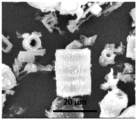
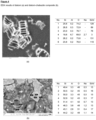
- Powder X-ray diffraction indicated that the zeolite chabazite had been formed (see Figure 2 ).
- Example 2 zeolite chabazite (CHA) is present in Example 2, which is consistent with the value of 55% determined by X-ray diffraction.
- CHA zeolite chabazite
- Materials were prepared in a similar manner to Example 1 with differing levels of chabazite zeolite content ranging from 20 to 40%. Materials were NH 4 + ion exchanged in a solution of NH 4 NO 3 , then filtered. The resulting materials were added to an aqueous solution of Cu(NO 3 ) 2 with stirring. The slurry was filtered, then washed and dried. The procedure can be repeated to achieve the desired metal loading of 3wt% (based on the zeolite content). The final product was calcined.
Landscapes
- Chemical & Material Sciences (AREA)
- Engineering & Computer Science (AREA)
- Chemical Kinetics & Catalysis (AREA)
- Organic Chemistry (AREA)
- Materials Engineering (AREA)
- Crystallography & Structural Chemistry (AREA)
- Combustion & Propulsion (AREA)
- Life Sciences & Earth Sciences (AREA)
- General Life Sciences & Earth Sciences (AREA)
- Geology (AREA)
- General Engineering & Computer Science (AREA)
- Mechanical Engineering (AREA)
- Health & Medical Sciences (AREA)
- Inorganic Chemistry (AREA)
- Ceramic Engineering (AREA)
- Toxicology (AREA)
- Physics & Mathematics (AREA)
- Thermal Sciences (AREA)
- Biomedical Technology (AREA)
- Environmental & Geological Engineering (AREA)
- Analytical Chemistry (AREA)
- General Chemical & Material Sciences (AREA)
- Oil, Petroleum & Natural Gas (AREA)
- Catalysts (AREA)
- Exhaust Gas Treatment By Means Of Catalyst (AREA)
- Silicates, Zeolites, And Molecular Sieves (AREA)
Claims (12)
- Verbundmaterial, umfassend ein makroporöses silikatbasiertes Material, wobei 30 bis 70 Gew.-% des makroporösen silikatbasierten Materials eine mikroporöse zeolithhaltige Struktur aufweisen, wobei der mikroporöse Zeolith entweder mit Kupfer, Eisen oder sowohl Kupfer als auch Eisen funktionalisiert ist, und wobei das Verbundmaterial in der Form von Partikeln vorliegt, wobei der mikroporöse Zeolith ein Zeolith mit kleinen Poren ist, der eine Ringgröße von maximal acht tetraedrischen Atomen enthält, wobei das makroporöse silikatbasierte Material Kieselgur umfasst.
- Verbundmaterial nach Anspruch 1, wobei der mikroporöse Zeolith ein Verhältnis von Siliciumdioxid zu Aluminiumoxid von 10 : 1 bis 50 : 1, vorzugsweise von 15 : 1 bis 30 : 1, aufweist.
- Verbundmaterial nach einem der vorstehenden Ansprüche, wobei der mikroporöse Zeolith aus den Gerüsttypcodes AEI, AFX, CHA, ERI und LEV ausgewählt ist, und/oder wobei der mikroporöse Zeolith ein Kupfer-Aluminium-Atomverhältnis von 0,25 bis 0,5, basierend auf dem Zeolithgehalt, aufweist.
- Verbundmaterial nach einem der vorstehenden Ansprüche, wobei das Verbundmaterial ein Porenvolumen von 0,1 bis 0,2 cm3/g aufweist, und/oder wobei die Partikel eine längste Abmessung von 1 µm bis 80 µm, vorzugsweise von 5 µm bis 40 µm, aufweisen.
- Verbundmaterial nach einem der vorstehenden Ansprüche, wobei die Mehrzahl der Makroporen des makroporösen silikatbasierten Materials einen Durchmesser von 100 nm bis 10 µm, vorzugsweise von 1 bis 10 µm, aufweisen.
- Verbundmaterial nach einem der vorstehenden Ansprüche, wobei mindestens einige der Partikel eine zylindrische Form aufweisen.
- Verfahren für die Herstellung des Verbundmaterials nach einem der vorstehenden Ansprüche, umfassend:i) Bereitstellen eines Gemisches, umfassend ein silikathaltiges Gerüst, das eine makroporöse Struktur aufweist, eine Aluminiumquelle und eine organische Matrize, wobei das silikathaltige Gerüst eine Kieselgur umfasst;ii) hydrothermales Behandeln des Gemisches, um eine mikroporöse zeolithhaltige Struktur, die im Wesentlichen die makroporöse Struktur des silikathaltigen Gerüsts behält, zu bilden;iii) Integrieren von Kupfer, Eisen oder sowohl von Kupfer als auch Eisen in den Zeolithen, wobei der Zeolith ein Zeolith mit kleinen Poren ist, der eine Ringgröße von maximal acht tetraedrischen Atomen enthält.
- Verfahren nach Anspruch 7, wobei das silikathaltige Gerüst eine zylindrische Struktur umfasst.
- SCR-Katalysatorzusammensetzung, umfassend das Verbundmaterial nach einem der Ansprüche 1 bis 6, vorzugsweise wobei die SCR-Katalysatorzusammensetzung ferner ein Vanadiumoxid, das auf einem Metalloxidträger aufgebracht ist, umfasst, ausgewählt aus Aluminiumoxid, Titandioxid, Zirconiumdioxid, Cerdioxid, Siliciumdioxid und Kombinationen davon.
- Katalytischer Artikel, umfassend ein Substrat, das mit der SCR-Katalysatorzusammensetzung nach Anspruch 9 beschichtet ist oder diese integriert, wobei das Substrat aus einem metallischen Durchflusssubstrat, einem keramischen Durchflusssubstrat, einem Wandstromfilter, einem Sintermetallfilter, einem Partialfilter und einer extrudierten Katalysatorwabe ausgewählt ist.
- Verwendung des Verbundmaterials nach einem der Ansprüche 1 bis 6, der SCR-Katalysatorzusammensetzung nach Anspruch 9 oder des katalytischen Artikels nach Anspruch 10 in einem Prozess selektiver katalytischer Reduktion (SCR).
- Emissionsbehandlungssystem zum Behandeln eines Stroms eines Verbrennungsabgases, das System umfassend eine Verbrennungsabgasquelle in Fluidverbindung mit der SCR- Katalysatorzusammensetzung nach Anspruch 9 oder dem katalytischen Artikel nach Anspruch 10 und eine Quelle stickstoffhaltigen Reduktionsmittels, die dem Artikel vorgelagert angeordnet ist.
Applications Claiming Priority (2)
| Application Number | Priority Date | Filing Date | Title |
|---|---|---|---|
| GB1705235.8A GB2560990A (en) | 2017-03-31 | 2017-03-31 | Composite material |
| PCT/GB2018/050870 WO2018178713A1 (en) | 2017-03-31 | 2018-03-29 | Composite material |
Publications (2)
| Publication Number | Publication Date |
|---|---|
| EP3601164A1 EP3601164A1 (de) | 2020-02-05 |
| EP3601164B1 true EP3601164B1 (de) | 2024-12-18 |
Family
ID=58682557
Family Applications (1)
| Application Number | Title | Priority Date | Filing Date |
|---|---|---|---|
| EP18715939.7A Active EP3601164B1 (de) | 2017-03-31 | 2018-03-29 | Verbundstoffmaterial |
Country Status (6)
| Country | Link |
|---|---|
| US (1) | US10828626B2 (de) |
| EP (1) | EP3601164B1 (de) |
| CN (1) | CN110770169A (de) |
| BR (1) | BR112019020388A2 (de) |
| GB (1) | GB2560990A (de) |
| WO (1) | WO2018178713A1 (de) |
Families Citing this family (1)
| Publication number | Priority date | Publication date | Assignee | Title |
|---|---|---|---|---|
| CN111085165A (zh) * | 2018-10-23 | 2020-05-01 | 中国海洋大学 | 一种表面矿化硅藻生物矿化硅的制备方法 |
Family Cites Families (23)
| Publication number | Priority date | Publication date | Assignee | Title |
|---|---|---|---|---|
| JPS6328452A (ja) * | 1986-07-22 | 1988-02-06 | Babcock Hitachi Kk | 窒素酸化物還元用触媒およびその製造方法 |
| US4961917A (en) | 1989-04-20 | 1990-10-09 | Engelhard Corporation | Method for reduction of nitrogen oxides with ammonia using promoted zeolite catalysts |
| GB9802504D0 (en) | 1998-02-06 | 1998-04-01 | Johnson Matthey Plc | Improvements in emission control |
| MX2009009095A (es) | 2007-02-27 | 2009-09-14 | Basf Catalysts Llc | Catalizadores de zeolita cha de cobre. |
| BRPI0810133B1 (pt) * | 2007-04-26 | 2023-01-17 | Johnson Matthey Public Limited Company | Método para converter óxidos de nitrogênio de um gás em nitrogênio, sistema de escapamento para um motor de combustão interna de queima pobre veicular, e, aparelho |
| JP5750701B2 (ja) * | 2009-10-14 | 2015-07-22 | ビーエーエスエフ ソシエタス・ヨーロピアBasf Se | NOxの選択的還元用の銅含有レビ沸石モレキュラーシーブ |
| GB2475740B (en) * | 2009-11-30 | 2017-06-07 | Johnson Matthey Plc | Catalysts for treating transient NOx emissions |
| US8293198B2 (en) * | 2009-12-18 | 2012-10-23 | Basf Corporation | Process of direct copper exchange into Na+-form of chabazite molecular sieve, and catalysts, systems and methods |
| US20120014866A1 (en) * | 2010-07-15 | 2012-01-19 | Ivor Bull | Copper Containing ZSM-34, OFF And/Or ERI Zeolitic Material For Selective Reduction Of NOx |
| US9289756B2 (en) * | 2010-07-15 | 2016-03-22 | Basf Se | Copper containing ZSM-34, OFF and/or ERI zeolitic material for selective reduction of NOx |
| US9221015B2 (en) * | 2010-07-15 | 2015-12-29 | Basf Se | Copper containing ZSM-34, OFF and/or ERI zeolitic material for selective reduction of NOx |
| JP6450521B2 (ja) * | 2010-12-02 | 2019-01-09 | ジョンソン、マッセイ、パブリック、リミテッド、カンパニーJohnson Matthey Public Limited Company | 金属含有ゼオライト触媒 |
| JP5938819B2 (ja) * | 2011-10-06 | 2016-06-22 | ジョンソン、マッセイ、パブリック、リミテッド、カンパニーJohnson Matthey Public Limited Company | 排気ガス処理用酸化触媒 |
| CN104080532A (zh) * | 2011-12-01 | 2014-10-01 | 庄信万丰股份有限公司 | 用于处理废气的催化剂 |
| CN104302394A (zh) * | 2012-04-11 | 2015-01-21 | 庄信万丰股份有限公司 | 含有金属的沸石催化剂 |
| GB2510284B (en) | 2012-08-17 | 2016-01-06 | Johnson Matthey Plc | Zeolite promoted v/ti/w catalysts |
| DE102014205760A1 (de) * | 2014-03-27 | 2015-10-01 | Johnson Matthey Public Limited Company | Verfahren zum Herstellen eines Katalysator sowie Katalysator |
| DE102014205783A1 (de) | 2014-03-27 | 2015-10-01 | Johnson Matthey Public Limited Company | Katalysator sowie Verfahren zum Herstellen eines Katalysator |
| US20150290632A1 (en) * | 2014-04-09 | 2015-10-15 | Ford Global Technologies, Llc | IRON AND COPPER-CONTAINING CHABAZITE ZEOLITE CATALYST FOR USE IN NOx REDUCTION |
| DE102014215112A1 (de) * | 2014-07-31 | 2016-02-04 | Johnson Matthey Public Limited Company | Verfahren zur Herstellung eines Katalysators sowie Katalysator-Artikel |
| GB201504986D0 (en) * | 2015-02-13 | 2015-05-06 | Johnson Matthey Plc | Oxidation catalyst for treating a natural gas emission |
| GB2547288B (en) * | 2016-02-03 | 2021-03-17 | Johnson Matthey Plc | Catalyst for oxidising ammonia |
| CN106145139B (zh) | 2016-06-27 | 2018-04-10 | 广州市威格林环保科技有限公司 | 一种内燃机尾气清洁处理催化剂及其制备方法 |
-
2017
- 2017-03-31 GB GB1705235.8A patent/GB2560990A/en not_active Withdrawn
-
2018
- 2018-03-29 WO PCT/GB2018/050870 patent/WO2018178713A1/en not_active Ceased
- 2018-03-29 CN CN201880021778.7A patent/CN110770169A/zh active Pending
- 2018-03-29 BR BR112019020388A patent/BR112019020388A2/pt not_active Application Discontinuation
- 2018-03-29 US US16/498,479 patent/US10828626B2/en active Active
- 2018-03-29 EP EP18715939.7A patent/EP3601164B1/de active Active
Also Published As
| Publication number | Publication date |
|---|---|
| US20200038850A1 (en) | 2020-02-06 |
| WO2018178713A1 (en) | 2018-10-04 |
| RU2019134773A (ru) | 2021-04-30 |
| GB2560990A (en) | 2018-10-03 |
| US10828626B2 (en) | 2020-11-10 |
| RU2019134773A3 (de) | 2021-06-03 |
| BR112019020388A2 (pt) | 2020-04-22 |
| EP3601164A1 (de) | 2020-02-05 |
| CN110770169A (zh) | 2020-02-07 |
| GB201705235D0 (en) | 2017-05-17 |
Similar Documents
| Publication | Publication Date | Title |
|---|---|---|
| Zhang et al. | Design and synthesis of core-shell structured meso-Cu-SSZ-13@ mesoporous aluminosilicate catalyst for SCR of NOx with NH3: Enhancement of activity, hydrothermal stability and propene poisoning resistance | |
| CN113811511B (zh) | 负载铁的小孔铝硅酸盐cha沸石以及制备负载金属的小孔铝硅酸盐cha沸石的方法 | |
| US11571682B2 (en) | Selective catalytic reduction catalyst composition | |
| EP2340103B1 (de) | Übergangsmetallhaltiger aluminosilicat-zeolith | |
| CN102666387B (zh) | 新型金属硅酸盐及其生产方法、氮氧化物除去催化剂及其生产方法和使用所述催化剂的氮氧化物除去方法 | |
| JP5958070B2 (ja) | β型鉄シリケート組成物及び窒素酸化物還元方法 | |
| JP5169779B2 (ja) | 窒素酸化物浄化触媒及び窒素酸化物浄化方法 | |
| JP5688096B2 (ja) | 鉄ゼオライト、鉄ゼオライトの製造方法、および亜酸化窒素の触媒還元方法 | |
| CN103282120B (zh) | 氮氧化物净化用催化剂 | |
| CN110300730A (zh) | 高二氧化硅aei沸石 | |
| KR20150131028A (ko) | 특정 입자 크기 분포를 갖는 금속 산화물 지지체 입자를 포함하는 촉매 조성물 | |
| JP2020513305A (ja) | 2価銅イオンを特定の比率で担持したゼオライト、その製造方法及びこれを含む触媒組成物 | |
| CN107548380B (zh) | 稳定化的微孔晶态材料、其制备方法和用于NOx的选择性催化还原的用途 | |
| CN116689018B (zh) | 一种以废fcc催化剂为原料合成的低温脱硝催化剂及其制备方法 | |
| CN103534027B (zh) | 用于氧化有机污染物的具有特别显著的疏水性的低温氧化催化剂 | |
| EP3601164B1 (de) | Verbundstoffmaterial | |
| JP5594121B2 (ja) | 新規メタロシリケート及び窒素酸化物浄化触媒 | |
| JPH11216358A (ja) | 炭化水素吸着剤及び排ガス浄化触媒 | |
| US11179707B2 (en) | Composite material | |
| WO2016046129A1 (en) | Thermally stable nh3-scr catalyst compositions | |
| RU2781191C2 (ru) | Композиционный материал | |
| TW202543725A (zh) | 氣相氨分解用的觸媒、觸媒本體、製程及氣相氨分解用的裝置 | |
| CN120922888A (zh) | 一种尿素改性制备zsm-5分子筛催化剂的方法及其应用 |
Legal Events
| Date | Code | Title | Description |
|---|---|---|---|
| STAA | Information on the status of an ep patent application or granted ep patent |
Free format text: STATUS: UNKNOWN |
|
| STAA | Information on the status of an ep patent application or granted ep patent |
Free format text: STATUS: THE INTERNATIONAL PUBLICATION HAS BEEN MADE |
|
| PUAI | Public reference made under article 153(3) epc to a published international application that has entered the european phase |
Free format text: ORIGINAL CODE: 0009012 |
|
| STAA | Information on the status of an ep patent application or granted ep patent |
Free format text: STATUS: REQUEST FOR EXAMINATION WAS MADE |
|
| 17P | Request for examination filed |
Effective date: 20190926 |
|
| AK | Designated contracting states |
Kind code of ref document: A1 Designated state(s): AL AT BE BG CH CY CZ DE DK EE ES FI FR GB GR HR HU IE IS IT LI LT LU LV MC MK MT NL NO PL PT RO RS SE SI SK SM TR |
|
| AX | Request for extension of the european patent |
Extension state: BA ME |
|
| DAV | Request for validation of the european patent (deleted) | ||
| DAX | Request for extension of the european patent (deleted) | ||
| STAA | Information on the status of an ep patent application or granted ep patent |
Free format text: STATUS: EXAMINATION IS IN PROGRESS |
|
| 17Q | First examination report despatched |
Effective date: 20210212 |
|
| P01 | Opt-out of the competence of the unified patent court (upc) registered |
Effective date: 20230526 |
|
| GRAP | Despatch of communication of intention to grant a patent |
Free format text: ORIGINAL CODE: EPIDOSNIGR1 |
|
| STAA | Information on the status of an ep patent application or granted ep patent |
Free format text: STATUS: GRANT OF PATENT IS INTENDED |
|
| INTG | Intention to grant announced |
Effective date: 20240926 |
|
| GRAS | Grant fee paid |
Free format text: ORIGINAL CODE: EPIDOSNIGR3 |
|
| GRAA | (expected) grant |
Free format text: ORIGINAL CODE: 0009210 |
|
| STAA | Information on the status of an ep patent application or granted ep patent |
Free format text: STATUS: THE PATENT HAS BEEN GRANTED |
|
| AK | Designated contracting states |
Kind code of ref document: B1 Designated state(s): AL AT BE BG CH CY CZ DE DK EE ES FI FR GB GR HR HU IE IS IT LI LT LU LV MC MK MT NL NO PL PT RO RS SE SI SK SM TR |
|
| REG | Reference to a national code |
Ref country code: GB Ref legal event code: FG4D |
|
| REG | Reference to a national code |
Ref country code: CH Ref legal event code: EP |
|
| REG | Reference to a national code |
Ref country code: DE Ref legal event code: R096 Ref document number: 602018077675 Country of ref document: DE |
|
| REG | Reference to a national code |
Ref country code: IE Ref legal event code: FG4D |
|
| REG | Reference to a national code |
Ref country code: LT Ref legal event code: MG9D |
|
| PG25 | Lapsed in a contracting state [announced via postgrant information from national office to epo] |
Ref country code: HR Free format text: LAPSE BECAUSE OF FAILURE TO SUBMIT A TRANSLATION OF THE DESCRIPTION OR TO PAY THE FEE WITHIN THE PRESCRIBED TIME-LIMIT Effective date: 20241218 |
|
| PG25 | Lapsed in a contracting state [announced via postgrant information from national office to epo] |
Ref country code: FI Free format text: LAPSE BECAUSE OF FAILURE TO SUBMIT A TRANSLATION OF THE DESCRIPTION OR TO PAY THE FEE WITHIN THE PRESCRIBED TIME-LIMIT Effective date: 20241218 |
|
| PG25 | Lapsed in a contracting state [announced via postgrant information from national office to epo] |
Ref country code: BG Free format text: LAPSE BECAUSE OF FAILURE TO SUBMIT A TRANSLATION OF THE DESCRIPTION OR TO PAY THE FEE WITHIN THE PRESCRIBED TIME-LIMIT Effective date: 20241218 |
|
| PG25 | Lapsed in a contracting state [announced via postgrant information from national office to epo] |
Ref country code: NO Free format text: LAPSE BECAUSE OF FAILURE TO SUBMIT A TRANSLATION OF THE DESCRIPTION OR TO PAY THE FEE WITHIN THE PRESCRIBED TIME-LIMIT Effective date: 20250318 |
|
| REG | Reference to a national code |
Ref country code: NL Ref legal event code: MP Effective date: 20241218 |
|
| PG25 | Lapsed in a contracting state [announced via postgrant information from national office to epo] |
Ref country code: GR Free format text: LAPSE BECAUSE OF FAILURE TO SUBMIT A TRANSLATION OF THE DESCRIPTION OR TO PAY THE FEE WITHIN THE PRESCRIBED TIME-LIMIT Effective date: 20250319 Ref country code: LV Free format text: LAPSE BECAUSE OF FAILURE TO SUBMIT A TRANSLATION OF THE DESCRIPTION OR TO PAY THE FEE WITHIN THE PRESCRIBED TIME-LIMIT Effective date: 20241218 |
|
| PG25 | Lapsed in a contracting state [announced via postgrant information from national office to epo] |
Ref country code: RS Free format text: LAPSE BECAUSE OF FAILURE TO SUBMIT A TRANSLATION OF THE DESCRIPTION OR TO PAY THE FEE WITHIN THE PRESCRIBED TIME-LIMIT Effective date: 20250318 |
|
| PG25 | Lapsed in a contracting state [announced via postgrant information from national office to epo] |
Ref country code: NL Free format text: LAPSE BECAUSE OF FAILURE TO SUBMIT A TRANSLATION OF THE DESCRIPTION OR TO PAY THE FEE WITHIN THE PRESCRIBED TIME-LIMIT Effective date: 20241218 |
|
| REG | Reference to a national code |
Ref country code: AT Ref legal event code: MK05 Ref document number: 1752143 Country of ref document: AT Kind code of ref document: T Effective date: 20241218 |
|
| PG25 | Lapsed in a contracting state [announced via postgrant information from national office to epo] |
Ref country code: SM Free format text: LAPSE BECAUSE OF FAILURE TO SUBMIT A TRANSLATION OF THE DESCRIPTION OR TO PAY THE FEE WITHIN THE PRESCRIBED TIME-LIMIT Effective date: 20241218 |
|
| PG25 | Lapsed in a contracting state [announced via postgrant information from national office to epo] |
Ref country code: PL Free format text: LAPSE BECAUSE OF FAILURE TO SUBMIT A TRANSLATION OF THE DESCRIPTION OR TO PAY THE FEE WITHIN THE PRESCRIBED TIME-LIMIT Effective date: 20241218 |
|
| PG25 | Lapsed in a contracting state [announced via postgrant information from national office to epo] |
Ref country code: ES Free format text: LAPSE BECAUSE OF FAILURE TO SUBMIT A TRANSLATION OF THE DESCRIPTION OR TO PAY THE FEE WITHIN THE PRESCRIBED TIME-LIMIT Effective date: 20241218 |
|
| PG25 | Lapsed in a contracting state [announced via postgrant information from national office to epo] |
Ref country code: IS Free format text: LAPSE BECAUSE OF FAILURE TO SUBMIT A TRANSLATION OF THE DESCRIPTION OR TO PAY THE FEE WITHIN THE PRESCRIBED TIME-LIMIT Effective date: 20250418 |
|
| PG25 | Lapsed in a contracting state [announced via postgrant information from national office to epo] |
Ref country code: PT Free format text: LAPSE BECAUSE OF FAILURE TO SUBMIT A TRANSLATION OF THE DESCRIPTION OR TO PAY THE FEE WITHIN THE PRESCRIBED TIME-LIMIT Effective date: 20250421 |
|
| PG25 | Lapsed in a contracting state [announced via postgrant information from national office to epo] |
Ref country code: EE Free format text: LAPSE BECAUSE OF FAILURE TO SUBMIT A TRANSLATION OF THE DESCRIPTION OR TO PAY THE FEE WITHIN THE PRESCRIBED TIME-LIMIT Effective date: 20241218 |
|
| PG25 | Lapsed in a contracting state [announced via postgrant information from national office to epo] |
Ref country code: AT Free format text: LAPSE BECAUSE OF FAILURE TO SUBMIT A TRANSLATION OF THE DESCRIPTION OR TO PAY THE FEE WITHIN THE PRESCRIBED TIME-LIMIT Effective date: 20241218 Ref country code: RO Free format text: LAPSE BECAUSE OF FAILURE TO SUBMIT A TRANSLATION OF THE DESCRIPTION OR TO PAY THE FEE WITHIN THE PRESCRIBED TIME-LIMIT Effective date: 20241218 |
|
| PG25 | Lapsed in a contracting state [announced via postgrant information from national office to epo] |
Ref country code: SK Free format text: LAPSE BECAUSE OF FAILURE TO SUBMIT A TRANSLATION OF THE DESCRIPTION OR TO PAY THE FEE WITHIN THE PRESCRIBED TIME-LIMIT Effective date: 20241218 |
|
| PG25 | Lapsed in a contracting state [announced via postgrant information from national office to epo] |
Ref country code: CZ Free format text: LAPSE BECAUSE OF FAILURE TO SUBMIT A TRANSLATION OF THE DESCRIPTION OR TO PAY THE FEE WITHIN THE PRESCRIBED TIME-LIMIT Effective date: 20241218 |
|
| PG25 | Lapsed in a contracting state [announced via postgrant information from national office to epo] |
Ref country code: IT Free format text: LAPSE BECAUSE OF FAILURE TO SUBMIT A TRANSLATION OF THE DESCRIPTION OR TO PAY THE FEE WITHIN THE PRESCRIBED TIME-LIMIT Effective date: 20241218 |
|
| PG25 | Lapsed in a contracting state [announced via postgrant information from national office to epo] |
Ref country code: SE Free format text: LAPSE BECAUSE OF FAILURE TO SUBMIT A TRANSLATION OF THE DESCRIPTION OR TO PAY THE FEE WITHIN THE PRESCRIBED TIME-LIMIT Effective date: 20241218 |
|
| REG | Reference to a national code |
Ref country code: DE Ref legal event code: R097 Ref document number: 602018077675 Country of ref document: DE |
|
| PG25 | Lapsed in a contracting state [announced via postgrant information from national office to epo] |
Ref country code: DK Free format text: LAPSE BECAUSE OF FAILURE TO SUBMIT A TRANSLATION OF THE DESCRIPTION OR TO PAY THE FEE WITHIN THE PRESCRIBED TIME-LIMIT Effective date: 20241218 |
|
| PG25 | Lapsed in a contracting state [announced via postgrant information from national office to epo] |
Ref country code: MC Free format text: LAPSE BECAUSE OF FAILURE TO SUBMIT A TRANSLATION OF THE DESCRIPTION OR TO PAY THE FEE WITHIN THE PRESCRIBED TIME-LIMIT Effective date: 20241218 |
|
| REG | Reference to a national code |
Ref country code: CH Ref legal event code: H13 Free format text: ST27 STATUS EVENT CODE: U-0-0-H10-H13 (AS PROVIDED BY THE NATIONAL OFFICE) Effective date: 20251023 |
|
| PLBE | No opposition filed within time limit |
Free format text: ORIGINAL CODE: 0009261 |
|
| STAA | Information on the status of an ep patent application or granted ep patent |
Free format text: STATUS: NO OPPOSITION FILED WITHIN TIME LIMIT |
|
| PG25 | Lapsed in a contracting state [announced via postgrant information from national office to epo] |
Ref country code: LU Free format text: LAPSE BECAUSE OF NON-PAYMENT OF DUE FEES Effective date: 20250329 |
|
| 26N | No opposition filed |
Effective date: 20250919 |
|
| REG | Reference to a national code |
Ref country code: BE Ref legal event code: MM Effective date: 20250331 |
|
| PG25 | Lapsed in a contracting state [announced via postgrant information from national office to epo] |
Ref country code: FR Free format text: LAPSE BECAUSE OF NON-PAYMENT OF DUE FEES Effective date: 20250331 |
|
| PG25 | Lapsed in a contracting state [announced via postgrant information from national office to epo] |
Ref country code: BE Free format text: LAPSE BECAUSE OF NON-PAYMENT OF DUE FEES Effective date: 20250331 |
|
| PG25 | Lapsed in a contracting state [announced via postgrant information from national office to epo] |
Ref country code: CH Free format text: LAPSE BECAUSE OF NON-PAYMENT OF DUE FEES Effective date: 20250331 |
|
| PG25 | Lapsed in a contracting state [announced via postgrant information from national office to epo] |
Ref country code: IE Free format text: LAPSE BECAUSE OF NON-PAYMENT OF DUE FEES Effective date: 20250329 |
|
| PGFP | Annual fee paid to national office [announced via postgrant information from national office to epo] |
Ref country code: GB Payment date: 20260220 Year of fee payment: 9 |
|
| PGFP | Annual fee paid to national office [announced via postgrant information from national office to epo] |
Ref country code: DE Payment date: 20260219 Year of fee payment: 9 |