EP3603591B1 - Couche jetable de type bande - Google Patents
Couche jetable de type bande Download PDFInfo
- Publication number
- EP3603591B1 EP3603591B1 EP18774942.9A EP18774942A EP3603591B1 EP 3603591 B1 EP3603591 B1 EP 3603591B1 EP 18774942 A EP18774942 A EP 18774942A EP 3603591 B1 EP3603591 B1 EP 3603591B1
- Authority
- EP
- European Patent Office
- Prior art keywords
- sheet
- folded
- main body
- tape
- stretchable region
- Prior art date
- Legal status (The legal status is an assumption and is not a legal conclusion. Google has not performed a legal analysis and makes no representation as to the accuracy of the status listed.)
- Active
Links
Images






Classifications
-
- A—HUMAN NECESSITIES
- A61—MEDICAL OR VETERINARY SCIENCE; HYGIENE
- A61F—FILTERS IMPLANTABLE INTO BLOOD VESSELS; PROSTHESES; DEVICES PROVIDING PATENCY TO, OR PREVENTING COLLAPSING OF, TUBULAR STRUCTURES OF THE BODY, e.g. STENTS; ORTHOPAEDIC, NURSING OR CONTRACEPTIVE DEVICES; FOMENTATION; TREATMENT OR PROTECTION OF EYES OR EARS; BANDAGES, DRESSINGS OR ABSORBENT PADS; FIRST-AID KITS
- A61F13/00—Bandages or dressings; Absorbent pads
- A61F13/15—Absorbent pads, e.g. sanitary towels, swabs or tampons for external or internal application to the body; Supporting or fastening means therefor; Tampon applicators
- A61F13/45—Absorbent pads, e.g. sanitary towels, swabs or tampons for external or internal application to the body; Supporting or fastening means therefor; Tampon applicators characterised by the shape
- A61F13/49—Absorbent pads, e.g. sanitary towels, swabs or tampons for external or internal application to the body; Supporting or fastening means therefor; Tampon applicators characterised by the shape specially adapted to be worn around the waist, e.g. diapers, nappies
- A61F13/496—Absorbent pads, e.g. sanitary towels, swabs or tampons for external or internal application to the body; Supporting or fastening means therefor; Tampon applicators characterised by the shape specially adapted to be worn around the waist, e.g. diapers, nappies in the form of pants or briefs
-
- A—HUMAN NECESSITIES
- A61—MEDICAL OR VETERINARY SCIENCE; HYGIENE
- A61F—FILTERS IMPLANTABLE INTO BLOOD VESSELS; PROSTHESES; DEVICES PROVIDING PATENCY TO, OR PREVENTING COLLAPSING OF, TUBULAR STRUCTURES OF THE BODY, e.g. STENTS; ORTHOPAEDIC, NURSING OR CONTRACEPTIVE DEVICES; FOMENTATION; TREATMENT OR PROTECTION OF EYES OR EARS; BANDAGES, DRESSINGS OR ABSORBENT PADS; FIRST-AID KITS
- A61F13/00—Bandages or dressings; Absorbent pads
- A61F13/15—Absorbent pads, e.g. sanitary towels, swabs or tampons for external or internal application to the body; Supporting or fastening means therefor; Tampon applicators
- A61F13/45—Absorbent pads, e.g. sanitary towels, swabs or tampons for external or internal application to the body; Supporting or fastening means therefor; Tampon applicators characterised by the shape
- A61F13/49—Absorbent pads, e.g. sanitary towels, swabs or tampons for external or internal application to the body; Supporting or fastening means therefor; Tampon applicators characterised by the shape specially adapted to be worn around the waist, e.g. diapers, nappies
- A61F13/49007—Form-fitting, self-adjusting disposable diapers
- A61F13/49009—Form-fitting, self-adjusting disposable diapers with elastic means
- A61F13/49011—Form-fitting, self-adjusting disposable diapers with elastic means the elastic means is located at the waist region
-
- A—HUMAN NECESSITIES
- A61—MEDICAL OR VETERINARY SCIENCE; HYGIENE
- A61F—FILTERS IMPLANTABLE INTO BLOOD VESSELS; PROSTHESES; DEVICES PROVIDING PATENCY TO, OR PREVENTING COLLAPSING OF, TUBULAR STRUCTURES OF THE BODY, e.g. STENTS; ORTHOPAEDIC, NURSING OR CONTRACEPTIVE DEVICES; FOMENTATION; TREATMENT OR PROTECTION OF EYES OR EARS; BANDAGES, DRESSINGS OR ABSORBENT PADS; FIRST-AID KITS
- A61F13/00—Bandages or dressings; Absorbent pads
- A61F13/15—Absorbent pads, e.g. sanitary towels, swabs or tampons for external or internal application to the body; Supporting or fastening means therefor; Tampon applicators
- A61F13/45—Absorbent pads, e.g. sanitary towels, swabs or tampons for external or internal application to the body; Supporting or fastening means therefor; Tampon applicators characterised by the shape
- A61F13/49—Absorbent pads, e.g. sanitary towels, swabs or tampons for external or internal application to the body; Supporting or fastening means therefor; Tampon applicators characterised by the shape specially adapted to be worn around the waist, e.g. diapers, nappies
- A61F13/49007—Form-fitting, self-adjusting disposable diapers
- A61F13/49009—Form-fitting, self-adjusting disposable diapers with elastic means
- A61F13/49011—Form-fitting, self-adjusting disposable diapers with elastic means the elastic means is located at the waist region
- A61F13/49012—Form-fitting, self-adjusting disposable diapers with elastic means the elastic means is located at the waist region the elastic means being elastic panels
-
- A—HUMAN NECESSITIES
- A61—MEDICAL OR VETERINARY SCIENCE; HYGIENE
- A61F—FILTERS IMPLANTABLE INTO BLOOD VESSELS; PROSTHESES; DEVICES PROVIDING PATENCY TO, OR PREVENTING COLLAPSING OF, TUBULAR STRUCTURES OF THE BODY, e.g. STENTS; ORTHOPAEDIC, NURSING OR CONTRACEPTIVE DEVICES; FOMENTATION; TREATMENT OR PROTECTION OF EYES OR EARS; BANDAGES, DRESSINGS OR ABSORBENT PADS; FIRST-AID KITS
- A61F13/00—Bandages or dressings; Absorbent pads
- A61F13/15—Absorbent pads, e.g. sanitary towels, swabs or tampons for external or internal application to the body; Supporting or fastening means therefor; Tampon applicators
- A61F13/15577—Apparatus or processes for manufacturing
- A61F13/15585—Apparatus or processes for manufacturing of babies' napkins, e.g. diapers
-
- A—HUMAN NECESSITIES
- A61—MEDICAL OR VETERINARY SCIENCE; HYGIENE
- A61F—FILTERS IMPLANTABLE INTO BLOOD VESSELS; PROSTHESES; DEVICES PROVIDING PATENCY TO, OR PREVENTING COLLAPSING OF, TUBULAR STRUCTURES OF THE BODY, e.g. STENTS; ORTHOPAEDIC, NURSING OR CONTRACEPTIVE DEVICES; FOMENTATION; TREATMENT OR PROTECTION OF EYES OR EARS; BANDAGES, DRESSINGS OR ABSORBENT PADS; FIRST-AID KITS
- A61F13/00—Bandages or dressings; Absorbent pads
- A61F13/15—Absorbent pads, e.g. sanitary towels, swabs or tampons for external or internal application to the body; Supporting or fastening means therefor; Tampon applicators
- A61F13/15577—Apparatus or processes for manufacturing
- A61F13/15756—Applying tabs, strips, tapes, loops; Knotting the ends of pads
-
- A—HUMAN NECESSITIES
- A61—MEDICAL OR VETERINARY SCIENCE; HYGIENE
- A61F—FILTERS IMPLANTABLE INTO BLOOD VESSELS; PROSTHESES; DEVICES PROVIDING PATENCY TO, OR PREVENTING COLLAPSING OF, TUBULAR STRUCTURES OF THE BODY, e.g. STENTS; ORTHOPAEDIC, NURSING OR CONTRACEPTIVE DEVICES; FOMENTATION; TREATMENT OR PROTECTION OF EYES OR EARS; BANDAGES, DRESSINGS OR ABSORBENT PADS; FIRST-AID KITS
- A61F13/00—Bandages or dressings; Absorbent pads
- A61F13/15—Absorbent pads, e.g. sanitary towels, swabs or tampons for external or internal application to the body; Supporting or fastening means therefor; Tampon applicators
- A61F13/45—Absorbent pads, e.g. sanitary towels, swabs or tampons for external or internal application to the body; Supporting or fastening means therefor; Tampon applicators characterised by the shape
- A61F13/49—Absorbent pads, e.g. sanitary towels, swabs or tampons for external or internal application to the body; Supporting or fastening means therefor; Tampon applicators characterised by the shape specially adapted to be worn around the waist, e.g. diapers, nappies
- A61F13/49007—Form-fitting, self-adjusting disposable diapers
- A61F13/49009—Form-fitting, self-adjusting disposable diapers with elastic means
- A61F13/49014—Form-fitting, self-adjusting disposable diapers with elastic means the elastic means is located at the side panels
-
- A—HUMAN NECESSITIES
- A61—MEDICAL OR VETERINARY SCIENCE; HYGIENE
- A61F—FILTERS IMPLANTABLE INTO BLOOD VESSELS; PROSTHESES; DEVICES PROVIDING PATENCY TO, OR PREVENTING COLLAPSING OF, TUBULAR STRUCTURES OF THE BODY, e.g. STENTS; ORTHOPAEDIC, NURSING OR CONTRACEPTIVE DEVICES; FOMENTATION; TREATMENT OR PROTECTION OF EYES OR EARS; BANDAGES, DRESSINGS OR ABSORBENT PADS; FIRST-AID KITS
- A61F13/00—Bandages or dressings; Absorbent pads
- A61F13/15—Absorbent pads, e.g. sanitary towels, swabs or tampons for external or internal application to the body; Supporting or fastening means therefor; Tampon applicators
- A61F13/56—Supporting or fastening means
- A61F13/5622—Supporting or fastening means specially adapted for diapers or the like
- A61F13/5633—Supporting or fastening means specially adapted for diapers or the like open type diaper
- A61F13/5638—Supporting or fastening means specially adapted for diapers or the like open type diaper adjustable open type diapers
-
- A—HUMAN NECESSITIES
- A61—MEDICAL OR VETERINARY SCIENCE; HYGIENE
- A61F—FILTERS IMPLANTABLE INTO BLOOD VESSELS; PROSTHESES; DEVICES PROVIDING PATENCY TO, OR PREVENTING COLLAPSING OF, TUBULAR STRUCTURES OF THE BODY, e.g. STENTS; ORTHOPAEDIC, NURSING OR CONTRACEPTIVE DEVICES; FOMENTATION; TREATMENT OR PROTECTION OF EYES OR EARS; BANDAGES, DRESSINGS OR ABSORBENT PADS; FIRST-AID KITS
- A61F13/00—Bandages or dressings; Absorbent pads
- A61F13/15—Absorbent pads, e.g. sanitary towels, swabs or tampons for external or internal application to the body; Supporting or fastening means therefor; Tampon applicators
- A61F13/56—Supporting or fastening means
- A61F13/58—Adhesive tab fastener elements
-
- A—HUMAN NECESSITIES
- A61—MEDICAL OR VETERINARY SCIENCE; HYGIENE
- A61F—FILTERS IMPLANTABLE INTO BLOOD VESSELS; PROSTHESES; DEVICES PROVIDING PATENCY TO, OR PREVENTING COLLAPSING OF, TUBULAR STRUCTURES OF THE BODY, e.g. STENTS; ORTHOPAEDIC, NURSING OR CONTRACEPTIVE DEVICES; FOMENTATION; TREATMENT OR PROTECTION OF EYES OR EARS; BANDAGES, DRESSINGS OR ABSORBENT PADS; FIRST-AID KITS
- A61F13/00—Bandages or dressings; Absorbent pads
- A61F13/15—Absorbent pads, e.g. sanitary towels, swabs or tampons for external or internal application to the body; Supporting or fastening means therefor; Tampon applicators
- A61F13/56—Supporting or fastening means
- A61F13/5622—Supporting or fastening means specially adapted for diapers or the like
-
- A—HUMAN NECESSITIES
- A61—MEDICAL OR VETERINARY SCIENCE; HYGIENE
- A61F—FILTERS IMPLANTABLE INTO BLOOD VESSELS; PROSTHESES; DEVICES PROVIDING PATENCY TO, OR PREVENTING COLLAPSING OF, TUBULAR STRUCTURES OF THE BODY, e.g. STENTS; ORTHOPAEDIC, NURSING OR CONTRACEPTIVE DEVICES; FOMENTATION; TREATMENT OR PROTECTION OF EYES OR EARS; BANDAGES, DRESSINGS OR ABSORBENT PADS; FIRST-AID KITS
- A61F13/00—Bandages or dressings; Absorbent pads
- A61F13/15—Absorbent pads, e.g. sanitary towels, swabs or tampons for external or internal application to the body; Supporting or fastening means therefor; Tampon applicators
- A61F13/45—Absorbent pads, e.g. sanitary towels, swabs or tampons for external or internal application to the body; Supporting or fastening means therefor; Tampon applicators characterised by the shape
- A61F13/49—Absorbent pads, e.g. sanitary towels, swabs or tampons for external or internal application to the body; Supporting or fastening means therefor; Tampon applicators characterised by the shape specially adapted to be worn around the waist, e.g. diapers, nappies
- A61F13/49007—Form-fitting, self-adjusting disposable diapers
- A61F13/49009—Form-fitting, self-adjusting disposable diapers with elastic means
- A61F13/4902—Form-fitting, self-adjusting disposable diapers with elastic means characterised by the elastic material
- A61F2013/49022—Form-fitting, self-adjusting disposable diapers with elastic means characterised by the elastic material being elastomeric sheet
-
- A—HUMAN NECESSITIES
- A61—MEDICAL OR VETERINARY SCIENCE; HYGIENE
- A61F—FILTERS IMPLANTABLE INTO BLOOD VESSELS; PROSTHESES; DEVICES PROVIDING PATENCY TO, OR PREVENTING COLLAPSING OF, TUBULAR STRUCTURES OF THE BODY, e.g. STENTS; ORTHOPAEDIC, NURSING OR CONTRACEPTIVE DEVICES; FOMENTATION; TREATMENT OR PROTECTION OF EYES OR EARS; BANDAGES, DRESSINGS OR ABSORBENT PADS; FIRST-AID KITS
- A61F13/00—Bandages or dressings; Absorbent pads
- A61F13/15—Absorbent pads, e.g. sanitary towels, swabs or tampons for external or internal application to the body; Supporting or fastening means therefor; Tampon applicators
- A61F13/45—Absorbent pads, e.g. sanitary towels, swabs or tampons for external or internal application to the body; Supporting or fastening means therefor; Tampon applicators characterised by the shape
- A61F13/49—Absorbent pads, e.g. sanitary towels, swabs or tampons for external or internal application to the body; Supporting or fastening means therefor; Tampon applicators characterised by the shape specially adapted to be worn around the waist, e.g. diapers, nappies
- A61F13/49007—Form-fitting, self-adjusting disposable diapers
- A61F13/49009—Form-fitting, self-adjusting disposable diapers with elastic means
- A61F13/4902—Form-fitting, self-adjusting disposable diapers with elastic means characterised by the elastic material
- A61F2013/49025—Form-fitting, self-adjusting disposable diapers with elastic means characterised by the elastic material having multiple elastic strands
-
- A—HUMAN NECESSITIES
- A61—MEDICAL OR VETERINARY SCIENCE; HYGIENE
- A61F—FILTERS IMPLANTABLE INTO BLOOD VESSELS; PROSTHESES; DEVICES PROVIDING PATENCY TO, OR PREVENTING COLLAPSING OF, TUBULAR STRUCTURES OF THE BODY, e.g. STENTS; ORTHOPAEDIC, NURSING OR CONTRACEPTIVE DEVICES; FOMENTATION; TREATMENT OR PROTECTION OF EYES OR EARS; BANDAGES, DRESSINGS OR ABSORBENT PADS; FIRST-AID KITS
- A61F13/00—Bandages or dressings; Absorbent pads
- A61F13/15—Absorbent pads, e.g. sanitary towels, swabs or tampons for external or internal application to the body; Supporting or fastening means therefor; Tampon applicators
- A61F13/45—Absorbent pads, e.g. sanitary towels, swabs or tampons for external or internal application to the body; Supporting or fastening means therefor; Tampon applicators characterised by the shape
- A61F13/49—Absorbent pads, e.g. sanitary towels, swabs or tampons for external or internal application to the body; Supporting or fastening means therefor; Tampon applicators characterised by the shape specially adapted to be worn around the waist, e.g. diapers, nappies
- A61F13/49007—Form-fitting, self-adjusting disposable diapers
- A61F2013/49042—Form-fitting, self-adjusting disposable diapers with only stretchable part, i.e. part being not elastic but only extensible with not a full recovery of its original length
-
- A—HUMAN NECESSITIES
- A61—MEDICAL OR VETERINARY SCIENCE; HYGIENE
- A61F—FILTERS IMPLANTABLE INTO BLOOD VESSELS; PROSTHESES; DEVICES PROVIDING PATENCY TO, OR PREVENTING COLLAPSING OF, TUBULAR STRUCTURES OF THE BODY, e.g. STENTS; ORTHOPAEDIC, NURSING OR CONTRACEPTIVE DEVICES; FOMENTATION; TREATMENT OR PROTECTION OF EYES OR EARS; BANDAGES, DRESSINGS OR ABSORBENT PADS; FIRST-AID KITS
- A61F13/00—Bandages or dressings; Absorbent pads
- A61F13/15—Absorbent pads, e.g. sanitary towels, swabs or tampons for external or internal application to the body; Supporting or fastening means therefor; Tampon applicators
- A61F13/45—Absorbent pads, e.g. sanitary towels, swabs or tampons for external or internal application to the body; Supporting or fastening means therefor; Tampon applicators characterised by the shape
- A61F13/49—Absorbent pads, e.g. sanitary towels, swabs or tampons for external or internal application to the body; Supporting or fastening means therefor; Tampon applicators characterised by the shape specially adapted to be worn around the waist, e.g. diapers, nappies
- A61F13/49007—Form-fitting, self-adjusting disposable diapers
- A61F2013/49042—Form-fitting, self-adjusting disposable diapers with only stretchable part, i.e. part being not elastic but only extensible with not a full recovery of its original length
- A61F2013/49052—Form-fitting, self-adjusting disposable diapers with only stretchable part, i.e. part being not elastic but only extensible with not a full recovery of its original length having a specific direction of stretchability
- A61F2013/49055—Form-fitting, self-adjusting disposable diapers with only stretchable part, i.e. part being not elastic but only extensible with not a full recovery of its original length having a specific direction of stretchability being stretchable in transversal direction or cross machine direction
Definitions
- the present invention relates to a so-called tape-type disposable diaper
- the tape-type disposable diaper is worn by attaching the diaper to a body in an unfolded state and then connecting fastening tapes protruding from both sides of a dorsal side portion to an outer surface of a ventral side portion.
- a general tape-type disposable diaper includes: a main body having a ventral side portion extending to a front side of the center in a front-back direction and a dorsal side portion extending to a back side of the center in the front-back direction; and fastening tapes protruding from both side portions of the dorsal side portion, and has a structure in which the fastening tapes are brought to an outer surface of the ventral side portion from both sides of a waist to be connected to an outer surface of the ventral side portion at the time of attaching the diaper to a body.
- Such a tape-type disposable diaper is used not only for babies but also widely used in nursing applications (adult applications).
- the tape-type disposable diaper has poorer fitting in a lower torso direction than an underpants-type disposable diaper. Therefore, it has been proposed to enhance fitting with respect to a lower torso by disposing a stretchable region in a width direction in a lower torso portion of a dorsal side portion or disposing a stretchable region in the width direction in the fastening tape (for example, see Patent Literatures 1 to 3).
- a stretchable region in the width direction is disposed in a lower torso portion of a dorsal side portion, and a stretchable region in the width direction is disposed in the fastening tape because elasticity can be imparted to a wider range.
- a stretchable region cannot be disposed over the entire waist stretching sheet in the width direction, and sufficient elasticity cannot be imparted to a lower torso only with the waist stretching sheet.
- the stretchable regions are separated from each other not a little in the width direction, and it is difficult to form a continuous stretchable region across the left and right fastening tapes.
- a main object of the present invention is to make it possible to widen a stretching range of a waist stretching sheet in order to enhance fitting with respect to a lower torso.
- a tape-type disposable diaper according to claim 1.
- the portion having the non-stretchable region in the main body is folded back to the center side and fixed. Therefore, the (unavoidably formed) width of the non-stretchable region of the waist stretching sheet occupied in the width of the main body can be reduced. As a result, a stretching range of the waist stretching sheet can be wide.
- each of the fastening tapes has a tape stretchable region that is disposed in a portion between the base portion and the connecting portion and expands and contracts in the width direction, and the fastening tapes are attached to the main body such that a base edge of the tape stretchable region is located within a range of ⁇ 5 mm in the width direction from a side edge of the main body stretchable region.
- the portion having the non-stretchable region in the main body is folded back to the center side and fixed. Therefore, the (unavoidably formed) width of the non-stretchable region of the waist stretching sheet occupied in the width of the main body can be reduced. As a result, continuity of the stretchable region across the left and right fastening tapes can be improved.
- the folded-back portion can have such a structure as in the present aspect.
- the base portion of the fastening tape to a back surface of a portion having the folded-back portion in the side flap portion, not only the strength of a portion where a force is concentrated during use (a portion where the fastening tape is attached) is high, but also no force to peel off the folded-back portion is applied advantageously.
- a texture of a surface on the skin side is not impaired.
- the folded-back portion can have such a structure as in the present aspect.
- the strength of a portion where a force is concentrated during use (a portion where the fastening tape is attached) is high.
- the base portion of the fastening tape is not exposed, and a hard material such as the outer sheet is not exposed due to covering of the front surface side of the folded-back portion with the side of the gather sheet. Therefore, a texture is not impaired.
- the folded-back portion can have such a structure as in the present aspect.
- the strength of a portion where a force is concentrated during use (a portion where the fastening tape is attached) is high.
- a texture of a surface on the skin side is not impaired.
- the tape-type disposable diaper according to any one of the third to fifth aspects, in which the folded-back portion does not include the liquid impervious sheet.
- the folded-back portion increases a thickness thereof and tends to be hard, and therefore preferably has a structure not including a liquid impervious sheet that particularly tends to be hard.
- the fastening tape is disposed outside the main body, and the base portion of the fastening tape is fixed to the back surface side of the main body.
- the main body has the folded-back portion and has the fastener folded-back portion outside the folded-back portion.
- the fastener folded-back portion is releasably and temporarily fixed to the folded-back portion of the main body.
- Such a structure can be manufactured, at the time of manufacture, by disposing the fastening tape such that a site serving as a base portion of the fastening tape is located at a site serving as a back surface side of the main body and extends to a site serving as the folded-back portion of the main body in an unfolded state before the folded-back portion of the main body is formed, fixing the site serving as the base portion of the fastening tape to the main body, releasably and temporarily fixing the fastening tape to the site serving as the folded-back portion of the main body, and then folding back both side portions of the main body and the fastening tape integrally to form the folded-back portion of the main body and the fastener folded-back portion.
- the fastening tape is integrated with the main body at two places of the base portion and the temporarily fixed portion. Therefore, folding back of the fastening tape is unlikely to be unsuitable. As a result, according to the present aspect, it is possible to effectively prevent positional deviation of the folded-back portion of the fastening tape.
- the fastener folded-back portion in the fastening tape is only temporarily fixed to the folded-back portion of the main body. Therefore, at the time of use, by releasing the temporary fixing by unfolding the fastener folded-back portion to a lateral side, a portion having the connecting portion in the fastening tape protrudes from a side edge of the folded-back portion of the main body.
- the diaper according to the present aspect can be used similarly to a conventional one except for inclusion of the folded-back portion in the main body.
- the entire connecting portion of the fastener folded-back portion may be temporarily fixed to the folded-back portion of the main body.
- a part of the connecting portion is preferably located on the width direction center side of the folded-back portion of the main body to form the projecting portion because the connecting portion is easily peeled off when the fastener folded-back portion is unfolded.
- the tape-type disposable diaper according to the seventh or eighth aspect in which the gather sheet extends only to an end portion on a width direction center side of the folded-back portion of the main body.
- the portion having the folded-back portion in the main body increases a thickness thereof by folding-back and easily impairs air permeability and flexibility. Therefore, the width of the gather sheet is preferably narrowed as in the present aspect because it is possible to reduce a region where the folded-back portion of the main body of the outer sheet overlaps with the gather sheet to increase the thickness and to suppress a decrease in air permeability and flexibility.
- the tape-type disposable diaper according to the seventh or eighth aspect in which the folded-back portion of the main body extends to the rising portion of the rising gather and is bonded to the rising gather.
- the present aspect when the outer side of the rising portion of the rising gather is covered with the folded-back portion of the main body, the number of stacked layers of a material of the rising gather is increased, and a liquid impervious property can be improved.
- the present aspect is suitable in a case where a water shielding film is not incorporated in the rising gather.
- the tape-type disposable diaper according to any one of the seventh to tenth aspects, in which a sheet on a backmost side of the main body is formed of a perforated nonwoven fabric having many holes passing through the sheet from the front to the back at intervals, and at least the folded-back portion of the main body has the many holes.
- the portion having the folded-back portion in the main body increases a thickness thereof by folding-back and easily impairs air permeability and flexibility. Therefore, as in the present aspect, the folded-back portion of the main body is preferably formed of the perforated nonwoven fabric having excellent flexibility and air permeability.
- the tape-type disposable diaper according to any one of the seventh to tenth aspects, in which the folded-back portion of the main body is bonded to a sheet adjacent to a back surface side of the folded-back portion of the main body via a hot melt adhesive disposed in an intermittent pattern.
- the portion having the folded-back portion in the main body increases a thickness thereof by folding-back and easily impairs air permeability and flexibility. Therefore, as in the present aspect, the folded-back portion of the main body is preferably fixed by intermittent adhesion to suppress a decrease in air permeability and flexibility in a region having the folded-back portion of the main body.
- a method for manufacturing the tape-type disposable diaper according to the seventh aspect is also described, the method including:
- the fastening tape is integrated with the main body at two places of the base portion and the temporarily fixed portion. Therefore, folding back of the fastening tape is unlikely to be unsuitable. As a result, according to the present aspect, it is possible to effectively prevent positional deviation of the folded-back portion of the fastening tape.
- the stretching range of the waist stretching sheet can be wide, and fitting to a lower torso can be enhanced advantageously.
- a dotted pattern portion in the cross-sectional views illustrates a hot melt adhesive for bonding constituent members.
- bonding may be performed using another adhesive or welding such as heat sealing or ultrasonic sealing in place of the hot melt adhesive.
- front-back direction LD longitudinal direction
- width direction WD means a direction (horizontal direction) orthogonal to the front-back direction.
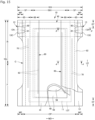
- Figs. 1 to 7 illustrate an example of a tape-type disposable diaper.
- This tape-type disposable diaper includes: a main body 10 having a ventral side portion F extending to a front side of a center C in a front-back direction and a dorsal side portion B extending to a back side of the center C in the front-back direction, and including an absorber 56 disposed in an intermediate portion in the width direction WD from the ventral side portion F to the dorsal side portion B, a liquid pervious top sheet 30 covering a front surface side of the absorber 56, and a liquid impervious sheet 11 covering a back surface side of the absorber 56; and fastening tapes 13 protruding from both side portions of a lower torso portion in the dorsal side portion B in the main body 10 for connecting the ventral side portion F to the dorsal side portion B.
- the main body 10 has an end flap portion EF extending to front and back sides of the absorber 56 and including no absorber 56, and
- the width of a lower torso portion of each of the ventral side portion F and the dorsal side portion B may be wider than the width of a crotch portion (in other words, a narrow portion around a leg may be located in an intermediate portion in the front-back direction LD).
- the width of the diaper is the same as the width of the crotch portion over the maximum length as in the illustrated example (in other words, a rectangular shape having no narrower portion).
- the entire outer surface of the main body 10 is formed of an outer sheet 12, and the liquid impervious sheet 11 is fixed to an internal surface side thereof with an adhesive such as a hot melt adhesive. Furthermore, on an inner surface side of the liquid impervious sheet 11, an absorbent element 50 including the absorber 56, an intermediate sheet 40, and the top sheet 30 are stacked in this order.
- the top sheet 30 and the liquid impervious sheet 11 are rectangular in the illustrated example, and each have a size slightly larger than the absorbent element 50 in the front-back direction LD and the width direction WD.
- a peripheral edge portion projecting from a side edge of the absorbent element 50 in the top sheet 30 is fixed to a peripheral edge portion projecting from a side edge of the absorbent element 50 in the liquid impervious sheet 11 with a hot melt adhesive or the like. This portion serves as a part of the end flap portion EF and the side flap portion SF.
- rising gathers 60 and 60 rising to a skin side of a wearer are disposed on both sides on a surface of the main body 10 in the width direction WD. Gather sheets 62 and 62 forming the rising gathers 60 and 60 extend from both sides of the top sheet 30 to the side flap portions SF.
- the outer sheet 12 is disposed such that a back surface of the disposable diaper has a texture and an appearance like cloth.
- a nonwoven fabric is suitable as the outer sheet 12, but the outer sheet 12 is not limited thereto.
- the type of the nonwoven fabric is not particularly limited.
- Examples thereof as a material fiber include a synthetic fiber such as a polyolefin-based fiber including polyethylene and polypropylene, a polyester-based fiber, or a polyamide-based fiber, a regenerated fiber such as rayon or cupra, and a natural fiber such as cotton.
- Examples of a processing method include a spunlacing method, a spunbonding method, a thermal bond method, an air through method, and a needle punching method.
- a long-fiber nonwoven fabric such as a spunbonded nonwoven fabric, an SMS nonwoven fabric, or an SMMS nonwoven fabric is suitable from a viewpoint of achieving both texture and strength.
- a nonwoven fabric can be used in a single sheet or in a plurality of stacked sheets. In the latter case, the nonwoven fabrics 12 are preferably bonded to each other with a hot melt adhesive or the like. In a case where a nonwoven fabric is used, it is desirable that the nonwoven fabric has a fiber basis weight of 10 to 50 g/m 2 , particularly 15 to 30 g/m 2 .
- the outer sheet 12 can be omitted. In this case, the liquid impervious sheet 11 can be exposed to a back surface of the disposable diaper.
- a material of the liquid impervious sheet 11 is not particularly limited, but examples thereof include a polyolefin-based resin such as polyethylene, polypropylene, or the like, a laminated nonwoven fabric obtained by stacking a nonwoven fabric on a polyethylene sheet, and a nonwoven fabric in which a waterproof film is interposed to substantially secure a liquid impervious property (in this case, the waterproof film and the nonwoven fabric form a liquid impervious sheet).
- a liquid impervious and moisture permeable material that has been favorably used from a viewpoint of preventing stuffiness in recent years can be used, for example.
- Examples of a sheet of the liquid impervious and moisture permeable material include a microporous sheet obtained by kneading an inorganic filler in a polyolefin-based resin such as polyethylene or polypropylene, molding a sheet, and then stretching the sheet in a monoaxial or biaxial direction. Furthermore, a nonwoven fabric using a micro denier fiber, a nonwoven fabric that has reinforced leakproofness by reducing a space between fibers by applying heat and pressure, and a sheet that has become liquid impervious without using a waterproof film by a method for applying a super absorbent polymer, a hydrophobic resin, or a water repellent agent can be used as the liquid impervious sheet 11.
- the liquid impervious sheet 11 in the illustrated example is slightly wider than the top sheet 30 and narrower than the outer sheet 12, but is not limited thereto. An appropriate modification can be made, for example, the liquid impervious sheet 11 has the same width as the outer sheet 12.
- a liquid pervious sheet for example, a perforated or imperforated nonwoven fabric or a porous plastic sheet
- the nonwoven fabric is not particularly limited concerning a raw material fiber thereof. Examples thereof include a synthetic fiber such as a polyolefin-based fiber including polyethylene and polypropylene, a polyester-based fiber, or a polyamide-based fiber, a regenerated fiber such as rayon or cupra, a natural fiber such as cotton, and a mixed fiber and a composite fiber in which two or more kinds of these fibers are used.
- the nonwoven fabric may be manufactured by any processing.
- Examples of a processing method include a known method such as a spunlacing method, a spunbonding method, a thermal bond method, a melt blown method, a needle punching method, an air through method, and a point bond method.
- a spunlacing method is a preferable processing method.
- a thermal bond method is a preferable processing method.
- the top sheet 30 may be formed of a single sheet or a stacked sheet obtained by bonding two or more sheets to each other. Similarly, the top sheet 30 may be formed of one sheet or two or more sheets in a plane direction.
- the top sheet 30 in the illustrated example extends to a lateral side of a side edge of the absorber 56, but is not limited to thereto, and may extend to a side edge of the outer sheet 12.
- an appropriate modification can be made, for example, the top sheet 30 may extend only up to a width direction inside of the side edge of the absorber as long as extending up to a root portion of the rising gather.
- the intermediate sheet 40 In order to move excrement that has passed through the top sheet 30 to the absorber to prevent returning, it is possible to dispose the intermediate sheet (also referred to as "second sheet") 40 between the top sheet 30 and the absorbent element 50.
- This intermediate sheet 40 not only quickly transfers excrement to the absorber to enhance absorption performance by the absorber, but also prevents returning of the absorbed excrement from the absorber, and improves a texture of a surface of the top sheet 30.
- the intermediate sheet 40 can be omitted.
- a material of the intermediate sheet 40 is not particularly limited, and for example, a similar material to that of the top sheet 30 can be used.
- the intermediate sheet 40 is preferably bonded to the top sheet 30.
- a material of the intermediate sheet 40 preferably has approximately the same melting point as the top sheet 30.
- fibers used for the intermediate sheet 40 preferably have a fineness of 5.0 to 7.0 dtex, but a liquid residue in the top sheet 30 is increased.
- the intermediate sheet 40 when the fineness of fibers used for the intermediate sheet 40 is 1.0 to 2.0 dtex, a liquid residue of the top sheet 30 is unlikely to be generated, but a solid content in stool is unlikely to pass therethrough. Therefore, fibers of a nonwoven fabric used for the intermediate sheet 40 preferably have a fineness of about 2.0 to 5.0 dtex. Note that the intermediate sheet 40 can be a mesh film or the like obtained by forming many pores in a film material such as polyethylene.
- the intermediate sheet 40 in the illustrated embodiment is disposed at the center so as to be shorter than the width of the absorbent element 50, but may be disposed over the maximum width.
- the longitudinal length of the intermediate sheet 40 may be the same as the maximum length of the diaper, may be the same as the length of the absorbent element 50, or may be within a short length range centered on a liquid receiving region.
- the absorbent element 50 is a portion for absorbing and holding a liquid such as urine or loose stool, and includes the absorber 56 and the wrapping sheet 58 wrapping the entire absorber 56 in the illustrated example.
- the absorbent element 50 includes only the absorber 56.
- the absorbent element 50 can be bonded to an inner surface of the liquid impervious sheet 11 via an adhesive such as a hot melt adhesive on a back surface thereof.
- the absorber 56 can be formed of an assembly of fibers.
- this fiber assembly in addition to those obtained by accumulating short fibers such as fluff pulps or synthetic fibers, a filament assembly obtained by opening a tow (fiber bundle) of synthetic fibers such as cellulose acetate as necessary can also be used.
- a fiber basis weight may be, for example, about 100 to 300 g/m 2 .
- a fiber basis weight may be, for example, about 30 to 120 g/m 2 .
- a fineness is, for example, 1 to 16 dtex, preferably 1 to 10 dtex, and more preferably 1 to 5 dtex.
- the filament may be formed of non-crimped fibers but is preferably formed of crimped fibers.
- the degree of crimp of the crimped fibers may be, for example, about 5 to 75, preferably 10 to 50, and more preferably 15 to 50 per 2.54 cm.
- a uniformly crimped fiber can be used.
- super absorbent polymer particles are preferably dispersed and held.
- the absorber 56 preferably has an hourglass shape having a narrower portion with a narrower width than the front and back sides thereof in an intermediate portion in a front-back direction because fitting around a leg is improved.
- the size of the absorber 56 can be determined appropriately as long as the absorber 56 extends to the front, back, left, and right of a ureteral port position. However, the absorber 56 preferably extends to the vicinity of peripheral edges of the main body 10 in the front-back direction LD and the width direction WD.
- a reference numeral 56X represents the maximum width of the absorber 56
- a reference numeral 10X represents the maximum length of the main body 10
- a reference numeral 10L represents the maximum length of the main body 10 (equal to the maximum length of the diaper in the illustrated embodiment).
- the absorber 56 may contain super absorbent polymer particles partially or entirely.
- the super absorbent polymer particles include "powder” in addition to “particles".
- As super absorbent polymer particles 54 those used for this type of absorbent article can be used as they are.
- the particle diameters of the super absorbent polymer particles are not particularly limited.
- a material of the super absorbent polymer particles can be used without particular limitation, but those having a water absorption capacity of 40 g/g or more are preferable.
- the super absorbent polymer particles include a starch-based material, a cellulose-based material, and a synthetic polymer-based material.
- a starch-acrylic acid (salt) graft copolymer, a saponified product of a starch-acrylonitrile copolymer, a cross-linked product of sodium carboxymethyl cellulose, an acrylic acid (salt) polymer, or the like can be used.
- As the shapes of the super absorbent polymer particles a usually used particulate material shape is suitable, but other shapes can also be used.
- the super absorbent polymer particles those having a water absorption rate of 70 seconds or less, particularly 40 seconds or less are suitably used. When the water absorption rate is too slow, so-called returning that a liquid supplied into the absorber 56 returns out of the absorber 56 tends to occur.
- the super absorbent polymer particles those having a gel strength of 1000 Pa or more are suitably used. This makes it possible to effectively suppress sticky feeling after liquid absorption even in a case of using the bulky absorber 56.
- the basis weight of the super absorbent polymer particles can be appropriately determined depending on the absorption amount required for an application of the absorber 56. Therefore, the basis weight can be 50 to 350 g/m 2 although this cannot be applied generally.
- the basis weight of a polymer of less than 50 g/m 2 makes it difficult to secure the absorption amount.
- the basis weight of more than 350 g/m 2 saturates an effect.
- the wrapping sheet 58 is used, as a material thereof, tissue paper, particularly, crepe paper, a nonwoven fabric, a polylaminated nonwoven fabric, or a sheet with small holes can be used. However, it is desirable that the wrapping sheet 58 is a sheet from which super absorbent polymer particles do not escape.
- a nonwoven fabric is used instead of crepe paper, a hydrophilic SMS nonwoven fabric (SMS, SSMMS, or the like) is particularly suitable, and polypropylene, a polyethylene/polypropylene composite material, or the like can be used as a material thereof.
- a nonwoven fabric having a basis weight of 5 to 40 g/m 2 , particularly of 10 to 30 g/m 2 is desirable.
- a wrapping form of the wrapping sheet 58 can be determined appropriately.
- the wrapping sheet 58 is wound around the absorber 56 cylindrically so as to surround front and back surfaces and both side surfaces of the absorber 56, the front and back end portions of the wrapping sheet 58 are caused to project from the front and back of the absorber 56, and a wound and overlapping portion and an overlapping portion of the front and back projecting portions are bonded by a bonding means such as a hot melt adhesive or material welding from viewpoints of ease of manufacture, prevention of leakage of the super absorbent polymer particles from front and back edges, and the like.
- a bonding means such as a hot melt adhesive or material welding from viewpoints of ease of manufacture, prevention of leakage of the super absorbent polymer particles from front and back edges, and the like.
- a side elastic member 70 extending in the front-back direction LD is disposed between sheet layers in an intermediate portion of the side flap portion SF in the front-back direction LD (in the illustrated example, between the outer sheet 12 of a folded-back portion 80 described later and the liquid impervious sheet 11 or between the gather sheet 62 and the liquid impervious sheet 11). Due to expansion and contraction of the side elastic member 70, a portion having the side elastic member 70 (that is, in the illustrated example, the folded-back portion 80 described later) expands and contracts in the front-back direction LD.
- the rising gather 60 rising (protruding) from a side of the top sheet 30 to a skin side is disposed over the entire front-back direction.
- the rising gather 60 includes: a root portion 65 fixed to a region including each of the side flap portions SF; a protruding portion 66 extending from the root portion 65; a fallen portion 67 in which both end portions of the protruding portion in a front-back direction are fixed in a fallen state; a non-fixed rising portion 68 located between front and back fallen portions in the protruding portion 66; and a gather elastic member 63 fixed in a state of being stretched in the front-back direction at least at a tip portion of the rising portion 68.
- the rising gather 60 is formed of a gather sheet 62 folded back at a tip. As the gather sheet 62, a water repellent nonwoven fabric can be used.
- an elongated elastic member such as a rubber thread can be used. As illustrated in Figs. 1 and 2 , a plurality of the gather elastic members 63 may be disposed at intervals, or one gather elastic member 63 may be disposed.
- the stretch rate of a portion having the gather elastic member 63 is not particularly limited, but in a usual case, is preferably 150 to 350%, and more preferably 200 to 300%.
- the root portion 65 of the rising gather 60 in the illustrated example is disposed only in the side flap portion SF, and is bonded to a side of the liquid impervious sheet 11 and a side of the outer sheet 12, but may extend from the side flap portion SF to a side of a region overlapping with the absorber 56.
- Both ends of the protruding portion 66 of the rising gather 60 in the front-back direction LD are fallen portions. However, a portion therebetween is the non-fixed rising portions 68, and the rising portion 68 rises by a contraction force of the gather elastic member 63.
- the diaper is attached to a body in a boat shape, and a contraction force of the gather elastic member 63 acts. Therefore, the rising gather 60 rises and elastically adheres to a periphery of a leg by the contraction force of the gather elastic member 63. As a result, so-called side leakage from a periphery of a leg is prevented.
- a belt-shaped waist stretching sheet 90 extending across the left and right side flap portions SF is disposed between both the fastening tapes 13, and the dorsal side portion B elastically expands and contracts in the width direction WD.
- Both ends of the waist stretching sheet 90 in the width direction WD are non-stretchable regions 96, and a portion between the non-stretchable regions 96 is a main body stretchable region 95 that expands and contracts in the width direction WD.
- the waist stretching sheet 90 may be located only at the end flap portion EF. However, the waist stretching sheet 90 is preferably disposed so as to extend from the end flap portion EF to a back end portion of the absorber 56 as in the illustrated example because the back end portion of the absorber 56 is firmly pressed against a body.
- a sheet-shaped elastic member such as a rubber sheet may be used, but a nonwoven fabric is preferably used from a viewpoint of air permeability.
- a sheet-shaped elastic member having air permeability such as an elastic nonwoven fabric can be used.
- a member obtained by bonding two sheet layers 91 formed of a nonwoven fabric or the like with an adhesive such as a hot melt adhesive and fixing an elastic member 92 in a perforated sheet shape, a net shape, an elongated shape (a thread shape, a string shape, or the like), or the like between the sheet layers 91 in a stretched state in the width direction WD is suitably used.
- the elastic member 92 preferably has a stretch rate of about 150 to 250%. In a case where an elongated (thread-shaped, string-shaped, or the like) member is used as the elastic member 92, it is preferable to dispose about 5 to 15 members each having a thickness of 420 to 1120 dtex at an interval of 3 to 10 mm in a front-back direction.
- the sizes of the main body stretchable region 95 and the non-stretchable region 96 in the waist stretching sheet 90 can be determined appropriately.
- the width of the main body stretchable region 95 is preferably 70 to 1000 of the width between the connecting portions 13A of the left and right fastening tapes 13 described later.
- the width of the non-stretchable region 96 is preferably about 5 to 40 mm in order to prevent contraction or curling at the time of being attached to the main body 10.
- the non-stretchable region 96 may be a region not having the elastic member 92.
- a part of the elastic member 92 may be disposed so as to cross the absorber 56. However, as illustrated in Fig. 6 , by cutting a part or the whole of a portion where the elastic member 92 overlaps with the absorber 56, for example, if a structure in which the elastic member 92 remains but hardly or never stretches is formed, a back end portion of the absorber 56 does not contract in the width direction. Therefore, fitting is further improved.
- the waist stretching sheet 90 is disposed between the liquid impervious sheet 11 and the outer sheet 12 in the illustrated embodiment, but is not particularly limited to this disposition.
- the waist stretching sheet 90 may be disposed between the liquid impervious sheet 11 and the absorbent element 50 or may be disposed outside the outer sheet 12.
- the outer sheet 12 is formed by stacking a plurality of sheet layers, the entire waist stretching sheet 90 may be disposed between the sheet layers of the outer sheet 12.
- the fastening tapes 13 protrude from both sides of a lower torso portion of the dorsal side portion B, and each have a base portion 13B attached to the lower torso portion of the dorsal side portion B, a non-fixed fastener free portion 13F extending from the base portion 13B on a lateral side, and a connecting portion 13A to be detachably connected to an outer surface of the ventral side portion F, disposed at a tip portion pf the fastener free portion 13F.
- a hook material (hook member) of a mechanical fastener (hook and loop fastener) or an adhesive layer may be disposed.
- the hook material has many engaging projections on a connecting surface thereof. Examples of the shapes of the engaging projections include (A) tick shape, (B) J shape, (C) mushroom shape, (D) T shape, and (E) double J shape (a shape in which the J-shaped ones are connected to each other back to back), but any shape may be used.
- the connecting portion 13A of the fastening tape 13 is connected to an appropriate position on an outer surface of the ventral side portion F.
- the fastening tape 13 it is possible to adopt not only a stretching type (side panel type) having a tape stretchable region 13E in which at least a portion between the base portion 13B and the connecting portion 13A expands and contracts in the width direction WD as illustrated in Figs. 6(c), 6(d) , and 12 but also a non-stretching type (tab type) having no tape stretchable region as illustrated in Fig. 19 .
- the stretch rate of the tape stretchable region 13E in the stretching type fastening tape 13 is not particularly limited, but is preferably about 150 to 250%.
- the structure of the tape stretchable region 13E is not particularly limited.
- at least an elastic stretchable portion of the fastening tape 13 can be formed using a sheet having elasticity by itself, such as a rubber sheet or a stretchable nonwoven fabric. As illustrated in Figs.
- the tape stretchable region 13E of the fastening tape 13 is also suitable to form at least the tape stretchable region 13E of the fastening tape 13 using one obtained by bonding two sheet layers 13S formed of a nonwoven fabric or the like with an adhesive such as a hot melt adhesive and fixing an elastic member 13G in a perforated sheet shape, a net shape, an elongated shape (a thread shape, a string shape, or the like), or the like between the sheet layers 13S in a stretched state in the width direction WD.
- an adhesive such as a hot melt adhesive
- an elastic member 13G in a perforated sheet shape, a net shape, an elongated shape (a thread shape, a string shape, or the like), or the like between the sheet layers 13S in a stretched state in the width direction WD.
- a product obtained by attaching the plurality of elongated elastic members 13G to the sheet layer 13S at intervals is widely used in the technical field of the disposable diaper, and therefore is easily manufactured.
- the thickness of the elongated elastic member 13G, the number thereof, the stretch rate thereof, the interval thereof, and the type of a material thereof can be easily adjusted advantageously.
- a material of the sheet layer 13S in this case a similar material to that of the outer sheet 12 can be used.
- an elongated (thread-shaped, string-shaped, or the like) member is used as the elastic member 13G, it is possible to dispose about 5 to 15 members each having a thickness of 420 to 1120 dtex at an interval of 3 to 10 mm in a front-back direction.
- the tape stretchable region 13E may be disposed over the entire fastening tape 13 in the width direction WD (that is, including the base portion 13B and the connecting portion 13A) as long as being disposed at least in a portion between the base portion 13B and the connecting portion 13A.
- the tape stretchable region 13E is preferably disposed in a range of 70 to 1000 of the width direction WD range between the base portion 13B and the connecting portion 13A.
- each of the base portion 13B and the connecting portion 13A may be a region not having the elastic member 13G.
- the connecting portion 13A of the stretching type fastening tape 13 may be disposed in the sheet layer 13S constituting the tape stretchable region 13E as illustrated in Figs. 6(c) and 6(d) .
- a support piece 13C protruding from a tip of the tape stretchable region 13E is attached to a tip portion of the fastening tape 13, and the connecting portion 13A is disposed on the support piece 13C because manufacture is easy.
- the support piece 13C has the connecting portion 13A in an intermediate portion in the width direction WD, and a tip portion thereof is a tab part having no connecting portion 13A.
- the shape of the support piece 13C can be appropriately determined, and in the illustrated example, the length thereof in the front-back direction LD becomes shorter toward a tip, and a portion where the length in the front-back direction LD is short has the connecting portion 13A.
- the shape may also be a rectangular shape.
- the length thereof in the front-back direction LD is preferably shorter than the sheet layer 13S constituting the tape stretchable region 13E.
- a material of the support piece 13C a known material such as a nonwoven fabric, a plastic film, a polylaminated nonwoven fabric, paper, or a composite material thereof can be used without particular limitation.
- a spunbonded nonwoven fabric, an air through nonwoven fabric, or a spunlaced nonwoven fabric having a fineness of 1.0 to 3.5 dtex, a basis weight of 20 to 100 g/m 2 , and a thickness of 1 mm is preferable.
- the shape of the stretching type fastening tape 13 can be appropriately determined, and the tape stretchable region 13E preferably has a rectangular shape as in the illustrated example because manufacture is easy. However, the tape stretchable region 13E can have a trapezoidal shape in which the length thereof in the front-back direction LD becomes shorter toward a tip side.
- the size of the stretching type fastening tape 13 can be appropriately determined, but the length of the tape stretchable region 13E in the front-back direction LD is preferably about 20 to 100 mm, and the length of the tape stretchable region 13E in the width direction WD is preferably about 0 to 90 mm.
- the structure of the non-stretching type fastening tape 13 is not particularly limited, and a known structure can be adopted.
- the non-stretching type fastening tape 13 in the illustrated example includes the support piece 13C protruding from a side edge of the main body 10 and the connecting portion 13A disposed on an intermediate portion of a portion protruding from the side edge of the main body 10 in the width direction WD in the support piece 13C.
- a material of the support piece 13C a material similar to that of the stretching type fastening tape can be used.
- a target sheet 12T having a target for facilitating connection is preferably disposed at a connecting location of the fastening tape 13 in the ventral side portion F.
- the connecting portion 13A is formed of a hook material
- the target sheet 12T it is possible to use one in which many loop threads making engaging projections of the hook material entangled therewith are disposed on a surface of a sheet substrate formed of a plastic film or a nonwoven fabric.
- an adhesive layer it is possible to use one obtained by subjecting a surface of a sheet substrate formed of a plastic film having a smooth surface with high pressure-sensitive adhesiveness to a peeling treatment.
- the connecting location of the fastening tape 13 in the ventral side portion F is formed of a nonwoven fabric
- the outer sheet 12 in the illustrated embodiment is formed of a nonwoven fabric and the connecting portion 13A of the fastening tape 13 is formed of a hook material
- the target sheet 12T can be omitted, and the hook material can be entangled with the nonwoven fabric of the outer sheet 12 to be connected.
- the target sheet 12T may be disposed between the outer sheet 12 and the liquid impervious sheet 11.
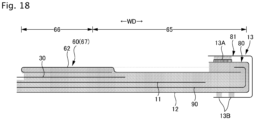
- the main body 10 has the folded-back portion 80 obtained by folding back a side including a portion having the non-stretchable region 96 of the waist stretching sheet 90 to a center side and fixing thereto.
- the fastening tape 13 is attached to the main body 10 such that a base edge of the tape stretchable region 13E is located within the range A1 of ⁇ 5 mm, more preferably within the range A1 of ⁇ 2 mm from a side edge of the main body stretchable region 95 in the width direction WD.
- the (unavoidably formed) width of the non-stretchable region 96 of the waist stretching sheet 90 occupied in the width of the main body 10 can be reduced.
- continuity of the stretchable region across the left and right fastening tapes 13 can be improved.
- the base portion 13B of the fastening tape 13 may be connected to a position overlapping with the main body stretchable region 95 or may be disposed adjacent to a side edge of the main body stretchable region 95.
- Bonding between the base portion 13B of the fastening tape 13 and the main body 10 is preferably formed so as to be elongated in the front-back direction LD as in the illustrated example, and is preferably strong. Therefore, bonding is preferably performed by welding such as ultrasonic sealing or heat sealing, but may be performed with a hot melt adhesive.
- the folded-back portion 80 is disposed in a partial range of the side flap portion SF in the width direction WD, but may extend to the entire side flap portion SF in the width direction WD or to a center side of the side flap portion SF in the width direction WD.
- the folded-back portion 80 may include an end portion of the main body stretchable region 95 or may include only a part of the non-stretchable region 96. That is, a folded-back position is preferably located at a boundary between the main body stretchable region 95 and the non-stretchable region 96. However, the folded-back position may be located at a center side of the boundary although not illustrated, or may be located outside the boundary as in the illustrated example. In a usual case, the folded-back position is preferably located within the range A2 of ⁇ 5 mm, more preferably within the range A2 of ⁇ 2 mm in the width direction WD based on the boundary between the main body stretchable region 95 and the non-stretchable region 96.
- the folded-back portion 80 is formed simply by folding back a side of the main body 10, there are points to be considered, for example, the number of stacked material layers increases to make the folded-back portion 80 hard, the fastening tape 13 which is conventionally sandwiched between materials and is not exposed is exposed, and the outer sheet 12 placing importance on strength rather than flexibility becomes a skin side. Therefore, as a preferable embodiment, as in the examples illustrated in Figs.
- each of the side flap portions SF is a portion in which the gather sheet 62, the liquid impervious sheet 11, the waist stretching sheet 90, and the outer sheet 12 are stacked
- the folded-back portion 80 is formed in each of the side flap portions SF and a portion obtained by folding back the gather sheet 62
- the base portion 13B of the fastening tape 13 is attached to a back surface of a portion having the folded-back portion 80 in each of the side flap portions SF.
- the folded-back portion 80 has such a structure, by attaching the base portion 13B of the fastening tape 13 to a back surface of a portion having the folded-back portion 80 in the side flap portion SF, not only the strength of a portion where a force is concentrated during use (a portion where the fastening tape 13 is attached) is high, but also no force to peel off the folded-back portion 80 is applied advantageously.
- a texture of a surface on the skin side is not impaired.
- the folded-back portion 80 is formed in the side flap portion SF and is a portion obtained by folding back at least a part of the non-stretchable region 96 of the waist stretching sheet 90 and the outer sheet 12 to a front surface side, a front surface side of the folded-back portion 80 is covered with a side of the gather sheet 62, and the base portion 13B of the fastening tape 13 is attached between the folded-back portion 80 in the side flap portion SF and the side of the gather sheet 62.
- the strength of a portion where a force is concentrated during use is high.
- the base portion 13B of the fastening tape 13 is not exposed, and a hard material such as the outer sheet 12 is not exposed due to covering of the front surface side of the folded-back portion 80 with the side of the gather sheet 62. Therefore, a texture is not impaired.
- the folded-back portion 80 is formed in the side flap portion SF and is a portion obtained by folding back the gather sheet 62, at least a part of the non-stretchable region 96 of the waist stretching sheet 90, and the outer sheet 12 to a back surface side, and the base portion 13B of the fastening tape 13 is attached to a back surface of a portion having the folded-back portion 80 in the side flap portion SF.
- the strength of a portion where a force is concentrated during use is high.
- the front surface side of the folded-back portion 80 with the gather sheet 62 and attaching no base portion 13B of the fastening tape 13 to a skin side a texture of a surface on the skin side is not impaired.
- the folded-back portion 80 tends to increase a thickness thereof and to become hard. Therefore, all the sheets constituting the folded-back portion 80 may extend to a tip of the folded-back portion 80 (edge on a center side in the width direction WD). However, more preferably, some of the sheets extend only to an intermediate portion of the folded-back portion 80 in the width direction WD.
- the outer sheet 12 extends to a tip of the folded-back portion 80, but the waist stretching sheet 90 extends only to the middle of the folded-back portion 80. Therefore, flexibility of the folded-back portion 80 is unlikely to be impaired.
- the folded-back portion 80 does not include the liquid impervious sheet 11 that particularly tends to be hard from such a viewpoint. Furthermore, the folded-back portion 80 is preferably bonded to a sheet adjacent to a back surface side of the folded-back portion 80 of the main body 10 via a hot melt adhesive disposed in an intermittent pattern from a similar viewpoint (not illustrated).
- the side of the main body 10 is folded back in the width direction WD over the entire front-back direction LD, but only a part including the waist stretching sheet 90 may be folded back to form the folded-back portion 80.
- the fastener free portion 13F of the fastening tape 13 has a fastener folded-back portion 81 folded back to an upper side of the folded-back portion 80 of the main body 10 at a side edge of the main body 10.
- the fastener folded-back portion 81 is preferably fixed to the folded-back portion 80 temporarily at a portion overlapping with the folded-back portion 80.
- the base portion 13B of the fastening tape 13 may be disposed on the side flap portion SF as in the illustrated example, or may be disposed at a position overlapping with the absorber 56 although not illustrated.
- An embodiment is preferable in which temporary fixing of the fastener folded-back portion 81 to the folded-back portion 80 of the main body 10 is performed by connecting the connecting portion 13A of the fastener folded-back portion 81 to the folded-back portion 80 as in the example illustrated in Fig. 11 .
- a part or the whole of a portion where the folded-back portion 80 and the fastener folded-back portion 81 overlap with each other can be releasably and temporarily fixed with a hot melt adhesive 82 (or by welding) without using the connecting portion 13A.
- this method is suitable for an embodiment in which a tip portion of the fastening tape 13 is folded back and the folded-back portion is temporarily fixed to the fastening tape 13 itself by the connecting portion 13A.
- Such a structure can be manufactured, at the time of manufacture, by disposing the fastening tape 13 such that a site serving as the base portion 13B of the fastening tape 13 is located at a site serving as a back surface side of the main body 10 and extends to a site serving as the folded-back portion 80 in a state before the folded-back portion 80 of the main body 10 is formed as illustrated in Fig. 20(a) , fixing the site serving as the base portion 13B to the main body 10, releasably and temporarily fixing the fastening tape 13 to the site serving as the folded-back portion 80, and then folding back both side portions of the main body 10 and the fastening tape 13 integrally at a folding position FP along a side edge of the main body 10 as illustrated in Fig.
- the fastening tape 13 is integrated with the main body 10 at two places of the base portion 13B and the temporarily fixed portion. Therefore, folding back of the fastening tape 13 is unlikely to be unsuitable unlike in prior art.
- the fastener folded-back portion 81 in the fastening tape 13 is only temporarily fixed to the folded-back portion 80 of the main body 10.
- a portion having the connecting portion 13A in the fastening tape 13 protrudes from a side edge of the folded-back portion 80 of the main body 10.
- the diaper according to the present aspect can be used similarly to a conventional one except for inclusion of the folded-back portion 80 in the main body 10.
- the folded-back portion 80 in the example illustrated in Fig. 1 is formed over the entire main body 10 in the front-back direction LD by folding back the entire sheet on a backmost side of the main body 10 in the front-back direction LD.
- the folded-back portion 80 in the examples illustrated in Figs. 15 to 18 by folding back only a part of the sheet on a backmost side of the main body 10 in the front-back direction LD, the folded-back portion 80 may be disposed only in a partial region including the site where the fastener folded-back portion 81 of the fastening tape 13 is located.
- the folded-back portion 80 may be locally formed from the beginning.
- the folded-back portion 80 may be formed only in a part of the main body 10 in the front-back direction LD.
- the connecting portion 13A of the fastener folded-back portion 81 is used for temporary fixing, as in the example illustrated in Fig. 11(a) , the whole thereof may be temporarily fixed to the folded-back portion 80.
- the connecting portion 13A preferably has a temporarily fixed portion 13x temporarily fixed to the folded-back portion 80 and a projecting portion 13p located on a width direction WD center side of an edge of the folded-back portion 80 on a width direction WD center side and not temporarily fixed to the folded-back portion 80.
- the connecting portion 13A is easily peeled off when the fastener folded-back portion 81 is unfolded.
- the maximum width of the temporarily fixed portion 13x is preferably 50% or more of the maximum width of the connecting portion 13A.
- the width of the folded-back portion 80 only needs to be wider than an interval between a side edge of the main body 10 and the connecting portion 13A of the fastening tape 13 in the width direction WD.
- the width of the folded-back portion 80 is equal to or larger than a length obtained by adding the size of the connecting portion 13A in the width direction WD to the interval between the side edge of the main body 10 and the connecting portion 13A of the fastening tape 13 in the width direction WD, the entire connecting portion 13A in the width direction WD can be temporarily fixed to the folded-back portion 80.
- the width of the folded-back portion 80 is equal to a length obtained by adding a size shorter than the size of the connecting portion 13A in the width direction WD to the interval between the side edge of the main body 10 and the connecting portion 13A of the fastening tape 13 in the width direction WD, a part of the connecting portion 13A projects from the folded-back portion 80.
- the width of the gather sheet 62 is narrowed, and the gather sheet 62 is extended only to an end portion of the folded-back portion 80 on a center side in the width direction (an end portion of the gather sheet 62 on a base side is located at an end portion of the folded-back portion 80 on a center side in the width direction WD) because it is possible to reduce a region where the thickness is increased by overlapping between the folded-back portion 80 of the outer sheet 12 and the gather sheet 62 and to suppress a decrease in air permeability and flexibility.
- the side elastic member 70 is preferably disposed between the liquid impervious sheet 11 and a portion located on a back surface side of the main body 10 in the outer sheet 12.
- an embodiment is also preferable in which the folded-back portion 80 extends to the rising portion 68 in the rising gather 60 and is bonded to the rising gather 60.
- the folded-back portion 80 extends to the rising portion 68 in the rising gather 60 and is bonded to the rising gather 60.
- the outer side of the rising portion 68 of the rising gather 60 is covered with the folded-back portion 80, the number of stacked layers of a material of the rising gather 60 is increased, and a liquid impervious property of the rising gather 60 can be improved.
- the present aspect is suitable in a the case where a water shielding film is not incorporated in rising gather 60.
- all the sheets or some of the sheets (the outer sheet 12 in the illustrated example) forming the folded-back portion 80 are formed of a perforated nonwoven fabric having many holes passing through the sheet from the front to the back at intervals, and have many holes at least in the folded-back portion 80 because it is possible to suppress a decrease in flexibility and air permeability.
- the size of each of the holes, the shape thereof, and the disposition thereof are not particularly limited. However, in a usual case, the area of each of the holes is preferably about 0.2 to 2.5 mm 2 (particularly 0.5 to 1.5 mm 2 ), and the area ratio is preferably about 1.0 to 15.0% (particularly 5.0 to 10.0%).
- the present invention can be applied to such a tape-type disposable diaper as in the above example.
Landscapes
- Health & Medical Sciences (AREA)
- Engineering & Computer Science (AREA)
- Life Sciences & Earth Sciences (AREA)
- Biomedical Technology (AREA)
- Heart & Thoracic Surgery (AREA)
- Vascular Medicine (AREA)
- Epidemiology (AREA)
- Animal Behavior & Ethology (AREA)
- General Health & Medical Sciences (AREA)
- Public Health (AREA)
- Veterinary Medicine (AREA)
- Manufacturing & Machinery (AREA)
- Absorbent Articles And Supports Therefor (AREA)
Claims (12)
- Couche jetable de type fixation à bande adhésive comprenant :un corps principal (10) ayant une partie latérale ventrale (F) s'étendant vers un côté avant depuis un centre dans une direction avant-arrière (LD) et une partie latérale dorsale (B) s'étendant vers un côté arrière depuis le centre vers la direction avant-arrière (LD) ;des bandes de fixation (13) dépassant des deux parties latérales d'une partie inférieure du torse de la partie latérale dorsale (B) ; etune feuille d'étirement de la taille (90) disposée dans la partie inférieure du torse de la partie latérale dorsale (B),dans lequel le corps principal (10) comprend un absorbeur (56), une feuille imperméable aux liquides (11) recouvrant une surface côté dos de l'absorbeur (56),une feuille extérieure (12) recouvrant un côté surface arrière de la feuille imperméable aux liquides (11),des parties de rabat latérales gauche et droite (SF), chacune située à l'extérieur d'un bord latéral de l'absorbeur (56), etune jonction montante (60) comprenant : une feuille de jonction (62) formant une partie racine (65) fixée à une région comprenant chacune des parties rabat latéral (SF), et une partie saillante (66) s'étendant à partir de la partie racine (65 ); une partie tombante (67) dans laquelle les deux parties d'extrémité de la partie saillante dans une direction avant-arrière (LD) sont fixées dans un état tombant ; une partie montante non fixe (68) située entre les parties tombantes avant et arrière dans la partie saillante (66) ; et un élément élastique de jonction (63) fixé dans un état d'étirement dans la direction avant-arrière (LD) au moins au niveau d'une partie d'extrémité de la partie montante (68),chacune des bandes de fixation (13) ayant une partie de base (13B) fixée à la partie inférieure du torse de la partie latérale dorsale (B) et une partie de connexion (13A) reliée de manière amovible à une surface extérieure de la partie latérale ventrale (F),la feuille d'étirement de la taille (90) servant de région non extensible (96) au niveau des deux parties d'extrémité dans le sens de la largeur (WD) et servant de région extensible du corps principal (95) qui se dilate et se contracte élastiquement dans le sens de la largeur (WD) au niveau d'une partie entre les régions non extensibles (96), dans lequella région non extensible (96) a une largeur comprise entre 5 et 40 mm,la feuille d'étirement de la taille (90) s'étend à travers les parties de rabat latérales gauche et droite (SF), etle corps principal (10) possède une partie repliée fixe (80) obtenue en repliant un côté comprenant une partie de la feuille d'étirement de la taille (90) dans la région non extensible (96) vers un côté central et en s'y fixant, la position de pliage étant située dans une plage de ± 5 mm dans le sens de la largeur (WD) à partir de la limite entre la région extensible (95) et la région non extensible (96).
- Couche jetable de type fixation à bande adhésive selon la revendication 1, dans laquellechacune des bandes de fixation (13) possède une région extensible de bande (13E) qui est disposée dans une partie entre la partie de base (13B) et la partie de connexion (13A) et se dilate et se contracte dans le sens de la largeur (WD), etles bandes de fixation (13) sont fixées au corps principal (10) de telle sorte qu'un bord de base de la région de la bande extensible (13E) soit situé dans une plage de ± 5 mm dans le sens de la largeur (WD) à partir d'un bord latéral de la région extensible du corps principal (95).
- Couche jetable de type fixation à bande adhésive selon la revendication 2, dans laquellela région extensible du corps principal (95) dans la feuille d'étirement de la taille (90) s'étend à travers les parties rabat latérales gauche et droite (SF),chacune des parties de rabat latéral (SF) est une partie dans laquelle la feuille de jonction (62), la feuille imperméable aux liquides (11), la feuille d'étirement de la taille (90) et la feuille extérieure (12) sont empilées,la partie repliée (80) est formée dans chacune des parties de rabat latéral (SF) et est une partie dans laquelle la feuille de jonction (62), au moins une partie de la région non extensible (96) de la feuille d'étirement de la taille (90), et la feuille extérieure (12) sont repliées vers un côté de surface avant, etune partie de base (13B) de chacune des bandes de fixation (13) est fixée à une surface arrière d'une partie comportant la partie repliée (80) dans chacune des parties de rabat latéral (SF).
- Couche jetable de type fixation à bande adhésive selon la revendication 2, dans laquellela région extensible du corps principal (95) dans la feuille d'étirement de la taille (90) s'étend à travers les parties rabat latérales gauche et droite (SF),chacune des parties de rabat latéral (SF) est une partie dans laquelle la feuille de jonction (62), la feuille imperméable aux liquides (11), la feuille d'étirement de la taille (90) et la feuille extérieure (12) sont empilées,la partie repliée (80) est formée dans chacune des parties de rabat latéral (SF) et est une partie dans laquelle au moins une partie de la région non extensible (96) de la feuille d'étirement de la taille (90) et de la feuille extérieure (12) sont repliés vers un côté de surface avant,un côté de surface avant de la partie repliée (80) est recouvert d'un côté de la feuille de jonction (62), etune partie de base (13B) des bandes de fixation (13) est fixé entre la partie repliée (80) et un côté de la feuille de jonction (62) dans chacune des parties de rabat latéral (SF).
- Couche jetable de type fixation à bande adhésive selon la revendication 2, dans laquellela région extensible du corps principal (95) dans la feuille d'étirement de la taille (90) s'étend à travers les parties rabat latérales gauche et droite (SF),chacune des parties de rabat latéral (SF) est une partie dans laquelle la feuille de jonction (62), la feuille imperméable aux liquides (11), la feuille d'étirement de la taille (90) et la feuille extérieure (12) sont empilées,la partie repliée (80) est formée dans chacune des parties de rabat latéral (SF) et est une partie dans laquelle la feuille de jonction (62), au moins une partie de la région non extensible (96) de la feuille d'étirement de la taille (90), et la feuille extérieure (12) sont repliées vers un côté surface arrière, etune partie de base (13B) de chacune des bandes de fixation (13) est fixée à une surface arrière d'une partie comportant la partie repliée (80) dans chacune des parties de rabat latéral (SF).
- Couche jetable du type fixation à bande adhésive selon l'une des revendications 3 à 5, dans laquelle
la partie repliée (80) ne comprend pas la feuille imperméable aux liquides (11). - Couche jetable de type fixation à bande adhésive selon l'une des revendications 1 à 6, dans laquellechacune des bandes de fixation (13) a la partie de base (13B) fixée à une surface arrière du corps principal (10) et la partie libre de fixation (13F) s'étendant sur un côté latéral à partir de la partie de base (13B), la partie libre de fixation (13F) comporte une partie repliée de fixation (81) repliée vers un côté supérieur de la partie repliée (80) au niveau un bord latéral du corps principal (10), etla partie repliée de fixation (81) est fixée de manière amovible et temporaire à la partie repliée (80) du corps principal (10) au niveau d'une partie chevauchant la partie repliée (80) du corps principal (10).
- Couche jetable de type fixation à bande adhésive selon la revendication 7, dans laquellela partie repliée de fixation (81) comporte la partie de connexion (13A) au niveau d'une partie chevauchant la partie repliée (80) du corps principal (10),la partie repliée de fixation (81) est temporairement fixée à la partie repliée (80) du corps principal (10) par la partie de connexion (13A), etla partie de connexion (13A) comporte une partie temporairement fixée à la partie repliée (80) du corps principal (10) et une partie saillante située sur un côté central dans une direction de la largeur (WD) d'une direction de la largeur (WD) du bord latéral central de la partie repliée (80) du corps principal (10) et non fixé temporairement à la partie repliée (80) du corps principal (10).
- Couche jetable de type fixation à bande adhésive selon la revendication 7 ou 8, dans laquelle
la feuille de jonction (62) s'étend uniquement jusqu'à une partie d'extrémité sur un côté central dans le sens de la largeur (WD) de la partie repliée (80) du corps principal (10). - Couche jetable de type fixation à bande adhésive selon la revendication 7 ou 8, dans laquelle
la partie repliée (80) du corps principal (10) s'étend jusqu'à la partie montante de la jonction montante (60) et est liée à la jonction montante. (60). - Couche jetable de type fixation à bande adhésive selon l'une des revendications 7 à 10, dans laquelle
une feuille sur un côté arrière du corps principal (10) est formée d'un tissu non tissé perforé ayant de nombreux trous traversant la feuille de l'avant vers l'arrière à intervalles réguliers, et au moins la partie repliée (80) du corps principal (10) comporte de nombreux trous. - Couche jetable de type fixation à bande adhésive selon l'une des revendications 7 à 10, dans laquelle
la partie repliée (80) du corps principal (10) est liée à une feuille adjacente à un côté de la surface arrière de la partie repliée (80) du corps principal (10) via un adhésif thermofusible disposé selon un motif intermittent.
Applications Claiming Priority (3)
| Application Number | Priority Date | Filing Date | Title |
|---|---|---|---|
| JP2017063581A JP6456999B2 (ja) | 2017-03-28 | 2017-03-28 | テープタイプ使い捨ておむつ |
| JP2017067003A JP6457004B2 (ja) | 2017-03-30 | 2017-03-30 | テープタイプ使い捨ておむつ及びその製造方法 |
| PCT/JP2018/008471 WO2018180264A1 (fr) | 2017-03-28 | 2018-03-06 | Couche jetable de type bande et procédé de production de couche jetable de type bande |
Publications (3)
| Publication Number | Publication Date |
|---|---|
| EP3603591A1 EP3603591A1 (fr) | 2020-02-05 |
| EP3603591A4 EP3603591A4 (fr) | 2020-11-18 |
| EP3603591B1 true EP3603591B1 (fr) | 2023-12-06 |
Family
ID=63675392
Family Applications (1)
| Application Number | Title | Priority Date | Filing Date |
|---|---|---|---|
| EP18774942.9A Active EP3603591B1 (fr) | 2017-03-28 | 2018-03-06 | Couche jetable de type bande |
Country Status (5)
| Country | Link |
|---|---|
| US (1) | US11786414B2 (fr) |
| EP (1) | EP3603591B1 (fr) |
| CN (2) | CN108652833B (fr) |
| TW (1) | TWI737903B (fr) |
| WO (1) | WO2018180264A1 (fr) |
Families Citing this family (9)
| Publication number | Priority date | Publication date | Assignee | Title |
|---|---|---|---|---|
| EP3603591B1 (fr) * | 2017-03-28 | 2023-12-06 | Daio Paper Corporation | Couche jetable de type bande |
| KR102597383B1 (ko) * | 2018-03-20 | 2023-11-01 | 다이오 페이퍼 코퍼레이션 | 테이프 타입 일회용 기저귀 |
| JP6488040B1 (ja) * | 2018-03-20 | 2019-03-20 | 大王製紙株式会社 | テープタイプ使い捨ておむつ |
| JP7370151B2 (ja) * | 2019-03-27 | 2023-10-27 | 大王製紙株式会社 | 使い捨ておむつ |
| JP7362528B2 (ja) * | 2020-03-25 | 2023-10-17 | 大王製紙株式会社 | 連結式使い捨て着用物品 |
| JP7349413B2 (ja) * | 2020-06-23 | 2023-09-22 | 大王製紙株式会社 | 連結式使い捨て着用物品 |
| WO2022109535A1 (fr) * | 2020-11-18 | 2022-05-27 | Curt G. Joa, Inc. | Système et procédé pour fixation discrète d'oreilles |
| JP7541942B2 (ja) * | 2021-03-03 | 2024-08-29 | 大王製紙株式会社 | テープタイプ使い捨ておむつ |
| EP4650311A1 (fr) * | 2024-05-15 | 2025-11-19 | Gdm S.P.A. | Procédé de fabrication de coussins de sous-vêtement pliés |
Family Cites Families (17)
| Publication number | Priority date | Publication date | Assignee | Title |
|---|---|---|---|---|
| JP3967856B2 (ja) | 1999-09-29 | 2007-08-29 | 大王製紙株式会社 | 使い捨て紙おむつ |
| JP4050860B2 (ja) * | 2000-06-09 | 2008-02-20 | 大王製紙株式会社 | 使い捨て紙おむつ |
| JP4002203B2 (ja) | 2003-03-31 | 2007-10-31 | 大王製紙株式会社 | 止着タイプ紙おむつ |
| JP4049733B2 (ja) | 2003-11-21 | 2008-02-20 | 花王株式会社 | 使い捨ておむつ |
| US7618404B2 (en) * | 2005-06-23 | 2009-11-17 | The Procter & Gamble Company | Disposable absorbent article having doubled side flaps and backsheet strips |
| JP4864585B2 (ja) | 2006-07-31 | 2012-02-01 | 大王製紙株式会社 | 紙おむつ並びに紙おむつの製造方法及びこれに用いるカッターロール装置 |
| MY183035A (en) * | 2008-04-18 | 2021-02-08 | Dsg Technology Holdings Ltd | An elastic composite having cross-directional elasticity and a system and method for making the elastic composite |
| JP5091037B2 (ja) | 2008-07-10 | 2012-12-05 | 王子ネピア株式会社 | 使い捨ておむつ |
| JP5135097B2 (ja) | 2008-07-18 | 2013-01-30 | 大王製紙株式会社 | テープ式使い捨ておむつ及びその製造方法 |
| WO2010044715A1 (fr) * | 2008-10-16 | 2010-04-22 | Sca Hygiene Products Ab | Article absorbant avec panneaux latéraux élastiques comprenant des balises |
| JP5391020B2 (ja) | 2009-10-01 | 2014-01-15 | ユニ・チャーム株式会社 | 使い捨ておむつ |
| JP5848066B2 (ja) * | 2011-08-31 | 2016-01-27 | ユニ・チャーム株式会社 | 使い捨て着用物品 |
| JP5933213B2 (ja) * | 2011-09-30 | 2016-06-08 | 大王製紙株式会社 | テープタイプ使い捨ておむつ |
| JP5922375B2 (ja) * | 2011-11-02 | 2016-05-24 | 花王株式会社 | 展開型の使い捨ておむつ |
| JP6407108B2 (ja) * | 2015-07-06 | 2018-10-17 | ユニ・チャーム株式会社 | 吸収性物品及び吸収性物品の製造方法 |
| JP6108372B1 (ja) * | 2016-01-29 | 2017-04-05 | 大王製紙株式会社 | 吸収性物品の伸縮構造及びその製造方法 |
| EP3603591B1 (fr) * | 2017-03-28 | 2023-12-06 | Daio Paper Corporation | Couche jetable de type bande |
-
2018
- 2018-03-06 EP EP18774942.9A patent/EP3603591B1/fr active Active
- 2018-03-06 US US16/491,262 patent/US11786414B2/en active Active
- 2018-03-06 WO PCT/JP2018/008471 patent/WO2018180264A1/fr not_active Ceased
- 2018-03-07 CN CN201810185056.7A patent/CN108652833B/zh active Active
- 2018-03-07 CN CN201820315229.8U patent/CN209048458U/zh not_active Withdrawn - After Issue
- 2018-03-27 TW TW107110395A patent/TWI737903B/zh active
Also Published As
| Publication number | Publication date |
|---|---|
| TW201836567A (zh) | 2018-10-16 |
| US11786414B2 (en) | 2023-10-17 |
| WO2018180264A1 (fr) | 2018-10-04 |
| US20200038257A1 (en) | 2020-02-06 |
| CN209048458U (zh) | 2019-07-02 |
| CN108652833A (zh) | 2018-10-16 |
| CN108652833B (zh) | 2021-07-13 |
| EP3603591A1 (fr) | 2020-02-05 |
| EP3603591A4 (fr) | 2020-11-18 |
| TWI737903B (zh) | 2021-09-01 |
Similar Documents
| Publication | Publication Date | Title |
|---|---|---|
| EP3603591B1 (fr) | Couche jetable de type bande | |
| EP3639799B1 (fr) | Couche jetable de type culotte | |
| EP3597160A1 (fr) | Article absorbant | |
| CN107874915B (zh) | 一次性穿着物品和有孔无纺布的粘贴方法 | |
| CN107874914B (zh) | 一次性穿着物品和有孔无纺布的粘贴方法 | |
| EP3769733B1 (fr) | Couche jetable de type à bande de fixation | |
| JP6332752B2 (ja) | テープタイプ使い捨ておむつ | |
| TW202122059A (zh) | 拋棄式尿布 | |
| EP3639800B1 (fr) | Couche-culotte d'apprentissage jetable | |
| EP3804682A1 (fr) | Couche jetable de type à bande de fixation | |
| JP6457004B2 (ja) | テープタイプ使い捨ておむつ及びその製造方法 | |
| JP6456999B2 (ja) | テープタイプ使い捨ておむつ | |
| TWI854105B (zh) | 拋棄式吸收性物品 | |
| EP4309636A1 (fr) | Article à porter jetable du type à raccord | |
| TWI848186B (zh) | 拋棄式尿布 | |
| JP6633729B2 (ja) | テープタイプ使い捨ておむつ | |
| JP6633730B2 (ja) | テープタイプ使い捨ておむつ及びその製造方法 | |
| EP4548890A1 (fr) | Article vestimentaire jetable de type caleçon | |
| RU2836804C2 (ru) | Одноразовое изделие соединяемого типа для ношения | |
| JP2019051244A (ja) | テープタイプ使い捨ておむつ | |
| RU2818662C1 (ru) | Одноразовый подгузник | |
| JP7289679B2 (ja) | 使い捨ておむつ | |
| JP2019051245A (ja) | テープタイプ使い捨ておむつ | |
| JP7129179B2 (ja) | 吸収性物品の伸縮構造 | |
| JP2018134273A5 (fr) |
Legal Events
| Date | Code | Title | Description |
|---|---|---|---|
| STAA | Information on the status of an ep patent application or granted ep patent |
Free format text: STATUS: THE INTERNATIONAL PUBLICATION HAS BEEN MADE |
|
| PUAI | Public reference made under article 153(3) epc to a published international application that has entered the european phase |
Free format text: ORIGINAL CODE: 0009012 |
|
| STAA | Information on the status of an ep patent application or granted ep patent |
Free format text: STATUS: REQUEST FOR EXAMINATION WAS MADE |
|
| 17P | Request for examination filed |
Effective date: 20190913 |
|
| AK | Designated contracting states |
Kind code of ref document: A1 Designated state(s): AL AT BE BG CH CY CZ DE DK EE ES FI FR GB GR HR HU IE IS IT LI LT LU LV MC MK MT NL NO PL PT RO RS SE SI SK SM TR |
|
| AX | Request for extension of the european patent |
Extension state: BA ME |
|
| DAV | Request for validation of the european patent (deleted) | ||
| DAX | Request for extension of the european patent (deleted) | ||
| A4 | Supplementary search report drawn up and despatched |
Effective date: 20201016 |
|
| RIC1 | Information provided on ipc code assigned before grant |
Ipc: A61F 13/496 20060101ALI20201012BHEP Ipc: A61F 13/49 20060101AFI20201012BHEP Ipc: A61F 13/494 20060101ALI20201012BHEP Ipc: A44B 18/00 20060101ALI20201012BHEP Ipc: A61F 13/56 20060101ALI20201012BHEP |
|
| STAA | Information on the status of an ep patent application or granted ep patent |
Free format text: STATUS: EXAMINATION IS IN PROGRESS |
|
| 17Q | First examination report despatched |
Effective date: 20220711 |
|
| GRAP | Despatch of communication of intention to grant a patent |
Free format text: ORIGINAL CODE: EPIDOSNIGR1 |
|
| STAA | Information on the status of an ep patent application or granted ep patent |
Free format text: STATUS: GRANT OF PATENT IS INTENDED |
|
| INTG | Intention to grant announced |
Effective date: 20230718 |
|
| RIN1 | Information on inventor provided before grant (corrected) |
Inventor name: MORI, YOSUKE Inventor name: FURUKAWA, MASASHI Inventor name: OKADA, YUKI |
|
| GRAS | Grant fee paid |
Free format text: ORIGINAL CODE: EPIDOSNIGR3 |
|
| GRAA | (expected) grant |
Free format text: ORIGINAL CODE: 0009210 |
|
| STAA | Information on the status of an ep patent application or granted ep patent |
Free format text: STATUS: THE PATENT HAS BEEN GRANTED |
|
| AK | Designated contracting states |
Kind code of ref document: B1 Designated state(s): AL AT BE BG CH CY CZ DE DK EE ES FI FR GB GR HR HU IE IS IT LI LT LU LV MC MK MT NL NO PL PT RO RS SE SI SK SM TR |
|
| REG | Reference to a national code |
Ref country code: GB Ref legal event code: FG4D |
|
| REG | Reference to a national code |
Ref country code: CH Ref legal event code: EP |
|
| REG | Reference to a national code |
Ref country code: DE Ref legal event code: R096 Ref document number: 602018062237 Country of ref document: DE |
|
| REG | Reference to a national code |
Ref country code: IE Ref legal event code: FG4D |
|
| REG | Reference to a national code |
Ref country code: LT Ref legal event code: MG9D |
|
| PG25 | Lapsed in a contracting state [announced via postgrant information from national office to epo] |
Ref country code: GR Free format text: LAPSE BECAUSE OF FAILURE TO SUBMIT A TRANSLATION OF THE DESCRIPTION OR TO PAY THE FEE WITHIN THE PRESCRIBED TIME-LIMIT Effective date: 20240307 |
|
| REG | Reference to a national code |
Ref country code: NL Ref legal event code: MP Effective date: 20231206 |
|
| PG25 | Lapsed in a contracting state [announced via postgrant information from national office to epo] |
Ref country code: LT Free format text: LAPSE BECAUSE OF FAILURE TO SUBMIT A TRANSLATION OF THE DESCRIPTION OR TO PAY THE FEE WITHIN THE PRESCRIBED TIME-LIMIT Effective date: 20231206 |
|
| PG25 | Lapsed in a contracting state [announced via postgrant information from national office to epo] |
Ref country code: ES Free format text: LAPSE BECAUSE OF FAILURE TO SUBMIT A TRANSLATION OF THE DESCRIPTION OR TO PAY THE FEE WITHIN THE PRESCRIBED TIME-LIMIT Effective date: 20231206 |
|
| PG25 | Lapsed in a contracting state [announced via postgrant information from national office to epo] |
Ref country code: LT Free format text: LAPSE BECAUSE OF FAILURE TO SUBMIT A TRANSLATION OF THE DESCRIPTION OR TO PAY THE FEE WITHIN THE PRESCRIBED TIME-LIMIT Effective date: 20231206 Ref country code: GR Free format text: LAPSE BECAUSE OF FAILURE TO SUBMIT A TRANSLATION OF THE DESCRIPTION OR TO PAY THE FEE WITHIN THE PRESCRIBED TIME-LIMIT Effective date: 20240307 Ref country code: ES Free format text: LAPSE BECAUSE OF FAILURE TO SUBMIT A TRANSLATION OF THE DESCRIPTION OR TO PAY THE FEE WITHIN THE PRESCRIBED TIME-LIMIT Effective date: 20231206 Ref country code: BG Free format text: LAPSE BECAUSE OF FAILURE TO SUBMIT A TRANSLATION OF THE DESCRIPTION OR TO PAY THE FEE WITHIN THE PRESCRIBED TIME-LIMIT Effective date: 20240306 |
|
| REG | Reference to a national code |
Ref country code: AT Ref legal event code: MK05 Ref document number: 1637708 Country of ref document: AT Kind code of ref document: T Effective date: 20231206 |
|
| PG25 | Lapsed in a contracting state [announced via postgrant information from national office to epo] |
Ref country code: NL Free format text: LAPSE BECAUSE OF FAILURE TO SUBMIT A TRANSLATION OF THE DESCRIPTION OR TO PAY THE FEE WITHIN THE PRESCRIBED TIME-LIMIT Effective date: 20231206 |
|
| PG25 | Lapsed in a contracting state [announced via postgrant information from national office to epo] |
Ref country code: SE Free format text: LAPSE BECAUSE OF FAILURE TO SUBMIT A TRANSLATION OF THE DESCRIPTION OR TO PAY THE FEE WITHIN THE PRESCRIBED TIME-LIMIT Effective date: 20231206 Ref country code: RS Free format text: LAPSE BECAUSE OF FAILURE TO SUBMIT A TRANSLATION OF THE DESCRIPTION OR TO PAY THE FEE WITHIN THE PRESCRIBED TIME-LIMIT Effective date: 20231206 Ref country code: NO Free format text: LAPSE BECAUSE OF FAILURE TO SUBMIT A TRANSLATION OF THE DESCRIPTION OR TO PAY THE FEE WITHIN THE PRESCRIBED TIME-LIMIT Effective date: 20240306 Ref country code: NL Free format text: LAPSE BECAUSE OF FAILURE TO SUBMIT A TRANSLATION OF THE DESCRIPTION OR TO PAY THE FEE WITHIN THE PRESCRIBED TIME-LIMIT Effective date: 20231206 Ref country code: LV Free format text: LAPSE BECAUSE OF FAILURE TO SUBMIT A TRANSLATION OF THE DESCRIPTION OR TO PAY THE FEE WITHIN THE PRESCRIBED TIME-LIMIT Effective date: 20231206 Ref country code: HR Free format text: LAPSE BECAUSE OF FAILURE TO SUBMIT A TRANSLATION OF THE DESCRIPTION OR TO PAY THE FEE WITHIN THE PRESCRIBED TIME-LIMIT Effective date: 20231206 |
|
| PG25 | Lapsed in a contracting state [announced via postgrant information from national office to epo] |
Ref country code: IS Free format text: LAPSE BECAUSE OF FAILURE TO SUBMIT A TRANSLATION OF THE DESCRIPTION OR TO PAY THE FEE WITHIN THE PRESCRIBED TIME-LIMIT Effective date: 20240406 |
|
| PG25 | Lapsed in a contracting state [announced via postgrant information from national office to epo] |
Ref country code: AT Free format text: LAPSE BECAUSE OF FAILURE TO SUBMIT A TRANSLATION OF THE DESCRIPTION OR TO PAY THE FEE WITHIN THE PRESCRIBED TIME-LIMIT Effective date: 20231206 Ref country code: CZ Free format text: LAPSE BECAUSE OF FAILURE TO SUBMIT A TRANSLATION OF THE DESCRIPTION OR TO PAY THE FEE WITHIN THE PRESCRIBED TIME-LIMIT Effective date: 20231206 |
|
| PG25 | Lapsed in a contracting state [announced via postgrant information from national office to epo] |
Ref country code: SK Free format text: LAPSE BECAUSE OF FAILURE TO SUBMIT A TRANSLATION OF THE DESCRIPTION OR TO PAY THE FEE WITHIN THE PRESCRIBED TIME-LIMIT Effective date: 20231206 |
|
| PG25 | Lapsed in a contracting state [announced via postgrant information from national office to epo] |
Ref country code: SM Free format text: LAPSE BECAUSE OF FAILURE TO SUBMIT A TRANSLATION OF THE DESCRIPTION OR TO PAY THE FEE WITHIN THE PRESCRIBED TIME-LIMIT Effective date: 20231206 Ref country code: SK Free format text: LAPSE BECAUSE OF FAILURE TO SUBMIT A TRANSLATION OF THE DESCRIPTION OR TO PAY THE FEE WITHIN THE PRESCRIBED TIME-LIMIT Effective date: 20231206 Ref country code: RO Free format text: LAPSE BECAUSE OF FAILURE TO SUBMIT A TRANSLATION OF THE DESCRIPTION OR TO PAY THE FEE WITHIN THE PRESCRIBED TIME-LIMIT Effective date: 20231206 Ref country code: IT Free format text: LAPSE BECAUSE OF FAILURE TO SUBMIT A TRANSLATION OF THE DESCRIPTION OR TO PAY THE FEE WITHIN THE PRESCRIBED TIME-LIMIT Effective date: 20231206 Ref country code: IS Free format text: LAPSE BECAUSE OF FAILURE TO SUBMIT A TRANSLATION OF THE DESCRIPTION OR TO PAY THE FEE WITHIN THE PRESCRIBED TIME-LIMIT Effective date: 20240406 Ref country code: EE Free format text: LAPSE BECAUSE OF FAILURE TO SUBMIT A TRANSLATION OF THE DESCRIPTION OR TO PAY THE FEE WITHIN THE PRESCRIBED TIME-LIMIT Effective date: 20231206 Ref country code: CZ Free format text: LAPSE BECAUSE OF FAILURE TO SUBMIT A TRANSLATION OF THE DESCRIPTION OR TO PAY THE FEE WITHIN THE PRESCRIBED TIME-LIMIT Effective date: 20231206 Ref country code: AT Free format text: LAPSE BECAUSE OF FAILURE TO SUBMIT A TRANSLATION OF THE DESCRIPTION OR TO PAY THE FEE WITHIN THE PRESCRIBED TIME-LIMIT Effective date: 20231206 |
|
| PG25 | Lapsed in a contracting state [announced via postgrant information from national office to epo] |
Ref country code: PL Free format text: LAPSE BECAUSE OF FAILURE TO SUBMIT A TRANSLATION OF THE DESCRIPTION OR TO PAY THE FEE WITHIN THE PRESCRIBED TIME-LIMIT Effective date: 20231206 Ref country code: PT Free format text: LAPSE BECAUSE OF FAILURE TO SUBMIT A TRANSLATION OF THE DESCRIPTION OR TO PAY THE FEE WITHIN THE PRESCRIBED TIME-LIMIT Effective date: 20240408 |
|
| PG25 | Lapsed in a contracting state [announced via postgrant information from national office to epo] |
Ref country code: PT Free format text: LAPSE BECAUSE OF FAILURE TO SUBMIT A TRANSLATION OF THE DESCRIPTION OR TO PAY THE FEE WITHIN THE PRESCRIBED TIME-LIMIT Effective date: 20240408 Ref country code: PL Free format text: LAPSE BECAUSE OF FAILURE TO SUBMIT A TRANSLATION OF THE DESCRIPTION OR TO PAY THE FEE WITHIN THE PRESCRIBED TIME-LIMIT Effective date: 20231206 |
|
| REG | Reference to a national code |
Ref country code: DE Ref legal event code: R097 Ref document number: 602018062237 Country of ref document: DE |
|
| PG25 | Lapsed in a contracting state [announced via postgrant information from national office to epo] |
Ref country code: DK Free format text: LAPSE BECAUSE OF FAILURE TO SUBMIT A TRANSLATION OF THE DESCRIPTION OR TO PAY THE FEE WITHIN THE PRESCRIBED TIME-LIMIT Effective date: 20231206 |
|
| PLBE | No opposition filed within time limit |
Free format text: ORIGINAL CODE: 0009261 |
|
| STAA | Information on the status of an ep patent application or granted ep patent |
Free format text: STATUS: NO OPPOSITION FILED WITHIN TIME LIMIT |
|
| PG25 | Lapsed in a contracting state [announced via postgrant information from national office to epo] |
Ref country code: SI Free format text: LAPSE BECAUSE OF FAILURE TO SUBMIT A TRANSLATION OF THE DESCRIPTION OR TO PAY THE FEE WITHIN THE PRESCRIBED TIME-LIMIT Effective date: 20231206 |
|
| PG25 | Lapsed in a contracting state [announced via postgrant information from national office to epo] |
Ref country code: SI Free format text: LAPSE BECAUSE OF FAILURE TO SUBMIT A TRANSLATION OF THE DESCRIPTION OR TO PAY THE FEE WITHIN THE PRESCRIBED TIME-LIMIT Effective date: 20231206 Ref country code: DK Free format text: LAPSE BECAUSE OF FAILURE TO SUBMIT A TRANSLATION OF THE DESCRIPTION OR TO PAY THE FEE WITHIN THE PRESCRIBED TIME-LIMIT Effective date: 20231206 |
|
| REG | Reference to a national code |
Ref country code: CH Ref legal event code: PL |
|
| 26N | No opposition filed |
Effective date: 20240909 |
|
| PG25 | Lapsed in a contracting state [announced via postgrant information from national office to epo] |
Ref country code: LU Free format text: LAPSE BECAUSE OF NON-PAYMENT OF DUE FEES Effective date: 20240306 |
|
| PG25 | Lapsed in a contracting state [announced via postgrant information from national office to epo] |
Ref country code: MC Free format text: LAPSE BECAUSE OF FAILURE TO SUBMIT A TRANSLATION OF THE DESCRIPTION OR TO PAY THE FEE WITHIN THE PRESCRIBED TIME-LIMIT Effective date: 20231206 |
|
| PG25 | Lapsed in a contracting state [announced via postgrant information from national office to epo] |
Ref country code: MC Free format text: LAPSE BECAUSE OF FAILURE TO SUBMIT A TRANSLATION OF THE DESCRIPTION OR TO PAY THE FEE WITHIN THE PRESCRIBED TIME-LIMIT Effective date: 20231206 Ref country code: LU Free format text: LAPSE BECAUSE OF NON-PAYMENT OF DUE FEES Effective date: 20240306 |
|
| REG | Reference to a national code |
Ref country code: BE Ref legal event code: MM Effective date: 20240331 |
|
| PG25 | Lapsed in a contracting state [announced via postgrant information from national office to epo] |
Ref country code: BE Free format text: LAPSE BECAUSE OF NON-PAYMENT OF DUE FEES Effective date: 20240331 |
|
| PG25 | Lapsed in a contracting state [announced via postgrant information from national office to epo] |
Ref country code: IE Free format text: LAPSE BECAUSE OF NON-PAYMENT OF DUE FEES Effective date: 20240306 |
|
| PG25 | Lapsed in a contracting state [announced via postgrant information from national office to epo] |
Ref country code: IE Free format text: LAPSE BECAUSE OF NON-PAYMENT OF DUE FEES Effective date: 20240306 Ref country code: BE Free format text: LAPSE BECAUSE OF NON-PAYMENT OF DUE FEES Effective date: 20240331 Ref country code: CH Free format text: LAPSE BECAUSE OF NON-PAYMENT OF DUE FEES Effective date: 20240331 |
|
| PGFP | Annual fee paid to national office [announced via postgrant information from national office to epo] |
Ref country code: FR Payment date: 20250210 Year of fee payment: 8 |
|
| PGFP | Annual fee paid to national office [announced via postgrant information from national office to epo] |
Ref country code: GB Payment date: 20250130 Year of fee payment: 8 |
|
| PGFP | Annual fee paid to national office [announced via postgrant information from national office to epo] |
Ref country code: TR Payment date: 20250227 Year of fee payment: 8 |
|
| PG25 | Lapsed in a contracting state [announced via postgrant information from national office to epo] |
Ref country code: CY Free format text: LAPSE BECAUSE OF FAILURE TO SUBMIT A TRANSLATION OF THE DESCRIPTION OR TO PAY THE FEE WITHIN THE PRESCRIBED TIME-LIMIT; INVALID AB INITIO Effective date: 20180306 |
|
| PG25 | Lapsed in a contracting state [announced via postgrant information from national office to epo] |
Ref country code: HU Free format text: LAPSE BECAUSE OF FAILURE TO SUBMIT A TRANSLATION OF THE DESCRIPTION OR TO PAY THE FEE WITHIN THE PRESCRIBED TIME-LIMIT; INVALID AB INITIO Effective date: 20180306 |
|
| PG25 | Lapsed in a contracting state [announced via postgrant information from national office to epo] |
Ref country code: FI Free format text: LAPSE BECAUSE OF FAILURE TO SUBMIT A TRANSLATION OF THE DESCRIPTION OR TO PAY THE FEE WITHIN THE PRESCRIBED TIME-LIMIT Effective date: 20231207 |
|
| PGFP | Annual fee paid to national office [announced via postgrant information from national office to epo] |
Ref country code: DE Payment date: 20260128 Year of fee payment: 9 |