EP3606973B1 - Neues polyurethangeliermittel - Google Patents
Neues polyurethangeliermittel Download PDFInfo
- Publication number
- EP3606973B1 EP3606973B1 EP18718613.5A EP18718613A EP3606973B1 EP 3606973 B1 EP3606973 B1 EP 3606973B1 EP 18718613 A EP18718613 A EP 18718613A EP 3606973 B1 EP3606973 B1 EP 3606973B1
- Authority
- EP
- European Patent Office
- Prior art keywords
- carbon atoms
- linear
- formula
- unsaturations
- alkyl radical
- Prior art date
- Legal status (The legal status is an assumption and is not a legal conclusion. Google has not performed a legal analysis and makes no representation as to the accuracy of the status listed.)
- Active
Links
Classifications
-
- C—CHEMISTRY; METALLURGY
- C08—ORGANIC MACROMOLECULAR COMPOUNDS; THEIR PREPARATION OR CHEMICAL WORKING-UP; COMPOSITIONS BASED THEREON
- C08G—MACROMOLECULAR COMPOUNDS OBTAINED OTHERWISE THAN BY REACTIONS ONLY INVOLVING UNSATURATED CARBON-TO-CARBON BONDS
- C08G18/00—Polymeric products of isocyanates or isothiocyanates
- C08G18/06—Polymeric products of isocyanates or isothiocyanates with compounds having active hydrogen
- C08G18/28—Polymeric products of isocyanates or isothiocyanates with compounds having active hydrogen characterised by the compounds used containing active hydrogen
- C08G18/30—Low-molecular-weight compounds
- C08G18/36—Hydroxylated esters of higher fatty acids
-
- A—HUMAN NECESSITIES
- A61—MEDICAL OR VETERINARY SCIENCE; HYGIENE
- A61K—PREPARATIONS FOR MEDICAL, DENTAL OR TOILETRY PURPOSES
- A61K8/00—Cosmetics or similar toiletry preparations
- A61K8/02—Cosmetics or similar toiletry preparations characterised by special physical form
- A61K8/04—Dispersions; Emulsions
- A61K8/042—Gels
-
- A—HUMAN NECESSITIES
- A61—MEDICAL OR VETERINARY SCIENCE; HYGIENE
- A61K—PREPARATIONS FOR MEDICAL, DENTAL OR TOILETRY PURPOSES
- A61K8/00—Cosmetics or similar toiletry preparations
- A61K8/18—Cosmetics or similar toiletry preparations characterised by the composition
- A61K8/72—Cosmetics or similar toiletry preparations characterised by the composition containing organic macromolecular compounds
- A61K8/84—Cosmetics or similar toiletry preparations characterised by the composition containing organic macromolecular compounds obtained by reactions otherwise than those involving only carbon-carbon unsaturated bonds
- A61K8/87—Polyurethanes
-
- A—HUMAN NECESSITIES
- A61—MEDICAL OR VETERINARY SCIENCE; HYGIENE
- A61K—PREPARATIONS FOR MEDICAL, DENTAL OR TOILETRY PURPOSES
- A61K9/00—Medicinal preparations characterised by special physical form
- A61K9/06—Ointments; Bases therefor; Other semi-solid forms, e.g. creams, sticks, gels
-
- A—HUMAN NECESSITIES
- A61—MEDICAL OR VETERINARY SCIENCE; HYGIENE
- A61Q—SPECIFIC USE OF COSMETICS OR SIMILAR TOILETRY PREPARATIONS
- A61Q19/00—Preparations for care of the skin
-
- C—CHEMISTRY; METALLURGY
- C08—ORGANIC MACROMOLECULAR COMPOUNDS; THEIR PREPARATION OR CHEMICAL WORKING-UP; COMPOSITIONS BASED THEREON
- C08G—MACROMOLECULAR COMPOUNDS OBTAINED OTHERWISE THAN BY REACTIONS ONLY INVOLVING UNSATURATED CARBON-TO-CARBON BONDS
- C08G18/00—Polymeric products of isocyanates or isothiocyanates
- C08G18/06—Polymeric products of isocyanates or isothiocyanates with compounds having active hydrogen
- C08G18/08—Processes
- C08G18/10—Prepolymer processes involving reaction of isocyanates or isothiocyanates with compounds having active hydrogen in a first reaction step
-
- C—CHEMISTRY; METALLURGY
- C08—ORGANIC MACROMOLECULAR COMPOUNDS; THEIR PREPARATION OR CHEMICAL WORKING-UP; COMPOSITIONS BASED THEREON
- C08G—MACROMOLECULAR COMPOUNDS OBTAINED OTHERWISE THAN BY REACTIONS ONLY INVOLVING UNSATURATED CARBON-TO-CARBON BONDS
- C08G18/00—Polymeric products of isocyanates or isothiocyanates
- C08G18/06—Polymeric products of isocyanates or isothiocyanates with compounds having active hydrogen
- C08G18/28—Polymeric products of isocyanates or isothiocyanates with compounds having active hydrogen characterised by the compounds used containing active hydrogen
- C08G18/30—Low-molecular-weight compounds
- C08G18/32—Polyhydroxy compounds; Polyamines; Hydroxyamines
- C08G18/3203—Polyhydroxy compounds
- C08G18/3206—Polyhydroxy compounds aliphatic
-
- C—CHEMISTRY; METALLURGY
- C08—ORGANIC MACROMOLECULAR COMPOUNDS; THEIR PREPARATION OR CHEMICAL WORKING-UP; COMPOSITIONS BASED THEREON
- C08G—MACROMOLECULAR COMPOUNDS OBTAINED OTHERWISE THAN BY REACTIONS ONLY INVOLVING UNSATURATED CARBON-TO-CARBON BONDS
- C08G18/00—Polymeric products of isocyanates or isothiocyanates
- C08G18/06—Polymeric products of isocyanates or isothiocyanates with compounds having active hydrogen
- C08G18/28—Polymeric products of isocyanates or isothiocyanates with compounds having active hydrogen characterised by the compounds used containing active hydrogen
- C08G18/67—Unsaturated compounds having active hydrogen
- C08G18/68—Unsaturated polyesters
-
- C—CHEMISTRY; METALLURGY
- C08—ORGANIC MACROMOLECULAR COMPOUNDS; THEIR PREPARATION OR CHEMICAL WORKING-UP; COMPOSITIONS BASED THEREON
- C08G—MACROMOLECULAR COMPOUNDS OBTAINED OTHERWISE THAN BY REACTIONS ONLY INVOLVING UNSATURATED CARBON-TO-CARBON BONDS
- C08G18/00—Polymeric products of isocyanates or isothiocyanates
- C08G18/06—Polymeric products of isocyanates or isothiocyanates with compounds having active hydrogen
- C08G18/70—Polymeric products of isocyanates or isothiocyanates with compounds having active hydrogen characterised by the isocyanates or isothiocyanates used
- C08G18/72—Polyisocyanates or polyisothiocyanates
- C08G18/73—Polyisocyanates or polyisothiocyanates acyclic
-
- C—CHEMISTRY; METALLURGY
- C10—PETROLEUM, GAS OR COKE INDUSTRIES; TECHNICAL GASES CONTAINING CARBON MONOXIDE; FUELS; LUBRICANTS; PEAT
- C10M—LUBRICATING COMPOSITIONS; USE OF CHEMICAL SUBSTANCES EITHER ALONE OR AS LUBRICATING INGREDIENTS IN A LUBRICATING COMPOSITION
- C10M119/00—Lubricating compositions characterised by the thickener being a macromolecular compound
- C10M119/24—Lubricating compositions characterised by the thickener being a macromolecular compound containing nitrogen
-
- A—HUMAN NECESSITIES
- A61—MEDICAL OR VETERINARY SCIENCE; HYGIENE
- A61K—PREPARATIONS FOR MEDICAL, DENTAL OR TOILETRY PURPOSES
- A61K2800/00—Properties of cosmetic compositions or active ingredients thereof or formulation aids used therein and process related aspects
- A61K2800/10—General cosmetic use
-
- A—HUMAN NECESSITIES
- A61—MEDICAL OR VETERINARY SCIENCE; HYGIENE
- A61K—PREPARATIONS FOR MEDICAL, DENTAL OR TOILETRY PURPOSES
- A61K2800/00—Properties of cosmetic compositions or active ingredients thereof or formulation aids used therein and process related aspects
- A61K2800/20—Chemical, physico-chemical or functional or structural properties of the composition as a whole
- A61K2800/26—Optical properties
- A61K2800/262—Transparent; Translucent
-
- A—HUMAN NECESSITIES
- A61—MEDICAL OR VETERINARY SCIENCE; HYGIENE
- A61K—PREPARATIONS FOR MEDICAL, DENTAL OR TOILETRY PURPOSES
- A61K2800/00—Properties of cosmetic compositions or active ingredients thereof or formulation aids used therein and process related aspects
- A61K2800/40—Chemical, physico-chemical or functional or structural properties of particular ingredients
- A61K2800/48—Thickener, Thickening system
-
- A—HUMAN NECESSITIES
- A61—MEDICAL OR VETERINARY SCIENCE; HYGIENE
- A61Q—SPECIFIC USE OF COSMETICS OR SIMILAR TOILETRY PREPARATIONS
- A61Q1/00—Make-up preparations; Body powders; Preparations for removing make-up
- A61Q1/02—Preparations containing skin colorants, e.g. pigments
- A61Q1/04—Preparations containing skin colorants, e.g. pigments for lips
- A61Q1/06—Lipsticks
-
- A—HUMAN NECESSITIES
- A61—MEDICAL OR VETERINARY SCIENCE; HYGIENE
- A61Q—SPECIFIC USE OF COSMETICS OR SIMILAR TOILETRY PREPARATIONS
- A61Q15/00—Anti-perspirants or body deodorants
-
- A—HUMAN NECESSITIES
- A61—MEDICAL OR VETERINARY SCIENCE; HYGIENE
- A61Q—SPECIFIC USE OF COSMETICS OR SIMILAR TOILETRY PREPARATIONS
- A61Q17/00—Barrier preparations; Preparations brought into direct contact with the skin for affording protection against external influences, e.g. sunlight, X-rays or other harmful rays, corrosive materials, bacteria or insect stings
- A61Q17/04—Topical preparations for affording protection against sunlight or other radiation; Topical sun tanning preparations
-
- C—CHEMISTRY; METALLURGY
- C08—ORGANIC MACROMOLECULAR COMPOUNDS; THEIR PREPARATION OR CHEMICAL WORKING-UP; COMPOSITIONS BASED THEREON
- C08G—MACROMOLECULAR COMPOUNDS OBTAINED OTHERWISE THAN BY REACTIONS ONLY INVOLVING UNSATURATED CARBON-TO-CARBON BONDS
- C08G2220/00—Compositions for preparing gels other than hydrogels, aerogels and xerogels
-
- C—CHEMISTRY; METALLURGY
- C10—PETROLEUM, GAS OR COKE INDUSTRIES; TECHNICAL GASES CONTAINING CARBON MONOXIDE; FUELS; LUBRICANTS; PEAT
- C10M—LUBRICATING COMPOSITIONS; USE OF CHEMICAL SUBSTANCES EITHER ALONE OR AS LUBRICATING INGREDIENTS IN A LUBRICATING COMPOSITION
- C10M2217/00—Organic macromolecular compounds containing nitrogen as ingredients in lubricant compositions
- C10M2217/04—Macromolecular compounds from nitrogen-containing monomers obtained otherwise than by reactions only involving carbon-to-carbon unsaturated bonds
- C10M2217/045—Polyureas; Polyurethanes
- C10M2217/0456—Polyureas; Polyurethanes used as thickening agents
Definitions
- the invention relates to the development of new transparent gels in organic media (oils, solvents) from new polyurethane derivatives, as well as a process for their preparation.
- the invention also relates to the gels formed from these gelling polyurethanes, as well as the compositions containing them, in particular the cosmetic compositions.
- the process according to the invention allows, by implementing the formation of an isocyanate derivative of high molar mass from an estolide (polyester type compound of fatty acids derived from hydroxylated oils), the extension of the chains and the functionalization of the chain ends, to obtain a gelling polyurethane compound capable of forming gels having the desired properties.
- a subject of the invention is also the gels obtained from these gelling polyurethanes. These gels are characterized by their transparency, their low gelling polyurethane content, their ability to disperse at temperatures below 85°C and their thermoreversible and shear-thinning character.
- the gelling polyurethane In the case of the gelation of cosmetic oils, the gelling polyurethane must meet various precise criteria. For cost reasons, during its use in a cosmetic product, the gelling polyurethane must first of all be capable of gelling the organic phase at a low concentration, that is to say less than 5% by mass. In addition, an important aspect for a cosmetic application is the feel of the product. Indeed, the incorporation of the gelling agent must not induce an excessively marked grainy effect on the cosmetic product.
- the esterification of castor oil derivatives is described, in particular, in the application WO2014/044809 , for the synthesis of prepolymers which can be used for the preparation of polymers used as additives in a poly(lactic acid) matrix.
- the polyurethanes obtained from these estolides comprise polyester groups at the end of the chain, and/or do not comprise a pattern chain extender, in particular of the 1,10-decanediol type. As a result, they do not exhibit the desired gelling properties.
- WO2011/030075 describes the preparation of low molecular weight polyurethanes from castor oil estolides. These compounds are used for the preparation of rigid or flexible foams and do not include a chain extender unit, and therefore do not have the ability to gel oils or solvents.
- WO2016/090081 describes the preparation of polyurethanes which can be used for the gelation of oils.
- These polyurethanes are prepared mainly from petro-based polymers (that is to say prepared from products from the oil industry), such as polybutadiene.
- the synthesis of polyurethanes from polyesters is envisaged, but only from the reaction of a glycol with a carboxylic acid ester, and without precision as to the biosourced character (i.e. of natural origin) or not. monomers.
- this application describes one-step reactions resulting in the possible formation of oil-insoluble by-products, which can influence the viscosity and transparency of gels obtained from these gelling polyurethanes in the presence of oils.
- the content of natural origin content of the polyurethane can be calculated, in particular, according to standard NF ISO 16128-2.
- these new polyurethane derivatives can be prepared by a synthesis process comprising a step of functionalization of an estolide diol with a diisocyanate derivative, followed by a step of adding the chain extender unit.
- the invention also relates to a process for the preparation of gelling polyurethanes.
- the purpose of preparing the gelling polyurethane is to synthesize and then chemically modify an estolide (polyester type compounds of fatty acids derived from hydroxylated oils, such as castor oil) in order to incorporate urethane groups thus making it possible to provide the desired gelation properties.
- a 1 represents a linear alkyl radical comprising from 2 to 12, preferably 2 to 6, in particular 3 carbon atoms, said radical optionally comprising one or more unsaturations
- a 2 represents an alkyl radical, linear or branched, comprising from 2 to 20 carbon atoms, in particular from 12 to 18 carbon atoms, said radical optionally comprising one or more unsaturations, and more preferably a group of formula :
- the diisocyanate of formula (4) can be chosen, for example, from unbranched aliphatic diisocyanates comprising 2 to approximately 36 carbon atoms, or from 4 to 30 carbon atoms, such as, for example, hexamethylene diisocyanate (HMDI), 1,10-decane diisocyanate, 1,4 butane diisocyanate (BDI) or 1,12-dodecane diisocyanate.
- HMDI hexamethylene diisocyanate
- BDI 1,10-decane diisocyanate
- 1,12-dodecane diisocyanate 1,12-dodecane diisocyanate
- a preferred diisocyanate for the purposes of the invention is hexamethylene diisocyanate (HMDI).
- the 1st stage namely the stage of functionalization of the estolide di-OH by a diisocyanate derivative, preferably has a duration of between 15 min and 6 h, preferably between 30 min and 2 h 30, and is carried out in the presence or not of an oil-type solvent.
- Step 1a promotes the formation of estolide oligomers, while step 1b promotes the functionalization of estolide chain ends.
- Step 1a can be carried out by rapidly adding an amount of diisocyanate (4) between 1.4 and 2 equivalents in a reactor with mechanical stirring containing 1 equivalent (eq) of estolide di-OH (3), calculated from after his OH index
- the reaction is carried out at a temperature between 60°C and 150°C, preferably between 110°C and 135°C, in particular between 115°C and 135°C, in a sealed system previously dried and placed under a continuous flow. nitrogen.
- Step 1b can be performed by adding 1 equivalent (eq) of estolide di-OH (3) over 15 min to a mixture of oil (e.g.
- caprylic/capric triglyceride and diisocyanate ( 4) present in an amount between 1.4 to 2.0 equivalents in a reactor with mechanical stirring.
- the reaction is carried out at a temperature greater than or equal to 110° C. in a sealed reactor dried beforehand and placed under a continuous flow of nitrogen.
- the 2nd step of the process according to the invention (synthesis of the polyurethane from estolide diol) can be carried out at a temperature above 110° C., in particular above 115° C., preferably between 110° C. and 130° C., in particular between 115° C. and 130° C., for a period of between 5 minutes and 2 hours, by adding one or more difunctional nucleophilic molecules which may or may not be dissolved in a solvent of the oil type.
- the nucleophile(s) is (are) added to the estolide diisocyanate in order to form the polyurethane-type gelling agent.
- the ratio between the difunctional nucleophile (6) and the estolide diisocyanate (5) is one of the factors which influences the gelling capacities of the final product.
- a quantity of diol of between 0.1 and 2 equivalent(s), and more particularly between 0.4 and 0.8 equivalent (eq) per 1 eq of estolide diisocyanate, will preferably be used.
- a preferred diol is 1,10-decanediol.
- Other cosmetic oils or not having the property of solubilizing 1,10-decanediol when hot can be used during this step.
- the gelling polyurethane is already formed but may possibly still have residual isocyanate functions.
- a nucleophilic molecule of the alcohol, thiol, amine or carboxylate type, monofunctional or difunctional is added in excess to the reaction medium during a 3rd step (optional). at a temperature between 110 and 150°C, in particular between 115°C and 130°C. This nucleophilic molecule is ideally soluble in cosmetic oils.
- the recovery of the gelling polyurethane can be carried out, for example, by causing it to flow at a temperature above 110° C. from the reactor towards a suitable container.
- the method according to the invention has several novelties and advantages compared to those of the prior art.
- this process is characterized by short reaction times, as well as by the absence of formation of secondary products which are difficult to dissolve in oils, thus enhancing the transparency of the gels once the gelling polyurethane has been dissolved in an oil.
- it mainly involves compounds of natural origin.
- the invention also relates to the use of the gelling polyurethane according to the invention, or obtained according to the process of the invention, as a gelling agent for organic media.
- the invention also relates to the use of the gelling polyurethane according to the invention, or obtained according to the process of the invention, as gelling agent for oils chosen, for example, from organic oils, including vegetable oils, and mixtures of apolar oils and more polar oils, such as, for example, hydrogenated polyisobutene, polyisobutene, etc. (INCI name).
- the invention also relates to a process for gelling at least one oil chosen, for example, from organic oils and mixtures of apolar oils and more polar oils, in which a gelling polyurethane of formula (I) such as described above, according to the invention, or obtained by the method of preparation described above, is added to said oil(s), or to a composition containing it or them.
- a gelling polyurethane of formula (I) such as described above, according to the invention, or obtained by the method of preparation described above, is added to said oil(s), or to a composition containing it or them.
- the gels comprising the gelling polyurethane according to the invention, or obtained according to the process of the invention, and at least one pharmaceutically or cosmetically acceptable oil are a subject of the invention.
- the gelling polyurethane according to the invention makes it possible to form, for example, a very shear-thinning and thixotropic strong gel at a content of 5% by weight in caprylic/capric triglyceride.
- a constant shear rate of 100 s ⁇ 1 for 5 minutes is applied to this gel, the viscosity decreases from 2.2 to 1.2 Pa.s. This gel then regains its initial viscosity in 8 hours.
- the gelling polyurethanes according to the invention make it possible to form gels in numerous cosmetic oils, such as, for example: C12-C15 alkylbenzoate, dimer dilinoleyl dimer dilinoleate, caprylic/capric triglyceride, isononyl isononanoate, Ricinus communis seed oil, triethylhexanoin, ethylhexyl palmitate, ethylhexyl myristate, dicaprylyl carbonate, isopropyl myristate, isopropyl palmitate, propylene glycol, dicaprylyl carbonate, pentaerythrityl tetraisostearate, ethylhexyl stearate, bis diglyceryl polyacyladipate, Triticum vulgare germ oil, Prunus amygdalus dulcis, Glycine soy oil, Sunflower helianthus oil, Sesamum
- the gelling polyurethanes according to the invention can also gel apolar oils if they are mixed with more polar oils, such as, for example, a 50% Hydrogenated Polyisobutene/50% isopropyl myristate mixture.
- gelling polyurethane according to the invention or obtained according to the process of the invention, as gelling agent can also be used as gelling agent for glycols, such as glycerin, propylene glycol or butylene glycol, in particular PEG-40 sorbitan peroleate , PEG-20 Glyceryl Triisostearate etc.
- glycols such as glycerin, propylene glycol or butylene glycol, in particular PEG-40 sorbitan peroleate , PEG-20 Glyceryl Triisostearate etc.
- the gelling polyurethane according to the invention makes it possible to gel oils and to stabilize mixtures containing up to 8% of waxes with the following waxes: beeswax, C10-18 triglycerides, behenyl alcohol, glyceryl stearate, synthetic wax, pentaerythrityl distearate, copernica cerifera wax, cetearyl alcohol, cetyl alcohol, ozokerite, rice bran wax, sunflower wax, bis diglyceryl polyacyladipate (INCI name).
- the gelling polyurethane also makes it possible to gel oils and stabilize mixtures containing up to 8% by weight of butters with, for example, the following butters: shea butter, argan butter, apricot butter, coconut butter .
- the invention also relates to the gels containing or formed from the gelling polyurethane according to the invention, or obtained according to the process of the invention.
- the mass content of gelling polyurethane in said gel can be, for example, between 0.7% and 10%, preferably from 1 to 5%.
- a subject of the invention is also compositions comprising gels containing or formed from the gelling polyurethane as described above, in particular pharmaceutical or cosmetic compositions.
- Said pharmaceutical or cosmetic compositions may comprise at least one active ingredient and at least one vehicle and/or pharmaceutically acceptable or cosmetically acceptable additives.
- the mass content of the gelling polyurethane in a cosmetic composition according to the invention can be, for example, between 0.7% and 10%, preferably from 1 to 5%.
- the gelling polyurethanes according to the invention can therefore be combined in cosmetics with polar, apolar, vegetable oils, glycols, perfumes.
- the gelling polyurethanes described above can be incorporated into various anhydrous galenic formulations such as anhydrous gel, vaporizable gel, pearlescent gel, tinted gel, organic sun gel, inorganic sun gel, perfumed gel, lip balm, gloss, oily make-up remover gel , stick, etc.
- emulsion types such as, for example, a cream gel without emulsifier, a water-in-oil emulsion, an oil-in-water emulsion, a mascara, a foundation, a mousse, etc.
- the propane-1,3-diol (PDO) estolides PRIC212 and PRIC2205H are methyl polyricinoleates marketed by ITERG (Institut des Corporation Gras).
- HMDI is hexamethylene diisiocyanate (Covestro).
- Labrafac CC (INCI name: Caprylic/Capric Triglyceride) comes from Gattefossé. 1,10-Decanediol is from Beckmann-Kenko GmbH.
- 1,3-Propanediol diOH estolide (3) can also be prepared as described in "Preparation 1" below.
- Poly(methyl ricinoleate) dihydroxytelechelic (3) was synthesized by transesterification of methyl ricinoleate (1) in the presence of 1,3-propanediol as well as Ti(OBu) as described in the application WO2014/044809 .
- the methyl ricinoleate (1) used was purified beforehand on a chromatographic column using a heptane/acetone mixture (v/v: 98/2) as eluent.
- the product (1), after purification, has a purity of 99% after analysis by gas chromatography.
- Example 1 Preparation of an estolide polyurethane of PDO (PRIC212) and 1,10-decanediol in which steps 1) and 2) are carried out at two different temperatures (GSC16179)
- the gelling polyurethane was synthesized in 3 steps by polyaddition of the estolide of PDO diisocyanate with 1,10-decanediol in the presence of a cosmetic oil. It has a natural origin content of 92.8% according to the NF ISO 16128-2 standard.
- 1,3-propanediol diOH estolide (3) is added at 130° C. to the 1 L reactor from step 3 containing the polyurethane of estolide of 1,3-propanediol (7).
- the reaction is prolonged for 1 h until complete disappearance of the peak linked to NCO in IR (peak at 2250 cm ⁇ 1 ).
- Example 2 Preparation of an estolide polyurethane of PDO (PRIC212) and of 1,10-decanediol in which steps 1) and 2) are carried out at the same temperature (GSC17016)
- the gelling polyurethane was synthesized in 3 steps by polyaddition of PDO diisocyanate estolide with a chain extender in the presence of a cosmetic oil. It has a natural origin content of 92.2% according to the NF ISO 16128-2 standard.
- Labrafac CC caprylic/capric triglyceride
- HMDI 40 g
- propanediol estolide PRIC212 Mn 2000 g/mol, 238 g
- the reaction is continued for 1 hour 15 minutes.
- estolide of 1,3-propanediol diOH PRIC212 (Mn 2000 g/mol) are added to the 1 L reactor.
- the reaction is prolonged for 1 h until complete disappearance in IR of the peak linked to the NCO functions.
- Example 3 Gelling tests on different oils were carried out with the gelling polyurethanes of Examples 1 and 2 (5% by weight).
- the gelling agent was dispersed in the oil at 130°C with stirring.
- the strength of the gels was evaluated as follows: The transparency of the gels is evaluated qualitatively, by observation of a pillbox containing gel. If it is possible to read very clearly written characters through the pill dispenser, then the gelling agent is considered to form transparent gels. The gel is considered strong if it does not flow when the pillbox is knocked over.
- Example 4 Measurement of the viscosity and the liquefaction temperature of gels produced in Caprylic/Capric triglyceride with the polyurethanes of examples 1 and 2.
- the viscosity measurements were carried out with a TA Instruments AR1500ex viscometer by flow rheology measurement, at shear rates of 100 s ⁇ 1 .
- the liquefaction temperature was measured in oscillation at 1 Pa and 1 Hz.
- the gelling polyurethane was synthesized in 3 steps by polyaddition of the estolide of 1,3-propanediol diisocyanate with 1,10-decanediol in the presence of two cosmetic oils. It has a natural origin content of 95.0% according to the NF ISO 16128-2 standard.
- 1,10-decanediol 14.5 g are dissolved at 130° C. in 86.1 g of Labrafac CC (caprylic/capric triglyceride, Gattefossé).
- Labrafac CC caprylic/capric triglyceride, Gattefossé
- the temperature of the 1L reactor from step 1 containing 1,3-propanediol diisocyanate estolide (5) is increased to 130°C, then the 1,10-decanediol mixture (6) plus Labrafac CC is added in one go. times in the reaction medium. The reaction is continued for 30 min under a stream of nitrogen.
- the gelling polyurethane was synthesized in 3 steps by polyaddition of the estolide of PDO diisocyanate with 1,6-hexanediol in the presence of a cosmetic oil. It has a content of natural origin of 92.7% according to the NF ISO 16128-2 standard.
- 1,3-propanediol estolide is added in excess at 130° C. to the 100 L flask from step 2 containing the polyurethane d estolide of 1,3-propanediol (7).
- the reaction is prolonged for 2.5 h until complete disappearance of the peak linked to the NCO in IR.
- the gelling polyurethane was synthesized in 3 steps by polyaddition of the estolide of PDO diisocyanate with 1,12-dodecanediol in the presence of cosmetic oil. It has a natural origin content of 93.4% according to the NF ISO 16128-2 standard.
- Example 8 The oil gelation tests with the polyurethanes of Examples 5, 6 and 7 (5% by weight of gelling polyurethane) are reported in Table 3 below.
- Example 9 Synthesis of an estolide polyurethane (PRIC2205H) and 1,10-decanediol by adding estolide to the diisocyanate (LZE17009)
- This polyurethane has a content of natural origin of 95.7% according to standard NF ISO 16128-2.
- Example 10 Synthesis of a polyurethane of estolides PRIC2205H and PRIC212, and of 1,10-decanediol by adding estolides to the diisocyanate (LZE17012)
- This polyurethane has a content of natural origin of 94.6% according to standard NF ISO 16128-2.
- Example 11 Influence of polyurethane synthesis conditions on the viscosity of gels obtained by dissolving polyurethanes in caprylic/capric triglyceride.
- step 2 It is also possible to modify the quantities of decanediol during step 2 to significantly modify the gelling properties of the polyurethanes, for example increasing the viscosity of 5% polyurethane gels by 1 to 1.6 Pa.s. in Caprylic/Capric Triglyceride.
- Example 12 Incorporation of gelling polyurethanes into cosmetic formulations
- the gel was prepared as follows: the gelling polyurethane added to the oil is first brought to temperature in a bath then subjected to strong agitation with Ultra-Turrax ® and finally stirring with a deflocculating blade while maintaining the temperature at 80°C.
- the ingredients are named by their INCI name.
- Gelling polyurethane is compatible with perfumes commonly used in cosmetics and perfumery.
- the gelling polyurethane (for example batch GSC16179 [Example 1]) gels perfumes and forms solid gels with contents of pure perfume comprised between 0.2 and 43.5%. These tests were carried out with 10 different perfumes.
- the gelling polyurethane also has a suspending power to maintain, for example, nacres, exfoliating agents, powders of variable density in the medium.
- the gelling polyurethane forms transparent gels allowing elements to be suspended from 1%.
- This gel can be formed from numerous gelling polyurethanes according to the invention.
- This gelled oil is very fluid and vaporizable.
- the nacres are kept in suspension thanks to the gelling polyurethane and this throughout the stability of the product. Pearls of variable granulometry and densities can be used, at concentrations of between 0.1 and 1% in the gel.
- the gel formed remains transparent despite the high content of gelling polyurethane, the nacres are perfectly maintained in suspension and this throughout the stability of the product.
- This gel can be formed of many gelling polyurethanes according to the invention.
- the gelling polyurethane forms a transparent, thick, pearly and vaporizable gel thanks to the thixotropic rheology of the gel formed.
- the gelling polyurethane forms a transparent gel in this oil mixture.
- the gel formed is thick, stable and vaporizable.
- the gelling polyurethane GSC17020 is identical to batch GSC17016 described in example 2 but with a quantity of 1,10-decanediol of 0.65 equivalent instead of 0.6 equivalent.
- the gelling polyurethane forms a transparent gel in this mixture of oil and wax.
- the gelling polyurethane GSC17020 reduces the crystallization of waxes and butters, which makes it possible to formulate transparent gels for the lips.
- the gel formed is thick and comes easily in a jar.
- the gelling polyurethane forms a transparent gel in this oil mixture.
- the gelling polyurethane maintains the pearls and pigments in suspension.
- the gel formed is not very thick and is easily presented in a hot water bottle.
- This gel can be formed with polyurethane GSC16179 [Example 1] or GSC17020. According to the example of gelling polyurethane used, the nacres are not kept in suspension.
- the gelling polyurethane is without any danger for the labial mucous membranes.
- the gelling polyurethane forms a transparent gel in this oil mixture.
- the gelling polyurethane maintains the pearls and pigments in suspension.
- the gel formed is moderately thick and comes easily in a hot water bottle.
- This gel can also be formed with the gelling polyurethanes GSC16100 or GSC17020. The nacres are perfectly maintained in suspension throughout the duration of the stability tests.
- the gelling polyurethane is without any danger for the labial mucous membranes.
- the gelling polyurethane forms a transparent gel in this oil mixture.
- the gelling polyurethane maintains the pearls and pigments in suspension.
- the gel formed is thick and comes easily in a jar.
- This gel can also be formed with the gelling polyurethane GSC17020.
- the nacres are perfectly maintained in suspension throughout the duration of the stability tests (several months).
- the gelling polyurethane is without any danger for the labial mucous membranes.
- the gelling polyurethane makes it possible, for example, to maintain exfoliants of variable density in suspension in an oily gel containing between 5 and 10% of gelling polyurethane.
- the gelling polyurethane holds in suspension, for example, 4% sugar or salt or synthetic wax, or corundum or pumice stone.
- the base gel is transparent. The thixotropic aspect of the gel allows for fluid spreading while the product is very thick in the pot.
- Gelling polyurethane forms a clear gel in mixtures containing octocrylene, ethylhexylsalicylate, homosalate, and/or butylmethoxydibenzoylmethane. Gelling polyurethane is compatible and stable with most organic filters. The gel can also be formed with the gelling polyurethane GSC17020.
- the gelling polyurethane maintains inorganic filters in suspension such as for example titanium dioxide in a thick and vaporizable gel.
- the gel can also be formed with the gelling polyurethane GSC17020.
- the gelling polyurethane makes it possible to form gels in cleansing oils with a high content of emulsifier.
- Gelling polyurethane is compatible with oily emulsifiers.
- the gel formed is thick, totally transparent and stable.
- the gelling polyurethane is easily incorporated into water-in-oil emulsion formulas and increases viscosity. This emulsion can also be formed with the gelling polyurethane GSC17020.
- This restorative night cream does not present instability when it contains the gelling polyurethane whereas the formula which does not contain it is unstable.
- This emulsion can also be formed with the gelling polyurethane GSC17020.
- the gelling polyurethane increases the viscosity and stabilizes sunscreen emulsions containing mineral filters. This example does not exhibit instability when it contains the gelling polyurethane, whereas the formula which does not contain it is unstable.
- This sample formula shows the gelling polyurethane in an aqueous continuous phase formula.
- the gelling polyurethane is incorporated well into the mixture and the formula is stable.
- This sample formulation shows the gelling polyurethane in an aqueous continuous phase formulation without an emulsifier.
- the gelling polyurethane is incorporated well into the mixture and the formula is stable.
- This sample formula shows the gelling polyurethane in a glycol continuous phase formula.
- the gelling polyurethane is incorporated correctly into the mixture and the formula is more stable with the gelling polyurethane than without the gelling polyurethane where it is completely out of phase.
- the gelling polyurethane can be incorporated into oil-in-water emulsions of the expanded foam type.
- the gelling polyurethane is incorporated well into the mixture and the formula is stable.
- the gelling polyurethane makes it possible to formulate strongly tinted emulsions such as a mascara.
- the gelling polyurethane increases the viscosity of the mixture, stabilizes the waxy networks, improves the grip on the brush and the deposit on the eyelash.
- the gelling polyurethane is incorporated well into the mixture and the formula is stable.
- Example 13 Measurement of the viscosity of the gelling polyurethane of example 2 according to the invention and of the polyurethane of example 5 of application WO2016/090081 in caprylic/capric triglyceride (comparative example).
- Example 5 of the application WO2016/090081 was prepared as described.
- the viscosity measurements were carried out on a gel containing 5% by weight of each of the polyurethanes under the conditions described in the application WO2016/090081 with a TA Instruments AR1500ex viscometer, by flow rheology measurement, at a shear rate of 1 s -1 and at 20°C.
Landscapes
- Chemical & Material Sciences (AREA)
- Health & Medical Sciences (AREA)
- Life Sciences & Earth Sciences (AREA)
- Medicinal Chemistry (AREA)
- Chemical Kinetics & Catalysis (AREA)
- Organic Chemistry (AREA)
- Polymers & Plastics (AREA)
- General Health & Medical Sciences (AREA)
- Animal Behavior & Ethology (AREA)
- Public Health (AREA)
- Veterinary Medicine (AREA)
- Epidemiology (AREA)
- Birds (AREA)
- Dispersion Chemistry (AREA)
- Pharmacology & Pharmacy (AREA)
- Dermatology (AREA)
- General Chemical & Material Sciences (AREA)
- Oil, Petroleum & Natural Gas (AREA)
- Polyurethanes Or Polyureas (AREA)
- Cosmetics (AREA)
- Organic Low-Molecular-Weight Compounds And Preparation Thereof (AREA)
Claims (15)
- Polyurethanverbindung, die zum Gelieren von Ölen fähig ist, der Formel (I):

 - A1 für einen Alkylrest, linear oder verzweigt, umfassend 2 bis 20 Kohlenstoffatome, vorzugsweise 2 bis 12 und insbesondere 2 bis 6, steht, wobei der Rest gegebenenfalls eine oder mehrere Ungesättigtheiten umfasst, gegebenenfalls durch mindestens ein Heteroatom unterbrochen ist, das aus O, N und S ausgewählt ist, und gegebenenfalls durch mindestens einen Substituenten -OAlk substituiert ist, wobei Alk für eine Alkylgruppe, umfassend 1 bis 10 Kohlenstoffatome, steht,- A2 für einen Alkylrest, linear oder verzweigt, umfassend 2 bis 20 Kohlenstoffatome, vorzugsweise 5 bis 18 und präferentiell 6 bis 17, steht, wobei der Rest gegebenenfalls eine oder mehrere Ungesättigtheiten umfasst und gegebenenfalls durch mindestens einen Substituenten - OAlk substituiert ist, wobei Alk für eine Alkylgruppe, umfassend 1 bis 10 Kohlenstoffatome, steht,- 1 und m unabhängig voneinander für eine ganze Zahl von 1 bis 20, vorzugsweise 1 bis 10 stehen, wobei die Summe 1 + m vorzugsweise 2 bis 20 beträgt,- n eine ganze Zahl von 1 bis 20, vorzugsweise 2 bis 8 ist,- D für einen Alkylrest, linear oder verzweigt, umfassend 2 bis 40 Kohlenstoffatome, vorzugsweise 6 bis 14 Kohlenstoffatome, steht, wobei der Rest gegebenenfalls eine oder mehrere Ungesättigtheiten umfasst;- X ein C2-C20-Alkylrest, linear oder verzweigt, aufweisend Ungesättigtheiten oder auch nicht, ist,- Y für ein Atom oder eine Gruppe steht, das bzw. die aus O, NH, S und C(O)O ausgewählt ist.
 - Polyurethanverbindung der Formel (I) nach Anspruch 1, wobei mindestens eine der folgenden Bedingungen erfüllt ist:- A1 steht für einen linearen Alkylrest, umfassend 2 bis 12, vorzugsweise 2 bis 6, insbesondere 3 Kohlenstoffatome, wobei der Rest gegebenenfalls eine oder mehrere Ungesättigtheiten umfasst;- A2 steht für einen Alkylrest, linear oder verzweigt, umfassend 2 bis 20 Kohlenstoffatome, insbesondere 12 bis 18 Kohlenstoffatome, wobei der Rest gegebenenfalls eine oder mehrere Ungesättigtheiten und besonders bevorzugt eine Gruppe der Formel umfasst:
 - 1 und m stehen unabhängig für eine ganze Zahl von 1 bis 10, wobei die Summe 1 + m vorzugsweise 2 bis 20 beträgt;- die Summe 1 + m weist einen durchschnittlichen Wert von 5 bis 12, insbesondere 7 oder 11 auf,- n ist eine ganze Zahl von 2 bis 8;- D ist ein Alkylrest, linear oder verzweigt, umfassend 6 bis 14 Kohlenstoffatome, wobei der Rest gegebenenfalls eine oder mehrere Ungesättigtheiten umfasst;- X ist ein Alkylrest, linear oder verzweigt, aufweisend Ungesättigtheiten oder auch nicht, umfassend 2 bis 10, insbesondere 6 Kohlenstoffatome;- Y steht für ein Sauerstoffatom.
 - Polyurethanverbindung der Formel (I) nach Anspruch 1, wobei- A1 für einen linearen Alkylrest, linear oder verzweigt, umfassend 2 bis 6, insbesondere 3 Kohlenstoffatome, steht;- A2 für einen Alkylrest, linear oder verzweigt, umfassend 12 bis 18 Kohlenstoffatome, steht, wobei der Rest gegebenenfalls eine oder mehrere Ungesättigtheiten umfasst;- 1 und m unabhängig voneinander für eine ganze Zahl von 1 bis 10 stehen, wobei die Summe 1 + m vorzugsweise 5 bis 12 beträgt;- n eine ganze Zahl von 2 bis 8 ist;- D für einen Alkylrest, linear oder verzweigt, umfassend 6 bis 14 Kohlenstoffatome, steht, wobei der Rest gegebenenfalls eine oder mehrere Ungesättigtheiten umfasst;- X ein Alkylrest, linear oder verzweigt, aufweisend Ungesättigtheiten oder auch nicht, umfassend 2 bis 10, insbesondere 6 Kohlenstoffatome, ist, und- Y für ein Sauerstoffatom steht.
- Polyurethanverbindung der Formel (I) nach einem der Ansprüche 1 bis 3, wobei A1 für einen linearen Alkylrest, umfassend 3 Kohlenstoffatome, steht und/oder A2 für eine Gruppe der Formel steht:

- Polyurethanverbindung der Formel (I) nach einem der Ansprüche 1 bis 4, aufweisend einen Inhalt natürlichen Ursprungs von mehr als 80 % gemäß der Norm NF-16128-2.
- Verfahren zur Herstellung einer Polyurethanverbindung der Formel (I):

 - A1 für einen Alkylrest, linear oder verzweigt, umfassend 2 bis 20 Kohlenstoffatome, vorzugsweise 2 bis 12 und insbesondere 2 bis 6, steht, wobei der Rest gegebenenfalls eine oder mehrere Ungesättigtheiten umfasst, gegebenenfalls durch mindestens ein Heteroatom unterbrochen ist, das aus O, N und S ausgewählt ist, und gegebenenfalls durch mindestens einen Substituenten -OAlk substituiert ist, wobei Alk für eine Alkylgruppe, umfassend 1 bis 10 Kohlenstoffatome, steht,- A2 für einen Alkylrest, linear oder verzweigt, umfassend 2 bis 20 Kohlenstoffatome, vorzugsweise 5 bis 18 und präferentiell 6 bis 17, steht, wobei der Rest gegebenenfalls eine oder mehrere Ungesättigtheiten umfasst und gegebenenfalls durch mindestens einen Substituenten - OAlk substituiert ist, wobei Alk für eine Alkylgruppe, umfassend 1 bis 10 Kohlenstoffatome, steht,- 1 und m unabhängig voneinander für eine ganze Zahl von 1 bis 20, vorzugsweise 1 bis 10 stehen, wobei die Summe 1 + m vorzugsweise 2 bis 20 beträgt,- n eine ganze Zahl von 1 bis 20, vorzugsweise 2 bis 8 ist,- D für einen Alkylrest, linear oder verzweigt, umfassend 2 bis 40 Kohlenstoffatome, vorzugsweise 6 bis 14 Kohlenstoffatome, steht, wobei der Rest gegebenenfalls eine oder mehrere Ungesättigtheiten umfasst,- X ein C2-C20-Alkylrest, linear oder verzweigt, aufweisend Ungesättigtheiten oder auch nicht, ist,- Y für ein Atom oder eine Gruppe steht, das bzw. die aus O, NH, S und C(O)O ausgewählt ist, umfassend die folgenden Schritte:1) Funktionalisierung eines Di-OH-estolids der Formel (3) durch ein Diisocyanatderivat der Formel (4), um ein Diisocyanatestolid der Formel (5) zu erhalten: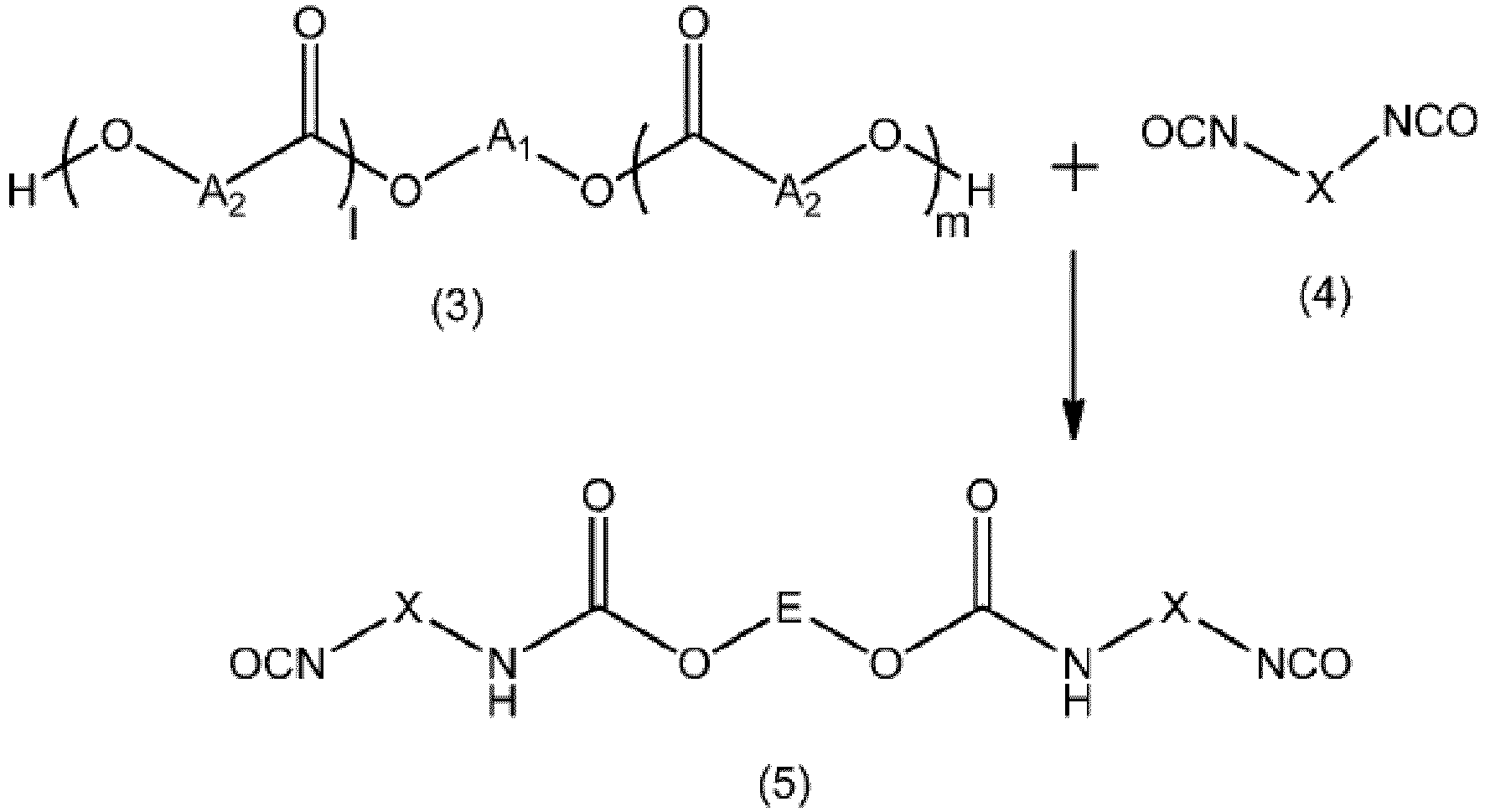
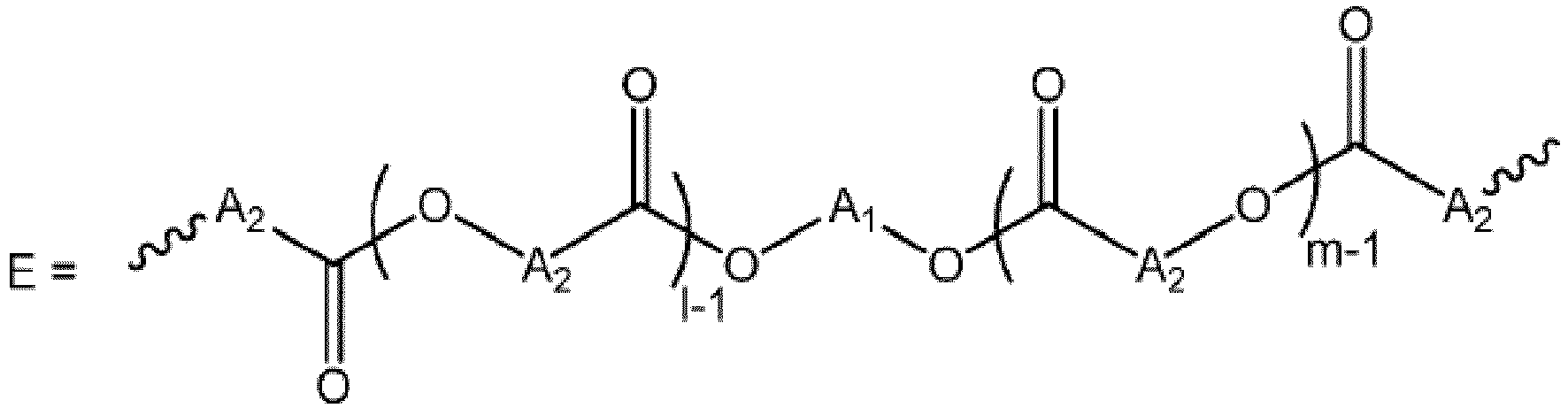 - A1, A2, 1 und m wie oben definiert sind;- X ein C2-C20-Alkylrest, linear oder verzweigt, aufweisend Ungesättigtheiten oder auch nicht, ist;2) Kettenverlängerung, um ein Estolidpolyurethan der Formel (7) zu erhalten, durch Zugabe eines Diols der Formel (6), gegebenenfalls in einem Öl solubilisiert:
 - A1, A2, E, X, Y, 1 und m wie oben definiert sind;- D für einen Alkylrest, linear oder verzweigt, umfassend 2 bis 40 Kohlenstoffatome, vorzugsweise 6 bis 14 Kohlenstoffatome, steht, wobei der Rest gegebenenfalls eine oder mehrere Ungesättigtheiten umfasst;- n eine ganze Zahl von 1 bis 20, vorzugsweise 2 bis 8 ist;und3) gegebenenfalls Kettentermination durch Zugabe eines nukleophilen Moleküls im Überschuss, das mit den restlichen Isocyanatfunktionen reagieren kann, um das gelierende Polyurethan der Formel (I) zu ergeben.
 - Verfahren nach Anspruch 6, wobei mindestens eine der folgenden Bedingungen erfüllt ist:- A1 steht für einen linearen Alkylrest, umfassend 2 bis 12, vorzugsweise 2 bis 6, insbesondere 3 Kohlenstoffatome, wobei der Rest gegebenenfalls eine oder mehrere Ungesättigtheiten umfasst;- A2 steht für einen Alkylrest, linear oder verzweigt, umfassend 2 bis 20 Kohlenstoffatome, insbesondere 12 bis 18 Kohlenstoffatome, wobei der Rest gegebenenfalls eine oder mehrere Ungesättigtheiten und besonders bevorzugt eine Gruppe der Formel umfasst:
 - 1 und m stehen unabhängig für eine ganze Zahl von 1 bis 10, wobei die Summe 1 + m vorzugsweise 2 bis 20 beträgt;- die Summe 1 + m weist einen durchschnittlichen Wert von 5 bis 12, insbesondere 7 oder 11 auf,- n ist eine ganze Zahl von 2 bis 8;- D ist ein Alkylrest, linear oder verzweigt, umfassend 6 bis 14 Kohlenstoffatome, wobei der Rest gegebenenfalls eine oder mehrere Ungesättigtheiten umfasst;- X ist ein Alkylrest, linear oder verzweigt, aufweisend Ungesättigtheiten oder auch nicht, umfassend 2 bis 10, insbesondere 6 Kohlenstoffatome;- Y steht für ein Sauerstoffatom.
 - Verfahren nach einem der Ansprüche 6 oder 7, wobei A1 für einen linearen Alkylrest, umfassend 3 Kohlenstoffatome, steht und/oder A2 für eine Gruppe der Formel steht:

- Verfahren nach einem der Ansprüche 6 bis 8, wobei der Schritt der Funktionalisierung des Di-OH-estolids durch ein Diisocyanatderivat durchgeführt wird:- durch schnelle Zugabe einer Menge eines Diisocyanats (4), umfassend zwischen 1,4 und 2,0 Äquivalente bezogen auf 1 Äquivalent (Äquiv.) Di-OH-estolid (3), berechnet nach seinem OH-Index, bei einer Temperatur, die zwischen 60 °C und 150 °C, vorzugsweise zwischen 110 °C und 135 °C liegt, oder- indem 1 Äquivalent (Äquiv.) Di-OH-estolid (3) auf ein Gemisch von Öl und Diisocyanat (4), das in einer Menge vorliegt, die zwischen 1,4 und 2,0 Äquivalenten liegt, bei einer Temperatur größer als oder gleich 110 °C zugegeben wird.
- Verfahren nach einem der Ansprüche 6 bis 9, wobei die Kettentermination durch Zugabe eines nukleophilen Moleküls vom Alkohol-, Thiol-, Amin- oder Carboxylat-Typ, mono- oder difunktionell, im Überschuss, um mit den restlichen Isocyanatfunktionen im Überschuss im Reaktionsmedium bei einer Temperatur, die zwischen 110 und 150 °C liegt, zu reagieren, durchgeführt wird.
- Verwendung des gelierenden Polyurethans der Formel (I) nach einem der Ansprüche 1 bis 5 oder erhalten gemäß dem Verfahren nach einem der Ansprüche 6 bis 10 als Geliermittel für Öle.
- Verfahren zur Gelierung mindestens eines Öls, ausgewählt beispielsweise aus organischen Ölen, darunter pflanzliche Öle, und Gemischen von apolaren Ölen und stärker polaren Ölen, wobei ein gelierendes Polyurethan der Formel (I) nach einem der Ansprüche 1 bis 5 oder erhalten gemäß dem Verfahren nach einem der Ansprüche 6 bis 10 zu dem oder den Ölen oder zu einer Zusammensetzung, die dieses oder diese enthält, zugegeben wird.
- Gel, das das gelierende Polyurethan der Formel (I) nach einem der Ansprüche 1 bis 5 oder das gemäß dem Verfahren nach einem der Ansprüche 6 bis 10 erhaltene gelierende Polyurethan der Formel (I) enthält oder zum Teil davon gebildet wird.
- Gel nach Anspruch 13, wobei der Massengehalt des gelierenden Polyurethans der Formel (I) zwischen 0,7 % und 10 %, vorzugsweise 1 bis 5 % liegt.
- Pharmazeutische oder kosmetische Zusammensetzung, umfassend ein Gel nach einem der Ansprüche 13 oder 14.
Applications Claiming Priority (2)
| Application Number | Priority Date | Filing Date | Title |
|---|---|---|---|
| FR1752933A FR3064638B1 (fr) | 2017-04-04 | 2017-04-04 | Nouveau gelifiant polyurethane |
| PCT/FR2018/050841 WO2018185432A1 (fr) | 2017-04-04 | 2018-04-04 | Nouveau gelifiant polyurethane |
Publications (3)
| Publication Number | Publication Date |
|---|---|
| EP3606973A1 EP3606973A1 (de) | 2020-02-12 |
| EP3606973C0 EP3606973C0 (de) | 2023-09-06 |
| EP3606973B1 true EP3606973B1 (de) | 2023-09-06 |
Family
ID=59409436
Family Applications (1)
| Application Number | Title | Priority Date | Filing Date |
|---|---|---|---|
| EP18718613.5A Active EP3606973B1 (de) | 2017-04-04 | 2018-04-04 | Neues polyurethangeliermittel |
Country Status (4)
| Country | Link |
|---|---|
| US (1) | US11535695B2 (de) |
| EP (1) | EP3606973B1 (de) |
| FR (1) | FR3064638B1 (de) |
| WO (1) | WO2018185432A1 (de) |
Families Citing this family (11)
| Publication number | Priority date | Publication date | Assignee | Title |
|---|---|---|---|---|
| FR3083118B1 (fr) * | 2018-07-02 | 2021-01-08 | Lvmh Rech | Composition gelifiee avec filtres uv |
| AU2020291622B2 (en) | 2019-06-13 | 2025-12-18 | L'ORéAL S.A. | A gel composition comprising viable microorganisms |
| MX2022002450A (es) * | 2019-08-30 | 2022-03-22 | Grant Ind Inc | Elastomero de base biologica y biodegradable para el cuidado cosmetico y personal. |
| FR3117353B1 (fr) * | 2020-12-11 | 2022-12-16 | Lvmh Rech | Composition avec élastomère non siliconé et corps gras pâteux |
| IT202200018588A1 (it) | 2022-09-12 | 2024-03-12 | Intercos Italiana | “Composizione cosmetica per prodotti cosmetici, contenente un poliuretano lineare o ramificato con elevato indice di origine naturale (NOI)” |
| FR3143328A1 (fr) * | 2022-12-15 | 2024-06-21 | L'oreal | Composition comprenant au moins un alcool gras saturé, au moins un tensioactif anionique, au moins un polyol, et au moins une huile non siliconée, la composition étant exempte de composés siliconés |
| FR3143330B1 (fr) * | 2022-12-15 | 2026-05-01 | Loreal | Composition comprenant au moins un alcool gras saturé, au moins un tensioactif anionique, au moins un polyol, et au moins une huile non siliconée |
| EP4470522A1 (de) | 2023-05-26 | 2024-12-04 | Hyteck | Wasserfreie sonnenformeln |
| WO2024245585A1 (en) | 2023-05-30 | 2024-12-05 | L'oréal | Topical formulation comprising deliquescent substance |
| FR3150103A1 (fr) | 2023-06-23 | 2024-12-27 | Capsum | Dispersions comprenant des pigments et au moins deux agents gelifiants lipophiles |
| WO2025036982A1 (en) | 2023-08-16 | 2025-02-20 | L'oréal | New container, method and delivery system stabilizing topical formulations |
Family Cites Families (4)
| Publication number | Priority date | Publication date | Assignee | Title |
|---|---|---|---|---|
| FR2950052B1 (fr) | 2009-09-11 | 2012-09-07 | Centre Nat Rech Scient | Nouveaux derives d'huile de ricin et leur procede de preparation |
| FR2995901B1 (fr) | 2012-09-21 | 2015-08-14 | Inst Corps Gras Etudes Et Rech S Tech Iterg | Nouveaux pre-polymeres biosources et leurs utilisations pour la preparation de polymeres utiles comme additifs dans une matrice poly(acide lactique) |
| FR2997957B1 (fr) * | 2012-11-12 | 2015-01-16 | Bostik Sa | Adhesif de lamination bicomposant d'origine renouvelable |
| JP2017537930A (ja) * | 2014-12-04 | 2017-12-21 | ルブリゾル アドバンスド マテリアルズ, インコーポレイテッド | 有機相含有組成物の粘度調整 |
-
2017
- 2017-04-04 FR FR1752933A patent/FR3064638B1/fr active Active
-
2018
- 2018-04-04 US US16/500,859 patent/US11535695B2/en active Active
- 2018-04-04 EP EP18718613.5A patent/EP3606973B1/de active Active
- 2018-04-04 WO PCT/FR2018/050841 patent/WO2018185432A1/fr not_active Ceased
Also Published As
| Publication number | Publication date |
|---|---|
| FR3064638B1 (fr) | 2020-04-17 |
| WO2018185432A1 (fr) | 2018-10-11 |
| US11535695B2 (en) | 2022-12-27 |
| US20200109231A1 (en) | 2020-04-09 |
| FR3064638A1 (fr) | 2018-10-05 |
| EP3606973A1 (de) | 2020-02-12 |
| EP3606973C0 (de) | 2023-09-06 |
Similar Documents
| Publication | Publication Date | Title |
|---|---|---|
| EP3606973B1 (de) | Neues polyurethangeliermittel | |
| EP3773432B1 (de) | Kosmetischer trägerstoff mit einem alkan mit c8-c10 und einem alkan mit c>=11 | |
| EP2156818A2 (de) | Kosmetische Zusammensetzungen enthaltend Kalciumcarbonat | |
| FR2954094A1 (fr) | Emulsion solide eau-dans-huile comprenant un solvant hydrocarbone volatil, un tensioactif polyglycerole et une cire polaire | |
| FR3073411A1 (fr) | Composition comprenant une phase grasse, un polymere lipophile et une huile hydrocarbonee volatile | |
| EP3906008A1 (de) | Feste kosmetische zusammensetzung mit wässrigen, in einer festen kontinuierlichen wasserfreien phase dispergierten kugeln | |
| FR3009956A1 (fr) | Composition hydratante sous forme d’emulsion huile-dans-eau ; procede de soin hydratant | |
| CA3252716A1 (fr) | Anhydrous solid cosmetic composition comprising decaglyceryl myristate and a combination of fatty substances | |
| EP4045566B1 (de) | Gelierende polyamide auf biobasis | |
| FR3104963A1 (fr) | Composition biphase comprenant une phase aqueuse comprenant un ou des polyols a une teneur allant de 5% a 30% en poids et une phase huileuse comprenant des huiles non siliconees | |
| FR3030260A1 (fr) | Composition comprenant des particules de polymere stabilise et un tensioactif non ionique | |
| EP1925291B1 (de) | Kosmetische Zusammensetzung, die mindestens einen flüchtigen Ester umfasst | |
| FR2843020A1 (fr) | Composition cosmetique comprenant un melange d'esters de dextrine | |
| CA3220679A1 (fr) | Composition cosmetique sous la forme d'emulsion huile-dans-eau a forte teneur en ingredients d'origine naturelle | |
| EP1787681A2 (de) | Kosmetische Zusammensetzung, dessen flüssige Fettphase mit einer Bis-harnstoff-verbindung angedickt wurde | |
| FR3124081A1 (fr) | Composition cosmétique comprenant au moins une huile polaire, un polyol et au moins un actif hydrophile | |
| FR2908982A1 (fr) | Composition cosmetique comprenant au moins un solvant volatil hydrocarbone aprotique | |
| FR3117834A1 (fr) | Composition cosmétique biphase comprenant un acide aminé et deux acides spécifiques | |
| FR2851915A1 (fr) | Composition cosmetique contenant un ester et un compose pateux | |
| KR102777610B1 (ko) | 제형 안정도가 우수한 수중유형 화장료 조성물 | |
| WO2011030036A1 (fr) | Composition comprenant un polymère à base de polyols particuliers, et procédé de traitement cosmétique | |
| FR3135729A1 (fr) | EXTRAIT de beurre de karité enrichi en insaponifiable détriterpéné | |
| FR3137831A1 (fr) | Emulsion huile-dans-eau comprenant une dispersion huileuse de particule polymérique stabilisée par un agent stabilisant alkyle en C9-C22 et un plastifiant spécifique | |
| FR3157146A1 (fr) | Composition cosmétique comprenant une huile, un alcanol, un polyol, de l’acide azélaïque, et une faible teneur en eau. | |
| FR3067931A1 (fr) | Composition cosmetique en poudre a base de dispersion huile-dans-eau enrobee de particules d'aerogel de silice hydrophobe |
Legal Events
| Date | Code | Title | Description |
|---|---|---|---|
| STAA | Information on the status of an ep patent application or granted ep patent |
Free format text: STATUS: UNKNOWN |
|
| STAA | Information on the status of an ep patent application or granted ep patent |
Free format text: STATUS: THE INTERNATIONAL PUBLICATION HAS BEEN MADE |
|
| PUAI | Public reference made under article 153(3) epc to a published international application that has entered the european phase |
Free format text: ORIGINAL CODE: 0009012 |
|
| STAA | Information on the status of an ep patent application or granted ep patent |
Free format text: STATUS: REQUEST FOR EXAMINATION WAS MADE |
|
| 17P | Request for examination filed |
Effective date: 20191018 |
|
| AK | Designated contracting states |
Kind code of ref document: A1 Designated state(s): AL AT BE BG CH CY CZ DE DK EE ES FI FR GB GR HR HU IE IS IT LI LT LU LV MC MK MT NL NO PL PT RO RS SE SI SK SM TR |
|
| AX | Request for extension of the european patent |
Extension state: BA ME |
|
| DAV | Request for validation of the european patent (deleted) | ||
| DAX | Request for extension of the european patent (deleted) | ||
| GRAP | Despatch of communication of intention to grant a patent |
Free format text: ORIGINAL CODE: EPIDOSNIGR1 |
|
| STAA | Information on the status of an ep patent application or granted ep patent |
Free format text: STATUS: GRANT OF PATENT IS INTENDED |
|
| RIC1 | Information provided on ipc code assigned before grant |
Ipc: C10M 119/24 20060101ALI20221124BHEP Ipc: A61Q 19/00 20060101ALI20221124BHEP Ipc: A61Q 17/04 20060101ALI20221124BHEP Ipc: A61Q 15/00 20060101ALI20221124BHEP Ipc: A61Q 1/06 20060101ALI20221124BHEP Ipc: A61K 8/87 20060101ALI20221124BHEP Ipc: A61K 8/04 20060101ALI20221124BHEP Ipc: C08G 18/36 20060101ALI20221124BHEP Ipc: C08G 18/73 20060101ALI20221124BHEP Ipc: C08G 18/68 20060101ALI20221124BHEP Ipc: C08G 18/10 20060101AFI20221124BHEP |
|
| INTG | Intention to grant announced |
Effective date: 20221214 |
|
| GRAJ | Information related to disapproval of communication of intention to grant by the applicant or resumption of examination proceedings by the epo deleted |
Free format text: ORIGINAL CODE: EPIDOSDIGR1 |
|
| STAA | Information on the status of an ep patent application or granted ep patent |
Free format text: STATUS: REQUEST FOR EXAMINATION WAS MADE |
|
| INTC | Intention to grant announced (deleted) | ||
| GRAP | Despatch of communication of intention to grant a patent |
Free format text: ORIGINAL CODE: EPIDOSNIGR1 |
|
| STAA | Information on the status of an ep patent application or granted ep patent |
Free format text: STATUS: GRANT OF PATENT IS INTENDED |
|
| INTG | Intention to grant announced |
Effective date: 20230530 |
|
| GRAS | Grant fee paid |
Free format text: ORIGINAL CODE: EPIDOSNIGR3 |
|
| GRAA | (expected) grant |
Free format text: ORIGINAL CODE: 0009210 |
|
| STAA | Information on the status of an ep patent application or granted ep patent |
Free format text: STATUS: THE PATENT HAS BEEN GRANTED |
|
| AK | Designated contracting states |
Kind code of ref document: B1 Designated state(s): AL AT BE BG CH CY CZ DE DK EE ES FI FR GB GR HR HU IE IS IT LI LT LU LV MC MK MT NL NO PL PT RO RS SE SI SK SM TR |
|
| REG | Reference to a national code |
Ref country code: GB Ref legal event code: FG4D Free format text: NOT ENGLISH |
|
| REG | Reference to a national code |
Ref country code: CH Ref legal event code: EP |
|
| REG | Reference to a national code |
Ref country code: DE Ref legal event code: R096 Ref document number: 602018056947 Country of ref document: DE |
|
| REG | Reference to a national code |
Ref country code: IE Ref legal event code: FG4D Free format text: LANGUAGE OF EP DOCUMENT: FRENCH |
|
| U01 | Request for unitary effect filed |
Effective date: 20230926 |
|
| U07 | Unitary effect registered |
Designated state(s): AT BE BG DE DK EE FI FR IT LT LU LV MT NL PT SE SI Effective date: 20231005 |
|
| PG25 | Lapsed in a contracting state [announced via postgrant information from national office to epo] |
Ref country code: GR Free format text: LAPSE BECAUSE OF FAILURE TO SUBMIT A TRANSLATION OF THE DESCRIPTION OR TO PAY THE FEE WITHIN THE PRESCRIBED TIME-LIMIT Effective date: 20231207 |
|
| PG25 | Lapsed in a contracting state [announced via postgrant information from national office to epo] |
Ref country code: RS Free format text: LAPSE BECAUSE OF FAILURE TO SUBMIT A TRANSLATION OF THE DESCRIPTION OR TO PAY THE FEE WITHIN THE PRESCRIBED TIME-LIMIT Effective date: 20230906 Ref country code: NO Free format text: LAPSE BECAUSE OF FAILURE TO SUBMIT A TRANSLATION OF THE DESCRIPTION OR TO PAY THE FEE WITHIN THE PRESCRIBED TIME-LIMIT Effective date: 20231206 Ref country code: HR Free format text: LAPSE BECAUSE OF FAILURE TO SUBMIT A TRANSLATION OF THE DESCRIPTION OR TO PAY THE FEE WITHIN THE PRESCRIBED TIME-LIMIT Effective date: 20230906 Ref country code: GR Free format text: LAPSE BECAUSE OF FAILURE TO SUBMIT A TRANSLATION OF THE DESCRIPTION OR TO PAY THE FEE WITHIN THE PRESCRIBED TIME-LIMIT Effective date: 20231207 |
|
| PG25 | Lapsed in a contracting state [announced via postgrant information from national office to epo] |
Ref country code: IS Free format text: LAPSE BECAUSE OF FAILURE TO SUBMIT A TRANSLATION OF THE DESCRIPTION OR TO PAY THE FEE WITHIN THE PRESCRIBED TIME-LIMIT Effective date: 20240106 |
|
| PG25 | Lapsed in a contracting state [announced via postgrant information from national office to epo] |
Ref country code: ES Free format text: LAPSE BECAUSE OF FAILURE TO SUBMIT A TRANSLATION OF THE DESCRIPTION OR TO PAY THE FEE WITHIN THE PRESCRIBED TIME-LIMIT Effective date: 20230906 |
|
| PG25 | Lapsed in a contracting state [announced via postgrant information from national office to epo] |
Ref country code: SM Free format text: LAPSE BECAUSE OF FAILURE TO SUBMIT A TRANSLATION OF THE DESCRIPTION OR TO PAY THE FEE WITHIN THE PRESCRIBED TIME-LIMIT Effective date: 20230906 Ref country code: RO Free format text: LAPSE BECAUSE OF FAILURE TO SUBMIT A TRANSLATION OF THE DESCRIPTION OR TO PAY THE FEE WITHIN THE PRESCRIBED TIME-LIMIT Effective date: 20230906 Ref country code: IS Free format text: LAPSE BECAUSE OF FAILURE TO SUBMIT A TRANSLATION OF THE DESCRIPTION OR TO PAY THE FEE WITHIN THE PRESCRIBED TIME-LIMIT Effective date: 20240106 Ref country code: ES Free format text: LAPSE BECAUSE OF FAILURE TO SUBMIT A TRANSLATION OF THE DESCRIPTION OR TO PAY THE FEE WITHIN THE PRESCRIBED TIME-LIMIT Effective date: 20230906 Ref country code: CZ Free format text: LAPSE BECAUSE OF FAILURE TO SUBMIT A TRANSLATION OF THE DESCRIPTION OR TO PAY THE FEE WITHIN THE PRESCRIBED TIME-LIMIT Effective date: 20230906 Ref country code: SK Free format text: LAPSE BECAUSE OF FAILURE TO SUBMIT A TRANSLATION OF THE DESCRIPTION OR TO PAY THE FEE WITHIN THE PRESCRIBED TIME-LIMIT Effective date: 20230906 |
|
| U20 | Renewal fee for the european patent with unitary effect paid |
Year of fee payment: 7 Effective date: 20240328 |
|
| PG25 | Lapsed in a contracting state [announced via postgrant information from national office to epo] |
Ref country code: PL Free format text: LAPSE BECAUSE OF FAILURE TO SUBMIT A TRANSLATION OF THE DESCRIPTION OR TO PAY THE FEE WITHIN THE PRESCRIBED TIME-LIMIT Effective date: 20230906 |
|
| REG | Reference to a national code |
Ref country code: DE Ref legal event code: R097 Ref document number: 602018056947 Country of ref document: DE |
|
| PLBE | No opposition filed within time limit |
Free format text: ORIGINAL CODE: 0009261 |
|
| STAA | Information on the status of an ep patent application or granted ep patent |
Free format text: STATUS: NO OPPOSITION FILED WITHIN TIME LIMIT |
|
| 26N | No opposition filed |
Effective date: 20240607 |
|
| PG25 | Lapsed in a contracting state [announced via postgrant information from national office to epo] |
Ref country code: MC Free format text: LAPSE BECAUSE OF FAILURE TO SUBMIT A TRANSLATION OF THE DESCRIPTION OR TO PAY THE FEE WITHIN THE PRESCRIBED TIME-LIMIT Effective date: 20230906 |
|
| PG25 | Lapsed in a contracting state [announced via postgrant information from national office to epo] |
Ref country code: MC Free format text: LAPSE BECAUSE OF FAILURE TO SUBMIT A TRANSLATION OF THE DESCRIPTION OR TO PAY THE FEE WITHIN THE PRESCRIBED TIME-LIMIT Effective date: 20230906 |
|
| REG | Reference to a national code |
Ref country code: CH Ref legal event code: PL |
|
| GBPC | Gb: european patent ceased through non-payment of renewal fee |
Effective date: 20240404 |
|
| PG25 | Lapsed in a contracting state [announced via postgrant information from national office to epo] |
Ref country code: GB Free format text: LAPSE BECAUSE OF NON-PAYMENT OF DUE FEES Effective date: 20240404 |
|
| PG25 | Lapsed in a contracting state [announced via postgrant information from national office to epo] |
Ref country code: GB Free format text: LAPSE BECAUSE OF NON-PAYMENT OF DUE FEES Effective date: 20240404 Ref country code: CH Free format text: LAPSE BECAUSE OF NON-PAYMENT OF DUE FEES Effective date: 20240430 |
|
| PG25 | Lapsed in a contracting state [announced via postgrant information from national office to epo] |
Ref country code: IE Free format text: LAPSE BECAUSE OF NON-PAYMENT OF DUE FEES Effective date: 20240404 |
|
| U20 | Renewal fee for the european patent with unitary effect paid |
Year of fee payment: 8 Effective date: 20250425 |
|
| PG25 | Lapsed in a contracting state [announced via postgrant information from national office to epo] |
Ref country code: CY Free format text: LAPSE BECAUSE OF FAILURE TO SUBMIT A TRANSLATION OF THE DESCRIPTION OR TO PAY THE FEE WITHIN THE PRESCRIBED TIME-LIMIT; INVALID AB INITIO Effective date: 20180404 |
|
| PG25 | Lapsed in a contracting state [announced via postgrant information from national office to epo] |
Ref country code: HU Free format text: LAPSE BECAUSE OF FAILURE TO SUBMIT A TRANSLATION OF THE DESCRIPTION OR TO PAY THE FEE WITHIN THE PRESCRIBED TIME-LIMIT; INVALID AB INITIO Effective date: 20180404 |
|
| PG25 | Lapsed in a contracting state [announced via postgrant information from national office to epo] |
Ref country code: TR Free format text: LAPSE BECAUSE OF FAILURE TO SUBMIT A TRANSLATION OF THE DESCRIPTION OR TO PAY THE FEE WITHIN THE PRESCRIBED TIME-LIMIT Effective date: 20230906 |