EP4045566B1 - Gelierende polyamide auf biobasis - Google Patents
Gelierende polyamide auf biobasis Download PDFInfo
- Publication number
- EP4045566B1 EP4045566B1 EP20799786.7A EP20799786A EP4045566B1 EP 4045566 B1 EP4045566 B1 EP 4045566B1 EP 20799786 A EP20799786 A EP 20799786A EP 4045566 B1 EP4045566 B1 EP 4045566B1
- Authority
- EP
- European Patent Office
- Prior art keywords
- carbon atoms
- formula
- polyamide
- gelling
- radical
- Prior art date
- Legal status (The legal status is an assumption and is not a legal conclusion. Google has not performed a legal analysis and makes no representation as to the accuracy of the status listed.)
- Active
Links
Classifications
-
- C—CHEMISTRY; METALLURGY
- C08—ORGANIC MACROMOLECULAR COMPOUNDS; THEIR PREPARATION OR CHEMICAL WORKING-UP; COMPOSITIONS BASED THEREON
- C08G—MACROMOLECULAR COMPOUNDS OBTAINED OTHERWISE THAN BY REACTIONS ONLY INVOLVING UNSATURATED CARBON-TO-CARBON BONDS
- C08G69/00—Macromolecular compounds obtained by reactions forming a carboxylic amide link in the main chain of the macromolecule
- C08G69/44—Polyester-amides
-
- A—HUMAN NECESSITIES
- A61—MEDICAL OR VETERINARY SCIENCE; HYGIENE
- A61K—PREPARATIONS FOR MEDICAL, DENTAL OR TOILETRY PURPOSES
- A61K47/00—Medicinal preparations characterised by the non-active ingredients used, e.g. carriers or inert additives; Targeting or modifying agents chemically bound to the active ingredient
- A61K47/06—Organic compounds, e.g. natural or synthetic hydrocarbons, polyolefins, mineral oil, petrolatum or ozokerite
- A61K47/08—Organic compounds, e.g. natural or synthetic hydrocarbons, polyolefins, mineral oil, petrolatum or ozokerite containing oxygen, e.g. ethers, acetals, ketones, quinones, aldehydes, peroxides
- A61K47/14—Esters of carboxylic acids, e.g. fatty acid monoglycerides, medium-chain triglycerides, parabens or PEG fatty acid esters
-
- A—HUMAN NECESSITIES
- A61—MEDICAL OR VETERINARY SCIENCE; HYGIENE
- A61K—PREPARATIONS FOR MEDICAL, DENTAL OR TOILETRY PURPOSES
- A61K47/00—Medicinal preparations characterised by the non-active ingredients used, e.g. carriers or inert additives; Targeting or modifying agents chemically bound to the active ingredient
- A61K47/30—Macromolecular organic or inorganic compounds, e.g. inorganic polyphosphates
- A61K47/34—Macromolecular compounds obtained otherwise than by reactions only involving carbon-to-carbon unsaturated bonds, e.g. polyesters, polyamino acids, polysiloxanes, polyphosphazines, copolymers of polyalkylene glycol or poloxamers
-
- A—HUMAN NECESSITIES
- A61—MEDICAL OR VETERINARY SCIENCE; HYGIENE
- A61K—PREPARATIONS FOR MEDICAL, DENTAL OR TOILETRY PURPOSES
- A61K47/00—Medicinal preparations characterised by the non-active ingredients used, e.g. carriers or inert additives; Targeting or modifying agents chemically bound to the active ingredient
- A61K47/30—Macromolecular organic or inorganic compounds, e.g. inorganic polyphosphates
- A61K47/42—Proteins; Polypeptides; Degradation products thereof; Derivatives thereof, e.g. albumin, gelatin or zein
-
- A—HUMAN NECESSITIES
- A61—MEDICAL OR VETERINARY SCIENCE; HYGIENE
- A61K—PREPARATIONS FOR MEDICAL, DENTAL OR TOILETRY PURPOSES
- A61K8/00—Cosmetics or similar toiletry preparations
- A61K8/02—Cosmetics or similar toiletry preparations characterised by special physical form
- A61K8/04—Dispersions; Emulsions
- A61K8/042—Gels
-
- A—HUMAN NECESSITIES
- A61—MEDICAL OR VETERINARY SCIENCE; HYGIENE
- A61K—PREPARATIONS FOR MEDICAL, DENTAL OR TOILETRY PURPOSES
- A61K8/00—Cosmetics or similar toiletry preparations
- A61K8/18—Cosmetics or similar toiletry preparations characterised by the composition
- A61K8/72—Cosmetics or similar toiletry preparations characterised by the composition containing organic macromolecular compounds
- A61K8/84—Cosmetics or similar toiletry preparations characterised by the composition containing organic macromolecular compounds obtained by reactions otherwise than those involving only carbon-carbon unsaturated bonds
- A61K8/88—Polyamides
-
- A—HUMAN NECESSITIES
- A61—MEDICAL OR VETERINARY SCIENCE; HYGIENE
- A61K—PREPARATIONS FOR MEDICAL, DENTAL OR TOILETRY PURPOSES
- A61K8/00—Cosmetics or similar toiletry preparations
- A61K8/18—Cosmetics or similar toiletry preparations characterised by the composition
- A61K8/92—Oils, fats or waxes; Derivatives thereof, e.g. hydrogenation products thereof
-
- A—HUMAN NECESSITIES
- A61—MEDICAL OR VETERINARY SCIENCE; HYGIENE
- A61K—PREPARATIONS FOR MEDICAL, DENTAL OR TOILETRY PURPOSES
- A61K8/00—Cosmetics or similar toiletry preparations
- A61K8/18—Cosmetics or similar toiletry preparations characterised by the composition
- A61K8/92—Oils, fats or waxes; Derivatives thereof, e.g. hydrogenation products thereof
- A61K8/922—Oils, fats or waxes; Derivatives thereof, e.g. hydrogenation products thereof of vegetable origin
-
- A—HUMAN NECESSITIES
- A61—MEDICAL OR VETERINARY SCIENCE; HYGIENE
- A61Q—SPECIFIC USE OF COSMETICS OR SIMILAR TOILETRY PREPARATIONS
- A61Q19/00—Preparations for care of the skin
-
- C—CHEMISTRY; METALLURGY
- C08—ORGANIC MACROMOLECULAR COMPOUNDS; THEIR PREPARATION OR CHEMICAL WORKING-UP; COMPOSITIONS BASED THEREON
- C08L—COMPOSITIONS OF MACROMOLECULAR COMPOUNDS
- C08L77/00—Compositions of polyamides obtained by reactions forming a carboxylic amide link in the main chain; Compositions of derivatives of such polymers
- C08L77/12—Polyester-amides
-
- C—CHEMISTRY; METALLURGY
- C08—ORGANIC MACROMOLECULAR COMPOUNDS; THEIR PREPARATION OR CHEMICAL WORKING-UP; COMPOSITIONS BASED THEREON
- C08L—COMPOSITIONS OF MACROMOLECULAR COMPOUNDS
- C08L91/00—Compositions of oils, fats or waxes; Compositions of derivatives thereof
-
- A—HUMAN NECESSITIES
- A61—MEDICAL OR VETERINARY SCIENCE; HYGIENE
- A61K—PREPARATIONS FOR MEDICAL, DENTAL OR TOILETRY PURPOSES
- A61K2800/00—Properties of cosmetic compositions or active ingredients thereof or formulation aids used therein and process related aspects
- A61K2800/10—General cosmetic use
-
- A—HUMAN NECESSITIES
- A61—MEDICAL OR VETERINARY SCIENCE; HYGIENE
- A61K—PREPARATIONS FOR MEDICAL, DENTAL OR TOILETRY PURPOSES
- A61K47/00—Medicinal preparations characterised by the non-active ingredients used, e.g. carriers or inert additives; Targeting or modifying agents chemically bound to the active ingredient
- A61K47/44—Oils, fats or waxes according to two or more groups of A61K47/02-A61K47/42; Natural or modified natural oils, fats or waxes, e.g. castor oil, polyethoxylated castor oil, montan wax, lignite, shellac, rosin, beeswax or lanolin
-
- A—HUMAN NECESSITIES
- A61—MEDICAL OR VETERINARY SCIENCE; HYGIENE
- A61K—PREPARATIONS FOR MEDICAL, DENTAL OR TOILETRY PURPOSES
- A61K9/00—Medicinal preparations characterised by special physical form
- A61K9/06—Ointments; Bases therefor; Other semi-solid forms, e.g. creams, sticks, gels
-
- C—CHEMISTRY; METALLURGY
- C08—ORGANIC MACROMOLECULAR COMPOUNDS; THEIR PREPARATION OR CHEMICAL WORKING-UP; COMPOSITIONS BASED THEREON
- C08G—MACROMOLECULAR COMPOUNDS OBTAINED OTHERWISE THAN BY REACTIONS ONLY INVOLVING UNSATURATED CARBON-TO-CARBON BONDS
- C08G69/00—Macromolecular compounds obtained by reactions forming a carboxylic amide link in the main chain of the macromolecule
- C08G69/02—Polyamides derived from amino-carboxylic acids or from polyamines and polycarboxylic acids
- C08G69/26—Polyamides derived from amino-carboxylic acids or from polyamines and polycarboxylic acids derived from polyamines and polycarboxylic acids
Definitions
- the invention relates to new gelling polyamide derivatives of biosourced origin, their preparation process and the development of new gels in organic media (oils) from these.
- the invention also relates to the gels formed from these gelling polyamides, as well as the compositions containing them, in particular cosmetic and pharmaceutical compositions.
- the process according to the invention makes it possible to obtain a polyamide compound capable of forming gels having the desired properties, by implementing two manufacturing stages.
- a first step an amide derivative of low molar mass is first obtained by functionalization of a diacid with a diamine, conferring the gelling properties of the compound of the invention, the diacid and the diamine being able to be biosourced.
- This step is followed by the addition of a diacid polyester to the polyamide compound obtained initially, in order to obtain a polyamide compound soluble in oils and capable of gelling them.
- the invention also relates to the gels obtained from these gelling polyamides.
- These gels are characterized by their pleasant texture to the touch, their transparency, their low content of gelling polyamide, their ability to disperse at temperatures below 85°C, their thermoreversible and rheofluidifying nature and the possibility of being composed 100% of products of natural origin.
- the gelling polyamide In the case of the gelling of cosmetic oils, the gelling polyamide must meet various precise criteria. For cost reasons, when used in a cosmetic product, the gelling polyamide must first be capable of gelling the organic phase at a low concentration, that is to say, preferably less than 10%. mass. Additionally, an important aspect for a cosmetic application is the feel of the product. Indeed, the incorporation of the gelling agent must not induce a too marked granular effect on the cosmetic product.
- Requirement WO98/17705 describes the preparation of ester-terminated polyamides capable of gelling oils, by a one-step process.
- the synthesized polyamides are capable of gelling tetradecane.
- polyamides obtained are not of a biosourced nature and therefore do not have the desired natural origin of the present invention.
- the polymers obtained can only gel a limited number of oils, and require the use of high concentrations to obtain strong gels, which results in significant manufacturing costs for a cosmetic formulation.
- polyamides according to the invention were easy to use in cosmetic formulations and made it possible to give them a creamy texture.
- natural origin we mean a product partially or entirely prepared from natural materials (animal or plant) modified or not chemically. Such a product can also be described as “biosourced” or “of biosourced origin”, these terms being commonly used in the field of polymers.
- Biosourced products or products of biosourced origin generally come from plant material such as trees or plants, for example sugar cane, beet, sunflower, palm, castor oil and others, or from animal material such as fats.
- the natural content content of the polyamide can be calculated, in particular, according to the NF ISO 16128-2 standard.
- the new polyamide derivatives according to the invention can be prepared by a synthesis process comprising a step of forming a precursor, and a step of adding a diacid polyester, providing solubility in oils to the final compound.
- a 1 represents a linear alkyl radical comprising from 2 to 12, preferably from 2 to 6, in particular 3 carbon atoms, said radical optionally comprising one or more unsaturations.
- a 2 represents an alkyl radical, linear or branched, comprising from 5 to 18 carbon atoms, said radical optionally comprising one or more unsaturations, and preferably a group of formula
- the sum l+m has an average value of 7, 11 or 15.
- the invention also relates to a process for preparing gelling polyamides.
- the objective of preparing the gelling polyamide is to chemically modify a polyester, soluble in oils, particularly vegetable oils, in order to incorporate amide groups, thus making it possible to provide the desired gelling properties.
- the polyamide diamine of formula (4) is indifferently called, in the description, “diamine precursor” or “functionalized diamine precursor”.
- the polyamide compound of formula (7) has improved solubility in vegetable oils.
- polyamide compound of formula (7) and its use as a gelling agent also represent aspects of the invention.
- the diacid polyester of formula (5) in which A 1 , A 2 , l and m are as defined above, is available commercially under the name PRICA ® (ITERG), or can be prepared by condensation of a diacid of formula (8) with a derivative hydroxylated ester or hydroxylated fatty acid of formula (9) according to a protocol derived from the application WO2014044809 :
- the 1st step of the process for preparing the gelling polyamide compound (1) namely the step of forming a diamine precursor (4) by functionalization of a diacid (2) with a diamine (3), allows the manufacture of the gelling block.
- This step preferably has a duration of between 1 hour and 24 hours, preferably between 4 hours and 16 hours.
- the reaction is preferably carried out at a temperature between 100°C and 240°C, in particular between 130°C and 160°C.
- This step is preferably carried out in a sealed system previously dried and placed under vacuum.
- the 1st step is carried out by mixing an equivalent of diacid (2) and a quantity of diamine (3) of between 1 and 4 equivalents.
- the quantity of equivalent(s) of diamine (3) used can be calculated, for example, according to the amine index thereof.
- equivalents are calculated based on the acid and amine levels provided by raw material manufacturers in the product's CoA (Certificate of Analysis) or are determined by dosage.
- the diacid of formula (2) can be chosen, for example, from C 4 -C 12 aliphatic diacids, such as sebacic acid, adipic acid, succinic acid. or diacids comprising a heterocycle having 3 to 10 members and comprising 1 or 2 heteroatom(s) chosen from O, N and S, such as furandicarboxylic acid (FDCA).
- C 4 -C 12 aliphatic diacids such as sebacic acid, adipic acid, succinic acid.
- diacids comprising a heterocycle having 3 to 10 members and comprising 1 or 2 heteroatom(s) chosen from O, N and S, such as furandicarboxylic acid (FDCA).
- the diamine of formula (3) may comprise, for example, an alkyl radical comprising 30 to 40 carbon atoms.
- a preferred diacid of formula (2) is sebacic acid and a preferred diamine of formula (3) is a diamine dimer having on average 36 carbons, marketed by CRODA under the name Priamine ® .
- the 2nd step of the process according to the invention (modification of the polyester polyamide) preferably has a duration of between 30 min and 24 h, in particular between 2 h and 10 h.
- the reaction can be carried out, for example, at a temperature between 100°C and 240°C, preferably between 130°C and 160°C, by adding diacid polyester to a reactor containing the precursor formed during the step. 1, previously heated and stirred at the temperature of step 2.
- the ratio between the diacid polyester (5) and the diamine precursor (4) is one of the factors which influences the gelling capacity of the final product.
- the ratio between the diamine precursor (4) and the diacid (5) is chosen such that the compound (1) no longer has amine functions at the end of the chain, but only carboxylic acid or alcohol functions.
- diamine precursor (4) of between 0.2 and 1 equivalent (eq), and more particularly between 0.4 and 0.7 equivalent (eq) for 1 equivalent of diacid polyester (5).
- the 2nd step is carried out by adding 1 equivalent of diacid polyester (5) to a quantity of diamine precursor (4) of between 0.2 and 1 equivalent, at a temperature of between 100 and 240°C, preferably between 130 and 150°C.
- the gelling polyamide is formed, and the recovery of the gelling polyamide can be carried out, for example, by flowing it at a temperature above 100°C from the reactor to a suitable container.
- the process according to the invention has the advantage of consisting of mass polymerization, using biosourced compounds and/or natural origin.
- the gelling polyamides thus obtained make it possible to obtain gels which can be 100% biosourced when the gelling polyamide is solubilized in a vegetable oil.
- the invention also relates to the use of the gelling polyamide according to the invention, or obtained according to the process of the invention, as a gelling agent for organic media, in particular vegetable oils.
- the invention also relates to the use of the gelling polyamide according to the invention, or obtained according to the process of the invention, as a gelling agent for oils chosen, for example, from vegetable oils or oils of natural origin, such as caprylic/capric triglyceride, helianthus annuus seed oil, ethylhexyl palmitate, castor oil, coconut oil, glycineavoine oil, Polyglyceryl-4 Oleate (and) Glyceryl Olivate (and) Hydrogenated Rapeseed Alcohol, Isopropyl myristate, dicaprylyl carbonate, ethyl oleate , prunus domestica seed oil, prunus amygdalus dulcis oil, sesamum indicum seed oil, simmondsia chinensis
- the gelling polyamide according to the invention can also form a clear and transparent gel with non-polar oils if they are mixed with more polar oils, such as for example, a mixture containing up to 70% of C15-19 Alkane or 70% of Squalane with 30% Caprylic/capric tryglyceride.
- the gelling polyamide of formula (1) or (7) makes it possible to obtain a gel having a combination of advantageous properties, namely: gel strength properties, transparency properties, pleasant texture to the touch and charges uniformly distributed in the gel thanks to the suspensive capacity of said polyamide with respect to said charges in the gel, these properties being, moreover, obtained by using a biosourced compound.
- sustained capacity we mean the ability to maintain solids in suspension in the medium without precipitation occurring.
- the gel obtained from the gelling polyamide of formula (1) or (7), as described above is shear thinning (its dynamic viscosity decreases when the shear rate increases) and thixotropic (its apparent viscosity decreases when subjected to a constant shear rate, and returns to its initial value when the shear is stopped).
- the gelling polyamide according to the invention can also be used to form balls of gelled oil suspended in an aqueous medium.
- the gelling polyamide will be previously dispersed in an oil of interest, then beads will be obtained by adding the gelled oil to the aqueous phase, either by mechanical dispersion or by microfluidics processes (millimeter beads).
- the mixture could possibly be stabilized either by adding surfactants to obtain a suspension, or by adding coacervation agents.
- the advantages provided by the gelling agent consist of increased mechanical properties of the beads, as well as a pleasant texture and greater stability of the beads suspended in the aqueous phase.
- the invention also relates to a process for gelling at least one oil chosen, for example, from vegetable oils and mixtures of non-polar oils and more polar oils, in particular of natural origin, in which a gelling polyamide of formula (1) or (7) as described above, according to the invention, or obtained by the preparation process described above, is added to said oil(s), or to a composition containing it(ies). .
- the invention also relates to gels containing or formed from said gelling polyamides.
- gels comprising the gelling polyamide according to the invention, or obtained according to the process of the invention, and at least one pharmaceutically or cosmetically acceptable oil are an object of the invention.
- the gelling polyamide according to the invention or obtained according to the process of the invention makes it possible to form, for example, a rheofluidifying and thixotropic gel at a content of 5% by weight in caprylic/capric triglyceride.
- the gelling polyamide according to the invention or obtained according to the process of the invention, as gelling agent forms gels in caprylic/capric triglyceride whose viscosity increases with the concentration of said gelling agent.
- the gel formed with the gelling polyamide according to the invention, or obtained according to the process of the invention can reach, in particular, an optimum viscosity only 4 hours after its preparation, and remain the same 48 hours later.
- the gelling polyamides according to the invention make it possible to form viscous gels containing up to 5% ethanol.
- the gelling polyamide according to the invention makes it possible to gel oils and stabilize mixtures containing up to 4% of waxes with the following waxes: beeswax, C10-18 triglycerides, behenyl alcohol, glyceryl stearate, synthetic wax, pentaerythrityl distearate, copernica cerifera wax, cetearyl alcohol, cetyl alcohol, rice bran wax, sunflower wax, hydrogenated cocoglycerides, glyceryl dibehenate, C18-36 acid triglyceride. (INCI name).
- the gelling polyamide also makes it possible to gel oils and stabilize mixtures containing up to 4% by weight of butters with, for example, the following butters: shea butter, apricot butter, coconut butter.
- the invention also relates to gels containing or formed from the gelling polyamide according to the invention, or obtained according to the process of the invention.
- the gelling polyamides of formula (1) or (7) make it possible to easily prepare completely natural clear oily gels.
- the gelling polyamides according to the invention also make it possible to form clear gels with sun filters such as ethylhexylmethoxycinnamate, ethylhexyl salicylate, homosalate, octocrylene.
- sun filters such as ethylhexylmethoxycinnamate, ethylhexyl salicylate, homosalate, octocrylene.
- the mass content of the gelling polyamide in said gel is preferably 0.5 to 10%, in particular 3 to 8%.
- the invention also relates to compositions comprising a gelling polyamide of formula (1) or (7) as described above or obtained according to the process of the invention, or comprising gels containing or formed from said gelling polyamides. , in particular pharmaceutical or cosmetic compositions.
- Said pharmaceutical or cosmetic compositions may comprise active ingredients and pharmaceutically acceptable or cosmetically acceptable vehicles and additives.
- the mass content of the gelling polyamide in a cosmetic composition according to the invention can be, for example, between 0.5% and 10%, preferably from 1 to 10%, in particular from 3 to 8%.
- the gelling polyamides according to the invention, or obtained according to the process of the invention can therefore be associated in cosmetics with polar, non-polar, vegetable oils, or perfumes.
- the gelling polyamide also makes it possible to gel oils and stabilize mixtures containing up to 10% surfactant, for example: PEG-20 sorbitan oleate, PEG-20 glyceryl triisostearate, polyglyceryl-4 oleate, polyglyceryl-4-stearate .
- surfactant for example: PEG-20 sorbitan oleate, PEG-20 glyceryl triisostearate, polyglyceryl-4 oleate, polyglyceryl-4-stearate .
- the gelling polyamide also makes it possible to gel oils and stabilize mixtures containing up to 5% of suspending agent such as silica, titanium dioxide, clay, mica, Luffa Cylindrica Fruit, cellulose acetate and vaccinum microcarpon fruit powder.
- suspending agent such as silica, titanium dioxide, clay, mica, Luffa Cylindrica Fruit, cellulose acetate and vaccinum microcarpon fruit powder.
- the gelling polyamides described above can be incorporated into various anhydrous galenic formulations such as anhydrous gel, sprayable gel, pumpable gel, pearly gel, tinted gel, lip balm, lip stick, exfoliating gel, perfumed gel, sun jelly, oily makeup remover gel.
- emulsion type formulations such as, for example, a water-in-oil emulsion, an oil-in-water emulsion, a sunscreen emulsion, a water-in-oil foundation, an oil-in-water foundation.
- the gelling polyamide according to the invention is particularly suitable for use in a cosmetic composition.
- the diacid polyester PRICA 2405 ® is a polyester marketed by ITERG, the Institute of Fatty Materials.
- Priamine 1075@ is a diamine marketed by CRODA.
- Sebacic acid comes from ARKEMA (biosourced) or Sigma Aldrich.
- Labrafac CC ® (INCI name: Caprylic/Capric Triglyceride, also referred to below as “CCT”) comes from Gattefossé.
- Sunflower oil (INCI name: helanthius annuus seed oil) comes from IES Labo.
- Preparations 1 to 9 describe the synthesis of the functionalized diamine precursor of formula (4), which constitutes the gelling block of the final product.
- Examples 1 to 9 and 11 to 13 relate to the gelling polyamide compounds of formula (1).
- Example 10 is a comparative example.
- Example 14 describes the preparation of a gelling polyamide compound of formula (7).
- Examples 15 to 23 relate to the study of the properties of polyamide gelling compounds of formula (1) and the compositions containing them.
- Preparation 1 Preparation of the functionalized diamine precursor (4) from 1 equivalent of diacid (2) for 2 equivalents of diamine (3).
- the diamine functionalized precursor is prepared from sebacic acid and Priamine 1075 ® .
- Priamine 10750 and 6.00g of sebacic acid are introduced into a 100mL flask.
- the reaction mixture is left under magnetic stirring at 140° C. for 24 hours under vacuum.
- Size exclusion chromatography (CES) in polystyrene calibration indicates a number average molar mass (Mn) of 600 g/mol.
- Preparation 2 Preparation of the functionalized diamine precursor (4) from 1 equivalent of diacid (2) for 2.5 equivalents of diamine (3).
- the diamine functionalized precursor is prepared from sebacic acid and Priamine 1075 ® .
- Priamine 10750 and 6.00g of sebacic acid are introduced into a 100mL flask.
- the reaction mixture is left under magnetic stirring at 140° C. for 24 hours under vacuum.
- Size exclusion chromatography (CES) in polystyrene calibration indicates a number average molar mass (Mn) of 590 g/mol.
- a gelation test was carried out.
- the gel is produced at a concentration of 5% by weight of the product obtained in CCT (Caprylic/Capric Triglyceride).
- CCT Caprylic/Capric Triglyceride
- 0.5g of the final product are introduced and supplemented with 9.51g of CCT in a 20mL pill bottle.
- the crimped pill bottle is placed in a horizontal shaker preheated to 100°C and shaken for 30 min. After 24 hours at room temperature, an opaque white gel is got.
- the grafting of the gelling block (4) onto the diacid polyester (5), perfectly soluble in oils, is therefore necessary to allow the transparency of the gels.
- Preparation 3 Preparation of the functionalized diamine precursor (4) from 1 equivalent of diacid (2) for 1 equivalent of diamine (3).
- the diamine functionalized precursor is prepared from sebacic acid and Priamine 1075 ® .
- Priamine 10750 and 10.00g of sebacic acid are introduced into a 100mL flask.
- the reaction mixture is left under mechanical stirring at 140° C. for 6 hours under vacuum.
- 2.65 g of Priamine 1075 ® are added to the reaction medium as a terminating agent, then the reaction is continued for 6 hours under vacuum.
- Size exclusion chromatography (CES) in polystyrene calibration indicates a number average molar mass (Mn) of 1980 g/mol.
- Preparation 4 (SNO19019): Preparation of the functionalized diamine precursor (4) from 1 equivalent of diacid (2) for 2.5 equivalents of diamine (3).
- the diamine functionalized precursor is prepared from sebacic acid and Priamine 1075 ® .
- Priamine 10750 and 76.26g of sebacic acid are introduced into a 1L reactor.
- the reaction mixture is left under mechanical stirring at 140° C. for 12 hours under vacuum.
- Size exclusion chromatography (CES) in polystyrene calibration indicates a number average molar mass (Mn) of 540 g/mol.
- a gelation test was carried out.
- the gel is produced at a concentration of 5% by weight of the product obtained in CCT (Caprylic/Capric Triglyceride). 0.49g of the final product are introduced and supplemented with 9.50g of CCT in a 20mL pill bottle.
- the crimped pill bottle is placed in a horizontal shaker preheated to 80°C and shaken for 30 min. After 24 hours at room temperature, an opaque white gel is obtained.
- the grafting of the gelling block (4) onto the diacid polyester (5), perfectly soluble in oils, is therefore necessary to allow the transparency of the gels.
- Preparation 5 (SNO19043): Preparation of the functionalized diamine precursor (4) from 1 equivalent of diacid (2) for 2.5 equivalents of diamine (3).
- the diamine functionalized precursor is prepared from sebacic acid and Priamine 1075 ® .
- Priamine 10750 and 69.0g of sebacic acid are introduced into a 1L reactor.
- the reaction mixture is left under mechanical stirring at 140° C. for 12 hours under vacuum.
- Size exclusion chromatography (CES) in polystyrene calibration indicates a number average molar mass (Mn) of 540 g/mol.
- Preparation 6 Preparation of the functionalized diamine precursor (4) from 1 equivalent of diacid (2) for 2.5 equivalents of diamine (3).
- the diamine functionalized precursor is prepared from succinic acid (Sigma Aldrich) and Priamine 1075 ® .
- Priamine 10750 and 2.998g of succinic acid are introduced into a 100mL flask.
- the reaction mixture is left under magnetic stirring at 180° C. for 1 hour under a nitrogen flow then 3 hours under vacuum.
- Size exclusion chromatography (CES) in polystyrene calibration indicates a number average molar mass (Mn) of 540 g/mol.
- Preparation 7 Preparation of the functionalized diamine precursor (4) from 1 equivalent of diacid (2) for 2.5 equivalents of diamine (3).
- the diamine functionalized precursor is prepared from adipic acid (Sigma Aldrich) and Priamine 1075 ® .
- Priamine 10750 and 3.01g of adipic acid are introduced into a 100mL flask.
- the reaction mixture is left under magnetic stirring at 140° C. for 24 hours under vacuum.
- Size exclusion chromatography (CES) in polystyrene calibration indicates a number average molar mass (Mn) of 570 g/mol.
- Preparation 8 Preparation of the functionalized diamine precursor (4) from 1 equivalent of diacid (2) for 2.5 equivalents of diamine (3).
- the diamine functionalized precursor is prepared from itaconic acid (Sigma Aldrich) and Priamine 1075 ® .
- Priamine 1075 ® and 3.01g of itaconic acid are introduced into a 100mL flask.
- the reaction mixture is left under magnetic stirring at 140°C for 7 hours under vacuum then at 180°C for 3 hours under vacuum.
- Size exclusion chromatography (CES) in polystyrene calibration indicates a number average molar mass (Mn) of 570 g/mol.
- Preparation 9 Preparation of the functionalized diamine precursor (4) from 1 equivalent of diacid (2) for 2.5 equivalents of diamine (3).
- the diamine functionalized precursor is prepared from furandicarboxylic acid (FDCA) (Sigma Aldrich) and Priamine 1075 ® .
- Example 1 Preparation of a polyamide (1) from a diacid polyester (PRICA ® ) (5) and the functionalized diamine precursor (4) (preparation 1)
- a gelation test was carried out.
- the gel is produced at a concentration of 5% by weight of the product obtained in the CCT.
- 0.3334g of a sample taken after 4 hours of reaction are introduced and made up to 6.667g with CCT in a 10mL pill bottle.
- 0.337g of the final product (24 hours of reaction) are introduced and made up to 6.740g with CCT in a 10mL pill bottle.
- the crimped pill bottles are placed in a horizontal shaker preheated to 100°C and shaken for 30 min. After 24 hours at room temperature, translucent gels are obtained.
- Example 2 Preparation of a polyamide (1) from a diacid polyester (PRICA ® ) (5) and the functionalized diamine precursor (4) (preparation 2)
- a gelation test was carried out.
- the gel is produced at a concentration of 5% by weight of the product obtained in the CCT.
- 5.00g of the final product and 95.01g of CCT are introduced into a 150mL beaker.
- the beaker is placed in a water bath preheated to 108°C and mechanical stirring is started at 200 rpm when the temperature of the contents of the beaker reaches 95°C then is increased to 300 rpm when the contents of the beaker reaches 98°C. Stirring is maintained for 30 min at 100 ⁇ 2°C.
- the contents of the beaker are poured into two plastic pots. After 24 hours, the gels obtained are transparent.
- Example 3 Preparation of a polyamide (1) from a diacid polyester (PRICA ® ) (5) and the functionalized diamine precursor (4) (preparation 3)
- a gelation test was carried out.
- the gel is produced at a concentration of 5% by weight of the product obtained in the CCT.
- 0.355g of the final product 24 hours of reaction are introduced and made up to 7.079g with CCT in a 10mL pill bottle.
- the crimped pill bottle is placed in a horizontal shaker preheated to 100°C and shaken for 30 min. After 24 hours at room temperature, the gel obtained is cloudy.
- Example 4 Preparation of a polyamide (1) from a diacid polyester (PRICA ® ) (5) and the functionalized diamine precursor (4) (preparation 4).
- the gels are produced at concentrations of 4%, 5% and 10% by weight of the product obtained in the CCT.
- the final product is introduced and supplemented with CCT in a 20mL pill bottle.
- the crimped pill bottle is placed in a horizontal shaker preheated to 80°C and shaken for 30 min.
- the gels obtained are transparent after 24 hours.
- Example 5 Preparation of a polyamide (1) from a diacid polyester (PRICA ® ) (5) and the functionalized diamine precursor (4) (preparation 5).
- the gels are produced at concentrations of 4% and 10% by weight of the product obtained in the CCT.
- the final product is introduced and supplemented by CCT in a 20mL pill bottle.
- the crimped pill bottle is placed in a horizontal shaker preheated to 80°C and shaken for 30 min.
- the gels obtained are transparent after 24 hours.
- Example 6 Preparation of a polyamide (1) from a diacid polyester (PRICA ® ) (5) and the functionalized diamine precursor (4) (preparation 4).
- Example 7 Preparation of a polyamide (1) from a diacid polyester (PRICA ® ) (5) and the functionalized diamine precursor (4) (preparation 2).
- Example 8 Preparation of a polyamide (1) from a diacid polyester (PRICA ® ) (5) and the functionalized diamine precursor (4)
- a gelation test was carried out.
- the gel is produced at a concentration of 5% by weight of the product obtained in the CCT.
- 0.341g of the final product (4 hours of reaction) are supplemented with CCT up to 6.84g in a 10mL pill bottle.
- the crimped pill bottle is placed in a horizontal shaker preheated to 80°C and shaken for 30 min. After 24 hours at room temperature, a perfectly transparent gel is obtained.
- Example 9 Preparation of a polyamide (1) from a diacid polyester (PRICA ® ) (5) and the functionalized diamine precursor (4).
- a gelation test was carried out.
- the gel is produced at a concentration of 5% by weight of the product obtained in the CCT.
- 0.338g of the final product is supplemented with CCT up to 6.86g in a 10mL pill bottle.
- the crimped pill bottle is placed in a horizontal shaker preheated to 80°C and shaken for 30 min. After 24 hours at room temperature, a cloudy gel is obtained.
- Example 10 Preparation of polyamide from a diacid polyester ( PRICA® ) (5) and a diamine ( Priamine® ) (3)
- a gelation test was carried out.
- the gel is produced at a concentration of 5% by weight of the product obtained in the CCT.
- 0.50 g of the final product (4 hours of reaction) are introduced and made up to 10.01 g with CCT in a 20 mL pill bottle.
- the crimped pill bottle is placed in a horizontal shaker preheated to 80°C and shaken for 30 min. After 24 hours at room temperature, the solution is transparent but has not gelled.
- the use of a gelling block (4) is therefore necessary to obtain a polyamide that gels oils.
- Example 11 Gelation tests of different oils carried out with the synthesized gelling polyamides (5% by mass).
- the polyamide (1) used for the gelation tests comes from 0.55 equivalents of the gelling precursor (4), consisting of one equivalent of sebacic acid (2) for 2.5 equivalents of Priamine 1075 ® (3), and an equivalent of PRICA 2405 ® (5).
- the gelling agent was dissolved in oil at 80°C with stirring.
- the strength of the gels was evaluated as follows: the transparency of the gels is evaluated qualitatively, by observing a pill bottle containing the gel. If it is possible to read written characters very clearly through the pill box, then the gelling agent is considered to form transparent gels. The gel is considered strong if it does not flow when the pill bottle is inverted and weak if the sample surface deforms or the gel flows.
- Example 12 Measurement of the viscosity of gels made in Caprylic/Capric Triglyceride with the polyamides of Examples 1,2,4 and 5 at a concentration of 5% by mass.
- Example 13 Preparation of a polyamide (1) from a diacid polyester (PRICA ® ) (5) and the functionalized diamine precursor (4) (preparation 7).
- a gelation test was carried out.
- the gel is produced at a concentration of 5% by weight of the product obtained in the CCT.
- 0.50g of the final product is introduced into a pill bottle and is supplemented to 10.01g with CCT.
- the crimped pill bottle is placed in a horizontal shaker heated to 80°C for 30 min. After 24 hours, the mixture has gelled and is perfectly transparent.
- Example 14 Termination of the chains of the gelling compound (1) using a hydroxyl compound (6).
- the gels are produced at a concentration of 5% by weight of the product obtained in sunflower oil (INCI: Helianthus Annuus seed oil). 0.50g of the final product finished with cetyl alcohol and 9.50g of sunflower oil are introduced into a pill bottle. 0.51g of the final control product and 9.51g of sunflower oil are introduced into a second pill bottle.
- the crimped pill bottles are placed in a horizontal shaker heated to 80°C for 30 min. After 24 hours, the mixtures are gelled and the pill bottle containing the product finished with cetyl acid is transparent while the pill bottle containing the control product is translucent.
- Example 15 comparison of the properties of the polyamide compound (1) of Example 4 (SNO19025) with commercially available gelling compounds
- CCT Caprylic/capric triglyceride
- the compound (1) according to the invention makes it possible to combine the properties of transparency, non-granular feel, using an entirely biosourced polymer and in the solution state at low temperature (at 80°C).
- the gelling polyamide of Example 7 (SNO19014) was introduced at a mass concentration of 2% into various oils, then stirred at 80°C for 30 min. The results are reported in Table 4 below.
- the gelling polyamide according to the invention makes it possible to gel in particular polar oils: vegetable oils, esters and most organic sun filters.
- Example 17 study of the gelling capacity in Caprylic/capric triglyceride oil
- the gelling polyamide of Example 5 (SNO19046) was introduced at increasing mass concentrations (from 0.5% to 10% by mass) into Caprylic/capric triglyceride oil containing nacres, then stirred at 80° C. for 30 min using a deflocculator at 300rpm.
- the viscosity is measured using a Brookfield LVDVII+ viscometer equipped with a Helipath module at a speed of 10 revolutions per minute. The measurement is taken after one minute of crushing. The results are reported in Tables 5 and 6.
- the suspensive capacity with respect to nacres was also measured, as well as the capacity of the gelled mixture to be pulverized (sprayability).
- sustained capacity we mean the ability to maintain solids in suspension in the medium without precipitation occurring over time. This capacity is assessed visually just after preparation, then confirmed the day after preparation of the gel, the quantity of nacre present at the bottom of the pill box then being visually assessed.
- the suspensive capacity of the gel formed by the invention is immediate, from 60°C during the protocol and from 0.5% polyamide.
- the galenic of the gel formed allows it to be easily sprayed with a spray up to at least 6% gelling polyamide.
- the setting of the gel over time was then evaluated for the 6% gelling polyamide gel in Caprylic/capric triglyceride oil.
- the viscosity was measured using a Brookfield LVDVII+ viscometer and a Helipath module at a speed of 10 rpm, the measurement being taken after one minute. The measurements are then carried out 30 min 1 hour, 2 hours, 4 hours, 6 hours, 8 hours, 24 hours, 30 hours and 48 hours after preparation.
- the measured viscosity is 6.6 Pa.s after 4 hours, 6.6 Pa.s after 8 hours and 7 Pa.s after 48 hours, showing that the gel forms quickly.
- the viscosity is measured using a Brookfield LVDVII+ viscometer and a Helipath module at a speed of 10 RPM, the measurement is taken after one minute. It is strongly impacted when 1% ethanol is added to the mixture.
- a gel containing 4% polyamide from Example 4 (SNO19025) is tested in combination with different waxes.
- Each test is prepared as follows: a reference containing the wax to be evaluated at 4% in Caprylic/Capric triglyceride, a test containing the wax to be evaluated, 4% of gelling agent from example 4 and Caprylic/Capric oil Capric triglycerides.
- the tests are prepared on 10g and heated to 80°C for 30 min with mechanical stirring.
- Example 20 compatibility with surfactants
- Example 21 Suspension power with different bulking agents
- the suspensive capacity of the gelling polymer of Example 4 was evaluated with different bulking agents: pigments, powder and exfoliating agent.
- the polyamide is added to the oil, heated to 80°C with stirring at 300 rpm using a deflocculating blade for 30 min, the mixture is then cooled and the fillers are added with the same stirring at a temperature of 40°C.
- Example 22 study of transparency and viscosity
- Example 23 Incorporation of gelling polyamide (1) into cosmetic formulations.
- the gelling polyamide obtained in Example 2 was incorporated into cosmetic formulations.
- a first beaker 52.56g of sunflower oil and 25.00g of titanium dioxide are introduced and dispersed using a high shear mixer for 5 min at room temperature.
- a second beaker 20.00g of sunflower oil and 2.00g of the gelling polyamide (1) are introduced and mixed for 15 min at 80°C with mechanical stirring (300 rpm).
- This beaker is introduced into the first beaker, previously heated to 80°C with mechanical stirring (300 rpm), and stirring is maintained for an additional 10 min.
- the homogeneous mixture obtained is cooled to 50°C and 0.50g of perfume is added. After 24 hours at room temperature, the mixture is homogeneous, the titanium dioxide particles are uniformly distributed in the medium, and has a viscosity of 55 Pa.s.
- a first beaker 72.03g of sunflower oil and 4.00g of emulsifier (Easynov) and 4.00g of the gelling polyamide (1) are introduced, heated to 80°C and mixed using a mechanical stirrer (300 rpm).
- a second beaker 110.00 g of demineralized water and 1.01 g of salt (NaCl) are introduced and mixed for 5 min at 70°C with mechanical stirring (300 rpm).
- This beaker is introduced into the first beaker dropwise and stirring is maintained until the solution cools to 50°C, where 0.50g of perfume is added. A homogeneous mixture is obtained. After 24 hours at room temperature, the mixture is homogeneous and gelled.
- a complete formula was prepared containing the gelling polyamide of Example 4: Table 12 INCI % Caprylic capric triglycerides 88.3 Compound of Example 4 (SNO19025) 6 Simmondsia chinensis oil 5 scent 0.5 dl- ⁇ -tocopheryl acetate 0.2
- the gel is thick and creamy, perfectly transparent. Its viscosity at D+1 is 5.2 Pa.s.
- the polyamide according to the invention makes it possible to form a texture that is easy to present in a tube or bottle, easy to spread and soft to the touch.
- a more fluid formula containing the gelling polyamide of Example 4 is produced with nacres in suspension.
- the polyamide of Example 4 therefore makes it possible to maintain pearly fillers at 0.5% in suspension. This suspensive capacity is effective as soon as the polymer is used, it is immediate after preparation.
- This gel has a dry and powdery feel
- the gelling polyamide of example 4 makes it possible here to form a gel of average viscosity presentable in a bottle and to keep the pearls in suspension effectively.
- a thick dry-touch balm was prepared, containing the polyamide of Example 4.
- This solid gel has a soft, dry feel. During crushing, the gel reforms, reacting like a shape memory gel.
- the polyamide of the invention makes it possible to gel the mixture strongly and to obtain a solid and creamy gel.
- Centrifugation of the control formula presents a phase shift of a few millimeters while the formula with the polyamide of the invention is stable and homogeneous.
- the formula with the gelling polyamide is therefore more stable than the one which does not contain it.
- the gelling polyamide therefore makes it possible to stabilize aqueous continuous phase emulsions.
- the feel of the cream which contains the polymer is richer, smoother and leaves a homogeneous nourishing film after spreading on the skin.
- a water-in-oil emulsion containing the polyamide of Example 4 is formulated with an emulsifier conventionally used in formulas of this type.
- Table 17 INCI % Butyrospermum parkii Butter 5 Polyglyceryl-2-Dipolyhydroxystearate 5 Caprylic/Capric triglyceride 20 Compound of Example 4 (SNO19025) 4 Tocopheryl acetate 0.3 Aqua 54.5 Magnesium sulfate 0.7 Glycerin 5 Pentylene glycol 5 Perfume 0.5
- the emulsion produced with the gelling polyamide of Example 4 is thicker than the reference formula without the polymer.
- Both formulas are stable in centrifugation and the emulsion is well formed.
- the emulsion with the polyamide according to the invention is richer and more comfortable.
- the feel of the cream which contains polyamide is richer, smoother and leaves a nourishing film on the skin after spreading.
- This emulsion is stable in centrifugation, it is easy to collect and has a smooth spread. It leaves a rich film on the skin.
- the formula containing the polyamide of the invention is more stable than that not containing it.
- the emulsion formed well, the pigments were integrated homogeneously into the emulsion.
- the color is homogeneous and the formula is stable in centrifugation.
- the viscosity of this cream is 33.3 Pa.s.
- the same emulsion produced without the gelling polyamide has a viscosity of 17 Pa.s.
- the gelling polyamide of the invention therefore makes it possible to obtain a higher viscosity.
- the addition of the gelling polyamide makes it possible to obtain localized application and shows good coverage of the shade.
- the finish is more matte, the shade more homogeneous than the reference cream without polyamide.
- the gelling polyamide of the invention can also be incorporated into stick type formulations.
- a test containing 50% of the gelling polyamide of Example 4 (SNO19025) in Caprylic/Capric triglyceride forms a very solid gel and transparent but too soft to be presented in a stick.
- the film placed on the lips is shiny, nourishing and comfortable.
- the taste of the grape thus formulated with the gelling polyamide is neutral.
- the formula combining the two polymers keeps the pearls in suspension evenly, the stick is very solid while allowing easy application of the product.
- the film placed on the lips is shiny, nourishing and comfortable.
- the taste of the grape thus formulated with the gelling polyamide is neutral.
- the combination of the polyamide according to the invention with another polymer makes it possible to formulate a completely transparent stick that is sufficiently strong to be presented in a stick and sufficiently plastic to be easily applied to the lips.
- the polyamide of Example 4 makes it possible to gel the mixture and keep the exfoliating agents in suspension.
- the gel is easy to spread and has a marked exfoliating action. It is easy to rinse and can come in a tube.
- the gelling polyamide of the invention having good suspensive power, it makes it possible to formulate mineral sunscreen products without water.
- Table 22 INCI % Zinc Oxide (and) Caprylic/Capric Triglyceride (and) Polyhydroxystearic Acid (and) Polyglyceryl-3 Polyricinoleate (and) Isostearic Acid (and) Lecithin 15 Compound of Example 4 (SNO19025) 10 Caprylic/Capric Triglyceride 54.5 Tocopherol acetate 0.5 Prunus domestica oil 20
- the gel is homogeneous and keeps the zinc oxide in suspension well. Smooth on application, it spreads well and leaves a soft, powdery film.
- This formula emulsifies easily, its viscosity is 4.0 Pa.s.
- the gelling polyamide helps to increase the viscosity and stabilize the emulsion formed.
- the spread is pleasant and leaves a very soft protective film perceptible after application.
- a sunscreen formulation is prepared using only non-nano grade mineral filters (i.e. whose primary particle size is not less than 100nm).
- the gelling polyamide helps to increase the viscosity and stabilize the emulsion formed.
- the highly natural emulsion forms very easily despite the very high concentration of mineral filters. This formula leaves a protective covering film upon application.
- the gel formed is completely transparent. Its texture is creamy and has shape memory during crushing. It applies well to the face and easily removes makeup, even waterproof. Its film-forming capacity makes it easier to remove make-up. The residue after removing makeup is easy to rinse with clean water.
- the gelling polyamide of the invention has a very shiny film-forming finish after spreading at high concentration and a smoothness which make it an ingredient of choice for gloss-type makeup products.
- Table 26 INCI % Ricinus communis seed oil 34 Isopropyl palmitate 25 Caprylic/capric triglyceride 30 Compound of Example 4 (SNO19025) 10 tocopherol acetate 0.5 Scent 0.5 Mica, titanium dioxide 0.05
- the gel formed is easily formulated. It is perfectly transparent and homogeneous, keeps the pearls in suspension, applies easily to the lips, it has a neutral taste and leaves a rich and nourishing film on the lips.
Landscapes
- Health & Medical Sciences (AREA)
- Chemical & Material Sciences (AREA)
- Life Sciences & Earth Sciences (AREA)
- General Health & Medical Sciences (AREA)
- Veterinary Medicine (AREA)
- Public Health (AREA)
- Animal Behavior & Ethology (AREA)
- Epidemiology (AREA)
- Medicinal Chemistry (AREA)
- Birds (AREA)
- Chemical Kinetics & Catalysis (AREA)
- Organic Chemistry (AREA)
- Oil, Petroleum & Natural Gas (AREA)
- Polymers & Plastics (AREA)
- Pharmacology & Pharmacy (AREA)
- Dispersion Chemistry (AREA)
- Proteomics, Peptides & Aminoacids (AREA)
- Inorganic Chemistry (AREA)
- Engineering & Computer Science (AREA)
- General Chemical & Material Sciences (AREA)
- Dermatology (AREA)
- Polyamides (AREA)
- Cosmetics (AREA)
Claims (15)
- Polyamidverbindung, die Öle gelieren kann, der Formel (1):

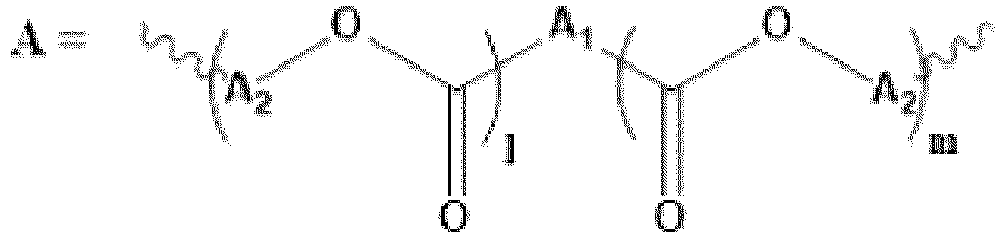
 - A1 für einen Alkylrest, gerade oder verzweigt, steht, der von 2 bis 40 Kohlenstoffatome, vorzugsweise von 2 bis 12 und insbesondere von 2 bis 6 umfasst, wobei der Rest gegebenenfalls eine oder mehrere Ungesättigtheiten umfasst, gegebenenfalls durch mindestens ein Heteroatom unterbrochen ist, das aus O, N und S ausgewählt ist, und gegebenenfalls durch mindestens einen Substituenten -Oalk substituiert ist, wobei Alk eine Alkylgruppe darstellt, die von 1 bis 10 Kohlenstoffatome umfasst;- A2 für einen Alkylrest, gerade oder verzweigt, steht, der von 2 bis 30 Kohlenstoffatome, vorzugsweise von 5 bis 22 umfasst, wobei der Rest gegebenenfalls eine oder mehrere Ungesättigtheiten umfasst und gegebenenfalls durch mindestens einen Substituenten -Oalk substituiert ist, wobei Alk eine Alkylgruppe darstellt, die von 1 bis 10 Kohlenstoffatome umfasst;- das Symbolfür eine Bindung des betrachteten Segments mit der Hauptkette steht;
 - 1 und m unabhängig voneinander für eine ganze Zahl von 1 bis 20, vorzugsweise von 1 bis 10 stehen, wobei die Summe 1 + m vorzugsweise von 2 bis 20 beträgt;- n eine ganze Zahl von 1 bis 20, vorzugsweise von 2 bis 8 ist;- j eine ganze Zahl von 1 bis 10, vorzugsweise von 1 bis 3 ist;- X für einen Alkylrest, gerade oder verzweigt, steht, der von 2 bis 60 Kohlenstoffatome, vorzugsweise von 16 bis 45 Kohlenstoffatome umfasst, wobei der Rest gegebenenfalls eine oder mehrere Ungesättigtheiten umfasst;- Y für einen Alkylrest, gerade oder verzweigt, der von 3 bis 35 Kohlenstoffatome, vorzugsweise von 6 bis 18 Kohlenstoffatome umfasst, wobei der Rest gegebenenfalls eine oder mehrere Ungesättigtheiten umfasst, oder einen Heterocyclus, der 3 bis 10 Mitglieder aufweist und 1 oder 2 Heteroatome umfasst, die aus O, N und S ausgewählt sind, steht.
 - Polyamidverbindung der Formel (1) nach Anspruch 1, wobei A1 für einen geraden Alkylrest steht, der von 2 bis 40, vorzugsweise 2 bis 12, insbesondere 3 Kohlenstoffatome umfasst, wobei der Rest gegebenenfalls eine oder mehrere Ungesättigtheiten umfasst.
- Polyamidverbindung der Formel (1) nach Anspruch 1 oder 2, wobei A2 für einen Alkylrest, gerade oder verzweigt, steht, der von 5 bis 18 Kohlenstoffatome umfasst, wobei der Rest gegebenenfalls eine oder mehrere Ungesättigtheiten und vorzugsweise eine Gruppe der Formel:

- Polyamidverbindung der Formel (1) nach einem der Ansprüche 1 bis 3, wobei die Summe 1 + m einen Mittelwert von 7, 11 oder 15 aufweist.
- Polyamidverbindung der Formel (1) nach einem der Ansprüche 1 bis 3, in der:- A1 für einen geraden Alkylrest steht, der 3 Kohlenstoffatome umfasst;- A2 für einen verzweigten Alkylrest steht, der 17 Kohlenstoffatome umfasst;- 1 und m unabhängig voneinander für eine ganze Zahl von 3 bis 4 stehen, wobei die Summe 1 + m vorzugsweise von 6 bis 8 beträgt;- n eine ganze Zahl von 1 bis 8, vorzugsweise von 1 bis 3 ist;- j eine ganze Zahl von 1 bis 10, vorzugsweise von 1 bis 3 ist;- X für einen verzweigten Alkylrest steht, der 36 Kohlenstoffatome umfasst;- Y für einen geraden Alkylrest steht, der 8 Kohlenstoffatome umfasst.
- Verfahren zur Herstellung einer Polyamidverbindung der Formel (1):
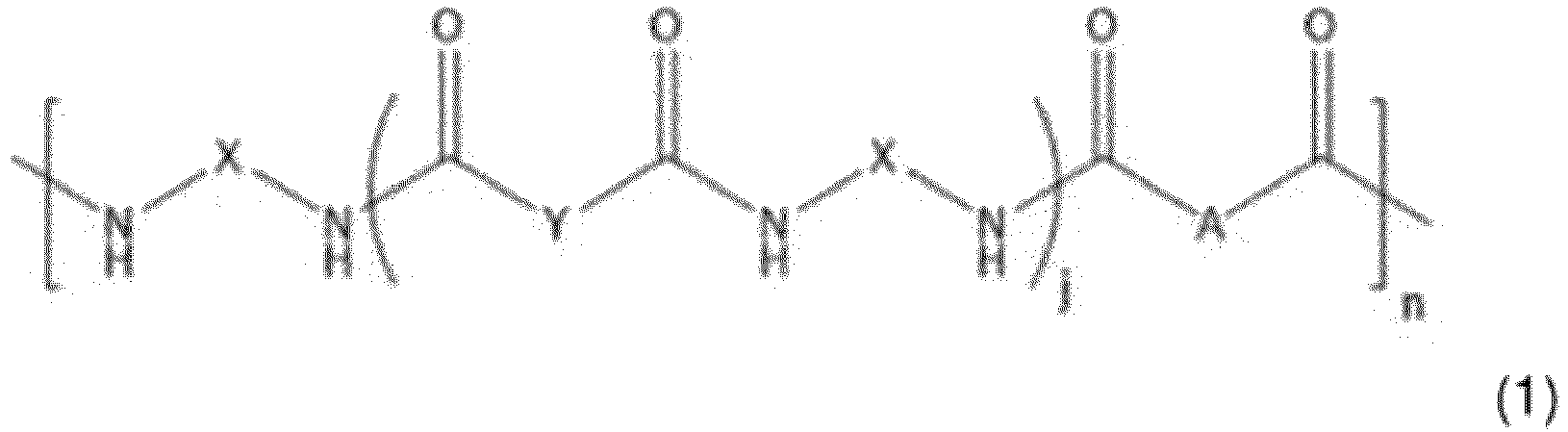
 - A1 für einen Alkylrest, gerade oder verzweigt, steht, der von 2 bis 40 Kohlenstoffatome, vorzugsweise von 2 bis 12 und insbesondere von 2 bis 6 umfasst, wobei der Rest gegebenenfalls eine oder mehrere Ungesättigtheiten umfasst, gegebenenfalls durch mindestens ein Heteroatom unterbrochen ist, das aus O, N und S ausgewählt ist, und gegebenenfalls durch mindestens einen Substituenten -Oalk substituiert ist, wobei Alk eine Alkylgruppe darstellt, die von 1 bis 10 Kohlenstoffatome umfasst;- A2 für einen Alkylrest, gerade oder verzweigt, steht, der von 2 bis 30 Kohlenstoffatome, vorzugsweise von 5 bis 22 umfasst, wobei der Rest gegebenenfalls eine oder mehrere Ungesättigtheiten umfasst und gegebenenfalls durch mindestens einen Substituenten -Oalk substituiert ist, wobei Alk eine Alkylgruppe darstellt, die von 1 bis 10 Kohlenstoffatome umfasst;- das Symbolfür eine Bindung des betrachteten Segments mit der Hauptkette steht;- 1 und m unabhängig voneinander für eine ganze Zahl von 1 bis 20, vorzugsweise von 1 bis 10 stehen, wobei die Summe 1 + m vorzugsweise von 2 bis 20 beträgt;- n eine ganze Zahl von 1 bis 20, vorzugsweise von 2 bis 8 ist;- j eine ganze Zahl von 1 bis 10, vorzugsweise von 1 bis 3 ist;- X für einen Alkylrest, gerade oder verzweigt, steht, der von 2 bis 60 Kohlenstoffatome, vorzugsweise von 16 bis 45 Kohlenstoffatome umfasst, wobei der Rest gegebenenfalls eine oder mehrere Ungesättigtheiten umfasst;- Y für einen Alkylrest, gerade oder verzweigt, der von 3 bis 35 Kohlenstoffatome, vorzugsweise von 6 bis 18 Kohlenstoffatome umfasst, wobei der Rest gegebenenfalls eine oder mehrere Ungesättigtheiten umfasst, oder einen Heterocyclus, der 3 bis 10 Mitglieder aufweist und 1 oder 2 Heteroatome umfasst, die aus O, N und S ausgewählt sind, steht,umfassend die folgenden Schritte:1) die Herstellung eines Polyamidvorläufers durch Funktionalisierung einer Disäure der Formel (2) mit einem Diamin der Formel (3), um ein Diaminpolyamid der Formel (4) zu erhalten:
 2) die Modifikation eines Disäurepolyesters der Formel (5) :

was zu dem obigen Polyamid der Formel (1) führt. - Verfahren nach Anspruch 6, in dem der 1. Schritt durch Mischung eines Äquivalents der Disäure der Formel (2) und einer Menge des Diamins der Formel (3), die zwischen 1 und 4 Äquivalenten umfasst, bei einer Temperatur, die zwischen 100 °C und 240 °C, vorzugsweise zwischen 130 °C und 150 °C liegt, durchgeführt wird.
- Verfahren nach einem der Ansprüche 6 oder 7, in dem der Schritt der Modifikation des Disäurepolyesters der Formel (5) durch Zugabe des Diaminpolyamids der Formel (4), der zu einem gelierenden Polyamid der Formel (1) führt, durch Zugaben von 1 Äquivalent des Disäurepolyesters zu einer Menge des gelierenden Vorläufers (4), die zwischen 0,2 und 1 Äquivalent umfasst, bei einer Temperatur, die zwischen 100 °C und 240 °C, vorzugsweise zwischen 130 °C und 150 °C liegt, durchgeführt wird.
- Verfahren nach einem der Ansprüche 6 bis 8, das weiterhin einen zusätzlichen Schritt umfasst, der den Kettenabbruch der Polyamidverbindung der Formel (1) durch Zugabe einer Alkohol-Abbruchverbindung der Formel (6) umfasst, was zu einer Polyamidverbindung der Formel (7) führt:

 - A, X, Y, A, A1, A2, j, n wie im Anspruch 6 definiert sind;- k eine ganze Zahl von 2 bis 60, vorzugsweise von 8 bis 40 ist.
 - Polyamidverbindung der Formel (7):

 - A1 für einen Alkylrest, gerade oder verzweigt, steht, der von 2 bis 40 Kohlenstoffatome, vorzugsweise von 2 bis 12 und insbesondere von 2 bis 6 umfasst, wobei der Rest gegebenenfalls eine oder mehrere Ungesättigtheiten umfasst, gegebenenfalls durch mindestens ein Heteroatom unterbrochen ist, das aus O, N und S ausgewählt ist, und gegebenenfalls durch mindestens einen Substituenten -OAlk substituiert ist, wobei Alk eine Alkylgruppe darstellt, die von 1 bis 10 Kohlenstoffatome umfasst;- A2 für einen Alkylrest, gerade oder verzweigt, steht, der von 2 bis 30 Kohlenstoffatome, vorzugsweise von 5 bis 22 umfasst, wobei der Rest gegebenenfalls eine oder mehrere Ungesättigtheiten umfasst und gegebenenfalls durch mindestens einen Substituenten -OAlk substituiert ist, wobei Alk eine Alkylgruppe darstellt, die von 1 bis 10 Kohlenstoffatome umfasst;- das Symbolfür eine Bindung des betrachteten Segments mit der Hauptkette steht;- 1 und m unabhängig voneinander für eine ganze Zahl von 1 bis 20, vorzugsweise von 1 bis 10 stehen, wobei die Summe 1 + m vorzugsweise von 2 bis 20 beträgt;- n eine ganze Zahl von 1 bis 20, vorzugsweise von 1 bis 8 ist;- j eine ganze Zahl von 1 bis 10, vorzugsweise von 1 bis 3 ist;- k eine ganze Zahl von 2 bis 60, vorzugsweise von 8 bis 40 ist;- X für einen Alkylrest, gerade oder verzweigt, steht, der von 2 bis 60 Kohlenstoffatome, vorzugsweise von 16 bis 45 Kohlenstoffatome umfasst, wobei der Rest gegebenenfalls eine oder mehrere Ungesättigtheiten umfasst;- Y für einen Alkylrest, gerade oder verzweigt, der von 3 bis 35 Kohlenstoffatome, vorzugsweise von 6 bis 18 Kohlenstoffatome umfasst, wobei der Rest gegebenenfalls eine oder mehrere Ungesättigtheiten umfasst, oder einen Heterocyclus, der 3 bis 10 Mitglieder aufweist und 1 oder 2 Heteroatome umfasst, die aus O, N und S ausgewählt sind, steht.
 - Verwendung eines gelierenden Polyamids der Formel (1) oder (7) nach einem der Ansprüche 1 bis 5 oder 10 oder eines gemäß dem Verfahren nach einem der Ansprüche 6 bis 9 erhaltenen als Ölgeliermittel.
- Gele, die das gelierende Polyamid gemäß einem gelierenden Polyamid der Formel (1) oder (7) nach einem der Ansprüche 1 bis 5 oder 10 oder einem gemäß dem Verfahren nach einem der Ansprüche 6 bis 9 erhaltenen enthalten oder zum Teil davon gebildet werden.
- Gele nach Anspruch 12, in denen der Gewichtsgehalt des gelierenden Polyamids zwischen 0,5 % und 10 % liegt, vorzugsweise von 3 bis 8 % beträgt.
- Pharmazeutische oder kosmetische Zusammensetzung, die ein gelierendes Polyamid der Formel (1) oder (7) nach einem der Ansprüche 1 bis 5 oder 10 oder ein gemäß dem Verfahren nach einem der Ansprüche 6 bis 9 erhaltenes oder die Gele, die zum Teil von den gelierenden Polyamiden gebildet werden, nach einem der Ansprüche 12 oder 13 umfasst.
- Kosmetische Zusammensetzung, die die Gele, die zum Teil von dem gelierenden Polyamid der Formel (1) oder (7) nach einem der Ansprüche 1 bis 5 oder 10 oder dem gemäß dem Verfahren nach einem der Ansprüche 6 bis 9 erhaltenen gebildet werden, umfasst, in der der Gewichtsgehalt des gelierenden Polyamids zwischen 0,5 % und 10 % liegt, vorzugsweise von 3 bis 8 % beträgt.
Applications Claiming Priority (2)
| Application Number | Priority Date | Filing Date | Title |
|---|---|---|---|
| FR1911530A FR3102178B1 (fr) | 2019-10-16 | 2019-10-16 | Polyamides gélifiants biosourcés |
| PCT/FR2020/051849 WO2021074541A1 (fr) | 2019-10-16 | 2020-10-15 | Polyamides gélifiants biosourcés |
Publications (3)
| Publication Number | Publication Date |
|---|---|
| EP4045566A1 EP4045566A1 (de) | 2022-08-24 |
| EP4045566C0 EP4045566C0 (de) | 2023-12-06 |
| EP4045566B1 true EP4045566B1 (de) | 2023-12-06 |
Family
ID=69903252
Family Applications (1)
| Application Number | Title | Priority Date | Filing Date |
|---|---|---|---|
| EP20799786.7A Active EP4045566B1 (de) | 2019-10-16 | 2020-10-15 | Gelierende polyamide auf biobasis |
Country Status (4)
| Country | Link |
|---|---|
| US (1) | US12583971B2 (de) |
| EP (1) | EP4045566B1 (de) |
| FR (1) | FR3102178B1 (de) |
| WO (1) | WO2021074541A1 (de) |
Families Citing this family (3)
| Publication number | Priority date | Publication date | Assignee | Title |
|---|---|---|---|---|
| FR3135977A1 (fr) * | 2022-05-30 | 2023-12-01 | Capsum | Polymères cationiques et leurs procédés de préparation |
| FR3135897A1 (fr) * | 2022-05-30 | 2023-12-01 | Capsum | Compositions cosmétiques capillaires comprenant au moins un polymère cationique lipophile non siliconé |
| EP4470522A1 (de) | 2023-05-26 | 2024-12-04 | Hyteck | Wasserfreie sonnenformeln |
Family Cites Families (5)
| Publication number | Priority date | Publication date | Assignee | Title |
|---|---|---|---|---|
| JPS62135521A (ja) * | 1985-12-10 | 1987-06-18 | Daicel Chem Ind Ltd | 末端にカルボキシル基を有するポリカプロラクトン |
| DE4444948C2 (de) * | 1994-12-16 | 2000-02-24 | Inventa Ag | Teilkristalline Block-Copolyesterpolyamide und Verwendung |
| US5783657A (en) | 1996-10-18 | 1998-07-21 | Union Camp Corporation | Ester-terminated polyamides of polymerized fatty acids useful in formulating transparent gels in low polarity liquids |
| US8450447B2 (en) * | 2007-03-14 | 2013-05-28 | Dow Global Technologies Llc | Copolyesteramides with decreased perfection of the amide sequence |
| FR2995901B1 (fr) | 2012-09-21 | 2015-08-14 | Inst Corps Gras Etudes Et Rech S Tech Iterg | Nouveaux pre-polymeres biosources et leurs utilisations pour la preparation de polymeres utiles comme additifs dans une matrice poly(acide lactique) |
-
2019
- 2019-10-16 FR FR1911530A patent/FR3102178B1/fr active Active
-
2020
- 2020-10-15 US US17/754,886 patent/US12583971B2/en active Active
- 2020-10-15 EP EP20799786.7A patent/EP4045566B1/de active Active
- 2020-10-15 WO PCT/FR2020/051849 patent/WO2021074541A1/fr not_active Ceased
Also Published As
| Publication number | Publication date |
|---|---|
| FR3102178B1 (fr) | 2021-11-05 |
| US12583971B2 (en) | 2026-03-24 |
| EP4045566C0 (de) | 2023-12-06 |
| EP4045566A1 (de) | 2022-08-24 |
| FR3102178A1 (fr) | 2021-04-23 |
| US20240124650A1 (en) | 2024-04-18 |
| WO2021074541A1 (fr) | 2021-04-22 |
Similar Documents
| Publication | Publication Date | Title |
|---|---|---|
| EP0692236B1 (de) | Reinigendes Mittel enthaltend lipidische Körner | |
| EP2616038B1 (de) | Kosmetische zusammensetzung mit einem farbstoff, besagter farbstoff und kosmetisches behandlungsverfahren | |
| EP3606973B1 (de) | Neues polyurethangeliermittel | |
| EP4045566B1 (de) | Gelierende polyamide auf biobasis | |
| FR2942963A1 (fr) | Composition cosmetique comprenant une matiere colorante, ladite matiere colorante et procede de traitement cosmetique | |
| EP3906008A1 (de) | Feste kosmetische zusammensetzung mit wässrigen, in einer festen kontinuierlichen wasserfreien phase dispergierten kugeln | |
| FR3091164A1 (fr) | Composition cosmétique solide comprenant des sphéroïdes anhydres en dispersion dans une phase continue aqueuse solide | |
| WO2022008691A1 (fr) | Emulsion eau dans huile à haute teneur en phase interne aqueuse | |
| EP1795176A2 (de) | Schaumförmige kosmetische Zusammensetzung geringer Dichte | |
| EP4504127A1 (de) | Feste pflege- und/oder schminkzusammensetzung | |
| FR3135894A1 (fr) | Composition cosmétique sous forme de solide compact comprenant une cire d'origine végétale, un composé liquide particulier, et un composé solide ou semi-solide à base de triglycérides d'origine végétale. | |
| FR2939659A1 (fr) | Vernis a ongles comprenant au moins un alkylether ou un ester de polysaccharide et au moins une resine vegetale | |
| EP2830575B1 (de) | Selbstemulgierende zusammensetzung mit einem polyglycerolester und einem saccharoseester | |
| EP4366684A1 (de) | Ölige tröpfchen und zweiphasige zusammensetzung mit diesen tröpfchen | |
| EP4351511A1 (de) | Kombination von ausgangsmaterialien und kosmetische zusammensetzung mit dieser kombination | |
| FR3106751A1 (fr) | Composition cosmétique sous forme de gel aqueux contenant en suspension des billes lipidiques gélifiées dans lesquelles sont incorporées des filtres solaires. | |
| FR3158433A1 (fr) | Emulsion cosmétique sans tensioactifs à faible teneur en phase aqueuse | |
| FR3157197A1 (fr) | Composition cosmetique de soin et/ou de maquillage comprenant de l’acide polyglutamique reticule | |
| FR3144915A1 (fr) | Composition galénique sous forme d’émulsion solide contenant pigments, particules solides et colorants. | |
| FR3151759A1 (fr) | Composition cosmétique comprenant un colorant particulier, une cire végétale et un diester particulier. | |
| FR3160891A1 (fr) | Composition cosmétique comprenant un carbonate organique particulier un copolymère réticulé particulier et un amidon particulier. | |
| FR3066914A1 (fr) | Composition cosmetique foisonnee a haute teneur en beurre vegetal | |
| FR3149776A1 (fr) | Composition anhydre comprenant une association de polyglycérols | |
| FR3117862A1 (fr) | Composition pour le soin et/ou le maquillage des matières kératineuses | |
| FR3046066A1 (fr) | Composition a base d’acide spiculisporique |
Legal Events
| Date | Code | Title | Description |
|---|---|---|---|
| STAA | Information on the status of an ep patent application or granted ep patent |
Free format text: STATUS: UNKNOWN |
|
| STAA | Information on the status of an ep patent application or granted ep patent |
Free format text: STATUS: THE INTERNATIONAL PUBLICATION HAS BEEN MADE |
|
| PUAI | Public reference made under article 153(3) epc to a published international application that has entered the european phase |
Free format text: ORIGINAL CODE: 0009012 |
|
| STAA | Information on the status of an ep patent application or granted ep patent |
Free format text: STATUS: REQUEST FOR EXAMINATION WAS MADE |
|
| 17P | Request for examination filed |
Effective date: 20220513 |
|
| AK | Designated contracting states |
Kind code of ref document: A1 Designated state(s): AL AT BE BG CH CY CZ DE DK EE ES FI FR GB GR HR HU IE IS IT LI LT LU LV MC MK MT NL NO PL PT RO RS SE SI SK SM TR |
|
| DAV | Request for validation of the european patent (deleted) | ||
| DAX | Request for extension of the european patent (deleted) | ||
| GRAP | Despatch of communication of intention to grant a patent |
Free format text: ORIGINAL CODE: EPIDOSNIGR1 |
|
| STAA | Information on the status of an ep patent application or granted ep patent |
Free format text: STATUS: GRANT OF PATENT IS INTENDED |
|
| INTG | Intention to grant announced |
Effective date: 20230515 |
|
| GRAS | Grant fee paid |
Free format text: ORIGINAL CODE: EPIDOSNIGR3 |
|
| GRAA | (expected) grant |
Free format text: ORIGINAL CODE: 0009210 |
|
| STAA | Information on the status of an ep patent application or granted ep patent |
Free format text: STATUS: THE PATENT HAS BEEN GRANTED |
|
| AK | Designated contracting states |
Kind code of ref document: B1 Designated state(s): AL AT BE BG CH CY CZ DE DK EE ES FI FR GB GR HR HU IE IS IT LI LT LU LV MC MK MT NL NO PL PT RO RS SE SI SK SM TR |
|
| REG | Reference to a national code |
Ref country code: GB Ref legal event code: FG4D Free format text: NOT ENGLISH |
|
| REG | Reference to a national code |
Ref country code: DE Ref legal event code: R096 Ref document number: 602020022397 Country of ref document: DE |
|
| REG | Reference to a national code |
Ref country code: CH Ref legal event code: EP |
|
| REG | Reference to a national code |
Ref country code: IE Ref legal event code: FG4D Free format text: LANGUAGE OF EP DOCUMENT: FRENCH |
|
| U01 | Request for unitary effect filed |
Effective date: 20231208 |
|
| U07 | Unitary effect registered |
Designated state(s): AT BE BG DE DK EE FI FR IT LT LU LV MT NL PT SE SI Effective date: 20231218 |
|
| PG25 | Lapsed in a contracting state [announced via postgrant information from national office to epo] |
Ref country code: GR Free format text: LAPSE BECAUSE OF FAILURE TO SUBMIT A TRANSLATION OF THE DESCRIPTION OR TO PAY THE FEE WITHIN THE PRESCRIBED TIME-LIMIT Effective date: 20240307 |
|
| PG25 | Lapsed in a contracting state [announced via postgrant information from national office to epo] |
Ref country code: ES Free format text: LAPSE BECAUSE OF FAILURE TO SUBMIT A TRANSLATION OF THE DESCRIPTION OR TO PAY THE FEE WITHIN THE PRESCRIBED TIME-LIMIT Effective date: 20231206 |
|
| PG25 | Lapsed in a contracting state [announced via postgrant information from national office to epo] |
Ref country code: GR Free format text: LAPSE BECAUSE OF FAILURE TO SUBMIT A TRANSLATION OF THE DESCRIPTION OR TO PAY THE FEE WITHIN THE PRESCRIBED TIME-LIMIT Effective date: 20240307 Ref country code: ES Free format text: LAPSE BECAUSE OF FAILURE TO SUBMIT A TRANSLATION OF THE DESCRIPTION OR TO PAY THE FEE WITHIN THE PRESCRIBED TIME-LIMIT Effective date: 20231206 |
|
| PG25 | Lapsed in a contracting state [announced via postgrant information from national office to epo] |
Ref country code: RS Free format text: LAPSE BECAUSE OF FAILURE TO SUBMIT A TRANSLATION OF THE DESCRIPTION OR TO PAY THE FEE WITHIN THE PRESCRIBED TIME-LIMIT Effective date: 20231206 Ref country code: NO Free format text: LAPSE BECAUSE OF FAILURE TO SUBMIT A TRANSLATION OF THE DESCRIPTION OR TO PAY THE FEE WITHIN THE PRESCRIBED TIME-LIMIT Effective date: 20240306 Ref country code: HR Free format text: LAPSE BECAUSE OF FAILURE TO SUBMIT A TRANSLATION OF THE DESCRIPTION OR TO PAY THE FEE WITHIN THE PRESCRIBED TIME-LIMIT Effective date: 20231206 |
|
| PG25 | Lapsed in a contracting state [announced via postgrant information from national office to epo] |
Ref country code: IS Free format text: LAPSE BECAUSE OF FAILURE TO SUBMIT A TRANSLATION OF THE DESCRIPTION OR TO PAY THE FEE WITHIN THE PRESCRIBED TIME-LIMIT Effective date: 20240406 |
|
| PG25 | Lapsed in a contracting state [announced via postgrant information from national office to epo] |
Ref country code: CZ Free format text: LAPSE BECAUSE OF FAILURE TO SUBMIT A TRANSLATION OF THE DESCRIPTION OR TO PAY THE FEE WITHIN THE PRESCRIBED TIME-LIMIT Effective date: 20231206 |
|
| PG25 | Lapsed in a contracting state [announced via postgrant information from national office to epo] |
Ref country code: SK Free format text: LAPSE BECAUSE OF FAILURE TO SUBMIT A TRANSLATION OF THE DESCRIPTION OR TO PAY THE FEE WITHIN THE PRESCRIBED TIME-LIMIT Effective date: 20231206 |
|
| PG25 | Lapsed in a contracting state [announced via postgrant information from national office to epo] |
Ref country code: SM Free format text: LAPSE BECAUSE OF FAILURE TO SUBMIT A TRANSLATION OF THE DESCRIPTION OR TO PAY THE FEE WITHIN THE PRESCRIBED TIME-LIMIT Effective date: 20231206 Ref country code: SK Free format text: LAPSE BECAUSE OF FAILURE TO SUBMIT A TRANSLATION OF THE DESCRIPTION OR TO PAY THE FEE WITHIN THE PRESCRIBED TIME-LIMIT Effective date: 20231206 Ref country code: RO Free format text: LAPSE BECAUSE OF FAILURE TO SUBMIT A TRANSLATION OF THE DESCRIPTION OR TO PAY THE FEE WITHIN THE PRESCRIBED TIME-LIMIT Effective date: 20231206 Ref country code: IS Free format text: LAPSE BECAUSE OF FAILURE TO SUBMIT A TRANSLATION OF THE DESCRIPTION OR TO PAY THE FEE WITHIN THE PRESCRIBED TIME-LIMIT Effective date: 20240406 Ref country code: CZ Free format text: LAPSE BECAUSE OF FAILURE TO SUBMIT A TRANSLATION OF THE DESCRIPTION OR TO PAY THE FEE WITHIN THE PRESCRIBED TIME-LIMIT Effective date: 20231206 |
|
| PG25 | Lapsed in a contracting state [announced via postgrant information from national office to epo] |
Ref country code: PL Free format text: LAPSE BECAUSE OF FAILURE TO SUBMIT A TRANSLATION OF THE DESCRIPTION OR TO PAY THE FEE WITHIN THE PRESCRIBED TIME-LIMIT Effective date: 20231206 |
|
| PG25 | Lapsed in a contracting state [announced via postgrant information from national office to epo] |
Ref country code: PL Free format text: LAPSE BECAUSE OF FAILURE TO SUBMIT A TRANSLATION OF THE DESCRIPTION OR TO PAY THE FEE WITHIN THE PRESCRIBED TIME-LIMIT Effective date: 20231206 |
|
| REG | Reference to a national code |
Ref country code: DE Ref legal event code: R097 Ref document number: 602020022397 Country of ref document: DE |
|
| PLBE | No opposition filed within time limit |
Free format text: ORIGINAL CODE: 0009261 |
|
| STAA | Information on the status of an ep patent application or granted ep patent |
Free format text: STATUS: NO OPPOSITION FILED WITHIN TIME LIMIT |
|
| 26N | No opposition filed |
Effective date: 20240909 |
|
| U20 | Renewal fee for the european patent with unitary effect paid |
Year of fee payment: 5 Effective date: 20241028 |
|
| REG | Reference to a national code |
Ref country code: CH Ref legal event code: PL |
|
| GBPC | Gb: european patent ceased through non-payment of renewal fee |
Effective date: 20241015 |
|
| PG25 | Lapsed in a contracting state [announced via postgrant information from national office to epo] |
Ref country code: MC Free format text: LAPSE BECAUSE OF FAILURE TO SUBMIT A TRANSLATION OF THE DESCRIPTION OR TO PAY THE FEE WITHIN THE PRESCRIBED TIME-LIMIT Effective date: 20231206 |
|
| PG25 | Lapsed in a contracting state [announced via postgrant information from national office to epo] |
Ref country code: GB Free format text: LAPSE BECAUSE OF NON-PAYMENT OF DUE FEES Effective date: 20241015 |
|
| PG25 | Lapsed in a contracting state [announced via postgrant information from national office to epo] |
Ref country code: CH Free format text: LAPSE BECAUSE OF NON-PAYMENT OF DUE FEES Effective date: 20241031 |
|
| PG25 | Lapsed in a contracting state [announced via postgrant information from national office to epo] |
Ref country code: IE Free format text: LAPSE BECAUSE OF NON-PAYMENT OF DUE FEES Effective date: 20241015 |
|
| U20 | Renewal fee for the european patent with unitary effect paid |
Year of fee payment: 6 Effective date: 20251027 |
|
| PG25 | Lapsed in a contracting state [announced via postgrant information from national office to epo] |
Ref country code: CY Free format text: LAPSE BECAUSE OF FAILURE TO SUBMIT A TRANSLATION OF THE DESCRIPTION OR TO PAY THE FEE WITHIN THE PRESCRIBED TIME-LIMIT; INVALID AB INITIO Effective date: 20201015 |
|
| PG25 | Lapsed in a contracting state [announced via postgrant information from national office to epo] |
Ref country code: HU Free format text: LAPSE BECAUSE OF FAILURE TO SUBMIT A TRANSLATION OF THE DESCRIPTION OR TO PAY THE FEE WITHIN THE PRESCRIBED TIME-LIMIT; INVALID AB INITIO Effective date: 20201015 |