EP3611262B1 - Méthode de séquençage du répertoire immunitaire - Google Patents
Méthode de séquençage du répertoire immunitaire Download PDFInfo
- Publication number
- EP3611262B1 EP3611262B1 EP19193496.7A EP19193496A EP3611262B1 EP 3611262 B1 EP3611262 B1 EP 3611262B1 EP 19193496 A EP19193496 A EP 19193496A EP 3611262 B1 EP3611262 B1 EP 3611262B1
- Authority
- EP
- European Patent Office
- Prior art keywords
- sequence
- sequencing
- dna
- repertoire
- immunoglobulin
- Prior art date
- Legal status (The legal status is an assumption and is not a legal conclusion. Google has not performed a legal analysis and makes no representation as to the accuracy of the status listed.)
- Active
Links
Images



Classifications
-
- B—PERFORMING OPERATIONS; TRANSPORTING
- B01—PHYSICAL OR CHEMICAL PROCESSES OR APPARATUS IN GENERAL
- B01J—CHEMICAL OR PHYSICAL PROCESSES, e.g. CATALYSIS OR COLLOID CHEMISTRY; THEIR RELEVANT APPARATUS
- B01J19/00—Chemical, physical or physico-chemical processes in general; Their relevant apparatus
- B01J19/0046—Sequential or parallel reactions, e.g. for the synthesis of polypeptides or polynucleotides; Apparatus and devices for combinatorial chemistry or for making molecular arrays
-
- C—CHEMISTRY; METALLURGY
- C12—BIOCHEMISTRY; BEER; SPIRITS; WINE; VINEGAR; MICROBIOLOGY; ENZYMOLOGY; MUTATION OR GENETIC ENGINEERING
- C12N—MICROORGANISMS OR ENZYMES; COMPOSITIONS THEREOF; PROPAGATING, PRESERVING, OR MAINTAINING MICROORGANISMS; MUTATION OR GENETIC ENGINEERING; CULTURE MEDIA
- C12N15/00—Mutation or genetic engineering; DNA or RNA concerning genetic engineering, vectors, e.g. plasmids, or their isolation, preparation or purification; Use of hosts therefor
- C12N15/09—Recombinant DNA-technology
- C12N15/10—Processes for the isolation, preparation or purification of DNA or RNA
- C12N15/1096—Processes for the isolation, preparation or purification of DNA or RNA cDNA Synthesis; Subtracted cDNA library construction, e.g. RT, RT-PCR
-
- C—CHEMISTRY; METALLURGY
- C12—BIOCHEMISTRY; BEER; SPIRITS; WINE; VINEGAR; MICROBIOLOGY; ENZYMOLOGY; MUTATION OR GENETIC ENGINEERING
- C12Q—MEASURING OR TESTING PROCESSES INVOLVING ENZYMES, NUCLEIC ACIDS OR MICROORGANISMS; COMPOSITIONS OR TEST PAPERS THEREFOR; PROCESSES OF PREPARING SUCH COMPOSITIONS; CONDITION-RESPONSIVE CONTROL IN MICROBIOLOGICAL OR ENZYMOLOGICAL PROCESSES
- C12Q1/00—Measuring or testing processes involving enzymes, nucleic acids or microorganisms; Compositions therefor; Processes of preparing such compositions
- C12Q1/68—Measuring or testing processes involving enzymes, nucleic acids or microorganisms; Compositions therefor; Processes of preparing such compositions involving nucleic acids
- C12Q1/6869—Methods for sequencing
-
- C—CHEMISTRY; METALLURGY
- C12—BIOCHEMISTRY; BEER; SPIRITS; WINE; VINEGAR; MICROBIOLOGY; ENZYMOLOGY; MUTATION OR GENETIC ENGINEERING
- C12Q—MEASURING OR TESTING PROCESSES INVOLVING ENZYMES, NUCLEIC ACIDS OR MICROORGANISMS; COMPOSITIONS OR TEST PAPERS THEREFOR; PROCESSES OF PREPARING SUCH COMPOSITIONS; CONDITION-RESPONSIVE CONTROL IN MICROBIOLOGICAL OR ENZYMOLOGICAL PROCESSES
- C12Q1/00—Measuring or testing processes involving enzymes, nucleic acids or microorganisms; Compositions therefor; Processes of preparing such compositions
- C12Q1/68—Measuring or testing processes involving enzymes, nucleic acids or microorganisms; Compositions therefor; Processes of preparing such compositions involving nucleic acids
- C12Q1/6869—Methods for sequencing
- C12Q1/6874—Methods for sequencing involving nucleic acid arrays, e.g. sequencing by hybridisation
-
- C—CHEMISTRY; METALLURGY
- C12—BIOCHEMISTRY; BEER; SPIRITS; WINE; VINEGAR; MICROBIOLOGY; ENZYMOLOGY; MUTATION OR GENETIC ENGINEERING
- C12Q—MEASURING OR TESTING PROCESSES INVOLVING ENZYMES, NUCLEIC ACIDS OR MICROORGANISMS; COMPOSITIONS OR TEST PAPERS THEREFOR; PROCESSES OF PREPARING SUCH COMPOSITIONS; CONDITION-RESPONSIVE CONTROL IN MICROBIOLOGICAL OR ENZYMOLOGICAL PROCESSES
- C12Q1/00—Measuring or testing processes involving enzymes, nucleic acids or microorganisms; Compositions therefor; Processes of preparing such compositions
- C12Q1/68—Measuring or testing processes involving enzymes, nucleic acids or microorganisms; Compositions therefor; Processes of preparing such compositions involving nucleic acids
- C12Q1/6876—Nucleic acid products used in the analysis of nucleic acids, e.g. primers or probes
- C12Q1/6881—Nucleic acid products used in the analysis of nucleic acids, e.g. primers or probes for tissue or cell typing, e.g. human leukocyte antigen [HLA] probes
-
- B—PERFORMING OPERATIONS; TRANSPORTING
- B01—PHYSICAL OR CHEMICAL PROCESSES OR APPARATUS IN GENERAL
- B01J—CHEMICAL OR PHYSICAL PROCESSES, e.g. CATALYSIS OR COLLOID CHEMISTRY; THEIR RELEVANT APPARATUS
- B01J2219/00—Chemical, physical or physico-chemical processes in general; Their relevant apparatus
- B01J2219/00274—Sequential or parallel reactions; Apparatus and devices for combinatorial chemistry or for making arrays; Chemical library technology
- B01J2219/00583—Features relative to the processes being carried out
- B01J2219/00596—Solid-phase processes
-
- B—PERFORMING OPERATIONS; TRANSPORTING
- B01—PHYSICAL OR CHEMICAL PROCESSES OR APPARATUS IN GENERAL
- B01J—CHEMICAL OR PHYSICAL PROCESSES, e.g. CATALYSIS OR COLLOID CHEMISTRY; THEIR RELEVANT APPARATUS
- B01J2219/00—Chemical, physical or physico-chemical processes in general; Their relevant apparatus
- B01J2219/00274—Sequential or parallel reactions; Apparatus and devices for combinatorial chemistry or for making arrays; Chemical library technology
- B01J2219/00718—Type of compounds synthesised
- B01J2219/0072—Organic compounds
- B01J2219/00722—Nucleotides
-
- C—CHEMISTRY; METALLURGY
- C12—BIOCHEMISTRY; BEER; SPIRITS; WINE; VINEGAR; MICROBIOLOGY; ENZYMOLOGY; MUTATION OR GENETIC ENGINEERING
- C12N—MICROORGANISMS OR ENZYMES; COMPOSITIONS THEREOF; PROPAGATING, PRESERVING, OR MAINTAINING MICROORGANISMS; MUTATION OR GENETIC ENGINEERING; CULTURE MEDIA
- C12N15/00—Mutation or genetic engineering; DNA or RNA concerning genetic engineering, vectors, e.g. plasmids, or their isolation, preparation or purification; Use of hosts therefor
- C12N15/09—Recombinant DNA-technology
- C12N15/10—Processes for the isolation, preparation or purification of DNA or RNA
- C12N15/1003—Extracting or separating nucleic acids from biological samples, e.g. pure separation or isolation methods; Conditions, buffers or apparatuses therefor
- C12N15/1006—Extracting or separating nucleic acids from biological samples, e.g. pure separation or isolation methods; Conditions, buffers or apparatuses therefor by means of a solid support carrier, e.g. particles, polymers
-
- C—CHEMISTRY; METALLURGY
- C12—BIOCHEMISTRY; BEER; SPIRITS; WINE; VINEGAR; MICROBIOLOGY; ENZYMOLOGY; MUTATION OR GENETIC ENGINEERING
- C12Q—MEASURING OR TESTING PROCESSES INVOLVING ENZYMES, NUCLEIC ACIDS OR MICROORGANISMS; COMPOSITIONS OR TEST PAPERS THEREFOR; PROCESSES OF PREPARING SUCH COMPOSITIONS; CONDITION-RESPONSIVE CONTROL IN MICROBIOLOGICAL OR ENZYMOLOGICAL PROCESSES
- C12Q2521/00—Reaction characterised by the enzymatic activity
- C12Q2521/10—Nucleotidyl transfering
- C12Q2521/101—DNA polymerase
-
- C—CHEMISTRY; METALLURGY
- C12—BIOCHEMISTRY; BEER; SPIRITS; WINE; VINEGAR; MICROBIOLOGY; ENZYMOLOGY; MUTATION OR GENETIC ENGINEERING
- C12Q—MEASURING OR TESTING PROCESSES INVOLVING ENZYMES, NUCLEIC ACIDS OR MICROORGANISMS; COMPOSITIONS OR TEST PAPERS THEREFOR; PROCESSES OF PREPARING SUCH COMPOSITIONS; CONDITION-RESPONSIVE CONTROL IN MICROBIOLOGICAL OR ENZYMOLOGICAL PROCESSES
- C12Q2521/00—Reaction characterised by the enzymatic activity
- C12Q2521/10—Nucleotidyl transfering
- C12Q2521/107—RNA dependent DNA polymerase,(i.e. reverse transcriptase)
-
- C—CHEMISTRY; METALLURGY
- C12—BIOCHEMISTRY; BEER; SPIRITS; WINE; VINEGAR; MICROBIOLOGY; ENZYMOLOGY; MUTATION OR GENETIC ENGINEERING
- C12Q—MEASURING OR TESTING PROCESSES INVOLVING ENZYMES, NUCLEIC ACIDS OR MICROORGANISMS; COMPOSITIONS OR TEST PAPERS THEREFOR; PROCESSES OF PREPARING SUCH COMPOSITIONS; CONDITION-RESPONSIVE CONTROL IN MICROBIOLOGICAL OR ENZYMOLOGICAL PROCESSES
- C12Q2525/00—Reactions involving modified oligonucleotides, nucleic acids, or nucleotides
- C12Q2525/10—Modifications characterised by
- C12Q2525/155—Modifications characterised by incorporating/generating a new priming site
-
- C—CHEMISTRY; METALLURGY
- C12—BIOCHEMISTRY; BEER; SPIRITS; WINE; VINEGAR; MICROBIOLOGY; ENZYMOLOGY; MUTATION OR GENETIC ENGINEERING
- C12Q—MEASURING OR TESTING PROCESSES INVOLVING ENZYMES, NUCLEIC ACIDS OR MICROORGANISMS; COMPOSITIONS OR TEST PAPERS THEREFOR; PROCESSES OF PREPARING SUCH COMPOSITIONS; CONDITION-RESPONSIVE CONTROL IN MICROBIOLOGICAL OR ENZYMOLOGICAL PROCESSES
- C12Q2525/00—Reactions involving modified oligonucleotides, nucleic acids, or nucleotides
- C12Q2525/10—Modifications characterised by
- C12Q2525/173—Modifications characterised by incorporating a polynucleotide run, e.g. polyAs, polyTs
-
- C—CHEMISTRY; METALLURGY
- C12—BIOCHEMISTRY; BEER; SPIRITS; WINE; VINEGAR; MICROBIOLOGY; ENZYMOLOGY; MUTATION OR GENETIC ENGINEERING
- C12Q—MEASURING OR TESTING PROCESSES INVOLVING ENZYMES, NUCLEIC ACIDS OR MICROORGANISMS; COMPOSITIONS OR TEST PAPERS THEREFOR; PROCESSES OF PREPARING SUCH COMPOSITIONS; CONDITION-RESPONSIVE CONTROL IN MICROBIOLOGICAL OR ENZYMOLOGICAL PROCESSES
- C12Q2525/00—Reactions involving modified oligonucleotides, nucleic acids, or nucleotides
- C12Q2525/10—Modifications characterised by
- C12Q2525/179—Modifications characterised by incorporating arbitrary or random nucleotide sequences
-
- C—CHEMISTRY; METALLURGY
- C12—BIOCHEMISTRY; BEER; SPIRITS; WINE; VINEGAR; MICROBIOLOGY; ENZYMOLOGY; MUTATION OR GENETIC ENGINEERING
- C12Q—MEASURING OR TESTING PROCESSES INVOLVING ENZYMES, NUCLEIC ACIDS OR MICROORGANISMS; COMPOSITIONS OR TEST PAPERS THEREFOR; PROCESSES OF PREPARING SUCH COMPOSITIONS; CONDITION-RESPONSIVE CONTROL IN MICROBIOLOGICAL OR ENZYMOLOGICAL PROCESSES
- C12Q2563/00—Nucleic acid detection characterized by the use of physical, structural and functional properties
- C12Q2563/179—Nucleic acid detection characterized by the use of physical, structural and functional properties the label being a nucleic acid
-
- C—CHEMISTRY; METALLURGY
- C12—BIOCHEMISTRY; BEER; SPIRITS; WINE; VINEGAR; MICROBIOLOGY; ENZYMOLOGY; MUTATION OR GENETIC ENGINEERING
- C12Q—MEASURING OR TESTING PROCESSES INVOLVING ENZYMES, NUCLEIC ACIDS OR MICROORGANISMS; COMPOSITIONS OR TEST PAPERS THEREFOR; PROCESSES OF PREPARING SUCH COMPOSITIONS; CONDITION-RESPONSIVE CONTROL IN MICROBIOLOGICAL OR ENZYMOLOGICAL PROCESSES
- C12Q2600/00—Oligonucleotides characterized by their use
- C12Q2600/16—Primer sets for multiplex assays
-
- C—CHEMISTRY; METALLURGY
- C40—COMBINATORIAL TECHNOLOGY
- C40B—COMBINATORIAL CHEMISTRY; LIBRARIES, e.g. CHEMICAL LIBRARIES
- C40B20/00—Methods specially adapted for identifying library members
- C40B20/04—Identifying library members by means of a tag, label, or other readable or detectable entity associated with the library members, e.g. decoding processes
Definitions
- the present invention relates to the field of quantitative nucleic acid analysis. More specifically, the present invention provides methods of determining the immune repertoire using high throughput sequencing.
- a feature of the adaptive immune response is the ability to generate a wide diversity of binding molecules, e.g. T-cell antigen receptors and antibodies.
- naive B and T-cells Upon exposure to antigen there can be a positive selection process, where cells expressing immunological receptors having desired binding properties are expanded, and may undergo further sequence modification, for example somatic hypermutation, and additional recombination.
- the repertoire of binding specificities in an individual sample can provide a history of past antigenic exposures, as well as being informative of inherent repertoire capabilities and limitations.
- Adaptive immunological receptors of interest include immunoglobulins, or antibodies. This repertoire is highly plastic and can be directed to create antibodies with broad chemical diversity and high selectivity. There is also a good understanding of the potential diversity available and the mechanistic aspects of how this diversity is generated.
- Antibodies are composed of two types of chains (heavy and light), each containing a highly diversified antigen-binding domain (variable). The V, D, and J gene segments of the antibody heavy-chain variable genes go through a series of recombination events to generate a new heavy-chain gene. Antibodies are formed by a mixture of recombination among gene segments, sequence diversification at the junctions of these segments, and point mutations throughout the gene. The mechanisms are reviewed, for example in Maizels (2005) Annu. Revu. Genet. 39:23-46 ; Jones and Gellert (2004) Immunol. Rev. 200:233-248 ; Winter and Gearhart (1998) Immunol. Rev. 162:89-96 .
- TCR T-cell antigen receptor
- V N-terminal variable
- CDRs hypervariable or complementarity determining regions
- HV4 hypervariability
- V and J for the alpha or gamma chain corresponds to the CDR3 region that is important for antigen- MHC recognition. It is the unique combination of the segments at this region, along with palindromic and random N- and P- nucleotide additions, which accounts for the TCR binding repertoire.
- lymphocytes While reference is made to binding specificities, and indeed a good deal of serological analysis is based on the physical interactions between antigen and receptor, the underlying cause of the diversity lies in the genetic sequences expressed by lymphocytes, which sequences reflect the myriad processes of recombination, mutation and selection that have acted on the cell.
- the invention provides, as specified by the claims, a method of determining the immune repertoire in a subject, comprising: (a) reverse transcribing mRNA obtained from the subject to produce immunoglobulin chain cDNAs comprising a 3' homopolymer tail by using immunoglobulin chain specific primers and a reverse transcriptase; (b) adding a random molecular tag and a universal sequence to the 3' end of the immunoglobulin chain cDNAs to form extended cDNAs, by using the reverse transcriptase and oligonucleotides comprising a 3' sequence complementary to the homopolymer tail and a 5' flanking sequence comprising the universal sequence and the random molecular tag, wherein each extended cDNA is associated with a unique random molecular tag; (c) amplifying the extended cDNAs by using one or more immunoglobulin chain specific primers and a primer specific to the universal sequence and further comprising a sequencing platform specific flanking sequence to produce a plurality of molecular tagged immuno
- the present disclosure also provides methods for monitoring the immune repertoire. More specifically, the disclosure provides method of determining the immune repertoire in a subject, by isolating a plurality of RNA from a biological sample comprising a plurality of cell types obtained from a subject, producing immunoglobulin chain or TCR chain cDNAs from the RNA; adding a homopolymeric tail, a random molecular tag and a universal sequence to the 3' end of the cDNAs; amplifying the cDNAs by using a one or more immunoglobulin chain or TCR chain specific primers and a universal sequence specific primer comprising an flanking sequence specific to the sequencing platform to produce a plurality of molecular tagged immunoglobulin chain or TCR chain nucleic acids and sequencing the amplified immunoglobuling chain or TCR chain nucleic acids to produce a plurality of sequencing reads thereby determining the immune repertoire of the subject
- the method further includes a data analysis step such as grouping sequences reads with the same molecular tag and clustering sequences within the same group.
- a consensus sequence for each cluster is determined to produce a collection of consensus sequences.
- the collection of consensus sequences is used to determine the diversity of the immune repertoire.
- the molecular tag is an oligomer. In an aspect, the oligomer is at least a 9mer.
- the biological sample is blood or a fraction thereof. In an aspect, the blood is peripheral whole blood. In an aspect, the blood fraction comprises peripheral blood mononuclear cells. In some aspects the blood sample is sorted based upon extracellular or intracellular markers.
- the immunoglobulin chain is the heavy chain or the light chain.
- the immunoglobulin heavy chain comprises the immunoglobulin VDJ and constant regions.
- the TCR chain maybe the alpha chain, the beta chain, the gamma chain or the delta chain.
- the TCR chain may contain the VJ and constant regions.
- the present disclosure provides an improved method of sequencing the immune repertoire.
- Previous methods for determining the immune repertoire such as those described in WO 2011/140433 and WO 2012/083069 are based upon multiplex PCR.
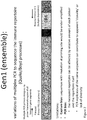
- Multiplex PCR has a number of limitations that make it particularly unsuited for accurately determining the immune repertoire. (See Figure 2 ) These limitations include capture bias and amplification bias owing to PCR..
- Multiplex PCR techniques for sequencing the immune repertoire use primers designed to prime all framework regions of known V gene segments. When a mutation arises at the priming site capture bias occurs and the gene that had the mutation would be under-amplified. PCR bias results from unequal amplification of the genes due to either the relative amount of each primer and PCR replicates of the same sequence. Thus PCR bias can cause apparent clonality or a lack of diversity.
- the observed repertoire is not a faithful, or linear representation of the actual underlying repertoire.
- the present method sequences the immune repertoire directly from a heterogeneous nucleic acid mixture derived from a heterogeneous population of cells.
- the methods of the disclosure generally involve the steps of obtaining a peripheral whole blood sample from a subject, isolating RNA from the peripheral whole blood sample, or fraction thereof (e.g., peripheral blood mononuclear cells), reverse transcribing the isolated RNA using immunoglobulin heavy chain or TCR beta chain specific primers to generate immunoglobulin (e.g., heavy chain or light chain) or TCR (e.g., alpha, beta, delta or gamma chain) cDNA transcripts.
- immunoglobulin e.g., heavy chain or light chain
- TCR e.g., alpha, beta, delta or gamma chain
- a short homopolymer is added to the end of the cDNA by the intrinsic property of reverse transcriptase.
- Oligonucleotides with 3' sequence complementary to the homopolymer and a 5' flanking sequence containing a universal sequence and molecular tag that is composed of random nucleotides would be used by the reverse transcriptase as template. The result is that the end of each cDNA molecule is extended with a short homopolymer, a unique molecular tag, and a universal sequence. This allows amplification of unknown sequences between the gene specific sequence and the 5'-end of the mRNA. ( Figures 4-6 ).
- each cDNA molecule is labeled with a unique tag prior to amplification, the differential amplification of each cDNA molecule can be corrected for by counting each unique tag once, thereby providing a faithful measure of the abundance of each species in the repertoire. Sequence replicates of each cDNA molecule identified by the same molecular tag can be used to construct consensus sequences, therefore allowing correction for amplification and sequencing errors.
- the methods of the disclosure utilize biological samples from subjects or individuals.
- the subject can be a patient, for example, a patient with an autoimmune disease, an infectious disease or cancer, or a transplant recipient.
- the subject can be a human or a non-human mammal.
- the subject can be a male or female subject of any age (e.g., a fetus, an infant, a child, or an adult).
- Samples used in the methods of the provided invention can include, for example, a bodily fluid from a subject, including amniotic fluid surrounding a fetus, aqueous humor, bile, blood and blood plasma, cerumen (earwax), Cowper's fluid or pre-ejaculatory fluid, chyle, chyme, female ejaculate, interstitial fluid, lymph, menses, breast milk, mucus (including snot and phlegm), pleural fluid, pus, saliva, sebum (skin oil), semen, serum, sweat, tears, urine, vaginal lubrication, vomit, feces, internal body fluids including cerebrospinal fluid surrounding the brain and the spinal cord, synovial fluid surrounding bone joints, intracellular fluid (the fluid inside cells), and vitreous humour (the fluids in the eyeball).
- a bodily fluid from a subject including amniotic fluid surrounding a fetus, aqueous humor, bile,
- the sample is a blood sample, such as a peripheral whole blood sample, or a fraction thereof.
- the sample is whole, unfractionated blood.
- the blood sample can be about 0.02, 0.03, 0.04, 0.05, 0.06, 0.07, 0.08 0.09, 0.1, 0.2, 0.3, 0.4, 0.5, 0.6, 0.7, 0.8, 0.9, 1.0, 1.5, 2.0, 2.5, 3.0, 3.5, 4.0, 4.5, or 5.0 mL.
- the sample can be obtained by a health care provider, for example, a physician, physician assistant, nurse, veterinarian, dermatologist, rheumatologist, dentist, paramedic, or surgeon.
- the sample can be obtained by a research technician. More than one sample from a subject can be obtained.
- the sample can include immune cells.
- the immune cells can include T-cells and/or B-cells.
- T-cells T lymphocytes
- T-cells include, for example, cells that express T-cell receptors.
- T-cells include Helper T-cells (effector T-cells or Th cells), cytotoxic T-cells (CTLs), memory T-cells, and regulatory T-cells.
- the sample can include a single cell in some applications (e.g., a calibration test to define relevant T-cells) or more generally at least 1,000, at least 10,000, at least 100,000, at least 250,000, at least 500,000, at least 750,000, or at least 1,000,000 T-cells.
- B-cells include, for example, plasma B cells, memory B cells, B1 cells, B2 cells, marginal-zone B cells, and follicular B cells.
- B-cells can express immunoglobulins (antibodies, B cell receptor).
- the sample can include a single cell in some applications (e.g., a calibration test to define relevant B cells) or more generally at least 1,000, at least 10,000, at least 100,000, at least 250,000, at least 500,000, at least 750,000, or at least 1,000,000 B-cells.
- the sample can include nucleic acid, for example, DNA (e.g., genomic DNA or mitochondrial DNA) or RNA (e.g., messenger RNA or microRNA).
- the nucleic acid can be cell-free DNA or RNA.
- the amount of RNA or DNA from a subject that can be analyzed includes, for example, as low as a single cell in some applications (e.g., a calibration test) and as many as 10 millions of cells or more translating to a range of DNA of 6 pg-60 ug, and RNA of approximately 1 pg-10 ug.
- PCR Polymerase chain reaction
- the region to be amplified includes the full clonal sequence or a subset of the clonal sequence, including the V-D junction, D-J junction of an immunoglobulin or T-cell receptor gene, the full variable region of an immunoglobulin or T-cell receptor gene, the antigen recognition region, or a CDR, e.g., complementarity determining region 3 (CDR3).
- CDR3 complementarity determining region 3
- the immunoglobulin sequence is amplified using a primary and a secondary amplification step.
- Each of the different amplification steps can comprise different primers.
- the different primers can introduce sequence not originally present in the immune gene sequence.
- the amplification procedure can add one or more tags to the 5' and/or 3' end of amplified immunoglobulin sequence.
- the tag can be a sequence that facilitates subsequent sequencing of the amplified DNA.
- the tag can be a sequence that facilitates binding the amplified sequence to a solid support.
- the tag can be a bar-code or label to facilitate identification of the amplified immunoglobulin sequence.
- a specific primer can be used from the C segment and a generic primer can be put in the other side (5').
- the generic primer can be appended in the cDNA synthesis through different methods including the well described methods of strand switching.
- the generic primer can be appended after cDNA making through different methods including ligation.
- RNA sequence based amplification examples include, for example, reverse transcription-PCR, real-time PCR, quantitative real-time PCR, digital PCR (dPCR), digital emulsion PCR (dePCR), clonal PCR, amplified fragment length polymorphism PCR (AFLP PCR), allele specific PCR, assembly PCR, asymmetric PCR (in which a great excess of primers for a chosen strand is used), colony PCR, helicase-dependent amplification (HDA), Hot Start PCR, inverse PCR (IPCR), in situ PCR, long PCR (extension of DNA greater than about 5 kilobases), multiplex PCR, nested PCR (uses more than one pair of primers), single-cell PCR, touchdown PCR, loop-mediated isothermal PCR (LAMP), and nucleic acid sequence based amplification (NASBA).
- Other amplification schemes include: Ligase Chain Reaction, Branch DNA Amplification, Rolling Circle Amplification,
- RNA in a sample can be converted to cDNA by using reverse transcription using techniques well known to those of ordinary skill in the art (see e.g., Sambrook, Fritsch and Maniatis, MOLECULAR CLONING: A LABORATORY MANUAL, 2nd edition (1989 )).
- PolyA primers, random primers, and/or gene specific primers can be used in reverse transcription reactions.
- Polymerases that can be used for amplification in the methods of the provided invention include, for example, Taq polymerase, AccuPrime polymerase, or Pfu.
- the choice of polymerase to use can be based on whether fidelity or efficiency is preferred.
- the amplicons are directly sequenced.
- DNA sequencing techniques include classic dideoxy sequencing reactions (Sanger method) using labeled terminators or primers and gel separation in slab or capillary, sequencing-by-synthesis using reversibly terminated labeled nucleotides, pyrosequencing, 454 sequencing, allele specific hybridization to a library of labeled oligonucleotide probes, sequencing-by-synthesis using allele specific hybridization to a library of labeled clones that is followed by ligation, real time monitoring of the incorporation of labeled nucleotides during a polymerization step, and SOLiD sequencing.
- the sequencing technique used in the methods of the provided invention generates at least 100 reads per run, at least 200 reads per run, at least 300 reads per run, at least 400 reads per run, at least 500 reads per run, at least 600 reads per run, at least 700 reads per run, at least 800 reads per run, at least 900 reads per run, at least 1000 reads per run, at least 5,000 reads per run, at least 10,000 reads per run, at least 50,000 reads per run, at least 100,000 reads per run, at least 500,000 reads per run, at least 1,000,000 reads per run, at least 2,000,000 reads per run, at least 3,000,000 reads per run, at least 4,000,000 reads per run at least 5000,000 reads per run, at least 6,000,000 reads per run at least 7,000,000 reads per run at least 8,000,000 reads per run, at least 9,000,000 reads per run, or at least 10,000,000 reads per run.
- the number of sequencing reads per B cell sampled should be at least 2 times the number of B cells sampled, at least 3 times the number of B cells sampled, at least 5 times the number of B cells sampled, at least 6 times the number of B cells sampled , at least 7 times the number of B cells sampled, at least 8 times the number of B cells sampled, at least 9 times the number of B cells sampled, or at least at least 10 times the number of B cells
- the read depth allows for accurate coverage of B cells sampled, facilitates error correction, and ensures that the sequencing of the library has been saturated.
- the number of sequencing reads per T-cell sampled should be at least 2 times the number of T-cells sampled, at least 3 times the number of T-cells sampled, at least 5 times the number of T-cells sampled, at least 6 times the number of T-cells sampled , at least 7 times the number of T-cells sampled, at least 8 times the number of T-cells sampled, at least 9 times the number of T-cells sampled, or at least at least 10 times the number of T-cells
- the read depth allows for accurate coverage of T-cells sampled, facilitates error correction, and ensures that the sequencing of the library has been saturated.
- the sequencing technique used in the methods of the provided invention can generate about 30 bp, about 40 bp, about 50 bp, about 60 bp, about 70 bp, about 80 bp, about 90 bp, about 100 bp, about 110, about 120 by per read, about 150 bp, about 200 bp, about 250 bp, about 300 bp, about 350 bp, about 400 bp, about 450 bp, about 500 bp, about 550 bp, about 600 bp, about 700 bp, about 800 bp, about 900 bp, or about 1,000 by per read.
- the sequencing technique used in the methods of the provided invention can generate at least 30, 40, 50, 60, 70, 80, 90, 100, 110, 120, 150, 200, 250, 300, 350, 400, 450, 500, 550, 600, 650, 700, 750, 800, 850, 900, 950, or 1,000 by per read.
- a sequencing technique that can be used in the methods of the provided invention includes, for example, Helicos True Single Molecule Sequencing (tSMS) ( Harris T. D. et al. (2008) Science 320:106-109 ).
- tSMS Helicos True Single Molecule Sequencing
- a DNA sample is cleaved into strands of approximately 100 to 200 nucleotides, and a polyA sequence is added to the 3' end of each DNA strand.
- Each strand is labeled by the addition of a fluorescently labeled adenosine nucleotide.
- the DNA strands are then hybridized to a flow cell, which contains millions of oligo-T capture sites that are immobilized to the flow cell surface.
- the templates can be at a density of about 100 million templates/cm 2 .
- the flow cell is then loaded into an instrument, e.g., HeliScopeTM. sequencer, and a laser illuminates the surface of the flow cell, revealing the position of each template.
- a CCD camera can map the position of the templates on the flow cell surface.
- the template fluorescent label is then cleaved and washed away.
- the sequencing reaction begins by introducing a DNA polymerase and a fluorescently labeled nucleotide.
- the oligo-T nucleic acid serves as a primer.
- the polymerase incorporates the labeled nucleotides to the primer in a template directed manner. The polymerase and unincorporated nucleotides are removed.
- the templates that have directed incorporation of the fluorescently labeled nucleotide are detected by imaging the flow cell surface. After imaging, a cleavage step removes the fluorescent label, and the process is repeated with other fluorescently labeled nucleotides until the desired read length is achieved. Sequence information is collected with each nucleotide addition step.
- 454 sequencing involves two steps. In the first step, DNA is sheared into fragments of approximately 300-800 base pairs, and the fragments are blunt ended. Oligonucleotide adaptors are then ligated to the ends of the fragments. The adaptors serve as primers for amplification and sequencing of the fragments.
- the fragments can be attached to DNA capture beads, e.g., streptavidin-coated beads using, e.g., Adaptor B, which contains 5'-biotin tag.
- the fragments attached to the beads are PCR amplified within droplets of an oil-water emulsion. The result is multiple copies of clonally amplified DNA fragments on each bead.
- the beads are captured in wells (pico-liter sized). Pyrosequencing is performed on each DNA fragment in parallel. Addition of one or more nucleotides generates a light signal that is recorded by a CCD camera in a sequencing instrument. The signal strength is proportional to the number of nucleotides incorporated.
- Pyrosequencing makes use of pyrophosphate (PPi) which is released upon nucleotide addition.
- PPi is converted to ATP by ATP sulfurylase in the presence of adenosine 5' phosphosulfate.
- Luciferase uses ATP to convert luciferin to oxyluciferin, and this reaction generates light that is detected and analyzed.
- Genome Sequencer FLX systems e.g., GS FLX/FLX+, GS Junior
- GS FLX/FLX+, GS Junior e.g., GS FLX/FLX+, GS Junior
- GS Junior GS FLX/FLX+, GS Junior
- These systems are ideally suited for de novo sequencing of whole genomes and transcriptomes of any size, metagenomic characterization of complex samples, or resequencing studies.
- SOLiD sequencing genomic DNA is sheared into fragments, and adaptors are attached to the 5' and 3' ends of the fragments to generate a fragment library.
- internal adaptors can be introduced by ligating adaptors to the 5' and 3' ends of the fragments, circularizing the fragments, digesting the circularized fragment to generate an internal adaptor, and attaching adaptors to the 5' and 3' ends of the resulting fragments to generate a mate-paired library.
- clonal bead populations are prepared in microreactors containing beads, primers, template, and PCR components. Following PCR, the templates are denatured and beads are enriched to separate the beads with extended templates. Templates on the selected beads are subjected to a 3' modification that permits bonding to a glass slide.
- the sequence can be determined by sequential hybridization and ligation of partially random oligonucleotides with a central determined base (or pair of bases) that is identified by a specific fluorophore. After a color is recorded, the ligated oligonucleotide is cleaved and removed and the process is then repeated.
- IonTorrent uses a high-density array of micro-machined wells to perform this biochemical process in a massively parallel way. Each well holds a different DNA template. Beneath the wells is an ion-sensitive layer and beneath that a proprietary Ion sensor. If a nucleotide, for example a C, is added to a DNA template and is then incorporated into a strand of DNA, a hydrogen ion will be released. The charge from that ion will change the pH of the solution, which can be detected by the proprietary ion sensor. The sequencer will call the base, going directly from chemical information to digital information.
- IonTorrent uses a high-density array of micro-machined wells to perform this biochemical process in a massively parallel way. Each well holds a different DNA template. Beneath the wells is an ion-sensitive layer and beneath that a proprietary Ion sensor. If a nucleotide, for example a C, is added to a DNA template and is then incorporated
- the Ion Personal Genome Machine (PGMTM) sequencer then sequentially floods the chip with one nucleotide after another. If the next nucleotide that floods the chip is not a match, no voltage change will be recorded and no base will be called. If there are two identical bases on the DNA strand, the voltage will be double, and the chip will record two identical bases called. Because this is direct detection-no scanning, no cameras, no light-each nucleotide incorporation is recorded in seconds.
- HiSEQTM e.g., HiSEQ2000TM and HiSEQ1000TM
- MiSEQTM the MiSEQTM system from Illumina, Inc.
- the HiSEQTM system is based on massively parallel sequencing of millions of fragments using attachment of randomly fragmented genomic DNA to a planar, optically transparent surface and solid phase amplification to create a high density sequencing flow cell with millions of clusters, each containing about 1,000 copies of template per sq. cm. These templates are sequenced using four-color DNA sequencing-by-synthesis technology.
- the MiSEQTM system uses TruSeq, Illumina's reversible terminator-based sequencing-by-synthesis.
- SOLEXA sequencing is based on the amplification of DNA on a solid surface using fold-back PCR and anchored primers. Genomic DNA is fragmented, and adapters are added to the 5' and 3' ends of the fragments. DNA fragments that are attached to the surface of flow cell channels are extended and bridge amplified. The fragments become double stranded, and the double stranded molecules are denatured. Multiple cycles of the solid-phase amplification followed by denaturation can create several million clusters of approximately 1,000 copies of single-stranded DNA molecules of the same template in each channel of the flow cell.
- Primers DNA polymerase and four fluorophore-labeled, reversibly terminating nucleotides are used to perform sequential sequencing. After nucleotide incorporation, a laser is used to excite the fluorophores, and an image is captured and the identity of the first base is recorded. The 3' terminators and fluorophores from each incorporated base are removed and the incorporation, detection and identification steps are repeated.
- SMRTTM single molecule, real-time
- each of the four DNA bases is attached to one of four different fluorescent dyes. These dyes are phospholinked.
- a single DNA polymerase is immobilized with a single molecule of template single stranded DNA at the bottom of a zero-mode waveguide (ZMW).
- ZMW zero-mode waveguide
- a ZMW is a confinement structure which enables observation of incorporation of a single nucleotide by DNA polymerase against the background of fluorescent nucleotides that rapidly diffuse in and out of the ZMW (in microseconds). It takes several milliseconds to incorporate a nucleotide into a growing strand.
- the fluorescent label is excited and produces a fluorescent signal, and the fluorescent tag is cleaved off. Detection of the corresponding fluorescence of the dye indicates which base was incorporated. The process is repeated.
- a nanopore is a small hole, of the order of 1 nanometer in diameter. Immersion of a nanopore in a conducting fluid and application of a potential across it results in a slight electrical current due to conduction of ions through the nanopore. The amount of current which flows is sensitive to the size of the nanopore. As a DNA molecule passes through a nanopore, each nucleotide on the DNA molecule obstructs the nanopore to a different degree. Thus, the change in the current passing through the nanopore as the DNA molecule passes through the nanopore represents a reading of the DNA sequence.
- a sequencing technique that can be used in the methods of the provided invention involves using a chemical-sensitive field effect transistor (chemFET) array to sequence DNA (for example, as described in US Patent Application Publication No. 20090026082 ).
- chemFET chemical-sensitive field effect transistor
- DNA molecules can be placed into reaction chambers, and the template molecules can be hybridized to a sequencing primer bound to a polymerase.
- Incorporation of one or more triphosphates into a new nucleic acid strand at the 3' end of the sequencing primer can be detected by a change in current by a chemFET.
- An array can have multiple chemFET sensors.
- single nucleic acids can be attached to beads, and the nucleic acids can be amplified on the bead, and the individual beads can be transferred to individual reaction chambers on a chemFET array, with each chamber having a chemFET sensor, and the nucleic acids can be sequenced.
- Another example of a sequencing technique that can be used in the methods of the provided invention involves using a electron microscope ( Moudrianakis E. N. and Beer M. Proc Natl Acad Sci USA. 1965 March; 53:564-71 ).
- individual DNA molecules are labeled using metallic labels that are distinguishable using an electron microscope. These molecules are then stretched on a flat surface and imaged using an electron microscope to measure sequences.
- Sequencing allows for the presence of multiple immunoglobulin gene to be detected and quantified in a heterogeneous biological sample.
- the high throughput sequencing provides a very large dataset, which is then analyzed in order to establish the repertoire.
- High-throughput analysis can be achieved using one or more bioinformatics tools, such as ALLPATHS (a whole genome shotgun assembler that can generate high quality assemblies from short reads), Arachne (a tool for assembling genome sequences from whole genome shotgun reads, mostly in forward and reverse pairs obtained by sequencing cloned ends, BACCardl (a graphical tool for the validation of genomic assemblies, assisting genome finishing and intergenome comparison), CCRaVAT & QuTie (enables analysis of rare variants in large-scale case control and quantitative trait association studies), CNV-seq (a method to detect copy number variation using high throughput sequencing), Elvira (a set of tools/procedures for high throughput assembly of small genomes (e.g., viruses)), Glimmer (a system for finding genes in microbial DNA, especially the genomes of bacteria, archaea and viruses), gnumap (a program designed to accurately map sequence data obtained from next-generation sequencing machines), Goseq (an R library for performing Gene Ontology and
- Grouping reads with the same molecular tag Initially sequences are matched based on identical molecular tag.
- Consensus reads are used for mutation analysis and diversity measurement.
- VDJ lineage diversity VDJ usage is enumerated by the number of observed lineages falling into each VJ, VDJ, VJC, or VDJC (e.g., VDJ) combination at a given read- depth.
- VDJ and unique sequence abundance histograms are plotted by binning VDJ and unique sequence abundances (the latter which is either clustered or has undergone lineage-analysis filtering and grouping) into log-spaced bins.
- VJ, VDJ, VJC, or VDJC (e.g., VDJ) usage Repertoires are represented by applying V-, D-, J-, and/or C- segments to different axes on a three-dimensional plot. Using either abundance (generally read number, which can be bias-normalized) or observed lineage diversity, bubbles of varying sizes are used at each V/D/J/C coordinate to represent the total usage of that combination.
- Mutation vs. sequence abundance plots After undergoing lineage analysis, unique sequences are binned by read-number (or bias-normalized abundance) into log-spaced bins. For a given abundance-bin, the number of mutations per unique sequence is averaged, giving a mutation vs. abundance curve.
- VJ, D, J, C, VJ, VDJ, VJC, VDJC antibody heavy chain, antibody light chain, CDR3, or T-cell receptor usage (Pearson, KL divergence): VJ, VDJ, VJC, or VDJC (e.g., VDJ) combinations are treated as vectors with indexed components v,, weighted by either lineage-diversity or abundance for that VDJ combination. Pearson correlations and KL-divergences between each pair of individuals are then calculated over the indices.
- the results of the analysis may be referred to herein as an immune repertoire analysis result, which may be represented as a dataset that includes sequence information, representation of V, D, J, C, VJ, VDJ, VJC, VDJC, antibody heavy chain, antibody light chain, CDR3, or T-cell receptor usage, representation for abundance of V, D, J, C, VJ, VDJ, VJC, VDJC, antibody heavy chain, antibody light chain, CDR3, or T-cell receptor and unique sequences; representation of mutation frequency, correlative measures of VJ V, D, J, C, VJ, VDJ, VJC, VDJC, antibody heavy chain, antibody light chain, CDR3, or T-cell receptor usage, etc.
- Such results may then be output or stored, e.g. in a database of repertoire analyses, and may be used in comparisons with test results, reference results, and the like.
- the repertoire can be compared with a reference or control repertoire to make a diagnosis, prognosis, analysis of drug effectiveness, or other desired analysis.
- a reference or control repertoire may be obtained by the methods of the invention, and will be selected to be relevant for the sample of interest.
- a test repertoire result can be compared to a single reference/control repertoire result to obtain information regarding the immune capability and/or history of the individual from which the sample was obtained.
- the obtained repertoire result can be compared to two or more different reference/control repertoire results to obtain more in-depth information regarding the characteristics of the test sample.
- the obtained repertoire result may be compared to a positive and negative reference repertoire result to obtain confirmed information regarding whether the phenotype of interest.
- test repertoires can also be compared with each other.
- a test repertoire is compared to a reference sample and the result is then compared with a result derived from a comparison between a second test repertoire and the same reference sample.
- Determination or analysis of the difference values i.e., the difference between two repertoires can be performed using any conventional methodology, where a variety of methodologies are known to those of skill in the array art, e.g., by comparing digital images of the repertoire output, by comparing databases of usage data, etc.
- a statistical analysis step can then be performed to obtain the weighted contribution of the sequence prevalence, e.g. V, D, J, C, VJ, VDJ, VJC, VDJC, antibody heavy chain, antibody light chain, CDR3, or T-cell receptor usage, mutation analysis, etc.
- nearest shrunken centroids analysis may be applied as described in Tibshirani et at. (2002) P.N.A.S. 99:6567-6572 to compute the centroid for each class, then compute the average squared distance between a given repertoire and each centroid, normalized by the within- class standard deviation.
- a statistical analysis may comprise use of a statistical metric (e.g., an entropy metric, an ecology metric, a variation of abundance metric, a species richness metric, or a species heterogeneity metric.) in order to characterize diversity of a set of immunological receptors.
- a statistical metric e.g., an entropy metric, an ecology metric, a variation of abundance metric, a species richness metric, or a species heterogeneity metric.
- Methods used to characterize ecological species diversity can also be used in the present invention. See, e.g., Peet, Annu Rev. Ecol. Syst. 5:285 (1974 ).
- a statistical metric may also be used to characterize variation of abundance or heterogeneity.
- An example of an approach to characterize heterogeneity is based on information theory, specifically the Shannon-Weaver entropy, which summarizes the frequency distribution in a single number. See, e.g.,
- the classification can be probabilistically defined, where the cut-off may be empirically derived.
- a probability of about 0.4 can be used to distinguish between individuals exposed and not-exposed to an antigen of interest, more usually a probability of about 0.5, and can utilize a probability of about 0.6 or higher.
- a "high” probability can be at least about 0.75, at least about 0.7, at least about 0.6, or at least about 0.5.
- a "low” probability may be not more than about 0.25, not more than 0.3, or not more than 0.4.
- the above-obtained information is employed to predict whether a host, subject or patient should be treated with a therapy of interest and to optimize the dose therein.
- the invention finds use in the prevention, treatment, detection, diagnosis, prognosis, or research into any condition or symptom of any condition, including cancer, inflammatory diseases, autoimmune diseases, allergies and infections of an organism.
- the organism is preferably a human subject but can also be derived from non-human subjects, e.g., non- human mammals.
- non-human mammals include, but are not limited to, non- human primates (e.g., apes, monkeys, gorillas), rodents (e.g., mice, rats), cows, pigs, sheep, horses, dogs, cats, or rabbits.
- cancer examples include prostrate, pancreas, colon, brain, lung, breast, bone, and skin cancers.
- inflammatory conditions include irritable bowel syndrome, ulcerative colitis, appendicitis, tonsilitis, dermatitis.
- atopic conditions include allergy, asthma, etc..
- autoimmune diseases include IDDM, RA, MS, SLE, Crohn's disease, Graves' disease, etc.
- Autoimmune diseases also include Celiac disease, and dermatitis herpetiformis. For example, determination of an immune response to cancer antigens, autoantigens, pathogenic antigens, vaccine antigens, and the like is of interest.
- nucleic acids e.g., genomic DNA, mRNA, etc.
- an antigen e.g., vaccinated
- the nucleic acids are obtained from an organism before the organism has been challenged with an antigen (e.g., vaccinated). Comparing the diversity of the immunological receptors present before and after challenge, may assist the analysis of the organism's response to the challenge.
- Methods are also provided for optimizing therapy, by analyzing the immune repertoire in a sample, and based on that information, selecting the appropriate therapy, dose, treatment modality, etc. that is optimal for stimulating or suppressing a targeted immune response, while minimizing undesirable toxicity.
- the treatment is optimized by selection for a treatment that minimizes undesirable toxicity, while providing for effective activity. For example, a patient may be assessed for the immune repertoire relevant to an autoimmune disease, and a systemic or targeted immunosuppressive regimen may be selected based on that information.
- a signature repertoire for a condition can refer to an immune repertoire result that indicates the presence of a condition of interest. For example a history of cancer (or a specific type of allergy) may be reflected in the presence of immune receptor sequences that bind to one or more cancer antigens. The presence of autoimmune disease may be reflected in the presence of immune receptor sequences that bind to autoantigens.
- a signature can be obtained from all or a part of a dataset, usually a signature will comprise repertoire information from at least about 100 different immune receptor sequences, at least about 10 2 different immune receptor sequences, at least about 10 3 different immune receptor sequences, at least about 10 4 different immune receptor sequences, at least about 10 5 different immune receptor sequences, or more. Where a subset of the dataset is used, the subset may comprise, for example, alpha TCR, beta TCR, MHC, IgH, IgL, or combinations thereof.
- classification methods described herein are of interest as a means of detecting the earliest changes along a disease pathway (e.g., a carcinogenesis pathway, inflammatory pathway, etc.), and/or to monitor the efficacy of various therapies and preventive interventions.
- a disease pathway e.g., a carcinogenesis pathway, inflammatory pathway, etc.
- the methods disclosed herein can also be utilized to analyze the effects of agents on cells of the immune system. For example, analysis of changes in immune repertoire following exposure to one or more test compounds can performed to analyze the effect(s) of the test compounds on an individual. Such analyses can be useful for multiple purposes, for example in the development of immunosuppressive or immune enhancing therapies.
- Agents to be analyzed for potential therapeutic value can be any compound, small molecule, protein, lipid, carbohydrate, nucleic acid or other agent appropriate for therapeutic use.
- tests are performed in vivo, e.g. using an animal model, to determine effects on the immune repertoire.
- Agents of interest for screening include known and unknown compounds that encompass numerous chemical classes, primarily organic molecules, which may include organometallic molecules, genetic sequences, etc.
- An important aspect of the disclosure is to evaluate candidate drugs, including toxicity testing; and the like.
- candidate agents include organic molecules comprising functional groups necessary for structural interactions, particularly hydrogen bonding, and typically include at least an amine, carbonyl, hydroxyl or carboxyl group, frequently at least two of the functional chemical groups.
- the candidate agents can comprise cyclical carbon or heterocyclic structures and/or aromatic or polyaromatic structures substituted with one or more of the above functional groups.
- Candidate agents can also be found among biomolecules, including peptides, polynucleotides, saccharides, fatty acids, steroids, purines, pyrimidines, derivatives, structural analogs or combinations thereof.
- test compounds may have known functions (e.g., relief of oxidative stress), but may act through an unknown mechanism or act on an unknown target.
- pharmacologically active drugs include chemotherapeutic agents, hormones or hormone antagonists, etc.
- chemotherapeutic agents include chemotherapeutic agents, hormones or hormone antagonists, etc.
- Exemplary of pharmaceutical agents suitable for this invention are those described in, " The Pharmacological Basis of Therapeutics," Goodman and Gilman, McGraw-Hill, New York, New York, (1996 ), Ninth edition, under the sections: Water, Salts and Ions; Drugs Affecting Renal Function and Electrolyte Metabolism; Drugs Affecting Gastrointestinal Function; Chemotherapy of Microbial Diseases; Chemotherapy of Neoplastic Diseases; Drugs Acting on Blood-Forming organs; Hormones and Hormone Antagonists; Vitamins, Dermatology; and Toxicology. Also included are toxins, and biological and chemical warfare agents, for example see Somani, S.M. (Ed.), "Chemical Warfare Agents,” Academic Press, New York, 1992 ).
- Test compounds include all of the classes of molecules described above, and can further comprise samples of unknown content. Of interest are complex mixtures of naturally occurring compounds derived from natural sources such as plants, fungi, bacteria, protists or animals. While many samples will comprise compounds in solution, solid samples that can be dissolved in a suitable solvent may also be assayed. Samples of interest include environmental samples, e.g., ground water, sea water, mining waste, etc., biological samples, e.g. lysates prepared from crops, tissue samples, etc.; manufacturing samples, e.g. time course during preparation of pharmaceuticals; as well as libraries of compounds prepared for analysis; and the like (e.g., compounds being assessed for potential therapeutic value, i.e., drug candidates).
- environmental samples e.g., ground water, sea water, mining waste, etc.
- biological samples e.g. lysates prepared from crops, tissue samples, etc.
- manufacturing samples e.g. time course during preparation of pharmaceuticals
- libraries of compounds prepared for analysis e.g.
- Samples or compounds can also include additional components, for example components that affect the ionic strength, pH, total protein concentration, etc.
- the samples may be treated to achieve at least partial fractionation or concentration.
- Biological samples may be stored if care is taken to reduce degradation of the compound, e.g. under nitrogen, frozen, or a combination thereof.
- the volume of sample used is sufficient to allow for measurable detection, for example from about 0.1 ml to 1 ml of a biological sample can be sufficient.
- Compounds, including candidate agents, are obtained from a wide variety of sources including libraries of synthetic or natural compounds. For example, numerous means are available for random and directed synthesis of a wide variety of organic compounds, including biomolecules, including expression of randomized oligonucleotides and oligopeptides. Alternatively, libraries of natural compounds in the form of bacterial, fungal, plant and animal extracts are available or readily produced. Additionally, natural or synthetically produced libraries and compounds are readily modified through conventional chemical, physical and biochemical means, and may be used to produce combinatorial libraries. Known pharmacological agents may be subjected to directed or random chemical modifications, such as acylation, alkylation, esterification, amidification, etc. to produce structural analogs.
- agent formulations do not include additional components, such as preservatives, that may have a significant effect on the overall formulation.
- additional components such as preservatives, that may have a significant effect on the overall formulation.
- such formulations consist essentially of a biologically active compound and a physiologically acceptable carrier, e.g. water, ethanol, DMSO, etc.
- a physiologically acceptable carrier e.g. water, ethanol, DMSO, etc.
- the formulation may consist essentially of the compound itself.
- databases of immune repertoires or of sets of immunological receptors can typically comprise repertoires results derived from various individual conditions, such as individuals having exposure to a vaccine, to a cancer, having an autoimmune disease of interest, infection with a pathogen, and the like.
- Such databases can also include sequences of immunological receptors derived from synthetic libraries, or from other artificial methods.
- the repertoire results and databases thereof may be provided in a variety of media to facilitate their use. "Media” refers to a manufacture that contains the expression repertoire information.
- the databases can be recorded on computer readable media, e.g. any medium that can be read and accessed directly by a computer.
- Such media include, but are not limited to: magnetic storage media, such as floppy discs, hard disc storage medium, and magnetic tape; optical storage media such as CD-ROM; electrical storage media such as RAM and ROM; and hybrids of these categories such as magnetic/optical storage media.
- magnetic storage media such as floppy discs, hard disc storage medium, and magnetic tape
- optical storage media such as CD-ROM
- electrical storage media such as RAM and ROM
- hybrids of these categories such as magnetic/optical storage media.
- a computer-based system refers to the hardware means, software means, and data storage means used to analyze the information.
- the minimum hardware of the computer-based systems comprises a central processing unit (CPU), input means, output means, and data storage means.
- CPU central processing unit
- input means input means
- output means output means
- data storage means may comprise any manufacture comprising a recording of the present information as described above, or a memory access means that can access such a manufacture.
- a variety of structural formats for the input and output means can be used to input and output the information in the computer-based systems. Such presentation provides a skilled artisan with a ranking of similarities and identifies the degree of similarity contained in the test expression repertoire.
- a scaled approach may also be taken to the data analysis. For example, Pearson correlation of the repertoire results can provide a quantitative score reflecting the signature for each sample. The higher the correlation value, the more the sample resembles a reference repertoire. A negative correlation value indicates the opposite behavior.
- the threshold for the classification can be moved up or down from zero depending on the clinical goal.
- the false discovery rate may be determined.
- a set of null distributions of dissimilarity values is generated.
- the values of observed repertoires are permuted to create a sequence of distributions of correlation coefficients obtained out of chance, thereby creating an appropriate set of null distributions of correlation coefficients (see Tusher et al. (2001) PNAS 98, 51 18-21 ).
- the set of null distribution is obtained by: permuting the values of each repertoire for all available repertoires; calculating the pairwise correlation coefficients for all repertoire results; calculating the probability density function of the correlation coefficients for this permutation; and repeating the procedure for N times, where N is a large number, usually 300.
- N is a large number, usually 300.
- the FDR is the ratio of the number of the expected falsely significant correlations (estimated from the correlations greater than this selected Pearson correlation in the set of randomized data) to the number of correlations greater than this selected Pearson correlation in the empirical data (significant correlations). This cut-off correlation value may be applied to the correlations between experimental repertoires.
- a level of confidence is chosen for significance. This is used to determine the lowest value of the correlation coefficient that exceeds the result that would have obtained by chance.
- this method one obtains thresholds for positive correlation, negative correlation or both. Using this threshold(s), the user can filter the observed values of the pairwise correlation coefficients and eliminate those that do not exceed the threshold(s). Furthermore, an estimate of the false positive rate can be obtained for a given threshold. For each of the individual "random correlation" distributions, one can find how many observations fall outside the threshold range. This procedure provides a sequence of counts. The mean and the standard deviation of the sequence provide the average number of potential false positives and its standard deviation.
- the data can be subjected to non-supervised hierarchical clustering to reveal relationships among repertoires.
- hierarchical clustering may be performed, where the Pearson correlation is employed as the clustering metric.
- Clustering of the correlation matrix e.g. using multidimensional scaling, enhances the visualization of functional homology similarities and dissimilarities.
- Multidimensional scaling (MDS) can be applied in one, two or three dimensions.
- the analysis may be implemented in hardware or software, or a combination of both.
- a machine-readable storage medium may be provided, the medium comprising a data storage material encoded with machine readable data which, when using a machine programmed with instructions for using said data, is capable of displaying any of the datasets and data comparisons of this disclosure.
- Such data may be used for a variety of purposes, such as drug discovery, analysis of interactions between cellular components, and the like.
- the methods described herein may be implemented in computer programs executing on programmable computers, comprising a processor, a data storage system (including volatile and non-volatile memory and/or storage elements), at least one input device, and at least one output device. Program code is applied to input data to perform the functions described above and generate output information. The output information is applied to one or more output devices, in known fashion.
- the computer may be, for example, a personal computer, microcomputer, or workstation of conventional design.
- Each program can be implemented in a high level procedural or object oriented programming language to communicate with a computer system.
- the programs can be implemented in assembly or machine language, if desired. In any case, the language may be a compiled or interpreted language.
- Each such computer program can be stored on a storage media or device (e.g., ROM or magnetic diskette) readable by a general or special purpose programmable computer, for configuring and operating the computer when the storage media or device is read by the computer to perform the procedures described herein.
- the system may also be considered to be implemented as a computer- readable storage medium, configured with a computer program, where the storage medium so configured causes a computer to operate in a specific and predefined manner to perform the functions described herein.
- a variety of structural formats for the input and output means can be used to input and output the information in the computer-based systems described herein.
- One format for an output tests datasets possessing varying degrees of similarity to a trusted repertoire. Such presentation provides a skilled artisan with a ranking of similarities and identifies the degree of similarity contained in the test repertoire.
- Sequence or other data can be input into a computer by a user either directly or indirectly.
- any of the devices which can be used to sequence DNA or analyze DNA or analyze immune repertoire data can be linked to a computer, such that the data is transferred to a computer and/or computer-compatible storage device.
- Data can be stored on a computer or suitable storage device (e.g., CD).
- Data can also be sent from a computer to another computer or data collection point via methods well known in the art (e.g., the internet, ground mail, air mail).
- methods well known in the art e.g., the internet, ground mail, air mail.
- data collected by the methods described herein can be collected at any point or geographical location and sent to any other geographical location
- reagents and kits thereof for practicing one or more of the above- described methods.
- the subject reagents and kits thereof may vary greatly.
- Reagents of interest include reagents specifically designed for use in production of the above described immune repertoire analysis.
- reagents can include primer sets for cDNA synthesis, for PCR amplification and/or for high throughput sequencing of a class or subtype of immunological receptors.
- Gene specific primers and methods for using the same are described in U.S. Patent No. 5,994,076 .
- the gene specific primer collections can include only primers for immunological receptors, or they may include primers for additional genes, e.g., housekeeping genes, controls, etc.
- kits of the subject disclosure can include the above described gene specific primer collections.
- the kits can further include a software package for statistical analysis, and may include a reference database for calculating the probability of a match between two repertoires.
- the kit may include reagents employed in the various methods, such as primers for generating target nucleic acids, dNTPs and/or rNTPs, which may be either premixed or separate, one or more uniquely labeled dNTPs and/or rNTPs, such as biotinylated or Cy3 or Cy5 tagged dNTPs, gold or silver particles with different scattering spectra, or other post synthesis labeling reagent, such as chemically active derivatives of fluorescent dyes, enzymes, such as reverse transcriptases, DNA polymerases, RNA polymerases, and the like, various buffer mediums, e.g.
- hybridization and washing buffers prefabricated probe arrays, labeled probe purification reagents and components, like spin columns, etc.
- signal generation and detection reagents e.g. streptavidin-alkaline phosphatase conjugate, chemifluorescent or chemiluminescent substrate, and the like.
- the subject kits will further include instructions for practicing the subject methods. These instructions may be present in the subject kits in a variety of forms, one or more of which may be present in the kit.
- One form in which these instructions may be present is as printed information on a suitable medium or substrate, e.g., a piece or pieces of paper on which the information is printed, in the packaging of the kit, in a package insert, etc.
- Yet another means would be a computer readable medium, e.g., diskette, CD, etc., on which the information has been recorded.
- Yet another means that may be present is a website address which may be used via the internet to access the information at a removed, site. Any convenient means may be present in the kits.
- the above-described analytical methods may be embodied as a program of instructions executable by computer to perform the different aspects of the disclosure. Any of the techniques described above may be performed by means of software components loaded into a computer or other information appliance or digital device. When so enabled, the computer, appliance or device may then perform the above-described techniques to assist the analysis of sets of values associated with a plurality of genes in the manner described above, or for comparing such associated values.
- the software component may be loaded from a fixed media or accessed through a communication medium such as the internet or other type of computer network.
- the above features are embodied in one or more computer programs may be performed by one or more computers running such programs.
- Software products may be tangibly embodied in a machine-readable medium, and comprise instructions operable to cause one or more data processing apparatus to perform operations comprising: a) clustering sequence data from a plurality of immunological receptors or fragments thereof; and b) providing a statistical analysis output on said sequence data.
- a software product includes instructions for assigning the sequence data into V, D, J, C, VJ, VDJ, VJC, VDJC, or VJ/VDJ lineage usage classes or instructions for displaying an analysis output in a multi-dimensional plot.
- a multidimensional plot enumerates all possible values for one of the following: V, D, J, or C. (e.g., a three-dimensional plot that includes one axis that enumerates all possible V values, a second axis that enumerates all possible D values, and a third axis that enumerates all possible J values).
- a software product includes instructions for identifying one or more unique patterns from a single sample correlated to a condition.
- the software product may also include instructions for normalizing for amplification bias.
- the software product may include instructions for using control data to normalize for sequencing errors or for using a clustering process to reduce sequencing errors.
- a software product (or component) may also include instructions for using two separate primer sets or a PCR filter to reduce sequencing errors.
Landscapes
- Chemical & Material Sciences (AREA)
- Life Sciences & Earth Sciences (AREA)
- Organic Chemistry (AREA)
- Health & Medical Sciences (AREA)
- Engineering & Computer Science (AREA)
- Genetics & Genomics (AREA)
- Proteomics, Peptides & Aminoacids (AREA)
- Zoology (AREA)
- Wood Science & Technology (AREA)
- Bioinformatics & Cheminformatics (AREA)
- Biotechnology (AREA)
- General Engineering & Computer Science (AREA)
- Biochemistry (AREA)
- Biophysics (AREA)
- Microbiology (AREA)
- Physics & Mathematics (AREA)
- Molecular Biology (AREA)
- General Health & Medical Sciences (AREA)
- Analytical Chemistry (AREA)
- Immunology (AREA)
- Biomedical Technology (AREA)
- Chemical Kinetics & Catalysis (AREA)
- Bioinformatics & Computational Biology (AREA)
- Plant Pathology (AREA)
- Crystallography & Structural Chemistry (AREA)
- Cell Biology (AREA)
- Measuring Or Testing Involving Enzymes Or Micro-Organisms (AREA)
- Investigating Or Analysing Biological Materials (AREA)
- Other Investigation Or Analysis Of Materials By Electrical Means (AREA)
Claims (15)
- Procédé de détermination du répertoire immunitaire chez un sujet, comprenant :(a) la transcription inverse d'ARNm obtenu à partir du sujet afin de produire des ADNc de chaîne d'immunoglobuline comprenant une queue homopolymère 3' en utilisant des amorces spécifiques à la chaîne d'immunoglobuline et une transcriptase inverse ;(b) l'ajout d'un marqueur moléculaire aléatoire et d'une séquence universelle à l'extrémité 3' des ADNc de chaîne d'immunoglobuline afin de former des ADNc étendus, en utilisant la transcriptase inverse et des oligonucléotides comprenant une séquence 3' complémentaire de la queue homopolymère et une séquence adjacente 5' comprenant la séquence universelle et le marqueur moléculaire aléatoire, chaque ADNc étendu étant associé avec un marqueur moléculaire aléatoire unique ;(c) l'amplification des ADNc étendus en utilisant une ou plusieurs amorces spécifiques à la chaîne d'immunoglobuline et une amorce spécifique à la séquence universelle et comprenant en outre une séquence adjacente spécifique à la plateforme de séquençage afin de produire une pluralité d'acides nucléiques de chaîne d'immunoglobuline marqués moléculairement ; et(d) le séquençage des acides nucléiques de chaîne d'immunoglobuline marqués moléculairement afin de produire une pluralité de lectures de séquençage, ce qui permet de déterminer le répertoire immunitaire du sujet.
- Procédé de la revendication 1, comprenant en outre le procédé implémenté par ordinateur de (e) dénombrement numérique du nombre de marqueurs moléculaires aléatoires uniques associés avec chaque séquence d'acides nucléiques de chaîne d'immunoglobuline, le nombre de marqueurs moléculaires aléatoires uniques associés avec chaque séquence d'acides nucléiques de chaîne d'immunoglobuline étant une mesure de l'abondance de chaque espèce d'acide nucléique de chaîne d'immunoglobuline dans le répertoire.
- Procédé de la revendication 1, comprenant en outre une étape d'analyse de données après l'étape (d).
- Procédé de la revendication 3, dans lequel l'analyse de données comprend le regroupement de lectures de séquençage ayant le même marqueur moléculaire et l'agrégation de séquences dans le même groupe afin de former des agrégats.
- Procédé de la revendication 4, comprenant en outre la formation d'une séquence consensus pour chaque agrégat afin de produire une collection de séquences consensus.
- Procédé de la revendication 5, dans lequel la collection de séquences consensus est utilisée afin de déterminer la diversité du répertoire immunitaire.
- Procédé de la revendication 1, dans lequel le marqueur moléculaire est un oligomère.
- Procédé de la revendication 7, dans lequel l'oligomère est au moins un 9mère.
- Procédé de la revendication 1, dans lequel l'ARNm obtenu à partir du sujet est issu d'un échantillon de sang ou d'un échantillon de fraction de sang.
- Procédé de la revendication 9, dans lequel le sang est du sang entier périphérique.
- Procédé de la revendication 9, dans lequel la fraction de sang comprend des cellules mononucléaires de sang périphérique.
- Procédé de la revendication 9, dans lequel l'échantillon de sang est trié sur la base de marqueurs extracellulaires ou intracellulaires.
- Procédé de la revendication 1, dans lequel la chaîne d'immunoglobuline est la chaîne lourde ou la chaîne légère.
- Procédé de la revendication 13, dans lequel la chaîne lourde d'immunoglobuline comprend les régions VDJ et constantes d'immunoglobuline.
- Procédé de la revendication 1, dans lequel l'ARNm obtenu à partir du sujet est issu d'un échantillon biologique du sujet comprenant une pluralité de types de cellules.
Applications Claiming Priority (5)
| Application Number | Priority Date | Filing Date | Title |
|---|---|---|---|
| US201361801785P | 2013-03-15 | 2013-03-15 | |
| US201361806143P | 2013-03-28 | 2013-03-28 | |
| EP14722886.0A EP2970958B1 (fr) | 2013-03-15 | 2014-03-14 | Méthode de séquençage du répertoire immunitaire |
| EP17202842.5A EP3327123B1 (fr) | 2013-03-15 | 2014-03-14 | Méthode de séquençage du répertoire immunitaire |
| PCT/US2014/029241 WO2014144713A2 (fr) | 2013-03-15 | 2014-03-14 | Méthode de séquençage du répertoire immunitaire |
Related Parent Applications (2)
| Application Number | Title | Priority Date | Filing Date |
|---|---|---|---|
| EP14722886.0A Division EP2970958B1 (fr) | 2013-03-15 | 2014-03-14 | Méthode de séquençage du répertoire immunitaire |
| EP17202842.5A Division EP3327123B1 (fr) | 2013-03-15 | 2014-03-14 | Méthode de séquençage du répertoire immunitaire |
Publications (2)
| Publication Number | Publication Date |
|---|---|
| EP3611262A1 EP3611262A1 (fr) | 2020-02-19 |
| EP3611262B1 true EP3611262B1 (fr) | 2020-11-11 |
Family
ID=50686173
Family Applications (5)
| Application Number | Title | Priority Date | Filing Date |
|---|---|---|---|
| EP19193496.7A Active EP3611262B1 (fr) | 2013-03-15 | 2014-03-14 | Méthode de séquençage du répertoire immunitaire |
| EP14722886.0A Active EP2970958B1 (fr) | 2013-03-15 | 2014-03-14 | Méthode de séquençage du répertoire immunitaire |
| EP14723572.5A Active EP2970959B1 (fr) | 2013-03-15 | 2014-03-14 | Procédés et compositions d'étiquetage et d'analyse d'échantillons |
| EP17202842.5A Active EP3327123B1 (fr) | 2013-03-15 | 2014-03-14 | Méthode de séquençage du répertoire immunitaire |
| EP18174907.8A Active EP3415626B1 (fr) | 2013-03-15 | 2014-03-14 | Procédés et compositions d'étiquetage et d'analyse d'échantillons |
Family Applications After (4)
| Application Number | Title | Priority Date | Filing Date |
|---|---|---|---|
| EP14722886.0A Active EP2970958B1 (fr) | 2013-03-15 | 2014-03-14 | Méthode de séquençage du répertoire immunitaire |
| EP14723572.5A Active EP2970959B1 (fr) | 2013-03-15 | 2014-03-14 | Procédés et compositions d'étiquetage et d'analyse d'échantillons |
| EP17202842.5A Active EP3327123B1 (fr) | 2013-03-15 | 2014-03-14 | Méthode de séquençage du répertoire immunitaire |
| EP18174907.8A Active EP3415626B1 (fr) | 2013-03-15 | 2014-03-14 | Procédés et compositions d'étiquetage et d'analyse d'échantillons |
Country Status (6)
| Country | Link |
|---|---|
| US (6) | US20160040234A1 (fr) |
| EP (5) | EP3611262B1 (fr) |
| CN (3) | CN105189749B (fr) |
| CA (2) | CA2905517C (fr) |
| DK (4) | DK3611262T3 (fr) |
| WO (2) | WO2014144713A2 (fr) |
Families Citing this family (116)
| Publication number | Priority date | Publication date | Assignee | Title |
|---|---|---|---|---|
| US8835358B2 (en) | 2009-12-15 | 2014-09-16 | Cellular Research, Inc. | Digital counting of individual molecules by stochastic attachment of diverse labels |
| GB201106254D0 (en) | 2011-04-13 | 2011-05-25 | Frisen Jonas | Method and product |
| CA2865575C (fr) | 2012-02-27 | 2024-01-16 | Cellular Research, Inc. | Compositions et trousses pour le comptage moleculaire |
| US9593365B2 (en) | 2012-10-17 | 2017-03-14 | Spatial Transcriptions Ab | Methods and product for optimising localised or spatial detection of gene expression in a tissue sample |
| EP3611262B1 (fr) | 2013-03-15 | 2020-11-11 | Lineage Biosciences, Inc. | Méthode de séquençage du répertoire immunitaire |
| DK3013983T3 (da) | 2013-06-25 | 2023-03-06 | Prognosys Biosciences Inc | Spatialt kodede biologiske assays ved brug af en mikrofluidisk anordning |
| US9567645B2 (en) | 2013-08-28 | 2017-02-14 | Cellular Research, Inc. | Massively parallel single cell analysis |
| WO2016081919A1 (fr) * | 2014-11-20 | 2016-05-26 | Icahn School Of Medicine At Mount Sinai | Procédés pour la détermination de la diversité de recombinaison au niveau d'un locus génomique |
| EP3247804B1 (fr) * | 2015-01-23 | 2020-08-05 | Qiagen Sciences, LLC | Pcr en multiplex élevé à l'aide de marquage par code-barres moléculaire |
| CN107208158B (zh) | 2015-02-27 | 2022-01-28 | 贝克顿迪金森公司 | 空间上可寻址的分子条形编码 |
| EP3835431B1 (fr) | 2015-03-30 | 2022-11-02 | Becton, Dickinson and Company | Procédés pour codage à barres combinatoire |
| CN120425026A (zh) | 2015-04-10 | 2025-08-05 | 十程基因技术瑞典公司 | 生物样本的空间区别、多重核酸分析 |
| US10590461B2 (en) * | 2015-04-21 | 2020-03-17 | General Automation Lab Technologies Inc. | High resolution systems, kits, apparatus, and methods using magnetic beads for high throughput microbiology applications |
| US11390914B2 (en) | 2015-04-23 | 2022-07-19 | Becton, Dickinson And Company | Methods and compositions for whole transcriptome amplification |
| JP2018518157A (ja) * | 2015-05-11 | 2018-07-12 | イラミーナ インコーポレーテッド | 治療薬剤の発見および分析のためのプラットフォーム |
| JP6940484B2 (ja) | 2015-09-11 | 2021-09-29 | セルラー リサーチ, インコーポレイテッド | ライブラリー正規化のための方法および組成物 |
| JP6934234B2 (ja) * | 2015-11-25 | 2021-09-15 | 一般財団法人生産技術研究奨励会 | マイクロチャンバーアレイ装置およびそれを用いた検査対象物の解析方法 |
| SG10202108763UA (en) | 2015-12-04 | 2021-09-29 | 10X Genomics Inc | Methods and compositions for nucleic acid analysis |
| EP4299803A3 (fr) * | 2016-05-02 | 2024-03-27 | Encodia, Inc. | Analyse de macromolécules au moyen du codage par acides nucléiques |
| US10301677B2 (en) | 2016-05-25 | 2019-05-28 | Cellular Research, Inc. | Normalization of nucleic acid libraries |
| US10202641B2 (en) | 2016-05-31 | 2019-02-12 | Cellular Research, Inc. | Error correction in amplification of samples |
| US10640763B2 (en) | 2016-05-31 | 2020-05-05 | Cellular Research, Inc. | Molecular indexing of internal sequences |
| CN106047857B (zh) * | 2016-06-01 | 2020-04-03 | 苏州金唯智生物科技有限公司 | 一种发掘特异性功能抗体的方法 |
| CA3037185A1 (fr) | 2016-09-15 | 2018-03-22 | ArcherDX, Inc. | Procedes de preparation d'echantillon d'acide nucleique |
| AU2017331459B2 (en) | 2016-09-26 | 2023-04-13 | Becton, Dickinson And Company | Measurement of protein expression using reagents with barcoded oligonucleotide sequences |
| JP6941680B2 (ja) | 2016-10-24 | 2021-09-29 | ジェネインフォセック、インコーポレイテッド | 核酸内に存在する情報の秘匿化 |
| CN110191959B (zh) * | 2016-11-02 | 2024-04-09 | 阿谢尔德克斯有限责任公司 | 用于免疫组库测序的核酸样品制备方法 |
| CN110312800B (zh) | 2016-11-11 | 2025-01-10 | 生物辐射实验室股份有限公司 | 处理核酸样本的方法 |
| WO2018144410A1 (fr) * | 2017-01-31 | 2018-08-09 | Ludwig Institute For Cancer Research Ltd. | Procédés améliorés de séquençage de récepteurs de cellules immunitaires |
| CN110382708A (zh) | 2017-02-01 | 2019-10-25 | 赛卢拉研究公司 | 使用阻断性寡核苷酸进行选择性扩增 |
| WO2018209625A1 (fr) * | 2017-05-18 | 2018-11-22 | 北京吉因加科技有限公司 | Système d'analyse pour la détection non invasive basée sur le sang périphérique d'une diversité du répertoire immunitaire de lésion et utilisations du système |
| WO2018226293A1 (fr) | 2017-06-05 | 2018-12-13 | Becton, Dickinson And Company | Indexation d'échantillon pour des cellules uniques |
| US20200131564A1 (en) * | 2017-07-07 | 2020-04-30 | Board Of Regents, The University Of Texas System | High-coverage and ultra-accurate immune repertoire sequencing using molecular identifiers |
| WO2019046817A1 (fr) | 2017-09-01 | 2019-03-07 | Life Technologies Corporation | Compositions et méthodes pour séquençage de répertoire immunologique |
| EP4741512A2 (fr) | 2017-09-22 | 2026-05-13 | University of Washington | Marquage combinatoire in situ de molécules cellulaires |
| CN111148836A (zh) * | 2017-09-28 | 2020-05-12 | 深圳华大生命科学研究院 | 一种用于检测的pcr引物及其应用 |
| AU2018358057B2 (en) | 2017-10-31 | 2023-03-02 | Encodia, Inc. | Kits for analysis using nucleic acid encoding and/or label |
| CN109918688B (zh) * | 2017-12-12 | 2023-09-08 | 上海翼锐汽车科技有限公司 | 基于熵原理的车身外形均匀匹配方法 |
| CN107868837B (zh) | 2017-12-12 | 2019-03-01 | 苏州普瑞森基因科技有限公司 | 一种用于分析肠道微生物的引物组合物及其应用 |
| EP3749740B1 (fr) * | 2018-02-05 | 2023-08-30 | The Board Of Trustees Of The Leland Stanford Junior University | Systèmes et procédés pour des mesures multiplexées dans des cellules uniques et d'ensemble |
| WO2019212615A1 (fr) * | 2018-05-01 | 2019-11-07 | Takara Bio Usa, Inc. | Procédés d'amplification d'acides nucléiques et compositions et kits pour les mettre en œuvre |
| EP3788170B1 (fr) | 2018-05-03 | 2025-01-01 | Becton, Dickinson and Company | Codage à barres moléculaire sur des extrémités de transcrit en regard |
| EP3788171B1 (fr) | 2018-05-03 | 2023-04-05 | Becton, Dickinson and Company | Analyse multi-omique d'échantillons à haut débit |
| EP3824103A1 (fr) | 2018-07-18 | 2021-05-26 | Life Technologies Corporation | Compositions et méthodes destinées au séquençage de répertoire immunologique |
| US11519033B2 (en) | 2018-08-28 | 2022-12-06 | 10X Genomics, Inc. | Method for transposase-mediated spatial tagging and analyzing genomic DNA in a biological sample |
| WO2020072380A1 (fr) | 2018-10-01 | 2020-04-09 | Cellular Research, Inc. | Détermination de séquences de transcripts 5' |
| EP3877520B1 (fr) | 2018-11-08 | 2025-03-19 | Becton, Dickson And Company | Analyse transcriptomique complète de cellules uniques à l'aide d'un amorçage aléatoire |
| US20220290217A1 (en) | 2018-12-10 | 2022-09-15 | 10X Genomics, Inc. | Resolving spatial arrays using deconvolution |
| US12529094B2 (en) | 2018-12-10 | 2026-01-20 | 10X Genomics, Inc. | Imaging system hardware |
| EP4745247A2 (fr) | 2018-12-13 | 2026-05-20 | Becton Dickinson Co | Extension sélective dans une analyse de transcriptome entier de cellule unique |
| US11649485B2 (en) | 2019-01-06 | 2023-05-16 | 10X Genomics, Inc. | Generating capture probes for spatial analysis |
| US11926867B2 (en) | 2019-01-06 | 2024-03-12 | 10X Genomics, Inc. | Generating capture probes for spatial analysis |
| CN113574178B (zh) | 2019-01-23 | 2024-10-29 | 贝克顿迪金森公司 | 与抗体关联的寡核苷酸 |
| EP3924515A4 (fr) * | 2019-02-11 | 2022-08-24 | Ultima Genomics, Inc. | Procédés d'analyse d'acide nucléique |
| CN120099139A (zh) | 2019-02-14 | 2025-06-06 | 贝克顿迪金森公司 | 杂合体靶向和全转录物组扩增 |
| EP3976820A1 (fr) | 2019-05-30 | 2022-04-06 | 10X Genomics, Inc. | Procédés de détection de l'hétérogénéité spatiale d'un échantillon biologique |
| CN120099137A (zh) | 2019-07-22 | 2025-06-06 | 贝克顿迪金森公司 | 单细胞染色质免疫沉淀测序测定 |
| US11926817B2 (en) | 2019-08-09 | 2024-03-12 | Nutcracker Therapeutics, Inc. | Microfluidic apparatus and methods of use thereof |
| EP4055160B1 (fr) | 2019-11-08 | 2024-04-10 | Becton Dickinson and Company | Utilisation d'un amorçage aléatoire pour obtenir des informations v(d)j de pleine longueur pour le séquençage du répertoire immunitaire |
| EP4081656A1 (fr) | 2019-12-23 | 2022-11-02 | 10X Genomics, Inc. | Compositions et méthodes d'utilisation d'échantillons biologiques fixés dans des dosages basés sur des compartiments |
| EP4081777B1 (fr) | 2019-12-23 | 2026-02-18 | 10X Genomics, Inc. | Réactifs de fixation réversibles et méthodes d'utilisation |
| CN121022991A (zh) | 2019-12-23 | 2025-11-28 | 10X基因组学有限公司 | 使用rna模板化连接进行空间分析的方法 |
| WO2021146219A1 (fr) | 2020-01-13 | 2021-07-22 | Becton, Dickinson And Company | Capture de cellules à l'aide d'oligonucléotides contenant de la du |
| EP4090763B1 (fr) | 2020-01-13 | 2024-12-04 | Becton Dickinson and Company | Procédés et compositions pour la quantification de protéines et d'arn |
| US12365942B2 (en) | 2020-01-13 | 2025-07-22 | 10X Genomics, Inc. | Methods of decreasing background on a spatial array |
| CN115698282A (zh) | 2020-01-13 | 2023-02-03 | 福路伦特生物科学公司 | 单细胞测序 |
| EP4090742A4 (fr) * | 2020-01-13 | 2024-01-17 | Fluent Biosciences Inc. | Transcription inverse pendant une émulsification à modélisation |
| US12405264B2 (en) | 2020-01-17 | 2025-09-02 | 10X Genomics, Inc. | Electrophoretic system and method for analyte capture |
| US11732299B2 (en) | 2020-01-21 | 2023-08-22 | 10X Genomics, Inc. | Spatial assays with perturbed cells |
| US11702693B2 (en) | 2020-01-21 | 2023-07-18 | 10X Genomics, Inc. | Methods for printing cells and generating arrays of barcoded cells |
| US20210230681A1 (en) | 2020-01-24 | 2021-07-29 | 10X Genomics, Inc. | Methods for spatial analysis using proximity ligation |
| ES2993319T3 (en) | 2020-01-29 | 2024-12-27 | Becton Dickinson Co | Barcoded wells for spatial mapping of single cells through sequencing |
| US12076701B2 (en) | 2020-01-31 | 2024-09-03 | 10X Genomics, Inc. | Capturing oligonucleotides in spatial transcriptomics |
| US11898205B2 (en) | 2020-02-03 | 2024-02-13 | 10X Genomics, Inc. | Increasing capture efficiency of spatial assays |
| US12110541B2 (en) | 2020-02-03 | 2024-10-08 | 10X Genomics, Inc. | Methods for preparing high-resolution spatial arrays |
| US11732300B2 (en) | 2020-02-05 | 2023-08-22 | 10X Genomics, Inc. | Increasing efficiency of spatial analysis in a biological sample |
| WO2021158925A1 (fr) | 2020-02-07 | 2021-08-12 | 10X Genomics, Inc. | Évaluation quantitative et automatisée de la performance de perméabilisation pour la transcriptomique spatiale |
| US12281357B1 (en) | 2020-02-14 | 2025-04-22 | 10X Genomics, Inc. | In situ spatial barcoding |
| US11891654B2 (en) | 2020-02-24 | 2024-02-06 | 10X Genomics, Inc. | Methods of making gene expression libraries |
| CN115151810A (zh) | 2020-02-25 | 2022-10-04 | 贝克顿迪金森公司 | 实现使用单细胞样品作为单色补偿对照的双特异性探针 |
| WO2021216708A1 (fr) | 2020-04-22 | 2021-10-28 | 10X Genomics, Inc. | Procédés d'analyse spatiale utilisant un appauvrissement d'arn ciblée |
| US11661625B2 (en) | 2020-05-14 | 2023-05-30 | Becton, Dickinson And Company | Primers for immune repertoire profiling |
| EP4414459B1 (fr) | 2020-05-22 | 2025-09-03 | 10X Genomics, Inc. | Mesure spatio-temporelle simultanée de l'expression génique et de l'activité cellulaire |
| WO2021237087A1 (fr) | 2020-05-22 | 2021-11-25 | 10X Genomics, Inc. | Analyse spatiale pour détecter des variants de séquence |
| WO2021242834A1 (fr) | 2020-05-26 | 2021-12-02 | 10X Genomics, Inc. | Procédé de réinitialisation d'un réseau |
| WO2021247543A2 (fr) | 2020-06-02 | 2021-12-09 | 10X Genomics, Inc. | Procédés de banques d'acides nucléiques |
| EP4158054B1 (fr) | 2020-06-02 | 2025-04-16 | 10X Genomics, Inc. | Trancriptomique spatiale pour les récepteurs d'antigènes |
| CN115803445A (zh) | 2020-06-02 | 2023-03-14 | 贝克顿迪金森公司 | 用于5撇基因表达测定的寡核苷酸和珠 |
| US12031177B1 (en) | 2020-06-04 | 2024-07-09 | 10X Genomics, Inc. | Methods of enhancing spatial resolution of transcripts |
| WO2021252499A1 (fr) | 2020-06-08 | 2021-12-16 | 10X Genomics, Inc. | Méthodes de détermination de marge chirurgicale et méthodes d'utilisation associées |
| EP4446430A3 (fr) | 2020-06-10 | 2024-12-18 | 10X Genomics, Inc. | Procédés de détermination d'un emplacement d'un analyte dans un échantillon biologique |
| WO2021263111A1 (fr) | 2020-06-25 | 2021-12-30 | 10X Genomics, Inc. | Analyse spatiale de la méthylation de l'adn |
| US11981960B1 (en) | 2020-07-06 | 2024-05-14 | 10X Genomics, Inc. | Spatial analysis utilizing degradable hydrogels |
| US12209280B1 (en) | 2020-07-06 | 2025-01-28 | 10X Genomics, Inc. | Methods of identifying abundance and location of an analyte in a biological sample using second strand synthesis |
| US11761038B1 (en) | 2020-07-06 | 2023-09-19 | 10X Genomics, Inc. | Methods for identifying a location of an RNA in a biological sample |
| US11932901B2 (en) | 2020-07-13 | 2024-03-19 | Becton, Dickinson And Company | Target enrichment using nucleic acid probes for scRNAseq |
| WO2022026909A1 (fr) | 2020-07-31 | 2022-02-03 | Becton, Dickinson And Company | Dosage à cellule unique pour chromatine accessible par transposase |
| US11981958B1 (en) | 2020-08-20 | 2024-05-14 | 10X Genomics, Inc. | Methods for spatial analysis using DNA capture |
| US11926822B1 (en) | 2020-09-23 | 2024-03-12 | 10X Genomics, Inc. | Three-dimensional spatial analysis |
| US11827935B1 (en) | 2020-11-19 | 2023-11-28 | 10X Genomics, Inc. | Methods for spatial analysis using rolling circle amplification and detection probes |
| US11739443B2 (en) | 2020-11-20 | 2023-08-29 | Becton, Dickinson And Company | Profiling of highly expressed and lowly expressed proteins |
| US20220243264A1 (en) * | 2020-11-23 | 2022-08-04 | The Broad Institute, Inc. | Systems and methods for amplifying rna |
| US12392771B2 (en) | 2020-12-15 | 2025-08-19 | Becton, Dickinson And Company | Single cell secretome analysis |
| EP4121555B1 (fr) | 2020-12-21 | 2026-02-25 | 10X Genomics, Inc. | Procédés pour capturer des sondes et/ou des codes à barres |
| EP4428246B1 (fr) | 2021-04-14 | 2025-12-24 | 10X Genomics, Inc. | Procédés de mesure de la localisation erronée d'un analyte |
| EP4320271B1 (fr) | 2021-05-06 | 2025-03-19 | 10X Genomics, Inc. | Procédés pour augmenter la résolution d'une analyse spatiale |
| WO2022256503A1 (fr) | 2021-06-03 | 2022-12-08 | 10X Genomics, Inc. | Procédés, compositions, kits et systèmes pour améliorer la capture d'analytes pour une analyse spatiale |
| CN117794646A (zh) | 2021-06-04 | 2024-03-29 | 伊努梅里斯公司 | 用于单细胞条形码化和测序的组合物、方法和系统 |
| EP4196605B1 (fr) | 2021-09-01 | 2024-12-04 | 10X Genomics, Inc. | Procédés pour bloquer une sonde de capture sur un réseau spatial |
| WO2023086880A1 (fr) | 2021-11-10 | 2023-05-19 | 10X Genomics, Inc. | Procédés, compositions et kits pour déterminer l'emplacement d'un analyte dans un échantillon biologique |
| WO2023102118A2 (fr) | 2021-12-01 | 2023-06-08 | 10X Genomics, Inc. | Procédés, compositions et systèmes pour la détection améliorée d'analytes in situ et analyse spatiale |
| CN114743593B (zh) * | 2022-06-13 | 2023-02-24 | 北京橡鑫生物科技有限公司 | 一种基于尿液进行前列腺癌早期筛查模型的构建方法、筛查模型及试剂盒 |
| CN115359843B (zh) * | 2022-08-26 | 2025-09-02 | 天津大学四川创新研究院 | 一种基于基因数值化表达的二代从头组装方法及系统 |
| US12534721B2 (en) | 2022-10-06 | 2026-01-27 | Illumina, Inc. | Quantitative detection and analysis of moleculesip |
| WO2024102809A1 (fr) | 2022-11-09 | 2024-05-16 | 10X Genomics, Inc. | Procédés, compositions et kits pour déterminer l'emplacement de plusieurs analytes dans un échantillon biologique |
| CN116640855B (zh) * | 2023-04-13 | 2024-10-15 | 华南农业大学 | 一组用于单细胞v(d)j测序的猪源tcr序列引物及其应用 |
Family Cites Families (138)
| Publication number | Priority date | Publication date | Assignee | Title |
|---|---|---|---|---|
| US4466467A (en) | 1979-06-18 | 1984-08-21 | Tolliver Wilbur E | Stackable stirrup mat |
| US5018067A (en) | 1987-01-12 | 1991-05-21 | Iameter Incorporated | Apparatus and method for improved estimation of health resource consumption through use of diagnostic and/or procedure grouping and severity of illness indicators |
| US5432054A (en) | 1994-01-31 | 1995-07-11 | Applied Imaging | Method for separating rare cells from a population of cells |
| US6287850B1 (en) | 1995-06-07 | 2001-09-11 | Affymetrix, Inc. | Bioarray chip reaction apparatus and its manufacture |
| IL116674A (en) | 1995-01-09 | 2003-05-29 | Mendell Co Inc Edward | Microcrystalline cellulose-based excipient having improved compressibility, pharmaceutical compositions containing the same and methods for the preparation of said excipient and of solid dosage form thereof |
| US5733729A (en) | 1995-09-14 | 1998-03-31 | Affymetrix, Inc. | Computer-aided probability base calling for arrays of nucleic acid probes on chips |
| US5962271A (en) * | 1996-01-03 | 1999-10-05 | Cloutech Laboratories, Inc. | Methods and compositions for generating full-length cDNA having arbitrary nucleotide sequence at the 3'-end |
| GB9704444D0 (en) | 1997-03-04 | 1997-04-23 | Isis Innovation | Non-invasive prenatal diagnosis |
| US5994076A (en) | 1997-05-21 | 1999-11-30 | Clontech Laboratories, Inc. | Methods of assaying differential expression |
| US6969488B2 (en) | 1998-05-22 | 2005-11-29 | Solexa, Inc. | System and apparatus for sequential processing of analytes |
| USRE39920E1 (en) | 1997-05-30 | 2007-11-13 | Xenomics, Inc. | Methods for detection of nucleic acid sequences in urine |
| US6492144B1 (en) | 1997-05-30 | 2002-12-10 | Diagen Corporation | Methods for detection of nucleic acid sequences in urine |
| ES2283936T3 (es) * | 1997-07-07 | 2007-11-01 | Medical Research Council | Procedimiento de clasificacion in vitro. |
| WO1999018231A1 (fr) | 1997-10-03 | 1999-04-15 | The Trustees Of Columbia University In The City Of New York | Procede de prevision d'un rejet de transplant |
| US7060431B2 (en) | 1998-06-24 | 2006-06-13 | Illumina, Inc. | Method of making and decoding of array sensors with microspheres |
| US20030022207A1 (en) | 1998-10-16 | 2003-01-30 | Solexa, Ltd. | Arrayed polynucleotides and their use in genome analysis |
| US6787308B2 (en) | 1998-07-30 | 2004-09-07 | Solexa Ltd. | Arrayed biomolecules and their use in sequencing |
| FR2782730B1 (fr) | 1998-08-25 | 2002-05-17 | Biocom Sa | Procede de separation cellulaire pour l'isolation de cellules pathogeniques, notamment cancereuses rares, equipement et reactif pour la mise en oeuvre du procede et application du procede |
| US6429027B1 (en) | 1998-12-28 | 2002-08-06 | Illumina, Inc. | Composite arrays utilizing microspheres |
| US7612020B2 (en) | 1998-12-28 | 2009-11-03 | Illumina, Inc. | Composite arrays utilizing microspheres with a hybridization chamber |
| US6846460B1 (en) | 1999-01-29 | 2005-01-25 | Illumina, Inc. | Apparatus and method for separation of liquid phases of different density and for fluorous phase organic syntheses |
| US6355431B1 (en) | 1999-04-20 | 2002-03-12 | Illumina, Inc. | Detection of nucleic acid amplification reactions using bead arrays |
| US20050191698A1 (en) | 1999-04-20 | 2005-09-01 | Illumina, Inc. | Nucleic acid sequencing using microsphere arrays |
| US7056661B2 (en) | 1999-05-19 | 2006-06-06 | Cornell Research Foundation, Inc. | Method for sequencing nucleic acid molecules |
| EP2360270B1 (fr) | 1999-05-20 | 2016-11-09 | Illumina, Inc. | Décodage combinatoire d'analyses aléatoires d'acide nucléique |
| US6544732B1 (en) | 1999-05-20 | 2003-04-08 | Illumina, Inc. | Encoding and decoding of array sensors utilizing nanocrystals |
| WO2000071992A1 (fr) | 1999-05-20 | 2000-11-30 | Illumina, Inc. | Procede et appareil de retention et d'exposition d'au moins un reseau de microspheres a des solutions et/ou des systemes d'imagerie optiques |
| EP1212599A2 (fr) | 1999-08-30 | 2002-06-12 | Illumina, Inc. | Procedes permettant d'ameliorer la detection de signaux dans un jeu d'echantillons |
| US7211390B2 (en) | 1999-09-16 | 2007-05-01 | 454 Life Sciences Corporation | Method of sequencing a nucleic acid |
| US7244559B2 (en) | 1999-09-16 | 2007-07-17 | 454 Life Sciences Corporation | Method of sequencing a nucleic acid |
| US6505125B1 (en) | 1999-09-28 | 2003-01-07 | Affymetrix, Inc. | Methods and computer software products for multiple probe gene expression analysis |
| WO2001023610A2 (fr) | 1999-09-29 | 2001-04-05 | Solexa Ltd. | Sequençage de polynucleotides |
| DK1239952T3 (da) | 1999-12-13 | 2012-01-02 | Illumina Inc | Syntetiseringsindretning til oligonukleotider ved anvendelse af en centrifugalkraft |
| GB0002389D0 (en) | 2000-02-02 | 2000-03-22 | Solexa Ltd | Molecular arrays |
| AU2001238068A1 (en) | 2000-02-07 | 2001-08-14 | Illumina, Inc. | Nucleic acid detection methods using universal priming |
| AU3806701A (en) | 2000-02-07 | 2001-08-14 | Illumina Inc | Nucleic acid detection methods using universal priming |
| US6913884B2 (en) | 2001-08-16 | 2005-07-05 | Illumina, Inc. | Compositions and methods for repetitive use of genomic DNA |
| US6770441B2 (en) | 2000-02-10 | 2004-08-03 | Illumina, Inc. | Array compositions and methods of making same |
| US20020038227A1 (en) | 2000-02-25 | 2002-03-28 | Fey Christopher T. | Method for centralized health data management |
| WO2002027029A2 (fr) | 2000-09-27 | 2002-04-04 | Lynx Therapeutics, Inc. | Procede de mesure de l'abondance relative de sequences d'acides nucleiques |
| US6753137B2 (en) | 2001-01-31 | 2004-06-22 | The Chinese University Of Hong Kong | Circulating epstein-barr virus DNA in the serum of patients with gastric carcinoma |
| WO2002074951A1 (fr) * | 2001-03-15 | 2002-09-26 | Kureha Chemical Industry Company, Limited | Procede de construction d'un marqueur d'adnc servant a identifier un gene exprime, et procede d'analyse de l'expression d'un gene |
| DE10120797B4 (de) | 2001-04-27 | 2005-12-22 | Genovoxx Gmbh | Verfahren zur Analyse von Nukleinsäureketten |
| US7026121B1 (en) | 2001-06-08 | 2006-04-11 | Expression Diagnostics, Inc. | Methods and compositions for diagnosing and monitoring transplant rejection |
| US7473767B2 (en) | 2001-07-03 | 2009-01-06 | The Institute For Systems Biology | Methods for detection and quantification of analytes in complex mixtures |
| WO2003020968A2 (fr) | 2001-08-29 | 2003-03-13 | Genovoxx Gmbh | Procede d'analyse de sequences d'acides nucleiques et de l'expression de genes |
| US6927028B2 (en) | 2001-08-31 | 2005-08-09 | Chinese University Of Hong Kong | Non-invasive methods for detecting non-host DNA in a host using epigenetic differences between the host and non-host DNA |
| JP2003101204A (ja) | 2001-09-25 | 2003-04-04 | Nec Kansai Ltd | 配線基板及び配線基板の製造方法並びに電子部品 |
| US20050227231A1 (en) | 2001-10-04 | 2005-10-13 | Dimitri Tcherkassov | Device for sequencing nucleic acid molecules |
| DE10149786B4 (de) | 2001-10-09 | 2013-04-25 | Dmitry Cherkasov | Oberfläche für Untersuchungen aus Populationen von Einzelmolekülen |
| US6902921B2 (en) | 2001-10-30 | 2005-06-07 | 454 Corporation | Sulfurylase-luciferase fusion proteins and thermostable sulfurylase |
| US20050124022A1 (en) | 2001-10-30 | 2005-06-09 | Maithreyan Srinivasan | Novel sulfurylase-luciferase fusion proteins and thermostable sulfurylase |
| GB0128153D0 (en) | 2001-11-23 | 2002-01-16 | Bayer Ag | Profiling of the immune gene repertoire |
| US20030198573A1 (en) | 2002-01-25 | 2003-10-23 | Illumina, Inc. | Sensor arrays for detecting analytes in fluids |
| US20090149335A1 (en) | 2002-02-22 | 2009-06-11 | Biolife Solutions Inc. | Method and use of microarray technology and proteogenomic analysis to predict efficacy of human and xenographic cell, tissue and organ transplant |
| US6977162B2 (en) | 2002-03-01 | 2005-12-20 | Ravgen, Inc. | Rapid analysis of variations in a genome |
| US7468032B2 (en) | 2002-12-18 | 2008-12-23 | Cardiac Pacemakers, Inc. | Advanced patient management for identifying, displaying and assisting with correlating health-related data |
| US20040122296A1 (en) | 2002-12-18 | 2004-06-24 | John Hatlestad | Advanced patient management for triaging health-related data |
| DE10214395A1 (de) | 2002-03-30 | 2003-10-23 | Dmitri Tcherkassov | Verfahren zur Analyse von Einzelnukleotidpolymorphismen |
| EP1573636A2 (fr) | 2002-07-01 | 2005-09-14 | Institut Pasteur | Systeme, procede, dispositif et progiciel permettant d'extraire, de rassembler, de manipuler et d'analyser des donnees de crete d'un sequenceur automatique |
| JP2004097158A (ja) * | 2002-09-12 | 2004-04-02 | Kureha Chem Ind Co Ltd | 発現遺伝子同定用cDNAタグの作成方法、及び該cDNAタグを用いる遺伝子発現解析方法 |
| WO2004065629A1 (fr) | 2003-01-17 | 2004-08-05 | The Chinese University Of Hong Kong | Arnm circulant utilises comme marqueurs diagnostiques pour des troubles de la grossesse |
| CA2513889A1 (fr) | 2003-01-29 | 2004-08-19 | 454 Corporation | Sequencage a double extremite |
| US7025935B2 (en) | 2003-04-11 | 2006-04-11 | Illumina, Inc. | Apparatus and methods for reformatting liquid samples |
| AU2003902299A0 (en) | 2003-05-13 | 2003-05-29 | Flinders Medical Centre | A method of analysing a marker nucleic acid molecule |
| US8150626B2 (en) | 2003-05-15 | 2012-04-03 | Illumina, Inc. | Methods and compositions for diagnosing lung cancer with specific DNA methylation patterns |
| US20040241764A1 (en) | 2003-06-02 | 2004-12-02 | Uri Galili | Early detection of recipient's immune response against heart transplant |
| US20050181394A1 (en) | 2003-06-20 | 2005-08-18 | Illumina, Inc. | Methods and compositions for whole genome amplification and genotyping |
| GB0319332D0 (en) * | 2003-08-16 | 2003-09-17 | Astrazeneca Ab | Amplification |
| WO2005044836A2 (fr) | 2003-11-05 | 2005-05-19 | Genovoxx Gmbh | Composes nucleotidiques macromoleculaires et leurs procedes d'utilisation |
| DE10356837A1 (de) | 2003-12-05 | 2005-06-30 | Dmitry Cherkasov | Modifizierte Nukleotide und Nukleoside |
| US7169560B2 (en) | 2003-11-12 | 2007-01-30 | Helicos Biosciences Corporation | Short cycle methods for sequencing polynucleotides |
| EP1704251A1 (fr) * | 2003-12-15 | 2006-09-27 | Institut Pasteur | Détermination du répertoire d'une population de lymphocytes b |
| ATE421998T1 (de) | 2003-12-15 | 2009-02-15 | Pasteur Institut | Ermittlung des repertoires von b-lymphozyten populationen |
| US7040959B1 (en) | 2004-01-20 | 2006-05-09 | Illumina, Inc. | Variable rate dispensing system for abrasive material and method thereof |
| US20050266432A1 (en) | 2004-02-26 | 2005-12-01 | Illumina, Inc. | Haplotype markers for diagnosing susceptibility to immunological conditions |
| DE102004009704A1 (de) | 2004-02-27 | 2005-09-15 | Dmitry Cherkasov | Makromolekulare Nukleotidverbindungen und Methoden zu deren Anwendung |
| US20060046258A1 (en) | 2004-02-27 | 2006-03-02 | Lapidus Stanley N | Applications of single molecule sequencing |
| US20070161001A1 (en) | 2004-03-04 | 2007-07-12 | Dena Leshkowitz | Quantifying and profiling antibody and t cell receptor gene expression |
| US7035740B2 (en) | 2004-03-24 | 2006-04-25 | Illumina, Inc. | Artificial intelligence and global normalization methods for genotyping |
| DE102004025744A1 (de) | 2004-05-26 | 2005-12-29 | Dmitry Cherkasov | Oberfläche für die Analysen an einzelnen Nukleinsäuremolekülen |
| DE102004025696A1 (de) | 2004-05-26 | 2006-02-23 | Dmitry Cherkasov | Verfahren, Oberfläche und Substrate zu hochparallelen Analysen von Nukleinsäureketten |
| DE102004025695A1 (de) | 2004-05-26 | 2006-02-23 | Dmitry Cherkasov | Verfahren und Oberfläche zur parallelen Sequenzierung von Nukleinsäureketten |
| DE102004025694A1 (de) | 2004-05-26 | 2006-02-23 | Dmitry Cherkasov | Verfahren und Oberfläche zu hochparallelen Analysen von Nukleinsäureketten |
| DE102004025745A1 (de) | 2004-05-26 | 2005-12-15 | Cherkasov, Dmitry | Oberfläche für die Analysen an einzelnen Molekülen |
| DE102004025746A1 (de) | 2004-05-26 | 2005-12-15 | Dmitry Cherkasov | Verfahren, Oberfläche und Substrate zur hochparallelen Sequenzierung von Nukleinsäureketten |
| US20060024711A1 (en) | 2004-07-02 | 2006-02-02 | Helicos Biosciences Corporation | Methods for nucleic acid amplification and sequence determination |
| US7276720B2 (en) | 2004-07-19 | 2007-10-02 | Helicos Biosciences Corporation | Apparatus and methods for analyzing samples |
| US20060012793A1 (en) | 2004-07-19 | 2006-01-19 | Helicos Biosciences Corporation | Apparatus and methods for analyzing samples |
| US20060019258A1 (en) | 2004-07-20 | 2006-01-26 | Illumina, Inc. | Methods and compositions for detection of small interfering RNA and micro-RNA |
| US20060024678A1 (en) | 2004-07-28 | 2006-02-02 | Helicos Biosciences Corporation | Use of single-stranded nucleic acid binding proteins in sequencing |
| US7316363B2 (en) | 2004-09-03 | 2008-01-08 | Nitrocision Llc | System and method for delivering cryogenic fluid |
| JP5700911B2 (ja) | 2005-12-23 | 2015-04-15 | ナノストリング テクノロジーズ,インコーポレーテッド | 配向され、固定化された巨大分子を含む組成物とその製造法 |
| CA2656022C (fr) * | 2006-06-19 | 2017-10-17 | The Johns Hopkins University | Pcr de molecule unique sur des microparticules dans des emulsions d'eau dans l'huile |
| US7745132B1 (en) | 2006-11-28 | 2010-06-29 | The Ohio State University | Prognostic indicators of canine lymphoid neoplasia using tumor-derived plasma DNA |
| US8262900B2 (en) | 2006-12-14 | 2012-09-11 | Life Technologies Corporation | Methods and apparatus for measuring analytes using large scale FET arrays |
| JP2010518863A (ja) * | 2007-02-23 | 2010-06-03 | ニユー・イングランド・バイオレイブス・インコーポレイテツド | インビトロ区画化を用いるタンパク質の選択および富化 |
| WO2008147879A1 (fr) | 2007-05-22 | 2008-12-04 | Ryan Golhar | Procede et dispositif automatises d'identification et d'isolement d'adn et de definition de sequences |
| EP2173872B1 (fr) * | 2007-06-29 | 2014-04-02 | CellScript, Inc. | Adn de copie et arn sens |
| ES2660785T3 (es) | 2007-08-22 | 2018-03-26 | Trovagene, Inc. | Métodos de uso de ARNmi para la detección de la muerte de células in vivo |
| ATE538218T1 (de) | 2007-11-08 | 2012-01-15 | Novartis Ag | Genexpressionssignaturen für chronische/sklerosierende allotransplantat- nephropathie |
| EP2255014A4 (fr) | 2008-02-12 | 2011-05-18 | Pacific Biosciences California | Compositions et procédés utilisables dans des réactions analytiques |
| US20090221620A1 (en) | 2008-02-20 | 2009-09-03 | Celera Corporation | Gentic polymorphisms associated with stroke, methods of detection and uses thereof |
| WO2009137255A2 (fr) | 2008-04-16 | 2009-11-12 | Hudsonalpha Institute For Biotechnology | Methode d’evaluation et de comparaison d’immuno-repertoires |
| DE102008025656B4 (de) | 2008-05-28 | 2016-07-28 | Genxpro Gmbh | Verfahren zur quantitativen Analyse von Nukleinsäuren, Marker dafür und deren Verwendung |
| US20100120097A1 (en) * | 2008-05-30 | 2010-05-13 | Board Of Regents, The University Of Texas System | Methods and compositions for nucleic acid sequencing |
| US20100041048A1 (en) | 2008-07-31 | 2010-02-18 | The Johns Hopkins University | Circulating Mutant DNA to Assess Tumor Dynamics |
| US8583380B2 (en) | 2008-09-05 | 2013-11-12 | Aueon, Inc. | Methods for stratifying and annotating cancer drug treatment options |
| US8748103B2 (en) | 2008-11-07 | 2014-06-10 | Sequenta, Inc. | Monitoring health and disease status using clonotype profiles |
| US8628927B2 (en) | 2008-11-07 | 2014-01-14 | Sequenta, Inc. | Monitoring health and disease status using clonotype profiles |
| US8691510B2 (en) | 2008-11-07 | 2014-04-08 | Sequenta, Inc. | Sequence analysis of complex amplicons |
| US9528160B2 (en) | 2008-11-07 | 2016-12-27 | Adaptive Biotechnolgies Corp. | Rare clonotypes and uses thereof |
| US9365901B2 (en) | 2008-11-07 | 2016-06-14 | Adaptive Biotechnologies Corp. | Monitoring immunoglobulin heavy chain evolution in B-cell acute lymphoblastic leukemia |
| EP2364368B1 (fr) | 2008-11-07 | 2014-01-15 | Sequenta, Inc. | Procédés de surveillance de maladies par analyse de séquence |
| US9506119B2 (en) | 2008-11-07 | 2016-11-29 | Adaptive Biotechnologies Corp. | Method of sequence determination using sequence tags |
| CN101864477A (zh) * | 2009-04-15 | 2010-10-20 | 上海聚类生物科技有限公司 | 一种利用高通量测序单通道复用技术进行microRNA表达谱测定的方法 |
| JP5773535B2 (ja) | 2009-04-24 | 2015-09-02 | ロシュ・イノベーション・センター・コペンハーゲン・アクティーゼルスカブRoche Innovation Center Copenhagen A/S | インターフェロンに非応答性のhcv患者の治療のための医薬組成物 |
| CA3047466A1 (fr) | 2009-09-08 | 2011-03-17 | Laboratory Corporation Of America Holdings | Compositions et procedes pour diagnostiquer des troubles du spectre autistique |
| HUE052213T2 (hu) | 2009-11-06 | 2021-04-28 | Univ Leland Stanford Junior | Grafitkilökõdés nem invazív diagnosztizálása szervátültetett betegekben |
| WO2011140433A2 (fr) * | 2010-05-07 | 2011-11-10 | The Board Of Trustees Of The Leland Stanford Junior University | Mesure et comparaison de diversité immunitaire par séquençage à haut débit |
| US9650629B2 (en) * | 2010-07-07 | 2017-05-16 | Roche Molecular Systems, Inc. | Clonal pre-amplification in emulsion |
| EP2625320B1 (fr) * | 2010-10-08 | 2019-03-27 | President and Fellows of Harvard College | Établissement à haut débit d'un code-barres de cellules simples |
| US9193997B2 (en) * | 2010-12-15 | 2015-11-24 | The Board Of Trustees Of The Leland Stanford Junior University | Measuring and monitoring of cell clonality |
| JP6069224B2 (ja) * | 2011-01-31 | 2017-02-01 | アプライズ バイオ, インコーポレイテッド | 細胞において複数のエピトープを同定する方法 |
| EP2675819B1 (fr) * | 2011-02-18 | 2020-04-08 | Bio-Rad Laboratories, Inc. | Compositions et méthodes de marquage moléculaire |
| CN102212888A (zh) * | 2011-03-17 | 2011-10-12 | 靳海峰 | 一种基于高通量测序的免疫组库构建方法 |
| WO2012149042A2 (fr) * | 2011-04-25 | 2012-11-01 | Bio-Rad Laboratories, Inc. | Procédés et compositions pour l'analyse d'acide nucléique |
| CA2833917C (fr) | 2011-04-28 | 2020-04-28 | The Board Of Trustees Of The Leland Stanford Junior University | Identification des polynucleotides associes a un echantillon. |
| US10385475B2 (en) | 2011-09-12 | 2019-08-20 | Adaptive Biotechnologies Corp. | Random array sequencing of low-complexity libraries |
| CN104271759B (zh) | 2011-09-22 | 2018-01-16 | 林纳格生物科学股份有限公司 | 作为疾病信号的同种型谱的检测 |
| WO2013043922A1 (fr) | 2011-09-22 | 2013-03-28 | ImmuMetrix, LLC | Compositions et procédés pour analyser des échantillons hétérogènes |
| US9499865B2 (en) | 2011-12-13 | 2016-11-22 | Adaptive Biotechnologies Corp. | Detection and measurement of tissue-infiltrating lymphocytes |
| US11177020B2 (en) | 2012-02-27 | 2021-11-16 | The University Of North Carolina At Chapel Hill | Methods and uses for molecular tags |
| US20130324422A1 (en) | 2012-06-04 | 2013-12-05 | Sequenta, Inc. | Detecting disease-correlated clonotypes from fixed samples |
| WO2014108850A2 (fr) | 2013-01-09 | 2014-07-17 | Yeda Research And Development Co. Ltd. | Analyse de transcriptome à haut débit |
| US20140255944A1 (en) | 2013-03-08 | 2014-09-11 | Sequenta, Inc. | Monitoring treatment-resistant clones in lymphoid and myeloid neoplasms by relative levels of evolved clonotypes |
| US20140255929A1 (en) | 2013-03-11 | 2014-09-11 | Sequenta, Inc. | Mosaic tags for labeling templates in large-scale amplifications |
| EP3611262B1 (fr) | 2013-03-15 | 2020-11-11 | Lineage Biosciences, Inc. | Méthode de séquençage du répertoire immunitaire |
-
2014
- 2014-03-14 EP EP19193496.7A patent/EP3611262B1/fr active Active
- 2014-03-14 EP EP14722886.0A patent/EP2970958B1/fr active Active
- 2014-03-14 CN CN201480016213.1A patent/CN105189749B/zh active Active
- 2014-03-14 CA CA2905517A patent/CA2905517C/fr active Active
- 2014-03-14 DK DK19193496.7T patent/DK3611262T3/da active
- 2014-03-14 CN CN201480016198.0A patent/CN105189748B/zh active Active
- 2014-03-14 US US14/776,141 patent/US20160040234A1/en not_active Abandoned
- 2014-03-14 DK DK17202842T patent/DK3327123T3/da active
- 2014-03-14 WO PCT/US2014/029241 patent/WO2014144713A2/fr not_active Ceased
- 2014-03-14 CA CA2905505A patent/CA2905505C/fr active Active
- 2014-03-14 EP EP14723572.5A patent/EP2970959B1/fr active Active
- 2014-03-14 CN CN202110536756.8A patent/CN114107458B/zh active Active
- 2014-03-14 US US14/776,177 patent/US10058839B2/en active Active
- 2014-03-14 DK DK14723572.5T patent/DK2970959T3/en active
- 2014-03-14 WO PCT/US2014/029393 patent/WO2014144822A2/fr not_active Ceased
- 2014-03-14 EP EP17202842.5A patent/EP3327123B1/fr active Active
- 2014-03-14 EP EP18174907.8A patent/EP3415626B1/fr active Active
- 2014-03-14 DK DK14722886.0T patent/DK2970958T3/en active
-
2018
- 2018-07-23 US US16/043,060 patent/US10722858B2/en active Active
-
2020
- 2020-05-27 US US16/884,518 patent/US11161087B2/en active Active
- 2020-09-11 US US17/018,060 patent/US20210001302A1/en not_active Abandoned
-
2021
- 2021-09-27 US US17/486,771 patent/US12576381B2/en active Active
Non-Patent Citations (1)
| Title |
|---|
| None * |
Also Published As
Similar Documents
| Publication | Publication Date | Title |
|---|---|---|
| US20210001302A1 (en) | Methods of sequencing the immune repertoire | |
| EP3289097B2 (fr) | Suppression d'erreur dans des fragments d'adn séquencés au moyen de lectures redondantes avec des indices moléculaires uniques (umi) | |
| US9670530B2 (en) | Haplotype resolved genome sequencing | |
| EP2758550B1 (fr) | Détection de profils d'isotypes comme signatures d'une maladie | |
| US20210108263A1 (en) | Methods and Compositions for Preparing Sequencing Libraries | |
| CN107889508A (zh) | 使用环化的配对文库和鸟枪测序检测基因组变异的方法 | |
| US20230055466A1 (en) | A method of nucleic acid sequence analysis | |
| HK1255869B (en) | Methods of sequencing the immune repertoire | |
| HK40040528B (en) | Error suppression in sequenced dna fragments using redundant reads with unique molecular indices (umis) | |
| HK1244513B (en) | Error suppression in sequenced dna fragments using redundant reads with unique molecular indices (umis) |
Legal Events
| Date | Code | Title | Description |
|---|---|---|---|
| PUAI | Public reference made under article 153(3) epc to a published international application that has entered the european phase |
Free format text: ORIGINAL CODE: 0009012 |
|
| STAA | Information on the status of an ep patent application or granted ep patent |
Free format text: STATUS: THE APPLICATION HAS BEEN PUBLISHED |
|
| AC | Divisional application: reference to earlier application |
Ref document number: 3327123 Country of ref document: EP Kind code of ref document: P Ref document number: 2970958 Country of ref document: EP Kind code of ref document: P |
|
| AK | Designated contracting states |
Kind code of ref document: A1 Designated state(s): AL AT BE BG CH CY CZ DE DK EE ES FI FR GB GR HR HU IE IS IT LI LT LU LV MC MK MT NL NO PL PT RO RS SE SI SK SM TR |
|
| STAA | Information on the status of an ep patent application or granted ep patent |
Free format text: STATUS: REQUEST FOR EXAMINATION WAS MADE |
|
| 17P | Request for examination filed |
Effective date: 20200325 |
|
| RBV | Designated contracting states (corrected) |
Designated state(s): AL AT BE BG CH CY CZ DE DK EE ES FI FR GB GR HR HU IE IS IT LI LT LU LV MC MK MT NL NO PL PT RO RS SE SI SK SM TR |
|
| GRAP | Despatch of communication of intention to grant a patent |
Free format text: ORIGINAL CODE: EPIDOSNIGR1 |
|
| STAA | Information on the status of an ep patent application or granted ep patent |
Free format text: STATUS: GRANT OF PATENT IS INTENDED |
|
| INTG | Intention to grant announced |
Effective date: 20200507 |
|
| GRAJ | Information related to disapproval of communication of intention to grant by the applicant or resumption of examination proceedings by the epo deleted |
Free format text: ORIGINAL CODE: EPIDOSDIGR1 |
|
| STAA | Information on the status of an ep patent application or granted ep patent |
Free format text: STATUS: REQUEST FOR EXAMINATION WAS MADE |
|
| GRAR | Information related to intention to grant a patent recorded |
Free format text: ORIGINAL CODE: EPIDOSNIGR71 |
|
| GRAS | Grant fee paid |
Free format text: ORIGINAL CODE: EPIDOSNIGR3 |
|
| STAA | Information on the status of an ep patent application or granted ep patent |
Free format text: STATUS: GRANT OF PATENT IS INTENDED |
|
| GRAA | (expected) grant |
Free format text: ORIGINAL CODE: 0009210 |
|
| STAA | Information on the status of an ep patent application or granted ep patent |
Free format text: STATUS: THE PATENT HAS BEEN GRANTED |
|
| INTC | Intention to grant announced (deleted) | ||
| AC | Divisional application: reference to earlier application |
Ref document number: 2970958 Country of ref document: EP Kind code of ref document: P Ref document number: 3327123 Country of ref document: EP Kind code of ref document: P |
|
| AK | Designated contracting states |
Kind code of ref document: B1 Designated state(s): AL AT BE BG CH CY CZ DE DK EE ES FI FR GB GR HR HU IE IS IT LI LT LU LV MC MK MT NL NO PL PT RO RS SE SI SK SM TR |
|
| INTG | Intention to grant announced |
Effective date: 20201006 |
|
| REG | Reference to a national code |
Ref country code: GB Ref legal event code: FG4D |
|
| REG | Reference to a national code |
Ref country code: CH Ref legal event code: EP |
|
| REG | Reference to a national code |
Ref country code: AT Ref legal event code: REF Ref document number: 1333506 Country of ref document: AT Kind code of ref document: T Effective date: 20201115 |
|
| REG | Reference to a national code |
Ref country code: DE Ref legal event code: R096 Ref document number: 602014072404 Country of ref document: DE |
|
| REG | Reference to a national code |
Ref country code: IE Ref legal event code: FG4D |
|
| REG | Reference to a national code |
Ref country code: DK Ref legal event code: T3 Effective date: 20210119 |
|
| REG | Reference to a national code |
Ref country code: NL Ref legal event code: FP |
|
| REG | Reference to a national code |
Ref country code: CH Ref legal event code: NV Representative=s name: TR-IP CONSULTING LLC, CH |
|
| REG | Reference to a national code |
Ref country code: AT Ref legal event code: MK05 Ref document number: 1333506 Country of ref document: AT Kind code of ref document: T Effective date: 20201111 |
|
| PG25 | Lapsed in a contracting state [announced via postgrant information from national office to epo] |
Ref country code: RS Free format text: LAPSE BECAUSE OF FAILURE TO SUBMIT A TRANSLATION OF THE DESCRIPTION OR TO PAY THE FEE WITHIN THE PRESCRIBED TIME-LIMIT Effective date: 20201111 Ref country code: PT Free format text: LAPSE BECAUSE OF FAILURE TO SUBMIT A TRANSLATION OF THE DESCRIPTION OR TO PAY THE FEE WITHIN THE PRESCRIBED TIME-LIMIT Effective date: 20210311 Ref country code: FI Free format text: LAPSE BECAUSE OF FAILURE TO SUBMIT A TRANSLATION OF THE DESCRIPTION OR TO PAY THE FEE WITHIN THE PRESCRIBED TIME-LIMIT Effective date: 20201111 Ref country code: NO Free format text: LAPSE BECAUSE OF FAILURE TO SUBMIT A TRANSLATION OF THE DESCRIPTION OR TO PAY THE FEE WITHIN THE PRESCRIBED TIME-LIMIT Effective date: 20210211 Ref country code: GR Free format text: LAPSE BECAUSE OF FAILURE TO SUBMIT A TRANSLATION OF THE DESCRIPTION OR TO PAY THE FEE WITHIN THE PRESCRIBED TIME-LIMIT Effective date: 20210212 |
|
| PG25 | Lapsed in a contracting state [announced via postgrant information from national office to epo] |
Ref country code: SE Free format text: LAPSE BECAUSE OF FAILURE TO SUBMIT A TRANSLATION OF THE DESCRIPTION OR TO PAY THE FEE WITHIN THE PRESCRIBED TIME-LIMIT Effective date: 20201111 Ref country code: AT Free format text: LAPSE BECAUSE OF FAILURE TO SUBMIT A TRANSLATION OF THE DESCRIPTION OR TO PAY THE FEE WITHIN THE PRESCRIBED TIME-LIMIT Effective date: 20201111 Ref country code: BG Free format text: LAPSE BECAUSE OF FAILURE TO SUBMIT A TRANSLATION OF THE DESCRIPTION OR TO PAY THE FEE WITHIN THE PRESCRIBED TIME-LIMIT Effective date: 20210211 Ref country code: LV Free format text: LAPSE BECAUSE OF FAILURE TO SUBMIT A TRANSLATION OF THE DESCRIPTION OR TO PAY THE FEE WITHIN THE PRESCRIBED TIME-LIMIT Effective date: 20201111 Ref country code: PL Free format text: LAPSE BECAUSE OF FAILURE TO SUBMIT A TRANSLATION OF THE DESCRIPTION OR TO PAY THE FEE WITHIN THE PRESCRIBED TIME-LIMIT Effective date: 20201111 Ref country code: IS Free format text: LAPSE BECAUSE OF FAILURE TO SUBMIT A TRANSLATION OF THE DESCRIPTION OR TO PAY THE FEE WITHIN THE PRESCRIBED TIME-LIMIT Effective date: 20210311 |
|
| REG | Reference to a national code |
Ref country code: LT Ref legal event code: MG9D |
|
| PG25 | Lapsed in a contracting state [announced via postgrant information from national office to epo] |
Ref country code: HR Free format text: LAPSE BECAUSE OF FAILURE TO SUBMIT A TRANSLATION OF THE DESCRIPTION OR TO PAY THE FEE WITHIN THE PRESCRIBED TIME-LIMIT Effective date: 20201111 |
|
| PG25 | Lapsed in a contracting state [announced via postgrant information from national office to epo] |
Ref country code: EE Free format text: LAPSE BECAUSE OF FAILURE TO SUBMIT A TRANSLATION OF THE DESCRIPTION OR TO PAY THE FEE WITHIN THE PRESCRIBED TIME-LIMIT Effective date: 20201111 Ref country code: SK Free format text: LAPSE BECAUSE OF FAILURE TO SUBMIT A TRANSLATION OF THE DESCRIPTION OR TO PAY THE FEE WITHIN THE PRESCRIBED TIME-LIMIT Effective date: 20201111 Ref country code: SM Free format text: LAPSE BECAUSE OF FAILURE TO SUBMIT A TRANSLATION OF THE DESCRIPTION OR TO PAY THE FEE WITHIN THE PRESCRIBED TIME-LIMIT Effective date: 20201111 Ref country code: RO Free format text: LAPSE BECAUSE OF FAILURE TO SUBMIT A TRANSLATION OF THE DESCRIPTION OR TO PAY THE FEE WITHIN THE PRESCRIBED TIME-LIMIT Effective date: 20201111 Ref country code: LT Free format text: LAPSE BECAUSE OF FAILURE TO SUBMIT A TRANSLATION OF THE DESCRIPTION OR TO PAY THE FEE WITHIN THE PRESCRIBED TIME-LIMIT Effective date: 20201111 |
|
| REG | Reference to a national code |
Ref country code: DE Ref legal event code: R097 Ref document number: 602014072404 Country of ref document: DE |
|
| PLBE | No opposition filed within time limit |
Free format text: ORIGINAL CODE: 0009261 |
|
| STAA | Information on the status of an ep patent application or granted ep patent |
Free format text: STATUS: NO OPPOSITION FILED WITHIN TIME LIMIT |
|
| 26N | No opposition filed |
Effective date: 20210812 |
|
| PG25 | Lapsed in a contracting state [announced via postgrant information from national office to epo] |
Ref country code: IT Free format text: LAPSE BECAUSE OF FAILURE TO SUBMIT A TRANSLATION OF THE DESCRIPTION OR TO PAY THE FEE WITHIN THE PRESCRIBED TIME-LIMIT Effective date: 20201111 Ref country code: MC Free format text: LAPSE BECAUSE OF FAILURE TO SUBMIT A TRANSLATION OF THE DESCRIPTION OR TO PAY THE FEE WITHIN THE PRESCRIBED TIME-LIMIT Effective date: 20201111 Ref country code: AL Free format text: LAPSE BECAUSE OF FAILURE TO SUBMIT A TRANSLATION OF THE DESCRIPTION OR TO PAY THE FEE WITHIN THE PRESCRIBED TIME-LIMIT Effective date: 20201111 |
|
| PG25 | Lapsed in a contracting state [announced via postgrant information from national office to epo] |
Ref country code: SI Free format text: LAPSE BECAUSE OF FAILURE TO SUBMIT A TRANSLATION OF THE DESCRIPTION OR TO PAY THE FEE WITHIN THE PRESCRIBED TIME-LIMIT Effective date: 20201111 |
|
| PG25 | Lapsed in a contracting state [announced via postgrant information from national office to epo] |
Ref country code: LU Free format text: LAPSE BECAUSE OF NON-PAYMENT OF DUE FEES Effective date: 20210314 Ref country code: ES Free format text: LAPSE BECAUSE OF FAILURE TO SUBMIT A TRANSLATION OF THE DESCRIPTION OR TO PAY THE FEE WITHIN THE PRESCRIBED TIME-LIMIT Effective date: 20201111 |
|
| PG25 | Lapsed in a contracting state [announced via postgrant information from national office to epo] |
Ref country code: IS Free format text: LAPSE BECAUSE OF FAILURE TO SUBMIT A TRANSLATION OF THE DESCRIPTION OR TO PAY THE FEE WITHIN THE PRESCRIBED TIME-LIMIT Effective date: 20210311 |
|
| PG25 | Lapsed in a contracting state [announced via postgrant information from national office to epo] |
Ref country code: CY Free format text: LAPSE BECAUSE OF FAILURE TO SUBMIT A TRANSLATION OF THE DESCRIPTION OR TO PAY THE FEE WITHIN THE PRESCRIBED TIME-LIMIT Effective date: 20201111 |
|
| P01 | Opt-out of the competence of the unified patent court (upc) registered |
Effective date: 20230526 |
|
| PG25 | Lapsed in a contracting state [announced via postgrant information from national office to epo] |
Ref country code: HU Free format text: LAPSE BECAUSE OF FAILURE TO SUBMIT A TRANSLATION OF THE DESCRIPTION OR TO PAY THE FEE WITHIN THE PRESCRIBED TIME-LIMIT; INVALID AB INITIO Effective date: 20140314 |
|
| PG25 | Lapsed in a contracting state [announced via postgrant information from national office to epo] |
Ref country code: MK Free format text: LAPSE BECAUSE OF FAILURE TO SUBMIT A TRANSLATION OF THE DESCRIPTION OR TO PAY THE FEE WITHIN THE PRESCRIBED TIME-LIMIT Effective date: 20201111 |
|
| PG25 | Lapsed in a contracting state [announced via postgrant information from national office to epo] |
Ref country code: MT Free format text: LAPSE BECAUSE OF FAILURE TO SUBMIT A TRANSLATION OF THE DESCRIPTION OR TO PAY THE FEE WITHIN THE PRESCRIBED TIME-LIMIT Effective date: 20201111 |
|
| PGFP | Annual fee paid to national office [announced via postgrant information from national office to epo] |
Ref country code: CH Payment date: 20250401 Year of fee payment: 12 |
|
| PG25 | Lapsed in a contracting state [announced via postgrant information from national office to epo] |
Ref country code: TR Free format text: LAPSE BECAUSE OF FAILURE TO SUBMIT A TRANSLATION OF THE DESCRIPTION OR TO PAY THE FEE WITHIN THE PRESCRIBED TIME-LIMIT Effective date: 20201111 |
|
| REG | Reference to a national code |
Ref country code: CH Ref legal event code: R17 Free format text: ST27 STATUS EVENT CODE: U-0-0-R10-R17 (AS PROVIDED BY THE NATIONAL OFFICE) Effective date: 20260206 |
|
| REG | Reference to a national code |
Ref country code: CH Ref legal event code: U11 Free format text: ST27 STATUS EVENT CODE: U-0-0-U10-U11 (AS PROVIDED BY THE NATIONAL OFFICE) Effective date: 20260401 |
|
| PGFP | Annual fee paid to national office [announced via postgrant information from national office to epo] |
Ref country code: GB Payment date: 20260327 Year of fee payment: 13 |
|
| PGFP | Annual fee paid to national office [announced via postgrant information from national office to epo] |
Ref country code: DK Payment date: 20260325 Year of fee payment: 13 Ref country code: DE Payment date: 20260327 Year of fee payment: 13 Ref country code: IE Payment date: 20260327 Year of fee payment: 13 |
|
| PGFP | Annual fee paid to national office [announced via postgrant information from national office to epo] |
Ref country code: BE Payment date: 20260327 Year of fee payment: 13 |
|
| PGFP | Annual fee paid to national office [announced via postgrant information from national office to epo] |
Ref country code: NL Payment date: 20260326 Year of fee payment: 13 |
|
| PGFP | Annual fee paid to national office [announced via postgrant information from national office to epo] |
Ref country code: FR Payment date: 20260325 Year of fee payment: 13 |
|
| PGFP | Annual fee paid to national office [announced via postgrant information from national office to epo] |
Ref country code: CZ Payment date: 20260225 Year of fee payment: 13 |