EP3620562B1 - Textile tricoté - Google Patents
Textile tricoté Download PDFInfo
- Publication number
- EP3620562B1 EP3620562B1 EP18020439.8A EP18020439A EP3620562B1 EP 3620562 B1 EP3620562 B1 EP 3620562B1 EP 18020439 A EP18020439 A EP 18020439A EP 3620562 B1 EP3620562 B1 EP 3620562B1
- Authority
- EP
- European Patent Office
- Prior art keywords
- knitted fabric
- thread
- plush
- knitted
- fibres
- Prior art date
- Legal status (The legal status is an assumption and is not a legal conclusion. Google has not performed a legal analysis and makes no representation as to the accuracy of the status listed.)
- Active
Links
Images
Classifications
-
- D—TEXTILES; PAPER
- D04—BRAIDING; LACE-MAKING; KNITTING; TRIMMINGS; NON-WOVEN FABRICS
- D04B—KNITTING
- D04B1/00—Weft knitting processes for the production of fabrics or articles not dependent on the use of particular machines; Fabrics or articles defined by such processes
- D04B1/22—Weft knitting processes for the production of fabrics or articles not dependent on the use of particular machines; Fabrics or articles defined by such processes specially adapted for knitting goods of particular configuration
- D04B1/24—Weft knitting processes for the production of fabrics or articles not dependent on the use of particular machines; Fabrics or articles defined by such processes specially adapted for knitting goods of particular configuration wearing apparel
- D04B1/26—Weft knitting processes for the production of fabrics or articles not dependent on the use of particular machines; Fabrics or articles defined by such processes specially adapted for knitting goods of particular configuration wearing apparel stockings
-
- A—HUMAN NECESSITIES
- A61—MEDICAL OR VETERINARY SCIENCE; HYGIENE
- A61F—FILTERS IMPLANTABLE INTO BLOOD VESSELS; PROSTHESES; DEVICES PROVIDING PATENCY TO, OR PREVENTING COLLAPSING OF, TUBULAR STRUCTURES OF THE BODY, e.g. STENTS; ORTHOPAEDIC, NURSING OR CONTRACEPTIVE DEVICES; FOMENTATION; TREATMENT OR PROTECTION OF EYES OR EARS; BANDAGES, DRESSINGS OR ABSORBENT PADS; FIRST-AID KITS
- A61F13/00—Bandages or dressings; Absorbent pads
- A61F13/06—Bandages or dressings; Absorbent pads specially adapted for feet or legs; Corn-pads; Corn-rings
- A61F13/08—Elastic stockings; for contracting aneurisms
-
- D—TEXTILES; PAPER
- D04—BRAIDING; LACE-MAKING; KNITTING; TRIMMINGS; NON-WOVEN FABRICS
- D04B—KNITTING
- D04B1/00—Weft knitting processes for the production of fabrics or articles not dependent on the use of particular machines; Fabrics or articles defined by such processes
- D04B1/22—Weft knitting processes for the production of fabrics or articles not dependent on the use of particular machines; Fabrics or articles defined by such processes specially adapted for knitting goods of particular configuration
- D04B1/24—Weft knitting processes for the production of fabrics or articles not dependent on the use of particular machines; Fabrics or articles defined by such processes specially adapted for knitting goods of particular configuration wearing apparel
- D04B1/26—Weft knitting processes for the production of fabrics or articles not dependent on the use of particular machines; Fabrics or articles defined by such processes specially adapted for knitting goods of particular configuration wearing apparel stockings
- D04B1/265—Surgical stockings
-
- D—TEXTILES; PAPER
- D10—INDEXING SCHEME ASSOCIATED WITH SUBLASSES OF SECTION D, RELATING TO TEXTILES
- D10B—INDEXING SCHEME ASSOCIATED WITH SUBLASSES OF SECTION D, RELATING TO TEXTILES
- D10B2509/00—Medical; Hygiene
- D10B2509/02—Bandages, dressings or absorbent pads
- D10B2509/028—Elastic support stockings or elastic bandages
Definitions
- the present invention relates to a knitted fabric, in particular to a compressive knitted fabric, according to the preamble of claim 1.
- Such knitted fabrics are used particularly in the medical field but also for use in sporting activities.
- the knitted fabrics are designed as compressive knits, they serve to exert targeted pressure on a patient's body.
- the pressure exerted on a patient's body is referred to as compression.
- the aim of compression stockings is, among other things, to relieve a patient's damaged venous and/or lymphatic system.
- the applied pressure prevents increasing swelling of the limbs, improves the drainage of venous blood and lymph, and increases blood supply.
- compression stockings are used in sports, they increase performance and improve regeneration. These effects are achieved in particular by the calf muscles (gastrocnemius muscle), which press against the compressive stocking with high support from the inside during every activity.
- the RAL-GZ 387 standard of the Quality Mark Association exists for the production, particularly for measurement and quality assurance, of compressive arm or leg stockings for medical use.
- the RAL test specifications specify how the pressure exerted by a compression stocking on a leg is to be determined.
- the HOSY measuring device Institut Hohenstein
- the test is carried out by measuring the tension at several measuring points, which varies depending on the respective extensibility of the knitted fabric, i.e., the elasticity of the knitted fabric.
- the compression is calculated from the tension. This means that the more elasticity a knitted fabric has in the cross-sectional direction, the lower the compression exerted by the knitted fabric on the patient. On the other hand, the lower the elasticity of the knitted part, the higher the compression exerted on the patient.
- a variety of knitted fabrics, particularly compressive knits, are known from the state of the art for the medical field or for use in sports activities.
- a knitted fabric, particularly in the form of a compression stocking with temperature-regulating properties, which in particular facilitates the transport of Moisture in the knit is taken into account and improved, for example from the DE 20 2010 013 665 U1 known.
- This well-known medical compression stocking is formed from an elastic knitted thread with a core with multiple wraps. These multiple wraps create spaces, particularly between the multiple filaments or fibers, which create a suction effect and thus transport moisture. At the same time, this well-known structure of the elastic knitted thread and the resulting knit improves the retention of moisture in the thread and thus in the knit. By creating multiple wraps, at least the inner wrap stores the moisture, meaning the moisture is not completely wicked away. The goal of this well-known knit is therefore to retain moisture in the knit so that the wearer's skin does not dry out.
- a knitted sports sock is known for its base yarn made of moisture-wicking fibers to improve moisture transport into and through the knit.
- the knit includes plush pieces knitted with one or more additional yarns to provide ball protection and prevent blisters on the ball of the foot.
- the US 5,319,807 discloses a moisture-regulating sock knitted from a base yarn onto which a first yarn with hydrophobic properties and a second yarn with hydrophilic properties are plated on opposite sides of the base yarn. This ensures not only good moisture transport through the knit but also good moisture absorption.
- the US 5,555,565 as well as WO2005/094738 A2 disclose the use of a blended yarn, in particular the combination of cotton and/or wool fibers with moisture-transporting fibers, antibacterial silver fibers, and Lycra fibers, for the production of knitted fabrics for socks in order to improve moisture transport into or through the knitted fabric.
- the blended yarn is also knitted, at least in some areas, to form plush loops, in particular to improve moisture absorption, but also to impart cushioning properties to the knitted fabric.
- the US 2008/0286513 A1 discloses a knitted fabric, in particular in the form of a sock, which comprises a yarn, in particular a blended yarn, consisting of moisture-transporting fibers, for transporting moisture into or through the knitted fabric.
- the blended yarn is preferably made of nylon combined with polyester or wool.
- One or more additional threads are plated onto the blended yarn to further improve the durability of the sock.
- the known designs of the knitting thread and thus of the knitted fabric, in particular with spaces between several fibers of a wrapping yarn of a knitting thread to form channels for moisture absorption are not sufficient to ensure adequate moisture transport.
- even when using the measures known from the prior art, in particular for the sports sector only inadequate moisture management is provided.
- a further disadvantage of the prior art approaches to providing climate-regulating knitted fabrics is the high moisture retention capacity of the knitted fabric.
- the moisture retention capacity therefore represents a significant disadvantage and is undesirable, especially in sports.
- the lack of consideration or improvement of the release of moisture absorbed in the knitted fabric also represents a disadvantage.
- the release of moisture in particular represents an essential component of the moisture management of a knitted fabric.
- the present invention is therefore based on the object of creating a knitted fabric, in particular a climate-regulating and preferably compressive knitted fabric, which avoids the disadvantages of the prior art, in particular which improves the absorption of moisture, the transport of moisture through the knitted fabric, and the release of moisture to the outside.
- the knitted fabric consists of at least one stitch-forming basic knitting thread, with at least one plush thread forming a plush loop plated onto the basic knitting thread, wherein the at least one basic knitting thread consists of a plurality of profile fibers spun together, which have a structured surface with elevations and grooves, in order to form channels for the transport of moisture between the plurality of fibers and wherein the plush thread extends through the knitted fabric and protrudes on both sides of the knitted fabric.
- the at least one stitch-forming basic knitting thread consists of several profile fibers spun together and the at least one plush thread, as well as an optional reinforcing thread, made of a plurality of fibers with substantially round cross-sections, wherein the threads are knitted together in such a way that the plush thread essentially forms both sides of the knitted fabric.
- the plush thread extends through the knitted fabric and protrudes on both sides, particularly with the plush loops on one side and the stitch feet on the other. This further optimizes the moisture absorption of the knitted fabric.
- the at least one plush thread is preferably incorporated into the knitted fabric only in sections, running in the circumferential direction, so that the moisture-regulating effect of the knitted fabric is only used locally, particularly where it is needed.
- the knitted fabric can, for example, be formed only with the base knitted thread, resulting in a significantly thinner knitted fabric there.
- At least one elastic weft thread is inserted and/or knitted into the knitted fabric.
- the at least one weft thread is knitted with the multiple threads of the knitted fabric in such a way that it protrudes in every nth wale on one of the two sides of the knitted fabric in the circumferential direction of the knitted fabric.
- the profile fibers of the stitch-forming basic knitting thread are made of plastic, in particular Polyamide, polyester, polypropylene, or polyurethane.
- the fibers with essentially round cross-sections of the plush thread may be made of natural fibers, particularly wool, cellulose, or viscose.
- the profile fibers of the stitch-forming base knitting thread are provided with a yarn twist, preferably greater than 80 turns per meter (T/m), particularly preferably greater than 150 turns per meter (T/m).
- T/m turns per meter
- T/m turns per meter
- the at least one stitch-forming basic knitting thread, the elastic weft thread, the reinforcing thread and/or plush thread has an elastic thread core, preferably made of elastane.
- the knitted fabric is preferably designed as a stocking, in particular as an arm or leg stump, sock, leg warmer, arm warmer, leggings or pants, bandage, or as a knitted part of an orthosis. It is particularly preferably designed as a compressive knitted part, with the compression strength preferably decreasing or increasing in the longitudinal direction of the knitted fabric.
- the at least one plush thread forming the plush loops is knitted into the knitted fabric in such a way that, when the knitted fabric is worn, it is arranged on the inside of the knitted fabric in the area of the Achilles tendon, heel, toes and/or sole of the foot.
- the compressive pressures generated by the knitted part in an ankle area of the Legwear preferably between 10 and 40 mmHg, in the calf area preferably between 5 and 30 mmHg and in a metatarsal area preferably between 10 and 30 mmHg.
- This legwear item is characterized by a number of significant advantages.
- the formation of the preferably compressive knitted fabric with or without a weft thread, as well as with multiple knitting threads, at least one of which consists of several profile fibers spun together to form channels for moisture transport between the multiple fibers, ensures significantly improved moisture transport.
- the elevations and depressions in the surfaces of the multiple fibers or filaments, preferably in combination with the increased yarn twist, give the thread optimal moisture transport properties.
- a further advantage is the combination of a thread consisting of profiled fibers with one or more threads consisting of fibers with essentially rounded cross-sections.
- the latter thread has a very large contact surface for contact with the wearer's skin, thus ensuring not only good conductivity due to the thread with profiled fibers, but also particularly good moisture absorption by the knitted fabric.
- the interplay between moisture absorption and transport through the knitted fabric is particularly important for the climate-regulating design of the knitted fabric, which is preferably designed for sports.
- the outer thread has good moisture absorption and release properties. It effectively absorbs the moisture conducted through the knitted fabric and the profile fibers and can easily release it to the environment.
- a further advantage of the invention is the incorporation of an elastic weft thread into the knitted fabric, which, in addition to providing increased compressive properties, is incorporated into the knitted fabric in such a way that it particularly preferably presses at least partially all three threads against the skin of a wearer. This ensures particularly good contact between the multiple threads and between the knit and the skin of a wearer, which gives the knit a particularly high level of moisture regulation.
- Another advantage of the knit is its excellent temperature-regulating properties.
- the multi-layered structure and the multiple channels in the threads create a breathable knit.
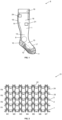
- Figure 1 1 shows a first exemplary embodiment of the knitted fabric 1 according to the invention, wherein the knitted fabric 1 is designed as a stocking 8, in particular as a leg stump.
- the stocking 8, in particular a sports stocking consists of at least a first and second knitted section 16, 17, preferably knitted using a circular knitting machine.
- the stocking 8 has a two-layer waistband 18.
- the compressive pressures generated by the knitted fabric 1 are preferably between 10 and 40 mmHg in an ankle region 13 of the leg garment, between 5 and 30 mmHg in the calf region 14, and between 10 and 30 mmHg in a metatarsal region 15.
- the values are measured using the measuring methodology and measuring device presented at the beginning, in particular by testing on the HOSY measuring device (Institut Hohenstein).
- the stocking 8 has a first padding 19.
- the padding 19 preferably extends in the circumferential direction only between the two muscle heads of the calf muscles without overlapping them.
- the padding 19 serves to compensate for a leg geometry that deviates from a circular cross-section.
- the at least one padding 19 extends, as shown, in the worn state of the stocking 8 additionally at least partially along the Achilles tendon 9 towards the heel 10 and overlaps the tendon.
- the stocking 8 has a foot part consisting of a second, preferably compressive, knitted part 17.
- This foot part 17 comprises further padding 20 for the toe area 11, the heel 10, and the sole 12.
- the padding 20 extends from the sole 12 up to the sides of the foot part 17.
- the padding 20 can also be arranged only in individual sections of the aforementioned areas.
- the multiple paddings 19 and 20 are formed by a knitted section in the knitted fabric 1, which differs in terms of its weave from an area of the base knitted fabric 1 adjacent to the padding 19, 20.
- the multiple paddings 19, 20 are designed as sandwich plush.
- the knitted fabric 1 and the first padding 19 have a gradual compression profile in the longitudinal direction of the knitted fabric. The compression strength decreases from the lower end towards the calf muscles.
- the gradual pressure profile is determined by the manner in which the weft thread 7 is inserted, in particular by the number of consecutive stitch rows into which the weft thread 7 is inserted.
- the knitted fabric 1 according to the invention it is of course possible for the knitted fabric 1 according to the invention to be designed as an arm stump, sock, bandage, or a knitted part of an orthosis.
- a stitch pattern, in particular a first section 21 from the Figure 1 shown embodiment of the knitted fabric 1, is in Figure 2 shown.
- the stitch pattern shows a basic knitting thread 2, which is knitted to form stitches over several knitting rows R1-R4 and wales M1-M7, into which at least one compression-providing weft thread 7 is inserted.
- the highly elastic weft thread 7 is inserted in each stitch row R1-R4. This can also be done selectively in any row.
- this thread 7 can be knitted to form stitches, at least in sections in the circumferential direction, in one or more rows M1-M7.
- the stitch pattern shows a reinforcing thread 3 plated onto the basic knitting thread 2.
- this reinforcing thread 3 is present in each stitch row R1-R4 and each wale M1-M7.
- This thread 3 can also only be knitted into the fabric 1 in any stitch row and only in sections in the circumferential direction.
- the reinforcement thread 3 is shown next to the basic knitting thread 2, but this is only for illustrative purposes.
- the knitting technique namely the When the reinforcing thread 3 is pressed onto the base knitting thread 2, the reinforcing thread 3 is located substantially in front of or behind the base knitting thread 2, when viewed from above onto the knitted fabric 1.
- the threads 2, 3 are therefore located substantially, i.e.
- the stitch heads 22 and stitch feet 23 of the base knitting thread 2 and of the reinforcing thread 3 preferably face the wearer's skin.
- the stitch legs 24 are located inside the knitted fabric.
- the base knitting thread 2 and the reinforcing thread 3 are pressed particularly strongly against the skin of a wearer, so that particularly good contact is achieved between the multiple threads 2, 3 and between the knitted fabric 1 and the wearer, which additionally improves the function of the knitted fabric 1.
- the weft thread 7 emerges in every nth wale on one of the two sides of the knitted fabric 1, viewed in the circumferential direction of the knitted fabric.
- the fibers of the plurality of threads 2, 3 are preferably made of plastic, in particular polyamide, polyester or polyurethane.
- Figure 3 is now a second section 25, in the form of a mesh pattern, from which in Figure 1 shown stocking 8, in particular sports stocking.
- a plush thread 4 is plated onto the basic knitting thread 2.
- This thread 4 is also shown next to the several threads for illustrative purposes. In reality, the at least three threads 2, 3, 4 are knitted together in such a way that the plush thread 4 essentially forms one side of the knitted fabric 1, i.e.
- the plush is in fact designed as a so-called sandwich plush.
- the plush loops 27, which are arranged on the inside of the knitted fabric 1, extend from this through the knitted fabric 1 to its outside. There, as described, the stitch feet 28 of the plush stitches 29 protrude.
- the basic knitting thread 2 and the reinforcing thread 3 are thus located between the knitted layers formed by the plush thread.
- the threads 2, 3, 4, 7 used which are particularly at least partially highly elastic, can differ not only in the fibers themselves, particularly in terms of fiber material and geometry, but also in that they optionally have a thread core.
- the number of fibers can also vary.
- the fibers can form one or more wraps for a thread core. They can also optionally be textured threads.
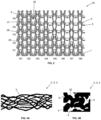
- Figure 4A shows a thread made of several interspun fibers, suitable for use as a basic knitting thread 2, in an enlarged detailed view.
- the fibers are formed as profile fibers 5 .
- Profile fibers 5 can, for example, have triangular, trilobal, or star-shaped cross-sections, particularly preferably in the form of a Trilobals. Other shapes are conceivable. If the thread has a plurality of profile fibers 5, it preferably contains more than 50 individual fibers, which are subjected to a yarn twist, preferably greater than 80 turns per meter (T/m), particularly preferably greater than 150 turns per meter. This influences not only the durability of the thread 3, but in particular the position of the fibers 5 relative to one another.
- the so-called protective twist with the significantly increased number of yarn twists (turns per meter) than is usually known leads to particularly good cohesion of the fibers 5, but also to the fibers 5 moving significantly closer together and consequently, due to the multiple elevations 30 and/or depressions 31 in the profile fibers 5, to a significantly better formation of channels 6.
- the suction effect of the fibers 5 and thus of the knitted fabric 1 is significantly improved due to the increased yarn twist.
- the fibers 5 can, as previously described, consist of plastic, in particular polyamide, polyester or polyurethane.
- Figure 4B the thread 2 Figure 4A , when it is formed as a thread consisting of several profile fibers 5, in a sectional view with the several channels 6 formed by the profile fibers 5 for transporting moisture.
- the channels 6 for transporting moisture are created by the random arrangement of the several fibers 5 relative to one another and by the yarn twist. These are formed in particular by the fact that the surface of the fibers 5 has a structure, namely elevations 30 and/or depressions 31, for example in the form of a trilobal as shown.
- the resulting cavities 6 have different diameters and cross-sections, depending on how the neighboring fibers 5 lie against one another.
Landscapes
- Engineering & Computer Science (AREA)
- Textile Engineering (AREA)
- Health & Medical Sciences (AREA)
- Biomedical Technology (AREA)
- Heart & Thoracic Surgery (AREA)
- Vascular Medicine (AREA)
- Life Sciences & Earth Sciences (AREA)
- Animal Behavior & Ethology (AREA)
- General Health & Medical Sciences (AREA)
- Public Health (AREA)
- Veterinary Medicine (AREA)
- Knitting Of Fabric (AREA)
Claims (11)
- Tricot (1), constitué d'au moins un fil à tricoter (2) de base formant les mailles, ainsi que d'au moins un fil (4) de peluche constituant des bouclettes, plaqué sur le fil à tricoter (2) de base, l'au moins un fil à tricoter (2) de base étant constitué de plusieurs fibres profilées (5) filées les unes avec les autres, lesquelles comportent une surface structurée dotée d'élévations (30) et / ou de creux (31), pour constituer entre les plusieurs fibres profilées (5) des canaux pour le transport d'humidité et l'au moins un fil (4) de peluche étant constitué de plusieurs fibres avec des sections transversales sensiblement arrondies, caractérisé en ce qu'avec le fil (4) de peluche est constituée une peluche en sandwich, les bouclettes formées par l'au moins un fil de peluche (4) s'étendant à travers le tricot (1), de telle sorte que le fil (4) de peluche ressorte sur les deux faces du tricot (1) et que le fil (4) de peluche forme essentiellement la face intérieure ainsi que la face extérieure du tricot (1).
- Tricot (1) selon la revendication 1, caractérisé en ce que le fil de peluche (4) n'est introduit chaque fois dans le tricot (1) que par endroits, en s'écoulant dans la direction circonférentielle.
- Tricot (1) selon l'une quelconque des revendications précédentes, caractérisé en ce qu'au moins un fil de trame (7) élastique qui est de préférence tricoté avec les plusieurs fils (2, 4) est inséré et / ou tricoté dans le tricot (1), en ce que dans la direction circonférentielle du tricot, celui-ci ressort à chaque nème colonne de mailles sur l'une des deux faces du tricot (1).
- Tricot (1) selon l'une quelconque des revendications précédentes, caractérisé en ce que les fibres profilées (5) comportent une surface structurée, sous forme trilobale.
- Tricot (1) selon l'une quelconque des revendications précédentes, caractérisé en ce que les fibres profilées (5) du fil à tricoter (2) de base formant les mailles sont constituées de matière plastique, notamment de polyamide, de polyester ou de polyuréthane.
- Tricot (1) selon la revendication 1 ou 2, caractérisé en ce que les fibres de section transversale sensiblement arrondie du fil de peluche (4) sont constituées de fibres naturelles, notamment de laine.
- Tricot (1) selon l'une quelconque des revendications précédentes, caractérisé en ce que les plusieurs fibres profilées (5) sont pourvues d'une torsion de fil, de préférence supérieure à 80 tours par mètre (T/m) de manière particulièrement préférentielle, supérieure à 150 tours par mètre (T/m).
- Tricot (1) selon la revendication 3, caractérisé en ce que l'au moins un fil à tricoter (2) de base formant les mailles, le fil de trame (7) élastique et / ou le fil (4) de peluche comportent un noyau de fil élastique, de préférence en élasthane.
- Tricot (1) selon l'une quelconque des revendications précédentes, caractérisé en ce que le tricot (1) est une chaussette (8), notamment un manchon ou une chaussette, une socquette, un bandage, ou une partie tricotée d'une orthèse.
- Tricot (1) selon la revendication 9, caractérisé en ce que l'au moins un fil (4) de peluche formant les bouclettes est tricoté dans le tricot (1) conçu sous la forme d'une pièce de vêtement (8) pour jambe de telle sorte que lorsque le tricot (1) est porté, les bouclettes soient placées sur la face intérieure du tricot, dans la zone du tendon d'Achille (9), du talon (10), des orteils (11) et / ou de la plante du pied (12) .
- Tricot (1) selon la revendication 10, caractérisé en ce que dans une zone de la cheville (13) de la pièce de vêtement (1) pour jambe, les pressions compressives générées par le tricot (1) se situent entre 10 et 40 mmHg, dans la zone du mollet (14), entre 5 30 mmHg et dans la zone du métatarse (15) entre 10 et 30 mmHg.
Priority Applications (2)
| Application Number | Priority Date | Filing Date | Title |
|---|---|---|---|
| EP18020439.8A EP3620562B1 (fr) | 2018-09-10 | 2018-09-10 | Textile tricoté |
| PT180204398T PT3620562T (pt) | 2018-09-10 | 2018-09-10 | Malha |
Applications Claiming Priority (1)
| Application Number | Priority Date | Filing Date | Title |
|---|---|---|---|
| EP18020439.8A EP3620562B1 (fr) | 2018-09-10 | 2018-09-10 | Textile tricoté |
Publications (2)
| Publication Number | Publication Date |
|---|---|
| EP3620562A1 EP3620562A1 (fr) | 2020-03-11 |
| EP3620562B1 true EP3620562B1 (fr) | 2025-05-28 |
Family
ID=63556087
Family Applications (1)
| Application Number | Title | Priority Date | Filing Date |
|---|---|---|---|
| EP18020439.8A Active EP3620562B1 (fr) | 2018-09-10 | 2018-09-10 | Textile tricoté |
Country Status (2)
| Country | Link |
|---|---|
| EP (1) | EP3620562B1 (fr) |
| PT (1) | PT3620562T (fr) |
Families Citing this family (2)
| Publication number | Priority date | Publication date | Assignee | Title |
|---|---|---|---|---|
| DE102019101832A1 (de) * | 2019-01-25 | 2020-07-30 | Falke Kgaa | Bekleidungsstück mit Feuchtetransportzone |
| CN111850785A (zh) * | 2020-06-30 | 2020-10-30 | 陕西科技大学 | 一种透气导湿速干袜的织造方法 |
Citations (8)
| Publication number | Priority date | Publication date | Assignee | Title |
|---|---|---|---|---|
| US4520635A (en) | 1984-05-29 | 1985-06-04 | Kayser-Roth Hosiery, Inc. | Cushion foot sock |
| EP0497136A1 (fr) | 1991-01-31 | 1992-08-05 | WIGWAM MILLS, Inc. | Chaussette à humidité controlée |
| DE4234379C1 (de) | 1992-10-13 | 1994-01-05 | Jacob Rohner Ag Balgach Balgac | Sportsocke |
| DE19740497A1 (de) | 1996-09-16 | 1998-03-19 | Patrick Yeh | Bekleidungsstück zur Schweißregulierung |
| WO1998039982A1 (fr) * | 1997-03-07 | 1998-09-17 | Porvair Plc | Chaussettes |
| EP2221406A1 (fr) | 2009-02-20 | 2010-08-25 | HUGO BOSS Trade Mark Management GmbH & Co. KG | Chaussette tricotée |
| EP2508660A2 (fr) | 2011-04-04 | 2012-10-10 | Kunert Fashion GmbH & Co. KG | Pièce de vêtement, notamment chaussette |
| US20160032501A1 (en) | 2013-04-29 | 2016-02-04 | Solid Water Holdings | Moisture transfer yarn and fabric |
Family Cites Families (5)
| Publication number | Priority date | Publication date | Assignee | Title |
|---|---|---|---|---|
| US5319807A (en) * | 1993-05-25 | 1994-06-14 | Brier Daniel L | Moisture-management sock and shoe for creating a moisture managing environment for the feet |
| US5555565A (en) * | 1995-06-23 | 1996-09-17 | Tanner Lynx Corporation | Thick pile sock with heterogeneous body and foot portions, and sock system therewith |
| GB0407371D0 (en) * | 2004-03-31 | 2004-05-05 | Bristol Myers Squibb Co | Improvements relating to socks |
| US20080286513A1 (en) * | 2007-05-15 | 2008-11-20 | Invista North America S A R L | Knit fabrics and socks made therefrom incorporating high tensile nylon staple |
| DE202010013665U1 (de) | 2010-09-28 | 2012-01-13 | Ofa Bamberg Gmbh | Elastischer Strickfaden |
-
2018
- 2018-09-10 PT PT180204398T patent/PT3620562T/pt unknown
- 2018-09-10 EP EP18020439.8A patent/EP3620562B1/fr active Active
Patent Citations (8)
| Publication number | Priority date | Publication date | Assignee | Title |
|---|---|---|---|---|
| US4520635A (en) | 1984-05-29 | 1985-06-04 | Kayser-Roth Hosiery, Inc. | Cushion foot sock |
| EP0497136A1 (fr) | 1991-01-31 | 1992-08-05 | WIGWAM MILLS, Inc. | Chaussette à humidité controlée |
| DE4234379C1 (de) | 1992-10-13 | 1994-01-05 | Jacob Rohner Ag Balgach Balgac | Sportsocke |
| DE19740497A1 (de) | 1996-09-16 | 1998-03-19 | Patrick Yeh | Bekleidungsstück zur Schweißregulierung |
| WO1998039982A1 (fr) * | 1997-03-07 | 1998-09-17 | Porvair Plc | Chaussettes |
| EP2221406A1 (fr) | 2009-02-20 | 2010-08-25 | HUGO BOSS Trade Mark Management GmbH & Co. KG | Chaussette tricotée |
| EP2508660A2 (fr) | 2011-04-04 | 2012-10-10 | Kunert Fashion GmbH & Co. KG | Pièce de vêtement, notamment chaussette |
| US20160032501A1 (en) | 2013-04-29 | 2016-02-04 | Solid Water Holdings | Moisture transfer yarn and fabric |
Non-Patent Citations (5)
| Title |
|---|
| ANONYMOUS: "Acrylic fiber", WIKIPEDIA (ACCESSED VIA THE WAYBACK MACHINE), 17 July 2017 (2017-07-17), XP093339918, Retrieved from the Internet <URL: https://web.archive.org/web/20170717033235/https://en.wikipedia.org/wiki/Acrylic_fiber> |
| ANONYMOUS: "Coolmax", WIKIPEDIA (ACCESSED VIA THE WAYBACK MACHINE), 15 April 2017 (2017-04-15), XP093339921, Retrieved from the Internet <URL:http://web.archive.org/web/20170415075810/https://en.wikipedia.org/wiki/Coolmax> |
| ANONYMOUS: "Medizinische Kompressionsstrümpfe Gütesicherung RAL-GZ 387/1", RAL - DEUTSCHES INSTITUT FÜR GÜTESICHERUNG UND KENNZEICHNUNG E.V., 1 January 2008 (2008-01-01), XP093339912, Retrieved from the Internet <URL:https://www.gzg-kompressionsstruempfe.de/uploads/media/RAL-GZ_387-1_Medizinische_Kompressionsstruempfe.pdf> |
| ANONYMOUS: "Wolle", WIKIPEDIA (ACCESSED VIA THE WAYBACK MACHINE), 5 September 2017 (2017-09-05), XP093339923, Retrieved from the Internet <URL:https://web.archive.org/web/20170905003803/https://de.wikipedia.org/wiki/Wolle> |
| D10 - STEPHEN M. BURKINSHAW: "Physico chemical Aspects of Textile Coloration", 1 January 2016, WILEY, Bradford, ISBN: 978-1-118-72569-6, article STEPHEN M. BURKINSHAW: "1 Fundamental Aspects of Textile Fibres", pages: 1 - 63, XP009565502, DOI: 10.1002/9781118725658.ch1 |
Also Published As
| Publication number | Publication date |
|---|---|
| EP3620562A1 (fr) | 2020-03-11 |
| PT3620562T (pt) | 2025-09-01 |
Similar Documents
| Publication | Publication Date | Title |
|---|---|---|
| EP3733941B1 (fr) | Article de compression tricoté avec effet adhésive | |
| DE1585117C3 (de) | Rundgestrickter Strumpf | |
| DE102004036344B4 (de) | Strickware zum Stützen und/oder Komprimieren und/oder Kompressionsbehandlung von Körperteilen und Verfahren zur Herstellung einer solchen Strickware | |
| EP3673878B1 (fr) | Article de contention tricoté | |
| EP3840600B1 (fr) | Chaussette de sport ou bandage de sport | |
| DE102013107803A1 (de) | Elastischer Schuh | |
| DE102017223750B4 (de) | Gestrickte oder gewirkte Komponente | |
| DE10316979B4 (de) | Gestricktes Fußbekleidungsstück, insbesondere Socke oder Strumpf | |
| EP1414318B1 (fr) | Article vestimentaire | |
| EP3141644B1 (fr) | Piece tricotee compressive et procede de fabrication | |
| DE602004006851T2 (de) | Kompressionsartikel oder Kompressionsartikelzubehör | |
| EP4137626B1 (fr) | Procédé de fabrication d'un article de compression sans couture sur un métier à tricoter rectiligne | |
| EP3620562A1 (fr) | Textile tricoté | |
| EP2508660B1 (fr) | Pièce de vêtement, notamment chaussette | |
| DE4204339A1 (de) | Gestrick | |
| EP3575463B1 (fr) | Pièce de vêtement pour jambes, en particulier bas | |
| EP3954817B1 (fr) | Vêtement pour jambes | |
| DE102015110313B4 (de) | Rundgestrick | |
| WO2005085509A1 (fr) | Tricot de compression, et article de compression produit a partir de ce tricot | |
| EP4459019A1 (fr) | Pièce tricotée | |
| EP3831994B1 (fr) | Pièce tricotée | |
| EP4276230B1 (fr) | Bonneterie chaussante tricotée | |
| WO2003013290A2 (fr) | Chaussette | |
| DE102015122018B4 (de) | Kompressives Strickteil | |
| DE202005019393U1 (de) | Strumpf aus gestricktem Garn zur Fußbekleidung |
Legal Events
| Date | Code | Title | Description |
|---|---|---|---|
| PUAI | Public reference made under article 153(3) epc to a published international application that has entered the european phase |
Free format text: ORIGINAL CODE: 0009012 |
|
| STAA | Information on the status of an ep patent application or granted ep patent |
Free format text: STATUS: THE APPLICATION HAS BEEN PUBLISHED |
|
| AK | Designated contracting states |
Kind code of ref document: A1 Designated state(s): AL AT BE BG CH CY CZ DE DK EE ES FI FR GB GR HR HU IE IS IT LI LT LU LV MC MK MT NL NO PL PT RO RS SE SI SK SM TR |
|
| AX | Request for extension of the european patent |
Extension state: BA ME |
|
| STAA | Information on the status of an ep patent application or granted ep patent |
Free format text: STATUS: REQUEST FOR EXAMINATION WAS MADE |
|
| 17P | Request for examination filed |
Effective date: 20200824 |
|
| RBV | Designated contracting states (corrected) |
Designated state(s): AL AT BE BG CH CY CZ DE DK EE ES FI FR GB GR HR HU IE IS IT LI LT LU LV MC MK MT NL NO PL PT RO RS SE SI SK SM TR |
|
| STAA | Information on the status of an ep patent application or granted ep patent |
Free format text: STATUS: EXAMINATION IS IN PROGRESS |
|
| TPAC | Observations filed by third parties |
Free format text: ORIGINAL CODE: EPIDOSNTIPA |
|
| 17Q | First examination report despatched |
Effective date: 20220428 |
|
| TPAC | Observations filed by third parties |
Free format text: ORIGINAL CODE: EPIDOSNTIPA |
|
| P01 | Opt-out of the competence of the unified patent court (upc) registered |
Effective date: 20230427 |
|
| GRAP | Despatch of communication of intention to grant a patent |
Free format text: ORIGINAL CODE: EPIDOSNIGR1 |
|
| STAA | Information on the status of an ep patent application or granted ep patent |
Free format text: STATUS: GRANT OF PATENT IS INTENDED |
|
| TPAC | Observations filed by third parties |
Free format text: ORIGINAL CODE: EPIDOSNTIPA |
|
| GRAS | Grant fee paid |
Free format text: ORIGINAL CODE: EPIDOSNIGR3 |
|
| INTG | Intention to grant announced |
Effective date: 20250324 |
|
| GRAA | (expected) grant |
Free format text: ORIGINAL CODE: 0009210 |
|
| STAA | Information on the status of an ep patent application or granted ep patent |
Free format text: STATUS: THE PATENT HAS BEEN GRANTED |
|
| AK | Designated contracting states |
Kind code of ref document: B1 Designated state(s): AL AT BE BG CH CY CZ DE DK EE ES FI FR GB GR HR HU IE IS IT LI LT LU LV MC MK MT NL NO PL PT RO RS SE SI SK SM TR |
|
| REG | Reference to a national code |
Ref country code: GB Ref legal event code: FG4D Free format text: NOT ENGLISH |
|
| REG | Reference to a national code |
Ref country code: CH Ref legal event code: EP |
|
| REG | Reference to a national code |
Ref country code: IE Ref legal event code: FG4D Free format text: LANGUAGE OF EP DOCUMENT: GERMAN Ref country code: DE Ref legal event code: R096 Ref document number: 502018015840 Country of ref document: DE |
|
| REG | Reference to a national code |
Ref country code: PT Ref legal event code: SC4A Ref document number: 3620562 Country of ref document: PT Date of ref document: 20250901 Kind code of ref document: T Free format text: AVAILABILITY OF NATIONAL TRANSLATION Effective date: 20250826 |
|
| REG | Reference to a national code |
Ref country code: NL Ref legal event code: MP Effective date: 20250528 Ref country code: CH Ref legal event code: U11 Free format text: ST27 STATUS EVENT CODE: U-0-0-U10-U11 (AS PROVIDED BY THE NATIONAL OFFICE) Effective date: 20251001 |
|
| PG25 | Lapsed in a contracting state [announced via postgrant information from national office to epo] |
Ref country code: FI Free format text: LAPSE BECAUSE OF FAILURE TO SUBMIT A TRANSLATION OF THE DESCRIPTION OR TO PAY THE FEE WITHIN THE PRESCRIBED TIME-LIMIT Effective date: 20250528 Ref country code: ES Free format text: LAPSE BECAUSE OF FAILURE TO SUBMIT A TRANSLATION OF THE DESCRIPTION OR TO PAY THE FEE WITHIN THE PRESCRIBED TIME-LIMIT Effective date: 20250528 |
|
| PGFP | Annual fee paid to national office [announced via postgrant information from national office to epo] |
Ref country code: PT Payment date: 20250828 Year of fee payment: 8 |
|
| PGFP | Annual fee paid to national office [announced via postgrant information from national office to epo] |
Ref country code: DE Payment date: 20250919 Year of fee payment: 8 |
|
| REG | Reference to a national code |
Ref country code: LT Ref legal event code: MG9D |
|
| PG25 | Lapsed in a contracting state [announced via postgrant information from national office to epo] |
Ref country code: GR Free format text: LAPSE BECAUSE OF FAILURE TO SUBMIT A TRANSLATION OF THE DESCRIPTION OR TO PAY THE FEE WITHIN THE PRESCRIBED TIME-LIMIT Effective date: 20250829 Ref country code: NO Free format text: LAPSE BECAUSE OF FAILURE TO SUBMIT A TRANSLATION OF THE DESCRIPTION OR TO PAY THE FEE WITHIN THE PRESCRIBED TIME-LIMIT Effective date: 20250828 |
|
| PG25 | Lapsed in a contracting state [announced via postgrant information from national office to epo] |
Ref country code: PL Free format text: LAPSE BECAUSE OF FAILURE TO SUBMIT A TRANSLATION OF THE DESCRIPTION OR TO PAY THE FEE WITHIN THE PRESCRIBED TIME-LIMIT Effective date: 20250528 Ref country code: NL Free format text: LAPSE BECAUSE OF FAILURE TO SUBMIT A TRANSLATION OF THE DESCRIPTION OR TO PAY THE FEE WITHIN THE PRESCRIBED TIME-LIMIT Effective date: 20250528 |
|
| PGFP | Annual fee paid to national office [announced via postgrant information from national office to epo] |
Ref country code: IT Payment date: 20250923 Year of fee payment: 8 |
|
| PG25 | Lapsed in a contracting state [announced via postgrant information from national office to epo] |
Ref country code: BG Free format text: LAPSE BECAUSE OF FAILURE TO SUBMIT A TRANSLATION OF THE DESCRIPTION OR TO PAY THE FEE WITHIN THE PRESCRIBED TIME-LIMIT Effective date: 20250528 |
|
| PGFP | Annual fee paid to national office [announced via postgrant information from national office to epo] |
Ref country code: GB Payment date: 20250919 Year of fee payment: 8 |
|
| PG25 | Lapsed in a contracting state [announced via postgrant information from national office to epo] |
Ref country code: HR Free format text: LAPSE BECAUSE OF FAILURE TO SUBMIT A TRANSLATION OF THE DESCRIPTION OR TO PAY THE FEE WITHIN THE PRESCRIBED TIME-LIMIT Effective date: 20250528 |
|
| PGFP | Annual fee paid to national office [announced via postgrant information from national office to epo] |
Ref country code: FR Payment date: 20250922 Year of fee payment: 8 |
|
| PG25 | Lapsed in a contracting state [announced via postgrant information from national office to epo] |
Ref country code: RS Free format text: LAPSE BECAUSE OF FAILURE TO SUBMIT A TRANSLATION OF THE DESCRIPTION OR TO PAY THE FEE WITHIN THE PRESCRIBED TIME-LIMIT Effective date: 20250828 |
|
| PG25 | Lapsed in a contracting state [announced via postgrant information from national office to epo] |
Ref country code: IS Free format text: LAPSE BECAUSE OF FAILURE TO SUBMIT A TRANSLATION OF THE DESCRIPTION OR TO PAY THE FEE WITHIN THE PRESCRIBED TIME-LIMIT Effective date: 20250928 |
|
| PG25 | Lapsed in a contracting state [announced via postgrant information from national office to epo] |
Ref country code: LV Free format text: LAPSE BECAUSE OF FAILURE TO SUBMIT A TRANSLATION OF THE DESCRIPTION OR TO PAY THE FEE WITHIN THE PRESCRIBED TIME-LIMIT Effective date: 20250528 |
|
| REG | Reference to a national code |
Ref country code: DE Ref legal event code: R026 Ref document number: 502018015840 Country of ref document: DE |
|
| PLBI | Opposition filed |
Free format text: ORIGINAL CODE: 0009260 |
|
| REG | Reference to a national code |
Ref country code: CH Ref legal event code: L10 Free format text: ST27 STATUS EVENT CODE: U-0-0-L10-L00 (AS PROVIDED BY THE NATIONAL OFFICE) Effective date: 20251126 |
|
| 26 | Opposition filed |
Opponent name: OFA BAMBERG GMBH Effective date: 20251119 |
|
| PG25 | Lapsed in a contracting state [announced via postgrant information from national office to epo] |
Ref country code: SM Free format text: LAPSE BECAUSE OF FAILURE TO SUBMIT A TRANSLATION OF THE DESCRIPTION OR TO PAY THE FEE WITHIN THE PRESCRIBED TIME-LIMIT Effective date: 20250528 Ref country code: DK Free format text: LAPSE BECAUSE OF FAILURE TO SUBMIT A TRANSLATION OF THE DESCRIPTION OR TO PAY THE FEE WITHIN THE PRESCRIBED TIME-LIMIT Effective date: 20250528 |
|
| PGFP | Annual fee paid to national office [announced via postgrant information from national office to epo] |
Ref country code: CH Payment date: 20251001 Year of fee payment: 8 |
|
| PG25 | Lapsed in a contracting state [announced via postgrant information from national office to epo] |
Ref country code: CZ Free format text: LAPSE BECAUSE OF FAILURE TO SUBMIT A TRANSLATION OF THE DESCRIPTION OR TO PAY THE FEE WITHIN THE PRESCRIBED TIME-LIMIT Effective date: 20250528 |
|
| PG25 | Lapsed in a contracting state [announced via postgrant information from national office to epo] |
Ref country code: EE Free format text: LAPSE BECAUSE OF FAILURE TO SUBMIT A TRANSLATION OF THE DESCRIPTION OR TO PAY THE FEE WITHIN THE PRESCRIBED TIME-LIMIT Effective date: 20250528 |
|
| PG25 | Lapsed in a contracting state [announced via postgrant information from national office to epo] |
Ref country code: SK Free format text: LAPSE BECAUSE OF FAILURE TO SUBMIT A TRANSLATION OF THE DESCRIPTION OR TO PAY THE FEE WITHIN THE PRESCRIBED TIME-LIMIT Effective date: 20250528 Ref country code: RO Free format text: LAPSE BECAUSE OF FAILURE TO SUBMIT A TRANSLATION OF THE DESCRIPTION OR TO PAY THE FEE WITHIN THE PRESCRIBED TIME-LIMIT Effective date: 20250528 |
|
| PLBI | Opposition filed |
Free format text: ORIGINAL CODE: 0009260 |
|
| REG | Reference to a national code |
Ref country code: CH Ref legal event code: L10 Free format text: ST27 STATUS EVENT CODE: U-0-0-L10-L00 (AS PROVIDED BY THE NATIONAL OFFICE) Effective date: 20260311 |
|
| PLAX | Notice of opposition and request to file observation + time limit sent |
Free format text: ORIGINAL CODE: EPIDOSNOBS2 |
|
| 26 | Opposition filed |
Opponent name: BAUERFEIND AG Effective date: 20260228 |
|
| PG25 | Lapsed in a contracting state [announced via postgrant information from national office to epo] |
Ref country code: LU Free format text: LAPSE BECAUSE OF NON-PAYMENT OF DUE FEES Effective date: 20250910 |
|
| REG | Reference to a national code |
Ref country code: BE Ref legal event code: MM Effective date: 20250930 |
|
| PG25 | Lapsed in a contracting state [announced via postgrant information from national office to epo] |
Ref country code: LT Free format text: LAPSE BECAUSE OF FAILURE TO SUBMIT A TRANSLATION OF THE DESCRIPTION OR TO PAY THE FEE WITHIN THE PRESCRIBED TIME-LIMIT Effective date: 20250528 |
|
| PG25 | Lapsed in a contracting state [announced via postgrant information from national office to epo] |
Ref country code: MC Free format text: LAPSE BECAUSE OF FAILURE TO SUBMIT A TRANSLATION OF THE DESCRIPTION OR TO PAY THE FEE WITHIN THE PRESCRIBED TIME-LIMIT Effective date: 20250528 |
|
| PLBB | Reply of patent proprietor to notice(s) of opposition received |
Free format text: ORIGINAL CODE: EPIDOSNOBS3 |
|
| PG25 | Lapsed in a contracting state [announced via postgrant information from national office to epo] |
Ref country code: IE Free format text: LAPSE BECAUSE OF NON-PAYMENT OF DUE FEES Effective date: 20250910 Ref country code: BE Free format text: LAPSE BECAUSE OF NON-PAYMENT OF DUE FEES Effective date: 20250930 |
|
| PG25 | Lapsed in a contracting state [announced via postgrant information from national office to epo] |
Ref country code: SE Free format text: LAPSE BECAUSE OF FAILURE TO SUBMIT A TRANSLATION OF THE DESCRIPTION OR TO PAY THE FEE WITHIN THE PRESCRIBED TIME-LIMIT Effective date: 20250528 |