EP3954817B1 - Vêtement pour jambes - Google Patents
Vêtement pour jambes Download PDFInfo
- Publication number
- EP3954817B1 EP3954817B1 EP20020363.6A EP20020363A EP3954817B1 EP 3954817 B1 EP3954817 B1 EP 3954817B1 EP 20020363 A EP20020363 A EP 20020363A EP 3954817 B1 EP3954817 B1 EP 3954817B1
- Authority
- EP
- European Patent Office
- Prior art keywords
- knitted
- knitted fabric
- leg garment
- flat
- foot
- Prior art date
- Legal status (The legal status is an assumption and is not a legal conclusion. Google has not performed a legal analysis and makes no representation as to the accuracy of the status listed.)
- Active
Links
Images


Classifications
-
- A—HUMAN NECESSITIES
- A41—WEARING APPAREL
- A41B—SHIRTS; UNDERWEAR; BABY LINEN; HANDKERCHIEFS
- A41B11/00—Hosiery; Panti-hose
- A41B11/01—Seams
-
- A—HUMAN NECESSITIES
- A61—MEDICAL OR VETERINARY SCIENCE; HYGIENE
- A61F—FILTERS IMPLANTABLE INTO BLOOD VESSELS; PROSTHESES; DEVICES PROVIDING PATENCY TO, OR PREVENTING COLLAPSING OF, TUBULAR STRUCTURES OF THE BODY, e.g. STENTS; ORTHOPAEDIC, NURSING OR CONTRACEPTIVE DEVICES; FOMENTATION; TREATMENT OR PROTECTION OF EYES OR EARS; BANDAGES, DRESSINGS OR ABSORBENT PADS; FIRST-AID KITS
- A61F13/00—Bandages or dressings; Absorbent pads
- A61F13/06—Bandages or dressings; Absorbent pads specially adapted for feet or legs; Corn-pads; Corn-rings
- A61F13/08—Elastic stockings; for contracting aneurisms
-
- D—TEXTILES; PAPER
- D04—BRAIDING; LACE-MAKING; KNITTING; TRIMMINGS; NON-WOVEN FABRICS
- D04B—KNITTING
- D04B1/00—Weft knitting processes for the production of fabrics or articles not dependent on the use of particular machines; Fabrics or articles defined by such processes
- D04B1/10—Patterned fabrics or articles
- D04B1/102—Patterned fabrics or articles with stitch pattern
- D04B1/108—Gussets, e.g. pouches or heel or toe portions
-
- D—TEXTILES; PAPER
- D04—BRAIDING; LACE-MAKING; KNITTING; TRIMMINGS; NON-WOVEN FABRICS
- D04B—KNITTING
- D04B1/00—Weft knitting processes for the production of fabrics or articles not dependent on the use of particular machines; Fabrics or articles defined by such processes
- D04B1/14—Other fabrics or articles characterised primarily by the use of particular thread materials
- D04B1/18—Other fabrics or articles characterised primarily by the use of particular thread materials elastic threads
-
- D—TEXTILES; PAPER
- D04—BRAIDING; LACE-MAKING; KNITTING; TRIMMINGS; NON-WOVEN FABRICS
- D04B—KNITTING
- D04B1/00—Weft knitting processes for the production of fabrics or articles not dependent on the use of particular machines; Fabrics or articles defined by such processes
- D04B1/22—Weft knitting processes for the production of fabrics or articles not dependent on the use of particular machines; Fabrics or articles defined by such processes specially adapted for knitting goods of particular configuration
- D04B1/24—Weft knitting processes for the production of fabrics or articles not dependent on the use of particular machines; Fabrics or articles defined by such processes specially adapted for knitting goods of particular configuration wearing apparel
- D04B1/243—Weft knitting processes for the production of fabrics or articles not dependent on the use of particular machines; Fabrics or articles defined by such processes specially adapted for knitting goods of particular configuration wearing apparel upper parts of panties; pants
-
- D—TEXTILES; PAPER
- D04—BRAIDING; LACE-MAKING; KNITTING; TRIMMINGS; NON-WOVEN FABRICS
- D04B—KNITTING
- D04B1/00—Weft knitting processes for the production of fabrics or articles not dependent on the use of particular machines; Fabrics or articles defined by such processes
- D04B1/22—Weft knitting processes for the production of fabrics or articles not dependent on the use of particular machines; Fabrics or articles defined by such processes specially adapted for knitting goods of particular configuration
- D04B1/24—Weft knitting processes for the production of fabrics or articles not dependent on the use of particular machines; Fabrics or articles defined by such processes specially adapted for knitting goods of particular configuration wearing apparel
- D04B1/26—Weft knitting processes for the production of fabrics or articles not dependent on the use of particular machines; Fabrics or articles defined by such processes specially adapted for knitting goods of particular configuration wearing apparel stockings
-
- D—TEXTILES; PAPER
- D04—BRAIDING; LACE-MAKING; KNITTING; TRIMMINGS; NON-WOVEN FABRICS
- D04B—KNITTING
- D04B1/00—Weft knitting processes for the production of fabrics or articles not dependent on the use of particular machines; Fabrics or articles defined by such processes
- D04B1/22—Weft knitting processes for the production of fabrics or articles not dependent on the use of particular machines; Fabrics or articles defined by such processes specially adapted for knitting goods of particular configuration
- D04B1/24—Weft knitting processes for the production of fabrics or articles not dependent on the use of particular machines; Fabrics or articles defined by such processes specially adapted for knitting goods of particular configuration wearing apparel
- D04B1/26—Weft knitting processes for the production of fabrics or articles not dependent on the use of particular machines; Fabrics or articles defined by such processes specially adapted for knitting goods of particular configuration wearing apparel stockings
- D04B1/265—Surgical stockings
-
- A—HUMAN NECESSITIES
- A41—WEARING APPAREL
- A41B—SHIRTS; UNDERWEAR; BABY LINEN; HANDKERCHIEFS
- A41B2500/00—Materials for shirts, underwear, baby linen or handkerchiefs not provided for in other groups of this subclass
- A41B2500/10—Knitted
-
- D—TEXTILES; PAPER
- D10—INDEXING SCHEME ASSOCIATED WITH SUBLASSES OF SECTION D, RELATING TO TEXTILES
- D10B—INDEXING SCHEME ASSOCIATED WITH SUBLASSES OF SECTION D, RELATING TO TEXTILES
- D10B2401/00—Physical properties
- D10B2401/06—Load-responsive characteristics
- D10B2401/061—Load-responsive characteristics elastic
-
- D—TEXTILES; PAPER
- D10—INDEXING SCHEME ASSOCIATED WITH SUBLASSES OF SECTION D, RELATING TO TEXTILES
- D10B—INDEXING SCHEME ASSOCIATED WITH SUBLASSES OF SECTION D, RELATING TO TEXTILES
- D10B2501/00—Wearing apparel
- D10B2501/02—Underwear
- D10B2501/021—Hosiery; Panti-hose
-
- D—TEXTILES; PAPER
- D10—INDEXING SCHEME ASSOCIATED WITH SUBLASSES OF SECTION D, RELATING TO TEXTILES
- D10B—INDEXING SCHEME ASSOCIATED WITH SUBLASSES OF SECTION D, RELATING TO TEXTILES
- D10B2509/00—Medical; Hygiene
- D10B2509/02—Bandages, dressings or absorbent pads
- D10B2509/028—Elastic support stockings or elastic bandages
Definitions
- the present invention relates to a legwear item according to the preamble of claim 1.
- Such legwear is particularly designed in the form of booties, socks, stockings, particularly as calf or thigh stumps, or for example as tights.
- these often have one or more compressive areas which serve to exert targeted pressure on a patient's body.
- the pressure exerted on a patient's body is referred to as compression.
- the aim of compressive legwear is, among other things, to relieve a patient's damaged venous and/or lymphatic system. The pressure applied prevents increasing swelling of the limbs, improves the removal of venous blood and lymph, and increases blood supply.
- compressive legwear When compressive legwear is used in sports, it increases performance and improves regeneration.
- compressive, legwear items they are circularly knitted using a circular knitting machine or flat-knitted using a flat knitting machine and then sewn together to form a tubular knit using a longitudinal seam.
- the basic knit is knitted from at least one basic knit thread that forms the stitches over several rows of stitches.
- an elastic weft thread is preferably inserted into the knitted stitches in every or every Xth, preferably every second, row.
- the RAL-GZ 387 of the quality mark association exists for the manufacture, in particular for measurement and quality assurance, of compressive arm or leg stockings for medical use.
- the RAL test regulations show how the pressure of a compression stocking on a leg is to be determined.
- the HOSY measuring device (Hohenstein Institute) is recommended as a measuring device, in particular a compression test device.
- the test is carried out by measuring the tension at the several measuring points, which varies depending on the respective stretchability of the knit.
- the compression is calculated from the tension in combination with other parameters relating to the knitted fabric. This means that the more stretchable a knitted fabric is in the cross-direction, the lower the compression exerted by the knitted fabric on the patient. On the other hand, the lower the stretchability of the knitted part, the higher the compression exerted on the patient.
- leg garments in particular in the form of leg stockings, are known from the prior art, which are sewn together to form a tubular knit by means of a longitudinal seam.
- Such a leg garment especially in the form of a compressive stocking, is used, for example, in the DE 1 772 612 U revealed.
- This well-known stocking also known as a rubber-elastic bandage, is characterized by a special seam that no longer adds bulk when worn, i.e. it is extremely flat and does not form a bulky bulge.
- the edges are placed flush against each other and sewn together using a special flat seam machine.
- the connecting seams were sewn together by overlapping the edges, which led to a wide bulge at the connection point.
- the increased compression caused the wearer of the stocking to experience pain in the area of the seam.
- the stocking is designed in such a way that the seam of the stocking runs along the back of the stocking, particularly in the middle of the back.
- the CA 784903 A also discloses a compressive leg stocking, in particular in the form of a thigh stocking.
- This in particular the knitted fabric according to the invention disclosed therein, is produced either using a circular knitting machine or a flat knitting machine. If the stocking is made as a circular knit, the stocking is preferably knitted seamlessly. If the stocking is made from a flat knit, it is sewn together using a longitudinal seam to form a tubular knit, in particular a stocking.
- the flat knit is designed in such a way that the seam of the stocking runs along its back, in particular in the middle of the back.
- the seam begins at the lower end of the stocking, namely the underside of the toe part of the stocking, runs in the middle along the sole of the foot and in the middle through a heel area of the stocking.
- the seam is then arranged in the middle of the back of the stocking, namely in a calf area and the back of the knee, and runs to an upper end of the stocking, which is formed by an adhesive band.
- the GB 2 316 418 A further discloses a knitted sock which is formed by a flat-knitted and elongated blank.
- the blank is folded lengthwise in a middle area, namely in a toe area.
- the overlapping areas of the blank are then sewn together using two seams.
- the finished sock therefore has two longitudinal seams arranged laterally and medially on the foot, which extend from the toe area to an upper open end of the sock.
- the JP H11 350203 discloses such a sock which is formed by a flat and elongated knitted part which is folded lengthwise in a central region to form a tubular sock.
- the folded knitted part is also closed on both sides by two seams.
- the design of the flat knit in such a way that the seam is arranged in the area of the sole of the foot when worn, particularly in the heel area, means that the wearer of the stocking steps on the seam every time it comes into contact with the ground.
- the wearer's entire body weight exerts pressure on the seam, which causes the wearer pain in the area of the seam, particularly if, for example, an additional seam tape is used to improve the durability of the seam, which is sewn onto the two knitted edges of the flat knit.
- the arrangement of the seam in the calf area and the increased compression there, particularly caused by the activity of the calf muscle pump, can also lead to pain in the area of the seam.
- wearing the stocking is less comfortable when designed as a thigh-high.
- legwear known from the state of the art is that the stockings are unsuitable for diabetics or allergy sufferers, especially people with sensitive feet.
- the arrangement of the seam in the area of the sole of the foot leads to increased pressure on the sole of the foot in some places.
- patients who are insensitive to pain and have chronic wounds in the area of the foot, especially in the area of the sole of the foot this can lead to further irritation of the wound. Due to poor wound healing in patients who suffer from diabetes, this must be avoided at all costs.
- the present invention is therefore based on the object of creating a leg garment which avoids the disadvantages of the prior art, in particular significantly improves the wearing comfort of a flat-knitted, preferably compressive, leg garment closed by means of a longitudinal seam.
- the legwear item has a flat-knitted base knitted part forming at least one foot part with at least one first functional zone knitted into the base knitted part, which is designed to accommodate a heel of a foot, wherein the flat-knitted base knitted part is a longitudinal seam is sewn together to form a tubular knit, and wherein the at least one first functional zone is knitted into the basic knitted part in such a way that the longitudinal seam connecting the basic knitted part is arranged at least in a heel region outside the sole of the foot when the leg garment is worn.
- the longitudinal seam of the basic knitted part preferably extends at least partially medially or laterally on the side of the foot and/or over the top of the foot when the leg garment is worn.
- the longitudinal seam preferably extends over the entire length of the foot medially or laterally on the side of the foot and/or over the top of the foot when the leg garment is worn. This means that the sole of the foot is free of any seams, which leads to significantly better wearing comfort.
- the flat-knitted base part additionally forms a toe part, wherein the toe part is sewn together to form a closed toe using a transverse seam.
- the longitudinal seam of the foot part and the transverse seam of the toe part are preferably designed as a continuous seam. This means that the entire leg garment, in particular the flat-knitted base part, can be closed using one manufacturing step, namely a single seam. A second seam is not required.
- the flat-knitted base knit part additionally forms a lower leg part, wherein the longitudinal seam extends medially or laterally on the side of the lower leg and/or across the front, in particular along the shin bone, when the leg garment is worn.
- the seam preferably extends on that side, i.e. medially, laterally or on the front of the leg, in the same way as it extends in the adjoining foot part.
- the seam in the foot part extends medially on the inside of the foot, for example, then the seam in the lower leg part preferably also extends medially, i.e. on the inside of the leg.
- the leg garment it is of course also possible for the leg garment to be designed in such a way that the arrangement of the seam differs between the foot part and the lower leg part when the leg garment is worn. All combinations are conceivable, in particular preferred e.g.: seam in the foot part medially and in the lower leg part on the front, seam in the foot part laterally and in the lower leg part on the front, seam in the foot part on the top of the foot and in the lower leg part medially, seam in the foot part on the top of the foot and in the lower leg part laterally. The list is not exhaustive.
- the flat-knitted base part forms a thigh part in addition to the lower leg part, wherein the longitudinal seam extends medially or laterally on the side of the thigh and/or over the front of the thigh when the leg garment is worn.
- the seam preferably extends on that side, i.e. medially, laterally or on the front of the leg, in the same way as it extends in the adjoining lower leg part and foot part. But here too, the extension of the seam can differ between the foot part, lower leg part and/or thigh part.
- the seam in the foot part extends on the top of the foot in order to keep an ankle area free of a seam and then extends medially or laterally in the area of the lower leg and thigh, so that a knee area and a back of the knee are also free of a seam.
- the longitudinal seam extends on different sides in all three areas, i.e. in the foot part, lower leg part and thigh part, when the leg garment is worn, in order to achieve maximum wearing comfort.
- the flat-knitted base part forms a body part in addition to the thigh part, with the longitudinal seam extending along the side of the pelvis and/or across the front of the pelvis when the leg garment is worn.
- the extension of the longitudinal seam in the foot part, lower leg part, thigh part and/or body part can be carried out in the same way, for example continuously medially on the side of the leg, or can differ.
- the flat-knitted base part has at least a second functional zone knitted into the base part, which preferably has a higher elasticity in the longitudinal and/or transverse direction than the flat-knitted base part.
- the second functional zone can serve, for example, as a relief zone in the ankle area or in the instep area, in particular to prevent wrinkles from forming there.
- the opposite knitted edges of the flat-knitted base knitted part running between a knitted fabric beginning and a knitted fabric end are symmetrical, in particular mirror-symmetrical, to each other.
- the opposite knitted edges of the flat-knitted base knitted part that run between a knitted beginning and a knitted end are designed asymmetrically to each other. This enables the longitudinal seam to be guided along the leg of a wearer, in particular past sensitive areas on the leg of a wearer, such as the ankle, the back of the knee or past other local sensitive areas, such as wounds.
- the course of the knitted edges and thus the course of the longitudinal seam along the foot part, the lower leg part, the thigh part and/or the torso part is determined individually, i.e. depending on the person.
- made-to-measure care where the patient receives a made-to-measure item of leg clothing and the base knitted part is thus knitted to measure, it is possible to individually determine and specify the position of the longitudinal seam on the leg of a wearer.
- the flat-knitted base knitted part is formed by one or more stitch-forming base knitted threads and at least one inserted weft thread. It particularly preferably has a gradual compression curve in the longitudinal direction of the knitted fabric.
- the gradual pressure curve is preferably determined by the manner, in particular by the number of consecutive rows of stitches in which the weft thread is deposited.
- the compression strength preferably increases or decreases continuously in the longitudinal direction of the knitted fabric.
- the compressive pressures generated by the flat-knitted base knitted part are preferably between 10 and 60 mmHg in an ankle area of the leg garment and between 5 and 50 mmHg in a calf area.
- the legwear item is designed as a single piece or in multiple pieces.
- the multiple pieces namely the foot part, the lower leg part, the thigh part and/or the body part, are formed by a single, continuously flat-knitted basic piece, or by two or more basic pieces that are formed separately from one another and are each sewn together to form a tubular knit using a longitudinal seam.
- the multiple-piece design makes it easier to put on.
- the leg garment according to the previous embodiments is preferably designed as a footlet, sock, stocking, in particular as a calf or thigh stump, as tights, foot bandage, or as a knitted part of a foot orthosis. It is particularly preferably designed as a compressive leg garment, wherein the compression strength decreases or increases in the longitudinal direction of the knitted fabric, in particular from the ankle towards the upper end of the knitted fabric.
- This legwear item is characterized by a number of significant advantages.
- the leg garment By designing the leg garment in such a way that the longitudinal seam connecting the basic knitted part of the leg garment is arranged at least in a heel area outside the sole of the foot when the leg garment is worn, a significantly better wearing comfort is achieved. There is no annoying seam connection between the wearer's foot and a tread surface, which could cause the wearer pain in the area of the seam.
- the sole of the leg garment is therefore preferably free of any seam connections. It therefore preferably consists only of the evenly knitted basic knitted part. In any case, there are no irritation-causing elements of the basic knitted part in the sole of the leg garment.
- the longitudinal seam is positioned medially or laterally on the side of the lower leg or on the front, i.e. in the area of the shin bone, when the leg garment is worn, so that the seam is not positioned in the calf area of the wearer's leg.
- the rear calf area is therefore also free of any seam connections. The activity of the calf muscle pump therefore does not lead to pain in the lower leg area due to disturbing or irritating elements in the calf area of the basic knitted part.
- the arrangement of the longitudinal seam when the legwear is worn, medially or laterally on the side or on the front of the lower leg and thigh, has the advantage that there is no annoying seam in the area of the back of the knee. This also leads to significantly better wearing comfort due to the reduced formation of wrinkles.
- legwear item according to the invention is particularly suitable for sensitive feet, i.e. in particular for diabetics or allergy sufferers. Because the sole of the foot is preferably free of any seams, there is no irritation of the sole of the foot, in particular of wounds in the area of the sole of the foot in patients who do not feel pain and chronic wounds in the area of the foot.
- the legwear according to the invention has the longitudinal seam of the basic knitted part arranged outside those areas of the legwear which are exposed to the use of a raised are exposed to stress, especially the sole of the foot and the heel. This ultimately leads to the durability of the leg garment being significantly improved.
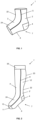
- a first embodiment of the leg garment 1 is shown in the form of a preferably compressive and preferably medical sock with an open toe.
- the leg garment 1 consists of a foot part 2, which is made from a base knitted part 3 that is flat-knitted over several rows of stitches and which is in turn sewn together to form a tubular knit using a longitudinal seam 5.
- a first functional zone 4 is knitted into the base knitted part 3, which is designed to accommodate a heel of a foot.
- the first functional zone 4 is knitted into the base knitted part 3 in such a way that the longitudinal seam 5 connecting the base knitted part is arranged outside the sole of the foot 6 at least in a heel area when the leg garment 1 is worn.
- the seam 5 runs medially on the inside 7 of the Foot of a wearer of the leg garment 1, i.e. on the inside in the metatarsal area 24, the heel area as well as the ankle area 22.
- the sole of the foot 6 thus has no seam connection that is disturbing for the wearer of the leg garment 1.
- the basic knitted part 3 itself is designed as a single-layer or multi-layer flat knit according to this and the following embodiments.
- the basic knitted part 3 is preferably formed by a right-right weave, consisting of a RR knitting thread (right-right knitting thread) and an inserted weft thread, or by a half-tubular weave consisting of a RR knitting thread, a RL knitting thread (right-left knitting thread) and the inserted weft thread.
- the longitudinal seam 5 in turn preferably has a seam tape for improved seam durability or seam strength according to this and the following embodiments.
- This is a tape-shaped textile element which is sewn together with the two knitted edges of the flat knit.
- the longitudinal seam 5 can also be designed as an overlapping or butt-to-butt connection.
- the leg garment 1 is a compressive sock
- the compressive pressures generated in an ankle area 22 are preferably between 10 and 60 mmHg
- in a midfoot area 24 are preferably between 10 and 50 mmHg.
- the basic knitted part 3, which is knitted flat on a flat knitting machine, has one or more weft threads inserted into several basic knitting stitch rows. The compressive values are measured using the measuring method and measuring device presented at the beginning, in particular by testing on the HOSY measuring device (Institut Hohenstein).
- FIG. 2 shows a second embodiment of the flat-knitted leg garment 1', which is designed as a stocking, in particular as a calf stocking.
- a stocking in particular as a calf stocking.
- This consists of a preferably compressive basic knitted part 3' forming a foot part 2' and a lower leg part 12'.
- the leg garment 1' preferably the basic knitted part 3', has a toe part 10, wherein the toe part 10 is sewn together by means of a transverse seam 11 to form a closed toe.
- the toe formed can thus be sewn onto the basic knitted part 3', or knitted in one piece with it.
- an adhesive section 33' in the form of a, preferably with a two-layered waistband or an adhesive band knitted or sewn on. This ensures that the stocking does not slip on the wearer's leg.
- the longitudinal seam 5' connecting the flat-knitted base knitted part 3' runs, due to the special arrangement of the first functional zone 4, namely the heel, in the base knitted part 3' and due to the design of the base knitted part 3' itself, both in the midfoot area 24, the ankle area 22, and the calf area 23 medially on the inside 7 of the foot and leg of a wearer of the leg garment 1'.
- the side of the leg garment 1 facing the sole 6 of the wearer is thus free of a disturbing seam connection.
- the calf area 23 also has no disturbing seam connection.
- the calf stocking shown is preferably designed as a compressive leg garment 1'.
- the compressive pressures in the ankle area 22 are preferably between 10 and 60 mmHg, and in the calf area between 5 and 50 mmHg.
- the compression strength preferably decreases from the lower end towards the calf muscles. Alternatively, an increasing pressure curve is also possible.
- FIG 3 a third embodiment of the legwear item 1" is shown, which also, as in Figure 2 shown, is designed as a stocking, in particular as a calf stocking.
- the stocking 1" also has, in addition to a foot part 2", a lower leg part 12" and a toe part 10.
- the toe part 10 is preferably sewn to the basic knitted part 3" by means of a seam connection 39.
- the adhesive section 33" is also provided.
- the calf stocking differs in particular in that the functional zone 4 consists of Figure 2 , namely the preferably knitted heel, is incorporated into the basic knitted part 3" or into the foot part 2" in such a way that the longitudinal seam 5" extends in a midfoot area 24 over the top of the foot 9 and in an ankle area 22 and calf area 23 over the front 25 of the leg clothing 1", in particular along the shin bone of a wearer, when the leg clothing 1" is worn.
- the longitudinal seam 5" meets the seam connection 39 on the top of the foot 9. This makes it possible for the seam 5" and the seam 39 to be formed as a single, in particular continuous seam.
- the sole of the foot 6 is thus free of seams in a rear heel area, which leads to significantly better wearing comfort.
- the toe part 10, in particular the formed toe, can have other shapes in addition to the closed variant shown, for example an open toe or several tubular knitted parts for each individual toe.
- the Open or closed toes preferably have different pressure profiles, which can be optionally combined with the pressure profiles of the foot and lower leg section 2", 12", preferably according to the several compression classes 1 to 4 according to RAL-GZ 387.
- a leg garment 1′′′ is shown which is designed as a thigh-high.
- the thigh-high 1′′′ consists of a foot part 2′′′, a lower leg part 12′′′ and a thigh part 13′′′, which is made from a base knitted part 3′′′, preferably a single one, knitted flat over several rows of stitches.
- the foot part 2′′′ has a preferably knitted toe part 10'.
- an adhesive band 33′′′ is knitted onto the upper end of the thigh-high 1′′′, so that a secure hold of the leg garment 1′′′, in particular on the thigh, is ensured.
- the longitudinal seam 5′′′ connecting the flat-knitted base knitted part 3′′′ runs through the specific arrangement of the first functional zone 4 in the base knitted part 3′′′ and through the formation of the base knitted part 3′′′ itself, in the metatarsal area 24, the ankle area 22, the calf area 23, as well as the thigh area 40 laterally on the outside 8 of the foot and leg of a wearer of the leg garment 1′′′.
- the seam 5′′′ extends into the toe part 10' and closes the tip of the preferably knitted toe.
- the flat-knitted base knitted part 3′′′ is thus sewn together by a single and in particular continuous seam connection to form a closed tubular knit, which brings with it significant time and thus cost savings. Multiple manually produced seam connections are no longer necessary.
- the embodiment shown thus brings with it the advantage of a time- and cost-saving manufacturing option.
- the basic knitted part 3′′′ is particularly preferably designed in such a way that the seam 5′′′ running on the side of the thigh-high stocking 1′′′ runs around a sensitive ankle zone 16 of a wearer of the leg garment 1′′′, i.e. does not cross it.
- This is achieved by the fact that the opposite knitted edges of the flat-knitted basic knitted part 3′′′ running between a knitted beginning and a knitted end are designed asymmetrically to one another, which will be explained later in Figure 7 will be explained in more detail.
- FIG. 5 finally shows a leg garment 1′′′′ in the form of tights with an upper waistband 33"".
- the tights 1 ⁇ consist of a flat-knitted basic knitted part 3"", which forms a foot part 2"", which in turn has a first functional zone 4' in the form of a heel and a toe part 10', a lower leg part 12"", a thigh part 13 ⁇ and a body part 14"".
- the flat-knitted basic knitted part 3 ⁇ is sewn together to form a tubular knit by means of a longitudinal seam 5 ⁇ .
- the longitudinal seam 5′′′ connecting the flat-knitted basic knitted part 3′′′ runs in a midfoot area 24, an ankle area 22, a calf area 23 and a thigh area 40 laterally on the outside 8 of the foot and leg of a wearer of the leg garment 1′′′′.
- the seam 5 ⁇ is also arranged on the outside 15 of the pelvis in the body part 14′′′, which is preferably sewn to the thigh part 13 ⁇ by means of a transverse seam 41.
- the preferably compressive and flat-knit leg garment 1 ⁇ therefore has no seam connection in the area of the sole of the foot 6, the back of the knee 34 or in the buttocks area, which is annoying for the wearer of the leg garment 3 ⁇ and deteriorates the wearing comfort.
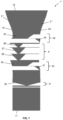
- FIG. 6 now shows in a schematic representation the knitting process of the flat-knitted basic knitted part 3, as it is used to form the leg garment 1, as shown in Figure 1 can be seen.
- the flat-knitted basic knitted part 3, in particular the foot part 2 is formed by means of at least one basic knitting thread, preferably by means of several basic knitting threads, which are knitted to form stitches over several knitting rows from left to right and/or from right to left in the longitudinal direction 21 of the knitted fabric.
- the basic knitted part 3 knitted on a flat knitting machine thus forms a flat knitted fabric which has a lower knitted beginning 17, an upper knitted end 18 and a knitted edge 19 and 20 on the left and right.
- At least one elastic weft thread is preferably inserted into the basic knitted stitches of the basic knitted part 3, preferably in each or every nth stitch row, in order to give the basic knitted part 3 compressive properties.
- the first functional zone 4 which is designed to accommodate a heel of a foot, is arranged essentially, i.e. preferably over its entire width, between the knitted edges 19 and 20.
- the functional zone 4 at least that area of the zone 4 which is arranged in the lower heel area when the legwear item 1 is worn - i.e. that area of the heel which is assigned to the sole of the foot - is thus not separated from the knitted edges 19 or 20.
- the first functional zone 4 for accommodating the heel is formed by several, preferably three, spikes 26, 27 and 28.
- a spike is an essentially trapezoidal knitted section that extends over several rows of stitches. The number of stitches formed decreases or increases row by row. This creates partial rows of stitches of different lengths. This, in particular through the formation of several consecutive spikes, ultimately leads to the creation of a corresponding geometrically defined section.
- the gussets 26, 27 and 28 are arranged entirely, i.e. across their entire width, between the knitted edges 19 and 20. This means that the multiple gussets are not divided by the knitted edges 19 and 20. In relation to a row of stitches in the area of the gussets, there is therefore only a single partial row of stitches, i.e. no second partial row separated and spaced from the first, within the same row of stitches. The beginning and end of the gusset are therefore between the knitted edges 19 and 20.
- the gussets 26, 27 and 28 are knitted into the basic knitted part 3 at different distances from the knitted edges 19 and 20.
- the gussets 26, 27 and 28 are arranged significantly closer to the left knitted edge 19, which means that the seam of the legwear item 1, when worn, lies on the side of the wearer's foot. If the gussets are knitted in the middle of the basic knitted part 3, for example, the seam lies on the top of the foot. However, the seam is in any case arranged outside the sole of the wearer's foot.
- FIG 7 is now a schematic representation of the knitting process of the flat-knitted basic knitted part of the leg garment 1", in particular a section thereof, namely the foot part 2′′′, as it is in Figure 4 can be seen.
- the flat-knitted basic knitted part 3′′′ with the lower knitted beginning 17, the upper knitted end 18 and the left and right knitted edges 19' and 20', has several incorporated functions 4', 29, 30, 31 according to this embodiment.
- the first functional zone 4' forms, as in Figure 6 explained, a heel and is also formed here by three spikes 26', 27', 28' worked into the basic knitted part 3′′′.
- a second functional zone 31 is knitted into the basic knitted part 3′′′, formed by another spike 38.
- the gusset 38 is knitted into the base knitted part 3′′′ across its entire width, preferably between the two knitted edges 19' and 20'. This serves to form a slanted forefoot area.
- the latter is formed by the gusset 38 arranged in the middle of the knitted fabric and the gussets 26', 27' and 28' of the heel arranged offset in the base knitted part 3′′′.
- a third and fourth functional zone 29, 30 is knitted in immediately before and after the first functional zone 4'. These zones are also formed by gussets 32 and 35 as well as 36 and 37. These two zones serve to reduce the number of stitches in the midfoot area, particularly in the instep area, so that there is less or no creasing there due to the base knitted part 3′′′ when the leg garment is worn.
Landscapes
- Engineering & Computer Science (AREA)
- Textile Engineering (AREA)
- Health & Medical Sciences (AREA)
- Biomedical Technology (AREA)
- Heart & Thoracic Surgery (AREA)
- Vascular Medicine (AREA)
- Life Sciences & Earth Sciences (AREA)
- Animal Behavior & Ethology (AREA)
- General Health & Medical Sciences (AREA)
- Public Health (AREA)
- Veterinary Medicine (AREA)
- Socks And Pantyhose (AREA)
Claims (15)
- Pièce d'habillage de jambe (1, 1', 1", 1‴, 1ʺʺ), comportant une partie en tricot de base (3, 3', 3", 3‴, 3ʺʺ) tricotée à plat, constituant au moins une partie pied (2, 2̋, 2‴,2‴), pourvue d'au moins une première zone fonctionnelle (4, 4') emmaillée dans la partie en tricot de base (3, 3', 3", 3‴, 3ʺʺ), laquelle est conçue pour recevoir un talon d'un pied, la partie en tricot de base (3, 3', 3", 3‴, 3ʺʺ) tricotée à plat étant cousue au moyen d'une couture longitudinale (5, 5', 5", 5‴, 5ʺʺ) en un tricot tubulaire, caractérisée en ce que l'au moins une première zone fonctionnelle (4, 4') est emmaillée dans la partie en tricot de base (3, 3', 3", 3‴, 3ʺʺ) de telle sorte que, lorsque la pièce d'habillage de jambes (1, 1', 1'', 1‴, 1ʺʺ) est portée, la couture longitudinale (5, 5', 5", 5‴, 5ʺʺ) reliant la partie en tricot de base (3, 3', 3", 3‴, 3ʺʺ) soit placée au moins dans une zone du talon à l'extérieur de la plante du pied (6).
- Pièce d'habillage de jambe (1, 1', 1", 1‴, 1ʺʺ) selon la revendication 1, caractérisée en ce que lorsque la pièce d'habillage de jambes (1, 1', 1", 1‴, 1ʺʺ) est portée, la couture longitudinale (5, 5', 5", 5‴, 5ʺʺ) s'étend dans la direction médiale (7) ou latérale (8) sur le côté du pied et / ou par-dessus le dessus du pied (9).
- Pièce d'habillage de jambe (1, 1', 1", 1‴, 1ʺʺ) selon la revendication 1 ou 2, caractérisée en ce que la partie en tricot de base (3', 3", 3‴, 3ʺʺ) tricotée à plat constitue additionnellement une partie orteil (10, 10'), la partie orteil (10, 10') étant cousue au moyen d'une couture transversale (11) en un embout protège-orteil fermé.
- Pièce d'habillage de jambe ( 1‴, 1‴′) selon la revendication 3, caractérisée en ce que la couture longitudinale (5 ‴, 5'''') de la partie pied (2", 2‴) et la couture transversale (11) de la partie orteil (10') est conçue sous la forme d'une couture continue.
- Pièce d'habillage de jambe (1, 1', 1", 1‴, 1ʺʺ) selon l'une quelconque des revendications précédentes, caractérisée en ce que la partie en tricot de base (3, 3', 3", 3‴, 3ʺʺ) tricotée à plat constitue additionnellement une partie jambe inférieure (12', 12",12‴, 12ʺʺ), lorsque la pièce d'habillage de jambes (1, 1', 1'', 1‴, 1ʺʺ) est portée, la couture longitudinale (5, 5', 5", 5‴, 5ʺʺ) s'étendant en direction médiale (7) ou latérale (8) sur le côté de la jambe inférieure et / ou s'étendant par-dessus la face avant (25).
- Pièce d'habillage de jambe ( 1‴, 1ʺʺ) selon la revendication 5, caractérisée en ce que la partie en tricot de base (3‴, 3‴′) tricotée à plat constitue additionnellement une partie cuisse (13‴, 13ʺʺ), lorsque la pièce d'habillage de jambes ( 1‴, 1ʺʺ) est portée, la couture longitudinale (5‴, 5ʺʺ) s'étendant en direction médiale (7) ou latérale (8) sur le côté de la cuisse et / ou s'étendant par-dessus la face avant (25) de la cuisse.
- Pièce d'habillage de jambe (1ʺʺ) selon la revendication 6, caractérisée en ce que la partie en tricot de base (3'''') tricotée à plat constitue additionnellement une partie corps (14ʺʺ),lorsque la pièce d'habillage de jambes (1ʺʺ) est portée, la couture longitudinale (5ʺʺ) s'étendant sur le côté (15) du bassin et / ou s'étendant par-dessus la face avant (25) du bassin.
- Pièce d'habillage de jambe (1‴) selon l'une quelconque des revendications précédentes, caractérisée en ce que la partie en tricot de base (3‴) tricotée à plat comporte au moins une deuxième zone fonctionnelle (29, 30, 31) emmaillée dans la partie en tricot de base (3‴), laquelle fait preuve d'une élasticité supérieure dans la direction longitudinale et / ou transversale.
- Pièce d'habillage de jambe (1, 1', 1", 1ʺʺ) selon l'une quelconque des revendications précédentes, caractérisée en ce que les arêtes de tricot (19, 20) de la partie en tricot de base (3, 3', 3", 3ʺʺ) tricotée à plat, opposées et s'écoulant entre un début de tricot (17) et une fin de tricot (18) sont conçues en étant symétriques l'une par rapport à l'autre.
- Pièce d'habillage de jambe (1‴) selon l'une quelconque des revendications 1 à 9, caractérisée en ce que les arêtes de tricot (19', 20') de la partie en tricot de base (3‴) tricotée à plat s'écoulant entre un début de tricot (17) et une fin de tricot (18) et opposées sont conçues en étant asymétriques l'une par rapport à l'autre.
- Pièce d'habillage de jambe (1, 1', 1", 1‴, 1ʺʺ) selon l'une quelconque des revendications précédentes, caractérisée en ce que la partie en tricot de base (3, 3', 3", 3‴, 3ʺʺ) tricotée à plat est constituée d'un ou de plusieurs fils de tricot de base formant des mailles ainsi que d'au moins un fil de trame inséré.
- Pièce d'habillage de jambe (1, 1', 1", 1‴, 1ʺʺ) selon l'une quelconque des revendications précédentes, caractérisée en ce que dans la direction longitudinale de tricot (21) de la pièce d'habillage de jambes (1, 1', 1", 1‴, 1ʺʺ), la partie en tricot de base (3, 3', 3‴, 3‴, 3ʺʺ) tricotée à plat présente un trajet de compression graduel.
- Pièce d'habillage de jambe (1, 1', 1", 1‴, 1ʺʺ) selon la revendication 12, caractérisée en ce que les pressions compressives exercées par la partie en tricot de base (3, 3', 3‴, 3‴, 3ʺʺ) tricotée à plat dans une zone de cheville (22) de la pièce d'habillage de jambes se situent entre 10 et 60 mmHg et dans une zone du mollet (23) se situent entre 5 et 50 mmHg.
- Pièce d'habillage de jambe (1, 1', 1", 1‴, 1ʺʺ) selon l'une quelconque des revendications précédentes, caractérisée en ce que la pièce d'habillage des jambes (1, 1', 1", 1‴, 1ʺʺ) est conçue en une partie ou en plusieurs parties.
- Pièce d'habillage de jambe (1, 1', 1", 1‴, 1ʺʺ) selon l'une quelconque des revendications précédentes, caractérisée en ce que la pièce d'habillage de jambe (1, 1', 1", 1‴, 1ʺʺ) est un chausson, une socquette, une chaussette (1, 1', 1", 1‴), un collant (1ʺʺ), un bandage de pied, ou une partie tricotée d'une orthèse de pied.
Priority Applications (4)
| Application Number | Priority Date | Filing Date | Title |
|---|---|---|---|
| ES20020363T ES2997194T3 (en) | 2020-08-11 | 2020-08-11 | Piece of clothing for the legs |
| EP20020363.6A EP3954817B1 (fr) | 2020-08-11 | 2020-08-11 | Vêtement pour jambes |
| US17/399,961 US12453383B2 (en) | 2020-08-11 | 2021-08-11 | Leg garments and related methods |
| US19/339,939 US20260020623A1 (en) | 2020-08-11 | 2025-09-25 | Leg garments and related methods |
Applications Claiming Priority (1)
| Application Number | Priority Date | Filing Date | Title |
|---|---|---|---|
| EP20020363.6A EP3954817B1 (fr) | 2020-08-11 | 2020-08-11 | Vêtement pour jambes |
Publications (2)
| Publication Number | Publication Date |
|---|---|
| EP3954817A1 EP3954817A1 (fr) | 2022-02-16 |
| EP3954817B1 true EP3954817B1 (fr) | 2024-10-23 |
Family
ID=72046677
Family Applications (1)
| Application Number | Title | Priority Date | Filing Date |
|---|---|---|---|
| EP20020363.6A Active EP3954817B1 (fr) | 2020-08-11 | 2020-08-11 | Vêtement pour jambes |
Country Status (3)
| Country | Link |
|---|---|
| US (2) | US12453383B2 (fr) |
| EP (1) | EP3954817B1 (fr) |
| ES (1) | ES2997194T3 (fr) |
Families Citing this family (1)
| Publication number | Priority date | Publication date | Assignee | Title |
|---|---|---|---|---|
| US20230337753A1 (en) * | 2022-04-25 | 2023-10-26 | Stephan Shin | Sporting Socks |
Family Cites Families (14)
| Publication number | Priority date | Publication date | Assignee | Title |
|---|---|---|---|---|
| US335704A (en) * | 1886-02-09 | Gyeus hoult | ||
| CA784903A (en) | 1968-05-14 | Alamance Industries | Sheer support stockings | |
| US1434941A (en) * | 1921-08-09 | 1922-11-07 | Boyd Ernest | Hosiery |
| DE588844C (de) * | 1932-04-17 | 1933-11-29 | Theodor Guenther Fa | Auf der flachen Kulierwirkmaschine hergestellter Strumpf und Verfahren zu dessen Herstellung |
| US2672139A (en) * | 1949-07-27 | 1954-03-16 | Pak Parachute Company Ltd | Elastic surgical stocking |
| DE1772612U (de) | 1957-11-26 | 1958-08-21 | Passauer Tuellfabrik Ag | Gummielastische bandage, beispielsweise aus gummituell hergestellter strumpf. |
| GB2316418B (en) * | 1996-08-20 | 2001-02-28 | Britt Helsing Kisby | Knitted socks |
| JPH11350203A (ja) * | 1998-06-15 | 1999-12-21 | Yookusu Kk | 防寒用くつ下 |
| DE102010046945A1 (de) * | 2010-09-29 | 2012-03-29 | Bsn-Jobst Gmbh | Kompressionsartikel mit Einsatz |
| WO2013063554A1 (fr) * | 2011-10-28 | 2013-05-02 | Ing Source, Inc. | Vêtement de compression de pied, et procédé thérapeutique pour réduire la douleur du talon |
| US20160242471A1 (en) * | 2015-02-19 | 2016-08-25 | Bryan Marville | Asymmetrical form fit wet sock |
| JP6052753B1 (ja) * | 2016-05-19 | 2016-12-27 | 株式会社トレステック | 筒状包帯 |
| DE102017005187A1 (de) * | 2017-05-24 | 2018-11-29 | Bauerfeind Ag | Kompressionsstrumpf |
| DE102018004065A1 (de) * | 2018-05-18 | 2019-11-21 | Medi Gmbh & Co. Kg | Kompressives Gestrickteil |
-
2020
- 2020-08-11 ES ES20020363T patent/ES2997194T3/es active Active
- 2020-08-11 EP EP20020363.6A patent/EP3954817B1/fr active Active
-
2021
- 2021-08-11 US US17/399,961 patent/US12453383B2/en active Active
-
2025
- 2025-09-25 US US19/339,939 patent/US20260020623A1/en active Pending
Also Published As
| Publication number | Publication date |
|---|---|
| ES2997194T3 (en) | 2025-02-14 |
| US20220046998A1 (en) | 2022-02-17 |
| US12453383B2 (en) | 2025-10-28 |
| US20260020623A1 (en) | 2026-01-22 |
| EP3954817A1 (fr) | 2022-02-16 |
Similar Documents
| Publication | Publication Date | Title |
|---|---|---|
| DE60001707T2 (de) | Mehrschichtige kompressionsorthese und verfahren zum anziehen | |
| DE69400773T2 (de) | Medizinische Kompressionseinrichtung für ein Bein oder einen Arm | |
| EP3733941B1 (fr) | Article de compression tricoté avec effet adhésive | |
| EP4302737B1 (fr) | Pièce de bonneterie pour le massage et la compression | |
| EP2068801B1 (fr) | Bas de contention, ensemble et utilisation | |
| DE69702849T2 (de) | Kompresionsstrumpf oder -strumpfhose | |
| EP3351667B1 (fr) | Corsage de contention ou collant de contention pourvu de corsage permettant le traitement par compression pendant la grossesse | |
| EP2078518A2 (fr) | Bas de contention et à varice | |
| DE602004006851T2 (de) | Kompressionsartikel oder Kompressionsartikelzubehör | |
| EP3954817B1 (fr) | Vêtement pour jambes | |
| EP3630032B2 (fr) | Bas de contention | |
| EP3575463B1 (fr) | Pièce de vêtement pour jambes, en particulier bas | |
| WO2011117247A1 (fr) | Caleçon de soutien pour messieurs, en particulier collant de soutien ou de compression | |
| DE102017109689A1 (de) | Venenkompressions-Orthese mit variablem Druck-Profil | |
| EP3620562B1 (fr) | Textile tricoté | |
| DE102016125409A1 (de) | Eingefasste Textilorthese | |
| EP1953284A2 (fr) | Tricot médicinal | |
| DE102018004065A1 (de) | Kompressives Gestrickteil | |
| WO2023169662A1 (fr) | Bas | |
| DE19503459C1 (de) | Thrombosestrumpf oder Strumpfteil einer Thrombosestrumpfhose und Verfahren zu ihrer Herstellung | |
| EP3831994B1 (fr) | Pièce tricotée | |
| EP4123072A1 (fr) | Pièce tricotée compressive | |
| EP4459019A1 (fr) | Pièce tricotée | |
| EP1537793A2 (fr) | Vêtement de jambe | |
| DE102005012338A1 (de) | Strumpf mit erhöhter Laufsicherheit und Standfestigkeit |
Legal Events
| Date | Code | Title | Description |
|---|---|---|---|
| PUAI | Public reference made under article 153(3) epc to a published international application that has entered the european phase |
Free format text: ORIGINAL CODE: 0009012 |
|
| STAA | Information on the status of an ep patent application or granted ep patent |
Free format text: STATUS: THE APPLICATION HAS BEEN PUBLISHED |
|
| AK | Designated contracting states |
Kind code of ref document: A1 Designated state(s): AL AT BE BG CH CY CZ DE DK EE ES FI FR GB GR HR HU IE IS IT LI LT LU LV MC MK MT NL NO PL PT RO RS SE SI SK SM TR |
|
| STAA | Information on the status of an ep patent application or granted ep patent |
Free format text: STATUS: REQUEST FOR EXAMINATION WAS MADE |
|
| 17P | Request for examination filed |
Effective date: 20220721 |
|
| RBV | Designated contracting states (corrected) |
Designated state(s): AL AT BE BG CH CY CZ DE DK EE ES FI FR GB GR HR HU IE IS IT LI LT LU LV MC MK MT NL NO PL PT RO RS SE SI SK SM TR |
|
| P01 | Opt-out of the competence of the unified patent court (upc) registered |
Effective date: 20230427 |
|
| GRAP | Despatch of communication of intention to grant a patent |
Free format text: ORIGINAL CODE: EPIDOSNIGR1 |
|
| STAA | Information on the status of an ep patent application or granted ep patent |
Free format text: STATUS: GRANT OF PATENT IS INTENDED |
|
| RIC1 | Information provided on ipc code assigned before grant |
Ipc: A61F 13/08 20060101ALI20240715BHEP Ipc: D04B 1/26 20060101ALI20240715BHEP Ipc: D04B 1/24 20060101AFI20240715BHEP |
|
| GRAS | Grant fee paid |
Free format text: ORIGINAL CODE: EPIDOSNIGR3 |
|
| INTG | Intention to grant announced |
Effective date: 20240816 |
|
| GRAA | (expected) grant |
Free format text: ORIGINAL CODE: 0009210 |
|
| STAA | Information on the status of an ep patent application or granted ep patent |
Free format text: STATUS: THE PATENT HAS BEEN GRANTED |
|
| AK | Designated contracting states |
Kind code of ref document: B1 Designated state(s): AL AT BE BG CH CY CZ DE DK EE ES FI FR GB GR HR HU IE IS IT LI LT LU LV MC MK MT NL NO PL PT RO RS SE SI SK SM TR |
|
| REG | Reference to a national code |
Ref country code: GB Ref legal event code: FG4D Free format text: NOT ENGLISH |
|
| REG | Reference to a national code |
Ref country code: CH Ref legal event code: EP |
|
| REG | Reference to a national code |
Ref country code: DE Ref legal event code: R096 Ref document number: 502020009534 Country of ref document: DE |
|
| REG | Reference to a national code |
Ref country code: IE Ref legal event code: FG4D Free format text: LANGUAGE OF EP DOCUMENT: GERMAN |
|
| REG | Reference to a national code |
Ref country code: SE Ref legal event code: TRGR |
|
| REG | Reference to a national code |
Ref country code: NL Ref legal event code: FP |
|
| REG | Reference to a national code |
Ref country code: ES Ref legal event code: FG2A Ref document number: 2997194 Country of ref document: ES Kind code of ref document: T3 Effective date: 20250214 |
|
| REG | Reference to a national code |
Ref country code: LT Ref legal event code: MG9D |
|
| PG25 | Lapsed in a contracting state [announced via postgrant information from national office to epo] |
Ref country code: PT Free format text: LAPSE BECAUSE OF FAILURE TO SUBMIT A TRANSLATION OF THE DESCRIPTION OR TO PAY THE FEE WITHIN THE PRESCRIBED TIME-LIMIT Effective date: 20250224 Ref country code: HR Free format text: LAPSE BECAUSE OF FAILURE TO SUBMIT A TRANSLATION OF THE DESCRIPTION OR TO PAY THE FEE WITHIN THE PRESCRIBED TIME-LIMIT Effective date: 20241023 Ref country code: IS Free format text: LAPSE BECAUSE OF FAILURE TO SUBMIT A TRANSLATION OF THE DESCRIPTION OR TO PAY THE FEE WITHIN THE PRESCRIBED TIME-LIMIT Effective date: 20250223 |
|
| PG25 | Lapsed in a contracting state [announced via postgrant information from national office to epo] |
Ref country code: FI Free format text: LAPSE BECAUSE OF FAILURE TO SUBMIT A TRANSLATION OF THE DESCRIPTION OR TO PAY THE FEE WITHIN THE PRESCRIBED TIME-LIMIT Effective date: 20241023 |
|
| PG25 | Lapsed in a contracting state [announced via postgrant information from national office to epo] |
Ref country code: BG Free format text: LAPSE BECAUSE OF FAILURE TO SUBMIT A TRANSLATION OF THE DESCRIPTION OR TO PAY THE FEE WITHIN THE PRESCRIBED TIME-LIMIT Effective date: 20241023 |
|
| PG25 | Lapsed in a contracting state [announced via postgrant information from national office to epo] |
Ref country code: NO Free format text: LAPSE BECAUSE OF FAILURE TO SUBMIT A TRANSLATION OF THE DESCRIPTION OR TO PAY THE FEE WITHIN THE PRESCRIBED TIME-LIMIT Effective date: 20250123 |
|
| PG25 | Lapsed in a contracting state [announced via postgrant information from national office to epo] |
Ref country code: LV Free format text: LAPSE BECAUSE OF FAILURE TO SUBMIT A TRANSLATION OF THE DESCRIPTION OR TO PAY THE FEE WITHIN THE PRESCRIBED TIME-LIMIT Effective date: 20241023 Ref country code: GR Free format text: LAPSE BECAUSE OF FAILURE TO SUBMIT A TRANSLATION OF THE DESCRIPTION OR TO PAY THE FEE WITHIN THE PRESCRIBED TIME-LIMIT Effective date: 20250124 |
|
| PG25 | Lapsed in a contracting state [announced via postgrant information from national office to epo] |
Ref country code: PL Free format text: LAPSE BECAUSE OF FAILURE TO SUBMIT A TRANSLATION OF THE DESCRIPTION OR TO PAY THE FEE WITHIN THE PRESCRIBED TIME-LIMIT Effective date: 20241023 |
|
| PG25 | Lapsed in a contracting state [announced via postgrant information from national office to epo] |
Ref country code: RS Free format text: LAPSE BECAUSE OF FAILURE TO SUBMIT A TRANSLATION OF THE DESCRIPTION OR TO PAY THE FEE WITHIN THE PRESCRIBED TIME-LIMIT Effective date: 20250123 |
|
| PG25 | Lapsed in a contracting state [announced via postgrant information from national office to epo] |
Ref country code: SM Free format text: LAPSE BECAUSE OF FAILURE TO SUBMIT A TRANSLATION OF THE DESCRIPTION OR TO PAY THE FEE WITHIN THE PRESCRIBED TIME-LIMIT Effective date: 20241023 |
|
| PG25 | Lapsed in a contracting state [announced via postgrant information from national office to epo] |
Ref country code: DK Free format text: LAPSE BECAUSE OF FAILURE TO SUBMIT A TRANSLATION OF THE DESCRIPTION OR TO PAY THE FEE WITHIN THE PRESCRIBED TIME-LIMIT Effective date: 20241023 |
|
| PG25 | Lapsed in a contracting state [announced via postgrant information from national office to epo] |
Ref country code: EE Free format text: LAPSE BECAUSE OF FAILURE TO SUBMIT A TRANSLATION OF THE DESCRIPTION OR TO PAY THE FEE WITHIN THE PRESCRIBED TIME-LIMIT Effective date: 20241023 |
|
| PG25 | Lapsed in a contracting state [announced via postgrant information from national office to epo] |
Ref country code: RO Free format text: LAPSE BECAUSE OF FAILURE TO SUBMIT A TRANSLATION OF THE DESCRIPTION OR TO PAY THE FEE WITHIN THE PRESCRIBED TIME-LIMIT Effective date: 20241023 |
|
| REG | Reference to a national code |
Ref country code: DE Ref legal event code: R097 Ref document number: 502020009534 Country of ref document: DE |
|
| PG25 | Lapsed in a contracting state [announced via postgrant information from national office to epo] |
Ref country code: SK Free format text: LAPSE BECAUSE OF FAILURE TO SUBMIT A TRANSLATION OF THE DESCRIPTION OR TO PAY THE FEE WITHIN THE PRESCRIBED TIME-LIMIT Effective date: 20241023 |
|
| PG25 | Lapsed in a contracting state [announced via postgrant information from national office to epo] |
Ref country code: CZ Free format text: LAPSE BECAUSE OF FAILURE TO SUBMIT A TRANSLATION OF THE DESCRIPTION OR TO PAY THE FEE WITHIN THE PRESCRIBED TIME-LIMIT Effective date: 20241023 |
|
| PLBE | No opposition filed within time limit |
Free format text: ORIGINAL CODE: 0009261 |
|
| STAA | Information on the status of an ep patent application or granted ep patent |
Free format text: STATUS: NO OPPOSITION FILED WITHIN TIME LIMIT |
|
| PGFP | Annual fee paid to national office [announced via postgrant information from national office to epo] |
Ref country code: NL Payment date: 20250821 Year of fee payment: 6 |
|
| 26N | No opposition filed |
Effective date: 20250724 |
|
| PGFP | Annual fee paid to national office [announced via postgrant information from national office to epo] |
Ref country code: ES Payment date: 20250926 Year of fee payment: 6 |
|
| PGFP | Annual fee paid to national office [announced via postgrant information from national office to epo] |
Ref country code: DE Payment date: 20250820 Year of fee payment: 6 |
|
| PGFP | Annual fee paid to national office [announced via postgrant information from national office to epo] |
Ref country code: IT Payment date: 20250825 Year of fee payment: 6 |
|
| PGFP | Annual fee paid to national office [announced via postgrant information from national office to epo] |
Ref country code: GB Payment date: 20250820 Year of fee payment: 6 |
|
| PGFP | Annual fee paid to national office [announced via postgrant information from national office to epo] |
Ref country code: FR Payment date: 20250828 Year of fee payment: 6 |
|
| PGFP | Annual fee paid to national office [announced via postgrant information from national office to epo] |
Ref country code: CH Payment date: 20250901 Year of fee payment: 6 Ref country code: SE Payment date: 20250820 Year of fee payment: 6 |
|
| PG25 | Lapsed in a contracting state [announced via postgrant information from national office to epo] |
Ref country code: MC Free format text: LAPSE BECAUSE OF FAILURE TO SUBMIT A TRANSLATION OF THE DESCRIPTION OR TO PAY THE FEE WITHIN THE PRESCRIBED TIME-LIMIT Effective date: 20241023 |
|
| PG25 | Lapsed in a contracting state [announced via postgrant information from national office to epo] |
Ref country code: LU Free format text: LAPSE BECAUSE OF NON-PAYMENT OF DUE FEES Effective date: 20250811 |