EP3621970B1 - Complexes organoborés pour dispositifs électroluminescents organiques - Google Patents
Complexes organoborés pour dispositifs électroluminescents organiques Download PDFInfo
- Publication number
- EP3621970B1 EP3621970B1 EP18721058.8A EP18721058A EP3621970B1 EP 3621970 B1 EP3621970 B1 EP 3621970B1 EP 18721058 A EP18721058 A EP 18721058A EP 3621970 B1 EP3621970 B1 EP 3621970B1
- Authority
- EP
- European Patent Office
- Prior art keywords
- atoms
- groups
- radicals
- substituted
- aromatic
- Prior art date
- Legal status (The legal status is an assumption and is not a legal conclusion. Google has not performed a legal analysis and makes no representation as to the accuracy of the status listed.)
- Active
Links
- 0 C[C@]1NC(C)=C(CC(C)=*)N[C@]1C Chemical compound C[C@]1NC(C)=C(CC(C)=*)N[C@]1C 0.000 description 10
- WWRPBGHUKUVORZ-LJSVPSOQSA-N C[C@@H]1C=CC(C2)C2C1[I]=C Chemical compound C[C@@H]1C=CC(C2)C2C1[I]=C WWRPBGHUKUVORZ-LJSVPSOQSA-N 0.000 description 1
- XEKBJOWGLPRMDG-CNZKWPKMSA-N C[C@H](C(CCI)N1)NC2=C1N=NNN2 Chemical compound C[C@H](C(CCI)N1)NC2=C1N=NNN2 XEKBJOWGLPRMDG-CNZKWPKMSA-N 0.000 description 1
- MPIOIBWSYVMFJG-ZXZARUISSA-N C[C@H]1N=NN=N[C@H]1C Chemical compound C[C@H]1N=NN=N[C@H]1C MPIOIBWSYVMFJG-ZXZARUISSA-N 0.000 description 1
- DJOJTPUNAMFNLR-UHFFFAOYSA-N Cc(c1c2[nH]c3c1[s]c1c3cccc1)cc1c2nccc1 Chemical compound Cc(c1c2[nH]c3c1[s]c1c3cccc1)cc1c2nccc1 DJOJTPUNAMFNLR-UHFFFAOYSA-N 0.000 description 1
- KFYPHALDDOOZFS-UHFFFAOYSA-N Cc1cc(ccc2cccnc22)c2[nH]1 Chemical compound Cc1cc(ccc2cccnc22)c2[nH]1 KFYPHALDDOOZFS-UHFFFAOYSA-N 0.000 description 1
- MKZQCTADRQXBAU-UHFFFAOYSA-N c(cc1)ccc1-[n](c(cccc1)c1c1c2)c1ccc2-c(cc1)nc2c1ncc1c2[nH]c2c1cccc2 Chemical compound c(cc1)ccc1-[n](c(cccc1)c1c1c2)c1ccc2-c(cc1)nc2c1ncc1c2[nH]c2c1cccc2 MKZQCTADRQXBAU-UHFFFAOYSA-N 0.000 description 1
- LXCFSFDAHQLFAC-UHFFFAOYSA-N c(cc1)ccc1-c1cc(-c2nc(-c(cc3)cc4c3-c3ccccc3C43c4ccccc4-c4c3cccc4)nc(-c3cc(-c4ccccc4)cc(-c4ccccc4)c3)n2)cc(-c2ccccc2)c1 Chemical compound c(cc1)ccc1-c1cc(-c2nc(-c(cc3)cc4c3-c3ccccc3C43c4ccccc4-c4c3cccc4)nc(-c3cc(-c4ccccc4)cc(-c4ccccc4)c3)n2)cc(-c2ccccc2)c1 LXCFSFDAHQLFAC-UHFFFAOYSA-N 0.000 description 1
- HBQUOLGAXBYZGR-UHFFFAOYSA-N c(cc1)ccc1-c1nc(-c2ccccc2)nc(-c2ccccc2)n1 Chemical compound c(cc1)ccc1-c1nc(-c2ccccc2)nc(-c2ccccc2)n1 HBQUOLGAXBYZGR-UHFFFAOYSA-N 0.000 description 1
- RXELBMYKBFKHSM-UHFFFAOYSA-N c(cc1)ccc1-c1ncncn1 Chemical compound c(cc1)ccc1-c1ncncn1 RXELBMYKBFKHSM-UHFFFAOYSA-N 0.000 description 1
- LHKWAXPYLUZMHY-UHFFFAOYSA-N c1ccc2[nH]c(c3ncccc3cc3)c3c2c1 Chemical compound c1ccc2[nH]c(c3ncccc3cc3)c3c2c1 LHKWAXPYLUZMHY-UHFFFAOYSA-N 0.000 description 1
Classifications
-
- C—CHEMISTRY; METALLURGY
- C07—ORGANIC CHEMISTRY
- C07F—ACYCLIC, CARBOCYCLIC OR HETEROCYCLIC COMPOUNDS CONTAINING ELEMENTS OTHER THAN CARBON, HYDROGEN, HALOGEN, OXYGEN, NITROGEN, SULFUR, SELENIUM OR TELLURIUM
- C07F5/00—Compounds containing elements of Groups 3 or 13 of the Periodic Table
- C07F5/02—Boron compounds
-
- C—CHEMISTRY; METALLURGY
- C07—ORGANIC CHEMISTRY
- C07F—ACYCLIC, CARBOCYCLIC OR HETEROCYCLIC COMPOUNDS CONTAINING ELEMENTS OTHER THAN CARBON, HYDROGEN, HALOGEN, OXYGEN, NITROGEN, SULFUR, SELENIUM OR TELLURIUM
- C07F5/00—Compounds containing elements of Groups 3 or 13 of the Periodic Table
- C07F5/02—Boron compounds
- C07F5/025—Boronic and borinic acid compounds
-
- C—CHEMISTRY; METALLURGY
- C09—DYES; PAINTS; POLISHES; NATURAL RESINS; ADHESIVES; COMPOSITIONS NOT OTHERWISE PROVIDED FOR; APPLICATIONS OF MATERIALS NOT OTHERWISE PROVIDED FOR
- C09K—MATERIALS FOR MISCELLANEOUS APPLICATIONS, NOT PROVIDED FOR ELSEWHERE
- C09K11/00—Luminescent materials, e.g. electroluminescent or chemiluminescent
- C09K11/02—Use of particular materials as binders, particle coatings or suspension media therefor
-
- C—CHEMISTRY; METALLURGY
- C09—DYES; PAINTS; POLISHES; NATURAL RESINS; ADHESIVES; COMPOSITIONS NOT OTHERWISE PROVIDED FOR; APPLICATIONS OF MATERIALS NOT OTHERWISE PROVIDED FOR
- C09K—MATERIALS FOR MISCELLANEOUS APPLICATIONS, NOT PROVIDED FOR ELSEWHERE
- C09K11/00—Luminescent materials, e.g. electroluminescent or chemiluminescent
- C09K11/06—Luminescent materials, e.g. electroluminescent or chemiluminescent containing organic luminescent materials
-
- H—ELECTRICITY
- H10—SEMICONDUCTOR DEVICES; ELECTRIC SOLID-STATE DEVICES NOT OTHERWISE PROVIDED FOR
- H10K—ORGANIC ELECTRIC SOLID-STATE DEVICES
- H10K50/00—Organic light-emitting devices
- H10K50/10—OLEDs or polymer light-emitting diodes [PLED]
- H10K50/11—OLEDs or polymer light-emitting diodes [PLED] characterised by the electroluminescent [EL] layers
- H10K50/12—OLEDs or polymer light-emitting diodes [PLED] characterised by the electroluminescent [EL] layers comprising dopants
-
- H—ELECTRICITY
- H10—SEMICONDUCTOR DEVICES; ELECTRIC SOLID-STATE DEVICES NOT OTHERWISE PROVIDED FOR
- H10K—ORGANIC ELECTRIC SOLID-STATE DEVICES
- H10K50/00—Organic light-emitting devices
- H10K50/10—OLEDs or polymer light-emitting diodes [PLED]
- H10K50/14—Carrier transporting layers
- H10K50/15—Hole transporting layers
-
- H—ELECTRICITY
- H10—SEMICONDUCTOR DEVICES; ELECTRIC SOLID-STATE DEVICES NOT OTHERWISE PROVIDED FOR
- H10K—ORGANIC ELECTRIC SOLID-STATE DEVICES
- H10K50/00—Organic light-emitting devices
- H10K50/10—OLEDs or polymer light-emitting diodes [PLED]
- H10K50/14—Carrier transporting layers
- H10K50/16—Electron transporting layers
-
- H—ELECTRICITY
- H10—SEMICONDUCTOR DEVICES; ELECTRIC SOLID-STATE DEVICES NOT OTHERWISE PROVIDED FOR
- H10K—ORGANIC ELECTRIC SOLID-STATE DEVICES
- H10K85/00—Organic materials used in the body or electrodes of devices covered by this subclass
- H10K85/30—Coordination compounds
- H10K85/321—Metal complexes comprising a group IIIA element, e.g. Tris (8-hydroxyquinoline) gallium [Gaq3]
-
- H—ELECTRICITY
- H10—SEMICONDUCTOR DEVICES; ELECTRIC SOLID-STATE DEVICES NOT OTHERWISE PROVIDED FOR
- H10K—ORGANIC ELECTRIC SOLID-STATE DEVICES
- H10K85/00—Organic materials used in the body or electrodes of devices covered by this subclass
- H10K85/30—Coordination compounds
- H10K85/321—Metal complexes comprising a group IIIA element, e.g. Tris (8-hydroxyquinoline) gallium [Gaq3]
- H10K85/322—Metal complexes comprising a group IIIA element, e.g. Tris (8-hydroxyquinoline) gallium [Gaq3] comprising boron
-
- H—ELECTRICITY
- H10—SEMICONDUCTOR DEVICES; ELECTRIC SOLID-STATE DEVICES NOT OTHERWISE PROVIDED FOR
- H10K—ORGANIC ELECTRIC SOLID-STATE DEVICES
- H10K85/00—Organic materials used in the body or electrodes of devices covered by this subclass
- H10K85/60—Organic compounds having low molecular weight
- H10K85/658—Organoboranes
-
- C—CHEMISTRY; METALLURGY
- C09—DYES; PAINTS; POLISHES; NATURAL RESINS; ADHESIVES; COMPOSITIONS NOT OTHERWISE PROVIDED FOR; APPLICATIONS OF MATERIALS NOT OTHERWISE PROVIDED FOR
- C09K—MATERIALS FOR MISCELLANEOUS APPLICATIONS, NOT PROVIDED FOR ELSEWHERE
- C09K2211/00—Chemical nature of organic luminescent or tenebrescent compounds
- C09K2211/10—Non-macromolecular compounds
- C09K2211/1003—Carbocyclic compounds
- C09K2211/1007—Non-condensed systems
-
- C—CHEMISTRY; METALLURGY
- C09—DYES; PAINTS; POLISHES; NATURAL RESINS; ADHESIVES; COMPOSITIONS NOT OTHERWISE PROVIDED FOR; APPLICATIONS OF MATERIALS NOT OTHERWISE PROVIDED FOR
- C09K—MATERIALS FOR MISCELLANEOUS APPLICATIONS, NOT PROVIDED FOR ELSEWHERE
- C09K2211/00—Chemical nature of organic luminescent or tenebrescent compounds
- C09K2211/10—Non-macromolecular compounds
- C09K2211/1018—Heterocyclic compounds
- C09K2211/1025—Heterocyclic compounds characterised by ligands
- C09K2211/1029—Heterocyclic compounds characterised by ligands containing one nitrogen atom as the heteroatom
-
- C—CHEMISTRY; METALLURGY
- C09—DYES; PAINTS; POLISHES; NATURAL RESINS; ADHESIVES; COMPOSITIONS NOT OTHERWISE PROVIDED FOR; APPLICATIONS OF MATERIALS NOT OTHERWISE PROVIDED FOR
- C09K—MATERIALS FOR MISCELLANEOUS APPLICATIONS, NOT PROVIDED FOR ELSEWHERE
- C09K2211/00—Chemical nature of organic luminescent or tenebrescent compounds
- C09K2211/10—Non-macromolecular compounds
- C09K2211/1018—Heterocyclic compounds
- C09K2211/1025—Heterocyclic compounds characterised by ligands
- C09K2211/1044—Heterocyclic compounds characterised by ligands containing two nitrogen atoms as heteroatoms
-
- C—CHEMISTRY; METALLURGY
- C09—DYES; PAINTS; POLISHES; NATURAL RESINS; ADHESIVES; COMPOSITIONS NOT OTHERWISE PROVIDED FOR; APPLICATIONS OF MATERIALS NOT OTHERWISE PROVIDED FOR
- C09K—MATERIALS FOR MISCELLANEOUS APPLICATIONS, NOT PROVIDED FOR ELSEWHERE
- C09K2211/00—Chemical nature of organic luminescent or tenebrescent compounds
- C09K2211/18—Metal complexes
- C09K2211/185—Metal complexes of the platinum group, i.e. Os, Ir, Pt, Ru, Rh or Pd
-
- C—CHEMISTRY; METALLURGY
- C09—DYES; PAINTS; POLISHES; NATURAL RESINS; ADHESIVES; COMPOSITIONS NOT OTHERWISE PROVIDED FOR; APPLICATIONS OF MATERIALS NOT OTHERWISE PROVIDED FOR
- C09K—MATERIALS FOR MISCELLANEOUS APPLICATIONS, NOT PROVIDED FOR ELSEWHERE
- C09K2211/00—Chemical nature of organic luminescent or tenebrescent compounds
- C09K2211/18—Metal complexes
- C09K2211/188—Metal complexes of other metals not provided for in one of the previous groups
-
- H—ELECTRICITY
- H10—SEMICONDUCTOR DEVICES; ELECTRIC SOLID-STATE DEVICES NOT OTHERWISE PROVIDED FOR
- H10K—ORGANIC ELECTRIC SOLID-STATE DEVICES
- H10K2101/00—Properties of the organic materials covered by group H10K85/00
- H10K2101/10—Triplet emission
-
- H—ELECTRICITY
- H10—SEMICONDUCTOR DEVICES; ELECTRIC SOLID-STATE DEVICES NOT OTHERWISE PROVIDED FOR
- H10K—ORGANIC ELECTRIC SOLID-STATE DEVICES
- H10K50/00—Organic light-emitting devices
- H10K50/10—OLEDs or polymer light-emitting diodes [PLED]
- H10K50/11—OLEDs or polymer light-emitting diodes [PLED] characterised by the electroluminescent [EL] layers
-
- H—ELECTRICITY
- H10—SEMICONDUCTOR DEVICES; ELECTRIC SOLID-STATE DEVICES NOT OTHERWISE PROVIDED FOR
- H10K—ORGANIC ELECTRIC SOLID-STATE DEVICES
- H10K50/00—Organic light-emitting devices
- H10K50/10—OLEDs or polymer light-emitting diodes [PLED]
- H10K50/14—Carrier transporting layers
-
- H—ELECTRICITY
- H10—SEMICONDUCTOR DEVICES; ELECTRIC SOLID-STATE DEVICES NOT OTHERWISE PROVIDED FOR
- H10K—ORGANIC ELECTRIC SOLID-STATE DEVICES
- H10K85/00—Organic materials used in the body or electrodes of devices covered by this subclass
- H10K85/30—Coordination compounds
- H10K85/341—Transition metal complexes, e.g. Ru(II)polypyridine complexes
- H10K85/342—Transition metal complexes, e.g. Ru(II)polypyridine complexes comprising iridium
-
- H—ELECTRICITY
- H10—SEMICONDUCTOR DEVICES; ELECTRIC SOLID-STATE DEVICES NOT OTHERWISE PROVIDED FOR
- H10K—ORGANIC ELECTRIC SOLID-STATE DEVICES
- H10K85/00—Organic materials used in the body or electrodes of devices covered by this subclass
- H10K85/60—Organic compounds having low molecular weight
- H10K85/649—Aromatic compounds comprising a hetero atom
- H10K85/654—Aromatic compounds comprising a hetero atom comprising only nitrogen as heteroatom
-
- H—ELECTRICITY
- H10—SEMICONDUCTOR DEVICES; ELECTRIC SOLID-STATE DEVICES NOT OTHERWISE PROVIDED FOR
- H10K—ORGANIC ELECTRIC SOLID-STATE DEVICES
- H10K85/00—Organic materials used in the body or electrodes of devices covered by this subclass
- H10K85/60—Organic compounds having low molecular weight
- H10K85/649—Aromatic compounds comprising a hetero atom
- H10K85/657—Polycyclic condensed heteroaromatic hydrocarbons
-
- H—ELECTRICITY
- H10—SEMICONDUCTOR DEVICES; ELECTRIC SOLID-STATE DEVICES NOT OTHERWISE PROVIDED FOR
- H10K—ORGANIC ELECTRIC SOLID-STATE DEVICES
- H10K85/00—Organic materials used in the body or electrodes of devices covered by this subclass
- H10K85/60—Organic compounds having low molecular weight
- H10K85/649—Aromatic compounds comprising a hetero atom
- H10K85/657—Polycyclic condensed heteroaromatic hydrocarbons
- H10K85/6574—Polycyclic condensed heteroaromatic hydrocarbons comprising only oxygen in the heteroaromatic polycondensed ring system, e.g. cumarine dyes
-
- Y—GENERAL TAGGING OF NEW TECHNOLOGICAL DEVELOPMENTS; GENERAL TAGGING OF CROSS-SECTIONAL TECHNOLOGIES SPANNING OVER SEVERAL SECTIONS OF THE IPC; TECHNICAL SUBJECTS COVERED BY FORMER USPC CROSS-REFERENCE ART COLLECTIONS [XRACs] AND DIGESTS
- Y02—TECHNOLOGIES OR APPLICATIONS FOR MITIGATION OR ADAPTATION AGAINST CLIMATE CHANGE
- Y02E—REDUCTION OF GREENHOUSE GAS [GHG] EMISSIONS, RELATED TO ENERGY GENERATION, TRANSMISSION OR DISTRIBUTION
- Y02E10/00—Energy generation through renewable energy sources
- Y02E10/50—Photovoltaic [PV] energy
- Y02E10/549—Organic PV cells
Definitions
- the present invention relates to a compound of the formula (1), to the use of the compound in an electronic device, and to an electronic device comprising a compound of the formula (1).
- the present invention furthermore relates to a process for the preparation of a compound of the formula (1) and to a formulation comprising one or more compounds of the formula (1).
- OLEDs organic electroluminescent devices
- the emitting materials employed here are very often organometallic complexes which exhibit phosphorescence.
- phosphorescent instead of fluorescent emitters.
- WO 2013/039413 A1 discloses compounds of formula (I), formulation thereof, processes for their preparation and their use in an electronic device.
- the properties of phosphorescent OLEDs are not only determined by the triplet emitters employed but also by the other materials used together with triplet emitters in OLEDs, such as matrix materials, also called host materials. Improvements in these materials and their charge-transport properties can thus also result in significant improvements in the OLED properties.
- the choice of the matrix material in an emission layer comprising a phosphorescent emitter has a great influence on OLEDs properties, especially in terms of efficiency.
- the matrix material limits the quenching of excited states of emitter molecules by energy transfer.
- the object of the present invention is the provision of compounds, which are suitable for use in an OLED, in particular as matrix material for phosphorescent emitters.
- a further object of the present invention is to provide further organic semiconductors for organic electroluminescent devices to provide the person skilled in the art with a greater possible choice of materials for the production of OLEDs.
- Organoboron complexes are known from the prior art for their optical properties (for example in Más-Montoya et al., J. Org. Chem. 2016, 81, 3296-3302 and in Liu et al., Adv. Funct. Mater. 2005, 15, No. 1, January, 143-154 ).
- organoboron complexes described in greater detail below are highly suitable for use in OLEDs, in particular as matrix material for phosphorescent emitters.
- matrix materials these compounds lead to OLEDs exhibiting very good properties in terms of lifetime and/or efficiency and/or electroluminescent emission.
- these compounds have a high glass transition temperature and a good thermal stability, which is an important property for OLED materials, especially when the materials are vapor-deposited via a vacuum process.
- the present invention therefore relates to these compounds and to electronic devices, in particular organic electroluminescent devices, which comprise compounds of this type.
- the present invention relates to a compound of the formula (1): where the following applies to the symbols and indices used:
- Adjacent substituents in the sense of the present invention are substituents which are bonded to carbon atoms which are linked directly to one another or which are bonded to the same carbon atom.
- An aryl group in the sense of this invention contains 6 to 60 aromatic ring atoms; a heteroaryl group in the sense of this invention contains 5 to 60 aromatic ring atoms, at least one of which is a heteroatom.
- the hetero atoms are preferably selected from N, O and S. This represents the basic definition. If other preferences are indicated in the description of the present invention, for example with respect to the number of aromatic ring atoms or the heteroatoms present, these apply.
- An aryl group or heteroaryl group here is taken to mean either a simple aromatic ring, i.e. benzene, or a simple heteroaromatic ring, for example pyridine, pyrimidine or thiophene, or a condensed (annellated) aromatic or heteroaromatic polycycle, for example naphthalene, phenanthrene, quinoline or carbazole.
- a condensed (annellated) aromatic or heteroaromatic polycycle in the sense of the present application consists of two or more simple aromatic or heteroaromatic rings condensed with one another.
- An aryl or heteroaryl group which may in each case be substituted by the above-mentioned radicals and which may be linked to the aromatic or heteroaromatic ring system via any desired positions, is taken to mean, in particular, groups derived from benzene, naphthalene, anthracene, phenanthrene, pyrene, dihydropyrene, chrysene, perylene, fluoranthene, benzanthracene, benzophenanthrene, tetracene, pentacene, benzopyrene, furan, benzofuran, isobenzofuran, dibenzofuran, thiophene, benzothiophene, isobenzothiophene, dibenzothiophene, pyrrole, indole, isoindole, carbazole, pyridine, quinoline, isoquinoline, acridine, phenanthridine, benzo-5,6-quinoline,
- aryloxy group in accordance with the definition of the present invention is taken to mean an aryl group, as defined above, which is bonded via an oxygen atom.
- An analogous definition applies to heteroaryloxy groups.
- An aromatic ring system in the sense of this invention contains 6 to 60 C atoms in the ring system.
- a heteroaromatic ring system in the sense of this invention contains 5 to 60 aromatic ring atoms, at least one of which is a heteroatom.
- the heteroatoms are preferably selected from N, O and/or S.
- An aromatic or heteroaromatic ring system in the sense of this invention is intended to be taken to mean a system which does not necessarily contain only aryl or heteroaryl groups, but instead in which, in addition, a plurality of aryl or heteroaryl groups may be connected by a non-aromatic unit (preferably less than 10% of the atoms other than H), such as, for example, an sp 3 -hybridised C, Si, N or O atom, an sp 2 -hybridised C or N atom or an sp-hybridised C atom.
- systems such as 9,9'-spirobifluorene, 9,9'-diarylfluorene, triarylamine, diaryl ether, stilbene, etc., are also intended to be taken to be aromatic ring systems in the sense of this invention, as are systems in which two or more aryl groups are connected, for example, by a linear or cyclic alkyl, alkenyl or alkynyl group or by a silyl group.
- systems in which two or more aryl or heteroaryl groups are linked to one another via single bonds are also taken to be aromatic or heteroaromatic ring systems in the sense of this invention, such as, for example, systems such as biphenyl, terphenyl or diphenyltriazine.
- An aromatic or heteroaromatic ring system having 5 - 60 aromatic ring atoms, which may in each case also be substituted by radicals as defined above and which may be linked to the aromatic or heteroaromatic group via any desired positions, is taken to mean, in particular, groups derived from benzene, naphthalene, anthracene, benzanthracene, phenanthrene, benzophenanthrene, pyrene, chrysene, perylene, fluoranthene, naphthacene, pentacene, benzopyrene, biphenyl, biphenylene, terphenyl, terphenylene, quaterphenyl, fluorene, spirobifluorene, dihydrophenanthrene, dihydropyrene, tetrahydropyrene, cis- or trans-indenofluorene, truxene, isotruxene, spirotruxene,
- a straight-chain alkyl group having 1 to 40 C atoms or a branched or cyclic alkyl group having 3 to 40 C atoms or an alkenyl or alkynyl group having 2 to 40 C atoms in which, in addition, individual H atoms or CH 2 groups may be substituted by the groups mentioned above under the definition of the radicals, is preferably taken to mean the radicals methyl, ethyl, n-propyl, i-propyl, n-butyl, i-butyl, s-butyl, t-butyl, 2-methylbutyl, n-pentyl, s-pentyl, cyclopentyl, neopentyl, n-hexyl, cyclohexyl, neohexyl, n-heptyl, cycloheptyl, n-octyl, cyclooctyl, cyclooct
- An alkoxy or thioalkyl group having 1 to 40 C atoms is preferably taken to mean methoxy, trifluoromethoxy, ethoxy, n-propoxy, i-propoxy, n-butoxy, i-butoxy, s-butoxy, t-butoxy, n-pentoxy, s-pentoxy, 2-methylbutoxy, n-hexoxy, cyclohexyloxy, n-heptoxy, cycloheptyloxy, n-octyloxy, cyclooctyloxy, 2-ethylhexyloxy, pentafluoroethoxy, 2,2,2-trifluoroethoxy, methylthio, ethylthio, n-propylthio, i-propylthio, n-butylthio, i-butylthio, s-butylthio, t-butylthio, n-penty
- the above-mentioned formulation is also intended to be taken to mean that, in the case where one of the two radicals represents hydrogen, the second radical is bonded at the position to which the hydrogen atom was bonded, with formation of a ring. This is illustrated by the following scheme:
- the group Ar 1 is a heteroaryl group having 5 to 18 aromatic ring atoms. More preferably, the group Ar 1 is selected from the groups of formulae (Ar1-1) or (Ar1-2), where the sign * indicates the position of the coordination to the Boron and the sign ⁇ indicates the bonds to the adjacent 6-membered ring, as depicted in formula (1), and the symbol W has the same meaning as above.
- one of the groups E 1 and E 2 is a single bond and the other one is C(R 0 ) 2 , O, S, or N(R 0 ).
- R 0 stands on each occurrence, identically or differently, for H, D, F, a straight-chain alkyl group having 1 to 10 C atoms or branched or a cyclic alkyl group having 3 to 10 C atoms, each of which may be substituted by one or more radicals R 4 , where one or more H atoms may be replaced by D or F, an aromatic or heteroaromatic ring systems having 5 to 18 aromatic ring atoms, which may in each case be substituted by one or more radicals R 4 , where two adjacent substituents R 0 may form an aliphatic or aromatic ring system together, which may be substituted by one or more radicals R 4 .
- X stands, on each occurrence, identically or differently, for CR 2 or N; or two adjacent groups X form together a ring condensed on the structure of formula (1), wherein the condensed ring is selected from formulae (X-1) and (X-2), where the dashed bonds indicate the bonding of the corresponding adjacent groups X to the structure of formula (1);
- V is on each occurrence, identically or differently, CR 2 or N; or two adjacent groups V form together a ring condensed on the structure of formula (X-1) or formula (X-2), wherein the condensed ring is selected from formulae (V-1) and (V-2),
- the compound of formula (1) is selected from the compounds of formula (2), where the symbols Ar B , X and W have the same meaning as above.
- the compounds of formula (1) or (2) are selected from the compounds of formulae (3) to (6), where the symbols Ar B , W, V, E 1 , E 2 and R 2 have the same meaning as above.
- the group Ar B is, on each occurrence, identically or differently, an aromatic or heteroaromatic ring system having 5 to 30 aromatic ring atoms, more preferably 5 to 18 aromatic ring atoms, which may be substituted by one or more radicals R 3 . It is very preferably that Ar B is, on each occurrence, identically or differently, an aromatic ring system having 6 to 18 aromatic ring atoms, more preferably 6 to 12 aromatic ring atoms, which may be substituted by one or more radicals R 3 .
- Examples of very suitable groups for Ar B are phenyl, biphenyl and naphthyl groups, which may be substituted by one or more radicals R 3 .
- R 3 stands on each occurrence, identically or differently, for H, D, F, a straight-chain alkyl group having 1 to 10 C atoms or branched or a cyclic alkyl group having 3 to 10 C atoms, each of which may be substituted by one or more radicals R 4 , where one or more H atoms may be replaced by D or F, an aromatic or heteroaromatic ring systems having 5 to 40 aromatic ring atoms, preferably 5 to 25 aromatic ring atoms, very preferably 5 to 18 aromatic ring atoms, which may in each case be substituted by one or more radicals R 4 .
- the compounds of formulae (1), (2), (3) to (6) and (3-1) to (6-2) comprise at least one group R 1 or R 2 selected from aromatic or heteroaromatic ring systems having 5 to 60 aromatic ring atoms, which may in each case be substituted by one or more radicals R 4 .
- the compounds of formulae (1), (2), (3) to (6) and (3-1) to (6-2) comprise at least one group R 1 or R 2 selected from the groups of formulae (R-1) to (R-15), where: the dashed bond indicates the bonding to the structure of formulae (1), (2), (3) to (6) and (3-1) to (6-2) and the symbol V has the same meaning as above, with the proviso that V is a C atom when the dashed bond is bonded to V, and where:
- R 1 or R 2 of formulae (R-1) to (R-15) are groups of formulae (R-16) to (R-129), where
- the group R C according to the present invention is preferably selected on each occurrence, identically or differently, from the group consisting of H, D, F, CN, Si(R 4 ) 3 , a straight-chain alkyl group having 1 to 10 C atoms or a branched or cyclic alkyl group having 3 to 10 C atoms, each of which may be substituted by one or more radicals R 4 , an aromatic or heteroaromatic group having 5 to 25 aromatic ring atoms, each of which may be substituted by one or more radicals R 4 , where two adjacent substituents R C may optionally form a mono- or polycyclic, aliphatic ring system or aromatic ring system, each of which may be substituted by one or more radicals R 4 .
- R C is selected on each occurrence, identically or differently, from the group consisting of H, a straight-chain alkyl group having 1 to 5 C atoms or a branched or cyclic alkyl group having 3 to 5 C atoms, each of which may be substituted by one or more radicals R 4 , an aryl or heteroaryl group having 5 to 18 aromatic ring atoms, each of which may be substituted by one or more radicals R 4 .
- the group R N according to the invention is preferably selected on each occurrence, identically or differently, from the group consisting of a straight-chain alkyl group having 1 to 10 C atoms or a branched or cyclic alkyl group having 3 to 10 C atoms, each of which may be substituted by one or more radicals R 4 , an aromatic or heteroaromatic ring system having 5 to 25 aromatic ring atoms, each of which may be substituted by one or more radicals R 4 . More preferably, R N is an aromatic or heteroaromatic ring system having 5 to 25 aromatic ring atoms, preferably 6 to 18 aromatic ring atoms, more preferably 6 to 13 aromatic ring atoms.
- the group R N is particularly preferably selected from the group consisting of phenyl, biphenyl, terphenyl, pyridine, quinoline, isoquinoline, pyridazine, benzopyridazine, pyrimidine, benzopyrimidine, benzimidazole, quinoxaline, pyrazine, 1,3,5-triazine, 1,2,4-triazine or 1,2,3-triazine, each of which may be substituted by one or more radicals R 4 .
- the compounds according to the invention can be prepared by synthesis steps known to the person skilled in the art, such as, for example, bromination, Suzuki coupling, Ullmann coupling, Hartwig-Buchwald coupling, etc. Suitable synthesis processes are depicted in general terms in Scheme 1 below.
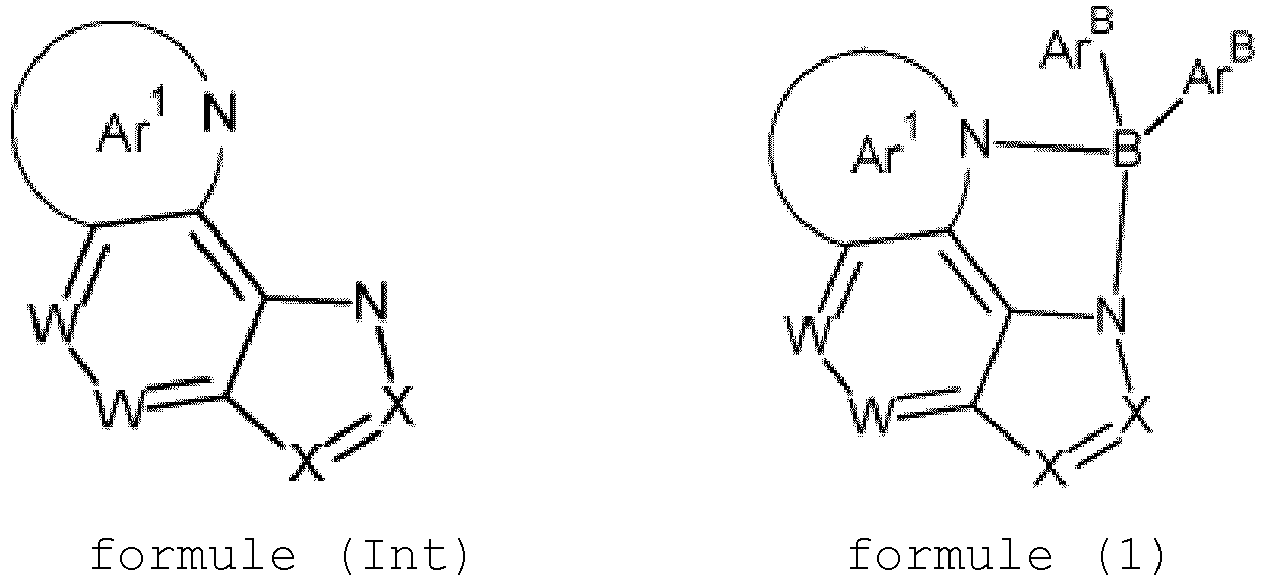
- the present invention therefore furthermore relates to a process for the synthesis of the compounds according to the invention, wherein a compound of formula (Int) reacts with a triarylborane B(Ar B ) 3 so that a compound of formula (1) is obtained as depicted in scheme 1 above, and where the symbols Ar 1 , Ar B , W and X have the same meaning as above.
- formulations of the compounds according to the invention are necessary. These formulations can be, for example, solutions, dispersions or emulsions. It may be preferred to use mixtures of two or more solvents for this purpose.
- Suitable and preferred solvents are, for example, toluene, anisole, o-, m- or p-xylene, methyl benzoate, mesitylene, tetralin, veratrol, THF, methyl-THF, THP, chlorobenzene, dioxane, phenoxytoluene, in particular 3-phenoxytoluene, (-)-fenchone, 1,2,3,5-tetramethylbenzene, 1,2,4,5-tetramethylbenzene, 1-methylnaphthalene, 2-methylbenzothiazole, 2-phenoxyethanol, 2-pyrrolidinone, 3-methylanisole, 4-methylanisole, 3,4-dimethylanisole, 3,5-dimethylanisole, acetophenone, ⁇ -terpineol, benzothiazole, butyl benzoate, cumene, cyclohexanol, cyclohexanone, cyclohexylbenzene, decalin, do
- the present invention therefore furthermore relates to a formulation comprising a compound according to the invention and at least one further compound.
- the further compound may be, for example, a solvent, in particular one of the above-mentioned solvents or a mixture of these solvents.
- the further compound may also be at least one further organic or inorganic compound which is likewise employed in the electronic device, for example an emitting compound, in particular a phosphorescent dopant, and/or a further matrix material. Suitable emitting compounds and further matrix materials are indicated below in connection with the organic electroluminescent device.
- This further compound may also be polymeric.
- An electronic device here is taken to mean a device which comprises at least one layer which comprises at least one organic compound.
- the component here may also comprise inorganic materials or also layers built up entirely from inorganic materials.
- the present invention therefore furthermore relates to the use of the compounds or mixtures according to the invention in an electronic device, in particular in an organic electroluminescent device.
- the present invention again furthermore relates to an electronic device comprising at least one of the compounds or mixtures according to the invention mentioned above.
- the preferences stated above for the compound also apply to the electronic devices.
- the electronic device is preferably selected from the group consisting of organic electroluminescent devices (OLEDs, PLEDs), organic integrated circuits (O-ICs), organic field-effect transistors (O-FETs), organic thin-film transistors (O-TFTs), organic light-emitting transistors (O-LETs), organic solar cells (O-SCs), organic dye-sensitised solar cells, organic optical detectors, organic photoreceptors, organic field-quench devices (O-FQDs), light-emitting electrochemical cells (LECs), organic laser diodes (O-lasers) and "organic plasmon emitting devices” ( D. M. Koller et al., Nature Photonics 2008, 1-4 ), preferably organic electroluminescent devices (OLEDs, PLEDs), in particular phosphorescent OLEDs.
- OLEDs organic electroluminescent devices
- PLEDs organic integrated circuits
- O-FETs organic field-effect transistors
- OF-TFTs organic thin-film
- the organic electroluminescent device comprises a cathode, an anode and at least one emitting layer. Apart from these layers, it may also comprise further layers, for example in each case one or more hole-injection layers, hole-transport layers, hole-blocking layers, electron-transport layers, electron-injection layers, exciton-blocking layers, electron-blocking layers and/or charge-generation layers. It is likewise possible for interlayers, which have, for example, an exciton-blocking function, to be introduced between two emitting layers. However, it should be pointed out that each of these layers does not necessarily have to be present.
- the organic electroluminescent device here may comprise one emitting layer or a plurality of emitting layers.
- a plurality of emission layers are present, these preferably have in total a plurality of emission maxima between 380 nm and 750 nm, resulting overall in white emission, i.e. various emitting compounds which are able to fluoresce or phosphoresce are used in the emitting layers.
- various emitting compounds which are able to fluoresce or phosphoresce are used in the emitting layers.
- Particular preference is given to systems having three emitting layers, where the three layers exhibit blue, green and orange or red emission (for the basic structure see, for example, WO 2005/011013 ).
- These can be fluorescent or phosphorescent emission layers or hybrid systems, in which fluorescent and phosphorescent emission layers are combined with one another.
- the compound according to the invention in accordance with the embodiments indicated above can be employed in various layers, depending on the precise structure.
- Preference is given to an organic electroluminescent device comprising a compound of the formula (1) or in accordance with the preferred embodiments as matrix material for fluorescent emitters, phosphorescent emitters or emitters showing TADF (Thermally Activated Delayed Fluorescence), in particular for phosphorescent emitters, and/or in an electron-transport layer and/or in an electron-blocking or exciton-blocking layer and/or in a hole-transport layer, depending on the precise substitution.
- TADF Thermally Activated Delayed Fluorescence
- the preferred embodiments indicated above also apply to the use of the materials in organic electronic devices.
- the compound of the formula (1) or in accordance with the preferred embodiments is employed as matrix material for a fluorescent or phosphorescent compound, in particular for a phosphorescent compound, in an emitting layer.
- the organic electroluminescent device here may comprise one emitting layer or a plurality of emitting layers, where at least one emitting layer comprises at least one compound according to the invention as matrix material.
- the compound of the formula (1) or in accordance with the preferred embodiments is employed as matrix material for an emitting compound in an emitting layer, it is preferably employed in combination with one or more phosphorescent materials (triplet emitters).
- Phosphorescence in the sense of this invention is taken to mean the luminescence from an excited state having spin multiplicity > 1, in particular from an excited triplet state.
- all luminescent transition-metal complexes and luminescent lanthanide complexes are to be regarded as phosphorescent compounds.
- the compounds of the formula (1) or in accordance with the preferred embodiments are employed as matrix materials for an emitting compound in an emitting layer, they are preferably employed in combination with one or more phosphorescent material (triplet emitters), where the phosphorescent material has an emission wavelength comprised between 550 nm to 680 nm, which corresponds to the red emission field.
- phosphorescent material triplet emitters
- the mixture comprising the compound of the formula (1) or in accordance with the preferred embodiments and the emitting compound comprises between 99 and 1% by vol., preferably between 98 and 10% by vol., particularly preferably between 97 and 60% by vol., in particular between 95 and 80% by vol., of the compound of the formula (1) or in accordance with the preferred embodiments, based on the entire mixture comprising emitter and matrix material.
- the mixture comprises between 1 and 99% by vol., preferably between 2 and 90% by vol., particularly preferably between 3 and 40% by vol., in particular between 5 and 20% by vol., of the emitter, based on the entire mixture comprising emitter and matrix material.
- a further preferred embodiment of the present invention is the use of the compound of the formula (1) or in accordance with the preferred embodiments as matrix material for a phosphorescent emitter in combination with a further matrix material.
- Particularly suitable matrix materials which can be employed in combination with the compounds of the formula (1) or in accordance with the preferred embodiments are aromatic ketones, aromatic phosphine oxides or aromatic sulfoxides or sulfones, for example in accordance with WO 2004/013080 , WO 2004/093207 , WO 2006/005627 or WO 2010/006680 , triarylamines, carbazole derivatives, for example CBP (N,N-biscarbazolylbiphenyl) or the carbazole derivatives disclosed in WO 2005/039246 , US 2005/0069729 , JP 2004/288381 , EP 1205527 or WO 2008/086851 , indolocarbazole derivatives, for example in accordance with WO 2007/063754 or
- Preferred co-host materials are triarylamine derivatives, in particular monoamines, lactams, carbazole derivatives and indenocarbazole derivatives.
- Suitable phosphorescent compounds are, in particular, compounds which emit light, preferably in the visible region, on suitable excitation and in addition contain at least one atom having an atomic number greater than 20, preferably greater than 38 and less than 84, particularly preferably greater than 56 and less than 80, in particular a metal having this atomic number.
- the phosphorescent emitters used are preferably compounds which contain copper, molybdenum, tungsten, rhenium, ruthenium, osmium, rhodium, iridium, palladium, platinum, silver, gold or europium, in particular compounds which contain iridium or platinum.
- all luminescent compounds which contain the above-mentioned metals are regarded as phosphorescent compounds.
- Examples of the emitters described above are revealed by the applications WO 00/70655 , WO 2001/41512 , WO 2002/02714 , WO 2002/15645 , EP 1191613 , EP 1191612 , EP 1191614 , WO 05/033244 , WO 05/019373 , US 2005/0258742 , WO 2009/146770 , WO 2010/015307 , WO 2010/031485 , WO 2010/054731 , WO 2010/054728 , WO 2010/086089 , WO 2010/099852 , WO 2010/102709 , WO 2011/032626 , WO 2011/066898 , WO 2011/157339 , WO 2012/007086 , WO 2014/008982 , WO 2014/023377 , WO 2014/094962 , WO 2014/094961 , WO 2014/094960 or WO 2016/124304 .
- Suitable phosphorescent materials that can be advantageously combined with the compounds of formula (1) are, as mentioned above, compounds which emit a red light on suitable excitation, which means phosphorescent materials having an excited triplet state level (T1) comprised between 550 and 680 nm.
- the organic electroluminescent device according to the invention does not comprise a separate hole-injection layer and/or hole-transport layer and/or hole-blocking layer and/or electron-transport layer, i.e. the emitting layer is directly adjacent to the hole-injection layer or the anode, and/or the emitting layer is directly adjacent to the electron-transport layer or the electron-injection layer or the cathode, as described, for example, in WO 2005/053051 . It is furthermore possible to use a metal complex which is identical or similar to the metal complex in the emitting layer as hole-transport or hole-injection material directly adjacent to the emitting layer, as described, for example, in WO 2009/030981 .
- an organic electroluminescent device characterised in that one or more layers are applied by means of a sublimation process, in which the materials are vapour-deposited in vacuum sublimation units at an initial pressure of less than 10 -5 mbar, preferably less than 10 -6 mbar.
- the initial pressure it is also possible for the initial pressure to be even lower or higher, for example less than 10 -7 mbar.
- an organic electroluminescent device characterised in that one or more layers are applied by means of the OVPD (organic vapour phase deposition) process or with the aid of carrier-gas sublimation, in which the materials are applied at a pressure between 10 -5 mbar and 1 bar.
- OVPD organic vapour phase deposition
- carrier-gas sublimation in which the materials are applied at a pressure between 10 -5 mbar and 1 bar.
- OVJP organic vapour jet printing
- an organic electroluminescent device characterised in that one or more layers are produced from solution, such as, for example, by spin coating, or by means of any desired printing process, such as, for example, ink-jet printing, LITI (light induced thermal imaging, thermal transfer printing), screen printing, flexographic printing, offset printing or nozzle printing. Soluble compounds, which are obtained, for example, by suitable substitution, are necessary for this purpose.
- hybrid processes in which, for example, one or more layers are applied from solution and one or more further layers are applied by vapour deposition.
- the compounds according to the invention generally have very good properties on use in organic electroluminescent devices.
- the lifetime on use of the compounds according to the invention in organic electroluminescent devices is significantly better compared with similar compounds in accordance with the prior art.
- the other properties of the organic electroluminescent device, in particular the efficiency and the voltage, are likewise better or at least comparable.
- the compounds have a high glass transition temperature and high thermal stability.
- Substrate pre-treatment of examples E1-E13 Glass plates with structured ITO (50 nm, indium tin oxide) form the substrates on which the OLEDs are processed. Before evaporation of the OLED materials, the substrates are pre-baked for 15 minutes at 250°C, followed by an O 2 and subsequent Argon plasma treatment.
- structured ITO 50 nm, indium tin oxide
- the OLEDs have in principle the following layer structure: substrate / hole-transport layer (HTL) / optional interlayer (IL) / electron-blocking layer (EBL) / emission layer (EML) / optional hole-blocking layer (HBL) / electron-transport layer (ETL) / optional electron-injection layer (EIL) and finally a cathode.
- the cathode is formed by an aluminium layer with a thickness of 100 nm.
- the exact layer structure is denoted in Table 1.
- the materials used for the OLED fabrication are presented in Table 2.
- the emission layer here always consists of at least one matrix material (host material) and an emitting dopant (emitter), which is admixed with the matrix material or matrix materials in a certain proportion by volume by co-evaporation.
- the electron-transport layer may also consist of a mixture of two materials.
- the OLEDs are characterised by standard methods.
- the electroluminescence (EL) spectra are recorded at a luminous density of 1000 cd/m 2 and the CIE 1931 x and y coordinates are then calculated from the EL spectrum.
- the examples E1-E13 show data of inventive OLEDs.
- Table 1 OLED layer structure Bsp.
Landscapes
- Chemical & Material Sciences (AREA)
- Organic Chemistry (AREA)
- Engineering & Computer Science (AREA)
- Materials Engineering (AREA)
- Physics & Mathematics (AREA)
- Inorganic Chemistry (AREA)
- Optics & Photonics (AREA)
- Spectroscopy & Molecular Physics (AREA)
- Electroluminescent Light Sources (AREA)
- Heterocyclic Carbon Compounds Containing A Hetero Ring Having Oxygen Or Sulfur (AREA)
- Plural Heterocyclic Compounds (AREA)
- Crystallography & Structural Chemistry (AREA)
- Nitrogen Condensed Heterocyclic Rings (AREA)
Claims (16)
- Composé de formule (1),
 Ar1 étant un groupe hétéroaryle comprenant au moins un azote qui est représenté dans la formule (1), possédant 5 à 30 atomes de cycle aromatique, qui peuvent être substitués par un ou plusieurs radicaux R1 ;X représentant, en chaque occurrence, de manière identique ou différente, CR2 ou N ; ou deux groupes X adjacents formant ensemble un cycle condensé sur la structure de formule (1), le cycle condensé étant choisi parmi un groupe aryle et hétéroaryle possédant 5 à 30 atomes de cycle aromatique, qui peuvent être substitués par un ou plusieurs radicaux R2 ;ArB étant, en chaque occurrence, de manière identique ou différente, un système cyclique aromatique ou hétéroaromatique possédant 5 à 60 atomes de cycle aromatique, qui peuvent être substitués par un ou plusieurs radicaux R3 ;W étant en chaque occurrence, de manière identique ou différente, CR1 ou N ; ou deux groupes W adjacents représentant un groupe de formule (W-1) ou (W-2),
 Z étant en chaque occurrence, de manière identique ou différente, CR1 ou N ;E1, E2 étant, en chaque occurrence, de manière identique ou différente, choisis parmi une simple liaison B(R0), C(R0)2, Si(R0)2, C=O, C=NR0, C=C(R0)2, O, S, S=O, SO2, N(R0), P(R0) et P(=O)R0, au moins l'un parmi les groupes E1 et E2, présents dans le même cycle, n'étant pas une simple liaison ;R0 représentant en chaque occurrence, de manière identique ou différente, H, D, F, Cl, Br, I, CN, un groupe alkyle, alcoxy ou thioalkyle à chaîne droite possédant 1 à 40 atomes de C ou un groupe alkyle, alcoxy ou thioalkyle ramifié ou cyclique possédant 3 à 40 atomes de C, chacun desquels pouvant être substitué par un ou plusieurs radicaux R4, en chaque cas un ou plusieurs groupes CH2 non adjacents pouvant être remplacés par R4C=CR4, C≡C, Si(R4)2, Ge(R4)2, Sn(R4)2, C=O, C=S, C=Se, P(=O)(R4), SO, SO2, O, S ou CONR4 et un ou plusieurs atomes de H pouvant être remplacés par D, F, Cl, Br, I, CN ou NO2, un système cyclique aromatique ou hétéroaromatique possédant 5 à 60 atomes de cycle aromatique, qui peut en chaque cas être substitué par un ou plusieurs radicaux R4, ou un groupe aryloxy possédant 5 à 60 atomes de cycle aromatique, qui peut être substitué par un ou plusieurs radicaux R4, deux substituants R0 adjacents pouvant former ensemble un système cyclique aliphatique ou aromatique, qui peut être substitué par un ou plusieurs radicaux R4 ;R1, R2, R3 représentant en chaque occurrence, de manière identique ou différente, H, D, F, Cl, Br, I, CHO, CN, C(=O)Ar3, P(=O) (Ar3)2, S(=O)Ar3, S(=O)2Ar3, N(Ar3)2, NO2, Si(R4)3, B(OR4)2, OSO2R4, un groupe alkyle, alcoxy ou thioalkyle à chaîne droite possédant 1 à 40 atomes de C ou un groupe alkyle, alcoxy ou thioalkyle ramifié ou cyclique possédant 3 à 40 atomes de C, chacun desquels pouvant être substitué par un ou plusieurs radicaux R4, en chaque cas un ou plusieurs groupes CH2 non adjacents pouvant être remplacés par R4C=CR4, C≡C, Si(R4)2, Ge(R4)2, Sn(R4)2, C=O, C=S, C=Se, P(=O)(R4), SO, SO2, O, S ou CONR4 et un ou plusieurs atomes de H pouvant être remplacés par D, F, Cl, Br, I, CN ou NO2, un système cyclique aromatique ou hétéroaromatique possédant 5 à 60 atomes de cycle aromatique, qui peut en chaque cas être substitué par un ou plusieurs radicaux R4, ou un groupe aryloxy possédant 5 à 60 atomes de cycle aromatique, qui peut être substitué par un ou plusieurs radicaux R4 ; deux substituants R1 adjacents, deux substituants R2 adjacents et/ou deux substituants R3 adjacents pouvant former ensemble un système cyclique aliphatique ou aromatique, qui peut être substitué par un ou plusieurs radicaux R4 ;Ar3 étant, en chaque occurrence, de manière identique ou différente, un système cyclique aromatique ou hétéroaromatique à 5 à 60 atomes de cycle aromatique, qui peut en chaque cas être également substitué par un ou plusieurs radicaux R4 ;R4 représentant en chaque occurrence, de manière identique ou différente, H, D, F, Cl, Br, I, CN, un groupe alkyle, alcoxy ou thioalkyle à chaîne droite possédant 1 à 20 atomes de C ou un groupe alkyle, alcoxy ou thioalkyle ramifié ou cyclique possédant 3 à 20 atomes de C, en chaque cas un ou plusieurs groupes CH2 non adjacents pouvant être remplacés par SO, SO2, O, S et un ou plusieurs atomes de H pouvant être remplacés par D, F, Cl, Br ou I, ou un système cyclique aromatique ou hétéroaromatique possédant 5 à 24 atomes de C.
 - Composé selon la revendication 1, caractérisé en ce que le groupe Ar1 est choisi parmi les groupes de formule (Ar1-1) et (Ar1-2),

- Composé selon la revendication 1, caractérisé en ce que X représente, en chaque occurrence, de manière identique ou différente, CR2 ou N ; ou deux groupes X adjacents formant ensemble un cycle condensé sur la structure de formule (1), le cycle condensé étant choisi parmi les formules (X-1) et (X-2),
 les liaisons en pointillés indiquant la liaison des groupes adjacents correspondants X à la structure de formule (1) ;V étant en chaque occurrence, de manière identique ou différente CR2 ou N ; ou deux groupes V adjacents formant ensemble un cycle condensé sur la structure de formule (X-1) ou de formula (X-2), le cycle condensé étant choisi parmi les formules (V-1) et (V-2),
 les liaisons en pointillés indiquant la liaison des groupes adjacents correspondants U aux structures des formules (X-1) et (X-2) ;U étant en chaque occurrence, de manière identique ou différente, CR2 ou N ;E1, E2 et R2 possédant la même signification que dans la revendication 1.
 - Composé selon l'une ou plusieurs des revendications précédentes,
caractérisé en ce qu'il est choisi parmi les composés de formule (2),
- Composé selon l'une ou plusieurs des revendications précédentes,
caractérisé en ce qu'il est choisi parmi les composés des formules (3) à (6),

- Composé selon l'une ou plusieurs des revendications précédentes,
caractérisé en ce que le composé est choisi parmi les composés des formules (3-1) à (6-2),
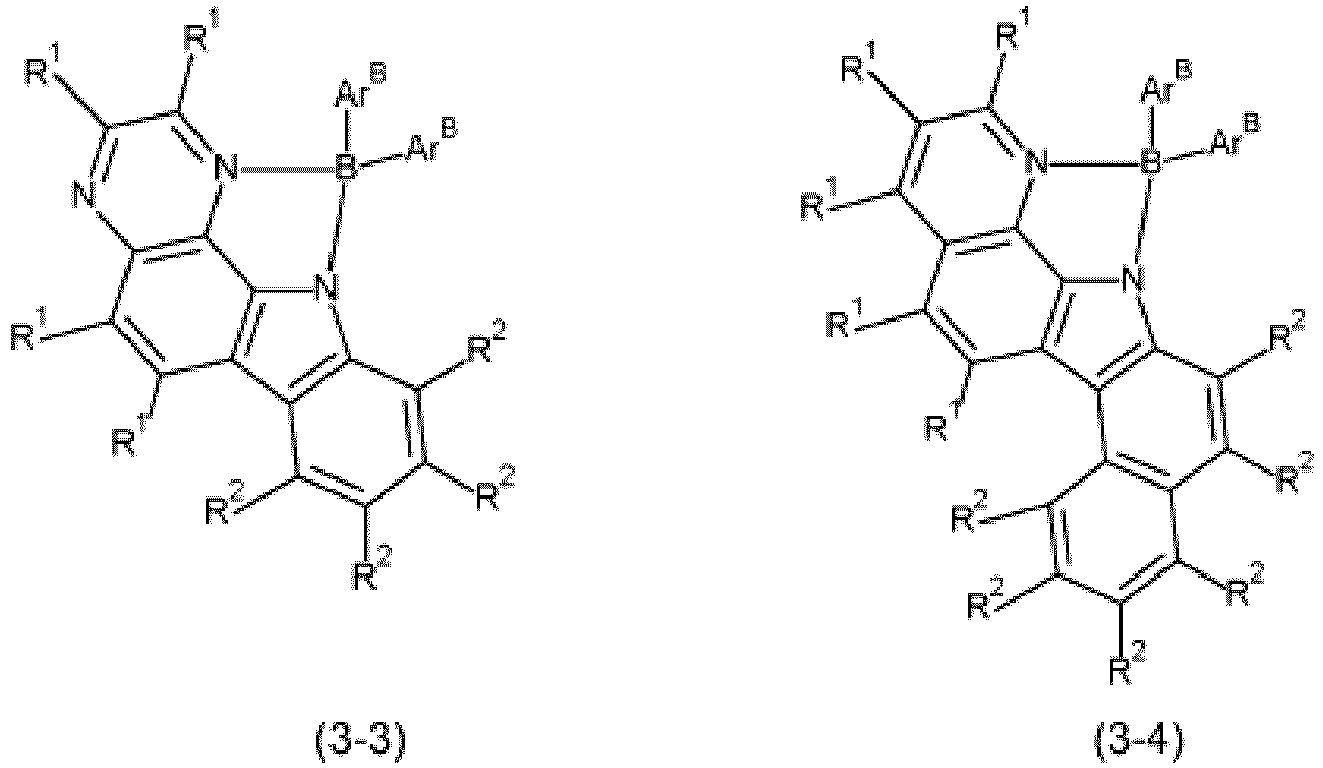
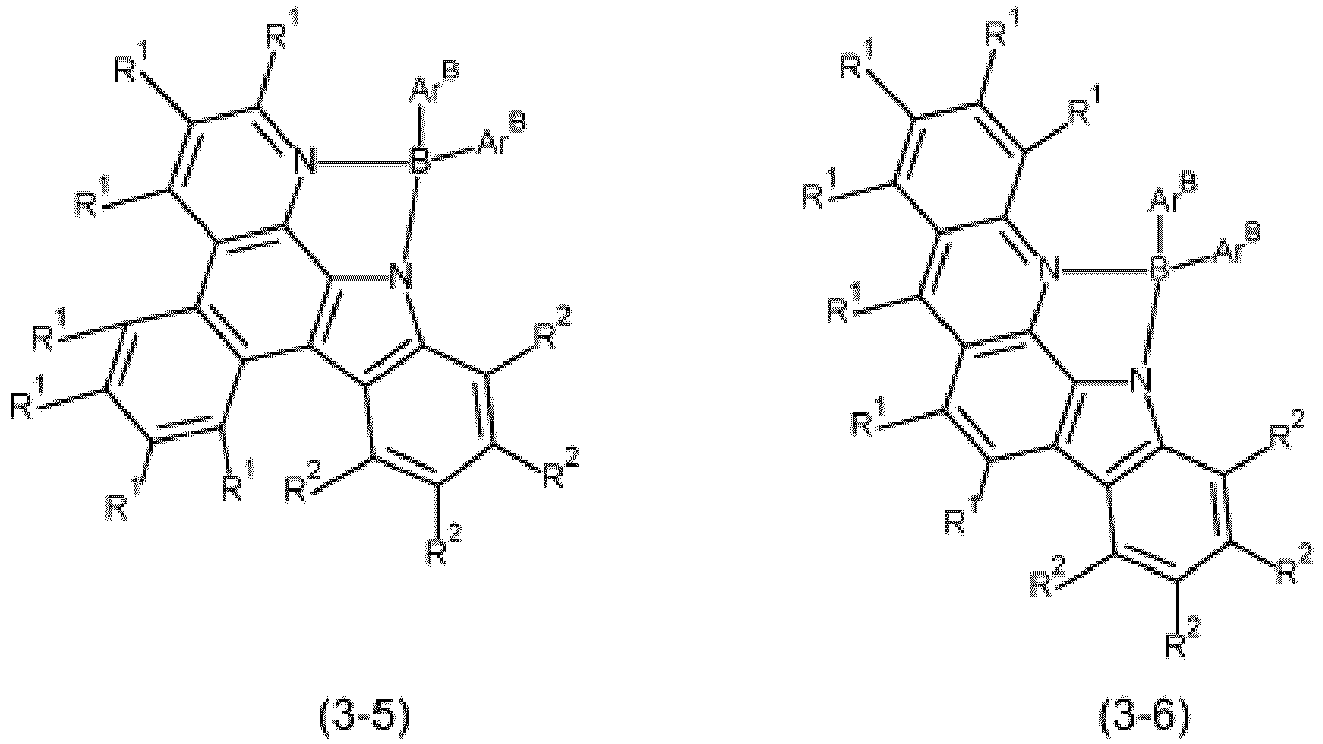
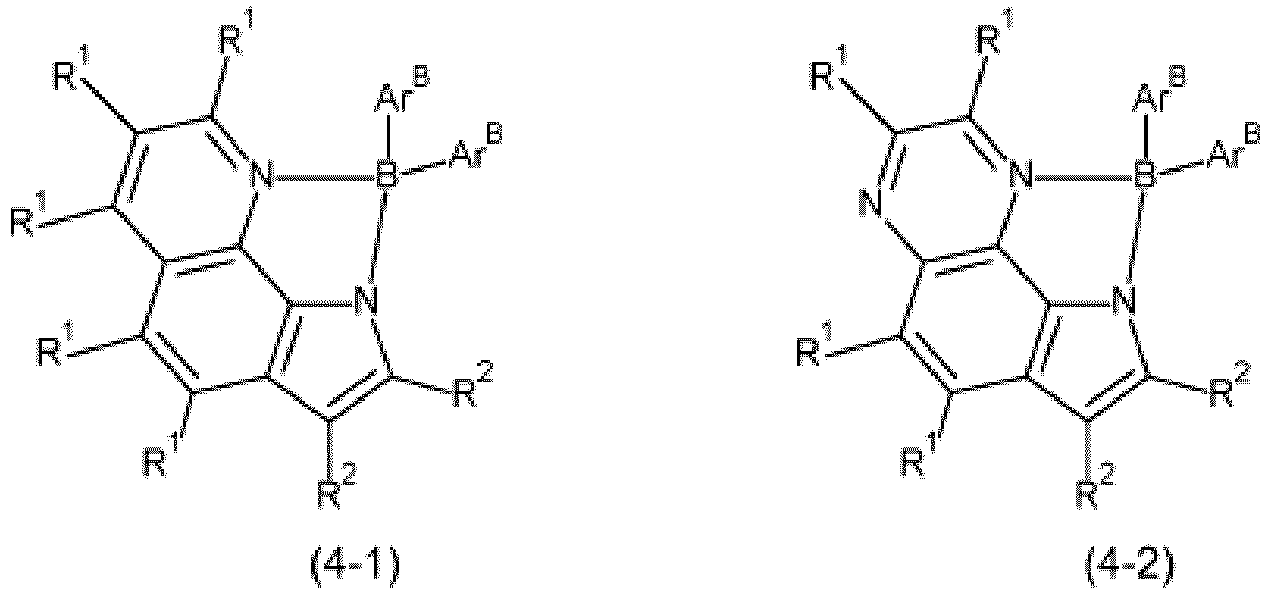
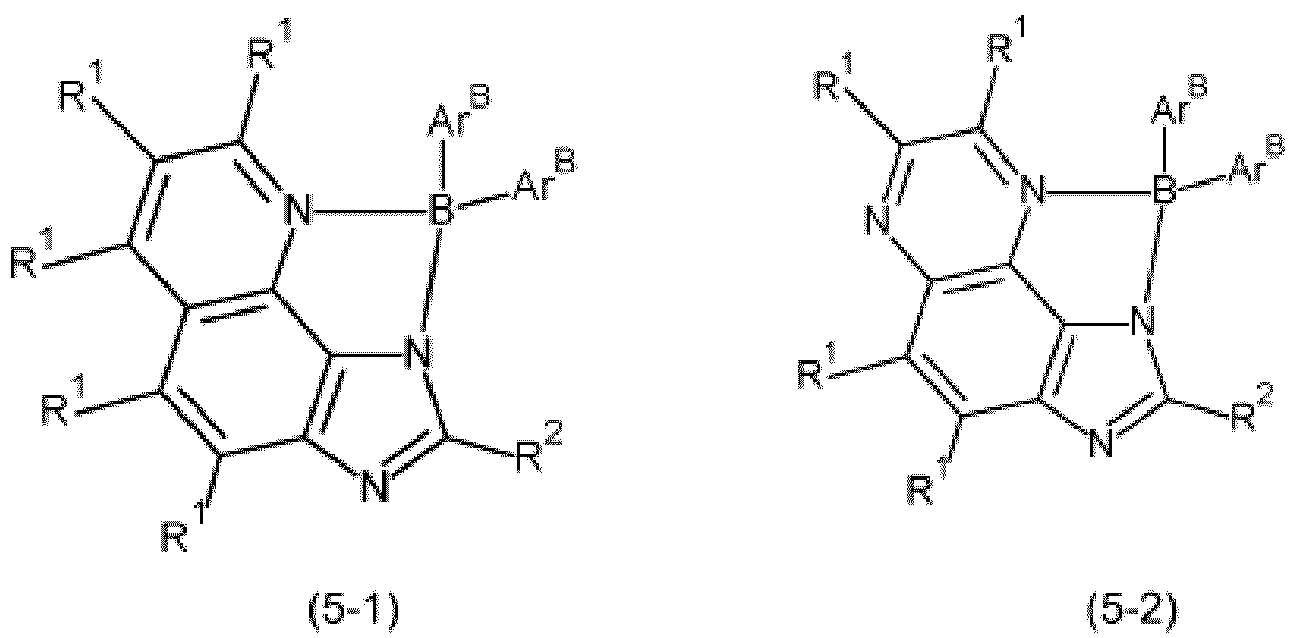

- Composé selon l'une ou plusieurs des revendications précédentes, caractérisé en ce que le groupe ArB est choisi parmi des systèmes cycliques aromatiques et hétéroaromatiques possédant 5 à 18 atomes de C, chacun desquels pouvant être substitué par un ou plusieurs radicaux R3.
- Composés selon l'une ou plusieurs des revendications précédentes, caractérisés en ce que le composé comprend au moins un groupe R1 ou R2 choisi parmi des systèmes cycliques aromatiques et hétéroaromatiques possédant 5 à 60 atomes de cycle aromatique, qui peuvent en chaque cas être substitués par un ou plusieurs radicaux R4.
- Composé selon l'une ou plusieurs des revendications précédentes, caractérisé en ce que le composé comprend au moins un groupe R1 ou R2 choisi parmi les groupes des formules (R-1) à (R-15),


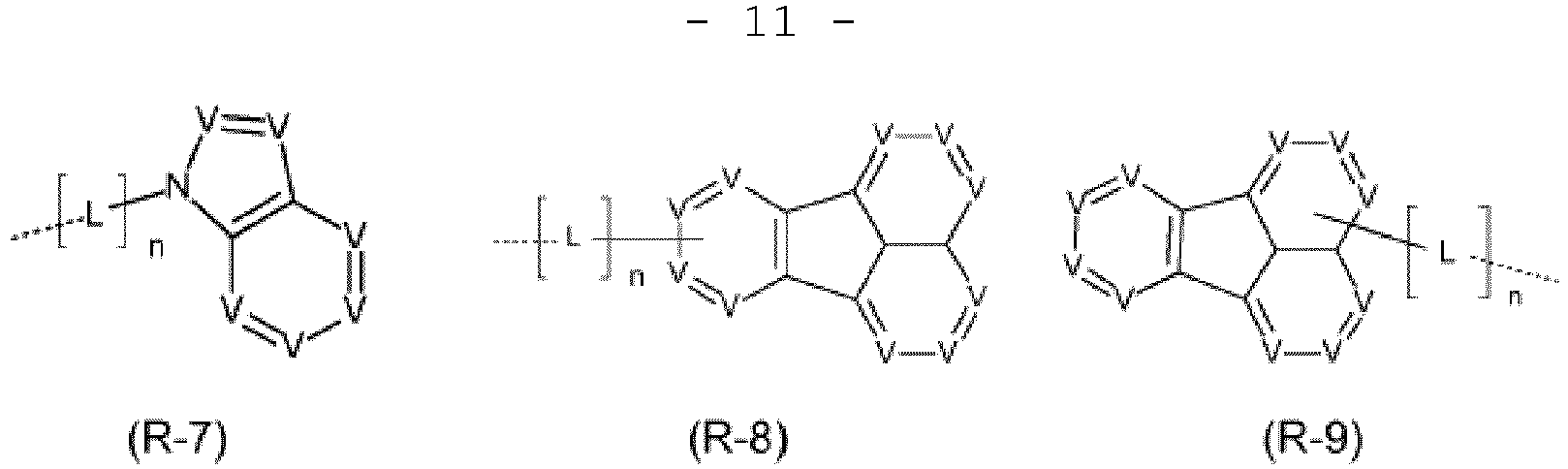

 la liaison en pointillés indiquant la liaison à la structure de formule (1) et le symbole V possédant la même signification que dans la revendication 3, étant entendu que V est un atome de C lorsque la liaison en pointillés est liée à V, etRN, RC étant en chaque occurrence, de manière identique ou différente, H, D, F, Cl, Br, I, CHO, N(Ar3)2, C(=O)Ar3, P(=O) (Ar3)2, S(=O)Ar3, S(=O)2Ar3, (R)C=C(R)Ar3, CN, NO2, Si(R4)3, B(OR4)2, B(R4)2, B(N(R4)2)2, OSO2R4, un groupe alkyle, alcoxy ou thioalcoxy à chaîne droite possédant 1 à 40 atomes de C ou un groupe alcényle ou alcynyle à chaîne droite possédant 2 à 40 atomes de C ou un groupe alkyle, alcényle, alcynyle, alcoxy ou thioalcoxy ramifié ou cyclique possédant 3 à 40 atomes de C, chacun desquels pouvant être substitué par un ou plusieurs radicaux R4, un ou plusieurs groupes CH2, préférablement non adjacents pouvant être remplacés par (R4)C=C(R4), C≡C, Si(R4)2, Ge(R4)2, Sn(R4)2, C=O, C=S, C=Se, P(=O)(R4), SO, SO2, N(R4), O, S ou CON(R4) et un ou plusieurs atomes de H pouvant être remplacés par D, F, Cl, Br, I, CN ou NO2, ou un système cyclique aromatique ou hétéroaromatique possédant 5 à 60 atomes de cycle aromatique, qui peut en chaque cas être substitué par un ou plusieurs radicaux R4, ou un groupe aryloxy ou hétéroaryloxy possédant 5 à 60 atomes de cycle aromatique, qui peut être substitué par un ou plusieurs radicaux R4, éventuellement deux substituants adjacents RC pouvant former l'un avec l'autre un système cyclique monocyclique ou polycyclique, aliphatique, aromatique ou hétéroaromatique ; Ar3 et R4 possédant les mêmes définitions que dans la revendication 1 ; etT représentant, en chaque occurrence, de manière identique ou différente, CR4 ou N, étant entendu que si T est un atome de C alors la liaison en pointillés est liée à T ; ou deux groupes adjacents T représentant un groupe de formule (T-1) ou (T-2),
 les liaisons en pointillés dans les formules (T-1) et (T-2) indiquant la liaison aux groupes des formules (R-1) à (R-5) ; etE1, E2 possédant la même signification que dans la revendication 1 ;G étant en chaque occurrence, de manière identique ou différente, CR4 ou N ; R4 possédant la même signification que dans la revendication 1 ;L étant un système cyclique aromatique ou hétéroaromatique possédant 5 à 30 atomes de cycle aromatique, qui peut être substitué par un ou plusieurs radicaux R4 ; etn étant 0 ou 1.
 - Formulation comprenant au moins un composé selon l'une ou plusieurs des revendications 1 à 9 et au moins un solvant.
- Procédé pour la préparation d'un composé de formule (1), caractérisé en ce qu'un composé de formule (Int) réagit avec un triarylborane B(ArB)3 de sorte qu'un composé de formule (1) est obtenu :
- Dispositif électronique comprenant au moins un composé selon l'une ou plusieurs des revendications 1 à 9.
- Dispositif électronique selon la revendication 12, caractérisé en ce qu'il est choisi dans le groupe constitué par des dispositifs organiques électroluminescents, des circuits intégrés organiques, des transistors organiques à effet de champ, des transistors organiques en film mince, des transistors organiques luminescents, des cellules solaires organiques, des cellules solaires organiques sensibilisées par un colorant, des détecteurs optiques organiques, des photorécepteurs organiques, des dispositifs organiques d'extinction de champ, des cellules électrochimiques luminescentes, des diodes laser organiques et des dispositifs organiques d'émission de plasmon.
- Dispositif électronique selon la revendication 12 ou 13, qui est un dispositif organique électroluminescent, caractérisé en ce que le composé selon l'une ou plusieurs des revendications 1 à 9 est employé en tant que matériau de matrice pour des émetteurs, pour un matériau de transport de trous ou pour un matériau de transport d'électrons.
- Dispositif électronique selon la revendication 13, caractérisé en ce qu'il est choisi parmi des dispositifs organiques électroluminescents comprenant une cathode, une anode et au moins une couche émettrice agencée entre l'anode et la cathode, l'au moins une couche émettrice comprenant au moins un matériau phosphorescent en tant qu'émetteur et au moins un composé selon l'une ou plusieurs des revendications 1 à 9 en tant que matériau de matrice.
- Dispositif électronique selon la revendication 15, caractérisé en ce que le matériau phosphorescent possède une longueur d'onde d'émission comprise entre 550 nm et 680 nm.
Applications Claiming Priority (2)
| Application Number | Priority Date | Filing Date | Title |
|---|---|---|---|
| EP17170654 | 2017-05-11 | ||
| PCT/EP2018/061767 WO2018206526A1 (fr) | 2017-05-11 | 2018-05-08 | Complexes organoborés pour dispositifs électroluminescents organiques |
Publications (2)
| Publication Number | Publication Date |
|---|---|
| EP3621970A1 EP3621970A1 (fr) | 2020-03-18 |
| EP3621970B1 true EP3621970B1 (fr) | 2021-01-13 |
Family
ID=58709815
Family Applications (1)
| Application Number | Title | Priority Date | Filing Date |
|---|---|---|---|
| EP18721058.8A Active EP3621970B1 (fr) | 2017-05-11 | 2018-05-08 | Complexes organoborés pour dispositifs électroluminescents organiques |
Country Status (4)
| Country | Link |
|---|---|
| US (1) | US11056656B2 (fr) |
| EP (1) | EP3621970B1 (fr) |
| KR (1) | KR102592391B1 (fr) |
| WO (1) | WO2018206526A1 (fr) |
Families Citing this family (3)
| Publication number | Priority date | Publication date | Assignee | Title |
|---|---|---|---|---|
| CN110092800B (zh) * | 2019-05-27 | 2020-12-08 | 武汉华星光电半导体显示技术有限公司 | 热活化延迟荧光分子材料及其合成方法、电致发光器件 |
| US11778895B2 (en) * | 2020-01-13 | 2023-10-03 | Universal Display Corporation | Organic electroluminescent materials and devices |
| CN117203191A (zh) * | 2021-04-29 | 2023-12-08 | 默克专利有限公司 | 用于有机电致发光器件的材料 |
Family Cites Families (85)
| Publication number | Priority date | Publication date | Assignee | Title |
|---|---|---|---|---|
| US4539507A (en) | 1983-03-25 | 1985-09-03 | Eastman Kodak Company | Organic electroluminescent devices having improved power conversion efficiencies |
| JPH07133483A (ja) | 1993-11-09 | 1995-05-23 | Shinko Electric Ind Co Ltd | El素子用有機発光材料及びel素子 |
| US5852191A (en) * | 1995-06-07 | 1998-12-22 | Carnegie Mellon University | Rigidized monomethine cyanines |
| US5925472A (en) * | 1997-03-31 | 1999-07-20 | Xerox Corporation | Electroluminescent devices |
| US6368731B2 (en) * | 1998-07-04 | 2002-04-09 | Bayer Aktiengesellschaft | Electroluminescent assemblies using boron chelates of 8-aminoquinoline derivatives |
| KR100913568B1 (ko) | 1999-05-13 | 2009-08-26 | 더 트러스티즈 오브 프린스턴 유니버시티 | 전계인광에 기초한 고 효율의 유기 발광장치 |
| WO2001041512A1 (fr) | 1999-12-01 | 2001-06-07 | The Trustees Of Princeton University | Complexes de forme l2mx en tant que dopants phosphorescents pour del organiques |
| TW532048B (en) | 2000-03-27 | 2003-05-11 | Idemitsu Kosan Co | Organic electroluminescence element |
| US20020121638A1 (en) | 2000-06-30 | 2002-09-05 | Vladimir Grushin | Electroluminescent iridium compounds with fluorinated phenylpyridines, phenylpyrimidines, and phenylquinolines and devices made with such compounds |
| CN101924190B (zh) | 2000-08-11 | 2012-07-04 | 普林斯顿大学理事会 | 有机金属化合物和发射转换有机电致磷光 |
| JP4154140B2 (ja) | 2000-09-26 | 2008-09-24 | キヤノン株式会社 | 金属配位化合物 |
| JP4154138B2 (ja) | 2000-09-26 | 2008-09-24 | キヤノン株式会社 | 発光素子、表示装置及び金属配位化合物 |
| JP4154139B2 (ja) | 2000-09-26 | 2008-09-24 | キヤノン株式会社 | 発光素子 |
| JP2002139833A (ja) * | 2000-11-02 | 2002-05-17 | Fuji Photo Film Co Ltd | 光重合性組成物および感光感熱記録材料 |
| ITRM20020411A1 (it) | 2002-08-01 | 2004-02-02 | Univ Roma La Sapienza | Derivati dello spirobifluorene, loro preparazione e loro uso. |
| GB0306097D0 (en) * | 2003-03-15 | 2003-04-23 | Elam T Ltd | Electroluminescent complexes |
| JP4411851B2 (ja) | 2003-03-19 | 2010-02-10 | コニカミノルタホールディングス株式会社 | 有機エレクトロルミネッセンス素子 |
| US7345301B2 (en) | 2003-04-15 | 2008-03-18 | Merck Patent Gmbh | Mixtures of matrix materials and organic semiconductors capable of emission, use of the same and electronic components containing said mixtures |
| JP4635870B2 (ja) | 2003-04-23 | 2011-02-23 | コニカミノルタホールディングス株式会社 | 有機エレクトロルミネッセンス素子、照明装置及び表示装置 |
| DE10333232A1 (de) | 2003-07-21 | 2007-10-11 | Merck Patent Gmbh | Organisches Elektrolumineszenzelement |
| DE10338550A1 (de) | 2003-08-19 | 2005-03-31 | Basf Ag | Übergangsmetallkomplexe mit Carbenliganden als Emitter für organische Licht-emittierende Dioden (OLEDs) |
| DE10345572A1 (de) | 2003-09-29 | 2005-05-19 | Covion Organic Semiconductors Gmbh | Metallkomplexe |
| US7795801B2 (en) | 2003-09-30 | 2010-09-14 | Konica Minolta Holdings, Inc. | Organic electroluminescent element, illuminator, display and compound |
| WO2005053051A1 (fr) | 2003-11-25 | 2005-06-09 | Merck Patent Gmbh | Element organique electroluminescent |
| US7070868B2 (en) * | 2004-01-30 | 2006-07-04 | Eastman Kodak Company | Organic element for electroluminescent devices |
| US7074503B2 (en) * | 2004-01-30 | 2006-07-11 | Eastman Kodak Company | Organic element for electroluminescent devices |
| US6885026B1 (en) * | 2004-01-30 | 2005-04-26 | Eastman Kodak Company | Organic element for electroluminescent devices |
| US7329466B2 (en) * | 2004-01-30 | 2008-02-12 | Eastman Kodak Company | Organic element for electroluminescent devices |
| US7790890B2 (en) | 2004-03-31 | 2010-09-07 | Konica Minolta Holdings, Inc. | Organic electroluminescence element material, organic electroluminescence element, display device and illumination device |
| US7300709B2 (en) * | 2004-03-31 | 2007-11-27 | Eastman Kodak Company | Organic element for electroluminescent devices |
| DE102004023277A1 (de) | 2004-05-11 | 2005-12-01 | Covion Organic Semiconductors Gmbh | Neue Materialmischungen für die Elektrolumineszenz |
| US7598388B2 (en) | 2004-05-18 | 2009-10-06 | The University Of Southern California | Carbene containing metal complexes as OLEDs |
| JP4862248B2 (ja) | 2004-06-04 | 2012-01-25 | コニカミノルタホールディングス株式会社 | 有機エレクトロルミネッセンス素子、照明装置及び表示装置 |
| US7147938B2 (en) * | 2004-06-30 | 2006-12-12 | Eastman Kodak Company | Organic element for electroluminescent devices |
| ITRM20040352A1 (it) | 2004-07-15 | 2004-10-15 | Univ Roma La Sapienza | Derivati oligomerici dello spirobifluorene, loro preparazione e loro uso. |
| WO2006117052A1 (fr) | 2005-05-03 | 2006-11-09 | Merck Patent Gmbh | Dispositif electroluminescent organique, et derives d'acide boronique et d'acide borinique utilises pour produire ce dispositif electroluminescent organique |
| EP1956022B1 (fr) | 2005-12-01 | 2012-07-25 | Nippon Steel Chemical Co., Ltd. | Compose pour element electroluminescent organique et element electroluminescent organique |
| DE102006025777A1 (de) | 2006-05-31 | 2007-12-06 | Merck Patent Gmbh | Neue Materialien für organische Elektrolumineszenzvorrichtungen |
| EP2080762B1 (fr) | 2006-11-09 | 2016-09-14 | Nippon Steel & Sumikin Chemical Co., Ltd. | Composé pour un dispositif électroluminescent organique et dispositif électroluminescent organique |
| JP2010515255A (ja) | 2006-12-28 | 2010-05-06 | ユニバーサル ディスプレイ コーポレイション | 長寿命リン光発光有機発光デバイス(oled)構造 |
| DE102007002714A1 (de) | 2007-01-18 | 2008-07-31 | Merck Patent Gmbh | Neue Materialien für organische Elektrolumineszenzvorrichtungen |
| DE102007053771A1 (de) | 2007-11-12 | 2009-05-14 | Merck Patent Gmbh | Organische Elektrolumineszenzvorrichtungen |
| US7862908B2 (en) | 2007-11-26 | 2011-01-04 | National Tsing Hua University | Conjugated compounds containing hydroindoloacridine structural elements, and their use |
| DE102008027005A1 (de) | 2008-06-05 | 2009-12-10 | Merck Patent Gmbh | Organische elektronische Vorrichtung enthaltend Metallkomplexe |
| DE102008033943A1 (de) | 2008-07-18 | 2010-01-21 | Merck Patent Gmbh | Neue Materialien für organische Elektrolumineszenzvorrichtungen |
| DE102008036247A1 (de) | 2008-08-04 | 2010-02-11 | Merck Patent Gmbh | Elektronische Vorrichtungen enthaltend Metallkomplexe |
| DE102008036982A1 (de) | 2008-08-08 | 2010-02-11 | Merck Patent Gmbh | Organische Elektrolumineszenzvorrichtung |
| DE102008048336A1 (de) | 2008-09-22 | 2010-03-25 | Merck Patent Gmbh | Einkernige neutrale Kupfer(I)-Komplexe und deren Verwendung zur Herstellung von optoelektronischen Bauelementen |
| KR101506919B1 (ko) | 2008-10-31 | 2015-03-30 | 롬엔드하스전자재료코리아유한회사 | 신규한 유기 전자재료용 화합물 및 이를 포함하는 유기 전자 소자 |
| DE102008056688A1 (de) | 2008-11-11 | 2010-05-12 | Merck Patent Gmbh | Materialien für organische Elektrolumineszenzvorrichtungen |
| JP5701766B2 (ja) | 2008-11-11 | 2015-04-15 | メルク パテント ゲーエムベーハー | 有機エレクトロルミネセント素子 |
| DE102008057050B4 (de) | 2008-11-13 | 2021-06-02 | Merck Patent Gmbh | Materialien für organische Elektrolumineszenzvorrichtungen |
| DE102008057051B4 (de) | 2008-11-13 | 2021-06-17 | Merck Patent Gmbh | Materialien für organische Elektrolumineszenzvorrichtungen |
| DE102009007038A1 (de) | 2009-02-02 | 2010-08-05 | Merck Patent Gmbh | Metallkomplexe |
| EP2402351B1 (fr) * | 2009-02-27 | 2013-10-09 | Idemitsu Kosan Co., Ltd. | Composés du complexe pyrrométhène-bore et éléments organiques électroluminescents les utilisant |
| DE102009011223A1 (de) | 2009-03-02 | 2010-09-23 | Merck Patent Gmbh | Metallkomplexe |
| DE102009013041A1 (de) | 2009-03-13 | 2010-09-16 | Merck Patent Gmbh | Materialien für organische Elektrolumineszenzvorrichtungen |
| US8206842B2 (en) * | 2009-04-06 | 2012-06-26 | Global Oled Technology Llc | Organic element for electroluminescent devices |
| DE102009023155A1 (de) | 2009-05-29 | 2010-12-02 | Merck Patent Gmbh | Materialien für organische Elektrolumineszenzvorrichtungen |
| DE102009031021A1 (de) | 2009-06-30 | 2011-01-05 | Merck Patent Gmbh | Materialien für organische Elektrolumineszenzvorrichtungen |
| DE102009041414A1 (de) | 2009-09-16 | 2011-03-17 | Merck Patent Gmbh | Metallkomplexe |
| DE102009048791A1 (de) | 2009-10-08 | 2011-04-14 | Merck Patent Gmbh | Materialien für organische Elektrolumineszenzvorrichtungen |
| DE102009057167A1 (de) | 2009-12-05 | 2011-06-09 | Merck Patent Gmbh | Elektronische Vorrichtung enthaltend Metallkomplexe |
| DE102010005697A1 (de) | 2010-01-25 | 2011-07-28 | Merck Patent GmbH, 64293 | Verbindungen für elektronische Vorrichtungen |
| DE102010012738A1 (de) | 2010-03-25 | 2011-09-29 | Merck Patent Gmbh | Materialien für organische Elektrolumineszenzvorrichtungen |
| DE102010019306B4 (de) | 2010-05-04 | 2021-05-20 | Merck Patent Gmbh | Organische Elektrolumineszenzvorrichtungen |
| DE112011102008B4 (de) | 2010-06-15 | 2022-04-21 | Merck Patent Gmbh | Metallkomplexe |
| DE102010027317A1 (de) | 2010-07-16 | 2012-01-19 | Merck Patent Gmbh | Metallkomplexe |
| DE102010048608A1 (de) | 2010-10-15 | 2012-04-19 | Merck Patent Gmbh | Materialien für organische Elektrolumineszenzvorrichtungen |
| US9166176B2 (en) | 2011-03-10 | 2015-10-20 | Kyoto University | Polycyclic aromatic compound |
| CA2735531A1 (fr) * | 2011-03-31 | 2012-09-30 | Queen's University At Kingston | Composes de bore a quatre coordonnees destines a une utilisation comme teintures photochromiques |
| CA2844573A1 (fr) | 2011-08-12 | 2013-02-21 | Uti Limited Partnership | Colorants fluorescents presentant d'importants deplacements de stokes |
| PT105885B (pt) * | 2011-09-13 | 2013-11-07 | Inst Superior Tecnico | Complexos iminopirrolil boro mono- e polinucleares, seu método de preparação e uso como materiais luminescentes |
| US8946714B2 (en) * | 2012-03-28 | 2015-02-03 | Sony Corporation | Semiconductor device and electronic apparatus including multilayer insulation film |
| WO2014008982A1 (fr) | 2012-07-13 | 2014-01-16 | Merck Patent Gmbh | Complexes metalliques |
| US11917901B2 (en) | 2012-08-07 | 2024-02-27 | Udc Ireland Limited | Metal complexes |
| KR102188214B1 (ko) | 2012-12-21 | 2020-12-08 | 메르크 파텐트 게엠베하 | 금속 착물 |
| KR102146232B1 (ko) | 2012-12-21 | 2020-08-20 | 메르크 파텐트 게엠베하 | 금속 착물 |
| KR102188212B1 (ko) | 2012-12-21 | 2020-12-08 | 메르크 파텐트 게엠베하 | 금속 착물 |
| JP6335530B2 (ja) * | 2014-01-29 | 2018-05-30 | キヤノン株式会社 | 有機発光素子 |
| JP6398226B2 (ja) * | 2014-02-28 | 2018-10-03 | セイコーエプソン株式会社 | 発光素子、発光装置、認証装置および電子機器 |
| WO2016124304A1 (fr) | 2015-02-03 | 2016-08-11 | Merck Patent Gmbh | Complexes métalliques |
| KR102070833B1 (ko) * | 2015-05-26 | 2020-04-01 | 도레이 카부시키가이샤 | 피로메텐 붕소 착체, 색 변환 조성물, 색 변환 필름, 및 그것을 포함하는 광원 유닛, 디스플레이 및 조명 |
| WO2016207910A1 (fr) * | 2015-06-22 | 2016-12-29 | Council Of Scientific & Industrial Research | Organobores à quatre coordonnées de type chélate n,c offrant une accordabilité complète des couleurs |
| KR102200716B1 (ko) * | 2016-11-30 | 2021-01-12 | 도레이 카부시키가이샤 | 피로메텐 붕소 착체, 색 변환 조성물, 색 변환 필름, 광원 유닛, 디스플레이 및 조명 장치 |
-
2018
- 2018-05-08 WO PCT/EP2018/061767 patent/WO2018206526A1/fr not_active Ceased
- 2018-05-08 KR KR1020197036263A patent/KR102592391B1/ko active Active
- 2018-05-08 US US16/612,184 patent/US11056656B2/en active Active
- 2018-05-08 EP EP18721058.8A patent/EP3621970B1/fr active Active
Non-Patent Citations (1)
| Title |
|---|
| None * |
Also Published As
| Publication number | Publication date |
|---|---|
| US11056656B2 (en) | 2021-07-06 |
| KR102592391B1 (ko) | 2023-10-20 |
| WO2018206526A1 (fr) | 2018-11-15 |
| EP3621970A1 (fr) | 2020-03-18 |
| KR20200005627A (ko) | 2020-01-15 |
| US20200388761A1 (en) | 2020-12-10 |
Similar Documents
| Publication | Publication Date | Title |
|---|---|---|
| EP4055642B1 (fr) | Matériaux pour dispositifs électroluminescents organiques | |
| KR102750558B1 (ko) | 유기 전계발광 소자용 재료 | |
| EP3326218B1 (fr) | Matières pour dispositifs électroluminescents organiques | |
| EP3844244B1 (fr) | Matériaux pour dispositifs électroluminescents organiques | |
| EP3844242B1 (fr) | Matériaux pour dispositifs électroluminescents organiques | |
| WO2017186760A1 (fr) | Matériaux pour dispositifs électroluminescents organiques | |
| WO2019076789A1 (fr) | Matériaux pour dispositifs électroluminescents organiques | |
| EP3844243B1 (fr) | Matériaux pour dispositifs électroluminescents organiques | |
| EP3464244B1 (fr) | Matériaux pour dispositifs électroluminescents organiques | |
| WO2019101835A1 (fr) | Matériaux pour dispositifs électroluminescents organiques | |
| EP3368520B1 (fr) | Matériaux pour dispositifs électroluminescents organiques | |
| EP4126884B1 (fr) | Matériaux pour dispositifs électroluminescents organiques | |
| US11056656B2 (en) | Organoboron complexes and their use in organic electroluminescent devices | |
| EP3823958B1 (fr) | Matériaux pour dispositifs électroluminescents organiques | |
| EP3621971B1 (fr) | Bodipys à base de carbazole pour dispositifs électroluminescents organiques | |
| EP3692043B1 (fr) | Matériaux pour dispositifs électroluminescents organiques | |
| EP3762373B1 (fr) | Matériaux pour dispositifs électroluminescents organiques | |
| EP3713944A1 (fr) | Matériaux pour dispositifs électroluminescents organiques | |
| WO2024033282A1 (fr) | Matériaux pour dispositifs électroluminescents organiques |
Legal Events
| Date | Code | Title | Description |
|---|---|---|---|
| STAA | Information on the status of an ep patent application or granted ep patent |
Free format text: STATUS: UNKNOWN |
|
| STAA | Information on the status of an ep patent application or granted ep patent |
Free format text: STATUS: THE INTERNATIONAL PUBLICATION HAS BEEN MADE |
|
| PUAI | Public reference made under article 153(3) epc to a published international application that has entered the european phase |
Free format text: ORIGINAL CODE: 0009012 |
|
| STAA | Information on the status of an ep patent application or granted ep patent |
Free format text: STATUS: REQUEST FOR EXAMINATION WAS MADE |
|
| 17P | Request for examination filed |
Effective date: 20191106 |
|
| AK | Designated contracting states |
Kind code of ref document: A1 Designated state(s): AL AT BE BG CH CY CZ DE DK EE ES FI FR GB GR HR HU IE IS IT LI LT LU LV MC MK MT NL NO PL PT RO RS SE SI SK SM TR |
|
| AX | Request for extension of the european patent |
Extension state: BA ME |
|
| DAV | Request for validation of the european patent (deleted) | ||
| DAX | Request for extension of the european patent (deleted) | ||
| RIC1 | Information provided on ipc code assigned before grant |
Ipc: H01L 51/50 20060101ALI20200807BHEP Ipc: C09K 11/02 20060101ALI20200807BHEP Ipc: C09K 11/06 20060101ALI20200807BHEP Ipc: C07F 5/02 20060101AFI20200807BHEP Ipc: H01L 51/00 20060101ALI20200807BHEP |
|
| GRAP | Despatch of communication of intention to grant a patent |
Free format text: ORIGINAL CODE: EPIDOSNIGR1 |
|
| STAA | Information on the status of an ep patent application or granted ep patent |
Free format text: STATUS: GRANT OF PATENT IS INTENDED |
|
| INTG | Intention to grant announced |
Effective date: 20200924 |
|
| GRAS | Grant fee paid |
Free format text: ORIGINAL CODE: EPIDOSNIGR3 |
|
| GRAA | (expected) grant |
Free format text: ORIGINAL CODE: 0009210 |
|
| STAA | Information on the status of an ep patent application or granted ep patent |
Free format text: STATUS: THE PATENT HAS BEEN GRANTED |
|
| AK | Designated contracting states |
Kind code of ref document: B1 Designated state(s): AL AT BE BG CH CY CZ DE DK EE ES FI FR GB GR HR HU IE IS IT LI LT LU LV MC MK MT NL NO PL PT RO RS SE SI SK SM TR |
|
| REG | Reference to a national code |
Ref country code: GB Ref legal event code: FG4D |
|
| REG | Reference to a national code |
Ref country code: CH Ref legal event code: EP |
|
| REG | Reference to a national code |
Ref country code: IE Ref legal event code: FG4D |
|
| REG | Reference to a national code |
Ref country code: DE Ref legal event code: R096 Ref document number: 602018011860 Country of ref document: DE |
|
| REG | Reference to a national code |
Ref country code: AT Ref legal event code: REF Ref document number: 1354485 Country of ref document: AT Kind code of ref document: T Effective date: 20210215 |
|
| REG | Reference to a national code |
Ref country code: AT Ref legal event code: MK05 Ref document number: 1354485 Country of ref document: AT Kind code of ref document: T Effective date: 20210113 |
|
| REG | Reference to a national code |
Ref country code: NL Ref legal event code: MP Effective date: 20210113 |
|
| REG | Reference to a national code |
Ref country code: LT Ref legal event code: MG9D |
|
| PG25 | Lapsed in a contracting state [announced via postgrant information from national office to epo] |
Ref country code: LT Free format text: LAPSE BECAUSE OF FAILURE TO SUBMIT A TRANSLATION OF THE DESCRIPTION OR TO PAY THE FEE WITHIN THE PRESCRIBED TIME-LIMIT Effective date: 20210113 Ref country code: PT Free format text: LAPSE BECAUSE OF FAILURE TO SUBMIT A TRANSLATION OF THE DESCRIPTION OR TO PAY THE FEE WITHIN THE PRESCRIBED TIME-LIMIT Effective date: 20210513 Ref country code: NO Free format text: LAPSE BECAUSE OF FAILURE TO SUBMIT A TRANSLATION OF THE DESCRIPTION OR TO PAY THE FEE WITHIN THE PRESCRIBED TIME-LIMIT Effective date: 20210413 Ref country code: BG Free format text: LAPSE BECAUSE OF FAILURE TO SUBMIT A TRANSLATION OF THE DESCRIPTION OR TO PAY THE FEE WITHIN THE PRESCRIBED TIME-LIMIT Effective date: 20210413 Ref country code: GR Free format text: LAPSE BECAUSE OF FAILURE TO SUBMIT A TRANSLATION OF THE DESCRIPTION OR TO PAY THE FEE WITHIN THE PRESCRIBED TIME-LIMIT Effective date: 20210414 Ref country code: FI Free format text: LAPSE BECAUSE OF FAILURE TO SUBMIT A TRANSLATION OF THE DESCRIPTION OR TO PAY THE FEE WITHIN THE PRESCRIBED TIME-LIMIT Effective date: 20210113 Ref country code: HR Free format text: LAPSE BECAUSE OF FAILURE TO SUBMIT A TRANSLATION OF THE DESCRIPTION OR TO PAY THE FEE WITHIN THE PRESCRIBED TIME-LIMIT Effective date: 20210113 |
|
| PG25 | Lapsed in a contracting state [announced via postgrant information from national office to epo] |
Ref country code: AT Free format text: LAPSE BECAUSE OF FAILURE TO SUBMIT A TRANSLATION OF THE DESCRIPTION OR TO PAY THE FEE WITHIN THE PRESCRIBED TIME-LIMIT Effective date: 20210113 Ref country code: RS Free format text: LAPSE BECAUSE OF FAILURE TO SUBMIT A TRANSLATION OF THE DESCRIPTION OR TO PAY THE FEE WITHIN THE PRESCRIBED TIME-LIMIT Effective date: 20210113 Ref country code: LV Free format text: LAPSE BECAUSE OF FAILURE TO SUBMIT A TRANSLATION OF THE DESCRIPTION OR TO PAY THE FEE WITHIN THE PRESCRIBED TIME-LIMIT Effective date: 20210113 Ref country code: PL Free format text: LAPSE BECAUSE OF FAILURE TO SUBMIT A TRANSLATION OF THE DESCRIPTION OR TO PAY THE FEE WITHIN THE PRESCRIBED TIME-LIMIT Effective date: 20210113 Ref country code: SE Free format text: LAPSE BECAUSE OF FAILURE TO SUBMIT A TRANSLATION OF THE DESCRIPTION OR TO PAY THE FEE WITHIN THE PRESCRIBED TIME-LIMIT Effective date: 20210113 |
|
| PG25 | Lapsed in a contracting state [announced via postgrant information from national office to epo] |
Ref country code: IS Free format text: LAPSE BECAUSE OF FAILURE TO SUBMIT A TRANSLATION OF THE DESCRIPTION OR TO PAY THE FEE WITHIN THE PRESCRIBED TIME-LIMIT Effective date: 20210513 |
|
| REG | Reference to a national code |
Ref country code: DE Ref legal event code: R097 Ref document number: 602018011860 Country of ref document: DE |
|
| PG25 | Lapsed in a contracting state [announced via postgrant information from national office to epo] |
Ref country code: CZ Free format text: LAPSE BECAUSE OF FAILURE TO SUBMIT A TRANSLATION OF THE DESCRIPTION OR TO PAY THE FEE WITHIN THE PRESCRIBED TIME-LIMIT Effective date: 20210113 Ref country code: EE Free format text: LAPSE BECAUSE OF FAILURE TO SUBMIT A TRANSLATION OF THE DESCRIPTION OR TO PAY THE FEE WITHIN THE PRESCRIBED TIME-LIMIT Effective date: 20210113 Ref country code: SM Free format text: LAPSE BECAUSE OF FAILURE TO SUBMIT A TRANSLATION OF THE DESCRIPTION OR TO PAY THE FEE WITHIN THE PRESCRIBED TIME-LIMIT Effective date: 20210113 |
|
| PLBE | No opposition filed within time limit |
Free format text: ORIGINAL CODE: 0009261 |
|
| STAA | Information on the status of an ep patent application or granted ep patent |
Free format text: STATUS: NO OPPOSITION FILED WITHIN TIME LIMIT |
|
| PG25 | Lapsed in a contracting state [announced via postgrant information from national office to epo] |
Ref country code: DK Free format text: LAPSE BECAUSE OF FAILURE TO SUBMIT A TRANSLATION OF THE DESCRIPTION OR TO PAY THE FEE WITHIN THE PRESCRIBED TIME-LIMIT Effective date: 20210113 Ref country code: SK Free format text: LAPSE BECAUSE OF FAILURE TO SUBMIT A TRANSLATION OF THE DESCRIPTION OR TO PAY THE FEE WITHIN THE PRESCRIBED TIME-LIMIT Effective date: 20210113 Ref country code: RO Free format text: LAPSE BECAUSE OF FAILURE TO SUBMIT A TRANSLATION OF THE DESCRIPTION OR TO PAY THE FEE WITHIN THE PRESCRIBED TIME-LIMIT Effective date: 20210113 |
|
| 26N | No opposition filed |
Effective date: 20211014 |
|
| REG | Reference to a national code |
Ref country code: CH Ref legal event code: PL |
|
| PG25 | Lapsed in a contracting state [announced via postgrant information from national office to epo] |
Ref country code: LI Free format text: LAPSE BECAUSE OF NON-PAYMENT OF DUE FEES Effective date: 20210531 Ref country code: LU Free format text: LAPSE BECAUSE OF NON-PAYMENT OF DUE FEES Effective date: 20210508 Ref country code: MC Free format text: LAPSE BECAUSE OF FAILURE TO SUBMIT A TRANSLATION OF THE DESCRIPTION OR TO PAY THE FEE WITHIN THE PRESCRIBED TIME-LIMIT Effective date: 20210113 Ref country code: AL Free format text: LAPSE BECAUSE OF FAILURE TO SUBMIT A TRANSLATION OF THE DESCRIPTION OR TO PAY THE FEE WITHIN THE PRESCRIBED TIME-LIMIT Effective date: 20210113 Ref country code: CH Free format text: LAPSE BECAUSE OF NON-PAYMENT OF DUE FEES Effective date: 20210531 Ref country code: ES Free format text: LAPSE BECAUSE OF FAILURE TO SUBMIT A TRANSLATION OF THE DESCRIPTION OR TO PAY THE FEE WITHIN THE PRESCRIBED TIME-LIMIT Effective date: 20210113 |
|
| REG | Reference to a national code |
Ref country code: BE Ref legal event code: MM Effective date: 20210531 |
|
| PG25 | Lapsed in a contracting state [announced via postgrant information from national office to epo] |
Ref country code: SI Free format text: LAPSE BECAUSE OF FAILURE TO SUBMIT A TRANSLATION OF THE DESCRIPTION OR TO PAY THE FEE WITHIN THE PRESCRIBED TIME-LIMIT Effective date: 20210113 |
|
| PG25 | Lapsed in a contracting state [announced via postgrant information from national office to epo] |
Ref country code: IT Free format text: LAPSE BECAUSE OF FAILURE TO SUBMIT A TRANSLATION OF THE DESCRIPTION OR TO PAY THE FEE WITHIN THE PRESCRIBED TIME-LIMIT Effective date: 20210113 Ref country code: IE Free format text: LAPSE BECAUSE OF NON-PAYMENT OF DUE FEES Effective date: 20210508 |
|
| PG25 | Lapsed in a contracting state [announced via postgrant information from national office to epo] |
Ref country code: IS Free format text: LAPSE BECAUSE OF FAILURE TO SUBMIT A TRANSLATION OF THE DESCRIPTION OR TO PAY THE FEE WITHIN THE PRESCRIBED TIME-LIMIT Effective date: 20210513 Ref country code: FR Free format text: LAPSE BECAUSE OF NON-PAYMENT OF DUE FEES Effective date: 20210531 |
|
| PG25 | Lapsed in a contracting state [announced via postgrant information from national office to epo] |
Ref country code: BE Free format text: LAPSE BECAUSE OF NON-PAYMENT OF DUE FEES Effective date: 20210531 |
|
| GBPC | Gb: european patent ceased through non-payment of renewal fee |
Effective date: 20220508 |
|
| PG25 | Lapsed in a contracting state [announced via postgrant information from national office to epo] |
Ref country code: GB Free format text: LAPSE BECAUSE OF NON-PAYMENT OF DUE FEES Effective date: 20220508 |
|
| P01 | Opt-out of the competence of the unified patent court (upc) registered |
Effective date: 20230519 |
|
| PG25 | Lapsed in a contracting state [announced via postgrant information from national office to epo] |
Ref country code: NL Free format text: LAPSE BECAUSE OF NON-PAYMENT OF DUE FEES Effective date: 20210113 Ref country code: CY Free format text: LAPSE BECAUSE OF FAILURE TO SUBMIT A TRANSLATION OF THE DESCRIPTION OR TO PAY THE FEE WITHIN THE PRESCRIBED TIME-LIMIT Effective date: 20210113 |
|
| PG25 | Lapsed in a contracting state [announced via postgrant information from national office to epo] |
Ref country code: HU Free format text: LAPSE BECAUSE OF FAILURE TO SUBMIT A TRANSLATION OF THE DESCRIPTION OR TO PAY THE FEE WITHIN THE PRESCRIBED TIME-LIMIT; INVALID AB INITIO Effective date: 20180508 |
|
| PG25 | Lapsed in a contracting state [announced via postgrant information from national office to epo] |
Ref country code: MK Free format text: LAPSE BECAUSE OF FAILURE TO SUBMIT A TRANSLATION OF THE DESCRIPTION OR TO PAY THE FEE WITHIN THE PRESCRIBED TIME-LIMIT Effective date: 20210113 |
|
| PG25 | Lapsed in a contracting state [announced via postgrant information from national office to epo] |
Ref country code: TR Free format text: LAPSE BECAUSE OF FAILURE TO SUBMIT A TRANSLATION OF THE DESCRIPTION OR TO PAY THE FEE WITHIN THE PRESCRIBED TIME-LIMIT Effective date: 20210113 |
|
| PG25 | Lapsed in a contracting state [announced via postgrant information from national office to epo] |
Ref country code: MT Free format text: LAPSE BECAUSE OF FAILURE TO SUBMIT A TRANSLATION OF THE DESCRIPTION OR TO PAY THE FEE WITHIN THE PRESCRIBED TIME-LIMIT Effective date: 20210113 |
|
| PGFP | Annual fee paid to national office [announced via postgrant information from national office to epo] |
Ref country code: DE Payment date: 20250423 Year of fee payment: 8 |