EP4126884B1 - Matériaux pour dispositifs électroluminescents organiques - Google Patents
Matériaux pour dispositifs électroluminescents organiques Download PDFInfo
- Publication number
- EP4126884B1 EP4126884B1 EP21712176.3A EP21712176A EP4126884B1 EP 4126884 B1 EP4126884 B1 EP 4126884B1 EP 21712176 A EP21712176 A EP 21712176A EP 4126884 B1 EP4126884 B1 EP 4126884B1
- Authority
- EP
- European Patent Office
- Prior art keywords
- radicals
- group
- substituted
- occurrence
- atoms
- Prior art date
- Legal status (The legal status is an assumption and is not a legal conclusion. Google has not performed a legal analysis and makes no representation as to the accuracy of the status listed.)
- Active
Links
Classifications
-
- C—CHEMISTRY; METALLURGY
- C07—ORGANIC CHEMISTRY
- C07F—ACYCLIC, CARBOCYCLIC OR HETEROCYCLIC COMPOUNDS CONTAINING ELEMENTS OTHER THAN CARBON, HYDROGEN, HALOGEN, OXYGEN, NITROGEN, SULFUR, SELENIUM OR TELLURIUM
- C07F5/00—Compounds containing elements of Groups 3 or 13 of the Periodic Table
- C07F5/02—Boron compounds
- C07F5/027—Organoboranes and organoborohydrides
-
- C—CHEMISTRY; METALLURGY
- C07—ORGANIC CHEMISTRY
- C07D—HETEROCYCLIC COMPOUNDS
- C07D471/00—Heterocyclic compounds containing nitrogen atoms as the only ring hetero atoms in the condensed system, at least one ring being a six-membered ring with one nitrogen atom, not provided for by groups C07D451/00 - C07D463/00
- C07D471/12—Heterocyclic compounds containing nitrogen atoms as the only ring hetero atoms in the condensed system, at least one ring being a six-membered ring with one nitrogen atom, not provided for by groups C07D451/00 - C07D463/00 in which the condensed system contains three hetero rings
- C07D471/14—Ortho-condensed systems
-
- C—CHEMISTRY; METALLURGY
- C07—ORGANIC CHEMISTRY
- C07D—HETEROCYCLIC COMPOUNDS
- C07D471/00—Heterocyclic compounds containing nitrogen atoms as the only ring hetero atoms in the condensed system, at least one ring being a six-membered ring with one nitrogen atom, not provided for by groups C07D451/00 - C07D463/00
- C07D471/22—Heterocyclic compounds containing nitrogen atoms as the only ring hetero atoms in the condensed system, at least one ring being a six-membered ring with one nitrogen atom, not provided for by groups C07D451/00 - C07D463/00 in which the condensed systems contains four or more hetero rings
-
- C—CHEMISTRY; METALLURGY
- C07—ORGANIC CHEMISTRY
- C07D—HETEROCYCLIC COMPOUNDS
- C07D487/00—Heterocyclic compounds containing nitrogen atoms as the only ring hetero atoms in the condensed system, not provided for by groups C07D451/00 - C07D477/00
- C07D487/02—Heterocyclic compounds containing nitrogen atoms as the only ring hetero atoms in the condensed system, not provided for by groups C07D451/00 - C07D477/00 in which the condensed system contains two hetero rings
- C07D487/06—Peri-condensed systems
-
- C—CHEMISTRY; METALLURGY
- C07—ORGANIC CHEMISTRY
- C07D—HETEROCYCLIC COMPOUNDS
- C07D487/00—Heterocyclic compounds containing nitrogen atoms as the only ring hetero atoms in the condensed system, not provided for by groups C07D451/00 - C07D477/00
- C07D487/12—Heterocyclic compounds containing nitrogen atoms as the only ring hetero atoms in the condensed system, not provided for by groups C07D451/00 - C07D477/00 in which the condensed system contains three hetero rings
- C07D487/16—Peri-condensed systems
-
- C—CHEMISTRY; METALLURGY
- C07—ORGANIC CHEMISTRY
- C07D—HETEROCYCLIC COMPOUNDS
- C07D498/00—Heterocyclic compounds containing in the condensed system at least one hetero ring having nitrogen and oxygen atoms as the only ring hetero atoms
- C07D498/02—Heterocyclic compounds containing in the condensed system at least one hetero ring having nitrogen and oxygen atoms as the only ring hetero atoms in which the condensed system contains two hetero rings
- C07D498/06—Peri-condensed systems
-
- C—CHEMISTRY; METALLURGY
- C07—ORGANIC CHEMISTRY
- C07D—HETEROCYCLIC COMPOUNDS
- C07D498/00—Heterocyclic compounds containing in the condensed system at least one hetero ring having nitrogen and oxygen atoms as the only ring hetero atoms
- C07D498/12—Heterocyclic compounds containing in the condensed system at least one hetero ring having nitrogen and oxygen atoms as the only ring hetero atoms in which the condensed system contains three hetero rings
- C07D498/16—Peri-condensed systems
-
- C—CHEMISTRY; METALLURGY
- C07—ORGANIC CHEMISTRY
- C07D—HETEROCYCLIC COMPOUNDS
- C07D513/00—Heterocyclic compounds containing in the condensed system at least one hetero ring having nitrogen and sulfur atoms as the only ring hetero atoms, not provided for in groups C07D463/00, C07D477/00 or C07D499/00 - C07D507/00
- C07D513/02—Heterocyclic compounds containing in the condensed system at least one hetero ring having nitrogen and sulfur atoms as the only ring hetero atoms, not provided for in groups C07D463/00, C07D477/00 or C07D499/00 - C07D507/00 in which the condensed system contains two hetero rings
- C07D513/06—Peri-condensed systems
-
- C—CHEMISTRY; METALLURGY
- C07—ORGANIC CHEMISTRY
- C07D—HETEROCYCLIC COMPOUNDS
- C07D513/00—Heterocyclic compounds containing in the condensed system at least one hetero ring having nitrogen and sulfur atoms as the only ring hetero atoms, not provided for in groups C07D463/00, C07D477/00 or C07D499/00 - C07D507/00
- C07D513/12—Heterocyclic compounds containing in the condensed system at least one hetero ring having nitrogen and sulfur atoms as the only ring hetero atoms, not provided for in groups C07D463/00, C07D477/00 or C07D499/00 - C07D507/00 in which the condensed system contains three hetero rings
- C07D513/16—Peri-condensed systems
-
- C—CHEMISTRY; METALLURGY
- C09—DYES; PAINTS; POLISHES; NATURAL RESINS; ADHESIVES; COMPOSITIONS NOT OTHERWISE PROVIDED FOR; APPLICATIONS OF MATERIALS NOT OTHERWISE PROVIDED FOR
- C09K—MATERIALS FOR MISCELLANEOUS APPLICATIONS, NOT PROVIDED FOR ELSEWHERE
- C09K11/00—Luminescent materials, e.g. electroluminescent or chemiluminescent
- C09K11/06—Luminescent materials, e.g. electroluminescent or chemiluminescent containing organic luminescent materials
-
- H—ELECTRICITY
- H10—SEMICONDUCTOR DEVICES; ELECTRIC SOLID-STATE DEVICES NOT OTHERWISE PROVIDED FOR
- H10K—ORGANIC ELECTRIC SOLID-STATE DEVICES
- H10K50/00—Organic light-emitting devices
- H10K50/10—OLEDs or polymer light-emitting diodes [PLED]
- H10K50/11—OLEDs or polymer light-emitting diodes [PLED] characterised by the electroluminescent [EL] layers
- H10K50/12—OLEDs or polymer light-emitting diodes [PLED] characterised by the electroluminescent [EL] layers comprising dopants
-
- H—ELECTRICITY
- H10—SEMICONDUCTOR DEVICES; ELECTRIC SOLID-STATE DEVICES NOT OTHERWISE PROVIDED FOR
- H10K—ORGANIC ELECTRIC SOLID-STATE DEVICES
- H10K85/00—Organic materials used in the body or electrodes of devices covered by this subclass
- H10K85/60—Organic compounds having low molecular weight
- H10K85/615—Polycyclic condensed aromatic hydrocarbons, e.g. anthracene
- H10K85/621—Aromatic anhydride or imide compounds, e.g. perylene tetra-carboxylic dianhydride or perylene tetracarboxylic di-imide
-
- H—ELECTRICITY
- H10—SEMICONDUCTOR DEVICES; ELECTRIC SOLID-STATE DEVICES NOT OTHERWISE PROVIDED FOR
- H10K—ORGANIC ELECTRIC SOLID-STATE DEVICES
- H10K85/00—Organic materials used in the body or electrodes of devices covered by this subclass
- H10K85/60—Organic compounds having low molecular weight
- H10K85/649—Aromatic compounds comprising a hetero atom
- H10K85/657—Polycyclic condensed heteroaromatic hydrocarbons
-
- H—ELECTRICITY
- H10—SEMICONDUCTOR DEVICES; ELECTRIC SOLID-STATE DEVICES NOT OTHERWISE PROVIDED FOR
- H10K—ORGANIC ELECTRIC SOLID-STATE DEVICES
- H10K85/00—Organic materials used in the body or electrodes of devices covered by this subclass
- H10K85/60—Organic compounds having low molecular weight
- H10K85/649—Aromatic compounds comprising a hetero atom
- H10K85/657—Polycyclic condensed heteroaromatic hydrocarbons
- H10K85/6572—Polycyclic condensed heteroaromatic hydrocarbons comprising only nitrogen in the heteroaromatic polycondensed ring system, e.g. phenanthroline or carbazole
-
- H—ELECTRICITY
- H10—SEMICONDUCTOR DEVICES; ELECTRIC SOLID-STATE DEVICES NOT OTHERWISE PROVIDED FOR
- H10K—ORGANIC ELECTRIC SOLID-STATE DEVICES
- H10K85/00—Organic materials used in the body or electrodes of devices covered by this subclass
- H10K85/60—Organic compounds having low molecular weight
- H10K85/658—Organoboranes
-
- C—CHEMISTRY; METALLURGY
- C09—DYES; PAINTS; POLISHES; NATURAL RESINS; ADHESIVES; COMPOSITIONS NOT OTHERWISE PROVIDED FOR; APPLICATIONS OF MATERIALS NOT OTHERWISE PROVIDED FOR
- C09K—MATERIALS FOR MISCELLANEOUS APPLICATIONS, NOT PROVIDED FOR ELSEWHERE
- C09K2211/00—Chemical nature of organic luminescent or tenebrescent compounds
- C09K2211/10—Non-macromolecular compounds
- C09K2211/1018—Heterocyclic compounds
-
- H—ELECTRICITY
- H10—SEMICONDUCTOR DEVICES; ELECTRIC SOLID-STATE DEVICES NOT OTHERWISE PROVIDED FOR
- H10K—ORGANIC ELECTRIC SOLID-STATE DEVICES
- H10K2101/00—Properties of the organic materials covered by group H10K85/00
- H10K2101/20—Delayed fluorescence emission
-
- H—ELECTRICITY
- H10—SEMICONDUCTOR DEVICES; ELECTRIC SOLID-STATE DEVICES NOT OTHERWISE PROVIDED FOR
- H10K—ORGANIC ELECTRIC SOLID-STATE DEVICES
- H10K50/00—Organic light-emitting devices
- H10K50/10—OLEDs or polymer light-emitting diodes [PLED]
- H10K50/11—OLEDs or polymer light-emitting diodes [PLED] characterised by the electroluminescent [EL] layers
-
- H—ELECTRICITY
- H10—SEMICONDUCTOR DEVICES; ELECTRIC SOLID-STATE DEVICES NOT OTHERWISE PROVIDED FOR
- H10K—ORGANIC ELECTRIC SOLID-STATE DEVICES
- H10K50/00—Organic light-emitting devices
- H10K50/10—OLEDs or polymer light-emitting diodes [PLED]
- H10K50/11—OLEDs or polymer light-emitting diodes [PLED] characterised by the electroluminescent [EL] layers
- H10K50/12—OLEDs or polymer light-emitting diodes [PLED] characterised by the electroluminescent [EL] layers comprising dopants
- H10K50/121—OLEDs or polymer light-emitting diodes [PLED] characterised by the electroluminescent [EL] layers comprising dopants for assisting energy transfer, e.g. sensitization
-
- Y—GENERAL TAGGING OF NEW TECHNOLOGICAL DEVELOPMENTS; GENERAL TAGGING OF CROSS-SECTIONAL TECHNOLOGIES SPANNING OVER SEVERAL SECTIONS OF THE IPC; TECHNICAL SUBJECTS COVERED BY FORMER USPC CROSS-REFERENCE ART COLLECTIONS [XRACs] AND DIGESTS
- Y02—TECHNOLOGIES OR APPLICATIONS FOR MITIGATION OR ADAPTATION AGAINST CLIMATE CHANGE
- Y02E—REDUCTION OF GREENHOUSE GAS [GHG] EMISSIONS, RELATED TO ENERGY GENERATION, TRANSMISSION OR DISTRIBUTION
- Y02E10/00—Energy generation through renewable energy sources
- Y02E10/50—Photovoltaic [PV] energy
- Y02E10/549—Organic PV cells
Definitions
- the present invention relates to a compound as defined in claim 1, to the use of the compound in an electronic device, and to an electronic device comprising a compound.
- the present invention furthermore relates to a process for the preparation of a compound and to a formulation comprising one or more compounds as defined in claim 1.
- the development of functional compounds for use in electronic devices is currently the subject of intensive research.
- the aim is, in particular, the development of compounds with which improved properties of electronic devices in one or more relevant points can be achieved, such as, for example, power efficiency and lifetime of the device as well as colour coordinates of the emitted light.
- the term electronic device is taken to mean, inter alia, organic integrated circuits (OICs), organic field-effect transistors (OFETs), organic thin-film transistors (OTFTs), organic light-emitting transistors (OLETs), organic solar cells (OSCs), organic optical detectors, organic photoreceptors, organic field-quench devices (OFQDs), organic light-emitting electrochemical cells (OLECs), organic laser diodes (O-lasers) and organic electroluminescent devices (OLEDs).
- OICs organic integrated circuits
- OFETs organic field-effect transistors
- OFTs organic thin-film transistors
- OLETs organic light-emitting transistors
- OSCs organic solar cells
- OFQDs organic field-quench devices
- OLEDs organic light-emitting electrochemical cells
- O-lasers organic laser diodes
- OEDs organic electroluminescent devices
- the fluorescent emitter compound which might advantageously be a sterically hindered fluorescent emitter compound.
- the fluorescent emitter compound which might advantageously be a sterically hindered fluorescent emitter compound.
- sterically hindered fluorescent emitters based on rubrene are described in WO 2015/135624 .
- An aryl group in the sense of this invention contains 6 to 60 aromatic ring atoms, preferably 6 to 40 aromatic ring atoms, more preferably 6 to 20 aromatic ring atoms; a heteroaryl group in the sense of this invention contains 5 to 60 aromatic ring atoms, preferably 5 to 40 aromatic ring atoms, more preferably 5 to 20 aromatic ring atoms, at least one of which is a heteroatom.
- the heteroatoms are preferably selected from N, O and S. This represents the basic definition. If other preferences are indicated in the description of the present invention, for example with respect to the number of aromatic ring atoms or the heteroatoms present, these apply.
- An aryl group or heteroaryl group here is taken to mean either a simple aromatic ring, i.e. benzene, or a simple heteroaromatic ring, for example pyridine, pyrimidine or thiophene, or a condensed (annellated) aromatic or heteroaromatic polycycle, for example naphthalene, phenanthrene, quinoline or carbazole.
- a condensed (annellated) aromatic or heteroaromatic polycycle in the sense of the present application consists of two or more simple aromatic or heteroaromatic rings condensed with one another.
- An aryl or heteroaryl group which may in each case be substituted by the above-mentioned radicals and which may be linked to the aromatic or heteroaromatic ring system via any desired positions, is taken to mean, in particular, groups derived from benzene, naphthalene, anthracene, phenanthrene, pyrene, dihydropyrene, chrysene, perylene, fluoranthene, benzanthracene, benzophenanthrene, tetracene, pentacene, benzopyrene, furan, benzofuran, isobenzofuran, dibenzofuran, thiophene, benzothiophene, isobenzothiophene, dibenzothiophene, pyrrole, indole, isoindole, carbazole, pyridine, quinoline, isoquinoline, acridine, phenanthridine, benzo-5,6-quinoline,
- aryloxy group in accordance with the definition of the present invention is taken to mean an aryl group, as defined above, which is bonded via an oxygen atom.
- An analogous definition applies to heteroaryloxy groups.
- An aralkyl group in accordance with the definition of the present invention is taken to mean an alkyl group, where at least one hydrogen atom is replaced by an aryl group.
- An analogous definition applies to heteroaralkyl groups.
- An aromatic ring system in the sense of this invention contains 6 to 60 C atoms in the ring system, preferably 6 to 40 C atoms, more preferably 6 to 20 C atoms.
- a heteroaromatic ring system in the sense of this invention contains 5 to 60 aromatic ring atoms, preferably 5 to 40 aromatic ring atoms, more preferably 5 to 20 aromatic ring atoms, at least one of which is a heteroatom.
- the heteroatoms are preferably selected from N, O and/or S.
- An aromatic or heteroaromatic ring system in the sense of this invention is intended to be taken to mean a system which does not necessarily contain only aryl or heteroaryl groups, but instead in which, in addition, a plurality of aryl or heteroaryl groups may be connected by a non-aromatic unit (preferably less than 10% of the atoms other than H), such as, for example, an sp 3 -hybridised C, Si, N or O atom, an sp 2 -hybridised C or N atom or an sp-hybridised C atom.
- An aromatic or heteroaromatic ring system having 5 - 60 aromatic ring atoms, which may in each case also be substituted by radicals as defined above and which may be linked to the aromatic or heteroaromatic group via any desired positions, is taken to mean, in particular, groups derived from benzene, naphthalene, anthracene, benzanthracene, phenanthrene, benzophenanthrene, pyrene, chrysene, perylene, fluoranthene, naphtha-cene, pentacene, benzopyrene, biphenyl, biphenylene, terphenyl, terphenyl-ene, quaterphenyl, fluorene, spirobifluorene, dihydrophenanthrene, dihydropyrene, tetrahydropyrene, cis- or trans-indenofluorene, truxene, isotruxene, spirotru
- An alkoxy or thioalkyl group having 1 to 40 C atoms is preferably taken to mean methoxy, trifluoromethoxy, ethoxy, n-propoxy, i-propoxy, n-butoxy, i-butoxy, s-butoxy, t-butoxy, n-pentoxy, s-pentoxy, 2-methylbutoxy, n-hexoxy, cyclohexyloxy, n-heptoxy, cycloheptyloxy, n-octyloxy, cyclooctyloxy, 2-ethylhexyloxy, pentafluoroethoxy, 2,2,2-trifluoroethoxy, methylthio, ethylthio, n-propylthio, i-propylthio, n-butylthio, i-butylthio, s-butylthio, t-butylthio, n-penty
- the groups E 2 and E 3 stand, on each occurrence, identically or differently, for a divalent bridge selected from B(R 0 ), N(R N ), C(R 0 ) 2 , O or S, or a group E 2 forms a lactam ring (L-1) as depicted above with a group X 2 , or a group E 3 forms a lactam ring (L-1) with a group X 3 .
- the compounds above comprise at least one group E 2 or E 3 , which stands for a divalent bridge selected from N(R N ) or forms a lactam ring (L-1) as depicted above with a group X 2 or X 3 .
- E 2' , E 3' stand, on each occurrence, identically or differently, for a divalent bridge selected from B(R 0 ), N(R N ), C(R 0 ) 2 , O or S.
- the compounds of the invention comprise at least one radical R 0 , R 1 , R N or R, which is selected from the following groups of formulae (RS-a) to (RS-e):
- Examples of suitable groups of formulae (RS-a) to (RS-d) are the groups (RS-1) to (RS-78): where the dashed bond indicates the bonding of these groups to the structure of formulae (2A-1) to (2B-3) and where the groups of formulae (RS-1) to (RS-47) may further be substituted by a least one group R 25 as defined above and groups (RS-48) to (RS-78) may further be substituted by a least one group R 32 as defined above.
- the index m in the group of formula (RS-e) is an integer selected from 1 to 6, very preferably from 1 to 4, very more preferably from 1 and 2.
- group Ar 51 is selected from the groups of formulae (Ar51-1) to (Ar51-15), where the dashed bond indicates the bonding to Ar 50 and where E 4 has the same meaning as above and the groups of formulae (Ar51-1) to (Ar51-15) may be substituted at each free position by a group R, which has the same meaning as above.
- formulations of the compounds according to the invention are necessary. These formulations can be, for example, solutions, dispersions or emulsions. It may be preferred to use mixtures of two or more solvents for this purpose.
- the present invention therefore furthermore relates to a formulation comprising a compound according to the invention and at least one further compound.
- the further compound may be, for example, a solvent, in particular one of the above-mentioned solvents or a mixture of these solvents.
- the further compound may also be at least one further organic or inorganic compound which is likewise employed in the electronic device, for example a phosphorescent dopant, a fluorescent dopant, a TADF dopant and/or a matrix material (also called host). Suitable compounds are indicated below in connection with the organic electroluminescent device.
- This further compound may also be polymeric.
- the present invention therefore furthermore relates to the use of the compounds or mixtures according to the invention in an electronic device, in particular in an organic electroluminescent device.
- the electronic device is preferably selected from the group consisting of organic electroluminescent devices (OLEDs, PLEDs), organic integrated circuits (O-ICs), organic field-effect transistors (O-FETs), organic thin-film transistors (O-TFTs), organic light-emitting transistors (O-LETs), organic solar cells (O-SCs), organic dye-sensitised solar cells, organic optical detectors, organic photoreceptors, organic field-quench devices (O-FQDs), light-emitting electrochemical cells (LECs), organic laser diodes (O-lasers) and "organic plasmon emitting devices” ( D. M. Koller et al., Nature Photonics 2008, 1-4 ), preferably organic electroluminescent devices (OLEDs, PLEDs), in particular phosphorescent OLEDs.
- OLEDs organic electroluminescent devices
- PLEDs organic integrated circuits
- O-FETs organic field-effect transistors
- OF-TFTs organic thin-film
- the organic electroluminescent device comprises a cathode, an anode and at least one emitting layer. Apart from these layers, it may also comprise further layers, for example in each case one or more hole-injection layers, hole-transport layers, hole-blocking layers, electron-transport layers, electron-injection layers, exciton-blocking layers, electron-blocking layers and/or charge-generation layers. It is likewise possible for interlayers, which have, for example, an exciton-blocking function, to be introduced between two emitting layers. However, it should be pointed out that each of these layers does not necessarily have to be present.
- the organic electroluminescent device here may comprise one emitting layer or a plurality of emitting layers.
- a plurality of emission layers are present, these preferably have in total a plurality of emission maxima between 380 nm and 750 nm, resulting overall in white emission, i.e. various emitting compounds which are able to fluoresce or phosphoresce are used in the emitting layers.
- various emitting compounds which are able to fluoresce or phosphoresce are used in the emitting layers.
- Particular preference is given to systems having three emitting layers, where the three layers exhibit blue, green and orange or red emission (for the basic structure see, for example, WO 2005/011013 ).
- These can be fluorescent or phosphorescent emission layers or hybrid systems, in which fluorescent and phosphorescent emission layers are combined with one another.
- an organic electroluminescent device comprising a compound of the invention as fluorescent emitters or TADF (Thermally Activated Delayed Fluorescence) emitters. More particularly, the compound of the invention is preferably employed as a fluorescent emitter showing prompt fluorescence or as a TADF emitter.
- the compound of invention is employed in a hyperfluorescent system, as described for example in WO2015/135624 , comprising the compound of the invention as a fluorescent emitter and a sensitizer compound selected from thermally activated delayed fluorescence compounds (TADF compounds), wherein the energy of the sensitizer is transferred to the fluorescent emitter via Förster resonance energy transfer.
- TADF compounds thermally activated delayed fluorescence compounds
- the compound of invention is employed in a hyperphosphorescent system, as described for example in WO2001/08230A1 , comprising the compound of the invention as a fluorescent emitter, and a sensitizer compound selected from phosphorescent compounds, wherein the energy of the sensitizer is transferred to the fluorescent emitter via Förster resonance energy transfer.
- the compounds of the invention can also be employed in an electron-transport layer and/or in an electron-blocking or exciton-blocking layer and/or in a hole-transport layer, depending on the precise substitution.
- the preferred embodiments indicated above also apply to the use of the materials in organic electronic devices.
- the compound of the invention is particularly suitable for use as a blue emitter compound.
- the electronic device concerned may comprise a single emitting layer comprising the compound according to the invention or it may comprise two or more emitting layers.
- the further emitting layers here may comprise one or more compounds according to the invention or alternatively other compounds.
- the compound according to the invention is employed as a fluorescent emitter or TADF emitter in an emitting layer, it is preferably employed in combination with one or more matrix materials.
- a matrix material here is taken to mean a material which is present in the emitting layer, preferably as the principal component, and which does not emit light on operation of the device.
- the matrix compound has a glass transition temperature T G of greater than 70°C, more preferably greater than 90°C, most preferably greater than 110°C.
- the proportion of the emitting compound in the mixture of the emitting layer is between 0.1 and 50.0%, preferably between 0.5 and 20.0%, particularly preferably between 1.0 and 10.0%.
- the proportion of the matrix material or matrix materials is between 50.0 and 99.9%, preferably between 80.0 and 99.5%, particularly preferably between 90.0 and 99.0%.
- the specifications of the proportions in % are, for the purposes of the present application, taken to mean % by vol. if the compounds are applied from the gas phase and % by weight if the compounds are applied from solution.
- the preferred matrix materials for use in combination with the fluorescent emitter are selected from the classes of the oligoarylenes (for example 2,2',7,7'-tetraphenylspirobifluorene in accordance with EP 676461 or dinaphthylanthracene), in particular the oligoarylenes containing condensed aromatic groups, the oligoarylenevinylenes (for example DPVBi or spiro-DPVBi in accordance with EP 676461 ), the polypodal metal complexes (for example in accordance with WO 2004/081017 ), the hole-conducting compounds (for example in accordance with WO 2004/058911 ), the electron-conducting compounds, in particular ketones, phosphine oxides, sulfoxides, etc.
- the oligoarylenes for example 2,2',7,7'-tetraphenylspirobifluorene in accordance with EP 676461 or dinaphthylanth
- Particularly preferred matrix materials are selected from the classes of the oligoarylenes, comprising naphthalene, anthracene, benzanthracene and/or pyrene or atropisomers of these compounds, the oligoarylenevinylenes, the ketones, the phosphine oxides and the sulfoxides.
- Very particularly preferred matrix materials are selected from the classes of the oligoarylenes, comprising anthracene, benzanthracene, benzophenanthrene and/or pyrene or atropisomers of these compounds.
- An oligoarylene in the sense of this invention is intended to be taken to mean a compound in which at least three aryl or arylene groups are bonded to one another.
- the compound according to the invention is employed as a fluorescent emitting compound in an emitting layer, it may be employed in combination with one or more other fluorescent emitting compounds.
- Preferred fluorescent emitters are selected from the class of the arylamines.
- An arylamine in the sense of this invention is taken to mean a compound which contains three substituted or unsubstituted aromatic or heteroaromatic ring systems bonded directly to the nitrogen. At least one of these aromatic or heteroaromatic ring systems is preferably a condensed ring system, particularly preferably having at least 14 aromatic ring atoms.
- Preferred examples thereof are aromatic anthracenamines, aromatic anthracenediamines, aromatic pyrenamines, aromatic pyrenediamines, aromatic chrysenamines or aromatic chrysenediamines.
- An aromatic anthracenamine is taken to mean a compound in which one diarylamino group is bonded directly to an anthracene group, preferably in the 9-position.
- An aromatic anthracenediamine is taken to mean a compound in which two diarylamino groups are bonded directly to an anthracene group, preferably in the 9,10-position.
- Aromatic pyrenamines, pyrenediamines, chrysenamines and chrysenediamines are defined analogously thereto, where the diarylamino groups are preferably bonded to the pyrene in the 1-position or in the 1,6-position.
- emitters are indenofluorenamines or indenofluorenediamines, for example in accordance with WO 2006/108497 or WO 2006/122630 , benzoindenofluorenamines or benzoindenofluorenediamines, for example in accordance with WO 2008/ 006449 , and dibenzoindenofluorenamines or dibenzoindenofluorene-diamines, for example in accordance with WO 2007/140847 , and the indenofluorene derivatives containing condensed aryl groups which are disclosed in WO 2010/012328 .
- Still further preferred emitters are benzanthracene derivatives as disclosed in WO 2015/158409 , anthracene derivatives as disclosed in WO 2017/036573 , fluorene dimers like in WO 2016/150544 or phenoxazine derivatives as disclosed in WO 2017/028940 and WO 2017/028941 .
- Preference is likewise given to the pyrenarylamines disclosed in WO 2012/048780 and WO 2013/185871 .
- the preferred matrix materials for use in combination with the TADF emitter are selected from the classes of the ketones, phosphine oxides, sulfoxides and sulfones, for example according to WO 2004/013080 , WO 2004/093207 , WO 2006/005627 or WO 2010/006680 , triarylamines, carbazole derivatives, e.g.
- CBP N,N-biscarbazolylbiphenyl
- m-CBP carbazole derivatives disclosed in WO 2005/039246 , US 2005/0069729 , JP 2004/288381 , EP 1205527 , WO 2008/086851 or US 2009/0134784 , dibenzofuran derivatives, indolocarbazole derivatives, for example according to WO 2007/063754 or WO 2008/056746 , indenocarbazole derivatives, for example according to WO 2010/136109 or WO 2011/000455 , azacarbazoles, for example according to EP 1617710 , EP 1617711 , EP 1731584 , JP 2005/347160 , bipolar matrix materials, for example according to WO 2007/137725 , silanes, for example according to WO 2005/111172 , azaboroles or boronic esters, for example according to WO 2006/117052 , diazasilole derivatives,
- the matrix compounds for TADF emitters are preferably charge-transporting, i.e. electron-transporting or hole-transporting, or bipolar compounds. Matrix compounds used may additionally also be compounds which are neither hole-nor electron-transporting in the context of the present application.
- An electron-transporting compound in the context of the present invention is a compound having a LUMO ⁇ -2.50 eV.
- the LUMO is ⁇ -2.60 eV, more preferably ⁇ -2.65 eV, most preferably ⁇ -2.70 eV.
- the LUMO is the lowest unoccupied molecular orbital. The value of the LUMO of the compound is determined by quantum-chemical calculation, as described in general terms in the examples section at the back.
- a hole-transporting compound in the context of the present invention is a compound having a HOMO ⁇ -5.5 eV.
- the HOMO is preferably ⁇ -5.4 eV, more preferably ⁇ -5.3 eV.
- the HOMO is the highest occupied molecular orbital.
- the value of the HOMO of the compound is determined by quantum-chemical calculation, as described in general terms in the examples section at the back.
- a bipolar compound in the context of the present invention is a compound which is both hole- and electron-transporting.
- Suitable electron-conducting matrix compounds for TADF emitters are selected from the substance classes of the triazines, the pyrimidines, the lactams, the metal complexes, especially the Be, Zn and Al complexes, the aromatic ketones, the aromatic phosphine oxides, the azaphospholes, the azaboroles substituted by at least one electron-conducting substituent, and the quinoxalines.
- the electron-conducting compound is a purely organic compound, i.e. a compound containing no metals.
- the hyperfluorescent and hyperphosphorescent systems as mentioned above preferably comprise, additionally to the sensitizer and the fluorescent emitter, at least one matrix material.
- the lowest triplet energy of the matrix compound is not more than 0.1 eV lower than the triplet energy of the sensitizer compound.
- T 1 (matrix) here is the lowest triplet energy of the matrix compound and T 1 (sensitizer) is the lowest triplet energy of the sensitizer compound.
- the triplet energy of the matrix compound T 1 (matrix) is determined here from the edge of the photoluminescence spectrum measured at 4 K of the neat film.
- T 1 (sensitizer) is determined from the edge of the photoluminescence spectrum measured at room temperature in toluene solution.
- Suitable matrix materials for hyperfluorescent or hyperphosphorescent systems are the same matrix materials as mentioned above, more preferred are the matrix materials that are also preferred for TADF materials.
- Suitable phosphorescent emitters are, in particular, compounds which emit light, preferably in the visible region, on suitable excitation and in addition contain at least one atom having an atomic number greater than 20, preferably greater than 38 and less than 84, particularly preferably greater than 56 and less than 80.
- the phosphorescent emitters used are preferably compounds which contain copper, molybdenum, tungsten, rhenium, ruthenium, osmium, rhodium, iridium, palladium, platinum, silver, gold or europium, in particular compounds which contain iridium, platinum or copper.
- luminescent iridium, platinum or copper complexes are regarded as phosphorescent compounds.
- the phosphorescent compound when employed in a hyperphosphorescent system as described above, is preferably selected from the phosphorescent organometallic complexes, which are described, for example, in WO2015/091716 .
- phosphorescent organometallic complexes which are described in WO2000/70655 , WO2001/41512 , WO2002/02714 , WO2002/15645 , EP1191612 , WO2005/033244 , WO2005/019373 , US2005/0258742 , WO2006/056418 , WO2007/115970 , WO2007/115981 , WO2008/000727 , WO2009/050281 , WO2009/050290 , WO2011/051404 , WO2011/073149 , WO2012/121936 , US2012/0305894 , WO2012/170571 , WO2012/170461 , WO2012/170463 , WO2006/121811 , WO2007/095118 , WO2008/156879 , WO2008/156879 , WO2010/068876 , WO2011/106344 , WO2012/
- phosphorescent organometallic complexes having polypodal ligands as described, for example, in WO2004/081017 , WO2005/042550 , US2005/0170206 , WO2009/146770 , WO2010/102709 , WO2011/066898 , WO2016124304 , WO2017/032439 , WO2018/019688 , EP3184534 and WO2018/011186 .
- phosphorescent binuclear organometallic complexes as described, for example, in WO2011/045337 , US20150171350 , WO2016/079169 , WO2018/019687 , WO2018/041769 , WO2018/054798 , WO2018/069196 , WO2018/069197 , WO2018/069273 .
- phosphorescent sensitizers are Ir(ppy) 3 and its derivatives as well as the structures listed below:
- phosphorescent sensitizers are iridium and platinum complexes containing carbene ligands and the structures listed below, wherein homoleptic and heteroleptic complexes and meridonal and facial isomers may be suitable:
- phosphorescent sensitizers are also copper complexes and the structures listed below:
- suitable TADF compounds are compounds in which the energy gap between the lowest triplet state T 1 and the first excited singlet state S 1 is sufficiently small that the S 1 state is thermally accessible from the T 1 state.
- TADF compounds have a gap between the lowest triplet state T 1 and the first excited singlet state S 1 of ⁇ 0.30 eV. More preferably, the gap between S 1 and T 1 is ⁇ 0.20 eV, even more preferably ⁇ 0.15 eV, especially more preferably ⁇ 0.10 eV and even more especially preferably ⁇ 0.08 eV.
- the energy of the lowest excited singlet state (S 1 ) and the lowest triplet state (T 1 ) as well as the HOMO and LUMO values are determined by quantum-chemical calculations.
- the Gaussian09 program package (revision D or later) is used. Neutral ground state geometries of all purely organic molecules are optimized at the AM1 level of theory.
- B3PW91/6-31G(d) single point calculations including a calculation of the lowest singlet and triplet excited states with TD-B3PW91/6-31G(d).
- HOMO and LUMO values as well as S1 and T1 excitation energies are taken from this single-point calculation at the B3PW91/6-31G(d) level of theory.
- B3PW91/6-31G(d)+LANL2DZ (LANL2DZ for all metal atoms, 6-31G(d) for all low-weight elements) is subsequently employed to calculate HOMO and LUMO values as well as TD-DFT excitation energies.
- HOMO (HEh) and LUMO (LEh) values from the calculation are given in Hartree units.
- the lowest triplet state T 1 is defined as the energy of the lowest TD-DFT triplet excitation energy.
- the lowest excited singlet state S 1 is defined as the energy of the lowest TD-DFT singlet excitation energy.
- the TADF compound is an organic compound.
- Organic compounds in the context of the present invention are carbonaceous compounds that do not contain any metals. More particularly, organic compounds are formed from the elements C, H, D, B, Si, N, P, O, S, F, Cl, Br and I.
- the TADF compound is more preferably an aromatic compound having both donor and acceptor substituents, with only slight spatial overlap between the LUMO and the HOMO of the compound.
- donor and acceptor substituents are known in principle to those skilled in the art.
- Suitable donor substituents are especially diaryl- or -heteroarylamino groups and carbazole groups or carbazole derivatives, each preferably bonded to the aromatic compound via N. These groups may also have further substitution.
- Suitable acceptor substituents are especially cyano groups, but also, for example, electron-deficient heteroaryl groups which may also have further substitution, for example substituted or unsubstituted triazine groups.
- the preferred dopant concentrations of the TADF compound in the emitting layer are described hereinafter. Because of the difference in production of the organic electroluminescent device, the dopant concentration in the case of production of the emitting layer by vapor deposition is reported in % by volume, and in the case of production of the emitting layer from solution in % by weight. The dopant concentrations in % by volume and % by weight is generally very similar.
- the TADF compound in the case of production of the emitting layer by vapor deposition, is present in a dopant concentration of 1% to 70% by volume in the emitting layer, more preferably of 5% to 50% by volume, even more preferably of 5% to 30% by volume.
- the TADF compound in the case of production of the emitting layer from solution, is present in a dopant concentration of 1% to 70% by weight in the emitting layer, more preferably of 5% to 50% by weight, even more preferably of 5% to 30% by weight.
- the compounds of invention may be used as fluorescent emitters in combination with a sensitizer in a hyperfluorescent or hyperphosphorescent system.
- the compounds of the invention are sterically shielded.
- the emitting layer further comprises at least one organic functional material selected from matrix materials.
- the compounds of the invention or in accordance with preferred embodiments can also be employed in combination with further compounds selected from the group consisting of HTM (Hole Transport Material), HIM (Hole Injection Material), HBM (Hole Blocking Material), p-dopant, ETM (Electron Transport Material), EIM (Electron Injection Material), EBM (Electron Blocking Material), n-dopant, fluorescent emitter, phosphorescent emitter, delayed fluorescent emitter, matrix material, host material, wide band gap material and quantum material, like quantum dot and quantum rod.
- the compound of invention is employed as a matrix material for an emitter in the emitting layer, preferably as a matrix material for a phosphorescent emitter, wherein the phosphorescent emitters correspond to phosphorescent emitters as described above.
- the compounds of the invention or in accordance with preferred embodiments can also be employed in other layers, for example as hole-transport materials in a hole-injection or hole-transport layer or electron-blocking layer or as matrix materials in an emitting layer.
- Suitable charge-transport materials are, for example, the compounds disclosed in Y. Shirota et al., Chem. Rev. 2007, 107(4), 953-1010 , or other materials as are employed in these layers in accordance with the prior art.
- Materials which can be used for the electron-transport layer are all materials as are used in accordance with the prior art as electron-transport materials in the electron-transport layer. Particularly suitable are aluminium complexes, for example Alq 3 , zirconium complexes, for example Zrq 4 , lithium complexes, for example LiQ, benzimidazole derivatives, triazine derivatives, pyrimidine derivatives, pyridine derivatives, pyrazine derivatives, quinoxaline derivatives, quinoline derivatives, oxadiazole derivatives, aromatic ketones, lactams, boranes, diazaphosphole derivatives and phosphine oxide derivatives.
- aluminium complexes for example Alq 3
- zirconium complexes for example Zrq 4
- lithium complexes for example LiQ
- benzimidazole derivatives triazine derivatives
- pyrimidine derivatives pyridine derivatives
- pyrazine derivatives quinoxaline derivatives
- Preferred hole-transport materials which can be used in a hole-transport, hole-injection or electron-blocking layer in the electroluminescent device according to the invention are indenofluorenamine derivatives (for example in accordance with WO 06/122630 or WO 06/100896 ), the amine derivatives disclosed in EP 1661888 , hexaazatriphenylene derivatives (for example in accordance with WO 01/049806 ), amine derivatives containing condensed aromatic rings (for example in accordance with US 5,061,569 ), the amine derivatives disclosed in WO 95/09147 , monobenzoindenofluorenamines (for example in accordance with WO 08/006449 ), dibenzoindenofluorenamines (for example in accordance with WO 07/140847 ), spirobifluorenamines (for example in accordance with WO 2012/034627 or WO 2013/120577 ), fluorenamines (for example in accordance with the as applications EP 28750
- the cathode of the organic electroluminescent device preferably comprises metals having a low work function, metal alloys or multilayered structures comprising various metals, such as, for example, alkaline-earth metals, alkali metals, main-group metals or lanthanoids (for example Ca, Ba, Mg, Al, In, Mg, Yb, Sm, etc.). Also suitable are alloys comprising an alkali metal or alkaline-earth metal and silver, for example an alloy comprising magnesium and silver.
- further metals which have a relatively high work function such as, for example, Ag or Al
- lithium quinolinate (LiQ) can be used for this purpose.
- the layer thickness of this layer is preferably between 0.5 and 5 nm.
- the anode preferably comprises materials having a high work function.
- the anode preferably has a work function of greater than 4.5 eV vs. vacuum. Suitable for this purpose are on the one hand metals having a high redox potential, such as, for example, Ag, Pt or Au.
- metal/metal oxide electrodes for example Al/Ni/NiO x , Al/PtO x ) may also be preferred.
- at least one of the electrodes must be transparent or partially transparent in order to facilitate either irradiation of the organic material (organic solar cells) or the coupling-out of light (OLEDs, O-lasers).
- Preferred anode materials here are conductive mixed metal oxides. Particular preference is given to indium tin oxide (ITO) or indium zinc oxide (IZO). Preference is furthermore given to conductive, doped organic materials, in particular conductive doped polymers.
- the device is appropriately (depending on the application) structured, provided with contacts and finally sealed, since the lifetime of the devices according to the invention is shortened in the presence of water and/or air.
- the organic electroluminescent device according to the invention is characterised in that one or more layers are coated by means of a sublimation process, in which the materials are applied by vapour deposition in vacuum sublimation units at an initial pressure of less than 10 -5 mbar, preferably less than 10 -6 mbar.
- the initial pressure it is also possible here for the initial pressure to be even lower, for example less than 10 -7 mbar.
- an organic electroluminescent device characterised in that one or more layers are coated by means of the OVPD (organic vapour phase deposition) process or with the aid of carrier-gas sublimation, in which the materials are applied at a pressure of between 10 -5 mbar and 1 bar.
- OVPD organic vapour phase deposition
- carrier-gas sublimation in which the materials are applied at a pressure of between 10 -5 mbar and 1 bar.
- OVJP organic vapour jet printing
- an organic electroluminescent device characterised in that one or more layers are produced from solution, such as, for example, by spin coating, or by means of any desired printing process, such as, for example, screen printing, flexographic printing, nozzle printing or offset printing, but particularly preferably LITI (light induced thermal imaging, thermal transfer printing) or ink-jet printing.
- Soluble compounds of the formula (I) are necessary for this purpose. High solubility can be achieved through suitable substitution of the compounds.
- hybrid processes in which, for example, one or more layers are applied from solution and one or more further layers are applied by vapour deposition.
- the electronic devices comprising one or more compounds according to the invention can be employed in displays, as light sources in lighting applications and as light sources in medical and/or cosmetic applications (for example light therapy).
- the preparation is cooled down to room temperature and extracted with 500 ml water.
- the aqueous phase is then washed three times with toluene, the combined organic phases are dried over sodium sulphate and the solvent is removed on the rotary evaporator.
- the brown residue is absorbed in approx. 200 ml toluene and filtered via silica gel.
- a recrystallisation from toluene/heptane is carried out.
- the yield is 11.3 g (31.5 mmol), corresponding to 89 % of the theory.
- the mixture is carefully concentrated on the rotary evaporator, the precipitated solid is removed by suction and washed with water and ethanol.
- the raw product is purified twice using a hot extractor (toluene/heptane 1:1) and the resulting solid is recrystallised from a toluene.
- Educt 1 Educt 2 Product Yield 1b [500350-01-6 ] [57012-50-7 ] 41% 2b [500350-01-6 ] 58% 3b [500350-01-6 ] 67% 4b [1015-89-0 ] [57012-50-7 ] 58% 5b [500350-01-6 ] [500554-14-3 ] 59% 6b [1015-89-0 ] [500554-14-3 ] 61% 7b [2375361-69-4 ] 44% 8b 71% 9d [1015-89-0 ] [1800321-81-6 ] 67%
- the preparation is cooled down to room temperature and extracted with 500 ml water.
- the aqueous phase is then washed three times with toluene, the combined organic phases are dried over sodium sulphate and the solvent is removed using the rotary evaporator.
- the brown residue is mixed with approx. 200ml of toluene and filtered via silica gel. For further purification, a recrystallisation from toluene/heptane is carried out.
- the yield is 13.7 g (24 mmol), corresponding to 70 % of the theory.
- the yield is 92 g (110 mmol), corresponding to 75 % of the theory.
- the yield is 18.8 g (31 mmol) of the mixture A+B+C, corresponding to 64 % of the theory. After column chromatographic separation: 15% A, 31 % B and 14 % C are obtained.
- OLEDs are based on a process, which is described for example in WO 04/058911 , and which is adapted to the individual conditions (e.g. layer thickness variation to achieve optimum efficiency or color).
- the results of different OLEDs comprising compounds according to the invention are presented.
- Glass plates coated with structured ITO form the substrates of the OLEDs.
- the OLEDs have the following layer structure: substrate / hole injection layer (HIL) / hole transport layer (HTL1) 60 nm/ hole transport layer (HTL2) 20 nm/ emission layer (EML) 30 nm/ electron transport layer (ETL) 20 nm and finally a cathode. All materials are applied by thermal vapour deposition in a vacuum chamber.
- the emission layer here always consists of at least one matrix material (host material) and an emitting dopant (emitter), which is admixed with the matrix material or matrix materials in a certain proportion by volume by co-evaporation.
- the cathode is formed by a 1 nm thin LiF layer and a 100 nm Al layer deposited on it. Table 1 shows the chemical structures of the materials used to build OLEDs.
- the OLEDs are characterized by standard methods. For this purpose, the electroluminescence spectra, efficiency (measured in cd/A), power efficiency (measured in Im/W), determined as a function of luminance, calculated from current-voltage-luminance characteristics assuming a Lambertian radiation characteristic, voltage (V) and lifetime are determined.
- the electroluminescence spectra are determined at a brightness of 1000 cd/m 2 and the CIE 1931 x and y colour coordinates are determined.
- the lifetime is defined as the time after which the initial brightness of 6000 cd/m 2 (for blue emitting OLEDs) or 25000 cd/m 2 (for green emitting OLEDs) has been divided by two.
- Table 2 and 3 summarize the results of some OLEDs (examples E1 to E12 according to the invention and comparative example E13).
- the examples E1, E2 and E3 comprise compounds according to the invention, which are used green fluorescent emitters.
- E4 to E12 comprise compounds according to the invention, which are used as blue emitter materials.
- the compound D13 in E13 is used according to the state of the art.
Landscapes
- Chemical & Material Sciences (AREA)
- Organic Chemistry (AREA)
- Engineering & Computer Science (AREA)
- Materials Engineering (AREA)
- Physics & Mathematics (AREA)
- Spectroscopy & Molecular Physics (AREA)
- Optics & Photonics (AREA)
- Plural Heterocyclic Compounds (AREA)
- Electroluminescent Light Sources (AREA)
- Heterocyclic Carbon Compounds Containing A Hetero Ring Having Oxygen Or Sulfur (AREA)
Claims (16)
- Composé de la formule (2A-1) à (2B-3),
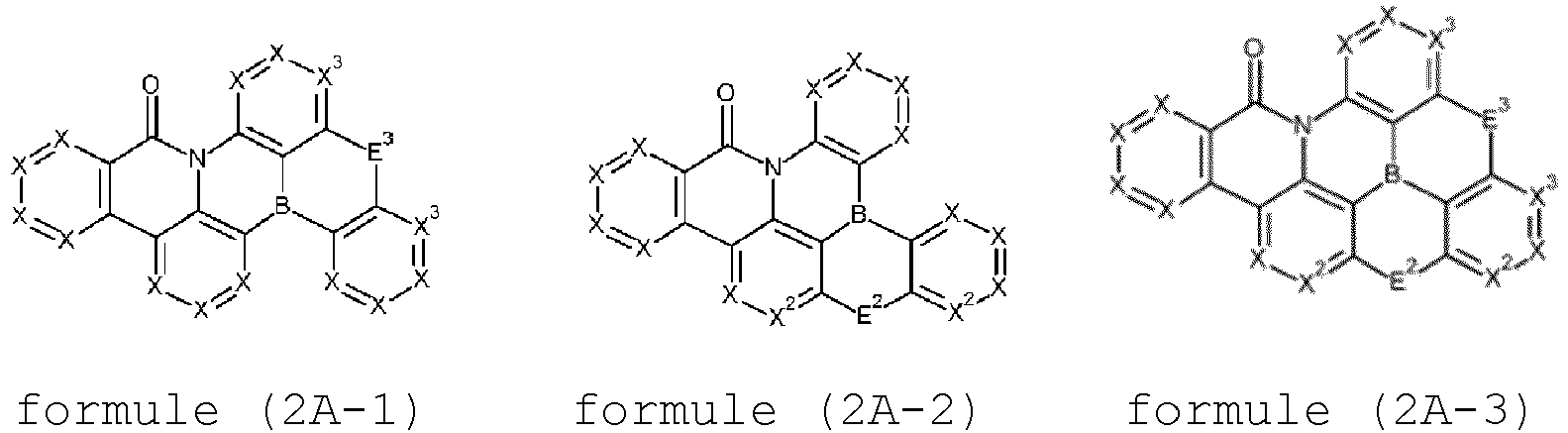
 E2, E3 représentant, lors de chaque occurrence, de manière identique ou différente, une simple liaison ou un pont divalent choisi parmi B(R0), N(RN), C(R0)2, Si(R0)2, C=O, C=NRN, C=C(R0)2, O, S, S=O, SO2, P(R0) ou P(=O)R0 ; ou un groupe E2 formant un cycle lactame (L-1) comme représenté ci-dessous avec un groupe X2, ou un groupe E3 formant un cycle lactame (L-1) avec un groupe X3 ;
 le signe « ∨ » indiquant la position du groupe X2 ou X3, qui représente C dans ce cas, et l'atome de N marqué par le signe « * » correspondant à E2 ou E3 ;X représentant, lors de chaque occurrence, de manière identique ou différente, CR1 ou N ;X2, X3 représentant, lors de chaque occurrence, de manière identique ou différente, X ;R0, R1, RN représentant, lors de chaque occurrence, de manière identique ou différente, H, D, F, Cl, Br, I, CHO, CN, C(=O)Ar, P(=O) (Ar)2, S(=O)Ar, S(=O)2Ar, N(R)2, N(Ar)2, NO2, Si(R)3, B(OR)2, OSO2R, un groupe alkyle, alcoxy ou thioalkyle à chaîne droite ayant 1 à 40 atomes de C ou un groupe alkyle, alcoxy ou thioalkyle ramifié ou cyclique ayant 3 à 40 atomes de C, chacun desquels pouvant être substitué par un ou plusieurs radicaux R, dans chaque cas un ou plusieurs groupes CH2 non adjacents pouvant être remplacés par RC=CR, C≡C, Si(R)2, Ge(R)2, Sn (R)2, C=O, C=S, C=Se, P(=O)(R), SO, SO2, O, S ou CONR et un ou plusieurs atomes de H pouvant être remplacés par D, F, Cl, Br, I, CN ou NO2, un système cyclique aromatique ou hétéroaromatique ayant 5 à 60 atomes de cycle aromatique, qui peut dans chaque cas être substitué par un ou plusieurs radicaux R, un groupe aralkyle ou hétéroaralkyle ayant 5 à 60 atomes de cycle aromatique, qui peut être substitué par un ou plusieurs radicaux R, ou un groupe aryloxy ou hétéroaryloxy ayant 5 à 60 atomes de cycle aromatique, qui peut être substitué par un ou plusieurs radicaux R ; deux radicaux R0, R1, RN pouvant former ensemble un système cyclique aliphatique, aromatique ou hétéroaromatique, qui peut être substitué par un ou plusieurs radicaux R ;R représentant lors de chaque occurrence, de manière identique ou différente, H, D, F, Cl, Br, I, CHO, CN, C(=O)Ar, P(=O)(Ar)2, S(=O)Ar, S(=O)2Ar, N(R')2, N(Ar)2, NO2, Si(R')3, B(OR')2, OSO2R', un groupe alkyle, alcoxy ou thioalkyle à chaîne droite ayant 1 à 40 atomes de C ou un groupe alkyle, alcoxy ou thioalkyle ramifié ou cyclique ayant 3 à 40 atomes de C, chacun desquels pouvant être substitué par un ou plusieurs radicaux R', dans chaque cas un ou plusieurs groupes CH2 non adjacents pouvant être remplacés par R'C=CR', C≡C, Si(R')2, Ge(R')2, Sn(R')2, C=O, C=S, C=Se, P(=O)(R'), SO, SO2, O, S ou CONR' et un ou plusieurs atomes de H pouvant être remplacés par D, F, Cl, Br, I, CN ou NO2, un système cyclique aromatique ou hétéroaromatique ayant 5 à 60 atomes de cycle aromatique, qui peut dans chaque cas être substitué par un ou plusieurs radicaux R' ; deux substituants R pouvant former ensemble un système cyclique aliphatique ou aromatique, qui peut être substitué par un ou plusieurs radicaux R' ;Ar étant, lors de chaque occurrence, de manière identique ou différente, un système cyclique aromatique ou hétéroaromatique ayant 5 à 60 atomes de cycle aromatique, qui peut dans chaque cas également être substitué par un ou plusieurs radicaux R' ;R' représentant, lors de chaque occurrence, de manière identique ou différente, H, D, F, Cl, Br, I, CN, un groupe alkyle, alcoxy ou thioalkyle à chaîne droite ayant 1 à 20 atomes de C ou un groupe alkyle, alcoxy ou thioalkyle ramifié ou cyclique ayant 3 à 20 atomes de C, dans chaque cas un ou plusieurs groupes CH2 non adjacents pouvant être remplacés par SO, SO2, O, S et un ou plusieurs atomes de H pouvant être remplacés par D, F, Cl, Br ou I, ou un système cyclique aromatique ou hétéroaromatique ayant 5 à 24 atomes de cycle aromatique.
 - Composé selon la revendication 1, caractérisé en ce que le composé de formule (1) comprend au moins un groupe E2 ou E3, qui représente un pont divalent choisi parmi B(R0), N(RN) , C(R0)2, Si(R0)2, C=O, C=NRN, C=C(R0)2, O, S, S=O, SO2, P(R0) ou P(=O)R0 ; ou au moins un groupe E2 ou E3 forme un cycle lactame (L-1) tel que défini dans la revendication 1 avec un groupe X2 ou un groupe X3.
- Composé selon la revendication 1 ou 2, caractérisé en ce que les groupes E2 et E3 représentent, lors de chaque occurrence, de manière identique ou différente, un pont divalent choisi parmi B(R0), N(RN), C(R0)2, O ou S, ou un groupe E2 forme un cycle lactame (L-1) tel que représenté dans la revendication 1 avec un groupe X2, ou un groupe E3 forme un cycle lactame (L-1) avec un groupe X3.
- Composé selon l'une ou plusieurs des revendications précédentes, caractérisé en ce qu'il comprend au moins un groupe E2 ou E3, qui représente un pont divalent choisi parmi N(RN), ou qui forme un cycle lactame (L-1) tel que représenté dans la revendication 1 avec un groupe X2 ou X3.
- Composé selon l'une ou plusieurs des revendications précédentes, caractérisé en ce qu'il est choisi parmi des composés des formules (2A-1-1) à (2-A-3-6),


- Composé selon la revendication 5, caractérisé en ce que E2', E3' représentent, lors de chaque occurrence, de manière identique ou différente, un pont divalent choisi parmi B(R0), N(RN), C(R0)2, O ou S.
- Composé selon l'une ou plusieurs des revendications précédentes, caractérisé en ce qu'il comprend au moins un radical R0, R1, RN ou R choisi parmi :- des groupes alkyle ramifiés ou cycliques représentés par la formule générale suivante (RS-a),
 R22, R23, R24 étant, lors de chaque occurrence, de manière identique ou différente, choisis parmi H, un groupe alkyle à chaîne droite ayant 1 à 10 atomes de carbone, ou un groupe alkyle ramifié ou cyclique ayant 3 à 10 atomes de carbone, les groupes mentionnés ci-dessus pouvant chacun être substitués par un ou plusieurs radicaux R25, et deux des radicaux R22, R23, R24 ou tous les radicaux R22, R23, R24 pouvant être joints pour former un groupe alkyle (poly)cyclique, qui peut être substitué par un ou plusieurs radicaux R25 ;R25 étant, lors de chaque occurrence, de manière identique ou différente, choisi parmi un groupe alkyle à chaîne droite ayant 1 à 10 atomes de carbone, ou un groupe alkyle ramifié ou cyclique ayant 3 à 10 atomes de carbone ;à la condition que lors de chaque occurrence au moins un des radicaux R22, R23 et R24 soit différent de H, à la condition que lors de chaque occurrence tous les radicaux R22, R23 et R24 ensemble aient au moins 4 atomes de carbone et à la condition que lors de chaque occurrence, si deux des radicaux R22, R23, R24 sont H, le radical restant ne soit pas une chaîne droite ; ou- des groupes alcoxy ramifiés ou cycliques représentés par la formule générale suivante (RS-b)
 R26, R27, R28 étant, lors de chaque occurrence, de manière identique ou différente, choisis parmi H, un groupe alkyle à chaîne droite ayant 1 à 10 atomes de carbone, ou un groupe alkyle ramifié ou cyclique ayant 3 à 10 atomes de carbone, les groupes mentionnés ci-dessus pouvant être chacun substitués par un ou plusieurs radicaux R25 tels que définis ci-dessus, et deux des radicaux R26, R27, R28 ou tous les radicaux R26, R27, R28 pouvant être joints pour former un groupe alkyle (poly)cyclique, qui peut être substitué par un ou plusieurs radicaux R25 tels que définis ci-dessus ;à la condition que lors de chaque occurrence seulement un des radicaux R26, R27 et R28 puisse être H ;- des groupes aralkyle représentés par la formule générale suivante (RS-c)
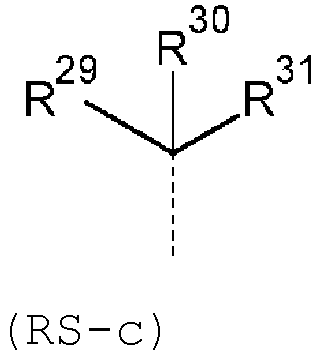 R29, R30, R31 étant, lors de chaque occurrence, de manière identique ou différente, choisis parmi H, un groupe alkyle à chaîne droite ayant 1 à 10 atomes de carbone, ou un groupe alkyle ramifié ou cyclique ayant 3 à 10 atomes de carbone, les groupes mentionnés ci-dessus pouvant être chacun substitués par un ou plusieurs radicaux R32, ou un système cyclique aromatique ayant 6 à 30 atomes de cycle aromatique, qui peut dans chaque cas être substitué par un ou plusieurs radicaux R32, et deux des radicaux R29, R30, R31 ou tous les radicaux R29, R30, R31 pouvant être joints pour former un groupe alkyle (poly)cyclique ou un système cyclique aromatique, chacun desquels pouvant être substitué par un ou plusieurs radicaux R32 ;R32 étant, lors de chaque occurrence, de manière identique ou différente, choisi parmi un groupe alkyle à chaîne droite ayant 1 à 10 atomes de carbone, ou un groupe alkyle ramifié ou cyclique ayant 3 à 10 atomes de carbone, ou un système cyclique aromatique ayant 6 à 24 atomes de cycle aromatique ;à la condition que lors de chaque occurrence au moins un des radicaux R29, R30 et R31 soit différent de H et que lors de chaque occurrence au moins l'un des radicaux R29, R30 et R31 soit ou contienne un système cyclique aromatique ayant au moins 6 atomes de cycle aromatique ;- des systèmes cycliques aromatiques représentés par la formule générale (RS-d)
 - des groupes de formule (RS-e),
- Polymère, oligomère ou dendrimère contenant un ou plusieurs composés selon l'une ou plusieurs des revendications 1 à 7, la ou les liaisons avec le polymère, l'oligomère ou le dendrimère pouvant être localisées au niveau de quelconques positions dans la formule (1) qui est substituée par R0, R1, RN ou R.
- Formulation comprenant au moins un composé selon une ou plusieurs des revendications 1 à 7 ou au moins un polymère, oligomère ou dendrimère selon la revendication 8 et au moins un solvant.
- Dispositif électronique comprenant au moins un composé selon une ou plusieurs des revendications 1 à 7 ou au moins un polymère, oligomère ou dendrimère selon la revendication 8, choisi dans le groupe constitué par les dispositifs électroluminescents organiques, les circuits intégrés organiques, les transistors à effet de champ organiques, les transistors à couches minces organiques, les transistors électroluminescents organiques, les cellules solaires organiques, les cellules solaires organiques à colorant, les détecteurs optiques organiques, les photorécepteurs organiques, les dispositifs d'extinction de champ organiques, les cellules électrochimiques électroluminescentes, les diodes laser organiques et les dispositifs émetteurs de plasmon organiques.
- Dispositif électroluminescent organique comprenant au moins un composé selon une ou plusieurs des revendications 1 à 7 ou au moins un polymère, oligomère ou dendrimère selon la revendication 8, caractérisé en ce que le composé selon une ou plusieurs des revendications 1 à 7 ou le polymère, oligomère ou dendrimère selon la revendication 8 est utilisé comme émetteur dans une couche émettrice.
- Dispositif électroluminescent organique selon la revendication 11, caractérisé en ce que le composé selon une ou plusieurs des revendications 1 à 7 ou le polymère, oligomère ou dendrimère selon la revendication 8 est utilisé comme émetteur fluorescent dans une couche émettrice, la couche émettrice comprenant au moins un autre composant choisi parmi des matériaux de matrice.
- Dispositif électroluminescent organique selon la revendication 11, caractérisé en ce que le composé selon une ou plusieurs des revendications 1 à 7 ou le polymère, oligomère ou dendrimère selon la revendication 8 est utilisé comme émetteur présentant une fluorescence retardée activée thermiquement dans une couche émettrice, la couche émettrice comprenant au moins un autre composant choisi parmi des matériaux de matrice.
- Dispositif électroluminescent organique selon la revendication 11, caractérisé en ce que le composé selon une ou plusieurs des revendications 1 à 7 ou le polymère, oligomère ou dendrimère selon la revendication 8 est utilisé comme émetteur fluorescent dans une couche émettrice, la couche émettrice comprenant au moins un sensibilisateur choisi parmi les composés phosphorescents et les composés à fluorescence retardée activée thermiquement.
- Dispositif électroluminescent organique selon la revendication 14, caractérisé en ce que la couche émettrice comprend en outre au moins un matériau fonctionnel organique choisi parmi des matériaux de matrice.
- Dispositif électroluminescent organique comprenant au moins un composé selon une ou plusieurs des revendications 1 à 7 ou au moins un polymère, oligomère ou dendrimère selon la revendication 8, caractérisé en ce que le composé selon une ou plusieurs des revendications 1 à 7 ou le polymère, oligomère ou dendrimère selon la revendication 8 est utilisé comme matériau de matrice.
Applications Claiming Priority (2)
| Application Number | Priority Date | Filing Date | Title |
|---|---|---|---|
| EP20164893 | 2020-03-23 | ||
| PCT/EP2021/057039 WO2021191058A1 (fr) | 2020-03-23 | 2021-03-19 | Matériaux pour dispositifs électroluminescents organiques |
Publications (2)
| Publication Number | Publication Date |
|---|---|
| EP4126884A1 EP4126884A1 (fr) | 2023-02-08 |
| EP4126884B1 true EP4126884B1 (fr) | 2025-07-09 |
Family
ID=69953879
Family Applications (1)
| Application Number | Title | Priority Date | Filing Date |
|---|---|---|---|
| EP21712176.3A Active EP4126884B1 (fr) | 2020-03-23 | 2021-03-19 | Matériaux pour dispositifs électroluminescents organiques |
Country Status (5)
| Country | Link |
|---|---|
| US (1) | US20230337537A1 (fr) |
| EP (1) | EP4126884B1 (fr) |
| KR (1) | KR20220157456A (fr) |
| CN (1) | CN115244060A (fr) |
| WO (1) | WO2021191058A1 (fr) |
Families Citing this family (3)
| Publication number | Priority date | Publication date | Assignee | Title |
|---|---|---|---|---|
| WO2022079067A1 (fr) * | 2020-10-16 | 2022-04-21 | Merck Patent Gmbh | Composés comprenant des hétéroatomes pour dispositifs électroluminescents organiques |
| US20240124454A1 (en) * | 2020-12-31 | 2024-04-18 | Nanjing Zaiming Pharmaceutical Co., Ltd. | Tricyclic compound and use thereof |
| CN118084947B (zh) * | 2022-11-08 | 2025-11-18 | 江苏三月科技股份有限公司 | 一种含硼有机化合物及其应用 |
Family Cites Families (179)
| Publication number | Priority date | Publication date | Assignee | Title |
|---|---|---|---|---|
| US4539507A (en) | 1983-03-25 | 1985-09-03 | Eastman Kodak Company | Organic electroluminescent devices having improved power conversion efficiencies |
| US5061569A (en) | 1990-07-26 | 1991-10-29 | Eastman Kodak Company | Electroluminescent device with organic electroluminescent medium |
| JP3295088B2 (ja) | 1993-09-29 | 2002-06-24 | 出光興産株式会社 | 有機エレクトロルミネッセンス素子 |
| JPH07133483A (ja) | 1993-11-09 | 1995-05-23 | Shinko Electric Ind Co Ltd | El素子用有機発光材料及びel素子 |
| EP0676461B1 (fr) | 1994-04-07 | 2002-08-14 | Covion Organic Semiconductors GmbH | Composés spiro et leur application comme matières électroluminescentes |
| JP3302945B2 (ja) | 1998-06-23 | 2002-07-15 | ネースディスプレイ・カンパニー・リミテッド | 新規な有機金属発光物質およびそれを含む有機電気発光素子 |
| EP1729327B2 (fr) | 1999-05-13 | 2022-08-10 | The Trustees Of Princeton University | Utilisation d'un composé d'iridium phosphorescent comme molécule émissive dans un dispositif électroluminescent organique |
| US6310360B1 (en) | 1999-07-21 | 2001-10-30 | The Trustees Of Princeton University | Intersystem crossing agents for efficient utilization of excitons in organic light emitting devices |
| EP1933395B2 (fr) | 1999-12-01 | 2019-08-07 | The Trustees of Princeton University | Complexes de formule L2lrX |
| KR100377321B1 (ko) | 1999-12-31 | 2003-03-26 | 주식회사 엘지화학 | 피-형 반도체 성질을 갖는 유기 화합물을 포함하는 전기소자 |
| US6660410B2 (en) | 2000-03-27 | 2003-12-09 | Idemitsu Kosan Co., Ltd. | Organic electroluminescence element |
| US20020121638A1 (en) | 2000-06-30 | 2002-09-05 | Vladimir Grushin | Electroluminescent iridium compounds with fluorinated phenylpyridines, phenylpyrimidines, and phenylquinolines and devices made with such compounds |
| EP1325671B1 (fr) | 2000-08-11 | 2012-10-24 | The Trustees Of Princeton University | Composes organometalliques et electrophosphorescence organique presentant un deplacement d'emission |
| JP4154140B2 (ja) | 2000-09-26 | 2008-09-24 | キヤノン株式会社 | 金属配位化合物 |
| JP4154139B2 (ja) | 2000-09-26 | 2008-09-24 | キヤノン株式会社 | 発光素子 |
| JP4154138B2 (ja) | 2000-09-26 | 2008-09-24 | キヤノン株式会社 | 発光素子、表示装置及び金属配位化合物 |
| KR100691543B1 (ko) | 2002-01-18 | 2007-03-09 | 주식회사 엘지화학 | 새로운 전자 수송용 물질 및 이를 이용한 유기 발광 소자 |
| ITRM20020411A1 (it) | 2002-08-01 | 2004-02-02 | Univ Roma La Sapienza | Derivati dello spirobifluorene, loro preparazione e loro uso. |
| US20060035109A1 (en) | 2002-09-20 | 2006-02-16 | Idemitsu Kosan Co., Ltd. | Organic electroluminescent element |
| US20060063027A1 (en) | 2002-12-23 | 2006-03-23 | Covion Organic Semiconductors Gmbh | Organic electroluminescent element |
| DE10310887A1 (de) | 2003-03-11 | 2004-09-30 | Covion Organic Semiconductors Gmbh | Matallkomplexe |
| EP2174932B1 (fr) | 2003-03-13 | 2019-07-03 | Idemitsu Kosan Co., Ltd. | Dérivé hétérocyclique contenant de l'azote et élément électroluminescent organique utilisant ce dérivé |
| JP4411851B2 (ja) | 2003-03-19 | 2010-02-10 | コニカミノルタホールディングス株式会社 | 有機エレクトロルミネッセンス素子 |
| EP1618170A2 (fr) | 2003-04-15 | 2006-01-25 | Covion Organic Semiconductors GmbH | Melanges de semi-conducteurs organiques aptes a l'emission et de matieres matricielles, leur utilisation et composants electroniques contenant ces melanges |
| JP4635870B2 (ja) | 2003-04-23 | 2011-02-23 | コニカミノルタホールディングス株式会社 | 有機エレクトロルミネッセンス素子、照明装置及び表示装置 |
| DE10333232A1 (de) | 2003-07-21 | 2007-10-11 | Merck Patent Gmbh | Organisches Elektrolumineszenzelement |
| DE10338550A1 (de) | 2003-08-19 | 2005-03-31 | Basf Ag | Übergangsmetallkomplexe mit Carbenliganden als Emitter für organische Licht-emittierende Dioden (OLEDs) |
| DE10345572A1 (de) | 2003-09-29 | 2005-05-19 | Covion Organic Semiconductors Gmbh | Metallkomplexe |
| US7795801B2 (en) | 2003-09-30 | 2010-09-14 | Konica Minolta Holdings, Inc. | Organic electroluminescent element, illuminator, display and compound |
| DE10350722A1 (de) | 2003-10-30 | 2005-05-25 | Covion Organic Semiconductors Gmbh | Metallkomplexe |
| US20050170206A1 (en) | 2004-02-03 | 2005-08-04 | Bin Ma | OLEDs utilizing multidentate ligand systems |
| DE102004008304A1 (de) | 2004-02-20 | 2005-09-08 | Covion Organic Semiconductors Gmbh | Organische elektronische Vorrichtungen |
| US7790890B2 (en) | 2004-03-31 | 2010-09-07 | Konica Minolta Holdings, Inc. | Organic electroluminescence element material, organic electroluminescence element, display device and illumination device |
| KR100787425B1 (ko) | 2004-11-29 | 2007-12-26 | 삼성에스디아이 주식회사 | 페닐카바졸계 화합물 및 이를 이용한 유기 전계 발광 소자 |
| DE102004023277A1 (de) | 2004-05-11 | 2005-12-01 | Covion Organic Semiconductors Gmbh | Neue Materialmischungen für die Elektrolumineszenz |
| US7598388B2 (en) | 2004-05-18 | 2009-10-06 | The University Of Southern California | Carbene containing metal complexes as OLEDs |
| JP4862248B2 (ja) | 2004-06-04 | 2012-01-25 | コニカミノルタホールディングス株式会社 | 有機エレクトロルミネッセンス素子、照明装置及び表示装置 |
| ITRM20040352A1 (it) | 2004-07-15 | 2004-10-15 | Univ Roma La Sapienza | Derivati oligomerici dello spirobifluorene, loro preparazione e loro uso. |
| EP1655359A1 (fr) | 2004-11-06 | 2006-05-10 | Covion Organic Semiconductors GmbH | Dispositif organique électroluminescent |
| DE102004057072A1 (de) | 2004-11-25 | 2006-06-01 | Basf Ag | Verwendung von Übergangsmetall-Carbenkomplexen in organischen Licht-emittierenden Dioden (OLEDs) |
| KR100949214B1 (ko) | 2005-03-18 | 2010-03-24 | 이데미쓰 고산 가부시키가이샤 | 방향족 아민 유도체 및 그것을 사용한 유기 전기발광 소자 |
| US8334058B2 (en) | 2005-04-14 | 2012-12-18 | Merck Patent Gmbh | Compounds for organic electronic devices |
| EP1888706B1 (fr) | 2005-05-03 | 2017-03-01 | Merck Patent GmbH | Dispositif electroluminescent organique, et derives d'acide boronique et d'acide borinique utilises pour produire ce dispositif electroluminescent organique |
| US9051344B2 (en) | 2005-05-06 | 2015-06-09 | Universal Display Corporation | Stability OLED materials and devices |
| DE102005023437A1 (de) | 2005-05-20 | 2006-11-30 | Merck Patent Gmbh | Verbindungen für organische elektronische Vorrichtungen |
| WO2007063754A1 (fr) | 2005-12-01 | 2007-06-07 | Nippon Steel Chemical Co., Ltd. | Compose pour element electroluminescent organique et element electroluminescent organique |
| BRPI0707552B8 (pt) | 2006-02-10 | 2020-05-05 | Universal Display Corp | complexos metálicos de ligantes imidazo [1,2-f] fenantridina e diimizado [1,2-a:1', 2'-c] quinazolina ciclometalados e análogos isoeletrônicos e benzanulados dos mesmos e dispositivos oled que os englobam |
| EP2007781B1 (fr) | 2006-04-04 | 2012-09-12 | Basf Se | Complexes de metaux de transition contenant un ligand non carbene et un ou deux ligands carbene et leur utilisation dans des oled |
| KR101431844B1 (ko) | 2006-04-05 | 2014-08-25 | 바스프 에스이 | 이종 리간드 전이 금속-카르벤 착체 및 이의 유기 발광 다이오드(oled)에서의 용도 |
| DE102006025777A1 (de) | 2006-05-31 | 2007-12-06 | Merck Patent Gmbh | Neue Materialien für organische Elektrolumineszenzvorrichtungen |
| DE102006025846A1 (de) | 2006-06-02 | 2007-12-06 | Merck Patent Gmbh | Neue Materialien für organische Elektrolumineszenzvorrichtungen |
| KR101430774B1 (ko) | 2006-06-26 | 2014-08-18 | 바스프 에스이 | 가교된 카르벤 리간드를 갖는 pt- 및 pd-비스- 및 테트라-카르벤 착물의 oled에서의 용도 |
| WO2008000727A1 (fr) | 2006-06-26 | 2008-01-03 | Basf Se | Utilisation dans des diodes électroluminescentes organiques de complexes carbène -métaux de transition qui ne contiennent pas de cyclométallation par l'intermédiaire de non carbènes |
| DE102006031990A1 (de) | 2006-07-11 | 2008-01-17 | Merck Patent Gmbh | Neue Materialien für organische Elektrolumineszenzvorrichtungen |
| US8062769B2 (en) | 2006-11-09 | 2011-11-22 | Nippon Steel Chemical Co., Ltd. | Indolocarbazole compound for use in organic electroluminescent device and organic electroluminescent device |
| DE102007002714A1 (de) | 2007-01-18 | 2008-07-31 | Merck Patent Gmbh | Neue Materialien für organische Elektrolumineszenzvorrichtungen |
| DE102007024850A1 (de) | 2007-05-29 | 2008-12-04 | Merck Patent Gmbh | Neue Materialien für organische Elektrolumineszenzvorrichtungen |
| WO2008156879A1 (fr) | 2007-06-20 | 2008-12-24 | Universal Display Corporation | Matériaux à base d'imidazophénantridine phosphorescente bleue |
| WO2009050290A1 (fr) | 2007-10-17 | 2009-04-23 | Basf Se | Complexes de métaux de transition avec des ligands carbène pontés, et leur utilisation dans des diodes électroluminescentes organiques (oled) |
| KR101612135B1 (ko) | 2007-10-17 | 2016-04-12 | 바스프 에스이 | 가교된 카르벤 리간드를 갖는 전이 금속 착체 및 oled에 있어서의 이의 용도 |
| DE102007053771A1 (de) | 2007-11-12 | 2009-05-14 | Merck Patent Gmbh | Organische Elektrolumineszenzvorrichtungen |
| US7862908B2 (en) | 2007-11-26 | 2011-01-04 | National Tsing Hua University | Conjugated compounds containing hydroindoloacridine structural elements, and their use |
| US8221905B2 (en) | 2007-12-28 | 2012-07-17 | Universal Display Corporation | Carbazole-containing materials in phosphorescent light emitting diodes |
| DE102008027005A1 (de) | 2008-06-05 | 2009-12-10 | Merck Patent Gmbh | Organische elektronische Vorrichtung enthaltend Metallkomplexe |
| DE102008033943A1 (de) | 2008-07-18 | 2010-01-21 | Merck Patent Gmbh | Neue Materialien für organische Elektrolumineszenzvorrichtungen |
| DE102008035413A1 (de) | 2008-07-29 | 2010-02-04 | Merck Patent Gmbh | Verbindungen für organische elektronische Vorrichtungen |
| DE102008036247A1 (de) | 2008-08-04 | 2010-02-11 | Merck Patent Gmbh | Elektronische Vorrichtungen enthaltend Metallkomplexe |
| DE102008036982A1 (de) | 2008-08-08 | 2010-02-11 | Merck Patent Gmbh | Organische Elektrolumineszenzvorrichtung |
| DE102008048336A1 (de) | 2008-09-22 | 2010-03-25 | Merck Patent Gmbh | Einkernige neutrale Kupfer(I)-Komplexe und deren Verwendung zur Herstellung von optoelektronischen Bauelementen |
| KR101506919B1 (ko) | 2008-10-31 | 2015-03-30 | 롬엔드하스전자재료코리아유한회사 | 신규한 유기 전자재료용 화합물 및 이를 포함하는 유기 전자 소자 |
| JP5701766B2 (ja) | 2008-11-11 | 2015-04-15 | メルク パテント ゲーエムベーハー | 有機エレクトロルミネセント素子 |
| DE102008056688A1 (de) | 2008-11-11 | 2010-05-12 | Merck Patent Gmbh | Materialien für organische Elektrolumineszenzvorrichtungen |
| DE102008057051B4 (de) | 2008-11-13 | 2021-06-17 | Merck Patent Gmbh | Materialien für organische Elektrolumineszenzvorrichtungen |
| DE102008057050B4 (de) | 2008-11-13 | 2021-06-02 | Merck Patent Gmbh | Materialien für organische Elektrolumineszenzvorrichtungen |
| US8815415B2 (en) | 2008-12-12 | 2014-08-26 | Universal Display Corporation | Blue emitter with high efficiency based on imidazo[1,2-f] phenanthridine iridium complexes |
| DE102008063470A1 (de) | 2008-12-17 | 2010-07-01 | Merck Patent Gmbh | Organische Elektrolumineszenzvorrichtung |
| DE102008064200A1 (de) | 2008-12-22 | 2010-07-01 | Merck Patent Gmbh | Organische Elektrolumineszenzvorrichtung |
| DE102009007038A1 (de) | 2009-02-02 | 2010-08-05 | Merck Patent Gmbh | Metallkomplexe |
| DE102009011223A1 (de) | 2009-03-02 | 2010-09-23 | Merck Patent Gmbh | Metallkomplexe |
| DE102009013041A1 (de) | 2009-03-13 | 2010-09-16 | Merck Patent Gmbh | Materialien für organische Elektrolumineszenzvorrichtungen |
| DE102009023155A1 (de) | 2009-05-29 | 2010-12-02 | Merck Patent Gmbh | Materialien für organische Elektrolumineszenzvorrichtungen |
| DE102009031021A1 (de) | 2009-06-30 | 2011-01-05 | Merck Patent Gmbh | Materialien für organische Elektrolumineszenzvorrichtungen |
| DE102009041414A1 (de) | 2009-09-16 | 2011-03-17 | Merck Patent Gmbh | Metallkomplexe |
| DE102009048791A1 (de) | 2009-10-08 | 2011-04-14 | Merck Patent Gmbh | Materialien für organische Elektrolumineszenzvorrichtungen |
| KR101820178B1 (ko) | 2009-10-14 | 2018-01-18 | 유디씨 아일랜드 리미티드 | 복핵 백금-카르벤 착체 및 oled에서의 이의 용도 |
| DE102009049587A1 (de) | 2009-10-16 | 2011-04-21 | Merck Patent Gmbh | Metallkomplexe |
| WO2011051404A1 (fr) | 2009-10-28 | 2011-05-05 | Basf Se | Complexes hétéroleptiques à base de carbène et leur utilisation dans l'électronique organique |
| DE102009057167A1 (de) | 2009-12-05 | 2011-06-09 | Merck Patent Gmbh | Elektronische Vorrichtung enthaltend Metallkomplexe |
| JP5124785B2 (ja) | 2009-12-07 | 2013-01-23 | 新日鉄住金化学株式会社 | 有機発光材料及び有機発光素子 |
| ES2525757T3 (es) | 2009-12-14 | 2014-12-30 | Basf Se | Complejos metálicos que contienen ligandos de diazabencimidazolcarbeno y su uso en OLED |
| DE102010005697A1 (de) | 2010-01-25 | 2011-07-28 | Merck Patent GmbH, 64293 | Verbindungen für elektronische Vorrichtungen |
| US9156870B2 (en) | 2010-02-25 | 2015-10-13 | Universal Display Corporation | Phosphorescent emitters |
| DE102010012738A1 (de) | 2010-03-25 | 2011-09-29 | Merck Patent Gmbh | Materialien für organische Elektrolumineszenzvorrichtungen |
| DE102010019306B4 (de) * | 2010-05-04 | 2021-05-20 | Merck Patent Gmbh | Organische Elektrolumineszenzvorrichtungen |
| JP6054290B2 (ja) | 2010-06-15 | 2016-12-27 | メルク パテント ゲーエムベーハー | 金属錯体 |
| DE102010027317A1 (de) | 2010-07-16 | 2012-01-19 | Merck Patent Gmbh | Metallkomplexe |
| DE102010031831A1 (de) | 2010-07-20 | 2012-01-26 | Cynora Gmbh | Singulett-Harvesting mit löslichen Kupfer(I)-Komplexen für opto-elektronische Vorrichtungen |
| DE102010045405A1 (de) | 2010-09-15 | 2012-03-15 | Merck Patent Gmbh | Materialien für organische Elektrolumineszenzvorrichtungen |
| DE102010048607A1 (de) | 2010-10-15 | 2012-04-19 | Merck Patent Gmbh | Verbindungen für elektronische Vorrichtungen |
| DE102010048608A1 (de) | 2010-10-15 | 2012-04-19 | Merck Patent Gmbh | Materialien für organische Elektrolumineszenzvorrichtungen |
| US8883322B2 (en) | 2011-03-08 | 2014-11-11 | Universal Display Corporation | Pyridyl carbene phosphorescent emitters |
| EP2699571B1 (fr) | 2011-04-18 | 2018-09-05 | Merck Patent GmbH | Matériaux pour dispositifs électroluminescents organiques |
| KR101970940B1 (ko) | 2011-05-05 | 2019-04-22 | 메르크 파텐트 게엠베하 | 전자 소자용 화합물 |
| US9490431B2 (en) | 2011-05-13 | 2016-11-08 | Cynora Gmbh | Copper(I) complexes, in particular for optoelectronic components |
| EP2543672A1 (fr) | 2011-07-08 | 2013-01-09 | cynora GmbH | Complexe de cuivre(I), notamment pour composants optoélectroniques |
| KR20120135363A (ko) | 2011-06-01 | 2012-12-13 | 엘지디스플레이 주식회사 | 청색 인광 화합물 및 이를 이용한 유기전계 발광소자 |
| KR101972184B1 (ko) | 2011-06-03 | 2019-04-24 | 메르크 파텐트 게엠베하 | 금속 착물 |
| KR101933734B1 (ko) | 2011-06-08 | 2018-12-28 | 유니버셜 디스플레이 코포레이션 | 헤테로렙틱 이리듐 카르벤 착물 및 이를 사용한 발광 디바이스 |
| EP3415521A1 (fr) | 2011-06-14 | 2018-12-19 | UDC Ireland Limited | Complexes de métal comprenant des ligands de carbène d'azabenzimidazole et leur utilisation dans des oled |
| EP2540730A1 (fr) | 2011-06-29 | 2013-01-02 | cynora GmbH | Complexe de cuivre(I), notamment pour composants optoélectroniques |
| EP2543673A1 (fr) | 2011-07-08 | 2013-01-09 | cynora GmbH | Complexes de cuivre(I) pour dispositifs optoélectroniques |
| US9660198B2 (en) | 2011-07-15 | 2017-05-23 | Kyulux, Inc. | Organic electroluminescence element and compound used therein |
| CN103688384B (zh) | 2011-07-15 | 2016-03-09 | 国立大学法人九州大学 | 迟滞荧光材料及使用其的有机电致发光元件 |
| DE102011080240A1 (de) | 2011-08-02 | 2013-02-07 | Cynora Gmbh | Singulett-Harvesting mit zweikernigen Kupfer(I)-Komplexen für opto-elektronische Vorrichtungen |
| KR101967014B1 (ko) | 2011-08-10 | 2019-04-08 | 메르크 파텐트 게엠베하 | 금속 착물 |
| JP6174030B2 (ja) | 2011-09-21 | 2017-08-02 | メルク パテント ゲーエムベーハー | 有機エレクトロルミネッセンスデバイス用のカルバゾール誘導体 |
| EP2594571A1 (fr) | 2011-11-16 | 2013-05-22 | Cynora GmbH | Complexes cuivrés pour applications optoélectroniques |
| US10305040B2 (en) | 2011-11-17 | 2019-05-28 | Merck Patent Gmbh | Spiro dihydroacridine derivatives and the use thereof as materials for organic electroluminescence devices |
| US9153788B2 (en) | 2011-12-02 | 2015-10-06 | Kyushu University National University Corporation | Organic light-emitting device, and delayed fluorescent material and compound used therefor |
| JP2013116975A (ja) | 2011-12-02 | 2013-06-13 | Kyushu Univ | 遅延蛍光材料、有機発光素子および化合物 |
| KR102015765B1 (ko) | 2012-02-14 | 2019-10-21 | 메르크 파텐트 게엠베하 | 유기 전계발광 소자용 스피로비플루오렌 화합물 |
| US9985215B2 (en) | 2012-03-09 | 2018-05-29 | Kyulux, Inc. | Light-emitting material, and organic light-emitting element |
| JP2014135466A (ja) | 2012-04-09 | 2014-07-24 | Kyushu Univ | 有機発光素子ならびにそれに用いる発光材料および化合物 |
| US20150141642A1 (en) | 2012-04-25 | 2015-05-21 | Kyushu University National University Corporation | Light-emitting material and organic light-emitting device |
| JP5594750B2 (ja) | 2012-05-17 | 2014-09-24 | 国立大学法人九州大学 | 化合物、発光材料および有機発光素子 |
| WO2013185871A1 (fr) | 2012-06-12 | 2013-12-19 | Merck Patent Gmbh | Composés pour dispositifs électroniques |
| EP2872590B1 (fr) | 2012-07-13 | 2018-11-14 | Merck Patent GmbH | Complexes metalliques |
| US9590196B2 (en) | 2012-07-19 | 2017-03-07 | Udc Ireland Limited | Dinuclear metal complexes comprising carbene ligands and the use thereof in OLEDs |
| CN104488359B (zh) | 2012-07-23 | 2018-01-23 | 默克专利有限公司 | 2‑二芳基氨基芴的衍生物和含有所述2‑二芳基氨基芴衍生物的有机电子复合体 |
| KR101807925B1 (ko) | 2012-07-23 | 2017-12-11 | 메르크 파텐트 게엠베하 | 화합물 및 유기 전계 발광 디바이스 |
| EP3424907B1 (fr) | 2012-07-23 | 2025-03-12 | Merck Patent GmbH | Raccordements et dispositifs électro-organiques |
| EP2882763B1 (fr) | 2012-08-07 | 2018-08-22 | Merck Patent GmbH | Complexes métalliques |
| KR102025971B1 (ko) | 2012-08-09 | 2019-09-26 | 유디씨 아일랜드 리미티드 | 카르벤 리간드를 갖는 전이 금속 착물 및 oled에서의 그의 용도 |
| CN104684886B (zh) | 2012-09-04 | 2017-07-18 | 默克专利有限公司 | 用于电子器件的化合物 |
| KR102179608B1 (ko) * | 2012-12-18 | 2020-11-17 | 메르크 파텐트 게엠베하 | 유기 전계발광 소자 |
| JP6556629B2 (ja) | 2012-12-21 | 2019-08-07 | メルク パテント ゲーエムベーハー | 金属錯体 |
| CN104884572B (zh) | 2013-01-03 | 2017-09-19 | 默克专利有限公司 | 用于电子器件的材料 |
| CN105102581A (zh) * | 2013-04-08 | 2015-11-25 | 默克专利有限公司 | 有机电致发光器件 |
| EP2991997B1 (fr) | 2013-04-29 | 2018-02-21 | UDC Ireland Limited | Complexes de métaux de transition comportant des ligands carbène et leur utilisation dans des oled |
| JP6486353B2 (ja) | 2013-07-31 | 2019-03-20 | ユー・ディー・シー アイルランド リミテッド | 発光性ジアザベンゾイミダゾールカルベン金属錯体 |
| WO2015036074A1 (fr) | 2013-09-11 | 2015-03-19 | Merck Patent Gmbh | Complexes métalliques |
| WO2014111269A2 (fr) | 2013-10-14 | 2014-07-24 | Merck Patent Gmbh | Matériaux pour dispositifs électroniques |
| EP3916822B1 (fr) | 2013-12-20 | 2025-08-06 | UDC Ireland Limited | Dispositifs oled hautement efficaces avec de très courts temps de détérioration |
| US11005050B2 (en) | 2014-01-13 | 2021-05-11 | Merck Patent Gmbh | Metal complexes |
| JP6640098B2 (ja) | 2014-02-05 | 2020-02-05 | メルク、パテント、ゲゼルシャフト、ミット、ベシュレンクテル、ハフツングMerck Patent GmbH | 金属錯体 |
| US10374166B2 (en) | 2014-02-18 | 2019-08-06 | Kwansei Gakuin Educational Foundation | Polycyclic aromatic compound |
| CN106062126B (zh) | 2014-02-28 | 2019-01-11 | 九州有机光材股份有限公司 | 发光材料、有机发光元件及化合物 |
| WO2015133501A1 (fr) | 2014-03-07 | 2015-09-11 | 国立大学法人九州大学 | Matériau électroluminescent, élément organique électroluminescent et composé |
| EP3117470B1 (fr) | 2014-03-13 | 2020-12-23 | Merck Patent GmbH | Dispositif électroluminescent organique |
| KR102330660B1 (ko) | 2014-03-31 | 2021-11-24 | 유디씨 아일랜드 리미티드 | o-치환된 비-사이클로메탈화 아릴 그룹을 갖는 카르벤 리간드를 포함하는 금속 착체 및 유기 발광 다이오드에서의 이의 용도 |
| US11063221B2 (en) | 2014-04-16 | 2021-07-13 | Merck Patent Gmbh | Materials for electronic devices |
| KR102432970B1 (ko) | 2014-07-28 | 2022-08-16 | 메르크 파텐트 게엠베하 | 금속 착물 |
| WO2016020516A1 (fr) | 2014-08-08 | 2016-02-11 | Basf Se | Complexes de carbène-métal à ligand imidazoquinoxaline électroluminescents |
| KR102512938B1 (ko) | 2014-11-18 | 2023-03-23 | 유디씨 아일랜드 리미티드 | 유기 발광 다이오드에 사용하기 위한 Pt- 또는 Pd-카르벤 착체 |
| WO2016124304A1 (fr) | 2015-02-03 | 2016-08-11 | Merck Patent Gmbh | Complexes métalliques |
| US10249831B2 (en) * | 2015-02-09 | 2019-04-02 | Merck Patent Gmbh | Electronic device containing cyclic lactams |
| EP3274419B1 (fr) | 2015-03-25 | 2019-04-03 | Merck Patent GmbH | Matériaux pour dispositifs électroluminescents organiques |
| CN107922402B (zh) | 2015-08-14 | 2021-12-31 | 默克专利有限公司 | 用于有机电致发光器件的吩噁嗪衍生物 |
| KR102599157B1 (ko) | 2015-08-14 | 2023-11-06 | 메르크 파텐트 게엠베하 | 유기 전계발광 소자용 페녹사진 유도체 |
| JP6946269B2 (ja) | 2015-08-25 | 2021-10-06 | メルク、パテント、ゲゼルシャフト、ミット、ベシュレンクテル、ハフツングMerck Patent GmbH | 金属錯体 |
| WO2017036573A1 (fr) | 2015-08-28 | 2017-03-09 | Merck Patent Gmbh | Composés pour dispositifs électroniques |
| JP6935391B2 (ja) | 2015-08-28 | 2021-09-15 | メルク、パテント、ゲゼルシャフト、ミット、ベシュレンクテル、ハフツングMerck Patent GmbH | 6,9,15,18−テトラヒドロ−s−インダセノ[1,2−b:5,6−b’]ジフルオレン誘導体、および電子素子におけるそれらの使用 |
| KR102684614B1 (ko) | 2015-12-21 | 2024-07-15 | 유디씨 아일랜드 리미티드 | 삼각형 리간드를 갖는 전이 금속 착체 및 oled에서의 이의 용도 |
| TWI749026B (zh) | 2016-07-14 | 2021-12-11 | 德商麥克專利有限公司 | 金屬錯合物 |
| WO2018019688A1 (fr) | 2016-07-25 | 2018-02-01 | Merck Patent Gmbh | Complexes métalliques trouvant application comme émetteurs dans des dispositifs électroluminescents organiques |
| US11437592B2 (en) | 2016-07-25 | 2022-09-06 | Merck Patent Gmbh | Dinuclear and oligonuclear metal complexes containing tripodal bidentate part ligands and their use in electronic devices |
| WO2018041769A1 (fr) | 2016-08-30 | 2018-03-08 | Merck Patent Gmbh | Complexes métalliques binucléaires et trinucléaires obtenus à partir de deux ligands hexadentés tripodaux liés entre eux, destinés à être utilisés dans des dispositifs électroluminescents |
| WO2018047639A1 (fr) | 2016-09-07 | 2018-03-15 | 学校法人関西学院 | Composé aromatique polycyclique |
| WO2018054798A1 (fr) | 2016-09-21 | 2018-03-29 | Merck Patent Gmbh | Complexes métalliques trouvant application comme émetteurs dans des dispositifs électroluminescents organiques |
| CN109937207A (zh) | 2016-10-12 | 2019-06-25 | 默克专利有限公司 | 金属络合物 |
| US11430962B2 (en) | 2016-10-12 | 2022-08-30 | Merck Patent Gmbh | Binuclear metal complexes and electronic devices, in particular organic electroluminescent devices containing said metal complexes |
| CN109790192A (zh) | 2016-10-13 | 2019-05-21 | 默克专利有限公司 | 金属络合物 |
| WO2018099846A1 (fr) * | 2016-11-30 | 2018-06-07 | Merck Patent Gmbh | Composés à structures valérolactame |
| US11322693B2 (en) | 2016-12-20 | 2022-05-03 | Kyushu University National University Corporation | Organic light-emitting element, and light-emitting material and fluorescent body used in same |
| EP4492949A3 (fr) | 2017-02-24 | 2025-10-15 | Kyulux, Inc. | Composé, matériau électroluminescent et élément électroluminescent |
| CN107501311A (zh) | 2017-07-14 | 2017-12-22 | 瑞声科技(南京)有限公司 | 有机电致发光材料及其发光器件 |
| US11069860B2 (en) | 2017-08-21 | 2021-07-20 | Kyulux, Inc. | Composition of matter for use in organic light-emitting diodes |
| TW201938761A (zh) * | 2018-03-06 | 2019-10-01 | 德商麥克專利有限公司 | 用於有機電致發光裝置的材料 |
| KR102713389B1 (ko) * | 2018-11-29 | 2024-10-08 | 삼성디스플레이 주식회사 | 유기 전계 발광 소자 및 유기 전계 발광 소자용 다환 화합물 |
-
2021
- 2021-03-19 KR KR1020227036497A patent/KR20220157456A/ko active Pending
- 2021-03-19 CN CN202180019562.9A patent/CN115244060A/zh active Pending
- 2021-03-19 EP EP21712176.3A patent/EP4126884B1/fr active Active
- 2021-03-19 WO PCT/EP2021/057039 patent/WO2021191058A1/fr not_active Ceased
- 2021-03-19 US US17/912,871 patent/US20230337537A1/en active Pending
Also Published As
| Publication number | Publication date |
|---|---|
| WO2021191058A1 (fr) | 2021-09-30 |
| CN115244060A (zh) | 2022-10-25 |
| EP4126884A1 (fr) | 2023-02-08 |
| KR20220157456A (ko) | 2022-11-29 |
| US20230337537A1 (en) | 2023-10-19 |
Similar Documents
| Publication | Publication Date | Title |
|---|---|---|
| EP4055642B1 (fr) | Matériaux pour dispositifs électroluminescents organiques | |
| US12351594B2 (en) | Materials for organic electroluminescent devices | |
| US12559510B2 (en) | Materials for organic electroluminescent devices | |
| KR102769406B1 (ko) | 유기 전계발광 디바이스용 재료 | |
| EP3844244B1 (fr) | Matériaux pour dispositifs électroluminescents organiques | |
| EP3762382A1 (fr) | Matériaux pour dispositifs électroluminescents organiques | |
| EP3844243B1 (fr) | Matériaux pour dispositifs électroluminescents organiques | |
| KR102760292B1 (ko) | 유기 전계발광 소자용 재료 | |
| EP4058462A1 (fr) | Matériaux pour dispositifs électroluminescents organiques | |
| WO2019101835A1 (fr) | Matériaux pour dispositifs électroluminescents organiques | |
| EP4126884B1 (fr) | Matériaux pour dispositifs électroluminescents organiques | |
| EP4069663B1 (fr) | Matériaux pour dispositifs électroluminescents organiques | |
| WO2019101833A1 (fr) | Matériaux pour dispositifs électroluminescents organiques | |
| EP4619484A1 (fr) | Matériaux pour dispositifs électroluminescents organiques |
Legal Events
| Date | Code | Title | Description |
|---|---|---|---|
| STAA | Information on the status of an ep patent application or granted ep patent |
Free format text: STATUS: UNKNOWN |
|
| STAA | Information on the status of an ep patent application or granted ep patent |
Free format text: STATUS: THE INTERNATIONAL PUBLICATION HAS BEEN MADE |
|
| PUAI | Public reference made under article 153(3) epc to a published international application that has entered the european phase |
Free format text: ORIGINAL CODE: 0009012 |
|
| STAA | Information on the status of an ep patent application or granted ep patent |
Free format text: STATUS: REQUEST FOR EXAMINATION WAS MADE |
|
| 17P | Request for examination filed |
Effective date: 20220919 |
|
| AK | Designated contracting states |
Kind code of ref document: A1 Designated state(s): AL AT BE BG CH CY CZ DE DK EE ES FI FR GB GR HR HU IE IS IT LI LT LU LV MC MK MT NL NO PL PT RO RS SE SI SK SM TR |
|
| DAV | Request for validation of the european patent (deleted) | ||
| DAX | Request for extension of the european patent (deleted) | ||
| P01 | Opt-out of the competence of the unified patent court (upc) registered |
Effective date: 20230519 |
|
| STAA | Information on the status of an ep patent application or granted ep patent |
Free format text: STATUS: EXAMINATION IS IN PROGRESS |
|
| 17Q | First examination report despatched |
Effective date: 20230713 |
|
| GRAP | Despatch of communication of intention to grant a patent |
Free format text: ORIGINAL CODE: EPIDOSNIGR1 |
|
| STAA | Information on the status of an ep patent application or granted ep patent |
Free format text: STATUS: GRANT OF PATENT IS INTENDED |
|
| RIC1 | Information provided on ipc code assigned before grant |
Ipc: C07D 471/22 20060101ALI20250214BHEP Ipc: C07D 471/14 20060101ALI20250214BHEP Ipc: H10K 85/60 20230101ALI20250214BHEP Ipc: C09K 11/06 20060101ALI20250214BHEP Ipc: C07F 5/02 20060101AFI20250214BHEP |
|
| INTG | Intention to grant announced |
Effective date: 20250317 |
|
| GRAS | Grant fee paid |
Free format text: ORIGINAL CODE: EPIDOSNIGR3 |
|
| GRAA | (expected) grant |
Free format text: ORIGINAL CODE: 0009210 |
|
| STAA | Information on the status of an ep patent application or granted ep patent |
Free format text: STATUS: THE PATENT HAS BEEN GRANTED |
|
| AK | Designated contracting states |
Kind code of ref document: B1 Designated state(s): AL AT BE BG CH CY CZ DE DK EE ES FI FR GB GR HR HU IE IS IT LI LT LU LV MC MK MT NL NO PL PT RO RS SE SI SK SM TR |
|
| REG | Reference to a national code |
Ref country code: GB Ref legal event code: FG4D |
|
| REG | Reference to a national code |
Ref country code: CH Ref legal event code: EP |
|
| REG | Reference to a national code |
Ref country code: IE Ref legal event code: FG4D |
|
| REG | Reference to a national code |
Ref country code: DE Ref legal event code: R096 Ref document number: 602021033739 Country of ref document: DE |
|
| REG | Reference to a national code |
Ref country code: NL Ref legal event code: MP Effective date: 20250709 |
|
| PG25 | Lapsed in a contracting state [announced via postgrant information from national office to epo] |
Ref country code: PT Free format text: LAPSE BECAUSE OF FAILURE TO SUBMIT A TRANSLATION OF THE DESCRIPTION OR TO PAY THE FEE WITHIN THE PRESCRIBED TIME-LIMIT Effective date: 20251110 |
|
| PG25 | Lapsed in a contracting state [announced via postgrant information from national office to epo] |
Ref country code: NL Free format text: LAPSE BECAUSE OF FAILURE TO SUBMIT A TRANSLATION OF THE DESCRIPTION OR TO PAY THE FEE WITHIN THE PRESCRIBED TIME-LIMIT Effective date: 20250709 |
|
| REG | Reference to a national code |
Ref country code: AT Ref legal event code: MK05 Ref document number: 1811766 Country of ref document: AT Kind code of ref document: T Effective date: 20250709 |
|
| PG25 | Lapsed in a contracting state [announced via postgrant information from national office to epo] |
Ref country code: IS Free format text: LAPSE BECAUSE OF FAILURE TO SUBMIT A TRANSLATION OF THE DESCRIPTION OR TO PAY THE FEE WITHIN THE PRESCRIBED TIME-LIMIT Effective date: 20251109 |
|
| PG25 | Lapsed in a contracting state [announced via postgrant information from national office to epo] |
Ref country code: NO Free format text: LAPSE BECAUSE OF FAILURE TO SUBMIT A TRANSLATION OF THE DESCRIPTION OR TO PAY THE FEE WITHIN THE PRESCRIBED TIME-LIMIT Effective date: 20251009 |
|
| REG | Reference to a national code |
Ref country code: LT Ref legal event code: MG9D |
|
| PG25 | Lapsed in a contracting state [announced via postgrant information from national office to epo] |
Ref country code: AT Free format text: LAPSE BECAUSE OF FAILURE TO SUBMIT A TRANSLATION OF THE DESCRIPTION OR TO PAY THE FEE WITHIN THE PRESCRIBED TIME-LIMIT Effective date: 20250709 |
|
| PG25 | Lapsed in a contracting state [announced via postgrant information from national office to epo] |
Ref country code: FI Free format text: LAPSE BECAUSE OF FAILURE TO SUBMIT A TRANSLATION OF THE DESCRIPTION OR TO PAY THE FEE WITHIN THE PRESCRIBED TIME-LIMIT Effective date: 20250709 |
|
| PG25 | Lapsed in a contracting state [announced via postgrant information from national office to epo] |
Ref country code: HR Free format text: LAPSE BECAUSE OF FAILURE TO SUBMIT A TRANSLATION OF THE DESCRIPTION OR TO PAY THE FEE WITHIN THE PRESCRIBED TIME-LIMIT Effective date: 20250709 |
|
| PG25 | Lapsed in a contracting state [announced via postgrant information from national office to epo] |
Ref country code: GR Free format text: LAPSE BECAUSE OF FAILURE TO SUBMIT A TRANSLATION OF THE DESCRIPTION OR TO PAY THE FEE WITHIN THE PRESCRIBED TIME-LIMIT Effective date: 20251010 |
|
| PG25 | Lapsed in a contracting state [announced via postgrant information from national office to epo] |
Ref country code: SE Free format text: LAPSE BECAUSE OF FAILURE TO SUBMIT A TRANSLATION OF THE DESCRIPTION OR TO PAY THE FEE WITHIN THE PRESCRIBED TIME-LIMIT Effective date: 20250709 |
|
| PG25 | Lapsed in a contracting state [announced via postgrant information from national office to epo] |
Ref country code: LV Free format text: LAPSE BECAUSE OF FAILURE TO SUBMIT A TRANSLATION OF THE DESCRIPTION OR TO PAY THE FEE WITHIN THE PRESCRIBED TIME-LIMIT Effective date: 20250709 |
|
| PG25 | Lapsed in a contracting state [announced via postgrant information from national office to epo] |
Ref country code: PL Free format text: LAPSE BECAUSE OF FAILURE TO SUBMIT A TRANSLATION OF THE DESCRIPTION OR TO PAY THE FEE WITHIN THE PRESCRIBED TIME-LIMIT Effective date: 20250709 Ref country code: BG Free format text: LAPSE BECAUSE OF FAILURE TO SUBMIT A TRANSLATION OF THE DESCRIPTION OR TO PAY THE FEE WITHIN THE PRESCRIBED TIME-LIMIT Effective date: 20250709 |
|
| PG25 | Lapsed in a contracting state [announced via postgrant information from national office to epo] |
Ref country code: RS Free format text: LAPSE BECAUSE OF FAILURE TO SUBMIT A TRANSLATION OF THE DESCRIPTION OR TO PAY THE FEE WITHIN THE PRESCRIBED TIME-LIMIT Effective date: 20251009 |
|
| PG25 | Lapsed in a contracting state [announced via postgrant information from national office to epo] |
Ref country code: ES Free format text: LAPSE BECAUSE OF FAILURE TO SUBMIT A TRANSLATION OF THE DESCRIPTION OR TO PAY THE FEE WITHIN THE PRESCRIBED TIME-LIMIT Effective date: 20250709 |
|
| PG25 | Lapsed in a contracting state [announced via postgrant information from national office to epo] |
Ref country code: SM Free format text: LAPSE BECAUSE OF FAILURE TO SUBMIT A TRANSLATION OF THE DESCRIPTION OR TO PAY THE FEE WITHIN THE PRESCRIBED TIME-LIMIT Effective date: 20250709 |
|
| PG25 | Lapsed in a contracting state [announced via postgrant information from national office to epo] |
Ref country code: DK Free format text: LAPSE BECAUSE OF FAILURE TO SUBMIT A TRANSLATION OF THE DESCRIPTION OR TO PAY THE FEE WITHIN THE PRESCRIBED TIME-LIMIT Effective date: 20250709 |
|
| PGFP | Annual fee paid to national office [announced via postgrant information from national office to epo] |
Ref country code: DE Payment date: 20260219 Year of fee payment: 6 |
|
| PG25 | Lapsed in a contracting state [announced via postgrant information from national office to epo] |
Ref country code: IT Free format text: LAPSE BECAUSE OF FAILURE TO SUBMIT A TRANSLATION OF THE DESCRIPTION OR TO PAY THE FEE WITHIN THE PRESCRIBED TIME-LIMIT Effective date: 20250709 |
|
| REG | Reference to a national code |
Ref country code: DE Ref legal event code: R081 Ref document number: 602021033739 Country of ref document: DE Owner name: UDC IRELAND LIMITED, BALLYCOOLIN, IE Free format text: FORMER OWNER: MERCK PATENT GESELLSCHAFT MIT BESCHRAENKTER HAFTUNG, 64293 DARMSTADT, DE |
|
| PG25 | Lapsed in a contracting state [announced via postgrant information from national office to epo] |
Ref country code: CZ Free format text: LAPSE BECAUSE OF FAILURE TO SUBMIT A TRANSLATION OF THE DESCRIPTION OR TO PAY THE FEE WITHIN THE PRESCRIBED TIME-LIMIT Effective date: 20250709 |
|
| PG25 | Lapsed in a contracting state [announced via postgrant information from national office to epo] |
Ref country code: EE Free format text: LAPSE BECAUSE OF FAILURE TO SUBMIT A TRANSLATION OF THE DESCRIPTION OR TO PAY THE FEE WITHIN THE PRESCRIBED TIME-LIMIT Effective date: 20250709 Ref country code: SK Free format text: LAPSE BECAUSE OF FAILURE TO SUBMIT A TRANSLATION OF THE DESCRIPTION OR TO PAY THE FEE WITHIN THE PRESCRIBED TIME-LIMIT Effective date: 20250709 |