EP3622832A1 - Assaisonnement à base de légume crucifère et son procédé de fabrication, aliment ou boisson contenant un légume crucifère, et procédé d'amélioration du goût riche d'un aliment ou d'une boisson contenant un légume crucifère - Google Patents
Assaisonnement à base de légume crucifère et son procédé de fabrication, aliment ou boisson contenant un légume crucifère, et procédé d'amélioration du goût riche d'un aliment ou d'une boisson contenant un légume crucifère Download PDFInfo
- Publication number
- EP3622832A1 EP3622832A1 EP18798811.8A EP18798811A EP3622832A1 EP 3622832 A1 EP3622832 A1 EP 3622832A1 EP 18798811 A EP18798811 A EP 18798811A EP 3622832 A1 EP3622832 A1 EP 3622832A1
- Authority
- EP
- European Patent Office
- Prior art keywords
- component
- odor
- cruciferous vegetable
- drink
- containing food
- Prior art date
- Legal status (The legal status is an assumption and is not a legal conclusion. Google has not performed a legal analysis and makes no representation as to the accuracy of the status listed.)
- Pending
Links
Images

Classifications
-
- A—HUMAN NECESSITIES
- A23—FOODS OR FOODSTUFFS; TREATMENT THEREOF, NOT COVERED BY OTHER CLASSES
- A23L—FOODS, FOODSTUFFS OR NON-ALCOHOLIC BEVERAGES, NOT OTHERWISE PROVIDED FOR; PREPARATION OR TREATMENT THEREOF
- A23L27/00—Spices; Flavouring agents or condiments; Artificial sweetening agents; Table salts; Dietetic salt substitutes; Preparation or treatment thereof
- A23L27/10—Natural spices, flavouring agents or condiments; Extracts thereof
-
- A—HUMAN NECESSITIES
- A23—FOODS OR FOODSTUFFS; TREATMENT THEREOF, NOT COVERED BY OTHER CLASSES
- A23L—FOODS, FOODSTUFFS OR NON-ALCOHOLIC BEVERAGES, NOT OTHERWISE PROVIDED FOR; PREPARATION OR TREATMENT THEREOF
- A23L19/00—Products from fruits or vegetables; Preparation or treatment thereof
-
- A—HUMAN NECESSITIES
- A23—FOODS OR FOODSTUFFS; TREATMENT THEREOF, NOT COVERED BY OTHER CLASSES
- A23L—FOODS, FOODSTUFFS OR NON-ALCOHOLIC BEVERAGES, NOT OTHERWISE PROVIDED FOR; PREPARATION OR TREATMENT THEREOF
- A23L2/00—Non-alcoholic beverages; Dry compositions or concentrates therefor; Preparation or treatment thereof
- A23L2/52—Adding ingredients
- A23L2/56—Flavouring or bittering agents
-
- A—HUMAN NECESSITIES
- A23—FOODS OR FOODSTUFFS; TREATMENT THEREOF, NOT COVERED BY OTHER CLASSES
- A23L—FOODS, FOODSTUFFS OR NON-ALCOHOLIC BEVERAGES, NOT OTHERWISE PROVIDED FOR; PREPARATION OR TREATMENT THEREOF
- A23L5/00—Preparation or treatment of foods or foodstuffs, in general; Food or foodstuffs obtained thereby; Materials therefor
- A23L5/10—General methods of cooking foods, e.g. by roasting or frying
- A23L5/11—General methods of cooking foods, e.g. by roasting or frying using oil
- A23L5/12—Processes other than deep-frying or float-frying using cooking oil in direct contact with the food
-
- A—HUMAN NECESSITIES
- A23—FOODS OR FOODSTUFFS; TREATMENT THEREOF, NOT COVERED BY OTHER CLASSES
- A23L—FOODS, FOODSTUFFS OR NON-ALCOHOLIC BEVERAGES, NOT OTHERWISE PROVIDED FOR; PREPARATION OR TREATMENT THEREOF
- A23L5/00—Preparation or treatment of foods or foodstuffs, in general; Food or foodstuffs obtained thereby; Materials therefor
- A23L5/10—General methods of cooking foods, e.g. by roasting or frying
- A23L5/13—General methods of cooking foods, e.g. by roasting or frying using water or steam
-
- A—HUMAN NECESSITIES
- A23—FOODS OR FOODSTUFFS; TREATMENT THEREOF, NOT COVERED BY OTHER CLASSES
- A23L—FOODS, FOODSTUFFS OR NON-ALCOHOLIC BEVERAGES, NOT OTHERWISE PROVIDED FOR; PREPARATION OR TREATMENT THEREOF
- A23L5/00—Preparation or treatment of foods or foodstuffs, in general; Food or foodstuffs obtained thereby; Materials therefor
- A23L5/10—General methods of cooking foods, e.g. by roasting or frying
- A23L5/15—General methods of cooking foods, e.g. by roasting or frying using wave energy, irradiation, electrical means or magnetic fields, e.g. oven cooking or roasting using radiant dry heat
-
- A—HUMAN NECESSITIES
- A23—FOODS OR FOODSTUFFS; TREATMENT THEREOF, NOT COVERED BY OTHER CLASSES
- A23V—INDEXING SCHEME RELATING TO FOODS, FOODSTUFFS OR NON-ALCOHOLIC BEVERAGES AND LACTIC OR PROPIONIC ACID BACTERIA USED IN FOODSTUFFS OR FOOD PREPARATION
- A23V2002/00—Food compositions, function of food ingredients or processes for food or foodstuffs
Definitions
- the present invention relates to a cruciferous vegetable seasoning and a method for producing the same, and a food or drink containing a cruciferous vegetable (cruciferous vegetable-containing food or drink), and a method for enhancing richness in a cruciferous vegetable-containing food or drink.
- Amino acids are important components in seasonings. From such a point of view, animal raw materials are used in seasonings, and examples thereof include meat, fish and the like. On the other hand, the non-use of animal raw materials is required in the market. In response to such demands, protein rich plant raw materials will be used instead of animal raw materials, and examples thereof include beans.
- a cruciferous vegetable seasoning refers to a seasoning in which a part or all of the raw materials thereof is a cruciferous vegetable.
- Soffritto is already well known in this context. In recent years, seasonings derived from vegetables such as soffritto have also been known and used for food and drink in some cases. Soffritto refers to those obtained by frying pot herbs (onions, garlic and the like).
- One of the disadvantages of pot herbs is their weak richness.
- One means for solving this disadvantage is the use of cruciferous vegetables. This is because the amino acid content of cruciferous vegetables is higher than that of other vegetables.
- Patent Document 1 describes a method of processing a cruciferous vegetable, more specifically, a method of processing a cruciferous vegetable in which a squeezed liquid is subjected to anion exchange by steaming under specific conditions before shredding in order to reduce a peculiar odor.
- Patent Document 2 describes a method for producing a squeezed liquid of a cruciferous vegetable, more specifically, a method for producing a squeezed liquid in which an odor component of a cruciferous vegetable is adsorbed (a squeezed liquid of a cruciferous vegetable is subjected to a contact treatment using a porous synthetic adsorption resin), in order to reduce an odor of a cruciferous vegetable.
- the problem to be solved by the present invention is the enhancement of richness in cruciferous vegetable seasonings. More specifically, it is the enhancement of richness and the suppression of grassy smell in cruciferous vegetable seasonings.
- a trade-off relationship between the "koku (richness)" and the "grassy smell” is inherent in cruciferous vegetables. In other words, although the richness is strong, the grassy smell also strong. It is required to further enhance the richness while suppressing the grassy smell in the method for producing a cruciferous vegetable seasoning.
- the problem to be solved by the present invention is the enhancement of richness in the cruciferous vegetable-containing food or drink, and more specifically, the suppression of the grassy smell derived from cruciferous vegetables, and the enhancement of richness.
- the inventors of the present application examined how to increase the components contributing to the richness of the cruciferous vegetable seasoning and remove the grassy smell components. As a result, the inventors of the present application have discovered that: (1) an odor contributing to the richness increases by heating; (2) the richness becomes difficult to perceive when the grassy smell is strong; (3) the components contributing to the grassy smell is highly volatile and the contents thereof tend to decrease by a process involving vaporization; and (4) an enzyme capable of generating the components contributing to the grassy smell can be inactivated by heating.
- the present invention can be defined as follows by applying the above mechanism.
- the method for producing a cruciferous vegetable seasoning according to the present invention is constituted of at least an odor-reducing heating process and an odor-imparting heating process.
- the odor-imparting heating process is performed after the odor-reducing heating process.
- one aspect of the method for producing a cruciferous vegetable seasoning according to the present invention is a production method including, at least an odor-reducing heat treatment and an odor-imparting heat treatment, and the aforementioned odor-imparting heat treatment is performed after the aforementioned odor-reducing heat treatment.
- cruciferous vegetable seasoning means a seasoning in which a part or all of the raw materials thereof is a cruciferous vegetable (hereinafter the same applies in this section).
- raw material refers to a material serving as a base for producing a cruciferous vegetable seasoning.
- odor-reducing heating refers to a heating process performed in order to reduce an odor (hereinafter the same applies in this section).
- examples of the odor-reducing heat treatment include boiling (hereinafter sometimes referred to as blanching), and the like.
- odor-imparting heating refers to a heating process performed in order to add an odor (hereinafter the same applies in this section).
- examples of the odor-imparting heat treatment include heating concentration and the like.
- an endogenous enzyme of a cruciferous vegetable is inactivated by subjecting the cruciferous vegetable to the odor-reducing heat treatment.
- liquid of a cruciferous vegetable is imparted with a heated odor by being subjected to the odor-imparting heat treatment.
- liquid of a cruciferous vegetable means a liquid derived from a cruciferous vegetable which has been subjected to an odor-reducing heat treatment (for example, a squeezed liquid, a liquid obtained by solid-liquid separation, or the like).
- the expression "heated odor is imparted” means that the content of a specific component, for example, phenylacetaldehyde, is increased (generated) by heating, as compared to that before heating.
- the method for producing a cruciferous vegetable seasoning according to the present invention is constituted of at least an odor-reducing heating process and an odor-imparting heating process.
- the odor-imparting heating process is performed simultaneously with the odor-reducing heating process.
- another aspect of the method for producing a cruciferous vegetable seasoning according to the present invention is a production method including, at least an odor-reducing heat treatment and an odor-imparting heat treatment, and the aforementioned odor-imparting heat treatment is performed simultaneously with the aforementioned odor-reducing heat treatment.
- a cruciferous vegetable By subjecting a cruciferous vegetable to the odor-reducing heat treatment, an odor component contained in the cruciferous vegetable is vaporized. At the same time, by subjecting the cruciferous vegetable to the odor-imparting heat treatment, a heated odor is imparted. Examples of these heat treatments include baking and frying.
- the aforementioned production method may further include fractionating a component containing an umami component and an odor component and derived from a cruciferous vegetable which has been subjected to an odor-imparting heat treatment (for example, baking or frying).
- the fractionation can be performed, for example, by solvent extraction or squeezing.
- the inventors of the present invention discovered, as a result of trial and error in producing a cruciferous vegetable-containing food or drink, that an odor component affects the richness. That is, the inventors of the present invention found that the richness can be enhanced by increasing the content of a specific odor component, and more preferably, the richness can be enhanced by lowering the content of another specific odor component which is different from the aforementioned specific odor component.
- the inventors of the present invention found that: the richness is enhanced when the ratio of the content (ppb) of the component (A) (phenylacetaldehyde) to that of the component (B) (2-hexenal), the component (C) (1-octen-3-one), the component (D) (dimethyl trisulfide) or the component (E) (butyl isothiocyanate) is within a specific range; and in another aspect, the richness is enhanced when the contents (ppb) of the components (A) to (E) with respect to the total mass of the cruciferous vegetable-containing food or drink at a specific Brix degree are within specific ranges, respectively.
- the richness is suppressed.
- the aforementioned food or drink may be any of a squeeze liquid, an extract (that is, an extracted product), or a powder.
- the present invention includes the following aspects.
- the present invention it is possible to provide a cruciferous vegetable-containing food or drink in which the richness is enhanced, and a method for enhancing richness in a cruciferous vegetable-containing food or drink.
- a cruciferous vegetable seasoning (hereinafter may be referred to as "present vegetable seasoning") according to an embodiment of the present invention means a seasoning in which all or a part of the raw material is a cruciferous vegetable.
- seasoning means a material for seasoning purposes.
- Raw materials other than the cruciferous vegetables are preferably vegetables described later.
- the type of the present vegetable seasoning is not particularly limited, and, for example, soup stock-based seasonings, sauce-based seasonings, sugar-based seasonings, salt-based seasonings, vinegar-based seasonings, soy sauce-based seasonings, miso-based seasonings, sake-based seasonings, oil-based seasonings, spice-based seasonings, and the like can be mentioned.
- soup stocks vary widely, and examples thereof include dashi (broth), soup stock, bouillon, fond de veau, and tan.
- the properties of the present vegetable seasoning are not particularly limited, and examples thereof include liquid forms (including extracts, squeezed liquids, and their concentrates or the like), paste forms, solid forms and powder forms.
- cruciferous vegetable means a vegetable scientifically classified as belonging to the family Cruciferae.
- Examples of cruciferous vegetables include cabbage, broccoli, kale, watercress, komatsuna (Japanese mustard spinach), bok choy, white radish sprouts, cauliflower, Chinese cabbage, Brassica flower, leaf mustard and kohlrabi.
- all or part of a portion (flower, leaf, stem or the like) of a cruciferous vegetable can be used as a raw material.
- one or more of these cruciferous vegetables can be used as a raw material, and it is preferable to use broccoli or cabbage as a raw material.
- the present vegetable seasoning may also use a vegetable other than the cruciferous vegetables as a raw material.
- the types of the above other vegetables are not particularly limited, and examples thereof include carrot, onion, turnip, Japanese radish, celery, spinach, bell pepper, asparagus, young barley leaf, garland chrysanthemum, Chinese mustard, butterhead lettuce, komatsuna, Angelica keiskei, sweet potato, potato, tomato, mulukhiya, paprika, parsley, celery, Japanese honeywort, lettuce, radish, Perilla frutescens var.
- a method for producing the present vegetable seasoning includes at least performing an odor-reducing heat treatment and an odor-imparting heat treatment.
- the odor-reducing heating means heating in order to reduce an odor, and examples of the odor-reducing heat treatment includes blanching (boiling), baking, and frying. More specifically, the grassy smell is reduced by the odor-reducing heat treatment.
- the odor-imparting heating means heating in order to add an odor, and examples of the odor-imparting heat treatment include heating concentration, baking, and frying. More specifically, a heated odor is imparted by the odor-imparting heat treatment.
- the timing of implementation of the aforementioned odor-imparting heat treatment is at the same time as or after the odor-reducing heat treatment.
- the temperature of the odor-reducing heat treatment is preferably from 45°C to 200°C.
- the temperature of the odor-imparting heat treatment is preferably from 45°C to 200°C.
- the heating temperature is preferably from 45°C to 200°C, and more preferably from 75°C to 180°C.
- the heating time is preferably from 10 to 120 minutes, and more preferably from 15 to 90 minutes.
- the temperature of the odor-reducing heat treatment is preferably from 50°C to 200°C, and more preferably from 50°C to 100°C.
- the heating time is preferably from 10 minutes to 3 hours, and the temperature of the odor-imparting heat treatment is preferably from 45 to 200°C.
- heating means baking or frying.
- Boaking is a type of cooking technique, and means cooking without regard to the use of a heating medium.
- “Frying” is a type of cooking technique and means cooking using a heating medium.
- An oil may be used for frying. Further, it is preferable to heat the raw material while stirring, during the frying process.
- “Boiling” means heating and cooking with hot water.
- the present production method may further include fractionation of components containing an umami component and a flavor component (for example, solvent extraction and juice extraction). These components are components derived from the cruciferous vegetables which has been subjected to the odor-imparting heat treatment.
- Examples of the umami component include amino acids and nucleic acids.
- odor component examples include volatile components such as phenylacetaldehyde, 2-hexenal, 1-octen-3-one, dimethyl trisulfide and butyl isothiocyanate.
- Examples of the present production method include the following embodiments 1-1 to 1-3.
- FIG. 1 is a diagram showing the flow of a production method according to the embodiment 1-1.
- the production method of the embodiment 1-1 includes cutting (S10), baking or frying (S20), extraction with water (S30), solid-liquid separation (S40), concentration (S50), and sterilization and filling (S60).
- the odor-reducing heat treatment and the odor-imparting heat treatment are simultaneously performed at least by baking or frying (S20). Further, fractionation is performed at least by the extraction with water (S30).
- the above-described embodiment 1-1 is characterized in that a seasoning having a property of relatively low viscosity can be produced and can be easily applied to various food and drink.
- the purpose of cutting cruciferous vegetables and other vegetables is to shorten the heating time. Another purpose is to shorten the extraction time. Portions of the vegetables (for example, flower parts, insect-fed leaves and the like) may be discarded.
- the size of the cut vegetables is arbitrary, but it is preferable that the maximum length is about 5 mm to 5 cm.
- the purpose of baking or frying the cut vegetables is to control the grassy smell.
- the grassy smell component of the cruciferous vegetables that is, the odor component contributing to the grassy smell
- Another purpose is to enhance the richness. That is, by baking or frying a vegetable, a heated odor is generated, and a sense of persistence of flavor is felt due to the heated odor.
- the heated odor is a smell that makes people feel the richness.
- phenylacetaldehyde is a component that increases upon heating (in other words, a component that contributes to the heated odor) and contributes to the richness.
- phenylacetaldehyde is a component generated by heating and breaking down phenylalanine, which is a kind of amino acid.
- the component contributing to the grassy smell has a boiling point lower than that of the component contributing to the heated odor, and is relatively volatile. If baking or frying is insufficient, the grassy smell is not suppressed. When baking or frying is excessive, the scorched smell becomes strong. A strong scorched smell is avoided.
- the temperature for baking or frying the vegetables is from 45°C to 200°C, and preferably from 75°C to 180°C. Further, the baking or frying time is preferably from 10 to 120 minutes.
- the baking or frying may be performed by a known method, and can be performed using, for example, a kneader, a roasting kiln or the like.
- the heat source is not limited to fire, and IH or the like may be employed.
- baking or frying temperature means the temperature of the heat source or the heating medium.
- the purpose of extraction with water is to extract (fractionate) the components contained in the baked or fried vegetables (that is, the components derived from the vegetables which have been subjected to the odor-reducing heat treatment and the odor-imparting heat treatment).
- the destination into which the aforementioned components are eluted is water (solvent). If the temperature of water (solvent) is too low, the extraction time increases. On the other hand, when the temperature of water (solvent) is too high, the component derived from vegetables deteriorates. From such a point of view, the temperature of water (solvent) is preferably from 85 to 98°C.
- the extraction time with water is preferably from 10 minutes to 2 hours.
- the amount of water (solvent) used for infusion in water is, for example, preferably 1 to 10 times the total mass of baked or fried vegetables.
- the purpose of solid-liquid separation is to suppress the grassy smell. It is the solid portion of vegetables that the grassy smell of vegetables remains in large amounts. By removing the above solid portion, the grassy smell is reduced. Another purpose is to streamline the post process. By removing the solids, the degree of concentration increases when performing the concentration process in the subsequent step. In addition, by removing the solid portion, the viscosity of the liquid is reduced, and application to various foods and drinks becomes easy.
- the process of solid-liquid separation may be performed by a known method, and examples thereof include a sieving method, a centrifugal separation method and the like.
- the principle of centrifugal separation may be either a continuous method or a batch method, and examples of the centrifugal separator include a decanter. The necessity of implementation of the present step can be determined in consideration of the final use of the material.
- the purpose of concentrating the liquid portion (liquid) obtained by solid-liquid separation is to improve the handling of the material. By concentrating the liquid, the volume of the liquid is reduced. In other words, the storage cost of the liquid is reduced.
- the concentration process can be performed by a known method, and examples thereof include vacuum concentration, membrane concentration and freeze concentration. However, as the above-mentioned concentration method, the heating concentration process as the odor-imparting heat treatment described later is excluded.
- the liquid portion (liquid) obtained by solid-liquid separation is preferably concentrated, for example, by 2- to 20-fold.
- the present production method employs sterilization and filling processes, where appropriate. These processes may be performed by known methods, and examples thereof include plate-type sterilization and tubular-type sterilization.
- FIG. 2 is a diagram showing the flow of a production method according to the embodiment 1-2.
- the production method of the embodiment 1-2 includes cutting (S10), baking or frying (S20), squeezing (S31), solid-liquid separation (S40), concentration (S50), and sterilization and filling (S60).
- the odor-reducing heat treatment and the odor-imparting heat treatment are simultaneously performed at least by baking or frying (S20).
- the fractionation of components containing an umami component and an odor component is performed at least by squeezing (S31). Only the features of the production method according to the embodiment 1-2 will be described below. Other descriptions are the same as the descriptions in the above-mentioned embodiment 1-1.
- the above-described embodiment 1-2 is characterized in that a seasoning having a relatively high viscosity and also having a high degree Brix can be produced.
- Juice and residues (lees) are obtained by squeezing cut vegetables. That is, the process of squeezing vegetables may be performed by a known method, and examples thereof include a squeezing method, a centrifugal separation method, and the like. Examples of the squeezing apparatus include an extruder, a filter press, a decanter, and a Guinard centrifuge.
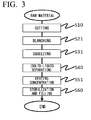
- FIG. 3 is a diagram showing the flow of a production method according to the embodiment 1-3.
- the production method of the embodiment 1-3 includes cutting (S10), blanching (S21), squeezing (S31), solid-liquid separation (S40), heating concentration (S51), and sterilization and filling (S60).
- the odor-reducing heat treatment is performed at least by blanching (S10).
- the odor-imparting heat treatment is performed at least by heating concentration (S51).
- the fractionation of components containing an umami component and an odor component is performed at least by squeezing (S31). Only the features of the production method according to the embodiment 1-3 will be described below.
- the above-described embodiment 1-3 is characterized in that by including the blanching step, it is possible to produce a seasoning in which components related to acrid taste and astringent taste, such as nitric acid and oxalic acid, are reduced.
- the purpose of blanching the cut vegetables is to inactivate enzymes.
- the method for blanching the cut vegetables is not particularly limited, and specific examples include steam blanching and warm water blanching.
- the temperature for blanching the cut vegetables is preferably from 50 to 100°C.
- the blanching time is preferably from 10 minutes to 2 hours.
- temperature for blanching means the temperature of steam or warm water.
- the purpose of heating concentration the liquid of vegetables obtained by squeezing or solid-liquid separation is to improve the handling of the material. By concentrating the material, the volume can be reduced, and the storage cost can be reduced. Another purpose is to enhance the richness. By heating and concentrating the liquid of vegetables obtained by squeezing or solid-liquid separation, a heated odor is provided and the richness becomes strong.
- the heating temperature in the heating concentration process is preferably from 45°C to 100°C.
- the heating concentration process is not particularly limited, but it is preferable to concentrate the liquid of vegetables obtained by squeezing or solid-liquid separation, for example, by 2- to 20-fold.
- the term "koku (richness)" in the present invention is one of sensory characteristics.
- the main element for judging richness is the persistence of flavors, and more preferably, the complexity of flavors is also considered.
- flavour means smell and taste
- the expression "persistence of flavor” means the property of keeping the flavor.
- the expression "complexity of flavor” means a state in which many flavors are felt in a sensory test, but a specific flavor does not stand out and the flavors cannot be clearly separated for classification.
- grassy smell means a grassy smell possessed by cruciferous vegetables.
- components contributing to the grassy smell include 2-hexenal, 1-octene-3-one, dimethyl trisulfide and butyl isothiocyanate.
- the Brix value is not particularly limited in the vegetable seasoning containing a cruciferous vegetable according to the present embodiment, it is preferably 1.0 or more and 60.0 or less.
- the method for measuring degrees Brix may be a known method. For example, it can be measured with an optical refractometer (NAR-3T manufactured by ATAGO Co., Ltd.) by setting the product temperature at the time of measurement to 20°C.
- the pH of the vegetable seasoning containing a cruciferous vegetable according to the present embodiment is not particularly limited, but is preferably from 4.0 to 7.0.
- the pH is more preferably from 5.0 to 7.0.
- the amount of centrifugal precipitation refers to the amount of precipitation when centrifuging a sample under certain conditions which is represented as a volume ratio.
- the measurement method employed in the present embodiment is as follows. That is, 10 ml of a vegetable seasoning containing a cruciferous vegetable is charged into a 10 ml precipitation tube (glass centrifuge test tube with a scale), and after centrifugation for 10 minutes at 3,000 rpm (1,600 ⁇ g), the volume of the precipitate is measured at 20°C.
- the amount of centrifugal precipitation is not particularly limited, the amount of centrifugal precipitation when converted (adjusted) to a Brix degree of 2.9 is preferably 0% or more and less than 30% with respect to the vegetable seasoning as a whole.
- the amount of centrifugation at 2.9 degrees Brix is more preferably 0% or more and less than 5%.
- the amount of centrifugal precipitation when converted (adjusted) to a Brix degree of 2.9 is still more preferably 0% or more and less than 1% with respect to the vegetable seasoning as a whole.
- the method for reducing the amount of centrifugal precipitation may be a known method, and specific examples thereof include removal of pulp content by a sieve, removal of pulp by centrifugation, and the like.
- particle size refers to a value obtained by measuring the major axes of particles.
- a% cumulative particle size refers to a particle size at which the cumulative frequency reaches a% when the cumulative frequency is determined by assuming the total volume of the particle population being 100% in the particle size distribution obtained by the measurement. That is, the 50% cumulative particle size (sometimes abbreviated as D50) refers to the particle size at which the cumulative frequency is 50%. Further, the 90% cumulative diameter (sometimes abbreviated as D90) refers to the particle diameter at which the cumulative frequency is 90%.
- the means for measuring the particle size is a laser diffraction / scattering type particle size distribution measuring device.
- D50 is preferably 0 ⁇ m or more and 250 ⁇ m or less.
- D90 is preferably 0 ⁇ m or more and 700 ⁇ m or less.
- D50 is more preferably 0 ⁇ m or more and 100 ⁇ m or less.
- D90 is more preferably 0 ⁇ m or more and 400 ⁇ m or less.
- the method for producing a cruciferous vegetable seasoning according to the present invention is a production method including:
- the temperature of the aforementioned odor-reducing heat treatment and the odor-imparting heat treatment may be from 45°C to 200°C, and preferably from 75°C to 180°C; the time for the aforementioned odor-reducing heat treatment and the odor-imparting heat treatment may be preferably from 10 to 120 minutes; and the temperature of the fractionation may be from 85 to 98°C.
- the method for producing a cruciferous vegetable seasoning according to the present invention is a production method including:
- the temperature of the aforementioned odor-reducing heat treatment and the odor-imparting heat treatment may be from 45°C to 200°C, and preferably from 75°C to 180°C; and the time for the aforementioned odor-reducing heat treatment and the odor-imparting heat treatment may be preferably from 10 to 120 minutes.
- the method for producing a cruciferous vegetable seasoning according to the present invention is a production method including:
- the temperature of the aforementioned odor-reducing heat treatment may be from 50°C to 100°C; the time for the aforementioned odor-reducing heat treatment may be from 10 minutes to 2 hours; and the temperature of the aforementioned odor-imparting heat treatment may be from 45 to 100°C.
- the food or drink in the second aspect of the present invention is a drinkable or edible product, and examples thereof include beverages, foods, seasonings, raw materials for foods and drinks, squeezed liquids, extracts (extracted products), powders, portions and supplements.
- the cruciferous vegetables in the second aspect of the present invention are the same vegetables as the cruciferous vegetables described in the aforementioned first aspect.
- the raw material of the food or drink in the second aspect may be any one or more of these vegetables.
- the above raw material may be all or part of a portion (flower, leaf or stem) of these vegetables.
- cruciferous vegetable-containing food or drink in the second aspect means a food or drink whose raw material is at least derived from a cruciferous vegetable, and the above food or drink may further contain other raw materials.
- raw materials derived from cruciferous vegetables include cruciferous vegetables and cut products, crushed materials, squeezed liquids, strained lees and extracted products of cruciferous vegetables, or dried products thereof.
- the other raw materials contained are preferably vegetables and are not particularly limited as long as they are vegetables commonly used in the art, and examples thereof include carrot, onion, turnip, Japanese radish, celery, spinach, bell pepper, asparagus, young barley leaf, garland chrysanthemum, Chinese mustard, butterhead lettuce, komatsuna, Angelica keiskei, sweet potato, potato, tomato, mulukhiya, paprika, parsley, celery, Japanese honeywort, lettuce, radish, Perilla frutescens var.
- the raw materials of the above-mentioned food or drink are preferably, in addition to cruciferous vegetables, carrots, onions and celery, the overall taste balance is improved.
- the odor component contributing to the effects of the present invention is at least one component selected from the component (A) (phenylacetaldehyde), the component (B) (2-hexenal), the component (C) (1-octen-3-one), the component (D) (dimethyl trisulfide), and the component (E) (butyl isothiocyanate).
- the odor component may be derived from the raw material or may be incorporated by addition, but a component derived from the raw material is preferable from the viewpoint of avoiding additives.
- the component (A) (phenylacetaldehyde) generally has a characteristic honey-like smell.
- the inventors of the present invention have found that the above component increases by undergoing a heating step. It is presumed that phenylacetaldehyde is generated by heating and breaking down phenylalanine, which is a kind of amino acid.
- the content of the component (A) (phenylacetaldehyde) when the food or drink has a Brix degree of 5.0 is 89.0 ppb or more, preferably 89.0 ppb or more and 116.0 ppb or less, more preferably 89.0 ppb or more and 107.0 ppb or less, and particularly preferably 98.0 ppb or more and 107 ppb or less, with respect to the total mass of the food or drink.
- the component (B) (2-hexenal) generally has a characteristic fresh or grassy smell of grass and leaves, and is contained in vegetables and fruits.
- the content of the component (B) (2-hexenal) when the cruciferous vegetable-containing food or drink has a Brix degree of 5.0 is preferably 0.48 ppb or less, more preferably 0.20 ppb or more and 0.48 ppb or less, and particularly preferably 0.20 ppb or more and 0.40 ppb or less, with respect to the total mass (ppb) of the food or drink.
- the component (C) (1-octen-3-one) generally has a characteristic mushroom-like smell.
- the content of the component (C) (1-octen-3-one) when the food or drink has a Brix degree of 5.0 is preferably 3.87 ppb or less, more preferably 1.38 ppb or more and 3.87 ppb or less, and still more preferably 1.38 ppb or more and 2.80 ppb or less, with respect to the total mass of the food or drink.
- the component (D) (dimethyl trisulfide) generally has a characteristic fresh onion-like smell, and is contained in cruciferous vegetables such as cabbage, broccoli and cauliflower.
- the content of the component (D) (dimethyl trisulfide) when the food or drink has a Brix degree of 5.0 is preferably 25.83 ppb or less, more preferably 6.50 ppb or more and 25.83 ppb or less, and still more preferably 6.50 ppb or more and 15.00 ppb or less, with respect to the total mass of the food or drink.
- the component (E) (butyl isothiocyanate) generally has a pungent smell, and is contained in cruciferous vegetables and the like.
- the content of the component (E) (butyl isothiocyanate) when the food or drink has a Brix degree of 5.0 is preferably 0 ppb or more and 0.04 ppb or less, and more preferably 0 ppb, with respect to the total mass of the food or drink.
- a relatively high content of the component (A) (phenylacetaldehyde) contributes to the effect of the present invention (that is, enhancement of richness).
- problems of the present invention cannot be solved when the component (B) (2-hexenal), the component (C) (1-octen-3-one), the component (D) (dimethyl trisulfide) or the component (E) (butyl isothiocyanate) is contained in a relatively large amount. Therefore, the ratio of the content of the component (A) to the content of the component selected from the components (B) to (E) is an important factor for solving the problems of the present invention.
- the ratio of the contents (ppb) of the odor components (A) to (D) preferably satisfies the conditions of 0 ⁇ (B) / (A) ⁇ 0.00539, 0 ⁇ (C) / (A) ⁇ 0.0435 and 0 ⁇ (D) / (A) ⁇ 0.290.
- the ratio of the contents (ppb) of the odor components (A) to (E) satisfies the conditions of 0.00187 ⁇ (B) / (A) ⁇ 0.00539, 0.0129 ⁇ (C) / (A) ⁇ 0.0435 and 0.0607 ⁇ (D) / (A) ⁇ 0.290, and it is still more preferable that the above conditions are satisfied and the condition of 0 ⁇ (E) / (A) ⁇ 0.00045 is satisfied.
- the "persistence” and “complexity" of the flavors in the present invention are evaluated in a human sensory evaluation test, it is preferable to conduct training inside the panel so as not to cause a difference in criteria among the evaluators. More specifically, the following steps are preferably taken. First, depending on the subjectivity of the panel, a sample having a flavor persistence and complexity (positive control) and a sample without them (negative control) are prepared, and a language development process for each sensory characteristic is conducted among the evaluators. Next, using the specific expressions that appeared in the language development process, discussions are conducted among the evaluators to reach a consensus on the definition of the terms "persistence” and "complexity".
- evaluation criteria for the presence or absence and strength are set, and various test samples are evaluated.
- evaluation criteria for the presence or absence and strength are set, and various test samples are evaluated.
- grassy smell in the second embodiment refers to a grassy smell which is felt from 2-hexenal, dimethyl trisulfide and 1-octene-3-one possessed by cruciferous vegetables, and more specifically, a grassy smell which is further felt from butyl isothiocyanate, in addition to the above-mentioned odor components.
- the Brix value is not particularly limited in the food or drink in the second aspect, it is preferably 1.0 or more and 60.0 or less.
- the Brix degrees can be measured by the same method as in the aforementioned first aspect.
- the cruciferous vegetable-containing food or drink according to the second aspect is not particularly limited as long as it is a production method in which the contents of the components (A) to (E) in the food or drink to be obtained and the content ratio of the components (A) to (E) satisfy the numerical ranges of the present invention.
- it can be suitably produced by appropriately selecting heat treatment conditions, fractionation conditions, concentration conditions and the like in a known production process.
- a specific odor component may be added for production.
- a cruciferous vegetable-containing food or drink is a food or drink containing cut products, crushed products, squeezed liquid, strained lees, and extracted products of the aforementioned cruciferous vegetable, or dried products thereof, or the like, wherein the raw material of the aforementioned food and drink is at least a cruciferous vegetable, and, if desired, a vegetable other than the aforementioned cruciferous vegetable, and preferably at least broccoli, an onion, celery and a carrot; the aforementioned food or drink contains phenylacetaldehyde (component (A)), 2-hexenal (component (B)), 1-octen-3-one (component (C)), and dimethyl trisulfide (component (D)); when a Brix degree of the aforementioned food or drink is converted to 5.0, with respect to the total mass of the aforementioned food or drink, the content of the component (A) is 89.0 ppb or more, preferably
- the aforementioned cruciferous vegetable-containing food or drink may further contain butyl isothiocyanate (component (E)), the content of the component (E) may be more than 0 ppb and 0.04 ppb or less with respect to the total mass of the aforementioned food or drink when a Brix degree of the food and drink is converted to 5.0, and the content ratio of the component (A) to the component (E) may be 0 ⁇ (E) / (A) ⁇ 0.00045.
- component (E) butyl isothiocyanate
- Broccoli was shredded to about 5 mm and extracted at 95°C for 1 h with water of twice the amount of the shredded broccoli.
- the resulting extract was separated into a solid fraction and a liquid fraction by a sieve of 0.5 mm mesh, and the liquid fraction was used as a sample.
- Broccoli was shredded to about 5 mm and roasted at 140°C. Then, the resultant was extracted at 95°C for 1 h with water of twice the amount of the shredded broccoli. The resulting extract was separated into a solid fraction and a liquid fraction by a sieve of 0.5 mm mesh, and the liquid fraction was used as a sample.
- Broccoli was shredded to about 5 mm, squeezed with a juice extractor, and then subjected to hot pack filling.
- Broccoli was shredded to about 5 mm and roasted at 140°C. Then, the resultant was squeezed with a juice extractor, and then subjected to hot pack filling.
- a cabbage was cut into about 2 cm pieces and extracted at 95°C for 1 h with water of twice the amount of the cut cabbage.
- the resulting extract was separated into a solid fraction and a liquid fraction by a sieve of 0.5 mm mesh, and the liquid fraction was used as a sample.
- a cabbage was cut into about 2 cm pieces and roasted at 140°C, and then extracted at 95°C for 1 h with water of twice the amount of the cut cabbage.
- the resulting extract was separated into a solid fraction and a liquid fraction by a sieve of 0.5 mm mesh, and the liquid fraction was used as a sample.
- Broccoli, onions, celery and carrots were cut into about 2 cm pieces and extracted at 95°C for 1 h with hot water of twice the amount of the cut vegetables. After removal of solid fractions, the extract was concentrated in vacuo to a Brix degree of 20. The concentrated sample was diluted with water to a Brix degree of 5.0.
- Broccoli, onions, celery and carrots were cut into about 2 cm pieces, and the cut vegetables were roasted at 140°C and then extracted at 95°C for 1 h with hot water of twice the amount of the cut vegetables. After removal of solid fractions, the extract was concentrated in vacuo to a Brix degree of 20. The concentrated sample was diluted with water to a Brix degree of 5.0.
- a sugar content (Brix) measuring device employed in this measurement is a refractometer (NAR-3T manufactured by Atago Co., Ltd.). The product temperature at the time of measurement was 20°C.
- a pH measuring device employed in this measurement is a pH meter (pH METER F-52 manufactured by HORIBA, Ltd.). The product temperature at the time of measurement was 20°C.
- the "complexity" is felt in a state in which many flavors are felt, but a specific flavor does not stand out and the flavors cannot be clearly separated for classification.
- the identifiability was judged at a significance level (P value) of 5% using the binomial distribution probability (BINOMDIST function) of an individual term, based on the evaluation of each panelist.
- P value significance level
- BINOMDIST function binomial distribution probability
- the odor-imparting heating is performed after or at the same time as the aforementioned odor-reducing heat treatment.
- Broccoli, onions, celery and carrots were cut into about 5 mm pieces and extracted at 90°C or higher with hot water of twice the amount of the cut vegetables. After removal of solid fractions, the extract was concentrated in vacuo to a Brix degree of 20. The concentrated sample was diluted with water to a Brix degree of 5.0 and used as a sample of Comparative Example IB.
- Broccoli, onions, celery and carrots were cut into about 5 mm pieces, and the cut vegetables were roasted, and then extracted at 90°C to 100°C with hot water of twice the amount of the cut vegetables. After removal of solid fractions, the extract was concentrated in vacuo to a Brix degree of 20. The concentrated sample was diluted with water to a Brix degree of 5.0 and used as a sample of Example 1B.
- Broccoli was cut into about 5 mm pieces and extracted at 90°C to 100°C with hot water of twice the amount of the cut vegetable. After removal of solid fractions, the extract was concentrated in vacuo to a Brix degree of 20. The concentrated sample was diluted with water to a Brix degree of 5.0 and used as a sample of Comparative Example 2B.
- Broccoli was cut into about 5 mm pieces, and the cut vegetable was roasted, and then extracted at 90°C to 100°C with hot water of twice the amount of the cut vegetable. After removal of solid fractions, the extract was concentrated in vacuo to a Brix degree of 20. The concentrated sample was diluted with water to a Brix degree of 5.0 and used as a sample of Example 2B.
- a sugar content (Brix) measuring device employed in this measurement is a refractometer (NAR-3T manufactured by Atago Co., Ltd.). The product temperature at the time of measurement was 20°C.
- Odor components were collected in a dedicated Tenax TA tube by the DHS method, and thermal desorption analysis by the TDU-1D-GC / MS system was performed.
- a measurement method of the amino acid concentration employed in this measurement is an HPLC method. More specifically, an amino acid measuring apparatus employed in this measurement is a high-speed amino acid analyzer L-8000 series (manufactured by Hitachi, Ltd.). The measurement conditions are as follows: ammonia filter column: #2650L (inner diameter: 4.6 mm ⁇ 60 mm, manufactured by Hitachi, Ltd.), analytical column: #2622 (inner diameter: 4.6 mm ⁇ 60 mm, manufactured by Hitachi, Ltd.), guard column: #2619 [inner diameter: 4.6 mm ⁇ 60 mm, manufactured by Hitachi, Ltd.], mobile phase: lithium citrate buffer solution, reaction solution: ninhydrin solution, detection wavelength: VIS 570 nm.
- a measuring method of the nucleic acid concentration employed in this measurement is a high performance liquid chromatography (hereinafter sometimes abbreviated as HPLC) method.
- HPLC high performance liquid chromatography
- a measurement method of the nucleic acid concentration employed in this measurement is an HPLC method.
- the specific measurement conditions are as follows.
- a measurement method of the nucleic acid concentration employed in this measurement is an HPLC method.
- the specific measurement conditions are as follows.
- Persistence is felt: a state in which the grassy smell is absent and a honey-like smell is felt after swallowing.
- the base solutions were prepared using standard products of sugars (sucrose, fructose, glucose), organic acids (citric acid, malic acid, pyroglutamic acid) and amino acids (aspartic acid, glutamic acid, arginine), and water.
- An intermediate value between the measured values of Comparative Example 1B and Example 1B described in Table 2B was used as the content of each component.
- the standard products of the odor components (A) to (E) were adjusted with respect to the base solution so as to have component contents of Categories 1B to 6B described in Table 3B below.
- Category 1B was adjusted so as to be equivalent to the component content of Comparative Example 1B
- Category 4B was adjusted so as to be equivalent to the component content of Example 1B.
- a sensory evaluation was performed by a panel trained by the aforementioned sensory evaluation training.
- component (A) The effect on the persistence of the flavor due to an increase of the component involved in the grassy smell was evaluated, where the concentration of phenylacetaldehyde (component (A)) was constant.
- the contents of the components (A), (B), (C), (D) and (E) are: 89.0 ppb or more; 0.48 ppb or less; 3.87 ppb or less; 25.83 ppb or less; and 0.04 ppb or less, respectively, when a Brix degree of the aforementioned cruciferous vegetable-containing food or drink was adjusted to 5.0.
- the present invention is extremely useful industrially because it can provide a cruciferous vegetable seasoning in which the richness is enhanced, a cruciferous vegetable-containing food or drink in which the richness is enhanced, and a method for enhancing richness in a cruciferous vegetable-containing food or drink.
Landscapes
- Chemical & Material Sciences (AREA)
- Health & Medical Sciences (AREA)
- Nutrition Science (AREA)
- Life Sciences & Earth Sciences (AREA)
- Engineering & Computer Science (AREA)
- Food Science & Technology (AREA)
- Polymers & Plastics (AREA)
- Oil, Petroleum & Natural Gas (AREA)
- Seasonings (AREA)
- Preparation Of Fruits And Vegetables (AREA)
- Coloring Foods And Improving Nutritive Qualities (AREA)
- Non-Alcoholic Beverages (AREA)
Applications Claiming Priority (3)
| Application Number | Priority Date | Filing Date | Title |
|---|---|---|---|
| JP2017095879A JP7248377B2 (ja) | 2017-05-12 | 2017-05-12 | アブラナ科野菜調味料及びその製造方法 |
| JP2017096137A JP6985817B2 (ja) | 2017-05-15 | 2017-05-15 | アブラナ科野菜含有飲食品、及び、アブラナ科野菜含有飲食品のコクを強化する方法 |
| PCT/JP2018/017928 WO2018207818A1 (fr) | 2017-05-12 | 2018-05-09 | Assaisonnement à base de légume crucifère et son procédé de fabrication, aliment ou boisson contenant un légume crucifère, et procédé d'amélioration du goût riche d'un aliment ou d'une boisson contenant un légume crucifère |
Publications (2)
| Publication Number | Publication Date |
|---|---|
| EP3622832A1 true EP3622832A1 (fr) | 2020-03-18 |
| EP3622832A4 EP3622832A4 (fr) | 2021-03-03 |
Family
ID=64105402
Family Applications (1)
| Application Number | Title | Priority Date | Filing Date |
|---|---|---|---|
| EP18798811.8A Pending EP3622832A4 (fr) | 2017-05-12 | 2018-05-09 | Assaisonnement à base de légume crucifère et son procédé de fabrication, aliment ou boisson contenant un légume crucifère, et procédé d'amélioration du goût riche d'un aliment ou d'une boisson contenant un légume crucifère |
Country Status (4)
| Country | Link |
|---|---|
| US (1) | US11805796B2 (fr) |
| EP (1) | EP3622832A4 (fr) |
| CN (1) | CN110753498B (fr) |
| WO (1) | WO2018207818A1 (fr) |
Cited By (1)
| Publication number | Priority date | Publication date | Assignee | Title |
|---|---|---|---|---|
| EP4501134A4 (fr) * | 2022-03-31 | 2026-04-01 | Fuji Oil Co Ltd | Agent de masquage |
Families Citing this family (3)
| Publication number | Priority date | Publication date | Assignee | Title |
|---|---|---|---|---|
| CN115486500A (zh) * | 2021-06-20 | 2022-12-20 | 任彦杰 | 一种药食同源的饮品 |
| JP7621909B2 (ja) * | 2021-08-11 | 2025-01-27 | カゴメ株式会社 | 野菜含有調味料、及びその製造方法 |
| WO2024048785A1 (fr) | 2022-09-02 | 2024-03-07 | 天野エンザイム株式会社 | Procédé de production de phénylacétaldéhyde et son application |
Family Cites Families (25)
| Publication number | Priority date | Publication date | Assignee | Title |
|---|---|---|---|---|
| JPS57174068A (en) * | 1981-04-16 | 1982-10-26 | Ajinomoto Co Inc | Preparation of oil having taste and flavor |
| JPS6070046A (ja) * | 1983-09-28 | 1985-04-20 | Ajinomoto Co Inc | 野菜エキスの製造法 |
| JPS6244144A (ja) * | 1985-08-20 | 1987-02-26 | Ajinomoto Co Inc | ロ−スト野菜の製造方法 |
| JPH08112073A (ja) * | 1994-10-18 | 1996-05-07 | Kagome Co Ltd | クロロフィル含有野菜の搾汁液製造方法 |
| JP3645662B2 (ja) * | 1996-07-31 | 2005-05-11 | カゴメ株式会社 | 野菜ジュースの製造方法 |
| JPH10313834A (ja) | 1997-05-15 | 1998-12-02 | Nippon Derumonte Kk | 野菜搾汁液の製造方法 |
| JP3585209B2 (ja) | 1997-10-27 | 2004-11-04 | タカラバイオ株式会社 | 焙炒野菜類 |
| JP3944323B2 (ja) * | 1998-04-22 | 2007-07-11 | 株式会社林原生物化学研究所 | ノンフライ調理法とその用途 |
| JP2001204405A (ja) * | 2000-01-31 | 2001-07-31 | Gun Ei Chem Ind Co Ltd | キャベツシロップの製造方法及び用途 |
| JP3676178B2 (ja) * | 2000-03-29 | 2005-07-27 | 株式会社 伊藤園 | アブラナ科野菜の処理方法、アブラナ科野菜飲食物の製造方法及びアブラナ科野菜飲食物 |
| JP2005015684A (ja) | 2003-06-27 | 2005-01-20 | Kiyomitsu Kawasaki | 野菜フレーバーの製造方法 |
| WO2005000028A1 (fr) * | 2003-06-30 | 2005-01-06 | Antonov, Andrey Dimitrov | Produit a base de pain et methode de production |
| JP3771919B2 (ja) | 2003-10-01 | 2006-05-10 | 株式会社 伊藤園 | 硝酸イオンを低減した野菜ジュース等の製造方法 |
| JP2007068457A (ja) * | 2005-09-06 | 2007-03-22 | Q P Corp | 混ぜご飯の素及びそれを用いた混ぜご飯 |
| WO2007045566A1 (fr) * | 2005-10-21 | 2007-04-26 | Symrise Gmbh & Co. Kg | Melanges ayant un gout sale |
| JP2007306904A (ja) | 2006-05-17 | 2007-11-29 | Shiro Yamashita | 焼き果菜ジュースの製造方法 |
| JP5052576B2 (ja) * | 2009-09-04 | 2012-10-17 | 株式会社ラムラ | 香辛料の製造方法 |
| JP2012085607A (ja) | 2010-10-22 | 2012-05-10 | Kirin Kyowa Foods Co Ltd | 調理感付与剤およびその製造方法 |
| JP6046411B2 (ja) * | 2012-08-03 | 2016-12-14 | ヱスビー食品株式会社 | チューブ入り半練り状調味料 |
| JP2014055201A (ja) | 2012-09-11 | 2014-03-27 | Ogawa & Co Ltd | 野菜フレーバーの製造方法 |
| JP6041910B2 (ja) | 2015-01-19 | 2016-12-14 | カゴメ株式会社 | アブラナ科野菜含有飲料及びその製造方法、並びにアブラナ科野菜含有飲料に対する新鮮な香味の付与方法 |
| JP6702697B2 (ja) | 2015-11-18 | 2020-06-03 | 文化シヤッター株式会社 | ドア構造 |
| JP6084674B1 (ja) | 2015-11-20 | 2017-02-22 | 株式会社ケーヒン | 内燃機関制御装置 |
| JP6368739B2 (ja) | 2016-05-31 | 2018-08-01 | カゴメ株式会社 | アブラナ科野菜含有飲料及びその製造方法、並びにアブラナ科野菜含有飲料に対する新鮮な香味の付与方法 |
| US20160376263A1 (en) * | 2016-07-26 | 2016-12-29 | Senomyx, Inc. | Bitter taste modifiers including substituted 1-benzyl-3-(1-(isoxazol-4-ylmethyl)-1h-pyrazol-4-yl)imidazolidine-2,4-diones and compositions thereof |
-
2018
- 2018-05-09 WO PCT/JP2018/017928 patent/WO2018207818A1/fr not_active Ceased
- 2018-05-09 US US16/611,376 patent/US11805796B2/en active Active
- 2018-05-09 CN CN201880030678.0A patent/CN110753498B/zh active Active
- 2018-05-09 EP EP18798811.8A patent/EP3622832A4/fr active Pending
Cited By (1)
| Publication number | Priority date | Publication date | Assignee | Title |
|---|---|---|---|---|
| EP4501134A4 (fr) * | 2022-03-31 | 2026-04-01 | Fuji Oil Co Ltd | Agent de masquage |
Also Published As
| Publication number | Publication date |
|---|---|
| CN110753498A (zh) | 2020-02-04 |
| WO2018207818A1 (fr) | 2018-11-15 |
| US11805796B2 (en) | 2023-11-07 |
| US20200154746A1 (en) | 2020-05-21 |
| EP3622832A4 (fr) | 2021-03-03 |
| CN110753498B (zh) | 2023-06-06 |
Similar Documents
| Publication | Publication Date | Title |
|---|---|---|
| US11805796B2 (en) | Cruciferous vegetable seasoning and method for manufacturing same, food or beverage containing cruciferous vegetable, and method for enhancing rich taste of food or beverage containing cruciferous vegetable | |
| EP4066652B1 (fr) | Aliment ou boisson contenant de l'acide acétique | |
| EP4070668B1 (fr) | Aliment ou boisson contenant de l'acide acétique | |
| JP5989301B2 (ja) | 調味料 | |
| JP2025104360A (ja) | 野菜含有調味料、及び野菜含有調味料の製造方法 | |
| EP3915395B1 (fr) | Aliment en poudre contenant une plante comestible, et produit alimentaire ou boisson le contenant | |
| JP7747706B2 (ja) | アブラナ科野菜調味料及びその製造方法 | |
| JP2024115560A (ja) | 野菜含有調味料、及び野菜含有調味料の製造方法 | |
| JP6985817B2 (ja) | アブラナ科野菜含有飲食品、及び、アブラナ科野菜含有飲食品のコクを強化する方法 | |
| JP6770773B1 (ja) | 甘い風味が増強された乾燥植物粉末及び飲食品 | |
| EP4129086A1 (fr) | Composition conditionnée en récipients et procédé d'amélioration d'arôme de jus d'agrume | |
| EP4190171B1 (fr) | Assaisonnement liquide contenant des ingrédients végétaux comestibles et son procédé de production | |
| JP7709561B2 (ja) | 野菜含有調味料、及びその製造方法 | |
| EP3997987B1 (fr) | Produit alimentaire contenant une substance végétale chauffée, produit alimentaire contenant une substance végétale traitée cuite, son procédé de production et procédé de réduction du goût indésirable d'un légume | |
| EP4691264A1 (fr) | Composition d'assaisonnement chauffée et composition aromatisante | |
| WO2023145921A1 (fr) | Produit transformé d'oignon, et procédé de fabrication de celui-ci | |
| JPWO2020208857A1 (ja) | デンプン含有植物由来の粉末を含有する粉末状食品 | |
| WO2020202348A1 (fr) | Aliment assaisonné contenant un solide végétal et ayant un goût acidulé, son procédé de production, et procédé destiné à conférer un goût acidulé à un aliment assaisonné contenant un solide végétal |
Legal Events
| Date | Code | Title | Description |
|---|---|---|---|
| STAA | Information on the status of an ep patent application or granted ep patent |
Free format text: STATUS: THE INTERNATIONAL PUBLICATION HAS BEEN MADE |
|
| PUAI | Public reference made under article 153(3) epc to a published international application that has entered the european phase |
Free format text: ORIGINAL CODE: 0009012 |
|
| STAA | Information on the status of an ep patent application or granted ep patent |
Free format text: STATUS: REQUEST FOR EXAMINATION WAS MADE |
|
| 17P | Request for examination filed |
Effective date: 20191119 |
|
| AK | Designated contracting states |
Kind code of ref document: A1 Designated state(s): AL AT BE BG CH CY CZ DE DK EE ES FI FR GB GR HR HU IE IS IT LI LT LU LV MC MK MT NL NO PL PT RO RS SE SI SK SM TR |
|
| AX | Request for extension of the european patent |
Extension state: BA ME |
|
| DAV | Request for validation of the european patent (deleted) | ||
| DAX | Request for extension of the european patent (deleted) | ||
| RIC1 | Information provided on ipc code assigned before grant |
Ipc: A23L 27/10 20160101AFI20201012BHEP Ipc: A23L 19/00 20160101ALI20201012BHEP |
|
| A4 | Supplementary search report drawn up and despatched |
Effective date: 20210201 |
|
| RIC1 | Information provided on ipc code assigned before grant |
Ipc: A23L 27/10 20160101AFI20210126BHEP Ipc: A23L 19/00 20160101ALI20210126BHEP |
|
| STAA | Information on the status of an ep patent application or granted ep patent |
Free format text: STATUS: EXAMINATION IS IN PROGRESS |
|
| 17Q | First examination report despatched |
Effective date: 20240507 |