EP3623323B1 - Procédé et dispositif de manipulation des marchandises, des articles et / ou des emballages - Google Patents
Procédé et dispositif de manipulation des marchandises, des articles et / ou des emballages Download PDFInfo
- Publication number
- EP3623323B1 EP3623323B1 EP19179990.7A EP19179990A EP3623323B1 EP 3623323 B1 EP3623323 B1 EP 3623323B1 EP 19179990 A EP19179990 A EP 19179990A EP 3623323 B1 EP3623323 B1 EP 3623323B1
- Authority
- EP
- European Patent Office
- Prior art keywords
- manipulator
- piece goods
- cycle
- formation
- piece
- Prior art date
- Legal status (The legal status is an assumption and is not a legal conclusion. Google has not performed a legal analysis and makes no representation as to the accuracy of the status listed.)
- Active
Links
Images



Classifications
-
- B—PERFORMING OPERATIONS; TRANSPORTING
- B65—CONVEYING; PACKING; STORING; HANDLING THIN OR FILAMENTARY MATERIAL
- B65G—TRANSPORT OR STORAGE DEVICES, e.g. CONVEYORS FOR LOADING OR TIPPING, SHOP CONVEYOR SYSTEMS OR PNEUMATIC TUBE CONVEYORS
- B65G61/00—Use of pick-up or transfer devices or of manipulators for stacking or de-stacking articles not otherwise provided for
-
- B—PERFORMING OPERATIONS; TRANSPORTING
- B65—CONVEYING; PACKING; STORING; HANDLING THIN OR FILAMENTARY MATERIAL
- B65G—TRANSPORT OR STORAGE DEVICES, e.g. CONVEYORS FOR LOADING OR TIPPING, SHOP CONVEYOR SYSTEMS OR PNEUMATIC TUBE CONVEYORS
- B65G47/00—Article or material-handling devices associated with conveyors; Methods employing such devices
- B65G47/02—Devices for feeding articles or materials to conveyors
- B65G47/04—Devices for feeding articles or materials to conveyors for feeding articles
- B65G47/06—Devices for feeding articles or materials to conveyors for feeding articles from a single group of articles arranged in orderly pattern, e.g. workpieces in magazines
- B65G47/08—Devices for feeding articles or materials to conveyors for feeding articles from a single group of articles arranged in orderly pattern, e.g. workpieces in magazines spacing or grouping the articles during feeding
- B65G47/084—Devices for feeding articles or materials to conveyors for feeding articles from a single group of articles arranged in orderly pattern, e.g. workpieces in magazines spacing or grouping the articles during feeding grouping articles in a predetermined 2-dimensional pattern
- B65G47/086—Devices for feeding articles or materials to conveyors for feeding articles from a single group of articles arranged in orderly pattern, e.g. workpieces in magazines spacing or grouping the articles during feeding grouping articles in a predetermined 2-dimensional pattern cubiform articles
-
- B—PERFORMING OPERATIONS; TRANSPORTING
- B65—CONVEYING; PACKING; STORING; HANDLING THIN OR FILAMENTARY MATERIAL
- B65G—TRANSPORT OR STORAGE DEVICES, e.g. CONVEYORS FOR LOADING OR TIPPING, SHOP CONVEYOR SYSTEMS OR PNEUMATIC TUBE CONVEYORS
- B65G47/00—Article or material-handling devices associated with conveyors; Methods employing such devices
- B65G47/22—Devices influencing the relative position or the attitude of articles during transit by conveyors
- B65G47/26—Devices influencing the relative position or the attitude of articles during transit by conveyors arranging the articles, e.g. varying spacing between individual articles
-
- B—PERFORMING OPERATIONS; TRANSPORTING
- B65—CONVEYING; PACKING; STORING; HANDLING THIN OR FILAMENTARY MATERIAL
- B65G—TRANSPORT OR STORAGE DEVICES, e.g. CONVEYORS FOR LOADING OR TIPPING, SHOP CONVEYOR SYSTEMS OR PNEUMATIC TUBE CONVEYORS
- B65G57/00—Stacking of articles
- B65G57/02—Stacking of articles by adding to the top of the stack
- B65G57/16—Stacking of articles of particular shape
- B65G57/20—Stacking of articles of particular shape three-dimensional [3D], e.g. cubiform or cylindrical
- B65G57/22—Stacking of articles of particular shape three-dimensional [3D], e.g. cubiform or cylindrical in layers each of predetermined arrangement
-
- B—PERFORMING OPERATIONS; TRANSPORTING
- B65—CONVEYING; PACKING; STORING; HANDLING THIN OR FILAMENTARY MATERIAL
- B65G—TRANSPORT OR STORAGE DEVICES, e.g. CONVEYORS FOR LOADING OR TIPPING, SHOP CONVEYOR SYSTEMS OR PNEUMATIC TUBE CONVEYORS
- B65G47/00—Article or material-handling devices associated with conveyors; Methods employing such devices
- B65G47/22—Devices influencing the relative position or the attitude of articles during transit by conveyors
- B65G47/24—Devices influencing the relative position or the attitude of articles during transit by conveyors orientating the articles
-
- B—PERFORMING OPERATIONS; TRANSPORTING
- B65—CONVEYING; PACKING; STORING; HANDLING THIN OR FILAMENTARY MATERIAL
- B65G—TRANSPORT OR STORAGE DEVICES, e.g. CONVEYORS FOR LOADING OR TIPPING, SHOP CONVEYOR SYSTEMS OR PNEUMATIC TUBE CONVEYORS
- B65G47/00—Article or material-handling devices associated with conveyors; Methods employing such devices
- B65G47/22—Devices influencing the relative position or the attitude of articles during transit by conveyors
- B65G47/26—Devices influencing the relative position or the attitude of articles during transit by conveyors arranging the articles, e.g. varying spacing between individual articles
- B65G47/30—Devices influencing the relative position or the attitude of articles during transit by conveyors arranging the articles, e.g. varying spacing between individual articles during transit by a series of conveyors
- B65G47/31—Devices influencing the relative position or the attitude of articles during transit by conveyors arranging the articles, e.g. varying spacing between individual articles during transit by a series of conveyors by varying the relative speeds of the conveyors forming the series
Definitions
- the present invention relates to a method for handling piece goods, articles and/or containers for the purpose of forming palletizable layers with the features of independent method claim 1.
- the invention relates to a device for handling piece goods, articles and/or containers with the features of claim 10.
- piece goods can be brought together by bringing them into a two-dimensional formation (block formation, e.g. pallet layer).
- a roller conveyor can be supplied linearly from one lane or from several lanes.
- the piece goods can be turned in front of the roller conveyor or first on the roller conveyor as required and mechanically arranged on the roller conveyor in the required position using stop points.
- the piece goods positioned in this way can then be pushed off the roller conveyor orthogonally to the direction of transport.
- the inflow, arrangement and pushing off of the piece goods can be viewed as one cycle. At least one cycle is required to put together a layer, but normally several cycles are required.
- the partially discontinuous conveying with its relatively abrupt changes in speed or direction causes correspondingly high mechanical stress on the piece goods, which can be detrimental to the gentle processing of the piece goods.
- EP 2 662 293 A1 describes a system for forming a layer of packages to be palletized.
- the packages are pushed together in the last conveyor section before the grouping module so that the packages enter the grouping module essentially without gaps. Cycles are then formed.
- the system includes a gate for dosing the incoming packages.
- the cycles formed in this way are then handled by a suitable manipulator, which in particular records the package cycles formed beforehand.
- the disclosure document EN 10 2016 124 250 A1 describes a device according to the preamble of device claim 10 and a method according to the preamble of method claim 1 for handling moving piece goods.
- the manipulator detects Cycles of piece goods from the incoming closed and/or gapless formation and separates them spatially.
- the object of the invention is to provide a method and a device for handling piece goods, articles and/or containers, which have an increased throughput compared to known methods and devices for layer formation and, in particular, operate in a process-reliable and as error-free as possible.
- the invention relates to a method and a device for handling piece goods, articles and/or containers for the purpose of forming palletizable layers consisting of several piece goods, articles and/or containers.
- the method that can be carried out by means of the device provides that in several successive method steps for forming a palletizable layer, cycles, each comprising at least one piece of goods, are brought into a relative target position and/or target orientation within a grouping module, wherein the piece of goods are brought into an arrangement relative to one another that essentially corresponds to the arrangement of the respective piece of goods within the palletizable layer to be formed.
- cycle which is used in the present context to define the method steps according to the invention, does not necessarily mean an entire layer, but rather is used to characterize a grouping of articles, piece goods or containers that can be grasped or detected simultaneously by means of a manipulator or gripper head or the like within a grouping module.
- cycle can mean at least a single piece of goods, a single article or a single container, because the manipulator, gripper head or similar gripping device located in the grouping module can grasp or detect several piece goods, articles or containers in one go, or optionally just a single piece of goods, an article or a single container, in order to move and/or rotate it and bring it into a desired target position of the desired layer pattern.
- Piece goods can be articles, packages, container combinations, bundles, cartons or similar that are moved in a row one after the other.
- Piece goods can be articles, packages, container combinations, bundles, cartons or similar that are moved in a row one after the other.
- a plurality of identical or different articles are combined into a bundle or mixed bundle by means of cardboard packaging, strapping or multiple strappings, film packaging or the like.
- a plurality of beverage containers that are held together, for example, by shrink wrapping, strapping or multiple strapping bands can each form a piece goods item.
- the piece goods that are moved in at least one row one after the other can be designed the same or differently depending on the requirements of the subsequent handling devices.
- the device comprises at least one transport device for conveying the piece goods in one or more rows in one transport direction.
- the at least two pieces of piece goods that are moved in a row without gaps or with minimal gaps and/or are conveyed to an area - in particular called a manipulation area or detection area or movement area - are preferably transported as a closed formation.
- closed formation refers to a largely unbroken sequence of piece goods that are transported one after the other.
- the closed formation in the sense of the present invention can have a finite length and comprise a limited number of piece goods, after which a gap and such a gap can be followed by another such formation that is subsequently transported. Such a sequence can be repeated, possibly several times, multiple times or in an indefinite number.
- the closed formation can also be transported as an endless formation that has no interruption and comprises any number of piece goods, articles or containers transported one after the other.
- the at least one transport device transports the piece goods in one or more rows in a closed and/or gap-free formation to a grouping module with at least one horizontal conveyor and at least one manipulator for the piece goods.
- the manipulator detects one cycle at a time, comprising at least one piece of goods that has entered its detection area, and brings this cycle into a defined target position and/or target orientation in accordance with the specified Layer arrangement. This creates a so-called prepared palletizable layer, in which there may still be gaps between the piece goods that make up the individual cycles. These gaps must be removed before the actual palletizing step, for example by means of a subsequent pre-grouping.
- the method for forming a respective palletizable layer provides for at least one method step in which the manipulator clamps and/or force- and/or form-fits a first cycle, comprising at least one piece of goods, from the formation entering the grouping module via the transport device, spatially separates it from the formation and brings it into a first defined relative target position and/or target orientation with respect to the subsequent piece of goods in the formation.
- At least one further method step is provided, in which a second cycle, comprising at least one piece of goods, is formed within the grouping module, spaced apart from the subsequent pieces of goods in the formation.
- this second cycle or the at least one piece of goods that can form this cycle is detected by the manipulator and brought to a second defined relative target position and/or target orientation within the grouping module.
- first cycle and a second cycle shown here is not necessarily essential to the invention, but rather depends in particular on the layer scheme to be created.
- a second cycle could first be separated from the formation within the grouping module and captured by the manipulator and brought into the corresponding target position and/or target orientation, and only in a later process step could a first cycle be separated directly from the formation by the manipulator.
- first cycle be separated directly from the formation by the manipulator.
- second cycle is separated only once within the grouping module and captured by the manipulator and brought into the corresponding target position and/or target orientation before further first cycles are formed by the manipulator.
- first cycle comprising one piece of goods can be detected by the manipulator, spatially separated and positioned
- second cycle a first cycle comprising three pieces of goods can be detected by the manipulator, spatially separated and positioned, while at the same time a second cycle comprising three pieces of goods is separated from the formation, which is detected by the manipulator in a subsequent method step and positioned accordingly, or similar.
- the manipulator By spacing the second cycle upstream from the following items of the formation, additional freedom of movement is provided for the manipulator. This means that the manipulator can, for example, start rotating a second cycle as soon as it detects it. The distance between the items of the second cycle and the following items of the formation can prevent a collision.
- the at least one transport device has a basic feed speed in the transport direction, which is also referred to below as the transport speed.
- the horizontal conveyor device has a basic conveying speed in the transport direction, which is also referred to below as the conveying speed.
- the transport speed of the transport device and the conveying speed of the horizontal conveyor device are largely or almost the same, so that a synchronous run can be spoken of.
- the piece goods entering the grouping module are generally fed further through the horizontal conveyor device in the transport direction at an unchanged speed before being picked up by the manipulator.
- the speeds of the feeding transport device and the movement sequences of the manipulator are controlled by a control device that is designed accordingly and/or equipped with appropriate programs.
- the control device has Information on the cycles to be formed and their target positions and/or target orientations to create the desired palletizable position.
- the formation of the second cycle takes place by at least a short-term delay of the at least one transport device arranged upstream of the grouping module. This creates a distance between the piece goods of the formation already arranged within the grouping module, in particular on the horizontal conveyor device of the grouping module, and the piece goods of the formation following on the transport device, since the piece goods on the horizontal conveyor device are moved on at an unchanged speed.
- the manipulator is moved at least briefly in the transport direction at a speed that is greater than or equal to the basic conveying speed of the horizontal conveyor when the piece goods are picked up, either as a first cycle directly from the formation or as a second cycle already spaced from the formation when they are brought into the target position and/or target alignment.
- the piece goods of the first cycle are spaced apart from the piece goods following behind in the formation and the piece goods of the second take are spaced even further apart from the piece goods following behind in the formation.
- a delay in the feeding transport device takes place after feeding a number of piece goods that depends on the layer scheme to be created.
- the feeding of further piece goods is delayed after completion of a palletizable layer so that the palletizable layer can be removed from the grouping module by suitable means and fed to further processing modules, for example a pre-grouping and/or a palletizer.
- the control device of the device controls the at least one transport device and/or the at least one manipulator for clamping and/or force-fitting and/or form-fitting detection of a first cycle or a second cycle, each comprising at least one piece of goods, if necessary for spatially separating the first cycle from the closed formation and for bringing the first cycle or the second cycle into the respectively defined target position and/or target orientation.
- the control device has and/or has stored information on a grouping to be formed from a large number of piece of goods for a palletizable position.
- the respective target positions and/or target orientations of the piece of goods form part of the information and assign a respective specific position and/or relative orientation in the respective grouping to the respective at least one piece of goods and the respective piece of goods arranged at the front.
- the control device contains or has stored information on the first cycles or second cycles to be picked up and positioned, as well as information on the movement sequence and the corresponding space requirement of the manipulator.
- information on the first cycles or second cycles to be picked up and positioned as well as information on the movement sequence and the corresponding space requirement of the manipulator.
- control device controls an at least short-term reduction in the transport speed of the transport device for forming a second cycle, comprising at least one piece of goods, within the grouping module, in order to thereby separate the at least one piece of goods already arranged on the horizontal conveyor device within the grouping module from the piece of goods of the formation following on the transport device and thereby generate the corresponding second cycle within the second grouping module.
- control device regulates whether the cycle formation takes place before the piece goods are picked up by the manipulator by means of a delay in the transport speed of the incoming transport device or when the piece goods are picked up by the manipulator.
- a suitable detection device is assigned to the grouping module, which detects the number of piece goods entering in formation on the horizontal conveyor.
- the detection device is preferably coupled to the control device and transmits the detected data to it.
- imaging sensors are suitable for this, which can recognize the individual piece goods, making it possible to determine the number of piece goods entering the grouping module.
- the manipulator grasps the piece goods of the respective cycle symmetrically or asymmetrically. It is provided that at least one first vertical plane of symmetry defined by the piece goods grasped by the at least two clamping and/or gripping means of the at least one manipulator and oriented approximately perpendicular to a transport direction of the piece goods and/or a longitudinal extension direction of the closed formation is spaced from a second vertical plane of symmetry aligned approximately parallel thereto, which is defined by the manipulator or by its clamping and/or gripping means.
- the piece of goods grasped by the manipulator is not grasped and positioned centrally or symmetrically to the vertical center and/or rotation axis of the manipulator or its clamping and/or gripping means, while it is moved and/or brought in the direction of the target position, possibly with simultaneous rotation.
- This described occurrence of a distance between the described vertical planes of symmetry can also be referred to as asynchronous picking up or as asynchronous detection or generally as asynchronous processing of the piece goods to be picked up and/or positioned and/or aligned, in particular because this does not involve a complete loading of the manipulator or a complete loading or use of the maximum space available between the gripper jaws or within the gripper head for piece goods to be picked up and/or gripped, but only a partial loading, partial detection and/or partial use of the loading and/or pick-up capacity of the manipulator or its clamping and/or gripping elements.
- Synchronous or symmetrical picking can be said to occur when these planes of symmetry coincide or almost coincide. This is also referred to as complete and/or symmetrical loading of the manipulator with several items of goods.
- piece goods are fed to the grouping module and in particular to the detection area of the at least one manipulator in at least two parallel rows.
- the two rows can be fed via a common transport device or via two separate, in particular individually controllable transport devices.
- it is possible for a multi-row It is therefore possible to control the individual rows individually and, in particular, to delay the feed of the piece goods when required to form second cycles.
- the movement of a cycle gripped by the manipulator in the transport direction can be delayed at least temporarily compared to the conveying speed of the horizontal conveyor.
- it can be provided, for example, that the piece goods positioned in this way are grasped again by the manipulator in a later process step and brought into a final target position and/or target alignment.
- a temporary deceleration compared to the conveying speed of the horizontal conveyor and/or a temporary synchronous movement with a speed corresponding to the conveying speed of the horizontal conveyor and/or a temporary acceleration compared to the conveying speed of the horizontal conveyor in the transport direction is provided.
- collision problems after the piece goods have been grasped by the gripper movably suspended on the manipulator, preferably formed by a so-called tripod or parallel kinematic robot, are avoided or at least significantly reduced with the subsequent piece goods.
- the collision problem arises in particular when the piece goods grasped by the manipulator are also or simultaneously rotated by it.
- the collision problem can be reduced by the gaps created within the grouping module before the manipulator grasps them.
- the method according to the invention can be carried out, for example, in the following chronological sequence, in which case piece goods, articles or containers moved in at least one row one behind the other run through a handling device that is suitable and equipped for carrying out the method and is manipulated there, i.e. grasped, moved, rotated and positioned in this way.
- a handling device suitable for carrying out the method according to the invention and appropriately equipped comprises in particular a first transport device, via which immediately successive piece goods are transported in a row without interruption and/or at a continuous transport speed to a grouping module with at least one manipulator, in particular into a detection area of the at least one manipulator of the handling device.
- the so-called detection range refers in particular to the maximum and/or the program-controlled movement range of the manipulator.
- the detection range or its outer spatial limitation can be larger than the outer limits of the horizontal conveyor of the grouping module, on whose approximately horizontal upper side the piece goods are conveyed and/or positioned and/or moved by means of the manipulator.
- the detection range of the manipulator is the sensible movement range in which the piece goods to be collected can be located and/or in which the piece goods to be deposited can be positioned.
- the transport device is, for example, at least one conveyor belt or at least one other suitable conveyor device on which the piece goods are preferably transported (each) in a single row, with no or only minor gaps, possibly due to the process, between each piece of goods that directly follow one another.
- the transport device can be formed by an endlessly rotating conveyor belt, an endlessly rotating conveyor chain or the like, so that the piece goods can be delivered to and transported to the horizontal conveyor device.
- the piece goods located in a row on the transport device preferably enter the detection area of the manipulator at a transport speed in a so-called closed formation.
- Piece goods in the sense of the present invention or the described embodiment can be, for example, individual articles, packages or containers.
- Packages or containers can be, for example, shrink-wrapped containers and/or strapped containers or the like, whereby normally several articles such as containers, liquid and/or beverage containers in particular are combined into containers by means of outer packaging in the form of strapping, shrink-wrapped packaging or the like.
- a horizontal conveyor can normally be assigned to the detection area of the manipulator, the surface of which carries the piece goods moving at a speed.
- the speed of the horizontal conveyor can correspond to the transport speed of the incoming transport device.
- the transport speed of the incoming transport device and the speed of the horizontal conveyor can also differ slightly, provided that it can be guaranteed that the uninterrupted transport of the piece goods to the horizontal conveyor is maintained.
- the piece goods arriving in series and/or formation via the transport device can, at least at different transport speeds, be pushed onto the horizontal conveyor and transported further without interruption by the dynamic pressure of the following piece goods that may arise due to the higher transport speed of the feed or the feeding belt.
- it is necessary to counteract this dynamic pressure by means of suitable Measures to control or reduce friction e.g. by means of a rubberized conveyor belt of the horizontal conveyor and/or by means of a rubberized conveyor belt of the incoming transport device, optionally also by means of a so-called braking belt located between the transport device and the horizontal conveyor, which is characterized by a surface supporting the piece goods with a particularly high coefficient of friction.
- the manipulator is designed and equipped for clamping and/or form-fitting and/or force-fitting acceptance of piece goods within the detection area.
- the manipulator detects and picks up a cycle predetermined for the layer formation, whereby a cycle in the present embodiment and also in connection with the present invention comprises a defined number of piece goods.
- the manipulator can pick up a first cycle comprising three piece goods arranged one behind the other and arriving in a closed formation, after which this first cycle can be separated from the single-row formation of the piece goods.
- the manipulator then transfers the first cycle to a target position and/or target orientation, in particular to a first target position on the horizontal conveyor.
- the first cycle can, for example, be shifted laterally relative to the piece goods of the incoming formation and also be further spaced from the formation of the piece goods in the transport direction.
- a lateral offset is achieved in particular by the manipulator applying an additional movement component perpendicular to the transport direction to the piece goods of the picked-up first cycle.
- the spacing in the transport direction is achieved by the manipulator applying an additional speed component to the picked-up piece goods of the first cycle in the transport direction or imposing such an additional speed component on them.
- the part of the manipulator intended for transferring the at least one piece of goods picked up by the manipulator to the target position and/or target orientation can be, for example, a movable tool head, a gripper head or the like, which is held and mounted on movably mounted cantilever arms, which can in turn typically be mounted fixedly to a frame or the like.
- a manipulator suspension or manipulator arrangement also known as a parallel kinematics arrangement - enables the desired mobility of the gripper head (also: the manipulator), which can grasp, move, position, place, rotate, etc. the piece of goods in the desired manner in order to be able to approach the respective target positions and/or target orientations for the piece of goods.
- the manipulator can be formed, for example, by a gripper head with laterally adjustable and openable clamping jaws or the like, or can comprise such a gripper head with lateral clamping jaws, which can typically be adjusted against each other when gripping the piece goods in order to grip or clamp the piece goods in a form-fitting and/or force-fitting manner, whereas the clamping jaws can be opened again when the target position is reached.
- the arrangement of the piece goods captured by the manipulator 5 in several successive process steps in defined target positions and/or target orientations on the horizontal conveyor takes place in particular on the basis of a defined layer schemes or with regard to a defined layer scheme for forming a layer that can be palletized.
- a layer scheme is understood to mean in particular the relative arrangement of a large number of piece goods within a layer to be palletized. There may still be gaps between the piece goods in their respective target position and/or target orientation on the horizontal conveyor, which are no longer present in the finished end position according to the layer scheme.
- a module e.g. a so-called pre-grouping, can be provided adjacent to the horizontal conveyor, in which the piece goods arranged by the manipulator in a relative position to one another are pushed together sideways, creating the finished end position, which can then be transferred to a pallet.
- At least one process step is provided in which a second cycle, comprising at least one piece of goods, is first formed within the grouping module, spaced apart from the subsequent piece of goods in the formation. This is preferably achieved by braking the transport device to a reduced transport speed, at least for a short time.
- a second cycle comprising, for example, two or three piece of goods that are already on the horizontal conveyor device, is spatially separated from the subsequent piece of goods in the formation.
- a gap is formed between the piece of goods in the second cycle and the subsequent piece of goods in the formation.
- the spaced second cycle can now be detected by the manipulator and moved to a second target position and target orientation by rotating it by approximately 90° and accelerating in the transport direction.
- the delay of the transport device within the grouping module means that the second cycle to be positioned is separated from the formation and at least slightly spaced apart before it is picked up by the manipulator, at least slightly more free space is created within the grouping module for the movement of the manipulator, so that it can more easily pick up the piece goods of the second cycle and, for example, immediately begin any necessary rotation without colliding with the subsequent piece goods in the formation.
- the delay of the transport device therefore serves the particular purpose of creating free space within the grouping module for subsequent manipulation steps.
- the separation and spacing of the piece goods of the second cycle from the subsequent piece goods of the formation is not carried out by the manipulator; instead, the second cycle is generated by a delay of the feeding transport device within the grouping module.
- the method provides in particular for a combination of a first cycle formation with the participation of the manipulator and a second cycle formation without the participation of the manipulator, which depends in particular on the layer scheme to be formed in each case.
- the piece goods can be transported in multiple rows on a feeding transport device or on multiple transport devices, particularly those arranged in parallel, in multiple parallel rows to the detection area of the manipulator.
- the parallel rows can be transported at a distance from one another or largely without any distance from one another.
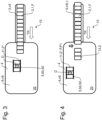
- Figures 1 to 7 show schematically a useful temporal sequence of an embodiment of a method according to the invention for handling piece goods moved in at least one row one behind the other by means of a corresponding handling device.
- Figures 1 to 7 show in a schematic manner a useful temporal sequence of an embodiment of a method for handling piece goods 2 moved one behind the other in at least one row 1 by means of a corresponding handling device 10.
- the handling device 10 which is schematically indicated and shown in plan view from above, comprises a first transport device 3, via which immediately consecutive piece goods 2 in a row 1 are transported without interruption and/or at a continuous transport speed v3 to a grouping module 20 with at least one manipulator 5, in particular into a detection area 4 (in the Fig.1 marked by hatching) of the at least one manipulator 5 of the handling device 10.
- the detection area 4 refers in particular to the maximum and/or the program-controlled predetermined movement area of the manipulator 5.
- the detection area 4 or its outer spatial boundary can be larger than the outer boundaries of the horizontal conveyor 6, on whose approximately horizontal upper side the piece goods 2 are conveyed and/or positioned and/or moved by means of the manipulator 5.
- the detection area 4 of the manipulator 5 is the sensible movement area in which the piece goods 2 to be detected can be located and/or in which the piece goods 2 to be deposited can be positioned.
- the transport device 3 is, for example, at least one conveyor belt or at least one other suitable conveyor device on which the piece goods 2 are preferably transported in one row (each), whereby between each directly successive piece goods 2 there are no or only minor gaps, possibly due to the process.
- the transport device 3 can be formed by an endlessly rotating conveyor belt, an endlessly rotating conveyor chain or the like, so that the piece goods 2 can be delivered to and conveyed to the horizontal conveyor device 6.
- the piece goods 2 located in row 1 on the transport device 3 preferably enter the detection area 4 of the manipulator 5 at a transport speed v3 in a so-called closed formation F.
- Piece goods 2 in the sense of the present invention or the described embodiment can be, for example, individual articles, packages or containers.
- Packages or containers can be, for example, shrink-wrapped containers and/or strapped containers or the like, whereby - as in Fig.1 shown by way of example - normally several articles such as in particular containers, liquid and/or beverage containers 7 are combined into bundles by means of an outer packaging in the form of strapping, shrink film 8 or similar.
- a horizontal conveyor 6 is assigned to the detection area 4 of the manipulator 5, the surface of which supports the piece goods 2 moving at a speed v6.
- the speed v6 of the horizontal conveyor 6 can correspond to the transport speed v3 of the transport device 3.
- the transport speed v3 and the speed v6 can also differ slightly, provided that it can be ensured that the uninterrupted conveyance of the piece goods 2 to the horizontal conveyor 6 is maintained.
- the piece goods 2 arriving in row 1 or formation F via the transport device 3 can, at least with differing v3 and v6, be pushed over to the horizontal conveyor device 6 by the dynamic pressure of the following piece goods 2 that may arise due to the higher transport speed v3 and can be transported there without interruption.
- it is necessary to reduce this dynamic pressure by suitable measures, e.g. by means of a rubberized conveyor belt of the horizontal conveyor device 6 and/or by means of a rubberized conveyor belt of the transport device 3, optionally also by a so-called braking belt located between the transport device 3 and the horizontal conveyor device 6, which is characterized by a surface that supports the piece goods 2 and has a particularly high coefficient of friction.
- the manipulator 5 is designed and equipped for the clamping and/or form-fitting and/or force-fitting acceptance of piece goods 2 within the detection area 4.
- the piece goods 2 detected by the manipulator 5 - i.e. generally at least one of the piece goods 2 entering first in the formation F - are designated below with the reference symbol 2* to distinguish them from the other piece goods 2 arranged in the formation F or in their respective target position P and/or target orientation.
- the manipulator 5 picks up a cycle 11, 12 specified for the layer formation, wherein a cycle comprises a defined number of piece goods 2*.
- the manipulator 5 picks up according to Figures 1 and 2 a first cycle 11 comprising three piece goods 2* arranged one behind the other and arriving in a closed formation F, separates this first cycle 11 from the single-row formation F of the piece goods 2 (cf. Fig. 2 ) and transfers the first cycle 11 into a target position P and/or target orientation, in particular into a first target position P1 on the horizontal conveyor 6 (cf. Figures 3 and 4 ).
- the first cycle 11 is shifted laterally relative to the piece goods 2 of the incoming formation F and is also spaced further away from the formation F of the piece goods 2 in the transport direction TR.
- the lateral offset is achieved by the manipulator 5 applying an additional movement component perpendicular to the transport direction TR to the piece goods 2* of the picked up first cycle 11.
- the spacing in the transport direction TR is achieved by the manipulator 5 applying an additional speed component to the picked up piece goods 2* of the first cycle 11 in the transport direction TR.
- the part of the manipulator 5 intended for transferring the at least one piece of goods 2* picked up by the manipulator 5 to the target position P and/or target orientation can be, for example, a tool head, a gripper head 50 or the like, which is held and mounted on movably mounted cantilever arms, which can in turn typically be mounted on a frame or the like in a frame-fixed manner.
- a tool head also known as a parallel kinematics arrangement known - manipulator suspension or manipulator arrangement
- Such an arrangement - also known as a parallel kinematics arrangement known - manipulator suspension or manipulator arrangement enables the desired mobility of the gripper head 50 (also: the manipulator 5), which can grasp, move, position, place, rotate, etc.
- the manipulator 5 can be formed, for example, by a gripper head 50 with laterally adjustable and openable clamping jaws 52 or the like, or can comprise such a gripper head 50 with lateral clamping jaws 52, which can typically be adjusted against each other when gripping the piece goods 2* in order to grip or clamp the piece goods 2* in a form-fitting and/or force-fitting manner, whereas the clamping jaws 52 can be opened again when the target position P is reached.
- a manipulator 5 and/or a gripper or gripper head 50 When a manipulator 5 and/or a gripper or gripper head 50 is mentioned in the present context or in the present description, these terms can be used as synonyms; if necessary, the gripper or gripper head 50 can also be viewed as a subassembly or component of the more comprehensively understood manipulator 5.
- the arrangement of the piece goods 2* detected by the manipulator 5 in several consecutive process steps in defined target positions P and/or target orientations on the horizontal conveyor 6 is carried out in particular on the basis of a defined layer scheme to form a layer that can be palletized.
- the layer scheme is understood in particular to mean the relative arrangement of a large number of piece goods 2 within a layer to be palletized. There may still be gaps between the piece goods 2 in their respective target position P and/or target orientation on the horizontal conveyor 6, which are no longer present in the finished end position according to the layer scheme.
- a module for example a so-called pre-grouping, can be provided subsequent to the horizontal conveyor 6, in which the piece goods 2 arranged in relative positions to one another by the manipulator 5 are pushed together laterally, thereby creating the finished end position, which can then be transferred to a pallet.
- At least one process step is provided in which a second cycle 12 comprising at least one piece of goods 2 is formed within the grouping module 20, spaced apart from the subsequent piece of goods 2 of the formation F.
- a second cycle 12 comprising at least one piece of goods 2 is formed within the grouping module 20, spaced apart from the subsequent piece of goods 2 of the formation F.
- the transport device 3 is braked at least briefly to a reduced transport speed v3(-).
- a second cycle 12 comprising three piece goods 2 that are already on the horizontal conveyor device is spatially separated from the subsequent piece goods 2 of the formation F.
- a gap marked by an arrow is formed between the piece goods 2 of the second cycle 12 and the subsequent piece goods 2 of the formation F.
- the separation and spacing of the piece goods 2 of the second cycle 12 from the subsequent piece goods 2 of the formation F is not carried out by the manipulator 5 as previously known, but instead the second cycle 12 is generated by a delay of the feeding transport device 3 within the grouping module 20.
- the method provides in particular for a combination of first cycle formation with the participation of the manipulator 5 and second cycle formation without the participation of the manipulator 5, which depends in particular on the respective layer scheme to be formed.
- the speeds v3 of the transport device 3 and the movement of the manipulator 5 are controlled, for example, via a control device 15 which is Fig.5 is shown by way of example.
- the control device 15 preferably has information on the cycles 11, 12 to be formed and on their target positions P and/or target orientations for forming the respectively desired palletizable position.
- the control device 15 regulates whether the cycle is formed before the piece goods 2 are picked up by the manipulator 5 by means of a delay in the transport speed of the feeding transport device 3 or when the piece goods 2 are picked up by the manipulator 5.
- the piece goods 2 can be transported in several rows on a transport device 3 or on several, in particular parallel arranged transport devices 3 in several parallel rows to the detection area 4 of the manipulator 5.
- the parallel rows can be transported at a distance from one another or largely without a distance from one another.
Landscapes
- Engineering & Computer Science (AREA)
- Mechanical Engineering (AREA)
- Stacking Of Articles And Auxiliary Devices (AREA)
Claims (10)
- Procédé de manipulation de produits de détail (2), d'articles et/ou de multipacks en vue de la formation de couches palettisables constituées chacune de plusieurs produits de détail (2), articles et/ou multipacks,- dans lequel le procédé prévoit un transport en une ou plusieurs rangées des produits de détail (2), articles et/ou multipacks au moyen d'au moins un dispositif de transport (3) dans une direction de transport (TR) dans une formation (F) respectivement fermée et/ou ininterrompue vers un module de groupement (20) comprenant au moins un dispositif de transport horizontal (6) ainsi qu'au moins un manipulateur (5),- dans lequel le dispositif de transport (3) présente une vitesse d'amenée de base (v3) dans la direction de transport (TR) et le dispositif de transport horizontal (6) présente une vitesse de transport de base (v6) dans la direction de transport (TR), dans lequel la vitesse d'amenée de base (v3) et la vitesse de transport de base (v6) sont identiques ou synchrones,- dans lequel les vitesses (v3) du dispositif de transport (3) amenant et les séquences de mouvements du manipulateur (5) sont commandées par l'intermédiaire d'un dispositif de commande (15) conçu de manière correspondante et/ou équipé de programmes correspondants,- dans lequel le manipulateur (5) saisit respectivement des cadences, comprenant au moins un produit de détail (2), et amène celles-ci au sein du module de groupement (20) par rotation et/ou déplacement et/ou soulèvement dans une position cible (P) et/ou une orientation cible selon une disposition de couches définie de la couche palettisable à former,
caractérisé par le fait que- le procédé prévoit au moins une étape de procédé pour former la couche palettisable respective, dans laquelle le manipulateur (5) saisit par serrage et/ou par adhérence et/ou à engagement positif une première cadence (11) comprenant au moins un produit de détail (2) de la formation fermée et/ou ininterrompue (F), sépare celle-ci spatialement de la formation fermée et/ou ininterrompue (F) et amène celle-ci dans une première position cible (P1) et/ou orientation cible relative(s) définie(s) par rapport à des produits de détail (2) suivants de la formation fermée et/ou ininterrompue (F), et- dans lequel le procédé prévoit au moins une autre étape de procédé pour former la couche palettisable respective, dans laquelle une deuxième cadence (12) comprenant au moins un produit de détail (2) et espacée des produits de détails (2) suivants de la formation fermée et/ou ininterrompue (F) est formée sans l'intervention du manipulateur (5) au sein du module de groupement (20),- et dans lequel ensuite la deuxième cadence (12) espacée de la formation fermée et/ou ininterrompue (F) et/ou ledit au moins un produit de détail (2) de la deuxième cadence (12) est saisi(e) par le manipulateur (5) et est amené(e) dans une deuxième position cible et/ou orientation cible (P2) relative(s) définie(s) au sein du module de groupement (20),- dans lequel le dispositif de commande (15) dispose d'informations relatives aux cadences à former et à leurs positions cibles et/ou orientations cibles pour former la couche palettisable respectivement souhaitée, et- dans lequel le dispositif de commande (15) règle si la formation de cadence se fait avant que les produits de détail (2) ne soient saisis par le manipulateur (5) au moyen d'un retard de la vitesse d'amenée de base (v3) du dispositif de transport (3) amenant ou bien lorsque les produits de détail (2) sont saisis par le manipulateur (5). - Procédé selon la revendication 1, dans lequel, directement après la saisie d'au moins un produit de détail (2), article et/ou multipack de la formation (F) ou après la saisie de la deuxième cadence (12) formée au sein du module de groupement (20), le manipulateur (5) est déplacé au moins brièvement à une vitesse (v5) dans la direction de transport (TR), qui est supérieure ou égale à la vitesse de transport de base (v6) du dispositif de transport horizontal (6).
- Procédé selon la revendication 2, dans lequel un retard du dispositif de transport (3) amenant et/ou une réduction de la vitesse de transport (v3) du dispositif de transport (3) amenant se fait/se font après avoir amené un nombre de produits de détail (2) qui est fonction du schéma de couches à créer.
- Procédé selon l'une quelconque des revendications précédentes, dans lequel le manipulateur (5) et/ou ledit au moins un dispositif de transport sont commandés et/ou réglés par un dispositif de commande (15).
- Procédé selon la revendication 4, dans lequel, pour former une deuxième cadence (12), ladite deuxième cadence (12) comprenant au moins un produit de détail (2), le dispositif de commande (15) commande au sein du module de groupement (20) une réduction au moins à court terme de la vitesse de transport (v3) du dispositif de transport (3).
- Procédé selon la revendication 4 ou 5, dans lequel le dispositif de commande (15) comprend ou bien stocke des informations relatives à un groupement à former à partir d'une pluralité de produits de détail (2), pour une couche palettisable, dans lequel les positions cibles (P) et/ou des orientations cibles respectives des produits de détail (2) forment une partie des informations et associent une position déterminée et/ou une orientation relative dans le groupement respectif audit au moins un produit de détail (2) respectif.
- Procédé selon l'une quelconque des revendications précédentes, dans lequel le manipulateur peut saisir de manière symétrique ou asymétrique des produits de détail (2).
- Procédé selon l'une quelconque des revendications précédentes, dans lequel les produits de détail (2) sont amenés en au moins deux rangées, en particulier par l'intermédiaire d'au moins deux dispositifs de transport (3), à une zone de saisie (4) dudit au moins un manipulateur (5).
- Procédé selon l'une quelconque des revendications précédentes, dans lequel les produits de détail (2) d'une première cadence (11) ou d'une deuxième cadence (12) saisie par le manipulateur (5) sont retardés au moins temporairement à une vitesse de transport dans la direction de transport (TR) par rapport à la vitesse de transport de base (v6) du dispositif de transport horizontal (6) dans la direction de transport.
- Dispositif de manipulation de produits de détail (2), d'articles et/ou de multipacks en vue de la formation de couches palettisables constituées chacune de plusieurs produits de détail (2), articles et/ou multipacks, destiné à mettre en œuvre un procédé selon l'une quelconque des revendications 1 à 9, dans lequel le dispositif (10) comprend un dispositif de commande, dans lequel- le procédé mis en œuvre au moyen du dispositif (10) prévoit un transport en une ou plusieurs rangées des produits de détail (2), articles et/ou multipacks au moyen d'au moins un dispositif de transport (3) dans une direction de transport (TR) dans une formation (F) respectivement fermée et/ou ininterrompue vers un module de groupement (20) comprenant au moins un dispositif de transport horizontal (6) ainsi qu'au moins un manipulateur (5),- dans lequel le dispositif de transport (3) présente une vitesse d'amenée de base (v3) dans la direction de transport et le dispositif de transport horizontal (6) présente une vitesse de transport de base (v6) dans la direction de transport (TR), dans lequel la vitesse d'amenée de base (v3) et la vitesse de transport de base (v6) sont identiques ou synchrones,- dans lequel les vitesses (v3) du dispositif de transport (3) amenant et les séquences de mouvements du manipulateur (5) sont commandées par l'intermédiaire du dispositif de commande (15) conçu de manière correspondante et/ou équipé de programmes correspondants,
caractérisé par le fait que- le dispositif de commande (15) dispose d'informations relatives aux cadences à former et à leurs positions cibles et/ou orientations cibles pour former la couche palettisable respectivement souhaitée, et- dans lequel le dispositif de commande contient ou a stocké des informations relatives aux premières cadences (11) ou aux deuxièmes cadences (12) à saisir et à positionner respectivement, ainsi que des informations relatives à la séquence de mouvements et, de manière correspondante à celle-ci, à l'encombrement respectif du manipulateur (5),- dans lequel le manipulateur (5) saisit respectivement des cadences, comprenant au moins un produit de détail (2), et amène celles-ci au sein du module de groupement (20) par rotation et/ou déplacement et/ou soulèvement dans une position cible (P) et/ou une orientation cible selon une disposition de couches définie de la couche palettisable à former,- dans lequel le procédé prévoit au moins une étape de procédé pour former la couche palettisable respective, dans laquelle le manipulateur (5) saisit par serrage et/ou par adhérence et/ou à engagement positif une première cadence (11) comprenant au moins un produit de détail (2) de la formation fermée et/ou ininterrompue (F), sépare celle-ci spatialement de la formation fermée et/ou ininterrompue (F) et amène celle-ci dans une première position cible (P1) et/ou orientation cible relative(s) définie(s) par rapport à des produits de détail (2) suivants de la formation fermée et/ou ininterrompue (F), et- dans lequel le procédé prévoit au moins une autre étape de procédé pour former la couche palettisable respective, dans laquelle une deuxième cadence (12) comprenant au moins un produit de détail (2) et espacée des produits de détails (2) suivants de la formation fermée et/ou ininterrompue (F) est formée sans l'intervention du manipulateur (5) au sein du module de groupement (20),- et dans lequel ensuite la deuxième cadence (12) espacée de la formation fermée et/ou ininterrompue (F) et/ou ledit au moins un produit de détail (2) de la deuxième cadence (12) est saisi(e) par le manipulateur (5) et est amené(e) dans une deuxième position cible et/ou orientation cible (P2) relative(s) définie(s) au sein du module de groupement (20),- dans lequel le dispositif de commande (15) règle si la formation de cadence se fait avant que les produits de détail (2) ne soient saisis par le manipulateur (5) au moyen d'un retard de la vitesse d'amenée de base (v3) du dispositif de transport (3) amenant ou bien lorsque les produits de détail (2) sont saisis par le manipulateur (5).
Applications Claiming Priority (1)
| Application Number | Priority Date | Filing Date | Title |
|---|---|---|---|
| DE102018122081.2A DE102018122081A1 (de) | 2018-09-11 | 2018-09-11 | Verfahren und Vorrichtung zur Handhabung von Stückgütern, Artikeln und/oder Gebinden |
Publications (3)
| Publication Number | Publication Date |
|---|---|
| EP3623323A1 EP3623323A1 (fr) | 2020-03-18 |
| EP3623323C0 EP3623323C0 (fr) | 2024-09-25 |
| EP3623323B1 true EP3623323B1 (fr) | 2024-09-25 |
Family
ID=66857779
Family Applications (1)
| Application Number | Title | Priority Date | Filing Date |
|---|---|---|---|
| EP19179990.7A Active EP3623323B1 (fr) | 2018-09-11 | 2019-06-13 | Procédé et dispositif de manipulation des marchandises, des articles et / ou des emballages |
Country Status (4)
| Country | Link |
|---|---|
| EP (1) | EP3623323B1 (fr) |
| CN (1) | CN110884903B (fr) |
| DE (1) | DE102018122081A1 (fr) |
| ES (1) | ES2992286T3 (fr) |
Families Citing this family (2)
| Publication number | Priority date | Publication date | Assignee | Title |
|---|---|---|---|---|
| CN115140335B (zh) * | 2022-07-19 | 2023-09-22 | 广州达意隆包装机械股份有限公司 | 一种裸瓶预编组成垛装置、成垛方法及包装设备 |
| CN117566444B (zh) * | 2024-01-16 | 2024-04-02 | 湖南科技学院 | 一种电商货物码垛装置及其码垛方法 |
Citations (2)
| Publication number | Priority date | Publication date | Assignee | Title |
|---|---|---|---|---|
| EP1556297B1 (fr) * | 2002-10-29 | 2008-04-23 | Siemens Aktiengesellschaft | Systeme de bande transporteuse permettant de manipuler des articles distribues |
| DE102016206650A1 (de) * | 2016-04-20 | 2017-10-26 | Krones Aktiengesellschaft | Verfahren und Vorrichtung zum Umgang mit hintereinander bewegten Stückgütern |
Family Cites Families (10)
| Publication number | Priority date | Publication date | Assignee | Title |
|---|---|---|---|---|
| DE102008055471A1 (de) * | 2008-04-04 | 2009-10-08 | Krones Ag | Verfahren und Vorrichtung zum Zusammenstellen und Ausrichten von Gebindegruppen |
| DE102011104900B4 (de) * | 2011-06-16 | 2017-06-08 | Robert Götze | Vorrichtung zur definierten Lagenbildung von Fördergut |
| DE102011080812A1 (de) * | 2011-08-11 | 2013-02-14 | Krones Aktiengesellschaft | Verfahren und Vorrichtung zur Bildung von Lagen aus Artikeln, Stückgütern oder Gebinden |
| ITPR20120026A1 (it) * | 2012-05-07 | 2013-11-08 | Gea Procomac Spa | Sistema di trasporto di pacchi |
| DE102013103886A1 (de) * | 2013-04-17 | 2014-10-23 | Krones Aktiengesellschaft | Vorrichtung und Verfahren zum Ausbilden einer vordefinierten Formation auf einem Transportband |
| DE102014105932A1 (de) * | 2014-04-28 | 2015-10-29 | Windmöller & Hölscher Kg | Zufuhrvorrichtung für die Zufuhr von gefüllten Säcken zu einer Palettiervorrichtung |
| DE102015104324B4 (de) * | 2015-03-23 | 2025-08-14 | Krones Aktiengesellschaft | Verfahren und Vorrichtung zur Handhabung von Artikeln, Stückgütern bzw. Gebinden |
| DE102016213400A1 (de) * | 2016-07-21 | 2018-01-25 | Krones Aktiengesellschaft | Vorrichtung und Verfahren zum Umgang mit bewegten Stückgütern, Förder-, Verarbeitungs- und/oder Verpackungsanlage mit einer Vorrichtung zum Umgang mit bewegten Stückgütern |
| DE102016124250A1 (de) * | 2016-12-13 | 2018-06-14 | Krones Aktiengesellschaft | Vorrichtung und Verfahren zum Umgang mit hintereinander bewegten Stückgütern |
| DE102016225499A1 (de) * | 2016-12-19 | 2018-06-21 | Krones Aktiengesellschaft | Verfahren und Vorrichtung zum Überführen einer palettierfähigen Lage auf eine zugeordnete Palette |
-
2018
- 2018-09-11 DE DE102018122081.2A patent/DE102018122081A1/de active Pending
-
2019
- 2019-06-13 EP EP19179990.7A patent/EP3623323B1/fr active Active
- 2019-06-13 ES ES19179990T patent/ES2992286T3/es active Active
- 2019-06-18 CN CN201910528771.0A patent/CN110884903B/zh active Active
Patent Citations (2)
| Publication number | Priority date | Publication date | Assignee | Title |
|---|---|---|---|---|
| EP1556297B1 (fr) * | 2002-10-29 | 2008-04-23 | Siemens Aktiengesellschaft | Systeme de bande transporteuse permettant de manipuler des articles distribues |
| DE102016206650A1 (de) * | 2016-04-20 | 2017-10-26 | Krones Aktiengesellschaft | Verfahren und Vorrichtung zum Umgang mit hintereinander bewegten Stückgütern |
Also Published As
| Publication number | Publication date |
|---|---|
| DE102018122081A1 (de) | 2020-03-12 |
| EP3623323C0 (fr) | 2024-09-25 |
| CN110884903B (zh) | 2021-11-26 |
| ES2992286T3 (es) | 2024-12-11 |
| EP3623323A1 (fr) | 2020-03-18 |
| CN110884903A (zh) | 2020-03-17 |
Similar Documents
| Publication | Publication Date | Title |
|---|---|---|
| EP3445692B1 (fr) | Procédé et dispositif permettant la manutention de marchandises de détail déplacées sur au moins deux rangées parallèles | |
| EP3652092B1 (fr) | Procédé et dispositif de manipulation de marchandises de détail, d'articles et/ou d'emballages | |
| EP3072837A1 (fr) | Procédé et dispositif destinés à la manipulation d'articles, marchandises au détail ou de gerbes | |
| EP3475199B1 (fr) | Procédé et dispositif de manutention de charges isolées déplacées les unes derrière les autres en au moins une rangée | |
| EP3475198B1 (fr) | Procédé et dispositif permettant la manutention de marchandises de détail déplacées les unes derrière les autres en au moins une rangée | |
| EP3652093B1 (fr) | Procédé et dispositif pour manipuler des marchandises, articles et/ou paquets | |
| EP3445683B1 (fr) | Procédé pour la manutention de marchandises de détail déplacées les unes derrière les autres | |
| WO2019042715A1 (fr) | Procédé et dispositif permettant la manutention de marchandises de détail déplacées les unes derrière les autres en au moins une rangée | |
| EP3814237A1 (fr) | Dispositif de manipulation et/ou de d'emballage et procédé pour emballer des articles | |
| EP3770086B1 (fr) | Procédé et dispositif de manipulation des marchandises déplacées les unes après les autres dans au moins une rangée | |
| DE102017118928A1 (de) | Lagenbildungs- und Palettiermodul und Verfahren zum Gruppieren und Palettieren von Stückgütern | |
| EP3652094B1 (fr) | Procédé et appareil pour la manutention de marchandises, d'articles et/ou d'emballages | |
| EP3626634B1 (fr) | Dispositif de manipulation et / ou d'emballage et procédé d'emballage des articles | |
| EP4186829B1 (fr) | Dispositif de préhension et procédé de manipulation de marchandises de détail | |
| EP3770085A1 (fr) | Procédé et dispositif de manipulation de marchandises déplacées les unes après les autres dans au moins une rangée | |
| DE102017204997A1 (de) | Vorrichtung und Verfahren zum Umgang mit in mindestens einer Reihe bewegten Stückgütern | |
| EP3445684B1 (fr) | Dispositif et procédé de manutention de marchandises de détail déplacées les unes derrière les autres sur au moins une rangée | |
| WO2019076708A1 (fr) | Procédé et dispositif de manipulation et/ou de regroupement de marchandises de détail | |
| EP3623323A1 (fr) | Procédé et dispositif de manipulation des marchandises, des articles et / ou des emballages | |
| EP3378803B1 (fr) | Dispositif et procédé de manipulation d'au moins une rangée de marchandises en mouvement les unes derrière les autres | |
| EP3475200B1 (fr) | Procédé et dispositif de manutention de charges isolées déplacées les unes derrière les autres | |
| EP3445689B1 (fr) | Procédé pour manipuler au moins une ligne de marchandises déplacées les unes derrière les autres | |
| WO2025149475A1 (fr) | Système de manipulation et procédé de manipulation d'articles, en particulier pour la distribution | |
| DE102021128864A1 (de) | Vorrichtung und Verfahren zum Umgang mit in mindestens einer Reihe hintereinander bewegten Stückgütern | |
| WO2019011579A1 (fr) | Procédé et dispositif pour manipuler des marchandises, articles et/ou paquets |
Legal Events
| Date | Code | Title | Description |
|---|---|---|---|
| PUAI | Public reference made under article 153(3) epc to a published international application that has entered the european phase |
Free format text: ORIGINAL CODE: 0009012 |
|
| STAA | Information on the status of an ep patent application or granted ep patent |
Free format text: STATUS: THE APPLICATION HAS BEEN PUBLISHED |
|
| AK | Designated contracting states |
Kind code of ref document: A1 Designated state(s): AL AT BE BG CH CY CZ DE DK EE ES FI FR GB GR HR HU IE IS IT LI LT LU LV MC MK MT NL NO PL PT RO RS SE SI SK SM TR |
|
| AX | Request for extension of the european patent |
Extension state: BA ME |
|
| STAA | Information on the status of an ep patent application or granted ep patent |
Free format text: STATUS: REQUEST FOR EXAMINATION WAS MADE |
|
| 17P | Request for examination filed |
Effective date: 20200902 |
|
| RBV | Designated contracting states (corrected) |
Designated state(s): AL AT BE BG CH CY CZ DE DK EE ES FI FR GB GR HR HU IE IS IT LI LT LU LV MC MK MT NL NO PL PT RO RS SE SI SK SM TR |
|
| STAA | Information on the status of an ep patent application or granted ep patent |
Free format text: STATUS: EXAMINATION IS IN PROGRESS |
|
| 17Q | First examination report despatched |
Effective date: 20210816 |
|
| P01 | Opt-out of the competence of the unified patent court (upc) registered |
Effective date: 20230523 |
|
| RIC1 | Information provided on ipc code assigned before grant |
Ipc: B65G 47/31 20060101ALN20240328BHEP Ipc: B65G 47/24 20060101ALI20240328BHEP Ipc: B65G 47/08 20060101AFI20240328BHEP |
|
| GRAP | Despatch of communication of intention to grant a patent |
Free format text: ORIGINAL CODE: EPIDOSNIGR1 |
|
| STAA | Information on the status of an ep patent application or granted ep patent |
Free format text: STATUS: GRANT OF PATENT IS INTENDED |
|
| INTG | Intention to grant announced |
Effective date: 20240508 |
|
| RAP3 | Party data changed (applicant data changed or rights of an application transferred) |
Owner name: KRONES AKTIENGESELLSCHAFT |
|
| GRAS | Grant fee paid |
Free format text: ORIGINAL CODE: EPIDOSNIGR3 |
|
| GRAA | (expected) grant |
Free format text: ORIGINAL CODE: 0009210 |
|
| STAA | Information on the status of an ep patent application or granted ep patent |
Free format text: STATUS: THE PATENT HAS BEEN GRANTED |
|
| AK | Designated contracting states |
Kind code of ref document: B1 Designated state(s): AL AT BE BG CH CY CZ DE DK EE ES FI FR GB GR HR HU IE IS IT LI LT LU LV MC MK MT NL NO PL PT RO RS SE SI SK SM TR |
|
| REG | Reference to a national code |
Ref country code: GB Ref legal event code: FG4D Free format text: NOT ENGLISH |
|
| REG | Reference to a national code |
Ref country code: CH Ref legal event code: EP |
|
| REG | Reference to a national code |
Ref country code: DE Ref legal event code: R096 Ref document number: 502019012174 Country of ref document: DE |
|
| REG | Reference to a national code |
Ref country code: IE Ref legal event code: FG4D Free format text: LANGUAGE OF EP DOCUMENT: GERMAN |
|
| U01 | Request for unitary effect filed |
Effective date: 20241002 |
|
| P04 | Withdrawal of opt-out of the competence of the unified patent court (upc) registered |
Free format text: CASE NUMBER: APP_57814/2024 Effective date: 20241022 |
|
| U07 | Unitary effect registered |
Designated state(s): AT BE BG DE DK EE FI FR IT LT LU LV MT NL PT RO SE SI Effective date: 20241025 |
|
| REG | Reference to a national code |
Ref country code: ES Ref legal event code: FG2A Ref document number: 2992286 Country of ref document: ES Kind code of ref document: T3 Effective date: 20241211 |
|
| PG25 | Lapsed in a contracting state [announced via postgrant information from national office to epo] |
Ref country code: NO Free format text: LAPSE BECAUSE OF FAILURE TO SUBMIT A TRANSLATION OF THE DESCRIPTION OR TO PAY THE FEE WITHIN THE PRESCRIBED TIME-LIMIT Effective date: 20241225 |
|
| PG25 | Lapsed in a contracting state [announced via postgrant information from national office to epo] |
Ref country code: GR Free format text: LAPSE BECAUSE OF FAILURE TO SUBMIT A TRANSLATION OF THE DESCRIPTION OR TO PAY THE FEE WITHIN THE PRESCRIBED TIME-LIMIT Effective date: 20241226 |
|
| PG25 | Lapsed in a contracting state [announced via postgrant information from national office to epo] |
Ref country code: RS Free format text: LAPSE BECAUSE OF FAILURE TO SUBMIT A TRANSLATION OF THE DESCRIPTION OR TO PAY THE FEE WITHIN THE PRESCRIBED TIME-LIMIT Effective date: 20241225 |
|
| PG25 | Lapsed in a contracting state [announced via postgrant information from national office to epo] |
Ref country code: RS Free format text: LAPSE BECAUSE OF FAILURE TO SUBMIT A TRANSLATION OF THE DESCRIPTION OR TO PAY THE FEE WITHIN THE PRESCRIBED TIME-LIMIT Effective date: 20241225 Ref country code: NO Free format text: LAPSE BECAUSE OF FAILURE TO SUBMIT A TRANSLATION OF THE DESCRIPTION OR TO PAY THE FEE WITHIN THE PRESCRIBED TIME-LIMIT Effective date: 20241225 Ref country code: GR Free format text: LAPSE BECAUSE OF FAILURE TO SUBMIT A TRANSLATION OF THE DESCRIPTION OR TO PAY THE FEE WITHIN THE PRESCRIBED TIME-LIMIT Effective date: 20241226 |
|
| PG25 | Lapsed in a contracting state [announced via postgrant information from national office to epo] |
Ref country code: IS Free format text: LAPSE BECAUSE OF FAILURE TO SUBMIT A TRANSLATION OF THE DESCRIPTION OR TO PAY THE FEE WITHIN THE PRESCRIBED TIME-LIMIT Effective date: 20250125 |
|
| PG25 | Lapsed in a contracting state [announced via postgrant information from national office to epo] |
Ref country code: SM Free format text: LAPSE BECAUSE OF FAILURE TO SUBMIT A TRANSLATION OF THE DESCRIPTION OR TO PAY THE FEE WITHIN THE PRESCRIBED TIME-LIMIT Effective date: 20240925 |
|
| PG25 | Lapsed in a contracting state [announced via postgrant information from national office to epo] |
Ref country code: CZ Free format text: LAPSE BECAUSE OF FAILURE TO SUBMIT A TRANSLATION OF THE DESCRIPTION OR TO PAY THE FEE WITHIN THE PRESCRIBED TIME-LIMIT Effective date: 20240925 Ref country code: PL Free format text: LAPSE BECAUSE OF FAILURE TO SUBMIT A TRANSLATION OF THE DESCRIPTION OR TO PAY THE FEE WITHIN THE PRESCRIBED TIME-LIMIT Effective date: 20240925 |
|
| PG25 | Lapsed in a contracting state [announced via postgrant information from national office to epo] |
Ref country code: SK Free format text: LAPSE BECAUSE OF FAILURE TO SUBMIT A TRANSLATION OF THE DESCRIPTION OR TO PAY THE FEE WITHIN THE PRESCRIBED TIME-LIMIT Effective date: 20240925 |
|
| U20 | Renewal fee for the european patent with unitary effect paid |
Year of fee payment: 7 Effective date: 20250509 |
|
| U1N | Appointed representative for the unitary patent procedure changed after the registration of the unitary effect |
Representative=s name: BENNINGER, JOHANNES; DE |
|
| PLBE | No opposition filed within time limit |
Free format text: ORIGINAL CODE: 0009261 |
|
| STAA | Information on the status of an ep patent application or granted ep patent |
Free format text: STATUS: NO OPPOSITION FILED WITHIN TIME LIMIT |
|
| 26N | No opposition filed |
Effective date: 20250626 |
|
| PGFP | Annual fee paid to national office [announced via postgrant information from national office to epo] |
Ref country code: ES Payment date: 20250707 Year of fee payment: 7 |
|
| PG25 | Lapsed in a contracting state [announced via postgrant information from national office to epo] |
Ref country code: HR Free format text: LAPSE BECAUSE OF FAILURE TO SUBMIT A TRANSLATION OF THE DESCRIPTION OR TO PAY THE FEE WITHIN THE PRESCRIBED TIME-LIMIT Effective date: 20240925 |
|
| REG | Reference to a national code |
Ref country code: CH Ref legal event code: H13 Free format text: ST27 STATUS EVENT CODE: U-0-0-H10-H13 (AS PROVIDED BY THE NATIONAL OFFICE) Effective date: 20260127 |
|
| PG25 | Lapsed in a contracting state [announced via postgrant information from national office to epo] |
Ref country code: MC Free format text: LAPSE BECAUSE OF FAILURE TO SUBMIT A TRANSLATION OF THE DESCRIPTION OR TO PAY THE FEE WITHIN THE PRESCRIBED TIME-LIMIT Effective date: 20240925 |
|
| GBPC | Gb: european patent ceased through non-payment of renewal fee |
Effective date: 20250613 |
|
| PG25 | Lapsed in a contracting state [announced via postgrant information from national office to epo] |
Ref country code: GB Free format text: LAPSE BECAUSE OF NON-PAYMENT OF DUE FEES Effective date: 20250613 |
|
| PG25 | Lapsed in a contracting state [announced via postgrant information from national office to epo] |
Ref country code: IE Free format text: LAPSE BECAUSE OF NON-PAYMENT OF DUE FEES Effective date: 20250613 |
|
| PG25 | Lapsed in a contracting state [announced via postgrant information from national office to epo] |
Ref country code: CH Free format text: LAPSE BECAUSE OF NON-PAYMENT OF DUE FEES Effective date: 20250630 |
|
| U20 | Renewal fee for the european patent with unitary effect paid |
Year of fee payment: 8 Effective date: 20260507 |
|
| PG25 | Lapsed in a contracting state [announced via postgrant information from national office to epo] |
Ref country code: CY Free format text: LAPSE BECAUSE OF FAILURE TO SUBMIT A TRANSLATION OF THE DESCRIPTION OR TO PAY THE FEE WITHIN THE PRESCRIBED TIME-LIMIT Effective date: 20240925 |