EP3646874B1 - Zubereitung zur transdermalen absorption von phosphatidylcholin - Google Patents
Zubereitung zur transdermalen absorption von phosphatidylcholin Download PDFInfo
- Publication number
- EP3646874B1 EP3646874B1 EP18904440.7A EP18904440A EP3646874B1 EP 3646874 B1 EP3646874 B1 EP 3646874B1 EP 18904440 A EP18904440 A EP 18904440A EP 3646874 B1 EP3646874 B1 EP 3646874B1
- Authority
- EP
- European Patent Office
- Prior art keywords
- styrene
- transdermal absorption
- phosphatidylcholine
- adhesive layer
- mass
- Prior art date
- Legal status (The legal status is an assumption and is not a legal conclusion. Google has not performed a legal analysis and makes no representation as to the accuracy of the status listed.)
- Active
Links
Images
Classifications
-
- A—HUMAN NECESSITIES
- A61—MEDICAL OR VETERINARY SCIENCE; HYGIENE
- A61K—PREPARATIONS FOR MEDICAL, DENTAL OR TOILETRY PURPOSES
- A61K9/00—Medicinal preparations characterised by special physical form
- A61K9/70—Web, sheet or filament bases ; Films; Fibres of the matrix type containing drug
- A61K9/7023—Transdermal patches and similar drug-containing composite devices, e.g. cataplasms
- A61K9/703—Transdermal patches and similar drug-containing composite devices, e.g. cataplasms characterised by shape or structure; Details concerning release liner or backing; Refillable patches; User-activated patches
- A61K9/7038—Transdermal patches of the drug-in-adhesive type, i.e. comprising drug in the skin-adhesive layer
-
- A—HUMAN NECESSITIES
- A61—MEDICAL OR VETERINARY SCIENCE; HYGIENE
- A61P—SPECIFIC THERAPEUTIC ACTIVITY OF CHEMICAL COMPOUNDS OR MEDICINAL PREPARATIONS
- A61P3/00—Drugs for disorders of the metabolism
- A61P3/04—Anorexiants; Antiobesity agents
-
- A—HUMAN NECESSITIES
- A61—MEDICAL OR VETERINARY SCIENCE; HYGIENE
- A61K—PREPARATIONS FOR MEDICAL, DENTAL OR TOILETRY PURPOSES
- A61K31/00—Medicinal preparations containing organic active ingredients
- A61K31/66—Phosphorus compounds
- A61K31/683—Diesters of a phosphorus acid with two hydroxy compounds, e.g. phosphatidylinositols
- A61K31/685—Diesters of a phosphorus acid with two hydroxy compounds, e.g. phosphatidylinositols one of the hydroxy compounds having nitrogen atoms, e.g. phosphatidylserine, lecithin
-
- A—HUMAN NECESSITIES
- A61—MEDICAL OR VETERINARY SCIENCE; HYGIENE
- A61K—PREPARATIONS FOR MEDICAL, DENTAL OR TOILETRY PURPOSES
- A61K47/00—Medicinal preparations characterised by the non-active ingredients used, e.g. carriers or inert additives; Targeting or modifying agents chemically bound to the active ingredient
- A61K47/30—Macromolecular organic or inorganic compounds, e.g. inorganic polyphosphates
- A61K47/32—Macromolecular compounds obtained by reactions only involving carbon-to-carbon unsaturated bonds, e.g. carbomers, poly(meth)acrylates, or polyvinyl pyrrolidone
-
- A—HUMAN NECESSITIES
- A61—MEDICAL OR VETERINARY SCIENCE; HYGIENE
- A61K—PREPARATIONS FOR MEDICAL, DENTAL OR TOILETRY PURPOSES
- A61K47/00—Medicinal preparations characterised by the non-active ingredients used, e.g. carriers or inert additives; Targeting or modifying agents chemically bound to the active ingredient
- A61K47/44—Oils, fats or waxes according to two or more groups of A61K47/02-A61K47/42; Natural or modified natural oils, fats or waxes, e.g. castor oil, polyethoxylated castor oil, montan wax, lignite, shellac, rosin, beeswax or lanolin
-
- A—HUMAN NECESSITIES
- A61—MEDICAL OR VETERINARY SCIENCE; HYGIENE
- A61K—PREPARATIONS FOR MEDICAL, DENTAL OR TOILETRY PURPOSES
- A61K9/00—Medicinal preparations characterised by special physical form
- A61K9/70—Web, sheet or filament bases ; Films; Fibres of the matrix type containing drug
- A61K9/7023—Transdermal patches and similar drug-containing composite devices, e.g. cataplasms
- A61K9/703—Transdermal patches and similar drug-containing composite devices, e.g. cataplasms characterised by shape or structure; Details concerning release liner or backing; Refillable patches; User-activated patches
- A61K9/7038—Transdermal patches of the drug-in-adhesive type, i.e. comprising drug in the skin-adhesive layer
- A61K9/7046—Transdermal patches of the drug-in-adhesive type, i.e. comprising drug in the skin-adhesive layer the adhesive comprising macromolecular compounds
- A61K9/7053—Transdermal patches of the drug-in-adhesive type, i.e. comprising drug in the skin-adhesive layer the adhesive comprising macromolecular compounds obtained by reactions only involving carbon to carbon unsaturated bonds, e.g. polyvinyl, polyisobutylene, polystyrene
Definitions
- the present invention relates to a phosphatidylcholine transdermal absorption preparation. More specifically, the present invention relates to a patch-type transdermal absorption preparation containing phosphatidylcholine in an adhesive layer.
- Phosphatidylcholine which is a main component of soybean lecithin obtained from soybean seed extract oil, is used in cosmetics and pharmaceuticals as surfactants (emulsifiers and the like) and skin conditioning agents.
- Such phosphatidylcholines are amphiphilic and thus can penetrate fat cells and phosphatidylic acid such as phosphatidylcholine can participate in the activation of fatty acid release pathways through which the local obesity such as subcutaneous fat is decreased, and thus these can be expected to exert the effect of dissolving subcutaneous fat.
- a method for decreasing obesity with excessive fat (fat layer) among subcutaneous fat accumulation and obesity for example, a method in which a composition for removing subcutaneous accumulation of fat is directly subcutaneously injected has been adopted, and phosphatidylcholine preparations and the like have been used as such a composition (see, for example, Patent Literature 1).
- subcutaneous injection of such phosphatidylcholine preparations is problematic in terms of pain and safety at the time of treatment, thus the development of a transdermal absorption-type preparation (transdermal absorption preparation. It is also called transdermal administration preparation.) of which selfadministration is possible but direct subcutaneous injection is not required has been expected.
- transdermal composition which contains natural productderived phosphatidylcholine, L-carnitine, propylene glycol, glycerin, and water but does not contain a lipophilic base has been provided (see, for example, Patent Literature 2).
- Further cosmetic formulations comprising phosphatidylcholine can for instance be found in EP 2 143 445 A1 , EP 1 852 130 A1 , JP S59 55819 A and US 2013/253552 A1 .
- IT VR20 070 150 A1 discloses the use of lecithin, hydrolyzed lecithin, phosphatidylcholine-enriched lecithin, phosphatidylcholine, in association with carnitine in its various forms (L-Carnitine, D-Carnitine, Acetyl L-Carnitine, etc.) for the preparation of products and, especially, lipolytic and anti-cellulite cosmetics.
- transdermal absorption preparation which contains phosphatidylcholine in the adhesive layer and has a patch dosage form.
- the preparation becomes a preparation which is a transdermal absorption type but is not a type to be applied to the skin, also has an advantage due to the patch dosage form that the preparation can be fixed to the affected area by being pasted to the affected area at which fat is considered to be decreased, and moreover is more favorably handled as compared to liquid and gel preparations.
- the present invention has been made in view of the problems and an object thereof is to provide a patch-type phosphatidylcholine transdermal absorption preparation containing phosphatidylcholine in an adhesive layer.
- a transdermal absorption preparation according to the present invention is a transdermal absorption preparation which includes a support, and an adhesive layer formed on at least one side of the support,
- the transdermal absorption preparation according to the present invention is characterized in that the adhesive component is a styrene-based thermoplastic elastomer in the above-described present invention.
- transdermal absorption preparation according to the present invention is characterized in that carnitine is further contained in the above-described present invention.
- the transdermal absorption preparation according to the present invention is characterized in that a content of phosphatidylcholine is 2.5% to 8.0% by mass with respect to an entire adhesive layer in the above-described present invention.
- the transdermal absorption preparation according to the present invention is characterized in that the lipophilic component contains mineral oil in the above-described present invention.
- the transdermal absorption preparation according to the present invention is characterized in that a branched polyolefin is further contained in the above-described present invention.
- the transdermal absorption preparation according to the present invention is characterized in that the branched polyolefin is a hydrogenated C6-14 olefin polymer in the above-described present invention.
- the phosphatidylcholine transdermal absorption preparation according to the present invention has a configuration in which the adhesive layer formed on at least one side of the support contains phosphatidylcholine, an adhesive component, and a lipophilic component.
- the preparation becomes a patch-type transdermal absorption preparation which acts as a fat-decreasing agent which contains phosphatidylcholine and can exert an effect that local obesity such as subcutaneous fat is dissolved and fat is decreased by transdermal absorption of phosphatidylcholine as the preparation is pasted to the skin and the like of a human body and the like since phosphatidylcholine can be stably present in the adhesive layer in addition to an advantage due to the patch dosage form that the preparation can be fixed to the affected area and is more favorably handled as compared to liquid preparations and the like.
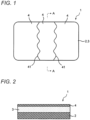
- Fig. 1 is a front view illustrating an aspect of the transdermal absorption preparation 1 according to the present invention
- Fig. 2 is a cross-sectional view taken along A-A in Fig. 1 .
- 1 denotes a phosphatidylcholine transdermal absorption preparation (transdermal absorption preparation)
- 2 denotes a support
- 3 denotes an adhesive layer
- 4 denotes a release sheet
- 41 denotes a cut, respectively.
- the phosphatidylcholine transdermal absorption preparation (transdermal absorption preparation) 1 is a transdermal absorption preparation 1 which include a support 2 and an adhesive layer 3 formed on at least one side of the support 2 and has a configuration in which the adhesive layer 3 contains phosphatidylcholine, an adhesive component, and a lipophilic component.
- a configuration in which the adhesive layer 3 is formed on one side of the support 2 and the release sheet 4 is pasted to the surface of the adhesive layer 3 is illustrated as an example of the configuration of the transdermal absorption preparation 1.
- the support 2 is not particularly limited as long as those generally used as an application for support of a patch which is the transdermal absorption preparation 1 can be used, and examples thereof include stretchable or non-stretchable woven fabric and nonwoven fabric formed of polyethylene, polypropylene and the like, films or sheets (in the present invention, "film” and “sheet” are synonymous with each other.
- polyolefins such as polyethylene and polypropylene
- polyesters such as polyethylene terephthalate (PET) and polyethylene naphthalate (PEN), ethylene-vinyl acetate copolymer, vinyl chloride and the like, or a foamed sheet of urethane, polyurethane and the like (these are also referred to as a "sheet-like material" in some cases).
- PET polyethylene terephthalate
- PEN polyethylene naphthalate
- ethylene-vinyl acetate copolymer vinyl chloride and the like
- foamed sheet of urethane, polyurethane and the like (these are also referred to as a "sheet-like material” in some cases).
- Those described above may be used singly or in combination (mixture or lamination) of two or more kinds thereof.
- an antistatic agent and the like may be contained in the above-described sheet-like materials such as woven fabric and nonwoven fabric and the like that constitute the support 2.
- the thickness of the support 2 in the transdermal absorption preparation 1 is, for example, preferably 200 to 280 ⁇ m and particularly preferably about 240 to 260 ⁇ m but is not particularly limited to this range.
- the transdermal absorption preparation 1 of the present invention may adopt a configuration in which the adhesive layer 3 is sandwiched between the support 2 and the release sheet 4 as illustrated in Figs. 1 and 2 .
- a release sheet 4 generally used in the field of patches can also be equipped.
- resin sheets of polyolefins such as polyethylene and polypropylene, polyesters such as polyethylene terephthalate (PET) and polyethylene naphthalate (PEN), and polystyrene, glassine paper, an aluminum sheet, a foamed polyethylene sheet, or a foamed polypropylene sheet and the like, or any laminate composed of two or more kinds thereof can be used.
- those obtained by subjecting these to silicone processing, fluororesin processing, embossing, hydrophilic processing, hydrophobic processing and the like can be used.
- the thickness of the release sheet 4 is, for example, preferably 80 to 120 ⁇ m and particularly preferably 90 to 110 ⁇ m but is not particularly limited to this range.
- a cut (slit) 41 on the release sheet 4, and the configuration illustrated in Fig. 1 shows an aspect in which two curved cuts 41 are formed and the release sheet 4 is divided into three.
- the adhesive layer 3 contains phosphatidylcholine, an adhesive component, and a lipophilic component.
- Phosphatidylcholine also described as phosphatidylcholine
- Phosphatidylcholine is a main component of soybean lecithin obtained from soybean seed extract oil, participates in the activation of fatty acid release pathways through which the local obesity such as subcutaneous fat is decreased by penetrating into fat cells, and thus exerts an effect of dissolving subcutaneous fat.
- phosphatidylcholine has different phospholipid names depending on the choice of two fatty acids and is called divalmitoyl phosphatidylcholine in a case in which two palmitic acids are selected as fatty acids, DL phosphatidylcholine in a case in which two linoleic acids are selected as fatty acids, divalmitoylphosphatidylcholine in a case in which two palmitic acids are selected as fatty acids, and PO phosphatidylcholine in a case in which palmitic acid and oleic acid are selected as fatty acids.
- phosphatidylcholine examples include conventionally known egg yolk phosphatidylcholine, soybean phosphatidylcholine, egg yolk lysophosphatidylcholine, soybean lysophosphatidylcholine, hydrogenated egg yolk phosphatidylcholine, hydrogenated soybean phosphatidylcholine, hydrogenated egg yolk lysophosphatidylcholine, and hydrogenated soybean lysophosphatidylcholine. These may be used singly or in combination of two or more kinds thereof.
- the content of phosphatidylcholine in the adhesive layer 3 is preferably 1.0% to 9.0% by mass with respect to the entire adhesive layer 3 (this indicates that the entire mass of the adhesive layer 3 is taken as 100% by mass. The same applies hereinafter.)
- the preparation can efficiently exert an effect of decreasing local obesity such as subcutaneous fat by transdermal absorption of phosphatidylcholine as a patch-type transdermal absorption preparation.
- the content of phosphatidylcholine is particularly preferably 2.5% to 8.0% by mass with respect to the entire adhesive layer 3.
- carnitine may be added to phosphatidylcholine.
- the stability and the like of phosphatidylcholine in the adhesive layer 3 can be enhanced and the effect attained by containing phosphatidylcholine is more efficiently exerted.
- examples of carnitine include L-carnitine, DL-carnitine, and acetyl-L-carnitine, these may be used singly or in combination of two or more kinds thereof. In the present invention, it is preferable to use L-carnitine.
- an inner salt, an inorganic salt such as hydrochloride or sodium salt, an organic acid salt such as a tartrate, an oxalate, or a fumarate, and the like may be used as carnitine.
- the amount of carnitine added with respect to phosphatidylcholine is preferably 8.5 to 12.0 parts by mass and particularly preferably 9.0 to 10.5 parts by mass in a case in which phosphatidylcholine is taken as 100 parts by mass.
- thermoplastic elastomer is generally a generic term for elastomers which exhibit thermoplasticity to be softened and exhibit fluidity by heating but to return to a rubber-like elastic body by cooling.
- thermoplastic elastomers include styrene-based, urethane-based, acrylic-based, and olefin-based thermoplastic elastomers.
- styrene-based thermoplastic elastomers including hydrogenated styrene-based thermoplastic elastomers
- styrene-based copolymers including hydrogenated ones
- thermoplastic elastomer examples include a styrene-butadiene block copolymer, a hydrogenated styrene-butadiene block copolymer, a styrene-butadiene-styrene block copolymer, a hydrogenated styrene-butadiene-styrene block copolymer, a styrene-isoprene block copolymer, a hydrogenated styrene-isoprene block copolymer, a styrene-isoprene-styrene block copolymer, and a hydrogenated styrene-isoprene-styrene block copolymer.
- examples thereof include a styrene-ethylene/butylene block copolymer, a styrene-ethylene/butylene-styrene block copolymer, a styrene-ethylene/propylene block copolymer, a styrene-ethylene/propylene-styrene block copolymer, a styrene-isobutylene block copolymer, a styrene-isobutylene-styrene block copolymer, and hydrogenated block copolymers of these.
- These styrene-based block copolymers may be used singly or in combination of two or more kinds thereof.
- ethylene/butylene indicates a copolymer block composed of ethylene and butylene
- ethylene/propylene indicates a copolymer block composed of ethylene and propylene
- styrene-based block copolymers it is preferable to use at least one selected from the group consisting of a styrene-butadiene block copolymer, a hydrogenated styrene-butadiene block copolymer, a styrene-isoprene block copolymer, a hydrogenated styrene-isoprene block copolymer, a styrene-isoprene-styrene block copolymer, and a hydrogenated styrene-isoprene-styrene block copolymer from the viewpoint of being easily available and exhibiting favorable handleability as well as exhibiting both favorable skin adhesiveness and low skin irritation.
- styrene-butadiene block copolymer including hydrogenated one
- a copolymer having a styrene component content of 5% to 55% by mass is preferable and a copolymer having a styrene component content of 10% to 50% by mass is particularly preferable.
- those having a weight average molecular weight (the same applies hereinafter for the weight average molecular weight) of 10,000 to 5,500,000 as measured by gel filtration chromatography and the like are preferable and those having a weight average molecular weight of 15,000 to 500,000 are particularly preferable.
- styrene-isoprene block copolymer including hydrogenated one
- a copolymer having a styrene component content of 5% to 55% by mass is preferable and a copolymer having a styrene component content of 10% to 50% by mass is particularly preferable.
- those having a weight average molecular weight of 10,000 to 5,500,000 are preferable and those having a weight average molecular weight of 15,000 to 500,000 are particularly preferable.
- styrene-isoprene-styrene block copolymer (including hydrogenated one)
- a copolymer having a styrene component content of 5% to 65% by mass is preferable and a copolymer having a styrene component content of 10% to 60% by mass is particularly preferable.
- those having a weight average molecular weight of 18,000 to 5,500,000 are preferable and those having a weight average molecular weight of 20,000 to 500,000 are particularly preferable.
- the content of the adhesive component such as the thermoplastic elastomer in the adhesive layer 3 is preferably 20.0% to 35.0% by mass with respect to the entire adhesive layer 3. It is not preferable that the content of the adhesive component is less than 20.0% by mass since there is a case in which the shape of the adhesive layer 3 is hardly maintained, and it is not preferable that the content of the adhesive component exceeds 35.0% by mass since there is a case in which the adhesiveness to the skin is insufficient.
- the content of the adhesive component such as the thermoplastic elastomer in the adhesive layer 3 is particularly preferably 25.0% to 30.0% by mass with respect to the entire adhesive layer 3.
- a branched polyolefin for the purpose of enhancing the hardness and transparency of the adhesive layer 3 and improving the feel of use and mixing, dispersion and the like of the respective components of the adhesive layer 3, it is preferable to blend a branched polyolefin.
- a polyolefinin include a hydrogenated C6-14 olefin polymer, polybutene, hydrogenated polyisobutene, isoparaffins such as (C7,8)isoparaffin, (C8,9)isoparaffin, (C9-11)isoparaffin, (C10-13)isoparaffin, (C11,12)isoparaffin, (C11-13)isoparaffin, (C13,14)isoparaffin, (C13-16)isoparaffin, and (C18-70)isoparaffin, olefin oligomers, and hydrogenated polydecene.
- a hydrogenated C6-14 olefin polymer, polybutene, and hydrogenated polyisobutene are particularly preferable from the viewpoint of usability such as transparency and adhesive property of the adhesive layer 3. These may be used singly or in combination of two or more kinds thereof.
- the content of the branched polyolefin in the adhesive layer 3 is preferably 2.0% to 15.0% by mass and particularly preferably 4.0% to 10.0% by mass with respect to the entire adhesive layer 3.
- the lipophilic component is an effective component for forming the above-described phosphatidylcholine and adhesive component into the adhesive layer 3 in the present invention, and examples thereof include vegetable oil such as olive oil (olive fruit oil), orange oil (orange fruit oil), and mineral oil, animal oil, and mineral oil.
- vegetable oil such as olive oil (olive fruit oil), orange oil (orange fruit oil), and mineral oil, animal oil, and mineral oil.
- examples of the lipophilic component include fatty acids such as palmitic acid, oleic acid, and stearic acid; vegetable oils such as avocado oil, linseed oil, almond oil, perilla oil, kaya oil, rapeseed oil, olive oil, corn oil, castor oil, safflower oil, sunflower oil, cottonseed oil, jojoba oil, macadamian nut oil, wheat germ oil, soybean oil, peanut oil, coconut oil, palm oil, palm kernel oil, camellia oil, and evening primrose oil; animal oils such as mink oil, fish oil, lard, and tallow; hydrocarbons such as liquid paraffin, squalene, squalane, polybutene, and hydrogenated polyisobutene; esters such as diisobutyl adipate, 2-hexyldecyl adipate, di-2-heptylundecyl adipate, N-alkyl glycol monoisostearate, isocety
- the content of the lipophilic component in the adhesive layer 3 is set to preferably 30.0% to 85.0% by mass, still more preferably 40.0% to 75.0% by mass, and particularly preferably 40% to 60% by mass with respect to the entire adhesive layer 3.
- an antioxidant in the adhesive layer 3 having the above-described configuration, an antioxidant, a plasticizer, a filler, a drug dissolution auxiliary, an antibacterial agent, a skin irritation diminishing agent, an excipient and the like can be appropriately blended as an arbitrary component if necessary in a range in which the object and effect of the present invention are not affected.
- the antioxidant is not particularly limited, and examples thereof include ascorbic acid derivatives such as ascorbyl palmitate and ascorbyl tetraisopalmitate, chelating agents such as sodium edetate, sodium sulfite, butylhydroxyanisole, butylhydroxytoluene, tocopherol and tocopherol derivatives such as tocopherol and tocopherol acetate, and quinoline and quinoline derivatives such as oxyquinoline sulfate.
- ascorbic acid derivatives such as ascorbyl palmitate and ascorbyl tetraisopalmitate
- chelating agents such as sodium edetate, sodium sulfite, butylhydroxyanisole, butylhydroxytoluene
- tocopherol and tocopherol derivatives such as tocopherol and tocopherol acetate
- quinoline and quinoline derivatives such as oxyquinoline sulfate.
- the plasticizer is not particularly limited, and examples thereof include glycols such as ethylene glycol, diethylene glycol, triethylene glycol, propylene glycol, polyethylene glycol, and polypropylene glycol; oils and fats such as olive oil, castor oil, squalene, lanolin; hydrocarbons such as liquid paraffin; fatty acid esters such as diisopropyl adipate, diisobutyl adipate, benzyl benzoate, cetyl 2-ethylhexanoate, oleyl oleate, decyl oleate, benzyl acetate, diisopropyl sebacate, diethyl sebacate, sorbitan trioleate, sorbitan tristearate, cetyl palmitate, octyldodecyl myristate, cetyl myristate, myristyl myristate, and isopropyl myristate. These may be used singly or in
- the filler is not particularly limited, and examples thereof include kaolin, bentonite, and titanium dioxide.
- the drug dissolution auxiliary is not particularly limited, and examples thereof include cyclodextrins such as ⁇ -cyclodextrin, ⁇ -cyclodextrin, and ⁇ -cyclodextrin (can also be used as excipients to be described later).
- the antibacterial agent is not particularly limited, and examples thereof include benzalkonium chloride, benzoic acid, and methyl parahydroxybenzoate.
- the skin irritation diminishing agent is not particularly limited, and examples thereof include anhydrous silicic acid.
- the excipient is not particularly limited, and examples thereof include cyclodextrin, lactose, and a cellulose-based powder (excipients such as cyclodextrin are usually used by being mixed with carnitine and the like in advance).
- the adhesive component such as a thermoplastic elastomer
- components to be added if necessary are each mixed with or dispersed in the lipophilic component and mixed or dispersed in a solvent such as acetone, ethyl acetate, or toluene if necessary to prepare a coating liquid for forming the adhesive layer 3.
- the coating liquid obtained is applied to the surface on which the adhesive layer 3 is to be formed of the support 2, and then dried (the solvent is scattered in the case of being mixed and the like in a solvent), whereby the transdermal absorption preparation 1 can be produced.
- the thickness of the adhesive layer 3 is preferably about 150 to 300 ⁇ m after drying.
- the release sheet 4 is pressure-bonded to the adhesive layer 3 after being applied to the support 2 and the adhesive layer 3 can be thus laminated by being sandwiched between the support 2 and the release sheet 4.
- the coating liquid for the adhesive layer 3 may be applied onto the release sheet 4 and dried to scatter the solvent and thus to form the adhesive layer 3 on the surface of the release sheet 4 and then the support 2 may be bonded onto the adhesive layer 3 by pressure bonding.
- the coating liquid for forming the adhesive layer 3 can be applied using, for example, conventionally known coaters such as a roll coater, a die coater, a gravure roll coater, a reverse roll coater, a kiss roll coater, a dip roll coater, a bar coater, a knife coater, and a spray coater.
- the coating liquid is dried preferably at a temperature of about 40°C to 160°C, for example.
- the phosphatidylcholine transdermal absorption preparation 1 has a configuration in which the adhesive layer 3 formed on at least one side of the support 2 contains phosphatidylcholine, an adhesive component, and a lipophilic component.
- the preparation becomes a patch-type transdermal absorption preparation a which acts as a fat-decreasing agent which contains phosphatidylcholine and can exert an effect that local obesity such as subcutaneous fat is dissolved and fat is decreased by transdermal absorption of phosphatidylcholine as the preparation 1 is pasted to the skin and the like of a human body and the like since phosphatidylcholine can be stably present in the adhesive layer 3 in addition to an advantage due to the patch dosage form that the preparation can be fixed to the affected area and is more favorably handled as compared to liquid preparations and the like.
- phosphatidylcholine transdermal absorption preparation 1 of the present invention adopts a configuration in which the preparation is produced as a patch using the adhesive layer 3 containing a lipophilic component instead of a hydrophilic component, phosphatidylcholine which is a drug is favorably transdermally absorbed through the skin and this penetration mechanism is considered as follows.
- transdermal absorption preparation 1 which is a patch is pasted to the skin
- phosphatidylcholine penetrates from the surface (sebum membrane) of the skin to the deep part of the skin (skin) in order by the skin concentration gradient.
- the transpiration of moisture in the stratum corneum of the skin is suppressed and the polymer such as a thermoplastic elastomer which is an adhesive component becomes soft (plasticization of polymer) as well as the stratum corneum swells by the occlusive dressing therapy (ODT) effect due to the lipophilic component in addition to the support 2, thus the passage of phosphatidylcholine through the skin becomes favorable and transdermal absorption of phosphatidylcholine proceeds in a state of exhibiting enhanced skin penetrability.
- the polymer such as a thermoplastic elastomer which is an adhesive component becomes soft (plasticization of polymer) as well as the stratum corneum swells by the occlusive dressing therapy (ODT) effect due to the lipophilic component in addition to the support 2
- low molecular weight components pass through the stratum corneum, but polymer components are different from the low molecular weight components, and inner wall cells of pores existing on the skin surface such as sweat glands and hair follicles are the main permeation pathways.
- Low molecular weight components diffuse in the lipophilic base (adhesive layer 3) and the stratum corneum, are distributed into the epidermis, then diffuse in the dermis, and are absorbed into cells and capillaries.
- polymer components diffuse in the lipophilic base and the pores, are distributed into the inner wall cells of the pores, and reach the dermis layer without passing through stratum corneum.
- the stratum corneum swells by the occlusive dressing therapy effect of a lipophilic component and the like, thus diffusion in the pores is promoted and the permeation efficiency of the active component is improved.
- the transdermal absorption preparation 1 according to the present invention can be expected to have an effect of dissolving local obesity such as subcutaneous fat and decreasing fat by transdermal absorption of phosphatidylcholine and is used by being pasted to the (skin of) affected area at which subcutaneous fat of a human body and the like is desired to be decreased.
- the frequency of pasting the transdermal absorption preparation 1 can be appropriately determined depending on the content of phosphatidylcholine and the like and the kinds and contents of other components in the adhesive layer 3, but it is considered that the effect is efficiently exerted by briefly pasting the preparation about 3 to 6 times a week (not particularly limited to this range) .
- the aspect described above shows an aspect of the present invention and the present invention is not limited to above-described embodiment, and it is needless to say that modifications and improvements in the range of being equipped with the configuration of the present invention and being able to achieve the object and effect of the present invention are included in the contents of the present invention. Moreover, it is not problematic even when the specific structure, shape, and the like when carrying out the present invention are other structures, shapes, and the like in the range in which the object and effect of the present invention can be achieved.
- the present invention is not limited to the respective embodiments described above, and modifications and improvements in the range in which the object and effect of the present invention can be achieved are included in the present invention.
- the configuration of the transdermal absorption preparation 1 has been described through an aspect in which two curved cuts 41 are formed on the release sheet 4 as illustrated in Fig. 1 , but the shape of the cut 41 is arbitrary and the cut 41 may not be formed.
- the support 2 and the adhesive layer 3 may be used and the release sheet 41 may not be used.
- the adhesive layer 3 is formed on one side of the support 2 and the release sheet 4 is pasted to the surface of the adhesive layer 3 has been described with reference to Figs. 1 and 2 , but the adhesive layer 3 may be formed on both sides of the support 2 or the release sheet 4 may be pasted to the surface of the adhesive layer 3 if necessary.
- the shape of the transdermal absorption preparation 1 has been described by taking a substantially rectangular shape with four rounded corners as an example, as illustrated in Fig. 1 , but the shape of the transdermal absorption preparation 1 that is a patch is arbitrary, and arbitrary shapes such as a polygonal shape such as a triangular shape, a quadrangular shape, or a pentagonal shape, a circular shape, an elliptical shape, or a geometric shape can be adopted.
- the size of the transdermal absorption preparation 1 is also arbitrary and can be appropriately determined depending on the place to which the preparation is pasted. In the case of a substantially rectangular shape (quadrangular shape) as illustrated in Fig. 1 , one side (before being rounded in a case in which the four corners are rounded) may be set to, for example, about 50 to 200 mm, but the size is not particularly limited to this range.
- the specific structure, shape and the like when carrying out the present invention may be other structures and the like in the range in which the object of the present invention can be achieved.
- Transdermal absorption preparations which were a patch having the configuration illustrated in Figs. 1 and 2 , were produced by the following method.
- the compositions (components and contents (% by mass)) of the adhesive layers of Example 1, Example 2, (comparative) and Comparative Example 1 are presented in Table 1.
- the numerical values (contents) in Table 1 are the values (% by mass) of the respective components in a case in which the entire adhesive layer is taken as 100% by mass.
- Comparative Example 1 does not contain phosphatidylcholine.
- the lipophilic component and components added if necessary were each mixed with and dispersed in the lipophilic component to prepare a mixed solution constituting the adhesive layer.
- This mixed solution was mixed with or dispersed in a solvent such as acetone to prepare a coating liquid for adhesive layer formation.
- This coating liquid was applied to a nonwoven fabric having a thickness of 250 ⁇ m as a support using a commercially available die coater so as to have a thickness of 250 ⁇ m, then a PET sheet having a thickness of 100 ⁇ m as a release sheet was pressure-bonded thereto, drying was performed at 60°C for 8 hours to scatter the solvent, and then the resultant was cut into a size of 110 mm ⁇ 135 mm (the four corners were rounded as illustrated in Fig. 1 ) to obtain a transdermal absorption preparation.
- Example 1 and comparative Example 2 were placed in a thermostatic bath at a temperature of 50°C and subjected to the examination of stability (changes in appearance, color, and smell). Incidentally, the standing period was set to two weeks. Abnormal changes were not observed from the transdermal absorption preparations after two weeks, and the stability of the transdermal absorption preparations was favorable.
- Example 1 and comparative Example 2 were pasted to the left and right sides of the navel of the subjects (eight women for each (subjects 1 to 8 for Example 1 and subjects 9 to 16 for Example 2), and the age of subjects are presented in Table 2) by two sheets in the direction in which the long side was the vertical and the short side was the horizontal.
- the pasting was performed (7 to 8 hours of pasting time) during the bedtime of subjects, and the transdermal absorption preparations were continuously used for one week in this manner.
- the presence or absence of fat decreasing effect was examined by comparing the measurement results at the "(1) Upper circumference of navel" and "(2) Subcutaneous fat (area)" before and after use to each other.
- the results are presented in Table 2 (" ⁇ " in "Difference” in Table 2 indicates that the value after the test is lower than that before the test (the difference is minus)).
- the measurement in (1) was performed using a commercially available tape measure (measure) (the unit of measurement was cm).
- the measurement in (2) was performed (the unit of area was cm 2 ) based on the images attained using an abdominal tomographic image measurement/whole body X-ray CT scanner "Asteion (registered trademark) Super4" (manufactured by Toshiba Medical Systems Corporation).
- Example 1 Upper circumference of navel (cm) Subcutaneous fat (area: cm 2 ) Subject Age (years) Before test After test Difference Before test After test Difference 1 39 84.0 78.0 ⁇ 6.0 211.2 190.1 ⁇ 21.1 2 55 84.0 78.1 ⁇ 5.9 241.5 225.3 ⁇ 16.2 3 43 80.8 75.8 ⁇ 5.0 202.7 190.6 ⁇ 12.1 4 26 76.1 72.3 ⁇ 3.8 191.7 180.3 ⁇ 11.4 5 36 74.6 71.0 ⁇ 3.6 108.1 97.3 ⁇ 10.8 6 21 79.2 76.1 ⁇ 3.1 257.5 238.6 ⁇ 18.9 7 68 88.4 85.4 ⁇ 3.0 232.1 224.0 ⁇ 8.1 8 26 70.2 68.2 ⁇ 2.0 134.2 130.1 ⁇ 4.1
- Example 2 Upper circumference of navel (cm) Subcutaneous fat (area: cm 2 ) Subject Age (years) Before test After test Difference Before test After test Difference 9 35 70.0 68.2 ⁇ 1.8 96.4 95.1 ⁇ 1.3 10 46 7
- Example 1 As presented in Table 2, it has been confirmed that the transdermal absorption preparations of Example 1 and comparative Example 2 both have a fat decreasing effect and the transdermal absorption preparation of Example 1 having a higher content of phosphatidylcholine was briefly superior in fat decreasing effect (comparative Example exhibited the effect in (1) but a result equal to that of Example 1 was not attained in (2), and the results of Example 1 were superior to those of comparative Example 2).
- the present invention can be advantageously used as a means for providing a patch-type transdermal absorption preparation (phosphatidylcholine transdermal absorption preparation) which contains phosphatidylcholine as an active component in an adhesive layer and has a fat decreasing effect and has high industrial applicability.
- phosphatidylcholine transdermal absorption preparation phosphatidylcholine transdermal absorption preparation which contains phosphatidylcholine as an active component in an adhesive layer and has a fat decreasing effect and has high industrial applicability.
Landscapes
- Health & Medical Sciences (AREA)
- Chemical & Material Sciences (AREA)
- Veterinary Medicine (AREA)
- General Health & Medical Sciences (AREA)
- Animal Behavior & Ethology (AREA)
- Medicinal Chemistry (AREA)
- Pharmacology & Pharmacy (AREA)
- Public Health (AREA)
- Life Sciences & Earth Sciences (AREA)
- Engineering & Computer Science (AREA)
- Bioinformatics & Cheminformatics (AREA)
- Epidemiology (AREA)
- Dermatology (AREA)
- Inorganic Chemistry (AREA)
- Oil, Petroleum & Natural Gas (AREA)
- Child & Adolescent Psychology (AREA)
- Hematology (AREA)
- Diabetes (AREA)
- Chemical Kinetics & Catalysis (AREA)
- Obesity (AREA)
- Nuclear Medicine, Radiotherapy & Molecular Imaging (AREA)
- Organic Chemistry (AREA)
- General Chemical & Material Sciences (AREA)
- Medicinal Preparation (AREA)
- Pharmaceuticals Containing Other Organic And Inorganic Compounds (AREA)
Claims (5)
- Präparat zur transdermalen Absorption, mit:einem Träger; undeiner auf mindestens einer Seite des Trägers ausgebildeten Klebstoffschicht,wobei die Klebstoffschicht 2,5 bis 8 Masse-% Phosphatidylcholin, 25,0 bis 30,0 Masse-% einer Klebstoffkomponente, 40,0 bis 75,0 Masse-% einer lipophilen Komponente und 8,5 bis 12,0 Masseteile Carnitin, bezogen auf die als 100 Teile genommene Phosphatidylcholinmasse, enthält, wobei die Gesamtmasse der Klebstoffschicht 100 Masse-% beträgt,wobei die Klebstoffkomponente ein Blockcopolymer auf Styrolbasis ist, das ausgewählt ist aus Styrol-Butadien-Blockcopolymeren und hydrierten Styrol-Butadien-Blockcopolymeren mit einem gewichtsmittleren Molekulargewicht von 10000 bis 5500000, Styrol-Isopren-Blockcopolymeren und hydrierten Styrol-Isopren-Blockcopolymeren mit einem gewichtsmittleren Molekulargewicht von 10000 bis 5500000 und Styrol-Isopren-Styrol-Blockcopolymeren und hydrierten Styrol-Isopren-Styrol-Blockcopolymeren mit einem gewichtsmittleren Molekulargewicht von 18000 bis 5500000, undwobei das gewichtsmittlere Molekulargewicht durch GelpermeationsChromatographie gemessen wird.
- Präparat zur transdermalen Absorption nach Anspruch 1, wobei die Klebstoffkomponente ein thermoplastisches Elastomer auf Styrolbasis ist.
- Präparat zur transdermalen Absorption nach Anspruch 1 oder 2, wobei die lipophile Komponente Mineralöl enthält.
- Präparat zur transdermalen Absorption nach einem der Ansprüche 1 bis 3, ferner mit einem verzweigten Polyolefin.
- Präparat zur transdermalen Absorption nach Anspruch 4, wobei das verzweigte Polyolefin ein hydriertes C6- C14-Olefinpolymer ist.
Applications Claiming Priority (2)
| Application Number | Priority Date | Filing Date | Title |
|---|---|---|---|
| JP2018015574 | 2018-01-31 | ||
| PCT/JP2018/017312 WO2019150594A1 (ja) | 2018-01-31 | 2018-04-27 | ホスファチジルコリン経皮吸収製剤 |
Publications (4)
| Publication Number | Publication Date |
|---|---|
| EP3646874A1 EP3646874A1 (de) | 2020-05-06 |
| EP3646874A4 EP3646874A4 (de) | 2021-03-17 |
| EP3646874C0 EP3646874C0 (de) | 2024-01-24 |
| EP3646874B1 true EP3646874B1 (de) | 2024-01-24 |
Family
ID=67479703
Family Applications (1)
| Application Number | Title | Priority Date | Filing Date |
|---|---|---|---|
| EP18904440.7A Active EP3646874B1 (de) | 2018-01-31 | 2018-04-27 | Zubereitung zur transdermalen absorption von phosphatidylcholin |
Country Status (5)
| Country | Link |
|---|---|
| US (1) | US11202763B2 (de) |
| EP (1) | EP3646874B1 (de) |
| JP (1) | JP6940889B2 (de) |
| CN (1) | CN110678185A (de) |
| WO (1) | WO2019150594A1 (de) |
Family Cites Families (17)
| Publication number | Priority date | Publication date | Assignee | Title |
|---|---|---|---|---|
| JPS5553649A (en) | 1978-10-13 | 1980-04-19 | Hitachi Ltd | Humidifier |
| JPS6057491B2 (ja) | 1980-09-05 | 1985-12-16 | 川崎製鉄株式会社 | 連続焼鈍炉におけるハ−スロ−ル |
| JPS5955819A (ja) * | 1982-09-24 | 1984-03-31 | Nitto Electric Ind Co Ltd | 粘着性貼付製剤用膏体 |
| JP3313891B2 (ja) * | 1994-06-21 | 2002-08-12 | ポーラ化成工業株式会社 | 経皮吸収促進剤及び皮膚外用剤 |
| US20040018237A1 (en) * | 2002-05-31 | 2004-01-29 | Perricone Nicholas V. | Topical drug delivery using phosphatidylcholine |
| DE10349979B4 (de) | 2003-10-24 | 2006-05-18 | Sanofi-Aventis Deutschland Gmbh | Medikamentöse gezielte lokale Lipolyse |
| US20090028806A1 (en) * | 2005-02-25 | 2009-01-29 | Shigeo Suzuki | Medicine for External Application Containing Anti-Inflammatory Agent and Soy Lecithin |
| DE102007015090A1 (de) * | 2007-03-29 | 2008-10-02 | Robert Bosch Gmbh | Blisteranordnung sowie Kartonzuschnitt hierfür |
| WO2008133272A1 (ja) * | 2007-04-23 | 2008-11-06 | Hisamitsu Pharmaceutical Co., Inc. | 貼付剤 |
| ITVR20070150A1 (it) | 2007-10-23 | 2009-04-24 | Phytonature Sas | Prodotto cosmetico per la lipolisi non invasiva del grasso sottocutaneo ed il trattamento della cellulite |
| CN102481305B (zh) * | 2009-08-25 | 2015-08-19 | 美德阿利克斯株式会社 | 磷脂酰胆碱的经皮组合物及其制备方法 |
| WO2013027681A1 (ja) | 2011-08-19 | 2013-02-28 | 株式会社 ケイ・エム トランスダーム | 貼付剤 |
| ES2660978T3 (es) | 2012-10-11 | 2018-03-26 | Anaplasi Pharmaceuticals Llc | Método y composiciones para el tratamiento de la psoriasis |
| KR20140143938A (ko) | 2013-06-10 | 2014-12-18 | (주)휴레브 | 저주파 치료용 패치 |
| US11660344B2 (en) | 2013-11-17 | 2023-05-30 | Medrx Co., Ltd. | Transdermal colloidal solution agent |
| CA2872279C (en) | 2014-11-21 | 2018-06-12 | Pankaj Modi | Topical lipolysis compositions and methods |
| JP6623084B2 (ja) | 2016-02-29 | 2019-12-18 | 株式会社カネカ | S/o型貼付剤 |
-
2018
- 2018-04-27 EP EP18904440.7A patent/EP3646874B1/de active Active
- 2018-04-27 CN CN201880035390.2A patent/CN110678185A/zh active Pending
- 2018-04-27 US US16/618,026 patent/US11202763B2/en active Active
- 2018-04-27 JP JP2019508997A patent/JP6940889B2/ja active Active
- 2018-04-27 WO PCT/JP2018/017312 patent/WO2019150594A1/ja not_active Ceased
Also Published As
| Publication number | Publication date |
|---|---|
| EP3646874C0 (de) | 2024-01-24 |
| CN110678185A (zh) | 2020-01-10 |
| JPWO2019150594A1 (ja) | 2020-08-20 |
| EP3646874A1 (de) | 2020-05-06 |
| WO2019150594A1 (ja) | 2019-08-08 |
| JP6940889B2 (ja) | 2021-09-29 |
| US20200138731A1 (en) | 2020-05-07 |
| EP3646874A4 (de) | 2021-03-17 |
| US11202763B2 (en) | 2021-12-21 |
Similar Documents
| Publication | Publication Date | Title |
|---|---|---|
| AU773778B2 (en) | Using quaternary ammonium salts for transdermal drug delivery | |
| JP4086897B2 (ja) | アシルラクチレート化合物を使用する皮膚透過増進剤組成物 | |
| US12201691B2 (en) | Core-shell structure, preparation, medicine for external application, tape agent and cosmetic product | |
| EP2269652A1 (de) | Zusammensetzung zum externen auftragen auf die haut | |
| TWI226242B (en) | Cleansing patch which reveals the condition of the skin | |
| CN108852865A (zh) | 一种富勒烯外用组合物 | |
| EP3950071A1 (de) | Kern-hülle-struktur, herstellung, arzneimittel zur externen anwendung, bandmittel und kosmetisches produkt | |
| EP3398592A1 (de) | Externes präparat und verfahren zur herstellung davon | |
| EP3646874B1 (de) | Zubereitung zur transdermalen absorption von phosphatidylcholin | |
| US11033506B2 (en) | External skin preparation comprising a core-shell structure | |
| JP3233746U (ja) | グルコサミン含有プラスター製剤 | |
| JP2004292345A (ja) | スキンケアシート及びスキンケア方法 | |
| JP2012097108A (ja) | 外用剤 | |
| JP3566343B2 (ja) | 経皮吸収促進剤及び皮膚外用剤 | |
| GB2464393A (en) | Compositions comprising macromolecular assemblies of lipid and surfactant | |
| HK40001094A (en) | Core-shell structure, preparation, medicine for external application, tape agent and cosmetic product |
Legal Events
| Date | Code | Title | Description |
|---|---|---|---|
| STAA | Information on the status of an ep patent application or granted ep patent |
Free format text: STATUS: THE INTERNATIONAL PUBLICATION HAS BEEN MADE |
|
| PUAI | Public reference made under article 153(3) epc to a published international application that has entered the european phase |
Free format text: ORIGINAL CODE: 0009012 |
|
| STAA | Information on the status of an ep patent application or granted ep patent |
Free format text: STATUS: REQUEST FOR EXAMINATION WAS MADE |
|
| 17P | Request for examination filed |
Effective date: 20191204 |
|
| AK | Designated contracting states |
Kind code of ref document: A1 Designated state(s): AL AT BE BG CH CY CZ DE DK EE ES FI FR GB GR HR HU IE IS IT LI LT LU LV MC MK MT NL NO PL PT RO RS SE SI SK SM TR |
|
| AX | Request for extension of the european patent |
Extension state: BA ME |
|
| A4 | Supplementary search report drawn up and despatched |
Effective date: 20210216 |
|
| RIC1 | Information provided on ipc code assigned before grant |
Ipc: A61K 47/18 20170101ALI20210210BHEP Ipc: A61P 3/06 20060101ALI20210210BHEP Ipc: A61K 9/70 20060101ALI20210210BHEP Ipc: A61K 47/44 20170101ALI20210210BHEP Ipc: A61K 31/685 20060101AFI20210210BHEP Ipc: A61K 47/32 20060101ALI20210210BHEP |
|
| DAV | Request for validation of the european patent (deleted) | ||
| DAX | Request for extension of the european patent (deleted) | ||
| STAA | Information on the status of an ep patent application or granted ep patent |
Free format text: STATUS: EXAMINATION IS IN PROGRESS |
|
| 17Q | First examination report despatched |
Effective date: 20220118 |
|
| REG | Reference to a national code |
Ref country code: DE Ref legal event code: R079 Free format text: PREVIOUS MAIN CLASS: A61K0031685000 Ipc: A61P0003040000 Ref country code: DE Ref legal event code: R079 Ref document number: 602018064676 Country of ref document: DE Free format text: PREVIOUS MAIN CLASS: A61K0031685000 Ipc: A61P0003040000 |
|
| GRAP | Despatch of communication of intention to grant a patent |
Free format text: ORIGINAL CODE: EPIDOSNIGR1 |
|
| STAA | Information on the status of an ep patent application or granted ep patent |
Free format text: STATUS: GRANT OF PATENT IS INTENDED |
|
| RIC1 | Information provided on ipc code assigned before grant |
Ipc: A61K 9/70 20060101ALI20220824BHEP Ipc: A61K 31/685 20060101ALI20220824BHEP Ipc: A61P 3/04 20060101AFI20220824BHEP |
|
| INTG | Intention to grant announced |
Effective date: 20220926 |
|
| GRAJ | Information related to disapproval of communication of intention to grant by the applicant or resumption of examination proceedings by the epo deleted |
Free format text: ORIGINAL CODE: EPIDOSDIGR1 |
|
| STAA | Information on the status of an ep patent application or granted ep patent |
Free format text: STATUS: EXAMINATION IS IN PROGRESS |
|
| INTC | Intention to grant announced (deleted) | ||
| GRAP | Despatch of communication of intention to grant a patent |
Free format text: ORIGINAL CODE: EPIDOSNIGR1 |
|
| STAA | Information on the status of an ep patent application or granted ep patent |
Free format text: STATUS: GRANT OF PATENT IS INTENDED |
|
| INTG | Intention to grant announced |
Effective date: 20230920 |
|
| GRAS | Grant fee paid |
Free format text: ORIGINAL CODE: EPIDOSNIGR3 |
|
| GRAA | (expected) grant |
Free format text: ORIGINAL CODE: 0009210 |
|
| STAA | Information on the status of an ep patent application or granted ep patent |
Free format text: STATUS: THE PATENT HAS BEEN GRANTED |
|
| AK | Designated contracting states |
Kind code of ref document: B1 Designated state(s): AL AT BE BG CH CY CZ DE DK EE ES FI FR GB GR HR HU IE IS IT LI LT LU LV MC MK MT NL NO PL PT RO RS SE SI SK SM TR |
|
| REG | Reference to a national code |
Ref country code: GB Ref legal event code: FG4D |
|
| REG | Reference to a national code |
Ref country code: CH Ref legal event code: EP |
|
| REG | Reference to a national code |
Ref country code: IE Ref legal event code: FG4D |
|
| REG | Reference to a national code |
Ref country code: DE Ref legal event code: R096 Ref document number: 602018064676 Country of ref document: DE |
|
| U01 | Request for unitary effect filed |
Effective date: 20240207 |
|
| U07 | Unitary effect registered |
Designated state(s): AT BE BG DE DK EE FI FR IT LT LU LV MT NL PT SE SI Effective date: 20240215 |
|
| U20 | Renewal fee for the european patent with unitary effect paid |
Year of fee payment: 7 Effective date: 20240424 |
|
| PG25 | Lapsed in a contracting state [announced via postgrant information from national office to epo] |
Ref country code: IS Free format text: LAPSE BECAUSE OF FAILURE TO SUBMIT A TRANSLATION OF THE DESCRIPTION OR TO PAY THE FEE WITHIN THE PRESCRIBED TIME-LIMIT Effective date: 20240524 |
|
| PG25 | Lapsed in a contracting state [announced via postgrant information from national office to epo] |
Ref country code: GR Free format text: LAPSE BECAUSE OF FAILURE TO SUBMIT A TRANSLATION OF THE DESCRIPTION OR TO PAY THE FEE WITHIN THE PRESCRIBED TIME-LIMIT Effective date: 20240425 |
|
| PG25 | Lapsed in a contracting state [announced via postgrant information from national office to epo] |
Ref country code: HR Free format text: LAPSE BECAUSE OF FAILURE TO SUBMIT A TRANSLATION OF THE DESCRIPTION OR TO PAY THE FEE WITHIN THE PRESCRIBED TIME-LIMIT Effective date: 20240124 Ref country code: RS Free format text: LAPSE BECAUSE OF FAILURE TO SUBMIT A TRANSLATION OF THE DESCRIPTION OR TO PAY THE FEE WITHIN THE PRESCRIBED TIME-LIMIT Effective date: 20240424 |
|
| PG25 | Lapsed in a contracting state [announced via postgrant information from national office to epo] |
Ref country code: ES Free format text: LAPSE BECAUSE OF FAILURE TO SUBMIT A TRANSLATION OF THE DESCRIPTION OR TO PAY THE FEE WITHIN THE PRESCRIBED TIME-LIMIT Effective date: 20240124 |
|
| PG25 | Lapsed in a contracting state [announced via postgrant information from national office to epo] |
Ref country code: RS Free format text: LAPSE BECAUSE OF FAILURE TO SUBMIT A TRANSLATION OF THE DESCRIPTION OR TO PAY THE FEE WITHIN THE PRESCRIBED TIME-LIMIT Effective date: 20240424 Ref country code: NO Free format text: LAPSE BECAUSE OF FAILURE TO SUBMIT A TRANSLATION OF THE DESCRIPTION OR TO PAY THE FEE WITHIN THE PRESCRIBED TIME-LIMIT Effective date: 20240424 Ref country code: IS Free format text: LAPSE BECAUSE OF FAILURE TO SUBMIT A TRANSLATION OF THE DESCRIPTION OR TO PAY THE FEE WITHIN THE PRESCRIBED TIME-LIMIT Effective date: 20240524 Ref country code: HR Free format text: LAPSE BECAUSE OF FAILURE TO SUBMIT A TRANSLATION OF THE DESCRIPTION OR TO PAY THE FEE WITHIN THE PRESCRIBED TIME-LIMIT Effective date: 20240124 Ref country code: GR Free format text: LAPSE BECAUSE OF FAILURE TO SUBMIT A TRANSLATION OF THE DESCRIPTION OR TO PAY THE FEE WITHIN THE PRESCRIBED TIME-LIMIT Effective date: 20240425 Ref country code: ES Free format text: LAPSE BECAUSE OF FAILURE TO SUBMIT A TRANSLATION OF THE DESCRIPTION OR TO PAY THE FEE WITHIN THE PRESCRIBED TIME-LIMIT Effective date: 20240124 |
|
| PG25 | Lapsed in a contracting state [announced via postgrant information from national office to epo] |
Ref country code: PL Free format text: LAPSE BECAUSE OF FAILURE TO SUBMIT A TRANSLATION OF THE DESCRIPTION OR TO PAY THE FEE WITHIN THE PRESCRIBED TIME-LIMIT Effective date: 20240124 |
|
| PG25 | Lapsed in a contracting state [announced via postgrant information from national office to epo] |
Ref country code: PL Free format text: LAPSE BECAUSE OF FAILURE TO SUBMIT A TRANSLATION OF THE DESCRIPTION OR TO PAY THE FEE WITHIN THE PRESCRIBED TIME-LIMIT Effective date: 20240124 |
|
| PG25 | Lapsed in a contracting state [announced via postgrant information from national office to epo] |
Ref country code: SM Free format text: LAPSE BECAUSE OF FAILURE TO SUBMIT A TRANSLATION OF THE DESCRIPTION OR TO PAY THE FEE WITHIN THE PRESCRIBED TIME-LIMIT Effective date: 20240124 |
|
| PG25 | Lapsed in a contracting state [announced via postgrant information from national office to epo] |
Ref country code: CZ Free format text: LAPSE BECAUSE OF FAILURE TO SUBMIT A TRANSLATION OF THE DESCRIPTION OR TO PAY THE FEE WITHIN THE PRESCRIBED TIME-LIMIT Effective date: 20240124 |
|
| REG | Reference to a national code |
Ref country code: DE Ref legal event code: R097 Ref document number: 602018064676 Country of ref document: DE |
|
| PG25 | Lapsed in a contracting state [announced via postgrant information from national office to epo] |
Ref country code: SK Free format text: LAPSE BECAUSE OF FAILURE TO SUBMIT A TRANSLATION OF THE DESCRIPTION OR TO PAY THE FEE WITHIN THE PRESCRIBED TIME-LIMIT Effective date: 20240124 |
|
| PG25 | Lapsed in a contracting state [announced via postgrant information from national office to epo] |
Ref country code: SM Free format text: LAPSE BECAUSE OF FAILURE TO SUBMIT A TRANSLATION OF THE DESCRIPTION OR TO PAY THE FEE WITHIN THE PRESCRIBED TIME-LIMIT Effective date: 20240124 Ref country code: SK Free format text: LAPSE BECAUSE OF FAILURE TO SUBMIT A TRANSLATION OF THE DESCRIPTION OR TO PAY THE FEE WITHIN THE PRESCRIBED TIME-LIMIT Effective date: 20240124 Ref country code: RO Free format text: LAPSE BECAUSE OF FAILURE TO SUBMIT A TRANSLATION OF THE DESCRIPTION OR TO PAY THE FEE WITHIN THE PRESCRIBED TIME-LIMIT Effective date: 20240124 Ref country code: CZ Free format text: LAPSE BECAUSE OF FAILURE TO SUBMIT A TRANSLATION OF THE DESCRIPTION OR TO PAY THE FEE WITHIN THE PRESCRIBED TIME-LIMIT Effective date: 20240124 |
|
| PG25 | Lapsed in a contracting state [announced via postgrant information from national office to epo] |
Ref country code: MC Free format text: LAPSE BECAUSE OF FAILURE TO SUBMIT A TRANSLATION OF THE DESCRIPTION OR TO PAY THE FEE WITHIN THE PRESCRIBED TIME-LIMIT Effective date: 20240124 |
|
| PG25 | Lapsed in a contracting state [announced via postgrant information from national office to epo] |
Ref country code: MC Free format text: LAPSE BECAUSE OF FAILURE TO SUBMIT A TRANSLATION OF THE DESCRIPTION OR TO PAY THE FEE WITHIN THE PRESCRIBED TIME-LIMIT Effective date: 20240124 |
|
| PLBE | No opposition filed within time limit |
Free format text: ORIGINAL CODE: 0009261 |
|
| REG | Reference to a national code |
Ref country code: CH Ref legal event code: PL |
|
| STAA | Information on the status of an ep patent application or granted ep patent |
Free format text: STATUS: NO OPPOSITION FILED WITHIN TIME LIMIT |
|
| 26N | No opposition filed |
Effective date: 20241025 |
|
| PG25 | Lapsed in a contracting state [announced via postgrant information from national office to epo] |
Ref country code: CH Free format text: LAPSE BECAUSE OF NON-PAYMENT OF DUE FEES Effective date: 20240430 |
|
| PG25 | Lapsed in a contracting state [announced via postgrant information from national office to epo] |
Ref country code: IE Free format text: LAPSE BECAUSE OF NON-PAYMENT OF DUE FEES Effective date: 20240427 |
|
| U20 | Renewal fee for the european patent with unitary effect paid |
Year of fee payment: 8 Effective date: 20250424 |
|
| PGFP | Annual fee paid to national office [announced via postgrant information from national office to epo] |
Ref country code: GB Payment date: 20250423 Year of fee payment: 8 |
|
| PG25 | Lapsed in a contracting state [announced via postgrant information from national office to epo] |
Ref country code: CY Free format text: LAPSE BECAUSE OF FAILURE TO SUBMIT A TRANSLATION OF THE DESCRIPTION OR TO PAY THE FEE WITHIN THE PRESCRIBED TIME-LIMIT; INVALID AB INITIO Effective date: 20180427 |
|
| PG25 | Lapsed in a contracting state [announced via postgrant information from national office to epo] |
Ref country code: HU Free format text: LAPSE BECAUSE OF FAILURE TO SUBMIT A TRANSLATION OF THE DESCRIPTION OR TO PAY THE FEE WITHIN THE PRESCRIBED TIME-LIMIT; INVALID AB INITIO Effective date: 20180427 |