EP3656384B1 - Combinaisons comprenant des dérivés 5-phénoxy-3h-pyrimidin-4-one et leur utilisation pour la prophylaxie ou le traitement d'une infection par le vih - Google Patents
Combinaisons comprenant des dérivés 5-phénoxy-3h-pyrimidin-4-one et leur utilisation pour la prophylaxie ou le traitement d'une infection par le vih Download PDFInfo
- Publication number
- EP3656384B1 EP3656384B1 EP19210167.3A EP19210167A EP3656384B1 EP 3656384 B1 EP3656384 B1 EP 3656384B1 EP 19210167 A EP19210167 A EP 19210167A EP 3656384 B1 EP3656384 B1 EP 3656384B1
- Authority
- EP
- European Patent Office
- Prior art keywords
- oxo
- methyl
- oxy
- alkyl
- chloro
- Prior art date
- Legal status (The legal status is an assumption and is not a legal conclusion. Google has not performed a legal analysis and makes no representation as to the accuracy of the status listed.)
- Active
Links
- 0 *C(N=CN1)=CC1=O Chemical compound *C(N=CN1)=CC1=O 0.000 description 46
- LAEFUMCLRJLLEP-UHFFFAOYSA-N N#Cc1cc(OC2=C(C(F)(F)F)N=CNC2=O)cc(Cl)c1 Chemical compound N#Cc1cc(OC2=C(C(F)(F)F)N=CNC2=O)cc(Cl)c1 LAEFUMCLRJLLEP-UHFFFAOYSA-N 0.000 description 6
- QQUUMRRVPUBFDC-UHFFFAOYSA-N N#Cc1cc(OC2=C(C(F)(F)F)N=CN(CC3=CC(C(F)F)=NNC3=O)C2=O)cc(Cl)c1 Chemical compound N#Cc1cc(OC2=C(C(F)(F)F)N=CN(CC3=CC(C(F)F)=NNC3=O)C2=O)cc(Cl)c1 QQUUMRRVPUBFDC-UHFFFAOYSA-N 0.000 description 4
- KCJTURHEWDJCNR-UHFFFAOYSA-N CC(C(C=C1CN(C=NC(C(C)(F)F)=C2Oc3cc(Cl)cc(C#N)c3)C2=O)=NNC1=O)(F)F Chemical compound CC(C(C=C1CN(C=NC(C(C)(F)F)=C2Oc3cc(Cl)cc(C#N)c3)C2=O)=NNC1=O)(F)F KCJTURHEWDJCNR-UHFFFAOYSA-N 0.000 description 3
- ZTNPGTXQUNUCJF-UHFFFAOYSA-N CC(C(C=C1CN(C=NC(C(F)(F)F)=C2Oc3cc(Cl)cc(C#N)c3)C2=O)=NNC1=O)(F)F Chemical compound CC(C(C=C1CN(C=NC(C(F)(F)F)=C2Oc3cc(Cl)cc(C#N)c3)C2=O)=NNC1=O)(F)F ZTNPGTXQUNUCJF-UHFFFAOYSA-N 0.000 description 3
- XBJLKXOOHLLTPG-UHFFFAOYSA-N COc(nn1)ccc1Cl Chemical compound COc(nn1)ccc1Cl XBJLKXOOHLLTPG-UHFFFAOYSA-N 0.000 description 3
- LWKJJTNPGRJALI-UHFFFAOYSA-N COc1nnc(CN(C=NC(C(F)(F)F)=C2Oc3cc(Cl)cc(C#N)c3)C2=O)cc1CO Chemical compound COc1nnc(CN(C=NC(C(F)(F)F)=C2Oc3cc(Cl)cc(C#N)c3)C2=O)cc1CO LWKJJTNPGRJALI-UHFFFAOYSA-N 0.000 description 3
- YSFHLBYWQCLYIY-UHFFFAOYSA-N N#Cc1cc(OC2=C(C(F)(F)F)N=CN(CC(C=C3C(F)(F)F)=NNC3=O)C2=O)cc(Cl)c1 Chemical compound N#Cc1cc(OC2=C(C(F)(F)F)N=CN(CC(C=C3C(F)(F)F)=NNC3=O)C2=O)cc(Cl)c1 YSFHLBYWQCLYIY-UHFFFAOYSA-N 0.000 description 3
- DKHIYSAXBUTKSX-UHFFFAOYSA-N N#Cc1cc(OC2=C(C(F)(F)F)N=CN(CC(C=C3c(cc4)ccc4F)=NNC3=O)C2=O)cc(Cl)c1 Chemical compound N#Cc1cc(OC2=C(C(F)(F)F)N=CN(CC(C=C3c(cc4)ccc4F)=NNC3=O)C2=O)cc(Cl)c1 DKHIYSAXBUTKSX-UHFFFAOYSA-N 0.000 description 3
- SKJSTVOAFXDODG-UHFFFAOYSA-N CC(C)(C)OCc(cc(C(C)(F)F)nn1)c1OC Chemical compound CC(C)(C)OCc(cc(C(C)(F)F)nn1)c1OC SKJSTVOAFXDODG-UHFFFAOYSA-N 0.000 description 2
- MTRRHXJDOVPLFP-UHFFFAOYSA-N CC(C)(C)OCc1cc(C(OC)=O)nnc1OC Chemical compound CC(C)(C)OCc1cc(C(OC)=O)nnc1OC MTRRHXJDOVPLFP-UHFFFAOYSA-N 0.000 description 2
- ZXNCFJLIPGYSKH-UHFFFAOYSA-N CC(C)(C)OCc1cc(CO)nnc1OC Chemical compound CC(C)(C)OCc1cc(CO)nnc1OC ZXNCFJLIPGYSKH-UHFFFAOYSA-N 0.000 description 2
- FALCJEILHDFBLD-UHFFFAOYSA-N CC(N=CNC1=O)=C1Oc1cc(Cl)cc(C#N)c1 Chemical compound CC(N=CNC1=O)=C1Oc1cc(Cl)cc(C#N)c1 FALCJEILHDFBLD-UHFFFAOYSA-N 0.000 description 2
- PGPRBXHYAAZKCI-UHFFFAOYSA-N CC(c(nn1)cc(CCl)c1OC)(F)F Chemical compound CC(c(nn1)cc(CCl)c1OC)(F)F PGPRBXHYAAZKCI-UHFFFAOYSA-N 0.000 description 2
- OOWPKYVXBFBQDZ-UHFFFAOYSA-N CC(c(nn1)cc(CO)c1OC)(F)F Chemical compound CC(c(nn1)cc(CO)c1OC)(F)F OOWPKYVXBFBQDZ-UHFFFAOYSA-N 0.000 description 2
- CPTGBBNUPNXHEW-UHFFFAOYSA-N CC(c(nn1)ccc1OC)=O Chemical compound CC(c(nn1)ccc1OC)=O CPTGBBNUPNXHEW-UHFFFAOYSA-N 0.000 description 2
- RFKIEIUHZZILBI-UHFFFAOYSA-N CCOC(C(c(cc1)ccc1F)=O)=O Chemical compound CCOC(C(c(cc1)ccc1F)=O)=O RFKIEIUHZZILBI-UHFFFAOYSA-N 0.000 description 2
- WRSWARHQCMVKFP-UHFFFAOYSA-N CCOC(CC(C(C)(F)F)=O)=O Chemical compound CCOC(CC(C(C)(F)F)=O)=O WRSWARHQCMVKFP-UHFFFAOYSA-N 0.000 description 2
- OPBSVICNALTEGK-UHFFFAOYSA-N CCOC(c(cnc(C(C)(C)C)n1)c1OC)=O Chemical compound CCOC(c(cnc(C(C)(C)C)n1)c1OC)=O OPBSVICNALTEGK-UHFFFAOYSA-N 0.000 description 2
- OLDBFIACJJBLSS-UHFFFAOYSA-N CCOC(c(nn1)ccc1OC)=C Chemical compound CCOC(c(nn1)ccc1OC)=C OLDBFIACJJBLSS-UHFFFAOYSA-N 0.000 description 2
- DOLGFLOZVSWMHI-UHFFFAOYSA-N COc(nn1)c(C(C2)CC2(F)F)cc1Cl Chemical compound COc(nn1)c(C(C2)CC2(F)F)cc1Cl DOLGFLOZVSWMHI-UHFFFAOYSA-N 0.000 description 2
- ZFXNARFUQDFDBS-UHFFFAOYSA-N COc1c(C(C2CC2)O)cc(CN(C=NC(C(F)(F)F)=C2Oc3cc(Cl)cc(C#N)c3)C2=O)nn1 Chemical compound COc1c(C(C2CC2)O)cc(CN(C=NC(C(F)(F)F)=C2Oc3cc(Cl)cc(C#N)c3)C2=O)nn1 ZFXNARFUQDFDBS-UHFFFAOYSA-N 0.000 description 2
- NVTHWSJNXVDIKR-UHFFFAOYSA-N COc1cc(OC)cc(C#N)c1 Chemical compound COc1cc(OC)cc(C#N)c1 NVTHWSJNXVDIKR-UHFFFAOYSA-N 0.000 description 2
- MLIQHPYFZOOCFB-UHFFFAOYSA-N COc1nnc(CN(C=NC(C(F)(F)F)=C2Oc3cc(Cl)cc(C#N)c3)C2=O)cc1C=O Chemical compound COc1nnc(CN(C=NC(C(F)(F)F)=C2Oc3cc(Cl)cc(C#N)c3)C2=O)cc1C=O MLIQHPYFZOOCFB-UHFFFAOYSA-N 0.000 description 2
- MYRACUIRKNOXQE-UHFFFAOYSA-N COc1nnccc1CO Chemical compound COc1nnccc1CO MYRACUIRKNOXQE-UHFFFAOYSA-N 0.000 description 2
- MSPKXXDHXUMTFV-UHFFFAOYSA-N O=C1NN=C(CBr)C=C1C(F)(F)F Chemical compound O=C1NN=C(CBr)C=C1C(F)(F)F MSPKXXDHXUMTFV-UHFFFAOYSA-N 0.000 description 2
- VQAFMTSSCUETHA-UHFFFAOYSA-N Brc(cc1)nnc1Br Chemical compound Brc(cc1)nnc1Br VQAFMTSSCUETHA-UHFFFAOYSA-N 0.000 description 1
- MEZUSOSATFEZNZ-UHFFFAOYSA-N CC(C(C=C1CN(C=NC(C(F)F)=C2Oc3cc(Cl)cc(C#N)c3)C2=O)=NNC1=O)(F)F Chemical compound CC(C(C=C1CN(C=NC(C(F)F)=C2Oc3cc(Cl)cc(C#N)c3)C2=O)=NNC1=O)(F)F MEZUSOSATFEZNZ-UHFFFAOYSA-N 0.000 description 1
- CETDLMDEXJUHCJ-UHFFFAOYSA-N CC(C(N1)=NC=C(CN(C=NC(C(F)(F)F)=C2Oc3cc(Cl)cc(C#N)c3)C2=O)C1=O)=O Chemical compound CC(C(N1)=NC=C(CN(C=NC(C(F)(F)F)=C2Oc3cc(Cl)cc(C#N)c3)C2=O)C1=O)=O CETDLMDEXJUHCJ-UHFFFAOYSA-N 0.000 description 1
- NNTHVNCHIJKGAB-UHFFFAOYSA-N CC(C(N=CN(CC1=CC(Cl)=NNC1=O)C1=O)=C1Oc1cc(C#N)cc(C#N)c1)(F)F Chemical compound CC(C(N=CN(CC1=CC(Cl)=NNC1=O)C1=O)=C1Oc1cc(C#N)cc(C#N)c1)(F)F NNTHVNCHIJKGAB-UHFFFAOYSA-N 0.000 description 1
- TWDZGLPGCREXLY-UHFFFAOYSA-N CC(C(N=CN(CC1=CC(Cl)=NNC1=O)C1=O)=C1Oc1cc(Cl)cc(C#N)c1)(F)F Chemical compound CC(C(N=CN(CC1=CC(Cl)=NNC1=O)C1=O)=C1Oc1cc(Cl)cc(C#N)c1)(F)F TWDZGLPGCREXLY-UHFFFAOYSA-N 0.000 description 1
- UDQKDEUXBUBWFP-UHFFFAOYSA-N CC(C(N=CN1)=CC1=O)(F)F Chemical compound CC(C(N=CN1)=CC1=O)(F)F UDQKDEUXBUBWFP-UHFFFAOYSA-N 0.000 description 1
- OJNLKLNUAKIHEW-UHFFFAOYSA-N CC(C(N=CNC1=O)=C1Br)(F)F Chemical compound CC(C(N=CNC1=O)=C1Br)(F)F OJNLKLNUAKIHEW-UHFFFAOYSA-N 0.000 description 1
- IRYIALXOTNSLSP-UHFFFAOYSA-N CC(C(N=CNC1=O)=C1Oc1cc(Cl)cc(C#N)c1)(F)F Chemical compound CC(C(N=CNC1=O)=C1Oc1cc(Cl)cc(C#N)c1)(F)F IRYIALXOTNSLSP-UHFFFAOYSA-N 0.000 description 1
- JAHMPRCNKSRQAH-UHFFFAOYSA-N CC(C)(C)OCC(C(C(OC)=O)=NN1)=CC1OC Chemical compound CC(C)(C)OCC(C(C(OC)=O)=NN1)=CC1OC JAHMPRCNKSRQAH-UHFFFAOYSA-N 0.000 description 1
- SVGTTWSEGNWZHE-UHFFFAOYSA-N CC(C)(C)OCc(cc(C(C)=O)nn1)c1OC Chemical compound CC(C)(C)OCc(cc(C(C)=O)nn1)c1OC SVGTTWSEGNWZHE-UHFFFAOYSA-N 0.000 description 1
- PNNBJAUZIMLXTL-UHFFFAOYSA-N CC(C)(C)OCc1cc(CN(C=NC(C(F)(F)F)=C2Oc3cc(Cl)cc(C#N)c3)C2=O)nnc1OC Chemical compound CC(C)(C)OCc1cc(CN(C=NC(C(F)(F)F)=C2Oc3cc(Cl)cc(C#N)c3)C2=O)nnc1OC PNNBJAUZIMLXTL-UHFFFAOYSA-N 0.000 description 1
- QHPYPRCSVJNSCK-UHFFFAOYSA-N CC(C)(C)OCc1cc(Cl)nnc1OC Chemical compound CC(C)(C)OCc1cc(Cl)nnc1OC QHPYPRCSVJNSCK-UHFFFAOYSA-N 0.000 description 1
- VOCNZKJKSCHZLV-UHFFFAOYSA-N CC(C)(C)c(cc1)ccc1C1=CC(CN(C=NC(C(F)(F)F)=C2Oc3cc(C#N)cc(Cl)c3)C2=O)=NNC1=O Chemical compound CC(C)(C)c(cc1)ccc1C1=CC(CN(C=NC(C(F)(F)F)=C2Oc3cc(C#N)cc(Cl)c3)C2=O)=NNC1=O VOCNZKJKSCHZLV-UHFFFAOYSA-N 0.000 description 1
- KPYKVEMGLNSEDH-UHFFFAOYSA-N CC(C)(C)c1nc(OC)c(CO)cn1 Chemical compound CC(C)(C)c1nc(OC)c(CO)cn1 KPYKVEMGLNSEDH-UHFFFAOYSA-N 0.000 description 1
- IJQMQBNMHXJYNG-UHFFFAOYSA-N CC(C)C1=CC(CN(C=NC(C(F)(F)F)=C2Oc3cc(Cl)cc(C#N)c3)C2=O)=NNC1=O Chemical compound CC(C)C1=CC(CN(C=NC(C(F)(F)F)=C2Oc3cc(Cl)cc(C#N)c3)C2=O)=NNC1=O IJQMQBNMHXJYNG-UHFFFAOYSA-N 0.000 description 1
- SMYIBOVDMFFNLZ-UHFFFAOYSA-N CC(C)c(cc1)ccc1C1=CC(CN(C=NC(C(F)(F)F)=C2Oc3cc(C#N)cc(Cl)c3)C2=O)=NNC1=O Chemical compound CC(C)c(cc1)ccc1C1=CC(CN(C=NC(C(F)(F)F)=C2Oc3cc(C#N)cc(Cl)c3)C2=O)=NNC1=O SMYIBOVDMFFNLZ-UHFFFAOYSA-N 0.000 description 1
- MYTZUZAIPVIAIO-UHFFFAOYSA-N CC(C1=CC(CN(C=NC(C(F)(F)F)=C2Oc3cc(Cl)cc(C#N)c3)C2=O)=NNC1=O)(F)F Chemical compound CC(C1=CC(CN(C=NC(C(F)(F)F)=C2Oc3cc(Cl)cc(C#N)c3)C2=O)=NNC1=O)(F)F MYTZUZAIPVIAIO-UHFFFAOYSA-N 0.000 description 1
- ZLPLEWTVXFKICX-UHFFFAOYSA-N CC(C=C1C(F)(F)F)=NNC1=O Chemical compound CC(C=C1C(F)(F)F)=NNC1=O ZLPLEWTVXFKICX-UHFFFAOYSA-N 0.000 description 1
- DGEVLARDJYTSJI-UHFFFAOYSA-N CC(CC1)CC1C1CC1 Chemical compound CC(CC1)CC1C1CC1 DGEVLARDJYTSJI-UHFFFAOYSA-N 0.000 description 1
- VTQHHPBIGJUPQE-UHFFFAOYSA-N CC(N=CN(CC(C=C1)=NN(C2OCCCC2)C1=O)C1=O)=C1Oc1cc(Cl)cc(C#N)c1 Chemical compound CC(N=CN(CC(C=C1)=NN(C2OCCCC2)C1=O)C1=O)=C1Oc1cc(Cl)cc(C#N)c1 VTQHHPBIGJUPQE-UHFFFAOYSA-N 0.000 description 1
- KNCUHSKZCXBMDK-UHFFFAOYSA-N CC(N=CN(CC1=CC(C(F)F)=NNC1=O)C1=O)=C1Oc1cc(Cl)cc(C#N)c1 Chemical compound CC(N=CN(CC1=CC(C(F)F)=NNC1=O)C1=O)=C1Oc1cc(Cl)cc(C#N)c1 KNCUHSKZCXBMDK-UHFFFAOYSA-N 0.000 description 1
- FKGRHOFKILFONV-UHFFFAOYSA-N CC(c(cc(CN(C=NC(C(F)(F)F)=C1Oc2cc(Cl)cc(C#N)c2)C1=O)nn1)c1OC)O Chemical compound CC(c(cc(CN(C=NC(C(F)(F)F)=C1Oc2cc(Cl)cc(C#N)c2)C1=O)nn1)c1OC)O FKGRHOFKILFONV-UHFFFAOYSA-N 0.000 description 1
- VTRHSEQWMRPXKJ-UHFFFAOYSA-N CC(c(nn1)cc(CN(C=NC(C(C)(F)F)=C2Oc3cc(Cl)cc(C#N)c3)C2=O)c1OC)(F)F Chemical compound CC(c(nn1)cc(CN(C=NC(C(C)(F)F)=C2Oc3cc(Cl)cc(C#N)c3)C2=O)c1OC)(F)F VTRHSEQWMRPXKJ-UHFFFAOYSA-N 0.000 description 1
- LCIUWVAYLSYXML-UHFFFAOYSA-N CC(c(nn1)cc(CN(C=NC(C(F)(F)F)=C2Oc(cccc3C#N)c3F)C2=O)c1OC)(F)F Chemical compound CC(c(nn1)cc(CN(C=NC(C(F)(F)F)=C2Oc(cccc3C#N)c3F)C2=O)c1OC)(F)F LCIUWVAYLSYXML-UHFFFAOYSA-N 0.000 description 1
- JRHXPPVIFCXGMH-UHFFFAOYSA-N CC(c(nn1)ccc1OC)(F)F Chemical compound CC(c(nn1)ccc1OC)(F)F JRHXPPVIFCXGMH-UHFFFAOYSA-N 0.000 description 1
- VEZILOJHPMLRMW-UHFFFAOYSA-N CC(c1ncccc11)=NNC1=O Chemical compound CC(c1ncccc11)=NNC1=O VEZILOJHPMLRMW-UHFFFAOYSA-N 0.000 description 1
- GPKPUASWIHWYIQ-UHFFFAOYSA-N CC1CC2(CC2)CC1 Chemical compound CC1CC2(CC2)CC1 GPKPUASWIHWYIQ-UHFFFAOYSA-N 0.000 description 1
- AEUSAUFERMVVDR-UHFFFAOYSA-N CCCN(C=NC(C(C)(F)F)=C1Oc2cc(Cl)cc(C#N)c2)C1=O Chemical compound CCCN(C=NC(C(C)(F)F)=C1Oc2cc(Cl)cc(C#N)c2)C1=O AEUSAUFERMVVDR-UHFFFAOYSA-N 0.000 description 1
- CKQVDLWSOZFTLQ-UHFFFAOYSA-N CCOC(C(C(C)=O)Oc1cc(Cl)cc(C#N)c1)=O Chemical compound CCOC(C(C(C)=O)Oc1cc(Cl)cc(C#N)c1)=O CKQVDLWSOZFTLQ-UHFFFAOYSA-N 0.000 description 1
- ISVLDAIKRGXNCZ-UHFFFAOYSA-N CCOC(C(C)(F)F)=O Chemical compound CCOC(C(C)(F)F)=O ISVLDAIKRGXNCZ-UHFFFAOYSA-N 0.000 description 1
- SNNHLSHDDGJVDM-UHFFFAOYSA-N CCOC(c(c(Cl)n1)cnc1SC)=O Chemical compound CCOC(c(c(Cl)n1)cnc1SC)=O SNNHLSHDDGJVDM-UHFFFAOYSA-N 0.000 description 1
- FNWWMJPISKFNPW-UHFFFAOYSA-N CCOC(c(c(OC)n1)cnc1SC)=O Chemical compound CCOC(c(c(OC)n1)cnc1SC)=O FNWWMJPISKFNPW-UHFFFAOYSA-N 0.000 description 1
- LGRBWCOYHPFTAF-UHFFFAOYSA-N CCc(nc1)nc(O)c1C(OCC)=O Chemical compound CCc(nc1)nc(O)c1C(OCC)=O LGRBWCOYHPFTAF-UHFFFAOYSA-N 0.000 description 1
- VQFKBIFGSPZMMM-UHFFFAOYSA-N CN(C(C=C1CN(C=NC(C(F)(F)F)=C2Oc3cc(Cl)cc(C#N)c3)C2=O)=O)NC1=O Chemical compound CN(C(C=C1CN(C=NC(C(F)(F)F)=C2Oc3cc(Cl)cc(C#N)c3)C2=O)=O)NC1=O VQFKBIFGSPZMMM-UHFFFAOYSA-N 0.000 description 1
- AZGICXXOMYQTHW-UHFFFAOYSA-N CN(C=C(CN(C=NC(C(F)(F)F)=C1Oc2cc(Cl)cc(C#N)c2)C1=O)N=C1)C1=O Chemical compound CN(C=C(CN(C=NC(C(F)(F)F)=C1Oc2cc(Cl)cc(C#N)c2)C1=O)N=C1)C1=O AZGICXXOMYQTHW-UHFFFAOYSA-N 0.000 description 1
- WXXRWFOXIWHVNW-UHFFFAOYSA-N CNNC1OCCCC1 Chemical compound CNNC1OCCCC1 WXXRWFOXIWHVNW-UHFFFAOYSA-N 0.000 description 1
- REYKVZJYIFOXTI-UHFFFAOYSA-N COC(C(C=C1)=NNC1=O)=O Chemical compound COC(C(C=C1)=NNC1=O)=O REYKVZJYIFOXTI-UHFFFAOYSA-N 0.000 description 1
- AWKPDGOIYFPZSP-UHFFFAOYSA-N COC(C(CN(C=NC(C(F)F)=C1Oc2cc(Cl)cc(C#N)c2)C1=O)=C1)NN=C1Cl Chemical compound COC(C(CN(C=NC(C(F)F)=C1Oc2cc(Cl)cc(C#N)c2)C1=O)=C1)NN=C1Cl AWKPDGOIYFPZSP-UHFFFAOYSA-N 0.000 description 1
- XEQAKWQFKNDOCD-UHFFFAOYSA-N COC(c(cc1)nnc1OC)=O Chemical compound COC(c(cc1)nnc1OC)=O XEQAKWQFKNDOCD-UHFFFAOYSA-N 0.000 description 1
- NGRLRVLGWAOYAR-UHFFFAOYSA-N COC(c(cc1C(C2)CC2(F)F)nnc1OC)=O Chemical compound COC(c(cc1C(C2)CC2(F)F)nnc1OC)=O NGRLRVLGWAOYAR-UHFFFAOYSA-N 0.000 description 1
- PZCCIMZUNYFNFY-UHFFFAOYSA-N COC(c(nn1)cc(CO)c1OC)=O Chemical compound COC(c(nn1)cc(CO)c1OC)=O PZCCIMZUNYFNFY-UHFFFAOYSA-N 0.000 description 1
- PKXXKDJDYMOWHE-UHFFFAOYSA-N COC(c1cc(Cl)nnc1OC)=O Chemical compound COC(c1cc(Cl)nnc1OC)=O PKXXKDJDYMOWHE-UHFFFAOYSA-N 0.000 description 1
- KMDUSZZGBPAUOS-UHFFFAOYSA-N COC1=CC(CN(C=NC(C(F)(F)F)=C2Oc3cc(C#N)cc(Cl)c3)C2=O)=NNC1=O Chemical compound COC1=CC(CN(C=NC(C(F)(F)F)=C2Oc3cc(C#N)cc(Cl)c3)C2=O)=NNC1=O KMDUSZZGBPAUOS-UHFFFAOYSA-N 0.000 description 1
- AFZNOPYUZADAOM-UHFFFAOYSA-N COc(c(C1=CC(CN(C=NC(C(F)(F)F)=C2Oc3cc(C#N)cc(Cl)c3)C2=O)=NNC1=O)c1)ccc1F Chemical compound COc(c(C1=CC(CN(C=NC(C(F)(F)F)=C2Oc3cc(C#N)cc(Cl)c3)C2=O)=NNC1=O)c1)ccc1F AFZNOPYUZADAOM-UHFFFAOYSA-N 0.000 description 1
- HYCDKDQYVLEOED-UHFFFAOYSA-N COc(c(F)c1)ccc1C1=CC(CN(C=NC(C(F)(F)F)=C2Oc3cc(C#N)cc(Cl)c3)C2=O)=NNC1=O Chemical compound COc(c(F)c1)ccc1C1=CC(CN(C=NC(C(F)(F)F)=C2Oc3cc(C#N)cc(Cl)c3)C2=O)=NNC1=O HYCDKDQYVLEOED-UHFFFAOYSA-N 0.000 description 1
- JUBHRSUZZXCSJR-UHFFFAOYSA-N COc(cc1C2=CC(CN(C=NC(C(F)(F)F)=C3Oc4cc(C#N)cc(Cl)c4)C3=O)=NNC2=O)ccc1F Chemical compound COc(cc1C2=CC(CN(C=NC(C(F)(F)F)=C3Oc4cc(C#N)cc(Cl)c4)C3=O)=NNC2=O)ccc1F JUBHRSUZZXCSJR-UHFFFAOYSA-N 0.000 description 1
- IDKYFKMIEBNMPZ-UHFFFAOYSA-N COc(nn1)c(C=O)cc1Br Chemical compound COc(nn1)c(C=O)cc1Br IDKYFKMIEBNMPZ-UHFFFAOYSA-N 0.000 description 1
- UUWPIDPUJWHWCD-UHFFFAOYSA-N COc(nn1)c(CCl)cc1Cl Chemical compound COc(nn1)c(CCl)cc1Cl UUWPIDPUJWHWCD-UHFFFAOYSA-N 0.000 description 1
- JSHMFWDLSHSOJY-UHFFFAOYSA-N COc(nn1)c(CN(C=NC(C(F)(F)F)=C2Oc3cc(Cl)cc(C#N)c3)C2=O)cc1Cl Chemical compound COc(nn1)c(CN(C=NC(C(F)(F)F)=C2Oc3cc(Cl)cc(C#N)c3)C2=O)cc1Cl JSHMFWDLSHSOJY-UHFFFAOYSA-N 0.000 description 1
- FLWAOADWCDXFTG-UHFFFAOYSA-N COc(nn1)c(CN(C=NC(C(F)F)=C2Oc3cc(Cl)cc(C#N)c3)C2=O)cc1Cl Chemical compound COc(nn1)c(CN(C=NC(C(F)F)=C2Oc3cc(Cl)cc(C#N)c3)C2=O)cc1Cl FLWAOADWCDXFTG-UHFFFAOYSA-N 0.000 description 1
- BMZZBOASBBJCLE-UHFFFAOYSA-N COc(nn1)c(CO)cc1Br Chemical compound COc(nn1)c(CO)cc1Br BMZZBOASBBJCLE-UHFFFAOYSA-N 0.000 description 1
- MFHZRORHFFDYDO-UHFFFAOYSA-N COc(nn1)c(CO)cc1Cl Chemical compound COc(nn1)c(CO)cc1Cl MFHZRORHFFDYDO-UHFFFAOYSA-N 0.000 description 1
- SWXXQESBTCWUIK-UHFFFAOYSA-N COc(nn1)ccc1Br Chemical compound COc(nn1)ccc1Br SWXXQESBTCWUIK-UHFFFAOYSA-N 0.000 description 1
- HEOVDAKCCCILEA-UHFFFAOYSA-N COc1c(CN(C=NC(C(F)(F)F)=C2Oc3cc(C#N)cc(Cl)c3)C2=O)ccnn1 Chemical compound COc1c(CN(C=NC(C(F)(F)F)=C2Oc3cc(C#N)cc(Cl)c3)C2=O)ccnn1 HEOVDAKCCCILEA-UHFFFAOYSA-N 0.000 description 1
- KCHIPHVZOXEDMZ-UHFFFAOYSA-N COc1c(CN(C=NC(C(F)(F)F)=C2Oc3cc(Cl)cc(C#N)c3)C2=O)cc(C(F)F)nn1 Chemical compound COc1c(CN(C=NC(C(F)(F)F)=C2Oc3cc(Cl)cc(C#N)c3)C2=O)cc(C(F)F)nn1 KCHIPHVZOXEDMZ-UHFFFAOYSA-N 0.000 description 1
- VPRIFMMAJNRXLU-UHFFFAOYSA-N COc1c(CN(C=NC(C(F)(F)F)=C2Oc3cc(Cl)cc(C#N)c3)C2=O)cnc(Cl)n1 Chemical compound COc1c(CN(C=NC(C(F)(F)F)=C2Oc3cc(Cl)cc(C#N)c3)C2=O)cnc(Cl)n1 VPRIFMMAJNRXLU-UHFFFAOYSA-N 0.000 description 1
- QCFJTWOFQYZIEY-UHFFFAOYSA-N COc1c(CN(C=NC(C(F)(F)F)=C2Oc3cc(Cl)cc(C#N)c3)C2=O)nccn1 Chemical compound COc1c(CN(C=NC(C(F)(F)F)=C2Oc3cc(Cl)cc(C#N)c3)C2=O)nccn1 QCFJTWOFQYZIEY-UHFFFAOYSA-N 0.000 description 1
- PQDXOAZRPPEWEA-UHFFFAOYSA-N COc1c(CO)cc(C(F)F)nn1 Chemical compound COc1c(CO)cc(C(F)F)nn1 PQDXOAZRPPEWEA-UHFFFAOYSA-N 0.000 description 1
- NPKCODMILABBSB-UHFFFAOYSA-N COc1c(CO)cnc(S(C)(=O)=O)n1 Chemical compound COc1c(CO)cnc(S(C)(=O)=O)n1 NPKCODMILABBSB-UHFFFAOYSA-N 0.000 description 1
- ZICUNSMPSPXYRQ-UHFFFAOYSA-N COc1c(COS(C)(=O)=O)ccnn1 Chemical compound COc1c(COS(C)(=O)=O)ccnn1 ZICUNSMPSPXYRQ-UHFFFAOYSA-N 0.000 description 1
- KRWRFIMBWRVMKE-UHFFFAOYSA-N COc1cc(Br)cc(OC)c1 Chemical compound COc1cc(Br)cc(OC)c1 KRWRFIMBWRVMKE-UHFFFAOYSA-N 0.000 description 1
- RHMYDKPQZGICON-UHFFFAOYSA-N COc1nnc(CN(C=NC(C(F)(F)F)=C2Oc3cc(Cl)cc(C#N)c3)C2=O)cc1CF Chemical compound COc1nnc(CN(C=NC(C(F)(F)F)=C2Oc3cc(Cl)cc(C#N)c3)C2=O)cc1CF RHMYDKPQZGICON-UHFFFAOYSA-N 0.000 description 1
- MAXPXKXDTUTNLM-UHFFFAOYSA-N CS(c1cccc(C2=CC(CN(C=NC(C(F)(F)F)=C3Oc4cc(Cl)cc(C#N)c4)C3=O)=NNC2=O)c1)(=O)=O Chemical compound CS(c1cccc(C2=CC(CN(C=NC(C(F)(F)F)=C3Oc4cc(Cl)cc(C#N)c4)C3=O)=NNC2=O)c1)(=O)=O MAXPXKXDTUTNLM-UHFFFAOYSA-N 0.000 description 1
- GWEDKSNFYRZQBK-QGZVFWFLSA-N C[C@](CN(C=NC(C(F)(F)F)=C1Oc2cc(Cl)cc(C#N)c2)C1=O)(C=C1C(F)(F)F)NC1=O Chemical compound C[C@](CN(C=NC(C(F)(F)F)=C1Oc2cc(Cl)cc(C#N)c2)C1=O)(C=C1C(F)(F)F)NC1=O GWEDKSNFYRZQBK-QGZVFWFLSA-N 0.000 description 1
- OMCCHLHNZRFEOG-UHFFFAOYSA-N C[n]1ncc(C2=CC(CN(C=NC(C(F)(F)F)=C3Oc4cc(Cl)cc(C#N)c4)C3=O)=NNC2=O)c1 Chemical compound C[n]1ncc(C2=CC(CN(C=NC(C(F)(F)F)=C3Oc4cc(Cl)cc(C#N)c4)C3=O)=NNC2=O)c1 OMCCHLHNZRFEOG-UHFFFAOYSA-N 0.000 description 1
- DAJKEENYKHSAOT-UHFFFAOYSA-N C[n]1nccc1C1=CC(CN(C=NC(C(F)(F)F)=C2Oc3cc(C#N)cc(Cl)c3)C2=O)=NNC1=O Chemical compound C[n]1nccc1C1=CC(CN(C=NC(C(F)(F)F)=C2Oc3cc(C#N)cc(Cl)c3)C2=O)=NNC1=O DAJKEENYKHSAOT-UHFFFAOYSA-N 0.000 description 1
- SRWCXMREYIABSY-UHFFFAOYSA-N Cc(c(C#N)cc(F)c1)c1OC Chemical compound Cc(c(C#N)cc(F)c1)c1OC SRWCXMREYIABSY-UHFFFAOYSA-N 0.000 description 1
- ZDHVJNGYPFUUIG-UHFFFAOYSA-N Cc(c(O)cc(F)c1)c1C#N Chemical compound Cc(c(O)cc(F)c1)c1C#N ZDHVJNGYPFUUIG-UHFFFAOYSA-N 0.000 description 1
- JOXIMZWYDAKGHI-UHFFFAOYSA-N Cc(cc1)ccc1S(O)(=O)=O Chemical compound Cc(cc1)ccc1S(O)(=O)=O JOXIMZWYDAKGHI-UHFFFAOYSA-N 0.000 description 1
- QSSBTUPDYKQQCD-DNOWBOINSA-N Cc(cc1)nnc1[O](C)CC1[C@@H](COC(C(C=C2)=NNC2OC)=O)C1 Chemical compound Cc(cc1)nnc1[O](C)CC1[C@@H](COC(C(C=C2)=NNC2OC)=O)C1 QSSBTUPDYKQQCD-DNOWBOINSA-N 0.000 description 1
- CSESNOHJBNAYIK-UHFFFAOYSA-N Cc(cc1F)ccc1C1=CC(CN(C=NC(C(F)(F)F)=C2Oc3cc(C#N)cc(Cl)c3)C2=O)=NNC1=O Chemical compound Cc(cc1F)ccc1C1=CC(CN(C=NC(C(F)(F)F)=C2Oc3cc(C#N)cc(Cl)c3)C2=O)=NNC1=O CSESNOHJBNAYIK-UHFFFAOYSA-N 0.000 description 1
- MHHMVVUUIYFNBA-UHFFFAOYSA-N N#Cc(cc(cc1)Cl)c1/[O]=C1/N(CC(C=C2c3ccn[nH]3)=NNC2=O)C=NC(C(F)(F)F)=C1O Chemical compound N#Cc(cc(cc1)Cl)c1/[O]=C1/N(CC(C=C2c3ccn[nH]3)=NNC2=O)C=NC(C(F)(F)F)=C1O MHHMVVUUIYFNBA-UHFFFAOYSA-N 0.000 description 1
- JXHOQHWHDXTAHB-UHFFFAOYSA-N N#Cc(cc1)ccc1C1=CC(CN(C=NC(C(F)(F)F)=C2Oc3cc(C#N)cc(Cl)c3)C2=O)=NNC1=O Chemical compound N#Cc(cc1)ccc1C1=CC(CN(C=NC(C(F)(F)F)=C2Oc3cc(C#N)cc(Cl)c3)C2=O)=NNC1=O JXHOQHWHDXTAHB-UHFFFAOYSA-N 0.000 description 1
- SYUBSLVWNLMQMZ-UHFFFAOYSA-N N#Cc1cc(C(F)F)cc(OC2=C(C(F)F)N=CN(CC3=CC(Cl)=NNC3=O)C2=O)c1 Chemical compound N#Cc1cc(C(F)F)cc(OC2=C(C(F)F)N=CN(CC3=CC(Cl)=NNC3=O)C2=O)c1 SYUBSLVWNLMQMZ-UHFFFAOYSA-N 0.000 description 1
- GHYUOOZZOMUNSY-UHFFFAOYSA-N N#Cc1cc(Cl)cc(O)c1 Chemical compound N#Cc1cc(Cl)cc(O)c1 GHYUOOZZOMUNSY-UHFFFAOYSA-N 0.000 description 1
- JEVSYGZBOKEQFO-UHFFFAOYSA-N N#Cc1cc(Cl)cc(OC(C(N(CC(C=C2c(cc3)ccc3F)=NNC2=O)C=N2)=O)=C2OC(F)F)c1 Chemical compound N#Cc1cc(Cl)cc(OC(C(N(CC(C=C2c(cc3)ccc3F)=NNC2=O)C=N2)=O)=C2OC(F)F)c1 JEVSYGZBOKEQFO-UHFFFAOYSA-N 0.000 description 1
- AOKYORJHTLYXAP-UHFFFAOYSA-N N#Cc1cc(Cl)cc(OC2=C(C(F)(F)F)N=CN(CC(C(N3)=O)=CN=C3OCC(F)(F)F)C2=O)c1 Chemical compound N#Cc1cc(Cl)cc(OC2=C(C(F)(F)F)N=CN(CC(C(N3)=O)=CN=C3OCC(F)(F)F)C2=O)c1 AOKYORJHTLYXAP-UHFFFAOYSA-N 0.000 description 1
- ZKUCJXQXDUZABO-UHFFFAOYSA-N N#Cc1cc(Cl)cc(OC2=C(C(F)(F)F)N=CN(CC(C=C3)=NNC3=O)C2=O)c1Cl Chemical compound N#Cc1cc(Cl)cc(OC2=C(C(F)(F)F)N=CN(CC(C=C3)=NNC3=O)C2=O)c1Cl ZKUCJXQXDUZABO-UHFFFAOYSA-N 0.000 description 1
- UVQHZGHXMRLNHK-UHFFFAOYSA-N N#Cc1cc(Cl)cc(OC2=C(C(F)(F)F)N=CN(CC(C=C3Br)=NNC3=O)C2=O)c1 Chemical compound N#Cc1cc(Cl)cc(OC2=C(C(F)(F)F)N=CN(CC(C=C3Br)=NNC3=O)C2=O)c1 UVQHZGHXMRLNHK-UHFFFAOYSA-N 0.000 description 1
- VCWSNTMTZJKCIY-UHFFFAOYSA-N N#Cc1cc(Cl)cc(OC2=C(C(F)(F)F)N=CN(CC(C=C3CO)=NNC3=O)C2=O)c1 Chemical compound N#Cc1cc(Cl)cc(OC2=C(C(F)(F)F)N=CN(CC(C=C3CO)=NNC3=O)C2=O)c1 VCWSNTMTZJKCIY-UHFFFAOYSA-N 0.000 description 1
- VIPQEBRTWDBCNT-UHFFFAOYSA-N N#Cc1cc(Cl)cc(OC2=C(C(F)(F)F)N=CN(CC(C=C3OC(F)F)=NNC3=O)C2=O)c1 Chemical compound N#Cc1cc(Cl)cc(OC2=C(C(F)(F)F)N=CN(CC(C=C3OC(F)F)=NNC3=O)C2=O)c1 VIPQEBRTWDBCNT-UHFFFAOYSA-N 0.000 description 1
- GQKHCYSKSLRZJS-UHFFFAOYSA-N N#Cc1cc(Cl)cc(OC2=C(C(F)(F)F)N=CN(CC(C=C3Oc(cc4)ccc4F)=NNC3=O)C2=O)c1 Chemical compound N#Cc1cc(Cl)cc(OC2=C(C(F)(F)F)N=CN(CC(C=C3Oc(cc4)ccc4F)=NNC3=O)C2=O)c1 GQKHCYSKSLRZJS-UHFFFAOYSA-N 0.000 description 1
- VSTDIFOHWZCWOJ-UHFFFAOYSA-N N#Cc1cc(Cl)cc(OC2=C(C(F)(F)F)N=CN(CC(C=C3c(cc4F)cc(F)c4F)=NNC3=O)C2=O)c1 Chemical compound N#Cc1cc(Cl)cc(OC2=C(C(F)(F)F)N=CN(CC(C=C3c(cc4F)cc(F)c4F)=NNC3=O)C2=O)c1 VSTDIFOHWZCWOJ-UHFFFAOYSA-N 0.000 description 1
- KFJDQRQOSXLBQW-UHFFFAOYSA-N N#Cc1cc(Cl)cc(OC2=C(C(F)(F)F)N=CN(CC(C=C3c(cc4F)ccc4Cl)=NNC3=O)C2=O)c1 Chemical compound N#Cc1cc(Cl)cc(OC2=C(C(F)(F)F)N=CN(CC(C=C3c(cc4F)ccc4Cl)=NNC3=O)C2=O)c1 KFJDQRQOSXLBQW-UHFFFAOYSA-N 0.000 description 1
- YVBREYAIPDYYCU-UHFFFAOYSA-N N#Cc1cc(Cl)cc(OC2=C(C(F)(F)F)N=CN(CC(C=C3c4c5OCCc5ccc4)=NNC3=O)C2=O)c1 Chemical compound N#Cc1cc(Cl)cc(OC2=C(C(F)(F)F)N=CN(CC(C=C3c4c5OCCc5ccc4)=NNC3=O)C2=O)c1 YVBREYAIPDYYCU-UHFFFAOYSA-N 0.000 description 1
- AYAZEVYHGCNTLO-UHFFFAOYSA-N N#Cc1cc(Cl)cc(OC2=C(C(F)(F)F)N=CN(CC(C=C3c4cc(F)ccc4F)=NNC3=O)C2=O)c1 Chemical compound N#Cc1cc(Cl)cc(OC2=C(C(F)(F)F)N=CN(CC(C=C3c4cc(F)ccc4F)=NNC3=O)C2=O)c1 AYAZEVYHGCNTLO-UHFFFAOYSA-N 0.000 description 1
- QENGNGDBTVUSAV-UHFFFAOYSA-N N#Cc1cc(Cl)cc(OC2=C(C(F)(F)F)N=CN(CC(C=C3c4cc(cccc5)c5nc4)=NNC3=O)C2=O)c1 Chemical compound N#Cc1cc(Cl)cc(OC2=C(C(F)(F)F)N=CN(CC(C=C3c4cc(cccc5)c5nc4)=NNC3=O)C2=O)c1 QENGNGDBTVUSAV-UHFFFAOYSA-N 0.000 description 1
- FEACUTNXYQMKEF-UHFFFAOYSA-N N#Cc1cc(Cl)cc(OC2=C(C(F)(F)F)N=CN(CC3=CC(c(cc4)ccc4OC(F)F)=NNC3=O)C2=O)c1 Chemical compound N#Cc1cc(Cl)cc(OC2=C(C(F)(F)F)N=CN(CC3=CC(c(cc4)ccc4OC(F)F)=NNC3=O)C2=O)c1 FEACUTNXYQMKEF-UHFFFAOYSA-N 0.000 description 1
- OAVDEQWXYJJZLE-UHFFFAOYSA-N N#Cc1cc(Cl)cc(OC2=C(C(F)(F)F)N=CN(CC3=CC=NNC3=O)C2=O)c1 Chemical compound N#Cc1cc(Cl)cc(OC2=C(C(F)(F)F)N=CN(CC3=CC=NNC3=O)C2=O)c1 OAVDEQWXYJJZLE-UHFFFAOYSA-N 0.000 description 1
- BMMSEDCMPWCLFE-UHFFFAOYSA-N N#Cc1cc(Cl)cc(OC2=C(C(F)(F)F)N=CN(CC3=CN=C(c(cc4)ccc4Cl)NC3=O)C2=O)c1 Chemical compound N#Cc1cc(Cl)cc(OC2=C(C(F)(F)F)N=CN(CC3=CN=C(c(cc4)ccc4Cl)NC3=O)C2=O)c1 BMMSEDCMPWCLFE-UHFFFAOYSA-N 0.000 description 1
- DRVRLXPVIFWBAY-UHFFFAOYSA-N N#Cc1cc(Cl)cc(OC2=C(C(F)(F)F)N=CNC2=O)c1Cl Chemical compound N#Cc1cc(Cl)cc(OC2=C(C(F)(F)F)N=CNC2=O)c1Cl DRVRLXPVIFWBAY-UHFFFAOYSA-N 0.000 description 1
- TVVYSJISOSSEOS-UHFFFAOYSA-N N#Cc1cc(OC2=C(C(F)(F)F)N=CN(CC(C(N3)=O)=CN=C3O)C2=O)cc(Cl)c1 Chemical compound N#Cc1cc(OC2=C(C(F)(F)F)N=CN(CC(C(N3)=O)=CN=C3O)C2=O)cc(Cl)c1 TVVYSJISOSSEOS-UHFFFAOYSA-N 0.000 description 1
- IANWMZWHKNDUGY-UHFFFAOYSA-N N#Cc1cc(OC2=C(C(F)(F)F)N=CN(CC(C=C3)=NNC3=O)C2=O)cc(C(F)(F)F)c1 Chemical compound N#Cc1cc(OC2=C(C(F)(F)F)N=CN(CC(C=C3)=NNC3=O)C2=O)cc(C(F)(F)F)c1 IANWMZWHKNDUGY-UHFFFAOYSA-N 0.000 description 1
- FYBXCWJJQZBDBN-UHFFFAOYSA-N N#Cc1cc(OC2=C(C(F)(F)F)N=CN(CC(C=C3)=NNC3=O)C2=O)cc(Cl)c1 Chemical compound N#Cc1cc(OC2=C(C(F)(F)F)N=CN(CC(C=C3)=NNC3=O)C2=O)cc(Cl)c1 FYBXCWJJQZBDBN-UHFFFAOYSA-N 0.000 description 1
- VGDLYOZFPIFZIK-UHFFFAOYSA-N N#Cc1cc(OC2=C(C(F)(F)F)N=CN(CC(C=C3C#N)=NNC3=O)C2=O)cc(Cl)c1 Chemical compound N#Cc1cc(OC2=C(C(F)(F)F)N=CN(CC(C=C3C#N)=NNC3=O)C2=O)cc(Cl)c1 VGDLYOZFPIFZIK-UHFFFAOYSA-N 0.000 description 1
- CKSHWCCUYFBMFR-UHFFFAOYSA-N N#Cc1cc(OC2=C(C(F)(F)F)N=CN(CC(C=C3C(C(F)(F)F)O)=NNC3=O)C2=O)cc(Cl)c1 Chemical compound N#Cc1cc(OC2=C(C(F)(F)F)N=CN(CC(C=C3C(C(F)(F)F)O)=NNC3=O)C2=O)cc(Cl)c1 CKSHWCCUYFBMFR-UHFFFAOYSA-N 0.000 description 1
- DCPPJIUCPVXKNP-UHFFFAOYSA-N N#Cc1cc(OC2=C(C(F)(F)F)N=CN(CC(C=C3C(C4CC4)O)=NNC3=O)C2=O)cc(Cl)c1 Chemical compound N#Cc1cc(OC2=C(C(F)(F)F)N=CN(CC(C=C3C(C4CC4)O)=NNC3=O)C2=O)cc(Cl)c1 DCPPJIUCPVXKNP-UHFFFAOYSA-N 0.000 description 1
- XPVMGHIKFWHSSX-UHFFFAOYSA-N N#Cc1cc(OC2=C(C(F)(F)F)N=CN(CC(C=C3C4CC4)=NNC3=O)C2=O)cc(Cl)c1 Chemical compound N#Cc1cc(OC2=C(C(F)(F)F)N=CN(CC(C=C3C4CC4)=NNC3=O)C2=O)cc(Cl)c1 XPVMGHIKFWHSSX-UHFFFAOYSA-N 0.000 description 1
- VTOZLONYADPILB-UHFFFAOYSA-N N#Cc1cc(OC2=C(C(F)(F)F)N=CN(CC(C=C3CF)=NNC3=O)C2=O)cc(Cl)c1 Chemical compound N#Cc1cc(OC2=C(C(F)(F)F)N=CN(CC(C=C3CF)=NNC3=O)C2=O)cc(Cl)c1 VTOZLONYADPILB-UHFFFAOYSA-N 0.000 description 1
- IXCZTGCJPBIWSI-UHFFFAOYSA-N N#Cc1cc(OC2=C(C(F)(F)F)N=CN(CC(C=C3Cl)=NNC3=O)C2=O)cc(Cl)c1 Chemical compound N#Cc1cc(OC2=C(C(F)(F)F)N=CN(CC(C=C3Cl)=NNC3=O)C2=O)cc(Cl)c1 IXCZTGCJPBIWSI-UHFFFAOYSA-N 0.000 description 1
- AHQXBQJHQJPKBU-UHFFFAOYSA-O N#Cc1cc(OC2=C(C(F)(F)F)N=CN(CC(C=C3N4[NH2+]NC=C4)=NNC3=O)C2=O)cc(Cl)c1 Chemical compound N#Cc1cc(OC2=C(C(F)(F)F)N=CN(CC(C=C3N4[NH2+]NC=C4)=NNC3=O)C2=O)cc(Cl)c1 AHQXBQJHQJPKBU-UHFFFAOYSA-O 0.000 description 1
- ASWUOHUSBBTBOC-UHFFFAOYSA-N N#Cc1cc(OC2=C(C(F)(F)F)N=CN(CC(C=C3[n]4nccc4)=NNC3=O)C2=O)cc(Cl)c1 Chemical compound N#Cc1cc(OC2=C(C(F)(F)F)N=CN(CC(C=C3[n]4nccc4)=NNC3=O)C2=O)cc(Cl)c1 ASWUOHUSBBTBOC-UHFFFAOYSA-N 0.000 description 1
- GLWQUUVCXOUBNW-UHFFFAOYSA-N N#Cc1cc(OC2=C(C(F)(F)F)N=CN(CC(C=C3c(cc4F)ccc4C#N)=NNC3=O)C2=O)cc(Cl)c1 Chemical compound N#Cc1cc(OC2=C(C(F)(F)F)N=CN(CC(C=C3c(cc4F)ccc4C#N)=NNC3=O)C2=O)cc(Cl)c1 GLWQUUVCXOUBNW-UHFFFAOYSA-N 0.000 description 1
- XVMAFWOTGMKHII-UHFFFAOYSA-N N#Cc1cc(OC2=C(C(F)(F)F)N=CN(CC(C=C3c4ccc(C(C(F)F)O)cc4)=NNC3=O)C2=O)cc(Cl)c1 Chemical compound N#Cc1cc(OC2=C(C(F)(F)F)N=CN(CC(C=C3c4ccc(C(C(F)F)O)cc4)=NNC3=O)C2=O)cc(Cl)c1 XVMAFWOTGMKHII-UHFFFAOYSA-N 0.000 description 1
- CNXIFCKGJIUELW-UHFFFAOYSA-N N#Cc1cc(OC2=C(C(F)(F)F)N=CN(CC(C=C3c4cccc(Cl)c4F)=NNC3=O)C2=O)cc(Cl)c1 Chemical compound N#Cc1cc(OC2=C(C(F)(F)F)N=CN(CC(C=C3c4cccc(Cl)c4F)=NNC3=O)C2=O)cc(Cl)c1 CNXIFCKGJIUELW-UHFFFAOYSA-N 0.000 description 1
- XOXQTHNRNCCYNI-UHFFFAOYSA-N N#Cc1cc(OC2=C(C(F)(F)F)N=CN(CC(C=C3c4ccccc4)=NNC3=O)C2=O)cc(Cl)c1 Chemical compound N#Cc1cc(OC2=C(C(F)(F)F)N=CN(CC(C=C3c4ccccc4)=NNC3=O)C2=O)cc(Cl)c1 XOXQTHNRNCCYNI-UHFFFAOYSA-N 0.000 description 1
- IIRSNNOPOCOZPD-UHFFFAOYSA-N N#Cc1cc(OC2=C(C(F)(F)F)N=CN(CC(C=C3c4cccnc4)=NNC3=O)C2=O)cc(Cl)c1 Chemical compound N#Cc1cc(OC2=C(C(F)(F)F)N=CN(CC(C=C3c4cccnc4)=NNC3=O)C2=O)cc(Cl)c1 IIRSNNOPOCOZPD-UHFFFAOYSA-N 0.000 description 1
- WCTSPLKZCGQANG-UHFFFAOYSA-N N#Cc1cc(OC2=C(C(F)(F)F)N=CN(CC(C=C3c4cccnc4F)=NNC3=O)C2=O)cc(Cl)c1 Chemical compound N#Cc1cc(OC2=C(C(F)(F)F)N=CN(CC(C=C3c4cccnc4F)=NNC3=O)C2=O)cc(Cl)c1 WCTSPLKZCGQANG-UHFFFAOYSA-N 0.000 description 1
- OTHJVORDLBIAKQ-UHFFFAOYSA-N N#Cc1cc(OC2=C(C(F)(F)F)N=CN(CC3=CC(Cl)=NNC3=O)C2=O)cc(C#N)c1 Chemical compound N#Cc1cc(OC2=C(C(F)(F)F)N=CN(CC3=CC(Cl)=NNC3=O)C2=O)cc(C#N)c1 OTHJVORDLBIAKQ-UHFFFAOYSA-N 0.000 description 1
- QTLAGFCVCFNVEE-UHFFFAOYSA-N N#Cc1cc(OC2=C(C(F)(F)F)N=CN(CC3=CC(Cl)=NNC3=O)C2=O)cc(Cl)c1 Chemical compound N#Cc1cc(OC2=C(C(F)(F)F)N=CN(CC3=CC(Cl)=NNC3=O)C2=O)cc(Cl)c1 QTLAGFCVCFNVEE-UHFFFAOYSA-N 0.000 description 1
- OTKOCGBQLOAVNZ-UHFFFAOYSA-N N#Cc1cc(OC2=C(C(F)(F)F)N=CN(CC3=CC(Cl)=NNC3=O)C2=O)ccc1 Chemical compound N#Cc1cc(OC2=C(C(F)(F)F)N=CN(CC3=CC(Cl)=NNC3=O)C2=O)ccc1 OTKOCGBQLOAVNZ-UHFFFAOYSA-N 0.000 description 1
- OUJWWKOYXCICDC-UHFFFAOYSA-N N#Cc1cc(OC2=C(C(F)(F)F)N=CN(CC3=CC(c4ccc(C(F)(F)F)cc4)=NNC3=O)C2=O)cc(Cl)c1 Chemical compound N#Cc1cc(OC2=C(C(F)(F)F)N=CN(CC3=CC(c4ccc(C(F)(F)F)cc4)=NNC3=O)C2=O)cc(Cl)c1 OUJWWKOYXCICDC-UHFFFAOYSA-N 0.000 description 1
- OYFJKCVHONXQKZ-UHFFFAOYSA-N N#Cc1cc(OC2=C(C(F)(F)F)N=CN(CC3=CC(c4cccc(F)c4F)=NNC3=O)C2=O)cc(Cl)c1 Chemical compound N#Cc1cc(OC2=C(C(F)(F)F)N=CN(CC3=CC(c4cccc(F)c4F)=NNC3=O)C2=O)cc(Cl)c1 OYFJKCVHONXQKZ-UHFFFAOYSA-N 0.000 description 1
- VCDJJGXEVKLFHF-UHFFFAOYSA-N N#Cc1cc(OC2=C(C(F)(F)F)N=CN(CC3=CC(c4cccnc4)=NNC3=O)C2=O)cc(Cl)c1 Chemical compound N#Cc1cc(OC2=C(C(F)(F)F)N=CN(CC3=CC(c4cccnc4)=NNC3=O)C2=O)cc(Cl)c1 VCDJJGXEVKLFHF-UHFFFAOYSA-N 0.000 description 1
- RRICSIMKUBLNSX-UHFFFAOYSA-N N#Cc1cc(OC2=C(C(F)(F)F)N=CN(CC3=CN=C(c(cc4)ccc4F)NC3=O)C2=O)cc(Cl)c1 Chemical compound N#Cc1cc(OC2=C(C(F)(F)F)N=CN(CC3=CN=C(c(cc4)ccc4F)NC3=O)C2=O)cc(Cl)c1 RRICSIMKUBLNSX-UHFFFAOYSA-N 0.000 description 1
- RTJWTOLNMPEVBI-UHFFFAOYSA-N N#Cc1cc(OC2=C(C(F)(F)F)N=CN(CC3=CN=C(c(cc4)ccc4OC(F)F)NC3=O)C2=O)cc(Cl)c1 Chemical compound N#Cc1cc(OC2=C(C(F)(F)F)N=CN(CC3=CN=C(c(cc4)ccc4OC(F)F)NC3=O)C2=O)cc(Cl)c1 RTJWTOLNMPEVBI-UHFFFAOYSA-N 0.000 description 1
- ABDQVKBQTNMHEA-UHFFFAOYSA-N N#Cc1cc(OC2=C(C(F)(F)F)N=CN(CC3=CN=CNC3=O)C2=O)cc(Cl)c1 Chemical compound N#Cc1cc(OC2=C(C(F)(F)F)N=CN(CC3=CN=CNC3=O)C2=O)cc(Cl)c1 ABDQVKBQTNMHEA-UHFFFAOYSA-N 0.000 description 1
- JRWZGVOJXXGEMP-UHFFFAOYSA-N N#Cc1cc(OC2=C(C(F)(F)F)N=CN(CC3=NC=CNC3=O)C2=O)cc(Cl)c1 Chemical compound N#Cc1cc(OC2=C(C(F)(F)F)N=CN(CC3=NC=CNC3=O)C2=O)cc(Cl)c1 JRWZGVOJXXGEMP-UHFFFAOYSA-N 0.000 description 1
- WDWHRBGGGVASNK-UHFFFAOYSA-N N#Cc1cc(OC2=C(C(F)(F)F)N=CN(Cc(cn3)ncc3Cl)C2=O)cc(Cl)c1 Chemical compound N#Cc1cc(OC2=C(C(F)(F)F)N=CN(Cc(cn3)ncc3Cl)C2=O)cc(Cl)c1 WDWHRBGGGVASNK-UHFFFAOYSA-N 0.000 description 1
- KTWPVENXWAOGDS-UHFFFAOYSA-N N#Cc1cc(OC2=C(C(F)(F)F)N=CN(Cc(cn3)ncc3O)C2=O)cc(Cl)c1 Chemical compound N#Cc1cc(OC2=C(C(F)(F)F)N=CN(Cc(cn3)ncc3O)C2=O)cc(Cl)c1 KTWPVENXWAOGDS-UHFFFAOYSA-N 0.000 description 1
- GRJXWFGTCYDVOC-UHFFFAOYSA-N N#Cc1cc(OC2=C(C(F)F)N=CN(CC3=CC(C(F)F)=NNC3=O)C2=O)cc(Cl)c1 Chemical compound N#Cc1cc(OC2=C(C(F)F)N=CN(CC3=CC(C(F)F)=NNC3=O)C2=O)cc(Cl)c1 GRJXWFGTCYDVOC-UHFFFAOYSA-N 0.000 description 1
- MQQOKTDSELEDML-UHFFFAOYSA-N N#Cc1cc(OC2=C(C(F)F)N=CN(CC3=CC(Cl)=NNC3=O)C2=O)cc(Cl)c1 Chemical compound N#Cc1cc(OC2=C(C(F)F)N=CN(CC3=CC(Cl)=NNC3=O)C2=O)cc(Cl)c1 MQQOKTDSELEDML-UHFFFAOYSA-N 0.000 description 1
- NDNYKDXIGBAPRI-UHFFFAOYSA-N N#Cc1cc(OC2=C(C(F)F)N=CNC2=O)cc(Cl)c1 Chemical compound N#Cc1cc(OC2=C(C(F)F)N=CNC2=O)cc(Cl)c1 NDNYKDXIGBAPRI-UHFFFAOYSA-N 0.000 description 1
- NLIXBPNJLVJRNQ-UHFFFAOYSA-N N#Cc1cccc(OC2=C(C(F)(F)F)N=CN(CC(C=C3c(cc4)ccc4F)=NNC3=O)C2=O)c1F Chemical compound N#Cc1cccc(OC2=C(C(F)(F)F)N=CN(CC(C=C3c(cc4)ccc4F)=NNC3=O)C2=O)c1F NLIXBPNJLVJRNQ-UHFFFAOYSA-N 0.000 description 1
- SXEXYRCGXXBLIG-UHFFFAOYSA-N N#Cc1cccc(OC2=C(C(F)(F)F)N=CNC2=O)c1F Chemical compound N#Cc1cccc(OC2=C(C(F)(F)F)N=CNC2=O)c1F SXEXYRCGXXBLIG-UHFFFAOYSA-N 0.000 description 1
- BSBLZCDSNZUPRP-UHFFFAOYSA-N NC(C1=CC(CN(C=NC(C(F)(F)F)=C2Oc3cc(Cl)cc(C#N)c3)C2=O)=NNC1=O)=O Chemical compound NC(C1=CC(CN(C=NC(C(F)(F)F)=C2Oc3cc(Cl)cc(C#N)c3)C2=O)=NNC1=O)=O BSBLZCDSNZUPRP-UHFFFAOYSA-N 0.000 description 1
- CRDZTBUVEUCATA-UHFFFAOYSA-N Nc1cc(OC2=C(C(F)(F)F)N=CN(CC(C=C3c(cc4)ccc4OC(F)(F)F)=NNC3=O)C2=O)cc(Cl)c1 Chemical compound Nc1cc(OC2=C(C(F)(F)F)N=CN(CC(C=C3c(cc4)ccc4OC(F)(F)F)=NNC3=O)C2=O)cc(Cl)c1 CRDZTBUVEUCATA-UHFFFAOYSA-N 0.000 description 1
- HOBVPLDAAJEZHI-UHFFFAOYSA-N Nc1cc(OC2=C(C(F)(F)F)N=CN(CC3=NC=CNC3=O)C2=O)cc(Cl)c1 Chemical compound Nc1cc(OC2=C(C(F)(F)F)N=CN(CC3=NC=CNC3=O)C2=O)cc(Cl)c1 HOBVPLDAAJEZHI-UHFFFAOYSA-N 0.000 description 1
- KMEMGPDWMLQGQI-UHFFFAOYSA-N O=C1NN=C(CBr)c2ncccc12 Chemical compound O=C1NN=C(CBr)c2ncccc12 KMEMGPDWMLQGQI-UHFFFAOYSA-N 0.000 description 1
- DDNQZQXWABNOSR-UHFFFAOYSA-N O=C1NN=C(CN(C=NC(C(F)(F)F)=C2Oc3cc(C(F)(F)F)cc(Cl)c3)C2=O)C=C1 Chemical compound O=C1NN=C(CN(C=NC(C(F)(F)F)=C2Oc3cc(C(F)(F)F)cc(Cl)c3)C2=O)C=C1 DDNQZQXWABNOSR-UHFFFAOYSA-N 0.000 description 1
- PLRCVBKYFLWAAT-UHFFFAOYSA-N OC(C(C1)CC1(F)F)=O Chemical compound OC(C(C1)CC1(F)F)=O PLRCVBKYFLWAAT-UHFFFAOYSA-N 0.000 description 1
- MHWGCAJJSBVYAG-UHFFFAOYSA-N OCC(C=C1)=NN(C2OCCCC2)C1=O Chemical compound OCC(C=C1)=NN(C2OCCCC2)C1=O MHWGCAJJSBVYAG-UHFFFAOYSA-N 0.000 description 1
Classifications
-
- C—CHEMISTRY; METALLURGY
- C07—ORGANIC CHEMISTRY
- C07D—HETEROCYCLIC COMPOUNDS
- C07D471/00—Heterocyclic compounds containing nitrogen atoms as the only ring hetero atoms in the condensed system, at least one ring being a six-membered ring with one nitrogen atom, not provided for by groups C07D451/00 - C07D463/00
- C07D471/02—Heterocyclic compounds containing nitrogen atoms as the only ring hetero atoms in the condensed system, at least one ring being a six-membered ring with one nitrogen atom, not provided for by groups C07D451/00 - C07D463/00 in which the condensed system contains two hetero rings
- C07D471/04—Ortho-condensed systems
-
- A—HUMAN NECESSITIES
- A61—MEDICAL OR VETERINARY SCIENCE; HYGIENE
- A61K—PREPARATIONS FOR MEDICAL, DENTAL OR TOILETRY PURPOSES
- A61K31/00—Medicinal preparations containing organic active ingredients
- A61K31/33—Heterocyclic compounds
- A61K31/395—Heterocyclic compounds having nitrogen as a ring hetero atom, e.g. guanethidine or rifamycins
- A61K31/495—Heterocyclic compounds having nitrogen as a ring hetero atom, e.g. guanethidine or rifamycins having six-membered rings with two or more nitrogen atoms as the only ring heteroatoms, e.g. piperazine or tetrazines
- A61K31/505—Pyrimidines; Hydrogenated pyrimidines, e.g. trimethoprim
- A61K31/513—Pyrimidines; Hydrogenated pyrimidines, e.g. trimethoprim having oxo groups directly attached to the heterocyclic ring, e.g. cytosine
-
- A—HUMAN NECESSITIES
- A61—MEDICAL OR VETERINARY SCIENCE; HYGIENE
- A61K—PREPARATIONS FOR MEDICAL, DENTAL OR TOILETRY PURPOSES
- A61K45/00—Medicinal preparations containing active ingredients not provided for in groups A61K31/00 - A61K41/00
- A61K45/06—Mixtures of active ingredients without chemical characterisation, e.g. antiphlogistics and cardiaca
-
- A—HUMAN NECESSITIES
- A61—MEDICAL OR VETERINARY SCIENCE; HYGIENE
- A61P—SPECIFIC THERAPEUTIC ACTIVITY OF CHEMICAL COMPOUNDS OR MEDICINAL PREPARATIONS
- A61P31/00—Antiinfectives, i.e. antibiotics, antiseptics, chemotherapeutics
- A61P31/12—Antivirals
- A61P31/14—Antivirals for RNA viruses
- A61P31/18—Antivirals for RNA viruses for HIV
-
- C—CHEMISTRY; METALLURGY
- C07—ORGANIC CHEMISTRY
- C07D—HETEROCYCLIC COMPOUNDS
- C07D239/00—Heterocyclic compounds containing 1,3-diazine or hydrogenated 1,3-diazine rings
- C07D239/02—Heterocyclic compounds containing 1,3-diazine or hydrogenated 1,3-diazine rings not condensed with other rings
- C07D239/24—Heterocyclic compounds containing 1,3-diazine or hydrogenated 1,3-diazine rings not condensed with other rings having three or more double bonds between ring members or between ring members and non-ring members
- C07D239/28—Heterocyclic compounds containing 1,3-diazine or hydrogenated 1,3-diazine rings not condensed with other rings having three or more double bonds between ring members or between ring members and non-ring members with hetero atoms or with carbon atoms having three bonds to hetero atoms with at the most one bond to halogen, directly attached to ring carbon atoms
- C07D239/46—Two or more oxygen, sulphur or nitrogen atoms
- C07D239/52—Two oxygen atoms
-
- C—CHEMISTRY; METALLURGY
- C07—ORGANIC CHEMISTRY
- C07D—HETEROCYCLIC COMPOUNDS
- C07D239/00—Heterocyclic compounds containing 1,3-diazine or hydrogenated 1,3-diazine rings
- C07D239/02—Heterocyclic compounds containing 1,3-diazine or hydrogenated 1,3-diazine rings not condensed with other rings
- C07D239/24—Heterocyclic compounds containing 1,3-diazine or hydrogenated 1,3-diazine rings not condensed with other rings having three or more double bonds between ring members or between ring members and non-ring members
- C07D239/28—Heterocyclic compounds containing 1,3-diazine or hydrogenated 1,3-diazine rings not condensed with other rings having three or more double bonds between ring members or between ring members and non-ring members with hetero atoms or with carbon atoms having three bonds to hetero atoms with at the most one bond to halogen, directly attached to ring carbon atoms
- C07D239/46—Two or more oxygen, sulphur or nitrogen atoms
- C07D239/52—Two oxygen atoms
- C07D239/54—Two oxygen atoms as doubly bound oxygen atoms or as unsubstituted hydroxy radicals
-
- C—CHEMISTRY; METALLURGY
- C07—ORGANIC CHEMISTRY
- C07D—HETEROCYCLIC COMPOUNDS
- C07D239/00—Heterocyclic compounds containing 1,3-diazine or hydrogenated 1,3-diazine rings
- C07D239/02—Heterocyclic compounds containing 1,3-diazine or hydrogenated 1,3-diazine rings not condensed with other rings
- C07D239/24—Heterocyclic compounds containing 1,3-diazine or hydrogenated 1,3-diazine rings not condensed with other rings having three or more double bonds between ring members or between ring members and non-ring members
- C07D239/28—Heterocyclic compounds containing 1,3-diazine or hydrogenated 1,3-diazine rings not condensed with other rings having three or more double bonds between ring members or between ring members and non-ring members with hetero atoms or with carbon atoms having three bonds to hetero atoms with at the most one bond to halogen, directly attached to ring carbon atoms
- C07D239/46—Two or more oxygen, sulphur or nitrogen atoms
- C07D239/56—One oxygen atom and one sulfur atom
-
- C—CHEMISTRY; METALLURGY
- C07—ORGANIC CHEMISTRY
- C07D—HETEROCYCLIC COMPOUNDS
- C07D401/00—Heterocyclic compounds containing two or more hetero rings, having nitrogen atoms as the only ring hetero atoms, at least one ring being a six-membered ring with only one nitrogen atom
- C07D401/14—Heterocyclic compounds containing two or more hetero rings, having nitrogen atoms as the only ring hetero atoms, at least one ring being a six-membered ring with only one nitrogen atom containing three or more hetero rings
-
- C—CHEMISTRY; METALLURGY
- C07—ORGANIC CHEMISTRY
- C07D—HETEROCYCLIC COMPOUNDS
- C07D403/00—Heterocyclic compounds containing two or more hetero rings, having nitrogen atoms as the only ring hetero atoms, not provided for by group C07D401/00
- C07D403/02—Heterocyclic compounds containing two or more hetero rings, having nitrogen atoms as the only ring hetero atoms, not provided for by group C07D401/00 containing two hetero rings
- C07D403/06—Heterocyclic compounds containing two or more hetero rings, having nitrogen atoms as the only ring hetero atoms, not provided for by group C07D401/00 containing two hetero rings linked by a carbon chain containing only aliphatic carbon atoms
-
- C—CHEMISTRY; METALLURGY
- C07—ORGANIC CHEMISTRY
- C07D—HETEROCYCLIC COMPOUNDS
- C07D403/00—Heterocyclic compounds containing two or more hetero rings, having nitrogen atoms as the only ring hetero atoms, not provided for by group C07D401/00
- C07D403/14—Heterocyclic compounds containing two or more hetero rings, having nitrogen atoms as the only ring hetero atoms, not provided for by group C07D401/00 containing three or more hetero rings
-
- C—CHEMISTRY; METALLURGY
- C07—ORGANIC CHEMISTRY
- C07D—HETEROCYCLIC COMPOUNDS
- C07D405/00—Heterocyclic compounds containing both one or more hetero rings having oxygen atoms as the only ring hetero atoms, and one or more rings having nitrogen as the only ring hetero atom
- C07D405/14—Heterocyclic compounds containing both one or more hetero rings having oxygen atoms as the only ring hetero atoms, and one or more rings having nitrogen as the only ring hetero atom containing three or more hetero rings
Definitions
- HIV human immunodeficiency virus
- HIV-1 HIV type-1
- HIV-2 type-2
- AIDS immunosuppressive disease
- HIV seropositive individuals are initially asymptomatic but typically develop AIDS related complex (ARC) followed by AIDS.
- ARC AIDS related complex
- Affected individuals exhibit severe immunosuppression which makes them highly susceptible to debilitating and ultimately fatal opportunistic infections.
- Replication of HIV by a host cell requires integration of the viral genome into the host cell's DNA. Since HIV is a retrovirus, the HIV replication cycle requires transcription of the viral RNA genome into DNA via an enzyme known as reverse transcriptase (RT).
- RT reverse transcriptase
- Reverse transcriptase has three known enzymatic functions: The enzyme acts as an RNA-dependent DNA polymerase, as a ribonuclease, and as a DNA-dependent DNA polymerase. In its role as an RNA-dependent DNA polymerase, RT transcribes a single-stranded DNA copy of the viral RNA. As a ribonuclease, RT destroys the original viral RNA and frees the DNA just produced from the original RNA. And as a DNA-dependent DNA polymerase, RT makes a second, complementary DNA strand using the first DNA strand as a template. The two strands form double-stranded DNA, which is integrated into the host cell's genome by the integrase enzyme.
- RT inhibitors 3'-azido- 3'-deoxythymidine (AZT), 2',3'-dideoxyinosine (ddI), 2',3'- dideoxycytidine (ddC), d4T, 3TC, nevirapine, delavirdine, efavirenz, abacavir, emtricitabine, and tenofovir.
- WO 2001/034578 discloses certain substituted azoles (including, for example, certain imidazoles and benzimidazoles) having anti-Helicobacter pylori activity.
- WO '578 discloses 1-[(3-methyl-4-phenoxy-2-pyridinyl)methyl]-1 H -benzimidazole(see Compound 91 on page 40).
- WO 2004/085406 and corresponding US 7189718 disclose certain benzyl pyridazinones as reverse transcriptase inhibitors.
- WO 2005/102989 and corresponding US 7166738 disclose certain N-phenyl 2-phenylacetamides to be non-nucleoside reverse transcriptase inhibitors.
- WO 2006/067587 discloses certain biaryl ether derivatives to be modulators of the reverse transcriptase enzyme.
- WO 2007/045572 and WO 2007/045573 disclose certain 2-(2-phenoxyphenyl) N-phenyl acetamides as non-nucleoside reverse transcriptase inhibitors.
- WO 2008/076225 discloses certain indazoles, benzotriazoles and related bicyclic compounds as HIV reverse transcriptase inhibitors.
- WO 2009/067166 discloses certain aryloxy-, cycloalkyloxy-, and heterocyclyloxy-pyridines and related compounds.
- the compounds are HIV reverse transcriptase inhibitors suitable, for example, for the treatment of infection by HIV.
- the compounds disclosed are certain 3-(3,5-disubstituted phenoxy)-1-(1 H -pyrazolo[3,4- b ]pyridin-3-ylmethyl)-4-(substituted)pyridin-2(1 H )-ones.
- US 2004/0192704 discloses certain 3-(phenoxy)benzyl substituted 5-membered triazolones, oxadiazolones, and thiadiazolones.
- the compounds are disclosed to be non-nucleoside reverse transcriptase inhibitors useful for the treatment or prophylaxis of HIV mediated diseases.
- US 2007/0021442 and WO 2007/015812 disclose certain substituted aromatic compounds.
- the compounds are HIV reverse transcriptase inhibitors suitable, for example, for the treatment of infection by HIV.
- WO 2009/067166 and WO2011/120133 discloses HIV non-nucleoside reverse transcriptase inhibitors.
- the present invention is directed to a combination comprising (i) a 4-pyrimidinone derivative or a pharmaceutically acceptable salt thereof and (ii) one or more anti HIV agent selected from HIV antiviral agents, immunomodulators and anti-infective agents.
- the present invention is further directed to the combination for use in the inhibition of HIV reverse transcriptase, the prophylaxis of infection by HIV, the treatment of infection by HIV, and the prophylaxis, treatment, and delay in the onset or progression of AIDS and/or ARC.
- Embodiment 1 encompasses a combination comprising (i) a compound of Formula (Ia): or a pharmaceutically acceptable salt thereof and (ii) one or more anti-HIV agent selected from HIV antiviral agents, immunomodulators and anti-infective agents, wherein:
- ArylA, ArylB and ArylC are independently aryl which is optionally substituted with a total of from 1 to 8 substituents, wherein:
- HetA, HetB and HetC are independently a heterocyclyl or heteroaryl which is optionally substituted with a total of from 1 to 8 substituents, wherein:
- the combination comprises a compound of formula (Ia) which is selected from: or a pharmaceutically acceptable salt thereof.
- the combination comprises a compound of formula (Ia) which is: or a pharmaceutically acceptable salt thereof.
- the combination comprises a compound of formula (Ia) which is: or a pharmaceutically acceptable salt thereof.
- the combination comprises a compound of formula (Ia) which is: or a pharmaceutically acceptable salt thereof.
- the combination comprises a compound of formula (Ia) which is: or a pharmaceutically acceptable salt thereof.
- the combination comprises a compound of formula (Ia) which is: or a pharmaceutically acceptable salt thereof.
- the compounds of Formula Ia above, and pharmaceutically acceptable salts thereof, are HIV reverse transcriptase inhibitors.
- the compounds are useful for inhibiting HIV reverse transcriptase and for inhibiting HIV replication in vitro and in vivo. More particularly, the compounds of Formula Ia inhibit the polymerase function of HIV-1 reverse transcriptase.
- Representative compounds of the present invention also exhibit activity against drug resistant forms of HIV (e.g., mutant strains of HIV-1 in which reverse transcriptase has a mutation at lysine 103 ⁇ asparagine (K103N) and/or tyrosine 181 ⁇ cysteine (Y181C) ).
- drug resistant forms of HIV e.g., mutant strains of HIV-1 in which reverse transcriptase has a mutation at lysine 103 ⁇ asparagine (K103N) and/or tyrosine 181 ⁇ cysteine (Y181C) ).
- substantially pure means suitably at least about 60 wt.%, typically at least about 70 wt.%, preferably at least about 80 wt.%, more preferably at least about 90 wt.% (e.g., from about 90 wt.% to about 99 wt.%), even more preferably at least about 95 wt.% (e.g., from about 95 wt.% to about 99 wt.%, or from about 98 wt.% to 99 wt.%), and most preferably at least about 99 wt.% of a product containing a compound of Formula Ia or its salt (e.g., the product isolated from a reaction mixture affording the compound or salt) consists of the compound or salt.
- substantially pure means suitably at least about 60 wt.%, typically at least about 70 wt.%, preferably at least about 80 wt.%, more preferably at least about 90 wt.% (e.g., from about 90 wt.% to about 99
- the level of purity of the compounds and salts can be determined using a standard method of analysis such as thin layer chromatography, gel electrophoresis, high performance liquid chromatography, and/or mass spectrometry. If more than one method of analysis is employed and the methods provide experimentally significant differences in the level of purity determined, then the method providing the highest purity level governs.
- a compound or salt of 100% purity is one which is free of detectable impurities as determined by a standard method of analysis.
- a substantially pure compound can be either a substantially pure mixture of the stereoisomers or a substantially pure individual diastereomer or enantiomer.
- prodrugs which are not part of the invention.
- prodrug refers to a derivative of a compound of the aforementioned formula, or a pharmaceutically acceptable salt thereof, which is converted in vivo into the active moeity.
- Prodrugs of compounds of Formula Ia can exhibit enhanced solubility, absorption, and/or lipophilicity compared to the compounds per se, thereby resulting in increased bioavailability and efficacy.
- the in vivo conversion of the prodrug can be the result of an enzyme-catalyzed chemical reaction, a metabolic chemical reaction, and/or a spontaneous chemical reaction (e.g., solvolysis).
- Other examples include the following:
- the prodrug can be an ester or an amide, and when the compound of Formula Ia contains a primary amino group or another suitable nitrogen that can be derivatized, the prodrug can be an amide, carbamate, urea, imine, or a Mannich base.
- Additional embodiments of the invention include the pharmaceutical compositions and uses set forth in (a)-(d) above wherein the compound of the present invention employed therein is a compound of one of the embodiments, aspects, classes, sub-classes, or features described above. In all of these embodiments etc., the compound may optionally be used in the form of a pharmaceutically acceptable salt.
- Additional embodiments of the present invention include each of the pharmaceutical compositions and uses set forth in the preceding paragraphs, wherein the compound of the present invention or its salt employed therein is substantially pure.
- a pharmaceutical composition comprising a compound of Formula Ia or its salt and a pharmaceutically acceptable carrier and optionally one or more excipients, it is understood that the term “substantially pure” is in reference to a compound of Formula Ia or salt per se.
- Still additional embodiments of the present invention include the pharmaceutical compositions and uses set forth in (a)-(d) above, wherein the HIV of interest is HIV-1.
- the compound of Formula Ia is employed in an amount effective against HIV-1 and the anti-HIV agent is an HIV-1 antiviral selected from the group consisting of HIV-1 protease inhibitors, HIV-1 reverse transcriptase inhibitors, HIV-1 integrase inhibitors, HIV-1 fusion inhibitors and HIV-1 entry inhibitors.
- alkyl refers to a monovalent straight or branched chain, saturated aliphatic hydrocarbon radical having a number of carbon atoms in the specified range.
- C 1-6 alkyl refers to any of the hexyl alkyl and pentyl alkyl isomers as well as n-, iso-, sec- and t-butyl, n- and iso- propyl, ethyl and methyl.
- C 1-4 alkyl refers to n-, iso-, sec- and t-butyl, n- and isopropyl, ethyl and methyl.
- alkenyl refers to a monovalent straight or branched chain aliphatic hydrocarbon radical containing one carbon-carbon double bond and having a number of carbon atoms in the specified range.
- C 2-6 alkenyl refers to all of the hexenyl and pentenyl isomers as well as 1-butenyl, 2-butenyl, 3-butenyl, isobutenyl, 1-propenyl, 2-propenyl, and ethenyl (or vinyl).
- alkynyl refers to a monovalent straight or branched chain aliphatic hydrocarbon radical containing one carbon-carbon triple bond and having a number of carbon atoms in the specified range.
- C 2-6 alkynyl refers to all of the hexynyl and pentynyl isomers as well as 1-butynyl, 2-butynyl, 3-butynyl, 1-propynyl, 2-propynyl, and ethynyl.
- alkylene refers to any divalent linear or branched chain aliphatic hydrocarbon radical having a number of carbon atoms in the specified range.
- -C 1-6 alkylene- refers to any of the C 1 to C 6 linear or branched alkylenes
- -C 1-4 alkylene- refers to any of the C 1 to C 4 linear or branched alkylenes.
- a class of alkylenes of interest with respect to the invention is -(CH 2 ) 1-6 -, and sub-classes of particular interest include -(CH 2 ) 1-4 -, -(CH 2 ) 2-4 -, -(CH 2 ) 1-3 -, -(CH 2 ) 2-3 -, -(CH 2 ) 1-2 -, and -CH 2 -.
- Another subclass of interest is an alkylene selected from the group consisting of -CH 2 -, -CH(CH 3 )-, and -C(CH 3 ) 2 -.
- cycloalkyl refers to any monocyclic ring of an alkane having a number of carbon atoms in the specified range.
- C 3-8 cycloalkyl refers to cyclopropyl, cyclobutyl, cyclopentyl, cyclohexyl, cycloheptyl, and cyclooctyl.
- cycloalkenyl refers to any monocyclic ring of an alkene having a number of carbon atoms in the specified range.
- C 5-8 cycloalkenyl refers to cyclopentenyl, cyclohexenyl, cycloheptenyl, and cyclooctenyl.
- halogen refers to fluorine, chlorine, bromine and iodine (alternatively referred to as fluoro, chloro, bromo, and iodo).
- haloalkyl refers to an alkyl group as defined above in which one or more of the hydrogen atoms have been replaced with a halogen (i.e., F, Cl, Br and/or I).
- a halogen i.e., F, Cl, Br and/or I.
- C 1-6 haloalkyl or “C 1 -C 6 haloalkyl” refers to a C 1 to C 6 linear or branched alkyl group as defined above with one or more halogen substituents.
- fluoroalkyl has an analogous meaning except that the halogen substituents are restricted to fluoro.
- Suitable fluoroalkyls include the series (CH 2 ) 0-4 CF 3 (i.e., trifluoromethyl, 2,2,2-trifluoroethyl, 3,3,3-trifluoro-n-propyl, etc.).
- a fluoroalkyl of particular interest is CF 3 .
- C(O) refers to carbonyl.
- S(O) 2 and “SO 2 " each refer to sulfonyl.
- S(O) refers to sulfinyl.
- aryl refers to (i) phenyl, (ii) 9- or 10-membered bicyclic, fused carbocylic ring systems in which at least one ring is aromatic, and (iii) 11- to 14-membered tricyclic, fused carbocyclic ring systems in which at least one ring is aromatic.
- Suitable aryls include, for example, phenyl, naphthyl, tetrahydronaphthyl (tetralinyl), indenyl, anthracenyl, and fluorenyl.
- a class of aryls of interest with respect to the invention is phenyl and napthyl.
- An aryl of particular interest is phenyl.
- heteroaryl refers to (i) a 5- or 6-membered heteroaromatic ring containing from 1 to 4 heteroatoms independently selected from N, O and S, wherein each N is optionally in the form of an oxide, (ii) a 9- or 10-membered bicyclic fused ring system, wherein the fused ring system of (ii) contains from 1 to 6 heteroatoms independently selected from N, O and S, wherein each ring in the fused ring system contains zero, one or more than one heteroatom, at least one ring is aromatic, each N is optionally in the form of an oxide, and each S in a ring which is not aromatic is optionally S(O) or S(O) 2 .
- Suitable 5- and 6-membered heteroaromatic rings include, for example, pyridyl, pyrrolyl, pyrazinyl, pyrimidinyl, pyridazinyl, triazinyl, thienyl, furanyl, imidazolyl, pyrazolyl, triazolyl triazolyl (i.e., 1,2,3-triazolyl or 1,2,4-triazolyl), tetrazolyl, oxazolyl, isooxazolyl, oxadiazolyl (i.e., the 1,2,3-, 1,2,4-, 1,2,5- (furazanyl), or 1,3,4-isomer), oxatriazolyl, thiazolyl, isothiazolyl, and thiadiazolyl.
- Suitable 9- and 10-membered heterobicyclic, fused ring systems include, for example, benzofuranyl, indolyl, indazolyl, naphthyridinyl, isobenzofuranyl, benzopiperidinyl, benzisoxazolyl, benzoxazolyl, chromenyl, quinolinyl, isoquinolinyl, cinnolinyl, quinazolinyl, tetrahydroquinolinyl, tetrahydroisoquinolinyl, isoindolyl, benzodioxolyl (e.g., benzo-1,3-dioxolyl: ), benzopiperidinyl, benzisoxazolyl, benzoxazolyl, chromanyl, isochromanyl, benzothienyl, benzofuranyl, imidazo[1,2-a]pyridinyl, benzotriazolyl
- Examples of 4- to 7-membered, saturated heterocyclic rings within the scope of this invention include, for example, azetidinyl, piperidinyl, morpholinyl, thiomorpholinyl, thiazolidinyl, isothiazolidinyl, oxazolidinyl, isoxazolidinyl, pyrrolidinyl, imidazolidinyl, piperazinyl, tetrahydrofuranyl, tetrahydrothienyl, pyrazolidinyl, hexahydropyrimidinyl, thiazinanyl, thiazepanyl, azepanyl, diazepanyl, tetrahydropyranyl, tetrahydrothiopyranyl, and dioxanyl.
- Examples of 4- to 7-membered, unsaturated, non-aromatic heterocyclic rings within the scope of this invention include mono-unsaturated heterocyclic rings corresponding to the saturated heterocyclic rings listed in the preceding sentence in which a single bond is replaced with a double bond (e.g., a carbon-carbon single bond is replaced with a carbon-carbon double bond).
- any of the various cyclic rings and ring systems described herein may be attached to the rest of the compound at any ring atom (i.e., any carbon atom or any heteroatom) provided that the attachment is chemically allowed and a stable compound results.
- a heteroaromatic ring described as containing from “ 1 to 4 heteroatoms” means the ring can contain 1, 2, 3 or 4 heteroatoms. It is also to be understood that any range cited herein includes within its scope all of the sub-ranges within that range.
- a heterocyclic ring described as containing from “ 1 to 4 heteroatoms” is intended to include as aspects thereof, heterocyclic rings containing 2 to 4 heteroatoms, 3 or 4 heteroatoms, 1 to 3 heteroatoms, 2 or 3 heteroatoms, 1 or 2 heteroatoms, 1 heteroatom, 2 heteroatoms, 3 heteroatoms, and 4 heteroatoms.
- an aryl or heteroaryl described as optionally substituted with "from 1 to 6 substituents" is intended to include as aspects thereof, an aryl or heteroaryl substituted with 1 to 6 substituents, 2 to 6 substituents, 3 to 6 substituents, 4 to 6 substituents, 5 to 6 substituents, 6 substituents, 1 to 5 substituents, 2 to 5 substituents, 3 to 5 substiuents, 4 to 5 substituents, 5 substituents, 1 to 4 substituents, 2 to 4 substituents, 3 to 4 substituents, 4 substituents, 1 to 3 substituents, 2 to 3 substituents, 3 substituents, 1 to 2 substituents, 2 substituents, and 1 substituent.
- any variable e.g., R A or R B
- its definition on each occurrence is independent of its definition at every other occurrence. Also, combinations of substituents and/or variables are permissible only if such combinations result in stable compounds.
- substitution by a named substituent is permitted on any atom in a ring (e.g., cycloalkyl, aryl, or heteroaryl) provided such ring substitution is chemically allowed and results in a stable compound.
- a “stable” compound is a compound which can be prepared and isolated and whose structure and properties remain or can be caused to remain essentially unchanged for a period of time sufficient to allow use of the compound for the purposes described herein (e.g., therapeutic or prophylactic administration to a subject).
- the compounds of the present invention are limited to stable compounds embraced by Formula Ia.
- certain compounds of the present invention can have asymmetric centers and can occur as mixtures of stereoisomers, or as individual diastereomers, or enantiomers. All isomeric forms of these compounds, whether individually or in mixtures, are within the scope of the present invention.
- the atoms in a compound of Formula Ia may exhibit their natural isotopic abundances, or one or more of the atoms may be artificially enriched in a particular isotope having the same atomic number, but an atomic mass or mass number different from the atomic mass or mass number predominantly found in nature.
- the present invention is meant to include all suitable isotopic variations of the compounds of generic Formula Ia.
- different isotopic forms of hydrogen (H) include protium ( 1 H) and deuterium ( 2 H).
- Protium is the predominant hydrogen isotope found in nature. Enriching for deuterium may afford certain therapeutic advantages, such as increasing in vivo half-life or reducing dosage requirements, or may provide a compound useful as a standard for characterization of biological samples.
- Isotopically-enriched compounds within generic Formula Ia can be prepared without undue experimentation by conventional techniques well known to those skilled in the art or by processes analogous to those described in the Schemes and Examples herein using appropriate isotopically-enriched reagents and/or intermediates.
- the compounds can be administered in the form of pharmaceutically acceptable salts.
- pharmaceutically acceptable salt refers to a salt which possesses the effectiveness of the parent compound and which is not biologically or otherwise undesirable (e.g., is neither toxic nor otherwise deleterious to the recipient thereof).
- Suitable salts include acid addition salts which may, for example, be formed by mixing a solution of the compound of the present invention with a solution of a pharmaceutically acceptable acid such as hydrochloric acid, sulfuric acid, acetic acid, or benzoic acid.
- suitable pharmaceutically acceptable salts thereof can include alkali metal salts (e.g., sodium or potassium salts), alkaline earth metal salts (e.g., calcium or magnesium salts), and salts formed with suitable organic ligands such as quaternary ammonium salts.
- alkali metal salts e.g., sodium or potassium salts
- alkaline earth metal salts e.g., calcium or magnesium salts
- suitable organic ligands such as quaternary ammonium salts.
- pharmaceutically acceptable esters can be employed to modify the solubility or hydrolysis characteristics of the compound.
- administration and variants thereof (e.g., “administering” a compound) in reference to a compound of Formula Ia mean providing the compound to the individual in need of treatment or prophylaxis.
- administration and its variants are each understood to include provision of the compound and other agents at the same time or at different times.
- the agents of a combination are administered at the same time, they can be administered together in a single composition or they can be administered separately.
- composition is intended to encompass a product comprising the specified ingredients, as well as any product which results from combining the specified ingredients.
- Ingredients suitable for inclusion in a pharmaceutical composition are pharmaceutically acceptable ingredients, which means the ingredients must be compatible with each other and not deleterious to the recipient thereof.
- subject refers to an animal, preferably a mammal, most preferably a human, who has been the object of treatment, observation or experiment.
- the term "effective amount” as used herein means that amount of active compound or pharmaceutical agent that elicits the biological or medicinal response in a tissue, system, animal or human that is being sought by a researcher, veterinarian, medical doctor or other clinician.
- the effective amount is a "therapeutically effective amount” for the alleviation of the symptoms of the disease or condition being treated.
- the effective amount is a "prophylactically effective amount” for prophylaxis of the symptoms of the disease or condition being prevented.
- the term also includes herein the amount of active compound sufficient to inhibit HIV reverse transcriptase (wild type and/or mutant strains thereof) and thereby elicit the response being sought (i.e., an "inhibition effective amount").
- the active compound i.e., active ingredient
- references to the amount of active ingredient are to the free form (i.e., the non-salt form) of the compound.
- the compounds of Formula Ia optionally in the form of a salt can be administered by any means that produces contact of the active agent with the agent's site of action. They can be administered by any conventional means available for use in conjunction with pharmaceuticals, either as individual therapeutic agents or in a combination of therapeutic agents. They can be administered alone, but typically are administered with a pharmaceutical carrier selected on the basis of the chosen route of administration and standard pharmaceutical practice.
- the compounds of the invention can, for example, be administered orally, parenterally (including subcutaneous injections, intravenous, intramuscular, intrasternal injection or infusion techniques), by inhalation spray, or rectally, in the form of a unit dosage of a pharmaceutical composition containing an effective amount of the compound and conventional non-toxic pharmaceutically acceptable carriers, adjuvants and vehicles.
- Liquid preparations suitable for oral administration e.g., suspensions, syrups, elixirs and the like
- Solid preparations suitable for oral administration can be prepared according to techniques known in the art and can employ such solid excipients as starches, sugars, kaolin, lubricants, binders, disintegrating agents and the like.
- Parenteral compositions can be prepared according to techniques known in the art and typically employ sterile water as a carrier and optionally other ingredients, such as a solubility aid.
- injectable solutions can be prepared according to methods known in the art wherein the carrier comprises a saline solution, a glucose solution or a solution containing a mixture of saline and glucose.
- Formulations of compounds described by Formula Ia that result in drug supersaturation and/or rapid dissolution may be utilized to facilitate oral drug absorption.
- Formulation approaches to cause drug supersaturation and/or rapid dissolution include, but are not limited to, nanoparticulate systems, amorphous systems, solid solutions, solid dispersions, and lipid systems.
- Such formulation approaches and techniques for preparing them are well known in the art.
- solid dispersions can be prepared using excipients and processes as described in reviews (e.g., A.T.M. Serajuddin, J Pharm Sci, 88:10, pp. 1058-1066 (1999 )).
- Nanoparticulate systems based on both attrition and direct synthesis have also been described in reviews such as Wu et al ( F. Kesisoglou, S. Panmai, Y. Wu, Advanced Drug Delivery Reviews, 59:7 pp 631-644 (2007 )).
- the combinations comprising compounds of Formula Ia can be administered orally in a dosage range of 0.001 to 1000 mg/kg of mammal (e.g., human) body weight per day in a single dose or in divided doses.
- mammal e.g., human
- One dosage range is 0.01 to 500 mg/kg body weight per day orally in a single dose or in divided doses.
- Another dosage range is 0.1 to 100 mg/kg body weight per day orally in single or divided doses.
- the compositions can be provided in the form of tablets or capsules containing 1.0 to 500 milligrams of the active ingredient, particularly 1, 5, 10, 15, 20, 25, 50, 75, 100, 150, 200, 250, 300, 400, and 500 milligrams of the active ingredient for the symptomatic adjustment of the dosage to the patient to be treated.
- the specific dose level and frequency of dosage for any particular patient may be varied and will depend upon a variety of factors including the activity of the specific compound employed, the metabolic stability and length of action of that compound, the age, body weight, general health, sex, diet, mode and time of administration, rate of excretion, drug combination, the severity of the particular condition, and the host undergoing therapy.
- Combinations comprising compounds of the invention can be administered as a single dose, once-daily or less frequently.
- an anti-HIV agent is any agent which is directly or indirectly effective in the inhibition of HIV reverse transcriptase or another enzyme required for HIV replication or infection, the treatment or prophylaxis of HIV infection, and/or the treatment, prophylaxis or delay in the onset or progression of AIDS.
- the one or more anti-HIV-agent is an antiviral selected from HIV protease inhibitors, nucleoside HIV reverse transcriptase inhibitors, non-nucleoside HIV reverse transcriptase inhibitors, HIV integrase inhibitors, HIV fusion inhibitors and HIV entry inhibitors.
- an anti-HIV agent is effective in treating, preventing, or delaying the onset or progression of HIV infection or AIDS and/or diseases or conditions arising therefrom or associated therewith.
- the combinations of this invention may be effectively administered, whether at periods of pre-exposure and/or post-exposure.
- the combinations comprise amounts of one or more anti-HIV agents selected from HIV antiviral agents, imunomodulators, antiinfectives, or vaccines useful for treating HIV infection or AIDS.
- Suitable HIV antivirals for use in combination with the compounds of the present invention include, for example, those listed in Table A as follows: Table A Antiviral Agents for Treating HIV infection or AIDS Name Type abacavir, ABC, Ziagen ® nRTI abacavir +lamivudine, Epzicom ® nRTI abacavir + lamivudine + zidovudine, Trizivir ® nRTI amprenavir, Agenerase ® PI atazanavir, Reyataz ® PI AZT, zidovudine, azidothymidine, Retrovir ® nRTI capravirine nnRTI darunavir, Prezista ® PI ddC, zalcitabine, dideoxycytidine, Hivid ® nRTI ddI, didanosine, dideoxyinosine, Videx ® nRTI ddI (enteric coated), Videx
- Some of the drugs listed in the table are used in a salt form; e.g., abacavir sulfate, delavirdine mesylate, indinavir sulfate, atazanavir sulfate, nelfinavir mesylate, saquinavir mesylate.
- the combinations of compounds of this invention with anti-HIV agents can include in principle any combination with any pharmaceutical composition useful for the treatment or prophylaxis of AIDS.
- the HIV antiviral agents and other agents will typically be employed in these combinations in their conventional dosage ranges and regimens as reported in the art, including, for example, the dosages described in editions of the Physicians' Desk Reference, such as the 63rd edition (2009) and earlier editions.
- the dosage ranges for a compound of the invention in these combinations can be the same as those set forth above.
- the compounds of the combinations of the invention are also useful in the preparation and execution of screening assays for antiviral compounds.
- the compounds of this invention are useful for isolating enzyme mutants, which are excellent screening tools for more powerful antiviral compounds.
- the compounds of this invention are useful in establishing or determining the binding site of other antivirals to HIV reverse transcriptase, e.g., by competitive inhibition.
- Scheme I depicts a method for preparing compounds of Formula Ia in which a substituted pyrimidinone I-1 is halogenated to give 1-2 wherein J is a halogen, typically bromine or chlorine.
- the pyrimidinone can be protected, with for example a 4-methoxybenzyl group, to give 1-3 wherein PG is the protecting group.
- 1-3 can be converted to 1-4 via a nucleophilic aromatic substitution (S N Ar) reaction using a suitable phenol and an appropriate base, such as potassium carbonate.
- S N Ar nucleophilic aromatic substitution
- Scheme II illustrates another method for preparing compounds of Formula I.
- Fluorinated pyrimidinone II-1 can be prepared using known methodology (see Organic Process Research & Development, 2001, 5, 28-36 and Tetrahedron Letters, Vol.30, No.45, pp 6113-6116, 1989 ) and may be alkylated to give II-2 via a nucleophilic substitution reaction with an alkylating agent X-M-Z wherein X is a leaving group, such as chloro, bromo, iodo, mesyl or tosyl, and M is typically CH 2 .
- this transformation may also be accomplished via a Mitsunobu reaction with a suitable alcohol HO-M-Z wherein M is typically CH 2 .
- II-2 can be converted to the desired II-3 via a nucleophilic aromatic substitution (S N Ar) reaction using a suitable phenol and an appropriate base, for example potassium carbonate.
- S N Ar nucleophilic aromatic substitution
- Scheme III depicts another method for preparing compounds of Formula I from commercially available ⁇ -ketoester III-1 wherein L is a halogen, typically bromine or chlorine.
- III-1 can be converted via nucleophilic substitution reaction with a suitable phenol in the presence of a base, such as potassium carbonate, to give III-2.
- a base such as potassium carbonate
- Condensation of III-2 with formamidine at elevated temperature affords pyrimidinone III-3, which may be converted to the compounds of the present invention using either standard alkylation or Mitsunobu methodology, as described in Scheme I.
- Scheme IV depicts another method for preparing compounds of Formula I in which IV-1 can be alkylated with a suitable alkylating agent IV-2, wherein L is a suitable leaving group, for example chloro, bromo, iodo, mesyl or tosyl, in the presence of a base such as potassium carbonate or N , N -diisopropylethylamine or, wherein L is hydroxyl, via a Mitsunobu reaction to afford a methyl-protected intermediate IV-3. Removal of the methyl protecting group, using for example TMSCl and KI, gives the desired IV-4.
- the methodology depicted in Scheme IV is not limited to the preparation of compounds of Formula I wherein Z is a pyridazinone, but straightforward variations can also be used to prepare examples wherein Z is an alternative heterocycle as defined above.
- V-4 may be converted to V-5 wherein L is a suitable leaving group, such as chloro, bromo, mesyl or tosyl, and V-5 may be used to alkylate 1-5 under basic conditions to provide the key intermediateV-6, which may be used to provide a variety of compounds of interest.
- the bromopyridazinone V-6 can be converted to V-7 wherein R 5 is aryl or heteroaryl via a palladium-catalyzed transformation, such as a Suzuki reaction with a suitable aryl or heteroaryl boronic acid or ester, or a Stille coupling with a suitable aryl or heteroaryl stannane derivative.
- the bromopyridazinone V-6 can also undergo a number of other palladium-catalyzed reactions and transformations including cyanation with ZnCN 2 , carbonylation with CO and an alcohol such as methanol, Buchwald amination and Heck reaction to give V-7 wherein R 5 is a cyano, amine, ester or alkene substituent, respectively.
- the bromopyridazinone V-6 may also be converted to V-7 via nucleophilic aromatic substitution (S N Ar) reaction with a suitable nucleophile, including for example thiol, alcohol, amine or heteroaryl such as pyrazole or triazole, in the presence of a suitable base.
- S N Ar nucleophilic aromatic substitution
- V-7 can be deprotected to give the desired V-8.
- Scheme VI illustrates a method for preparing compounds of Formula I wherein Z is an isomer of the pyridazinones described in Scheme V.
- the halogenated pyridazinone intermediate VI-1 can be converted to VI-2 using similar methodology to that described in Scheme V.
- compounds of the present invention wherein R 5 is aryl or heteroaryl may be obtained via a Suzuki reaction with a suitable aryl or hetereoaryl boronic acid or ester, or via a Stille coupling with a suitable aryl or heteroaryl stannane, in the presence of a suitable palladium catalyst.
- the halopyridazinone VI-1 can also undergo a number of other palladium-catalyzed reactions and transformations including cyanation with ZnCN 2 , carbonylation with CO and an alcohol such as methanol, Buchwald amination and Heck reaction to give VI-3 wherein R 5 is a cyano, amine, ester or alkene substituent, respectively.
- Deprotection, with for example TMSCl and KI, can afford the desired product VI-3.
- Scheme VII illustrates a method for preparing compounds of Formula I bearing a difluoroalkyl substituent.
- the suitably protected ketone VII-3 can be prepared from VII-1 via a Stille coupling followed by hydrolysis of VII-2.
- VII-3 can be fluorinated with a fluorinating agent such as DAST to give the difluoroethyl derivative VII-4.
- the protecting group PG may be removed to give the alcohol VII-5 which can be converted to the desired VII-7 via a Mitsunobu reaction with an appropriate pyrimidinone (1-5) followed by removal of the methyl protecting group.
- VII-5 can be converted to VII-6 wherein L is a good leaving group, such as halo, mesyl or tosyl.
- VII-6 may be used to alkylate 1-5 in the presence of a suitable base to provide, after deprotection, VII-7.
- Scheme VIII illustrates methods that may be used to prepare compounds of Formula I wherein Z bears a substituent such as hydroxyalkyl, formyl, keto, fluoroalkyl or difluoroalkyl.
- Alcohol VIII-4 can be deprotected to give the desired hyroxyalkyl derivative or undergo a number of functional group transformations, such as fluorination with DAST to give VIII-6 and oxidation with, for example, Dess-Martin periodinane to give VIII-5.
- the aldehyde VIII-5 may also be fluorinated with, for example, DAST to give VIII-7 or be converted to alcohol VIII-8, in which A is an alkyl substituent, via a Grignard reaction with an alkylmagnesium bromide reagent.
- the secondary alcohol VIII-8 may be deprotected to give desired secondary alcohol or treated with DAST and deprotected to provide the corresponding fluoride VIII-9.
- VIII-8 can be oxidized to give ketone VIII-10, which may be fluorinated then deprotected to give VIII-11 as previously described.
- Variations of the methods and functional group transformations illustrated in Scheme VIII may be used to prepare other compounds of Formula I in which Z is a heteroaryl ring other than the pyridazinone shown. Additionally, it may be advantageous to perform some of the functional group transformations earlier in the synthesis to prepare suitably functionalized intermediates such as HO-M-Z or X-M-Z as described in the Schemes I - III above.
- Scheme IX depicts another method for preparing compounds of Formula I bearing a variety of substituents R 5 .
- the methylsulfone-substituted pyrimidine IX-1 can be converted to IX-2 via a nucleophilic aromatic substitution reaction with a suitable nucleophile, such as an amine, a phenol, an alcohol, or a heteroaryl ring, such as pyrazole or triazole, in the presence of a suitable base, such as potassium carbonate or triethylamine.
- Sulfone IX-1 can also be converted to IX-2 wherein R 5 is alkyl via a Grignard reaction with an alkylmagnesium bromide.
- IX-2 may be deprotected to give the desired IX-3.
- Preparative HPLC was performed on a Waters preparative HPLC system fitted with a Waters Xselect.C18 column, typically using gradient elution with water/acetonitrile containing 0.075% trifluoro acetic acid. Flash column chromatography was performed using pre-packed normal phase silica from Biotage, Inc. or bulk silica from Fisher Scientific. Unless otherwise indicated, column chromatography was performed using a gradient elution of petroleum ether/ethyl acetate, from petroleum ether 100% to 100% ethyl acetate.
- the term "room temperature" in the examples refers to the ambient temperature which was typically in the range of about 20 °C to about 26 °C.
- Step 4 3-chloro-5-(1-(4-methoxybenzyl)-6-oxo-4-(trifluoromethyl)-1,6-dihydropyrimidin-5-yloxy)benzonitrile
- Step 5 3-chloro-5-(6-oxo-4-(trifluoromethyl)-1, 6-dihydropyrimidin-5-yloxy) benzonitrile
- Step 6 3-chloro-5-((6-oxo-1-((5-oxo-5,6-dihydropyrido[2,3-d]pyridazin-8-yl)methyl)-4-(trifluoromethyl)-1,6-dihydropyrimidin-5-yl)oxy)benzonitrile
- Step 2 3-chloro-5-((1-((5-chloropyrazin-2-yl)methyl)-6-oxo-4-(trifluoromethyl)-1,6 - dihydropyrimidin-5-yl)oxy)benzonitrile
- Step 3 3-chloro-5-((1-((5-hydroxypyrazin-2-yl)methyl)-6-oxo-4-(trifluoromethyl)-1,6-dihydropyrimidin-5-yl)oxy)benzonitrile
- Step 1 3-chloro-5-((1-((4-methyl-5-oxo-4,5-dihydropyrazin-2-yl)methyl)-6-oxo-4-(trifluoromethylj-1,6-dihydropyrimidin-5-yl)oxy)benzonitrile
- Step 2 3-chloro-5-((1-((3-methoxypyrazin-2-yl)methyl)-6-oxo-4-(trifluoromethyl)-1,6-dihydropyrimidin-5-yl)oxy)benzonitrile
- Step 3 3-chloro-5-((6-oxo-1-((3-oxo-3,4-dihydropyrazin-2-yl)methyl)-4-(trifluoromethyl) -1,6-dihydropyrimidin-5-yl)oxy)benzonitrile
- (3-methoxypyridazin-4-yl)methanol was prepared by reduction of methyl 3-methoxy pyridazine-4-carboxylate using a method similar to that described for Example 4.
- Step 2 3-chloro-5-((1-((3-methoxypyridazin-4-yl)methyl)-6-oxo-4-(trifluoromethyl)-1,6-dihydropyrimidin-5-yl)oxy)benzonitrile
- Step 3 3-chloro-5-((6-oxo-1-((3-oxo-2,3-dihydropyridazin-4-yl)methyl)-4-(trifluoromethyl) -1,6-dihydropyrimidin-5-yl)oxy)benzonitrile
- Step 2 3-chloro-5-((6-oxo-1-((6-oxo-5-(trifluoromethyl)-1,6-dihydropyridazin-3-yl) methyl)-4-(trifluoromethyl)-1,6-dihydropyrimidin-5-yl)oxy)benzonitrile
- Step 2 3-chloro-5-((1-((6-methoxypyridazin-3-yl)methyl)-6-oxo-4-(trifluoromethyl)-1,6-dihydropyrimidin-5-yl)oxy)benzonitrile
- Step 3 3-chloro-5-((6-oxo-1-((6-oxo-1,6-dihydropyridazin-3-yl)methyl)-4-(trifluoromethyl) -1,6-dihydropyrimidin-5-yl)oxy)benzonitrile
- Step 1 6-chloro-4-(3,3-difluorocyclobutyl)-3-methoxypyridazine
- Step 2 methyl 5-(3,3-difluorocyclobutyl)-6-methoxypyridazine-3-carboxylate
- Example 10 in the table below were prepared according to the procedure given for Example 9.
- MS (ESI) m / z 466, 468 1 H NMR (DMSO- d6 , 400 MHz): ⁇ 12.83 (s, 1H), 8.75 (s, 1H), 7.77 (s, 1H), 7.70 (s, 1H), 7.66 (s, 1H), 7.31 (s, 1H), 5.12 (s, 2H), 2.90-3.00 (m, 1H), 1.10 (d, J 7.6 Hz, 6H).
- Step 2 methyl 5-(2-hydroxypropan-2-yl)-6-methoxypyridazine-3-carboxylate
- Step 2 methyl 5-(tert-butoxymethyl)-6-methoxypyridazine-3-carboxylate and methyl 4-(tert-butoxymethyl)-6-methoxypyridazine-3-carboxylate
- Step 5 3-((1-((5-(tert-butoxymethyl)-6-methoxypyridazin-3-yl)methyl)-6-oxo-4-(trifluoro methyl)-1,6-dihydropyrimidin-5-yl)oxy)-5-chlorobenzonitrile
- Step 6 3-chloro-5-((1-((5-(hydroxymethyl)-6-methoxypyridazin-3-yl)methyl)-6-oxo-4-(trifluoromethyl)-1,6-dihydropyrimidin-5-yl)oxy)benzonitrile
- Step 7 3-chloro-5-((1-((5-(hydroxymethyl)-6-oxo-1,6-dihydropyridazin-3-yl)methyl)-6-oxo-4-(trifluoromethyl)-1,6-dihydropyrimidin-5-yl)oxy)benzonitrile
- Step 1 methyl 6-oxo-1-(tetrahydro-2H-pyran-2-yl)-1,6-dihydropyridazine-3-carboxylate
- Step 2 6-(hydroxymethyl)- 2 -(tetrahydro-2H-pyran-2-yl)pyridazin-3(2H)-one
- Step 3 3-chloro-5-((4-methyl-6-oxo-1-((6-oxo-1-(tetrahydro-2H-pyran-2-yl)-1,6-dihydro pyridazin-3yl)methyl)-1,6-dihydropyrimidin-5-yl)oxy)benzonitrile
- Step 4 3-chloro-5-((6-oxo-1-((6-oxo-1,6-dihydropyridazin-3-yl)methyl)-4-(trifluoromethyl) -1,6-dihydro pyrimidin-5-yl)oxy)benzonitrile
- the 1,4-dioxane was removed via concentration and the mixture was partitioned between ethyl acetate (35 mL) and saturated aqueous sodium bicarbonate (35 mL). The organic layer was dried over sodium sulfate and concentrated under reduced pressure. The crude off-white solid was purified by preparative HPLC and the desired fractions were freebased by partitioning between ethyl acetate (35 mL) and saturated aqueous sodium bicarbonate (35 mL).
- Step 1 3-chloro-5-((1-((5-formyl-6-methoxypyridazin-3-yl)methyl)-6-oxo-4-(trifluoro methyl)-1,6-dihydropyrimidin-5-yl)oxy)benzonitrile
- Step 2 3-chloro-5-((1-((5-(1-hydroxyethyl)-6-methoxypyridazin-3-yl)methyl)-6-oxo-4- (trifluoromethyl)-1,6-dihydropyrimidin-5-yl)oxy)benzonitrile
- Step 3 3-chloro-5-((1-((5-(1-hydroxyethyl)-6-oxo-1,6-dihydropyridazin-3-yl)methyl)-6-oxo- 4-(trifluoromethyl)-1,6-dihydropyrimidin-5-yl)oxy)benzonitrile
- Step 1 3-chloro-5-((1-((5-(fluoromethyl)-6-methoxypyridazin-3-yl)methyl)-6-oxo-4-(trifluoromethyl)-1,6-dihydropyrimidin-5-yl)oxy)benzonitrile
- Step 2 3-chloro-5-((1-((5-(fluoromethyl)-6-oxo-1,6-dihydropyridazin-3-yl)methyl)-6-oxo-4-(trifluoromethyl)-1,6-dihydropyrimidin-5-yl)oxy)benzonitrile
- Step 1 3-chloro-5-((1-((5-(cyclopropyl(hydroxy)methyl)-6-methoxypyridazin-3-yl)methyl)-6-oxo-4-(trifluoromethyl)-1,6-dihydropyrimidin-5-yl)oxy)benzonitrile
- Step 2 3-chloro-5-((1-((5-(cyclopropyl(hydroxy)methyl)-6-oxo-1,6-dihydropyridazin-3-yl)methyl)-6-oxo-4-(trifluoromethyl)-1,6-dihydropyrimidin-5-yl)oxy)benzonitrile
- Step 1 2,5-dichloro-3-((6-oxo-4-(trifluoromethyl)-1,6-dihydropyrimidin-5-yl)oxy) benzonitrile
- Step 2 2,5-dichloro-3-((6-oxo-1-((6-oxo-1,6-dihydropyridazin-3-yl)methyl)-4-(trifluoro methyl) -1,6-dihydropyrimidin-5-yl)oxy)benzonitrile
- Example Structure IUPAC name MS (M+H) + /NMR 19 3-fluoro-5-((6-oxo-1-((6-oxo-1,6-dihydropyridazin-3-yl)methyl)-4-(trifluoromethyl)-1,6-dihydropyrimidin-5-yl)oxy)benzonitrile MS (ESI) m / z 408 1 H NMR (DMSO- d6 , 400MHz): ⁇ 12.94 (s, 1H), 9.74 (s, 1H), 7.46-7.59 (m, 4H), 6.85 (d, J 9.2 Hz, 1H), 5.10 (s, 2H).
- Step 2 methyl 6-oxo-1,6-dihydropyridazine-3-carboxylate
- Step 3 methyl 5-bromo-6-oxo-1,6-dihydropyridazine-3-carboxylate
- Step 4 methyl 5-bromo-1-(4-methoxybenzyl)-6-oxo-1,6-dihydropyridazine-3-carboxylate
- Step 5 4-bromo-6-(hydroxymethyl)-2-(4-methoxybenzyl)pyridazin-3(2H)-one
- Step 6 (5-bromo-1-(4-methoxybenzyl)-6-oxo-1,6-dihydropyridazin-3-yl)methyl methanesulfonate
- Step 7 3-((1-((5-bromo-1-(4-methoxybenzyl)-6-oxo-1,6-dihydropyridazin-3-yl)methyl) -6-oxo-4-(trifluoromethyl)-1,6-dihydropyrimidin-5-yl)oxy)-5-chlorobenzonitrile
- Step 8 3-chloro-5-((1-((1-(4-methoxybenzyl)-6-oxo-5-phenyl-1,6-dihydropyridazin-3-yl)methyl)-6-oxo-4-(trifluoromethyl)-1,6-dihydropyrimidin-5-yl)oxy)benzonitrile
- Step 9 3-chloro-5-((6-oxo-1-((6-oxo-5-phenyl-1,6-dihydropyridazin-3-yl)methyl)-4-(trifluoromethyl)-1,6-dihydropyrimidin-5-yl)oxy)benzonitrile
- Step 2 ethyl 5-((tert-butyldiphenylsilyl)oxy)-2-(4-fluorophenyl)-2-hydroxy-4-oxopentanoate
- Step 3 [[(tert-butyldiphenylsilyl)oxy]methyl]-4-(4-fluorophenyl)-2,3-dihydropyridazin -3-one
- the reaction mixture was then poured into 2000 mL of water/ice.
- the resulting solution was extracted with 3 ⁇ 1000 of ethyl acetate and the organic layers combined.
- the resulting mixture was washed with 2000 mL of 5%NaHCO 3 and 1000 mL of brine.
- the mixture was dried over anhydrous sodium sulfate and concentrated under vacuum.
- the crude product was purified by recrystallization from n-hexane to afford 6-[[(tert-butyldiphenylsilyl)oxy]methyl]-4-(4-fluorophenyl)-2,3- dihydro pyridazin-3-one (150 g) as a white solid.
- Step 4 6-[[(tert-butyldiphenylsilyl)oxy]methyl]-4-(4-fluorophenyl)-2-(oxan-2-yl)-2,3-dihydropyridazin-3-one
- Step 5 4-(4-fluorophenyl)-6-(hydroxymethyl)-2-(oxan-2-yl)-2,3-dihydropyridazin-3-one
- Step 6 6-(bromomethyl)-4-(4-fluorophenyl)-2-(tetrahydro-2H-pyran- 2-yl)pyridazin-3(2H)-one
- Step 7 3-chloro-5-((1-((5-(4-fluorophenyl)-6-oxo-1-(tetrahydro-2H-pyran-2-yl)-1,6-dihydropyridazin-3-yl)methyl)-6-oxo-4-(trifluoromethyl)-1,6-dihydropyrimidin-5-yl)oxy)benzonitrile
- Step 8 3-chloro-5-((1-((5-(4-fluorophenyl)-6-oxo-1,6-dihydropyridazin-3-yl)methyl) - 6-oxo-4-(trifluoromethyl)-1,6-dihydropyrimidin-5-yl)oxy)benzonitrile
- Step 1 3-chloro-5-((1-((5-(6-fluoropyridin-3-yl)-1-(4-methoxybenzyl)-6-oxo-1,6-dihydropyridazin-3-yl)methyl)-6-oxo-4-(trifluoromethyl)-1,6-dihydropyrimidin-5-yl)oxy)benzonitrile
- Step 2 3-chloro-5-((1-((5-(6-fluoropyridin-3-yl)-6-oxo-1,6-dihydropyridazin-3-yl) methyl)-6-oxo-4-(trifluoromethyl)-1,6-dihydropyrimidin-5-yl)oxy)benzonitrile
- Example 79-89 were also prepared and characterized as indicated in the table below.
- Example 90 in the table below was also prepared from 3-((1-((5-bromo-1-(4-methoxybenzyl)-6-oxo-1,6-dihydropyridazin-3-yl)methyl)-6-oxo-4-(trifluoromethyl)-1,6-dihydropyrimidin-5-yl)oxy)-5-chlorobenzonitrile according to the procedure given for Step 2 in Example 78.
- Step 3 methyl 5-chloro-1-(4-methoxybenzyl)-6-oxo-1,6-dihydropyridazine-3-carboxylate
- Step 1 3-chloro-5-((1-((5-(dimethylamino)-6-oxo-1,6-dihydropyridazin-3-yl)methyl) -6-oxo-4-(trifluoromethyl)-1,6-dihydropyrimidin-5-yl)oxy)benzonitrile
- Step 1 3-chloro-5-((1-((1-(4-methoxybenzyl)-6-oxo-5-(1H-pyrazol-1-yl)-1,6-dihydropyridazin-3-yl)methyl)-6-oxo-4-(trifluoromethyl)-1,6-dihydropyrimidin-5-yl)oxy)benzonitrile
- Step 1 6-((5-(3-chloro-5-cyanophenoxy)-6-oxo-4-(trifluoromethyl)pyrimidin-1(6H)-yl) methyl)-2-(4-methoxybenzyl)-3-oxo-2,3-dihydropyridazine-4-carbonitrile
- Step 1 3-chloro-5-((1-((1-(4-methoxybenzyl)-5-(methylsuffonyl)-6-oxo-1,6-dihydropyridazin -3-yl)methyl)-6-oxo-4-(trifluoromethyl)-1,6-dihydropyrimidin-5-yl)oxy)benzonitrile
- Step 1 3-chloro-5-((1-((5-(5-fluoropyridin-2-yl)-1-(4-methoxybenzyl)-6-oxo-1,6-dihydropyridazin-3-yl)methyl)-6-oxo-4-(trifluoromethyl)-1,6-dihydropyrimidin-5-yl)oxy)benzonitrile
- Step 1 methyl 6-((5-(3-chloro-5-cyanophenoxy)-6-oxo-4-(trifluoromethyl)pyrimidin-1(6H)-yl) methyl)-2-(4-methoxybenzyl)-3-oxo-2, 3-dihydropyridazine-4-carboxylate
- Step 1 6-((5-(3-chloro-5-cyanophenoxy)-6-oxo-4-(trifluoromethyl)pyrimidin-1(6H)-yl) methyl)-2-(4-methoxybenzyl)-3-oxo-2,3-dihydropyridazine-4-carboxamide
- Step 1 (E)-methyl-3-(6-((5-(3-chloro-5-cyanophenoxy)-6-oxo-4-(trifluoromethyl)pyrimidin -1(6H)-yl)methyl)-2-(4-methoxybenzyl)-3-oxo-2, 3-dihydropyridazin-4-yl)acrylate
- the resulting yellow suspension was stirred at 100 °C under a nitrogen atmosphere overnight. After cooling to r.t., the mixture was poured into ice-water, extracted with ethyl acetate, and the combined organic extracts were washed with brine, dried over sodium sulfate, filtered and concentrated under reduced pressure.
- Step 2 3-chloro-5-((1-((5-formyl-1-(4-methoxybenzyl)-6-oxo-1,6-dihydropyridazin-3-yl) methyl)-6-oxo-4-(trifluoromethyl)-1,6-dihydropyrimidin-5-yl)oxy)benzonitrile
- Step 3 3-chloro-5-((1-((5-(difluoromethyl)-1-(4-methoxybenzyl)-6-oxo-1,6-dihydropyridazin-3-yl)methyl)-6-oxo-4-(trifluoromethyl)-1,6-dihydropyrimidin-5-yl)oxy)benzonitrile
- Step 4 3-chloro-5-((1-((5-(difluoromethyl)-6-oxo-1,6-dihydropyridazin-3-yl)methyl) -6-oxo-4-(trifluoromethyl)-1,6-dihydropyrimidin-5-yl)oxy)benzonitrile
- Example 103 3-chloro-5-((6-oxo-1-((6-oxo-5-(2,2,2-trifluoro-1-hydroxyethyl)-1,6-dihydro pyridazin-3-yl)methyl)-4-(trifluoromethyl)-1,6-dihydropyrimidin-5-yl)oxy)benzonitrile
- Step 1 3-chloro-5-((1-((1-(4-methoxybenzyl)-6-oxo-5-(2,2,2-trifluoro-1-hydroxyethyl) -1,6-dihydropyridazin-3-yl)methyl)-6-oxo-4-(trifluoromethyl)-1,6-dihydropyrimidin-5-yl)oxy)benzonitrile
- Step 1 3-chloro-5-((1-((5-(1-ethoxyvinyl)-1-(4-methoxybenzyl)-6-oxo-1,6- dihydro pyridazin-3-yl)methyl)-6-oxo-4-(trifluoromethyl)-1,6-dihydropyrimidin-5-yl)oxy)benzonitrile
- Step 2 3-((1-((5-acetyl-1-(4-methoxybenzyl)-6-oxo-1,6-dihydropyridazin-3-yl)methyl)-6-oxo-4-(trifluoromethyl)-1,6-dihydropyrimidin-5-yl)oxy)-5-chlorobenzonitrile
- Step 3 3-chloro-5-((1-((5-(1,1-difluoroethyl)-1-(4-methoxybenzyl)-6-oxo-1,6-dihydro pyridazin-3-yl)methyl)-6-oxo-4-(trifluoromethyl)-1,6-dihydropyrimidin-5-yl)oxy)benzonitrile
- Step 4 3-chloro-5-((1-((5-(1,1-difluoroethyl)-6-oxo-1,6-dihydropyridazin-3-yl)methyl)-6-oxo-4-(trifluoromethyl)-1,6-dihydropyrimidin-5-yl)oxy)benzonitrile
- Step 1 6-(hydroxymethyl)-4-methoxy-2-(4-methoxybenzyl)pyridazin-3(2H)-one
- Step 3 3-chloro-5-((1-((5-methoxy-1-(4-methoxybenzyl)-6-oxo-1,6-dihydropyridazin-3-yl) methyl)-6-oxo-4-(trifluoromethyl)-1,6-dihydropyrimidin-5-yl)oxy)benzonitrile
- Step 1 6-(hydroxymethyl)-2-(4-methoxybenzyl)-4-((4-methoxybenzyl)oxy) pyridazin-3(2H)-one
- Step 1 4-(4-fluorophenoxy)-6-(hydroxymethyl)-2-(4-methoxybenzyl)pyridazin-3(2H)-one
- Step 1 4-(benzyloxy)-6-(hydroxymethyl)-2-(4-methoxybenzyl)pyridazin-3(2H)-one
- Step 2 4-(benzyloxy)-6-(((tert-butyldiphenylsilyl)oxy)methyl)-2-(4-methoxybenzyl)pyridazin -3(2H)-one
- Step 3 6-(((tert-butyldiphenylsilyl)oxy)methyl)-4-hydroxy-2-(4-methoxybenzyl) pyridazin-3(2H)-one
- Step 4 6-(((tert-butyldiphenylsilyl)oxy)methyl)-4-(difluoromethoxy)-2-(4-methoxybenzyl) pyridazin-3(2H)-one
- Step 5 4-(difluoromethoxy)-6-(hydroxymethyl)-2-(4-methoxybenzyl)pyridazin-3(2H)-one
- Step 1 3-chloro-5-((1-((3-methoxy-6-phenylpyridazin-4-yl)methyl)-6-oxo-4-(trifluoromethyl)-1,6-dihydropyrimidin-5-yl)oxy)benzonitrile
- Step 2 3-chloro-5-((6-oxo-1-((3-oxo-6-phenyl-2,3-dihydropyridazin-4-yl)methyl)-4-(trifluoromethyl)-1,6-dihydropyrimidin-5-yl)oxy)benzonitrile
- Examples 111-126 in the table below were prepared using the appropriate boronic acid according to the procedure given for Example 110.
- Step 1 3-chloro-5-((1-((3-methoxy-1-methyl-6-oxo-1,6-dihydropyridazin-4-yl)methyl)-6-oxo-4-(trifluoromethyl)-1,6-dihydropyrimidin-5-yl)oxy)benzonitrile
- Step 1 methyl 5-(hydroxymethyl)-6-methoxypyridazine-3-carboxylate
- Step 2 methyl 5-(((tert-butyldimethylsilyl)oxy)methyl)-6-methoxypyridazine-3-carboxylate
- Step 4 4-(((tert-butyldimethylsilyl)oxy)methyl)-3-methoxy-6-(((tetrahydro-2H-pyran -2-yl)oxy)methyl)pyridazine
- Step 6 3-chloro-5-((1-((3-methoxy-6-(((tetrahydro-2H-pyran-2-yl)oxy)methyl)pyridazin -4-yl)methyl)-6-oxo-4-(trifluoromethyl)-1,6-dihydropyrimidin-5-yl) oxy)benzonitrile
- Step 7 3-chloro-5-((1-((6-(hydroxymethyl)-3-methoxypyridazin-4-yl)methyl)-6-oxo-4- (trifluoromethyl)-1,6-dihydropyrimidin-5-yl)oxy)benzonitrile
- Step 8 3-chloro-5-((1-((6-formyl-3-methoxypyridazin-4-yl)methyl)-6-oxo-4-(trifluoromethyl)-1,6-dihydropyrimidin-5-yl)oxy)benzonitrile
- Step 9 3-chloro-5-((1-((6-(difluoromethyl)-3-methoxypyridazin-4-yl)methyl)-6-oxo-4-(trifluoromethyl)-1,6-dihydropyrimidin-5-yl)oxy)benzonitrile
- Step 10 3-chloro-5-((1-((6-(difluoromethyl)-3-oxo-2,3-dihydropyridazin -4-yl)methyl)-6-oxo-4-(trifluoromethyl)-1,6-dihydropyrimidin-5-yl)oxy)benzonitrile
- Step 1 4-(tert-butoxymethyl)-6-(1-ethoxyvinyl)-3-methoxypyridazine
- Step 3 4-(tert-butoxymethyl)-6-(1,1-difluoroethyl)-3-methoxypyridazine
- Step 4 (6-(1,1-difluoroethyl) -3-methoxypyridazin-4-yl)methanol
- Step 6 3-chloro-5-((1-((6-(1,1-difluoroethyl)-3-methoxypyridazin-4-yl)methyl)-6-oxo -4-(trifluoromethyl)-1,6-dihydropyrimidin-5-yl)oxy)benzonitrile
- Step 7 3-chloro-5-((1-((6-(1,1-difluoroethyl)-3-oxo-2,3-dihydropyridazin-4-yl)methyl)-6-oxo-4-(trifluoromethyl)-1,6-dihydropyrimidin-5-yl)oxy)benzonitrile
- Step 1 ethyl 2-(tert-butyl)-4-hydroxypyrimidine-5-carboxylate
- Step 2 ethyl 2-(tert-butyl)-4-methoxypyrimidine-5-carboxylate
- Step 5 3-((1-((2-(tert-butyl)-4-methoxypyrimidin-5-yl)methyl)-6-oxo-4-(trifluoromethyl)-1,6-dihydropyrimidin-5-yl)oxy)-5-chlorobenzonitrile
- Step 6 3-((1-((2-(tert-butyl)-6-oxo-1,6-dihydropyrimidin-5-yl)methyl)-6-oxo-4-(trifluoromethyl)-1,6-dihydropyrimidin-5-yl)oxy)-5-chlorobenzonitrile
- Step 1 ethyl 4-methoxy-2-(methylthio)pyrimidine-5-carboxylate
- Step 1 3-chloro-5-((1-((4-methoxy-2-(methylsuffonyl)pyrimidin-5-yl)methyl)-6-oxo-4- (trifluoromethyl)-1,6-dihydropyrimidin-5-yl)oxy)benzonitrile
- Step 2 3-chloro-5-((1-((4-methoxy-2-methylpyrimidin-5-yl)methyl)-6-oxo-4-(trijluoromethyl)-1,6-dihydropyrimidin-5-yl)oxy)benzonitrile
Landscapes
- Chemical & Material Sciences (AREA)
- Organic Chemistry (AREA)
- Health & Medical Sciences (AREA)
- Life Sciences & Earth Sciences (AREA)
- Veterinary Medicine (AREA)
- Public Health (AREA)
- General Health & Medical Sciences (AREA)
- Animal Behavior & Ethology (AREA)
- Pharmacology & Pharmacy (AREA)
- Medicinal Chemistry (AREA)
- Epidemiology (AREA)
- Virology (AREA)
- Communicable Diseases (AREA)
- Nuclear Medicine, Radiotherapy & Molecular Imaging (AREA)
- General Chemical & Material Sciences (AREA)
- Chemical Kinetics & Catalysis (AREA)
- Oncology (AREA)
- Molecular Biology (AREA)
- Tropical Medicine & Parasitology (AREA)
- AIDS & HIV (AREA)
- Pharmaceuticals Containing Other Organic And Inorganic Compounds (AREA)
- Medicines That Contain Protein Lipid Enzymes And Other Medicines (AREA)
- Plural Heterocyclic Compounds (AREA)
- Nitrogen Condensed Heterocyclic Rings (AREA)
- Enzymes And Modification Thereof (AREA)
Claims (15)
- Combinaison comprenant (i) un composé de Formule (la) :
 ou un sel pharmaceutiquement acceptable de celui-ci et (ii) un ou plusieurs agents anti-VIH choisis parmi des agents antiviraux anti-VIH, des immunomodulateurs et des agents anti-infectieux,dans laquelle :M est CH2, CH2CH2, CH2CH2CH2, CH(CH3), C(CH3)2 ou C(O)N(RA) ;Z est choisi dans le groupe constitué par : pyridazine, pyridazinone, pyrimidine, pyrimidinone, pyrazine, pyrazinone, triazine et triazinone, chacune facultativement substituée par un ou plusieurs substituants jusqu'au nombre maximal permis par la valence choisis parmi R4 et R5 ;K1 et K2 sont chacun indépendamment F, Br, Cl, OCHF2, CF3 ou CN ;R2 est choisi dans le groupe constitué par :(1) H,(2) C1-6 alkyle,(3) C1-6 halogénoalkyle,(4) C1-6 alkyle substitué par 1 à 3 substituants dont chacun est indépendamment OH, O-C1-6 alkyle, O-C1-6 halogénoalkyle, CN, NO2, N(RA)RB, C(O)N(RA)RB, C(O)RA, CO2RA, SRA, S(O)RA, S(O)2RA, S(O)2N(RA)RB, N(RA)C(O)RB, N(RA)CO2RB, N(RA)S(O)2RB, N(RA)S(O)2N(RA)RB, OC(O)N(RA)RB, N(RA)C(O)N(RA)RB, ou N(RA)C(O)C(O)N(RA)RB,(5) O-C1-6 alkyle dans lequel l'alkyle est facultativement substitué par 1 à 3 substituants indépendamment choisis parmi OH, O-C1-6 alkyle, O-C1-6 halogénoalkyle, CN, N(RA)RB, C(O)N(RA)RB, C(O)RA, CO2RA, SRA, S(O)RA, S(O)2RA, ou S(O)2N(RA)RB,(6) O-C1-6 halogénoalkyle,(7) halogène,(8) CN,(9) NO2,(10) N(RA)RB,(11) C(O)N(RA)RB,(12) C(O)RA,(13) C(O)-C1-6 halogénoalkyle,(14) C(O)ORA,(15) OC(O)RA,(16) OC(O)N(RA)RB,(17) SRA,(18) S(O)RA,(19) S(O)2RA,(20) S(O)2N(RA)RB,(21) N(RA)S(O)2RB,(22) N(RA)S(O)2N(RA)RB,(23) N(RA)C(O)RB,(24) N(RA)C(O)N(RA)RB,(25) N(RA)C(O)-C(O)N(RA)RB,(26) N(RA)CO2RB,(27) N(RC)RD,(28) C(O)N(RC)RD,(29) OC(O)N(RC)RD,(30) S(O)2N(RC)RD,(31) N(RA)S(O)2N(RC)RD,(32) N(RA)C(O)N(RC)RD,(33) N(RA)C(O)-C(O)N(RC)RD,(34) CycA,(35) -O-CycA,(36) ArylA, ou(37) HetA;R3 est H, C1-6 alkyle, halogène, CN, C1-6 fluoroalkyle, OH, O-C1-6 alkyle ou O-C1-6 halogénoalkyle ;R4 et R5 sont chacun indépendamment choisis parmi :(1) H,(2) C1-6 alkyle, C2-6 alcényle ou C2-6 alcynyle, chacun facultativement substitué par un ou plusieurs substituants jusqu'au nombre maximal permis par la valence choisis parmi OH, OC1-6 alkyle, O-C1-6 halogénoalkyle, CN, NO2, N(RA)RB, C(O)N(RA)RB, C(O)RA, CO2RA, SRA, S(O)RA, S(O)2RA, S(O)2N(RA)RB, N(RA)C(O)RB, N(RA)CO2RB, N(RA)S(O)2RB, N(RA)S(O)2N(RA)RB, OC(O)N(RA)RB, N(RA)C(O)N(RA)RB, N(RA)C(O)C(O)N(RA)RB, CycB, ArylB et HetB,(3) C1-6 halogénoalkyle facultativement substitué de plus par un ou plusieurs substituants jusqu'au nombre maximal permis par la valence choisis parmi OH, O-C1-6 alkyle, OC1-6 halogénoalkyle, CN, NO2, N(RA)RB, C(O)N(RA)RB, C(O)RA, CO2RA, SRA, S(O)RA, S(O)2RA, S(O)2N(RA)RB, N(RA)C(O)RB, N(RA)CO2RB, N(RA)S(O)2RB, N(RA)S(O)2N(RA)RB, OC(O)N(RA)RB, N(RA)C(O)N(RA)RB, N(RA)C(O)C(O)N(RA)RB, CycB, ArylB et HetB,(4) O-C1-6 alkyle dans lequel la partie alkyle est facultativement substituée par un ou plusieurs substituants jusqu'au nombre maximal permis par la valence choisis parmi OH, O-C1-6 alkyle, O-C1-6 halogénoalkyle, CN, NO2, N(RA)RB, C(O)N(RA)RB, C(O)RA, CO2RA, SRA, S(O)RA, S(O)2RA, S(O)2N(RA)RB, N(RA)C(O)RB, N(RA)CO2RB, N(RA)S(O)2RB, N(RA)S(O)2N(RA)RB, OC(O)N(RA)RB, N(RA)C(O)N(RA)RB, N(RA)C(O)C(O)N(RA)RB, CycB, ArylB et HetB,(5) O-C1-6 halogénoalkyle, facultativement substitué en plus par un ou plusieurs substituants jusqu'au nombre maximal permis par la valence choisis parmi OH, O-C1-6 alkyle, OC1-6 halogénoalkyle, CN, NO2, N(RA)RB, C(O)N(RA)RB, C(O)RA, CO2RA, SRA, S(O)RA, S(O)2RA, S(O)2N(RA)RB, N(RA)C(O)RB, N(RA)CO2RB, N(RA)S(O)2RB, N(RA)S(O)2N(RA)RB, OC(O)N(RA)RB, N(RA)C(O)N(RA)RB, N(RA)C(O)C(O)N(RA)RB, CycB, ArylB et HetB,(6) halogène,(7) CN,(8) NO2,(9) N(RA)RB,(10) C(O)N(RA)RB,(11) C(O)RA,(12) C(O)-C1-6 halogénoalkyle,(13) C(O)ORA,(14) OC(O)RA,(15) OC(O)N(RA)RB,(16) SRA,(17) S(O)RA,(18) S(O)2RA,(19) S(O)2N(RA)RB,(20) N(RA)S(O)2RB,(21) N(RA)S(O)2N(RA)RB,(22) N(RA)C(O)RB,(23) N(RA)C(O)N(RA)RB,(24) N(RA)C(O)-C(O)N(RA)RB,(25) N(RA)CO2RB,(26) N(RC)RD,(27) C(O)N(RC)RD,(28) OC(O)N(RC)RD,(29) S(O)2N(RC)RD,(30) N(RA)S(O)2N(RC)RD,(31) N(RA)C(O)N(RC)RD,(32) N(RA)C(O)-C(O)N(RC)RD,(33) OH,(34) CycB,(35) ArylB,(36) HetB,(37) -J-CycB,(38) -J-ArylB, et(39) -J-HetB,ou R4 et R5 sur des atomes adjacents peuvent être joints ensemble avec les atomes auxquels ils sont attachés pour former un CycC, ArylC ou HetC condensés ;CycA, CycB et CycC sont indépendamment un carbocyclyle qui est un C3-8 cycloalkyle, un C5-8 cycloalcényle, ou un système cyclique non aromatique en C7-12 bicyclique, saturé ou insaturé, dans laquelle un cycle est condensé ou ponté avec l'autre cycle ; dans laquelle le carbocyclyle est facultativement substitué par un total de 1 à 6 substituants, dans laquelle :(i) de zéro à 6 substituants sont chacun indépendamment :(1) halogène,(2) CN,(3) C1-6 alkyle,(4) OH,(5) O-C1-6 alkyle,(6) C1-6 halogénoalkyle,(7) O-C1-6 halogénoalkyle,(8) C1-6 alcényle, ou(9) C1-6 alcényle substitué par CN, et(ii) de zéro à 2 substituants sont chacun indépendamment :(1) CycQ,(2) AryQ,(3) HetQ,(4) HetR,(5) J-CycQ,(6) J-AryQ,(7) J-HetQ,(8) J-HetR,(9) C1-6 alkyle substitué par CycQ, AryQ, HetQ, HetR, J-CycQ, J-AryQ, J-HetQ, ou J-HetR,(10) C2-6 alcényle substitué par CycQ, AryQ, HetQ, HetR, J-CycQ, J-AryQ, J-HetQ, ou J-HetR, ou(11) C2-6 alcynyle substitué par CycQ, AryQ, HetQ, HetR, J-CycQ, J-AryQ, J-HetQ, ou J-HetR ;ArylA, ArylB et ArylC sont indépendamment un aryle qui est facultativement substitué par un total de 1 à 8 substituants, dans laquelle :(i) de zéro à 8 substituants sont chacun indépendamment :(1) C1-6 alkyle,(2) C1-6 halogénoalkyle, qui est facultativement substitué par 1 à 3 substituants supplémentaires dont chacun est indépendamment choisi parmi OH, O-C1-6 alkyle, O-C1-6 halogénoalkyle, CN, NO2, N(RA)RB, C(O)N(RA)RB, C(O)RA, CO2RA, SRA, S(O)RA, S(O)2RA, S(O)2N(RA)RB, N(RA)C(O)RB, N(RA)CO2RB, N(RA)S(O)2RB, N(RA)S(O)2N(RA)RB, OC(O)N(RA)RB, N(RA)C(O)N(RA)RB, ou N(RA)C(O)C(O)N(RA)RB,(3) C1-6 alkyle substitué par 1 à 3 substituants dont chacun est indépendamment choisi parmi OH, O-C1-6 alkyle, O-C1-6 halogénoalkyle, CN, NO2, N(RA)RB, C(O)N(RA)RB, C(O)RA, CO2RA, SRA, S(O)RA, S(O)2RA, S(O)2N(RA)RB, N(RA)C(O)RB, N(RA)CO2RB, N(RA)S(O)2RB, N(RA)S(O)2N(RA)RB, OC(O)N(RA)RB, N(RA)C(O)N(RA)RB, ou N(RA)C(O)C(O)N(RA)RB,(4) C2-6 alcényle,(5) C2-6 alcényle substitué par 1 à 3 substituants dont chacun est indépendamment OH, O-C1-6 alkyle, 0-C1-6 halogénoalkyle, CN, NO2, N(RA)RB, C(O)N(RA)RB, C(O)RA, CO2RA, SRA, S(O)RA, S(O)2RA, S(O)2N(RA)RB, N(RA)C(O)RB, N(RA)CO2RB, N(RA)S(O)2RB, N(RA)S(O)2N(RA)RB, OC(O)N(RA)RB, N(RA)C(O)N(RA)RB, ou N(RA)C(O)C(O)N(RA)RB,(6) C2-6 alcynyle,(7) C2-6 alcynyle substitué par 1 à 3 substituants dont chacun est indépendamment OH, O-C1-6 alkyle, O-C1-6 halogénoalkyle, CN, NO2, N(RA)RB, C(O)N(RA)RB, C(O)RA, CO2RA, SRA, S(O)RA, S(O)2RA, S(O)2N(RA)RB, N(RA)C(O)RB, N(RA)CO2RB, N(RA)S(O)2RB, N(RA)S(O)2N(RA)RB, OC(O)N(RA)RB, N(RA)C(O)N(RA)RB, ou N(RA)C(O)C(O)N(RA)RB,(8) O-C1-6 alkyle,(9) O-C1-6 halogénoalkyle,(10) OH,(11) halogène,(12) CN,(13) NO2,(14) N(RA)RB,(15) C(O)N(RA)RB,(16) C(O)RA,(17) C(O)-C1-6 halogénoalkyle,(18) C(O)ORA,(19) OC(O)N(RA)RB,(20) SRA,(21) S(O)RA,(22) S(O)2RA,(23) S(O)2N(RA)RB,(24) N(RA)S(O)2RB,(25) N(RA)S(O)2N(RA)RB,(26) N(RA)C(O)RB,(27) N(RA)C(O)N(RA)RB,(28) N(RA)C(O)-C(O)N(RA)RB, ou(29) N(RA)CO2RB, et(ii) de zéro à 2 substituants sont chacun indépendamment :(1) CycQ,(2) AryQ,(3) HetQ,(4) HetR,(5) J-CycQ,(6) J-AryQ,(7) J-HetQ,(8) J-HetR,(9) C1-6 alkyle substitué par CycQ, AryQ, HetQ, HetR, J-CycQ, J-AryQ, J-HetQ, ou J-HetR,(10) C2-6 alcényle substitué par CycQ, AryQ, HetQ, HetR, J-CycQ, J-AryQ, J-HetQ, ou J-HetR, ou(11) C2-6 alcynyle substitué par CycQ, AryQ, HetQ, HetR, J-CycQ, J-AryQ, J-HetQ, ou J-HetR ;HetA, HetB et HetC sont indépendamment un hétérocyclyle ou hétéroaryle qui sont facultativement substitués par un total de 1 à 8 substituants, dans laquelle :(i) de zéro à 8 substituants sont chacun indépendamment :(1) C1-6 alkyle,(2) C1-6 halogénoalkyle, qui est facultativement substitué par 1 à 3 substituants supplémentaires dont chacun est indépendamment choisi parmi OH, O-C1-6 alkyle, O-C1-6 halogénoalkyle, CN, NO2, N(RA)RB, C(O)N(RA)RB, C(O)RA, CO2RA, SRA, S(O)RA, S(O)2RA, S(O)2N(RA)RB, N(RA)C(O)RB, N(RA)CO2RB, N(RA)S(O)2RB, N(RA)S(O)2N(RA)RB, OC(O)N(RA)RB, N(RA)C(O)N(RA)RB, ou N(RA)C(O)C(O)N(RA)RB,(3) C1-6 alkyle substitué par 1 à 3 substituants dont chacun est indépendamment choisi parmi OH, O-C1-6 alkyle, O-C1-6 halogénoalkyle, CN, NO2, N(RA)RB, C(O)N(RA)RB, C(O)RA, CO2RA, SRA, S(O)RA, S(O)2RA, S(O)2N(RA)RB, N(RA)C(O)RB, N(RA)CO2RB, N(RA)S(O)2RB, N(RA)S(O)2N(RA)RB, OC(O)N(RA)RB, N(RA)C(O)N(RA)RB, ou N(RA)C(O)C(O)N(RA)RB,(4) C2-6 alcényle,(5) C2-6 alcényle substitué par 1 à 3 substituants dont chacun est indépendamment OH, O-C1-6 alkyle, O-C1-6 halogénoalkyle, CN, NO2, N(RA)RB, C(O)N(RA)RB, C(O)RA, CO2RA, SRA, S(O)RA, S(O)2RA, S(O)2N(RA)RB, N(RA)C(O)RB, N(RA)CO2RB, N(RA)S(O)2RB, N(RA)S(O)2N(RA)RB, OC(O)N(RA)RB, N(RA)C(O)N(RA)RB, ou N(RA)C(O)C(O)N(RA)RB,(6) C2-6 alcynyle,(7) C2-6 alcynyle substitué par 1 à 3 substituants dont chacun est indépendamment OH, O-C1-6 alkyle, O-C1-6 halogénoalkyle, CN, NO2, N(RA)RB, C(O)N(RA)RB, C(O)RA, CO2RA, SRA, S(O)RA, S(O)2RA, S(O)2N(RA)RB, N(RA)C(O)RB, N(RA)CO2RB, N(RA)S(O)2RB, N(RA)S(O)2N(RA)RB, OC(O)N(RA)RB, N(RA)C(O)N(RA)RB, ou N(RA)C(O)C(O)N(RA)RB,(8) O-C1-6 alkyle,(9) O-C1-6 halogénoalkyle,(10) OH,(11) oxo,(12) halogène,(13) CN,(14) NO2,(15) N(RA)RB,(16) C(O)N(RA)RB,(17) C(O)RA,(18) C(O)-C1-6 halogénoalkyle,(19) C(O)ORA,(20) OC(O)N(RA)RB,(21) SRA,(22) S(O)RA,(23) S(O)2RA,(24) S(O)2N(RA)RB,(25) N(RA)S(O)2RB,(26) N(RA)S(O)2N(RA)RB,(27) N(RA)C(O)RB,(28) N(RA)C(O)N(RA)RB,(29) N(RA)C(O)-C(O)N(RA)RB, ou(30) N(RA)CO2RB, et(ii) de zéro à 2 substituants sont chacun indépendamment :(1) CycQ,(2) AryQ,(3) HetQ,(4) HetR,(5) J-CycQ,(6) J-AryQ,(7) J-HetQ,(8) J-HetR,(9) C1-6 alkyle substitué par CycQ, AryQ, HetQ, HetR, J-CycQ, J-AryQ, J-HetQ, ou J-HetR,(10) C2-6 alcényle substitué par CycQ, AryQ, HetQ, HetR, J-CycQ, J-AryQ, J-HetQ, ou J-HetR, ou(11) C2-6 alcynyle substitué par CycQ, AryQ, HetQ, HetR, J-CycQ, J-AryQ, J-HetQ, ou J-HetR ;chaque CycQ est indépendamment C3-8 cycloalkyle ou C5-8 cycloalcényle, dans laquelle le cycloalkyle ou le cycloalcényle sont facultativement substitués par 1 à 4 substituants, dont chacun est indépendamment halogène, C1-6 alkyle, OH, O-C1-6 alkyle, C1-6 halogénoalkyle, ou O-C1-6 halogénoalkyle ;chaque AryQ est indépendamment phényle ou naphtyle, dans laquelle le phényle ou naphtyle sont facultativement substitués par 1 à 5 substituants dont chacun est indépendamment halogène, CN, NO2, C1-6 alkyle, C1-6 halogénoalkyle, OH, O-C1-6 alkyle, O-C1-6 halogénoalkyle, N(RA)RB, C(O)N(RA)RB, C(O)RA, CO2RA, SRA, S(O)RA, SO2RA, SO2N(RA)RB, ou SO2N(RA)C(O)RB ;chaque HetQ est indépendamment un hétéroaryle qui est facultativement substitué par 1 à 4 substituants dont chacun est indépendamment halogène, C1-6 alkyle, C1-6 halogénoalkyle, OH, O-C1-6 alkyle, O-C1-6 halogénoalkyle, N(RA)RB, C(O)N(RA)RB, C(O)RA, CO2RA, SO2RA, N(RA)C(O)N(RA)RB, ou N(RA)CO2RB ;chaque HetR est indépendamment un cycle hétérocyclique non aromatique à 4 à 7 chaînons, saturé ou insaturé, contenant au moins un atome de carbone et de 1 à 4 hétéroatomes indépendamment choisis parmi N, O et S, où chaque S est facultativement oxydé en S(O) ou S(O)2, et dans laquelle le cycle hétérocyclique saturé ou insaturé est facultativement substitué par 1 à 4 substituants dont chacun est indépendamment halogène, CN, C1-6 alkyle, OH, oxo, O-C1-6 alkyle, C1-6 halogénoalkyle, O-C1-6 halogénoalkyle, C(O)N(RA)RB, C(O)RA, CO2RA, ou SO2RA ;chaque J est indépendamment :(i) O,(ii) S,(iii) S(O),(iv) S(O)2,(v) O-C1-6 alkylène,(vi) S-C1-6 alkylène,(vii) S(O)-C1-6 alkylène,(viii) S(O)2-C1-6 alkylène,(ix) N(RA), ou(x) N(RA)-C1-6 alkylène ;chaque RA, RB, Rc et RD est indépendamment choisi parmi H, C1-6 alkyle et C3-6 cycloalkyle, dans laquelle lesdits C1-6 alkyle et C3-6 cycloalkyle sont facultativement substitués par un ou plusieurs substituants jusqu'au nombre maximal permis par la valence choisis dans le groupe constitué par : halogène, OH, CN, C1-4 alkoxy, C3-6 cycloalkyle et phényle ;ou, en variante, chaque paire de RC et RD, conjointement avec l'azote auquel ils sont tous les deux liés, forment un cycle à 4 à 7 chaînons saturé ou mono-insaturé qui contient facultativement un hétéroatome en plus du N auquel RC et RD sont liés, dans laquelle l'hétéroatome supplémentaire est choisi parmi N, O, et S ; dans laquelle le cycle est facultativement substitué par 1 ou 2 substituants dont chacun est indépendamment C1-6 alkyle, C(O)RA, C(O)ORA, C(O)N(RA)RB, ou S(O)2RA ; et dans laquelle le S facultatif dans le cycle est facultativement sous la forme de S(O) ou S(O)2 ;chaque aryle est indépendamment (i) phényle, (ii) un système cyclique carbocyclique à 9 ou 10 chaînons bicyclique condensé dans lequel au moins un cycle est aromatique, ou (iii) un système cyclique carbocyclique à 11 à 14 chaînons tricyclique condensé dans lequel au moins un cycle est aromatique ;chaque hétérocyclyle est indépendamment (i) un cycle monocyclique à 4 à 8 chaînons saturé ou insaturé, (ii) un système cyclique bicyclique à 7 à 12 chaînons, ou (iii) un système cyclique tricyclique à 10 à 18 chaînons, dans laquelle chaque cycle dans (ii) ou (iii) est indépendant de, condensé à, ou ponté avec l'autre cycle ou les autres cycles, et chaque cycle est saturé ou insaturé ; dans laquelle le cycle monocyclique contient de 1 à 4 hétéroatomes et le reste d'atomes de carbone ; le système cyclique bicyclique ou le système cyclique tricyclique contient de 1 to 8 hétéroatomes et le reste d'atomes de carbone, dans laquelle un ou plusieurs des cycles contient un ou plusieurs des hétéroatomes ; dans laquelle les hétéroatomes sont choisis parmi N, O et S ; et dans laquelle l'un quelconque ou plusieurs des hétéroatomes azote et soufre sont facultativement oxydés, et l'un quelconque ou plusieurs des hétéroatomes azote sont facultativement quaternisés ;chaque hétéroaryle est indépendamment (i) un cycle hétéroaromatique à 5 ou 6 chaînons contenant de 1 à 4 hétéroatomes indépendamment choisis parmi N, O et S, dans laquelle chaque N est facultativement sous la forme d'un oxyde, ou (ii) un système cyclique hétérobicyclique à 9 ou 10 chaînons condensé contenant de 1 à 6 hétéroatomes indépendamment choisis parmi N, O et S, dans lequel l'un quelconque des cycles ou les deux contiennent un ou plusieurs des hétéroatomes, au moins un cycle est aromatique, chaque N est facultativement sous la forme d'un oxyde, et chaque S dans un cycle qui n'est pas aromatique est facultativement S(O) ou S(O)2.
 - Combinaison selon la revendication 1, dans laquelle le composé de formule (la) est choisi parmi :
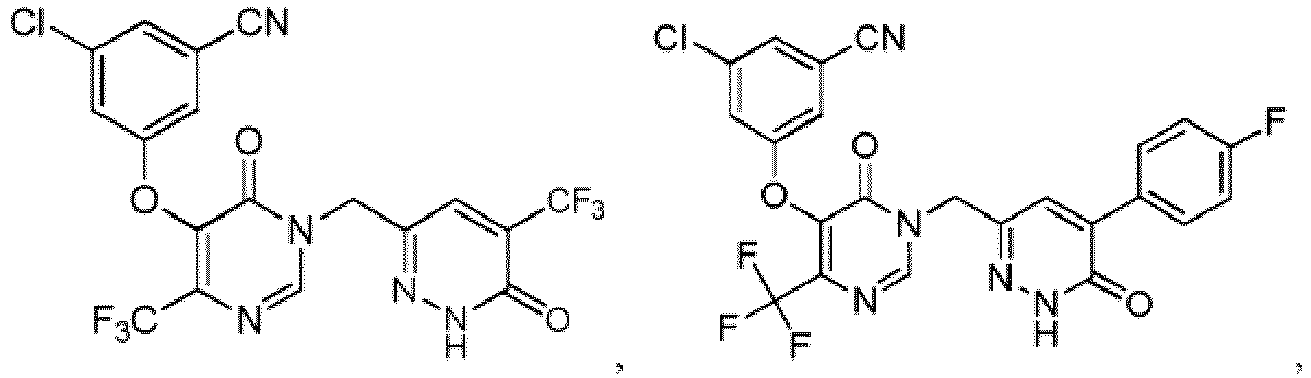


- Combinaison selon la revendication 2, dans laquelle le composé de formule (la) est :

- Combinaison selon la revendication 2, dans laquelle le composé de formule (la) est :

- Combinaison selon la revendication 2, dans laquelle le composé de formule (la) est :

- Combinaison selon la revendication 2, dans laquelle le composé de formule (la) est :

- Combinaison selon la revendication 2, dans laquelle le composé de formule (la) est :

- Combinaison selon l'une quelconque des revendications 1-7, dans laquelle les un ou plusieurs agents anti-VIH sont un antiviral choisi parmi des inhibiteurs de protéase du VIH, des inhibiteurs de transcriptase inverse du VIH nucléosidiques, des inhibiteurs de transcriptase inverse du VIH non nucléosidiques, des inhibiteurs d'intégrase du VIH, des inhibiteurs de fusion du VIH et des inhibiteurs d'entrée du VIH.
- Combinaison selon l'une quelconque des revendications 1-7, dans laquelle les un ou plusieurs agents anti-VIH sont choisis parmi :
abacavir, abacavir + lamivudine, abacavir + lamivudine + zidovudine, amprénavir, atazanavir, zidovudine, capravirine, darunavir, zalcitabine, didanosine, didanosine à enrobage entérique, délavirdine, éfavirenz, éfavirenz + emtricitabine + ténofovir disoproxil fumarate, 4' -éthynyl-2-fluoro-2' -désoxyadénosine, emtricitabine, emtricitabine + ténofovir disoproxil fumarate, emviridine, enfuvirtide, étravirine, fosamprénavir calcium, indinavir, lamivudine, lamivudine + zidovudine, lopinavir, lopinavir + ritonavir, maraviroc, nelfinavir, névirapine, PPL-100, raltégravir, ritonavir, saquinavir, stavudine, ténofovir disoproxil fumarate, ténofovirhexadécyloxypropyle, tipranavir, abacavir sulfate, délavirdine mésylate, indinavir sulfate, atazanavir sulfate, nelfinavir mésylate, et saquinavir mésylate - Combinaison selon la revendication 9, dans laquelle les un ou plusieurs agents anti-VIH sont le 4'-éthynyl-2-fluoro-2'-désoxyadénosine.
- Composition pharmaceutique comprenant la combinaison selon l'une quelconque des revendications 1 à 10, et un véhicule pharmaceutiquement acceptable.
- Combinaison selon l'une quelconque des revendications 1 à 10, pour utilisation dans l'inhibition d'une transcriptase inverse du VIH chez un sujet.
- Combinaison selon l'une quelconque des revendications 1 à 10, pour utilisation dans la prophylaxie d'une infection par le VIH ou la prophylaxie du SIDA chez un sujet.
- Combinaison selon l'une quelconque des revendications 1 à 10, pour utilisation dans le traitement d'une infection par le VIH, le traitement du SIDA ou le retardement de l'apparition du SIDA chez un sujet.
- Combinaison pour utilisation selon l'une quelconque des revendications 12 à 14, dans laquelle le sujet est un humain.
Priority Applications (4)
| Application Number | Priority Date | Filing Date | Title |
|---|---|---|---|
| RS20220359A RS63112B1 (sr) | 2012-10-08 | 2013-10-07 | Kombinacije koje sadrže derivate 5-fenoksi-3h-pirimidin-4-ona i njihova upotreba za profilaksu ili lečenje infekcije hiv-om |
| SI201331974T SI3656384T1 (sl) | 2012-10-08 | 2013-10-07 | Kombinacije, ki obsegajo derivate 5-fenoksi-3H-pirimidin-4-ona, in njihova uporaba za profilakso ali zdravljenje okužbe s HIV |
| HRP20220502TT HRP20220502T1 (hr) | 2012-10-08 | 2013-10-07 | Kombinacije koje sadrže derivate 5-fenoksi-3h-pirimidin-4-ona i njihova uporaba za profilaksu ili liječenje infekcije hiv-om |
| PL19210167T PL3656384T3 (pl) | 2012-10-08 | 2013-10-07 | Kombinacje zawierające pochodne 5-fenoksy-3h-pirymidyn-4-onu i ich zastosowanie do profilaktyki lub leczenia infekcji hiv |
Applications Claiming Priority (4)
| Application Number | Priority Date | Filing Date | Title |
|---|---|---|---|
| CN2012001358 | 2012-10-08 | ||
| EP17191307.2A EP3295942B1 (fr) | 2012-10-08 | 2013-10-07 | Combinaisons comprenant des dérivés 5-phénoxy-3h-pyrimidin-4-one et leur utilisation pour la prophylaxie ou le traitement d'une infection par le vih |
| EP13776702.6A EP2903977B1 (fr) | 2012-10-08 | 2013-10-07 | Derivés de 5-phénoxy-3h-pyrimidin-4-one et leur utilisation en tant qu'inhibiteurs de la transcriptase inverse du vih |
| PCT/US2013/063612 WO2014058747A1 (fr) | 2012-10-08 | 2013-10-07 | Dérivés de 5-phénoxy-3h-pyrimidin-4-one et leur utilisation en tant qu'inhibiteurs de la transcriptase inverse du vih |
Related Parent Applications (2)
| Application Number | Title | Priority Date | Filing Date |
|---|---|---|---|
| EP17191307.2A Division EP3295942B1 (fr) | 2012-10-08 | 2013-10-07 | Combinaisons comprenant des dérivés 5-phénoxy-3h-pyrimidin-4-one et leur utilisation pour la prophylaxie ou le traitement d'une infection par le vih |
| EP13776702.6A Division EP2903977B1 (fr) | 2012-10-08 | 2013-10-07 | Derivés de 5-phénoxy-3h-pyrimidin-4-one et leur utilisation en tant qu'inhibiteurs de la transcriptase inverse du vih |
Publications (2)
| Publication Number | Publication Date |
|---|---|
| EP3656384A1 EP3656384A1 (fr) | 2020-05-27 |
| EP3656384B1 true EP3656384B1 (fr) | 2022-02-23 |
Family
ID=49354986
Family Applications (3)
| Application Number | Title | Priority Date | Filing Date |
|---|---|---|---|
| EP13776702.6A Active EP2903977B1 (fr) | 2012-10-08 | 2013-10-07 | Derivés de 5-phénoxy-3h-pyrimidin-4-one et leur utilisation en tant qu'inhibiteurs de la transcriptase inverse du vih |
| EP17191307.2A Active EP3295942B1 (fr) | 2012-10-08 | 2013-10-07 | Combinaisons comprenant des dérivés 5-phénoxy-3h-pyrimidin-4-one et leur utilisation pour la prophylaxie ou le traitement d'une infection par le vih |
| EP19210167.3A Active EP3656384B1 (fr) | 2012-10-08 | 2013-10-07 | Combinaisons comprenant des dérivés 5-phénoxy-3h-pyrimidin-4-one et leur utilisation pour la prophylaxie ou le traitement d'une infection par le vih |
Family Applications Before (2)
| Application Number | Title | Priority Date | Filing Date |
|---|---|---|---|
| EP13776702.6A Active EP2903977B1 (fr) | 2012-10-08 | 2013-10-07 | Derivés de 5-phénoxy-3h-pyrimidin-4-one et leur utilisation en tant qu'inhibiteurs de la transcriptase inverse du vih |
| EP17191307.2A Active EP3295942B1 (fr) | 2012-10-08 | 2013-10-07 | Combinaisons comprenant des dérivés 5-phénoxy-3h-pyrimidin-4-one et leur utilisation pour la prophylaxie ou le traitement d'une infection par le vih |
Country Status (46)
Families Citing this family (62)
| Publication number | Priority date | Publication date | Assignee | Title |
|---|---|---|---|---|
| CN103517990A (zh) | 2010-10-07 | 2014-01-15 | 通用医疗公司 | 癌症生物标志物 |
| JO3470B1 (ar) * | 2012-10-08 | 2020-07-05 | Merck Sharp & Dohme | مشتقات 5- فينوكسي-3h-بيريميدين-4-أون واستخدامها كمثبطات ناسخ عكسي ل hiv |
| US9388430B2 (en) | 2013-09-06 | 2016-07-12 | President And Fellows Of Harvard College | Cas9-recombinase fusion proteins and uses thereof |
| US9340799B2 (en) | 2013-09-06 | 2016-05-17 | President And Fellows Of Harvard College | MRNA-sensing switchable gRNAs |
| EP3046912A1 (fr) | 2013-09-16 | 2016-07-27 | Bayer Pharma Aktiengesellschaft | Trifluorométhylpyrimidones disubstituées et leur utilisation comme antagonistes du ccr2 |
| EP3785714A1 (fr) * | 2014-04-01 | 2021-03-03 | Merck Sharp & Dohme Corp. | Promédicaments d'inhibiteurs de la transcriptase inverse du vih |
| EP3760208B1 (fr) | 2014-06-25 | 2024-05-29 | The General Hospital Corporation | Ciblage de hsatii (human satellite ii) |
| EP3186242B1 (fr) | 2014-08-29 | 2021-10-06 | Tes Pharma S.r.l. | Inhibiteurs de la semialdéhyde décarboxylase de l'acide alpha-amino-bêta-carboxymuconique |
| FR3027901B1 (fr) * | 2014-10-31 | 2018-03-16 | Universite De Reims Champagne Ardenne | Nouveaux procedes appartenant a la famille des pyridazinones. |
| US10350165B2 (en) * | 2014-12-12 | 2019-07-16 | Ojai Energetics Pbc | Methods and systems for forming stable droplets |
| SG10202104041PA (en) | 2015-10-23 | 2021-06-29 | Harvard College | Nucleobase editors and uses thereof |
| KR20250103795A (ko) | 2016-08-03 | 2025-07-07 | 프레지던트 앤드 펠로우즈 오브 하바드 칼리지 | 아데노신 핵염기 편집제 및 그의 용도 |
| US11661590B2 (en) | 2016-08-09 | 2023-05-30 | President And Fellows Of Harvard College | Programmable CAS9-recombinase fusion proteins and uses thereof |
| WO2018039438A1 (fr) | 2016-08-24 | 2018-03-01 | President And Fellows Of Harvard College | Incorporation d'acides aminés non naturels dans des protéines au moyen de l'édition de bases |
| SG11201903089RA (en) | 2016-10-14 | 2019-05-30 | Harvard College | Aav delivery of nucleobase editors |
| WO2018119359A1 (fr) | 2016-12-23 | 2018-06-28 | President And Fellows Of Harvard College | Édition du gène récepteur ccr5 pour protéger contre l'infection par le vih |
| US11898179B2 (en) | 2017-03-09 | 2024-02-13 | President And Fellows Of Harvard College | Suppression of pain by gene editing |
| EP3592381A1 (fr) | 2017-03-09 | 2020-01-15 | President and Fellows of Harvard College | Vaccin contre le cancer |
| WO2018165629A1 (fr) | 2017-03-10 | 2018-09-13 | President And Fellows Of Harvard College | Éditeur de base cytosine à guanine |
| WO2018176009A1 (fr) | 2017-03-23 | 2018-09-27 | President And Fellows Of Harvard College | Éditeurs de nucléobase comprenant des protéines de liaison à l'adn programmable par acides nucléiques |
| WO2018209320A1 (fr) | 2017-05-12 | 2018-11-15 | President And Fellows Of Harvard College | Arn guides incorporés par aptazyme pour une utilisation avec crispr-cas9 dans l'édition du génome et l'activation transcriptionnelle |
| CN111801345A (zh) | 2017-07-28 | 2020-10-20 | 哈佛大学的校长及成员们 | 使用噬菌体辅助连续进化(pace)的进化碱基编辑器的方法和组合物 |
| EP3676376B1 (fr) | 2017-08-30 | 2025-01-15 | President and Fellows of Harvard College | Éditeurs de bases à haut rendement comprenant une gam |
| AU2018334290A1 (en) | 2017-09-18 | 2020-04-02 | Goldfinch Bio, Inc. | Pyridazinones and methods of use thereof |
| US11795443B2 (en) | 2017-10-16 | 2023-10-24 | The Broad Institute, Inc. | Uses of adenosine base editors |
| WO2019118949A1 (fr) | 2017-12-15 | 2019-06-20 | The Broad Institute, Inc. | Systèmes et procédés de prédiction des résultats de la réparation en ingénierie génétique |
| US20210213041A1 (en) | 2018-02-06 | 2021-07-15 | The General Hospital Corporation | Repeat rna as biomarkers of tumor immune response |
| SI3788040T1 (sl) | 2018-04-30 | 2023-07-31 | Ribon Therapeutics Inc. | Piridazinoni kot zaviralci parp7 |
| US12157760B2 (en) | 2018-05-23 | 2024-12-03 | The Broad Institute, Inc. | Base editors and uses thereof |
| EP3820495A4 (fr) | 2018-07-09 | 2022-07-20 | The Broad Institute Inc. | Modificateurs d'arn épigénétiques programmables par arn et leurs utilisations |
| IL281438B2 (en) | 2018-09-18 | 2023-12-01 | Goldfinch Bio Inc | Pyridazinones and methods of use thereof |
| WO2020092453A1 (fr) | 2018-10-29 | 2020-05-07 | The Broad Institute, Inc. | Éditeurs de nucléobases comprenant geocas9 et utilisations associées |
| EP3898595B1 (fr) * | 2018-12-18 | 2024-05-01 | Merck Sharp & Dohme LLC | Dérivés de pyrimidone en tant qu'agents cytotoxiques sélectifs contre des cellules infectées par le vih |
| US12351837B2 (en) | 2019-01-23 | 2025-07-08 | The Broad Institute, Inc. | Supernegatively charged proteins and uses thereof |
| EP3942043A2 (fr) | 2019-03-19 | 2022-01-26 | The Broad Institute, Inc. | Procédés et compositions pour l'édition de séquences nucléotidiques |
| MX2021012310A (es) | 2019-04-11 | 2021-11-12 | Goldfinch Bio Inc | Formulación de secado por aspersión de un inhibidor de trpc5 de piridazinona. |
| WO2020214842A1 (fr) | 2019-04-17 | 2020-10-22 | The Broad Institute, Inc. | Éditeurs de base d'adénine présentant des effets hors cible réduits |
| US12371421B2 (en) | 2019-04-29 | 2025-07-29 | Ribon Therapeutics, Inc. | Solid forms of a PARP7 inhibitor |
| CA3141143A1 (fr) * | 2019-05-22 | 2020-11-26 | Merck Sharp & Dohme Corp. | Derives de pyridinone utilises en tant qu'agents cytotoxiques selectifs contre des cellules infectees par le vih |
| CN114258398A (zh) | 2019-06-13 | 2022-03-29 | 总医院公司 | 工程化的人内源性病毒样颗粒及使用其递送至细胞的方法 |
| MX2022004049A (es) * | 2019-10-04 | 2022-07-11 | Goldfinch Bio Inc | Tratamiento basado en biomarcadores de la glomeruloesclerosis focal y segmentaria y de la enfermedad renal diabetica. |
| US12435330B2 (en) | 2019-10-10 | 2025-10-07 | The Broad Institute, Inc. | Methods and compositions for prime editing RNA |
| MX2022005216A (es) | 2019-10-30 | 2022-06-02 | Ribon Therapeutics Inc | Piridazinonas como inhibidores de poli(adp-ribosa) polimerasa 7 (parp7). |
| EP4066839A4 (fr) | 2019-11-28 | 2023-12-27 | Shionogi & Co., Ltd | Agent pharmaceutique prophylactique et thérapeutique pour maladies infectieuses à vih, caractérisé en ce qu'il comprend une combinaison d'un inhibiteur d'intégrase et d'un agent anti-vih |
| TW202146416A (zh) | 2019-12-11 | 2021-12-16 | 德商拜耳廠股份有限公司 | 吡唑并三𠯤 |
| BR112022022603A2 (pt) | 2020-05-08 | 2023-01-17 | Broad Inst Inc | Métodos e composições para edição simultânea de ambas as fitas de sequência alvo de nucleotídeos de fita dupla |
| CN116670154A (zh) | 2020-07-24 | 2023-08-29 | 总医院公司 | 增强的病毒样颗粒及使用其递送至细胞的方法 |
| JP2023543803A (ja) | 2020-09-24 | 2023-10-18 | ザ ブロード インスティテュート,インコーポレーテッド | プライム編集ガイドrna、その組成物、及びその使用方法 |
| EP4274894A2 (fr) | 2021-01-11 | 2023-11-15 | The Broad Institute, Inc. | Variants d'éditeur primaire, constructions et procédés pour améliorer l'efficacité et la précision d'une édition primaire |
| WO2023275230A1 (fr) * | 2021-07-01 | 2023-01-05 | Janssen Pharmaceutica Nv | Acétamides 5-oxo-pyrido[2,3-d]pyridazin-6(5h)-yl |
| JP2024530487A (ja) | 2021-08-06 | 2024-08-21 | ザ ブロード インスティテュート,インコーポレーテッド | 改善されたプライムエディターおよび使用方法 |
| WO2023076898A1 (fr) | 2021-10-25 | 2023-05-04 | The Broad Institute, Inc. | Procédés et compositions pour l'édition d'un génome à l'aide d'une édition primaire et d'une recombinase |
| US20250064979A1 (en) | 2021-12-03 | 2025-02-27 | The Broad Institute, Inc. | Self-assembling virus-like particles for delivery of prime editors and methods of making and using same |
| WO2023205687A1 (fr) | 2022-04-20 | 2023-10-26 | The Broad Institute, Inc. | Procédés et compositions d'édition primaire améliorés |
| WO2023240137A1 (fr) | 2022-06-08 | 2023-12-14 | The Board Institute, Inc. | Variants de cas14a1 évolués, compositions et méthodes de fabrication et d'utilisation de ceux-ci dans l'édition génomique |
| WO2024077267A1 (fr) | 2022-10-07 | 2024-04-11 | The Broad Institute, Inc. | Méthodes et compositions d'édition d'amorce pour traiter des troubles de répétition de triplet |
| EP4619515A1 (fr) | 2022-11-17 | 2025-09-24 | The Broad Institute, Inc. | Distribution d'éditeur primaire par vaa |
| WO2024168147A2 (fr) | 2023-02-09 | 2024-08-15 | The Broad Institute, Inc. | Recombinases évoluées pour éditer un génome en combinaison avec une édition primaire |
| WO2024206125A1 (fr) | 2023-03-24 | 2024-10-03 | The Broad Institute, Inc. | Utilisation de l'édition primaire pour le traitement de la drépanocytose |
| US20250026759A1 (en) | 2023-07-07 | 2025-01-23 | Merck Sharp & Dohme Llc | Tetrahydroquinazoline derivatives as selective cytotoxic agents |
| AU2024357861A1 (en) | 2023-10-12 | 2026-04-23 | Renagade Therapeutics Management Inc. | Nickase-retron template-based precision editing system and methods of use |
| WO2025193566A1 (fr) * | 2024-03-15 | 2025-09-18 | Merck Sharp & Dohme Llc | Dérivés de n-oxyde utilisés en tant qu'agents cytotoxiques sélectifs |
Family Cites Families (26)
| Publication number | Priority date | Publication date | Assignee | Title |
|---|---|---|---|---|
| US5663169A (en) | 1992-08-07 | 1997-09-02 | Merck & Co., Inc. | Benzoxazinones as inhibitors of HIV reverse transcriptase |
| CA2330304A1 (fr) | 1998-04-27 | 1999-11-04 | Centre National De La Recherche Scientifique | Derives de 3-(amino- ou aminoalkyl)pyridinone et utilisation de ceux-ci dans le traitement de pathologies associees au vih |
| IT1305313B1 (it) | 1998-07-17 | 2001-05-04 | Colla Paolo | 3,4 - diidro- 6- benzil-4-oxopirimidine sostituite e relativo processodi produzione e impiego nella terapia delle infezioni da hiv-1. |
| SE9904045D0 (sv) | 1999-11-09 | 1999-11-09 | Astra Ab | Compounds |
| ES2266258T3 (es) | 2000-09-15 | 2007-03-01 | Vertex Pharmaceuticals Incorporated | Compuestos de pirazol utiles como inhibidores de proteina cinasas. |
| PL227577B1 (pl) | 2003-02-07 | 2017-12-29 | Janssen Pharmaceutica Nv | Zastosowanie pochodnych pirymidyny do wytwarzania leku do zapobiegania zakażeniu wirusem HIV oraz kompozycja farmaceutyczna |
| TW200423930A (en) | 2003-02-18 | 2004-11-16 | Hoffmann La Roche | Non-nucleoside reverse transcriptase inhibitors |
| TW200505441A (en) | 2003-03-24 | 2005-02-16 | Hoffmann La Roche | Non-nucleoside reverse transcriptase inhibitorsⅠ |
| KR20050119652A (ko) | 2003-03-24 | 2005-12-21 | 에프. 호프만-라 로슈 아게 | 역전사 효소 저해제로서의 벤질-피리다진온 |
| CN1934093A (zh) | 2004-01-12 | 2007-03-21 | 吉里德科学公司 | 嘧啶基膦酸酯抗病毒化合物和使用方法 |
| CN1934092A (zh) | 2004-03-23 | 2007-03-21 | 弗·哈夫曼-拉罗切有限公司 | 非核苷逆转录酶抑制剂 |
| US7166738B2 (en) | 2004-04-23 | 2007-01-23 | Roche Palo Alto Llc | Non-nucleoside reverse transcriptase inhibitors |
| CN1946680B (zh) | 2004-04-23 | 2011-04-06 | 弗·哈夫曼-拉罗切有限公司 | 非核苷逆转录酶抑制剂 |
| EP1831157A2 (fr) | 2004-12-22 | 2007-09-12 | Pfizer Limited | Inhibiteurs non-nucléosidiques de la transcriptase inverse du vih-1 |
| AR057455A1 (es) | 2005-07-22 | 2007-12-05 | Merck & Co Inc | Inhibidores de la transcriptasa reversa de vih y composicion farmaceutica |
| CN101287702A (zh) | 2005-10-19 | 2008-10-15 | 弗·哈夫曼-拉罗切有限公司 | N-苯基苯乙酰胺非核苷逆转录酶抑制剂 |
| EP1940781A1 (fr) | 2005-10-19 | 2008-07-09 | F.Hoffmann-La Roche Ag | Phénylacétamides en tant qu'inhibiteurs de nnrt |
| EP2256115A1 (fr) | 2006-11-24 | 2010-12-01 | Takeda Pharmaceutical Company Limited | Composé hétéromonocyclique et ses utilisations |
| US7803940B2 (en) | 2006-11-24 | 2010-09-28 | Takeda Pharmaceutical Company Limited | Heteromonocyclic compound or a salt thereof having strong antihypertensive action, insulin sensitizing activity and the like production thereof and use thereof for prophylaxis or treatment of cardiovascular diseases, metabolic diseases and/or central nervous system diseases |
| TW200831085A (en) | 2006-12-13 | 2008-08-01 | Merck & Co Inc | Non-nucleoside reverse transcriptase inhibitors |
| KR20100088142A (ko) | 2007-11-20 | 2010-08-06 | 머크 샤프 앤드 돔 코포레이션 | 비-뉴클레오사이드 역전사효소 억제제 |
| CA2710987A1 (fr) * | 2008-01-08 | 2009-07-16 | Merck Sharp & Dohme Corp. | Procede de preparation d'hydroxypyrimidinone carboxamides n-substitues |
| PL2924034T3 (pl) * | 2010-03-30 | 2017-07-31 | Merck Canada Inc. | Kompozycja farmaceutyczna zawierająca nienukleozydowy inhibitor odwrotnej transkryptazy |
| WO2011126969A1 (fr) | 2010-04-08 | 2011-10-13 | Merck Sharp & Dohme Corp. | Promédicaments d'un inhibiteur de la transcriptase inverse du vih |
| JO3470B1 (ar) * | 2012-10-08 | 2020-07-05 | Merck Sharp & Dohme | مشتقات 5- فينوكسي-3h-بيريميدين-4-أون واستخدامها كمثبطات ناسخ عكسي ل hiv |
| EP3785714A1 (fr) | 2014-04-01 | 2021-03-03 | Merck Sharp & Dohme Corp. | Promédicaments d'inhibiteurs de la transcriptase inverse du vih |
-
2013
- 2013-09-29 JO JOP/2013/0284A patent/JO3470B1/ar active
- 2013-10-02 AR ARP130103568A patent/AR092876A1/es active IP Right Grant
- 2013-10-07 ES ES17191307T patent/ES2770774T3/es active Active
- 2013-10-07 NZ NZ706729A patent/NZ706729A/en unknown
- 2013-10-07 ES ES19210167T patent/ES2909190T3/es active Active
- 2013-10-07 EP EP13776702.6A patent/EP2903977B1/fr active Active
- 2013-10-07 JP JP2015535852A patent/JP5877281B2/ja active Active
- 2013-10-07 CA CA2887312A patent/CA2887312C/fr active Active
- 2013-10-07 SG SG11201502620UA patent/SG11201502620UA/en unknown
- 2013-10-07 DK DK13776702.6T patent/DK2903977T3/en active
- 2013-10-07 DK DK17191307.2T patent/DK3295942T3/da active
- 2013-10-07 LT LTEP17191307.2T patent/LT3295942T/lt unknown
- 2013-10-07 US US14/047,515 patent/US9469634B2/en active Active
- 2013-10-07 MY MYPI2015000836A patent/MY192716A/en unknown
- 2013-10-07 RS RS20220359A patent/RS63112B1/sr unknown
- 2013-10-07 TW TW102136225A patent/TWI538907B/zh active
- 2013-10-07 SI SI201330835T patent/SI2903977T1/sl unknown
- 2013-10-07 AU AU2013329552A patent/AU2013329552B8/en active Active
- 2013-10-07 HR HRP20171819TT patent/HRP20171819T1/hr unknown
- 2013-10-07 KR KR1020157011661A patent/KR101696128B1/ko active Active
- 2013-10-07 GE GEAP201313818A patent/GEP20186838B/en unknown
- 2013-10-07 MA MA37959A patent/MA37959A2/fr unknown
- 2013-10-07 MX MX2015004448A patent/MX355040B/es active IP Right Grant
- 2013-10-07 LT LTEP13776702.6T patent/LT2903977T/lt unknown
- 2013-10-07 RS RS20200052A patent/RS59863B1/sr unknown
- 2013-10-07 HU HUE17191307A patent/HUE048670T2/hu unknown
- 2013-10-07 PL PL19210167T patent/PL3656384T3/pl unknown
- 2013-10-07 BR BR112015007742A patent/BR112015007742B8/pt active IP Right Grant
- 2013-10-07 ES ES13776702.6T patent/ES2645638T3/es active Active
- 2013-10-07 AP AP2015008355A patent/AP2015008355A0/xx unknown
- 2013-10-07 DK DK19210167.3T patent/DK3656384T3/da active
- 2013-10-07 EP EP17191307.2A patent/EP3295942B1/fr active Active
- 2013-10-07 TW TW105108710A patent/TWI598343B/zh active
- 2013-10-07 NO NO13776702A patent/NO2903977T3/no unknown
- 2013-10-07 CN CN201380061513.7A patent/CN104822670B/zh active Active
- 2013-10-07 PE PE2015001782A patent/PE20151787A1/es active IP Right Grant
- 2013-10-07 RS RS20171164A patent/RS56543B1/sr unknown
- 2013-10-07 PL PL13776702T patent/PL2903977T3/pl unknown
- 2013-10-07 HR HRP20220502TT patent/HRP20220502T1/hr unknown
- 2013-10-07 EP EP19210167.3A patent/EP3656384B1/fr active Active
- 2013-10-07 MD MD20150047A patent/MD4625C1/ro active IP Right Grant
- 2013-10-07 SI SI201331662T patent/SI3295942T1/sl unknown
- 2013-10-07 HU HUE19210167A patent/HUE058903T2/hu unknown
- 2013-10-07 HU HUE13776702A patent/HUE037231T2/hu unknown
- 2013-10-07 LT LTEP19210167.3T patent/LT3656384T/lt unknown
- 2013-10-07 WO PCT/US2013/063612 patent/WO2014058747A1/fr not_active Ceased
- 2013-10-07 PT PT171913072T patent/PT3295942T/pt unknown
- 2013-10-07 ME MEP-2017-264A patent/ME02918B/fr unknown
- 2013-10-07 EA EA201590674A patent/EA033436B1/ru not_active IP Right Cessation
- 2013-10-07 PT PT137767026T patent/PT2903977T/pt unknown
- 2013-10-07 SI SI201331974T patent/SI3656384T1/sl unknown
- 2013-10-07 PL PL17191307T patent/PL3295942T3/pl unknown
- 2013-10-07 PT PT192101673T patent/PT3656384T/pt unknown
- 2013-10-07 UA UAA201504486A patent/UA114006C2/uk unknown
-
2015
- 2015-03-23 TN TNP2015000106A patent/TN2015000106A1/fr unknown
- 2015-04-01 IL IL238090A patent/IL238090B/en active IP Right Grant
- 2015-04-06 PH PH12015500764A patent/PH12015500764B1/en unknown
- 2015-04-07 NI NI201500048A patent/NI201500048A/es unknown
- 2015-04-08 CR CR20150183A patent/CR20150183A/es unknown
- 2015-04-08 CL CL2015000880A patent/CL2015000880A1/es unknown
- 2015-04-08 DO DO2015000082A patent/DOP2015000082A/es unknown
- 2015-04-08 GT GT201500088A patent/GT201500088A/es unknown
- 2015-04-08 CO CO15077967A patent/CO7350655A2/es unknown
- 2015-05-07 ZA ZA2015/03143A patent/ZA201503143B/en unknown
- 2015-05-12 EC ECIEPI201518618A patent/ECSP15018618A/es unknown
-
2016
- 2016-01-25 JP JP2016011415A patent/JP6097422B2/ja active Active
- 2016-02-01 US US15/012,445 patent/US9718819B2/en active Active
-
2017
- 2017-06-07 US US15/616,756 patent/US10189831B2/en active Active
- 2017-11-20 CY CY20171101214T patent/CY1119655T1/el unknown
-
2020
- 2020-01-30 HR HRP20200158TT patent/HRP20200158T1/hr unknown
- 2020-02-04 CY CY20201100097T patent/CY1122585T1/el unknown
-
2022
- 2022-03-30 CY CY20221100247T patent/CY1125202T1/el unknown
Also Published As
Similar Documents
| Publication | Publication Date | Title |
|---|---|---|
| EP3295942B1 (fr) | Combinaisons comprenant des dérivés 5-phénoxy-3h-pyrimidin-4-one et leur utilisation pour la prophylaxie ou le traitement d'une infection par le vih | |
| EP3125894B1 (fr) | Promédicaments d'inhibiteurs de transcriptase inverse de vih | |
| HK1252786B (en) | Combinations comprising 5-phenoxy-3h-pyrimidin-4-one derivatives and their use for the prophylaxis or treatment of infection by hiv | |
| HK40022586A (en) | Combinations comprising 5-phenoxy-3h-pyrimidin-4-one derivatives and their use for the prophylaxis or treatment of infection by hiv | |
| HK40022586B (en) | Combinations comprising 5-phenoxy-3h-pyrimidin-4-one derivatives and their use for the prophylaxis or treatment of infection by hiv | |
| HK1207369B (en) | 5-phenoxy-3h-pyrimidin-4-one derivatives and their use as hiv reverse transcriptase inhibitors | |
| HK40042531A (en) | Prodrugs of hiv reverse transcriptase inhibitors |
Legal Events
| Date | Code | Title | Description |
|---|---|---|---|
| REG | Reference to a national code |
Ref country code: HR Ref legal event code: TUEP Ref document number: P20220502 Country of ref document: HR |
|
| PUAI | Public reference made under article 153(3) epc to a published international application that has entered the european phase |
Free format text: ORIGINAL CODE: 0009012 |
|
| STAA | Information on the status of an ep patent application or granted ep patent |
Free format text: STATUS: THE APPLICATION HAS BEEN PUBLISHED |
|
| AC | Divisional application: reference to earlier application |
Ref document number: 2903977 Country of ref document: EP Kind code of ref document: P Ref document number: 3295942 Country of ref document: EP Kind code of ref document: P |
|
| AK | Designated contracting states |
Kind code of ref document: A1 Designated state(s): AL AT BE BG CH CY CZ DE DK EE ES FI FR GB GR HR HU IE IS IT LI LT LU LV MC MK MT NL NO PL PT RO RS SE SI SK SM TR |
|
| AX | Request for extension of the european patent |
Extension state: BA ME |
|
| REG | Reference to a national code |
Ref country code: HK Ref legal event code: DE Ref document number: 40022586 Country of ref document: HK |
|
| STAA | Information on the status of an ep patent application or granted ep patent |
Free format text: STATUS: REQUEST FOR EXAMINATION WAS MADE |
|
| 17P | Request for examination filed |
Effective date: 20201127 |
|
| RAX | Requested extension states of the european patent have changed |
Extension state: BA Payment date: 20201127 Extension state: ME Payment date: 20201127 |
|
| RBV | Designated contracting states (corrected) |
Designated state(s): AL AT BE BG CH CY CZ DE DK EE ES FI FR GB GR HR HU IE IS IT LI LT LU LV MC MK MT NL NO PL PT RO RS SE SI SK SM TR |
|
| STAA | Information on the status of an ep patent application or granted ep patent |
Free format text: STATUS: EXAMINATION IS IN PROGRESS |
|
| 17Q | First examination report despatched |
Effective date: 20210201 |
|
| GRAP | Despatch of communication of intention to grant a patent |
Free format text: ORIGINAL CODE: EPIDOSNIGR1 |
|
| STAA | Information on the status of an ep patent application or granted ep patent |
Free format text: STATUS: GRANT OF PATENT IS INTENDED |
|
| INTG | Intention to grant announced |
Effective date: 20210831 |
|
| GRAS | Grant fee paid |
Free format text: ORIGINAL CODE: EPIDOSNIGR3 |
|
| GRAA | (expected) grant |
Free format text: ORIGINAL CODE: 0009210 |
|
| STAA | Information on the status of an ep patent application or granted ep patent |
Free format text: STATUS: THE PATENT HAS BEEN GRANTED |
|
| AC | Divisional application: reference to earlier application |
Ref document number: 2903977 Country of ref document: EP Kind code of ref document: P Ref document number: 3295942 Country of ref document: EP Kind code of ref document: P |
|
| AK | Designated contracting states |
Kind code of ref document: B1 Designated state(s): AL AT BE BG CH CY CZ DE DK EE ES FI FR GB GR HR HU IE IS IT LI LT LU LV MC MK MT NL NO PL PT RO RS SE SI SK SM TR |
|
| REG | Reference to a national code |
Ref country code: GB Ref legal event code: FG4D |
|
| REG | Reference to a national code |
Ref country code: CH Ref legal event code: EP |
|
| REG | Reference to a national code |
Ref country code: DE Ref legal event code: R096 Ref document number: 602013081002 Country of ref document: DE |
|
| REG | Reference to a national code |
Ref country code: AT Ref legal event code: REF Ref document number: 1469907 Country of ref document: AT Kind code of ref document: T Effective date: 20220315 |
|
| REG | Reference to a national code |
Ref country code: IE Ref legal event code: FG4D |
|
| REG | Reference to a national code |
Ref country code: PT Ref legal event code: SC4A Ref document number: 3656384 Country of ref document: PT Date of ref document: 20220322 Kind code of ref document: T Free format text: AVAILABILITY OF NATIONAL TRANSLATION Effective date: 20220315 |
|
| REG | Reference to a national code |
Ref country code: RO Ref legal event code: EPE |
|
| REG | Reference to a national code |
Ref country code: DK Ref legal event code: T3 Effective date: 20220413 |
|
| REG | Reference to a national code |
Ref country code: FI Ref legal event code: FGE Ref country code: NL Ref legal event code: FP |
|
| REG | Reference to a national code |
Ref country code: SE Ref legal event code: TRGR |
|
| REG | Reference to a national code |
Ref country code: GR Ref legal event code: EP Ref document number: 20220400672 Country of ref document: GR Effective date: 20220418 Ref country code: ES Ref legal event code: FG2A Ref document number: 2909190 Country of ref document: ES Kind code of ref document: T3 Effective date: 20220505 |
|
| REG | Reference to a national code |
Ref country code: EE Ref legal event code: FG4A Ref document number: E022096 Country of ref document: EE Effective date: 20220316 |
|
| REG | Reference to a national code |
Ref country code: HR Ref legal event code: T1PR Ref document number: P20220502 Country of ref document: HR |
|
| REG | Reference to a national code |
Ref country code: NO Ref legal event code: T2 Effective date: 20220223 |
|
| REG | Reference to a national code |
Ref country code: HU Ref legal event code: GB9C Owner name: MERCK SHARP & DOHME LLC, US Free format text: FORMER OWNER(S): MERCK SHARP & DOHME CORP., US |
|
| REG | Reference to a national code |
Ref country code: HU Ref legal event code: AG4A Ref document number: E058903 Country of ref document: HU |
|
| REG | Reference to a national code |
Ref country code: DE Ref legal event code: R081 Ref document number: 602013081002 Country of ref document: DE Owner name: MERCK SHARP & DOHME LLC, RAHWAY, US Free format text: FORMER OWNER: MERCK SHARP & DOHME CORP., RAHWAY, NJ, US |
|
| REG | Reference to a national code |
Ref country code: NL Ref legal event code: PD Owner name: MERCK SHARP & DOHME LLC; US Free format text: DETAILS ASSIGNMENT: CHANGE OF OWNER(S), MERGE; FORMER OWNER NAME: MERCK SHARP & DOHME CORP. Effective date: 20220922 |
|
| RAP2 | Party data changed (patent owner data changed or rights of a patent transferred) |
Owner name: MERCK SHARP & DOHME LLC |
|
| REG | Reference to a national code |
Ref country code: HR Ref legal event code: ODRP Ref document number: P20220502 Country of ref document: HR Payment date: 20220929 Year of fee payment: 10 |
|
| PG25 | Lapsed in a contracting state [announced via postgrant information from national office to epo] |
Ref country code: SM Free format text: LAPSE BECAUSE OF FAILURE TO SUBMIT A TRANSLATION OF THE DESCRIPTION OR TO PAY THE FEE WITHIN THE PRESCRIBED TIME-LIMIT Effective date: 20220223 |
|
| REG | Reference to a national code |
Ref country code: NO Ref legal event code: CHAD Owner name: MERCK SHARP & DOHME LLC, US |
|
| REG | Reference to a national code |
Ref country code: LU Ref legal event code: PD Owner name: MERCK SHARP & DOHME LLC; US Free format text: FORMER OWNER: MERCK SHARP & DOHME CORP. Effective date: 20220916 |
|
| REG | Reference to a national code |
Ref country code: SK Ref legal event code: PC4A Ref document number: E 39685 Country of ref document: SK Owner name: MERCK SHARP & DOHME LLC, RAHWAY, NEW JERSEY 07, US Free format text: FORMER OWNER: MERCK SHARP & DOHME CORP., RAHWAY, NJ 07065-0907, US Effective date: 20221018 |
|
| REG | Reference to a national code |
Ref country code: EE Ref legal event code: GB1A Ref document number: E022096 Country of ref document: EE |
|
| REG | Reference to a national code |
Ref country code: DE Ref legal event code: R097 Ref document number: 602013081002 Country of ref document: DE |
|
| REG | Reference to a national code |
Ref country code: HR Ref legal event code: PPPP Ref document number: P20220502 Country of ref document: HR Owner name: MERCK SHARP & DOHME LLC, US |
|
| PLBE | No opposition filed within time limit |
Free format text: ORIGINAL CODE: 0009261 |
|
| STAA | Information on the status of an ep patent application or granted ep patent |
Free format text: STATUS: NO OPPOSITION FILED WITHIN TIME LIMIT |
|
| REG | Reference to a national code |
Ref country code: BE Ref legal event code: PD Owner name: MERCK SHARP & DOHME LLC; US Free format text: DETAILS ASSIGNMENT: CHANGE OF OWNER(S), MERGE; FORMER OWNER NAME: MERCK SHARP & DOHME CORP. Effective date: 20221018 |
|
| REG | Reference to a national code |
Ref country code: GB Ref legal event code: 732E Free format text: REGISTERED BETWEEN 20221222 AND 20221228 |
|
| REG | Reference to a national code |
Ref country code: SI Ref legal event code: SP73 Owner name: MERCK SHARP & DOHME LLC; US Effective date: 20221209 |
|
| 26N | No opposition filed |
Effective date: 20221124 |
|
| REG | Reference to a national code |
Ref country code: AT Ref legal event code: PC Ref document number: 1469907 Country of ref document: AT Kind code of ref document: T Owner name: MERCK SHARP & DOHME LLC, US Effective date: 20230131 |
|
| PG25 | Lapsed in a contracting state [announced via postgrant information from national office to epo] |
Ref country code: MC Free format text: LAPSE BECAUSE OF FAILURE TO SUBMIT A TRANSLATION OF THE DESCRIPTION OR TO PAY THE FEE WITHIN THE PRESCRIBED TIME-LIMIT Effective date: 20220223 |
|
| P01 | Opt-out of the competence of the unified patent court (upc) registered |
Effective date: 20230516 |
|
| REG | Reference to a national code |
Ref country code: HR Ref legal event code: ODRP Ref document number: P20220502 Country of ref document: HR Payment date: 20230919 Year of fee payment: 11 |
|
| REG | Reference to a national code |
Ref country code: HR Ref legal event code: ODRP Ref document number: P20220502 Country of ref document: HR Payment date: 20240923 Year of fee payment: 12 |
|
| REG | Reference to a national code |
Ref country code: AT Ref legal event code: UEP Ref document number: 1469907 Country of ref document: AT Kind code of ref document: T Effective date: 20220223 |
|
| PGFP | Annual fee paid to national office [announced via postgrant information from national office to epo] |
Ref country code: FI Payment date: 20250926 Year of fee payment: 13 Ref country code: PT Payment date: 20250926 Year of fee payment: 13 |
|
| PGFP | Annual fee paid to national office [announced via postgrant information from national office to epo] |
Ref country code: LT Payment date: 20250916 Year of fee payment: 13 Ref country code: DK Payment date: 20250926 Year of fee payment: 13 |
|
| PGFP | Annual fee paid to national office [announced via postgrant information from national office to epo] |
Ref country code: GR Payment date: 20250925 Year of fee payment: 13 Ref country code: NO Payment date: 20250912 Year of fee payment: 13 |
|
| PGFP | Annual fee paid to national office [announced via postgrant information from national office to epo] |
Ref country code: TR Payment date: 20250924 Year of fee payment: 13 Ref country code: LU Payment date: 20250915 Year of fee payment: 13 Ref country code: PL Payment date: 20250915 Year of fee payment: 13 Ref country code: NL Payment date: 20250916 Year of fee payment: 13 |
|
| PGFP | Annual fee paid to national office [announced via postgrant information from national office to epo] |
Ref country code: BE Payment date: 20250916 Year of fee payment: 13 Ref country code: BG Payment date: 20250924 Year of fee payment: 13 Ref country code: GB Payment date: 20250911 Year of fee payment: 13 |
|
| PGFP | Annual fee paid to national office [announced via postgrant information from national office to epo] |
Ref country code: HR Payment date: 20250926 Year of fee payment: 13 |
|
| PGFP | Annual fee paid to national office [announced via postgrant information from national office to epo] |
Ref country code: FR Payment date: 20250912 Year of fee payment: 13 |
|
| PGFP | Annual fee paid to national office [announced via postgrant information from national office to epo] |
Ref country code: MT Payment date: 20250920 Year of fee payment: 13 |
|
| PGFP | Annual fee paid to national office [announced via postgrant information from national office to epo] |
Ref country code: IE Payment date: 20250912 Year of fee payment: 13 Ref country code: EE Payment date: 20250918 Year of fee payment: 13 Ref country code: CZ Payment date: 20250923 Year of fee payment: 13 |
|
| REG | Reference to a national code |
Ref country code: HR Ref legal event code: ODRP Ref document number: P20220502 Country of ref document: HR Payment date: 20250926 Year of fee payment: 13 |
|
| PGFP | Annual fee paid to national office [announced via postgrant information from national office to epo] |
Ref country code: SK Payment date: 20250912 Year of fee payment: 13 |
|
| PGFP | Annual fee paid to national office [announced via postgrant information from national office to epo] |
Ref country code: LV Payment date: 20250915 Year of fee payment: 13 |
|
| PGFP | Annual fee paid to national office [announced via postgrant information from national office to epo] |
Ref country code: SI Payment date: 20250917 Year of fee payment: 13 |
|
| REG | Reference to a national code |
Ref country code: CH Ref legal event code: U11 Free format text: ST27 STATUS EVENT CODE: U-0-0-U10-U11 (AS PROVIDED BY THE NATIONAL OFFICE) Effective date: 20251101 |
|
| PGFP | Annual fee paid to national office [announced via postgrant information from national office to epo] |
Ref country code: MK Payment date: 20240918 Year of fee payment: 15 |
|
| PGFP | Annual fee paid to national office [announced via postgrant information from national office to epo] |
Ref country code: HU Payment date: 20251008 Year of fee payment: 13 |
|
| PGFP | Annual fee paid to national office [announced via postgrant information from national office to epo] |
Ref country code: DE Payment date: 20250912 Year of fee payment: 13 Ref country code: IS Payment date: 20251008 Year of fee payment: 13 |
|
| PGFP | Annual fee paid to national office [announced via postgrant information from national office to epo] |
Ref country code: AT Payment date: 20250926 Year of fee payment: 13 |
|
| PGFP | Annual fee paid to national office [announced via postgrant information from national office to epo] |
Ref country code: IT Payment date: 20251010 Year of fee payment: 13 |
|
| PGFP | Annual fee paid to national office [announced via postgrant information from national office to epo] |
Ref country code: AL Payment date: 20251007 Year of fee payment: 13 |
|
| PGFP | Annual fee paid to national office [announced via postgrant information from national office to epo] |
Ref country code: CH Payment date: 20251101 Year of fee payment: 13 Ref country code: SE Payment date: 20251010 Year of fee payment: 13 |
|
| PGFP | Annual fee paid to national office [announced via postgrant information from national office to epo] |
Ref country code: CY Payment date: 20250923 Year of fee payment: 13 |
|
| PGFP | Annual fee paid to national office [announced via postgrant information from national office to epo] |
Ref country code: RO Payment date: 20251001 Year of fee payment: 13 |
|
| PGFP | Annual fee paid to national office [announced via postgrant information from national office to epo] |
Ref country code: RS Payment date: 20251002 Year of fee payment: 13 |
|
| PGFP | Annual fee paid to national office [announced via postgrant information from national office to epo] |
Ref country code: ES Payment date: 20251105 Year of fee payment: 13 |