EP3679961A1 - Dispositif pour réduire la taille d'un tissu biologique - Google Patents
Dispositif pour réduire la taille d'un tissu biologique Download PDFInfo
- Publication number
- EP3679961A1 EP3679961A1 EP18854041.3A EP18854041A EP3679961A1 EP 3679961 A1 EP3679961 A1 EP 3679961A1 EP 18854041 A EP18854041 A EP 18854041A EP 3679961 A1 EP3679961 A1 EP 3679961A1
- Authority
- EP
- European Patent Office
- Prior art keywords
- hole
- plate
- biological tissue
- protrusion
- edges
- Prior art date
- Legal status (The legal status is an assumption and is not a legal conclusion. Google has not performed a legal analysis and makes no representation as to the accuracy of the status listed.)
- Pending
Links
Images




Classifications
-
- A—HUMAN NECESSITIES
- A61—MEDICAL OR VETERINARY SCIENCE; HYGIENE
- A61M—DEVICES FOR INTRODUCING MEDIA INTO, OR ONTO, THE BODY; DEVICES FOR TRANSDUCING BODY MEDIA OR FOR TAKING MEDIA FROM THE BODY; DEVICES FOR PRODUCING OR ENDING SLEEP OR STUPOR
- A61M1/00—Suction or pumping devices for medical purposes; Devices for carrying-off, for treatment of, or for carrying-over, body-liquids; Drainage systems
- A61M1/02—Blood transfusion apparatus
- A61M1/0259—Apparatus for treatment of blood or blood constituents not otherwise provided for
-
- C—CHEMISTRY; METALLURGY
- C12—BIOCHEMISTRY; BEER; SPIRITS; WINE; VINEGAR; MICROBIOLOGY; ENZYMOLOGY; MUTATION OR GENETIC ENGINEERING
- C12M—APPARATUS FOR ENZYMOLOGY OR MICROBIOLOGY; APPARATUS FOR CULTURING MICROORGANISMS FOR PRODUCING BIOMASS, FOR GROWING CELLS OR FOR OBTAINING FERMENTATION OR METABOLIC PRODUCTS, i.e. BIOREACTORS OR FERMENTERS
- C12M45/00—Means for pre-treatment of biological substances
- C12M45/02—Means for pre-treatment of biological substances by mechanical forces; Stirring; Trituration; Comminuting
-
- A—HUMAN NECESSITIES
- A61—MEDICAL OR VETERINARY SCIENCE; HYGIENE
- A61M—DEVICES FOR INTRODUCING MEDIA INTO, OR ONTO, THE BODY; DEVICES FOR TRANSDUCING BODY MEDIA OR FOR TAKING MEDIA FROM THE BODY; DEVICES FOR PRODUCING OR ENDING SLEEP OR STUPOR
- A61M1/00—Suction or pumping devices for medical purposes; Devices for carrying-off, for treatment of, or for carrying-over, body-liquids; Drainage systems
-
- A—HUMAN NECESSITIES
- A61—MEDICAL OR VETERINARY SCIENCE; HYGIENE
- A61M—DEVICES FOR INTRODUCING MEDIA INTO, OR ONTO, THE BODY; DEVICES FOR TRANSDUCING BODY MEDIA OR FOR TAKING MEDIA FROM THE BODY; DEVICES FOR PRODUCING OR ENDING SLEEP OR STUPOR
- A61M1/00—Suction or pumping devices for medical purposes; Devices for carrying-off, for treatment of, or for carrying-over, body-liquids; Drainage systems
- A61M1/02—Blood transfusion apparatus
-
- A—HUMAN NECESSITIES
- A61—MEDICAL OR VETERINARY SCIENCE; HYGIENE
- A61M—DEVICES FOR INTRODUCING MEDIA INTO, OR ONTO, THE BODY; DEVICES FOR TRANSDUCING BODY MEDIA OR FOR TAKING MEDIA FROM THE BODY; DEVICES FOR PRODUCING OR ENDING SLEEP OR STUPOR
- A61M1/00—Suction or pumping devices for medical purposes; Devices for carrying-off, for treatment of, or for carrying-over, body-liquids; Drainage systems
- A61M1/02—Blood transfusion apparatus
- A61M1/0272—Apparatus for treatment of blood or blood constituents prior to or for conservation, e.g. freezing, drying or centrifuging
-
- A—HUMAN NECESSITIES
- A61—MEDICAL OR VETERINARY SCIENCE; HYGIENE
- A61M—DEVICES FOR INTRODUCING MEDIA INTO, OR ONTO, THE BODY; DEVICES FOR TRANSDUCING BODY MEDIA OR FOR TAKING MEDIA FROM THE BODY; DEVICES FOR PRODUCING OR ENDING SLEEP OR STUPOR
- A61M1/00—Suction or pumping devices for medical purposes; Devices for carrying-off, for treatment of, or for carrying-over, body-liquids; Drainage systems
- A61M1/34—Filtering material out of the blood by passing it through a membrane, i.e. hemofiltration or diafiltration
- A61M1/3403—Regulation parameters
- A61M1/3406—Physical characteristics of the filtrate, e.g. urea
-
- A—HUMAN NECESSITIES
- A61—MEDICAL OR VETERINARY SCIENCE; HYGIENE
- A61M—DEVICES FOR INTRODUCING MEDIA INTO, OR ONTO, THE BODY; DEVICES FOR TRANSDUCING BODY MEDIA OR FOR TAKING MEDIA FROM THE BODY; DEVICES FOR PRODUCING OR ENDING SLEEP OR STUPOR
- A61M1/00—Suction or pumping devices for medical purposes; Devices for carrying-off, for treatment of, or for carrying-over, body-liquids; Drainage systems
- A61M1/71—Suction drainage systems
- A61M1/79—Filters for solid matter
-
- A—HUMAN NECESSITIES
- A61—MEDICAL OR VETERINARY SCIENCE; HYGIENE
- A61B—DIAGNOSIS; SURGERY; IDENTIFICATION
- A61B17/00—Surgical instruments, devices or methods
- A61B2017/00743—Type of operation; Specification of treatment sites
- A61B2017/00792—Plastic surgery
-
- A—HUMAN NECESSITIES
- A61—MEDICAL OR VETERINARY SCIENCE; HYGIENE
- A61M—DEVICES FOR INTRODUCING MEDIA INTO, OR ONTO, THE BODY; DEVICES FOR TRANSDUCING BODY MEDIA OR FOR TAKING MEDIA FROM THE BODY; DEVICES FOR PRODUCING OR ENDING SLEEP OR STUPOR
- A61M1/00—Suction or pumping devices for medical purposes; Devices for carrying-off, for treatment of, or for carrying-over, body-liquids; Drainage systems
- A61M1/89—Suction aspects of liposuction
- A61M1/892—Suction aspects of liposuction with treatment of the collected fat
-
- A—HUMAN NECESSITIES
- A61—MEDICAL OR VETERINARY SCIENCE; HYGIENE
- A61M—DEVICES FOR INTRODUCING MEDIA INTO, OR ONTO, THE BODY; DEVICES FOR TRANSDUCING BODY MEDIA OR FOR TAKING MEDIA FROM THE BODY; DEVICES FOR PRODUCING OR ENDING SLEEP OR STUPOR
- A61M2202/00—Special media to be introduced, removed or treated
- A61M2202/08—Lipoids
-
- A—HUMAN NECESSITIES
- A61—MEDICAL OR VETERINARY SCIENCE; HYGIENE
- A61M—DEVICES FOR INTRODUCING MEDIA INTO, OR ONTO, THE BODY; DEVICES FOR TRANSDUCING BODY MEDIA OR FOR TAKING MEDIA FROM THE BODY; DEVICES FOR PRODUCING OR ENDING SLEEP OR STUPOR
- A61M2202/00—Special media to be introduced, removed or treated
- A61M2202/09—Body tissue
Definitions
- One or more example embodiments relate to a device for reducing a size of biological tissue.
- Fat tissue which is a kind of biological tissue, is obtained from a subject such as a person or an animal by suction or incision. Since the obtained fat tissue may be large in size and include a large amount of fibrous material, it is difficult to implant the fat tissue into the subject using a fine needle. Accordingly, a device for reducing a size of biological tissue such as the large fat tissue have been developed.
- U.S. Patent No. 6,139,757 discloses a method of separating cells from blood using a variable porosity filter.
- An aspect provides a device for reducing a size of a biological tissue by scratching or tearing the biological tissue.
- Another aspect provides a device for gradually reducing a size of a biological tissue.
- a device for reducing a size of a biological tissue including a plate and a through hole defined by a plurality of edges of the plate and penetrating a front and a rear of the plate, wherein each of the plurality of edges includes a protrusion that protrudes toward a central portion of the through hole, and while a biological tissue passes through the through hole, the biological tissue is scratched and torn by the protrusion so that a size of the biological tissue is reduced.
- a width of the protrusion may decrease toward the central portion of the through hole such that a tip is formed.
- Each of the plurality of edges may include linear portions formed on both sides based on the protrusion.
- the protrusion may be formed in a central portion of the edge.
- the device may further include a first group of protrusions protruding in a first direction based on the plate while forming an angle with respect to the plate, and a second group of protrusions protruding in a second direction differing from the first direction based on the plate while forming an angle with respect to the plate.
- the first group of protrusions and the second group of protrusions may be provided in various ways.
- the first group of protrusions may appear consecutively along a portion of the plurality of edges and the second group of protrusions may appear consecutively along a remaining portion of the plurality of edges.
- the first group of protrusions and the second group of protrusions may alternate in different directions along the plurality of edges.
- Extension lines of the first group of protrusions do not meet and are not parallel to extension lines of the second group of protrusions.
- an extension line of the first direction and an extension line of the second direction may be at skew positions.
- the device may further include an extension portion configured to extend from each of the plurality of edges toward the central portion of the through hole, and a tip formed at an end of the extension portion and configured to scratch and tear the biological tissue.
- the device may further include an additional extension portion formed on a side opposite to the extension portion based on the tip and configured to extend toward the central portion of the through hole.
- a protruding direction of the protrusion may not be parallel to a moving direction of the biological tissue passing through the through hole.
- a device for reducing a size of a biological tissue including: a first screen including a first plate, a first through hole defined by a plurality of first edges of the first plate and penetrating a front and a rear of the first plate, and a first protrusion that protrudes toward a central portion of the first through hole; and a second screen including a second plate laminated to the first plate, a second through hole defined by a plurality of second edges of the second plate and penetrating a front and a rear of the second plate, and a second protrusion that protrudes toward a central portion of the second through hole, wherein the first through hole overlaps the second through hole and is larger in size than the second through hole.
- Protruding directions of the first protrusion and the second protrusion may not be parallel to a moving direction of a biological tissue sequentially passing through the first through hole and the second through hole, and may be the same as or intersect with the moving direction.
- FIG. 1 is a perspective view illustrating a device for reducing a size of a biological tissue according to an example embodiment
- FIG. 2 is an exploded side view illustrating a device for reducing a size of a biological tissue according to an example embodiment
- FIG. 3 is a cross-sectional view illustrating a device for reducing a size of a biological tissue according to an example embodiment.
- a device 1 for reducing a size of a biological tissue may be configured to miniaturize a biological tissue and maximize a contact with a biological tissue to acquire a biological tissue in a desired size
- the biological tissue may include, for example, an adipose tissue.
- the biological tissue may be obtained from a living body of a subject such as a human being, an animal, or the like, by suction or incision.
- the device 1 may include a screen 10, a sealing member 12, a front cover 14, and a rear cover 16.
- the screen 10 may be configured to reduce a size of a biological tissue.
- the screen 10 may have a disk shape. When a lump-shaped biological tissue passes through the screen 10, the screen 10 may scratch or tear the biological tissue.
- the sealing member 12 may cover an exterior of the screen 10.
- the sealing member 12 may form a seal between the screen 10 and each of the front cover 14 and the rear cover 16.
- the sealing member 12 may have a ring shape.
- the sealing member 12 may be formed with a rubber material.
- the front cover 14 and the rear cover 16 may accept the screen 10 and the sealing member 12, respectively.
- the front cover 14 and the rear cover 16 may be coupled to each other.
- the front cover 14 and the rear cover 16 may be rotationally coupled.
- the front cover 14 and the rear cover 16 may respectively include an inlet port and an outlet port through which the biological tissue flows.
- a passage connecting the inlet port and the outlet port may be between the front cover 14 and the rear cover 16.
- the biological tissue or a mass thereof may flow inside the front cover 14 via the inlet port, pass the screen 10 along the passage, and then flow from inside to outside the rear cover 16 via the outlet port.
- FIG. 4 is a top view illustrating a screen according to an example embodiment.
- the screen 10 may include a plate 110 and at least one through hole 120.
- the plate 110 may have a disk shape.
- the plate 110 may have a circular shape.
- the plate 110 may be formed of a material suitable for preventing a contamination of a biological tissue.
- the through hole 120 may miniaturize the biological tissue and maximize a contact with the biological tissue.
- the through hole 120 may penetrate a front and a rear of the plate 110 and be defined by a plurality of edges of the plate 110.
- the plurality of edges of the plate 110 that define the through hole 120 may have irregular sizes.
- the plate 110 may be plate-molded overall so that a position at which the through hole 120 is formed in the plate 110 is not changed or a shape of the through hole 120 is not deformed by an external force.
- FIG. 5 is an enlarged view illustrating an example of a part A of FIG. 4 .
- a plurality of edges 111 that define the through hole 120 may define the through hole 120 such that the through hole 120 substantially has a quadrangular shape.
- Each of the plurality of edges 111 may include a protrusion 112.
- the protrusion 112 may protrude toward a central portion of the through hole 120. While a biological tissue passes through the through hole 120, the protrusion 112 may scratch or tear the biological tissue. Among constituent components of the biological tissue, a fiber which is greater in size than the through hole 120 may not pass through the through hole 120.
- a protruding direction of the protrusion 112 may not be parallel to a moving direction of the biological tissue passing through the through hole 120.
- the protruding direction of the protrusion 112 may be parallel to a tangential direction of the plate 110 or may be at a set angle with respect to the tangential direction of the plate 110.
- an angle between the protrusion 112 and the plate 110 may be set as an acute angle, an obtuse angle, or a reflex angle.
- a width of the protrusion 112 may decrease toward the central portion of the through hole 120, so that a tip 1121 is formed.
- the protrusion 112 may have a triangular shape.
- the plurality of edges 111 may include linear portions 114 and 116 formed on both sides based on the protrusion 112.
- the protrusion 112 may be located in a central portion of the edge 111.
- the linear portions 114 and 116 may have the same length such that the protrusion 112 is at a center of the edge 111.
- the protrusion 112 of the edge 111 and a protrusion of an edge facing the edge 111 may face each other toward the central portion of the through hole 120.
- the linear portions 114 and 116 may also have different lengths. Lengths of the linear portions 114 and 116 may be adjusted based on a size of the protrusion 112.
- a pressure may be applied to the biological tissue passing through the through hole 120 so that the lump-shaped biological tissue may be torn or scratched.
- FIG. 6 is an enlarged view illustrating another example of the part A of FIG. 4 .
- a plurality of edges 111' that define the through hole 120 may define the through hole 120 such that the through hole 120 substantially has a polygonal shape having at least four corners.
- the plurality of edges 111' may include a protrusion 112' that protrudes toward the central portion of the through hole 120.
- a width of the protrusion 112' may decrease toward the central portion of the through hole 120 so that a tip 1121 is formed.
- the plurality of edges 111' may not have linear portions formed on both sides based on the protrusion 112' or may have linear portions with lengths relatively small when compared to a size of the protrusion 112'.
- a plurality of protrusions 112' may be adjacent to one another along the plurality of edges 111'.
- FIG. 7 is a side view illustrating a screen according to an example embodiment
- FIG. 8 is an enlarged view illustrating an example of a part B of FIG. 7 .
- a screen 20 may include a plate 210 and a through hole 220.
- protrusions 212a and 212b of a plurality of edges 211a and 211b of the plate 210 may be at a set angle with respect to a tangential direction of the plate 210.
- a moving direction of a lump-shaped biological tissue BM passing through the through hole 220 from a front of the screen 20 to a rear of the screen 20 may nor parallel to protruding directions of the protrusions 212a and 212b.
- the protrusions 212a and 212b may reduce a size of the biological tissue BM by scratching or tearing the biological tissue BM instead of slicing the biological tissue BM.
- the plurality of edges 211a and 211b may include the protrusions 212a and 212b having at least one directivity relative to the tangential direction of the plate 210.
- the plurality of protrusions 212a, 212b may be classified into a plurality of groups.
- the plurality of protrusions 212a, 212b may be classified into a first group of protrusions that protrude in a first direction based on the plate 210 while forming an angle with respect to the plate 210 and a second group of protrusions that protrude in a second direction based on the plate 210 while forming an angle with respect to the plate 210.
- the first direction may be different from the second direction.
- the first direction differing from the second direction may indicate that the first direction is not parallel to the second direction.
- the protrusion 212a of the first direction may protrude to a left side of the plate 210 and the protrusion 212b of the second direction may protrude to a right side of the plate 210.
- the protrusion 212 a of the first group and the protrusion 212b of the second group may be adjacent to each other. In a preferred example, the protrusion 212a of the first group and the protrusion 212b of the second group may be alternated with each other.
- the plurality of protrusions 212a in the first group and the plurality of protrusions 212b in the second group may be grouped and adjacent in each of the groups.
- the plurality of protrusions 212a in the first group may be sequentially formed on a portion of the plurality of edges 211a and 211b
- the plurality of protrusions 212b in the second group may be sequentially formed on a remaining portion of the plurality of edges 211a and 211b.
- the plurality of protrusions 212a in the first group and the plurality of protrusions 212b in the second group may be arranged in various ways.
- an extension line of the protrusion 212a in the first group may not meet and not be parallel to an extension line of the protrusion 212b in the second group.
- the extension line of the protrusion 212a in the first group and the extension line of the protrusion 212b in the second group may be at skew positions in a three-dimensional (3D) space.
- a vertex at which the edge 211a including the protrusion 212a of the first group meets the edge 211b including the protrusion 212b of the second group may be set to be an origin.
- the first direction in which the protrusion 212a of the first group protrudes may be set to be an x axis
- the second direction in which the protrusion 212b of the second group protrudes may be set to be an y axis
- an outer product of the first direction and the second direction may be set to be a z axis.
- a vector from the edge 212a including the protrusion 212a of the first group to a tip of the edge 212a may be (1, 0, - 1)
- a vector from the edge 212b including the protrusion 212b of the second group to a tip of the edge 212b may be (-1, 0, 1).
- FIG. 9 is a view illustrating an example of a screen and a portion of the screen with an enlarged cross section according to an example embodiment.
- a screen 30 may include a plate 310 and a through hole 320.
- a sharp cross section may be formed over a plurality of edges 311 of the plate 310 that define the through hole 320.
- the screen 30 may include an extension portion that extends from each of the plurality of edges toward a central portion of the through hole 320 and a tip 316 formed at an end of the extension portion 314 to scratch and tear a biological tissue.
- the extension portion 314 may have any suitable shape.
- the extension portion 314 may be formed to be inclined based on a plane of the plate 310.
- the extension portion 314 may be outwardly curved based on the plate 310.
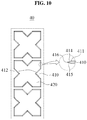
- FIG. 10 is a view illustrating another example of a screen and a portion of the screen with an enlarged cross section according to an example embodiment.
- a screen 40 may include a plate 410 and a through hole 420.
- a plurality of edges 411 that defines the through hole 420 may have a plurality of extension portions 414 and 415 formed on both sides based on a tip 416.
- the plurality of extension portions 414 and 415 may be formed on the plurality of edges 411 to be inclined at set angles with respect to the plate 410. In a preferred example, the angles at which the plurality of extension portions 414 and 415 are inclined relative to the plate 410 may be substantially the same.
- the plurality of extension portions 414 and 415 may be outwardly curved based on the plate 310.
- the plurality of extension portions 414 and 415 may be curved in different directions.
- curvature radiuses of the plurality of extension portions 414 and 415 may be substantially the same such that the tip 416 is located at a center between the plurality of extension portions 414 and 415.
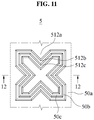
- FIG. 11 is a top view illustrating an example of a plurality of laminated screens according to an example embodiment
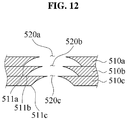
- FIG. 12 is a cross-sectional view taken along a line 12-12 of FIG. 11 .
- a device 5 for reducing a size of a biological tissue may include a plurality of screens 50a, 50b, and 50c laminated in sequence.
- the plurality of screens 50a, 50b, and 50c may respectively include plates 510a, 510b, and 510c and through holes 520a, 520b, and 520c defined by a plurality of edges 511a, a plurality of edges 511b, and a plurality of edges 511c.
- the plurality of screens 50a, 50b, and 50c may include protrusions 512a, 512b, and 512c protruding toward through holes 520a, 520b, and 520c.
- the plurality of edges 511a, 511b, and 511c may each have an extension portion and a tip.
- the through holes 520a, 520b, and 520c of the plurality of screens 50a, 50b, and 50c laminated in sequence may overlap one another in a direction in which sizes thereof decrease.
- a biological tissue passing through the plurality of screens 50a, 50b, and 50c may be gradually miniaturized while receiving a pressure applied due to a sharp cross section formed over the plurality of edges 511a, 511b, and 511c and/or shapes of the protrusions 512a, 512b, and 512c.
- FIG. 13 is a top view illustrating another example of a plurality of laminated screens according to an example embodiment
- FIG. 14 is a cross-sectional view taken along a line 14-14 of FIG. 13 .
- a device 6 for reducing a size of a biological tissue may include a plurality of screens 60a, 60b, and 60c laminated in sequence.
- the plurality of screens 60a, 60b, and 60c may respectively include plates 610a, 610b, and 610c and through holes 620a, 620b, and 620c defined by a plurality of edges 611a, a plurality of edges 611b, and a plurality of edges 611c.
- each of the plurality of edges 611a, 611b and may have a plurality of extension portions on both sides based on a tip.
- the through holes 620a, 620b, and 620c of the plurality of screens 60a, 60b, and 60c laminated in sequence may overlap one another in a direction in which sizes thereof decrease.
Landscapes
- Health & Medical Sciences (AREA)
- Heart & Thoracic Surgery (AREA)
- Life Sciences & Earth Sciences (AREA)
- Engineering & Computer Science (AREA)
- Biomedical Technology (AREA)
- General Health & Medical Sciences (AREA)
- Animal Behavior & Ethology (AREA)
- Hematology (AREA)
- Anesthesiology (AREA)
- Vascular Medicine (AREA)
- Public Health (AREA)
- Veterinary Medicine (AREA)
- Bioinformatics & Cheminformatics (AREA)
- Organic Chemistry (AREA)
- Wood Science & Technology (AREA)
- Zoology (AREA)
- Chemical & Material Sciences (AREA)
- Biotechnology (AREA)
- Genetics & Genomics (AREA)
- General Engineering & Computer Science (AREA)
- Biochemistry (AREA)
- Sustainable Development (AREA)
- Microbiology (AREA)
- Molecular Biology (AREA)
- Mechanical Engineering (AREA)
- Surgery (AREA)
- Apparatus Associated With Microorganisms And Enzymes (AREA)
- Surgical Instruments (AREA)
- Prostheses (AREA)
Applications Claiming Priority (3)
| Application Number | Priority Date | Filing Date | Title |
|---|---|---|---|
| KR20170113331 | 2017-09-05 | ||
| KR1020180101991A KR102051223B1 (ko) | 2017-09-05 | 2018-08-29 | 생체조직 미세화 장치 |
| PCT/KR2018/010278 WO2019050251A1 (fr) | 2017-09-05 | 2018-09-04 | Dispositif pour réduire la taille d'un tissu biologique |
Publications (2)
| Publication Number | Publication Date |
|---|---|
| EP3679961A1 true EP3679961A1 (fr) | 2020-07-15 |
| EP3679961A4 EP3679961A4 (fr) | 2021-06-09 |
Family
ID=65762261
Family Applications (1)
| Application Number | Title | Priority Date | Filing Date |
|---|---|---|---|
| EP18854041.3A Pending EP3679961A4 (fr) | 2017-09-05 | 2018-09-04 | Dispositif pour réduire la taille d'un tissu biologique |
Country Status (5)
| Country | Link |
|---|---|
| US (1) | US11987786B2 (fr) |
| EP (1) | EP3679961A4 (fr) |
| JP (1) | JP6898686B2 (fr) |
| KR (1) | KR102051223B1 (fr) |
| CN (1) | CN111032107B (fr) |
Families Citing this family (6)
| Publication number | Priority date | Publication date | Assignee | Title |
|---|---|---|---|---|
| US11672899B2 (en) * | 2018-07-24 | 2023-06-13 | Healeon Llc | Device and method for resizing adipose tissue for implantation |
| KR102202861B1 (ko) * | 2019-04-09 | 2021-01-18 | 이준석 | 스크린 교환 장치, 이를 포함하는 생체조직 미세화 시스템, 이를 이용하는 생체조직 미세화 방법 및 이와 관련된 생체조직으로부터 타겟 물질을 분리하는 방법 |
| WO2020209609A2 (fr) * | 2019-04-09 | 2020-10-15 | 이준석 | Dispositif d'échange de tamis, système de réduction de taille de tissu biologique le comprenant, procédé de réduction de taille de tissu biologique l'utilisant, et procédé de séparation d'une substance cible à partir d'un tissu biologique pertinent |
| CN110560232B (zh) * | 2019-09-30 | 2024-04-30 | 长沙赋妍医疗科技有限公司 | 一种体外细颗粒脂肪制备一体机 |
| WO2021194143A1 (fr) * | 2020-03-27 | 2021-09-30 | 이준석 | Procédé de séparation mécanique de tissu et de cellules constituant un tissu biologique |
| CN113426562A (zh) * | 2021-07-29 | 2021-09-24 | 厦门博森再生医学工程有限公司 | 一种切割滤网及破碎装置 |
Family Cites Families (23)
| Publication number | Priority date | Publication date | Assignee | Title |
|---|---|---|---|---|
| GB863487A (en) * | 1957-05-22 | 1961-03-22 | Hans Strasser | Mincing, emulsifying and homogenizing machine, in particular for meat |
| US3836464A (en) | 1972-07-14 | 1974-09-17 | Brown Int Corp | Filter screen mounting |
| US3941317A (en) * | 1973-10-26 | 1976-03-02 | Lnih, Inc. | Method and apparatus for tissue disaggregation |
| US5172920A (en) | 1992-01-28 | 1992-12-22 | Diamond Manufacturing Co. | Composite material for gaskets |
| US5626751A (en) | 1992-07-15 | 1997-05-06 | Daiichi Pharmaceutical Co., Ltd. | Filter unit and high-pressure sizing apparatus |
| ATE171387T1 (de) | 1993-12-21 | 1998-10-15 | Genera Tech Ltd | Verfahren und vorrichtung zur filtrierung |
| JP3322595B2 (ja) * | 1996-03-28 | 2002-09-09 | テルモ株式会社 | フィルター装置および生体微細組織の分離・回収方法 |
| US20020197631A1 (en) * | 2001-04-26 | 2002-12-26 | Lawrence Nathan P. | Multichamber device and uses thereof for processing of biological samples |
| TWI255738B (en) * | 2003-12-31 | 2006-06-01 | Ind Tech Res Inst | Tissue pulverizer |
| TWM252372U (en) * | 2004-03-30 | 2004-12-11 | Chung-Jen Pai | Improved filing sheet |
| JP2006082816A (ja) * | 2004-09-14 | 2006-03-30 | Dainippon Printing Co Ltd | ガスバリア性プラスチック容器の製造方法 |
| US20060142773A1 (en) | 2004-12-29 | 2006-06-29 | Depuy Mitek, Inc. | Abrasive cutting system and method |
| KR100748487B1 (ko) | 2006-05-16 | 2007-08-10 | 장동 | 고주파 에너지를 이용한 조직볼륨 축소장치 |
| US20070287933A1 (en) | 2006-06-08 | 2007-12-13 | Chris Phan | Tissue debulking device and method of using the same |
| BRPI0919260B8 (pt) | 2008-09-24 | 2021-06-22 | Massachusetts Inst Technology | equipamentos para formar pluralidade de tecidos de enxerto, para expandir membrana, para formar pluralidade de microenxertos a partir de pelo menos parte de tecido de enxerto e para produzir bolhas de sucção e método para afetar região de pele |
| US9192939B2 (en) | 2010-03-23 | 2015-11-24 | Lipogems International S.P.A. | Device and a method for preparing a tissue |
| IT1400069B1 (it) | 2010-05-20 | 2013-05-17 | Tremolada | Dispositivo e metodo per la preparazione di tessuto, in particolare tessuto adiposo per trapianto ottenuto da materiale adiposo lobulare estratto tramite liposuzione |
| US9427512B2 (en) | 2012-06-08 | 2016-08-30 | Pall Corporation | Filter device |
| EP3042629B1 (fr) | 2013-09-02 | 2021-02-17 | Fukushima Medical University | Plaque poreuse applicable pour usage médical et procédé de production de plaque poreuse applicable pour usage médical |
| ES2978108T3 (es) * | 2014-09-04 | 2024-09-05 | Becton Dickinson Co | Dispositivos y métodos para disociar una muestra de tejido biológico |
| KR101605849B1 (ko) | 2014-11-28 | 2016-03-23 | 이준석 | 지방 이식용기 |
| KR102565995B1 (ko) | 2014-12-15 | 2023-08-10 | 휴먼 브레인 웨이브 에스.알.엘. | 생체 시료의 분해 장치 및 대응되는 제조 방법과 세포 현탁액 및 조직 미세이식편의 준비 방법 |
| US10927347B2 (en) * | 2015-05-15 | 2021-02-23 | Black Tie Medical Inc. | Device and method for breaking down and sizing harvested fat |
-
2018
- 2018-08-29 KR KR1020180101991A patent/KR102051223B1/ko active Active
- 2018-09-04 EP EP18854041.3A patent/EP3679961A4/fr active Pending
- 2018-09-04 US US16/635,621 patent/US11987786B2/en active Active
- 2018-09-04 JP JP2020531411A patent/JP6898686B2/ja active Active
- 2018-09-04 CN CN201880052037.5A patent/CN111032107B/zh active Active
Also Published As
| Publication number | Publication date |
|---|---|
| KR20190026586A (ko) | 2019-03-13 |
| EP3679961A4 (fr) | 2021-06-09 |
| JP2020531218A (ja) | 2020-11-05 |
| KR102051223B1 (ko) | 2019-12-03 |
| US20200237995A1 (en) | 2020-07-30 |
| CN111032107B (zh) | 2023-10-03 |
| US11987786B2 (en) | 2024-05-21 |
| CN111032107A (zh) | 2020-04-17 |
| JP6898686B2 (ja) | 2021-07-07 |
Similar Documents
| Publication | Publication Date | Title |
|---|---|---|
| EP3679961A1 (fr) | Dispositif pour réduire la taille d'un tissu biologique | |
| JP6942768B2 (ja) | 創傷包帯 | |
| JP2017508501A (ja) | 潰すことが可能な陰圧創傷治療用被覆材 | |
| US11273249B2 (en) | Fluid volume measurement using canister resonance for reduced pressure therapy systems | |
| US9925317B2 (en) | Low-profile reduced pressure treatment system | |
| AU2007335240B2 (en) | Needle tip | |
| JP6577367B2 (ja) | エミッタおよび点滴灌漑用チューブ | |
| USD974568S1 (en) | Apparatus for medical or laboratory diagnosis | |
| JP2020523078A (ja) | 陰圧治療による肉芽形成の促進及び浸軟の低減のための複合ドレッシング | |
| EP2268364A2 (fr) | Pince-nez de masque et masque respiratoire | |
| TW201043275A (en) | Multiple segmented peristaltic pump and cassette | |
| EP3124060B1 (fr) | Amortisseur de bruit pour une unite de therapie a pression negative | |
| EP3865111A1 (fr) | Feuille de masque facial, ensemble de masque facial et procédé de fabrication | |
| US12036555B2 (en) | Microfluidic particle sorting apparatus and manufacturing method thereof | |
| JP4161026B2 (ja) | 医療用ナイフ | |
| JP6875788B2 (ja) | 圧力測定部を有する血液回路 | |
| WO2019050251A1 (fr) | Dispositif pour réduire la taille d'un tissu biologique | |
| JP2005013517A (ja) | おろし器 | |
| US11161067B2 (en) | Filtration system and method of use | |
| KR101276187B1 (ko) | 세포 채집 장치 | |
| EP1939136A3 (fr) | Dispositifs microfluidiques à haut rendement résistants à la pression | |
| US20240374434A1 (en) | Negative pressure dressing with differential collapsing force for wound closure | |
| EP2815775B1 (fr) | Filtres de fluide biologique avec orifice de distribution d'écoulement optimisé | |
| JP4853715B2 (ja) | 血液フィルタ装置 | |
| CN207400852U (zh) | 组合式橡胶膏 |
Legal Events
| Date | Code | Title | Description |
|---|---|---|---|
| STAA | Information on the status of an ep patent application or granted ep patent |
Free format text: STATUS: THE INTERNATIONAL PUBLICATION HAS BEEN MADE |
|
| PUAI | Public reference made under article 153(3) epc to a published international application that has entered the european phase |
Free format text: ORIGINAL CODE: 0009012 |
|
| STAA | Information on the status of an ep patent application or granted ep patent |
Free format text: STATUS: REQUEST FOR EXAMINATION WAS MADE |
|
| 17P | Request for examination filed |
Effective date: 20200129 |
|
| AK | Designated contracting states |
Kind code of ref document: A1 Designated state(s): AL AT BE BG CH CY CZ DE DK EE ES FI FR GB GR HR HU IE IS IT LI LT LU LV MC MK MT NL NO PL PT RO RS SE SI SK SM TR |
|
| AX | Request for extension of the european patent |
Extension state: BA ME |
|
| DAV | Request for validation of the european patent (deleted) | ||
| DAX | Request for extension of the european patent (deleted) | ||
| A4 | Supplementary search report drawn up and despatched |
Effective date: 20210510 |
|
| RIC1 | Information provided on ipc code assigned before grant |
Ipc: A61M 1/02 20060101AFI20210503BHEP Ipc: A61M 1/00 20060101ALI20210503BHEP Ipc: B02C 18/36 20060101ALI20210503BHEP Ipc: G01N 1/28 20060101ALI20210503BHEP |
|
| STAA | Information on the status of an ep patent application or granted ep patent |
Free format text: STATUS: EXAMINATION IS IN PROGRESS |
|
| 17Q | First examination report despatched |
Effective date: 20250829 |