EP3684688B1 - Système d'actionnement d'inclinaison d'aile pour aéronef électrique à décollage et atterrissage verticaux (adav) - Google Patents
Système d'actionnement d'inclinaison d'aile pour aéronef électrique à décollage et atterrissage verticaux (adav) Download PDFInfo
- Publication number
- EP3684688B1 EP3684688B1 EP18859571.4A EP18859571A EP3684688B1 EP 3684688 B1 EP3684688 B1 EP 3684688B1 EP 18859571 A EP18859571 A EP 18859571A EP 3684688 B1 EP3684688 B1 EP 3684688B1
- Authority
- EP
- European Patent Office
- Prior art keywords
- wing
- rotor
- aircraft
- electric motor
- motors
- Prior art date
- Legal status (The legal status is an assumption and is not a legal conclusion. Google has not performed a legal analysis and makes no representation as to the accuracy of the status listed.)
- Active
Links
Images







Classifications
-
- B—PERFORMING OPERATIONS; TRANSPORTING
- B64—AIRCRAFT; AVIATION; COSMONAUTICS
- B64C—AEROPLANES; HELICOPTERS
- B64C9/00—Adjustable control surfaces or members, e.g. rudders
- B64C9/14—Adjustable control surfaces or members, e.g. rudders forming slots
- B64C9/16—Adjustable control surfaces or members, e.g. rudders forming slots at the rear of the wing
- B64C9/18—Adjustable control surfaces or members, e.g. rudders forming slots at the rear of the wing by single flaps
-
- B—PERFORMING OPERATIONS; TRANSPORTING
- B60—VEHICLES IN GENERAL
- B60L—PROPULSION OF ELECTRICALLY-PROPELLED VEHICLES; SUPPLYING ELECTRIC POWER FOR AUXILIARY EQUIPMENT OF ELECTRICALLY-PROPELLED VEHICLES; ELECTRODYNAMIC BRAKE SYSTEMS FOR VEHICLES IN GENERAL; MAGNETIC SUSPENSION OR LEVITATION FOR VEHICLES; MONITORING OPERATING VARIABLES OF ELECTRICALLY-PROPELLED VEHICLES; ELECTRIC SAFETY DEVICES FOR ELECTRICALLY-PROPELLED VEHICLES
- B60L15/00—Methods, circuits, or devices for controlling the traction-motor speed of electrically-propelled vehicles
- B60L15/20—Methods, circuits, or devices for controlling the traction-motor speed of electrically-propelled vehicles for control of the vehicle or its driving motor to achieve a desired performance, e.g. speed, torque, programmed variation of speed
-
- B—PERFORMING OPERATIONS; TRANSPORTING
- B64—AIRCRAFT; AVIATION; COSMONAUTICS
- B64C—AEROPLANES; HELICOPTERS
- B64C1/00—Fuselages; Constructional features common to fuselages, wings, stabilising surfaces or the like
- B64C1/14—Windows; Doors; Hatch covers or access panels; Surrounding frame structures; Canopies; Windscreens accessories therefor, e.g. pressure sensors, water deflectors, hinges, seals, handles, latches, windscreen wipers
- B64C1/1407—Doors; surrounding frames
-
- B—PERFORMING OPERATIONS; TRANSPORTING
- B64—AIRCRAFT; AVIATION; COSMONAUTICS
- B64C—AEROPLANES; HELICOPTERS
- B64C13/00—Control systems or transmitting systems for actuating flying-control surfaces, lift-increasing flaps, air brakes, or spoilers
-
- B—PERFORMING OPERATIONS; TRANSPORTING
- B64—AIRCRAFT; AVIATION; COSMONAUTICS
- B64C—AEROPLANES; HELICOPTERS
- B64C13/00—Control systems or transmitting systems for actuating flying-control surfaces, lift-increasing flaps, air brakes, or spoilers
- B64C13/02—Initiating means
-
- B—PERFORMING OPERATIONS; TRANSPORTING
- B64—AIRCRAFT; AVIATION; COSMONAUTICS
- B64C—AEROPLANES; HELICOPTERS
- B64C15/00—Attitude, flight direction, or altitude control by jet reaction
-
- B—PERFORMING OPERATIONS; TRANSPORTING
- B64—AIRCRAFT; AVIATION; COSMONAUTICS
- B64C—AEROPLANES; HELICOPTERS
- B64C23/00—Influencing air flow over aircraft surfaces, not otherwise provided for
- B64C23/06—Influencing air flow over aircraft surfaces, not otherwise provided for by generating vortices
- B64C23/065—Influencing air flow over aircraft surfaces, not otherwise provided for by generating vortices at the wing tips
- B64C23/069—Influencing air flow over aircraft surfaces, not otherwise provided for by generating vortices at the wing tips using one or more wing tip airfoil devices, e.g. winglets, splines, wing tip fences or raked wingtips
-
- B—PERFORMING OPERATIONS; TRANSPORTING
- B64—AIRCRAFT; AVIATION; COSMONAUTICS
- B64C—AEROPLANES; HELICOPTERS
- B64C27/00—Rotorcraft; Rotors peculiar thereto
- B64C27/22—Compound rotorcraft, i.e. aircraft using in flight the features of both aeroplane and rotorcraft
- B64C27/28—Compound rotorcraft, i.e. aircraft using in flight the features of both aeroplane and rotorcraft with forward-propulsion propellers pivotable to act as lifting rotors
-
- B—PERFORMING OPERATIONS; TRANSPORTING
- B64—AIRCRAFT; AVIATION; COSMONAUTICS
- B64C—AEROPLANES; HELICOPTERS
- B64C27/00—Rotorcraft; Rotors peculiar thereto
- B64C27/52—Tilting of rotor bodily relative to fuselage
-
- B—PERFORMING OPERATIONS; TRANSPORTING
- B64—AIRCRAFT; AVIATION; COSMONAUTICS
- B64C—AEROPLANES; HELICOPTERS
- B64C27/00—Rotorcraft; Rotors peculiar thereto
- B64C27/54—Mechanisms for controlling blade adjustment or movement relative to rotor head, e.g. lag-lead movement
- B64C27/80—Mechanisms for controlling blade adjustment or movement relative to rotor head, e.g. lag-lead movement for differential adjustment of blade pitch between two or more lifting rotors
-
- B—PERFORMING OPERATIONS; TRANSPORTING
- B64—AIRCRAFT; AVIATION; COSMONAUTICS
- B64C—AEROPLANES; HELICOPTERS
- B64C27/00—Rotorcraft; Rotors peculiar thereto
- B64C27/82—Rotorcraft; Rotors peculiar thereto characterised by the provision of an auxiliary rotor or fluid-jet device for counter-balancing lifting rotor torque or changing direction of rotorcraft
-
- B—PERFORMING OPERATIONS; TRANSPORTING
- B64—AIRCRAFT; AVIATION; COSMONAUTICS
- B64C—AEROPLANES; HELICOPTERS
- B64C29/00—Aircraft capable of landing or taking-off vertically, e.g. vertical take-off and landing [VTOL] aircraft
-
- B—PERFORMING OPERATIONS; TRANSPORTING
- B64—AIRCRAFT; AVIATION; COSMONAUTICS
- B64C—AEROPLANES; HELICOPTERS
- B64C29/00—Aircraft capable of landing or taking-off vertically, e.g. vertical take-off and landing [VTOL] aircraft
- B64C29/0008—Aircraft capable of landing or taking-off vertically, e.g. vertical take-off and landing [VTOL] aircraft having its flight directional axis horizontal when grounded
- B64C29/0016—Aircraft capable of landing or taking-off vertically, e.g. vertical take-off and landing [VTOL] aircraft having its flight directional axis horizontal when grounded the lift during taking-off being created by free or ducted propellers or by blowers
- B64C29/0033—Aircraft capable of landing or taking-off vertically, e.g. vertical take-off and landing [VTOL] aircraft having its flight directional axis horizontal when grounded the lift during taking-off being created by free or ducted propellers or by blowers the propellers being tiltable relative to the fuselage
-
- B—PERFORMING OPERATIONS; TRANSPORTING
- B64—AIRCRAFT; AVIATION; COSMONAUTICS
- B64C—AEROPLANES; HELICOPTERS
- B64C3/00—Wings
- B64C3/38—Adjustment of complete wings or parts thereof
-
- B—PERFORMING OPERATIONS; TRANSPORTING
- B64—AIRCRAFT; AVIATION; COSMONAUTICS
- B64C—AEROPLANES; HELICOPTERS
- B64C39/00—Aircraft not otherwise provided for
- B64C39/02—Aircraft not otherwise provided for characterised by special use
- B64C39/024—Aircraft not otherwise provided for characterised by special use of the remote controlled vehicle type, i.e. RPV
-
- B—PERFORMING OPERATIONS; TRANSPORTING
- B64—AIRCRAFT; AVIATION; COSMONAUTICS
- B64C—AEROPLANES; HELICOPTERS
- B64C39/00—Aircraft not otherwise provided for
- B64C39/06—Aircraft not otherwise provided for having disc- or ring-shaped wings
- B64C39/068—Aircraft not otherwise provided for having disc- or ring-shaped wings having multiple wings joined at the tips
-
- B—PERFORMING OPERATIONS; TRANSPORTING
- B64—AIRCRAFT; AVIATION; COSMONAUTICS
- B64C—AEROPLANES; HELICOPTERS
- B64C9/00—Adjustable control surfaces or members, e.g. rudders
-
- B—PERFORMING OPERATIONS; TRANSPORTING
- B64—AIRCRAFT; AVIATION; COSMONAUTICS
- B64C—AEROPLANES; HELICOPTERS
- B64C9/00—Adjustable control surfaces or members, e.g. rudders
- B64C9/14—Adjustable control surfaces or members, e.g. rudders forming slots
- B64C9/16—Adjustable control surfaces or members, e.g. rudders forming slots at the rear of the wing
-
- B—PERFORMING OPERATIONS; TRANSPORTING
- B64—AIRCRAFT; AVIATION; COSMONAUTICS
- B64D—EQUIPMENT FOR FITTING IN OR TO AIRCRAFT; FLIGHT SUITS; PARACHUTES; ARRANGEMENT OR MOUNTING OF POWER PLANTS OR PROPULSION TRANSMISSIONS IN AIRCRAFT
- B64D27/00—Arrangement or mounting of power plants in aircraft; Aircraft characterised by the type or position of power plants
- B64D27/02—Aircraft characterised by the type or position of power plants
- B64D27/24—Aircraft characterised by the type or position of power plants using steam or spring force
-
- B—PERFORMING OPERATIONS; TRANSPORTING
- B64—AIRCRAFT; AVIATION; COSMONAUTICS
- B64D—EQUIPMENT FOR FITTING IN OR TO AIRCRAFT; FLIGHT SUITS; PARACHUTES; ARRANGEMENT OR MOUNTING OF POWER PLANTS OR PROPULSION TRANSMISSIONS IN AIRCRAFT
- B64D27/00—Arrangement or mounting of power plants in aircraft; Aircraft characterised by the type or position of power plants
- B64D27/02—Aircraft characterised by the type or position of power plants
- B64D27/30—Aircraft characterised by electric power plants
- B64D27/31—Aircraft characterised by electric power plants within, or attached to, wings
-
- B—PERFORMING OPERATIONS; TRANSPORTING
- B64—AIRCRAFT; AVIATION; COSMONAUTICS
- B64D—EQUIPMENT FOR FITTING IN OR TO AIRCRAFT; FLIGHT SUITS; PARACHUTES; ARRANGEMENT OR MOUNTING OF POWER PLANTS OR PROPULSION TRANSMISSIONS IN AIRCRAFT
- B64D27/00—Arrangement or mounting of power plants in aircraft; Aircraft characterised by the type or position of power plants
- B64D27/02—Aircraft characterised by the type or position of power plants
- B64D27/30—Aircraft characterised by electric power plants
- B64D27/34—All-electric aircraft
-
- B—PERFORMING OPERATIONS; TRANSPORTING
- B64—AIRCRAFT; AVIATION; COSMONAUTICS
- B64D—EQUIPMENT FOR FITTING IN OR TO AIRCRAFT; FLIGHT SUITS; PARACHUTES; ARRANGEMENT OR MOUNTING OF POWER PLANTS OR PROPULSION TRANSMISSIONS IN AIRCRAFT
- B64D27/00—Arrangement or mounting of power plants in aircraft; Aircraft characterised by the type or position of power plants
- B64D27/40—Arrangements for mounting power plants in aircraft
-
- B—PERFORMING OPERATIONS; TRANSPORTING
- B64—AIRCRAFT; AVIATION; COSMONAUTICS
- B64D—EQUIPMENT FOR FITTING IN OR TO AIRCRAFT; FLIGHT SUITS; PARACHUTES; ARRANGEMENT OR MOUNTING OF POWER PLANTS OR PROPULSION TRANSMISSIONS IN AIRCRAFT
- B64D27/00—Arrangement or mounting of power plants in aircraft; Aircraft characterised by the type or position of power plants
- B64D27/40—Arrangements for mounting power plants in aircraft
- B64D27/402—Arrangements for mounting power plants in aircraft comprising box like supporting frames, e.g. pylons or arrangements for embracing the power plant
-
- B—PERFORMING OPERATIONS; TRANSPORTING
- B64—AIRCRAFT; AVIATION; COSMONAUTICS
- B64D—EQUIPMENT FOR FITTING IN OR TO AIRCRAFT; FLIGHT SUITS; PARACHUTES; ARRANGEMENT OR MOUNTING OF POWER PLANTS OR PROPULSION TRANSMISSIONS IN AIRCRAFT
- B64D31/00—Power plant control systems; Arrangement of power plant control systems in aircraft
- B64D31/16—Power plant control systems; Arrangement of power plant control systems in aircraft for electric power plants
-
- B—PERFORMING OPERATIONS; TRANSPORTING
- B64—AIRCRAFT; AVIATION; COSMONAUTICS
- B64D—EQUIPMENT FOR FITTING IN OR TO AIRCRAFT; FLIGHT SUITS; PARACHUTES; ARRANGEMENT OR MOUNTING OF POWER PLANTS OR PROPULSION TRANSMISSIONS IN AIRCRAFT
- B64D35/00—Transmitting power from power plants to propellers or rotors; Arrangements of transmissions
- B64D35/02—Transmitting power from power plants to propellers or rotors; Arrangements of transmissions specially adapted for specific power plants
- B64D35/021—Transmitting power from power plants to propellers or rotors; Arrangements of transmissions specially adapted for specific power plants for electric power plants
- B64D35/026—Transmitting power from power plants to propellers or rotors; Arrangements of transmissions specially adapted for specific power plants for electric power plants the electric power plant being integral with the propeller or rotor
-
- B—PERFORMING OPERATIONS; TRANSPORTING
- B60—VEHICLES IN GENERAL
- B60L—PROPULSION OF ELECTRICALLY-PROPELLED VEHICLES; SUPPLYING ELECTRIC POWER FOR AUXILIARY EQUIPMENT OF ELECTRICALLY-PROPELLED VEHICLES; ELECTRODYNAMIC BRAKE SYSTEMS FOR VEHICLES IN GENERAL; MAGNETIC SUSPENSION OR LEVITATION FOR VEHICLES; MONITORING OPERATING VARIABLES OF ELECTRICALLY-PROPELLED VEHICLES; ELECTRIC SAFETY DEVICES FOR ELECTRICALLY-PROPELLED VEHICLES
- B60L2200/00—Type of vehicles
- B60L2200/10—Air crafts
-
- B—PERFORMING OPERATIONS; TRANSPORTING
- B64—AIRCRAFT; AVIATION; COSMONAUTICS
- B64C—AEROPLANES; HELICOPTERS
- B64C27/00—Rotorcraft; Rotors peculiar thereto
- B64C27/82—Rotorcraft; Rotors peculiar thereto characterised by the provision of an auxiliary rotor or fluid-jet device for counter-balancing lifting rotor torque or changing direction of rotorcraft
- B64C2027/8227—Rotorcraft; Rotors peculiar thereto characterised by the provision of an auxiliary rotor or fluid-jet device for counter-balancing lifting rotor torque or changing direction of rotorcraft comprising more than one rotor
-
- Y—GENERAL TAGGING OF NEW TECHNOLOGICAL DEVELOPMENTS; GENERAL TAGGING OF CROSS-SECTIONAL TECHNOLOGIES SPANNING OVER SEVERAL SECTIONS OF THE IPC; TECHNICAL SUBJECTS COVERED BY FORMER USPC CROSS-REFERENCE ART COLLECTIONS [XRACs] AND DIGESTS
- Y02—TECHNOLOGIES OR APPLICATIONS FOR MITIGATION OR ADAPTATION AGAINST CLIMATE CHANGE
- Y02T—CLIMATE CHANGE MITIGATION TECHNOLOGIES RELATED TO TRANSPORTATION
- Y02T10/00—Road transport of goods or passengers
- Y02T10/60—Other road transportation technologies with climate change mitigation effect
- Y02T10/72—Electric energy management in electromobility
-
- Y—GENERAL TAGGING OF NEW TECHNOLOGICAL DEVELOPMENTS; GENERAL TAGGING OF CROSS-SECTIONAL TECHNOLOGIES SPANNING OVER SEVERAL SECTIONS OF THE IPC; TECHNICAL SUBJECTS COVERED BY FORMER USPC CROSS-REFERENCE ART COLLECTIONS [XRACs] AND DIGESTS
- Y02—TECHNOLOGIES OR APPLICATIONS FOR MITIGATION OR ADAPTATION AGAINST CLIMATE CHANGE
- Y02T—CLIMATE CHANGE MITIGATION TECHNOLOGIES RELATED TO TRANSPORTATION
- Y02T50/00—Aeronautics or air transport
- Y02T50/10—Drag reduction
-
- Y—GENERAL TAGGING OF NEW TECHNOLOGICAL DEVELOPMENTS; GENERAL TAGGING OF CROSS-SECTIONAL TECHNOLOGIES SPANNING OVER SEVERAL SECTIONS OF THE IPC; TECHNICAL SUBJECTS COVERED BY FORMER USPC CROSS-REFERENCE ART COLLECTIONS [XRACs] AND DIGESTS
- Y02—TECHNOLOGIES OR APPLICATIONS FOR MITIGATION OR ADAPTATION AGAINST CLIMATE CHANGE
- Y02T—CLIMATE CHANGE MITIGATION TECHNOLOGIES RELATED TO TRANSPORTATION
- Y02T50/00—Aeronautics or air transport
- Y02T50/40—Weight reduction
-
- Y—GENERAL TAGGING OF NEW TECHNOLOGICAL DEVELOPMENTS; GENERAL TAGGING OF CROSS-SECTIONAL TECHNOLOGIES SPANNING OVER SEVERAL SECTIONS OF THE IPC; TECHNICAL SUBJECTS COVERED BY FORMER USPC CROSS-REFERENCE ART COLLECTIONS [XRACs] AND DIGESTS
- Y02—TECHNOLOGIES OR APPLICATIONS FOR MITIGATION OR ADAPTATION AGAINST CLIMATE CHANGE
- Y02T—CLIMATE CHANGE MITIGATION TECHNOLOGIES RELATED TO TRANSPORTATION
- Y02T50/00—Aeronautics or air transport
- Y02T50/60—Efficient propulsion technologies, e.g. for aircraft
Definitions
- the present disclosure relates to a wing tilt actuation system for electric vertical take-off and landing (VTOL) aircraft.
- the present invention relates to a wing tilt actuation system and mechanism for electric VTOL aircraft having passenger and/or military applications.
- VTOL aircraft are capable of take-off and landing vertically, or at some angle which is close to vertical.
- This style of aircraft includes helicopters and certain fixed wing aircraft, often used for military applications.
- VTOL aircraft permit take-off and landing in limited spaces, which negates the need for a large runway, and permits take-off and landing in small spaces and such as boat decks and landing pads on buildings and other structures.
- Helicopters are a style of aircraft in which lift and thrust are both provided by rotors.
- One such disadvantage associated with helicopters concerns the rotor design which is critical for flight.
- Drones generally operate with the electric rotors each rotating about an axis which is generally vertical.
- drones Whilst drones are becoming commercially viable for delivering small payloads, they are generally limited to relatively low flight speeds, on account of the vertical axis of rotation of the rotors. Furthermore, they tend to have reasonably low ranges of travel per battery charge.
- Tilt wing aircraft are available and generally operate on the principle of a vertical propeller axis for take-off and landing, and the wings are configured to tilt between a configuration in which the propellers have vertical axes for take-off and landing, and a configuration in which the propellers have horizontal axes for forward flight.
- tilt wing arrangement provides the advantage of take-off and landing in areas with limited available clear space, such as aircraft carriers and landing pads.
- tilt wing aircraft are able to provide flight speed comparable with conventional propeller driven fixed wing planes.
- Tilt wing aircraft generally have electric motors or gas turbine engines which drive propellers or ducted fans directly mounted to the wing.
- the entire wing rotates between vertical and horizontal to tilt the thrust vector from vertical to horizontal and return.
- the "Thrust line” also referred to as the “thrust vector” is the thrust force of the propeller and is approximately the same as axis of rotation of the propeller.
- the “hinge line” is the axis of the hinge rotation.
- VTOL jet An electric VTOL jet is currently being designed and tested by Lilium Aviation, under the brand Lilium Jet TM . That prototype is intended as a lightweight commuter aircraft for two passengers having two wings and around 36 electric motors.
- a disadvantage of the Lilium Jet TM type aircraft concerns the electric motors which are encased fan type motors. This arrangement is highly energy intensive, resulting in reduced possible flight range for a given battery size.
- the encased fans can only be operated for take-off and landing on hardstand surfaces, such as designated landing pads and runways. This limits the usability of the aircraft, and prevents it from being operated during take-off and landing on non-hardstand surfaces, such as parks, fields and gardens. For military applications, this is undesirable, and does not cater for impromptu landings in remote locations.
- VTOL aircraft is the S2 electric TM by Joby Aviation. This design has fixed wings with a plurality of electric motors, preferably four, mounted to each wing. Four additional motors are mounted to the rear stabiliser or tail.
- a disadvantage of this concept aircraft is that each electric motor is independently actuated, requiring a separate actuator for each motor. As noted above, this requires significant additional weight for the actuation motor system.
- VTOL aircraft is the ElectronFlight TM tilt rotor system.
- This system has two fixed wings with vertical axis motors permanently mounted both on the leading and trailing sides of each wing. Furthermore, an outer portion of each wing has a pivoting panel on which two rotors are mounted. The rotors are actuated by differential thrust, which negates the need for a dedicated actuation system.
- US 2016/0288903 discloses aerodynamically actuated thrust vectoring devices.
- US 2016/0311522 discloses an aerofoil for an aircraft, and an aircraft.
- US 2011/0042509 discloses a lightweight vertical take-off and landing aircraft and flight control paradigm using thrust differentials.
- WO 2017/096478 discloses a hybrid multicopter and fixed wing aerial vehicle.
- the present invention provides a vertical take-off and landing (VTOL) aircraft as set out in claim 1.
- VTOL vertical take-off and landing
- a thrust line of the first electric motor and rotor is, in a first alternative, angularly offset relative to a thrust line of the second electric motor and rotor.
- the first electric motor and rotor are, in a second alternative, located above the control surface, and the second electric motor and rotor are located below the control surface, such that a thrust line of the first electric motor and rotor is generally parallel to and offset relative to a thrust line of the second electric motor and rotor.
- the first electric motor is preferably operated by the control system at a higher rotational speed than the second electric motor responsive to a command to move the control surface between the first position and the second position, further wherein the first electric motor is operated by the control system at a lower rotational speed than the second electric motor responsive to a command to move the control surface between the second position and the first position.
- each wing has at least two electric motors each having rotors, the electric motors and rotors being arranged in pairs having thrust lines which cancel any turning moment when the pair of electric motors and rotors rotate at generally equal rotation rates.
- each wing has two rotors, with smaller actuators to provide redundancy.
- control system In a hovering mode, the control system is preferably configured to rotate each motor and rotor at a suitable speed to generate a combined thrust force of all electric motors and rotors equal to a total aircraft and payload mass multiplied by gravitational acceleration.
- the vertical take-off and landing (VTOL) aircraft further preferably includes a brake, small actuator or clamping device to hold the control surface in the desired first and second positions.
- the brake, small actuator or clamping device is preferably operated by the control system.
- the vertical take-off and landing (VTOL) aircraft preferably further comprises first and second rearward wings mounted to opposing sides of the fuselage, wherein a distal portion of each forward wing, furthest from the fuselage, is connected to a distal portion of the adjacent rearward wing with a connecting member, defining a boxed wing structure.
- the first electric motor and rotor and the second electric motor and rotor each have a variable pitch propellor
- the aircraft further comprises a control system for controlling rotation speed and/or blade pitch of each variable pitch propeller; wherein the control system is configured to change the pitch of the first propeller relative to the second propeller to generate a turning moment to pivot the control surface about the pivot axis.
- the electric motors are preferably brushless DC motors which change speed responsive to changing switching frequency from electronic speed controllers of the control system.
- a vertical take-off and landing (VTOL) aircraft 10 is disclosed.
- VTOL vertical take-off and landing
- the forward wings 20, 22 and the rearward wings 30, 32 are two pairs of wings.
- Each of the forward wings 20, 22 is attached to a laterally opposing region of the fuselage 24.
- each of the rearward wings 30, 32 is attached to a laterally opposing region of the fuselage 24.
- the aircraft 10 is depicted as a single seat aircraft 10. However, larger multi-person embodiments are envisaged.
- distal portions of the forward wings 20, 22 and the rearward wings 30, 32 are connected, such that the two pairs of wings 20, 22, 30, 32 define a boxed wing or closed wing structure.
- the forward wings 20, 22 and the rearward wings 30, 32 may be strut braced wings, connected with tie bars or struts.
- a strut braced wing is generally lighter than a conventional cantilevered wing.
- VTOL aircraft 10 Whilst the VTOL aircraft 10 described herein is a boxed wing or strut braced aircraft 10, it will be appreciated by those skilled in the art that the aircraft 10 may be a conventional cantilevered wing aircraft in which the forward wings 20, 22 and the rearward wings 30, 32 are separate and not interconnected. Furthermore, the aircraft 10 may have only a single pair of wings.
- the forward wings 20, 22 and the rearward wings 30, 32 are vertically separated.
- the tip portion 40 of the rearward wings 30, 32 extends downwardly and rearwardly. This wing tip portion, or winglet 40, assists to reduce wing tip vortices.
- each winglet 40 is connected to the connecting member 42 which joins the adjacent forward wing 20 and rearward wing 30.
- a further connecting member 42 joins the adjacent forward wing 22 and rearward wing 32 on the opposing side of the fuselage.
- Each of the forward wings 20, 22 and the rearward wings 30, 32 has a fixed leading edge 25, 35.
- the leading edge 25, 35 has a curved profile, in the form of a portion of an aerofoil. The leading edge does not rotate or otherwise move.
- each control surface 50 is pivotal between a generally vertical configuration for take-off and landing (as depicted in Fig. 11C, 11D ) and a generally horizontal configuration for forward flight (as depicted in Fig. 11A, 11B ).
- the control surface 50 may be a single surface which extends continuously along the full length of the wing 20, 22, 30, 32.
- each wing 20, 22, 30, 32 may have one or more independently pivotal control surfaces 50, such that the control surfaces 50 are capable of pivoting about the leading edge 25, 35, independent of the other control surfaces 50.
- the vertical take-off and landing (VTOL) aircraft 10 includes a plurality of electric motors 60.
- Each motor 60 has a propeller or rotor 70.
- the body portion 62 of each motor 60 is mounted adjacent to the upper surface or the lower surface of the moveable control surface 50, generally in front of the fixed leading edge 25, 35.
- the control surface 50 is able to rotate though a range of between about 80 and 100 degrees, and preferably approximately 90 degrees for both horizontal flight mode ( Fig. 2 ) and vertical flight mode ( Fig. 1 ).
- the motors 60 may be mounted sufficiently forward of the fixed leading edge 25, 35 so that the rotor blades can fold rearwardly and remain clear of the wing structure.
- the electric motors 60 are each pivotal about the leading edge 25, 35 with the control surfaces 50 between a first position in which the rotor of each motor 60 has a generally vertical axis of rotation, and a second position in which each the rotor of each motor 60 has a generally horizontal axis of rotation.
- At least one of the wings 20, 22, 30, 32 has a first and a second motor 60 which are offset relative to each other about a plane passing through the control surface 50. In the embodiment shown in the drawings, this is achieved by locating the motors 60 on opposing upper and lower sides of the wing 20, 22, 30, 32.
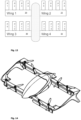
- each wing has four electric motors 60. Namely two electric motors 60 mounted above the wing 20, 22, 30, 32 and two electric motors mounted below the wing 20, 22, 30, 32, in an alternating configuration. However, in the embodiment depicted in Figs 14 and 15 , each wing has two electric motors 60.
- the electric motors 60 and their mounting pylons are each mounted to the pivoting control surface 50. All of the motors rotate about a hinge point 33.
- the four motors 60 are mounted with different thrust lines. In particular, two of the motors 60 have a thrust line that tends to rotate the control surface 50 horizontally, and other two motors have a thrust line that tends to rotate the wing 20, 22, 30, 32 vertically. When all four motors 60 operate in unison the moments cancel out, and stabilisation is achieved in the vertical flight mode.
- the sequence of wing adjustment shows the change of inclination of the motors 60 and control surface 50 when transitioning between the take-off wing position and the forward flight wing position.
- the leading edges 25, 35 are stationary, and non-pivoting.
- the motors 60 and control surfaces 50 pivot in unison.
- FIG. 7 A second embodiment of the invention is shown in Figs 7 to 10 .
- the four motors 60 are each mounted below the wings 20, 22, 30, 32.
- each motor 60 is hingedly secured to a location below the wing 20, 22, 30, 32, which can be used to create a leading edge slot 72, that further increases the coefficient of lift and reduces buffet at high angles of tilt, in descent.
- the leading edge slot 72 is the gap between the leading edges 25, 35 and the tilting control surface 50.
- the slot 72 can be seen in figures 3, 4 and 5 and is in the closed position in figure 6 . It can also be seen in Fig. 11A .
- each odd motor 60 has an axis of rotation XX which is downwardly inclined relative to the control surface 50
- each even motor 60 has an axis of rotation YY which is upwardly inclined relative to the control surface 50.
- two of the motors 60 have a thrust line that tends to rotate the control surface 50 clockwise
- other two motors have a thrust line that tends to rotate the control surface 50 counter-clockwise.
- the aircraft 10 provides a separately regulated power supply to each motor 60. This permits a different voltage to be delivered to each motor, and hence variable power output can selectively be generated by each motor to achieve desired flight conditions such as turning left and right.
- the independent power of the motors 60 enables the motors 60 to be used to tilt the control surface 50 located on the trailing edges of the wings 20, 22, 30, 32.
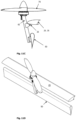
- Figs. 11A to 11D are schematic views of a motor 60 mounted to the underside of one of the wings 20, 22, 30, 32.
- a hinge plate 28 is connected to the fixed leading edge 25, 35, and extends downwardly.
- the motor 60 is pivotally connected to the hinge plate 28 at the hinge point 33.
- the propeller 70 and pylon structure is fixed to the control surface 50, which rotates about the hinge point 33.
- Figs. 11A to 11D shows the change of inclination of the motors 60 and control surfaces 50 when transitioning between the vertical take-off wing position and the horizontal forward flight wing position.
- the leading edges 25, 35 are stationary, and non-pivoting, and the motors 60 and control surfaces 50 pivot in unison.
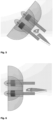
- Figs. 12A to 12D are schematic cross-sectional views depicting the transition between vertical and horizontal for the wing arrangement of any one of Figs. 7 to 11D .
- Figs. 12A to 12D also depict that the thrust lines of the adjacent motors on each wing being non-parallel, which results in the moment about the hinge point 33, which can be selectively used to rotate to control surfaces 50.
- motors 60 there are two or four motors 60 mounted to each wing 20, 22, 30, 32.
- additional motors 60 may be mounted to the aircraft 10, for example on the wings 20, 22, 30, 32, the nose of the fuselage 24 or the wing connecting members 42.
- the hinge mechanism can be integrated into the motor pod structure further reducing structural weight.
- a further possible improvement is that when there are multiple motor pods, each pod houses a hinge bearing.
- the rotor 70 blades of the motors 60 may fold downwardly when not in use. Furthermore, some of the rotor blades 70 may fold downwardly and rearwardly when in forward flight mode, as less propulsion power is normally required in forward flight mode as compared to take-off and landing.
- VTOL aircraft 10 Conventional tilt wing aircraft require an actuator to tilt the wing.
- the embodiments of the VTOL aircraft 10 disclosed herein use motor thrust to rotate the control surfaces 50. This is achieved by either having the motors mounted on both sides of the wing tilt axis (i.e. above and below the wing), or alternatively having some motors angularly inclined relative to the other motors to achieve different, angularly offset thrust lines, as shown in Fig. 7 . The operation will be described below.
- the motors 60 are preferably brushless DC motors which change speed by changing the switching frequency. This switching frequency is controlled by electronic speed controllers (ESC) in the control system 90.
- the motors 60 are actually permanent magnet AC motors, but the input from the ESC is DC so they are commonly referred to as brushless DC).
- the motor 60 operation is such that higher frequency input from the ESC results in higher propeller speed, and lower frequency input from the ESC results in lower propeller speed.
- the control system by increasing the rotational speed of the electric motors 60 located above the control surfaces 50 of the wing, the control system is able to increase the thrust produced by the upper propellers 70. Simultaneously, reducing the speed of the motors 60 located beneath the control surfaces 50 of the wing reduces the thrust produced by the lower propellers 70. The result is a turning moment that rotates the control surfaces 50 to the generally horizontal, forward flight mode.
- the motors 60 are controlled using mixing algorithms in the control software that ensure the total output of all motors 60 on that segment of wing produce the total thrust required for stable flight, yet are able to tilt the wing from vertical to horizontal and back as commanded.
- a brake or clamping device or small actuator is used to hold the control surfaces 50 in the desired vertical or horizontal configuration.
- the control system by increasing the rotational speed of the electric motors 60 having downwardly inclined thrust lines XX, the control system is able to increase the thrust produced by the upper propellers 70. Simultaneously, reducing the speed of the two motors 60 having upwardly inclined thrust lines YY, reduces the thrust produced by those propellers 70. The result is a turning moment that rotates the control surfaces 50 to the generally horizontal, forward flight mode.
- the embodiments of the aircraft 10 remove the need for large or heavy actuators to rotate the wing of a tilt wing configuration aircraft 10. There is also potentially a reduction in the number of components, thereby increasing system reliability.
- FIG. 7 the embodiment shown has four motors 60 per wing 20, 22, 30, 32, and sixteen motors 60 in total.
- the thrust generated by each motor 60 can be changed by the control system by increasing or decreasing the speed of each propeller 70, achieved by sending a signal to the Motor Electronic Speed Controller (ESC) that increases or decreases the rotational speed of the motor 60.
- ESC Motor Electronic Speed Controller
- variable pitch propellers can be used and thrust is changed by varying the pitch on the propeller.
- each motor 60 is varied to stabilise against disturbances and differential thrust is used to pitch and roll the aircraft 10.
- the wings 20, 22, 30, 32 may be free or clamped using another mechanism.
- the aircraft 10 permits smaller distributed hinge bearings for each motor 60, which can be redundant, and of a much smaller diameter (therefore lighter).
- the invention can provide a slotted leading edge that dramatically reduces buffet experienced by tilt wing aircraft during descent.
- Additional electric motors may be mounted to structures other than the wings, such as the fuselage, in order to generate additional lift force and/or forward speed.
- a box wing structure is more aerodynamically efficient than a conventional wing of the same size and can be more structurally efficient (therefore lighter).
- the boxed wing structure provides additional rigidity.
- the aircraft 10 reduces the weight of the bearings and tilt structure required when compared to a conventional tilt wing aircraft. This is because a conventional tilt wing requires a single large bearing pair (one on either side of the aircraft fuselage) with stiff structure that rotates.
Landscapes
- Engineering & Computer Science (AREA)
- Aviation & Aerospace Engineering (AREA)
- Mechanical Engineering (AREA)
- Automation & Control Theory (AREA)
- Power Engineering (AREA)
- Transportation (AREA)
- Chemical & Material Sciences (AREA)
- Combustion & Propulsion (AREA)
- Toys (AREA)
- Transmission Devices (AREA)
- Connection Of Motors, Electrical Generators, Mechanical Devices, And The Like (AREA)
- Chairs For Special Purposes, Such As Reclining Chairs (AREA)
- Fluid-Pressure Circuits (AREA)
Claims (9)
- Aéronef (10) à décollage et atterrissage verticaux, ADAV, comprenant :un fuselage (24) ;des première et seconde ailes avant (20, 22) montées sur des côtés opposés du fuselage (24), chaque aile (20, 22) présentant un bord d'attaque fixe (25) et une surface de commande de fuite (50) qui peut pivoter autour d'un axe de pivotement généralement horizontal ;chaque aile (20, 22) présentant des premier et second moteurs électriques (60) présentant chacun des rotors (70), les moteurs électriques (60) et les rotors (70) étant fixés à la surface de commande de fuite (50) et peuvent pivoter avec celle-ci entre une première position dans laquelle chaque rotor (70) présente un axe de rotation généralement vertical, et une seconde position dans laquelle chaque rotor (70) présente un axe de rotation généralement horizontal ;un système de commande (90) pour commander chaque moteur électrique (60) ;caractérisé en ce que les premier et second moteurs électriques (60) et les rotors (70) positionnés sur la même aile (20, 22) sont montés pour avoir des lignes de poussée respectivement différentes, et en ce que le système de commande (90) est configuré pour faire fonctionner sélectivement le premier moteur électrique (60) et le rotor (70) et le second moteur électrique (60) et le rotor (70) positionnés sur la même aile (20, 22) afin de générer des forces de poussée non égales pour générer un moment de rotation afin de faire pivoter la surface de commande (50) autour de l'axe de pivotement ; etsoit :la ligne de poussée du premier moteur électrique (60) et du rotor (70) est décalée angulairement par rapport à la ligne de poussée du second moteur électrique (60) et du rotor (70) positionnés sur la même aile (20, 22) ; soitle premier moteur électrique (60) et le rotor (70) sont positionnés au-dessus de la surface de commande (50), et le second moteur électrique (60) et le rotor (70) sont positionnés au-dessous de la surface de commande (50) de la même aile (20, 22), de sorte que la ligne de poussée du premier moteur électrique (60) et du rotor (70) est généralement parallèle et décalée par rapport à la ligne de poussée du second moteur électrique (60) et du rotor (70).
- Aéronef ADAV (10) selon la revendication 1, dans lequel le premier moteur électrique (60) est actionné par le système de commande (90) à une vitesse de rotation supérieure à celle du second moteur électrique (60) positionné sur la même aile (20, 22) en réponse à une commande de déplacement de la surface de commande (50) entre la première position et la seconde position,
en outre dans lequel le premier moteur électrique (60) est actionné par le système de commande (90) à une vitesse de rotation inférieure à celle du second moteur électrique (60) positionné sur la même aile (20, 22) en réponse à une commande pour déplacer la surface de commande (50) entre la seconde position et la première position. - Aéronef ADAV (10) selon l'une quelconque des revendications précédentes, dans lequel les moteurs électriques (60) et les rotors (70) de chaque aile sont agencés en paires présentant des lignes de poussée qui annulent tout moment de virage lorsque la paire de moteurs électriques (60) et de rotors (70) tourne à des vitesses de rotation généralement égales.
- Aéronef ADAV (10) selon l'une quelconque des revendications précédentes, dans lequel dans un mode de vol stationnaire, le système de commande (90) est configuré pour faire tourner chaque moteur (60) et rotor (70) à une vitesse appropriée afin de générer une force de poussée combinée de tous les moteurs électriques (60) et rotors (70) égale à la masse totale de l'aéronef (10) et de la charge utile multipliée par l'accélération gravitationnelle.
- Aéronef ADAV (10) selon l'une quelconque des revendications précédentes, incluant en outre un frein, un petit actionneur ou un dispositif de serrage afin de maintenir la surface de commande (50) dans les première et seconde positions souhaitées.
- Aéronef ADAV (10) selon la revendication 5, dans lequel le frein, le petit actionneur ou le dispositif de serrage est actionné par le système de commande (90).
- Aéronef ADAV (10) selon l'une quelconque des revendications précédentes, comprenant en outre des première et seconde ailes arrière (30, 32) montées sur des côtés opposés du fuselage (24), dans lequel une partie distale de chaque aile avant (20, 22), la plus éloignée du fuselage, est connectée à une partie distale de l'aile arrière adjacente (30, 32) avec un élément de connexion (42), en définissant une structure d'aile en caisson.
- Aéronef ADAV (10) selon la revendication 1, dans lequel chaque rotor est une hélice à pas variable (70), dans lequel le système de commande (90) est configuré pour commander la vitesse de rotation et/ou le pas des pales de chaque hélice à pas variable (70) ;
dans lequel le système de commande (90) est configuré pour modifier le pas de la première hélice (70) par rapport à la seconde hélice (70) afin de générer les forces de poussée non égales pour générer un moment de virage afin de faire pivoter la surface de commande (50) autour de l'axe de pivotement. - Aéronef ADAV (10) selon l'une quelconque des revendications précédentes, dans lequel les moteurs électriques (60) sont des moteurs CC sans balais qui changent de vitesse en réponse au changement de fréquence de commutation des dispositifs de commande de vitesse électroniques du système de commande (90).
Priority Applications (1)
| Application Number | Priority Date | Filing Date | Title |
|---|---|---|---|
| SI201831144T SI3684688T1 (sl) | 2017-09-22 | 2018-09-06 | Sistem za aktiviranje nagiba kril za zrakoplov za navpično vzletanje in pristajanje (VTOL) |
Applications Claiming Priority (4)
| Application Number | Priority Date | Filing Date | Title |
|---|---|---|---|
| AU2017903864A AU2017903864A0 (en) | 2017-09-22 | Wing tilt mechanism for electric vertical take-off and landing (VTOL) aircraft | |
| AU2017904036A AU2017904036A0 (en) | 2017-10-06 | Wing tilt actuation system for electric vertical take-off and landing (VTOL) aircraft | |
| AU2018901154A AU2018901154A0 (en) | 2018-04-06 | Wing tilt mechanism for electric vertical take-off and landing (VTOL) aircraft | |
| PCT/AU2018/050962 WO2019056052A1 (fr) | 2017-09-22 | 2018-09-06 | Système d'actionnement d'inclinaison d'aile pour aéronef électrique à décollage et atterrissage verticaux (adav) |
Publications (3)
| Publication Number | Publication Date |
|---|---|
| EP3684688A1 EP3684688A1 (fr) | 2020-07-29 |
| EP3684688A4 EP3684688A4 (fr) | 2021-06-16 |
| EP3684688B1 true EP3684688B1 (fr) | 2024-06-26 |
Family
ID=65809451
Family Applications (3)
| Application Number | Title | Priority Date | Filing Date |
|---|---|---|---|
| EP23164413.9A Pending EP4219303A1 (fr) | 2017-09-22 | 2018-09-06 | Système d'actionnement d'inclinaison d'aile pour aéronef à décollage et atterrissage verticaux (adav) |
| EP18859571.4A Active EP3684688B1 (fr) | 2017-09-22 | 2018-09-06 | Système d'actionnement d'inclinaison d'aile pour aéronef électrique à décollage et atterrissage verticaux (adav) |
| EP18859252.1A Active EP3684687B1 (fr) | 2017-09-22 | 2018-09-06 | Système d'actionnement d'inclinaison pour aéronef à décollage et atterrissage verticaux (adav) |
Family Applications Before (1)
| Application Number | Title | Priority Date | Filing Date |
|---|---|---|---|
| EP23164413.9A Pending EP4219303A1 (fr) | 2017-09-22 | 2018-09-06 | Système d'actionnement d'inclinaison d'aile pour aéronef à décollage et atterrissage verticaux (adav) |
Family Applications After (1)
| Application Number | Title | Priority Date | Filing Date |
|---|---|---|---|
| EP18859252.1A Active EP3684687B1 (fr) | 2017-09-22 | 2018-09-06 | Système d'actionnement d'inclinaison pour aéronef à décollage et atterrissage verticaux (adav) |
Country Status (19)
| Country | Link |
|---|---|
| US (2) | US11535371B2 (fr) |
| EP (3) | EP4219303A1 (fr) |
| JP (3) | JP7174054B2 (fr) |
| KR (2) | KR102627026B1 (fr) |
| CN (2) | CN111225853B (fr) |
| AU (4) | AU2018337666B2 (fr) |
| BR (1) | BR112020005611B1 (fr) |
| CA (2) | CA3075429A1 (fr) |
| ES (2) | ES2986122T3 (fr) |
| IL (2) | IL273315B2 (fr) |
| MX (2) | MX2020003021A (fr) |
| MY (2) | MY204504A (fr) |
| PH (2) | PH12020500507A1 (fr) |
| PL (2) | PL3684687T3 (fr) |
| RU (2) | RU2766634C2 (fr) |
| SG (2) | SG11202002182XA (fr) |
| SI (2) | SI3684688T1 (fr) |
| WO (2) | WO2019056053A1 (fr) |
| ZA (2) | ZA202001684B (fr) |
Families Citing this family (44)
| Publication number | Priority date | Publication date | Assignee | Title |
|---|---|---|---|---|
| US9694911B2 (en) * | 2014-03-18 | 2017-07-04 | Joby Aviation, Inc. | Aerodynamically efficient lightweight vertical take-off and landing aircraft with pivoting rotors and stowing rotor blades |
| EP4660079A3 (fr) * | 2017-05-22 | 2026-01-14 | Archer Aviation Inc. | Aéronef evtol utilisant de grands tilt-rotors à vitesse variable |
| US12006048B2 (en) | 2018-05-31 | 2024-06-11 | Joby Aero, Inc. | Electric power system architecture and fault tolerant VTOL aircraft using same |
| US11827347B2 (en) | 2018-05-31 | 2023-11-28 | Joby Aero, Inc. | Electric power system architecture and fault tolerant VTOL aircraft using same |
| EP3803132B1 (fr) | 2018-06-01 | 2025-08-27 | Joby Aero, Inc. | Système d'atténuation de bruit d'aéronef |
| US12545402B2 (en) * | 2018-06-23 | 2026-02-10 | Behrang Mehrgan | VTOL tail sitting aircraft with rotor blown nonplanar wing configuration |
| US10710741B2 (en) | 2018-07-02 | 2020-07-14 | Joby Aero, Inc. | System and method for airspeed determination |
| WO2020061085A1 (fr) | 2018-09-17 | 2020-03-26 | Joby Aero, Inc. | Système de commande d'aéronef |
| CN113165739B (zh) * | 2018-10-02 | 2023-10-31 | 埃姆普里萨有限公司 | 垂直和短距起降(vstol)飞机 |
| IL263301B2 (en) * | 2018-11-25 | 2023-09-01 | Israel Aerospace Ind Ltd | Aircraft and the method of operation of aircraft |
| US10983534B2 (en) | 2018-12-07 | 2021-04-20 | Joby Aero, Inc. | Aircraft control system and method |
| JP7401545B2 (ja) | 2018-12-07 | 2023-12-19 | ジョビー エアロ インク | 回転翼とその設計方法 |
| WO2020132332A1 (fr) | 2018-12-19 | 2020-06-25 | Joby Aero, Inc. | Système de navigation de véhicule |
| US11230384B2 (en) | 2019-04-23 | 2022-01-25 | Joby Aero, Inc. | Vehicle cabin thermal management system and method |
| KR102806907B1 (ko) | 2019-04-23 | 2025-05-13 | 조비 에어로, 인크. | 배터리 열 관리 시스템 및 방법 |
| US10988248B2 (en) | 2019-04-25 | 2021-04-27 | Joby Aero, Inc. | VTOL aircraft |
| USD933528S1 (en) * | 2019-04-30 | 2021-10-19 | Katla Aero AB | Aircraft |
| KR102927314B1 (ko) * | 2019-05-29 | 2026-02-13 | 크래프트 에어로스페이스 테크놀로지스 인크. | 탠덤 윙과 분산 추진 시스템을 사용한 새로운 항공기 설계 |
| GB2601453B (en) * | 2019-07-18 | 2023-05-03 | Gkn Aerospace Services Ltd | An aircraft |
| GB2585864B (en) * | 2019-07-18 | 2022-04-27 | Gkn Aerospace Services Ltd | An aircraft |
| JP7539683B2 (ja) * | 2019-09-19 | 2024-08-26 | 株式会社エアロネクスト | 飛行体 |
| CN114375276B (zh) * | 2019-10-09 | 2024-12-24 | 小鹰公司 | 具有前掠翼的短距起降载具 |
| GB202007673D0 (en) * | 2020-05-22 | 2020-07-08 | Univ Nelson Mandela Metropolitan | A vertical take-off and landing aircraft, methods and systems for controlling a vertical take-off and landing aircraft |
| ES3059340T3 (en) * | 2020-09-18 | 2026-03-19 | AMSL Innovations Pty Ltd | Aircraft structure |
| US12444938B2 (en) | 2020-10-27 | 2025-10-14 | Wisk Aero Llc | Power distribution circuits for electrically powered aircraft |
| US12227290B2 (en) * | 2020-10-27 | 2025-02-18 | Wisk Aero Llc | Power distribution circuits for electrically powered aircraft |
| ES1269111Y (es) * | 2021-04-18 | 2021-09-17 | Alexandre Emilio Martin | Dispositivo aeronautico de propulsion en flap con motor de helice |
| US20220402603A1 (en) * | 2021-06-22 | 2022-12-22 | Kitty Hawk Corporation | Vehicle with tractor tiltrotors and pusher tiltrotors |
| WO2023282789A1 (fr) * | 2021-07-06 | 2023-01-12 | Владимир Анатольевич ПЕТРОВ | Aéronef à décollage et atterrissage verticaux |
| CN113353254B (zh) * | 2021-07-14 | 2023-02-28 | 空中舞者(威海)航空动力技术有限公司 | 一种垂直起降旋翼机 |
| US12420922B2 (en) | 2021-07-31 | 2025-09-23 | Supernal, Llc | Vertical take-off and landing craft systems and methods |
| CN114084344A (zh) * | 2021-08-23 | 2022-02-25 | 上海新云彩航空科技有限责任公司 | 一种带动力轮式起落架的多轴旋翼飞行器 |
| CN114313251B (zh) * | 2022-03-03 | 2022-06-21 | 天津斑斓航空科技有限公司 | 一种组合式飞行器主动倾转结构及飞行器 |
| US12134470B2 (en) | 2022-04-11 | 2024-11-05 | Hi-Lite Aircraft | Aircraft with side body articulating propulsion |
| EP4511285A1 (fr) | 2022-04-22 | 2025-02-26 | Supernal, LLC | Ensemble rotor |
| UA152017U (uk) * | 2022-09-06 | 2022-10-12 | Євген Олександрович Кононихін | Літальний апарат вертикального зльоту і посадки із замкнутим крилом |
| KR102622742B1 (ko) | 2023-05-09 | 2024-01-08 | 함명래 | 비행 안정성이 향상되는 복합형 수직이착륙기 |
| KR20240170008A (ko) | 2023-05-25 | 2024-12-03 | 김중훈 | 통합형 로터 날개를 장착한 다중 비행모드 항공기 |
| KR102712524B1 (ko) | 2023-10-16 | 2024-10-02 | 주식회사 유에이엠테크 | 비행 효율이 향상되는 텐덤형 수직이착륙기 |
| US20250137431A1 (en) * | 2023-10-25 | 2025-05-01 | Embraer S.A. | Submersible box-winged vehicle systems and methods for generating hydroelectric energy |
| US20250153870A1 (en) * | 2023-11-15 | 2025-05-15 | Virginia Tech Intellectual Properties, Inc. | Novel extended range vertical take-off and landing drone |
| US20250172947A1 (en) * | 2023-11-24 | 2025-05-29 | Xiaowei Xiong | Flying apparatus, aircraft, and method for controlling flight of flying apparatus |
| KR102787878B1 (ko) | 2024-07-02 | 2025-03-26 | 함명래 | 회전기립식 수직이착륙 텐덤기 |
| KR102806858B1 (ko) * | 2024-09-04 | 2025-05-13 | 주식회사 스카이드 | 수평 비행 멀티콥터 드론 |
Family Cites Families (38)
| Publication number | Priority date | Publication date | Assignee | Title |
|---|---|---|---|---|
| US1498412A (en) * | 1920-02-18 | 1924-06-17 | Whiteside Howard Austin | Helico-plane |
| US3181810A (en) | 1961-02-27 | 1965-05-04 | Curtiss Wright Corp | Attitude control system for vtol aircraft |
| FR94023E (fr) * | 1967-05-24 | 1969-06-20 | Bertin & Cie | Systeme sustentateur ou propulso sustentateur pour aéronefs. |
| US5046684A (en) * | 1989-02-09 | 1991-09-10 | Julian Wolkovitch | Airplane with braced wings and pivoting propulsion devices |
| US5417386A (en) * | 1993-01-25 | 1995-05-23 | Wernicke; Kenneth G. | Flying and road vehicle |
| RU2097272C1 (ru) * | 1993-12-30 | 1997-11-27 | Анатолий Васильевич Бобров | Экологичный гибридный летательный аппарат вертикального взлета и посадки с хранилищем для используемого в нем гелия |
| US5823468A (en) | 1995-10-24 | 1998-10-20 | Bothe; Hans-Jurgen | Hybrid aircraft |
| ITFI20030043A1 (it) | 2003-02-19 | 2004-08-20 | Aldo Frediani | Velivolo biplano ad ali contrapposte ad elevata stabilita' statica |
| JP4566551B2 (ja) | 2003-12-04 | 2010-10-20 | 株式会社東京アールアンドデー | 電動機駆動回路 |
| US20050178879A1 (en) | 2004-01-15 | 2005-08-18 | Youbin Mao | VTOL tailsitter flying wing |
| US7118066B2 (en) * | 2004-07-22 | 2006-10-10 | Norman Carter Allen | Tall V/STOL aircraft |
| CN1907806A (zh) * | 2005-08-02 | 2007-02-07 | 韩培洲 | 前旋翼倾转式垂直起落飞机 |
| WO2009126905A1 (fr) * | 2008-04-11 | 2009-10-15 | Karem Aircraft, Inc. | Actionnement d'un basculement pour un giravion |
| JP2010057314A (ja) | 2008-08-29 | 2010-03-11 | Kyocera Mita Corp | モータ制御装置及び画像形成装置 |
| US8733690B2 (en) | 2009-08-24 | 2014-05-27 | Joby Aviation, Inc. | Lightweight vertical take-off and landing aircraft and flight control paradigm using thrust differentials |
| WO2012141736A1 (fr) | 2010-10-06 | 2012-10-18 | Shaw Donlad Orval | Aéronef comportant des ailes et des hélices mobiles |
| DE102012106869A1 (de) * | 2012-07-27 | 2014-01-30 | Jonathan Hesselbarth | Senkrecht startendes Flugzeug |
| US10071801B2 (en) | 2013-08-13 | 2018-09-11 | The United States Of America As Represented By The Administrator Of Nasa | Tri-rotor aircraft capable of vertical takeoff and landing and transitioning to forward flight |
| DE102013109392A1 (de) | 2013-08-29 | 2015-03-05 | Airbus Defence and Space GmbH | Schnellfliegendes, senkrechtstartfähiges Fluggerät |
| WO2015143098A2 (fr) * | 2014-03-18 | 2015-09-24 | Joby Aviation, Inc. | Aéronef à décollage et atterrissage verticaux, léger et performant, comprenant des rotors pivotants et des pales de rotor escamotables |
| US10625852B2 (en) | 2014-03-18 | 2020-04-21 | Joby Aero, Inc. | Aerodynamically efficient lightweight vertical take-off and landing aircraft with pivoting rotors and stowing rotor blades |
| US9694911B2 (en) * | 2014-03-18 | 2017-07-04 | Joby Aviation, Inc. | Aerodynamically efficient lightweight vertical take-off and landing aircraft with pivoting rotors and stowing rotor blades |
| EP3119674B1 (fr) * | 2014-03-18 | 2020-11-11 | Joby Aero, Inc. | Système de propulsion résistant aux chocs |
| GB2526517A (en) * | 2014-03-27 | 2015-12-02 | Malloy Aeronautics Ltd | Rotor-Lift Aircraft |
| RU2577931C1 (ru) * | 2015-01-13 | 2016-03-20 | Дмитрий Сергеевич Дуров | Гибридный самолет короткого взлета и посадки |
| WO2016135697A1 (fr) | 2015-02-27 | 2016-09-01 | Skybox Engineering S.R.L. | Rotor basculant à double aile mobile |
| US10370100B2 (en) | 2015-03-24 | 2019-08-06 | United States Of America As Represented By The Administrator Of Nasa | Aerodynamically actuated thrust vectoring devices |
| DE102015207445B4 (de) | 2015-04-23 | 2023-08-17 | Lilium GmbH | Tragfläche für ein Luftfahrzeug und Luftfahrzeug |
| DE102015006511A1 (de) | 2015-05-26 | 2016-12-01 | Airbus Defence and Space GmbH | Senkrechtstartfähiges Fluggerät |
| US20170297699A1 (en) | 2015-10-30 | 2017-10-19 | Sikorsky Aircraft Corporation | Quad rotor tail-sitter aircraft with rotor blown wing (rbw) configuration |
| WO2017096478A1 (fr) * | 2015-12-11 | 2017-06-15 | Coriolis Games Corporation | Multicoptère hybride et véhicule aérien à ailes fixes |
| CN105882961A (zh) | 2016-04-13 | 2016-08-24 | 邓阳平 | 一种可垂直起降的高速飞行器及其控制方法 |
| CN105730692B (zh) * | 2016-04-19 | 2018-04-17 | 北京航空航天大学 | 一种倾转四旋翼长航时复合式飞行器 |
| RU2018143894A (ru) | 2016-05-18 | 2020-06-18 | А^3 Бай Эйрбас Ллк | Самопилотируемый летательный аппарат для пассажирских и грузовых перевозок |
| CN109562828A (zh) | 2016-06-03 | 2019-04-02 | 威罗门飞行公司 | 具有互补的成角度旋翼的垂直起降(vtol)有翼飞行器 |
| US10183746B2 (en) * | 2016-07-01 | 2019-01-22 | Bell Helicopter Textron Inc. | Aircraft with independently controllable propulsion assemblies |
| US10807707B1 (en) * | 2016-09-15 | 2020-10-20 | Draganfly Innovations Inc. | Vertical take-off and landing (VTOL) aircraft having variable center of gravity |
| JP7093467B2 (ja) * | 2018-05-10 | 2022-06-29 | ジョビー エアロ,インコーポレイテッド | 電気チルトロータ航空機 |
-
2018
- 2018-09-06 WO PCT/AU2018/050963 patent/WO2019056053A1/fr not_active Ceased
- 2018-09-06 AU AU2018337666A patent/AU2018337666B2/en active Active
- 2018-09-06 WO PCT/AU2018/050962 patent/WO2019056052A1/fr not_active Ceased
- 2018-09-06 RU RU2020110832A patent/RU2766634C2/ru active
- 2018-09-06 IL IL273315A patent/IL273315B2/en unknown
- 2018-09-06 PL PL18859252.1T patent/PL3684687T3/pl unknown
- 2018-09-06 CN CN201880061285.6A patent/CN111225853B/zh active Active
- 2018-09-06 KR KR1020207011615A patent/KR102627026B1/ko active Active
- 2018-09-06 MX MX2020003021A patent/MX2020003021A/es unknown
- 2018-09-06 SG SG11202002182XA patent/SG11202002182XA/en unknown
- 2018-09-06 JP JP2020537809A patent/JP7174054B2/ja active Active
- 2018-09-06 IL IL273314A patent/IL273314B2/en unknown
- 2018-09-06 ES ES18859571T patent/ES2986122T3/es active Active
- 2018-09-06 CA CA3075429A patent/CA3075429A1/fr active Pending
- 2018-09-06 CA CA3075430A patent/CA3075430A1/fr active Pending
- 2018-09-06 US US16/647,824 patent/US11535371B2/en active Active
- 2018-09-06 KR KR1020207011614A patent/KR102650998B1/ko active Active
- 2018-09-06 JP JP2020537810A patent/JP7232834B2/ja active Active
- 2018-09-06 EP EP23164413.9A patent/EP4219303A1/fr active Pending
- 2018-09-06 BR BR112020005611-1A patent/BR112020005611B1/pt active IP Right Grant
- 2018-09-06 MY MYPI2020001388A patent/MY204504A/en unknown
- 2018-09-06 RU RU2020110837A patent/RU2766037C2/ru active
- 2018-09-06 MX MX2020003022A patent/MX2020003022A/es unknown
- 2018-09-06 MY MYPI2020001387A patent/MY204489A/en unknown
- 2018-09-06 EP EP18859571.4A patent/EP3684688B1/fr active Active
- 2018-09-06 AU AU2018337069A patent/AU2018337069B2/en active Active
- 2018-09-06 SG SG11202002180RA patent/SG11202002180RA/en unknown
- 2018-09-06 ES ES18859252T patent/ES2953004T3/es active Active
- 2018-09-06 CN CN201880061296.4A patent/CN111247066B/zh active Active
- 2018-09-06 US US16/647,817 patent/US12043376B2/en active Active
- 2018-09-06 EP EP18859252.1A patent/EP3684687B1/fr active Active
- 2018-09-06 SI SI201831144T patent/SI3684688T1/sl unknown
- 2018-09-06 PL PL18859571.4T patent/PL3684688T3/pl unknown
- 2018-09-06 SI SI201830971T patent/SI3684687T1/sl unknown
-
2020
- 2020-03-12 PH PH12020500507A patent/PH12020500507A1/en unknown
- 2020-03-12 PH PH12020500508A patent/PH12020500508A1/en unknown
- 2020-03-17 ZA ZA2020/01684A patent/ZA202001684B/en unknown
- 2020-03-17 ZA ZA2020/01683A patent/ZA202001683B/en unknown
- 2020-09-11 AU AU2020230338A patent/AU2020230338B2/en active Active
- 2020-09-11 AU AU2020230337A patent/AU2020230337B2/en active Active
-
2023
- 2023-02-20 JP JP2023024268A patent/JP7457175B2/ja active Active
Also Published As
Similar Documents
| Publication | Publication Date | Title |
|---|---|---|
| EP3684688B1 (fr) | Système d'actionnement d'inclinaison d'aile pour aéronef électrique à décollage et atterrissage verticaux (adav) | |
| US12448123B2 (en) | Electric tiltrotor aircraft | |
| US8857755B2 (en) | Vertical/short take-off and landing passenger aircraft | |
| NZ762345B2 (en) | Wing tilt actuation system for electric vertical take-off and landing (vtol) aircraft | |
| NZ762347B2 (en) | Wing tilt actuation system for electric vertical take-off and landing (vtol) aircraft |
Legal Events
| Date | Code | Title | Description |
|---|---|---|---|
| STAA | Information on the status of an ep patent application or granted ep patent |
Free format text: STATUS: THE INTERNATIONAL PUBLICATION HAS BEEN MADE |
|
| PUAI | Public reference made under article 153(3) epc to a published international application that has entered the european phase |
Free format text: ORIGINAL CODE: 0009012 |
|
| STAA | Information on the status of an ep patent application or granted ep patent |
Free format text: STATUS: REQUEST FOR EXAMINATION WAS MADE |
|
| 17P | Request for examination filed |
Effective date: 20200316 |
|
| AK | Designated contracting states |
Kind code of ref document: A1 Designated state(s): AL AT BE BG CH CY CZ DE DK EE ES FI FR GB GR HR HU IE IS IT LI LT LU LV MC MK MT NL NO PL PT RO RS SE SI SK SM TR |
|
| AX | Request for extension of the european patent |
Extension state: BA ME |
|
| DAV | Request for validation of the european patent (deleted) | ||
| DAX | Request for extension of the european patent (deleted) | ||
| A4 | Supplementary search report drawn up and despatched |
Effective date: 20210514 |
|
| RIC1 | Information provided on ipc code assigned before grant |
Ipc: B64C 29/00 20060101AFI20210508BHEP Ipc: B64C 27/52 20060101ALI20210508BHEP Ipc: B64C 9/16 20060101ALI20210508BHEP |
|
| STAA | Information on the status of an ep patent application or granted ep patent |
Free format text: STATUS: EXAMINATION IS IN PROGRESS |
|
| 17Q | First examination report despatched |
Effective date: 20221122 |
|
| REG | Reference to a national code |
Ref country code: DE Ref legal event code: R079 Free format text: PREVIOUS MAIN CLASS: B64C0029000000 Ipc: B64C0009180000 Ref country code: DE Ref legal event code: R079 Ref document number: 602018071106 Country of ref document: DE Free format text: PREVIOUS MAIN CLASS: B64C0029000000 Ipc: B64C0009180000 |
|
| GRAP | Despatch of communication of intention to grant a patent |
Free format text: ORIGINAL CODE: EPIDOSNIGR1 |
|
| STAA | Information on the status of an ep patent application or granted ep patent |
Free format text: STATUS: GRANT OF PATENT IS INTENDED |
|
| RIC1 | Information provided on ipc code assigned before grant |
Ipc: B64C 15/00 20060101ALI20240108BHEP Ipc: B64D 27/40 20240101ALI20240108BHEP Ipc: B64D 27/24 20060101ALI20240108BHEP Ipc: B64C 39/06 20060101ALI20240108BHEP Ipc: B64C 29/00 20060101ALI20240108BHEP Ipc: B64C 9/18 20060101AFI20240108BHEP |
|
| INTG | Intention to grant announced |
Effective date: 20240124 |
|
| GRAS | Grant fee paid |
Free format text: ORIGINAL CODE: EPIDOSNIGR3 |
|
| GRAA | (expected) grant |
Free format text: ORIGINAL CODE: 0009210 |
|
| STAA | Information on the status of an ep patent application or granted ep patent |
Free format text: STATUS: THE PATENT HAS BEEN GRANTED |
|
| AK | Designated contracting states |
Kind code of ref document: B1 Designated state(s): AL AT BE BG CH CY CZ DE DK EE ES FI FR GB GR HR HU IE IS IT LI LT LU LV MC MK MT NL NO PL PT RO RS SE SI SK SM TR |
|
| REG | Reference to a national code |
Ref country code: GB Ref legal event code: FG4D |
|
| REG | Reference to a national code |
Ref country code: CH Ref legal event code: EP |
|
| REG | Reference to a national code |
Ref country code: DE Ref legal event code: R096 Ref document number: 602018071106 Country of ref document: DE |
|
| REG | Reference to a national code |
Ref country code: SE Ref legal event code: TRGR |
|
| PG25 | Lapsed in a contracting state [announced via postgrant information from national office to epo] |
Ref country code: BG Free format text: LAPSE BECAUSE OF FAILURE TO SUBMIT A TRANSLATION OF THE DESCRIPTION OR TO PAY THE FEE WITHIN THE PRESCRIBED TIME-LIMIT Effective date: 20240626 |
|
| PG25 | Lapsed in a contracting state [announced via postgrant information from national office to epo] |
Ref country code: FI Free format text: LAPSE BECAUSE OF FAILURE TO SUBMIT A TRANSLATION OF THE DESCRIPTION OR TO PAY THE FEE WITHIN THE PRESCRIBED TIME-LIMIT Effective date: 20240626 Ref country code: HR Free format text: LAPSE BECAUSE OF FAILURE TO SUBMIT A TRANSLATION OF THE DESCRIPTION OR TO PAY THE FEE WITHIN THE PRESCRIBED TIME-LIMIT Effective date: 20240626 |
|
| REG | Reference to a national code |
Ref country code: LT Ref legal event code: MG9D |
|
| PG25 | Lapsed in a contracting state [announced via postgrant information from national office to epo] |
Ref country code: GR Free format text: LAPSE BECAUSE OF FAILURE TO SUBMIT A TRANSLATION OF THE DESCRIPTION OR TO PAY THE FEE WITHIN THE PRESCRIBED TIME-LIMIT Effective date: 20240927 |
|
| PG25 | Lapsed in a contracting state [announced via postgrant information from national office to epo] |
Ref country code: LV Free format text: LAPSE BECAUSE OF FAILURE TO SUBMIT A TRANSLATION OF THE DESCRIPTION OR TO PAY THE FEE WITHIN THE PRESCRIBED TIME-LIMIT Effective date: 20240626 |
|
| REG | Reference to a national code |
Ref country code: NL Ref legal event code: MP Effective date: 20240626 |
|
| PG25 | Lapsed in a contracting state [announced via postgrant information from national office to epo] |
Ref country code: NO Free format text: LAPSE BECAUSE OF FAILURE TO SUBMIT A TRANSLATION OF THE DESCRIPTION OR TO PAY THE FEE WITHIN THE PRESCRIBED TIME-LIMIT Effective date: 20240926 Ref country code: LV Free format text: LAPSE BECAUSE OF FAILURE TO SUBMIT A TRANSLATION OF THE DESCRIPTION OR TO PAY THE FEE WITHIN THE PRESCRIBED TIME-LIMIT Effective date: 20240626 Ref country code: HR Free format text: LAPSE BECAUSE OF FAILURE TO SUBMIT A TRANSLATION OF THE DESCRIPTION OR TO PAY THE FEE WITHIN THE PRESCRIBED TIME-LIMIT Effective date: 20240626 Ref country code: GR Free format text: LAPSE BECAUSE OF FAILURE TO SUBMIT A TRANSLATION OF THE DESCRIPTION OR TO PAY THE FEE WITHIN THE PRESCRIBED TIME-LIMIT Effective date: 20240927 Ref country code: FI Free format text: LAPSE BECAUSE OF FAILURE TO SUBMIT A TRANSLATION OF THE DESCRIPTION OR TO PAY THE FEE WITHIN THE PRESCRIBED TIME-LIMIT Effective date: 20240626 Ref country code: BG Free format text: LAPSE BECAUSE OF FAILURE TO SUBMIT A TRANSLATION OF THE DESCRIPTION OR TO PAY THE FEE WITHIN THE PRESCRIBED TIME-LIMIT Effective date: 20240626 Ref country code: RS Free format text: LAPSE BECAUSE OF FAILURE TO SUBMIT A TRANSLATION OF THE DESCRIPTION OR TO PAY THE FEE WITHIN THE PRESCRIBED TIME-LIMIT Effective date: 20240926 |
|
| REG | Reference to a national code |
Ref country code: ES Ref legal event code: FG2A Ref document number: 2986122 Country of ref document: ES Kind code of ref document: T3 Effective date: 20241108 |
|
| PG25 | Lapsed in a contracting state [announced via postgrant information from national office to epo] |
Ref country code: NL Free format text: LAPSE BECAUSE OF FAILURE TO SUBMIT A TRANSLATION OF THE DESCRIPTION OR TO PAY THE FEE WITHIN THE PRESCRIBED TIME-LIMIT Effective date: 20240626 |
|
| REG | Reference to a national code |
Ref country code: AT Ref legal event code: MK05 Ref document number: 1697517 Country of ref document: AT Kind code of ref document: T Effective date: 20240626 |
|
| PG25 | Lapsed in a contracting state [announced via postgrant information from national office to epo] |
Ref country code: NL Free format text: LAPSE BECAUSE OF FAILURE TO SUBMIT A TRANSLATION OF THE DESCRIPTION OR TO PAY THE FEE WITHIN THE PRESCRIBED TIME-LIMIT Effective date: 20240626 |
|
| PG25 | Lapsed in a contracting state [announced via postgrant information from national office to epo] |
Ref country code: PT Free format text: LAPSE BECAUSE OF FAILURE TO SUBMIT A TRANSLATION OF THE DESCRIPTION OR TO PAY THE FEE WITHIN THE PRESCRIBED TIME-LIMIT Effective date: 20241028 |
|
| PG25 | Lapsed in a contracting state [announced via postgrant information from national office to epo] |
Ref country code: PT Free format text: LAPSE BECAUSE OF FAILURE TO SUBMIT A TRANSLATION OF THE DESCRIPTION OR TO PAY THE FEE WITHIN THE PRESCRIBED TIME-LIMIT Effective date: 20241028 |
|
| PG25 | Lapsed in a contracting state [announced via postgrant information from national office to epo] |
Ref country code: EE Free format text: LAPSE BECAUSE OF FAILURE TO SUBMIT A TRANSLATION OF THE DESCRIPTION OR TO PAY THE FEE WITHIN THE PRESCRIBED TIME-LIMIT Effective date: 20240626 |
|
| PG25 | Lapsed in a contracting state [announced via postgrant information from national office to epo] |
Ref country code: IS Free format text: LAPSE BECAUSE OF FAILURE TO SUBMIT A TRANSLATION OF THE DESCRIPTION OR TO PAY THE FEE WITHIN THE PRESCRIBED TIME-LIMIT Effective date: 20241026 Ref country code: AT Free format text: LAPSE BECAUSE OF FAILURE TO SUBMIT A TRANSLATION OF THE DESCRIPTION OR TO PAY THE FEE WITHIN THE PRESCRIBED TIME-LIMIT Effective date: 20240626 |
|
| PG25 | Lapsed in a contracting state [announced via postgrant information from national office to epo] |
Ref country code: CZ Free format text: LAPSE BECAUSE OF FAILURE TO SUBMIT A TRANSLATION OF THE DESCRIPTION OR TO PAY THE FEE WITHIN THE PRESCRIBED TIME-LIMIT Effective date: 20240626 |
|
| PG25 | Lapsed in a contracting state [announced via postgrant information from national office to epo] |
Ref country code: RO Free format text: LAPSE BECAUSE OF FAILURE TO SUBMIT A TRANSLATION OF THE DESCRIPTION OR TO PAY THE FEE WITHIN THE PRESCRIBED TIME-LIMIT Effective date: 20240626 Ref country code: SK Free format text: LAPSE BECAUSE OF FAILURE TO SUBMIT A TRANSLATION OF THE DESCRIPTION OR TO PAY THE FEE WITHIN THE PRESCRIBED TIME-LIMIT Effective date: 20240626 |
|
| PG25 | Lapsed in a contracting state [announced via postgrant information from national office to epo] |
Ref country code: SM Free format text: LAPSE BECAUSE OF FAILURE TO SUBMIT A TRANSLATION OF THE DESCRIPTION OR TO PAY THE FEE WITHIN THE PRESCRIBED TIME-LIMIT Effective date: 20240626 |
|
| PG25 | Lapsed in a contracting state [announced via postgrant information from national office to epo] |
Ref country code: SM Free format text: LAPSE BECAUSE OF FAILURE TO SUBMIT A TRANSLATION OF THE DESCRIPTION OR TO PAY THE FEE WITHIN THE PRESCRIBED TIME-LIMIT Effective date: 20240626 Ref country code: SK Free format text: LAPSE BECAUSE OF FAILURE TO SUBMIT A TRANSLATION OF THE DESCRIPTION OR TO PAY THE FEE WITHIN THE PRESCRIBED TIME-LIMIT Effective date: 20240626 Ref country code: RO Free format text: LAPSE BECAUSE OF FAILURE TO SUBMIT A TRANSLATION OF THE DESCRIPTION OR TO PAY THE FEE WITHIN THE PRESCRIBED TIME-LIMIT Effective date: 20240626 Ref country code: IS Free format text: LAPSE BECAUSE OF FAILURE TO SUBMIT A TRANSLATION OF THE DESCRIPTION OR TO PAY THE FEE WITHIN THE PRESCRIBED TIME-LIMIT Effective date: 20241026 Ref country code: EE Free format text: LAPSE BECAUSE OF FAILURE TO SUBMIT A TRANSLATION OF THE DESCRIPTION OR TO PAY THE FEE WITHIN THE PRESCRIBED TIME-LIMIT Effective date: 20240626 Ref country code: CZ Free format text: LAPSE BECAUSE OF FAILURE TO SUBMIT A TRANSLATION OF THE DESCRIPTION OR TO PAY THE FEE WITHIN THE PRESCRIBED TIME-LIMIT Effective date: 20240626 Ref country code: AT Free format text: LAPSE BECAUSE OF FAILURE TO SUBMIT A TRANSLATION OF THE DESCRIPTION OR TO PAY THE FEE WITHIN THE PRESCRIBED TIME-LIMIT Effective date: 20240626 |
|
| REG | Reference to a national code |
Ref country code: DE Ref legal event code: R097 Ref document number: 602018071106 Country of ref document: DE |
|
| PG25 | Lapsed in a contracting state [announced via postgrant information from national office to epo] |
Ref country code: DK Free format text: LAPSE BECAUSE OF FAILURE TO SUBMIT A TRANSLATION OF THE DESCRIPTION OR TO PAY THE FEE WITHIN THE PRESCRIBED TIME-LIMIT Effective date: 20240626 |
|
| PG25 | Lapsed in a contracting state [announced via postgrant information from national office to epo] |
Ref country code: MC Free format text: LAPSE BECAUSE OF FAILURE TO SUBMIT A TRANSLATION OF THE DESCRIPTION OR TO PAY THE FEE WITHIN THE PRESCRIBED TIME-LIMIT Effective date: 20240626 |
|
| REG | Reference to a national code |
Ref country code: CH Ref legal event code: PL |
|
| PLBE | No opposition filed within time limit |
Free format text: ORIGINAL CODE: 0009261 |
|
| STAA | Information on the status of an ep patent application or granted ep patent |
Free format text: STATUS: NO OPPOSITION FILED WITHIN TIME LIMIT |
|
| PG25 | Lapsed in a contracting state [announced via postgrant information from national office to epo] |
Ref country code: LU Free format text: LAPSE BECAUSE OF NON-PAYMENT OF DUE FEES Effective date: 20240906 |
|
| 26N | No opposition filed |
Effective date: 20250327 |
|
| REG | Reference to a national code |
Ref country code: BE Ref legal event code: MM Effective date: 20240930 |
|
| PG25 | Lapsed in a contracting state [announced via postgrant information from national office to epo] |
Ref country code: BE Free format text: LAPSE BECAUSE OF NON-PAYMENT OF DUE FEES Effective date: 20240930 |
|
| PG25 | Lapsed in a contracting state [announced via postgrant information from national office to epo] |
Ref country code: CH Free format text: LAPSE BECAUSE OF NON-PAYMENT OF DUE FEES Effective date: 20240930 |
|
| PG25 | Lapsed in a contracting state [announced via postgrant information from national office to epo] |
Ref country code: IE Free format text: LAPSE BECAUSE OF NON-PAYMENT OF DUE FEES Effective date: 20240906 |
|
| PGFP | Annual fee paid to national office [announced via postgrant information from national office to epo] |
Ref country code: DE Payment date: 20250919 Year of fee payment: 8 |
|
| PGFP | Annual fee paid to national office [announced via postgrant information from national office to epo] |
Ref country code: IT Payment date: 20250923 Year of fee payment: 8 Ref country code: PL Payment date: 20250905 Year of fee payment: 8 Ref country code: TR Payment date: 20250905 Year of fee payment: 8 |
|
| PGFP | Annual fee paid to national office [announced via postgrant information from national office to epo] |
Ref country code: GB Payment date: 20250919 Year of fee payment: 8 |
|
| PGFP | Annual fee paid to national office [announced via postgrant information from national office to epo] |
Ref country code: FR Payment date: 20250922 Year of fee payment: 8 |
|
| PGFP | Annual fee paid to national office [announced via postgrant information from national office to epo] |
Ref country code: SE Payment date: 20250918 Year of fee payment: 8 |
|
| PGFP | Annual fee paid to national office [announced via postgrant information from national office to epo] |
Ref country code: SI Payment date: 20250905 Year of fee payment: 8 |
|
| PG25 | Lapsed in a contracting state [announced via postgrant information from national office to epo] |
Ref country code: CY Free format text: LAPSE BECAUSE OF FAILURE TO SUBMIT A TRANSLATION OF THE DESCRIPTION OR TO PAY THE FEE WITHIN THE PRESCRIBED TIME-LIMIT; INVALID AB INITIO Effective date: 20180906 |
|
| PGFP | Annual fee paid to national office [announced via postgrant information from national office to epo] |
Ref country code: ES Payment date: 20251030 Year of fee payment: 8 |
|
| PG25 | Lapsed in a contracting state [announced via postgrant information from national office to epo] |
Ref country code: HU Free format text: LAPSE BECAUSE OF FAILURE TO SUBMIT A TRANSLATION OF THE DESCRIPTION OR TO PAY THE FEE WITHIN THE PRESCRIBED TIME-LIMIT; INVALID AB INITIO Effective date: 20180906 |