EP3715105B1 - Matériau stratifié pour former un récipient souple et jupe de tube flexible comprenant ledit matériau stratifié - Google Patents
Matériau stratifié pour former un récipient souple et jupe de tube flexible comprenant ledit matériau stratifié Download PDFInfo
- Publication number
- EP3715105B1 EP3715105B1 EP19165660.2A EP19165660A EP3715105B1 EP 3715105 B1 EP3715105 B1 EP 3715105B1 EP 19165660 A EP19165660 A EP 19165660A EP 3715105 B1 EP3715105 B1 EP 3715105B1
- Authority
- EP
- European Patent Office
- Prior art keywords
- layer
- barrier
- flexible tube
- inner layer
- tube skirt
- Prior art date
- Legal status (The legal status is an assumption and is not a legal conclusion. Google has not performed a legal analysis and makes no representation as to the accuracy of the status listed.)
- Active
Links
Images


Classifications
-
- B—PERFORMING OPERATIONS; TRANSPORTING
- B32—LAYERED PRODUCTS
- B32B—LAYERED PRODUCTS, i.e. PRODUCTS BUILT-UP OF STRATA OF FLAT OR NON-FLAT, e.g. CELLULAR OR HONEYCOMB, FORM
- B32B27/00—Layered products comprising a layer of synthetic resin
- B32B27/06—Layered products comprising a layer of synthetic resin as the main or only constituent of a layer, which is next to another layer of the same or of a different material
- B32B27/08—Layered products comprising a layer of synthetic resin as the main or only constituent of a layer, which is next to another layer of the same or of a different material of synthetic resin
-
- B—PERFORMING OPERATIONS; TRANSPORTING
- B32—LAYERED PRODUCTS
- B32B—LAYERED PRODUCTS, i.e. PRODUCTS BUILT-UP OF STRATA OF FLAT OR NON-FLAT, e.g. CELLULAR OR HONEYCOMB, FORM
- B32B1/00—Layered products having a non-planar shape
- B32B1/08—Tubular products
-
- B—PERFORMING OPERATIONS; TRANSPORTING
- B32—LAYERED PRODUCTS
- B32B—LAYERED PRODUCTS, i.e. PRODUCTS BUILT-UP OF STRATA OF FLAT OR NON-FLAT, e.g. CELLULAR OR HONEYCOMB, FORM
- B32B27/00—Layered products comprising a layer of synthetic resin
- B32B27/32—Layered products comprising a layer of synthetic resin comprising polyolefins
-
- B—PERFORMING OPERATIONS; TRANSPORTING
- B32—LAYERED PRODUCTS
- B32B—LAYERED PRODUCTS, i.e. PRODUCTS BUILT-UP OF STRATA OF FLAT OR NON-FLAT, e.g. CELLULAR OR HONEYCOMB, FORM
- B32B7/00—Layered products characterised by the relation between layers; Layered products characterised by the relative orientation of features between layers, or by the relative values of a measurable parameter between layers, i.e. products comprising layers having different physical, chemical or physicochemical properties; Layered products characterised by the interconnection of layers
- B32B7/02—Physical, chemical or physicochemical properties
-
- B—PERFORMING OPERATIONS; TRANSPORTING
- B32—LAYERED PRODUCTS
- B32B—LAYERED PRODUCTS, i.e. PRODUCTS BUILT-UP OF STRATA OF FLAT OR NON-FLAT, e.g. CELLULAR OR HONEYCOMB, FORM
- B32B7/00—Layered products characterised by the relation between layers; Layered products characterised by the relative orientation of features between layers, or by the relative values of a measurable parameter between layers, i.e. products comprising layers having different physical, chemical or physicochemical properties; Layered products characterised by the interconnection of layers
- B32B7/02—Physical, chemical or physicochemical properties
- B32B7/027—Thermal properties
-
- B—PERFORMING OPERATIONS; TRANSPORTING
- B32—LAYERED PRODUCTS
- B32B—LAYERED PRODUCTS, i.e. PRODUCTS BUILT-UP OF STRATA OF FLAT OR NON-FLAT, e.g. CELLULAR OR HONEYCOMB, FORM
- B32B7/00—Layered products characterised by the relation between layers; Layered products characterised by the relative orientation of features between layers, or by the relative values of a measurable parameter between layers, i.e. products comprising layers having different physical, chemical or physicochemical properties; Layered products characterised by the interconnection of layers
- B32B7/04—Interconnection of layers
- B32B7/12—Interconnection of layers using interposed adhesives or interposed materials with bonding properties
-
- B—PERFORMING OPERATIONS; TRANSPORTING
- B32—LAYERED PRODUCTS
- B32B—LAYERED PRODUCTS, i.e. PRODUCTS BUILT-UP OF STRATA OF FLAT OR NON-FLAT, e.g. CELLULAR OR HONEYCOMB, FORM
- B32B2250/00—Layers arrangement
- B32B2250/03—3 layers
-
- B—PERFORMING OPERATIONS; TRANSPORTING
- B32—LAYERED PRODUCTS
- B32B—LAYERED PRODUCTS, i.e. PRODUCTS BUILT-UP OF STRATA OF FLAT OR NON-FLAT, e.g. CELLULAR OR HONEYCOMB, FORM
- B32B2250/00—Layers arrangement
- B32B2250/24—All layers being polymeric
- B32B2250/242—All polymers belonging to those covered by group B32B27/32
-
- B—PERFORMING OPERATIONS; TRANSPORTING
- B32—LAYERED PRODUCTS
- B32B—LAYERED PRODUCTS, i.e. PRODUCTS BUILT-UP OF STRATA OF FLAT OR NON-FLAT, e.g. CELLULAR OR HONEYCOMB, FORM
- B32B2250/00—Layers arrangement
- B32B2250/40—Symmetrical or sandwich layers, e.g. ABA, ABCBA, ABCCBA
-
- B—PERFORMING OPERATIONS; TRANSPORTING
- B32—LAYERED PRODUCTS
- B32B—LAYERED PRODUCTS, i.e. PRODUCTS BUILT-UP OF STRATA OF FLAT OR NON-FLAT, e.g. CELLULAR OR HONEYCOMB, FORM
- B32B2255/00—Coating on the layer surface
- B32B2255/10—Coating on the layer surface on synthetic resin layer or on natural or synthetic rubber layer
-
- B—PERFORMING OPERATIONS; TRANSPORTING
- B32—LAYERED PRODUCTS
- B32B—LAYERED PRODUCTS, i.e. PRODUCTS BUILT-UP OF STRATA OF FLAT OR NON-FLAT, e.g. CELLULAR OR HONEYCOMB, FORM
- B32B2255/00—Coating on the layer surface
- B32B2255/20—Inorganic coating
-
- B—PERFORMING OPERATIONS; TRANSPORTING
- B32—LAYERED PRODUCTS
- B32B—LAYERED PRODUCTS, i.e. PRODUCTS BUILT-UP OF STRATA OF FLAT OR NON-FLAT, e.g. CELLULAR OR HONEYCOMB, FORM
- B32B2307/00—Properties of the layers or laminate
- B32B2307/30—Properties of the layers or laminate having particular thermal properties
- B32B2307/31—Heat sealable
-
- B—PERFORMING OPERATIONS; TRANSPORTING
- B32—LAYERED PRODUCTS
- B32B—LAYERED PRODUCTS, i.e. PRODUCTS BUILT-UP OF STRATA OF FLAT OR NON-FLAT, e.g. CELLULAR OR HONEYCOMB, FORM
- B32B2307/00—Properties of the layers or laminate
- B32B2307/50—Properties of the layers or laminate having particular mechanical properties
- B32B2307/514—Oriented
- B32B2307/518—Oriented bi-axially
-
- B—PERFORMING OPERATIONS; TRANSPORTING
- B32—LAYERED PRODUCTS
- B32B—LAYERED PRODUCTS, i.e. PRODUCTS BUILT-UP OF STRATA OF FLAT OR NON-FLAT, e.g. CELLULAR OR HONEYCOMB, FORM
- B32B2307/00—Properties of the layers or laminate
- B32B2307/70—Other properties
- B32B2307/724—Permeability to gases, adsorption
- B32B2307/7242—Non-permeable
-
- B—PERFORMING OPERATIONS; TRANSPORTING
- B32—LAYERED PRODUCTS
- B32B—LAYERED PRODUCTS, i.e. PRODUCTS BUILT-UP OF STRATA OF FLAT OR NON-FLAT, e.g. CELLULAR OR HONEYCOMB, FORM
- B32B2307/00—Properties of the layers or laminate
- B32B2307/70—Other properties
- B32B2307/724—Permeability to gases, adsorption
- B32B2307/7242—Non-permeable
- B32B2307/7244—Oxygen barrier
-
- B—PERFORMING OPERATIONS; TRANSPORTING
- B32—LAYERED PRODUCTS
- B32B—LAYERED PRODUCTS, i.e. PRODUCTS BUILT-UP OF STRATA OF FLAT OR NON-FLAT, e.g. CELLULAR OR HONEYCOMB, FORM
- B32B2307/00—Properties of the layers or laminate
- B32B2307/70—Other properties
- B32B2307/732—Dimensional properties
-
- B—PERFORMING OPERATIONS; TRANSPORTING
- B32—LAYERED PRODUCTS
- B32B—LAYERED PRODUCTS, i.e. PRODUCTS BUILT-UP OF STRATA OF FLAT OR NON-FLAT, e.g. CELLULAR OR HONEYCOMB, FORM
- B32B2439/00—Containers; Receptacles
Definitions
- the invention relates to a flexible tube skirt comprising a laminated material.
- laminated materials comprising several layers are widely used as they represent advantages in terms of product protection and mechanical properties.
- an aluminium barrier layer is usually used to improve impermeability.
- Such aluminium layer is firmly bonded to layers of plastic materials. This presents a problem for recycling the laminated materials, as the plastic materials and aluminium cannot be readily separated and sorted into separate recycling channels.
- a barrier layer comprises a thin oxide material barrier coated on a polymer carrier layer, especially PP.
- a major part of the laminate shall be in PP too to allow good recyclability. Indeed, mixing of various plastic material has to be avoided for a good recycling.
- the bonding values of such barrier layers are not as satisfactory as for an aluminium barrier layer.
- Low bonding value may cause delamination, in particular in the overlapping region of the tube at the level of the side seam. This may limit the time life of the product contained in a tube.
- the general technical background of the invention also includes JP 2000 211627 A and DE 41 28 820 A1 .
- the present invention attempts to solve at least one of the above mentioned problems and propose a flexible tube skirt comprising a recyclable polypropylene (PP) based laminated material, the laminated material comprising an inner layer comprising PP, an outer layer comprising PP and an barrier layer comprising an oxide material barrier and a carrier layer coated by said oxide material barrier, said carrier layer being made of PP, the inner layer having an higher ability to flow than the carrier layer.
- PP polypropylene
- recyclable polypropylene (PP) based means that the percentage in mass of PP in the laminated material is high enough to allow the recycling of said laminated material. In particular, said percentage of PP is at least equal to 95% in mass.
- the applicant discovered that when the inner layer has a better ability to flow than the carrier layer, the sealing is improved especially in the overlapping region when forming a tube skirt from this laminated material.
- the delamination issues are especially reduced as will be better explained below.
- the invention can also comprise any of the following features taken individually or in any technically possible combination:
- the invention relates to a flexible tube skirt formed by rolling a flat sheet of a laminated material as described above and comprising an overlap side seam made of a first side edge of the sheet covering a second side edge of the sheet.
- the terms “outer”, “inner”, “upper” and “lower”, and the like, used with respect to the various layers refer to the laminated material with the intended outer or upper surface uppermost and the intended inner or lower (product-contacting) surface lowermost.
- these terms and the terms “over”, “under” or “on” do not imply that the layers are necessarily directly in contact.
- the upper layer being “formed on” the barrier layer does not preclude the presence of one or more other intervening layers located between the upper layer and the barrier layer.
- layers may be provided under the inner layer, i.e. between the inner layer and the product, or above the outer layer (like decorative layers).
- container is used herein to refer to an item which may contain a product. Such products are usually liquids, gels or pastes. Preferred containers include tubes and pouches.
- the container may further comprise a lid or a cap and, if necessary, attachment means for the lid or cap (such as a tube head or shoulder) before it forms a useful commercial container.
- the laminated material can form a tube skirt, an insert of a tube head or a combination thereof.
- flexible laminate as used herein describes a laminate or a container made thereof which can bend or be bent easily and which does not break (unless it is bent too much).
- flexible indicates that if the container is subjected to a force, for example, by being filled with a liquid, or by applying pressure with a finger or a hand, it will change its form without breaking.
- a flexible container can also be considered to be a "squeezable" container.
- adheresive layer refers to a layer which is placed between two layers with the object of ensuring that the two layers are joined together.
- SiOx means silicon oxide which is to say a material containing silicon, oxygen, and optionally other elements, in which x, the ratio of oxygen to silicon atoms, is from about 0.1 to about 2. Preferably, the ratio of oxygen to silicon atoms is from about 0.1 to about 1.2. These alternative values of x apply to any use of the term SiOx in this specification to define a composite barrier coating or layer.
- AlOx means aluminium oxide which is to say a material containing aluminium, oxygen, and optionally other elements, in which x, the ratio of oxygen to aluminium atoms, is from about 0.1 to about 2.
- polymer refers to a large molecule, or macromolecule, composed of many repeated subunits.
- polyolefin refers to any of a class of polymers produced from a simple olefin as a monomer.
- PP refers to polypropylene
- the laminated material 1 is a recyclable PP based laminated material. That is to say, a major part of the laminate is made in PP such that the material can be recycled.
- the percentage in mass of PP in the laminated material is high enough to allow the recycling of said laminated material.
- the percentage in mass is for instance calculated by considering the density and the thickness of the measured layer. The density depends on the nature of the layer and is usually known by the man skilled in the art from provider's data sheet.
- a measurement can also be realized before the lamination process in order to measure each layers separately. The measurement can also be realized after the lamination process, on samples of the laminated material.
- the percentage of PP in the laminated material 1 is at least equal to 95% in mass. Such amount of PP in the laminated material allows the recycling of said material.
- the laminated material 1 comprises an inner layer 10 comprising PP, an outer layer 20 comprising PP and a barrier layer 30.
- Said barrier layer 30 comprises an oxide material barrier 32 and a carrier layer 34 coated by said oxide material barrier 32.
- Said carrier layer 34 is made of PP.
- the inner layer 10 has a higher ability to flow than the carrier layer 34.
- the sealing is improved especially in the overlapping region when forming a tube skirt from this laminated material 1.
- the delamination issues are especially reduced.
- the method for forming the flexible tube skirt 200 comprises the following steps:
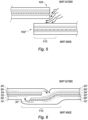
- Fig. 4 precisely shows the overlapping done to form the tube skirt 200, before producing the side seam 210.
- a heating temperature T1 (typically comprised between 125° C and 180° C) is applied on the inner surface of the tube skirt 200, more specifically on the inner layer 10' of the second side edge 102'.
- a heating temperature T2 much lower than the heating temperature T1 (typically below 120° C) is applied on the outer surface of the tube skirt 200, more specifically on the outer layer 20.
- the heating T2 is represented at the Fig. 4 but is not compulsory to manufacture the tube skirt 200.
- a second embodiment represented at Fig.5 instead of applying a heating temperature T2 on the outer surface of the tube skirt 200, it is possible to preheat the overlapping area 110 by blowing hot air (represented by the arrows) into the interstitial space separating the first side edge 102 from the second side edge 102' before they are superimposed.
- the goal is to soften the layers beforehand that are intended to melt during the side welding, in particular the layers oriented toward the outside of the tube skirt 200, in order to obtain a weld with a uniform appearance from the outside of the tube skirt.
- the end result is similar to that of the first embodiment, and corresponds to that shown in Fig. 6 .
- the overlapping region is compressed at both its outer and inner faces in order to help the melting layers mix and adhere to one another so as to produce the side seam 210 of the tube skirt 200.
- the inner layers 10 and 10', the outer layer 20' and the adhesive layers 50' will melt owing to the heating temperature T1.
- the inner layer comprises a plurality of layers, all these layers melt.
- the melting of the different layers in the overlapping region 110 is represented by the dotted lines and by their gradual disappearance at the Fig. 6 .
- the cut edges 33 of the oxide material barrier 32 represent a sensitive region of the laminated material 1 which could lead to layers separation (i.e. delamination) if not protected.
- layers separation i.e. delamination
- This stability of the barrier layer 30, 30' is due to the significantly low ability to flow of the carrier layer 34 (at least lower than the ability to flow of the inner layer 10, 10').
- the PP material from the inner layer here the inner layer 10' of the second side edge 102', flows (under heat and pressure) in direction to the inner layer 10 of the first side edge 102.
- This flow of material from the inner layer 10' is represented by a thick arrow at the Fig. 6 .
- the PP material from the inner layer 10' covers the cut edge 33' of the oxide material barrier 32' and protects it from corrosion by contact with a tube contents.
- the flow of PP material from the inner layer 10' of the side edge 102' bonds the PP material of the inner layer 10 of the side edge 102 of the sheet 100 as the melting layers mix and adhere to one another.
- the sealing of the tube skirt 200 is improved.
- the outer layer 20 of the first side edge 102 flows in direction to the outer layer 20' of the second side edge 102' under heat and pressure). This flow is also represented by an arrow at Fig. 6 . This also improve the sealing of the tube skirt 200.
- oxide material barrier 32 If the carrier layer 34 flows too much under heating, the coating of oxide material barrier 32 will be stretched and said oxide material barrier 32 will be degraded. This would lead to a defective barrier layer 30 and must be avoided.
- said carrier layer 34 and the oxide material barrier 32 do not melt and do not mix with the other layers, thereby making it possible to retain stability in the heated structure.
- Fig. 6 where the deformations of the different layers are shown after producing the side weld.
- the inner layers 10 and 10', the outer layer 20' and the adhesive layers 50' melt owing to the heating temperature T1.
- T1 heating temperature
- the carrier layer 34, 34' as well as the oxide material barrier 32, 32' do not melt or flow as they are represented by continuous lines in all the overlapping region 110.
- carrier layer 34 and the oxide material barrier 32 are not mixed with the other layers and are simply deformed under the action of the compression.
- This stability of the barrier layer 30, 30' is due to the significantly low ability to flow of the carrier layer 34 (at least lower than the ability to flow of the inner layer 10, 10').
- the layers upstream from, downstream from, and between the barrier layers 30, 30' have been mixed and fused.
- the oxide material barrier 32 stays stable, the cut edge 33 is protected and the sealing is improved especially in the overlapping region 110.
- Oxide material barriers are particularly interesting in recyclable laminated materials as they have good barrier properties while having a very low thickness and thus represent a small amount of the laminated material.
- the carrier layer 34 represents most of the thickness of the barrier layer 30 as the oxide material is advantageously a thin layer coated on the carrier layer 34. This small amount of oxide material has no impact on the recycling stream and thus the laminated material can be recycled as a whole, with the barrier layer 30.
- the barrier layer 30 comprising said carrier layer 34 and said oxide material 32 coating has a thickness between 10 and 35 ⁇ m. More preferably, the barrier layer 30 has a thickness between 15 and 25 ⁇ m.
- the oxide material 32 is made of SiOx.
- a thin inorganic layer of silicon oxide is evaporated in a vacuum environment to a PP carrier layer 34 substrate.
- the oxide material 32 is made of AlOx.
- the coating of oxide material 32 has a thickness less than 0.1 ⁇ m.
- the ability to flow of the different layers of the laminated material 1 can be influenced by different features.
- MFI Melt Flow Index
- melt flow rate a measure of the ease of flow of the melt of a thermoplastic polymer. It is defined as the mass of polymer, in grams, flowing in ten minutes through a capillary of a specific diameter and length by a pressure applied via prescribed alternative gravimetric weights for alternative prescribed temperatures. The method is described in the similar standards ASTM D1238 and ISO 1133. Here, the sample has been tested at 230°C and 2.16 kg.
- the inner layer 10 has a higher MFI than the MFI of the carrier layer 34. In such case, in particular when forming the side seam, the inner layer 10 will better flow than the carrier layer 34. This implies the advantages described above.
- the inner layer 10 has a MFI at least equal to 8 g/10mn at 230°C and 2.16 kg according to the ISO 1133 measurement. More advantageously, the inner layer 10 has a MFI comprised between 8 and 10 g/10mn. An inner layer 10 having such MFI presents a good ability to flow. Thus, the covering of the edges of the oxide material barrier is ensured and the sealing of the side seam is improved.
- the carrier layer 34 has a MFI comprised between 0.8 and 8 g/10mn at 230°C and 2.16 kg. More preferably, the carrier layer 34 has a MFI comprised between 2 and 4 g/10mn at 230°C and 2.16 kg. This limits the movement of the carrier layer 34, protects the oxide material barrier and thus ensures a sustainable barrier layer 30.
- MW molecular weight
- Molecular weight is the mass of a molecule. It is calculated as the sum of the relative atomic masses of each constituent element multiplied by the number of atoms of that element in the molecular formula.
- the MW is usually communicated in the data sheet of the products.
- Melt flow index is an indirect measure of molecular weight, with high melt flow index generally corresponding to low molecular weight.
- the inner layer 10 has a lower MW than the MW of the carrier layer 34.
- the inner layer can flow more easily than the carrier layer, which involves the advantages enounced above.
- MWD molecular weight Distribution
- the inner layer 10 has a lower MWD than the MWD of the carrier layer 34.
- the inner layer can flow more easily than the carrier layer, which involves the advantages enounced above.
- the barrier layer 30 is located between the inner layer 10 and the outer layer 20.
- Said inner layer 10 can be composed by a plurality of single layers.
- said outer layer 20 can be composed by a plurality of single layers.
- the number of single layers composing the inner layer 10 and the outer layer 20 is not limited to the example illustrated in the figures.
- the inner layer 10 comprises a core layer 12 sandwiched by two skin layers 14.
- the core layer 12 and the skin layers 14 comprise PP.
- the core layer is made of PP and the skin layers are PP/PE copolymer.
- Said PP/PE copolymer comprises less than 15% in mass of PE.
- the PP/PE copolymer comprises between 6% and 14% in mass of PE.
- PP material represents at least 95% in mass of the laminated material 1.
- the use of a PP/PE copolymer improve the heat sealing properties.
- the outer layer advantageously comprises a core layer 22 sandwiched by two skin layers 24.
- the core layer 22 and the skin layers 24 comprise PP.
- the core layer is made of PP and the skin layers are PP/PE copolymer.
- Said PP/PE copolymer comprises less than 15% in mass of PE.
- the PP/PE copolymer comprises between 6% and 14% in mass of PE.
- PP material represents at least 95% in mass of the laminated material 1.
- the use of a PP/PE copolymer improve the heat sealing properties.
- the inner layer 10 can be made of PP.
- the outer layer 20 can be made of PP.
- the different single PP layers can be cast type films or blown type film.
- the different layers are joined together by lamination process in order to obtain the laminated material.
- Said laminated material can be obtained by different lamination process, as extrusion lamination process or adhesive lamination process.
- the inner layer 10 is made of cast polypropylene (CPP).
- CPP cast polypropylene
- the type of PP used to form CPP layer is particularly advantageous for forming the inner layer 10 as it presents a sensibly high melt flow index and thus a good ability to flow. As exposed above, when the inner layer 10 has a good ability to flow, some excess material is squeezed out from the overlapping region 110 to form a polymer "flow out" region which protects the cut edge 33 of the oxide material barrier 32 from corrosion by contact with a tube contents.
- the carrier layer 34 is made of bi-oriented polypropylene (BOPP).
- BOPP bi-oriented polypropylene
- the type of PP used to form BOPP layer is particularly advantageous for forming the carrier layer 34 as it presents a sensibly low melt flow index and thus a low ability to flow.
- the oxide material barrier 32 stays stable, the cut edge 33 is protected and the sealing is improved especially in the overlapping region.
- BOPP presents a higher resistance to heat than the CPP. Said resistance to heat allows protecting the barrier coating during the lamination process.
- the laminated material 1 comprises an adhesive layer 50 between the barrier layer 30 and the inner layer 10 and/or between the barrier layer 30 and the outer layer 20.
- Said adhesive layer 50 is used to connect the inner layer 10 and barrier layer 30 as well as the outer layer 20 and the barrier layer 30 and to prevent any delamination problems.
- the adhesive layer may be PP based.
- the adhesive layer 50 is polyurethane (PU) based adhesive layer, such that a cross link adhesion is made between the barrier layer 30 and the inner layer 10 and/or between the barrier layer 30 and the outer layer 20. A cross link adhesion results in a better adhesion between the layers and thus prevents the delamination issues.
- PU polyurethane
- the laminated material comprises at least one intermediate layer 40.
- This intermediate layer 40 can be located between the inner layer 10 and the barrier layer 30 and/or between the outer layer 20 and the barrier layer 30.
- the intermediate layer 40 comprises PP.
- said intermediate layer 40 is made of PP.
- said intermediate layer 40 is a CPP layer.
- the total thickness of the laminated material 1 is an important feature as it will influence its mechanical properties.
- the laminated material 1 comprising mostly PP presents better mechanical strength than other comparative structures such as polyethylene (PE) structures.
- the laminated material 1 has an increased stiffness and rebound than other comparative PE structures.
- the rebound is the ability of the material to regain its original shape after that a deforming force being released.
- the advantage of a laminated structure having increased stiffness and rebound is that the target stiffness may be obtained by reducing the thickness and thus saving material.
- the target stiffness/rebound depends on the application, in particular on the type of container formed by the laminated material 1 and the type of product contained therein.
- the total thickness of the laminated material 1 is comprised between 150 and 300 ⁇ m. More advantageously, the total thickness of the laminated material 1 is comprised between 200 and 250 ⁇ m. Such thickness is well adapted for forming flexible tube, in particular toothpaste tube.
- the thickness of the laminated material 1 and the respective thickness of the different layers Another feature that can influence the ability of the different layers to flow is the thickness of the laminated material 1 and the respective thickness of the different layers.
- the inner layer 10 In order to flow, the inner layer 10 require a minimum thickness. If the inner layer 10 is too thin, not enough material will be “available” to flow and the covering of the cut edges 33 of the oxide material barrier 32 won't be achieved.
- the thickness of the inner layer also influences the absorption of some products that will be contained in the container. Some part of the product that will be contained in the container, for example the flavors, can be absorbed by the layers placed between the product and the barrier 32, here the inner layer 10. If the inner layer 10 is too thick, the retention rate will be too high and might lead to a deterioration of said inner layer 10. Thus, there is a need for a compromise between retention rate requiring a low thickness and appropriate flow requiring a high thickness.
- the thickness of the inner layer (10) is comprised between 50 and 120 ⁇ m. More advantageously, the thickness of the inner layer 10 is around 80 ⁇ m.
- the oxide material barrier 32 can be carried by carrier layer 34 on its side facing the inner layer 10.
- the metal oxide barrier 32 of the barrier layer 30 is oriented toward the inner layer 10. This configuration of the barrier layer 30 allows stopping the migration of part of the product that will be contained in the container before it reaches the carrier layer 34 and thus it reduces the absorption rate.
- the laminated material 1 having a substantially symmetrical layering structure from either side of said barrier layer 30.
- the symmetry of the laminated material can influence some physical properties of the laminated material.
- the symmetry improves the roundness of the skirt 200 made thereby.
- the roundness of the tube allows increasing production rates when forming and filling tubes.
- This embodiment is schematically represented at Fig 1 .
- Said embodiment is constituted of:
- the laminated material 1 is obtained from these different layers by adhesive lamination.
- the outer layer 20 has a thickness of 100 ⁇ m.
- the carrier layer 34 and the oxide material barrier 32 represent the barrier layer 30.
- the SiOx barrier 32 has a thickness less than 0.1 ⁇ m.
- Said barrier layer has a thickness of 20 ⁇ m.
- the inner layer 10 has a thickness of 100 ⁇ m.
- the laminated material 1 has a total thickness of 228 ⁇ m.
- the laminated material 1 is obtained from these different layers by extrusion lamination.
- the skin layers 24 and the core layer 22 represent the outer layer 20.
- the skin layers 24 each have a thickness of 10 ⁇ m and the core layer 22 has a thickness of 80 ⁇ m.
- the outer layer 20 has a thickness of 100 ⁇ m.
- the carrier layer 34 and the oxide material barrier 32 represent the barrier layer 30.
- the SiOx barrier 32 has a thickness less than 0.1 ⁇ m.
- Said barrier layer has a thickness of 18 ⁇ m.
- the skin layers 14 and the core layer 12 represent the inner layer 10.
- the skin layers 14 each have a thickness of 10 ⁇ m and the core layer 12 has a thickness of 80 ⁇ m.
- the inner layer 10 has a thickness of 100 ⁇ m.
- the laminated material 1 has a total thickness of 226 ⁇ m.
- This embodiment is schematically represented at Fig. 1 .
- Said embodiment is constituted of:
- the laminated material 1 is obtained from these different layers by extrusion lamination.
- the outer layer 20 has a thickness of 100 ⁇ m.
- the carrier layer 34 and the oxide material barrier 32 represent the barrier layer 30.
- the AlOx barrier 32 has a thickness less than 0.1 ⁇ m.
- Said barrier layer has a thickness of 16 ⁇ m.
- the inner layer 10 has a thickness of 100 ⁇ m.
- the laminated material 1 has a total thickness of 224 ⁇ m.
- This embodiment is schematically represented at figure 2 .
- This embodiment is constituted of:
- the laminated material 1 is obtained from these different layers by extrusion lamination.
- the skin layers 24 and the core layer 22 represent the outer layer 20.
- the skin layers 24 each have a thickness of at most 15 ⁇ m and the core layer 22 has a thickness of 30 to 100 ⁇ m.
- the outer layer 20 has a thickness of 60 to 120 ⁇ m.
- the outer layer 20 has a thickness of 60 to 120 ⁇ m.
- the first and the second intermediate layer 40 have a thickness of 30 ⁇ m.
- the carrier layer 34 and the oxide material barrier 32 represent the barrier layer 30.
- the AlOx barrier 32 has a thickness less than 0.1 ⁇ m.
- Said barrier layer has a thickness of 16 ⁇ m.
- the skin layers 14 and the core layer 12 represent the inner layer 10.
- the skin layers 14 each have a thickness of at most 15 ⁇ m and the core layer 12 has a thickness of 30 to 100 ⁇ m.
- the inner layer 10 has a thickness of 60 to 120 ⁇ m.
- the laminated material 1 has a total thickness of 200 to
- the laminated material 1 is obtained from these different layers by extrusion lamination.
- the skin layers 24 and the core layer 22 represent the outer layer 20.
- the skin layers 24 each have a thickness of at most 15 ⁇ m and the core layer 22 has a thickness of 30 to 100 ⁇ m.
- the outer layer 20 has a thickness of 60 to 120 ⁇ m.
- the first and the second intermediate layer 40 have a thickness of 30 ⁇ m.
- the carrier layer 34 and the oxide material barrier 32 represent the barrier layer 30.
- the AlOx barrier 32 has a thickness less than 0.1 ⁇ m.
- Said barrier layer has a thickness of 16 ⁇ m.
- the inner layer 10 has a thickness of 70 to 120 ⁇ m.
- the laminated material 1 has a total thickness of 200 to 250 ⁇ m.
- the percentage of PP in the laminated material 1 is at least equal to 95% in mass such that the laminated material is recyclable. Furthermore, in all these embodiments, the ability to flow of the inner layer 10 is higher than the ability to flow than the carrier layer 34.
- the ability to flow of the core layer 12 the skin layers 14, the intermediate layers 40 and the adhesive layers 50 is also higher than the ability to flow than the carrier layer 34.
- the present invention relates to a flexible tube skirt 200.
- Said tube skirt 200 is formed by rolling a flat sheet 100 of a laminated material 1 as described above. More particularly, portions of the sheet 100 are folded onto each other in a tubular configuration such that a first side edge 102 of the sheet 100 covers a second side edge 102' of the sheet 100. Then, an upper surface of the outer layer 20' is in facing contact with a lower surface of the inner layer 10. An overlap side seam 210 is formed by means of heating the sheet 100 such that the upper surface of the outer layer 20' is bonded to the lower surface of the inner layer 10.
- Said flexible tube skirt 200 is intended to be fixed to a tube head in order to form a flexible tube.
- the tube head is overmoulded on the skirt.
- Said tube head comprises a shoulder and a neck.
- the skirt is fixed to the shoulder periphery.
- Said tube head is advantageously made of PP but can be made in any other suitable material such as PE.
- the inner layer 10 has a good ability to flow, when the side seam 210 is formed, the inner layer 10 flows and cover the cut edge 33 of the oxide material barrier 32. Thus, the cut edge is protected from the product that will be contained by the tube and the sealing is improved especially in the overlapping region 110. Furthermore, as the carrier layer 34 doesn't flow, or at least not much, when the side seam 210 is formed, the oxide material barrier 32 stays stable and a sustainable protection is ensured. Thus, the sealing of the tube skirt 200 is improved and the time life of a product contained in a tube comprising said tube skirt 200 is extended.
Landscapes
- Physics & Mathematics (AREA)
- Thermal Sciences (AREA)
- Engineering & Computer Science (AREA)
- Mechanical Engineering (AREA)
- Laminated Bodies (AREA)
- Tubes (AREA)
Claims (15)
- Jupe de tube souple (200) formée en roulant une feuille plate (100) d'un matériau stratifié (1) à base de polypropylène (PP) recyclable, ledit matériau stratifié (1) étant réalisé pour former un récipient souple et comprenant une couche interne (10) comprenant du PP, une couche externe (20) comprenant du PP et une couche barrière (30) comprenant une barrière en matériau oxyde (32) et une couche de support (34) revêtue par ladite barrière en matériau oxyde (32), ladite couche de support (34) étant faite de PP, la couche interne (10) ayant une capacité d'écoulement supérieure à celle de la couche de support (34), ladite jupe de tube souple (200) comprenant une couture latérale de chevauchement (210) faite d'un premier bord latéral (102) de la feuille (100) couvrant un second bord latéral (102') de la feuille (100).
- Jupe de tube souple (200) selon la revendication 1, dans laquelle la barrière en matériau oxyde (32) est faite d'AIOx.
- Jupe de tube souple (200) selon la revendication 1, dans laquelle la barrière en matériau oxyde (32) est faite de SiOx.
- Jupe de tube souple (200) selon l'une quelconque des revendications précédentes, dans laquelle la couche interne (10) a un indice de fusion (MFI) plus élevé que le MFI de la couche de support (34).
- Jupe de tube souple (200) selon la revendication 4, dans laquelle la couche interne (10) a un MFI au moins égal à 8 g/10mn à 230°C et 2,16 kg selon la mesure ISO 1133, de préférence compris entre 8 et 10 g/10mn.
- Jupe de tube souple (200) selon la revendication 4 ou 5, dans laquelle la couche de support (34) a un MFI compris entre 0,8 et 8 g/10mn à 230°C et 2,16 kg selon la mesure ISO 1133, de préférence compris entre 2 et 4 g/10mn.
- Jupe de tube souple (200) selon l'une quelconque des revendications précédentes, dans laquelle la couche interne (10) a un poids moléculaire (MW) inférieur au MW de la couche de support (34).
- Jupe de tube souple (200) selon l'une quelconque des revendications précédentes, dans laquelle la couche interne (10) et la couche externe (20) sont faites de PP.
- Jupe de tube souple (200) selon l'une quelconque des revendications précédentes, dans laquelle la couche interne (10) est faite de polypropylène coulé (CPP) et la couche de support (34) est faite de polypropylène bi-orienté (BOPP).
- Jupe de tube souple (200) selon l'une quelconque des revendications précédentes, comprenant une couche adhésive (50) entre la couche barrière (30) et la couche interne (10) et/ou entre la couche barrière (30) et la couche externe (20).
- Jupe de tube souple (200) selon la revendication 10, dans laquelle la couche adhésive (50) est une couche adhésive à base de polyuréthane (PU), de sorte qu'une adhésion par réticulation est réalisée entre la couche barrière (30) et la couche interne (10) et/ou entre la couche barrière (30) et la couche externe (20).
- Jupe de tube souple (200) selon l'une quelconque des revendications précédentes, dans laquelle l'épaisseur totale du matériau stratifié (1) est comprise entre 200 et 250 µm et l'épaisseur de la couche interne (10) est comprise entre 50 et 120 µm.
- Jupe de tube souple (200) selon l'une quelconque des revendications précédentes, dans laquelle la barrière en matériau oxyde (32) est orientée vers la couche interne (10).
- Jupe de tube souple (200) selon l'une quelconque des revendications précédentes, ledit matériau stratifié (1) ayant une structure de stratification sensiblement symétrique depuis chaque côté de ladite couche barrière (30).
- Tube souple formé par une jupe de tube souple (200) telle que décrite dans les revendications précédentes et fixée à une tête de tube.
Priority Applications (5)
| Application Number | Priority Date | Filing Date | Title |
|---|---|---|---|
| PL19165660.2T PL3715105T3 (pl) | 2019-03-27 | 2019-03-27 | Laminowany materiał do formowania elastycznego pojemnika i elastycznej osłony tuby zawierającej wspomniany laminowany materiał |
| EP19165660.2A EP3715105B1 (fr) | 2019-03-27 | 2019-03-27 | Matériau stratifié pour former un récipient souple et jupe de tube flexible comprenant ledit matériau stratifié |
| US17/608,135 US20220212453A1 (en) | 2019-03-27 | 2020-03-24 | Laminated material for forming a flexible container and flexible tube skirt comprising said laminated material |
| PCT/EP2020/058185 WO2020193562A1 (fr) | 2019-03-27 | 2020-03-24 | Matériau stratifié pour former un récipient souple et jupe de tube souple comprenant ledit matériau stratifié |
| CN202080032205.1A CN113748016B (zh) | 2019-03-27 | 2020-03-24 | 用于形成挠性容器的层压材料和包括所述层压材料的挠性管裙 |
Applications Claiming Priority (1)
| Application Number | Priority Date | Filing Date | Title |
|---|---|---|---|
| EP19165660.2A EP3715105B1 (fr) | 2019-03-27 | 2019-03-27 | Matériau stratifié pour former un récipient souple et jupe de tube flexible comprenant ledit matériau stratifié |
Publications (2)
| Publication Number | Publication Date |
|---|---|
| EP3715105A1 EP3715105A1 (fr) | 2020-09-30 |
| EP3715105B1 true EP3715105B1 (fr) | 2023-04-05 |
Family
ID=65995618
Family Applications (1)
| Application Number | Title | Priority Date | Filing Date |
|---|---|---|---|
| EP19165660.2A Active EP3715105B1 (fr) | 2019-03-27 | 2019-03-27 | Matériau stratifié pour former un récipient souple et jupe de tube flexible comprenant ledit matériau stratifié |
Country Status (5)
| Country | Link |
|---|---|
| US (1) | US20220212453A1 (fr) |
| EP (1) | EP3715105B1 (fr) |
| CN (1) | CN113748016B (fr) |
| PL (1) | PL3715105T3 (fr) |
| WO (1) | WO2020193562A1 (fr) |
Families Citing this family (4)
| Publication number | Priority date | Publication date | Assignee | Title |
|---|---|---|---|---|
| CN117545631A (zh) * | 2021-07-02 | 2024-02-09 | 凸版印刷株式会社 | 层压管用层叠体以及层压管 |
| WO2024043840A1 (fr) * | 2022-08-25 | 2024-02-29 | Kim Pack Co., Ltd. | Bande coulée pour récipient tubulaire souple avec couture latérale longitudinale |
| EP4406736A1 (fr) * | 2023-01-25 | 2024-07-31 | Albea Services | Récipient tubulaire flexible |
| EP4480694A1 (fr) * | 2023-06-23 | 2024-12-25 | Huhtamaki Flexible Packaging Germany GmbH & Co. KG | Stratifié tubulaire comprenant exactement un film préfabriqué et des couches polymères appliquées sur les deux faces |
Family Cites Families (30)
| Publication number | Priority date | Publication date | Assignee | Title |
|---|---|---|---|---|
| JPS57147528A (en) * | 1981-03-06 | 1982-09-11 | Tokuyama Soda Co Ltd | Preparation of modified polypropylene film |
| DE4128820C2 (de) * | 1991-08-30 | 2001-04-12 | Hoechst Trespaphan Gmbh | Verbundfolie mit guter Sauerstoffbarriere |
| EP0972634A3 (fr) * | 1998-07-14 | 2000-06-28 | Sumitomo Bakelite Co., Ltd. | Laminé, récipient multicouche et récipient fermé hermétiquement |
| JP2000211627A (ja) * | 1999-01-26 | 2000-08-02 | Toppan Printing Co Ltd | レトルト殺菌処理可能な紙容器 |
| CA2378399A1 (fr) * | 1999-07-23 | 2001-02-01 | Yves Trouilhet | Copolymere d'acide ethylene avec adhesion renforcee |
| FR2807057A1 (fr) * | 2000-03-30 | 2001-10-05 | Atofina | Liants de coextrusion a base de polypropylene greffe et leur utilisation pour des structures metalloplastiques pelables |
| CN1441722A (zh) * | 2000-07-18 | 2003-09-10 | 昭和电工塑料产品株式会社 | 层合膜及其包装产品 |
| DE60237501D1 (de) * | 2001-06-20 | 2010-10-14 | Dainippon Printing Co Ltd | Batterieverpackungsmaterial |
| EP1423276A1 (fr) * | 2001-08-30 | 2004-06-02 | Toray Plastics (America), Inc. | Film en polyolefine a particules poreuses resistant aux huiles |
| ZA200510281B (en) * | 2003-07-18 | 2007-03-28 | Tetra Laval Holdings & Finance | Plastic gas barrier packaging laminate |
| US20050037162A1 (en) * | 2003-08-11 | 2005-02-17 | Adams John Peter | Paperboard laminate for food packaging applications |
| KR200355576Y1 (ko) * | 2003-10-14 | 2004-07-07 | 가부시키가이샤 호소카와 요코 | 향이 있는 라미네이트 |
| DE602005002449T2 (de) * | 2005-02-18 | 2008-06-12 | Vibac S.P.A., Ticineto | Klebeband hergestellt durch eine Heissschmelztechnik und welches eine opake BOPP Rückschicht enthält |
| CN101663627B (zh) * | 2007-04-20 | 2015-08-19 | 费希尔控制产品国际有限公司 | 用于气体调节器的改进流动阀口 |
| WO2010058988A2 (fr) * | 2008-11-19 | 2010-05-27 | 주식회사 엘지화학 | Substrat en plastique stratifié et son procédé de production |
| DE102009003225A1 (de) * | 2009-05-19 | 2010-11-25 | Evonik Degussa Gmbh | Transparente, witterungsbeständige Barrierefolie, Herstellung durch Lamination, Extrusionslamination oder Extrusionsbeschichtung |
| US8431651B2 (en) * | 2009-07-14 | 2013-04-30 | Dow Global Technologies Llc | Vacuum thermoformed, extruded sheeting with improved reduced gloss |
| WO2011010291A1 (fr) * | 2009-07-24 | 2011-01-27 | Ticona Llc | Compositions de polymère thermoconductrices et articles fabriqués à partir de celles-ci |
| EP2466030A1 (fr) * | 2010-12-17 | 2012-06-20 | Sika Technology AG | Utilisation de feuilles d'étanchéité en polyoléfine revêtues de matière collante thermofusible non réactive et destinées à l'étanchéification |
| WO2015061980A1 (fr) * | 2013-10-30 | 2015-05-07 | Colgate-Palmolive Company | Emballage et matériau pour sa fabrication |
| PL2949465T3 (pl) * | 2014-05-30 | 2021-07-19 | Albéa Services | Mocno dekorowana tubka, szczególnie mocno dekorowana tubka z laminatu |
| CN107000405A (zh) * | 2014-07-16 | 2017-08-01 | 阿舍·维特纳 | 聚合物‑玻璃‑聚合物气体阻挡层压体 |
| AT516778A1 (de) * | 2015-01-29 | 2016-08-15 | Constantia Hueck Folien Gmbh & Co Kg | Folienlaminat mit Siegelschicht |
| CN106660342B (zh) * | 2015-05-29 | 2019-05-07 | 爱索尔包装有限公司 | 柔软和丝绒触感的阻挡层压体 |
| CN107848661A (zh) * | 2015-07-13 | 2018-03-27 | 凸版印刷株式会社 | 包装容器 |
| JP6753055B2 (ja) * | 2015-12-01 | 2020-09-09 | 凸版印刷株式会社 | 積層樹脂フィルム |
| EP3397480B1 (fr) * | 2015-12-28 | 2025-07-16 | SIG Services AG | Composite liquide, en particulier, pour conteneurs alimentaires dimensionnement stables, ayant une couche intermediaire polymerique caracterisee par calorimetrie differentielle de balayage |
| ES2632977B1 (es) * | 2016-03-15 | 2018-06-26 | Ctl-Th Packaging, S.L. Unipersonal | Envase tubular con un tubo exterior y un contenedor interior |
| DE102017201449A1 (de) * | 2017-01-30 | 2018-08-02 | Sig Technology Ag | Flächenförmiger Verbund zum Herstellen formstabiler Nahrungsmittelbehälter mit einer Barriereschicht, die eine Barrieresubstratschicht und eine nach innen weisende Barrierematerialschicht aufweist |
| DE102017212142A1 (de) * | 2017-07-14 | 2019-01-17 | Sig Technology Ag | Flächenförmiger Verbund, insbesondere zum Herstellen formstabiler Nahrungsmittelbehälter, beinhaltend eine Polymerschicht P mit einem L-Wert |
-
2019
- 2019-03-27 EP EP19165660.2A patent/EP3715105B1/fr active Active
- 2019-03-27 PL PL19165660.2T patent/PL3715105T3/pl unknown
-
2020
- 2020-03-24 WO PCT/EP2020/058185 patent/WO2020193562A1/fr not_active Ceased
- 2020-03-24 US US17/608,135 patent/US20220212453A1/en active Pending
- 2020-03-24 CN CN202080032205.1A patent/CN113748016B/zh active Active
Also Published As
| Publication number | Publication date |
|---|---|
| CN113748016B (zh) | 2023-06-02 |
| EP3715105A1 (fr) | 2020-09-30 |
| WO2020193562A1 (fr) | 2020-10-01 |
| US20220212453A1 (en) | 2022-07-07 |
| PL3715105T3 (pl) | 2023-07-31 |
| CN113748016A (zh) | 2021-12-03 |
Similar Documents
| Publication | Publication Date | Title |
|---|---|---|
| EP3715105B1 (fr) | Matériau stratifié pour former un récipient souple et jupe de tube flexible comprenant ledit matériau stratifié | |
| US20060046006A1 (en) | Multilayer polymeric barrier film, flexible packaging made therewith, and methods | |
| FI96399C (fi) | Polymeeri/metalli/polymeerilaminaatti ja menetelmä sen valmistamiseksi | |
| FI96400B (fi) | Laminoitu metallilevy | |
| TWI801583B (zh) | 噴口袋及製造其之方法 | |
| EP3356253B1 (fr) | Récipient souple comprenant un bec verseur extensible | |
| JPWO2017002753A1 (ja) | 積層体、包装袋、口栓付包装袋および水素水入り口栓付包装袋 | |
| JP2001502261A (ja) | Rfシール可能な枕形ポーチ | |
| EP2804753A1 (fr) | Film multicouche pour une jupe d'un tube flexible et tube flexible associé | |
| WO2021053043A1 (fr) | Tube comprenant une tête de tube et une jupe de tube constituée d'un matériau stratifié comprenant une pluralité de couches de papier | |
| JP7535883B2 (ja) | 複合フィルム、包装袋、蓋材、蓋付き容器、及び複合フィルムの製造方法 | |
| US20060165927A1 (en) | Retort pouches | |
| WO2024156576A1 (fr) | Contenant de tube flexible | |
| EP2588318B1 (fr) | Film d'emballage souple comprenant du polyamide et de la polyoléfine | |
| EP4420876A1 (fr) | Stratifié d'emballage à haute barrière présentant une meilleure aptitude à l'usinage | |
| JP7316819B2 (ja) | 包装材料および包装体 | |
| EP3482928B1 (fr) | Matériau stratifié pour former un récipient souple, ensemble comprenant ledit matériau stratifié et tête de tube, et récipient souple comprenant ledit ensemble et capuchon | |
| EP4606726A1 (fr) | Récipient tubulaire flexible | |
| EP4601872B1 (fr) | Stratifié d'emballage multicouche recyclable avec revêtement barrière | |
| EP4590510A1 (fr) | Stratifié d'emballage multicouche recyclable avec revêtement barrière | |
| JP5981267B2 (ja) | ラミネートチューブの製造方法 | |
| WO2026089739A1 (fr) | Films d'emballage haute barrière recyclables | |
| WO2026082583A1 (fr) | Revêtement multicouche recyclable | |
| JP2026068296A (ja) | シーラントフィルム及び包装フィルム |
Legal Events
| Date | Code | Title | Description |
|---|---|---|---|
| PUAI | Public reference made under article 153(3) epc to a published international application that has entered the european phase |
Free format text: ORIGINAL CODE: 0009012 |
|
| STAA | Information on the status of an ep patent application or granted ep patent |
Free format text: STATUS: THE APPLICATION HAS BEEN PUBLISHED |
|
| AK | Designated contracting states |
Kind code of ref document: A1 Designated state(s): AL AT BE BG CH CY CZ DE DK EE ES FI FR GB GR HR HU IE IS IT LI LT LU LV MC MK MT NL NO PL PT RO RS SE SI SK SM TR |
|
| AX | Request for extension of the european patent |
Extension state: BA ME |
|
| STAA | Information on the status of an ep patent application or granted ep patent |
Free format text: STATUS: REQUEST FOR EXAMINATION WAS MADE |
|
| 17P | Request for examination filed |
Effective date: 20210401 |
|
| RBV | Designated contracting states (corrected) |
Designated state(s): AL AT BE BG CH CY CZ DE DK EE ES FI FR GB GR HR HU IE IS IT LI LT LU LV MC MK MT NL NO PL PT RO RS SE SI SK SM TR |
|
| GRAP | Despatch of communication of intention to grant a patent |
Free format text: ORIGINAL CODE: EPIDOSNIGR1 |
|
| STAA | Information on the status of an ep patent application or granted ep patent |
Free format text: STATUS: GRANT OF PATENT IS INTENDED |
|
| INTG | Intention to grant announced |
Effective date: 20221021 |
|
| GRAS | Grant fee paid |
Free format text: ORIGINAL CODE: EPIDOSNIGR3 |
|
| GRAA | (expected) grant |
Free format text: ORIGINAL CODE: 0009210 |
|
| STAA | Information on the status of an ep patent application or granted ep patent |
Free format text: STATUS: THE PATENT HAS BEEN GRANTED |
|
| AK | Designated contracting states |
Kind code of ref document: B1 Designated state(s): AL AT BE BG CH CY CZ DE DK EE ES FI FR GB GR HR HU IE IS IT LI LT LU LV MC MK MT NL NO PL PT RO RS SE SI SK SM TR |
|
| REG | Reference to a national code |
Ref country code: GB Ref legal event code: FG4D |
|
| REG | Reference to a national code |
Ref country code: DE Ref legal event code: R096 Ref document number: 602019027087 Country of ref document: DE |
|
| REG | Reference to a national code |
Ref country code: CH Ref legal event code: EP |
|
| REG | Reference to a national code |
Ref country code: AT Ref legal event code: REF Ref document number: 1557927 Country of ref document: AT Kind code of ref document: T Effective date: 20230415 |
|
| REG | Reference to a national code |
Ref country code: IE Ref legal event code: FG4D |
|
| P01 | Opt-out of the competence of the unified patent court (upc) registered |
Effective date: 20230517 |
|
| REG | Reference to a national code |
Ref country code: LT Ref legal event code: MG9D |
|
| REG | Reference to a national code |
Ref country code: NL Ref legal event code: MP Effective date: 20230405 |
|
| REG | Reference to a national code |
Ref country code: AT Ref legal event code: MK05 Ref document number: 1557927 Country of ref document: AT Kind code of ref document: T Effective date: 20230405 |
|
| PG25 | Lapsed in a contracting state [announced via postgrant information from national office to epo] |
Ref country code: NL Free format text: LAPSE BECAUSE OF FAILURE TO SUBMIT A TRANSLATION OF THE DESCRIPTION OR TO PAY THE FEE WITHIN THE PRESCRIBED TIME-LIMIT Effective date: 20230405 |
|
| PG25 | Lapsed in a contracting state [announced via postgrant information from national office to epo] |
Ref country code: SE Free format text: LAPSE BECAUSE OF FAILURE TO SUBMIT A TRANSLATION OF THE DESCRIPTION OR TO PAY THE FEE WITHIN THE PRESCRIBED TIME-LIMIT Effective date: 20230405 Ref country code: PT Free format text: LAPSE BECAUSE OF FAILURE TO SUBMIT A TRANSLATION OF THE DESCRIPTION OR TO PAY THE FEE WITHIN THE PRESCRIBED TIME-LIMIT Effective date: 20230807 Ref country code: NO Free format text: LAPSE BECAUSE OF FAILURE TO SUBMIT A TRANSLATION OF THE DESCRIPTION OR TO PAY THE FEE WITHIN THE PRESCRIBED TIME-LIMIT Effective date: 20230705 Ref country code: ES Free format text: LAPSE BECAUSE OF FAILURE TO SUBMIT A TRANSLATION OF THE DESCRIPTION OR TO PAY THE FEE WITHIN THE PRESCRIBED TIME-LIMIT Effective date: 20230405 Ref country code: AT Free format text: LAPSE BECAUSE OF FAILURE TO SUBMIT A TRANSLATION OF THE DESCRIPTION OR TO PAY THE FEE WITHIN THE PRESCRIBED TIME-LIMIT Effective date: 20230405 |
|
| PG25 | Lapsed in a contracting state [announced via postgrant information from national office to epo] |
Ref country code: RS Free format text: LAPSE BECAUSE OF FAILURE TO SUBMIT A TRANSLATION OF THE DESCRIPTION OR TO PAY THE FEE WITHIN THE PRESCRIBED TIME-LIMIT Effective date: 20230405 Ref country code: LV Free format text: LAPSE BECAUSE OF FAILURE TO SUBMIT A TRANSLATION OF THE DESCRIPTION OR TO PAY THE FEE WITHIN THE PRESCRIBED TIME-LIMIT Effective date: 20230405 Ref country code: LT Free format text: LAPSE BECAUSE OF FAILURE TO SUBMIT A TRANSLATION OF THE DESCRIPTION OR TO PAY THE FEE WITHIN THE PRESCRIBED TIME-LIMIT Effective date: 20230405 Ref country code: IS Free format text: LAPSE BECAUSE OF FAILURE TO SUBMIT A TRANSLATION OF THE DESCRIPTION OR TO PAY THE FEE WITHIN THE PRESCRIBED TIME-LIMIT Effective date: 20230805 Ref country code: HR Free format text: LAPSE BECAUSE OF FAILURE TO SUBMIT A TRANSLATION OF THE DESCRIPTION OR TO PAY THE FEE WITHIN THE PRESCRIBED TIME-LIMIT Effective date: 20230405 Ref country code: GR Free format text: LAPSE BECAUSE OF FAILURE TO SUBMIT A TRANSLATION OF THE DESCRIPTION OR TO PAY THE FEE WITHIN THE PRESCRIBED TIME-LIMIT Effective date: 20230706 Ref country code: AL Free format text: LAPSE BECAUSE OF FAILURE TO SUBMIT A TRANSLATION OF THE DESCRIPTION OR TO PAY THE FEE WITHIN THE PRESCRIBED TIME-LIMIT Effective date: 20230405 |
|
| PG25 | Lapsed in a contracting state [announced via postgrant information from national office to epo] |
Ref country code: FI Free format text: LAPSE BECAUSE OF FAILURE TO SUBMIT A TRANSLATION OF THE DESCRIPTION OR TO PAY THE FEE WITHIN THE PRESCRIBED TIME-LIMIT Effective date: 20230405 |
|
| REG | Reference to a national code |
Ref country code: DE Ref legal event code: R097 Ref document number: 602019027087 Country of ref document: DE |
|
| PG25 | Lapsed in a contracting state [announced via postgrant information from national office to epo] |
Ref country code: SK Free format text: LAPSE BECAUSE OF FAILURE TO SUBMIT A TRANSLATION OF THE DESCRIPTION OR TO PAY THE FEE WITHIN THE PRESCRIBED TIME-LIMIT Effective date: 20230405 |
|
| PG25 | Lapsed in a contracting state [announced via postgrant information from national office to epo] |
Ref country code: SM Free format text: LAPSE BECAUSE OF FAILURE TO SUBMIT A TRANSLATION OF THE DESCRIPTION OR TO PAY THE FEE WITHIN THE PRESCRIBED TIME-LIMIT Effective date: 20230405 Ref country code: SK Free format text: LAPSE BECAUSE OF FAILURE TO SUBMIT A TRANSLATION OF THE DESCRIPTION OR TO PAY THE FEE WITHIN THE PRESCRIBED TIME-LIMIT Effective date: 20230405 Ref country code: RO Free format text: LAPSE BECAUSE OF FAILURE TO SUBMIT A TRANSLATION OF THE DESCRIPTION OR TO PAY THE FEE WITHIN THE PRESCRIBED TIME-LIMIT Effective date: 20230405 Ref country code: EE Free format text: LAPSE BECAUSE OF FAILURE TO SUBMIT A TRANSLATION OF THE DESCRIPTION OR TO PAY THE FEE WITHIN THE PRESCRIBED TIME-LIMIT Effective date: 20230405 Ref country code: DK Free format text: LAPSE BECAUSE OF FAILURE TO SUBMIT A TRANSLATION OF THE DESCRIPTION OR TO PAY THE FEE WITHIN THE PRESCRIBED TIME-LIMIT Effective date: 20230405 Ref country code: CZ Free format text: LAPSE BECAUSE OF FAILURE TO SUBMIT A TRANSLATION OF THE DESCRIPTION OR TO PAY THE FEE WITHIN THE PRESCRIBED TIME-LIMIT Effective date: 20230405 |
|
| PLBE | No opposition filed within time limit |
Free format text: ORIGINAL CODE: 0009261 |
|
| STAA | Information on the status of an ep patent application or granted ep patent |
Free format text: STATUS: NO OPPOSITION FILED WITHIN TIME LIMIT |
|
| 26N | No opposition filed |
Effective date: 20240108 |
|
| PG25 | Lapsed in a contracting state [announced via postgrant information from national office to epo] |
Ref country code: SI Free format text: LAPSE BECAUSE OF FAILURE TO SUBMIT A TRANSLATION OF THE DESCRIPTION OR TO PAY THE FEE WITHIN THE PRESCRIBED TIME-LIMIT Effective date: 20230405 |
|
| PG25 | Lapsed in a contracting state [announced via postgrant information from national office to epo] |
Ref country code: SI Free format text: LAPSE BECAUSE OF FAILURE TO SUBMIT A TRANSLATION OF THE DESCRIPTION OR TO PAY THE FEE WITHIN THE PRESCRIBED TIME-LIMIT Effective date: 20230405 |
|
| REG | Reference to a national code |
Ref country code: CH Ref legal event code: PL |
|
| PG25 | Lapsed in a contracting state [announced via postgrant information from national office to epo] |
Ref country code: BG Free format text: LAPSE BECAUSE OF FAILURE TO SUBMIT A TRANSLATION OF THE DESCRIPTION OR TO PAY THE FEE WITHIN THE PRESCRIBED TIME-LIMIT Effective date: 20230405 |
|
| PG25 | Lapsed in a contracting state [announced via postgrant information from national office to epo] |
Ref country code: LU Free format text: LAPSE BECAUSE OF NON-PAYMENT OF DUE FEES Effective date: 20240327 |
|
| PG25 | Lapsed in a contracting state [announced via postgrant information from national office to epo] |
Ref country code: MC Free format text: LAPSE BECAUSE OF FAILURE TO SUBMIT A TRANSLATION OF THE DESCRIPTION OR TO PAY THE FEE WITHIN THE PRESCRIBED TIME-LIMIT Effective date: 20230405 |
|
| GBPC | Gb: european patent ceased through non-payment of renewal fee |
Effective date: 20240327 |
|
| PG25 | Lapsed in a contracting state [announced via postgrant information from national office to epo] |
Ref country code: MC Free format text: LAPSE BECAUSE OF FAILURE TO SUBMIT A TRANSLATION OF THE DESCRIPTION OR TO PAY THE FEE WITHIN THE PRESCRIBED TIME-LIMIT Effective date: 20230405 Ref country code: LU Free format text: LAPSE BECAUSE OF NON-PAYMENT OF DUE FEES Effective date: 20240327 Ref country code: BG Free format text: LAPSE BECAUSE OF FAILURE TO SUBMIT A TRANSLATION OF THE DESCRIPTION OR TO PAY THE FEE WITHIN THE PRESCRIBED TIME-LIMIT Effective date: 20230405 |
|
| REG | Reference to a national code |
Ref country code: BE Ref legal event code: MM Effective date: 20240331 |
|
| PG25 | Lapsed in a contracting state [announced via postgrant information from national office to epo] |
Ref country code: BE Free format text: LAPSE BECAUSE OF NON-PAYMENT OF DUE FEES Effective date: 20240331 |
|
| PG25 | Lapsed in a contracting state [announced via postgrant information from national office to epo] |
Ref country code: GB Free format text: LAPSE BECAUSE OF NON-PAYMENT OF DUE FEES Effective date: 20240327 |
|
| PG25 | Lapsed in a contracting state [announced via postgrant information from national office to epo] |
Ref country code: IE Free format text: LAPSE BECAUSE OF NON-PAYMENT OF DUE FEES Effective date: 20240327 |
|
| PG25 | Lapsed in a contracting state [announced via postgrant information from national office to epo] |
Ref country code: IE Free format text: LAPSE BECAUSE OF NON-PAYMENT OF DUE FEES Effective date: 20240327 Ref country code: GB Free format text: LAPSE BECAUSE OF NON-PAYMENT OF DUE FEES Effective date: 20240327 Ref country code: BE Free format text: LAPSE BECAUSE OF NON-PAYMENT OF DUE FEES Effective date: 20240331 Ref country code: CH Free format text: LAPSE BECAUSE OF NON-PAYMENT OF DUE FEES Effective date: 20240331 |
|
| PG25 | Lapsed in a contracting state [announced via postgrant information from national office to epo] |
Ref country code: CY Free format text: LAPSE BECAUSE OF FAILURE TO SUBMIT A TRANSLATION OF THE DESCRIPTION OR TO PAY THE FEE WITHIN THE PRESCRIBED TIME-LIMIT; INVALID AB INITIO Effective date: 20190327 |
|
| PG25 | Lapsed in a contracting state [announced via postgrant information from national office to epo] |
Ref country code: HU Free format text: LAPSE BECAUSE OF FAILURE TO SUBMIT A TRANSLATION OF THE DESCRIPTION OR TO PAY THE FEE WITHIN THE PRESCRIBED TIME-LIMIT; INVALID AB INITIO Effective date: 20190327 |
|
| PG25 | Lapsed in a contracting state [announced via postgrant information from national office to epo] |
Ref country code: TR Free format text: LAPSE BECAUSE OF FAILURE TO SUBMIT A TRANSLATION OF THE DESCRIPTION OR TO PAY THE FEE WITHIN THE PRESCRIBED TIME-LIMIT Effective date: 20230405 |
|
| PGFP | Annual fee paid to national office [announced via postgrant information from national office to epo] |
Ref country code: DE Payment date: 20260313 Year of fee payment: 8 |
|
| PGFP | Annual fee paid to national office [announced via postgrant information from national office to epo] |
Ref country code: IT Payment date: 20260309 Year of fee payment: 8 |
|
| PGFP | Annual fee paid to national office [announced via postgrant information from national office to epo] |
Ref country code: FR Payment date: 20260330 Year of fee payment: 8 |
|
| PGFP | Annual fee paid to national office [announced via postgrant information from national office to epo] |
Ref country code: PL Payment date: 20260223 Year of fee payment: 8 |